US331663A - Edwaed p - Google Patents
Edwaed p Download PDFInfo
- Publication number
- US331663A US331663A US331663DA US331663A US 331663 A US331663 A US 331663A US 331663D A US331663D A US 331663DA US 331663 A US331663 A US 331663A
- Authority
- US
- United States
- Prior art keywords
- filaments
- block
- thread
- wound
- carbon
- Prior art date
- Legal status (The legal status is an assumption and is not a legal conclusion. Google has not performed a legal analysis and makes no representation as to the accuracy of the status listed.)
- Expired - Lifetime
Links
- OKTJSMMVPCPJKN-UHFFFAOYSA-N Carbon Chemical compound [C] OKTJSMMVPCPJKN-UHFFFAOYSA-N 0.000 description 14
- 229910052799 carbon Inorganic materials 0.000 description 14
- 238000000034 method Methods 0.000 description 14
- 238000004804 winding Methods 0.000 description 8
- 239000000835 fiber Substances 0.000 description 6
- 238000003763 carbonization Methods 0.000 description 5
- 238000010000 carbonizing Methods 0.000 description 5
- 235000017166 Bambusa arundinacea Nutrition 0.000 description 4
- 235000017491 Bambusa tulda Nutrition 0.000 description 4
- 241001330002 Bambuseae Species 0.000 description 4
- 235000015334 Phyllostachys viridis Nutrition 0.000 description 4
- 239000011425 bamboo Substances 0.000 description 4
- 239000002023 wood Substances 0.000 description 4
- 230000000717 retained effect Effects 0.000 description 3
- XEEYBQQBJWHFJM-UHFFFAOYSA-N Iron Chemical compound [Fe] XEEYBQQBJWHFJM-UHFFFAOYSA-N 0.000 description 2
- PXHVJJICTQNCMI-UHFFFAOYSA-N Nickel Chemical compound [Ni] PXHVJJICTQNCMI-UHFFFAOYSA-N 0.000 description 2
- 239000000463 material Substances 0.000 description 2
- 230000004048 modification Effects 0.000 description 2
- 238000012986 modification Methods 0.000 description 2
- 229920000742 Cotton Polymers 0.000 description 1
- 239000000571 coke Substances 0.000 description 1
- 238000010276 construction Methods 0.000 description 1
- 230000008602 contraction Effects 0.000 description 1
- 229910052571 earthenware Inorganic materials 0.000 description 1
- 229910052742 iron Inorganic materials 0.000 description 1
- 229910052759 nickel Inorganic materials 0.000 description 1
- 238000002360 preparation method Methods 0.000 description 1
- 238000009877 rendering Methods 0.000 description 1
- 239000000126 substance Substances 0.000 description 1
Images
Classifications
-
- D—TEXTILES; PAPER
- D01—NATURAL OR MAN-MADE THREADS OR FIBRES; SPINNING
- D01F—CHEMICAL FEATURES IN THE MANUFACTURE OF ARTIFICIAL FILAMENTS, THREADS, FIBRES, BRISTLES OR RIBBONS; APPARATUS SPECIALLY ADAPTED FOR THE MANUFACTURE OF CARBON FILAMENTS
- D01F9/00—Artificial filaments or the like of other substances; Manufacture thereof; Apparatus specially adapted for the manufacture of carbon filaments
- D01F9/08—Artificial filaments or the like of other substances; Manufacture thereof; Apparatus specially adapted for the manufacture of carbon filaments of inorganic material
- D01F9/12—Carbon filaments; Apparatus specially adapted for the manufacture thereof
- D01F9/14—Carbon filaments; Apparatus specially adapted for the manufacture thereof by decomposition of organic filaments
- D01F9/145—Carbon filaments; Apparatus specially adapted for the manufacture thereof by decomposition of organic filaments from pitch or distillation residues
Definitions
- My invention relates to the methods or processes of preparing incandescing filaments for electric lamps by carbonization.
- the object of my invention is to provide means for preparing a large number of ⁇ lilaments for carbonization at the same time, for subjecting them by a single operation to the carbonizing process,and for insuring that they shall all be of the same size, form, and perfectness.
- the invention relates to the supporting of the carbonizable filament upon a formingblock, to Winding about the said lament a ligature at right angles thereto, and to cutting said filament at one or more points before carbonization.
- a block of carbon as a support for the filaments, and upon this block, if the filaments are to be formed from parchmentized threads, I wind the same helically.
- the form of the block is such that when the filament is Wound upon it it will be bent into the form of loops, which have the shape which it is desired shall be retained by the carbonized filaments, and the thread, after being wound upon the block, is retained in positionby means of string Wound transversely across the same.
- the filaments are preferably covered with pulverized carbon or coke, and placed in a Crucible, which is preferably of earthenware,but may be of iron or nickel, and t-he entire number of filaments are at the same time subjected to heat in the usual manner.
- a Crucible which is preferably of earthenware,but may be of iron or nickel, and t-he entire number of filaments are at the same time subjected to heat in the usual manner.
- the block upon which the iilaments are Wound is preferably of carbon, but it may be of Wood, in which case the shrinkage of the Wood itself Will in some degree compensate for the shrinkage of the iilaments, and in such case it may not be necessary to cut the filaments themselves until after they are carbonized.
- each complete convolution formed upon thesame will produce two carbonized filaments, so that by cutting the same upon the opposite sides of the center of the block two loops will be formed having their ends confronting each other.
- the carbonized lament should have a greater diameter at the loop than at the ends, and for this purpose it will be desirable to construct the double form of supporting-block of less 9i thickness through its center than near its edges.
- suitable blocks capable of taking up as much of the parchmentized thread as will be necessary to allow it to be pressed into the hollow spaces, are laid upon 1 the sides of the block while the thread is'being wound. These blocks are then'removed, and the subsequent winding of the supportingstrings presses the thread downward into the hollow spaces, and tting it tightly against the surface of the forming-block.
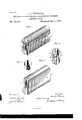
- Figure l is a perspective view ofaforming-block illustrating the method of supporting the threads or filaments which are to be carbonized.
- Figs. 2 and 3 illustrate certain modifications in the construction of the forming blocks.
- Fig 4 illustrates the method of applying bamboo fibers or strips.
- A represents a block or plate of carbon, upon which is wound a thread or a parchmentized fiber, B.
- This thread is wound helically from the end a to the end a2, and each convolution of the same affords two bent loops, b and b2.
- a string of cotton or other suitable material, C is Wound lengthwise upon the plate A, and this string holds the separate convolutions in position.
- the two ends of the filament B may be held in position during the winding of the string C by small pieces of wax e, or by other suitable means.
- each convolution of the thread When the string has been applied, each convolution of the thread will be securely held in position, and they are then cut apart along the center line ofthe carbon plate, as shown at f. There will then be formed two loops, g and y, from each convolution of the thread. By cutting the ends of the laments, as described, the shrinkage of the same will be permitted without rendering them liable to break and without lessening their strength.
- the plate or block of carbon is placed in the Crucible, which preferably is packed with pulverized carbon, and the cover of which is luted on. It is then subjected to heat, and the subsequent process is essentially the same as that usually adopted in carbonizing filaments.
- the string will be reduced to carbon during the process; but it will retain sufficient tensile strength to hold the separate loops in position until the carbonization has been effected to such a degree that they will themselves retain their forms and positions.
- the ends of the filaments may be formed upon single blocks or plates, as shown at B in Fig. 2, the thread being wound upon the same and held in position in essentially the same manner as described with reference to Fig. l. i
- the form of filament illustrated in Fig. 2 may, it is evident, be variously modified by changing the shape of the forming-block.
- Fig. 3 a modification is illustrated whereis applied to this block it shall be pressed A downward to conform to the hollow surfaces.
- bamboo fibers which are usually prepared in short sections for forming the filaments
- the bamboo strips having been placed upon the block and temporarily fastened by wax, the string is wound in the same manner as it is applied to the parchmentized threads.
- the supporting or forming blocks of wood instead of carbon, and the shrinkage of .the wood will then to a certain extent serve to compensate for the shrinkage of the filaments during the carbonization, so that the convolutions of thread are not necessarily cut along the lines f, as described.
- carbon filaments have been manufactured by winding the carbonizable lament upon convenient and suitable forms; but in the method referred to the filament is wound over a cutting-edge secured to the form, thus causing an undesirable strain upon the lament and thereby producing a Weak and friable carbon filament.
Landscapes
- Chemical & Material Sciences (AREA)
- Chemical Kinetics & Catalysis (AREA)
- General Chemical & Material Sciences (AREA)
- Engineering & Computer Science (AREA)
- Textile Engineering (AREA)
- Inorganic Fibers (AREA)
Description
(No ModeL) E. P. THOMPSON. METHOD OP OARBONIZING PILAMENTS POR I-NOANDBSGENT ELEGTRIG LAMPS.
No. 331.663. Patented Deo. 1, 1885.
awww/vio@ Edward P. T/omp'sam N. PETERS, Pncwumogmym, www-,310, n.1;
' UNITE STATES PATENT Tirion@ EDWARD P. THOMPSON, OF ELIZABETH, NEW' JERSEY.
METHOD 0F CARBONIZING FILAMENTS FOR INCANDESCENT ELECTRIC LAMPS.
SPECIFICATION forming part o Letters Patent No. 331,663, dated December l, 1885.
Application filed April 8, 1884. Serial No. 127,062. (No speeimensl) I To all whom it may concern:
Be it known that I, EDWARD P. TnoMPsoN, a citizen ofthe United States, residing at Elizabeth, in the county of Union and State ofNew Jersey, have invented certain new and useful Improvements'in the Methods of Garbonizing Filaments for Incandescent Electric Lamps, of which the following is a specification.
My invention relates to the methods or processes of preparing incandescing filaments for electric lamps by carbonization.
In the prepa-ration of carbon filaments it has been customary to form the fiber or the Inaterial which is to form the bases of the lament into the desired shape,and to subject it while still retained in thatrform to sufficient heat to remove other substances than the carbon. Each filament has usually been separately formed into the desired shape and treated separately.
The object of my invention is to provide means for preparing a large number of `lilaments for carbonization at the same time, for subjecting them by a single operation to the carbonizing process,and for insuring that they shall all be of the same size, form, and perfectness.
The invention relates to the supporting of the carbonizable filament upon a formingblock, to Winding about the said lament a ligature at right angles thereto, and to cutting said filament at one or more points before carbonization.
In carrying out my invention I prefer to use a block of carbon as a support for the filaments, and upon this block, if the filaments are to be formed from parchmentized threads, I wind the same helically. The form of the block is such that when the filament is Wound upon it it will be bent into the form of loops, which have the shape which it is desired shall be retained by the carbonized filaments, and the thread, after being wound upon the block, is retained in positionby means of string Wound transversely across the same. When thus prepared, the filaments are preferably covered with pulverized carbon or coke, and placed in a Crucible, which is preferably of earthenware,but may be of iron or nickel, and t-he entire number of filaments are at the same time subjected to heat in the usual manner.
During the process of carbonizing the string` employed for holding the laments in place is itself carbonized, and it is readily removed when the filaments are to be removed from the blOCk. 5f
It is well known that during the process of carbonizing the filaments contract in length, and to permit such contractionl prefer to out the thread which has been Wound upon the block across the lowerl ends of each loop, thereby permitting the ends to draw toward the bent portion of the loop by the contraction.
The block upon which the iilaments are Wound is preferably of carbon, but it may be of Wood, in which case the shrinkage of the Wood itself Will in some degree compensate for the shrinkage of the iilaments, and in such case it may not be necessary to cut the filaments themselves until after they are carbonized.
In instances where it is desired to employ bamboo fibers instead of parchmentized thread for forming the filaments, it is desirable to temporarily support each piece ofthe fiber in position by means of Wax, or in some other 7 Aconvenient manner, and then to employ the string for binding them closely to the block in the same manner as described above.
It is usually preferably to so construct the supporting-blocks that each complete convolution formed upon thesame will produce two carbonized filaments, so that by cutting the same upon the opposite sides of the center of the block two loops will be formed having their ends confronting each other. 8l
In some instances it is desirable that the carbonized lament should have a greater diameter at the loop than at the ends, and for this purpose it will be desirable to construct the double form of supporting-block of less 9i thickness through its center than near its edges. In Winding the carbonized thread upon such a block it will be necessary to provide some means for permitting the same to be drawn down by the winding strings into 9 the hollowed surfaces thus formed. To accomplish this result, suitable blocks, capable of taking up as much of the parchmentized thread as will be necessary to allow it to be pressed into the hollow spaces, are laid upon 1 the sides of the block while the thread is'being wound. These blocks are then'removed, and the subsequent winding of the supportingstrings presses the thread downward into the hollow spaces, and tting it tightly against the surface of the forming-block.
In the accompanying drawings, which illustrate my invention, Figure l is a perspective view ofaforming-block illustrating the method of supporting the threads or filaments which are to be carbonized. Figs. 2 and 3 illustrate certain modifications in the construction of the forming blocks. Fig 4 illustrates the method of applying bamboo fibers or strips.
Referring to the figures, A represents a block or plate of carbon, upon which is wound a thread or a parchmentized fiber, B. This thread is wound helically from the end a to the end a2, and each convolution of the same affords two bent loops, b and b2. When the filament B has been wound in position, the separate convolutions lie close together, but do not touch each other. A string of cotton or other suitable material, C, is Wound lengthwise upon the plate A, and this string holds the separate convolutions in position. The two ends of the filament B may be held in position during the winding of the string C by small pieces of wax e, or by other suitable means. When the string has been applied, each convolution of the thread will be securely held in position, and they are then cut apart along the center line ofthe carbon plate, as shown at f. There will then be formed two loops, g and y, from each convolution of the thread. By cutting the ends of the laments, as described, the shrinkage of the same will be permitted without rendering them liable to break and without lessening their strength. Having been thus prepared,the plate or block of carbon is placed in the Crucible, which preferably is packed with pulverized carbon, and the cover of which is luted on. It is then subjected to heat, and the subsequent process is essentially the same as that usually adopted in carbonizing filaments. The string will be reduced to carbon during the process; but it will retain sufficient tensile strength to hold the separate loops in position until the carbonization has been effected to such a degree that they will themselves retain their forms and positions.
In instances where it is desired that the ends of the filaments shall be closer together than the two arms near the loop, they may be formed upon single blocks or plates, as shown at B in Fig. 2, the thread being wound upon the same and held in position in essentially the same manner as described with reference to Fig. l. i
The form of filament illustrated in Fig. 2 may, it is evident, be variously modified by changing the shape of the forming-block.
In Fig. 3 a modification is illustrated whereis applied to this block it shall be pressed A downward to conform to the hollow surfaces.
For this purpose two supplementary blocks,
h and h2 are employed. These blocks t into the hollowed portions h and project outward from the surfaces of the `block B2 a sufficient distance to compensate for the depressions h. As great an amount of thread will therefore be required in the winding as will be necessary to press inward to conform to the hollowed surfaces h. After parchmentized thread is wound upon these blocks the blocks h and h2 are removed, and the string C2 is applied. This string draws the thread downward into the hollow surfaces h.
The subsequent treatment is substantially the same as that described with reference to Fig. l.
For the purpose of more conveniently winding the lament upon the blocks I prefer to construct them with centers 7c, which permit them to be placed in lathes. By slowly revolving them the thread may be evenly and readily wound in regular convolutions.
Where it is desired to employ bamboo fibers, which are usually prepared in short sections for forming the filaments, it may be necessary to apply each loop separately and to fasten its ends temporarily by means of waX, as illustrated in Fig. 4. This may be done without in any manner departing from the principle of the invention. The bamboo strips having been placed upon the block and temporarily fastened by wax, the string is wound in the same manner as it is applied to the parchmentized threads.
It may in some instances be desirable to construct the supporting or forming blocks of wood instead of carbon, and the shrinkage of .the wood will then to a certain extent serve to compensate for the shrinkage of the filaments during the carbonization, so that the convolutions of thread are not necessarily cut along the lines f, as described.
Heretofore carbon filaments have been manufactured by winding the carbonizable lament upon convenient and suitable forms; but in the method referred to the filament is wound over a cutting-edge secured to the form, thus causing an undesirable strain upon the lament and thereby producing a Weak and friable carbon filament.
I claim as my invention- The hereinbefore-d'escribed method of preparing carbonized filaments for incandescent electric lamps, which consists in windingthe filaments upon a block of carbon or etherfrefractory material having an oval or approximately oval cross-section, holding the said filaments to said form by Windinga ligature about the same at right angles to the filaments, severing the ilaments at one or more points, inclosing the whole Within a crucible or kiln7 and subjecting the same to heat, substantially as described.
In testimony whereof I have hereunto subscribed my name this 3d dany of April, A. D. 1884:.
EDWARD P. THOMPSON.
Witnesses:
DANL. W. EDGEooMB, CHARLES A. TERRY.
Publications (1)
| Publication Number | Publication Date |
|---|---|
| US331663A true US331663A (en) | 1885-12-01 |
Family
ID=2400763
Family Applications (1)
| Application Number | Title | Priority Date | Filing Date |
|---|---|---|---|
| US331663D Expired - Lifetime US331663A (en) | Edwaed p |
Country Status (1)
| Country | Link |
|---|---|
| US (1) | US331663A (en) |
Cited By (1)
| Publication number | Priority date | Publication date | Assignee | Title |
|---|---|---|---|---|
| US3245132A (en) * | 1963-12-30 | 1966-04-12 | Rca Corp | Method of manufacturing a heater |
-
0
- US US331663D patent/US331663A/en not_active Expired - Lifetime
Cited By (1)
| Publication number | Priority date | Publication date | Assignee | Title |
|---|---|---|---|---|
| US3245132A (en) * | 1963-12-30 | 1966-04-12 | Rca Corp | Method of manufacturing a heater |
Similar Documents
| Publication | Publication Date | Title |
|---|---|---|
| CN101911827B (en) | Carbon heating element and production method thereof | |
| US3367812A (en) | Process of producing carbonized articles | |
| US3503708A (en) | Graphite yarn | |
| US3305315A (en) | Process for manufacturing flexible carbonaceous textile material | |
| FR2533499A1 (en) | FIBER-BASED COMPOSITE AND PROCESS FOR PREPARING SAME | |
| JPS62117820A (en) | Production of carbon fiber chopped strand | |
| US4576810A (en) | Carbon fiber production | |
| US3716331A (en) | Process for producing carbon fibers having a high young's modulus of elasticity | |
| US3764662A (en) | Process for making carbon fiber | |
| JPH0314624A (en) | Production of carbon yarn | |
| US3540848A (en) | Continuous process for preparing electrically conductive carbonaceous fibers | |
| US3607059A (en) | Process for the manufacture of filamentary carbon products | |
| EP0098025B1 (en) | Process for producing polyacrylonitrile-based carbon fiber | |
| JPS602407B2 (en) | Continuous production method of carbon fiber | |
| US369664A (en) | Carbonizing-mold for incandescent-electric-light filaments | |
| US616276A (en) | Illuminant for incandescent electric lamps and process of making | |
| US3663173A (en) | Process for producing carbonized fibrous products | |
| FR1601374A (en) | Prodn of flexible carbon fibres with removal of by | |
| US324981A (en) | Incandesoents | |
| JPH04160059A (en) | Production of carbon fiber reinforcing carbon composite material | |
| JPS5976926A (en) | Modification of carbon fiber | |
| US382560A (en) | Electric lamp filament | |
| US323319A (en) | Hubeet heatey geubbe | |
| JPH0555466B2 (en) | ||
| US370998A (en) | Process of forming filaments for incandescent electric lamps |