US2894271A - Appliance for floating the human body in water - Google Patents
Appliance for floating the human body in water Download PDFInfo
- Publication number
- US2894271A US2894271A US641970A US64197057A US2894271A US 2894271 A US2894271 A US 2894271A US 641970 A US641970 A US 641970A US 64197057 A US64197057 A US 64197057A US 2894271 A US2894271 A US 2894271A
- Authority
- US
- United States
- Prior art keywords
- appliance
- floating
- water
- human body
- blocks
- Prior art date
- Legal status (The legal status is an assumption and is not a legal conclusion. Google has not performed a legal analysis and makes no representation as to the accuracy of the status listed.)
- Expired - Lifetime
Links
- XLYOFNOQVPJJNP-UHFFFAOYSA-N water Substances O XLYOFNOQVPJJNP-UHFFFAOYSA-N 0.000 title description 5
- 239000000463 material Substances 0.000 description 4
- 230000009182 swimming Effects 0.000 description 2
- 206010040830 Skin discomfort Diseases 0.000 description 1
- 206010040880 Skin irritation Diseases 0.000 description 1
- 230000001413 cellular effect Effects 0.000 description 1
- 238000010276 construction Methods 0.000 description 1
- 229920003023 plastic Polymers 0.000 description 1
- 238000009877 rendering Methods 0.000 description 1
- 230000036556 skin irritation Effects 0.000 description 1
- 231100000475 skin irritation Toxicity 0.000 description 1
- 229920002554 vinyl polymer Polymers 0.000 description 1
Images
Classifications
-
- B—PERFORMING OPERATIONS; TRANSPORTING
- B63—SHIPS OR OTHER WATERBORNE VESSELS; RELATED EQUIPMENT
- B63C—LAUNCHING, HAULING-OUT, OR DRY-DOCKING OF VESSELS; LIFE-SAVING IN WATER; EQUIPMENT FOR DWELLING OR WORKING UNDER WATER; MEANS FOR SALVAGING OR SEARCHING FOR UNDERWATER OBJECTS
- B63C9/00—Life-saving in water
- B63C9/08—Life-buoys, e.g. rings; Life-belts, jackets, suits, or the like
- B63C9/13—Life-buoys, e.g. rings; Life-belts, jackets, suits, or the like attachable to body member, e.g. arm, neck, head or waist
- B63C9/135—Life-buoys, e.g. rings; Life-belts, jackets, suits, or the like attachable to body member, e.g. arm, neck, head or waist using solid buoyant material
Definitions
- This invention relates to an appliance for floating a person in water, more particularly to a novel form of swimming belt or life preserver which may be applied to the wearer merely by stepping therein and then drawing the same upwardly into position about the waist.
- the present invention has for an object to provide a simple, effective and light-weight combination of buoyant members with extensible members which latter are designed to afford a resilient attachment thereof to the wearers body and which automatically adjust, within limits, the appliance thereto.
- Another object of the invention is to provide a simple and relatively inexpensive unit comprising a pair of independent buoyant members and a pair of elastic bands detachably uniting the two members into a unit adapted to embrace the waist of the wearer, said members being shaped to conform generally thereto.
- a further object of the invention is to provide a readily constructed unit suitable as a swimming and floating appliance which will not become disarranged in use; also, of a nature such as not to cause skin irritation or discomfort when worn.
- a still further object of the invention is to provide a combination of elements which, when the unit is not in use, may be nested into a relatively compact and small package.
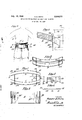
- Fig. l is a plan view of the assembled unit; and Fig. 2 is a perspective view showing the same applied to the wearers body.
- Fig. 3 is a longitudinal section, taken on the line 3--3, Fig. 1, and looking in the direction of the arrows.
- Fig. 4 is an enlarged, fragmentary section illustrating the manner of assembling the unit.
- Figs. 5 and 6 are respectively a plan and a side elevation of the elastic bands used in assembling the unit.
- Fig. 7 is an elevational view illustrating the manner of nesting a plurality of collapsed units.
- the novel unit or belt is 2 formed of a pair of supporting members or blocks 10, 11 which are constructed of waterproof, cellular and buoyant material and more or less rigid, for example, a material such as a plastic known as Spongex-a unicellular polyvinyl chloride-and a product of B. F. Goodrich.
- These blocks are of a more or less elongated or rectangular conformation shape, at least on the bodycontacting side, to conform substantially to the waist of a wearer and being to this end arcuately formed longitudinally.
- Approximately 1 cubic foot of such material has been found capable of sustaining afloat a human body of 150 lbs. weight; and a convenient length of material for each member is 12 inches of 1 /2 inch stock, 5 inches in width.
- the weight of a pair of blocks of such dimensions is approximately /2 pound, including the means, of insignificant weight, for attachment of the blocks to the wearer.
- the appliance thus is readily transportable and may be shipped conveniently and at relatively low cost.
- connection of the two blocks to each other, to provide an assembly into which a person may step and then draw the unit upwardly into position, is most satisfactorily accomplished through the medium of a pair of bands 15, 16 which are fashioned at their extremities in a manner such as to afford ready adjustment, as well as removal, with respect to a block or blocks. Removal of bands, however, is not essential in the case of ship ment of the units. As is shown in Fig. 7, the two elements 20, 21 of an assembled unit may readily be nested, their respective bands 22, 23 being folded under and about the blocks.
- a convenient way to assemble the blocks with hands into a unit is to provide slots in the opposite ends. of said blocks, for example, T-slots 25, 26 and 27, 28 respectively, said slots extending inwardly, preferably midway of the corresponding edges, to admit edgewise a band.
- the respective heads of said slots are preferably made slightly wider than the width of the entrance portions of said slots to allow of readily twisting a band in fitting it therein-in the manner indicated in Fig. 4.
- the thickened router portions 31, 32 of band 30 are further thickened, as at 33, 34 and slightly widened as is indicated at 35, 36.
- the thinnest section i.e. that between the thickened end portions, is used; and the hand then twisted into the wider head of the corresponding T-slot and drawn down to fit the said thickened portion snugly therein and until the further thickened and widened portions contacts: the body of the corresponding block.
- An appliance for floating a person in water comprising in combination: a pair of independent and generally elongated, non-inflatable buoyant members adapted for fitting about the waist of a person, said members being slotted longitudinally inwardly from their edges with right-angle termination to afford a T-slot thereat, the termination being of greater Width than the entrance portion width; and a pair of elastic, removable bands, of a thickness to fit an entrance slot, as the sole means for uniting the buoyant members to support the same on the wearer, the bands at their respective outer portions beinghthickened beyond the width of the entrance portion V 4 of a slot and additionally thickened at their respective extreme outer ends to fit snugly the termination of a T- slot.
Landscapes
- Engineering & Computer Science (AREA)
- Mechanical Engineering (AREA)
- Ocean & Marine Engineering (AREA)
- Orthopedics, Nursing, And Contraception (AREA)
Description
July 14, 1959 R. B. SMITH APPLIANCE FOR FLOATING THE HUMAN BODY" IN WATER Filed Feb. 25, 1957 jZga. 34 33 a? av k g I I l: inf INVENTOR. ,1 ix 1 l iaaewrfiflwzw HM" l United-Stat tent C APPLIANCE FOR FLOATING THE HUMAN BODY IN WATER Robert B. Smith, Pelham, NY.
Application February 25, 1957, Serial No. 641,970
2 Claims. (Cl. 9-17) This invention relates to an appliance for floating a person in water, more particularly to a novel form of swimming belt or life preserver which may be applied to the wearer merely by stepping therein and then drawing the same upwardly into position about the waist.
Devices, as heretofore provided for supporting or floating the body, have been of a more or less bulky construction and were of considerable weight, rendering such devices uncomfortable in use as well as not particularly portable nor suited for convenient shipment. Aside from being relatively expensive and not too durable, considerable inconvenience was experienced by the wearer in attaching the known appliances and in effecting adjustments of the same.
The present invention has for an object to provide a simple, effective and light-weight combination of buoyant members with extensible members which latter are designed to afford a resilient attachment thereof to the wearers body and which automatically adjust, within limits, the appliance thereto.
Another object of the invention is to provide a simple and relatively inexpensive unit comprising a pair of independent buoyant members and a pair of elastic bands detachably uniting the two members into a unit adapted to embrace the waist of the wearer, said members being shaped to conform generally thereto.
A further object of the invention is to provide a readily constructed unit suitable as a swimming and floating appliance which will not become disarranged in use; also, of a nature such as not to cause skin irritation or discomfort when worn.
A still further object of the invention is to provide a combination of elements which, when the unit is not in use, may be nested into a relatively compact and small package.
The nature of the invention, however, will best be understood when described in connection with the accompanying drawings, in which:
Fig. l is a plan view of the assembled unit; and Fig. 2 is a perspective view showing the same applied to the wearers body.
Fig. 3 is a longitudinal section, taken on the line 3--3, Fig. 1, and looking in the direction of the arrows.
Fig. 4 is an enlarged, fragmentary section illustrating the manner of assembling the unit.
Figs. 5 and 6 are respectively a plan and a side elevation of the elastic bands used in assembling the unit.
Fig. 7 is an elevational view illustrating the manner of nesting a plurality of collapsed units.
Referring to the drawings, the novel unit or belt is 2 formed of a pair of supporting members or blocks 10, 11 which are constructed of waterproof, cellular and buoyant material and more or less rigid, for example, a material such as a plastic known as Spongex-a unicellular polyvinyl chloride-and a product of B. F. Goodrich. These blocks are of a more or less elongated or rectangular conformation shape, at least on the bodycontacting side, to conform substantially to the waist of a wearer and being to this end arcuately formed longitudinally. Approximately 1 cubic foot of such material has been found capable of sustaining afloat a human body of 150 lbs. weight; and a convenient length of material for each member is 12 inches of 1 /2 inch stock, 5 inches in width. The weight of a pair of blocks of such dimensions is approximately /2 pound, including the means, of insignificant weight, for attachment of the blocks to the wearer.
The appliance thus is readily transportable and may be shipped conveniently and at relatively low cost.
For service, it will be understood that the two blocks 10, 11 are to be united and held to the body 12 of the wearer, embracing the waist as is indicated in Fig. 2. This embodiment shows the concave faces 13, 14 in contact with the body.
The connection of the two blocks to each other, to provide an assembly into which a person may step and then draw the unit upwardly into position, is most satisfactorily accomplished through the medium of a pair of bands 15, 16 which are fashioned at their extremities in a manner such as to afford ready adjustment, as well as removal, with respect to a block or blocks. Removal of bands, however, is not essential in the case of ship ment of the units. As is shown in Fig. 7, the two elements 20, 21 of an assembled unit may readily be nested, their respective bands 22, 23 being folded under and about the blocks.
A convenient way to assemble the blocks with hands into a unit is to provide slots in the opposite ends. of said blocks, for example, T- slots 25, 26 and 27, 28 respectively, said slots extending inwardly, preferably midway of the corresponding edges, to admit edgewise a band. The respective heads of said slots, as is indicated in the case of the heads 25, 26, Fig. 3, are preferably made slightly wider than the width of the entrance portions of said slots to allow of readily twisting a band in fitting it therein-in the manner indicated in Fig. 4.
Moreover, it is desirable to thicken the outer portions of the bands beyond the width of the entrance portions of the T-slots; and still further at the extreme outer ends and at which ends such further thickened portions are also to be slightly increased in width, e.g. beyond the length of the corresponding heads. of the T-slots to overlap the same. Thus, reference being had to Figs. 5 and 6, the thickened router portions 31, 32 of band 30 are further thickened, as at 33, 34 and slightly widened as is indicated at 35, 36.
It will be understood that, in introducing a band 30 edgewise into the entrance portion, the thinnest section, i.e. that between the thickened end portions, is used; and the hand then twisted into the wider head of the corresponding T-slot and drawn down to fit the said thickened portion snugly therein and until the further thickened and widened portions contacts: the body of the corresponding block.
I claim:
1. An appliance for floating a person in water, comprising in combination: a pair of independent and generally elongated, non-inflatable buoyant members adapted for fitting about the waist of a person, said members being slotted longitudinally inwardly from their edges with right-angle termination to afford a T-slot thereat, the termination being of greater Width than the entrance portion width; and a pair of elastic, removable bands, of a thickness to fit an entrance slot, as the sole means for uniting the buoyant members to support the same on the wearer, the bands at their respective outer portions beinghthickened beyond the width of the entrance portion V 4 of a slot and additionally thickened at their respective extreme outer ends to fit snugly the termination of a T- slot.
2. The appliance according to claim 1, wherein the bands are also increased in width, at their respective outer ends, beyond the length of the corresponding T- slot termination to overlap the same.
References Cited in the file of this patent UNITED STATES PATENTS
Priority Applications (1)
| Application Number | Priority Date | Filing Date | Title |
|---|---|---|---|
| US641970A US2894271A (en) | 1957-02-25 | 1957-02-25 | Appliance for floating the human body in water |
Applications Claiming Priority (1)
| Application Number | Priority Date | Filing Date | Title |
|---|---|---|---|
| US641970A US2894271A (en) | 1957-02-25 | 1957-02-25 | Appliance for floating the human body in water |
Publications (1)
| Publication Number | Publication Date |
|---|---|
| US2894271A true US2894271A (en) | 1959-07-14 |
Family
ID=24574608
Family Applications (1)
| Application Number | Title | Priority Date | Filing Date |
|---|---|---|---|
| US641970A Expired - Lifetime US2894271A (en) | 1957-02-25 | 1957-02-25 | Appliance for floating the human body in water |
Country Status (1)
| Country | Link |
|---|---|
| US (1) | US2894271A (en) |
Citations (2)
| Publication number | Priority date | Publication date | Assignee | Title |
|---|---|---|---|---|
| US1931406A (en) * | 1930-10-31 | 1933-10-17 | Denton Geoffrey Price | Buoyant life preserver |
| US2292150A (en) * | 1941-04-30 | 1942-08-04 | Albert L Murray | Endless inflatable swimming belt |
-
1957
- 1957-02-25 US US641970A patent/US2894271A/en not_active Expired - Lifetime
Patent Citations (2)
| Publication number | Priority date | Publication date | Assignee | Title |
|---|---|---|---|---|
| US1931406A (en) * | 1930-10-31 | 1933-10-17 | Denton Geoffrey Price | Buoyant life preserver |
| US2292150A (en) * | 1941-04-30 | 1942-08-04 | Albert L Murray | Endless inflatable swimming belt |
Similar Documents
| Publication | Publication Date | Title |
|---|---|---|
| US2270685A (en) | Knee brace | |
| US3512523A (en) | Cervical collar with means for varying the height and shape thereof | |
| US5850706A (en) | Scope cover | |
| US4109905A (en) | Device for in place swimming | |
| US2626394A (en) | Cushion pad | |
| US6115849A (en) | Adjustable strap for scuba mask | |
| US2802222A (en) | Life preserver belt | |
| US4986786A (en) | Garment for use in water recreation | |
| US3000119A (en) | Instep straps | |
| US2950489A (en) | Water ski and swim belt | |
| US2753563A (en) | Brassiere | |
| US2541487A (en) | Spinal brace | |
| US4067330A (en) | Bed sore bandage cover | |
| US3721237A (en) | Heel and ankle protector | |
| KR200471042Y1 (en) | A assistive-swimming apparatus | |
| US2870768A (en) | Brassiere strap | |
| US2765014A (en) | Construction element for use as a pillar, strut, brace or other stiffening member | |
| US4424043A (en) | Flotation device | |
| US2535269A (en) | Head support for telephones | |
| US4298008A (en) | Device for brassieres | |
| US5950247A (en) | Protective sports eyeglasses with buffer and shock-absorbing function | |
| US5480332A (en) | Multiple victim rescue device | |
| US4622018A (en) | Floatable collar | |
| KR200484976Y1 (en) | The neck prop | |
| US2142887A (en) | Fishing harness |