US2843458A - Process for producing silicon tetrachloride - Google Patents
Process for producing silicon tetrachloride Download PDFInfo
- Publication number
- US2843458A US2843458A US541602A US54160255A US2843458A US 2843458 A US2843458 A US 2843458A US 541602 A US541602 A US 541602A US 54160255 A US54160255 A US 54160255A US 2843458 A US2843458 A US 2843458A
- Authority
- US
- United States
- Prior art keywords
- reaction
- carbon
- solid
- silicon tetrachloride
- chlorine
- Prior art date
- Legal status (The legal status is an assumption and is not a legal conclusion. Google has not performed a legal analysis and makes no representation as to the accuracy of the status listed.)
- Expired - Lifetime
Links
- 238000000034 method Methods 0.000 title claims description 26
- VXEGSRKPIUDPQT-UHFFFAOYSA-N 4-[4-(4-methoxyphenyl)piperazin-1-yl]aniline Chemical compound C1=CC(OC)=CC=C1N1CCN(C=2C=CC(N)=CC=2)CC1 VXEGSRKPIUDPQT-UHFFFAOYSA-N 0.000 title claims description 18
- 239000005049 silicon tetrachloride Substances 0.000 title claims description 18
- 238000006243 chemical reaction Methods 0.000 claims description 48
- 239000007787 solid Substances 0.000 claims description 39
- 229910052799 carbon Inorganic materials 0.000 claims description 37
- OKTJSMMVPCPJKN-UHFFFAOYSA-N Carbon Chemical compound [C] OKTJSMMVPCPJKN-UHFFFAOYSA-N 0.000 claims description 35
- 239000007789 gas Substances 0.000 claims description 32
- 239000000463 material Substances 0.000 claims description 26
- 239000002245 particle Substances 0.000 claims description 6
- KZBUYRJDOAKODT-UHFFFAOYSA-N Chlorine Chemical compound ClCl KZBUYRJDOAKODT-UHFFFAOYSA-N 0.000 claims description 4
- 239000007795 chemical reaction product Substances 0.000 claims description 4
- 239000012535 impurity Substances 0.000 claims description 4
- XUIMIQQOPSSXEZ-UHFFFAOYSA-N Silicon Chemical compound [Si] XUIMIQQOPSSXEZ-UHFFFAOYSA-N 0.000 claims description 2
- 229910052710 silicon Inorganic materials 0.000 claims description 2
- 239000010703 silicon Substances 0.000 claims description 2
- 239000011343 solid material Substances 0.000 claims description 2
- VYPSYNLAJGMNEJ-UHFFFAOYSA-N Silicium dioxide Chemical compound O=[Si]=O VYPSYNLAJGMNEJ-UHFFFAOYSA-N 0.000 description 41
- HBMJWWWQQXIZIP-UHFFFAOYSA-N silicon carbide Chemical compound [Si+]#[C-] HBMJWWWQQXIZIP-UHFFFAOYSA-N 0.000 description 40
- 229910010271 silicon carbide Inorganic materials 0.000 description 40
- 239000000460 chlorine Substances 0.000 description 22
- ZAMOUSCENKQFHK-UHFFFAOYSA-N Chlorine atom Chemical compound [Cl] ZAMOUSCENKQFHK-UHFFFAOYSA-N 0.000 description 21
- 229910052801 chlorine Inorganic materials 0.000 description 21
- 239000000377 silicon dioxide Substances 0.000 description 19
- CURLTUGMZLYLDI-UHFFFAOYSA-N Carbon dioxide Chemical compound O=C=O CURLTUGMZLYLDI-UHFFFAOYSA-N 0.000 description 18
- 239000000203 mixture Substances 0.000 description 18
- QVGXLLKOCUKJST-UHFFFAOYSA-N atomic oxygen Chemical compound [O] QVGXLLKOCUKJST-UHFFFAOYSA-N 0.000 description 17
- 239000001301 oxygen Substances 0.000 description 17
- 229910052760 oxygen Inorganic materials 0.000 description 17
- 229910052681 coesite Inorganic materials 0.000 description 15
- 229910052906 cristobalite Inorganic materials 0.000 description 15
- 229910052682 stishovite Inorganic materials 0.000 description 15
- 229910052905 tridymite Inorganic materials 0.000 description 15
- 235000012239 silicon dioxide Nutrition 0.000 description 13
- 239000000376 reactant Substances 0.000 description 10
- 229910002092 carbon dioxide Inorganic materials 0.000 description 9
- 238000005660 chlorination reaction Methods 0.000 description 9
- 239000002994 raw material Substances 0.000 description 9
- 239000003570 air Substances 0.000 description 8
- 239000000047 product Substances 0.000 description 8
- 229910003910 SiCl4 Inorganic materials 0.000 description 7
- 239000006227 byproduct Substances 0.000 description 7
- FDNAPBUWERUEDA-UHFFFAOYSA-N silicon tetrachloride Chemical compound Cl[Si](Cl)(Cl)Cl FDNAPBUWERUEDA-UHFFFAOYSA-N 0.000 description 7
- IJGRMHOSHXDMSA-UHFFFAOYSA-N Atomic nitrogen Chemical compound N#N IJGRMHOSHXDMSA-UHFFFAOYSA-N 0.000 description 6
- 238000004519 manufacturing process Methods 0.000 description 6
- XEEYBQQBJWHFJM-UHFFFAOYSA-N Iron Chemical compound [Fe] XEEYBQQBJWHFJM-UHFFFAOYSA-N 0.000 description 4
- 239000001569 carbon dioxide Substances 0.000 description 4
- 150000001720 carbohydrates Chemical class 0.000 description 3
- 229910052751 metal Inorganic materials 0.000 description 3
- 239000002184 metal Substances 0.000 description 3
- 239000008188 pellet Substances 0.000 description 3
- 239000012495 reaction gas Substances 0.000 description 3
- 229910052814 silicon oxide Inorganic materials 0.000 description 3
- 230000003068 static effect Effects 0.000 description 3
- LTPBRCUWZOMYOC-UHFFFAOYSA-N Beryllium oxide Chemical compound O=[Be] LTPBRCUWZOMYOC-UHFFFAOYSA-N 0.000 description 2
- UGFAIRIUMAVXCW-UHFFFAOYSA-N Carbon monoxide Chemical compound [O+]#[C-] UGFAIRIUMAVXCW-UHFFFAOYSA-N 0.000 description 2
- PXHVJJICTQNCMI-UHFFFAOYSA-N Nickel Chemical compound [Ni] PXHVJJICTQNCMI-UHFFFAOYSA-N 0.000 description 2
- MCMNRKCIXSYSNV-UHFFFAOYSA-N Zirconium dioxide Chemical compound O=[Zr]=O MCMNRKCIXSYSNV-UHFFFAOYSA-N 0.000 description 2
- 229910002091 carbon monoxide Inorganic materials 0.000 description 2
- 229940105305 carbon monoxide Drugs 0.000 description 2
- 150000001805 chlorine compounds Chemical class 0.000 description 2
- 239000000470 constituent Substances 0.000 description 2
- 238000010438 heat treatment Methods 0.000 description 2
- -1 i. e. Substances 0.000 description 2
- 229910052742 iron Inorganic materials 0.000 description 2
- 239000007788 liquid Substances 0.000 description 2
- VNWKTOKETHGBQD-UHFFFAOYSA-N methane Chemical compound C VNWKTOKETHGBQD-UHFFFAOYSA-N 0.000 description 2
- 229910003465 moissanite Inorganic materials 0.000 description 2
- 229910052757 nitrogen Inorganic materials 0.000 description 2
- 101100392472 Caenorhabditis elegans hse-5 gene Proteins 0.000 description 1
- 229910052782 aluminium Inorganic materials 0.000 description 1
- XAGFODPZIPBFFR-UHFFFAOYSA-N aluminium Chemical compound [Al] XAGFODPZIPBFFR-UHFFFAOYSA-N 0.000 description 1
- PNEYBMLMFCGWSK-UHFFFAOYSA-N aluminium oxide Inorganic materials [O-2].[O-2].[O-2].[Al+3].[Al+3] PNEYBMLMFCGWSK-UHFFFAOYSA-N 0.000 description 1
- VSCWAEJMTAWNJL-UHFFFAOYSA-K aluminium trichloride Chemical class Cl[Al](Cl)Cl VSCWAEJMTAWNJL-UHFFFAOYSA-K 0.000 description 1
- 239000007864 aqueous solution Substances 0.000 description 1
- 239000011230 binding agent Substances 0.000 description 1
- 150000001721 carbon Chemical class 0.000 description 1
- UBAZGMLMVVQSCD-UHFFFAOYSA-N carbon dioxide;molecular oxygen Chemical compound O=O.O=C=O UBAZGMLMVVQSCD-UHFFFAOYSA-N 0.000 description 1
- 239000011248 coating agent Substances 0.000 description 1
- 238000000576 coating method Methods 0.000 description 1
- 239000000571 coke Substances 0.000 description 1
- 238000002485 combustion reaction Methods 0.000 description 1
- 239000002131 composite material Substances 0.000 description 1
- 150000001875 compounds Chemical class 0.000 description 1
- 238000010276 construction Methods 0.000 description 1
- 239000002826 coolant Substances 0.000 description 1
- 230000007547 defect Effects 0.000 description 1
- 238000004821 distillation Methods 0.000 description 1
- 230000000694 effects Effects 0.000 description 1
- 230000003628 erosive effect Effects 0.000 description 1
- 239000000446 fuel Substances 0.000 description 1
- 239000001257 hydrogen Substances 0.000 description 1
- 229910052739 hydrogen Inorganic materials 0.000 description 1
- 150000002431 hydrogen Chemical class 0.000 description 1
- 239000011261 inert gas Substances 0.000 description 1
- 229910001510 metal chloride Inorganic materials 0.000 description 1
- 150000002739 metals Chemical class 0.000 description 1
- 235000013379 molasses Nutrition 0.000 description 1
- 239000003345 natural gas Substances 0.000 description 1
- 229910052759 nickel Inorganic materials 0.000 description 1
- 229960003753 nitric oxide Drugs 0.000 description 1
- MWUXSHHQAYIFBG-UHFFFAOYSA-N nitrogen oxide Inorganic materials O=[N] MWUXSHHQAYIFBG-UHFFFAOYSA-N 0.000 description 1
- 230000003647 oxidation Effects 0.000 description 1
- 238000007254 oxidation reaction Methods 0.000 description 1
- 238000012856 packing Methods 0.000 description 1
- 238000005453 pelletization Methods 0.000 description 1
- 239000000843 powder Substances 0.000 description 1
- 238000002360 preparation method Methods 0.000 description 1
- 239000011164 primary particle Substances 0.000 description 1
- 239000011819 refractory material Substances 0.000 description 1
- 239000004576 sand Substances 0.000 description 1
- 238000012216 screening Methods 0.000 description 1
- 239000008247 solid mixture Substances 0.000 description 1
- 229910002076 stabilized zirconia Inorganic materials 0.000 description 1
- 239000000126 substance Substances 0.000 description 1
- 239000002699 waste material Substances 0.000 description 1
- XLYOFNOQVPJJNP-UHFFFAOYSA-N water Substances O XLYOFNOQVPJJNP-UHFFFAOYSA-N 0.000 description 1
Images
Classifications
-
- C—CHEMISTRY; METALLURGY
- C01—INORGANIC CHEMISTRY
- C01B—NON-METALLIC ELEMENTS; COMPOUNDS THEREOF; METALLOIDS OR COMPOUNDS THEREOF NOT COVERED BY SUBCLASS C01C
- C01B33/00—Silicon; Compounds thereof
- C01B33/08—Compounds containing halogen
Definitions
- This invention relates to the production of silicon tetrachloride from firesand or other relatively impure silicon carbide-containing residues. More particularly, it comprises a novel process for chlorinating such residues under conditions such that far more of the silicon carbide content of the residues is converted to silicon tetrachloride than is possible under Apresently known and practiced processes. Included Within the scope of this invention is the novel further step of producing additional amounts of silicon carbide or its reactantlequivalent from free silica and carbon in the chlorination zone by means of the reaction heat developed therein.
- silicon tetrachloride is ordi narily produced from the cheapest possible grades of silicon carbide, for example, resand, which ordinarily has a silicon carbide content of around 80-85%, or residues from electric furnace silicon carbide production containing substantial increments of unreacted or incompletely reacted sand and coke.
- This material in the coarse crushed state is treated by flowing chlorine gas through an initially preheated bed of the same to form silicon tetrachloride by the reaction,
- the ⁇ serious defect common to all prior artprocesses is the low yield of silicon tetrachloride obtained from 2,843,458 latented Julyl5, ⁇ 1958A by achieving the ultimate chlorination of ⁇ some ofthe siliceous material which is present in the initially unreduced state in the charge.
- Another object of this invention is to provide a process in which the solid reactant bed is freer from packing and caking diiculties so that the gaseous reactants are more uniformly distributed through the bed with lower pressure drops experienced for given volumes of'ow and more uniform and controllable reaction rates and temperatures are attained than heretofore.
- Still another object is to supply a composite raw material for the production of silicon tetrachloride which, because of its chemical compositionand physical arrangement, can be directly chlorinated readily and substantially completely leaving so little solid residue that a stream of said raw material can be continuously fed to a Vsimple shaft reactor for a considerable ⁇ period of time as the chlorination reaction proceeds before the reactor when the run has inexorably ended for lack of available reactable siliconcarbide. Then the reactor must be shut down, cooled off, cleaned out, recharged and reheated before another batch can be run. While the coated silicon carbide can be regenerated for reuse that step in itself is costly and time consuming.
- the principal object of this invention is to provide an improved process for converting silicon carbide to silicon tetrachloride by means of which a larger proportion than rheretofore of the silicon carbide charged is converted to product and the percentage of reactor down-time is greatly reduced.
- a corollary object is, of course, to reduce theamount of solid residue left in the chlorination reactor and thereby to extend the operating time between shut downs for a reactor of a given size.
- the process of our invention comprises charging ⁇ to a heat-insulated reaction chamber or furnace a charge material composed of silicon carbide admixed with siliceous and other impurities in the form of ⁇ finely-ground particles and owing chlorine admixed with an oxygencontaining gas therethrough.
- the silicon carbide constituent of the mixture should constitute at least 50% ⁇ thereof and preferably more since it is the primary source of the silicon constituent of the intended SiCl4 product.
- our invention can be practiced with highly adulterated silicon carbide to permit use of very low cost materials and greatly improve its commercial attractiveness.
- the reactant charge material is, of course, maintained in the reactor in physical form suited for good contact with the treating gases.
- a static bed that is, a relatively fixed bed which moves slowly downward as the charge is consumed, for which we first agglomerate the charge. This may be accomplished in any well known manner whereby the nely ground particles are mixed with ⁇ a small amount of binder, preferably a carbonizable carbohydrate, and agitated or compressed to form spherical pellets, tablets or briquets of substantially uniform shape and size which are, nevertheless, gas permeable.
- the gas composition for this purpose comprises chlorine and, either separately introduced or in admixture therewith, an oxygen-containing gas, e. g., oxygen, air, carbon dioxide, etc., which is selectively reactive under the conditions existing in said chlorination zone withY thersolid carbn rather than the SiCl4 product.
- the preparation of the solid feed charge as an intimate uniform mixture of exceptionally finely ground materials appears to be especially important in order to encourage reaction of the SiOg in the charge in accordance with Equation 4 above. Also, whenever this reaction is being counted on to reduce significantly the amount of solid residue by converting by-product carbon to gaseous oxides, the amount of SiO2 in the charge must, of course, be appreciably in excess of that stoichiometrically required for reaction with the free carbon initially in the solid feed charged. However, in this case, since the raw material should always contain at least about 50% SiC by weight, this means that its free carbon content should never be greater than about and in most cases not over 5% free carbon by weight will be preferred.
- a preferred raw material for this process would, therefore, contain about l0 to 20% by weight excess silica, i. e., the total Weight concentration of SiO2 would be not substantially less than about 10+2.5 times the weight percent initial free carbon and not substantially greater than 20-i-2.5 times the weight percent initial free carbon. Considering both raw material and operating cost, the most outstanding results are obtained in this range of compositions.
- Residual C initial C-l-by-product C-C consumed by SiO2, or
- the reactor 10 may be more or less conventional in construction and includes a metal shell having an intermediate lining 11 of nickel or other heat resistant metal and an inner lining 13 of insulating rebrick, preferably composed largely of silica.
- Solid feed material consisting of dry pellets of uniform shape, size and composition made by wet-pelletizing with the aid of a dilute aqueous solution of molasses or other carbohydrate a silicon carbide containing material which had been finely ground and screened through a 100 mesh screen, is delivered from charging hopper 12 through seal valve 14 to the reactor 10.
- a bed of charge material is formed and supported on grate 16.
- the initial charge is heated from below by sealed burners 18 supplied with a combustible mixture of gaseous fuel and air from bustle pipe 20.
- Combustion products ow up through the bed of pelletized resand and are conducted away through liue 22 and out stack 24 by appropriate setting of gate 26.
- gate 26 When the temperature within the bed of solids has reached about 900-1100" C., heating from burners 18 isdiscontinued, stack 24 is closed by means of gate 26 and a stream of dry reaction gases substantially free of hydrogen but containing free chlorine is then introduced continuously to the bottom of the bed through pipe 28.
- the reaction between SiC and chlorine is highly exothermic so that, once the bed is preheated to reaction temperature, the reaction will generally continue as long as both reactants are available.
- the chlorine flow rate .somewhat in excess of the said optimum amount.
- the optimum chlorine llow rate will generally run between Iabout 30 and 80 lbs./hr./sq. ft. of cross-sectional area of the solid bed.
- the maximum chlorine flow rate is usually limited by the temperatures generated in the bed. Bed temperatures ranging from about l000 to about 1600 C. are preferred but zones of 2000 C. or over can be tolerated near the center and some reaction is obtained in zones as low as 800 C.
- a dry gas such as air, oxygen or CO2, i. e., one which is selectively reactive with solid carbon but inert to SiC14 is introduced together with the dry, hydrogen-free chlorine stream at the bottom of the reactor.
- a dry gas such as air, oxygen or CO2
- the stoichiometric amount of such selectively reactive gas per mol of chlorine can be estimated from the relationships given above.
- the amount of selectively reactive gas should be at least half of the stoichiometric amount thus estimated and may be used However, best results are usually obtained by using 75 to 100% of the estimated stoichiometric amount.
- the hot reaction product gases Vcontaining principally SiCl, and CO and nitrogen when air is the reactive gas for the solid carbon, are removed continuously through flue 22 and pipe 30 by means of an appropriate setting of gate 25. Also included in the gaseous products are small amounts of unreacted C1202 and/ or CO2 as well as chlorides of iron, aluminum and any other impurity metals in the solid charge which form volatile chlorides.
- the SiCl4 and other metal chlorides are condensed out in a condenser 32 cooled by water or other suitable liquid coolant.
- Liquid SiCl4 containing slight amounts of iron and aluminum chlorides is drawn olf the ⁇ bottom of surge tank 36 through pipe 38 while carbon monoxide and any chlorine, nitrogen, oxygen, carbon dioxide and any other permanent gases are exhausted through breather pipe 40.
- the impure SiCl4 can be readily purified by distillation.
- the process of this invention can also be carried out in a fluidized bed.
- carbon dioxide is the preferred auxiliary reactant gas because its reaction with carbon is endothermic which helps hold temperatures within bounds.
- a minor amount of dry inert gas such as nitrogen or carbon monox-ide may be introduced with the reactant gases.
- lining 13 of the reactor be constructed of materials having even higher resistance than plus 'SiOZ is usually very small.
- Example' 1 Vvheated by natural gas -iiring to a temperature of about 1000 C. Then a stream of substantially pure chlorine and air is fed -at a rate of about lbs/sq; ft./hr. of chlorine and 0.2 1b. mol/ sq. ft./hr. based on the oxygen ycontent of the air through a distributor at the bottom of "the bed while more sand-fresand pellets are fed from the top at the rate of about lbs/hr.
- Example 2 A process is conducted in accordance with the procedures outlined in Example l ⁇ but using a solid feed composition consisting of Percent SiC 79 SiOz 17 C 4 and reaction gas containing 0.2 mol of free oxygen per mol of free chlorine. Operation is trouble-free and produces a solid residue of only about l0 to 15% of the material charged permitting uninterrupted continuous runs of several days duration.
- the feed rates maintained are about 2750 s. c. f. h. of free chlorine, about 550 s. c. f. h. of free oxygen and about lbs/hr. of solid feed while the production rate amounts to about 450 lbs/hr. of SiCl., through most of the run.
- Example 3 Firesand containing about 85% SiC, 9% SiO2 and 4% C is finely ground and a sized fraction between 50 and 150 mesh is fed to a reaction zone lined with high temperature' stabilized zirconia refractory and, after being preheated to about 1000 to ll00 C., is suspended therein in the form of a fluidized bed in a dry reaction gas containing about 0.5 mol CO2 per mol of free chlorine.
- additional solid feed is introduced continuously into the reaction gas stream the volume of which is adjusted by controlling the con* centration of N2 gas therein in order to maintain a properly fiuidized bed.
- This fluidized reactor must be shut down and started up again several times as often as a xed bed reactor Maisie 7 of the same size but the down time required forthese operations in the uidized reactor is less than half that for the xedbed type and the over-all percentage yield of SiCl4 is .every bit as good in this case as in Examples l and 2.
- a process for producing silicon tetrachloride from mixed solid charge materials composed 50-80% of silicon carbide, 3-10%'carbon, 17-45% unreduced siliceous matter and the remainder metallic impurities, all percentages being by weight which comprises subjecting such mixed materials in the form of ultimate particles no larger than about 50 mesh in size and initially preheated to a temperature of at least 900 C. to a stream of chlorine gas and a minor proportion of an oxygen-containing gas, exothermically reacting said solid materials and gases, thereby producing silicon tetrachloride and maintaining reaction temperature, and recovering the silicon tetrachloride thus produced from the other reaction products.
- oxygen-containing gas is selected from the group consisting of oxygen, air, carbon dioxide and mixtures thereof.
- a process for producing silicon tetrachloride from resand and similar impure silicon carbide compositions which comprises delivering to a heat-insulated reaction zone a mixture of finely-divided solids containing no primary particles larger than about mesh in size composed of 50-80% by weight silicon carbide, 3-10% by weight carb ⁇ on,'17-45% by weight unreduced siliceous matter and the remainder metallic compounds, initially heating said lsolids to at least 900 C., ilowing chlorine gas and a minor proportion of an oxygen-containing gas in contact with said solids, exothermically reacting the gases with Vthe silicon carbide, thereby converting the silicon carbide zone andfrom the other reaction products.
- the oxygen-containing gas is selected from the group consisting of oxygen, air, carbon dioxide and mixtures thereof and is present in an amount in molar ratio of oxygen to chlorine equal to at least half of the stoichiometric amount as estimated from the composition of the solids mixture feed.
Landscapes
- Chemical & Material Sciences (AREA)
- Organic Chemistry (AREA)
- Inorganic Chemistry (AREA)
- Silicon Compounds (AREA)
Description
July 15, 1958 R. D. BEATTIE, ET AL PROCESS FOR PRODUCING SILICON TETRACHLORIDE Filed OCT.. 20, 1955 aaA/oaw r s M M E HSE 5 IN VEN TORS Pag-e7 p. 5.597745", ia/ef/vre MMA/1 United States Patent PROCESS FOR PRODUCING SILICON TETRACHLORIDE Robert D. Beattie, Cambridge, and Laurent P. Michel, Watertown, Mass., and Charles A. Stokes, Houston, Tex., assignors to Godfrey L. Cabot, Inc., Boston, Mass., a corporation of Massachusetts Application October 20, 1955, Serial No. 541,602
11 Claims. (Cl. 23-205) This invention relates to the production of silicon tetrachloride from firesand or other relatively impure silicon carbide-containing residues. More particularly, it comprises a novel process for chlorinating such residues under conditions such that far more of the silicon carbide content of the residues is converted to silicon tetrachloride than is possible under Apresently known and practiced processes. Included Within the scope of this invention is the novel further step of producing additional amounts of silicon carbide or its reactantlequivalent from free silica and carbon in the chlorination zone by means of the reaction heat developed therein.
In conventional practice silicon tetrachloride is ordi narily produced from the cheapest possible grades of silicon carbide, for example, resand, which ordinarily has a silicon carbide content of around 80-85%, or residues from electric furnace silicon carbide production containing substantial increments of unreacted or incompletely reacted sand and coke. This material in the coarse crushed state, is treated by flowing chlorine gas through an initially preheated bed of the same to form silicon tetrachloride by the reaction,
which is highly exothermic.
The `serious defect common to all prior artprocesses is the low yield of silicon tetrachloride obtained from 2,843,458 latented Julyl5,` 1958A by achieving the ultimate chlorination of `some ofthe siliceous material which is present in the initially unreduced state in the charge.
Another object of this invention is to provide a process in which the solid reactant bed is freer from packing and caking diiculties so that the gaseous reactants are more uniformly distributed through the bed with lower pressure drops experienced for given volumes of'ow and more uniform and controllable reaction rates and temperatures are attained than heretofore.
Still another object is to supply a composite raw material for the production of silicon tetrachloride which, because of its chemical compositionand physical arrangement, can be directly chlorinated readily and substantially completely leaving so little solid residue that a stream of said raw material can be continuously fed to a Vsimple shaft reactor for a considerable `period of time as the chlorination reaction proceeds before the reactor when the run has inexorably ended for lack of available reactable siliconcarbide. Then the reactor must be shut down, cooled off, cleaned out, recharged and reheated before another batch can be run. While the coated silicon carbide can be regenerated for reuse that step in itself is costly and time consuming.
The principal object of this invention is to provide an improved process for converting silicon carbide to silicon tetrachloride by means of which a larger proportion than rheretofore of the silicon carbide charged is converted to product and the percentage of reactor down-time is greatly reduced. A corollary object is, of course, to reduce theamount of solid residue left in the chlorination reactor and thereby to extend the operating time between shut downs for a reactor of a given size.
It is also an object of this invention to reduce significantly the raw material cost of silicon tetrachloride production not only by obtaining more complete utilization of the isilicon carbide inthe raw material but also must be shut down and cleaned out.
These and other objects and advantages of `this invention will be apparent from the detailed description and discussion thereof `which follow.
The process of our invention comprises charging` to a heat-insulated reaction chamber or furnace a charge material composed of silicon carbide admixed with siliceous and other impurities in the form of `finely-ground particles and owing chlorine admixed with an oxygencontaining gas therethrough. The silicon carbide constituent of the mixture should constitute at least 50% `thereof and preferably more since it is the primary source of the silicon constituent of the intended SiCl4 product. However, our invention can be practiced with highly adulterated silicon carbide to permit use of very low cost materials and greatly improve its commercial attractiveness.
The following advantages over prior process thus appear. Instead of charging lumps of adulterated` silicon carbide .of about 20 mesh to 1 inch in 'size we utilize finely ground material, i. e., material no larger than about 5.0 mesh in size and preferably finer than mesh. Hence much more surface is available for reaction. Also, instead of quickly coating the silicon carbide particles with more reactive carbon we remove this carbon as it deposits by oxidation by the oxygen-containing gas. Additionally, instead of treating the siliceous ,materials as finevitable waste we utilize the heat of reaction and carbon present in the reaction zone to chlorinate the silica and increase ultimate yield of SiCl4.
The reactant charge material is, of course, maintained in the reactor in physical form suited for good contact with the treating gases. When the finely ground material is charged directly to the reactor, it must be fluidized and such operation is vperfectly feasible. However, we prefer to employ a static bed, that is, a relatively fixed bed which moves slowly downward as the charge is consumed, for which we first agglomerate the charge. This may be accomplished in any well known manner whereby the nely ground particles are mixed with `a small amount of binder, preferably a carbonizable carbohydrate, and agitated or compressed to form spherical pellets, tablets or briquets of substantially uniform shape and size which are, nevertheless, gas permeable.
By preparing the solid feed charge in this: manner, its chlorination has been facilitated so much that surprisingly large savings are effected in processing and `raw material costs by adjusting the composition of solid and gaseous reactants so that solid carbon in amounts appreciably greater than that initially present in `the mixture charged will tend to be converted to gaseous oxides of carbon. The gas composition for this purpose comprises chlorine and, either separately introduced or in admixture therewith, an oxygen-containing gas, e. g., oxygen, air, carbon dioxide, etc., which is selectively reactive under the conditions existing in said chlorination zone withY thersolid carbn rather than the SiCl4 product. These materials are believed to act in accordance with the following equations:
The effect of adjustments in the solid composition appears to be based on the participation in the chlorination reaction of unreacted silica or other solid oxides in significant amounts, e. g., in accordance with the .following equation:
The preparation of the solid feed charge as an intimate uniform mixture of exceptionally finely ground materials (preferably 100 to 200 mesh powders) appears to be especially important in order to encourage reaction of the SiOg in the charge in accordance with Equation 4 above. Also, whenever this reaction is being counted on to reduce significantly the amount of solid residue by converting by-product carbon to gaseous oxides, the amount of SiO2 in the charge must, of course, be appreciably in excess of that stoichiometrically required for reaction with the free carbon initially in the solid feed charged. However, in this case, since the raw material should always contain at least about 50% SiC by weight, this means that its free carbon content should never be greater than about and in most cases not over 5% free carbon by weight will be preferred.
From Equations l and 4 above, it can be seen that stoichiometrically 1 mol of SiO2 (60 lbs.) is required for reaction with each 2 mols (24 lbs.) of free carbon or with the by-product carbon from each 2 mols (80 lbs.) of SiC chlorinated. Therefore, the Weight percent concentration of SiOZ stoichiometrically required for complete reaction with both the carbon initially present plus that formed as by-product by complete reaction of all the SiC is equal to 2.5 times the weight percent initial free carbon plus 0.75 times the weight percent SiC. Assuming a solid raw material containing 5% initial free carbon and made up only of SiC, SiO2 and C, the Weight concentration of SiO2 should be 47.8% and the weight concentration of SiC only 47.2%.
In practice, however, even if such a solids composition were supplied, perfect and complete reaction would not result. In fact, even under best conditions, i. e., when the weight concentration of SiC is well over 50%, seldom can over 80% of the total SiO2 be chlorinated since solid-solid reaction with C is involved. Therefore, for minimum reaction residues and optimum operating efficiency and economy, it is preferable not to rely entirely upon the introduction of excess silica or other solid in the charge for conversion of solid carbon to 'gaseous' oxides. Since SiO2 is much cheaper than firesand or other silicon-carbide rich materials, some SiOZ in excess of that which will react with initial free carbon is desirable. A preferred raw material for this process would, therefore, contain about l0 to 20% by weight excess silica, i. e., the total Weight concentration of SiO2 would be not substantially less than about 10+2.5 times the weight percent initial free carbon and not substantially greater than 20-i-2.5 times the weight percent initial free carbon. Considering both raw material and operating cost, the most outstanding results are obtained in this range of compositions.
Assuming that only 80% of the SiOz present actually reacts, an expression for the amount of residual carbon (i. e. carbon not Vconsumed by SiO2 reaction) per 100 lbs. of charge if all the SiC does react can be given in 4, terms of the weight percent concentrations of SiC, SiO, and initial C as follows:
Residual C=initial C-l-by-product C-C consumed by SiO2, or
Mols resid. C Wt. percent init. C lbs. charge 12 wt. percent SiC 2(0,8 wt. percent S1O2) The unreacted residue from such a charge can usually be further reduced by the introduction in the reaction gases of some oxygen or CO2 for selective reaction with solid carbon. The amounts of such gases stoichiometrically required for reaction per mol of said residual or excess carbon is immediately indicated by Equations 2 and 3 above. However, since the rate at which the overall reaction proceeds is determined largely by the chlorine feed rate, what is really desired is an expression indicating the approximate ratio of such an auxiliary (selectively reactive) gas to chlorine. This is obtained as follows. From Equations l and 4, it is seen that Total mols C12 needed 100 lbs. charge 2(wt. percent SiC +2 O-8 wt. percent SiO) From this and the previous expression for residual carbon,
Mols resid. C M01 C12 3 (wt. percent SiC) +10 (wt. percent init. C)-
3.2(Wt. percent SiOZ) 6 (Wt. percent SiC)l-3.2 (wt. percent SiOz) Therefore, from Equations 2 and 3 above, for stoichiometrically complete consumption of carbon by-product and initial), the mol ratio of the auxiliary (selectively-reactive) gas to C12 is 1/2 the last expression above for O2 and identical with said expression for CO2.
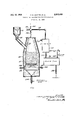
Considered in connection with the accompanying drawing, which is a diagrammatic view, in vertical partial cross section, of a suitable type of reactor together with related product collection equipment, a preferred embodiment of our invention may be described in more detail as follows:
The reactor 10 may be more or less conventional in construction and includes a metal shell having an intermediate lining 11 of nickel or other heat resistant metal and an inner lining 13 of insulating rebrick, preferably composed largely of silica.
Solid feed material consisting of dry pellets of uniform shape, size and composition made by wet-pelletizing with the aid of a dilute aqueous solution of molasses or other carbohydrate a silicon carbide containing material which had been finely ground and screened through a 100 mesh screen, is delivered from charging hopper 12 through seal valve 14 to the reactor 10. Within the reactor a bed of charge material is formed and supported on grate 16. The initial charge is heated from below by sealed burners 18 supplied with a combustible mixture of gaseous fuel and air from bustle pipe 20.
Combustion products ow up through the bed of pelletized resand and are conducted away through liue 22 and out stack 24 by appropriate setting of gate 26. When the temperature within the bed of solids has reached about 900-1100" C., heating from burners 18 isdiscontinued, stack 24 is closed by means of gate 26 and a stream of dry reaction gases substantially free of hydrogen but containing free chlorine is then introduced continuously to the bottom of the bed through pipe 28. The reaction between SiC and chlorine is highly exothermic so that, once the bed is preheated to reaction temperature, the reaction will generally continue as long as both reactants are available. The chlorine flow rate .somewhat in excess of the said optimum amount.
may vary widely but usually at least 30 lbs./hr./sq. ft. of C12 will be fed. Assuming it is sufficient to maintain the reaction, the lower the ,chlorine flow rate, the more complete the conversion of same will tend to be, other things being equal. However, considering both production rate and chlorine utilization efficiency, the optimum chlorine llow rate will generally run between Iabout 30 and 80 lbs./hr./sq. ft. of cross-sectional area of the solid bed. The maximum chlorine flow rate is usually limited by the temperatures generated in the bed. Bed temperatures ranging from about l000 to about 1600 C. are preferred but zones of 2000 C. or over can be tolerated near the center and some reaction is obtained in zones as low as 800 C.
Once the chlorination reaction has gotten underway, a dry gas such as air, oxygen or CO2, i. e., one which is selectively reactive with solid carbon but inert to SiC14 is introduced together with the dry, hydrogen-free chlorine stream at the bottom of the reactor. For a given solid feed composition, the stoichiometric amount of such selectively reactive gas per mol of chlorine can be estimated from the relationships given above. The amount of selectively reactive gas should be at least half of the stoichiometric amount thus estimated and may be used However, best results are usually obtained by using 75 to 100% of the estimated stoichiometric amount.
As the bed of solids is consumed by reaction, additional pelletized raw material is fed either continuously or intermittently from charging hopper 12 through seal valve 14.
The hot reaction product gases Vcontaining principally SiCl, and CO and nitrogen when air is the reactive gas for the solid carbon, are removed continuously through flue 22 and pipe 30 by means of an appropriate setting of gate 25. Also included in the gaseous products are small amounts of unreacted C1202 and/ or CO2 as well as chlorides of iron, aluminum and any other impurity metals in the solid charge which form volatile chlorides. The SiCl4 and other metal chlorides are condensed out in a condenser 32 cooled by water or other suitable liquid coolant. Liquid SiCl4 containing slight amounts of iron and aluminum chlorides is drawn olf the `bottom of surge tank 36 through pipe 38 while carbon monoxide and any chlorine, nitrogen, oxygen, carbon dioxide and any other permanent gases are exhausted through breather pipe 40. The impure SiCl4 can be readily purified by distillation.
In this manner substantially complete reaction of the SiC in the solid feed is not only obtained but most of the by-product carbon from the SiC chlorination reaction is also converted to gaseous products so that the solid residue which accumulates in reactor 10 is reduced to about l-l5% of the solid matter fed instead of the conventional 50 to 60%. This means that for a given sized reactor, continuous operation can be conducted for about 4 to 5 times longer than conventional processes before it must be shut .down and cleaned out. Since the downtime for each stoppage, clean out, recharging and restarting operation would be about the same in each case, say 6 to l2 hours, the proportion of downtime on a given reactor can be reduced several fold in this Way.
As we have said, the process of this invention can also be carried out in a fluidized bed. Charge material ground to the sizes previously specified, i. e., to minus 50 mesh but preferably to 150-200 mesh, is uidized in the reac tant gas stream. For such operation, involving somewhat more severe reaction conditions than with the static bed, carbon dioxide is the preferred auxiliary reactant gas because its reaction with carbon is endothermic which helps hold temperatures within bounds. For further temperature control a minor amount of dry inert gas such as nitrogen or carbon monox-ide may be introduced with the reactant gases. When employing a uid bed it is likewise preferred that lining 13 of the reactor be constructed of materials having even higher resistance than plus 'SiOZ is usually very small.
, 6 silicabrick `to erosion and chlorine attach-such as refractories based on zirconia, beryllia or alumina.`
A better understanding `of our invention may be obtained from the following specific examples whichl are given, however, only for purposes of illustration and not as limitations on the scope of said invention.
Example' 1 Vvheated by natural gas -iiring to a temperature of about 1000 C. Then a stream of substantially pure chlorine and air is fed -at a rate of about lbs/sq; ft./hr. of chlorine and 0.2 1b. mol/ sq. ft./hr. based on the oxygen ycontent of the air through a distributor at the bottom of "the bed while more sand-fresand pellets are fed from the top at the rate of about lbs/hr. About 85-90% 'by Weight of thelsolid material fed is converted to gaseous products, chiefly SiCl.,l and CO and the reaction is continued Afor about `75 hours without interruption compared to a maximum uninterrupted operating time of about l2 hours when the same iiresand is charged directly after coarse crushing and screening through a 20 mesh screen.
In the above example `SiO2 constituted about 40% of the blended and pelletized solid feed charge. While Vsolid feed streams containing larger proportions of SiO2 than this can be used, such surplus SiO2 is not necessary for reaction with by-product carbon and, even if extra free carbon is added together with such surplus SiO2 in the feed charge the percentage conversion of said sur- Therefore, feed charges containing over about 45 to 50% Si02 by weight are not recommended.
' Example 2 A process is conducted in accordance with the procedures outlined in Example l `but using a solid feed composition consisting of Percent SiC 79 SiOz 17 C 4 and reaction gas containing 0.2 mol of free oxygen per mol of free chlorine. Operation is trouble-free and produces a solid residue of only about l0 to 15% of the material charged permitting uninterrupted continuous runs of several days duration. The feed rates maintained are about 2750 s. c. f. h. of free chlorine, about 550 s. c. f. h. of free oxygen and about lbs/hr. of solid feed while the production rate amounts to about 450 lbs/hr. of SiCl., through most of the run.
Example 3 Firesand containing about 85% SiC, 9% SiO2 and 4% C is finely ground and a sized fraction between 50 and 150 mesh is fed to a reaction zone lined with high temperature' stabilized zirconia refractory and, after being preheated to about 1000 to ll00 C., is suspended therein in the form of a fluidized bed in a dry reaction gas containing about 0.5 mol CO2 per mol of free chlorine. Once the reaction is initiated, additional solid feed is introduced continuously into the reaction gas stream the volume of which is adjusted by controlling the con* centration of N2 gas therein in order to maintain a properly fiuidized bed.
This fluidized reactor must be shut down and started up again several times as often as a xed bed reactor Maisie 7 of the same size but the down time required forthese operations in the uidized reactor is less than half that for the xedbed type and the over-all percentage yield of SiCl4 is .every bit as good in this case as in Examples l and 2.
Having thus described our invention and preferred embodiments thereof, we claim:
1. A process for producing silicon tetrachloride from mixed solid charge materials composed 50-80% of silicon carbide, 3-10%'carbon, 17-45% unreduced siliceous matter and the remainder metallic impurities, all percentages being by weight, which comprises subjecting such mixed materials in the form of ultimate particles no larger than about 50 mesh in size and initially preheated to a temperature of at least 900 C. to a stream of chlorine gas and a minor proportion of an oxygen-containing gas, exothermically reacting said solid materials and gases, thereby producing silicon tetrachloride and maintaining reaction temperature, and recovering the silicon tetrachloride thus produced from the other reaction products.
2. The process of claim l in which the particles of the mixed materials are reacted in agglomerated condition.
3. The process of claim 1 in which the reaction is carried out in a static bed.
4. The process of claim 1 in which the reaction is carried out in a uid bed fluidized by means of the reactant gases.
5. The process of claim 1 in which the oxygen-containing gas is selectively reactive with solid carbon.
6. The process of claim 5 in which the oxygen-containing gas is selected from the group consisting of oxygen, air, carbon dioxide and mixtures thereof.
7. The process of claim 1 further characterized by providing unreduced siliceous matter in the reactant charge material in an amount in excess of that required for theoretically complete reaction with all of the free carbon therein.
8. A process for producing silicon tetrachloride from resand and similar impure silicon carbide compositions which comprises delivering to a heat-insulated reaction zone a mixture of finely-divided solids containing no primary particles larger than about mesh in size composed of 50-80% by weight silicon carbide, 3-10% by weight carb`on,'17-45% by weight unreduced siliceous matter and the remainder metallic compounds, initially heating said lsolids to at least 900 C., ilowing chlorine gas and a minor proportion of an oxygen-containing gas in contact with said solids, exothermically reacting the gases with Vthe silicon carbide, thereby converting the silicon carbide zone andfrom the other reaction products.
9. The process of claim 8 in which the solids mixture is in the form of agglomerates bound together by means of a carbonized carbohydrate.
l0. The process of claim 8 in which the oxygen-containing gas is selected from the group consisting of oxygen, air, carbon dioxide and mixtures thereof and is present in an amount in molar ratio of oxygen to chlorine equal to at least half of the stoichiometric amount as estimated from the composition of the solids mixture feed.
11. The process of claim 8 in which the amount of oxygen-containing gas employed in the reaction is between 50 and 125% of the amount stoichiometrically required for complete reaction with all of the free carbon present 4in the reaction zone not theoretically consumed by reaction with of the available siliceous matter.
References Cited in the tile of this patent UNITED STATES PATENTS 2,425,504 Belchetz a Aug. l2, 1947 2,739,041 Andersen Mar. 20, 1956 FOREIGN PATENTS 375,713 Germany May l5, 1923 75,041 Norway May 9, 1949
Claims (1)
1. A PROCESS FOR PRODUCING SILICON TETRACHLORIDE FROM MIXED SOLID CHARGE MATERIALS COMPOSED 50-80% OF SILICON EARBIDE, 3-10% CARBON, 17-45% UNREDUCED SILICEOUS MATTER AND THE REMAINDER METALLIC IMPURITIES, ALL PERCENTAGES BEING BY WEIGHT, WHICH COMPRISES SUBJECTING SUCH MIXED MATERIALS IN THE FORM OF ULTIMATE PARTICLES NO LARGER THAN ABOUT 50 MESH IN SIZE AND INITIALLY PREHEATED TO A TEMPERATURE OF AT LEAST 900*C. TO A STREAM OF CHLORINE GAS AND A MINOR PROPORTION OF AN OXYGEN-CONTAINING GAS, EXOTHERMICALLY REACTING SAID SOLID MATERIALS AND GASES, THEREBY PRODUCING SILICON TETRACHLORIDE AND MAINTAINING REACTION TEMPERATURE, AND RECOVERING THE SILICON TETRACHLORIDE THUS PRODUCED FROM THE OTHER REACTION PRODUCTS.
Priority Applications (1)
| Application Number | Priority Date | Filing Date | Title |
|---|---|---|---|
| US541602A US2843458A (en) | 1955-10-20 | 1955-10-20 | Process for producing silicon tetrachloride |
Applications Claiming Priority (1)
| Application Number | Priority Date | Filing Date | Title |
|---|---|---|---|
| US541602A US2843458A (en) | 1955-10-20 | 1955-10-20 | Process for producing silicon tetrachloride |
Publications (1)
| Publication Number | Publication Date |
|---|---|
| US2843458A true US2843458A (en) | 1958-07-15 |
Family
ID=24160270
Family Applications (1)
| Application Number | Title | Priority Date | Filing Date |
|---|---|---|---|
| US541602A Expired - Lifetime US2843458A (en) | 1955-10-20 | 1955-10-20 | Process for producing silicon tetrachloride |
Country Status (1)
| Country | Link |
|---|---|
| US (1) | US2843458A (en) |
Cited By (15)
| Publication number | Priority date | Publication date | Assignee | Title |
|---|---|---|---|---|
| US3020129A (en) * | 1958-07-25 | 1962-02-06 | Gen Electric | Production of silicon of improved purity |
| US3145083A (en) * | 1959-06-22 | 1964-08-18 | Cabot Corp | Production of silicon tetrachloride |
| US3173758A (en) * | 1961-12-15 | 1965-03-16 | Cabot Corp | Production of silicon tetrachloride |
| US3188178A (en) * | 1961-01-05 | 1965-06-08 | British Titan Products | Process of producing silicon tetrahalide |
| US3197283A (en) * | 1959-11-10 | 1965-07-27 | Monsanto Chemicals | Process for the production of silicon tetrachloride |
| US3490203A (en) * | 1967-01-18 | 1970-01-20 | Harry Kloepfer | Process for separating sicl4 and sihcl3 from gas mixtures of such halosilanes with hydrogen |
| US3920799A (en) * | 1973-04-19 | 1975-11-18 | Kempten Elektroschmelz Gmbh | Process for preparing silicon tetrachloride from silicon carbide with hydrogen chloride |
| EP0026860A1 (en) * | 1979-10-03 | 1981-04-15 | Union Carbide Corporation | Process for producing silicon tetrachloride |
| WO2008133525A1 (en) * | 2007-04-25 | 2008-11-06 | Norsk Hydro Asa | A process for the recycling of high purity silicon metal |
| US20100192471A1 (en) * | 1998-06-02 | 2010-08-05 | Brian Lombardo | Froth and method of producing froth |
| US20100196253A1 (en) * | 2007-08-01 | 2010-08-05 | E. I. Du Pont De Nemours And Company | Process for preparing titanium tetrachloride using off gases from a silica and zircon carbo-chlorination process |
| US20120171102A1 (en) * | 2009-02-26 | 2012-07-05 | Siliken Chemicals, S.L. | Fluidized bed reactor for production of high purity silicon |
| US8875728B2 (en) | 2012-07-12 | 2014-11-04 | Siliken Chemicals, S.L. | Cooled gas distribution plate, thermal bridge breaking system, and related methods |
| EP4516734A1 (en) | 2023-08-30 | 2025-03-05 | LANXESS Deutschland GmbH | Recovery of silicon in the form of the tetrachloride from biochar |
| WO2025045768A1 (en) | 2023-08-30 | 2025-03-06 | Lanxess Deutschland Gmbh | Recovery of silicon in the form of silicon tetrachloride from biochar |
Citations (3)
| Publication number | Priority date | Publication date | Assignee | Title |
|---|---|---|---|---|
| DE375713C (en) * | 1921-02-22 | 1923-05-15 | Consortium Elektrochem Ind | Process for the preparation of silicon tetrachloride |
| US2425504A (en) * | 1945-12-29 | 1947-08-12 | Stauffer Chemical Co | Manufacture of silicon tetrachloride and carbon disulphide |
| US2739041A (en) * | 1953-07-03 | 1956-03-20 | Stauffer Chemical Co | Silicon tetrachloride manufacture |
-
1955
- 1955-10-20 US US541602A patent/US2843458A/en not_active Expired - Lifetime
Patent Citations (3)
| Publication number | Priority date | Publication date | Assignee | Title |
|---|---|---|---|---|
| DE375713C (en) * | 1921-02-22 | 1923-05-15 | Consortium Elektrochem Ind | Process for the preparation of silicon tetrachloride |
| US2425504A (en) * | 1945-12-29 | 1947-08-12 | Stauffer Chemical Co | Manufacture of silicon tetrachloride and carbon disulphide |
| US2739041A (en) * | 1953-07-03 | 1956-03-20 | Stauffer Chemical Co | Silicon tetrachloride manufacture |
Cited By (16)
| Publication number | Priority date | Publication date | Assignee | Title |
|---|---|---|---|---|
| US3020129A (en) * | 1958-07-25 | 1962-02-06 | Gen Electric | Production of silicon of improved purity |
| US3145083A (en) * | 1959-06-22 | 1964-08-18 | Cabot Corp | Production of silicon tetrachloride |
| US3197283A (en) * | 1959-11-10 | 1965-07-27 | Monsanto Chemicals | Process for the production of silicon tetrachloride |
| US3188178A (en) * | 1961-01-05 | 1965-06-08 | British Titan Products | Process of producing silicon tetrahalide |
| US3173758A (en) * | 1961-12-15 | 1965-03-16 | Cabot Corp | Production of silicon tetrachloride |
| US3490203A (en) * | 1967-01-18 | 1970-01-20 | Harry Kloepfer | Process for separating sicl4 and sihcl3 from gas mixtures of such halosilanes with hydrogen |
| US3920799A (en) * | 1973-04-19 | 1975-11-18 | Kempten Elektroschmelz Gmbh | Process for preparing silicon tetrachloride from silicon carbide with hydrogen chloride |
| EP0026860A1 (en) * | 1979-10-03 | 1981-04-15 | Union Carbide Corporation | Process for producing silicon tetrachloride |
| US20100192471A1 (en) * | 1998-06-02 | 2010-08-05 | Brian Lombardo | Froth and method of producing froth |
| WO2008133525A1 (en) * | 2007-04-25 | 2008-11-06 | Norsk Hydro Asa | A process for the recycling of high purity silicon metal |
| US20100129281A1 (en) * | 2007-04-25 | 2010-05-27 | Per Bakke | A process for the recycling of high purity silicon metal |
| US20100196253A1 (en) * | 2007-08-01 | 2010-08-05 | E. I. Du Pont De Nemours And Company | Process for preparing titanium tetrachloride using off gases from a silica and zircon carbo-chlorination process |
| US20120171102A1 (en) * | 2009-02-26 | 2012-07-05 | Siliken Chemicals, S.L. | Fluidized bed reactor for production of high purity silicon |
| US8875728B2 (en) | 2012-07-12 | 2014-11-04 | Siliken Chemicals, S.L. | Cooled gas distribution plate, thermal bridge breaking system, and related methods |
| EP4516734A1 (en) | 2023-08-30 | 2025-03-05 | LANXESS Deutschland GmbH | Recovery of silicon in the form of the tetrachloride from biochar |
| WO2025045768A1 (en) | 2023-08-30 | 2025-03-06 | Lanxess Deutschland Gmbh | Recovery of silicon in the form of silicon tetrachloride from biochar |
Similar Documents
| Publication | Publication Date | Title |
|---|---|---|
| US2701179A (en) | Metal halide production | |
| US2843458A (en) | Process for producing silicon tetrachloride | |
| US3842163A (en) | Production of aluminum chloride | |
| US2486912A (en) | Process for producing titanium tetrachloride | |
| DK155589B (en) | USE OF A SILICON Dioxide AND CARBON-CONTAINING PRODUCT AS A SUBSTANCE MATERIAL FOR USE IN THE PRODUCTION OF SILICON CARBID | |
| US4981668A (en) | Silicon carbide as a raw material for silicon production | |
| US4117076A (en) | Titanium slag-coke granules suitable for fluid bed chlorination | |
| US4854972A (en) | Nitrogen-free process for chloride-route TiO2 pigment manufacture | |
| GB1584359A (en) | Recovery of chlorine values from iron chloride by-produced in chlorination of ilmenite and the like | |
| US2847316A (en) | Process for production of mixed metal oxides | |
| EP0243880B1 (en) | Silicon carbide as a raw material for silicon production | |
| US4187117A (en) | Titanium slag-coke granules suitable for fluid bed chlorination | |
| US3760066A (en) | Process for preparing aluminum trichloride | |
| US4490344A (en) | Production process of silicon tetrachloride | |
| JPS603004B2 (en) | Method for producing anhydrous magnesium chloride | |
| US3359065A (en) | Process for the production of titanium tetrachloride | |
| US4055621A (en) | Process for obtaining titanium tetrachloride, chlorine and iron oxide from ilmenite | |
| US3956454A (en) | Process for producing aluminum trichloride | |
| US2706144A (en) | Improved hargreaves method for making sulphate salts and hci | |
| JPS62143813A (en) | Production of silicon tetrachloride | |
| US3149911A (en) | Process for producing titanium tetrachloride | |
| US3293005A (en) | Process for chlorinating oxides | |
| US4363789A (en) | Alumina production via aluminum chloride oxidation | |
| US3050362A (en) | Process for producing titanium tetrachloride | |
| US3218122A (en) | Purification of ferric chloride |