US2492459A - Blasting cap circuit tester - Google Patents
Blasting cap circuit tester Download PDFInfo
- Publication number
- US2492459A US2492459A US561796A US56179644A US2492459A US 2492459 A US2492459 A US 2492459A US 561796 A US561796 A US 561796A US 56179644 A US56179644 A US 56179644A US 2492459 A US2492459 A US 2492459A
- Authority
- US
- United States
- Prior art keywords
- circuit
- contacts
- contact
- resistance
- wire
- Prior art date
- Legal status (The legal status is an assumption and is not a legal conclusion. Google has not performed a legal analysis and makes no representation as to the accuracy of the status listed.)
- Expired - Lifetime
Links
- 238000005422 blasting Methods 0.000 title description 35
- 238000012360 testing method Methods 0.000 description 23
- 229910021607 Silver chloride Inorganic materials 0.000 description 5
- HKZLPVFGJNLROG-UHFFFAOYSA-M silver monochloride Chemical compound [Cl-].[Ag+] HKZLPVFGJNLROG-UHFFFAOYSA-M 0.000 description 5
- VEXZGXHMUGYJMC-UHFFFAOYSA-M Chloride anion Chemical compound [Cl-] VEXZGXHMUGYJMC-UHFFFAOYSA-M 0.000 description 4
- BQCADISMDOOEFD-UHFFFAOYSA-N Silver Chemical compound [Ag] BQCADISMDOOEFD-UHFFFAOYSA-N 0.000 description 4
- 210000003811 finger Anatomy 0.000 description 4
- 229910052709 silver Inorganic materials 0.000 description 4
- 239000004332 silver Substances 0.000 description 4
- 230000000694 effects Effects 0.000 description 2
- 238000010304 firing Methods 0.000 description 2
- 239000000463 material Substances 0.000 description 2
- 229910052751 metal Inorganic materials 0.000 description 2
- 239000002184 metal Substances 0.000 description 2
- 210000003813 thumb Anatomy 0.000 description 2
- 229910001369 Brass Inorganic materials 0.000 description 1
- 101100400378 Mus musculus Marveld2 gene Proteins 0.000 description 1
- 239000010951 brass Substances 0.000 description 1
- 239000004020 conductor Substances 0.000 description 1
- 238000010586 diagram Methods 0.000 description 1
- 239000002360 explosive Substances 0.000 description 1
- 239000011521 glass Substances 0.000 description 1
- 210000004247 hand Anatomy 0.000 description 1
- 238000009413 insulation Methods 0.000 description 1
- WABPQHHGFIMREM-UHFFFAOYSA-N lead(0) Chemical compound [Pb] WABPQHHGFIMREM-UHFFFAOYSA-N 0.000 description 1
- 238000012856 packing Methods 0.000 description 1
- 239000003208 petroleum Substances 0.000 description 1
- 239000000843 powder Substances 0.000 description 1
- 102220110091 rs760912915 Human genes 0.000 description 1
- 238000007789 sealing Methods 0.000 description 1
- 239000000126 substance Substances 0.000 description 1
- XLYOFNOQVPJJNP-UHFFFAOYSA-N water Substances O XLYOFNOQVPJJNP-UHFFFAOYSA-N 0.000 description 1
Images
Classifications
-
- F—MECHANICAL ENGINEERING; LIGHTING; HEATING; WEAPONS; BLASTING
- F42—AMMUNITION; BLASTING
- F42C—AMMUNITION FUZES; ARMING OR SAFETY MEANS THEREFOR
- F42C21/00—Checking fuzes; Testing fuzes
-
- F—MECHANICAL ENGINEERING; LIGHTING; HEATING; WEAPONS; BLASTING
- F42—AMMUNITION; BLASTING
- F42B—EXPLOSIVE CHARGES, e.g. FOR BLASTING, FIREWORKS, AMMUNITION
- F42B3/00—Blasting cartridges, i.e. case and explosive
- F42B3/10—Initiators therefor
- F42B3/195—Manufacture
-
- F—MECHANICAL ENGINEERING; LIGHTING; HEATING; WEAPONS; BLASTING
- F42—AMMUNITION; BLASTING
- F42D—BLASTING
- F42D1/00—Blasting methods or apparatus, e.g. loading or tamping
- F42D1/04—Arrangements for ignition
- F42D1/045—Arrangements for electric ignition
Definitions
- This invention relates to a circuit tester. In one of its more specific aspects it relates to a blasting cap circuit tester in which means is provided for testing the tester and for testing the circuit. In another specific aspect it relates to a blasting cap circuit tester having two ranges depending on the resistance of the blasting cap circuit.
- One object of the present invention is to provide a combination high and low resistance testing circuit for a single blasting cap, or any number of caps in series, or any number of caps in parallel.
- Another object is to provide for the use of such a circuit with a bridging arrangement which eliminates all external switches.
- Another object is to provide a handy and useful self contained circuit tester which may be carried on a persons belt or elsewhere on their person without painful contact and which can be rapidly and readily used without removal from the carryin case.
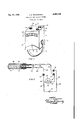
- Figure 2 is an electrical diagram of the circuit testing apparatus showing it about to be applied to a circuit containing a blasting cap, the blasting cap being shown in cross section.
- a carrying case generally designed as 3 is provided, having a box like portion 4 provided with a lid or cover portion 6 and containing an instrument, the dial I of which shows through opening 8 in the case.
- the case 3 is preferably provided with any usual fastening means such assnap fastener 9 to locate the cover 6 around the instrument I.
- case 3 is made is preferablyleather or rubber or some other similar soft yieldable and flexible material so that the hard, preferably metallic case of the instrument will not contact the person carrying the instrument.
- Case 3 is provided with a carrying strap II which may be any length strap and which is provided with the suitable fastening means 12 to secure it to the case. While strap It may be long enough to pass over the shoulder, I have found it preferable to have strap II a relatively short strap and then to pass the belt in the top of the trousers of the person carrying the instrument through strap It to support the instrument somewhere around the waist preferably in a position where bumping of the instrument during walking is minimized. 4
- holes l4, I6 and H there are provided holes l4, I6 and H.
- I In practice I often find it convenient to merge holes l6 and H into a single elliptical or hour glass shaped hole.
- Protruding through holes it, It and I1 and substantially flush with the upper surface of bottom l3, but preferably slightly recessed therebelow are elecm tric contacts l8, l9 and 2
- These three electrical contacts are provided preferably with a rough upper surface such as a knurled surface having fairly sharp points thereon. These contacts will be discussed further below.
- contacts 18, I9 and 2! are shown in the central portion of the figure and adjacent said contacts are bare ends 22 and 23 of wires 24 and 26.
- wires 24 and 26 are shown as insulated wires from which the insulation has been scraped at points 22 and 23.
- circuits may be tested, which may or may not be composed of insulated or uninsulated wires, depending on how they are supported and their use.
- Wires 24 and 25 are shown leading to a single blasting cap 21 of conventional type. Obviously any number of blasting caps may be contained in the circuit and they may be in series or in parallel or partly in series and partly in parallel, including wire splices which often cause shorts or open circuits.
- Conventional blasting cap 21 is generally provided with a metal case 21 of brass or other metal containing powder or other explosive charges 28 and 29, a sealing or packing plug 3
- resistance 32 is the resistance 32.
- resistance 32 should contact case 21 in two or more of the blasting caps a short circuit might exist between the blasting caps through the ground (not shown).
- circuit tester in order to test circuit 22 to 28 a circuit tester is provided as follows:
- An ammeter 33 is provided.
- Ammeter 88 is preierably about a to milliammeter, but obviously any electrical engineer can select the desired ammeter to fit the electrical conditions existing in the circuit.
- a first electrical connection 34 is provided from one side of ammeter 38 leading directly to contact point I8.
- a second electrical connection is provided between the same side of ammeter 33 and contact point I! and this second electrical connection preferably comprises a first resistance 36, a battery 31, a second resistance 38 and wire 39 connecting the resistances and battery in series.
- is provided directly between the other side 42 of said ammeter and the contact point 2
- All the other wires are too short and too conductive to have resistance enough to change the values of the elements already assigned resistance values except wires 24 and 28, which when properly spliced should run about 2 ohms per hundred feet and wires 24 and 26 generally average a total ofabout 100 feet for the usual shot hole, as that length places the blaster pretty close, and in many instances the total length (and electrical resistance) of wires 24 and 26 is greater. This places 0 the total minimum resistance of the blasting cap circuit at about 3 ohms and when there is more wire or two or more caps are in series the value is higher.
- the remotest chance of firing a blasting cap by 50 is the current received from the tester being used.
- some blasting caps require minimum current of about 200 milliamperes to fire them.
- the maximum current that can be delivered to the blasting cap circuit by the present invention when using the size resistance and battery mentioned above is about 10 milliamperes. This gives a factor of safety of about which is considered highly satisfactory.
- large deflections are visible on the ammeter dial so that the testing is made easy and can be done rapidly without chance of error.
- the bare end'of wire 28' is held against the rough surface of contact points l9 and 2
- wire 26, cap 21, or wire 22 are grounded, or not, have any effect, as the resistance in wire 23 between l9 and 2
- completes the circuit through wire cl, ammeter 33, resistance 36, battery 3
- the resistances 3o, 38 and the resistance 43 of the arnmeter are so chosen with respect to the voltage amperage and internal resistance of battery at so that the needle 44 on dial '1 will be deflected almost about, or exactly the full length of the scale.
- the extent of deliection may be noted when the battery 31 is new zor comparison with later readings to test the battery.
- One advantage of the chloride of silver cell is that the voltage is substantially constant even when the cell is almost completely discharged. This full scaled defiection of the needle shows that the circuit tester is in operating condition.
- the advantage of two current limiting resistances is protection of the valuable chloride of silver cell from a shorted discharge which might be more likely to occur if there were only one resistance to be accidentally shorted out.
- R Rra+Ras+Ra7+Ras Resistances of parts 43, 28, 81 and 38 are noted as R with the reference numeral as a subscript).
- the meter will continue to show maximum deflection of full scale when wire 22 is applied to contact II.
- the blasting circuit :4 as is shorted the meter needle 44 will drop back to zero, or give a minor deflection somewhere between normal and zero when wire 22 is applied to contact l8, and if this short is sumcient to cause trouble in the operation of the blasting circuit there will be a considerable difference between the normal and observed deflection of needle 44, as of course the operator is experienced in knowing how much resistance to expect in the circuit when normal, as he knows the lengths and resistances of the blasting cap circuit being tested.
- Ra resistance of parts 22, 32 and 23 be.
- R. 104 ohms
- R 2 ohms b c I-e(-- RaRb RGRC 0.0097 amps.
- dial 1 can be calibrated or marked with both ranges as desired or instead, as shown, equally spaced marks on the dial may be employed and the operator supplied with a chart giving values to the numbersshown in both the parallel and series hook ups.
- the silver chloride cell has the advantage of self limitation of current so that an added safety factor is given to prevent accidental firing of a blasting cap.
- a chloride of silver, or silver chloride cell (both are the same) is defined on page 1875 and page 1879 of Handbook of Chemistry and Physics," 24th edition,'Chemical Rubber Publishing Company, Cleveland, Ohio (1940).
- a circuit for testing a blasting cap comprising, in combination, a first contact, a second contact, and a third contact, said contacts being readily accessible for connection of an exterior circuit thereto, an ammeter connected across the first and second contacts, and a circuit connected across said first and third contacts, said circuit including a source of electromotive force and a resistance connected in series therewith whereby, upon interconnection of said second and third contacts, a deflection of said meter is produced for calibration purposes, and whereby the circuit between said first contact and the interconnected second and third contacts provides a shunt testing circuit, and the circuit between said second and third contacts provides a series testing circuit.
- a circuit for testing a blasting cap comprising, in combination, a first contact, a second contact, and a third contact, said contacts being readily accessible for connection of an exterior circuit thereto, an ammeter connected across the first and second contacts, and a circuit connected across said first and third contacts, said circuit including a, silver-chloride cell and a resistance connected in series therewith, said cell'limiting the current flow -through the-testing circuit; whereby, upon' interconnection of said second and third contacts; a deflection of-said meter is produced for calibration purposes, and whereby the circuit between said first contact and the interconnected second and third contacts provides a shunt testing circuit, and the circuit between said second and third contacts provides a series testing circuit.
- a circuit for testing a blasting cap comprising, in combination, a first contact, a second contact, and a third contact, each of said contacts having a knurled surface permitting a bare wire conductor to be effectively connected thereto by the pressure of a finger against the contact, an ammeter connected across the first and second contacts, and a circuit connected across said first and third contacts, said circuit including a silver chloride cell and a resistance connected in series therewith, said cell limiting the current flow through the testing circuit, whereby, upon interconnection of said second and third contacts, a deflection of said meter is produced for calibration purposes, and whereby the circuit between said first contact and the interconnected second and third contacts provides a shunt testing circuit and the circuit between said second and third contacts provides a series testing circuit.
- a circuit tester for indicating the condition of a blasting cap which comprises, in combination, a case, a first contact, a second contact, and a third contact, all mounted on said case and each having an exposed surface at the outside of said case, an anrmeter connected across the first and second contacts, and a circuit connected across said first and third contacts, said circuit including a source 01' electromotive force and a resistance connected in series therewith whereby,
Landscapes
- Engineering & Computer Science (AREA)
- General Engineering & Computer Science (AREA)
- Manufacturing & Machinery (AREA)
- Investigating Or Analyzing Materials By The Use Of Electric Means (AREA)
Description
Dec. 27, 1949 I BONDURANT 2,492,459
BLASTING CAP CIRCUIT TESTER Filed Nov. 3, 1944 INVENTOR J. E. BONDURANT ATl'ORN Patented Dec. 27, 1949 BLASTING CAP CIRCUIT TESTER John E. Bondurant, Bartlesvllle, th., asslgnor to Phillips Petroleum Company, a corporation of Delaware Application November 3, 1944, Serial No. 581,796
4 Claims.
This invention relates to a circuit tester. In one of its more specific aspects it relates to a blasting cap circuit tester in which means is provided for testing the tester and for testing the circuit. In another specific aspect it relates to a blasting cap circuit tester having two ranges depending on the resistance of the blasting cap circuit.
Difliculty has been experienced in the use of prior art circuit testers as such circuit testers are designed to test circuits containing a large number of caps only. Many of these old circuit testers have external switches which may be broken oil or which may be left closed so that the battery will be discharged accidentally.
One object of the present invention is to provide a combination high and low resistance testing circuit for a single blasting cap, or any number of caps in series, or any number of caps in parallel.
Another object is to provide for the use of such a circuit with a bridging arrangement which eliminates all external switches.
Another object is to provide a handy and useful self contained circuit tester which may be carried on a persons belt or elsewhere on their person without painful contact and which can be rapidly and readily used without removal from the carryin case.
Numerous other objects and advantages will be apparent to those skilled in the art upon reading the accompanying specification and claims and studying the accompanying drawings.
In the drawings- Figure 1 is a perspective view of an embocli= ment of the resent invention showing the external appearance of the carrying case and instrument.
Figure 2 is an electrical diagram of the circuit testing apparatus showing it about to be applied to a circuit containing a blasting cap, the blasting cap being shown in cross section.
In Figure 1 a carrying case generally designed as 3 is provided, having a box like portion 4 provided with a lid or cover portion 6 and containing an instrument, the dial I of which shows through opening 8 in the case. The case 3 ispreferably provided with any usual fastening means such assnap fastener 9 to locate the cover 6 around the instrument I.
The material of which case 3 is made is preferablyleather or rubber or some other similar soft yieldable and flexible material so that the hard, preferably metallic case of the instrument will not contact the person carrying the instrument. Case 3 is provided with a carrying strap II which may be any length strap and which is provided with the suitable fastening means 12 to secure it to the case. While strap It may be long enough to pass over the shoulder, I have found it preferable to have strap II a relatively short strap and then to pass the belt in the top of the trousers of the person carrying the instrument through strap It to support the instrument somewhere around the waist preferably in a position where bumping of the instrument during walking is minimized. 4
In the bottom 13 of case 3, there are provided holes l4, I6 and H. In practice I often find it convenient to merge holes l6 and H into a single elliptical or hour glass shaped hole. Protruding through holes it, It and I1 and substantially flush with the upper surface of bottom l3, but preferably slightly recessed therebelow are elecm tric contacts l8, l9 and 2|. These three electrical contacts are provided preferably with a rough upper surface such as a knurled surface having fairly sharp points thereon. These contacts will be discussed further below.
In Figure 2 it will be noted that contacts 18, I9 and 2! are shown in the central portion of the figure and adjacent said contacts are bare ends 22 and 23 of wires 24 and 26. As the circuit shown being tested is a blast cap circuit, and as wires in such a circuit are in contact with the ground in most instances, wires 24 and 26 are shown as insulated wires from which the insulation has been scraped at points 22 and 23.
Obviously other circuits may be tested, which may or may not be composed of insulated or uninsulated wires, depending on how they are supported and their use.
in order to test circuit 22 to 28 a circuit tester is provided as follows:
An ammeter 33 is provided. Ammeter 88 is preierably about a to milliammeter, but obviously any electrical engineer can select the desired ammeter to fit the electrical conditions existing in the circuit. A first electrical connection 34 is provided from one side of ammeter 38 leading directly to contact point I8. A second electrical connection is provided between the same side of ammeter 33 and contact point I! and this second electrical connection preferably comprises a first resistance 36, a battery 31, a second resistance 38 and wire 39 connecting the resistances and battery in series. A third electrical connection 4| is provided directly between the other side 42 of said ammeter and the contact point 2|.
While other values may be chosen, I prefer to have resistances 36 and 38 each 50 ohms. While other sources of direct current may be employed, I prefer to have battery 31 be a 1.02 volt chloride of silver cell. The average value of the internal resistance of such a cell 31 is about 4 ohms by test. -The average resistance between contacts l8 and 2| through milliammeter coil 48 is about 2 ohms by test. The average resistance of blasting cap 21 is about 1 ohm. All the other wires are too short and too conductive to have resistance enough to change the values of the elements already assigned resistance values except wires 24 and 28, which when properly spliced should run about 2 ohms per hundred feet and wires 24 and 26 generally average a total ofabout 100 feet for the usual shot hole, as that length places the blaster pretty close, and in many instances the total length (and electrical resistance) of wires 24 and 26 is greater. This places 0 the total minimum resistance of the blasting cap circuit at about 3 ohms and when there is more wire or two or more caps are in series the value is higher.
OPERATION the remotest chance of firing a blasting cap by 50 is the current received from the tester being used. For example some blasting caps require minimum current of about 200 milliamperes to fire them. The maximum current that can be delivered to the blasting cap circuit by the present invention when using the size resistance and battery mentioned above is about 10 milliamperes. This gives a factor of safety of about which is considered highly satisfactory. At the same time large deflections are visible on the ammeter dial so that the testing is made easy and can be done rapidly without chance of error. One of the bare ends 23 of the blasting circuit -is bridged across contact 'positibiiis jQ-a'ndfll as shown in Figure 2. The bare end'of wire 28' is held against the rough surface of contact points l9 and 2| by the pressure of the operator's thumb or finger, and the factjthat he is contacting the wire and contact points with'l'ils finger does not effect the operation of the device. Nor-does the fact that wire 26, cap 21, or wire 22 are grounded, or not, have any effect, as the resistance in wire 23 between l9 and 2| is so small no further decrease therein can be caused unless contact II were contacted which cannot occur without the 75 operator's knowledge. This contact of wire 23 on points Is and 2| completes the circuit through wire cl, ammeter 33, resistance 36, battery 3|, resistance 33, wire 33 and wire 23. The resistances 3o, 38 and the resistance 43 of the arnmeter are so chosen with respect to the voltage amperage and internal resistance of battery at so that the needle 44 on dial '1 will be deflected almost about, or exactly the full length of the scale. The extent of deliection may be noted when the battery 31 is new zor comparison with later readings to test the battery. One advantage of the chloride of silver cell is that the voltage is substantially constant even when the cell is almost completely discharged. This full scaled defiection of the needle shows that the circuit tester is in operating condition.
The advantage of two current limiting resistances is protection of the valuable chloride of silver cell from a shorted discharge which might be more likely to occur if there were only one resistance to be accidentally shorted out.
Example NO. 1
e=potential in volts =current in amps. R=resistance in ohms e=IR (Ohms law) R=Rra+Ras+Ra7+Ras Resistances of parts 43, 28, 81 and 38 are noted as R with the reference numeral as a subscript).
=1.02 VOltS R43=2 ohms Ras= Ohms Ra1=4 ohms Raa=50 ohms Substituting is Ohms law above:
1.02=I(2+50+4+50) I=0.0096 amps.=9.6 milliamps.
Now this current (I) of about 10 milliamperes not suificient to set off blasting cap 32 which requires 200 milliamperes to fire the same even if wire 23 were placed on contact I! and wire 22- on contact 2|. safety of 20 still exists. It will also be seen by Ohms law that as long as at least one of resistances 36 or 38 protects its end of battery 31 that less than 20 milliamperes can be drawn from the battery (there being 54 ohms resistance and 1.02 volts potential in this system) leaving a factor m of safety of 10 regardless of how the rest ofthe circuit is shorted.
While still holding bare wire 23 across contacts l9 and 2| the operator then takes bare wire 22 and contacts it to contact still maintaining the first circuit through wires 8| and 39 and the other elements enumerated above the operator has now established a second circuit 34, I8, 22, 24, 32, 26 and 23 in parallel to said first circuit and the current of battery 31 is divided between the two circuits. For a normal blasting circuit the ammeter will deflect-to about half of scale 7 depending on the resistance of the blasting circuit. The operator is holding wire 23} similarly; fingers oron contact l9 and 2| while wire 22 is held on contact l8 by another of his As mentioned above a factor of I8. Thus while thumbs At the low voltage employed the human body is substantially non-conducting and does not eiIect the reading enough to amount to anything.
If the blasting circuit is open (due to a poor connection or a broken lead wire or similar trouble) the meter will continue to show maximum deflection of full scale when wire 22 is applied to contact II. On the other hand if the blasting circuit :4, as is shorted the meter needle 44 will drop back to zero, or give a minor deflection somewhere between normal and zero when wire 22 is applied to contact l8, and if this short is sumcient to cause trouble in the operation of the blasting circuit there will be a considerable difference between the normal and observed deflection of needle 44, as of course the operator is experienced in knowing how much resistance to expect in the circuit when normal, as he knows the lengths and resistances of the blasting cap circuit being tested.
Example N0. 2
called Ra, resistance of parts 22, 32 and 23 be.
called Rb and the resistance of milliammeter ll, 43 be called Re, the currents therein as In where n is the respective letter, and the E. M. F. of battery 31 be called e. Then:
R.=104 ohms R ,=3 ohms e=1.02 volts R =2 ohms b c I-e(-- RaRb RGRC 0.0097 amps.
R I R, R
Other circuits will give other values which may be similarly calculated; or the following formula may be used:
I =0.00582 amps.
If a large number of blasting caps are connected in series (or there is some other reason for higher resistance in blasting circuit 24, 26) then after testing. the tester with wire 23 across contacts I9 and 2| and with wire 22 notin contact with anything, then wire 23 can be removed from one of contacts l9 and 2| and wire 22 applied to the other of contacts l9 and 2|. This provides,
amps.) and of course dial 1 can be calibrated or marked with both ranges as desired or instead, as shown, equally spaced marks on the dial may be employed and the operator supplied with a chart giving values to the numbersshown in both the parallel and series hook ups.
While other cells can be used the silver chloride cell has the advantage of self limitation of current so that an added safety factor is given to prevent accidental firing of a blasting cap. A chloride of silver, or silver chloride cell (both are the same) is defined on page 1875 and page 1879 of Handbook of Chemistry and Physics," 24th edition,'Chemical Rubber Publishing Company, Cleveland, Ohio (1940).
Obviously the usual accident will only short one resistance 36 or 33 at a time, and this will be detected before the other resistance can be shorted, so protection is always maintained.
The bridging arrangement shown where wires 22 and 23 are held against rough contacts ll, ll
and 2| eliminates alltroublesome switches and allows a fully water prooied case to be used. If a switch were to be used, there would always be the chance that it would be left on and this would drain the silver chloride cell 31 in a very short time. With the bridging arrangement as proposed the current flow ceases as soon as the operator removes the wire from contacts l3, l3
and- 2|. These wires cannot be fastened to the contacts. They will fall awayas soon as the" operator removes his hands'from the unit. This makes for simplicity of operation and long cell life.
Formal changes may be made in the specific embodiment of the invention described without departing from the spirit of the broad invention, the scope of which is commensurate with the appended claims.
Having described my invention, I claim:
1, A circuit for testing a blasting cap comprising, in combination, a first contact, a second contact, and a third contact, said contacts being readily accessible for connection of an exterior circuit thereto, an ammeter connected across the first and second contacts, and a circuit connected across said first and third contacts, said circuit including a source of electromotive force and a resistance connected in series therewith whereby, upon interconnection of said second and third contacts, a deflection of said meter is produced for calibration purposes, and whereby the circuit between said first contact and the interconnected second and third contacts provides a shunt testing circuit, and the circuit between said second and third contacts provides a series testing circuit.
2. A circuit for testing a blasting cap comprising, in combination, a first contact, a second contact, and a third contact, said contacts being readily accessible for connection of an exterior circuit thereto, an ammeter connected across the first and second contacts, and a circuit connected across said first and third contacts, said circuit including a, silver-chloride cell and a resistance connected in series therewith, said cell'limiting the current flow -through the-testing circuit; whereby, upon' interconnection of said second and third contacts; a deflection of-said meter is produced for calibration purposes, and whereby the circuit between said first contact and the interconnected second and third contacts provides a shunt testing circuit, and the circuit between said second and third contacts provides a series testing circuit.
3. A circuit for testing a blasting cap comprising, in combination, a first contact, a second contact, and a third contact, each of said contacts having a knurled surface permitting a bare wire conductor to be effectively connected thereto by the pressure of a finger against the contact, an ammeter connected across the first and second contacts, and a circuit connected across said first and third contacts, said circuit including a silver chloride cell and a resistance connected in series therewith, said cell limiting the current flow through the testing circuit, whereby, upon interconnection of said second and third contacts, a deflection of said meter is produced for calibration purposes, and whereby the circuit between said first contact and the interconnected second and third contacts provides a shunt testing circuit and the circuit between said second and third contacts provides a series testing circuit.
4. A circuit tester for indicating the condition of a blasting cap which comprises, in combination, a case, a first contact, a second contact, and a third contact, all mounted on said case and each having an exposed surface at the outside of said case, an anrmeter connected across the first and second contacts, and a circuit connected across said first and third contacts, said circuit including a source 01' electromotive force and a resistance connected in series therewith whereby,
upon interconnection of said second and third contacts, a deflection of said meter is produced for calibration purposes, and whereby the circuit circuit.
JOHN E. BQNDURANT. f
REFERENCES CITED The following references are of record in the file of this patent:
- UNITED STATES PA'IENIB Number Name Date 945,964 Marks Jan. 4, 1910 956,877 Beattie May 3, 1910 1,301,434 Heitman Apr. 22, 1910 1,593,024 Macadie July 20, 1926 1,690,118 Julyan Nov. 6, 1928 1,925,694 Hawkins Sept. 5, 1933 2,098,212 Wilkinson Nov. 2, 1937 2,163,475 Tomalis June 20, 1939 2,179,901 Smith Nov. 14, 1939 2,255,946 Smith Sept. 16, 1941 2,290,307 Wicker July 21, 1942 FOREIGN PATENTS Number Country Date 239,085 Germany Oct. 7', 1911 mm. REFERENCES Wireless World, August 1943, pages 324427.
Priority Applications (1)
| Application Number | Priority Date | Filing Date | Title |
|---|---|---|---|
| US561796A US2492459A (en) | 1944-11-03 | 1944-11-03 | Blasting cap circuit tester |
Applications Claiming Priority (1)
| Application Number | Priority Date | Filing Date | Title |
|---|---|---|---|
| US561796A US2492459A (en) | 1944-11-03 | 1944-11-03 | Blasting cap circuit tester |
Publications (1)
| Publication Number | Publication Date |
|---|---|
| US2492459A true US2492459A (en) | 1949-12-27 |
Family
ID=24243508
Family Applications (1)
| Application Number | Title | Priority Date | Filing Date |
|---|---|---|---|
| US561796A Expired - Lifetime US2492459A (en) | 1944-11-03 | 1944-11-03 | Blasting cap circuit tester |
Country Status (1)
| Country | Link |
|---|---|
| US (1) | US2492459A (en) |
Cited By (11)
| Publication number | Priority date | Publication date | Assignee | Title |
|---|---|---|---|---|
| US2543803A (en) * | 1945-10-09 | 1951-03-06 | Robert S Prescott | Detonator testing device |
| US2543754A (en) * | 1945-08-24 | 1951-03-06 | Ronald O Beach | Detonator testing device |
| US2707770A (en) * | 1951-02-03 | 1955-05-03 | Swift & Co | Electrical testing equipment |
| US2816264A (en) * | 1949-12-22 | 1957-12-10 | Herman A Hood | Conductivity testing system |
| US2821681A (en) * | 1954-05-27 | 1958-01-28 | Fairey Aviat Co Ltd | Resistance meters |
| US3365662A (en) * | 1963-07-18 | 1968-01-23 | Trw Inc | Ohmmeter having a constant current source including photovoltaic cell |
| US4636715A (en) * | 1984-08-13 | 1987-01-13 | C-I-L Inc. | Digital display ohmmeter |
| USD293895S (en) | 1985-01-17 | 1988-01-26 | Nitro Nobel Ab | Resistance insulation meter |
| US5631570A (en) * | 1995-05-09 | 1997-05-20 | Hubbell Incorporated | Protective grounding jumper cable tester and testing method |
| US5811979A (en) * | 1996-08-09 | 1998-09-22 | Hubbell Incorporated | Protective grounding jumper cable tester |
| WO2022084338A1 (en) * | 2020-10-19 | 2022-04-28 | Hoff Juergen | Ignition device |
Citations (12)
| Publication number | Priority date | Publication date | Assignee | Title |
|---|---|---|---|---|
| DE239085C (en) * | ||||
| US945964A (en) * | 1909-04-19 | 1910-01-11 | Frederick H Lincoln | Passenger electric-railway car. |
| US956877A (en) * | 1909-02-23 | 1910-05-03 | Francis Beattie | Tester for electric blasting-fuses. |
| US1301434A (en) * | 1917-06-14 | 1919-04-22 | Brown Instr Co | Electric meter. |
| US1593024A (en) * | 1922-05-30 | 1926-07-20 | Automatic Coil Winder & Electrical Equipment Co Ltd | Electrical measuring instrument |
| US1690118A (en) * | 1926-05-21 | 1928-11-06 | Auto Mechanical Products Compa | Battery connecter |
| US1925694A (en) * | 1932-02-02 | 1933-09-05 | William B Hawkins | Carryall case for cameras |
| US2098212A (en) * | 1936-11-21 | 1937-11-02 | Gen Electric | Testing of electrical circuits |
| US2163475A (en) * | 1935-12-04 | 1939-06-20 | Anthony J Tomalis | Blasting device |
| US2179901A (en) * | 1934-12-01 | 1939-11-14 | Ralph W Smith | Ground detector |
| US2255946A (en) * | 1939-12-19 | 1941-09-16 | Westinghouse Electric & Mfg Co | Instrument casing |
| US2290307A (en) * | 1938-05-28 | 1942-07-21 | Walter C Wicker | Camera case |
-
1944
- 1944-11-03 US US561796A patent/US2492459A/en not_active Expired - Lifetime
Patent Citations (12)
| Publication number | Priority date | Publication date | Assignee | Title |
|---|---|---|---|---|
| DE239085C (en) * | ||||
| US956877A (en) * | 1909-02-23 | 1910-05-03 | Francis Beattie | Tester for electric blasting-fuses. |
| US945964A (en) * | 1909-04-19 | 1910-01-11 | Frederick H Lincoln | Passenger electric-railway car. |
| US1301434A (en) * | 1917-06-14 | 1919-04-22 | Brown Instr Co | Electric meter. |
| US1593024A (en) * | 1922-05-30 | 1926-07-20 | Automatic Coil Winder & Electrical Equipment Co Ltd | Electrical measuring instrument |
| US1690118A (en) * | 1926-05-21 | 1928-11-06 | Auto Mechanical Products Compa | Battery connecter |
| US1925694A (en) * | 1932-02-02 | 1933-09-05 | William B Hawkins | Carryall case for cameras |
| US2179901A (en) * | 1934-12-01 | 1939-11-14 | Ralph W Smith | Ground detector |
| US2163475A (en) * | 1935-12-04 | 1939-06-20 | Anthony J Tomalis | Blasting device |
| US2098212A (en) * | 1936-11-21 | 1937-11-02 | Gen Electric | Testing of electrical circuits |
| US2290307A (en) * | 1938-05-28 | 1942-07-21 | Walter C Wicker | Camera case |
| US2255946A (en) * | 1939-12-19 | 1941-09-16 | Westinghouse Electric & Mfg Co | Instrument casing |
Cited By (12)
| Publication number | Priority date | Publication date | Assignee | Title |
|---|---|---|---|---|
| US2543754A (en) * | 1945-08-24 | 1951-03-06 | Ronald O Beach | Detonator testing device |
| US2543803A (en) * | 1945-10-09 | 1951-03-06 | Robert S Prescott | Detonator testing device |
| US2816264A (en) * | 1949-12-22 | 1957-12-10 | Herman A Hood | Conductivity testing system |
| US2707770A (en) * | 1951-02-03 | 1955-05-03 | Swift & Co | Electrical testing equipment |
| US2821681A (en) * | 1954-05-27 | 1958-01-28 | Fairey Aviat Co Ltd | Resistance meters |
| US3365662A (en) * | 1963-07-18 | 1968-01-23 | Trw Inc | Ohmmeter having a constant current source including photovoltaic cell |
| US4636715A (en) * | 1984-08-13 | 1987-01-13 | C-I-L Inc. | Digital display ohmmeter |
| USD293895S (en) | 1985-01-17 | 1988-01-26 | Nitro Nobel Ab | Resistance insulation meter |
| US5631570A (en) * | 1995-05-09 | 1997-05-20 | Hubbell Incorporated | Protective grounding jumper cable tester and testing method |
| US5684408A (en) * | 1995-05-09 | 1997-11-04 | Hubbell Incorporated | Protective grounding jumper cable testing method |
| US5811979A (en) * | 1996-08-09 | 1998-09-22 | Hubbell Incorporated | Protective grounding jumper cable tester |
| WO2022084338A1 (en) * | 2020-10-19 | 2022-04-28 | Hoff Juergen | Ignition device |
Similar Documents
| Publication | Publication Date | Title |
|---|---|---|
| US3141128A (en) | Apparatus for testing portable equipment for a. c. and d. c. leakage and for ground continuity | |
| US3315163A (en) | Meter probe with slidable circuit changing contact point | |
| US3936121A (en) | Jumper cables for sparkling polarity indicator | |
| US4210862A (en) | Test device for indicating an electric voltage and/or the polarity thereof, and the passage of current through an electric conductor | |
| US4636715A (en) | Digital display ohmmeter | |
| EP3258281A1 (en) | Asymmetric battery testing apparatus | |
| GB1385977A (en) | Electrical measurement apparatus | |
| CA1101072A (en) | Electrical circuit test devices | |
| US4143317A (en) | Multiple range peak reading voltmeter | |
| US2732518A (en) | Bore hole detecting circuit and bore hole firing | |
| US2502775A (en) | Method of testing well tubing | |
| US2128019A (en) | Phase sequence and voltage indicating means | |
| US2547248A (en) | Electrical multitester | |
| US3263164A (en) | Electrical ground and polarity tester with thermally controlled switch means | |
| US1835882A (en) | Electrical testing device | |
| US4204153A (en) | Method of determining the open circuit voltage of a battery in a closed circuit | |
| US3975683A (en) | In-circuit diode tester | |
| US1807439A (en) | Prod type battery cell tester | |
| US2076639A (en) | Storage battery testing apparatus | |
| US3387200A (en) | Battery chargers with reverse polarity indicator | |
| GB1333918A (en) | Instruments for checking the operation of earth leakage circuit breakers | |
| US4871972A (en) | Apparatus for detecting faulty power line insulator | |
| US2922104A (en) | Apparatus for testing multi-cell storage batteries | |
| US2778992A (en) | Electrical circuit device | |
| US4047104A (en) | Ohmmeter for circuits carrying unknown currents |