US2492444A - Garment construction - Google Patents
Garment construction Download PDFInfo
- Publication number
- US2492444A US2492444A US44941A US4494148A US2492444A US 2492444 A US2492444 A US 2492444A US 44941 A US44941 A US 44941A US 4494148 A US4494148 A US 4494148A US 2492444 A US2492444 A US 2492444A
- Authority
- US
- United States
- Prior art keywords
- ball
- garment
- knees
- leg
- umpire
- Prior art date
- Legal status (The legal status is an assumption and is not a legal conclusion. Google has not performed a legal analysis and makes no representation as to the accuracy of the status listed.)
- Expired - Lifetime
Links
- 238000010276 construction Methods 0.000 title description 7
- 210000002414 leg Anatomy 0.000 description 21
- 210000003127 knee Anatomy 0.000 description 20
- 239000000463 material Substances 0.000 description 11
- 210000003141 lower extremity Anatomy 0.000 description 4
- 210000004417 patella Anatomy 0.000 description 2
- 244000309466 calf Species 0.000 description 1
- 239000003086 colorant Substances 0.000 description 1
- 230000008602 contraction Effects 0.000 description 1
- 238000000034 method Methods 0.000 description 1
Images
Classifications
-
- A—HUMAN NECESSITIES
- A41—WEARING APPAREL
- A41D—OUTERWEAR; PROTECTIVE GARMENTS; ACCESSORIES
- A41D1/00—Garments
- A41D1/06—Trousers
- A41D1/08—Trousers specially adapted for sporting purposes
Definitions
- This invention relates to garment constructions designed to be worn by players of ball games, such as baseball, soft ball, andthe like. It is adapted to aid the umpire in making correct decisions as to whether the play constitutes a ball or a strikeL Official baseball rules provide that a fairly delivered ball is a ball pitched or thrown to the bat by the pitcher while standing in his position and facing the batsman that passes over any portion of the home base, before touching the ground, not lower than the batsmans knees nor higher than his shoulder. For every such fairly delivered ball the umpire shall call one strike.
- Conventional baseball pants are made of material which is of uniform color or appearance throughout, and usually the color is light.
- Such pants comprise a body portion which extends downwardly from the waistline of the wearer and merges into leg portions which extend well below the knees so as to provide ample material to permit the lower extremities of the leg portions to be doubled by turning them inwardly and upwardly.
- the free lower edges are hemmed and stitched to provide a circumferential pocket adapted to receive an elastic ring, to provide for contraction and expansion of the lower extremities of the leg portions.
- These lower contracted portions of the pants are designed to engage the stockings and legs of the wearer slightly below the knee, and the leg portions are intended to be long enough to provide a doubled portion surrounding each leg in the region just below the knee.
- the object of my invention is to provide a garment construction for ball game players which will indicate the location of the wearers knees and aid the umpire in making correct decisions.
- Another object is to provide means in a garment of the character described which will present a contrast to the ball and aid the umpire in determining that a ball which passes the contrasting area is not a fairly delivered ball and therefore does not constitute a strike.
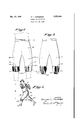
- Fig. 1 is a front elevational view of a garment embodying my invention, as it appears when worn by a ball game player, and indicating also part of the body of the wearer.
- Fig. 2 is a front elevational view of the garment as it appears when not being worn, and the leg portions thereof are fully extended and exposed to view.
- Fig. 3 is a perspective View of a baseball player in batting position and wearing the uniform of Fig. 1, this figure showing the vertical range of ball delivery to constitute a strike
- the garment takes the form of pants comprising a body portion I0 which extends downwardly from the waistline II and merges into leg portions I2 made of uniformly colored plain material or uniformly patterned material, preferably of a light color.
- Each leg portion I2 terminates in an edge I3 which extends around the wearers knee in a horizontal plane coinciding with the center of the knee cap indicated at I4.
- each leg portion I2 Attached to the edge I3 of each leg portion I2, by stitching or other suitable means, is a lower leg member I5 made of material which presents a contrasting appearance to the leg portion I2.
- the members I5 are made of dark material, or material of a color or kind which contrasts with the color ofthe ball used in the game.
- the free lower edges of the members I5 are overlapped and stitched as indicated at I6 to provide a circumferential pocket I1 enclosing the elastic ring which contracts the lower extremity of the leg.
- the pocketed portion I'I and the material just above it is turned inwardly and upwardly when the garment is being worn, so that the contracted portion engages the leg of the wearer below the knee, and to the observer the folded edge I8 constitutes the lower edge of the pants legs, as shown in Fig. l.
- the lighter appearing portion-s of the garment When properly tted and worn, the lighter appearing portion-s of the garment will cover the players body from lor near the waistline downwardly to the horizontal center line of the knees.
- the contrasting portions will cover the players 3 legs from said knee line to a point below the knees.
- Said contrasting material preferably is dark or of a color or kind which contrasts with the ball being played.
- the improved garment is shown as being worn by a ball player P in batting position, in Fig. 3.
- the vertical range of ball delivery to the batter at the plate to constitute a strike in accordance with existing rules is limited by the center of the players knee and his 'shoulder as i-s indicated Aat R.
- the invention need not be 4Y cozined to garments known as pants and may be embodied in garments which extend above the vWaistline of the player.
- the essential feature of the invention is the means which serve to indicate to the umpire the actual location of 'the pl'ayers knees while concealed by the garment.
- a garment construction to be worn by baseball players and adapted to aid the umpire in making correct decisions a-s to Whether a ball being delivered kto a batter constitutes a ball or a strike comprising a body covering portion having upper le'g members 'which define a crotch therebetween and extend downwardly from the crotch to horizontal lines which coincide approxi- -mate'ly 'with the center of the knee caps of the wearer,v and. lower leg portions connected to the upper leg members covering the wearers legs below said horizontal lines and extending down- REFERENCES CITED
- the following references are vof record in the le of this patent:
Landscapes
- Engineering & Computer Science (AREA)
- Textile Engineering (AREA)
- Professional, Industrial, Or Sporting Protective Garments (AREA)
Description
\ Dec- 27, 1949 w. l.. Rol-:ssNER GARMENT CONSTRUCTION y Filed Aug. 18, 1948 Patented Dec. 27, 1949 UMTEDv s're'rlazs-v PATENT OFFICE GARMENT 'CONSTRUCTION .Y William L. Roessner, Cherry Hills Village, Colo.
Application August 18, 1948, Serial No. 44,941
1 Claim.
This invention relates to garment constructions designed to be worn by players of ball games, such as baseball, soft ball, andthe like. It is adapted to aid the umpire in making correct decisions as to whether the play constitutes a ball or a strikeL Official baseball rules provide that a fairly delivered ball is a ball pitched or thrown to the bat by the pitcher while standing in his position and facing the batsman that passes over any portion of the home base, before touching the ground, not lower than the batsmans knees nor higher than his shoulder. For every such fairly delivered ball the umpire shall call one strike.
Conventional baseball pants are made of material which is of uniform color or appearance throughout, and usually the color is light. Such pants comprise a body portion which extends downwardly from the waistline of the wearer and merges into leg portions which extend well below the knees so as to provide ample material to permit the lower extremities of the leg portions to be doubled by turning them inwardly and upwardly. The free lower edges are hemmed and stitched to provide a circumferential pocket adapted to receive an elastic ring, to provide for contraction and expansion of the lower extremities of the leg portions. These lower contracted portions of the pants are designed to engage the stockings and legs of the wearer slightly below the knee, and the leg portions are intended to be long enough to provide a doubled portion surrounding each leg in the region just below the knee.
Some players adjust the lower extremities of the pants legs in such manner that the visible portion of the pants legs extends only a few inches below the center of the knee cap. Others arrange the elastic end portions well down on the calf of the leg, leaving little extra material to be doubled and exposing almost the full length of the pants legs below the wearers knees.
It is difficult for the umpire to decide whether a played ball has passed below or above the batsmans knees. When the players uniform is worn so that the pants legs extend a substantial distance below his knees the umpire cannot judge accurately the location of the knees and may call a strike when in fact the ball may have passed lower than the batsmans knees.
The misjudgment of balls is made more probable, also by the fact that balls and most uniforms are light in color and fail to present any contrasting appearance in the play.
The object of my invention is to provide a garment construction for ball game players which will indicate the location of the wearers knees and aid the umpire in making correct decisions.
Another object is to provide means in a garment of the character described which will present a contrast to the ball and aid the umpire in determining that a ball which passes the contrasting area is not a fairly delivered ball and therefore does not constitute a strike.
In the drawings:
Fig. 1 is a front elevational view of a garment embodying my invention, as it appears when worn by a ball game player, and indicating also part of the body of the wearer.
Fig. 2 is a front elevational view of the garment as it appears when not being worn, and the leg portions thereof are fully extended and exposed to view.
Fig. 3 is a perspective View of a baseball player in batting position and wearing the uniform of Fig. 1, this figure showing the vertical range of ball delivery to constitute a strike In the preferred embodiment of the invention shown in the drawing, the garment takes the form of pants comprising a body portion I0 which extends downwardly from the waistline II and merges into leg portions I2 made of uniformly colored plain material or uniformly patterned material, preferably of a light color. Each leg portion I2 terminates in an edge I3 which extends around the wearers knee in a horizontal plane coinciding with the center of the knee cap indicated at I4. Attached to the edge I3 of each leg portion I2, by stitching or other suitable means, is a lower leg member I5 made of material which presents a contrasting appearance to the leg portion I2. Preferably the members I5 are made of dark material, or material of a color or kind which contrasts with the color ofthe ball used in the game. The free lower edges of the members I5 are overlapped and stitched as indicated at I6 to provide a circumferential pocket I1 enclosing the elastic ring which contracts the lower extremity of the leg.
The pocketed portion I'I and the material just above it is turned inwardly and upwardly when the garment is being worn, so that the contracted portion engages the leg of the wearer below the knee, and to the observer the folded edge I8 constitutes the lower edge of the pants legs, as shown in Fig. l.
When properly tted and worn, the lighter appearing portion-s of the garment will cover the players body from lor near the waistline downwardly to the horizontal center line of the knees. The contrasting portions will cover the players 3 legs from said knee line to a point below the knees. Said contrasting material preferably is dark or of a color or kind which contrasts with the ball being played.
The improved garment is shown as being worn by a ball player P in batting position, in Fig. 3. As is shown', the vertical range of ball delivery to the batter at the plate to constitute a strike in accordance with existing rules is limited by the center of the players knee and his 'shoulder as i-s indicated Aat R.
While a batters knees are usually in adjacency when in batting position and awaiting the delivery of a ball, they may be in variably lspaced relation as best suits the player in his particular technique in hitting the ball. In any event'th'e lower range line I3 will be clearly visible to the umpire and will materially aid him in his decision as to whether the pitched ball is a strik'mor a bal1.
Obviously the invention need not be 4Y cozined to garments known as pants and may be embodied in garments which extend above the vWaistline of the player. The essential feature of the invention is the means which serve to indicate to the umpire the actual location of 'the pl'ayers knees while concealed by the garment.
It will be understood, of course, that the 'oicial ball game rules may be changed from time to time, and that a fair line other than the one now indicated vby the batsmans knees may be established. In such event, the line of vdivision between the contrasting vportions of the-garment, indicated by the seam or -edge I3 in this embodiment of the invention, would be raised or lowered to conform to the rules. Such obvious Vchanges come within the scope of my invention.
Changes may be made in details of construction of the garment, and in the character and colors of the materials employed, without departing from the scope of my invention except as set forth in the appended claim.
I claim:
A garment construction to be worn by baseball players and adapted to aid the umpire in making correct decisions a-s to Whether a ball being delivered kto a batter constitutes a ball or a strike, comprising a body covering portion having upper le'g members 'which define a crotch therebetween and extend downwardly from the crotch to horizontal lines which coincide approxi- -mate'ly 'with the center of the knee caps of the wearer,v and. lower leg portions connected to the upper leg members covering the wearers legs below said horizontal lines and extending down- REFERENCES CITED The following references are vof record in the le of this patent:
UNITED STATES PATENTS Number Name Date rD. 67,346 'MacKinnon s May 19', T1925 A2,382,495 Malatesta Allg. 14, 1945
Priority Applications (1)
| Application Number | Priority Date | Filing Date | Title |
|---|---|---|---|
| US44941A US2492444A (en) | 1948-08-18 | 1948-08-18 | Garment construction |
Applications Claiming Priority (1)
| Application Number | Priority Date | Filing Date | Title |
|---|---|---|---|
| US44941A US2492444A (en) | 1948-08-18 | 1948-08-18 | Garment construction |
Publications (1)
| Publication Number | Publication Date |
|---|---|
| US2492444A true US2492444A (en) | 1949-12-27 |
Family
ID=21935161
Family Applications (1)
| Application Number | Title | Priority Date | Filing Date |
|---|---|---|---|
| US44941A Expired - Lifetime US2492444A (en) | 1948-08-18 | 1948-08-18 | Garment construction |
Country Status (1)
| Country | Link |
|---|---|
| US (1) | US2492444A (en) |
Cited By (2)
| Publication number | Priority date | Publication date | Assignee | Title |
|---|---|---|---|---|
| US3110903A (en) * | 1960-06-17 | 1963-11-19 | Clarence M Burchard | Convertible nether outer garment |
| US4894867A (en) * | 1988-04-14 | 1990-01-23 | Soft Short, Inc. | Sports trunk |
Citations (1)
| Publication number | Priority date | Publication date | Assignee | Title |
|---|---|---|---|---|
| US2382495A (en) * | 1944-02-23 | 1945-08-14 | Jr John B Malatesta | Indicator |
-
1948
- 1948-08-18 US US44941A patent/US2492444A/en not_active Expired - Lifetime
Patent Citations (1)
| Publication number | Priority date | Publication date | Assignee | Title |
|---|---|---|---|---|
| US2382495A (en) * | 1944-02-23 | 1945-08-14 | Jr John B Malatesta | Indicator |
Cited By (2)
| Publication number | Priority date | Publication date | Assignee | Title |
|---|---|---|---|---|
| US3110903A (en) * | 1960-06-17 | 1963-11-19 | Clarence M Burchard | Convertible nether outer garment |
| US4894867A (en) * | 1988-04-14 | 1990-01-23 | Soft Short, Inc. | Sports trunk |
Similar Documents
| Publication | Publication Date | Title |
|---|---|---|
| US3991420A (en) | Protective baseball batting garment | |
| US4354282A (en) | Garment with score indicia and attachable score recording markers | |
| US4091466A (en) | Hockey garment | |
| US9603400B2 (en) | Golf shirt with improved fit and contrast | |
| US4811427A (en) | Athletic garment for protecting genital area | |
| US20070050879A1 (en) | Sports clothing | |
| JP6920243B2 (en) | Asymmetric exercise clothing and how to use it | |
| US5090060A (en) | Sport shift sleeves having perspiration absorbing elements | |
| US4986548A (en) | Body ball tag game | |
| US20180325189A1 (en) | Slip resistant garment | |
| US6782559B2 (en) | Protective hockey undergarment | |
| KR20000047832A (en) | Outerwear | |
| US2521410A (en) | Trouser construction | |
| JPH08505910A (en) | Clothing, especially sportswear | |
| US11679319B2 (en) | Sport gloves | |
| US3110903A (en) | Convertible nether outer garment | |
| US3045245A (en) | Wearing apparel | |
| US3106718A (en) | Golf shirt | |
| US20140189929A1 (en) | Athletic Jersey Having Separate Sections Replicating Different Athletic Jerseys | |
| US20150149115A1 (en) | Multi-function Padded Pants | |
| US2100869A (en) | Garment | |
| US20130291278A1 (en) | Athletic warmer apparel | |
| US3790963A (en) | One piece garment | |
| USRE23225E (en) | Garment construction | |
| US2977602A (en) | Concealed pocket for football players' pants |