US2477458A - Electric blasting cap - Google Patents
Electric blasting cap Download PDFInfo
- Publication number
- US2477458A US2477458A US568816A US56881644A US2477458A US 2477458 A US2477458 A US 2477458A US 568816 A US568816 A US 568816A US 56881644 A US56881644 A US 56881644A US 2477458 A US2477458 A US 2477458A
- Authority
- US
- United States
- Prior art keywords
- plug
- pieces
- electric blasting
- wires
- leg wires
- Prior art date
- Legal status (The legal status is an assumption and is not a legal conclusion. Google has not performed a legal analysis and makes no representation as to the accuracy of the status listed.)
- Expired - Lifetime
Links
- 238000005422 blasting Methods 0.000 title description 22
- 239000000463 material Substances 0.000 description 16
- 229920001971 elastomer Polymers 0.000 description 8
- 239000005060 rubber Substances 0.000 description 8
- 239000003999 initiator Substances 0.000 description 6
- 229910052751 metal Inorganic materials 0.000 description 6
- 239000002184 metal Substances 0.000 description 6
- 239000000203 mixture Substances 0.000 description 6
- 239000002360 explosive Substances 0.000 description 4
- 238000000465 moulding Methods 0.000 description 4
- 241001185540 Charissa ambiguata Species 0.000 description 3
- 229910000831 Steel Inorganic materials 0.000 description 3
- NINIDFKCEFEMDL-UHFFFAOYSA-N Sulfur Chemical compound [S] NINIDFKCEFEMDL-UHFFFAOYSA-N 0.000 description 3
- 230000009850 completed effect Effects 0.000 description 3
- 238000010304 firing Methods 0.000 description 3
- 239000012858 resilient material Substances 0.000 description 3
- 239000010959 steel Substances 0.000 description 3
- 229910052717 sulfur Inorganic materials 0.000 description 3
- 239000011593 sulfur Substances 0.000 description 3
- KAKZBPTYRLMSJV-UHFFFAOYSA-N Butadiene Chemical compound C=CC=C KAKZBPTYRLMSJV-UHFFFAOYSA-N 0.000 description 2
- 238000002788 crimping Methods 0.000 description 2
- 238000005474 detonation Methods 0.000 description 2
- 230000000694 effects Effects 0.000 description 2
- 230000008030 elimination Effects 0.000 description 2
- 238000003379 elimination reaction Methods 0.000 description 2
- 238000009413 insulation Methods 0.000 description 2
- 238000000034 method Methods 0.000 description 2
- 238000007789 sealing Methods 0.000 description 2
- 238000004073 vulcanization Methods 0.000 description 2
- XLYOFNOQVPJJNP-UHFFFAOYSA-N water Substances O XLYOFNOQVPJJNP-UHFFFAOYSA-N 0.000 description 2
- RVCKCEDKBVEEHL-UHFFFAOYSA-N 2,3,4,5,6-pentachlorobenzyl alcohol Chemical compound OCC1=C(Cl)C(Cl)=C(Cl)C(Cl)=C1Cl RVCKCEDKBVEEHL-UHFFFAOYSA-N 0.000 description 1
- 241000237858 Gastropoda Species 0.000 description 1
- AGUIVNYEYSCPNI-UHFFFAOYSA-N N-methyl-N-picrylnitramine Chemical group [O-][N+](=O)N(C)C1=C([N+]([O-])=O)C=C([N+]([O-])=O)C=C1[N+]([O-])=O AGUIVNYEYSCPNI-UHFFFAOYSA-N 0.000 description 1
- 230000001464 adherent effect Effects 0.000 description 1
- 239000000853 adhesive Substances 0.000 description 1
- 230000001070 adhesive effect Effects 0.000 description 1
- 229910052782 aluminium Inorganic materials 0.000 description 1
- XAGFODPZIPBFFR-UHFFFAOYSA-N aluminium Chemical compound [Al] XAGFODPZIPBFFR-UHFFFAOYSA-N 0.000 description 1
- 239000011324 bead Substances 0.000 description 1
- 239000004568 cement Substances 0.000 description 1
- YACLQRRMGMJLJV-UHFFFAOYSA-N chloroprene Chemical compound ClC(=C)C=C YACLQRRMGMJLJV-UHFFFAOYSA-N 0.000 description 1
- 150000001875 compounds Chemical class 0.000 description 1
- 210000003298 dental enamel Anatomy 0.000 description 1
- 238000004880 explosion Methods 0.000 description 1
- 231100001261 hazardous Toxicity 0.000 description 1
- MHWLNQBTOIYJJP-UHFFFAOYSA-N mercury difulminate Chemical compound [O-][N+]#C[Hg]C#[N+][O-] MHWLNQBTOIYJJP-UHFFFAOYSA-N 0.000 description 1
- 230000035515 penetration Effects 0.000 description 1
- 239000004033 plastic Substances 0.000 description 1
- 229920003023 plastic Polymers 0.000 description 1
- 229920001084 poly(chloroprene) Polymers 0.000 description 1
- 229920001748 polybutylene Polymers 0.000 description 1
- 239000003566 sealing material Substances 0.000 description 1
- 229920003051 synthetic elastomer Polymers 0.000 description 1
- 239000005061 synthetic rubber Substances 0.000 description 1
- -1 tetryl Chemical class 0.000 description 1
- 238000004078 waterproofing Methods 0.000 description 1
Images
Classifications
-
- F—MECHANICAL ENGINEERING; LIGHTING; HEATING; WEAPONS; BLASTING
- F42—AMMUNITION; BLASTING
- F42B—EXPLOSIVE CHARGES, e.g. FOR BLASTING, FIREWORKS, AMMUNITION
- F42B3/00—Blasting cartridges, i.e. case and explosive
- F42B3/10—Initiators therefor
- F42B3/103—Mounting initiator heads in initiators; Sealing-plugs
Definitions
- This invention relates to an improved electric blasting initiator, and more particularl to one showing desirable characteristics in use and capable of ready and convenient mechanical assembly.
- An electric blasting cap comprises, generally, a substantially cylindrical metal shell containing a main detonating explosive charge, leg wires to .conduct electric current to the firing charge in order to bring about ignition thereof and detonation of the main charge, and suitable arrangements for effecting ignition.
- a common arrangement for use in firing electric blasting caps comprises a substantially cylindrical or slightly tapering bridge plug surrounding the leg wires and keeping them a spaced distance apart, these wires extending slightly beyond the inner surface of the plug and being connected at their emergent ends by abridge wire of small diameter and high electrical resistance.
- cast sulfur plugs are used, the sulfur being poured in molten form in a mold about the A very satisfactory plug is one formed by molding a rubber composition about the leg wires and effecting vulcanization within the mold.
- the latter type of mold has the advantage of excellent water resistance because of the resilience of the plug, which allows tight crimping.
- An object of the present invention is an electric blasting initiator, particularly an electric blasting cap, possessed of excellent resistance against penetration of water and moisture.
- a further object is such an electric blasting cap characterized by simplicity of design and ease of assembly. Additional objects will be disclosed as the invention is described more at length hereinafter.
- an electric blasting initiator comprisin a loaded shell and leg wires enterin said shell and held in place by a bridge plug, this plug comprising two or more distinct pieces of rubber or other resilient material fitted together to form a plug of substantiall circular crosssection, the leg wires being held in place between said assembled pieces.
- the assembled pieces are secured at the inner end, that is the end within the shell, by an annulet of a ductile material, for example a steel ferrule.
- I utilize two substantially semi-cylindrical pieces of rubberlike material that fit together to form a plug of completely circular cross-section. While the com pleted plug is ordinarily cylindrical in shape, it may be slightly tapered, if desired.
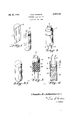
- Figure 1 is a perspective view of two grooved semi-cylindrical pieces of rubber to be formed into a plug.
- Figure 2 is an elevation of an assembled bridge plug.
- Figure 3 is a similar bridge plug with different arrangement of wires, while Figure 4 is a sectional view of a complete electric blasting cap.
- Figure 3-A is a perspective view of two semicylindrical pieces of rubber to be formed into a plug.
- I and 2 represent two substantially semi-cylindrical, vulcanized pieces of ,rubber of practically the same size, capable of being placed with their plane surfaces against one another to form a cylindrical plug.
- the grooves 3 run longitudinally the length of the flat surfaces'and are so positioned that the grooves on one of the semicylinders coincide with those on the other when the two pieces are fitted together, said grooves then forming cylindrical longitudinal passageways through the plug of such size as to allow close fitting leg wires to pass therethrough.
- FIG 2 a complete bridge plug is shown, with the pieces I and 2 fitted together to form the entire cylinder, a steel ferrule 4 being compressed tightly about the circular cross-section of the plug at the end intended to be inserted in the cap shell.
- the leg wires 5 and 6 pass through the entire assembled plug by way of the grooves in said plug and their emergent ends are connected by the brid e wire I of very small diameter and high-electrical resistance.
- the steel ferrule 4 functions to hold the plug halves together and the leg wire ends in position while the assembly is being handled and the bridge wire attached, prior to the introduction of the plug into the 3 loaded electric blasting cap shell and the crimping operation.
- FIG 4 represents an assembled electric blasting cap including the features of my invention.
- the cylindrical cap shell l contains the base charge ll of a secondary detonatlng compound such as tetryl, with a superposed primary charge of mercury fulminate l2 or other explosive capable of being brought to detonation by the hot bridge wire I, when the electric current passes through the leg wires and 6.
- These leg wires are held in spaced relationship from one another by the metal ferrule 4, which has been swaged or crimped about the end of the rubber plug made up of the two semi-cylindrical pieces I and 2.
- the plug is sealed within the cap shell by the crimps l3 and l 4.
- the ferrule or annulet may be of any suitable ductile material, though'usualiy of metal, for example, steeLcopper, aluminum, etc.
- This ferrule may be completely circular in cross-section, with the assembled plug end fitting tightly therewithin. In many cases, however, it will be desirable to crimp or compress it irregularly into the plug in order. to give a tight fitting.
- the wires may pass through the plug by way of preformed grooves, whereby a better fitting of the two plug segments will result.
- the leg wires within the plug may be bare of insulation or may be coated for a portion of the passage, for example, with enamel, plastic material, etc.
- the portions of the leg wires in contact with the bridge plug may be distorted in various ways in order to se-' cure greater gripping effect.
- the wires may be bent to give at least one deviation from a straight line, or beads or slugs of metal may be attached to the wire.
- the electric blasting cap of my invention possesses several advantages over the caps of the prior art.
- the application of a resilient plug of the type desired allows the elimination of the cast plug, which does not give a tight closure at the top of the metal shell and which requires the introduction of a sealing composition above said cast plug.
- a sealing composition above said cast plug.
- Previously used resilient plugs have been formed by molding the material about the leg wires, with subsequent vulcanization. A certain amount of flash or adherent material is often left along the lines of the mold after these operations, and this projecting material must be removed.
- assembly in a single machine is difflcult, if not impossible, where the molding cycle and the elimination of.flash enter in.
- the initiator of my invention avoids these objectionable features.
- An electric blasting initiator comprising a loaded shell and leg wires entering said shell and held in place by a bridge plug, said plug comprising at least two axially divided distinct pieces of a resilient rubber-like material, said pieces being fitted together to form a plug of substantially circular cross section holding the leg wires between the pieces, said assembled pieces being secured circumferentially at the inner end by a rigid annulet of sufliciently smaller inner diameter than the normal outer diameter of the assembled pieces so that the plug material is maintained in a compressed condition about the leg wires.
- An electric blasting cap comprising a loaded shell and leg wires entering said shell and held in spaced relationship by a bridge plug, said plug comprising at least two axially divided distinct pieces of a resilient rubber-like material, said pieces being fitted together to form a plug of substantially circular cross section holding the leg wires between the pieces, said assembled pieces being secured circumferentially at the inner end by a metal ferrule of sufliciently smaller inner diameter than the normal outer diameter of the assembled pieces so that the plug material is maintained in a compressed condition about the leg wires.
- the electric blasting cap of claim 2 in which the bridge plug comprises two distinct pieces of resilient material of substantially semi-circular cross-section fitted together to form a plug of substantially circular cross-section.
- the method of producing electric blasting initiators which comprises introducing leg wires between at least two axially divided distinct pieces of a resilient rubber-like material so that said said leg wires have emergent ends and so that said leg wires pass substantially parallel to the longitudinal axis of said pieces fitting said pieces together about said leg wires to form a completed 5 plug of substantially circular cross section, fitting a rigid ferrule over the end of said assembled plug at that end of the plug adjacent to the emergent wire ends, said ferrule being of adequately smaller inner diameter than the normal outer diameter of the assembled pieces so that the rubber-like material is maintained in a compressed condition about the leg wires, connecting said emergent wire ends by a conducting means of high resistance, introducing the assembled plug into a loaded cap shell, with said ferrule at the inner end and REFERENCES CITED
- the following references are of record in the file of this patent:
Landscapes
- Engineering & Computer Science (AREA)
- General Engineering & Computer Science (AREA)
- Connector Housings Or Holding Contact Members (AREA)
Description
y 1949- c. R. JOHNSON 2,477,458
ELECTRIC BLASTING CAP Filed Dec. 19, 1944 SOR/JNVENTOR.
ATTORNEY leg wires.
Patented July 26, 1949 UNITED STATES PATENT" OFFlCE.
ELECTRIC BLASTIN G CAP Charles R. Johnson, Glen Mills, Pa., assignor to E. I. du Pont de Nemours & Company, Wilmlngton, Del., a corporation of Delaware Application December 19, 1944, Serial No. 568,816
Claims. (Cl. 102-28) This invention relates to an improved electric blasting initiator, and more particularl to one showing desirable characteristics in use and capable of ready and convenient mechanical assembly.
This application is a continuation-in-part of my copending application Serial Number 559,165 filed October 18, 1944 now abandoned.
An electric blasting cap comprises, generally, a substantially cylindrical metal shell containing a main detonating explosive charge, leg wires to .conduct electric current to the firing charge in order to bring about ignition thereof and detonation of the main charge, and suitable arrangements for effecting ignition. A common arrangement for use in firing electric blasting caps comprises a substantially cylindrical or slightly tapering bridge plug surrounding the leg wires and keeping them a spaced distance apart, these wires extending slightly beyond the inner surface of the plug and being connected at their emergent ends by abridge wire of small diameter and high electrical resistance. Several types of bridge plugs have found application commercially. Frequently, cast sulfur plugs are used, the sulfur being poured in molten form in a mold about the A very satisfactory plug is one formed by molding a rubber composition about the leg wires and effecting vulcanization within the mold. The latter type of mold has the advantage of excellent water resistance because of the resilience of the plug, which allows tight crimping.
While satisfactory plugs have been produced by prior. art procedures, some disadvantages have been present. In the case of sulfur plugs, for example, a molten sealing material must be poured about the plug into a loaded shell with attendant hazards and inconvenience. Furthermore, these plugs arebrittle and have low strength. The use of plugs of rubber-like materials has solved the question of moistureproofing satisfactorily, but the requirements of the molding and vulcanizing operation necessitate the employment of a plurality of machines in the assembly of the completed electric blasting cap.
An object of the present invention is an electric blasting initiator, particularly an electric blasting cap, possessed of excellent resistance against penetration of water and moisture. A further object is such an electric blasting cap characterized by simplicity of design and ease of assembly. Additional objects will be disclosed as the invention is described more at length hereinafter.
I have been able to accomplish the foregoing objects by using an electric blasting initiator comprisin a loaded shell and leg wires enterin said shell and held in place by a bridge plug, this plug comprising two or more distinct pieces of rubber or other resilient material fitted together to form a plug of substantiall circular crosssection, the leg wires being held in place between said assembled pieces. The assembled pieces are secured at the inner end, that is the end within the shell, by an annulet of a ductile material, for example a steel ferrule. Preferably I utilize two substantially semi-cylindrical pieces of rubberlike material that fit together to form a plug of completely circular cross-section. While the com pleted plug is ordinarily cylindrical in shape, it may be slightly tapered, if desired.
For the better understanding of the electric blasting cap of my invention, reference is made to the accompanying drawing, in which Figure 1 is a perspective view of two grooved semi-cylindrical pieces of rubber to be formed into a plug. Figure 2 is an elevation of an assembled bridge plug. Figure 3 is a similar bridge plug with different arrangement of wires, while Figure 4 is a sectional view of a complete electric blasting cap.
Figure 3-A is a perspective view of two semicylindrical pieces of rubber to be formed into a plug.
In Figure 1, I and 2 represent two substantially semi-cylindrical, vulcanized pieces of ,rubber of practically the same size, capable of being placed with their plane surfaces against one another to form a cylindrical plug. The grooves 3 run longitudinally the length of the flat surfaces'and are so positioned that the grooves on one of the semicylinders coincide with those on the other when the two pieces are fitted together, said grooves then forming cylindrical longitudinal passageways through the plug of such size as to allow close fitting leg wires to pass therethrough.
In Figure 2, a complete bridge plug is shown, with the pieces I and 2 fitted together to form the entire cylinder, a steel ferrule 4 being compressed tightly about the circular cross-section of the plug at the end intended to be inserted in the cap shell. The leg wires 5 and 6 pass through the entire assembled plug by way of the grooves in said plug and their emergent ends are connected by the brid e wire I of very small diameter and high-electrical resistance. The steel ferrule 4 functions to hold the plug halves together and the leg wire ends in position while the assembly is being handled and the bridge wire attached, prior to the introduction of the plug into the 3 loaded electric blasting cap shell and the crimping operation.
In Figure'3, a similarly assembled plug is shown as that in Figure 2, but in this case there are no grooves in the plug halves for reception of the leg wires. Instead the wires 8 and 9 through the plug are not of uniform thickness but are formed to give the effect of knurling. This is preferably done within the ferrule, in order to secure a tighter gripping between wires and plug. When so deformed, there is no danger of the wires slipping along the plug under the influence of a quick tug.
Figure 4 represents an assembled electric blasting cap including the features of my invention. The cylindrical cap shell l contains the base charge ll of a secondary detonatlng compound such as tetryl, with a superposed primary charge of mercury fulminate l2 or other explosive capable of being brought to detonation by the hot bridge wire I, when the electric current passes through the leg wires and 6. These leg wires are held in spaced relationship from one another by the metal ferrule 4, which has been swaged or crimped about the end of the rubber plug made up of the two semi-cylindrical pieces I and 2. The plug is sealed within the cap shell by the crimps l3 and l 4.
While rubber plugs have been stressed in the foregoing, it should be understood that various other resilient or rubber-like materials may be used equally well, for example, various synthetic rubbers, polymerized butadiene compositions, Neoprene or polymerized chloroprene compositions generally, .polybutylene compositions, etc. Moreover, while ordinarily it will be advantageous to form the assembled plug of two substantially semi-cylindrical pieces, these pieces may take any other shape so long as they fit together to form a plug of substantially circular cross-section. If desired, also, the plug may be made up of more than two assembled pieces. For waterproofing purposes, it may be desirable to use some type of rubber cement, wax, or other waterinsoluble adhesive to fill any cracks or crevices in the assembled plug.
The ferrule or annulet may be of any suitable ductile material, though'usualiy of metal, for example, steeLcopper, aluminum, etc. This ferrule may be completely circular in cross-section, with the assembled plug end fitting tightly therewithin. In many cases, however, it will be desirable to crimp or compress it irregularly into the plug in order. to give a tight fitting.
As has been shown in Figures 1 and 2, the wires may pass through the plug by way of preformed grooves, whereby a better fitting of the two plug segments will result. The leg wires within the plug may be bare of insulation or may be coated for a portion of the passage, for example, with enamel, plastic material, etc. At all events, the emergent ends, to which the bridge wire is attached, are free from insulation. Instead of straight smooth surfaces, the portions of the leg wires in contact with the bridge plug may be distorted in various ways in order to se-' cure greater gripping effect. For example, the wires may be bent to give at least one deviation from a straight line, or beads or slugs of metal may be attached to the wire.
The electric blasting cap of my invention possesses several advantages over the caps of the prior art. The application of a resilient plug of the type desired allows the elimination of the cast plug, which does not give a tight closure at the top of the metal shell and which requires the introduction of a sealing composition above said cast plug. When such sealing composition is applied, a troublesome and potentially hazardous operation is necessary with the loaded cap. Previously used resilient plugs have been formed by molding the material about the leg wires, with subsequent vulcanization. A certain amount of flash or adherent material is often left along the lines of the mold after these operations, and this projecting material must be removed. Where mechanical assembly of the electric blasting cap is intended, assembly in a single machine is difflcult, if not impossible, where the molding cycle and the elimination of.flash enter in. The initiator of my invention avoids these objectionable features.
The invention has been disclosed clearly in the foregoing. It will be understood, however, that many variations in details of material, operations, and assembly may be introduced without departure from the scope of the invention. While this has been described with particular reference to electric blasting caps, which bring about the explosion of detonatlng explosives, it may likewise be applied to electric squibs, used for firing deflagrating explosives by the heat of a flame. I intend to be limited, therefore, only by the following claims.
I claim:
1. An electric blasting initiator comprising a loaded shell and leg wires entering said shell and held in place by a bridge plug, said plug comprising at least two axially divided distinct pieces of a resilient rubber-like material, said pieces being fitted together to form a plug of substantially circular cross section holding the leg wires between the pieces, said assembled pieces being secured circumferentially at the inner end by a rigid annulet of sufliciently smaller inner diameter than the normal outer diameter of the assembled pieces so that the plug material is maintained in a compressed condition about the leg wires.
2. An electric blasting cap comprising a loaded shell and leg wires entering said shell and held in spaced relationship by a bridge plug, said plug comprising at least two axially divided distinct pieces of a resilient rubber-like material, said pieces being fitted together to form a plug of substantially circular cross section holding the leg wires between the pieces, said assembled pieces being secured circumferentially at the inner end by a metal ferrule of sufliciently smaller inner diameter than the normal outer diameter of the assembled pieces so that the plug material is maintained in a compressed condition about the leg wires.
'3. The electric blasting cap of claim 2, in which the bridge plug comprises two distinct pieces of resilient material of substantially semi-circular cross-section fitted together to form a plug of substantially circular cross-section.
4. The electric blasting cap of claim 2, in which grooves are provided in the pieces of resilient material, through which grooves the leg wires pass.
5. The method of producing electric blasting initiators which comprises introducing leg wires between at least two axially divided distinct pieces of a resilient rubber-like material so that said said leg wires have emergent ends and so that said leg wires pass substantially parallel to the longitudinal axis of said pieces fitting said pieces together about said leg wires to form a completed 5 plug of substantially circular cross section, fitting a rigid ferrule over the end of said assembled plug at that end of the plug adjacent to the emergent wire ends, said ferrule being of suficiently smaller inner diameter than the normal outer diameter of the assembled pieces so that the rubber-like material is maintained in a compressed condition about the leg wires, connecting said emergent wire ends by a conducting means of high resistance, introducing the assembled plug into a loaded cap shell, with said ferrule at the inner end and REFERENCES CITED The following references are of record in the file of this patent:
5 UNITED STATES PATENTS Number Name Date 173,681 Smith Feb. 15, 1876 1,347,738 Douglas July 27, 1920 10 2,212,118 Handforth et a1. Aug. 20, 1940 2,382,921 Seavey Aug. 14, 1945
Priority Applications (1)
| Application Number | Priority Date | Filing Date | Title |
|---|---|---|---|
| US568816A US2477458A (en) | 1944-12-19 | 1944-12-19 | Electric blasting cap |
Applications Claiming Priority (1)
| Application Number | Priority Date | Filing Date | Title |
|---|---|---|---|
| US568816A US2477458A (en) | 1944-12-19 | 1944-12-19 | Electric blasting cap |
Publications (1)
| Publication Number | Publication Date |
|---|---|
| US2477458A true US2477458A (en) | 1949-07-26 |
Family
ID=24272860
Family Applications (1)
| Application Number | Title | Priority Date | Filing Date |
|---|---|---|---|
| US568816A Expired - Lifetime US2477458A (en) | 1944-12-19 | 1944-12-19 | Electric blasting cap |
Country Status (1)
| Country | Link |
|---|---|
| US (1) | US2477458A (en) |
Cited By (8)
| Publication number | Priority date | Publication date | Assignee | Title |
|---|---|---|---|---|
| US2695563A (en) * | 1951-09-27 | 1954-11-30 | Olin Mathieson | Electric blasting cap |
| US2756645A (en) * | 1951-05-23 | 1956-07-31 | Olin Mathieson | Blasting caps and process of making the same |
| US2763211A (en) * | 1951-05-23 | 1956-09-18 | Olin Mathieson | Blasting caps |
| US2767655A (en) * | 1953-06-15 | 1956-10-23 | Olin Mathieson | Blasting caps |
| US2974590A (en) * | 1957-10-02 | 1961-03-14 | Hercules Powder Co Ltd | Static resistant electric initiator |
| US2996987A (en) * | 1958-02-13 | 1961-08-22 | Hercules Powder Co Ltd | Blasting cap assembly |
| US3367175A (en) * | 1958-12-31 | 1968-02-06 | Avco Mfg Corp | Ablation sensor |
| FR2420115A1 (en) * | 1978-03-16 | 1979-10-12 | Dynamit Nobel Ag | PROCESS FOR THE MANUFACTURE OF AN IGNITION PAD FOR ELECTRIC WIRE STARTERS |
Citations (4)
| Publication number | Priority date | Publication date | Assignee | Title |
|---|---|---|---|---|
| US173681A (en) * | 1876-02-15 | Improvement in electric fuses | ||
| US1347738A (en) * | 1918-02-04 | 1920-07-27 | Harry A Douglas | Current-carrying plug |
| US2212118A (en) * | 1939-04-20 | 1940-08-20 | Du Pont | Electric blasting initiator |
| US2382921A (en) * | 1940-04-15 | 1945-08-14 | Olin Ind Inc | Explosive |
-
1944
- 1944-12-19 US US568816A patent/US2477458A/en not_active Expired - Lifetime
Patent Citations (4)
| Publication number | Priority date | Publication date | Assignee | Title |
|---|---|---|---|---|
| US173681A (en) * | 1876-02-15 | Improvement in electric fuses | ||
| US1347738A (en) * | 1918-02-04 | 1920-07-27 | Harry A Douglas | Current-carrying plug |
| US2212118A (en) * | 1939-04-20 | 1940-08-20 | Du Pont | Electric blasting initiator |
| US2382921A (en) * | 1940-04-15 | 1945-08-14 | Olin Ind Inc | Explosive |
Cited By (8)
| Publication number | Priority date | Publication date | Assignee | Title |
|---|---|---|---|---|
| US2756645A (en) * | 1951-05-23 | 1956-07-31 | Olin Mathieson | Blasting caps and process of making the same |
| US2763211A (en) * | 1951-05-23 | 1956-09-18 | Olin Mathieson | Blasting caps |
| US2695563A (en) * | 1951-09-27 | 1954-11-30 | Olin Mathieson | Electric blasting cap |
| US2767655A (en) * | 1953-06-15 | 1956-10-23 | Olin Mathieson | Blasting caps |
| US2974590A (en) * | 1957-10-02 | 1961-03-14 | Hercules Powder Co Ltd | Static resistant electric initiator |
| US2996987A (en) * | 1958-02-13 | 1961-08-22 | Hercules Powder Co Ltd | Blasting cap assembly |
| US3367175A (en) * | 1958-12-31 | 1968-02-06 | Avco Mfg Corp | Ablation sensor |
| FR2420115A1 (en) * | 1978-03-16 | 1979-10-12 | Dynamit Nobel Ag | PROCESS FOR THE MANUFACTURE OF AN IGNITION PAD FOR ELECTRIC WIRE STARTERS |
Similar Documents
| Publication | Publication Date | Title |
|---|---|---|
| US2923239A (en) | Ignition transmission line and systems including the same | |
| US3717096A (en) | Fuseheads | |
| US4220088A (en) | Static-resistant electric initiator | |
| US2887056A (en) | Contactor device for a projectile with electric ignition | |
| US2131766A (en) | Method of producing couplings | |
| US3052750A (en) | High tensile splice | |
| US2515780A (en) | Blasting cap manufacture | |
| US2891476A (en) | Delay blasting devices | |
| NO156565B (en) | PROCEDURE FOR PREPARING AN ALKYL MARKETING. | |
| US3096714A (en) | Electric detonators | |
| US2389086A (en) | Electric detonator | |
| US2974590A (en) | Static resistant electric initiator | |
| US2481696A (en) | Electric firing device | |
| US2757566A (en) | Delay electric blasting caps containing spiral delay elements | |
| US2532770A (en) | Assembly of electric explosion initiators | |
| US2960902A (en) | Explosively actuated fastener | |
| US2382921A (en) | Explosive | |
| US3116690A (en) | Fluid sensitive detonator assembly | |
| US3045524A (en) | Booster cup and method of making same | |
| US2618221A (en) | Delay blasting device | |
| US1968565A (en) | Connection for blasting fuses and method of using the same | |
| US2722155A (en) | Manufacture of electric blasting caps | |
| US2086527A (en) | Electric blasting initiator | |
| US2695563A (en) | Electric blasting cap | |
| US2331007A (en) | Manufacture of electric detonators |