US2451069A - Time and temperature controller for domestic appliances - Google Patents
Time and temperature controller for domestic appliances Download PDFInfo
- Publication number
- US2451069A US2451069A US505749A US50574943A US2451069A US 2451069 A US2451069 A US 2451069A US 505749 A US505749 A US 505749A US 50574943 A US50574943 A US 50574943A US 2451069 A US2451069 A US 2451069A
- Authority
- US
- United States
- Prior art keywords
- indicator
- time
- coincidence
- knob
- thermostat
- Prior art date
- Legal status (The legal status is an assumption and is not a legal conclusion. Google has not performed a legal analysis and makes no representation as to the accuracy of the status listed.)
- Expired - Lifetime
Links
- 238000010438 heat treatment Methods 0.000 description 27
- 238000010411 cooking Methods 0.000 description 19
- 238000010276 construction Methods 0.000 description 13
- 230000004048 modification Effects 0.000 description 6
- 238000012986 modification Methods 0.000 description 6
- 239000011435 rock Substances 0.000 description 5
- 230000004044 response Effects 0.000 description 4
- 230000006903 response to temperature Effects 0.000 description 3
- 238000009877 rendering Methods 0.000 description 2
- 241000282320 Panthera leo Species 0.000 description 1
- 230000001351 cycling effect Effects 0.000 description 1
- 238000010586 diagram Methods 0.000 description 1
Images



Classifications
-
- H—ELECTRICITY
- H05—ELECTRIC TECHNIQUES NOT OTHERWISE PROVIDED FOR
- H05B—ELECTRIC HEATING; ELECTRIC LIGHT SOURCES NOT OTHERWISE PROVIDED FOR; CIRCUIT ARRANGEMENTS FOR ELECTRIC LIGHT SOURCES, IN GENERAL
- H05B1/00—Details of electric heating devices
- H05B1/02—Automatic switching arrangements specially adapted to apparatus ; Control of heating devices
- H05B1/0202—Switches
- H05B1/0225—Switches actuated by timers
-
- G—PHYSICS
- G05—CONTROLLING; REGULATING
- G05D—SYSTEMS FOR CONTROLLING OR REGULATING NON-ELECTRIC VARIABLES
- G05D23/00—Control of temperature
- G05D23/19—Control of temperature characterised by the use of electric means
- G05D23/1902—Control of temperature characterised by the use of electric means characterised by the use of a variable reference value
- G05D23/1904—Control of temperature characterised by the use of electric means characterised by the use of a variable reference value variable in time
-
- G—PHYSICS
- G05—CONTROLLING; REGULATING
- G05D—SYSTEMS FOR CONTROLLING OR REGULATING NON-ELECTRIC VARIABLES
- G05D23/00—Control of temperature
- G05D23/19—Control of temperature characterised by the use of electric means
- G05D23/275—Control of temperature characterised by the use of electric means with sensing element expanding, contracting, or fusing in response to changes of temperature
Definitions
- This invention relates to domestic appliances and more particularly to a combined time and thermostatic control for heaters, such as oven heaters in domestic ranges.
- An object of this invention is to provide a C011lbined time and. thermostatic control of such 5 indicator, a thermostatic indicator, and in addicharacter hat it is ch13 necessary to set the t e tion a selector knob which determines whether device on the timer and to adjust the thermostat, the timer should be in control or not.
- Another object of this invention is to provide for example, the control disclosed in the patent an improved thermostatic control which is ca to Hutt 2,310,527, granted Feb. 9, 1943, is provided paole of being returned to the off position auwith an on or start indicator 33, an 01? or stop ically by a timer. 15 indicator and a selector knob [it which deof the present termines whether the clock control is to be effece following detive or not.
- the control shown in the said Hutt he acconipanypatent is intended to be used with a thermostatic ing (ll p A r I cried form of the control, not shown in the patent, which is also present invention is clearly shown. provided with an adjusting lznoh. This inven- L- the makes it possible to eliminate the knob 43.
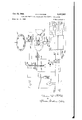
- FIG. 12 is a wiring diagram showing the thershown as 291 2 98, 269, 239 and 29!.
- Fig. 13 is a view similar to Fig. 12, but showing not affected by the operation of these shafts.
- Fig. 14 is an enlarged view of the return been changed to actuate a bar 390, which is also switch; and pivoted on the pin :298, so that the bar 300 actu- Fig. 15 is a View similar to Fig. 14 but with the ates the return contact 3! when the time indidevice in a later position.
- cater 3 5 comes into coincidence with off indifieretofore it hasbeen customary to provide a cator 34.
- it is timing device to be used in combination with a thermostatic device to control the electric or gas heaters of domestic ranges.
- the hub 305 When the time indicator 35 comes into coincidence with the oiT or stop indicator 34, the hub 305 'rises and rocks the bar 300 upwardly about thefulcrum 293 with the aid of spring 203 and this "raises the switch 30
- a dash-pot construction is used between the bar 300 and the contact 3M, so that the first movement of the bar 300 forces the cup 303a and plunger 303 upward to move the rod 304 and contact 301 into contact with the stationary contact 302, as shown in Fig. 14.
- the air compressed at 306 then slowly leaks out through the perforation 301 in valve 308, and a few moments later the plunger 303 is forced down by the spring 309, carrying with it the contact 30!, away from contact 302 as shown in Fig. 15.
- the Hutt patent construction has been modified by omitting the knob 40, and all the parts controlled by it; and in lieu thereof, the switch 30!, 302 has been substituted, which is so constructed that it is momentarily closed when the time indicator comes into coincidence with the off or stop position (at'six oclock), and is opened a few moments thereafter.
- , and parts controlled thereby have been omitted in this disclosure," although it is to be understood that they can'be'added, if desired.
- a thermostat 3I0 having a control knob 3H has been shown as associated inthe same casing with the timing mechanism, although it is to be understood that it can be placed at some other place on the range and connected by wiring, as is readily understood.
- the thermostat in casing 3l0 is 'of well-knownconstruction and is provided with a thermostatic bulb 3l2, which is responsive to the temperatures in the oven 3l3.
- the electric heaters 3l4, 3l5 are controlled by switching mechanism in the thermostat 310, under impulses received from the thermostatic bulb 3l2.
- both of the heaters 3l4 and 3l5 are completely disconnected in the box 3!!! when the knob 3H is in the off position.
- the lower heater 3I4 When the knob 3l l is turned to some cooking or bake'pos'ition, such as 200, the lower heater 3I4 is energized at full wattage and the upper heater 3l5. is@energized at reduced wattage, and these heaters are cycled by the switch construction 3l0 under. the control of the bulb 3l2 to maintain the desired temperature in oven 3I3.
- the lower heater 3I4 inthis position of the knob 3i l iscon nected to" the live'lines 3l6 and 3, while the 4 upper heater 3l5 is connected to one of the live lines 3"; or 3H and with the ground line 3I8, with an external resistance 319 added, if desired, in order to produce as low a wattage in heater 3 l 5 as desired.
- the construction may be such that when the knob 3H is first turned to broil and then returned to 200 (or any other lower temperature) then both heaters 3l4 and 3l5 are energized at full wattage until the oven reaches the selected temperature and thereafter the heaters are cycled as hretoiore described with regard to the 200 setting.
- a thermostat of this construction isnow known commercially, and is also described in the application of Victor Weber, S. N. 323,162, filed March 9, 1940, and issued September 2-5, 1945, as Patent Number 2,385,434.
- thermostatic switch construction in casing 3I0 details of the thermostatic switch construction in casing 3I0 are not disclosed, it being sufficient to state that a thermostatic bellows in .the casing 3l0 actuates proper switch construction to cycle the heaters 314 and H5 in response to impulses from the bulb 3l2.
- Turning of the knob 3, which turns the shaft 322 adjusts thebellows in such a manner that the bellows maintains the selected temperature in the oven, and the heaters are energized, or cycled, in the selected manner.
- this invention adds return means for returning the knob 3
- the purpose of this construction is to return the knob 3!] to the off position at the termination of a time controlled cooking operation and also to prevent the thermostat from being returned accidentally to the off position if the user should decide to operate the thermostat manually without resetting the off indicator 34 out of coincidence with the time in dicator 35.
- the shaft 322 is surrounded by a sleeve 323 which is loosely rotatable on the shaft 322 and carries a gear 324.
- the gear 324 is continuously rotated through gearing 325, which may be connected through gear 41 with the clock motor gear 46.
- a clutch sleeve 326 is rotationally fixed, but axially movable on shaft 322, and is provided with a cone clutch 321.
- the sleeve 326 is moved by lever 328, fulcrumed at 329 and normally rocked counter-clockwise by tension spring 330.
- a holding circuit is provided for the solenoid 33f bythe line'343, which is connectednbythe switch 3-t4-with one side of the solenoids to hold the same energized in case the switch 30], 332 should'open before knob 3 has been'fully returned to the off position.
- the operation of the modification shown in Figs. 1 to112, inclusive, 14 and 15 is as follows:
- the .useriat two oclock' adjusts the start kn0b38-and sets the on indicator 33 at three 'oclock and adjusts the off or stop knob 239 to set the-off or stop indicator 34 at six oclock..
- the operation. of most of the control parts to reach. this position is described in the Hutt patent. The.
- knob 239 also pushesdown thebar 380 by means of the collar 223while-the collar I23 does not come into contact withthe bar 291.
- These manipulations rock the barv 23! clockwise and the bar 300 counterclockwiseto.theposition shown in Fig. 6 and move the pins I20 and I2! out of the apertures H8 and.ll9.
- Thecup 303a is also lowered, air quickly enteringv space 396 by the raising of valve 303.
- the oven 3l3. is not heated at that time (two oclock) because the power is broken at 18, 19 by. this adjustment.
- the time indicator 35 then continues to rotate clockwise until it comes to coincidence with the on or start indicator 33 at three oclock.
- the returning-means for the knob 35 l is powered by the user as he-turns the knob from the off position to a cooking position.
- All of the parts shown in Fig. 13 operate as in- Fig. 12, except for the return means.
- the shaft 322 is loosely surrounded by a sleeve 353.
- A'pring 35E has one end secured to the casing 3H! and the other end secured to the sleeve 333;
- a pin 352 is carried by the shaft 322'and'a coacting lug 353 is carried by the sleeve 353.
- The-sleeve 353 has a ratchet band c s with which apawl 355 cooperates and holds the sleeve-'353 at the 'farthermost clockwise position to which it is turned.
- the user can therefore turn the kncb'3l l to any position, such as 500 or broil, and can then return the knob 3 l I to a lower posi tion such as 200; but the sleeve 350 remains at the fartherest clockwise position, being held by the pawl- 355.
- the holding circuit 343a, 354a, 335a is substantially the same as that disclosed in Fig. 12 and may be used if desired.
- the holding circuit may be omitted, if desired, reliance being made on the return of knob 3 l l to the off position before switch 33 l, 392 is reopened by the dash-pot construction.
- the switch 301, 302 When the time indicator 35 comes into coincidence with the stop or oil indicator 34 at six oclock, the switch 301, 302 is temporarily closed, thus energizing th solenoid saw and moving the pawl 355 away from the ratchet band 354. This allows the sleeve 35!] to be rotated counterclockwise by the spring 35! and drives the shaft 322 and knob 3 back to the off position. Since the contacts in the thermostat 3H) (Figs. 12 and 13) remain open at all times as long as the knob 3H is at the oii position, the heaters will not be energized again until the user moves the knob 31% to a cooking position. In Fig. 13, the knob 3H will not be returned from a cooking position to the off position a second time, until the user adjusts the on" indicator 34 away from coincidence with the time indicator 35.
- the user may adjust the ofi indicator 3% and the thermostat knob 3H and may thus start a cooking interval of time immediately to be terminated at the time selected by the indicator 34.
- the ofi and on indicators are shown concentric with the time indicator; but it is to be understood that they may have their own separate dials,
- the word coincidence a herein used is intended to mean that the time indicator shows a time which coincides with the setting of the on or off indicator, regardless of whether they are concentric or not.
- this invention may be used with gas stoves.
- the switches herein disclosed may be used to operate solenoid gas valves in the well-known manner, or gas valves may be directly substituted for the switches.
- a source .f heat energy an oven, heating means for said oven, a thermostat controlling the flow of energy from said source to said heating means in r spouse to oven temperature, thermostat adjusting means for said thermostat having an off position and a cooking position, a clock having an on indicator, an off indicator and a time indicator.
- means for adjusting said indicators means for disconnecting said source of heat energy from said heating means when said on indicator is adjusted away from said time indicator and for connecting said source with said heating means and for locking said. on indicator to said time indicator when said time indicator becomes coincident with said on indicator, and means for returning said thermostat adjusting means from cooking position to ofi position and for locking off indicator to said time indicator when time indicator becomes coincident with said off indicator.
- a source of heat energy an oven, heating means for said oven, a thermostat controlling the flow of energy from said source to said heating means in response to oven temperature, thermostat ad fiusting means for said thermostat having an off position and a cooking position, a clock having an on indicator, an ofi indicator and a time indicator, means for adjusting said indicators, means for disconnecting said source of heat energy from said heating means when said on indicator is adjusted away from said time indicator and for connecting said source with said heating means and for locking said on indicator to said time indicator when said time indicator becomes c0- incident with said on indicator, means for returning said thermostat adjusting means from cooking position to off position and for locking said on indicator to said time indicator when said time indicator becomes coincident with said off indicator, and thereafter preventing repetition of said returning of said thermostat adjusting means until after said oh indicator has been adjusted away from coincidence with said time indicator.
- a source of heat energy an oven, heating means for said oven, a thermostat controlling the flow of energy from said source to said heating means in response to oven temperature, thermostat adjutting means for said thermostat having an off position and a cooking position, return means for returning said adjusting means from cooking position to oii position, a clock having on, 01?
- a source of heat energy an oven, heating means for said oven, a thermostat controlling the flow of energy from said source to said heating means in response to oven temperature, thermostat adjusting means for said thermostat having an off position and a. cooking position, return means for returning said adjusting means from cooking position to off position, a clock having on, off and time indicators, means for adjusting said on and off indicators away from coincidence with said time indicator, means for locking said on and off indicators with said time indicator as said time indicator comes into coincidence with said on and on" indicators, switch means controlling conjointly with said thermostat the flow of energy from said source to said heating means, means opening said switch means when said on indicator is adjusted away from coincidence with said time indicator and closing said switch means when said time indicator comes into coincidence with said on indicator, said return means being powered by said clock and being rendered effective when said time indicator comes into coincidence with said off indicator, and means preventing said return means from operating more than once until after said off indicator has again been adjusted away from said time indicator.
- a source of heat energy heating means, a thermostat controlling the fiow of energy from said source to said heating means in response to temperature created by said heating means, thermostat adjusting means for said thermostat including a rotatable shaft movable from an off position to a heating position, a sleeve around said shaft, a timer having time adjusting means to set a heating time limit for said heating means, and means powered by said timer and rendered effective at said time limit causing said sleeve to return said shaft from heating position to said ofl position.
- a source of energy heating means, a thermostatic switch means controlling the flow of energy from said source to said heating means in response to temperatures produced by said heating means, thermostat adjusting means having an off position and a cooking position, return means for returning said adjusting means from cooking position to ofi position, a clock having on, off and time indicators, said on and off indicators being adjustable away from coincidence with said time indicator and looking with said time indicator as it moves into coincidence with them, clock switch means in series with said thermostatic switch means opening when said on indicator is adjusted out of coincidence with said time indicator and closing when said time indicator comes into coincidence with said on indicator, and a return switch controlling said return means which is momentarily actuated when said time indicator comes into coincidence with said ofi indicator.
- a source of energy heating means, a thermostatic flow control means controlling the flow of energy from said source to said heating means in response to temperatures produced by said heating means, thermostat adjusting means having an off position and a cooking position, return means for returning said adjusting means from cooking position to off position, a clock having on, off and time indicators, said on and oif indicators being adjustable away from coincidence with said time indicator and looking with said time indicator as it moves into coincidence with them, clock flow control means in series with saidtherm-ostatic flow control means, opening when said on indicator is adjusted out of coincidence with said time indicator and closing when said time indicator comes into coincidence with said on indicator, and a return controller controlling said return mean-s which is momentarily actuated when said time indicator comes into coincidence with said ofi indicator.
- a source of energy a device to be energized from said source and having a controller for connecting and disconnecting said source and device, said controller having on and ofi positions; a clock having an on indicator, an olT indicator and a time indicator; means for adjusting said indicators; means for disconnectin said source of ener y from said device when said on indicator is adjusted away from said time indicator and for connecting said source with said device and for locking said on indicator to said time indicator when said time indicator becomes coincident with said on indicator; and means for automatically returning said controller from said on position to said ofi position and for locking said off indicator to said time indicator when said time indicator becomes coincident with said off indicator.
- a source of energy a device to be energized from said source and having a controller for connecting and dis-connecting said source and device, said controller having on and oiT positions; a clock having an on indicator, an elf indicator and a time indicator; means for adjusting said indicators; means for disconnecting said source of energy from said device when said on indicator is adjusted away from said time indicator and for connecting said source with said device and for locking said on indicator to said time indicator when said time indicator becomes coincident with said on indicator; means for automatically returning said controller from said on position to Said off position and for locking said off indicator to said time indicator when said time indicator becomes coincident with said ofi indicator and for thereafter preventing repetition of said returning of said controller from said on position to said off position until after said off indicator has been adjusted away from coincidence with said time indicator.
- a source of energy a device to ice energized from said source and having a device controller for connecting and disconnecting said source and device, said controller having on and off positions; return means for returning said controller from on to off position; a clock having on, off and time indicators; means for adjusting said on and oil indicators away from coincidence with said time indicator; means for locking said on and off indicators with said time indicator as said time indicator comes into coincidence with said on and off indicators; a clock controller having on and off positions and controlling conjointly with said device controller the flow of energy from said source to said device; means placing said clock controller in off position when said on indicator is adjusted away from coincidence with said time indicator and placing said clock controller in on position when said time indicator comes in coincidence with said on indicator; means rendering said return means effective when said time indicator comes into coincidence with said ofi indicator; and means preventing said return means from operating more than once until after said off indicator has again been adjusted away from said time indicator.
Landscapes
- Physics & Mathematics (AREA)
- General Physics & Mathematics (AREA)
- Engineering & Computer Science (AREA)
- Automation & Control Theory (AREA)
- Control Of Resistance Heating (AREA)
Description
12, 1948- v R. R. CANDOR C 2,451,069
TIME AND TEMPERATURE CONTROLLER EOR DOMESTIC APPLIANCES Filled Oct. 11, 1943 '5 Sheets-Sheet 1 Oct. 12, 1948. R. CANDOR 2,451,069
TIME AND '5'; .F'ERAT'L'EE CONTROLLER FOR DOMESTIC APPLIANCES- Filed 001;. 11, 1943 5 Sheets-Sheet 2 28 e1 62. as 2 r 9 In 57 8 6D 8 S t: 87 5s 74 -1 T me 6 [z 6 7 7e 79 a Fly. 2.0
fWENTOR. 773mm? A YJJo/z Fry. /0.
Get. 12, 1948. RIR, CANDQR 2,451,069
TIME AND TEMPERATURE CONTROLLER FOR DOMESTIC APPLIANCES Filed Oct. 11, 1943 5 sneet-sheet s 3 E n E max 0mg mBT Oct. 12, 1948. CANDOR 2,451,069
TIME AND TEMPERATURE CONTROLLER FOR DOMESTIC APPLIANCES Filed Oct. 11, 1943 5 Sheets-Sheet 4 Oct. 12, 1948. R. R. CANDOR APPLIANCES TIME AND TEMPERATURE CONTROLLER FOR DOMESTIC 5 Sheets-Skieet 5 Filed Oct. 11, 1943 OFIQ O Q N :HVVENTOR.
Patented Oct. 12, 1948 TIME AND TEMPERATURE CONTROLLER FOR DOMESTIC APPLIANCES Robert R. Candor, Oakwood, Ohio, assignor to General Motors Corporation, Dayton, Ohio, a corporation of Delaware Application October 11, 1943, Serial No. 505,749
10 Claims.
1 This invention relates to domestic appliances and more particularly to a combined time and thermostatic control for heaters, such as oven heaters in domestic ranges.
An object of this invention is to provide a C011lbined time and. thermostatic control of such 5 indicator, a thermostatic indicator, and in addicharacter hat it is ch13 necessary to set the t e tion a selector knob which determines whether device on the timer and to adjust the thermostat, the timer should be in control or not. This adwithout the necessity of also setting an extra se= citional lmo'c is likely to be forgotten at certain lector knob of the character which heretofore times, and this invention makes it possible to has been used to place the timer in control. eliminate such a knob.
Another object of this invention is to provide For example, the control disclosed in the patent an improved thermostatic control which is ca to Hutt 2,310,527, granted Feb. 9, 1943, is provided paole of being returned to the off position auwith an on or start indicator 33, an 01? or stop ically by a timer. 15 indicator and a selector knob [it which deof the present termines whether the clock control is to be effece following detive or not. The control shown in the said Hutt he acconipanypatent is intended to be used with a thermostatic ing (ll p A r I cried form of the control, not shown in the patent, which is also present invention is clearly shown. provided with an adjusting lznoh. This inven- L- the makes it possible to eliminate the knob 43.
drawings front elevation of a preferred mhodie men of the invention, certain parts being broken sition; l. il to Fig. 5, but showing 40 operate in the same manner as disclosed in the rent position; Hutt patent Lion taken elo:.-g the lines it The modifications of this invention deal mainiv with the bar 91, pin 98, shaft construction 109 F g. ll. is elevation of the contact units andsettingknob 39 of the Hutt patent. These taken along the section line i i--l i of Fig. 2; have been modified in this application to the form Fig. 12 is a wiring diagram showing the thershown as 291 2 98, 269, 239 and 29!. In this apmostatic control with the automatic return plication, the bar 291 is pivoted on pin 298 and means; freely encompasses the shafts 299 and 20!, and is Fig. 13 is a view similar to Fig. 12, but showing not affected by the operation of these shafts.
a modified form of return means; The shaft 299, and its cooperating parts, have Fig. 14 is an enlarged view of the return been changed to actuate a bar 390, which is also switch; and pivoted on the pin :298, so that the bar 300 actu- Fig. 15 is a View similar to Fig. 14 but with the ates the return contact 3! when the time indidevice in a later position. cater 3 5 comes into coincidence with off indifieretofore it hasbeen customary to provide a cator 34. By reference to the Hutt patent, it is timing device to be used in combination with a thermostatic device to control the electric or gas heaters of domestic ranges. it has been cusiomary, when the user desires to set the conirois, for the user to set an on indicator and off in the Hutt patent there is also disclosed another lrnob ll, which has no particular connec tion with the oven control, and. discussion thereof therefore omitted, it being understood that the device controlled knob it may be used th or omitted from, the present invention.
his invention has been shown as applied to certain portions of the mechanism disclosed in the said I-iutt patent merely by way of example; it is to be understood that many of the parts herein disclosed may be used with other constructions of timers. Many of the views of the i-iutt patent have been repeated in this application, with the modifications of this invention thereon. Wherever numerals are used on the drawings which coincide with the reference numerals of the Hutt patent, it is to be understood the parts so indicated are constructed and way of example, when the time indicator 35 comes into coincidence with the on or start indicator 33, the hub I04 will take the position shown in Fig. 8, and causes the bar 291 to rock about thepivot 298 to close the switch l8, 19 substantially the same as described in the Hutt patent, with the exception that the bar 231 fulcrums about fixed pivot 298 instead of fulcruming about the hub I05 as described in the Hutt patent. The operation is substantially the same, and the parts of the Hutt patent do not have to be changed except for slight dimensional changes, which are obvious.
When the time indicator 35 comes into coincidence with the oiT or stop indicator 34, the hub 305 'rises and rocks the bar 300 upwardly about thefulcrum 293 with the aid of spring 203 and this "raises the switch 30| into contact with its stationary contact 302. A dash-pot construction is used between the bar 300 and the contact 3M, so that the first movement of the bar 300 forces the cup 303a and plunger 303 upward to move the rod 304 and contact 301 into contact with the stationary contact 302, as shown in Fig. 14. The air compressed at 306 then slowly leaks out through the perforation 301 in valve 308, and a few moments later the plunger 303 is forced down by the spring 309, carrying with it the contact 30!, away from contact 302 as shown in Fig. 15.
From'the' foregoing it is to be seen that the Hutt patent construction has been modified by omitting the knob 40, and all the parts controlled by it; and in lieu thereof, the switch 30!, 302 has been substituted, which is so constructed that it is momentarily closed when the time indicator comes into coincidence with the off or stop position (at'six oclock), and is opened a few moments thereafter. The knob 4|, and parts controlled thereby have been omitted in this disclosure," although it is to be understood that they can'be'added, if desired.
A thermostat 3I0, having a control knob 3H has been shown as associated inthe same casing with the timing mechanism, although it is to be understood that it can be placed at some other place on the range and connected by wiring, as is readily understood. The thermostat in casing 3l0 is 'of well-knownconstruction and is provided with a thermostatic bulb 3l2, which is responsive to the temperatures in the oven 3l3. The electric heaters 3l4, 3l5 are controlled by switching mechanism in the thermostat 310, under impulses received from the thermostatic bulb 3l2. By way of example, both of the heaters 3l4 and 3l5 are completely disconnected in the box 3!!! when the knob 3H is in the off position. When the knob 3l l is turned to some cooking or bake'pos'ition, such as 200, the lower heater 3I4 is energized at full wattage and the upper heater 3l5. is@energized at reduced wattage, and these heaters are cycled by the switch construction 3l0 under. the control of the bulb 3l2 to maintain the desired temperature in oven 3I3. The lower heater 3I4 inthis position of the knob 3i l iscon nected to" the live'lines 3l6 and 3, while the 4 upper heater 3l5 is connected to one of the live lines 3"; or 3H and with the ground line 3I8, with an external resistance 319 added, if desired, in order to produce as low a wattage in heater 3 l 5 as desired. By way of modification, the upper heater 3i 5 may be connected to one of the live lines 3l5 or 3H at one of its terminals, and its other terminal may be connected by the line 320 to the point 32! in the lower heater 3l4 to impose the correct reduced wattage to the upper heater. Whenthe knob 3 is turned to broil, the upper heater 3l5 alone is energized at full wattage by being connected to the live lines M6 and 3i! while the lower heater is completely deenergized. If desired the construction may be such that when the knob 3H is first turned to broil and then returned to 200 (or any other lower temperature) then both heaters 3l4 and 3l5 are energized at full wattage until the oven reaches the selected temperature and thereafter the heaters are cycled as hretoiore described with regard to the 200 setting. A thermostat of this constructionisnow known commercially, and is also described in the application of Victor Weber, S. N. 323,162, filed March 9, 1940, and issued September 2-5, 1945, as Patent Number 2,385,434. For this reason, details of the thermostatic switch construction in casing 3I0 are not disclosed, it being sufficient to state that a thermostatic bellows in .the casing 3l0 actuates proper switch construction to cycle the heaters 314 and H5 in response to impulses from the bulb 3l2. Turning of the knob 3, which turns the shaft 322 adjusts thebellows in such a manner that the bellows maintains the selected temperature in the oven, and the heaters are energized, or cycled, in the selected manner.
To the well-known thermostatic construction heretofore described, this invention adds return means for returning the knob 3| 1 from a cooking position to the off position, this means being rendered effective when the time indicator 35 comes into coincidence with the off or stop indicator 3:: (at six oclock by way of example). Means are also provided for preventing the return means from op erating more than once until after the off indicator 34 has again been adjusted away from thetime indicator 35. The purpose of this construction is to return the knob 3!] to the off position at the termination of a time controlled cooking operation and also to prevent the thermostat from being returned accidentally to the off position if the user should decide to operate the thermostat manually without resetting the off indicator 34 out of coincidence with the time in dicator 35. I
The means for returning the knob 3 to the off position'include the switch construction 30l, 302 heretofore described, and in addition certain parts shown in Fig. 12. The shaft 322 is surrounded by a sleeve 323 which is loosely rotatable on the shaft 322 and carries a gear 324. The gear 324 is continuously rotated through gearing 325, which may be connected through gear 41 with the clock motor gear 46. A clutch sleeve 326 is rotationally fixed, but axially movable on shaft 322, and is provided with a cone clutch 321. The sleeve 326 is moved by lever 328, fulcrumed at 329 and normally rocked counter-clockwise by tension spring 330. When the time indicator 35 2,451,0eca
energizes the solenoid- 33 l;- a circuit being proe duced fromi-poweriine 332 through contacts'30 l 302 solenoid 33i, contacts 333; 334, line: 335 to J power line-336j Etiergization 'of solenoid 33l raises the armature 331 androcksthe lever .3231: clockwise toengage the clutch 321 'withithegear; 324 and sleeve 323.1 This :returns the shaft'322 and knob 3 H counter-clockwise tothe off i position." As the shaft r322 reachesthe off :position, the'pin'360 comesinto contact with-:the 'rodi333. of the switch'339 and'move'sithe contact 343away.
fromuthe stationary contacts s333 iand 334,.athus breakingthe solenoid circuit. and declutching. the
The operation of the modification shown in Figs. 1 to112, inclusive, 14 and 15 is as follows: The .useriat two oclock', for example) adjusts the start kn0b38-and sets the on indicator 33 at three 'oclock and adjusts the off or stop knob 239 to set the-off or stop indicator 34 at six oclock.. He also turns the thermostat knob 3| l, forexample, to .200; This causes the parts 291 and '300-to assumethe position shown in Fig. 6. The operation. of most of the control parts to reach. this position is described in the Hutt patent. The. pushing down of knob 239 also pushesdown thebar 380 by means of the collar 223while-the collar I23 does not come into contact withthe bar 291. These manipulations rock the barv 23! clockwise and the bar 300 counterclockwiseto.theposition shown in Fig. 6 and move the pins I20 and I2! out of the apertures H8 and.ll9. Thecup 303a is also lowered, air quickly enteringv space 396 by the raising of valve 303. The oven 3l3. is not heated at that time (two oclock) because the power is broken at 18, 19 by. this adjustment. The time indicator 35 then continues to rotate clockwise until it comes to coincidence with the on or start indicator 33 at three oclock. At this time the pin I20 rises into aperture H8 and causes the hub I04 to rise to theposition. shown in Fig. 8, and rocks the bar 291 counter-clockwise about the fulcrum 298 and closes the switches 18 and 79, substantially as described'in theHutt patent with the exceptionithat' thebar 29'! is fulcrumed about 298. Power or current can'then flow from the live lines 332 and 335 through the closed switch 13,
19, through the thermostatic switch 3m to the heaters 3| 4 and 3l5. The heaters then heat the oven3l3 until it reaches a temperature of 200, at which time the thermostat disconnects the heaters 3l4=and 3l5until such time as the oven 313 tends to cool below 200. Thereafter the heatersare-*re-energized, anda cycling control of the heaters by the switch construction in 3H! continues, on and off, until six oclock. At six oclock'the time indicator 35 comes into coincidence with the stop or oif indicator 34. At this time thepin l2! rises into aperture H9 and causes the'hub 305 to rise from the position shown in Figs. 6 and 8 to rock the bar 300clockwise about fulcrum 298-to raise the cup 303a, plunger 303 andcontacttlll to the position shown in Fig- 14 'thusxm'omentarily" closing the contacts reset the time control; independently of the time control (by leaving the 3M" a'nd 3025 This energizes I. the solenoid: 33f. and clutches th'e continuously "rotating gearr324 adjusted away-from coincidence with the time indicator 35. This permits the user thereafter to usetheknobtil independently of the time con trolwlthout dangerzof having the knob returned to the offpositionuntil such time as he elects to When using the knob 35 l indicators 33- and3 l in coincidence with indica tor 35), the contacts 18 and is areclosed and allow power to flow continuously to thermostat 3l0; As long as thethermostat knob 3 is at offithe power is broken at 335. The user can turn' the knob 31 l Zto'any desired position and may operate the even just as if the time control were not present merely by allowing the indicators 33,- 34'and 35130 remain in coincidence.
In'the-mo-dification shown in Fig 3.3, the returning-means for the knob 35 l is powered by the user as he-turns the knob from the off position to a cooking position. All of the parts shown in Fig. 13 operate as in- Fig. 12, except for the return means. For example,'the shaft 322 is loosely surrounded by a sleeve 353. A'pring 35E has one end secured to the casing 3H! and the other end secured to the sleeve 333; A pin 352 is carried by the shaft 322'and'a coacting lug 353 is carried by the sleeve 353. As theknob' 3!! is turned clockwise by the user, the pin352 drives the lug 353 and sleeve 35% clockwisea The-sleeve 353 has a ratchet band c s with which apawl 355 cooperates and holds the sleeve-'353 at the 'farthermost clockwise position to which it is turned. The user can therefore turn the kncb'3l l to any position, such as 500 or broil, and can then return the knob 3 l I to a lower posi tion such as 200; but the sleeve 350 remains at the fartherest clockwise position, being held by the pawl- 355. The turning movement of sleeve 35:? winds the'spring 35L When the switch 33!, is closed;:as.heretofore described, the solenoid 33 to is energized, pulling the armature 337a and the pawl 355 against the action of the tension spring 339a. This releases the sleeve 358' and allows the spring 35! to rotate the sleeve 358 and shaft 32?. until the knob 3! l returns to the off position. At this time the pin 33in abuts the stationary stop 352a, and the pin 363a opens the switch 333a to break the holdingcircuit of the solenoid 33in. The holding circuit 343a, 354a, 335a is substantially the same as that disclosed in Fig. 12 and may be used if desired. However, since the returning movement of spring 35I is rapid, the holding circuit may be omitted, if desired, reliance being made on the return of knob 3 l l to the off position before switch 33 l, 392 is reopened by the dash-pot construction.
The operation of the modification shown in Fig. 13, taken in combination with the disclosure of Figs. 1 to 11, 14 and 15, is as follows: The user (at two oclock) sets the indicators 35 and 36 at three and :sixvrespectively (by way of example) and sets theknob 3! l at 200. The setting of the knob at 200 winds the spring 35! as heretofore described. When the time indicator 35 comes into coinciden'ce with the on Or start indicator 33 at threeoclock, the switch 18, 19 is closed, as here toforedescribed causing the heaters 3M and 3i-S- to be cycled by thermostat 3 I U, as heretofore described until six oclock. When the time indicator 35 comes into coincidence with the stop or oil indicator 34 at six oclock, the switch 301, 302 is temporarily closed, thus energizing th solenoid saw and moving the pawl 355 away from the ratchet band 354. This allows the sleeve 35!] to be rotated counterclockwise by the spring 35! and drives the shaft 322 and knob 3 back to the off position. Since the contacts in the thermostat 3H) (Figs. 12 and 13) remain open at all times as long as the knob 3H is at the oii position, the heaters will not be energized again until the user moves the knob 31% to a cooking position. In Fig. 13, the knob 3H will not be returned from a cooking position to the off position a second time, until the user adjusts the on" indicator 34 away from coincidence with the time indicator 35.
In either modification, the user may adjust the ofi indicator 3% and the thermostat knob 3H and may thus start a cooking interval of time immediately to be terminated at the time selected by the indicator 34.
In the Hutt patent, and in this application, the ofi and on indicators are shown concentric with the time indicator; but it is to be understood that they may have their own separate dials, The word coincidence a herein used, is intended to mean that the time indicator shows a time which coincides with the setting of the on or off indicator, regardless of whether they are concentric or not.
It is obvious that this invention may be used with gas stoves. For example the switches herein disclosed may be used to operate solenoid gas valves in the well-known manner, or gas valves may be directly substituted for the switches.
Whiie the form of embodiment of the invention as herein disclosed, constitutes a preferred fomn, it is to be understood that other forms might be adopted, as may come within the scope of the claims which follow.
What is claimed is as follows:
i. In device of the character described, a source .f heat energy, an oven, heating means for said oven, a thermostat controlling the flow of energy from said source to said heating means in r spouse to oven temperature, thermostat adjusting means for said thermostat having an off position and a cooking position, a clock having an on indicator, an off indicator and a time indicator. means for adjusting said indicators, means for disconnecting said source of heat energy from said heating means when said on indicator is adjusted away from said time indicator and for connecting said source with said heating means and for locking said. on indicator to said time indicator when said time indicator becomes coincident with said on indicator, and means for returning said thermostat adjusting means from cooking position to ofi position and for locking off indicator to said time indicator when time indicator becomes coincident with said off indicator.
2. In a device of the character described, a source of heat energy, an oven, heating means for said oven, a thermostat controlling the flow of energy from said source to said heating means in response to oven temperature, thermostat ad fiusting means for said thermostat having an off position and a cooking position, a clock having an on indicator, an ofi indicator and a time indicator, means for adjusting said indicators, means for disconnecting said source of heat energy from said heating means when said on indicator is adjusted away from said time indicator and for connecting said source with said heating means and for locking said on indicator to said time indicator when said time indicator becomes c0- incident with said on indicator, means for returning said thermostat adjusting means from cooking position to off position and for locking said on indicator to said time indicator when said time indicator becomes coincident with said off indicator, and thereafter preventing repetition of said returning of said thermostat adjusting means until after said oh indicator has been adjusted away from coincidence with said time indicator.
3. In a device of the character described, a source of heat energy, an oven, heating means for said oven, a thermostat controlling the flow of energy from said source to said heating means in response to oven temperature, thermostat adjutting means for said thermostat having an off position and a cooking position, return means for returning said adjusting means from cooking position to oii position, a clock having on, 01? and time indicators, means for adjusting said on and en indicators away from coincidence with said time indicator, means for locking said on and off indicators with said time indicator as said time indicator comes into coincidence with said on and off indicators, switch means controlling conjointiy with said thermostat the flow of energy from said source to said heating means, means opening said switch means when said on indicator is adjusted away from coincidence with said time indicator and closing said switch means when said time indicator comes into coincidence with said on indicator, means rendering said return means effective when said time indicator comes into coincidence with said off indicator, and means preventing said r turn means from operating more than once until after said oil indicator has again been adjusted away from said time indicator.
4. In a device of the character described, a source of heat energy, an oven, heating means for said oven, a thermostat controlling the flow of energy from said source to said heating means in response to oven temperature, thermostat adjusting means for said thermostat having an off position and a. cooking position, return means for returning said adjusting means from cooking position to off position, a clock having on, off and time indicators, means for adjusting said on and off indicators away from coincidence with said time indicator, means for locking said on and off indicators with said time indicator as said time indicator comes into coincidence with said on and on" indicators, switch means controlling conjointly with said thermostat the flow of energy from said source to said heating means, means opening said switch means when said on indicator is adjusted away from coincidence with said time indicator and closing said switch means when said time indicator comes into coincidence with said on indicator, said return means being powered by said clock and being rendered effective when said time indicator comes into coincidence with said off indicator, and means preventing said return means from operating more than once until after said off indicator has again been adjusted away from said time indicator.
5. In a device of the character described, a source of heat energy, heating means, a thermostat controlling the fiow of energy from said source to said heating means in response to temperature created by said heating means, thermostat adjusting means for said thermostat including a rotatable shaft movable from an off position to a heating position, a sleeve around said shaft, a timer having time adjusting means to set a heating time limit for said heating means, and means powered by said timer and rendered effective at said time limit causing said sleeve to return said shaft from heating position to said ofl position.
6. In a device of the character described, a source of energy, heating means, a thermostatic switch means controlling the flow of energy from said source to said heating means in response to temperatures produced by said heating means, thermostat adjusting means having an off position and a cooking position, return means for returning said adjusting means from cooking position to ofi position, a clock having on, off and time indicators, said on and off indicators being adjustable away from coincidence with said time indicator and looking with said time indicator as it moves into coincidence with them, clock switch means in series with said thermostatic switch means opening when said on indicator is adjusted out of coincidence with said time indicator and closing when said time indicator comes into coincidence with said on indicator, and a return switch controlling said return means which is momentarily actuated when said time indicator comes into coincidence with said ofi indicator.
7. In a device of the character described, a source of energy, heating means, a thermostatic flow control means controlling the flow of energy from said source to said heating means in response to temperatures produced by said heating means, thermostat adjusting means having an off position and a cooking position, return means for returning said adjusting means from cooking position to off position, a clock having on, off and time indicators, said on and oif indicators being adjustable away from coincidence with said time indicator and looking with said time indicator as it moves into coincidence with them, clock flow control means in series with saidtherm-ostatic flow control means, opening when said on indicator is adjusted out of coincidence with said time indicator and closing when said time indicator comes into coincidence with said on indicator, and a return controller controlling said return mean-s which is momentarily actuated when said time indicator comes into coincidence with said ofi indicator.
8. In combination: a source of energy; a device to be energized from said source and having a controller for connecting and disconnecting said source and device, said controller having on and ofi positions; a clock having an on indicator, an olT indicator and a time indicator; means for adjusting said indicators; means for disconnectin said source of ener y from said device when said on indicator is adjusted away from said time indicator and for connecting said source with said device and for locking said on indicator to said time indicator when said time indicator becomes coincident with said on indicator; and means for automatically returning said controller from said on position to said ofi position and for locking said off indicator to said time indicator when said time indicator becomes coincident with said off indicator.
9. In combination: a source of energy; a device to be energized from said source and having a controller for connecting and dis-connecting said source and device, said controller having on and oiT positions; a clock having an on indicator, an elf indicator and a time indicator; means for adjusting said indicators; means for disconnecting said source of energy from said device when said on indicator is adjusted away from said time indicator and for connecting said source with said device and for locking said on indicator to said time indicator when said time indicator becomes coincident with said on indicator; means for automatically returning said controller from said on position to Said off position and for locking said off indicator to said time indicator when said time indicator becomes coincident with said ofi indicator and for thereafter preventing repetition of said returning of said controller from said on position to said off position until after said off indicator has been adjusted away from coincidence with said time indicator.
10. In combination: a source of energy; a device to ice energized from said source and having a device controller for connecting and disconnecting said source and device, said controller having on and off positions; return means for returning said controller from on to off position; a clock having on, off and time indicators; means for adjusting said on and oil indicators away from coincidence with said time indicator; means for locking said on and off indicators with said time indicator as said time indicator comes into coincidence with said on and off indicators; a clock controller having on and off positions and controlling conjointly with said device controller the flow of energy from said source to said device; means placing said clock controller in off position when said on indicator is adjusted away from coincidence with said time indicator and placing said clock controller in on position when said time indicator comes in coincidence with said on indicator; means rendering said return means effective when said time indicator comes into coincidence with said ofi indicator; and means preventing said return means from operating more than once until after said off indicator has again been adjusted away from said time indicator.
ROBER'Ii R. CANDOR.
REFERENCES CITED The following references are of record in the file of this patent:
UNITED STATES PATENTS
Priority Applications (2)
| Application Number | Priority Date | Filing Date | Title |
|---|---|---|---|
| US505749A US2451069A (en) | 1943-10-11 | 1943-10-11 | Time and temperature controller for domestic appliances |
| US610998A US2471862A (en) | 1943-10-11 | 1945-08-17 | Time and temperature controller for domestic appliances |
Applications Claiming Priority (1)
| Application Number | Priority Date | Filing Date | Title |
|---|---|---|---|
| US505749A US2451069A (en) | 1943-10-11 | 1943-10-11 | Time and temperature controller for domestic appliances |
Publications (1)
| Publication Number | Publication Date |
|---|---|
| US2451069A true US2451069A (en) | 1948-10-12 |
Family
ID=24011667
Family Applications (1)
| Application Number | Title | Priority Date | Filing Date |
|---|---|---|---|
| US505749A Expired - Lifetime US2451069A (en) | 1943-10-11 | 1943-10-11 | Time and temperature controller for domestic appliances |
Country Status (1)
| Country | Link |
|---|---|
| US (1) | US2451069A (en) |
Cited By (2)
| Publication number | Priority date | Publication date | Assignee | Title |
|---|---|---|---|---|
| US2723335A (en) * | 1952-06-21 | 1955-11-08 | Paul M Hotchkin | Clock controlled electric heater |
| FR2438236A1 (en) * | 1978-10-03 | 1980-04-30 | Atag Bv Apparatenfab | ELECTRIC COOKER WITH PROGRAMMER |
Citations (7)
| Publication number | Priority date | Publication date | Assignee | Title |
|---|---|---|---|---|
| US1638582A (en) * | 1926-02-01 | 1927-08-09 | Jay W Houch | Heat regulator |
| US1758619A (en) * | 1925-02-05 | 1930-05-13 | Standard Gas Equipment Corp | Timer for automatically controlling electric stoves |
| US1902498A (en) * | 1929-10-08 | 1933-03-21 | Gen Electric | Control device |
| US2054041A (en) * | 1935-08-13 | 1936-09-08 | Penn Electric Switch Co | Transformer protection circuit for burner systems |
| US2208956A (en) * | 1938-07-27 | 1940-07-23 | Tappan Stove Co | Fuel burner and control therefor |
| US2290626A (en) * | 1942-07-21 | Sequence controller | ||
| US2392166A (en) * | 1942-09-11 | 1946-01-01 | Westinghouse Electric Corp | Control apparatus |
-
1943
- 1943-10-11 US US505749A patent/US2451069A/en not_active Expired - Lifetime
Patent Citations (7)
| Publication number | Priority date | Publication date | Assignee | Title |
|---|---|---|---|---|
| US2290626A (en) * | 1942-07-21 | Sequence controller | ||
| US1758619A (en) * | 1925-02-05 | 1930-05-13 | Standard Gas Equipment Corp | Timer for automatically controlling electric stoves |
| US1638582A (en) * | 1926-02-01 | 1927-08-09 | Jay W Houch | Heat regulator |
| US1902498A (en) * | 1929-10-08 | 1933-03-21 | Gen Electric | Control device |
| US2054041A (en) * | 1935-08-13 | 1936-09-08 | Penn Electric Switch Co | Transformer protection circuit for burner systems |
| US2208956A (en) * | 1938-07-27 | 1940-07-23 | Tappan Stove Co | Fuel burner and control therefor |
| US2392166A (en) * | 1942-09-11 | 1946-01-01 | Westinghouse Electric Corp | Control apparatus |
Cited By (2)
| Publication number | Priority date | Publication date | Assignee | Title |
|---|---|---|---|---|
| US2723335A (en) * | 1952-06-21 | 1955-11-08 | Paul M Hotchkin | Clock controlled electric heater |
| FR2438236A1 (en) * | 1978-10-03 | 1980-04-30 | Atag Bv Apparatenfab | ELECTRIC COOKER WITH PROGRAMMER |
Similar Documents
| Publication | Publication Date | Title |
|---|---|---|
| US2663786A (en) | Timer apparatus | |
| US2487154A (en) | Time switch | |
| US2435530A (en) | Control for electric ovens | |
| US2303672A (en) | Burner control apparatus | |
| US2471862A (en) | Time and temperature controller for domestic appliances | |
| US3358924A (en) | System for controlling heating means and parts therefor or the like | |
| US2416084A (en) | Domestic appliance | |
| US2545846A (en) | Time-controlled temperatureresponsive oven control | |
| US2933585A (en) | Control system for a roasting oven | |
| US2402787A (en) | Domestic appliance | |
| US3358121A (en) | Integrated oven controls | |
| US2295298A (en) | Heating system | |
| US3560711A (en) | Oven control system and parts therefor or the like | |
| US2606991A (en) | Electric appliance control | |
| US2721926A (en) | Electric heating systems for ovens or the like | |
| US2681101A (en) | Motor and ignition safety control system for liquid fuel burners | |
| US3234409A (en) | Temperature responsive control apparatus | |
| US2054041A (en) | Transformer protection circuit for burner systems | |
| US2172820A (en) | Thermostat | |
| US3244841A (en) | Oven temperature control system | |
| US2610678A (en) | Temperature control device | |
| US2279504A (en) | Time and temperature control for stokers | |
| US2291210A (en) | Temperature regulating system | |
| US2434347A (en) | Temperature responsive motor control system | |
| US2326002A (en) | Control of fuel feeding devices |