US2392575A - Box liner - Google Patents
Box liner Download PDFInfo
- Publication number
- US2392575A US2392575A US529368A US52936844A US2392575A US 2392575 A US2392575 A US 2392575A US 529368 A US529368 A US 529368A US 52936844 A US52936844 A US 52936844A US 2392575 A US2392575 A US 2392575A
- Authority
- US
- United States
- Prior art keywords
- liner
- folded
- flap
- flaps
- folding
- Prior art date
- Legal status (The legal status is an assumption and is not a legal conclusion. Google has not performed a legal analysis and makes no representation as to the accuracy of the status listed.)
- Expired - Lifetime
Links
- 239000000853 adhesive Substances 0.000 description 8
- 230000001070 adhesive effect Effects 0.000 description 8
- 238000012856 packing Methods 0.000 description 8
- XLYOFNOQVPJJNP-UHFFFAOYSA-N water Substances O XLYOFNOQVPJJNP-UHFFFAOYSA-N 0.000 description 6
- 239000000463 material Substances 0.000 description 5
- 238000007789 sealing Methods 0.000 description 4
- 238000003780 insertion Methods 0.000 description 3
- 230000037431 insertion Effects 0.000 description 3
- 239000000843 powder Substances 0.000 description 2
- 230000015572 biosynthetic process Effects 0.000 description 1
- 238000010276 construction Methods 0.000 description 1
- 238000004806 packaging method and process Methods 0.000 description 1
- 238000003825 pressing Methods 0.000 description 1
- 238000009877 rendering Methods 0.000 description 1
- 239000002699 waste material Substances 0.000 description 1
Images

Classifications
-
- B—PERFORMING OPERATIONS; TRANSPORTING
- B65—CONVEYING; PACKING; STORING; HANDLING THIN OR FILAMENTARY MATERIAL
- B65D—CONTAINERS FOR STORAGE OR TRANSPORT OF ARTICLES OR MATERIALS, e.g. BAGS, BARRELS, BOTTLES, BOXES, CANS, CARTONS, CRATES, DRUMS, JARS, TANKS, HOPPERS, FORWARDING CONTAINERS; ACCESSORIES, CLOSURES, OR FITTINGS THEREFOR; PACKAGING ELEMENTS; PACKAGES
- B65D5/00—Rigid or semi-rigid containers of polygonal cross-section, e.g. boxes, cartons or trays, formed by folding or erecting one or more blanks made of paper
- B65D5/42—Details of containers or of foldable or erectable container blanks
- B65D5/56—Linings or internal coatings, e.g. pre-formed trays provided with a blow- or thermoformed layer
- B65D5/60—Loose, or loosely attached, linings
-
- B—PERFORMING OPERATIONS; TRANSPORTING
- B65—CONVEYING; PACKING; STORING; HANDLING THIN OR FILAMENTARY MATERIAL
- B65D—CONTAINERS FOR STORAGE OR TRANSPORT OF ARTICLES OR MATERIALS, e.g. BAGS, BARRELS, BOTTLES, BOXES, CANS, CARTONS, CRATES, DRUMS, JARS, TANKS, HOPPERS, FORWARDING CONTAINERS; ACCESSORIES, CLOSURES, OR FITTINGS THEREFOR; PACKAGING ELEMENTS; PACKAGES
- B65D31/00—Bags or like containers made of paper and having structural provision for thickness of contents
- B65D31/005—Bags or like containers made of paper and having structural provision for thickness of contents by folding a single blank to U-shape to form the base of the bag and opposite sides of the body-portion, the remaining sides being formed by extensions of one or more of these opposite sides
Definitions
- This invention relates to a box liner, and especially to a liner which may be manufactured in flat form and when it is to be used is' readily extendible for insertion in a carton. a packing case,.or like container.
- barrels, boxes, cartons and like containers are often used, and in order to prevent sifting or leakage of the content, rarticulariy when it is in powder or granular form,
- the object of the present invention is generally to improve and-simplify the construction and operation of liners of the character described; to provide a liner which may be manufactured in flat form and stacked and shipped in that form; to provide a liner of the character described which is quickly extended from flat form to assume a square or rectangular cross-sectional shape, and when so extended is readily insertable in the box or other'container to be lined; to providea liner, the blank of which is formed without die-cutting or waste ofthe paper from which the liner is formed; to provide a liner in which the bottom is formed without any overlap or seam which might let go or open and thereby permit sifting out of the contents or entrance of moistureyto provide a liner which may be moisture "or waterproofedor both, and sealed in such a manner that products or goods placed within the liner' are fully protected against water or moisture iwliich might penetrate from the exterior; and further; to provide a liner which is not only sealed and leak-proof at the-bottom and sides, but which is also
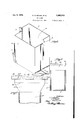
- Fig. 3 is a plan view showing the second folding operation
- Fig. 4 is a plan view showing the final folding operation which completes the liner
- Fig. 5 is an enlarged cross-section of the liner taken on line V-V of Fig. 4;
- Fig. 6 is a perspective view of the liner showing it extended or opened and ready for insertion in a packing case
- Fig. 7 shows the liner when inserted in the packing case
- Fig. 8 shows the upper end of a packing case and the projecting open end of the liner, said view showing the manner in which the open end of the liner is folded closed and sealed after the liner has been packed with the product or goods to be I protected.
- FIG. 1 A indicates the paper blank or other material from which the liner is to be formed.
- Figs. 2, 3 and 4 show the different folding operations required to form and complete the liner.
- a suitable adhesive is ap- .plied to the edges of the blank in the areas indior leakage either from the exterior or interior of 4 the liner, even though the box be placed on its side or upside down during shipment.
- Fig. 1 is a plan view of the blank from which the liner is to be formed
- the blank is then folded upon itself on the dotted line'indicated at 4 thereby forming a. flat envelope-like container with a projecting flap 5 (see Fig. 2),.
- the side edges 6--6 of the envelope will, of course, be sealed or will adhere to each other due to the adhesive which was previously applied, and pressure will of course be employed to insure such sealing.
- the fold line 4 forms the bottom of the envelope or liner and this is reenforced at the corners by folding them as indicated at 1-i in Fig. 3.
- An adhesive is applied to the areas indicated at 88 after the comers have been folded and as such will'also be applied to the folded corners. Then by folding the side edges over and towards each other as shown at 8-6 in Fig. 4 and applying pressure to the folded edges, the liner will be completed.
- reenforces and insures sealing of the bottom comersat the weakest point. This folding also serves another purpose hereinafter to be described.
- the folding of the sides of the envelope or liner as indicated at 8-8 reenforces and further seals the sides and forms a hook-shaped fold (see Fig.5) which materially increases the strength of the liner as a whole.
- the liner in the completed form as shown in Fig. 4 is flat and as such may be stacked or bundled and shipped to the user in that form, this being obviously an advantage when shipping and storage is considered.
- the flaps II are folded against the sides of the liner when it is ready for insertion in the packing case and when the liner is inserted, it will assume the position shown in Fig. '7. Here it may be filled with the goods or commodity to be shipped and protected and when substantially filled, an adhesive is applied to the inner face of the flap and the secondary flaps Ill-i0. The open'end of the liner is then flattened to bring the sides I! and i4 into contact with each other as shown in Fig. 8. Flaps 5 and I8 already having th adhesive applied thereto as 'indicated by the stippled area ii, are now folded,
- the open end of the bag closed and sealed in the manner described may now be folded several times upon itself and cross-folded to lie within the upper end of the packing case when the lid may be applied to close the case for final hipment.
- the liner inserted in the manner described is sealed both at the bottom, the sides, and the upper end. Sifting out or leakage of the contents is prevented.
- the liner illustrated is in general made from a heavy tough grade of paper, but may obviously be made from any grade of paper or other suitable material. The liner does not only serve the purpose of preventing sifting or leaking of certain types of commodities or products, but also that of protecting certain commodities and materials from water or moisture tending to enter the packing case from the exterior.
- terials and finish of the parts employed may be such as the experience and judgment of the man ufacturer may dictate, or varying uses may demand.
- An initially flat box liner comprising a rectangular shaped paper blank folded transversely upon itself to form a pair of connected side memher; one of greater length than the other to form a projecting flap, said transverse fold forming the bottomof the liner, ,a fold extending along each side edge of the liner from the bottom to and including the flap, said folds being turned in under at the ends adjacent the bottom to form a pair of triangular flaps to seal and reenforce the bottom corners of the liner, said folds and triangular flaps being sealed with an adhesive and a pair of secondary flaps one at each end of the first named flap formed during the folding of the sides of the liner, said flap and secondary flaps having an adhesive applied thereto to permit the flaps when folded to close the liner to be secured and sealed.
- An initially fiat box liner comprising a rectangular blank folded transversely upon itself so that one portion thereof projects beyond the other portion and thus forms a projecting fiap
- said liner being adapted to be erected into substantially rectangular formation for filling and when so erected consists of front, back, bottom and oppositely disposed side walls'and open at its top, the flap thus including and being integral with and a continuation of the entire upper back wall portion and an upper part of each of said side walls and projecting above the upper edge of the entire front wall and the remaining part of the side wall portion, and sealing the open end of the liner by the flap which extends over brought together upper wall portions of the liner.
Landscapes
- Engineering & Computer Science (AREA)
- Mechanical Engineering (AREA)
- Cartons (AREA)
Description
Jan. 8, 1946. BUDGE ETAL Q 2,392,575
BOX LINER Q Filed April 3, 1944 Sheets-Sheet l Jan. 8, 1946. I BUDGE ETAL 2,392,575
' BOX LINER Filed April 3, 1944 2 Sheets-Sheet 2 Patented Jan. 8, 1946 BOX LINER Edward D. Budge, Oakland, and Chapin P. Hunt and Donald E. Lent, San Francisco, Calif., assignors to Z'ellerbach Paper Company, San Francisco, Calif., a corporation of California Application April 3, 1944, Serial No. 529,368
3 Claims.
This invention relates to a box liner, and especially to a liner which may be manufactured in flat form and when it is to be used is' readily extendible for insertion in a carton. a packing case,.or like container.
In the packaging and shipping of many products and commodities, particularly in powder or granular form, barrels, boxes, cartons and like containers are often used, and in order to prevent sifting or leakage of the content, rarticulariy when it is in powder or granular form,
and in order to prevent damage by exterior water or moisture, paper liners and the like are used. Such liners, while not excessive as far as cost of material is concerned, take considerable time to properly place and secure within the container. Even with the best of care, leakage or sifting out of some of the contents is liable to take place, or water or moisture may enter due to careless handling or exposure to the elements during shipment. I
The object of the present invention is generally to improve and-simplify the construction and operation of liners of the character described; to provide a liner which may be manufactured in flat form and stacked and shipped in that form; to provide a liner of the character described which is quickly extended from flat form to assume a square or rectangular cross-sectional shape, and when so extended is readily insertable in the box or other'container to be lined; to providea liner, the blank of which is formed without die-cutting or waste ofthe paper from which the liner is formed; to provide a liner in which the bottom is formed without any overlap or seam which might let go or open and thereby permit sifting out of the contents or entrance of moistureyto provide a liner which may be moisture "or waterproofedor both, and sealed in such a manner that products or goods placed within the liner' are fully protected against water or moisture iwliich might penetrate from the exterior; and further; to provide a liner which is not only sealed and leak-proof at the-bottom and sides, but which is also adapted to be sealed and folded after the box liner has been filled so that when the lid or cover is applied, there will be no sifting Fig. 2 is a plan view showing the first folding operation;
Fig. 3 is a plan view showing the second folding operation;
Fig. 4 is a plan view showing the final folding operation which completes the liner; v
Fig. 5 is an enlarged cross-section of the liner taken on line V-V of Fig. 4;
Fig. 6 is a perspective view of the liner showing it extended or opened and ready for insertion in a packing case; a
Fig. 7 shows the liner when inserted in the packing case; and
Fig. 8 shows the upper end of a packing case and the projecting open end of the liner, said view showing the manner in which the open end of the liner is folded closed and sealed after the liner has been packed with the product or goods to be I protected.
Referring to the drawings in detail, and particularly Fig. 1, A indicates the paper blank or other material from which the liner is to be formed. Figs. 2, 3 and 4 show the different folding operations required to form and complete the liner.
In actual practice, the paper blank shown in Fig. 1 will be folded by machine operation and the adhesive required will similarly be applied by machine operation, but as no machine is shown, hand operation will be described.
To commence with, a suitable adhesive is ap- .plied to the edges of the blank in the areas indior leakage either from the exterior or interior of 4 the liner, even though the box be placed on its side or upside down during shipment.
The liner is shown by way of illustration in th accompanying drawings in which:
Fig. 1 is a plan view of the blank from which the liner is to be formed;
cated at 22 (see Fig. 1). The blank is then folded upon itself on the dotted line'indicated at 4 thereby forming a. flat envelope-like container with a projecting flap 5 (see Fig. 2),. The side edges 6--6 of the envelope will, of course, be sealed or will adhere to each other due to the adhesive which was previously applied, and pressure will of course be employed to insure such sealing.
The fold line 4 forms the bottom of the envelope or liner and this is reenforced at the corners by folding them as indicated at 1-i in Fig. 3. An adhesive is applied to the areas indicated at 88 after the comers have been folded and as such will'also be applied to the folded corners. Then by folding the side edges over and towards each other as shown at 8-6 in Fig. 4 and applying pressure to the folded edges, the liner will be completed.
The folding of the bottom comers as indicated at 'i| reenforces and insures sealing of the bottom comersat the weakest point. This folding also serves another purpose hereinafter to be described. The folding of the sides of the envelope or liner as indicated at 8-8 reenforces and further seals the sides and forms a hook-shaped fold (see Fig.5) which materially increases the strength of the liner as a whole.
The liner in the completed form as shown in Fig. 4 is flat and as such may be stacked or bundled and shipped to the user in that form, this being obviously an advantage when shipping and storage is considered.
In actual operation when the liner is to be inserted in a packing case or otherwise, it is first necessary to tear the folded-over ends of the flap 8 along the -dotted lines indicated at 8-8 (see Fig. 4) to form a pair of secondary flaps l8-l8 as shown in Fig. 6 and then to open or extend the envelope to assume the position shown in that view. In so opening or extending the envelope to shape or form the liner, to conform to the container within which it is to be placed, a pair of triangular extensions or flaps Ii-ll are formed partly from the bottom of the liner and partly from the opposite sides of the liner.
These flaps terminate in a point and this point together with th angular sides of the fiap II are readily formed due to the folding of the corners as shown at in Fig. 3 as previously described. That is, the angularly unfolded corners 1-1 assist materially in forming the flaps II when the envelope is being extended to form the liner.
The flaps II are folded against the sides of the liner when it is ready for insertion in the packing case and when the liner is inserted, it will assume the position shown in Fig. '7. Here it may be filled with the goods or commodity to be shipped and protected and when substantially filled, an adhesive is applied to the inner face of the flap and the secondary flaps Ill-i0. The open'end of the liner is then flattened to bring the sides I! and i4 into contact with each other as shown in Fig. 8. Flaps 5 and I8 already having th adhesive applied thereto as 'indicated by the stippled area ii, are now folded,
down over the upper end of the section I! to assume the dotted line position indicated at i8 where th flap 5 will adhere to and close and seal the liner, this seal being further insured by folding the secondary flaps ill-J8 back or behind the fiap 5 to assume the dotted line positions indicated at Illa-Illa. These flaps also serve the function of reenforcing the corners.
The open end of the bag closed and sealed in the manner described may now be folded several times upon itself and cross-folded to lie within the upper end of the packing case when the lid may be applied to close the case for final hipment.
The liner inserted in the manner described is sealed both at the bottom, the sides, and the upper end. Sifting out or leakage of the contents is prevented. The liner illustrated is in general made from a heavy tough grade of paper, but may obviously be made from any grade of paper or other suitable material. The liner does not only serve the purpose of preventing sifting or leaking of certain types of commodities or products, but also that of protecting certain commodities and materials from water or moisture tending to enter the packing case from the exterior. This is accomplished by rendering the paper liner or other material employed water and/or moisture proof, and by employing an ad'- hesive which is water and moisture proof, and while this and other features of the invention have been more or less specifically described and illustrated, it should be understood that various changes in form may be resorted to within the scope of the appended claims, and that the.
terials and finish of the parts employed may be such as the experience and judgment of the man ufacturer may dictate, or varying uses may demand.
Having thus described our invention, what we claim and desire to secure by Letters Patent is:
1. An initially flat box liner comprising a rectangular shaped paper blank folded transversely upon itself to form a pair of connected side memher; one of greater length than the other to form a projecting flap, said transverse fold forming the bottomof the liner, ,a fold extending along each side edge of the liner from the bottom to and including the flap, said folds being turned in under at the ends adjacent the bottom to form a pair of triangular flaps to seal and reenforce the bottom corners of the liner, said folds and triangular flaps being sealed with an adhesive and a pair of secondary flaps one at each end of the first named flap formed during the folding of the sides of the liner, said flap and secondary flaps having an adhesive applied thereto to permit the flaps when folded to close the liner to be secured and sealed.
2. An initially fiat box liner comprising a rectangular blank folded transversely upon itself so that one portion thereof projects beyond the other portion and thus forms a projecting fiap,-
the side edges of the blank being secured together from the fold line up to the projecting flap, and the lower corners at the line of fold being bent inwardly and secured upon themselves, said side edges including the side edges of the flap and the bent over lower comers being folded over and secured upon themselves, said liner being adapted to be erected into substantially rectangular formation for filling and when so erected consists of front, back, bottom and oppositely disposed side walls'and open at its top, the flap thus including and being integral with and a continuation of the entire upper back wall portion and an upper part of each of said side walls and projecting above the upper edge of the entire front wall and the remaining part of the side wall portion, and sealing the open end of the liner by the flap which extends over brought together upper wall portions of the liner.
3. A box liner as described in and by claim 2 wherein the liner is of one piece and the opposit upper side wall fiap portions each carry integral therewith 'a secondary flap which extends outwardly therefrom substantially intermediate the opposed side walls and acts as a further sealing means for the liner.
EDWARD D. BUDGE. CHAPIN P. HUNT. DONALD E. LENT.
Priority Applications (1)
| Application Number | Priority Date | Filing Date | Title |
|---|---|---|---|
| US529368A US2392575A (en) | 1944-04-03 | 1944-04-03 | Box liner |
Applications Claiming Priority (1)
| Application Number | Priority Date | Filing Date | Title |
|---|---|---|---|
| US529368A US2392575A (en) | 1944-04-03 | 1944-04-03 | Box liner |
Publications (1)
| Publication Number | Publication Date |
|---|---|
| US2392575A true US2392575A (en) | 1946-01-08 |
Family
ID=24109628
Family Applications (1)
| Application Number | Title | Priority Date | Filing Date |
|---|---|---|---|
| US529368A Expired - Lifetime US2392575A (en) | 1944-04-03 | 1944-04-03 | Box liner |
Country Status (1)
| Country | Link |
|---|---|
| US (1) | US2392575A (en) |
Cited By (2)
| Publication number | Priority date | Publication date | Assignee | Title |
|---|---|---|---|---|
| US4596355A (en) * | 1984-02-06 | 1986-06-24 | Kupersmit Julius B | Collapsible shipping container having collapsed planar profile |
| WO2013014441A1 (en) | 2011-07-25 | 2013-01-31 | Silica de Panama S.A. | Conversion of gaseous carbon dioxide into aqueous alkaline and/or alkaline earth bicarbonate solutions |
-
1944
- 1944-04-03 US US529368A patent/US2392575A/en not_active Expired - Lifetime
Cited By (2)
| Publication number | Priority date | Publication date | Assignee | Title |
|---|---|---|---|---|
| US4596355A (en) * | 1984-02-06 | 1986-06-24 | Kupersmit Julius B | Collapsible shipping container having collapsed planar profile |
| WO2013014441A1 (en) | 2011-07-25 | 2013-01-31 | Silica de Panama S.A. | Conversion of gaseous carbon dioxide into aqueous alkaline and/or alkaline earth bicarbonate solutions |
Similar Documents
| Publication | Publication Date | Title |
|---|---|---|
| US2446308A (en) | Package | |
| US3459357A (en) | Bag-in-a-box | |
| US3576290A (en) | Bag in a box for frozen eggs or the like | |
| US3272423A (en) | Container structures | |
| US2284604A (en) | Art of packing | |
| US3029008A (en) | Composite container for shipping and packaging | |
| US3133688A (en) | Reclosable angle spout carton | |
| US3344971A (en) | Lined box | |
| US2395663A (en) | Carton | |
| US1987647A (en) | Container | |
| US2689079A (en) | Container | |
| US3561669A (en) | Composite leakproof carton | |
| US1723150A (en) | Corner seal for boxes | |
| US3578234A (en) | Lined shipping container | |
| US3306514A (en) | Dispensing carton | |
| US2317651A (en) | Receptacle | |
| US3269635A (en) | Canister type paperboard cartons | |
| US1980851A (en) | Box | |
| US3955743A (en) | Packaging container | |
| US2979247A (en) | Heat sealable carton and method of sealing same | |
| US1940849A (en) | Reclosable carton | |
| US2093978A (en) | Means for sealing bags | |
| US3079060A (en) | Carton and liner assembly | |
| US1965769A (en) | Packaging | |
| US3764058A (en) | Pour spout carton having a hinged reclosable lid |