US2388198A - Process for the vaporization of organic compounds - Google Patents
Process for the vaporization of organic compounds Download PDFInfo
- Publication number
- US2388198A US2388198A US494874A US49487443A US2388198A US 2388198 A US2388198 A US 2388198A US 494874 A US494874 A US 494874A US 49487443 A US49487443 A US 49487443A US 2388198 A US2388198 A US 2388198A
- Authority
- US
- United States
- Prior art keywords
- air
- naphthalene
- liquid
- hydrocarbon
- flow
- Prior art date
- Legal status (The legal status is an assumption and is not a legal conclusion. Google has not performed a legal analysis and makes no representation as to the accuracy of the status listed.)
- Expired - Lifetime
Links
- UFWIBTONFRDIAS-UHFFFAOYSA-N Naphthalene Chemical compound C1=CC=CC2=CC=CC=C21 UFWIBTONFRDIAS-UHFFFAOYSA-N 0.000 description 72
- 239000007788 liquid Substances 0.000 description 25
- 229930195733 hydrocarbon Natural products 0.000 description 18
- 150000002430 hydrocarbons Chemical class 0.000 description 18
- 239000004215 Carbon black (E152) Substances 0.000 description 17
- 239000000203 mixture Substances 0.000 description 14
- 230000003197 catalytic effect Effects 0.000 description 9
- 230000003647 oxidation Effects 0.000 description 9
- 238000007254 oxidation reaction Methods 0.000 description 9
- 239000012808 vapor phase Substances 0.000 description 8
- 238000000034 method Methods 0.000 description 7
- 238000012856 packing Methods 0.000 description 7
- 230000009471 action Effects 0.000 description 6
- 239000010409 thin film Substances 0.000 description 6
- 238000009834 vaporization Methods 0.000 description 6
- 230000008016 vaporization Effects 0.000 description 6
- 238000010438 heat treatment Methods 0.000 description 5
- 230000008018 melting Effects 0.000 description 4
- 238000002844 melting Methods 0.000 description 4
- 239000007787 solid Substances 0.000 description 4
- 239000007921 spray Substances 0.000 description 4
- 238000010408 sweeping Methods 0.000 description 4
- 230000015572 biosynthetic process Effects 0.000 description 3
- 238000001704 evaporation Methods 0.000 description 3
- 239000002360 explosive Substances 0.000 description 3
- 239000000463 material Substances 0.000 description 3
- QPUYECUOLPXSFR-UHFFFAOYSA-N 1-methylnaphthalene Chemical compound C1=CC=C2C(C)=CC=CC2=C1 QPUYECUOLPXSFR-UHFFFAOYSA-N 0.000 description 2
- LGRFSURHDFAFJT-UHFFFAOYSA-N Phthalic anhydride Natural products C1=CC=C2C(=O)OC(=O)C2=C1 LGRFSURHDFAFJT-UHFFFAOYSA-N 0.000 description 2
- JHIWVOJDXOSYLW-UHFFFAOYSA-N butyl 2,2-difluorocyclopropane-1-carboxylate Chemical compound CCCCOC(=O)C1CC1(F)F JHIWVOJDXOSYLW-UHFFFAOYSA-N 0.000 description 2
- 239000003054 catalyst Substances 0.000 description 2
- 238000006243 chemical reaction Methods 0.000 description 2
- 239000012530 fluid Substances 0.000 description 2
- 230000006872 improvement Effects 0.000 description 2
- 238000004519 manufacturing process Methods 0.000 description 2
- 150000002894 organic compounds Chemical class 0.000 description 2
- 238000002360 preparation method Methods 0.000 description 2
- 230000008569 process Effects 0.000 description 2
- 230000002035 prolonged effect Effects 0.000 description 2
- 239000006200 vaporizer Substances 0.000 description 2
- OKTJSMMVPCPJKN-UHFFFAOYSA-N Carbon Chemical compound [C] OKTJSMMVPCPJKN-UHFFFAOYSA-N 0.000 description 1
- 230000008901 benefit Effects 0.000 description 1
- 238000009835 boiling Methods 0.000 description 1
- 229910052799 carbon Inorganic materials 0.000 description 1
- 230000008859 change Effects 0.000 description 1
- 150000001875 compounds Chemical class 0.000 description 1
- 238000010276 construction Methods 0.000 description 1
- 230000008021 deposition Effects 0.000 description 1
- 230000001066 destructive effect Effects 0.000 description 1
- 230000009977 dual effect Effects 0.000 description 1
- 238000004880 explosion Methods 0.000 description 1
- 239000008246 gaseous mixture Substances 0.000 description 1
- 239000008240 homogeneous mixture Substances 0.000 description 1
- 239000012535 impurity Substances 0.000 description 1
- 239000002994 raw material Substances 0.000 description 1
- 238000000926 separation method Methods 0.000 description 1
- 239000011364 vaporized material Substances 0.000 description 1
Images
Classifications
-
- C—CHEMISTRY; METALLURGY
- C07—ORGANIC CHEMISTRY
- C07C—ACYCLIC OR CARBOCYCLIC COMPOUNDS
- C07C51/00—Preparation of carboxylic acids or their salts, halides or anhydrides
- C07C51/16—Preparation of carboxylic acids or their salts, halides or anhydrides by oxidation
- C07C51/31—Preparation of carboxylic acids or their salts, halides or anhydrides by oxidation of cyclic compounds with ring-splitting
- C07C51/313—Preparation of carboxylic acids or their salts, halides or anhydrides by oxidation of cyclic compounds with ring-splitting with molecular oxygen
Definitions
- naphthalene In the manufacture of phthalic anhydride by vapor phase oxidation by air in the presence of a catalyst, it is necessary to produce a suitable mixture of air and naphthalene or other hydrocarbon used.
- the usual raw material is a crude 5 naphthalene containing varying amounts of methyl naphthalene and other liquid hydrocarbons, some non-volatile, or at least relatively high boiling material, usually styled tar, vas well as lesser amounts of other impurities which, under the proper conditions, can polymerize to produce more tar.
- naphthalene Vaporizers are in practical use. One involves maintaining a body of molten crude naphthalene in a vessel at a predetermined temperature and passing a comminuted stream of air through the body of liquid. Heat is supplied either by outside heating, heating the incoming stream of air or both. This gives a mixture of air and naphthalene which is richer in hydrocarbon content than is customarily used in phthalic anhydride manufacture and hence this stream of primary air after saturation is mixed with a stream of secondary air to give a mixture dilute enough to be out of the explosive range, which mixture is passed to the catalytic convertor.
- the hot naphthalene is kept in prolonged contact with air in the vaporizer which causes increased formation of tar from polymerizable materials and as the tar content increases, there is an increasing tendency toward its entrainment in the vapor stream along with unvaporized liquid naphthalene.
- Such entrainment causes carbon deposition in the catalyst and is destructive of catalytic activity, making frequent catalytic renewals necessary.
- the previous disadvantages have been overcome by passing a stream of liquid naphthalene and a stream of air concurrently downward over an extended surface and controlling the naphthalene stream in accordance with the rate of flow of the stream of air.
- Such concurrent flow has the additional advantage of allowing the construction of a vaporizer with much lower pressure drop than one in which the flow of the naphthalene and air are countercurrent and moreover presents very much less chance of entrainment of liquid than would exist with countercurrent flow.
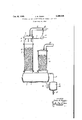
- numeral l represents a vessel which may be provided with a steam jacket 2 for heating.
- a column section 3 filled with packing 4, for example Raschig rings, to provide an extended surface for contact.
- packing 4 for example Raschig rings
- Above the column section 3 is a chamber 5' which may be integral with the column section or arranged as shown as a separate section.
- This chamber 5 contains spray heads or other devices 6 to distribute liquid naphthalene introduced through the pipe 1. Air may be fed to the apparatus by the pipe 8, the opening 9 serving to accommodate an explosion flange or act as a handhole.
- the column 3 and chamber 5 may be provided with steam heating jackets.
- extended radiator sections provided with steam may be employed as both surface and heating means.
- Another short column section It! with packing H and exit pipe I! serves as a spray remover for the mixture of naphthalene and air. These may be steam jacketed if desired. Other forms of spray remover may be used instead of the section ill with packing II.
- the vessel 93 with jacket I4 and draw-off cock l5 serves to collect residue or tar" from the vessel l, flowing to it through the trapped pipe it.
- the pipe I! is provided to equalize the pressures between the vessels l and I3. Alternately, the vessel l3 may be omitted and tar drawn directly from the vessel l. l a
- an air measuring and controlling device I8 is provided in the incoming air line 8 and this is arranged so as to control the action or the pump l9 to introduce naphthalene in an exact ratio to the flow of air.
- Such proportioning pumps controlled in a relation to another stream of fluid are common articles of commerce and no detailed description of them and their method of operatio are required.
- air at a known and constant pressure and temperature is introduced to the pipe 8 passing the measuring controller l8 which actuates the pump ill to introduce a stream of naphthalene into the pipe I equivalent, for example, to one part by weight for every thirty parts by weight of air, which is outside the explosive mixture range.
- the air and naphthalene pass concurrently downward over the extended surface 4 which gives contact and vaporizes the.
- the heat of vaporization may be provided by the temperature of the incoming air or in part by the air and in part or all by steam jackets on the vessel 3 or by extended surface radiator sections heated by steam replacing the packing 4 shown.
- the vessel I also serves to decrease the linear velocity of the stream and allow the separation of liquid droplets.
- the removal of liquid droplets is completed by the column It! with packing H or by such other forms of spray remover as may be employed.
- the mixture of air and naphthalene leaves by the pipe I2 and goes to a catalytic converter or other device for its utilization.
- naphthalene as used in the claims is intended to include crude or refined material.
- the process or apparatus may be used to vaporize other organic compounds to provide a mixture with air suitable for use in producing partial oxidation products by vapor phase catalytic oxidation.
- the method of forming a naphthalene vapor and air mixture for vapor phase catalytic oxidation which comprises delivering air and liquid naphthalene in predetermined relative proportions to the upper part of a tower containing members presenting a multitude of separate surfaces over which and from one to another of which liquid naphthalene may flow, sweeping the liquid naphthalene downwardly and distributing it as thin films over said surfaces by the action of the downfiowing current of air while maintaining the temperature of the air and naphthalene substantially above the melting point of the naphthalene, whereby the liquid naphthalene is exposed to evaporating action in said thin films and on said surfaces.
- the method of forming a naphthalene vapor and air mixture for vapor phase catalytic oxidation which comprises delivering air and liquid naphthalene in predetermined relative proportions to the upper part of a tower containing members presenting a multiple of separate surfaces over which and from one to another of which liquid naphthalene may flow, sweeping the liquid naphthalene downwardly and distributing it as thin films over said surfaces by the action of the downflowing current of air while maintaining the temperature of the air and naphthalene substantially above the melting point of the naphthalene, whereby the liquid naphthalene is exposed to evaporating action in said thin films and on said surfaces, and separating and withdrawing non-vaporized material from the gaseous mixture of air and naphthalene at the bottom of the tower.
Landscapes
- Chemical & Material Sciences (AREA)
- Organic Chemistry (AREA)
- Engineering & Computer Science (AREA)
- Oil, Petroleum & Natural Gas (AREA)
- Organic Low-Molecular-Weight Compounds And Preparation Thereof (AREA)
Description
Oct.- 30, 1945. J. M. WEISS PROCESS FOR THE VAPORIZATION OF ORGANIC COMPOUNDS Filed July 15, 1945 INVENTOR John M Ws's Wu ML-Q Patented Oct. 30, 1945 UNITED STATES v rnocnss FOR THE VAPORIZATION oncmc COMPOUNDS John M. Weis s, New York, N. Y., assignor to John M. Weiss and 00., New York County, N. Y.
Application July 15, 1943, Serial No. 494,874
4 Claims.
In the manufacture of phthalic anhydride by vapor phase oxidation by air in the presence of a catalyst, it is necessary to produce a suitable mixture of air and naphthalene or other hydrocarbon used. The usual raw material is a crude 5 naphthalene containing varying amounts of methyl naphthalene and other liquid hydrocarbons, some non-volatile, or at least relatively high boiling material, usually styled tar, vas well as lesser amounts of other impurities which, under the proper conditions, can polymerize to produce more tar.
Several types of naphthalene Vaporizers are in practical use. One involves maintaining a body of molten crude naphthalene in a vessel at a predetermined temperature and passing a comminuted stream of air through the body of liquid. Heat is supplied either by outside heating, heating the incoming stream of air or both. This gives a mixture of air and naphthalene which is richer in hydrocarbon content than is customarily used in phthalic anhydride manufacture and hence this stream of primary air after saturation is mixed with a stream of secondary air to give a mixture dilute enough to be out of the explosive range, which mixture is passed to the catalytic convertor. Besides the disadvantageof the dual control of air streams and the extra valves and instruments required for two air streams, the hot naphthalene is kept in prolonged contact with air in the vaporizer which causes increased formation of tar from polymerizable materials and as the tar content increases, there is an increasing tendency toward its entrainment in the vapor stream along with unvaporized liquid naphthalene. Such entrainment causes carbon deposition in the catalyst and is destructive of catalytic activity, making frequent catalytic renewals necessary.
Other devices in use pass a stream of air over the surface of a flowing or quiescent body of molten crude naphthalene controlling the contact surface in relation to the temperature so as to obtain the degree of vaporization desired. This d method also results in prolonged contact between air and naphthalene and induces tar formation" although not to the same degree as with those. devices where the stream of air is passed through the naphthalene. Due to the fact that these methods are based on ineiiicient vaporization, any change in rate of air flow gives a different composition of mixed vapor unless the temperature is adjusted to suit. This is especially disadvantageous in the initial operation of the plant when low and changing rates of flow are desired.
Under" such circumstances, there is danger of too much vaporization and hence formation of explosive mixtures.
According to the present invention, the previous disadvantages have been overcome by passing a stream of liquid naphthalene and a stream of air concurrently downward over an extended surface and controlling the naphthalene stream in accordance with the rate of flow of the stream of air. Such concurrent flow has the additional advantage of allowing the construction of a vaporizer with much lower pressure drop than one in which the flow of the naphthalene and air are countercurrent and moreover presents very much less chance of entrainment of liquid than would exist with countercurrent flow.
The invention is illustrated by the accompanying drawing which however is not intended to limit the scope of the invention, such scope being defined only by the appended claims.
In the drawing, numeral l represents a vessel which may be provided with a steam jacket 2 for heating. Connected to the top of the vessel is a column section 3 filled with packing 4, for example Raschig rings, to provide an extended surface for contact. Above the column section 3 is a chamber 5' which may be integral with the column section or arranged as shown as a separate section. This chamber 5 contains spray heads or other devices 6 to distribute liquid naphthalene introduced through the pipe 1. Air may be fed to the apparatus by the pipe 8, the opening 9 serving to accommodate an explosion flange or act as a handhole. The column 3 and chamber 5 may be provided with steam heating jackets. Instead of the packing 4, extended radiator sections provided with steam may be employed as both surface and heating means.
Another short column section It! with packing H and exit pipe I! serves as a spray remover for the mixture of naphthalene and air. These may be steam jacketed if desired. Other forms of spray remover may be used instead of the section ill with packing II.
The vessel 93 with jacket I4 and draw-off cock l5 serves to collect residue or tar" from the vessel l, flowing to it through the trapped pipe it. The pipe I! is provided to equalize the pressures between the vessels l and I3. Alternately, the vessel l3 may be omitted and tar drawn directly from the vessel l. l a In the incoming air line 8 an air measuring and controlling device I8 is provided and this is arranged so as to control the action or the pump l9 to introduce naphthalene in an exact ratio to the flow of air. Such proportioning pumps controlled in a relation to another stream of fluid are common articles of commerce and no detailed description of them and their method of operatio are required. a
In operation, air at a known and constant pressure and temperature is introduced to the pipe 8 passing the measuring controller l8 which actuates the pump ill to introduce a stream of naphthalene into the pipe I equivalent, for example, to one part by weight for every thirty parts by weight of air, which is outside the explosive mixture range. The air and naphthalene pass concurrently downward over the extended surface 4 which gives contact and vaporizes the.
naphthalene fed in with the air. This downward concurrent flow is important since the back pressure is much lower than with countercurrent flow and there is no danger of flooding and the excessive entrainment of liquid which this would cause. The heat of vaporization may be provided by the temperature of the incoming air or in part by the air and in part or all by steam jackets on the vessel 3 or by extended surface radiator sections heated by steam replacing the packing 4 shown.
Any residual tar'drips from the packing 5 into the vessel I and is removed therefrom by the pipe l6 either through the tank H3 or directly as previously stated.
The vessel I also serves to decrease the linear velocity of the stream and allow the separation of liquid droplets. The removal of liquid droplets is completed by the column It! with packing H or by such other forms of spray remover as may be employed. The mixture of air and naphthalene leaves by the pipe I2 and goes to a catalytic converter or other device for its utilization.
The term naphthalene as used in the claims is intended to include crude or refined material. The process or apparatus may be used to vaporize other organic compounds to provide a mixture with air suitable for use in producing partial oxidation products by vapor phase catalytic oxidation.
Having thus described my invention, I claim:
1. The method of forming a naphthalene vapor and air mixture for vapor phase catalytic oxidation, which comprises delivering air and liquid naphthalene in predetermined relative proportions to the upper part of a tower containing members presenting a multitude of separate surfaces over which and from one to another of which liquid naphthalene may flow, sweeping the liquid naphthalene downwardly and distributing it as thin films over said surfaces by the action of the downfiowing current of air while maintaining the temperature of the air and naphthalene substantially above the melting point of the naphthalene, whereby the liquid naphthalene is exposed to evaporating action in said thin films and on said surfaces.
2. The method of forming a naphthalene vapor and air mixture for vapor phase catalytic oxidation, which comprises delivering air and liquid naphthalene in predetermined relative proportions to the upper part of a tower containing members presenting a multiple of separate surfaces over which and from one to another of which liquid naphthalene may flow, sweeping the liquid naphthalene downwardly and distributing it as thin films over said surfaces by the action of the downflowing current of air while maintaining the temperature of the air and naphthalene substantially above the melting point of the naphthalene, whereby the liquid naphthalene is exposed to evaporating action in said thin films and on said surfaces, and separating and withdrawing non-vaporized material from the gaseous mixture of air and naphthalene at the bottom of the tower.
3. In the conversion of a normally solid hydrocarbon in liquid form to partial oxidation products by vapor phase catalytic oxidation involving the preparation of a vapor phase hydrocarbon mixture from said hydrocarbon and air, the improvement which comprises delivering sa'id hydrocarbon in liquid form and said air in predetermined relative proportions, and at a temperature substantially above the melting point of said normally solid hydrocarbon, down through a column offering comparatively low resistance to fiuid flow and presenting a plurality of bafilings in the path of flow and over which said liquid hydrocarbon may flow in thin films, sweeping the liquid hydrocarbon downwardly and over said surfaces, and simultaneously evaporating said hydrocarbon during the downward flow by the action of the downwardly flowing current of the air, whereby substantially all of the liquid hydrocarbon is evaporated and a homogeneous mixture is formed.
4. In the conversion of a normally solid hydrocarbon in liquid form to partial oxidation products by vapor phase catalytic oxidation involving the preparation of a vapor phase hydrocarbon mixture from said hydrocarbon and air, the improvement which comprises delivering said hydrocarbon in liquid form and said air in predetermined relative proportions, and at a temperature substantially above the melting point of said normally solid hydrocarbon, down through a column oifering comparatively low resistance to fluid flo'w and presenting a plurality of ,bafllings in the path of flow and over which said liquid hydrocarbon may flow in thin films, sweeping the
Priority Applications (1)
| Application Number | Priority Date | Filing Date | Title |
|---|---|---|---|
| US494874A US2388198A (en) | 1943-07-15 | 1943-07-15 | Process for the vaporization of organic compounds |
Applications Claiming Priority (1)
| Application Number | Priority Date | Filing Date | Title |
|---|---|---|---|
| US494874A US2388198A (en) | 1943-07-15 | 1943-07-15 | Process for the vaporization of organic compounds |
Publications (1)
| Publication Number | Publication Date |
|---|---|
| US2388198A true US2388198A (en) | 1945-10-30 |
Family
ID=23966329
Family Applications (1)
| Application Number | Title | Priority Date | Filing Date |
|---|---|---|---|
| US494874A Expired - Lifetime US2388198A (en) | 1943-07-15 | 1943-07-15 | Process for the vaporization of organic compounds |
Country Status (1)
| Country | Link |
|---|---|
| US (1) | US2388198A (en) |
-
1943
- 1943-07-15 US US494874A patent/US2388198A/en not_active Expired - Lifetime
Similar Documents
| Publication | Publication Date | Title |
|---|---|---|
| US2357113A (en) | Apparatus for distillation control | |
| US3496159A (en) | Esterification of fatty acids of tall oil in a horizontal distillation column and condenser | |
| US2339160A (en) | Distillation process | |
| US2729600A (en) | Azeotropic dehydration of maleic acid to anhydride | |
| US2584785A (en) | Process and apparatus for separation of mixtures | |
| US2007116A (en) | Method of oxidizing hydrocarbons | |
| US2223383A (en) | Oxidation of hydrocarbons to phenols | |
| CN109776257A (en) | The method and apparatus of methylene chloride dehydration rectifying in acesulfame-K production | |
| US2149362A (en) | Preparation of naphthalene vapor mixtures for catalytic oxidation | |
| US3297566A (en) | Gas oil reflux controller | |
| US1701988A (en) | Art of separating liquids having different boiling points | |
| US2016804A (en) | Purification of carbon tetrachloride | |
| US1954839A (en) | Rectifying process | |
| US1905033A (en) | Concentration of formaldehyde solutions | |
| US2129684A (en) | Process and apparatus for removing water from aqueous aliphatic acids | |
| US2729599A (en) | Dehydration of maleic acid to anhydride | |
| US3325532A (en) | Manufacture of adiponitrile | |
| US2250091A (en) | Dehydration of maleic acid | |
| US2091218A (en) | Process for the production of hydrogen peroxide | |
| US2599466A (en) | Apparatus for continuous catalysis | |
| US1312974A (en) | of geneva | |
| US1341423A (en) | Process for making sulfur chlorid | |
| US2247910A (en) | Phthalic anhydride | |
| US2541267A (en) | Catalytic hydrocarbon conversion process and apparatus | |
| US1291025A (en) | Apparatus for the concentration of vinegar and acetic acid. |