US2355117A - Electrical gaseous discharge lamp - Google Patents
Electrical gaseous discharge lamp Download PDFInfo
- Publication number
- US2355117A US2355117A US358848A US35884840A US2355117A US 2355117 A US2355117 A US 2355117A US 358848 A US358848 A US 358848A US 35884840 A US35884840 A US 35884840A US 2355117 A US2355117 A US 2355117A
- Authority
- US
- United States
- Prior art keywords
- discharge
- lamp
- envelope
- compound
- bismuth
- Prior art date
- Legal status (The legal status is an assumption and is not a legal conclusion. Google has not performed a legal analysis and makes no representation as to the accuracy of the status listed.)
- Expired - Lifetime
Links
- 150000001875 compounds Chemical class 0.000 description 30
- 239000000463 material Substances 0.000 description 29
- 229910052797 bismuth Inorganic materials 0.000 description 11
- JCXGWMGPZLAOME-UHFFFAOYSA-N bismuth atom Chemical compound [Bi] JCXGWMGPZLAOME-UHFFFAOYSA-N 0.000 description 11
- 230000005855 radiation Effects 0.000 description 10
- 229910052787 antimony Inorganic materials 0.000 description 5
- WATWJIUSRGPENY-UHFFFAOYSA-N antimony atom Chemical compound [Sb] WATWJIUSRGPENY-UHFFFAOYSA-N 0.000 description 5
- 150000004678 hydrides Chemical class 0.000 description 5
- 230000003595 spectral effect Effects 0.000 description 5
- XKRFYHLGVUSROY-UHFFFAOYSA-N Argon Chemical compound [Ar] XKRFYHLGVUSROY-UHFFFAOYSA-N 0.000 description 4
- 238000000354 decomposition reaction Methods 0.000 description 4
- 150000004820 halides Chemical class 0.000 description 4
- XMBWDFGMSWQBCA-UHFFFAOYSA-N hydrogen iodide Chemical compound I XMBWDFGMSWQBCA-UHFFFAOYSA-N 0.000 description 4
- KOECRLKKXSXCPB-UHFFFAOYSA-K triiodobismuthane Chemical compound I[Bi](I)I KOECRLKKXSXCPB-UHFFFAOYSA-K 0.000 description 4
- UFHFLCQGNIYNRP-UHFFFAOYSA-N Hydrogen Chemical compound [H][H] UFHFLCQGNIYNRP-UHFFFAOYSA-N 0.000 description 3
- RQNWIZPPADIBDY-UHFFFAOYSA-N arsenic atom Chemical compound [As] RQNWIZPPADIBDY-UHFFFAOYSA-N 0.000 description 3
- 239000001257 hydrogen Substances 0.000 description 3
- 229910052739 hydrogen Inorganic materials 0.000 description 3
- 229910052762 osmium Inorganic materials 0.000 description 3
- SYQBFIAQOQZEGI-UHFFFAOYSA-N osmium atom Chemical compound [Os] SYQBFIAQOQZEGI-UHFFFAOYSA-N 0.000 description 3
- 230000008016 vaporization Effects 0.000 description 3
- ZCYVEMRRCGMTRW-UHFFFAOYSA-N 7553-56-2 Chemical compound [I] ZCYVEMRRCGMTRW-UHFFFAOYSA-N 0.000 description 2
- 229910052786 argon Inorganic materials 0.000 description 2
- 229910052785 arsenic Inorganic materials 0.000 description 2
- 230000005284 excitation Effects 0.000 description 2
- 239000011261 inert gas Substances 0.000 description 2
- 229910052740 iodine Inorganic materials 0.000 description 2
- 239000011630 iodine Substances 0.000 description 2
- 229910052751 metal Inorganic materials 0.000 description 2
- 238000001228 spectrum Methods 0.000 description 2
- 238000009792 diffusion process Methods 0.000 description 1
- 230000000694 effects Effects 0.000 description 1
- 239000011521 glass Substances 0.000 description 1
- 230000003993 interaction Effects 0.000 description 1
- PNDPGZBMCMUPRI-UHFFFAOYSA-N iodine Chemical compound II PNDPGZBMCMUPRI-UHFFFAOYSA-N 0.000 description 1
- 238000004519 manufacturing process Methods 0.000 description 1
- 229910000489 osmium tetroxide Inorganic materials 0.000 description 1
- 239000002245 particle Substances 0.000 description 1
Images
Classifications
-
- H—ELECTRICITY
- H01—ELECTRIC ELEMENTS
- H01J—ELECTRIC DISCHARGE TUBES OR DISCHARGE LAMPS
- H01J61/00—Gas-discharge or vapour-discharge lamps
- H01J61/02—Details
- H01J61/12—Selection of substances for gas fillings; Specified operating pressure or temperature
- H01J61/125—Selection of substances for gas fillings; Specified operating pressure or temperature having an halogenide as principal component
Definitions
- This invention relates to an electrical gaseous discharge lamp of the type in which atoms of a material which has desirable spectral properties are introduced into a discharge space in which they are excited and caused to emit the desired radiation.
- An object of this invention is to introduce atoms of the spectral material into a discharge space without corresponding elevated temperatures of the lamp envelope.
- Another object is to accomplish such introduction by utilizing the spectral material in the form of a compound of that material, which compound is easily vaporizable, is decomposed in the discharge space, and subsequently the elements of such decomposition recombine to form the compound.
- a further object is to utiliz the spectral material in the form of halides, hydrides or the like.
- a still further object is to generally improve the effectiveness and operation of such gaseous discharge lamps.
- I represents a lamp envelope consisting of some suitable material, such as glass preferably transparent to the radiations which are generated within it.
- an exciting coil 2 Surrounding the lamp l is an exciting coil 2, which when fed with alternating currents of proper frequency produce an electrodeless discharge within the atmosphere contained in the envelope I.
- the envelope I contains a quantity 3 of the compound which is to be vaporized. It also may contain an inert gas, such as argon, at a pressure of a few millimeters in order to assist in the starting and running of the lamp, if desired. In some instances where the material 3 is vaporized sufflciently, upon energization of the coil 2, the inert gas may be omitted.
- Such elements as bismuth, antimony, arsenic and osmium, which are diflicult to vaporize, form many compounds which are much more easily vaporizable than the elements themselves. Furthermore, such compounds decompose under the action of the discharge which occurs within the envelope I so as to liberate atoms of the elements, whereupon said atoms are subjected to collision by exciting particles within said discharge. Furthermore the products of such decomposition recombine to form the original compound which recondenses on the walls of the envelope I, where it is again vaporized so as to participate in the discharge as described above. Certain halides of bismuth or antimony are compounds of this genera1 nature.
- I have utilized bismuth iodide (BiIa) for the material 3, together with argon at about two millimeters pressure.
- BiIa bismuth iodide
- the envelope was-operated at a relatively low temperature at which bismuth would ordinarily be substantially non-vaporizable, the spectrum of bismuth was present in a marked degree.
- Other compounds aside from the halides could be used.
- antimony and arsenic form volatile hydrides which have the desired properties as specified above.
- other compounds aside from the halides and hydrides might be utilized.
- osmium tetraoxide is a vaporizable com pound which also has the desired properties resulting in the possibility of producing the spectrum of osmium in a lamp with a relatively low temperature envelope.
- lamp as used in the specification and claims, I mean a device for generating light.
- the term light in the sense employed in the foregoing definition, is broad enough to include both visible and invisible light radiations.
- the compounds described above are readily formed by the interaction of its components, in many instances said components may be in itially introduced into said lamp instead of the compound itself.
- a quantity oi bismuth and iodine may be introduced separately into the envelope or a quantity of antimony and some gaseous hydrogen might be introduced separately.
- the vapor oi the iodine or the gaseous hydrogen would react with the respective metallic element to form the vaporizable compound.
- there is preferably an excess or the metallic element so that there is substantially no free iodine, hydrogen or other corresponding component.
- a lamp comprising an envelope containing bismuth iodide, and means for producing a space discharge in said lamp, said iodide being more easily vaporizable than bismuth at the normal operating temperature of said envelope, said iodide being decomposible into componentaineluding bismuth under conditions prevailing in said discharge.
- a lamp comprising an envelope containing bismuth iodide, and an excess of bismuth, and means for producing a space discharge in said lamp, said iodide being more easily vaporizable than bismuth at the normal operating temperature of said envelope, said iodide being decomposible into components, including bismuth under conditions prevailing in said discharge.
- a lamp comprising an envelope, means for producing an electrical space discharge in said lamp, and a compound arranged within the envelope, said compound including a material adapted to be. introduced in the path of the discharge and to be excited by the discharge to emit radiation, said material being relatively nonvaporizable at the normal operating temperature of envelope andpressure conditions within the lamp, said compound being substantially more easilyvaporizable than said material under said temperature and pressure conditions, said compound being characterized by the property of vaporizing at said temperature and pressure con- 4.
- a lamp comprising an envelope, means for producing an electrical space discharge in said lamp, a compound arranged within the envelope, said compound including a material adapted to be introduced in the path of the discharge and to be excited by the discharge to emit radiation, and an excess of said material within said envelope, said material being relatively non-vaporizable at the normal operating temperature 01 envelope and pressure conditions within the lamp, said compound being substantially more easily vaporizable than said material under said temperature and pressure conditions, said compound being characterized by the property of vaporizing at said temperature and pressure conditions to supply to said discharge a substantial quantity of said compound in vapor form, said compound being adapted, upon diffusion into the discharge path, to be decomposed therein to release a quantity of said material, said material being adapted to be excited by the discharge to emit radiations.
- a device for generating light by the excitation of a gaseous atmosphere comprising an envelope, means for producing an electrical space discharge in said lamp, and a compound arranged within the envelope, said compound including a material adapted to be introduced in the path of the discharge and to be excited by the discharge to emit radiation, said material being relatively nonvaporizable at the normal operating temperature of envelope and pressure conditions within the lamp, said compound being substantially more easily vaporizable than said material under said temperature and pressure conditions, said compound being characterized by the property of vaporizing at said temperature and pressure conditions to supply to said discharge a substantial quantity of said compound in vapor form, said compound being adapted, upon difiusion into the discharge path, to be decomposed therein to release a quantity of said material, said material being adapted to be excited by the discharge to emit radiations.
Landscapes
- Discharge Lamp (AREA)
Description
- Aug. 8, 1944. c. G. SMITH ELECTRICAL GASEOUS DISCHARGE LAMP Filed Sept. 28, 1940 I VENTOR. CHARLES G. SMITH BY am 51 TTY.
Patented Aug. 8, 1944 ELECTRICAL GASEOUS DISCHARGE LAMP Charles G. Smith, Medford, Mass., asslgnor to Raytheon Manufacturing Company, Newton, Mass., a corporation oi Delaware Application September 28, 1940, Serial No. 358,848
Claims.
This invention relates to an electrical gaseous discharge lamp of the type in which atoms of a material which has desirable spectral properties are introduced into a discharge space in which they are excited and caused to emit the desired radiation.
Many materials whose spectral properties are desirable in a lamp are diflicult to vaporize at the relatively low temperatures at which it is usually desirable to operate the envelope of the lamp. These materials include, for example, bismuth, antimony, arsenic and osmium. If such materials were placed in the usual lamp, the envelope would have to be maintained at an undesirably high temperature in order to vaporiz such material sufliciently to generate enough vapor to cause the desired excitation of these materials. However, in order to cause the material to emit its radiations, it is merely necessary to introduce a sufficiently large number of atoms of that material into a discharge space where said. atoms may be subjected to the exciting effect of the discharge.
An object of this invention is to introduce atoms of the spectral material into a discharge space without corresponding elevated temperatures of the lamp envelope.
Another object is to accomplish such introduction by utilizing the spectral material in the form of a compound of that material, which compound is easily vaporizable, is decomposed in the discharge space, and subsequently the elements of such decomposition recombine to form the compound.
A further object is to utiliz the spectral material in the form of halides, hydrides or the like.
A still further object is to generally improve the effectiveness and operation of such gaseous discharge lamps.
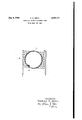
The foregoing and other objects of this invention will be best understood from the following description of an exemplification thereof, reference being had to the accompanying diagrammatic drawing, in which I represents a lamp envelope consisting of some suitable material, such as glass preferably transparent to the radiations which are generated within it. Surrounding the lamp l is an exciting coil 2, which when fed with alternating currents of proper frequency produce an electrodeless discharge within the atmosphere contained in the envelope I. The envelope I contains a quantity 3 of the compound which is to be vaporized. It also may contain an inert gas, such as argon, at a pressure of a few millimeters in order to assist in the starting and running of the lamp, if desired. In some instances where the material 3 is vaporized sufflciently, upon energization of the coil 2, the inert gas may be omitted.
Such elements as bismuth, antimony, arsenic and osmium, which are diflicult to vaporize, form many compounds which are much more easily vaporizable than the elements themselves. Furthermore, such compounds decompose under the action of the discharge which occurs within the envelope I so as to liberate atoms of the elements, whereupon said atoms are subjected to collision by exciting particles within said discharge. Furthermore the products of such decomposition recombine to form the original compound which recondenses on the walls of the envelope I, where it is again vaporized so as to participate in the discharge as described above. Certain halides of bismuth or antimony are compounds of this genera1 nature. In a preferred embodiment of the lamp, I have utilized bismuth iodide (BiIa) for the material 3, together with argon at about two millimeters pressure. In such a lamp, although the envelope was-operated at a relatively low temperature at which bismuth would ordinarily be substantially non-vaporizable, the spectrum of bismuth was present in a marked degree. Other compounds aside from the halides could be used. For example, antimony and arsenic form volatile hydrides which have the desired properties as specified above. Also other compounds aside from the halides and hydrides might be utilized. For example, osmium tetraoxide is a vaporizable com pound which also has the desired properties resulting in the possibility of producing the spectrum of osmium in a lamp with a relatively low temperature envelope.
In the above embodiment I have illustrated an electrodeless discharge arrangement so that there are no electrodes with which the decomposition elements might react in an undesirable manner. If, however, the lamp were in the form having electrodes, the vaporizable compound and its elements of decomposition should preferably be inert with respect to said electrodes. The preferred embodiment in such an arrangement would probably utilize the hydrides, as for example antlmony hydride, instead of the bismuth iodide referr ed to above.
By the term lamp, as used in the specification and claims, I mean a device for generating light. The term light, in the sense employed in the foregoing definition, is broad enough to include both visible and invisible light radiations.
Since the compounds described above are readily formed by the interaction of its components, in many instances said components may be in itially introduced into said lamp instead of the compound itself. For example, a quantity oi bismuth and iodine may be introduced separately into the envelope or a quantity of antimony and some gaseous hydrogen might be introduced separately. In each instance the vapor oi the iodine or the gaseous hydrogen would react with the respective metallic element to form the vaporizable compound. In each case also there is preferably an excess or the metallic element so that there is substantially no free iodine, hydrogen or other corresponding component.
It is to be understood that this invention is not limited to the particular details as described above as many equivalents will suggest themselves to those skilled in the art. It is accordingly desired that the appended claims be given a broad interpretation commensurate with the scope of the invention within the art.
What is claimed is:
emit radiations.
1. A lamp comprising an envelope containing bismuth iodide, and means for producing a space discharge in said lamp, said iodide being more easily vaporizable than bismuth at the normal operating temperature of said envelope, said iodide being decomposible into componentaineluding bismuth under conditions prevailing in said discharge.
2. A lamp comprising an envelope containing bismuth iodide, and an excess of bismuth, and means for producing a space discharge in said lamp, said iodide being more easily vaporizable than bismuth at the normal operating temperature of said envelope, said iodide being decomposible into components, including bismuth under conditions prevailing in said discharge.
3. A lamp comprising an envelope, means for producing an electrical space discharge in said lamp, and a compound arranged within the envelope, said compound including a material adapted to be. introduced in the path of the discharge and to be excited by the discharge to emit radiation, said material being relatively nonvaporizable at the normal operating temperature of envelope andpressure conditions within the lamp, said compound being substantially more easilyvaporizable than said material under said temperature and pressure conditions, said compound being characterized by the property of vaporizing at said temperature and pressure con- 4. A lamp comprising an envelope, means for producing an electrical space discharge in said lamp, a compound arranged within the envelope, said compound including a material adapted to be introduced in the path of the discharge and to be excited by the discharge to emit radiation, and an excess of said material within said envelope, said material being relatively non-vaporizable at the normal operating temperature 01 envelope and pressure conditions within the lamp, said compound being substantially more easily vaporizable than said material under said temperature and pressure conditions, said compound being characterized by the property of vaporizing at said temperature and pressure conditions to supply to said discharge a substantial quantity of said compound in vapor form, said compound being adapted, upon diffusion into the discharge path, to be decomposed therein to release a quantity of said material, said material being adapted to be excited by the discharge to emit radiations.
5. A device for generating light by the excitation of a gaseous atmosphere comprising an envelope, means for producing an electrical space discharge in said lamp, and a compound arranged within the envelope, said compound including a material adapted to be introduced in the path of the discharge and to be excited by the discharge to emit radiation, said material being relatively nonvaporizable at the normal operating temperature of envelope and pressure conditions within the lamp, said compound being substantially more easily vaporizable than said material under said temperature and pressure conditions, said compound being characterized by the property of vaporizing at said temperature and pressure conditions to supply to said discharge a substantial quantity of said compound in vapor form, said compound being adapted, upon difiusion into the discharge path, to be decomposed therein to release a quantity of said material, said material being adapted to be excited by the discharge to emit radiations.
CHARLES G. SMITH.
Priority Applications (1)
| Application Number | Priority Date | Filing Date | Title |
|---|---|---|---|
| US358848A US2355117A (en) | 1940-09-28 | 1940-09-28 | Electrical gaseous discharge lamp |
Applications Claiming Priority (1)
| Application Number | Priority Date | Filing Date | Title |
|---|---|---|---|
| US358848A US2355117A (en) | 1940-09-28 | 1940-09-28 | Electrical gaseous discharge lamp |
Publications (1)
| Publication Number | Publication Date |
|---|---|
| US2355117A true US2355117A (en) | 1944-08-08 |
Family
ID=23411293
Family Applications (1)
| Application Number | Title | Priority Date | Filing Date |
|---|---|---|---|
| US358848A Expired - Lifetime US2355117A (en) | 1940-09-28 | 1940-09-28 | Electrical gaseous discharge lamp |
Country Status (1)
| Country | Link |
|---|---|
| US (1) | US2355117A (en) |
Cited By (3)
| Publication number | Priority date | Publication date | Assignee | Title |
|---|---|---|---|---|
| US2449880A (en) * | 1945-05-16 | 1948-09-21 | Durotest Corp | Light source |
| NL1003768C2 (en) * | 1995-08-11 | 1997-11-18 | Matsushita Electric Works Ltd | Stakeless gas discharge lamp. |
| US20190279859A1 (en) * | 2016-05-27 | 2019-09-12 | Hanovia Limited | Mercury-free uv gas discharge lamp |
-
1940
- 1940-09-28 US US358848A patent/US2355117A/en not_active Expired - Lifetime
Cited By (4)
| Publication number | Priority date | Publication date | Assignee | Title |
|---|---|---|---|---|
| US2449880A (en) * | 1945-05-16 | 1948-09-21 | Durotest Corp | Light source |
| NL1003768C2 (en) * | 1995-08-11 | 1997-11-18 | Matsushita Electric Works Ltd | Stakeless gas discharge lamp. |
| US20190279859A1 (en) * | 2016-05-27 | 2019-09-12 | Hanovia Limited | Mercury-free uv gas discharge lamp |
| US10685828B2 (en) * | 2016-05-27 | 2020-06-16 | Hanovia Limited | Mercury-free UV gas discharge lamp |
Similar Documents
| Publication | Publication Date | Title |
|---|---|---|
| US2182732A (en) | Metal vapor lamp | |
| US2118452A (en) | Electric lamp | |
| US2386277A (en) | Fluorescent lamp | |
| US5162699A (en) | Ion source | |
| US2152999A (en) | Gaseous electric discharge lamp device | |
| Druyvesteyn | Electron emission of the cathode of an arc | |
| US2404002A (en) | Electrical gaseous discharge lamp | |
| US3728572A (en) | Incandescent lamp with regenerative cycle | |
| US2438181A (en) | Fluorescent and/or cathode glow lamp and method | |
| US5543687A (en) | Hydrogen-gas discharge lamp | |
| US2333052A (en) | Electrical discharge device | |
| US2450548A (en) | Erythemal phosphor | |
| US2803775A (en) | Vapour discharge lamp | |
| US2042261A (en) | Gaseous electric discharge device | |
| US2018815A (en) | Liberation of alkali metals | |
| US1566848A (en) | Incandescent lamp | |
| US3241903A (en) | Method and apparatus for controlling a sealed atmosphere | |
| US20180051633A1 (en) | Krypton-85-free spark gap with a discharge probe | |
| US2177694A (en) | Gas or vapor discharge device | |
| US1655502A (en) | Incandescent electric lamp | |
| US2073431A (en) | Discharge tube | |
| US2060657A (en) | Electric lamp | |
| US2135690A (en) | Gaseous electric discharge lamp device | |
| Chen et al. | Mechanism of radiolysis of gaseous HBr | |
| GB520835A (en) | Improvements in gasfilled electric incandescent lamps |