US2323402A - Parking meter - Google Patents
Parking meter Download PDFInfo
- Publication number
- US2323402A US2323402A US360465A US36046540A US2323402A US 2323402 A US2323402 A US 2323402A US 360465 A US360465 A US 360465A US 36046540 A US36046540 A US 36046540A US 2323402 A US2323402 A US 2323402A
- Authority
- US
- United States
- Prior art keywords
- coin
- disc
- plate
- presser
- time
- Prior art date
- Legal status (The legal status is an assumption and is not a legal conclusion. Google has not performed a legal analysis and makes no representation as to the accuracy of the status listed.)
- Expired - Lifetime
Links
- 230000007246 mechanism Effects 0.000 description 31
- PXHVJJICTQNCMI-UHFFFAOYSA-N Nickel Chemical compound [Ni] PXHVJJICTQNCMI-UHFFFAOYSA-N 0.000 description 12
- 230000002093 peripheral effect Effects 0.000 description 7
- 229910052759 nickel Inorganic materials 0.000 description 6
- 230000009471 action Effects 0.000 description 5
- 125000006850 spacer group Chemical group 0.000 description 4
- 230000004048 modification Effects 0.000 description 3
- 238000012986 modification Methods 0.000 description 3
- 238000005096 rolling process Methods 0.000 description 3
- 230000008901 benefit Effects 0.000 description 2
- 230000003111 delayed effect Effects 0.000 description 2
- 230000005484 gravity Effects 0.000 description 2
- 230000001788 irregular Effects 0.000 description 2
- 238000000926 separation method Methods 0.000 description 2
- 230000015572 biosynthetic process Effects 0.000 description 1
- 230000008859 change Effects 0.000 description 1
- 238000010276 construction Methods 0.000 description 1
- 230000000694 effects Effects 0.000 description 1
- 239000011521 glass Substances 0.000 description 1
- 238000003780 insertion Methods 0.000 description 1
- 230000037431 insertion Effects 0.000 description 1
- 238000007689 inspection Methods 0.000 description 1
- 230000000284 resting effect Effects 0.000 description 1
- XLYOFNOQVPJJNP-UHFFFAOYSA-N water Substances O XLYOFNOQVPJJNP-UHFFFAOYSA-N 0.000 description 1
- 238000004804 winding Methods 0.000 description 1
Images



Classifications
-
- G—PHYSICS
- G07—CHECKING-DEVICES
- G07F—COIN-FREED OR LIKE APPARATUS
- G07F17/00—Coin-freed apparatus for hiring articles; Coin-freed facilities or services
- G07F17/24—Coin-freed apparatus for hiring articles; Coin-freed facilities or services for parking meters
-
- Y—GENERAL TAGGING OF NEW TECHNOLOGICAL DEVELOPMENTS; GENERAL TAGGING OF CROSS-SECTIONAL TECHNOLOGIES SPANNING OVER SEVERAL SECTIONS OF THE IPC; TECHNICAL SUBJECTS COVERED BY FORMER USPC CROSS-REFERENCE ART COLLECTIONS [XRACs] AND DIGESTS
- Y10—TECHNICAL SUBJECTS COVERED BY FORMER USPC
- Y10S—TECHNICAL SUBJECTS COVERED BY FORMER USPC CROSS-REFERENCE ART COLLECTIONS [XRACs] AND DIGESTS
- Y10S194/00—Check-actuated control mechanisms
- Y10S194/90—Parking meter with barrier
Definitions
- the coin which has been deposited be visible for inspection, so that its genuineness may be determined. It is also desirable that the remaining parking time which is indicated by the device be readily determinable from a distance.
- These two desiderata are obtained with the device of the invention by employing the coin itself as the pointer. Both sides of this coin are visible throughout the alloted parking time so that it may be examined. Since the coin is of large size, its position may be ascertained from a distance. Moreover, the coin is visible from both sides of the device.
- these devices accommodate coins of more than one denomination. This may be desirable so that a coin of small denomination may be deposited if it is desired to obtain a parking time of shorter duration than the maximum time which is afforded by the coin of larger denomination. Such a device may also be desirable so that if a single coin of the large denomination is not at hand, as, for example, a nickel, a suitable number of smaller denomination coins may be placed in the mechanism, as, for example, five pennies, to obtain the full parking time permitted.
- time indicating devices accurately indicate the time for each newly deposited coin without interference by a formerly deposited coin, or coins. That is, the time to be indicated by the newly deposited coin should be neither reduce-d nor extended by the presence of another coin which was earlier deposited.
- the device of the invention is wholly free of any such interference.
- Another feature of the invention is th provision of means for obtaining a predetermined amount of excess time with the device.
- excess time is required by some ordinances, and s nce it may vary in extent with different cities, it is important that the device make it possible to regulate this excess time.
- the device of the invention it is possible to readily afford any desired amount of excess t me, and, moreover, this provis on in no way affects the operation of the device in indicating thenormal time.
- the device of this invention is tamper-proof.
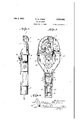
- Figure 1 is a front elevation of the assembled device.
- Fig. 2 is a rear elevationof Fig. 1.
- Fig. 3 is a side elevation from the left of Fig. 1.
- Fig. 4 is a section on the line 44 of Fig. 3, the coin handling mechanism being omitted, but part of the driving gearing being shown.
- Fig. 5 is a front view similar to Fig. 1, the front wall of the casingbeing removed to show the preferred construction of the operating mechanism of the invention.
- Fig. 6 is a section on the line -6-6 of Fig. 2 of th casing only. 7
- Fig. 7 is a section on the line l-I of Fig. 2.
- Fig. 7a is a section on the line '
- Fig. 8 is an elevation of the interior of the front plate of the operating mechanism appearing in Fig. 5.
- Fig. 9 is an elevation of the interior of the rear plate of the operating mechanism.
- Fig. 10 is a side elevation of the operating mechanism from the right of Fig. 5.
- Fig. 11 is a'section on the line mm of Fig. 5.
- Fig. 12 is a section on the line 12-42 of Fig. 5.
- Fig. 13 is a section through the coin box on the line l3
- Fig. 14 is a section on the line
- Fig. 15 is a section on the line l5l5 of Fig. 1.
- Fig. 16 is an elevation of a modification of one of the coin presser blocks.
- Fig. 17 is a side'elevation similar to Fig. 9 show,- ing a modification of parts of the operating mechanism.
- Fig. 18 is a front elevation of the operating mechanism of another embodiment of the invention.
- Fig. 19 is a side elevation from the right of Fig. 18. V
- Fig. 20 is an enlarged view of the upper portion of Fig. 18, certain forward parts being coin passes by gravity to and through an opening 5 in a front plate 6 of the operating mechanism.
- Another plate I is spaced from the plate 8 a distance slightly greater than the thickness of the coin, and after the coin enters the opening 6, it falls between the two plates 8 and 'I, and comes to rest upon the periphery of a rotatable disc 8.
- the plates 8 and I are spaced apart at their lower ends by means of bosses 8 and I0 which surround the bolt holes II and I2, and which are formed integrally with the plate 8. At their upper ends, the plates are held apart by a lug l4 and an enlarged lug II which surrounds the bolt hole II.
- the upwardly facing surface II of this lug ll forms an inclined runway which delivers the coin which has entered through the opening 5, over to the downwardly moving side of the disc 8.
- a detent I8 is provided.
- the plate 8 has a central recess 28 to receive a side portion of the rotatable disc I. This recess is completely out through the plate at 28 to aflord an opening through which the contact between the coin and disc may be observed.
- the plate I is formed with a central opening 2i to receive the disc 8. Because of this relationship, the disc I may be thicker than the space between the plates 4 and I, and this is desirable to insure that the coin will remain upon the periphery of the disc and cannot become displaced sideways off of the disc 4.
- presser block 28 After the coin has rolled down the inclined surface II and contacted the periphery of the disc 8, it rolls around the periphery of the disc until the outer edge of the coin strikes the presser block 28.
- three presser blocks, 28, 24, and 25, are provided. These presser blocks are T-shaped in cross-section, and their central stem or leg portions are thin enough to freely enter between the plates 8 and I, as shown in Fig. 12. The arms or side portions of the presser blocks rest upon the outer edges 28 and 21 respectively of the plates 8 and I to limit inward movement of the presser blocks.
- edges 28 and 21 preferably are concentric with the periphery of the disc I. Shoulders 28', 21' at both ends of the edges 24 and 21 retain the presser blocks against movement along the edges 28 and 21.
- the presser blocks 23, 24, and 25 are urged inwardly toward the disc by means of a coiled spring 28 which is secured at its ends to pins 28 and 80 which extend between the plates 8 and 1.
- This spring is under a slight tension and bears against the outer faces of the presser blocks 28, 24, and 25 to urge them inwardly toward the disc I.
- their outer faces may be grooved as shown at Si in Fig. 12.
- a gear 48 is secured to the shaft 33, and it meshes with a gear 4
- Shaft 42 is rotatably mounted in bearings in plates 84 and 8.
- also meshes with a driving gear 48 of the clock mechanism.
- Plate 24 is attached to the clock frameworkby bolts 38 which pass through a framework member of the clock mechanism and thread into the plate 24.
- Dresser block 22 is cut away at 44 (Fig. 8), so that this portion of the inner surface will not contact the coin.
- the remaining surface 4! is slightly closer to the periphery of disc 8 than the diameter of the coin, with the result that the presser block is moved slightly outwardly against the tension of spring 28 as the coin is advanced under the surface 45 by the rotation of disc 8. In this manner, the coin is urged into frictional contact with the periphery of the disc.
- the coin Since the coin has a true rolling motion upon the internal surface 45 of presser block 23, and also has a true rolling motion upon the periphery of disc 8, the coin is advanced in its orbital motion about the axis of the disc 8 with slight effort. Moreover, since there is no tendency toward slippage, the coin is advanced in a posi- The coin will be moved in an orbital path in a the space between the periphery of disc 8 and the inwardly facing surface; of presser blocks 22, 24, and 25, due to the rotation of the disc 8 by the clock mechanism indicated at 82.
- the disc For driving the disc, it is attached to a shaft 88 which has a bearing in the plate 8, and also in a plate 24. Plate 34 is secured in spaced relation from plate 8 by means of collars 85 upon the bolts 31.
- the bolts 21 pass through the plate 24, through the holes II and II of plate 4 and similar holes through the plate I, to clamp these three plates in fixed relation.
- Another bolt 38 tive, regular manner, the rate of this advance being determined by the
- the length of the surface 45 is such as to cause advance of the coin under the action of disc 8 in a predetermined time interval. This time interval will afford a slight additional time to the normal or maximum time for the coin to pass through the remainder of the device. This additional time is required by some city ordinances, and generally will be from four to ten minutes. After leaving the surface 45, the coin will pass at once beneath the cut away portion 44 and come against the presser block 24.
- Presser block 24 ordinarily will have a continuous inwardly facing surface so that it will require a maximum time period for the advance of the coin thereunder.
- the coin will then be advanced along the inner surface of presser block 25, and eventually will drop from between the disc 8 and block 25.
- the coin will be directed by the curved lip 48 of plate I away from .the clock mechanism and to a coin chute 41 within the lower shell 3 of the casing.
- the total time required for the coin to pass beneath the presser blocks 24 and 23 should be the normal or maximum parking time afforded by the city ordinance.
- the necessary length of the inner surfaces of blocks 24 and 25 is readily ascertained from the rate of advance of the coin.
- the inwardly facing surface of presser block 25 would be similar to that of presser block 24, so that these two blocks would be interchangeable. That is, when these two presser blocks 24 and 28 are not being acted upon by lects toward the periphery of the disc 8.
- This projection 49 presents a slight shoulder 49 against which a penny will initially come to rest, after passing freely beneath the blocks 25 and 24 and the initial portion of block 25. Since all points of the inwardly lying surface 49 are slightly closer to the periphery of the disc than the diameter of a penny, the penny will be advanced between surface 49 and the disc by rotation of the disc 8. The presence of this inwardly lying surface portion 49 in no way interferes with the operation of the mechanism with a nickel, since the nickel will move past the shoulder 49 and along the surface 48 in a regular manner.
- the presser block 25 with the inwardly lying surface 48 makes it possible to 'use the device to indicate only a short period of time.
- the shoulder 49 may be so located that a penny will indicate twelve, or more, or less. minutes.
- a penny passes freely beneath the presser blocks 23 and 24 and is arrested only by the shoulder 49, several pennies may be delivered into the machine at once. As many as five pennies may be placed into the machine at once, so that a full hour's time will be marked off with them. This is useful if a nickel should not be at hand. These pennies will merely lie one in back of the other about the periphery of the disc, and will successively reach'the shoulder 49 as the advance penny is dropped out.
- the side plate 9 has formed therethrough the arcuate slots i and 52 leaving a central arcuate rib 53 concentric with the disc 9. Similar slots 5
- the ribs 53 and 53' are preferably so located that they lie opposite the points within the coin slot at which a row of pennies upon disc 8 contact each other. Because of this relationship, the ribs 53 and 53' serve to prevent tilting of the coins within the coin slot and maintain the coins in peripheral contact with each other, so that one cannot get behind another and interfere with the operation of the device.
- presser blocks such as 23, 24, and 25, is an important feature of the invention, and presents several advantages. Any one of these blocksmay be changed without disturbing the other blocks. For example, if it is desired to change the amountof extra time which the device affords, it is necessary to merely replace the presser block 23with one having a longer or shorter surface 45. The block 23 may be eliminated if additional time is desired. Or, if it is desired that the device have, or not have, provision for operating with coins of two denominations, it is merely necessary to use as the presser block 25 one having, or not having, the inwardly lying surface 48.
- the provision of a plurality of presser blocks has the additional advantage that one coin does not interfere with the operation of another coin which may be passing through the device in advance thereof. Thus, it may frequently occur that before one coin has fully passed through the device, another coin, or several coins, may be deposited. This may occur when a person leaves the parking space before having exhausted his time and therefore before his coin has been discharged, and a newcomer occupies the parking space and deposits a new coin. It may even occur that the second person will leave and a third person will deposit a coin in the device before the first coin has passed out of the device.
- This feature of the invention of preventing improper advance of a coin through the device due to the presence of other coins in advance thereof, and still passing through the device, is accomplishedby reason of the fact that not more than two coins can contact, any one presser blockat one time.
- This shortness of length of the presser blocks and the relatively universal tiltin movement of which they are capable by reason of the yieldability. of the spring 28, makes it possible for two coins to be under the same presser block, and for both to be urged into contact with the periphery of the disc so that the only movement of which they are capable is that which is imparted by rotation of disc 8. This would not be true if three or more coins could at the same time lie beneath a single presser block, as the last deposited one of the coins might be loose between the disc and the presser block, and could therefore drop ahead and give a shortened time reading.
- the presser blocks are of such short length that the dividing lines between them are on radii from the axis of disc 8 and passing through the centers of adjacent coins disposed about the periphery of the disc. Or, otherwise stated, the angle subtended by the ends of one presser plate is the same as the angle subtended by a coin upon the peripher of disc 8.
- This initial presser block 23 may, as shown by the modified presser block 28' of Fig. 16, have a recess 44' in its central part, leaving an inward surface 85a which will afford the desired overtime, and also leaving an inward surface 45b which will start the coin upon the regular part or its travel for indicating the normal parking time.
- the coin chute 41 which the coin enters after leaving the curved lower lip 45 of plate 1 carries the coin around and away from the clock mechanism, so that it cannot become engaged in the gearing.
- a portion 01' the side wall 01 the coin chute is, however, constituted by the side plate 54 enclosing one of the springs of the clock mechanism. This spring fits into the curved notch at 54' of the inner wall of the coin chute so that the side plate 54 in effect widens this inner wall.
- the coin chute delivers the coin into a removable coin box 55.
- This coin box has a coin receiving passageway 58 through which the coin must pass to enter the box, but which is so shaped that removal of a coin through this passageway is practically impossible.
- the passageway 58 of curved shape from its entrance at the exterior of the box to the opening 51 within the box.
- the entrance opening of the passageway 58 is generally vertical, whereas the outlet opening 51 is directed generally horizontal toward a vertical side wall of the box.
- the distance from this opening 51 to this side wall is preferably less than the diameter of the smallest coin to be handled, as this makes it more difllcult to cause a coin to enter the opening 51 when an effort is made to dislodge it from the box.
- a vertical tapered recess 58 within the body of the box, and this recess reduces in width away from the opening 51. If an effort is made to dislodge a coin from the interior of the box, it will tend to enter the recess 58 instead of making the curve into the opening 51 of the passageway 58. To further insure the movement of the coin into the recess 58, instead of into the opening 51, the wall between the recess 55 and passageway 55 terminates at a point 58 lying inwardly of the opening 51. This offsetting of the point 58 will direct an escaping coin into the recess 58 where it will become wedged due to the tapering formation of the recess 58.
- a recess 88 is formed in the body of the box in line with the opening 51.
- This recess 50 is horizontal and tapers away from the opening 51.
- a coin that should happen to enter the opening 51 will enter the recess 80 and become wedged therein.
- a wedged coin in recess 58 or 88 will thus indicate that an effort has been made to shake a coin loose from the box.
- the coin box is preferably provided with a removable door 8
- This door may slide in guideways formed in the box adjacent the open side of the box.
- a lock may be passed through the opening 82 in the sliding door, and a registering opening 68 in a lug on top of the box, to prevent unauthorized access to the interior of the box.
- the coin box 55 occupies a space Provided within the lower part of the lower shell 3 of the ca'sing. Access to this space for insertion of or removal of the coin box is had by means of the door 64 of the casing.
- This door 54 has a lower lug 55 (Fig. 6) which lies against the interior of the wall below the door opening, and is provided at its upper end with a key controlled latch 58 which may be turned to lie against the interior of the wall above the door opening.
- the door 84 bears against a lug 84 on the coin box, and this prevents inward movement of the door. This is a further feature of the invention, because if the coin box 55 is not in place. the door ll will fall inwardly. This makes it impossible for an attendant to purposely fail to insert a coin box for the purpose of later recovering the coins which will drop into the open space intended for the coin box.
- the lug 88' also serves as a handle to the coin box 55.
- the lower end of the shell 8 may be formed with a split skirt 88.
- a tapered plug 88 which may be drawn upwardly within the skirt by means of a bolt 18 threaded into the plug.
- the head of bolt 10 bears upon a cross plate at the lower end of shell 3.
- the clock mechanism occupies a receiving space in the lower shell I.
- the clock mechanism is lowered until a strap 1
- the upper shell 2 rests upon the upper surface or the lower shell 8, and this meeting line lain a horizontal plane.
- the upper shell 2 is also formed with a depending lip 12 which extends down over the exterior-of the lower shell 8 and forms a tight seal. Because of this joint between the upper and lower shells, it is impossible for rain to enter the interior of the casing.
- bolts 18 are passed upwardly through openings 15 in the lower shell and are threaded into the upper shell 2 at 15.
- they To pass the bolts 18 through the opening 14, they must first be inserted upwardly through the openings 18 of the lower wall of an encircling flange 82 which projects horizontally from the shell 2, and which defines a recess 18 in the side of shell 2.
- Holes 18 are large enough to permit passage of the bolt heads therethrough.
- a screw driver may be inserted through the openings 18 to tighten the bolts 18.
- a plate 11 is positioned in the recess 18, and this plate is formed with projecting lugs 19 which enter a deep recess 88 occupied by the heads of bolts 18. These lugs 18 overlie the openings 18, as shown in Fig. 7a, and thereby prevent access through openings 16 to the screws 13.
- Plate 11 fits within the encircling flange 82 and is held in place in the recess 18 by means of a screw which threads into the body of shell 3.
- Screw 80 is formed integrally with the cylinder of a key controlled lock 8
- rubber pads or gaskets 84' may be cemented to the inner face of plate 11 in position to seal the openings 84.
- the exterior of shell 2 may be marked to indicate therelative position of the coin in its path of travel.
- the notation extra time may be marked on the shell to correspond in position with the location of the coin when contacting the surface 85 of presser block 28.
- the further markings alongside the windows will be based upon the total time interval for which the device is normally set. Thus, if the device is to indicate a parking time of one hour, at the point on the casing opposite which the coin will lie when it first reaches the presser block 24 will be the marking 60. Other markings may be further alongside the windows to indicate the remaining parking time which is available. L
- the coin at all times serves as the indicator or pointer, and when no coin is visible it indicates an illegal parking. By being visible throughout the time that it is serving as a pointer, the coin may readily be inspected to determine whether it is genuine.
- a single presser block or shoe 85 is employed instead of the plurality of blocks 23, 24, and 25.
- This presser shoe 85 may replace the blocks 23, 28, and 25 so that the remaining parts of the mechanism remain unchanged, and their details therefore need not be repeated.
- the presser shoe 85 is pivoted to a pin 86 carried by the side plates 6 and I. It is urged inwardly toward the disc by a spring 81 extending between the lower end of the presser shoe and a pin 80 carried by the side plates. To limit inward movement of the shoe 85, a pin 89 secured thereto may bear upon the outer edges of the side plates.
- the initial coin contacting surface of this shoe 8'! may be formed with an inwardly extending portion 9
- a coin passing undeneath this projection III will urge the shoe 01 about pivot 86 and away from the disc 8, so that any coins which are upon the disc 8 at a point further along the shoe 8! will at once drop out of the mechanism. Only the last deposited coin can therefore be upon the disc 8 at any one time.
- the surface 92 following the point III will provide the additional time which is a feature of the invention, and the length of this surface may be made to give the desired extent of extra time.
- a cut-away portion 93 past which the coin can freely drop. This cut-away portion 93 will insure a separation between successively deposited coins to insure that the advance coin will be dropped out of the device by the aforementioned lifting action of the following coin.
- this internal surface 95 may be so curved that a penny will not contact it until it has reached the point 86 which lies sufliciently close to the periphery of the disc to prevent further free passage of the penny. The penny will then roll only along the inwardly lying surface 81. In this respect, this contact point 86 corresponds to the shoulder 49 of presser shoe 25. If it is intended that the device handle coins of only one denomination, the inwardly lying surface 8'] would be omitted, and the entire inner surface 85 would normally lie slightly closer to the disc 8 than the diameter of a nickel.
- FIG. 18 to 23 The embodiment of the invention illustrated in Figs. 18 to 23 may be substituted in the casing 2, 8 instead of the mechanisms illustrated in Figs. 1 to 17.
- This mechanism of Figs. 18 to 25 is so constructed that the coin which enters the opening I in the casing will pass to and through the coin slot I00.
- This coin slot is formed between a rear plate IN and a front plate I02 which are separated by spacer plates I03 and I04.
- the rear plate IN is secured to a supporting plate I05. Plate I05 is supported by a bracket I01 which is attached by the bolt I06 to the framework of the clock mechanism.
- the front plate I02 is formed with an opening I I0 through which the coin enters from the opening I of the outercasing, in order to pass into the coin slot I00.
- a coin carrying disc H2 is secured to a shaft II3 which is rotatable in a bearing in the supporting plate I05, and also in a plate II4 which is attached to the clock framework by means of the screws II5.
- This coin carrying disc H2 is made up of a disc IIS having a peripheral flange III which forms a peripheral shoulder 8 upon this disc I IS.
- a spring disc I I9 is secured against the forward face of the disc IIB by means of a disc I20 which is clamped against the disc II8 by means of screws I2I.
- Disc I20 is keyed to shaft H3 at I2 I.
- the outer edge of the spring disc H9 is formed with a plurality of radially extending slots so that the periphery of this disc presents a plurality of spring fingers I22. These spring fingers are curved so that they incline toward the flange Ill, and then flare away from this flange III, the central part of the spring fingers I22 lying closest to the flange I II. In this manner, a space is formed between the spring fingers I22 and the flange I II for the reception of a coin.
- the lower edge of the plate I02 is extended to enter into the space between the spring fingers- I22 and the flange III.
- This lower edge of plate I02 bears forcibly upon the spring fingers I22, as shown in Fig. 22, so as to urge them away from the flange I I1 and widen the space therebetween.
- This widening of the space between flange II'I and the spring fingers I22 is at the point where the coin from the coin slot I00 will drop into this space. In this manner, the coin may immediately drop down upon the shoulder H8 of the disc 8 without being impeded by the spring fingers I22.
- the spring fingers opposite the coin are advanced away from the lower edge of the plate I02 and then spring toward the flange I I1 and firmly grip the coin.
- the spacer plate I04 may be provided with a downwardly facing edge I22 which will exert a camming action upon the coin and force it down upon the shoulder Ill.
- This provision of the camming surface I2! is merely a safety measure, and may not be provided if desired.
- the shaft H2 is rotated by means of a gear I25 secured thereto.
- Gear I2! meshes with one side portion of a wide gear I22 which is rotatable upon a pin I, which is firmly secured to the side plate III.
- the other side portion of the wide gear I28 meshes wth the gear I21 of the clockwork mechanism. It will be apparent that this gear train must be so proportioned that the coin carrying disc III will turn through the desired number of degrees in a predetermined period of time under the driving action of the clockwork mechanism.
- a space widening member I28 is provided.
- the member In is carried by an arm III attached to a collar I32 upon one of the bolts I".
- This member I28 enters the coin space and forcibly bears against the spring iingers I22 so as to force them away from the flange III. This will cause the coin to drop out of this space under the action of gravity, and the coin will thereafter be conducted by means of a flange portion I2! of the space widening member I28 to the coin discharge chute 41.
- the total length of time which the coin will indicate include a limited amount of overtime, this may be provided for by merely locating the space widening member I28 further away from the initial space widening member formed by the lower edge of the plate 02.
- a time indicating device comprising s, rotatable member providing a circular peripheral surface, means for rotating said member, and means for retaining a coin in contact with said circular peripheral surface during at least a fraction of a complete rotation of said member to cause the coin to have a rolling contact therewith and also an orbital motion about the axis of said member, said last named means including a plurality of separately movable elements spaced radially outwardly from said rotatable member and presenting an inwardly facing surface to contact the periphery of the coin, means for urging said elements toward said rotatable member to maintain the coin against the circular peripheral surface thereof, and means alon! the path of travel of the coin for measuring the extent of movement of the coin, and thereby indicating a determinable time period.
- each of said elements is of short length so that not more than two coins can contact the inwardly facing surface thereof at one time.
- a time indicating device comprising a rotatable disc, guide means disposed about at least a portion of the periphery of the disc to retain a coin upon the periphery of the disc, a plurality of separately movable presser blocks arranged end to end and spaced radially outwardly from tlu disc and presenting a surface opposing and con centric to the periphery of the disc, means for urging the presser blocks toward the axis of the disc to press the coin against the periphery of the disc, means for driving the disc, and means along the path of travel of the coin for measuring the extent of movement of the coin and thereby indicating a determinable time period.
- a time indicating device in which said means for urging the presser blocks toward the disc is a coil spring encircling the blocks under tension.
- a time indicating device in which the presser blocks are separated from each other on radial lines from the axis of the disc passing through the centers of side by side coins upon the disc periphery.
- a time indicating device comprising s rotatable disc, guide means disposed about at least a portion of the periphery of the disc to retain a coin upon the periphery of the disc, a plurality of separately movable presser blocks arranged end to end and spaced radially outwardly from the disc and presenting a surface opposing and concentric to the periphery of the disc, means for urging the presser blocks toward the axis of the disc to press the coinagainst the periphery of the disc, means for driving the disc, the first of said presser plates having a cut-away. portion leaving only a limited length of coin contacting surface, and means along the path of travel of the coin for measuring the extent of movement of the coin and thereby indicating a determinable time period.
- a time indicating device in which said cut-away portion succeeds an initial coin contacting portion.
- a time indicating device in which the last of said presser blocks has a terminal portion projecting close toward the periphery of the disc to contact a small coin.
- a time indicating device comprising a pair of plates spaced from each other and having a centrally located disc receiving opening, a disc rotatably mounted in said opening and in line with the space between the plates, said plates presenting edges on opposite sides of the disc and generally concentric with the disc, at least one presser block having side portions resting on said concentric edges and having a central depending part extending into the space between the blocks and toward the disc, means for yieldably urging the presser block toward the disc,
- a time indicating device comprising a rotatably mounted circular member providing a continuous peripheral coin receiving recess, one side wall of said recess being resilient to permit the entrance of a coin into said recess and-t0 grip the entered coin, means for causing the entrance of a coin into said recess, means for causing the coin to leave said recess means for moving said circular member to carry a coin from said means for causing the entrance of a coin to said means for causing the coin to leave said 10 recess, and means along the path of travel of the coin for measuring the extent of movement of the coin and thereby indicating a, determinable time period.
- each of said means comprises a shoe which bears upon said resilient side wall to widen the recess beyond the width of the coin.
Landscapes
- Physics & Mathematics (AREA)
- General Physics & Mathematics (AREA)
- Adornments (AREA)
- Control Of Vending Devices And Auxiliary Devices For Vending Devices (AREA)
Description
July 6, 1943. w w, JONES 2,323,402
PARKING METER Filed 001:. 9, 1940 6 Sheets-Sheet l July 6, 1943. w, w JONES 2,323,402
PARKING METER Filed Oct. 9, 1940 6 Sheets-Sheet 2 57 van 7271 W. W. JONES July 6, 1943.
6 Sheets-Sheet 5 r 3w .4 P 0 7. 4 2 u 4 5 f0 6 G T w 7 k M w m m F; W w ;1JL H M W i :5 wi I ifi M 1 2 d 0 f o 6 y W 0 0 P M W. W. JONES July 6, 1943.
PARKING METER Filed Oct. 9, 1940 6 Sheets-Sheet 4 July 6, 1943. w, w, JONES 2,323,402.
PARKING METER Filed Oct. 9, 1940 6 Sheets-Sheet 5 Patented July s, 1943 UNITED STATES PATENT OFFICE Y I whitney vfv. Jone: lTiljf phia, la.
the coin which has been deposited be visible for inspection, so that its genuineness may be determined. It is also desirable that the remaining parking time which is indicated by the device be readily determinable from a distance. These two desiderata are obtained with the device of the invention by employing the coin itself as the pointer. Both sides of this coin are visible throughout the alloted parking time so that it may be examined. Since the coin is of large size, its position may be ascertained from a distance. Moreover, the coin is visible from both sides of the device.
It is sometimes required that these devices accommodate coins of more than one denomination. This may be desirable so that a coin of small denomination may be deposited if it is desired to obtain a parking time of shorter duration than the maximum time which is afforded by the coin of larger denomination. Such a device may also be desirable so that if a single coin of the large denomination is not at hand, as, for example, a nickel, a suitable number of smaller denomination coins may be placed in the mechanism, as, for example, five pennies, to obtain the full parking time permitted.
It is important that these time indicating devices accurately indicate the time for each newly deposited coin without interference by a formerly deposited coin, or coins. That is, the time to be indicated by the newly deposited coin should be neither reduce-d nor extended by the presence of another coin which was earlier deposited. The device of the invention is wholly free of any such interference.
Another feature of the invention is th provision of means for obtaining a predetermined amount of excess time with the device. Such excess time is required by some ordinances, and s nce it may vary in extent with different cities, it is important that the device make it possible to regulate this excess time. With the device of the invention, it is possible to readily afford any desired amount of excess t me, and, moreover, this provis on in no way affects the operation of the device in indicating thenormal time.
It is also important in such a parking t me indicating dev ce that it afford proof against tampering so that it may not be taken apart by an unauthorized person who may desire to secure the coins which have already been deposited. The device of this invention is tamper-proof.
' Other features of the invention will hereinafter.
appear.
In the drawings Figure 1 is a front elevation of the assembled device.
Fig. 2 is a rear elevationof Fig. 1.
Fig. 3 is a side elevation from the left of Fig. 1.
Fig. 4 is a section on the line 44 of Fig. 3, the coin handling mechanism being omitted, but part of the driving gearing being shown.
Fig. 5 is a front view similar to Fig. 1, the front wall of the casingbeing removed to show the preferred construction of the operating mechanism of the invention.
Fig. 6 is a section on the line -6-6 of Fig. 2 of th casing only. 7
Fig. 7 is a section on the line l-I of Fig. 2.
Fig. 7a is a section on the line '|a'|a of Fig. 7 on an enlarged scale.
Fig. 8 is an elevation of the interior of the front plate of the operating mechanism appearing in Fig. 5.
Fig. 9 is an elevation of the interior of the rear plate of the operating mechanism.
Fig. 10 is a side elevation of the operating mechanism from the right of Fig. 5.
Fig. 11 is a'section on the line mm of Fig. 5.
Fig. 12 is a section on the line 12-42 of Fig. 5.
Fig. 13 is a section through the coin box on the line l3|3 of Fig. 14.
Fig. 14 is a section on the line |4--l 4 of Fig. 13.
Fig. 15 is a section on the line l5l5 of Fig. 1.
Fig. 16 is an elevation of a modification of one of the coin presser blocks.
Fig. 17 is a side'elevation similar to Fig. 9 show,- ing a modification of parts of the operating mechanism.
Fig. 18 is a front elevation of the operating mechanism of another embodiment of the invention.
Fig. 19 is a side elevation from the right of Fig. 18. V
Fig. 20 is an enlarged view of the upper portion of Fig. 18, certain forward parts being coin passes by gravity to and through an opening 5 in a front plate 6 of the operating mechanism. Another plate I is spaced from the plate 8 a distance slightly greater than the thickness of the coin, and after the coin enters the opening 6, it falls between the two plates 8 and 'I, and comes to rest upon the periphery of a rotatable disc 8.
The plates 8 and I are spaced apart at their lower ends by means of bosses 8 and I0 which surround the bolt holes II and I2, and which are formed integrally with the plate 8. At their upper ends, the plates are held apart by a lug l4 and an enlarged lug II which surrounds the bolt hole II. The upwardly facing surface II of this lug ll forms an inclined runway which delivers the coin which has entered through the opening 5, over to the downwardly moving side of the disc 8. To prevent a return movement of the coin after it has passed downwardly along the surface II, a detent I8 is provided.
The plate 8 has a central recess 28 to receive a side portion of the rotatable disc I. This recess is completely out through the plate at 28 to aflord an opening through which the contact between the coin and disc may be observed. The plate I is formed with a central opening 2i to receive the disc 8. Because of this relationship, the disc I may be thicker than the space between the plates 4 and I, and this is desirable to insure that the coin will remain upon the periphery of the disc and cannot become displaced sideways off of the disc 4.
After the coin has rolled down the inclined surface II and contacted the periphery of the disc 8, it rolls around the periphery of the disc until the outer edge of the coin strikes the presser block 28. As a feature of this embodiment of the invention, three presser blocks, 28, 24, and 25, are provided. These presser blocks are T-shaped in cross-section, and their central stem or leg portions are thin enough to freely enter between the plates 8 and I, as shown in Fig. 12. The arms or side portions of the presser blocks rest upon the outer edges 28 and 21 respectively of the plates 8 and I to limit inward movement of the presser blocks. I
These edges 28 and 21 preferably are concentric with the periphery of the disc I. Shoulders 28', 21' at both ends of the edges 24 and 21 retain the presser blocks against movement along the edges 28 and 21.
The presser blocks 23, 24, and 25 are urged inwardly toward the disc by means of a coiled spring 28 which is secured at its ends to pins 28 and 80 which extend between the plates 8 and 1. This spring is under a slight tension and bears against the outer faces of the presser blocks 28, 24, and 25 to urge them inwardly toward the disc I. To retain the spring 2| upon the presser blocks, their outer faces may be grooved as shown at Si in Fig. 12.
passes through a hole in plate I and threads into the hole I8 of plate 8 to further secure the plates 8 and I together.
A gear 48 is secured to the shaft 33, and it meshes with a gear 4| fixed to the shaft 42. Shaft 42 is rotatably mounted in bearings in plates 84 and 8. Gear 4| also meshes with a driving gear 48 of the clock mechanism. Plate 24 is attached to the clock frameworkby bolts 38 which pass through a framework member of the clock mechanism and thread into the plate 24.
The inwardly facing surface of Dresser block 22 is cut away at 44 (Fig. 8), so that this portion of the inner surface will not contact the coin. The remaining surface 4! is slightly closer to the periphery of disc 8 than the diameter of the coin, with the result that the presser block is moved slightly outwardly against the tension of spring 28 as the coin is advanced under the surface 45 by the rotation of disc 8. In this manner, the coin is urged into frictional contact with the periphery of the disc.
Since the coin has a true rolling motion upon the internal surface 45 of presser block 23, and also has a true rolling motion upon the periphery of disc 8, the coin is advanced in its orbital motion about the axis of the disc 8 with slight effort. Moreover, since there is no tendency toward slippage, the coin is advanced in a posi- The coin will be moved in an orbital path in a the space between the periphery of disc 8 and the inwardly facing surface; of presser blocks 22, 24, and 25, due to the rotation of the disc 8 by the clock mechanism indicated at 82. For driving the disc, it is attached to a shaft 88 which has a bearing in the plate 8, and also in a plate 24. Plate 34 is secured in spaced relation from plate 8 by means of collars 85 upon the bolts 31. The bolts 21 pass through the plate 24, through the holes II and II of plate 4 and similar holes through the plate I, to clamp these three plates in fixed relation. Another bolt 38 tive, regular manner, the rate of this advance being determined by the diameter of disc 8 and its speed of rotation.
The length of the surface 45 is such as to cause advance of the coin under the action of disc 8 in a predetermined time interval. This time interval will afford a slight additional time to the normal or maximum time for the coin to pass through the remainder of the device. This additional time is required by some city ordinances, and generally will be from four to ten minutes. After leaving the surface 45, the coin will pass at once beneath the cut away portion 44 and come against the presser block 24.
The total time required for the coin to pass beneath the presser blocks 24 and 23 should be the normal or maximum parking time afforded by the city ordinance. The necessary length of the inner surfaces of blocks 24 and 25 is readily ascertained from the rate of advance of the coin.
If the device is intended to register with coins only of a single denomination, as, for example, nickels only, the inwardly facing surface of presser block 25 would be similar to that of presser block 24, so that these two blocks would be interchangeable. That is, when these two presser blocks 24 and 28 are not being acted upon by lects toward the periphery of the disc 8. This projection 49 presents a slight shoulder 49 against which a penny will initially come to rest, after passing freely beneath the blocks 25 and 24 and the initial portion of block 25. Since all points of the inwardly lying surface 49 are slightly closer to the periphery of the disc than the diameter of a penny, the penny will be advanced between surface 49 and the disc by rotation of the disc 8. The presence of this inwardly lying surface portion 49 in no way interferes with the operation of the mechanism with a nickel, since the nickel will move past the shoulder 49 and along the surface 48 in a regular manner.
The provision of the presser block 25 with the inwardly lying surface 48 makes it possible to 'use the device to indicate only a short period of time. Thus, if the nickel is intended to indicate an hours duration, exclusive of the additional time afforded by surface 45 of presser block 29, the shoulder 49 may be so located that a penny will indicate twelve, or more, or less. minutes. Also, since a penny passes freely beneath the presser blocks 23 and 24 and is arrested only by the shoulder 49, several pennies may be delivered into the machine at once. As many as five pennies may be placed into the machine at once, so that a full hour's time will be marked off with them. This is useful if a nickel should not be at hand. These pennies will merely lie one in back of the other about the periphery of the disc, and will successively reach'the shoulder 49 as the advance penny is dropped out.
In order that the coins will be visible from the exterior, the side plate 9 has formed therethrough the arcuate slots i and 52 leaving a central arcuate rib 53 concentric with the disc 9. Similar slots 5| and 52 and a rib 53' are formed in the plate I, so that they are directly opposite the corresponding slots and rib of plate 6. Glass windows 50 and 50 may be located in the upper shell 2 in both side walls thereof, and in registration with the slots 5|, 52, and 5|, 52' in order that the passage of the coin through the device will be visible.
The ribs 53 and 53' are preferably so located that they lie opposite the points within the coin slot at which a row of pennies upon disc 8 contact each other. Because of this relationship, the ribs 53 and 53' serve to prevent tilting of the coins within the coin slot and maintain the coins in peripheral contact with each other, so that one cannot get behind another and interfere with the operation of the device.
The provision of a plurality of presser blocks, such as 23, 24, and 25, is an important feature of the invention, and presents several advantages. Any one of these blocksmay be changed without disturbing the other blocks. For example, if it is desired to change the amountof extra time which the device affords, it is necessary to merely replace the presser block 23with one having a longer or shorter surface 45. The block 23 may be eliminated if additional time is desired. Or, if it is desired that the device have, or not have, provision for operating with coins of two denominations, it is merely necessary to use as the presser block 25 one having, or not having, the inwardly lying surface 48.
The provision of a plurality of presser blocks has the additional advantage that one coin does not interfere with the operation of another coin which may be passing through the device in advance thereof. Thus, it may frequently occur that before one coin has fully passed through the device, another coin, or several coins, may be deposited. This may occur when a person leaves the parking space before having exhausted his time and therefore before his coin has been discharged, and a newcomer occupies the parking space and deposits a new coin. It may even occur that the second person will leave and a third person will deposit a coin in the device before the first coin has passed out of the device. In such situations, with the present invention it is impossible for the newly deposited coin to drop ahead of its normal movement and cause a loss of parking time, and it is likewise impossible for the newly deposited coin to be delayed in its passage through the device so as to thereby give a longer parking time than that to which the person is entitled.
This feature of the invention of preventing improper advance of a coin through the device due to the presence of other coins in advance thereof, and still passing through the device, is accomplishedby reason of the fact that not more than two coins can contact, any one presser blockat one time. This shortness of length of the presser blocks and the relatively universal tiltin movement of which they are capable by reason of the yieldability. of the spring 28, makes it possible for two coins to be under the same presser block, and for both to be urged into contact with the periphery of the disc so that the only movement of which they are capable is that which is imparted by rotation of disc 8. This would not be true if three or more coins could at the same time lie beneath a single presser block, as the last deposited one of the coins might be loose between the disc and the presser block, and could therefore drop ahead and give a shortened time reading.
In the illustrated embodiment of the invention, the presser blocks are of such short length that the dividing lines between them are on radii from the axis of disc 8 and passing through the centers of adjacent coins disposed about the periphery of the disc. Or, otherwise stated, the angle subtended by the ends of one presser plate is the same as the angle subtended by a coin upon the peripher of disc 8.
It has been noted that with the invention it is impossible'for a newly deposited coin to be delayed in its passage through the device, by an earlier deposited coin. This is obtained by the provision of the cut-away portion 44 of the presser block 23. The presence of this cut-away portion between the surface 45 which affords the additional or extra time, and the internal surface of presser block 24, serves to cause a separation between successively deposited coins so that they cannot remain in contact throughout their pas-- of movement is most easily judged if the total ar- 7 until it finally leaves the presser block 25.
Also, it is not necessary that the initial presser block 23 be employed solely to afford the desired amount of overtime. This initial presser block may, as shown by the modified presser block 28' of Fig. 16, have a recess 44' in its central part, leaving an inward surface 85a which will afford the desired overtime, and also leaving an inward surface 45b which will start the coin upon the regular part or its travel for indicating the normal parking time.
The coin chute 41 which the coin enters after leaving the curved lower lip 45 of plate 1 carries the coin around and away from the clock mechanism, so that it cannot become engaged in the gearing. A portion 01' the side wall 01 the coin chute is, however, constituted by the side plate 54 enclosing one of the springs of the clock mechanism. This spring fits into the curved notch at 54' of the inner wall of the coin chute so that the side plate 54 in effect widens this inner wall. At its lower end, the coin chute delivers the coin into a removable coin box 55. This coin box has a coin receiving passageway 58 through which the coin must pass to enter the box, but which is so shaped that removal of a coin through this passageway is practically impossible.
This is achieved by forming the passageway 58 of curved shape from its entrance at the exterior of the box to the opening 51 within the box. The entrance opening of the passageway 58 is generally vertical, whereas the outlet opening 51 is directed generally horizontal toward a vertical side wall of the box. The distance from this opening 51 to this side wall is preferably less than the diameter of the smallest coin to be handled, as this makes it more difllcult to cause a coin to enter the opening 51 when an effort is made to dislodge it from the box.
Directly above the opening 51 is formed a vertical tapered recess 58 within the body of the box, and this recess reduces in width away from the opening 51. If an effort is made to dislodge a coin from the interior of the box, it will tend to enter the recess 58 instead of making the curve into the opening 51 of the passageway 58. To further insure the movement of the coin into the recess 58, instead of into the opening 51, the wall between the recess 55 and passageway 55 terminates at a point 58 lying inwardly of the opening 51. This offsetting of the point 58 will direct an escaping coin into the recess 58 where it will become wedged due to the tapering formation of the recess 58.
To further reduce the possibility of shaking a coin loose from the box, a recess 88 is formed in the body of the box in line with the opening 51. This recess 50 is horizontal and tapers away from the opening 51. A coin that should happen to enter the opening 51 will enter the recess 80 and become wedged therein. A wedged coin in recess 58 or 88 will thus indicate that an effort has been made to shake a coin loose from the box.
The coin box is preferably provided with a removable door 8|. This door may slide in guideways formed in the box adjacent the open side of the box. A lock may be passed through the opening 82 in the sliding door, and a registering opening 68 in a lug on top of the box, to prevent unauthorized access to the interior of the box.
The coin box 55 occupies a space Provided within the lower part of the lower shell 3 of the ca'sing. Access to this space for insertion of or removal of the coin box is had by means of the door 64 of the casing. This door 54 has a lower lug 55 (Fig. 6) which lies against the interior of the wall below the door opening, and is provided at its upper end with a key controlled latch 58 which may be turned to lie against the interior of the wall above the door opening.
The door 84 bears against a lug 84 on the coin box, and this prevents inward movement of the door. This is a further feature of the invention, because if the coin box 55 is not in place. the door ll will fall inwardly. This makes it impossible for an attendant to purposely fail to insert a coin box for the purpose of later recovering the coins which will drop into the open space intended for the coin box. The lug 88' also serves as a handle to the coin box 55.
To secure the entire device to a standard, as an upright pipe 81, the lower end of the shell 8 may be formed with a split skirt 88. Within this split skirt is a tapered plug 88 which may be drawn upwardly within the skirt by means of a bolt 18 threaded into the plug. The head of bolt 10 bears upon a cross plate at the lower end of shell 3. When the split skirt 55 is inserted in th pipe 61 and the bolt 10 is turned to draw the tapered plug 69 upwardly, the split skirt 88 is expanded against the interior of the pipe 51 and secures the shell 3 firmly against removal. Access is had to the head of bolt 18 to turn it only through the opening for the door I, so that when the door 54 is in place, unauthorized manipulation of bolt 10 is prevented.
The clock mechanism occupies a receiving space in the lower shell I. The clock mechanism is lowered until a strap 1| thereof engages over lugs 1| of the shell 8 to hold the clock mechanism in place. Also, the clock mechanism closely fits the receiving space in shell 8, so that a firm support results and no contact between the coin handling mechanism and the upper shell I is necessary.
The upper shell 2 rests upon the upper surface or the lower shell 8, and this meeting line lain a horizontal plane. The upper shell 2 is also formed with a depending lip 12 which extends down over the exterior-of the lower shell 8 and forms a tight seal. Because of this joint between the upper and lower shells, it is impossible for rain to enter the interior of the casing.
To clamp the upper and lower shells together, bolts 18 are passed upwardly through openings 15 in the lower shell and are threaded into the upper shell 2 at 15. To pass the bolts 18 through the opening 14, they must first be inserted upwardly through the openings 18 of the lower wall of an encircling flange 82 which projects horizontally from the shell 2, and which defines a recess 18 in the side of shell 2. Holes 18 are large enough to permit passage of the bolt heads therethrough. A screw driver may be inserted through the openings 18 to tighten the bolts 18. After the bolts 18 have been tightened, a plate 11 is positioned in the recess 18, and this plate is formed with projecting lugs 19 which enter a deep recess 88 occupied by the heads of bolts 18. These lugs 18 overlie the openings 18, as shown in Fig. 7a, and thereby prevent access through openings 16 to the screws 13.
Plate 11 fits within the encircling flange 82 and is held in place in the recess 18 by means of a screw which threads into the body of shell 3. Screw 80 is formed integrally with the cylinder of a key controlled lock 8|, so that the screw 80 may be screwed into or out of the shell 3 by means of the key. Removal of the plate 11 also gives access to the winding stems of the springs of the clock mechanism through the openings 84. To prevent rain water which might leak into the space 18 from flowing into the openings 8!, rubber pads or gaskets 84' may be cemented to the inner face of plate 11 in position to seal the openings 84.
The exterior of shell 2 may be marked to indicate therelative position of the coin in its path of travel. Thus, at the initial part of the windows the notation extra time" may be marked on the shell to correspond in position with the location of the coin when contacting the surface 85 of presser block 28. The further markings alongside the windows will be based upon the total time interval for which the device is normally set. Thus, if the device is to indicate a parking time of one hour, at the point on the casing opposite which the coin will lie when it first reaches the presser block 24 will be the marking 60. Other markings may be further alongside the windows to indicate the remaining parking time which is available. L
The coin at all times serves as the indicator or pointer, and when no coin is visible it indicates an illegal parking. By being visible throughout the time that it is serving as a pointer, the coin may readily be inspected to determine whether it is genuine.
In the modification of the invention illustrated in Fig. 17, a single presser block or shoe 85 is employed instead of the plurality of blocks 23, 24, and 25. This presser shoe 85 may replace the blocks 23, 28, and 25 so that the remaining parts of the mechanism remain unchanged, and their details therefore need not be repeated.
The presser shoe 85 is pivoted to a pin 86 carried by the side plates 6 and I. It is urged inwardly toward the disc by a spring 81 extending between the lower end of the presser shoe and a pin 80 carried by the side plates. To limit inward movement of the shoe 85, a pin 89 secured thereto may bear upon the outer edges of the side plates.
The initial coin contacting surface of this shoe 8'! may be formed with an inwardly extending portion 9|. A coin passing undeneath this projection III will urge the shoe 01 about pivot 86 and away from the disc 8, so that any coins which are upon the disc 8 at a point further along the shoe 8! will at once drop out of the mechanism. Only the last deposited coin can therefore be upon the disc 8 at any one time. The surface 92 following the point III will provide the additional time which is a feature of the invention, and the length of this surface may be made to give the desired extent of extra time.
Immediately following the extra time surface 92 is a cut-away portion 93 past which the coin can freely drop. This cut-away portion 93 will insure a separation between successively deposited coins to insure that the advance coin will be dropped out of the device by the aforementioned lifting action of the following coin.
Following the cut-away portion 93 is a surface 85 upon which the periphery of the coin rolls in its orbital movement about the disc. In passing along this inner surface 85 of the shoe, the desired normal length of parking time will be indicated.
If the device is to handle coins of two denominations, as nickels and pennies, this internal surface 95 may be so curved that a penny will not contact it until it has reached the point 86 which lies sufliciently close to the periphery of the disc to prevent further free passage of the penny. The penny will then roll only along the inwardly lying surface 81. In this respect, this contact point 86 corresponds to the shoulder 49 of presser shoe 25. If it is intended that the device handle coins of only one denomination, the inwardly lying surface 8'] would be omitted, and the entire inner surface 85 would normally lie slightly closer to the disc 8 than the diameter of a nickel.
The embodiment of the invention illustrated in Figs. 18 to 23 may be substituted in the casing 2, 8 instead of the mechanisms illustrated in Figs. 1 to 17. This mechanism of Figs. 18 to 25 is so constructed that the coin which enters the opening I in the casing will pass to and through the coin slot I00. This coin slot is formed between a rear plate IN and a front plate I02 which are separated by spacer plates I03 and I04. The rear plate IN is secured to a supporting plate I05. Plate I05 is supported by a bracket I01 which is attached by the bolt I06 to the framework of the clock mechanism.
The spacer plate I03 15 formed with an inclined surface I08, and the spacer plate I04 is provided with a surface I09 which lies in generally parallel relationship with the surface I08. The front plate I02 is formed with an opening I I0 through which the coin enters from the opening I of the outercasing, in order to pass into the coin slot I00.
A coin carrying disc H2 is secured to a shaft II3 which is rotatable in a bearing in the supporting plate I05, and also in a plate II4 which is attached to the clock framework by means of the screws II5. This coin carrying disc H2 is made up of a disc IIS having a peripheral flange III which forms a peripheral shoulder 8 upon this disc I IS. A spring disc I I9 is secured against the forward face of the disc IIB by means of a disc I20 which is clamped against the disc II8 by means of screws I2I. Disc I20 is keyed to shaft H3 at I2 I.
The outer edge of the spring disc H9 is formed with a plurality of radially extending slots so that the periphery of this disc presents a plurality of spring fingers I22. These spring fingers are curved so that they incline toward the flange Ill, and then flare away from this flange III, the central part of the spring fingers I22 lying closest to the flange I II. In this manner, a space is formed between the spring fingers I22 and the flange I II for the reception of a coin.
The lower edge of the plate I02 is extended to enter into the space between the spring fingers- I22 and the flange III. This lower edge of plate I02 bears forcibly upon the spring fingers I22, as shown in Fig. 22, so as to urge them away from the flange I I1 and widen the space therebetween. This widening of the space between flange II'I and the spring fingers I22 is at the point where the coin from the coin slot I00 will drop into this space. In this manner, the coin may immediately drop down upon the shoulder H8 of the disc 8 without being impeded by the spring fingers I22. As the disc H6 is rotated, the spring fingers opposite the coin are advanced away from the lower edge of the plate I02 and then spring toward the flange I I1 and firmly grip the coin.
Because of the widening of the coin receiving space by the lower edge of plate I02, it is not necessary to exert any positive downward pressure upon the coin to force it downwardly between the flange III and the spring fingers I22. This is important because no irregular frictional drag need be exerted upon the clockwork mechanism in order to force coins down into this coin receiving space at the irregular intervals at which coins may be deposited. The lower edge of the plate I02, by bearing constantly upon the spring fingers I22 to force them away from the flange Ill and open up the coin receiving space, exerts a constant frictional drag on the clockworkmechanism so that once the clockwork mechanism has been adjusted to compensate for this drag, it will thereafter operate in a uniform manner.
To insure, however, that the coin will be firmly gripped between the flange H1 and the spring fingers I22, if, for some reason, the coin receiving space should inadvertently not be widened by means of the lower edge of the plate I02, the spacer plate I04 may be provided with a downwardly facing edge I22 which will exert a camming action upon the coin and force it down upon the shoulder Ill. This provision of the camming surface I2! is merely a safety measure, and may not be provided if desired.
The shaft H2 is rotated by means of a gear I25 secured thereto. Gear I2! meshes with one side portion of a wide gear I22 which is rotatable upon a pin I, which is firmly secured to the side plate III. The other side portion of the wide gear I28 meshes wth the gear I21 of the clockwork mechanism. It will be apparent that this gear train must be so proportioned that the coin carrying disc III will turn through the desired number of degrees in a predetermined period of time under the driving action of the clockwork mechanism.
At the point at which it is desired that the coin shall leave the coin carrying disc II: because it has passed through the desired number of angular degrees, a space widening member I28 is provided. The member In is carried by an arm III attached to a collar I32 upon one of the bolts I". This member I28 enters the coin space and forcibly bears against the spring iingers I22 so as to force them away from the flange III. This will cause the coin to drop out of this space under the action of gravity, and the coin will thereafter be conducted by means of a flange portion I2! of the space widening member I28 to the coin discharge chute 41.
If it is desired that the total length of time which the coin will indicate include a limited amount of overtime, this may be provided for by merely locating the space widening member I28 further away from the initial space widening member formed by the lower edge of the plate 02. As with the earlier forms of this invention,
e coin, in being carried about the axis of the shaft I I3, will be visible on both of its sides, this visibility being possible because the windows of the casing would be in registry with the arcuate path of movement of the coin. Since the coin is used as the pointer in this modified form of the invention, not only may the genuineness of the coin be examined through the windows, but the time which is indicated by the coin may be determined from a distance.
I claim:
1. A time indicating device comprising s, rotatable member providing a circular peripheral surface, means for rotating said member, and means for retaining a coin in contact with said circular peripheral surface during at least a fraction of a complete rotation of said member to cause the coin to have a rolling contact therewith and also an orbital motion about the axis of said member, said last named means including a plurality of separately movable elements spaced radially outwardly from said rotatable member and presenting an inwardly facing surface to contact the periphery of the coin, means for urging said elements toward said rotatable member to maintain the coin against the circular peripheral surface thereof, and means alon! the path of travel of the coin for measuring the extent of movement of the coin, and thereby indicating a determinable time period.
2. A time indicating device according to claim 1 in which each of said elements is of short length so that not more than two coins can contact the inwardly facing surface thereof at one time.
3. A time indicating device comprising a rotatable disc, guide means disposed about at least a portion of the periphery of the disc to retain a coin upon the periphery of the disc, a plurality of separately movable presser blocks arranged end to end and spaced radially outwardly from tlu disc and presenting a surface opposing and con centric to the periphery of the disc, means for urging the presser blocks toward the axis of the disc to press the coin against the periphery of the disc, means for driving the disc, and means along the path of travel of the coin for measuring the extent of movement of the coin and thereby indicating a determinable time period.
4. A time indicating device according to claim 3 in which said means for urging the presser blocks toward the disc is a coil spring encircling the blocks under tension.
5. A time indicating device according to claim 3 in which the presser blocks are separated from each other on radial lines from the axis of the disc passing through the centers of side by side coins upon the disc periphery. 6. A time indicating device comprising s rotatable disc, guide means disposed about at least a portion of the periphery of the disc to retain a coin upon the periphery of the disc, a plurality of separately movable presser blocks arranged end to end and spaced radially outwardly from the disc and presenting a surface opposing and concentric to the periphery of the disc, means for urging the presser blocks toward the axis of the disc to press the coinagainst the periphery of the disc, means for driving the disc, the first of said presser plates having a cut-away. portion leaving only a limited length of coin contacting surface, and means along the path of travel of the coin for measuring the extent of movement of the coin and thereby indicating a determinable time period.
7. A time indicating device according to claim 6 in which said cut-away portion succeeds an initial coin contacting portion.
8. A time indicating device according to claim 6 in which the last of said presser blocks has a terminal portion projecting close toward the periphery of the disc to contact a small coin.
9. A time indicating device comprising a pair of plates spaced from each other and having a centrally located disc receiving opening, a disc rotatably mounted in said opening and in line with the space between the plates, said plates presenting edges on opposite sides of the disc and generally concentric with the disc, at least one presser block having side portions resting on said concentric edges and having a central depending part extending into the space between the blocks and toward the disc, means for yieldably urging the presser block toward the disc,
and means along the path of travel of the coin for measuring the extent of movement of the coin and thereby indicating a determinable time period.
10. A time indicating device comprising a rotatably mounted circular member providing a continuous peripheral coin receiving recess, one side wall of said recess being resilient to permit the entrance of a coin into said recess and-t0 grip the entered coin, means for causing the entrance of a coin into said recess, means for causing the coin to leave said recess means for moving said circular member to carry a coin from said means for causing the entrance of a coin to said means for causing the coin to leave said 10 recess, and means along the path of travel of the coin for measuring the extent of movement of the coin and thereby indicating a, determinable time period.
11. A time indicating device according to claim I 10 in which each of said means comprises a shoe which bears upon said resilient side wall to widen the recess beyond the width of the coin.
WHITNEY W. JONES.
Priority Applications (1)
| Application Number | Priority Date | Filing Date | Title |
|---|---|---|---|
| US360465A US2323402A (en) | 1940-10-09 | 1940-10-09 | Parking meter |
Applications Claiming Priority (1)
| Application Number | Priority Date | Filing Date | Title |
|---|---|---|---|
| US360465A US2323402A (en) | 1940-10-09 | 1940-10-09 | Parking meter |
Publications (1)
| Publication Number | Publication Date |
|---|---|
| US2323402A true US2323402A (en) | 1943-07-06 |
Family
ID=23418062
Family Applications (1)
| Application Number | Title | Priority Date | Filing Date |
|---|---|---|---|
| US360465A Expired - Lifetime US2323402A (en) | 1940-10-09 | 1940-10-09 | Parking meter |
Country Status (1)
| Country | Link |
|---|---|
| US (1) | US2323402A (en) |
Cited By (4)
| Publication number | Priority date | Publication date | Assignee | Title |
|---|---|---|---|---|
| US2629438A (en) * | 1951-06-13 | 1953-02-24 | Charles H Martin | Parking meter |
| US2718954A (en) * | 1951-07-03 | 1955-09-27 | Superior Switchboard & Devices | Parking meter |
| US4798273A (en) * | 1986-11-06 | 1989-01-17 | Pom Incorporated | Parking meter anchor |
| US6354425B1 (en) * | 2000-06-22 | 2002-03-12 | Duncan Industries | Housing for parking meter |
-
1940
- 1940-10-09 US US360465A patent/US2323402A/en not_active Expired - Lifetime
Cited By (4)
| Publication number | Priority date | Publication date | Assignee | Title |
|---|---|---|---|---|
| US2629438A (en) * | 1951-06-13 | 1953-02-24 | Charles H Martin | Parking meter |
| US2718954A (en) * | 1951-07-03 | 1955-09-27 | Superior Switchboard & Devices | Parking meter |
| US4798273A (en) * | 1986-11-06 | 1989-01-17 | Pom Incorporated | Parking meter anchor |
| US6354425B1 (en) * | 2000-06-22 | 2002-03-12 | Duncan Industries | Housing for parking meter |
Similar Documents
| Publication | Publication Date | Title |
|---|---|---|
| US2483805A (en) | Coin mechanism housing | |
| US2633960A (en) | Coin-handling apparatus | |
| US2070445A (en) | Parking meter | |
| US2304012A (en) | Parking meter | |
| US2256398A (en) | Parking meter | |
| US2267576A (en) | Coin collection device | |
| US2173326A (en) | Coin operated time indicating device | |
| US2721641A (en) | Parking meter mechanism | |
| US4592461A (en) | Vending machine with coin sorter and totalizer | |
| US2281514A (en) | Timing device | |
| US2430583A (en) | Timing device | |
| US1995493A (en) | Token receiving device | |
| US2676689A (en) | Parking meter | |
| US3120300A (en) | Cradle structure for coin handling equipment | |
| US2285532A (en) | Parking meter | |
| JPH10143720A (en) | Coin collecting device | |
| US2288961A (en) | Parking meter | |
| US2349359A (en) | Parking meter | |
| US2198779A (en) | Parking meter | |
| US3920112A (en) | Apparatus for preventing fraudulent operation of parking meters | |
| US2632547A (en) | Coin selector | |
| US3897864A (en) | Parking meter with slug detecting mechanisms | |
| US3089640A (en) | Coin displaying parking meter | |
| US1844863A (en) | Slot machine and attachment therefor | |
| GB1293323A (en) | Coin selector for parking meters |