US2247828A - Can seaming machine - Google Patents
Can seaming machine Download PDFInfo
- Publication number
- US2247828A US2247828A US194212A US19421238A US2247828A US 2247828 A US2247828 A US 2247828A US 194212 A US194212 A US 194212A US 19421238 A US19421238 A US 19421238A US 2247828 A US2247828 A US 2247828A
- Authority
- US
- United States
- Prior art keywords
- sleeve
- doorway
- casing
- seaming
- chamber
- Prior art date
- Legal status (The legal status is an assumption and is not a legal conclusion. Google has not performed a legal analysis and makes no representation as to the accuracy of the status listed.)
- Expired - Lifetime
Links
Images


Classifications
-
- B—PERFORMING OPERATIONS; TRANSPORTING
- B21—MECHANICAL METAL-WORKING WITHOUT ESSENTIALLY REMOVING MATERIAL; PUNCHING METAL
- B21D—WORKING OR PROCESSING OF SHEET METAL OR METAL TUBES, RODS OR PROFILES WITHOUT ESSENTIALLY REMOVING MATERIAL; PUNCHING METAL
- B21D51/00—Making hollow objects
- B21D51/16—Making hollow objects characterised by the use of the objects
- B21D51/26—Making hollow objects characterised by the use of the objects cans or tins; Closing same in a permanent manner
- B21D51/30—Folding the circumferential seam
- B21D51/32—Folding the circumferential seam by rolling
Definitions
- This invention relates: to machines for seaming ⁇ cans; that is, to machines for turning and rolling the flanged edges of can coversy following l'ling of the ca-nsv and initial application of the covers; thereto with their flanged' edges interengag-,e'd with flanges onl the; cans, thereby to close and seal the cans,l and has for its general object to provide,- for this purpose a practical machine embodying a plurality of seamin-g units and means to operate said units successively, to the end of. obtaining an excoptionallyv high output capacity.
- Another object of the; invention is to provide a can seaming machine. embodying means whereby the cans may be subjected either; to a sub-atmospheric, or a higher than atmospheric pressure during closing and' sealing of the same, and further to, provide in this connection novel means whereby the cans,- in the event they are closed and sealed in a, vacuum, may be subjected gradually rather than suddenly to the full vacuum employed, thereby to avoid lifting of the can cover-s and drawing of the can contents from the cans as likely would occur if the vacuum were applied suddenly.
- Another object of the invention is. to providev a can seami'ng. machine including the features aforementioned: and' embodying provision for adjustment and interchangeability of parts thereof so that it may readily and easily be adapted to the seaming of cans of different heights.
- the seam-ing units or heads move orbitalrly and' continuously abouta common axis and during their travel pass receiving and discharge troduced into the units and are discharged therefrom, respectively, the receiving station being located immediately in advance of the discharge station as regards the direction of movement of the heads, and the seamling operations taking place during movement of the heads from the receiving station to the discharge station.
- other objects of the invention are to provide novel means whereby the heads or units are opened to discharge cans when they reach the discharge station, are maintained open until they pass the receiving station and are closed after they pass the receiving station; to provide novel means for ejecting the cansy at the discharge station; to provide novel means to prop- L" erly position and hold the cans within the heads or units following receiving of the cans by said heads or units at the receiving station; and to provide novel means for applying the Vacuum or y pressure, as the case may be, to the cans during stations. whereat. cans are inter, as indicated at I3.
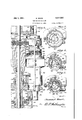
- Figure 1- is a front elevation of one of the can seaming heads or units.
- Figure 2 is a central, vertical section through one of the heads or units.
- Figure 3/ is a top plan View of the machine.
- Figure i isa section on the line 4.-4 of Figure 3'. v
- Figure 51 is a cross section ori-.the line 5.-5 of Figure 2.
- Figure 6 is a cross section on the line 6.-6. of FigureA 2.
- Figure 8 isy a perspective view of one of the adapters.
- Figure 9 is a detail section on the line 9--9 of Figure 5.
- Figure 10 is a section onthe line I-I of Figure 2; and
- Figure l1 is a detail'view' illustrating the manner in which a can is closed and sealed by the machine.
- FIG. 11 of the drawings A porti-on of a can ofv a type to be seamed by the present machine is illustrated in Figure 11 of the drawings.
- the present machine comprises a suitable base I4 and a suitable frame l5 supported upon and journaled in said base in -any suitable manner for rotation with respect thereto.
- Carried by the frame I5 is any desired plurality of seaming heads which are spaced, preferably, equiangularly distances apart and which, by rota*- tion of said frame, are movable orbitally in a circular path from a receiving station indicated in Figure 3 back to said receiving station, passing in their movement a discharge station indicated in figure as being located behind and adjacent to the receiving station as regards the direction of movement of said heads, their movement in the present instance, being counterclockwise as indicated by the arrow a in Figure 3.
- a gear wheel I6 may be iixed to any suitable portion of said frame and power from any suitable source may be applied to said gear wheel in any suitable manner.
- the seaming heads are duplicates of one another and each comprises a cylindrical casing l1 having integral or rigid therewith side flanges or webs I8 in which are vertical slots I9 through which extend clamping bolts which are threaded into the frame I5, whereby the casing may be fastened to said frame in diierent positions of vertical adjustment with respect thereto.
- the top portion of the casing I1 is of larger diameter than the bottom portion thereof and is jointed with said bottom portion by a horizontal wall 2i.
- an oscillatory sleeve 22 'and at the top of this sleeve is an outwardly directed, annular flange 23 which seats upon the top of the wall 2
- the top of the casing I1 is closed by a cover plate 213, and journaled in this cover plate is the tubular, upper end portion of an actuator 25 for the sleeve 22, said actuator having at the bottom of its tubular, upper end portion an outwardly directed flange 25 which underlies said cover plate and has depending therefrom a plurality of fingers 21 which, at-their lower ends, are engaged in recesses in the top of the flange 23.
- oscillation of said actuator is eiective to oscillate said sleeve.
- a gear casing 28 Extending downwardly into the tubular, upper end portion of the actuator 25 is the tubular, lower end portion oi' a gear casing 28 which, as in the case of the casing I1, is provided with side flanges or webs 29 having openings through which extend clamping bolts 30 which are threaded into the frame I5 whereby said gear casing is secured to said frame.
- a tube 3l which, at its upper end, is provided with a spur gear 32 disposed within a gear chamber at the upper end of said gear casing and which, at its lower end, is provided with a spur gear 33.
- Within the tube 3
- journaled in the block 36 is any desired plurality of vertical shafts 31 which are disposed planet-wise about the spur gear 33 and which, at their lower ends, carry seaming rollers 38 disposed below said block 35. Also carried by said shafts S1 are pinions 39 which are disposed in mesh with the spur gear 33. rllhus, by rotation of the tube 35i and the block 35 carried thereby, the seaming rollers 38 are rotated orbitally in a circular path, and by relative rotation of the tubes 3i and 34, said seaming rollers are rotated about their own axes.
- a cap 453 closes the top of the gear casing 28 and has extending therethrough and downwardly therefrom through the tube 34 and the block 35 a tube 4I which, at its lower, immediately below said block 35, carries a can cover engaging pad 42.
- a vertically reciprccable rod 43 which, at its lower end, is provided with a can pusher or knock-out plate 44 and which, yat its upper end, carries a block 45 slidably mounted in suitable guide means 46 mounted on the top of the cap 4D.
- a roller 1 Carried by the block 45 is a roller 1 which is disposed in a cam channel 48 in the periphery of a xed cam disk 49.
- the rod 43 is moved downwardly and upwardly at predetermined times by the coaction of the roller 51 with suitable downwardly and upwardly extending portions of the cam channel 45 in said fixed cam disk.
- a spur gear 50 Surrounding the tubular end portion of the sleeve actuator 25 is a spur gear 50 which is in the form yof a ring rotatable with respect to said actuator and which is seated on the top of the cover plate 24. Also surrounding the actuator 25 above said gear 55 is a clutch ring 5I which is keyed to said actuator so that it may move vertically with respect thereto but cannot rotate with respect thereto.
- a shoulder element 52 Fixed in any suitable manner to the gear casing 28 is a shoulder element 52 which is disposed above the clutch ring 5I, and between said shoulder element and said clutch ring is interposed an expansion spring 53 which constantly reacts from said shoulder element to urge said clutch ring downwardly toward the spur gear 50.
- the side flanges or webs I8 of said casing carry a split clamping band 55 in which is disposed the reduced, lower end portion of a can adapter support 51 which may be fastened in desired vertically adjusted position by constricting said clamping as, for example, by tightening a bolt 58 connecting together the free end portions of said band.
- the adapter support extends upwardly into the lower end of the sleeve 22 and includes a portion 53 more or less closely tting said sleeve and, above said portion 59, a reduced, shouldered and threaded portion 68.
- a reduced, shouldered and threaded portion 68 On the reduced portion 68 is threaded a nut which is screwed down tightly against a shoulder on said reduced portion and which also more or less loosely fits the sleeve 22.
- a suitable sealing ring 62 and a gasket 63 In the space between the portion 59 and the nut 6
- a vertically reciprocable rod 64 carrying at its upper end a can lifter plate E5 which, in the lowermost position of said rod, is disposed within a recess 66 in the top of the nut 6
- the reduced, lower end portion of the adapter support 51 is of tubular form and is slotted at its inner side as indicated at 61, and has mounted therein for vertical sliding movement a hollow block 68 having a lateral projection 69 which eX- tends through the slot 61 and carries a roller 18, disposed within a cam channel 1
- the lower end portion of the rod 64 is threaded and has threaded thereon a nut 13 with the top of which a top shoulder of the block 68 engages, whereby downward movement of 'said block effects downward movement of said rod.
- a nut 14 In the lower end portion of the block 68 is threaded a nut 14 through which the rod 64 extends loosely, and between this nut and the nut 13 is interposed a coil spring 15 through which upward movement of the block 63 is transmitted via the nuts 14 and 13 to the rod 64.
- is formed so that as the head moves in its orbital path the block 68 and the rod 64 are moved upwardly and downwardly at predetermined times, and the described connection between the block 68 and the rod 64 affords means whereby continued upward movement of the block 68,*after upward movement of the rod 64 has beenarrested, results in a yielding upward pressure being imposed uponV said rod.
- a can adapter 'i8 which is of substantially crescent-shape as viewed in plan and which is fastened to said nut 6
- the open front of this adapter is alined with the doorway 18 in the casing i1. Accordingly, when the doorway 11 in the sleeve 22 is alined with the doorway 16, a can as illustrated by dotted lines in Fig. 2 is insertable into and removable from said adapter through said alined doorways 16 and 11.
- adapters 18 of different heights and internal diameters are providedfor interchangeable use depending upon the height and the diameter of the cans to be seamed, the adapter selected for use in the seaming of cans of any given dimensions preferably being such that it snugly accommodates the can.
- Extending inwardly from the sleeve 22 through a slot or recess 88 in the adapter 18 is a lug 8
- has its inner face formed so that in the event a can is not fully inserted into the adapter 18 when the doorways 16 and 11 are alined, rotation of the sleeve 22 to disaline thevdoorway 11 from the doorway 16 results in the inner face of said lug wiping the side of the can and urging the same fully into the adapter.
- the adapter 16 is provided with an inwardly opening recess 82 in which is disposed a can ejector lever 83.
- This lever is pivoted intermediate its ends to the adapter, as indicated at 28, for swinging movement in a horizontal plane, and includes a short arm 85 and a long arm 86, the former of which carries a pin 81 to be engaged at a predetermined time by a lug 88 projecting inwardly from the sleeve 22, thereby to swing said lever to cause its longer'arm 86 to eject a can from the adapter through the doorways 16 and 11 when the latter are alined.
- a suitable spring 89 tends constantly to swing the lever 83 to the position shown by full lines in Figs. 6 and 7, in which it is disposed at the rear of the adapter 18 rearwardly with respect to the inner face of said adapter so as not to interfere with insertion of a can into said adapter, and said spring holds said lever normally in'said position.
- the lug 88 is disposed against as closely adjacent to the pin 81 and in front of the latter so that by slight rotation of the sleeve 22 in a counterclockwise direction said lug, by pushing against said pin, swings said lever to its can ejecting position shown by dotted lines in Fig. 7.
- An opening 86 is formed through the wall of the casing i1 within the'planes dening the top and the bottom of the doorway 11 in the sleeve 22 and is located at a point spaced rearwardly from the left hand side of the doorway 16 such that it is covered by the sleeve 22 when the 'doorway 11 thereof is alined with the doorway 16 and becomes uncovered by the doorway 11 when said sleeve 22, by counterclockwise rotation, reaches a position closing the doorway 16, as illustrated in Fig. 1v ofthe drawings.
- may be formed through the adapter 18 toaord direct communication between the interior of said adapter and the opening 96 whenv the doorway 11 is alined with said opening 68. Moreover, ifvsaid opening 8
- Ytop portion of the adapter need not be spaced 'from the sleeve 22.
- either the top of the adapter may be spaced from the sleeve 22 to the exclusion of the opening 9i', or said opening SI may be provided to the exclusion of the said spacing of said ladapter and sleeve, or both said spacing and said opening may be provided to afford communication between the opening SQ ⁇ and the seaming chamber when the sleeve doorway 'II is alined with said opening Si).
- the opening 90 is connected with any suitable source of sub-atmospheric or higher than atmospheric pressure, depending upon whether the cans are to be seamed and sealed in a vacuum or under pressure. Accordingly, when the sleeve 22 is moved to close the doorway 'I5 and when, l
- the opening 9) extends upwardly through the vside wall of the casing II to a constricted duct 92 which opens through the top of the horizontal wall 2I of said casing I'I, -Formed through the flange 23 of the sleeve v22 isa circumferentially elongated slot E3 which is positioned so that it alines with the duct 92 as soon as the sleeve 22 reaches a position closing the casing doorway 'I5 and prior to the doorway 'IT of said sleeve uncovering the opening 90, ⁇ and which maintains said duct 92 uncovered during travel of said sleeve 22 until its doorway uncovers said opening t.
- the seaming chamber is pre-vacuumized to a small extent or is subjected to a small amount of pressure, as the case may be, immediately fol-lowing 'closing of said chamber and prior to the latter being subjected to the :full vacuum or pressure employed which becomes eiective when the sleeve doorway 'Il alines with the opening QQ.
- the vacuum or pressure as the case may be, is applied gradually rather than suddenly and, as a consequence, especially in the case of the use of a vacuum, any undesirable pulling of the can contents from the ⁇ cans prior to or during seaming of the same is effectively avoided.
- a connection particularly suitable for the present machine may comprise a passageway 94 in the frame I5, a pipe connection between said passageway and said opening, and another pipe connection 96 between said passageway 94 and the source of vacuum or suction, the latter connection including a manifold Sl surrounding a lower, cylindrical part of the .1
- the frame I5 is formed as separate upper and lower sections I5a and I'Eb which are suitably keyed or spliced together, as indicated at 33, so that they rotate in unison and so that the upper section may be vertically adjusted relative to the lower section, as for example, by means of screws 99 threaded into one of the sections and engaging the other section.
- This adjustment and the aforementioned provision for vertical adjustment of the heads or units relative to the frame I5 provides for adapting the machine to a can feeding mechanism and for adapting the machine to seam cans of various diierent heights.
- each* of the -seaming heads or units is a vertical shaft IGS which is journaled in the upper section I 5a of the frame I5 and which carries at its lower and upper ends spur pinions I da* and Il'I, respectively.
- 535 are in mesh with the spur gears 5t of the related heads and the pinions IGT each mesh with a related horizontally disposed rack bar I slidably mounted in a related guideway M9 on the top of the upper frame section I5a.
- cam channel II@ In the bottom of the cam disk 49 is a cam channel II@ and on the tops of the rack bars It are rollers III which are disposed in said cam channel Il.
- the rack bars E68 are slid in their guideways ISS responsive to the coaction of the rollers I I I with the cam channel Ill) and, as a consequence of sliding movement of said rack bars and the gear connections between said rack bars and the spur gears 5t, the sleeve actuator 25 and the sleeves 22 are rotated in one direction or the other depending upon the direction of sliding movement of the related rack bars.
- the rack bar is shaped so that when any given seaming head is at the can receiving station the position of the related rack bar is such that the sleeve 22 is in a position with its doorway 'Il alined with the casing doorway l5; that as the seaming head moves (counterclockwise in the present instance) away from its can receiving position the rack bar is slid in a direction to elect clockwise rotation of the sleeve v22 to close the casing doorway; that the sleeve 22 is held in a position maintaining the doorway 'I6 closed during orbital movement of the seaming head through a major portion of its cycle; that as the seaming -head approaches the can discharge station the rack bar is shifted to rotate the sleeve 22 in a clockwise direction suciently to aline the sleeve doorway with the casing doorway and to cause the lug 88 to engage the pin 8l of the lever 83 and to swing said lever to -effect ejection of a can from the seam
- the different heads are, of course, operated successively in the same manner as just described, and, as will be apparent from the foregoing description, as each sleeve is moved to close the doorway 'IS in its related casing, the slot 93 alines with the small duct 92 prior to alinement of the doorway 'IT with the opening Se so that exhaust of air or supply of air under pressure to the seaming is gradual rather than sudden.
- the cam channel 'II is formed so that as each sleeve 22 is moved to close the doorway 'I6 of the related casing, the rod 54 is moved upwardly to lift the can to bring its top into operative relationship to the seaming rollers 38 which, due to their orbital movement and their rotation on their own axes, act to effect the dotted line seaming. of the can illustrated in Fig. 11.
- said cam channel II is formed to maintain the rod and, consequently, the can in a lifted position until the head approaches the can discharge station, when the rod 64 is moved downwardly and the cam 43 acts to move the rod 43 and, consequently, the can downwardly to a position to be ejected in the manner stated at the discharge station.
- the casing I'I' of each of the heads is provided with a flexible tongue I I2 for adjustment to compensate for any looseness or play of the sleeve 22 within said casing.
- a pair of kerfs I I3 are cut to extend from one side of the doorway 15, at the top and at the bottom thereof, respectively, circumferentially around the casing any suitable distance, while in order to provide for substantially radial adjustment of said tongue, a lug or lugs IIII is, or are, provided on the flange or web I8 at the related side of the head and through said lug or lugs is, or are, passed a bolt, or bolts I I which is or are threaded into a boss, or bosses, formed on the tongue I I2.
- an orbitally movable casing having a seaming chamber and a doorway through which a can is insertable into and ejectable from said chamber
- an oscillatory y sleeve within said casing having a doorway for aiinement with and disalinement from said casing doorway by oscillation of said sleeve
- an orbitally movable casing having a seaming chamber and a doorway through which a can is insertable into and ejectable from said seaming chamber, an oscillatory sleeve within said casing having a doorway for alinement with and disalinement from said casing doorway by oscillation of said sleeve, means operableV responsive to orbital movement of said casing to rotate said sleeve to open and close said casing doorway, and means operable responsive to rotation of said sleeve to aline its doorway with they casing doorway to effect ejection of a can through said alined doorways.
- an orbitally movable casing having a seaming chamber and a doorway through which a can is insertable into and ejeotable from said chamber
- an oscillatory sleeve within said casing having a doorway for alinement with andv disalinement from said casing doorway by oscillation of said sleeve
- means operable responsive to orbital movement of said casing to rotate said sleeve to aline and disaline its doorway from sai-d casing doorway, said sleeve having a formation to wipe across a partially inserted can and to urge the can fully into the seaming chamber when said sleeve is rotated to close the casing doorway.
- can ejecting means comprising a pivotedlever within t-he seaming chamber, and a lug on the sleeve for cooperation with said lever to swing same to eject a can when the sleeve is rotated to aline its doorway with the casing door- Way.
- a casing having a seaming chamberl and a doorway through which a can is insertable into and ejectable from said chamber, an oscillatory sleeve within said casing having a doorway for alinement with and disalinementfrom said casing doorway by oscillation of said sleeve, means to oscillate said sleeve, a source of suction, means whereby rotation of said sleeve to a position to open said casing doorway cuts off communication between said source and said chamber, and means whereby rotation of said sleeve to close said casing doorway first establishes restricted communication and subsequently full communication between said suction source and said chamber.
- a casing having a seaming chamber and a doorway through which a can is insertable into and ejectable from said chamber, an oscillatory sleeve within said casing having a doorway for alinement with and disalinement from said casing doorway by oscillation of said sleeve, means to oscillate said sleeve, a bottom closure for said sleeve with .respect to which said sleeve is rotatable, and sealing means between said sleeve and said bottom closure.
- a casing having a seaming chamber and a doorway through which a can is insertable into and ejectable from said chamber, an oscillatory sleeve within said casing having a doorway for alinement with and disalinement from said casing doorway by oscillation of said sleeve, means to oscillate said sleeve, a bottom closure for said sleeve with respect to which said sleeve is rotatable, sealing means between said sleeve and said bottom closure, and a can positioning element within said sleeve mounted on said bottom closure.
- a casing having a seaming chamber and a doorway through which a can is insertable into and ej ectable from said chamber, an oscillatory sleeve within said casing having a doorway for alinement with and disalinement from said casing doorway by oscillation of said sleeve, means to oscillate said sleeve, a bottom closure for said sleeve with respect to which said sleeve is rotatable, sealing means between said sleeve and said bottom closure, a can positioning element within said sleeve mounted on said bottom closure, a swingable can ejecting element pivoted to said can positioning element, and means on the sleeve cooperating with said can ejecting element to swing same to eject a can when the sleeve is rotated to aline its doorway with the casing doorway.
- an orbitally rnovable casing having a seaming chamber and a doorway through which a can is insertable into and ejectable from said chamber
- an oscillatory sleeve within said casing having a doorway for aiinement with and disalmeld from said casing doorway by oscillation of said sleeve
- means operable responsive to orbital movement of said casing and at predetermined times 'to rotate said sleeve to aline and disaline its doorway from the casing doorway and means controlled by rotation of said sleeve to subject said chamber rst to a given sub-normal pressure and subsequently to a lesser sub-normal pressure following closing of said casing doorway, and to maintain said lesser sub-normal pressure until the sleeve is rotated to aline its doorway with the casing doorway.
- a casing having a seaming chamber, said casing including a side wall having a doorway through which a can is insertable into and ejectable from said chamber an oscillatory sleeve within said casing having a doorway for alinement with and disalinement from said casing doorway by oscillation of said sleeve, means to oscillate said sleeve, the side wall of said casing having a recess opening through the inner face thereof and positioned to he covered by said sleeve when the doorway of the latter is alined with the casing doorway, and to be uncovered by said sleeve doorway when the latter is disalined from the casing doorway, thereby to provide communication between said recess and the seaming chamber, said wall having a constricted duct leading from saidrecess, and said sleeve having a slot for alinement with said duct to provide communication between said recess and said sealing chamber following rotation of the s
Landscapes
- Engineering & Computer Science (AREA)
- Mechanical Engineering (AREA)
- Rigid Containers With Two Or More Constituent Elements (AREA)
Description
July 1, 1941. s, woop 2,247,828
CAN SEAMING MACHINE ma W002i,
VL'. A e Qm July l, 1941. s WOOD 2,247,828
GAN SEAMING MACHINE Filed March 5, 1938 f 3 Sheets-Sheet 2 68 g8 1 wcm/hw July 194k s. woon CAN SEAMING MACHINE Filed March 5, 1958 I5 Sheets-Sheet 5 ma n4 77 Patented July 1, 1941 UNIT ED STAT E S OF FICE CAN. SEAMING MACHINE Samuel Vv'fvood, Geneva, N. Y. delineation March 5, 193s,` serial No. 194,212.V 1o claims. (o1. 11s- 24) This invention relates: to machines for seaming` cans; that is, to machines for turning and rolling the flanged edges of can coversy following l'ling of the ca-nsv and initial application of the covers; thereto with their flanged' edges interengag-,e'd with flanges onl the; cans, thereby to close and seal the cans,l and has for its general object to provide,- for this purpose a practical machine embodying a plurality of seamin-g units and means to operate said units successively, to the end of. obtaining an excoptionallyv high output capacity.
Another object of the; invention is to provide a can seaming machine. embodying means whereby the cans may be subjected either; to a sub-atmospheric, or a higher than atmospheric pressure during closing and' sealing of the same, and further to, provide in this connection novel means whereby the cans,- in the event they are closed and sealed in a, vacuum, may be subjected gradually rather than suddenly to the full vacuum employed, thereby to avoid lifting of the can cover-s and drawing of the can contents from the cans as likely would occur if the vacuum were applied suddenly..
Another object of the invention is. to providev a can seami'ng. machine including the features aforementioned: and' embodying provision for adjustment and interchangeability of parts thereof so that it may readily and easily be adapted to the seaming of cans of different heights.
According toi the invention, the seam-ing units or heads move orbitalrly and' continuously abouta common axis and during their travel pass receiving and discharge troduced into the units and are discharged therefrom, respectively, the receiving station being located immediately in advance of the discharge station as regards the direction of movement of the heads, and the seamling operations taking place during movement of the heads from the receiving station to the discharge station. In this connection, other objects of the invention are to provide novel means whereby the heads or units are opened to discharge cans when they reach the discharge station, are maintained open until they pass the receiving station and are closed after they pass the receiving station; to provide novel means for ejecting the cansy at the discharge station; to provide novel means to prop- L" erly position and hold the cans within the heads or units following receiving of the cans by said heads or units at the receiving station; and to provide novel means for applying the Vacuum or y pressure, as the case may be, to the cans during stations. whereat. cans are inter, as indicated at I3.
travel of the heads or units between the receiving and the discharge stations.
With the foregoing and. other objects in view, which. will become more fully apparent as the nature- Yof the invention is better understood, the same consists in the novel features. of construction, combination and arrangement of partsv as will be hereinafter more fully described in con-v nection with. the accompanying drawings and particularly deined in the appended claims.
In, the accompanying drawings, wherein like characters of reference denotev corresponding parts inthe different views:
Figure 1- is a front elevation of one of the can seaming heads or units.
Figure 2 is a central, vertical section through one of the heads or units. Y
Figure 3/ is a top plan View of the machine.
Figure i isa section on the line 4.-4 of Figure 3'. v
. Figure 51 is a cross section ori-.the line 5.-5 of Figure 2.
Figure 6 is a cross section on the line 6.-6. of FigureA 2.
Figure 7 is a View similar to Figure 6 showing a different relative position of the parts, andill=ustrating by dotted lines the manner in which a can isej'ected.
Figure 8 isy a perspective view of one of the adapters.,
Figure 9 is a detail section on the line 9--9 of Figure 5. 'Figure 10 is a section onthe line I-I of Figure 2; and Figure l1 is a detail'view' illustrating the manner in which a can is closed and sealed by the machine.
A porti-on of a can ofv a type to be seamed by the present machine is illustrated in Figure 11 of the drawings. In other words, the side w-all i0 of' the 'can is flanged outwardly at its upper end, a-s indicated at I I and,.prior to the introduction of the can into one of the heads or units of the present machine, the can is filled and has initially applied thereto, in any suitable manner not entering into the present invention, a cover l2 which, at its edge, is interengaged with the iiangev ITI by being bent downwardly across the edge of said flange 'and thence beneath the lat- Seaming of the can by the present machine comprises rolling the interengaged flange II and the edge of the cover I2 downwardly and inwardly against the side of the can body, as illustrated by dotted lines in Figure Il, whereby the can is closed and sealed. `Of
course, it will be understood in this connection that while the machine as specifically illustrated in the present instance is designed for seaming cans of the type specically illustrated and described, the machine may readily be adapted for the seaming of specifically diierent cans simply by substituting for the seaming rollers illustrated other seaming rollers or equivalent devices which are specially designed for use in seaming cans of specifically different types, this being especially true insofar as the present inventive concept is concerned because the seaming rollers, or their equivalents, may be of any known type and because no novelty in respect to them, per se, is claimed.
As illustrated in the drawings, the present machine comprises a suitable base I4 and a suitable frame l5 supported upon and journaled in said base in -any suitable manner for rotation with respect thereto.
Carried by the frame I5 is any desired plurality of seaming heads which are spaced, preferably, equiangularly distances apart and which, by rota*- tion of said frame, are movable orbitally in a circular path from a receiving station indicated in Figure 3 back to said receiving station, passing in their movement a discharge station indicated in figure as being located behind and adjacent to the receiving station as regards the direction of movement of said heads, their movement in the present instance, being counterclockwise as indicated by the arrow a in Figure 3.
Any suitable means may be employed to rotate the frame I5. For example, a gear wheel I6 may be iixed to any suitable portion of said frame and power from any suitable source may be applied to said gear wheel in any suitable manner.
The seaming heads are duplicates of one another and each comprises a cylindrical casing l1 having integral or rigid therewith side flanges or webs I8 in which are vertical slots I9 through which extend clamping bolts which are threaded into the frame I5, whereby the casing may be fastened to said frame in diierent positions of vertical adjustment with respect thereto.
The top portion of the casing I1 is of larger diameter than the bottom portion thereof and is jointed with said bottom portion by a horizontal wall 2i. In the casing bottom portion is an oscillatory sleeve 22, 'and at the top of this sleeve is an outwardly directed, annular flange 23 which seats upon the top of the wall 2|, whereby the sleeve is supported within the said bottom portion `of said sleeve.
The top of the casing I1 is closed by a cover plate 213, and journaled in this cover plate is the tubular, upper end portion of an actuator 25 for the sleeve 22, said actuator having at the bottom of its tubular, upper end portion an outwardly directed flange 25 which underlies said cover plate and has depending therefrom a plurality of fingers 21 which, at-their lower ends, are engaged in recesses in the top of the flange 23. Thus, oscillation of said actuator is eiective to oscillate said sleeve.
Extending downwardly into the tubular, upper end portion of the actuator 25 is the tubular, lower end portion oi' a gear casing 28 which, as in the case of the casing I1, is provided with side flanges or webs 29 having openings through which extend clamping bolts 30 which are threaded into the frame I5 whereby said gear casing is secured to said frame.
Within the tubular portion of the gear casing 28 is rotatably mounted a tube 3l which, at its upper end, is provided with a spur gear 32 disposed within a gear chamber at the upper end of said gear casing and which, at its lower end, is provided with a spur gear 33.
Within the tube 3| is rotatably mounted another tube 3d which, at its upper end, is provided with a spur gear 35 disposed within the aforesaid gear chamber above the spur gear 32 and which, at its lower end, carries a block 35 disposed within the seaming chamber comprised by the larger, upper end portion of the casing I1.
Journaled in the block 36 is any desired plurality of vertical shafts 31 which are disposed planet-wise about the spur gear 33 and which, at their lower ends, carry seaming rollers 38 disposed below said block 35. Also carried by said shafts S1 are pinions 39 which are disposed in mesh with the spur gear 33. rllhus, by rotation of the tube 35i and the block 35 carried thereby, the seaming rollers 38 are rotated orbitally in a circular path, and by relative rotation of the tubes 3i and 34, said seaming rollers are rotated about their own axes.
A cap 453 closes the top of the gear casing 28 and has extending therethrough and downwardly therefrom through the tube 34 and the block 35 a tube 4I which, at its lower, immediately below said block 35, carries a can cover engaging pad 42.
Through the tube 4I extends a vertically reciprccable rod 43 which, at its lower end, is provided with a can pusher or knock-out plate 44 and which, yat its upper end, carries a block 45 slidably mounted in suitable guide means 46 mounted on the top of the cap 4D.
Carried by the block 45 is a roller 1 which is disposed in a cam channel 48 in the periphery of a xed cam disk 49. Thus, as the head moves orbitally, the rod 43 is moved downwardly and upwardly at predetermined times by the coaction of the roller 51 with suitable downwardly and upwardly extending portions of the cam channel 45 in said fixed cam disk.
Surrounding the tubular end portion of the sleeve actuator 25 is a spur gear 50 which is in the form yof a ring rotatable with respect to said actuator and which is seated on the top of the cover plate 24. Also surrounding the actuator 25 above said gear 55 is a clutch ring 5I which is keyed to said actuator so that it may move vertically with respect thereto but cannot rotate with respect thereto.
Fixed in any suitable manner to the gear casing 28 is a shoulder element 52 which is disposed above the clutch ring 5I, and between said shoulder element and said clutch ring is interposed an expansion spring 53 which constantly reacts from said shoulder element to urge said clutch ring downwardly toward the spur gear 50.
In the bottom of the clutch ring 5I is one or more recesses 5d, and on the top of the spur gear 55 is one or more protuberances 55 which normally is, or are, engaged in said recess or recesses. Thus, normally, oscillation of the spur gear 553 effects oscillation of the sleeve actuator 25. However, if, for any reason, the sleeve 22 should be held against oscillation, positive driving of the spur gear 5S will result simply in the clutch ring 5I yielding upwardly and not being driven with said spur gear so that damage to the mechanism will not result.
Below the cylindrical casing I1 the side flanges or webs I8 of said casing carry a split clamping band 55 in which is disposed the reduced, lower end portion of a can adapter support 51 which may be fastened in desired vertically adjusted position by constricting said clamping as, for example, by tightening a bolt 58 connecting together the free end portions of said band.
The adapter support extends upwardly into the lower end of the sleeve 22 and includes a portion 53 more or less closely tting said sleeve and, above said portion 59, a reduced, shouldered and threaded portion 68. On the reduced portion 68 is threaded a nut which is screwed down tightly against a shoulder on said reduced portion and which also more or less loosely fits the sleeve 22. In the space between the portion 59 and the nut 6| is disposed a suitable sealing ring 62 and a gasket 63 whereby any air leakage through the bottom portion of the sleeve 22 is prevented.
In the adapter support 51 is a central bore, and extending through this bore is a vertically reciprocable rod 64 carrying at its upper end a can lifter plate E5 which, in the lowermost position of said rod, is disposed within a recess 66 in the top of the nut 6| so that its upper face either is flush with or below the top face of said nut.
The reduced, lower end portion of the adapter support 51 is of tubular form and is slotted at its inner side as indicated at 61, and has mounted therein for vertical sliding movement a hollow block 68 having a lateral projection 69 which eX- tends through the slot 61 and carries a roller 18, disposed within a cam channel 1| in the periphery of a cam ring 12 xedly mounted on the base I4.
The lower end portion of the rod 64 is threaded and has threaded thereon a nut 13 with the top of which a top shoulder of the block 68 engages, whereby downward movement of 'said block effects downward movement of said rod.
In the lower end portion of the block 68 is threaded a nut 14 through which the rod 64 extends loosely, and between this nut and the nut 13 is interposed a coil spring 15 through which upward movement of the block 63 is transmitted via the nuts 14 and 13 to the rod 64.
The cam channel 1| is formed so that as the head moves in its orbital path the block 68 and the rod 64 are moved upwardly and downwardly at predetermined times, and the described connection between the block 68 and the rod 64 affords means whereby continued upward movement of the block 68,*after upward movement of the rod 64 has beenarrested, results in a yielding upward pressure being imposed uponV said rod.
In the front of the casing |1 is a doorway 16, and in the sleeve 22 is a doorway 11 for alinement with said doorway 16 when the sleeve 22 is in a predetermined position of rotation relative to said casing.
On top ofthe nut 6i is seated a can adapter 'i8 which is of substantially crescent-shape as viewed in plan and which is fastened to said nut 6| by screws 19. The open front of this adapter is alined with the doorway 18 in the casing i1. Accordingly, when the doorway 11 in the sleeve 22 is alined with the doorway 16, a can as illustrated by dotted lines in Fig. 2 is insertable into and removable from said adapter through said alined doorways 16 and 11. In this connection it is pointed out that adapters 18 of different heights and internal diameters are providedfor interchangeable use depending upon the height and the diameter of the cans to be seamed, the adapter selected for use in the seaming of cans of any given dimensions preferably being such that it snugly accommodates the can.
Extending inwardly from the sleeve 22 through a slot or recess 88 in the adapter 18 is a lug 8| which is disposed to one side of the doorway 16 when the sleeve 22 is in a position'with its doorway 11 alined with said doorway 16 and which is movable acrossthe open front of the adapter 18 when the sleeve 22 is rotated to disaline its doorway from the doorway 16. This lug 8| has its inner face formed so that in the event a can is not fully inserted into the adapter 18 when the doorways 16 and 11 are alined, rotation of the sleeve 22 to disaline thevdoorway 11 from the doorway 16 results in the inner face of said lug wiping the side of the can and urging the same fully into the adapter.
At a suitable point in its height the adapter 16 is provided with an inwardly opening recess 82 in which is disposed a can ejector lever 83. This lever is pivoted intermediate its ends to the adapter, as indicated at 28, for swinging movement in a horizontal plane, and includes a short arm 85 and a long arm 86, the former of which carries a pin 81 to be engaged at a predetermined time by a lug 88 projecting inwardly from the sleeve 22, thereby to swing said lever to cause its longer'arm 86 to eject a can from the adapter through the doorways 16 and 11 when the latter are alined.
A suitable spring 89 tends constantly to swing the lever 83 to the position shown by full lines in Figs. 6 and 7, in which it is disposed at the rear of the adapter 18 rearwardly with respect to the inner face of said adapter so as not to interfere with insertion of a can into said adapter, and said spring holds said lever normally in'said position. In this connection it will be observed by reference tovFig, 6 that when the doorways 16, 11 are alined the lug 88 is disposed against as closely adjacent to the pin 81 and in front of the latter so that by slight rotation of the sleeve 22 in a counterclockwise direction said lug, by pushing against said pin, swings said lever to its can ejecting position shown by dotted lines in Fig. 7.
An opening 86 is formed through the wall of the casing i1 within the'planes dening the top and the bottom of the doorway 11 in the sleeve 22 and is located at a point spaced rearwardly from the left hand side of the doorway 16 such that it is covered by the sleeve 22 when the 'doorway 11 thereof is alined with the doorway 16 and becomes uncovered by the doorway 11 when said sleeve 22, by counterclockwise rotation, reaches a position closing the doorway 16, as illustrated in Fig. 1v ofthe drawings.
From the plane of the opening 98 upwardly to the top of the adapter 18, said adapter is of lesser external diameter than the internal diameter of the sleeve 22. Consequently, when the sleeve 22 is in the position shown in Fig. '7 the opening 98 is in communication with the searning chamber comprised by the interior of the adapter 18 kand the larger, upper end portion of the casing |1 via the doorway 11 and the space between the sleeve 22 and the said upper end portion of the adapter. On the other hand, when the sleeve 22 is in a position as shown in Fig. 6 with its doorway 11 alined with thecasing doorway 16, said sleeve covers the opening and denies communication between the same and said seaming chamber. If desired, but not necessarily, an opening 6| may be formed through the adapter 18 toaord direct communication between the interior of said adapter and the opening 96 whenv the doorway 11 is alined with said opening 68. Moreover, ifvsaid opening 8| is provided, the
Ytop portion of the adapter need not be spaced 'from the sleeve 22. Manifestly, therefore, either the top of the adapter may be spaced from the sleeve 22 to the exclusion of the opening 9i', or said opening SI may be provided to the exclusion of the said spacing of said ladapter and sleeve, or both said spacing and said opening may be provided to afford communication between the opening SQ `and the seaming chamber when the sleeve doorway 'II is alined with said opening Si).
The opening 90 is connected with any suitable source of sub-atmospheric or higher than atmospheric pressure, depending upon whether the cans are to be seamed and sealed in a vacuum or under pressure. Accordingly, when the sleeve 22 is moved to close the doorway 'I5 and when, l
by such movement of said sleeve, its doorway uncovers the opening 90, air either is exhausted from the seeming chamber or is supplied thereto under pressure, as the case may be.
The opening 9) extends upwardly through the vside wall of the casing II to a constricted duct 92 which opens through the top of the horizontal wall 2I of said casing I'I, -Formed through the flange 23 of the sleeve v22 isa circumferentially elongated slot E3 which is positioned so that it alines with the duct 92 as soon as the sleeve 22 reaches a position closing the casing doorway 'I5 and prior to the doorway 'IT of said sleeve uncovering the opening 90, `and which maintains said duct 92 uncovered during travel of said sleeve 22 until its doorway uncovers said opening t. Thus, the seaming chamber is pre-vacuumized to a small extent or is subjected to a small amount of pressure, as the case may be, immediately fol-lowing 'closing of said chamber and prior to the latter being subjected to the :full vacuum or pressure employed which becomes eiective when the sleeve doorway 'Il alines with the opening QQ. In other words, the vacuum or pressure, as the case may be, is applied gradually rather than suddenly and, as a consequence, especially in the case of the use of a vacuum, any undesirable pulling of the can contents from the `cans prior to or during seaming of the same is effectively avoided.
While any suitable connection may be provided between the opening 9E! and a source of vacuum, or pressure, a connection particularly suitable for the present machine may comprise a passageway 94 in the frame I5, a pipe connection between said passageway and said opening, and another pipe connection 96 between said passageway 94 and the source of vacuum or suction, the latter connection including a manifold Sl surrounding a lower, cylindrical part of the .1
frame and having the passageway 94 opening into the same so that there is constant communication between the source of vacuum or pressure and the opening 9B regardless of the rotated position of the frame I5.
Preferably the frame I5 is formed as separate upper and lower sections I5a and I'Eb which are suitably keyed or spliced together, as indicated at 33, so that they rotate in unison and so that the upper section may be vertically adjusted relative to the lower section, as for example, by means of screws 99 threaded into one of the sections and engaging the other section. This adjustment and the aforementioned provision for vertical adjustment of the heads or units relative to the frame I5 provides for adapting the machine to a can feeding mechanism and for adapting the machine to seam cans of various diierent heights.
On a shaft Iil which extends centrally through the frame I5 and which may be driven in any suitable manner at a desired speed, either the same as or dierent from the speed of the frame, are fixed two spur gears IilI and |02 which, through idler gears |03 and |04, respectively, carried by shafts journaled in the frame I5, are in driving relationship to the gears 32 and 35, respectively, of each of the seaming heads or units. Accordingly, as the seaming heads or units move through their orbital paths, the seaming rollers 38 are moved orbitally and also are rotated on their own axes.
Related to each* of the -seaming heads or units is a vertical shaft IGS which is journaled in the upper section I 5a of the frame I5 and which carries at its lower and upper ends spur pinions I da* and Il'I, respectively. The pinions |535 are in mesh with the spur gears 5t of the related heads and the pinions IGT each mesh with a related horizontally disposed rack bar I slidably mounted in a related guideway M9 on the top of the upper frame section I5a.
In the bottom of the cam disk 49 is a cam channel II@ and on the tops of the rack bars It are rollers III which are disposed in said cam channel Il. Thus, as the frame I5 rotates, the rack bars E68 are slid in their guideways ISS responsive to the coaction of the rollers I I I with the cam channel Ill) and, as a consequence of sliding movement of said rack bars and the gear connections between said rack bars and the spur gears 5t, the sleeve actuator 25 and the sleeves 22 are rotated in one direction or the other depending upon the direction of sliding movement of the related rack bars. In this connection it is pointed out that the cam channel IIE! is shaped so that when any given seaming head is at the can receiving station the position of the related rack bar is such that the sleeve 22 is in a position with its doorway 'Il alined with the casing doorway l5; that as the seaming head moves (counterclockwise in the present instance) away from its can receiving position the rack bar is slid in a direction to elect clockwise rotation of the sleeve v22 to close the casing doorway; that the sleeve 22 is held in a position maintaining the doorway 'I6 closed during orbital movement of the seaming head through a major portion of its cycle; that as the seaming -head approaches the can discharge station the rack bar is shifted to rotate the sleeve 22 in a clockwise direction suciently to aline the sleeve doorway with the casing doorway and to cause the lug 88 to engage the pin 8l of the lever 83 and to swing said lever to -effect ejection of a can from the seaming chamber; and that, as the head approaches the can receivingr station, also counterclockwise the rack bar is shifted to cause slight counterclockwise rotation of the sleeve 22 to retract the lug 83 and permit the spring 89 to return the lever 83 to its normal position so that a can to be seemed may be introduced into the seeming chamber at the receiving station.
The different heads are, of course, operated successively in the same manner as just described, and, as will be apparent from the foregoing description, as each sleeve is moved to close the doorway 'IS in its related casing, the slot 93 alines with the small duct 92 prior to alinement of the doorway 'IT with the opening Se so that exhaust of air or supply of air under pressure to the seaming is gradual rather than sudden.
The cam channel 'II is formed so that as each sleeve 22 is moved to close the doorway 'I6 of the related casing, the rod 54 is moved upwardly to lift the can to bring its top into operative relationship to the seaming rollers 38 which, due to their orbital movement and their rotation on their own axes, act to effect the dotted line seaming. of the can illustrated in Fig. 11. Moreover, said cam channel II is formed to maintain the rod and, consequently, the can in a lifted position until the head approaches the can discharge station, when the rod 64 is moved downwardly and the cam 43 acts to move the rod 43 and, consequently, the can downwardly to a position to be ejected in the manner stated at the discharge station. Thus it is apparent that the machine isl continuously operable to rapidly receive, seam and discharge cans under either vacuum or pressure which is applied gradually rather thany suddenly.
Preferably, but not necessarily, the casing I'I' of each of the heads is provided with a flexible tongue I I2 for adjustment to compensate for any looseness or play of the sleeve 22 within said casing. To provide said tongue a pair of kerfs I I3 are cut to extend from one side of the doorway 15, at the top and at the bottom thereof, respectively, circumferentially around the casing any suitable distance, while in order to provide for substantially radial adjustment of said tongue, a lug or lugs IIII is, or are, provided on the flange or web I8 at the related side of the head and through said lug or lugs is, or are, passed a bolt, or bolts I I which is or are threaded into a boss, or bosses, formed on the tongue I I2. By interposing shims between the lugs and the bosses the desired adjustment can be effected, and by tightening of the bolts the effected adjustment may be maintained.
Without further description it is thought that the features and advantages of the invention will be readily understood and appreciated. It is desired to point out, however, that while only a f single structural embodiment of the invention has been illustrated and described, the same is readily capable of embodiment in specifically different mechanical structures within its spirit and scope as dened in the appended claims.
I claim:
1. In a can seaming machine, an orbitally movable casing having a seaming chamber and a doorway through which a can is insertable into and ejectable from said chamber, an oscillatory y sleeve within said casing having a doorway for aiinement with and disalinement from said casing doorway by oscillation of said sleeve, means operable responsive to orbital movement of said casing and at predetermined times to rotate said sleeve to aline and disaline its' doorway from the casing doorway and to effect seaming of a can disposed within said chamber, and means controlled by rotation of said sleeve to subject said seaming chamber to an abnormal pressure during seaming of the can.
2'. In a can seaming machine, an orbitally movable casing having a seaming chamber and a doorway through which a can is insertable into and ejectable from said seaming chamber, an oscillatory sleeve within said casing having a doorway for alinement with and disalinement from said casing doorway by oscillation of said sleeve, means operableV responsive to orbital movement of said casing to rotate said sleeve to open and close said casing doorway, and means operable responsive to rotation of said sleeve to aline its doorway with they casing doorway to effect ejection of a can through said alined doorways.
3. In a seaming machine, an orbitally movable casing having a seaming chamber and a doorway through which a can is insertable into and ejeotable from said chamber, an oscillatory sleeve within said casing having a doorway for alinement with andv disalinement from said casing doorway by oscillation of said sleeve, and means operable responsive to orbital movement of said casing to rotate said sleeve to aline and disaline its doorway from sai-d casing doorway, said sleeve having a formation to wipe across a partially inserted can and to urge the can fully into the seaming chamber when said sleeve is rotated to close the casing doorway.
4. In a can seaming machine as set forth in claimv 3., can ejecting means comprising a pivotedlever within t-he seaming chamber, and a lug on the sleeve for cooperation with said lever to swing same to eject a can when the sleeve is rotated to aline its doorway with the casing door- Way.
5'. In a can seaming machine, a casing having a seaming chamberl and a doorway through which a can is insertable into and ejectable from said chamber, an oscillatory sleeve within said casing having a doorway for alinement with and disalinementfrom said casing doorway by oscillation of said sleeve, means to oscillate said sleeve, a source of suction, means whereby rotation of said sleeve to a position to open said casing doorway cuts off communication between said source and said chamber, and means whereby rotation of said sleeve to close said casing doorway first establishes restricted communication and subsequently full communication between said suction source and said chamber.
6. In a can seaming machine, a casing having a seaming chamber and a doorway through which a can is insertable into and ejectable from said chamber, an oscillatory sleeve within said casing having a doorway for alinement with and disalinement from said casing doorway by oscillation of said sleeve, means to oscillate said sleeve, a bottom closure for said sleeve with .respect to which said sleeve is rotatable, and sealing means between said sleeve and said bottom closure.
7. In a can seaming machine, a casing having a seaming chamber and a doorway through which a can is insertable into and ejectable from said chamber, an oscillatory sleeve within said casing having a doorway for alinement with and disalinement from said casing doorway by oscillation of said sleeve, means to oscillate said sleeve, a bottom closure for said sleeve with respect to which said sleeve is rotatable, sealing means between said sleeve and said bottom closure, and a can positioning element within said sleeve mounted on said bottom closure.
8. In a can seaming machine, a casing having a seaming chamber and a doorway through which a can is insertable into and ej ectable from said chamber, an oscillatory sleeve within said casing having a doorway for alinement with and disalinement from said casing doorway by oscillation of said sleeve, means to oscillate said sleeve, a bottom closure for said sleeve with respect to which said sleeve is rotatable, sealing means between said sleeve and said bottom closure, a can positioning element within said sleeve mounted on said bottom closure, a swingable can ejecting element pivoted to said can positioning element, and means on the sleeve cooperating with said can ejecting element to swing same to eject a can when the sleeve is rotated to aline its doorway with the casing doorway.
9. In a can seaming machine, an orbitally rnovable casing having a seaming chamber and a doorway through which a can is insertable into and ejectable from said chamber, an oscillatory sleeve within said casing having a doorway for aiinement with and disalnement from said casing doorway by oscillation of said sleeve, means operable responsive to orbital movement of said casing and at predetermined times 'to rotate said sleeve to aline and disaline its doorway from the casing doorway, and means controlled by rotation of said sleeve to subject said chamber rst to a given sub-normal pressure and subsequently to a lesser sub-normal pressure following closing of said casing doorway, and to maintain said lesser sub-normal pressure until the sleeve is rotated to aline its doorway with the casing doorway.
10. In a can seaming machine, a casing having a seaming chamber, said casing including a side wall having a doorway through which a can is insertable into and ejectable from said chamber an oscillatory sleeve within said casing having a doorway for alinement with and disalinement from said casing doorway by oscillation of said sleeve, means to oscillate said sleeve, the side wall of said casing having a recess opening through the inner face thereof and positioned to he covered by said sleeve when the doorway of the latter is alined with the casing doorway, and to be uncovered by said sleeve doorway when the latter is disalined from the casing doorway, thereby to provide communication between said recess and the seaming chamber, said wall having a constricted duct leading from saidrecess, and said sleeve having a slot for alinement with said duct to provide communication between said recess and said sealing chamber following rotation of the sleeve to disaline its doorway from the casing doorway and prior to uncovering of said recess by the sleeve doorway, thus to provide for the establishing in stages an abnormal pressure within the sealing chamber.
SAMUEL WOOD.
Priority Applications (1)
| Application Number | Priority Date | Filing Date | Title |
|---|---|---|---|
| US194212A US2247828A (en) | 1938-03-05 | 1938-03-05 | Can seaming machine |
Applications Claiming Priority (1)
| Application Number | Priority Date | Filing Date | Title |
|---|---|---|---|
| US194212A US2247828A (en) | 1938-03-05 | 1938-03-05 | Can seaming machine |
Publications (1)
| Publication Number | Publication Date |
|---|---|
| US2247828A true US2247828A (en) | 1941-07-01 |
Family
ID=22716738
Family Applications (1)
| Application Number | Title | Priority Date | Filing Date |
|---|---|---|---|
| US194212A Expired - Lifetime US2247828A (en) | 1938-03-05 | 1938-03-05 | Can seaming machine |
Country Status (1)
| Country | Link |
|---|---|
| US (1) | US2247828A (en) |
Cited By (1)
| Publication number | Priority date | Publication date | Assignee | Title |
|---|---|---|---|---|
| US20190300213A1 (en) * | 2018-04-02 | 2019-10-03 | LeRoy J. Reiner | Tooling for industrial canning |
-
1938
- 1938-03-05 US US194212A patent/US2247828A/en not_active Expired - Lifetime
Cited By (1)
| Publication number | Priority date | Publication date | Assignee | Title |
|---|---|---|---|---|
| US20190300213A1 (en) * | 2018-04-02 | 2019-10-03 | LeRoy J. Reiner | Tooling for industrial canning |
Similar Documents
| Publication | Publication Date | Title |
|---|---|---|
| US2936681A (en) | Container blank feeder mechanism | |
| US2485040A (en) | Carton handling apparatus | |
| US2630953A (en) | Capsule filling machine | |
| US2247828A (en) | Can seaming machine | |
| US2540120A (en) | Apparatus for filling and sealing containers | |
| US2170821A (en) | Can-closing machine | |
| US2223480A (en) | Container sealing machine | |
| US2161267A (en) | Pretzel machine | |
| US2119665A (en) | Work feeding apparatus | |
| US1881783A (en) | Method of and apparatus for packaging | |
| US2759649A (en) | No-can no-fill mechanism for filling machines | |
| US2315255A (en) | Can filling machine | |
| US2095960A (en) | Vacuum machine | |
| US2301949A (en) | Can sealing machine | |
| US2679660A (en) | Nonintermittent lamp base filling machine | |
| US2107474A (en) | Receptacle cleaning and filling machine | |
| US2323930A (en) | Vacuum closing machine | |
| US1891851A (en) | Can vacuumizing and sealing machine | |
| US2323939A (en) | Can end closure attaching machine | |
| US1708313A (en) | Apparatus for filling and capping bottles | |
| US2288224A (en) | Lining machine | |
| US2032259A (en) | Receptacle filling and sealing machine | |
| US2266497A (en) | Filling machine | |
| US1340185A (en) | Can-filling machine | |
| US1539110A (en) | Die-casting machine |