US20220184874A1 - System and Method of Manufacturing Fiber Based Articles With Steam Molding - Google Patents
System and Method of Manufacturing Fiber Based Articles With Steam Molding Download PDFInfo
- Publication number
- US20220184874A1 US20220184874A1 US17/547,362 US202117547362A US2022184874A1 US 20220184874 A1 US20220184874 A1 US 20220184874A1 US 202117547362 A US202117547362 A US 202117547362A US 2022184874 A1 US2022184874 A1 US 2022184874A1
- Authority
- US
- United States
- Prior art keywords
- nwm
- mold
- molded
- end effector
- expandable
- Prior art date
- Legal status (The legal status is an assumption and is not a legal conclusion. Google has not performed a legal analysis and makes no representation as to the accuracy of the status listed.)
- Granted
Links
Images







Classifications
-
- B—PERFORMING OPERATIONS; TRANSPORTING
- B29—WORKING OF PLASTICS; WORKING OF SUBSTANCES IN A PLASTIC STATE IN GENERAL
- B29C—SHAPING OR JOINING OF PLASTICS; SHAPING OF MATERIAL IN A PLASTIC STATE, NOT OTHERWISE PROVIDED FOR; AFTER-TREATMENT OF THE SHAPED PRODUCTS, e.g. REPAIRING
- B29C37/00—Component parts, details, accessories or auxiliary operations, not covered by group B29C33/00 or B29C35/00
- B29C37/0003—Discharging moulded articles from the mould
- B29C37/0007—Discharging moulded articles from the mould using means operable from outside the mould for moving between mould parts, e.g. robots
-
- B—PERFORMING OPERATIONS; TRANSPORTING
- B29—WORKING OF PLASTICS; WORKING OF SUBSTANCES IN A PLASTIC STATE IN GENERAL
- B29C—SHAPING OR JOINING OF PLASTICS; SHAPING OF MATERIAL IN A PLASTIC STATE, NOT OTHERWISE PROVIDED FOR; AFTER-TREATMENT OF THE SHAPED PRODUCTS, e.g. REPAIRING
- B29C51/00—Shaping by thermoforming, i.e. shaping sheets or sheet like preforms after heating, e.g. shaping sheets in matched moulds or by deep-drawing; Apparatus therefor
- B29C51/002—Shaping by thermoforming, i.e. shaping sheets or sheet like preforms after heating, e.g. shaping sheets in matched moulds or by deep-drawing; Apparatus therefor characterised by the choice of material
- B29C51/004—Textile or other fibrous material made from plastics fibres
-
- B—PERFORMING OPERATIONS; TRANSPORTING
- B25—HAND TOOLS; PORTABLE POWER-DRIVEN TOOLS; MANIPULATORS
- B25J—MANIPULATORS; CHAMBERS PROVIDED WITH MANIPULATION DEVICES
- B25J15/00—Gripping heads and other end effectors
- B25J15/06—Gripping heads and other end effectors with vacuum or magnetic holding means
- B25J15/0616—Gripping heads and other end effectors with vacuum or magnetic holding means with vacuum
-
- B—PERFORMING OPERATIONS; TRANSPORTING
- B25—HAND TOOLS; PORTABLE POWER-DRIVEN TOOLS; MANIPULATORS
- B25J—MANIPULATORS; CHAMBERS PROVIDED WITH MANIPULATION DEVICES
- B25J15/00—Gripping heads and other end effectors
- B25J15/06—Gripping heads and other end effectors with vacuum or magnetic holding means
- B25J15/0616—Gripping heads and other end effectors with vacuum or magnetic holding means with vacuum
- B25J15/0691—Suction pad made out of porous material, e.g. sponge or foam
-
- B—PERFORMING OPERATIONS; TRANSPORTING
- B29—WORKING OF PLASTICS; WORKING OF SUBSTANCES IN A PLASTIC STATE IN GENERAL
- B29C—SHAPING OR JOINING OF PLASTICS; SHAPING OF MATERIAL IN A PLASTIC STATE, NOT OTHERWISE PROVIDED FOR; AFTER-TREATMENT OF THE SHAPED PRODUCTS, e.g. REPAIRING
- B29C35/00—Heating, cooling or curing, e.g. crosslinking or vulcanising; Apparatus therefor
- B29C35/02—Heating or curing, e.g. crosslinking or vulcanizing during moulding, e.g. in a mould
- B29C35/04—Heating or curing, e.g. crosslinking or vulcanizing during moulding, e.g. in a mould using liquids, gas or steam
- B29C35/049—Heating or curing, e.g. crosslinking or vulcanizing during moulding, e.g. in a mould using liquids, gas or steam using steam or damp
-
- B—PERFORMING OPERATIONS; TRANSPORTING
- B29—WORKING OF PLASTICS; WORKING OF SUBSTANCES IN A PLASTIC STATE IN GENERAL
- B29C—SHAPING OR JOINING OF PLASTICS; SHAPING OF MATERIAL IN A PLASTIC STATE, NOT OTHERWISE PROVIDED FOR; AFTER-TREATMENT OF THE SHAPED PRODUCTS, e.g. REPAIRING
- B29C43/00—Compression moulding, i.e. applying external pressure to flow the moulding material; Apparatus therefor
- B29C43/02—Compression moulding, i.e. applying external pressure to flow the moulding material; Apparatus therefor of articles of definite length, i.e. discrete articles
- B29C43/14—Compression moulding, i.e. applying external pressure to flow the moulding material; Apparatus therefor of articles of definite length, i.e. discrete articles in several steps
-
- B—PERFORMING OPERATIONS; TRANSPORTING
- B29—WORKING OF PLASTICS; WORKING OF SUBSTANCES IN A PLASTIC STATE IN GENERAL
- B29C—SHAPING OR JOINING OF PLASTICS; SHAPING OF MATERIAL IN A PLASTIC STATE, NOT OTHERWISE PROVIDED FOR; AFTER-TREATMENT OF THE SHAPED PRODUCTS, e.g. REPAIRING
- B29C43/00—Compression moulding, i.e. applying external pressure to flow the moulding material; Apparatus therefor
- B29C43/32—Component parts, details or accessories; Auxiliary operations
- B29C43/50—Removing moulded articles
-
- B—PERFORMING OPERATIONS; TRANSPORTING
- B29—WORKING OF PLASTICS; WORKING OF SUBSTANCES IN A PLASTIC STATE IN GENERAL
- B29C—SHAPING OR JOINING OF PLASTICS; SHAPING OF MATERIAL IN A PLASTIC STATE, NOT OTHERWISE PROVIDED FOR; AFTER-TREATMENT OF THE SHAPED PRODUCTS, e.g. REPAIRING
- B29C51/00—Shaping by thermoforming, i.e. shaping sheets or sheet like preforms after heating, e.g. shaping sheets in matched moulds or by deep-drawing; Apparatus therefor
- B29C51/26—Component parts, details or accessories; Auxiliary operations
- B29C51/42—Heating or cooling
- B29C51/421—Heating or cooling of preforms, specially adapted for thermoforming
- B29C51/424—Heating or cooling of preforms, specially adapted for thermoforming using a heated fluid
-
- B—PERFORMING OPERATIONS; TRANSPORTING
- B29—WORKING OF PLASTICS; WORKING OF SUBSTANCES IN A PLASTIC STATE IN GENERAL
- B29C—SHAPING OR JOINING OF PLASTICS; SHAPING OF MATERIAL IN A PLASTIC STATE, NOT OTHERWISE PROVIDED FOR; AFTER-TREATMENT OF THE SHAPED PRODUCTS, e.g. REPAIRING
- B29C51/00—Shaping by thermoforming, i.e. shaping sheets or sheet like preforms after heating, e.g. shaping sheets in matched moulds or by deep-drawing; Apparatus therefor
- B29C51/26—Component parts, details or accessories; Auxiliary operations
- B29C51/44—Removing or ejecting moulded articles
-
- D—TEXTILES; PAPER
- D04—BRAIDING; LACE-MAKING; KNITTING; TRIMMINGS; NON-WOVEN FABRICS
- D04H—MAKING TEXTILE FABRICS, e.g. FROM FIBRES OR FILAMENTARY MATERIAL; FABRICS MADE BY SUCH PROCESSES OR APPARATUS, e.g. FELTS, NON-WOVEN FABRICS; COTTON-WOOL; WADDING ; NON-WOVEN FABRICS FROM STAPLE FIBRES, FILAMENTS OR YARNS, BONDED WITH AT LEAST ONE WEB-LIKE MATERIAL DURING THEIR CONSOLIDATION
- D04H1/00—Non-woven fabrics formed wholly or mainly of staple fibres or like relatively short fibres
- D04H1/40—Non-woven fabrics formed wholly or mainly of staple fibres or like relatively short fibres from fleeces or layers composed of fibres without existing or potential cohesive properties
- D04H1/54—Non-woven fabrics formed wholly or mainly of staple fibres or like relatively short fibres from fleeces or layers composed of fibres without existing or potential cohesive properties by welding together the fibres, e.g. by partially melting or dissolving
- D04H1/541—Composite fibres, e.g. sheath-core, sea-island or side-by-side; Mixed fibres
-
- D—TEXTILES; PAPER
- D04—BRAIDING; LACE-MAKING; KNITTING; TRIMMINGS; NON-WOVEN FABRICS
- D04H—MAKING TEXTILE FABRICS, e.g. FROM FIBRES OR FILAMENTARY MATERIAL; FABRICS MADE BY SUCH PROCESSES OR APPARATUS, e.g. FELTS, NON-WOVEN FABRICS; COTTON-WOOL; WADDING ; NON-WOVEN FABRICS FROM STAPLE FIBRES, FILAMENTS OR YARNS, BONDED WITH AT LEAST ONE WEB-LIKE MATERIAL DURING THEIR CONSOLIDATION
- D04H1/00—Non-woven fabrics formed wholly or mainly of staple fibres or like relatively short fibres
- D04H1/40—Non-woven fabrics formed wholly or mainly of staple fibres or like relatively short fibres from fleeces or layers composed of fibres without existing or potential cohesive properties
- D04H1/54—Non-woven fabrics formed wholly or mainly of staple fibres or like relatively short fibres from fleeces or layers composed of fibres without existing or potential cohesive properties by welding together the fibres, e.g. by partially melting or dissolving
- D04H1/542—Adhesive fibres
-
- D—TEXTILES; PAPER
- D04—BRAIDING; LACE-MAKING; KNITTING; TRIMMINGS; NON-WOVEN FABRICS
- D04H—MAKING TEXTILE FABRICS, e.g. FROM FIBRES OR FILAMENTARY MATERIAL; FABRICS MADE BY SUCH PROCESSES OR APPARATUS, e.g. FELTS, NON-WOVEN FABRICS; COTTON-WOOL; WADDING ; NON-WOVEN FABRICS FROM STAPLE FIBRES, FILAMENTS OR YARNS, BONDED WITH AT LEAST ONE WEB-LIKE MATERIAL DURING THEIR CONSOLIDATION
- D04H1/00—Non-woven fabrics formed wholly or mainly of staple fibres or like relatively short fibres
- D04H1/40—Non-woven fabrics formed wholly or mainly of staple fibres or like relatively short fibres from fleeces or layers composed of fibres without existing or potential cohesive properties
- D04H1/54—Non-woven fabrics formed wholly or mainly of staple fibres or like relatively short fibres from fleeces or layers composed of fibres without existing or potential cohesive properties by welding together the fibres, e.g. by partially melting or dissolving
- D04H1/558—Non-woven fabrics formed wholly or mainly of staple fibres or like relatively short fibres from fleeces or layers composed of fibres without existing or potential cohesive properties by welding together the fibres, e.g. by partially melting or dissolving in combination with mechanical or physical treatments other than embossing
-
- D—TEXTILES; PAPER
- D04—BRAIDING; LACE-MAKING; KNITTING; TRIMMINGS; NON-WOVEN FABRICS
- D04H—MAKING TEXTILE FABRICS, e.g. FROM FIBRES OR FILAMENTARY MATERIAL; FABRICS MADE BY SUCH PROCESSES OR APPARATUS, e.g. FELTS, NON-WOVEN FABRICS; COTTON-WOOL; WADDING ; NON-WOVEN FABRICS FROM STAPLE FIBRES, FILAMENTS OR YARNS, BONDED WITH AT LEAST ONE WEB-LIKE MATERIAL DURING THEIR CONSOLIDATION
- D04H1/00—Non-woven fabrics formed wholly or mainly of staple fibres or like relatively short fibres
- D04H1/40—Non-woven fabrics formed wholly or mainly of staple fibres or like relatively short fibres from fleeces or layers composed of fibres without existing or potential cohesive properties
- D04H1/58—Non-woven fabrics formed wholly or mainly of staple fibres or like relatively short fibres from fleeces or layers composed of fibres without existing or potential cohesive properties by applying, incorporating or activating chemical or thermoplastic bonding agents, e.g. adhesives
-
- B—PERFORMING OPERATIONS; TRANSPORTING
- B29—WORKING OF PLASTICS; WORKING OF SUBSTANCES IN A PLASTIC STATE IN GENERAL
- B29C—SHAPING OR JOINING OF PLASTICS; SHAPING OF MATERIAL IN A PLASTIC STATE, NOT OTHERWISE PROVIDED FOR; AFTER-TREATMENT OF THE SHAPED PRODUCTS, e.g. REPAIRING
- B29C43/00—Compression moulding, i.e. applying external pressure to flow the moulding material; Apparatus therefor
- B29C43/32—Component parts, details or accessories; Auxiliary operations
- B29C43/50—Removing moulded articles
- B29C2043/5046—Removing moulded articles using vacuum
-
- B—PERFORMING OPERATIONS; TRANSPORTING
- B29—WORKING OF PLASTICS; WORKING OF SUBSTANCES IN A PLASTIC STATE IN GENERAL
- B29C—SHAPING OR JOINING OF PLASTICS; SHAPING OF MATERIAL IN A PLASTIC STATE, NOT OTHERWISE PROVIDED FOR; AFTER-TREATMENT OF THE SHAPED PRODUCTS, e.g. REPAIRING
- B29C59/00—Surface shaping of articles, e.g. embossing; Apparatus therefor
- B29C59/02—Surface shaping of articles, e.g. embossing; Apparatus therefor by mechanical means, e.g. pressing
Definitions
- This invention generally relates to molding three dimensional objects or portions thereof, and more particularly to molding objects or portions thereof using blanks of compressed heat expanding nonwoven materials.
- molding of heat-expanding, non-woven material molding blanks can employ a two-part separable mold, for example, comprising an upper part and lower part that, when assembled, form a mold interior with a contoured surface matching the desired 3D shape.
- the mold parts are separated (e.g., by raising the upper part from the lower part), making the contoured surface in the lower part accessible.
- One or more HE NWM blanks are placed on the accessible contoured mold surface of the lower part, the mold is re-assembled (e.g., by lowering the upper part onto the lower part), enclosing the mold interior around the one or more mold blanks, and heat is applied, for example, by introduction of steam into the mold interior via steam passages.
- the binder melting temperature the binder becomes liquid, releasing the nonwoven material from its compression state.
- the non-woven material expands outward, through force of the kinetic energy stored in the compression, toward the HE NWM blank's pre-compressed dimensions, until reaching the contoured surfaces of the mold's interior.
- the temperature of the now expanded NWM and the binder decreases to lower than the binder melting temperature and, eventually, to the binder solidification temperature.
- the molded NWM 3D object may then be removed from the mold.
- a shortcoming of the above-referenced techniques is that there can be some change in the shape of the molded NWM 3D object after removal from the mold.
- Embodiments provide high throughput capable first stage molding, and a second stage multi-configurable feature augmentation and finishing.
- Benefits and advantages provided by two-stage HE-NWM molding in accordance with various embodiments include, for example, and without limitation, removability of 3D objects molded from HE-NWM mold blanks, from their form molds, prior to fully cooling to the binder solidification temperature.
- Secondary benefits can include, but are not limited to, higher throughput of the first stage HE-NWM molding process, by removing the need to wait until the product has fully cooled before removal.
- features and advantages also include, as provided by an actuatable arm, contoured contact surface end effector, and final forming surfaces in accordance with various embodiments, maintaining an inherently optimal distribution of form stabilizing forces on the final formed NWM 3D object until the object has fully cooled to the binder material solidification state, and doing so without occupying the heated molding resource.
- An example of disclosed methods includes a method for molding an object, and which can comprise: heat expanding a compressed nonwoven material (NWM) molding blank within a separable mold, forming an intermediate NWM molded three-dimensional (3D) object; cooling the intermediate NWM molded 3D object, through a temperature band having an upper boundary and a lower boundary, and further cooling to a solidifying temperature of the binder, the lower boundary being higher than a solidifying temperature of the binder and the upper boundary being lower than the binder melting temperature.
- NWM compressed nonwoven material
- the example method further includes, while in the temperature band: separating the separable mold, making accessible an exposed surface of the intermediate NWM molded 3D object, gripping the intermediate NWM molded 3D object, by vacuum suction from an end effector of an actuatable arm, transporting the gripped intermediate NWM molded 3D object to a forming surface of a forming base, by transport movements of the actuatable arm, and
- An example of disclosed systems includes an end effector apparatus for retrieving an expandable object from a mold, wherein the mold has a top inner surface and a bottom inner surface, and each surface faces the expandable object, comprising an expandable object contacting surface resembling at least a portion of the top inner surface of the mold; at least one robotic arm connected to the expandable object contacting surface, wherein the robotic arm is configured to move the expandable object contacting surface to contact a top portion of the expandable object; and at least one vacuum suction system connected to the expandable object contacting surface, wherein the at least one vacuum suction system is configured to withdraw heat and moisture while providing sufficient vacuum to hold the expandable object against the expandable object contacting surface.
- An example of disclosed systems includes a separable mold, comprising a lower component and an upper component that, when assembled, form a molding chamber, and includes steam passages for receiving a supplied steam and conveying at least a portion of the steam to the molding chamber.
- the mold is configured to enclose within the molding chamber, when assembled, one or more HE-NWM blanks that can comprise a compressed NWM within a solidified binder material.
- the mold is configured to effectuate, responsive at least in part to the supplied steam, a heat molding of HE-NWM blanks, fills the molding chamber to form an intermediate molded 3D NWM object.
- the example system can include a mold separating apparatus, configured for separating the upper component from the lower component, leaving the intermediate molded 3D NWM object supported by the lower components, with an exposed top surface.
- the example system further includes an end effector, connected to an actuatable arm, and featuring a contact surface that conforms to a contour of the exposed top surface.
- the actuatable arm is configured perform a transporting of the intermediate molded 3D NWM object, e.g., in response to control signals from a control controller, and to position the contact surface against the exposed top surface, and to establish a vacuum gripping by the contact surface of the exposed top surface, via vacuum passages than open at the contact surface, lift the intermediate molded 3D NWM object from the lower component of the mold, and transport the intermediate molded 3D NWM object to a contoured lower final forming surface of a forming base adjacent the separable mold.
- the actuatable arm, the end effector, the contact surface of the end effector, and the contoured lower supporting surface are also configured to exert particular pressure on the intermediate molded 3D NWM object, for feature augmentation and finish forming, and maintain stabilizing pressure on the final form NWM molded 3D object until the binder material fully solidifies.
- Another example of disclosed methods includes a method of molding an object, comprising: providing a mold, the mold including a top portion and a bottom portion, wherein the mold is configured to deliver heat from steam to the top portion and the bottom portion of the mold, and wherein the mold is configured to exhaust moisture from inside the mold by vacuum suction; placing the expandable object in the mold to form a configuration using the heat from steam when the top portion is placed on the bottom portion of the mold with the expandable object positioned between the top portion and the bottom portion of the mold.
- the example method further comprises withdrawing the heat and moisture from the mold by applying vacuum suction to the mold during and/or after molding; and opening the mold so that the top portion separates from the bottom portion of the mold to expose at least some portion of the expandable object while the expandable object remains positioned on the bottom portion of the mold.
- the example method also includes placing an expandable object contacting surface of an end effector apparatus onto the exposed portion of the expandable object while applying vacuum suction sufficient to cool and hold the expandable object against the expandable object contacting surface of the end effector apparatus, wherein the expandable object contacting surface of the end effector apparatus sets the configuration to a first configuration by cooling and holding; and retrieving the first configuration expandable object from the bottom portion of the mold.
- FIG. 1 is a functional block schematic of one example implementation of a system supporting a two-stage HE-NWM molding process, in accordance with one or more exemplary embodiments.
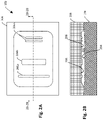
- FIG. 2A shows a top plan view
- FIG. 2B is a front elevation view on the FIG. 2A cross-cut projection 2 B- 2 B, of an example assembled separable mold 200 for molding processes in accordance with one or more embodiments.
- FIG. 3 is an enlarged front crosscut view, on the FIG. 2A cross-cut projection 2 B- 2 B, of the example separable mold, with an example compressed, HE-NWM molding blank in the mold interior.
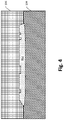
- FIG. 4 shows a front crosscut view, on the cross-cut projection of FIG. 3 , of an intermediate NWM 3D object, produced by a first stage HE-NWM molding processing of the compressed, HE-NWM molding blank.
- FIG. 5 shows a front crosscut view, on the cross-cut projection of FIGS. 3 and 4 , showing the exposed upper surface of the intermediate NWM 3D molded object after removing the mold upper component.
- FIG. 6 shows a front crosscut view of an example effector according to an exemplary embodiment, providing a contact surface configured for the top surface of the first stage NWM 3D object, positioned above the intermediate NWM 3D molded object by the FIG. 1 actuatable arm.
- FIG. 7 shows a front crosscut view of the FIG. 6 example end effector, with the contact surface against the upper surface of the intermediate NWM 3D molded object, and the vacuum suction activated, for transportation further to second stage augmentation and finishing according to one or more embodiments.
- FIG. 8 shows a front crosscut view of the FIG. 7 end effector, with the contact surface against the upper surface of the intermediate NWM 3D molded object, after lifting the first stage NWM 3D molded object from the lower part of the separable mold.
- FIG. 9 shows a front crosscut view of the FIG. 7 end effector, having transported the first stage NWM 3D molded object and positioned it above an example finishing form surface of an example second stage forming base, with an example finishing feature contour, for a second stage form augmenting and finishing according to one or more embodiments.
- FIG. 10 shows a front crosscut view of the FIG. 8 end effector, after aligning the first stage NWM 3D molded object above the FIG. 9 second stage forming base, urging the intermediate NWM 3D molded object onto the finishing form surface and its example finishing feature forming contour, for a second stage form augmenting and finishing according to one or more embodiments.
- FIG. 11 shows a front crosscut view an example finished NWM 3D molded object after the FIG. 10 illustrated second stage augmentation and finishing cools the finished NWM 3D molded object below the binder solidification temperature, fixing the 3D molded object's form and dimensions, and the actuatable arm has removed the end effector.
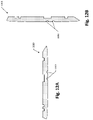
- FIGS. 12A and 12B show a first rotation and a second rotation view of a finished NWM 3D molded object produced by the described example two-stage HE-NWM molding process according to one or more embodiments.
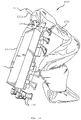
- FIG. 13 shows a top isometric view of an example end effector, connected to an actuatable arm, for a first stage NWM object removal, transport, and second stage form augmenting and finishing operations in exemplary two-stage NWM 3D molding processes in accordance with various embodiments.
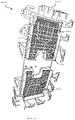
- FIG. 14 shows another isometric view of the example contoured contact surface of the FIG. 13 end effector in accordance with various embodiments.
- FIG. 15 is a plan view of the FIG. 14 example contoured contact surface of the end effector.
- FIG. 16 shows an isometric view of another example finishing feature forming contour, for another example second stage forming base, for other second stage form augmenting and finishing in two-stage NWM 3D molding processes according to various embodiments.
- FIG. 17 shows a first projection view of another example finished NWM 3D molded object, as can be produced by a two-stage HE-NWM molding process according to various embodiments, using the example end effector illustrated in FIGS. 13-15 , and finishing form contour illustrated in FIG. 16 ,
- FIG. 18 is an isometric view of the finished NWM 3D molded object shown in FIG. 17 , from a perspective showing a reverse side.
- FIG. 19 shows a flow diagram of operations in an example process in a two-stage HE-NWM molding process according to various embodiments.
- FIG. 1 is a functional block schematic of one example implementation of a system 100 that can support a two-stage HE-NWM molding process, in accordance with one or more exemplary embodiments.
- the system 100 includes a separable mold 102 that can comprise an upper component 106 and a lower component 104 . As described in more detail in reference to FIGS.
- the upper component 106 and the lower component 104 can be formed to accommodate, on a generally upward facing lower molding surface provided on the lower components, one or more HE-NWM molding blanks and the upper component 106 can be configured with a generally downward facing upper molding surface that, when the mold 102 components are assembled, complements the lower component 104 molding surface to form a molding chamber, enclosing the one or more molding blanks.
- the lower component 104 and the upper component 106 can include steam passages, as described in more detail in later sections and in the '837 publication, for molding processes, to both distribute supplied steam within and thereby heat the separable mold 102 components, and to convey the supplied steam into the molding chamber, to directly heat the HE-NWM molding blank.
- the system 100 also include an actuatable robotic arm 108 , alternatively referenced herein for brevity as “actuatable arm” 108 and, connected to a distal end of the actuatable arm 108 , an end effector 110 .
- actuatable arm 108
- an end effector 110 Arranged on a portion of the end effector 110 that, in the FIG. 1 orientation and positioning of the actuatable arm 108 faces downward, is a contact surface, examples of which are described in more detail in reference to FIGS. 6-10 , FIGS. 14-15 , and elsewhere herein.
- the contact surface can be contoured to conform to an upper surface of the 3D object that will be molded in the separable mold 102 , using one or more HE NWM material blanks.
- the effector end 110 also includes a vacuum suction channeling system, extending from a connection of the vacuum suction tube 112 to a plenum chamber or equivalent, such as represented by the rectilinear housing shown atop a upper housing of the end effector 110 , and from an internal volume of the plenum chamber or equivalent, via tubes or passages within the end effector 110 , to vacuum passage openings on the contact surface.
- a vacuum suction channeling system extending from a connection of the vacuum suction tube 112 to a plenum chamber or equivalent, such as represented by the rectilinear housing shown atop a upper housing of the end effector 110 , and from an internal volume of the plenum chamber or equivalent, via tubes or passages within the end effector 110 , to vacuum passage openings on the contact surface.
- Functionalities of the actuatable arm 108 and end effector 110 include, in accordance with various embodiments, transporting, post HE-NWM steam-heated molding, an NWM molded 3D object from the lower component 104 to an adjacent final forming lower structure or base 114 , followed by placing the NWM molded 3D object onto a lower final forming surface 116 of the structure 114 .
- Example actuatable arm 108 movements for such transport and placement can be performed, for example, under control of a control processor, e.g., within the actuatable arm 108 or connected thereto by a network.
- Operations can include positioning the contact surface of the end effector 110 , by movements of the actuatable arm 108 , on the upper exposed surface of the NWM molded 3D object, activating a suction gripping of the upper surface by the contact surface, e.g., by controlling vacuum flow valves, followed by lifting the gripped NWM molded 3D object and manipulating the arm 108 to position the object above and onto the lower final forming surface 116 .
- a substantial feature in two-stage HE-NWM molding processing in accordance with various embodiments is initiating the second stage processing, e.g., transporting the NWM molded 3D object to the lower final forming surface 116 , after the NWM molded 3D object has cooled below an upper boundary of a temperature band that s termed herein, for purposes of convenience and consistency, as “a secondary forming temperature band.”
- the upper boundary is below the melting temperate of the binder material, but above the solidification temperature of the binder material.
- Processes in accordance with various embodiments provide, among other features exploitation of a certain workability of the NWM molded 3D object while within the secondary forming temperature band.
- actuatable arm 108 and the end effector 110 in combination with the lower final forming surface 116 include maintaining optimally distributed form stabilizing forces on the final formed NWM 3D object until the object has fully cooled to the binder material solidification state.
- actuatable arm 108 and end effector 110 also include what is alternatively referenced herein, for purposes of description, as “augmentation and finish forming processes.”
- features of the system 100 including contouring of the contact surface of the end effector and contouring of the lower final forming surface 116 .
- Other features, in accordance with various embodiments, can include arrangement of attachment pieces, ornamental pieces, and other items and devices, with the end effector 110 , on the lower final forming surfaces 116 , both, for compression embedding in the NWM molded 3D object prior to cooling below the temperature band.
- Another feature in two-stage HE-NWM molding processing in accordance with various embodiments is completion of the augmentation and final forming process, or at least substantial completion other than minor forming, prior to the NWM molded 3D object cooling to below the lower boundary of the band, or at least prior to having cooled such that further forming carries unacceptable costs.
- Example costs can include unacceptable risk of causing structure defects in the final formed NWM 3D object. Costs can also include, for example reduction in tool life, or actuatable arm 108 life due to wear and tear resulting from higher forces required for forming at lower temperatures.
- FIG. 2A shows a top view
- FIG. 2B front a front crosscut view on the FIG. 2A cross-cut projection 2 B- 2 B, of an example assembled implementation of the FIG. 1 two-part separable mold 100 .
- the FIG. 2 implementation includes an example implementation of the lower component 104 and the overlaying upper component 106 .
- Complementary interior surfaces of the assembled lower component 104 and overlaying upper component 106 enclose a mold interior 202 .
- the mold interior 202 molding surfaces include a contoured bottom molding surface 204 formed by features in an upper portion of the lower component 104 , complemented by a contoured top molding surface 206 formed by features in a lower portion of the upper component 106 .
- the contoured bottom molding surface 204 and the contoured top molding surface 206 will also be collectively referenced as “contoured interior molding surfaces 204 / 206 .”
- FIGS. 2A and 2B illustrations of the contoured interior molding surfaces 204 / 206 are generic representations of what can be, in various applications and implementations, complex geometric shapes and forms.
- the contoured top molding surface 206 includes an arbitrary configuration of molding features, including a first top surface molding feature 206 a , a second top surface molding feature 206 b , and optional other features 206 n , of which only an nth top surface molding feature 206 n is visible.
- FIG. 3 is a front elevation view, on the FIG. 2A cross-cut projection 2 B- 2 B, of the FIG. 2A-2B example two-part separable mold 102 , with an illustrative compressed, heat expandable non-woven material (HE-NWM) mold blank 302 placed in the mold interior.
- HE-NWM compressed, heat expandable non-woven material
- Example processes in methods according to various disclosed embodiments including an example that starts with the FIG. 3 HE-NWM mold blank 302 in the example two-part separable mold 102 , will be described in paragraphs below.
- forming of an example implementation of an HE-NWM mold blank 302 can start with a nonwoven material.
- the nonwoven material can be fabricated from a mass of fibers, comprising binder fibers and one or more other fibers.
- the binder fibers can be, for example, polyesters such as ELK®, E-PLEX®, and EMF type high elastic LMF, which are commercially available from Teijin Limited, Toray Chemical Korea Inc., and Huvis Corporation, respectively.
- These example binder fibers have a melting temperature, for example, of 80-150° C., which is below the melting or decomposition temperature of the one or more other fibers.
- the binder fibers when melted, can tack along the outsides of the one or more other fibers, and upon hardening produce the nonwoven structure as a mass of the one or more other fibers with adjacent fibers held together at various locations by binder material resulting melting and re-hardening of the binder fibers.
- These nonwovens are therefore also referred to as “thermobonded nonwovens.”
- Forming an HE-NWM mold blank 302 can include compressing the nonwoven material, while heating to a melt temperature of the binder material and can further include maintaining the compression until cooling re-solidifies the binder.
- the compression state of the NWM fibers held by the solidified binder effectively stores kinetic energy, because the compressed fiber orientation is not the fiber's natural orientation. It will therefore be understood that, for the blanks to store kinetic energy of compression, their dimension, i.e., the compressed dimension maintained by the solidified binder, must be less than the original dimension of the nonwoven (be it height, width, or length).
- V-lap nonwoven material may be preferable for some applications, e.g., for seating or bedding components, “vertical” being in a direction that opposes the weight of a person's back or buttocks, as it has more stiffness and resilience in the vertical direction.
- a blank formed of V-lap nonwoven can be compressed 50%, 60%, 70%, 80%, 90%, from its original height, and, on subsequent heating, may expand up to, or beyond its original height.
- thermobonded nonwovens for practices according to disclosed embodiments have at least 5% by weight binder material, with up to 95% by weight of the one or more other fibers. Percentages can depend on application-specific requirements. Also, for some applications, the thermobonded nonwoven may include additional materials, e.g., fire retardant (“FR”) compounds, scented compounds, antimicrobial compounds or materials, polymeric coatings, and metal or ceramic particles.
- FR fire retardant
- Example ratios of binder material to the one or more other fiber in the nonwovens used for practices in accordance with disclosed embodiments may range from 5:95 to 95:5.
- thermobonded nonwovens which may be used in practices according to disclosed embodiments can include, but are not limited, any thermobond made with any of the example combinations of materials and corresponding percentages thereof listed in Table 1:
- any denier, any fiber length, polyester fiber e.g., not limited to PET (polyethylene terephthalate), PTT (polytrimethylene terephthalate), and PBT (polybuthylene terephthalate) up to 95% of any denier, any fiber length, polyacrylonitrile fiber up to 95% of any denier, any fiber length, polyvinyl alcohol fiber (PVA) up to 95% of any denier, any fiber length, polytetrafluoroethylene fiber (PTFE), e.g., TEFLON up to 95% of any denier, any fiber length, polyamide fiber, e.g., nylon or perlon up to 95% of any denier, any fiber length, wool fiber; up to 95% of any denier, any fiber length, coconut fiber; up to 95% of any denier, any fiber length, hemp fiber; up to 95% of any denier, any fiber length, flax fiber; up to 95% of any denier, any fiber length, j
- silver fibers for providing antimicrobial resistance basalt fibers, natural fibers (e.g., cotton, ramie, coir, hemp, abaca, sisal, kapok, jute, flax, linen, kenaf, coconut fiber, pineapple fiber, wool, cashmere, and silk), man-made fibers (e.g., polyester, nylon, acrylics, acetate, polyolefins, melamine fibers, elastomeric fibers, polybenzimidazole, aramid fibers, polyimide fibers, modacrylics, polyphenylene sulfide fibers, oxidized PAN fiber, carbon fibers, novoloid fibers, manufactured cellulosic fibers (e.g., rayon, lyocell, bamboo fiber, Tencel, and Modal), and manufactured fire-retardant (FR) cellulosic fibers (e.g., Visil.RTM., Anti-Fcell, Daiwabo's Corona. fibers, Anti-
- thermobonded nonwovens that may be used in practices according to disclosed embodiments can also include, but are not limited, any thermobond made with any hollow core fibers, e.g., hollow core polyethylene terephthalate (PET).
- PET hollow core polyethylene terephthalate
- thermobonded nonwovens that may be used in practices according to disclosed embodiments can also include, but are not limited, any thermobonded nonwoven made with composite fibers, sometimes referred to as sheath-core fibers.
- Binder fibers used to produce nonwovens that may be used in practices according to disclosed embodiments can also include sheath-core fibers, where the sheath is polyester or some other low melting temperature material.
- nonwovens not preferable for practice of the invention include: any thermobonded nonwoven made with a fiber that melts at an equal or lower temperature than the binder fiber's melt temperature; and any thermobonded nonwoven made with only binder.
- blanks can be laminated to form boards.
- Lamination can be blanks to blanks or can be a lamination of blanks with non-expandable materials such as foams, fabric (e.g., knitted material), rubber, metal, metal alloy, polymeric, ceramic, and paper materials.
- the boards may also be cut to desired sizes and shapes, e.g., using a suitable computer controlled or manual cutting machine.
- nonwoven is a manufactured sheet, web, or batt of natural and/or man-made fibers or filaments that are bonded to each other by any of several means. Manufacturing of nonwoven products is well described in “Nonwoven Textile Fabrics” in Kirk-Othmer Encyclopedia of Chemical Technology, 3rd Ed., Vol. 16, Jul. 1984, John Wiley & Sons, p. 72-124 and in “Nonwoven Textiles”, November 1988, Carolina Academic Press. Nonwovens are commercially available from a number of manufacturers.
- V-Lap vertically lapped
- NWM may provide some advantages in terms of support or comfort, where “vertical” means a direction that opposes, for example, the weight of a person's back or buttocks.
- V-lap nonwoven blanks or boards can be compressed 50%, 60%, 70%, 80%, 90%, etc. from their original height dimension, and, on subsequent heating, can expand toward, up to, or beyond the original height dimension.
- Vertical lapping may be performed using methods as set forth in US 2008/0155787 and U.S. Pat. No. 7,591,049, each of which is incorporated herein by reference.
- Vertically lapped nonwovens are commercially available from various commercial vendors.
- Nonwovens in the practices according to disclosed embodiments can be fabricated from a mass of fibers, which can comprise binder fibers and one or more other fibers.
- the binder fibers have a melting temperature that is below the melting or decomposition temperature of the one or more other fibers, e.g., binder fibers typically have a melting temperature of 80-150° C.
- polyyesters are typical examples of binder fibers used in the production of nonwovens (examples of elastic polyester binder fibers include ELK®, E-PLEX®, and EMF type high elastic LMF are commercially available from Teijin Limited, Toray Chemical Korea Inc., and Huvis Corporation, respectively)).
- thermobonded nonwovens will have at least 5% by weight binder material, with up to 95% by weight of the one or more other fibers.
- the binder material may constitute 5-50% by weight of the nonwoven with the remainder being the one or more other fibers, or the one more other fibers plus additional materials.
- Additional materials can include but are not limited to fire retardant compounds scented compounds, antimicrobial compounds or materials (e.g., silver particles or fibers), polymeric coatings, metal or ceramic particles; etc.
- FR chemicals/compounds include, but are not limited to, phosphoric acid and its derivatives, phosphonic acid and its derivatives, sulfuric acid and its derivatives, sulfamic acid and its derivatives, boric acid, ammonium phosphates, ammonium polyphosphates, ammonium sulfate, ammonium sulfamate, ammonium chloride, ammonium bromide.
- the ratio of binder material to the one or more other fibers in the nonwovens for practices in accordance with disclosed embodiments may range from 5:95 to 95:5.
- Hollow core fibers e.g., hollow core polyethylene terephthalate (PET) may be used in practices according to disclosed embodiments.
- nonwovens that can be used useful in the practices according to disclosed embodiments can be formed using composite fibers, which can be referred to as sheath-core fibers.
- Binder fibers used in producing nonwovens that can be used in practices according to various embodiments can include sheath-core fibers, where the sheath is polyester or some other low melting temperature material.
- FIG. 3 shows a front crosscut view, on the FIG. 2A cross-cut projection 2 B- 2 B, of the example separable mold 102 , with an example compressed, HE-NWM molding blank 302 , formed as described above, in the mold interior.
- FIG. 4 shows a front crosscut view, on the cross-cut projection of FIG. 3 , of an intermediate NWM molded 3D object 402 , produced by a first stage HE-NWM molding processing of the compressed, HE-NWM molding blank 302 .
- FIG. 5 shows a front crosscut view, on the cross-cut projection of FIGS. 3 and 4 , showing the exposed upper surface 502 of the intermediate NWM 3D molded object after removing the mold upper component 106 .
- the upper surface 502 is shown with an intermediate object first top surface contour 502 a , corresponding to the first top surface molding feature 206 a of the FIGS. 2A and 2B example contoured top molding surface 206 , and an intermediate object second top surface contour 502 b and nth top surface contour 502 n corresponding, respectively, to the FIG. 2A-2B second top surface molding feature 206 b and nth top surface molding feature 206 n.
- FIG. 6 shows a front crosscut view of an example implementation of the end effector 110 according to an exemplary embodiment.
- the FIG. 6 end effector provides a contact surface 602 configured for the top or upper surface 502 of the intermediate NWM molded 3D object 402 , positioned above the intermediate NWM 3D molded object by actuation of the FIG. 1 actuatable arm 108 .
- the contact surface 602 can be configured with various contours, such as the examples (visible but not separately labeled) shown in FIG. 6 as corresponding, respectively, to the intermediate object first top surface contour 502 a , second top surface contour 502 b , and nth top surface contour 502 n .
- the contact surface 602 is also referenced herein as the “contoured contact surface” 602 .
- contour features of the contoured contact surface 602 can be identical, respectively, to the top molding surface features of the upper component 106 of the separable mold 102 .
- FIG. 6 can be an example of such configuration, intermediate object first top surface contour 502 a , second top surface contour 502 b , and nth top surface contour 502 n being identical, respectively, to the first top surface molding feature 206 a , second top surface molding feature 206 b , and nth top surface molding feature 206 n of the FIG. 2A-2B contoured top molding surface 206 .
- Such configuration can provide, concurrent with second form augmenting and finishing operations on the bottom surface of the intermediate NWM molded 3D object 402 , as described below, a finishing and fixing of the upper contour of the final NWM product to match the original contoured top molding surface 206 .
- Benefits and advantages of such configuration can include, without limitation, a solution to unwanted post-molding expansion that can occur when removing molded NWM 3D objects from their heat expansion molds prior to fully cooling to the NWM binder solidification temperature.
- the contact contour features of the contact surface 602 can be additional to, or can augment or otherwise differ from the FIG. 2A-2B contoured top molding surface 206 .
- the example end effector 110 includes a plurality of vacuum passages 604 , each establishing a fluid connection from an opening at the contact surface 602 and a vacuum plenum 606 .
- vacuum passages 604 are only an example of distribution conduits for the vacuum. Alternative implementations include, but are not limited to, tubular structures.
- FIG. 6 shows the vacuum activated, by representative flow arrows.
- FIG. 7 shows a front crosscut view of the FIG. 6 example end effector 110 , with the contact surface 602 against the upper surface 502 of the intermediate NWM 3D molded object 402 , and the vacuum suction activated, for transportation further to second stage augmentation and finishing according to one or more embodiments.
- FIG. 8 shows, viewed on the same front crosscut projection as FIG. 7 , end effector 110 , with the contact surface 602 against the upper surface 502 of the intermediate NWM 3D molded object 402 , after lifting said object 402 from the lower component 104 of the separable mold 102 .
- the position visible in FIG. 8 is a snapshot in a movement sequence or trajectory performed by the actuatable arm 108 , e.g., under control of a controller as described above, in transporting the intermediate NWM 3D molded object 402 from the lower component 104 of the now separated mold 102 over to the FIG. 1 second stage forming base 114 , for second stage augmentation and finishing according to one or more embodiments.
- FIG. 9 shows a front crosscut view of the FIG. 7 end effector 110 , having transported the first stage NWM 3D molded object and positioned it above an example of the FIG. 1 finishing form surface 116 and finishing contour feature 116 A of the second stage forming base 114 .
- the FIG. 9 viewing projection, for the second stage forming base 114 , its finishing form surface 116 , and the finishing contour feature 116 A is the FIG. 1 cross-sectional projection 9 - 9 .
- Operations in second stage augmentation and finishing processes can include the actuatable arm 108 lowering the end effector 110 to compress the lower surface of the gripped intermediate NWM 3D molded object 402 on the finishing form surface 116 and its example finishing contour feature 116 A.
- the compressing can also supplement or augment features of the upper surface 502 of the intermediate NWM 3D molded object 402 , as described above.
- FIG. 10 shows, on the same front crosscut projection as FIG. 8 , the end effector 110 , after aligning the first stage NWM 3D molded object 402 above the FIG. 9 second stage forming base 114 , urging the intermediate NWM 3D molded object onto the finishing form surface 116 and its example finishing feature forming contour 116 A, for a second stage form augmenting and finishing according to one or more embodiments.
- FIG. 11 shows a front crosscut view of an example finished NWM 3D molded object 1100 after the FIG. 10 illustrated second stage augmentation and finishing cools the finished NWM 3D molded object below the binder solidification temperature, fixing the 3D molded object's form and dimensions, and the actuatable arm 108 has removed the end effector 110 .
- FIGS. 12A and 12B show a first rotation and a second rotation view of a finished NWM 3D molded object 1100 produced by the described example two-stage HE-NWM molding process according to one or more embodiments.
- FIG. 13 shows a top isometric view of an example end effector 1300 , connected to an actuatable arm 1302 , for a first stage NWM object removal, transport, and second stage form augmenting and finishing operations in exemplary two-stage NWM 3D molding processes in accordance with various embodiments.
- the end effector 1300 includes a rotatable mechanical connection 1304 to the actuatable arm 1302 , and a vacuum plenum or distribution chamber 1306 that receives, via a side vacuum distribution channel 1310 , a vacuum 1314 through a vacuum connection hose 1312 .
- the end effector also includes connectors or attachment clamps 1308 for attaching and securing, for example, to a lower component of a mold.
- FIG. 14 shows an isometric view of an example contoured contact surface 1400 of the FIG. 13 end effector 1300 , in accordance with various embodiments, viewed by rotating the FIG. 13 view about the axis of the rotatable mechanical connection 1304 .
- the contoured contact surface 1400 includes a first instance of a first contour embossment feature 1402 at a first region and a second instance of the first contour embossment feature 1402 at a second region.
- the contoured contact surface 1400 also includes, in the first region, an instance of a second contour embossment feature 1404 in the first region, and an instance of a first recessing contour feature 1406 .
- FIG. 15 is a plan view 1500 of the first region of the FIG. 14 example contoured contact surface 1400 of the end effector. As shown, the first region of also includes a texture feature 1502 , and a second recessing contour feature 1504 .
- FIG. 16 shows an isometric view of an example finishing forming contour 1600 , for a second stage forming base, for second stage form augmenting and finishing in two-stage NWM 3D molding processes according to various embodiments.
- the finishing forming contour 1600 can be an implementation, for example, of the FIG. 1 final forming surface 116 .
- the finishing forming contour 1600 includes finish features 1602 .
- FIG. 17 shows a first projection view of example finished NWM 3D molded object 1700 , as can be produced by a two-stage HE-NWM molding process according to various embodiments, using the example end effector illustrated in FIGS. 13-15 , and finishing form contour illustrated in FIG. 16 .
- FIG. 18 is an isometric view of the finished NWM 3D molded object 1700 shown in FIG. 17 , showing a finish form 1800 from a a reverse side.
- the finish form 1800 includes a first recess 1802 and a second recess 1804 .
- the first recess 1802 corresponds to the FIG. 15 second recessing contour feature 1504
- the second recess 1804 corresponds to the FIG. 14 first recessing contour feature 1406 .
- FIG. 19 shows a flow diagram of operations in an example process 1900 in a two-stage HE-NWM molding process according to various embodiments.
- FIG. 19 abbreviates “intermediate NWM molded 3D object” as “IMD Object.”
- FIG. 19 includes, arranged above the process 1900 blocks, a temperature state progression 1901 , which is referenced in the following description of example operations in an instance of the process 1900 .
- An example instance can include heat expanding 1902 a compressed NWM molding blank within a separable mold, producing an intermediate NWM molded 3D object.
- example implementations of heat expanding 1902 can include, but are not limited to, placing as shown in FIG.
- the heat expanding 1902 raises the temperature of the compressed NWM molding blank 302 to a value higher than the melting temperature of the binder material of the compressed NWM molding blank.
- operations in the process 1900 can proceed to cooling 1904 the IMD object to the upper boundary of the final forming temperature band.
- the upper boundary is lower than the melting temperature of the NWM binder material but higher than the binder solidification temperature.
- FIG. 19 shows the temperature at commencement of the cooling as 1901 B, and the upper boundary of the final forming temperature band as 1902 C.
- operations in the process 1900 proceed to separating 1906 the separable mold, exposing an upper or top surface of the IMD object.
- “upper” and “top,” in the context of the exposed surface of the IMD object is in reference to the lower component 104 and upper component 106 of the FIG. 1 example separable mold 102 .
- the exposed upper surface of the IMD object may be the bottom, or even a side surface of the final NWM molded object.
- cooling rate can be increased, for example, by air flow.
- cooling rate can be increased using a cycling of vacuum removal of steam condensation, re-pressurization, vacuum removal, and so forth, as described in the '837 publication.
- operations in the process 1900 can proceed to transporting 1908 the IMD object to a final forming surface of a forming base.
- operations in the transporting 1908 can include the end effector of the actuating arm performing vacuum gripping 1908 A of the upper surface, then performing sequential transporting movements 1908 B lifting the IMD object from the separated mold, and positioning the IMD object over the final forming surface. Examples of these operations can be the FIG. 1 actuatable arm 108 positioning the contact surface 111 of the end effector 110 onto the exposed surface of the IMD object, such as shown in FIG. 6 , where the contact surface 602 of the end effector 110 is above the exposed top surface 502 of the example IMD object 402 .
- example operations implementing the transporting operations 1908 B can then lift the IMD object 402 from the surface 204 of the lower component 104 and, by various rotations of the actuatable arm segments (visible in FIG. 1 but not separately numbered) about their pivot axes, transporting the IMD object to the position illustrated on FIG. 9 .
- the position, as shown on FIG. 9 is above the final forming surface 116 with its example final forming features 116 A.
- Operations in the process 1900 can then proceed to compressing 1910 portions of the IMD object objects against one or more final forming surfaces, or between two or more final forming surfaces, or both. As shown on FIG. 19 , the compressing 1910 is initiated while the IMD object is within the final forming temperature band. It will be understood that although the material binder is above its solidification temperature, the binder is below its melting temperature, and thus can be re-formed to an extent without requiring an undesirable magnitude of force and without and unacceptable rate of stress-induced structural defects.
- operations in the compressing 1910 can be configured to remove a feature from the heat expansion molding of the IMD object.
- example operations in the compressing 1910 are shown as an in-process molded IMD object 1002 , having indentation regions corresponding to the final form contours 116 A.
- the contact surface 602 of the end effector 110 can also include final form contours.
- the contact surface of the end effector 110 may include final form contours, and the final forming surface 116 of the lower forming base 114 may have form contours.
- form contours on the final forming surface 116 of the lower forming base 114 e.g., form contours 116 A
- base final form contours
- final form contours on the contacting surface of the end effector e.g., on the contact surface 602 shown on FIG. 6
- top “upper” or “end effector” form contours.
- operations in the process 1900 can then proceed to continuing or maintaining 1912 the above-described compressions, until the in-process NWM molded 3D object cold to the solidification temperature 1901 D of the binder.
- a vacuum pump system can be provided to facilitate removal of moisture, steam and the associated heat.
- a vacuum pump can be used to pull a vacuum in the mold interior, e.g., the FIG. 2B mold interior 202 . After a vacuum is pulled, the mold held with a vacuum pressure for another time interval. The vacuum pump can then be stopped the mold returned to ambient pressure, and the intermediate NWM molded 3D object removed.
- additional steps can be applied for pressurizing the mold multiple times, exhausting steam pressure, and applying vacuum pressure to the mold multiple times.
Landscapes
- Engineering & Computer Science (AREA)
- Mechanical Engineering (AREA)
- Textile Engineering (AREA)
- Robotics (AREA)
- Physics & Mathematics (AREA)
- Health & Medical Sciences (AREA)
- Oral & Maxillofacial Surgery (AREA)
- Thermal Sciences (AREA)
- Chemical & Material Sciences (AREA)
- Dispersion Chemistry (AREA)
- Moulds For Moulding Plastics Or The Like (AREA)
- Manipulator (AREA)
- Shaping By String And By Release Of Stress In Plastics And The Like (AREA)
- Yarns And Mechanical Finishing Of Yarns Or Ropes (AREA)
- Spinning Methods And Devices For Manufacturing Artificial Fibers (AREA)
- Preliminary Treatment Of Fibers (AREA)
- Dry Formation Of Fiberboard And The Like (AREA)
- Casting Or Compression Moulding Of Plastics Or The Like (AREA)
Abstract
Description
- This application claims priority to U.S. Provisional Application 63/123,567 filed Dec. 10, 2020, which is hereby incorporated by reference in its entirety.
- This invention generally relates to molding three dimensional objects or portions thereof, and more particularly to molding objects or portions thereof using blanks of compressed heat expanding nonwoven materials.
- U.S. Patent Publication PCT/US2020/022893 (“the '893 publication”), the entire disclosure of which is included in U.S. Provisional Application 63/123,567, describes techniques for molding heat-expanding blanks (e.g., boards) comprising certain nonwoven materials held in compression by certain solidified binders, into objects of various three-dimensional (3D) shape. As described in the '893 publication, the compression state in which the solidified binders hold the nonwoven material stores substantial kinetic energy. As also described, the melting temperature of the binders is lower than the melting temperature of the nonwoven materials. Therefore, heating the blanks to a temperature between the two melting points releases the nonwoven material to expand toward its precompression state.
- As described in the '893 publication, molding of heat-expanding, non-woven material molding blanks (hereinafter also referenced as “HE NWM blanks”) can employ a two-part separable mold, for example, comprising an upper part and lower part that, when assembled, form a mold interior with a contoured surface matching the desired 3D shape. In the molding process, the mold parts are separated (e.g., by raising the upper part from the lower part), making the contoured surface in the lower part accessible. One or more HE NWM blanks are placed on the accessible contoured mold surface of the lower part, the mold is re-assembled (e.g., by lowering the upper part onto the lower part), enclosing the mold interior around the one or more mold blanks, and heat is applied, for example, by introduction of steam into the mold interior via steam passages. When the temperature of the HE NWM blanks reaches the binder melting temperature, the binder becomes liquid, releasing the nonwoven material from its compression state. The non-woven material expands outward, through force of the kinetic energy stored in the compression, toward the HE NWM blank's pre-compressed dimensions, until reaching the contoured surfaces of the mold's interior. Next, by operations such as terminating the heat and introducing air flow, lapse of time, the temperature of the now expanded NWM and the binder decreases to lower than the binder melting temperature and, eventually, to the binder solidification temperature. The molded
NWM 3D object may then be removed from the mold. - In certain applications, a shortcoming of the above-referenced techniques is that there can be some change in the shape of the molded
NWM 3D object after removal from the mold. - Embodiments provide high throughput capable first stage molding, and a second stage multi-configurable feature augmentation and finishing. Benefits and advantages provided by two-stage HE-NWM molding in accordance with various embodiments include, for example, and without limitation, removability of 3D objects molded from HE-NWM mold blanks, from their form molds, prior to fully cooling to the binder solidification temperature. Secondary benefits can include, but are not limited to, higher throughput of the first stage HE-NWM molding process, by removing the need to wait until the product has fully cooled before removal.
- Features and advantages also include, as provided by an actuatable arm, contoured contact surface end effector, and final forming surfaces in accordance with various embodiments, maintaining an inherently optimal distribution of form stabilizing forces on the final formed NWM 3D object until the object has fully cooled to the binder material solidification state, and doing so without occupying the heated molding resource.
- Other features and advantages include heat expansion molding for vertical sidewall NWM 3D objects using relief-angled mold sidewalls, i.e., angled back from the end product vertical. This can avoid difficulties in post-molding lifting the mold upper component and in removing the molded NWM object from the lower component.
- An example of disclosed methods according to various embodiments includes a method for molding an object, and which can comprise: heat expanding a compressed nonwoven material (NWM) molding blank within a separable mold, forming an intermediate NWM molded three-dimensional (3D) object; cooling the intermediate NWM molded 3D object, through a temperature band having an upper boundary and a lower boundary, and further cooling to a solidifying temperature of the binder, the lower boundary being higher than a solidifying temperature of the binder and the upper boundary being lower than the binder melting temperature. The example method further includes, while in the temperature band: separating the separable mold, making accessible an exposed surface of the intermediate NWM molded 3D object, gripping the intermediate NWM molded 3D object, by vacuum suction from an end effector of an actuatable arm, transporting the gripped intermediate NWM molded 3D object to a forming surface of a forming base, by transport movements of the actuatable arm, and
- compressing at least a portion of the intermediate NWM molded 3D object against the forming surface, and further comprises finishing the intermediate NWM molded 3D object, by continuing the compressing at least the portion of the intermediate NWM molded 3D object against the forming surface until cooling to the solidifying temperature.
- An example of disclosed systems according to various embodiments includes an end effector apparatus for retrieving an expandable object from a mold, wherein the mold has a top inner surface and a bottom inner surface, and each surface faces the expandable object, comprising an expandable object contacting surface resembling at least a portion of the top inner surface of the mold; at least one robotic arm connected to the expandable object contacting surface, wherein the robotic arm is configured to move the expandable object contacting surface to contact a top portion of the expandable object; and at least one vacuum suction system connected to the expandable object contacting surface, wherein the at least one vacuum suction system is configured to withdraw heat and moisture while providing sufficient vacuum to hold the expandable object against the expandable object contacting surface.
- An example of disclosed systems according to various embodiments includes a separable mold, comprising a lower component and an upper component that, when assembled, form a molding chamber, and includes steam passages for receiving a supplied steam and conveying at least a portion of the steam to the molding chamber. The mold is configured to enclose within the molding chamber, when assembled, one or more HE-NWM blanks that can comprise a compressed NWM within a solidified binder material. The mold is configured to effectuate, responsive at least in part to the supplied steam, a heat molding of HE-NWM blanks, fills the molding chamber to form an intermediate molded 3D NWM object. The example system can include a mold separating apparatus, configured for separating the upper component from the lower component, leaving the intermediate molded 3D NWM object supported by the lower components, with an exposed top surface. The example system further includes an end effector, connected to an actuatable arm, and featuring a contact surface that conforms to a contour of the exposed top surface. The actuatable arm is configured perform a transporting of the intermediate molded 3D NWM object, e.g., in response to control signals from a control controller, and to position the contact surface against the exposed top surface, and to establish a vacuum gripping by the contact surface of the exposed top surface, via vacuum passages than open at the contact surface, lift the intermediate molded 3D NWM object from the lower component of the mold, and transport the intermediate molded 3D NWM object to a contoured lower final forming surface of a forming base adjacent the separable mold. The actuatable arm, the end effector, the contact surface of the end effector, and the contoured lower supporting surface are also configured to exert particular pressure on the intermediate molded 3D NWM object, for feature augmentation and finish forming, and maintain stabilizing pressure on the final form NWM molded 3D object until the binder material fully solidifies.
- Another example of disclosed methods according to various embodiments includes a method of molding an object, comprising: providing a mold, the mold including a top portion and a bottom portion, wherein the mold is configured to deliver heat from steam to the top portion and the bottom portion of the mold, and wherein the mold is configured to exhaust moisture from inside the mold by vacuum suction; placing the expandable object in the mold to form a configuration using the heat from steam when the top portion is placed on the bottom portion of the mold with the expandable object positioned between the top portion and the bottom portion of the mold. The example method further comprises withdrawing the heat and moisture from the mold by applying vacuum suction to the mold during and/or after molding; and opening the mold so that the top portion separates from the bottom portion of the mold to expose at least some portion of the expandable object while the expandable object remains positioned on the bottom portion of the mold. The example method also includes placing an expandable object contacting surface of an end effector apparatus onto the exposed portion of the expandable object while applying vacuum suction sufficient to cool and hold the expandable object against the expandable object contacting surface of the end effector apparatus, wherein the expandable object contacting surface of the end effector apparatus sets the configuration to a first configuration by cooling and holding; and retrieving the first configuration expandable object from the bottom portion of the mold.
- This Summary identifies example features and aspects and is not an exclusive or exhaustive description of disclosed subject matter. Whether features or aspects are included in or omitted from this Summary is not intended as indicative of relative importance of such features or aspects. Additional features are described, explicitly and implicitly, as will be understood by persons of skill in the pertinent arts upon reading the following detailed description and viewing the drawings, which form a part thereof.
-
FIG. 1 is a functional block schematic of one example implementation of a system supporting a two-stage HE-NWM molding process, in accordance with one or more exemplary embodiments. -
FIG. 2A shows a top plan view, andFIG. 2B is a front elevation view on theFIG. 2A cross-cut projection 2B-2B, of an example assembled separable mold 200 for molding processes in accordance with one or more embodiments. -
FIG. 3 is an enlarged front crosscut view, on theFIG. 2A cross-cut projection 2B-2B, of the example separable mold, with an example compressed, HE-NWM molding blank in the mold interior. -
FIG. 4 shows a front crosscut view, on the cross-cut projection ofFIG. 3 , of anintermediate NWM 3D object, produced by a first stage HE-NWM molding processing of the compressed, HE-NWM molding blank. -
FIG. 5 shows a front crosscut view, on the cross-cut projection ofFIGS. 3 and 4 , showing the exposed upper surface of theintermediate NWM 3D molded object after removing the mold upper component. -
FIG. 6 shows a front crosscut view of an example effector according to an exemplary embodiment, providing a contact surface configured for the top surface of thefirst stage NWM 3D object, positioned above theintermediate NWM 3D molded object by theFIG. 1 actuatable arm. -
FIG. 7 shows a front crosscut view of theFIG. 6 example end effector, with the contact surface against the upper surface of theintermediate NWM 3D molded object, and the vacuum suction activated, for transportation further to second stage augmentation and finishing according to one or more embodiments. -
FIG. 8 shows a front crosscut view of theFIG. 7 end effector, with the contact surface against the upper surface of theintermediate NWM 3D molded object, after lifting thefirst stage NWM 3D molded object from the lower part of the separable mold. -
FIG. 9 shows a front crosscut view of theFIG. 7 end effector, having transported thefirst stage NWM 3D molded object and positioned it above an example finishing form surface of an example second stage forming base, with an example finishing feature contour, for a second stage form augmenting and finishing according to one or more embodiments. -
FIG. 10 shows a front crosscut view of theFIG. 8 end effector, after aligning thefirst stage NWM 3D molded object above theFIG. 9 second stage forming base, urging theintermediate NWM 3D molded object onto the finishing form surface and its example finishing feature forming contour, for a second stage form augmenting and finishing according to one or more embodiments. -
FIG. 11 shows a front crosscut view an example finishedNWM 3D molded object after theFIG. 10 illustrated second stage augmentation and finishing cools the finishedNWM 3D molded object below the binder solidification temperature, fixing the 3D molded object's form and dimensions, and the actuatable arm has removed the end effector. -
FIGS. 12A and 12B show a first rotation and a second rotation view of a finishedNWM 3D molded object produced by the described example two-stage HE-NWM molding process according to one or more embodiments. -
FIG. 13 shows a top isometric view of an example end effector, connected to an actuatable arm, for a first stage NWM object removal, transport, and second stage form augmenting and finishing operations in exemplary two-stage NWM 3D molding processes in accordance with various embodiments. -
FIG. 14 shows another isometric view of the example contoured contact surface of theFIG. 13 end effector in accordance with various embodiments. -
FIG. 15 is a plan view of theFIG. 14 example contoured contact surface of the end effector. -
FIG. 16 shows an isometric view of another example finishing feature forming contour, for another example second stage forming base, for other second stage form augmenting and finishing in two-stage NWM 3D molding processes according to various embodiments. -
FIG. 17 shows a first projection view of another example finishedNWM 3D molded object, as can be produced by a two-stage HE-NWM molding process according to various embodiments, using the example end effector illustrated inFIGS. 13-15 , and finishing form contour illustrated inFIG. 16 , -
FIG. 18 is an isometric view of the finishedNWM 3D molded object shown inFIG. 17 , from a perspective showing a reverse side. -
FIG. 19 shows a flow diagram of operations in an example process in a two-stage HE-NWM molding process according to various embodiments. -
FIG. 1 is a functional block schematic of one example implementation of asystem 100 that can support a two-stage HE-NWM molding process, in accordance with one or more exemplary embodiments. Thesystem 100 includes aseparable mold 102 that can comprise anupper component 106 and alower component 104. As described in more detail in reference toFIGS. 2A and 2B , theupper component 106 and thelower component 104 can be formed to accommodate, on a generally upward facing lower molding surface provided on the lower components, one or more HE-NWM molding blanks and theupper component 106 can be configured with a generally downward facing upper molding surface that, when themold 102 components are assembled, complements thelower component 104 molding surface to form a molding chamber, enclosing the one or more molding blanks. Thelower component 104 and theupper component 106 can include steam passages, as described in more detail in later sections and in the '837 publication, for molding processes, to both distribute supplied steam within and thereby heat theseparable mold 102 components, and to convey the supplied steam into the molding chamber, to directly heat the HE-NWM molding blank. - The
system 100, according to various embodiments, also include an actuatablerobotic arm 108, alternatively referenced herein for brevity as “actuatable arm” 108 and, connected to a distal end of theactuatable arm 108, anend effector 110. Arranged on a portion of theend effector 110 that, in theFIG. 1 orientation and positioning of theactuatable arm 108 faces downward, is a contact surface, examples of which are described in more detail in reference toFIGS. 6-10 ,FIGS. 14-15 , and elsewhere herein. In overview, the contact surface can be contoured to conform to an upper surface of the 3D object that will be molded in theseparable mold 102, using one or more HE NWM material blanks. Theeffector end 110 also includes a vacuum suction channeling system, extending from a connection of thevacuum suction tube 112 to a plenum chamber or equivalent, such as represented by the rectilinear housing shown atop a upper housing of theend effector 110, and from an internal volume of the plenum chamber or equivalent, via tubes or passages within theend effector 110, to vacuum passage openings on the contact surface. - Functionalities of the
actuatable arm 108 andend effector 110 include, in accordance with various embodiments, transporting, post HE-NWM steam-heated molding, an NWM molded 3D object from thelower component 104 to an adjacent final forming lower structure orbase 114, followed by placing the NWM molded 3D object onto a lower final formingsurface 116 of thestructure 114.Example actuatable arm 108 movements for such transport and placement can be performed, for example, under control of a control processor, e.g., within theactuatable arm 108 or connected thereto by a network. Operations can include positioning the contact surface of theend effector 110, by movements of theactuatable arm 108, on the upper exposed surface of the NWM molded 3D object, activating a suction gripping of the upper surface by the contact surface, e.g., by controlling vacuum flow valves, followed by lifting the gripped NWM molded 3D object and manipulating thearm 108 to position the object above and onto the lower final formingsurface 116. - It will be understood that a substantial feature in two-stage HE-NWM molding processing in accordance with various embodiments is initiating the second stage processing, e.g., transporting the NWM molded 3D object to the lower final forming
surface 116, after the NWM molded 3D object has cooled below an upper boundary of a temperature band that s termed herein, for purposes of convenience and consistency, as “a secondary forming temperature band.” - The upper boundary is below the melting temperate of the binder material, but above the solidification temperature of the binder material.
- Processes in accordance with various embodiments, provide, among other features exploitation of a certain workability of the NWM molded 3D object while within the secondary forming temperature band.
- Features and advantages also include, as provided by the
actuatable arm 108 and theend effector 110, in combination with the lower final formingsurface 116 include maintaining optimally distributed form stabilizing forces on the final formedNWM 3D object until the object has fully cooled to the binder material solidification state. - Functionalities of the
actuatable arm 108 andend effector 110 also include what is alternatively referenced herein, for purposes of description, as “augmentation and finish forming processes.” - Features of the
system 100, according to one or more embodiments, providing such functionalities include contouring of the contact surface of the end effector and contouring of the lower final formingsurface 116. Other features, in accordance with various embodiments, can include arrangement of attachment pieces, ornamental pieces, and other items and devices, with theend effector 110, on the lower final formingsurfaces 116, both, for compression embedding in the NWM molded 3D object prior to cooling below the temperature band. - Another feature in two-stage HE-NWM molding processing in accordance with various embodiments is completion of the augmentation and final forming process, or at least substantial completion other than minor forming, prior to the NWM molded 3D object cooling to below the lower boundary of the band, or at least prior to having cooled such that further forming carries unacceptable costs. Example costs can include unacceptable risk of causing structure defects in the final formed
NWM 3D object. Costs can also include, for example reduction in tool life, oractuatable arm 108 life due to wear and tear resulting from higher forces required for forming at lower temperatures. -
FIG. 2A shows a top view, andFIG. 2B front a front crosscut view on theFIG. 2A cross-cut projection 2B-2B, of an example assembled implementation of theFIG. 1 two-partseparable mold 100. TheFIG. 2 implementation includes an example implementation of thelower component 104 and the overlayingupper component 106. Complementary interior surfaces of the assembledlower component 104 and overlayingupper component 106 enclose amold interior 202. Themold interior 202 molding surfaces include a contouredbottom molding surface 204 formed by features in an upper portion of thelower component 104, complemented by a contouredtop molding surface 206 formed by features in a lower portion of theupper component 106. For purposes of description, the contouredbottom molding surface 204 and the contouredtop molding surface 206 will also be collectively referenced as “contoured interior molding surfaces 204/206.” - It will be understood that the
FIGS. 2A and 2B illustrations of the contoured interior molding surfaces 204/206 are generic representations of what can be, in various applications and implementations, complex geometric shapes and forms. - For purposes of illustration, the contoured
top molding surface 206 includes an arbitrary configuration of molding features, including a first topsurface molding feature 206 a, a second topsurface molding feature 206 b, and optionalother features 206 n, of which only an nth topsurface molding feature 206 n is visible. -
FIG. 3 is a front elevation view, on theFIG. 2A cross-cut projection 2B-2B, of theFIG. 2A-2B example two-partseparable mold 102, with an illustrative compressed, heat expandable non-woven material (HE-NWM)mold blank 302 placed in the mold interior. - Example processes in methods according to various disclosed embodiments, including an example that starts with the
FIG. 3 HE-NWM mold blank 302 in the example two-partseparable mold 102, will be described in paragraphs below. - Before moving to further description of example features and processes of systems and methods according to various embodiments, certain features, selections, and options for examples of compressed HE-NWM mold blanks as may be used in practices of such systems and methods will be described in reference to the appended
FIGS. 3 through 12 b. Further description, for example, for academic purposes, may be found in publications referenced in the '893 publication. - In overview, forming of an example implementation of an HE-NWM mold blank 302 can start with a nonwoven material. The nonwoven material can be fabricated from a mass of fibers, comprising binder fibers and one or more other fibers. The binder fibers can be, for example, polyesters such as ELK®, E-PLEX®, and EMF type high elastic LMF, which are commercially available from Teijin Limited, Toray Chemical Korea Inc., and Huvis Corporation, respectively. These example binder fibers have a melting temperature, for example, of 80-150° C., which is below the melting or decomposition temperature of the one or more other fibers. The binder fibers, when melted, can tack along the outsides of the one or more other fibers, and upon hardening produce the nonwoven structure as a mass of the one or more other fibers with adjacent fibers held together at various locations by binder material resulting melting and re-hardening of the binder fibers. These nonwovens are therefore also referred to as “thermobonded nonwovens.”
- Forming an HE-NWM mold blank 302 can include compressing the nonwoven material, while heating to a melt temperature of the binder material and can further include maintaining the compression until cooling re-solidifies the binder. The compression state of the NWM fibers held by the solidified binder effectively stores kinetic energy, because the compressed fiber orientation is not the fiber's natural orientation. It will therefore be understood that, for the blanks to store kinetic energy of compression, their dimension, i.e., the compressed dimension maintained by the solidified binder, must be less than the original dimension of the nonwoven (be it height, width, or length).
- Vertically lapped (“V-lap”) nonwoven material may be preferable for some applications, e.g., for seating or bedding components, “vertical” being in a direction that opposes the weight of a person's back or buttocks, as it has more stiffness and resilience in the vertical direction. A blank formed of V-lap nonwoven can be compressed 50%, 60%, 70%, 80%, 90%, from its original height, and, on subsequent heating, may expand up to, or beyond its original height.
- Preferably, thermobonded nonwovens for practices according to disclosed embodiments have at least 5% by weight binder material, with up to 95% by weight of the one or more other fibers. Percentages can depend on application-specific requirements. Also, for some applications, the thermobonded nonwoven may include additional materials, e.g., fire retardant (“FR”) compounds, scented compounds, antimicrobial compounds or materials, polymeric coatings, and metal or ceramic particles.
- Example ratios of binder material to the one or more other fiber in the nonwovens used for practices in accordance with disclosed embodiments may range from 5:95 to 95:5.
- Examples of thermobonded nonwovens which may be used in practices according to disclosed embodiments can include, but are not limited, any thermobond made with any of the example combinations of materials and corresponding percentages thereof listed in Table 1:
-
TABLE 1 up to 95% of any denier, any fiber length, polyester fiber, e.g., not limited to PET (polyethylene terephthalate), PTT (polytrimethylene terephthalate), and PBT (polybuthylene terephthalate) up to 95% of any denier, any fiber length, polyacrylonitrile fiber up to 95% of any denier, any fiber length, polyvinyl alcohol fiber (PVA) up to 95% of any denier, any fiber length, polytetrafluoroethylene fiber (PTFE), e.g., TEFLON up to 95% of any denier, any fiber length, polyamide fiber, e.g., nylon or perlon up to 95% of any denier, any fiber length, wool fiber; up to 95% of any denier, any fiber length, coconut fiber; up to 95% of any denier, any fiber length, hemp fiber; up to 95% of any denier, any fiber length, flax fiber; up to 95% of any denier, any fiber length, jute fiber; up to 95% of any denier, any fiber length, cotton fiber; up to 95% of any denier, any fiber length, viscose fiber, e.g., rayon; up to 95% of any denier, any fiber length, polyethylene fiber; up to 95% of any denier, any fiber length, polypropylene fiber; up to 95% of any denier, any fiber length, polyester fiber, e.g., not limited to PET (polyethylene terephthalate), PTT (polytrimethylene terephthalate), and PBT (polybuthylene terephthalate) up to 95% of any denier, any fiber length, Basofil fiber up to 95% of any denier, any fiber length, Belcotex fiber; up to 95% of any denier, any fiber length, Nomex fiber; up to 95% of any denier, any fiber length, O-PAN fiber; up to 95% of any denier, any fiber length, Tencel fiber; up to 95% of a mixture of any of the fibers set forth above or any mixture of fibers with other fibers of interest (e.g. silver fibers for providing antimicrobial resistance, basalt fibers, natural fibers (e.g., cotton, ramie, coir, hemp, abaca, sisal, kapok, jute, flax, linen, kenaf, coconut fiber, pineapple fiber, wool, cashmere, and silk), man-made fibers (e.g., polyester, nylon, acrylics, acetate, polyolefins, melamine fibers, elastomeric fibers, polybenzimidazole, aramid fibers, polyimide fibers, modacrylics, polyphenylene sulfide fibers, oxidized PAN fiber, carbon fibers, novoloid fibers, manufactured cellulosic fibers (e.g., rayon, lyocell, bamboo fiber, Tencel, and Modal), and manufactured fire-retardant (FR) cellulosic fibers (e.g., Visil.RTM., Anti-Fcell, Daiwabo's Corona. fibers, Anti-Frayon, Sniace's FR rayon, and Lenzing FR)). - Examples of thermobonded nonwovens that may be used in practices according to disclosed embodiments can also include, but are not limited, any thermobond made with any hollow core fibers, e.g., hollow core polyethylene terephthalate (PET).
- Examples of thermobonded nonwovens that may be used in practices according to disclosed embodiments can also include, but are not limited, any thermobonded nonwoven made with composite fibers, sometimes referred to as sheath-core fibers.
- Binder fibers used to produce nonwovens that may be used in practices according to disclosed embodiments can also include sheath-core fibers, where the sheath is polyester or some other low melting temperature material.
- Examples of nonwovens not preferable for practice of the invention include: any thermobonded nonwoven made with a fiber that melts at an equal or lower temperature than the binder fiber's melt temperature; and any thermobonded nonwoven made with only binder.
- Optionally, in practices according to one or more disclosed embodiments, blanks can be laminated to form boards. Lamination can be blanks to blanks or can be a lamination of blanks with non-expandable materials such as foams, fabric (e.g., knitted material), rubber, metal, metal alloy, polymeric, ceramic, and paper materials. The boards may also be cut to desired sizes and shapes, e.g., using a suitable computer controlled or manual cutting machine.
- A “nonwoven” is a manufactured sheet, web, or batt of natural and/or man-made fibers or filaments that are bonded to each other by any of several means. Manufacturing of nonwoven products is well described in “Nonwoven Textile Fabrics” in Kirk-Othmer Encyclopedia of Chemical Technology, 3rd Ed., Vol. 16, Jul. 1984, John Wiley & Sons, p. 72-124 and in “Nonwoven Textiles”, November 1988, Carolina Academic Press. Nonwovens are commercially available from a number of manufacturers.
- For some applications, board/blanks made of vertically lapped (“V-Lap”) configuration NWM may provide some advantages in terms of support or comfort, where “vertical” means a direction that opposes, for example, the weight of a person's back or buttocks. V-lap nonwoven blanks or boards can be compressed 50%, 60%, 70%, 80%, 90%, etc. from their original height dimension, and, on subsequent heating, can expand toward, up to, or beyond the original height dimension. Vertical lapping may be performed using methods as set forth in
US 2008/0155787 and U.S. Pat. No. 7,591,049, each of which is incorporated herein by reference. Vertically lapped nonwovens are commercially available from various commercial vendors. - Nonwovens in the practices according to disclosed embodiments can be fabricated from a mass of fibers, which can comprise binder fibers and one or more other fibers. The binder fibers have a melting temperature that is below the melting or decomposition temperature of the one or more other fibers, e.g., binder fibers typically have a melting temperature of 80-150° C. (polyesters are typical examples of binder fibers used in the production of nonwovens (examples of elastic polyester binder fibers include ELK®, E-PLEX®, and EMF type high elastic LMF are commercially available from Teijin Limited, Toray Chemical Korea Inc., and Huvis Corporation, respectively)). Once the binder fibers are melted, they will generally tack along the outsides of the one or more other fibers. On cooling the will harden to produce the nonwoven which is essentially a mass of the one or more other fibers with adjacent fibers held together at various locations throughout the nonwoven by binder material which results from melting and re-hardening of the binder fibers. These nonwovens are often referred to as thermobonded nonwovens. The thermobonded nonwovens in the practice of this invention will have at least 5% by weight binder material, with up to 95% by weight of the one or more other fibers. Depending on the needs of the article manufacturer the binder material may constitute 5-50% by weight of the nonwoven with the remainder being the one or more other fibers, or the one more other fibers plus additional materials. Additional materials can include but are not limited to fire retardant compounds scented compounds, antimicrobial compounds or materials (e.g., silver particles or fibers), polymeric coatings, metal or ceramic particles; etc. Examples of FR chemicals/compounds include, but are not limited to, phosphoric acid and its derivatives, phosphonic acid and its derivatives, sulfuric acid and its derivatives, sulfamic acid and its derivatives, boric acid, ammonium phosphates, ammonium polyphosphates, ammonium sulfate, ammonium sulfamate, ammonium chloride, ammonium bromide.)
- Depending on the application, the ratio of binder material to the one or more other fibers in the nonwovens for practices in accordance with disclosed embodiments may range from 5:95 to 95:5.
- Hollow core fibers, e.g., hollow core polyethylene terephthalate (PET) may be used in practices according to disclosed embodiments. In addition, nonwovens that can be used useful in the practices according to disclosed embodiments can be formed using composite fibers, which can be referred to as sheath-core fibers. Binder fibers used in producing nonwovens that can be used in practices according to various embodiments can include sheath-core fibers, where the sheath is polyester or some other low melting temperature material.
-
FIG. 3 , as described above, shows a front crosscut view, on theFIG. 2A cross-cut projection 2B-2B, of the exampleseparable mold 102, with an example compressed, HE-NWM molding blank 302, formed as described above, in the mold interior. -
FIG. 4 shows a front crosscut view, on the cross-cut projection ofFIG. 3 , of an intermediate NWM molded3D object 402, produced by a first stage HE-NWM molding processing of the compressed, HE-NWM molding blank 302. -
FIG. 5 shows a front crosscut view, on the cross-cut projection ofFIGS. 3 and 4 , showing the exposedupper surface 502 of theintermediate NWM 3D molded object after removing the moldupper component 106. Theupper surface 502 is shown with an intermediate object firsttop surface contour 502 a, corresponding to the first topsurface molding feature 206 a of theFIGS. 2A and 2B example contouredtop molding surface 206, and an intermediate object secondtop surface contour 502 b and nthtop surface contour 502 n corresponding, respectively, to theFIG. 2A-2B second topsurface molding feature 206 b and nth topsurface molding feature 206 n. -
FIG. 6 shows a front crosscut view of an example implementation of theend effector 110 according to an exemplary embodiment. TheFIG. 6 end effector provides acontact surface 602 configured for the top orupper surface 502 of the intermediate NWM molded3D object 402, positioned above theintermediate NWM 3D molded object by actuation of theFIG. 1 actuatable arm 108. According to various embodiments, thecontact surface 602 can be configured with various contours, such as the examples (visible but not separately labeled) shown inFIG. 6 as corresponding, respectively, to the intermediate object firsttop surface contour 502 a, secondtop surface contour 502 b, and nthtop surface contour 502 n. Accordingly, thecontact surface 602 is also referenced herein as the “contoured contact surface” 602. - In an aspect, contour features of the contoured
contact surface 602 can be identical, respectively, to the top molding surface features of theupper component 106 of theseparable mold 102.FIG. 6 can be an example of such configuration, intermediate object firsttop surface contour 502 a, secondtop surface contour 502 b, and nthtop surface contour 502 n being identical, respectively, to the first topsurface molding feature 206 a, second topsurface molding feature 206 b, and nth topsurface molding feature 206 n of theFIG. 2A-2B contouredtop molding surface 206. Such configuration can provide, concurrent with second form augmenting and finishing operations on the bottom surface of the intermediate NWM molded3D object 402, as described below, a finishing and fixing of the upper contour of the final NWM product to match the original contouredtop molding surface 206. Benefits and advantages of such configuration can include, without limitation, a solution to unwanted post-molding expansion that can occur when removing moldedNWM 3D objects from their heat expansion molds prior to fully cooling to the NWM binder solidification temperature. - In another aspect, the contact contour features of the
contact surface 602, or some of such features, can be additional to, or can augment or otherwise differ from theFIG. 2A-2B contouredtop molding surface 206. - Referring to
FIG. 6 , theexample end effector 110 includes a plurality ofvacuum passages 604, each establishing a fluid connection from an opening at thecontact surface 602 and avacuum plenum 606. It will be understood thatvacuum passages 604 are only an example of distribution conduits for the vacuum. Alternative implementations include, but are not limited to, tubular structures. For purposes of illustration,FIG. 6 shows the vacuum activated, by representative flow arrows. -
FIG. 7 shows a front crosscut view of theFIG. 6 example end effector 110, with thecontact surface 602 against theupper surface 502 of theintermediate NWM 3D moldedobject 402, and the vacuum suction activated, for transportation further to second stage augmentation and finishing according to one or more embodiments. -
FIG. 8 shows, viewed on the same front crosscut projection asFIG. 7 ,end effector 110, with thecontact surface 602 against theupper surface 502 of theintermediate NWM 3D moldedobject 402, after lifting saidobject 402 from thelower component 104 of theseparable mold 102. The position visible inFIG. 8 is a snapshot in a movement sequence or trajectory performed by theactuatable arm 108, e.g., under control of a controller as described above, in transporting theintermediate NWM 3D moldedobject 402 from thelower component 104 of the now separatedmold 102 over to theFIG. 1 secondstage forming base 114, for second stage augmentation and finishing according to one or more embodiments. -
FIG. 9 shows a front crosscut view of theFIG. 7 end effector 110, having transported thefirst stage NWM 3D molded object and positioned it above an example of theFIG. 1 finishing form surface 116 and finishingcontour feature 116A of the secondstage forming base 114. To illustrate various features of second stage augmentation and finishing according to various embodiments, theFIG. 9 viewing projection, for the secondstage forming base 114, its finishingform surface 116, and the finishingcontour feature 116A, is theFIG. 1 cross-sectional projection 9-9. Operations in second stage augmentation and finishing processes according to disclosed embodiments can include theactuatable arm 108 lowering theend effector 110 to compress the lower surface of the grippedintermediate NWM 3D moldedobject 402 on the finishingform surface 116 and its example finishingcontour feature 116A. Although not explicitly visible, and dependent in part on the specific configuration of the contouredcontact surface 602, the compressing can also supplement or augment features of theupper surface 502 of theintermediate NWM 3D moldedobject 402, as described above. -
FIG. 10 shows, on the same front crosscut projection asFIG. 8 , theend effector 110, after aligning thefirst stage NWM 3D moldedobject 402 above theFIG. 9 secondstage forming base 114, urging theintermediate NWM 3D molded object onto the finishingform surface 116 and its example finishingfeature forming contour 116A, for a second stage form augmenting and finishing according to one or more embodiments. -
FIG. 11 shows a front crosscut view of an example finishedNWM 3D moldedobject 1100 after theFIG. 10 illustrated second stage augmentation and finishing cools thefinished NWM 3D molded object below the binder solidification temperature, fixing the 3D molded object's form and dimensions, and theactuatable arm 108 has removed theend effector 110. -
FIGS. 12A and 12B show a first rotation and a second rotation view of afinished NWM 3D moldedobject 1100 produced by the described example two-stage HE-NWM molding process according to one or more embodiments. -
FIG. 13 shows a top isometric view of anexample end effector 1300, connected to anactuatable arm 1302, for a first stage NWM object removal, transport, and second stage form augmenting and finishing operations in exemplary two-stage NWM 3D molding processes in accordance with various embodiments. Theend effector 1300 includes a rotatablemechanical connection 1304 to theactuatable arm 1302, and a vacuum plenum ordistribution chamber 1306 that receives, via a sidevacuum distribution channel 1310, avacuum 1314 through avacuum connection hose 1312. The end effector also includes connectors or attachment clamps 1308 for attaching and securing, for example, to a lower component of a mold. -
FIG. 14 shows an isometric view of an example contouredcontact surface 1400 of theFIG. 13 end effector 1300, in accordance with various embodiments, viewed by rotating theFIG. 13 view about the axis of the rotatablemechanical connection 1304. The contouredcontact surface 1400 includes a first instance of a firstcontour embossment feature 1402 at a first region and a second instance of the firstcontour embossment feature 1402 at a second region. The contouredcontact surface 1400 also includes, in the first region, an instance of a secondcontour embossment feature 1404 in the first region, and an instance of a firstrecessing contour feature 1406. -
FIG. 15 is aplan view 1500 of the first region of theFIG. 14 example contouredcontact surface 1400 of the end effector. As shown, the first region of also includes atexture feature 1502, and a secondrecessing contour feature 1504. -
FIG. 16 shows an isometric view of an examplefinishing forming contour 1600, for a second stage forming base, for second stage form augmenting and finishing in two-stage NWM 3D molding processes according to various embodiments. Thefinishing forming contour 1600 can be an implementation, for example, of theFIG. 1 final formingsurface 116. Thefinishing forming contour 1600 includes finish features 1602. -
FIG. 17 shows a first projection view of example finishedNWM 3D moldedobject 1700, as can be produced by a two-stage HE-NWM molding process according to various embodiments, using the example end effector illustrated inFIGS. 13-15 , and finishing form contour illustrated inFIG. 16 . -
FIG. 18 is an isometric view of thefinished NWM 3D moldedobject 1700 shown inFIG. 17 , showing afinish form 1800 from a a reverse side. Thefinish form 1800 includes afirst recess 1802 and asecond recess 1804. Thefirst recess 1802 corresponds to theFIG. 15 secondrecessing contour feature 1504, and thesecond recess 1804 corresponds to theFIG. 14 firstrecessing contour feature 1406. -
FIG. 19 shows a flow diagram of operations in anexample process 1900 in a two-stage HE-NWM molding process according to various embodiments. For brevity of labelling blocks,FIG. 19 abbreviates “intermediate NWM molded 3D object” as “IMD Object.” -
FIG. 19 includes, arranged above theprocess 1900 blocks, atemperature state progression 1901, which is referenced in the following description of example operations in an instance of theprocess 1900. An example instance can include heat expanding 1902 a compressed NWM molding blank within a separable mold, producing an intermediate NWM molded 3D object. Referring for purposes of example, toFIGS. 3 through 12 b, example implementations of heat expanding 1902 can include, but are not limited to, placing as shown inFIG. 3 a compressed HE NWM molding blank 302 in an interior of a separable mold such as theseparable mold 102, then heating the compressed HENWM molding blank 302, for example and without limitation, via routing steam through one or both of theupper component 106 andlower component 104 of theseparable mold 102. As illustrated byreference point 1901A of thetemperature state progression 1901, in an aspect, the heat expanding 1902 raises the temperature of the compressed NWM molding blank 302 to a value higher than the melting temperature of the binder material of the compressed NWM molding blank. - Upon completion of the heat expanding 1902 operations in the
process 1900 can proceed to cooling 1904 the IMD object to the upper boundary of the final forming temperature band. As described above, the upper boundary is lower than the melting temperature of the NWM binder material but higher than the binder solidification temperature.FIG. 19 shows the temperature at commencement of the cooling as 1901B, and the upper boundary of the final forming temperature band as 1902C. Upon the temperature of the IMD object descending to theupper boundary 1901C, operations in theprocess 1900 proceed to separating 1906 the separable mold, exposing an upper or top surface of the IMD object. It will be understood that “upper” and “top,” in the context of the exposed surface of the IMD object, is in reference to thelower component 104 andupper component 106 of theFIG. 1 exampleseparable mold 102. In some application, the exposed upper surface of the IMD object may be the bottom, or even a side surface of the final NWM molded object. - Depending on the specific setting of the
upper boundary 1901C, and specific NWM, there may be an undesirable degradation from separating 1906 prior to the IMD object cooling to, or sufficiently close to theupper boundary 1901C of thetemperature state progression 1901. The cooling rate can be increased, for example, by air flow. Optionally, cooling rate can be increased using a cycling of vacuum removal of steam condensation, re-pressurization, vacuum removal, and so forth, as described in the '837 publication. - Upon separating 1906 the mold, operations in the
process 1900 can proceed to transporting 1908 the IMD object to a final forming surface of a forming base. As shown onFIG. 19 , operations in the transporting 1908 can include the end effector of the actuating arm performing vacuum gripping 1908A of the upper surface, then performing sequential transportingmovements 1908B lifting the IMD object from the separated mold, and positioning the IMD object over the final forming surface. Examples of these operations can be theFIG. 1 actuatable arm 108 positioning thecontact surface 111 of theend effector 110 onto the exposed surface of the IMD object, such as shown inFIG. 6 , where thecontact surface 602 of theend effector 110 is above the exposedtop surface 502 of theexample IMD object 402. Then, as shown inFIG. 7 , the vacuum suction can be activated, gripping theIMD object 402 sufficiently to withstand the weight of the IMD object and, initially, and any adhesion of the object's bottom surface to the bottom surface 204 (labeled onFIG. 2B ) of thelower component 104 of the mold. Referring toFIG. 8 , example operations implementing the transportingoperations 1908B can then lift the IMD object 402 from thesurface 204 of thelower component 104 and, by various rotations of the actuatable arm segments (visible inFIG. 1 but not separately numbered) about their pivot axes, transporting the IMD object to the position illustrated onFIG. 9 . The position, as shown onFIG. 9 , is above the final formingsurface 116 with its examplefinal forming features 116A. - Operations in the
process 1900 can then proceed to compressing 1910 portions of the IMD object objects against one or more final forming surfaces, or between two or more final forming surfaces, or both. As shown onFIG. 19 , the compressing 1910 is initiated while the IMD object is within the final forming temperature band. It will be understood that although the material binder is above its solidification temperature, the binder is below its melting temperature, and thus can be re-formed to an extent without requiring an undesirable magnitude of force and without and unacceptable rate of stress-induced structural defects. - In an aspect, operations in the compressing 1910 can be configured to remove a feature from the heat expansion molding of the IMD object.
- Referring to
FIG. 10 , example operations in the compressing 1910 are shown as an in-process moldedIMD object 1002, having indentation regions corresponding to thefinal form contours 116A. - In an aspect, the
contact surface 602 of theend effector 110 can also include final form contours. In another aspect, the contact surface of theend effector 110 may include final form contours, and the final formingsurface 116 of the lower formingbase 114 may have form contours. For purposes of description, form contours on the final formingsurface 116 of the lower formingbase 114, e.g.,form contours 116A, will be referred to as “lower” or “base” final form contours and final form contours on the contacting surface of the end effector, e.g., on thecontact surface 602 shown onFIG. 6 , will be referred to as “top”, “upper” or “end effector” form contours. - Referring to
FIG. 19 , operations in theprocess 1900 can then proceed to continuing or maintaining 1912 the above-described compressions, until the in-process NWM molded 3D object cold to thesolidification temperature 1901D of the binder. - Referring to
FIGS. 1, and 2A-2B, 3, and 4 , a vacuum pump system can be provided to facilitate removal of moisture, steam and the associated heat. An example is described in more detail in the '837 publication. As described after, or concomitantly with exhausting steam pressure from theseparable mold 102, a vacuum pump can be used to pull a vacuum in the mold interior, e.g., theFIG. 2B mold interior 202. After a vacuum is pulled, the mold held with a vacuum pressure for another time interval. The vacuum pump can then be stopped the mold returned to ambient pressure, and the intermediate NWM molded 3D object removed. In another aspect, additional steps can be applied for pressurizing the mold multiple times, exhausting steam pressure, and applying vacuum pressure to the mold multiple times. It has been found that more uniform and fuller expansion within the mold may be obtained through controlling pressurization of the mold when applying steam inside of the mold, and controlling the application of a vacuum pressure inside the mold prior to removal of the part from the mold. Examples are described in more detail in the '837 publication. - It is noted that, as used herein and in the appended claims, the singular forms “a”, “an”, and “the” include plural referents unless the context clearly dictates otherwise. It is further noted that the claims may be drafted to exclude any optional element. As such, this statement is intended to serve as support for the recitation in the claims of such exclusive terminology as “solely,” “only” and the like in connection with the recitation of claim elements, or use of a “negative” limitations, such as “wherein [a particular feature or element] is absent”, or “except for [a particular feature or element]”, or “wherein [a particular feature or element] is not present (included, etc.) . . . ”.
- Where a range of values is provided, it is understood that each intervening value, to the tenth of the unit of the lower limit unless the context clearly dictates otherwise, between the upper and lower limit of that range and any other stated or intervening value in that stated range, is encompassed within the invention. The upper and lower limits of these smaller ranges may independently be included in the smaller ranges and are also encompassed within the invention, subject to any specifically excluded limit in the stated range. Where the stated range includes one, or both of the limits, ranges excluding either or both of those included limits are also included in the invention.
- As will be apparent to those of skill in the art upon reading this disclosure, each of the individual embodiments described and illustrated herein has discrete components and features which may be readily separated from or combined with the features of any of the other several embodiments without departing from the scope or spirit of the present invention. Any recited method can be carried out in the order of events recited or in any other order which is logically possible.
- The invention is further described by the following non-limiting examples which further illustrate the invention, and are not intended, nor should they be interpreted to, limit the scope of the invention.
Claims (26)
Priority Applications (2)
| Application Number | Priority Date | Filing Date | Title |
|---|---|---|---|
| US17/547,362 US11975475B2 (en) | 2020-12-10 | 2021-12-10 | System and method of manufacturing fiber based articles with steam molding |
| US18/598,412 US20240278480A1 (en) | 2020-12-10 | 2024-03-07 | System and method of manufacturing fiber based articles with steam molding |
Applications Claiming Priority (2)
| Application Number | Priority Date | Filing Date | Title |
|---|---|---|---|
| US202063123567P | 2020-12-10 | 2020-12-10 | |
| US17/547,362 US11975475B2 (en) | 2020-12-10 | 2021-12-10 | System and method of manufacturing fiber based articles with steam molding |
Related Child Applications (1)
| Application Number | Title | Priority Date | Filing Date |
|---|---|---|---|
| US18/598,412 Continuation US20240278480A1 (en) | 2020-12-10 | 2024-03-07 | System and method of manufacturing fiber based articles with steam molding |
Publications (2)
| Publication Number | Publication Date |
|---|---|
| US20220184874A1 true US20220184874A1 (en) | 2022-06-16 |
| US11975475B2 US11975475B2 (en) | 2024-05-07 |
Family
ID=81943207
Family Applications (2)
| Application Number | Title | Priority Date | Filing Date |
|---|---|---|---|
| US17/547,362 Active US11975475B2 (en) | 2020-12-10 | 2021-12-10 | System and method of manufacturing fiber based articles with steam molding |
| US18/598,412 Pending US20240278480A1 (en) | 2020-12-10 | 2024-03-07 | System and method of manufacturing fiber based articles with steam molding |
Family Applications After (1)
| Application Number | Title | Priority Date | Filing Date |
|---|---|---|---|
| US18/598,412 Pending US20240278480A1 (en) | 2020-12-10 | 2024-03-07 | System and method of manufacturing fiber based articles with steam molding |
Country Status (7)
| Country | Link |
|---|---|
| US (2) | US11975475B2 (en) |
| EP (1) | EP4259416B1 (en) |
| JP (1) | JP7802794B2 (en) |
| CN (1) | CN116568485B (en) |
| ES (1) | ES3054058T3 (en) |
| TW (1) | TWI805122B (en) |
| WO (1) | WO2022125861A1 (en) |
Cited By (2)
| Publication number | Priority date | Publication date | Assignee | Title |
|---|---|---|---|---|
| CN117799097A (en) * | 2024-02-23 | 2024-04-02 | 山东天海重工有限公司 | Product cooling system of rotational molding machine |
| WO2026104000A1 (en) * | 2024-11-15 | 2026-05-21 | Bayerische Motoren Werke Aktiengesellschaft | Method for producing a cushion and cushion for a vehicle |
Family Cites Families (17)
| Publication number | Priority date | Publication date | Assignee | Title |
|---|---|---|---|---|
| CA2020956C (en) * | 1989-07-12 | 1998-08-18 | Masataka Inoue | Process for the production of composite molded articles |
| JP2809861B2 (en) * | 1990-10-22 | 1998-10-15 | 帝人株式会社 | Intermediate material for manufacturing lightweight composite molded products |
| DE19537737C2 (en) * | 1995-10-10 | 1997-12-18 | Daimler Benz Ag | Process for producing a molded body from a fiber-reinforced thermoplastic material |
| IT1284082B1 (en) * | 1996-06-27 | 1998-05-08 | Calp Spa | METHOD AND DEVICE FOR CUTTING BY A LASER BEAM OF HOLLOW GLASS ARTICLES |
| JP3695202B2 (en) * | 1999-03-02 | 2005-09-14 | 住友化学株式会社 | Method for producing fiber reinforced thermoplastic resin expansion molded body |
| JP4301717B2 (en) * | 2000-09-20 | 2009-07-22 | 三菱エンジニアリングプラスチックス株式会社 | Nesting and mold assembly and molding method |
| US20050006824A9 (en) * | 2001-02-23 | 2005-01-13 | Lebreton Edward T. | Fiber reinforced thermoplastic pressure vessels |
| US8012290B2 (en) * | 2008-06-30 | 2011-09-06 | Herbert Olbrich Gmbh & Co. Kg | Method and apparatus for producing a three-dimensionally molded, laminated article with transfer-printed surface decoration |
| CN101508190B (en) * | 2009-03-26 | 2012-05-23 | 北京航空航天大学 | Reinforced foam sandwich structure with fiber bundles and preparation method adopting sewing-thermal expansion curing molding |
| JP2012192645A (en) * | 2011-03-17 | 2012-10-11 | Toray Ind Inc | Method for manufacturing molded article |
| DE102011119567A1 (en) * | 2011-11-28 | 2013-05-29 | Faurecia Innenraum Systeme Gmbh | Molded part useful for interiors of vehicles, comprises carrier with wood fiber molding material made of hot pressed, cross-linked binder and attachment part, which is connected positively with carrier by thermal welding layer |
| CN103770342B (en) * | 2012-10-26 | 2016-04-27 | 比亚迪股份有限公司 | A kind of preparation method of irregular contour carbon fiber pipe |
| US10792870B2 (en) * | 2016-11-29 | 2020-10-06 | Milliken & Company | Process for forming a nonwoven composite |
| CN112512775A (en) * | 2018-07-09 | 2021-03-16 | 有能沛思株式会社 | Continuous forming method of press-formed article and continuous forming apparatus of press-formed article |
| KR102143863B1 (en) * | 2018-11-16 | 2020-08-12 | 한국생산기술연구원 | Compression mold model for laminated flat plate of fiber reinforced composite material |
| CN110216710B (en) * | 2019-01-31 | 2025-02-21 | 浙江舒康科技有限公司 | A transfer device and production line for pulp molding manipulator |
| WO2020190831A1 (en) * | 2019-03-19 | 2020-09-24 | Piana Nonwovens | Self rising board molding |
-
2021
- 2021-12-10 EP EP21904448.4A patent/EP4259416B1/en active Active
- 2021-12-10 JP JP2023534741A patent/JP7802794B2/en active Active
- 2021-12-10 TW TW110146338A patent/TWI805122B/en active
- 2021-12-10 US US17/547,362 patent/US11975475B2/en active Active
- 2021-12-10 WO PCT/US2021/062753 patent/WO2022125861A1/en not_active Ceased
- 2021-12-10 CN CN202180083637.XA patent/CN116568485B/en active Active
- 2021-12-10 ES ES21904448T patent/ES3054058T3/en active Active
-
2024
- 2024-03-07 US US18/598,412 patent/US20240278480A1/en active Pending
Non-Patent Citations (1)
| Title |
|---|
| Machine Translation of WO 2020/012721 (Unipress) Document Publication date of 1/16/20 * |
Cited By (2)
| Publication number | Priority date | Publication date | Assignee | Title |
|---|---|---|---|---|
| CN117799097A (en) * | 2024-02-23 | 2024-04-02 | 山东天海重工有限公司 | Product cooling system of rotational molding machine |
| WO2026104000A1 (en) * | 2024-11-15 | 2026-05-21 | Bayerische Motoren Werke Aktiengesellschaft | Method for producing a cushion and cushion for a vehicle |
Also Published As
| Publication number | Publication date |
|---|---|
| JP2023552805A (en) | 2023-12-19 |
| US20240278480A1 (en) | 2024-08-22 |
| WO2022125861A1 (en) | 2022-06-16 |
| JP7802794B2 (en) | 2026-01-20 |
| ES3054058T3 (en) | 2026-01-29 |
| EP4259416B1 (en) | 2025-11-05 |
| TW202237356A (en) | 2022-10-01 |
| US11975475B2 (en) | 2024-05-07 |
| EP4259416C0 (en) | 2025-11-05 |
| CN116568485B (en) | 2026-03-17 |
| EP4259416A1 (en) | 2023-10-18 |
| EP4259416A4 (en) | 2024-11-20 |
| CN116568485A (en) | 2023-08-08 |
| TWI805122B (en) | 2023-06-11 |
Similar Documents
| Publication | Publication Date | Title |
|---|---|---|
| US20240278480A1 (en) | System and method of manufacturing fiber based articles with steam molding | |
| US20220363018A1 (en) | Self-rising board molding | |
| US12465831B2 (en) | Systems and methods for mobile molding and bonding | |
| EP3941705B1 (en) | Self rising board molding | |
| US12420497B2 (en) | Molding of fiber blanks into three-dimensional fiber block articles | |
| KR101911784B1 (en) | Method and Device for processing 3D air mesh fabric | |
| US11780177B2 (en) | Self rising board molding | |
| JP4372384B2 (en) | Preform manufacturing method | |
| JP2002307379A (en) | Cutting device for reinforced fiber base | |
| US12589557B2 (en) | Self-rising board molding | |
| WO2017140458A1 (en) | Method and apparatus for producing a fibrous product from a fibrous non-woven | |
| US20230398749A1 (en) | Self rising board molding | |
| CN120116583B (en) | An apparatus and method for preparing aerogel and graphene skin-friendly, breathable, and warm fabric. | |
| HK40060736A (en) | Self rising board molding | |
| JPH09248866A (en) | Different hardness fibrous cushion body and method for producing the same | |
| JP2005288805A (en) | Method for manufacturing cylindrical member and blow molding machine |
Legal Events
| Date | Code | Title | Description |
|---|---|---|---|
| AS | Assignment |
Owner name: PIANA NONWOVENS LLC, GEORGIA Free format text: ASSIGNMENT OF ASSIGNORS INTEREST;ASSIGNORS:DEFRANKS, MICHAEL STEPHEN;MCCANN, ERIC;HOLLIS, ANDY;REEL/FRAME:058360/0567 Effective date: 20211210 |
|
| FEPP | Fee payment procedure |
Free format text: ENTITY STATUS SET TO UNDISCOUNTED (ORIGINAL EVENT CODE: BIG.); ENTITY STATUS OF PATENT OWNER: SMALL ENTITY |
|
| STPP | Information on status: patent application and granting procedure in general |
Free format text: APPLICATION UNDERGOING PREEXAM PROCESSING |
|
| FEPP | Fee payment procedure |
Free format text: ENTITY STATUS SET TO SMALL (ORIGINAL EVENT CODE: SMAL); ENTITY STATUS OF PATENT OWNER: SMALL ENTITY |
|
| STPP | Information on status: patent application and granting procedure in general |
Free format text: DOCKETED NEW CASE - READY FOR EXAMINATION |
|
| STPP | Information on status: patent application and granting procedure in general |
Free format text: NON FINAL ACTION MAILED |
|
| AS | Assignment |
Owner name: PERSICO S.P.A., ITALY Free format text: ASSIGNMENT OF ASSIGNORS INTEREST;ASSIGNORS:FUMAGALLI, ANDREA;GASTALDI, SERGIO-BATTISTA;RADI, MATTEO;REEL/FRAME:064309/0496 Effective date: 20230719 |
|
| STPP | Information on status: patent application and granting procedure in general |
Free format text: RESPONSE TO NON-FINAL OFFICE ACTION ENTERED AND FORWARDED TO EXAMINER |
|
| STPP | Information on status: patent application and granting procedure in general |
Free format text: NOTICE OF ALLOWANCE MAILED -- APPLICATION RECEIVED IN OFFICE OF PUBLICATIONS |
|
| ZAAB | Notice of allowance mailed |
Free format text: ORIGINAL CODE: MN/=. |
|
| STPP | Information on status: patent application and granting procedure in general |
Free format text: AWAITING TC RESP., ISSUE FEE NOT PAID |
|
| STPP | Information on status: patent application and granting procedure in general |
Free format text: NOTICE OF ALLOWANCE MAILED -- APPLICATION RECEIVED IN OFFICE OF PUBLICATIONS |
|
| STPP | Information on status: patent application and granting procedure in general |
Free format text: AWAITING TC RESP., ISSUE FEE NOT PAID |
|
| STPP | Information on status: patent application and granting procedure in general |
Free format text: NOTICE OF ALLOWANCE MAILED -- APPLICATION RECEIVED IN OFFICE OF PUBLICATIONS |
|
| STPP | Information on status: patent application and granting procedure in general |
Free format text: AWAITING TC RESP, ISSUE FEE PAYMENT VERIFIED |
|
| STPP | Information on status: patent application and granting procedure in general |
Free format text: PUBLICATIONS -- ISSUE FEE PAYMENT VERIFIED |
|
| STCF | Information on status: patent grant |
Free format text: PATENTED CASE |