US20220184851A1 - Process for forming particles - Google Patents
Process for forming particles Download PDFInfo
- Publication number
- US20220184851A1 US20220184851A1 US17/550,598 US202117550598A US2022184851A1 US 20220184851 A1 US20220184851 A1 US 20220184851A1 US 202117550598 A US202117550598 A US 202117550598A US 2022184851 A1 US2022184851 A1 US 2022184851A1
- Authority
- US
- United States
- Prior art keywords
- precursor material
- process according
- gas
- particles
- weight
- Prior art date
- Legal status (The legal status is an assumption and is not a legal conclusion. Google has not performed a legal analysis and makes no representation as to the accuracy of the status listed.)
- Granted
Links
Images



Classifications
-
- B—PERFORMING OPERATIONS; TRANSPORTING
- B29—WORKING OF PLASTICS; WORKING OF SUBSTANCES IN A PLASTIC STATE IN GENERAL
- B29B—PREPARATION OR PRETREATMENT OF THE MATERIAL TO BE SHAPED; MAKING GRANULES OR PREFORMS; RECOVERY OF PLASTICS OR OTHER CONSTITUENTS OF WASTE MATERIAL CONTAINING PLASTICS
- B29B9/00—Making granules
- B29B9/16—Auxiliary treatment of granules
-
- B—PERFORMING OPERATIONS; TRANSPORTING
- B01—PHYSICAL OR CHEMICAL PROCESSES OR APPARATUS IN GENERAL
- B01J—CHEMICAL OR PHYSICAL PROCESSES, e.g. CATALYSIS OR COLLOID CHEMISTRY; THEIR RELEVANT APPARATUS
- B01J2/00—Processes or devices for granulating materials, e.g. fertilisers in general; Rendering particulate materials free flowing in general, e.g. making them hydrophobic
- B01J2/26—Processes or devices for granulating materials, e.g. fertilisers in general; Rendering particulate materials free flowing in general, e.g. making them hydrophobic on endless conveyor belts
-
- B—PERFORMING OPERATIONS; TRANSPORTING
- B29—WORKING OF PLASTICS; WORKING OF SUBSTANCES IN A PLASTIC STATE IN GENERAL
- B29B—PREPARATION OR PRETREATMENT OF THE MATERIAL TO BE SHAPED; MAKING GRANULES OR PREFORMS; RECOVERY OF PLASTICS OR OTHER CONSTITUENTS OF WASTE MATERIAL CONTAINING PLASTICS
- B29B9/00—Making granules
- B29B9/02—Making granules by dividing preformed material
-
- C—CHEMISTRY; METALLURGY
- C11—ANIMAL OR VEGETABLE OILS, FATS, FATTY SUBSTANCES OR WAXES; FATTY ACIDS THEREFROM; DETERGENTS; CANDLES
- C11D—DETERGENT COMPOSITIONS; USE OF SINGLE SUBSTANCES AS DETERGENTS; SOAP OR SOAP-MAKING; RESIN SOAPS; RECOVERY OF GLYCEROL
- C11D11/00—Special methods for preparing compositions containing mixtures of detergents
- C11D11/0082—Special methods for preparing compositions containing mixtures of detergents one or more of the detergent ingredients being in a liquefied state, e.g. slurry, paste or melt, and the process resulting in solid detergent particles such as granules, powders or beads
-
- C—CHEMISTRY; METALLURGY
- C11—ANIMAL OR VEGETABLE OILS, FATS, FATTY SUBSTANCES OR WAXES; FATTY ACIDS THEREFROM; DETERGENTS; CANDLES
- C11D—DETERGENT COMPOSITIONS; USE OF SINGLE SUBSTANCES AS DETERGENTS; SOAP OR SOAP-MAKING; RESIN SOAPS; RECOVERY OF GLYCEROL
- C11D3/00—Other compounding ingredients of detergent compositions covered in group C11D1/00
- C11D3/16—Organic compounds
- C11D3/37—Polymers
- C11D3/3703—Macromolecular compounds obtained otherwise than by reactions only involving carbon-to-carbon unsaturated bonds
- C11D3/3707—Polyethers, e.g. polyalkyleneoxides
-
- B—PERFORMING OPERATIONS; TRANSPORTING
- B29—WORKING OF PLASTICS; WORKING OF SUBSTANCES IN A PLASTIC STATE IN GENERAL
- B29B—PREPARATION OR PRETREATMENT OF THE MATERIAL TO BE SHAPED; MAKING GRANULES OR PREFORMS; RECOVERY OF PLASTICS OR OTHER CONSTITUENTS OF WASTE MATERIAL CONTAINING PLASTICS
- B29B9/00—Making granules
- B29B9/16—Auxiliary treatment of granules
- B29B2009/161—Absorbing, i.e. introducing a gas, a liquid or a solid material into the granules
-
- B—PERFORMING OPERATIONS; TRANSPORTING
- B29—WORKING OF PLASTICS; WORKING OF SUBSTANCES IN A PLASTIC STATE IN GENERAL
- B29K—INDEXING SCHEME ASSOCIATED WITH SUBCLASSES B29B, B29C OR B29D, RELATING TO MOULDING MATERIALS OR TO MATERIALS FOR MOULDS, REINFORCEMENTS, FILLERS OR PREFORMED PARTS, e.g. INSERTS
- B29K2096/00—Use of specified macromolecular materials not provided for in a single one of main groups B29K2001/00 - B29K2095/00, as moulding material
- B29K2096/04—Block polymers
Definitions
- Consumers desire products that can simplify the processes they use to do their laundry, help them reduce the amount of time that they spend dealing with soiled laundry, and help them achieve high levels of benefits. Consumers are well positioned to understand the amount of fabric care composition that is required to provide benefit they desire. As a result, fabric care products that enable consumers to customize the amount of fabric care composition they use are popular with many consumers.
- Fabric care products that can be delivered in the wash are particularly easy for consumers to use. For instance, the consumer can simply place the fabric care product in the tub of the washing machine along with the laundry and start the washing machine cycle.
- fabric care detergent composition that contains an appreciable quantity of surfactants and other cleaning ingredients.
- Such fabric care compositions are often provided in soluble unit dose pouches that contain a prescribed quantity of fabric care active agents.
- Fabric care compositions are also provided in liquid or powder forms and the consumer is provided with a measuring cup to provide a measured quantity of fabric care composition. These types of products may be referred to as fully formulated fabric care compositions.
- fabric care products that are additives are popular with consumers. Consumers enjoy and are satisfied by using fabric care additives that are packaged in a manner the enables the consumer to use a custom amount of the fabric care additive based on the consumer's judgment of how much of the fabric care additive is needed to provide the desired benefit.
- Such fabric care additives are conveniently provided through the wash along with fully formulated fabric care compositions but are dosed separately from the fully formulated fabric care composition.
- Fabric care additives in the form of particles have become attractive to many consumers.
- Some fabric care additive particles are provided with a porous structure. Particles having a porous structure can float in the water as the wash liquor is formed. Particles that float may tend to dissolve more completely in the wash as compared to particles that sink because particles that sink may become trapped in folds, creases, and pockets of the laundry during washing. Undissolved particles tend to incompletely deliver the fabric care benefit active agent contained in the particle, which may be undesirable to the consumer.
- Particles that float and include unencapsulated perfume may provide a pleasant scent to the headspace above the wash liquor and the room within which the washing machine is positioned. Further, particles that float may better distribute the fabric care additives to the laundry during the wash cycle.
- Melt processing is a common approach for forming particles.
- One problem with making porous particles via a melt process is that the bubbles within the melt tend to coalesce and rise out of the molten material as the melted precursor material solidifies. This can result in large pores at or near an outer surface of the particle, an irregular rough outer surface, an irregular distribution of pore sizes within solidified particles, and eruptions of bubbles and molten material from the surface of the particle as it solidifies.
- Such particles may be less durable that particles that have a more competent outer surface and be prone to becoming dusty, messy to use, and appear to be of poor quality.
- the tendency of bubble within the melt to coalesce and rise out of the molten material as the melted precursor material solidifies can also effectively limit the volume of pores that can be provided in particles without these adverse consequences occurring.
- a process for forming particles comprising the steps of: providing a precursor material to a feed pipe; entraining gas into said precursor material, wherein said gas comprises from about 50 vol % to about 75 vol % carbon dioxide and from about 25 vol % to about 50 vol % other constituents; providing a distributor comprising a plurality of apertures; transporting said precursor material from said feed pipe to said distributor; passing said precursor material through said apertures; providing a moveable conveyor beneath said apertures; depositing said precursor material onto said moveable conveyor; and cooling said precursor material to form a plurality of particles.
- FIG. 1 is an apparatus for forming particles.
- FIG. 2 is a portion of an apparatus for forming particles.
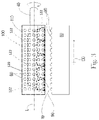
- FIG. 3 is an end view of an apparatus for forming particles.
- FIG. 4 is a portion of an apparatus for forming particles.
- the particles, and thus precursor material as described below, can comprise a water soluble carrier.
- the water soluble carrier can be a water soluble polymer.
- the water soluble carrier acts to carry the capsules to the wash liquor. Upon dissolution of the water soluble carrier, the capsules are dispersed into the wash liquor and deposited onto the laundry.
- the water soluble carrier can be a material that is soluble in a wash liquor within a short period of time, for instance less than about 10 minutes.
- Water soluble means that the material, carrier material, or particle is soluble or dispersible in water, and optionally has a water-solubility of at least 50%, optionally at least 75% or even at least 95%, as measured by the method set out hereafter using a glass-filter with a maximum pore size of 20 microns: 50 grams ⁇ 0.1 gram of the carrier is added in a pre-weighed 400 mL beaker and 245 mL ⁇ 1 mL of distilled water is added. This is stirred vigorously on a magnetic stirrer set at 600 rpm, for 30 minutes. Then, the mixture is filtered through a sintered-glass filter with a pore size as defined above (max. 20 micron).
- the steps are performed at a temperature of 23° C ⁇ 1.0° C. and a relative humidity of 50% ⁇ 2%.
- the water is dried off from the collected filtrate by any conventional method, and the weight of the remaining material is determined (which is the dissolved or dispersed fraction). Then, the percentage solubility or dispersibility can be calculated.
- the water soluble carrier can be selected from the group consisting of water soluble inorganic alkali metal salt, water-soluble alkaline earth metal salt, water-soluble organic alkali metal salt, water-soluble organic alkaline earth metal salt, water soluble carbohydrate, water-soluble silicate, water soluble urea, and any combination thereof.
- Alkali metal salts can be, for example, selected from the group consisting of salts of lithium, salts of sodium, and salts of potassium, and any combination thereof.
- Useful alkali metal salts can be, for example, selected from the group consisting of alkali metal fluorides, alkali metal chlorides, alkali metal bromides, alkali metal iodides, alkali metal sulfates, alkali metal bisulfates, alkali metal phosphates, alkali metal monohydrogen phosphates, alkali metal dihydrogen phosphates, alkali metal carbonates, alkali metal monohydrogen carbonates, alkali metal acetates, alkali metal citrates, alkali metal lactates, alkali metal pyruvates, alkali metal silicates, alkali metal ascorbates, and combinations thereof.
- Alkali metal salts can be selected from the group consisting of sodium fluoride, sodium chloride, sodium bromide, sodium iodide, sodium sulfate, sodium bisulfate, sodium phosphate, sodium monohydrogen phosphate, sodium dihydrogen phosphate, sodium carbonate, sodium hydrogen carbonate, sodium acetate, sodium citrate, sodium lactate, sodium tartrate, sodium silicate, sodium ascorbate, potassium fluoride, potassium chloride, potassium bromide, potassium iodide, potassium sulfate, potassium bisulfate, potassium phosphate, potassium monohydrogen phosphate, potassium dihydrogen phosphate, potassium carbonate, potassium monohydrogen carbonate, potassium acetate, potassium citrate, potassium lactate, potassium tartrate, potassium silicate, potassium, ascorbate, and combinations thereof.
- Alkaline earth metal salts can be selected from the group consisting of salts of magnesium, salts of calcium, and the like, and combinations thereof.
- Alkaline earth metal salts can be selected from the group consisting of alkaline metal fluorides, alkaline metal chlorides, alkaline metal bromides, alkaline metal iodides, alkaline metal sulfates, alkaline metal bisulfates, alkaline metal phosphates, alkaline metal monohydrogen phosphates, alkaline metal dihydrogen phosphates, alkaline metal carbonates, alkaline metal monohydrogen carbonates, alkaline metal acetates, alkaline metal citrates, alkaline metal lactates, alkaline metal pyruvates, alkaline metal silicates, alkaline metal ascorbates, and combinations thereof.
- Alkaline earth metal salts can be selected from the group consisting of magnesium fluoride, magnesium chloride, magnesium bromide, magnesium iodide, magnesium sulfate, magnesium phosphate, magnesium monohydrogen phosphate, magnesium dihydrogen phosphate, magnesium carbonate, magnesium monohydrogen carbonate, magnesium acetate, magnesium citrate, magnesium lactate, magnesium tartrate, magnesium silicate, magnesium ascorbate, calcium fluoride, calcium chloride, calcium bromide, calcium iodide, calcium sulfate, calcium phosphate, calcium monohydrogen phosphate, calcium dihydrogen phosphate, calcium carbonate, calcium monohydrogen carbonate, calcium acetate, calcium citrate, calcium lactate, calcium tartrate, calcium silicate, calcium ascorbate, and combinations thereof.
- Inorganic salts such as inorganic alkali metal salts and inorganic alkaline earth metal salts, do not contain carbon.
- Organic salts such as organic alkali metal salts and organic alkaline earth metal salts, contain carbon.
- the organic salt can be an alkali metal salt or an alkaline earth metal salt of sorbic acid (i.e., a sorbate). Sorbates can be selected from the group consisting of sodium sorbate, potassium sorbate, magnesium sorbate, calcium sorbate, and combinations thereof.
- the water soluble carrier can be or comprise a material selected from the group consisting of a water-soluble inorganic alkali metal salt, a water-soluble organic alkali metal salt, a water-soluble inorganic alkaline earth metal salt, a water-soluble organic alkaline earth metal salt, a water-soluble carbohydrate, a water-soluble silicate, a water-soluble urea, and combinations thereof.
- the water soluble carrier can be selected from the group consisting of sodium chloride, potassium chloride, calcium chloride, magnesium chloride, sodium sulfate, potassium sulfate, magnesium sulfate, sodium carbonate, potassium carbonate, sodium hydrogen carbonate, potassium hydrogen carbonate, sodium acetate, potassium acetate, sodium citrate, potassium citrate, sodium tartrate, potassium tartrate, potassium sodium tartrate, calcium lactate, water glass, sodium silicate, potassium silicate, dextrose, fructose, galactose, isoglucose, glucose, sucrose, raffinose, isomalt, xylitol, candy sugar, coarse sugar, and combinations thereof.
- the water soluble carrier can be sodium chloride.
- the water soluble carrier can be table salt.
- the water soluble carrier can be or comprise a material selected from the group consisting of sodium bicarbonate, sodium sulfate, sodium carbonate, sodium formate, calcium formate, sodium chloride, sucrose, maltodextrin, corn syrup solids, corn starch, wheat starch, rice starch, potato starch, tapioca starch, clay, silicate, citric acid carboxymethyl cellulose, fatty acid, fatty alcohol, glyceryl diester of hydrogenated tallow, glycerol, and combinations thereof.
- the water soluble carrier can be selected from the group consisting of water soluble organic alkali metal salt, water soluble inorganic alkaline earth metal salt, water soluble organic alkaline earth metal salt, water soluble carbohydrate, water soluble silicate, water soluble urea, starch, clay, water insoluble silicate, citric acid carboxymethyl cellulose, fatty acid, fatty alcohol, glyceryl diester of hydrogenated tallow, glycerol, polyethylene glycol, and combinations thereof.
- the water soluble carrier can be selected from the group consisting of disaccharides, polysaccharides, silicates, zeolites, carbonates, sulfates, citrates, and combinations thereof.
- the water soluble carrier can be selected from the group consisting of polyethylene glycol, sodium acetate, sodium bicarbonate, sodium chloride, sodium silicate, polypropylene glycol polyoxoalkylene, polyethylene glycol fatty acid ester, polyethylene glycol ether, sodium sulfate, starch, and mixtures thereof.
- the water soluble carrier can be a water soluble polymer.
- the water soluble polymer can be selected from the group consisting of C8-C22 alkyl polyalkoxylate comprising more than about 40 alkoxylate units, ethoxylated nonionic surfactant having a degree of ethoxylation greater than about 30, polyalkylene glycol having a weight average molecular weight from about 2000 to about 15000, and combinations thereof.
- the water soluble polymer can be a block copolymer having Formulae (I), (II), (III) or (IV), R 1 O-(EO)x-(PO)y-R 2 (I), R 1 O—(PO)x-(EO)y-R 2 (II), R 1 O-(EO)o-(PO)p-(EO)q-R 2 (III), R 1 —(PO)o-(EO)p-(PO)q-R 2 (IV), or a combination thereof; wherein EOis a —CH 2 CH 2 O-group, and PO is a —CH(CH 3 )CH 2 O— group; R 1 and R 2 independently is H or a C1-C22 alkyl group; x, y, o, p, and q independently is 1-100; provided that the sum of x and y is greater than 35, and the sum of o, p and q is greater than 35; wherein the block copolymer has a molecular weight ranging from about 3
- the water soluble polymer can be a block copolymer or block copolymers, for example a block copolymer based on ethylene oxide and propylene oxide selected from the group consisting of PLURONIC-F38, PLURONIC-F68, PLURONIC-F77, PLURONIC-F87, PLURONIC-F88, and combinations thereof.
- PLURONIC materials are available from BASF.
- the water soluble polymer can be selected from the group consisting of polyvinyl alcohols (PVA), modified PVAs; polyvinyl pyrrolidone; PVA copolymers such as PVA/polyvinyl pyrrolidone and PVA/polyvinyl amine; partially hydrolyzed polyvinyl acetate;
- PVA polyvinyl alcohols
- modified PVAs polyvinyl pyrrolidone
- PVA copolymers such as PVA/polyvinyl pyrrolidone and PVA/polyvinyl amine
- partially hydrolyzed polyvinyl acetate partially hydrolyzed polyvinyl acetate
- polyalkylene oxides such as polyethylene oxide; polyethylene glycols; acrylamide; acrylic acid; cellulose, alkyl cellulosics such as methyl cellulose, ethyl cellulose and propyl cellulose; cellulose ethers; cellulose esters; cellulose amides; polyvinyl acetates; polycarboxylic acids and salts; polyaminoacids or peptides; polyamides; polyacrylamide; copolymers of maleic/acrylic acids; polysaccharides including starch, modified starch; gelatin; alginates; xyloglucans, other hemicellulosic polysaccharides including xylan, glucuronoxylan, arabinoxylan, mannan, glucomannan and galactoglucomannan; and natural gums such as pectin, xanthan, and carrageenan, locus bean, arabic, tragacanth; and combinations thereof.
- the polymer comprises polyacrylates, especially sulfonated polyacrylates and water-soluble acrylate copolymers; and alkylhydroxy cellulosics such as methylcellulose, carboxymethylcellulose sodium, modified carboxy-methylcellulose, dextrin, ethylcellulose, propylcellulose, hydroxyethyl cellulose, hydroxypropyl methylcellulose, maltodextrin, polymethacrylates.
- the water soluble polymer can be selected from the group consisting of PVA; PVA copolymers; hydroxypropyl methyl cellulose (HPMC); and mixtures thereof.
- the water soluble polymer can be selected from the group consisting of polyvinyl alcohol, modified polyvinyl alcohol, polyvinyl pyrrolidone, polyvinyl alcohol/polyvinyl pyrrolidone, polyvinyl alcohol/polyvinyl amine, partially hydrolyzed polyvinyl acetate, polyalkylene oxide, polyethylene glycol, acrylamide, acrylic acid, cellulose, alkyl cellulosics, methyl cellulose, ethyl cellulose, propyl cellulose, cellulose ethers, cellulose esters, cellulose amides, polyvinyl acetates, polycarboxylic acids and salts, polyaminoacids or peptides, polyamides, polyacrylamide, copolymers of maleic/acrylic acids, polysaccharides, starch, modified starch, gelatin, alginates, xyloglucans, hemicellulosic polysaccharides, xylan, glucuronoxy
- the water soluble polymer can be an organic material.
- Organic water soluble polymers may provide a benefit of being readily soluble in water.
- the water soluble polymer can be selected from the group consisting of polyethylene glycol, polypropylene glycol polyoxoalkylene, polyethylene glycol fatty acid ester, polyethylene glycol ether, starch, and mixtures thereof.
- the water soluble polymer can be polyethylene glycol (PEG).
- PEG can be a convenient material to employ to make particles because it can be sufficiently water soluble to dissolve during a wash cycle when the particles have the range of mass disclosed herein. Further, PEG can be easily processed as melt. The onset of melt temperature of PEG can vary as a function of molecular weight of the PEG.
- the particles can comprise about 20% to about 94% by weight
- PEG having a weight average molecular weight from about 2000 to about 15000 PEG has a relatively low cost, may be formed into many different shapes and sizes, minimizes unencapsulated perfume diffusion, and dissolves well in water. PEG comes in various weight average molecular weights.
- a suitable weight average molecular weight range of PEG includes from about 2,000 to about 13,000, alternatively from about 4,000 to about 13,000, alternatively from about 4,000 to about 12,000, alternatively from about 4,000 to about 11,000, alternatively from about 5,000 to about 11,000, alternatively from about 6,000 to about 10,000, alternatively from about 7,000 to about 9,000, alternatively combinations thereof.
- PEG is available from BASF, for example PLURIOL E 8000, or other PLURIOL product.
- the water soluble polymer can be a mixture of two or more polyethylene glycol compositions, one having a first weight average molecular weight (e.g. 9000) and the other having a second weight average molecular weight (e.g. 4000), the second weight average molecular weight differing from the first weight average molecular weight.
- first weight average molecular weight e.g. 9000
- second weight average molecular weight e.g. 4000
- the particles can comprise about 20% to about 99% by weight water soluble carrier.
- the particles can comprise from about 35% to about 95%, optionally from about 50% to about 80%, optionally combinations thereof and any whole percentages or ranges of whole percentages within any of the aforementioned ranges, of water soluble carrier by weight of the particles.
- the plurality of particles can comprise individual particles that comprise about 20% to about 99% by weight of the particles water soluble carrier; and about 0.1% to about 20% by weight of the particles capsules; wherein the capsules are dispersed in a matrix of the water soluble polymer.
- the particles can comprise about 20% to about 99% by weight of the individual particles of PEG.
- the individual particles can comprise from about 20% to about 95%, optionally from about 35% to about 95%, optionally from about 50% to about 80%, optionally combinations thereof and any whole percentages or ranges of whole percentages within any of the aforementioned ranges, of PEG by weight of the particles.
- the water soluble polymer can comprise a material selected from the group consisting of: a polyalkylene polymer of formula H—(C 2 H 4 O) x— (CH(CH 3 )CH 2 O) y —(C 2 H 4 O) z —OH wherein x is from about 50 to about 300, y is from about 20 to about 100, and z is from about 10 to about 200; a polyethylene glycol fatty acid ester of formula (C 2 H 4 O) q —C(O)O—(CH 2 ) r —CH 3 wherein q is from about 20 to about 200 and r is from about 10 to about 30; a polyethylene glycol fatty alcohol ether of formula HO—(C 2 H 4 O) s -(CH 2 ) t )-CH 3 wherein s is from about 30 to about 250 and t is from about 10 to about 30; and mixtures thereof.
- the water soluble polymer can comprise: polyethylene glycol; a polyalkylene polymer of formula H—(C 2 H 4 O) x -(CH(CH 3 )CH 2 O) y -(C 2 H 4 O) z —OH wherein x is from about 50 to about 300; y is from about 20 to about 100, and z is from about 10 to about 200; a polyethylene glycol fatty acid ester of formula (C 2 H 4 O) q —C(O)O—(CH 2 ) r ,CH 3 wherein q is from about 20 to about 200 and r is from about 10 to about 30; and a polyethylene glycol fatty alcohol ether of formula HO—(C 2 H 4 O) s —(CH 2 ) t )—CH 3 wherein s is from about 30 to about 250 and t is from about 10 to about 30.
- the water soluble polymer can comprise from about 20% to about 95% by weight of the plurality of particles or by weight of the individual particles of polyalkylene polymer of formula H—(C 2 H 4 O) x -(CH(CH 3 )CH 2 O) y —(C 2 H 4 O) z -OH wherein x is from about 50 to about 300; y is from about 20 to about 100, and z is from about 10 to about 200.
- the water soluble polymer can comprise from about 1% to about 20% by weight of the plurality of particles or by weight of the individual particles polyethylene glycol fatty acid ester of formula (C 2 H 4 O) q —C(O)O—(CH 2 ) r -CH 3 wherein q is from about 20 to about 200 and r is from about 10 to about 30.
- the water soluble polymer can comprise from about 1% to about 10% by weight of the plurality of particles or by weight of the individual particles of polyethylene glycol fatty alcohol ether of formula HO—(C 2 H 4 O) s -(CH 2 ) t )-CH 3 wherein s is from about 30 to about 250 and t is from about 10 to about 30.
- the water soluble carrier can comprise plasticizer polyol (from 0% to 3% by weight of the particles), wherein the plasticizer polymer is optionally a liquid at 20 C and 1 atmosphere of pressure; water (from 1% to 20%, or 1% to 12%, or 6% to 8%, by weight of the particles); sugar alcohol polyol selected from the group consisting of erythritol, xylitol, mannitol, isomalt, maltitol, lactitol, trehalose, lactose, tagatose, sucralose, and mixtures thereof (from 45% to 80%, or 50% to 70%, or 50% to 60%, by weight of the particles); wherein said particles further comprise: (a) modified starch having a dextrose equivalent from 15 to 20 and said sugar alcohol polyol and said modified starch are present at a weight ratio of said sugar alcohol polyol to said modified starch from 2:1 to 16:1, or from 2:1 to 10:1, or from 2:1 to 3:1; or (b) modified star
- the modified starch can have a dextrose equivalent from 15 to 20 and said sugar alcohol polyol and said modified starch can be present at a ratio from 2:1 to 16:1, or from 2:1 to 10:1, or from 2:1 to 3:1.
- the modified starch can have a dextrose equivalent from 4 to less than 15 and said sugar alcohol polyol and said modified starch can be present at a weight ratio of said sugar alcohol polyol to said modified starch from 1.5:1 to 16:1, or from 1.5:1 to 10:1, or from 1.5:1 to 4:1.
- the modified starch can have a dextrose equivalent from 4 to 12.
- the modified starch can be maltodextrin.
- the sugar alcohol polyol can be mannitol.
- the plasticizer polyol can be selected from the group consisting of glycerin, dipropylene glycol, propylene glycol, and mixtures thereof.
- the particles can comprise more than about 20% by weight water soluble carrier.
- the particles can comprise more than about 40% by weight water soluble carrier.
- the particles can comprise from about 20% to about 99% by weight water soluble carrier.
- the particles can comprise from about 35% to about 85%, or even from about 50% to about 80%, by weight of the particles water soluble carrier.
- the water soluble carrier can be selected from the group consisting of a polyalkylene polymer of formula H-(C 2 H 4 O) x -(CH(CH 3 )CH 2 O) y -(C 2 H 4 O) z —OH wherein x is from 50 to 300, y is from 20 to 100, and z is from 10 to 200; a polyethylene glycol fatty acid ester of formula (C 2 H 4 O) q —C(O)O—CH 2 ) r -CH 3 wherein q is from 20 to 200 and r is from 10 to 30; a polyethylene glycol fatty alcohol ether of formula HO—(C 2 H 4 O)-(CH 2 ) t )-CH 3 wherein s is from 30 to 250 and t is from 10 to 30; C8-C22 alkyl polyalkoxylate comprising more than 40 alkoxylate units; polyethylene glycol having a weight average molecular weight from 2000 to 15000; EO/PO/EO block cop
- the particles can comprise about 0.1% to about 99% by weight fabric care benefit active agent.
- a fabric care benefit active agent is a substance provided as part of the composition of particles in a sufficient quantity to impart a benefit to the fabric being treated with the particles.
- the fabric care benefit active agent can be selected from the group consisting of an amine, a surfactant system, nonionic surfactant, a water-binding agent, a sulfite, fatty acids and/or salts thereof, enzymes, encapsulated benefit agents, soil release polymers, hueing agents, builders, chelating agents, dye transfer inhibiting agents, dispersants, enzyme stabilizers, catalytic materials, bleaching agents, bleach catalysts, bleach activators, polymeric dispersing agents, cyclodextrin complexed benefit agents, soil removal/anti-redeposition agents, encapsulated perfumes, polymeric dispersing agents, polymeric grease cleaning agents, brighteners, suds suppressors, dyes, hueing agents, free perfume, structure elasticizing agents, fabric softening agents, quaternary amines, hard and soft tallow, carriers, fillers, hydrotropes, organic solvents, anti-microbial agents and/or preservatives, neutralizers and/or pH adjusting agents, processing aids
- the fabric care benefit agent can be perfume.
- a perfume is an oil or fragrance that includes one or more odoriferous compounds, for example synthetic products of the ester, ether, aldehyde, ketone, alcohol, and hydrocarbon type. Mixtures of various odoriferous substances, which together produce an attractive fragrant note, can be used. Such perfume oils can also comprise natural mixtures of odoriferous compounds, as are available from vegetal sources.
- Perfume can be a substantially water insoluble composition comprising perfume components, optionally mixed with a suitable solvent or diluent.
- suitable solvents or diluents include compounds selected from the group consisting of ethanol, isopropanol, diethylene glycol monoethyl ether, dipropylene glycol, diethyl phthalate, triethyl citrate, and mixtures thereof.
- the perfume can be provided as unencapsulated perfume.
- the perfume can be provided in a perfume delivery system.
- Zeolite and cyclodextrine are examples of perfume delivery systems.
- the perfume can be encapsulated in starch.
- an emulsion of starch and perfume oil can be spray dried to form particles of starch having droplets of perfume dispersed within the starch matrix.
- Perfume delivery systems can be particulate materials or fine particulate materials that may be difficult to handle in a manufacturing environment due to the possibility that the particles may become suspended in air.
- the perfume can be encapsulated perfume.
- Encapsulated perfume is commonly employed in laundry products.
- Encapsulated perfume comprises a plurality of droplets of liquid perfume each of which are encapsulated in an encapsulate shell.
- Perfume may be encapsulated in a water soluble or water insoluble encapsulate shell.
- Encapsulate shell can comprise melamine- urea-formaldehyde, melamine formaldehyde, urea formaldehyde, starch, and the like materials.
- the encapsulate shell wall can be a material selected from polyethylenes; polyamides; polyvinylalcohols, optionally containing other co-monomers; polystyrenes; polyisoprenes; polycarbonates; polyesters; polyacrylates; polyolefins; polysaccharides, e.g., alginate and/or chitosan; gelatin; shellac; epoxy resins; vinyl polymers; water insoluble inorganics; silicone; aminoplasts; and mixtures thereof.
- the aminoplast may comprise polyurea, polyurethane, and/or polyureaurethane.
- the polyurea may comprise polyoxymethyleneurea and/or melamine formaldehyde.
- Encapsulates having an encapsulate shell comprising a polysaccharide can be practical.
- the encapsulate shell can be selected from the group consisting of chitosan, gum arabic, alginate, ⁇ -glucan, starch, starch derivatives, plant proteins, gelatin, alyssum homolocarpum seed gum, and combinations thereof.
- the encapsulate shell can comprise from about 90% to 100%, optionally from about 95% to 100%, optionally from about 99% to 100% by weight of the shell of an inorganic material.
- the inorganic material can be selected from the group consisting of metal oxide, semi-metal oxides, metals, minerals, and mixtures thereof, optionally selected from the group consisting of SiO 2 , TiO 2 , Al 2 O 3 , ZrO 2 , ZnO 2 , CaCO 3 , Ca 2 SiO 4 , Fe 2 O 3 , Fe 3 O 4 , clay, gold, silver, iron, nickel, copper, and mixtures thereof, optionally selected from the group consisting of SiO 2 , TiO 2 , A 2 O 3 , CaCO 3 , and mixtures thereof, optionally SiO 2 .
- the encapsulate shell can comprise a first shell component comprising a condensed layer and a nanoparticle layer, wherein the condensed layer comprises a condensation product of a precursor, and wherein the nanoparticle layer comprises inorganic nanoparticles, and wherein the condensed layer is disposed between the core and the nanoparticle layer, and a second shell component surrounding the first shell component, wherein the second shell component surrounds the nanoparticle layer.
- the encapsulate can be any of those encapsulates described in United States Patent Publications 2020/0330948 A1, 2020/0330949 A1, and 2020/0330950 A1 and U.S. patent application Ser. No. 63/092,829.
- the perfume can comprise one or more fragrances of plant origin.
- a fragrance of plant origin is a concentrated hydrophobic liquid containing volatile chemical compound extracted from a plant.
- the fragrance of plant origin can be selected from the group consisting of allspice berry, angelica seed, anise seed, basil, bay laurel, bay, bergamot, blood orange, camphor, caraway seed, cardamom seed, carrot seed, cassia, catnip, cedarwood, celery seed, chamomile german, chamomile roman, cinnamon bark, cinnamon leaf, citronella, clary sage, clove bud, coriander seed, cypress, elemi, eucalyptus, fennel, fir needle, frankincense, geranium, ginger, grapefruit pink, helichrysum, hop, hyssop, juniper berry, labdanum, lavender, lemon, lemongrass, lime, magnolia, mandarin, marjoram,
- the particles can comprise from about 0.1% to about 20% by weight of the particles perfume, optionally from about 0.1% to about 15%, optionally from about 0.1% to about 12%, optionally from about 1% to about 15%, optionally from about 2% to about 20%, optionally from about 8% to about 10% by weight of the particles perfume.
- the fabric care benefit agent can be a perfume emulsion composition.
- the perfume emulsion composition can comprise an aminofunctional silicone, wherein the aminofunctional silicone comprises one or more primary amine moieties, and wherein the aminofunctional silicone is characterized by a total amine content of from about 0.05 to about 2.2; one or more emulsifiers; one or more perfume raw materials, wherein the one or more perfume raw materials comprises an aldehyde moiety, a ketone moiety, or combinations thereof; and water.
- the perfume emulsion composition can be any of those described in European Patent Office Application 20156010.9, filed February 7, 2020.
- a primary amine content of from about 0.05 to about 2.2, preferably from about 0.071 to about 2.14, or from about 0.071 to about 1.78, or from about 0.71 to about 1.43, or from about 0.14 to about 1.07, or from about 0.14 to about 0.71, or from about 0.21 to about 0.71, or from about 0.36 to about 0.71; and/or (c) a ratio of primary amine content to total amine content of from about 1:2 to about 1:1, preferably from about 1.2:2, more preferably from about 1.5:2, or even more preferably from about 1.8:2.
- j is an integer from 0 to 150, preferably from 0 to 50, more preferably from 0 to 20;
- m is an integer from 10 to 1500, preferably 10 to 1000, more preferably from 20 to 500;
- l is an integer from 0 to 150, preferably from 1 to 150, more preferably from 0 to 50, most preferably from 0 to 20;
- each R 1-6 is independently selected from the group consisting of OH, C 1 -C 2 alkyl, C 1 -C 2 substituted alkyl, C 1 -C 2 alkoxy, C 1 -C 2 substituted alkoxy, and X-Z;
- each X is independently a substituted or unsubstituted divalent alkylene or alkylidene radical comprising 2-12 carbon atoms, preferably each X is independently a substituted or unsubstituted divalent alkylene or alkylidene radical comprising 2-6 carbon atoms, most preferably each X is independently a substituted or unsubstituted divalent alkylene or alkylidene radical comprising 2-4 carbon atoms; wherein each Z is a moiety comprising the one or more primary amine moieties, preferably wherein each Z is independently selected from the group —NH 2 , —N(H)-X-NH 2 , or a mixture thereof.
- the emulsion composition can be characterized by at least one of characteristics (a) through (d):
- (c) being characterized by a viscosity of from about 10 to about 500 Pa ⁇ s, preferably from about 20 to about 400 Pa ⁇ s, more preferably from about 25 to about 300 Pa ⁇ s, even more preferably from about 100 to about 300 Pa ⁇ s, measured at 0.1 rad/s and 25° C.; and/or
- (d) comprising a plurality of droplets, where the plurality of droplets is characterized by a mean diameter of from about 1 micron to about 5 microns.
- the one or more perfume raw materials can comprise a material selected from the following:
- delta-damascone beta-damascone, alpha-damascone, nectaryl, or mixtures thereof;
- vanillin e. vanillin, ethyl vanillin, or mixtures thereof; or
- the one or more emulsifiers can comprise a nonionic surfactant, preferably wherein the nonionic surfactant comprises an alkoxylated fatty alcohol, even more preferably wherein the one or more emulsifier is characterized by an HLB value of from about 5 to about 20, preferably from about 8 to about 16.
- the one or more emulsifiers can comprise a first emulsifier and a second emulsifier, wherein the second emulsifier is different from the first emulsifier, preferably wherein the first emulsifier is a linear nonionic surfactant, and/or preferably wherein the second emulsifier is a branched nonionic surfactant.
- the fabric care active benefit agent can be a fabric softening active.
- the particles can comprise from about 5% to about 45% by weight quaternary ammonium compound.
- the quaternary ammonium compound can be an ester quaternary ammonium compound.
- the quaternary ammonium compound can be those described in United States Patent Publications 2019/0169538 A1, 2019/0169539 A1, 2019/0169777 A1, 2019/0169532 A1, 2019/0169533 A1, and 2019/0169534 A1.
- the quaternary ammonium compound can be di-(tallowoyloxyethl)-N,N-methylhydroxyethylammonium methyl sulfate.
- the fabric softening active can be a fatty amine
- the particles can comprise from about 8% to 45% by weight fatty amine
- the fatty amine can be those described in United States Patent Publication 2020/0354652 A1.
- the fabric softening active can be a silicone.
- the particles can comprise from about 1% to about 50% by weight silicone.
- the silicone can be that as described in United States Patent Publication 2017/0349865.
- the fabric care active benefit agent can be a branched polyester.
- the particles can comprise from about 5% to about 45% by weight a branched polyester.
- the branched polyester can be those described in United States Patent Publication 2019/0367841 A1.
- the branched polyester can be those described and claimed in United States Patent Publication 2019/0233764 A1.
- the fabric care active benefit agent can be a cationic polymer.
- the particles can comprise from about 0.1% to about 10% by weight cationic polymer.
- the cationic polymer can be selected from the group consisting of cationic polysaccharide, Polyquaternium-4, Polyquaternium-6, Polyquaternium-7, Polyquaternium-10, Polyquaternium-22, Polyquaternium- 67, and mixtures thereof.
- the cationic polysaccharide can be polymeric quaternary ammonium salt of hydroxyethylcellulose which has been reacted with an epoxide substituted with a trimethylammonium group.
- the fabric care active benefit agent can be enzyme.
- the particles can comprise from about 0.0001% to about 5% by weight an enzyme.
- the enzyme can be selected from the group consisting of protease, xyloglucanase, mannanase, and combinations thereof.
- the enzyme can be those described in United States Patent Publications 2017/0260481 A1 and 2017/0260482 A1.
- the fabric care active benefit agent can be a graft copolymer.
- the particles can comprise from about 1% to about 75% by weight a graft copolymer.
- the graft copolymer can those described in U.S. patent application 69/951,274.
- the graft copolymer can those described in U.S. patent application 69/722,492.
- the fabric care active benefit agent can be an antioxidant.
- the particles can comprise from about 0.2% to about 2% by weight antioxidant.
- the antioxidant can be dispersed in a matrix of said water soluble carrier.
- the antioxidant can those described in U.S. patent application 63/034,766.
- the antioxidant can be butylated hydroxytoluene.
- the precursor material 20 can be a melt of any of the compositions disclosed herein for the particles 90 .
- the precursor material 20 can comprise more than about 20% by weight water soluble carrier.
- the precursor material 20 can comprise more than about 20% by weight water soluble polymer.
- the precursor material 20 can comprise from about 20% to about 99% by weight water soluble carrier.
- the precursor material 20 can comprise from about 20% to about 99% by weight water soluble polymer.
- the precursor material 20 can comprises more than about 20%, optionally more than about 40%, by weight polyethylene glycol having a weight average molecular weight from about 2000 to about 13000 and from about 0.1% to about 20% by weight perfume.
- the raw material or raw materials can be provided to a batch mixer 10 .
- the batch mixer 10 can have sufficient capacity to retain the volume of raw materials provided thereto for a sufficient residence time to permit the desired level of mixing and or reaction of the raw materials.
- the material leaving the batch mixer 10 can be the precursor material 20 .
- the precursor material can be provided to the feed pipe 40 from some other upstream mixing process, for example in-line mixing, in-line static mixing, and the like.
- the precursor material 20 can be a molten product.
- the batch mixer 10 can be a dynamic mixer.
- a dynamic mixer is a mixer to which energy is applied to mix the contents in the mixer.
- the batch mixer 10 can comprise one or more impellers to mix the contents in the batch mixer 10 .
- the feed pipe 40 can be in fluid communication with the batch mixer 10 .
- One or more gas feed lines 155 can be provided in fluid communication with the feed pipe 40 downstream of the batch mixer 10 .
- One or more gas feed lines 155 can be provided in fluid communication with the feed pipe 40 between the batch mixer 10 and the distributor 30 .
- a mill 200 can be provided downstream of the one or more gas feed lines 155 and in line with the feed pipe 40 .
- the mill 200 can be provided in line with the feed pipe 40 downstream of the one or more gas feed lines 155 and upstream of the distributor 30 .
- the precursor material 20 can be provided to the feed pipe 40 .
- the feed pipe 40 is the conveyance by which the precursor material 20 is carried.
- the feed pipe 40 includes the conveyance between elements of the apparatus 1 and the conveyance through which the precursor material is carried within components of the apparatus 1 .
- the mill 200 may be provided in a unit with a portion of the conveyance approaching the mill 200 and a portion of the conveyance exiting the mill 200 . Each of these portions is part of the feed pipe 40 . So, the feed pipe 40 can be viewed the entire conveyance between the batch mixer 10 and the distributor 30 and the feed pipe 40 is interrupted by various elements such as the one or more gas feed lines 155 , the mill 200 , intermediate mixer 50 , and feed pump 140 .
- the feed pipe 40 can be viewed the entire conveyance upstream of the distributor 30 and the feed pipe 40 is interrupted by various elements such as the one or more gas feed lines 155 , the mill 200 , intermediate mixer 50 , and feed pump 140 .
- An intermediate mixer 55 can be provided downstream of the mill 200 and in line with feed pipe 40 .
- the intermediate mixer 55 can be a static mixer 50 .
- the intermediate mixer 55 can be in fluid communication with the feed pipe 40 between the mill 200 and the distributor 30 .
- the intermediate mixer 55 which can be a static mixer 50 , can be downstream of the batch mixer 10 . Stated otherwise, the batch mixer 10 can be upstream of the intermediate mixer 55 or static mixer 55 if employed.
- the intermediate mixer 55 can be in-line with the feed pipe 40 .
- the intermediate mixer 55 can be a rotor-stator mixer.
- the intermediate mixer 55 can be a colloid mill.
- the intermediate mixer 55 can be a driven in-line fluid disperser.
- the intermediate mixer 55 can be an Ultra Turrax disperser, Dispax-reactor disperser, Colloid Mil MK, or Cone Mill MKO, available from IKA, Wilmington, North Carolina, United States of America.
- the intermediate mixer 55 can be a perforated disc mill, toothed colloid mill, or DIL Inline Homogenizer, available from FrymaKoruma, Rheinfelden, Switzerland.
- the static mixer 50 can be a helical static mixer.
- the static mixer 50 can be a Kenics 1.905 cm inside diameter KMS 6, available from Chemineer, Dayton, Ohio, USA.
- an intermediate mixer 55 such as the static mixer 50
- the temperature of the precursor material 20 within the feed pipe 40 across a cross section of the feed pipe 40 orthogonal to the direction of flow can vary by less than about 10° C., or less than about 5° C., or less than about 1° C., or less than about 0.5° C.
- the temperature across a cross section of the feed pipe 40 orthogonal to the direction of flow may be non-uniform.
- the temperature of the precursor material 20 at the center line of the feed pipe 40 may be higher than the temperature of the precursor feed material 20 at the peripheral wall of the feed pipe 40 .
- the temperature of the precursor material 20 may vary at different positions within the distributor or stator 100 . Without being bound by theory, it is thought that by providing for a uniform temperature across the cross section of the feed pipe 40 by employing a static mixer 50 as described herein, more uniform particles 90 can be produced as compared to an apparatus 1 that does not have a static mixer 50 .
- the distributor 30 can be provided with a plurality of apertures 60 .
- the precursor material 20 can be passed through the apertures 60 .
- the precursor material 20 can be deposited on a moving conveyor 80 that is provided beneath the distributor 30 .
- the precursor material 20 can be deposited on the moving conveyor 80 when the conveyor 80 is in motion.
- the conveyor 80 can be moveable in translation relative to the distributor 30 .
- the conveyor 80 can be a continuously moving conveyor 80 .
- the conveyor 80 can be an intermittently moving conveyor 80 .
- a continuously moving conveyor 80 may provide for higher processing speeds.
- An intermittently moving conveyor 80 can provide for improved control of the shape of the particles 90 that are produced.
- the precursor material 20 can be cooled on the moving conveyor 80 to form a plurality of solid particles 90 .
- the cooling can be provided by ambient cooling.
- the cooling can be provided by spraying the under-side of the conveyor 80 with ambient temperature water or chilled water.
- the particles 90 can be transferred from the conveyor 80 to processing equipment downstream of the conveyor 80 for further processing and or packaging.
- the distributor 30 can be a cylinder 110 rotationally mounted about a stator 100 with the stator being in fluid communication with the feed pipe 40 and the cylinder 110 can have a periphery 120 and there can be a plurality of apertures 60 in the periphery 120 , as shown in FIG. 2 .
- the apparatus 1 can comprise a stator 100 in fluid communication with the feed pipe 40 .
- the feed pipe 40 can feed the precursor material 20 to the stator 100 after the precursor material 20 has passed through the mill 200 .
- the apparatus 1 can comprise a cylinder 110 rotationally mounted about the stator 100 .
- the stator 100 is fed precursor material through one or both ends 130 of the cylinder 110 .
- the cylinder 110 can have a longitudinal axis L passing through the cylinder 110 about which the cylinder 110 rotates.
- the cylinder 110 has a periphery 120 . There can be a plurality of apertures 60 in the periphery 120 of the cylinder 110 .
- the apertures 60 can be intermittently in fluid communication with the stator 100 as the cylinder 110 rotates about the stator 100 .
- the cylinder 110 can be considered to have a machine direction MD in a direction of movement of the periphery 120 across the stator 100 and a cross machine direction on the periphery 120 orthogonal to the machine direction MD.
- the stator 100 can similarly be considered to have a cross machine direction CD parallel to the longitudinal axis L.
- the cross machine direction of the stator 100 can be aligned with the cross machine direction of the cylinder 110 .
- the stator 100 can have a plurality of distribution ports 122 arranged in a cross machine direction CD of the stator 100 .
- the distribution ports 122 are portions or zones of the stator 100 supplied with precursor material 20 .
- precursor material 20 can be fed past the one or more gas feed lines 155 through the mill 200 and feed pipe 40 to the stator 100 .
- the stator 100 distributes the precursor feed material 20 across the operating width of the cylinder 110 .
- precursor material 20 is fed through the apertures 60 as the apertures 60 pass by the stator 100 .
- a discrete mass of precursor material 20 is fed through each aperture 60 as each aperture 60 encounters the stator 100 .
- the mass of precursor material 20 fed through each aperture 60 as each aperture 60 passes by the stator 100 can be controlled by controlling one or both of the pressure of the precursor material within the stator 100 and the rotational velocity of the cylinder 110 or optionally controlling the viscosity of the precursor material 20 by controlling the temperature of the precursor material 20 .
- Drops of the precursor material 20 are deposited on the conveyor 80 across the operating width of the cylinder 110 .
- the conveyor 80 can be moveable in translation relative to the longitudinal axis of the cylinder 110 .
- the velocity of the conveyor 80 can be set relative to the tangential velocity of the cylinder 110 to control the shape that the precursor material 20 has once it is deposited on the conveyor 80 .
- the velocity of the conveyor 80 can be the about the same as the tangential velocity of the cylinder 110 .
- flow of the precursor material 20 through the feed pipe 40 can be provided by gravity driven flow from a batch mixer 10 and the distributor 30 .
- the apparatus 1 can be provided with a feed pump 140 , as shown in FIG. 2 .
- the feed pump 140 can be in line with the feed pipe 40 , with in line meaning in the line of flow of the precursor material 20 .
- the feed pump 140 can between the batch mixer 10 and the distributor 30 .
- the feed pump 140 can be upstream of the distributor 30 . If a stator 100 is employed, the feed pump 140 can be in line with the feed pipe 40 , with in line meaning in the line of flow of the precursor material 20 .
- the feed pump 140 can be between the batch mixer 10 and the stator 100 .
- the feed pump 140 can be upstream of the stator 100 . In describing the position of the feed pump 140 , between is used to describe the feed pump 140 being in-line downstream of the batch mixer 10 and upstream of the distributor 30 or if used, upstream of the stator 100 .
- the one or more gas feed lines 155 and the mill 200 can be positioned in line between the feed pump 140 and the distributor 30 or stator 100 , if employed in the apparatus 1 .
- the flow rate of the precursor material 20 can be about 3 L/min.
- the precursor material 20 can be a molten material comprising any of the compositions described herein for the precursor material 20 or particles 90 .
- the apparatus 1 can comprise one or more gas feed lines 155 .
- a single gas feed line 155 can be practical if the gas to entrained into the precursor material can be practically supplied via a single gas feed line 155 .
- a gas comprising multiple constituents can be desirable.
- Multi-constituent gasses can be provided in a single container 157 .
- a mixture of carbon dioxide and nitrogen can be provided in a gas cylinder.
- mixtures of gasses can be provide continuously from the environment via a reaction process or by combining air with another gas sourced from a container.
- the gas can be pressurized via a compressor.
- the one or more gas feed lines 155 can comprise a flow regulator 158 .
- the flow regulator 158 can regulate the flow of gas into the feed line 40 .
- the volume of gas added per unit volume of precursor material 20 can be controlled by setting the flow regulator 158 to the desired flow rate. The more gas fed into the precursor material 20 within the feed line 40 , the more gas that will be contained in the particles 90 .
- the one or more gas feed lines 155 can provide for entraining gas into the precursor material 20 .
- the flow regulator 158 can be Key Instruments Flo-Rite Series GS 65 mm flowmeter, part number 60410-R5.
- the feed line 40 can be a 1 1 ⁇ 2′′ stainless steel sanitary pipe.
- the gas feed line 155 can be 1 ⁇ 4′′ inside diameter polyethylene tubing. Gas can be provided in the gas feed line 155 at a pressure greater than about 4 bar, for example 5.9 bar.
- a flow regulator can be provided along each gas feed line 155 to regulate the flow of gas in each respective gas feed line 155 . If a mixture of gas is introduced into the feed pipe 40 via a single gas feed line 155 , a single flow regulator 158 can be practical.
- an injection quill device for introducing the gas can be provided.
- the gas can be provided at a temperature and pressure such that when the gas reaches ambient temperature and pressure the desired volume of gas is present in the particles 90 .
- the Ideal Gas Law can be used to determine the desired temperature and pressure of delivery.
- the gas can also comprise water.
- the water can be in gaseous or liquid form.
- the quantity of water in the gas can be selected to be at the desired level.
- the mill 200 can be a rotor-stator type mill.
- the mill can be a Quadro Z1 in-line mixer with a single stage of medium rotor stators, operated at about 400 RPM.
- the mill 200 and the one or more gas feed lines 155 can be combined in a single unit.
- An Oakes Foamer (E.T. Oakes Corporation, 686 Old Willets Path, Hauppauge, N.Y. 11788) 2MT1A continuous foamer) can be used to provide a gas feed line 155 , flow regulator 158 and mill 200 in a single unit.
- FIG. 3 A view of an apparatus 1 in the machine direction MD is shown in FIG. 3 .
- the apparatus 1 can have an operating width W and the cylinder 110 can rotate about longitudinal axis L.
- the apparatus 1 for forming particles 90 can comprise: a feed pipe; one or more gas feed lines 155 mounted in fluid communication with the feed pipe 40 downstream of the batch mixer 10 ; a mill 200 downstream of the one or more gas feed lines 155 and in line with the feed pipe 40 ; and a distributor 30 downstream of the mill 200 and fluid communication with said feed pipe 40 , wherein said distributor 30 comprises a plurality of apertures 60 .
- the apparatus 1 can comprise a conveyor beneath the distributor 30 and movable in translation relative to the distributor 30 .
- the distributor 30 can comprise a stator 100 in fluid communication with the feed pipe 40 .
- the distributor 30 can comprise a cylinder 110 rotationally mounted about the stator 100 and rotatable about a longitudinal axis L of the cylinder 110 .
- the cylinder 110 can have a periphery 120 and the cylinder 110 can have a plurality of apertures 60 disposed about the periphery 120 .
- the apertures 60 can be intermittently in fluid communication with the stator 100 as the cylinder 110 rotates about the stator 100 .
- the apparatus can comprise a conveyor 80 beneath the cylinder 110 and the conveyor 80 can be movable in translation relative to the longitudinal axis L.
- the apparatus 1 for forming particles 90 can comprise a batch mixer 10 .
- the feed pipe 40 can be in fluid communication with the batch mixer 10 .
- the process for forming particles 90 can comprise the steps of: providing a precursor material 20 to a feed pipe 40 ; entraining gas into the precursor material 20 , wherein the gas comprises from about 50% to about 75% carbon dioxide and from about 25% to about 50% other constituents; providing a distributor 30 having a plurality of apertures 60 ; transporting the precursor material 20 from the feed pipe 40 to the distributor 30 ; passing the precursor material 20 through the apertures 60 ; providing a movable conveyor 80 beneath the apertures 60 ; depositing the precursor material 20 on to the movable conveyor 80 ; and cooling the precursor material 20 to form a plurality of particles 90 .
- the gas can be entrained in the precursor material 20 as a mixture of gasses.
- the mixture of gasses can directed into the precursor material 20 via a single gas feed line 155 .
- the mixture of gasses can comprise from about 50 vol % to about 75 vol % carbon dioxide and from about 25 vol % to about 50 vol % other constituents.
- the mixture can be provided from a container 157 containing the mixture of gasses.
- the container 157 can be a gas cylinder that is filled with the desired gas, which is a mixture of different gasses.
- the carbon dioxide can be provided from a primary container 157 a and the other constituents of the gas can be provided from one or more secondary containers 157 b ( FIG. 4 ).
- the primary container 157 a and secondary container 157 b can feed into a single gas feed line 155 .
- Flow regulators 158 can control the flow of gas from the primary container 157 a and secondary container 157 b into the gas feed line 155 .
- an inline mixer can be provided in or upstream of the gas feed line 155 to mix the gasses from the primary container 157 a and the secondary container 157 b.
- the primary container 157 a can contain the carbon dioxide.
- the other constituents of the gas can be provided from the secondary container 157 b.
- the other constituents of the gas can be provided as air from the secondary container 157 b.
- Containers of air are readily available commercially.
- containers of carbon dioxide are readily available commercially.
- the operator of the apparatus 1 can acquire a cylinder of carbon dioxide and a cylinder of air and set the flow regulators 158 to provide the desired gas.
- the carbon dioxide and the other constituents of the gas can be combined into a single flow of the gas prior to being entrained into the precursor material 20 .
- the primary container 157 a can feed into a primary gas feed line 155 and the secondary container 157 b can feed into a secondary gas feed line 155 .
- Gas flow within each gas feed line 155 can be regulated by a flow regulator 158 dedicated to such gas feed line 155 .
- the precursor material 20 in the feed pipe can be provided at an operating pressure from about 2 bars to about 8 bars.
- the gas can be fed into the feed pipe at pressure above the operating pressure of the feed pipe 40 .
- the gas, or the carbon dioxide constituent thereof, can be entrained at a pressure greater than about 3 to about 4 bars, or even greater than about 4 bars, or even greater than about 5 bars.
- the solubility of carbon dioxide in the precursor material 20 can be greater than the solubility of the majority by volume of other constituents of the gas.
- carbon dioxide gas When carbon dioxide gas is fed into the stream of precursor material 20 that is at the operating pressure, the carbon dioxide solubilizes into the precursor material 20 .
- Other constituents of the gas may or may not solubilize into the precursor material 20 at the operating pressure. Those constituents that have a low solubility in the precursor material 20 relative to the carbon dioxide predominantly remain as bubbles in the precursor material 20 .
- the pressure drops towards or to atmospheric pressure.
- the precursor material 20 may also begin to cool.
- the precursor material 20 may continue to cool as the precursor material 20 travels from the apertures 60 to the movable conveyor 80 . Cooling continues after the precursor material 20 is deposited on the movable conveyor 80 . Heat is removed from the precursor material 20 by the conveyor and the belt facing side of the precursor material 20 in contact with the movable conveyor 80 begins to solidify. Similarly the surface of the precursor material 20 continues to cool after the precursor material 20 is deposited on the movable conveyor 80 . As such, cooling of the precursor material 20 once deposited on the movable conveyor 80 is three dimensional time dependent process.
- a solidification front develops from the belt facing side of precursor material 20 and the solidification front advances away from the moveable conveyor 80 over time.
- the air facing side of the precursor material 20 which is away from the belt facing surface of the precursor material, also cools as a function of time. This results in a solidification front advancing from the air facing surface towards the center of the particle being formed on the moveable conveyor 80 as the precursor material 20 cools.
- the gas entrained in the precursor material 20 is air, which is about 78 vol % nitrogen, about 21 vol % oxygen, about 0.93 vol % argon, and about 0.03 vol % carbon dioxide, most of that gas has limited solubility into the precursor material 20 and the air remains as bubbles in the precursor material 20 throughout the process of making particles. This can limit the amount of air that can be entrained in the precursor material 20 and still make particles having the desired stability and appearance.
- the buoyancy of the air bubbles in the precursor material 20 and the solidification front advancing from the belt facing side of the precursor material 20 tends to drive some of the air bubbles away from the movable conveyor 80 .
- air bubbles As the air bubbles are driven upwardly, they may coalesce to form larger air bubbles. Some of the air bubbles may escape through the air facing side of the precursor material 20 . Escaped air bubbles no longer contribute to the porosity of the particles 90 . If a skin layer has formed on the air facing side of the precursor material 20 , air bubbles may erupt through the skin layer which can result in particles 90 that have a physically unstable outer surface. A physically unstable outer surface is undesirable as that can result in the particles being subject to flaking and make the particles messy to use.
- the problem with using air as the gas to be entrained is that the air bubbles exist in the precursor material 20 when the precursor material 20 is deposited onto the moveable belt 40 and the phenomena described in the preceding paragraph occur, which can result in unsatisfactory particles 90 .
- using a gas that comprises from about 50 vol% to about 75 vol% carbon dioxide can improve the ability of the precursor material 20 to retain bubbles as the precursor material 20 cools on the movable conveyor 80 to form particles 90 . That can result in particles 90 that have a higher porosity and fewer large bubbles at or near the air facing surface of the particles 90 .
- Carbon dioxide can be relatively soluble in the precursor material 20 as compared to other gas constituents.
- the gas constituents that are relatively insoluble in the precursor material 20 may be present as bubbles.
- the process of the carbon dioxide coming out of solution from the precursor material 20 is a time dependent process.
- the bubbles of gas constituents that are relatively insoluble in the precursor material 20 may serve as nucleation sites for the carbon dioxide to come out of solution from the precursor material. While the carbon dioxide is coming out of solution, the precursor material 20 is also cooling. As described previously, a solidification front may develop from the belt facing side of the precursor material 20 and the air facing side of the precursor material 20 is also solidifying.
- the solidifying or solidified precursor material 20 forms a barrier to bubbles escaping from the precursor material 20 .
- bubbles of carbon dioxide may form and or the carbon dioxide may come out of solution into the existing bubbles of relatively insoluble gas constituents.
- the delayed formation of the carbon dioxide bubbles or the expansion of the existing bubbles of relatively insoluble gas constituents as the carbon dioxide nucleates on such bubbles allows for a greater volume of bubbles to be formed in the precursor material 20 . And these late formed bubbles are less likely to escape from the precursor material 20 .
- the formed particle 90 can have a large volume of voids.
- the particles 90 can be formed as described herein can comprise about 25% to about 99% by weight water soluble carrier.
- the particles 90 can further comprise from about 0.1% to about 20% by weight fabric care benefit active agent.
- Each of the particles can have a mass from about 5 mg to about 200 mg, preferably from about 10 mg to about 100 mg, preferably from about 20 mg to about 50 mg.
- the particles can have a hemispherical or compressed hemispherical shape.
- the fabric care benefit active agent can be selected from the group consisting of an amine, a surfactant system, nonionic surfactant, a water-binding agent, a sulfite, fatty acids and/or salts thereof, enzymes, encapsulated benefit agents, soil release polymers, hueing agents, builders, chelating agents, dye transfer inhibiting agents, dispersants, enzyme stabilizers, catalytic materials, bleaching agents, bleach catalysts, bleach activators, polymeric dispersing agents, cyclodextrin complexed benefit agents, soil removal/anti-redeposition agents, encapsulated perfumes, polymeric dispersing agents, polymeric grease cleaning agents, brighteners, suds suppressors, dyes, hueing agents, free perfume, structure elasticizing agents, fabric softening agents, quaternary amines, hard and soft tallow, carriers, fillers, hydrotropes, organic solvents, anti-microbial agents and/or preservatives, neutralizers and/or pH adjusting agents, processing aids
- the fabric care benefit active agent can be selected from the group consisting of an antimicrobial, antioxidant, perfume, fabric conditioning agent, dye, dye fixative, and combinations thereof.
- the fabric care benefit active agent can be unencapsulated perfume or encapsulated perfume.
- Each of the particles 90 can have a mass from about 5 mg to about 200 mg, optionally about 10 mg to about 100 mg, optionally from about 20 mg to about 50 mg.
- the particles can have a hemispherical or compressed hemispherical shape.
- Particles 90 can be produced as follows.
- a 50 kg batch of precursor material 20 can be prepared in a mixer.
- Molten PEG8000 can be added to a jacketed mixer held at 70° C. and agitated with a pitch blade agitator at 125 rpm.
- Butylated hydroxytoluene can be added to the mixer at a level of about 0.01% by weight of the precursor material 20 .
- a water based slurry of perfume microcapsules can be added to the mixer at a level of about 4% by weight of the precursor material 20 .
- Unencapsulated perfume can be added to the mixer at a level of about 8% by weight of the precursor material 20 .
- Dye can be added to the mixer at a level of about 0.01% by weight of the precursor material 20 .
- the PEG can account for the balance by weight of the precursor material 20 .
- the precursor material 20 can be mixed for 30 minutes.
- the precursor material 20 can be formed into particles 90 on a SANDVIK ROTOFORM 3000 having a 750 mm wide 10 m long belt.
- the cylinder 110 can have 2 mm diameter apertures 60 set at a 10 mm pitch in the cross machine direction CD and 9.35 mm pitch in the machine direction MD.
- the cylinder can be set at approximately 3 mm above the belt.
- the belt speed and rotational speed of the cylinder 110 can be set at 10 m/min.
- the precursor material 20 can be pumped at a constant 3.1 kg/min rate, or even a 4 kg/min rate, from the mixer 10 through a plate and frame heat exchanger set to control the outlet temperature to 50° C.
- the pressure in the feed pipe 40 downstream of the pump 140 can be about 2 to about 7 bar, and alternatively about 5.5 bar or about 5 bar, the pressure being in the feed pipe 40 downstream of the mill 200 .
- the gas can be entrained in the precursor material 20 at a volumetric flow rate ratio of precursor material to gas from about 1.3:1 to about 2.6:1, or even about 1.3:1 to about 1.6:1.
- the pressure of the gas in the gas feed line 155 must be higher than the pressure in the feed pipe 40 to ensure flow and entrainment of gas into the precursor material 20 .
- the flow rate for the precursor material 20 can be about 4.5 liters per minute, and the gas flow rate may be about 3.4 liters per minute.
- the gas can be a mixture of carbon dioxide and other insoluble gases.
- the precursor material 20 having the gas entrained therein can be passed through a Quadro Z 1 mill with medium rotor/stator elements. After milling, the precursor material can optionally be passed through a Kenics 1.905 cm KMS 6 static mixer 50 installed 91.44 cm upstream of the stator 100 of the rotoforming device.
- a process for forming particles comprising the steps of:
- X The process according to any of Paragraphs A to W, wherein said precursor material comprises a fabric care benefit agent selected from the group consisting of an amine, a surfactant system, nonionic surfactant, a water-binding agent, a sulfite, fatty acids and/or salts thereof, enzymes, encapsulated benefit agents, soil release polymers, hueing agents, builders, chelating agents, dye transfer inhibiting agents, dispersants, enzyme stabilizers, catalytic materials, bleaching agents, bleach catalysts, bleach activators, polymeric dispersing agents, cyclodextrin complexed benefit agents, soil removal/anti-redeposition agents, encapsulated perfumes, polymeric dispersing agents, polymeric grease cleaning agents, brighteners, suds suppressors, dyes, hueing agents, free perfume, structure elasticizing agents, fabric softening agents, quaternary amines, hard and soft tallow, carriers, fillers, hydrotropes, organic solvents, anti-microbial agents and/or
Landscapes
- Chemical & Material Sciences (AREA)
- Engineering & Computer Science (AREA)
- Organic Chemistry (AREA)
- Chemical Kinetics & Catalysis (AREA)
- Mechanical Engineering (AREA)
- Oil, Petroleum & Natural Gas (AREA)
- Life Sciences & Earth Sciences (AREA)
- Wood Science & Technology (AREA)
- Detergent Compositions (AREA)
- Glanulating (AREA)
- Physical Or Chemical Processes And Apparatus (AREA)
- Inorganic Compounds Of Heavy Metals (AREA)
- Manufacture Of Metal Powder And Suspensions Thereof (AREA)
Abstract
Description
- Consumers desire products that can simplify the processes they use to do their laundry, help them reduce the amount of time that they spend dealing with soiled laundry, and help them achieve high levels of benefits. Consumers are well positioned to understand the amount of fabric care composition that is required to provide benefit they desire. As a result, fabric care products that enable consumers to customize the amount of fabric care composition they use are popular with many consumers.
- Fabric care products that can be delivered in the wash are particularly easy for consumers to use. For instance, the consumer can simply place the fabric care product in the tub of the washing machine along with the laundry and start the washing machine cycle.
- Typically, consumers use a fabric care detergent composition that contains an appreciable quantity of surfactants and other cleaning ingredients. Such fabric care compositions are often provided in soluble unit dose pouches that contain a prescribed quantity of fabric care active agents. Fabric care compositions are also provided in liquid or powder forms and the consumer is provided with a measuring cup to provide a measured quantity of fabric care composition. These types of products may be referred to as fully formulated fabric care compositions.
- To provide for fabric care benefits above and beyond what can be provided by using fully formulated fabric care compositions, fabric care products that are additives are popular with consumers. Consumers enjoy and are satisfied by using fabric care additives that are packaged in a manner the enables the consumer to use a custom amount of the fabric care additive based on the consumer's judgment of how much of the fabric care additive is needed to provide the desired benefit. Such fabric care additives are conveniently provided through the wash along with fully formulated fabric care compositions but are dosed separately from the fully formulated fabric care composition.
- Fabric care additives in the form of particles have become attractive to many consumers. Some fabric care additive particles are provided with a porous structure. Particles having a porous structure can float in the water as the wash liquor is formed. Particles that float may tend to dissolve more completely in the wash as compared to particles that sink because particles that sink may become trapped in folds, creases, and pockets of the laundry during washing. Undissolved particles tend to incompletely deliver the fabric care benefit active agent contained in the particle, which may be undesirable to the consumer. Particles that float and include unencapsulated perfume may provide a pleasant scent to the headspace above the wash liquor and the room within which the washing machine is positioned. Further, particles that float may better distribute the fabric care additives to the laundry during the wash cycle.
- Melt processing is a common approach for forming particles. One problem with making porous particles via a melt process is that the bubbles within the melt tend to coalesce and rise out of the molten material as the melted precursor material solidifies. This can result in large pores at or near an outer surface of the particle, an irregular rough outer surface, an irregular distribution of pore sizes within solidified particles, and eruptions of bubbles and molten material from the surface of the particle as it solidifies. Such particles may be less durable that particles that have a more competent outer surface and be prone to becoming dusty, messy to use, and appear to be of poor quality. The tendency of bubble within the melt to coalesce and rise out of the molten material as the melted precursor material solidifies can also effectively limit the volume of pores that can be provided in particles without these adverse consequences occurring.
- With these limitations in mind, there is a continuing unaddressed need for fabric care additives in the form of particles that have a uniform distribution of pore sizes throughout the particle. There is a further unaddressed need for a process for forming such porous particles.
- A process for forming particles comprising the steps of: providing a precursor material to a feed pipe; entraining gas into said precursor material, wherein said gas comprises from about 50 vol % to about 75 vol % carbon dioxide and from about 25 vol % to about 50 vol % other constituents; providing a distributor comprising a plurality of apertures; transporting said precursor material from said feed pipe to said distributor; passing said precursor material through said apertures; providing a moveable conveyor beneath said apertures; depositing said precursor material onto said moveable conveyor; and cooling said precursor material to form a plurality of particles.
-
FIG. 1 is an apparatus for forming particles. -
FIG. 2 is a portion of an apparatus for forming particles. -
FIG. 3 is an end view of an apparatus for forming particles. -
FIG. 4 is a portion of an apparatus for forming particles. - The particles, and thus precursor material as described below, can comprise a water soluble carrier. The water soluble carrier can be a water soluble polymer. The water soluble carrier acts to carry the capsules to the wash liquor. Upon dissolution of the water soluble carrier, the capsules are dispersed into the wash liquor and deposited onto the laundry.
- The water soluble carrier can be a material that is soluble in a wash liquor within a short period of time, for instance less than about 10 minutes.
- Water soluble means that the material, carrier material, or particle is soluble or dispersible in water, and optionally has a water-solubility of at least 50%, optionally at least 75% or even at least 95%, as measured by the method set out hereafter using a glass-filter with a maximum pore size of 20 microns: 50 grams±0.1 gram of the carrier is added in a pre-weighed 400 mL beaker and 245 mL±1 mL of distilled water is added. This is stirred vigorously on a magnetic stirrer set at 600 rpm, for 30 minutes. Then, the mixture is filtered through a sintered-glass filter with a pore size as defined above (max. 20 micron). The steps are performed at a temperature of 23° C±1.0° C. and a relative humidity of 50%±2%. The water is dried off from the collected filtrate by any conventional method, and the weight of the remaining material is determined (which is the dissolved or dispersed fraction). Then, the percentage solubility or dispersibility can be calculated.
- The water soluble carrier can be selected from the group consisting of water soluble inorganic alkali metal salt, water-soluble alkaline earth metal salt, water-soluble organic alkali metal salt, water-soluble organic alkaline earth metal salt, water soluble carbohydrate, water-soluble silicate, water soluble urea, and any combination thereof.
- Alkali metal salts can be, for example, selected from the group consisting of salts of lithium, salts of sodium, and salts of potassium, and any combination thereof. Useful alkali metal salts can be, for example, selected from the group consisting of alkali metal fluorides, alkali metal chlorides, alkali metal bromides, alkali metal iodides, alkali metal sulfates, alkali metal bisulfates, alkali metal phosphates, alkali metal monohydrogen phosphates, alkali metal dihydrogen phosphates, alkali metal carbonates, alkali metal monohydrogen carbonates, alkali metal acetates, alkali metal citrates, alkali metal lactates, alkali metal pyruvates, alkali metal silicates, alkali metal ascorbates, and combinations thereof.
- Alkali metal salts can be selected from the group consisting of sodium fluoride, sodium chloride, sodium bromide, sodium iodide, sodium sulfate, sodium bisulfate, sodium phosphate, sodium monohydrogen phosphate, sodium dihydrogen phosphate, sodium carbonate, sodium hydrogen carbonate, sodium acetate, sodium citrate, sodium lactate, sodium tartrate, sodium silicate, sodium ascorbate, potassium fluoride, potassium chloride, potassium bromide, potassium iodide, potassium sulfate, potassium bisulfate, potassium phosphate, potassium monohydrogen phosphate, potassium dihydrogen phosphate, potassium carbonate, potassium monohydrogen carbonate, potassium acetate, potassium citrate, potassium lactate, potassium tartrate, potassium silicate, potassium, ascorbate, and combinations thereof.
- Alkaline earth metal salts can be selected from the group consisting of salts of magnesium, salts of calcium, and the like, and combinations thereof. Alkaline earth metal salts can be selected from the group consisting of alkaline metal fluorides, alkaline metal chlorides, alkaline metal bromides, alkaline metal iodides, alkaline metal sulfates, alkaline metal bisulfates, alkaline metal phosphates, alkaline metal monohydrogen phosphates, alkaline metal dihydrogen phosphates, alkaline metal carbonates, alkaline metal monohydrogen carbonates, alkaline metal acetates, alkaline metal citrates, alkaline metal lactates, alkaline metal pyruvates, alkaline metal silicates, alkaline metal ascorbates, and combinations thereof. Alkaline earth metal salts can be selected from the group consisting of magnesium fluoride, magnesium chloride, magnesium bromide, magnesium iodide, magnesium sulfate, magnesium phosphate, magnesium monohydrogen phosphate, magnesium dihydrogen phosphate, magnesium carbonate, magnesium monohydrogen carbonate, magnesium acetate, magnesium citrate, magnesium lactate, magnesium tartrate, magnesium silicate, magnesium ascorbate, calcium fluoride, calcium chloride, calcium bromide, calcium iodide, calcium sulfate, calcium phosphate, calcium monohydrogen phosphate, calcium dihydrogen phosphate, calcium carbonate, calcium monohydrogen carbonate, calcium acetate, calcium citrate, calcium lactate, calcium tartrate, calcium silicate, calcium ascorbate, and combinations thereof.
- Inorganic salts, such as inorganic alkali metal salts and inorganic alkaline earth metal salts, do not contain carbon. Organic salts, such as organic alkali metal salts and organic alkaline earth metal salts, contain carbon. The organic salt can be an alkali metal salt or an alkaline earth metal salt of sorbic acid (i.e., a sorbate). Sorbates can be selected from the group consisting of sodium sorbate, potassium sorbate, magnesium sorbate, calcium sorbate, and combinations thereof.
- The water soluble carrier can be or comprise a material selected from the group consisting of a water-soluble inorganic alkali metal salt, a water-soluble organic alkali metal salt, a water-soluble inorganic alkaline earth metal salt, a water-soluble organic alkaline earth metal salt, a water-soluble carbohydrate, a water-soluble silicate, a water-soluble urea, and combinations thereof. The water soluble carrier can be selected from the group consisting of sodium chloride, potassium chloride, calcium chloride, magnesium chloride, sodium sulfate, potassium sulfate, magnesium sulfate, sodium carbonate, potassium carbonate, sodium hydrogen carbonate, potassium hydrogen carbonate, sodium acetate, potassium acetate, sodium citrate, potassium citrate, sodium tartrate, potassium tartrate, potassium sodium tartrate, calcium lactate, water glass, sodium silicate, potassium silicate, dextrose, fructose, galactose, isoglucose, glucose, sucrose, raffinose, isomalt, xylitol, candy sugar, coarse sugar, and combinations thereof. In one embodiment, the water soluble carrier can be sodium chloride. In one embodiment, the water soluble carrier can be table salt.
- The water soluble carrier can be or comprise a material selected from the group consisting of sodium bicarbonate, sodium sulfate, sodium carbonate, sodium formate, calcium formate, sodium chloride, sucrose, maltodextrin, corn syrup solids, corn starch, wheat starch, rice starch, potato starch, tapioca starch, clay, silicate, citric acid carboxymethyl cellulose, fatty acid, fatty alcohol, glyceryl diester of hydrogenated tallow, glycerol, and combinations thereof.
- The water soluble carrier can be selected from the group consisting of water soluble organic alkali metal salt, water soluble inorganic alkaline earth metal salt, water soluble organic alkaline earth metal salt, water soluble carbohydrate, water soluble silicate, water soluble urea, starch, clay, water insoluble silicate, citric acid carboxymethyl cellulose, fatty acid, fatty alcohol, glyceryl diester of hydrogenated tallow, glycerol, polyethylene glycol, and combinations thereof.
- The water soluble carrier can be selected from the group consisting of disaccharides, polysaccharides, silicates, zeolites, carbonates, sulfates, citrates, and combinations thereof.
- The water soluble carrier can be selected from the group consisting of polyethylene glycol, sodium acetate, sodium bicarbonate, sodium chloride, sodium silicate, polypropylene glycol polyoxoalkylene, polyethylene glycol fatty acid ester, polyethylene glycol ether, sodium sulfate, starch, and mixtures thereof.
- The water soluble carrier can be a water soluble polymer. The water soluble polymer can be selected from the group consisting of C8-C22 alkyl polyalkoxylate comprising more than about 40 alkoxylate units, ethoxylated nonionic surfactant having a degree of ethoxylation greater than about 30, polyalkylene glycol having a weight average molecular weight from about 2000 to about 15000, and combinations thereof.
- The water soluble polymer can be a block copolymer having Formulae (I), (II), (III) or (IV), R1O-(EO)x-(PO)y-R2 (I), R1O—(PO)x-(EO)y-R2 (II), R1O-(EO)o-(PO)p-(EO)q-R2 (III), R1—(PO)o-(EO)p-(PO)q-R2 (IV), or a combination thereof; wherein EOis a —CH2CH2O-group, and PO is a —CH(CH3)CH2O— group; R1 and R2 independently is H or a C1-C22 alkyl group; x, y, o, p, and q independently is 1-100; provided that the sum of x and y is greater than 35, and the sum of o, p and q is greater than 35; wherein the block copolymer has a molecular weight ranging from about 3000 g/mol to about 15,000 g/mol.
- The water soluble polymer can be a block copolymer or block copolymers, for example a block copolymer based on ethylene oxide and propylene oxide selected from the group consisting of PLURONIC-F38, PLURONIC-F68, PLURONIC-F77, PLURONIC-F87, PLURONIC-F88, and combinations thereof. PLURONIC materials are available from BASF.
- The water soluble polymer can be selected from the group consisting of polyvinyl alcohols (PVA), modified PVAs; polyvinyl pyrrolidone; PVA copolymers such as PVA/polyvinyl pyrrolidone and PVA/polyvinyl amine; partially hydrolyzed polyvinyl acetate;
- polyalkylene oxides such as polyethylene oxide; polyethylene glycols; acrylamide; acrylic acid; cellulose, alkyl cellulosics such as methyl cellulose, ethyl cellulose and propyl cellulose; cellulose ethers; cellulose esters; cellulose amides; polyvinyl acetates; polycarboxylic acids and salts; polyaminoacids or peptides; polyamides; polyacrylamide; copolymers of maleic/acrylic acids; polysaccharides including starch, modified starch; gelatin; alginates; xyloglucans, other hemicellulosic polysaccharides including xylan, glucuronoxylan, arabinoxylan, mannan, glucomannan and galactoglucomannan; and natural gums such as pectin, xanthan, and carrageenan, locus bean, arabic, tragacanth; and combinations thereof. In one embodiment the polymer comprises polyacrylates, especially sulfonated polyacrylates and water-soluble acrylate copolymers; and alkylhydroxy cellulosics such as methylcellulose, carboxymethylcellulose sodium, modified carboxy-methylcellulose, dextrin, ethylcellulose, propylcellulose, hydroxyethyl cellulose, hydroxypropyl methylcellulose, maltodextrin, polymethacrylates. In yet another embodiment the water soluble polymer can be selected from the group consisting of PVA; PVA copolymers; hydroxypropyl methyl cellulose (HPMC); and mixtures thereof.
- The water soluble polymer can be selected from the group consisting of polyvinyl alcohol, modified polyvinyl alcohol, polyvinyl pyrrolidone, polyvinyl alcohol/polyvinyl pyrrolidone, polyvinyl alcohol/polyvinyl amine, partially hydrolyzed polyvinyl acetate, polyalkylene oxide, polyethylene glycol, acrylamide, acrylic acid, cellulose, alkyl cellulosics, methyl cellulose, ethyl cellulose, propyl cellulose, cellulose ethers, cellulose esters, cellulose amides, polyvinyl acetates, polycarboxylic acids and salts, polyaminoacids or peptides, polyamides, polyacrylamide, copolymers of maleic/acrylic acids, polysaccharides, starch, modified starch, gelatin, alginates, xyloglucans, hemicellulosic polysaccharides, xylan, glucuronoxylan, arabinoxylan, mannan, glucomannan, galactoglucomannan, natural gums, pectin, xanthan, carrageenan, locus bean, arabic, tragacanth, polyacrylates, sulfonated polyacrylates, water-soluble acrylate copolymers, alkylhydroxy cellulosics, methylcellulose, carboxymethylcellulose sodium, modified carboxy-methylcellulose, dextrin, ethylcellulose, propylcellulose, hydroxyethyl cellulose, hydroxypropyl methylcellulose, maltodextrin, polymethacrylates, polyvinyl alcohol copolymers, hydroxypropyl methyl cellulose, and mixtures thereof.
- The water soluble polymer can be an organic material. Organic water soluble polymers may provide a benefit of being readily soluble in water.
- The water soluble polymer can be selected from the group consisting of polyethylene glycol, polypropylene glycol polyoxoalkylene, polyethylene glycol fatty acid ester, polyethylene glycol ether, starch, and mixtures thereof.
- The water soluble polymer can be polyethylene glycol (PEG). PEG can be a convenient material to employ to make particles because it can be sufficiently water soluble to dissolve during a wash cycle when the particles have the range of mass disclosed herein. Further, PEG can be easily processed as melt. The onset of melt temperature of PEG can vary as a function of molecular weight of the PEG. The particles can comprise about 20% to about 94% by weight
- PEG having a weight average molecular weight from about 2000 to about 15000. PEG has a relatively low cost, may be formed into many different shapes and sizes, minimizes unencapsulated perfume diffusion, and dissolves well in water. PEG comes in various weight average molecular weights. A suitable weight average molecular weight range of PEG includes from about 2,000 to about 13,000, alternatively from about 4,000 to about 13,000, alternatively from about 4,000 to about 12,000, alternatively from about 4,000 to about 11,000, alternatively from about 5,000 to about 11,000, alternatively from about 6,000 to about 10,000, alternatively from about 7,000 to about 9,000, alternatively combinations thereof. PEG is available from BASF, for example PLURIOL E 8000, or other PLURIOL product. The water soluble polymer can be a mixture of two or more polyethylene glycol compositions, one having a first weight average molecular weight (e.g. 9000) and the other having a second weight average molecular weight (e.g. 4000), the second weight average molecular weight differing from the first weight average molecular weight.
- The particles can comprise about 20% to about 99% by weight water soluble carrier. The particles can comprise from about 35% to about 95%, optionally from about 50% to about 80%, optionally combinations thereof and any whole percentages or ranges of whole percentages within any of the aforementioned ranges, of water soluble carrier by weight of the particles.
- The plurality of particles can comprise individual particles that comprise about 20% to about 99% by weight of the particles water soluble carrier; and about 0.1% to about 20% by weight of the particles capsules; wherein the capsules are dispersed in a matrix of the water soluble polymer.
- The particles can comprise about 20% to about 99% by weight of the individual particles of PEG. Optionally, the individual particles can comprise from about 20% to about 95%, optionally from about 35% to about 95%, optionally from about 50% to about 80%, optionally combinations thereof and any whole percentages or ranges of whole percentages within any of the aforementioned ranges, of PEG by weight of the particles.
- The water soluble polymer can comprise a material selected from the group consisting of: a polyalkylene polymer of formula H—(C2H4O)x—(CH(CH3)CH2O)y—(C2H4O)z—OH wherein x is from about 50 to about 300, y is from about 20 to about 100, and z is from about 10 to about 200; a polyethylene glycol fatty acid ester of formula (C2H4O)q—C(O)O—(CH2)r—CH3 wherein q is from about 20 to about 200 and r is from about 10 to about 30; a polyethylene glycol fatty alcohol ether of formula HO—(C2H4O)s-(CH2)t)-CH3 wherein s is from about 30 to about 250 and t is from about 10 to about 30; and mixtures thereof. The polyalkylene polymer of formula H—(C2H4O)x—(CH(CH3)CH2O)y-(C2H4O)z—OH wherein x is from about 50 to about 300, y is from about 20 to about 100, and z is from about 10 to about 200, can be a block copolymer or random copolymer.
- The water soluble polymer can comprise: polyethylene glycol; a polyalkylene polymer of formula H—(C2H4O)x-(CH(CH3)CH2O)y-(C2H4O)z—OH wherein x is from about 50 to about 300; y is from about 20 to about 100, and z is from about 10 to about 200; a polyethylene glycol fatty acid ester of formula (C2H4O)q—C(O)O—(CH2)r,CH3 wherein q is from about 20 to about 200 and r is from about 10 to about 30; and a polyethylene glycol fatty alcohol ether of formula HO—(C2H4O)s—(CH2)t)—CH3 wherein s is from about 30 to about 250 and t is from about 10 to about 30.
- The water soluble polymer can comprise from about 20% to about 95% by weight of the plurality of particles or by weight of the individual particles of polyalkylene polymer of formula H—(C2H4O)x-(CH(CH3)CH2O)y—(C2H4O)z-OH wherein x is from about 50 to about 300; y is from about 20 to about 100, and z is from about 10 to about 200.
- The water soluble polymer can comprise from about 1% to about 20% by weight of the plurality of particles or by weight of the individual particles polyethylene glycol fatty acid ester of formula (C2H4O)q—C(O)O—(CH2)r-CH3 wherein q is from about 20 to about 200 and r is from about 10 to about 30.
- The water soluble polymer can comprise from about 1% to about 10% by weight of the plurality of particles or by weight of the individual particles of polyethylene glycol fatty alcohol ether of formula HO—(C2H4O)s-(CH2)t)-CH3 wherein s is from about 30 to about 250 and t is from about 10 to about 30.
- The water soluble carrier can comprise plasticizer polyol (from 0% to 3% by weight of the particles), wherein the plasticizer polymer is optionally a liquid at 20 C and 1 atmosphere of pressure; water (from 1% to 20%, or 1% to 12%, or 6% to 8%, by weight of the particles); sugar alcohol polyol selected from the group consisting of erythritol, xylitol, mannitol, isomalt, maltitol, lactitol, trehalose, lactose, tagatose, sucralose, and mixtures thereof (from 45% to 80%, or 50% to 70%, or 50% to 60%, by weight of the particles); wherein said particles further comprise: (a) modified starch having a dextrose equivalent from 15 to 20 and said sugar alcohol polyol and said modified starch are present at a weight ratio of said sugar alcohol polyol to said modified starch from 2:1 to 16:1, or from 2:1 to 10:1, or from 2:1 to 3:1; or (b) modified starch having a dextrose equivalent from 4 to less than 15 and said sugar alcohol polyol and said modified starch are present at a weight ratio of said sugar alcohol polyol to said modified starch from 1.5:1 to 16:1, or from 1.5:1 to 10:1, or from 1.5:1 to 4. The modified starch can have a dextrose equivalent from 15 to 20 and said sugar alcohol polyol and said modified starch can be present at a ratio from 2:1 to 16:1, or from 2:1 to 10:1, or from 2:1 to 3:1. The modified starch can have a dextrose equivalent from 4 to less than 15 and said sugar alcohol polyol and said modified starch can be present at a weight ratio of said sugar alcohol polyol to said modified starch from 1.5:1 to 16:1, or from 1.5:1 to 10:1, or from 1.5:1 to 4:1. The modified starch can have a dextrose equivalent from 4 to 12. The modified starch can be maltodextrin. The sugar alcohol polyol can be mannitol. The plasticizer polyol can be selected from the group consisting of glycerin, dipropylene glycol, propylene glycol, and mixtures thereof.
- The particles can comprise more than about 20% by weight water soluble carrier. The particles can comprise more than about 40% by weight water soluble carrier. The particles can comprise from about 20% to about 99% by weight water soluble carrier. Optionally, the particles can comprise from about 35% to about 85%, or even from about 50% to about 80%, by weight of the particles water soluble carrier. The water soluble carrier can be selected from the group consisting of a polyalkylene polymer of formula H-(C2H4O)x-(CH(CH3)CH2O)y-(C2H4O)z—OH wherein x is from 50 to 300, y is from 20 to 100, and z is from 10 to 200; a polyethylene glycol fatty acid ester of formula (C2H4O)q—C(O)O—CH2)r-CH3 wherein q is from 20 to 200 and r is from 10 to 30; a polyethylene glycol fatty alcohol ether of formula HO—(C2H4O)-(CH2)t)-CH3 wherein s is from 30 to 250 and t is from 10 to 30; C8-C22 alkyl polyalkoxylate comprising more than 40 alkoxylate units; polyethylene glycol having a weight average molecular weight from 2000 to 15000; EO/PO/EO block copolymer; PO/EO/PO block copolymer; EO/PO block copolymer; PO/EO block copolymer; polypropylene glycol; ethoxylated nonionic surfactant having a degree of ethoxylation greater than 30; polyvinyl alcohol; polyalkylene glycol having a weight average molecular weight from 2000 to 15000; and mixtures thereof.
- The particles can comprise about 0.1% to about 99% by weight fabric care benefit active agent. A fabric care benefit active agent is a substance provided as part of the composition of particles in a sufficient quantity to impart a benefit to the fabric being treated with the particles.
- The fabric care benefit active agent can be selected from the group consisting of an amine, a surfactant system, nonionic surfactant, a water-binding agent, a sulfite, fatty acids and/or salts thereof, enzymes, encapsulated benefit agents, soil release polymers, hueing agents, builders, chelating agents, dye transfer inhibiting agents, dispersants, enzyme stabilizers, catalytic materials, bleaching agents, bleach catalysts, bleach activators, polymeric dispersing agents, cyclodextrin complexed benefit agents, soil removal/anti-redeposition agents, encapsulated perfumes, polymeric dispersing agents, polymeric grease cleaning agents, brighteners, suds suppressors, dyes, hueing agents, free perfume, structure elasticizing agents, fabric softening agents, quaternary amines, hard and soft tallow, carriers, fillers, hydrotropes, organic solvents, anti-microbial agents and/or preservatives, neutralizers and/or pH adjusting agents, processing aids, fillers, antioxidants, rheology modifiers or structurants, opacifiers, pearlescent agents, pigments, anti-corrosion and/or anti-tarnishing agents, and mixtures thereof.
- The fabric care benefit agent can be perfume. A perfume is an oil or fragrance that includes one or more odoriferous compounds, for example synthetic products of the ester, ether, aldehyde, ketone, alcohol, and hydrocarbon type. Mixtures of various odoriferous substances, which together produce an attractive fragrant note, can be used. Such perfume oils can also comprise natural mixtures of odoriferous compounds, as are available from vegetal sources.
- Perfume can be a substantially water insoluble composition comprising perfume components, optionally mixed with a suitable solvent or diluent. Suitable solvents or diluents include compounds selected from the group consisting of ethanol, isopropanol, diethylene glycol monoethyl ether, dipropylene glycol, diethyl phthalate, triethyl citrate, and mixtures thereof.
- The perfume can be provided as unencapsulated perfume. The perfume can be provided in a perfume delivery system. Zeolite and cyclodextrine are examples of perfume delivery systems. The perfume can be encapsulated in starch. For example an emulsion of starch and perfume oil can be spray dried to form particles of starch having droplets of perfume dispersed within the starch matrix. Perfume delivery systems can be particulate materials or fine particulate materials that may be difficult to handle in a manufacturing environment due to the possibility that the particles may become suspended in air.
- The perfume can be encapsulated perfume. Encapsulated perfume is commonly employed in laundry products. Encapsulated perfume comprises a plurality of droplets of liquid perfume each of which are encapsulated in an encapsulate shell. Perfume may be encapsulated in a water soluble or water insoluble encapsulate shell. Encapsulate shell can comprise melamine- urea-formaldehyde, melamine formaldehyde, urea formaldehyde, starch, and the like materials. The encapsulate shell wall can be a material selected from polyethylenes; polyamides; polyvinylalcohols, optionally containing other co-monomers; polystyrenes; polyisoprenes; polycarbonates; polyesters; polyacrylates; polyolefins; polysaccharides, e.g., alginate and/or chitosan; gelatin; shellac; epoxy resins; vinyl polymers; water insoluble inorganics; silicone; aminoplasts; and mixtures thereof. When the encapsulate shell comprises an aminoplast, the aminoplast may comprise polyurea, polyurethane, and/or polyureaurethane. The polyurea may comprise polyoxymethyleneurea and/or melamine formaldehyde. Encapsulates having an encapsulate shell comprising a polysaccharide can be practical. The encapsulate shell can be selected from the group consisting of chitosan, gum arabic, alginate, β-glucan, starch, starch derivatives, plant proteins, gelatin, alyssum homolocarpum seed gum, and combinations thereof.
- The encapsulate shell can comprise from about 90% to 100%, optionally from about 95% to 100%, optionally from about 99% to 100% by weight of the shell of an inorganic material. The inorganic material can be selected from the group consisting of metal oxide, semi-metal oxides, metals, minerals, and mixtures thereof, optionally selected from the group consisting of SiO2, TiO2, Al2O3, ZrO2, ZnO2, CaCO3, Ca2SiO4, Fe2O3, Fe3O4, clay, gold, silver, iron, nickel, copper, and mixtures thereof, optionally selected from the group consisting of SiO2, TiO2, A2O3, CaCO3, and mixtures thereof, optionally SiO2. The encapsulate shell can comprise a first shell component comprising a condensed layer and a nanoparticle layer, wherein the condensed layer comprises a condensation product of a precursor, and wherein the nanoparticle layer comprises inorganic nanoparticles, and wherein the condensed layer is disposed between the core and the nanoparticle layer, and a second shell component surrounding the first shell component, wherein the second shell component surrounds the nanoparticle layer. The encapsulate can be any of those encapsulates described in United States Patent Publications 2020/0330948 A1, 2020/0330949 A1, and 2020/0330950 A1 and U.S. patent application Ser. No. 63/092,829.
- The perfume can comprise one or more fragrances of plant origin. A fragrance of plant origin is a concentrated hydrophobic liquid containing volatile chemical compound extracted from a plant. The fragrance of plant origin can be selected from the group consisting of allspice berry, angelica seed, anise seed, basil, bay laurel, bay, bergamot, blood orange, camphor, caraway seed, cardamom seed, carrot seed, cassia, catnip, cedarwood, celery seed, chamomile german, chamomile roman, cinnamon bark, cinnamon leaf, citronella, clary sage, clove bud, coriander seed, cypress, elemi, eucalyptus, fennel, fir needle, frankincense, geranium, ginger, grapefruit pink, helichrysum, hop, hyssop, juniper berry, labdanum, lavender, lemon, lemongrass, lime, magnolia, mandarin, marjoram, melissa, mugwort, myrrh, myrtle, neroli, niaouli, nutmeg, orange sweet, oregano, palmarosa, patchouli, pennyroyal, pepper black, peppermint, petitgrain, pine needle, radiata, ravensara, rose, rosemary, rosewood, sage, sandalwood, spearmint, spikenard, spruce, star anise, sweet annie, tangerine, tea tree, thyme red, verbena, vetiver, wintergreen, wormwood, yarrow, ylang ylang extra, and ylang ylang III, and mixtures thereof.
- The particles can comprise from about 0.1% to about 20% by weight of the particles perfume, optionally from about 0.1% to about 15%, optionally from about 0.1% to about 12%, optionally from about 1% to about 15%, optionally from about 2% to about 20%, optionally from about 8% to about 10% by weight of the particles perfume.
- The fabric care benefit agent can be a perfume emulsion composition. The perfume emulsion composition can comprise an aminofunctional silicone, wherein the aminofunctional silicone comprises one or more primary amine moieties, and wherein the aminofunctional silicone is characterized by a total amine content of from about 0.05 to about 2.2; one or more emulsifiers; one or more perfume raw materials, wherein the one or more perfume raw materials comprises an aldehyde moiety, a ketone moiety, or combinations thereof; and water.
- The perfume emulsion composition can be any of those described in European Patent Office Application 20156010.9, filed February 7, 2020.
- The aminofunctional silicone can be characterized by:
- (a) a total amine content of from about 0.071 to about 2.14, or from about 0.071 to about 1.78, or from about 0.71 to about 1.43, or from about 0.14 to about 1.07, or from about 0.14 to about 0.71, or from about 0.21 to about 0.71, or from about 0.36 to about 0.71; and/or
- (b) a primary amine content of from about 0.05 to about 2.2, preferably from about 0.071 to about 2.14, or from about 0.071 to about 1.78, or from about 0.71 to about 1.43, or from about 0.14 to about 1.07, or from about 0.14 to about 0.71, or from about 0.21 to about 0.71, or from about 0.36 to about 0.71; and/or (c) a ratio of primary amine content to total amine content of from about 1:2 to about 1:1, preferably from about 1.2:2, more preferably from about 1.5:2, or even more preferably from about 1.8:2.
- The aminofunctional silicone can be characterized by the following formula:
-
[R1R2R3SiO1/2](j+21+2)[R4R5SiO2/2]m[R6SiO4/2]1 - wherein
j is an integer from 0 to 150, preferably from 0 to 50, more preferably from 0 to 20;
m is an integer from 10 to 1500, preferably 10 to 1000, more preferably from 20 to 500;
l is an integer from 0 to 150, preferably from 1 to 150, more preferably from 0 to 50, most preferably from 0 to 20; - with the provisio j+m+1 equals an integer greater than or equal to 50; each of R1, R2, R3, R4, R5 and R6 moieties is independently selected from the group consisting of H, OH, C1-C32 alkyl, C1-C32 substituted alkyl, C6-C32 aryl, C5-C32 substituted aryl, C6-C32 alkylaryl, C6-C32 substituted alkylaryl, C1 -C32 alkoxy and C1-C32 substituted alkoxy, and X-Z, wherein at least one of the moieties R1 through R6=X-Z,
- preferably wherein each R1-6 is independently selected from the group consisting of OH, C1-C2 alkyl, C1-C2 substituted alkyl, C1-C2 alkoxy, C1-C2 substituted alkoxy, and X-Z;
- wherein each X is independently a substituted or unsubstituted divalent alkylene or alkylidene radical comprising 2-12 carbon atoms, preferably each X is independently a substituted or unsubstituted divalent alkylene or alkylidene radical comprising 2-6 carbon atoms, most preferably each X is independently a substituted or unsubstituted divalent alkylene or alkylidene radical comprising 2-4 carbon atoms;
wherein each Z is a moiety comprising the one or more primary amine moieties, preferably wherein each Z is independently selected from the group —NH2, —N(H)-X-NH2, or a mixture thereof. - The emulsion composition can be characterized by at least one of characteristics (a) through (d):
- (a) comprising from about 10% to about 70%, or from about 25% to about 65%, or from about 50% to about 65%, by weight of the silicone emulsion, of the aminofunctional silicone; and/or
- (b) comprising from about 30% to about 90%, or from about 35% to about 75%, or from about 35% to about 50%, by weight of the emulsion, of water; and/or
- (c) being characterized by a viscosity of from about 10 to about 500 Pa·s, preferably from about 20 to about 400 Pa·s, more preferably from about 25 to about 300 Pa·s, even more preferably from about 100 to about 300 Pa·s, measured at 0.1 rad/s and 25° C.; and/or
- (d) comprising a plurality of droplets, where the plurality of droplets is characterized by a mean diameter of from about 1 micron to about 5 microns.
- The one or more perfume raw materials can comprise a material selected from the following:
- a. oncidal, methyl nonyl acetaldehyde, adoxal, melanal, calypsone, or mixtures thereof;
- b. cuminic aldehyde, benzaldehyde, anisic aldehyde, heliotropin, isocyclocitral, triplal/ligustral, 3,6-ivy carbaldehyde, ligustral, scentenal, or mixtures thereof;
- c. satinaldehyde (jasmorange), otropal, cyclamen homoaldehyde, cyclamen aldehyde (cyclamal), lilial, canthoxal, floralozone, cinnemic aldehyde, or mixtures thereof;
- d. delta-damascone, beta-damascone, alpha-damascone, nectaryl, or mixtures thereof;
- e. vanillin, ethyl vanillin, or mixtures thereof; or
- f. a combination of materials selected from at least two categories of a, b, c, d, and e.
- The one or more emulsifiers can comprise a nonionic surfactant, preferably wherein the nonionic surfactant comprises an alkoxylated fatty alcohol, even more preferably wherein the one or more emulsifier is characterized by an HLB value of from about 5 to about 20, preferably from about 8 to about 16.
- The one or more emulsifiers can comprise a first emulsifier and a second emulsifier, wherein the second emulsifier is different from the first emulsifier, preferably wherein the first emulsifier is a linear nonionic surfactant, and/or preferably wherein the second emulsifier is a branched nonionic surfactant.
- The fabric care active benefit agent can be a fabric softening active. The particles can comprise from about 5% to about 45% by weight quaternary ammonium compound. The quaternary ammonium compound can be an ester quaternary ammonium compound. The quaternary ammonium compound can be those described in United States Patent Publications 2019/0169538 A1, 2019/0169539 A1, 2019/0169777 A1, 2019/0169532 A1, 2019/0169533 A1, and 2019/0169534 A1. The quaternary ammonium compound can be di-(tallowoyloxyethl)-N,N-methylhydroxyethylammonium methyl sulfate.
- The fabric softening active can be a fatty amine The particles can comprise from about 8% to 45% by weight fatty amine The fatty amine can be those described in United States Patent Publication 2020/0354652 A1.
- The fabric softening active can be a silicone. The particles can comprise from about 1% to about 50% by weight silicone. The silicone can be that as described in United States Patent Publication 2017/0349865.
- The fabric care active benefit agent can be a branched polyester. The particles can comprise from about 5% to about 45% by weight a branched polyester. The branched polyester can be those described in United States Patent Publication 2019/0367841 A1. The branched polyester can be those described and claimed in United States Patent Publication 2019/0233764 A1.
- The fabric care active benefit agent can be a cationic polymer. The particles can comprise from about 0.1% to about 10% by weight cationic polymer. The cationic polymer can be selected from the group consisting of cationic polysaccharide, Polyquaternium-4, Polyquaternium-6, Polyquaternium-7, Polyquaternium-10, Polyquaternium-22, Polyquaternium- 67, and mixtures thereof. The cationic polysaccharide can be polymeric quaternary ammonium salt of hydroxyethylcellulose which has been reacted with an epoxide substituted with a trimethylammonium group.
- The fabric care active benefit agent can be enzyme. The particles can comprise from about 0.0001% to about 5% by weight an enzyme. The enzyme can be selected from the group consisting of protease, xyloglucanase, mannanase, and combinations thereof. The enzyme can be those described in United States Patent Publications 2017/0260481 A1 and 2017/0260482 A1.
- The fabric care active benefit agent can be a graft copolymer. The particles can comprise from about 1% to about 75% by weight a graft copolymer. The graft copolymer can those described in U.S. patent application 69/951,274. The graft copolymer can those described in U.S. patent application 69/722,492.
- The fabric care active benefit agent can be an antioxidant. The particles can comprise from about 0.2% to about 2% by weight antioxidant. The antioxidant can be dispersed in a matrix of said water soluble carrier. The antioxidant can those described in U.S. patent application 63/034,766. The antioxidant can be butylated hydroxytoluene.
- An apparatus 1 for forming particles is shown in
FIG. 1 . Theprecursor material 20 can be a melt of any of the compositions disclosed herein for theparticles 90. Theprecursor material 20 can comprise more than about 20% by weight water soluble carrier. Theprecursor material 20 can comprise more than about 20% by weight water soluble polymer. Theprecursor material 20 can comprise from about 20% to about 99% by weight water soluble carrier. Theprecursor material 20 can comprise from about 20% to about 99% by weight water soluble polymer. Theprecursor material 20 can comprises more than about 20%, optionally more than about 40%, by weight polyethylene glycol having a weight average molecular weight from about 2000 to about 13000 and from about 0.1% to about 20% by weight perfume. - The raw material or raw materials can be provided to a
batch mixer 10. Thebatch mixer 10 can have sufficient capacity to retain the volume of raw materials provided thereto for a sufficient residence time to permit the desired level of mixing and or reaction of the raw materials. The material leaving thebatch mixer 10 can be theprecursor material 20. Optionally, the precursor material can be provided to thefeed pipe 40 from some other upstream mixing process, for example in-line mixing, in-line static mixing, and the like. Theprecursor material 20 can be a molten product. Thebatch mixer 10 can be a dynamic mixer. A dynamic mixer is a mixer to which energy is applied to mix the contents in the mixer. Thebatch mixer 10 can comprise one or more impellers to mix the contents in thebatch mixer 10. - Between the
batch mixer 10, which is optionally present, and thedistributor 30, theprecursor material 20 can be transported through thefeed pipe 40. Thefeed pipe 40 can be in fluid communication with thebatch mixer 10. One or moregas feed lines 155 can be provided in fluid communication with thefeed pipe 40 downstream of thebatch mixer 10. One or moregas feed lines 155 can be provided in fluid communication with thefeed pipe 40 between thebatch mixer 10 and thedistributor 30. Amill 200 can be provided downstream of the one or moregas feed lines 155 and in line with thefeed pipe 40. Themill 200 can be provided in line with thefeed pipe 40 downstream of the one or moregas feed lines 155 and upstream of thedistributor 30. - The
precursor material 20 can be provided to thefeed pipe 40. Thefeed pipe 40 is the conveyance by which theprecursor material 20 is carried. Thefeed pipe 40 includes the conveyance between elements of the apparatus 1 and the conveyance through which the precursor material is carried within components of the apparatus 1. For instance, themill 200 may be provided in a unit with a portion of the conveyance approaching themill 200 and a portion of the conveyance exiting themill 200. Each of these portions is part of thefeed pipe 40. So, thefeed pipe 40 can be viewed the entire conveyance between thebatch mixer 10 and thedistributor 30 and thefeed pipe 40 is interrupted by various elements such as the one or moregas feed lines 155, themill 200,intermediate mixer 50, andfeed pump 140. In absence of abatch mixer 10 upstream of thefeed pipe 40, thefeed pipe 40 can be viewed the entire conveyance upstream of thedistributor 30 and thefeed pipe 40 is interrupted by various elements such as the one or moregas feed lines 155, themill 200,intermediate mixer 50, andfeed pump 140. - An
intermediate mixer 55 can be provided downstream of themill 200 and in line withfeed pipe 40. Theintermediate mixer 55 can be astatic mixer 50. Theintermediate mixer 55 can be in fluid communication with thefeed pipe 40 between themill 200 and thedistributor 30. Theintermediate mixer 55, which can be astatic mixer 50, can be downstream of thebatch mixer 10. Stated otherwise, thebatch mixer 10 can be upstream of theintermediate mixer 55 orstatic mixer 55 if employed. Theintermediate mixer 55 can be in-line with thefeed pipe 40. Theintermediate mixer 55 can be a rotor-stator mixer. Theintermediate mixer 55 can be a colloid mill. Theintermediate mixer 55 can be a driven in-line fluid disperser. Theintermediate mixer 55 can be an Ultra Turrax disperser, Dispax-reactor disperser, Colloid Mil MK, or Cone Mill MKO, available from IKA, Wilmington, North Carolina, United States of America. Theintermediate mixer 55 can be a perforated disc mill, toothed colloid mill, or DIL Inline Homogenizer, available from FrymaKoruma, Rheinfelden, Switzerland. Thestatic mixer 50 can be a helical static mixer. Thestatic mixer 50 can be a Kenics 1.905 cm inside diameter KMS 6, available from Chemineer, Dayton, Ohio, USA. - Without being bound by theory, it is believed that an
intermediate mixer 55, such as thestatic mixer 50, can provide for a more uniform temperature of theprecursor material 20 within thedistributor 30 orstator 100. At the downstream end of theintermediate mixer 55, orstatic mixer 50 if used, the temperature of theprecursor material 20 within thefeed pipe 40 across a cross section of thefeed pipe 40 orthogonal to the direction of flow can vary by less than about 10° C., or less than about 5° C., or less than about 1° C., or less than about 0.5° C. - In absence of a
static mixer 50, the temperature across a cross section of thefeed pipe 40 orthogonal to the direction of flow may be non-uniform. The temperature of theprecursor material 20 at the center line of thefeed pipe 40 may be higher than the temperature of theprecursor feed material 20 at the peripheral wall of thefeed pipe 40. When theprecursor material 20 is discharged to thedistributor 30 orstator 100, the temperature of theprecursor material 20 may vary at different positions within the distributor orstator 100. Without being bound by theory, it is thought that by providing for a uniform temperature across the cross section of thefeed pipe 40 by employing astatic mixer 50 as described herein, moreuniform particles 90 can be produced as compared to an apparatus 1 that does not have astatic mixer 50. - The
distributor 30 can be provided with a plurality ofapertures 60. Theprecursor material 20 can be passed through theapertures 60. After passing through theapertures 60, theprecursor material 20 can be deposited on a movingconveyor 80 that is provided beneath thedistributor 30. Theprecursor material 20 can be deposited on the movingconveyor 80 when theconveyor 80 is in motion. Theconveyor 80 can be moveable in translation relative to thedistributor 30. Theconveyor 80 can be a continuously movingconveyor 80. Theconveyor 80 can be an intermittently movingconveyor 80. A continuously movingconveyor 80 may provide for higher processing speeds. An intermittently movingconveyor 80 can provide for improved control of the shape of theparticles 90 that are produced. - The
precursor material 20 can be cooled on the movingconveyor 80 to form a plurality ofsolid particles 90. The cooling can be provided by ambient cooling. Optionally the cooling can be provided by spraying the under-side of theconveyor 80 with ambient temperature water or chilled water. - Once the
particles 90 are sufficiently coherent, theparticles 90 can be transferred from theconveyor 80 to processing equipment downstream of theconveyor 80 for further processing and or packaging. - The
distributor 30 can be acylinder 110 rotationally mounted about astator 100 with the stator being in fluid communication with thefeed pipe 40 and thecylinder 110 can have aperiphery 120 and there can be a plurality ofapertures 60 in theperiphery 120, as shown inFIG. 2 . So, the apparatus 1 can comprise astator 100 in fluid communication with thefeed pipe 40. Thefeed pipe 40 can feed theprecursor material 20 to thestator 100 after theprecursor material 20 has passed through themill 200. - The apparatus 1 can comprise a
cylinder 110 rotationally mounted about thestator 100. Thestator 100 is fed precursor material through one or both ends 130 of thecylinder 110. Thecylinder 110 can have a longitudinal axis L passing through thecylinder 110 about which thecylinder 110 rotates. Thecylinder 110 has aperiphery 120. There can be a plurality ofapertures 60 in theperiphery 120 of thecylinder 110. - As the
cylinder 110 is driven to rotate about its longitudinal axis L, theapertures 60 can be intermittently in fluid communication with thestator 100 as thecylinder 110 rotates about thestator 100. Thecylinder 110 can be considered to have a machine direction MD in a direction of movement of theperiphery 120 across thestator 100 and a cross machine direction on theperiphery 120 orthogonal to the machine direction MD. Thestator 100 can similarly be considered to have a cross machine direction CD parallel to the longitudinal axis L. The cross machine direction of thestator 100 can be aligned with the cross machine direction of thecylinder 110. Thestator 100 can have a plurality ofdistribution ports 122 arranged in a cross machine direction CD of thestator 100. Thedistribution ports 122 are portions or zones of thestator 100 supplied withprecursor material 20. - In general,
precursor material 20 can be fed past the one or moregas feed lines 155 through themill 200 andfeed pipe 40 to thestator 100. Thestator 100 distributes theprecursor feed material 20 across the operating width of thecylinder 110. As thecylinder 110 rotates about its longitudinal axis,precursor material 20 is fed through theapertures 60 as theapertures 60 pass by thestator 100. A discrete mass ofprecursor material 20 is fed through eachaperture 60 as eachaperture 60 encounters thestator 100. The mass ofprecursor material 20 fed through eachaperture 60 as eachaperture 60 passes by thestator 100 can be controlled by controlling one or both of the pressure of the precursor material within thestator 100 and the rotational velocity of thecylinder 110 or optionally controlling the viscosity of theprecursor material 20 by controlling the temperature of theprecursor material 20. - Drops of the
precursor material 20 are deposited on theconveyor 80 across the operating width of thecylinder 110. Theconveyor 80 can be moveable in translation relative to the longitudinal axis of thecylinder 110. The velocity of theconveyor 80 can be set relative to the tangential velocity of thecylinder 110 to control the shape that theprecursor material 20 has once it is deposited on theconveyor 80. The velocity of theconveyor 80 can be the about the same as the tangential velocity of thecylinder 110. - As shown in
FIG. 1 , flow of theprecursor material 20 through thefeed pipe 40 can be provided by gravity driven flow from abatch mixer 10 and thedistributor 30. To provide for more controllable manufacturing, the apparatus 1 can be provided with afeed pump 140, as shown inFIG. 2 . Thefeed pump 140 can be in line with thefeed pipe 40, with in line meaning in the line of flow of theprecursor material 20. Thefeed pump 140 can between thebatch mixer 10 and thedistributor 30. Thefeed pump 140 can be upstream of thedistributor 30. If astator 100 is employed, thefeed pump 140 can be in line with thefeed pipe 40, with in line meaning in the line of flow of theprecursor material 20. If astator 100 is employed, thefeed pump 140 can be between thebatch mixer 10 and thestator 100. Thefeed pump 140 can be upstream of thestator 100. In describing the position of thefeed pump 140, between is used to describe thefeed pump 140 being in-line downstream of thebatch mixer 10 and upstream of thedistributor 30 or if used, upstream of thestator 100. - The one or more
gas feed lines 155 and themill 200 can be positioned in line between thefeed pump 140 and thedistributor 30 orstator 100, if employed in the apparatus 1. - The flow rate of the
precursor material 20 can be about 3 L/min. Theprecursor material 20 can be a molten material comprising any of the compositions described herein for theprecursor material 20 orparticles 90. - The apparatus 1 can comprise one or more gas feed lines 155. A single
gas feed line 155 can be practical if the gas to entrained into the precursor material can be practically supplied via a singlegas feed line 155. As described herein, a gas comprising multiple constituents can be desirable. Multi-constituent gasses can be provided in asingle container 157. For example, a mixture of carbon dioxide and nitrogen can be provided in a gas cylinder. Optionally, mixtures of gasses can be provide continuously from the environment via a reaction process or by combining air with another gas sourced from a container. The gas can be pressurized via a compressor. - The one or more
gas feed lines 155 can comprise aflow regulator 158. Theflow regulator 158 can regulate the flow of gas into thefeed line 40. The volume of gas added per unit volume ofprecursor material 20 can be controlled by setting theflow regulator 158 to the desired flow rate. The more gas fed into theprecursor material 20 within thefeed line 40, the more gas that will be contained in theparticles 90. The one or moregas feed lines 155 can provide for entraining gas into theprecursor material 20. - The
flow regulator 158 can be Key Instruments Flo-Rite Series GS 65 mm flowmeter, part number 60410-R5. Thefeed line 40 can be a 1 ½″ stainless steel sanitary pipe. Thegas feed line 155 can be ¼″ inside diameter polyethylene tubing. Gas can be provided in thegas feed line 155 at a pressure greater than about 4 bar, for example 5.9 bar. - If two or more
gas feed lines 155 are separately connected to thefeed pipe 40, a flow regulator can be provided along eachgas feed line 155 to regulate the flow of gas in each respectivegas feed line 155. If a mixture of gas is introduced into thefeed pipe 40 via a singlegas feed line 155, asingle flow regulator 158 can be practical. - At the connection between a
gas feed line 155 and the feed pipe an injection quill device for introducing the gas can be provided. - The gas can be provided at a temperature and pressure such that when the gas reaches ambient temperature and pressure the desired volume of gas is present in the
particles 90. The - Ideal Gas Law can be used to determine the desired temperature and pressure of delivery. The gas can also comprise water. The water can be in gaseous or liquid form. The quantity of water in the gas can be selected to be at the desired level.
- The
mill 200 can be a rotor-stator type mill. The mill can be a Quadro Z1 in-line mixer with a single stage of medium rotor stators, operated at about 400 RPM. - The
mill 200 and the one or moregas feed lines 155 can be combined in a single unit. - An Oakes Foamer (E.T. Oakes Corporation, 686 Old Willets Path, Hauppauge, N.Y. 11788) 2MT1A continuous foamer) can be used to provide a
gas feed line 155,flow regulator 158 andmill 200 in a single unit. - A view of an apparatus 1 in the machine direction MD is shown in
FIG. 3 . As shown inFIG. 3 , the apparatus 1 can have an operating width W and thecylinder 110 can rotate about longitudinal axis L. - The apparatus 1 for forming
particles 90 can comprise: a feed pipe; one or moregas feed lines 155 mounted in fluid communication with thefeed pipe 40 downstream of thebatch mixer 10; amill 200 downstream of the one or moregas feed lines 155 and in line with thefeed pipe 40; and adistributor 30 downstream of themill 200 and fluid communication with saidfeed pipe 40, wherein saiddistributor 30 comprises a plurality ofapertures 60. The apparatus 1 can comprise a conveyor beneath thedistributor 30 and movable in translation relative to thedistributor 30. Thedistributor 30 can comprise astator 100 in fluid communication with thefeed pipe 40. Thedistributor 30 can comprise acylinder 110 rotationally mounted about thestator 100 and rotatable about a longitudinal axis L of thecylinder 110. Thecylinder 110 can have aperiphery 120 and thecylinder 110 can have a plurality ofapertures 60 disposed about theperiphery 120. Theapertures 60 can be intermittently in fluid communication with thestator 100 as thecylinder 110 rotates about thestator 100. The apparatus can comprise aconveyor 80 beneath thecylinder 110 and theconveyor 80 can be movable in translation relative to the longitudinal axis L. The apparatus 1 for formingparticles 90 can comprise abatch mixer 10. Thefeed pipe 40 can be in fluid communication with thebatch mixer 10. - The process for forming
particles 90 can comprise the steps of: providing aprecursor material 20 to afeed pipe 40; entraining gas into theprecursor material 20, wherein the gas comprises from about 50% to about 75% carbon dioxide and from about 25% to about 50% other constituents; providing adistributor 30 having a plurality ofapertures 60; transporting theprecursor material 20 from thefeed pipe 40 to thedistributor 30; passing theprecursor material 20 through theapertures 60; providing amovable conveyor 80 beneath theapertures 60; depositing theprecursor material 20 on to themovable conveyor 80; and cooling theprecursor material 20 to form a plurality ofparticles 90. - The gas can be entrained in the
precursor material 20 as a mixture of gasses. For example the mixture of gasses can directed into theprecursor material 20 via a singlegas feed line 155. The mixture of gasses can comprise from about 50 vol % to about 75 vol % carbon dioxide and from about 25 vol % to about 50 vol % other constituents. The mixture can be provided from acontainer 157 containing the mixture of gasses. For example, thecontainer 157 can be a gas cylinder that is filled with the desired gas, which is a mixture of different gasses. - Optionally, the carbon dioxide can be provided from a
primary container 157 a and the other constituents of the gas can be provided from one or moresecondary containers 157 b (FIG. 4 ). Theprimary container 157 a andsecondary container 157 b can feed into a singlegas feed line 155.Flow regulators 158 can control the flow of gas from theprimary container 157 a andsecondary container 157 b into thegas feed line 155. Optionally, an inline mixer can be provided in or upstream of thegas feed line 155 to mix the gasses from theprimary container 157 a and thesecondary container 157 b. - The
primary container 157 a can contain the carbon dioxide. The other constituents of the gas can be provided from thesecondary container 157 b. The other constituents of the gas can be provided as air from thesecondary container 157 b. Containers of air are readily available commercially. Similarly containers of carbon dioxide are readily available commercially. The operator of the apparatus 1 can acquire a cylinder of carbon dioxide and a cylinder of air and set theflow regulators 158 to provide the desired gas. The carbon dioxide and the other constituents of the gas can be combined into a single flow of the gas prior to being entrained into theprecursor material 20. - Optionally, the
primary container 157 a can feed into a primarygas feed line 155 and thesecondary container 157 b can feed into a secondarygas feed line 155. Gas flow within eachgas feed line 155 can be regulated by aflow regulator 158 dedicated to suchgas feed line 155. - In operation, it can be practical to provide the
precursor material 20 in the feed pipe at an operating pressure from about 2 bars to about 8 bars. The gas can be fed into the feed pipe at pressure above the operating pressure of thefeed pipe 40. The gas, or the carbon dioxide constituent thereof, can be entrained at a pressure greater than about 3 to about 4 bars, or even greater than about 4 bars, or even greater than about 5 bars. - The solubility of carbon dioxide in the
precursor material 20 can be greater than the solubility of the majority by volume of other constituents of the gas. When carbon dioxide gas is fed into the stream ofprecursor material 20 that is at the operating pressure, the carbon dioxide solubilizes into theprecursor material 20. Other constituents of the gas may or may not solubilize into theprecursor material 20 at the operating pressure. Those constituents that have a low solubility in theprecursor material 20 relative to the carbon dioxide predominantly remain as bubbles in theprecursor material 20. - As the
precursor material 20 passes through theapertures 60, the pressure drops towards or to atmospheric pressure. Theprecursor material 20 may also begin to cool. Theprecursor material 20 may continue to cool as theprecursor material 20 travels from theapertures 60 to themovable conveyor 80. Cooling continues after theprecursor material 20 is deposited on themovable conveyor 80. Heat is removed from theprecursor material 20 by the conveyor and the belt facing side of theprecursor material 20 in contact with themovable conveyor 80 begins to solidify. Similarly the surface of theprecursor material 20 continues to cool after theprecursor material 20 is deposited on themovable conveyor 80. As such, cooling of theprecursor material 20 once deposited on themovable conveyor 80 is three dimensional time dependent process. - As the
molten precursor material 20 cools, a solidification front develops from the belt facing side ofprecursor material 20 and the solidification front advances away from themoveable conveyor 80 over time. The air facing side of theprecursor material 20, which is away from the belt facing surface of the precursor material, also cools as a function of time. This results in a solidification front advancing from the air facing surface towards the center of the particle being formed on themoveable conveyor 80 as theprecursor material 20 cools. - If the gas entrained in the
precursor material 20 is air, which is about 78 vol % nitrogen, about 21 vol % oxygen, about 0.93 vol % argon, and about 0.03 vol % carbon dioxide, most of that gas has limited solubility into theprecursor material 20 and the air remains as bubbles in theprecursor material 20 throughout the process of making particles. This can limit the amount of air that can be entrained in theprecursor material 20 and still make particles having the desired stability and appearance. After theprecursor material 20 is deposited on themoveable belt 40, the buoyancy of the air bubbles in theprecursor material 20 and the solidification front advancing from the belt facing side of theprecursor material 20 tends to drive some of the air bubbles away from themovable conveyor 80. As the air bubbles are driven upwardly, they may coalesce to form larger air bubbles. Some of the air bubbles may escape through the air facing side of theprecursor material 20. Escaped air bubbles no longer contribute to the porosity of theparticles 90. If a skin layer has formed on the air facing side of theprecursor material 20, air bubbles may erupt through the skin layer which can result inparticles 90 that have a physically unstable outer surface. A physically unstable outer surface is undesirable as that can result in the particles being subject to flaking and make the particles messy to use. - The problem with using air as the gas to be entrained is that the air bubbles exist in the
precursor material 20 when theprecursor material 20 is deposited onto themoveable belt 40 and the phenomena described in the preceding paragraph occur, which can result inunsatisfactory particles 90. Surprisingly, using a gas that comprises from about 50 vol% to about 75 vol% carbon dioxide can improve the ability of theprecursor material 20 to retain bubbles as theprecursor material 20 cools on themovable conveyor 80 to formparticles 90. That can result inparticles 90 that have a higher porosity and fewer large bubbles at or near the air facing surface of theparticles 90. - Carbon dioxide can be relatively soluble in the
precursor material 20 as compared to other gas constituents. The gas constituents that are relatively insoluble in theprecursor material 20 may be present as bubbles. When the operating pressure on the precursor material is released to or towards ambient pressure, the carbon dioxide comes out of solution. The process of the carbon dioxide coming out of solution from theprecursor material 20 is a time dependent process. The bubbles of gas constituents that are relatively insoluble in theprecursor material 20 may serve as nucleation sites for the carbon dioxide to come out of solution from the precursor material. While the carbon dioxide is coming out of solution, theprecursor material 20 is also cooling. As described previously, a solidification front may develop from the belt facing side of theprecursor material 20 and the air facing side of theprecursor material 20 is also solidifying. The solidifying or solidifiedprecursor material 20 forms a barrier to bubbles escaping from theprecursor material 20. As the carbon dioxide gradually comes out of solution from theprecursor material 20, bubbles of carbon dioxide may form and or the carbon dioxide may come out of solution into the existing bubbles of relatively insoluble gas constituents. The delayed formation of the carbon dioxide bubbles or the expansion of the existing bubbles of relatively insoluble gas constituents as the carbon dioxide nucleates on such bubbles allows for a greater volume of bubbles to be formed in theprecursor material 20. And these late formed bubbles are less likely to escape from theprecursor material 20. Once theprecursor material 20 has completely solidified, the formedparticle 90 can have a large volume of voids. - The
particles 90 can be formed as described herein can comprise about 25% to about 99% by weight water soluble carrier. Theparticles 90 can further comprise from about 0.1% to about 20% by weight fabric care benefit active agent. Each of the particles can have a mass from about 5 mg to about 200 mg, preferably from about 10 mg to about 100 mg, preferably from about 20 mg to about 50 mg. The particles can have a hemispherical or compressed hemispherical shape. - The fabric care benefit active agent can be selected from the group consisting of an amine, a surfactant system, nonionic surfactant, a water-binding agent, a sulfite, fatty acids and/or salts thereof, enzymes, encapsulated benefit agents, soil release polymers, hueing agents, builders, chelating agents, dye transfer inhibiting agents, dispersants, enzyme stabilizers, catalytic materials, bleaching agents, bleach catalysts, bleach activators, polymeric dispersing agents, cyclodextrin complexed benefit agents, soil removal/anti-redeposition agents, encapsulated perfumes, polymeric dispersing agents, polymeric grease cleaning agents, brighteners, suds suppressors, dyes, hueing agents, free perfume, structure elasticizing agents, fabric softening agents, quaternary amines, hard and soft tallow, carriers, fillers, hydrotropes, organic solvents, anti-microbial agents and/or preservatives, neutralizers and/or pH adjusting agents, processing aids, fillers, antioxidants, rheology modifiers or structurants, opacifiers, pearlescent agents, pigments, anti-corrosion and/or anti-tarnishing agents, and mixtures thereof.
- The fabric care benefit active agent can be selected from the group consisting of an antimicrobial, antioxidant, perfume, fabric conditioning agent, dye, dye fixative, and combinations thereof.. The fabric care benefit active agent can be unencapsulated perfume or encapsulated perfume.
- Each of the
particles 90 can have a mass from about 5 mg to about 200 mg, optionally about 10 mg to about 100 mg, optionally from about 20 mg to about 50 mg. The particles can have a hemispherical or compressed hemispherical shape. -
Particles 90 can be produced as follows. A 50 kg batch ofprecursor material 20 can be prepared in a mixer. Molten PEG8000 can be added to a jacketed mixer held at 70° C. and agitated with a pitch blade agitator at 125 rpm. Butylated hydroxytoluene can be added to the mixer at a level of about 0.01% by weight of theprecursor material 20. A water based slurry of perfume microcapsules can be added to the mixer at a level of about 4% by weight of theprecursor material 20. Unencapsulated perfume can be added to the mixer at a level of about 8% by weight of theprecursor material 20. Dye can be added to the mixer at a level of about 0.01% by weight of theprecursor material 20. The PEG can account for the balance by weight of theprecursor material 20. Theprecursor material 20 can be mixed for 30 minutes. - The
precursor material 20 can be formed intoparticles 90 on a SANDVIK ROTOFORM 3000 having a 750 mm wide 10 m long belt. Thecylinder 110 can have 2mm diameter apertures 60 set at a 10 mm pitch in the cross machine direction CD and 9.35 mm pitch in the machine direction MD. The cylinder can be set at approximately 3 mm above the belt. The belt speed and rotational speed of thecylinder 110 can be set at 10 m/min. - After mixing the
precursor material 20, theprecursor material 20 can be pumped at a constant 3.1 kg/min rate, or even a 4 kg/min rate, from themixer 10 through a plate and frame heat exchanger set to control the outlet temperature to 50° C. The pressure in thefeed pipe 40 downstream of thepump 140 can be about 2 to about 7 bar, and alternatively about 5.5 bar or about 5 bar, the pressure being in thefeed pipe 40 downstream of themill 200. - The gas can be entrained in the
precursor material 20 at a volumetric flow rate ratio of precursor material to gas from about 1.3:1 to about 2.6:1, or even about 1.3:1 to about 1.6:1. The pressure of the gas in thegas feed line 155 must be higher than the pressure in thefeed pipe 40 to ensure flow and entrainment of gas into theprecursor material 20. The flow rate for theprecursor material 20 can be about 4.5 liters per minute, and the gas flow rate may be about 3.4 liters per minute. The gas can be a mixture of carbon dioxide and other insoluble gases. - The
precursor material 20 having the gas entrained therein can be passed through a Quadro Z1 mill with medium rotor/stator elements. After milling, the precursor material can optionally be passed through a Kenics 1.905 cm KMS 6static mixer 50 installed 91.44 cm upstream of thestator 100 of the rotoforming device. - Combinations:
- A. A process for forming particles comprising the steps of:
-
- a. providing a precursor material (20) to a feed pipe (40);
- b. entraining gas into said precursor material, wherein said gas comprises from about 50 vol % to about 75 vol % carbon dioxide and from about 25 vol % to about 50 vol % other constituents;
- c. providing a distributor (30) comprising a plurality of apertures (60);
- d. transporting said precursor material (20) from said feed pipe to said distributor;
- e. passing said precursor material through said apertures;
- f. providing a moveable conveyor (80) beneath said apertures;
- g. depositing said precursor material onto said moveable conveyor; and
- h. cooling said precursor material to form a plurality of particles (90).
- B. The process according to Paragraph A, wherein said distributor comprises:
-
- a. a stator (100) in fluid communication with said feed pipe;
- b. a cylinder (110) rotationally mounted about said stator and rotatable about a longitudinal axis (L) of said cylinder, wherein said cylinder has a periphery (120) and said cylinder comprises said plurality of apertures disposed about said periphery, wherein said apertures are intermittently in fluid communication with said stator as said cylinder rotates about said stator.
- C. The process according to Paragraph A or B, further comprising the step of milling said precursor material after the step of entraining gas into said precursor material.
- D. The process according to Paragraph C, wherein said step of milling said precursor material after the step of entraining gas into said precursor material is performed with an in-line rotor-stator mill.
- E. The process according to any of Paragraphs A to D, wherein said gas is entrained as a mixture of gasses.
- F. The process according to Paragraph E, wherein said mixture of gasses is from a container containing a mixture of said gas.
- G. The process according to any of Paragraphs A to E, wherein said carbon dioxide is provided from a primary container (157 a) and said other constituents of said gas are provided from one or more secondary containers (157 b).
- H. The process according to Paragraph G, wherein said carbon dioxide and said other constituents of said gas are combined into a single flow of said gas prior to being entrained into said precursor material.
- I. The process according to Paragraph H wherein said other constituents of said gas are provided as air from said secondary container.
- J. The process according to any of Paragraphs A to I, wherein said carbon dioxide is entrained at a pressure greater than 2 bars at a minimum flow rate of about 0.5 liters/min
- K. The process according to any of Paragraphs A to J, wherein more than 50 vol % of said other constituents are less soluble in said precursor material than said carbon dioxide.
- L. The process according to any of Paragraphs A to K, wherein said precursor material comprises more than about 20% by weight water soluble polymer.
- M. The process according to Paragraph L, wherein said water soluble polymer is selected from the group consisting of :
-
- a. a polyalkylene polymer of formula H-(C2H4O)x-(CH(CH3)CH2O)y-(C2H4O)z-OH wherein x is from 50 to 300, y is from 20 to 100, and z is from 10 to 200;
- b. a polyethylene glycol fatty acid ester of formula (C2H4O)q—C(O)O—(CH2)r-CH3 wherein q is from 20 to 200 and r is from 10 to 30;
- c. a polyethylene glycol fatty alcohol ether of formula HO-(C2H4O)s-(CH2)t)-CH3 wherein s is from 30 to 250 and t is from 10 to 30;
- d. C8-C22 alkyl polyalkoxylate comprising more than 40 alkoxylate units;
- e. polyethylene glycol having a weight average molecular weight from 2000 to 15000;
- f. EO/PO/EO block copolymer;
- g. PO/EO/PO block copolymer;
- h. EO/PO block copolymer;
- i. PO/EO block copolymer;
- j. polypropylene glycol;
- k. ethoxylated nonionic surfactant having a degree of ethoxylation greater than 30;
- l. polyvinyl alcohol;
- m. polyalkylene glycol having a weight average molecular weight from 2000 to 15000; and mixtures thereof.
- N. The process according to any of Paragraphs A to M, wherein said precursor material comprises polyethylene glycol having a weight average molecular weight from about 2000 to about 13000.
- O. The process according to any of Paragraphs A to N, wherein said precursor material comprises more than about 40% by weight polyethylene glycol.
- P. The process according to any of Paragraphs A to O, wherein said particles have an individual mass between about 0.1 mg to about 2 g.
- Q. The process according to any of Paragraphs A to P, wherein said precursor material comprises from about 0.1% to about 20% by weight perfume.
- R. The process according to Paragraph Q, wherein said perfume comprises encapsulated perfume.
- S. The process according to Paragraph Q, wherein said perfume comprises encapsulated perfume and unencapsulated perfume.
- T. The process according to any of Paragraphs A to S, wherein said precursor material comprises between about 0.1% and about 20% by weight encapsulated perfume.
- U. The process according to any of Paragraphs A to T, wherein the step of cooling said precursor material is conducted by way of ambient cooling.
- V. The process according to any of Paragraphs A to U, wherein said precursor material is provided to said feed pipe from a batch mixer (10).
- W. The process according to any of Paragraphs A to V, wherein said other constituents are selected from the group consisting of oxygen, nitrogen, argon, and mixtures thereof.
- X. The process according to any of Paragraphs A to W, wherein said precursor material comprises a fabric care benefit agent selected from the group consisting of an amine, a surfactant system, nonionic surfactant, a water-binding agent, a sulfite, fatty acids and/or salts thereof, enzymes, encapsulated benefit agents, soil release polymers, hueing agents, builders, chelating agents, dye transfer inhibiting agents, dispersants, enzyme stabilizers, catalytic materials, bleaching agents, bleach catalysts, bleach activators, polymeric dispersing agents, cyclodextrin complexed benefit agents, soil removal/anti-redeposition agents, encapsulated perfumes, polymeric dispersing agents, polymeric grease cleaning agents, brighteners, suds suppressors, dyes, hueing agents, free perfume, structure elasticizing agents, fabric softening agents, quaternary amines, hard and soft tallow, carriers, fillers, hydrotropes, organic solvents, anti-microbial agents and/or preservatives, neutralizers and/or pH adjusting agents, processing aids, fillers, antioxidants, rheology modifiers or structurants, opacifiers, pearlescent agents, pigments, anti-corrosion and/or anti-tarnishing agents, and mixtures thereof.
- The dimensions and values disclosed herein are not to be understood as being strictly limited to the exact numerical values recited. Instead, unless otherwise specified, each such dimension is intended to mean both the recited value and a functionally equivalent range surrounding that value. For example, a dimension disclosed as “40 mm” is intended to mean “about 40 mm. ”
- Every document cited herein, including any cross referenced or related patent or application and any patent application or patent to which this application claims priority or benefit thereof, is hereby incorporated herein by reference in its entirety unless expressly excluded or otherwise limited. The citation of any document is not an admission that it is prior art with respect to any invention disclosed or claimed herein or that it alone, or in any combination with any other reference or references, teaches, suggests or discloses any such invention. Further, to the extent that any meaning or definition of a term in this document conflicts with any meaning or definition of the same term in a document incorporated by reference, the meaning or definition assigned to that term in this document shall govern.
- While particular embodiments of the present invention have been illustrated and described, it would be obvious to those skilled in the art that various other changes and modifications can be made without departing from the spirit and scope of the invention. It is therefore intended to cover in the appended claims all such changes and modifications that are within the scope of this invention.
Claims (20)
Priority Applications (1)
| Application Number | Priority Date | Filing Date | Title |
|---|---|---|---|
| US17/550,598 US11951657B2 (en) | 2020-12-15 | 2021-12-14 | Process for forming particles |
Applications Claiming Priority (2)
| Application Number | Priority Date | Filing Date | Title |
|---|---|---|---|
| US202063125779P | 2020-12-15 | 2020-12-15 | |
| US17/550,598 US11951657B2 (en) | 2020-12-15 | 2021-12-14 | Process for forming particles |
Publications (2)
| Publication Number | Publication Date |
|---|---|
| US20220184851A1 true US20220184851A1 (en) | 2022-06-16 |
| US11951657B2 US11951657B2 (en) | 2024-04-09 |
Family
ID=81326559
Family Applications (1)
| Application Number | Title | Priority Date | Filing Date |
|---|---|---|---|
| US17/550,598 Active 2041-12-14 US11951657B2 (en) | 2020-12-15 | 2021-12-14 | Process for forming particles |
Country Status (7)
| Country | Link |
|---|---|
| US (1) | US11951657B2 (en) |
| EP (1) | EP4263038A1 (en) |
| JP (1) | JP7644235B2 (en) |
| CN (1) | CN116490600B (en) |
| CA (1) | CA3201046A1 (en) |
| MX (1) | MX2023006620A (en) |
| WO (1) | WO2022132542A1 (en) |
Cited By (1)
| Publication number | Priority date | Publication date | Assignee | Title |
|---|---|---|---|---|
| US20230242851A1 (en) * | 2022-02-03 | 2023-08-03 | The Procter & Gamble Company | Laundry care particles having a small variation in average pore radius |
Families Citing this family (1)
| Publication number | Priority date | Publication date | Assignee | Title |
|---|---|---|---|---|
| EP4473080B1 (en) * | 2022-02-03 | 2026-02-18 | The Procter & Gamble Company | Laundry care particles having a small variation in average pore radius |
Citations (3)
| Publication number | Priority date | Publication date | Assignee | Title |
|---|---|---|---|---|
| US6136891A (en) * | 1996-03-06 | 2000-10-24 | Rhodia Chimie | Composite particles including an organic polymer and an oxide and/or hydroxide |
| US20030211027A1 (en) * | 2002-03-29 | 2003-11-13 | Asahi Glass Company, Limited | Method for producing sodium hyrogencarbonate crystal particles having a low caking property, and sodium hydrogencarbonate crystal particles |
| US20160368169A1 (en) * | 2015-06-19 | 2016-12-22 | The Procter & Gamble Company | Apparatus and process for forming particles |
Family Cites Families (22)
| Publication number | Priority date | Publication date | Assignee | Title |
|---|---|---|---|---|
| US8476219B2 (en) | 2009-11-05 | 2013-07-02 | The Procter & Gamble Company | Laundry scent additive |
| CA2682636C (en) | 2009-11-05 | 2010-06-15 | The Procter & Gamble Company | Laundry scent additive |
| JP5871266B2 (en) * | 2012-03-13 | 2016-03-01 | 国立研究開発法人産業技術総合研究所 | High pressure atomization method for molten resin and low viscosity produced by mixing carbon dioxide and method for producing resin fine particles |
| US9763860B2 (en) | 2014-11-04 | 2017-09-19 | The Procter & Gamble Company | Apparatus and process for forming particles |
| US10301579B2 (en) * | 2015-06-19 | 2019-05-28 | The Procter & Gamble Company | Packaged composition |
| US10377975B2 (en) * | 2015-10-23 | 2019-08-13 | The Procter & Gamble Company | Packaged composition |
| US10538720B2 (en) | 2016-03-08 | 2020-01-21 | The Procter & Gamble Company | Particles including enzyme |
| US20170260482A1 (en) | 2016-03-08 | 2017-09-14 | The Procter & Gamble Company | Particles including enzyme |
| US10196593B2 (en) | 2016-06-02 | 2019-02-05 | The Procter & Gamble Company | Laundry treatment particles including silicone |
| US20180195028A1 (en) | 2017-01-09 | 2018-07-12 | The Procter & Gamble Company | Laundry scent particles |
| US10640731B2 (en) | 2017-12-01 | 2020-05-05 | The Procter & Gamble Company | Particulate laundry softening wash additive |
| US10648115B2 (en) | 2017-12-01 | 2020-05-12 | The Procter & Gamble Company | Process for treating an article of clothing utilizing water-soluble particles comprising an esterquat |
| US10487293B2 (en) | 2017-12-01 | 2019-11-26 | The Procter & Gamble Company | Particulate laundry softening wash additive |
| US10392582B2 (en) | 2017-12-01 | 2019-08-27 | The Procter & Gamble Company | Particulate laundry softening wash additive |
| US10377966B2 (en) | 2017-12-01 | 2019-08-13 | The Procter & Gamble Company | Particulate laundry softening wash additive |
| JP7043626B2 (en) | 2018-01-29 | 2022-03-29 | ザ プロクター アンド ギャンブル カンパニー | Softening cleaning additive for particulate laundry |
| US10696929B2 (en) * | 2018-03-21 | 2020-06-30 | The Procter & Gamble Company | Laundry care composition comprising polyethylene glycol-based particles comprising a leuco colorant |
| EP3802662B1 (en) | 2018-05-30 | 2026-02-18 | The Procter & Gamble Company | Particulate laundry softening wash additive |
| PL3663384T3 (en) | 2018-12-04 | 2026-08-10 | The Procter & Gamble Company | Particulate laundry softening wash additive |
| JP7395612B2 (en) | 2019-04-17 | 2023-12-11 | ザ プロクター アンド ギャンブル カンパニー | capsule |
| CN113631695A (en) | 2019-04-17 | 2021-11-09 | 宝洁公司 | Capsule |
| EP3736320A1 (en) | 2019-05-08 | 2020-11-11 | The Procter & Gamble Company | Particles for through the wash laundry softening |
-
2021
- 2021-12-09 CA CA3201046A patent/CA3201046A1/en active Pending
- 2021-12-09 JP JP2023531640A patent/JP7644235B2/en active Active
- 2021-12-09 EP EP21881348.3A patent/EP4263038A1/en active Pending
- 2021-12-09 MX MX2023006620A patent/MX2023006620A/en unknown
- 2021-12-09 CN CN202180079079.XA patent/CN116490600B/en active Active
- 2021-12-09 WO PCT/US2021/062501 patent/WO2022132542A1/en not_active Ceased
- 2021-12-14 US US17/550,598 patent/US11951657B2/en active Active
Patent Citations (3)
| Publication number | Priority date | Publication date | Assignee | Title |
|---|---|---|---|---|
| US6136891A (en) * | 1996-03-06 | 2000-10-24 | Rhodia Chimie | Composite particles including an organic polymer and an oxide and/or hydroxide |
| US20030211027A1 (en) * | 2002-03-29 | 2003-11-13 | Asahi Glass Company, Limited | Method for producing sodium hyrogencarbonate crystal particles having a low caking property, and sodium hydrogencarbonate crystal particles |
| US20160368169A1 (en) * | 2015-06-19 | 2016-12-22 | The Procter & Gamble Company | Apparatus and process for forming particles |
Cited By (2)
| Publication number | Priority date | Publication date | Assignee | Title |
|---|---|---|---|---|
| US20230242851A1 (en) * | 2022-02-03 | 2023-08-03 | The Procter & Gamble Company | Laundry care particles having a small variation in average pore radius |
| US12180436B2 (en) * | 2022-02-03 | 2024-12-31 | The Procter & Gamble Company | Laundry care particles having a small variation in average pore radius |
Also Published As
| Publication number | Publication date |
|---|---|
| CN116490600B (en) | 2025-06-13 |
| MX2023006620A (en) | 2023-06-19 |
| EP4263038A1 (en) | 2023-10-25 |
| WO2022132542A1 (en) | 2022-06-23 |
| CN116490600A (en) | 2023-07-25 |
| CA3201046A1 (en) | 2022-06-23 |
| JP7644235B2 (en) | 2025-03-11 |
| US11951657B2 (en) | 2024-04-09 |
| JP2023550523A (en) | 2023-12-01 |
Similar Documents
| Publication | Publication Date | Title |
|---|---|---|
| US11951657B2 (en) | Process for forming particles | |
| JP6728245B2 (en) | Packaging composition | |
| US10471629B2 (en) | Apparatus and process for forming particles | |
| EP1984486B1 (en) | Laundry composition with encapsulated liquid benefit agent | |
| EP4162017B1 (en) | Particulate laundry additive | |
| BR112019015854A2 (en) | detergent sheet for washing clothes with microcapsules | |
| US12428527B2 (en) | Process for forming particles | |
| US12180436B2 (en) | Laundry care particles having a small variation in average pore radius | |
| EP4473080B1 (en) | Laundry care particles having a small variation in average pore radius | |
| AU715795B2 (en) | Free flowing agglomerated nonionic surfactant detergent composition and process for making same | |
| JP4102989B2 (en) | Coated particles and detergent composition | |
| US6177397B1 (en) | Free-flowing agglomerated nonionic surfactant detergent composition and process for making same | |
| JP4480810B2 (en) | Granular detergent composition and method for producing the same | |
| JP4110393B2 (en) | Detergent builder particles and detergent composition | |
| JPWO2004069970A1 (en) | Granular detergent composition and method for producing the same | |
| EP1627036B2 (en) | Perfume composition | |
| JP2010144045A (en) | Method for producing mononuclear detergent particle cluster | |
| JP2003105400A (en) | Granular detergent composition |
Legal Events
| Date | Code | Title | Description |
|---|---|---|---|
| FEPP | Fee payment procedure |
Free format text: ENTITY STATUS SET TO UNDISCOUNTED (ORIGINAL EVENT CODE: BIG.); ENTITY STATUS OF PATENT OWNER: LARGE ENTITY |
|
| AS | Assignment |
Owner name: THE PROCTER & GAMBLE COMPANY, OHIO Free format text: ASSIGNMENT OF ASSIGNORS INTEREST;ASSIGNORS:QUAN, KE-MING;HUDDLESTON, RICHARD ALBERT;WILLIAMS, KRISTIN RHEDRICK;AND OTHERS;SIGNING DATES FROM 20211130 TO 20220110;REEL/FRAME:058709/0623 |
|
| STPP | Information on status: patent application and granting procedure in general |
Free format text: DOCKETED NEW CASE - READY FOR EXAMINATION |
|
| STPP | Information on status: patent application and granting procedure in general |
Free format text: NON FINAL ACTION MAILED |
|
| STPP | Information on status: patent application and granting procedure in general |
Free format text: RESPONSE TO NON-FINAL OFFICE ACTION ENTERED AND FORWARDED TO EXAMINER |
|
| STPP | Information on status: patent application and granting procedure in general |
Free format text: NON FINAL ACTION MAILED |
|
| STPP | Information on status: patent application and granting procedure in general |
Free format text: RESPONSE TO NON-FINAL OFFICE ACTION ENTERED AND FORWARDED TO EXAMINER |
|
| STPP | Information on status: patent application and granting procedure in general |
Free format text: NOTICE OF ALLOWANCE MAILED -- APPLICATION RECEIVED IN OFFICE OF PUBLICATIONS |
|
| STCF | Information on status: patent grant |
Free format text: PATENTED CASE |