US20220184827A1 - Multi-piece hair clipper construction with metal outer housing - Google Patents
Multi-piece hair clipper construction with metal outer housing Download PDFInfo
- Publication number
- US20220184827A1 US20220184827A1 US17/122,741 US202017122741A US2022184827A1 US 20220184827 A1 US20220184827 A1 US 20220184827A1 US 202017122741 A US202017122741 A US 202017122741A US 2022184827 A1 US2022184827 A1 US 2022184827A1
- Authority
- US
- United States
- Prior art keywords
- chassis
- hair clipper
- portions
- housing
- clipper
- Prior art date
- Legal status (The legal status is an assumption and is not a legal conclusion. Google has not performed a legal analysis and makes no representation as to the accuracy of the status listed.)
- Granted
Links
Images








Classifications
-
- B—PERFORMING OPERATIONS; TRANSPORTING
- B26—HAND CUTTING TOOLS; CUTTING; SEVERING
- B26B—HAND-HELD CUTTING TOOLS NOT OTHERWISE PROVIDED FOR
- B26B19/00—Clippers or shavers operating with a plurality of cutting edges, e.g. hair clippers, dry shavers
- B26B19/02—Clippers or shavers operating with a plurality of cutting edges, e.g. hair clippers, dry shavers of the reciprocating-cutter type
- B26B19/04—Cutting heads therefor; Cutters therefor; Securing equipment thereof
- B26B19/06—Cutting heads therefor; Cutters therefor; Securing equipment thereof involving co-operating cutting elements both of which have shearing teeth
- B26B19/063—Movable or adjustable cutting head
-
- B—PERFORMING OPERATIONS; TRANSPORTING
- B26—HAND CUTTING TOOLS; CUTTING; SEVERING
- B26B—HAND-HELD CUTTING TOOLS NOT OTHERWISE PROVIDED FOR
- B26B19/00—Clippers or shavers operating with a plurality of cutting edges, e.g. hair clippers, dry shavers
- B26B19/38—Details of, or accessories for, hair clippers, or dry shavers, e.g. housings, casings, grips, guards
- B26B19/3846—Blades; Cutters
-
- B—PERFORMING OPERATIONS; TRANSPORTING
- B26—HAND CUTTING TOOLS; CUTTING; SEVERING
- B26B—HAND-HELD CUTTING TOOLS NOT OTHERWISE PROVIDED FOR
- B26B19/00—Clippers or shavers operating with a plurality of cutting edges, e.g. hair clippers, dry shavers
- B26B19/02—Clippers or shavers operating with a plurality of cutting edges, e.g. hair clippers, dry shavers of the reciprocating-cutter type
- B26B19/04—Cutting heads therefor; Cutters therefor; Securing equipment thereof
- B26B19/06—Cutting heads therefor; Cutters therefor; Securing equipment thereof involving co-operating cutting elements both of which have shearing teeth
-
- B—PERFORMING OPERATIONS; TRANSPORTING
- B26—HAND CUTTING TOOLS; CUTTING; SEVERING
- B26B—HAND-HELD CUTTING TOOLS NOT OTHERWISE PROVIDED FOR
- B26B19/00—Clippers or shavers operating with a plurality of cutting edges, e.g. hair clippers, dry shavers
- B26B19/20—Clippers or shavers operating with a plurality of cutting edges, e.g. hair clippers, dry shavers with provision for shearing hair of preselected or variable length
-
- B—PERFORMING OPERATIONS; TRANSPORTING
- B26—HAND CUTTING TOOLS; CUTTING; SEVERING
- B26B—HAND-HELD CUTTING TOOLS NOT OTHERWISE PROVIDED FOR
- B26B19/00—Clippers or shavers operating with a plurality of cutting edges, e.g. hair clippers, dry shavers
- B26B19/20—Clippers or shavers operating with a plurality of cutting edges, e.g. hair clippers, dry shavers with provision for shearing hair of preselected or variable length
- B26B19/205—Clippers or shavers operating with a plurality of cutting edges, e.g. hair clippers, dry shavers with provision for shearing hair of preselected or variable length by adjustment of the cutting members
-
- B—PERFORMING OPERATIONS; TRANSPORTING
- B26—HAND CUTTING TOOLS; CUTTING; SEVERING
- B26B—HAND-HELD CUTTING TOOLS NOT OTHERWISE PROVIDED FOR
- B26B19/00—Clippers or shavers operating with a plurality of cutting edges, e.g. hair clippers, dry shavers
- B26B19/38—Details of, or accessories for, hair clippers, or dry shavers, e.g. housings, casings, grips, guards
- B26B19/3853—Housing or handle
-
- B—PERFORMING OPERATIONS; TRANSPORTING
- B26—HAND CUTTING TOOLS; CUTTING; SEVERING
- B26B—HAND-HELD CUTTING TOOLS NOT OTHERWISE PROVIDED FOR
- B26B19/00—Clippers or shavers operating with a plurality of cutting edges, e.g. hair clippers, dry shavers
- B26B19/38—Details of, or accessories for, hair clippers, or dry shavers, e.g. housings, casings, grips, guards
- B26B19/3873—Electric features; Charging; Computing devices
Definitions
- the present invention relates to electric hair cutting devices, commonly known as hair clippers or hair trimmers, and more specifically relates to a multi-component hair clipper construction featuring metal outer housing pieces.
- hair clippers Conventional electrically-powered hair clippers and trimmers, collectively referred to here as hair clippers, feature an inner chassis to which a motor, electronic controls, batteries or AC power cords and bladeset power transmission linkage are mounted. This structure is then covered by an outer housing, typically upper and lower clamshell-like portions which are held to the chassis by threaded fasteners. In most cases, the outer housing is made of molded plastic pieces.
- a more recent interest to designers is the ability to replace traditional plastic housings with metal housings.
- a challenge here is that metal housings are less forgiving of variations in tolerances compared to plastic parts. As such, achieving a high quality, aesthetically pleasing, close fit of components which are assembled in a factory setting is a significant challenge for clipper designers.
- modern hair clippers often feature housings with separate ornamental pieces made of metal, plastic or plastic with metal or foil plating that are preferably closely fit to the housing.
- the resulting challenge for hair clipper designers is the balancing of many, often opposing design considerations, accommodating multiple pieces having varying tolerances for achieving an aesthetically appealing appearance, and also securing operating components in a way to reduce vibration and noise.
- the present multi-piece hair clipper construction which includes a core chassis having upper and lower portions configured for encasing the motor and electronic control components and a portion of the bladeset power transmission assembly.
- the chassis is preferably made of plastic, the internal clipper components (motor, switch, circuitry, power cords, etc.) are protected from electrical interference with the preferably metal housing portions, including upper and lower portions, which enclose the chassis.
- the housing is made of cast, polished aluminum, however other metals are contemplated, as well as plastics or selected engineered materials incorporating blends of known materials.
- a motor recess constructed and arranged for accommodating the electric motor, which is preferably a vibrator type, however other motors known in the hair clipper art are considered suitable.
- integral crush ribs that hold the motor in place in a friction fit, which tightens as the chassis is assembled.
- Threaded fasteners capture the motor between the upper and lower chassis portions, without tightly restraining the motor. That function is performed by the crush ribs, which are wedged further against the motor as the upper chassis is tightened into place. Since the motor is securely held within the upper and lower chassis portions, the present assembly has been found to reduce motor operational noise and vibration compared to conventional clipper assembly technology. As such, in the present clipper, the motor is electrically isolated from the metal clipper housing.
- the blade guide channel is defined by a formation at a blade end of the chassis that also defines a travel path for a cam follower. As is known in the art, the cam follower travels transversely to a longitudinal axis of the clipper, and parallel to movement of a moving blade of the bladeset.
- a third function of the blade guide channel is defining an angular seat for a forward edge of the lower clipper housing, which, as described above is preferably made of metal.
- each grip is loosely clipped along upper and lower edges to the assembled chassis using a hook and loop system.
- the hook and loop connection system includes at least one ramped hook on the chassis, and at least one complementary loop on the grip, each hook being surrounding by a landing receiving the hook.
- the grip has at least one loop projecting from an upper edge, and at least one loop projecting from a lower edge.
- each grip includes at least one supplemental gripping formation on at least one of a front end and a rear end, and the chassis is configured for receiving each supplemental gripping formation in a snap-fit engagement.
- the grips By loosely holding the grips to the chassis, the grips can move or “float” to accommodate variations in the rigid metal housing portions.
- the grip material compresses as needed as the upper and lower housing portions are secured to each other with the chassis captured between them.
- Yet another feature of the present clipper is a fastening system for retaining ornamental badges or decorative pieces to a metal clipper housing so that a tight, aligned fit is achieved without the use of threaded fasteners. Achieving such a fit is challenging, given the variability of dimensions of cast and polished metal housing portions.
- the decorative piece is provided with at least one and preferably a plurality of cantilevered hook projections that extend into an interior of the clipper.
- a retainer is placed on an underside of the housing configured with a plurality of complementary projections that engage the hook projections of the decorative piece in a snap-fit relationship.
- the retainer includes two types of projections, a first plurality of planar projections, and a second plurality of doglegged projections, the latter of which are configured for exerting a preloaded clamping force on the projections of the decorative piece.
- the chassis includes a projection recess for accommodating the hook and said retainer projections.
- the upper and lower housing portions are provided with mounting bosses configured for projecting through complementary throughbores in the chassis, so that fasteners passing through the bosses tightly retain the chassis between the upper and lower housing portions.
- at least one of the housing portions includes at least one locating formation projecting from an interior of the housing portion, and matingly engaging a complementary at least one receiving formation in the chassis.
- a hair clipper including a chassis having upper and lower chassis portions defining an enclosed interior chamber, the upper and lower chassis portions configured for being secured together; and an outer housing including upper and lower housing portions constructed and arranged for enclosing the chassis as the housing portions are secured together such that the interior chamber is isolated from the housing.
- a hair clipper including a chassis having upper and lower chassis portions defining an enclosed interior chamber, the upper and lower chassis portions configured for being secured together.
- An outer housing includes upper and lower housing portions constructed and arranged for enclosing the chassis as the housing portions are secured together such that the interior chamber is isolated from the housing.
- the interior chamber includes a motor recess, and a motor held in the motor recess through tight cooperation of complementary formations on the upper and lower chassis portions; and resilient grip formations loosely connected to the chassis, and constructed and arranged to be compressed upon assembly of the upper and lower housing portions.
- a method for assembling a hair clipper includes providing a chassis having upper and lower chassis portions defining an enclosed interior chamber, said upper and lower chassis portions configured for being secured together; providing an outer housing including upper and lower housing portions constructed and arranged for enclosing the chassis as the housing portions are secured together such that the interior chamber is isolated from the housing; providing the chassis with a first, blade end, and a second, rear end, and the blade end includes an integral blade guide channel
- the blade guide channel is incorporated into a formation that defines a housing receiving surface oriented at an oblique angle to an axis defined by the chassis, and the lower housing portion has an angled front edge that is slidably engaged along the housing receiving surface.
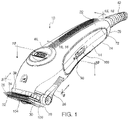
- FIG. 1 is a top perspective assembled view of the present hair clipper
- FIG. 2 is an exploded perspective view of the hair clipper of FIG. 1 ;
- FIG. 3 is an exploded perspective view of the chassis of the present hair clipper
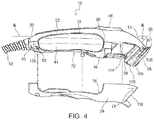
- FIG. 4 is a partially exploded side elevation of the present hair clipper
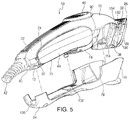
- FIG. 5 is rear partially exploded perspective of the hair clipper shown in FIG. 4 ;
- FIG. 6 is an enlarged, fragmentary top perspective view of the present hair clipper showing the bladeset
- FIG. 7 is a rear partially exploded perspective view of the present hair clipper showing detail of the side grip pads
- FIG. 8 is a cross-section taken along the lines 8 - 8 of FIG. 1 and in the direction generally indicated;
- FIG. 9 is an enlarged, fragmentary view of the hair clipper depicted in FIG. 8 ;
- FIG. 10 is a cross-section taken along the line 10 - 10 of FIG. 1 and in the direction indicated generally;
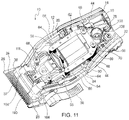
- FIG. 11 is an enlarged, fragmentary top view of the present hair clipper, with portions omitted for clarity;
- FIG. 12 is a fragmentary front perspective view of the present hair clipper, with portions omitted for clarity;
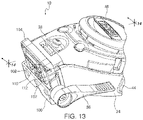
- FIG. 13 is an enlarged, top perspective view of the hair clipper of FIG. 12 ;
- FIG. 14 is a cross-section taken along the lines 14 - 14 of FIG. 13 in the direction generally indicated;
- FIG. 15 is a fragmentary vertical cross-section taken along the line 15 - 15 of FIG. 1 and in the direction generally indicated;
- FIG. 16 is a vertical cross-section taken along the line 16 - 16 of FIG. 1 and in the direction generally indicated;
- FIG. 17 is a partially exploded top perspective view of the hair clipper of FIG. 1 with portions omitted for clarity;
- FIG. 18 is an enlarged fragmentary top perspective view of the hair clipper of FIG. 1 with portions omitted for clarity;
- FIG. 19 is a top perspective view of the ornamental design element of the present hair clipper.
- FIG. 20 is an enlarged, top perspective view of the element of FIG. 19 ;
- FIG. 21 is an exploded top perspective view of the ornamental design element of FIG. 19 .
- the present hair clipper is generally designated 10 , and includes a chassis 12 having upper and lower chassis portions 14 , 16 defining an enclosed interior chamber 18 ( FIG. 3 ).
- the upper and lower chassis portions 14 , 16 are constructed and arranged for being fastened together, as with threaded fasteners or the like.
- “upper” and “lower” refer to the orientation of the hair clipper 10 as seen in the drawings, which is the same as the clipper would be as it rests on a substrate such as a table or stylist work station. Other orientations of the clipper 10 are contemplated during use.
- the chassis 12 Enclosing the chassis 12 is an outer housing 20 including upper and lower housing portions 22 , 24 constructed and arranged for enclosing the chassis 12 as the housing portions are secured together such that the interior chamber 18 is isolated from the housing.
- the chassis 12 is made of electrically insulative material such as injection molded plastic or the like
- the outer housing 20 is made of metal, preferably cast and polished aluminum or the like, or other metals or composite materials known in the art.
- the chassis 12 is provided with several features for accommodating variations in dimensions of the outer housing 20 caused by the casting and polishing process, so that the hair clipper 10 is easily assembled and the respective components are fully aligned for a quality appearance.
- the hair clipper 10 is also provided with a bladeset 26 including a stationary blade 28 and a laterally reciprocating moving blade 30 , each blade having a corresponding plurality of teeth 32 , 34 .
- a bladeset 26 including a stationary blade 28 and a laterally reciprocating moving blade 30 , each blade having a corresponding plurality of teeth 32 , 34 .
- Cutting action occurs as the moving blade 30 reciprocates relative to the stationary blade 28 .
- An adjustment lever 36 is connected to the chassis 12 and to the stationary blade 28 and is configured for moving the stationary blade relative to the moving blade 30 as is known in the art.
- the chassis 12 has a first or bladeset end 38 and a second, opposite or rear end 40 .
- a cord protector 42 is secured to the chassis 12 for protecting a power cord as is known in the art. It is contemplated that the present hair clipper 10 is powered by AC wall current, or by battery power, in which case the cord protector 42 is eliminated.
- a decorative piece or ornamental badge 46 is also included on the outer housing 20 , and preferably on the upper housing portion 22 .
- a motor recess 48 dimensioned for accommodating an electric motor 50 , preferably a vibrator motor of the type described in commonly-owned U.S. Pat. Nos. 5,787,587; 7,239,053; and 8,276,279, all of which are incorporated by reference and such motors are well known in the art.
- an electric motor 50 preferably a vibrator motor of the type described in commonly-owned U.S. Pat. Nos. 5,787,587; 7,239,053; and 8,276,279, all of which are incorporated by reference and such motors are well known in the art.
- other types of electric motors commonly used in hair clippers are contemplated.
- One of the features of the present clipper 10 is that the motor 50 is held in place in the interior chamber 18 of the chassis 12 so that operational noise and vibrations are reduced, and that the motor is installed with reduced labor compared to conventional hair clippers.
- the motor 50 is held in the motor recess 48 through tight cooperation of complementary formations 52 , 54 respectively
- the complementary formations 52 , 54 include crush ribs 56 integrally formed on the lower chassis portion 16 . More specifically, the crush ribs 56 include an inner wall 58 configured for tightly and slidingly engaging an outer surface 60 of laminations 62 of the motor 50 . Behind the inner wall 58 is defined a cavity 64 enclosed in part by an outer wall 66 of the chassis portion 16 . On the upper chassis portion 14 , the formations 52 take the form of depending wedges on the other of the chassis portions, the wedges being engaged in the cavities 64 in the crush ribs.
- the wedges 52 and the cavities 64 are constructed and arranged so that as the upper and lower chassis portions 14 , 16 are secured together around the motor 50 , the wedges 52 increase the holding force of the crush ribs 56 on the motor.
- the action of the complementary formations 52 , 54 is the main structure holding the motor 50 within the motor recess 48 .
- the hair clipper 10 is provided with threaded fasteners 68 used to secure the chassis portions 14 , 16 together. As seen in FIGS. 9 and 11 , the fasteners 68 are loosely accommodated within throughbores 70 in the motor 50 , and as such locate the motor within the motor recess. Referring now to FIGS.
- another feature of the present hair clipper 10 is the use of the resilient grips 44 to accommodate manufacturing variations of the upper and lower housing portions 22 , 24 so that the final assembly has an aesthetically pleasing appearance without unsightly gaps between components.
- the grips 44 are dimensioned with a slightly oversize peripheral edge 72 so that corresponding edges 74 , 76 of the upper and lower housing portions 22 , 24 exert a compressive force upon the grips 44 upon assembly.
- the grips 44 are relatively loosely connected to the chassis.
- the connection is achieved by a hook and loop connection system. While it is contemplated that either the grip 44 or the chassis 12 is provided with the hooks and the other component is provided with the loops, in the preferred embodiment, the grips 44 are provided with at least one and preferably a plurality of loops 78 projecting laterally or generally horizontally from an inner surface 80 of the peripheral edge 72 . Each of the loops 78 has a relatively large opening 81 .
- each loop 78 Engaging each loop 78 is a ramped hook 82 on the chassis 12 , each hook being loosely engaged in the opening 81 and being progressively taller towards a longitudinal axis of the chassis 12 .
- Surrounding each hook 82 is a generally planar landing 84 ( FIG. 3 ) preferably configured for complementarily receiving an exterior edge 86 of the loop 78 ( FIG. 7 ).
- each grip 44 has at least one and preferably a pair of the loops 78 projecting from an upper part of the edge 72 , and at least one and preferably a pair of the loops 78 projecting from a lower part of the edge 72 .
- the grips 44 are further secured to the chassis 12 through the use of at least one supplemental gripping formation 88 on at least one of a front end 90 and a rear end 92 of the grip, and the chassis 12 is configured with openings 94 for receiving each supplemental gripping formation in a snap-fit engagement.
- the supplemental gripping formations 88 are provided with barbed ends 96 ( FIG. 7 ).
- one of the grips 44 is provided with an opening 98 for accommodating an ON/OFF switch 100 .
- the chassis 12 has the first, bladeset or blade end 38 , and the second, rear end 40 , and the blade end includes an integral blade guide channel 102 .
- hair clippers are provided with a supplemental metal guide bracket for slidingly accommodating movement of the stationary blade 28 transverse to the lateral reciprocal cutting motion.
- the conventional bracket is replaced by the channel 102 , which is defined by an enlarged formation 104 oriented at an oblique angle a to the longitudinal axis “A” of the chassis ( FIG. 4 ). While other angles are contemplated, in the preferred embodiment, the angle a is 60°.
- the blade guide channel 102 slidingly receives a generally “U”-shaped bracket 106 secured to the stationary blade 28 and also receiving the adjustment lever 36 , which is threadably secured to the formation 104 .
- an eccentric cam (not shown) on the adjustment lever 36 , movement of the adjustment lever 36 causes sliding action of the bracket 106 and the blade 28 in the channel 102 .
- FIGS. 11-14 another function of the blade end formation 104 is that it defines a travel path 108 for a cam follower 110 used to transfer laterally reciprocating motion from the motor 50 to the moving blade 30 , using a drive arm 111 ( FIG. 11 ).
- the travel path 108 extends transversely to the longitudinal axis of the chassis 12 .
- the formation 104 defines a central opening 112 ( FIG. 12 ) that accommodates the reciprocal movement of the cam follower 110 .
- still another feature of the formation 104 is defining a housing receiving surface 114 oriented at an oblique angle, preferably angle a for slidably receiving an angled front edge 116 of one of the upper and lower housing portions 22 , 24 , preferably the lower housing portion 24 .
- the lower housing portion 24 is slidably engaged upon the lower chassis portion 16 so that the front edge 116 slidably and angularly engages the receiving surface 114 in the direction of the arrow “B” ( FIG. 6 ).
- a still further feature of the present hair clipper 10 is the ability for tightly accommodating the separate badge or decorative piece 46 , despite variations in manufacturing tolerances of the associated housing portion 22 , 24 .
- the decorative piece 46 is secured to the upper housing portion 22 , however, attachment to the lower housing portion 24 is contemplated, depending on the application.
- the decorative piece 46 is secured to the housing portion 22 , 24 without the use of threaded fasteners.
- the decorative piece 46 is provided with a plurality of hook projections 122 ( FIGS. 2, 16, 17 and 21 ) extending into an interior of the clipper 10 , which are snap-fit into a separate retainer 124 positioned on an underside 126 ( FIG. 2 ) of the housing portion 22 , 24 receiving the decorative piece.
- the housing portion 22 , 24 is preferably metal, such as aluminum or the like, and the decorative piece 46 and the retainer 124 are both preferably plastic, the decorative piece 46 is preferably coated with metal or foil as is known in the art.
- the decorative piece 46 and the retainer 124 are secured to each other with the respective housing portion 22 , 24 sandwiched therebetween.
- the retainer 124 is provided with a complementary plurality of retaining projections 128 , 130 constructed and arranged for engaging the hook projections 122 .
- the plurality of retainer projections includes a first plurality of planar projections 128 , and a second plurality of dog-legged projections 130 , the latter configured for exerting a preloaded clamping force on the hook projections 122 ( FIG. 20 ).
- the projections 130 exert a pulling or holding force against the decorative piece 46 which holds it in tight relationship with the housing portion 22 , 24 .
- the planar projections 128 are received in slots 132 in the decorative piece 46 .
- the chassis 12 is further provided with at least one projection recess 134 for accommodating the hook projections 122 and the retainer projections 128 , 130 for a more secure location of the housing portions 22 , 24 upon the chassis.
- the upper and lower housing portions 22 , 24 are provided with at least one mounting boss 136 configured for projecting through complementary throughbores 138 in the chassis 12 , so that fasteners passing through the bosses tightly retain the chassis between the upper and lower housing portions.
- At least one of the housing portions 22 , 24 includes at least one locating formation 140 projecting from an interior of the housing portion, and matingly engaging at least one complementary receiving formation 142 in the chassis. These formations 140 facilitate the location of the housing portions 22 , 24 upon the chassis 12 during assembly of the hair clipper 10 .
- cam follower 110 is slidably retained within the central opening 112 of the formation 104 for lateral reciprocal movement. Further, when the user opts to remove the bladeset 26 for maintenance, the engagement of the cam follower 110 in the formation 104 retains the cam follower in the operational position, so the user does not risk losing the component upon clipper disassembly.
- a transverse bar 146 slidingly engages and laterally reciprocates in the travel path 108 .
- Bifurcated or forked ends 148 of the transverse bar 146 exert a friction fit within with the travel path 108 , and help to retain the cam follower 110 in position.
- a recessed, generally U-shaped saddle 150 is defined behind the transverse bar 146 .
- a generally vertically-projecting tab 152 defines a rear end of the saddle 150 .
- the saddle 150 is dimensioned to slidingly engage an upper beam 154 of the formation 104 when the cam follower is operationally engaged on an end of the drive arm 111 .
- the tab 152 is received in an opening 156 in the beam 154 .
- a front face 158 of the cam follower includes a projection 160 that engages a slot (not shown) in the moving blade 30 .
- the user When periodic maintenance of the bladeset 26 is needed, the user easily detaches the blades 28 , 30 , leaving the U-shaped slide bracket 106 in place.
- the cam follower 110 is held in place in the opening 112 through the engagement of the saddle 150 on the upper beam 154 , and the presence of the bracket 106 .
- a method for assembling the hair clipper 10 includes providing the chassis 12 having upper and lower chassis portions 14 , 16 defining an enclosed interior chamber 18 , the upper and lower chassis portions configured for being secured together; providing the outer housing 20 including upper and lower housing portions 22 , 24 constructed and arranged for enclosing the chassis as the housing portions are secured together such that the interior chamber is isolated from the housing; providing the chassis 12 with the first, blade end 38 , and the second, rear end 40 , and the blade end includes an integral blade guide channel 102 .
- the blade guide channel 102 is incorporated into a formation 104 that defines a housing receiving surface 114 oriented at an oblique angle a to an axis defined by the chassis, and the lower housing portion has the angled front edge 116 that is slidably engaged along the housing receiving surface.
- the upper and lower housing portions 22 , 24 are secured together so as to enclose the chassis 12 .
Landscapes
- Life Sciences & Earth Sciences (AREA)
- Forests & Forestry (AREA)
- Engineering & Computer Science (AREA)
- Mechanical Engineering (AREA)
- Dry Shavers And Clippers (AREA)
- Cleaning And Drying Hair (AREA)
Abstract
Description
- The present invention relates to electric hair cutting devices, commonly known as hair clippers or hair trimmers, and more specifically relates to a multi-component hair clipper construction featuring metal outer housing pieces.
- Conventional electrically-powered hair clippers and trimmers, collectively referred to here as hair clippers, feature an inner chassis to which a motor, electronic controls, batteries or AC power cords and bladeset power transmission linkage are mounted. This structure is then covered by an outer housing, typically upper and lower clamshell-like portions which are held to the chassis by threaded fasteners. In most cases, the outer housing is made of molded plastic pieces.
- An ongoing performance objective of hair clipper designers is the reduction of motor and bladeset vibration and noise. Another objective is the reduction in parts for production and assembly cost savings.
- A more recent interest to designers is the ability to replace traditional plastic housings with metal housings. A challenge here is that metal housings are less forgiving of variations in tolerances compared to plastic parts. As such, achieving a high quality, aesthetically pleasing, close fit of components which are assembled in a factory setting is a significant challenge for clipper designers. In addition, modern hair clippers often feature housings with separate ornamental pieces made of metal, plastic or plastic with metal or foil plating that are preferably closely fit to the housing. The resulting challenge for hair clipper designers is the balancing of many, often opposing design considerations, accommodating multiple pieces having varying tolerances for achieving an aesthetically appealing appearance, and also securing operating components in a way to reduce vibration and noise.
- Accordingly, there is a need for an improved hair clipper construction that addresses the above-listed design criteria.
- The above-listed need is met or exceeded by the present multi-piece hair clipper construction, which includes a core chassis having upper and lower portions configured for encasing the motor and electronic control components and a portion of the bladeset power transmission assembly. Further, since the chassis is preferably made of plastic, the internal clipper components (motor, switch, circuitry, power cords, etc.) are protected from electrical interference with the preferably metal housing portions, including upper and lower portions, which enclose the chassis. In the preferred embodiment, the housing is made of cast, polished aluminum, however other metals are contemplated, as well as plastics or selected engineered materials incorporating blends of known materials. By employing the present clipper construction, the relatively high voltage of 120-230V of the preferred clipper motor is electrically isolated from the metal housing.
- Included in the lower chassis portion is a motor recess constructed and arranged for accommodating the electric motor, which is preferably a vibrator type, however other motors known in the hair clipper art are considered suitable. Also included in the lower chassis are integral crush ribs that hold the motor in place in a friction fit, which tightens as the chassis is assembled. Depending wedges on the upper chassis portion are engaged in cavities in the crush ribs to further tighten the motor in place as the chassis portions are secured together. Threaded fasteners capture the motor between the upper and lower chassis portions, without tightly restraining the motor. That function is performed by the crush ribs, which are wedged further against the motor as the upper chassis is tightened into place. Since the motor is securely held within the upper and lower chassis portions, the present assembly has been found to reduce motor operational noise and vibration compared to conventional clipper assembly technology. As such, in the present clipper, the motor is electrically isolated from the metal clipper housing.
- Also included on the lower chassis is an integral blade guide channel that replaces a separate metal bracket found on conventional hair clippers. The blade guide channel is defined by a formation at a blade end of the chassis that also defines a travel path for a cam follower. As is known in the art, the cam follower travels transversely to a longitudinal axis of the clipper, and parallel to movement of a moving blade of the bladeset. A third function of the blade guide channel is defining an angular seat for a forward edge of the lower clipper housing, which, as described above is preferably made of metal.
- In addition, relatively soft, rubber-like grips provided for user comfort are attached to the chassis on sides of the clipper. These grips create compression zones for accommodating variations in the metal housing tolerances so that the housing and grips are secured together without unsightly gaps or misalignments. In other words, the grips are dimensioned to be slightly oversize, and are configured to compress without bulging as the upper and lower housing portions are fastened to the chassis. In the preferred embodiment, each grip is loosely clipped along upper and lower edges to the assembled chassis using a hook and loop system. In a preferred embodiment, the hook and loop connection system includes at least one ramped hook on the chassis, and at least one complementary loop on the grip, each hook being surrounding by a landing receiving the hook. Also, in an embodiment, the grip has at least one loop projecting from an upper edge, and at least one loop projecting from a lower edge. Further, each grip includes at least one supplemental gripping formation on at least one of a front end and a rear end, and the chassis is configured for receiving each supplemental gripping formation in a snap-fit engagement.
- By loosely holding the grips to the chassis, the grips can move or “float” to accommodate variations in the rigid metal housing portions. The grip material compresses as needed as the upper and lower housing portions are secured to each other with the chassis captured between them.
- Yet another feature of the present clipper is a fastening system for retaining ornamental badges or decorative pieces to a metal clipper housing so that a tight, aligned fit is achieved without the use of threaded fasteners. Achieving such a fit is challenging, given the variability of dimensions of cast and polished metal housing portions. The decorative piece is provided with at least one and preferably a plurality of cantilevered hook projections that extend into an interior of the clipper. A retainer is placed on an underside of the housing configured with a plurality of complementary projections that engage the hook projections of the decorative piece in a snap-fit relationship. In a preferred embodiment, the retainer includes two types of projections, a first plurality of planar projections, and a second plurality of doglegged projections, the latter of which are configured for exerting a preloaded clamping force on the projections of the decorative piece.
- In an embodiment, the chassis includes a projection recess for accommodating the hook and said retainer projections. Also, the upper and lower housing portions are provided with mounting bosses configured for projecting through complementary throughbores in the chassis, so that fasteners passing through the bosses tightly retain the chassis between the upper and lower housing portions. Also, at least one of the housing portions includes at least one locating formation projecting from an interior of the housing portion, and matingly engaging a complementary at least one receiving formation in the chassis.
- More specifically, a hair clipper is provided, including a chassis having upper and lower chassis portions defining an enclosed interior chamber, the upper and lower chassis portions configured for being secured together; and an outer housing including upper and lower housing portions constructed and arranged for enclosing the chassis as the housing portions are secured together such that the interior chamber is isolated from the housing.
- In another embodiment, a hair clipper is provided, including a chassis having upper and lower chassis portions defining an enclosed interior chamber, the upper and lower chassis portions configured for being secured together. An outer housing includes upper and lower housing portions constructed and arranged for enclosing the chassis as the housing portions are secured together such that the interior chamber is isolated from the housing. The interior chamber includes a motor recess, and a motor held in the motor recess through tight cooperation of complementary formations on the upper and lower chassis portions; and resilient grip formations loosely connected to the chassis, and constructed and arranged to be compressed upon assembly of the upper and lower housing portions.
- In still another embodiment, a method for assembling a hair clipper includes providing a chassis having upper and lower chassis portions defining an enclosed interior chamber, said upper and lower chassis portions configured for being secured together; providing an outer housing including upper and lower housing portions constructed and arranged for enclosing the chassis as the housing portions are secured together such that the interior chamber is isolated from the housing; providing the chassis with a first, blade end, and a second, rear end, and the blade end includes an integral blade guide channel The blade guide channel is incorporated into a formation that defines a housing receiving surface oriented at an oblique angle to an axis defined by the chassis, and the lower housing portion has an angled front edge that is slidably engaged along the housing receiving surface.
-
FIG. 1 is a top perspective assembled view of the present hair clipper; -
FIG. 2 is an exploded perspective view of the hair clipper ofFIG. 1 ; -
FIG. 3 is an exploded perspective view of the chassis of the present hair clipper; -
FIG. 4 is a partially exploded side elevation of the present hair clipper; -
FIG. 5 is rear partially exploded perspective of the hair clipper shown inFIG. 4 ; -
FIG. 6 is an enlarged, fragmentary top perspective view of the present hair clipper showing the bladeset; -
FIG. 7 is a rear partially exploded perspective view of the present hair clipper showing detail of the side grip pads; -
FIG. 8 is a cross-section taken along the lines 8-8 ofFIG. 1 and in the direction generally indicated; -
FIG. 9 is an enlarged, fragmentary view of the hair clipper depicted inFIG. 8 ; -
FIG. 10 is a cross-section taken along the line 10-10 ofFIG. 1 and in the direction indicated generally; -
FIG. 11 is an enlarged, fragmentary top view of the present hair clipper, with portions omitted for clarity; -
FIG. 12 is a fragmentary front perspective view of the present hair clipper, with portions omitted for clarity; -
FIG. 13 is an enlarged, top perspective view of the hair clipper ofFIG. 12 ; -
FIG. 14 is a cross-section taken along the lines 14-14 ofFIG. 13 in the direction generally indicated; -
FIG. 15 is a fragmentary vertical cross-section taken along the line 15-15 ofFIG. 1 and in the direction generally indicated; -
FIG. 16 is a vertical cross-section taken along the line 16-16 ofFIG. 1 and in the direction generally indicated; -
FIG. 17 is a partially exploded top perspective view of the hair clipper ofFIG. 1 with portions omitted for clarity; -
FIG. 18 is an enlarged fragmentary top perspective view of the hair clipper ofFIG. 1 with portions omitted for clarity; -
FIG. 19 is a top perspective view of the ornamental design element of the present hair clipper; -
FIG. 20 is an enlarged, top perspective view of the element ofFIG. 19 ; and -
FIG. 21 is an exploded top perspective view of the ornamental design element ofFIG. 19 . - Referring now to
FIGS. 1-3 , the present hair clipper is generally designated 10, and includes achassis 12 having upper andlower chassis portions FIG. 3 ). The upper andlower chassis portions hair clipper 10 as seen in the drawings, which is the same as the clipper would be as it rests on a substrate such as a table or stylist work station. Other orientations of theclipper 10 are contemplated during use. - Enclosing the
chassis 12 is anouter housing 20 including upper andlower housing portions chassis 12 as the housing portions are secured together such that theinterior chamber 18 is isolated from the housing. In the preferred embodiment, thechassis 12 is made of electrically insulative material such as injection molded plastic or the like, and theouter housing 20 is made of metal, preferably cast and polished aluminum or the like, or other metals or composite materials known in the art. As described in greater detail below, thechassis 12 is provided with several features for accommodating variations in dimensions of theouter housing 20 caused by the casting and polishing process, so that thehair clipper 10 is easily assembled and the respective components are fully aligned for a quality appearance. - As known in the art, the
hair clipper 10 is also provided with abladeset 26 including astationary blade 28 and a laterally reciprocating movingblade 30, each blade having a corresponding plurality ofteeth blade 30 reciprocates relative to thestationary blade 28. Anadjustment lever 36 is connected to thechassis 12 and to thestationary blade 28 and is configured for moving the stationary blade relative to the movingblade 30 as is known in the art. - The
chassis 12 has a first orbladeset end 38 and a second, opposite orrear end 40. At therear end 40, acord protector 42 is secured to thechassis 12 for protecting a power cord as is known in the art. It is contemplated that thepresent hair clipper 10 is powered by AC wall current, or by battery power, in which case thecord protector 42 is eliminated. - Between the upper and
lower housing portions like grips 44 described in greater detail below. Also included on theouter housing 20, and preferably on theupper housing portion 22 is a decorative piece orornamental badge 46, also described in greater detail below. - Referring now to
FIGS. 3 and 8-11 , within theinterior chamber 18 of thechassis 12 is amotor recess 48 dimensioned for accommodating anelectric motor 50, preferably a vibrator motor of the type described in commonly-owned U.S. Pat. Nos. 5,787,587; 7,239,053; and 8,276,279, all of which are incorporated by reference and such motors are well known in the art. However, other types of electric motors commonly used in hair clippers are contemplated. One of the features of thepresent clipper 10 is that themotor 50 is held in place in theinterior chamber 18 of thechassis 12 so that operational noise and vibrations are reduced, and that the motor is installed with reduced labor compared to conventional hair clippers. To this end, themotor 50 is held in themotor recess 48 through tight cooperation ofcomplementary formations lower chassis portions - In an embodiment, the
complementary formations 52, 54 (FIGS. 3, 8 and 10 ) includecrush ribs 56 integrally formed on thelower chassis portion 16. More specifically, thecrush ribs 56 include aninner wall 58 configured for tightly and slidingly engaging anouter surface 60 oflaminations 62 of themotor 50. Behind theinner wall 58 is defined acavity 64 enclosed in part by anouter wall 66 of thechassis portion 16. On theupper chassis portion 14, theformations 52 take the form of depending wedges on the other of the chassis portions, the wedges being engaged in thecavities 64 in the crush ribs. Thewedges 52 and thecavities 64 are constructed and arranged so that as the upper andlower chassis portions motor 50, thewedges 52 increase the holding force of thecrush ribs 56 on the motor. The action of thecomplementary formations motor 50 within themotor recess 48. In addition, thehair clipper 10 is provided with threadedfasteners 68 used to secure thechassis portions FIGS. 9 and 11 , thefasteners 68 are loosely accommodated withinthroughbores 70 in themotor 50, and as such locate the motor within the motor recess. Referring now toFIGS. 2, 4, 5, 7 and 18 , another feature of thepresent hair clipper 10 is the use of theresilient grips 44 to accommodate manufacturing variations of the upper andlower housing portions grips 44 are dimensioned with a slightly oversizeperipheral edge 72 so that corresponding edges 74, 76 of the upper andlower housing portions grips 44 upon assembly. - For enhancing the ability of the
grips 44 to accommodate the above-described manufacturing variations, it is preferred that the grips are relatively loosely connected to the chassis. In the preferred embodiment, the connection is achieved by a hook and loop connection system. While it is contemplated that either thegrip 44 or thechassis 12 is provided with the hooks and the other component is provided with the loops, in the preferred embodiment, thegrips 44 are provided with at least one and preferably a plurality ofloops 78 projecting laterally or generally horizontally from aninner surface 80 of theperipheral edge 72. Each of theloops 78 has a relativelylarge opening 81. Engaging eachloop 78 is a rampedhook 82 on thechassis 12, each hook being loosely engaged in theopening 81 and being progressively taller towards a longitudinal axis of thechassis 12. Surrounding eachhook 82 is a generally planar landing 84 (FIG. 3 ) preferably configured for complementarily receiving anexterior edge 86 of the loop 78 (FIG. 7 ). In the preferred embodiment, eachgrip 44 has at least one and preferably a pair of theloops 78 projecting from an upper part of theedge 72, and at least one and preferably a pair of theloops 78 projecting from a lower part of theedge 72. - Referring now to
FIGS. 2, 7 and 8 , thegrips 44 are further secured to thechassis 12 through the use of at least one supplemental grippingformation 88 on at least one of afront end 90 and arear end 92 of the grip, and thechassis 12 is configured withopenings 94 for receiving each supplemental gripping formation in a snap-fit engagement. In the preferred embodiment, the supplementalgripping formations 88 are provided with barbed ends 96 (FIG. 7 ). As seen inFIG. 7 , in the preferred embodiment, one of thegrips 44 is provided with anopening 98 for accommodating an ON/OFF switch 100. - Referring now to
FIGS. 1-6 and 11-14 , another feature of thepresent hair clipper 10 is that thechassis 12 has the first, bladeset orblade end 38, and the second,rear end 40, and the blade end includes an integralblade guide channel 102. As is well known in the art, hair clippers are provided with a supplemental metal guide bracket for slidingly accommodating movement of thestationary blade 28 transverse to the lateral reciprocal cutting motion. In thepresent clipper 10, the conventional bracket is replaced by thechannel 102, which is defined by anenlarged formation 104 oriented at an oblique angle a to the longitudinal axis “A” of the chassis (FIG. 4 ). While other angles are contemplated, in the preferred embodiment, the angle a is 60°. - As seen in
FIGS. 1, 5 and 6 , theblade guide channel 102 slidingly receives a generally “U”-shapedbracket 106 secured to thestationary blade 28 and also receiving theadjustment lever 36, which is threadably secured to theformation 104. Through an eccentric cam (not shown) on theadjustment lever 36, movement of theadjustment lever 36 causes sliding action of thebracket 106 and theblade 28 in thechannel 102. Referring now toFIGS. 11-14 , another function of theblade end formation 104 is that it defines atravel path 108 for acam follower 110 used to transfer laterally reciprocating motion from themotor 50 to the movingblade 30, using a drive arm 111 (FIG. 11 ). Thetravel path 108 extends transversely to the longitudinal axis of thechassis 12. Further, theformation 104 defines a central opening 112 (FIG. 12 ) that accommodates the reciprocal movement of thecam follower 110. - Referring now to
FIGS. 4-6 , still another feature of theformation 104 is defining ahousing receiving surface 114 oriented at an oblique angle, preferably angle a for slidably receiving an angledfront edge 116 of one of the upper andlower housing portions lower housing portion 24. During assembly of thehair clipper 10, once thechassis 12 is fastened together, thelower housing portion 24 is slidably engaged upon thelower chassis portion 16 so that thefront edge 116 slidably and angularly engages the receivingsurface 114 in the direction of the arrow “B” (FIG. 6 ). - Referring now to
FIGS. 16-21 , a still further feature of thepresent hair clipper 10 is the ability for tightly accommodating the separate badge ordecorative piece 46, despite variations in manufacturing tolerances of the associatedhousing portion decorative piece 46 is secured to theupper housing portion 22, however, attachment to thelower housing portion 24 is contemplated, depending on the application. Advantageously, thedecorative piece 46 is secured to thehousing portion - More specifically, the
decorative piece 46 is provided with a plurality of hook projections 122 (FIGS. 2, 16, 17 and 21 ) extending into an interior of theclipper 10, which are snap-fit into aseparate retainer 124 positioned on an underside 126 (FIG. 2 ) of thehousing portion housing portion decorative piece 46 and theretainer 124 are both preferably plastic, thedecorative piece 46 is preferably coated with metal or foil as is known in the art. - During assembly, the
decorative piece 46 and theretainer 124 are secured to each other with therespective housing portion retainer 124 is provided with a complementary plurality of retainingprojections hook projections 122. The plurality of retainer projections includes a first plurality ofplanar projections 128, and a second plurality of dog-legged projections 130, the latter configured for exerting a preloaded clamping force on the hook projections 122 (FIG. 20 ). Thus, theprojections 130 exert a pulling or holding force against thedecorative piece 46 which holds it in tight relationship with thehousing portion planar projections 128 are received inslots 132 in thedecorative piece 46. - Referring now to
FIGS. 8, 16 and 17 , thechassis 12 is further provided with at least oneprojection recess 134 for accommodating thehook projections 122 and theretainer projections housing portions lower housing portions boss 136 configured for projecting throughcomplementary throughbores 138 in thechassis 12, so that fasteners passing through the bosses tightly retain the chassis between the upper and lower housing portions. - Referring now to
FIG. 16 , at least one of thehousing portions formation 140 projecting from an interior of the housing portion, and matingly engaging at least onecomplementary receiving formation 142 in the chassis. Theseformations 140 facilitate the location of thehousing portions chassis 12 during assembly of thehair clipper 10. - Referring now to
FIGS. 13 and 14 , another feature of thepresent hair clipper 10 is that thecam follower 110 is slidably retained within thecentral opening 112 of theformation 104 for lateral reciprocal movement. Further, when the user opts to remove thebladeset 26 for maintenance, the engagement of thecam follower 110 in theformation 104 retains the cam follower in the operational position, so the user does not risk losing the component upon clipper disassembly. - More specifically, at an upper end 144 of the
cam follower 110, a transverse bar 146 slidingly engages and laterally reciprocates in thetravel path 108. Bifurcated or forked ends 148 of the transverse bar 146 exert a friction fit within with thetravel path 108, and help to retain thecam follower 110 in position. Moving towards therear end 40, a recessed, generally U-shaped saddle 150 is defined behind the transverse bar 146. A generally vertically-projecting tab 152 defines a rear end of the saddle 150. - The saddle 150 is dimensioned to slidingly engage an upper beam 154 of the
formation 104 when the cam follower is operationally engaged on an end of thedrive arm 111. The tab 152 is received in an opening 156 in the beam 154. In addition, a front face 158 of the cam follower includes a projection 160 that engages a slot (not shown) in the movingblade 30. During operation of thehair clipper 10, the pivotingdrive arm 111 causes lateral reciprocation of thecam follower 110, which through the engagement of the projection 160, causes lateral reciprocation of the movingblade 30 relative to thestationary blade 28, causing cutting action. - When periodic maintenance of the
bladeset 26 is needed, the user easily detaches theblades U-shaped slide bracket 106 in place. Thecam follower 110 is held in place in theopening 112 through the engagement of the saddle 150 on the upper beam 154, and the presence of thebracket 106. - A method for assembling the
hair clipper 10 includes providing thechassis 12 having upper andlower chassis portions interior chamber 18, the upper and lower chassis portions configured for being secured together; providing theouter housing 20 including upper andlower housing portions chassis 12 with the first,blade end 38, and the second,rear end 40, and the blade end includes an integralblade guide channel 102. Theblade guide channel 102 is incorporated into aformation 104 that defines ahousing receiving surface 114 oriented at an oblique angle a to an axis defined by the chassis, and the lower housing portion has the angledfront edge 116 that is slidably engaged along the housing receiving surface. The upper andlower housing portions chassis 12. - While a particular embodiment of the present multi-piece hair clipper construction with metal housing has been described herein, it will be appreciated by those skilled in the art that changes and modifications may be made thereto without departing from the invention in its broader aspects and as set forth in the following claims.
Claims (29)
Priority Applications (5)
| Application Number | Priority Date | Filing Date | Title |
|---|---|---|---|
| US17/122,741 US11731295B2 (en) | 2020-12-15 | 2020-12-15 | Multi-piece hair clipper construction with metal outer housing |
| MX2023004792A MX2023004792A (en) | 2020-12-15 | 2021-12-08 | CONSTRUCTION OF MULTI-PIECE HAIR CLIPPER WITH METAL OUTER HOUSING. |
| CA3196011A CA3196011A1 (en) | 2020-12-15 | 2021-12-08 | Multi-piece hair clipper construction with metal outer housing |
| CN202180084962.8A CN116600957B (en) | 2020-12-15 | 2021-12-08 | Multi-piece hair clipper structure with metal outer shell |
| PCT/US2021/072806 WO2022133399A1 (en) | 2020-12-15 | 2021-12-08 | Multi-piece hair clipper construction with metal outer housing |
Applications Claiming Priority (1)
| Application Number | Priority Date | Filing Date | Title |
|---|---|---|---|
| US17/122,741 US11731295B2 (en) | 2020-12-15 | 2020-12-15 | Multi-piece hair clipper construction with metal outer housing |
Publications (2)
| Publication Number | Publication Date |
|---|---|
| US20220184827A1 true US20220184827A1 (en) | 2022-06-16 |
| US11731295B2 US11731295B2 (en) | 2023-08-22 |
Family
ID=81943115
Family Applications (1)
| Application Number | Title | Priority Date | Filing Date |
|---|---|---|---|
| US17/122,741 Active 2041-08-25 US11731295B2 (en) | 2020-12-15 | 2020-12-15 | Multi-piece hair clipper construction with metal outer housing |
Country Status (5)
| Country | Link |
|---|---|
| US (1) | US11731295B2 (en) |
| CN (1) | CN116600957B (en) |
| CA (1) | CA3196011A1 (en) |
| MX (1) | MX2023004792A (en) |
| WO (1) | WO2022133399A1 (en) |
Cited By (11)
| Publication number | Priority date | Publication date | Assignee | Title |
|---|---|---|---|---|
| USD980530S1 (en) * | 2021-06-04 | 2023-03-07 | Conair Llc | Hair clipper |
| USD981042S1 (en) * | 2021-12-09 | 2023-03-14 | Sifang Lai | Hair clipper |
| US11731295B2 (en) * | 2020-12-15 | 2023-08-22 | Wahl Clipper Corporation | Multi-piece hair clipper construction with metal outer housing |
| USD1005590S1 (en) * | 2023-04-19 | 2023-11-21 | Hanjie Zhang | Electric clipper |
| USD1007055S1 (en) * | 2023-04-19 | 2023-12-05 | Nature Lab Corporation | Electric hair clipper |
| USD1017903S1 (en) * | 2023-04-24 | 2024-03-12 | Hanjie Zhang | Electric clipper |
| USD1018989S1 (en) * | 2023-04-19 | 2024-03-19 | Hanjie Zhang | Electric clipper |
| USD1028361S1 (en) * | 2023-04-24 | 2024-05-21 | Hanjie Zhang | Electric clipper |
| US12296496B2 (en) * | 2022-05-19 | 2025-05-13 | Braun Gmbh | Method of manufacturing a hair cutter |
| USD1106582S1 (en) * | 2023-11-07 | 2025-12-16 | Wenzhou Ante Electrical Appliance Co., Ltd. | Hair clipper |
| USD1124511S1 (en) * | 2024-02-01 | 2026-04-28 | Wahl Clipper Corporation | Hair clipper |
Families Citing this family (2)
| Publication number | Priority date | Publication date | Assignee | Title |
|---|---|---|---|---|
| USD1006326S1 (en) | 2021-03-26 | 2023-11-28 | Manscaped, Llc | Body of an electric groomer |
| USD1041756S1 (en) * | 2024-02-09 | 2024-09-10 | Eldad Tehrani | Hair clipper |
Citations (9)
| Publication number | Priority date | Publication date | Assignee | Title |
|---|---|---|---|---|
| US3520059A (en) * | 1967-10-05 | 1970-07-14 | Allway Tools | Knife handle for adjustable blade |
| US4660283A (en) * | 1985-09-20 | 1987-04-28 | Matsushita Electric Works, Ltd. | Dynamically balanced apparatus having reciprocating member |
| US5189792A (en) * | 1990-12-20 | 1993-03-02 | Matsushita Electric Works, Ltd. | Reciprocatory electric shaver |
| US5193275A (en) * | 1990-08-28 | 1993-03-16 | Matsushita Electric Works, Ltd. | Flat-shaped dry shaver |
| US5237750A (en) * | 1991-05-28 | 1993-08-24 | Matsushita Electric Works, Ltd. | Hair clipper |
| US6112414A (en) * | 1997-09-10 | 2000-09-05 | Andis Company | Rechargeable hair clipper assembly |
| US20070107230A1 (en) * | 2003-11-25 | 2007-05-17 | Koninklijke Philips Electronics, N.V. | Shaving apparatus and method of manufacturing such apparatus |
| US20080282550A1 (en) * | 2008-06-30 | 2008-11-20 | Andis Company | Blade assembly |
| US20220234227A1 (en) * | 2021-01-26 | 2022-07-28 | Shenzhen Dogcare Innovation & Technology Co., Ltd. | Hair Clipper |
Family Cites Families (17)
| Publication number | Priority date | Publication date | Assignee | Title |
|---|---|---|---|---|
| US3783508A (en) | 1970-08-14 | 1974-01-08 | Gillette Co | Electric shavers |
| US5786061A (en) | 1991-05-03 | 1998-07-28 | Velcro Industries B.V. | Separable fastener having a perimeter cover gasket |
| US5787587A (en) | 1996-04-19 | 1998-08-04 | Wahl Clipper Corp. | Vibrator motor |
| CN2357893Y (en) * | 1999-01-21 | 2000-01-12 | 余荣恺 | electric hair clipper |
| US20020170180A1 (en) | 2001-05-15 | 2002-11-21 | Wahl Clipper Corp. | Vibrator motor |
| JP4573257B2 (en) * | 2004-01-19 | 2010-11-04 | 九州日立マクセル株式会社 | Electric razor |
| US7346990B2 (en) * | 2004-08-30 | 2008-03-25 | Wahl Clipper Corporation | Rotary motor clipper with linear drive system |
| US7520693B2 (en) | 2007-02-15 | 2009-04-21 | Denso International America, Inc. | Screw boss with snap fitting |
| US7749383B2 (en) | 2007-09-06 | 2010-07-06 | Cummins Filtration Ip, Inc. | Filter cartridge with crush ribs |
| US8276279B2 (en) | 2010-08-09 | 2012-10-02 | Wahl Clipper Corporation | Hair clipper with a vibrator motor |
| US9561596B2 (en) | 2011-09-19 | 2017-02-07 | Wahl Clipper Corporation | Multi-part hair clipper housing lid |
| US9038276B2 (en) * | 2013-03-15 | 2015-05-26 | Wahl Clipper Corporation | Hair clipper with a rotary motor vibration and noise damper |
| EP3445548B1 (en) | 2016-04-22 | 2021-12-22 | Andis Company | Insulative liner for a hair clipper |
| CN109676646A (en) * | 2019-01-31 | 2019-04-26 | 陈小妹 | A kind of hair clipper |
| CN209737660U (en) * | 2019-03-28 | 2019-12-06 | 宁波嘉美电器有限公司 | Hair clipper with light filling function |
| CN211709383U (en) * | 2020-03-10 | 2020-10-20 | 宁波邦首电器有限公司 | Waterproof electric hair clipper with magnetic switch |
| US11731295B2 (en) * | 2020-12-15 | 2023-08-22 | Wahl Clipper Corporation | Multi-piece hair clipper construction with metal outer housing |
-
2020
- 2020-12-15 US US17/122,741 patent/US11731295B2/en active Active
-
2021
- 2021-12-08 CN CN202180084962.8A patent/CN116600957B/en active Active
- 2021-12-08 CA CA3196011A patent/CA3196011A1/en active Pending
- 2021-12-08 MX MX2023004792A patent/MX2023004792A/en unknown
- 2021-12-08 WO PCT/US2021/072806 patent/WO2022133399A1/en not_active Ceased
Patent Citations (9)
| Publication number | Priority date | Publication date | Assignee | Title |
|---|---|---|---|---|
| US3520059A (en) * | 1967-10-05 | 1970-07-14 | Allway Tools | Knife handle for adjustable blade |
| US4660283A (en) * | 1985-09-20 | 1987-04-28 | Matsushita Electric Works, Ltd. | Dynamically balanced apparatus having reciprocating member |
| US5193275A (en) * | 1990-08-28 | 1993-03-16 | Matsushita Electric Works, Ltd. | Flat-shaped dry shaver |
| US5189792A (en) * | 1990-12-20 | 1993-03-02 | Matsushita Electric Works, Ltd. | Reciprocatory electric shaver |
| US5237750A (en) * | 1991-05-28 | 1993-08-24 | Matsushita Electric Works, Ltd. | Hair clipper |
| US6112414A (en) * | 1997-09-10 | 2000-09-05 | Andis Company | Rechargeable hair clipper assembly |
| US20070107230A1 (en) * | 2003-11-25 | 2007-05-17 | Koninklijke Philips Electronics, N.V. | Shaving apparatus and method of manufacturing such apparatus |
| US20080282550A1 (en) * | 2008-06-30 | 2008-11-20 | Andis Company | Blade assembly |
| US20220234227A1 (en) * | 2021-01-26 | 2022-07-28 | Shenzhen Dogcare Innovation & Technology Co., Ltd. | Hair Clipper |
Cited By (11)
| Publication number | Priority date | Publication date | Assignee | Title |
|---|---|---|---|---|
| US11731295B2 (en) * | 2020-12-15 | 2023-08-22 | Wahl Clipper Corporation | Multi-piece hair clipper construction with metal outer housing |
| USD980530S1 (en) * | 2021-06-04 | 2023-03-07 | Conair Llc | Hair clipper |
| USD981042S1 (en) * | 2021-12-09 | 2023-03-14 | Sifang Lai | Hair clipper |
| US12296496B2 (en) * | 2022-05-19 | 2025-05-13 | Braun Gmbh | Method of manufacturing a hair cutter |
| USD1005590S1 (en) * | 2023-04-19 | 2023-11-21 | Hanjie Zhang | Electric clipper |
| USD1007055S1 (en) * | 2023-04-19 | 2023-12-05 | Nature Lab Corporation | Electric hair clipper |
| USD1018989S1 (en) * | 2023-04-19 | 2024-03-19 | Hanjie Zhang | Electric clipper |
| USD1017903S1 (en) * | 2023-04-24 | 2024-03-12 | Hanjie Zhang | Electric clipper |
| USD1028361S1 (en) * | 2023-04-24 | 2024-05-21 | Hanjie Zhang | Electric clipper |
| USD1106582S1 (en) * | 2023-11-07 | 2025-12-16 | Wenzhou Ante Electrical Appliance Co., Ltd. | Hair clipper |
| USD1124511S1 (en) * | 2024-02-01 | 2026-04-28 | Wahl Clipper Corporation | Hair clipper |
Also Published As
| Publication number | Publication date |
|---|---|
| CN116600957A (en) | 2023-08-15 |
| CN116600957B (en) | 2026-03-27 |
| CA3196011A1 (en) | 2022-06-23 |
| WO2022133399A1 (en) | 2022-06-23 |
| US11731295B2 (en) | 2023-08-22 |
| MX2023004792A (en) | 2023-05-09 |
Similar Documents
| Publication | Publication Date | Title |
|---|---|---|
| US11731295B2 (en) | Multi-piece hair clipper construction with metal outer housing | |
| CN109922934B (en) | Drive element for a hair cutting device | |
| RU2654396C2 (en) | Hair cutting appliance, receptacle and connector plug | |
| US9038276B2 (en) | Hair clipper with a rotary motor vibration and noise damper | |
| US20190255718A1 (en) | Blade Assembly Having Entrapped Spring | |
| US20140352159A1 (en) | Linear drive system for hair clippers | |
| US12263607B2 (en) | Blade pad assembly for hair cutting apparatus | |
| CN101301749B (en) | Manually Controlled Work Implements | |
| JPH04117986A (en) | Electric hair clippers | |
| US20210237290A1 (en) | Blade Assembly Having Entrapped Spring | |
| US20240109210A1 (en) | Adjustable Blade Assembly Having Magnetic Tensioning | |
| JP2010532221A (en) | Grooming tools | |
| US20040010922A1 (en) | Hair clipper and seal | |
| US9144913B2 (en) | Hair clipper blade gapping tool | |
| US8136249B2 (en) | Locking device | |
| US4979303A (en) | Self hair cutting device | |
| CN118661561A (en) | Knife assembly for gardening appliance | |
| US20260115949A1 (en) | Hair cutting device with integral motor vibration damping | |
| US20250282071A1 (en) | Outliner hair trimmer with enhanced water resistant seals | |
| JP2788169B2 (en) | Electric razor | |
| JPH0121655Y2 (en) | ||
| JP2004147922A (en) | Electric razor | |
| JPS60165982A (en) | Electric razor | |
| JPS58209380A (en) | Reciprocal type electric shaver | |
| JP2019166582A (en) | Cutter fitting device and power tool having this cutter fitting device |
Legal Events
| Date | Code | Title | Description |
|---|---|---|---|
| AS | Assignment |
Owner name: WAHL CLIPPER CORPORATION, ILLINOIS Free format text: ASSIGNMENT OF ASSIGNORS INTEREST;ASSIGNORS:ARNDT, STEVEN WAYNE;CRAIG, NATHANIEL DOUGLAS;SAATHOFF, DANIEL MICHAEL;REEL/FRAME:054656/0257 Effective date: 20201215 |
|
| FEPP | Fee payment procedure |
Free format text: ENTITY STATUS SET TO UNDISCOUNTED (ORIGINAL EVENT CODE: BIG.); ENTITY STATUS OF PATENT OWNER: LARGE ENTITY |
|
| STPP | Information on status: patent application and granting procedure in general |
Free format text: DOCKETED NEW CASE - READY FOR EXAMINATION |
|
| STPP | Information on status: patent application and granting procedure in general |
Free format text: NON FINAL ACTION MAILED |
|
| STPP | Information on status: patent application and granting procedure in general |
Free format text: RESPONSE TO NON-FINAL OFFICE ACTION ENTERED AND FORWARDED TO EXAMINER |
|
| STPP | Information on status: patent application and granting procedure in general |
Free format text: NON FINAL ACTION MAILED |
|
| STPP | Information on status: patent application and granting procedure in general |
Free format text: PUBLICATIONS -- ISSUE FEE PAYMENT VERIFIED |
|
| STCF | Information on status: patent grant |
Free format text: PATENTED CASE |