US20200301978A1 - Systems and methods for cloud-based content management and distribution - Google Patents
Systems and methods for cloud-based content management and distribution Download PDFInfo
- Publication number
- US20200301978A1 US20200301978A1 US16/789,165 US202016789165A US2020301978A1 US 20200301978 A1 US20200301978 A1 US 20200301978A1 US 202016789165 A US202016789165 A US 202016789165A US 2020301978 A1 US2020301978 A1 US 2020301978A1
- Authority
- US
- United States
- Prior art keywords
- issue
- draft
- article
- published
- articles
- Prior art date
- Legal status (The legal status is an assumption and is not a legal conclusion. Google has not performed a legal analysis and makes no representation as to the accuracy of the status listed.)
- Granted
Links
Images






Classifications
-
- G—PHYSICS
- G06—COMPUTING OR CALCULATING; COUNTING
- G06Q—INFORMATION AND COMMUNICATION TECHNOLOGY [ICT] SPECIALLY ADAPTED FOR ADMINISTRATIVE, COMMERCIAL, FINANCIAL, MANAGERIAL OR SUPERVISORY PURPOSES; SYSTEMS OR METHODS SPECIALLY ADAPTED FOR ADMINISTRATIVE, COMMERCIAL, FINANCIAL, MANAGERIAL OR SUPERVISORY PURPOSES, NOT OTHERWISE PROVIDED FOR
- G06Q30/00—Commerce
- G06Q30/02—Marketing; Price estimation or determination; Fundraising
- G06Q30/0241—Advertisements
- G06Q30/0276—Advertisement creation
-
- G—PHYSICS
- G06—COMPUTING OR CALCULATING; COUNTING
- G06F—ELECTRIC DIGITAL DATA PROCESSING
- G06F16/00—Information retrieval; Database structures therefor; File system structures therefor
- G06F16/20—Information retrieval; Database structures therefor; File system structures therefor of structured data, e.g. relational data
- G06F16/22—Indexing; Data structures therefor; Storage structures
- G06F16/2282—Tablespace storage structures; Management thereof
-
- G—PHYSICS
- G06—COMPUTING OR CALCULATING; COUNTING
- G06F—ELECTRIC DIGITAL DATA PROCESSING
- G06F16/00—Information retrieval; Database structures therefor; File system structures therefor
- G06F16/20—Information retrieval; Database structures therefor; File system structures therefor of structured data, e.g. relational data
- G06F16/28—Databases characterised by their database models, e.g. relational or object models
- G06F16/284—Relational databases
- G06F16/285—Clustering or classification
-
- G—PHYSICS
- G06—COMPUTING OR CALCULATING; COUNTING
- G06F—ELECTRIC DIGITAL DATA PROCESSING
- G06F16/00—Information retrieval; Database structures therefor; File system structures therefor
- G06F16/90—Details of database functions independent of the retrieved data types
- G06F16/904—Browsing; Visualisation therefor
-
- G—PHYSICS
- G06—COMPUTING OR CALCULATING; COUNTING
- G06F—ELECTRIC DIGITAL DATA PROCESSING
- G06F16/00—Information retrieval; Database structures therefor; File system structures therefor
- G06F16/90—Details of database functions independent of the retrieved data types
- G06F16/93—Document management systems
-
- G—PHYSICS
- G06—COMPUTING OR CALCULATING; COUNTING
- G06F—ELECTRIC DIGITAL DATA PROCESSING
- G06F21/00—Security arrangements for protecting computers, components thereof, programs or data against unauthorised activity
- G06F21/30—Authentication, i.e. establishing the identity or authorisation of security principals
- G06F21/44—Program or device authentication
-
- G—PHYSICS
- G06—COMPUTING OR CALCULATING; COUNTING
- G06F—ELECTRIC DIGITAL DATA PROCESSING
- G06F40/00—Handling natural language data
- G06F40/10—Text processing
- G06F40/103—Formatting, i.e. changing of presentation of documents
- G06F40/106—Display of layout of documents; Previewing
-
- G—PHYSICS
- G06—COMPUTING OR CALCULATING; COUNTING
- G06F—ELECTRIC DIGITAL DATA PROCESSING
- G06F40/00—Handling natural language data
- G06F40/10—Text processing
- G06F40/166—Editing, e.g. inserting or deleting
- G06F40/177—Editing, e.g. inserting or deleting of tables; using ruled lines
-
- G—PHYSICS
- G06—COMPUTING OR CALCULATING; COUNTING
- G06F—ELECTRIC DIGITAL DATA PROCESSING
- G06F40/00—Handling natural language data
- G06F40/10—Text processing
- G06F40/197—Version control
-
- G—PHYSICS
- G06—COMPUTING OR CALCULATING; COUNTING
- G06Q—INFORMATION AND COMMUNICATION TECHNOLOGY [ICT] SPECIALLY ADAPTED FOR ADMINISTRATIVE, COMMERCIAL, FINANCIAL, MANAGERIAL OR SUPERVISORY PURPOSES; SYSTEMS OR METHODS SPECIALLY ADAPTED FOR ADMINISTRATIVE, COMMERCIAL, FINANCIAL, MANAGERIAL OR SUPERVISORY PURPOSES, NOT OTHERWISE PROVIDED FOR
- G06Q10/00—Administration; Management
- G06Q10/10—Office automation; Time management
-
- G—PHYSICS
- G06—COMPUTING OR CALCULATING; COUNTING
- G06Q—INFORMATION AND COMMUNICATION TECHNOLOGY [ICT] SPECIALLY ADAPTED FOR ADMINISTRATIVE, COMMERCIAL, FINANCIAL, MANAGERIAL OR SUPERVISORY PURPOSES; SYSTEMS OR METHODS SPECIALLY ADAPTED FOR ADMINISTRATIVE, COMMERCIAL, FINANCIAL, MANAGERIAL OR SUPERVISORY PURPOSES, NOT OTHERWISE PROVIDED FOR
- G06Q30/00—Commerce
- G06Q30/018—Certifying business or products
-
- H—ELECTRICITY
- H04—ELECTRIC COMMUNICATION TECHNIQUE
- H04L—TRANSMISSION OF DIGITAL INFORMATION, e.g. TELEGRAPHIC COMMUNICATION
- H04L67/00—Network arrangements or protocols for supporting network services or applications
- H04L67/01—Protocols
- H04L67/10—Protocols in which an application is distributed across nodes in the network
-
- H—ELECTRICITY
- H04—ELECTRIC COMMUNICATION TECHNIQUE
- H04L—TRANSMISSION OF DIGITAL INFORMATION, e.g. TELEGRAPHIC COMMUNICATION
- H04L67/00—Network arrangements or protocols for supporting network services or applications
- H04L67/50—Network services
- H04L67/56—Provisioning of proxy services
- H04L67/565—Conversion or adaptation of application format or content
Definitions
- the present disclosure generally relates to a media content editing system and, more particularly, to a cloud-based system that may be utilized to organize and provide digital magazine issues.
- Users of electronic devices may access articles (e.g., news articles) written by content providers, for example, via the internet.
- articles e.g., news articles
- users may be provided with digital versions of printed newspapers, magazines, or portions thereof.
- individual articles that are not included in collections may be available.
- the present disclosure relates to cloud-based digital content management and distribution techniques. More specifically, providers of content such as articles may make digital collections (e.g., an issue) of content to be distributed to electronic devices utilized by potential users of the content, such as people interested in reading articles provided by the content provider. Additionally, the techniques disclosed herein enable a table of contents to be generated based on the content included in a content provider-created issue. Content providers may also customize tables of contents.
- content included in arrangements may be specific to a collection. For example, content may only be published in one collection. Content may also be provided solely outside of a collection, such as an individually published article.
- present techniques enable content to be included in one collection and also included outside of the collection. For example, a content provider may make an issue of articles, and one or more articles included in the issue may also be included in other issues or published individually. Accordingly, the present disclosure provides techniques to arrange and provide content in a manner unique to digital content.
- FIG. 1 is a schematic block diagram of an electronic device that provides linked text boxes, according to embodiments of the present disclosure
- FIG. 2 is a perspective view of a notebook computer representing an embodiment of the electronic device of FIG. 1 ;
- FIG. 3 is a front view of a hand-held device representing another embodiment of the electronic device of FIG. 1 ;
- FIG. 4 is a front view of another hand-held device representing another embodiment of the electronic device of FIG. 1 ;
- FIG. 5 is a front view of a desktop computer representing another embodiment of the electronic device of FIG. 1 ;
- FIG. 6 is a front view and side view of a wearable electronic device representing another embodiment of the electronic device of FIG. 1 ;
- FIG. 7 is a flow diagram of a content distribution system, according to embodiments of the present disclosure.
- FIG. 8 illustrates a flow diagram for providing content via the cloud publishing device of FIG. 7 , according to embodiments of the present disclosure
- FIG. 9 is a block diagram a draft issue, according to embodiments of the present disclosure.
- FIG. 10 is a block diagram of an issue, according to embodiments of the present disclosure.
- FIG. 11 illustrates a block diagram of a table of contents, according to embodiments of the present disclosure
- FIG. 12 is a block diagram of a draft issue that includes draft articles, according to embodiments of the present disclosure.
- FIG. 13 is a block diagram of an article, according to embodiments of the present disclosure.
- FIG. 14 illustrates a flow diagram of a process for publishing an issue, according to embodiments of the present disclosure
- FIG. 15 is a block diagram of a draft issue and a corresponding published issue, according to embodiments of the present disclosure.
- FIG. 16 illustrates a block diagram of a draft issue that includes an article that is published outside of an issue, according to embodiments of the present disclosure
- FIG. 17 illustrates a flow diagram of a process for modifying an issue, according to embodiments of the present disclosure
- FIG. 18 illustrates a block diagram of a draft issue and published issue, according to embodiments of the present disclosure
- FIG. 19 illustrates a block diagram that includes a draft issue with a new draft article, according to embodiments of the present disclosure
- FIG. 20 illustrates a block diagram of a draft issue and a corresponding published issue generated upon republication of the draft issue, according to embodiments of the present disclosure
- FIG. 21 illustrates a flow diagram of a process for updating a published issue based on a change made outside of the published issue or a corresponding draft issue, according to embodiments of the present disclosure
- FIG. 22 is a block diagram illustrating a draft issue, a published issue, and an outside article, according to embodiments of the present disclosure
- FIG. 23 illustrates a block diagram of the draft issue, published issue, and outside article of FIG. 22 indicating a relationship between the outside article and a published article of the published issue, according to embodiments of the present disclosure
- FIG. 24 illustrates a block diagram that includes the draft issue and published issue of FIG. 23 after the draft issue and published issue have been updated, according to embodiments of the present disclosure
- FIG. 25 is a flow diagram of a process for removing articles, deleting articles, and reverting a draft issue based on a most recent version of a published issue, according to embodiments of the present disclosure
- FIG. 26 is a block diagram of a published issue and a draft issue that has been unlocked for editing, according to embodiments of the present disclosure
- FIG. 27 illustrates a block diagram of the draft issue and published issue of FIG. 26 after some draft articles have been removed, according to embodiments of the present disclosure
- FIG. 28 illustrates a block diagram of the draft issue and published issue of FIG. 27 after an article has been deleted, according to embodiments of the present disclosure
- FIG. 29 illustrates a block diagram of the draft issue and the published of FIG. 28 after a reversion to the draft issue based on a most recent version of the published issue has occurred, according to embodiments of the present disclosure
- FIG. 30 is a flow diagram of a process for unpublishing a published issue, according to embodiments of the present disclosure.
- FIG. 31 is a block diagram of the draft issue the published articles of the published issue of FIG. 29 after unpublishing of the published issue has occurred, according to embodiments of the present disclosure
- FIG. 32 is a flow diagram of a process for deleting an issue, according to embodiments of the present disclosure.
- FIG. 33 is a block diagram of the published articles of FIG. 31 after the draft issue of FIG. 31 has been deleted, according to embodiments of the present disclosure
- FIG. 34 illustrates a user interface of a platform or application provided by the cloud publishing device of FIG. 7 , according to embodiments of the present disclosure
- FIG. 35 illustrates an article selection user interface, according to embodiments of the present disclosure
- FIG. 36 illustrates an article selection user interface, according to embodiments of the present disclosure
- FIG. 37 illustrates the user interface of FIG. 34 providing uniform resource locators associated with a draft issue and a published issue, according to embodiments of the present disclosure
- FIG. 38 illustrates a calendar interface that may be included in the user interface of FIG. 34 , according to embodiments of the present disclosure
- FIG. 39 illustrates an issue settings interface that may be included in the user interface of FIG. 34 , according to embodiments of the present disclosure
- FIG. 40 illustrates a table of contents as displayed on an electronic device, according to embodiments of the present disclosure
- FIG. 41 illustrates another user interface of a platform or application provided by the cloud publishing device of FIG. 7 , according to embodiments of the present disclosure
- FIG. 42 illustrates a color settings interface of the user interface of FIG. 41 , according to embodiments of the present disclosure
- FIG. 43 illustrates of an order of articles section of the user interface of FIG. 41 , according to embodiments of the present disclosure
- FIG. 44 illustrates the order of articles section of FIG. 43 after a new section has been added, according to embodiments of the present disclosure
- FIG. 45 illustrates the order of articles section of FIG. 43 after an article has been selected to not be included in a table of contents, according to embodiments of the present disclosure
- FIG. 46 is a flow diagram of a process for generating a table of contents, according to embodiments of the present disclosure.
- FIG. 47 is a flow diagram of a process for updating a table of contents, according to embodiments of the present disclosure.
- the articles “a,” “an,” and “the” are intended to mean that there are one or more of the elements.
- the terms “including” and “having” are intended to be inclusive and mean that there may be additional elements other than the listed elements.
- references to “some embodiments,” “embodiments,” “one embodiment,” or “an embodiment” of the present disclosure are not intended to be interpreted as excluding the existence of additional embodiments that also incorporate the recited features.
- the phrase A “based on” B is intended to mean that A is at least partially based on B.
- the term “or” is intended to be inclusive (e.g., logical OR) and not exclusive (e.g., logical XOR). In other words, the phrase A “or” B is intended to mean A, B, or both A and B.
- the present disclosure relates to a media content publishing system that may be utilized to arrange and provide content to end users' electronic devices.
- the media content publishing system may be implemented via a cloud computing system and obtain content (e.g., articles) from content providers, enable content providers to interact with the media content publishing system to arrange the content, and provide the content to electronic devices.
- content e.g., articles
- articles may be arranged into issues, and the issues may be disseminated to electronic devices for viewing via the electronic devices.
- articles included in an issue may be available for viewing outside of an issue. Accordingly, the techniques discussed below enable the management and provision of issue-specific articles and issue-independent articles.
- FIG. 1 a block diagram of an electronic device 10 is shown in FIG. 1 .
- the electronic device 10 may represent any suitable electronic device, such as a computer, a mobile phone, a portable media device, a tablet, a television, a virtual-reality headset, a vehicle dashboard, or the like.
- the electronic device 10 may represent, for example, a notebook computer 10 A as depicted in FIG. 2 , a handheld device 10 B as depicted in FIG. 3 , a handheld device 10 C as depicted in FIG. 4 , a desktop computer 10 D as depicted in FIG. 5 , a wearable electronic device 10 E as depicted in FIG. 6 , or a similar device.
- the electronic device 10 shown in FIG. 1 may include, for example, a processor core complex 12 , a local memory 14 , a main memory storage device 16 , an electronic display 18 , input structures 22 , an input/output (I/O) interface 24 , a network interface 26 , and a power source 28 .
- the various functional blocks shown in FIG. 1 may include hardware elements (including circuitry), software elements (including machine-executable instructions stored on a tangible, non-transitory medium, such as the local memory 14 or the main memory storage device 16 ) or a combination of both hardware and software elements.
- FIG. 1 is merely one example of a particular implementation and is intended to illustrate the types of components that may be present in electronic device 10 . Indeed, the various depicted components may be combined into fewer components or separated into additional components. For example, the local memory 14 and the main memory storage device 16 may be included in a single component.
- the processor core complex 12 may carry out a variety of operations of the electronic device 10 .
- the processor core complex 12 may include any suitable data processing circuitry to perform these operations, such as one or more microprocessors, one or more application program specific processors (ASICs), or one or more programmable logic devices (PLDs).
- the processor core complex 12 may execute programs or instructions (e.g., an operating system or application program) stored on a suitable article of manufacture, such as the local memory 14 and/or the main memory storage device 16 .
- the processor core complex 12 may carry out instructions stored in the local memory 14 and/or the main memory storage device 16 to receive content from a publishing system to receive issues or articles as well as receive user input regarding which issues or articles to access.
- the local memory 14 and/or the main memory storage device 16 may also store data to be processed by the processor core complex 12 .
- the local memory 14 may include random access memory (RAM) and the main memory storage device 16 may include read only memory (ROM), rewritable non-volatile memory such as flash memory, hard drives, optical discs, or the like.
- the electronic display 18 may display image frames, such as a graphical user interface (GUI) for an operating system or an application program interface, still images, or video content.
- the processor core complex 12 may supply at least some of the image frames.
- the processor core complex 12 may supply image frames of media content, such as articles within issues provided by a media content distribution system.
- the electronic display 18 may be a self-emissive display, such as an organic light emitting diodes (OLED) display, a micro-LED display, a micro-OLED type display, or a liquid crystal display (LCD) illuminated by a backlight.
- the electronic display 18 may include a touch screen, which may allow users to interact with a user interface of the electronic device 10 .
- the input structures 22 of the electronic device 10 may enable a user to interact with the electronic device 10 (e.g., pressing a button to increase or decrease a volume level).
- the I/O interface 24 may enable electronic device 10 to interface with various other electronic devices, as may the network interface 26 .
- the network interface 26 may include, for example, interfaces for a personal area network (PAN), such as a Bluetooth network, for a local area network (LAN) or wireless local area network (WLAN), such as an 802.11x Wi-Fi network, and/or for a wide area network (WAN), such as a cellular network.
- PAN personal area network
- LAN local area network
- WLAN wireless local area network
- WAN wide area network
- the network interface 26 may also include interfaces for, for example, broadband fixed wireless access networks (WiMAX), mobile broadband Wireless networks (mobile WiMAX), asynchronous digital subscriber lines (e.g., ADSL, VDSL), digital video broadcasting-terrestrial (DVB-T) and its extension DVB Handheld (DVB-H), ultra wideband (UWB), alternating current (AC) power lines, and so forth.
- the power source 28 may include any suitable source of power, such as a rechargeable lithium polymer (Li-poly) battery and/or an alternating current (AC) power converter.
- the electronic device 10 may take the form of a computer, a portable electronic device, a wearable electronic device, or other type of electronic device.
- Such computers may include computers that are generally portable (such as laptop, notebook, and tablet computers) as well as computers that are generally used in one place (such as desktop computers, workstations and/or servers).
- the electronic device 10 in the form of a computer may be a model of a MacBook®, MacBook® Pro, MacBook Air®, iMac®, Mac® mini, or Mac Pro® available from Apple Inc.
- the electronic device 10 taking the form of a notebook computer 10 A, is illustrated in FIG. 2 according to embodiments of the present disclosure.
- the depicted computer 10 A may include a housing or enclosure 36 , an electronic display 18 , input structures 22 , and ports of an I/O interface 24 .
- the input structures 22 (such as a keyboard and/or touchpad) may be used to interact with the computer 10 A, such as to start, control, or operate a GUI or application programs running on computer 10 A.
- a keyboard and/or touchpad may allow a user to navigate a user interface or application program interface displayed on the electronic display 18 .
- FIG. 3 depicts a front view of a handheld device 10 B, which represents one embodiment of the electronic device 10 .
- the handheld device 10 B may represent, for example, a portable phone, a media player, a personal data organizer, a handheld game platform, or any combination of such devices.
- the handheld device 10 B may be a model of an iPod® or iPhone® available from Apple Inc. of Cupertino, California.
- the handheld device 10 B may include an enclosure 36 to protect interior components from physical damage and to shield them from electromagnetic interference.
- the enclosure 36 may surround the electronic display 18 .
- the I/O interfaces 24 may open through the enclosure 36 and may include, for example, an I/O port for a hard-wired connection for charging and/or content manipulation using a standard connector and protocol, such as the Lightning connector provided by Apple Inc., a universal serial bus (USB), or other similar connector and protocol.
- a standard connector and protocol such as the Lightning connector provided by Apple Inc., a universal serial bus (USB), or other similar connector and protocol.
- User input structures 22 may allow a user to control the handheld device 10 B.
- the input structures 22 may activate or deactivate the handheld device 10 B, navigate user interface to a home screen, a user-configurable application program screen, and/or activate a voice-recognition feature of the handheld device 10 B.
- Other input structures 22 may provide volume control, or may toggle between vibrate and ring modes.
- the input structures 22 may also include a microphone may obtain a user's voice for various voice-related features, and a speaker may enable audio playback and/or certain phone capabilities.
- the input structures 22 may also include a headphone input may provide a connection to external speakers and/or headphones.
- FIG. 4 depicts a front view of another handheld device 10 C, which represents another embodiment of the electronic device 10 .
- the handheld device 10 C may represent, for example, a tablet computer or portable computing device.
- the handheld device 10 C may be a tablet-sized embodiment of the electronic device 10 , which may be, for example, a model of an iPad® available from Apple Inc. of Cupertino, Calif.
- a computer 10 D may represent another embodiment of the electronic device 10 of FIG. 1 .
- the computer 10 D may be any computer, such as a desktop computer, a server, or a notebook computer, but may also be a standalone media player or video gaming machine.
- the computer 10 D may be an iMac®, a MacBook®, or other similar device by Apple Inc.
- the computer 10 D may also represent a personal computer (PC) by another manufacturer.
- a similar enclosure 36 may be provided to protect and enclose internal components of the computer 10 D such as the electronic display 18 .
- a user of the computer 10 D may interact with the computer 10 D using various peripheral input devices, such as input structures 22 A or 22 B (e.g., keyboard and mouse), which may connect to the computer 10 D.
- FIG. 6 depicts a wearable electronic device 10 E representing another embodiment of the electronic device 10 of FIG. 1 that may be configured to operate using the techniques described herein.
- the wearable electronic device 10 E which may include a wristband 43 , may be an Apple Watch® by Apple Inc.
- the wearable electronic device 10 E may include any wearable electronic device such as, for example, a wearable exercise monitoring device (e.g., pedometer, accelerometer, heart rate monitor) or other device by another manufacturer.
- a wearable exercise monitoring device e.g., pedometer, accelerometer, heart rate monitor
- the electronic display 18 of the wearable electronic device 10 E may include a touch screen display 18 (e.g., LCD, OLED display, active-matrix organic light emitting diode (AMOLED) display, and so forth), as well as input structures 22 , which may allow users to interact with a user interface of the wearable electronic device 10 E.
- a touch screen display 18 e.g., LCD, OLED display, active-matrix organic light emitting diode (AMOLED) display, and so forth
- input structures 22 may allow users to interact with a user interface of the wearable electronic device 10 E.
- the present disclosure relates to a media content publishing system or platform that may be utilized to arrange articles (e.g., news articles, reviews, studies, research papers, commentary, opinion pieces, etc.) into issues and provide the issues to electronic devices, such as the electronic device 10 .
- articles e.g., news articles, reviews, studies, research papers, commentary, opinion pieces, etc.
- an issue or an article may be presented via the electronic display 18 of the electronic device 10 .
- FIG. 7 is a block diagram illustrating a content distribution system 60 for providing digital content to electronic devices.
- the content distribution system 60 includes content providers 62 , content 64 , a cloud publishing device 66 , content 68 , and electronic devices 10 .
- the content 68 may differ from the content 64 , for instance, due to changes the cloud publishing device 66 may make to the content 64 .
- the content providers 62 may include various sources and types of organizations.
- a content provider 62 generally refers to a person or organization that can provide content, such as articles, to the cloud publishing device 66 .
- the content providers 62 may be individuals, companies, organizations, or other entities capable of providing articles, advertisements, or other forms of media content.
- the content providers 62 may be representative of electronic devices through which a person or organization that makes content (e.g., content 64 ) interacts with the cloud publishing device 66 .
- the content providers 62 may provide content to the cloud publishing device 66 .
- the content may be articles such, but not limited to, news articles, reviews, studies, research papers, commentary, and opinion pieces.
- a content provider 62 may write an article and provide the article to the cloud publishing device 66 via the internet.
- the content providers may access a system or platform implemented via the cloud publishing device 66 to provide (e.g., upload) the articles and information associated with the articles.
- the content is not limited to written content.
- the content may include images, video content, music, or other forms of non-written content.
- the cloud publishing device 66 may receive the content 64 from the content providers 62 and ultimately provide the content 68 to electronic devices 10 .
- the cloud publishing device 66 may be a computer-based system implemented via one or more computers, servers, or a combination thereof.
- the cloud publishing device 66 may include processing circuitry 70 and memory 72 .
- the processing circuitry 70 may include any suitable data processing circuitry to perform operations discussed herein.
- the processing circuitry 70 may include one or more microprocessors, one or more application program specific processors (ASICs), or one or more programmable logic devices (PLDs), such as field-programmable gate arrays (FPGAs).
- ASICs application program specific processors
- PLDs programmable logic devices
- the memory 72 may include random access memory (RAM), read only memory (ROM), rewritable non-volatile memory such as flash memory, hard drives, optical discs, or the like.
- the memory 72 may include instructions for a cloud publishing application that the processing circuitry 70 may execute to perform the operations of the cloud publishing device 66 discussed herein.
- the processing circuitry 70 may carry out instructions stored in the memory 72 to receive the content 64 from the content providers 62 , arrange issues of articles included in the content 64 , and provide content 68 to the electronic devices 10 .
- the memory 72 may also store data to be processed by the processing circuitry 70 .
- the cloud publishing device 66 may provide content 68 to the electronic devices 10 .
- the content 68 may differ from the content 64 originally provided by the content providers 62 .
- the content 68 may be in the form of an issue that has articles, advertisements, or a combination thereof included in the content 64 .
- the cloud publishing device 66 may add metadata, pointers, or other data to the content 64 and included in the content 68 provided to the electronic devices 10 .
- metadata relating to an article or an issue in which an article is included may be included in the content 68 .
- the cloud publishing device 66 generally operates by generating draft issues that can include various types of articles and publishing a public or published issue corresponding to a draft issue.
- the cloud publishing device 66 may make available, via an application or otherwise make available through the internet, an issue and the content included therein.
- FIG. 8 is a flow diagram of a process for providing content via the cloud publishing device 66 .
- the process 80 may be implemented in the form of an application program that includes instructions that are executed by at least one suitable processor of a computer system, such as the processing circuitry of the cloud publishing device 66 .
- the illustrated process 80 is merely provided as an example, and in other embodiments, certain illustrated steps of the process 80 may be performed in other orders, skipped, or repeated, according to embodiments of the present disclosure.
- the process 80 generally includes generating a draft issue based on user input (e.g., process block 82 ), adding one or more articles to a draft issue based on user input (e.g., process block 84 ), generating a published issue based on user input (e.g., process block 86 ), and generating published articles based on user input (e.g., process block 88 ).
- the processing circuitry 70 may generate a draft issue based on user input. For instance, content providers 62 may access (e.g., via the internet) an application or platform provided by the cloud publishing device 66 and submit a request to create a new issue. In response to such input, the processing circuitry 70 may generate a draft issue.
- content providers 62 may access (e.g., via the internet) an application or platform provided by the cloud publishing device 66 and submit a request to create a new issue.
- the processing circuitry 70 may generate a draft issue.
- FIG. 9 illustrates a block diagram that includes a draft issue 100 .
- FIG. 9 includes a draft column 102 and published column 104 separated by a line 106 . Items included in the draft column 102 (e.g., to the left of the line 106 ) are draft items, and items included in the published column 104 are published items.
- the cloud publishing device 66 may generate the draft issue 100 , which may be assigned an issue number (e.g., “Issue #1”) and a version number (e.g., “v1”).
- issue number e.g., “Issue #1”
- v1 version number
- content e.g., issues or articles
- the content may not be made available to the public (e.g., distributed publically via the internet).
- Issues may include various types of data or metadata.
- an issue may be a programming object that includes other objects, attributes, or other types of data or metadata.
- FIG. 10 illustrates a block diagram of an embodiment of an issue 120 , such as the draft issue 100 of FIG. 9 , which includes various types of data.
- the issue 120 may include an issue identifier 122 , which may provide a unique designation for the issue 120 .
- the issue identifier 122 may indicate which particular issue the issue 120 is.
- a version identifier 124 may identify which version of an issue the issue 120 is. For example, as discussed below, upon changes being made to an issue, the version of the article may be updated.
- An issue uniform resource locator (“URL”) 126 may designate a web address indicating where the issue 120 is located. For instance, the issue URL 126 may be indicative of an internet webpage.
- Another example of data that may be included in the issue 120 is a related issue identifier 127 , which may identify other issues that are related to the issue 120 .
- published issues may be generated from draft issues.
- the related issue identifier 127 of a published issue may identify the draft issue from which the published issue was generated.
- the related issue identifier 127 of a draft issue may identify published issues generated from the draft issue.
- the issue 120 may also include a draft/published status indicator 128 that indicates whether the issue 120 is a draft or has been published.
- a locked/unlocked status indicator 130 may indicate whether or not the issue is locked from being edited. For instance, as discussed below, once an issue is published, a draft issue corresponding to a published issue may be locked from being edited.
- the issue 120 may also include a title indicator 132 , which indicates the title of the issue 120 , an excerpt 134 that may include other text associated with the issue (e.g., a description of what is discussed in the issue), and a cover image 136 , which is the cover image for the issue 120 .
- Other data associated with the issue 120 may include notification text 138 , a publication date 140 , an on-sale date 142 , and off-sale date 144 .
- the notification text 138 may be text provided to the electronic devices 10 when the issue 120 is published or otherwise becomes publically available.
- the publication date 140 is the date the issue 120 will be made publically available via the cloud publishing device 66 .
- the cloud publishing device 66 may enable the electronic devices 10 to access the issue 120 via a platform or application.
- the on-sale date 142 and off-sale date 144 respectively refer to the date the issue 120 will be offered for the sale and the date the issue 120 will no longer be offered for sale.
- the on-sale date 142 may differ from the publication date 140 .
- an issue may be offered for sale prior to the issue being published (e.g., a pre-sale).
- the issue 120 and articles included in the issue may include data pointers that provide a reference to a location in memory (e.g., the memory 72 of the cloud publishing device 66 ) where a corresponding item is stored.
- the cover image for an issue may be stored on the memory 72
- the cover image 136 of the issue 120 may include a data pointer providing the location of such an image stored in the memory 72 .
- the draft issue 100 may also include a draft table of contents 150 , which may be assigned a table of contents number (e.g., “TOC #1”) and a version number (e.g., “v1”), which correspond to data included in the draft table of contents 150 .
- tables of contents such as the draft table of contents 150 may be defined as a particular type of article.
- an issue such as the issue 120
- the articles may include tables of contents, articles (e.g., news articles, reviews, studies, research papers, commentary, opinion pieces, etc.), and advertisements.
- Tables of contents such as the draft table of contents 150 as well as tables of contents included in published issues may include various forms of data.
- FIG. 11 shows a block diagram of a table of contents 160 .
- a table of contents identifier 162 may indicate which table of contents a particular table of contents is, and the version identifier 164 may indicate which version of the table of contents the table of contents 160 is.
- the cloud publishing device 66 may update the table of contents 160 to include information about the articles and modify the version identifier 164 to indicate that a change to the table of contents 160 has occurred.
- the table of contents 160 may also include a table of contents URL 166 , which indicates a location of the table of contents 160 .
- the table of contents 160 may include a related table of contents identifier 167 , which may identify another table of contents that is related to the table of contents 160 .
- a table of contents included in a published issue may be generated based on a table of contents included in a draft issue.
- the table of contents of the published issue may include a related table of contents identifier 167 that identifies the table of contents included in the draft issue.
- the table of contents of a draft issue may include a related table of contents identifier 167 that identifies the table of contents included in the published issue generated from the draft issue.
- the table of contents 160 may also include data pertaining to how the table of contents 160 appears or items included in the table of contents 160 , for instance, when provided to and displayed by the electronic devices 10 .
- An issue title and description 168 may include information such as the title of the issue 120 the table of contents 160 is included in as well as a description of the issue. Among other things, a description may describe a theme of an issue or topics discussed within an issue.
- the table of contents 160 may include one or more bylines 170 that may be associated with articles included in an issue.
- the table of contents 160 may also include color settings data 172 indicative of colors associated with the table of contents 160 .
- the table of contents 160 may include a background color, and one or more colors associated with text included in the table of contents, such as the issue title and description 168 and bylines 170 .
- the table of contents 160 may include articles 174 .
- the table of contents 160 may include the one or more articles included in an issue or data representative of the articles that are included within the issue.
- one or more types of data included in issues and/or articles may include pointers to locations of where data is stored.
- tables of contents may be articles, tables of contents may also include pointers.
- the table of contents 160 may include a pointer to a location within the memory 72 that includes the text of the article.
- the cloud publishing device 66 may add one or more articles to the draft issue 100 based on user input.
- a user e.g., a content provider 62
- the cloud publishing device 66 may add the indicated article(s) to the draft issue 100 .
- FIG. 12 depicts a block diagram of the draft issue 100 to which the cloud publishing device 66 has added draft articles 180 .
- the draft table of contents 150 may be classified as an article.
- the draft articles 180 of FIG. 12 generally refer to advertisements as well as content that may more commonly be referred to an article, such as news items, reviews, studies, research papers, commentary, opinion pieces, and the like.
- the draft articles 180 may include issue-specific articles and issue-independent articles.
- an issue-specific article refers to an article that is specific to an issue. In other words, an issue-specific article is not published outside of an issue.
- Issue-independent articles are articles that may be published outside of an issue, published outside of an issue and inside an issue, or published in more than one issue.
- draft articles 180 A, 180 B are issue-specific articles.
- the draft articles 180 A, 180 B are included completely within the bounds of the draft issue 100 .
- Draft articles 180 C, 180 D which are depicted partially within and outside the draft issue 100 , are issue-independent articles.
- multiple articles may exist for an issue-independent article.
- an article with an article identifier may be included inside the issue, while another article with a different article identifier may exist only outside of the issue (e.g., an individually-published article or an article published in another issue).
- Each of these articles may include linking data that indicates the particular articles relationship to the other article.
- Articles, such as the draft articles 180 and published articles may include various types of data.
- articles may be defined as objects that include various attributes or other forms of data.
- FIG. 13 depicts a block diagram of an article 200 .
- the article 200 may include an article identifier 202 that indicates which article the article 200 is.
- the article 200 may also include a version identifier 204 , which may indicates which version of the article 200 the article 200 is.
- an article may be edited, and the cloud publishing device 66 may assign a different version identifier 204 , for example, to indicate that the article has been modified.
- the article 200 may include an article URL 206 that indicates a location of the article 200 .
- the article 200 may also include a draft/published status indicator 208 that indicates whether the article has been published.
- Articles may also include data pertaining to content included within the articles.
- the article 200 may include a title 210 , image data 212 , and content data 214 .
- the image data 212 refers to image data that may be included in the article, such as photographs, other images, video, and the like.
- the content data 214 generally refers to other content that may be included in an article, such as text included within the article 200 or music content.
- articles such as the article 200 may include pointers to a storage location of data instead of included the data itself.
- the article 200 may include pointers to locations within the memory 72 of the cloud publishing device 66 where data associated with the article 200 , such as the image data 212 and the content data 214 is stored.
- the article 200 may include a related article identifier 207 that identifies another article that is related to the article 200 .
- the related article identifier 207 of the article 200 may indicate a draft issue from which the article 200 was generated.
- the related article identifier 207 may indicate a published article that was generated based on the article 200 .
- the article 200 may include several related article identifiers 207 that each identify a related article. For instance, multiple published articles may be generated from a single draft article, in which case the draft article may include related article identifiers 207 for each of the published articles generated from the draft article.
- Linking data 216 may include the related article identifiers 207 and may also indicate a particular relationship between two articles. As such, the related article identifiers 207 and/or linking data 216 may define a relationship between the article 200 and other articles. For example, related article identifiers 207 and/or the linking data 216 may be utilized to indicate that two articles are related to one another. For instance, for an issue-independent article, which may be included inside of an issue and outside of an issue (e.g., one article with one article identifier 202 and another article having a different article identifier 202 but generally the same contents), a related article identifier 207 and/or the linking data 216 may indicate that an article inside an issue is related to an article outside of the issue.
- an issue-independent article which may be included inside of an issue and outside of an issue (e.g., one article with one article identifier 202 and another article having a different article identifier 202 but generally the same contents)
- the article 200 may also include an article classification 218 .
- the article 200 may be classified as a featured article, regular article, or advertisement. As discussed below, how an article is classified can be utilized in determining an order of articles within a table of contents, such as the draft table of contents 150 .
- the article 200 may include a table of contents visibility status 220 , which may define whether or not the article 200 is included in a table of contents for an issue that includes the article 200 .
- tables of contents may be updated.
- the cloud publishing device 66 may update the table of contents 160 to reflect that the draft articles 180 are included in the draft issue 100 and may change the version identifier 164 of the draft table of contents 150 .
- the draft table of contents 150 is the second version (as indicated by “v2”).
- the cloud publishing device 66 may generate a published issue based on user input. For instance, in an application or platform the cloud publishing device may provide to the content providers 62 , the content providers 62 may provide input to publish a draft article. In response to such an input, the cloud publishing device 66 may generate a published issue.
- FIG. 14 is a flow diagram of a process 240 for publishing a published issue.
- the process 240 relates to generating a published version of the draft issue 100 .
- the process 240 may be implemented in the form of an application program that includes instructions that are executed by at least one suitable processor of a computer system, such as the processing circuitry 70 of the cloud publishing device 66 .
- the illustrated process 240 is merely provided as an example, and in other embodiments, certain illustrated steps of the process 240 may be performed in other orders, skipped, or repeated, according to embodiments of the present disclosure.
- the process 240 generally includes receiving user input to publish an issue (e.g., process block 242 ), generating a published issue (e.g., process block 244 ), generating published articles (e.g., process block 246 ), generating a published table of contents (e.g., process block 248 ), publishing the published issue (e.g., process block 250 ), and locking the ability to edit a draft issue (e.g., process block 252 ).
- an issue e.g., process block 242
- generating a published issue e.g., process block 244
- generating published articles e.g., process block 246
- generating a published table of contents e.g., process block 248
- publishing the published issue e.g., process block 250
- locking the ability to edit a draft issue e.g., process block 252 .
- cloud publishing device 66 may receive user input to publish an issue. For instance, as discussed above, the cloud publishing device 66 may provide an application or platform to the content providers 62 via which the content providers 62 may be able to indicate that a draft issue (e.g., draft issue 100 ) should be published.
- a draft issue e.g., draft issue 100
- the cloud publishing device 66 may generate a published issue. Published issues are not necessarily the same as draft issues. For example, while published issues may generally include content that appears to be the same as the content included in a draft article, the underlying data may differ. In other words, draft issues and published issues are separate from one another and may co-exist. Thus, a published issue that is generated may not include any articles. Rather, the data to establish another issue (e.g., a published issue) may be generated.
- the cloud publishing device 66 may generate published articles and include the published articles in a published issue. More specifically, published articles may be different from, yet correspond to, draft articles included in a draft issue.
- a published article may be an object separate from a draft object.
- a draft article and a published article that are associated with the same content may be two separate pieces of data distinct from one another.
- a draft article may include one article identifier, while a corresponding published article may be associated with a different identifier.
- other data such as the article URL 206 , may be different between a draft article and a corresponding published article.
- the published articles may be the same as the draft article.
- a published article may be a public version of a draft article, and the published article and draft article may share the same article identifier 202 .
- a published article may be a draft article in which the draft/published status indicator 128 is changed from “draft” to “published” to indicate that the article has been published.
- the cloud publishing device 66 may generate a published table of contents.
- a published table of contents may generally correspond to a draft table of contents.
- articles included in a published table of contents may be published articles that correspond to draft articles listed in a draft table of contents.
- a published table of contents may be similar to a corresponding draft table of contents but differ at least because the published table of contents may include or be associated with different article identifiers 202 than a draft issue.
- a draft table of contents may include data related to draft articles
- a published table of contents may include data related to published articles.
- the published table of contents may be an updated version of a previously published table of contents. For example, if the contents (e.g., articles) of a previously published issue are modified, a new published table of contents for the issue may be generated by updating an earlier version of the published table of contents of the issue.
- the cloud publishing device 66 may publish a published issue.
- the cloud publishing device 66 may provide a published issue via the internet to the electronic devices 10 , and users of the electronic devices 10 may access the published issue.
- the cloud publishing device 66 may lock editing of a draft issue (e.g., the draft issue 100 ). That is the, the cloud publishing device 66 may prevent content providers 62 from being able to edit the draft issue 100 upon publication of a corresponding published issue.
- FIG. 15 provides a block diagram that includes the draft issue 100 and a corresponding published issue 270 .
- the published issue 270 includes published articles 280 .
- the draft articles 180 and published articles 280 include hatching to illustrate that the draft articles 180 and published articles 280 are published. More specifically, draft articles 180 are not publically available, but rather, the content to be consumed (e.g., news content, video content, etc.) that is associated with the draft articles 180 is available because, as discussed above, the published articles 280 include corresponding content.
- the draft articles 180 and published articles 280 may be the same.
- published article 280 C may be a public version of draft article 180 C, and the published article 280 C and draft article 180 C may share the same article identifier 202 .
- a published article may be a draft article in which the draft/published status indicator 128 is changed from “draft” to “published” to indicate that the article has been published.
- the lock symbol 282 indicates that the draft issue 100 is locked from being edited.
- an issue identifier associated with the published issue 270 may differ from the issue identifier 122 associated with the draft issue 100 .
- the draft issue 100 is “Issue #1,” while the published issue 270 is “Issue #2.”
- the draft articles 180 and corresponding published articles 280 are depicted as having the same article numbers and version numbers, the draft articles 180 and published articles 280 are depicted in this manner to illustrate that the underlying content (e.g., text, images, video content, music, etc.) is the same.
- article identifiers 202 associated with a draft article e.g., draft article 180 A
- a corresponding published article e.g., published article 280 A
- article identifiers 202 associated with a draft article may have the same or different article identifiers 202 .
- a published table of contents 290 may be generated for the published issue 270 .
- the published table of contents 290 may be generally similar to the draft table of contents 150 but be associated with different article identifiers 202 and/or article URLs 206 (e.g., article identifiers 202 and article URLs 206 of published articles 280 ).
- the draft table of contents 150 may also be updated.
- the draft table of contents 150 may be modified to include article identifiers 202 and article URLs 206 of published articles 280 .
- the draft table of contents 150 and the published table of contents 290 may be the same.
- a version number (e.g., associated with the version identifier 164 ) may be modified when a table of contents is modified.
- the draft table of contents 150 may be updated to reflect that the draft table of contents 150 has been modified (e.g., change from “v2” to “v3”).
- the cloud publishing device 66 may generate published article(s) based on user input. For example, a user may indicate a desire to publish an issue-independent article before an issue is made public via an application or platform provided via the cloud publishing device 66 . In response, the cloud publishing device 66 may generate a published article, such as an issue-independent article that exists outside of an issue. The cloud publishing device may generate a published article (e.g., an issue-independent published article) in a manner generally similar to the published articles 280 discussed above with respect to FIG. 15 . For example, FIG.
- FIG. 16 illustrates a block diagram that includes the draft issue 100 in which the draft article 180 C has been published outside of the draft issue 100 , as shown by published article 280 C under the published column 104 .
- one or more articles (e.g., draft article) included in a draft issue may be published before the issue as a whole is published.
- FIG. 17 is a flow diagram of a process 300 for modifying an issue, for instance, after the issue has been published.
- the process 300 may be implemented in the form of an application program that includes instructions that are executed by at least one suitable processor of a computer system, such as the processing circuitry 70 of the cloud publishing device 66 .
- the illustrated process 300 is merely provided as an example, and in other embodiments, certain illustrated steps of the process 300 may be performed in other orders, skipped, or repeated, according to embodiments of the present disclosure.
- the process 300 generally includes receiving user input to edit an issue (e.g., process block 302 ), unlocking a draft issue for editing (e.g., process block 304 ), generating a new draft table of contents based on a published table of contents (e.g., process block 306 ), receiving user input to modify the draft issue (e.g., process block 308 ), modifying the draft issue based on the user input (e.g., process block 310 ), receiving user input to publish an updated published issue (e.g., process block 312 ), publishing an updated published issue based on user input (e.g., process block 314 ), and locking the ability to edit the draft issue (e.g., process block 316 ).
- an issue e.g., process block 302
- unlocking a draft issue for editing e.g., process block 304
- generating a new draft table of contents based on a published table of contents e.g., process block 306
- the cloud publishing device 66 may receive user input requesting to unlock a draft issue, such as the draft issue 100 .
- a content provider 62 may want to edit an issue after the issue has been published.
- the cloud publishing device 66 may receive user data (e.g., username(s), IP addresse(s)) or security credentials (e.g., password(s)) from the person or entity requesting unlocking of the draft issue 100 .
- the memory 72 of the cloud publishing device 66 may include data indicating certain users that may access the draft issue 100 for editing.
- the cloud publishing device 66 may unlock the draft issue 100 for editing. Furthermore, in embodiments in which the cloud publishing device 66 utilizes user data and/or security credentials, the cloud publishing device 66 may determine whether the person or entity requesting that the draft issue 100 be unlocked for editing has permission to edit the draft issue 100 and unlock the draft issue 100 when the cloud publishing device 66 determines that the person or entity has permission to edit the draft issue 100 .
- the cloud publishing device 66 may generate a new draft table of contents based on a published table of contents (e.g., published table of contents 290 ).
- FIG. 18 includes a block diagram of the draft issue 100 and published issue 270 in which a new draft table of contents 320 has been generated, as indicated by the table of contents number (e.g., “TOC #6) differing from a previous table of contents number (e.g., “TOC #1,” as shown in FIG. 15 ).
- generating the new draft table of contents 320 may generally include copying the published table of contents 290 and modifying the table of contents identifier 162 of the new draft table of contents 320 to differ from the table of contents identifier 162 of the published issue 270 .
- the new draft table of contents 320 as illustrated by the lack of hashing, is not publically available. Because the new table of contents 320 is different from the published table of contents 290 and not published, content providers may edit the new draft table of contents 320 without the publically available published table of contents 290 being modified. In other words, changes to a draft version of the table of contents may be made without causing changes to a publicly visible version of the table of contents.
- the new draft table of content 320 may be a previous version of a draft table of contents (e.g., draft table of contents 150 ) that is regenerated based on properties of a published table of contents (e.g., published table of contents 290 ).
- an entire new draft issue may be generated upon the draft issue 100 being unlocked for editing.
- changes may have been made to articles outside of an issue.
- the cloud publishing device 66 may modify an original draft issue to include the publically available content (which may differ from content found in the draft issue). For instance, in a new draft issue, a new draft table of contents and new draft articles may be generated based on published content. Accordingly, by generating a new draft issue (or re-generating a draft issue), the cloud publishing device 66 may ensure that the most up-to-date content is provided to the content providers 62 for editing.
- the cloud publishing device 66 may receive user input to edit the draft issue 100 .
- a content provider 62 may want to edit an article, replace an article, or remove an article. Indeed, as discussed below, more types of modifications may be made to an issue.
- the cloud publishing device 66 may modify the draft issue.
- FIG. 19 illustrates a block diagram that includes the draft issue 100 with a new draft article 322 .
- the new draft article 322 may be an edited version of the draft article 180 A.
- a content provider may have edited the draft article 180 A to make redactions or corrections to the draft article 180 A.
- the new draft article 322 may be assigned a different issue identifier 122 and not be publically available. As such, the new draft article 322 may not be available until the draft issue 100 is republished or the new draft article 322 is published (e.g., in embodiments in which a new draft article 322 is an issue-independent article). Enabling new or edited draft articles to be kept private during editing may be desirable, for example, to prevent public access to an article while the article is still being edited or before changes have been reviewed.
- the cloud publishing device 66 may receive user input to publish the draft issue 100 . That is, the cloud publishing device 66 may receive user input to publish a draft issue that has been modified or otherwise edited. In response to such user input, at process block 314 , the cloud publishing device 66 may generate and publish a published issue. Additionally, at process block 316 , the cloud publishing device 66 may lock the draft issue 100 from being edited.
- FIG. 20 depicts a block diagram in which the draft issue 100 has been republished, which resulted in the illustrated embodiment of the published issue 270 .
- the cloud publishing device 66 may modify the published article 280 A to include the content included in the new draft article 322 of FIG. 19 , which is illustrated as being another version (e.g., “v2”) of the draft article 180 A in FIG. 20 .
- Such a change may be indicated by updating the contents of the published article 280 A, including changing the version identifier 204 .
- the cloud publishing device 66 may have determined that the new draft article 322 and/or draft article 180 A corresponds to the published article 280 A (e.g., as indicated by one or more related article identifiers 207 , the linking data 216 , or data indicating a position of the new draft article 322 within the draft issue 100 ).
- the data of the draft issue 100 may be modified to reflect such a determination.
- a new version of the published table of contents may be generated in the draft issue 100 and the published issue 270 in the manner discussed above.
- the draft issue 100 may be locked from being edited, as discussed above and indicated by the lock symbol 282 in FIG. 20 .
- FIG. 21 illustrates a flow diagram of a process 340 for updating a published issue based on a change made outside of the issue (e.g., outside of the published issue and a corresponding draft issue).
- the process 340 may be implemented in the form of an application program that includes instructions that are executed by at least one suitable processor of a computer system, such as the processing circuitry 70 of the cloud publishing device 66 .
- the illustrated process 340 is merely provided as an example, and in other embodiments, certain illustrated steps of the process 340 may be performed in other orders, skipped, or repeated, according to embodiments of the present disclosure.
- the process 340 generally includes receiving a request to edit an article outside of an issue (e.g., process block 342 ), updating the article outside of the issue (e.g., process block 344 ), and updating a draft issue and a published issue (e.g., process block 346 ).
- the cloud publishing device 66 may receive a request to edit an article outside of an issue. Additionally, at process block 344 , the cloud publishing device 66 may update the article outside of the issue.
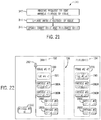
- FIG. 22 illustrates the draft issue 100 , the published issue 270 , and an outside article 350 .
- the outside article 350 may be a new article or an edited version of a preexisting article.
- the outside article 350 may be an edited draft article outside of an issue that corresponds to an article included in an issue.
- FIG. 23 illustrates the draft issue 100 , the published issue 270 , and that the outside article 350 is either related to or will replace published article 280 D.
- the cloud publishing device 66 may determine that the outside article 350 is related to the published article 280 D. More specifically, the outside article 350 and published article 280 D may correspond to an issue-independent article.
- the cloud publishing device 66 may update the draft issue 100 and the published issue 270 based on the outside article 350 . More particularly, the draft article 180 D and the published article 280 D or data therein may be modified to reflect changes made to the outside article 350 . Additionally, the version identifiers 204 of the draft article 180 D and published article 280 D may be updated.
- FIG. 24 is a block diagram that includes the draft issue 100 and the published issue 270 after the draft issue 100 and published issue 270 have been updated.
- the version numbers for both the draft issue 100 and the published issue 270 have changed to “v2.”
- the draft article 180 D and published article 280 D may be modified based on the outside article 350 D as well as a draft version of the outside article 350 D.
- the cloud publishing device 66 enables articles within issues to be removed and deleted.
- removing an article refers to removing an article from an issue and does not include deleting the article.
- Deleting an article refers to deleting the article, for example, from the memory 72 of the cloud publishing device 66 .
- an article removed from an issue may exist (e.g., still be stored in memory 72 ), while an article will no longer exist upon deletion.
- the cloud publishing device 66 may enable content providers 62 to cause a draft issue to reflect the most recent version of a published issue.
- FIG. 25 is a flow diagram of a process 370 for removing articles, deleting articles, and reverting a draft issue based on a most recent version of a published issue.
- the process 370 may be implemented in the form of an application program that includes instructions that are executed by at least one suitable processor of a computer system, such as the processing circuitry 70 of the cloud publishing device 66 .
- the illustrated process 370 is merely provided as an example, and in other embodiments, certain illustrated steps of the process 370 may be performed in other orders, skipped, or repeated, according to embodiments of the present disclosure.
- the process 370 generally includes receiving a request to unlock a draft issue for editing (e.g., process block 372 ), unlocking the draft issue for editing (e.g., process block 374 ), and generating a new draft table of and contents based on a published table of contents (e.g., process block 376 ).
- the process 370 may also include receiving user input to remove one or more articles from the draft issue (e.g., process block 378 ) and removing the article(s) from the draft issue (e.g., process block 380 ).
- the process 370 may also include receiving user input to delete one or more articles (e.g., process block 382 ), determining whether the article is an issue-independent article (decision block 384 ), and deleting the draft article and a corresponding published article when the article selected for deletion is not an issue-independent article (e.g., process block 386 ) or deleting the article, a corresponding article from a corresponding published issue, and one or more outside articles related to the article(s) selected for deletion (e.g., process block 388 ).
- the process 370 may also include receiving user input to revert a draft issue to a most recent published issue (e.g., process block 390 ), and overwriting the draft issue with articles from the most recent version of the published issue (e.g., process block 392 ).
- the cloud publishing device 66 may receive user input requesting to unlock a draft issue, such as the draft issue 100 .
- a content provider 62 may want to edit an issue after the issue has been published.
- the cloud publishing device 66 may receive user data (e.g., username(s), IP addresse(s)) or security credentials (e.g., password(s)) from the person or entity requesting unlocking of the draft issue 100 .
- the memory 72 of the cloud publishing device 66 may include data indicating certain users that may access the draft issue 100 for editing.
- the cloud publishing device 66 may unlock the draft issue 100 for editing. Furthermore, in embodiments in which the cloud publishing device 66 utilizes user data and/or security credentials, the cloud publishing device 66 may determine whether the person or entity requesting that the draft issue 100 be unlocked for editing has permission to edit the draft issue 100 and unlock the draft issue 100 when the cloud publishing device 66 determines that the person or entity has permission to edit the draft issue 100 .
- the cloud publishing device 66 may generate a new draft table of contents based on a published table of contents (e.g., published table of contents 290 ).
- a published table of contents e.g., published table of contents 290
- generating a new draft table of contents may generally include copying the published table of contents 290 and modifying the table of contents identifier 162 of the new draft table of contents (e.g., new draft table of contents 320 ) to differ from the table of contents identifier 162 of the published table of contents 290 of the published issue 270 .
- generating a new draft table of contents may include regenerating an existing draft table of contents.
- FIG. 26 is a block diagram of the published issue 270 and the draft issue 100 that has been unlocked for editing and includes a new, or updated, draft table of contents 320 .
- the draft table of contents 320 may be an updated version of the draft table of contents 150 generated based on the contents of the published issue 270 .
- the draft table of contents 150 may be updated to account for changes made to the published issue 270 of contents thereof for which corresponding changes have not been made in the draft issue 100 .
- the cloud publishing device 66 may receive user input to remove one or more draft articles from the draft issue. For example, the cloud publishing device 66 may receive user input to remove draft article 180 B and draft article 180 C. Furthermore, based on the user input, at process block 380 , the cloud publishing device 66 may remove the draft article(s) 180 indicated by the user input.
- FIG. 27 illustrates a block diagram of the draft issue 100 and published issue 270 after some of the draft articles 180 have been removed based on user input. For instance, continuing with the example in which user input was received to remove draft article 180 B and draft article 180 C, as illustrated in FIG. 27 , the draft article 180 B and draft article 180 C are no longer included in the draft issue 100 . However, it should be noted that the corresponding published articles (e.g., published article 280 B and published article 280 C) are still included in the published issue 270 , and thus, publically accessible. In other words, until the draft issue 100 is republished (after one or more draft articles 180 have been removed), the published issue 270 may still include published articles 280 corresponding to removed draft articles 180 .
- the corresponding published articles e.g., published article 280 B and published article 280 C
- the process 370 also pertains to deleting articles.
- the cloud publishing device 66 may receive user input to delete one or more articles.
- the cloud publishing device 66 may receive user input to delete draft article 180 D.
- the cloud publishing device 66 may determine whether the article to be deleted is an issue-independent article. In other words, the cloud publishing device 66 may determine whether there are any outside articles (e.g., a draft article outside of the draft issue 100 or a published article outside of the published issue 270 ) corresponding to the draft article 180 D to be deleted.
- the cloud publishing device 66 may determine that the draft article 180 D is an issue independent article (e.g., based on one or more related article identifiers 207 and/or the linking data 216 ).
- the cloud publishing device 66 may delete the draft article 180 D and a corresponding published article 280 D. That is, the cloud publishing device 66 may delete the draft article 180 D indicated by a user input as well as a published article 280 D previously generated based on the draft article 180 D.
- the cloud publishing device 66 may delete the draft article 180 D, a corresponding published article 280 D from the published issue 270 , and any outside articles.
- articles outside of the draft issue 100 or published issue 270 that have the same content e.g., another programming object having the same content
- the cloud publishing device 66 may delete the draft article 180 D, the published article 280 D, and any articles outside of the draft issue 100 or published issue 270 that correspond to the draft article 180 D (e.g., as indicated by one or more related article identifiers 207 and/or the linking data 216 ).
- FIG. 28 is a block diagram that illustrates the draft issue 100 and published issue 270 after the draft article 180 D and corresponding published article 280 D have been deleted. As can be seen by comparing FIG. 28 to FIG. 27 , deleting an article may cause the article to be deleted from both the draft issue 100 and the published issue 270 .
- the deletion outside of the draft issue 100 may also result in a draft article 180 and corresponding published article 280 being deleted.
- the outside article e.g., a draft article
- a published article corresponding to the outside article e.g., a published article that exists outside of an issue or a published article located in a published issue other than the published issue 270
- the draft article 180 , and the published article 280 may be deleted.
- deleting a published article may cause the published article and a corresponding draft article to be deleted.
- the cloud publishing device 66 may also enable a reversion in the draft issue 100 based on the contents of the published issue 270 . For instance, returning to FIG. 25 , at process block 390 , the cloud publishing device 66 may receive user input to revert the draft issue 100 to the most recent version of the published issue 270 . Upon receiving such an input, at process block 392 , the cloud publishing device 66 may overwrite the draft issue 100 with articles from the most recent version of the published issue 270 .
- the cloud publishing device 66 may determine the contents of the published issue 270 , modify the draft issue 100 to include draft articles 180 that correspond to the published articles 280 included in the published issue 270 , and update the draft table of contents 320 to reflect the changes made to the draft article 180 .
- FIG. 29 is a block diagram illustrating the draft issue 100 and the published issue 270 after a reversion has occurred.
- a content provider has requested a reversion based on the published issue 270 shown in FIG. 28 .
- the cloud publishing device 66 has added draft article 180 B and draft article 180 C to the draft issue 100 .
- the cloud publishing device 66 has updated the draft table of contents 320 (e.g., as indicated by “v5” compared to “v4” in FIG. 28 ).
- the cloud publishing device 66 may modify the issue (e.g., the version identifier 124 ), as reflected by “v8”.
- the cloud publishing device 66 may lock the draft issue 100 for editing.
- FIG. 30 is a flow diagram of a process 410 for unpublishing a published issue 270 .
- the process 410 may be implemented in the form of an application program that includes instructions that are executed by at least one suitable processor of a computer system, such as the processing circuitry 70 of the cloud publishing device 66 .
- the process 410 generally includes receiving user input to unpublish a published issue (e.g., process block 412 ), unpublishing the published issue based on the user input (e.g., process block 414 ), unlocking a corresponding draft issue for editing (e.g., process block 416 ), and updating the draft issue based on the state of the published issue, for instance, at the time of unpublication (e.g., process block 418 ).
- a published issue e.g., process block 412
- unpublishing the published issue based on the user input e.g., process block 414
- unlocking a corresponding draft issue for editing e.g., process block 416
- updating the draft issue based on the state of the published issue, for instance, at the time of unpublication (e.g., process block 418 ).
- the cloud publishing device 66 may receive user input to unpublish a published issue, such as the published issue 270 .
- a published issue such as the published issue 270
- content providers 62 may submit a request for the published issue 270 to be unpublished (e.g., retracted from public distribution).
- the cloud publishing device 66 may unpublish the published issue 270 . More specifically, the cloud publishing device 66 may cease to make available the published issue 270 . As explained below with respect to FIG. 31 , it should be noted that the published articles 280 within the published issue 270 may still be distributed by the cloud publishing device 66 or otherwise publically accessible (e.g., accessible by the article URL 206 ). However, the collection of the published articles (i.e., the published issue 270 ) is not available. Furthermore, in the case of issue-independent articles, it should be noted that articles outside of the published issue 270 will be unaffected. For instance, an outside article published in a different published issue may still be publically accessible.
- the cloud publishing device 66 may update the draft issue 100 based on the published issue 270 (e.g., based on the contents of the published issue 270 ).
- the cloud publishing device 66 may update the draft issue 100 in the same manner as discussed above with respect to updating draft issues after being unlocked for editing.
- the draft table of contents 320 may be updated
- the version identifier 164 of the draft table of contents 320 may be updated
- the version identifier 204 of the draft issue 100 may be updated.
- the cloud publishing device 66 may unlock the draft issue 100 for editing, for example, in the manner discussed above.
- the cloud publishing device 66 may perform the process 410 by only receiving user input to unpublish a published issue (e.g., process block 412 ) and unpublishing the published issue based on the user input (e.g., process block 414 ). In other words, the cloud publishing device 66 may not unlock a corresponding draft issue for editing (e.g., process block 416 ) or update the draft issue based on the state of the published issue (e.g., process block 418 ). The cloud publishing device 66 may perform the process 410 in the manner to prevent overwriting the draft issue 100 with changes that have not been published (e.g., included in published issue 270 ).
- FIG. 31 is a block diagram of the draft issue 100 and the published articles 280 and published table of contents 290 of the published issue 270 after unpublishing the published issue 270 .
- the cloud publishing device 66 may perform operations of the process 410 to result in the embodiments of the draft issue 100 and content of the published issue 270 (e.g., published articles 280 and published table of contents 290 ) illustrated in FIG. 31 .
- FIG. 32 is a flow diagram of a process 430 for deleting an issue.
- the process 430 may be implemented in the form of an application program that includes instructions that are executed by at least one suitable processor of a computer system, such as the processing circuitry 70 of the cloud publishing device 66 .
- the illustrated process 430 is merely provided as an example, and in other embodiments, certain illustrated steps of the process 430 may be performed in other orders, skipped, or repeated, according to embodiments of the present disclosure.
- the process 430 generally includes receiving a request to delete an issue (e.g., process block 432 ) and deleting a draft issue, draft articles included within the draft issue, and a published issue (e.g., process block 434 ).
- the cloud publishing device 66 may receive a request to delete an issue, such as published issue 270 .
- an issue such as published issue 270 .
- content providers 62 may submit a request to delete an issue.
- the cloud publishing device 66 may delete the published issue indicated by the request (e.g., published issue 270 ), the draft issue 100 , and the draft articles included in the draft issue 100 (e.g., draft table of contents 320 and draft articles 180 ).
- the draft issue 100 , draft table of contents 320 , draft articles 180 , and published issue 270 may be deleted (e.g., no longer stored in the memory 72 of the cloud publishing device 66 ).
- the published articles 280 and published table of contents 290 may not be deleted and remain available.
- the draft articles 180 may not be deleted.
- FIG. 33 is a block diagram that includes published articles 280 and the published table of contents 290 . More specifically, FIG. 33 depicts the result of receiving a request to delete the draft issue 100 or published issue 270 of FIG. 31 . As illustrated, only the published articles (e.g., published table of contents 290 and published articles 280 ) remain. Moreover, the published table of contents 290 and published articles 280 may still be provided to the electronic devices 10 . For instance, the published table of contents 290 and published articles 280 that are not issue-independent articles may respectively be accessible via the table of contents URL 166 and the article URLs 206 , whereas issue-independent articles (or content associated with issue-independent articles) may be accessible via the article URLs 206 or via outside articles.
- draft issues may also be deleted.
- the cloud publishing device 66 may delete the draft issue 100 , the articles included in the draft issue 100 (e.g., draft table of contents 320 and draft articles 180 ), and the published issue that corresponds to the draft issue 100 (e.g., published issue 270 ).
- the cloud publishing device 66 may provide a platform or application that content providers 62 may utilize to make issues and publish issues.
- FIGS. 34-45 which are discussed individually below, are provided to illustrate examples of such a platform or application with which content providers 62 may interact.
- a platform or application may be provided to the content providers 62 via the internet.
- content providers 62 may navigate to a webpage or through an application (e.g., software application such as a mobile application) to interact with the cloud publishing device 66 .
- FIG. 34 illustrates a user interface 500 of a platform or application that the cloud publishing device 66 may provide to content providers 62 .
- Content providers 62 may interact with the user interface 500 to edit an issue.
- issue tab 502 the user interface 500 is for editing issues.
- content providers 62 may select a table of contents tab 504 to view a user interface specific to the table of contents of an issue and to modify the table of contents.
- the user interface 500 includes information related an issue and the contents included in the issue.
- a user e.g., content provider
- the user may cause an issue to be published (e.g., cause the cloud publishing device 66 to generate a published issue) by selecting the publication icon 506 .
- the user interface 500 indicates the title 508 , issue excerpt 510 , and cover image 512 for the issue, which respectively correspond to the title indicator 132 , excerpt 134 , and cover image 136 of FIG. 10 .
- a user may select (e.g., via input structures of an electronic device, such as input structures 22 discussed above with respect to electronic device 10 ) the title 508 , issue except 510 , and cover image 512 to make modifications to the title 508 , issue excerpt 510 , and cover image 512 .
- the user interface 500 may include an articles list 520 , which indicates the articles and advertisements included in an issue.
- Articles and advertisements may include a type indicator 522 .
- the type indicator 522 may indicate that an article is a featured article, which as discussed below, may alter where the article is listed in the table of contents for the issue.
- Advertisements may also include a type indicator 522 to indicate that an advertisement is an advertisement.
- Articles and advertisements listed in the articles list 520 may also include a draft/published status indicator 524 , a link button 526 , a statistics button 528 , a settings button 530 , and an order button 532 .
- the draft/published status indicator 524 indicates whether an article or advertisement has been published (e.g., in the present issue or in another issue).
- the link button 526 when selected, causes a direct link (e.g., a specific URL) to the article to be displayed.
- the statistics button 528 enables statistics about a particular article to be presented via the user interface 500 . For instance, in response to receiving user input indicative of a selection of the statistics button 528 , an analytics page for the article may be presented via the user interface 500 .
- the settings button 530 enables other settings regarding articles or advertisements to be changed.
- the settings button 530 may enable a user to select a publication date specific to an article (e.g., for publication before the issue is published).
- the order button 532 may be selected by a user to change the order of articles and advertisements in the article list 520 .
- a user may select the order button 532 to enable an article to be dragged to and dropped in a different location (e.g., between different articles) to modify the order of articles and advertisements within an issue.
- the user interface 500 also includes an article selection button 540 and an advertisement selection button 542 , which may be selected to respectively add articles and advertisements to an issue.
- FIG. 35 illustrates an article selection user interface 550 , which the cloud publishing device 66 may provide to the content provider upon the content provider selecting the article selection button 540 .
- the article selection user interface 550 includes a search box 552 , a listing of articles 554 , an upload article button 556 , and status indicators 558 .
- Content providers may provide articles and advertisements to the cloud publishing device 66 .
- articles may be uploaded to the cloud publishing device 66 by selecting the upload article button 556 and selecting an article to be uploaded to the cloud publishing device 66 .
- Articles uploaded by a particular content provider (e.g., while editing a current issue or previous issues) may be presented in the listing of articles 554 .
- a user may be required to present credentials such as a username and password. Based on the credentials, the cloud publishing service may determine a content provider that the user is associated with and a data channel specific to that content provider.
- articles and advertisements associated with a specific content provider may be provided to the user. It should be noted that, in some embodiments, some advertisements and articles may not be specific to the particular content provider. Additionally, users may utilize the search box 552 to search through articles included in the listing of articles 554 .
- the status indicators 558 indicate whether an article is included in the issue. For example, status indicator 558 A indicates that an article is not included in the issue, while status indicator 558 B indicates that an article is included in the issue. A user may select the status indicator 558 A to add a particular article to the issue as well as select the status indicator 558 B to remove an article from the issue.
- a content provider may select the advertisement selection button 542 of the user interface 500 to cause the cloud publishing device 66 to provide an advertisement selection user interface, such as the advertisement selection user interface 570 illustrated in FIG. 36 .
- Advertisements such as content provider-specific advertisements, may be included in a listing of advertisements 572 .
- Status indicators 574 indicate whether an advertisement is included in the issue. For example, status indicator 574 A indicates that an advertisement is not included in the issue, while status indicator 574 B indicates that an advertisement is included in the issue. A user may select the status indicator 574 A to add a particular advertisement to the issue as well as select the status indicator 574 B to remove a particular advertisement from the issue.
- users may select an advertisement creation button 576 to be presented with a user interface to make a new advertisement. Additionally, users may upload advertisements by selecting the advertisement upload button 578 .
- content providers may view the URLs associated with the draft issue and published issue for an issue shown in the user interface 500 .
- a user may select the issue viewing button 580 to see the URLs associated with the draft issue and published issue for an issue. Users may proceed to the URLs to view the issues.
- a URL for a published issue may not be provided before an issue is published.
- FIG. 34 also depicts a calendar button 582 .
- the calendar button 582 may be selected to choose or modify dates associated with the issue, such as a publication date, on-sale date, or off-sale date.
- the cloud publishing device 66 may provide an interface, such as calendar interface 584 illustrated in FIG. 38 .
- a user may select a date on of the calendar interface 584 to choose when an issue will be published, when the issue will be available to be purchased, and when the issue will no longer be offered for purchase.
- the publication date and on-sale date may differ. For example, an issue may be offered for sale prior to publication of the issue.
- Various other settings associated with an issue may also be edited via the user interface 500 .
- a user may select a settings button 590 included in FIG. 34 to cause the cloud publishing device 66 to provide for display an issue settings interface 592 , which is illustrated in FIG. 39 .
- a user may interact with the issue settings interface 592 to select notification text 594 (e.g., corresponding to the notification text 138 of FIG. 10 ) associated with an issue.
- the notification text 594 may refer to text included in a message that may be provided to potential readers of the issue upon publication (e.g., users of electronic devices 10 ), for instance, to notify the potential readers that the issue has been published.
- a word count or character count of the notification text may also be provided.
- content providers may view, replace, and remove an issue cover 596 (e.g., corresponding to the cover image 136 of FIG. 10 .) via the issue settings interface 592 .
- content providers may choose whether circulation reporting 598 should be provided for an issue. For example, content providers may select whether various statistics for an issue will be tracked. For example, numbers of purchases of the issue may be tracked.
- a content provider may choose an on-sale date (corresponding to the on-sale date 142 of FIG. 10 ) and an off-sale date (e.g., corresponding to the off-sale date 144 of FIG. 10 ) for an issue via the issue settings interface 592 .
- FIG. 40 illustrates an example of a table of contents 620 as displayed on the electronic device 10 , or more specifically, an embodiment of the electronic device 10 B.
- the table of contents 620 includes an issue title 622 , issue description 624 , and an issue cover 626 .
- the table of contents 620 also includes one or more buttons 628 , section names 630 , and articles 632 .
- the articles 632 which may be representative of articles (e.g., published articles 280 ) included in the issue, may include article titles 634 , bylines 636 , and article images 638 .
- the button 628 may include a button that can be selected to request to read or subscribe to an issue.
- the section names 630 may be titles for sections within the table of contents 620 .
- the illustrated section name 630 is for featured articles.
- Articles that a user indicates are featured articles may be included in a featured article section before other articles in an issue.
- the cloud publishing device 66 may arrange the table of contents 620 such that certain articles (e.g., featured articles) are listed before other articles included in an issue.
- the cloud publishing device 66 may provide a user interface related to a table of contents to a user.
- FIG. 41 illustrates a user interface 660 related to a table of contents for an issue.
- the user interface 660 may include a download button 662 , upload button 664 , appearance settings section 666 , a table of contents preview 668 , and the publication icon 670 .
- the cloud publishing device 66 may automatically generate a table of contents for an issue based on the articles included in the issue as well as whether an article is a feature article.
- content providers may also utilize their own table of contents. For example, to ensure that a content provider-created table of contents is compatible with the cloud publishing device 66 , a user may select the download button 662 to download the table of contents generated by the cloud publishing device 66 . The content provider may then edit the downloaded table of contents and upload the edited table of contents by selecting the upload button 664 . The cloud publishing device 66 will then utilize a user-created custom table of contents for an issue.
- Content providers may also edit various aesthetic features associated with the table of contents. For example, color settings (corresponding to the color settings data 172 of FIG. 11 ) associated with the issue title 622 , issue description 624 , article titles 634 , bylines 636 , section names 630 , buttons 628 , as well as a background color of a table of contents, such as the table of contents 620 of FIG. 40 .
- FIG. 42 illustrates a color settings interface 680 that may be presented.
- a user may select a color icon 682 to cause the color settings interface 680 to be presented.
- a content provider may select a color for a portion of the table of contents.
- a content provider may select a color by providing a hexadecimal value (e.g., hex triplet) of a color or a RGBA value for a color.
- Content providers may further modify the color settings by utilizing a hue slider 684 to modify a hue, a saturation slider 686 to modify saturation, a brightness slider 688 to modify brightness, and an opacity slider 690 to modify opacity.
- the table of contents preview 668 provides a preview of how colors of various portions of the table of contents will appear. For example, upon a user selecting a color an article title, an article title 692 within the table of contents preview 668 may be presented in the selected color.
- FIG. 43 illustrates an order of articles section 720 that may be included in the user interface 660 .
- the order of articles section 720 may include an article list 722 , which lists the order in which the articles of an issue will appear in the table of contents for the issue. More specifically, article list 722 may include sections 724 that include the articles within an issue.
- the order of articles in the table of contents may be automatically generated based on an article's position within the issue as well as based on a classification of the article. For example, featured articles may appear higher in the table of contents (e.g., in a featured articles section 724 A). As another example, advertisements may not be included in a table of contents based on their classification as advertisements.
- Content providers may rearrange the order in which sections and articles are listed in the article list 722 .
- a content provider may select an order button 726 to enable an article to be dragged to and dropped in a different location within the article list 722 to modify the order of articles within the table of contents. For instance, a user may move an article within a section 724 of the article list 722 or into a different section of the article list 722 .
- the article list 722 includes several sections 724 , such as the featured articles section 724 A and a general article section 724 B, which may include articles that are not featured articles (or featured articles if a user has moved a featured article into the general article section 724 B).
- the order of articles section 720 includes a section addition button 728 , which when selected, may cause the cloud publishing device 66 to generate a new section within the table of contents.
- FIG. 44 illustrates the order of articles section 720 after a content provider has selected the section addition button 728 to request a new section 730 be added to the table of contents and the new section 730 has been added to the table of contents.
- Content providers may provide input (e.g., type) to name the new section 730 .
- a revert to original button 732 may be presented when a content provider makes a change in the order of articles section 720 .
- the cloud publishing device 66 may undo the changes made by the user and/or present the order of articles in the order originally included in the order of articles section 720 .
- content providers may also customize which articles are presented in the table of contents by interacting with a visibility indicator 740 .
- each article is visible.
- FIG. 45 illustrates the order of articles section 720 after the visibility indicator 740 for one of the articles has been selected to no longer be included in the table of contents.
- the cloud publishing device 66 may alter the visibility indicator 740 and either add or remove the article from the table of contents. For example, a user's interaction with the visibility indicator 740 may cause the table of contents visibility status 220 for an article to be modified.
- FIG. 46 is a flow diagram of a process 760 for determining and ordering articles within a table of contents.
- the process 760 may be implemented in the form of an application program that includes instructions that are executed by at least one suitable processor of a computer system, such as the processing circuitry 70 of the cloud publishing device 66 .
- the illustrated process 760 is merely provided as an example, and in other embodiments, certain illustrated steps of the process 760 may be performed in other orders, skipped, or repeated, according to embodiments of the present disclosure.
- the process 760 generally includes determining articles in an issue based on the article list 520 (e.g., process block 762 ), determining an article classification for each article (e.g., process block 764 ), removing advertisements from consideration (e.g., process block 766 ), determining table of contents visibility for each article (e.g., process block 768 ), removing from consideration articles that are indicated as not to be included in the table of contents (e.g., process block 770 ), determining an order of articles in the table of contents based on article classification and the order of articles in the article list 520 (e.g., process block 772 ), and generating the table of contents based on the determined order of articles (e.g., process block 774 ).
- the cloud publishing device 66 may determine the articles included in an issue, for instance, based on the article list 520 .
- the articles included in an issue may include advertisements in addition to other articles, such as news articles and opinion pieces.
- the cloud publishing device 66 may determine the article classification 218 for each article. In other words, the cloud publishing device 66 may determine whether an article is a featured article, advertisement, or other type of article (e.g., a regular, non-featured article). At process block 766 , the cloud publishing device may remove articles determined to be advertisements from consideration for inclusion in the table of contents.
- the cloud publishing device 66 may determine a table of contents visibility for each article, for example, based on the visibility indicator 740 associated with each remaining article.
- the cloud publishing device 66 may remove from consideration for inclusion in the table of contents articles that are determined not to be visible in the table of contents.
- the cloud publishing device 66 may determine an order for remaining articles based on the articles' article classifications 218 and the order of articles in the article list 520 . For example, as noted above, featured articles may be included in the table of contents before non-featured articles. Additionally, articles may otherwise be listed in the table of contents based on the order of the articles in the article list 520 . Furthermore, at process block 774 , the cloud publishing device 66 may generate the table of contents based on the determined order of articles. That is, the cloud publishing device 66 may generate a table of contents and include within the table of contents an indication of the articles included in the issue, and the items listed in the table of contents may be listed in the order determined at process block 772 .
- performance of the process 760 may be performed in an order that differs from the order presented in FIG. 46 .
- the cloud publishing device 66 may determine a table of contents visibility for each article and remove the articles that are indicated as not to be visible from the articles being considered before determine an article classification for the remaining articles.
- content providers may perform various actions that cause a table of contents to be updated. Examples include unlocking a draft issue for editing as well as modifying a draft issue.
- users may also customize the table of contents. For example, users may rearrange the order of articles listed in the table of contents, alter whether an article is included in the table of contents, or make and use their own table of contents.
- updating the table of contents may alter the customizations made by a user. For example, updating a table of contents may cause the table of contents to list articles included in an issue according to the process 760 , whereas a user's customized table of contents may have included different articles and/or articles in a different order.
- the process 790 may be implemented in the form of an application program that includes instructions that are executed by at least one suitable processor of a computer system, such as the processing circuitry 70 of the cloud publishing device 66 .
- the illustrated process 790 is merely provided as an example, and in other embodiments, certain illustrated steps of the process 790 may be performed in other orders, skipped, or repeated, according to embodiments of the present disclosure.
- the process 790 generally includes determining whether a table of contents to be updated is a custom table of contents (e.g., decision block 792 ) and updating a table of contents based on the contents of a published issue upon determining that the table of contents to be updated is not a custom table of contents (e.g., process block 794 ) or sending a push notification to manually update a custom table of contents upon determining that the table of contents to be updated is a custom table of contents (e.g., process block 796 ).
- the cloud publishing device 66 may determine whether a table of contents to be updated is a custom table of contents.
- a table of contents may be considered to be custom when a content provider has made its own table of contents or when a generated table of contents has been modified.
- the table of contents may be considered a custom table of contents.
- the cloud publishing device 66 may update the table of contents based on the contents of a published issue.
- a draft table of contents may be updated to reflect the content included in a published issue corresponding to the draft issue in which the draft table of contents is included.
- a table of contents may be updated in a manner generally to the process 760 of FIG. 46 .
- the cloud publishing device 66 may make determinations regarding article classifications of an issue, table of contents visibilities of the issue, and an article list (e.g., data included in a published issue regarding an order of articles in the issue) to determine articles that should be included in the table of contents as well as the order of those articles in the table of contents and update the table of contents.
- the cloud publishing device 66 may provide a notification, such as a push notification, to the content provider to manually update the table of contents.
- a notification such as a push notification
- the cloud publishing device 66 may provide a notification, such as a push notification, to the content provider to manually update the table of contents.
- the push notification may be provided via the user interface 660 .
- the technical effects of the present disclosure include a cloud publishing device 66 that may enable content providers 62 to manage how content is arranged and provided to end users (e.g., users of electronic devices 10 ). More specifically, the cloud publishing device 66 may enable content, such as articles, to be arranged into issues, for editable tables of contents to be generated, and for modifications to issues to be made after being published. For instance, by maintaining draft versions and published versions of issues (as well as content included in issues, such as tables of contents and articles), the cloud publishing device 66 enables editing of content to occur without causing a publically available version of the content to be modified.
- content providers 62 may manage how content is arranged and provided to end users (e.g., users of electronic devices 10 ). More specifically, the cloud publishing device 66 may enable content, such as articles, to be arranged into issues, for editable tables of contents to be generated, and for modifications to issues to be made after being published. For instance, by maintaining draft versions and published versions of issues (as well as content included in issues, such as tables
- the presently disclosed techniques enable collections of content that include content that can be specific to a collection (e.g., an issue-specific article) as well as content that is not specific to a collection (e.g., an issue-independent article).
- a collection e.g., an issue-specific article
- content that is not specific to a collection e.g., an issue-independent article.
Landscapes
- Engineering & Computer Science (AREA)
- Theoretical Computer Science (AREA)
- Business, Economics & Management (AREA)
- General Physics & Mathematics (AREA)
- Physics & Mathematics (AREA)
- Databases & Information Systems (AREA)
- General Engineering & Computer Science (AREA)
- Strategic Management (AREA)
- Data Mining & Analysis (AREA)
- General Business, Economics & Management (AREA)
- Entrepreneurship & Innovation (AREA)
- Economics (AREA)
- Marketing (AREA)
- Accounting & Taxation (AREA)
- Finance (AREA)
- Development Economics (AREA)
- Computational Linguistics (AREA)
- General Health & Medical Sciences (AREA)
- Health & Medical Sciences (AREA)
- Artificial Intelligence (AREA)
- Audiology, Speech & Language Pathology (AREA)
- Human Resources & Organizations (AREA)
- Computer Security & Cryptography (AREA)
- Software Systems (AREA)
- Operations Research (AREA)
- Tourism & Hospitality (AREA)
- Computer Networks & Wireless Communication (AREA)
- Signal Processing (AREA)
- Game Theory and Decision Science (AREA)
- Quality & Reliability (AREA)
- Computer Hardware Design (AREA)
- Information Transfer Between Computers (AREA)
- User Interface Of Digital Computer (AREA)
- Management, Administration, Business Operations System, And Electronic Commerce (AREA)
Abstract
Description
- This application claims priority to U.S. Provisional Patent Application No. 62/822,494, entitled “SYSTEMS AND METHODS FOR CLOUD-BASED CONTENT MANAGEMENT AND DISTRIBUTION,” filed on Mar. 22, 2019, which is incorporated herein by reference in its entirety for all purposes.
- The present disclosure generally relates to a media content editing system and, more particularly, to a cloud-based system that may be utilized to organize and provide digital magazine issues.
- This section is intended to introduce the reader to various aspects of art that may be related to various aspects of the present disclosure, which are described and/or claimed below. This discussion is believed to be helpful in providing the reader with background information to facilitate a better understanding of the various aspects of the present disclosure. Accordingly, it should be understood that these statements are to be read in this light, and not as admissions of prior art.
- Users of electronic devices may access articles (e.g., news articles) written by content providers, for example, via the internet. For example, users may be provided with digital versions of printed newspapers, magazines, or portions thereof. In other cases, individual articles that are not included in collections may be available.
- A summary of certain embodiments disclosed herein is set forth below. It should be understood that these aspects are presented merely to provide the reader with a brief summary of these certain embodiments and that these aspects are not intended to limit the scope of this disclosure. Indeed, this disclosure may encompass a variety of aspects that may not be set forth below.
- The present disclosure relates to cloud-based digital content management and distribution techniques. More specifically, providers of content such as articles may make digital collections (e.g., an issue) of content to be distributed to electronic devices utilized by potential users of the content, such as people interested in reading articles provided by the content provider. Additionally, the techniques disclosed herein enable a table of contents to be generated based on the content included in a content provider-created issue. Content providers may also customize tables of contents.
- While a content provider is making or arranging an issue, the issue may be kept private. However, a content provider may publish an issue to enable the issue to be made publically available. As discussed herein, a draft version of an issue and a published version of an issue may be generated and managed. Furthermore, the present disclosure provides for content to be modified after publication. By utilizing multiple versions of content, it is possible to make changes to a draft version of the content while a published version of the content is still available and without making the changes (e.g., simultaneously) to the published content. When a content provider has finished editing the content (e.g., the draft version of the content), the published version of the content may be modified based on the changes made to the draft version. As such, the present techniques enable digital content to be managed without affecting a published, or public, version of the content.
- Furthermore, as discussed herein, content included in arrangements (e.g., issues), may be specific to a collection. For example, content may only be published in one collection. Content may also be provided solely outside of a collection, such as an individually published article. In addition, the present techniques enable content to be included in one collection and also included outside of the collection. For example, a content provider may make an issue of articles, and one or more articles included in the issue may also be included in other issues or published individually. Accordingly, the present disclosure provides techniques to arrange and provide content in a manner unique to digital content.
- Various refinements of the features noted above may be made in relation to various aspects of the present disclosure. Further features may also be incorporated in these various aspects as well. These refinements and additional features may exist individually or in any combination. For instance, various features discussed below in relation to one or more of the illustrated embodiments may be incorporated into any of the above-described aspects of the present disclosure alone or in any combination. The brief summary presented above is intended only to familiarize the reader with certain aspects and contexts of embodiments of the present disclosure without limitation to the claimed subject matter.
- Various aspects of this disclosure may be better understood upon reading the following detailed description and upon reference to the drawings in which:
-
FIG. 1 is a schematic block diagram of an electronic device that provides linked text boxes, according to embodiments of the present disclosure; -
FIG. 2 is a perspective view of a notebook computer representing an embodiment of the electronic device ofFIG. 1 ; -
FIG. 3 is a front view of a hand-held device representing another embodiment of the electronic device ofFIG. 1 ; -
FIG. 4 is a front view of another hand-held device representing another embodiment of the electronic device ofFIG. 1 ; -
FIG. 5 is a front view of a desktop computer representing another embodiment of the electronic device ofFIG. 1 ; -
FIG. 6 is a front view and side view of a wearable electronic device representing another embodiment of the electronic device ofFIG. 1 ; -
FIG. 7 is a flow diagram of a content distribution system, according to embodiments of the present disclosure; -
FIG. 8 illustrates a flow diagram for providing content via the cloud publishing device ofFIG. 7 , according to embodiments of the present disclosure; -
FIG. 9 is a block diagram a draft issue, according to embodiments of the present disclosure; -
FIG. 10 is a block diagram of an issue, according to embodiments of the present disclosure; -
FIG. 11 illustrates a block diagram of a table of contents, according to embodiments of the present disclosure; -
FIG. 12 is a block diagram of a draft issue that includes draft articles, according to embodiments of the present disclosure; -
FIG. 13 is a block diagram of an article, according to embodiments of the present disclosure; -
FIG. 14 illustrates a flow diagram of a process for publishing an issue, according to embodiments of the present disclosure; -
FIG. 15 is a block diagram of a draft issue and a corresponding published issue, according to embodiments of the present disclosure; -
FIG. 16 illustrates a block diagram of a draft issue that includes an article that is published outside of an issue, according to embodiments of the present disclosure; -
FIG. 17 illustrates a flow diagram of a process for modifying an issue, according to embodiments of the present disclosure; -
FIG. 18 illustrates a block diagram of a draft issue and published issue, according to embodiments of the present disclosure; -
FIG. 19 illustrates a block diagram that includes a draft issue with a new draft article, according to embodiments of the present disclosure; -
FIG. 20 illustrates a block diagram of a draft issue and a corresponding published issue generated upon republication of the draft issue, according to embodiments of the present disclosure; -
FIG. 21 illustrates a flow diagram of a process for updating a published issue based on a change made outside of the published issue or a corresponding draft issue, according to embodiments of the present disclosure; -
FIG. 22 is a block diagram illustrating a draft issue, a published issue, and an outside article, according to embodiments of the present disclosure; -
FIG. 23 illustrates a block diagram of the draft issue, published issue, and outside article ofFIG. 22 indicating a relationship between the outside article and a published article of the published issue, according to embodiments of the present disclosure; -
FIG. 24 illustrates a block diagram that includes the draft issue and published issue ofFIG. 23 after the draft issue and published issue have been updated, according to embodiments of the present disclosure; -
FIG. 25 is a flow diagram of a process for removing articles, deleting articles, and reverting a draft issue based on a most recent version of a published issue, according to embodiments of the present disclosure; -
FIG. 26 is a block diagram of a published issue and a draft issue that has been unlocked for editing, according to embodiments of the present disclosure; -
FIG. 27 illustrates a block diagram of the draft issue and published issue ofFIG. 26 after some draft articles have been removed, according to embodiments of the present disclosure; -
FIG. 28 illustrates a block diagram of the draft issue and published issue ofFIG. 27 after an article has been deleted, according to embodiments of the present disclosure; -
FIG. 29 illustrates a block diagram of the draft issue and the published ofFIG. 28 after a reversion to the draft issue based on a most recent version of the published issue has occurred, according to embodiments of the present disclosure; -
FIG. 30 is a flow diagram of a process for unpublishing a published issue, according to embodiments of the present disclosure; -
FIG. 31 is a block diagram of the draft issue the published articles of the published issue ofFIG. 29 after unpublishing of the published issue has occurred, according to embodiments of the present disclosure; -
FIG. 32 is a flow diagram of a process for deleting an issue, according to embodiments of the present disclosure; -
FIG. 33 is a block diagram of the published articles ofFIG. 31 after the draft issue ofFIG. 31 has been deleted, according to embodiments of the present disclosure; -
FIG. 34 illustrates a user interface of a platform or application provided by the cloud publishing device ofFIG. 7 , according to embodiments of the present disclosure; -
FIG. 35 illustrates an article selection user interface, according to embodiments of the present disclosure; -
FIG. 36 illustrates an article selection user interface, according to embodiments of the present disclosure; -
FIG. 37 illustrates the user interface ofFIG. 34 providing uniform resource locators associated with a draft issue and a published issue, according to embodiments of the present disclosure; -
FIG. 38 illustrates a calendar interface that may be included in the user interface ofFIG. 34 , according to embodiments of the present disclosure; -
FIG. 39 illustrates an issue settings interface that may be included in the user interface ofFIG. 34 , according to embodiments of the present disclosure; -
FIG. 40 illustrates a table of contents as displayed on an electronic device, according to embodiments of the present disclosure; -
FIG. 41 , illustrates another user interface of a platform or application provided by the cloud publishing device ofFIG. 7 , according to embodiments of the present disclosure; -
FIG. 42 illustrates a color settings interface of the user interface ofFIG. 41 , according to embodiments of the present disclosure; -
FIG. 43 illustrates of an order of articles section of the user interface ofFIG. 41 , according to embodiments of the present disclosure; -
FIG. 44 illustrates the order of articles section ofFIG. 43 after a new section has been added, according to embodiments of the present disclosure; -
FIG. 45 illustrates the order of articles section ofFIG. 43 after an article has been selected to not be included in a table of contents, according to embodiments of the present disclosure; -
FIG. 46 is a flow diagram of a process for generating a table of contents, according to embodiments of the present disclosure; and -
FIG. 47 is a flow diagram of a process for updating a table of contents, according to embodiments of the present disclosure. - One or more specific embodiments will be described below. In an effort to provide a concise description of these embodiments, not all features of an actual implementation are described in the specification. It should be appreciated that in the development of any such actual implementation, as in any engineering or design project, numerous implementation-specific decisions must be made to achieve the developers' specific goals, such as compliance with system-related and business-related constraints, which may vary from one implementation to another. Moreover, it should be appreciated that such a development effort might be complex and time consuming, but would nevertheless be a routine undertaking of design, fabrication, and manufacture for those of ordinary skill having the benefit of this disclosure.
- When introducing elements of various embodiments of the present disclosure, the articles “a,” “an,” and “the” are intended to mean that there are one or more of the elements. The terms “including” and “having” are intended to be inclusive and mean that there may be additional elements other than the listed elements. Additionally, it should be understood that references to “some embodiments,” “embodiments,” “one embodiment,” or “an embodiment” of the present disclosure are not intended to be interpreted as excluding the existence of additional embodiments that also incorporate the recited features. Furthermore, the phrase A “based on” B is intended to mean that A is at least partially based on B. Moreover, the term “or” is intended to be inclusive (e.g., logical OR) and not exclusive (e.g., logical XOR). In other words, the phrase A “or” B is intended to mean A, B, or both A and B.
- The present disclosure relates to a media content publishing system that may be utilized to arrange and provide content to end users' electronic devices. More specifically, the media content publishing system may be implemented via a cloud computing system and obtain content (e.g., articles) from content providers, enable content providers to interact with the media content publishing system to arrange the content, and provide the content to electronic devices. In particular, as discussed below, articles may be arranged into issues, and the issues may be disseminated to electronic devices for viewing via the electronic devices. In some cases, articles included in an issue may be available for viewing outside of an issue. Accordingly, the techniques discussed below enable the management and provision of issue-specific articles and issue-independent articles.
- Before discussing the media content publishing system in greater detail, electronic devices which may receive media content (e.g., articles and issues) are discussed first. As an example, a block diagram of an
electronic device 10 is shown inFIG. 1 . As will be described in more detail below, theelectronic device 10 may represent any suitable electronic device, such as a computer, a mobile phone, a portable media device, a tablet, a television, a virtual-reality headset, a vehicle dashboard, or the like. Theelectronic device 10 may represent, for example, anotebook computer 10A as depicted inFIG. 2 , ahandheld device 10B as depicted inFIG. 3 , a handheld device 10C as depicted inFIG. 4 , adesktop computer 10D as depicted inFIG. 5 , a wearableelectronic device 10E as depicted inFIG. 6 , or a similar device. - The
electronic device 10 shown inFIG. 1 may include, for example, aprocessor core complex 12, a local memory 14, a mainmemory storage device 16, anelectronic display 18,input structures 22, an input/output (I/O)interface 24, anetwork interface 26, and apower source 28. The various functional blocks shown inFIG. 1 may include hardware elements (including circuitry), software elements (including machine-executable instructions stored on a tangible, non-transitory medium, such as the local memory 14 or the main memory storage device 16) or a combination of both hardware and software elements. It should be noted thatFIG. 1 is merely one example of a particular implementation and is intended to illustrate the types of components that may be present inelectronic device 10. Indeed, the various depicted components may be combined into fewer components or separated into additional components. For example, the local memory 14 and the mainmemory storage device 16 may be included in a single component. - The
processor core complex 12 may carry out a variety of operations of theelectronic device 10. Theprocessor core complex 12 may include any suitable data processing circuitry to perform these operations, such as one or more microprocessors, one or more application program specific processors (ASICs), or one or more programmable logic devices (PLDs). In some cases, theprocessor core complex 12 may execute programs or instructions (e.g., an operating system or application program) stored on a suitable article of manufacture, such as the local memory 14 and/or the mainmemory storage device 16. For example, theprocessor core complex 12 may carry out instructions stored in the local memory 14 and/or the mainmemory storage device 16 to receive content from a publishing system to receive issues or articles as well as receive user input regarding which issues or articles to access. In addition to instructions for theprocessor core complex 12, the local memory 14 and/or the mainmemory storage device 16 may also store data to be processed by theprocessor core complex 12. By way of example, the local memory 14 may include random access memory (RAM) and the mainmemory storage device 16 may include read only memory (ROM), rewritable non-volatile memory such as flash memory, hard drives, optical discs, or the like. - The
electronic display 18 may display image frames, such as a graphical user interface (GUI) for an operating system or an application program interface, still images, or video content. Theprocessor core complex 12 may supply at least some of the image frames. For example, theprocessor core complex 12 may supply image frames of media content, such as articles within issues provided by a media content distribution system. Theelectronic display 18 may be a self-emissive display, such as an organic light emitting diodes (OLED) display, a micro-LED display, a micro-OLED type display, or a liquid crystal display (LCD) illuminated by a backlight. In some embodiments, theelectronic display 18 may include a touch screen, which may allow users to interact with a user interface of theelectronic device 10. - The
input structures 22 of theelectronic device 10 may enable a user to interact with the electronic device 10 (e.g., pressing a button to increase or decrease a volume level). The I/O interface 24 may enableelectronic device 10 to interface with various other electronic devices, as may thenetwork interface 26. Thenetwork interface 26 may include, for example, interfaces for a personal area network (PAN), such as a Bluetooth network, for a local area network (LAN) or wireless local area network (WLAN), such as an 802.11x Wi-Fi network, and/or for a wide area network (WAN), such as a cellular network. Thenetwork interface 26 may also include interfaces for, for example, broadband fixed wireless access networks (WiMAX), mobile broadband Wireless networks (mobile WiMAX), asynchronous digital subscriber lines (e.g., ADSL, VDSL), digital video broadcasting-terrestrial (DVB-T) and its extension DVB Handheld (DVB-H), ultra wideband (UWB), alternating current (AC) power lines, and so forth. Thepower source 28 may include any suitable source of power, such as a rechargeable lithium polymer (Li-poly) battery and/or an alternating current (AC) power converter. - In certain embodiments, the
electronic device 10 may take the form of a computer, a portable electronic device, a wearable electronic device, or other type of electronic device. Such computers may include computers that are generally portable (such as laptop, notebook, and tablet computers) as well as computers that are generally used in one place (such as desktop computers, workstations and/or servers). In certain embodiments, theelectronic device 10 in the form of a computer may be a model of a MacBook®, MacBook® Pro, MacBook Air®, iMac®, Mac® mini, or Mac Pro® available from Apple Inc. By way of example, theelectronic device 10, taking the form of anotebook computer 10A, is illustrated inFIG. 2 according to embodiments of the present disclosure. The depictedcomputer 10A may include a housing orenclosure 36, anelectronic display 18,input structures 22, and ports of an I/O interface 24. In one embodiment, the input structures 22 (such as a keyboard and/or touchpad) may be used to interact with thecomputer 10A, such as to start, control, or operate a GUI or application programs running oncomputer 10A. For example, a keyboard and/or touchpad may allow a user to navigate a user interface or application program interface displayed on theelectronic display 18. -
FIG. 3 depicts a front view of ahandheld device 10B, which represents one embodiment of theelectronic device 10. Thehandheld device 10B may represent, for example, a portable phone, a media player, a personal data organizer, a handheld game platform, or any combination of such devices. By way of example, thehandheld device 10B may be a model of an iPod® or iPhone® available from Apple Inc. of Cupertino, California. Thehandheld device 10B may include anenclosure 36 to protect interior components from physical damage and to shield them from electromagnetic interference. Theenclosure 36 may surround theelectronic display 18. The I/O interfaces 24 may open through theenclosure 36 and may include, for example, an I/O port for a hard-wired connection for charging and/or content manipulation using a standard connector and protocol, such as the Lightning connector provided by Apple Inc., a universal serial bus (USB), or other similar connector and protocol. -
User input structures 22, in combination with theelectronic display 18, may allow a user to control thehandheld device 10B. For example, theinput structures 22 may activate or deactivate thehandheld device 10B, navigate user interface to a home screen, a user-configurable application program screen, and/or activate a voice-recognition feature of thehandheld device 10B.Other input structures 22 may provide volume control, or may toggle between vibrate and ring modes. Theinput structures 22 may also include a microphone may obtain a user's voice for various voice-related features, and a speaker may enable audio playback and/or certain phone capabilities. Theinput structures 22 may also include a headphone input may provide a connection to external speakers and/or headphones. -
FIG. 4 depicts a front view of another handheld device 10C, which represents another embodiment of theelectronic device 10. The handheld device 10C may represent, for example, a tablet computer or portable computing device. By way of example, the handheld device 10C may be a tablet-sized embodiment of theelectronic device 10, which may be, for example, a model of an iPad® available from Apple Inc. of Cupertino, Calif. - Turning to
FIG. 5 , acomputer 10D may represent another embodiment of theelectronic device 10 ofFIG. 1 . Thecomputer 10D may be any computer, such as a desktop computer, a server, or a notebook computer, but may also be a standalone media player or video gaming machine. By way of example, thecomputer 10D may be an iMac®, a MacBook®, or other similar device by Apple Inc. It should be noted that thecomputer 10D may also represent a personal computer (PC) by another manufacturer. Asimilar enclosure 36 may be provided to protect and enclose internal components of thecomputer 10D such as theelectronic display 18. In certain embodiments, a user of thecomputer 10D may interact with thecomputer 10D using various peripheral input devices, such asinput structures computer 10D. - Similarly,
FIG. 6 depicts a wearableelectronic device 10E representing another embodiment of theelectronic device 10 ofFIG. 1 that may be configured to operate using the techniques described herein. By way of example, the wearableelectronic device 10E, which may include awristband 43, may be an Apple Watch® by Apple Inc. However, in other embodiments, the wearableelectronic device 10E may include any wearable electronic device such as, for example, a wearable exercise monitoring device (e.g., pedometer, accelerometer, heart rate monitor) or other device by another manufacturer. Theelectronic display 18 of the wearableelectronic device 10E may include a touch screen display 18 (e.g., LCD, OLED display, active-matrix organic light emitting diode (AMOLED) display, and so forth), as well asinput structures 22, which may allow users to interact with a user interface of the wearableelectronic device 10E. - As noted above, the present disclosure relates to a media content publishing system or platform that may be utilized to arrange articles (e.g., news articles, reviews, studies, research papers, commentary, opinion pieces, etc.) into issues and provide the issues to electronic devices, such as the
electronic device 10. For example, an issue or an article may be presented via theelectronic display 18 of theelectronic device 10. - With the foregoing in mind,
FIG. 7 is a block diagram illustrating acontent distribution system 60 for providing digital content to electronic devices. As illustrated, thecontent distribution system 60 includescontent providers 62,content 64, acloud publishing device 66,content 68, andelectronic devices 10. As will be discussed below, thecontent 68 may differ from thecontent 64, for instance, due to changes thecloud publishing device 66 may make to thecontent 64. - The
content providers 62 may include various sources and types of organizations. For example, as used herein, acontent provider 62 generally refers to a person or organization that can provide content, such as articles, to thecloud publishing device 66. For instance, thecontent providers 62 may be individuals, companies, organizations, or other entities capable of providing articles, advertisements, or other forms of media content. Moreover, inFIG. 7 , thecontent providers 62 may be representative of electronic devices through which a person or organization that makes content (e.g., content 64) interacts with thecloud publishing device 66. - As depicted in
FIG. 7 , thecontent providers 62 may provide content to thecloud publishing device 66. As discussed above, the content may be articles such, but not limited to, news articles, reviews, studies, research papers, commentary, and opinion pieces. For example, acontent provider 62 may write an article and provide the article to thecloud publishing device 66 via the internet. More specifically, as discussed below, the content providers may access a system or platform implemented via thecloud publishing device 66 to provide (e.g., upload) the articles and information associated with the articles. Furthermore, it should also be noted that the content is not limited to written content. For example, the content may include images, video content, music, or other forms of non-written content. - The
cloud publishing device 66 may receive the content 64 from thecontent providers 62 and ultimately provide thecontent 68 toelectronic devices 10. Thecloud publishing device 66 may be a computer-based system implemented via one or more computers, servers, or a combination thereof. For example, thecloud publishing device 66 may include processingcircuitry 70 andmemory 72. Theprocessing circuitry 70 may include any suitable data processing circuitry to perform operations discussed herein. For example, theprocessing circuitry 70 may include one or more microprocessors, one or more application program specific processors (ASICs), or one or more programmable logic devices (PLDs), such as field-programmable gate arrays (FPGAs). Thememory 72 may include random access memory (RAM), read only memory (ROM), rewritable non-volatile memory such as flash memory, hard drives, optical discs, or the like. For example, thememory 72 may include instructions for a cloud publishing application that theprocessing circuitry 70 may execute to perform the operations of thecloud publishing device 66 discussed herein. For instance, theprocessing circuitry 70 may carry out instructions stored in thememory 72 to receive the content 64 from thecontent providers 62, arrange issues of articles included in thecontent 64, and providecontent 68 to theelectronic devices 10. Furthermore, thememory 72 may also store data to be processed by theprocessing circuitry 70. - As mentioned above, the
cloud publishing device 66 may providecontent 68 to theelectronic devices 10. As discussed below, thecontent 68 may differ from thecontent 64 originally provided by thecontent providers 62. For example, thecontent 68 may be in the form of an issue that has articles, advertisements, or a combination thereof included in thecontent 64. Additionally, thecloud publishing device 66 may add metadata, pointers, or other data to thecontent 64 and included in thecontent 68 provided to theelectronic devices 10. For instance, as elaborated upon below, metadata relating to an article or an issue in which an article is included may be included in thecontent 68. - As discussed herein, the
cloud publishing device 66 generally operates by generating draft issues that can include various types of articles and publishing a public or published issue corresponding to a draft issue. For example, thecloud publishing device 66 may make available, via an application or otherwise make available through the internet, an issue and the content included therein. Keeping this and the discussion ofFIG. 7 in mind,FIG. 8 is a flow diagram of a process for providing content via thecloud publishing device 66. Theprocess 80 may be implemented in the form of an application program that includes instructions that are executed by at least one suitable processor of a computer system, such as the processing circuitry of thecloud publishing device 66. The illustratedprocess 80 is merely provided as an example, and in other embodiments, certain illustrated steps of theprocess 80 may be performed in other orders, skipped, or repeated, according to embodiments of the present disclosure. As discussed below, theprocess 80 generally includes generating a draft issue based on user input (e.g., process block 82), adding one or more articles to a draft issue based on user input (e.g., process block 84), generating a published issue based on user input (e.g., process block 86), and generating published articles based on user input (e.g., process block 88). - At
process block 82, theprocessing circuitry 70 may generate a draft issue based on user input. For instance,content providers 62 may access (e.g., via the internet) an application or platform provided by thecloud publishing device 66 and submit a request to create a new issue. In response to such input, theprocessing circuitry 70 may generate a draft issue. - To help elaborate on the discussion of the
process 80,FIG. 9 illustrates a block diagram that includes adraft issue 100. In particular,FIG. 9 includes adraft column 102 and publishedcolumn 104 separated by aline 106. Items included in the draft column 102 (e.g., to the left of the line 106) are draft items, and items included in the publishedcolumn 104 are published items. Upon receiving user input to make a new issue, thecloud publishing device 66 may generate thedraft issue 100, which may be assigned an issue number (e.g., “Issue # 1”) and a version number (e.g., “v1”). Before thedraft issue 100 is published, thedraft issue 100 and content included within thedraft issue 100 may not be publically available. In other words, as will be discussed below, unless content (e.g., issues or articles) included in the publishedcolumn 104 corresponds to content within the draft column 102 (e.g., the draft issue 100), the content may not be made available to the public (e.g., distributed publically via the internet). - Issues, such as the
draft issue 100 and published issues discussed below, may include various types of data or metadata. For example, in one embodiment, an issue may be a programming object that includes other objects, attributes, or other types of data or metadata. With this in mind,FIG. 10 illustrates a block diagram of an embodiment of anissue 120, such as thedraft issue 100 ofFIG. 9 , which includes various types of data. Theissue 120 may include anissue identifier 122, which may provide a unique designation for theissue 120. In other words, theissue identifier 122 may indicate which particular issue theissue 120 is. A version identifier 124 may identify which version of an issue theissue 120 is. For example, as discussed below, upon changes being made to an issue, the version of the article may be updated. An issue uniform resource locator (“URL”) 126 may designate a web address indicating where theissue 120 is located. For instance, theissue URL 126 may be indicative of an internet webpage. Another example of data that may be included in theissue 120 is arelated issue identifier 127, which may identify other issues that are related to theissue 120. As discussed below, published issues may be generated from draft issues. Therelated issue identifier 127 of a published issue may identify the draft issue from which the published issue was generated. Moreover, therelated issue identifier 127 of a draft issue may identify published issues generated from the draft issue. Theissue 120 may also include a draft/publishedstatus indicator 128 that indicates whether theissue 120 is a draft or has been published. A locked/unlockedstatus indicator 130 may indicate whether or not the issue is locked from being edited. For instance, as discussed below, once an issue is published, a draft issue corresponding to a published issue may be locked from being edited. Theissue 120 may also include atitle indicator 132, which indicates the title of theissue 120, anexcerpt 134 that may include other text associated with the issue (e.g., a description of what is discussed in the issue), and acover image 136, which is the cover image for theissue 120. - Other data associated with the
issue 120 may includenotification text 138, a publication date 140, an on-sale date 142, and off-sale date 144. Thenotification text 138, for example, may be text provided to theelectronic devices 10 when theissue 120 is published or otherwise becomes publically available. The publication date 140 is the date theissue 120 will be made publically available via thecloud publishing device 66. For instance, thecloud publishing device 66 may enable theelectronic devices 10 to access theissue 120 via a platform or application. The on-sale date 142 and off-sale date 144 respectively refer to the date theissue 120 will be offered for the sale and the date theissue 120 will no longer be offered for sale. The on-sale date 142 may differ from the publication date 140. For example, an issue may be offered for sale prior to the issue being published (e.g., a pre-sale). - It should be noted that one or more of the data items discussed herein with respect to issues and article may take different forms in other embodiments. For example, rather than include the data itself, the
issue 120 and articles included in the issue may include data pointers that provide a reference to a location in memory (e.g., thememory 72 of the cloud publishing device 66) where a corresponding item is stored. For instance, the cover image for an issue may be stored on thememory 72, and thecover image 136 of theissue 120 may include a data pointer providing the location of such an image stored in thememory 72. - Returning to
FIG. 9 , thedraft issue 100 may also include a draft table ofcontents 150, which may be assigned a table of contents number (e.g., “TOC # 1”) and a version number (e.g., “v1”), which correspond to data included in the draft table ofcontents 150. It should be noted that tables of contents, such as the draft table ofcontents 150 may be defined as a particular type of article. For instance, an issue, such as theissue 120, may be a collection of articles. The articles may include tables of contents, articles (e.g., news articles, reviews, studies, research papers, commentary, opinion pieces, etc.), and advertisements. - Tables of contents, such as the draft table of
contents 150 as well as tables of contents included in published issues may include various forms of data. To help illustrate,FIG. 11 shows a block diagram of a table ofcontents 160. A table of contents identifier 162 may indicate which table of contents a particular table of contents is, and theversion identifier 164 may indicate which version of the table of contents the table ofcontents 160 is. For example, as articles are added to an issue, thecloud publishing device 66 may update the table ofcontents 160 to include information about the articles and modify theversion identifier 164 to indicate that a change to the table ofcontents 160 has occurred. The table ofcontents 160 may also include a table ofcontents URL 166, which indicates a location of the table ofcontents 160. Furthermore, the table ofcontents 160 may include a related table ofcontents identifier 167, which may identify another table of contents that is related to the table ofcontents 160. For example, a table of contents included in a published issue may be generated based on a table of contents included in a draft issue. The table of contents of the published issue may include a related table of contents identifier 167 that identifies the table of contents included in the draft issue. Likewise, the table of contents of a draft issue may include a related table of contents identifier 167 that identifies the table of contents included in the published issue generated from the draft issue. - The table of
contents 160 may also include data pertaining to how the table ofcontents 160 appears or items included in the table ofcontents 160, for instance, when provided to and displayed by theelectronic devices 10. An issue title anddescription 168 may include information such as the title of theissue 120 the table ofcontents 160 is included in as well as a description of the issue. Among other things, a description may describe a theme of an issue or topics discussed within an issue. Furthermore, the table ofcontents 160 may include one ormore bylines 170 that may be associated with articles included in an issue. The table ofcontents 160 may also includecolor settings data 172 indicative of colors associated with the table ofcontents 160. For example, the table ofcontents 160 may include a background color, and one or more colors associated with text included in the table of contents, such as the issue title anddescription 168 andbylines 170. - Furthermore, the table of
contents 160 may includearticles 174. For example, the table ofcontents 160 may include the one or more articles included in an issue or data representative of the articles that are included within the issue. As discussed above, one or more types of data included in issues and/or articles may include pointers to locations of where data is stored. As tables of contents may be articles, tables of contents may also include pointers. For example, rather than include text of an article, the table ofcontents 160 may include a pointer to a location within thememory 72 that includes the text of the article. - Returning to
FIG. 8 and the discussion of theprocess 80, atprocess block 84, thecloud publishing device 66 may add one or more articles to thedraft issue 100 based on user input. For example, a user (e.g., a content provider 62) may interact with an application or platform provide by thecloud publishing device 66 to indicate which articles the user wants an issue to include. In response to such user input, thecloud publishing device 66 may add the indicated article(s) to thedraft issue 100. - With this in mind,
FIG. 12 depicts a block diagram of thedraft issue 100 to which thecloud publishing device 66 has added draft articles 180. As noted above, the draft table ofcontents 150 may be classified as an article. With that in mind, the draft articles 180 ofFIG. 12 generally refer to advertisements as well as content that may more commonly be referred to an article, such as news items, reviews, studies, research papers, commentary, opinion pieces, and the like. - The draft articles 180 may include issue-specific articles and issue-independent articles. As discussed herein, an issue-specific article refers to an article that is specific to an issue. In other words, an issue-specific article is not published outside of an issue. Issue-independent articles are articles that may be published outside of an issue, published outside of an issue and inside an issue, or published in more than one issue. In the illustrated embodiment,
draft articles FIG. 12 , thedraft articles draft issue 100.Draft articles draft issue 100, are issue-independent articles. Furthermore, it should be noted that multiple articles may exist for an issue-independent article. For instance, for an issue-independent article that is included both inside and outside an issue, an article with an article identifier may be included inside the issue, while another article with a different article identifier may exist only outside of the issue (e.g., an individually-published article or an article published in another issue). Each of these articles may include linking data that indicates the particular articles relationship to the other article. - Articles, such as the draft articles 180 and published articles (discussed below) may include various types of data. For instance, articles may be defined as objects that include various attributes or other forms of data. To help illustrate,
FIG. 13 depicts a block diagram of anarticle 200. As depicted, thearticle 200 may include anarticle identifier 202 that indicates which article thearticle 200 is. Thearticle 200 may also include aversion identifier 204, which may indicates which version of thearticle 200 thearticle 200 is. For instance, as discussed below, an article may be edited, and thecloud publishing device 66 may assign adifferent version identifier 204, for example, to indicate that the article has been modified. Additionally, thearticle 200 may include anarticle URL 206 that indicates a location of thearticle 200. Furthermore, thearticle 200 may also include a draft/published status indicator 208 that indicates whether the article has been published. - Articles may also include data pertaining to content included within the articles. For example, the
article 200 may include atitle 210,image data 212, andcontent data 214. Theimage data 212 refers to image data that may be included in the article, such as photographs, other images, video, and the like. Thecontent data 214 generally refers to other content that may be included in an article, such as text included within thearticle 200 or music content. As noted above, in some cases, articles such as thearticle 200 may include pointers to a storage location of data instead of included the data itself. For example, in some embodiments, thearticle 200 may include pointers to locations within thememory 72 of thecloud publishing device 66 where data associated with thearticle 200, such as theimage data 212 and thecontent data 214 is stored. - Furthermore, the
article 200 may include a related article identifier 207 that identifies another article that is related to thearticle 200. For example, if thearticle 200 is a published article, the related article identifier 207 of thearticle 200 may indicate a draft issue from which thearticle 200 was generated. As another example, if thearticle 200 is a draft article, the related article identifier 207 may indicate a published article that was generated based on thearticle 200. Additionally, thearticle 200 may include several related article identifiers 207 that each identify a related article. For instance, multiple published articles may be generated from a single draft article, in which case the draft article may include related article identifiers 207 for each of the published articles generated from the draft article. Linkingdata 216 may include the related article identifiers 207 and may also indicate a particular relationship between two articles. As such, the related article identifiers 207 and/or linkingdata 216 may define a relationship between thearticle 200 and other articles. For example, related article identifiers 207 and/or the linkingdata 216 may be utilized to indicate that two articles are related to one another. For instance, for an issue-independent article, which may be included inside of an issue and outside of an issue (e.g., one article with onearticle identifier 202 and another article having adifferent article identifier 202 but generally the same contents), a related article identifier 207 and/or the linkingdata 216 may indicate that an article inside an issue is related to an article outside of the issue. - The
article 200 may also include anarticle classification 218. Among other things, thearticle 200 may be classified as a featured article, regular article, or advertisement. As discussed below, how an article is classified can be utilized in determining an order of articles within a table of contents, such as the draft table ofcontents 150. Additionally, thearticle 200 may include a table ofcontents visibility status 220, which may define whether or not thearticle 200 is included in a table of contents for an issue that includes thearticle 200. - As mentioned above, when an issue is edited, tables of contents may be updated. For example, when the draft articles 180 are added to the
draft issue 100, thecloud publishing device 66 may update the table ofcontents 160 to reflect that the draft articles 180 are included in thedraft issue 100 and may change theversion identifier 164 of the draft table ofcontents 150. For instance, inFIG. 12 , the draft table ofcontents 150 is the second version (as indicated by “v2”). - Returning to the discussion of the
process 80 ofFIG. 8 , atprocess block 86, thecloud publishing device 66 may generate a published issue based on user input. For instance, in an application or platform the cloud publishing device may provide to thecontent providers 62, thecontent providers 62 may provide input to publish a draft article. In response to such an input, thecloud publishing device 66 may generate a published issue. - Making a draft issue or the contents (e.g., articles) of a draft issue publically available via an electronic medium comes presents challenges that do not exist with traditional printed media. For example, once a newspaper is printed, it can be delivered to people to be read, and the content printed in the newspaper can no longer be edited by the printer of the newspaper. However, that is not the case for digital content. For example, if a published article were to merely include the same contents as a draft article, editing the contents of the draft article would cause the published contents to also be altered, which may be undesirable. For instance, a version of an article within an issue may be made publically available while the article is being redacted, which may lead to incomplete or incorrect content to be provided to the
electronic devices 10. As discussed below, the present techniques enable distributed content to be edited without modifying the distributed content. That is, one version of an article can be edited without a published version of the article also being edited. - With this in mind,
FIG. 14 is a flow diagram of aprocess 240 for publishing a published issue. In other words, theprocess 240 relates to generating a published version of thedraft issue 100. Theprocess 240 may be implemented in the form of an application program that includes instructions that are executed by at least one suitable processor of a computer system, such as theprocessing circuitry 70 of thecloud publishing device 66. The illustratedprocess 240 is merely provided as an example, and in other embodiments, certain illustrated steps of theprocess 240 may be performed in other orders, skipped, or repeated, according to embodiments of the present disclosure. As discussed below, theprocess 240 generally includes receiving user input to publish an issue (e.g., process block 242), generating a published issue (e.g., process block 244), generating published articles (e.g., process block 246), generating a published table of contents (e.g., process block 248), publishing the published issue (e.g., process block 250), and locking the ability to edit a draft issue (e.g., process block 252). - At
process block 242,cloud publishing device 66 may receive user input to publish an issue. For instance, as discussed above, thecloud publishing device 66 may provide an application or platform to thecontent providers 62 via which thecontent providers 62 may be able to indicate that a draft issue (e.g., draft issue 100) should be published. - In response to receiving the user input to publish the draft issue, at process block 244 the
cloud publishing device 66 may generate a published issue. Published issues are not necessarily the same as draft issues. For example, while published issues may generally include content that appears to be the same as the content included in a draft article, the underlying data may differ. In other words, draft issues and published issues are separate from one another and may co-exist. Thus, a published issue that is generated may not include any articles. Rather, the data to establish another issue (e.g., a published issue) may be generated. - At
process block 246, thecloud publishing device 66 may generate published articles and include the published articles in a published issue. More specifically, published articles may be different from, yet correspond to, draft articles included in a draft issue. For example, a published article may be an object separate from a draft object. In other words, a draft article and a published article that are associated with the same content (e.g., text information, images, etc.) may be two separate pieces of data distinct from one another. For instance, a draft article may include one article identifier, while a corresponding published article may be associated with a different identifier. Moreover, other data, such as thearticle URL 206, may be different between a draft article and a corresponding published article. In some cases, the published articles may be the same as the draft article. For example, a published article may be a public version of a draft article, and the published article and draft article may share thesame article identifier 202. Additionally, in such a case, a published article may be a draft article in which the draft/publishedstatus indicator 128 is changed from “draft” to “published” to indicate that the article has been published. - At
process block 248, thecloud publishing device 66 may generate a published table of contents. A published table of contents may generally correspond to a draft table of contents. For example, articles included in a published table of contents may be published articles that correspond to draft articles listed in a draft table of contents. In particular, a published table of contents may be similar to a corresponding draft table of contents but differ at least because the published table of contents may include or be associated withdifferent article identifiers 202 than a draft issue. In other words, while a draft table of contents may include data related to draft articles, a published table of contents may include data related to published articles. However, in other embodiments, the published table of contents may be an updated version of a previously published table of contents. For example, if the contents (e.g., articles) of a previously published issue are modified, a new published table of contents for the issue may be generated by updating an earlier version of the published table of contents of the issue. - At
process block 250, thecloud publishing device 66 may publish a published issue. For example, thecloud publishing device 66 may provide a published issue via the internet to theelectronic devices 10, and users of theelectronic devices 10 may access the published issue. Furthermore, at process block 252 thecloud publishing device 66 may lock editing of a draft issue (e.g., the draft issue 100). That is the, thecloud publishing device 66 may preventcontent providers 62 from being able to edit thedraft issue 100 upon publication of a corresponding published issue. - To help elaborate on published issues,
FIG. 15 is provided. In particular,FIG. 15 provides a block diagram that includes thedraft issue 100 and a corresponding publishedissue 270. As illustrated, the publishedissue 270 includes published articles 280. Additionally, the draft articles 180 and published articles 280 include hatching to illustrate that the draft articles 180 and published articles 280 are published. More specifically, draft articles 180 are not publically available, but rather, the content to be consumed (e.g., news content, video content, etc.) that is associated with the draft articles 180 is available because, as discussed above, the published articles 280 include corresponding content. Moreover, as noted above, the draft articles 180 and published articles 280 may be the same. For example, publishedarticle 280C may be a public version ofdraft article 180C, and the publishedarticle 280C anddraft article 180C may share thesame article identifier 202. Additionally, in such a case, a published article may be a draft article in which the draft/publishedstatus indicator 128 is changed from “draft” to “published” to indicate that the article has been published. Furthermore, thelock symbol 282 indicates that thedraft issue 100 is locked from being edited. - As noted above, an issue identifier associated with the published
issue 270 may differ from theissue identifier 122 associated with thedraft issue 100. For instance, as illustrated thedraft issue 100 is “Issue # 1,” while the publishedissue 270 is “Issue # 2.” Additionally, while the draft articles 180 and corresponding published articles 280 are depicted as having the same article numbers and version numbers, the draft articles 180 and published articles 280 are depicted in this manner to illustrate that the underlying content (e.g., text, images, video content, music, etc.) is the same. Furthermore, as discussed above,article identifiers 202 associated with a draft article (e.g.,draft article 180A) and a corresponding published article (e.g., publishedarticle 280A) may have the same ordifferent article identifiers 202. - As discussed above, a published table of
contents 290 may be generated for the publishedissue 270. In particular, the published table ofcontents 290 may be generally similar to the draft table ofcontents 150 but be associated withdifferent article identifiers 202 and/or article URLs 206 (e.g.,article identifiers 202 andarticle URLs 206 of published articles 280). Furthermore, it should be noted that the draft table ofcontents 150 may also be updated. For example, the draft table ofcontents 150 may be modified to includearticle identifiers 202 andarticle URLs 206 of published articles 280. As such, in some cases, the draft table ofcontents 150 and the published table ofcontents 290 may be the same. Furthermore, as discussed above, a version number (e.g., associated with the version identifier 164) may be modified when a table of contents is modified. For instance, in the illustrated embodiment, the draft table ofcontents 150 may be updated to reflect that the draft table ofcontents 150 has been modified (e.g., change from “v2” to “v3”). - As discussed above, some articles may be issue-independent articles that may be published outside of an issue. Bearing this in mind, and returning to the discussion of
FIG. 8 and theprocess 80, atprocess block 88, thecloud publishing device 66 may generate published article(s) based on user input. For example, a user may indicate a desire to publish an issue-independent article before an issue is made public via an application or platform provided via thecloud publishing device 66. In response, thecloud publishing device 66 may generate a published article, such as an issue-independent article that exists outside of an issue. The cloud publishing device may generate a published article (e.g., an issue-independent published article) in a manner generally similar to the published articles 280 discussed above with respect toFIG. 15 . For example,FIG. 16 illustrates a block diagram that includes thedraft issue 100 in which thedraft article 180C has been published outside of thedraft issue 100, as shown by publishedarticle 280C under the publishedcolumn 104. In other words, one or more articles (e.g., draft article) included in a draft issue (e.g., draft issue 100) may be published before the issue as a whole is published. - The presently disclosed techniques also enable modifications to be made to issues or articles within issues after the issues and/or articles have been published. Keeping this in mind,
FIG. 17 is a flow diagram of a process 300 for modifying an issue, for instance, after the issue has been published. The process 300 may be implemented in the form of an application program that includes instructions that are executed by at least one suitable processor of a computer system, such as theprocessing circuitry 70 of thecloud publishing device 66. The illustrated process 300 is merely provided as an example, and in other embodiments, certain illustrated steps of the process 300 may be performed in other orders, skipped, or repeated, according to embodiments of the present disclosure. As discussed below, the process 300 generally includes receiving user input to edit an issue (e.g., process block 302), unlocking a draft issue for editing (e.g., process block 304), generating a new draft table of contents based on a published table of contents (e.g., process block 306), receiving user input to modify the draft issue (e.g., process block 308), modifying the draft issue based on the user input (e.g., process block 310), receiving user input to publish an updated published issue (e.g., process block 312), publishing an updated published issue based on user input (e.g., process block 314), and locking the ability to edit the draft issue (e.g., process block 316). - At
process block 302, thecloud publishing device 66 may receive user input requesting to unlock a draft issue, such as thedraft issue 100. For example, acontent provider 62 may want to edit an issue after the issue has been published. In some embodiments, thecloud publishing device 66 may receive user data (e.g., username(s), IP addresse(s)) or security credentials (e.g., password(s)) from the person or entity requesting unlocking of thedraft issue 100. For example, thememory 72 of thecloud publishing device 66 may include data indicating certain users that may access thedraft issue 100 for editing. - In response to the user input, at
process block 304, thecloud publishing device 66 may unlock thedraft issue 100 for editing. Furthermore, in embodiments in which thecloud publishing device 66 utilizes user data and/or security credentials, thecloud publishing device 66 may determine whether the person or entity requesting that thedraft issue 100 be unlocked for editing has permission to edit thedraft issue 100 and unlock thedraft issue 100 when thecloud publishing device 66 determines that the person or entity has permission to edit thedraft issue 100. - At
process block 306, thecloud publishing device 66 may generate a new draft table of contents based on a published table of contents (e.g., published table of contents 290). To help illustrate,FIG. 18 includes a block diagram of thedraft issue 100 and publishedissue 270 in which a new draft table ofcontents 320 has been generated, as indicated by the table of contents number (e.g., “TOC #6) differing from a previous table of contents number (e.g., “TOC # 1,” as shown inFIG. 15 ). More specifically, generating the new draft table ofcontents 320 may generally include copying the published table ofcontents 290 and modifying the table of contents identifier 162 of the new draft table ofcontents 320 to differ from the table of contents identifier 162 of the publishedissue 270. The new draft table ofcontents 320, as illustrated by the lack of hashing, is not publically available. Because the new table ofcontents 320 is different from the published table ofcontents 290 and not published, content providers may edit the new draft table ofcontents 320 without the publically available published table ofcontents 290 being modified. In other words, changes to a draft version of the table of contents may be made without causing changes to a publicly visible version of the table of contents. Furthermore, it should be noted that the lack of thelock symbol 282 indicates that thedraft issue 100 is available to be edited. It should be noted that, in some embodiments, the new draft table ofcontent 320 may be a previous version of a draft table of contents (e.g., draft table of contents 150) that is regenerated based on properties of a published table of contents (e.g., published table of contents 290). - In some embodiments, an entire new draft issue may be generated upon the
draft issue 100 being unlocked for editing. For example, in some embodiments of issues, particularly issues with issue-independent articles, changes may have been made to articles outside of an issue. Thus, thecloud publishing device 66 may modify an original draft issue to include the publically available content (which may differ from content found in the draft issue). For instance, in a new draft issue, a new draft table of contents and new draft articles may be generated based on published content. Accordingly, by generating a new draft issue (or re-generating a draft issue), thecloud publishing device 66 may ensure that the most up-to-date content is provided to thecontent providers 62 for editing. - Turning back to
FIG. 17 , at process block 308, thecloud publishing device 66 may receive user input to edit thedraft issue 100. As non-limiting examples, acontent provider 62 may want to edit an article, replace an article, or remove an article. Indeed, as discussed below, more types of modifications may be made to an issue. Based on the user input, atprocess block 310, thecloud publishing device 66 may modify the draft issue. For instance,FIG. 19 illustrates a block diagram that includes thedraft issue 100 with anew draft article 322. Thenew draft article 322 may be an edited version of thedraft article 180A. For example, a content provider may have edited thedraft article 180A to make redactions or corrections to thedraft article 180A. As illustrated, thenew draft article 322 may be assigned adifferent issue identifier 122 and not be publically available. As such, thenew draft article 322 may not be available until thedraft issue 100 is republished or thenew draft article 322 is published (e.g., in embodiments in which anew draft article 322 is an issue-independent article). Enabling new or edited draft articles to be kept private during editing may be desirable, for example, to prevent public access to an article while the article is still being edited or before changes have been reviewed. - Returning to
FIG. 17 , atprocess block 312, thecloud publishing device 66 may receive user input to publish thedraft issue 100. That is, thecloud publishing device 66 may receive user input to publish a draft issue that has been modified or otherwise edited. In response to such user input, atprocess block 314, thecloud publishing device 66 may generate and publish a published issue. Additionally, atprocess block 316, thecloud publishing device 66 may lock thedraft issue 100 from being edited. - To help illustrate,
FIG. 20 depicts a block diagram in which thedraft issue 100 has been republished, which resulted in the illustrated embodiment of the publishedissue 270. More specifically, thecloud publishing device 66 may modify the publishedarticle 280A to include the content included in thenew draft article 322 ofFIG. 19 , which is illustrated as being another version (e.g., “v2”) of thedraft article 180A inFIG. 20 . Such a change may be indicated by updating the contents of the publishedarticle 280A, including changing theversion identifier 204. More specifically, thecloud publishing device 66 may have determined that thenew draft article 322 and/ordraft article 180A corresponds to the publishedarticle 280A (e.g., as indicated by one or more related article identifiers 207, the linkingdata 216, or data indicating a position of thenew draft article 322 within the draft issue 100). The data of thedraft issue 100 may be modified to reflect such a determination. Moreover, a new version of the published table of contents may be generated in thedraft issue 100 and the publishedissue 270 in the manner discussed above. Furthermore, thedraft issue 100 may be locked from being edited, as discussed above and indicated by thelock symbol 282 inFIG. 20 . - In addition to enabling editing of articles within draft issues, the
cloud publishing device 66 enablescontent providers 62 to have edits applied to issue-independent articles outside of an issue applied within an issue. In other words, changes made outside of issues to articles that exist inside of an issue and outside of an issue (e.g., published in an issue and either also published as an individual article or also published in at least one other issue) may also be applied to inside of an issue. With this in mind,FIG. 21 illustrates a flow diagram of a process 340 for updating a published issue based on a change made outside of the issue (e.g., outside of the published issue and a corresponding draft issue). The process 340 may be implemented in the form of an application program that includes instructions that are executed by at least one suitable processor of a computer system, such as theprocessing circuitry 70 of thecloud publishing device 66. The illustrated process 340 is merely provided as an example, and in other embodiments, certain illustrated steps of the process 340 may be performed in other orders, skipped, or repeated, according to embodiments of the present disclosure. As discussed below, the process 340 generally includes receiving a request to edit an article outside of an issue (e.g., process block 342), updating the article outside of the issue (e.g., process block 344), and updating a draft issue and a published issue (e.g., process block 346). - At
process block 342, thecloud publishing device 66 may receive a request to edit an article outside of an issue. Additionally, atprocess block 344, thecloud publishing device 66 may update the article outside of the issue.FIG. 22 illustrates thedraft issue 100, the publishedissue 270, and anoutside article 350. Theoutside article 350 may be a new article or an edited version of a preexisting article. For example, theoutside article 350 may be an edited draft article outside of an issue that corresponds to an article included in an issue. For instance,FIG. 23 illustrates thedraft issue 100, the publishedissue 270, and that theoutside article 350 is either related to or will replace publishedarticle 280D. For instance, once theoutside article 350 is edited, thecloud publishing device 66 may determine that theoutside article 350 is related to the publishedarticle 280D. More specifically, theoutside article 350 and publishedarticle 280D may correspond to an issue-independent article. - Returning to
FIG. 21 , atprocess block 346, thecloud publishing device 66 may update thedraft issue 100 and the publishedissue 270 based on theoutside article 350. More particularly, thedraft article 180D and the publishedarticle 280D or data therein may be modified to reflect changes made to theoutside article 350. Additionally, theversion identifiers 204 of thedraft article 180D and publishedarticle 280D may be updated. For example,FIG. 24 is a block diagram that includes thedraft issue 100 and the publishedissue 270 after thedraft issue 100 and publishedissue 270 have been updated. As illustrated, the version numbers for both thedraft issue 100 and the publishedissue 270 have changed to “v2.” In other words, if a user modifies the publishedarticle 280D (which may be the same article as thedraft article 180D and include the same article identifier 202) to be the article outsidearticle 350, thedraft article 180D and publishedarticle 280D may be modified based on the outside article 350D as well as a draft version of the outside article 350D. - In addition to making changes by adding or editing articles, the
cloud publishing device 66 enables articles within issues to be removed and deleted. As discussed below, removing an article refers to removing an article from an issue and does not include deleting the article. Deleting an article refers to deleting the article, for example, from thememory 72 of thecloud publishing device 66. In other words, an article removed from an issue may exist (e.g., still be stored in memory 72), while an article will no longer exist upon deletion. Furthermore, thecloud publishing device 66 may enablecontent providers 62 to cause a draft issue to reflect the most recent version of a published issue. - Keeping this in mind,
FIG. 25 is a flow diagram of aprocess 370 for removing articles, deleting articles, and reverting a draft issue based on a most recent version of a published issue. Theprocess 370 may be implemented in the form of an application program that includes instructions that are executed by at least one suitable processor of a computer system, such as theprocessing circuitry 70 of thecloud publishing device 66. The illustratedprocess 370 is merely provided as an example, and in other embodiments, certain illustrated steps of theprocess 370 may be performed in other orders, skipped, or repeated, according to embodiments of the present disclosure. As discussed below, theprocess 370 generally includes receiving a request to unlock a draft issue for editing (e.g., process block 372), unlocking the draft issue for editing (e.g., process block 374), and generating a new draft table of and contents based on a published table of contents (e.g., process block 376). When related to removing one or more articles from an issue, theprocess 370 may also include receiving user input to remove one or more articles from the draft issue (e.g., process block 378) and removing the article(s) from the draft issue (e.g., process block 380). When pertaining to deleting articles, theprocess 370 may also include receiving user input to delete one or more articles (e.g., process block 382), determining whether the article is an issue-independent article (decision block 384), and deleting the draft article and a corresponding published article when the article selected for deletion is not an issue-independent article (e.g., process block 386) or deleting the article, a corresponding article from a corresponding published issue, and one or more outside articles related to the article(s) selected for deletion (e.g., process block 388). Furthermore, when theprocess 370 relates to reverting a draft issue to a most recent published issue, theprocess 370 may also include receiving user input to revert a draft issue to a most recent published issue (e.g., process block 390), and overwriting the draft issue with articles from the most recent version of the published issue (e.g., process block 392). - At
process block 372, thecloud publishing device 66 may receive user input requesting to unlock a draft issue, such as thedraft issue 100. For example, acontent provider 62 may want to edit an issue after the issue has been published. In some embodiments, thecloud publishing device 66 may receive user data (e.g., username(s), IP addresse(s)) or security credentials (e.g., password(s)) from the person or entity requesting unlocking of thedraft issue 100. For example, thememory 72 of thecloud publishing device 66 may include data indicating certain users that may access thedraft issue 100 for editing. - In response to the user input, at
process block 374, thecloud publishing device 66 may unlock thedraft issue 100 for editing. Furthermore, in embodiments in which thecloud publishing device 66 utilizes user data and/or security credentials, thecloud publishing device 66 may determine whether the person or entity requesting that thedraft issue 100 be unlocked for editing has permission to edit thedraft issue 100 and unlock thedraft issue 100 when thecloud publishing device 66 determines that the person or entity has permission to edit thedraft issue 100. - At
process block 376, thecloud publishing device 66 may generate a new draft table of contents based on a published table of contents (e.g., published table of contents 290). For example, as discussed above with respect toFIG. 18 , generating a new draft table of contents may generally include copying the published table ofcontents 290 and modifying the table of contents identifier 162 of the new draft table of contents (e.g., new draft table of contents 320) to differ from the table of contents identifier 162 of the published table ofcontents 290 of the publishedissue 270. As another example, generating a new draft table of contents may include regenerating an existing draft table of contents. - To help illustrate,
FIG. 26 is a block diagram of the publishedissue 270 and thedraft issue 100 that has been unlocked for editing and includes a new, or updated, draft table ofcontents 320. More specifically, as discussed above, the draft table ofcontents 320 may be an updated version of the draft table ofcontents 150 generated based on the contents of the publishedissue 270. For example, the draft table ofcontents 150 may be updated to account for changes made to the publishedissue 270 of contents thereof for which corresponding changes have not been made in thedraft issue 100. - Returning to
FIG. 25 and the discussion of theprocess 370, atprocess block 378, thecloud publishing device 66 may receive user input to remove one or more draft articles from the draft issue. For example, thecloud publishing device 66 may receive user input to removedraft article 180B anddraft article 180C. Furthermore, based on the user input, atprocess block 380, thecloud publishing device 66 may remove the draft article(s) 180 indicated by the user input. -
FIG. 27 illustrates a block diagram of thedraft issue 100 and publishedissue 270 after some of the draft articles 180 have been removed based on user input. For instance, continuing with the example in which user input was received to removedraft article 180B anddraft article 180C, as illustrated inFIG. 27 , thedraft article 180B anddraft article 180C are no longer included in thedraft issue 100. However, it should be noted that the corresponding published articles (e.g., publishedarticle 280B and publishedarticle 280C) are still included in the publishedissue 270, and thus, publically accessible. In other words, until thedraft issue 100 is republished (after one or more draft articles 180 have been removed), the publishedissue 270 may still include published articles 280 corresponding to removed draft articles 180. - As mentioned above, the
process 370 also pertains to deleting articles. Returning toFIG. 25 , atprocess block 382, thecloud publishing device 66 may receive user input to delete one or more articles. For example, thecloud publishing device 66 may receive user input to deletedraft article 180D. Atdecision block 384, thecloud publishing device 66 may determine whether the article to be deleted is an issue-independent article. In other words, thecloud publishing device 66 may determine whether there are any outside articles (e.g., a draft article outside of thedraft issue 100 or a published article outside of the published issue 270) corresponding to thedraft article 180D to be deleted. For instance, continuing with the example of deletingdraft article 180D, thecloud publishing device 66 may determine that thedraft article 180D is an issue independent article (e.g., based on one or more related article identifiers 207 and/or the linking data 216). - Upon determining that the article to be deleted is not an issue-independent article, at
process block 386, thecloud publishing device 66 may delete thedraft article 180D and a corresponding publishedarticle 280D. That is, thecloud publishing device 66 may delete thedraft article 180D indicated by a user input as well as a publishedarticle 280D previously generated based on thedraft article 180D. - However, if at
decision block 384 thecloud publishing device 66 determines that the article to be deleted is an issue-independent article, atprocess block 388, thecloud publishing device 66 may delete thedraft article 180D, a corresponding publishedarticle 280D from the publishedissue 270, and any outside articles. In other words, articles outside of thedraft issue 100 or publishedissue 270 that have the same content (e.g., another programming object having the same content) may be deleted. For instance, continuing with the example of deleting thedraft article 180D, upon determining that thedraft article 180D is an issue-independent article, thecloud publishing device 66 may delete thedraft article 180D, the publishedarticle 280D, and any articles outside of thedraft issue 100 or publishedissue 270 that correspond to thedraft article 180D (e.g., as indicated by one or more related article identifiers 207 and/or the linking data 216). To help illustrate deleting articles,FIG. 28 is a block diagram that illustrates thedraft issue 100 and publishedissue 270 after thedraft article 180D and corresponding publishedarticle 280D have been deleted. As can be seen by comparingFIG. 28 toFIG. 27 , deleting an article may cause the article to be deleted from both thedraft issue 100 and the publishedissue 270. - Before proceeding to discuss other features of the
process 370, it should be noted that while the example above discussed deleting a draft article from thedraft issue 100, the deletion outside of thedraft issue 100 may also result in a draft article 180 and corresponding published article 280 being deleted. For instance, if acontent provider 62 were to delete the outside article associated with the draft article 180, the outside article (e.g., a draft article), a published article corresponding to the outside article (e.g., a published article that exists outside of an issue or a published article located in a published issue other than the published issue 270), the draft article 180, and the published article 280 may be deleted. Furthermore, deleting a published article may cause the published article and a corresponding draft article to be deleted. - As noted above, the
cloud publishing device 66 may also enable a reversion in thedraft issue 100 based on the contents of the publishedissue 270. For instance, returning toFIG. 25 , atprocess block 390, thecloud publishing device 66 may receive user input to revert thedraft issue 100 to the most recent version of the publishedissue 270. Upon receiving such an input, atprocess block 392, thecloud publishing device 66 may overwrite thedraft issue 100 with articles from the most recent version of the publishedissue 270. In other words, thecloud publishing device 66 may determine the contents of the publishedissue 270, modify thedraft issue 100 to include draft articles 180 that correspond to the published articles 280 included in the publishedissue 270, and update the draft table ofcontents 320 to reflect the changes made to the draft article 180. - As an example,
FIG. 29 is a block diagram illustrating thedraft issue 100 and the publishedissue 270 after a reversion has occurred. In the illustrated embodiment, a content provider has requested a reversion based on the publishedissue 270 shown inFIG. 28 . In response, thecloud publishing device 66 has addeddraft article 180B anddraft article 180C to thedraft issue 100. Additionally, thecloud publishing device 66 has updated the draft table of contents 320 (e.g., as indicated by “v5” compared to “v4” inFIG. 28 ). Moreover, thecloud publishing device 66 may modify the issue (e.g., the version identifier 124), as reflected by “v8”. Furthermore, in some embodiments, such as the illustrated embodiment, thecloud publishing device 66 may lock thedraft issue 100 for editing. - In addition to enabling actions (e.g., editing, removing, deleting) to be performed to articles within issues, the
cloud publishing device 66 may also facilitate the actions to be performed to issues. For example, thecloud publishing device 66 may enable the “unpublishing,” or retraction, of a published issue. With this in mind,FIG. 30 is a flow diagram of aprocess 410 for unpublishing a publishedissue 270. Theprocess 410 may be implemented in the form of an application program that includes instructions that are executed by at least one suitable processor of a computer system, such as theprocessing circuitry 70 of thecloud publishing device 66. The illustratedprocess 410 is merely provided as an example, and in other embodiments, certain illustrated steps of theprocess 410 may be performed in other orders, skipped, or repeated, according to embodiments of the present disclosure. As discussed below, theprocess 410 generally includes receiving user input to unpublish a published issue (e.g., process block 412), unpublishing the published issue based on the user input (e.g., process block 414), unlocking a corresponding draft issue for editing (e.g., process block 416), and updating the draft issue based on the state of the published issue, for instance, at the time of unpublication (e.g., process block 418). - At
process block 412, thecloud publishing device 66 may receive user input to unpublish a published issue, such as the publishedissue 270. For example, via an application or platform implemented or provided by the cloud publishing device to thecontent providers 62,content providers 62 may submit a request for the publishedissue 270 to be unpublished (e.g., retracted from public distribution). - At
process block 414, thecloud publishing device 66 may unpublish the publishedissue 270. More specifically, thecloud publishing device 66 may cease to make available the publishedissue 270. As explained below with respect toFIG. 31 , it should be noted that the published articles 280 within the publishedissue 270 may still be distributed by thecloud publishing device 66 or otherwise publically accessible (e.g., accessible by the article URL 206). However, the collection of the published articles (i.e., the published issue 270) is not available. Furthermore, in the case of issue-independent articles, it should be noted that articles outside of the publishedissue 270 will be unaffected. For instance, an outside article published in a different published issue may still be publically accessible. - At
process block 416, thecloud publishing device 66 may update thedraft issue 100 based on the published issue 270 (e.g., based on the contents of the published issue 270). Thecloud publishing device 66 may update thedraft issue 100 in the same manner as discussed above with respect to updating draft issues after being unlocked for editing. For example, the draft table ofcontents 320 may be updated, theversion identifier 164 of the draft table ofcontents 320 may be updated, and theversion identifier 204 of thedraft issue 100 may be updated. Furthermore, atprocess block 418, thecloud publishing device 66 may unlock thedraft issue 100 for editing, for example, in the manner discussed above. - As noted above, in some cases, some steps of the
process 410 may be omitted. As an example, if thedraft issue 100 is already unlocked, thecloud publishing device 66 may perform theprocess 410 by only receiving user input to unpublish a published issue (e.g., process block 412) and unpublishing the published issue based on the user input (e.g., process block 414). In other words, thecloud publishing device 66 may not unlock a corresponding draft issue for editing (e.g., process block 416) or update the draft issue based on the state of the published issue (e.g., process block 418). Thecloud publishing device 66 may perform theprocess 410 in the manner to prevent overwriting thedraft issue 100 with changes that have not been published (e.g., included in published issue 270). - To help illustrate the
process 410,FIG. 31 is a block diagram of thedraft issue 100 and the published articles 280 and published table ofcontents 290 of the publishedissue 270 after unpublishing the publishedissue 270. For example, in response to receiving a request to unpublish the embodiment of the publishedissue 270 illustrated inFIG. 29 , thecloud publishing device 66 may perform operations of theprocess 410 to result in the embodiments of thedraft issue 100 and content of the published issue 270 (e.g., published articles 280 and published table of contents 290) illustrated inFIG. 31 . - In addition to unpublishing issues, the
cloud publishing device 66 enables issues to be deleted. With this in mind,FIG. 32 is a flow diagram of aprocess 430 for deleting an issue. Theprocess 430 may be implemented in the form of an application program that includes instructions that are executed by at least one suitable processor of a computer system, such as theprocessing circuitry 70 of thecloud publishing device 66. The illustratedprocess 430 is merely provided as an example, and in other embodiments, certain illustrated steps of theprocess 430 may be performed in other orders, skipped, or repeated, according to embodiments of the present disclosure. As discussed below, theprocess 430 generally includes receiving a request to delete an issue (e.g., process block 432) and deleting a draft issue, draft articles included within the draft issue, and a published issue (e.g., process block 434). - At
process block 432, thecloud publishing device 66 may receive a request to delete an issue, such as publishedissue 270. For example, via an application or platform implemented or provided by the cloud publishing device to thecontent providers 62,content providers 62 may submit a request to delete an issue. Additionally, atprocess block 434, thecloud publishing device 66 may delete the published issue indicated by the request (e.g., published issue 270), thedraft issue 100, and the draft articles included in the draft issue 100 (e.g., draft table ofcontents 320 and draft articles 180). In other words, thedraft issue 100, draft table ofcontents 320, draft articles 180, and publishedissue 270 may be deleted (e.g., no longer stored in thememory 72 of the cloud publishing device 66). However, data previously associated with, or included in, the publishedissue 270 may still exist. For instance, the published articles 280 and published table ofcontents 290 may not be deleted and remain available. Additionally, in some embodiments, while thedraft issue 100 and draft table ofcontents 320 may be deleted, the draft articles 180 may not be deleted. - For instance,
FIG. 33 is a block diagram that includes published articles 280 and the published table ofcontents 290. More specifically,FIG. 33 depicts the result of receiving a request to delete thedraft issue 100 or publishedissue 270 ofFIG. 31 . As illustrated, only the published articles (e.g., published table ofcontents 290 and published articles 280) remain. Moreover, the published table ofcontents 290 and published articles 280 may still be provided to theelectronic devices 10. For instance, the published table ofcontents 290 and published articles 280 that are not issue-independent articles may respectively be accessible via the table ofcontents URL 166 and thearticle URLs 206, whereas issue-independent articles (or content associated with issue-independent articles) may be accessible via thearticle URLs 206 or via outside articles. - While the example of deleting a published issue (e.g., receiving user input to delete published issue 270) is provided above, it should be noted that draft issues may also be deleted. Upon receiving a request to delete a draft issue (e.g., draft issue 100), the
cloud publishing device 66 may delete thedraft issue 100, the articles included in the draft issue 100 (e.g., draft table ofcontents 320 and draft articles 180), and the published issue that corresponds to the draft issue 100 (e.g., published issue 270). - As discussed above, the
cloud publishing device 66 may provide a platform or application thatcontent providers 62 may utilize to make issues and publish issues. With this in mind,FIGS. 34-45 , which are discussed individually below, are provided to illustrate examples of such a platform or application with whichcontent providers 62 may interact. Additionally, it should be noted that such a platform or application may be provided to thecontent providers 62 via the internet. For example,content providers 62 may navigate to a webpage or through an application (e.g., software application such as a mobile application) to interact with thecloud publishing device 66. -
FIG. 34 illustrates auser interface 500 of a platform or application that thecloud publishing device 66 may provide tocontent providers 62.Content providers 62 may interact with theuser interface 500 to edit an issue. As indicated by anissue tab 502, theuser interface 500 is for editing issues. As discussed below,content providers 62 may select a table ofcontents tab 504 to view a user interface specific to the table of contents of an issue and to modify the table of contents. - The
user interface 500 includes information related an issue and the contents included in the issue. For example, a user (e.g., content provider) may construct a draft issue and make changes to the draft issue via theuser interface 500. Additionally, the user may cause an issue to be published (e.g., cause thecloud publishing device 66 to generate a published issue) by selecting thepublication icon 506. - Users may see information pertaining to an issue as well as edit the contents of the issue via the
user interface 500. For example, theuser interface 500 indicates thetitle 508,issue excerpt 510, and coverimage 512 for the issue, which respectively correspond to thetitle indicator 132,excerpt 134, and coverimage 136 ofFIG. 10 . A user may select (e.g., via input structures of an electronic device, such asinput structures 22 discussed above with respect to electronic device 10) thetitle 508, issue except 510, and coverimage 512 to make modifications to thetitle 508,issue excerpt 510, and coverimage 512. - The
user interface 500 may include anarticles list 520, which indicates the articles and advertisements included in an issue. Articles and advertisements may include atype indicator 522. For instance, for articles, thetype indicator 522 may indicate that an article is a featured article, which as discussed below, may alter where the article is listed in the table of contents for the issue. Advertisements may also include atype indicator 522 to indicate that an advertisement is an advertisement. - Articles and advertisements listed in the articles list 520 may also include a draft/published
status indicator 524, alink button 526, astatistics button 528, asettings button 530, and anorder button 532. The draft/publishedstatus indicator 524 indicates whether an article or advertisement has been published (e.g., in the present issue or in another issue). Thelink button 526, when selected, causes a direct link (e.g., a specific URL) to the article to be displayed. Thestatistics button 528 enables statistics about a particular article to be presented via theuser interface 500. For instance, in response to receiving user input indicative of a selection of thestatistics button 528, an analytics page for the article may be presented via theuser interface 500. Thesettings button 530 enables other settings regarding articles or advertisements to be changed. For example, thesettings button 530 may enable a user to select a publication date specific to an article (e.g., for publication before the issue is published). Theorder button 532 may be selected by a user to change the order of articles and advertisements in thearticle list 520. For example, a user may select theorder button 532 to enable an article to be dragged to and dropped in a different location (e.g., between different articles) to modify the order of articles and advertisements within an issue. - The
user interface 500 also includes anarticle selection button 540 and anadvertisement selection button 542, which may be selected to respectively add articles and advertisements to an issue. To help illustrate,FIG. 35 illustrates an articleselection user interface 550, which thecloud publishing device 66 may provide to the content provider upon the content provider selecting thearticle selection button 540. As illustrated, the articleselection user interface 550 includes asearch box 552, a listing ofarticles 554, an uploadarticle button 556, and status indicators 558. - Content providers may provide articles and advertisements to the
cloud publishing device 66. For example, articles may be uploaded to thecloud publishing device 66 by selecting the uploadarticle button 556 and selecting an article to be uploaded to thecloud publishing device 66. Articles uploaded by a particular content provider (e.g., while editing a current issue or previous issues) may be presented in the listing ofarticles 554. For example, to access the platform or application provided by thecloud publishing device 66, a user may be required to present credentials such as a username and password. Based on the credentials, the cloud publishing service may determine a content provider that the user is associated with and a data channel specific to that content provider. Thus, when the user views the articleselection user interface 550 or an advertisementselection user interface 570 ofFIG. 36 , articles and advertisements associated with a specific content provider (e.g., articles or advertisements included in one or more data channels specific to the content provider) may be provided to the user. It should be noted that, in some embodiments, some advertisements and articles may not be specific to the particular content provider. Additionally, users may utilize thesearch box 552 to search through articles included in the listing ofarticles 554. - The status indicators 558 indicate whether an article is included in the issue. For example,
status indicator 558A indicates that an article is not included in the issue, whilestatus indicator 558B indicates that an article is included in the issue. A user may select thestatus indicator 558A to add a particular article to the issue as well as select thestatus indicator 558B to remove an article from the issue. - Referring briefly back to
FIG. 34 , a content provider may select theadvertisement selection button 542 of theuser interface 500 to cause thecloud publishing device 66 to provide an advertisement selection user interface, such as the advertisementselection user interface 570 illustrated inFIG. 36 . Advertisements, such as content provider-specific advertisements, may be included in a listing ofadvertisements 572. Status indicators 574 indicate whether an advertisement is included in the issue. For example,status indicator 574A indicates that an advertisement is not included in the issue, whilestatus indicator 574B indicates that an advertisement is included in the issue. A user may select thestatus indicator 574A to add a particular advertisement to the issue as well as select thestatus indicator 574B to remove a particular advertisement from the issue. - Furthermore, users may select an
advertisement creation button 576 to be presented with a user interface to make a new advertisement. Additionally, users may upload advertisements by selecting the advertisement uploadbutton 578. - Returning to
FIG. 34 , content providers may view the URLs associated with the draft issue and published issue for an issue shown in theuser interface 500. For example, as illustrated inFIG. 37 , a user may select theissue viewing button 580 to see the URLs associated with the draft issue and published issue for an issue. Users may proceed to the URLs to view the issues. However, it should be noted that a URL for a published issue may not be provided before an issue is published. -
FIG. 34 also depicts acalendar button 582. Thecalendar button 582 may be selected to choose or modify dates associated with the issue, such as a publication date, on-sale date, or off-sale date. Upon receiving a user selection of thecalendar button 582, thecloud publishing device 66 may provide an interface, such ascalendar interface 584 illustrated inFIG. 38 . For example, a user may select a date on of thecalendar interface 584 to choose when an issue will be published, when the issue will be available to be purchased, and when the issue will no longer be offered for purchase. In some cases, the publication date and on-sale date may differ. For example, an issue may be offered for sale prior to publication of the issue. - Various other settings associated with an issue may also be edited via the
user interface 500. For example, a user may select asettings button 590 included inFIG. 34 to cause thecloud publishing device 66 to provide for display anissue settings interface 592, which is illustrated inFIG. 39 . A user may interact with the issue settings interface 592 to select notification text 594 (e.g., corresponding to thenotification text 138 ofFIG. 10 ) associated with an issue. Thenotification text 594 may refer to text included in a message that may be provided to potential readers of the issue upon publication (e.g., users of electronic devices 10), for instance, to notify the potential readers that the issue has been published. A word count or character count of the notification text may also be provided. Moreover, content providers may view, replace, and remove an issue cover 596 (e.g., corresponding to thecover image 136 ofFIG. 10 .) via theissue settings interface 592. Furthermore, content providers may choose whether circulation reporting 598 should be provided for an issue. For example, content providers may select whether various statistics for an issue will be tracked. For example, numbers of purchases of the issue may be tracked. In some embodiments, a content provider may choose an on-sale date (corresponding to the on-sale date 142 ofFIG. 10 ) and an off-sale date (e.g., corresponding to the off-sale date 144 ofFIG. 10 ) for an issue via theissue settings interface 592. - In addition to creating and modifying issues, content providers may also edit the table of contents associated with an issue. In particular, a default table of contents may be generated based on the order of articles in an issue as well as based on whether an article is a feature article. The table of contents, in some cases, may not include any advertisements. In other words, in some embodiments, the table of contents may provide information regarding an issue and articles within the issue but not include advertisements. Additionally, a user may build a custom table of contents. Before discussing editing of tables of contents in more detail,
FIG. 40 is provided. In particular,FIG. 40 illustrates an example of a table ofcontents 620 as displayed on theelectronic device 10, or more specifically, an embodiment of theelectronic device 10B. As illustrated, the table ofcontents 620 includes anissue title 622,issue description 624, and anissue cover 626. The table ofcontents 620 also includes one ormore buttons 628, section names 630, andarticles 632. Thearticles 632, which may be representative of articles (e.g., published articles 280) included in the issue, may includearticle titles 634,bylines 636, andarticle images 638. Thebutton 628 may include a button that can be selected to request to read or subscribe to an issue. The section names 630 may be titles for sections within the table ofcontents 620. For example, the illustratedsection name 630 is for featured articles. Articles that a user indicates are featured articles may be included in a featured article section before other articles in an issue. In other words, thecloud publishing device 66 may arrange the table ofcontents 620 such that certain articles (e.g., featured articles) are listed before other articles included in an issue. - Referring briefly back to
FIG. 34 , upon selecting the table ofcontents tab 504, thecloud publishing device 66 may provide a user interface related to a table of contents to a user. For example,FIG. 41 illustrates auser interface 660 related to a table of contents for an issue. As illustrated, theuser interface 660 may include adownload button 662, uploadbutton 664,appearance settings section 666, a table of contents preview 668, and thepublication icon 670. - As mentioned above, the
cloud publishing device 66 may automatically generate a table of contents for an issue based on the articles included in the issue as well as whether an article is a feature article. However, content providers may also utilize their own table of contents. For example, to ensure that a content provider-created table of contents is compatible with thecloud publishing device 66, a user may select thedownload button 662 to download the table of contents generated by thecloud publishing device 66. The content provider may then edit the downloaded table of contents and upload the edited table of contents by selecting the uploadbutton 664. Thecloud publishing device 66 will then utilize a user-created custom table of contents for an issue. - Content providers may also edit various aesthetic features associated with the table of contents. For example, color settings (corresponding to the
color settings data 172 ofFIG. 11 ) associated with theissue title 622,issue description 624,article titles 634,bylines 636, section names 630,buttons 628, as well as a background color of a table of contents, such as the table ofcontents 620 ofFIG. 40 . For example,FIG. 42 illustrates a color settings interface 680 that may be presented. For example, a user may select a color icon 682 to cause the color settings interface 680 to be presented. By interacting with the color settings interface 680, a content provider may select a color for a portion of the table of contents. For example, a content provider may select a color by providing a hexadecimal value (e.g., hex triplet) of a color or a RGBA value for a color. Content providers may further modify the color settings by utilizing ahue slider 684 to modify a hue, asaturation slider 686 to modify saturation, abrightness slider 688 to modify brightness, and anopacity slider 690 to modify opacity. - The table of contents preview 668 provides a preview of how colors of various portions of the table of contents will appear. For example, upon a user selecting a color an article title, an
article title 692 within the table of contents preview 668 may be presented in the selected color. - Content providers may further customize the table of contents in several ways.
FIG. 43 illustrates an order ofarticles section 720 that may be included in theuser interface 660. The order ofarticles section 720 may include anarticle list 722, which lists the order in which the articles of an issue will appear in the table of contents for the issue. More specifically,article list 722 may include sections 724 that include the articles within an issue. As discussed above (and in more detail below), the order of articles in the table of contents may be automatically generated based on an article's position within the issue as well as based on a classification of the article. For example, featured articles may appear higher in the table of contents (e.g., in a featuredarticles section 724A). As another example, advertisements may not be included in a table of contents based on their classification as advertisements. - Content providers may rearrange the order in which sections and articles are listed in the
article list 722. For example, a content provider may select anorder button 726 to enable an article to be dragged to and dropped in a different location within thearticle list 722 to modify the order of articles within the table of contents. For instance, a user may move an article within a section 724 of thearticle list 722 or into a different section of thearticle list 722. - As noted above, the
article list 722 includes several sections 724, such as the featuredarticles section 724A and a general article section 724B, which may include articles that are not featured articles (or featured articles if a user has moved a featured article into the general article section 724B). As illustrated, the order ofarticles section 720 includes asection addition button 728, which when selected, may cause thecloud publishing device 66 to generate a new section within the table of contents. For example,FIG. 44 illustrates the order ofarticles section 720 after a content provider has selected thesection addition button 728 to request anew section 730 be added to the table of contents and thenew section 730 has been added to the table of contents. Content providers may provide input (e.g., type) to name thenew section 730. Additionally, content providers may move articles from other sections 724 into thenew section 730 by using theorder buttons 726. Furthermore, as illustrated inFIG. 44 , a revert tooriginal button 732 may be presented when a content provider makes a change in the order ofarticles section 720. Upon receiving user input indicative of a selection of the revert tooriginal button 732, thecloud publishing device 66 may undo the changes made by the user and/or present the order of articles in the order originally included in the order ofarticles section 720. - Returning to
FIG. 43 , content providers may also customize which articles are presented in the table of contents by interacting with avisibility indicator 740. InFIG. 43 , each article is visible. However,FIG. 45 illustrates the order ofarticles section 720 after thevisibility indicator 740 for one of the articles has been selected to no longer be included in the table of contents. Upon receiving user input to change the visibility of an article in the table of contents, thecloud publishing device 66 may alter thevisibility indicator 740 and either add or remove the article from the table of contents. For example, a user's interaction with thevisibility indicator 740 may cause the table ofcontents visibility status 220 for an article to be modified. - As discussed above, the
cloud publishing device 66 may generate a table of contents based on the articles included in an issue. To help elaborate,FIG. 46 is a flow diagram of aprocess 760 for determining and ordering articles within a table of contents. Theprocess 760 may be implemented in the form of an application program that includes instructions that are executed by at least one suitable processor of a computer system, such as theprocessing circuitry 70 of thecloud publishing device 66. The illustratedprocess 760 is merely provided as an example, and in other embodiments, certain illustrated steps of theprocess 760 may be performed in other orders, skipped, or repeated, according to embodiments of the present disclosure. As discussed below, theprocess 760 generally includes determining articles in an issue based on the article list 520 (e.g., process block 762), determining an article classification for each article (e.g., process block 764), removing advertisements from consideration (e.g., process block 766), determining table of contents visibility for each article (e.g., process block 768), removing from consideration articles that are indicated as not to be included in the table of contents (e.g., process block 770), determining an order of articles in the table of contents based on article classification and the order of articles in the article list 520 (e.g., process block 772), and generating the table of contents based on the determined order of articles (e.g., process block 774). - At
process block 762, thecloud publishing device 66 may determine the articles included in an issue, for instance, based on thearticle list 520. As discussed above, the articles included in an issue may include advertisements in addition to other articles, such as news articles and opinion pieces. - At
process block 764, thecloud publishing device 66 may determine thearticle classification 218 for each article. In other words, thecloud publishing device 66 may determine whether an article is a featured article, advertisement, or other type of article (e.g., a regular, non-featured article). Atprocess block 766, the cloud publishing device may remove articles determined to be advertisements from consideration for inclusion in the table of contents. - At
process block 768, thecloud publishing device 66 may determine a table of contents visibility for each article, for example, based on thevisibility indicator 740 associated with each remaining article. Atprocess block 770, thecloud publishing device 66 may remove from consideration for inclusion in the table of contents articles that are determined not to be visible in the table of contents. - At
process block 772, thecloud publishing device 66 may determine an order for remaining articles based on the articles'article classifications 218 and the order of articles in thearticle list 520. For example, as noted above, featured articles may be included in the table of contents before non-featured articles. Additionally, articles may otherwise be listed in the table of contents based on the order of the articles in thearticle list 520. Furthermore, atprocess block 774, thecloud publishing device 66 may generate the table of contents based on the determined order of articles. That is, thecloud publishing device 66 may generate a table of contents and include within the table of contents an indication of the articles included in the issue, and the items listed in the table of contents may be listed in the order determined atprocess block 772. - As noted above, in some embodiments, performance of the
process 760 may be performed in an order that differs from the order presented inFIG. 46 . For example, thecloud publishing device 66 may determine a table of contents visibility for each article and remove the articles that are indicated as not to be visible from the articles being considered before determine an article classification for the remaining articles. - As also discussed above, content providers may perform various actions that cause a table of contents to be updated. Examples include unlocking a draft issue for editing as well as modifying a draft issue. However, as also discussed above, users may also customize the table of contents. For example, users may rearrange the order of articles listed in the table of contents, alter whether an article is included in the table of contents, or make and use their own table of contents. When a customized table of contents is utilized, updating the table of contents may alter the customizations made by a user. For example, updating a table of contents may cause the table of contents to list articles included in an issue according to the
process 760, whereas a user's customized table of contents may have included different articles and/or articles in a different order. With this in mind,FIG. 47 illustrates a flow diagram of aprocess 790 for updating a table of contents. Theprocess 790 may be implemented in the form of an application program that includes instructions that are executed by at least one suitable processor of a computer system, such as theprocessing circuitry 70 of thecloud publishing device 66. The illustratedprocess 790 is merely provided as an example, and in other embodiments, certain illustrated steps of theprocess 790 may be performed in other orders, skipped, or repeated, according to embodiments of the present disclosure. As discussed below, theprocess 790 generally includes determining whether a table of contents to be updated is a custom table of contents (e.g., decision block 792) and updating a table of contents based on the contents of a published issue upon determining that the table of contents to be updated is not a custom table of contents (e.g., process block 794) or sending a push notification to manually update a custom table of contents upon determining that the table of contents to be updated is a custom table of contents (e.g., process block 796). - At
decision block 792, thecloud publishing device 66 may determine whether a table of contents to be updated is a custom table of contents. As discussed above, a table of contents may be considered to be custom when a content provider has made its own table of contents or when a generated table of contents has been modified. For example, a table of contents in which the order of articles has been modified or in which the articles that appear in the table of contents have been modified, the table of contents may be considered a custom table of contents. Upon determining that a table of contents to be updated is not a custom table of contents, atprocess block 794, thecloud publishing device 66 may update the table of contents based on the contents of a published issue. For example, in the case of when a draft article is unlocked for editing, as described above, a draft table of contents may be updated to reflect the content included in a published issue corresponding to the draft issue in which the draft table of contents is included. As another example, a table of contents may be updated in a manner generally to theprocess 760 ofFIG. 46 . For instance, thecloud publishing device 66 may make determinations regarding article classifications of an issue, table of contents visibilities of the issue, and an article list (e.g., data included in a published issue regarding an order of articles in the issue) to determine articles that should be included in the table of contents as well as the order of those articles in the table of contents and update the table of contents. - However, if at
decision block 792, thecloud publishing device 66 determines that the table of contents to be updated is a custom table of contents, atprocess block 796, thecloud publishing device 66 may provide a notification, such as a push notification, to the content provider to manually update the table of contents. For example, rather than update the table of contents in accordance withprocess block 794, it may be beneficial to allow a content to provider to manually make changes to a table of contents because updating a table of contents in accordance with the techniques associated with process block 794 may cause the customized portions of the table of contents to be overwritten or otherwise changed. The push notification may be provided via theuser interface 660. - The technical effects of the present disclosure include a
cloud publishing device 66 that may enablecontent providers 62 to manage how content is arranged and provided to end users (e.g., users of electronic devices 10). More specifically, thecloud publishing device 66 may enable content, such as articles, to be arranged into issues, for editable tables of contents to be generated, and for modifications to issues to be made after being published. For instance, by maintaining draft versions and published versions of issues (as well as content included in issues, such as tables of contents and articles), thecloud publishing device 66 enables editing of content to occur without causing a publically available version of the content to be modified. Furthermore, the presently disclosed techniques enable collections of content that include content that can be specific to a collection (e.g., an issue-specific article) as well as content that is not specific to a collection (e.g., an issue-independent article). When modifications to content are made outside of a collection, such as an issue, the cloud publishing device 55 enables the changes to be propagated to the content that is related to the content that has been modified. - The specific embodiments described above have been shown by way of example, and it should be understood that these embodiments may be susceptible to various modifications and alternative forms. It should be further understood that the claims are not intended to be limited to the particular forms disclosed, but rather to cover all modifications, equivalents, and alternatives falling within the spirit and scope of this disclosure.
- The techniques presented and claimed herein are referenced and applied to material objects and concrete examples of a practical nature that demonstrably improve the present technical field and, as such, are not abstract, intangible or purely theoretical. Further, if any claims appended to the end of this specification contain one or more elements designated as “means for [perform]ing [a function] . . . ” or “step for [perform]ing [a function] . . . ”, it is intended that such elements are to be interpreted under 35 U.S.C. 112(f). However, for any claims containing elements designated in any other manner, it is intended that such elements are not to be interpreted under 35 U.S.C. 112(f).
Claims (20)
Priority Applications (2)
| Application Number | Priority Date | Filing Date | Title |
|---|---|---|---|
| US16/789,165 US11531714B2 (en) | 2019-03-22 | 2020-02-12 | Systems and methods for cloud-based content management and distribution |
| US18/084,006 US11971931B2 (en) | 2019-03-22 | 2022-12-19 | Systems and methods for cloud-based content management and distribution |
Applications Claiming Priority (2)
| Application Number | Priority Date | Filing Date | Title |
|---|---|---|---|
| US201962822494P | 2019-03-22 | 2019-03-22 | |
| US16/789,165 US11531714B2 (en) | 2019-03-22 | 2020-02-12 | Systems and methods for cloud-based content management and distribution |
Related Child Applications (1)
| Application Number | Title | Priority Date | Filing Date |
|---|---|---|---|
| US18/084,006 Continuation US11971931B2 (en) | 2019-03-22 | 2022-12-19 | Systems and methods for cloud-based content management and distribution |
Publications (2)
| Publication Number | Publication Date |
|---|---|
| US20200301978A1 true US20200301978A1 (en) | 2020-09-24 |
| US11531714B2 US11531714B2 (en) | 2022-12-20 |
Family
ID=72514392
Family Applications (2)
| Application Number | Title | Priority Date | Filing Date |
|---|---|---|---|
| US16/789,165 Active US11531714B2 (en) | 2019-03-22 | 2020-02-12 | Systems and methods for cloud-based content management and distribution |
| US18/084,006 Active US11971931B2 (en) | 2019-03-22 | 2022-12-19 | Systems and methods for cloud-based content management and distribution |
Family Applications After (1)
| Application Number | Title | Priority Date | Filing Date |
|---|---|---|---|
| US18/084,006 Active US11971931B2 (en) | 2019-03-22 | 2022-12-19 | Systems and methods for cloud-based content management and distribution |
Country Status (1)
| Country | Link |
|---|---|
| US (2) | US11531714B2 (en) |
Families Citing this family (1)
| Publication number | Priority date | Publication date | Assignee | Title |
|---|---|---|---|---|
| US11531714B2 (en) * | 2019-03-22 | 2022-12-20 | Apple Inc. | Systems and methods for cloud-based content management and distribution |
Family Cites Families (13)
| Publication number | Priority date | Publication date | Assignee | Title |
|---|---|---|---|---|
| US6005560A (en) * | 1992-10-01 | 1999-12-21 | Quark, Inc. | Multi-media project management and control system |
| GB9714305D0 (en) | 1997-07-07 | 1997-09-10 | Rhone Poulenc Agrochimie | Chemical process |
| US6697821B2 (en) * | 2000-03-15 | 2004-02-24 | Süccesses.com, Inc. | Content development management system and method |
| US20080077870A1 (en) * | 2004-01-09 | 2008-03-27 | Suzanne Napoleon | Method and apparatus for producing structured sgml/xml student compositions |
| GB2433136A (en) | 2005-12-08 | 2007-06-13 | Philip John | A method of making media files available for delivery to portable electronic devices |
| JP4816476B2 (en) * | 2007-01-30 | 2011-11-16 | ブラザー工業株式会社 | Print control system, authentication server, and authentication program |
| US9053190B1 (en) * | 2010-11-22 | 2015-06-09 | Libredigital, Inc. | Electronic book building system and method |
| WO2013028566A2 (en) | 2011-08-19 | 2013-02-28 | Apple Inc. | Authoring content for digital books |
| US9195648B2 (en) * | 2011-10-12 | 2015-11-24 | Salesforce.Com, Inc. | Multi-lingual knowledge base |
| US20130145257A1 (en) * | 2011-12-06 | 2013-06-06 | Google Inc. | Edition Designer |
| US10289661B2 (en) | 2012-09-12 | 2019-05-14 | Flipboard, Inc. | Generating a cover for a section of a digital magazine |
| US20150185982A1 (en) * | 2013-12-31 | 2015-07-02 | Barnesandnoble.Com Llc | Content flagging techniques for digital content |
| US11531714B2 (en) * | 2019-03-22 | 2022-12-20 | Apple Inc. | Systems and methods for cloud-based content management and distribution |
-
2020
- 2020-02-12 US US16/789,165 patent/US11531714B2/en active Active
-
2022
- 2022-12-19 US US18/084,006 patent/US11971931B2/en active Active
Also Published As
| Publication number | Publication date |
|---|---|
| US11531714B2 (en) | 2022-12-20 |
| US20230120009A1 (en) | 2023-04-20 |
| US11971931B2 (en) | 2024-04-30 |
Similar Documents
| Publication | Publication Date | Title |
|---|---|---|
| US9954964B2 (en) | Content suggestion for posting on communication network | |
| US8635317B2 (en) | Method and apparatus for providing uniform content management | |
| US10255377B2 (en) | Taxonomy driven site navigation | |
| JP7740814B2 (en) | Display method, device, and readable storage medium | |
| US20110138299A1 (en) | Method and apparatus for suggesting data for transfer | |
| US8621341B2 (en) | Theming engine | |
| KR20100044185A (en) | System and method for generating a thumbnail image for an audiovisual file | |
| US10198411B2 (en) | Storing additional document information through change tracking | |
| RU2010153320A (en) | STRUCTURED CO-AUTHOR DEVELOPMENT | |
| CN106796581A (en) | For the generation based on user view of the layout of content-data | |
| CN118055092A (en) | Interaction method, work distribution method, device, equipment and storage medium | |
| US10963635B2 (en) | Extensibility of compound data objects | |
| US20090287724A1 (en) | Data Viewer Management | |
| US11971931B2 (en) | Systems and methods for cloud-based content management and distribution | |
| CN118138843A (en) | Method, device, equipment and storage medium for creating works | |
| US20130054686A1 (en) | Content enhancement utility | |
| US11455367B1 (en) | Systems for executing an editor application for composing content of a content management system | |
| US20130218935A1 (en) | Information processing apparatus, information processing method, and program | |
| CN105468570A (en) | Document composition display method and device | |
| KR20130095511A (en) | Method for producing literary work using e-book contents in e-book library | |
| US10025464B1 (en) | System and method for highlighting dependent slides while editing master slides of a presentation | |
| US20130047061A1 (en) | Collaborative Content Publishing | |
| McLelland | The Soul of Anime: Collaborative Creativity and Japan’s Media Success Story | |
| WO2023007397A1 (en) | Tags and permissions in a content management system | |
| Kelly | Crossover Stardom: Popular Male Music Stars in American Cinema |
Legal Events
| Date | Code | Title | Description |
|---|---|---|---|
| FEPP | Fee payment procedure |
Free format text: ENTITY STATUS SET TO UNDISCOUNTED (ORIGINAL EVENT CODE: BIG.); ENTITY STATUS OF PATENT OWNER: LARGE ENTITY |
|
| AS | Assignment |
Owner name: APPLE INC., CALIFORNIA Free format text: ASSIGNMENT OF ASSIGNORS INTEREST;ASSIGNORS:KOENIG, GEORGE R.;GUPTA, RACHANA K.;DOSHI, SUCHITA C.;AND OTHERS;SIGNING DATES FROM 20191217 TO 20200227;REEL/FRAME:051981/0629 |
|
| STPP | Information on status: patent application and granting procedure in general |
Free format text: DOCKETED NEW CASE - READY FOR EXAMINATION |
|
| STPP | Information on status: patent application and granting procedure in general |
Free format text: NON FINAL ACTION MAILED |
|
| STPP | Information on status: patent application and granting procedure in general |
Free format text: RESPONSE TO NON-FINAL OFFICE ACTION ENTERED AND FORWARDED TO EXAMINER |
|
| STPP | Information on status: patent application and granting procedure in general |
Free format text: FINAL REJECTION MAILED |
|
| STPP | Information on status: patent application and granting procedure in general |
Free format text: RESPONSE AFTER FINAL ACTION FORWARDED TO EXAMINER |
|
| STPP | Information on status: patent application and granting procedure in general |
Free format text: ADVISORY ACTION MAILED |
|
| STPP | Information on status: patent application and granting procedure in general |
Free format text: DOCKETED NEW CASE - READY FOR EXAMINATION |
|
| STPP | Information on status: patent application and granting procedure in general |
Free format text: NON FINAL ACTION MAILED |
|
| STPP | Information on status: patent application and granting procedure in general |
Free format text: RESPONSE TO NON-FINAL OFFICE ACTION ENTERED AND FORWARDED TO EXAMINER |
|
| STPP | Information on status: patent application and granting procedure in general |
Free format text: NOTICE OF ALLOWANCE MAILED -- APPLICATION RECEIVED IN OFFICE OF PUBLICATIONS |
|
| STPP | Information on status: patent application and granting procedure in general |
Free format text: PUBLICATIONS -- ISSUE FEE PAYMENT VERIFIED |
|
| STCF | Information on status: patent grant |
Free format text: PATENTED CASE |