US20200069918A1 - Tubular body - Google Patents
Tubular body Download PDFInfo
- Publication number
- US20200069918A1 US20200069918A1 US16/374,747 US201916374747A US2020069918A1 US 20200069918 A1 US20200069918 A1 US 20200069918A1 US 201916374747 A US201916374747 A US 201916374747A US 2020069918 A1 US2020069918 A1 US 2020069918A1
- Authority
- US
- United States
- Prior art keywords
- wires
- tubular body
- wire
- cross
- deformed
- Prior art date
- Legal status (The legal status is an assumption and is not a legal conclusion. Google has not performed a legal analysis and makes no representation as to the accuracy of the status listed.)
- Granted
Links
Images




Classifications
-
- A—HUMAN NECESSITIES
- A61—MEDICAL OR VETERINARY SCIENCE; HYGIENE
- A61M—DEVICES FOR INTRODUCING MEDIA INTO, OR ONTO, THE BODY; DEVICES FOR TRANSDUCING BODY MEDIA OR FOR TAKING MEDIA FROM THE BODY; DEVICES FOR PRODUCING OR ENDING SLEEP OR STUPOR
- A61M25/00—Catheters; Hollow probes
- A61M25/01—Introducing, guiding, advancing, emplacing or holding catheters
- A61M25/09—Guide wires
-
- A—HUMAN NECESSITIES
- A61—MEDICAL OR VETERINARY SCIENCE; HYGIENE
- A61M—DEVICES FOR INTRODUCING MEDIA INTO, OR ONTO, THE BODY; DEVICES FOR TRANSDUCING BODY MEDIA OR FOR TAKING MEDIA FROM THE BODY; DEVICES FOR PRODUCING OR ENDING SLEEP OR STUPOR
- A61M25/00—Catheters; Hollow probes
- A61M25/0009—Making of catheters or other medical or surgical tubes
- A61M25/0012—Making of catheters or other medical or surgical tubes with embedded structures, e.g. coils, braids, meshes, strands or radiopaque coils
-
- A—HUMAN NECESSITIES
- A61—MEDICAL OR VETERINARY SCIENCE; HYGIENE
- A61M—DEVICES FOR INTRODUCING MEDIA INTO, OR ONTO, THE BODY; DEVICES FOR TRANSDUCING BODY MEDIA OR FOR TAKING MEDIA FROM THE BODY; DEVICES FOR PRODUCING OR ENDING SLEEP OR STUPOR
- A61M25/00—Catheters; Hollow probes
- A61M25/0021—Catheters; Hollow probes characterised by the form of the tubing
- A61M25/0023—Catheters; Hollow probes characterised by the form of the tubing by the form of the lumen, e.g. cross-section, variable diameter
-
- A—HUMAN NECESSITIES
- A61—MEDICAL OR VETERINARY SCIENCE; HYGIENE
- A61L—METHODS OR APPARATUS FOR STERILISING MATERIALS OR OBJECTS IN GENERAL; DISINFECTION, STERILISATION OR DEODORISATION OF AIR; CHEMICAL ASPECTS OF BANDAGES, DRESSINGS, ABSORBENT PADS OR SURGICAL ARTICLES; MATERIALS FOR BANDAGES, DRESSINGS, ABSORBENT PADS OR SURGICAL ARTICLES
- A61L29/00—Materials for catheters, medical tubing, cannulae, or endoscopes or for coating catheters
- A61L29/02—Inorganic materials
-
- A—HUMAN NECESSITIES
- A61—MEDICAL OR VETERINARY SCIENCE; HYGIENE
- A61M—DEVICES FOR INTRODUCING MEDIA INTO, OR ONTO, THE BODY; DEVICES FOR TRANSDUCING BODY MEDIA OR FOR TAKING MEDIA FROM THE BODY; DEVICES FOR PRODUCING OR ENDING SLEEP OR STUPOR
- A61M25/00—Catheters; Hollow probes
- A61M25/0043—Catheters; Hollow probes characterised by structural features
- A61M25/0045—Catheters; Hollow probes characterised by structural features multi-layered, e.g. coated
-
- A—HUMAN NECESSITIES
- A61—MEDICAL OR VETERINARY SCIENCE; HYGIENE
- A61M—DEVICES FOR INTRODUCING MEDIA INTO, OR ONTO, THE BODY; DEVICES FOR TRANSDUCING BODY MEDIA OR FOR TAKING MEDIA FROM THE BODY; DEVICES FOR PRODUCING OR ENDING SLEEP OR STUPOR
- A61M25/00—Catheters; Hollow probes
- A61M25/0043—Catheters; Hollow probes characterised by structural features
- A61M25/005—Catheters; Hollow probes characterised by structural features with embedded materials for reinforcement, e.g. wires, coils, braids
-
- A—HUMAN NECESSITIES
- A61—MEDICAL OR VETERINARY SCIENCE; HYGIENE
- A61M—DEVICES FOR INTRODUCING MEDIA INTO, OR ONTO, THE BODY; DEVICES FOR TRANSDUCING BODY MEDIA OR FOR TAKING MEDIA FROM THE BODY; DEVICES FOR PRODUCING OR ENDING SLEEP OR STUPOR
- A61M25/00—Catheters; Hollow probes
- A61M25/0043—Catheters; Hollow probes characterised by structural features
- A61M25/0054—Catheters; Hollow probes characterised by structural features with regions for increasing flexibility
-
- D—TEXTILES; PAPER
- D07—ROPES; CABLES OTHER THAN ELECTRIC
- D07B—ROPES OR CABLES IN GENERAL
- D07B1/00—Constructional features of ropes or cables
- D07B1/12—Ropes or cables with a hollow core
-
- A—HUMAN NECESSITIES
- A61—MEDICAL OR VETERINARY SCIENCE; HYGIENE
- A61M—DEVICES FOR INTRODUCING MEDIA INTO, OR ONTO, THE BODY; DEVICES FOR TRANSDUCING BODY MEDIA OR FOR TAKING MEDIA FROM THE BODY; DEVICES FOR PRODUCING OR ENDING SLEEP OR STUPOR
- A61M25/00—Catheters; Hollow probes
- A61M25/0043—Catheters; Hollow probes characterised by structural features
- A61M2025/0059—Catheters; Hollow probes characterised by structural features having means for preventing the catheter, sheath or lumens from collapsing due to outer forces, e.g. compressing forces, or caused by twisting or kinking
-
- A—HUMAN NECESSITIES
- A61—MEDICAL OR VETERINARY SCIENCE; HYGIENE
- A61M—DEVICES FOR INTRODUCING MEDIA INTO, OR ONTO, THE BODY; DEVICES FOR TRANSDUCING BODY MEDIA OR FOR TAKING MEDIA FROM THE BODY; DEVICES FOR PRODUCING OR ENDING SLEEP OR STUPOR
- A61M25/00—Catheters; Hollow probes
- A61M25/01—Introducing, guiding, advancing, emplacing or holding catheters
- A61M25/09—Guide wires
- A61M2025/09058—Basic structures of guide wires
- A61M2025/09066—Basic structures of guide wires having a coil without a core possibly combined with a sheath
-
- A—HUMAN NECESSITIES
- A61—MEDICAL OR VETERINARY SCIENCE; HYGIENE
- A61M—DEVICES FOR INTRODUCING MEDIA INTO, OR ONTO, THE BODY; DEVICES FOR TRANSDUCING BODY MEDIA OR FOR TAKING MEDIA FROM THE BODY; DEVICES FOR PRODUCING OR ENDING SLEEP OR STUPOR
- A61M25/00—Catheters; Hollow probes
- A61M25/01—Introducing, guiding, advancing, emplacing or holding catheters
- A61M25/09—Guide wires
- A61M2025/09133—Guide wires having specific material compositions or coatings; Materials with specific mechanical behaviours, e.g. stiffness, strength to transmit torque
-
- A—HUMAN NECESSITIES
- A61—MEDICAL OR VETERINARY SCIENCE; HYGIENE
- A61M—DEVICES FOR INTRODUCING MEDIA INTO, OR ONTO, THE BODY; DEVICES FOR TRANSDUCING BODY MEDIA OR FOR TAKING MEDIA FROM THE BODY; DEVICES FOR PRODUCING OR ENDING SLEEP OR STUPOR
- A61M25/00—Catheters; Hollow probes
- A61M25/01—Introducing, guiding, advancing, emplacing or holding catheters
- A61M25/09—Guide wires
- A61M2025/09191—Guide wires made of twisted wires
-
- D—TEXTILES; PAPER
- D07—ROPES; CABLES OTHER THAN ELECTRIC
- D07B—ROPES OR CABLES IN GENERAL
- D07B2201/00—Ropes or cables
- D07B2201/20—Rope or cable components
- D07B2201/2001—Wires or filaments
- D07B2201/2002—Wires or filaments characterised by their cross-sectional shape
-
- D—TEXTILES; PAPER
- D07—ROPES; CABLES OTHER THAN ELECTRIC
- D07B—ROPES OR CABLES IN GENERAL
- D07B2201/00—Ropes or cables
- D07B2201/20—Rope or cable components
- D07B2201/2001—Wires or filaments
- D07B2201/2009—Wires or filaments characterised by the materials used
-
- D—TEXTILES; PAPER
- D07—ROPES; CABLES OTHER THAN ELECTRIC
- D07B—ROPES OR CABLES IN GENERAL
- D07B2205/00—Rope or cable materials
- D07B2205/30—Inorganic materials
- D07B2205/3021—Metals
-
- F—MECHANICAL ENGINEERING; LIGHTING; HEATING; WEAPONS; BLASTING
- F16—ENGINEERING ELEMENTS AND UNITS; GENERAL MEASURES FOR PRODUCING AND MAINTAINING EFFECTIVE FUNCTIONING OF MACHINES OR INSTALLATIONS; THERMAL INSULATION IN GENERAL
- F16L—PIPES; JOINTS OR FITTINGS FOR PIPES; SUPPORTS FOR PIPES, CABLES OR PROTECTIVE TUBING; MEANS FOR THERMAL INSULATION IN GENERAL
- F16L11/00—Hoses, i.e. flexible pipes
- F16L11/14—Hoses, i.e. flexible pipes made of rigid material, e.g. metal or hard plastics
- F16L11/16—Hoses, i.e. flexible pipes made of rigid material, e.g. metal or hard plastics wound from profiled strips or bands
Definitions
- the present disclosure relates to a tubular body that is configured by twisting a plurality of wires.
- Patent Document 1 discloses a medical tube including a coil layer which a flat wire (its cross section is rectangular) is densely wound is arranged on an inner layer of the medical tube, and an outer layer of polyamide elastomer is arranged on an outside of the coil layer (see FIG. 1 etc.). Patent Document 1 also discloses that it is possible to achieve all of flexibility, good kink resistance, and good tensile strength according to this medical tube (see paragraph [0006] etc.).
- the present application provides a tubular body, comprising: a plurality of first wires distributed in an annular portion of the tubular body; and a plurality of deformed second wires alternately disposed between each of the plurality of first wires, the plurality of first wires and the plurality of deformed second wires being in an alternately twisted arrangement in a longitudinal direction of the tubular body, wherein each of the plurality of first wires has a substantially circular shape in a cross section view with respect to the longitudinal direction of the tubular body, and each of the plurality of deformed second wires has a non-circular shape in the cross section view, has an arcuate side portion that receive a part of a side surface of an adjacent wire of the plurality of first wires, and has an annular sector shape protruding in a radial direction in the cross section view of the tubular body.
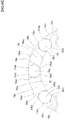
- FIG. 1 is a perspective view of the tubular body of the first embodiment of the present disclosure.
- FIG. 2 is a cross-sectional view of the tubular body of the first embodiment.
- FIG. 3 is a partially enlarged view of FIG. 2 .
- FIG. 4 is a perspective view of the tubular body of the second embodiment.
- FIG. 5 is a cross-sectional view of the tubular body of the second embodiment.
- FIG. 6 is a partially enlarged view of FIG. 5 .
- FIG. 7 is a cross-sectional view showing an initial state of setting a stranded wire to a swaging machine in producing a tubular body of the second embodiment.
- FIG. 8 is a cross-sectional view showing an intermediate state in producing the tubular body of the second embodiment.
- FIG. 9 is a cross-sectional view showing a final state in producing the tubular body of the second embodiment.
- FIG. 10 is a cross-sectional view of the tubular body of the third embodiment.
- FIG. 11 is a partially enlarged view of FIG. 10 .
- FIG. 12 is a cross-sectional view of the tubular body of the fourth embodiment.
- FIG. 13 is a partially enlarged view of FIG. 12 .
- FIG. 14 is a cross-sectional view of the tubular body of the fifth embodiment.
- FIG. 15 is a partially enlarged view of FIG. 14 .
- the outer tube made of polyamide elastomer is coated on the outside of the coil (see paragraph [0042] etc.).
- the wire constituting the coil is a round wire (circular cross section) compared with the case of the wire constituting the coil is a flat wire, because the inner surface of the coil is more uneven, a problem that the insertion resistance of the medical device into an inside of the coil is even worse has occurred.
- the present disclosure has been made in response to the above problems the aforementioned prior art has.
- the present disclosure may prevents the misalignment between the wires, may improve the torque transmissibility and pushing force to the other end portion of the tubular body, and may improve the insertability of the medical device into the inside of the tubular body, and further may improve flexibility and improve durability.
- the first aspect of the present disclosure comprises a plurality of first wires, a plurality of second wires twisted with the plurality of first wires, wherein at least one of the first wires has a substantially circular cross section, each of at least one of the second wires corresponding to the at least one of the first wires has a recess in the contact portion between adjacent the first wires, and a convex shape cross section in the transverse plane radial direction.
- the second aspect of the present disclosure is a tubular body of the first aspect, wherein each of the plurality of second wires is configured by twisting a plurality of third wires.
- the third aspect of the present disclosure is a tubular body of the first or second aspect, wherein each of the plurality of first wires is configured by twisting a plurality of fourth wires.
- each of the plurality of the second wires is formed by deforming the wire of larger outer diameter than an outer diameter of the first wire.
- first aspect of the present disclosure comprises a plurality of first wires, a plurality of second wires twisted with the plurality of first wires, wherein at least one of the first wires has a substantially circular cross section, each of at least one of the second wires corresponding to the at least one of the first wires has a recess in the contact portion between adjacent the first wires, and a convex shape cross section in the transverse plane radial direction, when the user manipulates one end portion portion of the tubular body, it is possible to prevent the deviation between the first wire and the second wire, to improve the torque transmissibility and pushing force to the other end portion of the tubular body. Further, it is possible to improve insertability of a medical device into the inside of the tubular body.
- each of the plurality of second wires is configured by twisting a plurality of third wires, in addition to the effect of the first aspect of the disclosure, when the tubular body is curved, by the subtle movement of the third wire, the flexibility and durability may be improved.
- each of the plurality of first wires is configured by twisting a plurality of fourth wires, in addition to the effect of the tubular body of the first or second aspect, when the tubular body is curved, by the subtle movement of the fourth wire, the flexibility and durability may also be further improved.
- any one of the tubular body of the first aspect to the third aspect as each of the plurality of the second wires is formed by deforming the wire of larger outer diameter than an outer diameter of the first wire, in addition to the effect of any of the tubular body of the first aspect to the third aspect, the second wire is sufficiently filled between the first wires, when the user manipulates one end portion of the tubular body, it is possible to prevent the deviation between the first wire and the second wire, to improve the torque transmission and pushing force to the other end portion of the tubular body.
- FIG. 1 is a perspective view of the tubular body of the first embodiment of the present disclosure
- FIG. 2 is a cross-sectional view of the tubular body of the first embodiment
- FIG. 3 is a partially enlarged view of FIG. 2 .
- a tubular body 1 is elongated tubular body configured to wind eight first wires ( 3 a, 3 b, 3 c, 3 d, 3 e, 3 f, 3 g, 3 h ) and eight second wires ( 5 a, 5 b, 5 c, 5 d, 5 e, 5 f , 5 g, 5 h ) alternately hollow spirally.
- tubular body 1 includes a substantially circular outer peripheral surface and a substantially circular inner peripheral surface in a cross-sectional view, and the tubular body 1 forms a hollow portion 6 in an inside of the inner peripheral surface thereof.
- the first wire of the present embodiment ( 3 a ⁇ 3 h ) is substantially circular in a cross-sectional view.
- the reason why the first wires ( 3 a ⁇ 3 h ) are described as substantially circular not exactly circular in a cross-sectional view depends on considering a case where the first wire is slightly deformed by the manufacturing method of the tubular body described below.
- the first wires ( 3 a ⁇ 3 h ) are substantively good to be circular in a cross-sectional view.
- each of the second wires ( 5 a ⁇ 5 h ) of the present embodiment has a recess in the contact portion between the first wires adjacent to both sides.
- the second wire 5 a has a recess 5 ar in the contact portion between the second wire 5 a and the first wire 3 h, and a recess 5 as in the contact portion between the second wire 5 a and the first wire 3 a as shown in FIG. 3 .
- the second wire 5 b has a recess 5 br in the contact portion between the second wire 5 b and the first wire 3 a, and a recess 5 bs in the contact portion between the second wire 5 b and the first wire 3 b.
- other second wires ( 5 c, 5 d, 5 e, 5 f, 5 g, 5 h ) also have recesses 5 cr , recess 5 cs (not shown), . . . , recess 5 hr (not shown), recess 5 hs . It will be easily understood.
- the second wire ( 5 a ⁇ 5 h ) of the present embodiment has a convex annular sector shape (arch shape) in the transverse plane radial direction.
- the second wire 5 a has an annular sector shape (arch shape) having a convex outer arc 5 ap and a convex inner arc 5 aq in the transverse plane radial direction as shown in FIG. 3 .
- the second wire 5 b has an annular sector shape (arch shape) having a convex outer arc 5 bp and a convex inner arc 5 bq in the transverse plane radial direction. Further, other second wires ( 5 c, 5 d, 5 e, 5 f, 5 g, 5 h ) also have annular sector shape (arch shape) having a convex outer arc and a convex inner arc in the transverse plane radial direction. It will be easily understood.
- each end of two second wires adjacent to both sides of the first wire is in contact with each one point of the outside and inside.
- two ends of the outer side are in contact with one point 7 a
- the two ends of the inner side are also in contact with one point 9 a as shown in FIGS. 1 to 3 .
- a helical pattern through point 7 a is formed on the outer surface of the tubular body 1
- a helical pattern through point 9 a is formed on the inner surface of the tubular body 1 .
- first wires ( 3 a ⁇ 3 h ) and a second wire ( 5 a ⁇ 5 h ) are stainless steel, platinum alloys, Ni-Ti-based alloys, cobalt based alloys such as, it is not particularly limited to them. Any material having a biocompatible is available, and stainless steel is used in the present embodiment.
- the first wires ( 3 a ⁇ 3 h ) and a second wires ( 5 a ⁇ 5 h ) are formed of the same material as in the present embodiment, they may be formed of a different material. However, when a tubular body 1 is produced by the method according to a swaging machine to be described later, It is preferred that the material of the second wires ( 5 a ⁇ 5 h ) are softer than the material of the first wires ( 3 a ⁇ 3 h ).
- each of first wires ( 3 a ⁇ 3 h ) is a substantially circular cross section
- each of second wires ( 5 a ⁇ 5 h ) has a recess ( 5 ar , 5 as , 5 br , 5 bs , 5 cr . . . 5 hs ) in contact portion between the first wire adjacent to it, has an annular sector shape (arch shape) having a convex outer arc ( 5 ap , 5 bp , . . .
- the number of the first wire and the second wire is eight each, it is not limited to eight.
- Two or more first wires and two or more second wires may be used in a tubular body. That is, it may be a tubular body comprising a plurality of first wires and a plurality of second wires.
- FIG. 4 is a perspective view of the tubular body of the second embodiment
- FIG. 5 is a cross-sectional view of the tubular body of the second embodiment
- FIG. 6 is a partially enlarged view of FIG. 5 .
- a tubular body 10 is elongated tubular body configured to wind eight first wires ( 13 a, 13 b, 13 c, 13 d, 13 e, 13 f, 13 g, 13 h ) and eight second wires ( 15 a , 15 b, 15 c, 15 d, 15 e, 15 f, 15 g, 15 h ) alternately hollow spirally.
- tubular body 10 includes a substantially circular outer peripheral surface and a substantially circular inner peripheral surface in a cross-sectional view, and the tubular body 10 forms a hollow portion 16 in an inside of the inner peripheral surface thereof.
- Each of the first wires ( 13 a ⁇ 13 h ) of the present embodiment is substantially circular in a cross-sectional view.
- the reason why the first wires ( 13 a ⁇ 13 h ) are described as substantially circular not exactly circular in a cross-sectional view depends on considering a case where the first wire is slightly deformed by the manufacturing method of the tubular body described below.
- the first wires ( 13 a ⁇ 13 h ) are substantively good to be circular in a cross-sectional view.
- each of the second wires ( 15 a ⁇ 15 h ) of the present embodiment has a recess in the contact portion between the first wires adjacent to both sides.
- the second wire 15 a has a recess 15 ar in the contact portion between the second wire 15 a and the first wire 13 h, and a recess 15 as in the contact portion between the second wire 15 a and the first wire 13 a as shown in FIG. 6 .
- the second wire 15 b has a recess 15 br in the contact portion between the second wire 15 b and the first wire 13 a, and a recess 15 bs in the contact portion between the second wire 15 b and the first wire 13 b.
- other second wires 15 c, 15 d, 15 e, 15 f, 15 g , 15 h
- recesses 15 cr recess 15 cs (not shown), . . . , recess 15 hr (not shown), recess 15 hs . It will be easily understood.
- the second wire ( 15 a ⁇ 15 h ) of the present embodiment has the shape of convex annular sector shape (arch shape) in the transverse plane radial direction.
- the second wire 15 a has an annular sector shape (arch shape) having a convex outer arc 15 ap and a convex inner arc 15 aq in the transverse plane radial direction as shown in FIG. 6 .
- the second wire 15 b has an annular sector shape (arch shape) having a convex outer arc 15 bp and a convex inner arc 15 bq in the transverse plane radial direction. Further, other second wires ( 15 c, 15 d, 15 e, 15 f, 15 g, 15 h ) also have annular sector shape (arch shape) having a convex outer arc and a convex inner arc in the transverse plane radial direction. It will be easily understood.
- the tubular body 10 of the present embodiment differs from the tubular body 1 of the first embodiment, each of the ends of two second wires adjacent to both sides of the first wire are separated.
- an outer end 17 a 1 of the second wire 15 a adjacent to one side of the first wire 13 a, and an outer end 17 a 2 of the second wire 15 b adjacent to the other side of the first wire 13 a are spaced apart
- an inner end 19 a 1 of the second wire 15 a adjacent to one side of the first wire 13 a, and an inner end 19 a 2 of the second wire 15 b adjacent to the other side of the first wire 13 a are also spaced apart as shown in FIGS. 4 to 6 .
- an outer end 17 b 1 and an outer end 17 b 2 , an outer end 17 c 1 and an outer end 17 c 2 , . . . , an outer end 17 g 1 and an outer end 17 g 2 , an outer end 17 h 1 and an outer end 17 h 2 are spaced apart, an inner end 19 b 1 and an inner end 19 b 2 , an inner end 19 c 1 and an inner end 19 c 2 , . . . , an inner end 19 g 1 and an inner end 19 g 2 , an inner end 19 h 1 and the inner end 19 h 2 are also spaced apart.
- two helical patterns per one first wire are formed on the outer surface and the inner surface of the tubular body 10 as shown in FIG. 4 .
- a total of 16 helical patterns are formed on the outer surface of the tubular body 10
- a total of 16 helical patterns are formed on the inner surface of the tubular body 10 .
- Material of the first wires ( 13 a ⁇ 13 h ) and a second wire ( 15 a ⁇ 15 h ) are stainless steel, platinum alloys, Ni-Ti-based alloys, cobalt based alloys such as, it is not particularly limited to them. Any material having a biocompatible is available, and stainless steel is used in the present embodiment.
- the first wires ( 13 a ⁇ 13 h ) and a second wires ( 15 a ⁇ 15 h ) are formed of the same material as in the present embodiment, they may be formed of a different material. However, when produced by the method according to a swaging machine to be described later a tubular body 10 , It is preferred that the material of the second wires ( 15 a ⁇ 15 h ) are softer than the material of the first wires ( 13 a ⁇ 13 h ).
- FIG. 7 is a cross-sectional view showing an initial state of setting a stranded wire to a swaging machine in producing a tubular body of the second embodiment
- FIG. 8 is a cross-sectional view showing an intermediate state in producing the tubular body of the second embodiment
- FIG. 9 is a cross-sectional view showing a final state in producing the tubular body of the second embodiment.
- a swaging machine used to produce the tubular body 10 may use any swaging machine among two-splits die, three-splits die, four-splits die and six-slits die.
- a manufacturing method will be described using the swaging machine with a four-splits die.
- a manufacturer prepares a stranded wire 12 configured to wind eight first wires ( 13 a ⁇ 13 h ) of circular cross-section and eight second wires ( 15 a ⁇ 15 h ) of circular cross-section, wherein the diameter of the second wire is larger than the diameter of the first wire, in a spiral manner around a circumference of a core wire 2 .
- the manufacturer sets the stranded wire 12 to a swaging machine 4 and deforms the stranded wire 12 by operating the swaging machine 4 .
- the manufacturer deforms the stranded wire 12 by vibrating a first die 4 a in a direction toward Y 1 and Y 2 , a second die 4 b in a direction toward X 3 and X 4 , a third die 4 c in direction toward Y 3 and Y 4 , and a fourth die 4 d in a direction toward X 1 and X 2 respectively while rotating a first die 4 a, a second die 4 b, a third die 4 c and a fourth die 4 d of swaging machine 4 around the stranded wire 12 .
- cross-sectional shape of each of eight first wires ( 13 a ⁇ 13 h ) is remained circular
- cross-sectional shape of each of eight second wires ( 15 a ⁇ 15 h ) is deformed into annular sector shape (arch shape) having larger diameter than the diameter of each of the first wires ( 13 a ⁇ 13 h ) as shown in FIG. 8 .
- the tubular body 10 is completed to pull out the core wire 2 from the stranded wire 12 , after removing the stranded wire 12 from the swaging machine 4 .
- each of first wires ( 13 a ⁇ 13 h ) is a substantially circular cross section
- each of second wires ( 15 a ⁇ 15 h ) has recesses ( 15 ar , 15 as , 15 br , 15 bs , 15 cr . . . 15 hs ) in contact portion between the first wire adjacent to it, has an annular sector shape (arch shape) having convex outer arcs ( 15 ap , 15 bp , . . .
- the inner surface of the tubular body 10 is flat in a vertical cross-sectional view, it may improve insertability of other medical devices into an inside of the tubular body 10 .
- tubular body 10 of the present embodiment differs from the tubular body 1 of the first embodiment, that is, since the ends of the two second wires adjacent to both sides of the first wire are separated, the tubular body 10 may have a somewhat flexible structure compared to the tubular body 1 of the first embodiment.
- the number of the first wire and the second wire is eight each, it is not limited to eight.
- Two or more first wires and two or more second wires may be used in a tubular body. That is, it may be a tubular body comprising a plurality of first wires and a plurality of second wires.
- FIG. 10 is a cross-sectional view of the tubular body of the third embodiment
- FIG. 11 is a partially enlarged view of FIG. 10 .
- a tubular body 20 is elongated tubular body configured to wind eight first wires ( 23 a, 23 b, 23 c, 23 d, 23 e, 23 f, 23 g, 23 h ) and eight second wires ( 25 a , 25 b, 25 c, 25 d, 25 e, 25 f, 25 g, 25 h ) alternately hollow spirally.
- each of eight second wires ( 25 a ⁇ 25 h ) is configured to wind nine third wires.
- the second wire 25 a is configured to wind nine third wires ( 25 a 1 , 25 a 2 , 25 a 3 , 25 a 4 , 25 a 5 , 25 a 6 , 25 a 7 , 25 a 8 , 25 a 9 )
- the second wire 25 b is configured to wind nine third wires ( 25 b 1 , 25 b 2 , 25 b 3 , 25 b 4 , 25 b 5 , 25 b 6 , 25 b 7 , 25 b 8 , 25 b 9 ) as shown in FIG. 11 .
- the other second wires 25 c ⁇ 25 h are each configured to wind nine third wires ( 25 c 1 ⁇ 25 c 9 , 25 d 1 ⁇ 25 d 9 , 25 e 1 ⁇ 25 e 9 , 25 f 1 ⁇ 25 f 9 , 25 g 1 ⁇ 25 g 9 , 25 h 1 ⁇ 25 h 9 (not one part shown)).
- tubular body 20 includes a substantially circular outer peripheral surface and a substantially circular inner peripheral surface in a cross-sectional view, and the tubular body 20 forms a hollow portion 26 in an inside of the inner peripheral surface thereof.
- Each of the first wires ( 23 a ⁇ 23 h ) of the present embodiment is substantially circular in a cross-sectional view.
- the reason why the first wires ( 23 a ⁇ 23 h ) are described as substantially circular not exactly circular in a cross-sectional view depends on considering a case where the first wire is slightly deformed by the manufacturing method of the tubular body described above. However, the first wires ( 23 a ⁇ 23 h ) are substantively good to be circular in a cross-sectional view.
- each of the second wires ( 25 a ⁇ 25 h ) of the present embodiment has a recess in the contact portion between the first wires adjacent to both sides.
- the second wire 25 a has a recess 25 ar in the contact portion between the second wire 25 a and the first wire 23 h, and a recess 25 as in the contact portion between the second wire 25 a and the first wire 23 a as shown in FIG. 11 .
- the second wire 25 b has a recess 25 br in the contact portion between the second wire 25 b and the first wire 23 a, and a recess 25 bs in the contact portion between the second wire 25 b and the first wire 23 b.
- other second wires 25 c, 25 d, 25 e, 25 f, 25 g , 25 h
- recesses 25 cr recess 25 cs (not shown), . . . , recess 25 hr (not shown), recess 25 hs . It will be easily understood.
- the second wire ( 25 a ⁇ 25 h ) of the present embodiment has the shape of convex annular sector shape (arch shape) in the transverse plane radial direction.
- the second wire 25 a has an annular sector shape (arch shape) having a convex outer arc 25 ap and a convex inner arc 25 aq in the transverse plane radial direction as shown in FIG. 11 .
- the second wire 25 b has an annular sector shape (arch shape) having a convex outer arc 25 bp and a convex inner arc 25 b q in the transverse plane radial direction. Further, other second wires ( 25 c, 25 d, 25 e, 25 f, 25 g, 25 h ) also have annular sector shape (arch shape) having a convex outer arc and a convex inner arc in the transverse plane radial direction. It will be easily understood.
- the tubular body 20 of the present embodiment is similar to the tubular body 10 of the second embodiment, the ends of two second wires adjacent to both sides of the first wire are separated.
- an outer end 27 a 1 of the second wire 25 a adjacent to one side of the first wire 23 a, and an outer end 27 a 2 of the second wire 25 b adjacent to the other side of the first wire 23 a are spaced apart
- an inner end 29 a 2 of the second wire 25 b adjacent to the other side of the first wire 23 a are also spaced apart as shown in FIGS. 10 and 11 .
- an outer end 27 b 1 and an outer end 27 b 2 , an outer end 27 c 1 and an outer end 27 c 2 , . . . , an outer end 27 g 1 and an outer end 27 g 2 , an outer end 27 h 1 and an outer end 27 h 2 are spaced apart, an inner end 29 b 1 and an inner end 29 b 2 , an inner end 29 c 1 and an inner end 29 c 2 , . . . , an inner end 29 g 1 and an inner end 29 g 2 , an inner end 29 h 1 and the inner end 29 h 2 are also spaced apart.
- two helical patterns per one first wire are formed on the outer surface and the inner surface of the tubular body 20 as shown in FIG. 4 .
- a total of 16 helical patterns are formed on the outer surface of the tubular body 20
- a total of 16 helical patterns are formed on the inner surface of the tubular body 20 .
- material of the first wires ( 23 a ⁇ 23 h ) and a second wire ( 25 a ⁇ 25 h ) are stainless steel, platinum alloys, Ni-Ti-based alloys, cobalt based alloys such as, it is not particularly limited to them. Any material having a biocompatible is available, and stainless steel is used in the present embodiment.
- the first wires ( 23 a ⁇ 23 h ) and a second wires ( 25 a ⁇ 25 h ) are formed of the same material as in the present embodiment, they may be formed of a different material. However, when the tubular body 20 is produced by the method according to a swaging machine to be described above, It is preferred that the material of the second wires ( 25 a ⁇ 25 h ) are softer than the material of the first wires ( 23 a ⁇ 23 h ).
- the manufacturing method of the tubular body 20 is identical to the manufacturing method of the tubular body 10 of the second embodiment. However, instead of each of the second wires ( 15 a ⁇ 15 h ) in FIG. 7 , a stranded wire configured by twisting cross-sectional view circular nine third wires is arranged.
- the tubular body 20 of this embodiment is produced to prepare a stranded wire configured to wind eight first wires ( 23 a ⁇ 23 h ) of circular cross-section and eight second wires ( 25 a ⁇ 25 h ) of substantially circular cross-section, wherein the diameter of the second wire is larger than the diameter of the first wire ( 23 a ⁇ 23 h ) in a spiral manner around the circumference of a core wire 2 .
- each of first wires ( 23 a ⁇ 23 h ) is a substantially circular cross section
- each of second wires ( 25 a ⁇ 25 h ) has a recess ( 25 ar , 25 as , 25 br , 25 bs , 25 cr . . . 25 hs ) in contact portion between the first wire adjacent to it, and has an annular sector shape (arch shape) having convex outer arcs ( 25 ap , 25 bp , . . .
- each of second wires is configured by twisting nine third wires (such as 25 a 1 ⁇ 25 a 9 ), when the user manipulates one end portion of the tubular body 20 , it is possible to prevent the deviation between the first wires and the second wires, improve the torque transmissibility and pushing force to the other end portion of the tubular body 20 .
- the inner surface of the tubular body 20 is flat in a vertical cross-sectional view, it may improve insertability of other medical devices into an inside of the tubular body 20 . And when the user bends the tubular body 20 , the subtle movement of the third wires may improve flexibility and durability of the tubular body.
- the number of the first wire and the second wire is eight each, it is not limited to eight.
- Two or more first wires and two or more second wires may be used in a tubular body. That is, it may be a tubular body comprising a plurality of first wires and a plurality of second wires.
- the second wire is configured by twisting nine third wires, it is not limited to nine. Three or more third wires may be used in the tubular body.
- FIG. 12 is a cross-sectional view of the tubular body of the fourth embodiment
- FIG. 13 is a partially enlarged view of FIG. 12 .
- a tubular body 30 is elongated tubular body configured to wind eight first wires ( 33 a, 33 b, 33 c, 33 d, 33 e, 33 f, 33 g, 33 h ) and eight second wires ( 35 a , 35 b, 35 c, 35 d, 35 e, 35 f, 35 g, 35 h ) alternately hollow spirally.
- each of first wires ( 33 a ⁇ 33 h ) is configured to wind seven fourth wires.
- the first wire 33 a is configured to wind seven fourth wires ( 33 a 1 , 33 a 2 , 33 a 3 , 33 a 4 , 33 a 5 , 33 a 6 , 33 a 7 )
- the first wire 3 b is configured to wind seven fourth wires ( 33 b 1 , 33 b 2 , 33 b 3 , 33 b 4 , 333 b 5 , 33 b 6 , 33 b 7 ) as shown in FIG. 13 .
- the other first wires 33 c ⁇ 33 h are each configured to wind seven fourth wires ( 33 c 1 ⁇ 33 c 7 , 33 d 1 ⁇ 33 d 7 , 33 e 1 ⁇ 33 e 7 , 33 f 1 ⁇ 33 f 7 , 33 g 1 ⁇ 33 g 7 , 33 h 1 ⁇ 33 h 7 (not one part shown)).
- tubular body 30 includes a substantially circular outer peripheral surface and a substantially circular inner peripheral surface in a cross-sectional view, and the tubular body 30 forms a hollow portion 36 in an inside of the inner peripheral surface thereof.
- each of the second wires ( 35 a ⁇ 35 h ) of the present embodiment has a recess in the contact portion between the first wires adjacent to both sides.
- the second wire 35 a has a recess 35 ar in the contact portion between the second wire 35 a and the first wire 33 h, and a recess 35 as in the contact portion between the second wire 35 a and the first wire 33 a as shown in FIG. 13 .
- the second wire 35 b has a recess 35 br in the contact portion between the second wire 35 b and the first wire 33 a, and a recess 35 bs in the contact portion between the second wire 35 b and the first wire 33 b.
- other second wires 35 c, 35 d, 35 e, 35 f, 35 g , 35 h
- recesses 35 cr recess 35 cs (not shown), . . . , recess 35 hr (not shown), recess 35 hs . It will be easily understood.
- the second wire ( 35 a ⁇ 35 h ) of the present embodiment has the shape of convex annular sector shape (arch shape) in the transverse plane radial direction.
- the second wire 35 a has an annular sector shape (arch shape) having a convex outer arc 35 ap and a convex inner arc 35 aq in the transverse plane radial direction as shown in FIG. 13 .
- the second wire 35 b has an annular sector shape (arch shape) having a convex outer arc 35 bp and a convex inner arc 35 bq in the transverse plane radial direction. Further, other second wires ( 35 c, 35 d, 35 e, 35 f, 35 g, 35 h ) also have annular sector shape (arch shape) having a convex outer arc and a convex inner arc in the transverse plane radial direction. It will be easily understood.
- the tubular body 30 of the present embodiment is similar to the tubular body 10 of the second embodiment, the ends of two second wires adjacent to both sides of the first wire are separated.
- an outer end 37 a 1 of the second wire 35 a adjacent to one side of the first wire 33 a, and an outer end 37 a 2 of the second wire 35 b adjacent to the other side of the first wire 33 a are spaced apart
- an inner end 39 a 2 of the second wire 35 b adjacent to the other side of the first wire 33 a are also spaced apart as shown in FIGS. 12 and 13 .
- an outer end 37 b 1 and an outer end 37 b 2 , an outer end 37 c 1 and an outer end 37 c 2 , . . . , an outer end 37 g 1 and an outer end 37 g 2 , an outer end 37 h 1 and an outer end 37 h 2 are spaced apart, an inner end 39 b 1 and an inner end 39 b 2 , an inner end 39 c 1 and an inner end 39 c 2 , . . . , an inner end 39 g 1 and an inner end 39 g 2 , an inner end 39 h 1 and the inner end 39 h 2 are also spaced apart.
- two helical patterns per one first wire are formed on the outer surface and the inner surface of the tubular body 30 as shown in FIG. 4 .
- a total of 16 helical patterns are formed on the outer surface of the tubular body 30
- a total of 16 helical patterns are formed on the inner surface of the tubular body 30 .
- material of the first wires ( 33 a ⁇ 33 h ) and a second wire ( 35 a ⁇ 35 h ) are stainless steel, platinum alloys, Ni-Ti-based alloys, cobalt based alloys such as, it is not particularly limited to them. Any material having a biocompatible is available, and stainless steel is used in the present embodiment.
- the first wires ( 33 a ⁇ 33 h ) and a second wires ( 35 a ⁇ 35 h ) are formed of the same material as in the present embodiment, they may be formed of a different material. However, when the tubular body 30 is produced by the method according to a swaging machine to be described before, It is preferred that the material of the second wires ( 35 a ⁇ 35 h ) are softer than the material of the first wires ( 33 a ⁇ 33 h ).
- the manufacturing method of the tubular body 30 is identical to the manufacturing method of the tubular body 10 of the second embodiment. However, instead of each of the first wires ( 13 a ⁇ 13 h ) in FIG. 7 , a stranded wire configured by twisting cross-sectional view circular seven fourth wires is arranged.
- the tubular body 30 of this embodiment is produced to prepare a stranded wire configured to wind eight first stranded wires ( 33 a ⁇ 33 h ) configured to wind seven fourth wires of circular cross-section and eight second wires ( 35 a ⁇ 35 h ) of circular cross-section, wherein the diameter of the second wire is larger than the diameter of the first wire ( 33 a ⁇ 33 h ), in a spiral manner around the circumference of a core wire 2 .
- each of first wires ( 33 a ⁇ 33 h ) is a substantially circular cross section
- each of second wires ( 35 a ⁇ 35 h ) has recesses ( 35 ar , 35 as , 35 br , 35 bs , 35 cr . . . 35 hs ) in contact portion between the first wire adjacent to it, and has an annular sector shape (arch shape) having convex outer arcs ( 35 ap , 35 bp , . . .
- each of first wires ( 33 a ⁇ 33 h ) is configured by twisting seven fourth wires (such as 33 a 1 ⁇ 33 a 7 ), when the user manipulates one end portion of the tubular body 30 , it is possible to prevent the deviation between the first wires and the second wires, improve the torque transmissibility and pushing force to the other end portion of the tubular body 30 .
- the inner surface of the tubular body 30 is flat in a vertical cross-sectional view, it may improve insertability of other medical devices into an inside of the tubular body 30 . And when the user bends the tubular body 30 , the subtle movement of the fourth wires may improve flexibility and durability of the tubular body.
- the number of the first wire and the second wire is eight each, it is not limited to eight.
- Two or more first wires and two or more second wires may be used in a tubular body. That is, it may be a tubular body comprising a plurality of first wires and a plurality of second wires.
- the first wire is configured by twisting seven fourth wires, it is not limited to seven. Three or more fourth wires may be used in the tubular body.
- FIG. 14 is a cross-sectional view of the tubular body of the fifth embodiment
- FIG. 15 is a partially enlarged view of FIG. 14 .
- a tubular body 40 is elongated tubular body configured to wind eight first wires ( 43 a, 43 b, 43 c, 43 d, 43 e, 43 f, 43 g, 43 h ) and eight second wires ( 45 a , 45 b, 45 c, 45 d, 45 e, 45 f, 45 g, 45 h ) alternately hollow spirally.
- each of first wires ( 43 a ⁇ 43 h ) is configured to wind seven fourth wires
- each of second wires ( 45 a ⁇ 45 h ) is configured to wind nine third wires.
- the first wire 43 a is configured to wind seven fourth wires ( 43 a 1 , 43 a 2 , 43 a 3 , 43 a 4 , 43 a 5 , 43 a 6 , 43 a 7 ), the second wire 45 a is configured to wind nine third wires ( 45 a 1 , 45 a 2 , 45 a 3 , 45 a 4 , 45 a 5 , 45 a 6 , 45 a 7 , 45 a 8 , 45 a 9 ) as shown in FIG. 15 .
- the other first wires 43 b ⁇ 43 h are each configured to wind seven fourth wires ( 43 b 1 ⁇ 43 b 7 , 43 c 1 ⁇ 43 c 7 , 43 d 1 ⁇ 43 d 7 , 43 e 1 ⁇ 43 e 7 , 43 f 1 ⁇ 43 f 7 , 43 g 1 ⁇ 43 g 7 , 43 h 1 ⁇ 43 h 7 (not one part shown)), the other second wires 45 b ⁇ 45 h are each configured to wind nine third wires ( 45 b 1 ⁇ 45 b 9 , 45 c 1 ⁇ 45 c 9 , 45 d 1 ⁇ 45 d 9 , 45 e 1 ⁇ 45 e 9 , 45 f 1 ⁇ 45 f 9 , 45 g 1 ⁇ 45 g 9 , 45 h 1 ⁇ 45 h 9 (not one part shown)).
- tubular body 40 includes a substantially circular outer peripheral surface and a substantially circular inner peripheral surface in a cross-sectional view, and the tubular body 40 forms a hollow portion 46 in an inside of the inner peripheral surface thereof.
- each of the second wires ( 45 a ⁇ 45 h ) of the present embodiment has a recess in the contact portion between the first wires adjacent to both sides.
- the second wire 45 a has a recess 45 ar in the contact portion between the second wire 45 a and the first wire 43 h, and a recess 45 as in the contact portion between the second wire 45 a and the first wire 43 a as shown in FIG. 15 .
- the second wire 45 b has a recess 45 br in the contact portion between the second wire 45 b and the first wire 43 a, and a recess 45 bs in the contact portion between the second wire 45 b and the first wire 43 b.
- other second wires 45 c, 45 d, 45 e, 45 f, 45 g , 45 h
- recesses 45 cr also have recesses 45 cr , . . . , recess 45 hs . It will be easily understood.
- the second wire ( 45 a ⁇ 45 h ) of the present embodiment has the shape of convex annular sector shape (arch shape) in the transverse plane radial direction.
- the second wire 45 a has an annular sector shape (arch shape) having a convex outer arc 45 ap and a convex inner arc 45 aq in the transverse plane radial direction as shown in FIG. 15 .
- the second wire 45 b has an annular sector shape (arch shape) having a convex outer arc 45 bp and a convex inner arc 45 bq in the transverse plane radial direction. Further, other second wires ( 45 c, 45 d, 45 e, 45 f, 45 g, 45 h ) also have annular sector shape (arch shape) having a convex outer arc and a convex inner arc in the transverse plane radial direction. It will be easily understood.
- the tubular body 40 of the present embodiment is similar to the tubular body 10 of the second embodiment, the ends of two second wires adjacent to both sides of the first wire are separated.
- an outer end 47 a 1 of the second wire 45 a adjacent to one side of the first wire 43 a, and an outer end 47 a 2 of the second wire 45 b adjacent to the other side of the first wire 43 a are spaced apart
- an inner end 49 a 2 of the second wire 45 b adjacent to the other side of the first wire 43 a are also spaced apart as shown in FIGS. 14 and 15 .
- an outer end 47 b 1 and an outer end 47 b 2 , an outer end 47 c 1 and an outer end 47 c 2 , . . . , an outer end 47 g 1 and an outer end 47 g 2 , an outer end 47 h 1 and an outer end 47 h 2 are spaced apart, an inner end 49 b 1 and an inner end 49 b 2 , an inner end 49 c 1 and an inner end 49 c 2 , . . . , an inner end 49 g 1 and an inner end 49 g 2 , an inner end 49 h 1 and the inner end 49 h 2 are also spaced apart.
- two helical patterns per one first wire are formed on the outer surface and the inner surface of the tubular body 40 as shown in FIG. 4 .
- a total of 16 helical patterns are formed on the outer surface of the tubular body 40
- a total of 16 helical patterns are formed on the inner surface of the tubular body 40 .
- material of the first wires ( 43 a ⁇ 43 h ) and a second wire ( 45 a ⁇ 45 h ) are stainless steel, platinum alloys, Ni-Ti-based alloys, cobalt based alloys such as, it is not particularly limited to them. Any material having a biocompatible is available, and stainless steel is used in the present embodiment.
- the first wires ( 43 a ⁇ 43 h ) and a second wires ( 45 a ⁇ 45 h ) are formed of the same material as in the present embodiment, they may be formed of a different material. However, when the tubular body 40 is produced by the method according to a swaging machine to be described before, It is preferred that the material of the second wires ( 45 a ⁇ 45 h ) are softer than the material of the first wires ( 43 a ⁇ 43 h ).
- the manufacturing method of the tubular body 40 is identical to the manufacturing method of the tubular body 10 of the second embodiment.
- a stranded wire configured by twisting seven cross-sectional view circular fourth wires is arranged.
- a stranded wire configured by twisting nine cross-sectional view circular third wires is arranged.
- the tubular body 40 of this embodiment is produced to prepare a stranded wire configured to wind eight first stranded wires ( 43 a ⁇ 43 h ) configured to wind seven fourth wires of circular cross-section and eight second wires ( 45 a ⁇ 45 h ) of circular cross-section, wherein the diameter of the second wire is larger than the diameter of the first wire ( 43 a ⁇ 43 h ), in a spiral manner around the circumference of a core wire 2 .
- each of first wires ( 433 a ⁇ 43 h ) is a substantially circular cross section
- each of second wires ( 45 a ⁇ 45 h ) has a recess ( 45 ar , 45 as , 45 br , 45 bs , 45 cr . . . 45 hs ) in contact portion between the first wire adjacent to it, and has an annular sector shape (arch shape) having convex outer arcs ( 45 ap , 45 bp , . . .
- each of first wires ( 43 a ⁇ 43 h ) is configured by twisting seven fourth wires (such as 43 a 1 ⁇ 43 a 7 ), when the user manipulates one end portion of the tubular body 40 , it is possible to prevent the deviation between the first wires and the second wires, improve the torque transmissibility and pushing force to the other end portion of the tubular body 40 .
- the inner surface of the tubular body 40 is flat in a vertical cross-sectional view, it may improve insertability of other medical devices into an inside of the tubular body 40 . And when the user bends the tubular body 40 , the subtle movement of the third wires and the subtle movement of the fourth wires may improve flexibility and durability of the tubular body.
- the number of the first wire and the second wire is eight each, it is not limited to eight.
- Two or more first wires and two or more second wires may be used in a tubular body. That is, it may be a tubular body comprising a plurality of first wires and a plurality of second wires.
- the first wire is configured by twisting seven fourth wires, it is not limited to seven. Three or more fourth wires may be used in the tubular body.
- the second wire is configured by twisting nine third wires, it is not limited to nine. Three or more third wires may be used in the tubular body.
Landscapes
- Health & Medical Sciences (AREA)
- Life Sciences & Earth Sciences (AREA)
- Animal Behavior & Ethology (AREA)
- Veterinary Medicine (AREA)
- Public Health (AREA)
- General Health & Medical Sciences (AREA)
- Engineering & Computer Science (AREA)
- Heart & Thoracic Surgery (AREA)
- Hematology (AREA)
- Biomedical Technology (AREA)
- Anesthesiology (AREA)
- Pulmonology (AREA)
- Biophysics (AREA)
- Chemical & Material Sciences (AREA)
- Inorganic Chemistry (AREA)
- Epidemiology (AREA)
- Media Introduction/Drainage Providing Device (AREA)
Abstract
Description
- This application claims priority to Japanese Patent Application 2018-165635, filed on Sep. 5, 2018, which is incorporated herein by reference.
- The present disclosure relates to a tubular body that is configured by twisting a plurality of wires.
- Conventionally, in a catheter percutaneously inserted into a blood vessel, from the viewpoint of the performance of pushability for transmitting pushing force of an operator to a distal end portion of the catheter, torque transmissibility for transmitting a rotative force to the distal end portion of the catheter when the operator rotates a proximal end portion of the catheter, kink resistance not causing bent at the bent portion or the curved portion of the blood vessel, and insertability of another medical devices into the catheter lumen and so on, various medical tube suitable for catheters have been developed.
- For example,
Patent Document 1 discloses a medical tube including a coil layer which a flat wire (its cross section is rectangular) is densely wound is arranged on an inner layer of the medical tube, and an outer layer of polyamide elastomer is arranged on an outside of the coil layer (seeFIG. 1 etc.).Patent Document 1 also discloses that it is possible to achieve all of flexibility, good kink resistance, and good tensile strength according to this medical tube (see paragraph [0006] etc.). - [Patent Document 1] JP 2010-136895 A
- The present application provides a tubular body, comprising: a plurality of first wires distributed in an annular portion of the tubular body; and a plurality of deformed second wires alternately disposed between each of the plurality of first wires, the plurality of first wires and the plurality of deformed second wires being in an alternately twisted arrangement in a longitudinal direction of the tubular body, wherein each of the plurality of first wires has a substantially circular shape in a cross section view with respect to the longitudinal direction of the tubular body, and each of the plurality of deformed second wires has a non-circular shape in the cross section view, has an arcuate side portion that receive a part of a side surface of an adjacent wire of the plurality of first wires, and has an annular sector shape protruding in a radial direction in the cross section view of the tubular body.
-
FIG. 1 is a perspective view of the tubular body of the first embodiment of the present disclosure. -
FIG. 2 is a cross-sectional view of the tubular body of the first embodiment. -
FIG. 3 is a partially enlarged view ofFIG. 2 . -
FIG. 4 is a perspective view of the tubular body of the second embodiment. -
FIG. 5 is a cross-sectional view of the tubular body of the second embodiment. -
FIG. 6 is a partially enlarged view ofFIG. 5 . -
FIG. 7 is a cross-sectional view showing an initial state of setting a stranded wire to a swaging machine in producing a tubular body of the second embodiment. -
FIG. 8 is a cross-sectional view showing an intermediate state in producing the tubular body of the second embodiment. -
FIG. 9 is a cross-sectional view showing a final state in producing the tubular body of the second embodiment. -
FIG. 10 is a cross-sectional view of the tubular body of the third embodiment. -
FIG. 11 is a partially enlarged view ofFIG. 10 . -
FIG. 12 is a cross-sectional view of the tubular body of the fourth embodiment. -
FIG. 13 is a partially enlarged view ofFIG. 12 . -
FIG. 14 is a cross-sectional view of the tubular body of the fifth embodiment. -
FIG. 15 is a partially enlarged view ofFIG. 14 . - However, the coils used in the medical tube disclosed in
Patent Document 1, since the wire is wound is flat wire (its cross section is rectangular), when one end portion of the medical tube is operated, there was a problem that the wire itself deviates in cross section radially inside or outside of the coil from adjacent wires. - Therefore, in the medical tube disclosed in
Patent Document 1, in order to prevent the deviation of the wire, the outer tube made of polyamide elastomer is coated on the outside of the coil (see paragraph [0042] etc.). - Incidentally, when the user manipulates one end portion of the medical tube, a problem that the wire itself deviates in cross section radially inside or outside of the coil against the wires adjacent to both sides, has occurred even if the wire forming the coil is a round wire (circular cross section) not only in the case of a flat wire (rectangular cross section).
- Incidentally, when the wire constituting the coil is a round wire (circular cross section) compared with the case of the wire constituting the coil is a flat wire, because the inner surface of the coil is more uneven, a problem that the insertion resistance of the medical device into an inside of the coil is even worse has occurred.
- The present disclosure has been made in response to the above problems the aforementioned prior art has. When the user manipulates one end portion portion of the coil (hereinafter, referred to as “tubular body”), the present disclosure may prevents the misalignment between the wires, may improve the torque transmissibility and pushing force to the other end portion of the tubular body, and may improve the insertability of the medical device into the inside of the tubular body, and further may improve flexibility and improve durability.
- To solve the problems described above, the first aspect of the present disclosure comprises a plurality of first wires, a plurality of second wires twisted with the plurality of first wires, wherein at least one of the first wires has a substantially circular cross section, each of at least one of the second wires corresponding to the at least one of the first wires has a recess in the contact portion between adjacent the first wires, and a convex shape cross section in the transverse plane radial direction.
- The second aspect of the present disclosure is a tubular body of the first aspect, wherein each of the plurality of second wires is configured by twisting a plurality of third wires.
- The third aspect of the present disclosure is a tubular body of the first or second aspect, wherein each of the plurality of first wires is configured by twisting a plurality of fourth wires.
- Furthermore, a fourth aspect of the present disclosure, in any one of the tubular body according to
claim 1 to claim 3, wherein each of the plurality of the second wires is formed by deforming the wire of larger outer diameter than an outer diameter of the first wire. - As a first aspect of the present disclosure comprises a plurality of first wires, a plurality of second wires twisted with the plurality of first wires, wherein at least one of the first wires has a substantially circular cross section, each of at least one of the second wires corresponding to the at least one of the first wires has a recess in the contact portion between adjacent the first wires, and a convex shape cross section in the transverse plane radial direction, when the user manipulates one end portion portion of the tubular body, it is possible to prevent the deviation between the first wire and the second wire, to improve the torque transmissibility and pushing force to the other end portion of the tubular body. Further, it is possible to improve insertability of a medical device into the inside of the tubular body.
- According to the second aspect of the present disclosure, in the tubular body of the first aspect, as each of the plurality of second wires is configured by twisting a plurality of third wires, in addition to the effect of the first aspect of the disclosure, when the tubular body is curved, by the subtle movement of the third wire, the flexibility and durability may be improved.
- According to the third aspect of the present disclosure, in a tubular body of the first or second aspect, as each of the plurality of first wires is configured by twisting a plurality of fourth wires, in addition to the effect of the tubular body of the first or second aspect, when the tubular body is curved, by the subtle movement of the fourth wire, the flexibility and durability may also be further improved.
- Further, according to the fourth aspect of the present disclosure, in any one of the tubular body of the first aspect to the third aspect, as each of the plurality of the second wires is formed by deforming the wire of larger outer diameter than an outer diameter of the first wire, in addition to the effect of any of the tubular body of the first aspect to the third aspect, the second wire is sufficiently filled between the first wires, when the user manipulates one end portion of the tubular body, it is possible to prevent the deviation between the first wire and the second wire, to improve the torque transmission and pushing force to the other end portion of the tubular body.
- Hereinafter, embodiments of the present disclosure will be described with reference to the drawings.
- Firstly, a first embodiment of the present disclosure will be described.
FIG. 1 is a perspective view of the tubular body of the first embodiment of the present disclosure,FIG. 2 is a cross-sectional view of the tubular body of the first embodiment,FIG. 3 is a partially enlarged view ofFIG. 2 . - As shown in
FIG. 1 , atubular body 1 is elongated tubular body configured to wind eight first wires (3 a, 3 b, 3 c, 3 d, 3 e, 3 f, 3 g, 3 h) and eight second wires (5 a, 5 b, 5 c, 5 d, 5 e, 5 f, 5 g, 5 h) alternately hollow spirally. - Further, the
tubular body 1 includes a substantially circular outer peripheral surface and a substantially circular inner peripheral surface in a cross-sectional view, and thetubular body 1 forms ahollow portion 6 in an inside of the inner peripheral surface thereof. - The first wire of the present embodiment (3 a˜3 h) is substantially circular in a cross-sectional view. Here, the reason why the first wires (3 a˜3 h) are described as substantially circular not exactly circular in a cross-sectional view depends on considering a case where the first wire is slightly deformed by the manufacturing method of the tubular body described below. However, the first wires (3 a˜3 h) are substantively good to be circular in a cross-sectional view.
- On the other hand, each of the second wires (5 a˜5 h) of the present embodiment has a recess in the contact portion between the first wires adjacent to both sides. For example, the
second wire 5 a has a recess 5 ar in the contact portion between thesecond wire 5 a and thefirst wire 3 h, and a recess 5 as in the contact portion between thesecond wire 5 a and thefirst wire 3 a as shown inFIG. 3 . - The
second wire 5 b has a recess 5 br in the contact portion between thesecond wire 5 b and thefirst wire 3 a, and a recess 5 bs in the contact portion between thesecond wire 5 b and thefirst wire 3 b. Further, other second wires (5 c, 5 d, 5 e, 5 f, 5 g, 5 h) also have recesses 5 cr, recess 5 cs (not shown), . . . , recess 5 hr (not shown), recess 5 hs. It will be easily understood. - The second wire (5 a˜5 h) of the present embodiment has a convex annular sector shape (arch shape) in the transverse plane radial direction. For example, the
second wire 5 a has an annular sector shape (arch shape) having a convex outer arc 5 ap and a convex inner arc 5 aq in the transverse plane radial direction as shown inFIG. 3 . - The
second wire 5 b has an annular sector shape (arch shape) having a convex outer arc 5 bp and a convex inner arc 5 bq in the transverse plane radial direction. Further, other second wires (5 c, 5 d, 5 e, 5 f, 5 g, 5 h) also have annular sector shape (arch shape) having a convex outer arc and a convex inner arc in the transverse plane radial direction. It will be easily understood. - Incidentally, in the
tubular body 1 of the present embodiment, each end of two second wires adjacent to both sides of the first wire is in contact with each one point of the outside and inside. For example, in twosecond wires first wire 3 a, two ends of the outer side are in contact with onepoint 7 a, the two ends of the inner side are also in contact with onepoint 9 a as shown inFIGS. 1 to 3 . - Thus, a helical pattern through
point 7 a is formed on the outer surface of thetubular body 1, and a helical pattern throughpoint 9 a is formed on the inner surface of thetubular body 1. - Similarly, as the ends of two second wires adjacent to each both sides of other first wires (3 b, 3 c, 3 d, 3 e, 3 f, 3 g, 3 h) are also contact with one point of the outer side and the inner side, seven helical patterns by
point tubular body 1, and seven helical patterns bypoint tubular body 1. - Materials of the first wires (3 a˜3 h) and a second wire (5 a˜5 h) are stainless steel, platinum alloys, Ni-Ti-based alloys, cobalt based alloys such as, it is not particularly limited to them. Any material having a biocompatible is available, and stainless steel is used in the present embodiment.
- The first wires (3 a˜3 h) and a second wires (5 a˜5 h) are formed of the same material as in the present embodiment, they may be formed of a different material. However, when a
tubular body 1 is produced by the method according to a swaging machine to be described later, It is preferred that the material of the second wires (5 a˜5 h) are softer than the material of the first wires (3 a˜3 h). - According to the
tubular body 1 of the present embodiment, as thetubular body 1 is configured to wind eight first wires (3 a˜3 h) and eight second wires (5 a˜5 h) alternately in a hollow shape, each of first wires (3 a˜3 h) is a substantially circular cross section, each of second wires (5 a˜5 h) has a recess (5 ar, 5 as, 5 br, 5 bs, 5 cr . . . 5 hs) in contact portion between the first wire adjacent to it, has an annular sector shape (arch shape) having a convex outer arc (5 ap, 5 bp, . . . , 5 hp (not shown)) and a convex inner arc (5 aq, 5 bq, . . . 5 hq (not shown)) in the transverse plane radial direction, when the user manipulates one end portion of thetubular body 1, it is possible to prevent the deviation between the first wires and the second wires, improve the torque transmissibility and pushing force to the other end portion of thetubular body 1. Further, since the inner surface of thetubular body 1 is flat in a vertical cross-sectional view, it may improves insertability of other medical devices into an inside of thetubular body 1. - In the present embodiment, the number of the first wire and the second wire is eight each, it is not limited to eight. Two or more first wires and two or more second wires may be used in a tubular body. That is, it may be a tubular body comprising a plurality of first wires and a plurality of second wires.
- Next, a second embodiment of the present disclosure will be described.
-
FIG. 4 is a perspective view of the tubular body of the second embodiment,FIG. 5 is a cross-sectional view of the tubular body of the second embodiment,FIG. 6 is a partially enlarged view ofFIG. 5 . - As shown in
FIG. 4 , atubular body 10 is elongated tubular body configured to wind eight first wires (13 a, 13 b, 13 c, 13 d, 13 e, 13 f, 13 g, 13 h) and eight second wires (15 a, 15 b, 15 c, 15 d, 15 e, 15 f, 15 g, 15 h) alternately hollow spirally. - Further, the
tubular body 10 includes a substantially circular outer peripheral surface and a substantially circular inner peripheral surface in a cross-sectional view, and thetubular body 10 forms ahollow portion 16 in an inside of the inner peripheral surface thereof. - Each of the first wires (13 a˜13 h) of the present embodiment is substantially circular in a cross-sectional view. Here, the reason why the first wires (13 a˜13 h) are described as substantially circular not exactly circular in a cross-sectional view depends on considering a case where the first wire is slightly deformed by the manufacturing method of the tubular body described below. However, the first wires (13 a˜13 h) are substantively good to be circular in a cross-sectional view.
- On the other hand, each of the second wires (15 a˜15 h) of the present embodiment has a recess in the contact portion between the first wires adjacent to both sides. For example, the
second wire 15 a has a recess 15 ar in the contact portion between thesecond wire 15 a and thefirst wire 13 h, and a recess 15 as in the contact portion between thesecond wire 15 a and thefirst wire 13 a as shown inFIG. 6 . - The
second wire 15 b has a recess 15 br in the contact portion between thesecond wire 15 b and thefirst wire 13 a, and a recess 15 bs in the contact portion between thesecond wire 15 b and thefirst wire 13 b. Further, other second wires (15 c, 15 d, 15 e, 15 f, 15 g, 15 h) also have recesses 15 cr, recess 15 cs (not shown), . . . , recess 15 hr (not shown), recess 15 hs. It will be easily understood. - The second wire (15 a˜15 h) of the present embodiment has the shape of convex annular sector shape (arch shape) in the transverse plane radial direction. For example, the
second wire 15 a has an annular sector shape (arch shape) having a convex outer arc 15 ap and a convex inner arc 15 aq in the transverse plane radial direction as shown inFIG. 6 . - The
second wire 15 b has an annular sector shape (arch shape) having a convex outer arc 15 bp and a convex inner arc 15 bq in the transverse plane radial direction. Further, other second wires (15 c, 15 d, 15 e, 15 f, 15 g, 15 h) also have annular sector shape (arch shape) having a convex outer arc and a convex inner arc in the transverse plane radial direction. It will be easily understood. - Incidentally, the
tubular body 10 of the present embodiment differs from thetubular body 1 of the first embodiment, each of the ends of two second wires adjacent to both sides of the first wire are separated. For example, an outer end 17 a 1 of thesecond wire 15 a adjacent to one side of thefirst wire 13 a, and an outer end 17 a 2 of thesecond wire 15 b adjacent to the other side of thefirst wire 13 a are spaced apart, further, an inner end 19 a 1 of thesecond wire 15 a adjacent to one side of thefirst wire 13 a, and an inner end 19 a 2 of thesecond wire 15 b adjacent to the other side of thefirst wire 13 a are also spaced apart as shown inFIGS. 4 to 6 . - Similarly, in the other
first wire 13 b˜13 h, an outer end 17 b 1 and an outer end 17 b 2, an outer end 17 c 1 and an outer end 17 c 2, . . . , an outer end 17g 1 and an outer end 17 g 2, an outer end 17h 1 and an outer end 17 h 2 are spaced apart, an inner end 19 b 1 and an inner end 19 b 2, an inner end 19 c 1 and an inner end 19 c 2, . . . , an inner end 19g 1 and an inner end 19 g 2, an inner end 19h 1 and the inner end 19 h 2 are also spaced apart. - Accordingly, two helical patterns per one first wire are formed on the outer surface and the inner surface of the
tubular body 10 as shown inFIG. 4 . In the present embodiment, a total of 16 helical patterns are formed on the outer surface of thetubular body 10, and a total of 16 helical patterns are formed on the inner surface of thetubular body 10. - Similar to the first wires (3 a˜3 h) and a second wire (5 a˜5 h) of the first embodiment, Material of the first wires (13 a˜13 h) and a second wire (15 a˜15 h) are stainless steel, platinum alloys, Ni-Ti-based alloys, cobalt based alloys such as, it is not particularly limited to them. Any material having a biocompatible is available, and stainless steel is used in the present embodiment.
- The first wires (13 a˜13 h) and a second wires (15 a˜15 h) are formed of the same material as in the present embodiment, they may be formed of a different material. However, when produced by the method according to a swaging machine to be described later a
tubular body 10, It is preferred that the material of the second wires (15 a˜15 h) are softer than the material of the first wires (13 a˜13 h). - Here, a method for manufacturing the
tubular body 10 will be described. -
FIG. 7 is a cross-sectional view showing an initial state of setting a stranded wire to a swaging machine in producing a tubular body of the second embodiment,FIG. 8 is a cross-sectional view showing an intermediate state in producing the tubular body of the second embodiment,FIG. 9 is a cross-sectional view showing a final state in producing the tubular body of the second embodiment. - Incidentally, a swaging machine used to produce the
tubular body 10 may use any swaging machine among two-splits die, three-splits die, four-splits die and six-slits die. In the present embodiment, a manufacturing method will be described using the swaging machine with a four-splits die. - To produce the
tubular body 10, firstly, a manufacturer prepares a strandedwire 12 configured to wind eight first wires (13 a˜13 h) of circular cross-section and eight second wires (15 a˜15 h) of circular cross-section, wherein the diameter of the second wire is larger than the diameter of the first wire, in a spiral manner around a circumference of a core wire 2. - Then, as shown in
FIG. 7 , the manufacturer sets the strandedwire 12 to a swaging machine 4 and deforms the strandedwire 12 by operating the swaging machine 4. Specifically, the manufacturer deforms the strandedwire 12 by vibrating afirst die 4 a in a direction toward Y1 and Y2, asecond die 4 b in a direction toward X3 and X4, athird die 4 c in direction toward Y3 and Y4, and afourth die 4 d in a direction toward X1 and X2 respectively while rotating afirst die 4 a, asecond die 4 b, athird die 4 c and afourth die 4 d of swaging machine 4 around the strandedwire 12. - After the manufacturer continues to operate the swaging machine 4 for a predetermined time in this way, while cross-sectional shape of each of eight first wires (13 a˜13 h) is remained circular, cross-sectional shape of each of eight second wires (15 a˜15 h) is deformed into annular sector shape (arch shape) having larger diameter than the diameter of each of the first wires (13 a˜13 h) as shown in
FIG. 8 . - Further after the manufacturer continues to operate the swaging machine 4 for a predetermined time in this way, while cross-sectional shape of each of eight first wires (13 a˜13 h) is remained circular, cross-section of each of the eight second wires (15 a˜15 h) having larger diameter than the diameter of each of the first wires(13 a˜13 h) is deformed into convex annular sector shape (arch shape) in the transverse plane radial direction having a recess in the contact portion between the first wires adjacent to both sides as shown in
FIG. 9 . - Then, the
tubular body 10 is completed to pull out the core wire 2 from the strandedwire 12, after removing the strandedwire 12 from the swaging machine 4. - On the other hand, without removing the stranded
wire 12 from the swaging machine 4, After the manufacturer continues to operate the swaging machine 4 for a further predetermined time, strandedwire 12 that each ends of two second wires adjacent to both sides of each of the first wires (13 a˜13 h) are in contact at each one point of the outside and inside of the stranded wire in cross-sectional view is completed. Then, thetubular body 1 as shown inFIGS. 1 to 3 is completed to pull out the core wire 2 from the strandedwire 12, after removing the strandedwire 12 from the swaging machine 4. - According to the
tubular body 10 of the present embodiment, as thetubular body 10 is configured to wind eight first wires (13 a˜13 h) and eight second wires (15 a˜15 h) alternately in a hollow shape, each of first wires (13 a˜13 h) is a substantially circular cross section, each of second wires (15 a˜15 h) has recesses (15 ar, 15 as, 15 br, 15 bs, 15 cr . . . 15 hs) in contact portion between the first wire adjacent to it, has an annular sector shape (arch shape) having convex outer arcs (15 ap, 15 bp, . . . , 15 hp (not shown)) and inner arcs (15 aq, 15 bq, . . . 15 hq (not shown)) in the transverse plane radial direction, when the user manipulates one end portion of thetubular body 10, it is possible to prevent the deviation between the first wires and the second wires, improve the torque transmissibility and pushing force to the other end portion of thetubular body 10. - Further, since the inner surface of the
tubular body 10 is flat in a vertical cross-sectional view, it may improve insertability of other medical devices into an inside of thetubular body 10. - Furthermore, the
tubular body 10 of the present embodiment differs from thetubular body 1 of the first embodiment, that is, since the ends of the two second wires adjacent to both sides of the first wire are separated, thetubular body 10 may have a somewhat flexible structure compared to thetubular body 1 of the first embodiment. - In the present embodiment, the number of the first wire and the second wire is eight each, it is not limited to eight. Two or more first wires and two or more second wires may be used in a tubular body. That is, it may be a tubular body comprising a plurality of first wires and a plurality of second wires.
- Next, a description of a third embodiment of the present disclosure will be described.
-
FIG. 10 is a cross-sectional view of the tubular body of the third embodiment,FIG. 11 is a partially enlarged view ofFIG. 10 . - As shown in
FIG. 10 , atubular body 20 is elongated tubular body configured to wind eight first wires (23 a, 23 b, 23 c, 23 d, 23 e, 23 f, 23 g, 23 h) and eight second wires (25 a, 25 b, 25 c, 25 d, 25 e, 25 f, 25 g, 25 h) alternately hollow spirally. - The
tubular body 20 of the present embodiment differs from thetubular body 10 of the second embodiment, each of eight second wires (25 a˜25 h) is configured to wind nine third wires. Specifically, thesecond wire 25 a is configured to wind nine third wires (25 a 1, 25 a 2, 25 a 3, 25 a 4, 25 a 5, 25 a 6, 25 a 7, 25 a 8, 25 a 9), thesecond wire 25 b is configured to wind nine third wires (25b b 2, 25b 3, 25b 4, 25b 5, 25b b 7, 25b 8, 25 b 9) as shown inFIG. 11 . - Similarly, the other
second wires 25 c˜25 h are each configured to wind nine third wires (25c 1˜25c 9, 25d 1˜25d 9, 25e 1˜25 e 9, 25f 1˜25f 9, 25g 1˜25g 9, 25h 1˜25 h 9 (not one part shown)). - Further, the
tubular body 20 includes a substantially circular outer peripheral surface and a substantially circular inner peripheral surface in a cross-sectional view, and thetubular body 20 forms ahollow portion 26 in an inside of the inner peripheral surface thereof. - Each of the first wires (23 a˜23 h) of the present embodiment is substantially circular in a cross-sectional view. Here, the reason why the first wires (23 a˜23 h) are described as substantially circular not exactly circular in a cross-sectional view depends on considering a case where the first wire is slightly deformed by the manufacturing method of the tubular body described above. However, the first wires (23 a˜23 h) are substantively good to be circular in a cross-sectional view.
- On the other hand, each of the second wires (25 a˜25 h) of the present embodiment has a recess in the contact portion between the first wires adjacent to both sides. For example, the
second wire 25 a has a recess 25 ar in the contact portion between thesecond wire 25 a and thefirst wire 23 h, and a recess 25 as in the contact portion between thesecond wire 25 a and thefirst wire 23 a as shown inFIG. 11 . - The
second wire 25 b has a recess 25 br in the contact portion between thesecond wire 25 b and thefirst wire 23 a, and a recess 25 bs in the contact portion between thesecond wire 25 b and thefirst wire 23 b. Further, other second wires (25 c, 25 d, 25 e, 25 f, 25 g, 25 h) also have recesses 25 cr, recess 25 cs (not shown), . . . , recess 25 hr (not shown), recess 25 hs. It will be easily understood. - The second wire (25 a˜25 h) of the present embodiment has the shape of convex annular sector shape (arch shape) in the transverse plane radial direction. For example, the
second wire 25 a has an annular sector shape (arch shape) having a convex outer arc 25 ap and a convex inner arc 25 aq in the transverse plane radial direction as shown inFIG. 11 . - The
second wire 25 b has an annular sector shape (arch shape) having a convex outer arc 25 bp and a convex inner arc 25 bq in the transverse plane radial direction. Further, other second wires (25 c, 25 d, 25 e, 25 f, 25 g, 25 h) also have annular sector shape (arch shape) having a convex outer arc and a convex inner arc in the transverse plane radial direction. It will be easily understood. - Incidentally, the
tubular body 20 of the present embodiment is similar to thetubular body 10 of the second embodiment, the ends of two second wires adjacent to both sides of the first wire are separated. For example, an outer end 27 a 1 of thesecond wire 25 a adjacent to one side of thefirst wire 23 a, and an outer end 27 a 2 of thesecond wire 25 b adjacent to the other side of thefirst wire 23 a are spaced apart, further, an inner end 29 a 1 of thesecond wire 25 a adjacent to one side of thefirst wire 23 a, and an inner end 29 a 2 of thesecond wire 25 b adjacent to the other side of thefirst wire 23 a are also spaced apart as shown inFIGS. 10 and 11 . - Similarly, in the other
first wire 23 b˜23 h, an outer end 27 b 1 and an outer end 27 b 2, an outer end 27 c 1 and an outer end 27 c 2, . . . , an outer end 27g 1 and an outer end 27 g 2, an outer end 27h 1 and an outer end 27 h 2 are spaced apart, an inner end 29 b 1 and an inner end 29 b 2, an inner end 29 c 1 and an inner end 29 c 2, . . . , an inner end 29g 1 and an inner end 29 g 2, an inner end 29h 1 and the inner end 29 h 2 are also spaced apart. - Accordingly, two helical patterns per one first wire are formed on the outer surface and the inner surface of the
tubular body 20 as shown inFIG. 4 . In the present embodiment, a total of 16 helical patterns are formed on the outer surface of thetubular body 20, and a total of 16 helical patterns are formed on the inner surface of thetubular body 20. - Similar to the first wires and a second wire of the first embodiment and the second embodiment, material of the first wires (23 a˜23 h) and a second wire (25 a˜25 h) are stainless steel, platinum alloys, Ni-Ti-based alloys, cobalt based alloys such as, it is not particularly limited to them. Any material having a biocompatible is available, and stainless steel is used in the present embodiment.
- The first wires (23 a˜23 h) and a second wires (25 a˜25 h) are formed of the same material as in the present embodiment, they may be formed of a different material. However, when the
tubular body 20 is produced by the method according to a swaging machine to be described above, It is preferred that the material of the second wires (25 a˜25 h) are softer than the material of the first wires (23 a˜23 h). - Note that the manufacturing method of the
tubular body 20 is identical to the manufacturing method of thetubular body 10 of the second embodiment. However, instead of each of the second wires (15 a˜15 h) inFIG. 7 , a stranded wire configured by twisting cross-sectional view circular nine third wires is arranged. - That is, the
tubular body 20 of this embodiment is produced to prepare a stranded wire configured to wind eight first wires (23 a˜23 h) of circular cross-section and eight second wires (25 a˜25 h) of substantially circular cross-section, wherein the diameter of the second wire is larger than the diameter of the first wire (23 a˜23 h) in a spiral manner around the circumference of a core wire 2. - Then, after the manufacturer continues to operate the swaging machine 4 for a predetermined time in this way, while cross-sectional shape of each of eight first wires (23 a˜23 h) is remained circular, cross-sectional shape of each of eight second wires (25 a˜25 h) having larger diameter than the diameter of each of the first wires (23 a˜23 h) has a recess in the contact portion between the first wire adjacent to both sides, is deformed into annular sector shape (arch shape) as shown in
FIG. 10 . Thereafter, similarly to the manufacturing method of thetubular body 10 of the second embodiment, by extracting the core wire 2 from the stranded wire, thetubular body 20 is completed. - According to the
tubular body 20 of the present embodiment, as thetubular body 20 is configured to wind eight first wires (23 a˜23 h) and eight second wires (25 a˜25 h) alternately in a hollow shape, wherein each of first wires (23 a˜23 h) is a substantially circular cross section, each of second wires (25 a˜25 h) has a recess (25 ar, 25 as, 25 br, 25 bs, 25 cr . . . 25 hs) in contact portion between the first wire adjacent to it, and has an annular sector shape (arch shape) having convex outer arcs (25 ap, 25 bp, . . . , 25 hp (not shown)) and inner arcs (25 aq, 25 bq, . . . 25 hq (not shown)) in the transverse plane radial direction, further each of second wires (25 a˜25 h) is configured by twisting nine third wires (such as 25 a 1˜25 a 9), when the user manipulates one end portion of thetubular body 20, it is possible to prevent the deviation between the first wires and the second wires, improve the torque transmissibility and pushing force to the other end portion of thetubular body 20. - Further, since the inner surface of the
tubular body 20 is flat in a vertical cross-sectional view, it may improve insertability of other medical devices into an inside of thetubular body 20. And when the user bends thetubular body 20, the subtle movement of the third wires may improve flexibility and durability of the tubular body. - In the present embodiment, the number of the first wire and the second wire is eight each, it is not limited to eight. Two or more first wires and two or more second wires may be used in a tubular body. That is, it may be a tubular body comprising a plurality of first wires and a plurality of second wires.
- In the present embodiment, although the second wire is configured by twisting nine third wires, it is not limited to nine. Three or more third wires may be used in the tubular body.
- Next, a description of a fourth embodiment of the present disclosure will be described.
-
FIG. 12 is a cross-sectional view of the tubular body of the fourth embodiment,FIG. 13 is a partially enlarged view ofFIG. 12 . - As shown in
FIG. 12 , atubular body 30 is elongated tubular body configured to wind eight first wires (33 a, 33 b, 33 c, 33 d, 33 e, 33 f, 33 g, 33 h) and eight second wires (35 a, 35 b, 35 c, 35 d, 35 e, 35 f, 35 g, 35 h) alternately hollow spirally. - The
tubular body 30 of the present embodiment differs from thetubular body 10 of the second embodiment, each of first wires (33 a˜33 h) is configured to wind seven fourth wires. Specifically, thefirst wire 33 a is configured to wind seven fourth wires (33 a 1, 33 a 2, 33 a 3, 33 a 4, 33 a 5, 33 a 6, 33 a 7), thefirst wire 3 b is configured to wind seven fourth wires (33b b 2, 33b 3, 33 b 4, 333b 5, 33b FIG. 13 . - Similarly, the other
first wires 33 c˜33 h are each configured to wind seven fourth wires (33c 1˜33c 7, 33d 1˜33d 7, 33e 1˜33e 7, 33f 1˜33f 7, 33g 1˜33g 7, 33h 1˜33 h 7 (not one part shown)). - Further, the
tubular body 30 includes a substantially circular outer peripheral surface and a substantially circular inner peripheral surface in a cross-sectional view, and thetubular body 30 forms ahollow portion 36 in an inside of the inner peripheral surface thereof. - Further, each of the second wires (35 a˜35 h) of the present embodiment has a recess in the contact portion between the first wires adjacent to both sides. For example, the
second wire 35 a has a recess 35 ar in the contact portion between thesecond wire 35 a and thefirst wire 33 h, and a recess 35 as in the contact portion between thesecond wire 35 a and thefirst wire 33 a as shown inFIG. 13 . - The
second wire 35 b has a recess 35 br in the contact portion between thesecond wire 35 b and thefirst wire 33 a, and a recess 35 bs in the contact portion between thesecond wire 35 b and thefirst wire 33 b. Further, other second wires (35 c, 35 d, 35 e, 35 f, 35 g, 35 h) also have recesses 35 cr, recess 35 cs (not shown), . . . , recess 35 hr (not shown), recess 35 hs. It will be easily understood. - The second wire (35 a˜35 h) of the present embodiment has the shape of convex annular sector shape (arch shape) in the transverse plane radial direction. For example, the
second wire 35 a has an annular sector shape (arch shape) having a convex outer arc 35 ap and a convex inner arc 35 aq in the transverse plane radial direction as shown inFIG. 13 . - The
second wire 35 b has an annular sector shape (arch shape) having a convex outer arc 35 bp and a convex inner arc 35 bq in the transverse plane radial direction. Further, other second wires (35 c, 35 d, 35 e, 35 f, 35 g, 35 h) also have annular sector shape (arch shape) having a convex outer arc and a convex inner arc in the transverse plane radial direction. It will be easily understood. - Incidentally, the
tubular body 30 of the present embodiment is similar to thetubular body 10 of the second embodiment, the ends of two second wires adjacent to both sides of the first wire are separated. For example, an outer end 37 a 1 of thesecond wire 35 a adjacent to one side of thefirst wire 33 a, and an outer end 37 a 2 of thesecond wire 35 b adjacent to the other side of thefirst wire 33 a are spaced apart, further, an inner end 39 a 1 of thesecond wire 35 a adjacent to one side of thefirst wire 33 a, and an inner end 39 a 2 of thesecond wire 35 b adjacent to the other side of thefirst wire 33 a are also spaced apart as shown inFIGS. 12 and 13 . - Similarly, in the other
first wire 33 b˜33 h, an outer end 37 b 1 and an outer end 37 b 2, an outer end 37 c 1 and an outer end 37 c 2, . . . , an outer end 37g 1 and an outer end 37 g 2, an outer end 37h 1 and an outer end 37 h 2 are spaced apart, an inner end 39 b 1 and an inner end 39 b 2, an inner end 39 c 1 and an inner end 39 c 2, . . . , an inner end 39g 1 and an inner end 39 g 2, an inner end 39h 1 and the inner end 39 h 2 are also spaced apart. - Accordingly, two helical patterns per one first wire are formed on the outer surface and the inner surface of the
tubular body 30 as shown inFIG. 4 . In the present embodiment, a total of 16 helical patterns are formed on the outer surface of thetubular body 30, and a total of 16 helical patterns are formed on the inner surface of thetubular body 30. - Similar to the first wires and a second wire of the first embodiment to the third embodiment, material of the first wires (33 a˜33 h) and a second wire (35 a˜35 h) are stainless steel, platinum alloys, Ni-Ti-based alloys, cobalt based alloys such as, it is not particularly limited to them. Any material having a biocompatible is available, and stainless steel is used in the present embodiment.
- The first wires (33 a˜33 h) and a second wires (35 a˜35 h) are formed of the same material as in the present embodiment, they may be formed of a different material. However, when the
tubular body 30 is produced by the method according to a swaging machine to be described before, It is preferred that the material of the second wires (35 a˜35 h) are softer than the material of the first wires (33 a˜33 h). - Note that the manufacturing method of the
tubular body 30 is identical to the manufacturing method of thetubular body 10 of the second embodiment. However, instead of each of the first wires (13 a˜13 h) inFIG. 7 , a stranded wire configured by twisting cross-sectional view circular seven fourth wires is arranged. - That is, the
tubular body 30 of this embodiment is produced to prepare a stranded wire configured to wind eight first stranded wires (33 a˜33 h) configured to wind seven fourth wires of circular cross-section and eight second wires (35 a˜35 h) of circular cross-section, wherein the diameter of the second wire is larger than the diameter of the first wire (33 a˜33 h), in a spiral manner around the circumference of a core wire 2. - Then, after the manufacturer continues to operate the swaging machine 4 for a predetermined time in this way, while cross-sectional shape of each of eight first wires (33 a˜33 h) is remained circular, cross-sectional shape of each of eight second wires (35 a˜35 h) having larger diameter than the diameter of each of the first wires (33 a˜33 h) has a recess in the contact portion between the first wire adjacent to both sides, is deformed into annular sector shape (arch shape) as shown in
FIG. 12 . Thereafter, similarly to the manufacturing method of thetubular body 10 of the second embodiment, by extracting the core wire 2 from the stranded wire, thetubular body 30 is completed. - According to the
tubular body 30 of the present embodiment, as thetubular body 30 is configured to wind eight first wires (33 a˜33 h) and eight second wires (35 a˜35 h) alternately in a hollow shape, wherein each of first wires (33 a˜33 h) is a substantially circular cross section, each of second wires (35 a˜35 h) has recesses (35 ar, 35 as, 35 br, 35 bs, 35 cr . . . 35 hs) in contact portion between the first wire adjacent to it, and has an annular sector shape (arch shape) having convex outer arcs (35 ap, 35 bp, . . . , 35 hp (not shown)) and inner arcs (35 aq, 35 bq, . . . 35 hq (not shown)) in the transverse plane radial direction, further each of first wires (33 a˜33 h) is configured by twisting seven fourth wires (such as 33 a 1˜33 a 7), when the user manipulates one end portion of thetubular body 30, it is possible to prevent the deviation between the first wires and the second wires, improve the torque transmissibility and pushing force to the other end portion of thetubular body 30. - Further, since the inner surface of the
tubular body 30 is flat in a vertical cross-sectional view, it may improve insertability of other medical devices into an inside of thetubular body 30. And when the user bends thetubular body 30, the subtle movement of the fourth wires may improve flexibility and durability of the tubular body. - In the present embodiment, the number of the first wire and the second wire is eight each, it is not limited to eight. Two or more first wires and two or more second wires may be used in a tubular body. That is, it may be a tubular body comprising a plurality of first wires and a plurality of second wires.
- In the present embodiment, although the first wire is configured by twisting seven fourth wires, it is not limited to seven. Three or more fourth wires may be used in the tubular body.
- Next, a description of a fifth embodiment of the present disclosure will be described.
-
FIG. 14 is a cross-sectional view of the tubular body of the fifth embodiment,FIG. 15 is a partially enlarged view ofFIG. 14 . - As shown in
FIG. 14 , atubular body 40 is elongated tubular body configured to wind eight first wires (43 a, 43 b, 43 c, 43 d, 43 e, 43 f, 43 g, 43 h) and eight second wires (45 a, 45 b, 45 c, 45 d, 45 e, 45 f, 45 g, 45 h) alternately hollow spirally. - The
tubular body 40 of the present embodiment differs from thetubular body 10 of the second embodiment, each of first wires (43 a˜43 h) is configured to wind seven fourth wires, each of second wires (45 a˜45 h) is configured to wind nine third wires. - Specifically, the
first wire 43 a is configured to wind seven fourth wires (43 a 1, 43 a 2, 43 a 3, 43 a 4, 43 a 5, 43 a 6, 43 a 7), thesecond wire 45 a is configured to wind nine third wires (45 a 1, 45 a 2, 45 a 3, 45 a 4, 45 a 5, 45 a 6, 45 a 7,45 a 8,45 a 9) as shown inFIG. 15 . - Similarly, the other
first wires 43 b˜43 h are each configured to wind seven fourth wires (43b 1˜43b 7, 43c 1˜43c 7, 43d 1˜43d 7, 43e 1˜43e 7, 43f 1˜43f 7, 43g 1˜43g 7, 43h 1˜43 h 7 (not one part shown)), the othersecond wires 45 b˜45 h are each configured to wind nine third wires (45b 1˜45b 9, 45c 1˜45c 9, 45d 1˜45d 9, 45e 1˜45e 9, 45f 1˜45f 9, 45g 1˜45g 9, 45h 1˜45 h 9 (not one part shown)). - Further, the
tubular body 40 includes a substantially circular outer peripheral surface and a substantially circular inner peripheral surface in a cross-sectional view, and thetubular body 40 forms ahollow portion 46 in an inside of the inner peripheral surface thereof. - Further, each of the second wires (45 a˜45 h) of the present embodiment has a recess in the contact portion between the first wires adjacent to both sides. For example, the
second wire 45 a has a recess 45 ar in the contact portion between thesecond wire 45 a and thefirst wire 43 h, and a recess 45 as in the contact portion between thesecond wire 45 a and thefirst wire 43 a as shown inFIG. 15 . - The
second wire 45 b has a recess 45 br in the contact portion between thesecond wire 45 b and thefirst wire 43 a, and a recess 45 bs in the contact portion between thesecond wire 45 b and thefirst wire 43 b. Further, other second wires (45 c, 45 d, 45 e, 45 f, 45 g, 45 h) also have recesses 45 cr, . . . , recess 45 hs. It will be easily understood. - The second wire (45 a˜45 h) of the present embodiment has the shape of convex annular sector shape (arch shape) in the transverse plane radial direction. For example, the
second wire 45 a has an annular sector shape (arch shape) having a convex outer arc 45 ap and a convex inner arc 45 aq in the transverse plane radial direction as shown inFIG. 15 . - The
second wire 45 b has an annular sector shape (arch shape) having a convex outer arc 45 bp and a convex inner arc 45 bq in the transverse plane radial direction. Further, other second wires (45 c, 45 d, 45 e, 45 f, 45 g, 45 h) also have annular sector shape (arch shape) having a convex outer arc and a convex inner arc in the transverse plane radial direction. It will be easily understood. - Incidentally, the
tubular body 40 of the present embodiment is similar to thetubular body 10 of the second embodiment, the ends of two second wires adjacent to both sides of the first wire are separated. For example, an outer end 47 a 1 of thesecond wire 45 a adjacent to one side of thefirst wire 43 a, and an outer end 47 a 2 of thesecond wire 45 b adjacent to the other side of thefirst wire 43 a are spaced apart, further, an inner end 49 a 1 of thesecond wire 45 a adjacent to one side of thefirst wire 43 a, and an inner end 49 a 2 of thesecond wire 45 b adjacent to the other side of thefirst wire 43 a are also spaced apart as shown inFIGS. 14 and 15 . - Similarly, in the other
first wire 43 b˜43 h, an outer end 47 b 1 and an outer end 47 b 2, an outer end 47 c 1 and an outer end 47 c 2, . . . , an outer end 47g 1 and an outer end 47 g 2, an outer end 47h 1 and an outer end 47 h 2 are spaced apart, an inner end 49 b 1 and an inner end 49 b 2, an inner end 49 c 1 and an inner end 49 c 2, . . . , an inner end 49g 1 and an inner end 49 g 2, an inner end 49h 1 and the inner end 49 h 2 are also spaced apart. - Accordingly, two helical patterns per one first wire are formed on the outer surface and the inner surface of the
tubular body 40 as shown inFIG. 4 . In the present embodiment, a total of 16 helical patterns are formed on the outer surface of thetubular body 40, and a total of 16 helical patterns are formed on the inner surface of thetubular body 40. - Similar to the first wires and a second wire of the first embodiment to the fourth embodiment, material of the first wires (43 a˜43 h) and a second wire (45 a˜45 h) are stainless steel, platinum alloys, Ni-Ti-based alloys, cobalt based alloys such as, it is not particularly limited to them. Any material having a biocompatible is available, and stainless steel is used in the present embodiment.
- The first wires (43 a˜43 h) and a second wires (45 a˜45 h) are formed of the same material as in the present embodiment, they may be formed of a different material. However, when the
tubular body 40 is produced by the method according to a swaging machine to be described before, It is preferred that the material of the second wires (45 a˜45 h) are softer than the material of the first wires (43 a˜43 h). - Note that the manufacturing method of the
tubular body 40 is identical to the manufacturing method of thetubular body 10 of the second embodiment. However, instead of each of the first wires (13 a˜13 h) inFIG. 7 , a stranded wire configured by twisting seven cross-sectional view circular fourth wires is arranged. And instead of each of the second wires (15 a˜15 h) inFIG. 7 , a stranded wire configured by twisting nine cross-sectional view circular third wires is arranged. - That is, the
tubular body 40 of this embodiment is produced to prepare a stranded wire configured to wind eight first stranded wires (43 a˜43 h) configured to wind seven fourth wires of circular cross-section and eight second wires (45 a˜45 h) of circular cross-section, wherein the diameter of the second wire is larger than the diameter of the first wire (43 a˜43 h), in a spiral manner around the circumference of a core wire 2. - Then, after the manufacturer continues to operate the swaging machine 4 for a predetermined time in this way, while cross-sectional shape of each of eight first wires (43 a˜43 h) is remained circular, cross-sectional shape of each of eight second wires (45 a˜45 h) having larger diameter than the diameter of each of the first wires (43 a˜43 h) has a recess in the contact portion between the first wire adjacent to both sides, is deformed into annular sector shape (arch shape) as shown in
FIG. 14 . Thereafter, similarly to the manufacturing method of thetubular body 10 of the second embodiment, by extracting the core wire 2 from the stranded wire, thetubular body 40 is completed. - According to the
tubular body 40 of the present embodiment, as thetubular body 40 is configured to wind eight first wires (43 a˜43 h) and eight second wires (45 a˜45 h) alternately in a hollow shape, wherein each of first wires (433 a˜43 h) is a substantially circular cross section, each of second wires (45 a˜45 h) has a recess (45 ar, 45 as, 45 br, 45 bs, 45 cr . . . 45 hs) in contact portion between the first wire adjacent to it, and has an annular sector shape (arch shape) having convex outer arcs (45 ap, 45 bp, . . . , 45 hp (not shown)) and inner arcs (45 aq, 45 bq, . . . 45 hq (not shown)) in the transverse plane radial direction, further each of first wires (43 a˜43 h) is configured by twisting seven fourth wires (such as 43 a 1˜43 a 7), when the user manipulates one end portion of thetubular body 40, it is possible to prevent the deviation between the first wires and the second wires, improve the torque transmissibility and pushing force to the other end portion of thetubular body 40. - Further, since the inner surface of the
tubular body 40 is flat in a vertical cross-sectional view, it may improve insertability of other medical devices into an inside of thetubular body 40. And when the user bends thetubular body 40, the subtle movement of the third wires and the subtle movement of the fourth wires may improve flexibility and durability of the tubular body. - In the present embodiment, the number of the first wire and the second wire is eight each, it is not limited to eight. Two or more first wires and two or more second wires may be used in a tubular body. That is, it may be a tubular body comprising a plurality of first wires and a plurality of second wires.
- In the present embodiment, although the first wire is configured by twisting seven fourth wires, it is not limited to seven. Three or more fourth wires may be used in the tubular body.
- In the present embodiment, although the second wire is configured by twisting nine third wires, it is not limited to nine. Three or more third wires may be used in the tubular body.
- 1,10, 20, 30, 40 . . . tubular body
- 2 . . . core wire
- 3 a˜3 h, 13 a˜13 h, 23 a˜23 h, 33 a˜33 h, 43 a˜43 h . . . first wire
- 4 . . . swaging machine
- 5 a˜5 h, 15 a˜15 h, 25 a˜25 h, 35 a˜35 h, 45 a˜45 h . . . second wires
- 6,16,26,36,46 . . . hollow portion
- 7 a˜7 h, 17 a˜17 h, 27 a˜27 h, 37 a˜37 h, 47 a˜47 h . . . outer end
- 9 a˜9 h, 19 a˜19 h, 29 a˜29 h, 39 a˜39 h, 49 a˜49 h . . . inner end
Claims (16)
Applications Claiming Priority (2)
| Application Number | Priority Date | Filing Date | Title |
|---|---|---|---|
| JP2018-165635 | 2018-09-05 | ||
| JP2018165635A JP7089994B2 (en) | 2018-09-05 | 2018-09-05 | Tubular body |
Publications (2)
| Publication Number | Publication Date |
|---|---|
| US20200069918A1 true US20200069918A1 (en) | 2020-03-05 |
| US10912929B2 US10912929B2 (en) | 2021-02-09 |
Family
ID=67514304
Family Applications (1)
| Application Number | Title | Priority Date | Filing Date |
|---|---|---|---|
| US16/374,747 Expired - Fee Related US10912929B2 (en) | 2018-09-05 | 2019-04-03 | Tubular body |
Country Status (5)
| Country | Link |
|---|---|
| US (1) | US10912929B2 (en) |
| EP (1) | EP3620197A1 (en) |
| JP (1) | JP7089994B2 (en) |
| KR (1) | KR20200027873A (en) |
| CN (1) | CN110876830B (en) |
Families Citing this family (1)
| Publication number | Priority date | Publication date | Assignee | Title |
|---|---|---|---|---|
| US12017013B2 (en) * | 2020-01-20 | 2024-06-25 | Philips Image Guided Therapy Corporation | Catheter shaft with multiple wire reinforcement and associated devices, systems, and methods |
Family Cites Families (31)
| Publication number | Priority date | Publication date | Assignee | Title |
|---|---|---|---|---|
| US424044A (en) * | 1890-03-25 | Thomas e | ||
| US338913A (en) * | 1886-03-30 | batchelor | ||
| US969660A (en) * | 1909-06-10 | 1910-09-06 | Franz Schmidt | Flexible shaft. |
| US1164521A (en) * | 1914-05-18 | 1915-12-14 | Otto P Houben | Protective covering or armor. |
| US2087876A (en) * | 1933-10-19 | 1937-07-20 | American Steel & Wire Co | Annular strand |
| DE671776C (en) * | 1935-11-28 | 1939-02-15 | Heinrich Oechslin | Wire rope or stranded wire with an outer layer of profile wires |
| US3445586A (en) * | 1966-12-30 | 1969-05-20 | Aluminium Lab Ltd | Loose-core conductor having improved self-damping combined with improved internal wear resistance |
| CA1005366A (en) * | 1972-12-08 | 1977-02-15 | Institut Francais Du Petrole | Flexible proofed conduit |
| JPS5759519A (en) * | 1980-09-30 | 1982-04-09 | Olympus Optical Co | Quide tube for operating and drafting treating tool |
| US5169729A (en) * | 1987-04-28 | 1992-12-08 | Pirelli Coordinamento Pneumatici S.P.A. | Beads of pneumatic tires for vehicle wheels |
| US6137060A (en) * | 1997-05-02 | 2000-10-24 | General Science And Technology Corp | Multifilament drawn radiopaque highly elastic cables and methods of making the same |
| US6258195B1 (en) * | 1999-03-19 | 2001-07-10 | Scimed Life Systems, Inc. | Multi-cord fusing manufacturing process for catheter members |
| EP1195174B1 (en) * | 2000-10-03 | 2005-01-26 | William Cook Europe ApS | A guide wire |
| US6881194B2 (en) * | 2001-03-21 | 2005-04-19 | Asahi Intec Co., Ltd. | Wire-stranded medical hollow tube, and a medical guide wire |
| US20050154400A1 (en) | 2003-12-18 | 2005-07-14 | Asahi Intecc Co., Ltd | Medical treating tool |
| JP2005230132A (en) | 2004-02-18 | 2005-09-02 | Asahi Intecc Co Ltd | Medical treatment tool |
| JP4810388B2 (en) | 2006-10-03 | 2011-11-09 | 三洲電線株式会社 | Twisted wire conductor and manufacturing method thereof |
| US20100147435A1 (en) * | 2007-05-21 | 2010-06-17 | Bridgestone Corporation | Pneumatic tire |
| WO2009030549A1 (en) * | 2007-09-06 | 2009-03-12 | Nv Bekaert Sa | Steel rope safety system with compacted ropes |
| JP2010136895A (en) | 2008-12-11 | 2010-06-24 | Kaneka Corp | Medical tube |
| JP5110716B2 (en) * | 2011-02-25 | 2012-12-26 | 朝日インテック株式会社 | catheter |
| JP2013094343A (en) | 2011-10-31 | 2013-05-20 | Asahi Intecc Co Ltd | Guide wire |
| ITPD20130081A1 (en) * | 2013-03-29 | 2014-09-30 | Gioachino Coppi | CATHETER WITH CONTROLLED DEFORMATION |
| JP6046804B2 (en) * | 2013-04-01 | 2016-12-21 | テルモ株式会社 | COIL, GUIDEWIRE AND COIL MANUFACTURING METHOD |
| JP2015159865A (en) * | 2014-02-26 | 2015-09-07 | 朝日インテック株式会社 | Guide wire |
| JP6344762B2 (en) * | 2014-05-21 | 2018-06-20 | 朝日インテック株式会社 | catheter |
| JP6624600B2 (en) | 2015-03-23 | 2019-12-25 | 朝日インテック株式会社 | catheter |
| EP3318205B1 (en) | 2015-07-01 | 2020-01-29 | Olympus Corporation | Treatment instrument for endoscope |
| EP3514402B8 (en) | 2016-09-14 | 2023-09-06 | Asahi Intecc Co., Ltd. | Connection structure, and guide wire provided with connection structure |
| CN206688006U (en) * | 2016-12-26 | 2017-12-01 | 上海英诺伟医疗器械有限公司 | A kind of non-vascular cavity seal wire |
| JP2018108119A (en) * | 2016-12-28 | 2018-07-12 | テルモ株式会社 | Guide wire and medical coil |
-
2018
- 2018-09-05 JP JP2018165635A patent/JP7089994B2/en active Active
-
2019
- 2019-02-14 KR KR1020190017258A patent/KR20200027873A/en not_active Withdrawn
- 2019-04-03 US US16/374,747 patent/US10912929B2/en not_active Expired - Fee Related
- 2019-05-15 CN CN201910402738.3A patent/CN110876830B/en active Active
- 2019-07-29 EP EP19188785.0A patent/EP3620197A1/en not_active Withdrawn
Also Published As
| Publication number | Publication date |
|---|---|
| JP2020036772A (en) | 2020-03-12 |
| CN110876830A (en) | 2020-03-13 |
| EP3620197A1 (en) | 2020-03-11 |
| KR20200027873A (en) | 2020-03-13 |
| JP7089994B2 (en) | 2022-06-23 |
| US10912929B2 (en) | 2021-02-09 |
| CN110876830B (en) | 2023-05-30 |
Similar Documents
| Publication | Publication Date | Title |
|---|---|---|
| US11484690B2 (en) | Torqueable steerable sheaths | |
| US8951210B2 (en) | Medical guidewire | |
| US8961434B2 (en) | Medical guidewire | |
| EP2417998B1 (en) | Guidewire | |
| US11154692B2 (en) | Intraluminal device with looped core wire | |
| EP3546008A1 (en) | Catheter and method for manufacturing catheter | |
| US8622932B2 (en) | Guidewire | |
| US10603471B2 (en) | Medical guide wire | |
| JP6993408B2 (en) | A rotary twistable intravascular device with an operable work end | |
| CN111228637B (en) | Catheter tube | |
| JP2005533594A (en) | Medical device that progresses in human body structure and manufacturing method thereof | |
| JP6611237B2 (en) | Hollow stranded wire for operation | |
| US11389172B2 (en) | Rotationally torquable endovascular device with variable flexibility tip | |
| JP2002275774A (en) | Medical tubing, balloon catheters and medical guidewires | |
| EP2921195A1 (en) | Guide wire | |
| JP7050175B2 (en) | Medical equipment | |
| US5947979A (en) | Wire loop type instrument for endoscope and method of producing the same | |
| US10912929B2 (en) | Tubular body | |
| JP2016013285A (en) | Medical tube body | |
| JP6515012B2 (en) | Guide wire | |
| JP6869350B2 (en) | Flexible tubes for endoscopes and endoscopes | |
| JP7093901B1 (en) | Method for manufacturing braided structure, tube structure, catheter tube structure, braided structure | |
| CN114007681A (en) | Guide wire | |
| JP2002282366A (en) | Catheter with reinforcement | |
| JPH0975299A (en) | Reticulated tube for flexible tube of endoscope |
Legal Events
| Date | Code | Title | Description |
|---|---|---|---|
| FEPP | Fee payment procedure |
Free format text: ENTITY STATUS SET TO UNDISCOUNTED (ORIGINAL EVENT CODE: BIG.); ENTITY STATUS OF PATENT OWNER: LARGE ENTITY |
|
| AS | Assignment |
Owner name: ASAHI INTECC CO., LTD., JAPAN Free format text: ASSIGNMENT OF ASSIGNORS INTEREST;ASSIGNORS:NISHIHARA, HIROYUKI;TAKECHI, AYA;SIGNING DATES FROM 20190315 TO 20190325;REEL/FRAME:048794/0952 |
|
| STPP | Information on status: patent application and granting procedure in general |
Free format text: RESPONSE TO NON-FINAL OFFICE ACTION ENTERED AND FORWARDED TO EXAMINER |
|
| STPP | Information on status: patent application and granting procedure in general |
Free format text: NOTICE OF ALLOWANCE MAILED -- APPLICATION RECEIVED IN OFFICE OF PUBLICATIONS |
|
| STCF | Information on status: patent grant |
Free format text: PATENTED CASE |
|
| FEPP | Fee payment procedure |
Free format text: MAINTENANCE FEE REMINDER MAILED (ORIGINAL EVENT CODE: REM.); ENTITY STATUS OF PATENT OWNER: LARGE ENTITY |
|
| LAPS | Lapse for failure to pay maintenance fees |
Free format text: PATENT EXPIRED FOR FAILURE TO PAY MAINTENANCE FEES (ORIGINAL EVENT CODE: EXP.); ENTITY STATUS OF PATENT OWNER: LARGE ENTITY |
|
| STCH | Information on status: patent discontinuation |
Free format text: PATENT EXPIRED DUE TO NONPAYMENT OF MAINTENANCE FEES UNDER 37 CFR 1.362 |
|
| FP | Lapsed due to failure to pay maintenance fee |
Effective date: 20250209 |