US20200048162A1 - Preparation method for conjugated diene compound - Google Patents
Preparation method for conjugated diene compound Download PDFInfo
- Publication number
- US20200048162A1 US20200048162A1 US16/342,894 US201816342894A US2020048162A1 US 20200048162 A1 US20200048162 A1 US 20200048162A1 US 201816342894 A US201816342894 A US 201816342894A US 2020048162 A1 US2020048162 A1 US 2020048162A1
- Authority
- US
- United States
- Prior art keywords
- acid
- additive
- preparation
- mmol
- powder
- Prior art date
- Legal status (The legal status is an assumption and is not a legal conclusion. Google has not performed a legal analysis and makes no representation as to the accuracy of the status listed.)
- Abandoned
Links
- 0 *C#C.*C(=C)C(*)=C Chemical compound *C#C.*C(=C)C(*)=C 0.000 description 2
- LPCVTSDKVPVDNP-UHFFFAOYSA-N C=C(C(=C)C1=CC=C(Br)C=C1)C1=CC=C(Br)C=C1 Chemical compound C=C(C(=C)C1=CC=C(Br)C=C1)C1=CC=C(Br)C=C1 LPCVTSDKVPVDNP-UHFFFAOYSA-N 0.000 description 1
- TZUBEWNDSDCWSX-UHFFFAOYSA-N C=C(C(=C)C1=CC=C(C(C)=O)C=C1)C1=CC=C(C(C)=O)C=C1 Chemical compound C=C(C(=C)C1=CC=C(C(C)=O)C=C1)C1=CC=C(C(C)=O)C=C1 TZUBEWNDSDCWSX-UHFFFAOYSA-N 0.000 description 1
- GQSLMESWMJGBBT-UHFFFAOYSA-N C=C(C(=C)C1=CC=C(C)C=C1)C1=CC=C(C)C=C1 Chemical compound C=C(C(=C)C1=CC=C(C)C=C1)C1=CC=C(C)C=C1 GQSLMESWMJGBBT-UHFFFAOYSA-N 0.000 description 1
- LKPRNLWYYCZRGT-UHFFFAOYSA-N C=C(C(=C)C1=CC=C(F)C=C1)C1=CC=C(F)C=C1 Chemical compound C=C(C(=C)C1=CC=C(F)C=C1)C1=CC=C(F)C=C1 LKPRNLWYYCZRGT-UHFFFAOYSA-N 0.000 description 1
- CTJFTLYLPSPTST-UHFFFAOYSA-N C=C(C(=C)C1=CC=C(OC)C=C1)C1=CC=C(OC)C=C1 Chemical compound C=C(C(=C)C1=CC=C(OC)C=C1)C1=CC=C(OC)C=C1 CTJFTLYLPSPTST-UHFFFAOYSA-N 0.000 description 1
- LGLDSEPDYUTBNZ-UHFFFAOYSA-N C=C(C(=C)C1=CC=CC=C1)C1=CC=CC=C1 Chemical compound C=C(C(=C)C1=CC=CC=C1)C1=CC=CC=C1 LGLDSEPDYUTBNZ-UHFFFAOYSA-N 0.000 description 1
- NQENBSZUCQDNRW-UHFFFAOYSA-N C=C(C(=C)C1=CC=CS1)C1=CC=CS1 Chemical compound C=C(C(=C)C1=CC=CS1)C1=CC=CS1 NQENBSZUCQDNRW-UHFFFAOYSA-N 0.000 description 1
- SDJHPPZKZZWAKF-UHFFFAOYSA-N C=C(C)C(=C)C Chemical compound C=C(C)C(=C)C SDJHPPZKZZWAKF-UHFFFAOYSA-N 0.000 description 1
Images


Classifications
-
- C—CHEMISTRY; METALLURGY
- C07—ORGANIC CHEMISTRY
- C07C—ACYCLIC OR CARBOCYCLIC COMPOUNDS
- C07C2/00—Preparation of hydrocarbons from hydrocarbons containing a smaller number of carbon atoms
- C07C2/02—Preparation of hydrocarbons from hydrocarbons containing a smaller number of carbon atoms by addition between unsaturated hydrocarbons
- C07C2/04—Preparation of hydrocarbons from hydrocarbons containing a smaller number of carbon atoms by addition between unsaturated hydrocarbons by oligomerisation of well-defined unsaturated hydrocarbons without ring formation
- C07C2/38—Preparation of hydrocarbons from hydrocarbons containing a smaller number of carbon atoms by addition between unsaturated hydrocarbons by oligomerisation of well-defined unsaturated hydrocarbons without ring formation of dienes or alkynes
- C07C2/40—Preparation of hydrocarbons from hydrocarbons containing a smaller number of carbon atoms by addition between unsaturated hydrocarbons by oligomerisation of well-defined unsaturated hydrocarbons without ring formation of dienes or alkynes of conjugated dienes
- C07C2/403—Catalytic processes
- C07C2/406—Catalytic processes with hydrides or organic compounds
-
- C—CHEMISTRY; METALLURGY
- C07—ORGANIC CHEMISTRY
- C07C—ACYCLIC OR CARBOCYCLIC COMPOUNDS
- C07C2/00—Preparation of hydrocarbons from hydrocarbons containing a smaller number of carbon atoms
- C07C2/02—Preparation of hydrocarbons from hydrocarbons containing a smaller number of carbon atoms by addition between unsaturated hydrocarbons
- C07C2/04—Preparation of hydrocarbons from hydrocarbons containing a smaller number of carbon atoms by addition between unsaturated hydrocarbons by oligomerisation of well-defined unsaturated hydrocarbons without ring formation
- C07C2/38—Preparation of hydrocarbons from hydrocarbons containing a smaller number of carbon atoms by addition between unsaturated hydrocarbons by oligomerisation of well-defined unsaturated hydrocarbons without ring formation of dienes or alkynes
-
- C—CHEMISTRY; METALLURGY
- C07—ORGANIC CHEMISTRY
- C07C—ACYCLIC OR CARBOCYCLIC COMPOUNDS
- C07C17/00—Preparation of halogenated hydrocarbons
- C07C17/26—Preparation of halogenated hydrocarbons by reactions involving an increase in the number of carbon atoms in the skeleton
- C07C17/263—Preparation of halogenated hydrocarbons by reactions involving an increase in the number of carbon atoms in the skeleton by condensation reactions
- C07C17/269—Preparation of halogenated hydrocarbons by reactions involving an increase in the number of carbon atoms in the skeleton by condensation reactions of only halogenated hydrocarbons
-
- C—CHEMISTRY; METALLURGY
- C07—ORGANIC CHEMISTRY
- C07C—ACYCLIC OR CARBOCYCLIC COMPOUNDS
- C07C41/00—Preparation of ethers; Preparation of compounds having groups, groups or groups
- C07C41/01—Preparation of ethers
- C07C41/18—Preparation of ethers by reactions not forming ether-oxygen bonds
- C07C41/30—Preparation of ethers by reactions not forming ether-oxygen bonds by increasing the number of carbon atoms, e.g. by oligomerisation
-
- C—CHEMISTRY; METALLURGY
- C07—ORGANIC CHEMISTRY
- C07C—ACYCLIC OR CARBOCYCLIC COMPOUNDS
- C07C45/00—Preparation of compounds having >C = O groups bound only to carbon or hydrogen atoms; Preparation of chelates of such compounds
- C07C45/61—Preparation of compounds having >C = O groups bound only to carbon or hydrogen atoms; Preparation of chelates of such compounds by reactions not involving the formation of >C = O groups
- C07C45/67—Preparation of compounds having >C = O groups bound only to carbon or hydrogen atoms; Preparation of chelates of such compounds by reactions not involving the formation of >C = O groups by isomerisation; by change of size of the carbon skeleton
- C07C45/68—Preparation of compounds having >C = O groups bound only to carbon or hydrogen atoms; Preparation of chelates of such compounds by reactions not involving the formation of >C = O groups by isomerisation; by change of size of the carbon skeleton by increase in the number of carbon atoms
- C07C45/69—Preparation of compounds having >C = O groups bound only to carbon or hydrogen atoms; Preparation of chelates of such compounds by reactions not involving the formation of >C = O groups by isomerisation; by change of size of the carbon skeleton by increase in the number of carbon atoms by addition to carbon-to-carbon double or triple bonds
-
- C—CHEMISTRY; METALLURGY
- C07—ORGANIC CHEMISTRY
- C07C—ACYCLIC OR CARBOCYCLIC COMPOUNDS
- C07C11/00—Aliphatic unsaturated hydrocarbons
- C07C11/12—Alkadienes
-
- C—CHEMISTRY; METALLURGY
- C07—ORGANIC CHEMISTRY
- C07C—ACYCLIC OR CARBOCYCLIC COMPOUNDS
- C07C15/00—Cyclic hydrocarbons containing only six-membered aromatic rings as cyclic parts
- C07C15/40—Cyclic hydrocarbons containing only six-membered aromatic rings as cyclic parts substituted by unsaturated carbon radicals
- C07C15/50—Cyclic hydrocarbons containing only six-membered aromatic rings as cyclic parts substituted by unsaturated carbon radicals polycyclic non-condensed
-
- C—CHEMISTRY; METALLURGY
- C07—ORGANIC CHEMISTRY
- C07C—ACYCLIC OR CARBOCYCLIC COMPOUNDS
- C07C2523/00—Catalysts comprising metals or metal oxides or hydroxides, not provided for in group C07C2521/00
- C07C2523/06—Catalysts comprising metals or metal oxides or hydroxides, not provided for in group C07C2521/00 of zinc, cadmium or mercury
-
- C—CHEMISTRY; METALLURGY
- C07—ORGANIC CHEMISTRY
- C07C—ACYCLIC OR CARBOCYCLIC COMPOUNDS
- C07C2523/00—Catalysts comprising metals or metal oxides or hydroxides, not provided for in group C07C2521/00
- C07C2523/38—Catalysts comprising metals or metal oxides or hydroxides, not provided for in group C07C2521/00 of noble metals
- C07C2523/40—Catalysts comprising metals or metal oxides or hydroxides, not provided for in group C07C2521/00 of noble metals of the platinum group metals
- C07C2523/44—Palladium
-
- C—CHEMISTRY; METALLURGY
- C07—ORGANIC CHEMISTRY
- C07C—ACYCLIC OR CARBOCYCLIC COMPOUNDS
- C07C2527/00—Catalysts comprising the elements or compounds of halogens, sulfur, selenium, tellurium, phosphorus or nitrogen; Catalysts comprising carbon compounds
- C07C2527/14—Phosphorus; Compounds thereof
- C07C2527/185—Phosphorus; Compounds thereof with iron group metals or platinum group metals
-
- C—CHEMISTRY; METALLURGY
- C07—ORGANIC CHEMISTRY
- C07C—ACYCLIC OR CARBOCYCLIC COMPOUNDS
- C07C2531/00—Catalysts comprising hydrides, coordination complexes or organic compounds
- C07C2531/16—Catalysts comprising hydrides, coordination complexes or organic compounds containing coordination complexes
- C07C2531/22—Organic complexes
-
- C—CHEMISTRY; METALLURGY
- C07—ORGANIC CHEMISTRY
- C07C—ACYCLIC OR CARBOCYCLIC COMPOUNDS
- C07C2531/00—Catalysts comprising hydrides, coordination complexes or organic compounds
- C07C2531/16—Catalysts comprising hydrides, coordination complexes or organic compounds containing coordination complexes
- C07C2531/24—Phosphines
-
- C—CHEMISTRY; METALLURGY
- C07—ORGANIC CHEMISTRY
- C07C—ACYCLIC OR CARBOCYCLIC COMPOUNDS
- C07C2531/00—Catalysts comprising hydrides, coordination complexes or organic compounds
- C07C2531/26—Catalysts comprising hydrides, coordination complexes or organic compounds containing in addition, inorganic metal compounds not provided for in groups C07C2531/02 - C07C2531/24
- C07C2531/28—Catalysts comprising hydrides, coordination complexes or organic compounds containing in addition, inorganic metal compounds not provided for in groups C07C2531/02 - C07C2531/24 of the platinum group metals, iron group metals or copper
Definitions
- the current invention belongs to the technical fields of fine chemicals and related chemistry, and provides a preparation method for 1,3-butadiene derivatives.
- Conjugated diene derivative is an important part of many natural product molecules, is a kind of important intermediate in organic synthesis, and is widely used in Diels-Alder reaction, electrocyclic reaction and Ziegler-Natta polymerization [Mundal D. A., Lutz K. E., Thomson R. J., Org. Lett., 2009, 11, 465-468]. Therefore, the development of high-efficiently and high-selectively synthetic methods of conjugated dienes, especially 1,3-butadiene derivatives, is significant and has application value.
- the main methods for synthesis of 1,3-butadiene derivatives are: Wittig reaction, transition metal-catalyzed cross-coupling reaction of alkenyl halides, and Pd-catalyzed oxidative coupling reaction of N-tosylhydarazones.
- Conjugated dienes are obtained by the reaction of aldehydes with phosphorus ylides in the Wittig reaction.
- the reaction requires higher requirements for operation and conditions. Firstly, n-BuLi or t-BuLi is used to convert phosphine salt to obtain phosphorus ylides, and then aldehydes are added to the reaction system to provide conjugated dienes. Moreover, the raw material of the reaction needs to be excessive, so it is limited in industrial application [Maryanoff B. E., Reitz A. B. Chem. Rev., 1989, 89, 863-927].
- the current invention provides a novel preparation method for 1,3-butadiene derivatives. Mild and environmentally friendly reaction conditions, experimental simplicity, cheaper and readily available in raw materials and high yield are the useful features of current catalytic method.
- a preparation method for conjugated diene compounds is provided.
- arylacetylene derivatives using as raw materials react in an anhydrous organic solvent at 20° C. ⁇ 80° C. in the presence of a metal catalyst and an additive for 12-24 hours, and are converted into 1,3-butadiene derivatives, with a synthetic route as follows:
- R is selected from alkyl and aryl
- a molar ratio of the arylacetylene derivative to the metal catalyst is 1:0.02 to 1:0.1;
- a molar ratio of the arylacetylene derivative to the additive is 1:0.1 to 1:2;
- the molar concentration of the arylacetylene derivative is 0.01 mmol/mL to 2 mmol/mL.
- the solvent comprises tetrahydrofuran, 1,2-dimethoxyethane, chloroform, dichloromethane, diethyl ether, dimethyl sulfoxide, carbon tetrachloride, acetone, toluene, 1,4-dioxane, N,N-dimethylformamide and hexane, and preferably dichloromethane, tetrahydrofuran and acetone.
- the catalyst comprises Pd 2 dba 3 , Pd(PPh 3 ) 4 , Pd(PPh 3 ) 2 Cl 2 , Pd(OAc) 2 , Pd(TFA) 2 , PdCl 2 , Pd(CH 3 CN) 2 Cl 2 and Pd(acac) 2 , and preferably Pd(PPh 3 ) 4 , Pd 2 dba 3 , Pd(PPh 3 ) 2 Cl 2 , Pd(OAc) 2 and Pd(acac) 2 .
- Ligands comprise PPh 3 , tri(p-tolyl)phosphine, tri(2-furyl)phosphine, PCy 3 , Ph 2 P t Bu, P t Bu 3 , PEt 3 , tri(o-tolyl)phosphine, Me 2 PPh and P n Bu; and preferably PPh 3 , tri(p-tolyl)phosphine and Ph 2 P t Bu.
- a molar ratio of the metal catalysts to the ligands is 1:2 to 1:4.
- the additive 1 comprises iron powder, manganese powder, magnesium powder and zinc powder, and preferably iron powder, zinc powder and manganese powder.
- the additive 2 comprises toluene-p-sulfonic acid, 2,6-pyridinedicarboxylic acid, trifluoromethanesulfonic acid, trimethylacetic acid, salicylic acid, trifluoroacetic acid, methanesulfonic acid, 2-ethylhexanoic acid, m-nitrobenzoic acid and cinnamic acid, and preferably toluene-p-sulfonic acid, trifluoromethanesulfonic acid, trimethylacetic acid, trifluoroacetic acid and methanesulfonic acid.
- Separation methods comprise recrystallization and column chromatography.
- the recrystallization method uses solvents including benzene, alcohol, petroleum ether, acetonitrile, tetrahydrofuran, chloroform, hexane, acetone, ethyl acetate and dichloromethane.
- solvents including benzene, alcohol, petroleum ether, acetonitrile, tetrahydrofuran, chloroform, hexane, acetone, ethyl acetate and dichloromethane.
- silica gel or alumina can be used as a stationary phase and an eluent is generally a mixture of polar and nonpolar solvents such as ethyl acetate-petroleum ether, ethyl acetate-hexane, dichloromethane-petroleum ether and methanol-petroleum ether.
- the current invention has some beneficial characteristics such as cheap and readily available raw material, mild reaction conditions, environmentally friendly property and possibility of realizing industrialization, and obtains the 1,3-butadiene derivatives in high yields.
- the 1,3-butadiene derivatives synthesized by this method can be further functionalized into various compounds which have potential applications in development and research of natural products, functional materials and fine chemicals.
- FIG. 1 is a 1 H NMR of buta-1,3-diene-2,3-diyldibenzene in example 1.
- FIG. 2 is a 13 C NMR of buta-1,3-diene-2,3-diyldibenzene in example 1.
- FIG. 3 is a 1 H NMR of 4,4′-(buta-1,3-diene-2,3-diyl)bis(methylbenzene) in example 2.
- FIG. 4 is a 13 C NMR of 4,4′-(buta-1,3-diene-2,3-diyl)bis(methylbenzene) in example 2.
- FIG. 5 is a 1 H NMR of 4,4′-(buta-1,3-diene-2,3-diyl)bis(methoxybenzene) in example 3.
- FIG. 6 is a 13 C NMR of 4,4′-(buta-1,3-diene-2,3-diyl)bis(methoxybenzene) in example 3.
- FIG. 7 is a 1 H NMR of 4,4′-(buta-1,3-diene-2,3-diyl)bis(fluorobenzene) in example 4.
- FIG. 8 is a 13 C NMR of 4,4′-(buta-1,3-diene-2,3-diyl)bis(fluorobenzene) in example 4.
- FIG. 9 is a 1 H NMR of 4,4′-(buta-1,3-diene-2,3-diyl)bis(bromobenzene) in example 5.
- FIG. 10 is a 13 C NMR of 4,4′-(buta-1,3-diene-2,3-diyl)bis(bromobenzene) in example 5.
- FIG. 11 is a 1 H NMR of 1,1′-(buta-1,3-diene-2,3-diylbis(4,1-phenylene))bis(ethan-1-one) in example 6.
- FIG. 12 is a 13 C NMR of 1,1′-(buta-1,3-diene-2,3-diylbis(4,1-phenylene))bis(ethan-1-one) in example 6.
- FIG. 13 is a 1 H NMR of 2,2′-(buta-1,3-diene-2,3-diyl)dithiophene in example 7.
- FIG. 14 is a 13 C NMR of 2,2′-(buta-1,3-diene-2,3-diyl)dithiophene in example 7.
- FIG. 15 is a 1 HNMR of 7,8-dimethylenetetradecane in example 8.
- FIG. 16 is a 13 C NMR of 7,8-dimethylenetetradecane in example 8.
- the preparation method for the 1,3-butadiene derivatives in the current invention has the advantages of low cost of raw material, fewer reaction steps, mild reaction conditions, environmentally friendly property, convenient operation and high reaction yield.
- methanesulfonic acid 0.014 g, 0.15 mmol
- trifluoroacetic acid 0.097 g, 0.85 mmol
- manganese powder 0.027 g, 0.5 mmol
- Pd(OAc) 2 0.005 g, 0.02 mmol
- tri(p-tolyl)phosphine 0.012 g, 0.04 mmol
- nitrogen is exchanged for three times; then 3 mL of anhydrous tetrahydrofuran is added; 2-ethynylthiophene (0.0541 g, 0.5 mmol) is added while stirred; and the above mixtures are stirred for 24 h at 50° C.
Landscapes
- Chemical & Material Sciences (AREA)
- Organic Chemistry (AREA)
- Chemical Kinetics & Catalysis (AREA)
- Organic Low-Molecular-Weight Compounds And Preparation Thereof (AREA)
- Catalysts (AREA)
- Low-Molecular Organic Synthesis Reactions Using Catalysts (AREA)
Abstract
The current invention belongs to the technical fields of fine chemicals and related chemistry, and provides a preparation method for butadiene derivatives. Arylacetylenes and derivatives using as raw materials react in an anhydrous organic solvent in the presence of a metal catalyst and an additive, and are converted into 2,3-disubstituted-1,3-butadiene derivatives. The current invention has some beneficial characteristics such as cheap and readily available raw material, mild reaction conditions, environmentally friendly property and possibility of realizing industrialization, and obtains the 1,3-butadiene derivatives in high yields. The 1,3-butadiene derivatives synthesized by this method can be further functionalized into various compounds which have potential applications in development and research of natural products, functional materials and fine chemicals.
Description
- The current invention belongs to the technical fields of fine chemicals and related chemistry, and provides a preparation method for 1,3-butadiene derivatives.
- Conjugated diene derivative is an important part of many natural product molecules, is a kind of important intermediate in organic synthesis, and is widely used in Diels-Alder reaction, electrocyclic reaction and Ziegler-Natta polymerization [Mundal D. A., Lutz K. E., Thomson R. J., Org. Lett., 2009, 11, 465-468]. Therefore, the development of high-efficiently and high-selectively synthetic methods of conjugated dienes, especially 1,3-butadiene derivatives, is significant and has application value. At present, the main methods for synthesis of 1,3-butadiene derivatives are: Wittig reaction, transition metal-catalyzed cross-coupling reaction of alkenyl halides, and Pd-catalyzed oxidative coupling reaction of N-tosylhydarazones.
- Conjugated dienes are obtained by the reaction of aldehydes with phosphorus ylides in the Wittig reaction. The reaction requires higher requirements for operation and conditions. Firstly, n-BuLi or t-BuLi is used to convert phosphine salt to obtain phosphorus ylides, and then aldehydes are added to the reaction system to provide conjugated dienes. Moreover, the raw material of the reaction needs to be excessive, so it is limited in industrial application [Maryanoff B. E., Reitz A. B. Chem. Rev., 1989, 89, 863-927]. Since the 1970s, the transition metal-catalyzed cross-coupling reaction has attracted extensive attention due to its high efficiency and has become an important method for constructing carbon-carbon bonds. However, the method requires not only higher reaction temperature, but also pre-functionalization of reaction substrates [Lee, P. H., Seomoon D., Lee K. Org. Lett., 2005, 7, 343-345]. Therefore, how to improve the atomic economy, reduce the temperature of the system and use cheaper and readily available substrates are the current challenges.
- The current invention provides a novel preparation method for 1,3-butadiene derivatives. Mild and environmentally friendly reaction conditions, experimental simplicity, cheaper and readily available in raw materials and high yield are the useful features of current catalytic method.
- The current invention adopts the following technical solution:
- A preparation method for conjugated diene compounds is provided. arylacetylene derivatives using as raw materials react in an anhydrous organic solvent at 20° C.−80° C. in the presence of a metal catalyst and an additive for 12-24 hours, and are converted into 1,3-butadiene derivatives, with a synthetic route as follows:
-

- R is selected from alkyl and aryl;
- a molar ratio of the arylacetylene derivative to the metal catalyst is 1:0.02 to 1:0.1;
- a molar ratio of the arylacetylene derivative to the additive is 1:0.1 to 1:2; and
- the molar concentration of the arylacetylene derivative is 0.01 mmol/mL to 2 mmol/mL.
- The solvent comprises tetrahydrofuran, 1,2-dimethoxyethane, chloroform, dichloromethane, diethyl ether, dimethyl sulfoxide, carbon tetrachloride, acetone, toluene, 1,4-dioxane, N,N-dimethylformamide and hexane, and preferably dichloromethane, tetrahydrofuran and acetone.
- The catalyst comprises Pd2dba3, Pd(PPh3)4, Pd(PPh3)2Cl2, Pd(OAc)2, Pd(TFA)2, PdCl2, Pd(CH3CN)2Cl2 and Pd(acac)2, and preferably Pd(PPh3)4, Pd2dba3, Pd(PPh3)2Cl2, Pd(OAc)2 and Pd(acac)2.
- Ligands comprise PPh3, tri(p-tolyl)phosphine, tri(2-furyl)phosphine, PCy3, Ph2PtBu, PtBu3, PEt3, tri(o-tolyl)phosphine, Me2PPh and PnBu; and preferably PPh3, tri(p-tolyl)phosphine and Ph2PtBu. A molar ratio of the metal catalysts to the ligands is 1:2 to 1:4.
- The additive 1 comprises iron powder, manganese powder, magnesium powder and zinc powder, and preferably iron powder, zinc powder and manganese powder.
- The
additive 2 comprises toluene-p-sulfonic acid, 2,6-pyridinedicarboxylic acid, trifluoromethanesulfonic acid, trimethylacetic acid, salicylic acid, trifluoroacetic acid, methanesulfonic acid, 2-ethylhexanoic acid, m-nitrobenzoic acid and cinnamic acid, and preferably toluene-p-sulfonic acid, trifluoromethanesulfonic acid, trimethylacetic acid, trifluoroacetic acid and methanesulfonic acid. - Separation methods comprise recrystallization and column chromatography. The recrystallization method uses solvents including benzene, alcohol, petroleum ether, acetonitrile, tetrahydrofuran, chloroform, hexane, acetone, ethyl acetate and dichloromethane. When the column chromatography method is used to separate products, silica gel or alumina can be used as a stationary phase and an eluent is generally a mixture of polar and nonpolar solvents such as ethyl acetate-petroleum ether, ethyl acetate-hexane, dichloromethane-petroleum ether and methanol-petroleum ether.
- The current invention has some beneficial characteristics such as cheap and readily available raw material, mild reaction conditions, environmentally friendly property and possibility of realizing industrialization, and obtains the 1,3-butadiene derivatives in high yields. The 1,3-butadiene derivatives synthesized by this method can be further functionalized into various compounds which have potential applications in development and research of natural products, functional materials and fine chemicals.
-
FIG. 1 is a 1H NMR of buta-1,3-diene-2,3-diyldibenzene in example 1. -
FIG. 2 is a 13C NMR of buta-1,3-diene-2,3-diyldibenzene in example 1. -
FIG. 3 is a 1H NMR of 4,4′-(buta-1,3-diene-2,3-diyl)bis(methylbenzene) in example 2. -
FIG. 4 is a 13C NMR of 4,4′-(buta-1,3-diene-2,3-diyl)bis(methylbenzene) in example 2. -
FIG. 5 is a 1H NMR of 4,4′-(buta-1,3-diene-2,3-diyl)bis(methoxybenzene) in example 3. -
FIG. 6 is a 13C NMR of 4,4′-(buta-1,3-diene-2,3-diyl)bis(methoxybenzene) in example 3. -
FIG. 7 is a 1H NMR of 4,4′-(buta-1,3-diene-2,3-diyl)bis(fluorobenzene) in example 4. -
FIG. 8 is a 13C NMR of 4,4′-(buta-1,3-diene-2,3-diyl)bis(fluorobenzene) in example 4. -
FIG. 9 is a 1H NMR of 4,4′-(buta-1,3-diene-2,3-diyl)bis(bromobenzene) in example 5. -
FIG. 10 is a 13C NMR of 4,4′-(buta-1,3-diene-2,3-diyl)bis(bromobenzene) in example 5. -
FIG. 11 is a 1H NMR of 1,1′-(buta-1,3-diene-2,3-diylbis(4,1-phenylene))bis(ethan-1-one) in example 6. -
FIG. 12 is a 13C NMR of 1,1′-(buta-1,3-diene-2,3-diylbis(4,1-phenylene))bis(ethan-1-one) in example 6. -
FIG. 13 is a 1H NMR of 2,2′-(buta-1,3-diene-2,3-diyl)dithiophene in example 7. -
FIG. 14 is a 13C NMR of 2,2′-(buta-1,3-diene-2,3-diyl)dithiophene in example 7. -
FIG. 15 is a 1HNMR of 7,8-dimethylenetetradecane in example 8. -
FIG. 16 is a 13C NMR of 7,8-dimethylenetetradecane in example 8. - The preparation method for the 1,3-butadiene derivatives in the current invention has the advantages of low cost of raw material, fewer reaction steps, mild reaction conditions, environmentally friendly property, convenient operation and high reaction yield.
- The current invention is further described below in combination with the specific examples. The examples are only used for illustrating the current invention, not used for limiting the scope of the current invention. Simple replacement or improvement made to the current invention by those skilled in the art belongs to the technical solution protected by the current invention.
- In a 25 mL reactor toluene-p-sulfonic acid (0.029 g, 0.15 mmol), trimethylacetic acid (0.087 g, 0.85 mmol), zinc powder (0.033 g, 0.5 mmol) and Pd(PPh3)4 (0.023 g, 0.02 mmol) are added; nitrogen is exchanged for three times; then 3 mL of anhydrous dichloromethane is added; arylacetylenes (0.051 g, 0.5 mmol) is added while stirred; and the above mixtures are stirred for 24 h at 25° C. Column chromatography separation (silica gel with 200-300 meshes; eluent, petroleum ether) is conducted to obtain 0.038 g of buta-1,3-diene-2,3-diyldibenzene with a yield of 73%.
-
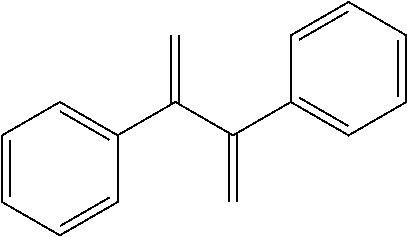
- Clear crystal; 1H NMR (CDCl3, 400 MHz) δ 7.38-7.40 (m, 4H), 7.19-7.27 (m, 6H), 5.53 (s, 2H), 5.30 (s, 2H); 13C NMR (CDCl3, 100 MHz) δ 149.9, 140.2, 128.2, 127.6, 116.4 ppm; MS (D) m/z=207, 206, 191, 178, 128, 115, 91.
- Operation is the same as that in example 1. The 1-ethynyl-4-methylbenzene reacts to produce 0.049 g of 4,4′-(buta-1,3-diene-2,3-diyl)bis(methylbenzene) with a yield of 83%.
-

- White solid; 1H NMR (CDCl3, 400 MHz) δ 7.28 (d, J=8.0 Hz, 4H), 7.05 (d, J=8.0 Hz, 4H), 5.50 (s, 2H), 5.26 (s, 2H), 2.28 (s, 6H); 13C NMR (CDCl3, 100 MHz) δ149.8, 137.4, 137.2, 128.9, 127.3, 115.4, 21.2 ppm; MS (D) m/z=235, 234, 219, 204, 128, 115, 91
- Operation is the same as that in example 1. The 4-methoxyl arylacetylene reacts to produce 0.060 g of 4,4′-(buta-1,3-diene-2,3-diyl)bis(methoxybenzene) with a yield of 90%.
-

- White solid; 1H NMR (CDCl3, 400 MHz) δ 7.31 (d, J=8.0 Hz, 4H), 6.78 (d, J=8.0 Hz, 4H), 5.47 (s, 2H), 5.23 (s, 2H), 3.74 (s, 6H); 13C NMR (CDCl3, 100 MHz) δ159.1, 149.4, 132.7, 128.5, 114.3, 113.6, 55.2 ppm; MS (EI) m/z=267, 266, 251, 235, 121
- In a 25 mL reactor trifluoromethanesulfonic acid (0.0225 g, 0.15 mmol), trimethylacetic acid (0.087 g, 0.85 mmol), iron powder (0.028 g, 0.5 mmol), Pd2dba3 (0.092 g, 0.01 mmol) and PPh3 (0.011 g, 0.04 mmol) are added; nitrogen is exchanged for three times; then 3 mL of anhydrous acetone is added; 1-ethynyl-4-fluorobenzene (0.061 g, 0.5 mmol) is added while stirred; and the above mixtures are stirred for 24 h at 35° C. Column chromatography separation (silica gel with 200-300 meshes; eluent, petroleum ether) is conducted to obtain 0.045 g of 4,4′-(buta-1,3-diene-2,3-diyl)bis(fluorobenzene) with a yield of 73%.
-

- Colorless oil; 1H NMR (CDCl3, 400 MHz) δ 7.30-7.34 (m, 4H), 6.92-6.96 (m, 4H), 5.48 (s, 2H), 5.29 (s, 2H); 13C NMR (CDCl3, 100 MHz) δ 163.6, 161.2, 148.8, 136.0 (d, J=3.3 Hz), 129.1 (d, J=8 Hz), 116.3, 115.2, 115.0 ppm; HRMS (EI) m/z calcd. For C16H12F2: 242.0907; found: 242.0911.
- In a 25 mL reactor trifluoromethanesulfonic acid (0.023 g, 0.15 mmol), trimethylacetic acid (0.087 g, 0.85 mmol), manganese powder (0.027 g, 0 5 mmol), Pd(PPh3)2Cl2 (0.014 g, 0.02 mmol) and PPh3 (0.011 g, 0.04 mmol) are added; nitrogen is exchanged for three times; then 3 mL of anhydrous acetone is added; 1-ethynyl-4-bromobenzene (0.091 g, 0.5 mmol) is added while stirred; and the above mixtures are stirred for 24 h at 20° C. Column chromatography separation (silica gel with 200-300 meshes; eluent, petroleum ether) is conducted to obtain 0.070 g of 4,4′-(buta-1,3-diene-2,3-diyl)bis(bromobenzene) with a yield of 77%.
-

- Yellow crystal; 1H NMR (CDCl3, 400 MHz) δ 7.38 (d, J=8 Hz, 4H), 7.20 (d, J=8 Hz, 4H), 5.52 (s, 2H), 5.32 (s, 2H); 13C NMR (CDCl3, 100 MHz) δ 148.4, 138.7, 131.4, 129.1, 121.8, 117.1 ppm; MS (EI) m/z=366, 364, 362, 338, 336, 334, 283, 204, 101
- In a 25 mL reactor methanesulfonic acid (0.014 g, 0.15 mmol), trimethylacetic acid (0.087 g, 0.85 mmol), manganese powder (0.027 g, 0.5 mmol), tri(2-furyl)phosphine (0.009 g, 0.04 mmol) and Pd(OAc)2 (0.005 g, 0.02 mmol) are added; nitrogen is exchanged for three times; then 3 mL of anhydrous tetrahydrofuran is added; 1-(4-ethynylphenyl)ethan-1-one (0.072 g, 0.5 mmol) is added while stirred; and the above mixtures are stirred for 24 h at 40° C. Column chromatography separation (silica gel with 200-300 meshes; eluent, petroleum ether) is conducted to obtain 0.033 g of 1,1′-(buta-1,3-diene-2,3-diylbis(4,1-phenylene))bis(ethan-1-one) with a yield of 62%.
-

- White solid; 1H NMR (CDCl3, 400 MHz) δ 7.85 (d, J=8 Hz, 2H), 7.45 (d, J=8 Hz, 2H), 5.68 (s, 2H), 5.47 (s, 2H); 13C NMR (CDCl3, 100 MHz) δ 197.6, 148.4, 144.3, 136.3, 128.5, 127.6, 118.5, 26.6 ppm; MS: m/z=291 [M+H+]
- In a 25 mL reactor methanesulfonic acid (0.014 g, 0.15 mmol), trifluoroacetic acid (0.097 g, 0.85 mmol), manganese powder (0.027 g, 0.5 mmol), Pd(OAc)2 (0.005 g, 0.02 mmol) and tri(p-tolyl)phosphine (0.012 g, 0.04 mmol) are added; nitrogen is exchanged for three times; then 3 mL of anhydrous tetrahydrofuran is added; 2-ethynylthiophene (0.0541 g, 0.5 mmol) is added while stirred; and the above mixtures are stirred for 24 h at 50° C. Column chromatography separation (silica gel with 200-300 meshes; eluent, petroleum ether) is conducted to obtain 0.034 g of 2,2′-(buta-1,3-diene-2,3-diyl)dithiophene with a yield of 62%.
-

- Colorless oil; 1H NMR (CDCl3, 400 MHz) δ 7.16-7.18 (m, 2H), 6.95-6.96 (m, 2H), 6.90-6.92 (in, 2H), 5.63 (s, 2H), 5.26 (s, 2H); 13C NMR (CDCl3, 100 MHz) δ 143.6, 142.5, 127.4, 126.1, 124.9, 114.3 ppm; HRMS (EI): m/z calcd. For C12H10S2: 218.0224; found: 218.0227.
- In a 25 mL reactor toluene-p-sulfonic acid (0.029 g, 0.15 mmol), trifluoroacetic acid (0.097 g, 0.85 mmol), Zinc powder (0.033 g, 0.5 mmol), PPh3 (0.011 g, 0.04 mmol) and Pd(acac)2 (0.006 g, 0.02 mmol) are added; nitrogen is exchanged for three times; then 3 mL of anhydrous dichloromethane is added; oct-1-yne (0.055 g, 0.5 mmol) is added while stirred; and the above mixtures are stirred for 24 h at 25° C. Column chromatography separation (silica gel with 200-300 meshes; eluent, petroleum ether) is conducted to obtain 0.043 g of 7,8-dimethylenetetradecane with a yield of 77%.
-

- Colorless oil; 1H NMR (400 MHz, CDCl3): δ5.04 (s, 2H), 4.90 (s, 2H), 2.22 (dd, J=7.2, 7.2 Hz, 4H), 1.44-1.39 (m, 4H), 1.32-1.25 (m, 12H), 0.90-0.86 (t, J=6.8 Hz, 6H) ppm. 13C NMR (100 MHz, CDCl3): δ148.1, 111.2, 34.3, 31.8, 29.2, 0.7, 22.7, 14.1 ppm.
Claims (5)
1. A preparation method for conjugated diene compounds, wherein arylacetylene derivatives as raw materials reacting in an anhydrous organic solvent at 20° C.−80° C. in the presence of a metal catalyst and an additive for 12-24 hours, and being converted into 1,3-butadiene derivatives, with a synthetic route as follows:

R is selected from alkyl and aryl;
a molar ratio of the arylacetylene derivative to the metal catalyst is 1:0.02 to 1:0.1;
a molar ratio of the arylacetylene derivative to the additive is 1:0.1 to 1:2; and
the molar concentration of the arylacetylene derivative is 0.01 mmol/mL to 2 mmol/mL.
2. The preparation method according to claim 1 , wherein the anhydrous organic solvent comprises tetrahydrofuran, 1,2-dimethoxyethane, chloroform, dichloromethane, diethyl ether, dimethyl sulfoxide, carbon tetrachloride, acetone, toluene, 1,4-dioxane, N,N-dimethylformamide and hexane.
3. The preparation method according to claim 1 , wherein the catalyst comprises Pd2dba3, Pd(PPh3)4, Pd(PPh3)2Cl2, Pd(OAc)2, Pd(TFA)2, PdCl2, Pd(CH3CN)2Cl2 and Pd(acac)2; ligands comprise PPh3, tri(p-tolyl)phosphine, tri(2-furyl)phosphine, PCy3, Ph2PtBu, PtBu3, PEt3, tri(o-tolyl)phosphine, Me2PPh and PnBu; and a molar ratio of the metal catalysts to the ligands is 1:2 to 1:4.
4. The preparation method according to claim 1 , wherein the additive comprises additive 1 and additive 2; the additive 1 comprises iron powder, manganese powder, magnesium powder and zinc powder; and the additive 2 comprises toluene-p-sulfonic acid, 2,6-pyridinedicarboxylic acid, trifluoromethanesulfonic acid, trimethylacetic acid, salicylic acid, trifluoroacetic acid, methanesulfonic acid, 2-ethylhexanoic acid, m-nitrobenzoic acid and cinnamic acid.
5. The preparation method according to claim 3 , wherein the additive comprises additive 1 and additive 2; the additive 1 comprises iron powder, manganese powder, magnesium powder and zinc powder; and the additive 2 comprises toluene-p-sulfonic acid, 2,6-pyridinedicarboxylic acid, trifluoromethanesulfonic acid, trimethylacetic acid, salicylic acid, trifluoroacetic acid, methanesulfonic acid, 2-ethylhexanoic acid, m-nitrobenzoic acid and cinnamic acid.
Applications Claiming Priority (3)
| Application Number | Priority Date | Filing Date | Title |
|---|---|---|---|
| CN201710830258.8A CN107556153B (en) | 2017-09-15 | 2017-09-15 | Preparation method of conjugated diene compound |
| CN201710830258.8 | 2017-09-15 | ||
| PCT/CN2018/090254 WO2019052236A1 (en) | 2017-09-15 | 2018-06-07 | Preparation method for conjugated diene compound |
Publications (1)
| Publication Number | Publication Date |
|---|---|
| US20200048162A1 true US20200048162A1 (en) | 2020-02-13 |
Family
ID=60980052
Family Applications (1)
| Application Number | Title | Priority Date | Filing Date |
|---|---|---|---|
| US16/342,894 Abandoned US20200048162A1 (en) | 2017-09-15 | 2018-06-07 | Preparation method for conjugated diene compound |
Country Status (3)
| Country | Link |
|---|---|
| US (1) | US20200048162A1 (en) |
| CN (1) | CN107556153B (en) |
| WO (1) | WO2019052236A1 (en) |
Families Citing this family (5)
| Publication number | Priority date | Publication date | Assignee | Title |
|---|---|---|---|---|
| CN107556153B (en) * | 2017-09-15 | 2020-04-07 | 大连理工大学 | Preparation method of conjugated diene compound |
| CN110452090A (en) * | 2018-05-08 | 2019-11-15 | 五邑大学 | A kind of synthetic method of polysubstituted rich vinyl compound |
| CN110015946B (en) * | 2018-11-28 | 2021-08-10 | 大连理工大学 | Preparation method of 1, 5-diaryl-4-pentene-1-alcohol compound |
| CN111484388B (en) * | 2019-01-28 | 2021-06-01 | 中国科学院大连化学物理研究所 | A kind of synthetic method of 1,5-diene derivative |
| CN111548269B (en) * | 2020-04-29 | 2023-10-27 | 兰州大学 | Preparation method of diarylmethane structural compound |
Family Cites Families (2)
| Publication number | Priority date | Publication date | Assignee | Title |
|---|---|---|---|---|
| CN105732253B (en) * | 2016-01-26 | 2018-04-10 | 大连理工大学 | A kind of preparation method of aryl allyl aroma compounds |
| CN107556153B (en) * | 2017-09-15 | 2020-04-07 | 大连理工大学 | Preparation method of conjugated diene compound |
-
2017
- 2017-09-15 CN CN201710830258.8A patent/CN107556153B/en active Active
-
2018
- 2018-06-07 US US16/342,894 patent/US20200048162A1/en not_active Abandoned
- 2018-06-07 WO PCT/CN2018/090254 patent/WO2019052236A1/en not_active Ceased
Also Published As
| Publication number | Publication date |
|---|---|
| CN107556153B (en) | 2020-04-07 |
| WO2019052236A1 (en) | 2019-03-21 |
| CN107556153A (en) | 2018-01-09 |
Similar Documents
| Publication | Publication Date | Title |
|---|---|---|
| Palomas et al. | Synthesis and reactivity of electron poor allenes: formation of completely organic frustrated Lewis pairs | |
| Kostas et al. | A palladium complex with a new hemilabile amino-and sulfur-containing phosphinite ligand as an efficient catalyst for the Heck reaction of aryl bromides with styrene. The effect of the amino group | |
| Sauerbrey et al. | Synthesis, structure and reactivity of 4-phosphanylated 1, 3-dialkyl-imidazole-2-thiones | |
| Aydemir et al. | Rhodium-catalyzed transfer hydrogenation with functionalized bis (phosphino) amine ligands | |
| CN103804413B (en) | Preparation method of biphenyl triphosphine ligand and application of gradually replacing PPh3 in hydroformylation | |
| Naghipour et al. | A highly active two six-membered phosphinite palladium PCP pincer complex [PdCl {C6H3 (CH2OPPri) 2-2, 6}] | |
| CN107556153B (en) | Preparation method of conjugated diene compound | |
| CN102875599B (en) | Three tooth Phosphine ligands and the application in linear hydroformylation and similar reaction thereof | |
| Shibata et al. | Ir and Rh complex-catalyzed intramolecular alkyne–alkyne couplings with carbon monoxide and isocyanides | |
| CN101148456A (en) | A kind of organophosphoric acid catalyst and its preparation method and application | |
| Wan et al. | Enantioselective hydrogenation of cyclic tetrasubstituted-olefinic dehydroamino acid derivatives | |
| Bennett et al. | Synthesis, structure and redox behaviour of tethered arene–ruthenium (II) complexes | |
| Xi et al. | Cis-Fashioned palladium (II) complexes of 2-phenylbenzimidazole ligands: Synthesis, characterization, and catalytic behavior towards Suzuki–Miyaura reaction | |
| Joshaghani et al. | Efficient Suzuki cross-coupling reactions using bulky phosphines | |
| CN113861237B (en) | Organophosphorus ligands and their preparation methods and applications | |
| Glotova et al. | Base catalyzed double addition of secondary phosphine chalcogenides to benzoylacetylene | |
| Shabana et al. | Synthesis of Mixed Oligomeric Heteroarylenes Containing Unsubstituted Furan, Thiophene, and Selenophene Rings; Their UV Spectra and Oxidation Potentials | |
| Bush et al. | Development of a palladium catalyzed addition of boronic acids to alkynyl esters: synthesis of trisubstituted olefins as single isomers | |
| Crociani et al. | Palladium complexes of 8-(di-tert-butylphosphinooxy) quinoline | |
| Huang et al. | Stereoselective synthesis of (E)-vinylic selenides by palladium catalyzed cross-coupling reactions | |
| Yu et al. | Synthesis and application of novel ionic phosphine ligands with a cobaltocenium backbone | |
| CN105732253A (en) | Preparation method of allyl aromatic compound | |
| Kuno et al. | Scyllo-inositol as a convenient protecting group for aryl boronic acids in Suzuki–Miyaura cross-coupling reactions | |
| Xi et al. | Synthesis, characterization, and catalytic activity of (1, 2-Diaryl) alkenylphosphine palladium complexes | |
| Kakeya et al. | Dialkyl-and diaryl-platinum (II) complexes with secondary phosphines: Preparation, structure and thermal reaction giving the metallopolymer |
Legal Events
| Date | Code | Title | Description |
|---|---|---|---|
| AS | Assignment |
Owner name: DALIAN UNIVERSITY OF TECHNOLOGY, CHINA Free format text: ASSIGNMENT OF ASSIGNORS INTEREST;ASSIGNORS:BAO, MING;GUO, HONGYU;ZHANG, SHENG;REEL/FRAME:048916/0721 Effective date: 20190329 |
|
| STPP | Information on status: patent application and granting procedure in general |
Free format text: NON FINAL ACTION MAILED |
|
| STCB | Information on status: application discontinuation |
Free format text: ABANDONED -- FAILURE TO RESPOND TO AN OFFICE ACTION |