US20180163243A1 - Enzymatic Systems and Methods for Synthesizing Nicotinamide Mononucleotide and Nicotinic Acid Mononucleotide - Google Patents
Enzymatic Systems and Methods for Synthesizing Nicotinamide Mononucleotide and Nicotinic Acid Mononucleotide Download PDFInfo
- Publication number
- US20180163243A1 US20180163243A1 US15/837,818 US201715837818A US2018163243A1 US 20180163243 A1 US20180163243 A1 US 20180163243A1 US 201715837818 A US201715837818 A US 201715837818A US 2018163243 A1 US2018163243 A1 US 2018163243A1
- Authority
- US
- United States
- Prior art keywords
- prs
- nicotinamide
- mutant
- nmn
- produced
- Prior art date
- Legal status (The legal status is an assumption and is not a legal conclusion. Google has not performed a legal analysis and makes no representation as to the accuracy of the status listed.)
- Abandoned
Links
- UGJPAJCPUTVAAE-QWICORGASA-M C=O([C@@]1(C)O[C@@](C)(N2=CC=CC(C(C)=O)=C2)[C@@](C)(O)C1(C)O)P(=O)([O-])O Chemical compound C=O([C@@]1(C)O[C@@](C)(N2=CC=CC(C(C)=O)=C2)[C@@](C)(O)C1(C)O)P(=O)([O-])O UGJPAJCPUTVAAE-QWICORGASA-M 0.000 description 1
- SANAPQLPBBYGGR-UHFFFAOYSA-N CC(=O)C1=CC=CN(C2OC(CO)C(O)C2O)=C1 Chemical compound CC(=O)C1=CC=CN(C2OC(CO)C(O)C2O)=C1 SANAPQLPBBYGGR-UHFFFAOYSA-N 0.000 description 1
- YFLLEDOXFRAPQI-SGUBAKSOSA-N CC(=O)C1=CC=C[N+]([C@@H]2O[C@H](CO)C(O)[C@@H]2O)=C1 Chemical compound CC(=O)C1=CC=C[N+]([C@@H]2O[C@H](CO)C(O)[C@@H]2O)=C1 YFLLEDOXFRAPQI-SGUBAKSOSA-N 0.000 description 1
- OKXLYEWHVJAEFT-SGUBAKSOSA-O CC(=O)C1=CC=C[N+]([C@@H]2O[C@H](COP(=O)(O)O)C(O)[C@@H]2O)=C1 Chemical compound CC(=O)C1=CC=C[N+]([C@@H]2O[C@H](COP(=O)(O)O)C(O)[C@@H]2O)=C1 OKXLYEWHVJAEFT-SGUBAKSOSA-O 0.000 description 1
- WEGYGNROSJDEIW-UHFFFAOYSA-N CC(=O)C1=CN=CC=C1 Chemical compound CC(=O)C1=CN=CC=C1 WEGYGNROSJDEIW-UHFFFAOYSA-N 0.000 description 1
- JXOWYPGGIDCUIE-YNOYVWFRSA-O NC(=O)C1=CC=C[N+]([C@@H]2O[C@H](COP(=O)(O)OP(=O)(O)OC[C@H]3O[C@@H](N4C=NC5=C4N=CC=C5N)[C@@H](O)C3O)C(O)[C@@H]2O)=C1 Chemical compound NC(=O)C1=CC=C[N+]([C@@H]2O[C@H](COP(=O)(O)OP(=O)(O)OC[C@H]3O[C@@H](N4C=NC5=C4N=CC=C5N)[C@@H](O)C3O)C(O)[C@@H]2O)=C1 JXOWYPGGIDCUIE-YNOYVWFRSA-O 0.000 description 1
Classifications
-
- C—CHEMISTRY; METALLURGY
- C12—BIOCHEMISTRY; BEER; SPIRITS; WINE; VINEGAR; MICROBIOLOGY; ENZYMOLOGY; MUTATION OR GENETIC ENGINEERING
- C12P—FERMENTATION OR ENZYME-USING PROCESSES TO SYNTHESISE A DESIRED CHEMICAL COMPOUND OR COMPOSITION OR TO SEPARATE OPTICAL ISOMERS FROM A RACEMIC MIXTURE
- C12P19/00—Preparation of compounds containing saccharide radicals
- C12P19/26—Preparation of nitrogen-containing carbohydrates
- C12P19/28—N-glycosides
- C12P19/30—Nucleotides
-
- C—CHEMISTRY; METALLURGY
- C07—ORGANIC CHEMISTRY
- C07H—SUGARS; DERIVATIVES THEREOF; NUCLEOSIDES; NUCLEOTIDES; NUCLEIC ACIDS
- C07H19/00—Compounds containing a hetero ring sharing one ring hetero atom with a saccharide radical; Nucleosides; Mononucleotides; Anhydro-derivatives thereof
- C07H19/02—Compounds containing a hetero ring sharing one ring hetero atom with a saccharide radical; Nucleosides; Mononucleotides; Anhydro-derivatives thereof sharing nitrogen
- C07H19/04—Heterocyclic radicals containing only nitrogen atoms as ring hetero atom
- C07H19/048—Pyridine radicals
-
- C—CHEMISTRY; METALLURGY
- C12—BIOCHEMISTRY; BEER; SPIRITS; WINE; VINEGAR; MICROBIOLOGY; ENZYMOLOGY; MUTATION OR GENETIC ENGINEERING
- C12N—MICROORGANISMS OR ENZYMES; COMPOSITIONS THEREOF; PROPAGATING, PRESERVING, OR MAINTAINING MICROORGANISMS; MUTATION OR GENETIC ENGINEERING; CULTURE MEDIA
- C12N11/00—Carrier-bound or immobilised enzymes; Carrier-bound or immobilised microbial cells; Preparation thereof
- C12N11/02—Enzymes or microbial cells immobilised on or in an organic carrier
- C12N11/10—Enzymes or microbial cells immobilised on or in an organic carrier the carrier being a carbohydrate
-
- C—CHEMISTRY; METALLURGY
- C12—BIOCHEMISTRY; BEER; SPIRITS; WINE; VINEGAR; MICROBIOLOGY; ENZYMOLOGY; MUTATION OR GENETIC ENGINEERING
- C12N—MICROORGANISMS OR ENZYMES; COMPOSITIONS THEREOF; PROPAGATING, PRESERVING, OR MAINTAINING MICROORGANISMS; MUTATION OR GENETIC ENGINEERING; CULTURE MEDIA
- C12N11/00—Carrier-bound or immobilised enzymes; Carrier-bound or immobilised microbial cells; Preparation thereof
- C12N11/18—Multi-enzyme systems
-
- C—CHEMISTRY; METALLURGY
- C12—BIOCHEMISTRY; BEER; SPIRITS; WINE; VINEGAR; MICROBIOLOGY; ENZYMOLOGY; MUTATION OR GENETIC ENGINEERING
- C12N—MICROORGANISMS OR ENZYMES; COMPOSITIONS THEREOF; PROPAGATING, PRESERVING, OR MAINTAINING MICROORGANISMS; MUTATION OR GENETIC ENGINEERING; CULTURE MEDIA
- C12N9/00—Enzymes; Proenzymes; Compositions thereof; Processes for preparing, activating, inhibiting, separating or purifying enzymes
- C12N9/10—Transferases (2.)
- C12N9/1048—Glycosyltransferases (2.4)
- C12N9/1077—Pentosyltransferases (2.4.2)
-
- C—CHEMISTRY; METALLURGY
- C12—BIOCHEMISTRY; BEER; SPIRITS; WINE; VINEGAR; MICROBIOLOGY; ENZYMOLOGY; MUTATION OR GENETIC ENGINEERING
- C12N—MICROORGANISMS OR ENZYMES; COMPOSITIONS THEREOF; PROPAGATING, PRESERVING, OR MAINTAINING MICROORGANISMS; MUTATION OR GENETIC ENGINEERING; CULTURE MEDIA
- C12N9/00—Enzymes; Proenzymes; Compositions thereof; Processes for preparing, activating, inhibiting, separating or purifying enzymes
- C12N9/10—Transferases (2.)
- C12N9/12—Transferases (2.) transferring phosphorus containing groups, e.g. kinases (2.7)
-
- C—CHEMISTRY; METALLURGY
- C12—BIOCHEMISTRY; BEER; SPIRITS; WINE; VINEGAR; MICROBIOLOGY; ENZYMOLOGY; MUTATION OR GENETIC ENGINEERING
- C12N—MICROORGANISMS OR ENZYMES; COMPOSITIONS THEREOF; PROPAGATING, PRESERVING, OR MAINTAINING MICROORGANISMS; MUTATION OR GENETIC ENGINEERING; CULTURE MEDIA
- C12N9/00—Enzymes; Proenzymes; Compositions thereof; Processes for preparing, activating, inhibiting, separating or purifying enzymes
- C12N9/10—Transferases (2.)
- C12N9/12—Transferases (2.) transferring phosphorus containing groups, e.g. kinases (2.7)
- C12N9/1235—Diphosphotransferases (2.7.6)
-
- C—CHEMISTRY; METALLURGY
- C12—BIOCHEMISTRY; BEER; SPIRITS; WINE; VINEGAR; MICROBIOLOGY; ENZYMOLOGY; MUTATION OR GENETIC ENGINEERING
- C12P—FERMENTATION OR ENZYME-USING PROCESSES TO SYNTHESISE A DESIRED CHEMICAL COMPOUND OR COMPOSITION OR TO SEPARATE OPTICAL ISOMERS FROM A RACEMIC MIXTURE
- C12P19/00—Preparation of compounds containing saccharide radicals
- C12P19/02—Monosaccharides
-
- C—CHEMISTRY; METALLURGY
- C12—BIOCHEMISTRY; BEER; SPIRITS; WINE; VINEGAR; MICROBIOLOGY; ENZYMOLOGY; MUTATION OR GENETIC ENGINEERING
- C12P—FERMENTATION OR ENZYME-USING PROCESSES TO SYNTHESISE A DESIRED CHEMICAL COMPOUND OR COMPOSITION OR TO SEPARATE OPTICAL ISOMERS FROM A RACEMIC MIXTURE
- C12P19/00—Preparation of compounds containing saccharide radicals
- C12P19/26—Preparation of nitrogen-containing carbohydrates
- C12P19/28—N-glycosides
- C12P19/30—Nucleotides
- C12P19/36—Dinucleotides, e.g. nicotineamide-adenine dinucleotide phosphate
-
- C—CHEMISTRY; METALLURGY
- C12—BIOCHEMISTRY; BEER; SPIRITS; WINE; VINEGAR; MICROBIOLOGY; ENZYMOLOGY; MUTATION OR GENETIC ENGINEERING
- C12Y—ENZYMES
- C12Y204/00—Glycosyltransferases (2.4)
- C12Y204/02—Pentosyltransferases (2.4.2)
- C12Y204/02011—Nicotinate phosphoribosyltransferase (2.4.2.11)
-
- C—CHEMISTRY; METALLURGY
- C12—BIOCHEMISTRY; BEER; SPIRITS; WINE; VINEGAR; MICROBIOLOGY; ENZYMOLOGY; MUTATION OR GENETIC ENGINEERING
- C12Y—ENZYMES
- C12Y204/00—Glycosyltransferases (2.4)
- C12Y204/02—Pentosyltransferases (2.4.2)
- C12Y204/02012—Nicotinamide phosphoribosyltransferase (2.4.2.12), i.e. visfatin
-
- C—CHEMISTRY; METALLURGY
- C12—BIOCHEMISTRY; BEER; SPIRITS; WINE; VINEGAR; MICROBIOLOGY; ENZYMOLOGY; MUTATION OR GENETIC ENGINEERING
- C12Y—ENZYMES
- C12Y207/00—Transferases transferring phosphorus-containing groups (2.7)
- C12Y207/06—Diphosphotransferases (2.7.6)
- C12Y207/06001—Ribose-phosphate diphosphokinase (2.7.6.1)
Definitions
- Nicotinamide Adenine Dinucleotide (NAD + ) is an essential metabolic cofactor. Recent research has indicated that NAD + levels decline with age and in certain mammalian disease states, and that therapeutically increasing NAD + levels has health benefits. However, NAD + is an intracellular metabolite, and does not readily lend itself to external supplementation. It has been suggested that utilizing precursors to the natural synthesis of NAD + may be an effective way to increase NAD + .
- NMN nicotinamide monomucleotide
- NR nicotinamide riboside
- This disclosure relates to new methods and systems for the enzymatic synthesis of the NAD precursors, such as nicotinamide mononucleotide (NMN) and nicotinic acid mononucleotide (NaMN).
- NAD precursors such as nicotinamide mononucleotide (NMN) and nicotinic acid mononucleotide (NaMN).
- NMN nicotinamide mononucleotide
- NaMN nicotinic acid mononucleotide
- the disclosed systems and methods utilize (1) a mutated form of phosphoribosylpyrophosphate synthetase (PRS) that is rendered insensitive to its own reaction product, thus increasing its activity; and/or (2) one or more other enzymes or enzyme combinations (optionally including the mutated form of PRS) that are bound to a solid surface.
- the one or more enzymes used may be produced by recombinant means in one or more cells, including, without limitation, in yeast, bacteria, baculovirus, or mammalian cell lines.
- the one or more enzymes used may be produced in cell-containing or cell-free in vitro translation systems, such as in reticulocyte lysate.
- the disclosure encompasses a system for synthesizing an nicotinamide adenine dinucleotide (NAD) precursor.
- the system includes a superactive phosphoribosylpyrophosphate synthetase (PRS) mutant, wherein the PRS mutant is less sensitive to the product of the reaction that it catalyzes than a wild type PRS.
- PRS superactive phosphoribosylpyrophosphate synthetase
- the superactive PRS mutant includes a polypeptide that differs from wild type PRS by one or more amino acid substitutions.
- the one or more amino acid substitutions are Asp51His of human PRS, Asn113Ser of human PRS, Leu128Ile of human PRPP, Asp182His of human PRS, Ala189Val of human PRS, His192Gln of human PRS, any of the equivalent substitutions in a non-human PRS, or any combination of these.
- the superactive PRS mutant includes one or more affinity tags.
- the affinity tag is a 6 ⁇ His tag or a glutathione S-transferase (GST) tag.
- the superactive PRS mutant is recombinantly produced, isolated, or purified from cells.
- the superactive PRS mutant is immobilized onto a surface. In some such embodiments, the superactive PRS mutant is immobilized onto the surface by adsorption, affinity binding, ionic bonding, or covalent bonding. In some embodiments, the surface is the surface of a bead or comprises a resin.
- the system further includes nicotinamide phosphoribosyltransferase (NAMPT) or nicotinate phosphoribosyltransferase (NAPRT).
- NAMPT nicotinamide phosphoribosyltransferase
- NAPRT nicotinate phosphoribosyltransferase
- the NAMPT or NAPRT includes one or more affinity tags.
- the affinity tag is a 6 ⁇ His tag or a glutathione S-transferase (GST) tag.
- the NAMPT or NAPRT is recombinantly produced, isolated, or purified from cells.
- the NAMPT or NAPRT is immobilized onto a surface. In some such embodiments, the NAMPT or NAPRT is immobilized onto the surface by adsorption, affinity binding, ionic bonding, or covalent bonding. In some embodiments, the surface is the surface of a bead or comprises a resin.
- the PRS mutant is also immobilized onto a surface.
- the PRS mutant and the NAMPT or NAPRT are immobilized onto different surfaces.
- the PRS mutant and the NAMPT or NAPRT are immobilized onto the same surface.
- the system further includes adenosine triphosphate (ATP).
- ATP adenosine triphosphate
- system further includes ribose-5-phosphate.
- the system further includes nicotinamide or nicotinic acid.
- system further includes phosphoribosyl pyrophosphate (PRPP).
- PRPP phosphoribosyl pyrophosphate
- the system further includes nicotinamide mononucleotide (NMN) or nicotinic acid mononucleotide (NaMN).
- NMN nicotinamide mononucleotide
- NaMN nicotinic acid mononucleotide
- this disclosure encompasses a method for synthesizing an nicotinamide adenine dinucleotide (NAD) precursor.
- the method includes the step of contacting ribose-5-phosphate with a superactive phosphoribosylpyrophosphate synthetase (PRS) mutant in the presence of adenosine triphosphate (ATP), wherein the PRS mutant is less sensitive to the product of the reaction that it catalyzes than a wild type PRS, and whereby phosphoribosyl pyrophosphate (PRPP) is produced.
- PRS superactive phosphoribosylpyrophosphate synthetase
- ATP adenosine triphosphate
- the superactive PRS mutant comprises a polypeptide that differs from wild type PRS by one or more amino acid substitutions.
- the one or more amino acid substitutions can be Asp51His of human PRS, Asn113Ser of human PRS, Leu128Ile of human PRPP, Asp182His of human PRS, Ala189Val of human PRS, His192Gln of human PRS, any of the equivalent substitutions in a non-human PRS, and any combination of these.
- the superactive PRS mutant includes one or more affinity tags.
- the affinity tag is a 6 ⁇ His tag or a glutathione S-transferase (GST) tag.
- the superactive PRS mutant is recombinantly produced, isolated, or purified from cells.
- the superactive PRS mutant is immobilized onto a surface. In some such embodiments, the superactive PRS mutant is immobilized onto the surface by adsorption, affinity binding, ionic bonding, or covalent bonding.
- the surface is the surface of a bead or comprises a resin.
- the method further includes the steps of (a)contacting the resulting PRPP with nicotinamide phosphoribosyltransferase (NAMPT) in the presence of nicotinamide, whereby nicotinamide mononucleotide (NMN) is produced; or (b) contacting the resulting PRPP with nicotinate phosphoribosyltransferase (NAPRT) in the presence of nicotinic acid, whereby nicotinic acid mononucleotide (NaMN) is produced.
- NAMPT nicotinamide phosphoribosyltransferase
- NAPRT nicotinate phosphoribosyltransferase
- the NAMPT or NAPRT include one or more affinity tags.
- the affinity tag is a 6 ⁇ His tag or a glutathione S-transferase (GST) tag.
- the NAMPT or NAPRT is recombinantly produced, isolated, or purified from cells.
- the NAMPT or NAPRT is immobilized onto a surface. In some such embodiments, the NAMPT or NAPRT is immobilized onto the surface by adsorption, affinity binding, ionic bonding, or covalent bonding. In some such embodiments, the surface is the surface of a bead or comprises a resin.
- the PRS mutant is also immobilized onto a surface.
- the PRS mutant and the NAMPT or NAPRT are immobilized onto different surfaces.
- the PRS mutant and the NAMPT or NAPRT are immobilized onto the same surface.
- the method further includes the step of purifying or concentrating the NMN or NaMN produced.
- this disclosure encompasses a system for synthesizing nicotinamide mononucleotide (NMN).
- the system includes nicotinamide riboside kinase (NRK) enzyme immobilized onto a surface.
- NRK nicotinamide riboside kinase
- the NRK includes one or more affinity tags.
- the affinity tag is a 6 ⁇ His tag or a glutathione S-transferase (GST) tag.
- the NRK is recombinantly produced, isolated, or purified from a cell.
- the NRK is immobilized onto the surface by adsorption, affinity binding, ionic bonding, or covalent bonding.
- the surface is the surface of a bead or comprises a resin.
- the NRK is purified from cells or produced through recombinant means.
- the system further includes adenosine triphosphate (ATP).
- ATP adenosine triphosphate
- system further includes nicotinamide riboside.
- the system further includes nicotinamide mononucleotide (NMN).
- NPN nicotinamide mononucleotide
- this disclosure encompasses a method for synthesizing nicotinamide mononucleotide (NMN).
- the method includes the steps of contacting nicotinamide riboside kinase (NRK) immobilized onto a surface with nicotinamide riboside in the presence of adenosine triphosphate (ATP), whereby NMN is produced.
- NRK nicotinamide riboside kinase
- ATP adenosine triphosphate
- the NRK includes one or more affinity tags.
- the affinity tag is a 6 ⁇ His tag or a glutathione S-transferase (GST) tag.
- the NRK is recombinantly produced, isolated, or purified from a cell.
- the NRK is immobilized onto the surface by adsorption, affinity binding, ionic bonding, or covalent bonding.
- the surface is the surface of a bead or comprises a resin.
- Some embodiments further include the step of purifying or concentrating the NMN produced.
- this disclosure encompasses a system for synthesizing nicotinamide mononucleotide (NMN).
- the system includes the following enzymes immobilized onto a surface: (a) a superactive phosphoribosylpyrophosphate synthetase (PRS) mutant, wherein the PRS mutant is less sensitive to the product of the reaction that it catalyzes than a wild type PRS; (b) hexokinase; (c) glucose-6phosphate dehydrogenase; (d) gluconolactonase; (e) 6-phospho gluconate dehydrogenase; (f) ribulose-5-phosphate isomerase; and (g) nicotinamide phosphoribosyl transferase.
- PRS superactive phosphoribosylpyrophosphate synthetase
- one or more of the immobilized enzymes include one or more affinity tags.
- the affinity tag is a 6 ⁇ His tag or a glutathione S-transferase (GST) tag.
- one or more of the immobilized enzymes is recombinantly produced, isolated, or purified from a cell.
- the NRK is immobilized onto the surface by adsorption, affinity binding, ionic bonding, or covalent bonding.
- the superactive PRS mutant includes a polypeptide that differs from wild type PRS by one or more amino acid substitutions.
- the one or more amino acid substitutions can be Asp51His of human PRS, Asn113Ser of human PRS, Leu128Ile of human PRPP, Asp182His of human PRS, Ala189Val of human PRS, His192Gln of human PRS, any of the equivalent substitutions in a non-human PRS, or any combination of these.
- the surface is the surface of a bead or comprises a resin.
- each enzyme is immobilized onto a different surface. In other embodiments, each enzyme is immobilized onto a different surface. In yet other embodiments, the six immobilized enzymes are immobilized to between two and five different surfaces.
- the system may also include one or more of glucose, nicotinamide, adenosine triphosphate (ATP), nicotinamide adenine dinucleotide phosphate (NADP + ), an oxidizing agent, or mixtures thereof.
- glucose nicotinamide
- ATP adenosine triphosphate
- NADP + nicotinamide adenine dinucleotide phosphate
- an oxidizing agent or mixtures thereof.
- this disclosure encompasses a method for synthesizing nicotinamide mononucleotide (NMN).
- the method includes the step of contacting the system described in any of the previous eight paragraphs with nicotinamide in the presence of glucose, adenosine triphosphate (ATP), Nicotinamide adenine dinucleotide phosphate (NADP + ), and an oxidizing agent, whereby NMN is produced.
- ATP adenosine triphosphate
- NADP + Nicotinamide adenine dinucleotide phosphate
- the method further includes the step of purifying or concentrating the NMN produced.
- a or “an” entity refers to one or more of that entity; for example, a compound refers to one or more compounds or at least one compound.
- a compound refers to one or more compounds or at least one compound.
- the terms “a” (or “an”), “one or more”, and “at least one” can be used interchangeably herein.
- purified refers to the purity of a given compound.
- a compound is “purified” when the given compound is a major component of the composition, i.e., at least 50% w/w pure.
- purified embraces at least 50% w/w purity, at least 60% w/w purity, at least 70% purity, at least 80% purity, at least 85% purity, at least 90% purity, at least 92% purity, at least 94% purity, at least 96% purity, at least 97% purity, at least 98% purity, at least 99% purity, at least 99.5% purity, and at least 99.9% purity, wherein “substantially pure” embraces at least 97% purity, at least 98% purity, at least 99% purity, at least 99.5% purity, and at least 99.9% purity.
- Nicotinamide in addition to being known as niacinamide, is also known as 3-pyridinecarboxamide, pyridine-3-carboxamide, nicotinic acid amide, vitamin B3, and vitamin PP. Nicotinamide has a molecular formula of C 6 H 6 N 2 O and its molecular weight is 122.13 Daltons. Nicotinamide is commercially available from a variety of sources.
- NAD + Nicotinamide Adenine Dinucleotide
- Nicotinamide adenine dinucleotide has a molecular formula of C 21 H 27 N 7 O 14 P 2 and a molecular weight of 663.43. Nicotinamide adenine dinucleotide (NAD) is commercially available from such sources as Sigma-Aldrich (St. Louis, Mo.).
- NPN Nicotinamide Mononucleotide
- Nicotinamide mononucleotide has a molecular formula of C 11 H 15 N 2 O 8 P and a molecular weight of 334.22. Nicotinamide mononucleotide (NMN) is commercially available from such sources as Sigma-Aldrich (St. Louis, Mo.).
- Nicotinamide Riboside (NR), which corresponds to the following structure,
- NaMN “Nicotinic Acid Mononucleotide” (NaMN) corresponds to the following structure:
- NaR Nicotinic Acid Riboside
- the human enzyme phosphoribosoylpyrophosphate synthetase is mutated to increase its activity through rendering it insensitive to the product of its own reaction, phosphoribosyl pyrophosphate (PRPP). Mutations may include, without limitation, Asp51His, Asn113Ser, Leu128Ile, Asp182His, Ala189Val and His192Gln. These mutations are defined relative to the known sequence of human PRS. However, PRS from other species may be used in the disclosed systems and methods, with equivalent mutations in non-human homologs also resulting in the required superactivity.
- Enzymes may optionally be tagged with affinity tags, such as 6 ⁇ His tag or GST tag.
- Recombinant or purified enzyme mutants as described above may be immobilized on, for example, beads or resin (e.g., agarose beads, sepharose beads) through adsorption, affinity binding (e.g. 6 ⁇ His tagged proteins to Ni 2+ or Co 2+ beads), ionic binding or covalent bonds.
- affinity tags such as 6 ⁇ His tag or GST tag.
- Ribose-5-phosphate in the presence of ATP may be passed through beads or resin with immobilized, mutated PRS to yield PRPP.
- the enzyme nicotinamide phosphoribosyltransferase (NAMPT) may be tagged and immobilized to beads or resin, as described above and known in the art.
- the product of the previous reaction can be combined with nicotinamide and passed through such a resin to yield nicotinamide mononucleotide (NMN).
- resin or beads carrying recombinant or isolated NAMPT are placed in a bottom layer of a column, and resin or beads carrying recombinant or isolated PRS mutants are placed in an upper layer of a column.
- a single mixture containing nicotinamide, ribose-5-phosphate and ATP is then passed through the column to yield NMN as a final product.
- resin or beads carrying immobilized PRS mutant enzyme and NAMPT enzyme are mixed into a single column, and a mixture containing nicotinamide, ribose-5-phosphate and ATP is then passed through the column.
- This latter embodiment will have the advantage of consuming PRPP to further reduce inhibition of PRS enzyme.
- NAMPT is replaced by nicotinate phosphoribosyltransferase and nicotinamide is replaced by nicotinic acid, to yield nicotinic acid mononucleotide (NaMN).
- nicotinamide riboside kinase may be purified from cells or produced through recombinant means, and then immobilized on a solid support (e.g. resin, beads). Nicotinamide riboside and ATP are then passed over this solid support to yield nicotinamide mononucleotide (NMN).
- a solid support e.g. resin, beads. Nicotinamide riboside and ATP are then passed over this solid support to yield nicotinamide mononucleotide (NMN).
- Glucose, nicotinamide, ATP, NADP + and an oxidizing agent are passed over a solid support (e.g. resin, beads) which contain the isolated or recombinant enzymes hexokinase, glucose-6-phosphate dehydrogenase, gluconolactonase, 6-phospho gluconate dehydrogenase, ribulose-5-phosphate isomerase, mutant versions of phosphoriboylpyrophosphatase synthetase, and nicotinamide phosphoribosyl transferase. These enzymes may be immobilized to separate solid supports, and placed in layers in the order listed above from top to bottom.
- a solid support e.g. resin, beads
- all enzymes may be mixed and immobilized to the same solid support. Glucose and nicotinamide will be converted by these enzymes into NMN, which will consume ATP and require the conversion of NADP + into NADPH. NADPH will be immediately regenerated back into NADP + through the addition of an oxidizing agent.
- preferred oxidizing agents may include any of a number of very mild oxidizing agents known in the art to be capable of oxidizing NADPH into NADP + .
- the enzymes used in the disclosed systems and methods in all of the above-disclosed exemplary methods may be produced through recombinant means in microbes, such as in yeast, bacteria, baculovirus, or in eukaryotic cells, such as in mammalian cell lines. Methods of producing recombinant enzymes using such host cells are well-known in the art. Alternatively, the enzymes may be produced through in vitro translation methods. A variety of cell-free translation methods are known in the art. A non-limiting example is the use of reticulocyte lysate to facilitate enzyme production.
- Constructs for recombinant expression may be subjected to codon optimization from the parent cDNA to increase protein translation. Again, such techniques are well-known in the art.
- the enzymes described in this disclosure are the human forms, the human form of the enzymes used may be substituted with the orthologous enzymes from other species, depending on the efficiency of their activity.
Landscapes
- Chemical & Material Sciences (AREA)
- Organic Chemistry (AREA)
- Life Sciences & Earth Sciences (AREA)
- Health & Medical Sciences (AREA)
- Engineering & Computer Science (AREA)
- Zoology (AREA)
- Wood Science & Technology (AREA)
- Genetics & Genomics (AREA)
- Bioinformatics & Cheminformatics (AREA)
- General Health & Medical Sciences (AREA)
- Biochemistry (AREA)
- General Engineering & Computer Science (AREA)
- Biotechnology (AREA)
- Microbiology (AREA)
- Molecular Biology (AREA)
- Biomedical Technology (AREA)
- Medicinal Chemistry (AREA)
- Chemical Kinetics & Catalysis (AREA)
- General Chemical & Material Sciences (AREA)
- Immobilizing And Processing Of Enzymes And Microorganisms (AREA)
- Enzymes And Modification Thereof (AREA)
Abstract
Description
- This application claims priority to U.S. Provisional Patent Application No. 62/174,412, filed Jun. 11, 2015, which is incorporated herein by reference as if set forth in its entirety.
- Not Applicable
- Nicotinamide Adenine Dinucleotide (NAD+) is an essential metabolic cofactor. Recent research has indicated that NAD+ levels decline with age and in certain mammalian disease states, and that therapeutically increasing NAD+ levels has health benefits. However, NAD+ is an intracellular metabolite, and does not readily lend itself to external supplementation. It has been suggested that utilizing precursors to the natural synthesis of NAD+ may be an effective way to increase NAD+.
- Two exemplary precursors that could be administered to increase NAD+ are nicotinamide monomucleotide (NMN), which is directly synthesized into NAD+, and nicotinamide riboside (NR), which is recycled from the utilization of NAD+, into NMN. There are no known dietary or environmental sources of NMN or NR. Accordingly, in order to use these precursors as drugs or supplements, they must be manufactured.
- U.S. Pat. No. 8,106,184, issued to Sauve et. al., describes methods for the efficient manufacture of NR through synthetic chemistry. No such method exists for the production of NMN. U.S. Pat. No. 4,411,995, issued to Whitesides and Walt, describes an enzymatic process for producing NMN, but such a method, while efficient in its yield, requires carefully controlled conditions and the addition of costly enzymes.
- Therefore a need exists in the art for an improved method to manufacture NAD precursors at high yield, high purity, and lower cost. Such methods are described herein.
- This disclosure relates to new methods and systems for the enzymatic synthesis of the NAD precursors, such as nicotinamide mononucleotide (NMN) and nicotinic acid mononucleotide (NaMN). Various enzyme-based methods for the production of NMN have been described by, for example, Whitesides (1985), Berghauser (1981), Dietrich (1966), and Preiss (1957). Here we disclose enzyme-based systems and methods for producing NMN or NaMN utilizing one or more improvements. Specifically, the disclosed systems and methods utilize (1) a mutated form of phosphoribosylpyrophosphate synthetase (PRS) that is rendered insensitive to its own reaction product, thus increasing its activity; and/or (2) one or more other enzymes or enzyme combinations (optionally including the mutated form of PRS) that are bound to a solid surface. The one or more enzymes used may be produced by recombinant means in one or more cells, including, without limitation, in yeast, bacteria, baculovirus, or mammalian cell lines. Alternatively, the one or more enzymes used may be produced in cell-containing or cell-free in vitro translation systems, such as in reticulocyte lysate.
- Accordingly, in a first aspect, the disclosure encompasses a system for synthesizing an nicotinamide adenine dinucleotide (NAD) precursor. The system includes a superactive phosphoribosylpyrophosphate synthetase (PRS) mutant, wherein the PRS mutant is less sensitive to the product of the reaction that it catalyzes than a wild type PRS.
- In some embodiments, the superactive PRS mutant includes a polypeptide that differs from wild type PRS by one or more amino acid substitutions. In some such embodiments, the one or more amino acid substitutions are Asp51His of human PRS, Asn113Ser of human PRS, Leu128Ile of human PRPP, Asp182His of human PRS, Ala189Val of human PRS, His192Gln of human PRS, any of the equivalent substitutions in a non-human PRS, or any combination of these.
- In some embodiments, the superactive PRS mutant includes one or more affinity tags. In some such embodiments, the affinity tag is a 6× His tag or a glutathione S-transferase (GST) tag.
- In some embodiments, the superactive PRS mutant is recombinantly produced, isolated, or purified from cells.
- In some embodiments, the superactive PRS mutant is immobilized onto a surface. In some such embodiments, the superactive PRS mutant is immobilized onto the surface by adsorption, affinity binding, ionic bonding, or covalent bonding. In some embodiments, the surface is the surface of a bead or comprises a resin.
- In some embodiments, the system further includes nicotinamide phosphoribosyltransferase (NAMPT) or nicotinate phosphoribosyltransferase (NAPRT). In some such embodiments, the NAMPT or NAPRT includes one or more affinity tags. In some such embodiments, the affinity tag is a 6× His tag or a glutathione S-transferase (GST) tag.
- In some embodiments, the NAMPT or NAPRT is recombinantly produced, isolated, or purified from cells.
- In some embodiments, the NAMPT or NAPRT is immobilized onto a surface. In some such embodiments, the NAMPT or NAPRT is immobilized onto the surface by adsorption, affinity binding, ionic bonding, or covalent bonding. In some embodiments, the surface is the surface of a bead or comprises a resin.
- In some embodiments where the NAMPT or NAPRT is immobilized onto a surface, the PRS mutant is also immobilized onto a surface. In some such embodiments, the PRS mutant and the NAMPT or NAPRT are immobilized onto different surfaces. In other such embodiments, the PRS mutant and the NAMPT or NAPRT are immobilized onto the same surface.
- In some embodiments, the system further includes adenosine triphosphate (ATP).
- In some embodiments, the system further includes ribose-5-phosphate.
- In some embodiments, the system further includes nicotinamide or nicotinic acid.
- In some embodiments, the system further includes phosphoribosyl pyrophosphate (PRPP).
- In some embodiments, the system further includes nicotinamide mononucleotide (NMN) or nicotinic acid mononucleotide (NaMN).
- In a second aspect, this disclosure encompasses a method for synthesizing an nicotinamide adenine dinucleotide (NAD) precursor. The method includes the step of contacting ribose-5-phosphate with a superactive phosphoribosylpyrophosphate synthetase (PRS) mutant in the presence of adenosine triphosphate (ATP), wherein the PRS mutant is less sensitive to the product of the reaction that it catalyzes than a wild type PRS, and whereby phosphoribosyl pyrophosphate (PRPP) is produced.
- In some embodiments, the superactive PRS mutant comprises a polypeptide that differs from wild type PRS by one or more amino acid substitutions. In some such embodiments, the one or more amino acid substitutions can be Asp51His of human PRS, Asn113Ser of human PRS, Leu128Ile of human PRPP, Asp182His of human PRS, Ala189Val of human PRS, His192Gln of human PRS, any of the equivalent substitutions in a non-human PRS, and any combination of these.
- In some embodiments, the superactive PRS mutant includes one or more affinity tags. In some such embodiments, the affinity tag is a 6× His tag or a glutathione S-transferase (GST) tag.
- In some embodiments, the superactive PRS mutant is recombinantly produced, isolated, or purified from cells.
- In some embodiments, the superactive PRS mutant is immobilized onto a surface. In some such embodiments, the superactive PRS mutant is immobilized onto the surface by adsorption, affinity binding, ionic bonding, or covalent bonding.
- In some embodiments, the surface is the surface of a bead or comprises a resin.
- In some embodiments, the method further includes the steps of (a)contacting the resulting PRPP with nicotinamide phosphoribosyltransferase (NAMPT) in the presence of nicotinamide, whereby nicotinamide mononucleotide (NMN) is produced; or (b) contacting the resulting PRPP with nicotinate phosphoribosyltransferase (NAPRT) in the presence of nicotinic acid, whereby nicotinic acid mononucleotide (NaMN) is produced.
- In some embodiments, the NAMPT or NAPRT include one or more affinity tags. In some such embodiments, the affinity tag is a 6× His tag or a glutathione S-transferase (GST) tag.
- In some embodiments, the NAMPT or NAPRT is recombinantly produced, isolated, or purified from cells.
- In some embodiments, the NAMPT or NAPRT is immobilized onto a surface. In some such embodiments, the NAMPT or NAPRT is immobilized onto the surface by adsorption, affinity binding, ionic bonding, or covalent bonding. In some such embodiments, the surface is the surface of a bead or comprises a resin.
- In some embodiments, the PRS mutant is also immobilized onto a surface. In some such embodiments, the PRS mutant and the NAMPT or NAPRT are immobilized onto different surfaces. In other such embodiments, the PRS mutant and the NAMPT or NAPRT are immobilized onto the same surface.
- In some embodiments, the method further includes the step of purifying or concentrating the NMN or NaMN produced.
- In a third aspect, this disclosure encompasses a system for synthesizing nicotinamide mononucleotide (NMN). The system includes nicotinamide riboside kinase (NRK) enzyme immobilized onto a surface.
- In some embodiments the NRK includes one or more affinity tags. In some such embodiments, the affinity tag is a 6× His tag or a glutathione S-transferase (GST) tag.
- In some embodiments, the NRK is recombinantly produced, isolated, or purified from a cell.
- In some embodiments, the NRK is immobilized onto the surface by adsorption, affinity binding, ionic bonding, or covalent bonding.
- In some embodiments, the surface is the surface of a bead or comprises a resin.
- In some embodiments, the NRK is purified from cells or produced through recombinant means.
- In some embodiments, the system further includes adenosine triphosphate (ATP).
- In some embodiments, the system further includes nicotinamide riboside.
- In some embodiments, the system further includes nicotinamide mononucleotide (NMN).
- In a fourth aspect, this disclosure encompasses a method for synthesizing nicotinamide mononucleotide (NMN). The method includes the steps of contacting nicotinamide riboside kinase (NRK) immobilized onto a surface with nicotinamide riboside in the presence of adenosine triphosphate (ATP), whereby NMN is produced.
- In some embodiments, the NRK includes one or more affinity tags. In some such embodiments, the affinity tag is a 6× His tag or a glutathione S-transferase (GST) tag.
- In some embodiments, the NRK is recombinantly produced, isolated, or purified from a cell.
- In some embodiments, the NRK is immobilized onto the surface by adsorption, affinity binding, ionic bonding, or covalent bonding. In some embodiments, the surface is the surface of a bead or comprises a resin.
- Some embodiments further include the step of purifying or concentrating the NMN produced.
- In a fifth aspect, this disclosure encompasses a system for synthesizing nicotinamide mononucleotide (NMN). The system includes the following enzymes immobilized onto a surface: (a) a superactive phosphoribosylpyrophosphate synthetase (PRS) mutant, wherein the PRS mutant is less sensitive to the product of the reaction that it catalyzes than a wild type PRS; (b) hexokinase; (c) glucose-6phosphate dehydrogenase; (d) gluconolactonase; (e) 6-phospho gluconate dehydrogenase; (f) ribulose-5-phosphate isomerase; and (g) nicotinamide phosphoribosyl transferase.
- In some embodiments, one or more of the immobilized enzymes include one or more affinity tags. In some such embodiments, the affinity tag is a 6× His tag or a glutathione S-transferase (GST) tag.
- In some embodiments, one or more of the immobilized enzymes is recombinantly produced, isolated, or purified from a cell.
- In some embodiments, the NRK is immobilized onto the surface by adsorption, affinity binding, ionic bonding, or covalent bonding.
- In some embodiments, the superactive PRS mutant includes a polypeptide that differs from wild type PRS by one or more amino acid substitutions. In some such embodiments, the one or more amino acid substitutions can be Asp51His of human PRS, Asn113Ser of human PRS, Leu128Ile of human PRPP, Asp182His of human PRS, Ala189Val of human PRS, His192Gln of human PRS, any of the equivalent substitutions in a non-human PRS, or any combination of these.
- In some embodiments, the surface is the surface of a bead or comprises a resin.
- In some embodiments, each enzyme is immobilized onto a different surface. In other embodiments, each enzyme is immobilized onto a different surface. In yet other embodiments, the six immobilized enzymes are immobilized to between two and five different surfaces.
- In some embodiments, the system may also include one or more of glucose, nicotinamide, adenosine triphosphate (ATP), nicotinamide adenine dinucleotide phosphate (NADP+), an oxidizing agent, or mixtures thereof.
- In a sixth apect, this disclosure encompasses a method for synthesizing nicotinamide mononucleotide (NMN). The method includes the step of contacting the system described in any of the previous eight paragraphs with nicotinamide in the presence of glucose, adenosine triphosphate (ATP), Nicotinamide adenine dinucleotide phosphate (NADP+), and an oxidizing agent, whereby NMN is produced.
- In some embodiments, the method further includes the step of purifying or concentrating the NMN produced.
- The phrase “a” or “an” entity as used herein refers to one or more of that entity; for example, a compound refers to one or more compounds or at least one compound. As such, the terms “a” (or “an”), “one or more”, and “at least one” can be used interchangeably herein.
- The terms “optional” or “optionally” as used herein means that a subsequently described event or circumstance may but need not occur, and that the description includes instances where the event or circumstance occurs and instances in which it does not. For example, “optional bond” means that the bond may or may not be present, and that the description includes single, double, or triple bonds.
- The term “purified,” as described herein, refers to the purity of a given compound. For example, a compound is “purified” when the given compound is a major component of the composition, i.e., at least 50% w/w pure. Thus, “purified” embraces at least 50% w/w purity, at least 60% w/w purity, at least 70% purity, at least 80% purity, at least 85% purity, at least 90% purity, at least 92% purity, at least 94% purity, at least 96% purity, at least 97% purity, at least 98% purity, at least 99% purity, at least 99.5% purity, and at least 99.9% purity, wherein “substantially pure” embraces at least 97% purity, at least 98% purity, at least 99% purity, at least 99.5% purity, and at least 99.9% purity.
- “Nicotinamide,” which corresponds to the following structure,
-
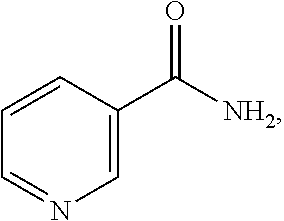
- is one of the two principal forms of the B-complex vitamin niacin. The other principal form of niacin is nicotinic acid; nicotinamide, rather than nicotinic acid, however, is the major substrate for nicotinamide adenine dinucleotide (NAD) biosynthesis in mammals, as discussed in detail herein. Nicotinamide, in addition to being known as niacinamide, is also known as 3-pyridinecarboxamide, pyridine-3-carboxamide, nicotinic acid amide, vitamin B3, and vitamin PP. Nicotinamide has a molecular formula of C6H6N2O and its molecular weight is 122.13 Daltons. Nicotinamide is commercially available from a variety of sources.
- “Nicotinamide Adenine Dinucleotide” (NAD+), which corresponds to the following structure,
-
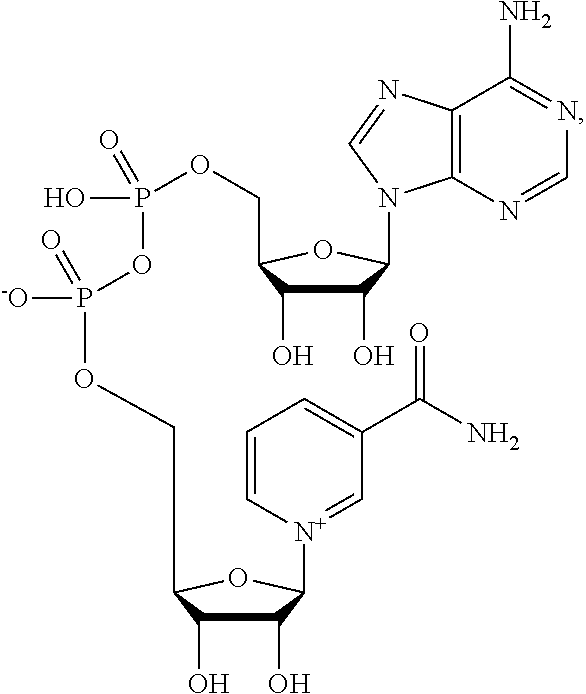
- is produced from the conversion of nicotinamide to NMN, which is catalyzed by Nampt, and the subsequent conversion of NMN to NAD, which is catalyzed by Nmnat. Nicotinamide adenine dinucleotide (NAD) has a molecular formula of C21H27N7O14P2 and a molecular weight of 663.43. Nicotinamide adenine dinucleotide (NAD) is commercially available from such sources as Sigma-Aldrich (St. Louis, Mo.).
- “Nicotinamide Mononucleotide” (NMN), which corresponds to the following structure,
-
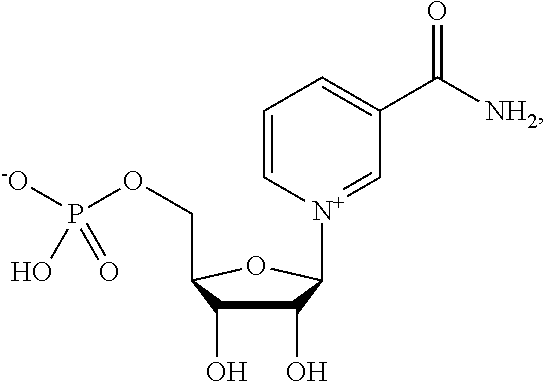
- is produced from nicotinamide in the NAD biosynthesis pathway, a reaction that is catalyzed by Nampt. NMN is further converted to NAD in the NAD biosynthesis pathway, a reaction that is catalyzed by Nmnat. Nicotinamide mononucleotide (NMN) has a molecular formula of C11H15N2O8P and a molecular weight of 334.22. Nicotinamide mononucleotide (NMN) is commercially available from such sources as Sigma-Aldrich (St. Louis, Mo.).
- “Nicotinamide Riboside” (NR), which corresponds to the following structure,
-
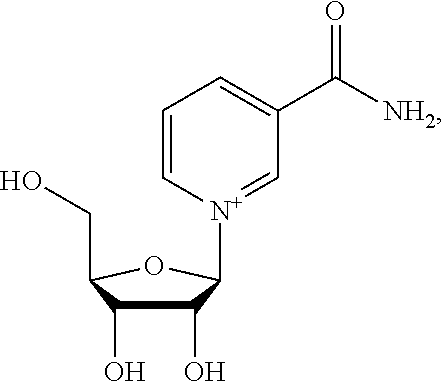
- is characterized and a synthesized as described in, for instance, U.S. Pat. No. 8,106,184.
- “Nicotinic Acid Mononucleotide” (NaMN) corresponds to the following structure:
-

- “Nicotinic Acid Riboside” (NaR) corresponds to the following structure:
-
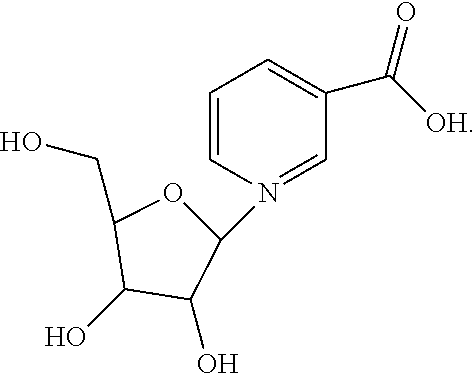
- The following exemplary methods and systems are offered for illustrative purposes only, and are not intended to limit the scope of the present invention in any way. Indeed, various modifications of the invention in addition to those shown and described herein will become apparent to those skilled in the art from the foregoing description and the following exemplary systems and methods.
- Exemplary Method 1:
- The human enzyme phosphoribosoylpyrophosphate synthetase (PRS) is mutated to increase its activity through rendering it insensitive to the product of its own reaction, phosphoribosyl pyrophosphate (PRPP). Mutations may include, without limitation, Asp51His, Asn113Ser, Leu128Ile, Asp182His, Ala189Val and His192Gln. These mutations are defined relative to the known sequence of human PRS. However, PRS from other species may be used in the disclosed systems and methods, with equivalent mutations in non-human homologs also resulting in the required superactivity.
- Enzymes may optionally be tagged with affinity tags, such as 6× His tag or GST tag. Recombinant or purified enzyme mutants as described above may be immobilized on, for example, beads or resin (e.g., agarose beads, sepharose beads) through adsorption, affinity binding (e.g. 6× His tagged proteins to Ni2+ or Co2+ beads), ionic binding or covalent bonds. Such methods are well-known in the art.
- Ribose-5-phosphate in the presence of ATP may be passed through beads or resin with immobilized, mutated PRS to yield PRPP. The enzyme nicotinamide phosphoribosyltransferase (NAMPT) may be tagged and immobilized to beads or resin, as described above and known in the art. The product of the previous reaction can be combined with nicotinamide and passed through such a resin to yield nicotinamide mononucleotide (NMN).
- In an alternative method, resin or beads carrying recombinant or isolated NAMPT are placed in a bottom layer of a column, and resin or beads carrying recombinant or isolated PRS mutants are placed in an upper layer of a column. A single mixture containing nicotinamide, ribose-5-phosphate and ATP is then passed through the column to yield NMN as a final product.
- In another alternative method, resin or beads carrying immobilized PRS mutant enzyme and NAMPT enzyme are mixed into a single column, and a mixture containing nicotinamide, ribose-5-phosphate and ATP is then passed through the column. This latter embodiment will have the advantage of consuming PRPP to further reduce inhibition of PRS enzyme.
- In yet another alternative method, NAMPT is replaced by nicotinate phosphoribosyltransferase and nicotinamide is replaced by nicotinic acid, to yield nicotinic acid mononucleotide (NaMN).
- Exemplary Method 2:
- The enzyme nicotinamide riboside kinase (NRK) may be purified from cells or produced through recombinant means, and then immobilized on a solid support (e.g. resin, beads). Nicotinamide riboside and ATP are then passed over this solid support to yield nicotinamide mononucleotide (NMN).
- Exemplary Method 3:
- Glucose, nicotinamide, ATP, NADP+ and an oxidizing agent are passed over a solid support (e.g. resin, beads) which contain the isolated or recombinant enzymes hexokinase, glucose-6-phosphate dehydrogenase, gluconolactonase, 6-phospho gluconate dehydrogenase, ribulose-5-phosphate isomerase, mutant versions of phosphoriboylpyrophosphatase synthetase, and nicotinamide phosphoribosyl transferase. These enzymes may be immobilized to separate solid supports, and placed in layers in the order listed above from top to bottom. Alternatively, all enzymes may be mixed and immobilized to the same solid support. Glucose and nicotinamide will be converted by these enzymes into NMN, which will consume ATP and require the conversion of NADP+ into NADPH. NADPH will be immediately regenerated back into NADP+ through the addition of an oxidizing agent.
- The midpoint potential of the NADP−/NADPH redox pair is −0.324 volts, meaning that NADPH is comparatively easy to oxidize. Thus, preferred oxidizing agents may include any of a number of very mild oxidizing agents known in the art to be capable of oxidizing NADPH into NADP+.
- The enzymes used in the disclosed systems and methods in all of the above-disclosed exemplary methods may be produced through recombinant means in microbes, such as in yeast, bacteria, baculovirus, or in eukaryotic cells, such as in mammalian cell lines. Methods of producing recombinant enzymes using such host cells are well-known in the art. Alternatively, the enzymes may be produced through in vitro translation methods. A variety of cell-free translation methods are known in the art. A non-limiting example is the use of reticulocyte lysate to facilitate enzyme production.
- Constructs for recombinant expression may be subjected to codon optimization from the parent cDNA to increase protein translation. Again, such techniques are well-known in the art. Although the enzymes described in this disclosure are the human forms, the human form of the enzymes used may be substituted with the orthologous enzymes from other species, depending on the efficiency of their activity.
- Other embodiments and uses will be apparent to those skilled in the art from consideration from the specification and practice of the invention disclosed herein. It is understood that the invention is not confined to the specific reagents, formulations, reaction conditions, etc., herein illustrated and described, but embraces such modified forms thereof as come within the scope of the following claims.
- All references cited herein for any reason, including all journal citations and U.S./foreign patents and patent applications, are specifically and entirely incorporated by reference herein.
Claims (34)
Priority Applications (1)
| Application Number | Priority Date | Filing Date | Title |
|---|---|---|---|
| US15/837,818 US20180163243A1 (en) | 2015-06-11 | 2017-12-11 | Enzymatic Systems and Methods for Synthesizing Nicotinamide Mononucleotide and Nicotinic Acid Mononucleotide |
Applications Claiming Priority (3)
| Application Number | Priority Date | Filing Date | Title |
|---|---|---|---|
| US201562174412P | 2015-06-11 | 2015-06-11 | |
| PCT/IB2016/000874 WO2016198948A1 (en) | 2015-06-11 | 2016-06-08 | Enzymatic systems and methods for synthesizing nicotinamide mononucleotide and nicotinic acid mononucleotide |
| US15/837,818 US20180163243A1 (en) | 2015-06-11 | 2017-12-11 | Enzymatic Systems and Methods for Synthesizing Nicotinamide Mononucleotide and Nicotinic Acid Mononucleotide |
Related Parent Applications (1)
| Application Number | Title | Priority Date | Filing Date |
|---|---|---|---|
| PCT/IB2016/000874 Continuation WO2016198948A1 (en) | 2015-06-11 | 2016-06-08 | Enzymatic systems and methods for synthesizing nicotinamide mononucleotide and nicotinic acid mononucleotide |
Publications (1)
| Publication Number | Publication Date |
|---|---|
| US20180163243A1 true US20180163243A1 (en) | 2018-06-14 |
Family
ID=57504856
Family Applications (2)
| Application Number | Title | Priority Date | Filing Date |
|---|---|---|---|
| US15/580,972 Abandoned US20190093140A1 (en) | 2015-06-11 | 2016-06-08 | Enzymatic systems and methods for synthesizing nicotinamide mononucleotide and nicotinic acid mononucleotide |
| US15/837,818 Abandoned US20180163243A1 (en) | 2015-06-11 | 2017-12-11 | Enzymatic Systems and Methods for Synthesizing Nicotinamide Mononucleotide and Nicotinic Acid Mononucleotide |
Family Applications Before (1)
| Application Number | Title | Priority Date | Filing Date |
|---|---|---|---|
| US15/580,972 Abandoned US20190093140A1 (en) | 2015-06-11 | 2016-06-08 | Enzymatic systems and methods for synthesizing nicotinamide mononucleotide and nicotinic acid mononucleotide |
Country Status (3)
| Country | Link |
|---|---|
| US (2) | US20190093140A1 (en) |
| CN (1) | CN108368493A (en) |
| WO (1) | WO2016198948A1 (en) |
Cited By (7)
| Publication number | Priority date | Publication date | Assignee | Title |
|---|---|---|---|---|
| US10654883B2 (en) | 2018-05-15 | 2020-05-19 | Jumpstart Fertility Pty Ltd | Inorganic salts of nicotinic acid mononucleotide as anti-aging agents |
| CN111705096A (en) * | 2020-06-29 | 2020-09-25 | 上海舒泽生物科技研究所 | Method for producing beta-nicotinamide mononucleotide by enzyme conversion method |
| CN112961890A (en) * | 2021-02-05 | 2021-06-15 | 深圳希吉亚生物技术有限公司 | Enzymatic synthesis method of nicotinamide mononucleotide |
| WO2021126961A1 (en) * | 2019-12-16 | 2021-06-24 | Ginkgo Bioworks, Inc. | Enhanced production of histidine, purine pathway metabolites, and plasmid dna |
| WO2021226044A1 (en) * | 2020-05-05 | 2021-11-11 | Conagen Inc. | Production of nmn and its derivatives via microbial processes |
| US11584771B2 (en) | 2019-07-19 | 2023-02-21 | Biosynth Ag | Method of making nicotinamide ribofuranoside salts, nicotinamide ribofuranoside salts as such, and uses thereof |
| JP2024020425A (en) * | 2017-09-29 | 2024-02-14 | 三菱ケミカル株式会社 | Method for producing nicotinamide mononucleotide and transformant used in the method |
Families Citing this family (10)
| Publication number | Priority date | Publication date | Assignee | Title |
|---|---|---|---|---|
| CN106755209B (en) * | 2016-12-29 | 2021-07-23 | 苏州汉酶生物技术有限公司 | A kind of method for preparing β-nicotinamide mononucleotide by enzymatic method |
| CN108949865A (en) * | 2018-08-17 | 2018-12-07 | 尚科生物医药(上海)有限公司 | One step enzyme method of immobilized whole-cell catalysis preparation β-nicotinamide mononucleotide |
| JP7209977B2 (en) * | 2018-12-18 | 2023-01-23 | 帝人株式会社 | Recombinant microorganisms and methods for producing nicotinamide derivatives, and vectors used therefor |
| CN112646851B (en) * | 2019-10-10 | 2023-03-28 | 安徽古特生物科技有限公司 | Method for rapidly preparing beta-nicotinamide mononucleotide by enzyme method |
| CN111647635B (en) | 2020-06-19 | 2021-09-21 | 理星(天津)生物科技有限公司 | Method for synthesizing beta-nicotinamide mononucleotide and intermediate thereof |
| CN114075586A (en) * | 2020-08-18 | 2022-02-22 | 弈柯莱生物科技(上海)股份有限公司 | Preparation method of beta-nicotinamide mononucleotide |
| CN112877386B (en) * | 2021-01-28 | 2022-08-26 | 湖南福来格生物技术有限公司 | Method for synthesizing nicotinamide mononucleotide based on enzyme method |
| CN115637262B (en) * | 2021-09-14 | 2026-03-27 | 湖北远大生命科学与技术有限责任公司 | A method for efficient preparation of nicotinamide mononucleotide and fusion protein |
| EP4692364A1 (en) | 2023-03-29 | 2026-02-11 | Mitsubishi Chemical Corporation | Method for producing substance |
| CN118956806B (en) * | 2024-10-12 | 2025-03-07 | 中山大学 | Light-operated NAMPT enzyme, nucleic acid and application thereof |
Family Cites Families (1)
| Publication number | Priority date | Publication date | Assignee | Title |
|---|---|---|---|---|
| US20160287621A1 (en) * | 2013-11-06 | 2016-10-06 | President And Fellows Of Harvard College | Biological production of nad precursors and analogs |
-
2016
- 2016-06-08 US US15/580,972 patent/US20190093140A1/en not_active Abandoned
- 2016-06-08 CN CN201680047100.7A patent/CN108368493A/en active Pending
- 2016-06-08 WO PCT/IB2016/000874 patent/WO2016198948A1/en not_active Ceased
-
2017
- 2017-12-11 US US15/837,818 patent/US20180163243A1/en not_active Abandoned
Cited By (10)
| Publication number | Priority date | Publication date | Assignee | Title |
|---|---|---|---|---|
| JP2024020425A (en) * | 2017-09-29 | 2024-02-14 | 三菱ケミカル株式会社 | Method for producing nicotinamide mononucleotide and transformant used in the method |
| JP7741409B2 (en) | 2017-09-29 | 2025-09-18 | 三菱ケミカル株式会社 | Method for producing nicotinamide mononucleotide and transformant used in the method |
| US10654883B2 (en) | 2018-05-15 | 2020-05-19 | Jumpstart Fertility Pty Ltd | Inorganic salts of nicotinic acid mononucleotide as anti-aging agents |
| US11584771B2 (en) | 2019-07-19 | 2023-02-21 | Biosynth Ag | Method of making nicotinamide ribofuranoside salts, nicotinamide ribofuranoside salts as such, and uses thereof |
| US12344629B2 (en) | 2019-07-19 | 2025-07-01 | Biosynth Ag | Method of making nicotinamide ribofuranoside salts, nicotinamide ribofuranoside salts as such, and uses thereof |
| US12358940B2 (en) | 2019-07-19 | 2025-07-15 | Biosynth Ag | Method of making nicotinamide ribofuranoside salts, nicotinamide ribofuranoside salts as such, and uses thereof |
| WO2021126961A1 (en) * | 2019-12-16 | 2021-06-24 | Ginkgo Bioworks, Inc. | Enhanced production of histidine, purine pathway metabolites, and plasmid dna |
| WO2021226044A1 (en) * | 2020-05-05 | 2021-11-11 | Conagen Inc. | Production of nmn and its derivatives via microbial processes |
| CN111705096A (en) * | 2020-06-29 | 2020-09-25 | 上海舒泽生物科技研究所 | Method for producing beta-nicotinamide mononucleotide by enzyme conversion method |
| CN112961890A (en) * | 2021-02-05 | 2021-06-15 | 深圳希吉亚生物技术有限公司 | Enzymatic synthesis method of nicotinamide mononucleotide |
Also Published As
| Publication number | Publication date |
|---|---|
| CN108368493A (en) | 2018-08-03 |
| US20190093140A1 (en) | 2019-03-28 |
| WO2016198948A1 (en) | 2016-12-15 |
Similar Documents
| Publication | Publication Date | Title |
|---|---|---|
| US20190093140A1 (en) | Enzymatic systems and methods for synthesizing nicotinamide mononucleotide and nicotinic acid mononucleotide | |
| Bieganowski et al. | Discoveries of nicotinamide riboside as a nutrient and conserved NRK genes establish a Preiss-Handler independent route to NAD+ in fungi and humans | |
| Todisco et al. | Identification of the mitochondrial NAD+ transporter in Saccharomyces cerevisiae | |
| Stoeckler et al. | Purine nucleoside phosphorylase. 3. Reversal of purine base specificity by site-directed mutagenesis | |
| Belenky et al. | Nicotinamide riboside promotes Sir2 silencing and extends lifespan via Nrk and Urh1/Pnp1/Meu1 pathways to NAD+ | |
| Calhoun et al. | An economical method for cell‐free protein synthesis using glucose and nucleoside monophosphates | |
| Zhao et al. | Effect of zwf gene knockout on the metabolism of Escherichia coli grown on glucose or acetate | |
| Rebelo et al. | Biosynthesis of pteridines. Reaction mechanism of GTP cyclohydrolase I | |
| Shen et al. | Biological synthesis of nicotinamide mononucleotide | |
| O'Hara et al. | Targeting NAD+ metabolism in the human malaria parasite Plasmodium falciparum | |
| McCarty et al. | Escherichia coli QueD is a 6-carboxy-5, 6, 7, 8-tetrahydropterin synthase | |
| Muramatsu et al. | Characterization of ergothionase from Burkholderia sp. HME13 and its application to enzymatic quantification of ergothioneine | |
| Bogan et al. | Identification of Isn1 and Sdt1 as glucose-and vitamin-regulated nicotinamide mononucleotide and nicotinic acid mononucleotide 5′-nucleotidases responsible for production of nicotinamide riboside and nicotinic acid riboside | |
| Wang et al. | Improvement of l-leucine production in Corynebacterium glutamicum by altering the redox flux | |
| Bieganowski et al. | Synthetic lethal and biochemical analyses of NAD and NADH kinases in Saccharomyces cerevisiae establish separation of cellular functions | |
| Lecoq et al. | Role of adenosine kinase in Saccharomyces cerevisiae: identification of the ADO1 gene and study of the mutant phenotypes | |
| West et al. | Metabolic role of cytoplasmic isozymes of 5, 10-methylenetetrahydrofolate dehydrogenase in Saccharomyces cerevisiae | |
| Zhai et al. | NahK/GlmU fusion enzyme: characterization and one-step enzymatic synthesis of UDP-N-acetylglucosamine | |
| Xu et al. | Improved production of 2′-fucosyllactose in engineered Saccharomyces cerevisiae expressing a putative α-1, 2-fucosyltransferase from Bacillus cereus | |
| Belenky et al. | Nrt1 and Tna1-independent export of NAD+ precursor vitamins promotes NAD+ homeostasis and allows engineering of vitamin production | |
| Lambrecht et al. | Anthranilate phosphoribosyl transferase (TrpD) generates phosphoribosylamine for thiamine synthesis from enamines and phosphoribosyl pyrophosphate | |
| Komarov et al. | New insights into the mechanism of permeation through large channels | |
| Gedeon et al. | Interaction network among de novo purine nucleotide biosynthesis enzymes in Escherichia coli | |
| Narsimulu et al. | Exploration of seryl tRNA synthetase to identify potent inhibitors against leishmanial parasites | |
| Comini et al. | Preparative enzymatic synthesis of trypanothione and trypanothione analogues |
Legal Events
| Date | Code | Title | Description |
|---|---|---|---|
| AS | Assignment |
Owner name: METROBIOTECH, LLC, MICHIGAN Free format text: ASSIGNMENT OF ASSIGNORS INTEREST;ASSIGNOR:MEETZE, KYLE;REEL/FRAME:045016/0518 Effective date: 20161011 Owner name: METRO INTERNATIONAL BIOTECH, LLC, MICHIGAN Free format text: ASSIGNMENT OF ASSIGNORS INTEREST;ASSIGNOR:METROBIOTECH, LLC;REEL/FRAME:045016/0527 Effective date: 20180217 |
|
| AS | Assignment |
Owner name: NEWSOUTH INNOVATIONS PTY LTD, AUSTRALIA Free format text: ASSIGNMENT OF ASSIGNORS INTEREST;ASSIGNORS:WU, LINDSAY EDWARD;SINCLAIR, DAVID A.;SIGNING DATES FROM 20180217 TO 20180221;REEL/FRAME:045468/0995 |
|
| AS | Assignment |
Owner name: NEWSOUTH INNOVATIONS PTY LTD, AUSTRALIA Free format text: ASSIGNMENT OF ASSIGNORS INTEREST;ASSIGNOR:METRO INTERNATIONAL BIOTECH, LLC;REEL/FRAME:045955/0800 Effective date: 20180327 |
|
| STPP | Information on status: patent application and granting procedure in general |
Free format text: NON FINAL ACTION MAILED |
|
| STPP | Information on status: patent application and granting procedure in general |
Free format text: RESPONSE TO NON-FINAL OFFICE ACTION ENTERED AND FORWARDED TO EXAMINER |
|
| STPP | Information on status: patent application and granting procedure in general |
Free format text: NON FINAL ACTION COUNTED, NOT YET MAILED |
|
| STPP | Information on status: patent application and granting procedure in general |
Free format text: NON FINAL ACTION MAILED |
|
| STPP | Information on status: patent application and granting procedure in general |
Free format text: RESPONSE TO NON-FINAL OFFICE ACTION ENTERED AND FORWARDED TO EXAMINER |
|
| STPP | Information on status: patent application and granting procedure in general |
Free format text: FINAL REJECTION MAILED |
|
| STPP | Information on status: patent application and granting procedure in general |
Free format text: DOCKETED NEW CASE - READY FOR EXAMINATION |
|
| STPP | Information on status: patent application and granting procedure in general |
Free format text: NON FINAL ACTION MAILED |
|
| STPP | Information on status: patent application and granting procedure in general |
Free format text: RESPONSE TO NON-FINAL OFFICE ACTION ENTERED AND FORWARDED TO EXAMINER |
|
| STPP | Information on status: patent application and granting procedure in general |
Free format text: FINAL REJECTION MAILED |
|
| STCV | Information on status: appeal procedure |
Free format text: NOTICE OF APPEAL FILED |
|
| STCV | Information on status: appeal procedure |
Free format text: EXAMINER'S ANSWER TO APPEAL BRIEF MAILED |
|
| STCV | Information on status: appeal procedure |
Free format text: ON APPEAL -- AWAITING DECISION BY THE BOARD OF APPEALS |
|
| STCV | Information on status: appeal procedure |
Free format text: BOARD OF APPEALS DECISION RENDERED |
|
| STCB | Information on status: application discontinuation |
Free format text: ABANDONED -- AFTER EXAMINER'S ANSWER OR BOARD OF APPEALS DECISION |