US20180098806A1 - Tensioning devices and methods for dynamic suture systems - Google Patents
Tensioning devices and methods for dynamic suture systems Download PDFInfo
- Publication number
- US20180098806A1 US20180098806A1 US15/787,435 US201715787435A US2018098806A1 US 20180098806 A1 US20180098806 A1 US 20180098806A1 US 201715787435 A US201715787435 A US 201715787435A US 2018098806 A1 US2018098806 A1 US 2018098806A1
- Authority
- US
- United States
- Prior art keywords
- tensioning
- suture
- handles
- tips
- recited
- Prior art date
- Legal status (The legal status is an assumption and is not a legal conclusion. Google has not performed a legal analysis and makes no representation as to the accuracy of the status listed.)
- Granted
Links
- 238000000034 method Methods 0.000 title description 6
- 230000008901 benefit Effects 0.000 claims description 6
- 238000004140 cleaning Methods 0.000 claims description 3
- 230000009977 dual effect Effects 0.000 claims description 3
- 210000001519 tissue Anatomy 0.000 description 20
- 210000000988 bone and bone Anatomy 0.000 description 15
- 230000006835 compression Effects 0.000 description 8
- 238000007906 compression Methods 0.000 description 8
- 230000035876 healing Effects 0.000 description 7
- 239000012634 fragment Substances 0.000 description 5
- 230000007246 mechanism Effects 0.000 description 5
- 210000001562 sternum Anatomy 0.000 description 4
- 230000008439 repair process Effects 0.000 description 3
- 230000006378 damage Effects 0.000 description 2
- 239000000463 material Substances 0.000 description 2
- 238000001356 surgical procedure Methods 0.000 description 2
- 210000000115 thoracic cavity Anatomy 0.000 description 2
- 208000027418 Wounds and injury Diseases 0.000 description 1
- 230000009471 action Effects 0.000 description 1
- 239000007943 implant Substances 0.000 description 1
- 208000014674 injury Diseases 0.000 description 1
- 230000002452 interceptive effect Effects 0.000 description 1
- 230000004048 modification Effects 0.000 description 1
- 238000012986 modification Methods 0.000 description 1
- 229920000642 polymer Polymers 0.000 description 1
- 230000000452 restraining effect Effects 0.000 description 1
- 230000000087 stabilizing effect Effects 0.000 description 1
- 238000006467 substitution reaction Methods 0.000 description 1
- 210000003813 thumb Anatomy 0.000 description 1
Images

Classifications
-
- A—HUMAN NECESSITIES
- A61—MEDICAL OR VETERINARY SCIENCE; HYGIENE
- A61B—DIAGNOSIS; SURGERY; IDENTIFICATION
- A61B17/00—Surgical instruments, devices or methods
- A61B17/56—Surgical instruments or methods for treatment of bones or joints; Devices specially adapted therefor
- A61B17/58—Surgical instruments or methods for treatment of bones or joints; Devices specially adapted therefor for osteosynthesis, e.g. bone plates, screws or setting implements
- A61B17/88—Osteosynthesis instruments; Methods or means for implanting or extracting internal or external fixation devices
- A61B17/8869—Tensioning devices
-
- A—HUMAN NECESSITIES
- A61—MEDICAL OR VETERINARY SCIENCE; HYGIENE
- A61B—DIAGNOSIS; SURGERY; IDENTIFICATION
- A61B17/00—Surgical instruments, devices or methods
- A61B17/56—Surgical instruments or methods for treatment of bones or joints; Devices specially adapted therefor
- A61B17/58—Surgical instruments or methods for treatment of bones or joints; Devices specially adapted therefor for osteosynthesis, e.g. bone plates, screws or setting implements
- A61B17/68—Internal fixation devices, including fasteners and spinal fixators, even if a part thereof projects from the skin
- A61B17/82—Internal fixation devices, including fasteners and spinal fixators, even if a part thereof projects from the skin for bone cerclage
- A61B17/823—Internal fixation devices, including fasteners and spinal fixators, even if a part thereof projects from the skin for bone cerclage for the sternum
-
- A—HUMAN NECESSITIES
- A61—MEDICAL OR VETERINARY SCIENCE; HYGIENE
- A61B—DIAGNOSIS; SURGERY; IDENTIFICATION
- A61B17/00—Surgical instruments, devices or methods
- A61B17/56—Surgical instruments or methods for treatment of bones or joints; Devices specially adapted therefor
- A61B17/58—Surgical instruments or methods for treatment of bones or joints; Devices specially adapted therefor for osteosynthesis, e.g. bone plates, screws or setting implements
- A61B17/88—Osteosynthesis instruments; Methods or means for implanting or extracting internal or external fixation devices
- A61B17/8861—Apparatus for manipulating flexible wires or straps
-
- A—HUMAN NECESSITIES
- A61—MEDICAL OR VETERINARY SCIENCE; HYGIENE
- A61B—DIAGNOSIS; SURGERY; IDENTIFICATION
- A61B17/00—Surgical instruments, devices or methods
- A61B17/04—Surgical instruments, devices or methods for suturing wounds; Holders or packages for needles or suture materials
-
- A—HUMAN NECESSITIES
- A61—MEDICAL OR VETERINARY SCIENCE; HYGIENE
- A61B—DIAGNOSIS; SURGERY; IDENTIFICATION
- A61B17/00—Surgical instruments, devices or methods
- A61B17/56—Surgical instruments or methods for treatment of bones or joints; Devices specially adapted therefor
- A61B17/58—Surgical instruments or methods for treatment of bones or joints; Devices specially adapted therefor for osteosynthesis, e.g. bone plates, screws or setting implements
- A61B17/68—Internal fixation devices, including fasteners and spinal fixators, even if a part thereof projects from the skin
- A61B17/82—Internal fixation devices, including fasteners and spinal fixators, even if a part thereof projects from the skin for bone cerclage
-
- A—HUMAN NECESSITIES
- A61—MEDICAL OR VETERINARY SCIENCE; HYGIENE
- A61B—DIAGNOSIS; SURGERY; IDENTIFICATION
- A61B17/00—Surgical instruments, devices or methods
- A61B17/04—Surgical instruments, devices or methods for suturing wounds; Holders or packages for needles or suture materials
- A61B2017/0496—Surgical instruments, devices or methods for suturing wounds; Holders or packages for needles or suture materials for tensioning sutures
Definitions
- the present invention is related to the general surgical repair of separated body tissues, and more particularly to internally fixating and stabilizing such body tissues, specifically bones.
- Twisted wires are typically used to keep bone fragments together so they may heal. Twisted wires only hold tension as long as the twisted wire pair remains stable. Often the wires untwist too soon, thus failing to keep the bone fragments together so that they may heal. Wires can also cut into bone fragments, allowing them to separate so that healing is difficult.
- the banding systems of the present invention are therefore attractive for use in sternal closure because they offer some distinct advantage over twisted wires commonly used in the procedure.
- bands address the issues wires have, as noted in the following discussion.
- a band by definition, is wide. In being wide, a band distributes its forces over a wider surface area. This inhibits the band from digging into the bone. In being wide, a band also affords a larger cross-sectional area, whereby more material may be realized, thus presenting the opportunity to offer as much strength in the construct as is necessary to hold the bone fragments together.
- bands address two main weaknesses of twisted wires. These weaknesses are: digging into the bone fragments being held together, and not having sufficient cross sectional area.
- Binding the band ends together can also impose some problems. Generally this binding involves a mechanism on the band end that interfaces with holes or slots or contours on the other band end. This creates a tensioning system that is incremental in nature. As in the twisted wire systems, this mechanical interface of the two ends id the weakest link in the banding system. This mechanical interface becomes conductive to fine tuning the tension, so this is problematic. Flat sutures have been used to tie tissues together, but the residual tension supplied in such a knotted structure is insufficient for optimum healing. There is a lot of fuss and time associated with trying to keep and hold a desirable tension with these sutures. What is needed is an attachment means that provides variable tensioning.
- the present invention solves the problems outlined above by providing a mechanized tensioning system for consistently and evenly applying a prescribed predetermined level of tension to the suture, at which point the suture is clamped in place with a buckle.
- a tensioning device comprising two proximal handles for grasping, a pair of movable distal tensioning tips, a pivot between the proximal handle and distal tensioning tips, and suture holding clamps proximal to the tensioning tips.
- the tensioning device is used in conjunction with a buckle that includes a lock bar and tensioning tab for securing and tensioning suture, the tension tab is provided to secure the lock bar in its first position until tension on the suture exceeds a predetermined level.
- a tensioning device for tensioning suture bands having free ends fastenable using a buckle which comprise a pair of proximal handles for grasping and applying tension, a pair of movable tensioning tips disposed distally to the handles, a spring disposed between the handles for biasing the handles to a desired state, a pivot joining the handles and the tensioning tips so that they are pivotally connected; and suture holding clamps disposed between the tensioning tips and the handles.
- the combination may also comprise suture guides on a proximal end of each handle for holding and managing excess suture length.
- the handles for grasping and applying tension are shaped in such a way as to provide mechanical advantage for various hand sizes and holes for lighting device, which also aid in the use of suture clamps.
- the movable tensioning tips are smooth and round to provide free movement of the band and also include raised sides to prevent band slippage.
- the spring may preferably comprise a leaf spring and is positioned between the handles with screws in such a way as to provide easy access for cleaning and sufficient force to return handle to original state.
- the pivot is positioned in such a way as to provide a desired amount of leverage and travel of the movable tensioning tips, when the handle is squeezed to cause the tensioning tips to move outwardly.
- the suture holding clamps are disposed between the tensioning tips and the handles and comprise a holder and a toggle clamp.
- the toggle clamp includes a cam with serrations for gripping suture band and a handle with sufficient length to provide leverage for clamping.
- the holder includes a smooth surface for the toggle clamp to rotate on, a feature to stop toggle rotation, and a threaded feature for securing a precision shoulder screw.
- the suture holding clamps disposed between the tensioning tips and handles comprise narrow suture holder slots, thumbscrews for clamping, and suture guide pins.
- the suture holding clamps disposed between the tensioning tips and handles may comprise suture holder slots, thumbscrews, movable jaws for clamping, and suture guide pins, or may alternatively comprise toggle clamps with dual support toggle clamp holder, and suture guide pins.
- the suture holding clamps comprise toggle clamps with toggle clamp holder, and suture guide pins.
- the tensioning tips comprise pivots, and tensioning leaf springs to control the amount of tension the tensioning device can deliver.
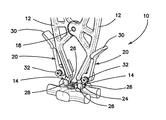
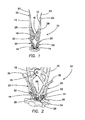
- FIG. 1 is a front isometric view of one embodiment of a tensioning device constructed in accordance with the principles of the present invention, including an illustration of a buckle and a band on the sternum;
- FIG. 2 is a front isometric view of the distal end of the tensioning device of FIG. 1 ;
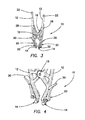
- FIG. 3 is a front isometric view of the tensioning device of FIGS. 1 and 2 shown in the closed position;
- FIG. 4 is a front isometric view of the distal end of tensioning device of FIGS. 1-3 in the closed position;
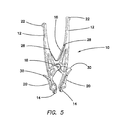
- FIG. 5 is a rear isometric view of the tensioning device of FIGS. 1-4 in the closed position
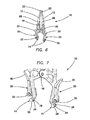
- FIG. 6 is a front isometric view of the tensioning device of FIGS. 1-5 in the open position
- FIG. 7 is a front isometric view of the distal end of the tensioning device of FIGS. 1-6 in the open position;
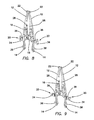
- FIG. 8 is a front isometric view of a modified embodiment of the tensioning device of the present invention, using alternate suture holding clamps with thumbscrew, suture guides, and suture guide pins;
- FIG. 9 is a front isometric view of the tensioning device of FIG. 8 ;
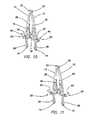
- FIG. 10 is a front isometric view of another modified embodiment of the tensioning device of the present invention, using alternate suture holding clamps with toggle clamps, dual support toggle clamp holder, and suture guide pins;
- FIG. 11 is a front isometric view of still another modified embodiment of the tensioning device of the present invention, using alternate suture holding clamps with toggle clamps, toggle clamp holder, and suture guide pins.
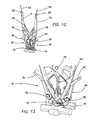
- FIG. 12 is a front isometric view of yet another modified embodiment of the tensioning device of the present invention, with pivoting tensioning tips and springs for force control, shown with buckle, band, and no tensioning tab;
- FIG. 13 is a front isometric view of the distal end of the tensioning device of FIG. 12 ;
- FIG. 14 is a front isometric view of still another modified embodiment of the tensioning device of the present invention, with pivoting tensioning tips and springs for force control;
- FIG. 15 is a front isometric view of the distal end of the tensioning device of FIG. 14 , with pivoting tensioning tips and springs for force control, distal end;
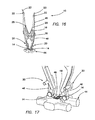
- FIG. 16 is a front isometric view of yet another embodiment of the tensioning device of the present invention.
- FIG. 17 is a front isometric view of the distal end of the tensioning device of FIG. 16 .
- FIGS. 1-7 there is shown in FIGS. 1-7 a first embodiment of a tensioning system 10 constructed in accordance with the principles of the present invention.
- the system or device 10 comprises two proximal handles 12 , for grasping and applying tension, a pair of movable distal tensioning tips 14 disposed distally to the handles, and a leaf spring 16 disposed between the handles 12 which are biased for returning the handles to their original state.
- the handles 12 and tensioning tips 14 are pivotally joined together by a pivot pin 18 .
- Suture holding clamps 20 are disposed on the device 10 between the handle portions 12 and the tensioning tips 14 , proximal to the tensioning tips, as shown.
- Suture guides 22 are disposed on the proximal end of handles 12 for holding and managing excess suture length (suture 23 ).
- the pivot 18 is positioned in such a way as to provide the right amount of leverage and travel of the movable tension tips 14 . When the handles 12 are squeezed, the tensioning tips 14 move outwardly.
- the handles 12 are shaped in such a way as to provide mechanical advantage for various hand sizes and include apertures for accommodating a lighting device, which also aid in the use of the suture clamps.
- the movable tensioning tips 14 are round and smooth, for providing free movement of the band. This is best shown in FIGS. 2 and 7 .
- the tips 14 comprise a recessed center portion 24 for accommodating the band, and raised side walls 26 defining the recessed center portion 24 for preventing band slippage.
- the leaf spring 16 is positioned between the handles 12 , as shown in the drawings, using screws 28 , or other suitable fasteners, in order to provide easy access for cleaning and sufficient force to return the handle to its original state.
- the suture holding clamps 20 include a proximal thumb flange or actuator 30 for pivoting the clamp 20 between open and clamping positions about pivot screws 32 .
- FIGS. 8 and 9 illustrate a modified embodiment of the invention, wherein like elements are identified by like reference numerals to those used in FIGS. 1-7 .
- the suture holding clamp 20 comprises a thumbscrew 34 , suture guides 36 , and suture guide pins 38 .
- FIGS. 10 and 11 two additional modified embodiments are illustrated, wherein, once again, like elements are identified by like reference numerals to those used in FIGS. 1-9 .
- the suture holding clamps 20 have been modified, so that they comprise suture guide pins 38 , and the clamp 20 comprises a toggle clamp including a toggle actuator 40 for selectively clamping suture within a suture clamping channel 42 .
- FIG. 11 is similar, but includes different constructional details for the suture holding clamps.
- FIG. 12 illustrates yet another modified embodiment of the inventive device 10 , wherein, again, like elements are identified by like reference numerals.
- a second spring 42 is disposed between the tensioning tips 14 in order to provide force control for the tensioning system.
- FIG. 13 is an enlarged view of the distal end of FIG. 12 .
- FIGS. 14 and 15 illustrate the FIG. 12-13 embodiment without the sternum and suture buckling system in place.
- FIGS. 16 and 17 illustrate still another modified embodiment of the present inventive device 10 .
- the embodiment is shown in conjunction with the application for which it has been particularly adapted. That application is in connection with a sternal bone 44 which has been separated for the purpose of performing a surgical procedure, and is now being joined together using a suture band 46 , wherein the band is to remain in place about the bone until natural healing takes place.
- a buckle 48 is utilized to join the free suture ends together, and to adjust the tension on those suture ends.
- a buckle system of the type shown herein is shown and disclosed in much greater detail in commonly assigned U.S. Published Patent App. No. 2013/0184720, which has already been expressly incorporated herein by reference, in its entirety.
- the suture band 46 is positioned as desired around the bone 44 to be repaired, and is then tensioned to tighten the band around the bone in order to secure the bone in proper position, and to ensure that the band will remain in tension during the entire healing process, by ensuring that the implant follows the bone as it shrinks during healing.
- a lock bar (not shown) in the buckle remains in an unactuated position, permitting free movement of the suture band 46 through the gap in the buckle 48 as the tensioning proceeds.
- a predetermined tensioning force is applied to the suture band 46 , the friction forces restraining the lock bar are overcome, and the lock bar breaks free from its restraint, moving to a locking position. This locks the buckle in place, preventing further movement of the suture band 46 .
- the tensioning system shown and described herein assists in applying a consistent and required tension level.
- the band 46 passes around each tensioning tip 14 , as shown. To retain the suture band in place, it is seated in the tensioning tip recessed center portion 24 , between raised side walls 26 .
- the suture bands 46 then extend through the suture holding clamps 20 and along the handles 12 exit the tensioning device through suture guides 22 as suture free ends 23 . No threading is necessary.
- the closed position of the tensioning device 10 occurs when the handles 12 are spaced apart, and the movable tensioning tips are in close proximity ( FIGS. 1-5 , for example).
- the open position is shown in 6 - 9 , for example.
- the suture holding clamps 20 When it is desired to apply a tensioning force to the two suture band ends disposed about each of the tensioning tips 14 and over the device 10 , the suture holding clamps 20 are actuated to clamp the suture band 46 in place on either side of the device, and the handles are squeezed together to move the device to its open position, with the tensioning tips in their spaced apart orientation. This movement causes tension to be applied to the suture band 46 in the vicinity of the buckle 48 .
- the buckle is fastened, after which the suture holding clamps 20 can be released, and the handles 12 permitted, by action of the leaf spring 16 , to return the tensioner to its relaxed closed position. Then, the suture ends may be trimmed, as desired.
Landscapes
- Health & Medical Sciences (AREA)
- Orthopedic Medicine & Surgery (AREA)
- Surgery (AREA)
- Life Sciences & Earth Sciences (AREA)
- Heart & Thoracic Surgery (AREA)
- Nuclear Medicine, Radiotherapy & Molecular Imaging (AREA)
- Engineering & Computer Science (AREA)
- Biomedical Technology (AREA)
- Medical Informatics (AREA)
- Molecular Biology (AREA)
- Animal Behavior & Ethology (AREA)
- General Health & Medical Sciences (AREA)
- Public Health (AREA)
- Veterinary Medicine (AREA)
- Neurology (AREA)
- Surgical Instruments (AREA)
Abstract
Description
- This application claims the benefit under 35 U.S.C. 119(e) of the filing date of Provisional U.S. Application Ser. No. 61/982,265, entitled Tensioning Device for Dynamic Suture System, filed on Apr. 21, 2014, which application is expressly incorporated herein by reference, in its entirety.
- Additionally, this application is related to U.S. Published Patent Application No. 2013/0184720, U.S. Pat. No. 8,414,599, U.S. Pat. No. 8,613,755, U.S. Pat. No. 8,303,591, U.S. Published Patent Application No. 2014/0018804, U.S. Pat. No. 8,579,901, U.S. Pat. No. 8,715,297, U.S. Pat. No. 8,668,696, and U.S. Published Patent App. No. 2011/0313435, all of which are commonly assigned and expressly incorporated herein, by reference, in their entirety.
- The present invention is related to the general surgical repair of separated body tissues, and more particularly to internally fixating and stabilizing such body tissues, specifically bones.
- In the present state of the art, there are a number of systems available to repair biological tissues separated in surgery or by injury. These products serve to approximate and stabilize the tissues so that healing may commence and provide compression in the interface to promote anatomical heal of tissue. With the correct amount of compression applied to the interface of the tissue portions to be joined, signals are sent to the tissue, thus allowing the tissue to remodel in proper anatomical position. The amount of compression applied to the tissue interface needs to be appropriate to the type of tissue that is being healed.
- Twisted wires are typically used to keep bone fragments together so they may heal. Twisted wires only hold tension as long as the twisted wire pair remains stable. Often the wires untwist too soon, thus failing to keep the bone fragments together so that they may heal. Wires can also cut into bone fragments, allowing them to separate so that healing is difficult.
- When it is necessary to access the thoracic cavity for a medical procedure, for example, it is required to cut the sternum into two pieces using a sternal saw. Once the procedure is completed within the thoracic cavity, the sternum must be repaired. For such repairs, it is known to use a dynamic compression device. Some of the drawbacks of this typical device, and others which are used include the fact that bulky spring materials used in such devices, while occupying substantial space, often do not store much energy. Some use polymer elastic bands, while others use coiled springs. Additionally, wires are sometimes used to wrap the hones into position in compression with one another. However, wires can have sharp ends that can damage adjunctive tissues. Knot stacks in suture can interfere with the natural movement of surrounding tissues. Another disadvantage of these prior art dynamic compression devices is that current banding systems that incorporate a biasing mechanism to achieve dynamic compression put the biasing mechanism in line with the band or suture. This practice competes with precious space at the healing site. Bands of suture are used to approximate tissues so that they may heal. It is desirable to obtain the best purchase possible on the tissue, so that the binding mechanics offered by the suture may be utilized. The best purchase is optimized by ensuring that the suture has the greatest contact area with the tissue. If a biasing mechanism is interfering with this concept, the biasing mechanism may diminish the suture's ability to hold the tissues together.
- In addition, the current banding systems have stiff bands that are not compliant with bony undulations. Flat sutures are used, but are tedious to tie and do not hold reliably.
- The banding systems of the present invention are therefore attractive for use in sternal closure because they offer some distinct advantage over twisted wires commonly used in the procedure.
- Bands address the issues wires have, as noted in the following discussion. A band, by definition, is wide. In being wide, a band distributes its forces over a wider surface area. This inhibits the band from digging into the bone. In being wide, a band also affords a larger cross-sectional area, whereby more material may be realized, thus presenting the opportunity to offer as much strength in the construct as is necessary to hold the bone fragments together. As such, bands address two main weaknesses of twisted wires. These weaknesses are: digging into the bone fragments being held together, and not having sufficient cross sectional area.
- However, with respect to bands, their strength is accompanied by stiffness, as mentioned elsewhere herein. The larger cross-section of the band significantly increases the stiffness of the band. While stiffness and rigidity are good attributes in the sense that they can stabilize the bone union, these attributes can also prevent the band from following the contours of the bone when inserted. This can lead to capturing tissues underneath the band that ultimately destabilize the union as the tissues continue and disappear over time.
- Binding the band ends together can also impose some problems. Generally this binding involves a mechanism on the band end that interfaces with holes or slots or contours on the other band end. This creates a tensioning system that is incremental in nature. As in the twisted wire systems, this mechanical interface of the two ends id the weakest link in the banding system. This mechanical interface becomes conductive to fine tuning the tension, so this is problematic. Flat sutures have been used to tie tissues together, but the residual tension supplied in such a knotted structure is insufficient for optimum healing. There is a lot of fuss and time associated with trying to keep and hold a desirable tension with these sutures. What is needed is an attachment means that provides variable tensioning.
- Another problem associated with banding systems is that their tension holding capabilities are not sufficient for the environment in which they operate. Tension holding ability can be increased or enhanced by increasing friction at the binding interface of the band. What is needed however is a banding system with the ability to hold tension by selectively increasing friction at the binding interface during locking and/or after locking without increasing friction while tensioning.
- What is needed, therefore, are improved devices and techniques for holding two tissue portions in a state of compression and tension that address and overcome these shortcomings in an innovative way.
- The present invention solves the problems outlined above by providing a mechanized tensioning system for consistently and evenly applying a prescribed predetermined level of tension to the suture, at which point the suture is clamped in place with a buckle.
- More particularly, there is provided a tensioning device comprising two proximal handles for grasping, a pair of movable distal tensioning tips, a pivot between the proximal handle and distal tensioning tips, and suture holding clamps proximal to the tensioning tips.
- The tensioning device is used in conjunction with a buckle that includes a lock bar and tensioning tab for securing and tensioning suture, the tension tab is provided to secure the lock bar in its first position until tension on the suture exceeds a predetermined level.
- In one particular aspect of the invention, there is provided a tensioning device for tensioning suture bands having free ends fastenable using a buckle, which comprise a pair of proximal handles for grasping and applying tension, a pair of movable tensioning tips disposed distally to the handles, a spring disposed between the handles for biasing the handles to a desired state, a pivot joining the handles and the tensioning tips so that they are pivotally connected; and suture holding clamps disposed between the tensioning tips and the handles. The combination may also comprise suture guides on a proximal end of each handle for holding and managing excess suture length. The handles for grasping and applying tension are shaped in such a way as to provide mechanical advantage for various hand sizes and holes for lighting device, which also aid in the use of suture clamps. The movable tensioning tips are smooth and round to provide free movement of the band and also include raised sides to prevent band slippage. The spring may preferably comprise a leaf spring and is positioned between the handles with screws in such a way as to provide easy access for cleaning and sufficient force to return handle to original state.
- The pivot is positioned in such a way as to provide a desired amount of leverage and travel of the movable tensioning tips, when the handle is squeezed to cause the tensioning tips to move outwardly. The suture holding clamps are disposed between the tensioning tips and the handles and comprise a holder and a toggle clamp. The toggle clamp includes a cam with serrations for gripping suture band and a handle with sufficient length to provide leverage for clamping.
- The holder includes a smooth surface for the toggle clamp to rotate on, a feature to stop toggle rotation, and a threaded feature for securing a precision shoulder screw. The suture guides on the proximal ends of the handles-comprise narrow slots with chamfer lead in features to assist in positioning the bands within the narrow slots. The suture holding clamps disposed between the tensioning tips and handles comprise narrow suture holder slots, thumbscrews for clamping, and suture guide pins.
- The suture holding clamps disposed between the tensioning tips and handles may comprise suture holder slots, thumbscrews, movable jaws for clamping, and suture guide pins, or may alternatively comprise toggle clamps with dual support toggle clamp holder, and suture guide pins. In yet another embodiment, the suture holding clamps comprise toggle clamps with toggle clamp holder, and suture guide pins.
- The tensioning tips comprise pivots, and tensioning leaf springs to control the amount of tension the tensioning device can deliver.
- The invention, together with additional features and advantages thereof, may best be understood by reference to the following description taken in conjunction with the accompanying illustrative drawings.
-
FIG. 1 is a front isometric view of one embodiment of a tensioning device constructed in accordance with the principles of the present invention, including an illustration of a buckle and a band on the sternum; -
FIG. 2 is a front isometric view of the distal end of the tensioning device ofFIG. 1 ; -
FIG. 3 is a front isometric view of the tensioning device ofFIGS. 1 and 2 shown in the closed position; -
FIG. 4 is a front isometric view of the distal end of tensioning device ofFIGS. 1-3 in the closed position; -
FIG. 5 is a rear isometric view of the tensioning device ofFIGS. 1-4 in the closed position; -
FIG. 6 is a front isometric view of the tensioning device ofFIGS. 1-5 in the open position; -
FIG. 7 is a front isometric view of the distal end of the tensioning device ofFIGS. 1-6 in the open position; -
FIG. 8 is a front isometric view of a modified embodiment of the tensioning device of the present invention, using alternate suture holding clamps with thumbscrew, suture guides, and suture guide pins; -
FIG. 9 is a front isometric view of the tensioning device ofFIG. 8 ; -
FIG. 10 is a front isometric view of another modified embodiment of the tensioning device of the present invention, using alternate suture holding clamps with toggle clamps, dual support toggle clamp holder, and suture guide pins; -
FIG. 11 is a front isometric view of still another modified embodiment of the tensioning device of the present invention, using alternate suture holding clamps with toggle clamps, toggle clamp holder, and suture guide pins. -
FIG. 12 is a front isometric view of yet another modified embodiment of the tensioning device of the present invention, with pivoting tensioning tips and springs for force control, shown with buckle, band, and no tensioning tab; -
FIG. 13 is a front isometric view of the distal end of the tensioning device ofFIG. 12 ; -
FIG. 14 is a front isometric view of still another modified embodiment of the tensioning device of the present invention, with pivoting tensioning tips and springs for force control; -
FIG. 15 is a front isometric view of the distal end of the tensioning device ofFIG. 14 , with pivoting tensioning tips and springs for force control, distal end; -
FIG. 16 is a front isometric view of yet another embodiment of the tensioning device of the present invention; and -
FIG. 17 is a front isometric view of the distal end of the tensioning device ofFIG. 16 . - Referring more particularly to the drawings, there is shown in
FIGS. 1-7 a first embodiment of atensioning system 10 constructed in accordance with the principles of the present invention. The system ordevice 10 comprises twoproximal handles 12, for grasping and applying tension, a pair of movabledistal tensioning tips 14 disposed distally to the handles, and aleaf spring 16 disposed between thehandles 12 which are biased for returning the handles to their original state. Thehandles 12 andtensioning tips 14 are pivotally joined together by apivot pin 18. Suture holding clamps 20 are disposed on thedevice 10 between thehandle portions 12 and thetensioning tips 14, proximal to the tensioning tips, as shown. Suture guides 22 are disposed on the proximal end ofhandles 12 for holding and managing excess suture length (suture 23). Thepivot 18 is positioned in such a way as to provide the right amount of leverage and travel of themovable tension tips 14. When thehandles 12 are squeezed, thetensioning tips 14 move outwardly. - Advantageously, the
handles 12 are shaped in such a way as to provide mechanical advantage for various hand sizes and include apertures for accommodating a lighting device, which also aid in the use of the suture clamps. - The
movable tensioning tips 14, as illustrated, are round and smooth, for providing free movement of the band. This is best shown inFIGS. 2 and 7 . Thetips 14 comprise a recessedcenter portion 24 for accommodating the band, and raisedside walls 26 defining the recessedcenter portion 24 for preventing band slippage. - The
leaf spring 16 is positioned between thehandles 12, as shown in the drawings, usingscrews 28, or other suitable fasteners, in order to provide easy access for cleaning and sufficient force to return the handle to its original state. - In the
FIGS. 1-7 embodiment, the suture holding clamps 20 include a proximal thumb flange oractuator 30 for pivoting theclamp 20 between open and clamping positions about pivot screws 32. -
FIGS. 8 and 9 illustrate a modified embodiment of the invention, wherein like elements are identified by like reference numerals to those used inFIGS. 1-7 . In this embodiment, however, thesuture holding clamp 20 comprises athumbscrew 34, suture guides 36, and suture guide pins 38. - In
FIGS. 10 and 11 , two additional modified embodiments are illustrated, wherein, once again, like elements are identified by like reference numerals to those used inFIGS. 1-9 . InFIG. 10 , the suture holding clamps 20 have been modified, so that they comprise suture guide pins 38, and theclamp 20 comprises a toggle clamp including atoggle actuator 40 for selectively clamping suture within asuture clamping channel 42.FIG. 11 is similar, but includes different constructional details for the suture holding clamps. -
FIG. 12 illustrates yet another modified embodiment of theinventive device 10, wherein, again, like elements are identified by like reference numerals. In this embodiment, asecond spring 42 is disposed between thetensioning tips 14 in order to provide force control for the tensioning system.FIG. 13 is an enlarged view of the distal end ofFIG. 12 .FIGS. 14 and 15 illustrate theFIG. 12-13 embodiment without the sternum and suture buckling system in place. -
FIGS. 16 and 17 illustrate still another modified embodiment of the presentinventive device 10. In this embodiment, as in theFIGS. 1-2 and 12-13 embodiments, the embodiment is shown in conjunction with the application for which it has been particularly adapted. That application is in connection with asternal bone 44 which has been separated for the purpose of performing a surgical procedure, and is now being joined together using asuture band 46, wherein the band is to remain in place about the bone until natural healing takes place. Abuckle 48 is utilized to join the free suture ends together, and to adjust the tension on those suture ends. A buckle system of the type shown herein is shown and disclosed in much greater detail in commonly assigned U.S. Published Patent App. No. 2013/0184720, which has already been expressly incorporated herein by reference, in its entirety. - Thus, in practice, the
suture band 46 is positioned as desired around thebone 44 to be repaired, and is then tensioned to tighten the band around the bone in order to secure the bone in proper position, and to ensure that the band will remain in tension during the entire healing process, by ensuring that the implant follows the bone as it shrinks during healing. During this tensioning step, a lock bar (not shown) in the buckle remains in an unactuated position, permitting free movement of thesuture band 46 through the gap in thebuckle 48 as the tensioning proceeds. When a predetermined tensioning force is applied to thesuture band 46, the friction forces restraining the lock bar are overcome, and the lock bar breaks free from its restraint, moving to a locking position. This locks the buckle in place, preventing further movement of thesuture band 46. - In practice, it is difficult to manage the required amount of force to clamp the suture in place using manual techniques. Thus, the tensioning system shown and described herein assists in applying a consistent and required tension level. As shown, the
band 46 passes around eachtensioning tip 14, as shown. To retain the suture band in place, it is seated in the tensioning tip recessedcenter portion 24, between raisedside walls 26. Thesuture bands 46 then extend through the suture holding clamps 20 and along thehandles 12 exit the tensioning device through suture guides 22 as suture free ends 23. No threading is necessary. The closed position of thetensioning device 10 occurs when thehandles 12 are spaced apart, and the movable tensioning tips are in close proximity (FIGS. 1-5 , for example). The open position is shown in 6-9, for example. - When it is desired to apply a tensioning force to the two suture band ends disposed about each of the
tensioning tips 14 and over thedevice 10, the suture holding clamps 20 are actuated to clamp thesuture band 46 in place on either side of the device, and the handles are squeezed together to move the device to its open position, with the tensioning tips in their spaced apart orientation. This movement causes tension to be applied to thesuture band 46 in the vicinity of thebuckle 48. When the suture is tensioned as desired, the buckle is fastened, after which the suture holding clamps 20 can be released, and thehandles 12 permitted, by action of theleaf spring 16, to return the tensioner to its relaxed closed position. Then, the suture ends may be trimmed, as desired. - Accordingly, although exemplary embodiments of the invention have been shown and described, it is to be understood that all the terms used herein are descriptive rather than limiting, and that many changes, modifications, and substitutions may be made by one having ordinary skill in the art without departing from the spirit and scope of the invention, which is to be limited only in accordance with the following claims.
Claims (15)
Priority Applications (1)
| Application Number | Priority Date | Filing Date | Title |
|---|---|---|---|
| US15/787,435 US10568676B2 (en) | 2014-04-21 | 2017-10-18 | Tensioning devices and methods for dynamic suture systems |
Applications Claiming Priority (3)
| Application Number | Priority Date | Filing Date | Title |
|---|---|---|---|
| US201461982265P | 2014-04-21 | 2014-04-21 | |
| US14/691,573 US9820793B1 (en) | 2014-04-21 | 2015-04-20 | Tensioning devices and methods for dynamic suture systems |
| US15/787,435 US10568676B2 (en) | 2014-04-21 | 2017-10-18 | Tensioning devices and methods for dynamic suture systems |
Related Parent Applications (1)
| Application Number | Title | Priority Date | Filing Date |
|---|---|---|---|
| US14/691,573 Continuation US9820793B1 (en) | 2014-04-21 | 2015-04-20 | Tensioning devices and methods for dynamic suture systems |
Publications (2)
| Publication Number | Publication Date |
|---|---|
| US20180098806A1 true US20180098806A1 (en) | 2018-04-12 |
| US10568676B2 US10568676B2 (en) | 2020-02-25 |
Family
ID=60320527
Family Applications (2)
| Application Number | Title | Priority Date | Filing Date |
|---|---|---|---|
| US14/691,573 Expired - Fee Related US9820793B1 (en) | 2014-04-21 | 2015-04-20 | Tensioning devices and methods for dynamic suture systems |
| US15/787,435 Active 2035-07-20 US10568676B2 (en) | 2014-04-21 | 2017-10-18 | Tensioning devices and methods for dynamic suture systems |
Family Applications Before (1)
| Application Number | Title | Priority Date | Filing Date |
|---|---|---|---|
| US14/691,573 Expired - Fee Related US9820793B1 (en) | 2014-04-21 | 2015-04-20 | Tensioning devices and methods for dynamic suture systems |
Country Status (1)
| Country | Link |
|---|---|
| US (2) | US9820793B1 (en) |
Families Citing this family (5)
| Publication number | Priority date | Publication date | Assignee | Title |
|---|---|---|---|---|
| US9820793B1 (en) | 2014-04-21 | 2017-11-21 | Dallen Medical, Inc. | Tensioning devices and methods for dynamic suture systems |
| FR3026636B1 (en) * | 2014-10-01 | 2017-09-15 | Cousin Biotech | ANCHORAGE FOR TENSIONING A LONGILINE ELEMENT FOR ATTACHING AN IMPLANT TO A BONE MEMBER |
| US11090096B2 (en) * | 2016-04-12 | 2021-08-17 | K2M, Inc. | Surgical rod bender |
| US12426900B2 (en) * | 2022-02-16 | 2025-09-30 | Biomet Microfixation, Llc | Fastener guide |
| US12616513B2 (en) * | 2022-10-07 | 2026-05-05 | Arbutus Medical Inc. | Medical device |
Citations (4)
| Publication number | Priority date | Publication date | Assignee | Title |
|---|---|---|---|---|
| US2455609A (en) * | 1945-06-20 | 1948-12-07 | Burton V Scheib | Wire applying forceps |
| US5545168A (en) * | 1994-03-11 | 1996-08-13 | Burke; Dennis W. | Apparatus for both tensioning and crimping a surgical wire |
| US20020072753A1 (en) * | 2000-10-02 | 2002-06-13 | Surgical Dynamics, Inc. | System and method for spinal reconstruction |
| US8579901B1 (en) * | 2009-06-17 | 2013-11-12 | Dallen Medical, Inc. | Suture band buckle and methods |
Family Cites Families (44)
| Publication number | Priority date | Publication date | Assignee | Title |
|---|---|---|---|---|
| US1310232A (en) * | 1919-07-15 | Piston-ring compressor | ||
| US1304620A (en) * | 1919-05-27 | Wire-tie-forming tool | ||
| US1641077A (en) * | 1924-11-21 | 1927-08-30 | Fouquet Eugene | Binding and cutting pliers |
| US2049361A (en) * | 1934-10-27 | 1936-07-28 | Ericsson Ernst Axel Johan | Wire or ribbon tightening apparatus |
| US2291413A (en) * | 1941-06-13 | 1942-07-28 | John R Siebrandt | Bone clamping and wire adjusting means |
| US3507270A (en) * | 1967-07-05 | 1970-04-21 | Raymond W Ferrier | Occluder for blood vessel or flexible tube |
| GB1551707A (en) * | 1975-04-28 | 1979-08-30 | Downs Surgical Ltd | Surgical instrument |
| DE3319149C1 (en) * | 1983-05-26 | 1984-12-13 | Franz 7202 Mühlheim Leibinger | Arrangement for the mutual fixation of bone parts and tool for fastening this arrangement |
| US5116340A (en) * | 1989-01-26 | 1992-05-26 | Songer Robert J | Surgical securance apparatus |
| US4966600A (en) * | 1989-01-26 | 1990-10-30 | Songer Robert J | Surgical securance method |
| IT8903410A0 (en) * | 1989-04-03 | 1989-04-03 | Citieffe Srl | CLAMP DEVICE FOR TENSIONING TRACTION WIRES IN ORTHOPEDIC SURGERY |
| US5314431A (en) * | 1992-06-19 | 1994-05-24 | Graziano Thomas A | Surgical instrument used in conjunction with fixation of fractures or surgical osteotomies |
| US5312410A (en) * | 1992-12-07 | 1994-05-17 | Danek Medical, Inc. | Surgical cable tensioner |
| US5540698A (en) * | 1993-04-21 | 1996-07-30 | Amei Technologies Inc. | System and method for securing a medical cable |
| US5395374A (en) * | 1993-09-02 | 1995-03-07 | Danek Medical, Inc. | Orthopedic cabling method and apparatus |
| US5490856A (en) * | 1993-12-14 | 1996-02-13 | Untied States Surgical Corporation | Purse string stapler |
| WO1995022294A1 (en) * | 1994-02-17 | 1995-08-24 | Surgical Accessories, Inc. | Fastener and tensioner for bone securing cable |
| US5536270A (en) * | 1994-02-24 | 1996-07-16 | Pioneer Laboratories, Inc. | Cable system for bone securance |
| US5720747A (en) * | 1994-03-11 | 1998-02-24 | Burke; Dennis W. | Apparatus for crimping a surgical wire |
| US5542843A (en) * | 1995-03-22 | 1996-08-06 | Price; Michael T. | Rotatably driven autoclavable ligation instrument |
| DE19627864C2 (en) * | 1996-07-11 | 2003-05-08 | Aesculap Ag & Co Kg | Surgical jig |
| US5964769A (en) * | 1997-08-26 | 1999-10-12 | Spinal Concepts, Inc. | Surgical cable system and method |
| US6482208B1 (en) * | 1998-11-25 | 2002-11-19 | Alliance Orthopedic, Inc. | Fracture reduction clamp |
| US6395010B1 (en) * | 1999-12-21 | 2002-05-28 | Securos, Inc. | Crimping device for cranial cruciate ligament stabilization |
| US6383200B1 (en) * | 1999-12-21 | 2002-05-07 | Securos, Inc. | Tensioning device for cranial cruciate ligament stabilization |
| US7993349B2 (en) * | 2000-07-27 | 2011-08-09 | Synthes Usa, Llc | Cranial flap clamp instrument |
| ATE320760T1 (en) * | 2000-07-27 | 2006-04-15 | Synthes Ag | INSTRUMENT FOR SKULL CASE FIXATION DEVICE |
| US7207996B2 (en) * | 2002-04-04 | 2007-04-24 | Vascular Control Systems, Inc. | Doppler directed suturing and compression device and method |
| CA2482251A1 (en) * | 2002-04-09 | 2003-10-16 | Synthes (U.S.A.) | Device for guiding a cerclage wire |
| US6752810B1 (en) * | 2002-05-31 | 2004-06-22 | Pilling Weck Incorporated | Instrument and method for pulling and twisting a tie onto two separated items |
| JP3721189B1 (en) * | 2005-05-02 | 2005-11-30 | アルフレッサファーマ株式会社 | Tightening device for bone fastening cable |
| US7871424B2 (en) * | 2005-05-23 | 2011-01-18 | Custom Spine, Inc. | Spinal rod inserter |
| US8500739B2 (en) * | 2007-04-06 | 2013-08-06 | DePuy Synthes Products, LLC | Securing device to secure fixation devices to bone portions |
| US8323294B2 (en) * | 2007-08-21 | 2012-12-04 | Depuy Spine, Inc. | Tether tensioning instrument |
| US8257367B2 (en) * | 2008-08-12 | 2012-09-04 | Pioneer Surgical Technology, Inc. | Surgical cable tensioning apparatus and method |
| US9023058B2 (en) * | 2008-10-07 | 2015-05-05 | Kardium Inc. | Surgical instrument and method for tensioning and securing a flexible suture |
| US9241748B2 (en) * | 2012-04-30 | 2016-01-26 | Acute Innovations Llc | System for binding bone |
| GB2474363B (en) * | 2009-10-09 | 2013-09-25 | Acute Innovations Llc | System for tensioning a surgical wire |
| BRPI1002494B1 (en) * | 2010-07-12 | 2015-08-18 | João Bosco De Oliveira | Shear with tensioning device |
| US9084644B2 (en) * | 2011-02-02 | 2015-07-21 | DePuy Synthes Products, Inc. | Bone fixation assembly |
| WO2013106775A1 (en) * | 2012-01-13 | 2013-07-18 | Dallen Medical, Inc. | Actuator for band tensioning system |
| US9561064B2 (en) * | 2012-11-21 | 2017-02-07 | Pioneer Surgical Technology, Inc. | Bone plate system and method |
| US9820793B1 (en) | 2014-04-21 | 2017-11-21 | Dallen Medical, Inc. | Tensioning devices and methods for dynamic suture systems |
| EP3148462B1 (en) * | 2014-05-30 | 2018-04-18 | DePuy Synthes Products, Inc. | Bone fixation assembly |
-
2015
- 2015-04-20 US US14/691,573 patent/US9820793B1/en not_active Expired - Fee Related
-
2017
- 2017-10-18 US US15/787,435 patent/US10568676B2/en active Active
Patent Citations (4)
| Publication number | Priority date | Publication date | Assignee | Title |
|---|---|---|---|---|
| US2455609A (en) * | 1945-06-20 | 1948-12-07 | Burton V Scheib | Wire applying forceps |
| US5545168A (en) * | 1994-03-11 | 1996-08-13 | Burke; Dennis W. | Apparatus for both tensioning and crimping a surgical wire |
| US20020072753A1 (en) * | 2000-10-02 | 2002-06-13 | Surgical Dynamics, Inc. | System and method for spinal reconstruction |
| US8579901B1 (en) * | 2009-06-17 | 2013-11-12 | Dallen Medical, Inc. | Suture band buckle and methods |
Also Published As
| Publication number | Publication date |
|---|---|
| US9820793B1 (en) | 2017-11-21 |
| US10568676B2 (en) | 2020-02-25 |
Similar Documents
| Publication | Publication Date | Title |
|---|---|---|
| US10568676B2 (en) | Tensioning devices and methods for dynamic suture systems | |
| US9345465B2 (en) | Actuator for band tensioning system | |
| JP7295176B2 (en) | Systems and methods for securing soft tissue | |
| US6228096B1 (en) | Instrument and method for manipulating an operating member coupled to suture material while maintaining tension on the suture material | |
| US6761722B2 (en) | Tissue anchoring system and method | |
| US8668696B2 (en) | Low friction buckle tightening systems and methods | |
| JP2007519456A (en) | Fixing device | |
| US20040122471A1 (en) | Connective tissue repair system | |
| CN100571648C (en) | Cranial flap clamp apparatus | |
| US20050177179A1 (en) | Surgical cable system | |
| CA2935477A1 (en) | Devices and methods for advancing knots | |
| JP2010515497A (en) | Surgical cable tightening method and apparatus | |
| US20210401477A1 (en) | System and method for bone fixation | |
| GB2455182A (en) | Clamp for use in orthopaedic surgery | |
| US20020120280A1 (en) | Crimping device for cranial cruciate ligament stabilization | |
| EP3089675A1 (en) | Devices and methods for advancing knots | |
| US11534216B2 (en) | Tensioner for a sternal closure strap device | |
| KR101624953B1 (en) | Surgical clips | |
| JP2023521443A (en) | Apparatus and bone fastening kit for tensioning surgical threads | |
| US11813011B2 (en) | Cerclage cable system and apparatus | |
| US20240366275A1 (en) | Cerclage cable system and apparatus | |
| CN107550573B (en) | Universal tensioner and graft passer | |
| JP6400420B2 (en) | Bone fixation forceps | |
| JP2007519455A (en) | Fixing device | |
| US20200000454A1 (en) | Slack removal in suture constructs for tissue repair |
Legal Events
| Date | Code | Title | Description |
|---|---|---|---|
| FEPP | Fee payment procedure |
Free format text: ENTITY STATUS SET TO UNDISCOUNTED (ORIGINAL EVENT CODE: BIG.); ENTITY STATUS OF PATENT OWNER: LARGE ENTITY |
|
| STPP | Information on status: patent application and granting procedure in general |
Free format text: NON FINAL ACTION MAILED |
|
| STPP | Information on status: patent application and granting procedure in general |
Free format text: RESPONSE TO NON-FINAL OFFICE ACTION ENTERED AND FORWARDED TO EXAMINER |
|
| STPP | Information on status: patent application and granting procedure in general |
Free format text: NON FINAL ACTION MAILED |
|
| STPP | Information on status: patent application and granting procedure in general |
Free format text: RESPONSE TO NON-FINAL OFFICE ACTION ENTERED AND FORWARDED TO EXAMINER |
|
| STPP | Information on status: patent application and granting procedure in general |
Free format text: NOTICE OF ALLOWANCE MAILED -- APPLICATION RECEIVED IN OFFICE OF PUBLICATIONS |
|
| STPP | Information on status: patent application and granting procedure in general |
Free format text: PUBLICATIONS -- ISSUE FEE PAYMENT VERIFIED |
|
| STCF | Information on status: patent grant |
Free format text: PATENTED CASE |
|
| CC | Certificate of correction | ||
| MAFP | Maintenance fee payment |
Free format text: PAYMENT OF MAINTENANCE FEE, 4TH YEAR, LARGE ENTITY (ORIGINAL EVENT CODE: M1551); ENTITY STATUS OF PATENT OWNER: LARGE ENTITY Year of fee payment: 4 |