US20180098597A1 - Shoe - Google Patents
Shoe Download PDFInfo
- Publication number
- US20180098597A1 US20180098597A1 US15/288,091 US201615288091A US2018098597A1 US 20180098597 A1 US20180098597 A1 US 20180098597A1 US 201615288091 A US201615288091 A US 201615288091A US 2018098597 A1 US2018098597 A1 US 2018098597A1
- Authority
- US
- United States
- Prior art keywords
- foot
- main body
- shoe
- strap
- toe
- Prior art date
- Legal status (The legal status is an assumption and is not a legal conclusion. Google has not performed a legal analysis and makes no representation as to the accuracy of the status listed.)
- Abandoned
Links
Images



Classifications
-
- A—HUMAN NECESSITIES
- A43—FOOTWEAR
- A43B—CHARACTERISTIC FEATURES OF FOOTWEAR; PARTS OF FOOTWEAR
- A43B3/00—Footwear characterised by the shape or the use
- A43B3/12—Sandals; Strap guides thereon
- A43B3/128—Sandals; Strap guides thereon characterised by the sole
-
- A—HUMAN NECESSITIES
- A43—FOOTWEAR
- A43B—CHARACTERISTIC FEATURES OF FOOTWEAR; PARTS OF FOOTWEAR
- A43B23/00—Uppers; Boot legs; Stiffeners; Other single parts of footwear
- A43B23/02—Uppers; Boot legs
- A43B23/0245—Uppers; Boot legs characterised by the constructive form
-
- A—HUMAN NECESSITIES
- A43—FOOTWEAR
- A43B—CHARACTERISTIC FEATURES OF FOOTWEAR; PARTS OF FOOTWEAR
- A43B3/00—Footwear characterised by the shape or the use
- A43B3/0036—Footwear characterised by the shape or the use characterised by a special shape or design
-
- A—HUMAN NECESSITIES
- A43—FOOTWEAR
- A43B—CHARACTERISTIC FEATURES OF FOOTWEAR; PARTS OF FOOTWEAR
- A43B3/00—Footwear characterised by the shape or the use
- A43B3/12—Sandals; Strap guides thereon
- A43B3/126—Sandals; Strap guides thereon characterised by the shape or layout of the straps
-
- A—HUMAN NECESSITIES
- A43—FOOTWEAR
- A43B—CHARACTERISTIC FEATURES OF FOOTWEAR; PARTS OF FOOTWEAR
- A43B5/00—Footwear for sporting purposes
- A43B5/08—Bathing shoes ; Aquatic sports shoes
-
- A—HUMAN NECESSITIES
- A43—FOOTWEAR
- A43B—CHARACTERISTIC FEATURES OF FOOTWEAR; PARTS OF FOOTWEAR
- A43B5/00—Footwear for sporting purposes
- A43B5/12—Dancing shoes
-
- A—HUMAN NECESSITIES
- A43—FOOTWEAR
- A43B—CHARACTERISTIC FEATURES OF FOOTWEAR; PARTS OF FOOTWEAR
- A43B7/00—Footwear with health or hygienic arrangements
- A43B7/14—Footwear with health or hygienic arrangements with foot-supporting parts
- A43B7/18—Joint supports, e.g. instep supports
- A43B7/20—Ankle-joint supports or holders
Definitions
- This invention relates generally to footwear, and more particularly to a shoe that enables the toes, ball, and heel of the user's foot to directly contact the ground or other desired surface (e.g., studio floor, surfboard, or other surface), to allow for optimum balance, movement and proprioception (sensory input).
- ground or other desired surface e.g., studio floor, surfboard, or other surface
- the prior art teaches a wide range of foot wear that are suitable for various activities.
- Lindsay, U.S. 2004/0261289 teaches a yoga sandal with a sole portion, an elastic foot covering portion, and a rear strap portion.
- the sole portion is flexible, thin and has a non-slip surface that makes contact with the floor.
- the sole portion covers both the arch and the ball area of the user's foot, but not the toe and heel areas.
- the elastic foot covering portion is attached to the sole portion at each side edge of the sole so that the foot covering portion fits snuggly on the top central portion of the user's foot.
- the strap portion is attached to the rear edge of each side of the elastic foot covering so that the strap can retain the user's foot within the sandal. While this reference teaches a sandal that covers the arch and leaves the heel exposed, it also covers the ball of the foot, and does not engage the user's toe(s).
- the device includes an upper and an exterior cover for covering the bottom of the foot.
- the exterior cover covers most of the bottom of the foot, but includes an anterior hole over the ball of the foot, and a posterior hole over the heel.
- the toes are mostly covered, and toe holes are provided so that the ends of the toes extend out of the device and are not covered. While this reference teaches holes for the heel and ball of the foot, the toe portion covers the toes and is connected with the arch cover, except for the hole.
- a similar device is also shown in Luedecke, U.S. Pat. No. 7,739,810.
- Logan, U.S. Pat. No. 8,240,066, teaches an arch support device that elevates the midsection of the foot.
- the device does not cover the metatarsus or heel, and is attached to the foot by lateral straps or equivalents.
- the device does not engage the toes.
- Hergenroeder U.S. Pat. No. 5,205,071 teaches a surfing sandal that includes an instep pad adapted to extend across the instep at the top of the foot and a traction surface adapted to extend across the bottom of the foot between the heel and the ball of the foot.
- An ankle strap holds the pad and sole rearward while a toe strap holds the pad and sole forward.
- the device is attached to the big toe with a connector; however, the connector extends across the ball of the foot, beneath the foot, rather than from the top of the foot connected to the upper.
- Heathcote et al. U.S. 2014/0033567, teaches dance footwear that includes a fabric tube formed of a continuous elastic material to receive and partially cover the foot, the tube comprising a heel end and an opposite toe end having at least two toe openings to receive toes; and one floor-engaging forefoot pad disposed on the tube near the toe end to underlie a ball of the foot; wherein the tube defines first and second openings at the heel end and a heel strap to extend around the Achilles tendon of the heel between the first and second openings and thereby retain the footwear on the foot.
- U.S. 2009/0100715 teaches a shoe that provides a sole under the ball of the foot but none below the arch or heel.
- An upper encircles the metatarsal bones and the distal end of the tarsals.
- An inelastic ankle band shaped as “C” holds the shoe on the foot.
- Support is mainly longitudinal, includes over the arch, may be adjustable, and is provided without causing foot distortion.
- the present invention teaches certain benefits in construction and use which give rise to the objectives described below.
- the present invention provides a shoe having a main body, an ankle strap, and a toe loop connected to the main body with a toe strap.
- the main body wraps around the instep of the foot and the arch of the foot, without covering the ball of the foot, the heel, or the toes.
- the ankle strap is attached at its ends to the main body and extends around the back of the foot above the heel for constraining the main body from forward movement.
- the toe loop surrounds one of the toes.
- the top strap connects the toe loop with the main body from above the foot, the top strap extending over the instep for constraining the main body from rearward movement, without covering the ball of the foot or the toes.
- the shoe has four contact areas on the foot which allows the shoe to stay in place: 1. toe or toes, 2. metatarsal area/instep area, 3. arch area under the foot, and 4. heel area on the back of the foot.
- This allows the user to have contact of the exposed toes, ball, and heel area of the foot with any desired surface.
- This makes the shoe desirable to perform a wide variety of activities such as yoga, Pilates, dance, gymnastics, surfing, and other types activities in which the user can benefit because the toes, ball, and heel areas of the foot can be in natural contact with the surface.
- a primary objective of the present invention is to provide a shoe having advantages not taught by the prior art.
- Another objective is to provide a shoe that contacts the foot in four locations, the toe, the instep/metatarsal area, the arch, and the heel.
- Another objective is to provide a shoe that contacts the instep or metatarsal area of the foot and the arch of the foot, without covering the toes, the ball area of the foot, or the heel area of the foot.
- a further objective is to provide a shoe that is lightweight, comfortable, and is in close, snug contact with the foot to not interfere with the physical activities of the user.
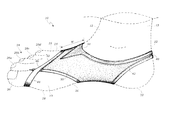
- FIG. 1 is a perspective view of a shoe according to one embodiment of the present invention.
- FIG. 2 is a top plan view thereof
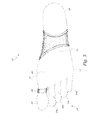
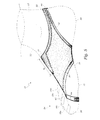
- FIG. 3 is a bottom plan view thereof
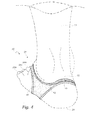
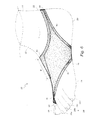
- FIG. 4 is a rear elevational view thereof
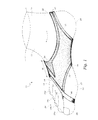
- FIG. 5 is an inner side elevational view thereof
- FIG. 6 is an outer side elevational view thereof
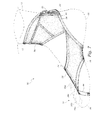
- FIG. 7 is an inner side view of a second embodiment of the shoe.
- FIG. 8 is an outer side view of a third embodiment of the shoe.
- FIG. 9 is a bottom plan view of a fourth embodiment of the shoe.
- FIG. 10 is a bottom plan view of a fifth embodiment of the shoe.
- FIG. 1 is a perspective view of a shoe 10 according to one embodiment of the present invention.
- the shoe 10 is useful for a wide range of physical activities, and has the unique construction of leaving a ball 18 , a heel 20 , and toes 24 of a wearer's foot 12 uncovered, while covering at least some of an instep 14 and an arch 16 of the wearer's foot 12 . This construction is discussed in greater detail below.
- the wearer's foot 12 For purposes of this application, we discuss various parts of the wearer's foot 12 , including not only the instep 14 (defined, for purposes of this application, the dorsum of the wearer's foot 12 which faces upwardly when the person is standing, including the area over the instep bone and the metatarsal bones, but excluding the phalanges) and the arch 16 (defined, for purposes of this application, the portion of the planum of the wearer's foot 12 located between the heel 20 and the ball 18 of the foot, the planum being the portion of the foot that faces downwardly when the person is standing).
- the ball 18 of the foot is formed generally under a base of the first metatarsal bone of the wearer's foot 12 .
- the heel 20 refers the region positioned generally under the calcaneous bone, and a back 22 of the foot is the portion above and behind the heel 20 and talus (i.e., the location of the Achilles tendon).
- the toes 24 are formed by the phalanges, and include a first toe (i.e. big toe) 26 and four smaller toes 28 a, 28 b, 28 c, 28 d. Since the general construction of the foot is known in the art, this is not discussed in greater detail herein.
- FIG. 2 is a top plan view thereof;
- FIG. 3 is a bottom plan view thereof;
- FIG. 4 is a rear elevational view thereof;
- FIG. 5 is an inner side elevational view thereof;
- FIG. 6 is an outer side elevational view thereof.
- the shoe 10 includes a main body 30 that wraps around the instep 14 of the foot and the arch 16 of the foot, without covering the ball 18 of the foot, or the heel 20 , or the toes 26 .
- the main body 30 is in the form of a sleeve having a leading edge 32 and a trailing edge 34 that are separated by a width W great enough to cover a majority of the instep 14 and the arch 16 of the foot.
- the term “majority” shall be defined to mean over 50%.
- the main body may be in the form of two sections or “ears” which wrap under the arch of the foot to rejoin again on top of the instep to tie in a bow or otherwise fasten or are fastened in that area.
- ears wrap under the arch of the foot to rejoin again on top of the instep to tie in a bow or otherwise fasten or are fastened in that area.
- other constructions known in the art may be used, and some further examples are discussed in greater detail below.
- the shoe 10 further includes an ankle strap 40 attached at its ends 42 to the main body 30 and extending around the back 22 of the foot above the heel 20 .
- the ankle strap 40 functions to constrain the main body 30 from forward movement.
- the ankle strap 40 may be a single piece construction that is integral with the main body 30 , as illustrated, or may be one or more separate pieces that are attached with fasteners 52 or other devices. In other embodiments, it may have alternative constructions, and one particular alternative embodiment is discussed in more detail below.
- the shoe 10 further includes a toe loop 44 that surrounds one of the toes 24 .
- the toe loop 44 is a single loop that wraps around the base of the big toe 26 . In an alternative embodiment, it may loop around one or more of the other toes 28 a, 28 b, 28 c, 28 d, or may include multiple loops, each around one or more toes.
- a top strap 46 connects the toe loop 44 with a portion of the main body 30 that is above the foot for constraining the main body 30 from rearward movement.
- the top strap 46 only extends over the instep 14 (i.e., the dorsum of the wearer's foot 12 ), without covering the ball 18 of the foot or the toes 26 .
- the outer side 15 of the foot 12 (adjacent toe 29 d ) and the inner side 19 adjacent the ball 18 are also left uncovered, with only the toe loop 44 forming the front of the shoe 10 , which only covers a de minimus part of the base of the big toe.
- footwear typically covers the ball 18 of the user's foot, and usually covers all of the metatarsal area of the bottom of the foot; however, the shoe 10 of the present invention teaches away from the prior art, and teaches leaving the front of the foot, and in particular the ball 18 of the foot and most of the toes, uncovered, including the sides 15 and 19 .
- the entirety of the metatarsal area of the foot is left uncovered, as are the phalanges except for the toe loop 40 , which is only connected to the main body 30 on the top of the foot.
- the toe loop 44 is in the form of a single strip of material which extends to form a leading edge 32 of the main body 30 .
- it may be of different construction, it may be attached to the main body 30 in any manner known in the art, including but not limited to an integral construction, sewing, loops, hooks and loops, snaps, or any form of fasteners known in the art, either permanently or removably.
- the invention is not limited to the embodiments illustrated or discussed in particular, but also includes alternative or equivalent arrangements known in the art.
- the invention further includes a method for covering a wearer's foot 12 using the above described shoe 10 , or a similar or an equivalent construction.
- the method comprises the steps of providing the shoe 10 described above, and wrapping the main body 30 around the instep 14 of the foot and the arch 16 of the foot, without covering the ball 18 of the foot, the heel 20 , or the toes 26 . This is typically performed by sliding the main body 30 over the toes 24 and then up onto the foot until the main body 30 is positioned between the heel 20 and the ball 18 of the foot.
- the toe loop 44 is positioned around one (or alternatively more than one) of the toes 24 such that the top strap 46 is positioned above the foot, and such that no portion of the shoe 10 covers the ball 18 of the foot. This step may be performed concurrently with sliding the main body 30 into place, or, if the toe loop 44 includes a fastener 52 (not shown), it may be so positioned after the main body 30 is in place.
- the ankle strap 40 is positioned around the back 22 of the foot, above the heel 20 , for constraining the main body 30 from forward movement. This may be performed by lifting the ankle strap 40 up over the heel 20 ; alternatively it may be fastened in place around the back 22 of the foot with a fastener 52 , as discussed below. Yet further alternative methods may also be utilized, according to the teachings of those skilled in the art.
- FIG. 7 is an inner side view of a second embodiment of the shoe 50 .
- the shoe 10 may further include a fastener 52 that removably connects two portions 54 of the ankle strap 40 so that the ankle strap 40 may be unfastened for removing the shoe 10 .
- the shoe 10 further includes an ankle cover 56 that extends upwardly from the ankle strap 40 to surround the wearer's ankle 13 .
- This construction may be included for decorative purposes, or it may be provided for other reasons, e.g., to include additional warming and/or support to the ankle 13 of the user during physical activities.
- FIG. 8 is an outer side view of a third embodiment of the shoe 60 .
- the main body 30 and the ankle 13 strap are formed from a main strap 62 , and include a lower strap 64 that extends laterally across the arch 16 of the foot, connected at its ends 66 with side portions 68 of the main strap 62 .
- FIG. 9 is a bottom plan view of a fourth embodiment of the shoe 70 .
- the lower strap 64 includes a pair of longitudinally spaced straps 72 .
- FIG. 10 is a bottom plan view of a fifth embodiment of the shoe 80 .
- the lower strap 64 includes a pair of crossed straps 82 .
- the words “a,” “an,” and “one” are defined to include one or more of the referenced item unless specifically stated otherwise.
- the terms “approximately” and “about” are defined to mean +/ ⁇ 10%, unless otherwise stated.
- the terms “have,” “include,” “contain,” and similar terms are defined to mean “comprising” unless specifically stated otherwise.
- the terminology used in the specification provided above is hereby defined to include similar and/or equivalent terms, and/or alternative embodiments that would be considered obvious to one skilled in the art given the teachings of the present patent application. While the invention has been described with reference to at least one particular embodiment, it is to be clearly understood that the invention is not limited to these embodiments, but rather the scope of the invention is defined by the following claims.
Landscapes
- Health & Medical Sciences (AREA)
- General Health & Medical Sciences (AREA)
- Physical Education & Sports Medicine (AREA)
- Epidemiology (AREA)
- Public Health (AREA)
- Footwear And Its Accessory, Manufacturing Method And Apparatuses (AREA)
Abstract
Description
- This invention relates generally to footwear, and more particularly to a shoe that enables the toes, ball, and heel of the user's foot to directly contact the ground or other desired surface (e.g., studio floor, surfboard, or other surface), to allow for optimum balance, movement and proprioception (sensory input).
- The prior art teaches a wide range of foot wear that are suitable for various activities.
- Lindsay, U.S. 2004/0261289, teaches a yoga sandal with a sole portion, an elastic foot covering portion, and a rear strap portion. The sole portion is flexible, thin and has a non-slip surface that makes contact with the floor. The sole portion covers both the arch and the ball area of the user's foot, but not the toe and heel areas. The elastic foot covering portion is attached to the sole portion at each side edge of the sole so that the foot covering portion fits snuggly on the top central portion of the user's foot. The strap portion is attached to the rear edge of each side of the elastic foot covering so that the strap can retain the user's foot within the sandal. While this reference teaches a sandal that covers the arch and leaves the heel exposed, it also covers the ball of the foot, and does not engage the user's toe(s).
- Song, U.S. Pat. No. 7,682,326, teaches a foot protection device adapted to protect a user's feet when training and playing fighting games. The device includes an upper and an exterior cover for covering the bottom of the foot. The exterior cover covers most of the bottom of the foot, but includes an anterior hole over the ball of the foot, and a posterior hole over the heel. The toes are mostly covered, and toe holes are provided so that the ends of the toes extend out of the device and are not covered. While this reference teaches holes for the heel and ball of the foot, the toe portion covers the toes and is connected with the arch cover, except for the hole. A similar device is also shown in Luedecke, U.S. Pat. No. 7,739,810.
- Logan, U.S. Pat. No. 8,240,066, teaches an arch support device that elevates the midsection of the foot. The device does not cover the metatarsus or heel, and is attached to the foot by lateral straps or equivalents. The device does not engage the toes.
- Hergenroeder, U.S. Pat. No. 5,205,071, teaches a surfing sandal that includes an instep pad adapted to extend across the instep at the top of the foot and a traction surface adapted to extend across the bottom of the foot between the heel and the ball of the foot. An ankle strap holds the pad and sole rearward while a toe strap holds the pad and sole forward. Importantly, the device is attached to the big toe with a connector; however, the connector extends across the ball of the foot, beneath the foot, rather than from the top of the foot connected to the upper.
- Heathcote et al., U.S. 2014/0033567, teaches dance footwear that includes a fabric tube formed of a continuous elastic material to receive and partially cover the foot, the tube comprising a heel end and an opposite toe end having at least two toe openings to receive toes; and one floor-engaging forefoot pad disposed on the tube near the toe end to underlie a ball of the foot; wherein the tube defines first and second openings at the heel end and a heel strap to extend around the Achilles tendon of the heel between the first and second openings and thereby retain the footwear on the foot.
- Broadley, U.S. 2009/0100715, teaches a shoe that provides a sole under the ball of the foot but none below the arch or heel. An upper encircles the metatarsal bones and the distal end of the tarsals. An inelastic ankle band shaped as “C” holds the shoe on the foot. Support is mainly longitudinal, includes over the arch, may be adjustable, and is provided without causing foot distortion.
- The prior art teaches various forms of footwear. However, the prior art does not teach a shoe having the unique construction as claimed below. The present invention fulfills these needs and provides further advantages as described in the following summary.
- The present invention teaches certain benefits in construction and use which give rise to the objectives described below.
- The present invention provides a shoe having a main body, an ankle strap, and a toe loop connected to the main body with a toe strap. The main body wraps around the instep of the foot and the arch of the foot, without covering the ball of the foot, the heel, or the toes. The ankle strap is attached at its ends to the main body and extends around the back of the foot above the heel for constraining the main body from forward movement. The toe loop surrounds one of the toes. The top strap connects the toe loop with the main body from above the foot, the top strap extending over the instep for constraining the main body from rearward movement, without covering the ball of the foot or the toes.
- In one embodiment, the shoe has four contact areas on the foot which allows the shoe to stay in place: 1. toe or toes, 2. metatarsal area/instep area, 3. arch area under the foot, and 4. heel area on the back of the foot. This allows the user to have contact of the exposed toes, ball, and heel area of the foot with any desired surface. This makes the shoe desirable to perform a wide variety of activities such as yoga, Pilates, dance, gymnastics, surfing, and other types activities in which the user can benefit because the toes, ball, and heel areas of the foot can be in natural contact with the surface.
- A primary objective of the present invention is to provide a shoe having advantages not taught by the prior art.
- Another objective is to provide a shoe that contacts the foot in four locations, the toe, the instep/metatarsal area, the arch, and the heel.
- Another objective is to provide a shoe that contacts the instep or metatarsal area of the foot and the arch of the foot, without covering the toes, the ball area of the foot, or the heel area of the foot.
- A further objective is to provide a shoe that is lightweight, comfortable, and is in close, snug contact with the foot to not interfere with the physical activities of the user.
- Other features and advantages of the present invention will become apparent from the following more detailed description, taken in conjunction with the accompanying drawings, which illustrate, by way of example, the principles of the invention.
- The accompanying drawings illustrate the present invention. In such drawings:
-
FIG. 1 is a perspective view of a shoe according to one embodiment of the present invention; -
FIG. 2 is a top plan view thereof; -
FIG. 3 is a bottom plan view thereof; -
FIG. 4 is a rear elevational view thereof; -
FIG. 5 is an inner side elevational view thereof; -
FIG. 6 is an outer side elevational view thereof; -
FIG. 7 is an inner side view of a second embodiment of the shoe; -
FIG. 8 is an outer side view of a third embodiment of the shoe; -
FIG. 9 is a bottom plan view of a fourth embodiment of the shoe; and -
FIG. 10 is a bottom plan view of a fifth embodiment of the shoe. -
FIG. 1 is a perspective view of ashoe 10 according to one embodiment of the present invention. Theshoe 10 is useful for a wide range of physical activities, and has the unique construction of leaving aball 18, aheel 20, andtoes 24 of a wearer'sfoot 12 uncovered, while covering at least some of aninstep 14 and an arch 16 of the wearer'sfoot 12. This construction is discussed in greater detail below. - For purposes of this application, we discuss various parts of the wearer's
foot 12, including not only the instep 14 (defined, for purposes of this application, the dorsum of the wearer'sfoot 12 which faces upwardly when the person is standing, including the area over the instep bone and the metatarsal bones, but excluding the phalanges) and the arch 16 (defined, for purposes of this application, the portion of the planum of the wearer'sfoot 12 located between theheel 20 and theball 18 of the foot, the planum being the portion of the foot that faces downwardly when the person is standing). Theball 18 of the foot is formed generally under a base of the first metatarsal bone of the wearer'sfoot 12. Theheel 20 refers the region positioned generally under the calcaneous bone, and a back 22 of the foot is the portion above and behind theheel 20 and talus (i.e., the location of the Achilles tendon). Thetoes 24 are formed by the phalanges, and include a first toe (i.e. big toe) 26 and foursmaller toes - Various additional views of the
shoe 10 are provided, to more fully disclose this embodiment of the invention.FIG. 2 is a top plan view thereof;FIG. 3 is a bottom plan view thereof;FIG. 4 is a rear elevational view thereof;FIG. 5 is an inner side elevational view thereof; andFIG. 6 is an outer side elevational view thereof. - As shown in
FIGS. 1-6 , theshoe 10 includes amain body 30 that wraps around theinstep 14 of the foot and the arch 16 of the foot, without covering theball 18 of the foot, or theheel 20, or thetoes 26. In this embodiment, themain body 30 is in the form of a sleeve having a leadingedge 32 and a trailingedge 34 that are separated by a width W great enough to cover a majority of theinstep 14 and the arch 16 of the foot. For purposes of this application, the term “majority” shall be defined to mean over 50%. In one alternative embodiment, not shown, the main body may be in the form of two sections or “ears” which wrap under the arch of the foot to rejoin again on top of the instep to tie in a bow or otherwise fasten or are fastened in that area. In alternative embodiments, other constructions known in the art may be used, and some further examples are discussed in greater detail below. - As shown in
FIGS. 1-6 , theshoe 10 further includes anankle strap 40 attached at itsends 42 to themain body 30 and extending around theback 22 of the foot above theheel 20. Theankle strap 40 functions to constrain themain body 30 from forward movement. Theankle strap 40 may be a single piece construction that is integral with themain body 30, as illustrated, or may be one or more separate pieces that are attached withfasteners 52 or other devices. In other embodiments, it may have alternative constructions, and one particular alternative embodiment is discussed in more detail below. - As shown in
FIGS. 1-6 , theshoe 10 further includes atoe loop 44 that surrounds one of thetoes 24. In the present embodiment, thetoe loop 44 is a single loop that wraps around the base of thebig toe 26. In an alternative embodiment, it may loop around one or more of theother toes - Critically, a
top strap 46 connects thetoe loop 44 with a portion of themain body 30 that is above the foot for constraining themain body 30 from rearward movement. Thetop strap 46 only extends over the instep 14 (i.e., the dorsum of the wearer's foot 12), without covering theball 18 of the foot or thetoes 26. Theouter side 15 of the foot 12 (adjacent toe 29 d) and theinner side 19 adjacent theball 18 are also left uncovered, with only thetoe loop 44 forming the front of theshoe 10, which only covers a de minimus part of the base of the big toe. - Prior art teaches footwear typically covers the
ball 18 of the user's foot, and usually covers all of the metatarsal area of the bottom of the foot; however, theshoe 10 of the present invention teaches away from the prior art, and teaches leaving the front of the foot, and in particular theball 18 of the foot and most of the toes, uncovered, including thesides toe loop 40, which is only connected to themain body 30 on the top of the foot. - In the embodiment of
FIGS. 1-6 , thetoe loop 44 is in the form of a single strip of material which extends to form aleading edge 32 of themain body 30. In alternative embodiments, it may be of different construction, it may be attached to themain body 30 in any manner known in the art, including but not limited to an integral construction, sewing, loops, hooks and loops, snaps, or any form of fasteners known in the art, either permanently or removably. The invention is not limited to the embodiments illustrated or discussed in particular, but also includes alternative or equivalent arrangements known in the art. - The invention further includes a method for covering a wearer's
foot 12 using the above describedshoe 10, or a similar or an equivalent construction. The method comprises the steps of providing theshoe 10 described above, and wrapping themain body 30 around theinstep 14 of the foot and the arch 16 of the foot, without covering theball 18 of the foot, theheel 20, or thetoes 26. This is typically performed by sliding themain body 30 over thetoes 24 and then up onto the foot until themain body 30 is positioned between theheel 20 and theball 18 of the foot. - The
toe loop 44 is positioned around one (or alternatively more than one) of thetoes 24 such that thetop strap 46 is positioned above the foot, and such that no portion of theshoe 10 covers theball 18 of the foot. This step may be performed concurrently with sliding themain body 30 into place, or, if thetoe loop 44 includes a fastener 52 (not shown), it may be so positioned after themain body 30 is in place. - Finally, the
ankle strap 40 is positioned around theback 22 of the foot, above theheel 20, for constraining themain body 30 from forward movement. This may be performed by lifting theankle strap 40 up over theheel 20; alternatively it may be fastened in place around theback 22 of the foot with afastener 52, as discussed below. Yet further alternative methods may also be utilized, according to the teachings of those skilled in the art. -
FIG. 7 is an inner side view of a second embodiment of theshoe 50. As shown in this embodiment, theshoe 10 may further include afastener 52 that removably connects twoportions 54 of theankle strap 40 so that theankle strap 40 may be unfastened for removing theshoe 10. In this embodiment, theshoe 10 further includes anankle cover 56 that extends upwardly from theankle strap 40 to surround the wearer'sankle 13. This construction may be included for decorative purposes, or it may be provided for other reasons, e.g., to include additional warming and/or support to theankle 13 of the user during physical activities. -
FIG. 8 is an outer side view of a third embodiment of theshoe 60. In the embodiment ofFIG. 8 , themain body 30 and theankle 13 strap are formed from a main strap 62, and include alower strap 64 that extends laterally across the arch 16 of the foot, connected at itsends 66 with side portions 68 of the main strap 62. -
FIG. 9 is a bottom plan view of a fourth embodiment of theshoe 70. In the embodiment ofFIG. 9 , thelower strap 64 includes a pair of longitudinally spaced straps 72. -
FIG. 10 is a bottom plan view of a fifth embodiment of theshoe 80. In the embodiment ofFIG. 10 , thelower strap 64 includes a pair of crossed straps 82. Obviously, those skilled in the art may devise alternative embodiments within the scope of the present invention, and such alternatives should be considered within the scope of the present invention. - As used in this application, the words “a,” “an,” and “one” are defined to include one or more of the referenced item unless specifically stated otherwise. The terms “approximately” and “about” are defined to mean +/−10%, unless otherwise stated. Also, the terms “have,” “include,” “contain,” and similar terms are defined to mean “comprising” unless specifically stated otherwise. Furthermore, the terminology used in the specification provided above is hereby defined to include similar and/or equivalent terms, and/or alternative embodiments that would be considered obvious to one skilled in the art given the teachings of the present patent application. While the invention has been described with reference to at least one particular embodiment, it is to be clearly understood that the invention is not limited to these embodiments, but rather the scope of the invention is defined by the following claims.
Claims (8)
Priority Applications (3)
| Application Number | Priority Date | Filing Date | Title |
|---|---|---|---|
| US15/288,091 US20180098597A1 (en) | 2016-10-07 | 2016-10-07 | Shoe |
| PCT/US2017/054966 WO2018067586A1 (en) | 2016-10-07 | 2017-10-03 | Shoe |
| US17/871,914 US12064013B2 (en) | 2016-10-07 | 2022-07-23 | Supportive footwear for athletic training |
Applications Claiming Priority (1)
| Application Number | Priority Date | Filing Date | Title |
|---|---|---|---|
| US15/288,091 US20180098597A1 (en) | 2016-10-07 | 2016-10-07 | Shoe |
Related Child Applications (1)
| Application Number | Title | Priority Date | Filing Date |
|---|---|---|---|
| US17/871,914 Continuation US12064013B2 (en) | 2016-10-07 | 2022-07-23 | Supportive footwear for athletic training |
Publications (1)
| Publication Number | Publication Date |
|---|---|
| US20180098597A1 true US20180098597A1 (en) | 2018-04-12 |
Family
ID=61829508
Family Applications (2)
| Application Number | Title | Priority Date | Filing Date |
|---|---|---|---|
| US15/288,091 Abandoned US20180098597A1 (en) | 2016-10-07 | 2016-10-07 | Shoe |
| US17/871,914 Active US12064013B2 (en) | 2016-10-07 | 2022-07-23 | Supportive footwear for athletic training |
Family Applications After (1)
| Application Number | Title | Priority Date | Filing Date |
|---|---|---|---|
| US17/871,914 Active US12064013B2 (en) | 2016-10-07 | 2022-07-23 | Supportive footwear for athletic training |
Country Status (2)
| Country | Link |
|---|---|
| US (2) | US20180098597A1 (en) |
| WO (1) | WO2018067586A1 (en) |
Cited By (1)
| Publication number | Priority date | Publication date | Assignee | Title |
|---|---|---|---|---|
| US20200170344A1 (en) * | 2017-08-04 | 2020-06-04 | Stefanie Miller Kwiatkowski | Slip resistant shoe |
Citations (21)
| Publication number | Priority date | Publication date | Assignee | Title |
|---|---|---|---|---|
| US5205071A (en) * | 1991-03-06 | 1993-04-27 | Hergenroeder David J | Surfing sandal |
| US5257969A (en) * | 1992-10-16 | 1993-11-02 | Mance Cornelius J | Ankle foot dorsiflexor/supporter |
| US6367087B1 (en) * | 2001-01-26 | 2002-04-09 | Margaret Spillman | Foot comforting device |
| US20040078997A1 (en) * | 2002-10-29 | 2004-04-29 | Alexandria Pledger | Decorative footwear for an exposed foot |
| US6800063B2 (en) * | 2002-04-02 | 2004-10-05 | Kazuo Iwata | Foot stimulation tool |
| US20060137224A1 (en) * | 2003-06-27 | 2006-06-29 | Dong-Suk Song | Foot protection device for a fight |
| US20060161090A1 (en) * | 2005-01-14 | 2006-07-20 | Lee James C | Heel support apparatus and method of using |
| US20060288609A1 (en) * | 2005-06-28 | 2006-12-28 | Pointe Noir Pty Ltd. | Dance footwear |
| US20070006486A1 (en) * | 2005-07-05 | 2007-01-11 | David Wilkenfeld | Dance footwear |
| US20070113387A1 (en) * | 2005-11-22 | 2007-05-24 | Audra Gerhardt | Footwear accessory |
| US20080110045A1 (en) * | 2005-03-01 | 2008-05-15 | Ballet Makers, Inc. | Protective Foot Covering |
| US20090100715A1 (en) * | 2005-04-15 | 2009-04-23 | Cherie Petrea Broadley | Shoe |
| US20090265954A1 (en) * | 2008-04-23 | 2009-10-29 | Franne Goldberg | Shoe and Sandal Footwear Combination |
| US7739810B2 (en) * | 2006-12-01 | 2010-06-22 | Nike, Inc. | Article of footwear for contact sports |
| US20110016745A1 (en) * | 2009-07-02 | 2011-01-27 | George Hammerbeck | One-piece footwear |
| US20130091732A1 (en) * | 2011-10-15 | 2013-04-18 | Danilo Mendoza | Footwear and Related Accessories |
| US20140223770A1 (en) * | 2013-02-12 | 2014-08-14 | Nike, Inc. | Footwear Assembly With Inner And Outer Articles |
| USD717961S1 (en) * | 2013-08-09 | 2014-11-18 | SLO Living LLC | Soft bunion splint |
| US20150020415A1 (en) * | 2013-07-22 | 2015-01-22 | Deborah S. Teitz | Modifiable and decorative footwear |
| US20160302953A1 (en) * | 2013-01-19 | 2016-10-20 | Derek Amanatullah | Dynamic hallux tension device for treatment of plantar fasciitis |
| US20170086516A1 (en) * | 2015-09-30 | 2017-03-30 | Steve PARENTEAU | Garment for applying cold or heat to digits |
Family Cites Families (12)
| Publication number | Priority date | Publication date | Assignee | Title |
|---|---|---|---|---|
| US2530004A (en) * | 1948-06-09 | 1950-11-14 | Guglielmo Joseph Di | Sandal with integral retaining straps |
| US2708930A (en) * | 1952-06-23 | 1955-05-24 | William G Lowman | Arch maintaining device |
| US3656244A (en) * | 1970-08-27 | 1972-04-18 | Mary L Andrade | Foot decoration |
| US5386710A (en) * | 1992-09-25 | 1995-02-07 | Moore; Alberta M. | Foot jewelry |
| US6629943B1 (en) * | 2002-09-10 | 2003-10-07 | Mitchell J. Schroder | Bunion correction device |
| JPWO2006098042A1 (en) * | 2005-03-16 | 2008-08-21 | 岩正織物株式会社 | Foot stimulation health equipment |
| WO2008128197A1 (en) * | 2007-04-13 | 2008-10-23 | Michele Laurie Hallivis | Protective foot membrane |
| USD653984S1 (en) * | 2009-08-06 | 2012-02-14 | Michelle Carroll | Foot accessory |
| US20120167278A1 (en) * | 2010-05-14 | 2012-07-05 | Hallie House | Adornments for feet |
| US9421118B2 (en) * | 2011-03-08 | 2016-08-23 | Royal Patents, LLC | Digital control strap system |
| US20130066249A1 (en) * | 2011-09-12 | 2013-03-14 | Joshua Paul Eldridge | Foot Arch Support for Barefoot Athletes |
| DE202013004834U1 (en) * | 2013-05-24 | 2013-06-10 | Hallufix Ag | Gel-side pad |
-
2016
- 2016-10-07 US US15/288,091 patent/US20180098597A1/en not_active Abandoned
-
2017
- 2017-10-03 WO PCT/US2017/054966 patent/WO2018067586A1/en not_active Ceased
-
2022
- 2022-07-23 US US17/871,914 patent/US12064013B2/en active Active
Patent Citations (21)
| Publication number | Priority date | Publication date | Assignee | Title |
|---|---|---|---|---|
| US5205071A (en) * | 1991-03-06 | 1993-04-27 | Hergenroeder David J | Surfing sandal |
| US5257969A (en) * | 1992-10-16 | 1993-11-02 | Mance Cornelius J | Ankle foot dorsiflexor/supporter |
| US6367087B1 (en) * | 2001-01-26 | 2002-04-09 | Margaret Spillman | Foot comforting device |
| US6800063B2 (en) * | 2002-04-02 | 2004-10-05 | Kazuo Iwata | Foot stimulation tool |
| US20040078997A1 (en) * | 2002-10-29 | 2004-04-29 | Alexandria Pledger | Decorative footwear for an exposed foot |
| US20060137224A1 (en) * | 2003-06-27 | 2006-06-29 | Dong-Suk Song | Foot protection device for a fight |
| US20060161090A1 (en) * | 2005-01-14 | 2006-07-20 | Lee James C | Heel support apparatus and method of using |
| US20080110045A1 (en) * | 2005-03-01 | 2008-05-15 | Ballet Makers, Inc. | Protective Foot Covering |
| US20090100715A1 (en) * | 2005-04-15 | 2009-04-23 | Cherie Petrea Broadley | Shoe |
| US20060288609A1 (en) * | 2005-06-28 | 2006-12-28 | Pointe Noir Pty Ltd. | Dance footwear |
| US20070006486A1 (en) * | 2005-07-05 | 2007-01-11 | David Wilkenfeld | Dance footwear |
| US20070113387A1 (en) * | 2005-11-22 | 2007-05-24 | Audra Gerhardt | Footwear accessory |
| US7739810B2 (en) * | 2006-12-01 | 2010-06-22 | Nike, Inc. | Article of footwear for contact sports |
| US20090265954A1 (en) * | 2008-04-23 | 2009-10-29 | Franne Goldberg | Shoe and Sandal Footwear Combination |
| US20110016745A1 (en) * | 2009-07-02 | 2011-01-27 | George Hammerbeck | One-piece footwear |
| US20130091732A1 (en) * | 2011-10-15 | 2013-04-18 | Danilo Mendoza | Footwear and Related Accessories |
| US20160302953A1 (en) * | 2013-01-19 | 2016-10-20 | Derek Amanatullah | Dynamic hallux tension device for treatment of plantar fasciitis |
| US20140223770A1 (en) * | 2013-02-12 | 2014-08-14 | Nike, Inc. | Footwear Assembly With Inner And Outer Articles |
| US20150020415A1 (en) * | 2013-07-22 | 2015-01-22 | Deborah S. Teitz | Modifiable and decorative footwear |
| USD717961S1 (en) * | 2013-08-09 | 2014-11-18 | SLO Living LLC | Soft bunion splint |
| US20170086516A1 (en) * | 2015-09-30 | 2017-03-30 | Steve PARENTEAU | Garment for applying cold or heat to digits |
Cited By (2)
| Publication number | Priority date | Publication date | Assignee | Title |
|---|---|---|---|---|
| US20200170344A1 (en) * | 2017-08-04 | 2020-06-04 | Stefanie Miller Kwiatkowski | Slip resistant shoe |
| US11589650B2 (en) * | 2017-08-04 | 2023-02-28 | Stefanie Miller Kwiatkowski | Slip resistant shoe |
Also Published As
| Publication number | Publication date |
|---|---|
| WO2018067586A1 (en) | 2018-04-12 |
| US12064013B2 (en) | 2024-08-20 |
| US20220354209A1 (en) | 2022-11-10 |
Similar Documents
| Publication | Publication Date | Title |
|---|---|---|
| CN101460070B (en) | Article of footwear with open upper | |
| US5317820A (en) | Multi-application ankle support footwear | |
| US20140033567A1 (en) | Footwear for modern dance and method of manufacturing same | |
| EP2816925B1 (en) | Shoe with instep elastic insertion and insole with depressions | |
| US9668534B2 (en) | Footwear | |
| US9295303B2 (en) | Article of footwear for proprioceptive training | |
| US20020078591A1 (en) | Dance shoe with tri-split | |
| US20140352170A1 (en) | Modern dance shoe | |
| CN100502812C (en) | Ankle jacket | |
| US20060288609A1 (en) | Dance footwear | |
| JP6871209B2 (en) | shoes | |
| US7267656B2 (en) | Ankle brace | |
| US10150004B1 (en) | Swim fin adapted for walking | |
| US12594177B2 (en) | Ankle brace | |
| JP2005305085A (en) | Hallux valgus correcting supporter | |
| US12064013B2 (en) | Supportive footwear for athletic training | |
| US20240206585A1 (en) | Foot guard | |
| JP3195381U (en) | Sandal board and sandals | |
| US20040231196A1 (en) | Baby shoe | |
| WO2012021919A1 (en) | Footwear for modern dance and method of manufacturing same | |
| US8512270B2 (en) | Dynamic foot-arch support assembly and associated methods | |
| WO2013082385A1 (en) | Improved athletic shoe | |
| CN101986921B (en) | Basketball shoes | |
| KR20110003819A (en) | Patient and Handicapped Shoes | |
| JP3219865U (en) | Foot support rubber band |
Legal Events
| Date | Code | Title | Description |
|---|---|---|---|
| STPP | Information on status: patent application and granting procedure in general |
Free format text: NON FINAL ACTION MAILED |
|
| STPP | Information on status: patent application and granting procedure in general |
Free format text: RESPONSE TO NON-FINAL OFFICE ACTION ENTERED AND FORWARDED TO EXAMINER |
|
| STPP | Information on status: patent application and granting procedure in general |
Free format text: FINAL REJECTION MAILED |
|
| STPP | Information on status: patent application and granting procedure in general |
Free format text: DOCKETED NEW CASE - READY FOR EXAMINATION |
|
| STPP | Information on status: patent application and granting procedure in general |
Free format text: FINAL REJECTION MAILED |
|
| STPP | Information on status: patent application and granting procedure in general |
Free format text: RESPONSE AFTER FINAL ACTION FORWARDED TO EXAMINER |
|
| STPP | Information on status: patent application and granting procedure in general |
Free format text: ADVISORY ACTION MAILED |
|
| STPP | Information on status: patent application and granting procedure in general |
Free format text: DOCKETED NEW CASE - READY FOR EXAMINATION |
|
| STPP | Information on status: patent application and granting procedure in general |
Free format text: NON FINAL ACTION MAILED |
|
| STPP | Information on status: patent application and granting procedure in general |
Free format text: FINAL REJECTION MAILED |
|
| STPP | Information on status: patent application and granting procedure in general |
Free format text: RESPONSE AFTER FINAL ACTION FORWARDED TO EXAMINER |
|
| STPP | Information on status: patent application and granting procedure in general |
Free format text: ADVISORY ACTION MAILED |
|
| STPP | Information on status: patent application and granting procedure in general |
Free format text: DOCKETED NEW CASE - READY FOR EXAMINATION |
|
| STPP | Information on status: patent application and granting procedure in general |
Free format text: NON FINAL ACTION MAILED |
|
| STPP | Information on status: patent application and granting procedure in general |
Free format text: FINAL REJECTION MAILED |
|
| STCB | Information on status: application discontinuation |
Free format text: ABANDONED -- FAILURE TO RESPOND TO AN OFFICE ACTION |