US20180098478P1 - Campanula plant named 'PKM06' - Google Patents

Campanula plant named 'PKM06' Download PDF

Info

Publication number
US20180098478P1
US20180098478P1 US15/330,523 US201615330523V US2018098478P1 US 20180098478 P1 US20180098478 P1 US 20180098478P1 US 201615330523 V US201615330523 V US 201615330523V US 2018098478 P1 US2018098478 P1 US 2018098478P1
Authority
US
United States
Prior art keywords
pkm06
campanula
plant
new
plants
Prior art date
Legal status (The legal status is an assumption and is not a legal conclusion. Google has not performed a legal analysis and makes no representation as to the accuracy of the status listed.)
Granted
Application number
US15/330,523
Other versions
USPP29954P3 (en
Inventor
Christian Hald Madsen
Current Assignee (The listed assignees may be inaccurate. Google has not performed a legal analysis and makes no representation or warranty as to the accuracy of the list.)
Gartneriet PKM AS
Original Assignee
Gartneriet PKM AS
Priority date (The priority date is an assumption and is not a legal conclusion. Google has not performed a legal analysis and makes no representation as to the accuracy of the date listed.)
Filing date
Publication date
Application filed by Gartneriet PKM AS filed Critical Gartneriet PKM AS
Priority to US15/330,523 priority Critical patent/USPP29954P3/en
Assigned to GARTNERIET PKM A/S reassignment GARTNERIET PKM A/S ASSIGNMENT OF ASSIGNORS INTEREST (SEE DOCUMENT FOR DETAILS). Assignors: MADSEN, CHRISTIAN HALD
Publication of US20180098478P1 publication Critical patent/US20180098478P1/en
Application granted granted Critical
Publication of USPP29954P3 publication Critical patent/USPP29954P3/en
Active legal-status Critical Current
Adjusted expiration legal-status Critical

Links

Images

Classifications

    • AHUMAN NECESSITIES
    • A01AGRICULTURE; FORESTRY; ANIMAL HUSBANDRY; HUNTING; TRAPPING; FISHING
    • A01HNEW PLANTS OR NON-TRANSGENIC PROCESSES FOR OBTAINING THEM; PLANT REPRODUCTION BY TISSUE CULTURE TECHNIQUES
    • A01H6/00Angiosperms, i.e. flowering plants, characterised by their botanic taxonomy
    • A01H6/26Campanulaceae
    • A01H6/264Campanula
    • AHUMAN NECESSITIES
    • A01AGRICULTURE; FORESTRY; ANIMAL HUSBANDRY; HUNTING; TRAPPING; FISHING
    • A01HNEW PLANTS OR NON-TRANSGENIC PROCESSES FOR OBTAINING THEM; PLANT REPRODUCTION BY TISSUE CULTURE TECHNIQUES
    • A01H5/00Angiosperms, i.e. flowering plants, characterised by their plant parts; Angiosperms characterised otherwise than by their botanic taxonomy
    • A01H5/02Flowers

Definitions

  • Campanula hybrid Latin name of genus and species of the plant claimed: Campanula hybrid.
  • the present invention relates to a new and distinct cultivar of Campanula hybrid plant, and hereinafter referred to by the name ‘PKM06’.
  • the new Campanula, ‘PKM06’ is a product of a planned breeding program conducted by the inventor, Christian Hald Madsen, in S ⁇ hus, Denmark.
  • the new Campanula originated from a planned cross between two Campanula hybrids; the female parent being an unnamed, proprietary Campanula variety (unpatented) and the male parent being an unnamed, proprietary Campanula variety (unpatented).
  • the initial crossing was performed in April 2014 by the Inventor, followed by further testing after vegetative propagation since then.
  • Plants of the cultivar ‘PKM06’ can be compared to the unpatented cultivar Campanula ⁇ haydlodgensis ‘Blue Wonder’ and ‘PKM07’.
  • plants of the instant cultivar ‘PKM06’ and plants of the cultivars ‘Blue Wonder’ and ‘PKM07’ differ in the following characteristics:
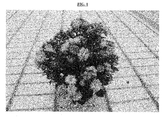
  • FIG. 1 comprises a side perspective view of a typical flowering plant of ‘PKM06’ grown in a 10.5 cm pot.
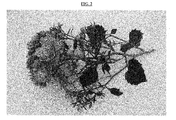
  • FIG. 2 comprises a close-up view of inflorescence of ‘PKM06’.
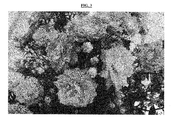
  • FIG. 3 comprises a close-up view of flowers of ‘PKM06’.
  • the new Campanula ‘PKM06’ has not been observed under all possible environmental conditions.
  • the phenotype of the new cultivar may vary with variations in environment such as growth regulator treatment, temperature, light intensity, day length, and fertility level without any variance in genotype.

Landscapes

  • Life Sciences & Earth Sciences (AREA)
  • Health & Medical Sciences (AREA)
  • Physiology (AREA)
  • Botany (AREA)
  • Developmental Biology & Embryology (AREA)
  • Environmental Sciences (AREA)
  • Natural Medicines & Medicinal Plants (AREA)
  • Breeding Of Plants And Reproduction By Means Of Culturing (AREA)

Abstract

A new and distinct cultivar of Campanula plant named ‘PKM06’, characterized by its compact plant habit; globular plant form; vigorous growth habit; double/filled light violet-blue flowers and small leaves.

Description

  • Latin name of genus and species of the plant claimed: Campanula hybrid.
  • Variety denomination: ‘PKM06’.
  • BACKGROUND OF THE INVENTION
  • The present invention relates to a new and distinct cultivar of Campanula hybrid plant, and hereinafter referred to by the name ‘PKM06’.
  • The new Campanula, ‘PKM06’ is a product of a planned breeding program conducted by the inventor, Christian Hald Madsen, in Søhus, Denmark. The new Campanula originated from a planned cross between two Campanula hybrids; the female parent being an unnamed, proprietary Campanula variety (unpatented) and the male parent being an unnamed, proprietary Campanula variety (unpatented). The initial crossing was performed in April 2014 by the Inventor, followed by further testing after vegetative propagation since then. The inventor selected ‘PKM06’ on the basis of blue double flowers and compact growth habit.
  • Asexual reproduction of the new Campanula cultivar by terminal cuttings has demonstrated that the combination of characteristics as herein disclosed for the new cultivar are firmly fixed and retained through successive generations of asexual reproduction. The new cultivar reproduces true-to-type.
  • SUMMARY OF THE INVENTION
  • The following traits have been repeatedly observed and are determined to be the unique characteristics of ‘PKM06’. These characteristics in combination distinguish ‘PKM06’ as a new and distinct cultivar:
      • 1. Upright plant habit with stiff stems.
      • 2. Bushy globular plant form.
      • 3. Vigorous growth habit, but still needing less chemical growth retardation.
      • 4. Double light violet-blue flowers.
  • Plants of the cultivar ‘PKM06’ can be compared to the unpatented cultivar Campanula×haydlodgensis ‘Blue Wonder’ and ‘PKM07’. In side-by-side comparisons conducted by the inventor in Søhus, Denmark, plants of the instant cultivar ‘PKM06’ and plants of the cultivars ‘Blue Wonder’ and ‘PKM07’ differ in the following characteristics:
      • 1. Plants of ‘PKM06’ have larger flowers than ‘Blue Wonder’.
      • 2. Plants of ‘PKM06’ have larger leaves than ‘Blue Wonder’.
      • 3. Plants of ‘PKM06’ have a more upright plant habit than ‘Blue Wonder’.
      • 4. Plants of ‘PKM06’ have lighter colored flowers than ‘PKM07’.
      • 5. Plants of ‘PKM06’ are less compact growing than ‘PKM07’.
  • Data on plants of the parent varieties are no longer available for comparison with plants of the new cultivar Campanula ‘PKM06’.
  • BRIEF DESCRIPTION OF THE PHOTOGRAPHS
  • The accompanying colored photographs illustrate the overall appearance of the new Campanula ‘PKM06’, showing the colors as true as it is reasonably possible to obtain in colored reproductions of this type. Colors in the photographs may differ slightly from the color values cited in the detailed botanical description, which more accurately describe the actual colors of ‘PKM06’.
  • FIG. 1 comprises a side perspective view of a typical flowering plant of ‘PKM06’ grown in a 10.5 cm pot.
  • FIG. 2 comprises a close-up view of inflorescence of ‘PKM06’.
  • FIG. 3 comprises a close-up view of flowers of ‘PKM06’.
  • DETAILED BOTANICAL DESCRIPTION
  • The new Campanula ‘PKM06’ has not been observed under all possible environmental conditions. The phenotype of the new cultivar may vary with variations in environment such as growth regulator treatment, temperature, light intensity, day length, and fertility level without any variance in genotype.
  • The aforementioned photographs, together with the following observations, measurements and values describe plants of the new Campanula ‘PKM06’ as grown under greenhouse conditions.
  • The age of the ‘PKM06’ plants described is 3 months after propagation. Color references are made to The Royal Horticultural Society Colour Chart (R.H.S.), 5th edition, except where general colors of ordinary significance are used.
    • Classification:
        • Botanical.—Campanula interspecific hybrid.
    • Parentage:
        • Female or seed parent.—Campanula unpatented proprietary selection.
        • Male or pollen parent.—Campanula unpatented proprietary selection.
    • Propagation:
        • Type cutting.—Terminal vegetative cuttings.
        • Time to initiate roots.—About 10 to 14 days at 18 to 21° C. in tunnels in a greenhouse.
        • Root description.—Fine, well branched.
    • Plant description:
        • Form.—Upright plant habit. Double to filled wide Campanulate flowers in panicles. Freely branching with lateral branches forming at every node.
        • Crop time.—After rooting, about 12 weeks are required to produce finished flowering plants in 10.5 cm pots.
        • Plant height (from soil level to top of plant plane).—About 16 cm. Depending on growth conditions.
        • Plant width.—About 25 cm. Depending on growth conditions.
        • Vigor.—Vigorous growth rate.
    • Foliage description:
        • Basal leaf shape.—Single, dentate, cordiform, palmate venation.
        • Leaf shape (upper part).—Ovate.
        • Leaf blade length.—up to 3 cm. Longest in the basal part of the plant.
        • Leaf blade width.—up to 3 cm. Widest in the basal part of the plant.
        • Petiole length.—up to 4 cm. Longest in the basal part of the plant.
        • Apex.—obtuse.
        • Base.—truncate to slightly cordate.
        • Margin.—Serrate.
        • Texture.—Glabrous, stiff.
        • Color.—Upper Surface, RHS N137A, Green Lower Surface, RHS 138B (Green).
        • Venation color.—similar or lighter green than leaf blade, but areas too small to determine R.H.S. values.
    • Inflorescence description:
        • Flower arrangement and shape.—Single, upright, double to filled flowers in panicles with many flowers at lateral branches, flowers with star shaped calyx.
        • Natural flowering season.—Continuous throughout spring and summer. Season can be extended through long day treatments, no vernalization needed.
        • Flower longevity.—Individual flowers up to three weeks. Flowers persistent.
        • Inflorescence size.—Length: up to 17 cm.
        • Flowers.—Length: About 1.5 cm. Diameter: up to 3 cm. Layers of corollas: 3-5.
        • Corolla.—Length of tube: up to 10 mm. Length of lobe: up to 10 mm. Width of lobe: 10 mm. Tip of lobe: acute and twisted.
        • Corolla color.—Upper and Lower surfaces, R.H.S. between 91A and 92B, violet-blue.
        • Sepals.—: Arrangement: Free and sessile. Quantity per flower: 5. Length: 8 mm. Width: 1-2 mm. Overall shape: Triangular. Tip: Acute. Margin: Entire. Color (mature and immature): Upper and lower surfaces: Green (areas too small to give R.H.S. values). Pedicel: Length: up to 3 cm. Diameter: up to 2 mm. Color: light green.
    • Reproductive organs:
        • Gynoecium.—Pistil and Stigma: Shape: often malformed. Color: White green tip before opening.
Claims (1)

I claim:
1. A new and distinct cultivar of Campanula plant named ‘PKM06’, as illustrated and described herein.
US15/330,523 2016-10-03 2016-10-03 Campanula plant named ‘PKM06’ Active 2036-12-30 USPP29954P3 (en)

Priority Applications (1)

Application Number Priority Date Filing Date Title
US15/330,523 USPP29954P3 (en) 2016-10-03 2016-10-03 Campanula plant named ‘PKM06’

Applications Claiming Priority (1)

Application Number Priority Date Filing Date Title
US15/330,523 USPP29954P3 (en) 2016-10-03 2016-10-03 Campanula plant named ‘PKM06’

Publications (2)

Publication Number Publication Date
US20180098478P1 true US20180098478P1 (en) 2018-04-05
USPP29954P3 USPP29954P3 (en) 2018-12-04

Family

ID=61758586

Family Applications (1)

Application Number Title Priority Date Filing Date
US15/330,523 Active 2036-12-30 USPP29954P3 (en) 2016-10-03 2016-10-03 Campanula plant named ‘PKM06’

Country Status (1)

Country Link
US (1) USPP29954P3 (en)

Also Published As

Publication number Publication date
USPP29954P3 (en) 2018-12-04

Similar Documents

Publication Publication Date Title
USPP23232P2 (en) Calibrachoa plant named ‘USCAL91001’
USPP27008P2 (en) Calibrachoa plant named ‘USCAL42202’
USPP29954P3 (en) Campanula plant named ‘PKM06’
US20090328266P1 (en) Campanula plant named 'PKMM01'
US20180098477P1 (en) Campanula plant named 'PKM07'
USPP28951P3 (en) Campanula plant named ‘PKM05’
USPP28898P3 (en) Campanula plant named ‘PKMP11’
USPP25188P3 (en) Campanula plant named ‘PKMP10’
USPP29947P3 (en) Dendrobium plant named ‘Suden1603’
USPP30047P3 (en) Ranunculus plant named ‘ABUMACATLO’
USPP28963P3 (en) Campanula plant named ‘PKM04’
USPP24766P3 (en) Campanula plant named ‘L.10.061’
USPP23876P3 (en) Campanula plant named ‘B.09.01’
USPP24523P3 (en) Campanula plant named ‘PKM01’
USPP24798P2 (en) Astilbe plant named ‘Look at Me’
USPP24765P3 (en) Campanula plant named ‘L.10.018’
USPP28348P2 (en) Chamelaucium plant named ‘REY’
USPP25385P2 (en) Calibrachoa plant named ‘USCAL 12202’
USPP24740P3 (en) Campanula plant named ‘B.10.082’
USPP16038P3 (en) Campanula plant named ‘PKMh02’
USPP27183P3 (en) Salvia plant named ‘Black and Bloom’
USPP24940P2 (en) Astilbe plant named ‘Cappuccino’
US20140053305P1 (en) Campanula plant named 'PKMpos01'
USPP23231P2 (en) Calibrachoa plant named ‘USCAL84704’
USPP22772P2 (en) Campanula plant named ‘PKMF03’

Legal Events

Date Code Title Description
AS Assignment

Owner name: GARTNERIET PKM A/S, DENMARK

Free format text: ASSIGNMENT OF ASSIGNORS INTEREST;ASSIGNOR:MADSEN, CHRISTIAN HALD;REEL/FRAME:040281/0090

Effective date: 20160901