US20180098256A1 - Methods and devices for managing video sessions in a network based on network performance information - Google Patents
Methods and devices for managing video sessions in a network based on network performance information Download PDFInfo
- Publication number
- US20180098256A1 US20180098256A1 US15/284,037 US201615284037A US2018098256A1 US 20180098256 A1 US20180098256 A1 US 20180098256A1 US 201615284037 A US201615284037 A US 201615284037A US 2018098256 A1 US2018098256 A1 US 2018098256A1
- Authority
- US
- United States
- Prior art keywords
- video
- cell
- mobile device
- sessions
- traffic metric
- Prior art date
- Legal status (The legal status is an assumption and is not a legal conclusion. Google has not performed a legal analysis and makes no representation as to the accuracy of the status listed.)
- Granted
Links
Images


Classifications
-
- H—ELECTRICITY
- H04—ELECTRIC COMMUNICATION TECHNIQUE
- H04W—WIRELESS COMMUNICATION NETWORKS
- H04W36/00—Hand-off or reselection arrangements
- H04W36/16—Performing reselection for specific purposes
- H04W36/165—Performing reselection for specific purposes for reducing network power consumption
-
- H—ELECTRICITY
- H04—ELECTRIC COMMUNICATION TECHNIQUE
- H04L—TRANSMISSION OF DIGITAL INFORMATION, e.g. TELEGRAPHIC COMMUNICATION
- H04L67/00—Network arrangements or protocols for supporting network services or applications
- H04L67/50—Network services
- H04L67/75—Indicating network or usage conditions on the user display
-
- H—ELECTRICITY
- H04—ELECTRIC COMMUNICATION TECHNIQUE
- H04L—TRANSMISSION OF DIGITAL INFORMATION, e.g. TELEGRAPHIC COMMUNICATION
- H04L41/00—Arrangements for maintenance, administration or management of data switching networks, e.g. of packet switching networks
- H04L41/12—Discovery or management of network topologies
-
- H—ELECTRICITY
- H04—ELECTRIC COMMUNICATION TECHNIQUE
- H04L—TRANSMISSION OF DIGITAL INFORMATION, e.g. TELEGRAPHIC COMMUNICATION
- H04L43/00—Arrangements for monitoring or testing data switching networks
- H04L43/08—Monitoring or testing based on specific metrics, e.g. QoS, energy consumption or environmental parameters
-
- H—ELECTRICITY
- H04—ELECTRIC COMMUNICATION TECHNIQUE
- H04L—TRANSMISSION OF DIGITAL INFORMATION, e.g. TELEGRAPHIC COMMUNICATION
- H04L43/00—Arrangements for monitoring or testing data switching networks
- H04L43/08—Monitoring or testing based on specific metrics, e.g. QoS, energy consumption or environmental parameters
- H04L43/0876—Network utilisation, e.g. volume of load or congestion level
- H04L43/0882—Utilisation of link capacity
-
- H—ELECTRICITY
- H04—ELECTRIC COMMUNICATION TECHNIQUE
- H04L—TRANSMISSION OF DIGITAL INFORMATION, e.g. TELEGRAPHIC COMMUNICATION
- H04L43/00—Arrangements for monitoring or testing data switching networks
- H04L43/08—Monitoring or testing based on specific metrics, e.g. QoS, energy consumption or environmental parameters
- H04L43/0876—Network utilisation, e.g. volume of load or congestion level
- H04L43/0888—Throughput
-
- H04L67/36—
-
- H—ELECTRICITY
- H04—ELECTRIC COMMUNICATION TECHNIQUE
- H04W—WIRELESS COMMUNICATION NETWORKS
- H04W24/00—Supervisory, monitoring or testing arrangements
- H04W24/08—Testing, supervising or monitoring using real traffic
-
- H—ELECTRICITY
- H04—ELECTRIC COMMUNICATION TECHNIQUE
- H04W—WIRELESS COMMUNICATION NETWORKS
- H04W36/00—Hand-off or reselection arrangements
- H04W36/24—Reselection being triggered by specific parameters
- H04W36/32—Reselection being triggered by specific parameters by location or mobility data, e.g. speed data
-
- H—ELECTRICITY
- H04—ELECTRIC COMMUNICATION TECHNIQUE
- H04W—WIRELESS COMMUNICATION NETWORKS
- H04W36/00—Hand-off or reselection arrangements
- H04W36/24—Reselection being triggered by specific parameters
- H04W36/32—Reselection being triggered by specific parameters by location or mobility data, e.g. speed data
- H04W36/322—Reselection being triggered by specific parameters by location or mobility data, e.g. speed data by location data
-
- H04W4/028—
-
- H—ELECTRICITY
- H04—ELECTRIC COMMUNICATION TECHNIQUE
- H04W—WIRELESS COMMUNICATION NETWORKS
- H04W4/00—Services specially adapted for wireless communication networks; Facilities therefor
- H04W4/02—Services making use of location information
- H04W4/029—Location-based management or tracking services
-
- H—ELECTRICITY
- H04—ELECTRIC COMMUNICATION TECHNIQUE
- H04W—WIRELESS COMMUNICATION NETWORKS
- H04W4/00—Services specially adapted for wireless communication networks; Facilities therefor
- H04W4/06—Selective distribution of broadcast services, e.g. multimedia broadcast multicast service [MBMS]; Services to user groups; One-way selective calling services
- H04W4/08—User group management
-
- H—ELECTRICITY
- H04—ELECTRIC COMMUNICATION TECHNIQUE
- H04W—WIRELESS COMMUNICATION NETWORKS
- H04W36/00—Hand-off or reselection arrangements
- H04W36/16—Performing reselection for specific purposes
- H04W36/22—Performing reselection for specific purposes for handling the traffic
Definitions
- the subject disclosure relates to a methods and devices for managing video sessions in a network based on network performance information.
- Modern communication networks including the Internet, cellular networks and edge wireless networks (e.g. WiFi networks), allow users to conduct video sessions on mobile devices such as smartphones and tablet computers.
- Video sessions can include streaming video content as well as conducting video conferencing on mobile devices.
- FIGS. 1-5 depict illustrative embodiments for managing video sessions in a network based on network performance information
- FIG. 6 depicts an illustrative embodiment of a method used in portions of the system described in FIGS. 1-5 ;
- FIGS. 7-8 depict illustrative embodiments of communication systems that provide media services such as delivering and managing video content for video sessions conducted on mobile devices;
- FIG. 9 depicts an illustrative embodiment of a web portal for interacting with the communication systems of FIGS. 1-5 , and FIGS. 7-8 ];
- FIG. 10 depicts an illustrative embodiment of a communication device
- FIG. 11 is a diagrammatic representation of a machine in the form of a computer system within which a set of instructions, when executed, may cause the machine to perform any one or more of the methods described herein.
- Embodiments can include receiving aggregate network information for communication sessions for each cell of a multiple of cells in a cellular network.
- the communication sessions include a group of video sessions and the aggregate network information comprises network information from each of a multiple of data sources.
- Further embodiments include calculating an overall video traffic metric for the group of video sessions for each cell based on the aggregate network information.
- Additional embodiments include determining a first overall video traffic metric of a first group of video sessions controlled by a first base station of a first cell is above a first predetermined threshold and a second overall video traffic metric of a second group of video sessions controlled by a second base station of a second cell is below the first predetermined threshold. Also, embodiments include generating a graphical map of the cellular network that displays a geography of the cellular network and indicates the overall video traffic metric for the group of video sessions for each cell in the cellular network.
- Further embodiments include sending the graphical map to a mobile device conducting a video session in the first cell and an indication that the first overall video traffic metric associated with first cell is above the first predetermined threshold and the second overall video traffic metric associated with the second cell is below the first predetermined threshold.
- Other embodiments are described in the subject disclosure.
- the device can include a processing system including a processor and a memory that stores executable instructions that, when executed by the processing system, facilitate performance of operations.
- Operations can include receiving aggregate network information for communication sessions for each cell of a plurality of cells in a cellular network.
- the communication sessions include a group of video sessions and the aggregate network information comprises network information from each of a multiple of data sources.
- Further operations can include calculating an overall video traffic metric for the group of video sessions for each cell based on the aggregate network information.
- Additional operations can include generating a graphical map of the cellular network that displays a geography of the cellular network and indicates the overall video traffic metric for the group of video sessions for each cell in the cellular network within the geography.
- operations can include determining a first overall video traffic metric of a first group of video sessions controlled by a first base station of a first cell is above a first predetermined threshold and a second overall video traffic metric of a second group of video sessions controlled by a second base station of a second cell is below the first predetermined threshold.
- a threshold for a metric can be dynamic instead of predetermined.
- the threshold for a metric can be relative to another metric or parameter of a network.
- Further operations can include sending the graphical map to a communication device and an indication that the first overall video traffic metric associated with first cell is above the first predetermined threshold and the second overall video traffic metric associated with the second cell is below the first predetermined threshold.
- Additional operations can include performing a handover of control of a first portion of the first group of video sessions from the first base station to the second base station responsive to receiving a message from the communication device.
- handover of control of video sessions can come from automated network control (e.g. from a centralized network device) or from a base station request.
- the message provides an indication to change control of the first portion of the first group of video session from the first base station to the second base station.
- One or more aspects of the subject disclosure include a machine-readable storage medium, comprising executable instructions that, when executed by a processing system including a processor, facilitate performance of operations.
- the operation can include receiving aggregate network information for communication sessions for each cell of a plurality of cells in a cellular network.
- the communication sessions include a group of video sessions and the aggregate network information comprises network information from each of a plurality of data sources.
- Further operations can include calculating an overall video traffic metric for the group of video sessions for each cell based on the aggregate network information.
- Additional operations can include determining a first overall video traffic metric of a first group of video sessions controlled by a first base station of a first cell is above a first predetermined threshold and a second overall video traffic metric of a second group of video sessions controlled by a second base station of a second cell is below the first predetermined threshold. Also, operations can include receiving aggregate wireless network information for each of a plurality of wireless networks. Further operations can include calculating a wireless traffic metric for each of the plurality of wireless networks. Additional operations can include identifying a first wireless network of multiple wireless networks. The first wireless network has a first wireless traffic metric below a second predetermined threshold.
- operations can include generating a graphical map of the cellular network that displays a geography of the cellular network, indicates the overall video traffic metric for the group of video sessions for each cell in the cellular network, displays a geography of the plurality of wireless networks, and indicates the wireless traffic metric for each of the plurality of wireless networks. Further operations can include sending the graphical map to a mobile device conducting a video session in the first cell and an indication that the first overall video traffic metric associated with first cell is above the first predetermined threshold, the second overall video traffic metric associated with the second cell is below the first predetermined threshold, and the first wireless traffic metric is below the second predetermined threshold.
- the method can include receiving, by a processing system including a processor, aggregate network information for communication sessions for each cell of a plurality of cells in a cellular network.
- the communication sessions include a group of video sessions and wherein the aggregate network information comprises network information from each of a multiple of data sources.
- the method can further include calculating, by the processing system, an overall video traffic metric for the group of video sessions for each cell based on the aggregate network information.
- the method can include determining, by the processing system, a first overall video traffic metric of a first group of video sessions controlled by a first base station of a first cell is above a first predetermined threshold and a second overall video traffic metric of a second group of video sessions controlled by a second base station of a second cell is below the first predetermined threshold. Also, the method can include generating, by the processing system, a graphical map of the cellular network that displays a geography of the cellular network and indicates the overall video traffic metric for the group of video sessions for each cell in the cellular network.
- the method can include sending, by the processing system, the graphical map to a mobile device conducting a video session in the first cell and an indication that the first overall video traffic metric associated with first cell is above the first predetermined threshold and the second overall video traffic metric associated with the second cell is below the first predetermined threshold.
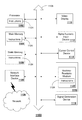
- FIG. 1 depicts an illustrative embodiment of managing video sessions in a network based on network information.
- the system 100 includes a network server generating a graphical map 105 of a cellular network.
- the graphical map 105 spans from San Francisco and San Jose.
- Portions of the graphical map 105 can show clusters of cells 110 , 120 , 130 , 140 of the cellular network by using different pattern squares.
- Each square pattern can provide a range of values for an overall video traffic metric for the cell. Squares with certain patterns indicate cells with more congestion according to the overall video traffic metric than squares with other patterns.
- the graphical map can be presented using Nanocube technology (see www.nancube.net). Nanocube technology allows for fast visualization of large spatiotemporal datasets. Further, Nanocube technology processes data with respect to space, time, or data attributes, and presents the results in real-time on a web browser over heatmaps, bar charts, histograms, etc.
- the graphical map 105 can be sent by the network server to communication device of cellular network management personnel (e.g. cellular network operator) identifying more congested (i.e. more overall video traffic according to the overall video traffic metric) cells and less congested cells.
- the network operator communication device can be any computing device including, but not limited to, a desktop computer, laptop computer, tablet computer, smartphone, etc.
- the congestion of the cells may be due in part of video sessions conducted by mobile devices (e.g. smartphone, tablet computers, etc.).
- Video sessions can include a mobile device streaming video content or conducting a video conference.
- a network operator can change control of some mobile devices from a base station associated with a more congested cell to a base station associated with a less congested cell.
- Examples of an overall video traffic metric for a cell can include number of communication sessions, number of video sessions, total data (MB), throughput (Kbps), transfer duration (sec), average video quality (Kbps), application or channel type (e.g. HuluTM, NetflixTM, YoutubeTM, SkypeTM, etc.), operating system type (AndroidTM, iOSTM, etc.), rebuffering ratio (%), startup delay (seconds), quality switching, and network type (e.g. 2G, 3G, LTE, etc.). Metrics can be calculated or otherwise determined from network information receives from different sources.
- Network (performance) information can include physical network information of a cell including the signal strength of mobile devices and base station of a cell as well as the interference subjected to the signals in a cell.
- Network information can include application information provided by a different data source.
- application information can indicate the type of application used in a communication session or video session such as HuluTM, NetflixTM, YoutubeTM, SkypeTM, etc.
- Additional network information can be the operating system type of mobile devices in a cell provided by a different data source.
- Other network information can include Transmission Control Protocol (TCP) flow level information that can include the number of retransmissions of packets for communication sessions or video sessions.
- TCP Transmission Control Protocol
- metrics such as throughput, total data, transfer duration, etc. are dependent on the number of retransmissions of packets and affect the congestion of cells.
- the system 100 can be configured to send the graphical map 105 indicating the congestion of each cell according to a selected overall video traffic metric to be presented on a communication device or mobile device. Further, the system 100 can be provisioned or have default settings for different thresholds of congestions, each threshold having a different metric value. In addition, the network server of system 100 can assign a color, pattern, or any other visual indicator for each cell being above and/or below a threshold value of the overall video traffic metric. For example, graphical map 105 can indicate the congestion of cells 110 - 140 according to the number of video sessions (i.e. overall video traffic metric).
- a square representing the cell in the graphical map can be colored green. If the number of video sessions in a cell is detected or determined to be 26-50 video sessions, the square representing the cell in the graphical map can be colored yellow. Further, if the number of video sessions is detected or determined to be 51-75 video sessions, the square representing the cell in the graphical map can be colored orange. In addition, if the number of video sessions is detected or determined to be between 76-100 video sessions, the square representing the cell in the graphical map can be colored red.
- the system 100 can include one or more network servers and can send the graphical map 105 to a communication device of a network operator to be presented on a display.
- the network server can provide an indication to the communication device that one cell is congested due to a high value of an overall video traffic metric for the cell and another cell is less congested due to lower value of the overall video traffic metric for the other cell.
- the indication can include information that one or more mobile devices in the one cell can be configured to connect to the other cell to relieve some congestion in the one cell. For example, the number of video sessions in a first cell is 53 sessions and the number of video sessions for a second cell is 42 sessions. A predetermined threshold for a congestion for the overall video traffic metric (i.e. number of video sessions) can be 50 video sessions. Further, five mobile devices from the first cell can be provisioned to be connected to the second cell.
- a network operator can provide a message that instructs the network server to provision the connection of the one or more mobile devices from the one cell to the other cell. Consequently, the network server can instruct a base station of the one cell to perform or cause to perform a handover of control of the one or more mobile device to a base station of the other cell.
- the network operator via their communication device, can send instructions to the network server to have the base station of the first cell perform or cause to perform a handover of control of the five mobile devices to the base station of the second cell.
- the first cell has 48 video sessions and the second cell has 47 video sessions, thereby each cell being below a predetermined threshold of congestion of 50 video sessions.
- the network server can send the graphical map 105 to one of the mobile devices in a congested cell to be presented on a display. Further, the network server can provide an indication to the mobile device that it is connected to a congested cell (according to an overall video traffic metric) and provide an indication that the mobile device can be connected to another, less congested cell. For example, the number of video sessions in a congested cell is 53 sessions and the number of video sessions for a less congested cell is 42 sessions. A predetermined threshold for congestion according to an overall video traffic metric (i.e. number of video sessions) can be 50 video sessions. Further, five mobile devices from the first cell can be provisioned to be connected to the second cell.
- an overall video traffic metric i.e. number of video sessions
- the network server can send each of these five mobile devices the graphical map 105 and/or an indication that they are each connected to a congested cell but can connect to a less congested cell to possibly improve the quality of their respective video sessions.
- three of the five mobile devices may connect to the less congested cell and send a message to the network server to perform or cause to perform a handover of control of their respective mobile devices from the base station of the congested cell to the base station of the less congested cell.
- the users of the two other mobile devices may decide not to connect to the less congested cell because they have determined, by examining the graphical map 105 , that they are traveling away from the less congested cell.
- the system 100 can determine one cell is congested due to a high value of an overall video traffic metric for the cell (e.g. above a predetermined threshold) and another cell is less congested due to lower value of the overall video traffic metric for the other cell (e.g. below a predetermined threshold).
- the network server can determine that one or more mobile devices in the one cell can be provisioned to connect to the other cell to relieve some congestion of the one cell. Responsive to this determination, the network server can automatically perform or cause to perform a handover of control of the one or more mobile devices from base station of the one cell to the base station of the other cell, thereby reducing the congestion of the one cell.
- the number of video sessions in a first cell can be 53 sessions and the number of video sessions for a second cell is 42 sessions.
- a predetermined threshold for an overall video traffic metric i.e. number of video sessions
- the network server can perform or cause to perform a handover of control of the five mobile devices from the base station of the first cell to the base station of the second cell, thereby decreasing congestion in the first cell.
- the network server can use image recognition to determine a congested cell (i.e. overall video traffic metric above a predetermined threshold) and a less congested cell (i.e. overall video traffic metric below a predetermined threshold). Further, the network server can determine one or more mobile devices connected to the congested cell can also be connected to the less congested cell. Responsive to this determination, the network server can automatically perform or cause to perform a handover of control of the one or more mobile devices from a base station of the congested cell to the base station of the less congested cell, thereby reducing the congested cell. For example, the number of video sessions in a first cell can be 53 sessions and the number of video sessions for a second cell is 42 sessions.
- a predetermined threshold for an overall video traffic metric can be 50 video sessions.
- a square representing the first cell can be colored red on the graphical map 105 to indicate the level of congestion (i.e. metric) in the first cell is above a predetermined threshold.
- a square representing the second cell can be colored green on the graphical map 105 to indicate the level of congestion (i.e. metric) in the second cell is below a predetermined threshold.
- the network server can determine five mobile devices from the first cell can be provisioned to be connected to the second cell. The network server can perform or cause to perform a handover of control of the five mobile devices from the base station of the first cell to the base station of the second cell, thereby decreasing congestion in the first cell.
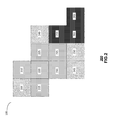
- FIG. 2 depicts a cell cluster 130 of the cellular network from graphical map 105 .
- each square 205 - 265 represents a cell in a cellular network.
- each square 205 - 265 has a pattern to indicate a range values for congestion according to an overall video traffic metric.
- Squares 205 , 240 , 245 , 250 with a single diagonal line pattern may indicate a low range of congestion.
- squares 210 - 235 with a two diagonal line pattern may indicate an intermediate range of congestion.
- squares 255 - 265 with a cross hatching pattern may indicate a high range of congestions.
- squares 205 , 240 , 245 , 250 with a single diagonal line pattern may indicate cells with a number of video sessions between 0-30 video sessions.
- squares 210 - 235 with a two diagonal line pattern may indicate cells with a number of video session between 31-70 video sessions.
- squares 255 - 265 with a cross hatching pattern may indicate cells with over 71 video sessions.
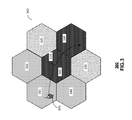
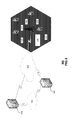
- FIG. 3 depicts an illustrative embodiment for managing video sessions in a network based on network performance information.
- the system 300 can include a network server that can generate a cluster of shapes (e.g. hexagons) to represent a cluster of cells 302 on a graphical map 105 .
- a cluster of shapes e.g. hexagons
- the congestion of each cell 315 - 345 can be indicated by a pattern as described in discussing FIG. 2 .
- the cluster of cells 302 can indicate a mobile device 305 traversing a portion of the cells 315 - 345 .
- the system 300 can receive network information regarding a mobile device such as a call detail record (CDR) that indicates a travel trajectory 310 of the mobile device 305 .
- CDR call detail record
- the trajectory 310 can be determined by personal information of the mobile device user.
- the network server can determine that the mobile device user may be traveling home from work because the time of day is evening rush hour (e.g. 5 pm-7 pm) and in the past the mobile device 305 trajectory 310 is along a commuter bus route that the user has traveled regularly during evening rush hour.
- the trajectory 310 of the mobile device 305 can be provided with the graphical map, by the network server, to either the mobile device for viewing by the user or to a communication device for viewing by a network operator. Further, an indication can be given, by the network server, with the graphical map 105 that the mobile device 305 is entering a congested cell 345 but can connect to one of two neighboring cells 325 , 335 that are less congested (e.g. congestion of cells determined according to the overall video traffic metric). However, due to the trajectory 310 on the graphical map, the user or the network operator can make an informed decision on whether to request a handover of control of mobile device to cell 335 or 325 .
- Examining the trajectory 310 indicates that performing a handover of control of mobile device 305 from cell 345 to cell 335 can be better choice as the trajectory 310 brings mobile device 305 closer cell 335 than to cell 325 .
- the user or the network operator can send a request to the network server to perform or cause to perform a handover of control of mobile device 305 from a base station of cell 345 to a base station of cell 335 .
- the network server can analyze the data used in generating the cell cluster 302 for graphical map 105 and identifying the trajectory 310 .
- the network server can automatically (without user or network operator input) perform or cause to perform a handover of control of the mobile device 305 from a base station of cell 345 to a base station of cell 335 because the network server has determined that the distance between cell 335 to the trajectory 310 is shorter than the distance between cell 325 and the trajectory 310 .
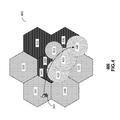
- FIG. 4 depicts an illustrative embodiment for managing video sessions in a network based on network performance information.
- a network server of system 400 can generate a cluster of shapes (e.g. hexagons, circles, etc.) to represent a cluster of cells and wireless networks 402 on a graphical map 105 (similar to the cluster of cells 302 in FIG. 3 ).
- the congestion (according to an overall video traffic metric) of each cell 315 - 345 can be indicated by a pattern as described in discussing FIG. 2 .
- the cluster of cells and wireless networks 402 can indicate a mobile device 305 traversing portion of the cells 315 - 345 .
- the shapes representing each cell 315 - 345 e.g.
- the system 400 can present on the graphical map 105 shapes (e.g. circles) representing other networks 410 - 440 that can be connected to mobile device 305 .
- networks 410 - 440 can be wireless networks such as WiFi networks.
- each circle representing wireless network 410 - 410 can have a pattern to indicate a range of congestion according to a wireless traffic metric the same as or similar to the overall video traffic metric for the cells 315 - 340 .
- wireless traffic metric can different than the overall video traffic metric for the cells 315 - 340 .
- a pattern for a cell and the same pattern for a wireless network can indicate the same range of congestion according to the overall video traffic metric/wireless traffic metric (as may be the case when the overall video traffic metric and wireless traffic metric are the same or similar).
- a pattern for a cell can indicate one range of congestion and the same pattern for a wireless network can indicate a different range of congestion (as may be the case when the overall video traffic metric and wireless traffic metric are different).
- congestion of the cluster of cells and wireless networks 402 are indicated according to the same metric (e.g. number of video sessions).
- a shape e.g. hexagon or circle
- a shape with two diagonal line pattern indicates a number of video sessions in a cell or wireless network to be 31-70 video sessions.
- a shape with a cross hatching pattern indicates a number of video sessions in a cell or wireless network to be over 70 video sessions.
- the graphical map 105 with cluster of cells and wireless networks 402 can be sent to a network operator's communication device or user's mobile device 305 .
- the network operator or user can determine that cells 345 and 330 on the trajectory of mobile device 305 are congested with over 70 video sessions in each cell.
- cell 335 has an intermediate level of congestion with the number of video sessions between 31-70 video sessions.
- wireless networks 420 - 440 have a relatively lower congestion level than any cell, with a number of video sessions between 0-30 video sessions.
- a network operator may send a message, via the communication device, to a network server of system 400 , indicating to send a request to mobile device 305 to connect with the wireless networks 420 - 440 once each wireless network is within range of mobile device 305 .
- the mobile device 305 can be programmed, by user, or the network server, to automatically connect to the wireless networks 420 - 440 when in range.
- the user may send a message, via the mobile device 305 , to the network server indicating that the mobile device 305 is connecting to the wireless networks 420 - 440 once mobile device 305 is within range of each wireless network.
- the graphical map 105 presenting cluster of cells and wireless networks 402 shows that although the wireless network 410 may be in range of mobile device 305 as it traverses the trajectory 310 , the network operator, user, or network server, may not connect mobile device 305 to wireless network 410 . The reason may be that mobile device 305 can also connect to wireless network 430 at the same time as wireless network 410 . Wireless network 430 has less congestion than wireless network 410 . Thus, any video session conducted when the mobile device 305 is connected to wireless network 430 would likely provide a better experience than a video session conducted when mobile device 305 is connected to wireless network 410 .
- FIG. 5 depicts an illustrative embodiment for managing video sessions in a network based on network performance information.
- the system 500 can include mobile devices 510 - 525 in a congested cell 505 (i.e. congested according to an overall video traffic metric).
- a network server 540 may be coupled to a base station 530 for the cell 505 over communication network 535 .
- a video content server 545 can provide video content for a video session conducted by each of the mobile devices 510 - 525 .
- the network server 540 can be communicate with video content server 545 over a communication network 550 .
- the network server 540 can determine the video content provider for each of the video sessions conducted by the mobile devices 510 - 525 using network information provided by different data sources. In some embodiments, the video content provider can be discerned from the application type for each video session provided by the network information. Further, the network server 540 can determine an overall video traffic metric for the cell 505 and identifies that the overall video traffic metric indicates that the cell 505 has a high level of congestion. In addition, the network server 540 identifies, a based on the network information, that the video content provider is delivering video content at a high resolution for each of the video sessions conducted by the mobile devices 510 - 525 .
- the network server 540 In response to identifying a high resolution video content, the video content provider, and a high level of congestion of the cell 505 (e.g. above a predetermined threshold), the network server 540 sends video content server 545 a request to deliver the video content for all or a portion of the video content delivered to the mobile devices 510 - 525 at a lower resolution, thereby decreasing the congestion of the cell 505 .
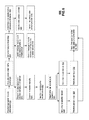
- FIG. 6 depicts an illustrative embodiment of a method 600 used by systems 100 - 500 .
- the method 600 can include, at step 602 , a network server 540 receiving aggregate network information for communication sessions for each cell of a multiple of cells in a cellular network.
- the communication sessions can include a group of video sessions.
- the aggregate network information comprises network information from each of a multiple of data sources. In some embodiments, the aggregate network information is generated by linking and correlating data from the multiple data sources.
- the method 600 further includes the network server 540 calculating an overall video traffic metric for the group of video sessions for each cell based on the aggregate network information. Additionally, the method 600 , at step 606 , includes generating a graphical map of the cellular network that displays a geography of the cellular network. The graphical map can also indicate the overall video traffic metric for the group of video sessions for each cell in the cellular network within the geography. At step 608 , the method 600 also includes the network server 540 determining a first overall video traffic metric of a first group of video sessions controlled by a first base station of a first cell is above a first predetermined threshold.
- the method 600 includes the network server 540 identifying a video content provider associated with a portion of the first group of video sessions. That is, the network server 540 identifies the video content provider delivering video content for each of the video sessions in the portion of the first group of video sessions based on the aggregate network information.
- the aggregate network information can include the application type used in conducting each video session.
- a video content provider can be identified according an application type (e.g. if YoutubeTM application type, then video content provider is GoogleTM, if SkypeTM application type, then video content provider is MicrosoftTM, etc.).
- the method 600 can include the network server 540 transmitting a request to the video content provider. The request can indicate the video content provider to lower video resolution of each of the video sessions of the portion of the first group of video sessions.
- the method 600 includes the network server 540 identifying a first wireless network of multiple wireless networks.
- the first wireless network has a first wireless traffic metric below a second predetermined threshold. This identification can be in response to the network server 540 receiving aggregate wireless network information for each of the multiple wireless networks and then calculating a wireless traffic metric for each of the multiple wireless networks.
- the network server 540 may re-generate the graphical map to include displaying a geography of the multiple wireless networks and indicating the wireless traffic metric or range of values for the wireless metric for each of the multiple wireless networks.
- steps 614 - 616 are implemented prior to step 606 such that when generating the graphical map, the graphical map includes displaying a geography of the multiple wireless networks and indicating the wireless traffic metric or range of values for the wireless metric for each of the multiple wireless networks.
- the method 600 can include the network server 540 sending a message to each of a multiple of mobile devices. Each mobile device is conducting a video session in the first cell, and the message indicates a mobile device to connect to the first wireless network to conduct the video session. In response to receiving the message, a user of a mobile device can provision the mobile device to connect to the first wireless network.
- the method 600 further includes the network server 540 determining a second overall video traffic metric of a second group of video sessions controlled by a second base station of a second cell is below the first predetermined threshold. Further, at a step 620 , the method 600 includes the network server 540 calculating an excess capacity of the second cell as a difference between the second overall video traffic metric and the first predetermined threshold and the network server 540 and determining an overall video traffic metric of the first portion of the first group of video sessions is less than the excess capacity.
- Method 600 at step 622 , can include the network server 540 identifying a trajectory of mobile device conducting a video session of the first portion of the first group of video sessions. In addition, the method 600 , at step 624 , can include the network server 540 selecting the second cell according to the trajectory of the mobile device.
- the method 600 includes the network server 540 sending the graphical map to an operator's communication device and an indication that the first overall video traffic metric associated with first cell is above the first predetermined threshold and the second overall video traffic metric associated with the second cell is below the first predetermined threshold.
- the method 600 includes the network server 540 receiving a message from the operator's communication device. The message provides an indication to change (or cause the change of) control of the first portion of the first group of video session from the first base station to the second base station.
- the method 600 includes the network server 540 sending the graphical map to a user's mobile device and an indication that the first overall video traffic metric associated with first cell is above the first predetermined threshold and the second overall video traffic metric associated with the second cell is below the first predetermined threshold.
- the method 600 includes the network server 540 receiving a message from the user's mobile device. The message provides an indication to change control of the first portion of the first group of video session from the first base station to the second base station.
- the method 600 includes the network server 540 performing or causing to perform a handover of control of a first portion of the first group of video sessions from the first base station to the second base station. Causing to perform a handover can include providing instructions for a network device (including for the network server 540 ) to perform the handovers of control as described herein.
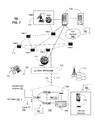
- FIG. 7 depicts an illustrative embodiment of a communication system 700 for providing various communication services, such as delivering media or video content.
- the communication system 700 can represent an interactive media network, such as an interactive television system (e.g., an Internet Protocol Television (IPTV) media system).
- IPTV Internet Protocol Television
- Communication system 700 can be overlaid or operably coupled with systems 100 , 200 , 300 , 400 , 500 of FIGS. 1-5 as another representative embodiment of communication system 700 .
- one or more devices illustrated in the communication system 700 of FIG. 7 can be used for managing video sessions in a network based on network information.
- Embodiments of communication system 700 can include network server 730 receiving aggregate network information for communication sessions for each cell of a multiple of cells in a cellular network.
- the communication sessions include a group of video sessions and the aggregate network information comprises network information from each of a multiple of data sources.
- Further embodiments can include the network server 730 calculating an overall video traffic metric for the group of video sessions for each cell based on the aggregate network information. Additional embodiments can include the network server 730 determining a first overall video traffic metric of a first group of video sessions controlled by a first base station of a first cell is above a first predetermined threshold and a second overall video traffic metric of a second group of video sessions controlled by a second base station of a second cell is below the first predetermined threshold.
- embodiments can include network server 730 generating a graphical map of the cellular network that displays a geography of the cellular network and indicates the overall video traffic metric for the group of video sessions for each cell in the cellular network. Further embodiments include the network server 730 sending the graphical map to a communication device conducting a video session in the first cell and an indication that the first overall video traffic metric associated with first cell is above the first predetermined threshold and the second overall video traffic metric associated with the second cell is below the first predetermined threshold.
- the communication system 700 can include a super head-end office (SHO) 710 with at least one super headend office server (SHS) 711 which receives media content from satellite and/or terrestrial communication systems.
- media content can represent, for example, audio content, moving image content such as 2 D or 3 D videos, video games, virtual reality content, still image content, and combinations thereof.
- the SHS server 711 can forward packets associated with the media content to one or more video head-end servers (VHS) 714 via a network of video head-end offices (VHO) 712 according to a multicast communication protocol.
- the VHS 714 can distribute multimedia broadcast content via an access network 718 to commercial and/or residential buildings 702 housing a gateway 704 (such as a residential or commercial gateway).
- the access network 718 can represent a group of digital subscriber line access multiplexers (DSLAMs) located in a central office or a service area interface that provide broadband services over fiber optical links or copper twisted pairs 719 to buildings 702 .
- DSLAMs digital subscriber line access multiplexers
- the gateway 704 can use communication technology to distribute broadcast signals to media processors 706 such as Set-Top Boxes (STBs) which in turn present broadcast channels to media devices 708 such as computers or television sets managed in some instances by a media controller 707 (such as an infrared or RF remote controller).
- STBs Set-Top Boxes
- media devices 708 such as computers or television sets managed in some instances by a media controller 707 (such as an infrared or RF remote controller).
- the gateway 704 , the media processors 706 , and media devices 708 can utilize tethered communication technologies (such as coaxial, powerline or phone line wiring) or can operate over a wireless access protocol such as Wireless Fidelity (WiFi), Bluetooth®, Zigbee or other present or next generation local or personal area wireless network technologies.
- WiFi Wireless Fidelity
- Bluetooth® Bluetooth®
- Zigbee Zigbee
- unicast communications can also be invoked between the media processors 706 and subsystems of the IPTV media system for services such as video-on-demand (VoD), browsing an electronic programming guide (EPG), or other infrastructure services.
- VoD video-on-demand
- EPG electronic programming guide
- a satellite broadcast television system 729 can be used in the media system of FIG. 7 .
- the satellite broadcast television system can be overlaid, operably coupled with, or replace the IPTV system as another representative embodiment of communication system 700 .
- signals transmitted by a satellite 715 that include media content can be received by a satellite dish receiver 731 coupled to the building 702 .
- Modulated signals received by the satellite dish receiver 731 can be transferred to the media processors 706 for demodulating, decoding, encoding, and/or distributing broadcast channels to the media devices 708 .
- the media processors 706 can be equipped with a broadband port to an Internet Service Provider (ISP) network 732 to enable interactive services such as VoD and EPG as described above.
- ISP Internet Service Provider
- an analog or digital cable broadcast distribution system such as cable TV system 733 can be overlaid, operably coupled with, or replace the IPTV system and/or the satellite TV system as another representative embodiment of communication system 700 .
- the cable TV system 733 can also provide Internet, telephony, and interactive media services.
- System 700 enables various types of interactive television and/or services including IPTV, cable and/or satellite.
- the subject disclosure can apply to other present or next generation over-the-air and/or landline media content services system.
- Some of the network elements of the IPTV media system can be coupled to one or more computing devices 730 , a portion of which can operate as a web server for providing web portal services over the ISP network 732 to wireline media devices 708 or wireless communication devices 716 .
- Communication system 700 can also provide for all or a portion of the computing devices 730 to function as a network management server (herein referred to as network server 730 ).
- the network server 730 can use computing and communication technology to perform function 762 , which can include among other things, the video session management techniques described by method 600 of FIG. 6 .
- function 762 of server 730 can be similar to the functions described for network server 540 of FIG. 5 in accordance with method 600 .
- the media processors 706 and wireless communication devices 716 can be provisioned with software functions 764 and 766 , respectively, to utilize the services of network server 730 .
- functions 764 and 766 of media processors 706 and wireless communication devices 716 can be similar to the functions described for the communication devices or mobile devices 305 , 510 - 515 or a network operator communication device discussed when describing FIGS. 1-5 in accordance with method 600 of FIG. 6 .
- media services can be offered to media devices over landline technologies such as those described above. Additionally, media services can be offered to media devices by way of a wireless access base station 717 operating according to common wireless access protocols such as Global System for Mobile or GSM, Code Division Multiple Access or CDMA, Time Division Multiple Access or TDMA, Universal Mobile Telecommunications or UMTS, World interoperability for Microwave or WiMAX, Software Defined Radio or SDR, Long Term Evolution or LTE, and so on.
- GSM Global System for Mobile or GSM
- CDMA Code Division Multiple Access
- TDMA Time Division Multiple Access or TDMA
- Universal Mobile Telecommunications or UMTS Universal Mobile Telecommunications or UMTS
- World interoperability for Microwave or WiMAX Software Defined Radio or SDR, Long Term Evolution or LTE, and so on.
- Other present and next generation wide area wireless access network technologies can be used in one or more embodiments of the subject disclosure.
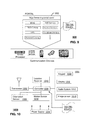
- FIG. 8 depicts an illustrative embodiment of a communication system 800 employing an IP Multimedia Subsystem (IMS) network architecture to facilitate the combined services of circuit-switched and packet-switched systems.
- Communication system 800 can be overlaid or operably coupled with systems 100 , 200 , 300 , 400 , 500 of FIGS. 1-5 and communication system 700 as another representative embodiment of communication system 700 .
- IMS IP Multimedia Subsystem
- Embodiments of a communication system 800 can include network server 730 receiving aggregate network information for communication sessions for each cell of a plurality of cells in a cellular network, wherein the communication sessions include a group of video sessions, and wherein the aggregate network information comprises network information from each of a plurality of data sources. Further embodiments can include network server 730 calculating an overall video traffic metric for the group of video sessions for each cell based on the aggregate network information. Additional embodiments can include network server 730 generating a graphical map of the cellular network that displays a geography of the cellular network and indicates the overall video traffic metric for the group of video sessions for each cell in the cellular network within the geography.
- embodiments can include network server 730 determining a first overall video traffic metric of a first group of video sessions controlled by a first base station of a first cell is above a first predetermined threshold and a second overall video traffic metric of a second group of video sessions controlled by a second base station of a second cell is below the first predetermined threshold. Further embodiments can include network server 730 sending the graphical map to a communication device and an indication that the first overall video traffic metric associated with first cell is above the first predetermined threshold and the second overall video traffic metric associated with the second cell is below the first predetermined threshold.
- Additional embodiments can include network server 730 performing or causing to perform a handover of control of a first portion of the first group of video sessions from the first base station to the second base station responsive to receiving a message from the communication device, wherein the message provides an indication to change control of the first portion of the first group of video session from the first base station to the second base station.
- Communication system 800 can comprise a Home Subscriber Server (HSS) 840 , a tElephone NUmber Mapping (ENUM) server 830 , and other network elements of an IMS network 850 .
- the IMS network 850 can establish communications between IMS-compliant communication devices (CDs) 801 , 802 , Public Switched Telephone Network (PSTN) CDs 803 , 805 , and combinations thereof by way of a Media Gateway Control Function (MGCF) 820 coupled to a PSTN network 860 .
- the MGCF 820 need not be used when a communication session involves IMS CD to IMS CD communications.
- a communication session involving at least one PSTN CD may utilize the MGCF 820 .
- IMS CDs 801 , 802 can register with the IMS network 850 by contacting a Proxy Call Session Control Function (P-CSCF) which communicates with an interrogating CSCF (I-CSCF), which in turn, communicates with a Serving CSCF (S-CSCF) to register the CDs with the HSS 840 .
- P-CSCF Proxy Call Session Control Function
- I-CSCF interrogating CSCF
- S-CSCF Serving CSCF
- an originating IMS CD 801 can submit a Session Initiation Protocol (SIP INVITE) message to an originating P-CSCF 804 which communicates with a corresponding originating S-CSCF 806 .
- SIP INVITE Session Initiation Protocol
- the originating S-CSCF 806 can submit the SIP INVITE message to one or more application servers (ASs) 817 that can provide a variety of services to IMS subscribers.
- ASs application servers
- the application servers 817 can be used to perform originating call feature treatment functions on the calling party number received by the originating S-CSCF 806 in the SIP INVITE message.
- Originating treatment functions can include determining whether the calling party number has international calling services, call ID blocking, calling name blocking, 7-digit dialing, and/or is requesting special telephony features (e.g., *72 forward calls, *73 cancel call forwarding, *67 for caller ID blocking, and so on).
- special telephony features e.g., *72 forward calls, *73 cancel call forwarding, *67 for caller ID blocking, and so on.
- iFCs initial filter criteria
- the originating S-CSCF 806 can submit queries to the ENUM system 830 to translate an E.164 telephone number in the SIP INVITE message to a SIP Uniform Resource Identifier (URI) if the terminating communication device is IMS-compliant.
- the SIP URI can be used by an Interrogating CSCF (I-CSCF) 807 to submit a query to the HSS 840 to identify a terminating S-CSCF 814 associated with a terminating IMS CD such as reference 802 .
- I-CSCF 807 can submit the SIP INVITE message to the terminating S-CSCF 814 .
- the terminating S-CSCF 814 can then identify a terminating P-CSCF 816 associated with the terminating CD 802 .
- the P-CSCF 816 may then signal the CD 802 to establish Voice over Internet Protocol (VoIP) communication services, thereby enabling the calling and called parties to engage in voice and/or data communications.
- VoIP Voice over Internet Protocol
- one or more application servers may be invoked to provide various call terminating feature services, such as call forwarding, do not disturb, music tones, simultaneous ringing, sequential ringing, etc.
- communication system 800 can be adapted to support video conferencing.
- communication system 800 can be adapted to provide the IMS CDs 801 , 802 with the multimedia and Internet services of communication system 700 of FIG. 7 .
- the ENUM system 830 can respond with an unsuccessful address resolution which can cause the originating S-CSCF 806 to forward the call to the MGCF 820 via a Breakout Gateway Control Function (BGCF) 819 .
- the MGCF 820 can then initiate the call to the terminating PSTN CD over the PSTN network 860 to enable the calling and called parties to engage in voice and/or data communications.
- BGCF Breakout Gateway Control Function
- the CDs of FIG. 8 can operate as wireline or wireless devices.
- the CDs of FIG. 8 can be communicatively coupled to a cellular base station 821 , a femtocell, a WiFi router, a Digital Enhanced Cordless Telecommunications (DECT) base unit, or another suitable wireless access unit to establish communications with the IMS network 850 of FIG. 8 .
- the cellular access base station 821 can operate according to common wireless access protocols such as GSM, CDMA, TDMA, UMTS, WiMax, SDR, LTE, and so on.
- Other present and next generation wireless network technologies can be used by one or more embodiments of the subject disclosure. Accordingly, multiple wireline and wireless communication technologies can be used by the CDs of FIG. 8 .
- Cellular phones supporting LTE can support packet-switched voice and packet-switched data communications and thus may operate as IMS-compliant mobile devices.
- the cellular base station 821 may communicate directly with the IMS network 850 as shown by the arrow connecting the cellular base station 821 and the P-CSCF 816 .
- a CSCF can operate in a device, system, component, or other form of centralized or distributed hardware and/or software.
- a respective CSCF may be embodied as a respective CSCF system having one or more computers or servers, either centralized or distributed, where each computer or server may be configured to perform or provide, in whole or in part, any method, step, or functionality described herein in accordance with a respective CSCF.
- the network server 730 of FIG. 7 can be operably coupled to communication system 800 for purposes similar to those described above.
- Network server 730 can perform function 762 and thereby provide video session management services to the CDs 801 , 802 , 803 and 805 of FIG. 8 similar to the functions described for systems 100 , 200 , 300 , 400 of FIGS. 1-4 and network server 540 of FIG. 5 in accordance with method 600 of FIG. 6 .
- CDs 801 , 802 , 803 and 805 which can be adapted with software to perform function 874 to utilize the services of the network server 730 similar to the functions described for communication devices 305 , 510 - 525 and network operator communication device of FIGS. 1-5 in accordance with method 600 of FIG. 6 .
- Network server 730 can be an integral part of the application server(s) 817 performing function 874 , which can be substantially similar to function 762 and adapted to the operations of the IMS network 850 .
- S-CSCF S-CSCF
- P-CSCF P-CSCF
- I-CSCF I-CSCF
- any form of a CSCF server can operate in a device, system, component, or other form of centralized or distributed hardware and software.
- DIAMETER commands are terms can include features, methodologies, and/or fields that may be described in whole or in part by standards bodies such as 3′ Generation Partnership Project (3GPP). It is further noted that some or all embodiments of the subject disclosure may in whole or in part modify, supplement, or otherwise supersede final or proposed standards published and promulgated by 3GPP.
- FIG. 9 depicts an illustrative embodiment of a web portal 902 of a communication system 900 .
- Communication system 900 can be overlaid or operably coupled with systems 100 , 200 , 300 , 400 , 500 of FIGS. 1-5 , communication system 700 , and/or communication system 800 as another representative embodiment of systems 100 , 200 , 300 , 400 , 500 of FIGS. 1-5 , communication system 700 , and/or communication system 800 .
- the web portal 902 can be used for managing services of systems 100 , 200 , 300 , 400 , 500 of FIGS. 1-5 and communication systems 700 - 800 .
- a web page of the web portal 902 can be accessed by a Uniform Resource Locator (URL) with an Internet browser using an Internet-capable communication device such as those described in FIGS. 1-5 and FIGS. 7-8 .
- the web portal 902 can be configured, for example, to access a media processor 706 and services managed thereby such as a Digital Video Recorder (DVR), a Video on Demand (VoD) catalog, an Electronic Programming Guide (EPG), or a personal catalog (such as personal videos, pictures, audio recordings, etc.) stored at the media processor 706 .
- DVR Digital Video Recorder
- VoD Video on Demand
- EPG Electronic Programming Guide
- personal catalog such as personal videos, pictures, audio recordings, etc.
- the web portal 902 can further be utilized to manage and provision software applications 762 - 766 , and 872 - 874 to adapt these applications as may be desired by subscribers and/or service providers of systems 100 , 200 , 300 , 400 , 500 of FIGS. 1-5 , and communication systems 700 - 800 .
- a user of the video session management services provided by network server 540 or network server 730 can log into their on-line accounts and provision the network server 540 or network server 730 to configure to connect their mobile device from a congested cell in a cellular network to a less congested cell in the cellular network.
- a user can configure to connect their mobile device to one or more wireless (e.g. WiFi) networks on a certain trajectory (e.g.
- the mobile device automatically connects to these networks when their mobile device is in range of these networks.
- the user can send a request to a video content provider that is providing video content for the video session they are conducting on their mobile device to lower the resolution of the video content to relieve congestion of the cell to which their mobile device is connected.
- a network operator through their communication device, can provision the predetermined thresholds, or range of values to indicate congestion of cells and wireless networks on the graphical map 105 using portal 902 .
- a network operator from their communication device can connect a mobile device from a congested cell in a cellular network to a less congested cell in the cellular network.
- the network operator from their communication device can configure to connect a mobile device to one or more wireless (e.g. WiFi) networks on a certain trajectory (e.g. commuter train route during evening rush hour) such that the mobile device (in some embodiments automatically) connects to these networks when the mobile device is in range of these networks.
- the network operator through their communication device can send a request to a video content provider that is providing video content for the video session conducted on a mobile device to lower the resolution of the video content to relieve congestion of the cell to which their mobile device is connected.
- FIG. 10 depicts an illustrative embodiment of a communication device 1000 .
- Communication device 1000 can serve in whole or in part as an illustrative embodiment of the devices depicted described in conjunction with FIGS. 1-5 , and FIGS. 7-8 and can be configured to perform portions of method 600 of FIG. 6 .
- Communication device 1000 can comprise a wireline and/or wireless transceiver 1002 (herein transceiver 1002 ), a user interface (UI) 1004 , a power supply 1014 , a location receiver 1016 , a motion sensor 1018 , an orientation sensor 1020 , and a controller 1006 for managing operations thereof.
- the transceiver 1002 can support short-range or long-range wireless access technologies such as Bluetooth®, ZigBee®, WiFi, DECT, or cellular communication technologies, just to mention a few (Bluetooth® and ZigBee® are trademarks registered by the Bluetooth® Special Interest Group and the ZigBee® Alliance, respectively).
- Cellular technologies can include, for example, CDMA- 1 X, UMTS/HSDPA, GSM/GPRS, TDMA/EDGE, EV/DO, WiMAX, SDR, LTE, as well as other next generation wireless communication technologies as they arise.
- the transceiver 1002 can also be adapted to support circuit-switched wireline access technologies (such as PSTN), packet-switched wireline access technologies (such as TCP/IP, VoIP, etc.), and combinations thereof.
- the UI 1004 can include a depressible or touch-sensitive keypad 1008 with a navigation mechanism such as a roller ball, a joystick, a mouse, or a navigation disk for manipulating operations of the communication device 1000 .
- the keypad 1008 can be an integral part of a housing assembly of the communication device 1000 or an independent device operably coupled thereto by a tethered wireline interface (such as a USB cable) or a wireless interface supporting for example Bluetooth®.
- the keypad 1008 can represent a numeric keypad commonly used by phones, and/or a QWERTY keypad with alphanumeric keys.
- the UI 1004 can further include a display 1010 such as monochrome or color LCD (Liquid Crystal Display), OLED (Organic Light Emitting Diode) or other suitable display technology for conveying images to an end user of the communication device 1000 .
- a display 1010 such as monochrome or color LCD (Liquid Crystal Display), OLED (Organic Light Emitting Diode) or other suitable display technology for conveying images to an end user of the communication device 1000 .
- a portion or all of the keypad 1008 can be presented by way of the display 1010 with navigation features.
- the display 1010 can use touch screen technology to also serve as a user interface for detecting user input.
- the communication device 1000 can be adapted to present a user interface with graphical user interface (GUI) elements that can be selected by a user with a touch of a finger.
- GUI graphical user interface
- the touch screen display 1010 can be equipped with capacitive, resistive or other forms of sensing technology to detect how much surface area of a user's finger has been placed on a portion of the touch screen display. This sensing information can be used to control the manipulation of the GUI elements or other functions of the user interface.
- the display 1010 can be an integral part of the housing assembly of the communication device 1000 or an independent device communicatively coupled thereto by a tethered wireline interface (such as a cable) or a wireless interface.
- the UI 1004 can also include an audio system 1012 that utilizes audio technology for conveying low volume audio (such as audio heard in proximity of a human ear) and high volume audio (such as speakerphone for hands free operation).
- the audio system 1012 can further include a microphone for receiving audible signals of an end user.
- the audio system 1012 can also be used for voice recognition applications.
- the UI 1004 can further include an image sensor 1013 such as a charged coupled device (CCD) camera for capturing still or moving images.
- CCD charged coupled device
- the power supply 1014 can utilize common power management technologies such as replaceable and rechargeable batteries, supply regulation technologies, and/or charging system technologies for supplying energy to the components of the communication device 1000 to facilitate long-range or short-range portable applications.
- the charging system can utilize external power sources such as DC power supplied over a physical interface such as a USB port or other suitable tethering technologies.
- the location receiver 1016 can utilize location technology such as a global positioning system (GPS) receiver capable of assisted GPS for identifying a location of the communication device 1000 based on signals generated by a constellation of GPS satellites, which can be used for facilitating location services such as navigation.
- GPS global positioning system
- the motion sensor 1018 can utilize motion sensing technology such as an accelerometer, a gyroscope, or other suitable motion sensing technology to detect motion of the communication device 1000 in three-dimensional space.
- the orientation sensor 1020 can utilize orientation sensing technology such as a magnetometer to detect the orientation of the communication device 1000 (north, south, west, and east, as well as combined orientations in degrees, minutes, or other suitable orientation metrics).
- the communication device 1000 can use the transceiver 1002 to also determine a proximity to a cellular, WiFi, Bluetooth®, or other wireless access points by sensing techniques such as utilizing a received signal strength indicator (RSSI) and/or signal time of arrival (TOA) or time of flight (TOF) measurements.
- the controller 1006 can utilize computing technologies such as a microprocessor, a digital signal processor (DSP), programmable gate arrays, application specific integrated circuits, and/or a video processor with associated storage memory such as Flash, ROM, RAM, SRAM, DRAM or other storage technologies for executing computer instructions, controlling, and processing data supplied by the aforementioned components of the communication device 1000 .
- the communication device 1000 can include a reset button (not shown).
- the reset button can be used to reset the controller 1006 of the communication device 1000 .
- the communication device 1000 can also include a factory default setting button positioned, for example, below a small hole in a housing assembly of the communication device 1000 to force the communication device 1000 to re-establish factory settings.
- a user can use a protruding object such as a pen or paper clip tip to reach into the hole and depress the default setting button.
- the communication device 1000 can also include a slot for adding or removing an identity module such as a Subscriber Identity Module (SIM) card. SIM cards can be used for identifying subscriber services, executing programs, storing subscriber data, and so forth.
- SIM Subscriber Identity Module
- the communication device 1000 as described herein can operate with more or less of the circuit components shown in FIG. 10 . These variant embodiments can be used in one or more embodiments of the subject disclosure.
- the communication device 1000 can be adapted to perform the functions of mobile devices 305 , 510 - 525 , the servers described in conjunction with systems 100 , 200 , 300 , 400 , 500 , communication device of a network operator, network server 540 , the media processor 706 , the media devices 708 , or the portable communication devices 716 of FIG. 7 , as well as the IMS CDs 801 - 802 and PSTN CDs 803 - 805 of FIG. 8 . It will be appreciated that the communication device 1000 can also represent other devices that can operate in systems 100 , 200 , 300 , 400 , 500 , of FIGS. 1-5 , communication systems 700 - 800 of FIGS. 7-8 such as a gaming console and a media player.
- the controller 1006 can be adapted in various embodiments to perform the functions 762 - 766 and 872 - 874 , respectively.
- devices described in the exemplary embodiments can be in communication with each other via various wireless and/or wired methodologies.
- the methodologies can be links that are described as coupled, connected and so forth, which can include unidirectional and/or bidirectional communication over wireless paths and/or wired paths that utilize one or more of various protocols or methodologies, where the coupling and/or connection can be direct (e.g., no intervening processing device) and/or indirect (e.g., an intermediary processing device such as a router).
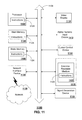
- FIG. 11 depicts an exemplary diagrammatic representation of a machine in the form of a computer system 1100 within which a set of instructions, when executed, may cause the machine to perform any one or more of the methods described above.
- One or more instances of the machine can operate, for example, as the network server 730 , the media processor 706 , mobile devices 305 , 510 - 525 , the servers described in conjunction with systems 100 , 200 , 300 , 400 , 500 , communication device of a network operator, network server 540 , and other devices described in conjunction with FIGS. 1-10 .
- the machine may be connected (e.g., using a network 1126 ) to other machines.
- the machine may operate in the capacity of a server or a client user machine in a server-client user network environment, or as a peer machine in a peer-to-peer (or distributed) network environment.
- the machine may comprise a server computer, a client user computer, a personal computer (PC), a tablet, a smart phone, a laptop computer, a desktop computer, a control system, a network router, switch or bridge, or any machine capable of executing a set of instructions (sequential or otherwise) that specify actions to be taken by that machine.
- a communication device of the subject disclosure includes broadly any electronic device that provides voice, video or data communication.
- the term “machine” shall also be taken to include any collection of machines that individually or jointly execute a set (or multiple sets) of instructions to perform any one or more of the methods discussed herein.
- the computer system 1100 may include a processor (or controller) 1102 (e.g., a central processing unit (CPU)), a graphics processing unit (GPU, or both), a main memory 1104 and a static memory 1106 , which communicate with each other via a bus 1108 .
- the computer system 1100 may further include a display unit 1110 (e.g., a liquid crystal display (LCD), a flat panel, or a solid state display).
- the computer system 1100 may include an input device 1112 (e.g., a keyboard), a cursor control device 1114 (e.g., a mouse), a disk drive unit 1116 , a signal generation device 1118 (e.g., a speaker or remote control) and a network interface device 1120 .
- the embodiments described in the subject disclosure can be adapted to utilize multiple display units 1110 controlled by two or more computer systems 1100 .
- presentations described by the subject disclosure may in part be shown in a first of the display units 1110 , while the remaining portion is presented in a second of the display units 1110 .
- the disk drive unit 1116 may include a tangible computer-readable storage medium 1122 on which is stored one or more sets of instructions (e.g., software 1124 ) embodying any one or more of the methods or functions described herein, including those methods illustrated above.
- the instructions 1124 may also reside, completely or at least partially, within the main memory 1104 , the static memory 1106 , and/or within the processor 1102 during execution thereof by the computer system 1100 .
- the main memory 1104 and the processor 1102 also may constitute tangible computer-readable storage media.
- Dedicated hardware implementations including, but not limited to, application specific integrated circuits, programmable logic arrays and other hardware devices can likewise be constructed to implement the methods described herein.
- Application specific integrated circuits and programmable logic array can use downloadable instructions for executing state machines and/or circuit configurations to implement embodiments of the subject disclosure.
- Applications that may include the apparatus and systems of various embodiments broadly include a variety of electronic and computer systems. Some embodiments implement functions in two or more specific interconnected hardware modules or devices with related control and data signals communicated between and through the modules, or as portions of an application-specific integrated circuit.
- the example system is applicable to software, firmware, and hardware implementations.
- the operations or methods described herein are intended for operation as software programs or instructions running on or executed by a computer processor or other computing device, and which may include other forms of instructions manifested as a state machine implemented with logic components in an application specific integrated circuit or field programmable gate array.
- software implementations e.g., software programs, instructions, etc.
- Distributed processing environments can include multiple processors in a single machine, single processors in multiple machines, and/or multiple processors in multiple machines.
- a computing device such as a processor, a controller, a state machine or other suitable device for executing instructions to perform operations or methods may perform such operations directly or indirectly by way of one or more intermediate devices directed by the computing device.
- tangible computer-readable storage medium 822 is shown in an example embodiment to be a single medium, the term “tangible computer-readable storage medium” should be taken to include a single medium or multiple media (e.g., a centralized or distributed database, and/or associated caches and servers) that store the one or more sets of instructions.
- tangible computer-readable storage medium shall also be taken to include any non-transitory medium that is capable of storing or encoding a set of instructions for execution by the machine and that cause the machine to perform any one or more of the methods of the subject disclosure.
- non-transitory as in a non-transitory computer-readable storage includes without limitation memories, drives, devices and anything tangible but not a signal per se.
- tangible computer-readable storage medium shall accordingly be taken to include, but not be limited to: solid-state memories such as a memory card or other package that houses one or more read-only (non-volatile) memories, random access memories, or other re-writable (volatile) memories, a magneto-optical or optical medium such as a disk or tape, or other tangible media which can be used to store information. Accordingly, the disclosure is considered to include any one or more of a tangible computer-readable storage medium, as listed herein and including art-recognized equivalents and successor media, in which the software implementations herein are stored.
- Each of the standards for Internet and other packet switched network transmission (e.g., TCP/IP, UDP/IP, HTML, HTTP) represent examples of the state of the art. Such standards are from time-to-time superseded by faster or more efficient equivalents having essentially the same functions.
- Wireless standards for device detection e.g., RFID
- short-range communications e.g., Bluetooth®, WiFi, Zigbee®
- long-range communications e.g., WiMAX, GSM, CDMA, LTE
- information regarding use of services can be generated including services being accessed, media consumption history, user preferences, and so forth.
- This information can be obtained by various methods including user input, detecting types of communications (e.g., video content vs. audio content), analysis of content streams, and so forth.
- the generating, obtaining and/or monitoring of this information can be responsive to an authorization provided by the user.
- an analysis of data can be subject to authorization from user(s) associated with the data, such as an opt-in, an opt-out, acknowledgement requirements, notifications, selective authorization based on types of data, and so forth.
- facilitating e.g., facilitating access or facilitating establishing a connection
- the facilitating can include less than every step needed to perform the function or can include all of the steps needed to perform the function.
- a processor (which can include a controller or circuit) has been described that performs various functions. It should be understood that the processor can be multiple processors, which can include distributed processors or parallel processors in a single machine or multiple machines.
- the processor can be used in supporting a virtual processing environment.
- the virtual processing environment may support one or more virtual machines representing computers, servers, or other computing devices. In such virtual machines, components such as microprocessors and storage devices may be virtualized or logically represented.
- the processor can include a state machine, application specific integrated circuit, and/or programmable gate array including a Field PGA.
Landscapes
- Engineering & Computer Science (AREA)
- Computer Networks & Wireless Communication (AREA)
- Signal Processing (AREA)
- Environmental & Geological Engineering (AREA)
- Multimedia (AREA)
- Mobile Radio Communication Systems (AREA)
Abstract
Description
- The subject disclosure relates to a methods and devices for managing video sessions in a network based on network performance information.
- Modern communication networks, including the Internet, cellular networks and edge wireless networks (e.g. WiFi networks), allow users to conduct video sessions on mobile devices such as smartphones and tablet computers. Video sessions can include streaming video content as well as conducting video conferencing on mobile devices.
- Reference will now be made to the accompanying drawings, which are not necessarily drawn to scale, and wherein:
-
FIGS. 1-5 depict illustrative embodiments for managing video sessions in a network based on network performance information; -
FIG. 6 depicts an illustrative embodiment of a method used in portions of the system described inFIGS. 1-5 ; -
FIGS. 7-8 depict illustrative embodiments of communication systems that provide media services such as delivering and managing video content for video sessions conducted on mobile devices; -
FIG. 9 depicts an illustrative embodiment of a web portal for interacting with the communication systems ofFIGS. 1-5 , andFIGS. 7-8 ]; -
FIG. 10 depicts an illustrative embodiment of a communication device; and -
FIG. 11 is a diagrammatic representation of a machine in the form of a computer system within which a set of instructions, when executed, may cause the machine to perform any one or more of the methods described herein. - The subject disclosure describes, among other things, illustrative embodiments for managing video sessions in a network based on network information. Embodiments can include receiving aggregate network information for communication sessions for each cell of a multiple of cells in a cellular network. The communication sessions include a group of video sessions and the aggregate network information comprises network information from each of a multiple of data sources. Further embodiments include calculating an overall video traffic metric for the group of video sessions for each cell based on the aggregate network information. Additional embodiments include determining a first overall video traffic metric of a first group of video sessions controlled by a first base station of a first cell is above a first predetermined threshold and a second overall video traffic metric of a second group of video sessions controlled by a second base station of a second cell is below the first predetermined threshold. Also, embodiments include generating a graphical map of the cellular network that displays a geography of the cellular network and indicates the overall video traffic metric for the group of video sessions for each cell in the cellular network. Further embodiments include sending the graphical map to a mobile device conducting a video session in the first cell and an indication that the first overall video traffic metric associated with first cell is above the first predetermined threshold and the second overall video traffic metric associated with the second cell is below the first predetermined threshold. Other embodiments are described in the subject disclosure.
- One or more aspects of the subject disclosure include a device. The device can include a processing system including a processor and a memory that stores executable instructions that, when executed by the processing system, facilitate performance of operations. Operations can include receiving aggregate network information for communication sessions for each cell of a plurality of cells in a cellular network. The communication sessions include a group of video sessions and the aggregate network information comprises network information from each of a multiple of data sources. Further operations can include calculating an overall video traffic metric for the group of video sessions for each cell based on the aggregate network information. Additional operations can include generating a graphical map of the cellular network that displays a geography of the cellular network and indicates the overall video traffic metric for the group of video sessions for each cell in the cellular network within the geography. Also, operations can include determining a first overall video traffic metric of a first group of video sessions controlled by a first base station of a first cell is above a first predetermined threshold and a second overall video traffic metric of a second group of video sessions controlled by a second base station of a second cell is below the first predetermined threshold. In some embodiments a threshold for a metric can be dynamic instead of predetermined. In other embodiments, the threshold for a metric can be relative to another metric or parameter of a network. Further operations can include sending the graphical map to a communication device and an indication that the first overall video traffic metric associated with first cell is above the first predetermined threshold and the second overall video traffic metric associated with the second cell is below the first predetermined threshold. Additional operations can include performing a handover of control of a first portion of the first group of video sessions from the first base station to the second base station responsive to receiving a message from the communication device. In some embodiments handover of control of video sessions can come from automated network control (e.g. from a centralized network device) or from a base station request. The message provides an indication to change control of the first portion of the first group of video session from the first base station to the second base station.
- One or more aspects of the subject disclosure include a machine-readable storage medium, comprising executable instructions that, when executed by a processing system including a processor, facilitate performance of operations. The operation can include receiving aggregate network information for communication sessions for each cell of a plurality of cells in a cellular network. The communication sessions include a group of video sessions and the aggregate network information comprises network information from each of a plurality of data sources. Further operations can include calculating an overall video traffic metric for the group of video sessions for each cell based on the aggregate network information. Additional operations can include determining a first overall video traffic metric of a first group of video sessions controlled by a first base station of a first cell is above a first predetermined threshold and a second overall video traffic metric of a second group of video sessions controlled by a second base station of a second cell is below the first predetermined threshold. Also, operations can include receiving aggregate wireless network information for each of a plurality of wireless networks. Further operations can include calculating a wireless traffic metric for each of the plurality of wireless networks. Additional operations can include identifying a first wireless network of multiple wireless networks. The first wireless network has a first wireless traffic metric below a second predetermined threshold. Also, operations can include generating a graphical map of the cellular network that displays a geography of the cellular network, indicates the overall video traffic metric for the group of video sessions for each cell in the cellular network, displays a geography of the plurality of wireless networks, and indicates the wireless traffic metric for each of the plurality of wireless networks. Further operations can include sending the graphical map to a mobile device conducting a video session in the first cell and an indication that the first overall video traffic metric associated with first cell is above the first predetermined threshold, the second overall video traffic metric associated with the second cell is below the first predetermined threshold, and the first wireless traffic metric is below the second predetermined threshold.
- One or more aspects of the subject disclosure include a method. The method can include receiving, by a processing system including a processor, aggregate network information for communication sessions for each cell of a plurality of cells in a cellular network. The communication sessions include a group of video sessions and wherein the aggregate network information comprises network information from each of a multiple of data sources. The method can further include calculating, by the processing system, an overall video traffic metric for the group of video sessions for each cell based on the aggregate network information. Additionally, the method can include determining, by the processing system, a first overall video traffic metric of a first group of video sessions controlled by a first base station of a first cell is above a first predetermined threshold and a second overall video traffic metric of a second group of video sessions controlled by a second base station of a second cell is below the first predetermined threshold. Also, the method can include generating, by the processing system, a graphical map of the cellular network that displays a geography of the cellular network and indicates the overall video traffic metric for the group of video sessions for each cell in the cellular network. Further, the method can include sending, by the processing system, the graphical map to a mobile device conducting a video session in the first cell and an indication that the first overall video traffic metric associated with first cell is above the first predetermined threshold and the second overall video traffic metric associated with the second cell is below the first predetermined threshold.
-
FIG. 1 depicts an illustrative embodiment of managing video sessions in a network based on network information. In one or more embodiments, thesystem 100 includes a network server generating agraphical map 105 of a cellular network. The nonlimiting embodiment shown inFIG. 1 , thegraphical map 105 spans from San Francisco and San Jose. Portions of thegraphical map 105 can show clusters ofcells - In one or more embodiments, the
graphical map 105 can be sent by the network server to communication device of cellular network management personnel (e.g. cellular network operator) identifying more congested (i.e. more overall video traffic according to the overall video traffic metric) cells and less congested cells. The network operator communication device can be any computing device including, but not limited to, a desktop computer, laptop computer, tablet computer, smartphone, etc. The congestion of the cells may be due in part of video sessions conducted by mobile devices (e.g. smartphone, tablet computers, etc.). Video sessions can include a mobile device streaming video content or conducting a video conference. Moreover, based on identifying more congested cells and less congested cells, a network operator can change control of some mobile devices from a base station associated with a more congested cell to a base station associated with a less congested cell. - Examples of an overall video traffic metric for a cell can include number of communication sessions, number of video sessions, total data (MB), throughput (Kbps), transfer duration (sec), average video quality (Kbps), application or channel type (e.g. Hulu™, Netflix™, Youtube™, Skype™, etc.), operating system type (Android™, iOS™, etc.), rebuffering ratio (%), startup delay (seconds), quality switching, and network type (e.g. 2G, 3G, LTE, etc.). Metrics can be calculated or otherwise determined from network information receives from different sources. Network (performance) information can include physical network information of a cell including the signal strength of mobile devices and base station of a cell as well as the interference subjected to the signals in a cell. Signal strength and interference affect the number of retransmissions of packets for communications sessions such as video sessions. Other network information can include application information provided by a different data source. For example, application information can indicate the type of application used in a communication session or video session such as Hulu™, Netflix™, Youtube™, Skype™, etc. Additional network information can be the operating system type of mobile devices in a cell provided by a different data source. Other network information can include Transmission Control Protocol (TCP) flow level information that can include the number of retransmissions of packets for communication sessions or video sessions. Further, metrics such as throughput, total data, transfer duration, etc. are dependent on the number of retransmissions of packets and affect the congestion of cells.
- In one or more embodiments, the
system 100 can be configured to send thegraphical map 105 indicating the congestion of each cell according to a selected overall video traffic metric to be presented on a communication device or mobile device. Further, thesystem 100 can be provisioned or have default settings for different thresholds of congestions, each threshold having a different metric value. In addition, the network server ofsystem 100 can assign a color, pattern, or any other visual indicator for each cell being above and/or below a threshold value of the overall video traffic metric. For example,graphical map 105 can indicate the congestion of cells 110-140 according to the number of video sessions (i.e. overall video traffic metric). In agraphical map 105, if the number of video sessions in a cell is detected or determined to be 0-25 video sessions, then a square representing the cell in the graphical map can be colored green. If the number of video sessions in a cell is detected or determined to be 26-50 video sessions, the square representing the cell in the graphical map can be colored yellow. Further, if the number of video sessions is detected or determined to be 51-75 video sessions, the square representing the cell in the graphical map can be colored orange. In addition, if the number of video sessions is detected or determined to be between 76-100 video sessions, the square representing the cell in the graphical map can be colored red. - In one or more embodiments, the
system 100 can include one or more network servers and can send thegraphical map 105 to a communication device of a network operator to be presented on a display. Further, the network server can provide an indication to the communication device that one cell is congested due to a high value of an overall video traffic metric for the cell and another cell is less congested due to lower value of the overall video traffic metric for the other cell. In addition, the indication can include information that one or more mobile devices in the one cell can be configured to connect to the other cell to relieve some congestion in the one cell. For example, the number of video sessions in a first cell is 53 sessions and the number of video sessions for a second cell is 42 sessions. A predetermined threshold for a congestion for the overall video traffic metric (i.e. number of video sessions) can be 50 video sessions. Further, five mobile devices from the first cell can be provisioned to be connected to the second cell. - In one or more embodiments, a network operator can provide a message that instructs the network server to provision the connection of the one or more mobile devices from the one cell to the other cell. Consequently, the network server can instruct a base station of the one cell to perform or cause to perform a handover of control of the one or more mobile device to a base station of the other cell. For example, the network operator, via their communication device, can send instructions to the network server to have the base station of the first cell perform or cause to perform a handover of control of the five mobile devices to the base station of the second cell. When the handover of the five mobile devices is complete, then the first cell has 48 video sessions and the second cell has 47 video sessions, thereby each cell being below a predetermined threshold of congestion of 50 video sessions.
- In one or more embodiments, the network server can send the
graphical map 105 to one of the mobile devices in a congested cell to be presented on a display. Further, the network server can provide an indication to the mobile device that it is connected to a congested cell (according to an overall video traffic metric) and provide an indication that the mobile device can be connected to another, less congested cell. For example, the number of video sessions in a congested cell is 53 sessions and the number of video sessions for a less congested cell is 42 sessions. A predetermined threshold for congestion according to an overall video traffic metric (i.e. number of video sessions) can be 50 video sessions. Further, five mobile devices from the first cell can be provisioned to be connected to the second cell. The network server can send each of these five mobile devices thegraphical map 105 and/or an indication that they are each connected to a congested cell but can connect to a less congested cell to possibly improve the quality of their respective video sessions. In some embodiments, three of the five mobile devices may connect to the less congested cell and send a message to the network server to perform or cause to perform a handover of control of their respective mobile devices from the base station of the congested cell to the base station of the less congested cell. In addition, the users of the two other mobile devices may decide not to connect to the less congested cell because they have determined, by examining thegraphical map 105, that they are traveling away from the less congested cell. - In one or more embodiments, the
system 100 can determine one cell is congested due to a high value of an overall video traffic metric for the cell (e.g. above a predetermined threshold) and another cell is less congested due to lower value of the overall video traffic metric for the other cell (e.g. below a predetermined threshold). In addition, the network server can determine that one or more mobile devices in the one cell can be provisioned to connect to the other cell to relieve some congestion of the one cell. Responsive to this determination, the network server can automatically perform or cause to perform a handover of control of the one or more mobile devices from base station of the one cell to the base station of the other cell, thereby reducing the congestion of the one cell. For example, the number of video sessions in a first cell can be 53 sessions and the number of video sessions for a second cell is 42 sessions. A predetermined threshold for an overall video traffic metric (i.e. number of video sessions) can be 50 video sessions. Further, five mobile devices from the first cell can be provisioned to be connected to the second cell. The network server can perform or cause to perform a handover of control of the five mobile devices from the base station of the first cell to the base station of the second cell, thereby decreasing congestion in the first cell. - In one or more embodiments, the network server can use image recognition to determine a congested cell (i.e. overall video traffic metric above a predetermined threshold) and a less congested cell (i.e. overall video traffic metric below a predetermined threshold). Further, the network server can determine one or more mobile devices connected to the congested cell can also be connected to the less congested cell. Responsive to this determination, the network server can automatically perform or cause to perform a handover of control of the one or more mobile devices from a base station of the congested cell to the base station of the less congested cell, thereby reducing the congested cell. For example, the number of video sessions in a first cell can be 53 sessions and the number of video sessions for a second cell is 42 sessions. A predetermined threshold for an overall video traffic metric (i.e. number of video sessions) can be 50 video sessions. A square representing the first cell can be colored red on the
graphical map 105 to indicate the level of congestion (i.e. metric) in the first cell is above a predetermined threshold. Further, a square representing the second cell can be colored green on thegraphical map 105 to indicate the level of congestion (i.e. metric) in the second cell is below a predetermined threshold. Further, the network server can determine five mobile devices from the first cell can be provisioned to be connected to the second cell. The network server can perform or cause to perform a handover of control of the five mobile devices from the base station of the first cell to the base station of the second cell, thereby decreasing congestion in the first cell. -
FIG. 2 depicts acell cluster 130 of the cellular network fromgraphical map 105. In one or more embodiments, each square 205-265 represents a cell in a cellular network. Further, each square 205-265 has a pattern to indicate a range values for congestion according to an overall video traffic metric.Squares squares -
FIG. 3 depicts an illustrative embodiment for managing video sessions in a network based on network performance information. In one or more embodiments, the system 300 can include a network server that can generate a cluster of shapes (e.g. hexagons) to represent a cluster ofcells 302 on agraphical map 105. Further, the congestion of each cell 315-345, according to an overall video traffic metric, can be indicated by a pattern as described in discussingFIG. 2 . Further, the cluster ofcells 302 can indicate amobile device 305 traversing a portion of the cells 315-345. - In one or more embodiments, the system 300 can receive network information regarding a mobile device such as a call detail record (CDR) that indicates a
travel trajectory 310 of themobile device 305. Further, thetrajectory 310 can be determined by personal information of the mobile device user. For example, the network server can determine that the mobile device user may be traveling home from work because the time of day is evening rush hour (e.g. 5 pm-7 pm) and in the past themobile device 305trajectory 310 is along a commuter bus route that the user has traveled regularly during evening rush hour. - In one or more embodiments, the
trajectory 310 of themobile device 305 can be provided with the graphical map, by the network server, to either the mobile device for viewing by the user or to a communication device for viewing by a network operator. Further, an indication can be given, by the network server, with thegraphical map 105 that themobile device 305 is entering acongested cell 345 but can connect to one of two neighboringcells trajectory 310 on the graphical map, the user or the network operator can make an informed decision on whether to request a handover of control of mobile device tocell trajectory 310 indicates that performing a handover of control ofmobile device 305 fromcell 345 tocell 335 can be better choice as thetrajectory 310 bringsmobile device 305closer cell 335 than tocell 325. Thus, the user or the network operator can send a request to the network server to perform or cause to perform a handover of control ofmobile device 305 from a base station ofcell 345 to a base station ofcell 335. - In one or more embodiments, the network server can analyze the data used in generating the
cell cluster 302 forgraphical map 105 and identifying thetrajectory 310. The network server can automatically (without user or network operator input) perform or cause to perform a handover of control of themobile device 305 from a base station ofcell 345 to a base station ofcell 335 because the network server has determined that the distance betweencell 335 to thetrajectory 310 is shorter than the distance betweencell 325 and thetrajectory 310. -
FIG. 4 depicts an illustrative embodiment for managing video sessions in a network based on network performance information. In one or more embodiments, a network server ofsystem 400 can generate a cluster of shapes (e.g. hexagons, circles, etc.) to represent a cluster of cells andwireless networks 402 on a graphical map 105 (similar to the cluster ofcells 302 inFIG. 3 ). Further, the congestion (according to an overall video traffic metric) of each cell 315-345 can be indicated by a pattern as described in discussingFIG. 2 . Further, the cluster of cells andwireless networks 402 can indicate amobile device 305 traversing portion of the cells 315-345. In addition, to the shapes representing each cell 315-345 (e.g. hexagons), thesystem 400 can present on thegraphical map 105 shapes (e.g. circles) representing other networks 410-440 that can be connected tomobile device 305. For example, networks 410-440 can be wireless networks such as WiFi networks. Further, in some embodiments, each circle representing wireless network 410-410 can have a pattern to indicate a range of congestion according to a wireless traffic metric the same as or similar to the overall video traffic metric for the cells 315-340. In other embodiments wireless traffic metric can different than the overall video traffic metric for the cells 315-340. In some embodiments, a pattern for a cell and the same pattern for a wireless network can indicate the same range of congestion according to the overall video traffic metric/wireless traffic metric (as may be the case when the overall video traffic metric and wireless traffic metric are the same or similar). In other embodiments, a pattern for a cell can indicate one range of congestion and the same pattern for a wireless network can indicate a different range of congestion (as may be the case when the overall video traffic metric and wireless traffic metric are different). - In one or more embodiments, congestion of the cluster of cells and
wireless networks 402 are indicated according to the same metric (e.g. number of video sessions). Further, a shape (e.g. hexagon or circle) with a single diagonal line pattern indicates a number of video sessions in a cell or wireless network to be 0-30 video sessions. A shape with two diagonal line pattern indicates a number of video sessions in a cell or wireless network to be 31-70 video sessions. A shape with a cross hatching pattern indicates a number of video sessions in a cell or wireless network to be over 70 video sessions. - In one or more embodiments, the
graphical map 105 with cluster of cells andwireless networks 402 can be sent to a network operator's communication device or user'smobile device 305. Reviewing the graphical map, the network operator or user can determine thatcells mobile device 305 are congested with over 70 video sessions in each cell. Further,cell 335 has an intermediate level of congestion with the number of video sessions between 31-70 video sessions. However, wireless networks 420-440 have a relatively lower congestion level than any cell, with a number of video sessions between 0-30 video sessions. Thus, in some embodiments, a network operator may send a message, via the communication device, to a network server ofsystem 400, indicating to send a request tomobile device 305 to connect with the wireless networks 420-440 once each wireless network is within range ofmobile device 305. Further, themobile device 305 can be programmed, by user, or the network server, to automatically connect to the wireless networks 420-440 when in range. In other embodiments, the user may send a message, via themobile device 305, to the network server indicating that themobile device 305 is connecting to the wireless networks 420-440 oncemobile device 305 is within range of each wireless network. - In one or more embodiments, the
graphical map 105 presenting cluster of cells andwireless networks 402 shows that although thewireless network 410 may be in range ofmobile device 305 as it traverses thetrajectory 310, the network operator, user, or network server, may not connectmobile device 305 towireless network 410. The reason may be thatmobile device 305 can also connect towireless network 430 at the same time aswireless network 410.Wireless network 430 has less congestion thanwireless network 410. Thus, any video session conducted when themobile device 305 is connected towireless network 430 would likely provide a better experience than a video session conducted whenmobile device 305 is connected towireless network 410. -
FIG. 5 depicts an illustrative embodiment for managing video sessions in a network based on network performance information. In one or more embodiments, thesystem 500 can include mobile devices 510-525 in a congested cell 505 (i.e. congested according to an overall video traffic metric). Further, anetwork server 540 may be coupled to abase station 530 for thecell 505 overcommunication network 535. In addition, avideo content server 545 can provide video content for a video session conducted by each of the mobile devices 510-525. Also, thenetwork server 540 can be communicate withvideo content server 545 over acommunication network 550. - In one or more embodiments, the
network server 540 can determine the video content provider for each of the video sessions conducted by the mobile devices 510-525 using network information provided by different data sources. In some embodiments, the video content provider can be discerned from the application type for each video session provided by the network information. Further, thenetwork server 540 can determine an overall video traffic metric for thecell 505 and identifies that the overall video traffic metric indicates that thecell 505 has a high level of congestion. In addition, thenetwork server 540 identifies, a based on the network information, that the video content provider is delivering video content at a high resolution for each of the video sessions conducted by the mobile devices 510-525. In response to identifying a high resolution video content, the video content provider, and a high level of congestion of the cell 505 (e.g. above a predetermined threshold), thenetwork server 540 sends video content server 545 a request to deliver the video content for all or a portion of the video content delivered to the mobile devices 510-525 at a lower resolution, thereby decreasing the congestion of thecell 505. - Note, the systems 100-400 can include a
network server 540 to implements the functions of systems 100-400 discussed when describingFIGS. 1-4 .FIG. 6 depicts an illustrative embodiment of a method 600 used by systems 100-500. The method 600 can include, at step 602, anetwork server 540 receiving aggregate network information for communication sessions for each cell of a multiple of cells in a cellular network. The communication sessions can include a group of video sessions. Also, the aggregate network information comprises network information from each of a multiple of data sources. In some embodiments, the aggregate network information is generated by linking and correlating data from the multiple data sources. - At a
step 604, the method 600 further includes thenetwork server 540 calculating an overall video traffic metric for the group of video sessions for each cell based on the aggregate network information. Additionally, the method 600, atstep 606, includes generating a graphical map of the cellular network that displays a geography of the cellular network. The graphical map can also indicate the overall video traffic metric for the group of video sessions for each cell in the cellular network within the geography. Atstep 608, the method 600 also includes thenetwork server 540 determining a first overall video traffic metric of a first group of video sessions controlled by a first base station of a first cell is above a first predetermined threshold. - At a
step 610, the method 600 includes thenetwork server 540 identifying a video content provider associated with a portion of the first group of video sessions. That is, thenetwork server 540 identifies the video content provider delivering video content for each of the video sessions in the portion of the first group of video sessions based on the aggregate network information. The aggregate network information can include the application type used in conducting each video session. A video content provider can be identified according an application type (e.g. if Youtube™ application type, then video content provider is Google™, if Skype™ application type, then video content provider is Microsoft™, etc.). At astep 612, the method 600 can include thenetwork server 540 transmitting a request to the video content provider. The request can indicate the video content provider to lower video resolution of each of the video sessions of the portion of the first group of video sessions. - The method 600, at
step 616, includes thenetwork server 540 identifying a first wireless network of multiple wireless networks. The first wireless network has a first wireless traffic metric below a second predetermined threshold. This identification can be in response to thenetwork server 540 receiving aggregate wireless network information for each of the multiple wireless networks and then calculating a wireless traffic metric for each of the multiple wireless networks. In addition, in some embodiments, thenetwork server 540 may re-generate the graphical map to include displaying a geography of the multiple wireless networks and indicating the wireless traffic metric or range of values for the wireless metric for each of the multiple wireless networks. In other embodiments, steps 614-616 are implemented prior to step 606 such that when generating the graphical map, the graphical map includes displaying a geography of the multiple wireless networks and indicating the wireless traffic metric or range of values for the wireless metric for each of the multiple wireless networks. The method 600, at a step 618, can include thenetwork server 540 sending a message to each of a multiple of mobile devices. Each mobile device is conducting a video session in the first cell, and the message indicates a mobile device to connect to the first wireless network to conduct the video session. In response to receiving the message, a user of a mobile device can provision the mobile device to connect to the first wireless network. - At a
step 614, the method 600 further includes thenetwork server 540 determining a second overall video traffic metric of a second group of video sessions controlled by a second base station of a second cell is below the first predetermined threshold. Further, at astep 620, the method 600 includes thenetwork server 540 calculating an excess capacity of the second cell as a difference between the second overall video traffic metric and the first predetermined threshold and thenetwork server 540 and determining an overall video traffic metric of the first portion of the first group of video sessions is less than the excess capacity. Method 600, at step 622, can include thenetwork server 540 identifying a trajectory of mobile device conducting a video session of the first portion of the first group of video sessions. In addition, the method 600, atstep 624, can include thenetwork server 540 selecting the second cell according to the trajectory of the mobile device. - At
step 626, the method 600 includes thenetwork server 540 sending the graphical map to an operator's communication device and an indication that the first overall video traffic metric associated with first cell is above the first predetermined threshold and the second overall video traffic metric associated with the second cell is below the first predetermined threshold. Atstep 628, the method 600 includes thenetwork server 540 receiving a message from the operator's communication device. The message provides an indication to change (or cause the change of) control of the first portion of the first group of video session from the first base station to the second base station. - At step 630, the method 600 includes the
network server 540 sending the graphical map to a user's mobile device and an indication that the first overall video traffic metric associated with first cell is above the first predetermined threshold and the second overall video traffic metric associated with the second cell is below the first predetermined threshold. At step 632, the method 600 includes thenetwork server 540 receiving a message from the user's mobile device. The message provides an indication to change control of the first portion of the first group of video session from the first base station to the second base station. At astep 634, the method 600 includes thenetwork server 540 performing or causing to perform a handover of control of a first portion of the first group of video sessions from the first base station to the second base station. Causing to perform a handover can include providing instructions for a network device (including for the network server 540) to perform the handovers of control as described herein. - While for purposes of simplicity of explanation, the respective processes are shown and described as a series of blocks in
FIG. 6 , it is to be understood and appreciated that the claimed subject matter is not limited by the order of the blocks, as some blocks may occur in different orders and/or concurrently with other blocks from what is depicted and described herein. Moreover, not all illustrated blocks may be required to implement the methods described herein. -
FIG. 7 depicts an illustrative embodiment of a communication system 700 for providing various communication services, such as delivering media or video content. The communication system 700 can represent an interactive media network, such as an interactive television system (e.g., an Internet Protocol Television (IPTV) media system). Communication system 700 can be overlaid or operably coupled withsystems FIGS. 1-5 as another representative embodiment of communication system 700. For instance, one or more devices illustrated in the communication system 700 ofFIG. 7 can be used for managing video sessions in a network based on network information. Embodiments of communication system 700 can includenetwork server 730 receiving aggregate network information for communication sessions for each cell of a multiple of cells in a cellular network. The communication sessions include a group of video sessions and the aggregate network information comprises network information from each of a multiple of data sources. Further embodiments can include thenetwork server 730 calculating an overall video traffic metric for the group of video sessions for each cell based on the aggregate network information. Additional embodiments can include thenetwork server 730 determining a first overall video traffic metric of a first group of video sessions controlled by a first base station of a first cell is above a first predetermined threshold and a second overall video traffic metric of a second group of video sessions controlled by a second base station of a second cell is below the first predetermined threshold. Also, embodiments can includenetwork server 730 generating a graphical map of the cellular network that displays a geography of the cellular network and indicates the overall video traffic metric for the group of video sessions for each cell in the cellular network. Further embodiments include thenetwork server 730 sending the graphical map to a communication device conducting a video session in the first cell and an indication that the first overall video traffic metric associated with first cell is above the first predetermined threshold and the second overall video traffic metric associated with the second cell is below the first predetermined threshold. - In one or more embodiments, the communication system 700 can include a super head-end office (SHO) 710 with at least one super headend office server (SHS) 711 which receives media content from satellite and/or terrestrial communication systems. In the present context, media content can represent, for example, audio content, moving image content such as 2D or 3D videos, video games, virtual reality content, still image content, and combinations thereof. The
SHS server 711 can forward packets associated with the media content to one or more video head-end servers (VHS) 714 via a network of video head-end offices (VHO) 712 according to a multicast communication protocol. TheVHS 714 can distribute multimedia broadcast content via anaccess network 718 to commercial and/orresidential buildings 702 housing a gateway 704 (such as a residential or commercial gateway). - The
access network 718 can represent a group of digital subscriber line access multiplexers (DSLAMs) located in a central office or a service area interface that provide broadband services over fiber optical links or copper twistedpairs 719 tobuildings 702. Thegateway 704 can use communication technology to distribute broadcast signals tomedia processors 706 such as Set-Top Boxes (STBs) which in turn present broadcast channels tomedia devices 708 such as computers or television sets managed in some instances by a media controller 707 (such as an infrared or RF remote controller). - The
gateway 704, themedia processors 706, andmedia devices 708 can utilize tethered communication technologies (such as coaxial, powerline or phone line wiring) or can operate over a wireless access protocol such as Wireless Fidelity (WiFi), Bluetooth®, Zigbee or other present or next generation local or personal area wireless network technologies. By way of these interfaces, unicast communications can also be invoked between themedia processors 706 and subsystems of the IPTV media system for services such as video-on-demand (VoD), browsing an electronic programming guide (EPG), or other infrastructure services. - A satellite
broadcast television system 729 can be used in the media system ofFIG. 7 . The satellite broadcast television system can be overlaid, operably coupled with, or replace the IPTV system as another representative embodiment of communication system 700. In this embodiment, signals transmitted by asatellite 715 that include media content can be received by asatellite dish receiver 731 coupled to thebuilding 702. Modulated signals received by thesatellite dish receiver 731 can be transferred to themedia processors 706 for demodulating, decoding, encoding, and/or distributing broadcast channels to themedia devices 708. Themedia processors 706 can be equipped with a broadband port to an Internet Service Provider (ISP)network 732 to enable interactive services such as VoD and EPG as described above. - In yet another embodiment, an analog or digital cable broadcast distribution system such as
cable TV system 733 can be overlaid, operably coupled with, or replace the IPTV system and/or the satellite TV system as another representative embodiment of communication system 700. In this embodiment, thecable TV system 733 can also provide Internet, telephony, and interactive media services. System 700 enables various types of interactive television and/or services including IPTV, cable and/or satellite. - The subject disclosure can apply to other present or next generation over-the-air and/or landline media content services system.
- Some of the network elements of the IPTV media system can be coupled to one or
more computing devices 730, a portion of which can operate as a web server for providing web portal services over theISP network 732 towireline media devices 708 orwireless communication devices 716. - Communication system 700 can also provide for all or a portion of the
computing devices 730 to function as a network management server (herein referred to as network server 730). Thenetwork server 730 can use computing and communication technology to performfunction 762, which can include among other things, the video session management techniques described by method 600 ofFIG. 6 . For instance, function 762 ofserver 730 can be similar to the functions described fornetwork server 540 ofFIG. 5 in accordance with method 600. Themedia processors 706 andwireless communication devices 716 can be provisioned withsoftware functions network server 730. For instance, functions 764 and 766 ofmedia processors 706 andwireless communication devices 716 can be similar to the functions described for the communication devices ormobile devices 305, 510-515 or a network operator communication device discussed when describingFIGS. 1-5 in accordance with method 600 ofFIG. 6 . - Multiple forms of media services can be offered to media devices over landline technologies such as those described above. Additionally, media services can be offered to media devices by way of a wireless
access base station 717 operating according to common wireless access protocols such as Global System for Mobile or GSM, Code Division Multiple Access or CDMA, Time Division Multiple Access or TDMA, Universal Mobile Telecommunications or UMTS, World interoperability for Microwave or WiMAX, Software Defined Radio or SDR, Long Term Evolution or LTE, and so on. Other present and next generation wide area wireless access network technologies can be used in one or more embodiments of the subject disclosure. -
FIG. 8 depicts an illustrative embodiment of acommunication system 800 employing an IP Multimedia Subsystem (IMS) network architecture to facilitate the combined services of circuit-switched and packet-switched systems.Communication system 800 can be overlaid or operably coupled withsystems FIGS. 1-5 and communication system 700 as another representative embodiment of communication system 700. - Embodiments of a
communication system 800 can includenetwork server 730 receiving aggregate network information for communication sessions for each cell of a plurality of cells in a cellular network, wherein the communication sessions include a group of video sessions, and wherein the aggregate network information comprises network information from each of a plurality of data sources. Further embodiments can includenetwork server 730 calculating an overall video traffic metric for the group of video sessions for each cell based on the aggregate network information. Additional embodiments can includenetwork server 730 generating a graphical map of the cellular network that displays a geography of the cellular network and indicates the overall video traffic metric for the group of video sessions for each cell in the cellular network within the geography. Also, embodiments can includenetwork server 730 determining a first overall video traffic metric of a first group of video sessions controlled by a first base station of a first cell is above a first predetermined threshold and a second overall video traffic metric of a second group of video sessions controlled by a second base station of a second cell is below the first predetermined threshold. Further embodiments can includenetwork server 730 sending the graphical map to a communication device and an indication that the first overall video traffic metric associated with first cell is above the first predetermined threshold and the second overall video traffic metric associated with the second cell is below the first predetermined threshold. Additional embodiments can includenetwork server 730 performing or causing to perform a handover of control of a first portion of the first group of video sessions from the first base station to the second base station responsive to receiving a message from the communication device, wherein the message provides an indication to change control of the first portion of the first group of video session from the first base station to the second base station. -
Communication system 800 can comprise a Home Subscriber Server (HSS) 840, a tElephone NUmber Mapping (ENUM)server 830, and other network elements of anIMS network 850. TheIMS network 850 can establish communications between IMS-compliant communication devices (CDs) 801, 802, Public Switched Telephone Network (PSTN)CDs PSTN network 860. TheMGCF 820 need not be used when a communication session involves IMS CD to IMS CD communications. A communication session involving at least one PSTN CD may utilize theMGCF 820. -
IMS CDs 801, 802 can register with theIMS network 850 by contacting a Proxy Call Session Control Function (P-CSCF) which communicates with an interrogating CSCF (I-CSCF), which in turn, communicates with a Serving CSCF (S-CSCF) to register the CDs with theHSS 840. To initiate a communication session between CDs, an originatingIMS CD 801 can submit a Session Initiation Protocol (SIP INVITE) message to an originating P-CSCF 804 which communicates with a corresponding originating S-CSCF 806. The originating S-CSCF 806 can submit the SIP INVITE message to one or more application servers (ASs) 817 that can provide a variety of services to IMS subscribers. - For example, the
application servers 817 can be used to perform originating call feature treatment functions on the calling party number received by the originating S-CSCF 806 in the SIP INVITE message. Originating treatment functions can include determining whether the calling party number has international calling services, call ID blocking, calling name blocking, 7-digit dialing, and/or is requesting special telephony features (e.g., *72 forward calls, *73 cancel call forwarding, *67 for caller ID blocking, and so on). Based on initial filter criteria (iFCs) in a subscriber profile associated with a CD, one or more application servers may be invoked to provide various call originating feature services. - Additionally, the originating S-
CSCF 806 can submit queries to theENUM system 830 to translate an E.164 telephone number in the SIP INVITE message to a SIP Uniform Resource Identifier (URI) if the terminating communication device is IMS-compliant. The SIP URI can be used by an Interrogating CSCF (I-CSCF) 807 to submit a query to theHSS 840 to identify a terminating S-CSCF 814 associated with a terminating IMS CD such as reference 802. Once identified, the I-CSCF 807 can submit the SIP INVITE message to the terminating S-CSCF 814. The terminating S-CSCF 814 can then identify a terminating P-CSCF 816 associated with the terminating CD 802. The P-CSCF 816 may then signal the CD 802 to establish Voice over Internet Protocol (VoIP) communication services, thereby enabling the calling and called parties to engage in voice and/or data communications. Based on the iFCs in the subscriber profile, one or more application servers may be invoked to provide various call terminating feature services, such as call forwarding, do not disturb, music tones, simultaneous ringing, sequential ringing, etc. - In some instances the aforementioned communication process is symmetrical. Accordingly, the terms “originating” and “terminating” in
FIG. 8 may be interchangeable. It is further noted thatcommunication system 800 can be adapted to support video conferencing. In addition,communication system 800 can be adapted to provide theIMS CDs 801, 802 with the multimedia and Internet services of communication system 700 ofFIG. 7 . - If the terminating communication device is instead a PSTN CD such as
CD 803 or CD 805 (in instances where the cellular phone only supports circuit-switched voice communications), theENUM system 830 can respond with an unsuccessful address resolution which can cause the originating S-CSCF 806 to forward the call to theMGCF 820 via a Breakout Gateway Control Function (BGCF) 819. TheMGCF 820 can then initiate the call to the terminating PSTN CD over thePSTN network 860 to enable the calling and called parties to engage in voice and/or data communications. - It is further appreciated that the CDs of
FIG. 8 can operate as wireline or wireless devices. For example, the CDs ofFIG. 8 can be communicatively coupled to acellular base station 821, a femtocell, a WiFi router, a Digital Enhanced Cordless Telecommunications (DECT) base unit, or another suitable wireless access unit to establish communications with theIMS network 850 ofFIG. 8 . The cellularaccess base station 821 can operate according to common wireless access protocols such as GSM, CDMA, TDMA, UMTS, WiMax, SDR, LTE, and so on. Other present and next generation wireless network technologies can be used by one or more embodiments of the subject disclosure. Accordingly, multiple wireline and wireless communication technologies can be used by the CDs ofFIG. 8 . - Cellular phones supporting LTE can support packet-switched voice and packet-switched data communications and thus may operate as IMS-compliant mobile devices. In this embodiment, the
cellular base station 821 may communicate directly with theIMS network 850 as shown by the arrow connecting thecellular base station 821 and the P-CSCF 816. - Alternative forms of a CSCF can operate in a device, system, component, or other form of centralized or distributed hardware and/or software. Indeed, a respective CSCF may be embodied as a respective CSCF system having one or more computers or servers, either centralized or distributed, where each computer or server may be configured to perform or provide, in whole or in part, any method, step, or functionality described herein in accordance with a respective CSCF. Likewise, other functions, servers and computers described herein, including but not limited to, the HSS, the ENUM server, the BGCF, and the MGCF, can be embodied in a respective system having one or more computers or servers, either centralized or distributed, where each computer or server may be configured to perform or provide, in whole or in part, any method, step, or functionality described herein in accordance with a respective function, server, or computer.
- The
network server 730 ofFIG. 7 can be operably coupled tocommunication system 800 for purposes similar to those described above.Network server 730 can perform function 762 and thereby provide video session management services to theCDs FIG. 8 similar to the functions described forsystems FIGS. 1-4 andnetwork server 540 ofFIG. 5 in accordance with method 600 ofFIG. 6 .CDs function 874 to utilize the services of thenetwork server 730 similar to the functions described forcommunication devices 305, 510-525 and network operator communication device ofFIGS. 1-5 in accordance with method 600 ofFIG. 6 .Network server 730 can be an integral part of the application server(s) 817 performingfunction 874, which can be substantially similar to function 762 and adapted to the operations of theIMS network 850. - For illustration purposes only, the terms S-CSCF, P-CSCF, I-CSCF, and so on, can be server devices, but may be referred to in the subject disclosure without the word “server.” It is also understood that any form of a CSCF server can operate in a device, system, component, or other form of centralized or distributed hardware and software. It is further noted that these terms and other terms such as DIAMETER commands are terms can include features, methodologies, and/or fields that may be described in whole or in part by standards bodies such as 3′ Generation Partnership Project (3GPP). It is further noted that some or all embodiments of the subject disclosure may in whole or in part modify, supplement, or otherwise supersede final or proposed standards published and promulgated by 3GPP.
-
FIG. 9 depicts an illustrative embodiment of aweb portal 902 of acommunication system 900.Communication system 900 can be overlaid or operably coupled withsystems FIGS. 1-5 , communication system 700, and/orcommunication system 800 as another representative embodiment ofsystems FIGS. 1-5 , communication system 700, and/orcommunication system 800. Theweb portal 902 can be used for managing services ofsystems FIGS. 1-5 and communication systems 700-800. A web page of theweb portal 902 can be accessed by a Uniform Resource Locator (URL) with an Internet browser using an Internet-capable communication device such as those described inFIGS. 1-5 andFIGS. 7-8 . Theweb portal 902 can be configured, for example, to access amedia processor 706 and services managed thereby such as a Digital Video Recorder (DVR), a Video on Demand (VoD) catalog, an Electronic Programming Guide (EPG), or a personal catalog (such as personal videos, pictures, audio recordings, etc.) stored at themedia processor 706. Theweb portal 902 can also be used for provisioning IMS services described earlier, provisioning Internet services, provisioning cellular phone services, and so on. - The
web portal 902 can further be utilized to manage and provision software applications 762-766, and 872-874 to adapt these applications as may be desired by subscribers and/or service providers ofsystems FIGS. 1-5 , and communication systems 700-800. For instance, a user of the video session management services provided bynetwork server 540 ornetwork server 730 can log into their on-line accounts and provision thenetwork server 540 ornetwork server 730 to configure to connect their mobile device from a congested cell in a cellular network to a less congested cell in the cellular network. Further, a user can configure to connect their mobile device to one or more wireless (e.g. WiFi) networks on a certain trajectory (e.g. commuter train route during evening rush hour) such that the mobile device automatically connects to these networks when their mobile device is in range of these networks. In addition, the user can send a request to a video content provider that is providing video content for the video session they are conducting on their mobile device to lower the resolution of the video content to relieve congestion of the cell to which their mobile device is connected. - Also, a network operator, through their communication device, can provision the predetermined thresholds, or range of values to indicate congestion of cells and wireless networks on the
graphical map 105 usingportal 902. Further, a network operator from their communication device can connect a mobile device from a congested cell in a cellular network to a less congested cell in the cellular network. Further, the network operator from their communication device can configure to connect a mobile device to one or more wireless (e.g. WiFi) networks on a certain trajectory (e.g. commuter train route during evening rush hour) such that the mobile device (in some embodiments automatically) connects to these networks when the mobile device is in range of these networks. In addition, the network operator through their communication device can send a request to a video content provider that is providing video content for the video session conducted on a mobile device to lower the resolution of the video content to relieve congestion of the cell to which their mobile device is connected. -
FIG. 10 depicts an illustrative embodiment of a communication device 1000. Communication device 1000 can serve in whole or in part as an illustrative embodiment of the devices depicted described in conjunction withFIGS. 1-5 , andFIGS. 7-8 and can be configured to perform portions of method 600 ofFIG. 6 . - Communication device 1000 can comprise a wireline and/or wireless transceiver 1002 (herein transceiver 1002), a user interface (UI) 1004, a
power supply 1014, alocation receiver 1016, amotion sensor 1018, anorientation sensor 1020, and acontroller 1006 for managing operations thereof. Thetransceiver 1002 can support short-range or long-range wireless access technologies such as Bluetooth®, ZigBee®, WiFi, DECT, or cellular communication technologies, just to mention a few (Bluetooth® and ZigBee® are trademarks registered by the Bluetooth® Special Interest Group and the ZigBee® Alliance, respectively). Cellular technologies can include, for example, CDMA-1X, UMTS/HSDPA, GSM/GPRS, TDMA/EDGE, EV/DO, WiMAX, SDR, LTE, as well as other next generation wireless communication technologies as they arise. Thetransceiver 1002 can also be adapted to support circuit-switched wireline access technologies (such as PSTN), packet-switched wireline access technologies (such as TCP/IP, VoIP, etc.), and combinations thereof. - The
UI 1004 can include a depressible or touch-sensitive keypad 1008 with a navigation mechanism such as a roller ball, a joystick, a mouse, or a navigation disk for manipulating operations of the communication device 1000. Thekeypad 1008 can be an integral part of a housing assembly of the communication device 1000 or an independent device operably coupled thereto by a tethered wireline interface (such as a USB cable) or a wireless interface supporting for example Bluetooth®. Thekeypad 1008 can represent a numeric keypad commonly used by phones, and/or a QWERTY keypad with alphanumeric keys. TheUI 1004 can further include adisplay 1010 such as monochrome or color LCD (Liquid Crystal Display), OLED (Organic Light Emitting Diode) or other suitable display technology for conveying images to an end user of the communication device 1000. In an embodiment where thedisplay 1010 is touch-sensitive, a portion or all of thekeypad 1008 can be presented by way of thedisplay 1010 with navigation features. - The
display 1010 can use touch screen technology to also serve as a user interface for detecting user input. As a touch screen display, the communication device 1000 can be adapted to present a user interface with graphical user interface (GUI) elements that can be selected by a user with a touch of a finger. Thetouch screen display 1010 can be equipped with capacitive, resistive or other forms of sensing technology to detect how much surface area of a user's finger has been placed on a portion of the touch screen display. This sensing information can be used to control the manipulation of the GUI elements or other functions of the user interface. Thedisplay 1010 can be an integral part of the housing assembly of the communication device 1000 or an independent device communicatively coupled thereto by a tethered wireline interface (such as a cable) or a wireless interface. - The
UI 1004 can also include anaudio system 1012 that utilizes audio technology for conveying low volume audio (such as audio heard in proximity of a human ear) and high volume audio (such as speakerphone for hands free operation). Theaudio system 1012 can further include a microphone for receiving audible signals of an end user. Theaudio system 1012 can also be used for voice recognition applications. TheUI 1004 can further include animage sensor 1013 such as a charged coupled device (CCD) camera for capturing still or moving images. - The
power supply 1014 can utilize common power management technologies such as replaceable and rechargeable batteries, supply regulation technologies, and/or charging system technologies for supplying energy to the components of the communication device 1000 to facilitate long-range or short-range portable applications. Alternatively, or in combination, the charging system can utilize external power sources such as DC power supplied over a physical interface such as a USB port or other suitable tethering technologies. - The
location receiver 1016 can utilize location technology such as a global positioning system (GPS) receiver capable of assisted GPS for identifying a location of the communication device 1000 based on signals generated by a constellation of GPS satellites, which can be used for facilitating location services such as navigation. Themotion sensor 1018 can utilize motion sensing technology such as an accelerometer, a gyroscope, or other suitable motion sensing technology to detect motion of the communication device 1000 in three-dimensional space. Theorientation sensor 1020 can utilize orientation sensing technology such as a magnetometer to detect the orientation of the communication device 1000 (north, south, west, and east, as well as combined orientations in degrees, minutes, or other suitable orientation metrics). - The communication device 1000 can use the
transceiver 1002 to also determine a proximity to a cellular, WiFi, Bluetooth®, or other wireless access points by sensing techniques such as utilizing a received signal strength indicator (RSSI) and/or signal time of arrival (TOA) or time of flight (TOF) measurements. Thecontroller 1006 can utilize computing technologies such as a microprocessor, a digital signal processor (DSP), programmable gate arrays, application specific integrated circuits, and/or a video processor with associated storage memory such as Flash, ROM, RAM, SRAM, DRAM or other storage technologies for executing computer instructions, controlling, and processing data supplied by the aforementioned components of the communication device 1000. - Other components not shown in
FIG. 10 can be used in one or more embodiments of the subject disclosure. For instance, the communication device 1000 can include a reset button (not shown). The reset button can be used to reset thecontroller 1006 of the communication device 1000. In yet another embodiment, the communication device 1000 can also include a factory default setting button positioned, for example, below a small hole in a housing assembly of the communication device 1000 to force the communication device 1000 to re-establish factory settings. In this embodiment, a user can use a protruding object such as a pen or paper clip tip to reach into the hole and depress the default setting button. The communication device 1000 can also include a slot for adding or removing an identity module such as a Subscriber Identity Module (SIM) card. SIM cards can be used for identifying subscriber services, executing programs, storing subscriber data, and so forth. - The communication device 1000 as described herein can operate with more or less of the circuit components shown in
FIG. 10 . These variant embodiments can be used in one or more embodiments of the subject disclosure. - The communication device 1000 can be adapted to perform the functions of
mobile devices 305, 510-525, the servers described in conjunction withsystems network server 540, themedia processor 706, themedia devices 708, or theportable communication devices 716 ofFIG. 7 , as well as the IMS CDs 801-802 and PSTN CDs 803-805 ofFIG. 8 . It will be appreciated that the communication device 1000 can also represent other devices that can operate insystems FIGS. 1-5 , communication systems 700-800 ofFIGS. 7-8 such as a gaming console and a media player. In addition, thecontroller 1006 can be adapted in various embodiments to perform the functions 762-766 and 872-874, respectively. - Upon reviewing the aforementioned embodiments, it would be evident to an artisan with ordinary skill in the art that said embodiments can be modified, reduced, or enhanced without departing from the scope of the claims described below. For example, portions or entire embodiments can be combined with other portions of other embodiments or combined with other entire embodiments. Other embodiments can be used in the subject disclosure.
- It should be understood that devices described in the exemplary embodiments can be in communication with each other via various wireless and/or wired methodologies. The methodologies can be links that are described as coupled, connected and so forth, which can include unidirectional and/or bidirectional communication over wireless paths and/or wired paths that utilize one or more of various protocols or methodologies, where the coupling and/or connection can be direct (e.g., no intervening processing device) and/or indirect (e.g., an intermediary processing device such as a router).
-
FIG. 11 depicts an exemplary diagrammatic representation of a machine in the form of acomputer system 1100 within which a set of instructions, when executed, may cause the machine to perform any one or more of the methods described above. One or more instances of the machine can operate, for example, as thenetwork server 730, themedia processor 706,mobile devices 305, 510-525, the servers described in conjunction withsystems network server 540, and other devices described in conjunction withFIGS. 1-10 . In some embodiments, the machine may be connected (e.g., using a network 1126) to other machines. In a networked deployment, the machine may operate in the capacity of a server or a client user machine in a server-client user network environment, or as a peer machine in a peer-to-peer (or distributed) network environment. - The machine may comprise a server computer, a client user computer, a personal computer (PC), a tablet, a smart phone, a laptop computer, a desktop computer, a control system, a network router, switch or bridge, or any machine capable of executing a set of instructions (sequential or otherwise) that specify actions to be taken by that machine. It will be understood that a communication device of the subject disclosure includes broadly any electronic device that provides voice, video or data communication. Further, while a single machine is illustrated, the term “machine” shall also be taken to include any collection of machines that individually or jointly execute a set (or multiple sets) of instructions to perform any one or more of the methods discussed herein.
- The
computer system 1100 may include a processor (or controller) 1102 (e.g., a central processing unit (CPU)), a graphics processing unit (GPU, or both), amain memory 1104 and astatic memory 1106, which communicate with each other via abus 1108. Thecomputer system 1100 may further include a display unit 1110 (e.g., a liquid crystal display (LCD), a flat panel, or a solid state display). Thecomputer system 1100 may include an input device 1112 (e.g., a keyboard), a cursor control device 1114 (e.g., a mouse), adisk drive unit 1116, a signal generation device 1118 (e.g., a speaker or remote control) and anetwork interface device 1120. In distributed environments, the embodiments described in the subject disclosure can be adapted to utilizemultiple display units 1110 controlled by two ormore computer systems 1100. In this configuration, presentations described by the subject disclosure may in part be shown in a first of thedisplay units 1110, while the remaining portion is presented in a second of thedisplay units 1110. - The
disk drive unit 1116 may include a tangible computer-readable storage medium 1122 on which is stored one or more sets of instructions (e.g., software 1124) embodying any one or more of the methods or functions described herein, including those methods illustrated above. Theinstructions 1124 may also reside, completely or at least partially, within themain memory 1104, thestatic memory 1106, and/or within theprocessor 1102 during execution thereof by thecomputer system 1100. Themain memory 1104 and theprocessor 1102 also may constitute tangible computer-readable storage media. - Dedicated hardware implementations including, but not limited to, application specific integrated circuits, programmable logic arrays and other hardware devices can likewise be constructed to implement the methods described herein. Application specific integrated circuits and programmable logic array can use downloadable instructions for executing state machines and/or circuit configurations to implement embodiments of the subject disclosure. Applications that may include the apparatus and systems of various embodiments broadly include a variety of electronic and computer systems. Some embodiments implement functions in two or more specific interconnected hardware modules or devices with related control and data signals communicated between and through the modules, or as portions of an application-specific integrated circuit. Thus, the example system is applicable to software, firmware, and hardware implementations.
- In accordance with various embodiments of the subject disclosure, the operations or methods described herein are intended for operation as software programs or instructions running on or executed by a computer processor or other computing device, and which may include other forms of instructions manifested as a state machine implemented with logic components in an application specific integrated circuit or field programmable gate array. Furthermore, software implementations (e.g., software programs, instructions, etc.) including, but not limited to, distributed processing or component/object distributed processing, parallel processing, or virtual machine processing can also be constructed to implement the methods described herein. Distributed processing environments can include multiple processors in a single machine, single processors in multiple machines, and/or multiple processors in multiple machines. It is further noted that a computing device such as a processor, a controller, a state machine or other suitable device for executing instructions to perform operations or methods may perform such operations directly or indirectly by way of one or more intermediate devices directed by the computing device.
- While the tangible computer-readable storage medium 822 is shown in an example embodiment to be a single medium, the term “tangible computer-readable storage medium” should be taken to include a single medium or multiple media (e.g., a centralized or distributed database, and/or associated caches and servers) that store the one or more sets of instructions. The term “tangible computer-readable storage medium” shall also be taken to include any non-transitory medium that is capable of storing or encoding a set of instructions for execution by the machine and that cause the machine to perform any one or more of the methods of the subject disclosure. The term “non-transitory” as in a non-transitory computer-readable storage includes without limitation memories, drives, devices and anything tangible but not a signal per se.
- The term “tangible computer-readable storage medium” shall accordingly be taken to include, but not be limited to: solid-state memories such as a memory card or other package that houses one or more read-only (non-volatile) memories, random access memories, or other re-writable (volatile) memories, a magneto-optical or optical medium such as a disk or tape, or other tangible media which can be used to store information. Accordingly, the disclosure is considered to include any one or more of a tangible computer-readable storage medium, as listed herein and including art-recognized equivalents and successor media, in which the software implementations herein are stored.
- Although the present specification describes components and functions implemented in the embodiments with reference to particular standards and protocols, the disclosure is not limited to such standards and protocols. Each of the standards for Internet and other packet switched network transmission (e.g., TCP/IP, UDP/IP, HTML, HTTP) represent examples of the state of the art. Such standards are from time-to-time superseded by faster or more efficient equivalents having essentially the same functions. Wireless standards for device detection (e.g., RFID), short-range communications (e.g., Bluetooth®, WiFi, Zigbee®), and long-range communications (e.g., WiMAX, GSM, CDMA, LTE) can be used by
computer system 800. In one or more embodiments, information regarding use of services can be generated including services being accessed, media consumption history, user preferences, and so forth. This information can be obtained by various methods including user input, detecting types of communications (e.g., video content vs. audio content), analysis of content streams, and so forth. The generating, obtaining and/or monitoring of this information can be responsive to an authorization provided by the user. In one or more embodiments, an analysis of data can be subject to authorization from user(s) associated with the data, such as an opt-in, an opt-out, acknowledgement requirements, notifications, selective authorization based on types of data, and so forth. - The illustrations of embodiments described herein are intended to provide a general understanding of the structure of various embodiments, and they are not intended to serve as a complete description of all the elements and features of apparatus and systems that might make use of the structures described herein. Many other embodiments will be apparent to those of skill in the art upon reviewing the above description. The exemplary embodiments can include combinations of features and/or steps from multiple embodiments. Other embodiments may be utilized and derived therefrom, such that structural and logical substitutions and changes may be made without departing from the scope of this disclosure. Figures are also merely representational and may not be drawn to scale. Certain proportions thereof may be exaggerated, while others may be minimized. Accordingly, the specification and drawings are to be regarded in an illustrative rather than a restrictive sense.
- Although specific embodiments have been illustrated and described herein, it should be appreciated that any arrangement which achieves the same or similar purpose may be substituted for the embodiments described or shown by the subject disclosure. The subject disclosure is intended to cover any and all adaptations or variations of various embodiments. Combinations of the above embodiments, and other embodiments not specifically described herein, can be used in the subject disclosure. For instance, one or more features from one or more embodiments can be combined with one or more features of one or more other embodiments. In one or more embodiments, features that are positively recited can also be negatively recited and excluded from the embodiment with or without replacement by another structural and/or functional feature. The steps or functions described with respect to the embodiments of the subject disclosure can be performed in any order. The steps or functions described with respect to the embodiments of the subject disclosure can be performed alone or in combination with other steps or functions of the subject disclosure, as well as from other embodiments or from other steps that have not been described in the subject disclosure. Further, more than or less than all of the features described with respect to an embodiment can also be utilized.
- Less than all of the steps or functions described with respect to the exemplary processes or methods can also be performed in one or more of the exemplary embodiments. Further, the use of numerical terms to describe a device, component, step or function, such as first, second, third, and so forth, is not intended to describe an order or function unless expressly stated so. The use of the terms first, second, third and so forth, is generally to distinguish between devices, components, steps or functions unless expressly stated otherwise. Additionally, one or more devices or components described with respect to the exemplary embodiments can facilitate one or more functions, where the facilitating (e.g., facilitating access or facilitating establishing a connection) can include less than every step needed to perform the function or can include all of the steps needed to perform the function.
- In one or more embodiments, a processor (which can include a controller or circuit) has been described that performs various functions. It should be understood that the processor can be multiple processors, which can include distributed processors or parallel processors in a single machine or multiple machines. The processor can be used in supporting a virtual processing environment. The virtual processing environment may support one or more virtual machines representing computers, servers, or other computing devices. In such virtual machines, components such as microprocessors and storage devices may be virtualized or logically represented. The processor can include a state machine, application specific integrated circuit, and/or programmable gate array including a Field PGA. In one or more embodiments, when a processor executes instructions to perform “operations”, this can include the processor performing the operations directly and/or facilitating, directing, or cooperating with another device or component to perform the operations.
- The Abstract of the Disclosure is provided with the understanding that it will not be used to interpret or limit the scope or meaning of the claims. In addition, in the foregoing Detailed Description, it can be seen that various features are grouped together in a single embodiment for the purpose of streamlining the disclosure. This method of disclosure is not to be interpreted as reflecting an intention that the claimed embodiments require more features than are expressly recited in each claim. Rather, as the following claims reflect, inventive subject matter lies in less than all features of a single disclosed embodiment. Thus the following claims are hereby incorporated into the Detailed Description, with each claim standing on its own as a separately claimed subject matter.
Claims (20)
Priority Applications (2)
| Application Number | Priority Date | Filing Date | Title |
|---|---|---|---|
| US15/284,037 US10172062B2 (en) | 2016-10-03 | 2016-10-03 | Methods and devices for managing video sessions in a network based on network performance information |
| US16/191,966 US10820243B2 (en) | 2016-10-03 | 2018-11-15 | Methods and devices for managing video sessions in a network based on network performance information |
Applications Claiming Priority (1)
| Application Number | Priority Date | Filing Date | Title |
|---|---|---|---|
| US15/284,037 US10172062B2 (en) | 2016-10-03 | 2016-10-03 | Methods and devices for managing video sessions in a network based on network performance information |
Related Child Applications (1)
| Application Number | Title | Priority Date | Filing Date |
|---|---|---|---|
| US16/191,966 Continuation US10820243B2 (en) | 2016-10-03 | 2018-11-15 | Methods and devices for managing video sessions in a network based on network performance information |
Publications (2)
| Publication Number | Publication Date |
|---|---|
| US20180098256A1 true US20180098256A1 (en) | 2018-04-05 |
| US10172062B2 US10172062B2 (en) | 2019-01-01 |
Family
ID=61757404
Family Applications (2)
| Application Number | Title | Priority Date | Filing Date |
|---|---|---|---|
| US15/284,037 Expired - Fee Related US10172062B2 (en) | 2016-10-03 | 2016-10-03 | Methods and devices for managing video sessions in a network based on network performance information |
| US16/191,966 Expired - Fee Related US10820243B2 (en) | 2016-10-03 | 2018-11-15 | Methods and devices for managing video sessions in a network based on network performance information |
Family Applications After (1)
| Application Number | Title | Priority Date | Filing Date |
|---|---|---|---|
| US16/191,966 Expired - Fee Related US10820243B2 (en) | 2016-10-03 | 2018-11-15 | Methods and devices for managing video sessions in a network based on network performance information |
Country Status (1)
| Country | Link |
|---|---|
| US (2) | US10172062B2 (en) |
Cited By (5)
| Publication number | Priority date | Publication date | Assignee | Title |
|---|---|---|---|---|
| US20170295103A1 (en) * | 2014-09-30 | 2017-10-12 | Convida Wireless, Llc | Dynamic policy control |
| US10820243B2 (en) | 2016-10-03 | 2020-10-27 | At&T Intellectual Property I, L.P. | Methods and devices for managing video sessions in a network based on network performance information |
| US20220264360A1 (en) * | 2019-08-14 | 2022-08-18 | Telefonaktiebolaget Lm Ericsson (Publ) | Techniques for adaptive bitrate video traffic shaping |
| US20240267735A1 (en) * | 2021-07-08 | 2024-08-08 | Visa International Service Association | System and methods for data security using distance measurement |
| US20260089107A1 (en) * | 2024-09-23 | 2026-03-26 | Hewlett Packard Enterprise Development Lp | Use of link utilization as a load metric |
Families Citing this family (3)
| Publication number | Priority date | Publication date | Assignee | Title |
|---|---|---|---|---|
| US10554718B2 (en) * | 2016-10-21 | 2020-02-04 | Tambora Systems Singapore Pte. Ltd. | Systems and methods for providing improved quality of experience for media content consumption |
| US10841399B2 (en) * | 2019-01-24 | 2020-11-17 | Tambora Systems Singapore Pte. Ltd. | System and method for guaranteeing quality of experience of a user in an online environment by implementing a required change in the mobile network based on quality of experience requirements and received quality of experience parameters |
| US11032735B2 (en) * | 2019-08-08 | 2021-06-08 | At&T Intellectual Property I, L.P. | Management of overload condition for 5G or other next generation wireless network |
Citations (1)
| Publication number | Priority date | Publication date | Assignee | Title |
|---|---|---|---|---|
| US20150319664A1 (en) * | 2012-11-30 | 2015-11-05 | Interdigital Patent Holdings, Inc. | Systems and/or methods for anchor node selection in networks using distributed mobility management (dmm) |
Family Cites Families (32)
| Publication number | Priority date | Publication date | Assignee | Title |
|---|---|---|---|---|
| FI101118B (en) | 1995-06-29 | 1998-04-15 | Ericsson Telefon Ab L M | Traffic management in a mobile telephone network |
| GB9611403D0 (en) | 1996-05-31 | 1996-08-07 | Northern Telecom Ltd | Network data analysis method |
| US6266514B1 (en) | 1998-11-06 | 2001-07-24 | Telefonaktiebolaget Lm Ericsson | Poor network coverage mapping |
| US7319847B2 (en) | 2000-03-20 | 2008-01-15 | Nielsen Mobile, Inc. | Bitwise monitoring of network performance |
| GB2378859A (en) | 2001-08-18 | 2003-02-19 | Motorola Inc | Processing dropped calls in a cellular communications system and storing information about the locations where the calls are dropped |
| US7224968B2 (en) | 2001-11-23 | 2007-05-29 | Actix Limited | Network testing and monitoring systems |
| GB2382502B (en) | 2001-11-23 | 2005-10-19 | Actix Ltd | Network testing systems |
| EP1361761A1 (en) | 2002-05-10 | 2003-11-12 | Compaq Information Technologies Group, L.P. | Telecommunications network management system and method for service monitoring |
| US20150341812A1 (en) * | 2003-08-29 | 2015-11-26 | Ineoquest Technologies, Inc. | Video quality monitoring |
| US8509761B2 (en) | 2005-09-15 | 2013-08-13 | At&T Mobility Ii Llc | Location based services quality assessment |
| CN101401089B (en) | 2006-01-11 | 2014-03-12 | 费希尔-罗斯蒙德系统公司 | Control system with predictive field device response time over wireless network |
| US20080002711A1 (en) | 2006-06-30 | 2008-01-03 | Bugenhagen Michael K | System and method for access state based service options |
| GB2461242B (en) | 2007-09-14 | 2010-06-30 | Actix Ltd | Mobile phone network management systems |
| US8625662B2 (en) | 2008-05-28 | 2014-01-07 | Broadcom Corporation | Modification of delivery of video stream to wireless device based upon position/motion of wireless device |
| US8040864B2 (en) * | 2008-05-28 | 2011-10-18 | Broadcom Corporation | Map indicating quality of service for delivery of video data to wireless device |
| US8880111B2 (en) | 2008-07-25 | 2014-11-04 | Qualcomm Incorporated | System and method for network management |
| US7855977B2 (en) | 2008-08-01 | 2010-12-21 | At&T Mobility Ii Llc | Alarming in a femto cell network |
| US8379532B2 (en) | 2008-10-06 | 2013-02-19 | Root Wireless, Inc. | Web server and method for hosting a web page for presenting location based user quality data related to a communication network |
| US9113345B2 (en) | 2008-10-06 | 2015-08-18 | Root Wireless, Inc. | Web server and method for hosting a web page for presenting location based user quality data related to a communication network |
| US8391896B2 (en) * | 2010-07-09 | 2013-03-05 | Nokia Corporation | Method and apparatus for providing a geo-predictive streaming service |
| US8682255B2 (en) | 2011-08-29 | 2014-03-25 | Alcatel Lucent | Methods and apparatuses for evaluating wireless network performance |
| CN102404765A (en) | 2011-11-15 | 2012-04-04 | 上海百林通信网络科技有限公司 | Double-frequency network automatic telephone traffic and quality balancing method based on measurement report |
| US20140155043A1 (en) * | 2011-12-22 | 2014-06-05 | Cygnus Broadband, Inc. | Application quality management in a communication system |
| US9295022B2 (en) * | 2012-05-18 | 2016-03-22 | Comcast Cable Communications, LLC. | Wireless network supporting extended coverage of service |
| US9301211B2 (en) | 2013-08-20 | 2016-03-29 | Telefonaktiebolaget L M Ericsson (Publ) | Reporting performance and controlling mobility between different radio access technologies |
| US9432865B1 (en) | 2013-12-19 | 2016-08-30 | Sprint Communications Company L.P. | Wireless cell tower performance analysis system and method |
| US9585030B2 (en) | 2014-12-15 | 2017-02-28 | T-Mobile Usa, Inc. | Systems and methods for improved cellular quality of experience |
| GB2535784B (en) * | 2015-02-27 | 2018-08-29 | Jaguar Land Rover Ltd | Route planning apparatus and method |
| US9652971B1 (en) * | 2015-03-12 | 2017-05-16 | Alarm.Com Incorporated | System and process for distributed network of redundant central stations |
| US9714840B2 (en) * | 2015-07-30 | 2017-07-25 | International Business Machines Corporation | Route determination based on user ranking of wireless internet quality of service metrics |
| US9603158B1 (en) * | 2015-12-08 | 2017-03-21 | Uber Technologies, Inc. | Optimizing communication for automated vehicles |
| US10172062B2 (en) | 2016-10-03 | 2019-01-01 | At&T Intellectual Property I, L.P. | Methods and devices for managing video sessions in a network based on network performance information |
-
2016
- 2016-10-03 US US15/284,037 patent/US10172062B2/en not_active Expired - Fee Related
-
2018
- 2018-11-15 US US16/191,966 patent/US10820243B2/en not_active Expired - Fee Related
Patent Citations (1)
| Publication number | Priority date | Publication date | Assignee | Title |
|---|---|---|---|---|
| US20150319664A1 (en) * | 2012-11-30 | 2015-11-05 | Interdigital Patent Holdings, Inc. | Systems and/or methods for anchor node selection in networks using distributed mobility management (dmm) |
Cited By (8)
| Publication number | Priority date | Publication date | Assignee | Title |
|---|---|---|---|---|
| US20170295103A1 (en) * | 2014-09-30 | 2017-10-12 | Convida Wireless, Llc | Dynamic policy control |
| US11770339B2 (en) * | 2014-09-30 | 2023-09-26 | Interdigital Patent Holdings, Inc. | Dynamic policy control |
| US10820243B2 (en) | 2016-10-03 | 2020-10-27 | At&T Intellectual Property I, L.P. | Methods and devices for managing video sessions in a network based on network performance information |
| US20220264360A1 (en) * | 2019-08-14 | 2022-08-18 | Telefonaktiebolaget Lm Ericsson (Publ) | Techniques for adaptive bitrate video traffic shaping |
| US12177718B2 (en) * | 2019-08-14 | 2024-12-24 | Telefonaktiebolaget Lm Ericsson (Publ) | Techniques for adaptive bitrate video traffic shaping |
| US20240267735A1 (en) * | 2021-07-08 | 2024-08-08 | Visa International Service Association | System and methods for data security using distance measurement |
| US12114161B2 (en) * | 2021-07-08 | 2024-10-08 | Visa International Service Association | System and methods for data security using distance measurement |
| US20260089107A1 (en) * | 2024-09-23 | 2026-03-26 | Hewlett Packard Enterprise Development Lp | Use of link utilization as a load metric |
Also Published As
| Publication number | Publication date |
|---|---|
| US10172062B2 (en) | 2019-01-01 |
| US20190090170A1 (en) | 2019-03-21 |
| US10820243B2 (en) | 2020-10-27 |
Similar Documents
| Publication | Publication Date | Title |
|---|---|---|
| US11412440B2 (en) | Client-side location aware network selection | |
| US10944629B2 (en) | Data analytics for adaptive networks | |
| US10827032B2 (en) | Server-side scheduling for media transmissions according to client device states | |
| US10820243B2 (en) | Methods and devices for managing video sessions in a network based on network performance information | |
| US9973448B2 (en) | Predictive cached buffer for communication devices | |
| US10813153B2 (en) | Method and apparatus for distributing services and data | |
| US10594569B2 (en) | Content quality assessment and prediction via flows | |
| US20230188650A1 (en) | Method and apparatus for distributing content via a wireless communication network | |
| US20210014551A1 (en) | Method and apparatus for managing over-the-top video rate | |
| US11049005B2 (en) | Methods, devices and systems for managing network video traffic | |
| US10491645B2 (en) | System and method for switching between adaptive bit rate and fixed rate streams |
Legal Events
| Date | Code | Title | Description |
|---|---|---|---|
| AS | Assignment |
Owner name: AT&T INTELLECTUAL PROPERTY I, L.P., GEORGIA Free format text: ASSIGNMENT OF ASSIGNORS INTEREST;ASSIGNORS:HALEPOVIC, EMIR;MCCASKEY, HAROLD ORR;HWANG, KYUNG-WOOK;AND OTHERS;SIGNING DATES FROM 20160930 TO 20161003;REEL/FRAME:039930/0879 |
|
| STCF | Information on status: patent grant |
Free format text: PATENTED CASE |
|
| FEPP | Fee payment procedure |
Free format text: MAINTENANCE FEE REMINDER MAILED (ORIGINAL EVENT CODE: REM.); ENTITY STATUS OF PATENT OWNER: LARGE ENTITY |
|
| LAPS | Lapse for failure to pay maintenance fees |
Free format text: PATENT EXPIRED FOR FAILURE TO PAY MAINTENANCE FEES (ORIGINAL EVENT CODE: EXP.); ENTITY STATUS OF PATENT OWNER: LARGE ENTITY |
|
| STCH | Information on status: patent discontinuation |
Free format text: PATENT EXPIRED DUE TO NONPAYMENT OF MAINTENANCE FEES UNDER 37 CFR 1.362 |
|
| FP | Lapsed due to failure to pay maintenance fee |
Effective date: 20230101 |