US20180098216A1 - Subscriber identity pattern - Google Patents
Subscriber identity pattern Download PDFInfo
- Publication number
- US20180098216A1 US20180098216A1 US15/566,620 US201515566620A US2018098216A1 US 20180098216 A1 US20180098216 A1 US 20180098216A1 US 201515566620 A US201515566620 A US 201515566620A US 2018098216 A1 US2018098216 A1 US 2018098216A1
- Authority
- US
- United States
- Prior art keywords
- subscriber
- subscriber identity
- record
- pattern
- matching
- Prior art date
- Legal status (The legal status is an assumption and is not a legal conclusion. Google has not performed a legal analysis and makes no representation as to the accuracy of the status listed.)
- Granted
Links
- 230000004044 response Effects 0.000 claims abstract description 8
- 238000000034 method Methods 0.000 claims description 31
- 230000001413 cellular effect Effects 0.000 description 5
- 238000004891 communication Methods 0.000 description 4
- 238000003860 storage Methods 0.000 description 4
- 238000005516 engineering process Methods 0.000 description 3
- 238000012986 modification Methods 0.000 description 2
- 230000004048 modification Effects 0.000 description 2
- 239000007787 solid Substances 0.000 description 2
- 230000006399 behavior Effects 0.000 description 1
- 230000007774 longterm Effects 0.000 description 1
- 238000004519 manufacturing process Methods 0.000 description 1
- 238000010295 mobile communication Methods 0.000 description 1
- 230000000737 periodic effect Effects 0.000 description 1
- 238000004513 sizing Methods 0.000 description 1
- 230000001052 transient effect Effects 0.000 description 1
Images


Classifications
-
- H—ELECTRICITY
- H04—ELECTRIC COMMUNICATION TECHNIQUE
- H04W—WIRELESS COMMUNICATION NETWORKS
- H04W4/00—Services specially adapted for wireless communication networks; Facilities therefor
- H04W4/70—Services for machine-to-machine communication [M2M] or machine type communication [MTC]
-
- H—ELECTRICITY
- H04—ELECTRIC COMMUNICATION TECHNIQUE
- H04W—WIRELESS COMMUNICATION NETWORKS
- H04W12/00—Security arrangements; Authentication; Protecting privacy or anonymity
- H04W12/06—Authentication
-
- H04W4/005—
-
- H—ELECTRICITY
- H04—ELECTRIC COMMUNICATION TECHNIQUE
- H04W—WIRELESS COMMUNICATION NETWORKS
- H04W8/00—Network data management
- H04W8/02—Processing of mobility data, e.g. registration information at HLR [Home Location Register] or VLR [Visitor Location Register]; Transfer of mobility data, e.g. between HLR, VLR or external networks
- H04W8/04—Registration at HLR or HSS [Home Subscriber Server]
-
- H—ELECTRICITY
- H04—ELECTRIC COMMUNICATION TECHNIQUE
- H04W—WIRELESS COMMUNICATION NETWORKS
- H04W8/00—Network data management
- H04W8/18—Processing of user or subscriber data, e.g. subscribed services, user preferences or user profiles; Transfer of user or subscriber data
-
- H—ELECTRICITY
- H04—ELECTRIC COMMUNICATION TECHNIQUE
- H04W—WIRELESS COMMUNICATION NETWORKS
- H04W8/00—Network data management
- H04W8/18—Processing of user or subscriber data, e.g. subscribed services, user preferences or user profiles; Transfer of user or subscriber data
- H04W8/20—Transfer of user or subscriber data
Definitions
- MTC Machine Type Communications
- IoT Internet of Things
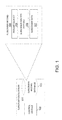
- FIG. 1 illustrates an example subscriber data server including a subscriber record database.
- FIG. 2 illustrates a subscriber data server including an authentication database and a subscriber trace.
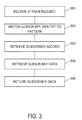
- FIG. 3 illustrates an example method of returning subscriber data using a subscriber identity pattern.
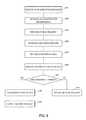
- FIG. 4 illustrates an example method of managing connections of devices served by a common subscriber record.
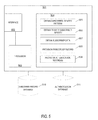
- FIG. 5 illustrates an example subscriber data server including computer executable instructions to provision a shared subscriber record.
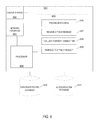
- FIG. 6 illustrates an example subscriber data server including computer executable instructions for managing connection status of groups of devices sharing subscriber records.
- GSM Global System for Mobile Communications
- 3GPP 3 rd Generation Partnership Project
- LTE Long Term Evolution
- Operational, sizing, provisioning, and billing models may be based on the assumption that devices connect to the network for a long duration, each device is associated with a unique subscription, and each subscription is associated with a fixed address.
- a subscriber data server such as a home location register (HLR) or home subscriber server (HSS) may store a separate record for each subscriber device, typically keyed by an International Mobile Subscriber Identity (IMSI) stored on a subscriber identity module (SIM).
- IMSI International Mobile Subscriber Identity
- SIM subscriber identity module
- aspects of the disclosed technology may allow a single subscription record to control a group of devices.
- the devices may be configured to be normally disconnected from the network and to only connect for short intervals at random times. For example, the devices may use their connection times to upload data, download instructions, or perform other periodic communications as necessary for their specific applications. Accordingly, a single subscription may support a large group of M2M devices, such as IoT devices.
- the disclosed technology may be implemented in existing networks, such as existing GSM, 3GPP, or LTE standards.
- FIG. 1 illustrates an example subscriber data server 101 including a subscriber record database 103 .
- the subscriber data server 101 may be an HSS, an HLR, or a combined HSS/HLR system.
- the server 101 may be distributed across one or more physical or virtual machines.
- the control module 102 and the subscriber record database 103 may be distributed across a group of physical server machines.
- the illustrated functional modules may be implemented as software stored on a non-transitory computer readable medium, as hardware, or as a combination thereof.
- the example subscriber record database 103 may store a subscriber record 104 .
- the subscriber record 104 may include a primary subscriber identity 105 .
- the primary subscriber identity 105 may be a primary IMSI used as a key for the subscriber record 104 .
- the primary subscriber identity 105 may be an MSISDN associated with the subscriber record 104 , an IPv6 address for a device within a group of devices controlled by the record 104 , or any other unique key associated with the group of devices.
- the subscriber record 104 may further include a subscriber identity pattern 106 .
- the subscriber identity pattern 106 may be an information element that encompasses a range of different subscriber identities. The size of the range may determine the maximum number of devices that may be covered by a single subscriber record 104 .
- the subscriber identity pattern 106 may be a wildcard element. For example, an IMSI wildcard such as 18121237??? would encompass IMSIs from 18121237000 to 18121237999.
- the subscriber identity pattern 106 may be a pair of elements that encompass a range of different subscriber identities.
- the pattern 106 may be an IMSI along with a range size, such as (18121237000, 1000) would encompass IMSIs from 18121237000 to 18121237999.
- the subscriber identity pattern 106 may be a range size associated with the primary subscriber identity 105 to encompass a range of different subscriber identities.
- the pattern 106 may be a range such as 500. For a primary subscriber identity 105 of 18121237000, the pattern 106 of 500 would cover IMSIs from 18121237000 to 18121237499.
- the size of the range covered by the subscriber identity pattern 106 may vary between different subscriber records 104 .
- a single group of devices may share a single subscriber record 104 and the range size may be configured according to the group size.
- the range size may be the same for all records 104 .
- each record may have a subscriber identity wildcard element with an equal number of wildcard characters.
- the subscriber record 104 may further store a set of subscriber data 107 for the group of devices covered by the record 104 .
- the subscriber data 107 may be various subscriber profile data stored in an HLR or HSS to enable devices to connect to cellular networks.
- the subscriber profile data may include allowed access types, barred or allowed services, or other service features.
- the subscriber data 107 may also include information to assist the server in managing group of devices.
- the subscriber data 107 may include a timeout period which defines a minimum time for which a device of the group is allowed to connect to the network. For example, the timeout period may be provisioned based on the needs of the devices served by the record.
- a timeout period of 30 seconds would allow a maximum of 2 devices per minute, or 1440 device connections in a 12 hour slot, which would allow a 1000 device group to connect twice a day.
- the subscriber data 107 may include transient information such as the identity of a currently connected device and a timer of how long that device has been connected.
- the example subscriber data server 101 may further include a control module 102 .
- the control module 102 may be implemented as software stored on a non-transitory computer readable medium and executed by a processor, as hardware, or as a combination thereof.
- the control module 102 may implement the functionality of an HLR supporting a GSM or other cellular standard network, an HSS supporting an LTE or other network, or a combined HSS/HLR supporting multiple protocols on a network.
- the control module 102 may receive an attach request for a device.
- the attach request may be any message sent to the server 101 as part of a device attach or location update procedure.
- the attach request may be an authentication message or location update request sent by a serving general packet radio service (GPRS) support node (SGSN), or a visitor location register/mobile service center (VLR/MSC) to an HLR.
- GPRS general packet radio service
- SGSN serving general packet radio service
- VLR/MSC visitor location register/mobile service center
- the attach request may be an authentication message or location update request sent by a mobile management entity (MME) to an HSS).
- MME mobile management entity
- the request may include a subscriber identity for the device, which may be different than the primary subscriber identity of a record 104 stored on the subscriber record database 103 .
- the control module 102 may retrieve a subscriber record 104 for the device by matching the identity in the request to a subscriber identity pattern 106 of a subscriber record 104 .
- the control module 102 may search the subscriber database 103 for a subscriber record 104 having a subscriber identity pattern 106 that encompasses the subscribed identity.
- the control module 102 may further determine a primary subscriber identity 105 that corresponds to the matched subscriber identity pattern 106 .
- the control module 102 may retrieve the subscriber data 107 from the subscriber record 104 using the primary subscriber identity 105 as a key. Alternatively, the control module 102 may retrieve the subscriber data 107 from the subscriber record 104 using the pattern 106 as a key. The control module 102 may then return the subscriber profile data 107 from the subscriber data 107 . For example, the control module 102 may return the subscriber profile data 107 as an update location message.
- the server 101 may receive a second attach request for a second device in the group of devices covered by the record 104 .
- the server 101 may receive the second attach request while the first device is still attached to the network.
- the server 101 may reject the connection attempt unless the timeout period following the first device's connection time has elapsed. If the first device's connection has exceeded the timeout period, then the sever 101 may cancel the first connection and allow the second device to attach.
- the control module 102 may receive a second attach request for a second device, the second request including a second subscriber identity matching the subscriber identity pattern. If the first device has been connected for at least a timeout period, the control module 102 may disconnect the first device. For example, the control module 102 may disconnect the first device by transmitting a cancel location message to the SGSN or MME currently supporting the first device. Additionally, the control module may return the subscriber data from the subscriber record to allow the second device to connect. For example, the control module may return the subscriber data as part of an update location message for the second device. If the first device has been connected for less than the timeout period, the control module 102 may transmit a refusal to the attach request. The second device may then try to connect later. For example, the second device may wait for a random back off time and attempt to reconnect after the back off period.
- FIG. 2 illustrates a subscriber data server 201 including an authentication database 208 and a subscriber trace 209 .
- the server 201 may be an implementation of a server described with respect to FIG. 1 .
- the control module 202 , subscriber record database 203 , subscriber record 204 , primary identity 205 , subscriber identity pattern 206 , and subscriber data 207 may be as described with respect to control module 102 , subscriber record database 103 , subscriber record 104 , primary identity 105 , subscriber identity pattern 106 , and subscriber data 107 of FIG. 1 , respectively.
- the subscriber data server 201 may maintain a single authentication record for a plurality of subscriber identities matching the subscriber identity pattern. In this situation, the authentication information on the SIM cards of the devices served by a subscriber record 204 would be shared. For example, a SIM manufacturer may manufacture such custom SIM cards for a particular M2M deployment.
- the authentication record database 208 may store the single authentication record for the plurality of subscriber identities matching the subscriber identity pattern. For example, the authentication record may be keyed by the primary identity 205 or the subscriber identity pattern 206 of the corresponding subscriber record 204 .
- the control module 202 may retrieve authentication information keyed to the primary subscriber identity 205 or the subscriber identity pattern 206 . The control module 202 may then return the retrieved information in an authentication response with the connecting device's identity.
- the subscriber data server 201 may maintain separate authentication records for each subscriber identity served by a subscriber record 204 . For example, this may accommodate the situation where each SIM card contains unique authentication information.
- the server 201 may maintain each authentication record keyed to the individual device's identity, such as its IMSI.
- the control module 202 may retrieve the authentication information keyed to the connecting device's identity and return it in a message containing the same identity.
- the subscriber data server 201 may include a log, such as a subscriber trace log. Records within the log may be keyed by device subscriber identity and may include connection attempt times for a device, successful connection times and connection time lengths, disconnection times, corresponding primary subscriber identities, or other useful information for tracking the behavior of devices served by a subscriber record 204 .
- FIG. 3 illustrates an example method of returning subscriber data using a subscriber identity pattern.
- the example method may be performed by an HLR or an HSS.
- the method of FIG. 3 may be implemented during operation of a subscriber data server such as the subscriber data server 101 of FIG. 1 or the subscriber data server 201 of FIG. 2 .
- Block 301 may include receiving an attach request for a device, the request including a subscriber identity for the device.
- the attach request may be any message sent to the server as part of a device attach or location update procedure.
- the attach request may be an authentication message or location update request sent by a serving general packet radio service (GPRS) support node (SGSN), or a visitor location register/mobile service center (VLR/MSC) to an HLR.
- GPRS general packet radio service
- VLR/MSC visitor location register/mobile service center
- the attach request may be an authentication message or location update request sent by a mobile management entity (MME) to an HSS).
- MME mobile management entity
- the request may include a subscriber identity for the device, such as an IMSI or MSISDN of the device.
- Block 302 may include matching the subscriber identity to a subscriber identity pattern.
- the subscriber identity pattern may be a wildcard field stored within a subscriber record of a subscriber profile database. Matching the subscriber identity may include matching a stored wildcard to the subscriber identity.
- Block 303 may include retrieving a subscriber record using the subscriber identity pattern.
- block 303 may include using the subscriber identity pattern as a key to a subscriber record.
- block 303 may include using the subscriber identity pattern to determine a primary subscriber identity associated with the subscriber identity pattern and using the primary subscriber identity as a key to the subscriber record.
- Block 304 may include retrieving subscriber data from the subscriber record.
- the subscriber data may include subscriber profile data that is shared by a group of devices having identities that match the subscriber identity pattern.
- the subscriber profile data may include information provided by an HLR or HSS to an SGSN or MME during attach or update procedures.
- the example method may further include block 305 .
- Block 305 may include returning the subscriber data.
- block 305 may include returning the subscriber data as a response to the attach request received in block 301 .
- the response may include the device identity received in the attach request along with the subscriber data keyed to the primary subscriber identity.
- FIG. 4 illustrates an example method of managing connections of devices served by a common subscriber record.
- the example method may be performed by an HLR or an HSS.
- the method of FIG. 4 may be implemented during operation of a subscriber data server such as the subscriber data server 101 of FIG. 1 or the subscriber data server 201 of FIG. 2 .
- the example method may include block 401 .
- Block 401 may include receiving an authentication request.
- the authentication request may include a device identity, such as an IMSI, of a first device that is managed by a shared subscriber record.
- the authentication request may be sent by an SGSN, or an MSC/VLR during an initial network attach or location update procedure.
- the example method may also include block 402 .
- Block 402 may include obtaining the requested authentication information for the device from an authentication record database.
- Block 402 may further include returning the authentication information as a response to the authentication request received in block 401 .
- block 402 may include matching the device identity from the authentication request to a subscriber identity pattern.
- block 402 may include retrieving authentication information based on the subscriber identity pattern.
- the authentication information may be shared between devices matching the subscriber identity pattern.
- block 402 may include using the subscriber identity pattern to retrieve a primary subscriber identity for a shared subscriber record, and using the primary subscriber identity as a key to the shared authentication information.
- block 402 may include using the device identity from the authentication request as a key to the authentication information.
- the authentication information may be unique to the device.
- the example method may further include block 403 .
- Block 403 may include receiving an attach request for the first device.
- block 403 may be performed as described with respect to block 301 of FIG. 3 .
- the example method may further include block 404 .
- Block 404 may include retrieving a subscriber record shared by the first device and other devices of a group of devices. For example, block 404 may be performed as described with respect to blocks 303 and 303 of FIG. 3 .
- the example method may further include block 405 .
- Block 405 may include returning subscriber data retrieved from the subscriber record retrieved in block 404 .
- block 405 may be performed as described with respect to block 304 of FIG. 3 .
- Block 406 may include receiving a second attached request for a second device.
- the second request may include a second subscriber identity, such as a second IMSI, for the second device.
- the second device may be another device in a group of devices sharing the subscription record with the first device. In this case, the second subscriber identity will match the subscriber identity pattern of the subscriber record retrieved in block 404 .
- Block 407 may include determining if the first device has been connected for at least a timeout period. For example, the timeout period may be retrieved from the subscriber record retrieved in block 404 . Additionally, the time for which the first device has been connected may be stored as temporary data in the subscriber record.
- blocks 408 and 409 may be performed. If the first device has been connected for less than the timeout period then block 410 may be performed.
- Block 408 may include disconnecting the first device.
- block 408 may include transmitting a cancel location message to the SGSN or MSC/VLR to which the first device is currently associated.
- Block 409 may include granted the second attach request.
- block 409 may include returning the subscriber data as a response to the second attach request 406 as described with respect to block 405 .
- Block 410 may include refusing to grant the second attach request.
- block 410 may include transmitting a refusal as a response to the second attach request received in block 406 .
- FIG. 5 illustrates an example subscriber data server 501 including computer executable instructions to provision a shared subscriber record.
- the data server 501 may be an HLR or HSS and may be an implementation of the servers described with respect to FIGS. 1 and 2 .
- the server 501 may include a non-transitory computer readable medium 504 .
- the medium 504 may include memory such as random access memory (RAM), storage such as hard disk, or solid state storage, or a combination thereof.
- RAM random access memory
- storage such as hard disk, or solid state storage, or a combination thereof.
- the medium 504 may store a first set of instructions 505 that are executable by a processor 503 .
- the first set of instructions 505 may be executed to obtain a subscriber identity pattern.
- the subscriber pattern may be a wildcard field or other information element that covers a range of subscriber identities.
- the subscriber identity pattern may be as described with respect to pattern 106 of FIG. 1 .
- the instructions 505 may be executable to retrieve the subscriber pattern from a user through a provisioning user interface 502 .
- the instructions 505 may be executable to generate the subscriber pattern from other information, such as a primary subscriber identity key received through the interface 502 .
- the medium 504 may store a second set of instructions 506 that are executable by the processor 503 .
- the instructions 506 may be executable to obtain a primary subscriber identity corresponding to the subscriber identity pattern.
- the primary subscriber identity may be as described with respect to identity 105 of FIG. 1 and may serve as a key for the shared subscriber record.
- the instructions 506 may be executable to generate the primary subscriber key from the subscriber identity pattern.
- the instructions 506 may be executable to receive the primary subscriber key via the interface 502 .
- the medium 504 may store a third set of instructions 507 that are executable by the processor 503 .
- the instructions 507 may be executable to obtain subscriber data for a set of devices having subscriber identities matching the subscriber identity pattern.
- the subscriber data may be as described with respect to subscriber data 107 of FIG. 1 .
- the data 107 may be received via the provisioning user interface 502 .
- the medium 504 may store a fourth set of instructions 508 that are executable by the processor 503 .
- the instructions 508 may be executable to provision a subscriber record keyed to the primary subscriber identity and including the subscriber identity pattern and the subscriber data.
- the instructions 508 may be executable to use the obtained information to create a subscriber record and store the subscriber record on a subscriber record database 510 .
- the subscriber record may be as described with respect to subscriber record 104 of FIG. 1 and the subscriber record database 501 may be as described with respect to database 103 .
- the medium 506 may also store a fifth set of instructions 509 .
- the instructions 509 may be executable to provision authentication records for the subscribers in an authentication database 511 .
- the authentication records and database 511 may be as described with respect to authentication records 208 of FIG. 2 .
- the instructions 509 may be executable to provision separate authentication records for a set of devices matching the primary subscriber identity.
- FIG. 6 illustrates an example subscriber data server 601 including computer executable instructions for managing connection status of groups of devices sharing subscriber records.
- the data server 601 may be an HLR or HSS and may be an implementation of the servers described with respect to FIGS. 1, 2, and 5 .
- the example server 601 may include a non-transitory computer readable medium 605 .
- the medium 605 may include memory such as random access memory (RAM), storage such as hard disk, or solid state storage, or a combination thereof.
- RAM random access memory
- storage such as hard disk, or solid state storage, or a combination thereof.
- the medium 605 may store a first set of instructions 606 .
- Instructions 606 may be executable by a processor 604 to receive information for shared subscriber records and authentication records via a user interface 602 .
- Instructions 606 may be further executable by the processor 604 to provision the corresponding records in a subscriber record database 610 and an authentication database.
- instruction set 606 may be as described with respect to instructions 505 - 509 of FIG. 5 .
- Medium 605 may further store instruction set 607 .
- Instruction set 607 may be executable by the processor 604 to receive an attach request via a network interface for a subscriber device.
- the attach request may be for a requesting device having a first subscriber identity matching a subscriber identity pattern of a subscriber record.
- a currently attached subscriber device may be connected to the cellular network using the subscriber record. Accordingly, the currently attached subscriber device may have a second subscriber identity matching the subscriber identity pattern.
- Medium 605 may store instruction set 608 .
- Instruction set 608 may be executable by the processor 604 to evaluate the connection time of the currently attached subscriber device. For example, instruction set 608 may be executable to retrieve a current connection length of the current device from the subscriber record and to compare that connection length to a timeout period. In some cases, the timeout period may be stored in the subscriber record.
- Medium 605 may store instruction set 609 .
- Instruction set 609 may be executable to respond to the attach request according to the connection length of the currently attached device. For example, if the currently attached device has been attached for less than the timeout period, the instructions 609 may be executable to deny the attach request. If the currently attached device has been attached for more than the timeout period, the instructions 609 may be executable to disconnect the currently attached device and grant the attach request. For example, the instructions 609 may be executable to cause the server 601 to transmit a cancel location message for the first device and to transmit an update location message for the second device.
Landscapes
- Engineering & Computer Science (AREA)
- Computer Networks & Wireless Communication (AREA)
- Signal Processing (AREA)
- Databases & Information Systems (AREA)
- Computer Security & Cryptography (AREA)
- Mobile Radio Communication Systems (AREA)
Abstract
Description
- Machine Type Communications (MTC) enables machines to communicate directly with one another in a machine to machine (M2M) fashion. For example, MTC is a foundational technology for the Internet of Things (IoT), the network of physical objects embedded with electronics and connectivity.
-
FIG. 1 illustrates an example subscriber data server including a subscriber record database. -
FIG. 2 illustrates a subscriber data server including an authentication database and a subscriber trace. -
FIG. 3 illustrates an example method of returning subscriber data using a subscriber identity pattern. -
FIG. 4 illustrates an example method of managing connections of devices served by a common subscriber record. -
FIG. 5 illustrates an example subscriber data server including computer executable instructions to provision a shared subscriber record. -
FIG. 6 illustrates an example subscriber data server including computer executable instructions for managing connection status of groups of devices sharing subscriber records. - Cellular network communications are often used for MTC. Existing cellular networks, such as Global System for Mobile Communications (GSM) standard based networks, 3rd Generation Partnership Project (3GPP) standard based networks, or Long Term Evolution (LTE) standard based networks, are designed to provide human voice and data communications. Operational, sizing, provisioning, and billing models may be based on the assumption that devices connect to the network for a long duration, each device is associated with a unique subscription, and each subscription is associated with a fixed address. For example, a subscriber data server, such as a home location register (HLR) or home subscriber server (HSS), may store a separate record for each subscriber device, typically keyed by an International Mobile Subscriber Identity (IMSI) stored on a subscriber identity module (SIM).
- Aspects of the disclosed technology may allow a single subscription record to control a group of devices. The devices may be configured to be normally disconnected from the network and to only connect for short intervals at random times. For example, the devices may use their connection times to upload data, download instructions, or perform other periodic communications as necessary for their specific applications. Accordingly, a single subscription may support a large group of M2M devices, such as IoT devices. In some cases, the disclosed technology may be implemented in existing networks, such as existing GSM, 3GPP, or LTE standards.
-
FIG. 1 illustrates an examplesubscriber data server 101 including asubscriber record database 103. For example, thesubscriber data server 101 may be an HSS, an HLR, or a combined HSS/HLR system. In some implementations, theserver 101 may be distributed across one or more physical or virtual machines. For example, thecontrol module 102 and thesubscriber record database 103 may be distributed across a group of physical server machines. Additionally, the illustrated functional modules may be implemented as software stored on a non-transitory computer readable medium, as hardware, or as a combination thereof. - The example
subscriber record database 103 may store asubscriber record 104. Thesubscriber record 104 may include aprimary subscriber identity 105. For example, theprimary subscriber identity 105 may be a primary IMSI used as a key for thesubscriber record 104. As other examples, theprimary subscriber identity 105 may be an MSISDN associated with thesubscriber record 104, an IPv6 address for a device within a group of devices controlled by therecord 104, or any other unique key associated with the group of devices. - The
subscriber record 104 may further include asubscriber identity pattern 106. Thesubscriber identity pattern 106 may be an information element that encompasses a range of different subscriber identities. The size of the range may determine the maximum number of devices that may be covered by asingle subscriber record 104. In some implementations, thesubscriber identity pattern 106 may be a wildcard element. For example, an IMSI wildcard such as 18121237??? would encompass IMSIs from 18121237000 to 18121237999. As another example, thesubscriber identity pattern 106 may be a pair of elements that encompass a range of different subscriber identities. For example, thepattern 106 may be an IMSI along with a range size, such as (18121237000, 1000) would encompass IMSIs from 18121237000 to 18121237999. As a further example, thesubscriber identity pattern 106 may be a range size associated with theprimary subscriber identity 105 to encompass a range of different subscriber identities. For example, thepattern 106 may be a range such as 500. For aprimary subscriber identity 105 of 18121237000, thepattern 106 of 500 would cover IMSIs from 18121237000 to 18121237499. - In some implementations, the size of the range covered by the
subscriber identity pattern 106 may vary betweendifferent subscriber records 104. For example, a single group of devices may share asingle subscriber record 104 and the range size may be configured according to the group size. In other implementations, the range size may be the same for allrecords 104. For example, each record may have a subscriber identity wildcard element with an equal number of wildcard characters. - The
subscriber record 104 may further store a set ofsubscriber data 107 for the group of devices covered by therecord 104. In some implementations, thesubscriber data 107 may be various subscriber profile data stored in an HLR or HSS to enable devices to connect to cellular networks. For example, the subscriber profile data may include allowed access types, barred or allowed services, or other service features. Thesubscriber data 107 may also include information to assist the server in managing group of devices. For example, thesubscriber data 107 may include a timeout period which defines a minimum time for which a device of the group is allowed to connect to the network. For example, the timeout period may be provisioned based on the needs of the devices served by the record. For example, a timeout period of 30 seconds would allow a maximum of 2 devices per minute, or 1440 device connections in a 12 hour slot, which would allow a 1000 device group to connect twice a day. As another example, thesubscriber data 107 may include transient information such as the identity of a currently connected device and a timer of how long that device has been connected. - The example
subscriber data server 101 may further include acontrol module 102. For example, thecontrol module 102 may be implemented as software stored on a non-transitory computer readable medium and executed by a processor, as hardware, or as a combination thereof. For example, thecontrol module 102 may implement the functionality of an HLR supporting a GSM or other cellular standard network, an HSS supporting an LTE or other network, or a combined HSS/HLR supporting multiple protocols on a network. - The
control module 102 may receive an attach request for a device. For example, the attach request may be any message sent to theserver 101 as part of a device attach or location update procedure. For example, the attach request may be an authentication message or location update request sent by a serving general packet radio service (GPRS) support node (SGSN), or a visitor location register/mobile service center (VLR/MSC) to an HLR. As another example, the attach request may be an authentication message or location update request sent by a mobile management entity (MME) to an HSS). The request may include a subscriber identity for the device, which may be different than the primary subscriber identity of arecord 104 stored on thesubscriber record database 103. - The
control module 102 may retrieve asubscriber record 104 for the device by matching the identity in the request to asubscriber identity pattern 106 of asubscriber record 104. For example, thecontrol module 102 may search thesubscriber database 103 for asubscriber record 104 having asubscriber identity pattern 106 that encompasses the subscribed identity. Thecontrol module 102 may further determine aprimary subscriber identity 105 that corresponds to the matchedsubscriber identity pattern 106. - The
control module 102 may retrieve thesubscriber data 107 from thesubscriber record 104 using theprimary subscriber identity 105 as a key. Alternatively, thecontrol module 102 may retrieve thesubscriber data 107 from thesubscriber record 104 using thepattern 106 as a key. Thecontrol module 102 may then return thesubscriber profile data 107 from thesubscriber data 107. For example, thecontrol module 102 may return thesubscriber profile data 107 as an update location message. - The
server 101 may receive a second attach request for a second device in the group of devices covered by therecord 104. For example, theserver 101 may receive the second attach request while the first device is still attached to the network. Theserver 101 may reject the connection attempt unless the timeout period following the first device's connection time has elapsed. If the first device's connection has exceeded the timeout period, then the sever 101 may cancel the first connection and allow the second device to attach. - For example, the
control module 102 may receive a second attach request for a second device, the second request including a second subscriber identity matching the subscriber identity pattern. If the first device has been connected for at least a timeout period, thecontrol module 102 may disconnect the first device. For example, thecontrol module 102 may disconnect the first device by transmitting a cancel location message to the SGSN or MME currently supporting the first device. Additionally, the control module may return the subscriber data from the subscriber record to allow the second device to connect. For example, the control module may return the subscriber data as part of an update location message for the second device. If the first device has been connected for less than the timeout period, thecontrol module 102 may transmit a refusal to the attach request. The second device may then try to connect later. For example, the second device may wait for a random back off time and attempt to reconnect after the back off period. -
FIG. 2 illustrates asubscriber data server 201 including anauthentication database 208 and asubscriber trace 209. Theserver 201 may be an implementation of a server described with respect toFIG. 1 . For example, thecontrol module 202,subscriber record database 203,subscriber record 204,primary identity 205,subscriber identity pattern 206, andsubscriber data 207 may be as described with respect to controlmodule 102,subscriber record database 103,subscriber record 104,primary identity 105,subscriber identity pattern 106, andsubscriber data 107 ofFIG. 1 , respectively. - In some implementations, the
subscriber data server 201 may maintain a single authentication record for a plurality of subscriber identities matching the subscriber identity pattern. In this situation, the authentication information on the SIM cards of the devices served by asubscriber record 204 would be shared. For example, a SIM manufacturer may manufacture such custom SIM cards for a particular M2M deployment. In these implementations, theauthentication record database 208 may store the single authentication record for the plurality of subscriber identities matching the subscriber identity pattern. For example, the authentication record may be keyed by theprimary identity 205 or thesubscriber identity pattern 206 of thecorresponding subscriber record 204. In these implementations, during authentication, thecontrol module 202 may retrieve authentication information keyed to theprimary subscriber identity 205 or thesubscriber identity pattern 206. Thecontrol module 202 may then return the retrieved information in an authentication response with the connecting device's identity. - In other implementations, the
subscriber data server 201 may maintain separate authentication records for each subscriber identity served by asubscriber record 204. For example, this may accommodate the situation where each SIM card contains unique authentication information. In these implementations, theserver 201 may maintain each authentication record keyed to the individual device's identity, such as its IMSI. In these implementations, during authentication, thecontrol module 202 may retrieve the authentication information keyed to the connecting device's identity and return it in a message containing the same identity. - In some implementations, the
subscriber data server 201 may include a log, such as a subscriber trace log. Records within the log may be keyed by device subscriber identity and may include connection attempt times for a device, successful connection times and connection time lengths, disconnection times, corresponding primary subscriber identities, or other useful information for tracking the behavior of devices served by asubscriber record 204. -
FIG. 3 illustrates an example method of returning subscriber data using a subscriber identity pattern. In some implementations, the example method may be performed by an HLR or an HSS. For example, the method ofFIG. 3 may be implemented during operation of a subscriber data server such as thesubscriber data server 101 ofFIG. 1 or thesubscriber data server 201 ofFIG. 2 . - The example method may include block 301.
Block 301 may include receiving an attach request for a device, the request including a subscriber identity for the device. For example, the attach request may be any message sent to the server as part of a device attach or location update procedure. For example, the attach request may be an authentication message or location update request sent by a serving general packet radio service (GPRS) support node (SGSN), or a visitor location register/mobile service center (VLR/MSC) to an HLR. As another example, the attach request may be an authentication message or location update request sent by a mobile management entity (MME) to an HSS). The request may include a subscriber identity for the device, such as an IMSI or MSISDN of the device. - The example method may further include
block 302.Block 302 may include matching the subscriber identity to a subscriber identity pattern. For example, the subscriber identity pattern may be a wildcard field stored within a subscriber record of a subscriber profile database. Matching the subscriber identity may include matching a stored wildcard to the subscriber identity. - The example method may further include
block 303.Block 303 may include retrieving a subscriber record using the subscriber identity pattern. For example, block 303 may include using the subscriber identity pattern as a key to a subscriber record. As another example, block 303 may include using the subscriber identity pattern to determine a primary subscriber identity associated with the subscriber identity pattern and using the primary subscriber identity as a key to the subscriber record. - The example method may further include
block 304.Block 304 may include retrieving subscriber data from the subscriber record. For example, the subscriber data may include subscriber profile data that is shared by a group of devices having identities that match the subscriber identity pattern. For example, the subscriber profile data may include information provided by an HLR or HSS to an SGSN or MME during attach or update procedures. - The example method may further include
block 305.Block 305 may include returning the subscriber data. For example, block 305 may include returning the subscriber data as a response to the attach request received inblock 301. The response may include the device identity received in the attach request along with the subscriber data keyed to the primary subscriber identity. -
FIG. 4 illustrates an example method of managing connections of devices served by a common subscriber record. In some implementations, the example method may be performed by an HLR or an HSS. For example, the method ofFIG. 4 may be implemented during operation of a subscriber data server such as thesubscriber data server 101 ofFIG. 1 or thesubscriber data server 201 ofFIG. 2 . - The example method may include block 401.
Block 401 may include receiving an authentication request. The authentication request may include a device identity, such as an IMSI, of a first device that is managed by a shared subscriber record. For example, the authentication request may be sent by an SGSN, or an MSC/VLR during an initial network attach or location update procedure. - The example method may also include
block 402.Block 402 may include obtaining the requested authentication information for the device from an authentication record database.Block 402 may further include returning the authentication information as a response to the authentication request received inblock 401. - In some implementations, block 402 may include matching the device identity from the authentication request to a subscriber identity pattern. In this example, block 402 may include retrieving authentication information based on the subscriber identity pattern. In this case, the authentication information may be shared between devices matching the subscriber identity pattern. As another example, block 402 may include using the subscriber identity pattern to retrieve a primary subscriber identity for a shared subscriber record, and using the primary subscriber identity as a key to the shared authentication information.
- In other implementations, block 402 may include using the device identity from the authentication request as a key to the authentication information. In these implementations, the authentication information may be unique to the device.
- The example method may further include
block 403.Block 403 may include receiving an attach request for the first device. For example, block 403 may be performed as described with respect to block 301 ofFIG. 3 . - The example method may further include
block 404.Block 404 may include retrieving a subscriber record shared by the first device and other devices of a group of devices. For example, block 404 may be performed as described with respect toblocks FIG. 3 . - The example method may further include
block 405.Block 405 may include returning subscriber data retrieved from the subscriber record retrieved inblock 404. For example, block 405 may be performed as described with respect to block 304 ofFIG. 3 . - The example method may further include
block 406.Block 406 may include receiving a second attached request for a second device. The second request may include a second subscriber identity, such as a second IMSI, for the second device. The second device may be another device in a group of devices sharing the subscription record with the first device. In this case, the second subscriber identity will match the subscriber identity pattern of the subscriber record retrieved inblock 404. - The example method may further include
block 407.Block 407 may include determining if the first device has been connected for at least a timeout period. For example, the timeout period may be retrieved from the subscriber record retrieved inblock 404. Additionally, the time for which the first device has been connected may be stored as temporary data in the subscriber record. - If the first device has been connected for at least a timeout period, then blocks 408 and 409 may be performed. If the first device has been connected for less than the timeout period then block 410 may be performed.
-
Block 408 may include disconnecting the first device. For example, block 408 may include transmitting a cancel location message to the SGSN or MSC/VLR to which the first device is currently associated. -
Block 409 may include granted the second attach request. for example, block 409 may include returning the subscriber data as a response to the second attachrequest 406 as described with respect to block 405. -
Block 410 may include refusing to grant the second attach request. For example, block 410 may include transmitting a refusal as a response to the second attach request received inblock 406. -
FIG. 5 illustrates an examplesubscriber data server 501 including computer executable instructions to provision a shared subscriber record. For example, thedata server 501 may be an HLR or HSS and may be an implementation of the servers described with respect toFIGS. 1 and 2 . - The
server 501 may include a non-transitory computerreadable medium 504. For example, the medium 504 may include memory such as random access memory (RAM), storage such as hard disk, or solid state storage, or a combination thereof. - The medium 504 may store a first set of
instructions 505 that are executable by aprocessor 503. The first set ofinstructions 505 may be executed to obtain a subscriber identity pattern. For example, the subscriber pattern may be a wildcard field or other information element that covers a range of subscriber identities. For example, the subscriber identity pattern may be as described with respect topattern 106 ofFIG. 1 . In some cases, theinstructions 505 may be executable to retrieve the subscriber pattern from a user through aprovisioning user interface 502. In other cases, theinstructions 505 may be executable to generate the subscriber pattern from other information, such as a primary subscriber identity key received through theinterface 502. - The medium 504 may store a second set of
instructions 506 that are executable by theprocessor 503. Theinstructions 506 may be executable to obtain a primary subscriber identity corresponding to the subscriber identity pattern. For example, the primary subscriber identity may be as described with respect toidentity 105 ofFIG. 1 and may serve as a key for the shared subscriber record. In some cases, theinstructions 506 may be executable to generate the primary subscriber key from the subscriber identity pattern. In other cases, theinstructions 506 may be executable to receive the primary subscriber key via theinterface 502. - The medium 504 may store a third set of
instructions 507 that are executable by theprocessor 503. Theinstructions 507 may be executable to obtain subscriber data for a set of devices having subscriber identities matching the subscriber identity pattern. For example, the subscriber data may be as described with respect tosubscriber data 107 ofFIG. 1 . In some implementations, thedata 107 may be received via theprovisioning user interface 502. - The medium 504 may store a fourth set of
instructions 508 that are executable by theprocessor 503. Theinstructions 508 may be executable to provision a subscriber record keyed to the primary subscriber identity and including the subscriber identity pattern and the subscriber data. For example, theinstructions 508 may be executable to use the obtained information to create a subscriber record and store the subscriber record on asubscriber record database 510. For example, the subscriber record may be as described with respect tosubscriber record 104 ofFIG. 1 and thesubscriber record database 501 may be as described with respect todatabase 103. - The medium 506 may also store a fifth set of
instructions 509. Theinstructions 509 may be executable to provision authentication records for the subscribers in anauthentication database 511. For example, the authentication records anddatabase 511 may be as described with respect toauthentication records 208 ofFIG. 2 . In some cases, theinstructions 509 may be executable to provision separate authentication records for a set of devices matching the primary subscriber identity. -
FIG. 6 illustrates an examplesubscriber data server 601 including computer executable instructions for managing connection status of groups of devices sharing subscriber records. For example, thedata server 601 may be an HLR or HSS and may be an implementation of the servers described with respect toFIGS. 1, 2, and 5 . - The
example server 601 may include a non-transitory computerreadable medium 605. For example, the medium 605 may include memory such as random access memory (RAM), storage such as hard disk, or solid state storage, or a combination thereof. - The medium 605 may store a first set of
instructions 606.Instructions 606 may be executable by aprocessor 604 to receive information for shared subscriber records and authentication records via auser interface 602.Instructions 606 may be further executable by theprocessor 604 to provision the corresponding records in asubscriber record database 610 and an authentication database. For example,instruction set 606 may be as described with respect to instructions 505-509 ofFIG. 5 . -
Medium 605 may further storeinstruction set 607.Instruction set 607 may be executable by theprocessor 604 to receive an attach request via a network interface for a subscriber device. The attach request may be for a requesting device having a first subscriber identity matching a subscriber identity pattern of a subscriber record. In some cases, a currently attached subscriber device may be connected to the cellular network using the subscriber record. Accordingly, the currently attached subscriber device may have a second subscriber identity matching the subscriber identity pattern. -
Medium 605 may storeinstruction set 608.Instruction set 608 may be executable by theprocessor 604 to evaluate the connection time of the currently attached subscriber device. For example,instruction set 608 may be executable to retrieve a current connection length of the current device from the subscriber record and to compare that connection length to a timeout period. In some cases, the timeout period may be stored in the subscriber record. -
Medium 605 may storeinstruction set 609.Instruction set 609 may be executable to respond to the attach request according to the connection length of the currently attached device. For example, if the currently attached device has been attached for less than the timeout period, theinstructions 609 may be executable to deny the attach request. If the currently attached device has been attached for more than the timeout period, theinstructions 609 may be executable to disconnect the currently attached device and grant the attach request. For example, theinstructions 609 may be executable to cause theserver 601 to transmit a cancel location message for the first device and to transmit an update location message for the second device. - In the foregoing description, numerous details are set forth to provide an understanding of the subject disclosed herein. However, implementations may be practiced without some or all of these details. Other implementations may include modifications and variations from the details discussed above. It is intended that the appended claims cover such modifications and variations.
Claims (15)
Applications Claiming Priority (3)
| Application Number | Priority Date | Filing Date | Title |
|---|---|---|---|
| IN1910/CHE/2015 | 2015-04-13 | ||
| IN1910CH2015 | 2015-04-13 | ||
| PCT/US2015/055061 WO2016167834A1 (en) | 2015-04-13 | 2015-10-12 | Subscriber identity pattern |
Publications (2)
| Publication Number | Publication Date |
|---|---|
| US20180098216A1 true US20180098216A1 (en) | 2018-04-05 |
| US10433170B2 US10433170B2 (en) | 2019-10-01 |
Family
ID=57126692
Family Applications (1)
| Application Number | Title | Priority Date | Filing Date |
|---|---|---|---|
| US15/566,620 Active US10433170B2 (en) | 2015-04-13 | 2015-10-12 | Subscriber identity pattern |
Country Status (3)
| Country | Link |
|---|---|
| US (1) | US10433170B2 (en) |
| EP (1) | EP3269084B1 (en) |
| WO (1) | WO2016167834A1 (en) |
Cited By (7)
| Publication number | Priority date | Publication date | Assignee | Title |
|---|---|---|---|---|
| US20180091501A1 (en) * | 2016-09-29 | 2018-03-29 | Intel Corporation | Mirrored communication devices in carrier networks |
| US20190238644A1 (en) * | 2018-01-31 | 2019-08-01 | T-Mobile Usa, Inc. | User identification for digital experience controls |
| US10764744B2 (en) * | 2018-06-29 | 2020-09-01 | Verizon Patent And Licensing Inc. | System and method for supporting shared service profiles between network devices of core network |
| US11206267B2 (en) | 2018-01-31 | 2021-12-21 | T-Mobile Usa, Inc. | Fine grained digital experience controls |
| US11570610B2 (en) * | 2020-04-03 | 2023-01-31 | Telus Communications Inc. | System and method for managing visitor location register (VLR) records by updating duplicate records |
| US11611877B2 (en) | 2020-07-08 | 2023-03-21 | T-Mobile Usa, Inc. | User authentication |
| US11627137B2 (en) | 2018-01-31 | 2023-04-11 | T-Mobile Usa, Inc. | Virtual profile instantiations via an access privilege control system |
Families Citing this family (1)
| Publication number | Priority date | Publication date | Assignee | Title |
|---|---|---|---|---|
| SE541983C2 (en) * | 2017-09-25 | 2020-01-14 | Tele2 Iot Ab | Method and subscriber identity component for providing network access |
Family Cites Families (19)
| Publication number | Priority date | Publication date | Assignee | Title |
|---|---|---|---|---|
| FR2841087A1 (en) | 2002-06-18 | 2003-12-19 | Cegetel Groupe | Mobile telephone management distance placed equipment having first step providing time slot division attributes with second step server synchronization third step terminal storing specified time slots each terminal. |
| US8478238B2 (en) | 2005-04-29 | 2013-07-02 | Jasper Wireless, Inc. | Global platform for managing subscriber identity modules |
| KR100981963B1 (en) * | 2007-07-06 | 2010-09-13 | 한국전자통신연구원 | Node Authentication and Node Operation in Service Network and Access Network for Bundled Authentication between Service Network and Access Network in Next Generation Networks |
| US8850066B2 (en) * | 2008-05-28 | 2014-09-30 | Cisco Technology, Inc. | Dynamically assigning unique addresses to endpoints |
| US20100041365A1 (en) * | 2008-06-12 | 2010-02-18 | At&T Mobility Ii Llc | Mediation, rating, and billing associated with a femtocell service framework |
| WO2010072242A1 (en) | 2008-12-23 | 2010-07-01 | Nokia Siemens Networks Oy | Service control based on subscriber identity |
| US8792356B2 (en) * | 2009-04-14 | 2014-07-29 | At&T Mobility Ii Llc | Determining telecommunication subscriber metrics |
| WO2010124184A2 (en) * | 2009-04-24 | 2010-10-28 | Evolving Systems, Inc. | Occasional access to a wireless network |
| EP2259611A1 (en) | 2009-06-05 | 2010-12-08 | Hewlett-Packard Development Company, L.P. | Method and apparatus for associating a subscriber directory identifier to a subscriber identifier |
| US9083587B2 (en) * | 2009-08-21 | 2015-07-14 | Cisco Technology, Inc. | Port chunk allocation in network address translation |
| EP2369890A1 (en) * | 2010-03-26 | 2011-09-28 | Panasonic Corporation | Connection peak avoidance for machine-type-communication (MTC) devices |
| WO2012000161A1 (en) | 2010-06-28 | 2012-01-05 | Qualcomm Incorporated | System and method for subscription data optimization |
| CN103095470B (en) * | 2011-10-27 | 2016-02-10 | 阿尔卡特朗讯 | A kind of method of the Guest User's online charging to application content provider |
| US8577337B2 (en) | 2012-03-05 | 2013-11-05 | Rogers Communications Inc. | Radio management method and system using embedded universal integrated circuit card |
| US8755799B1 (en) * | 2012-12-26 | 2014-06-17 | Cellco Partnerhsip | Provisioning and using wildcarded private identity to register devices for wireless services |
| US9326185B2 (en) | 2013-03-11 | 2016-04-26 | Seven Networks, Llc | Mobile network congestion recognition for optimization of mobile traffic |
| US20160057291A1 (en) | 2013-03-22 | 2016-02-25 | Nokia Solutions And Networks Oy | Enabling monitoring and reporting for dynamic policy enforcement in multi-operator wholesale networks |
| US20150133052A1 (en) * | 2013-11-08 | 2015-05-14 | Nokia Corporation | Device selection |
| TWI507052B (en) * | 2014-05-28 | 2015-11-01 | Univ Nat Taipei Technology | Authentication method of volte |
-
2015
- 2015-10-12 EP EP15889419.6A patent/EP3269084B1/en active Active
- 2015-10-12 US US15/566,620 patent/US10433170B2/en active Active
- 2015-10-12 WO PCT/US2015/055061 patent/WO2016167834A1/en not_active Ceased
Cited By (10)
| Publication number | Priority date | Publication date | Assignee | Title |
|---|---|---|---|---|
| US20180091501A1 (en) * | 2016-09-29 | 2018-03-29 | Intel Corporation | Mirrored communication devices in carrier networks |
| US10805286B2 (en) * | 2016-09-29 | 2020-10-13 | Intel Corporation | Mirrored communication devices in carrier networks |
| US20190238644A1 (en) * | 2018-01-31 | 2019-08-01 | T-Mobile Usa, Inc. | User identification for digital experience controls |
| US11206267B2 (en) | 2018-01-31 | 2021-12-21 | T-Mobile Usa, Inc. | Fine grained digital experience controls |
| US11627137B2 (en) | 2018-01-31 | 2023-04-11 | T-Mobile Usa, Inc. | Virtual profile instantiations via an access privilege control system |
| US10764744B2 (en) * | 2018-06-29 | 2020-09-01 | Verizon Patent And Licensing Inc. | System and method for supporting shared service profiles between network devices of core network |
| US11412368B2 (en) * | 2018-06-29 | 2022-08-09 | Verizon Patent And Licensing Inc. | System and method for supporting shared service profiles between network devices of core network |
| US11570610B2 (en) * | 2020-04-03 | 2023-01-31 | Telus Communications Inc. | System and method for managing visitor location register (VLR) records by updating duplicate records |
| US11611877B2 (en) | 2020-07-08 | 2023-03-21 | T-Mobile Usa, Inc. | User authentication |
| US12375916B2 (en) | 2020-07-08 | 2025-07-29 | T-Mobile Usa, Inc. | User authentication |
Also Published As
| Publication number | Publication date |
|---|---|
| WO2016167834A1 (en) | 2016-10-20 |
| US10433170B2 (en) | 2019-10-01 |
| EP3269084A1 (en) | 2018-01-17 |
| EP3269084B1 (en) | 2019-11-27 |
| EP3269084A4 (en) | 2018-04-18 |
Similar Documents
| Publication | Publication Date | Title |
|---|---|---|
| US10433170B2 (en) | Subscriber identity pattern | |
| JP6698850B2 (en) | Method for enhanced machine-type communication between a mobile communication network and a group of machine-type communication devices, on the other hand, mobile communication networks, machine-type communication devices, user equipment, programs and computer program products | |
| US9026082B2 (en) | Terminal identifiers in a communications network | |
| US10721616B2 (en) | Subscription information download method, related device, and system | |
| JP6732948B2 (en) | Virtual user identification module authentication method and apparatus | |
| US9548780B2 (en) | Service sharing system and apparatus | |
| EP3125593B1 (en) | System and method for automatic detection and activation of a virtual sim on a mobile device | |
| US12133292B2 (en) | Network connectivity | |
| US10306461B2 (en) | Provision of subscriber profile to a MME in case of roaming | |
| US10419932B2 (en) | Method, device and system for authenticating to a mobile network and a server for authenticating devices to a mobile network | |
| US8406761B2 (en) | Initializing and provisioning user equipment having multi-network connectivity | |
| CN103052054A (en) | Method, equipment and system for determining access authority of users to wireless local area network (WLAN) | |
| US20200236610A1 (en) | Method and subscriber identity component for providing network access | |
| US20230262444A1 (en) | Systems and methods for supporting multiple universal subscriber identity modules | |
| WO2011089464A1 (en) | Method and apparatus of attaching to communication network | |
| EP3205133B1 (en) | Method for transferring an assignment regarding an embedded universal integrated circuit entity from a first mobile network operator to a second mobile network operator | |
| WO2015088411A1 (en) | Methods and apparatuses for communicating in a communication system comprising a home communication network and visiting communication networks | |
| JP2020502894A (en) | Service ordering method and device | |
| EP3122083A1 (en) | Method for providing a subscription to a secure element |
Legal Events
| Date | Code | Title | Description |
|---|---|---|---|
| AS | Assignment |
Owner name: HEWLETT PACKARD ENTERPRISE DEVELOPMENT LP, TEXAS Free format text: ASSIGNMENT OF ASSIGNORS INTEREST;ASSIGNOR:HEWLETT-PACKARD DEVELOPMENT COMPANY, L.P.;REEL/FRAME:044208/0001 Effective date: 20151027 Owner name: HEWLETT-PACKARD DEVELOPMENT COMPANY, L.P., TEXAS Free format text: ASSIGNMENT OF ASSIGNORS INTEREST;ASSIGNORS:VINCENT, MARIO BERTRAM;SHETTY, PRASAD VITHAL;REEL/FRAME:044264/0397 Effective date: 20150414 |
|
| FEPP | Fee payment procedure |
Free format text: ENTITY STATUS SET TO UNDISCOUNTED (ORIGINAL EVENT CODE: BIG.); ENTITY STATUS OF PATENT OWNER: LARGE ENTITY |
|
| STPP | Information on status: patent application and granting procedure in general |
Free format text: RESPONSE TO NON-FINAL OFFICE ACTION ENTERED AND FORWARDED TO EXAMINER |
|
| STPP | Information on status: patent application and granting procedure in general |
Free format text: NOTICE OF ALLOWANCE MAILED -- APPLICATION RECEIVED IN OFFICE OF PUBLICATIONS |
|
| STPP | Information on status: patent application and granting procedure in general |
Free format text: AWAITING TC RESP., ISSUE FEE NOT PAID |
|
| STPP | Information on status: patent application and granting procedure in general |
Free format text: PUBLICATIONS -- ISSUE FEE PAYMENT VERIFIED |
|
| STCF | Information on status: patent grant |
Free format text: PATENTED CASE |
|
| MAFP | Maintenance fee payment |
Free format text: PAYMENT OF MAINTENANCE FEE, 4TH YEAR, LARGE ENTITY (ORIGINAL EVENT CODE: M1551); ENTITY STATUS OF PATENT OWNER: LARGE ENTITY Year of fee payment: 4 |