US20180098131A1 - Apparatus and methods for adaptive bit-rate streaming of 360 video - Google Patents
Apparatus and methods for adaptive bit-rate streaming of 360 video Download PDFInfo
- Publication number
- US20180098131A1 US20180098131A1 US15/711,704 US201715711704A US2018098131A1 US 20180098131 A1 US20180098131 A1 US 20180098131A1 US 201715711704 A US201715711704 A US 201715711704A US 2018098131 A1 US2018098131 A1 US 2018098131A1
- Authority
- US
- United States
- Prior art keywords
- version
- versions
- viewing direction
- video data
- streaming
- Prior art date
- Legal status (The legal status is an assumption and is not a legal conclusion. Google has not performed a legal analysis and makes no representation as to the accuracy of the status listed.)
- Abandoned
Links
- 238000000034 method Methods 0.000 title claims abstract description 26
- 230000003044 adaptive effect Effects 0.000 title description 4
- 238000009877 rendering Methods 0.000 claims abstract description 29
- 230000008859 change Effects 0.000 claims description 22
- 230000005540 biological transmission Effects 0.000 description 7
- 230000006835 compression Effects 0.000 description 7
- 238000007906 compression Methods 0.000 description 7
- 238000010586 diagram Methods 0.000 description 6
- 230000006870 function Effects 0.000 description 5
- 238000013507 mapping Methods 0.000 description 5
- 238000012545 processing Methods 0.000 description 5
- 239000013074 reference sample Substances 0.000 description 5
- 239000000523 sample Substances 0.000 description 5
- 101100536354 Drosophila melanogaster tant gene Proteins 0.000 description 3
- 239000004065 semiconductor Substances 0.000 description 3
- 230000008901 benefit Effects 0.000 description 2
- 230000008569 process Effects 0.000 description 2
- 230000009467 reduction Effects 0.000 description 2
- 241000258963 Diplopoda Species 0.000 description 1
- 230000003139 buffering effect Effects 0.000 description 1
- 238000013461 design Methods 0.000 description 1
- 238000012986 modification Methods 0.000 description 1
- 230000004048 modification Effects 0.000 description 1
- 230000003287 optical effect Effects 0.000 description 1
- 230000008520 organization Effects 0.000 description 1
- 230000037361 pathway Effects 0.000 description 1
- 230000004044 response Effects 0.000 description 1
- 230000001960 triggered effect Effects 0.000 description 1
Images


Classifications
-
- H—ELECTRICITY
- H04—ELECTRIC COMMUNICATION TECHNIQUE
- H04N—PICTORIAL COMMUNICATION, e.g. TELEVISION
- H04N21/00—Selective content distribution, e.g. interactive television or video on demand [VOD]
- H04N21/60—Network structure or processes for video distribution between server and client or between remote clients; Control signalling between clients, server and network components; Transmission of management data between server and client, e.g. sending from server to client commands for recording incoming content stream; Communication details between server and client
- H04N21/63—Control signaling related to video distribution between client, server and network components; Network processes for video distribution between server and clients or between remote clients, e.g. transmitting basic layer and enhancement layers over different transmission paths, setting up a peer-to-peer communication via Internet between remote STB's; Communication protocols; Addressing
- H04N21/637—Control signals issued by the client directed to the server or network components
- H04N21/6373—Control signals issued by the client directed to the server or network components for rate control, e.g. request to the server to modify its transmission rate
-
- H—ELECTRICITY
- H04—ELECTRIC COMMUNICATION TECHNIQUE
- H04N—PICTORIAL COMMUNICATION, e.g. TELEVISION
- H04N19/00—Methods or arrangements for coding, decoding, compressing or decompressing digital video signals
- H04N19/50—Methods or arrangements for coding, decoding, compressing or decompressing digital video signals using predictive coding
- H04N19/597—Methods or arrangements for coding, decoding, compressing or decompressing digital video signals using predictive coding specially adapted for multi-view video sequence encoding
-
- H—ELECTRICITY
- H04—ELECTRIC COMMUNICATION TECHNIQUE
- H04N—PICTORIAL COMMUNICATION, e.g. TELEVISION
- H04N21/00—Selective content distribution, e.g. interactive television or video on demand [VOD]
- H04N21/20—Servers specifically adapted for the distribution of content, e.g. VOD servers; Operations thereof
- H04N21/23—Processing of content or additional data; Elementary server operations; Server middleware
- H04N21/234—Processing of video elementary streams, e.g. splicing of video streams or manipulating encoded video stream scene graphs
- H04N21/2343—Processing of video elementary streams, e.g. splicing of video streams or manipulating encoded video stream scene graphs involving reformatting operations of video signals for distribution or compliance with end-user requests or end-user device requirements
- H04N21/23439—Processing of video elementary streams, e.g. splicing of video streams or manipulating encoded video stream scene graphs involving reformatting operations of video signals for distribution or compliance with end-user requests or end-user device requirements for generating different versions
-
- H—ELECTRICITY
- H04—ELECTRIC COMMUNICATION TECHNIQUE
- H04N—PICTORIAL COMMUNICATION, e.g. TELEVISION
- H04N21/00—Selective content distribution, e.g. interactive television or video on demand [VOD]
- H04N21/80—Generation or processing of content or additional data by content creator independently of the distribution process; Content per se
- H04N21/81—Monomedia components thereof
- H04N21/816—Monomedia components thereof involving special video data, e.g 3D video
Definitions
- 360 videos also known as 360-degree video, immersive videos, or spherical videos
- 360-degree video immersive videos
- spherical videos are video recordings of a real-world panorama, where the view in every direction is recorded at the same time, shot using an omnidirectional camera or a collection of cameras.
- a viewer can have control of the viewing direction and Field of View (FOV) angles, as a form of virtual reality.
- FOV Field of View
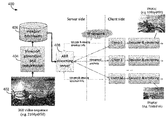
- FIG. 4 depicts a viewport based 360 video streaming system according to some example embodiments.
- FIG. 9 depicts a flow chart of a method for streaming 360-degree video data according to some example embodiments.
- this disclosure is directed to a system for streaming 360-degree video data.
- the system includes one or more viewport engines and a streaming server.
- the one or more viewport engines receive 360-degree video data, and generate a plurality of versions of the 360-degree video data.
- each version has a corresponding primary viewing direction, includes independently decodable units (IDUs) of video data arranged according to a sequence, and has image resolution for the corresponding primary viewing direction that is higher than image resolutions for other viewing directions.
- the streaming server streams a first IDU of video content from a first version of the plurality of versions of the 360-degree video data to a client for rendering at the client.
- the one or more viewport engines generate IDUs of the first and second versions for streaming at a first bit rate.
- the first bit rate is a function of an image resolution and a frame rate of the IDUs of the first and second versions.
- the one or more viewport engines generate the plurality of versions of the 360-degree video data by generating a first plurality of versions according to a first bit rate for streaming, and a second plurality of versions according to a second bit rate for streaming.
- this disclosure is directed to a method for streaming 360-degree video data.
- 360-degree video data is received.
- a plurality of versions of the 360-degree video data is generated.
- each version has a corresponding primary viewing direction, with independently decodable units (IDUs) of video data arranged according to a sequence, and has image resolution for the corresponding primary viewing direction that is higher than image resolutions for other viewing directions.
- IDUs independently decodable units
- a streaming server streams a first IDU of video content from a first version of the plurality of versions of the 360-degree video data to a client for rendering at the client.
- another change in network condition is detected.
- the second version is dynamically switched to a third version, responsive to the detected change in network condition.
- the second version is from the first plurality of versions
- the third version is from the second plurality of versions
- the second and third versions each has a primary viewing direction comprising the second viewing direction.
- each IDU of the first version comprises video data for which a typical field-of-view (FOV) angle centered around the corresponding primary viewing direction has a first image resolution
- video data for other viewing directions each has an image resolution that is lower than the first image resolution.
- the generated plurality of versions of the 360-degree video data are stored in one or more storage devices.
- the first IDU is retrieved from the one or more storage devices to stream to the client.
- a video content is encoded into multiple layers of streams with different picture resolutions, bit-rates, and frame-rates.
- Each bitstream includes multiple independently decodable units (IDUs), which allows clients to conduct bitstream switching among the streams based on network conditions, in one or more embodiments.
- the bitstream switch happens at IDU boundaries, and an IDU lasts for or extends over a period of time (e.g., 1 to 2 seconds) in one or more embodiments.
- a video content is encoded and stored into three layers, namely 2160p@50 at 8 Mbps, 1080p@50 at 4 Mbps and 720p@30 at 1 Mbps, in one or more embodiments.
- a stream to the clients is made up of IDUs selected from the three layers of the streams, in one or more embodiments.
- the stream includes IDUs with different picture resolutions, bit-rates, and frame-rates, in one or more embodiments.
- One operation of 360 video rendering is to find the corresponding reference sample(s) in an input 360 video picture for a sample in the output rendering picture, in one or more embodiments.
- the rendering picture size is renderingPicWidth ⁇ renderingPicheight and an integer-pel coordinate of a rendering sample in the rendering picture is (X c , Y c )
- coordinate of the rendering sample in the normalized rendering coordinate system is computed by
- the 360 degree viewport based streaming system provides high resolution video at a primary viewing direction within typical FOV angles (e.g. 100 ⁇ 60 degree). In one or more embodiments, the 360 degree viewport based streaming system provides low resolution of video for other viewing directions to reduce bandwidth and decoder resource usage. In one or more embodiments, the 360 degree viewport based streaming system is capable of rendering 360 video at any viewing direction to enable graceful switching of viewport so that a client can change viewing direction at any time with a corresponding bitstream switch occurring at IDU boundaries.
- the viewport based 360 video streaming system 400 includes an ABR streaming server 408 , in one or more embodiments.
- the ABR streaming server 408 serves one or more clients (e.g., client 0 , client 1 . . . client M) via various possible types of networks, such as an IP network, in one or more embodiments.
- the ABR streaming server 408 receives bit-rate and/or viewing direction information from the clients, in one or more embodiments.
- each client may have a feedback channel to the server to convey or provide the bandwidth and viewing direction information connected to the client, in one or more embodiments.
- a 360 video content is able to be represented at a significantly lower resolution, and thus consumes a significantly lower bandwidth for transmission and significantly less decoder resources for decoding, in one or more embodiments.
- a 360 video i.e. 360 ⁇ 180 degree
- 3840 ⁇ 2160 (4K) in for example the equirectangular projection format
- the same content could be represented by a picture size or resolution of 1920 ⁇ 720 in the viewport projection format depicted in (d) of FIG.
- a client is able to render high fidelity video if the client chooses a viewing direction that is close to or to the same as the selected primary viewing direction of the received viewport stream, in one or more embodiments. Otherwise, low fidelity portion(s) of the video is rendered and displayed before the server switches to a new viewport bitstream (at IDU boundary) whose primary viewing direction matches the newly selected viewing direction by the client, in one or more embodiments.
- the viewport generation and compression module 404 is configured to generate viewports bitstreams by compressing the viewports with a selected video compression format (e.g. HEVC/H.265, MPEG AVC/H.264, VP9, etc.) and at given bit-rates (e.g., 1.3 Mbps, 667 kbps or 167 kbps depending on the picture resolution and/or frame-rate), in one or more embodiments.
- the compressed viewport bitstreams are stored on the server, in one or more embodiments.
- the method includes receiving 360-degree video data (operation 902 ), generating a plurality of versions of the 360-degree video data (operation 904 ), streaming a first independently decodable unit (IDU) of video content (operation 906 ), receiving feedback (operation 908 ), switching to a second version of the plurality of versions based on the feedback (operation 910 ), and streaming one or more independently decodable units (IDUs) of video content from the second version (operation 912 ).
- the streamed content as depicted in the bottom portion of FIG. 8 is made up of IDUs from e.g. three layers of viewport streams of different viewing directions, in one or more embodiments.
- the ABR system switches the viewport bitstream only due to a change in available or allocated bandwidth (data transmission bit-rate) (e.g., due to network conditions), or only due to a change in viewing direction (e.g., triggered by the client), or due to a concurrent change in bandwidth and in viewing direction, depending on the bandwidth and viewing direction feedback information provided by the client device, client and/or network.
- example is used herein to mean “serving as an example, instance, or illustration.” Any embodiment described herein as “exemplary” or as an “example” is not necessarily to be construed as preferred or advantageous over other embodiments. Furthermore, to the extent that the term “include,” “have,” or the like is used in the description or the claims, such term is intended to be inclusive in a manner similar to the term “comprise” as “comprise” is interpreted when employed as a transitional word in a claim.
Landscapes
- Engineering & Computer Science (AREA)
- Multimedia (AREA)
- Signal Processing (AREA)
- Two-Way Televisions, Distribution Of Moving Picture Or The Like (AREA)
Abstract
Description
- This application claims priority to and the benefit of U.S. Provisional Application No. 62/402,344, filed Sep. 30, 2016, entitled “APPARATUS AND METHODS FOR ADAPTIVE BIT-RATE STREAMING OF 360 VIDEO”, assigned to the assignee of this application, and which is incorporated herein by reference in its entirety for all purposes.
- The present description relates generally to systems and methods for adaptive bit-rate streaming, including but not limited to systems and methods for adaptive bit-rate streaming of 360 video.
- 360 videos, also known as 360-degree video, immersive videos, or spherical videos, are video recordings of a real-world panorama, where the view in every direction is recorded at the same time, shot using an omnidirectional camera or a collection of cameras. During playback, a viewer can have control of the viewing direction and Field of View (FOV) angles, as a form of virtual reality.
- Various objects, aspects, features, and advantages of the disclosure will become more apparent and better understood by referring to the detailed description taken in conjunction with the accompanying drawings, in which like reference characters identify corresponding elements throughout. In the drawings, like reference numbers generally indicate identical, functionally similar, and/or structurally similar elements.
-
FIG. 1 depicts a diagram of a 360 degree video capture and playback system according to some example embodiments. -
FIG. 2 depicts a diagram of a 360 viewing coordinate system according to some example embodiments. -
FIG. 3 depicts a diagram of rotation angles of a 3D viewing coordinate system according to some example embodiments. -
FIG. 4 depicts a viewport based 360 video streaming system according to some example embodiments. -
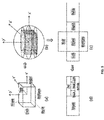
FIG. 5 depicts a rectangular prime projection format for 360 viewport according to some example embodiments. -
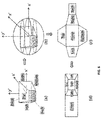
FIG. 6 depicts a truncated pyramid projection format for 360 viewport according to some example embodiments. -
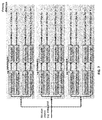
FIG. 7 depicts a representation of 360 viewport generation and encoding according to some example embodiments. -
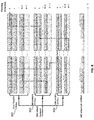
FIG. 8 depicts viewport based ABR streaming according to some example embodiments. -
FIG. 9 depicts a flow chart of a method for streaming 360-degree video data according to some example embodiments. - The details of various embodiments of the methods and systems are set forth in the accompanying drawings and the description below.
- The detailed description set forth below is intended as a description of various configurations of the subject technology and is not intended to represent the only configurations in which the subject technology may be practiced. The appended drawings are incorporated herein and constitute a part of the detailed description. The detailed description includes specific details for the purpose of providing a thorough understanding of the subject technology. However, it will be clear and apparent to those skilled in the art that the subject technology is not limited to the specific details set forth herein and may be practiced using one or more implementations.
- In one aspect, this disclosure is directed to a system for streaming 360-degree video data. In one or more embodiments, the system includes one or more viewport engines and a streaming server. In one or more embodiments, the one or more viewport engines receive 360-degree video data, and generate a plurality of versions of the 360-degree video data. In one or more embodiments, each version has a corresponding primary viewing direction, includes independently decodable units (IDUs) of video data arranged according to a sequence, and has image resolution for the corresponding primary viewing direction that is higher than image resolutions for other viewing directions. In one or more embodiments, the streaming server streams a first IDU of video content from a first version of the plurality of versions of the 360-degree video data to a client for rendering at the client. In one or more embodiments, the first version has a primary viewing direction comprising a first viewing direction. In one or more embodiments, the streaming server receives feedback according to the rendering at the client. In one or more embodiments, the feedback is indicative of an update in viewing direction to a second viewing direction. In one or more embodiments, responsive to the update in viewing direction, the streaming server dynamically switches to a second version of the plurality of versions that has a primary viewing direction comprising the second viewing direction, to stream one or more IDUs from the second version to the client. In one or more embodiments, the one or more IDUs are streamed according to the sequence relative to the first IDU.
- In one or more embodiments, the one or more viewport engines generate IDUs of the first and second versions for streaming at a first bit rate. In one or more embodiments, the first bit rate is a function of an image resolution and a frame rate of the IDUs of the first and second versions. In one or more embodiments, the one or more viewport engines generate the plurality of versions of the 360-degree video data by generating a first plurality of versions according to a first bit rate for streaming, and a second plurality of versions according to a second bit rate for streaming.
- In one or more embodiments, the streaming server detects a change in network condition, and to dynamically switch from the first version to the second version responsive to the detected change in network condition. In one or more embodiments, the first version is from the first plurality of versions, and the second version is from the second plurality of versions. In one or more embodiments, the streaming server detects a change in network condition, and to dynamically switch from the second version to a third version, responsive to the detected change in network condition. In one or more embodiments, the second version is from the first plurality of versions, and the third version is from the second plurality of versions, and the second and third versions each has a primary viewing direction comprising the second viewing direction.
- In one or more embodiments, each IDU of the first version includes video data for which a typical field-of-view (FOV) angle centered around the corresponding primary viewing direction has a first image resolution, and video data for other viewing directions each has an image resolution that is lower than the first image resolution. In one or more embodiments, the system includes one or more storage devices configured to store the generated plurality of versions of the 360-degree video data. In one or more embodiments, the streaming server further retrieves the first IDU from the one or more storage devices to stream to the client.
- In another aspect, this disclosure is directed to a method for streaming 360-degree video data. In one or more embodiments, 360-degree video data is received. In one or more embodiments, a plurality of versions of the 360-degree video data is generated. In one or more embodiments, each version has a corresponding primary viewing direction, with independently decodable units (IDUs) of video data arranged according to a sequence, and has image resolution for the corresponding primary viewing direction that is higher than image resolutions for other viewing directions. In one or more embodiments, a streaming server streams a first IDU of video content from a first version of the plurality of versions of the 360-degree video data to a client for rendering at the client. In one or more embodiments, the first version has a primary viewing direction comprising a first viewing direction. In one or more embodiments, the streaming server receives feedback according to the rendering at the client. In one or more embodiments, the feedback is indicative of an update in viewing direction to a second viewing direction. In one or more embodiments, responsive to the update in viewing direction, the first version is dynamically switches to a second version of the plurality of versions that has a primary viewing direction comprising the second viewing direction, to stream one or more IDUs from the second version to the client. In one or more embodiments, the one or more IDUs are streamed according to the sequence relative to the first IDU.
- In one or more embodiments, IDUs of the first and second versions are generated for streaming at a first bit rate. In one or more embodiments, the first bit rate is a function of an image resolution and a frame rate of the IDUs of the first and second versions. In one or more embodiments, generating the plurality of versions of the 360-degree video data includes generating a first plurality of versions according to a first bit rate for streaming, and a second plurality of versions according to a second bit rate for streaming. In one or more embodiments, a change in network condition is detected. In one or more embodiments, the first version is dynamically switched to the second version responsive to the detected change in network condition. In one or more embodiments, the first version is from the first plurality of versions, and the second version is from the second plurality of versions.
- In one or more embodiments, another change in network condition is detected. In one or more embodiments, the second version is dynamically switched to a third version, responsive to the detected change in network condition. In one or more embodiments, the second version is from the first plurality of versions, and the third version is from the second plurality of versions, and the second and third versions each has a primary viewing direction comprising the second viewing direction. In one or more embodiments, each IDU of the first version comprises video data for which a typical field-of-view (FOV) angle centered around the corresponding primary viewing direction has a first image resolution, and video data for other viewing directions each has an image resolution that is lower than the first image resolution. In one or more embodiments, the generated plurality of versions of the 360-degree video data are stored in one or more storage devices. In one or more embodiments, the first IDU is retrieved from the one or more storage devices to stream to the client.
- In yet another aspect, this disclosure is directed to one or more computer-readable storage media having instructions stored therein that, when executed by at least one processor, cause the at least one processor to perform operations including: receiving 360-degree video data; generating a plurality of versions of the 360-degree video data, each version having a corresponding primary viewing direction, each version comprising independently decodable units (IDUs) of video data arranged according to a sequence, and having image resolution for the corresponding primary viewing direction that is higher than image resolutions for other viewing directions; streaming a first IDU of video content from a first version of the plurality of versions of the 360-degree video data to a client for rendering at the client, the first version having a corresponding primary viewing direction comprising a first viewing direction; receiving feedback according to the rendering at the client, the feedback indicative of an update in viewing direction to a second viewing direction; and responsive to the update in viewing direction, dynamically switching to a second version of the plurality of versions that has a primary viewing direction comprising the second viewing direction, to stream one or more IDUs from the second version to the client, the one or more IDUs streamed according to the sequence relative to the first IDU.
- In one or more embodiments, the at least one processor further performs operations including generating IDUs of the first and second versions for streaming at a first bit rate. In one or more embodiments, the first bit rate is a function of an image resolution and a frame rate of the IDUs of the first and second versions. In one or more embodiments, generating the plurality of versions of the 360-degree video data includes generating a first plurality of versions according to a first bit rate for streaming, and a second plurality of versions according to a second bit rate for streaming.
- In one or more embodiments, in ABR streaming, a video content is encoded into multiple layers of streams with different picture resolutions, bit-rates, and frame-rates. Each bitstream includes multiple independently decodable units (IDUs), which allows clients to conduct bitstream switching among the streams based on network conditions, in one or more embodiments. The bitstream switch happens at IDU boundaries, and an IDU lasts for or extends over a period of time (e.g., 1 to 2 seconds) in one or more embodiments. For example, a video content is encoded and stored into three layers, namely 2160p@50 at 8 Mbps, 1080p@50 at 4 Mbps and 720p@30 at 1 Mbps, in one or more embodiments. A stream to the clients is made up of IDUs selected from the three layers of the streams, in one or more embodiments. The stream includes IDUs with different picture resolutions, bit-rates, and frame-rates, in one or more embodiments.
- Referring to
FIG. 1 , a diagram of a 360 degree video capture and playback system is depicted according some example embodiments. A 360 degree video is captured by a camera rig, in one or more embodiments. For example, the 360 video is captured by 6 (or some other number of) cameras stitched together into an equirectangular projection format, in one or more embodiments. The 360 video is compressed into any suitable video compression format, such as MPEG/ITU-T AVC/H.264, HEVC/H.265, VP9, in one or more embodiments. The compressed video is transmitted to receivers via various transmission links, such as cable, satellite, terrestrial, internet streaming, in one or more embodiments. On the receiver side, the video is decoded and stored in e.g. the equirectangular format, then is rendered according to the viewing direction angles and field of view (FOV) angles, and/or displayed, in one or more embodiments. According to one or more embodiments, the clients have control of viewing direction angles and FOV angles in order to watch the 360 video at the desired view direction angles and FOV angles. For ABR streaming, a 360 video content is compressed at several bit-rates, picture sizes and frame-rates to adapt to the network conditions, in one or more embodiments. - Referring to
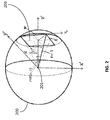
FIG. 2 , a diagram of a 360 viewing coordinate system is depicted according to some example embodiments. For display of a 360 degree video, a portion of each 360 degree video picture is projected and rendered, in one or more embodiments. The FOV angles define how big a portion of a 360 degree video picture is displayed, while the viewing direction angles defines which portion of the 360 degree video picture is displayed, in one or more embodiments. For example, a 360 video is mapped on a sphere surface (e.g., sphere radius is 1) as shown in a 360 viewing coordinate system (x′, y′, z′) depicted inFIG. 2 . A viewer at thecenter point 201 of thesphere 200 is able to view arectangular screen 203, and the screen has its four corners located on the sphere surface. - As shown in
FIG. 2 , in the viewing coordinate system (x′, y′, z′), thecenter point 201 of the projection plane (e.g., the rectangular screen) is located on z′ axis and is parallel to x′-y′ plane, in one or more embodiments. Therefore, in one or more embodiments, the projection plane size, w×h, and its distance to the center of the sphere d can be computed by: -
- Where
-
- and αε(0: π] is the horizontal FOV angle and βΣ(0: π] is the vertical FOV angle, respexctively.
- Referring to
FIG. 3 , a diagram of rotation angles of a 3D viewing coordinate system is depicted according to some example embodiments. As mentioned above and shown inFIG. 1 for example, the viewing direction angles (θ, γ, ε) define which portion of the 360 degree video picture is displayed, in one or more embodiments. The viewing direction is defined by the rotation angles of the 3D viewing coordinate system (x′, y′, z′) relative to the 3D capture (camera) coordinate system (x, y, z), in one or more embodiments. The viewing direction is dictated by the clockwise rotation angle θ along y axis (yaw), the counterclockwise rotation angle γ along x axis (pitch), and the counterclockwise rotation angle ε along z axis (roll), in one or more embodiments. - In one or more embodiments, the coordinate mapping between the (x, y, z) and (x′, y′, z′) coordinate system is defined as:
-
-
- One operation of 360 video rendering (for display) is to find the corresponding reference sample(s) in an
input 360 video picture for a sample in the output rendering picture, in one or more embodiments. In one or more embodiments, if the rendering picture size is renderingPicWidth×renderingPicheight and an integer-pel coordinate of a rendering sample in the rendering picture is (Xc, Yc), then coordinate of the rendering sample in the normalized rendering coordinate system is computed by -
- In one or more embodiments, the mapping of the simple to 3D viewing coordinate system (x′, y′, z′) is computed by
-
- In one or more embodiments, another step is to use the above relationship between the (x, y, z) and (x′, y′, z′) coordinate system to covert the 3D coordinate (x′, y′, z′) to the (x, y, z) capture (camera) coordinate system. In one or more embodiments, the coordinate(s) of corresponding reference sample(s) in the
input 360 video picture is computed based on the 360 video projection format (e.g., equirectangular) and/or the input picture size. In one or more embodiments, the coordinate of corresponding reference sample, i.e. (Xp, Yp), in theinput 360 video picture of equirectangular projection format is computed by -
- Where inputPicWidth×inputPicheight is
input 360 picture size of luminance or chrominance components. Note that (Xp, Yp) are in sub-pel precision and the reference sample at (Xp, Yp) may not physically exist in theinput 360 video picture as it contains samples only at integer-pel positions, in one or more embodiments. - In one or more embodiments, the coordinate mapping process described above is performed separately for luminance and chrominance components of a rendering picture, or performed jointly by re-using the luminance coordinate mapping for chrominance components based on the Chroma format (coordinate scaling is used for Chroma format such as 4:2:0).
- In one or more embodiments, rendering a sample of the output rendering picture is realized by interpolation of reference sample(s) of integer-pel position surrounding the sub-pel position (Xp, Yp) in the
input 360 video picture. In one or more embodiments, the integer-pel reference samples used for interpolation are determined by the filter type used. For example, if the bilinear filter is used for interpolation, then the four reference samples of integer-pel position which are nearest to the sub-pel position (Xp, Yp) are used for rendering, in one or more embodiments. - In one or more embodiments, the streaming of 360 video is able to use the ABR methods disclosed herein, with each layer carrying 360 video content of full resolution of 360×180 degree for instance. However, there is relatively greater use of transmission bandwidth and decoder processing resource since the typical FOV angles are only around 100×60 degree, in one or more embodiments. That is, only around 10% received data is for instance actually used on the client side for typical 360 video rendering and display of a selected viewing direction, in one or more embodiments. Therefore, in accordance with inventive concepts disclosed herein, ABR streaming solutions for 360 video are provided with efficient use of transmission bandwidth and decoder resource usage, in one or more embodiments.
- Systems and methods of various 360 degree viewport based streaming are provided in the present disclosure for efficient use of bandwidth and decoder resources for 360 video streaming. In one or more embodiments, the 360 degree viewport based streaming system provides high resolution video at a primary viewing direction within typical FOV angles (e.g. 100×60 degree). In one or more embodiments, the 360 degree viewport based streaming system provides low resolution of video for other viewing directions to reduce bandwidth and decoder resource usage. In one or more embodiments, the 360 degree viewport based streaming system is capable of rendering 360 video at any viewing direction to enable graceful switching of viewport so that a client can change viewing direction at any time with a corresponding bitstream switch occurring at IDU boundaries.
- Referring to
FIG. 4 , a viewport based 360video streaming system 400 is depicted according to some example embodiments. The viewport based 360video streaming system 400 includes a server side system and a client side system, in one or more embodiments. The server side system communicates with the client side system through various IP networks, in one or more embodiments. On the server side, a 360video sequence 402 is converted into viewport representations of selected primary viewing directions, resolutions and/or frame-rates by a viewport generation andcompression module 404, in one or more embodiments. The viewport generation andcompression module 404 encodes the viewport representations into viewport bitstreams with selected bit-rates, in one or more embodiments. The encoded viewport bitstreams are stored in astorage module 406, in one or more embodiments. - The viewport based 360
video streaming system 400 includes anABR streaming server 408, in one or more embodiments. TheABR streaming server 408 serves one or more clients (e.g.,client 0,client 1 . . . client M) via various possible types of networks, such as an IP network, in one or more embodiments. TheABR streaming server 408 receives bit-rate and/or viewing direction information from the clients, in one or more embodiments. On the client side, each client may have a feedback channel to the server to convey or provide the bandwidth and viewing direction information connected to the client, in one or more embodiments. Based on the feedback information, theserver 408 determines and selects the corresponding content from the stored viewport bitstreams and transmits the selected bitstreams to the client, in one or more embodiments. The selected corresponding content for a client may have a primary viewing direction which is closest to the viewing direction used by the client, and consume a transmission bandwidth that is less or equal to the available transmission bandwidth for the client. The client decodes packets to reconstruct the viewport, and renders the video for display according to the selected viewing direction and display resolution, in one or more embodiments. In one or more embodiments, the bandwidth, the selected viewing direction and/or display resolution are different or changes from client to client and/or from time to time. - Referring to
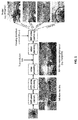
FIG. 5 , a rectangular prime projection format for 360 video is depicted according to some example embodiments. Viewport projection formats are designed to allow a viewport to carry 360 video content at a much lower picture resolution than full resolution, in one or more embodiments. As disclosed herein, one such format is a rectangular prime projection format, in one or more embodiments. As shown in (a) ofFIG. 5 , a rectangular prime has six faces, namely, left, front, right, back, top and bottom, in one or more embodiments. Here, the front face is defined as the face parallel to the x′-y′ plane and with z′>0, and is determined by a selected primary viewing direction, in one or more embodiments. The front face covers a viewing region with FOV angles such as 100×60 degree, in one or more embodiments. - The 360 video is projected to this format by mapping a sphere (360×180 degree) surface to the six faces of rectangular prime as illustrated in (b) and (c) of
FIG. 5 , in one or more embodiments. Finally, high resolution is kept for the front face (which is centered at the primary viewing direction) and low resolutions are used for other faces in the viewport layout format depicted in (d) ofFIG. 5 , in one or more embodiments. - With the viewport projection format defined in (d) of
FIG. 5 , a 360 video content is able to be represented at a significantly lower resolution, and thus consumes a significantly lower bandwidth for transmission and significantly less decoder resources for decoding, in one or more embodiments. For example, if a 360 video (i.e. 360×180 degree) is originally represented by a picture size or resolution of 3840×2160 (4K) in for example the equirectangular projection format, the same content could be represented by a picture size or resolution of 1920×720 in the viewport projection format depicted in (d) ofFIG. 5 for a selected primary view direction and typical FOV angles of 100×60 degree, with 960×720 luminance samples (and associated chrominance samples) for the front face/view and 960×720 samples for the rest of the faces/views (5 faces/views) collectively, roughly a factor 6 of reduction in terms of both picture size and bandwidth reduction, in one or more embodiments. - In spite of significantly reduced resolution of viewport projection format, on the client side a client is able to render high fidelity video if the client chooses a viewing direction that is close to or to the same as the selected primary viewing direction of the received viewport stream, in one or more embodiments. Otherwise, low fidelity portion(s) of the video is rendered and displayed before the server switches to a new viewport bitstream (at IDU boundary) whose primary viewing direction matches the newly selected viewing direction by the client, in one or more embodiments.
- Referring to
FIG. 6 , a truncated pyramid projection format for 360 viewport is depicted according to some example embodiments. In the truncated pyramid projection format, a 360 video is projected onto two rectangular faces (front and back) and four truncated pyramid faces (left, right, top and bottom), in one or more embodiments. Similar to the rectangular prime projection format, a high resolution (e.g., 3840×2160 (4K)) is kept for the front face (which is cenetred at the selected primary viewing direction) and relatively lower resolutions (e.g., 1920×720) are used for other faces in the truncated pyramid viewport layout as illustratively shown in (d) ofFIG. 6 , in one or more embodiments. In one or more embodiments, rendering from the truncated pyramid format is more difficult because of complex processing that is to be applied along diagonal face boundaries in this viewport projection format. - The rectangular prime projection format as shown in
FIG. 5 , and the truncated pyramid projection format as shown inFIG. 6 , are for illustration purposes. Various other viewport projection formats are used according to some embodiments. A skilled person in the art shall understand that any suitable viewport projection formats can be adapted in accordance with the present disclosure. - Referring to
FIG. 7 , a representation of 360 viewport generation and encoding is depicted according to some example embodiments. The viewport generation andcompression module 404 as shown inFIG. 4 is implemented to process input videos to generate 360 viewport and to encode the 360 viewport, in one or more embodiments. The input videos have various formats including 360 video projection format, image resolution, frame-rate, etc., in one or more embodiments. For example, the input video as depicted inFIG. 7 has a 2160p@50 sample rate and in equirectangular projection format, in one or more embodiments. In one or more embodiments, the viewport generation andcompression module 404 is implemented to convert the incoming 360 video content into viewports of a selected viewport projection format (e.g. rectangular prime or truncated pyramid) for a combination of N selected primary viewing directions and K streaming layers of picture resolutions and frame-rates (e.g., 1920×720@50, 960×360@50 and 640×240@30 inFIG. 7 ). Finally, the viewport generation andcompression module 404 is configured to generate viewports bitstreams by compressing the viewports with a selected video compression format (e.g. HEVC/H.265, MPEG AVC/H.264, VP9, etc.) and at given bit-rates (e.g., 1.3 Mbps, 667 kbps or 167 kbps depending on the picture resolution and/or frame-rate), in one or more embodiments. The compressed viewport bitstreams are stored on the server, in one or more embodiments. - For viewport bitstream generation, the primary viewing directions are selected with a variety of methods, in one or more embodiments. In one or more embodiments, the N primary viewing directions may be uniformly spaced on a 360×180 degree sphere. For example, fixing roll to be 0 and evenly spacing pitch and yaw by every 30 degrees, results in a total of 72 (e.g., N=360/30×180/30=72) viewport bitstreams for a streaming layer, in one or more embodiments. For viewports of different streaming layers, the number of selected primary viewing directions N does not have to be the same, in one or more embodiments.
- Referring to
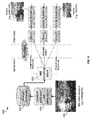
FIG. 8 , a viewport based ABR streaming is depicted according to some example embodiments. The viewport based ABR streaming provides viewport bitstreams to clients based on the bandwidth and viewing directions of the clients, in one or more embodiments. Theinput 360 video are converted into, e.g., three (or other number of) layers of videos, in one or more embodiments. Each video layer has a different fidelity including resolution, frame rate, bit rate, etc., in one or more embodiments. For example,video layer 802 has a 1920×720p@50 1.3 Mbps format,video layer 804 has a 960×360@50 667 kbps format,video layer 806 has a 640×240@30 167 kbps format, in one or more embodiments. Each video layer includes multiple viewport bitstreams of different primary viewing directions, such asdirections - Referring to
FIG. 9 , a flow chart of a method for streaming 360-degree video data is depicted according to some example embodiments. The method includes receiving 360-degree video data (operation 902), generating a plurality of versions of the 360-degree video data (operation 904), streaming a first independently decodable unit (IDU) of video content (operation 906), receiving feedback (operation 908), switching to a second version of the plurality of versions based on the feedback (operation 910), and streaming one or more independently decodable units (IDUs) of video content from the second version (operation 912). - At
operation 902, 360-degree video data is received from a 360-degree a video capturing system, in one or more embodiments, e.g., in real time as the video data is captured, or in near real time. In one or more embodiments, the 360-degree video data is received from a storage device, such as a buffering or temporary storage device. One or more viewport engines receive the 360-degree video data, in one or more embodiments. The 360-degree video data represents 360-degree views in time series, captured from a central point of the video capturing system, in one or more embodiments. - At
operation 904, a plurality of versions of the 360-degree video data is generated using the received 360-degree video data, in one or more embodiments. The one or more viewport engines generate the plurality of versions of the 360-degree video data, in one or more embodiments. In one or more embodiments, each version is generated according to a primary viewing direction and a video fidelity. In one or more embodiments, the video fidelity is indicated by a video bitrate, frame-rate and video resolution. For example, a first version is generated for a first primary viewing direction (e.g., yaw=0, pitch=0 and roll=0 degree). The first version is generated with a first video fidelity including a video resolution 1920×720, a frame-rate 50 frames/sec and a video bitrate of 1.3 Mbps. A second version is generated for a second primary viewing direction (e.g., yaw=30, pitch=0 and roll=0 degree). The second version is generated with a second video fidelity including a video resolution 960×360, a frame-rate 50 frames/sec and a video bitrate of 667 Kbps. In one or more embodiments, each version includes a plurality of IDUs. - At
operation 906, a first IDU of video content is streamed by a streaming server from a first version of the plurality of versions of the 360-degree video data to a client, in one or more embodiments. In one or more embodiments, the streaming server streams IDUs in a time series and selects each IDU for streamlining based on a current bandwidth and a viewing direction. The first IDU of video content is rendered at the client, in one or more embodiments. In one or more embodiments, the first IDU is selected based on a default viewing direction before receiving any feedback from the client. In one or more embodiments, the first IDU is selected based on a previous feedback including a viewing direction. The first version has a primary viewing direction including a first viewing direction, in one or more embodiments. - At
operation 908, the streaming server receives feedback according to the rendering at the client, in one or more embodiments. The feedback is indicative of an update in viewing direction to a second viewing direction, in one or more embodiments. In one or more embodiments, the feedback is generated by a client input. In one or more embodiments, the feedback is generated by detecting a client switching a viewing direction (e.g., when a client wears an AR/VR Head Mounted Display). In one or more embodiments, the feedback is conveyed in real time or near real time. In one or more embodiments, the feedback is generated in response to detecting a change to a current bandwidth. - At
operation 910, responsive to the update in viewing direction, the first version of the plurality of versions of the 360-degree video data is dynamically switched to a second version of the plurality of versions of the 360-degree video data, in one or more embodiments. The streaming server selects and/or switches to the second version according to the received feedback, in one or more embodiments. The second version has a primary viewing direction which is closest to the second viewing direction, in one or more embodiments. In one or more embodiments, responsive to an update in available or allocated bandwidth, the first version is dynamically switched to a second version, which has a bitrate supported by the updated bandwidth. In one or more embodiments, responsive to an update in both viewing direction and bandwidth, the first version is dynamically switched to a second version, which has the primary viewing direction closest to the second viewing direction and a bitrate supported by the updated bandwidth. - At
operation 912, one or more IDUs are streamed by the streaming server from the second version of the plurality of versions to the client, in one or more embodiments. The one or more IDUs are streamed according to the sequence relative to the first IDU, in one or more embodiments. In one or more embodiments, the streaming server tracks the sequence of IDUs sent, and identifies the next IDU in the sequence from the second version when switching over. In one or more embodiments, the sequence is an index-based system. In one or more embodiments, the sequence is based on timestamps of the video. In one or more embodiments, each version has a corresponding IDU of the same index/timestamp. In one or more embodiments, when a version has no IDU at a particular index/timestamp in the sequence to switch/skip to, the streaming server skips/switches to the next available or suitable IDU within the version. - The viewport based ABR streaming allows the viewers to select directions for viewing and to switch views in real time or near real time between different directions, in one or more embodiments. In one or more embodiments, the viewport based ABR streaming switches views at boundaries of IDUs. The arrow line in
FIG. 8 illustrates an example path of the switching between viewport bitstreams (sometime referred herein to as versions of the 360-degree video data), the switching based on network conditions and/or viewing direction changes, in one or more embodiments. The ABR streaming system automatically selects suitable viewport bitstreams according to network conditions, in one or more embodiments. The ABR streaming system receives instructions or feedback from the viewer/client and/or network, indicative of desired or appropriate viewing directions and/or video resolutions, in one or more embodiments. The ABR streaming system adjusts the streaming path according the instructions/feedback, in one or more embodiments. The view path is switched simultaneously as feedback is received regarding the viewer switching to a different viewing direction, in one or more embodiments. If a client changes viewing direction in the middle of an IDU, a low quality of rendered video is displayed (rendered using low resolution information in that IDU corresponding to the viewing direction(s) being switch to) until the end of the current IDU, before high quality rendered video from a next IDU from a new viewport bitstream is resumed, because switching to the new viewport stream that matches with the newly selected viewing direction (by the client) would occur at the next IDU boundary (e.g., at the earliest), in one or more embodiments. - The streamed content as depicted in the bottom portion of
FIG. 8 is made up of IDUs from e.g. three layers of viewport streams of different viewing directions, in one or more embodiments. In one or more embodiments, the ABR system switches the viewport bitstream only due to a change in available or allocated bandwidth (data transmission bit-rate) (e.g., due to network conditions), or only due to a change in viewing direction (e.g., triggered by the client), or due to a concurrent change in bandwidth and in viewing direction, depending on the bandwidth and viewing direction feedback information provided by the client device, client and/or network. In one of more embodiments, bandwidth of a network is changed in various network conditions, such as overloaded network, increase demand of network resources, bottleneck on certain nodes in network pathways, failure of network devices. In one or more embodiments, the bandwidth change is detected by determining reduced number of acknowledgement packages which indicate successful receipt at the receiving end, or increased requests to resent data due to dropped packets. - Implementations within the scope of the present disclosure can be partially or entirely realized using a tangible computer-readable storage medium (or multiple tangible computer-readable storage media of one or more types) encoding one or more instructions. The tangible computer-readable storage medium also can be non-transitory in nature.
- The computer-readable storage medium can be any storage medium that can be read, written, or otherwise accessed by a general purpose or special purpose computing device, including any processing electronics and/or processing circuitry capable of executing instructions. For example, without limitation, the computer-readable medium can include any volatile semiconductor memory, such as RAM, DRAM, SRAM, T-RAM, Z-RAM, and TTRAM. The computer-readable medium also can include any non-volatile semiconductor memory, such as ROM, PROM, EPROM, EEPROM, NVRAM, flash, nvSRAM, FeRAM, FeTRAM, MRAM, PRAM, CBRAM, SONOS, RRAM, NRAM, racetrack memory, FJG, and Millipede memory.
- Further, the computer-readable storage medium can include any non-semiconductor memory, such as optical disk storage, magnetic disk storage, magnetic tape, other magnetic storage devices, or any other medium capable of storing one or more instructions. In some implementations, the tangible computer-readable storage medium can be directly coupled to a computing device, while in other implementations, the tangible computer-readable storage medium can be indirectly coupled to a computing device, e.g., via one or more wired connections, one or more wireless connections, or any combination thereof.
- Instructions can be directly executable or can be used to develop executable instructions. For example, instructions can be realized as executable or non-executable machine code or as instructions in a high-level language that can be compiled to produce executable or non-executable machine code. Further, instructions also can be realized as or can include data. Computer-executable instructions also can be organized in any format, including routines, subroutines, programs, data structures, objects, modules, applications, applets, functions, etc. As recognized by those of skill in the art, details including, but not limited to, the number, structure, sequence, and organization of instructions can vary significantly without varying the underlying logic, function, processing, and output.
- Those of skill in the art would appreciate that the various illustrative blocks, modules, elements, components, and methods described herein may be implemented as electronic hardware, computer software, or combinations of both. To illustrate this interchangeability of hardware and software, various illustrative blocks, modules, elements, components, and methods have been described above generally in terms of their functionality. Whether such functionality is implemented as hardware or software depends upon the particular application and design constraints imposed on the overall system. Skilled artisans may implement the described functionality in varying ways for each particular application. Various components and blocks may be arranged differently (e.g., arranged in a different order, or partitioned in a different way) all without departing from the scope of the subject technology.
- As used herein, the phrase “at least one of” preceding a series of items, with the term “and” or “or” to separate any of the items, modifies the list as a whole, rather than each member of the list (i.e., each item). The phrase “at least one of” does not require selection of at least one of each item listed; rather, the phrase allows a meaning that includes at least one of any one of the items, and/or at least one of any combination of the items, and/or at least one of each of the items. By way of example, the phrases “at least one of A, B, and C” or “at least one of A, B, or C” each refer to only A, only B, or only C; any combination of A, B, and C; and/or at least one of each of A, B, and C.
- A phrase such as “an aspect” does not imply that such aspect is essential to the subject technology or that such aspect applies to all configurations of the subject technology. A disclosure relating to an aspect may apply to all configurations, or one or more configurations. An aspect may provide one or more examples of the disclosure. A phrase such as an “aspect” may refer to one or more aspects and vice versa. A phrase such as an “embodiment” does not imply that such embodiment is essential to the subject technology or that such embodiment applies to all configurations of the subject technology. A disclosure relating to an embodiment may apply to all embodiments, or one or more embodiments. An embodiment may provide one or more examples of the disclosure. A phrase such an “embodiment” may refer to one or more embodiments and vice versa. A phrase such as a “configuration” does not imply that such configuration is essential to the subject technology or that such configuration applies to all configurations of the subject technology. A disclosure relating to a configuration may apply to all configurations, or one or more configurations. A configuration may provide one or more examples of the disclosure. A phrase such as a “configuration” may refer to one or more configurations and vice versa.
- The word “example” is used herein to mean “serving as an example, instance, or illustration.” Any embodiment described herein as “exemplary” or as an “example” is not necessarily to be construed as preferred or advantageous over other embodiments. Furthermore, to the extent that the term “include,” “have,” or the like is used in the description or the claims, such term is intended to be inclusive in a manner similar to the term “comprise” as “comprise” is interpreted when employed as a transitional word in a claim.
- All structural and functional equivalents to the elements of the various aspects described throughout this disclosure that are known or later come to be known to those of ordinary skill in the art are expressly incorporated herein by reference and are intended to be encompassed by the claims. Moreover, nothing disclosed herein is intended to be dedicated to the public regardless of whether such disclosure is explicitly recited in the claims. No claim element is to be construed under the provisions of 35 U.S.C. 112, sixth paragraph, unless the element is expressly recited using the phrase “means for” or, in the case of a method claim, the element is recited using the phrase “step for.”
- The previous description is provided to enable any person skilled in the art to practice the various aspects described herein. Various modifications to these aspects will be readily apparent to those skilled in the art, and the generic principles defined herein may be applied to other aspects. Thus, the claims are not intended to be limited to the aspects shown herein, but are to be accorded the full scope consistent with the language claims, wherein reference to an element in the singular is not intended to mean “one and only one” unless specifically so stated, but rather “one or more.” Unless specifically stated otherwise, the term “some” refers to one or more. Pronouns in the masculine (e.g., his) include the feminine and neuter gender (e.g., her and its) and vice versa. Headings and subheadings, if any, are used for convenience only and do not limit the subject disclosure.
Claims (20)
Priority Applications (1)
| Application Number | Priority Date | Filing Date | Title |
|---|---|---|---|
| US15/711,704 US20180098131A1 (en) | 2016-09-30 | 2017-09-21 | Apparatus and methods for adaptive bit-rate streaming of 360 video |
Applications Claiming Priority (2)
| Application Number | Priority Date | Filing Date | Title |
|---|---|---|---|
| US201662402344P | 2016-09-30 | 2016-09-30 | |
| US15/711,704 US20180098131A1 (en) | 2016-09-30 | 2017-09-21 | Apparatus and methods for adaptive bit-rate streaming of 360 video |
Publications (1)
| Publication Number | Publication Date |
|---|---|
| US20180098131A1 true US20180098131A1 (en) | 2018-04-05 |
Family
ID=61759226
Family Applications (1)
| Application Number | Title | Priority Date | Filing Date |
|---|---|---|---|
| US15/711,704 Abandoned US20180098131A1 (en) | 2016-09-30 | 2017-09-21 | Apparatus and methods for adaptive bit-rate streaming of 360 video |
Country Status (1)
| Country | Link |
|---|---|
| US (1) | US20180098131A1 (en) |
Cited By (27)
| Publication number | Priority date | Publication date | Assignee | Title |
|---|---|---|---|---|
| US20180164593A1 (en) * | 2016-12-14 | 2018-06-14 | Qualcomm Incorporated | Viewport-aware quality metric for 360-degree video |
| US10062414B1 (en) * | 2017-08-22 | 2018-08-28 | Futurewei Technologies, Inc. | Determining a future field of view (FOV) for a particular user viewing a 360 degree video stream in a network |
| US20190068949A1 (en) * | 2017-08-23 | 2019-02-28 | Mediatek Inc. | Method and Apparatus of Signalling Syntax for Immersive Video Coding |
| WO2019120638A1 (en) * | 2017-12-22 | 2019-06-27 | Huawei Technologies Co., Ltd. | Scalable fov+ for vr 360 video delivery to remote end users |
| WO2020051777A1 (en) | 2018-09-11 | 2020-03-19 | SZ DJI Technology Co., Ltd. | System and method for supporting progressive video bit stream swiitching |
| CN111131805A (en) * | 2019-12-31 | 2020-05-08 | 歌尔股份有限公司 | Image processing method, device and readable storage medium |
| US10735783B1 (en) | 2017-09-28 | 2020-08-04 | Twitch Interactive, Inc. | Intra-rendition latency variation |
| US10819645B2 (en) | 2017-09-20 | 2020-10-27 | Futurewei Technologies, Inc. | Combined method for data rate and field of view size adaptation for virtual reality and 360 degree video streaming |
| US10887600B2 (en) * | 2017-03-17 | 2021-01-05 | Samsung Electronics Co., Ltd. | Method and apparatus for packaging and streaming of virtual reality (VR) media content |
| US10970519B2 (en) | 2019-04-16 | 2021-04-06 | At&T Intellectual Property I, L.P. | Validating objects in volumetric video presentations |
| US11012675B2 (en) | 2019-04-16 | 2021-05-18 | At&T Intellectual Property I, L.P. | Automatic selection of viewpoint characteristics and trajectories in volumetric video presentations |
| US11074697B2 (en) | 2019-04-16 | 2021-07-27 | At&T Intellectual Property I, L.P. | Selecting viewpoints for rendering in volumetric video presentations |
| JP2021521747A (en) * | 2018-04-11 | 2021-08-26 | アルカクルーズ インク | Digital media system |
| US11128926B2 (en) * | 2017-08-23 | 2021-09-21 | Samsung Electronics Co., Ltd. | Client device, companion screen device, and operation method therefor |
| US11146834B1 (en) * | 2017-09-28 | 2021-10-12 | Twitch Interactive, Inc. | Server-based encoded version selection |
| US11153492B2 (en) | 2019-04-16 | 2021-10-19 | At&T Intellectual Property I, L.P. | Selecting spectator viewpoints in volumetric video presentations of live events |
| US11184461B2 (en) | 2018-10-23 | 2021-11-23 | At&T Intellectual Property I, L.P. | VR video transmission with layered video by re-using existing network infrastructures |
| US20220038767A1 (en) * | 2019-01-22 | 2022-02-03 | Tempus Ex Machina, Inc. | Systems and methods for customizing and compositing a video feed at a client device |
| US11284054B1 (en) * | 2018-08-30 | 2022-03-22 | Largo Technology Group, Llc | Systems and method for capturing, processing and displaying a 360° video |
| US11323754B2 (en) | 2018-11-20 | 2022-05-03 | At&T Intellectual Property I, L.P. | Methods, devices, and systems for updating streaming panoramic video content due to a change in user viewpoint |
| US11409834B1 (en) * | 2018-06-06 | 2022-08-09 | Meta Platforms, Inc. | Systems and methods for providing content |
| US11470017B2 (en) * | 2019-07-30 | 2022-10-11 | At&T Intellectual Property I, L.P. | Immersive reality component management via a reduced competition core network component |
| US11494870B2 (en) * | 2017-08-18 | 2022-11-08 | Mediatek Inc. | Method and apparatus for reducing artifacts in projection-based frame |
| US20230090079A1 (en) * | 2021-09-20 | 2023-03-23 | Salesforce.Com, Inc. | Augmented circuit breaker policy |
| US11831855B2 (en) * | 2018-06-22 | 2023-11-28 | Lg Electronics Inc. | Method for transmitting 360-degree video, method for providing a user interface for 360-degree video, apparatus for transmitting 360-degree video, and apparatus for providing a user interface for 360-degree video |
| US11997314B2 (en) | 2020-03-31 | 2024-05-28 | Alibaba Group Holding Limited | Video stream processing method and apparatus, and electronic device and computer-readable medium |
| US12651383B2 (en) | 2023-10-05 | 2026-06-09 | Exos Ip, Llc | Adding augmented reality to a sub-view of a high resolution central video feed |
-
2017
- 2017-09-21 US US15/711,704 patent/US20180098131A1/en not_active Abandoned
Cited By (42)
| Publication number | Priority date | Publication date | Assignee | Title |
|---|---|---|---|---|
| US10620441B2 (en) * | 2016-12-14 | 2020-04-14 | Qualcomm Incorporated | Viewport-aware quality metric for 360-degree video |
| US20180164593A1 (en) * | 2016-12-14 | 2018-06-14 | Qualcomm Incorporated | Viewport-aware quality metric for 360-degree video |
| US10887600B2 (en) * | 2017-03-17 | 2021-01-05 | Samsung Electronics Co., Ltd. | Method and apparatus for packaging and streaming of virtual reality (VR) media content |
| US11494870B2 (en) * | 2017-08-18 | 2022-11-08 | Mediatek Inc. | Method and apparatus for reducing artifacts in projection-based frame |
| US10062414B1 (en) * | 2017-08-22 | 2018-08-28 | Futurewei Technologies, Inc. | Determining a future field of view (FOV) for a particular user viewing a 360 degree video stream in a network |
| US10827159B2 (en) * | 2017-08-23 | 2020-11-03 | Mediatek Inc. | Method and apparatus of signalling syntax for immersive video coding |
| US11128926B2 (en) * | 2017-08-23 | 2021-09-21 | Samsung Electronics Co., Ltd. | Client device, companion screen device, and operation method therefor |
| US20190068949A1 (en) * | 2017-08-23 | 2019-02-28 | Mediatek Inc. | Method and Apparatus of Signalling Syntax for Immersive Video Coding |
| US10819645B2 (en) | 2017-09-20 | 2020-10-27 | Futurewei Technologies, Inc. | Combined method for data rate and field of view size adaptation for virtual reality and 360 degree video streaming |
| US10735783B1 (en) | 2017-09-28 | 2020-08-04 | Twitch Interactive, Inc. | Intra-rendition latency variation |
| US11146834B1 (en) * | 2017-09-28 | 2021-10-12 | Twitch Interactive, Inc. | Server-based encoded version selection |
| US11706274B2 (en) | 2017-12-22 | 2023-07-18 | Huawei Technologies Co., Ltd. | Scalable FOV+ for VR 360 video delivery to remote end users |
| WO2019120638A1 (en) * | 2017-12-22 | 2019-06-27 | Huawei Technologies Co., Ltd. | Scalable fov+ for vr 360 video delivery to remote end users |
| US11546397B2 (en) | 2017-12-22 | 2023-01-03 | Huawei Technologies Co., Ltd. | VR 360 video for remote end users |
| US11589110B2 (en) | 2018-04-11 | 2023-02-21 | Alcacruz Inc. | Digital media system |
| JP7174941B2 (en) | 2018-04-11 | 2022-11-18 | アルカクルーズ インク | digital media system |
| JP2021521747A (en) * | 2018-04-11 | 2021-08-26 | アルカクルーズ インク | Digital media system |
| US11343568B2 (en) | 2018-04-11 | 2022-05-24 | Alcacruz Inc. | Digital media system |
| US11409834B1 (en) * | 2018-06-06 | 2022-08-09 | Meta Platforms, Inc. | Systems and methods for providing content |
| US11831855B2 (en) * | 2018-06-22 | 2023-11-28 | Lg Electronics Inc. | Method for transmitting 360-degree video, method for providing a user interface for 360-degree video, apparatus for transmitting 360-degree video, and apparatus for providing a user interface for 360-degree video |
| US11284054B1 (en) * | 2018-08-30 | 2022-03-22 | Largo Technology Group, Llc | Systems and method for capturing, processing and displaying a 360° video |
| EP3797515A4 (en) * | 2018-09-11 | 2021-04-28 | SZ DJI Technology Co., Ltd. | SYSTEM AND METHOD TO SUPPORT THE SWITCHING OF VIDEOBITSTREAMS |
| WO2020051777A1 (en) | 2018-09-11 | 2020-03-19 | SZ DJI Technology Co., Ltd. | System and method for supporting progressive video bit stream swiitching |
| US11184461B2 (en) | 2018-10-23 | 2021-11-23 | At&T Intellectual Property I, L.P. | VR video transmission with layered video by re-using existing network infrastructures |
| US11323754B2 (en) | 2018-11-20 | 2022-05-03 | At&T Intellectual Property I, L.P. | Methods, devices, and systems for updating streaming panoramic video content due to a change in user viewpoint |
| US20220038767A1 (en) * | 2019-01-22 | 2022-02-03 | Tempus Ex Machina, Inc. | Systems and methods for customizing and compositing a video feed at a client device |
| US12382126B2 (en) * | 2019-01-22 | 2025-08-05 | Infinite Athlete, Inc. | Systems and methods for customizing and compositing a video feed at a client device |
| US11663725B2 (en) | 2019-04-16 | 2023-05-30 | At&T Intellectual Property I, L.P. | Selecting viewpoints for rendering in volumetric video presentations |
| US11956546B2 (en) | 2019-04-16 | 2024-04-09 | At&T Intellectual Property I, L.P. | Selecting spectator viewpoints in volumetric video presentations of live events |
| US10970519B2 (en) | 2019-04-16 | 2021-04-06 | At&T Intellectual Property I, L.P. | Validating objects in volumetric video presentations |
| US11012675B2 (en) | 2019-04-16 | 2021-05-18 | At&T Intellectual Property I, L.P. | Automatic selection of viewpoint characteristics and trajectories in volumetric video presentations |
| US11153492B2 (en) | 2019-04-16 | 2021-10-19 | At&T Intellectual Property I, L.P. | Selecting spectator viewpoints in volumetric video presentations of live events |
| US11670099B2 (en) | 2019-04-16 | 2023-06-06 | At&T Intellectual Property I, L.P. | Validating objects in volumetric video presentations |
| US11470297B2 (en) | 2019-04-16 | 2022-10-11 | At&T Intellectual Property I, L.P. | Automatic selection of viewpoint characteristics and trajectories in volumetric video presentations |
| US11074697B2 (en) | 2019-04-16 | 2021-07-27 | At&T Intellectual Property I, L.P. | Selecting viewpoints for rendering in volumetric video presentations |
| US11470017B2 (en) * | 2019-07-30 | 2022-10-11 | At&T Intellectual Property I, L.P. | Immersive reality component management via a reduced competition core network component |
| CN111131805A (en) * | 2019-12-31 | 2020-05-08 | 歌尔股份有限公司 | Image processing method, device and readable storage medium |
| US11997314B2 (en) | 2020-03-31 | 2024-05-28 | Alibaba Group Holding Limited | Video stream processing method and apparatus, and electronic device and computer-readable medium |
| US20230090079A1 (en) * | 2021-09-20 | 2023-03-23 | Salesforce.Com, Inc. | Augmented circuit breaker policy |
| US11914986B2 (en) | 2021-09-20 | 2024-02-27 | Salesforce, Inc. | API gateway self paced migration |
| US11829745B2 (en) * | 2021-09-20 | 2023-11-28 | Salesforce, Inc. | Augmented circuit breaker policy |
| US12651383B2 (en) | 2023-10-05 | 2026-06-09 | Exos Ip, Llc | Adding augmented reality to a sub-view of a high resolution central video feed |
Similar Documents
| Publication | Publication Date | Title |
|---|---|---|
| US10620441B2 (en) | Viewport-aware quality metric for 360-degree video | |
| US11120837B2 (en) | System and method for use in playing back panorama video content | |
| EP3672251A1 (en) | Processing video data for a video player apparatus | |
| US12513344B2 (en) | Adaptive coding and streaming of multi-directional video | |
| US10277914B2 (en) | Measuring spherical image quality metrics based on user field of view | |
| US9986221B2 (en) | View-aware 360 degree video streaming | |
| de la Fuente et al. | Delay impact on MPEG OMAF’s tile-based viewport-dependent 360 video streaming | |
| US10999583B2 (en) | Scalability of multi-directional video streaming | |
| US20160277772A1 (en) | Reduced bit rate immersive video | |
| US20230033063A1 (en) | Method, an apparatus and a computer program product for video conferencing | |
| JP7177034B2 (en) | Method, apparatus and stream for formatting immersive video for legacy and immersive rendering devices | |
| US20200294188A1 (en) | Transmission apparatus, transmission method, reception apparatus, and reception method | |
| US20240292027A1 (en) | An apparatus, a method and a computer program for video coding and decoding | |
| US12604014B2 (en) | Method and system of video processing with low latency bitstream distribution | |
| US20240195966A1 (en) | A method, an apparatus and a computer program product for high quality regions change in omnidirectional conversational video | |
| US20240187673A1 (en) | A method, an apparatus and a computer program product for video encoding and video decoding | |
| JP7296219B2 (en) | Receiving device, transmitting device, and program | |
| WO2023194648A1 (en) | A method, an apparatus and a computer program product for media streaming of immersive media | |
| Hušák et al. | Stereoscopic Displays and Applications XV | |
| Husak et al. | DepthQ: universal system for stereoscopic video visualization on WIN32 platform |
Legal Events
| Date | Code | Title | Description |
|---|---|---|---|
| STPP | Information on status: patent application and granting procedure in general |
Free format text: DOCKETED NEW CASE - READY FOR EXAMINATION |
|
| AS | Assignment |
Owner name: AVAGO TECHNOLOGIES GENERAL IP (SINGAPORE) PTE. LTD Free format text: ASSIGNMENT OF ASSIGNORS INTEREST;ASSIGNOR:ZHOU, MINHUA;REEL/FRAME:046267/0270 Effective date: 20170919 |
|
| AS | Assignment |
Owner name: AVAGO TECHNOLOGIES INTERNATIONAL SALES PTE. LIMITED, SINGAPORE Free format text: MERGER;ASSIGNOR:AVAGO TECHNOLOGIES GENERAL IP (SINGAPORE) PTE. LTD.;REEL/FRAME:047231/0369 Effective date: 20180509 Owner name: AVAGO TECHNOLOGIES INTERNATIONAL SALES PTE. LIMITE Free format text: MERGER;ASSIGNOR:AVAGO TECHNOLOGIES GENERAL IP (SINGAPORE) PTE. LTD.;REEL/FRAME:047231/0369 Effective date: 20180509 |
|
| AS | Assignment |
Owner name: AVAGO TECHNOLOGIES INTERNATIONAL SALES PTE. LIMITE Free format text: CORRECTIVE ASSIGNMENT TO CORRECT THE EXECUTION DATE OF THE MERGER AND APPLICATION NOS. 13/237,550 AND 16/103,107 FROM THE MERGER PREVIOUSLY RECORDED ON REEL 047231 FRAME 0369. ASSIGNOR(S) HEREBY CONFIRMS THE MERGER;ASSIGNOR:AVAGO TECHNOLOGIES GENERAL IP (SINGAPORE) PTE. LTD.;REEL/FRAME:048549/0113 Effective date: 20180905 Owner name: AVAGO TECHNOLOGIES INTERNATIONAL SALES PTE. LIMITED, SINGAPORE Free format text: CORRECTIVE ASSIGNMENT TO CORRECT THE EXECUTION DATE OF THE MERGER AND APPLICATION NOS. 13/237,550 AND 16/103,107 FROM THE MERGER PREVIOUSLY RECORDED ON REEL 047231 FRAME 0369. ASSIGNOR(S) HEREBY CONFIRMS THE MERGER;ASSIGNOR:AVAGO TECHNOLOGIES GENERAL IP (SINGAPORE) PTE. LTD.;REEL/FRAME:048549/0113 Effective date: 20180905 |
|
| STPP | Information on status: patent application and granting procedure in general |
Free format text: NON FINAL ACTION MAILED |
|
| STPP | Information on status: patent application and granting procedure in general |
Free format text: RESPONSE TO NON-FINAL OFFICE ACTION ENTERED AND FORWARDED TO EXAMINER |
|
| STPP | Information on status: patent application and granting procedure in general |
Free format text: FINAL REJECTION MAILED |
|
| STPP | Information on status: patent application and granting procedure in general |
Free format text: DOCKETED NEW CASE - READY FOR EXAMINATION |
|
| STPP | Information on status: patent application and granting procedure in general |
Free format text: RESPONSE TO NON-FINAL OFFICE ACTION ENTERED AND FORWARDED TO EXAMINER |
|
| STPP | Information on status: patent application and granting procedure in general |
Free format text: FINAL REJECTION MAILED |
|
| STCB | Information on status: application discontinuation |
Free format text: ABANDONED -- FAILURE TO RESPOND TO AN OFFICE ACTION |