US20160128362A1 - Twin Screw Rotary Head Extruder, Method of Extrusion and Random Extruded Products - Google Patents
Twin Screw Rotary Head Extruder, Method of Extrusion and Random Extruded Products Download PDFInfo
- Publication number
- US20160128362A1 US20160128362A1 US14/538,532 US201414538532A US2016128362A1 US 20160128362 A1 US20160128362 A1 US 20160128362A1 US 201414538532 A US201414538532 A US 201414538532A US 2016128362 A1 US2016128362 A1 US 2016128362A1
- Authority
- US
- United States
- Prior art keywords
- rotary head
- random
- stator
- augers
- flour
- Prior art date
- Legal status (The legal status is an assumption and is not a legal conclusion. Google has not performed a legal analysis and makes no representation as to the accuracy of the status listed.)
- Granted
Links
Images

Classifications
-
- A23L1/0076—
-
- A—HUMAN NECESSITIES
- A23—FOODS OR FOODSTUFFS; TREATMENT THEREOF, NOT COVERED BY OTHER CLASSES
- A23L—FOODS, FOODSTUFFS OR NON-ALCOHOLIC BEVERAGES, NOT OTHERWISE PROVIDED FOR; PREPARATION OR TREATMENT THEREOF
- A23L7/00—Cereal-derived products; Malt products; Preparation or treatment thereof
- A23L7/10—Cereal-derived products
- A23L7/198—Dry unshaped finely divided cereal products, not provided for in groups A23L7/117 - A23L7/196 and A23L29/00, e.g. meal, flour, powder, dried cereal creams or extracts
-
- A23L1/1041—
-
- A23L1/2005—
-
- A—HUMAN NECESSITIES
- A23—FOODS OR FOODSTUFFS; TREATMENT THEREOF, NOT COVERED BY OTHER CLASSES
- A23L—FOODS, FOODSTUFFS OR NON-ALCOHOLIC BEVERAGES, NOT OTHERWISE PROVIDED FOR; PREPARATION OR TREATMENT THEREOF
- A23L11/00—Pulses, i.e. fruits of leguminous plants, for production of food; Products from legumes; Preparation or treatment thereof
- A23L11/05—Mashed or comminuted pulses or legumes; Products made therefrom
-
- A—HUMAN NECESSITIES
- A23—FOODS OR FOODSTUFFS; TREATMENT THEREOF, NOT COVERED BY OTHER CLASSES
- A23L—FOODS, FOODSTUFFS OR NON-ALCOHOLIC BEVERAGES, NOT OTHERWISE PROVIDED FOR; PREPARATION OR TREATMENT THEREOF
- A23L7/00—Cereal-derived products; Malt products; Preparation or treatment thereof
- A23L7/10—Cereal-derived products
- A23L7/117—Flakes or other shapes of ready-to-eat type; Semi-finished or partly-finished products therefor
-
- A—HUMAN NECESSITIES
- A23—FOODS OR FOODSTUFFS; TREATMENT THEREOF, NOT COVERED BY OTHER CLASSES
- A23L—FOODS, FOODSTUFFS OR NON-ALCOHOLIC BEVERAGES, NOT OTHERWISE PROVIDED FOR; PREPARATION OR TREATMENT THEREOF
- A23L7/00—Cereal-derived products; Malt products; Preparation or treatment thereof
- A23L7/10—Cereal-derived products
- A23L7/161—Puffed cereals, e.g. popcorn or puffed rice
- A23L7/165—Preparation of puffed cereals involving preparation of meal or dough as an intermediate step
- A23L7/17—Preparation of puffed cereals involving preparation of meal or dough as an intermediate step by extrusion
-
- A—HUMAN NECESSITIES
- A23—FOODS OR FOODSTUFFS; TREATMENT THEREOF, NOT COVERED BY OTHER CLASSES
- A23P—SHAPING OR WORKING OF FOODSTUFFS, NOT FULLY COVERED BY A SINGLE OTHER SUBCLASS
- A23P30/00—Shaping or working of foodstuffs characterised by the process or apparatus
- A23P30/20—Extruding
-
- A—HUMAN NECESSITIES
- A23—FOODS OR FOODSTUFFS; TREATMENT THEREOF, NOT COVERED BY OTHER CLASSES
- A23P—SHAPING OR WORKING OF FOODSTUFFS, NOT FULLY COVERED BY A SINGLE OTHER SUBCLASS
- A23P30/00—Shaping or working of foodstuffs characterised by the process or apparatus
- A23P30/30—Puffing or expanding
- A23P30/32—Puffing or expanding by pressure release, e.g. explosion puffing; by vacuum treatment
- A23P30/34—Puffing or expanding by pressure release, e.g. explosion puffing; by vacuum treatment by extrusion-expansion
-
- B29C47/122—
-
- B29C47/402—
-
- B—PERFORMING OPERATIONS; TRANSPORTING
- B29—WORKING OF PLASTICS; WORKING OF SUBSTANCES IN A PLASTIC STATE IN GENERAL
- B29C—SHAPING OR JOINING OF PLASTICS; SHAPING OF MATERIAL IN A PLASTIC STATE, NOT OTHERWISE PROVIDED FOR; AFTER-TREATMENT OF THE SHAPED PRODUCTS, e.g. REPAIRING
- B29C48/00—Extrusion moulding, i.e. expressing the moulding material through a die or nozzle which imparts the desired form; Apparatus therefor
- B29C48/25—Component parts, details or accessories; Auxiliary operations
- B29C48/256—Exchangeable extruder parts
- B29C48/2566—Die parts
-
- B—PERFORMING OPERATIONS; TRANSPORTING
- B29—WORKING OF PLASTICS; WORKING OF SUBSTANCES IN A PLASTIC STATE IN GENERAL
- B29C—SHAPING OR JOINING OF PLASTICS; SHAPING OF MATERIAL IN A PLASTIC STATE, NOT OTHERWISE PROVIDED FOR; AFTER-TREATMENT OF THE SHAPED PRODUCTS, e.g. REPAIRING
- B29C48/00—Extrusion moulding, i.e. expressing the moulding material through a die or nozzle which imparts the desired form; Apparatus therefor
- B29C48/25—Component parts, details or accessories; Auxiliary operations
- B29C48/30—Extrusion nozzles or dies
- B29C48/301—Extrusion nozzles or dies having reciprocating, oscillating or rotating parts
-
- B—PERFORMING OPERATIONS; TRANSPORTING
- B29—WORKING OF PLASTICS; WORKING OF SUBSTANCES IN A PLASTIC STATE IN GENERAL
- B29C—SHAPING OR JOINING OF PLASTICS; SHAPING OF MATERIAL IN A PLASTIC STATE, NOT OTHERWISE PROVIDED FOR; AFTER-TREATMENT OF THE SHAPED PRODUCTS, e.g. REPAIRING
- B29C48/00—Extrusion moulding, i.e. expressing the moulding material through a die or nozzle which imparts the desired form; Apparatus therefor
- B29C48/25—Component parts, details or accessories; Auxiliary operations
- B29C48/36—Means for plasticising or homogenising the moulding material or forcing it through the nozzle or die
- B29C48/395—Means for plasticising or homogenising the moulding material or forcing it through the nozzle or die using screws surrounded by a cooperating barrel, e.g. single screw extruders
- B29C48/40—Means for plasticising or homogenising the moulding material or forcing it through the nozzle or die using screws surrounded by a cooperating barrel, e.g. single screw extruders using two or more parallel screws or at least two parallel non-intermeshing screws, e.g. twin screw extruders
- B29C48/402—Means for plasticising or homogenising the moulding material or forcing it through the nozzle or die using screws surrounded by a cooperating barrel, e.g. single screw extruders using two or more parallel screws or at least two parallel non-intermeshing screws, e.g. twin screw extruders the screws having intermeshing parts
-
- B—PERFORMING OPERATIONS; TRANSPORTING
- B29—WORKING OF PLASTICS; WORKING OF SUBSTANCES IN A PLASTIC STATE IN GENERAL
- B29C—SHAPING OR JOINING OF PLASTICS; SHAPING OF MATERIAL IN A PLASTIC STATE, NOT OTHERWISE PROVIDED FOR; AFTER-TREATMENT OF THE SHAPED PRODUCTS, e.g. REPAIRING
- B29C48/00—Extrusion moulding, i.e. expressing the moulding material through a die or nozzle which imparts the desired form; Apparatus therefor
- B29C48/25—Component parts, details or accessories; Auxiliary operations
- B29C48/36—Means for plasticising or homogenising the moulding material or forcing it through the nozzle or die
- B29C48/395—Means for plasticising or homogenising the moulding material or forcing it through the nozzle or die using screws surrounded by a cooperating barrel, e.g. single screw extruders
- B29C48/40—Means for plasticising or homogenising the moulding material or forcing it through the nozzle or die using screws surrounded by a cooperating barrel, e.g. single screw extruders using two or more parallel screws or at least two parallel non-intermeshing screws, e.g. twin screw extruders
- B29C48/405—Intermeshing co-rotating screws
-
- A—HUMAN NECESSITIES
- A23—FOODS OR FOODSTUFFS; TREATMENT THEREOF, NOT COVERED BY OTHER CLASSES
- A23V—INDEXING SCHEME RELATING TO FOODS, FOODSTUFFS OR NON-ALCOHOLIC BEVERAGES AND LACTIC OR PROPIONIC ACID BACTERIA USED IN FOODSTUFFS OR FOOD PREPARATION
- A23V2002/00—Food compositions, function of food ingredients or processes for food or foodstuffs
-
- B—PERFORMING OPERATIONS; TRANSPORTING
- B29—WORKING OF PLASTICS; WORKING OF SUBSTANCES IN A PLASTIC STATE IN GENERAL
- B29C—SHAPING OR JOINING OF PLASTICS; SHAPING OF MATERIAL IN A PLASTIC STATE, NOT OTHERWISE PROVIDED FOR; AFTER-TREATMENT OF THE SHAPED PRODUCTS, e.g. REPAIRING
- B29C2948/00—Indexing scheme relating to extrusion moulding
- B29C2948/92—Measuring, controlling or regulating
- B29C2948/92504—Controlled parameter
- B29C2948/92704—Temperature
-
- B—PERFORMING OPERATIONS; TRANSPORTING
- B29—WORKING OF PLASTICS; WORKING OF SUBSTANCES IN A PLASTIC STATE IN GENERAL
- B29C—SHAPING OR JOINING OF PLASTICS; SHAPING OF MATERIAL IN A PLASTIC STATE, NOT OTHERWISE PROVIDED FOR; AFTER-TREATMENT OF THE SHAPED PRODUCTS, e.g. REPAIRING
- B29C48/00—Extrusion moulding, i.e. expressing the moulding material through a die or nozzle which imparts the desired form; Apparatus therefor
- B29C48/001—Combinations of extrusion moulding with other shaping operations
- B29C48/0012—Combinations of extrusion moulding with other shaping operations combined with shaping by internal pressure generated in the material, e.g. foaming
-
- B—PERFORMING OPERATIONS; TRANSPORTING
- B29—WORKING OF PLASTICS; WORKING OF SUBSTANCES IN A PLASTIC STATE IN GENERAL
- B29C—SHAPING OR JOINING OF PLASTICS; SHAPING OF MATERIAL IN A PLASTIC STATE, NOT OTHERWISE PROVIDED FOR; AFTER-TREATMENT OF THE SHAPED PRODUCTS, e.g. REPAIRING
- B29C48/00—Extrusion moulding, i.e. expressing the moulding material through a die or nozzle which imparts the desired form; Apparatus therefor
- B29C48/022—Extrusion moulding, i.e. expressing the moulding material through a die or nozzle which imparts the desired form; Apparatus therefor characterised by the choice of material
-
- B—PERFORMING OPERATIONS; TRANSPORTING
- B29—WORKING OF PLASTICS; WORKING OF SUBSTANCES IN A PLASTIC STATE IN GENERAL
- B29C—SHAPING OR JOINING OF PLASTICS; SHAPING OF MATERIAL IN A PLASTIC STATE, NOT OTHERWISE PROVIDED FOR; AFTER-TREATMENT OF THE SHAPED PRODUCTS, e.g. REPAIRING
- B29C48/00—Extrusion moulding, i.e. expressing the moulding material through a die or nozzle which imparts the desired form; Apparatus therefor
- B29C48/03—Extrusion moulding, i.e. expressing the moulding material through a die or nozzle which imparts the desired form; Apparatus therefor characterised by the shape of the extruded material at extrusion
- B29C48/04—Particle-shaped
-
- B—PERFORMING OPERATIONS; TRANSPORTING
- B29—WORKING OF PLASTICS; WORKING OF SUBSTANCES IN A PLASTIC STATE IN GENERAL
- B29C—SHAPING OR JOINING OF PLASTICS; SHAPING OF MATERIAL IN A PLASTIC STATE, NOT OTHERWISE PROVIDED FOR; AFTER-TREATMENT OF THE SHAPED PRODUCTS, e.g. REPAIRING
- B29C48/00—Extrusion moulding, i.e. expressing the moulding material through a die or nozzle which imparts the desired form; Apparatus therefor
- B29C48/03—Extrusion moulding, i.e. expressing the moulding material through a die or nozzle which imparts the desired form; Apparatus therefor characterised by the shape of the extruded material at extrusion
- B29C48/05—Filamentary, e.g. strands
-
- B—PERFORMING OPERATIONS; TRANSPORTING
- B29—WORKING OF PLASTICS; WORKING OF SUBSTANCES IN A PLASTIC STATE IN GENERAL
- B29C—SHAPING OR JOINING OF PLASTICS; SHAPING OF MATERIAL IN A PLASTIC STATE, NOT OTHERWISE PROVIDED FOR; AFTER-TREATMENT OF THE SHAPED PRODUCTS, e.g. REPAIRING
- B29C48/00—Extrusion moulding, i.e. expressing the moulding material through a die or nozzle which imparts the desired form; Apparatus therefor
- B29C48/25—Component parts, details or accessories; Auxiliary operations
- B29C48/36—Means for plasticising or homogenising the moulding material or forcing it through the nozzle or die
- B29C48/50—Details of extruders
- B29C48/68—Barrels or cylinders
- B29C48/682—Barrels or cylinders for twin screws
-
- B—PERFORMING OPERATIONS; TRANSPORTING
- B29—WORKING OF PLASTICS; WORKING OF SUBSTANCES IN A PLASTIC STATE IN GENERAL
- B29C—SHAPING OR JOINING OF PLASTICS; SHAPING OF MATERIAL IN A PLASTIC STATE, NOT OTHERWISE PROVIDED FOR; AFTER-TREATMENT OF THE SHAPED PRODUCTS, e.g. REPAIRING
- B29C48/00—Extrusion moulding, i.e. expressing the moulding material through a die or nozzle which imparts the desired form; Apparatus therefor
- B29C48/25—Component parts, details or accessories; Auxiliary operations
- B29C48/92—Measuring, controlling or regulating
Definitions
- the present invention generally relates to an improved rotary head extruder for the incorporation of ingredients that are otherwise difficult to include within random extruded collets.
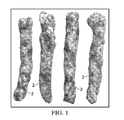
- FIG. 1 depicts the well-liked variety of corn collets known as random corn collets 2 , which are produced by a rotary head extruder.
- Random corn collets 2 comprise unique, twisted (“random”) shapes and protrusions and a highly desirable crunchy texture that can only be produced with a rotary head extruder. It is a generally accepted fact in the industry that these kinds of extruders cannot handle flour-like or non-refined granular materials.
- extruder formulations for random collets comprise only corn grits or corn meal, and water, to create the collets 2 of FIG. 1 . While it may be possible to incorporate some amounts of other ingredients to slightly modify the direct expanded products, to date, these amounts are not large enough to significantly vary the varieties or tastes of random collet products. Moreover, introduction of small granular materials such as flour or powder into a continuous random extrusion line typically causes blockage and halts production. Thus, there is a need for a rotary head extruder capable of handling additional formulations on a continuous basis for mass production.
- ingredients other than corn into a rotary head extruder while mimicking the appealing characteristics of the random corn collet 2 is highly desirable; namely, taste, appearance, density, and mouthfeel (or texture).
- Such non-corn random collet products should emulate the organoleptic properties, including taste and texture, of a conventionally produced shelf stable (i.e., corn-based) and ready to eat random collet.
- FIG. 1 depicts typical random corn collets as known in the industry.
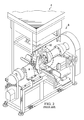
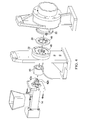
- FIG. 2 depicts a perspective view of a prior art rotary head extruder used in manufacturing collets.
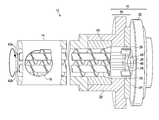
- FIG. 3A depicts a close-up view of the main working components of the rotary head extruder depicted in FIG. 2 .
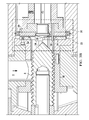
- FIG. 3B depicts a detailed cross-sectional view of the main working components of the extruder depicted in FIG. 2 .
- FIG. 4 depicts an exploded view of one embodiment of an improved rotary head extruder.
- FIG. 5A depicts a top view of one embodiment of an assembled improved extruder.
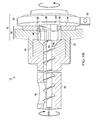
- FIG. 5B depicts a cross-sectional side view of the twin auger system within an improved rotary head extruder.
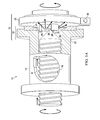
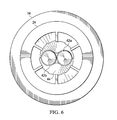
- FIG. 6 depicts a forward view of the twin augers in one embodiment of an improved extruder described herein.
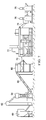
- FIG. 7 depicts a random extrusion line process incorporating the extruder described herein.
- An improved rotary head extruder successfully replaces the typically used single auger within the extruder with a twin-screw system for continued production and high throughput rates of random extruded products having a density within the range of 3.75-5.5 lbs/cu ft.
- Two screws also referred to here as augers
- a transition piece ensures delivery to a stator is continuous and uniform, ensuring proper flow of materials introduced into the barrel of the extruder for extrusion.
- the stator is a stationary plate surrounding an output end of an interior conical portion downstream from the single barrel.
- a rotor, or rotatable plate is downstream from the stator.
- the rotatable plate comprises a plurality of fingers surrounding a protruding nose cone located within a die gap, which is between the stator and the rotor.
- Extrusion using the rotary die system of a rotary head extruder together with the twin auger system described herein allows for a variety of fine particle sizes, a wide particle size distribution, and raw material compositions to be successfully introduced into and conveyed within a rotary head extruder to the die assembly, where the materials are cooked to form a wider array of random extruded products.
- the random extruded products incorporate formulations with various ingredients aside from the typically used corn meal formulations, while maintaining the desired bulk density, texture, and crunch of random extruded collet products.
- Other benefits and advantages of the present invention will become apparent to one skilled in the art.
- Rotary head extruders use two round plates to cook and gelatinize corn meal. One plate is rotating and the other is stationary, producing friction necessary to produce random collets. These extruders are high-shear, high-pressure machines, which generate heat in the form of friction in a relatively short length of time. No barrel heating is applied in rotary head extruders, as the energy used to cook the extrudate is generated from viscous dissipation of mechanical energy. There is no added water, heating element or cooling element used within a rotary head extruder to control temperatures. Instead, rotary head extruders use friction generated within the round plates (and not in the auger or screw zone) to cook the extrudate.
- the auger zone helps transport materials to the die assembly 10 , it cannot mix materials and is a poor conveyer of mixed materials and of certain ingredients, including very small ingredients such as powders or flours.
- the rotary head extruder is limited to refined cereal meal formulations within a narrow range of particle size. Anything else often results in flow irregularities along the single auger, which turns into blockages in the extruder flow, leading to failure and stoppages of the extruder.
- the maximum in-feed throughput capacity is limited to between about 400 to about 450 lb/hr.
- FIG. 2 illustrates a perspective view of a typical rotary head extruder used for production of the random corn collets 2 depicted in FIG. 1 .
- Pre-moistened cornmeal is gravity-fed through a hopper 4 and into the extruder 6 .
- the rotary head extruder 6 is comprised of two main working components that give the collets their twisted (“random”) shapes: a single screw or auger 8 and a rotary die assembly 10 .
- FIGS. 3A and 3B illustrate a close up and detailed side view image of the two main working components 12 of the extruder 6 .
- the auger 8 is housed in a cylindrical casing, or barrel 14 , and comprises an open feed section 16 through which the cornmeal passes, shown in FIG. 3 .
- the open feed section 16 is slightly turned in FIG. 3 to better depict the auger 8 .
- the hopper feeds into the open feed section 16 from above.
- the barrel 14 is shown to be quite short in the figures for clarity purposes, it should be noted that its portrayal is merely for purposes of depiction and the barrel length is not drawn to scale.
- the auger 8 transports and compresses the cornmeal, feeding it to the rotary die assembly 10 , where it is plasticized to a fluidized state in a glass transition process further described below.
- the die assembly 10 contains two brass alloy round plates: a stator 18 (with the stationary plate) and a rotor 20 (the rotating plate). Gelatinization of moisturized starchy ingredients takes place inside the concentric cavity between these two brass plates 18 , 20 .
- the stator 18 is an assembly comprising a stator head section 22 and a round stationary brass plate 24 that acts as a die through which the gelatinized melt flows.
- the stationary plate 24 has grooves 48 that aid in the compression of cornmeal as the stator 18 works together with the rotor 20 .
- the rotor 20 is a rotating plate comprising fingers 26 and a nose cone 28 .
- the nose cone 28 channels the cornmeal towards the fingers 26 and helps discharge the gelatinized cornmeal through the small gap between the rotor 18 and stator 20 .
- the action of the fingers 26 creates the necessary condition of pressure and heat to achieve plasticization of the raw materials at approximately 260° F. to 320° F. (127° C.-160° C.). Specifically, the fingers 26 force cornmeal back into the grooves of the stator head 24 , causing friction and compression of the cornmeal in the gap between the stator 18 and the rotor 20 .
- the brass facing 32 on the rotor 20 also helps to create heat and compression. Random extrusion may thus be characterized by a thermo mechanical transformation of the raw materials brought about by the metal-to-metal interactions of the die assembly 10 .
- the corn meal is subjected to high shear rates and pressure that generate most of the heat to cook the corn.
- most of the cooking takes place in the rotary die assembly 10 of the rotary head extruder.
- a rapid pressure loss causes the superheated water in the corn mass to turn to steam, puffing the cooked corn as it exits the die assembly.
- the flow of corn between one rotating plate 20 and one stationary plate 18 twists the expanding corn leaving it twisted and collapsed in places, resulting in the product characteristic shape shown in FIG. 1 .
- the random collets exit the rotary head extruder circumferentially outward from the gap between the stator and rotor in a radial path from the center of the fingers in the general direction of the straight arrows depicted in FIG. 3A .
- Cutter blades within a cutter assembly then cut off the collets 2 that result from the expansion process of the stator-rotor interactions.
- the process is entirely unique, providing unsystematic, irregularly shaped collets and a texture distinct in its crunchiness, giving somewhat of a homemade effect.
- Typical prior art corn meal specifications for rotary head extruders for example, include a particle size distribution where no more than 2.5% of the particles can be smaller than 300 microns.
- the extruder described herein can successfully process cornmeal with more than about 5%-10% of the particles smaller than 300 microns. While other extruders may provide more flexibility in terms of the components introduced therein, only rotary head extruders can perform random extrusion and create the random collet 2 , which upon exit from the extruder, comprises a unique shape and a bulk density ranging from between about 3.0 to about 6.0 lbs/cu ft. or more preferably between about 4.0 to about 5.25 lbs./cu ft.
- FIG. 4 illustrates an exploded view of the components of an improved rotary head extruder according to one aspect of the present disclosure.
- the rotary head extruder comprises a hopper 16 , much like that of the above described rotary head extruder of FIG. 3 , through which raw material is passed into a barrel 14 . Materials may be introduced, for example, through a hopper or other funnel device.
- a twin screw system comprising two augers 42 a,b , also depicted in FIGS. 5A and 5B .
- a transition piece 40 surrounds an end portion of the augers 42 a, b as best shown in FIGS. 5A and 5B .
- the distance between the external surfaces of the augers to the inner wall of the barrel 14 may range from between about 0.1 mm to about 0.150 mm. Flight elevates from the base of the auger will stop about 0.1 mm short of the wall in one embodiment.
- the transition piece 40 fits snugly within the stator head section 22 .
- the internal shape of the transition piece 40 presents a conical shape of flow path 44 , best shown in FIG. 6 .
- a figure eight shape is shown on the upstream end of the interior conical flow path 44 .
- the interior conical flow path 44 surrounds an end of each of the auger 42 a, b , the conical interior shape comprising a figure-eight shape at its base or upstream end, which diverges to a wide circular downstream end.
- the improved rotary head extruder comprises a twin auger system comprising or consisting of two rotatable augers 42 a, 42 b within a single barrel 14 ; a transition piece 40 at a downstream end of the rotatable augers 42 a, 42 b, the transition piece having a figure eight opening comprising a funnel shape; and a die assembly 10 comprising or consisting of a stator 18 and a rotor 20 with a die gap there between, wherein the stator comprises a stationary plate 24 surrounding an output end of the transition piece and the rotor 20 is a rotatable plate downstream from the stator, the rotatable plate comprising a plurality of fingers 26 surrounding a protruding nose cone 28 of the rotatable plate located within the die gap.
- the single barrel 14 is positioned at the end of a shaft controlled by a gear box (not shown) and moveably positioned such that the fingers 26 surround downstream ends of the two augers 42 a, b when the extruder is operated to undergo random extrusion of food materials.
- a gear box not shown
- the fingers 26 in FIG. 5A is shown only in part so as to better depict the nose cone 28 .
- each of the fingers 26 comprise the approximate same length and circumferentially surround the nose cone as well as at least a portion of the downstream ends of the two augers 42 a, b .
- Each of the two augers is located equidistant to and on opposing sides of the nose cone in one embodiment.
- 5A and 5B depict the stator 18 and rotor 20 with the small die gap there between, which is present during operation of the rotary head extruder.
- the die gap is between about 1.25 mm and about 2.54 mm. As described above with the prior art rotary head extruder, cooked and expanded or puffed product will exit the extruder circumferentially outwards from the die gap.
- FIG. 6 depicts an interior conical flow path 44 between the external surfaces of the augers 42 a, 42 b and the walls of the barrel 14 .
- the interior conical flow path 44 encloses an end of the two augers 42 a, 42 b tightly, forming a figure eight opening at the most upstream end of the transition piece 40 towards the barrel 14 .
- the opening remains constant for a length along a downstream end of the augers and then funnels out, widening at the exit end of the material to be plasticized in the two bronze plates.
- the single barrel 14 houses the two augers 42 a,b and extends horizontally along at least half their connecting with the transition piece 40 and into the FIG. 8 -shape of the conical flow path 44 . While depicted as a separate piece in the figures, the transition piece 40 may also be an integral part of the stator head section 22 adjacent to the downstream end of the augers.
- the stator 18 comprises a stator head section 22 with interior grooves 46 at its outlet end.
- the interior grooves are preferentially horizontal and circumferentially spaced around the circular opening.
- the interior grooves 46 should substantially align at their downstream ends with the grooves 48 of the stationary plate 24 , which surrounds the outlet end of the stator head 22 .
- the stationary plate 24 is comprised or consists of bronze. Other metals may also be possible so long as friction remains generated in operation.
- the interior grooves 46 meet with the downstream end of the transition 40 and interior conical flow path 44 , the conical shape having a slope extending outwards to meet with the interior grooves 46 .
- the interior conical flow path 44 comprises a funnel-like shape with its wide end facing the grooves 46 of the stator 18 .
- the slope of the interior conical portion of the transition piece 40 begins at a location behind the two augers, or at their downstream tip ends, to meet the interior grooves 46 of the stator head section 22 .
- the slope is less than about 75 degrees. In one embodiment, the slope is less than about 65 degrees. In one embodiment, the slope is less than about 60 degrees.
- the slope should generally allow for a smooth transition and continuous flow of extrudate to the die assembly.
- the stator head section 22 surrounds the interior conical portion 44 , which provides for a quick transition or short slope end portion between the two auger ends and the stator 18 .
- the transition piece 40 comprises an upstream portion having a substantially constant or equal thickness along its length.
- This equivalent upstream stem portion spans at least half the length of the transition piece 40 .
- the downstream end of the transition piece 40 comprises a funnel like shape, which slopes out to a conical mouth with a wider opening at its most downstream end.
- the interior conical portion provides for smooth flow of materials to the die assembly 10 , where they will ultimately be cooked and puffed.
- the rotor 20 has its own motor drive (not depicted) to control the speed and rotation of the rotor during extrusion.
- twin screw rotary head extruder improves the stability of the overall process and creates a robust random extrusion system capable of accepting a wide variety of raw materials for production of diverse random collets.
- the two augers 42 a, b may rotate independently (actuated by separate power sources or a transmission gear) but in the same direction to provide for intermeshing effects to convey materials between the walls of the single barrel and the augers.
- the two augers are connected via a gearbox. As depicted in FIGS.
- the augers are positioned horizontally within the single barrel adjacent to one another.
- the augers 42 a,b may also be position vertically, or one on top of the other.
- the two augers will rotate at speeds of between about 150 to about 500 rpm.
- the two augers will rotate at speeds of between about 200 to about 350 rpm.
- the two augers will rotate at speeds of between about 300 to about 320 rpm.
- the twin-auger system is self-wiping and closely intermeshing, transferring materials by a positive displacement action by its co-rotating mechanism, which makes the process more independent of the nature and composition of the raw material. Transfer limitations due to constituents of the raw material difficult to convey such as fiber, oily particles, small particulates, or other lubricant-acting components are overcome and conveyance is improved. There remains no added water, heating element or cooling element used within the rotary head extruder described herein. The energy used to cook the extrudate is generated from the friction of the die assembly. There are no holes or openings in either the stator or rotor, and the random collets exit the rotary head extruder circumferentially outward from the gap between the stator and rotor.
- twin screw rotary head extruder described herein can successfully handle continuous random extrusion of varied materials as well as materials of variable sizes.
- corn meal having a wide range of particle sizes has been successfully tested, including those that have previously imparted challenges due to the very different particles sizes of the corn meal.
- a particle size distribution of between 200 and 900 micrometers can be fed into the rotary head extruder of the present disclosure and successfully random extruded.
- up to or about 80% by weight of the particle size distribution may comprise fine particle size of about 400 micrometers.
- the particles may range from about 200 to about 1200 micrometers, with optionally about 50% of the particle size distribution reaching up to or about 400 micrometers. Additional embodiments and examples are provided below.
- a method of random extrusion comprising the steps of feeding raw materials into a single barrel comprising or consisting of two augers positioned within a tightly fitting encasing within the single barrel; and conveying the raw materials towards a die assembly through an intermeshing mechanism of the augers, said die assembly comprising a stator and a rotor with a die gap there between, wherein the stator is a stationary plate surrounding an output end of the single barrel and the rotor is a rotatable plate downstream from the stator, the rotatable plate comprising a plurality of fingers surrounding a protruding nose cone of the rotor located within the die gap.
- the raw materials pass through an interior conical portion prior to reach the rotary die assembly.
- the nose cone of the rotor protrudes inwardly with its tip facing the stator such that the nose cone is positioned within the die gap.
- the single barrel housing the auger system may be positioned so as to create the die gap between the stator and rotor. In some embodiments, the die gap may be between about 1.35 to about 1.8 mm.
- the positioning step places the single barrel with its two augers such that the fingers of the rotatable plate surround at least a portion of the downstream ends of the two augers. The fingers may also surround the downstream ends of the two augers in one embodiment or may be in close proximity to the downstream ends from between about 2 to about 6 mm in distance in one embodiment.
- the feeding step comprises a feed rate for raw materials of between about 200 to about 550 lbs/hr. In one embodiment, the feeding step comprises a feed rate of between about 400 to about 550 lbs/hr. In one embodiment, the feeding step comprises a feed rate of over 450 lbs/hr.
- the raw materials may comprise one or more of corn meal, whole grain corn meal, rice, whole grain flour, rice pea, brown rice, wheat flour, whole wheat flour, pea flour, black bean, pinto bean flour, potato flour, and other grain legumes or tubers whether in flour, powder or other granular form.
- Raw materials comprising a moisture between about 1.0% to about 18% may generally be used to form random extruded products in the rotary head extruder described herein.
- the method may comprise the step of pre-moistening or pre-hydrating the raw materials for introduction into the rotary head extruder.
- the raw materials comprise an initial moisture content of between about 11% to about 12.5%.
- Raw materials may be pre-hydrated to from about 14.5% to about 18% moisture by weight.
- the raw materials are pre-hydrated to about 16.9% in-barrel moisture content by weight.
- the method may comprise the step of pre-mixing raw materials, which may include mixing one type of raw material with water or with other raw materials with water for moistening prior to introduction into the improved rotary head extruder. In this way, different materials can be moistened to the same approximate moisture level, for example.
- both augers co-rotate and intermesh, whether independent of one another or not, in the same direction and/or speed.
- a twin shot gear box may be used to rotate both augers simultaneously, or a single gear box with one motor moves two shafts.
- each auger may comprise its own gear box to co-rotate independent of one another at the same speed.
- the conveying step may comprise an auger speed of about 100 to 400 rpm.
- the die gap remains constant during extrusion once the single barrel (and its the two augers) and rotor is positioned to set the gap, with only small adjustments if necessary in the range of +/ ⁇ 0.5 mm.
- the temperature of the stator head may range from between about 260 to about 320F.
- the rotor speed may be adjusted to from about 250 to about 600 RPM.
- the method further comprises the step of expanding the raw materials into a food product comprising a bulk density of between about 3.0 and 11 lbs./cu ft, most preferably between 3.0 and 6.5 lb/cu ft.
- expanded and puffed food product comprises a bulk density of between about 4.5 and about 5.0 lbs./cu ft.
- a cutting step may also be used to cut the expanded and puffed food product to a desirable size.
- FIG. 6 depicts a random extrusion processing line into which the rotary head extruder described herein may be introduced.
- a mixer 60 adds moisture as it mixes the raw materials.
- the mixer may be vertical, as depicted in FIG. 6 , or horizontal (not pictured).
- the raw materials are then transferred to a bucket elevator 42 , which elevates the materials to the hopper 64 of the rotary head extruder.
- extrusion forms hard dense extruded product utilizing rotating brass plates, as previously discussed above.
- the product is then conveyed 66 to a fines tumbler 68 , which removes small fines from the product.
- the product then passes through a vibratory feeder 70 to provide even feed to a fryer 72 , such as a rotary fryer, which decreases moisture and adds oil to the extruded product.
- a vibratory feeder 70 transfers product to a coating tumbler 76 , wherein oil, flavor and salt are mixed.
- the products can then be turned in a flavor drum 57 , wherein flavor is applied to the surface of the random collets.
- FIG. 6 describes a process for producing fried random corn collets, such illustration is not meant to limit the scope of this embodiment.
- the rotary head extruder described herein may be incorporated into a fried corn collet production line for producing fried corn collets.
- the rotary head extruder described herein may be incorporated into a baked corn collet production line for producing baked corn collets.
- a mixture of whole grain cornmeal and yellow corn meal are blended to created a whole grain blend for extrusion and formation of whole grain random collets.
- the mixture comprises 55% whole grain cornmeal and 45% standard cornmeal.
- the mixture is introduced into a mixer and 4-7% water is added.
- the mixture was mixed to moisten the whole grain blend until it achieved a moisture content of about 15-18% .
- the particle size distribution of this particular cornmeal is between 100 and 700 microns with up to 58% comprising particle size of about 425 microns.
- An in-barrel moisture content of about 15.9% was determined.
- the rotor position or gap was set to about 1.52 mm, and the stator head temperature was recorded to be about 146C.
- the auger speed was initially set to about 228 rpm and the rotor comprised a rotor speed of about 500 rpm.
- Product rate was measured to be about 467 lb/minute, with resulting expanded, puffed product resulting with a bulk density of about 4.75 lbs/cu ft.
- a mixture of rice flour, yellow corn meal and yellow pea flour was blended to create a rice flour blend for extrusion and formation of rice flour random collets.
- the mixture comprised about 60% rice flour, 30% corn meal, and 10% yellow pea flour. All percentages are by weight unless otherwise disclosed.
- the mixture is introduced into a mixer and 7% water is added.
- the mixture was mixed to moisten the whole grain blend until it achieved a moisture content of about 17.5%.
- the rotor position or gap was set to about 1.60 mm, and the stator head temperature was recorded to be about 132° C.
- the auger speed was initially set to about 275 rpm and the rotor comprised a rotor speed of about 530 rpm.
- Product rate was measured to be about 400 lb/minute, with resulting expanded, puffed product resulting with a bulk density of about 5.5 lbs/cu ft.
- a mixture of rice flour, yellow corn meal and yellow pea flour was blended to create a rice flour blend for extrusion and formation of rice flour random collets.
- the mixture comprised about 55% rice flour, 30% whole-grain corn meal, and 15% yellow pea flour. All percentages are by weight unless otherwise disclosed.
- the mixture is introduced into a mixer and 7% water is added.
- the mixture was mixed to moisten the whole grain blend until it achieved a moisture content of about 17%.
- the rotor position or gap was set to about 1.60 mm, and the stator head temperature was recorded to be about 139° C.
- the auger speed was initially set to about 275 rpm and the rotor comprised a rotor speed of about 530 rpm.
- Product rate was measured to be about 340 lb/minute, with resulting expanded, puffed product resulting with a bulk density of about 5.2 lbs/cu ft.
- the method illustratively disclosed herein suitably may be practiced in the absence of any element that is not specifically disclosed herein.
- the methods described herein may suitably comprise or consist only of the steps disclosed.
- the formulations may comprise or consist only of the components disclosed.
- Individual numerical values and/or ranges are stated as approximations as though the values were preceded by the word “about” or “approximately.”
- the terms “about” and “approximately” when referring to a numerical value shall have their plain and ordinary meanings to a person of ordinary skill in the art to which the disclosed subject matter is most closely related. It should be understood that the exact value following the term “about” or “approximately” is also a suitable range or value without the approximate terms.
Landscapes
- Engineering & Computer Science (AREA)
- Life Sciences & Earth Sciences (AREA)
- Chemical & Material Sciences (AREA)
- Food Science & Technology (AREA)
- Polymers & Plastics (AREA)
- Mechanical Engineering (AREA)
- Health & Medical Sciences (AREA)
- Nutrition Science (AREA)
- Manufacturing & Machinery (AREA)
- Agronomy & Crop Science (AREA)
- Botany (AREA)
- Formation And Processing Of Food Products (AREA)
- General Preparation And Processing Of Foods (AREA)
- Noodles (AREA)
- Grain Derivatives (AREA)
- Extrusion Moulding Of Plastics Or The Like (AREA)
Abstract
Description
- 1. Technical Field
- The present invention generally relates to an improved rotary head extruder for the incorporation of ingredients that are otherwise difficult to include within random extruded collets.
- 2. Description of Related Art
- In the formation of random collet products, inclusion of components other than substantially uniform corn meal (i.e., of similar particle size) or refined meals has proven difficult because of the limitations of the rotary head extruder.
FIG. 1 depicts the well-liked variety of corn collets known asrandom corn collets 2, which are produced by a rotary head extruder.Random corn collets 2 comprise unique, twisted (“random”) shapes and protrusions and a highly desirable crunchy texture that can only be produced with a rotary head extruder. It is a generally accepted fact in the industry that these kinds of extruders cannot handle flour-like or non-refined granular materials. As such, extruder formulations for random collets comprise only corn grits or corn meal, and water, to create thecollets 2 ofFIG. 1 . While it may be possible to incorporate some amounts of other ingredients to slightly modify the direct expanded products, to date, these amounts are not large enough to significantly vary the varieties or tastes of random collet products. Moreover, introduction of small granular materials such as flour or powder into a continuous random extrusion line typically causes blockage and halts production. Thus, there is a need for a rotary head extruder capable of handling additional formulations on a continuous basis for mass production. In particular, the introduction of ingredients other than corn into a rotary head extruder while mimicking the appealing characteristics of therandom corn collet 2 is highly desirable; namely, taste, appearance, density, and mouthfeel (or texture). Such non-corn random collet products should emulate the organoleptic properties, including taste and texture, of a conventionally produced shelf stable (i.e., corn-based) and ready to eat random collet. - The novel features believed characteristic of the invention are set forth in the appended claims. The invention itself, however, as well as a mode of use, further objectives and advantages thereof, will be best understood by reference to the following detailed description of illustrative embodiments when read in conjunction with the accompanying drawings, wherein:
-
FIG. 1 depicts typical random corn collets as known in the industry. -
FIG. 2 depicts a perspective view of a prior art rotary head extruder used in manufacturing collets. -
FIG. 3A depicts a close-up view of the main working components of the rotary head extruder depicted inFIG. 2 . -
FIG. 3B depicts a detailed cross-sectional view of the main working components of the extruder depicted inFIG. 2 . -
FIG. 4 depicts an exploded view of one embodiment of an improved rotary head extruder. -
FIG. 5A depicts a top view of one embodiment of an assembled improved extruder. -
FIG. 5B depicts a cross-sectional side view of the twin auger system within an improved rotary head extruder. -
FIG. 6 depicts a forward view of the twin augers in one embodiment of an improved extruder described herein. -
FIG. 7 depicts a random extrusion line process incorporating the extruder described herein. - An improved rotary head extruder successfully replaces the typically used single auger within the extruder with a twin-screw system for continued production and high throughput rates of random extruded products having a density within the range of 3.75-5.5 lbs/cu ft. Two screws (also referred to here as augers) are encased within a single barrel. A transition piece ensures delivery to a stator is continuous and uniform, ensuring proper flow of materials introduced into the barrel of the extruder for extrusion. The stator is a stationary plate surrounding an output end of an interior conical portion downstream from the single barrel. A rotor, or rotatable plate, is downstream from the stator. The rotatable plate comprises a plurality of fingers surrounding a protruding nose cone located within a die gap, which is between the stator and the rotor.
- Extrusion using the rotary die system of a rotary head extruder together with the twin auger system described herein allows for a variety of fine particle sizes, a wide particle size distribution, and raw material compositions to be successfully introduced into and conveyed within a rotary head extruder to the die assembly, where the materials are cooked to form a wider array of random extruded products.
- The random extruded products incorporate formulations with various ingredients aside from the typically used corn meal formulations, while maintaining the desired bulk density, texture, and crunch of random extruded collet products. Other benefits and advantages of the present invention will become apparent to one skilled in the art.
- To better understand the limitations of a rotary head extruder in terms of its typically used corn formulations, and the benefits of the improved extruder and method described herein, a discussion of the conventional rotary head extruder is helpful.
- Rotary head extruders use two round plates to cook and gelatinize corn meal. One plate is rotating and the other is stationary, producing friction necessary to produce random collets. These extruders are high-shear, high-pressure machines, which generate heat in the form of friction in a relatively short length of time. No barrel heating is applied in rotary head extruders, as the energy used to cook the extrudate is generated from viscous dissipation of mechanical energy. There is no added water, heating element or cooling element used within a rotary head extruder to control temperatures. Instead, rotary head extruders use friction generated within the round plates (and not in the auger or screw zone) to cook the extrudate. There is no mixing and only a very limited compression at the auger of a rotary head extruder; specifically, only enough to convey the material in the gap areas within the barrel. The shear is instead at the fingers 26 (best shown in
FIG. 3A ), described below. While the auger zone helps transport materials to the dieassembly 10, it cannot mix materials and is a poor conveyer of mixed materials and of certain ingredients, including very small ingredients such as powders or flours. Instead, the rotary head extruder is limited to refined cereal meal formulations within a narrow range of particle size. Anything else often results in flow irregularities along the single auger, which turns into blockages in the extruder flow, leading to failure and stoppages of the extruder. In addition, the maximum in-feed throughput capacity is limited to between about 400 to about 450 lb/hr. -
FIG. 2 illustrates a perspective view of a typical rotary head extruder used for production of therandom corn collets 2 depicted inFIG. 1 . Pre-moistened cornmeal is gravity-fed through ahopper 4 and into theextruder 6. Therotary head extruder 6 is comprised of two main working components that give the collets their twisted (“random”) shapes: a single screw orauger 8 and arotary die assembly 10.FIGS. 3A and 3B illustrate a close up and detailed side view image of the two mainworking components 12 of theextruder 6. Theauger 8 is housed in a cylindrical casing, orbarrel 14, and comprises anopen feed section 16 through which the cornmeal passes, shown inFIG. 3 . It should be noted that theopen feed section 16 is slightly turned inFIG. 3 to better depict theauger 8. In practice, the hopper feeds into theopen feed section 16 from above. While thebarrel 14 is shown to be quite short in the figures for clarity purposes, it should be noted that its portrayal is merely for purposes of depiction and the barrel length is not drawn to scale. Theauger 8 transports and compresses the cornmeal, feeding it to therotary die assembly 10, where it is plasticized to a fluidized state in a glass transition process further described below. - The
die assembly 10 contains two brass alloy round plates: a stator 18 (with the stationary plate) and a rotor 20 (the rotating plate). Gelatinization of moisturized starchy ingredients takes place inside the concentric cavity between these twobrass plates stator 18 is an assembly comprising astator head section 22 and a roundstationary brass plate 24 that acts as a die through which the gelatinized melt flows. Thestationary plate 24 hasgrooves 48 that aid in the compression of cornmeal as thestator 18 works together with therotor 20. Therotor 20 is a rotatingplate comprising fingers 26 and anose cone 28. Thenose cone 28 channels the cornmeal towards thefingers 26 and helps discharge the gelatinized cornmeal through the small gap between therotor 18 andstator 20. The action of thefingers 26 creates the necessary condition of pressure and heat to achieve plasticization of the raw materials at approximately 260° F. to 320° F. (127° C.-160° C.). Specifically, thefingers 26 force cornmeal back into the grooves of thestator head 24, causing friction and compression of the cornmeal in the gap between thestator 18 and therotor 20. The brass facing 32 on therotor 20 also helps to create heat and compression. Random extrusion may thus be characterized by a thermo mechanical transformation of the raw materials brought about by the metal-to-metal interactions of thedie assembly 10. - Several things happen within the
die assembly 10 during the random extrusion process. First, the corn meal is subjected to high shear rates and pressure that generate most of the heat to cook the corn. Thus, unlike other extruders, most of the cooking takes place in therotary die assembly 10 of the rotary head extruder. As stated above, there is no added water or external heat used to control the temperatures within this extruder. Second, a rapid pressure loss causes the superheated water in the corn mass to turn to steam, puffing the cooked corn as it exits the die assembly. Third, the flow of corn between one rotatingplate 20 and onestationary plate 18 twists the expanding corn leaving it twisted and collapsed in places, resulting in the product characteristic shape shown inFIG. 1 . The random collets exit the rotary head extruder circumferentially outward from the gap between the stator and rotor in a radial path from the center of the fingers in the general direction of the straight arrows depicted inFIG. 3A . Cutter blades within a cutter assembly then cut off thecollets 2 that result from the expansion process of the stator-rotor interactions. The process is entirely unique, providing unsystematic, irregularly shaped collets and a texture distinct in its crunchiness, giving somewhat of a homemade effect. Typical prior art corn meal specifications for rotary head extruders, for example, include a particle size distribution where no more than 2.5% of the particles can be smaller than 300 microns. The extruder described herein, on the other hand, can successfully process cornmeal with more than about 5%-10% of the particles smaller than 300 microns. While other extruders may provide more flexibility in terms of the components introduced therein, only rotary head extruders can perform random extrusion and create therandom collet 2, which upon exit from the extruder, comprises a unique shape and a bulk density ranging from between about 3.0 to about 6.0 lbs/cu ft. or more preferably between about 4.0 to about 5.25 lbs./cu ft. -
FIG. 4 illustrates an exploded view of the components of an improved rotary head extruder according to one aspect of the present disclosure. The rotary head extruder comprises ahopper 16, much like that of the above described rotary head extruder ofFIG. 3 , through which raw material is passed into abarrel 14. Materials may be introduced, for example, through a hopper or other funnel device. Within thebarrel 14 is a twin screw system comprising twoaugers 42 a,b, also depicted inFIGS. 5A and 5B . Atransition piece 40 surrounds an end portion of theaugers 42 a, b as best shown inFIGS. 5A and 5B . In one embodiment, the distance between the external surfaces of the augers to the inner wall of thebarrel 14 may range from between about 0.1 mm to about 0.150 mm. Flight elevates from the base of the auger will stop about 0.1 mm short of the wall in one embodiment. Thetransition piece 40 fits snugly within thestator head section 22. The internal shape of thetransition piece 40 presents a conical shape offlow path 44, best shown inFIG. 6 . A figure eight shape is shown on the upstream end of the interiorconical flow path 44. The interiorconical flow path 44 surrounds an end of each of theauger 42 a, b, the conical interior shape comprising a figure-eight shape at its base or upstream end, which diverges to a wide circular downstream end. - Referring to
FIG. 5A , in one embodiment, the improved rotary head extruder comprises a twin auger system comprising or consisting of tworotatable augers single barrel 14; atransition piece 40 at a downstream end of therotatable augers die assembly 10 comprising or consisting of astator 18 and arotor 20 with a die gap there between, wherein the stator comprises astationary plate 24 surrounding an output end of the transition piece and therotor 20 is a rotatable plate downstream from the stator, the rotatable plate comprising a plurality offingers 26 surrounding a protrudingnose cone 28 of the rotatable plate located within the die gap. Thesingle barrel 14 is positioned at the end of a shaft controlled by a gear box (not shown) and moveably positioned such that thefingers 26 surround downstream ends of the twoaugers 42 a, b when the extruder is operated to undergo random extrusion of food materials. It should be noted that one of thefingers 26 inFIG. 5A is shown only in part so as to better depict thenose cone 28. In practice, each of thefingers 26 comprise the approximate same length and circumferentially surround the nose cone as well as at least a portion of the downstream ends of the twoaugers 42 a, b. Each of the two augers is located equidistant to and on opposing sides of the nose cone in one embodiment.FIGS. 5A and 5B depict thestator 18 androtor 20 with the small die gap there between, which is present during operation of the rotary head extruder. In one embodiment, the die gap is between about 1.25 mm and about 2.54 mm. As described above with the prior art rotary head extruder, cooked and expanded or puffed product will exit the extruder circumferentially outwards from the die gap. -
FIG. 6 depicts an interiorconical flow path 44 between the external surfaces of theaugers barrel 14. The interiorconical flow path 44 encloses an end of the twoaugers transition piece 40 towards thebarrel 14. The opening remains constant for a length along a downstream end of the augers and then funnels out, widening at the exit end of the material to be plasticized in the two bronze plates. Thesingle barrel 14 houses the twoaugers 42 a,b and extends horizontally along at least half their connecting with thetransition piece 40 and into theFIG. 8 -shape of theconical flow path 44. While depicted as a separate piece in the figures, thetransition piece 40 may also be an integral part of thestator head section 22 adjacent to the downstream end of the augers. - Returning to
FIGS. 5A and 5B , thestator 18 comprises astator head section 22 withinterior grooves 46 at its outlet end. The interior grooves are preferentially horizontal and circumferentially spaced around the circular opening. In addition, theinterior grooves 46 should substantially align at their downstream ends with thegrooves 48 of thestationary plate 24, which surrounds the outlet end of thestator head 22. In one embodiment, thestationary plate 24 is comprised or consists of bronze. Other metals may also be possible so long as friction remains generated in operation. On the upstream end, theinterior grooves 46 meet with the downstream end of thetransition 40 and interiorconical flow path 44, the conical shape having a slope extending outwards to meet with theinterior grooves 46. Thus, the interiorconical flow path 44 comprises a funnel-like shape with its wide end facing thegrooves 46 of thestator 18. In one embodiment, the slope of the interior conical portion of thetransition piece 40 begins at a location behind the two augers, or at their downstream tip ends, to meet theinterior grooves 46 of thestator head section 22. In one embodiment, the slope is less than about 75 degrees. In one embodiment, the slope is less than about 65 degrees. In one embodiment, the slope is less than about 60 degrees. The slope should generally allow for a smooth transition and continuous flow of extrudate to the die assembly. In one embodiment, thestator head section 22 surrounds the interiorconical portion 44, which provides for a quick transition or short slope end portion between the two auger ends and thestator 18. As perhaps best shown inFIG. 5B , thetransition piece 40 comprises an upstream portion having a substantially constant or equal thickness along its length. This equivalent upstream stem portion spans at least half the length of thetransition piece 40. The downstream end of thetransition piece 40 comprises a funnel like shape, which slopes out to a conical mouth with a wider opening at its most downstream end. The interior conical portion provides for smooth flow of materials to thedie assembly 10, where they will ultimately be cooked and puffed. Therotor 20 has its own motor drive (not depicted) to control the speed and rotation of the rotor during extrusion. - By successfully incorporating a twin-screw system into an extruder that is still capable of producing random extrusion processes, the transfer of granular materials inside the extruder to the rotary die is improved. The twin screw rotary head extruder described herein improves the stability of the overall process and creates a robust random extrusion system capable of accepting a wide variety of raw materials for production of diverse random collets. During random extrusion, the two
augers 42 a, b may rotate independently (actuated by separate power sources or a transmission gear) but in the same direction to provide for intermeshing effects to convey materials between the walls of the single barrel and the augers. In one embodiment, the two augers are connected via a gearbox. As depicted inFIGS. 5A and 5B , in one embodiment, the augers are positioned horizontally within the single barrel adjacent to one another. However, in one embodiment, theaugers 42 a,b may also be position vertically, or one on top of the other. In one embodiment, the two augers will rotate at speeds of between about 150 to about 500 rpm. In another embodiment, the two augers will rotate at speeds of between about 200 to about 350 rpm. In another one embodiment, the two augers will rotate at speeds of between about 300 to about 320 rpm. - The twin-auger system is self-wiping and closely intermeshing, transferring materials by a positive displacement action by its co-rotating mechanism, which makes the process more independent of the nature and composition of the raw material. Transfer limitations due to constituents of the raw material difficult to convey such as fiber, oily particles, small particulates, or other lubricant-acting components are overcome and conveyance is improved. There remains no added water, heating element or cooling element used within the rotary head extruder described herein. The energy used to cook the extrudate is generated from the friction of the die assembly. There are no holes or openings in either the stator or rotor, and the random collets exit the rotary head extruder circumferentially outward from the gap between the stator and rotor.
- The twin screw rotary head extruder described herein can successfully handle continuous random extrusion of varied materials as well as materials of variable sizes. For example, corn meal having a wide range of particle sizes has been successfully tested, including those that have previously imparted challenges due to the very different particles sizes of the corn meal. In one embodiment, a particle size distribution of between 200 and 900 micrometers can be fed into the rotary head extruder of the present disclosure and successfully random extruded. In this embodiment, up to or about 80% by weight of the particle size distribution may comprise fine particle size of about 400 micrometers. In other embodiments, the particles may range from about 200 to about 1200 micrometers, with optionally about 50% of the particle size distribution reaching up to or about 400 micrometers. Additional embodiments and examples are provided below.
- In accordance with another aspect of the present disclosure is a method of random extrusion comprising the steps of feeding raw materials into a single barrel comprising or consisting of two augers positioned within a tightly fitting encasing within the single barrel; and conveying the raw materials towards a die assembly through an intermeshing mechanism of the augers, said die assembly comprising a stator and a rotor with a die gap there between, wherein the stator is a stationary plate surrounding an output end of the single barrel and the rotor is a rotatable plate downstream from the stator, the rotatable plate comprising a plurality of fingers surrounding a protruding nose cone of the rotor located within the die gap. In one embodiment, the raw materials pass through an interior conical portion prior to reach the rotary die assembly.
- As depicted in
FIGS. 5A and 5B , the nose cone of the rotor protrudes inwardly with its tip facing the stator such that the nose cone is positioned within the die gap. The single barrel housing the auger system may be positioned so as to create the die gap between the stator and rotor. In some embodiments, the die gap may be between about 1.35 to about 1.8 mm. The positioning step places the single barrel with its two augers such that the fingers of the rotatable plate surround at least a portion of the downstream ends of the two augers. The fingers may also surround the downstream ends of the two augers in one embodiment or may be in close proximity to the downstream ends from between about 2 to about 6 mm in distance in one embodiment. The feeding step comprises a feed rate for raw materials of between about 200 to about 550 lbs/hr. In one embodiment, the feeding step comprises a feed rate of between about 400 to about 550 lbs/hr. In one embodiment, the feeding step comprises a feed rate of over 450 lbs/hr. - As described above, a wide range of raw materials is possible using the improved rotary head extruder device described herein. The raw materials may comprise one or more of corn meal, whole grain corn meal, rice, whole grain flour, rice pea, brown rice, wheat flour, whole wheat flour, pea flour, black bean, pinto bean flour, potato flour, and other grain legumes or tubers whether in flour, powder or other granular form.
- Raw materials comprising a moisture between about 1.0% to about 18% may generally be used to form random extruded products in the rotary head extruder described herein. In one embodiment, the method may comprise the step of pre-moistening or pre-hydrating the raw materials for introduction into the rotary head extruder. In one embodiment, the raw materials comprise an initial moisture content of between about 11% to about 12.5%. Raw materials may be pre-hydrated to from about 14.5% to about 18% moisture by weight. In one embodiment, the raw materials are pre-hydrated to about 16.9% in-barrel moisture content by weight. In one embodiment, the method may comprise the step of pre-mixing raw materials, which may include mixing one type of raw material with water or with other raw materials with water for moistening prior to introduction into the improved rotary head extruder. In this way, different materials can be moistened to the same approximate moisture level, for example.
- During extrusion, and perhaps more specifically, the conveying step, both augers co-rotate and intermesh, whether independent of one another or not, in the same direction and/or speed. In one embodiment, a twin shot gear box may be used to rotate both augers simultaneously, or a single gear box with one motor moves two shafts. In one embodiment, each auger may comprise its own gear box to co-rotate independent of one another at the same speed. In one embodiment, the conveying step may comprise an auger speed of about 100 to 400 rpm. Typically, the die gap remains constant during extrusion once the single barrel (and its the two augers) and rotor is positioned to set the gap, with only small adjustments if necessary in the range of +/−0.5 mm. The temperature of the stator head may range from between about 260 to about 320F. In some embodiments, the rotor speed may be adjusted to from about 250 to about 600 RPM.
- The method further comprises the step of expanding the raw materials into a food product comprising a bulk density of between about 3.0 and 11 lbs./cu ft, most preferably between 3.0 and 6.5 lb/cu ft. In one embodiment, expanded and puffed food product comprises a bulk density of between about 4.5 and about 5.0 lbs./cu ft. A cutting step may also be used to cut the expanded and puffed food product to a desirable size.
- By way of example,
FIG. 6 depicts a random extrusion processing line into which the rotary head extruder described herein may be introduced. Briefly, as shown inFIG. 6 , in a first step of a random extrusion line, amixer 60 adds moisture as it mixes the raw materials. The mixer may be vertical, as depicted inFIG. 6 , or horizontal (not pictured). The raw materials are then transferred to a bucket elevator 42, which elevates the materials to thehopper 64 of the rotary head extruder. Next, extrusion forms hard dense extruded product utilizing rotating brass plates, as previously discussed above. The product is then conveyed 66 to a fines tumbler 68, which removes small fines from the product. The product then passes through avibratory feeder 70 to provide even feed to afryer 72, such as a rotary fryer, which decreases moisture and adds oil to the extruded product. Next, an additionalvibratory feeder 74 transfers product to acoating tumbler 76, wherein oil, flavor and salt are mixed. The products can then be turned in a flavor drum 57, wherein flavor is applied to the surface of the random collets. - It should be noted that while
FIG. 6 describes a process for producing fried random corn collets, such illustration is not meant to limit the scope of this embodiment. In one embodiment, the rotary head extruder described herein may be incorporated into a fried corn collet production line for producing fried corn collets. In one embodiment, the rotary head extruder described herein may be incorporated into a baked corn collet production line for producing baked corn collets. - The invention will now be further elucidated with reference to the following examples, which should be understood to be non-limitative. It should be appreciated by those of ordinary skill in the art that the techniques disclosed in the examples that follow represent ones discovered by the inventors to function well in the practice of the invention and thus, constitute exemplary modes. One of ordinary skill in the art, when armed with this disclosure, should appreciate that many changes can be made in the specific embodiments while still obtaining similar or like results without departing from the spirit and scope of the present invention.
- A mixture of whole grain cornmeal and yellow corn meal are blended to created a whole grain blend for extrusion and formation of whole grain random collets. The mixture comprises 55% whole grain cornmeal and 45% standard cornmeal. The mixture is introduced into a mixer and 4-7% water is added. The mixture was mixed to moisten the whole grain blend until it achieved a moisture content of about 15-18% . The particle size distribution of this particular cornmeal is between 100 and 700 microns with up to 58% comprising particle size of about 425 microns. An in-barrel moisture content of about 15.9% was determined. The rotor position or gap was set to about 1.52 mm, and the stator head temperature was recorded to be about 146C. The auger speed was initially set to about 228 rpm and the rotor comprised a rotor speed of about 500 rpm. Product rate was measured to be about 467 lb/minute, with resulting expanded, puffed product resulting with a bulk density of about 4.75 lbs/cu ft.
- A mixture of rice flour, yellow corn meal and yellow pea flour was blended to create a rice flour blend for extrusion and formation of rice flour random collets. The mixture comprised about 60% rice flour, 30% corn meal, and 10% yellow pea flour. All percentages are by weight unless otherwise disclosed. The mixture is introduced into a mixer and 7% water is added. The mixture was mixed to moisten the whole grain blend until it achieved a moisture content of about 17.5%. The rotor position or gap was set to about 1.60 mm, and the stator head temperature was recorded to be about 132° C. The auger speed was initially set to about 275 rpm and the rotor comprised a rotor speed of about 530 rpm. Product rate was measured to be about 400 lb/minute, with resulting expanded, puffed product resulting with a bulk density of about 5.5 lbs/cu ft.
- A mixture of rice flour, yellow corn meal and yellow pea flour was blended to create a rice flour blend for extrusion and formation of rice flour random collets. The mixture comprised about 55% rice flour, 30% whole-grain corn meal, and 15% yellow pea flour. All percentages are by weight unless otherwise disclosed. The mixture is introduced into a mixer and 7% water is added. The mixture was mixed to moisten the whole grain blend until it achieved a moisture content of about 17%. The rotor position or gap was set to about 1.60 mm, and the stator head temperature was recorded to be about 139° C. The auger speed was initially set to about 275 rpm and the rotor comprised a rotor speed of about 530 rpm. Product rate was measured to be about 340 lb/minute, with resulting expanded, puffed product resulting with a bulk density of about 5.2 lbs/cu ft.
- The use of any and all examples, or exemplary language (e.g., “such as”) provided herein, is intended merely to better illuminate the invention and does not pose a limitation on the scope of the invention unless otherwise claimed. No language in the specification should be construed as indicating any non-claimed element as essential to the practice of the invention. Unless otherwise defined, all technical and scientific terms and abbreviations used herein have the same meaning as commonly understood by one of ordinary skill in the art to which the invention pertains.
- The method illustratively disclosed herein suitably may be practiced in the absence of any element that is not specifically disclosed herein. In some embodiments, the methods described herein may suitably comprise or consist only of the steps disclosed. Similarly, the formulations may comprise or consist only of the components disclosed. Individual numerical values and/or ranges are stated as approximations as though the values were preceded by the word “about” or “approximately.” As used herein, the terms “about” and “approximately” when referring to a numerical value shall have their plain and ordinary meanings to a person of ordinary skill in the art to which the disclosed subject matter is most closely related. It should be understood that the exact value following the term “about” or “approximately” is also a suitable range or value without the approximate terms.
- While this invention has been particularly shown and described with reference to preferred embodiments, it will be understood by those skilled in the art that various changes in form and detail may be made therein without departing from the spirit and scope of the invention. The inventors expect skilled artisans to employ such variations as appropriate, and the inventors intend the invention to be practiced otherwise than as specifically described herein. Accordingly, all modifications and equivalents of the subject matter recited in the claims appended hereto are included within the scope of the claims as permitted by applicable law. Moreover, any combination of the above-described elements in all possible variations thereof is encompassed unless otherwise indicated herein or otherwise clearly contradicted by context.
Claims (26)
Priority Applications (13)
| Application Number | Priority Date | Filing Date | Title |
|---|---|---|---|
| US14/538,532 US9669574B2 (en) | 2014-11-11 | 2014-11-11 | Twin screw rotary head extruder, method of extrusion and random extruded products |
| PT158582023T PT3218161T (en) | 2014-11-11 | 2015-10-13 | TWIN SCREW SWIVEL HEAD EXTRUDER, RANDOM EXTRUDED PRODUCTS EXTRUSION METHOD |
| PL15858202.3T PL3218161T3 (en) | 2014-11-11 | 2015-10-13 | Twin screw rotary head extruder, method of extruding random extruded products |
| PCT/US2015/055267 WO2016077001A1 (en) | 2014-11-11 | 2015-10-13 | Twin screw rotary head extruder, method of extrusion random extruded products |
| MX2017006193A MX2017006193A (en) | 2014-11-11 | 2015-10-13 | Twin screw rotary head extruder, method of extrusion random extruded products. |
| CA2967579A CA2967579C (en) | 2014-11-11 | 2015-10-13 | Twin screw rotary head extruder, method of extrusion and random extruded products |
| ES15858202T ES2938203T3 (en) | 2014-11-11 | 2015-10-13 | Twin Screw Rotary Head Extruder Random Extruded Products Extrusion Method |
| EP15858202.3A EP3218161B1 (en) | 2014-11-11 | 2015-10-13 | Twin screw rotary head extruder, method of extruding random extruded products |
| US15/475,975 US20170202255A1 (en) | 2014-11-11 | 2017-03-31 | Twin Screw Rotary Head Extruder, Method of Extrusion and Random Extruded Products |
| US15/475,851 US9888711B2 (en) | 2014-11-11 | 2017-03-31 | Twin screw rotary head extruder, method of extrusion and random extruded products |
| US15/581,205 US9955712B2 (en) | 2014-11-11 | 2017-04-28 | Rotary head extruder |
| CL2017001194A CL2017001194A1 (en) | 2014-11-11 | 2017-05-11 | Rotary head and double helix extruder, extrusion method and randomly extruded products |
| US18/625,444 US12465068B2 (en) | 2014-11-11 | 2024-04-03 | Method of extrusion and making random extruded products |
Applications Claiming Priority (1)
| Application Number | Priority Date | Filing Date | Title |
|---|---|---|---|
| US14/538,532 US9669574B2 (en) | 2014-11-11 | 2014-11-11 | Twin screw rotary head extruder, method of extrusion and random extruded products |
Related Child Applications (3)
| Application Number | Title | Priority Date | Filing Date |
|---|---|---|---|
| US15/475,851 Division US9888711B2 (en) | 2014-11-11 | 2017-03-31 | Twin screw rotary head extruder, method of extrusion and random extruded products |
| US15/475,975 Division US20170202255A1 (en) | 2014-11-11 | 2017-03-31 | Twin Screw Rotary Head Extruder, Method of Extrusion and Random Extruded Products |
| US15/581,205 Continuation-In-Part US9955712B2 (en) | 2014-11-11 | 2017-04-28 | Rotary head extruder |
Publications (2)
| Publication Number | Publication Date |
|---|---|
| US20160128362A1 true US20160128362A1 (en) | 2016-05-12 |
| US9669574B2 US9669574B2 (en) | 2017-06-06 |
Family
ID=55911185
Family Applications (4)
| Application Number | Title | Priority Date | Filing Date |
|---|---|---|---|
| US14/538,532 Active 2035-02-21 US9669574B2 (en) | 2014-11-11 | 2014-11-11 | Twin screw rotary head extruder, method of extrusion and random extruded products |
| US15/475,851 Active US9888711B2 (en) | 2014-11-11 | 2017-03-31 | Twin screw rotary head extruder, method of extrusion and random extruded products |
| US15/475,975 Abandoned US20170202255A1 (en) | 2014-11-11 | 2017-03-31 | Twin Screw Rotary Head Extruder, Method of Extrusion and Random Extruded Products |
| US18/625,444 Active US12465068B2 (en) | 2014-11-11 | 2024-04-03 | Method of extrusion and making random extruded products |
Family Applications After (3)
| Application Number | Title | Priority Date | Filing Date |
|---|---|---|---|
| US15/475,851 Active US9888711B2 (en) | 2014-11-11 | 2017-03-31 | Twin screw rotary head extruder, method of extrusion and random extruded products |
| US15/475,975 Abandoned US20170202255A1 (en) | 2014-11-11 | 2017-03-31 | Twin Screw Rotary Head Extruder, Method of Extrusion and Random Extruded Products |
| US18/625,444 Active US12465068B2 (en) | 2014-11-11 | 2024-04-03 | Method of extrusion and making random extruded products |
Country Status (9)
| Country | Link |
|---|---|
| US (4) | US9669574B2 (en) |
| EP (1) | EP3218161B1 (en) |
| CA (1) | CA2967579C (en) |
| CL (1) | CL2017001194A1 (en) |
| ES (1) | ES2938203T3 (en) |
| MX (1) | MX2017006193A (en) |
| PL (1) | PL3218161T3 (en) |
| PT (1) | PT3218161T (en) |
| WO (1) | WO2016077001A1 (en) |
Cited By (11)
| Publication number | Priority date | Publication date | Assignee | Title |
|---|---|---|---|---|
| CN107173842A (en) * | 2017-07-06 | 2017-09-19 | 广州市国研机械设备制造有限公司 | Face or bean product extrusion die |
| CN107856273A (en) * | 2017-10-17 | 2018-03-30 | 张家港市欣达机械制造有限公司 | Hypergeometric reppears particle extruder |
| WO2018200810A1 (en) * | 2017-04-28 | 2018-11-01 | Frito-Lay North America, Inc. | Rotary head extruder, method of extrusion and extruded products |
| US10178876B2 (en) | 2012-04-13 | 2019-01-15 | Frito-Lay North America, Inc. | Micropellets of fine particle nutrients in snack food products |
| US10220558B2 (en) | 2012-05-23 | 2019-03-05 | Frito-Lay North America, Inc. | Rotor assembly with one-piece finger member |
| US10226890B2 (en) * | 2015-06-08 | 2019-03-12 | Hyundai Motor Company | Molding apparatus |
| US20200383370A1 (en) * | 2016-01-18 | 2020-12-10 | Kellogg Company | Apparatus and method for producing flake-like cereal without the use of a flaking mill |
| US11785972B2 (en) | 2020-04-24 | 2023-10-17 | Frito-Lay North America, Inc. | Processing aid for extrudable food composition |
| US20240081385A1 (en) * | 2020-12-31 | 2024-03-14 | Cj Cheiljedang Corporation | Seasoning provision device, seasoning provision method and seasoning provision management device |
| US12324454B2 (en) | 2021-12-16 | 2025-06-10 | Frito-Lay North America, Inc. | Temperature control for a rotary head extruder |
| US12465068B2 (en) | 2014-11-11 | 2025-11-11 | Frito-Lay North America, Inc. | Method of extrusion and making random extruded products |
Families Citing this family (4)
| Publication number | Priority date | Publication date | Assignee | Title |
|---|---|---|---|---|
| US9955712B2 (en) * | 2014-11-11 | 2018-05-01 | Frito-Lay North America, Inc. | Rotary head extruder |
| CN109430921B (en) * | 2018-11-01 | 2020-12-01 | 广西诚杨食品有限公司 | Puffed food manufacturing and processing equipment and puffed food manufacturing and processing method |
| US11889851B2 (en) | 2021-02-01 | 2024-02-06 | Frito-Lay North America, Inc. | Method and composition of chickpea flour |
| WO2024081951A1 (en) | 2022-10-14 | 2024-04-18 | Myno Carbon Corp. | Context-responsive systems and methods for operating a carbon removal facility |
Citations (7)
| Publication number | Priority date | Publication date | Assignee | Title |
|---|---|---|---|---|
| US2350643A (en) * | 1939-04-27 | 1944-06-06 | Flakall Corp | Machine for preparing food products |
| US3246594A (en) * | 1960-09-28 | 1966-04-19 | Sprout Waldron & Co Inc | Manufacture of cooked or expanded and extruded pellets |
| US3685429A (en) * | 1969-05-19 | 1972-08-22 | John A Mcbride | Soy bean processing machine |
| US5143738A (en) * | 1990-02-09 | 1992-09-01 | American Extrusion International, Inc. | Computerized food product extrusion machine and method |
| US20030056657A1 (en) * | 2001-09-27 | 2003-03-27 | Warner Richard Jarvis | Method and means for selectively cooling an extrusion die head |
| US20110027403A1 (en) * | 2009-07-28 | 2011-02-03 | American Extrusion International | Head assembly for use in a rotary head extruder for extruding a food product |
| US20130316037A1 (en) * | 2012-05-23 | 2013-11-28 | Dennis Williams | Rotor Assembly with One-Piece Finger Member |
Family Cites Families (116)
| Publication number | Priority date | Publication date | Assignee | Title |
|---|---|---|---|---|
| US2549559A (en) | 1947-12-05 | 1951-04-17 | Allison Abraham | Pharmaceutical means for facilitating the making of suppositories or the like |
| US3100909A (en) | 1961-01-30 | 1963-08-20 | Roto Dry Corp | Agglomerated food product and method for making the same |
| US3146167A (en) | 1961-10-05 | 1964-08-25 | Smith Kline French Lab | Method of preparing sustained release pellets and products thereof |
| US3135612A (en) | 1962-04-19 | 1964-06-02 | Procter & Gamble | Process for agglomerating culinary mixes |
| US3230582A (en) | 1963-02-27 | 1966-01-25 | Black Clawson Co | Plastic pelletizer |
| US3262213A (en) | 1963-04-02 | 1966-07-26 | Gen Mills Inc | Method and apparatus for drying agglomerates |
| US3277520A (en) | 1963-06-18 | 1966-10-11 | Fuji Denki Kogyo Kabushiki Kai | Method and apparatus for making spherical granules |
| US3196487A (en) | 1963-07-18 | 1965-07-27 | Du Pont | Melt cutter apparatus |
| US3360865A (en) | 1965-02-08 | 1968-01-02 | Pillsbury Co | Process and apparatus for agglomerating and drying flour |
| US3318705A (en) | 1965-06-14 | 1967-05-09 | Gen Foods Corp | Breakfast cereal process |
| US3476567A (en) | 1966-03-21 | 1969-11-04 | Helme Products Inc | Process for preparing expanded cornmeal extrusions |
| US3402682A (en) | 1966-10-04 | 1968-09-24 | Gen Mills Inc | Die-head for producing hollow particles |
| US3561672A (en) | 1968-03-18 | 1971-02-09 | Baxter Laboratories Inc | Washing process and centrifuge assembly |
| US3541946A (en) | 1968-05-13 | 1970-11-24 | Quaker Oats Co | Apparatus for continuously producing a center filled puffed cereal product |
| US3584334A (en) | 1968-08-07 | 1971-06-15 | Fuji Denki Kogyo Co Ltd | Apparatus for making spherical granules |
| US3579719A (en) | 1968-11-15 | 1971-05-25 | Fuji Denki Kogyo Co Ltd | Apparatus and method for making spherical granules |
| US3637400A (en) | 1969-03-26 | 1972-01-25 | Gen Mills Inc | High-pressure process for making puffed food product and product |
| US3600745A (en) | 1969-08-06 | 1971-08-24 | Hans Heinrich Wilhelm Hench | Device for the granulation of synthetic plastics |
| US3676029A (en) | 1970-04-09 | 1972-07-11 | Peter Hopkin | Pelletizing apparatus |
| US3690896A (en) | 1970-05-15 | 1972-09-12 | Gen Mills Inc | Process for forming a multi-colored food product |
| US3925563A (en) | 1970-05-27 | 1975-12-09 | Gen Mills Inc | Preparing an extruded puffed snack product |
| US3968268A (en) | 1970-10-02 | 1976-07-06 | The Griffith Laboratories, Inc. | Process for producing hydratable, translucent to glassy, proteinaceous products, and the resulting products |
| US3966975A (en) | 1970-12-21 | 1976-06-29 | Aktieselskabet Niro Atomizer | Method for producing agglomerated powders and apparatus for performing the method |
| US3808962A (en) | 1971-10-01 | 1974-05-07 | Procter & Gamble | Method of and apparatus for making substantially uniformly shaped flakes |
| US3861844A (en) | 1973-05-07 | 1975-01-21 | Nabisco Inc | Apparatus for producing irregularly shaped expanded food products |
| US4073951A (en) | 1974-04-18 | 1978-02-14 | Sargeant Ralph G | Agglomeration method |
| US4045590A (en) | 1976-10-04 | 1977-08-30 | The Procter & Gamble Company | Meat analog from agglomerated protein |
| US4179255A (en) | 1978-03-13 | 1979-12-18 | E. I. Du Pont De Nemours And Company | Melt cutter apparatus |
| US4232047A (en) | 1978-05-30 | 1980-11-04 | Griffith Laboratories U.S.A., Inc. | Food supplement concentrate in a dense glasseous extrudate |
| US4285651A (en) | 1980-02-15 | 1981-08-25 | The General Tire & Rubber Company | Extrusion die head and method of making the same |
| DE3021739A1 (en) | 1980-06-10 | 1981-12-17 | Textruder Engineering AG, Zug | METHOD AND DOUBLE SCREW EXTRUDER FOR PROCESSING FOOD AND FEED |
| US4376133A (en) | 1981-03-24 | 1983-03-08 | Canadian Patents & Development Limited | Agglomeration of proteinaceous solids |
| US4529370A (en) | 1981-11-09 | 1985-07-16 | Thomas R. Vigil | Pelletizer |
| US4517204A (en) | 1984-02-27 | 1985-05-14 | Frito-Lay, Inc. | Reduced calorie puffed snack food products |
| US4875847A (en) | 1984-04-23 | 1989-10-24 | Wenger Manufacturing, Inc. | Twin-screw extruder having respective conical nose screw sections |
| US4704269A (en) | 1985-06-11 | 1987-11-03 | Hudson Pharmaceutical Corporation | Effervescent antacid and analgesic compositions |
| AU587863B2 (en) | 1985-10-07 | 1989-08-31 | Basf Aktiengesellschaft | Vitamin-containing granules and production thereof |
| JPS63215335A (en) | 1987-03-02 | 1988-09-07 | Kao Corp | Method for coating mold coating material |
| US4954061A (en) | 1987-08-28 | 1990-09-04 | The Quaker Oats Company | Multi-orifice coextrusion apparatus |
| US5052911A (en) | 1989-04-27 | 1991-10-01 | Mikeska Olvin J | Underwater pelletizer blade |
| US4994294A (en) | 1989-09-22 | 1991-02-19 | Bruce Gould | Temperature controlled food processing apparatus and method |
| US5069118A (en) | 1990-01-16 | 1991-12-03 | Henningsen Foods, Inc. | Mechanism and method for agglomerating food powders |
| US5130156A (en) | 1990-01-16 | 1992-07-14 | Henningsen Foods, Inc. | Method for agglomerating food powders |
| US5468029A (en) | 1990-01-19 | 1995-11-21 | Ipsco Enterprises Inc. | Pipe coupling |
| US5395640A (en) | 1990-02-20 | 1995-03-07 | A.E. Staley Manufacturing Company | Method of preparing reduced fat foods |
| US5254551A (en) | 1990-04-30 | 1993-10-19 | Kirk Paula S | Flour fortification formulation comprising granulated riboflavin |
| US5071301A (en) | 1991-02-28 | 1991-12-10 | General Motors Corporation | Modified rolled thread form for studs |
| US5146831A (en) | 1991-09-30 | 1992-09-15 | The Conair Group, Inc. | Quick release cutting hub assembly |
| US5242292A (en) | 1991-09-30 | 1993-09-07 | Wenger Manufacturing, Inc. | Extruder apparatus for producing sterile pelleted feed product |
| US5514397A (en) | 1992-04-02 | 1996-05-07 | Holy Ravioli Pasta Company | Process for making a layered dough sheet product |
| CN1037754C (en) | 1992-06-27 | 1998-03-18 | 吉林工业大学 | Gear fine hobbing cutter |
| AU664327C (en) | 1993-03-24 | 2003-01-30 | Brunob Ii B.V. | Method for increasing expansion and improving texture of fiber fortified extruded food products |
| US5777102A (en) | 1993-04-06 | 1998-07-07 | Grindsted Products A/S (Danisco) | Carrageenan-containing product and a method of producing same |
| DK75293D0 (en) | 1993-06-24 | 1993-06-24 | Anhydro As | PROCEDURE AND PLANT FOR AN AGGLOMERATED PRODUCT |
| GB9313865D0 (en) | 1993-07-05 | 1993-08-18 | G D Bowes & Sons Ltd | Processing low value animal material |
| IL106697A (en) | 1993-08-15 | 1996-10-16 | Iscar Ltd | Cutting insert with integral clamping means |
| US5906838A (en) | 1993-12-13 | 1999-05-25 | The Quaker Oats Company | Symmetrical flow extrusion manifold |
| US5639485A (en) | 1994-05-11 | 1997-06-17 | General Mills, Inc. | Apparatus for making a complexly patterned extrudate |
| US6110511A (en) | 1995-03-31 | 2000-08-29 | Cereal Ingredients, Inc. | Fruit particle analog |
| US5599562A (en) | 1995-04-28 | 1997-02-04 | Shell Oil Company | Underwater pelletizer |
| US5736178A (en) | 1995-05-02 | 1998-04-07 | Opta Food Ingredients, Inc. | Colloidal dispersions of gluten, method of making and use therefor |
| US5624688A (en) | 1995-10-12 | 1997-04-29 | Gala Industries, Inc. | Self-aligning cutter hub |
| JP4064476B2 (en) | 1996-03-29 | 2008-03-19 | エラワン ファーマスーティカル リサーチ アンドラボラトリー カンパニー リミテッド | Spherical agglomerated starch with silicon dioxide |
| US5942170A (en) | 1996-09-16 | 1999-08-24 | B&P Process Equipment And Systems, L.L.C. | Process of and apparatus for preparing thermosetting polymer pellets |
| US5846584A (en) | 1997-04-30 | 1998-12-08 | Mars, Incorporated | Apparatus and method for forming cereal food products |
| US6010732A (en) | 1997-11-04 | 2000-01-04 | General Mills, Inc. | Grain based extruded product and process of making |
| US5962036A (en) | 1998-01-08 | 1999-10-05 | Wenger Manufacturing, Inc. | Twin screw extruder with high-speed bearing support |
| US6537050B1 (en) | 1998-03-02 | 2003-03-25 | Kabushiki Kaisha Kobe Seiko Sho | Underwater cutting granulating device |
| US6242033B1 (en) | 1999-02-16 | 2001-06-05 | Eugene H. Sander | High protein cereal |
| US6340487B1 (en) | 2000-03-28 | 2002-01-22 | Wenger Manufacturing, Inc. | Multiple purpose quick-changeover extrusion system |
| JP3604325B2 (en) | 2000-05-26 | 2004-12-22 | オーエスジー株式会社 | Rolling dies for rod-end screws |
| GB0015417D0 (en) | 2000-06-24 | 2000-08-16 | Cerestar Holding Bv | Agglomerated starch-based product for food preparation |
| JP2004524975A (en) | 2001-03-12 | 2004-08-19 | ソシエテ デ プロデユイ ネツスル ソシエテ アノニム | Extruder and extrusion method |
| CN100456944C (en) | 2001-03-27 | 2009-02-04 | 明治制果株式会社 | Method and device for producing puffed snack food |
| US7252847B2 (en) | 2001-10-29 | 2007-08-07 | Frito-Lay North America, Inc. | Flavored extruded food product |
| US7648352B2 (en) | 2001-10-29 | 2010-01-19 | Frito-Lay North America, Inc. | Apparatus for imprinting lines on direct-expanded food products having complex shapes with improved dimensional quality |
| EP1461058A2 (en) | 2001-12-04 | 2004-09-29 | Pedro E. Levy | Supplements containing annatto extracts and carotenoids and methods for using the same |
| GB2398989A (en) | 2002-01-15 | 2004-09-08 | Mars Inc | Methods to reduce agglomeration of granular foods |
| US6607772B1 (en) | 2002-02-08 | 2003-08-19 | Recot, Inc. | Method and apparatus for producing a braided puff extrudate |
| DE10234229B4 (en) | 2002-07-27 | 2005-09-01 | Berstorff Gmbh | granulator |
| US6811364B2 (en) | 2002-09-23 | 2004-11-02 | Ken Kelzer | Quick connecting threaded coupler |
| US9107804B2 (en) | 2002-12-10 | 2015-08-18 | Nortec Development Associates, Inc. | Method of preparing biologically active formulations |
| US7118774B2 (en) | 2002-12-30 | 2006-10-10 | Kraft Foods Holdings, Inc. | Cereal bars and methods of their manufacture |
| US20040209082A1 (en) | 2003-04-17 | 2004-10-21 | Lee Willy W. | Process of Coating Tacky and Soft Polymer Pellets |
| US7275926B2 (en) | 2003-06-20 | 2007-10-02 | Manuel Gomes | Quick assembly hot runner nozzle design |
| US7235276B2 (en) | 2003-09-24 | 2007-06-26 | General Mills Ip Holdings Ii, Llc | High protein puffed food product and method of preparation |
| US7074446B2 (en) | 2003-10-30 | 2006-07-11 | Frito-Lay North America, Inc. | Method for making a dual-textured food substrate having large seasoning bits |
| CA2566311A1 (en) | 2004-05-19 | 2005-12-08 | Glatt Air Techniques, Inc. | Micropellet containing pellets and method of preparing such pellets |
| US20060019009A1 (en) | 2004-07-26 | 2006-01-26 | Keller Lewis C | Low carbohydrate direct expanded snack and method for making |
| US8048470B2 (en) | 2005-02-01 | 2011-11-01 | Wm. Wrigley, Jr. Company | Coated confectionary product |
| MX2007010519A (en) | 2005-03-04 | 2008-01-18 | Nycomed Pharma As | Process for the production of calcium compositions in a continuous fluid bed. |
| DE102005019458A1 (en) | 2005-04-25 | 2006-10-26 | Grünenthal GmbH | Composition, useful in the preparation of pellets and the multi-particular-presentation form, comprises cefuroximaxetil and carrageenan of the group of lambda carrageenan, tau carrageenan and kappa carrageenan |
| US20070021515A1 (en) | 2005-07-19 | 2007-01-25 | United States (as represented by the Secretary of Agriculture) | Expandable starch-based beads and method of manufacturing molded articles therefrom |
| PL1745704T3 (en) | 2005-07-20 | 2012-08-31 | Nestec Sa | Apparatus for manufacturing a granular product by extrusion and cutting |
| US7556492B2 (en) | 2005-11-09 | 2009-07-07 | Nike, Inc. | Footwear mold heating system and method |
| TWI308997B (en) | 2005-11-25 | 2009-04-21 | Hon Hai Prec Ind Co Ltd | Hinge mechanism |
| CN100467891C (en) | 2005-12-01 | 2009-03-11 | 鸿富锦精密工业(深圳)有限公司 | hinge device |
| US20070141218A1 (en) | 2005-12-21 | 2007-06-21 | Robert Chatel | Waxy corn starch and whole grain cereals |
| US7883735B2 (en) | 2006-08-07 | 2011-02-08 | Kellogg Company | Apparatus and method for curled extrudate |
| US20080102165A1 (en) | 2006-09-28 | 2008-05-01 | Solae, Llc | Extruded Protein Compositions |
| EP1972336A1 (en) | 2007-03-19 | 2008-09-24 | LEK Pharmaceuticals D.D. | Hot-melt micropellets |
| US8062685B2 (en) | 2007-04-03 | 2011-11-22 | Frito-Lay North America, Inc. | Direct expanded snack made with peanut flour and method for making |
| US20090155444A1 (en) * | 2007-12-12 | 2009-06-18 | Solae, Llc | Protein Extrudates Comprising Whole Grains |
| WO2009101593A2 (en) | 2008-02-15 | 2009-08-20 | The Procter & Gamble Company | Delivery particle |
| US8313788B2 (en) | 2008-04-18 | 2012-11-20 | Frito-Lay North America, Inc. | Method for developing a dairy protein cake |
| FR2941507A1 (en) | 2009-01-29 | 2010-07-30 | Lisi Aerospace | THREADING WITH DISTRIBUTION OF CONSTRAINTS |
| KR20120050453A (en) * | 2009-07-20 | 2012-05-18 | 솔레 엘엘씨 | Amorphous protein extrudates |
| US20110020503A1 (en) | 2009-07-27 | 2011-01-27 | Baur Joachim N C | Agglomerates and preparation thereof |
| CA2771343C (en) | 2009-09-09 | 2015-07-07 | Durafizz, Llc | Edible surface-modifying particles and methods for their manufacture |
| WO2011044092A2 (en) | 2009-10-06 | 2011-04-14 | Kerry, Inc | Extruder die and cutter assembly having an extrusion die with a shaped extrusion port and a filling tube |
| US20120064209A1 (en) | 2010-09-15 | 2012-03-15 | Frito-Lay North America, Inc. | Protein Ingredient Selection and Manipulation for the Manufacture of Snack Foods |
| US20130273209A1 (en) | 2012-04-13 | 2013-10-17 | Frito-Lay North America, Inc. | Bi-Colored Random Collets and Methods for Making Same |
| US9510617B2 (en) | 2012-04-13 | 2016-12-06 | Frito-Lay North America, Inc. | Micropellets of fine particle nutrients and methods of incorporating same into snack food products |
| AT512974B1 (en) | 2012-05-23 | 2015-02-15 | Josef A Ing Blach | Multi-screw extruder |
| CA2894053A1 (en) * | 2014-06-13 | 2015-12-13 | Mom Brands Company | Puffed snack food product and process to make the same |
| US9669574B2 (en) | 2014-11-11 | 2017-06-06 | Frito-Lay North America, Inc. | Twin screw rotary head extruder, method of extrusion and random extruded products |
-
2014
- 2014-11-11 US US14/538,532 patent/US9669574B2/en active Active
-
2015
- 2015-10-13 WO PCT/US2015/055267 patent/WO2016077001A1/en not_active Ceased
- 2015-10-13 ES ES15858202T patent/ES2938203T3/en active Active
- 2015-10-13 MX MX2017006193A patent/MX2017006193A/en unknown
- 2015-10-13 PL PL15858202.3T patent/PL3218161T3/en unknown
- 2015-10-13 PT PT158582023T patent/PT3218161T/en unknown
- 2015-10-13 CA CA2967579A patent/CA2967579C/en active Active
- 2015-10-13 EP EP15858202.3A patent/EP3218161B1/en active Active
-
2017
- 2017-03-31 US US15/475,851 patent/US9888711B2/en active Active
- 2017-03-31 US US15/475,975 patent/US20170202255A1/en not_active Abandoned
- 2017-05-11 CL CL2017001194A patent/CL2017001194A1/en unknown
-
2024
- 2024-04-03 US US18/625,444 patent/US12465068B2/en active Active
Patent Citations (7)
| Publication number | Priority date | Publication date | Assignee | Title |
|---|---|---|---|---|
| US2350643A (en) * | 1939-04-27 | 1944-06-06 | Flakall Corp | Machine for preparing food products |
| US3246594A (en) * | 1960-09-28 | 1966-04-19 | Sprout Waldron & Co Inc | Manufacture of cooked or expanded and extruded pellets |
| US3685429A (en) * | 1969-05-19 | 1972-08-22 | John A Mcbride | Soy bean processing machine |
| US5143738A (en) * | 1990-02-09 | 1992-09-01 | American Extrusion International, Inc. | Computerized food product extrusion machine and method |
| US20030056657A1 (en) * | 2001-09-27 | 2003-03-27 | Warner Richard Jarvis | Method and means for selectively cooling an extrusion die head |
| US20110027403A1 (en) * | 2009-07-28 | 2011-02-03 | American Extrusion International | Head assembly for use in a rotary head extruder for extruding a food product |
| US20130316037A1 (en) * | 2012-05-23 | 2013-11-28 | Dennis Williams | Rotor Assembly with One-Piece Finger Member |
Cited By (14)
| Publication number | Priority date | Publication date | Assignee | Title |
|---|---|---|---|---|
| US10178876B2 (en) | 2012-04-13 | 2019-01-15 | Frito-Lay North America, Inc. | Micropellets of fine particle nutrients in snack food products |
| US10220558B2 (en) | 2012-05-23 | 2019-03-05 | Frito-Lay North America, Inc. | Rotor assembly with one-piece finger member |
| US12465068B2 (en) | 2014-11-11 | 2025-11-11 | Frito-Lay North America, Inc. | Method of extrusion and making random extruded products |
| US10226890B2 (en) * | 2015-06-08 | 2019-03-12 | Hyundai Motor Company | Molding apparatus |
| US11612181B2 (en) * | 2016-01-18 | 2023-03-28 | Kellogg Company | Apparatus and method for producing flake-like cereal without the use of a flaking mill |
| US20200383370A1 (en) * | 2016-01-18 | 2020-12-10 | Kellogg Company | Apparatus and method for producing flake-like cereal without the use of a flaking mill |
| WO2018200810A1 (en) * | 2017-04-28 | 2018-11-01 | Frito-Lay North America, Inc. | Rotary head extruder, method of extrusion and extruded products |
| CN110573028A (en) * | 2017-04-28 | 2019-12-13 | 福瑞托-雷北美有限公司 | Rotary head extruder, extrusion method and extruded product |
| EP3592156A4 (en) * | 2017-04-28 | 2021-01-06 | Frito-Lay North America, Inc. | Rotary head extruder, method of extrusion and extruded products |
| CN107173842A (en) * | 2017-07-06 | 2017-09-19 | 广州市国研机械设备制造有限公司 | Face or bean product extrusion die |
| CN107856273A (en) * | 2017-10-17 | 2018-03-30 | 张家港市欣达机械制造有限公司 | Hypergeometric reppears particle extruder |
| US11785972B2 (en) | 2020-04-24 | 2023-10-17 | Frito-Lay North America, Inc. | Processing aid for extrudable food composition |
| US20240081385A1 (en) * | 2020-12-31 | 2024-03-14 | Cj Cheiljedang Corporation | Seasoning provision device, seasoning provision method and seasoning provision management device |
| US12324454B2 (en) | 2021-12-16 | 2025-06-10 | Frito-Lay North America, Inc. | Temperature control for a rotary head extruder |
Also Published As
| Publication number | Publication date |
|---|---|
| CA2967579C (en) | 2018-11-06 |
| MX2017006193A (en) | 2017-07-31 |
| EP3218161A1 (en) | 2017-09-20 |
| ES2938203T3 (en) | 2023-04-05 |
| EP3218161B1 (en) | 2023-01-11 |
| PL3218161T3 (en) | 2023-05-08 |
| CL2017001194A1 (en) | 2018-01-12 |
| US9888711B2 (en) | 2018-02-13 |
| CA2967579A1 (en) | 2016-05-19 |
| EP3218161A4 (en) | 2018-11-21 |
| PT3218161T (en) | 2023-02-16 |
| US12465068B2 (en) | 2025-11-11 |
| US20240245082A1 (en) | 2024-07-25 |
| US20170202255A1 (en) | 2017-07-20 |
| US20170202262A1 (en) | 2017-07-20 |
| WO2016077001A1 (en) | 2016-05-19 |
| US9669574B2 (en) | 2017-06-06 |
Similar Documents
| Publication | Publication Date | Title |
|---|---|---|
| US12465068B2 (en) | Method of extrusion and making random extruded products | |
| US10178876B2 (en) | Micropellets of fine particle nutrients in snack food products | |
| US9955712B2 (en) | Rotary head extruder | |
| Ek et al. | Basics of extrusion processing | |
| Yovchev et al. | Influence of the extrusion parameters on the physical properties of chickpea and barley extrudates | |
| Huber et al. | Extruded snacks | |
| KR101175522B1 (en) | Extrusion apparatus for manufacturing of barley noodle | |
| Rokey | Single screw extruders | |
| EP3592156A1 (en) | Rotary head extruder, method of extrusion and extruded products | |
| KR20200057245A (en) | Device and method for manufacturing cereal bar using cereal and double noodle using double noodle | |
| MX2007004254A (en) | Three-dimensional food products. | |
| KR200201867Y1 (en) | Grain noodle manufacturing apparatus | |
| US12324454B2 (en) | Temperature control for a rotary head extruder | |
| US11785972B2 (en) | Processing aid for extrudable food composition | |
| JPS62122558A (en) | Production of japanese crackerlike food | |
| EA051803B1 (en) | METHOD FOR PRODUCING EXTRUDED SNACKS | |
| Rokey | 14 Troubleshooting | |
| Rokey | Extruded Snacks |
Legal Events
| Date | Code | Title | Description |
|---|---|---|---|
| AS | Assignment |
Owner name: FRITO-LAY NORTH AMERICA, INC., TEXAS Free format text: ASSIGNMENT OF ASSIGNORS INTEREST;ASSIGNORS:MORALES-ALVAREZ, JORGE C.;RAO, V.N. MOHAN;SIGNING DATES FROM 20141202 TO 20141204;REEL/FRAME:034435/0440 |
|
| STCF | Information on status: patent grant |
Free format text: PATENTED CASE |
|
| MAFP | Maintenance fee payment |
Free format text: PAYMENT OF MAINTENANCE FEE, 4TH YEAR, LARGE ENTITY (ORIGINAL EVENT CODE: M1551); ENTITY STATUS OF PATENT OWNER: LARGE ENTITY Year of fee payment: 4 |
|
| MAFP | Maintenance fee payment |
Free format text: PAYMENT OF MAINTENANCE FEE, 8TH YEAR, LARGE ENTITY (ORIGINAL EVENT CODE: M1552); ENTITY STATUS OF PATENT OWNER: LARGE ENTITY Year of fee payment: 8 |