US20160021908A1 - Chewing gum with long-lasting freshness and its manufacturing process - Google Patents
Chewing gum with long-lasting freshness and its manufacturing process Download PDFInfo
- Publication number
- US20160021908A1 US20160021908A1 US14/782,254 US201414782254A US2016021908A1 US 20160021908 A1 US20160021908 A1 US 20160021908A1 US 201414782254 A US201414782254 A US 201414782254A US 2016021908 A1 US2016021908 A1 US 2016021908A1
- Authority
- US
- United States
- Prior art keywords
- cooling
- chewing gum
- menthane
- menthol
- carboxamide
- Prior art date
- Legal status (The legal status is an assumption and is not a legal conclusion. Google has not performed a legal analysis and makes no representation as to the accuracy of the status listed.)
- Abandoned
Links
- 235000015218 chewing gum Nutrition 0.000 title claims abstract description 88
- 229940112822 chewing gum Drugs 0.000 title claims description 76
- 238000004519 manufacturing process Methods 0.000 title claims description 9
- 230000005923 long-lasting effect Effects 0.000 title abstract description 5
- 238000001816 cooling Methods 0.000 claims abstract description 106
- 239000000203 mixture Substances 0.000 claims abstract description 95
- 239000004615 ingredient Substances 0.000 claims abstract description 54
- 239000007787 solid Substances 0.000 claims abstract description 47
- 230000035597 cooling sensation Effects 0.000 claims abstract description 18
- 238000000034 method Methods 0.000 claims abstract description 18
- 239000000796 flavoring agent Substances 0.000 claims description 64
- 235000019634 flavors Nutrition 0.000 claims description 63
- NOOLISFMXDJSKH-UTLUCORTSA-N (+)-Neomenthol Chemical group CC(C)[C@@H]1CC[C@@H](C)C[C@@H]1O NOOLISFMXDJSKH-UTLUCORTSA-N 0.000 claims description 44
- 239000007788 liquid Substances 0.000 claims description 32
- 238000011049 filling Methods 0.000 claims description 31
- 235000003599 food sweetener Nutrition 0.000 claims description 31
- 239000003765 sweetening agent Substances 0.000 claims description 31
- 238000000576 coating method Methods 0.000 claims description 30
- 239000011248 coating agent Substances 0.000 claims description 26
- NOOLISFMXDJSKH-UHFFFAOYSA-N DL-menthol Natural products CC(C)C1CCC(C)CC1O NOOLISFMXDJSKH-UHFFFAOYSA-N 0.000 claims description 22
- 229940041616 menthol Drugs 0.000 claims description 22
- 229920002689 polyvinyl acetate Polymers 0.000 claims description 22
- 239000011118 polyvinyl acetate Substances 0.000 claims description 21
- -1 N-substituted p-menthane-carboxamide Chemical class 0.000 claims description 20
- IAOZJIPTCAWIRG-QWRGUYRKSA-N aspartame Chemical compound OC(=O)C[C@H](N)C(=O)N[C@H](C(=O)OC)CC1=CC=CC=C1 IAOZJIPTCAWIRG-QWRGUYRKSA-N 0.000 claims description 18
- 238000002156 mixing Methods 0.000 claims description 15
- 239000000126 substance Substances 0.000 claims description 15
- 229920002554 vinyl polymer Polymers 0.000 claims description 13
- FINKDHKJINNQQW-UHFFFAOYSA-N 5-methyl-2-propan-2-ylcyclohexane-1-carboxamide Chemical class CC(C)C1CCC(C)CC1C(N)=O FINKDHKJINNQQW-UHFFFAOYSA-N 0.000 claims description 11
- BLILOGGUTRWFNI-UHFFFAOYSA-N Monomenthyl succinate Chemical compound CC(C)C1CCC(C)CC1OC(=O)CCC(O)=O BLILOGGUTRWFNI-UHFFFAOYSA-N 0.000 claims description 10
- 239000002253 acid Substances 0.000 claims description 8
- CTMTYSVTTGVYAW-FRRDWIJNSA-N 5-[(1r,2s,5r)-5-methyl-2-propan-2-ylcyclohexyl]oxy-5-oxopentanoic acid Chemical compound CC(C)[C@@H]1CC[C@@H](C)C[C@H]1OC(=O)CCCC(O)=O CTMTYSVTTGVYAW-FRRDWIJNSA-N 0.000 claims description 7
- IVFWZYOGAYVLRF-UHFFFAOYSA-N bis(5-methyl-2-propan-2-ylcyclohexyl) pentanedioate Chemical compound CC(C)C1CCC(C)CC1OC(=O)CCCC(=O)OC1C(C(C)C)CCC(C)C1 IVFWZYOGAYVLRF-UHFFFAOYSA-N 0.000 claims description 7
- 238000001125 extrusion Methods 0.000 claims description 7
- 230000008569 process Effects 0.000 claims description 7
- WXABJFUNSDXVNH-UHFFFAOYSA-N 5-methyl-2-propan-2-yl-n-(2-pyridin-2-ylethyl)cyclohexane-1-carboxamide Chemical compound CC(C)C1CCC(C)CC1C(=O)NCCC1=CC=CC=N1 WXABJFUNSDXVNH-UHFFFAOYSA-N 0.000 claims description 6
- 239000004372 Polyvinyl alcohol Substances 0.000 claims description 6
- 229920002451 polyvinyl alcohol Polymers 0.000 claims description 6
- 238000005096 rolling process Methods 0.000 claims description 6
- 125000000008 (C1-C10) alkyl group Chemical group 0.000 claims description 4
- 125000003545 alkoxy group Chemical group 0.000 claims description 4
- 125000005079 alkoxycarbonylmethyl group Chemical group 0.000 claims description 4
- 125000004093 cyano group Chemical group *C#N 0.000 claims description 4
- 125000001997 phenyl group Chemical group [H]C1=C([H])C([H])=C(*)C([H])=C1[H] 0.000 claims description 4
- 239000001267 polyvinylpyrrolidone Substances 0.000 claims description 4
- 229920000036 polyvinylpyrrolidone Polymers 0.000 claims description 4
- 235000013855 polyvinylpyrrolidone Nutrition 0.000 claims description 4
- 230000002195 synergetic effect Effects 0.000 claims description 4
- FPJRGEOLQICYQZ-FHLIZLRMSA-N (1r,2s,5r)-n-[4-(cyanomethyl)phenyl]-5-methyl-2-propan-2-ylcyclohexane-1-carboxamide Chemical compound CC(C)[C@@H]1CC[C@@H](C)C[C@H]1C(=O)NC1=CC=C(CC#N)C=C1 FPJRGEOLQICYQZ-FHLIZLRMSA-N 0.000 claims description 3
- VUNOFAIHSALQQH-UHFFFAOYSA-N Ethyl menthane carboxamide Chemical group CCNC(=O)C1CC(C)CCC1C(C)C VUNOFAIHSALQQH-UHFFFAOYSA-N 0.000 claims description 3
- GWRCTWAPTXBPHW-UHFFFAOYSA-N N-[(Ethoxycarbonyl)methyl)-p-menthane-3-carboxamide Chemical compound CCOC(=O)CNC(=O)C1CC(C)CCC1C(C)C GWRCTWAPTXBPHW-UHFFFAOYSA-N 0.000 claims description 3
- 238000005520 cutting process Methods 0.000 claims description 3
- 229920001897 terpolymer Polymers 0.000 claims description 3
- 241001528275 Eucalyptus deglupta Species 0.000 claims description 2
- 229920001577 copolymer Polymers 0.000 claims description 2
- 229940070765 laurate Drugs 0.000 claims description 2
- 238000009740 moulding (composite fabrication) Methods 0.000 claims description 2
- HNSGVPAAXJJOPQ-UHFFFAOYSA-N n-(4-methoxyphenyl)-5-methyl-2-propan-2-ylcyclohexane-1-carboxamide Chemical compound C1=CC(OC)=CC=C1NC(=O)C1C(C(C)C)CCC(C)C1 HNSGVPAAXJJOPQ-UHFFFAOYSA-N 0.000 claims description 2
- 125000000217 alkyl group Chemical group 0.000 claims 1
- 150000007524 organic acids Chemical class 0.000 claims 1
- 235000005985 organic acids Nutrition 0.000 claims 1
- 239000013618 particulate matter Substances 0.000 abstract description 40
- 230000001055 chewing effect Effects 0.000 abstract description 13
- 239000011885 synergistic combination Substances 0.000 abstract description 3
- 239000002826 coolant Substances 0.000 description 26
- TVXBFESIOXBWNM-UHFFFAOYSA-N Xylitol Natural products OCCC(O)C(O)C(O)CCO TVXBFESIOXBWNM-UHFFFAOYSA-N 0.000 description 11
- HEBKCHPVOIAQTA-UHFFFAOYSA-N meso ribitol Natural products OCC(O)C(O)C(O)CO HEBKCHPVOIAQTA-UHFFFAOYSA-N 0.000 description 11
- 239000002245 particle Substances 0.000 description 11
- 239000000811 xylitol Substances 0.000 description 11
- 235000010447 xylitol Nutrition 0.000 description 11
- HEBKCHPVOIAQTA-SCDXWVJYSA-N xylitol Chemical compound OC[C@H](O)[C@@H](O)[C@H](O)CO HEBKCHPVOIAQTA-SCDXWVJYSA-N 0.000 description 11
- 229960002675 xylitol Drugs 0.000 description 11
- 238000002360 preparation method Methods 0.000 description 10
- 150000003857 carboxamides Chemical class 0.000 description 9
- 239000000845 maltitol Substances 0.000 description 9
- 235000010449 maltitol Nutrition 0.000 description 9
- 108010011485 Aspartame Proteins 0.000 description 8
- FBPFZTCFMRRESA-FSIIMWSLSA-N D-Glucitol Natural products OC[C@H](O)[C@H](O)[C@@H](O)[C@H](O)CO FBPFZTCFMRRESA-FSIIMWSLSA-N 0.000 description 8
- PEDCQBHIVMGVHV-UHFFFAOYSA-N Glycerine Chemical compound OCC(O)CO PEDCQBHIVMGVHV-UHFFFAOYSA-N 0.000 description 8
- 239000000605 aspartame Substances 0.000 description 8
- 235000010357 aspartame Nutrition 0.000 description 8
- 229960003438 aspartame Drugs 0.000 description 8
- 150000001875 compounds Chemical class 0.000 description 8
- 230000000694 effects Effects 0.000 description 8
- 239000000600 sorbitol Substances 0.000 description 8
- 229960002920 sorbitol Drugs 0.000 description 8
- 235000010356 sorbitol Nutrition 0.000 description 8
- FBPFZTCFMRRESA-JGWLITMVSA-N D-glucitol Chemical compound OC[C@H](O)[C@@H](O)[C@H](O)[C@H](O)CO FBPFZTCFMRRESA-JGWLITMVSA-N 0.000 description 7
- 229930195725 Mannitol Natural products 0.000 description 6
- 0 [1*]N([H])C(=O)[C@@H]1C[C@H](C)CC[C@H]1C(C)C Chemical compound [1*]N([H])C(=O)[C@@H]1C[C@H](C)CC[C@H]1C(C)C 0.000 description 6
- 239000013078 crystal Substances 0.000 description 6
- 238000009472 formulation Methods 0.000 description 6
- 239000008187 granular material Substances 0.000 description 6
- 239000000594 mannitol Substances 0.000 description 6
- 235000010355 mannitol Nutrition 0.000 description 6
- 239000006188 syrup Substances 0.000 description 6
- 235000020357 syrup Nutrition 0.000 description 6
- 150000003626 triacylglycerols Chemical class 0.000 description 6
- FBPFZTCFMRRESA-KVTDHHQDSA-N D-Mannitol Chemical compound OC[C@@H](O)[C@@H](O)[C@H](O)[C@H](O)CO FBPFZTCFMRRESA-KVTDHHQDSA-N 0.000 description 5
- UJNOLBSYLSYIBM-WISYIIOYSA-N [(1r,2s,5r)-5-methyl-2-propan-2-ylcyclohexyl] (2r)-2-hydroxypropanoate Chemical compound CC(C)[C@@H]1CC[C@@H](C)C[C@H]1OC(=O)[C@@H](C)O UJNOLBSYLSYIBM-WISYIIOYSA-N 0.000 description 5
- 239000008298 dragée Substances 0.000 description 5
- 150000002148 esters Chemical class 0.000 description 5
- 239000004014 plasticizer Substances 0.000 description 5
- 229920000642 polymer Polymers 0.000 description 5
- 230000035807 sensation Effects 0.000 description 5
- 235000019615 sensations Nutrition 0.000 description 5
- WBZFUFAFFUEMEI-UHFFFAOYSA-M Acesulfame k Chemical compound [K+].CC1=CC(=O)[N-]S(=O)(=O)O1 WBZFUFAFFUEMEI-UHFFFAOYSA-M 0.000 description 4
- 108010016626 Dipeptides Proteins 0.000 description 4
- 239000004386 Erythritol Substances 0.000 description 4
- UNXHWFMMPAWVPI-UHFFFAOYSA-N Erythritol Natural products OCC(O)C(O)CO UNXHWFMMPAWVPI-UHFFFAOYSA-N 0.000 description 4
- LYCAIKOWRPUZTN-UHFFFAOYSA-N Ethylene glycol Chemical compound OCCO LYCAIKOWRPUZTN-UHFFFAOYSA-N 0.000 description 4
- 239000000619 acesulfame-K Substances 0.000 description 4
- 239000003086 colorant Substances 0.000 description 4
- UNXHWFMMPAWVPI-ZXZARUISSA-N erythritol Chemical compound OC[C@H](O)[C@H](O)CO UNXHWFMMPAWVPI-ZXZARUISSA-N 0.000 description 4
- 235000019414 erythritol Nutrition 0.000 description 4
- 229940009714 erythritol Drugs 0.000 description 4
- VQHSOMBJVWLPSR-WUJBLJFYSA-N maltitol Chemical compound OC[C@H](O)[C@@H](O)[C@@H]([C@H](O)CO)O[C@H]1O[C@H](CO)[C@@H](O)[C@H](O)[C@H]1O VQHSOMBJVWLPSR-WUJBLJFYSA-N 0.000 description 4
- 229940035436 maltitol Drugs 0.000 description 4
- 238000000465 moulding Methods 0.000 description 4
- 239000002904 solvent Substances 0.000 description 4
- XLYOFNOQVPJJNP-UHFFFAOYSA-N water Substances O XLYOFNOQVPJJNP-UHFFFAOYSA-N 0.000 description 4
- WQZGKKKJIJFFOK-GASJEMHNSA-N Glucose Natural products OC[C@H]1OC(O)[C@H](O)[C@@H](O)[C@@H]1O WQZGKKKJIJFFOK-GASJEMHNSA-N 0.000 description 3
- 244000303040 Glycyrrhiza glabra Species 0.000 description 3
- 235000006200 Glycyrrhiza glabra Nutrition 0.000 description 3
- 229920000084 Gum arabic Polymers 0.000 description 3
- DNIAPMSPPWPWGF-UHFFFAOYSA-N Propylene glycol Chemical compound CC(O)CO DNIAPMSPPWPWGF-UHFFFAOYSA-N 0.000 description 3
- 239000004376 Sucralose Substances 0.000 description 3
- XTXRWKRVRITETP-UHFFFAOYSA-N Vinyl acetate Chemical compound CC(=O)OC=C XTXRWKRVRITETP-UHFFFAOYSA-N 0.000 description 3
- 239000000205 acacia gum Substances 0.000 description 3
- 235000010489 acacia gum Nutrition 0.000 description 3
- 150000007513 acids Chemical class 0.000 description 3
- 239000000654 additive Substances 0.000 description 3
- 150000001413 amino acids Chemical group 0.000 description 3
- WQZGKKKJIJFFOK-VFUOTHLCSA-N beta-D-glucose Chemical compound OC[C@H]1O[C@@H](O)[C@H](O)[C@@H](O)[C@@H]1O WQZGKKKJIJFFOK-VFUOTHLCSA-N 0.000 description 3
- YZXZAUAIVAZWFN-UHFFFAOYSA-N bis(5-methyl-2-propan-2-ylcyclohexyl) butanedioate Chemical compound CC(C)C1CCC(C)CC1OC(=O)CCC(=O)OC1C(C(C)C)CCC(C)C1 YZXZAUAIVAZWFN-UHFFFAOYSA-N 0.000 description 3
- 239000003795 chemical substances by application Substances 0.000 description 3
- KRKNYBCHXYNGOX-UHFFFAOYSA-N citric acid Chemical compound OC(=O)CC(O)(C(O)=O)CC(O)=O KRKNYBCHXYNGOX-UHFFFAOYSA-N 0.000 description 3
- 238000005538 encapsulation Methods 0.000 description 3
- 229960001031 glucose Drugs 0.000 description 3
- 235000011187 glycerol Nutrition 0.000 description 3
- LPLVUJXQOOQHMX-QWBHMCJMSA-N glycyrrhizinic acid Chemical compound O([C@@H]1[C@@H](O)[C@H](O)[C@H](O[C@@H]1O[C@@H]1C([C@H]2[C@]([C@@H]3[C@@]([C@@]4(CC[C@@]5(C)CC[C@@](C)(C[C@H]5C4=CC3=O)C(O)=O)C)(C)CC2)(C)CC1)(C)C)C(O)=O)[C@@H]1O[C@H](C(O)=O)[C@@H](O)[C@H](O)[C@H]1O LPLVUJXQOOQHMX-QWBHMCJMSA-N 0.000 description 3
- 235000011477 liquorice Nutrition 0.000 description 3
- 239000000463 material Substances 0.000 description 3
- 239000008368 mint flavor Substances 0.000 description 3
- 239000007967 peppermint flavor Substances 0.000 description 3
- 235000019408 sucralose Nutrition 0.000 description 3
- BAQAVOSOZGMPRM-QBMZZYIRSA-N sucralose Chemical compound O[C@@H]1[C@@H](O)[C@@H](Cl)[C@@H](CO)O[C@@H]1O[C@@]1(CCl)[C@@H](O)[C@H](O)[C@@H](CCl)O1 BAQAVOSOZGMPRM-QBMZZYIRSA-N 0.000 description 3
- 150000005846 sugar alcohols Polymers 0.000 description 3
- 239000000341 volatile oil Substances 0.000 description 3
- XHXUANMFYXWVNG-ADEWGFFLSA-N (-)-Menthyl acetate Chemical compound CC(C)[C@@H]1CC[C@@H](C)C[C@H]1OC(C)=O XHXUANMFYXWVNG-ADEWGFFLSA-N 0.000 description 2
- SPFMQWBKVUQXJV-BTVCFUMJSA-N (2r,3s,4r,5r)-2,3,4,5,6-pentahydroxyhexanal;hydrate Chemical compound O.OC[C@@H](O)[C@@H](O)[C@H](O)[C@@H](O)C=O SPFMQWBKVUQXJV-BTVCFUMJSA-N 0.000 description 2
- NUFKRGBSZPCGQB-FLBSXDLDSA-N (3s)-3-amino-4-oxo-4-[[(2r)-1-oxo-1-[(2,2,4,4-tetramethylthietan-3-yl)amino]propan-2-yl]amino]butanoic acid;pentahydrate Chemical compound O.O.O.O.O.OC(=O)C[C@H](N)C(=O)N[C@H](C)C(=O)NC1C(C)(C)SC1(C)C.OC(=O)C[C@H](N)C(=O)N[C@H](C)C(=O)NC1C(C)(C)SC1(C)C NUFKRGBSZPCGQB-FLBSXDLDSA-N 0.000 description 2
- 244000215068 Acacia senegal Species 0.000 description 2
- 239000004377 Alitame Substances 0.000 description 2
- 229920002134 Carboxymethyl cellulose Polymers 0.000 description 2
- 239000004384 Neotame Substances 0.000 description 2
- VYPSYNLAJGMNEJ-UHFFFAOYSA-N Silicium dioxide Chemical compound O=[Si]=O VYPSYNLAJGMNEJ-UHFFFAOYSA-N 0.000 description 2
- GWEVSGVZZGPLCZ-UHFFFAOYSA-N Titan oxide Chemical compound O=[Ti]=O GWEVSGVZZGPLCZ-UHFFFAOYSA-N 0.000 description 2
- 108010009985 alitame Proteins 0.000 description 2
- 235000019409 alitame Nutrition 0.000 description 2
- 150000001408 amides Chemical class 0.000 description 2
- RYYVLZVUVIJVGH-UHFFFAOYSA-N caffeine Chemical compound CN1C(=O)N(C)C(=O)C2=C1N=CN2C RYYVLZVUVIJVGH-UHFFFAOYSA-N 0.000 description 2
- 239000001768 carboxy methyl cellulose Substances 0.000 description 2
- 235000010948 carboxy methyl cellulose Nutrition 0.000 description 2
- 239000008112 carboxymethyl-cellulose Substances 0.000 description 2
- 229960000673 dextrose monohydrate Drugs 0.000 description 2
- 238000011156 evaluation Methods 0.000 description 2
- 239000003925 fat Substances 0.000 description 2
- 235000019197 fats Nutrition 0.000 description 2
- 235000013355 food flavoring agent Nutrition 0.000 description 2
- 239000008103 glucose Substances 0.000 description 2
- 238000010438 heat treatment Methods 0.000 description 2
- WGCNASOHLSPBMP-UHFFFAOYSA-N hydroxyacetaldehyde Natural products OCC=O WGCNASOHLSPBMP-UHFFFAOYSA-N 0.000 description 2
- 229910052500 inorganic mineral Inorganic materials 0.000 description 2
- 238000003780 insertion Methods 0.000 description 2
- 230000037431 insertion Effects 0.000 description 2
- ZYTMANIQRDEHIO-KXUCPTDWSA-N isopulegol Chemical compound C[C@@H]1CC[C@@H](C(C)=C)[C@H](O)C1 ZYTMANIQRDEHIO-KXUCPTDWSA-N 0.000 description 2
- 239000002075 main ingredient Substances 0.000 description 2
- 239000011159 matrix material Substances 0.000 description 2
- 239000011707 mineral Substances 0.000 description 2
- 235000019412 neotame Nutrition 0.000 description 2
- HLIAVLHNDJUHFG-HOTGVXAUSA-N neotame Chemical compound CC(C)(C)CCN[C@@H](CC(O)=O)C(=O)N[C@H](C(=O)OC)CC1=CC=CC=C1 HLIAVLHNDJUHFG-HOTGVXAUSA-N 0.000 description 2
- 108010070257 neotame Proteins 0.000 description 2
- 230000008447 perception Effects 0.000 description 2
- 230000000144 pharmacologic effect Effects 0.000 description 2
- 229920005862 polyol Polymers 0.000 description 2
- 150000003077 polyols Chemical class 0.000 description 2
- QQONPFPTGQHPMA-UHFFFAOYSA-N propylene Natural products CC=C QQONPFPTGQHPMA-UHFFFAOYSA-N 0.000 description 2
- 125000004805 propylene group Chemical group [H]C([H])([H])C([H])([*:1])C([H])([H])[*:2] 0.000 description 2
- 235000000346 sugar Nutrition 0.000 description 2
- URAYPUMNDPQOKB-UHFFFAOYSA-N triacetin Chemical compound CC(=O)OCC(OC(C)=O)COC(C)=O URAYPUMNDPQOKB-UHFFFAOYSA-N 0.000 description 2
- 239000011782 vitamin Substances 0.000 description 2
- 229940088594 vitamin Drugs 0.000 description 2
- 229930003231 vitamin Natural products 0.000 description 2
- 235000013343 vitamin Nutrition 0.000 description 2
- 239000001871 (1R,2R,5S)-5-methyl-2-prop-1-en-2-ylcyclohexan-1-ol Substances 0.000 description 1
- WXABJFUNSDXVNH-HYVNUMGLSA-N (1r,2s,5r)-5-methyl-2-propan-2-yl-n-(2-pyridin-2-ylethyl)cyclohexane-1-carboxamide Chemical compound CC(C)[C@@H]1CC[C@@H](C)C[C@H]1C(=O)NCCC1=CC=CC=N1 WXABJFUNSDXVNH-HYVNUMGLSA-N 0.000 description 1
- YTKBWWKAVMSYHE-OALUTQOASA-N (3s)-3-[3-(3-hydroxy-4-methoxyphenyl)propylamino]-4-[[(2s)-1-methoxy-1-oxo-3-phenylpropan-2-yl]amino]-4-oxobutanoic acid Chemical compound C([C@@H](C(=O)OC)NC(=O)[C@H](CC(O)=O)NCCCC=1C=C(O)C(OC)=CC=1)C1=CC=CC=C1 YTKBWWKAVMSYHE-OALUTQOASA-N 0.000 description 1
- 239000001605 (5-methyl-2-propan-2-ylcyclohexyl) acetate Substances 0.000 description 1
- SERLAGPUMNYUCK-DCUALPFSSA-N 1-O-alpha-D-glucopyranosyl-D-mannitol Chemical compound OC[C@@H](O)[C@@H](O)[C@H](O)[C@H](O)CO[C@H]1O[C@H](CO)[C@@H](O)[C@H](O)[C@H]1O SERLAGPUMNYUCK-DCUALPFSSA-N 0.000 description 1
- MIDXCONKKJTLDX-UHFFFAOYSA-N 3,5-dimethylcyclopentane-1,2-dione Chemical compound CC1CC(C)C(=O)C1=O MIDXCONKKJTLDX-UHFFFAOYSA-N 0.000 description 1
- 239000004394 Advantame Substances 0.000 description 1
- 206010006784 Burning sensation Diseases 0.000 description 1
- XHXUANMFYXWVNG-UHFFFAOYSA-N D-menthyl acetate Natural products CC(C)C1CCC(C)CC1OC(C)=O XHXUANMFYXWVNG-UHFFFAOYSA-N 0.000 description 1
- 244000239659 Eucalyptus pulverulenta Species 0.000 description 1
- 108010010803 Gelatin Proteins 0.000 description 1
- LPHGQDQBBGAPDZ-UHFFFAOYSA-N Isocaffeine Natural products CN1C(=O)N(C)C(=O)C2=C1N(C)C=N2 LPHGQDQBBGAPDZ-UHFFFAOYSA-N 0.000 description 1
- JVTAAEKCZFNVCJ-UHFFFAOYSA-M Lactate Chemical compound CC(O)C([O-])=O JVTAAEKCZFNVCJ-UHFFFAOYSA-M 0.000 description 1
- 229920002774 Maltodextrin Polymers 0.000 description 1
- 244000024873 Mentha crispa Species 0.000 description 1
- 235000014749 Mentha crispa Nutrition 0.000 description 1
- 108010093901 N-(N-(3-(3-hydroxy-4-methoxyphenyl) propyl)-alpha-aspartyl)-L-phenylalanine 1-methyl ester Proteins 0.000 description 1
- 229920002472 Starch Polymers 0.000 description 1
- CZMRCDWAGMRECN-UGDNZRGBSA-N Sucrose Chemical compound O[C@H]1[C@H](O)[C@@H](CO)O[C@@]1(CO)O[C@@H]1[C@H](O)[C@@H](O)[C@H](O)[C@@H](CO)O1 CZMRCDWAGMRECN-UGDNZRGBSA-N 0.000 description 1
- 229930006000 Sucrose Natural products 0.000 description 1
- DOOTYTYQINUNNV-UHFFFAOYSA-N Triethyl citrate Chemical compound CCOC(=O)CC(O)(C(=O)OCC)CC(=O)OCC DOOTYTYQINUNNV-UHFFFAOYSA-N 0.000 description 1
- AEBWZQXFNQDWPS-XQFMQEEXSA-N [H]N(C(=O)[C@@H]1C[C@H](C)CC[C@H]1C(C)C)C1=CC=C(CC#N)C=C1.[H]N(C(=O)[C@@H]1C[C@H](C)CC[C@H]1C(C)C)C1=CC=C(OC)C=C1.[H]N(CC(=O)OCC)C(=O)[C@@H]1C[C@H](C)CC[C@H]1C(C)C.[H]N(CC)C(=O)[C@@H]1C[C@H](C)CC[C@H]1C(C)C.[H]N(CCC1=CC=CC=N1)C(=O)[C@@H]1C[C@H](C)CC[C@H]1C(C)C Chemical compound [H]N(C(=O)[C@@H]1C[C@H](C)CC[C@H]1C(C)C)C1=CC=C(CC#N)C=C1.[H]N(C(=O)[C@@H]1C[C@H](C)CC[C@H]1C(C)C)C1=CC=C(OC)C=C1.[H]N(CC(=O)OCC)C(=O)[C@@H]1C[C@H](C)CC[C@H]1C(C)C.[H]N(CC)C(=O)[C@@H]1C[C@H](C)CC[C@H]1C(C)C.[H]N(CCC1=CC=CC=N1)C(=O)[C@@H]1C[C@H](C)CC[C@H]1C(C)C AEBWZQXFNQDWPS-XQFMQEEXSA-N 0.000 description 1
- 239000013543 active substance Substances 0.000 description 1
- 239000002671 adjuvant Substances 0.000 description 1
- 235000019453 advantame Nutrition 0.000 description 1
- 150000001298 alcohols Chemical class 0.000 description 1
- 230000008901 benefit Effects 0.000 description 1
- 235000019636 bitter flavor Nutrition 0.000 description 1
- 235000019658 bitter taste Nutrition 0.000 description 1
- 239000004161 brilliant blue FCF Substances 0.000 description 1
- 229960001948 caffeine Drugs 0.000 description 1
- VJEONQKOZGKCAK-UHFFFAOYSA-N caffeine Natural products CN1C(=O)N(C)C(=O)C2=C1C=CN2C VJEONQKOZGKCAK-UHFFFAOYSA-N 0.000 description 1
- 235000013736 caramel Nutrition 0.000 description 1
- 125000003178 carboxy group Chemical group [H]OC(*)=O 0.000 description 1
- 239000004203 carnauba wax Substances 0.000 description 1
- 235000013869 carnauba wax Nutrition 0.000 description 1
- 239000000969 carrier Substances 0.000 description 1
- 210000003169 central nervous system Anatomy 0.000 description 1
- 235000019219 chocolate Nutrition 0.000 description 1
- 235000019504 cigarettes Nutrition 0.000 description 1
- 235000019864 coconut oil Nutrition 0.000 description 1
- 239000003240 coconut oil Substances 0.000 description 1
- 239000000470 constituent Substances 0.000 description 1
- 238000013270 controlled release Methods 0.000 description 1
- 239000003599 detergent Substances 0.000 description 1
- 239000008121 dextrose Substances 0.000 description 1
- 150000005690 diesters Chemical class 0.000 description 1
- 238000009826 distribution Methods 0.000 description 1
- 239000003814 drug Substances 0.000 description 1
- 239000003995 emulsifying agent Substances 0.000 description 1
- 239000000284 extract Substances 0.000 description 1
- 238000007730 finishing process Methods 0.000 description 1
- 235000013305 food Nutrition 0.000 description 1
- 239000008369 fruit flavor Substances 0.000 description 1
- 230000006870 function Effects 0.000 description 1
- 229920000159 gelatin Polymers 0.000 description 1
- 239000008273 gelatin Substances 0.000 description 1
- 235000019322 gelatine Nutrition 0.000 description 1
- 235000011852 gelatine desserts Nutrition 0.000 description 1
- 239000001087 glyceryl triacetate Substances 0.000 description 1
- 235000013773 glyceryl triacetate Nutrition 0.000 description 1
- 238000009499 grossing Methods 0.000 description 1
- 239000008172 hydrogenated vegetable oil Substances 0.000 description 1
- 238000007654 immersion Methods 0.000 description 1
- 230000003993 interaction Effects 0.000 description 1
- 239000000905 isomalt Substances 0.000 description 1
- 235000010439 isomalt Nutrition 0.000 description 1
- HPIGCVXMBGOWTF-UHFFFAOYSA-N isomaltol Natural products CC(=O)C=1OC=CC=1O HPIGCVXMBGOWTF-UHFFFAOYSA-N 0.000 description 1
- 229940095045 isopulegol Drugs 0.000 description 1
- 230000002045 lasting effect Effects 0.000 description 1
- 239000000787 lecithin Substances 0.000 description 1
- 235000010445 lecithin Nutrition 0.000 description 1
- 229960001855 mannitol Drugs 0.000 description 1
- 238000012986 modification Methods 0.000 description 1
- 230000004048 modification Effects 0.000 description 1
- 239000003607 modifier Substances 0.000 description 1
- 210000000214 mouth Anatomy 0.000 description 1
- FPJRGEOLQICYQZ-UHFFFAOYSA-N n-[4-(cyanomethyl)phenyl]-5-methyl-2-propan-2-ylcyclohexane-1-carboxamide Chemical compound CC(C)C1CCC(C)CC1C(=O)NC1=CC=C(CC#N)C=C1 FPJRGEOLQICYQZ-UHFFFAOYSA-N 0.000 description 1
- ZYTMANIQRDEHIO-UHFFFAOYSA-N neo-Isopulegol Natural products CC1CCC(C(C)=C)C(O)C1 ZYTMANIQRDEHIO-UHFFFAOYSA-N 0.000 description 1
- 210000001640 nerve ending Anatomy 0.000 description 1
- 239000003921 oil Substances 0.000 description 1
- 235000019198 oils Nutrition 0.000 description 1
- 235000014593 oils and fats Nutrition 0.000 description 1
- 210000003254 palate Anatomy 0.000 description 1
- 239000008188 pellet Substances 0.000 description 1
- 230000000149 penetrating effect Effects 0.000 description 1
- 239000000419 plant extract Substances 0.000 description 1
- 239000002798 polar solvent Substances 0.000 description 1
- 238000005498 polishing Methods 0.000 description 1
- 239000000843 powder Substances 0.000 description 1
- 230000009467 reduction Effects 0.000 description 1
- 229940112950 sage extract Drugs 0.000 description 1
- 235000020752 sage extract Nutrition 0.000 description 1
- 150000003839 salts Chemical class 0.000 description 1
- 150000003329 sebacic acid derivatives Chemical class 0.000 description 1
- 239000000377 silicon dioxide Substances 0.000 description 1
- 235000013599 spices Nutrition 0.000 description 1
- 235000019698 starch Nutrition 0.000 description 1
- 239000005720 sucrose Substances 0.000 description 1
- 150000003445 sucroses Chemical class 0.000 description 1
- 150000008163 sugars Chemical class 0.000 description 1
- 239000000454 talc Substances 0.000 description 1
- 229910052623 talc Inorganic materials 0.000 description 1
- 238000012360 testing method Methods 0.000 description 1
- 239000004408 titanium dioxide Substances 0.000 description 1
- 239000007852 tooth bleaching agent Substances 0.000 description 1
- 229960002622 triacetin Drugs 0.000 description 1
- 150000005691 triesters Chemical class 0.000 description 1
- 239000001069 triethyl citrate Substances 0.000 description 1
- VMYFZRTXGLUXMZ-UHFFFAOYSA-N triethyl citrate Natural products CCOC(=O)C(O)(C(=O)OCC)C(=O)OCC VMYFZRTXGLUXMZ-UHFFFAOYSA-N 0.000 description 1
- 235000013769 triethyl citrate Nutrition 0.000 description 1
- MWOOGOJBHIARFG-UHFFFAOYSA-N vanillin Chemical compound COC1=CC(C=O)=CC=C1O MWOOGOJBHIARFG-UHFFFAOYSA-N 0.000 description 1
- FGQOOHJZONJGDT-UHFFFAOYSA-N vanillin Natural products COC1=CC(O)=CC(C=O)=C1 FGQOOHJZONJGDT-UHFFFAOYSA-N 0.000 description 1
- 235000012141 vanillin Nutrition 0.000 description 1
- 235000019871 vegetable fat Nutrition 0.000 description 1
- 230000000007 visual effect Effects 0.000 description 1
- 239000000080 wetting agent Substances 0.000 description 1
Images

Classifications
-
- A—HUMAN NECESSITIES
- A23—FOODS OR FOODSTUFFS; TREATMENT THEREOF, NOT COVERED BY OTHER CLASSES
- A23G—COCOA; COCOA PRODUCTS, e.g. CHOCOLATE; SUBSTITUTES FOR COCOA OR COCOA PRODUCTS; CONFECTIONERY; CHEWING GUM; ICE-CREAM; PREPARATION THEREOF
- A23G4/00—Chewing gum
- A23G4/06—Chewing gum characterised by the composition containing organic or inorganic compounds
-
- A—HUMAN NECESSITIES
- A23—FOODS OR FOODSTUFFS; TREATMENT THEREOF, NOT COVERED BY OTHER CLASSES
- A23G—COCOA; COCOA PRODUCTS, e.g. CHOCOLATE; SUBSTITUTES FOR COCOA OR COCOA PRODUCTS; CONFECTIONERY; CHEWING GUM; ICE-CREAM; PREPARATION THEREOF
- A23G4/00—Chewing gum
- A23G4/06—Chewing gum characterised by the composition containing organic or inorganic compounds
- A23G4/14—Chewing gum characterised by the composition containing organic or inorganic compounds containing peptides or proteins
-
- A—HUMAN NECESSITIES
- A23—FOODS OR FOODSTUFFS; TREATMENT THEREOF, NOT COVERED BY OTHER CLASSES
- A23G—COCOA; COCOA PRODUCTS, e.g. CHOCOLATE; SUBSTITUTES FOR COCOA OR COCOA PRODUCTS; CONFECTIONERY; CHEWING GUM; ICE-CREAM; PREPARATION THEREOF
- A23G4/00—Chewing gum
- A23G4/18—Chewing gum characterised by shape, structure or physical form, e.g. aerated products
- A23G4/20—Composite products, e.g. centre-filled, multi-layer, laminated
-
- A—HUMAN NECESSITIES
- A61—MEDICAL OR VETERINARY SCIENCE; HYGIENE
- A61K—PREPARATIONS FOR MEDICAL, DENTAL OR TOILETRY PURPOSES
- A61K8/00—Cosmetics or similar toiletry preparations
- A61K8/02—Cosmetics or similar toiletry preparations characterised by special physical form
- A61K8/0241—Containing particulates characterized by their shape and/or structure
-
- A—HUMAN NECESSITIES
- A61—MEDICAL OR VETERINARY SCIENCE; HYGIENE
- A61K—PREPARATIONS FOR MEDICAL, DENTAL OR TOILETRY PURPOSES
- A61K8/00—Cosmetics or similar toiletry preparations
- A61K8/18—Cosmetics or similar toiletry preparations characterised by the composition
- A61K8/30—Cosmetics or similar toiletry preparations characterised by the composition containing organic compounds
- A61K8/33—Cosmetics or similar toiletry preparations characterised by the composition containing organic compounds containing oxygen
- A61K8/37—Esters of carboxylic acids
-
- A—HUMAN NECESSITIES
- A61—MEDICAL OR VETERINARY SCIENCE; HYGIENE
- A61K—PREPARATIONS FOR MEDICAL, DENTAL OR TOILETRY PURPOSES
- A61K8/00—Cosmetics or similar toiletry preparations
- A61K8/18—Cosmetics or similar toiletry preparations characterised by the composition
- A61K8/30—Cosmetics or similar toiletry preparations characterised by the composition containing organic compounds
- A61K8/40—Cosmetics or similar toiletry preparations characterised by the composition containing organic compounds containing nitrogen
- A61K8/42—Amides
-
- A—HUMAN NECESSITIES
- A61—MEDICAL OR VETERINARY SCIENCE; HYGIENE
- A61K—PREPARATIONS FOR MEDICAL, DENTAL OR TOILETRY PURPOSES
- A61K8/00—Cosmetics or similar toiletry preparations
- A61K8/18—Cosmetics or similar toiletry preparations characterised by the composition
- A61K8/30—Cosmetics or similar toiletry preparations characterised by the composition containing organic compounds
- A61K8/49—Cosmetics or similar toiletry preparations characterised by the composition containing organic compounds containing heterocyclic compounds
- A61K8/4906—Cosmetics or similar toiletry preparations characterised by the composition containing organic compounds containing heterocyclic compounds with one nitrogen as the only hetero atom
- A61K8/4926—Cosmetics or similar toiletry preparations characterised by the composition containing organic compounds containing heterocyclic compounds with one nitrogen as the only hetero atom having six membered rings
-
- A—HUMAN NECESSITIES
- A61—MEDICAL OR VETERINARY SCIENCE; HYGIENE
- A61K—PREPARATIONS FOR MEDICAL, DENTAL OR TOILETRY PURPOSES
- A61K8/00—Cosmetics or similar toiletry preparations
- A61K8/18—Cosmetics or similar toiletry preparations characterised by the composition
- A61K8/30—Cosmetics or similar toiletry preparations characterised by the composition containing organic compounds
- A61K8/64—Proteins; Peptides; Derivatives or degradation products thereof
-
- A—HUMAN NECESSITIES
- A61—MEDICAL OR VETERINARY SCIENCE; HYGIENE
- A61K—PREPARATIONS FOR MEDICAL, DENTAL OR TOILETRY PURPOSES
- A61K8/00—Cosmetics or similar toiletry preparations
- A61K8/18—Cosmetics or similar toiletry preparations characterised by the composition
- A61K8/72—Cosmetics or similar toiletry preparations characterised by the composition containing organic macromolecular compounds
- A61K8/81—Cosmetics or similar toiletry preparations characterised by the composition containing organic macromolecular compounds obtained by reactions involving only carbon-to-carbon unsaturated bonds
- A61K8/8135—Compositions of homopolymers or copolymers of compounds having one or more unsaturated aliphatic radicals, each having only one carbon-to-carbon double bond, and at least one being terminated by an acyloxy radical of a saturated carboxylic acid, of carbonic acid or of a haloformic acid; Compositions of derivatives of such polymers, e.g. vinyl esters (polyvinylacetate)
-
- A—HUMAN NECESSITIES
- A61—MEDICAL OR VETERINARY SCIENCE; HYGIENE
- A61Q—SPECIFIC USE OF COSMETICS OR SIMILAR TOILETRY PREPARATIONS
- A61Q11/00—Preparations for care of the teeth, of the oral cavity or of dentures; Dentifrices, e.g. toothpastes; Mouth rinses
-
- A—HUMAN NECESSITIES
- A61—MEDICAL OR VETERINARY SCIENCE; HYGIENE
- A61K—PREPARATIONS FOR MEDICAL, DENTAL OR TOILETRY PURPOSES
- A61K2800/00—Properties of cosmetic compositions or active ingredients thereof or formulation aids used therein and process related aspects
- A61K2800/20—Chemical, physico-chemical or functional or structural properties of the composition as a whole
- A61K2800/24—Thermal properties
- A61K2800/244—Endothermic; Cooling; Cooling sensation
-
- A—HUMAN NECESSITIES
- A61—MEDICAL OR VETERINARY SCIENCE; HYGIENE
- A61K—PREPARATIONS FOR MEDICAL, DENTAL OR TOILETRY PURPOSES
- A61K9/00—Medicinal preparations characterised by special physical form
- A61K9/0012—Galenical forms characterised by the site of application
- A61K9/0053—Mouth and digestive tract, i.e. intraoral and peroral administration
- A61K9/0056—Mouth soluble or dispersible forms; Suckable, eatable, chewable coherent forms; Forms rapidly disintegrating in the mouth; Lozenges; Lollipops; Bite capsules; Baked products; Baits or other oral forms for animals
- A61K9/0058—Chewing gums
Definitions
- the present invention relates to chewing gums that impart a long-lasting cooling sensation during chewing.
- the overall teaching is to use mixtures with a precise balance between carboxamides and other ingredients of the cooling mixture, in order to maximise the cooling effect and minimize undesirable aspects such as bitter flavours and burning sensations.
- EP 1935252 describes cooling agents in chewing gums coated with xylitol, wherein the latter is reduced as a result of using the cooling agents.
- the cooling agents can be mixed together, and the mixtures optionally encapsulated. Encapsulation methods and materials are cited generically.
- the listed compositions include chewing gum.
- Monomenthyl succinate can be mixed with solvents, in particular polar solvents such as alcohols and propylene glycol, with flavours or other cooling agents. In view of the wide range of fields of application, the doses are necessarily generic (0.001-1%).
- Cooling flavours in the form of particulate solid matter are disclosed in WO 2011/159935 and EP 2124601, both of which relate to mixtures of different types of cooling agents encapsulated together.
- WO 2011/159935 discloses mixtures of many different cooling agents.
- menthol is mixed with menthyl succinate, isopulegol and menthane diol.
- the mixtures can, in turn, be encapsulated in a plurality of materials and methods.
- EP 2124601 illustrates filled and coated chewing gums, wherein the filling consists of particulate matter.
- Said particulate matter consists of granules with dimensions of 980-1900 ⁇ m, comprising xylitol together with menthol flavours and cooling agents such as menthyl succinate, lactate or carboxamides.
- the granules provide a rapid release of freshness and a crunchy sensation.
- the general teaching is therefore to mix various types of cooling agents, including those belonging to different classes of compounds (such as esters and amides), to achieve the desired effect.
- compositions in the form of solid particulate matter for the slow release of sweeteners are known. These are obtained by blending aspartame with a melted polymer and a plasticiser at hot temperatures. The mixture is left to cool and reduced to the desired particle size at a later stage. This process is used, for example, in EP 229000, U.S. Pat. No. 4,740,376 and EP 273009, which illustrate compositions for the slow release of sweeteners in polyvinyl acetate of various grades. Encapsulation of flavours, including essential oils, is also generically cited.
- WO 2006/127065 and WO 2006/127074 generically illustrate many encapsulation possibilities and combinations.
- Sweeteners, acids, flavouring compounds, agents with pharmacological activity, vitamins, minerals, breath-freshening agents, tooth-whitening agents, cleansing agents, cooling or heating agents, throat-soothing substances, spices, caffeine, medicaments, etc. are cited as active agents which can be encapsulated.
- cooling agents Although different types of cooling agents are known, and although controlled-release systems of intensive sweeteners and flavours are known, it is still necessary to find formulations that guarantee a long-lasting cooling sensation, and are simple and cheap to make.
- a chewing gum gives the consumer a cooling sensation when said gum comprises a region characterised by the presence of gum base, at least one sweetener, and a cooling synergistic combination of two ingredients a) and b) which are separated from one another:
- a cooling flavour in the form of solid particulate matter comprising a vinyl polymer, a dipeptide sweetener and at least one N-substituted p-menthane-carboxamide of formula I
- R1 is C1-C10 alkyl, C1-C10 alkoxycarbonylmethyl, heteroaryl-C1-C5 alkyl or phenyl, optionally substituted by C1-C5 alkoxy and/or cyano groups.
- a cooling mixture comprising one or more organic (C3-C10) mono- and di-acids esterified with one or two menthol groups and optionally at least one lipophilic ingredient, said mixture being evenly dispersed in said region.
- chewing gum containing the synergistic combination provides a more intense and long lasting cooling sensation than a chewing gum with its constituents when administered to a consumer, even after 20 minutes or more of chewing, for example after 30, 40 or 50 minutes chewing.
- R2 is a C2-C10 alkyl substituent optionally substituted by one or more carboxyl groups which, in turn, can be esterified with menthol.
- the Applicant has also found that, contrary to the teachings of the prior art, the cooling sensation released by the product and perceived by a consumer lasts much longer than that obtainable with known manufacturing techniques, if, the cooling agents belonging to different classes of compounds, such as esters and amides, are separated.
- a further advantage on the same lines is obtained by including p-menthane-carboxamides in solid formulations with dipeptide sweeteners, there being no need to mix them with menthol as taught by the prior art.
- Menthol esters can be advantageously used in liquid mixtures with lipophilic ingredients.
- the chewing gums of the invention can consist of a single region comprising at least one gum base and a sweetener (sticks or slabs) or can comprise a number of regions, one of which comprises at least one gum base and a sweetener (chewing gum dragee or pellets, filled dragee, filled slabs and multi-layer gums).
- Another object of the invention is a process for the preparation of chewing gums which involves preparing a mixture by adding the following ingredients in a mixer and mixing them for a total time (t tot ):
- Ingredients III) and IV) are added at two different stages of mixing: t III ⁇ t tot and t IV ⁇ t tot .
- the absolute difference between t III and t IV is preferably greater than 30 seconds, more preferably greater than 60 seconds, and even more preferably greater than 120 seconds.
- the mixer can be a double-Z mixer or a continuous extruder.
- the temperature of the mixture it is preferable to control the temperature of the mixture so that it is less than 100° C., preferably less than 70° C., and even more preferably less than 55° C.
- “Liquid cooling premix” means a preparation of a mixture in liquid form which is obtained before mixing the ingredients in a mixer. The premix remains in liquid form until mixing. In the finished product, the premix is mixed with, dispersed through, adsorbed on the surface of and/or absorbed into the other ingredients of the mixture, and is described as the “cooling mixture”.
- the liquid cooling premix is prepared, preferably at a temperature of less than 50° C., before addition in the mixer or continuous extruder.
- Addition time t IV , of the liquid cooling premix is preferably less than addition time t III , of the cooling flavour in the form of solid particulate matter, and simultaneously the difference t III ⁇ t IV >30 s, preferably t III ⁇ t IV >60 s; t III ⁇ t IV >120 s.
- the mixture When the mixture has been obtained, it is reduced to a plurality of chewing gum pieces, such as sticks or slabs, or a plurality of cores, by one or more of the following processes: extrusion, dye forming, cutting, rolling and scoring.
- a substance having the function of filling of the chewing gum pieces or cores can also be introduced into the mixture.
- the filling can be liquid, solid, granular or gelatinous, and is introduced after or at the same time as the extrusion stage and before the moulding, cutting or rolling stage.
- the insertion of a filling can contribute to the cooling sensation imparted by the invention by the use of further flavours, cooling agents, or the use of solids or particulates with negative heat of solution, including many polyalcohols.
- Coating can be performed in pans. Coating can comprise the application of powders, application of one or more layers of smoothening syrup and application of one or more layers of gloss. As an alternative to gloss, a rough finishing can be obtained and, in a particular embodiment, a satin finishing.
- “satin effect” means a low level of roughness, characterised by an average roughness Ra of between 1 and 6 ⁇ m and/or a roughness Rz between 5 and 30 ⁇ m.
- Flavours, cooling agents and mixtures, together with ingredients with negative heat of solution that reinforce the cooling sensation imparted by the invention, can also be used in the coating region.
- FIGURE Chart showing the intensity of the cooling sensation on a scale of 0 to 100 for a series of chewing gums manufactured according to the prior art and two chewing gums of the invention, chewed for up to 60 minutes.
- cooling sensation means a stimulus transmitted by the nerve endings present in the oral cavity and nose to the central nervous system that convey said sensation, which is not necessarily connected with a reduction in temperature.
- Compounds were recently synthesised which impart said sensation in a more intense or lasting way than menthol, without the association of a specific flavour.
- Said compounds are conventionally known as (and hereinafter called) “cooling agents” or “coolants”. They can belong to different classes of compounds and preferentially act in particular areas (e.g. the palate, tongue and throat). Although they do not impart a particular flavour they are included in lists of flavouring substances; the preparations containing them are therefore called “flavours” or “cooling flavours”.
- the chewing gum of the invention comprises a region characterised by the presence of gum base, at least one sweetener, and a synergistic cooling combination of two ingredients which are separated from one another, the first in the form of solid particulate matter, and the second in the form of a mixture evenly dispersed in said region.
- Porate matter means a set of more or less rigid granules, characterised by a certain particle-size distribution. In the particulate matter, over 40% by weight of the particles are typically smaller than 1000 ⁇ m and larger than 250 ⁇ m. In one embodiment, more than 80% by weight of the particles are smaller than 1000 ⁇ m and larger than 250 ⁇ m. Intermediate forms of embodiment are possible, including those wherein the average particle size is between 400 and 600 ⁇ m or between 600 and 800 ⁇ m. The single particles can appear under the microscope in different shapes, including spheroids and flakes with sharp edges.
- the solid particulate matter of the present invention can be obtained by known methods. However, contrary to the teachings of the prior art, it has been found advantageous to include in the particulate matter at least one N-substituted p-menthane-carboxamide of formula I, a dipeptide sweetener and polyvinyl acetate.
- N-substituted p-menthane carboxamides are represented by formula I
- R1 is C1-C10 alkyl, C1-C10 alkoxycarbonylmethyl, heteroaryl-C1-C5 alkyl or phenyl, optionally substituted by C1-C5 alkoxy and/or cyano groups.
- the N-substituted p-menthane-carboxamide is preferably selected from N-ethyl-p-menthane carboxamide (WS3), N-ethoxycarbonylmethyl-p-menthane carboxamide (WS5), N-p-methoxyphenyl-p-menthane carboxamide (WS 12), N-p-benzeneacetonitrile-menthanecarboxamide, N-(2-(pyridin-2-yl)ethyl)-3-p-menthanecarboxamide and combinations thereof, corresponding to the formulas:
- the dipeptide sweetener is an intensive sweetener, i.e. it imparts sweetness to a greater extent than sugar.
- Dipeptide sweeteners are characterised by a backbone resulting from two amino acids bonded by an amido bond. The amino acids can present modifications from natural amino acids.
- Dipeptide sweeteners are preferably selected from aspartame, neotame, advantame and alitame and combinations thereof.
- the vinyl polymer is preferably selected from polyvinyl acetate, polyvinyl acetate/polyvinyl laurate copolymer, polyvinyl acetate/polyvinyl versatate/polyvinyl alcohol terpolymer, polyvinylpyrrolidone, crosslinked polyvinylpyrrolidone, polyvinyl alcohol and mixtures thereof. Particularly preferred are polyvinyl acetate and polyvinyl acetate/polyvinyl versatate/polyvinyl alcohol terpolymer, alone or mixed together.
- the vinyl acetate polymer included in the ingredients of the matrix of solid particulate matter of the invention, retains the cooling agent and the sweetener, and releases them gradually during chewing.
- Polyvinyl acetate is particularly preferred. Many different grades of polyvinyl acetate are available on the market, some of which, of food grade, are used in the manufacture of gum base. The use of dipeptide sweeteners, in a matrix of vinyl polymers, and in particular of polyvinyl acetate, makes the freshness imparted by the cooling agents deriving from p-menthane-carboxamide more perceptible, and also influences the rheological properties of the vinyl acetate polymer, producing a solid particulate which is neither excessively fragile nor excessively soft, and characterised by slow release of the cooling agent.
- the molecular weight of polyvinyl acetate can vary within wide limits, from 5,000 to 20,000 UMA, preferably from 15,000 to 30,000. Alternatively, a grade between 35000 and 100000 UMA can be used. Polyvinyl acetates of different grades can be mixed. Polyvinyl alcohol, generated in the industrial finishing process, may be present in polyvinyl acetate.
- plasticisers additives, plasticisers, colorants, polyalcohols, acids and other flavouring substances can be present in the granulate.
- plasticisers in quantities lower than 20% by weight of the granulate.
- Suitable plasticisers are mono-, di- or triglycerides, lecithins, mono-, di- or triesters of citric acid, sebacic acid esters, sucrose esters and mixtures thereof.
- Mono-, di- and triglycerides comprise natural, fractionated, partly or totally hydrogenated oils and fats.
- the cooling flavour in the form of particulate matter does not contain solvents.
- the cooling flavour in the form of particulate matter does not contain menthol esters.
- ratios between the main ingredients of the cooling flavour in the form of particulate matter, are preferred because they facilitate better perception of the freshness in the chewing gum.
- the three main ingredients can be present in the particulate matter in the following percentages by weight: N-substituted p-menthane-carboxamide 1% to 10%, dipeptide sweetener 5% to 50%, and polyvinyl acetate 30% to 90%.
- the cooling flavour in the form of solid particulate matter is contained in the chewing gum in a percentage ranging from 0.1% to 10% by weight of the chewing gum, and even more preferably from 1% to 5%.
- the second crucial ingredient of the invention is a cooling mixture, whose ingredients are mixed before the chewing gum is made.
- the manufacture of the chewing gum also requires mixing the ingredients such as at least one gum base, at least one sweetener, a cooling flavour in the form of solid particulate matter, and a cooling mixture.
- the cooling mixture comprises one or more organic C3-C10 mono- and di-acids esterified with one or two menthol groups, and optionally at least one lipophilic ingredient.
- Lipophilic ingredient means an ingredient of the mixture which is substantially insoluble or immiscible in water.
- Lipophilic ingredients which can be used within the scope of the present invention are preferably oils, animal fats, vegetable fats, essential oils, and flavouring solvents.
- the mixture Before being added to the other ingredients of the invention, the mixture is in liquid form.
- the preferred menthol esters are monomenthyl glutarate, dimenthyl glutarate and monomenthyl succinate.
- Said cooling mixture in liquid form preferably comprises, as a percentage of the mixture, 1% to 70% monomenthyl glutarate, 1% to 70% dimenthyl glutarate and 0.5% to 50% monomenthyl succinate.
- the liquid cooling mixture preferably consists of monomenthyl glutarate, dimenthyl glutarate, monomenthyl succinate and triglycerides.
- the cooling mixture can advantageously include, as lipophilic ingredient, C 1 -C 3 chain triglycerides ranging from 1% to 70% by weight of the mixture and C 6 -C 12 chain triglycerides ranging from 1% to 70% by weight of the mixture.
- the cooling mixture in liquid form ranges from 0.2% to 5% of the chewing gum.
- the cooling and lipophilic ingredients are mixed together before preparation of the region comprising gum base and at least one sweetener, to form a liquid cooling premix.
- Said premix is prepared with rotor mixers, anchor mixers, planetary mixers or manual mixing. It can be stored at room temperature until addition at the mixing stage.
- the liquid mixture is then dispersed evenly in the region of the chewing gum characterised by the presence of gum base and at least one sweetener.
- the inventive gum characterised by the ingredients described imparts a cooling sensation when administered to a consumer, even after 10 minutes' chewing. In particular, it imparts a cooling sensation even after or at 20, 30, 40 or 50 minutes' chewing.
- the chewing gum can also contain a further cooling flavour in spray-dried, liquid or encapsulated form, wherein the flavouring substances comprise one or more menthane carboxamides and menthol esters.
- the flavouring substances comprise one or more menthane carboxamides and menthol esters.
- the use of N-p-benzeneacetonitrile-menthane carboxamide (CAS 852379-28-3), N-(2-(pyridin-2-yl)ethyl)-3-p-menthane carboxamide (CAS 847565-09-7) and menthol esters, alone or mixed together, is preferred.
- a flavouring in spray-dried form on gum arabic, containing a mixture of menthyl lactate with N-(2-(pyridin-2-yl)ethyl)-3-p-menthane carboxamide substantially devoid of menthol, is preferably used.
- the flavouring substances can be present in the following percentages of the total flavouring substances: menthyl lactate over 50%, N-(2-(pyridin-2-yl)ethyl)-3-p-menthane carboxamide over 3%, menthol under 1%.
- flavouring substances are preferably present in the following percentages of the total flavouring substances: menthyl lactate between 30% and 60%, N-(2-(pyridin-2-yl)ethyl)-3-p-menthane carboxamide between 20 and 40%, menthol absent.
- menthyl lactate between 30% and 60%
- N-(2-(pyridin-2-yl)ethyl)-3-p-menthane carboxamide between 20 and 40%
- menthol absent menthol absent.
- the addition of said additional mixture of cooling agents in spray-dried form increases freshness during chewing in the medium-long term.
- the additional cooling agents can be present in the region characterised by the presence of gum base and/or in the other regions.
- the inventive chewing gum can also contain flavours such as flavouring preparations (including essential oils), natural and artificial flavouring substances, flavours deriving from heat treatments, smoked flavouring substances, solvents, flavour's additives, supports, modifiers and mixtures thereof such as known by those expert in the field.
- Said flavours are typically fat-soluble, and liquid at room temperature.
- solid forms of these flavours, supported on one or more carriers, are readily available on the market.
- Chewing gum can be made in any shape, such as sticks, slabs, cigarettes, and cushion, ball, cube and disc shapes.
- the gum can contain a region consisting of a filling, which may be totally included in the chewing gum region or be visible from the exterior on one or more sides of the chewing gum.
- Said filling can be liquid, solid, granular or gelatinous.
- Said chewing gum can be also be coated, namely a chewing gum containing at least one central region, comprising the gum base and a sweetener, called the core, and an outer region, called the coating.
- the first stage of the chewing gum preparation process involves preparing the region with gum base and at least one sweetener.
- the crucial step is to obtain a gum dough. Final pieces of chewing gum or centers of dragees are obtained from the gum dough.
- the gum base used for the present invention is manufactured with known methods and ingredients.
- the sweetener can be selected from sugars (in solid form, such as sucrose and glucose, or in the form of syrup, such as glucose syrup), polyols (in solid form, such as sorbitol, or in the form of syrup, such as maltitol syrup), and combinations thereof.
- the polyols can be selected from sorbitol, mannitol, maltitol, isomalt (a mixture of glucopyranosyl mannitol and glucopyranosyl sorbitol), erythritol, xylitol, maltitol syrup and mixtures thereof.
- Various particle size grades are available for each of the ingredients listed, which can be used mixed together, to modulate the hardness, flavour and tactile sensation of the chewing gum composition.
- the gum dough may also contain one or more of the following substances: intensive sweeteners, flavouring agents in solid or liquid form, wetting agents, technological adjuvants such as emulsifiers or plasticisers, active pharmacological ingredients, plant extracts, functional ingredients such as vitamins or mineral salts, and colorants.
- the gum dough can be prepared according to any known methodology, for example with the use of continuous extruders or non-continuous mixing apparatus.
- the cooling flavour in the form of solid particulate matter and the cooling premix are inserted in the formulation of the chewing gum during preparation of the gum dough.
- the cooling premix is a liquid at room temperature before preparation of the gum dough.
- the premix is thoroughly mixed with, dispersed through, adsorbed onto the surface of and/or absorbed into the other ingredients, including the gum base and sweeteners.
- one or more regions constituted by the cooling premix are therefore no longer identifiable.
- the interaction between the cooling premix and some ingredients can modify the properties of both.
- the Applicant considers that the cooling mixture comprising menthol esters and a lipophilic ingredient is able to interact in a particular way with the gum base, bonding to and partly penetrating into it, and is then released slowly during chewing, thus contributing to the cooling effect imparted by the gum of the invention.
- the ingredients of the gum dough including the cooling flavour in the form of solid particulate matter and the cooling premix, can be added at the same time or at different times during manufacture. However, the cooling flavour in the form of solid particulate matter and the cooling premix are added at different times during the preparation of the gum dough.
- the ingredients of the gum dough can be added in the same region or different regions of the extruder.
- the cooling flavour in the form of solid particulate matter and the cooling premix are added in different regions of the extruder.
- the transit time through the continuous extruder can be indicated as the time total (t tot ), and the ingredient addition times refer to the time that elapses between the feed zone of the first ingredient of the gum dough and the zone of insertion of the ingredient whose time is to be measured.
- the gum dough When the gum dough has been prepared, it is processed according to known methods to obtain a plurality of pieces of chewing gum or cores.
- the dough usually undergoes one or two consecutive additional extrusion stages.
- ingredients of the gum dough including the cooling flavour in the form of solid particulate matter and the cooling premix, can be added during the extrusion stages.
- the mixture is conveyed to a subsequent rolling or moulding stage.
- the cores obtained from the rolling or moulding stage present a discoidal, cylindrical, cubic or spherical geometrical configuration, with a longitudinal cross-section which is diamond-shaped, rectangular or rectangular with rounded corners (pillow-shaped).
- Gum pieces are then processed according to known methods. Coated gums require the application of hard or soft coatings, as described below. In the case of uncoated gums (sticks and slabs), the subsequent stages mainly involve wrapping.
- the manufacturing process can also include a stage of introduction into the additionally extruded gum dough of a substance designed to fill the body of the chewing gum pieces, said introduction stage being performed after or at the same time as the additional extrusion stage, and before the rolling or moulding stage.
- the filling can be liquid, solid, granular or gelatinous. Depending on the type of core and filling material, and on the shape of the piece of chewing gum, the filling can be totally incorporated in the piece of chewing gum or can be visible from the exterior of the chewing gum on one or more sides.
- the gum contains a quantity of filling completely surrounded by chewing gum. If the filling is liquid or granular, it exits rapidly from the gum during the first stages of chewing, thus contributing to the initial sensation imparted by the chewing gum.
- the presence in the liquid or granular filling of flavours, including menthol, and/or cooling agents, can increase the initial cooling sensation when chewing the chewing gum.
- the use of ingredients with a negative heat of solution such as dextrose, dextrose monohydrate, sorbitol, erythritol and xylitol, and mixtures thereof, contributes to the initial cooling sensation.
- the granular filling preferably comprises a particulate matter with at least one of the following: dextrose monohydrate, sorbitol, erythritol and xylitol, and mixtures thereof in crystals.
- the average particle size preferably ranges from 40 ⁇ m to 1000 ⁇ m, and even more preferably from 250 ⁇ m to 800 ⁇ m; moreover, the particulate matter may be present in quantities exceeding 10%, preferably 50%, and even more preferably exceeding 90% by weight of the filling.
- the filling preferably also contains powdered flavours such as menthol and cooling agents, either “as is” or supported or encapsulated.
- the filling in the form of particulate matter preferably comprises xylitol crystals with an average particle size ranging between 250 ⁇ m and 1000 ⁇ m, in a percentage exceeding 50 wt % of the filling.
- the filling is visible on one side of the chewing gum only, occupying the space excavated on one side of the body of the chewing gum.
- the filling can be visible on two opposite sides of a parallelepiped-shaped chewing gum.
- the filling can be square, parallelepipedal, round, elliptical, star-shaped, heart-shaped, etc.
- the filling is visible on three sides of the chewing gum, occupying a groove excavated in the body of the chewing gum.
- the filling can be visible on four sides of the chewing gum composition, in the form of a layer inserted between two layers of chewing gum. Even if there are more than three layers, the filling would be visible on four sides.
- Hard and Soft Coating Can be Performed on the Inventive Gum Centers, Alone or in Combination, According to Known Methods.
- Flavours intensive sweeteners, liquid or powdered colorants, optionally encapsulated or supported, either alone or mixed together, can be used in both types of coating.
- part of the coating can be obtained by one technique and part by another, thus generating infinite permutations of textures, colours, flavours, etc.
- Both types of coating can be followed by a smoothing step and polishing step, which uses particular syrups and additives.
- Particular coverings which can be used in conjunction with the present invention include coatings designed to cover particulates such as crystals of polyalcohols, by application of particular syrups, as described in U.S. Pat. No. 8,124,145, or water, as described in WO 2009138208A1. Said coverings can also be applied after a hard or soft coating.
- the coating region is completed by applying a satin finishing to the outermost part.
- the coating completed in the traditional form or with a satin effect, can also contain glitter or speckles, well known in the art of chewing gum manufacture.
- coatings use compounds based on fats, such as chocolate or imitations, or are obtained by immersion in molten compounds (such as molten xylitol). Said coatings can also be used within the scope of the invention, and combined with the preceding ones.
- the chewing gum of the invention can also contain flavours in the coating region.
- the coating can contain a further cooling flavour comprising one or more of the following: menthol, menthol esters, p-menthane-carboxamides and mixtures thereof.
- a mixture containing the following substances, expressed as percentages of the finished product, is particularly preferred: monomenthyl glutarate 0.001% to 0.06%, dimenthyl glutarate 0.001% to 0.06%, and monomenthyl succinate 0.001% to 0.1%.
- carboxamides can be present in percentages ranging between 0.001 and 0.1% of the finished product.
- the coating of the chewing gum can also contain a further cooling flavour in the form of particulate matter, comprising one or more of the following: menthol, menthol esters, p-menthane-carboxamides and mixtures thereof.
- menthol menthol esters
- p-menthane-carboxamides p-menthane-carboxamides
- the addition of powdered menthol, optionally containing anti-caking additives ranging between 0.01% and 1%, preferably between 0.07% and 0.3% (percentages of the finished product), is preferred.
- composition of cooling flavours in the form of solid particulate matter usable in the invention.
- the percentages are percentages of the particulate matter.
- compositions of the inventive gum with filling regions a region with gum base and at least one sweetener, and coating regions.
- Cooling flavour in the form of 1.00 solid particulate matter example 5 Cooling mixture.
- Example 6 0.30 Cooling mixture.
- example 7 2.00 Cooling mixture.
- example 8 4.00 Spray-dried N-p-benzeneacetonitrile- 0.5 menthane carboxamide N-(2-(pyridin-2-yl)ethyl)-3-p- 0.20 menthane carboxamide and menthyl lactate Powdered liquorice extract 1.00 Granules containing sage extract 2.00 Total 100 100 100 100 100
- Chewing gums 10, 11 and 12 (non-inventive), 13 and 24 (according to the invention) were subjected to organoleptic evaluation.
- Five expert tasters chewed the four gums for an hour, without being informed of the identity of the samples.
- At pre-set intervals (30 sec, 2, 5, 10, 20, 30, 40 and 50 min) they were asked to evaluate the cooling effect delivered by the product on the VAS scale (Visual Analogue Scale), with the values “no cooling” and “unbearable cooling” anchored to the ends of the scale.
- VAS scale Visual Analogue Scale
- the scale contained 100 divisions, so that the cooling score could be measured on a scale of 0 to 100.
- non-inventive compositions containing as cooling agents a mixture of menthol esters only (example 10), a cooling mixture with menthol esters and lipophilic ingredients only (example 11), or a cooling flavour in the form of solid particulate matter only (example 12), are generally less cool than the compositions of the invention (Examples 13 and 24).
- the non-inventive compositions have a cooling score of less than 20 from 30 minutes onwards
- inventive composition 13 has a cooling score of less than 20 from 50 minutes onwards
- inventive composition 24 which also contains some preferred embodiment such as additional cooling agents and filling and coating regions, has a cooling score higher than 20 for 60 minutes.
- the chewing gum described in example 13 contains the cooling flavour in the form of solid particulate matter in the same quantity as Example 12, and the cooling mixture in the same quantity as Example 11.
- the other ingredients are substantially equal, so the cooling scores of example 13 would be expected to be equal to the sum of the cooling scores perceived for examples 11 and 12.
- the table which shows the average perceived cooling scores, demonstrates that from 20 to 60 minutes' chewing, the cooling effect of example 13 is greater than the sum of the examples containing the individual ingredients of the invention, thereby demonstrating a synergistic effect on the perception of cold, due to the simultaneous presence in the formulation containing gum base and sweetener of a cooling flavour in the form of solid particulate matter and the cooling mixture.
Landscapes
- Life Sciences & Earth Sciences (AREA)
- Health & Medical Sciences (AREA)
- Animal Behavior & Ethology (AREA)
- Veterinary Medicine (AREA)
- Public Health (AREA)
- General Health & Medical Sciences (AREA)
- Chemical & Material Sciences (AREA)
- Birds (AREA)
- Epidemiology (AREA)
- Polymers & Plastics (AREA)
- Food Science & Technology (AREA)
- Engineering & Computer Science (AREA)
- Inorganic Chemistry (AREA)
- Proteomics, Peptides & Aminoacids (AREA)
- Emergency Medicine (AREA)
- Oral & Maxillofacial Surgery (AREA)
- Confectionery (AREA)
- Seasonings (AREA)
- Addition Polymer Or Copolymer, Post-Treatments, Or Chemical Modifications (AREA)
- Compositions Of Macromolecular Compounds (AREA)
Abstract
The present invention relates to chewing gums that impart a long-lasting cooling sensation during chewing. Said chewing gums comprise a refreshing synergistic combination of two ingredients which are separated from one another: a cooling your in the form of solid particulate matter, and a cooling mixture. The invention also relates to methods of obtaining said chewing gums.
Description
- The present invention relates to chewing gums that impart a long-lasting cooling sensation during chewing.
- One of the main reasons for consumption of chewing gum is the desire for a cooling sensation. This can be provided naturally by menthol which, however, has a strong mint flavour and a bitter taste. For this reason, specific flavours, called cooling agents or coolants, which belong to the families specified below, have been developed in order to increase the intensity of the cooling sensation.
- Mixtures of Carboxamides
- It has been found that some carboxamides increase the cooling sensation, for example when mixed with menthol in various percentages (U.S. Pat. No. 5,009,893 and U.S. Pat. No. 5,698,181), or in flavouring compositions containing fruit flavours, as reported in EP 1 003 383 B2.
- Mixtures of carboxamides with menthyl acetate in spray-dried form (U.S. Pat. No. 6,497,859) and mixtures with menthol and/or menthyl esters are also known (WO 2010-096542, US 2007-0221236, US 2007-077331).
- The overall teaching is to use mixtures with a precise balance between carboxamides and other ingredients of the cooling mixture, in order to maximise the cooling effect and minimize undesirable aspects such as bitter flavours and burning sensations.
- EP 1935252 describes cooling agents in chewing gums coated with xylitol, wherein the latter is reduced as a result of using the cooling agents. The cooling agents can be mixed together, and the mixtures optionally encapsulated. Encapsulation methods and materials are cited generically.
- Monomenthyl Succinate and Other Menthyl Esters
- U.S. Pat. No. 5,725,865 and U.S. Pat. No. 5,843,466 disclose compositions containing a specific menthyl ester: monomenthyl succinate (CAS77341-67-4). The listed compositions include chewing gum. Monomenthyl succinate can be mixed with solvents, in particular polar solvents such as alcohols and propylene glycol, with flavours or other cooling agents. In view of the wide range of fields of application, the doses are necessarily generic (0.001-1%).
- Cooling Flavours in the Form of Particulate Solid Matter
- Cooling flavours in the form of particulate solid matter are disclosed in WO 2011/159935 and EP 2124601, both of which relate to mixtures of different types of cooling agents encapsulated together.
- WO 2011/159935 discloses mixtures of many different cooling agents. For example, menthol is mixed with menthyl succinate, isopulegol and menthane diol. The mixtures can, in turn, be encapsulated in a plurality of materials and methods.
- EP 2124601 illustrates filled and coated chewing gums, wherein the filling consists of particulate matter. Said particulate matter consists of granules with dimensions of 980-1900 μm, comprising xylitol together with menthol flavours and cooling agents such as menthyl succinate, lactate or carboxamides. The granules provide a rapid release of freshness and a crunchy sensation.
- The general teaching is therefore to mix various types of cooling agents, including those belonging to different classes of compounds (such as esters and amides), to achieve the desired effect.
- Solid Particulate Matter Containing Aspartame
- Compositions in the form of solid particulate matter for the slow release of sweeteners, in particular aspartame, are known. These are obtained by blending aspartame with a melted polymer and a plasticiser at hot temperatures. The mixture is left to cool and reduced to the desired particle size at a later stage. This process is used, for example, in EP 229000, U.S. Pat. No. 4,740,376 and EP 273009, which illustrate compositions for the slow release of sweeteners in polyvinyl acetate of various grades. Encapsulation of flavours, including essential oils, is also generically cited.
- WO 2006/127065 and WO 2006/127074 generically illustrate many encapsulation possibilities and combinations. Sweeteners, acids, flavouring compounds, agents with pharmacological activity, vitamins, minerals, breath-freshening agents, tooth-whitening agents, cleansing agents, cooling or heating agents, throat-soothing substances, spices, caffeine, medicaments, etc. are cited as active agents which can be encapsulated.
- Although different types of cooling agents are known, and although controlled-release systems of intensive sweeteners and flavours are known, it is still necessary to find formulations that guarantee a long-lasting cooling sensation, and are simple and cheap to make.
- It has now been found that a chewing gum gives the consumer a cooling sensation when said gum comprises a region characterised by the presence of gum base, at least one sweetener, and a cooling synergistic combination of two ingredients a) and b) which are separated from one another:
- a) a cooling flavour in the form of solid particulate matter comprising a vinyl polymer, a dipeptide sweetener and at least one N-substituted p-menthane-carboxamide of formula I
-

- wherein R1 is C1-C10 alkyl, C1-C10 alkoxycarbonylmethyl, heteroaryl-C1-C5 alkyl or phenyl, optionally substituted by C1-C5 alkoxy and/or cyano groups.
- b) a cooling mixture comprising one or more organic (C3-C10) mono- and di-acids esterified with one or two menthol groups and optionally at least one lipophilic ingredient, said mixture being evenly dispersed in said region.
- The Applicant has found that chewing gum containing the synergistic combination provides a more intense and long lasting cooling sensation than a chewing gum with its constituents when administered to a consumer, even after 20 minutes or more of chewing, for example after 30, 40 or 50 minutes chewing.
- Menthol esters have formula II
-
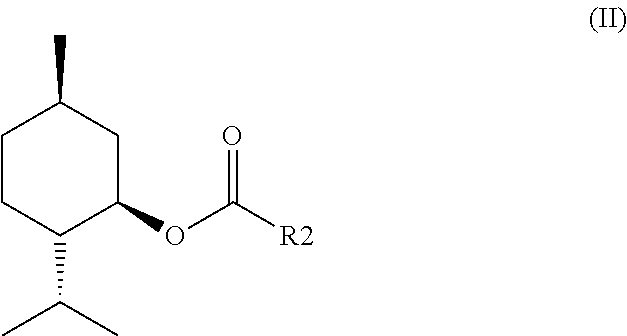
- wherein R2 is a C2-C10 alkyl substituent optionally substituted by one or more carboxyl groups which, in turn, can be esterified with menthol.
- The Applicant has also found that, contrary to the teachings of the prior art, the cooling sensation released by the product and perceived by a consumer lasts much longer than that obtainable with known manufacturing techniques, if, the cooling agents belonging to different classes of compounds, such as esters and amides, are separated. A further advantage on the same lines is obtained by including p-menthane-carboxamides in solid formulations with dipeptide sweeteners, there being no need to mix them with menthol as taught by the prior art. Menthol esters can be advantageously used in liquid mixtures with lipophilic ingredients.
- The chewing gums of the invention can consist of a single region comprising at least one gum base and a sweetener (sticks or slabs) or can comprise a number of regions, one of which comprises at least one gum base and a sweetener (chewing gum dragee or pellets, filled dragee, filled slabs and multi-layer gums).
- Another object of the invention is a process for the preparation of chewing gums which involves preparing a mixture by adding the following ingredients in a mixer and mixing them for a total time (ttot):
-
- I. gum base;
- II. at least one sweetener;
- III. a cooling flavour in the form of solid particulate matter comprising a vinyl polymer, a dipeptide sweetener and an N-substituted p-menthane-carboxamide of formula I;
- IV. a liquid cooling premix comprising one or more organic C3-C10 mono- and di-acids esterified with one or two menthol groups, and optionally at least one lipophilic ingredient, said premix being evenly dispersed in said region.
- Ingredients III) and IV) are added at two different stages of mixing: tIII<ttot and tIV<ttot. The absolute difference between tIII and tIV is preferably greater than 30 seconds, more preferably greater than 60 seconds, and even more preferably greater than 120 seconds.
- The mixer can be a double-Z mixer or a continuous extruder. During the mixing stage it is preferable to control the temperature of the mixture so that it is less than 100° C., preferably less than 70° C., and even more preferably less than 55° C.
- “Liquid cooling premix” means a preparation of a mixture in liquid form which is obtained before mixing the ingredients in a mixer. The premix remains in liquid form until mixing. In the finished product, the premix is mixed with, dispersed through, adsorbed on the surface of and/or absorbed into the other ingredients of the mixture, and is described as the “cooling mixture”.
- The liquid cooling premix is prepared, preferably at a temperature of less than 50° C., before addition in the mixer or continuous extruder.
- Adding at different times, during mixing, the cooling flavour in the form of solid particulate matter and the liquid cooling premix enables the former to maintain its properties and the latter to interact freely with the other ingredients of the mixture. Addition time tIV, of the liquid cooling premix, is preferably less than addition time tIII, of the cooling flavour in the form of solid particulate matter, and simultaneously the difference tIII−tIV>30 s, preferably tIII−tIV>60 s; tIII−tIV>120 s. In this way, carboxamides and menthol esters are also kept separate during the process of obtaining the chewing gum according to the invention, as well as in the finished product.
- When the mixture has been obtained, it is reduced to a plurality of chewing gum pieces, such as sticks or slabs, or a plurality of cores, by one or more of the following processes: extrusion, dye forming, cutting, rolling and scoring.
- A substance having the function of filling of the chewing gum pieces or cores can also be introduced into the mixture. The filling can be liquid, solid, granular or gelatinous, and is introduced after or at the same time as the extrusion stage and before the moulding, cutting or rolling stage. The insertion of a filling can contribute to the cooling sensation imparted by the invention by the use of further flavours, cooling agents, or the use of solids or particulates with negative heat of solution, including many polyalcohols.
- The invention can be completed by further application of one or more layers of hard or soft coating and combinations thereof. Coating can be performed in pans. Coating can comprise the application of powders, application of one or more layers of smoothening syrup and application of one or more layers of gloss. As an alternative to gloss, a rough finishing can be obtained and, in a particular embodiment, a satin finishing.
- In the context of the invention, “satin effect” means a low level of roughness, characterised by an average roughness Ra of between 1 and 6 μm and/or a roughness Rz between 5 and 30 μm.
- Flavours, cooling agents and mixtures, together with ingredients with negative heat of solution that reinforce the cooling sensation imparted by the invention, can also be used in the coating region.
- FIGURE: Chart showing the intensity of the cooling sensation on a scale of 0 to 100 for a series of chewing gums manufactured according to the prior art and two chewing gums of the invention, chewed for up to 60 minutes.
- In the context of the present invention, “cooling sensation” means a stimulus transmitted by the nerve endings present in the oral cavity and nose to the central nervous system that convey said sensation, which is not necessarily connected with a reduction in temperature. Compounds were recently synthesised which impart said sensation in a more intense or lasting way than menthol, without the association of a specific flavour. Said compounds are conventionally known as (and hereinafter called) “cooling agents” or “coolants”. They can belong to different classes of compounds and preferentially act in particular areas (e.g. the palate, tongue and throat). Although they do not impart a particular flavour they are included in lists of flavouring substances; the preparations containing them are therefore called “flavours” or “cooling flavours”.
- The chewing gum of the invention comprises a region characterised by the presence of gum base, at least one sweetener, and a synergistic cooling combination of two ingredients which are separated from one another, the first in the form of solid particulate matter, and the second in the form of a mixture evenly dispersed in said region.
- Cooling Flavour in the Form of Solid Particulate Matter
- “Particulate matter” means a set of more or less rigid granules, characterised by a certain particle-size distribution. In the particulate matter, over 40% by weight of the particles are typically smaller than 1000 μm and larger than 250 μm. In one embodiment, more than 80% by weight of the particles are smaller than 1000 μm and larger than 250 μm. Intermediate forms of embodiment are possible, including those wherein the average particle size is between 400 and 600 μm or between 600 and 800 μm. The single particles can appear under the microscope in different shapes, including spheroids and flakes with sharp edges.
- The solid particulate matter of the present invention can be obtained by known methods. However, contrary to the teachings of the prior art, it has been found advantageous to include in the particulate matter at least one N-substituted p-menthane-carboxamide of formula I, a dipeptide sweetener and polyvinyl acetate.
- N-substituted p-menthane carboxamides are represented by formula I
-
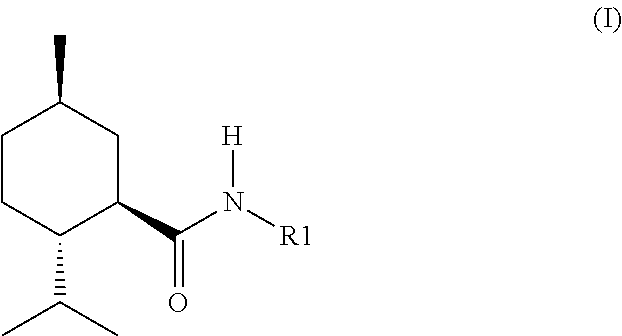
- wherein R1 is C1-C10 alkyl, C1-C10 alkoxycarbonylmethyl, heteroaryl-C1-C5 alkyl or phenyl, optionally substituted by C1-C5 alkoxy and/or cyano groups.
- The N-substituted p-menthane-carboxamide is preferably selected from N-ethyl-p-menthane carboxamide (WS3), N-ethoxycarbonylmethyl-p-menthane carboxamide (WS5), N-p-methoxyphenyl-p-menthane carboxamide (WS 12), N-p-benzeneacetonitrile-menthanecarboxamide, N-(2-(pyridin-2-yl)ethyl)-3-p-menthanecarboxamide and combinations thereof, corresponding to the formulas:
-

- The dipeptide sweetener is an intensive sweetener, i.e. it imparts sweetness to a greater extent than sugar. Dipeptide sweeteners are characterised by a backbone resulting from two amino acids bonded by an amido bond. The amino acids can present modifications from natural amino acids. Dipeptide sweeteners are preferably selected from aspartame, neotame, advantame and alitame and combinations thereof.
- The vinyl polymer is preferably selected from polyvinyl acetate, polyvinyl acetate/polyvinyl laurate copolymer, polyvinyl acetate/polyvinyl versatate/polyvinyl alcohol terpolymer, polyvinylpyrrolidone, crosslinked polyvinylpyrrolidone, polyvinyl alcohol and mixtures thereof. Particularly preferred are polyvinyl acetate and polyvinyl acetate/polyvinyl versatate/polyvinyl alcohol terpolymer, alone or mixed together.
- The vinyl acetate polymer, included in the ingredients of the matrix of solid particulate matter of the invention, retains the cooling agent and the sweetener, and releases them gradually during chewing.
- Polyvinyl acetate is particularly preferred. Many different grades of polyvinyl acetate are available on the market, some of which, of food grade, are used in the manufacture of gum base. The use of dipeptide sweeteners, in a matrix of vinyl polymers, and in particular of polyvinyl acetate, makes the freshness imparted by the cooling agents deriving from p-menthane-carboxamide more perceptible, and also influences the rheological properties of the vinyl acetate polymer, producing a solid particulate which is neither excessively fragile nor excessively soft, and characterised by slow release of the cooling agent. The molecular weight of polyvinyl acetate can vary within wide limits, from 5,000 to 20,000 UMA, preferably from 15,000 to 30,000. Alternatively, a grade between 35000 and 100000 UMA can be used. Polyvinyl acetates of different grades can be mixed. Polyvinyl alcohol, generated in the industrial finishing process, may be present in polyvinyl acetate.
- Other polymers, customarily used in gum base formulation, can be used in combination with the vinyl acetate polymer.
- Additives, plasticisers, colorants, polyalcohols, acids and other flavouring substances can be present in the granulate. In particular, it is preferable to use plasticisers in quantities lower than 20% by weight of the granulate. Suitable plasticisers are mono-, di- or triglycerides, lecithins, mono-, di- or triesters of citric acid, sebacic acid esters, sucrose esters and mixtures thereof. Mono-, di- and triglycerides comprise natural, fractionated, partly or totally hydrogenated oils and fats.
- In one embodiment, the cooling flavour in the form of particulate matter does not contain solvents.
- In a particular form of embodiment, the cooling flavour in the form of particulate matter does not contain menthol esters.
- Some ratios, between the main ingredients of the cooling flavour in the form of particulate matter, are preferred because they facilitate better perception of the freshness in the chewing gum. In particular, a ratio between N-substituted p-menthane-carboxamide : dipeptide sweetener : polyvinyl acetate ranging from a minimum of 0.02:1:0.75 to a maximum of 8:1:9 is preferred.
- The three main ingredients can be present in the particulate matter in the following percentages by weight: N-substituted p-menthane-carboxamide 1% to 10%, dipeptide sweetener 5% to 50%, and
polyvinyl acetate 30% to 90%. - Finally, it is preferable for the cooling flavour in the form of solid particulate matter to be contained in the chewing gum in a percentage ranging from 0.1% to 10% by weight of the chewing gum, and even more preferably from 1% to 5%.
- Cooling Mixture with Menthol Esters
- The second crucial ingredient of the invention is a cooling mixture, whose ingredients are mixed before the chewing gum is made. The manufacture of the chewing gum also requires mixing the ingredients such as at least one gum base, at least one sweetener, a cooling flavour in the form of solid particulate matter, and a cooling mixture.
- The cooling mixture comprises one or more organic C3-C10 mono- and di-acids esterified with one or two menthol groups, and optionally at least one lipophilic ingredient.
- “Lipophilic ingredient” means an ingredient of the mixture which is substantially insoluble or immiscible in water.
- Lipophilic ingredients which can be used within the scope of the present invention are preferably oils, animal fats, vegetable fats, essential oils, and flavouring solvents.
- Before being added to the other ingredients of the invention, the mixture is in liquid form. The preferred menthol esters are monomenthyl glutarate, dimenthyl glutarate and monomenthyl succinate.
- Said cooling mixture in liquid form preferably comprises, as a percentage of the mixture, 1% to 70% monomenthyl glutarate, 1% to 70% dimenthyl glutarate and 0.5% to 50% monomenthyl succinate.
- The liquid cooling mixture preferably consists of monomenthyl glutarate, dimenthyl glutarate, monomenthyl succinate and triglycerides.
- The cooling mixture can advantageously include, as lipophilic ingredient, C1-C3 chain triglycerides ranging from 1% to 70% by weight of the mixture and C6-C12 chain triglycerides ranging from 1% to 70% by weight of the mixture.
- In one embodiment, the cooling mixture in liquid form ranges from 0.2% to 5% of the chewing gum.
- The cooling and lipophilic ingredients are mixed together before preparation of the region comprising gum base and at least one sweetener, to form a liquid cooling premix. Said premix is prepared with rotor mixers, anchor mixers, planetary mixers or manual mixing. It can be stored at room temperature until addition at the mixing stage. The liquid mixture is then dispersed evenly in the region of the chewing gum characterised by the presence of gum base and at least one sweetener.
- The inventive gum characterised by the ingredients described imparts a cooling sensation when administered to a consumer, even after 10 minutes' chewing. In particular, it imparts a cooling sensation even after or at 20, 30, 40 or 50 minutes' chewing.
- Additional Cooling Agents
- The chewing gum can also contain a further cooling flavour in spray-dried, liquid or encapsulated form, wherein the flavouring substances comprise one or more menthane carboxamides and menthol esters. In particular, the use of N-p-benzeneacetonitrile-menthane carboxamide (CAS 852379-28-3), N-(2-(pyridin-2-yl)ethyl)-3-p-menthane carboxamide (CAS 847565-09-7) and menthol esters, alone or mixed together, is preferred.
- A flavouring in spray-dried form on gum arabic, containing a mixture of menthyl lactate with N-(2-(pyridin-2-yl)ethyl)-3-p-menthane carboxamide substantially devoid of menthol, is preferably used. In particular, the flavouring substances can be present in the following percentages of the total flavouring substances: menthyl lactate over 50%, N-(2-(pyridin-2-yl)ethyl)-3-p-menthane carboxamide over 3%, menthol under 1%. The flavouring substances are preferably present in the following percentages of the total flavouring substances: menthyl lactate between 30% and 60%, N-(2-(pyridin-2-yl)ethyl)-3-p-menthane carboxamide between 20 and 40%, menthol absent. The addition of said additional mixture of cooling agents in spray-dried form increases freshness during chewing in the medium-long term.
- In chewing gum containing several regions, the additional cooling agents can be present in the region characterised by the presence of gum base and/or in the other regions.
- Additional Flavours
- The inventive chewing gum can also contain flavours such as flavouring preparations (including essential oils), natural and artificial flavouring substances, flavours deriving from heat treatments, smoked flavouring substances, solvents, flavour's additives, supports, modifiers and mixtures thereof such as known by those expert in the field.
- Said flavours are typically fat-soluble, and liquid at room temperature. However, solid forms of these flavours, supported on one or more carriers, are readily available on the market.
- Release systems obtained as disclosed in EP 2560501 can also be used.
- Chewing Gum
- Chewing gum can be made in any shape, such as sticks, slabs, cigarettes, and cushion, ball, cube and disc shapes. The gum can contain a region consisting of a filling, which may be totally included in the chewing gum region or be visible from the exterior on one or more sides of the chewing gum. Said filling can be liquid, solid, granular or gelatinous.
- Said chewing gum can be also be coated, namely a chewing gum containing at least one central region, comprising the gum base and a sweetener, called the core, and an outer region, called the coating.
- Region with Gum Base and Sweetener
- The first stage of the chewing gum preparation process involves preparing the region with gum base and at least one sweetener. The crucial step is to obtain a gum dough. Final pieces of chewing gum or centers of dragees are obtained from the gum dough.
- The gum base used for the present invention is manufactured with known methods and ingredients.
- The sweetener can be selected from sugars (in solid form, such as sucrose and glucose, or in the form of syrup, such as glucose syrup), polyols (in solid form, such as sorbitol, or in the form of syrup, such as maltitol syrup), and combinations thereof. The polyols can be selected from sorbitol, mannitol, maltitol, isomalt (a mixture of glucopyranosyl mannitol and glucopyranosyl sorbitol), erythritol, xylitol, maltitol syrup and mixtures thereof. Various particle size grades are available for each of the ingredients listed, which can be used mixed together, to modulate the hardness, flavour and tactile sensation of the chewing gum composition.
- The gum dough may also contain one or more of the following substances: intensive sweeteners, flavouring agents in solid or liquid form, wetting agents, technological adjuvants such as emulsifiers or plasticisers, active pharmacological ingredients, plant extracts, functional ingredients such as vitamins or mineral salts, and colorants.
- The gum dough can be prepared according to any known methodology, for example with the use of continuous extruders or non-continuous mixing apparatus.
- In one embodiment of the invention, the cooling flavour in the form of solid particulate matter and the cooling premix are inserted in the formulation of the chewing gum during preparation of the gum dough.
- The cooling premix is a liquid at room temperature before preparation of the gum dough. During preparation of the gum dough, the premix is thoroughly mixed with, dispersed through, adsorbed onto the surface of and/or absorbed into the other ingredients, including the gum base and sweeteners. At the end of mixing, one or more regions constituted by the cooling premix are therefore no longer identifiable. During the mixing stage the interaction between the cooling premix and some ingredients can modify the properties of both. Without wishing to be constrained by theoretical factors, the Applicant considers that the cooling mixture comprising menthol esters and a lipophilic ingredient is able to interact in a particular way with the gum base, bonding to and partly penetrating into it, and is then released slowly during chewing, thus contributing to the cooling effect imparted by the gum of the invention.
- If a discontinuous mixing equipment is employed, the ingredients of the gum dough, including the cooling flavour in the form of solid particulate matter and the cooling premix, can be added at the same time or at different times during manufacture. However, the cooling flavour in the form of solid particulate matter and the cooling premix are added at different times during the preparation of the gum dough.
- If continuous extruders are used, the ingredients of the gum dough, including the cooling flavour in the form of solid particulate matter and the cooling premix, can be added in the same region or different regions of the extruder. However, the cooling flavour in the form of solid particulate matter and the cooling premix are added in different regions of the extruder. The transit time through the continuous extruder can be indicated as the time total (ttot), and the ingredient addition times refer to the time that elapses between the feed zone of the first ingredient of the gum dough and the zone of insertion of the ingredient whose time is to be measured.
- When the gum dough has been prepared, it is processed according to known methods to obtain a plurality of pieces of chewing gum or cores. The dough usually undergoes one or two consecutive additional extrusion stages.
- Optionally, some ingredients of the gum dough, including the cooling flavour in the form of solid particulate matter and the cooling premix, can be added during the extrusion stages.
- In order to form the plurality of chewing gum pieces or cores, after the additional extrusion stage or stages the mixture is conveyed to a subsequent rolling or moulding stage. Preferably, the cores obtained from the rolling or moulding stage present a discoidal, cylindrical, cubic or spherical geometrical configuration, with a longitudinal cross-section which is diamond-shaped, rectangular or rectangular with rounded corners (pillow-shaped).
- Gum pieces are then processed according to known methods. Coated gums require the application of hard or soft coatings, as described below. In the case of uncoated gums (sticks and slabs), the subsequent stages mainly involve wrapping.
- Filling
- The manufacturing process can also include a stage of introduction into the additionally extruded gum dough of a substance designed to fill the body of the chewing gum pieces, said introduction stage being performed after or at the same time as the additional extrusion stage, and before the rolling or moulding stage. The filling can be liquid, solid, granular or gelatinous. Depending on the type of core and filling material, and on the shape of the piece of chewing gum, the filling can be totally incorporated in the piece of chewing gum or can be visible from the exterior of the chewing gum on one or more sides.
- In certain embodiments of the invention, the gum contains a quantity of filling completely surrounded by chewing gum. If the filling is liquid or granular, it exits rapidly from the gum during the first stages of chewing, thus contributing to the initial sensation imparted by the chewing gum. The presence in the liquid or granular filling of flavours, including menthol, and/or cooling agents, can increase the initial cooling sensation when chewing the chewing gum. Moreover, in the case of granular or powdered fillings, the use of ingredients with a negative heat of solution, such as dextrose, dextrose monohydrate, sorbitol, erythritol and xylitol, and mixtures thereof, contributes to the initial cooling sensation. The granular filling preferably comprises a particulate matter with at least one of the following: dextrose monohydrate, sorbitol, erythritol and xylitol, and mixtures thereof in crystals. The average particle size preferably ranges from 40 μm to 1000 μm, and even more preferably from 250 μm to 800 μm; moreover, the particulate matter may be present in quantities exceeding 10%, preferably 50%, and even more preferably exceeding 90% by weight of the filling.
- The filling preferably also contains powdered flavours such as menthol and cooling agents, either “as is” or supported or encapsulated.
- The filling in the form of particulate matter preferably comprises xylitol crystals with an average particle size ranging between 250 μm and 1000 μm, in a percentage exceeding 50 wt % of the filling.
- Other embodiments require the filling not to be completely surrounded by chewing gum, but visible on one or more sides.
- In one form of embodiment, the filling is visible on one side of the chewing gum only, occupying the space excavated on one side of the body of the chewing gum.
- Alternatively, the filling can be visible on two opposite sides of a parallelepiped-shaped chewing gum. The filling can be square, parallelepipedal, round, elliptical, star-shaped, heart-shaped, etc.
- In one form of embodiment the filling is visible on three sides of the chewing gum, occupying a groove excavated in the body of the chewing gum.
- Alternatively, the filling can be visible on four sides of the chewing gum composition, in the form of a layer inserted between two layers of chewing gum. Even if there are more than three layers, the filling would be visible on four sides.
- Coating
- Hard and Soft Coating Can be Performed on the Inventive Gum Centers, Alone or in Combination, According to Known Methods.
- Flavours, intensive sweeteners, liquid or powdered colorants, optionally encapsulated or supported, either alone or mixed together, can be used in both types of coating.
- Moreover, part of the coating can be obtained by one technique and part by another, thus generating infinite permutations of textures, colours, flavours, etc.
- Both types of coating can be followed by a smoothing step and polishing step, which uses particular syrups and additives.
- Particular coverings which can be used in conjunction with the present invention include coatings designed to cover particulates such as crystals of polyalcohols, by application of particular syrups, as described in U.S. Pat. No. 8,124,145, or water, as described in WO 2009138208A1. Said coverings can also be applied after a hard or soft coating.
- In a particular embodiment, the coating region is completed by applying a satin finishing to the outermost part.
- The coating, completed in the traditional form or with a satin effect, can also contain glitter or speckles, well known in the art of chewing gum manufacture.
- Other coatings use compounds based on fats, such as chocolate or imitations, or are obtained by immersion in molten compounds (such as molten xylitol). Said coatings can also be used within the scope of the invention, and combined with the preceding ones.
- The chewing gum of the invention can also contain flavours in the coating region. In particular, the coating can contain a further cooling flavour comprising one or more of the following: menthol, menthol esters, p-menthane-carboxamides and mixtures thereof. A mixture containing the following substances, expressed as percentages of the finished product, is particularly preferred: monomenthyl glutarate 0.001% to 0.06%, dimenthyl glutarate 0.001% to 0.06%, and monomenthyl succinate 0.001% to 0.1%. Optionally, carboxamides can be present in percentages ranging between 0.001 and 0.1% of the finished product.
- The coating of the chewing gum can also contain a further cooling flavour in the form of particulate matter, comprising one or more of the following: menthol, menthol esters, p-menthane-carboxamides and mixtures thereof. In particular, the addition of powdered menthol, optionally containing anti-caking additives ranging between 0.01% and 1%, preferably between 0.07% and 0.3% (percentages of the finished product), is preferred.
- The following examples describe the composition of cooling flavours in the form of solid particulate matter usable in the invention. The percentages are percentages of the particulate matter.
-
% Ingredient 1 2 3 4 5 Polyvinyl acetate MW 10000-20000 10 55 70 Polyvinyl acetate MW 30000-50000 50 60 Polyvinyl acetate MW 60000-70000 30 5 Aspartame 45 19 Neotame 10 5 Alitame 7 N-ethyl-p-menthane carboxamide 7 N-ethoxycarbonylmethyl-p- 10 menthane carboxamide N-p-methoxyphenyl-p-menthane 13 carboxamide N-p-benzeneacetonitrile-menthane 5 carboxamide N-(2-(pyridin-2-yl)ethyl)-3-p- 8 menthane carboxamide Hydrogenated vegetable oil 15 3 Mono- and diglycerides of fatty 10 acids Triethyl citrate 5 13 Talc 24 12 Silica 5 2 E 133 1 Vanillin 1 Total 100 100 100 100 100 - The following examples describe the composition of cooling premixes in liquid form usable in the invention. The percentages are percentages of the premix.
-
% Ingredient 6 7 8 Monomenthyl glutarate 25 12 24 Dimenthyl glutarate 10 5 6 Monomenthyl succinate 15 3 10 Fractionated coconut oil 10 Triglycerides with chain C 250 30 Triglycerides with chain C8- C 1020 30 Total 100 100 100 - The following examples report chewing gum formulations consisting of a region with gum base and sweeteners.
-
% 9: non- 10: non- 11: non- 12: non- 13: Ingredient inventive inventive inventive inventive inventive Gum base 36.00 36.00 36.00 36.00 36.00 Acesulfame K 0.05 0.05 0.05 0.05 0.05 Aspartame 0.05 0.05 0.05 0.05 0.05 Sucralose 0.10 0.10 0.10 0.10 0.10 Cooling flavour in the form of solid particulate 0.00 0.00 0.00 2.00 2.00 matter (Example 5) Mannitol 10.00 10.00 10.00 10.00 10.00 Glycerol 3.50 3.00 3.00 3.00 3.00 Peppermint flavour in solid form 1.80 1.80 1.80 1.80 1.80 Maltitol 32.00 32.90 32.00 30.00 30.00 Cooling mixture consisting of menthol esters and 0.00 0.00 1.50 0.00 1.50 lipophilic ingredients (Example 8) Cooling mixture consisting of menthol esters 0.00 0.6 0.00 0.00 0.00 Lipophilic ingredients of the cooling mixture 0.00 0.00 0.00 1.50 0.00 Maltitol syrup 5.00 5.00 5.00 5.00 5.00 Peppermint flavour 1.50 0.50 0.50 0.50 0.50 Sorbitol 10.00 10.00 10.00 10.00 10.00 Total 100 100 100 100 100 - The following examples report the percentage compositions of the inventive gum with filling regions, a region with gum base and at least one sweetener, and coating regions.
-
-
% Ingredient 14 15 16 Xylitol crystals, average particle size 87.00 75.00 500 μm Sorbitol crystals, average particle size 10.45 200 μm Powdered menthol 2.00 Triacetin 0.50 E133-aluminium lake 0.05 0.10 Maltitol syrup 80.00 20.00 Carboxymethylcellulose 0.20 1.00 Sucralose 0.20 Acesulfame K 0.10 Glycerin 10.00 Water 8.00 Liquorice flavour (contains WS3) 1.50 Spearmint flavour 1.50 Water 2.40 Total 100 100 100 Physical form Particulate Liquid Soft matter caramel -
-
% 17 18 19 Ingredient invention invention invention Gum base 33.00 42.00 36.00 Acesulfame K 0.05 0.01 0.07 Aspartame 0.05 0.19 0.20 Sucralose 0.10 0.03 Xylitol 8.00 3.00 Erythritol 15.00 Sorbitol 8.00 22.00 15.00 Mannitol 15.00 15.00 Glycerol 2.00 2.00 Maltitol 30.00 20.00 Maltitol syrup 6.00 1.00 3.00 Mint flavour in solid form 1.00 0.50 Mint flavour in liquid form 0.50 2.00 Powdered menthol 1.50 1.00 Cooling flavour in the form of 3.50 solid particulate matter. example 1 Cooling flavour in the form of 2.30 solid particulate matter. example 2 Cooling flavour in the form of 1.00 solid particulate matter. example 5 Cooling mixture. example 6 0.30 Cooling mixture. example 7 2.00 Cooling mixture. example 8 4.00 Spray-dried N-p-benzeneacetonitrile- 0.5 menthane carboxamide N-(2-(pyridin-2-yl)ethyl)-3-p- 0.20 menthane carboxamide and menthyl lactate Powdered liquorice extract 1.00 Granules containing sage extract 2.00 Total 100 100 100 -
-
% Ingredient 20 21 22 Maltitol 78.00 Xylitol 60.00 Mannitol 15.50 Xylitol crystals. mean particle size 300 μm 98.50 Gum arabic 16.00 Gelatin 2.30 Mixture of starches and maltodextrins 6.00 Carboxymethylcellulose 3.00 Titanium dioxide 1.50 2.50 Liquorice flavour 0.60 Peppermint flavour 2.00 1.30 Spray-dried menthyl lactate 0.20 10% menthyl succinate in propylene 0.15 glycol 10% N-ethoxycarbonylmethyl-p- menthane carboxamide in propylene 0.20 glycol Spray-dried N-p-benzeneacetonitrile- 0.05 menthane carboxamide Powdered menthol 0.10 Aspartame 0.50 0.20 0.10 Acesulfame K 0.2 0.40 Brown speckles 0.30 Carnauba wax 0.20 0.20 Mannitol/powdered gum arabic 10.00 Total 100 100 100 -
-
% 23 24 25 Ingredient invention invention invention Filling region 8 12 30 (example 15) (example 14) (example 16) Core 60 57 65 (example 19) (example 17) (example 18) Coating 32 30 5 (example 20) (example 21) (example 22) Total 100 100 100 Type of Liquid-filled Dragee with Stick with layer chewing gum dragee, with hard granular filling, of filling between coating and hard coating two layers of glossy finishing. and satin gum. Granular finishing. coating as disclosed by WO2009/1308208. - Chewing
gums - The mean results of the evaluation are set out in the graph in the FIGURE.
- The non-inventive compositions, containing as cooling agents a mixture of menthol esters only (example 10), a cooling mixture with menthol esters and lipophilic ingredients only (example 11), or a cooling flavour in the form of solid particulate matter only (example 12), are generally less cool than the compositions of the invention (Examples 13 and 24). In particular, the non-inventive compositions have a cooling score of less than 20 from 30 minutes onwards, whereas inventive composition 13 has a cooling score of less than 20 from 50 minutes onwards, and inventive composition 24, which also contains some preferred embodiment such as additional cooling agents and filling and coating regions, has a cooling score higher than 20 for 60 minutes.
- The chewing gum described in example 13 contains the cooling flavour in the form of solid particulate matter in the same quantity as Example 12, and the cooling mixture in the same quantity as Example 11. The other ingredients are substantially equal, so the cooling scores of example 13 would be expected to be equal to the sum of the cooling scores perceived for examples 11 and 12. The table, which shows the average perceived cooling scores, demonstrates that from 20 to 60 minutes' chewing, the cooling effect of example 13 is greater than the sum of the examples containing the individual ingredients of the invention, thereby demonstrating a synergistic effect on the perception of cold, due to the simultaneous presence in the formulation containing gum base and sweetener of a cooling flavour in the form of solid particulate matter and the cooling mixture.
-
TABLE Cooling scores Example Total Minutes 11 Example 12 cooling Example of (non- (non- Examples 13 Synergistic chewing inventive) inventive) 11 + 12 (inventive) effect 0.5 36.0 32.3 68.3 43.6 2 38.8 38.5 77.3 52.4 5 32.3 34.8 67.0 52.8 10 24.3 24.3 48.5 47.6 20 0.5 12.0 12.5 38.2 yes 30 0.0 1.8 1.8 34.4 yes 40 0.0 1.0 1.0 29.0 yes 50 0.0 1.0 1.0 14.6 yes 60 0.0 1.0 1.0 11.6 yes
Claims (18)
1. Chewing gum imparting a cooling sensation to a consumer, comprising a region characterized by the presence of gum base, at least one sweetener, and a synergistic cooling combination of two separated components:
a) a solid particulate cooling flavor comprising a vinyl polymer, a dipeptide sweetener and at least one N-substituted p-menthane-carboxamide having formula I

wherein R1 is selected from C1-C10 alkyl, C1-C10 alkoxycarbonylmethyl, heteroaryl-C1-C5 alkyl and phenyl, optionally substituted by C1-C5 alkoxy and/or cyano groups;
b) a cooling mix comprising one or more organic C3-C10 mono- and di- acids esterified with one or two menthol groups, homogeneously dispersed in said region.
2. Chewing gum according to claim 1 , wherein said N-substituted p-menthane carboxamide is selected from N-ethyl-p-menthane carboxamide (WS3), N-ethoxycarbonylmethyl-p-menthane carboxamide (WS5), N-p-methoxyphenyl-p-menthane carboxamide (WS 12), N-p-benzeneacetonitrile-menthanecarboxamide, N-(2-(pyridin-2-yl)ethyl)-3-p-menthanecarboxamide and combinations thereof.
3. Chewing gum according to claim 1 , wherein said solid particulate cooling flavor has an N-substituted p-menthane-carboxamide: dipeptide sweetener: polyvinyl acetate ratio ranging from a minimum of 0.02:1:0.75 to a maximum of 8:1:9.
4. Chewing gum according to claim 1 , wherein said solid particulate cooling flavor comprises 1% to 10% of said N-substituted p-menthane-carboxamide, 5% to 50% of said dipeptide sweetener and 30% to 90% of said vinyl polymer, expressed as a percentage of said particulate.
5. Chewing gum according to claim 1 , wherein said chewing gum comprises 0.1% to 10% of said solid particulate cooling flavor, preferably 1% to 5% thereof, expressed as a percentage of said chewing gum.
6. Chewing gum according to claim 1 wherein said cooling mix contains, as organic acids esterified with one or more menthol groups, one or more of the following: monomenthyl glutarate, dimenthyl glutarate, monomenthyl succinate and mixtures thereof.
7. Chewing gum according to claim 6 , wherein said cooling mix comprises 1% to 70% monomenthyl glutarate, 1% to 70% dimenthyl glutarate and 0.5% to 50% monomenthyl succinate, expressed as a percentage of said mix.
8. Chewing gum according to claim 6 , wherein said cooling mix also contains a lipophilic ingredient.
9. Chewing gum according to claim 1 , containing 0.2% to 5% of said liquid cooling mix.
10. Chewing gum according to claim 1 , further comprising a filling region, a coating region and combination thereof.
11. Chewing gum according to claim 1 , comprising an additional cooling flavor in spray-dried, liquid or encapsulated form, wherein the flavoring substances comprise at least one of menthane carboxamides and menthol esters.
12. Chewing gum according to claim 10 , comprising within the coating region an additional cooling flavour comprising one or more of menthol, menthol esters, p-menthane carboxamides and mixtures thereof.
13. Chewing gum according to claim 10 , comprising within the coating region an additional cooling flavor in particulate form comprising one or more of menthol, menthol esters, p-menthane carboxamides and mixtures thereof.
14. Chewing gum according to claim 1 , wherein said cooling flavor in solid particulate form is contained in said chewing gum in a percentage from 0.1% to 10%, preferably from 1% to 5%, and wherein said cooling mix constitutes 0.2% to 5% of the chewing gum.
15. Chewing gum according to claim 1 , wherein said vinyl polymer is selected from polyvinyl acetate, polyvinyl acetate/polyvinyl laurate copolymer, polyvinyl acetate/polyvinyl versatate/polyvinyl alcohol terpolymer, polyvinylpyrrolidone, crosslinked polyvinylpyrrolidone, polyvinyl alcohol and mixtures thereof.
16. Process for the manufacture of the chewing gum according to claim 1 , comprising the manufacture of a dough through the addition in a mixer, and a mixing operation carried out for a time ttot, of the following ingredients:
I. gum base;
II. at least one sweetener;
III. a solid particulate cooling flavor comprising a vinyl polymer, a dipeptide sweetener and at least one N-substituted p-menthane-carboxamide having formula I

wherein R1 is selected from C1-C10 alkyl, C1-C10 alkoxycarbonylmethyl, heteroaryl-C1-05 alkyl or phenyl, optionally substituted by C1-05 alkoxy and/or cyano groups;
IV. a liquid cooling premix comprising one or more organic C3-C10 mono- and di-acids esterified with one or two menthol groups, and optionally at least one lipophilic component, evenly dispersed in said region;
wherein ingredients III) and IV) are added at two distinct times tIII<ttot and tIV<ttot.
17. Process according to claim 16 , wherein the absolute difference between tIII e tIV is higher than 30 seconds, preferably higher than 60 seconds.
18. Process according to claim 16 , further comprising reducing the dough to a plurality of chewing gum pieces or centres through one or more of the extrusion, dye forming, cutting, rolling and scoring.
Applications Claiming Priority (3)
| Application Number | Priority Date | Filing Date | Title |
|---|---|---|---|
| ITMI2013A000685 | 2013-04-24 | ||
| IT000685A ITMI20130685A1 (en) | 2013-04-24 | 2013-04-24 | CHEWING RUBBER WITH PROLONGED FRESHNESS AND OBTAINING PROCESS |
| PCT/EP2014/058179 WO2014173922A1 (en) | 2013-04-24 | 2014-04-23 | Chewing gum with long-lasting freshness and its manufacturing process |
Publications (1)
| Publication Number | Publication Date |
|---|---|
| US20160021908A1 true US20160021908A1 (en) | 2016-01-28 |
Family
ID=48628785
Family Applications (1)
| Application Number | Title | Priority Date | Filing Date |
|---|---|---|---|
| US14/782,254 Abandoned US20160021908A1 (en) | 2013-04-24 | 2014-04-23 | Chewing gum with long-lasting freshness and its manufacturing process |
Country Status (25)
| Country | Link |
|---|---|
| US (1) | US20160021908A1 (en) |
| EP (1) | EP2988606B1 (en) |
| JP (1) | JP6574164B2 (en) |
| KR (1) | KR20160004277A (en) |
| CN (1) | CN105142419B (en) |
| AU (1) | AU2014257599C1 (en) |
| BR (1) | BR112015025659B1 (en) |
| CA (1) | CA2910028A1 (en) |
| CY (1) | CY1119236T1 (en) |
| DK (1) | DK2988606T3 (en) |
| ES (1) | ES2633485T3 (en) |
| HR (1) | HRP20171355T1 (en) |
| HU (1) | HUE034455T2 (en) |
| IT (1) | ITMI20130685A1 (en) |
| LT (1) | LT2988606T (en) |
| MX (1) | MX2015014787A (en) |
| PH (1) | PH12015502431A1 (en) |
| PL (1) | PL2988606T3 (en) |
| PT (1) | PT2988606T (en) |
| RU (1) | RU2656250C2 (en) |
| SG (1) | SG11201508719RA (en) |
| SI (1) | SI2988606T1 (en) |
| SM (1) | SMT201700423T1 (en) |
| UA (1) | UA115473C2 (en) |
| WO (1) | WO2014173922A1 (en) |
Families Citing this family (3)
| Publication number | Priority date | Publication date | Assignee | Title |
|---|---|---|---|---|
| WO2015037648A1 (en) * | 2013-09-13 | 2015-03-19 | 長谷川香料株式会社 | Freshness-maintaining agent having reduced off-flavor |
| DK3668326T3 (en) * | 2017-08-18 | 2024-01-08 | Perfetti Van Melle Benelux B V | Chewing gum compositions and methods of making the same |
| WO2019230710A1 (en) * | 2018-05-29 | 2019-12-05 | ライオン株式会社 | Composition for oral cavity |
Family Cites Families (31)
| Publication number | Priority date | Publication date | Assignee | Title |
|---|---|---|---|---|
| US4711784A (en) | 1986-01-07 | 1987-12-08 | Warner-Lambert Company | Encapsulation composition for use with chewing gum and edible products |
| US4740376A (en) * | 1986-01-07 | 1988-04-26 | Warner-Lambert Company | Encapsulation composition for use with chewing gum and edible products |
| US4816265A (en) | 1986-12-23 | 1989-03-28 | Warner-Lambert Company | Sweetener delivery systems containing polyvinyl acetate |
| AU618508B2 (en) * | 1989-03-28 | 1991-12-19 | Wm. Wrigley Jr. Company | Alitame stability in chewing gum by encapsulation |
| US5009893A (en) | 1989-07-17 | 1991-04-23 | Warner-Lambert Company | Breath-freshening edible compositions of methol and a carboxamide |
| US5698181A (en) * | 1994-12-09 | 1997-12-16 | Warner-Lambert Company | Breath-freshening edible compositions comprising menthol and an N-substituted-P-menthane carboxamide and methods for preparing same |
| US5725865A (en) | 1995-08-29 | 1998-03-10 | V. Mane Fils S.A. | Coolant compositions |
| US5843466A (en) | 1995-08-29 | 1998-12-01 | V. Mane Fils S.A. | Coolant compositions |
| MY119059A (en) | 1997-08-11 | 2005-03-31 | Cadbury Adams Usa Llc | Enhanced flavoring compositions containing n-ethyl-p-menthane-3-carboxamide and method of making and using same |
| AU2002318886B2 (en) * | 1997-09-18 | 2005-02-17 | Wm. Wrigley Jr. Company | Chewing Gum Containing Controlled Release Acyclic Carboxamides |
| CA2506429A1 (en) * | 1997-09-18 | 1999-03-25 | Wm. Wrigley Jr. Company | Chewing gum containing physiological cooling agents |
| DK1014805T3 (en) | 1997-09-18 | 2009-01-05 | Wrigley W M Jun Co | Chewing gum containing physiologically cooling substances |
| US6497859B1 (en) | 2000-11-17 | 2002-12-24 | Noville Inc. | Cooling agents, pharmaceutical compositions having cooling agents and processes for making and using same |
| US8591973B2 (en) | 2005-05-23 | 2013-11-26 | Kraft Foods Global Brands Llc | Delivery system for active components and a material having preselected hydrophobicity as part of an edible composition |
| US8591974B2 (en) | 2003-11-21 | 2013-11-26 | Kraft Foods Global Brands Llc | Delivery system for two or more active components as part of an edible composition |
| CA2556745C (en) * | 2004-02-26 | 2010-04-20 | Wm. Wrigley Jr. Company | Confections containing a blend of physiological cooling agents |
| US20060263475A1 (en) * | 2004-08-25 | 2006-11-23 | Cadbury Adams Usa, Llc. | Center-filled chewing gum composition |
| US20080050605A1 (en) * | 2004-10-15 | 2008-02-28 | Rapp Knut M | Pan Coating Process |
| CA2608020C (en) | 2005-05-10 | 2015-02-03 | The Hershey Company | Sugar alcohol sanded chewing gum and process for making same |
| JP5225077B2 (en) * | 2005-05-23 | 2013-07-03 | クラフト・フーズ・グローバル・ブランズ・エルエルシー | Center-filled chewing gum composition |
| US20070221236A1 (en) | 2005-10-05 | 2007-09-27 | Cadbury Adams Usa Llc. | Cooling compositions including menthyl esters |
| JP5284787B2 (en) * | 2005-10-05 | 2013-09-11 | クラフト・フーズ・グローバル・ブランズ・エルエルシー | Chewing gum containing a refreshing composition |
| JP2007143411A (en) * | 2005-11-24 | 2007-06-14 | Ezaki Glico Co Ltd | Taste-retentive composition, chewing gum utilizing the same, and method for producing the chewing gum |
| WO2007100055A1 (en) * | 2006-03-02 | 2007-09-07 | Meiji Seika Kaisha, Ltd. | Long-lasting flavored chewing gum and method for producing the same |
| KR100848182B1 (en) | 2007-02-06 | 2008-07-23 | 롯데제과주식회사 | Refreshing coated center peeling chewing gum and preparation method thereof |
| JP4300242B2 (en) * | 2007-03-16 | 2009-07-22 | キャドバリー・アダムズ・ユーエスエイ・エルエルシー | Equipment for processing chewing gum solid materials |
| ITMI20080889A1 (en) | 2008-05-15 | 2009-11-16 | Perfetti Van Melle Spa | PROCESS FOR PRODUCING CHEWING RUBBER WITH A COATING LAYER AND RUBBER GUMS TO BE OBTAINED FROM THIS PROCESS |
| US20120040057A1 (en) | 2009-02-18 | 2012-02-16 | Ferri Dino C | Confectioneries providing mouth-moistening refreshment |
| IT1399630B1 (en) | 2010-04-20 | 2013-04-26 | Perfetti Van Melle Spa | SLOW RELEASE FOOD FORMULATIONS |
| GB2481251B (en) * | 2010-06-18 | 2014-04-30 | Kraft Foods Global Brands Llc | Soft coated powder centre-filled gum |
| EP2582252A4 (en) * | 2010-06-18 | 2013-11-06 | Wrigley W M Jun Co | Chewing gum containing combinations of physiological cooling agents |
-
2013
- 2013-04-24 IT IT000685A patent/ITMI20130685A1/en unknown
-
2014
- 2014-04-23 KR KR1020157030553A patent/KR20160004277A/en not_active Withdrawn
- 2014-04-23 UA UAA201510329A patent/UA115473C2/en unknown
- 2014-04-23 HR HRP20171355TT patent/HRP20171355T1/en unknown
- 2014-04-23 MX MX2015014787A patent/MX2015014787A/en unknown
- 2014-04-23 AU AU2014257599A patent/AU2014257599C1/en not_active Ceased
- 2014-04-23 ES ES14724330.7T patent/ES2633485T3/en active Active
- 2014-04-23 HU HUE14724330A patent/HUE034455T2/en unknown
- 2014-04-23 SM SM20170423T patent/SMT201700423T1/en unknown
- 2014-04-23 EP EP14724330.7A patent/EP2988606B1/en active Active
- 2014-04-23 US US14/782,254 patent/US20160021908A1/en not_active Abandoned
- 2014-04-23 PL PL14724330T patent/PL2988606T3/en unknown
- 2014-04-23 PT PT147243307T patent/PT2988606T/en unknown
- 2014-04-23 JP JP2016509443A patent/JP6574164B2/en active Active
- 2014-04-23 BR BR112015025659-7A patent/BR112015025659B1/en active IP Right Grant
- 2014-04-23 CN CN201480023022.8A patent/CN105142419B/en active Active
- 2014-04-23 DK DK14724330.7T patent/DK2988606T3/en active
- 2014-04-23 LT LTEP14724330.7T patent/LT2988606T/en unknown
- 2014-04-23 CA CA2910028A patent/CA2910028A1/en not_active Abandoned
- 2014-04-23 WO PCT/EP2014/058179 patent/WO2014173922A1/en not_active Ceased
- 2014-04-23 SG SG11201508719RA patent/SG11201508719RA/en unknown
- 2014-04-23 SI SI201430314T patent/SI2988606T1/en unknown
- 2014-04-23 RU RU2015145329A patent/RU2656250C2/en active
-
2015
- 2015-10-22 PH PH12015502431A patent/PH12015502431A1/en unknown
-
2017
- 2017-07-31 CY CY20171100824T patent/CY1119236T1/en unknown
Also Published As
Similar Documents
| Publication | Publication Date | Title |
|---|---|---|
| JP5415570B2 (en) | Chocolate-containing toffee gum | |
| JP5882906B2 (en) | Coated multi-region confectionery and method for producing the same | |
| ES2503545T3 (en) | Sugar-based Isomalt confectionery products and methods for their production | |
| EP2326187B2 (en) | Confectionery products providing an increased hydration sensation | |
| ES2702173T5 (en) | Novel confectionary with improved crispiness | |
| CN104068197A (en) | Multi-region chewing gum composition including isomalt gum region | |
| CN101378664A (en) | Multi-layer confectionery products and methods relating thereto | |
| CN101321469A (en) | Confectionery products with a liquid center | |
| JP2016518127A (en) | Colored wax composition | |
| EP2988606B1 (en) | Chewing gum with long-lasting freshness and its manufacturing process | |
| CN114144070A (en) | Chewing gum base containing polyols | |
| NL2020349B1 (en) | Candies with long-lasting freshness | |
| ES2673482T3 (en) | Slow-release dietary formulations | |
| HK1218374B (en) | Chewing gum with long-lasting freshness and its manufacturing process |
Legal Events
| Date | Code | Title | Description |
|---|---|---|---|
| AS | Assignment |
Owner name: PERFETTI VAN MELLE S.P.A., ITALY Free format text: ASSIGNMENT OF ASSIGNORS INTEREST;ASSIGNORS:COLLE, ROBERTO;BALDI, GIANNI;DELEO, MAURIZIO;REEL/FRAME:036719/0758 Effective date: 20150910 |
|
| STCB | Information on status: application discontinuation |
Free format text: ABANDONED -- FAILURE TO RESPOND TO AN OFFICE ACTION |