US20160002201A1 - Histone demethylase inhibitors - Google Patents
Histone demethylase inhibitors Download PDFInfo
- Publication number
- US20160002201A1 US20160002201A1 US14/650,241 US201314650241A US2016002201A1 US 20160002201 A1 US20160002201 A1 US 20160002201A1 US 201314650241 A US201314650241 A US 201314650241A US 2016002201 A1 US2016002201 A1 US 2016002201A1
- Authority
- US
- United States
- Prior art keywords
- compound
- pyrazol
- formula
- hydrogen
- alkyl
- Prior art date
- Legal status (The legal status is an assumption and is not a legal conclusion. Google has not performed a legal analysis and makes no representation as to the accuracy of the status listed.)
- Granted
Links
- 108010074870 Histone Demethylases Proteins 0.000 title claims abstract description 34
- 102000008157 Histone Demethylases Human genes 0.000 title claims abstract description 34
- 239000003112 inhibitor Substances 0.000 title 1
- 150000001875 compounds Chemical class 0.000 claims abstract description 647
- 239000000203 mixture Substances 0.000 claims abstract description 113
- 206010028980 Neoplasm Diseases 0.000 claims abstract description 29
- 201000011510 cancer Diseases 0.000 claims abstract description 21
- 239000008194 pharmaceutical composition Chemical class 0.000 claims abstract description 12
- 239000001257 hydrogen Substances 0.000 claims description 264
- 229910052739 hydrogen Inorganic materials 0.000 claims description 264
- 238000000034 method Methods 0.000 claims description 251
- 125000000217 alkyl group Chemical group 0.000 claims description 204
- 125000003710 aryl alkyl group Chemical group 0.000 claims description 174
- 125000003118 aryl group Chemical group 0.000 claims description 160
- 125000001072 heteroaryl group Chemical group 0.000 claims description 151
- 125000004452 carbocyclyl group Chemical group 0.000 claims description 148
- 125000000623 heterocyclic group Chemical group 0.000 claims description 141
- 125000004446 heteroarylalkyl group Chemical group 0.000 claims description 138
- 125000004415 heterocyclylalkyl group Chemical group 0.000 claims description 138
- 125000005884 carbocyclylalkyl group Chemical group 0.000 claims description 137
- 125000004435 hydrogen atom Chemical group [H]* 0.000 claims description 94
- 150000003839 salts Chemical class 0.000 claims description 91
- 125000002947 alkylene group Chemical group 0.000 claims description 84
- 229910052736 halogen Inorganic materials 0.000 claims description 79
- 150000002367 halogens Chemical group 0.000 claims description 79
- 125000001997 phenyl group Chemical group [H]C1=C([H])C([H])=C(*)C([H])=C1[H] 0.000 claims description 30
- UFHFLCQGNIYNRP-UHFFFAOYSA-N Hydrogen Chemical compound [H][H] UFHFLCQGNIYNRP-UHFFFAOYSA-N 0.000 claims description 17
- 230000002401 inhibitory effect Effects 0.000 claims description 16
- 239000003937 drug carrier Substances 0.000 claims description 8
- -1 pyrazolylpyrimidine derivative compounds Chemical class 0.000 abstract description 155
- 238000011282 treatment Methods 0.000 abstract description 16
- 206010005003 Bladder cancer Diseases 0.000 abstract description 9
- 206010006187 Breast cancer Diseases 0.000 abstract description 8
- 208000026310 Breast neoplasm Diseases 0.000 abstract description 8
- 206010058467 Lung neoplasm malignant Diseases 0.000 abstract description 8
- 208000000236 Prostatic Neoplasms Diseases 0.000 abstract description 8
- 208000007097 Urinary Bladder Neoplasms Diseases 0.000 abstract description 8
- 201000005202 lung cancer Diseases 0.000 abstract description 8
- 208000020816 lung neoplasm Diseases 0.000 abstract description 8
- 201000005112 urinary bladder cancer Diseases 0.000 abstract description 8
- 206010060862 Prostate cancer Diseases 0.000 abstract description 7
- 201000001441 melanoma Diseases 0.000 abstract description 7
- 150000005292 pyrazolylpyridines Chemical class 0.000 abstract description 5
- XEODJMCAUUKTEC-UHFFFAOYSA-N 3-(1h-pyrazol-5-yl)pyridazine Chemical class N1C=CC(C=2N=NC=CC=2)=N1 XEODJMCAUUKTEC-UHFFFAOYSA-N 0.000 abstract description 4
- 230000005764 inhibitory process Effects 0.000 abstract description 2
- 238000002360 preparation method Methods 0.000 description 265
- HEDRZPFGACZZDS-MICDWDOJSA-N Trichloro(2H)methane Chemical compound [2H]C(Cl)(Cl)Cl HEDRZPFGACZZDS-MICDWDOJSA-N 0.000 description 246
- 238000005160 1H NMR spectroscopy Methods 0.000 description 232
- IAZDPXIOMUYVGZ-WFGJKAKNSA-N Dimethyl sulfoxide Chemical compound [2H]C([2H])([2H])S(=O)C([2H])([2H])[2H] IAZDPXIOMUYVGZ-WFGJKAKNSA-N 0.000 description 172
- XEKOWRVHYACXOJ-UHFFFAOYSA-N Ethyl acetate Chemical compound CCOC(C)=O XEKOWRVHYACXOJ-UHFFFAOYSA-N 0.000 description 160
- 150000002431 hydrogen Chemical group 0.000 description 158
- LFQSCWFLJHTTHZ-UHFFFAOYSA-N Ethanol Chemical compound CCO LFQSCWFLJHTTHZ-UHFFFAOYSA-N 0.000 description 122
- 239000000243 solution Substances 0.000 description 92
- QTBSBXVTEAMEQO-UHFFFAOYSA-N Acetic acid Chemical compound CC(O)=O QTBSBXVTEAMEQO-UHFFFAOYSA-N 0.000 description 68
- 235000019439 ethyl acetate Nutrition 0.000 description 68
- HEMHJVSKTPXQMS-UHFFFAOYSA-M Sodium hydroxide Chemical compound [OH-].[Na+] HEMHJVSKTPXQMS-UHFFFAOYSA-M 0.000 description 66
- 239000011541 reaction mixture Substances 0.000 description 62
- 229910001868 water Inorganic materials 0.000 description 62
- XLYOFNOQVPJJNP-UHFFFAOYSA-N water Substances O XLYOFNOQVPJJNP-UHFFFAOYSA-N 0.000 description 57
- 239000007787 solid Substances 0.000 description 54
- LPQCTEIJKYZMTK-UHFFFAOYSA-N OC1=CC=NN1C1=CC(C#N)=CC=N1 Chemical compound OC1=CC=NN1C1=CC(C#N)=CC=N1 LPQCTEIJKYZMTK-UHFFFAOYSA-N 0.000 description 49
- OKKJLVBELUTLKV-UHFFFAOYSA-N Methanol Chemical compound OC OKKJLVBELUTLKV-UHFFFAOYSA-N 0.000 description 39
- 150000001204 N-oxides Chemical class 0.000 description 39
- OKKJLVBELUTLKV-MZCSYVLQSA-N Deuterated methanol Chemical compound [2H]OC([2H])([2H])[2H] OKKJLVBELUTLKV-MZCSYVLQSA-N 0.000 description 38
- 125000004432 carbon atom Chemical group C* 0.000 description 34
- VLKZOEOYAKHREP-UHFFFAOYSA-N n-Hexane Chemical compound CCCCCC VLKZOEOYAKHREP-UHFFFAOYSA-N 0.000 description 33
- 239000012074 organic phase Substances 0.000 description 30
- 150000003254 radicals Chemical class 0.000 description 30
- 239000002904 solvent Substances 0.000 description 30
- PMRMKCHJLLVOQU-UHFFFAOYSA-N 2-hydrazinylpyridine-4-carbonitrile Chemical compound NNC1=CC(C#N)=CC=N1 PMRMKCHJLLVOQU-UHFFFAOYSA-N 0.000 description 29
- 239000012071 phase Substances 0.000 description 29
- HPALAKNZSZLMCH-UHFFFAOYSA-M sodium;chloride;hydrate Chemical compound O.[Na+].[Cl-] HPALAKNZSZLMCH-UHFFFAOYSA-M 0.000 description 29
- 239000012267 brine Substances 0.000 description 28
- 238000004895 liquid chromatography mass spectrometry Methods 0.000 description 28
- 125000002496 methyl group Chemical group [H]C([H])([H])* 0.000 description 28
- VEXZGXHMUGYJMC-UHFFFAOYSA-N Hydrochloric acid Chemical compound Cl VEXZGXHMUGYJMC-UHFFFAOYSA-N 0.000 description 27
- 239000000543 intermediate Substances 0.000 description 26
- BWHMMNNQKKPAPP-UHFFFAOYSA-L potassium carbonate Chemical compound [K+].[K+].[O-]C([O-])=O BWHMMNNQKKPAPP-UHFFFAOYSA-L 0.000 description 26
- 239000002253 acid Substances 0.000 description 25
- 238000003818 flash chromatography Methods 0.000 description 25
- 229940093499 ethyl acetate Drugs 0.000 description 24
- 125000001424 substituent group Chemical group 0.000 description 23
- 239000000126 substance Substances 0.000 description 22
- PMZURENOXWZQFD-UHFFFAOYSA-L Sodium Sulfate Chemical compound [Na+].[Na+].[O-]S([O-])(=O)=O PMZURENOXWZQFD-UHFFFAOYSA-L 0.000 description 20
- 108010033040 Histones Proteins 0.000 description 19
- TWBYWOBDOCUKOW-UHFFFAOYSA-N isonicotinic acid Natural products OC(=O)C1=CC=NC=C1 TWBYWOBDOCUKOW-UHFFFAOYSA-N 0.000 description 19
- 108090000623 proteins and genes Proteins 0.000 description 19
- YMWUJEATGCHHMB-UHFFFAOYSA-N Dichloromethane Chemical compound ClCCl YMWUJEATGCHHMB-UHFFFAOYSA-N 0.000 description 18
- 239000007832 Na2SO4 Substances 0.000 description 18
- REPVNSJSTLRQEQ-UHFFFAOYSA-N n,n-dimethylacetamide;n,n-dimethylformamide Chemical compound CN(C)C=O.CN(C)C(C)=O REPVNSJSTLRQEQ-UHFFFAOYSA-N 0.000 description 18
- 229910052757 nitrogen Inorganic materials 0.000 description 18
- 229910052938 sodium sulfate Inorganic materials 0.000 description 18
- DTQVDTLACAAQTR-UHFFFAOYSA-N Trifluoroacetic acid Chemical compound OC(=O)C(F)(F)F DTQVDTLACAAQTR-UHFFFAOYSA-N 0.000 description 17
- 125000004450 alkenylene group Chemical group 0.000 description 16
- 238000006243 chemical reaction Methods 0.000 description 16
- 239000000651 prodrug Substances 0.000 description 16
- 229940002612 prodrug Drugs 0.000 description 16
- 238000010992 reflux Methods 0.000 description 16
- CSNNHWWHGAXBCP-UHFFFAOYSA-L Magnesium sulfate Chemical compound [Mg+2].[O-][S+2]([O-])([O-])[O-] CSNNHWWHGAXBCP-UHFFFAOYSA-L 0.000 description 15
- 208000037265 diseases, disorders, signs and symptoms Diseases 0.000 description 15
- 239000003921 oil Substances 0.000 description 15
- 239000000047 product Substances 0.000 description 15
- RLCYIOZTWUVYOM-UHFFFAOYSA-N 2-hydrazinylpyridine-4-carbonitrile;hydrochloride Chemical compound Cl.NNC1=CC(C#N)=CC=N1 RLCYIOZTWUVYOM-UHFFFAOYSA-N 0.000 description 14
- 102100040584 Lysine-specific demethylase 2B Human genes 0.000 description 14
- UIIMBOGNXHQVGW-UHFFFAOYSA-M Sodium bicarbonate Chemical compound [Na+].OC([O-])=O UIIMBOGNXHQVGW-UHFFFAOYSA-M 0.000 description 14
- ZMANZCXQSJIPKH-UHFFFAOYSA-N Triethylamine Chemical compound CCN(CC)CC ZMANZCXQSJIPKH-UHFFFAOYSA-N 0.000 description 14
- 229910052799 carbon Inorganic materials 0.000 description 14
- 125000003709 fluoroalkyl group Chemical group 0.000 description 14
- 239000012044 organic layer Substances 0.000 description 14
- 101000615488 Homo sapiens Methyl-CpG-binding domain protein 2 Proteins 0.000 description 13
- 102100021299 Methyl-CpG-binding domain protein 2 Human genes 0.000 description 13
- NCAIGTHBQTXTLR-UHFFFAOYSA-N phentermine hydrochloride Chemical compound [Cl-].CC(C)([NH3+])CC1=CC=CC=C1 NCAIGTHBQTXTLR-UHFFFAOYSA-N 0.000 description 13
- 229910000027 potassium carbonate Inorganic materials 0.000 description 13
- 238000002953 preparative HPLC Methods 0.000 description 13
- 235000018102 proteins Nutrition 0.000 description 13
- 102000004169 proteins and genes Human genes 0.000 description 13
- NEPPSDXLISKMNU-UHFFFAOYSA-N 5-chloro-2-(hydroxymethyl)phenol Chemical compound OCC1=CC=C(Cl)C=C1O NEPPSDXLISKMNU-UHFFFAOYSA-N 0.000 description 12
- 102100040598 Lysine-specific demethylase 2A Human genes 0.000 description 12
- VYPSYNLAJGMNEJ-UHFFFAOYSA-N Silicium dioxide Chemical compound O=[Si]=O VYPSYNLAJGMNEJ-UHFFFAOYSA-N 0.000 description 12
- 150000007513 acids Chemical class 0.000 description 12
- 239000002585 base Substances 0.000 description 12
- 201000010099 disease Diseases 0.000 description 12
- 125000005843 halogen group Chemical group 0.000 description 12
- 125000004356 hydroxy functional group Chemical group O* 0.000 description 12
- 239000005457 ice water Substances 0.000 description 12
- 239000003960 organic solvent Substances 0.000 description 12
- 239000000741 silica gel Substances 0.000 description 12
- 229910002027 silica gel Inorganic materials 0.000 description 12
- 125000003831 tetrazolyl group Chemical group 0.000 description 12
- 102100033247 Lysine-specific demethylase 5B Human genes 0.000 description 11
- 125000003342 alkenyl group Chemical group 0.000 description 11
- 150000001732 carboxylic acid derivatives Chemical class 0.000 description 11
- 238000007069 methylation reaction Methods 0.000 description 11
- 125000002023 trifluoromethyl group Chemical group FC(F)(F)* 0.000 description 11
- 102000006947 Histones Human genes 0.000 description 10
- 101001088883 Homo sapiens Lysine-specific demethylase 5B Proteins 0.000 description 10
- 101710105679 Lysine-specific demethylase 2B Proteins 0.000 description 10
- 229910002092 carbon dioxide Inorganic materials 0.000 description 10
- 125000004122 cyclic group Chemical group 0.000 description 10
- OKTJSMMVPCPJKN-UHFFFAOYSA-N Carbon Chemical compound [C] OKTJSMMVPCPJKN-UHFFFAOYSA-N 0.000 description 9
- RTZKZFJDLAIYFH-UHFFFAOYSA-N Diethyl ether Chemical compound CCOCC RTZKZFJDLAIYFH-UHFFFAOYSA-N 0.000 description 9
- 101710105678 Lysine-specific demethylase 2A Proteins 0.000 description 9
- LRHPLDYGYMQRHN-UHFFFAOYSA-N N-Butanol Chemical compound CCCCO LRHPLDYGYMQRHN-UHFFFAOYSA-N 0.000 description 9
- 125000000304 alkynyl group Chemical group 0.000 description 9
- 125000000956 methoxy group Chemical group [H]C([H])([H])O* 0.000 description 9
- 230000011987 methylation Effects 0.000 description 9
- 238000003786 synthesis reaction Methods 0.000 description 9
- GNKZMNRKLCTJAY-UHFFFAOYSA-N 4'-Methylacetophenone Chemical compound CC(=O)C1=CC=C(C)C=C1 GNKZMNRKLCTJAY-UHFFFAOYSA-N 0.000 description 8
- 101000613625 Homo sapiens Lysine-specific demethylase 4A Proteins 0.000 description 8
- 101001088893 Homo sapiens Lysine-specific demethylase 4C Proteins 0.000 description 8
- 101001088892 Homo sapiens Lysine-specific demethylase 5A Proteins 0.000 description 8
- 102100040863 Lysine-specific demethylase 4A Human genes 0.000 description 8
- 102100033230 Lysine-specific demethylase 4C Human genes 0.000 description 8
- 102100033246 Lysine-specific demethylase 5A Human genes 0.000 description 8
- 230000008901 benefit Effects 0.000 description 8
- 210000004027 cell Anatomy 0.000 description 8
- IJGRMHOSHXDMSA-UHFFFAOYSA-N nitrogen Substances N#N IJGRMHOSHXDMSA-UHFFFAOYSA-N 0.000 description 8
- 125000004433 nitrogen atom Chemical group N* 0.000 description 8
- RIOQSEWOXXDEQQ-UHFFFAOYSA-N triphenylphosphine Chemical compound C1=CC=CC=C1P(C=1C=CC=CC=1)C1=CC=CC=C1 RIOQSEWOXXDEQQ-UHFFFAOYSA-N 0.000 description 8
- YVPHKAZMKGNDEA-UHFFFAOYSA-N 2-[5-[(2,3-difluoro-4-methylphenyl)methoxy]pyrazol-1-yl]pyridine-4-carboxylic acid Chemical compound FC1=C(F)C(C)=CC=C1COC1=CC=NN1C1=CC(C(O)=O)=CC=N1 YVPHKAZMKGNDEA-UHFFFAOYSA-N 0.000 description 7
- FJXXVLHXLPRIGW-UHFFFAOYSA-N 2-[5-[(3-chloro-4-ethylphenyl)methoxy]pyrazol-1-yl]pyridine-4-carboxylic acid Chemical compound C1=C(Cl)C(CC)=CC=C1COC1=CC=NN1C1=CC(C(O)=O)=CC=N1 FJXXVLHXLPRIGW-UHFFFAOYSA-N 0.000 description 7
- WPESTWIANQBENM-UHFFFAOYSA-N 2-[5-[(3-fluoro-4-methylphenyl)methoxy]pyrazol-1-yl]pyridine-4-carboxylic acid Chemical compound C1=C(F)C(C)=CC=C1COC1=CC=NN1C1=CC(C(O)=O)=CC=N1 WPESTWIANQBENM-UHFFFAOYSA-N 0.000 description 7
- INIXTIFIUFLZRZ-UHFFFAOYSA-N 2-[5-[(4-ethyl-3-fluorophenyl)methoxy]pyrazol-1-yl]pyridine-4-carboxylic acid Chemical compound C1=C(F)C(CC)=CC=C1COC1=CC=NN1C1=CC(C(O)=O)=CC=N1 INIXTIFIUFLZRZ-UHFFFAOYSA-N 0.000 description 7
- 101100477411 Dictyostelium discoideum set1 gene Proteins 0.000 description 7
- 125000003545 alkoxy group Chemical group 0.000 description 7
- 125000001495 ethyl group Chemical group [H]C([H])([H])C([H])([H])* 0.000 description 7
- 238000010438 heat treatment Methods 0.000 description 7
- 230000007062 hydrolysis Effects 0.000 description 7
- 238000006460 hydrolysis reaction Methods 0.000 description 7
- 229910052943 magnesium sulfate Inorganic materials 0.000 description 7
- 238000000746 purification Methods 0.000 description 7
- 229910000030 sodium bicarbonate Inorganic materials 0.000 description 7
- 230000001225 therapeutic effect Effects 0.000 description 7
- NWZSZGALRFJKBT-KNIFDHDWSA-N (2s)-2,6-diaminohexanoic acid;(2s)-2-hydroxybutanedioic acid Chemical compound OC(=O)[C@@H](O)CC(O)=O.NCCCC[C@H](N)C(O)=O NWZSZGALRFJKBT-KNIFDHDWSA-N 0.000 description 6
- BJFOUULYELAMPD-UHFFFAOYSA-N 2-[5-[(3-chloro-4-methylphenyl)methoxy]pyrazol-1-yl]pyridine-4-carboxylic acid Chemical compound C1=C(Cl)C(C)=CC=C1COC1=CC=NN1C1=CC(C(O)=O)=CC=N1 BJFOUULYELAMPD-UHFFFAOYSA-N 0.000 description 6
- 229910014033 C-OH Inorganic materials 0.000 description 6
- 229910014570 C—OH Inorganic materials 0.000 description 6
- WSFSSNUMVMOOMR-UHFFFAOYSA-N Formaldehyde Chemical compound O=C WSFSSNUMVMOOMR-UHFFFAOYSA-N 0.000 description 6
- XEEYBQQBJWHFJM-UHFFFAOYSA-N Iron Chemical compound [Fe] XEEYBQQBJWHFJM-UHFFFAOYSA-N 0.000 description 6
- PXIPVTKHYLBLMZ-UHFFFAOYSA-N Sodium azide Chemical compound [Na+].[N-]=[N+]=[N-] PXIPVTKHYLBLMZ-UHFFFAOYSA-N 0.000 description 6
- 230000001476 alcoholic effect Effects 0.000 description 6
- 125000000753 cycloalkyl group Chemical group 0.000 description 6
- 125000001559 cyclopropyl group Chemical group [H]C1([H])C([H])([H])C1([H])* 0.000 description 6
- 125000000524 functional group Chemical group 0.000 description 6
- IKDUDTNKRLTJSI-UHFFFAOYSA-N hydrazine monohydrate Substances O.NN IKDUDTNKRLTJSI-UHFFFAOYSA-N 0.000 description 6
- 150000002430 hydrocarbons Chemical group 0.000 description 6
- 125000001841 imino group Chemical group [H]N=* 0.000 description 6
- YOZDGVQEWQPZKP-UHFFFAOYSA-N methyl 2-[5-[(4-cyanophenyl)methoxy]pyrazol-1-yl]pyridine-4-carboxylate Chemical compound COC(=O)C1=CC=NC(N2C(=CC=N2)OCC=2C=CC(=CC=2)C#N)=C1 YOZDGVQEWQPZKP-UHFFFAOYSA-N 0.000 description 6
- QCCDLTOVEPVEJK-UHFFFAOYSA-N phenylacetone Chemical compound CC(=O)CC1=CC=CC=C1 QCCDLTOVEPVEJK-UHFFFAOYSA-N 0.000 description 6
- 230000000069 prophylactic effect Effects 0.000 description 6
- 229920006395 saturated elastomer Polymers 0.000 description 6
- 125000003107 substituted aryl group Chemical group 0.000 description 6
- 239000000758 substrate Substances 0.000 description 6
- 239000000725 suspension Substances 0.000 description 6
- PCVRYEUFVDIBFI-UHFFFAOYSA-N 1-(1h-indazol-6-yl)ethanone Chemical compound CC(=O)C1=CC=C2C=NNC2=C1 PCVRYEUFVDIBFI-UHFFFAOYSA-N 0.000 description 5
- BZLVMXJERCGZMT-UHFFFAOYSA-N Methyl tert-butyl ether Chemical compound COC(C)(C)C BZLVMXJERCGZMT-UHFFFAOYSA-N 0.000 description 5
- 206010073150 Multiple endocrine neoplasia Type 1 Diseases 0.000 description 5
- JUJWROOIHBZHMG-UHFFFAOYSA-N Pyridine Chemical group C1=CC=NC=C1 JUJWROOIHBZHMG-UHFFFAOYSA-N 0.000 description 5
- 125000004429 atom Chemical group 0.000 description 5
- 230000015572 biosynthetic process Effects 0.000 description 5
- 150000001721 carbon Chemical group 0.000 description 5
- 239000003153 chemical reaction reagent Substances 0.000 description 5
- 239000000460 chlorine Chemical group 0.000 description 5
- 230000008878 coupling Effects 0.000 description 5
- 238000010168 coupling process Methods 0.000 description 5
- 238000005859 coupling reaction Methods 0.000 description 5
- 125000004093 cyano group Chemical group *C#N 0.000 description 5
- 125000001316 cycloalkyl alkyl group Chemical group 0.000 description 5
- 230000017858 demethylation Effects 0.000 description 5
- 238000010520 demethylation reaction Methods 0.000 description 5
- 230000006870 function Effects 0.000 description 5
- 230000014509 gene expression Effects 0.000 description 5
- 125000005842 heteroatom Chemical group 0.000 description 5
- 125000001449 isopropyl group Chemical group [H]C([H])([H])C([H])(*)C([H])([H])[H] 0.000 description 5
- 235000018977 lysine Nutrition 0.000 description 5
- LPNYRYFBWFDTMA-UHFFFAOYSA-N potassium tert-butoxide Chemical compound [K+].CC(C)(C)[O-] LPNYRYFBWFDTMA-UHFFFAOYSA-N 0.000 description 5
- 230000002829 reductive effect Effects 0.000 description 5
- 229910000104 sodium hydride Inorganic materials 0.000 description 5
- 238000004809 thin layer chromatography Methods 0.000 description 5
- GEZMEIHVFSWOCA-UHFFFAOYSA-N (4-fluorophenyl)methanol Chemical compound OCC1=CC=C(F)C=C1 GEZMEIHVFSWOCA-UHFFFAOYSA-N 0.000 description 4
- FPJJSKKWGRACAX-UHFFFAOYSA-N 2-(5-phenylmethoxypyrazol-1-yl)pyridine-4-carboxylic acid Chemical compound OC(=O)C1=CC=NC(N2C(=CC=N2)OCC=2C=CC=CC=2)=C1 FPJJSKKWGRACAX-UHFFFAOYSA-N 0.000 description 4
- KBIDIQUYVVCIGT-UHFFFAOYSA-N 2-[4-[2-[tert-butyl(dimethyl)silyl]oxyethyl]-5-[(4-fluorophenyl)methoxy]pyrazol-1-yl]pyridine-4-carbonitrile Chemical compound CC(C)(C)[Si](C)(C)OCCC=1C=NN(C=2N=CC=C(C=2)C#N)C=1OCC1=CC=C(F)C=C1 KBIDIQUYVVCIGT-UHFFFAOYSA-N 0.000 description 4
- DQZXWCVKIBSQAJ-UHFFFAOYSA-N 2-[5-(3-methoxy-4-methylphenyl)pyrazol-1-yl]pyridine-4-carboxylic acid Chemical compound C1=C(C)C(OC)=CC(C=2N(N=CC=2)C=2N=CC=C(C=2)C(O)=O)=C1 DQZXWCVKIBSQAJ-UHFFFAOYSA-N 0.000 description 4
- BEOSCPUYUHDKBT-UHFFFAOYSA-N 2-[5-(4-chloro-3-methoxyphenyl)pyrazol-1-yl]pyridine-4-carboxylic acid Chemical compound C1=C(Cl)C(OC)=CC(C=2N(N=CC=2)C=2N=CC=C(C=2)C(O)=O)=C1 BEOSCPUYUHDKBT-UHFFFAOYSA-N 0.000 description 4
- ORNNBJNBTNAYBS-UHFFFAOYSA-N 2-[5-[(1-methylindazol-6-yl)methoxy]pyrazol-1-yl]pyridine-4-carboxylic acid Chemical compound C1=C2N(C)N=CC2=CC=C1COC1=CC=NN1C1=CC(C(O)=O)=CC=N1 ORNNBJNBTNAYBS-UHFFFAOYSA-N 0.000 description 4
- GMWKOCOYZWNSIJ-UHFFFAOYSA-N 2-[5-[(3,4-difluorophenyl)methoxy]pyrazol-1-yl]pyridine-4-carboxylic acid Chemical compound OC(=O)C1=CC=NC(N2C(=CC=N2)OCC=2C=C(F)C(F)=CC=2)=C1 GMWKOCOYZWNSIJ-UHFFFAOYSA-N 0.000 description 4
- BUWBKFLUJJAMOD-UHFFFAOYSA-N 2-[5-[(3-chloro-4-fluorophenyl)methoxy]pyrazol-1-yl]pyridine-4-carboxylic acid Chemical compound OC(=O)C1=CC=NC(N2C(=CC=N2)OCC=2C=C(Cl)C(F)=CC=2)=C1 BUWBKFLUJJAMOD-UHFFFAOYSA-N 0.000 description 4
- RVWFSGMSJSTAIJ-UHFFFAOYSA-N 2-[5-[(3-fluorophenyl)methoxy]pyrazol-1-yl]pyridine-4-carboxylic acid Chemical compound OC(=O)C1=CC=NC(N2C(=CC=N2)OCC=2C=C(F)C=CC=2)=C1 RVWFSGMSJSTAIJ-UHFFFAOYSA-N 0.000 description 4
- ITIAJFABKUNVBR-UHFFFAOYSA-N 2-[5-[(4-bromophenyl)methoxy]pyrazol-1-yl]pyridine-4-carboxylic acid Chemical compound OC(=O)C1=CC=NC(N2C(=CC=N2)OCC=2C=CC(Br)=CC=2)=C1 ITIAJFABKUNVBR-UHFFFAOYSA-N 0.000 description 4
- DOZDKMPUJLMVHD-UHFFFAOYSA-N 2-[5-[(4-chloro-2-fluorophenyl)methoxy]pyrazol-1-yl]pyridine-4-carboxylic acid Chemical compound OC(=O)C1=CC=NC(N2C(=CC=N2)OCC=2C(=CC(Cl)=CC=2)F)=C1 DOZDKMPUJLMVHD-UHFFFAOYSA-N 0.000 description 4
- SMXDPQZYSIFABV-UHFFFAOYSA-N 2-[5-[(4-chlorophenyl)methoxy]pyrazol-1-yl]pyridine-4-carboxylic acid Chemical compound OC(=O)C1=CC=NC(N2C(=CC=N2)OCC=2C=CC(Cl)=CC=2)=C1 SMXDPQZYSIFABV-UHFFFAOYSA-N 0.000 description 4
- YSLNSTXNXMRWMU-UHFFFAOYSA-N 2-[5-[(4-cyclopropylphenyl)methoxy]pyrazol-1-yl]pyridine-4-carboxylic acid Chemical compound OC(=O)C1=CC=NC(N2C(=CC=N2)OCC=2C=CC(=CC=2)C2CC2)=C1 YSLNSTXNXMRWMU-UHFFFAOYSA-N 0.000 description 4
- NYJLXELRMWJXFN-UHFFFAOYSA-N 2-[5-[(4-fluorophenyl)methoxy]pyrazol-1-yl]pyridine-4-carboxylic acid Chemical compound OC(=O)C1=CC=NC(N2C(=CC=N2)OCC=2C=CC(F)=CC=2)=C1 NYJLXELRMWJXFN-UHFFFAOYSA-N 0.000 description 4
- ROLKCSJSIFETFK-UHFFFAOYSA-N 2-[5-[(4-methylphenyl)methoxy]pyrazol-1-yl]pyridine-4-carboxylic acid Chemical compound C1=CC(C)=CC=C1COC1=CC=NN1C1=CC(C(O)=O)=CC=N1 ROLKCSJSIFETFK-UHFFFAOYSA-N 0.000 description 4
- SPGCFZXNJYGZNU-UHFFFAOYSA-N 2-[5-[[4-(trifluoromethyl)phenyl]methoxy]pyrazol-1-yl]pyridine-4-carboxylic acid Chemical compound OC(=O)C1=CC=NC(N2C(=CC=N2)OCC=2C=CC(=CC=2)C(F)(F)F)=C1 SPGCFZXNJYGZNU-UHFFFAOYSA-N 0.000 description 4
- AFCIQAUKKOALRD-UHFFFAOYSA-N 2-hydrazinylpyrimidine-4-carbonitrile Chemical compound NNC1=NC=CC(C#N)=N1 AFCIQAUKKOALRD-UHFFFAOYSA-N 0.000 description 4
- NQWQONNKCIMQCE-UHFFFAOYSA-N 6-hydrazinylpyridazine-4-carbonitrile Chemical compound NNC1=CC(C#N)=CN=N1 NQWQONNKCIMQCE-UHFFFAOYSA-N 0.000 description 4
- IOWHEIZJZIRSCC-UHFFFAOYSA-N 6-hydrazinylpyrimidine-4-carbonitrile Chemical compound NNC1=CC(C#N)=NC=N1 IOWHEIZJZIRSCC-UHFFFAOYSA-N 0.000 description 4
- NLXLAEXVIDQMFP-UHFFFAOYSA-N Ammonia chloride Chemical compound [NH4+].[Cl-] NLXLAEXVIDQMFP-UHFFFAOYSA-N 0.000 description 4
- 208000005623 Carcinogenesis Diseases 0.000 description 4
- 108010077544 Chromatin Proteins 0.000 description 4
- 229910020323 ClF3 Inorganic materials 0.000 description 4
- 239000007821 HATU Substances 0.000 description 4
- 101000614013 Homo sapiens Lysine-specific demethylase 2B Proteins 0.000 description 4
- WTDHULULXKLSOZ-UHFFFAOYSA-N Hydroxylamine hydrochloride Chemical compound Cl.ON WTDHULULXKLSOZ-UHFFFAOYSA-N 0.000 description 4
- KDXKERNSBIXSRK-YFKPBYRVSA-N L-lysine Chemical compound NCCCC[C@H](N)C(O)=O KDXKERNSBIXSRK-YFKPBYRVSA-N 0.000 description 4
- KDXKERNSBIXSRK-UHFFFAOYSA-N Lysine Natural products NCCCCC(N)C(O)=O KDXKERNSBIXSRK-UHFFFAOYSA-N 0.000 description 4
- 239000004472 Lysine Substances 0.000 description 4
- 238000010934 O-alkylation reaction Methods 0.000 description 4
- NBIIXXVUZAFLBC-UHFFFAOYSA-N Phosphoric acid Chemical compound OP(O)(O)=O NBIIXXVUZAFLBC-UHFFFAOYSA-N 0.000 description 4
- 108700025701 Retinoblastoma Genes Proteins 0.000 description 4
- QAOWNCQODCNURD-UHFFFAOYSA-N Sulfuric acid Chemical compound OS(O)(=O)=O QAOWNCQODCNURD-UHFFFAOYSA-N 0.000 description 4
- 150000001412 amines Chemical class 0.000 description 4
- 230000033228 biological regulation Effects 0.000 description 4
- ILAHWRKJUDSMFH-UHFFFAOYSA-N boron tribromide Chemical compound BrB(Br)Br ILAHWRKJUDSMFH-UHFFFAOYSA-N 0.000 description 4
- 230000036952 cancer formation Effects 0.000 description 4
- 231100000504 carcinogenesis Toxicity 0.000 description 4
- 210000003483 chromatin Anatomy 0.000 description 4
- 238000001816 cooling Methods 0.000 description 4
- 230000004069 differentiation Effects 0.000 description 4
- XYIBRDXRRQCHLP-UHFFFAOYSA-N ethyl acetoacetate Chemical compound CCOC(=O)CC(C)=O XYIBRDXRRQCHLP-UHFFFAOYSA-N 0.000 description 4
- FKRCODPIKNYEAC-UHFFFAOYSA-N ethyl propionate Chemical compound CCOC(=O)CC FKRCODPIKNYEAC-UHFFFAOYSA-N 0.000 description 4
- 239000000284 extract Substances 0.000 description 4
- 230000012010 growth Effects 0.000 description 4
- 238000001727 in vivo Methods 0.000 description 4
- 239000004615 ingredient Substances 0.000 description 4
- 230000007246 mechanism Effects 0.000 description 4
- RPHJVNKZUSDUDA-UHFFFAOYSA-N methyl 1-methylindazole-6-carboxylate Chemical compound COC(=O)C1=CC=C2C=NN(C)C2=C1 RPHJVNKZUSDUDA-UHFFFAOYSA-N 0.000 description 4
- DPDPLMPLBWKMSG-UHFFFAOYSA-N methyl 2-methylindazole-6-carboxylate Chemical compound C1=C(C(=O)OC)C=CC2=CN(C)N=C21 DPDPLMPLBWKMSG-UHFFFAOYSA-N 0.000 description 4
- ADYSZCGUXDZDGN-UHFFFAOYSA-N methyl 3-amino-4-ethylbenzoate Chemical compound CCC1=CC=C(C(=O)OC)C=C1N ADYSZCGUXDZDGN-UHFFFAOYSA-N 0.000 description 4
- 230000001613 neoplastic effect Effects 0.000 description 4
- 125000000449 nitro group Chemical group [O-][N+](*)=O 0.000 description 4
- QJGQUHMNIGDVPM-UHFFFAOYSA-N nitrogen group Chemical group [N] QJGQUHMNIGDVPM-UHFFFAOYSA-N 0.000 description 4
- 208000002154 non-small cell lung carcinoma Diseases 0.000 description 4
- 125000004043 oxo group Chemical group O=* 0.000 description 4
- 125000004430 oxygen atom Chemical group O* 0.000 description 4
- 125000004353 pyrazol-1-yl group Chemical group [H]C1=NN(*)C([H])=C1[H] 0.000 description 4
- 230000001105 regulatory effect Effects 0.000 description 4
- 238000007363 ring formation reaction Methods 0.000 description 4
- LPXPTNMVRIOKMN-UHFFFAOYSA-M sodium nitrite Chemical compound [Na+].[O-]N=O LPXPTNMVRIOKMN-UHFFFAOYSA-M 0.000 description 4
- 125000000464 thioxo group Chemical group S=* 0.000 description 4
- 208000029729 tumor suppressor gene on chromosome 11 Diseases 0.000 description 4
- GGCFMDYFNVQSFR-UHFFFAOYSA-N 1,2-dihydropyrazol-3-one;pyridine Chemical compound C1=CC=[NH+]C=C1.[O-]C=1C=CNN=1 GGCFMDYFNVQSFR-UHFFFAOYSA-N 0.000 description 3
- RYHBNJHYFVUHQT-UHFFFAOYSA-N 1,4-Dioxane Chemical compound C1COCCO1 RYHBNJHYFVUHQT-UHFFFAOYSA-N 0.000 description 3
- RAXXELZNTBOGNW-UHFFFAOYSA-N 1H-imidazole Chemical compound C1=CNC=N1 RAXXELZNTBOGNW-UHFFFAOYSA-N 0.000 description 3
- OKWTXEOPPSGVKX-UHFFFAOYSA-N 2-(3-methyl-5-phenylmethoxypyrazol-1-yl)pyridine-4-carboxylic acid Chemical compound C=1C(C(O)=O)=CC=NC=1N1N=C(C)C=C1OCC1=CC=CC=C1 OKWTXEOPPSGVKX-UHFFFAOYSA-N 0.000 description 3
- CKBDZDLBYXCSKN-UHFFFAOYSA-N 2-(3-oxo-1h-pyrazol-2-yl)pyridine-4-carboxylic acid Chemical compound OC(=O)C1=CC=NC(N2C(C=CN2)=O)=C1 CKBDZDLBYXCSKN-UHFFFAOYSA-N 0.000 description 3
- RVAYBRPTDWETSV-UHFFFAOYSA-N 2-(3-oxo-5-propyl-1H-pyrazol-2-yl)pyridine-4-carboxylic acid Chemical compound N1C(CCC)=CC(=O)N1C1=CC(C(O)=O)=CC=N1 RVAYBRPTDWETSV-UHFFFAOYSA-N 0.000 description 3
- WVXUJPCABRKGEQ-UHFFFAOYSA-N 2-(4,5-dimethyl-3-oxo-1H-pyrazol-2-yl)pyridine-4-carboxylic acid Chemical compound O=C1C(C)=C(C)NN1C1=CC(C(O)=O)=CC=N1 WVXUJPCABRKGEQ-UHFFFAOYSA-N 0.000 description 3
- GRGDWUMYWYDYRO-UHFFFAOYSA-N 2-(5-benzyl-3-oxo-1H-pyrazol-2-yl)pyridine-4-carboxylic acid Chemical compound OC(=O)C1=CC=NC(N2C(C=C(CC=3C=CC=CC=3)N2)=O)=C1 GRGDWUMYWYDYRO-UHFFFAOYSA-N 0.000 description 3
- SAXXFJQUHSPIPP-UHFFFAOYSA-N 2-(5-benzylpyrazol-1-yl)pyridine-4-carboxylic acid Chemical compound OC(=O)C1=CC=NC(N2C(=CC=N2)CC=2C=CC=CC=2)=C1 SAXXFJQUHSPIPP-UHFFFAOYSA-N 0.000 description 3
- YHNFXISQPODBJA-UHFFFAOYSA-N 2-(5-butylpyrazol-1-yl)pyridine-4-carboxylic acid Chemical compound CCCCC1=CC=NN1C1=CC(C(O)=O)=CC=N1 YHNFXISQPODBJA-UHFFFAOYSA-N 0.000 description 3
- PXPKNVPANSVBHA-UHFFFAOYSA-N 2-(5-methoxy-3-methylpyrazol-1-yl)pyridine-4-carboxylic acid Chemical compound COC1=CC(C)=NN1C1=CC(C(O)=O)=CC=N1 PXPKNVPANSVBHA-UHFFFAOYSA-N 0.000 description 3
- CWJDGROVHAGTOM-UHFFFAOYSA-N 2-(5-methyl-3-oxo-4-phenyl-1H-pyrazol-2-yl)pyridine-4-carboxylic acid Chemical compound O=C1C(C=2C=CC=CC=2)=C(C)NN1C1=CC(C(O)=O)=CC=N1 CWJDGROVHAGTOM-UHFFFAOYSA-N 0.000 description 3
- DYVKRSMFVROHFY-UHFFFAOYSA-N 2-(5-methyl-4-phenylpyrazol-1-yl)pyridine-4-carboxylic acid Chemical compound CC1=C(C=2C=CC=CC=2)C=NN1C1=CC(C(O)=O)=CC=N1 DYVKRSMFVROHFY-UHFFFAOYSA-N 0.000 description 3
- DBNRSQHWQKIXGR-UHFFFAOYSA-N 2-(5-methylpyrazol-1-yl)pyridine-4-carboxylic acid Chemical compound CC1=CC=NN1C1=CC(C(O)=O)=CC=N1 DBNRSQHWQKIXGR-UHFFFAOYSA-N 0.000 description 3
- WGDUIIXPWPBNOF-UHFFFAOYSA-N 2-(5-phenylpyrazol-1-yl)pyridine-4-carboxylic acid Chemical compound OC(=O)C1=CC=NC(N2C(=CC=N2)C=2C=CC=CC=2)=C1 WGDUIIXPWPBNOF-UHFFFAOYSA-N 0.000 description 3
- XNWFRZJHXBZDAG-UHFFFAOYSA-N 2-METHOXYETHANOL Chemical compound COCCO XNWFRZJHXBZDAG-UHFFFAOYSA-N 0.000 description 3
- RARDAFAMJQBDBC-UHFFFAOYSA-N 2-[3-amino-5-(4-methylphenyl)pyrazol-1-yl]pyridine-4-carboxylic acid Chemical compound C1=CC(C)=CC=C1C1=CC(N)=NN1C1=CC(C(O)=O)=CC=N1 RARDAFAMJQBDBC-UHFFFAOYSA-N 0.000 description 3
- XFBUWKQDOAULCT-UHFFFAOYSA-N 2-[3-ethyl-5-(4-methylphenyl)pyrazol-1-yl]pyridine-4-carboxylic acid Chemical compound C=1C(C(O)=O)=CC=NC=1N1N=C(CC)C=C1C1=CC=C(C)C=C1 XFBUWKQDOAULCT-UHFFFAOYSA-N 0.000 description 3
- MKZLVNIZKIFRHO-UHFFFAOYSA-N 2-[3-methyl-5-(4-methylphenyl)pyrazol-1-yl]pyridine-4-carboxylic acid Chemical compound C=1C(C(O)=O)=CC=NC=1N1N=C(C)C=C1C1=CC=C(C)C=C1 MKZLVNIZKIFRHO-UHFFFAOYSA-N 0.000 description 3
- HFZYROZYXFJLKQ-UHFFFAOYSA-N 2-[3-oxo-5-(phenoxymethyl)-1H-pyrazol-2-yl]pyridine-4-carboxylic acid Chemical compound OC(=O)C1=CC=NC(N2C(C=C(COC=3C=CC=CC=3)N2)=O)=C1 HFZYROZYXFJLKQ-UHFFFAOYSA-N 0.000 description 3
- QZXMTFZQLZHLTN-UHFFFAOYSA-N 2-[4-ethyl-5-[(4-fluorophenyl)methoxy]pyrazol-1-yl]pyridine-4-carboxylic acid Chemical compound CCC=1C=NN(C=2N=CC=C(C=2)C(O)=O)C=1OCC1=CC=C(F)C=C1 QZXMTFZQLZHLTN-UHFFFAOYSA-N 0.000 description 3
- LMWRRFGBEDJAGG-UHFFFAOYSA-N 2-[5-(1h-indazol-6-yl)pyrazol-1-yl]pyridine-4-carboxylic acid Chemical compound OC(=O)C1=CC=NC(N2C(=CC=N2)C=2C=C3NN=CC3=CC=2)=C1 LMWRRFGBEDJAGG-UHFFFAOYSA-N 0.000 description 3
- LLIMXLUTGJVMBY-UHFFFAOYSA-N 2-[5-(1h-indazol-6-ylmethoxy)pyrazol-1-yl]pyridine-4-carboxylic acid Chemical compound OC(=O)C1=CC=NC(N2C(=CC=N2)OCC=2C=C3NN=CC3=CC=2)=C1 LLIMXLUTGJVMBY-UHFFFAOYSA-N 0.000 description 3
- WTMJZFIQFSYVHA-UHFFFAOYSA-N 2-[5-(2,4-difluorophenyl)pyrazol-1-yl]pyridine-4-carboxylic acid Chemical compound OC(=O)C1=CC=NC(N2C(=CC=N2)C=2C(=CC(F)=CC=2)F)=C1 WTMJZFIQFSYVHA-UHFFFAOYSA-N 0.000 description 3
- DACMLBJRQXQGAD-UHFFFAOYSA-N 2-[5-(2-chlorophenyl)-3-oxo-1H-pyrazol-2-yl]pyridine-4-carboxylic acid Chemical compound OC(=O)C1=CC=NC(N2C(C=C(N2)C=2C(=CC=CC=2)Cl)=O)=C1 DACMLBJRQXQGAD-UHFFFAOYSA-N 0.000 description 3
- IEZSWDDCSGRQGM-UHFFFAOYSA-N 2-[5-(2-fluorophenyl)-3-oxo-1H-pyrazol-2-yl]pyridine-4-carboxylic acid Chemical compound OC(=O)C1=CC=NC(N2C(C=C(N2)C=2C(=CC=CC=2)F)=O)=C1 IEZSWDDCSGRQGM-UHFFFAOYSA-N 0.000 description 3
- MVDDWOUDRGQZND-UHFFFAOYSA-N 2-[5-(2-phenylethyl)pyrazol-1-yl]pyridine-4-carboxylic acid Chemical compound OC(=O)C1=CC=NC(N2C(=CC=N2)CCC=2C=CC=CC=2)=C1 MVDDWOUDRGQZND-UHFFFAOYSA-N 0.000 description 3
- HMFDIJHBCQAEDL-UHFFFAOYSA-N 2-[5-(3,4-difluorophenyl)pyrazol-1-yl]pyridine-4-carboxylic acid Chemical compound OC(=O)C1=CC=NC(N2C(=CC=N2)C=2C=C(F)C(F)=CC=2)=C1 HMFDIJHBCQAEDL-UHFFFAOYSA-N 0.000 description 3
- QKDWURZWFKZKLH-UHFFFAOYSA-N 2-[5-(3-fluorophenyl)pyrazol-1-yl]pyridine-4-carboxylic acid Chemical compound OC(=O)C1=CC=NC(N2C(=CC=N2)C=2C=C(F)C=CC=2)=C1 QKDWURZWFKZKLH-UHFFFAOYSA-N 0.000 description 3
- GLMOOUIHDMOTSN-UHFFFAOYSA-N 2-[5-(3-hydroxy-4-methylsulfonylphenyl)pyrazol-1-yl]pyridine-4-carboxylic acid Chemical compound C1=C(O)C(S(=O)(=O)C)=CC=C1C1=CC=NN1C1=CC(C(O)=O)=CC=N1 GLMOOUIHDMOTSN-UHFFFAOYSA-N 0.000 description 3
- QVSDPEWGBYKEDU-UHFFFAOYSA-N 2-[5-(3-hydroxyphenyl)pyrazol-1-yl]pyridine-4-carboxylic acid Chemical compound OC(=O)C1=CC=NC(N2C(=CC=N2)C=2C=C(O)C=CC=2)=C1 QVSDPEWGBYKEDU-UHFFFAOYSA-N 0.000 description 3
- QBLUFCRSMWHQNN-UHFFFAOYSA-N 2-[5-(3-methylphenyl)pyrazol-1-yl]pyridine-4-carboxylic acid Chemical compound CC1=CC=CC(C=2N(N=CC=2)C=2N=CC=C(C=2)C(O)=O)=C1 QBLUFCRSMWHQNN-UHFFFAOYSA-N 0.000 description 3
- MITOFELVTHNBGA-UHFFFAOYSA-N 2-[5-(4-bromophenyl)pyrazol-1-yl]pyridine-4-carboxylic acid Chemical compound OC(=O)C1=CC=NC(N2C(=CC=N2)C=2C=CC(Br)=CC=2)=C1 MITOFELVTHNBGA-UHFFFAOYSA-N 0.000 description 3
- MYIZAYXMTDPUHW-UHFFFAOYSA-N 2-[5-(4-fluorophenyl)pyrazol-1-yl]pyridine-4-carboxylic acid Chemical compound OC(=O)C1=CC=NC(N2C(=CC=N2)C=2C=CC(F)=CC=2)=C1 MYIZAYXMTDPUHW-UHFFFAOYSA-N 0.000 description 3
- NKEZYOTZJJQTCC-UHFFFAOYSA-N 2-[5-(4-methoxyphenyl)pyrazol-1-yl]pyridine-4-carbonitrile Chemical compound C1=CC(OC)=CC=C1C1=CC=NN1C1=CC(C#N)=CC=N1 NKEZYOTZJJQTCC-UHFFFAOYSA-N 0.000 description 3
- LKBZHRSAENXIOI-UHFFFAOYSA-N 2-[5-(4-methylphenyl)pyrazol-1-yl]pyridine-4-carboxylic acid Chemical compound C1=CC(C)=CC=C1C1=CC=NN1C1=CC(C(O)=O)=CC=N1 LKBZHRSAENXIOI-UHFFFAOYSA-N 0.000 description 3
- HONRHPVMYYIRBL-UHFFFAOYSA-N 2-[5-(4-methylsulfonylphenyl)pyrazol-1-yl]pyridine-4-carboxylic acid Chemical compound C1=CC(S(=O)(=O)C)=CC=C1C1=CC=NN1C1=CC(C(O)=O)=CC=N1 HONRHPVMYYIRBL-UHFFFAOYSA-N 0.000 description 3
- JITAGEPIWBGPQU-UHFFFAOYSA-N 2-[5-(methoxymethyl)-3-oxo-1H-pyrazol-2-yl]pyridine-4-carboxylic acid Chemical compound N1C(COC)=CC(=O)N1C1=CC(C(O)=O)=CC=N1 JITAGEPIWBGPQU-UHFFFAOYSA-N 0.000 description 3
- PXCCUUDXLVUZQL-UHFFFAOYSA-N 2-[5-(pyridin-3-ylmethoxy)pyrazol-1-yl]pyridine-4-carboxylic acid Chemical compound OC(=O)C1=CC=NC(N2C(=CC=N2)OCC=2C=NC=CC=2)=C1 PXCCUUDXLVUZQL-UHFFFAOYSA-N 0.000 description 3
- ONEZLZXKPNGPFV-UHFFFAOYSA-N 2-[5-(pyridin-4-ylmethoxy)pyrazol-1-yl]pyridine-4-carboxylic acid Chemical compound OC(=O)C1=CC=NC(N2C(=CC=N2)OCC=2C=CN=CC=2)=C1 ONEZLZXKPNGPFV-UHFFFAOYSA-N 0.000 description 3
- JVEGQTZXGNUQNB-UHFFFAOYSA-N 2-[5-[(2,4-dichlorophenyl)methoxy]pyrazol-1-yl]pyridine-4-carboxylic acid Chemical compound OC(=O)C1=CC=NC(N2C(=CC=N2)OCC=2C(=CC(Cl)=CC=2)Cl)=C1 JVEGQTZXGNUQNB-UHFFFAOYSA-N 0.000 description 3
- QNCYOEYMNMZNBO-UHFFFAOYSA-N 2-[5-[(2,4-difluorophenyl)methoxy]pyrazol-1-yl]pyridine-4-carboxylic acid Chemical compound OC(=O)C1=CC=NC(N2C(=CC=N2)OCC=2C(=CC(F)=CC=2)F)=C1 QNCYOEYMNMZNBO-UHFFFAOYSA-N 0.000 description 3
- DRXNXOKZAZEGFK-UHFFFAOYSA-N 2-[5-[(2-butan-2-yloxy-4-chlorophenyl)methoxy]pyrazol-1-yl]pyridine-4-carboxylic acid Chemical compound CCC(C)OC1=CC(Cl)=CC=C1COC1=CC=NN1C1=CC(C(O)=O)=CC=N1 DRXNXOKZAZEGFK-UHFFFAOYSA-N 0.000 description 3
- JQPYWFPJAZZKAV-UHFFFAOYSA-N 2-[5-[(2-butoxy-4-chlorophenyl)methoxy]pyrazol-1-yl]pyridine-4-carboxylic acid Chemical compound CCCCOC1=CC(Cl)=CC=C1COC1=CC=NN1C1=CC(C(O)=O)=CC=N1 JQPYWFPJAZZKAV-UHFFFAOYSA-N 0.000 description 3
- VICDONOMNXVSDL-UHFFFAOYSA-N 2-[5-[(2-fluorophenyl)methoxy]pyrazol-1-yl]pyridine-4-carboxylic acid Chemical compound OC(=O)C1=CC=NC(N2C(=CC=N2)OCC=2C(=CC=CC=2)F)=C1 VICDONOMNXVSDL-UHFFFAOYSA-N 0.000 description 3
- WBQBJTNMBDYBHL-UHFFFAOYSA-N 2-[5-[(3,4-dichlorophenyl)methoxy]pyrazol-1-yl]pyridine-4-carboxylic acid Chemical compound OC(=O)C1=CC=NC(N2C(=CC=N2)OCC=2C=C(Cl)C(Cl)=CC=2)=C1 WBQBJTNMBDYBHL-UHFFFAOYSA-N 0.000 description 3
- UMHHZTUSDDYOHB-UHFFFAOYSA-N 2-[5-[(3-bromophenyl)methoxy]pyrazol-1-yl]pyridine-4-carboxylic acid Chemical compound OC(=O)C1=CC=NC(N2C(=CC=N2)OCC=2C=C(Br)C=CC=2)=C1 UMHHZTUSDDYOHB-UHFFFAOYSA-N 0.000 description 3
- ICHXMUXDEGLEPY-UHFFFAOYSA-N 2-[5-[(3-chlorophenyl)methoxy]pyrazol-1-yl]pyridine-4-carboxylic acid Chemical compound OC(=O)C1=CC=NC(N2C(=CC=N2)OCC=2C=C(Cl)C=CC=2)=C1 ICHXMUXDEGLEPY-UHFFFAOYSA-N 0.000 description 3
- RGXVNVRDWNLFAZ-UHFFFAOYSA-N 2-[5-[(3-cyanophenyl)methoxy]pyrazol-1-yl]pyridine-4-carboxylic acid Chemical compound OC(=O)C1=CC=NC(N2C(=CC=N2)OCC=2C=C(C=CC=2)C#N)=C1 RGXVNVRDWNLFAZ-UHFFFAOYSA-N 0.000 description 3
- SCDSPJVQVVSKER-UHFFFAOYSA-N 2-[5-[(3-hydroxyphenyl)methoxy]pyrazol-1-yl]pyridine-4-carboxylic acid Chemical compound OC(=O)C1=CC=NC(N2C(=CC=N2)OCC=2C=C(O)C=CC=2)=C1 SCDSPJVQVVSKER-UHFFFAOYSA-N 0.000 description 3
- KPFPUUAZQKWLBM-UHFFFAOYSA-N 2-[5-[(3-methoxyphenyl)methoxy]pyrazol-1-yl]pyridine-4-carboxylic acid Chemical compound COC1=CC=CC(COC=2N(N=CC=2)C=2N=CC=C(C=2)C(O)=O)=C1 KPFPUUAZQKWLBM-UHFFFAOYSA-N 0.000 description 3
- MBWGIVXATSPGAT-UHFFFAOYSA-N 2-[5-[(4,4-difluorocyclohexyl)methoxy]pyrazol-1-yl]pyridine-4-carboxylic acid Chemical compound OC(=O)C1=CC=NC(N2C(=CC=N2)OCC2CCC(F)(F)CC2)=C1 MBWGIVXATSPGAT-UHFFFAOYSA-N 0.000 description 3
- GTWJZXSSCNHGGN-UHFFFAOYSA-N 2-[5-[(4-chloro-2-ethoxyphenyl)methoxy]pyrazol-1-yl]pyridine-4-carboxylic acid Chemical compound CCOC1=CC(Cl)=CC=C1COC1=CC=NN1C1=CC(C(O)=O)=CC=N1 GTWJZXSSCNHGGN-UHFFFAOYSA-N 0.000 description 3
- TVFQMRCHDYLPNH-UHFFFAOYSA-N 2-[5-[(4-chloro-2-methoxyphenyl)methoxy]pyrazol-1-yl]pyridine-4-carboxylic acid Chemical compound COC1=CC(Cl)=CC=C1COC1=CC=NN1C1=CC(C(O)=O)=CC=N1 TVFQMRCHDYLPNH-UHFFFAOYSA-N 0.000 description 3
- PSOBPHXKKHPWMU-UHFFFAOYSA-N 2-[5-[(4-chloro-2-methylphenyl)methoxy]pyrazol-1-yl]pyridine-4-carboxylic acid Chemical compound CC1=CC(Cl)=CC=C1COC1=CC=NN1C1=CC(C(O)=O)=CC=N1 PSOBPHXKKHPWMU-UHFFFAOYSA-N 0.000 description 3
- NNMOCDJHJWOBLY-UHFFFAOYSA-N 2-[5-[(4-chloro-2-phenylmethoxyphenyl)methoxy]pyrazol-1-yl]pyridine-4-carboxylic acid Chemical compound OC(=O)C1=CC=NC(N2C(=CC=N2)OCC=2C(=CC(Cl)=CC=2)OCC=2C=CC=CC=2)=C1 NNMOCDJHJWOBLY-UHFFFAOYSA-N 0.000 description 3
- XEOWFNYWWSWLBN-UHFFFAOYSA-N 2-[5-[(4-chloro-2-propan-2-yloxyphenyl)methoxy]pyrazol-1-yl]pyridine-4-carboxylic acid Chemical compound CC(C)OC1=CC(Cl)=CC=C1COC1=CC=NN1C1=CC(C(O)=O)=CC=N1 XEOWFNYWWSWLBN-UHFFFAOYSA-N 0.000 description 3
- WISFRWCHKRKOHY-UHFFFAOYSA-N 2-[5-[(4-chloro-2-propoxyphenyl)methoxy]pyrazol-1-yl]pyridine-4-carboxylic acid Chemical compound CCCOC1=CC(Cl)=CC=C1COC1=CC=NN1C1=CC(C(O)=O)=CC=N1 WISFRWCHKRKOHY-UHFFFAOYSA-N 0.000 description 3
- FISNSBBQGXNIJS-UHFFFAOYSA-N 2-[5-[(4-chloro-3-fluorophenyl)methoxy]pyrazol-1-yl]pyridine-4-carboxylic acid Chemical compound OC(=O)C1=CC=NC(N2C(=CC=N2)OCC=2C=C(F)C(Cl)=CC=2)=C1 FISNSBBQGXNIJS-UHFFFAOYSA-N 0.000 description 3
- MKBWAOCGFREQKS-UHFFFAOYSA-N 2-[5-[(4-ethylphenyl)methoxy]pyrazol-1-yl]pyridine-4-carboxylic acid Chemical compound C1=CC(CC)=CC=C1COC1=CC=NN1C1=CC(C(O)=O)=CC=N1 MKBWAOCGFREQKS-UHFFFAOYSA-N 0.000 description 3
- QUWILIWFYYFAPG-UHFFFAOYSA-N 2-[5-[(4-fluorophenyl)methoxy]-4-methylpyrazol-1-yl]pyridine-4-carboxylic acid Chemical compound CC=1C=NN(C=2N=CC=C(C=2)C(O)=O)C=1OCC1=CC=C(F)C=C1 QUWILIWFYYFAPG-UHFFFAOYSA-N 0.000 description 3
- SVCKUILRFZXYLH-UHFFFAOYSA-N 2-[5-[(4-methoxyphenyl)methoxy]pyrazol-1-yl]pyridine-4-carboxylic acid Chemical compound C1=CC(OC)=CC=C1COC1=CC=NN1C1=CC(C(O)=O)=CC=N1 SVCKUILRFZXYLH-UHFFFAOYSA-N 0.000 description 3
- OEHJHVSOQQJIGN-UHFFFAOYSA-N 2-[5-[1-(4-fluorophenyl)ethoxy]pyrazol-1-yl]pyridine-4-carboxylic acid Chemical compound C=1C=C(F)C=CC=1C(C)OC1=CC=NN1C1=CC(C(O)=O)=CC=N1 OEHJHVSOQQJIGN-UHFFFAOYSA-N 0.000 description 3
- IVOFHPAJLLZMRL-UHFFFAOYSA-N 2-[5-[[4-chloro-2-(2,2,2-trifluoroethoxy)phenyl]methoxy]pyrazol-1-yl]pyridine-4-carboxylic acid Chemical compound OC(=O)C1=CC=NC(N2C(=CC=N2)OCC=2C(=CC(Cl)=CC=2)OCC(F)(F)F)=C1 IVOFHPAJLLZMRL-UHFFFAOYSA-N 0.000 description 3
- ZSYSQOMASXIARJ-UHFFFAOYSA-N 2-[5-[[4-chloro-2-(2-methoxyethoxy)phenyl]methoxy]pyrazol-1-yl]pyridine-4-carboxylic acid Chemical compound COCCOC1=CC(Cl)=CC=C1COC1=CC=NN1C1=CC(C(O)=O)=CC=N1 ZSYSQOMASXIARJ-UHFFFAOYSA-N 0.000 description 3
- UDNZKYWBVTTWJF-UHFFFAOYSA-N 2-[5-[[4-chloro-2-(2-methylpropoxy)phenyl]methoxy]pyrazol-1-yl]pyridine-4-carboxylic acid Chemical compound CC(C)COC1=CC(Cl)=CC=C1COC1=CC=NN1C1=CC(C(O)=O)=CC=N1 UDNZKYWBVTTWJF-UHFFFAOYSA-N 0.000 description 3
- CCXBVLGMHSEBLX-UHFFFAOYSA-N 2-[5-[[4-chloro-2-(cyclopropylmethoxy)phenyl]methoxy]pyrazol-1-yl]pyridine-4-carboxylic acid Chemical compound OC(=O)C1=CC=NC(N2C(=CC=N2)OCC=2C(=CC(Cl)=CC=2)OCC2CC2)=C1 CCXBVLGMHSEBLX-UHFFFAOYSA-N 0.000 description 3
- XUNRIWDHRHUEJG-UHFFFAOYSA-N 2-[5-[[4-chloro-3-(trifluoromethyl)phenyl]methoxy]pyrazol-1-yl]pyridine-4-carboxylic acid Chemical compound OC(=O)C1=CC=NC(N2C(=CC=N2)OCC=2C=C(C(Cl)=CC=2)C(F)(F)F)=C1 XUNRIWDHRHUEJG-UHFFFAOYSA-N 0.000 description 3
- PWRFHRBNLUGPHN-UHFFFAOYSA-N 2-hydrazinylpyridine-4-carboxylic acid Chemical compound NNC1=CC(C(O)=O)=CC=N1 PWRFHRBNLUGPHN-UHFFFAOYSA-N 0.000 description 3
- KPGXRSRHYNQIFN-UHFFFAOYSA-N 2-oxoglutaric acid Chemical compound OC(=O)CCC(=O)C(O)=O KPGXRSRHYNQIFN-UHFFFAOYSA-N 0.000 description 3
- AZVBJJDUDXZLTM-UHFFFAOYSA-N 5-(2-chlorophenyl)-1-methyl-7-nitro-3h-1,4-benzodiazepin-2-one Chemical compound N=1CC(=O)N(C)C2=CC=C([N+]([O-])=O)C=C2C=1C1=CC=CC=C1Cl AZVBJJDUDXZLTM-UHFFFAOYSA-N 0.000 description 3
- KWOLFJPFCHCOCG-UHFFFAOYSA-N Acetophenone Natural products CC(=O)C1=CC=CC=C1 KWOLFJPFCHCOCG-UHFFFAOYSA-N 0.000 description 3
- NDUVHPBOXPBOBA-UHFFFAOYSA-N COC(=O)C1=CC=NC(N2C(=CC=N2)O)=C1 Chemical compound COC(=O)C1=CC=NC(N2C(=CC=N2)O)=C1 NDUVHPBOXPBOBA-UHFFFAOYSA-N 0.000 description 3
- 108020004414 DNA Proteins 0.000 description 3
- 230000004568 DNA-binding Effects 0.000 description 3
- 102000004190 Enzymes Human genes 0.000 description 3
- 108090000790 Enzymes Proteins 0.000 description 3
- 101000613958 Homo sapiens Lysine-specific demethylase 2A Proteins 0.000 description 3
- DGAQECJNVWCQMB-PUAWFVPOSA-M Ilexoside XXIX Chemical compound C[C@@H]1CC[C@@]2(CC[C@@]3(C(=CC[C@H]4[C@]3(CC[C@@H]5[C@@]4(CC[C@@H](C5(C)C)OS(=O)(=O)[O-])C)C)[C@@H]2[C@]1(C)O)C)C(=O)O[C@H]6[C@@H]([C@H]([C@@H]([C@H](O6)CO)O)O)O.[Na+] DGAQECJNVWCQMB-PUAWFVPOSA-M 0.000 description 3
- 102000016624 JmjC domains Human genes 0.000 description 3
- 108050006228 JmjC domains Proteins 0.000 description 3
- 229910010084 LiAlH4 Inorganic materials 0.000 description 3
- WMFOQBRAJBCJND-UHFFFAOYSA-M Lithium hydroxide Chemical compound [Li+].[OH-] WMFOQBRAJBCJND-UHFFFAOYSA-M 0.000 description 3
- RFZXBLFWXKOCEM-UHFFFAOYSA-N N1=C(C)C=C(O)N1C1=CC(C#N)=CC=N1 Chemical compound N1=C(C)C=C(O)N1C1=CC(C#N)=CC=N1 RFZXBLFWXKOCEM-UHFFFAOYSA-N 0.000 description 3
- MUBZPKHOEPUJKR-UHFFFAOYSA-N Oxalic acid Chemical compound OC(=O)C(O)=O MUBZPKHOEPUJKR-UHFFFAOYSA-N 0.000 description 3
- OFOBLEOULBTSOW-UHFFFAOYSA-N Propanedioic acid Natural products OC(=O)CC(O)=O OFOBLEOULBTSOW-UHFFFAOYSA-N 0.000 description 3
- 201000000582 Retinoblastoma Diseases 0.000 description 3
- DKGAVHZHDRPRBM-UHFFFAOYSA-N Tert-Butanol Chemical compound CC(C)(C)O DKGAVHZHDRPRBM-UHFFFAOYSA-N 0.000 description 3
- YXFVVABEGXRONW-UHFFFAOYSA-N Toluene Chemical compound CC1=CC=CC=C1 YXFVVABEGXRONW-UHFFFAOYSA-N 0.000 description 3
- WETWJCDKMRHUPV-UHFFFAOYSA-N acetyl chloride Chemical compound CC(Cl)=O WETWJCDKMRHUPV-UHFFFAOYSA-N 0.000 description 3
- 239000012346 acetyl chloride Substances 0.000 description 3
- 125000004419 alkynylene group Chemical group 0.000 description 3
- 150000001413 amino acids Chemical class 0.000 description 3
- 150000005840 aryl radicals Chemical class 0.000 description 3
- QVGXLLKOCUKJST-UHFFFAOYSA-N atomic oxygen Chemical group [O] QVGXLLKOCUKJST-UHFFFAOYSA-N 0.000 description 3
- 239000011203 carbon fibre reinforced carbon Substances 0.000 description 3
- 239000000969 carrier Substances 0.000 description 3
- 239000003795 chemical substances by application Substances 0.000 description 3
- KRKNYBCHXYNGOX-UHFFFAOYSA-N citric acid Chemical compound OC(=O)CC(O)(C(O)=O)CC(O)=O KRKNYBCHXYNGOX-UHFFFAOYSA-N 0.000 description 3
- 239000012043 crude product Substances 0.000 description 3
- XBDQKXXYIPTUBI-UHFFFAOYSA-N dimethylselenoniopropionate Natural products CCC(O)=O XBDQKXXYIPTUBI-UHFFFAOYSA-N 0.000 description 3
- 208000035475 disorder Diseases 0.000 description 3
- MVUMJYQUKKUOHO-AATRIKPKSA-N ethyl (e)-3-(dimethylamino)prop-2-enoate Chemical compound CCOC(=O)\C=C\N(C)C MVUMJYQUKKUOHO-AATRIKPKSA-N 0.000 description 3
- 239000000706 filtrate Substances 0.000 description 3
- 239000012458 free base Substances 0.000 description 3
- 239000000499 gel Substances 0.000 description 3
- 150000003840 hydrochlorides Chemical class 0.000 description 3
- 238000005805 hydroxylation reaction Methods 0.000 description 3
- 229910052742 iron Inorganic materials 0.000 description 3
- 239000012280 lithium aluminium hydride Substances 0.000 description 3
- QKJMHNHOXLPOSF-UHFFFAOYSA-N methyl 2-[5-(1h-indazol-6-yl)pyrazol-1-yl]pyridine-4-carboxylate Chemical compound COC(=O)C1=CC=NC(N2C(=CC=N2)C=2C=C3NN=CC3=CC=2)=C1 QKJMHNHOXLPOSF-UHFFFAOYSA-N 0.000 description 3
- UIPNSWXGXWJZCM-UHFFFAOYSA-N methyl 2-[5-[(4-bromophenyl)methoxy]pyrazol-1-yl]pyridine-4-carboxylate Chemical compound COC(=O)C1=CC=NC(N2C(=CC=N2)OCC=2C=CC(Br)=CC=2)=C1 UIPNSWXGXWJZCM-UHFFFAOYSA-N 0.000 description 3
- HXRAMSFGUAOAJR-UHFFFAOYSA-N n,n,n',n'-tetramethyl-1-[(2-methylpropan-2-yl)oxy]methanediamine Chemical compound CN(C)C(N(C)C)OC(C)(C)C HXRAMSFGUAOAJR-UHFFFAOYSA-N 0.000 description 3
- 229910052760 oxygen Inorganic materials 0.000 description 3
- 239000001301 oxygen Chemical group 0.000 description 3
- 239000000546 pharmaceutical excipient Substances 0.000 description 3
- VVWRJUBEIPHGQF-MDZDMXLPSA-N propan-2-yl (ne)-n-propan-2-yloxycarbonyliminocarbamate Chemical compound CC(C)OC(=O)\N=N\C(=O)OC(C)C VVWRJUBEIPHGQF-MDZDMXLPSA-N 0.000 description 3
- 239000000376 reactant Substances 0.000 description 3
- 238000000926 separation method Methods 0.000 description 3
- 239000011734 sodium Substances 0.000 description 3
- 229910052708 sodium Inorganic materials 0.000 description 3
- 239000012453 solvate Substances 0.000 description 3
- 238000001228 spectrum Methods 0.000 description 3
- 239000007858 starting material Substances 0.000 description 3
- 238000003756 stirring Methods 0.000 description 3
- 208000024891 symptom Diseases 0.000 description 3
- CXWXQJXEFPUFDZ-UHFFFAOYSA-N tetralin Chemical group C1=CC=C2CCCCC2=C1 CXWXQJXEFPUFDZ-UHFFFAOYSA-N 0.000 description 3
- 125000000391 vinyl group Chemical group [H]C([*])=C([H])[H] 0.000 description 3
- BVPUKTSBKDFGBN-UHFFFAOYSA-N (1-methylindazol-6-yl)methanol Chemical compound C1=C(CO)C=C2N(C)N=CC2=C1 BVPUKTSBKDFGBN-UHFFFAOYSA-N 0.000 description 2
- DQSLGRQGXKEAKS-UHFFFAOYSA-N (2,3-difluoro-4-methylphenyl)methanol Chemical compound CC1=CC=C(CO)C(F)=C1F DQSLGRQGXKEAKS-UHFFFAOYSA-N 0.000 description 2
- BQDNTZJULGRUKA-UHFFFAOYSA-N (2-butan-2-yloxy-4-chlorophenyl)methanol Chemical compound CCC(C)OC1=CC(Cl)=CC=C1CO BQDNTZJULGRUKA-UHFFFAOYSA-N 0.000 description 2
- GJADQLIPTXSFDV-UHFFFAOYSA-N (2-butoxy-4-chlorophenyl)methanol Chemical compound CCCCOC1=CC(Cl)=CC=C1CO GJADQLIPTXSFDV-UHFFFAOYSA-N 0.000 description 2
- ICROYDHYTAEOHS-UHFFFAOYSA-N (2-methylindazol-6-yl)methanol Chemical compound C1=CC(CO)=CC2=NN(C)C=C21 ICROYDHYTAEOHS-UHFFFAOYSA-N 0.000 description 2
- BVIHYDKZACPRJL-UHFFFAOYSA-N (3-chloro-4-ethylphenyl)methanol Chemical compound CCC1=CC=C(CO)C=C1Cl BVIHYDKZACPRJL-UHFFFAOYSA-N 0.000 description 2
- NLRJZTGNCBMNKS-UHFFFAOYSA-N (3-chloro-4-methylphenyl)methanol Chemical compound CC1=CC=C(CO)C=C1Cl NLRJZTGNCBMNKS-UHFFFAOYSA-N 0.000 description 2
- GUVYDEWBAVPGMI-UHFFFAOYSA-N (4-chloro-2-ethoxyphenyl)methanol Chemical compound CCOC1=CC(Cl)=CC=C1CO GUVYDEWBAVPGMI-UHFFFAOYSA-N 0.000 description 2
- PJXSKFNACKKWPU-UHFFFAOYSA-N (4-chloro-2-phenylmethoxyphenyl)methanol Chemical compound OCC1=CC=C(Cl)C=C1OCC1=CC=CC=C1 PJXSKFNACKKWPU-UHFFFAOYSA-N 0.000 description 2
- XEXMYBVQQCJPCM-UHFFFAOYSA-N (4-chloro-2-propan-2-yloxyphenyl)methanol Chemical compound CC(C)OC1=CC(Cl)=CC=C1CO XEXMYBVQQCJPCM-UHFFFAOYSA-N 0.000 description 2
- FCSFZIFCYPTGTN-UHFFFAOYSA-N (4-chloro-2-propoxyphenyl)methanol Chemical compound CCCOC1=CC(Cl)=CC=C1CO FCSFZIFCYPTGTN-UHFFFAOYSA-N 0.000 description 2
- MRUUGFGPVCRUMN-UHFFFAOYSA-N (4-ethyl-3-fluorophenyl)methanol Chemical compound CCC1=CC=C(CO)C=C1F MRUUGFGPVCRUMN-UHFFFAOYSA-N 0.000 description 2
- NWNIHPCIMMBEGC-UHFFFAOYSA-N (5-acetyl-2-methylsulfanylphenyl) acetate Chemical compound CSC1=CC=C(C(C)=O)C=C1OC(C)=O NWNIHPCIMMBEGC-UHFFFAOYSA-N 0.000 description 2
- HEUYNXVXCWSMPO-UHFFFAOYSA-N (5-acetyl-2-methylsulfonylphenyl) acetate Chemical compound CC(=O)OC1=CC(C(C)=O)=CC=C1S(C)(=O)=O HEUYNXVXCWSMPO-UHFFFAOYSA-N 0.000 description 2
- ODGKAPMOYVGPNZ-AATRIKPKSA-N (e)-1-(2,4-difluorophenyl)-3-(dimethylamino)prop-2-en-1-one Chemical compound CN(C)\C=C\C(=O)C1=CC=C(F)C=C1F ODGKAPMOYVGPNZ-AATRIKPKSA-N 0.000 description 2
- LMRJHGLZTUEMNZ-AATRIKPKSA-N (e)-1-(3,4-difluorophenyl)-3-(dimethylamino)prop-2-en-1-one Chemical compound CN(C)\C=C\C(=O)C1=CC=C(F)C(F)=C1 LMRJHGLZTUEMNZ-AATRIKPKSA-N 0.000 description 2
- IGZLESKZUATMSD-BQYQJAHWSA-N (e)-1-(4-bromophenyl)-3-(dimethylamino)prop-2-en-1-one Chemical compound CN(C)\C=C\C(=O)C1=CC=C(Br)C=C1 IGZLESKZUATMSD-BQYQJAHWSA-N 0.000 description 2
- CUHDEOBLTOYCHJ-VOTSOKGWSA-N (e)-1-(4-chloro-3-methoxyphenyl)-3-(dimethylamino)prop-2-en-1-one Chemical compound COC1=CC(C(=O)\C=C\N(C)C)=CC=C1Cl CUHDEOBLTOYCHJ-VOTSOKGWSA-N 0.000 description 2
- SKGCHDMMRCTHEW-ZHACJKMWSA-N (e)-1-(dimethylamino)-5-phenylpent-1-en-3-one Chemical compound CN(C)\C=C\C(=O)CCC1=CC=CC=C1 SKGCHDMMRCTHEW-ZHACJKMWSA-N 0.000 description 2
- RLYFKZHIZBASMB-BQYQJAHWSA-N (e)-1-(dimethylamino)hept-1-en-3-one Chemical compound CCCCC(=O)\C=C\N(C)C RLYFKZHIZBASMB-BQYQJAHWSA-N 0.000 description 2
- MJEQZIDZSNCFKG-VOTSOKGWSA-N (e)-3-(dimethylamino)-1-(3-fluorophenyl)prop-2-en-1-one Chemical compound CN(C)\C=C\C(=O)C1=CC=CC(F)=C1 MJEQZIDZSNCFKG-VOTSOKGWSA-N 0.000 description 2
- UTTMWVGGIKCCRC-BQYQJAHWSA-N (e)-3-(dimethylamino)-1-(3-methoxy-4-methylphenyl)prop-2-en-1-one Chemical compound COC1=CC(C(=O)\C=C\N(C)C)=CC=C1C UTTMWVGGIKCCRC-BQYQJAHWSA-N 0.000 description 2
- QBMMITATXZJWDG-BQYQJAHWSA-N (e)-3-(dimethylamino)-1-(3-methoxyphenyl)prop-2-en-1-one Chemical compound COC1=CC=CC(C(=O)\C=C\N(C)C)=C1 QBMMITATXZJWDG-BQYQJAHWSA-N 0.000 description 2
- VPERRSAVTDIPOP-BQYQJAHWSA-N (e)-3-(dimethylamino)-1-(3-methylphenyl)prop-2-en-1-one Chemical compound CN(C)\C=C\C(=O)C1=CC=CC(C)=C1 VPERRSAVTDIPOP-BQYQJAHWSA-N 0.000 description 2
- GTJNUCRUOWBWEW-BQYQJAHWSA-N (e)-3-(dimethylamino)-1-(4-fluorophenyl)prop-2-en-1-one Chemical compound CN(C)\C=C\C(=O)C1=CC=C(F)C=C1 GTJNUCRUOWBWEW-BQYQJAHWSA-N 0.000 description 2
- FXNAUCNJLHEGGF-CMDGGOBGSA-N (e)-3-(dimethylamino)-1-(4-methoxyphenyl)prop-2-en-1-one Chemical compound COC1=CC=C(C(=O)\C=C\N(C)C)C=C1 FXNAUCNJLHEGGF-CMDGGOBGSA-N 0.000 description 2
- WOCSELRLTMCQDJ-PKNBQFBNSA-N (e)-3-(dimethylamino)-1-(4-methylphenyl)but-2-en-1-one Chemical compound CN(C)C(\C)=C\C(=O)C1=CC=C(C)C=C1 WOCSELRLTMCQDJ-PKNBQFBNSA-N 0.000 description 2
- RRVBRKWQJVEFJN-CMDGGOBGSA-N (e)-3-(dimethylamino)-1-(4-methylphenyl)prop-2-en-1-one Chemical compound CN(C)\C=C\C(=O)C1=CC=C(C)C=C1 RRVBRKWQJVEFJN-CMDGGOBGSA-N 0.000 description 2
- ZZIVHKVQCVMPJE-CMDGGOBGSA-N (e)-3-(dimethylamino)-1-(4-methylsulfonylphenyl)prop-2-en-1-one Chemical compound CN(C)\C=C\C(=O)C1=CC=C(S(C)(=O)=O)C=C1 ZZIVHKVQCVMPJE-CMDGGOBGSA-N 0.000 description 2
- ABFTVBNGIBPJEZ-MDZDMXLPSA-N (e)-3-(dimethylamino)-1-[4-(dimethylamino)phenyl]prop-2-en-1-one Chemical compound CN(C)\C=C\C(=O)C1=CC=C(N(C)C)C=C1 ABFTVBNGIBPJEZ-MDZDMXLPSA-N 0.000 description 2
- ZWZDDFKWIXYUIC-CMDGGOBGSA-N (e)-4-(dimethylamino)-1-phenylbut-3-en-2-one Chemical compound CN(C)\C=C\C(=O)CC1=CC=CC=C1 ZWZDDFKWIXYUIC-CMDGGOBGSA-N 0.000 description 2
- JMXVESGATWXZOJ-XFXZXTDPSA-N (e)-4-(dimethylamino)-3-phenylbut-3-en-2-one Chemical compound CN(C)\C=C(\C(C)=O)C1=CC=CC=C1 JMXVESGATWXZOJ-XFXZXTDPSA-N 0.000 description 2
- VABJPSUSEXVOFU-VOTSOKGWSA-N (e)-4-hydroxy-1-phenylbut-3-en-2-one Chemical compound O\C=C\C(=O)CC1=CC=CC=C1 VABJPSUSEXVOFU-VOTSOKGWSA-N 0.000 description 2
- 101150084750 1 gene Proteins 0.000 description 2
- FBZVZUSVGKOWHG-UHFFFAOYSA-N 1,1-dimethoxy-n,n-dimethylethanamine Chemical compound COC(C)(OC)N(C)C FBZVZUSVGKOWHG-UHFFFAOYSA-N 0.000 description 2
- XBYRMPXUBGMOJC-UHFFFAOYSA-N 1,2-dihydropyrazol-3-one Chemical compound OC=1C=CNN=1 XBYRMPXUBGMOJC-UHFFFAOYSA-N 0.000 description 2
- MFJCFSDSJMSMQK-UHFFFAOYSA-N 1-(3-hydroxy-4-methylphenyl)ethanone Chemical compound CC(=O)C1=CC=C(C)C(O)=C1 MFJCFSDSJMSMQK-UHFFFAOYSA-N 0.000 description 2
- UXWXXDAPUYGWRL-UHFFFAOYSA-N 1-(4-cyanopyridin-2-yl)-5-(4-methylphenyl)pyrazole-3-carboxylic acid Chemical compound C1=CC(C)=CC=C1C1=CC(C(O)=O)=NN1C1=CC(C#N)=CC=N1 UXWXXDAPUYGWRL-UHFFFAOYSA-N 0.000 description 2
- RJIQGQQOKDQIBJ-UHFFFAOYSA-N 1-(4-methylphenyl)pentane-1,3-dione Chemical compound CCC(=O)CC(=O)C1=CC=C(C)C=C1 RJIQGQQOKDQIBJ-UHFFFAOYSA-N 0.000 description 2
- CXUCKELNYMZTRT-UHFFFAOYSA-N 1-Ethyl-2-benzimidazolinone Chemical compound C1=CC=C2NC(=O)N(CC)C2=C1 CXUCKELNYMZTRT-UHFFFAOYSA-N 0.000 description 2
- YBYIRNPNPLQARY-UHFFFAOYSA-N 1H-indene Chemical group C1=CC=C2CC=CC2=C1 YBYIRNPNPLQARY-UHFFFAOYSA-N 0.000 description 2
- IGKCQDUYZULGBM-UHFFFAOYSA-N 2,2,2-trifluoroethyl 4-methylbenzenesulfonate Chemical compound CC1=CC=C(S(=O)(=O)OCC(F)(F)F)C=C1 IGKCQDUYZULGBM-UHFFFAOYSA-N 0.000 description 2
- SBVPSRYCWBPYAX-UHFFFAOYSA-N 2-(3-benzylpyrazol-1-yl)pyridine-4-carbonitrile Chemical compound N#CC1=CC=NC(N2N=C(CC=3C=CC=CC=3)C=C2)=C1 SBVPSRYCWBPYAX-UHFFFAOYSA-N 0.000 description 2
- UEFZTBOXYTUEQA-UHFFFAOYSA-N 2-(3-benzylpyrazol-1-yl)pyridine-4-carboxylic acid Chemical compound OC(=O)C1=CC=NC(N2N=C(CC=3C=CC=CC=3)C=C2)=C1 UEFZTBOXYTUEQA-UHFFFAOYSA-N 0.000 description 2
- BSBYXHXFEDERPD-UHFFFAOYSA-N 2-(3-butylpyrazol-1-yl)pyridine-4-carbonitrile Chemical compound N1=C(CCCC)C=CN1C1=CC(C#N)=CC=N1 BSBYXHXFEDERPD-UHFFFAOYSA-N 0.000 description 2
- NRGSAZMZQWJSRB-UHFFFAOYSA-N 2-(3-butylpyrazol-1-yl)pyridine-4-carboxylic acid Chemical compound N1=C(CCCC)C=CN1C1=CC(C(O)=O)=CC=N1 NRGSAZMZQWJSRB-UHFFFAOYSA-N 0.000 description 2
- CEKPWCVESQZVET-UHFFFAOYSA-N 2-(3-methyl-5-phenylmethoxypyrazol-1-yl)pyridine-4-carbonitrile Chemical compound C=1C(C#N)=CC=NC=1N1N=C(C)C=C1OCC1=CC=CC=C1 CEKPWCVESQZVET-UHFFFAOYSA-N 0.000 description 2
- BHFLSMBAGCDNPH-UHFFFAOYSA-N 2-(5-benzylpyrazol-1-yl)pyridine-4-carbonitrile Chemical compound N#CC1=CC=NC(N2C(=CC=N2)CC=2C=CC=CC=2)=C1 BHFLSMBAGCDNPH-UHFFFAOYSA-N 0.000 description 2
- VOJRWRGWNKKOPS-UHFFFAOYSA-N 2-(5-butylpyrazol-1-yl)pyridine-4-carbonitrile Chemical compound CCCCC1=CC=NN1C1=CC(C#N)=CC=N1 VOJRWRGWNKKOPS-UHFFFAOYSA-N 0.000 description 2
- OWGMCGCRCMAWJU-UHFFFAOYSA-N 2-(5-cyclopropyl-3-oxo-1h-pyrazol-2-yl)pyridine-4-carboxylic acid Chemical compound OC(=O)C1=CC=NC(N2C(C=C(N2)C2CC2)=O)=C1 OWGMCGCRCMAWJU-UHFFFAOYSA-N 0.000 description 2
- JZSSWVMVCNFBEA-UHFFFAOYSA-N 2-(5-methoxy-3-methylpyrazol-1-yl)pyridine-4-carbonitrile Chemical compound COC1=CC(C)=NN1C1=CC(C#N)=CC=N1 JZSSWVMVCNFBEA-UHFFFAOYSA-N 0.000 description 2
- VTOIXYNOQAJNBQ-UHFFFAOYSA-N 2-(5-methyl-3-oxo-1h-pyrazol-2-yl)pyridine-4-carboxylic acid Chemical compound N1C(C)=CC(=O)N1C1=CC(C(O)=O)=CC=N1 VTOIXYNOQAJNBQ-UHFFFAOYSA-N 0.000 description 2
- FIPXJVVYVGDSFJ-UHFFFAOYSA-N 2-(5-methyl-4-phenylpyrazol-1-yl)pyridine-4-carbonitrile Chemical compound CC1=C(C=2C=CC=CC=2)C=NN1C1=CC(C#N)=CC=N1 FIPXJVVYVGDSFJ-UHFFFAOYSA-N 0.000 description 2
- VSESKQQVKHEIES-UHFFFAOYSA-N 2-(5-methylpyrazol-1-yl)pyridine-4-carbonitrile Chemical compound CC1=CC=NN1C1=CC(C#N)=CC=N1 VSESKQQVKHEIES-UHFFFAOYSA-N 0.000 description 2
- DUALKTUSVFNLPG-UHFFFAOYSA-N 2-(5-phenylpyrazol-1-yl)pyridine-4-carbonitrile Chemical compound N#CC1=CC=NC(N2C(=CC=N2)C=2C=CC=CC=2)=C1 DUALKTUSVFNLPG-UHFFFAOYSA-N 0.000 description 2
- SOOARYARZPXNAL-UHFFFAOYSA-N 2-(Methylthio)phenol Chemical compound CSC1=CC=CC=C1O SOOARYARZPXNAL-UHFFFAOYSA-N 0.000 description 2
- HZAXFHJVJLSVMW-UHFFFAOYSA-N 2-Aminoethan-1-ol Chemical compound NCCO HZAXFHJVJLSVMW-UHFFFAOYSA-N 0.000 description 2
- QQZOPKMRPOGIEB-UHFFFAOYSA-N 2-Oxohexane Chemical compound CCCCC(C)=O QQZOPKMRPOGIEB-UHFFFAOYSA-N 0.000 description 2
- YZUXASCSVABCLU-UHFFFAOYSA-N 2-[1-(4-cyanopyridin-2-yl)-5-[(4-fluorophenyl)methoxy]pyrazol-4-yl]ethyl methanesulfonate Chemical compound CS(=O)(=O)OCCC=1C=NN(C=2N=CC=C(C=2)C#N)C=1OCC1=CC=C(F)C=C1 YZUXASCSVABCLU-UHFFFAOYSA-N 0.000 description 2
- WJWYKWMRDLFUHT-UHFFFAOYSA-N 2-[3-(2-phenylethyl)pyrazol-1-yl]pyridine-4-carbonitrile Chemical compound N#CC1=CC=NC(N2N=C(CCC=3C=CC=CC=3)C=C2)=C1 WJWYKWMRDLFUHT-UHFFFAOYSA-N 0.000 description 2
- IKDUYJZLUXCOMP-UHFFFAOYSA-N 2-[3-(2-phenylethyl)pyrazol-1-yl]pyridine-4-carboxylic acid Chemical compound OC(=O)C1=CC=NC(N2N=C(CCC=3C=CC=CC=3)C=C2)=C1 IKDUYJZLUXCOMP-UHFFFAOYSA-N 0.000 description 2
- FCSSQXPOGQRYNM-UHFFFAOYSA-N 2-[3-ethyl-5-(4-methylphenyl)pyrazol-1-yl]pyridine-4-carbonitrile Chemical compound C=1C(C#N)=CC=NC=1N1N=C(CC)C=C1C1=CC=C(C)C=C1 FCSSQXPOGQRYNM-UHFFFAOYSA-N 0.000 description 2
- FPBIMVIEKOYGJX-UHFFFAOYSA-N 2-[3-methyl-5-(4-methylphenyl)pyrazol-1-yl]pyridine-4-carbonitrile Chemical compound C=1C(C#N)=CC=NC=1N1N=C(C)C=C1C1=CC=C(C)C=C1 FPBIMVIEKOYGJX-UHFFFAOYSA-N 0.000 description 2
- IFUNKCNWLLRCAZ-UHFFFAOYSA-N 2-[4-[2-(dimethylamino)ethyl]-5-[(4-fluorophenyl)methoxy]pyrazol-1-yl]pyridine-4-carbonitrile Chemical compound CN(C)CCC=1C=NN(C=2N=CC=C(C=2)C#N)C=1OCC1=CC=C(F)C=C1 IFUNKCNWLLRCAZ-UHFFFAOYSA-N 0.000 description 2
- ALHWXWTUDYISRS-UHFFFAOYSA-N 2-[4-[2-(dimethylamino)ethyl]-5-[(4-fluorophenyl)methoxy]pyrazol-1-yl]pyridine-4-carboxylic acid Chemical compound CN(C)CCC=1C=NN(C=2N=CC=C(C=2)C(O)=O)C=1OCC1=CC=C(F)C=C1 ALHWXWTUDYISRS-UHFFFAOYSA-N 0.000 description 2
- GDEDLNLCNULZDE-UHFFFAOYSA-N 2-[4-ethyl-5-[(4-fluorophenyl)methoxy]pyrazol-1-yl]pyridine-4-carbonitrile Chemical compound CCC=1C=NN(C=2N=CC=C(C=2)C#N)C=1OCC1=CC=C(F)C=C1 GDEDLNLCNULZDE-UHFFFAOYSA-N 0.000 description 2
- DIENKNBGKYVTQD-UHFFFAOYSA-N 2-[5-(2,4-difluorophenyl)pyrazol-1-yl]pyridine-4-carbonitrile Chemical compound FC1=CC(F)=CC=C1C1=CC=NN1C1=CC(C#N)=CC=N1 DIENKNBGKYVTQD-UHFFFAOYSA-N 0.000 description 2
- CSIJGONHTKZERM-UHFFFAOYSA-N 2-[5-(2-phenylethyl)pyrazol-1-yl]pyridine-4-carbonitrile Chemical compound N#CC1=CC=NC(N2C(=CC=N2)CCC=2C=CC=CC=2)=C1 CSIJGONHTKZERM-UHFFFAOYSA-N 0.000 description 2
- CSGJIBXFKLWMIQ-UHFFFAOYSA-N 2-[5-(3,4-difluorophenyl)pyrazol-1-yl]pyridine-4-carbonitrile Chemical compound C1=C(F)C(F)=CC=C1C1=CC=NN1C1=CC(C#N)=CC=N1 CSGJIBXFKLWMIQ-UHFFFAOYSA-N 0.000 description 2
- CVZBINAWSKWMEL-UHFFFAOYSA-N 2-[5-(3-fluorophenyl)pyrazol-1-yl]pyridine-4-carbonitrile Chemical compound FC1=CC=CC(C=2N(N=CC=2)C=2N=CC=C(C=2)C#N)=C1 CVZBINAWSKWMEL-UHFFFAOYSA-N 0.000 description 2
- FJCLAYNTNLSCOL-UHFFFAOYSA-N 2-[5-(3-hydroxy-4-methylphenyl)pyrazol-1-yl]pyridine-4-carboxylic acid Chemical compound C1=C(O)C(C)=CC=C1C1=CC=NN1C1=CC(C(O)=O)=CC=N1 FJCLAYNTNLSCOL-UHFFFAOYSA-N 0.000 description 2
- JQVQOOVPOBTGQH-UHFFFAOYSA-N 2-[5-(3-methoxy-4-methylphenyl)pyrazol-1-yl]pyridine-4-carbonitrile Chemical compound C1=C(C)C(OC)=CC(C=2N(N=CC=2)C=2N=CC=C(C=2)C#N)=C1 JQVQOOVPOBTGQH-UHFFFAOYSA-N 0.000 description 2
- YHUGSYYBAPRQSY-UHFFFAOYSA-N 2-[5-(3-methoxy-4-methylsulfonylphenyl)pyrazol-1-yl]pyridine-4-carbonitrile Chemical compound C1=C(S(C)(=O)=O)C(OC)=CC(C=2N(N=CC=2)C=2N=CC=C(C=2)C#N)=C1 YHUGSYYBAPRQSY-UHFFFAOYSA-N 0.000 description 2
- UKBBQYUAEZZNBF-UHFFFAOYSA-N 2-[5-(3-methoxy-4-methylsulfonylphenyl)pyrazol-1-yl]pyridine-4-carboxylic acid Chemical compound C1=C(S(C)(=O)=O)C(OC)=CC(C=2N(N=CC=2)C=2N=CC=C(C=2)C(O)=O)=C1 UKBBQYUAEZZNBF-UHFFFAOYSA-N 0.000 description 2
- XBFQEJHMXQKQKU-UHFFFAOYSA-N 2-[5-(3-methoxyphenyl)pyrazol-1-yl]pyridine-4-carbonitrile Chemical compound COC1=CC=CC(C=2N(N=CC=2)C=2N=CC=C(C=2)C#N)=C1 XBFQEJHMXQKQKU-UHFFFAOYSA-N 0.000 description 2
- FNWVAOVFAQXSFC-UHFFFAOYSA-N 2-[5-(3-methoxyphenyl)pyrazol-1-yl]pyridine-4-carboxylic acid Chemical compound COC1=CC=CC(C=2N(N=CC=2)C=2N=CC=C(C=2)C(O)=O)=C1 FNWVAOVFAQXSFC-UHFFFAOYSA-N 0.000 description 2
- HSZXCLWQOYOVPQ-UHFFFAOYSA-N 2-[5-(3-methylphenyl)pyrazol-1-yl]pyridine-4-carbonitrile Chemical compound CC1=CC=CC(C=2N(N=CC=2)C=2N=CC=C(C=2)C#N)=C1 HSZXCLWQOYOVPQ-UHFFFAOYSA-N 0.000 description 2
- ZIRKUKPZSNJZGI-UHFFFAOYSA-N 2-[5-(4-bromophenyl)pyrazol-1-yl]pyridine-4-carbonitrile Chemical compound C1=CC(Br)=CC=C1C1=CC=NN1C1=CC(C#N)=CC=N1 ZIRKUKPZSNJZGI-UHFFFAOYSA-N 0.000 description 2
- KLXSSSNBZFSVGC-UHFFFAOYSA-N 2-[5-(4-chloro-3-hydroxyphenyl)pyrazol-1-yl]pyridine-4-carboxylic acid Chemical compound OC(=O)C1=CC=NC(N2C(=CC=N2)C=2C=C(O)C(Cl)=CC=2)=C1 KLXSSSNBZFSVGC-UHFFFAOYSA-N 0.000 description 2
- RGAMEPWSWGOZJE-UHFFFAOYSA-N 2-[5-(4-chloro-3-methoxyphenyl)pyrazol-1-yl]pyridine-4-carbonitrile Chemical compound C1=C(Cl)C(OC)=CC(C=2N(N=CC=2)C=2N=CC=C(C=2)C#N)=C1 RGAMEPWSWGOZJE-UHFFFAOYSA-N 0.000 description 2
- XCUZPEUIOLXSAB-UHFFFAOYSA-N 2-[5-(4-fluorophenyl)pyrazol-1-yl]pyridine-4-carbonitrile Chemical compound C1=CC(F)=CC=C1C1=CC=NN1C1=CC(C#N)=CC=N1 XCUZPEUIOLXSAB-UHFFFAOYSA-N 0.000 description 2
- YCGATGBJHALDLT-UHFFFAOYSA-N 2-[5-(4-hydroxyphenyl)pyrazol-1-yl]pyridine-4-carboxylic acid Chemical compound OC(=O)C1=CC=NC(N2C(=CC=N2)C=2C=CC(O)=CC=2)=C1 YCGATGBJHALDLT-UHFFFAOYSA-N 0.000 description 2
- QQMCBQWPHRGOHE-UHFFFAOYSA-N 2-[5-(4-methylphenyl)pyrazol-1-yl]pyridine-4-carbonitrile Chemical compound C1=CC(C)=CC=C1C1=CC=NN1C1=CC(C#N)=CC=N1 QQMCBQWPHRGOHE-UHFFFAOYSA-N 0.000 description 2
- CCDCPPRJTIYOBL-UHFFFAOYSA-N 2-[5-(4-methylsulfonylphenyl)pyrazol-1-yl]pyridine-4-carbonitrile Chemical compound C1=CC(S(=O)(=O)C)=CC=C1C1=CC=NN1C1=CC(C#N)=CC=N1 CCDCPPRJTIYOBL-UHFFFAOYSA-N 0.000 description 2
- CGCHWDHGWPWPOY-UHFFFAOYSA-N 2-[5-(pyridin-3-ylmethoxy)pyrazol-1-yl]pyridine-4-carbonitrile Chemical compound N#CC1=CC=NC(N2C(=CC=N2)OCC=2C=NC=CC=2)=C1 CGCHWDHGWPWPOY-UHFFFAOYSA-N 0.000 description 2
- BXAQGXKDAKYMLN-UHFFFAOYSA-N 2-[5-(pyridin-4-ylmethoxy)pyrazol-1-yl]pyridine-4-carbonitrile Chemical compound N#CC1=CC=NC(N2C(=CC=N2)OCC=2C=CN=CC=2)=C1 BXAQGXKDAKYMLN-UHFFFAOYSA-N 0.000 description 2
- IWDYBSSHKRBHCU-UHFFFAOYSA-N 2-[5-[(1-methylindazol-6-yl)methoxy]pyrazol-1-yl]pyridine-4-carbonitrile Chemical compound C1=C2N(C)N=CC2=CC=C1COC1=CC=NN1C1=CC(C#N)=CC=N1 IWDYBSSHKRBHCU-UHFFFAOYSA-N 0.000 description 2
- YOJVXFFGJFARPT-UHFFFAOYSA-N 2-[5-[(2,3-difluoro-4-methylphenyl)methoxy]pyrazol-1-yl]pyridine-4-carbonitrile Chemical compound FC1=C(F)C(C)=CC=C1COC1=CC=NN1C1=CC(C#N)=CC=N1 YOJVXFFGJFARPT-UHFFFAOYSA-N 0.000 description 2
- BFAGYWPCNKMENZ-UHFFFAOYSA-N 2-[5-[(2,4-dichlorophenyl)methoxy]pyrazol-1-yl]pyridine-4-carbonitrile Chemical compound ClC1=CC(Cl)=CC=C1COC1=CC=NN1C1=CC(C#N)=CC=N1 BFAGYWPCNKMENZ-UHFFFAOYSA-N 0.000 description 2
- IOVVBHICZFCUDZ-UHFFFAOYSA-N 2-[5-[(2,4-difluorophenyl)methoxy]pyrazol-1-yl]pyridine-4-carbonitrile Chemical compound FC1=CC(F)=CC=C1COC1=CC=NN1C1=CC(C#N)=CC=N1 IOVVBHICZFCUDZ-UHFFFAOYSA-N 0.000 description 2
- SPBQPMYJZZCGAH-UHFFFAOYSA-N 2-[5-[(2-butan-2-yloxy-4-chlorophenyl)methoxy]pyrazol-1-yl]pyridine-4-carbonitrile Chemical compound CCC(C)OC1=CC(Cl)=CC=C1COC1=CC=NN1C1=CC(C#N)=CC=N1 SPBQPMYJZZCGAH-UHFFFAOYSA-N 0.000 description 2
- KHIQHMGZXUUGQT-UHFFFAOYSA-N 2-[5-[(2-butoxy-4-chlorophenyl)methoxy]pyrazol-1-yl]pyridine-4-carbonitrile Chemical compound CCCCOC1=CC(Cl)=CC=C1COC1=CC=NN1C1=CC(C#N)=CC=N1 KHIQHMGZXUUGQT-UHFFFAOYSA-N 0.000 description 2
- ZPMSEESSPDKIMT-UHFFFAOYSA-N 2-[5-[(2-fluorophenyl)methoxy]pyrazol-1-yl]pyridine-4-carbonitrile Chemical compound FC1=CC=CC=C1COC1=CC=NN1C1=CC(C#N)=CC=N1 ZPMSEESSPDKIMT-UHFFFAOYSA-N 0.000 description 2
- ZZYZPFVUVALFAO-UHFFFAOYSA-N 2-[5-[(2-methylindazol-5-yl)methoxy]pyrazol-1-yl]pyridine-4-carbonitrile Chemical compound C1=CC2=NN(C)C=C2C=C1COC1=CC=NN1C1=CC(C#N)=CC=N1 ZZYZPFVUVALFAO-UHFFFAOYSA-N 0.000 description 2
- AVMUKTXGEVRNOT-UHFFFAOYSA-N 2-[5-[(2-methylindazol-5-yl)methoxy]pyrazol-1-yl]pyridine-4-carboxylic acid Chemical compound C1=CC2=NN(C)C=C2C=C1COC1=CC=NN1C1=CC(C(O)=O)=CC=N1 AVMUKTXGEVRNOT-UHFFFAOYSA-N 0.000 description 2
- BYIOYFQFXCDAGM-UHFFFAOYSA-N 2-[5-[(3,3-difluorocyclobutyl)methoxy]pyrazol-1-yl]pyridine-4-carbonitrile Chemical compound C1C(F)(F)CC1COC1=CC=NN1C1=CC(C#N)=CC=N1 BYIOYFQFXCDAGM-UHFFFAOYSA-N 0.000 description 2
- RPTWQPJAAAJOAS-UHFFFAOYSA-N 2-[5-[(3,3-difluorocyclobutyl)methoxy]pyrazol-1-yl]pyridine-4-carboxylic acid Chemical compound OC(=O)C1=CC=NC(N2C(=CC=N2)OCC2CC(F)(F)C2)=C1 RPTWQPJAAAJOAS-UHFFFAOYSA-N 0.000 description 2
- REXOUJNWBJRBPC-UHFFFAOYSA-N 2-[5-[(3,4-dichlorophenyl)methoxy]pyrazol-1-yl]pyridine-4-carbonitrile Chemical compound C1=C(Cl)C(Cl)=CC=C1COC1=CC=NN1C1=CC(C#N)=CC=N1 REXOUJNWBJRBPC-UHFFFAOYSA-N 0.000 description 2
- QVZGHACTSNXZNT-UHFFFAOYSA-N 2-[5-[(3,4-difluorophenyl)methoxy]pyrazol-1-yl]pyridine-4-carbonitrile Chemical compound C1=C(F)C(F)=CC=C1COC1=CC=NN1C1=CC(C#N)=CC=N1 QVZGHACTSNXZNT-UHFFFAOYSA-N 0.000 description 2
- PETBXDODZPJDEF-UHFFFAOYSA-N 2-[5-[(3-bromophenyl)methoxy]pyrazol-1-yl]pyridine-4-carbonitrile Chemical compound BrC1=CC=CC(COC=2N(N=CC=2)C=2N=CC=C(C=2)C#N)=C1 PETBXDODZPJDEF-UHFFFAOYSA-N 0.000 description 2
- KHYKBAOIURUXJM-UHFFFAOYSA-N 2-[5-[(3-chloro-4-ethylphenyl)methoxy]pyrazol-1-yl]pyridine-4-carbonitrile Chemical compound C1=C(Cl)C(CC)=CC=C1COC1=CC=NN1C1=CC(C#N)=CC=N1 KHYKBAOIURUXJM-UHFFFAOYSA-N 0.000 description 2
- ZXFAHTXYUQJBFF-UHFFFAOYSA-N 2-[5-[(3-chloro-4-fluorophenyl)methoxy]pyrazol-1-yl]pyridine-4-carbonitrile Chemical compound C1=C(Cl)C(F)=CC=C1COC1=CC=NN1C1=CC(C#N)=CC=N1 ZXFAHTXYUQJBFF-UHFFFAOYSA-N 0.000 description 2
- QHAWUVKEGLGRDS-UHFFFAOYSA-N 2-[5-[(3-chloro-4-methylphenyl)methoxy]pyrazol-1-yl]pyridine-4-carbonitrile Chemical compound C1=C(Cl)C(C)=CC=C1COC1=CC=NN1C1=CC(C#N)=CC=N1 QHAWUVKEGLGRDS-UHFFFAOYSA-N 0.000 description 2
- TXRNCNXGDXNBIX-UHFFFAOYSA-N 2-[5-[(3-chlorophenyl)methoxy]pyrazol-1-yl]pyridine-4-carbonitrile Chemical compound ClC1=CC=CC(COC=2N(N=CC=2)C=2N=CC=C(C=2)C#N)=C1 TXRNCNXGDXNBIX-UHFFFAOYSA-N 0.000 description 2
- MKZIYGJXZHUGLE-UHFFFAOYSA-N 2-[5-[(3-fluoro-4-methylphenyl)methoxy]pyrazol-1-yl]pyridine-4-carbonitrile Chemical compound C1=C(F)C(C)=CC=C1COC1=CC=NN1C1=CC(C#N)=CC=N1 MKZIYGJXZHUGLE-UHFFFAOYSA-N 0.000 description 2
- FBWIZUSJGUNNBH-UHFFFAOYSA-N 2-[5-[(3-fluorophenyl)methoxy]pyrazol-1-yl]pyridine-4-carbonitrile Chemical compound FC1=CC=CC(COC=2N(N=CC=2)C=2N=CC=C(C=2)C#N)=C1 FBWIZUSJGUNNBH-UHFFFAOYSA-N 0.000 description 2
- BUHYLUAWCDKZDQ-UHFFFAOYSA-N 2-[5-[(3-methoxyphenyl)methoxy]pyrazol-1-yl]pyridine-4-carbonitrile Chemical compound COC1=CC=CC(COC=2N(N=CC=2)C=2N=CC=C(C=2)C#N)=C1 BUHYLUAWCDKZDQ-UHFFFAOYSA-N 0.000 description 2
- IMYJXOPPHWNHKN-UHFFFAOYSA-N 2-[5-[(4,4-difluorocyclohexyl)methoxy]pyrazol-1-yl]pyridine-4-carbonitrile Chemical compound C1CC(F)(F)CCC1COC1=CC=NN1C1=CC(C#N)=CC=N1 IMYJXOPPHWNHKN-UHFFFAOYSA-N 0.000 description 2
- RTWJTYTXFVFIAG-UHFFFAOYSA-N 2-[5-[(4-bromophenyl)methoxy]pyrazol-1-yl]pyridine-4-carbonitrile Chemical compound C1=CC(Br)=CC=C1COC1=CC=NN1C1=CC(C#N)=CC=N1 RTWJTYTXFVFIAG-UHFFFAOYSA-N 0.000 description 2
- QJCKNCZRVQWYSR-UHFFFAOYSA-N 2-[5-[(4-chloro-2-ethoxyphenyl)methoxy]pyrazol-1-yl]pyridine-4-carbonitrile Chemical compound CCOC1=CC(Cl)=CC=C1COC1=CC=NN1C1=CC(C#N)=CC=N1 QJCKNCZRVQWYSR-UHFFFAOYSA-N 0.000 description 2
- NNYNPSXOLIUMCI-UHFFFAOYSA-N 2-[5-[(4-chloro-2-fluorophenyl)methoxy]pyrazol-1-yl]pyridine-4-carbonitrile Chemical compound FC1=CC(Cl)=CC=C1COC1=CC=NN1C1=CC(C#N)=CC=N1 NNYNPSXOLIUMCI-UHFFFAOYSA-N 0.000 description 2
- MLVJSFVSTZLEMZ-UHFFFAOYSA-N 2-[5-[(4-chloro-2-methoxyphenyl)methoxy]pyrazol-1-yl]pyridine-4-carbonitrile Chemical compound COC1=CC(Cl)=CC=C1COC1=CC=NN1C1=CC(C#N)=CC=N1 MLVJSFVSTZLEMZ-UHFFFAOYSA-N 0.000 description 2
- MKZKUDSUBLAWNR-UHFFFAOYSA-N 2-[5-[(4-chloro-2-methylphenyl)methoxy]pyrazol-1-yl]pyridine-4-carbonitrile Chemical compound CC1=CC(Cl)=CC=C1COC1=CC=NN1C1=CC(C#N)=CC=N1 MKZKUDSUBLAWNR-UHFFFAOYSA-N 0.000 description 2
- PKELOASALXOFQN-UHFFFAOYSA-N 2-[5-[(4-chloro-2-phenylmethoxyphenyl)methoxy]pyrazol-1-yl]pyridine-4-carbonitrile Chemical compound C=1C=CC=CC=1COC1=CC(Cl)=CC=C1COC1=CC=NN1C1=CC(C#N)=CC=N1 PKELOASALXOFQN-UHFFFAOYSA-N 0.000 description 2
- XBBQGROPJCXSLS-UHFFFAOYSA-N 2-[5-[(4-chloro-2-propan-2-yloxyphenyl)methoxy]pyrazol-1-yl]pyridine-4-carbonitrile Chemical compound CC(C)OC1=CC(Cl)=CC=C1COC1=CC=NN1C1=CC(C#N)=CC=N1 XBBQGROPJCXSLS-UHFFFAOYSA-N 0.000 description 2
- PTPAVFVOTGYSGV-UHFFFAOYSA-N 2-[5-[(4-chloro-2-propoxyphenyl)methoxy]pyrazol-1-yl]pyridine-4-carbonitrile Chemical compound CCCOC1=CC(Cl)=CC=C1COC1=CC=NN1C1=CC(C#N)=CC=N1 PTPAVFVOTGYSGV-UHFFFAOYSA-N 0.000 description 2
- NSWFCKSLUWMOJD-UHFFFAOYSA-N 2-[5-[(4-chloro-3-fluorophenyl)methoxy]pyrazol-1-yl]pyridine-4-carbonitrile Chemical compound C1=C(Cl)C(F)=CC(COC=2N(N=CC=2)C=2N=CC=C(C=2)C#N)=C1 NSWFCKSLUWMOJD-UHFFFAOYSA-N 0.000 description 2
- VSCPAKXUPNVZDB-UHFFFAOYSA-N 2-[5-[(4-chlorophenyl)methoxy]pyrazol-1-yl]pyridine-4-carbonitrile Chemical compound C1=CC(Cl)=CC=C1COC1=CC=NN1C1=CC(C#N)=CC=N1 VSCPAKXUPNVZDB-UHFFFAOYSA-N 0.000 description 2
- WVXRMWSXRNMWLL-UHFFFAOYSA-N 2-[5-[(4-cyanophenyl)methoxy]pyrazol-1-yl]pyridine-4-carboxylic acid Chemical compound OC(=O)C1=CC=NC(N2C(=CC=N2)OCC=2C=CC(=CC=2)C#N)=C1 WVXRMWSXRNMWLL-UHFFFAOYSA-N 0.000 description 2
- IRTRRTPTENKSGK-UHFFFAOYSA-N 2-[5-[(4-cyclopropylphenyl)methoxy]pyrazol-1-yl]pyridine-4-carbonitrile Chemical compound N#CC1=CC=NC(N2C(=CC=N2)OCC=2C=CC(=CC=2)C2CC2)=C1 IRTRRTPTENKSGK-UHFFFAOYSA-N 0.000 description 2
- VKQVGTVIHDORQF-UHFFFAOYSA-N 2-[5-[(4-ethyl-3-fluorophenyl)methoxy]pyrazol-1-yl]pyridine-4-carbonitrile Chemical compound C1=C(F)C(CC)=CC=C1COC1=CC=NN1C1=CC(C#N)=CC=N1 VKQVGTVIHDORQF-UHFFFAOYSA-N 0.000 description 2
- SXAVYCBYOCYRMQ-UHFFFAOYSA-N 2-[5-[(4-ethylphenyl)methoxy]pyrazol-1-yl]pyridine-4-carbonitrile Chemical compound C1=CC(CC)=CC=C1COC1=CC=NN1C1=CC(C#N)=CC=N1 SXAVYCBYOCYRMQ-UHFFFAOYSA-N 0.000 description 2
- MMYKXTIMYNYUPZ-UHFFFAOYSA-N 2-[5-[(4-fluorophenyl)methoxy]-4-(2-hydroxyethyl)pyrazol-1-yl]pyridine-4-carbonitrile Chemical compound OCCC=1C=NN(C=2N=CC=C(C=2)C#N)C=1OCC1=CC=C(F)C=C1 MMYKXTIMYNYUPZ-UHFFFAOYSA-N 0.000 description 2
- MAYCQAAYKTWJKJ-UHFFFAOYSA-N 2-[5-[(4-fluorophenyl)methoxy]-4-(2-hydroxyethyl)pyrazol-1-yl]pyridine-4-carboxylic acid Chemical compound OCCC=1C=NN(C=2N=CC=C(C=2)C(O)=O)C=1OCC1=CC=C(F)C=C1 MAYCQAAYKTWJKJ-UHFFFAOYSA-N 0.000 description 2
- XCXMHSYWEIGGHT-UHFFFAOYSA-N 2-[5-[(4-fluorophenyl)methoxy]-4-methylpyrazol-1-yl]pyridine-4-carbonitrile Chemical compound CC=1C=NN(C=2N=CC=C(C=2)C#N)C=1OCC1=CC=C(F)C=C1 XCXMHSYWEIGGHT-UHFFFAOYSA-N 0.000 description 2
- UEHCDEPKLRFKRM-UHFFFAOYSA-N 2-[5-[(4-fluorophenyl)methoxy]pyrazol-1-yl]pyridine-4-carbonitrile Chemical compound C1=CC(F)=CC=C1COC1=CC=NN1C1=CC(C#N)=CC=N1 UEHCDEPKLRFKRM-UHFFFAOYSA-N 0.000 description 2
- DKQMEFJNWZRDLO-UHFFFAOYSA-N 2-[5-[(4-methoxyphenyl)methoxy]pyrazol-1-yl]pyridine-4-carbonitrile Chemical compound C1=CC(OC)=CC=C1COC1=CC=NN1C1=CC(C#N)=CC=N1 DKQMEFJNWZRDLO-UHFFFAOYSA-N 0.000 description 2
- HXVZISHVWHPARZ-UHFFFAOYSA-N 2-[5-[(4-methylphenyl)methoxy]pyrazol-1-yl]pyridine-4-carbonitrile Chemical compound C1=CC(C)=CC=C1COC1=CC=NN1C1=CC(C#N)=CC=N1 HXVZISHVWHPARZ-UHFFFAOYSA-N 0.000 description 2
- PNVBHZOXBKLVSA-UHFFFAOYSA-N 2-[5-[1-(4-fluorophenyl)ethoxy]pyrazol-1-yl]pyridine-4-carbonitrile Chemical compound C=1C=C(F)C=CC=1C(C)OC1=CC=NN1C1=CC(C#N)=CC=N1 PNVBHZOXBKLVSA-UHFFFAOYSA-N 0.000 description 2
- HMPYGMUWYPEERB-UHFFFAOYSA-N 2-[5-[4-(dimethylamino)phenyl]pyrazol-1-yl]pyridine-4-carbonitrile Chemical compound C1=CC(N(C)C)=CC=C1C1=CC=NN1C1=CC(C#N)=CC=N1 HMPYGMUWYPEERB-UHFFFAOYSA-N 0.000 description 2
- FRSFPMMQGXIOOY-UHFFFAOYSA-N 2-[5-[4-(dimethylamino)phenyl]pyrazol-1-yl]pyridine-4-carboxylic acid Chemical compound C1=CC(N(C)C)=CC=C1C1=CC=NN1C1=CC(C(O)=O)=CC=N1 FRSFPMMQGXIOOY-UHFFFAOYSA-N 0.000 description 2
- ZHQMQINRPKDZAU-UHFFFAOYSA-N 2-[5-[[4-(trifluoromethyl)phenyl]methoxy]pyrazol-1-yl]pyridine-4-carbonitrile Chemical compound C1=CC(C(F)(F)F)=CC=C1COC1=CC=NN1C1=CC(C#N)=CC=N1 ZHQMQINRPKDZAU-UHFFFAOYSA-N 0.000 description 2
- ISSNAPHUHRILAY-UHFFFAOYSA-N 2-[5-[[4-chloro-2-(2,2,2-trifluoroethoxy)phenyl]methoxy]pyrazol-1-yl]pyridine-4-carbonitrile Chemical compound FC(F)(F)COC1=CC(Cl)=CC=C1COC1=CC=NN1C1=CC(C#N)=CC=N1 ISSNAPHUHRILAY-UHFFFAOYSA-N 0.000 description 2
- NISJMUPQFHUQDB-UHFFFAOYSA-N 2-[5-[[4-chloro-2-(2-methoxyethoxy)phenyl]methoxy]pyrazol-1-yl]pyridine-4-carbonitrile Chemical compound COCCOC1=CC(Cl)=CC=C1COC1=CC=NN1C1=CC(C#N)=CC=N1 NISJMUPQFHUQDB-UHFFFAOYSA-N 0.000 description 2
- APXFLXUWCMTWAM-UHFFFAOYSA-N 2-[5-[[4-chloro-2-(2-methylpropoxy)phenyl]methoxy]pyrazol-1-yl]pyridine-4-carbonitrile Chemical compound CC(C)COC1=CC(Cl)=CC=C1COC1=CC=NN1C1=CC(C#N)=CC=N1 APXFLXUWCMTWAM-UHFFFAOYSA-N 0.000 description 2
- RHYLIUWZRBHTGX-UHFFFAOYSA-N 2-[5-[[4-chloro-2-(cyclopropylmethoxy)phenyl]methoxy]pyrazol-1-yl]pyridine-4-carbonitrile Chemical compound C1CC1COC1=CC(Cl)=CC=C1COC1=CC=NN1C1=CC(C#N)=CC=N1 RHYLIUWZRBHTGX-UHFFFAOYSA-N 0.000 description 2
- WVEHUIVVPBXOJC-UHFFFAOYSA-N 2-[5-[[4-chloro-2-[(4-fluorophenyl)methoxy]phenyl]methoxy]pyrazol-1-yl]pyridine-4-carboxylic acid Chemical compound OC(=O)C1=CC=NC(N2C(=CC=N2)OCC=2C(=CC(Cl)=CC=2)OCC=2C=CC(F)=CC=2)=C1 WVEHUIVVPBXOJC-UHFFFAOYSA-N 0.000 description 2
- LNRJFYRLRJSGGD-UHFFFAOYSA-N 2-[5-[[4-chloro-3-(trifluoromethyl)phenyl]methoxy]pyrazol-1-yl]pyridine-4-carbonitrile Chemical compound C1=C(Cl)C(C(F)(F)F)=CC(COC=2N(N=CC=2)C=2N=CC=C(C=2)C#N)=C1 LNRJFYRLRJSGGD-UHFFFAOYSA-N 0.000 description 2
- QRXBTPFMCTXCRD-UHFFFAOYSA-N 2-chloropyridine-4-carbonitrile Chemical compound ClC1=CC(C#N)=CC=N1 QRXBTPFMCTXCRD-UHFFFAOYSA-N 0.000 description 2
- QXCOHSRHFCHCHN-UHFFFAOYSA-N 2-chloropyridine-4-carboxylic acid Chemical compound OC(=O)C1=CC=NC(Cl)=C1 QXCOHSRHFCHCHN-UHFFFAOYSA-N 0.000 description 2
- RCEFMOGVOYEGJN-UHFFFAOYSA-N 3-(2-hydroxyphenyl)-6-(3-nitrophenyl)-1,4-dihydropyrimidin-2-one Chemical compound OC1=CC=CC=C1N1C(=O)NC(C=2C=C(C=CC=2)[N+]([O-])=O)=CC1 RCEFMOGVOYEGJN-UHFFFAOYSA-N 0.000 description 2
- HUTKDPINCSJXAA-CMDGGOBGSA-N 3-(dimethylamino)-1-phenylprop-2-en-1-one Chemical compound CN(C)\C=C\C(=O)C1=CC=CC=C1 HUTKDPINCSJXAA-CMDGGOBGSA-N 0.000 description 2
- MVQVNTPHUGQQHK-UHFFFAOYSA-N 3-pyridinemethanol Chemical compound OCC1=CC=CN=C1 MVQVNTPHUGQQHK-UHFFFAOYSA-N 0.000 description 2
- VHYFNPMBLIVWCW-UHFFFAOYSA-N 4-Dimethylaminopyridine Chemical compound CN(C)C1=CC=NC=C1 VHYFNPMBLIVWCW-UHFFFAOYSA-N 0.000 description 2
- MSHFRERJPWKJFX-UHFFFAOYSA-N 4-Methoxybenzyl alcohol Chemical compound COC1=CC=C(CO)C=C1 MSHFRERJPWKJFX-UHFFFAOYSA-N 0.000 description 2
- SSKZSPIXTLWDEZ-UHFFFAOYSA-N 4-[tert-butyl(dimethyl)silyl]oxybutanoic acid Chemical compound CC(C)(C)[Si](C)(C)OCCCC(O)=O SSKZSPIXTLWDEZ-UHFFFAOYSA-N 0.000 description 2
- DUTYVLOGZGRKMA-UHFFFAOYSA-N 4-ethyl-3-nitrobenzoic acid Chemical compound CCC1=CC=C(C(O)=O)C=C1[N+]([O-])=O DUTYVLOGZGRKMA-UHFFFAOYSA-N 0.000 description 2
- NTPLXRHDUXRPNE-UHFFFAOYSA-N 4-methoxyacetophenone Chemical compound COC1=CC=C(C(C)=O)C=C1 NTPLXRHDUXRPNE-UHFFFAOYSA-N 0.000 description 2
- ITSRRXPKKIBBAA-UHFFFAOYSA-N 6-fluoro-4-oxo-n-pyridin-2-yl-1h-quinoline-3-carboxamide Chemical compound O=C1C2=CC(F)=CC=C2NC=C1C(=O)NC1=CC=CC=N1 ITSRRXPKKIBBAA-UHFFFAOYSA-N 0.000 description 2
- HBAQYPYDRFILMT-UHFFFAOYSA-N 8-[3-(1-cyclopropylpyrazol-4-yl)-1H-pyrazolo[4,3-d]pyrimidin-5-yl]-3-methyl-3,8-diazabicyclo[3.2.1]octan-2-one Chemical class C1(CC1)N1N=CC(=C1)C1=NNC2=C1N=C(N=C2)N1C2C(N(CC1CC2)C)=O HBAQYPYDRFILMT-UHFFFAOYSA-N 0.000 description 2
- VHUUQVKOLVNVRT-UHFFFAOYSA-N Ammonium hydroxide Chemical compound [NH4+].[OH-] VHUUQVKOLVNVRT-UHFFFAOYSA-N 0.000 description 2
- 229910015845 BBr3 Inorganic materials 0.000 description 2
- GAEKSWLYKFDILW-UHFFFAOYSA-N CC1=NN(C=2N=CC=C(C=2)C#N)C(O)=C1C1=CC=CC=C1 Chemical compound CC1=NN(C=2N=CC=C(C=2)C#N)C(O)=C1C1=CC=CC=C1 GAEKSWLYKFDILW-UHFFFAOYSA-N 0.000 description 2
- CURLTUGMZLYLDI-UHFFFAOYSA-N Carbon dioxide Chemical compound O=C=O CURLTUGMZLYLDI-UHFFFAOYSA-N 0.000 description 2
- XZMCDFZZKTWFGF-UHFFFAOYSA-N Cyanamide Chemical compound NC#N XZMCDFZZKTWFGF-UHFFFAOYSA-N 0.000 description 2
- YXHKONLOYHBTNS-UHFFFAOYSA-N Diazomethane Chemical compound C=[N+]=[N-] YXHKONLOYHBTNS-UHFFFAOYSA-N 0.000 description 2
- OIFBSDVPJOWBCH-UHFFFAOYSA-N Diethyl carbonate Chemical compound CCOC(=O)OCC OIFBSDVPJOWBCH-UHFFFAOYSA-N 0.000 description 2
- 108010066805 F-Box Proteins Proteins 0.000 description 2
- 102000018700 F-Box Proteins Human genes 0.000 description 2
- KRHYYFGTRYWZRS-UHFFFAOYSA-N Fluorane Chemical compound F KRHYYFGTRYWZRS-UHFFFAOYSA-N 0.000 description 2
- VZCYOOQTPOCHFL-OWOJBTEDSA-N Fumaric acid Chemical compound OC(=O)\C=C\C(O)=O VZCYOOQTPOCHFL-OWOJBTEDSA-N 0.000 description 2
- AEMRFAOFKBGASW-UHFFFAOYSA-N Glycolic acid Chemical compound OCC(O)=O AEMRFAOFKBGASW-UHFFFAOYSA-N 0.000 description 2
- 108010034791 Heterochromatin Proteins 0.000 description 2
- 101710160287 Heterochromatin protein 1 Proteins 0.000 description 2
- 101001050886 Homo sapiens Lysine-specific histone demethylase 1A Proteins 0.000 description 2
- 102000058057 JmjC domain-containing Human genes 0.000 description 2
- 108700001203 JmjC domain-containing Proteins 0.000 description 2
- 102100024985 Lysine-specific histone demethylase 1A Human genes 0.000 description 2
- AFVFQIVMOAPDHO-UHFFFAOYSA-N Methanesulfonic acid Chemical compound CS(O)(=O)=O AFVFQIVMOAPDHO-UHFFFAOYSA-N 0.000 description 2
- 238000006751 Mitsunobu reaction Methods 0.000 description 2
- 241000699666 Mus <mouse, genus> Species 0.000 description 2
- 238000007126 N-alkylation reaction Methods 0.000 description 2
- MBBZMMPHUWSWHV-BDVNFPICSA-N N-methylglucamine Chemical compound CNC[C@H](O)[C@@H](O)[C@H](O)[C@H](O)CO MBBZMMPHUWSWHV-BDVNFPICSA-N 0.000 description 2
- FIIOHBPSJZTIHB-UHFFFAOYSA-N N1=C(CCC)C=C(O)N1C1=CC(C#N)=CC=N1 Chemical compound N1=C(CCC)C=C(O)N1C1=CC(C#N)=CC=N1 FIIOHBPSJZTIHB-UHFFFAOYSA-N 0.000 description 2
- PTMATRIBFDRQHQ-UHFFFAOYSA-N N1=C(COC)C=C(O)N1C1=CC(C#N)=CC=N1 Chemical compound N1=C(COC)C=C(O)N1C1=CC(C#N)=CC=N1 PTMATRIBFDRQHQ-UHFFFAOYSA-N 0.000 description 2
- GKAJXWHWXGDFBI-UHFFFAOYSA-N N=1N(C=2N=CC=C(C=2)C#N)C(O)=CC=1CC1=CC=CC=C1 Chemical compound N=1N(C=2N=CC=C(C=2)C#N)C(O)=CC=1CC1=CC=CC=C1 GKAJXWHWXGDFBI-UHFFFAOYSA-N 0.000 description 2
- RXNQZPJVQIMTTP-UHFFFAOYSA-N N=1N(C=2N=CC=C(C=2)C#N)C(O)=CC=1COC1=CC=CC=C1 Chemical compound N=1N(C=2N=CC=C(C=2)C#N)C(O)=CC=1COC1=CC=CC=C1 RXNQZPJVQIMTTP-UHFFFAOYSA-N 0.000 description 2
- UFWIBTONFRDIAS-UHFFFAOYSA-N Naphthalene Chemical group C1=CC=CC2=CC=CC=C21 UFWIBTONFRDIAS-UHFFFAOYSA-N 0.000 description 2
- GRYLNZFGIOXLOG-UHFFFAOYSA-N Nitric acid Chemical compound O[N+]([O-])=O GRYLNZFGIOXLOG-UHFFFAOYSA-N 0.000 description 2
- LWTSILNZMWIPBG-UHFFFAOYSA-N OC1=C(C(=O)O)C=NN1C1=CC(C(O)=O)=CC=N1 Chemical compound OC1=C(C(=O)O)C=NN1C1=CC(C(O)=O)=CC=N1 LWTSILNZMWIPBG-UHFFFAOYSA-N 0.000 description 2
- DGSVXHRICSXRNX-UHFFFAOYSA-N OC1=C(C(=O)OCC)C=NN1C1=CC(C#N)=CC=N1 Chemical compound OC1=C(C(=O)OCC)C=NN1C1=CC(C#N)=CC=N1 DGSVXHRICSXRNX-UHFFFAOYSA-N 0.000 description 2
- LANHJTUGCLQJNJ-UHFFFAOYSA-N OC1=C(C)C(C)=NN1C1=CC(C#N)=CC=N1 Chemical compound OC1=C(C)C(C)=NN1C1=CC(C#N)=CC=N1 LANHJTUGCLQJNJ-UHFFFAOYSA-N 0.000 description 2
- SXNBUXMXORODHY-UHFFFAOYSA-N OC1=C(C)C=NN1C1=CC(C#N)=CC=N1 Chemical compound OC1=C(C)C=NN1C1=CC(C#N)=CC=N1 SXNBUXMXORODHY-UHFFFAOYSA-N 0.000 description 2
- VTWQTPZNPLXJOP-UHFFFAOYSA-N OC1=C(CC)C=NN1C1=CC(C#N)=CC=N1 Chemical compound OC1=C(CC)C=NN1C1=CC(C#N)=CC=N1 VTWQTPZNPLXJOP-UHFFFAOYSA-N 0.000 description 2
- HMHUFNPIAPDRFE-UHFFFAOYSA-N OC1=C(CCO[Si](C)(C)C(C)(C)C)C=NN1C1=CC(C#N)=CC=N1 Chemical compound OC1=C(CCO[Si](C)(C)C(C)(C)C)C=NN1C1=CC(C#N)=CC=N1 HMHUFNPIAPDRFE-UHFFFAOYSA-N 0.000 description 2
- KQCWKCIPMYVFJF-UHFFFAOYSA-N OC1=CC(C=2C(=CC=CC=2)Cl)=NN1C1=CC(C#N)=CC=N1 Chemical compound OC1=CC(C=2C(=CC=CC=2)Cl)=NN1C1=CC(C#N)=CC=N1 KQCWKCIPMYVFJF-UHFFFAOYSA-N 0.000 description 2
- QFQYABMYDWBWMF-UHFFFAOYSA-N OC1=CC(C=2C(=CC=CC=2)F)=NN1C1=CC(C#N)=CC=N1 Chemical compound OC1=CC(C=2C(=CC=CC=2)F)=NN1C1=CC(C#N)=CC=N1 QFQYABMYDWBWMF-UHFFFAOYSA-N 0.000 description 2
- KDLHZDBZIXYQEI-UHFFFAOYSA-N Palladium Chemical compound [Pd] KDLHZDBZIXYQEI-UHFFFAOYSA-N 0.000 description 2
- GLUUGHFHXGJENI-UHFFFAOYSA-N Piperazine Chemical compound C1CNCCN1 GLUUGHFHXGJENI-UHFFFAOYSA-N 0.000 description 2
- NQRYJNQNLNOLGT-UHFFFAOYSA-N Piperidine Chemical compound C1CCNCC1 NQRYJNQNLNOLGT-UHFFFAOYSA-N 0.000 description 2
- LCTONWCANYUPML-UHFFFAOYSA-N Pyruvic acid Chemical compound CC(=O)C(O)=O LCTONWCANYUPML-UHFFFAOYSA-N 0.000 description 2
- KEAYESYHFKHZAL-UHFFFAOYSA-N Sodium Chemical compound [Na] KEAYESYHFKHZAL-UHFFFAOYSA-N 0.000 description 2
- CDBYLPFSWZWCQE-UHFFFAOYSA-L Sodium Carbonate Chemical compound [Na+].[Na+].[O-]C([O-])=O CDBYLPFSWZWCQE-UHFFFAOYSA-L 0.000 description 2
- NINIDFKCEFEMDL-UHFFFAOYSA-N Sulfur Chemical group [S] NINIDFKCEFEMDL-UHFFFAOYSA-N 0.000 description 2
- KYVDWDIBQYWGNW-UHFFFAOYSA-N [3-[[2-(4-cyanopyridin-2-yl)pyrazol-3-yl]oxymethyl]phenyl] acetate Chemical compound CC(=O)OC1=CC=CC(COC=2N(N=CC=2)C=2N=CC=C(C=2)C#N)=C1 KYVDWDIBQYWGNW-UHFFFAOYSA-N 0.000 description 2
- SKWJHKNKNKWHBZ-UHFFFAOYSA-N [4-chloro-2-(2,2,2-trifluoroethoxy)phenyl]methanol Chemical compound OCC1=CC=C(Cl)C=C1OCC(F)(F)F SKWJHKNKNKWHBZ-UHFFFAOYSA-N 0.000 description 2
- WTWQLPYIVDGIKE-UHFFFAOYSA-N [4-chloro-2-(2-methoxyethoxy)phenyl]methanol Chemical compound COCCOC1=CC(Cl)=CC=C1CO WTWQLPYIVDGIKE-UHFFFAOYSA-N 0.000 description 2
- JIQFPXXONJVAKZ-UHFFFAOYSA-N [4-chloro-2-(2-methylpropoxy)phenyl]methanol Chemical compound CC(C)COC1=CC(Cl)=CC=C1CO JIQFPXXONJVAKZ-UHFFFAOYSA-N 0.000 description 2
- CTWTYHHHLJGVEM-UHFFFAOYSA-N [4-chloro-2-(cyclopropylmethoxy)phenyl]methanol Chemical compound OCC1=CC=C(Cl)C=C1OCC1CC1 CTWTYHHHLJGVEM-UHFFFAOYSA-N 0.000 description 2
- HULNZEAHGAQXCY-BQYQJAHWSA-N [5-[(e)-3-(dimethylamino)prop-2-enoyl]-2-methylsulfonylphenyl] acetate Chemical compound CN(C)\C=C\C(=O)C1=CC=C(S(C)(=O)=O)C(OC(C)=O)=C1 HULNZEAHGAQXCY-BQYQJAHWSA-N 0.000 description 2
- 150000008062 acetophenones Chemical class 0.000 description 2
- 229910052784 alkaline earth metal Inorganic materials 0.000 description 2
- 150000001347 alkyl bromides Chemical class 0.000 description 2
- 150000001350 alkyl halides Chemical class 0.000 description 2
- 150000001351 alkyl iodides Chemical class 0.000 description 2
- 230000029936 alkylation Effects 0.000 description 2
- 238000005804 alkylation reaction Methods 0.000 description 2
- IYABWNGZIDDRAK-UHFFFAOYSA-N allene Chemical group C=C=C IYABWNGZIDDRAK-UHFFFAOYSA-N 0.000 description 2
- VSCWAEJMTAWNJL-UHFFFAOYSA-K aluminium trichloride Chemical compound Cl[Al](Cl)Cl VSCWAEJMTAWNJL-UHFFFAOYSA-K 0.000 description 2
- 235000001014 amino acid Nutrition 0.000 description 2
- 229940024606 amino acid Drugs 0.000 description 2
- 125000003277 amino group Chemical group 0.000 description 2
- 235000019270 ammonium chloride Nutrition 0.000 description 2
- 235000009697 arginine Nutrition 0.000 description 2
- 125000000499 benzofuranyl group Chemical group O1C(=CC2=C1C=CC=C2)* 0.000 description 2
- WPYMKLBDIGXBTP-UHFFFAOYSA-N benzoic acid Chemical compound OC(=O)C1=CC=CC=C1 WPYMKLBDIGXBTP-UHFFFAOYSA-N 0.000 description 2
- 150000001558 benzoic acid derivatives Chemical class 0.000 description 2
- 125000004196 benzothienyl group Chemical group S1C(=CC2=C1C=CC=C2)* 0.000 description 2
- AGEZXYOZHKGVCM-UHFFFAOYSA-N benzyl bromide Chemical compound BrCC1=CC=CC=C1 AGEZXYOZHKGVCM-UHFFFAOYSA-N 0.000 description 2
- 125000001797 benzyl group Chemical group [H]C1=C([H])C([H])=C(C([H])=C1[H])C([H])([H])* 0.000 description 2
- AKGGYBADQZYZPD-UHFFFAOYSA-N benzylacetone Chemical compound CC(=O)CCC1=CC=CC=C1 AKGGYBADQZYZPD-UHFFFAOYSA-N 0.000 description 2
- 125000002619 bicyclic group Chemical group 0.000 description 2
- 239000008280 blood Substances 0.000 description 2
- 210000004369 blood Anatomy 0.000 description 2
- 239000006227 byproduct Substances 0.000 description 2
- RYYVLZVUVIJVGH-UHFFFAOYSA-N caffeine Chemical compound CN1C(=O)N(C)C(=O)C2=C1N=CN2C RYYVLZVUVIJVGH-UHFFFAOYSA-N 0.000 description 2
- 230000024245 cell differentiation Effects 0.000 description 2
- 230000010261 cell growth Effects 0.000 description 2
- 125000005112 cycloalkylalkoxy group Chemical group 0.000 description 2
- XHFGWHUWQXTGAT-UHFFFAOYSA-N dimethylamine hydrochloride Natural products CNC(C)C XHFGWHUWQXTGAT-UHFFFAOYSA-N 0.000 description 2
- IQDGSYLLQPDQDV-UHFFFAOYSA-N dimethylazanium;chloride Chemical compound Cl.CNC IQDGSYLLQPDQDV-UHFFFAOYSA-N 0.000 description 2
- 230000000694 effects Effects 0.000 description 2
- 210000001671 embryonic stem cell Anatomy 0.000 description 2
- 230000008029 eradication Effects 0.000 description 2
- NDXVKIASSUUJPD-BQYQJAHWSA-N ethyl (2e)-2-(dimethylaminomethylidene)butanoate Chemical compound CCOC(=O)C(\CC)=C\N(C)C NDXVKIASSUUJPD-BQYQJAHWSA-N 0.000 description 2
- OOFWTIBOJJJVGS-PKNBQFBNSA-N ethyl (2e)-2-[[2-(4-cyanopyridin-2-yl)hydrazinyl]methylidene]butanoate Chemical compound CCOC(=O)C(\CC)=C\NNC1=CC(C#N)=CC=N1 OOFWTIBOJJJVGS-PKNBQFBNSA-N 0.000 description 2
- RJUVPCYAOBNZAX-VOTSOKGWSA-N ethyl (e)-3-(dimethylamino)-2-methylprop-2-enoate Chemical compound CCOC(=O)C(\C)=C\N(C)C RJUVPCYAOBNZAX-VOTSOKGWSA-N 0.000 description 2
- YQQGPRQEVOKPAQ-CMDGGOBGSA-N ethyl (e)-3-[2-(4-cyanopyridin-2-yl)hydrazinyl]-2-methylprop-2-enoate Chemical compound CCOC(=O)C(\C)=C\NNC1=CC(C#N)=CC=N1 YQQGPRQEVOKPAQ-CMDGGOBGSA-N 0.000 description 2
- CXRQMYUAFQHYLX-GQCTYLIASA-N ethyl (e)-3-[2-(4-cyanopyridin-2-yl)hydrazinyl]prop-2-enoate Chemical compound CCOC(=O)\C=C\NNC1=CC(C#N)=CC=N1 CXRQMYUAFQHYLX-GQCTYLIASA-N 0.000 description 2
- DLFBNTUSDQSFOF-UHFFFAOYSA-N ethyl 3-(2-chlorophenyl)-3-oxopropanoate Chemical compound CCOC(=O)CC(=O)C1=CC=CC=C1Cl DLFBNTUSDQSFOF-UHFFFAOYSA-N 0.000 description 2
- BOZNWXQZCYZCSH-UHFFFAOYSA-N ethyl 3-oxo-4-phenylbutanoate Chemical compound CCOC(=O)CC(=O)CC1=CC=CC=C1 BOZNWXQZCYZCSH-UHFFFAOYSA-N 0.000 description 2
- OBNCKNCVKJNDBV-UHFFFAOYSA-N ethyl butyrate Chemical compound CCCC(=O)OCC OBNCKNCVKJNDBV-UHFFFAOYSA-N 0.000 description 2
- 239000007789 gas Substances 0.000 description 2
- 230000001890 gluconeogenic effect Effects 0.000 description 2
- 210000004458 heterochromatin Anatomy 0.000 description 2
- 238000004128 high performance liquid chromatography Methods 0.000 description 2
- 125000002887 hydroxy group Chemical group [H]O* 0.000 description 2
- 230000033444 hydroxylation Effects 0.000 description 2
- 125000002632 imidazolidinyl group Chemical group 0.000 description 2
- 125000002636 imidazolinyl group Chemical group 0.000 description 2
- PQNFLJBBNBOBRQ-UHFFFAOYSA-N indane Chemical group C1=CC=C2CCCC2=C1 PQNFLJBBNBOBRQ-UHFFFAOYSA-N 0.000 description 2
- 125000003453 indazolyl group Chemical group N1N=C(C2=C1C=CC=C2)* 0.000 description 2
- 150000007529 inorganic bases Chemical class 0.000 description 2
- INQOMBQAUSQDDS-UHFFFAOYSA-N iodomethane Chemical compound IC INQOMBQAUSQDDS-UHFFFAOYSA-N 0.000 description 2
- 125000000959 isobutyl group Chemical group [H]C([H])([H])C([H])(C([H])([H])[H])C([H])([H])* 0.000 description 2
- 101150076630 jhdm-1 gene Proteins 0.000 description 2
- 239000010410 layer Substances 0.000 description 2
- 239000003446 ligand Substances 0.000 description 2
- OEOASMCZTDZCJY-UHFFFAOYSA-M lithium;4-[tert-butyl(dimethyl)silyl]oxybutanoate Chemical compound [Li]OC(=O)CCCO[Si](C)(C)C(C)(C)C OEOASMCZTDZCJY-UHFFFAOYSA-M 0.000 description 2
- HQXIDRLGWYBFQL-UHFFFAOYSA-M lithium;4-hydroxybutanoate Chemical compound [Li+].OCCCC([O-])=O HQXIDRLGWYBFQL-UHFFFAOYSA-M 0.000 description 2
- 125000003588 lysine group Chemical class [H]N([H])C([H])([H])C([H])([H])C([H])([H])C([H])([H])C([H])(N([H])[H])C(*)=O 0.000 description 2
- HQKMJHAJHXVSDF-UHFFFAOYSA-L magnesium stearate Chemical compound [Mg+2].CCCCCCCCCCCCCCCCCC([O-])=O.CCCCCCCCCCCCCCCCCC([O-])=O HQKMJHAJHXVSDF-UHFFFAOYSA-L 0.000 description 2
- GXHFUVWIGNLZSC-UHFFFAOYSA-N meldrum's acid Chemical compound CC1(C)OC(=O)CC(=O)O1 GXHFUVWIGNLZSC-UHFFFAOYSA-N 0.000 description 2
- CADDTUDJERYLJN-VAWYXSNFSA-N methyl (2e)-4-[tert-butyl(dimethyl)silyl]oxy-2-(dimethylaminomethylidene)butanoate Chemical compound COC(=O)C(=C\N(C)C)\CCO[Si](C)(C)C(C)(C)C CADDTUDJERYLJN-VAWYXSNFSA-N 0.000 description 2
- YONZIIWXISVDCL-FYWRMAATSA-N methyl (2e)-4-[tert-butyl(dimethyl)silyl]oxy-2-[[2-(4-cyanopyridin-2-yl)hydrazinyl]methylidene]butanoate Chemical compound CC(C)(C)[Si](C)(C)OCC/C(C(=O)OC)=C\NNC1=CC(C#N)=CC=N1 YONZIIWXISVDCL-FYWRMAATSA-N 0.000 description 2
- FXHWNSFVJHFOLR-UHFFFAOYSA-N methyl 1-(4-cyanopyridin-2-yl)-5-(4-methylphenyl)pyrazole-3-carboxylate Chemical compound C=1C(C#N)=CC=NC=1N1N=C(C(=O)OC)C=C1C1=CC=C(C)C=C1 FXHWNSFVJHFOLR-UHFFFAOYSA-N 0.000 description 2
- TUSICEWIXLMXEY-UHFFFAOYSA-N methyl 1h-indazole-6-carboxylate Chemical compound COC(=O)C1=CC=C2C=NNC2=C1 TUSICEWIXLMXEY-UHFFFAOYSA-N 0.000 description 2
- OPSIMGZDCKBJNW-UHFFFAOYSA-N methyl 2-(5-phenylmethoxypyrazol-1-yl)pyridine-4-carboxylate Chemical compound COC(=O)C1=CC=NC(N2C(=CC=N2)OCC=2C=CC=CC=2)=C1 OPSIMGZDCKBJNW-UHFFFAOYSA-N 0.000 description 2
- NORHJUYNXXMKHH-UHFFFAOYSA-N methyl 2-[5-[(2,3-difluoro-4-methylphenyl)methoxy]pyrazol-1-yl]pyridine-4-carboxylate Chemical compound COC(=O)C1=CC=NC(N2C(=CC=N2)OCC=2C(=C(F)C(C)=CC=2)F)=C1 NORHJUYNXXMKHH-UHFFFAOYSA-N 0.000 description 2
- YTKUKFQCCYBMFH-UHFFFAOYSA-N methyl 2-[5-[(3,4-difluorophenyl)methoxy]pyrazol-1-yl]pyridine-4-carboxylate Chemical compound COC(=O)C1=CC=NC(N2C(=CC=N2)OCC=2C=C(F)C(F)=CC=2)=C1 YTKUKFQCCYBMFH-UHFFFAOYSA-N 0.000 description 2
- VMFOBZYJCXHCTE-UHFFFAOYSA-N methyl 2-[5-[(3-chloro-4-ethylphenyl)methoxy]pyrazol-1-yl]pyridine-4-carboxylate Chemical compound C1=C(Cl)C(CC)=CC=C1COC1=CC=NN1C1=CC(C(=O)OC)=CC=N1 VMFOBZYJCXHCTE-UHFFFAOYSA-N 0.000 description 2
- HSNGOAPSMKAYDU-UHFFFAOYSA-N methyl 2-[5-[(3-chloro-4-fluorophenyl)methoxy]pyrazol-1-yl]pyridine-4-carboxylate Chemical compound COC(=O)C1=CC=NC(N2C(=CC=N2)OCC=2C=C(Cl)C(F)=CC=2)=C1 HSNGOAPSMKAYDU-UHFFFAOYSA-N 0.000 description 2
- UQFZNSSFKBJHKE-UHFFFAOYSA-N methyl 2-[5-[(3-chloro-4-methylphenyl)methoxy]pyrazol-1-yl]pyridine-4-carboxylate Chemical compound COC(=O)C1=CC=NC(N2C(=CC=N2)OCC=2C=C(Cl)C(C)=CC=2)=C1 UQFZNSSFKBJHKE-UHFFFAOYSA-N 0.000 description 2
- DFMPLHRMMBARTN-UHFFFAOYSA-N methyl 2-[5-[(3-cyanophenyl)methoxy]pyrazol-1-yl]pyridine-4-carboxylate Chemical compound COC(=O)C1=CC=NC(N2C(=CC=N2)OCC=2C=C(C=CC=2)C#N)=C1 DFMPLHRMMBARTN-UHFFFAOYSA-N 0.000 description 2
- OABVLGUEKJYWBQ-UHFFFAOYSA-N methyl 2-[5-[(3-fluorophenyl)methoxy]pyrazol-1-yl]pyridine-4-carboxylate Chemical compound COC(=O)C1=CC=NC(N2C(=CC=N2)OCC=2C=C(F)C=CC=2)=C1 OABVLGUEKJYWBQ-UHFFFAOYSA-N 0.000 description 2
- PNAXGOMYMJNOBR-UHFFFAOYSA-N methyl 2-[5-[(4-chloro-2-fluorophenyl)methoxy]pyrazol-1-yl]pyridine-4-carboxylate Chemical compound COC(=O)C1=CC=NC(N2C(=CC=N2)OCC=2C(=CC(Cl)=CC=2)F)=C1 PNAXGOMYMJNOBR-UHFFFAOYSA-N 0.000 description 2
- WVIBKNPENSOFSM-UHFFFAOYSA-N methyl 2-[5-[(4-chloro-3-fluorophenyl)methoxy]pyrazol-1-yl]pyridine-4-carboxylate Chemical compound COC(=O)C1=CC=NC(N2C(=CC=N2)OCC=2C=C(F)C(Cl)=CC=2)=C1 WVIBKNPENSOFSM-UHFFFAOYSA-N 0.000 description 2
- CDSIWRGJSKHJRV-UHFFFAOYSA-N methyl 2-[5-[(4-chlorophenyl)methoxy]pyrazol-1-yl]pyridine-4-carboxylate Chemical compound COC(=O)C1=CC=NC(N2C(=CC=N2)OCC=2C=CC(Cl)=CC=2)=C1 CDSIWRGJSKHJRV-UHFFFAOYSA-N 0.000 description 2
- UGXSXMJNNMWMAM-UHFFFAOYSA-N methyl 2-[5-[(4-cyclopropylphenyl)methoxy]pyrazol-1-yl]pyridine-4-carboxylate Chemical compound COC(=O)C1=CC=NC(N2C(=CC=N2)OCC=2C=CC(=CC=2)C2CC2)=C1 UGXSXMJNNMWMAM-UHFFFAOYSA-N 0.000 description 2
- YBIOFSFOKIHZAR-UHFFFAOYSA-N methyl 2-[5-[(4-ethyl-3-fluorophenyl)methoxy]pyrazol-1-yl]pyridine-4-carboxylate Chemical compound C1=C(F)C(CC)=CC=C1COC1=CC=NN1C1=CC(C(=O)OC)=CC=N1 YBIOFSFOKIHZAR-UHFFFAOYSA-N 0.000 description 2
- OAZAAXQZOBRLFA-UHFFFAOYSA-N methyl 2-[5-[(4-ethylphenyl)methoxy]pyrazol-1-yl]pyridine-4-carboxylate Chemical compound C1=CC(CC)=CC=C1COC1=CC=NN1C1=CC(C(=O)OC)=CC=N1 OAZAAXQZOBRLFA-UHFFFAOYSA-N 0.000 description 2
- RABORKCQNWSDEB-UHFFFAOYSA-N methyl 2-[5-[(4-fluorophenyl)methoxy]pyrazol-1-yl]pyridine-4-carboxylate Chemical compound COC(=O)C1=CC=NC(N2C(=CC=N2)OCC=2C=CC(F)=CC=2)=C1 RABORKCQNWSDEB-UHFFFAOYSA-N 0.000 description 2
- JZZYDMISZMSBNW-UHFFFAOYSA-N methyl 2-[5-[(4-methylphenyl)methoxy]pyrazol-1-yl]pyridine-4-carboxylate Chemical compound COC(=O)C1=CC=NC(N2C(=CC=N2)OCC=2C=CC(C)=CC=2)=C1 JZZYDMISZMSBNW-UHFFFAOYSA-N 0.000 description 2
- XWEXJELGUOETAS-UHFFFAOYSA-N methyl 3-chloro-4-ethylbenzoate Chemical compound CCC1=CC=C(C(=O)OC)C=C1Cl XWEXJELGUOETAS-UHFFFAOYSA-N 0.000 description 2
- AINBBVVRYVUFOK-UHFFFAOYSA-N methyl 4-(4-methylphenyl)-2,4-dioxobutanoate Chemical compound COC(=O)C(=O)CC(=O)C1=CC=C(C)C=C1 AINBBVVRYVUFOK-UHFFFAOYSA-N 0.000 description 2
- DTPRWPGPBPLVRS-UHFFFAOYSA-N methyl 4-[tert-butyl(dimethyl)silyl]oxybutanoate Chemical compound COC(=O)CCCO[Si](C)(C)C(C)(C)C DTPRWPGPBPLVRS-UHFFFAOYSA-N 0.000 description 2
- XCAOHAPTVLSQGJ-UHFFFAOYSA-N methyl 4-ethyl-3-fluorobenzoate Chemical compound CCC1=CC=C(C(=O)OC)C=C1F XCAOHAPTVLSQGJ-UHFFFAOYSA-N 0.000 description 2
- YAGPCEXMZGXMLN-UHFFFAOYSA-N methyl 4-ethyl-3-nitrobenzoate Chemical compound CCC1=CC=C(C(=O)OC)C=C1[N+]([O-])=O YAGPCEXMZGXMLN-UHFFFAOYSA-N 0.000 description 2
- 150000004702 methyl esters Chemical class 0.000 description 2
- 230000004048 modification Effects 0.000 description 2
- 238000012986 modification Methods 0.000 description 2
- UHOVQNZJYSORNB-UHFFFAOYSA-N monobenzene Natural products C1=CC=CC=C1 UHOVQNZJYSORNB-UHFFFAOYSA-N 0.000 description 2
- 125000002950 monocyclic group Chemical group 0.000 description 2
- 229910017604 nitric acid Inorganic materials 0.000 description 2
- 125000002560 nitrile group Chemical group 0.000 description 2
- 150000002825 nitriles Chemical class 0.000 description 2
- 150000007530 organic bases Chemical class 0.000 description 2
- CTSLXHKWHWQRSH-UHFFFAOYSA-N oxalyl chloride Chemical compound ClC(=O)C(Cl)=O CTSLXHKWHWQRSH-UHFFFAOYSA-N 0.000 description 2
- 230000001323 posttranslational effect Effects 0.000 description 2
- 239000011736 potassium bicarbonate Substances 0.000 description 2
- 229910000028 potassium bicarbonate Inorganic materials 0.000 description 2
- TYJJADVDDVDEDZ-UHFFFAOYSA-M potassium hydrogencarbonate Chemical compound [K+].OC([O-])=O TYJJADVDDVDEDZ-UHFFFAOYSA-M 0.000 description 2
- 239000000843 powder Substances 0.000 description 2
- 239000002244 precipitate Substances 0.000 description 2
- 125000002924 primary amino group Chemical group [H]N([H])* 0.000 description 2
- 230000019639 protein methylation Effects 0.000 description 2
- 125000003072 pyrazolidinyl group Chemical group 0.000 description 2
- UMJSCPRVCHMLSP-UHFFFAOYSA-N pyridine Natural products COC1=CC=CN=C1 UMJSCPRVCHMLSP-UHFFFAOYSA-N 0.000 description 2
- LEHBURLTIWGHEM-UHFFFAOYSA-N pyridinium chlorochromate Chemical compound [O-][Cr](Cl)(=O)=O.C1=CC=[NH+]C=C1 LEHBURLTIWGHEM-UHFFFAOYSA-N 0.000 description 2
- 125000004076 pyridyl group Chemical group 0.000 description 2
- 125000000168 pyrrolyl group Chemical group 0.000 description 2
- 239000011369 resultant mixture Substances 0.000 description 2
- YGSDEFSMJLZEOE-UHFFFAOYSA-N salicylic acid Chemical compound OC(=O)C1=CC=CC=C1O YGSDEFSMJLZEOE-UHFFFAOYSA-N 0.000 description 2
- 230000009758 senescence Effects 0.000 description 2
- 150000003384 small molecules Chemical class 0.000 description 2
- 239000012312 sodium hydride Substances 0.000 description 2
- 229910052717 sulfur Chemical group 0.000 description 2
- 239000011593 sulfur Chemical group 0.000 description 2
- 238000001308 synthesis method Methods 0.000 description 2
- DYHSDKLCOJIUFX-UHFFFAOYSA-N tert-butoxycarbonyl anhydride Chemical compound CC(C)(C)OC(=O)OC(=O)OC(C)(C)C DYHSDKLCOJIUFX-UHFFFAOYSA-N 0.000 description 2
- NIJIYABCKFCSOQ-UHFFFAOYSA-N tert-butyl 5-[[2-(4-cyanopyridin-2-yl)pyrazol-3-yl]oxymethyl]indazole-1-carboxylate Chemical compound C=1C=C2N(C(=O)OC(C)(C)C)N=CC2=CC=1COC1=CC=NN1C1=CC(C#N)=CC=N1 NIJIYABCKFCSOQ-UHFFFAOYSA-N 0.000 description 2
- JBXIIUJOBLCXRJ-UHFFFAOYSA-N tert-butyl 6-(hydroxymethyl)indazole-1-carboxylate Chemical compound C1=C(CO)C=C2N(C(=O)OC(C)(C)C)N=CC2=C1 JBXIIUJOBLCXRJ-UHFFFAOYSA-N 0.000 description 2
- BHMOTAAXAXSEJG-UHFFFAOYSA-N tert-butyl n-[1-(4-cyanopyridin-2-yl)-5-(4-methylphenyl)pyrazol-3-yl]carbamate Chemical compound C1=CC(C)=CC=C1C1=CC(NC(=O)OC(C)(C)C)=NN1C1=CC(C#N)=CC=N1 BHMOTAAXAXSEJG-UHFFFAOYSA-N 0.000 description 2
- 150000003536 tetrazoles Chemical class 0.000 description 2
- YAPQBXQYLJRXSA-UHFFFAOYSA-N theobromine Chemical compound CN1C(=O)NC(=O)C2=C1N=CN2C YAPQBXQYLJRXSA-UHFFFAOYSA-N 0.000 description 2
- 125000001544 thienyl group Chemical group 0.000 description 2
- 125000003396 thiol group Chemical group [H]S* 0.000 description 2
- 125000004568 thiomorpholinyl group Chemical group 0.000 description 2
- FYSNRJHAOHDILO-UHFFFAOYSA-N thionyl chloride Chemical compound ClS(Cl)=O FYSNRJHAOHDILO-UHFFFAOYSA-N 0.000 description 2
- 210000001519 tissue Anatomy 0.000 description 2
- JOXIMZWYDAKGHI-UHFFFAOYSA-N toluene-4-sulfonic acid Chemical compound CC1=CC=C(S(O)(=O)=O)C=C1 JOXIMZWYDAKGHI-UHFFFAOYSA-N 0.000 description 2
- VZCYOOQTPOCHFL-UHFFFAOYSA-N trans-butenedioic acid Natural products OC(=O)C=CC(O)=O VZCYOOQTPOCHFL-UHFFFAOYSA-N 0.000 description 2
- 238000013518 transcription Methods 0.000 description 2
- 230000035897 transcription Effects 0.000 description 2
- 230000009466 transformation Effects 0.000 description 2
- 238000000844 transformation Methods 0.000 description 2
- GETQZCLCWQTVFV-UHFFFAOYSA-N trimethylamine Chemical compound CN(C)C GETQZCLCWQTVFV-UHFFFAOYSA-N 0.000 description 2
- 239000003039 volatile agent Substances 0.000 description 2
- VCGRFBXVSFAGGA-UHFFFAOYSA-N (1,1-dioxo-1,4-thiazinan-4-yl)-[6-[[3-(4-fluorophenyl)-5-methyl-1,2-oxazol-4-yl]methoxy]pyridin-3-yl]methanone Chemical compound CC=1ON=C(C=2C=CC(F)=CC=2)C=1COC(N=C1)=CC=C1C(=O)N1CCS(=O)(=O)CC1 VCGRFBXVSFAGGA-UHFFFAOYSA-N 0.000 description 1
- QEHXDOJPVIHUDO-UHFFFAOYSA-N (2-fluorophenyl)methanol Chemical compound OCC1=CC=CC=C1F QEHXDOJPVIHUDO-UHFFFAOYSA-N 0.000 description 1
- QBYIENPQHBMVBV-HFEGYEGKSA-N (2R)-2-hydroxy-2-phenylacetic acid Chemical compound O[C@@H](C(O)=O)c1ccccc1.O[C@@H](C(O)=O)c1ccccc1 QBYIENPQHBMVBV-HFEGYEGKSA-N 0.000 description 1
- MDZKTVVUZBIKGI-UHFFFAOYSA-N (3,3-difluorocyclobutyl)methanol Chemical compound OCC1CC(F)(F)C1 MDZKTVVUZBIKGI-UHFFFAOYSA-N 0.000 description 1
- FVJIUQSKXOYFKG-UHFFFAOYSA-N (3,4-dichlorophenyl)methanol Chemical compound OCC1=CC=C(Cl)C(Cl)=C1 FVJIUQSKXOYFKG-UHFFFAOYSA-N 0.000 description 1
- GNQLTCVBSGVGHC-UHFFFAOYSA-N (3,4-difluorophenyl)methanol Chemical compound OCC1=CC=C(F)C(F)=C1 GNQLTCVBSGVGHC-UHFFFAOYSA-N 0.000 description 1
- FSWNRRSWFBXQCL-UHFFFAOYSA-N (3-bromophenyl)methanol Chemical compound OCC1=CC=CC(Br)=C1 FSWNRRSWFBXQCL-UHFFFAOYSA-N 0.000 description 1
- KRQHBUXUXOPOON-UHFFFAOYSA-N (3-chloro-4-fluorophenyl)methanol Chemical compound OCC1=CC=C(F)C(Cl)=C1 KRQHBUXUXOPOON-UHFFFAOYSA-N 0.000 description 1
- ZSRDNPVYGSFUMD-UHFFFAOYSA-N (3-chlorophenyl)methanol Chemical compound OCC1=CC=CC(Cl)=C1 ZSRDNPVYGSFUMD-UHFFFAOYSA-N 0.000 description 1
- UUVJAGTYIVYFOS-UHFFFAOYSA-N (3-fluoro-4-methylphenyl)methanol Chemical compound CC1=CC=C(CO)C=C1F UUVJAGTYIVYFOS-UHFFFAOYSA-N 0.000 description 1
- XJZNZSLOHZLFQP-UHFFFAOYSA-N (4,4-difluorocyclohexyl)methanol Chemical compound OCC1CCC(F)(F)CC1 XJZNZSLOHZLFQP-UHFFFAOYSA-N 0.000 description 1
- XUZRWKWJKDCQNA-UHFFFAOYSA-N (4-chloro-2-fluorophenyl)methanol Chemical compound OCC1=CC=C(Cl)C=C1F XUZRWKWJKDCQNA-UHFFFAOYSA-N 0.000 description 1
- AXXPZAITCCIOIA-UHFFFAOYSA-N (4-chloro-2-methoxyphenyl)methanol Chemical compound COC1=CC(Cl)=CC=C1CO AXXPZAITCCIOIA-UHFFFAOYSA-N 0.000 description 1
- AHXBDGJNZJKLNE-UHFFFAOYSA-N (4-chloro-2-methylphenyl)methanol Chemical compound CC1=CC(Cl)=CC=C1CO AHXBDGJNZJKLNE-UHFFFAOYSA-N 0.000 description 1
- PTHGDVCPCZKZKR-UHFFFAOYSA-N (4-chlorophenyl)methanol Chemical compound OCC1=CC=C(Cl)C=C1 PTHGDVCPCZKZKR-UHFFFAOYSA-N 0.000 description 1
- OUUVDKAYACQKRO-UHFFFAOYSA-N (4-cyclopropylphenyl)methanol Chemical compound C1=CC(CO)=CC=C1C1CC1 OUUVDKAYACQKRO-UHFFFAOYSA-N 0.000 description 1
- YSLBFFIVJGJBSA-UHFFFAOYSA-N (4-ethylphenyl)methanol Chemical compound CCC1=CC=C(CO)C=C1 YSLBFFIVJGJBSA-UHFFFAOYSA-N 0.000 description 1
- 125000006732 (C1-C15) alkyl group Chemical group 0.000 description 1
- 125000006273 (C1-C3) alkyl group Chemical group 0.000 description 1
- 125000004178 (C1-C4) alkyl group Chemical group 0.000 description 1
- 125000006527 (C1-C5) alkyl group Chemical group 0.000 description 1
- 125000006833 (C1-C5) alkylene group Chemical group 0.000 description 1
- 125000004209 (C1-C8) alkyl group Chemical group 0.000 description 1
- 125000006313 (C5-C8) alkyl group Chemical group 0.000 description 1
- VLSDXINSOMDCBK-BQYQJAHWSA-N (E)-1,1'-azobis(N,N-dimethylformamide) Chemical compound CN(C)C(=O)\N=N\C(=O)N(C)C VLSDXINSOMDCBK-BQYQJAHWSA-N 0.000 description 1
- QPWSKIGAQZAJKS-SNAWJCMRSA-N (e)-4-(dimethylamino)but-3-en-2-one Chemical compound CN(C)\C=C\C(C)=O QPWSKIGAQZAJKS-SNAWJCMRSA-N 0.000 description 1
- 108091032973 (ribonucleotides)n+m Proteins 0.000 description 1
- WBYWAXJHAXSJNI-VOTSOKGWSA-M .beta-Phenylacrylic acid Natural products [O-]C(=O)\C=C\C1=CC=CC=C1 WBYWAXJHAXSJNI-VOTSOKGWSA-M 0.000 description 1
- 125000005988 1,1-dioxo-thiomorpholinyl group Chemical group 0.000 description 1
- DTWBAGOOFICVJN-UHFFFAOYSA-N 1,2-dihydropyrazol-3-one;pyridazine Chemical compound C1=CC=NN=C1.OC=1C=CNN=1 DTWBAGOOFICVJN-UHFFFAOYSA-N 0.000 description 1
- LPEWWIWOSHIYPO-UHFFFAOYSA-N 1,2-dihydropyrazol-3-one;pyrimidine Chemical class C1=CN=CN=C1.OC=1C=CNN=1 LPEWWIWOSHIYPO-UHFFFAOYSA-N 0.000 description 1
- 125000005871 1,3-benzodioxolyl group Chemical group 0.000 description 1
- 125000005877 1,4-benzodioxanyl group Chemical group 0.000 description 1
- QEWHNJPLPZOEKU-UHFFFAOYSA-N 1-(2,4-difluorophenyl)ethanone Chemical compound CC(=O)C1=CC=C(F)C=C1F QEWHNJPLPZOEKU-UHFFFAOYSA-N 0.000 description 1
- ZDOYHCIRUPHUHN-UHFFFAOYSA-N 1-(2-chlorophenyl)ethanone Chemical compound CC(=O)C1=CC=CC=C1Cl ZDOYHCIRUPHUHN-UHFFFAOYSA-N 0.000 description 1
- AKMNUCBQGHFICM-UHFFFAOYSA-N 1-(2-methyl-1,3-benzoxazol-6-yl)-3-(1,5-naphthyridin-4-yl)urea Chemical compound C1=CN=C2C(NC(=O)NC3=CC=C4N=C(OC4=C3)C)=CC=NC2=C1 AKMNUCBQGHFICM-UHFFFAOYSA-N 0.000 description 1
- VWJSSJFLXRMYNV-UHFFFAOYSA-N 1-(3,4-difluorophenyl)ethanone Chemical compound CC(=O)C1=CC=C(F)C(F)=C1 VWJSSJFLXRMYNV-UHFFFAOYSA-N 0.000 description 1
- HCEKGPAHZCYRBZ-UHFFFAOYSA-N 1-(3-fluorophenyl)ethanone Chemical compound CC(=O)C1=CC=CC(F)=C1 HCEKGPAHZCYRBZ-UHFFFAOYSA-N 0.000 description 1
- BAYUSCHCCGXLAY-UHFFFAOYSA-N 1-(3-methoxyphenyl)ethanone Chemical compound COC1=CC=CC(C(C)=O)=C1 BAYUSCHCCGXLAY-UHFFFAOYSA-N 0.000 description 1
- WYECURVXVYPVAT-UHFFFAOYSA-N 1-(4-bromophenyl)ethanone Chemical compound CC(=O)C1=CC=C(Br)C=C1 WYECURVXVYPVAT-UHFFFAOYSA-N 0.000 description 1
- ZJRFCVYGGNITQR-UHFFFAOYSA-N 1-(4-chloro-3-hydroxyphenyl)ethanone Chemical compound CC(=O)C1=CC=C(Cl)C(O)=C1 ZJRFCVYGGNITQR-UHFFFAOYSA-N 0.000 description 1
- PSDSORRYQPTKSV-UHFFFAOYSA-N 1-(4-fluorophenyl)ethanol Chemical compound CC(O)C1=CC=C(F)C=C1 PSDSORRYQPTKSV-UHFFFAOYSA-N 0.000 description 1
- ZDPAWHACYDRYIW-UHFFFAOYSA-N 1-(4-fluorophenyl)ethanone Chemical compound CC(=O)C1=CC=C(F)C=C1 ZDPAWHACYDRYIW-UHFFFAOYSA-N 0.000 description 1
- KAVZYDHKJNABPC-UHFFFAOYSA-N 1-(4-methylsulfonylphenyl)ethanone Chemical compound CC(=O)C1=CC=C(S(C)(=O)=O)C=C1 KAVZYDHKJNABPC-UHFFFAOYSA-N 0.000 description 1
- NVNPLEPBDPJYRZ-UHFFFAOYSA-N 1-(bromomethyl)-4-fluorobenzene Chemical compound FC1=CC=C(CBr)C=C1 NVNPLEPBDPJYRZ-UHFFFAOYSA-N 0.000 description 1
- VXNZUUAINFGPBY-UHFFFAOYSA-N 1-Butene Chemical group CCC=C VXNZUUAINFGPBY-UHFFFAOYSA-N 0.000 description 1
- MUNMOWURKVSRRL-UHFFFAOYSA-N 1-[1-(2-trimethylsilylethoxymethyl)indazol-6-yl]ethanone Chemical compound CC(=O)C1=CC=C2C=NN(COCC[Si](C)(C)C)C2=C1 MUNMOWURKVSRRL-UHFFFAOYSA-N 0.000 description 1
- PEBSPQPARVXWCE-UHFFFAOYSA-N 1-[2-(2-trimethylsilylethoxymethyl)indazol-6-yl]ethanone Chemical compound C1=C(C(=O)C)C=CC2=CN(COCC[Si](C)(C)C)N=C21 PEBSPQPARVXWCE-UHFFFAOYSA-N 0.000 description 1
- HUDYANRNMZDQGA-UHFFFAOYSA-N 1-[4-(dimethylamino)phenyl]ethanone Chemical compound CN(C)C1=CC=C(C(C)=O)C=C1 HUDYANRNMZDQGA-UHFFFAOYSA-N 0.000 description 1
- YZUPZGFPHUVJKC-UHFFFAOYSA-N 1-bromo-2-methoxyethane Chemical compound COCCBr YZUPZGFPHUVJKC-UHFFFAOYSA-N 0.000 description 1
- HLVFKOKELQSXIQ-UHFFFAOYSA-N 1-bromo-2-methylpropane Chemical compound CC(C)CBr HLVFKOKELQSXIQ-UHFFFAOYSA-N 0.000 description 1
- MPPPKRYCTPRNTB-UHFFFAOYSA-N 1-bromobutane Chemical compound CCCCBr MPPPKRYCTPRNTB-UHFFFAOYSA-N 0.000 description 1
- 125000004973 1-butenyl group Chemical group C(=CCC)* 0.000 description 1
- QWMRWZQWWSEPJS-UHFFFAOYSA-N 1-o-tert-butyl 6-o-methyl indazole-1,6-dicarboxylate Chemical compound COC(=O)C1=CC=C2C=NN(C(=O)OC(C)(C)C)C2=C1 QWMRWZQWWSEPJS-UHFFFAOYSA-N 0.000 description 1
- 125000005987 1-oxo-thiomorpholinyl group Chemical group 0.000 description 1
- WYTRYIUQUDTGSX-UHFFFAOYSA-N 1-phenylpropan-2-ol Chemical compound CC(O)CC1=CC=CC=C1 WYTRYIUQUDTGSX-UHFFFAOYSA-N 0.000 description 1
- 125000004214 1-pyrrolidinyl group Chemical group [H]C1([H])N(*)C([H])([H])C([H])([H])C1([H])[H] 0.000 description 1
- 102100027833 14-3-3 protein sigma Human genes 0.000 description 1
- 125000004206 2,2,2-trifluoroethyl group Chemical group [H]C([H])(*)C(F)(F)F 0.000 description 1
- ANVIYYKETYLSRV-UHFFFAOYSA-N 2,3-difluoro-4-methylbenzoic acid Chemical compound CC1=CC=C(C(O)=O)C(F)=C1F ANVIYYKETYLSRV-UHFFFAOYSA-N 0.000 description 1
- HCSBTDBGTNZOAB-UHFFFAOYSA-N 2,3-dinitrobenzoic acid Chemical class OC(=O)C1=CC=CC([N+]([O-])=O)=C1[N+]([O-])=O HCSBTDBGTNZOAB-UHFFFAOYSA-N 0.000 description 1
- DBHODFSFBXJZNY-UHFFFAOYSA-N 2,4-dichlorobenzyl alcohol Chemical compound OCC1=CC=C(Cl)C=C1Cl DBHODFSFBXJZNY-UHFFFAOYSA-N 0.000 description 1
- NIJZBWHOHNWJBX-UHFFFAOYSA-N 2,4-difluorobenzyl alcohol 2,4-difluoro-1-(hydroxymethyl)benzene Chemical compound OCC1=CC=C(F)C=C1F NIJZBWHOHNWJBX-UHFFFAOYSA-N 0.000 description 1
- GWUWUTYIQBTKDS-UHFFFAOYSA-N 2-(3-methylpyrazol-1-yl)pyridine-4-carbonitrile Chemical compound N1=C(C)C=CN1C1=CC(C#N)=CC=N1 GWUWUTYIQBTKDS-UHFFFAOYSA-N 0.000 description 1
- DAQMVWZQLLROIS-UHFFFAOYSA-N 2-(5-cyclopentyl-3-oxo-1H-pyrazol-2-yl)pyridine-4-carboxylic acid Chemical compound OC(=O)C1=CC=NC(N2C(C=C(N2)C2CCCC2)=O)=C1 DAQMVWZQLLROIS-UHFFFAOYSA-N 0.000 description 1
- SUVHCIDLLJLORG-UHFFFAOYSA-N 2-(5-phenylmethoxypyrazol-1-yl)pyridine-4-carbonitrile Chemical compound N#CC1=CC=NC(N2C(=CC=N2)OCC=2C=CC=CC=2)=C1 SUVHCIDLLJLORG-UHFFFAOYSA-N 0.000 description 1
- BPXKZEMBEZGUAH-UHFFFAOYSA-N 2-(chloromethoxy)ethyl-trimethylsilane Chemical compound C[Si](C)(C)CCOCCl BPXKZEMBEZGUAH-UHFFFAOYSA-N 0.000 description 1
- DZJZSRZJHFPLCB-UHFFFAOYSA-N 2-[3-fluoro-5-[(4-fluorophenyl)methoxy]pyrazol-1-yl]pyridine-4-carboxylic acid Chemical compound OC(=O)C1=CC=NC(N2C(=CC(F)=N2)OCC=2C=CC(F)=CC=2)=C1 DZJZSRZJHFPLCB-UHFFFAOYSA-N 0.000 description 1
- KYGWEKKYONYNTJ-UHFFFAOYSA-N 2-[3-oxo-5-(1-phenylethyl)-1H-pyrazol-2-yl]pyridine-4-carboxylic acid Chemical compound C=1C=CC=CC=1C(C)C(N1)=CC(=O)N1C1=CC(C(O)=O)=CC=N1 KYGWEKKYONYNTJ-UHFFFAOYSA-N 0.000 description 1
- DEHHVMVXUYEQEX-UHFFFAOYSA-N 2-[4-(cyclopropylmethyl)-5-[(4-fluorophenyl)methoxy]pyrazol-1-yl]pyridine-4-carboxylic acid Chemical compound OC(=O)C1=CC=NC(N2C(=C(CC3CC3)C=N2)OCC=2C=CC(F)=CC=2)=C1 DEHHVMVXUYEQEX-UHFFFAOYSA-N 0.000 description 1
- NMDDEKBJKMJOQQ-UHFFFAOYSA-N 2-[4-[2-[(4-fluorophenyl)methyl-methylamino]ethyl]pyrazol-1-yl]pyridine-4-carboxylic acid Chemical compound C=1C=C(F)C=CC=1CN(C)CCC(=C1)C=NN1C1=CC(C(O)=O)=CC=N1 NMDDEKBJKMJOQQ-UHFFFAOYSA-N 0.000 description 1
- XUHIIUNVOKYEMD-UHFFFAOYSA-N 2-[4-[2-[2-(dimethylamino)ethoxy]ethyl]-5-[(4-fluorophenyl)methoxy]pyrazol-1-yl]pyridine-4-carboxylic acid Chemical compound CN(C)CCOCCC=1C=NN(C=2N=CC=C(C=2)C(O)=O)C=1OCC1=CC=C(F)C=C1 XUHIIUNVOKYEMD-UHFFFAOYSA-N 0.000 description 1
- AFHURKIRQPWBGP-UHFFFAOYSA-N 2-[4-[3-(dimethylamino)propyl]-5-[(4-fluorophenyl)methoxy]pyrazol-1-yl]pyridine-4-carboxylic acid Chemical compound CN(C)CCCC=1C=NN(C=2N=CC=C(C=2)C(O)=O)C=1OCC1=CC=C(F)C=C1 AFHURKIRQPWBGP-UHFFFAOYSA-N 0.000 description 1
- GJPINKWSEYQESV-UHFFFAOYSA-N 2-[4-cyclopropyl-5-[(4-fluorophenyl)methoxy]pyrazol-1-yl]pyridine-4-carboxylic acid Chemical compound OC(=O)C1=CC=NC(N2C(=C(C3CC3)C=N2)OCC=2C=CC(F)=CC=2)=C1 GJPINKWSEYQESV-UHFFFAOYSA-N 0.000 description 1
- ILTCPDIVBYUMLZ-UHFFFAOYSA-N 2-[5-(2,3-dihydro-1-benzofuran-7-ylmethoxy)pyrazol-1-yl]pyridine-4-carboxylic acid Chemical compound OC(=O)C1=CC=NC(N2C(=CC=N2)OCC=2C=3OCCC=3C=CC=2)=C1 ILTCPDIVBYUMLZ-UHFFFAOYSA-N 0.000 description 1
- TVDUNYKLGNDMPS-UHFFFAOYSA-N 2-[5-(3-chlorophenyl)-3-oxo-1H-pyrazol-2-yl]pyridine-4-carboxylic acid Chemical compound OC(=O)C1=CC=NC(N2C(C=C(N2)C=2C=C(Cl)C=CC=2)=O)=C1 TVDUNYKLGNDMPS-UHFFFAOYSA-N 0.000 description 1
- HMNOCUPBCAQZDE-UHFFFAOYSA-N 2-[5-(4-chlorophenyl)-3-oxo-1h-pyrazol-2-yl]pyridine-4-carboxylic acid Chemical compound OC(=O)C1=CC=NC(N2C(C=C(N2)C=2C=CC(Cl)=CC=2)=O)=C1 HMNOCUPBCAQZDE-UHFFFAOYSA-N 0.000 description 1
- LSOJGNRNLVVPCV-UHFFFAOYSA-N 2-[5-(4-methoxyphenyl)pyrazol-1-yl]pyridine-4-carboxylic acid Chemical compound C1=CC(OC)=CC=C1C1=CC=NN1C1=CC(C(O)=O)=CC=N1 LSOJGNRNLVVPCV-UHFFFAOYSA-N 0.000 description 1
- UWOKKDLXYIYNLU-QGZVFWFLSA-N 2-[5-[(1r)-1-(4-chlorophenyl)-2-cyclopropylethoxy]pyrazol-1-yl]pyridine-4-carboxylic acid Chemical compound OC(=O)C1=CC=NC(N2C(=CC=N2)O[C@H](CC2CC2)C=2C=CC(Cl)=CC=2)=C1 UWOKKDLXYIYNLU-QGZVFWFLSA-N 0.000 description 1
- XZXWVXRKBATNHS-LLVKDONJSA-N 2-[5-[(1r)-1-(4-chlorophenyl)ethoxy]pyrazol-1-yl]pyridine-4-carboxylic acid Chemical compound O([C@H](C)C=1C=CC(Cl)=CC=1)C1=CC=NN1C1=CC(C(O)=O)=CC=N1 XZXWVXRKBATNHS-LLVKDONJSA-N 0.000 description 1
- IKNXHDYBOQRZQU-OAHLLOKOSA-N 2-[5-[(1r)-1-(4-chlorophenyl)propoxy]pyrazol-1-yl]pyridine-4-carboxylic acid Chemical compound O([C@H](CC)C=1C=CC(Cl)=CC=1)C1=CC=NN1C1=CC(C(O)=O)=CC=N1 IKNXHDYBOQRZQU-OAHLLOKOSA-N 0.000 description 1
- OEHJHVSOQQJIGN-LLVKDONJSA-N 2-[5-[(1r)-1-(4-fluorophenyl)ethoxy]pyrazol-1-yl]pyridine-4-carboxylic acid Chemical compound O([C@H](C)C=1C=CC(F)=CC=1)C1=CC=NN1C1=CC(C(O)=O)=CC=N1 OEHJHVSOQQJIGN-LLVKDONJSA-N 0.000 description 1
- KJSJNZVSODHIGM-OAHLLOKOSA-N 2-[5-[(1r)-1-(4-fluorophenyl)propoxy]pyrazol-1-yl]pyridine-4-carboxylic acid Chemical compound O([C@H](CC)C=1C=CC(F)=CC=1)C1=CC=NN1C1=CC(C(O)=O)=CC=N1 KJSJNZVSODHIGM-OAHLLOKOSA-N 0.000 description 1
- JMUKYQAJMFQOPZ-QGZVFWFLSA-N 2-[5-[(1r)-2-cyclopropyl-1-(4-fluorophenyl)ethoxy]pyrazol-1-yl]pyridine-4-carboxylic acid Chemical compound OC(=O)C1=CC=NC(N2C(=CC=N2)O[C@H](CC2CC2)C=2C=CC(F)=CC=2)=C1 JMUKYQAJMFQOPZ-QGZVFWFLSA-N 0.000 description 1
- UWOKKDLXYIYNLU-KRWDZBQOSA-N 2-[5-[(1s)-1-(4-chlorophenyl)-2-cyclopropylethoxy]pyrazol-1-yl]pyridine-4-carboxylic acid Chemical compound OC(=O)C1=CC=NC(N2C(=CC=N2)O[C@@H](CC2CC2)C=2C=CC(Cl)=CC=2)=C1 UWOKKDLXYIYNLU-KRWDZBQOSA-N 0.000 description 1
- XZXWVXRKBATNHS-NSHDSACASA-N 2-[5-[(1s)-1-(4-chlorophenyl)ethoxy]pyrazol-1-yl]pyridine-4-carboxylic acid Chemical compound O([C@@H](C)C=1C=CC(Cl)=CC=1)C1=CC=NN1C1=CC(C(O)=O)=CC=N1 XZXWVXRKBATNHS-NSHDSACASA-N 0.000 description 1
- IKNXHDYBOQRZQU-HNNXBMFYSA-N 2-[5-[(1s)-1-(4-chlorophenyl)propoxy]pyrazol-1-yl]pyridine-4-carboxylic acid Chemical compound O([C@@H](CC)C=1C=CC(Cl)=CC=1)C1=CC=NN1C1=CC(C(O)=O)=CC=N1 IKNXHDYBOQRZQU-HNNXBMFYSA-N 0.000 description 1
- OEHJHVSOQQJIGN-NSHDSACASA-N 2-[5-[(1s)-1-(4-fluorophenyl)ethoxy]pyrazol-1-yl]pyridine-4-carboxylic acid Chemical compound O([C@@H](C)C=1C=CC(F)=CC=1)C1=CC=NN1C1=CC(C(O)=O)=CC=N1 OEHJHVSOQQJIGN-NSHDSACASA-N 0.000 description 1
- KJSJNZVSODHIGM-HNNXBMFYSA-N 2-[5-[(1s)-1-(4-fluorophenyl)propoxy]pyrazol-1-yl]pyridine-4-carboxylic acid Chemical compound O([C@@H](CC)C=1C=CC(F)=CC=1)C1=CC=NN1C1=CC(C(O)=O)=CC=N1 KJSJNZVSODHIGM-HNNXBMFYSA-N 0.000 description 1
- JMUKYQAJMFQOPZ-KRWDZBQOSA-N 2-[5-[(1s)-2-cyclopropyl-1-(4-fluorophenyl)ethoxy]pyrazol-1-yl]pyridine-4-carboxylic acid Chemical compound OC(=O)C1=CC=NC(N2C(=CC=N2)O[C@@H](CC2CC2)C=2C=CC(F)=CC=2)=C1 JMUKYQAJMFQOPZ-KRWDZBQOSA-N 0.000 description 1
- XUYSGGCAQKHJKY-UHFFFAOYSA-N 2-[5-[(2,2-dimethyl-3h-1-benzofuran-7-yl)methoxy]pyrazol-1-yl]pyridine-4-carboxylic acid Chemical compound C=12OC(C)(C)CC2=CC=CC=1COC1=CC=NN1C1=CC(C(O)=O)=CC=N1 XUYSGGCAQKHJKY-UHFFFAOYSA-N 0.000 description 1
- ZFKRYSDGEVFOBY-UHFFFAOYSA-N 2-[5-[(2,4-difluorophenyl)methyl]-3-oxo-1H-pyrazol-2-yl]pyridine-4-carboxylic acid Chemical compound OC(=O)C1=CC=NC(N2C(C=C(CC=3C(=CC(F)=CC=3)F)N2)=O)=C1 ZFKRYSDGEVFOBY-UHFFFAOYSA-N 0.000 description 1
- ZQNXWEZQRNBWCU-UHFFFAOYSA-N 2-[5-[(2,4-dimethylphenyl)methoxy]pyrazol-1-yl]pyridine-4-carboxylic acid Chemical compound CC1=CC(C)=CC=C1COC1=CC=NN1C1=CC(C(O)=O)=CC=N1 ZQNXWEZQRNBWCU-UHFFFAOYSA-N 0.000 description 1
- JTXFRKLAQJUDCY-UHFFFAOYSA-N 2-[5-[(2,6-difluorophenyl)methyl]-3-oxo-1H-pyrazol-2-yl]pyridine-4-carboxylic acid Chemical compound OC(=O)C1=CC=NC(N2C(C=C(CC=3C(=CC=CC=3F)F)N2)=O)=C1 JTXFRKLAQJUDCY-UHFFFAOYSA-N 0.000 description 1
- WAIZUINEWFKOJE-UHFFFAOYSA-N 2-[5-[(2-butan-2-yloxy-4-fluorophenyl)methoxy]pyrazol-1-yl]pyridine-4-carboxylic acid Chemical compound CCC(C)OC1=CC(F)=CC=C1COC1=CC=NN1C1=CC(C(O)=O)=CC=N1 WAIZUINEWFKOJE-UHFFFAOYSA-N 0.000 description 1
- CMHXYWOYZDVGSR-UHFFFAOYSA-N 2-[5-[(2-butoxy-4-fluorophenyl)methoxy]pyrazol-1-yl]pyridine-4-carboxylic acid Chemical compound CCCCOC1=CC(F)=CC=C1COC1=CC=NN1C1=CC(C(O)=O)=CC=N1 CMHXYWOYZDVGSR-UHFFFAOYSA-N 0.000 description 1
- QUEUBIKJDGXLFY-UHFFFAOYSA-N 2-[5-[(2-chloro-4-cyclopropylphenyl)methoxy]pyrazol-1-yl]pyridine-4-carboxylic acid Chemical compound OC(=O)C1=CC=NC(N2C(=CC=N2)OCC=2C(=CC(=CC=2)C2CC2)Cl)=C1 QUEUBIKJDGXLFY-UHFFFAOYSA-N 0.000 description 1
- NCCRYWGVCKYSTJ-UHFFFAOYSA-N 2-[5-[(2-chloro-4-ethylphenyl)methoxy]pyrazol-1-yl]pyridine-4-carboxylic acid Chemical compound ClC1=CC(CC)=CC=C1COC1=CC=NN1C1=CC(C(O)=O)=CC=N1 NCCRYWGVCKYSTJ-UHFFFAOYSA-N 0.000 description 1
- BNEDYWDXODJLAY-UHFFFAOYSA-N 2-[5-[(2-chloro-4-methylphenyl)methoxy]pyrazol-1-yl]pyridine-4-carboxylic acid Chemical compound ClC1=CC(C)=CC=C1COC1=CC=NN1C1=CC(C(O)=O)=CC=N1 BNEDYWDXODJLAY-UHFFFAOYSA-N 0.000 description 1
- SXFDDJYSNYZMKY-UHFFFAOYSA-N 2-[5-[(2-chlorophenyl)methyl]-3-oxo-1H-pyrazol-2-yl]pyridine-4-carboxylic acid Chemical compound OC(=O)C1=CC=NC(N2C(C=C(CC=3C(=CC=CC=3)Cl)N2)=O)=C1 SXFDDJYSNYZMKY-UHFFFAOYSA-N 0.000 description 1
- VFQWDEDHEXEJLC-UHFFFAOYSA-N 2-[5-[(2-cyano-4-methylphenyl)methoxy]pyrazol-1-yl]pyridine-4-carboxylic acid Chemical compound N#CC1=CC(C)=CC=C1COC1=CC=NN1C1=CC(C(O)=O)=CC=N1 VFQWDEDHEXEJLC-UHFFFAOYSA-N 0.000 description 1
- VKNHZFBCWNMGLV-UHFFFAOYSA-N 2-[5-[(2-ethoxy-4-fluorophenyl)methoxy]pyrazol-1-yl]pyridine-4-carboxylic acid Chemical compound CCOC1=CC(F)=CC=C1COC1=CC=NN1C1=CC(C(O)=O)=CC=N1 VKNHZFBCWNMGLV-UHFFFAOYSA-N 0.000 description 1
- LFTMQFRCMXWVBO-UHFFFAOYSA-N 2-[5-[(2-ethyl-4-fluorophenyl)methoxy]pyrazol-1-yl]pyridine-4-carboxylic acid Chemical compound CCC1=CC(F)=CC=C1COC1=CC=NN1C1=CC(C(O)=O)=CC=N1 LFTMQFRCMXWVBO-UHFFFAOYSA-N 0.000 description 1
- RPOONZXSYGAYQG-UHFFFAOYSA-N 2-[5-[(2-ethyl-4-methylphenyl)methoxy]pyrazol-1-yl]pyridine-4-carboxylic acid Chemical compound CCC1=CC(C)=CC=C1COC1=CC=NN1C1=CC(C(O)=O)=CC=N1 RPOONZXSYGAYQG-UHFFFAOYSA-N 0.000 description 1
- TVOKPAHWCXXTHY-UHFFFAOYSA-N 2-[5-[(2-fluoro-4-methylphenyl)methoxy]pyrazol-1-yl]pyridine-4-carboxylic acid Chemical compound FC1=CC(C)=CC=C1COC1=CC=NN1C1=CC(C(O)=O)=CC=N1 TVOKPAHWCXXTHY-UHFFFAOYSA-N 0.000 description 1
- FQGBTVRNSGIKSS-UHFFFAOYSA-N 2-[5-[(2-fluoro-4-methylphenyl)methyl]-3-oxo-1H-pyrazol-2-yl]pyridine-4-carboxylic acid Chemical compound FC1=CC(C)=CC=C1CC1=CC(=O)N(C=2N=CC=C(C=2)C(O)=O)N1 FQGBTVRNSGIKSS-UHFFFAOYSA-N 0.000 description 1
- WAPIESSEOAYVNJ-UHFFFAOYSA-N 2-[5-[(2-methoxy-4-methylphenyl)methoxy]pyrazol-1-yl]pyridine-4-carboxylic acid Chemical compound COC1=CC(C)=CC=C1COC1=CC=NN1C1=CC(C(O)=O)=CC=N1 WAPIESSEOAYVNJ-UHFFFAOYSA-N 0.000 description 1
- UHHHWQGWXVWUPF-UHFFFAOYSA-N 2-[5-[(3,5-dichlorophenyl)methyl]-3-oxo-1H-pyrazol-2-yl]pyridine-4-carboxylic acid Chemical compound OC(=O)C1=CC=NC(N2C(C=C(CC=3C=C(Cl)C=C(Cl)C=3)N2)=O)=C1 UHHHWQGWXVWUPF-UHFFFAOYSA-N 0.000 description 1
- MMZVVWIDZXOSFA-UHFFFAOYSA-N 2-[5-[(3-chloro-4-cyclopropylphenyl)methoxy]pyrazol-1-yl]pyridine-4-carboxylic acid Chemical compound OC(=O)C1=CC=NC(N2C(=CC=N2)OCC=2C=C(Cl)C(C3CC3)=CC=2)=C1 MMZVVWIDZXOSFA-UHFFFAOYSA-N 0.000 description 1
- BLKDIABUNZWHMB-UHFFFAOYSA-N 2-[5-[(4-bromo-2-methoxyphenyl)methoxy]pyrazol-1-yl]pyridine-4-carboxylic acid Chemical compound COC1=CC(Br)=CC=C1COC1=CC=NN1C1=CC(C(O)=O)=CC=N1 BLKDIABUNZWHMB-UHFFFAOYSA-N 0.000 description 1
- SEHBCCOGWMQNBD-UHFFFAOYSA-N 2-[5-[(4-bromo-2-methylphenyl)methoxy]pyrazol-1-yl]pyridine-4-carboxylic acid Chemical compound CC1=CC(Br)=CC=C1COC1=CC=NN1C1=CC(C(O)=O)=CC=N1 SEHBCCOGWMQNBD-UHFFFAOYSA-N 0.000 description 1
- HYSAXCDPGIPIAF-UHFFFAOYSA-N 2-[5-[(4-chloro-2-ethylphenyl)methoxy]pyrazol-1-yl]pyridine-4-carboxylic acid Chemical compound CCC1=CC(Cl)=CC=C1COC1=CC=NN1C1=CC(C(O)=O)=CC=N1 HYSAXCDPGIPIAF-UHFFFAOYSA-N 0.000 description 1
- KNDSJKWJJCZWCW-UHFFFAOYSA-N 2-[5-[(4-chlorophenyl)methoxy]-3-fluoropyrazol-1-yl]pyridine-4-carboxylic acid Chemical compound OC(=O)C1=CC=NC(N2C(=CC(F)=N2)OCC=2C=CC(Cl)=CC=2)=C1 KNDSJKWJJCZWCW-UHFFFAOYSA-N 0.000 description 1
- UEGNHUHTOVYNJB-UHFFFAOYSA-N 2-[5-[(4-chlorophenyl)methoxy]-4-(2-hydroxyethyl)pyrazol-1-yl]pyridine-4-carboxylic acid Chemical compound OCCC=1C=NN(C=2N=CC=C(C=2)C(O)=O)C=1OCC1=CC=C(Cl)C=C1 UEGNHUHTOVYNJB-UHFFFAOYSA-N 0.000 description 1
- LMLIWZAZLVULRC-UHFFFAOYSA-N 2-[5-[(4-chlorophenyl)methoxy]-4-(2-pyrrolidin-1-ylethyl)pyrazol-1-yl]pyridine-4-carboxylic acid Chemical compound OC(=O)C1=CC=NC(N2C(=C(CCN3CCCC3)C=N2)OCC=2C=CC(Cl)=CC=2)=C1 LMLIWZAZLVULRC-UHFFFAOYSA-N 0.000 description 1
- NJYXFGLQQRCJFA-UHFFFAOYSA-N 2-[5-[(4-chlorophenyl)methoxy]-4-(cyclopropylmethyl)pyrazol-1-yl]pyridine-4-carboxylic acid Chemical compound OC(=O)C1=CC=NC(N2C(=C(CC3CC3)C=N2)OCC=2C=CC(Cl)=CC=2)=C1 NJYXFGLQQRCJFA-UHFFFAOYSA-N 0.000 description 1
- FXPZPWKZWUGYRS-UHFFFAOYSA-N 2-[5-[(4-chlorophenyl)methoxy]-4-[2-(dimethylamino)ethyl]pyrazol-1-yl]pyridine-4-carboxylic acid Chemical compound CN(C)CCC=1C=NN(C=2N=CC=C(C=2)C(O)=O)C=1OCC1=CC=C(Cl)C=C1 FXPZPWKZWUGYRS-UHFFFAOYSA-N 0.000 description 1
- NYKFDMQVEYIXBE-UHFFFAOYSA-N 2-[5-[(4-chlorophenyl)methoxy]-4-[2-(methylamino)ethyl]pyrazol-1-yl]pyridine-4-carboxylic acid Chemical compound CNCCC=1C=NN(C=2N=CC=C(C=2)C(O)=O)C=1OCC1=CC=C(Cl)C=C1 NYKFDMQVEYIXBE-UHFFFAOYSA-N 0.000 description 1
- SGAFEWIBFFXYTH-UHFFFAOYSA-N 2-[5-[(4-chlorophenyl)methoxy]-4-[2-[2-(dimethylamino)ethoxy]ethyl]pyrazol-1-yl]pyridine-4-carboxylic acid Chemical compound CN(C)CCOCCC=1C=NN(C=2N=CC=C(C=2)C(O)=O)C=1OCC1=CC=C(Cl)C=C1 SGAFEWIBFFXYTH-UHFFFAOYSA-N 0.000 description 1
- ZIANTKCAIZEUPA-UHFFFAOYSA-N 2-[5-[(4-chlorophenyl)methoxy]-4-[2-[2-hydroxyethyl(methyl)amino]ethyl]pyrazol-1-yl]pyridine-4-carboxylic acid Chemical compound OCCN(C)CCC=1C=NN(C=2N=CC=C(C=2)C(O)=O)C=1OCC1=CC=C(Cl)C=C1 ZIANTKCAIZEUPA-UHFFFAOYSA-N 0.000 description 1
- NDDKKACMXYCLLY-UHFFFAOYSA-N 2-[5-[(4-chlorophenyl)methoxy]-4-[3-(dimethylamino)propyl]pyrazol-1-yl]pyridine-4-carboxylic acid Chemical compound CN(C)CCCC=1C=NN(C=2N=CC=C(C=2)C(O)=O)C=1OCC1=CC=C(Cl)C=C1 NDDKKACMXYCLLY-UHFFFAOYSA-N 0.000 description 1
- RBROEAQKRKGZFK-UHFFFAOYSA-N 2-[5-[(4-chlorophenyl)methoxy]-4-cyclopropylpyrazol-1-yl]pyridine-4-carboxylic acid Chemical compound OC(=O)C1=CC=NC(N2C(=C(C3CC3)C=N2)OCC=2C=CC(Cl)=CC=2)=C1 RBROEAQKRKGZFK-UHFFFAOYSA-N 0.000 description 1
- XSWMYIFSSIETBR-UHFFFAOYSA-N 2-[5-[(4-chlorophenyl)methoxy]-4-ethylpyrazol-1-yl]pyridine-4-carboxylic acid Chemical compound CCC=1C=NN(C=2N=CC=C(C=2)C(O)=O)C=1OCC1=CC=C(Cl)C=C1 XSWMYIFSSIETBR-UHFFFAOYSA-N 0.000 description 1
- LSZNIYYOLFFNJK-UHFFFAOYSA-N 2-[5-[(4-chlorophenyl)methoxy]-4-propylpyrazol-1-yl]pyridine-4-carboxylic acid Chemical compound CCCC=1C=NN(C=2N=CC=C(C=2)C(O)=O)C=1OCC1=CC=C(Cl)C=C1 LSZNIYYOLFFNJK-UHFFFAOYSA-N 0.000 description 1
- LMQXHJYZULZVJX-UHFFFAOYSA-N 2-[5-[(4-chlorophenyl)methyl]-3-oxo-1H-pyrazol-2-yl]pyridine-4-carboxylic acid Chemical compound OC(=O)C1=CC=NC(N2C(C=C(CC=3C=CC(Cl)=CC=3)N2)=O)=C1 LMQXHJYZULZVJX-UHFFFAOYSA-N 0.000 description 1
- LFHDOSKLOQHEPU-UHFFFAOYSA-N 2-[5-[(4-cyano-2-ethylphenyl)methoxy]pyrazol-1-yl]pyridine-4-carboxylic acid Chemical compound CCC1=CC(C#N)=CC=C1COC1=CC=NN1C1=CC(C(O)=O)=CC=N1 LFHDOSKLOQHEPU-UHFFFAOYSA-N 0.000 description 1
- BPESMBOBNCKDKF-UHFFFAOYSA-N 2-[5-[(4-cyano-2-fluorophenyl)methoxy]pyrazol-1-yl]pyridine-4-carboxylic acid Chemical compound OC(=O)C1=CC=NC(N2C(=CC=N2)OCC=2C(=CC(=CC=2)C#N)F)=C1 BPESMBOBNCKDKF-UHFFFAOYSA-N 0.000 description 1
- HWBFUMCZKFJIFB-UHFFFAOYSA-N 2-[5-[(4-cyano-2-methylphenyl)methoxy]pyrazol-1-yl]pyridine-4-carboxylic acid Chemical compound CC1=CC(C#N)=CC=C1COC1=CC=NN1C1=CC(C(O)=O)=CC=N1 HWBFUMCZKFJIFB-UHFFFAOYSA-N 0.000 description 1
- WTVJIZOUDVEZFE-UHFFFAOYSA-N 2-[5-[(4-cyclopropyl-2-fluorophenyl)methoxy]pyrazol-1-yl]pyridine-4-carboxylic acid Chemical compound OC(=O)C1=CC=NC(N2C(=CC=N2)OCC=2C(=CC(=CC=2)C2CC2)F)=C1 WTVJIZOUDVEZFE-UHFFFAOYSA-N 0.000 description 1
- VESNHHASMCDWDO-UHFFFAOYSA-N 2-[5-[(4-ethyl-2-fluorophenyl)methoxy]pyrazol-1-yl]pyridine-4-carboxylic acid Chemical compound FC1=CC(CC)=CC=C1COC1=CC=NN1C1=CC(C(O)=O)=CC=N1 VESNHHASMCDWDO-UHFFFAOYSA-N 0.000 description 1
- UAUNLQLFCWSOPG-UHFFFAOYSA-N 2-[5-[(4-fluoro-2-methoxyphenyl)methoxy]pyrazol-1-yl]pyridine-4-carboxylic acid Chemical compound COC1=CC(F)=CC=C1COC1=CC=NN1C1=CC(C(O)=O)=CC=N1 UAUNLQLFCWSOPG-UHFFFAOYSA-N 0.000 description 1
- XOAIYPLCNOSYRX-UHFFFAOYSA-N 2-[5-[(4-fluoro-2-propan-2-yloxyphenyl)methoxy]pyrazol-1-yl]pyridine-4-carboxylic acid Chemical compound CC(C)OC1=CC(F)=CC=C1COC1=CC=NN1C1=CC(C(O)=O)=CC=N1 XOAIYPLCNOSYRX-UHFFFAOYSA-N 0.000 description 1
- BVPYHRVPLJNFDI-UHFFFAOYSA-N 2-[5-[(4-fluoro-2-propoxyphenyl)methoxy]pyrazol-1-yl]pyridine-4-carboxylic acid Chemical compound CCCOC1=CC(F)=CC=C1COC1=CC=NN1C1=CC(C(O)=O)=CC=N1 BVPYHRVPLJNFDI-UHFFFAOYSA-N 0.000 description 1
- KNZLUBCIDKPAFV-UHFFFAOYSA-N 2-[5-[(4-fluorophenyl)methoxy]-4-(2-pyrrolidin-1-ylethyl)pyrazol-1-yl]pyridine-4-carboxylic acid Chemical compound OC(=O)C1=CC=NC(N2C(=C(CCN3CCCC3)C=N2)OCC=2C=CC(F)=CC=2)=C1 KNZLUBCIDKPAFV-UHFFFAOYSA-N 0.000 description 1
- XHUJFLKKMWZKOA-UHFFFAOYSA-N 2-[5-[(4-fluorophenyl)methoxy]-4-[2-(methylamino)ethyl]pyrazol-1-yl]pyridine-4-carboxylic acid Chemical compound CNCCC=1C=NN(C=2N=CC=C(C=2)C(O)=O)C=1OCC1=CC=C(F)C=C1 XHUJFLKKMWZKOA-UHFFFAOYSA-N 0.000 description 1
- LUQFDXSWYROBNL-UHFFFAOYSA-N 2-[5-[(4-fluorophenyl)methoxy]-4-[2-[2-hydroxyethyl(methyl)amino]ethyl]pyrazol-1-yl]pyridine-4-carboxylic acid Chemical compound OCCN(C)CCC=1C=NN(C=2N=CC=C(C=2)C(O)=O)C=1OCC1=CC=C(F)C=C1 LUQFDXSWYROBNL-UHFFFAOYSA-N 0.000 description 1
- ZMFCLEDADDPCGE-UHFFFAOYSA-N 2-[5-[(4-fluorophenyl)methoxy]-4-propylpyrazol-1-yl]pyridine-4-carboxylic acid Chemical compound CCCC=1C=NN(C=2N=CC=C(C=2)C(O)=O)C=1OCC1=CC=C(F)C=C1 ZMFCLEDADDPCGE-UHFFFAOYSA-N 0.000 description 1
- DNNQPECTYYGIPO-UHFFFAOYSA-N 2-[5-[(4-iodo-2-methoxyphenyl)methoxy]pyrazol-1-yl]pyridine-4-carboxylic acid Chemical compound COC1=CC(I)=CC=C1COC1=CC=NN1C1=CC(C(O)=O)=CC=N1 DNNQPECTYYGIPO-UHFFFAOYSA-N 0.000 description 1
- MBJOZIBNEMTKKO-UHFFFAOYSA-N 2-[5-[(4-iodo-2-methylphenyl)methoxy]pyrazol-1-yl]pyridine-4-carboxylic acid Chemical compound CC1=CC(I)=CC=C1COC1=CC=NN1C1=CC(C(O)=O)=CC=N1 MBJOZIBNEMTKKO-UHFFFAOYSA-N 0.000 description 1
- NFVXMQNDOGMBRE-UHFFFAOYSA-N 2-[5-[(5-chloro-2,3-dihydro-1h-inden-1-yl)oxy]pyrazol-1-yl]pyridine-4-carboxylic acid Chemical compound OC(=O)C1=CC=NC(N2C(=CC=N2)OC2C3=CC=C(Cl)C=C3CC2)=C1 NFVXMQNDOGMBRE-UHFFFAOYSA-N 0.000 description 1
- MYEIDQDVSWLKKZ-UHFFFAOYSA-N 2-[5-[(6-chloro-1,2,3,4-tetrahydronaphthalen-1-yl)oxy]pyrazol-1-yl]pyridine-4-carboxylic acid Chemical compound OC(=O)C1=CC=NC(N2C(=CC=N2)OC2C3=CC=C(Cl)C=C3CCC2)=C1 MYEIDQDVSWLKKZ-UHFFFAOYSA-N 0.000 description 1
- QKDSOTUHFJKBQW-UHFFFAOYSA-N 2-[5-[(6-fluoro-1,2,3,4-tetrahydronaphthalen-1-yl)oxy]pyrazol-1-yl]pyridine-4-carboxylic acid Chemical compound OC(=O)C1=CC=NC(N2C(=CC=N2)OC2C3=CC=C(F)C=C3CCC2)=C1 QKDSOTUHFJKBQW-UHFFFAOYSA-N 0.000 description 1
- MUUZOJVEPPSCJC-UHFFFAOYSA-N 2-[5-[(7-chloro-2,3-dihydro-1-benzofuran-4-yl)methoxy]pyrazol-1-yl]pyridine-4-carboxylic acid Chemical compound OC(=O)C1=CC=NC(N2C(=CC=N2)OCC=2C=3CCOC=3C(Cl)=CC=2)=C1 MUUZOJVEPPSCJC-UHFFFAOYSA-N 0.000 description 1
- CGBXHCPAFAMGTH-UHFFFAOYSA-N 2-[5-[(7-fluoro-2,3-dihydro-1-benzofuran-4-yl)methoxy]pyrazol-1-yl]pyridine-4-carboxylic acid Chemical compound OC(=O)C1=CC=NC(N2C(=CC=N2)OCC=2C=3CCOC=3C(F)=CC=2)=C1 CGBXHCPAFAMGTH-UHFFFAOYSA-N 0.000 description 1
- HHVUFKZVKJIYQJ-UHFFFAOYSA-N 2-[5-[1-(2-trimethylsilylethoxymethyl)indazol-6-yl]pyrazol-1-yl]pyridine-4-carbonitrile Chemical compound C1=C2N(COCC[Si](C)(C)C)N=CC2=CC=C1C1=CC=NN1C1=CC(C#N)=CC=N1 HHVUFKZVKJIYQJ-UHFFFAOYSA-N 0.000 description 1
- QUCFNOLAZDOPIU-UHFFFAOYSA-N 2-[5-[1-(2-trimethylsilylethoxymethyl)indazol-6-yl]pyrazol-1-yl]pyridine-4-carboxylic acid Chemical compound C1=C2N(COCC[Si](C)(C)C)N=CC2=CC=C1C1=CC=NN1C1=CC(C(O)=O)=CC=N1 QUCFNOLAZDOPIU-UHFFFAOYSA-N 0.000 description 1
- VUWYOYBLCFHEHV-UHFFFAOYSA-N 2-[5-[1-(4-chlorophenyl)cyclopropyl]-3-oxo-1H-pyrazol-2-yl]pyridine-4-carboxylic acid Chemical compound OC(=O)C1=CC=NC(N2C(C=C(N2)C2(CC2)C=2C=CC(Cl)=CC=2)=O)=C1 VUWYOYBLCFHEHV-UHFFFAOYSA-N 0.000 description 1
- IIJSHBDQEBPJLJ-UHFFFAOYSA-N 2-[5-[1-(4-chlorophenyl)cyclopropyl]oxypyrazol-1-yl]pyridine-4-carboxylic acid Chemical compound OC(=O)C1=CC=NC(N2C(=CC=N2)OC2(CC2)C=2C=CC(Cl)=CC=2)=C1 IIJSHBDQEBPJLJ-UHFFFAOYSA-N 0.000 description 1
- KYIGXIMQSZBDFP-UHFFFAOYSA-N 2-[5-[1-(4-fluorophenyl)cyclopropyl]oxypyrazol-1-yl]pyridine-4-carboxylic acid Chemical compound OC(=O)C1=CC=NC(N2C(=CC=N2)OC2(CC2)C=2C=CC(F)=CC=2)=C1 KYIGXIMQSZBDFP-UHFFFAOYSA-N 0.000 description 1
- HXSXOPZCSDIWME-UHFFFAOYSA-N 2-[5-[2-(2-trimethylsilylethoxymethyl)indazol-6-yl]pyrazol-1-yl]pyridine-4-carbonitrile Chemical compound C=1C2=NN(COCC[Si](C)(C)C)C=C2C=CC=1C1=CC=NN1C1=CC(C#N)=CC=N1 HXSXOPZCSDIWME-UHFFFAOYSA-N 0.000 description 1
- YNKPFEHSXYAIBU-UHFFFAOYSA-N 2-[5-[2-(2-trimethylsilylethoxymethyl)indazol-6-yl]pyrazol-1-yl]pyridine-4-carboxylic acid Chemical compound C=1C2=NN(COCC[Si](C)(C)C)C=C2C=CC=1C1=CC=NN1C1=CC(C(O)=O)=CC=N1 YNKPFEHSXYAIBU-UHFFFAOYSA-N 0.000 description 1
- ATZYCPOIOFLCRJ-UHFFFAOYSA-N 2-[5-[2-(4-chlorophenyl)propan-2-yl]-3-oxo-1H-pyrazol-2-yl]pyridine-4-carboxylic acid Chemical compound C=1C=C(Cl)C=CC=1C(C)(C)C(N1)=CC(=O)N1C1=CC(C(O)=O)=CC=N1 ATZYCPOIOFLCRJ-UHFFFAOYSA-N 0.000 description 1
- FUGONNIBIDEJBS-UHFFFAOYSA-N 2-[5-[2-(4-chlorophenyl)propan-2-yloxy]pyrazol-1-yl]pyridine-4-carboxylic acid Chemical compound C=1C=C(Cl)C=CC=1C(C)(C)OC1=CC=NN1C1=CC(C(O)=O)=CC=N1 FUGONNIBIDEJBS-UHFFFAOYSA-N 0.000 description 1
- OUWBLSBXDXEZDL-UHFFFAOYSA-N 2-[5-[2-(4-fluorophenyl)propan-2-yloxy]pyrazol-1-yl]pyridine-4-carboxylic acid Chemical compound C=1C=C(F)C=CC=1C(C)(C)OC1=CC=NN1C1=CC(C(O)=O)=CC=N1 OUWBLSBXDXEZDL-UHFFFAOYSA-N 0.000 description 1
- QVVMVUXACQERSQ-UHFFFAOYSA-N 2-[5-[[2-(cyclopropylmethoxy)-4-fluorophenyl]methoxy]pyrazol-1-yl]pyridine-4-carboxylic acid Chemical compound OC(=O)C1=CC=NC(N2C(=CC=N2)OCC=2C(=CC(F)=CC=2)OCC2CC2)=C1 QVVMVUXACQERSQ-UHFFFAOYSA-N 0.000 description 1
- GBJNSFXBUOTPIV-UHFFFAOYSA-N 2-[5-[[4-chloro-2-(1-phenylethoxy)phenyl]methoxy]pyrazol-1-yl]pyridine-4-carboxylic acid Chemical compound C=1C=CC=CC=1C(C)OC1=CC(Cl)=CC=C1COC1=CC=NN1C1=CC(C(O)=O)=CC=N1 GBJNSFXBUOTPIV-UHFFFAOYSA-N 0.000 description 1
- SXFWMFWMXLWTDY-UHFFFAOYSA-N 2-[5-[[4-chloro-2-(trifluoromethyl)phenyl]methoxy]pyrazol-1-yl]pyridine-4-carboxylic acid Chemical compound OC(=O)C1=CC=NC(N2C(=CC=N2)OCC=2C(=CC(Cl)=CC=2)C(F)(F)F)=C1 SXFWMFWMXLWTDY-UHFFFAOYSA-N 0.000 description 1
- BVUXJIUJKSADTM-DAFODLJHSA-N 2-[5-[[4-chloro-2-[(e)-2-(4-fluorophenyl)ethenyl]phenyl]methoxy]pyrazol-1-yl]pyridine-4-carboxylic acid Chemical compound OC(=O)C1=CC=NC(N2C(=CC=N2)OCC=2C(=CC(Cl)=CC=2)\C=C\C=2C=CC(F)=CC=2)=C1 BVUXJIUJKSADTM-DAFODLJHSA-N 0.000 description 1
- KBYPMYYZRUNPRA-UHFFFAOYSA-N 2-[5-[[4-chloro-2-[2-(4-fluorophenyl)ethyl]phenyl]methoxy]pyrazol-1-yl]pyridine-4-carboxylic acid Chemical compound OC(=O)C1=CC=NC(N2C(=CC=N2)OCC=2C(=CC(Cl)=CC=2)CCC=2C=CC(F)=CC=2)=C1 KBYPMYYZRUNPRA-UHFFFAOYSA-N 0.000 description 1
- NUKWFAQUBJIRPU-UHFFFAOYSA-N 2-[5-[[4-chloro-3-(2,2,2-trifluoroethoxy)phenyl]methoxy]pyrazol-1-yl]pyridine-4-carboxylic acid Chemical compound OC(=O)C1=CC=NC(N2C(=CC=N2)OCC=2C=C(OCC(F)(F)F)C(Cl)=CC=2)=C1 NUKWFAQUBJIRPU-UHFFFAOYSA-N 0.000 description 1
- JFUSDWYLUAUIKN-UHFFFAOYSA-N 2-[5-[[4-chloro-3-(cyclopropylmethoxy)phenyl]methoxy]pyrazol-1-yl]pyridine-4-carboxylic acid Chemical compound OC(=O)C1=CC=NC(N2C(=CC=N2)OCC=2C=C(OCC3CC3)C(Cl)=CC=2)=C1 JFUSDWYLUAUIKN-UHFFFAOYSA-N 0.000 description 1
- YALQAUZSXADMLL-UHFFFAOYSA-N 2-[5-[[4-chloro-3-[(4-fluorophenyl)methoxy]phenyl]methoxy]pyrazol-1-yl]pyridine-4-carboxylic acid Chemical compound OC(=O)C1=CC=NC(N2C(=CC=N2)OCC=2C=C(OCC=3C=CC(F)=CC=3)C(Cl)=CC=2)=C1 YALQAUZSXADMLL-UHFFFAOYSA-N 0.000 description 1
- HLLJXKSVVFKHOX-UHFFFAOYSA-N 2-[5-[[4-fluoro-2-(2-methylpropoxy)phenyl]methoxy]pyrazol-1-yl]pyridine-4-carboxylic acid Chemical compound CC(C)COC1=CC(F)=CC=C1COC1=CC=NN1C1=CC(C(O)=O)=CC=N1 HLLJXKSVVFKHOX-UHFFFAOYSA-N 0.000 description 1
- ORJWXKKKIHKYHY-UHFFFAOYSA-N 2-[5-[[4-fluoro-2-(trifluoromethyl)phenyl]methoxy]pyrazol-1-yl]pyridine-4-carboxylic acid Chemical compound OC(=O)C1=CC=NC(N2C(=CC=N2)OCC=2C(=CC(F)=CC=2)C(F)(F)F)=C1 ORJWXKKKIHKYHY-UHFFFAOYSA-N 0.000 description 1
- YMWREFXLGWZZOR-UHFFFAOYSA-N 2-[5-[[4-fluoro-2-[(4-fluorophenyl)methoxy]phenyl]methoxy]pyrazol-1-yl]pyridine-4-carboxylic acid Chemical compound OC(=O)C1=CC=NC(N2C(=CC=N2)OCC=2C(=CC(F)=CC=2)OCC=2C=CC(F)=CC=2)=C1 YMWREFXLGWZZOR-UHFFFAOYSA-N 0.000 description 1
- OYXGRLHUDVMFKK-UHFFFAOYSA-N 2-[5-[[4-fluoro-2-[2-(4-fluorophenyl)ethyl]phenyl]methoxy]pyrazol-1-yl]pyridine-4-carboxylic acid Chemical compound OC(=O)C1=CC=NC(N2C(=CC=N2)OCC=2C(=CC(F)=CC=2)CCC=2C=CC(F)=CC=2)=C1 OYXGRLHUDVMFKK-UHFFFAOYSA-N 0.000 description 1
- GOQPPXHDGBLTQP-UHFFFAOYSA-N 2-[5-[[4-fluoro-3-(trifluoromethyl)phenyl]methoxy]pyrazol-1-yl]pyridine-4-carboxylic acid Chemical compound OC(=O)C1=CC=NC(N2C(=CC=N2)OCC=2C=C(C(F)=CC=2)C(F)(F)F)=C1 GOQPPXHDGBLTQP-UHFFFAOYSA-N 0.000 description 1
- JHDVDMCSBXSGFG-UHFFFAOYSA-N 2-[5-[[4-fluoro-3-[(4-fluorophenyl)methoxy]phenyl]methoxy]pyrazol-1-yl]pyridine-4-carboxylic acid Chemical compound OC(=O)C1=CC=NC(N2C(=CC=N2)OCC=2C=C(OCC=3C=CC(F)=CC=3)C(F)=CC=2)=C1 JHDVDMCSBXSGFG-UHFFFAOYSA-N 0.000 description 1
- MSWZFWKMSRAUBD-IVMDWMLBSA-N 2-amino-2-deoxy-D-glucopyranose Chemical compound N[C@H]1C(O)O[C@H](CO)[C@@H](O)[C@@H]1O MSWZFWKMSRAUBD-IVMDWMLBSA-N 0.000 description 1
- UPSXAPQYNGXVBF-UHFFFAOYSA-N 2-bromobutane Chemical compound CCC(C)Br UPSXAPQYNGXVBF-UHFFFAOYSA-N 0.000 description 1
- NAMYKGVDVNBCFQ-UHFFFAOYSA-N 2-bromopropane Chemical compound CC(C)Br NAMYKGVDVNBCFQ-UHFFFAOYSA-N 0.000 description 1
- IKCLCGXPQILATA-UHFFFAOYSA-N 2-chlorobenzoic acid Chemical class OC(=O)C1=CC=CC=C1Cl IKCLCGXPQILATA-UHFFFAOYSA-N 0.000 description 1
- HXVQPZSXXYOZMP-UHFFFAOYSA-N 2-chloropyrimidine-4-carbonitrile Chemical compound ClC1=NC=CC(C#N)=N1 HXVQPZSXXYOZMP-UHFFFAOYSA-N 0.000 description 1
- YMDSUQSBJRDYLI-UHFFFAOYSA-N 2-chloropyrimidine-4-carboxylic acid Chemical compound OC(=O)C1=CC=NC(Cl)=N1 YMDSUQSBJRDYLI-UHFFFAOYSA-N 0.000 description 1
- BFSVOASYOCHEOV-UHFFFAOYSA-N 2-diethylaminoethanol Chemical compound CCN(CC)CCO BFSVOASYOCHEOV-UHFFFAOYSA-N 0.000 description 1
- 229940013085 2-diethylaminoethanol Drugs 0.000 description 1
- YOETUEMZNOLGDB-UHFFFAOYSA-N 2-methylpropyl carbonochloridate Chemical compound CC(C)COC(Cl)=O YOETUEMZNOLGDB-UHFFFAOYSA-N 0.000 description 1
- 125000006088 2-oxoazepinyl group Chemical group 0.000 description 1
- 125000004638 2-oxopiperazinyl group Chemical group O=C1N(CCNC1)* 0.000 description 1
- 125000004637 2-oxopiperidinyl group Chemical group O=C1N(CCCC1)* 0.000 description 1
- VMZCDNSFRSVYKQ-UHFFFAOYSA-N 2-phenylacetyl chloride Chemical compound ClC(=O)CC1=CC=CC=C1 VMZCDNSFRSVYKQ-UHFFFAOYSA-N 0.000 description 1
- 125000003903 2-propenyl group Chemical group [H]C([*])([H])C([H])=C([H])[H] 0.000 description 1
- 125000004485 2-pyrrolidinyl group Chemical group [H]N1C([H])([H])C([H])([H])C([H])([H])C1([H])* 0.000 description 1
- HHXFBGFQTSSGSG-UHFFFAOYSA-N 3-(dimethylamino)-1-[1-(2-trimethylsilylethoxymethyl)indazol-6-yl]prop-2-en-1-one Chemical compound CN(C)C=CC(=O)c1ccc2cnn(COCC[Si](C)(C)C)c2c1 HHXFBGFQTSSGSG-UHFFFAOYSA-N 0.000 description 1
- PCOFIIVWHXIDGT-UHFFFAOYSA-N 3-(hydroxymethyl)benzonitrile Chemical compound OCC1=CC=CC(C#N)=C1 PCOFIIVWHXIDGT-UHFFFAOYSA-N 0.000 description 1
- IIGNZLVHOZEOPV-UHFFFAOYSA-N 3-Methoxybenzyl alcohol Chemical compound COC1=CC=CC(CO)=C1 IIGNZLVHOZEOPV-UHFFFAOYSA-N 0.000 description 1
- BMYNFMYTOJXKLE-UHFFFAOYSA-N 3-azaniumyl-2-hydroxypropanoate Chemical compound NCC(O)C(O)=O BMYNFMYTOJXKLE-UHFFFAOYSA-N 0.000 description 1
- 125000004179 3-chlorophenyl group Chemical group [H]C1=C([H])C(*)=C([H])C(Cl)=C1[H] 0.000 description 1
- QDHRSLFSDGCJFX-UHFFFAOYSA-N 3-fluorobenzyl alcohol Chemical compound OCC1=CC=CC(F)=C1 QDHRSLFSDGCJFX-UHFFFAOYSA-N 0.000 description 1
- 125000004575 3-pyrrolidinyl group Chemical group [H]N1C([H])([H])C([H])([H])C([H])(*)C1([H])[H] 0.000 description 1
- MOOUWXDQAUXZRG-UHFFFAOYSA-N 4-(trifluoromethyl)benzyl alcohol Chemical compound OCC1=CC=C(C(F)(F)F)C=C1 MOOUWXDQAUXZRG-UHFFFAOYSA-N 0.000 description 1
- YEJRWHAVMIAJKC-UHFFFAOYSA-N 4-Butyrolactone Chemical compound O=C1CCCO1 YEJRWHAVMIAJKC-UHFFFAOYSA-N 0.000 description 1
- ZQVKTHRQIXSMGY-UHFFFAOYSA-N 4-Ethylbenzoic acid Chemical compound CCC1=CC=C(C(O)=O)C=C1 ZQVKTHRQIXSMGY-UHFFFAOYSA-N 0.000 description 1
- IOZJWQSOQJKHKJ-UHFFFAOYSA-N 4-[3-(difluoromethoxy)phenyl]-1-propan-2-yl-2,4,5,7-tetrahydropyrazolo[3,4-b]pyridine-3,6-dione Chemical compound C1C(=O)NC=2N(C(C)C)NC(=O)C=2C1C1=CC=CC(OC(F)F)=C1 IOZJWQSOQJKHKJ-UHFFFAOYSA-N 0.000 description 1
- QCQCHGYLTSGIGX-GHXANHINSA-N 4-[[(3ar,5ar,5br,7ar,9s,11ar,11br,13as)-5a,5b,8,8,11a-pentamethyl-3a-[(5-methylpyridine-3-carbonyl)amino]-2-oxo-1-propan-2-yl-4,5,6,7,7a,9,10,11,11b,12,13,13a-dodecahydro-3h-cyclopenta[a]chrysen-9-yl]oxy]-2,2-dimethyl-4-oxobutanoic acid Chemical compound N([C@@]12CC[C@@]3(C)[C@]4(C)CC[C@H]5C(C)(C)[C@@H](OC(=O)CC(C)(C)C(O)=O)CC[C@]5(C)[C@H]4CC[C@@H]3C1=C(C(C2)=O)C(C)C)C(=O)C1=CN=CC(C)=C1 QCQCHGYLTSGIGX-GHXANHINSA-N 0.000 description 1
- KVCQTKNUUQOELD-UHFFFAOYSA-N 4-amino-n-[1-(3-chloro-2-fluoroanilino)-6-methylisoquinolin-5-yl]thieno[3,2-d]pyrimidine-7-carboxamide Chemical compound N=1C=CC2=C(NC(=O)C=3C4=NC=NC(N)=C4SC=3)C(C)=CC=C2C=1NC1=CC=CC(Cl)=C1F KVCQTKNUUQOELD-UHFFFAOYSA-N 0.000 description 1
- LWXFCZXRFBUOOR-UHFFFAOYSA-N 4-chloro-2-hydroxybenzoic acid Chemical compound OC(=O)C1=CC=C(Cl)C=C1O LWXFCZXRFBUOOR-UHFFFAOYSA-N 0.000 description 1
- XXFKOBGFMUIWDH-UHFFFAOYSA-N 4-chloro-2-methylbenzoic acid Chemical compound CC1=CC(Cl)=CC=C1C(O)=O XXFKOBGFMUIWDH-UHFFFAOYSA-N 0.000 description 1
- 125000006283 4-chlorobenzyl group Chemical group [H]C1=C([H])C(=C([H])C([H])=C1Cl)C([H])([H])* 0.000 description 1
- XAASLEJRGFPHEV-UHFFFAOYSA-N 4-cyanobenzyl alcohol Chemical compound OCC1=CC=C(C#N)C=C1 XAASLEJRGFPHEV-UHFFFAOYSA-N 0.000 description 1
- 229960000549 4-dimethylaminophenol Drugs 0.000 description 1
- 125000001255 4-fluorophenyl group Chemical group [H]C1=C([H])C(*)=C([H])C([H])=C1F 0.000 description 1
- QKGYZEODEUWWRN-UHFFFAOYSA-N 4-imino-1-phenylpentan-2-one Chemical compound CC(=N)CC(=O)CC1=CC=CC=C1 QKGYZEODEUWWRN-UHFFFAOYSA-N 0.000 description 1
- KMTDMTZBNYGUNX-UHFFFAOYSA-N 4-methylbenzyl alcohol Chemical compound CC1=CC=C(CO)C=C1 KMTDMTZBNYGUNX-UHFFFAOYSA-N 0.000 description 1
- 125000005986 4-piperidonyl group Chemical group 0.000 description 1
- YYROPELSRYBVMQ-UHFFFAOYSA-N 4-toluenesulfonyl chloride Chemical compound CC1=CC=C(S(Cl)(=O)=O)C=C1 YYROPELSRYBVMQ-UHFFFAOYSA-N 0.000 description 1
- LMXDSXAYJKXNEQ-UHFFFAOYSA-N 5-(1-phenylethyl)-2-[4-(2h-tetrazol-5-yl)pyridin-2-yl]-1h-pyrazol-3-one Chemical compound C=1C=CC=CC=1C(C)C(N1)=CC(=O)N1C(N=CC=1)=CC=1C=1N=NNN=1 LMXDSXAYJKXNEQ-UHFFFAOYSA-N 0.000 description 1
- TXQCQHYMQHMMEK-UHFFFAOYSA-N 5-[(2-chlorophenyl)methyl]-2-[4-(2H-tetrazol-5-yl)pyridin-2-yl]-1H-pyrazol-3-one Chemical compound ClC1=CC=CC=C1CC1=CC(=O)N(C=2N=CC=C(C=2)C2=NNN=N2)N1 TXQCQHYMQHMMEK-UHFFFAOYSA-N 0.000 description 1
- WGTGKKIOKRYWON-UHFFFAOYSA-N 5-[(3-chlorophenyl)methyl]-2-[4-(2H-tetrazol-5-yl)pyridin-2-yl]-1H-pyrazol-3-one Chemical compound ClC1=CC=CC(CC=2NN(C(=O)C=2)C=2N=CC=C(C=2)C2=NNN=N2)=C1 WGTGKKIOKRYWON-UHFFFAOYSA-N 0.000 description 1
- CRRWQVOTYKUULO-UHFFFAOYSA-N 5-[(4-chlorophenyl)methyl]-2-[4-(2H-tetrazol-5-yl)pyridin-2-yl]-1H-pyrazol-3-one Chemical compound C1=CC(Cl)=CC=C1CC1=CC(=O)N(C=2N=CC=C(C=2)C2=NNN=N2)N1 CRRWQVOTYKUULO-UHFFFAOYSA-N 0.000 description 1
- WMKDUJVLNZANRN-UHFFFAOYSA-N 6-bromo-1h-indazole Chemical compound BrC1=CC=C2C=NNC2=C1 WMKDUJVLNZANRN-UHFFFAOYSA-N 0.000 description 1
- NSQPONCZGYQHKH-UHFFFAOYSA-N 6-chloropyridazine-4-carbonitrile Chemical compound ClC1=CC(C#N)=CN=N1 NSQPONCZGYQHKH-UHFFFAOYSA-N 0.000 description 1
- GYRNORMCWYVKCT-UHFFFAOYSA-N 6-chloropyridazine-4-carboxylic acid Chemical compound OC(=O)C1=CN=NC(Cl)=C1 GYRNORMCWYVKCT-UHFFFAOYSA-N 0.000 description 1
- AJRPBTWNTZPVSO-UHFFFAOYSA-N 6-chloropyrimidine-4-carbonitrile Chemical compound ClC1=CC(C#N)=NC=N1 AJRPBTWNTZPVSO-UHFFFAOYSA-N 0.000 description 1
- RWSPRTBXAXZIOS-UHFFFAOYSA-N 6-chloropyrimidine-4-carboxylic acid Chemical compound OC(=O)C1=CC(Cl)=NC=N1 RWSPRTBXAXZIOS-UHFFFAOYSA-N 0.000 description 1
- CYJRNFFLTBEQSQ-UHFFFAOYSA-N 8-(3-methyl-1-benzothiophen-5-yl)-N-(4-methylsulfonylpyridin-3-yl)quinoxalin-6-amine Chemical compound CS(=O)(=O)C1=C(C=NC=C1)NC=1C=C2N=CC=NC2=C(C=1)C=1C=CC2=C(C(=CS2)C)C=1 CYJRNFFLTBEQSQ-UHFFFAOYSA-N 0.000 description 1
- QTBSBXVTEAMEQO-UHFFFAOYSA-M Acetate Chemical compound CC([O-])=O QTBSBXVTEAMEQO-UHFFFAOYSA-M 0.000 description 1
- 208000031261 Acute myeloid leukaemia Diseases 0.000 description 1
- 201000004384 Alopecia Diseases 0.000 description 1
- GUBGYTABKSRVRQ-XLOQQCSPSA-N Alpha-Lactose Chemical compound O[C@@H]1[C@@H](O)[C@@H](O)[C@@H](CO)O[C@H]1O[C@@H]1[C@@H](CO)O[C@H](O)[C@H](O)[C@H]1O GUBGYTABKSRVRQ-XLOQQCSPSA-N 0.000 description 1
- QGZKDVFQNNGYKY-UHFFFAOYSA-O Ammonium Chemical compound [NH4+] QGZKDVFQNNGYKY-UHFFFAOYSA-O 0.000 description 1
- 239000004475 Arginine Substances 0.000 description 1
- 108700020463 BRCA1 Proteins 0.000 description 1
- 102000036365 BRCA1 Human genes 0.000 description 1
- 101150072950 BRCA1 gene Proteins 0.000 description 1
- 239000005711 Benzoic acid Substances 0.000 description 1
- WVDDGKGOMKODPV-UHFFFAOYSA-N Benzyl alcohol Chemical compound OCC1=CC=CC=C1 WVDDGKGOMKODPV-UHFFFAOYSA-N 0.000 description 1
- KWIUHFFTVRNATP-UHFFFAOYSA-N Betaine Natural products C[N+](C)(C)CC([O-])=O KWIUHFFTVRNATP-UHFFFAOYSA-N 0.000 description 1
- WKBOTKDWSSQWDR-UHFFFAOYSA-N Bromine atom Chemical group [Br] WKBOTKDWSSQWDR-UHFFFAOYSA-N 0.000 description 1
- OYPRJOBELJOOCE-UHFFFAOYSA-N Calcium Chemical compound [Ca] OYPRJOBELJOOCE-UHFFFAOYSA-N 0.000 description 1
- 239000004215 Carbon black (E152) Substances 0.000 description 1
- 102000014914 Carrier Proteins Human genes 0.000 description 1
- 102100035888 Caveolin-1 Human genes 0.000 description 1
- ZAMOUSCENKQFHK-UHFFFAOYSA-N Chlorine atom Chemical group [Cl] ZAMOUSCENKQFHK-UHFFFAOYSA-N 0.000 description 1
- WBYWAXJHAXSJNI-SREVYHEPSA-N Cinnamic acid Chemical compound OC(=O)\C=C/C1=CC=CC=C1 WBYWAXJHAXSJNI-SREVYHEPSA-N 0.000 description 1
- RYGMFSIKBFXOCR-UHFFFAOYSA-N Copper Chemical compound [Cu] RYGMFSIKBFXOCR-UHFFFAOYSA-N 0.000 description 1
- OCUCCJIRFHNWBP-IYEMJOQQSA-L Copper gluconate Chemical class [Cu+2].OC[C@@H](O)[C@@H](O)[C@H](O)[C@@H](O)C([O-])=O.OC[C@@H](O)[C@@H](O)[C@H](O)[C@@H](O)C([O-])=O OCUCCJIRFHNWBP-IYEMJOQQSA-L 0.000 description 1
- 229910021591 Copper(I) chloride Inorganic materials 0.000 description 1
- 108091029523 CpG island Proteins 0.000 description 1
- FBPFZTCFMRRESA-KVTDHHQDSA-N D-Mannitol Chemical compound OC[C@@H](O)[C@@H](O)[C@H](O)[C@H](O)CO FBPFZTCFMRRESA-KVTDHHQDSA-N 0.000 description 1
- FEWJPZIEWOKRBE-JCYAYHJZSA-N Dextrotartaric acid Chemical compound OC(=O)[C@H](O)[C@@H](O)C(O)=O FEWJPZIEWOKRBE-JCYAYHJZSA-N 0.000 description 1
- XBPCUCUWBYBCDP-UHFFFAOYSA-N Dicyclohexylamine Chemical compound C1CCCCC1NC1CCCCC1 XBPCUCUWBYBCDP-UHFFFAOYSA-N 0.000 description 1
- 102100024673 Dual specificity protein phosphatase 3 Human genes 0.000 description 1
- PIICEJLVQHRZGT-UHFFFAOYSA-N Ethylenediamine Chemical compound NCCN PIICEJLVQHRZGT-UHFFFAOYSA-N 0.000 description 1
- BDAGIHXWWSANSR-UHFFFAOYSA-M Formate Chemical compound [O-]C=O BDAGIHXWWSANSR-UHFFFAOYSA-M 0.000 description 1
- UGJMXCAKCUNAIE-UHFFFAOYSA-N Gabapentin Chemical compound OC(=O)CC1(CN)CCCCC1 UGJMXCAKCUNAIE-UHFFFAOYSA-N 0.000 description 1
- 108010010803 Gelatin Proteins 0.000 description 1
- 108700028146 Genetic Enhancer Elements Proteins 0.000 description 1
- 208000031448 Genomic Instability Diseases 0.000 description 1
- WQZGKKKJIJFFOK-GASJEMHNSA-N Glucose Natural products OC[C@H]1OC(O)[C@H](O)[C@@H](O)[C@@H]1O WQZGKKKJIJFFOK-GASJEMHNSA-N 0.000 description 1
- 229910004373 HOAc Inorganic materials 0.000 description 1
- 102100039869 Histone H2B type F-S Human genes 0.000 description 1
- 108010036115 Histone Methyltransferases Proteins 0.000 description 1
- 102000011787 Histone Methyltransferases Human genes 0.000 description 1
- 102100035864 Histone lysine demethylase PHF8 Human genes 0.000 description 1
- 101000723509 Homo sapiens 14-3-3 protein sigma Proteins 0.000 description 1
- 101000715467 Homo sapiens Caveolin-1 Proteins 0.000 description 1
- 101000908482 Homo sapiens Dual specificity protein phosphatase 3 Proteins 0.000 description 1
- 101001035372 Homo sapiens Histone H2B type F-S Proteins 0.000 description 1
- 101001000378 Homo sapiens Histone lysine demethylase PHF8 Proteins 0.000 description 1
- 101000613629 Homo sapiens Lysine-specific demethylase 4B Proteins 0.000 description 1
- 101001088895 Homo sapiens Lysine-specific demethylase 4D Proteins 0.000 description 1
- 101001088900 Homo sapiens Lysine-specific demethylase 4E Proteins 0.000 description 1
- 101001088887 Homo sapiens Lysine-specific demethylase 5C Proteins 0.000 description 1
- 101001088879 Homo sapiens Lysine-specific demethylase 5D Proteins 0.000 description 1
- 101000692954 Homo sapiens Lysine-specific demethylase PHF2 Proteins 0.000 description 1
- 101001056567 Homo sapiens Protein Jumonji Proteins 0.000 description 1
- 101001012157 Homo sapiens Receptor tyrosine-protein kinase erbB-2 Proteins 0.000 description 1
- LPHGQDQBBGAPDZ-UHFFFAOYSA-N Isocaffeine Natural products CN1C(=O)N(C)C(=O)C2=C1N(C)C=N2 LPHGQDQBBGAPDZ-UHFFFAOYSA-N 0.000 description 1
- 101150086476 KDM5B gene Proteins 0.000 description 1
- ODKSFYDXXFIFQN-BYPYZUCNSA-P L-argininium(2+) Chemical compound NC(=[NH2+])NCCC[C@H]([NH3+])C(O)=O ODKSFYDXXFIFQN-BYPYZUCNSA-P 0.000 description 1
- CKLJMWTZIZZHCS-REOHCLBHSA-N L-aspartic acid Chemical compound OC(=O)[C@@H](N)CC(O)=O CKLJMWTZIZZHCS-REOHCLBHSA-N 0.000 description 1
- WHUUTDBJXJRKMK-VKHMYHEASA-N L-glutamic acid Chemical compound OC(=O)[C@@H](N)CCC(O)=O WHUUTDBJXJRKMK-VKHMYHEASA-N 0.000 description 1
- HNDVDQJCIGZPNO-YFKPBYRVSA-N L-histidine Chemical compound OC(=O)[C@@H](N)CC1=CN=CN1 HNDVDQJCIGZPNO-YFKPBYRVSA-N 0.000 description 1
- FFEARJCKVFRZRR-BYPYZUCNSA-N L-methionine Chemical compound CSCC[C@H](N)C(O)=O FFEARJCKVFRZRR-BYPYZUCNSA-N 0.000 description 1
- GUBGYTABKSRVRQ-QKKXKWKRSA-N Lactose Natural products OC[C@H]1O[C@@H](O[C@H]2[C@H](O)[C@@H](O)C(O)O[C@@H]2CO)[C@H](O)[C@@H](O)[C@H]1O GUBGYTABKSRVRQ-QKKXKWKRSA-N 0.000 description 1
- WHXSMMKQMYFTQS-UHFFFAOYSA-N Lithium Chemical compound [Li] WHXSMMKQMYFTQS-UHFFFAOYSA-N 0.000 description 1
- 102100040860 Lysine-specific demethylase 4B Human genes 0.000 description 1
- 102100033231 Lysine-specific demethylase 4D Human genes 0.000 description 1
- 102100033232 Lysine-specific demethylase 4E Human genes 0.000 description 1
- 102100033249 Lysine-specific demethylase 5C Human genes 0.000 description 1
- 102100033143 Lysine-specific demethylase 5D Human genes 0.000 description 1
- 102100026395 Lysine-specific demethylase PHF2 Human genes 0.000 description 1
- FYYHWMGAXLPEAU-UHFFFAOYSA-N Magnesium Chemical compound [Mg] FYYHWMGAXLPEAU-UHFFFAOYSA-N 0.000 description 1
- 229930195725 Mannitol Natural products 0.000 description 1
- 241000699670 Mus sp. Species 0.000 description 1
- 208000033776 Myeloid Acute Leukemia Diseases 0.000 description 1
- KWIUHFFTVRNATP-UHFFFAOYSA-O N,N,N-trimethylglycinium Chemical compound C[N+](C)(C)CC(O)=O KWIUHFFTVRNATP-UHFFFAOYSA-O 0.000 description 1
- AYCPARAPKDAOEN-LJQANCHMSA-N N-[(1S)-2-(dimethylamino)-1-phenylethyl]-6,6-dimethyl-3-[(2-methyl-4-thieno[3,2-d]pyrimidinyl)amino]-1,4-dihydropyrrolo[3,4-c]pyrazole-5-carboxamide Chemical compound C1([C@H](NC(=O)N2C(C=3NN=C(NC=4C=5SC=CC=5N=C(C)N=4)C=3C2)(C)C)CN(C)C)=CC=CC=C1 AYCPARAPKDAOEN-LJQANCHMSA-N 0.000 description 1
- UEEJHVSXFDXPFK-UHFFFAOYSA-N N-dimethylaminoethanol Chemical compound CN(C)CCO UEEJHVSXFDXPFK-UHFFFAOYSA-N 0.000 description 1
- HTLZVHNRZJPSMI-UHFFFAOYSA-N N-ethylpiperidine Chemical compound CCN1CCCCC1 HTLZVHNRZJPSMI-UHFFFAOYSA-N 0.000 description 1
- JCXJVPUVTGWSNB-UHFFFAOYSA-N Nitrogen dioxide Chemical compound O=[N]=O JCXJVPUVTGWSNB-UHFFFAOYSA-N 0.000 description 1
- 108020005497 Nuclear hormone receptor Proteins 0.000 description 1
- 102000007399 Nuclear hormone receptor Human genes 0.000 description 1
- 108010047956 Nucleosomes Proteins 0.000 description 1
- 102100027069 Odontogenic ameloblast-associated protein Human genes 0.000 description 1
- 101710091533 Odontogenic ameloblast-associated protein Proteins 0.000 description 1
- 229910019142 PO4 Inorganic materials 0.000 description 1
- 235000008673 Persea americana Nutrition 0.000 description 1
- 240000002426 Persea americana var. drymifolia Species 0.000 description 1
- ZLMJMSJWJFRBEC-UHFFFAOYSA-N Potassium Chemical compound [K] ZLMJMSJWJFRBEC-UHFFFAOYSA-N 0.000 description 1
- XBDQKXXYIPTUBI-UHFFFAOYSA-M Propionate Chemical compound CCC([O-])=O XBDQKXXYIPTUBI-UHFFFAOYSA-M 0.000 description 1
- 102100025733 Protein Jumonji Human genes 0.000 description 1
- IWYDHOAUDWTVEP-UHFFFAOYSA-N R-2-phenyl-2-hydroxyacetic acid Natural products OC(=O)C(O)C1=CC=CC=C1 IWYDHOAUDWTVEP-UHFFFAOYSA-N 0.000 description 1
- 102100030086 Receptor tyrosine-protein kinase erbB-2 Human genes 0.000 description 1
- AUNGANRZJHBGPY-SCRDCRAPSA-N Riboflavin Chemical compound OC[C@@H](O)[C@@H](O)[C@@H](O)CN1C=2C=C(C)C(C)=CC=2N=C2C1=NC(=O)NC2=O AUNGANRZJHBGPY-SCRDCRAPSA-N 0.000 description 1
- 229910006124 SOCl2 Inorganic materials 0.000 description 1
- 206010041067 Small cell lung cancer Diseases 0.000 description 1
- 229920002472 Starch Polymers 0.000 description 1
- 208000005718 Stomach Neoplasms Diseases 0.000 description 1
- KDYFGRWQOYBRFD-UHFFFAOYSA-N Succinic acid Natural products OC(=O)CCC(O)=O KDYFGRWQOYBRFD-UHFFFAOYSA-N 0.000 description 1
- CZMRCDWAGMRECN-UGDNZRGBSA-N Sucrose Chemical compound O[C@H]1[C@H](O)[C@@H](CO)O[C@@]1(CO)O[C@@H]1[C@H](O)[C@@H](O)[C@H](O)[C@@H](CO)O1 CZMRCDWAGMRECN-UGDNZRGBSA-N 0.000 description 1
- 229930006000 Sucrose Natural products 0.000 description 1
- LSNNMFCWUKXFEE-UHFFFAOYSA-N Sulfurous acid Chemical class OS(O)=O LSNNMFCWUKXFEE-UHFFFAOYSA-N 0.000 description 1
- FEWJPZIEWOKRBE-UHFFFAOYSA-N Tartaric acid Natural products [H+].[H+].[O-]C(=O)C(O)C(O)C([O-])=O FEWJPZIEWOKRBE-UHFFFAOYSA-N 0.000 description 1
- RHQDFWAXVIIEBN-UHFFFAOYSA-N Trifluoroethanol Chemical compound OCC(F)(F)F RHQDFWAXVIIEBN-UHFFFAOYSA-N 0.000 description 1
- 108700025716 Tumor Suppressor Genes Proteins 0.000 description 1
- 102000044209 Tumor Suppressor Genes Human genes 0.000 description 1
- HCHKCACWOHOZIP-UHFFFAOYSA-N Zinc Chemical compound [Zn] HCHKCACWOHOZIP-UHFFFAOYSA-N 0.000 description 1
- ZEEBGORNQSEQBE-UHFFFAOYSA-N [2-(3-phenylphenoxy)-6-(trifluoromethyl)pyridin-4-yl]methanamine Chemical compound C1(=CC(=CC=C1)OC1=NC(=CC(=C1)CN)C(F)(F)F)C1=CC=CC=C1 ZEEBGORNQSEQBE-UHFFFAOYSA-N 0.000 description 1
- PZAMFCCILFWVGS-UHFFFAOYSA-N [3-(hydroxymethyl)phenyl] acetate Chemical compound CC(=O)OC1=CC=CC(CO)=C1 PZAMFCCILFWVGS-UHFFFAOYSA-N 0.000 description 1
- RAGHQPBZDWVUPU-UHFFFAOYSA-N [4-chloro-2-[(4-fluorophenyl)methoxy]phenyl]methanol Chemical compound OCC1=CC=C(Cl)C=C1OCC1=CC=C(F)C=C1 RAGHQPBZDWVUPU-UHFFFAOYSA-N 0.000 description 1
- JRYCPYROZOWIDJ-UHFFFAOYSA-N [4-chloro-3-(trifluoromethyl)phenyl]methanol Chemical compound OCC1=CC=C(Cl)C(C(F)(F)F)=C1 JRYCPYROZOWIDJ-UHFFFAOYSA-N 0.000 description 1
- 150000001242 acetic acid derivatives Chemical class 0.000 description 1
- 125000002339 acetoacetyl group Chemical group O=C([*])C([H])([H])C(=O)C([H])([H])[H] 0.000 description 1
- 230000021736 acetylation Effects 0.000 description 1
- 238000006640 acetylation reaction Methods 0.000 description 1
- 125000000641 acridinyl group Chemical group C1(=CC=CC2=NC3=CC=CC=C3C=C12)* 0.000 description 1
- 230000004913 activation Effects 0.000 description 1
- 239000004480 active ingredient Substances 0.000 description 1
- 125000005073 adamantyl group Chemical group C12(CC3CC(CC(C1)C3)C2)* 0.000 description 1
- 230000011759 adipose tissue development Effects 0.000 description 1
- 125000001931 aliphatic group Chemical group 0.000 description 1
- 239000003513 alkali Substances 0.000 description 1
- 150000001342 alkaline earth metals Chemical class 0.000 description 1
- HSFWRNGVRCDJHI-UHFFFAOYSA-N alpha-acetylene Natural products C#C HSFWRNGVRCDJHI-UHFFFAOYSA-N 0.000 description 1
- 229910000147 aluminium phosphate Inorganic materials 0.000 description 1
- 230000001093 anti-cancer Effects 0.000 description 1
- 230000006907 apoptotic process Effects 0.000 description 1
- 238000013459 approach Methods 0.000 description 1
- 239000008346 aqueous phase Substances 0.000 description 1
- ODKSFYDXXFIFQN-UHFFFAOYSA-N arginine Natural products OC(=O)C(N)CCCNC(N)=N ODKSFYDXXFIFQN-UHFFFAOYSA-N 0.000 description 1
- 229960003121 arginine Drugs 0.000 description 1
- 150000001484 arginines Chemical class 0.000 description 1
- 159000000032 aromatic acids Chemical class 0.000 description 1
- 229940009098 aspartate Drugs 0.000 description 1
- 238000003556 assay Methods 0.000 description 1
- 125000002785 azepinyl group Chemical group 0.000 description 1
- 150000007514 bases Chemical class 0.000 description 1
- 230000009286 beneficial effect Effects 0.000 description 1
- SLUNEGLMXGHOLY-UHFFFAOYSA-N benzene;hexane Chemical compound CCCCCC.C1=CC=CC=C1 SLUNEGLMXGHOLY-UHFFFAOYSA-N 0.000 description 1
- SRSXLGNVWSONIS-UHFFFAOYSA-N benzenesulfonic acid Chemical class OS(=O)(=O)C1=CC=CC=C1 SRSXLGNVWSONIS-UHFFFAOYSA-N 0.000 description 1
- 125000003785 benzimidazolyl group Chemical group N1=C(NC2=C1C=CC=C2)* 0.000 description 1
- 125000005870 benzindolyl group Chemical group 0.000 description 1
- 125000005605 benzo group Chemical group 0.000 description 1
- 125000005875 benzo[b][1,4]dioxepinyl group Chemical group 0.000 description 1
- 125000005876 benzo[b][1,4]oxazinyl group Chemical group 0.000 description 1
- 125000005873 benzo[d]thiazolyl group Chemical group 0.000 description 1
- 125000000928 benzodioxinyl group Chemical group O1C(=COC2=C1C=CC=C2)* 0.000 description 1
- 125000002047 benzodioxolyl group Chemical group O1OC(C2=C1C=CC=C2)* 0.000 description 1
- 235000010233 benzoic acid Nutrition 0.000 description 1
- 125000005878 benzonaphthofuranyl group Chemical group 0.000 description 1
- 125000005872 benzooxazolyl group Chemical group 0.000 description 1
- 125000004619 benzopyranyl group Chemical group O1C(C=CC2=C1C=CC=C2)* 0.000 description 1
- 125000005874 benzothiadiazolyl group Chemical group 0.000 description 1
- 125000003354 benzotriazolyl group Chemical group N1N=NC2=C1C=CC=C2* 0.000 description 1
- 125000004541 benzoxazolyl group Chemical group O1C(=NC2=C1C=CC=C2)* 0.000 description 1
- MSWZFWKMSRAUBD-UHFFFAOYSA-N beta-D-galactosamine Natural products NC1C(O)OC(CO)C(O)C1O MSWZFWKMSRAUBD-UHFFFAOYSA-N 0.000 description 1
- WQZGKKKJIJFFOK-VFUOTHLCSA-N beta-D-glucose Chemical compound OC[C@H]1O[C@@H](O)[C@H](O)[C@@H](O)[C@@H]1O WQZGKKKJIJFFOK-VFUOTHLCSA-N 0.000 description 1
- 229960003237 betaine Drugs 0.000 description 1
- BVCRERJDOOBZOH-UHFFFAOYSA-N bicyclo[2.2.1]heptanyl Chemical group C1C[C+]2CC[C-]1C2 BVCRERJDOOBZOH-UHFFFAOYSA-N 0.000 description 1
- 230000027455 binding Effects 0.000 description 1
- 108091008324 binding proteins Proteins 0.000 description 1
- 230000031018 biological processes and functions Effects 0.000 description 1
- QAOWNCQODCNURD-UHFFFAOYSA-M bisulphate group Chemical group S([O-])(O)(=O)=O QAOWNCQODCNURD-UHFFFAOYSA-M 0.000 description 1
- 201000001531 bladder carcinoma Diseases 0.000 description 1
- UWTDFICHZKXYAC-UHFFFAOYSA-N boron;oxolane Chemical compound [B].C1CCOC1 UWTDFICHZKXYAC-UHFFFAOYSA-N 0.000 description 1
- GDTBXPJZTBHREO-UHFFFAOYSA-N bromine Chemical group BrBr GDTBXPJZTBHREO-UHFFFAOYSA-N 0.000 description 1
- 229910052794 bromium Inorganic materials 0.000 description 1
- 150000001649 bromium compounds Chemical class 0.000 description 1
- 125000001246 bromo group Chemical group Br* 0.000 description 1
- AKGNCCFKMGNGKU-UHFFFAOYSA-N bromo(cyclopropyl)methanol Chemical compound OC(Br)C1CC1 AKGNCCFKMGNGKU-UHFFFAOYSA-N 0.000 description 1
- RDHPKYGYEGBMSE-UHFFFAOYSA-N bromoethane Chemical compound CCBr RDHPKYGYEGBMSE-UHFFFAOYSA-N 0.000 description 1
- KDYFGRWQOYBRFD-NUQCWPJISA-N butanedioic acid Chemical compound O[14C](=O)CC[14C](O)=O KDYFGRWQOYBRFD-NUQCWPJISA-N 0.000 description 1
- ILAJWURWJKXJPW-UHFFFAOYSA-N butanedioic acid;octanedioic acid Chemical class OC(=O)CCC(O)=O.OC(=O)CCCCCCC(O)=O ILAJWURWJKXJPW-UHFFFAOYSA-N 0.000 description 1
- 125000004063 butyryl group Chemical group O=C([*])C([H])([H])C([H])([H])C([H])([H])[H] 0.000 description 1
- 229960001948 caffeine Drugs 0.000 description 1
- VJEONQKOZGKCAK-UHFFFAOYSA-N caffeine Natural products CN1C(=O)N(C)C(=O)C2=C1C=CN2C VJEONQKOZGKCAK-UHFFFAOYSA-N 0.000 description 1
- 239000011575 calcium Substances 0.000 description 1
- 229910052791 calcium Inorganic materials 0.000 description 1
- 239000002775 capsule Substances 0.000 description 1
- 125000000609 carbazolyl group Chemical group C1(=CC=CC=2C3=CC=CC=C3NC12)* 0.000 description 1
- 239000001569 carbon dioxide Substances 0.000 description 1
- 125000002915 carbonyl group Chemical group [*:2]C([*:1])=O 0.000 description 1
- 150000007942 carboxylates Chemical class 0.000 description 1
- 150000001733 carboxylic acid esters Chemical class 0.000 description 1
- 230000003197 catalytic effect Effects 0.000 description 1
- 238000000423 cell based assay Methods 0.000 description 1
- 230000003915 cell function Effects 0.000 description 1
- 230000033077 cellular process Effects 0.000 description 1
- 239000001913 cellulose Substances 0.000 description 1
- 235000010980 cellulose Nutrition 0.000 description 1
- 229920002678 cellulose Polymers 0.000 description 1
- PBAYDYUZOSNJGU-UHFFFAOYSA-N chelidonic acid Natural products OC(=O)C1=CC(=O)C=C(C(O)=O)O1 PBAYDYUZOSNJGU-UHFFFAOYSA-N 0.000 description 1
- 229910052801 chlorine Chemical group 0.000 description 1
- 150000001805 chlorine compounds Chemical class 0.000 description 1
- 125000001309 chloro group Chemical group Cl* 0.000 description 1
- VDANGULDQQJODZ-UHFFFAOYSA-N chloroprocaine Chemical compound CCN(CC)CCOC(=O)C1=CC=C(N)C=C1Cl VDANGULDQQJODZ-UHFFFAOYSA-N 0.000 description 1
- 229960002023 chloroprocaine Drugs 0.000 description 1
- OEYIOHPDSNJKLS-UHFFFAOYSA-N choline Chemical compound C[N+](C)(C)CCO OEYIOHPDSNJKLS-UHFFFAOYSA-N 0.000 description 1
- 229960001231 choline Drugs 0.000 description 1
- 210000000349 chromosome Anatomy 0.000 description 1
- 235000013985 cinnamic acid Nutrition 0.000 description 1
- 229930016911 cinnamic acid Natural products 0.000 description 1
- 125000000259 cinnolinyl group Chemical group N1=NC(=CC2=CC=CC=C12)* 0.000 description 1
- 235000015165 citric acid Nutrition 0.000 description 1
- 150000001860 citric acid derivatives Chemical class 0.000 description 1
- 239000012230 colorless oil Substances 0.000 description 1
- 238000004440 column chromatography Methods 0.000 description 1
- 229940126214 compound 3 Drugs 0.000 description 1
- 229910052802 copper Inorganic materials 0.000 description 1
- 239000010949 copper Substances 0.000 description 1
- OXBLHERUFWYNTN-UHFFFAOYSA-M copper(I) chloride Chemical compound [Cu]Cl OXBLHERUFWYNTN-UHFFFAOYSA-M 0.000 description 1
- 239000013058 crude material Substances 0.000 description 1
- 125000000392 cycloalkenyl group Chemical group 0.000 description 1
- 125000001995 cyclobutyl group Chemical group [H]C1([H])C([H])([H])C([H])(*)C1([H])[H] 0.000 description 1
- 125000001162 cycloheptenyl group Chemical group C1(=CCCCCC1)* 0.000 description 1
- 125000000582 cycloheptyl group Chemical group [H]C1([H])C([H])([H])C([H])([H])C([H])([H])C([H])(*)C([H])([H])C1([H])[H] 0.000 description 1
- 125000000596 cyclohexenyl group Chemical group C1(=CCCCC1)* 0.000 description 1
- 125000000113 cyclohexyl group Chemical group [H]C1([H])C([H])([H])C([H])([H])C([H])(*)C([H])([H])C1([H])[H] 0.000 description 1
- 125000000522 cyclooctenyl group Chemical group C1(=CCCCCCC1)* 0.000 description 1
- 125000000640 cyclooctyl group Chemical group [H]C1([H])C([H])([H])C([H])([H])C([H])([H])C([H])(*)C([H])([H])C([H])([H])C1([H])[H] 0.000 description 1
- 125000002433 cyclopentenyl group Chemical group C1(=CCCC1)* 0.000 description 1
- 125000001511 cyclopentyl group Chemical group [H]C1([H])C([H])([H])C([H])([H])C([H])(*)C1([H])[H] 0.000 description 1
- 125000005507 decahydroisoquinolyl group Chemical group 0.000 description 1
- 125000004855 decalinyl group Chemical group C1(CCCC2CCCCC12)* 0.000 description 1
- 230000007423 decrease Effects 0.000 description 1
- 230000003111 delayed effect Effects 0.000 description 1
- 230000002939 deleterious effect Effects 0.000 description 1
- 230000001419 dependent effect Effects 0.000 description 1
- 238000013461 design Methods 0.000 description 1
- 238000003745 diagnosis Methods 0.000 description 1
- 125000005509 dibenzothiophenyl group Chemical group 0.000 description 1
- 150000001991 dicarboxylic acids Chemical class 0.000 description 1
- ZBCBWPMODOFKDW-UHFFFAOYSA-N diethanolamine Chemical compound OCCNCCO ZBCBWPMODOFKDW-UHFFFAOYSA-N 0.000 description 1
- LTMHNWPUDSTBKD-UHFFFAOYSA-N diethyl 2-(ethoxymethylidene)propanedioate Chemical compound CCOC=C(C(=O)OCC)C(=O)OCC LTMHNWPUDSTBKD-UHFFFAOYSA-N 0.000 description 1
- WYACBZDAHNBPPB-UHFFFAOYSA-N diethyl oxalate Chemical compound CCOC(=O)C(=O)OCC WYACBZDAHNBPPB-UHFFFAOYSA-N 0.000 description 1
- HPNMFZURTQLUMO-UHFFFAOYSA-N diethylamine Chemical compound CCNCC HPNMFZURTQLUMO-UHFFFAOYSA-N 0.000 description 1
- 125000001028 difluoromethyl group Chemical group [H]C(F)(F)* 0.000 description 1
- 125000005879 dioxolanyl group Chemical group 0.000 description 1
- 235000011180 diphosphates Nutrition 0.000 description 1
- 230000019975 dosage compensation by inactivation of X chromosome Effects 0.000 description 1
- 230000003828 downregulation Effects 0.000 description 1
- 229940079593 drug Drugs 0.000 description 1
- 239000003814 drug Substances 0.000 description 1
- 238000009510 drug design Methods 0.000 description 1
- 230000005014 ectopic expression Effects 0.000 description 1
- 230000001973 epigenetic effect Effects 0.000 description 1
- 125000004185 ester group Chemical group 0.000 description 1
- CCIVGXIOQKPBKL-UHFFFAOYSA-M ethanesulfonate Chemical compound CCS([O-])(=O)=O CCIVGXIOQKPBKL-UHFFFAOYSA-M 0.000 description 1
- 125000005678 ethenylene group Chemical group [H]C([*:1])=C([H])[*:2] 0.000 description 1
- 239000012259 ether extract Substances 0.000 description 1
- FNENWZWNOPCZGK-UHFFFAOYSA-N ethyl 2-methyl-3-oxobutanoate Chemical compound CCOC(=O)C(C)C(C)=O FNENWZWNOPCZGK-UHFFFAOYSA-N 0.000 description 1
- YMUNUVJSNWUWDA-UHFFFAOYSA-N ethyl 3-(2-fluorophenyl)-3-oxopropanoate Chemical compound CCOC(=O)CC(=O)C1=CC=CC=C1F YMUNUVJSNWUWDA-UHFFFAOYSA-N 0.000 description 1
- LFSVADABIDBSBV-UHFFFAOYSA-N ethyl 3-cyclopropyl-3-oxopropanoate Chemical compound CCOC(=O)CC(=O)C1CC1 LFSVADABIDBSBV-UHFFFAOYSA-N 0.000 description 1
- PWRUKIPYVGHRFL-UHFFFAOYSA-N ethyl 3-oxo-2-phenylbutanoate Chemical compound CCOC(=O)C(C(C)=O)C1=CC=CC=C1 PWRUKIPYVGHRFL-UHFFFAOYSA-N 0.000 description 1
- KQWWVLVLVYYYDT-UHFFFAOYSA-N ethyl 3-oxohexanoate Chemical compound CCCC(=O)CC(=O)OCC KQWWVLVLVYYYDT-UHFFFAOYSA-N 0.000 description 1
- 229940012017 ethylenediamine Drugs 0.000 description 1
- 125000002534 ethynyl group Chemical group [H]C#C* 0.000 description 1
- 238000002474 experimental method Methods 0.000 description 1
- 238000001914 filtration Methods 0.000 description 1
- RMBPEFMHABBEKP-UHFFFAOYSA-N fluorene Chemical group C1=CC=C2C3=C[CH]C=CC3=CC2=C1 RMBPEFMHABBEKP-UHFFFAOYSA-N 0.000 description 1
- 125000001153 fluoro group Chemical group F* 0.000 description 1
- 125000004216 fluoromethyl group Chemical group [H]C([H])(F)* 0.000 description 1
- WBJINCZRORDGAQ-UHFFFAOYSA-N formic acid ethyl ester Natural products CCOC=O WBJINCZRORDGAQ-UHFFFAOYSA-N 0.000 description 1
- VZCYOOQTPOCHFL-OWOJBTEDSA-L fumarate(2-) Chemical class [O-]C(=O)\C=C\C([O-])=O VZCYOOQTPOCHFL-OWOJBTEDSA-L 0.000 description 1
- 239000001530 fumaric acid Substances 0.000 description 1
- 235000011087 fumaric acid Nutrition 0.000 description 1
- 125000003844 furanonyl group Chemical group 0.000 description 1
- 125000002541 furyl group Chemical group 0.000 description 1
- 206010017758 gastric cancer Diseases 0.000 description 1
- 210000001035 gastrointestinal tract Anatomy 0.000 description 1
- 239000008273 gelatin Substances 0.000 description 1
- 229920000159 gelatin Polymers 0.000 description 1
- 235000019322 gelatine Nutrition 0.000 description 1
- 235000011852 gelatine desserts Nutrition 0.000 description 1
- 230000030279 gene silencing Effects 0.000 description 1
- 238000012226 gene silencing method Methods 0.000 description 1
- 229960002442 glucosamine Drugs 0.000 description 1
- 239000008103 glucose Substances 0.000 description 1
- 235000001727 glucose Nutrition 0.000 description 1
- 230000014101 glucose homeostasis Effects 0.000 description 1
- 229930195712 glutamate Natural products 0.000 description 1
- 125000002795 guanidino group Chemical group C(N)(=N)N* 0.000 description 1
- 208000024963 hair loss Diseases 0.000 description 1
- 230000003676 hair loss Effects 0.000 description 1
- 125000000262 haloalkenyl group Chemical group 0.000 description 1
- 125000000232 haloalkynyl group Chemical group 0.000 description 1
- 230000003862 health status Effects 0.000 description 1
- 125000005114 heteroarylalkoxy group Chemical group 0.000 description 1
- 125000005980 hexynyl group Chemical group 0.000 description 1
- HNDVDQJCIGZPNO-UHFFFAOYSA-N histidine Natural products OC(=O)C(N)CC1=CN=CN1 HNDVDQJCIGZPNO-UHFFFAOYSA-N 0.000 description 1
- 229960002885 histidine Drugs 0.000 description 1
- 235000014304 histidine Nutrition 0.000 description 1
- 102000033785 histone binding proteins Human genes 0.000 description 1
- 108091009732 histone binding proteins Proteins 0.000 description 1
- XGIHQYAWBCFNPY-AZOCGYLKSA-N hydrabamine Chemical compound C([C@@H]12)CC3=CC(C(C)C)=CC=C3[C@@]2(C)CCC[C@@]1(C)CNCCNC[C@@]1(C)[C@@H]2CCC3=CC(C(C)C)=CC=C3[C@@]2(C)CCC1 XGIHQYAWBCFNPY-AZOCGYLKSA-N 0.000 description 1
- 125000000717 hydrazino group Chemical group [H]N([*])N([H])[H] 0.000 description 1
- 229930195733 hydrocarbon Natural products 0.000 description 1
- XMBWDFGMSWQBCA-UHFFFAOYSA-N hydrogen iodide Chemical compound I XMBWDFGMSWQBCA-UHFFFAOYSA-N 0.000 description 1
- 229940071870 hydroiodic acid Drugs 0.000 description 1
- 125000002883 imidazolyl group Chemical group 0.000 description 1
- 230000006872 improvement Effects 0.000 description 1
- 238000000338 in vitro Methods 0.000 description 1
- 238000010348 incorporation Methods 0.000 description 1
- 125000003387 indolinyl group Chemical group N1(CCC2=CC=CC=C12)* 0.000 description 1
- 125000003406 indolizinyl group Chemical group C=1(C=CN2C=CC=CC12)* 0.000 description 1
- 125000001041 indolyl group Chemical group 0.000 description 1
- 206010073095 invasive ductal breast carcinoma Diseases 0.000 description 1
- 201000010985 invasive ductal carcinoma Diseases 0.000 description 1
- 150000004694 iodide salts Chemical class 0.000 description 1
- 125000002346 iodo group Chemical group I* 0.000 description 1
- 239000003456 ion exchange resin Substances 0.000 description 1
- 229920003303 ion-exchange polymer Polymers 0.000 description 1
- KQNPFQTWMSNSAP-UHFFFAOYSA-N isobutyric acid Chemical class CC(C)C(O)=O KQNPFQTWMSNSAP-UHFFFAOYSA-N 0.000 description 1
- 125000004594 isoindolinyl group Chemical group C1(NCC2=CC=CC=C12)* 0.000 description 1
- 125000000904 isoindolyl group Chemical group C=1(NC=C2C=CC=CC12)* 0.000 description 1
- TWBYWOBDOCUKOW-UHFFFAOYSA-M isonicotinate Chemical compound [O-]C(=O)C1=CC=NC=C1 TWBYWOBDOCUKOW-UHFFFAOYSA-M 0.000 description 1
- JJWLVOIRVHMVIS-UHFFFAOYSA-N isopropylamine Chemical compound CC(C)N JJWLVOIRVHMVIS-UHFFFAOYSA-N 0.000 description 1
- 125000002183 isoquinolinyl group Chemical group C1(=NC=CC2=CC=CC=C12)* 0.000 description 1
- 125000005956 isoquinolyl group Chemical group 0.000 description 1
- 125000004628 isothiazolidinyl group Chemical group S1N(CCC1)* 0.000 description 1
- 125000001786 isothiazolyl group Chemical group 0.000 description 1
- 125000003965 isoxazolidinyl group Chemical group 0.000 description 1
- 125000000842 isoxazolyl group Chemical group 0.000 description 1
- 150000003903 lactic acid esters Chemical class 0.000 description 1
- 239000008101 lactose Substances 0.000 description 1
- 229910052744 lithium Inorganic materials 0.000 description 1
- DLEDOFVPSDKWEF-UHFFFAOYSA-N lithium butane Chemical compound [Li+].CCC[CH2-] DLEDOFVPSDKWEF-UHFFFAOYSA-N 0.000 description 1
- GLXDVVHUTZTUQK-UHFFFAOYSA-M lithium;hydroxide;hydrate Chemical compound [Li+].O.[OH-] GLXDVVHUTZTUQK-UHFFFAOYSA-M 0.000 description 1
- 229960003646 lysine Drugs 0.000 description 1
- FSPSELPMWGWDRY-UHFFFAOYSA-N m-Methylacetophenone Chemical compound CC(=O)C1=CC=CC(C)=C1 FSPSELPMWGWDRY-UHFFFAOYSA-N 0.000 description 1
- 239000011777 magnesium Substances 0.000 description 1
- 229910052749 magnesium Inorganic materials 0.000 description 1
- ZLNQQNXFFQJAID-UHFFFAOYSA-L magnesium carbonate Chemical compound [Mg+2].[O-]C([O-])=O ZLNQQNXFFQJAID-UHFFFAOYSA-L 0.000 description 1
- 239000001095 magnesium carbonate Substances 0.000 description 1
- 229910000021 magnesium carbonate Inorganic materials 0.000 description 1
- 235000019359 magnesium stearate Nutrition 0.000 description 1
- VZCYOOQTPOCHFL-UPHRSURJSA-N maleic acid Chemical compound OC(=O)\C=C/C(O)=O VZCYOOQTPOCHFL-UPHRSURJSA-N 0.000 description 1
- 239000011976 maleic acid Substances 0.000 description 1
- 150000002688 maleic acid derivatives Chemical class 0.000 description 1
- 150000004701 malic acid derivatives Chemical class 0.000 description 1
- 150000002690 malonic acid derivatives Chemical class 0.000 description 1
- 229960002510 mandelic acid Drugs 0.000 description 1
- 239000000594 mannitol Substances 0.000 description 1
- 235000010355 mannitol Nutrition 0.000 description 1
- 239000000463 material Substances 0.000 description 1
- 230000001404 mediated effect Effects 0.000 description 1
- 229910052751 metal Inorganic materials 0.000 description 1
- 239000002184 metal Substances 0.000 description 1
- 150000002739 metals Chemical class 0.000 description 1
- 125000005341 metaphosphate group Chemical group 0.000 description 1
- AFVFQIVMOAPDHO-UHFFFAOYSA-M methanesulfonate group Chemical class CS(=O)(=O)[O-] AFVFQIVMOAPDHO-UHFFFAOYSA-M 0.000 description 1
- 229940098779 methanesulfonic acid Drugs 0.000 description 1
- QARBMVPHQWIHKH-UHFFFAOYSA-N methanesulfonyl chloride Chemical compound CS(Cl)(=O)=O QARBMVPHQWIHKH-UHFFFAOYSA-N 0.000 description 1
- 229930182817 methionine Natural products 0.000 description 1
- OHHPAQQPQKWVRF-UHFFFAOYSA-N methyl 2-[5-[(3-fluoro-4-methylphenyl)methoxy]pyrazol-1-yl]pyridine-4-carboxylate Chemical compound COC(=O)C1=CC=NC(N2C(=CC=N2)OCC=2C=C(F)C(C)=CC=2)=C1 OHHPAQQPQKWVRF-UHFFFAOYSA-N 0.000 description 1
- PTOROVVBFPXSKY-UHFFFAOYSA-N methyl 2-[5-[1-(2-trimethylsilylethoxymethyl)indazol-6-yl]pyrazol-1-yl]pyridine-4-carboxylate Chemical compound COC(=O)C1=CC=NC(N2C(=CC=N2)C=2C=C3N(COCC[Si](C)(C)C)N=CC3=CC=2)=C1 PTOROVVBFPXSKY-UHFFFAOYSA-N 0.000 description 1
- CLSJDZLBFLNKBO-UHFFFAOYSA-N methyl 2-[5-[2-(2-trimethylsilylethoxymethyl)indazol-6-yl]pyrazol-1-yl]pyridine-4-carboxylate Chemical compound COC(=O)C1=CC=NC(N2C(=CC=N2)C2=CC3=NN(COCC[Si](C)(C)C)C=C3C=C2)=C1 CLSJDZLBFLNKBO-UHFFFAOYSA-N 0.000 description 1
- DKPBIRFMSHFPFN-UHFFFAOYSA-N methyl 2-[5-[[4-(trifluoromethyl)phenyl]methoxy]pyrazol-1-yl]pyridine-4-carboxylate Chemical compound COC(=O)C1=CC=NC(N2C(=CC=N2)OCC=2C=CC(=CC=2)C(F)(F)F)=C1 DKPBIRFMSHFPFN-UHFFFAOYSA-N 0.000 description 1
- QZNXCJAYODJYMQ-UHFFFAOYSA-N methyl 3-oxo-4-phenoxybutanoate Chemical compound COC(=O)CC(=O)COC1=CC=CC=C1 QZNXCJAYODJYMQ-UHFFFAOYSA-N 0.000 description 1
- JHYKOXJKJHTKTE-UHFFFAOYSA-N methyl 3-pyrrolidin-1-ylpropanoate Chemical compound COC(=O)CCN1CCCC1 JHYKOXJKJHTKTE-UHFFFAOYSA-N 0.000 description 1
- QGBPKJFJAVDUNC-UHFFFAOYSA-N methyl 4-methoxy-3-oxobutanoate Chemical compound COCC(=O)CC(=O)OC QGBPKJFJAVDUNC-UHFFFAOYSA-N 0.000 description 1
- QPJVMBTYPHYUOC-UHFFFAOYSA-N methyl benzoate Chemical class COC(=O)C1=CC=CC=C1 QPJVMBTYPHYUOC-UHFFFAOYSA-N 0.000 description 1
- 229920000609 methyl cellulose Polymers 0.000 description 1
- WBYWAXJHAXSJNI-UHFFFAOYSA-N methyl p-hydroxycinnamate Natural products OC(=O)C=CC1=CC=CC=C1 WBYWAXJHAXSJNI-UHFFFAOYSA-N 0.000 description 1
- 239000001923 methylcellulose Substances 0.000 description 1
- 150000007522 mineralic acids Chemical class 0.000 description 1
- 230000011278 mitosis Effects 0.000 description 1
- 125000005322 morpholin-1-yl group Chemical group 0.000 description 1
- 125000004312 morpholin-2-yl group Chemical group [H]N1C([H])([H])C([H])([H])OC([H])(*)C1([H])[H] 0.000 description 1
- 125000002757 morpholinyl group Chemical group 0.000 description 1
- ACTNHJDHMQSOGL-UHFFFAOYSA-N n',n'-dibenzylethane-1,2-diamine Chemical compound C=1C=CC=CC=1CN(CCN)CC1=CC=CC=C1 ACTNHJDHMQSOGL-UHFFFAOYSA-N 0.000 description 1
- NOUUUQMKVOUUNR-UHFFFAOYSA-N n,n'-diphenylethane-1,2-diamine Chemical compound C=1C=CC=CC=1NCCNC1=CC=CC=C1 NOUUUQMKVOUUNR-UHFFFAOYSA-N 0.000 description 1
- YMZYXRXAOBGMQY-UHFFFAOYSA-N n-(4-acetyl-3,5-dimethylphenyl)acetamide Chemical compound CC(=O)NC1=CC(C)=C(C(C)=O)C(C)=C1 YMZYXRXAOBGMQY-UHFFFAOYSA-N 0.000 description 1
- MZRVEZGGRBJDDB-UHFFFAOYSA-N n-Butyllithium Substances [Li]CCCC MZRVEZGGRBJDDB-UHFFFAOYSA-N 0.000 description 1
- QXPNFUDMDNCVJO-UHFFFAOYSA-N n-cyano-2-[4-[2-[(4-fluorophenyl)methyl-methylamino]ethyl]pyrazol-1-yl]pyridine-4-carboxamide Chemical compound C=1C=C(F)C=CC=1CN(C)CCC(=C1)C=NN1C1=CC(C(=O)NC#N)=CC=N1 QXPNFUDMDNCVJO-UHFFFAOYSA-N 0.000 description 1
- OYVXVLSZQHSNDK-UHFFFAOYSA-N n-methoxy-n-methylacetamide Chemical compound CON(C)C(C)=O OYVXVLSZQHSNDK-UHFFFAOYSA-N 0.000 description 1
- PVWOIHVRPOBWPI-UHFFFAOYSA-N n-propyl iodide Chemical compound CCCI PVWOIHVRPOBWPI-UHFFFAOYSA-N 0.000 description 1
- 125000004593 naphthyridinyl group Chemical group N1=C(C=CC2=CC=CN=C12)* 0.000 description 1
- 230000017095 negative regulation of cell growth Effects 0.000 description 1
- 230000035407 negative regulation of cell proliferation Effects 0.000 description 1
- 229960004738 nicotinyl alcohol Drugs 0.000 description 1
- 150000002823 nitrates Chemical class 0.000 description 1
- 231100000252 nontoxic Toxicity 0.000 description 1
- 230000003000 nontoxic effect Effects 0.000 description 1
- 125000003518 norbornenyl group Chemical group C12(C=CC(CC1)C2)* 0.000 description 1
- 125000002868 norbornyl group Chemical group C12(CCC(CC1)C2)* 0.000 description 1
- 108020004017 nuclear receptors Proteins 0.000 description 1
- NIHNNTQXNPWCJQ-UHFFFAOYSA-N o-biphenylenemethane Chemical group C1=CC=C2CC3=CC=CC=C3C2=C1 NIHNNTQXNPWCJQ-UHFFFAOYSA-N 0.000 description 1
- 125000005060 octahydroindolyl group Chemical group N1(CCC2CCCCC12)* 0.000 description 1
- 125000005061 octahydroisoindolyl group Chemical group C1(NCC2CCCCC12)* 0.000 description 1
- WWZKQHOCKIZLMA-UHFFFAOYSA-M octanoate Chemical class CCCCCCCC([O-])=O WWZKQHOCKIZLMA-UHFFFAOYSA-M 0.000 description 1
- 230000006548 oncogenic transformation Effects 0.000 description 1
- 239000006186 oral dosage form Substances 0.000 description 1
- 150000007524 organic acids Chemical class 0.000 description 1
- 235000005985 organic acids Nutrition 0.000 description 1
- 238000006053 organic reaction Methods 0.000 description 1
- 230000002018 overexpression Effects 0.000 description 1
- 125000001715 oxadiazolyl group Chemical group 0.000 description 1
- 235000006408 oxalic acid Nutrition 0.000 description 1
- 150000003901 oxalic acid esters Chemical class 0.000 description 1
- 125000000160 oxazolidinyl group Chemical group 0.000 description 1
- 125000002971 oxazolyl group Chemical group 0.000 description 1
- 238000005895 oxidative decarboxylation reaction Methods 0.000 description 1
- 125000000466 oxiranyl group Chemical group 0.000 description 1
- 125000005476 oxopyrrolidinyl group Chemical group 0.000 description 1
- 201000008129 pancreatic ductal adenocarcinoma Diseases 0.000 description 1
- FJKROLUGYXJWQN-UHFFFAOYSA-N papa-hydroxy-benzoic acid Natural products OC(=O)C1=CC=C(O)C=C1 FJKROLUGYXJWQN-UHFFFAOYSA-N 0.000 description 1
- VEDDBHYQWFOITD-UHFFFAOYSA-N para-bromobenzyl alcohol Chemical compound OCC1=CC=C(Br)C=C1 VEDDBHYQWFOITD-UHFFFAOYSA-N 0.000 description 1
- 230000036961 partial effect Effects 0.000 description 1
- 125000005981 pentynyl group Chemical group 0.000 description 1
- 125000001791 phenazinyl group Chemical group C1(=CC=CC2=NC3=CC=CC=C3N=C12)* 0.000 description 1
- 125000001484 phenothiazinyl group Chemical group C1(=CC=CC=2SC3=CC=CC=C3NC12)* 0.000 description 1
- 125000001644 phenoxazinyl group Chemical group C1(=CC=CC=2OC3=CC=CC=C3NC12)* 0.000 description 1
- WLJVXDMOQOGPHL-UHFFFAOYSA-N phenylacetic acid Chemical class OC(=O)CC1=CC=CC=C1 WLJVXDMOQOGPHL-UHFFFAOYSA-N 0.000 description 1
- 235000021317 phosphate Nutrition 0.000 description 1
- 150000003013 phosphoric acid derivatives Chemical class 0.000 description 1
- 125000005498 phthalate group Chemical class 0.000 description 1
- 125000004592 phthalazinyl group Chemical group C1(=NN=CC2=CC=CC=C12)* 0.000 description 1
- 230000000704 physical effect Effects 0.000 description 1
- 230000004962 physiological condition Effects 0.000 description 1
- 239000006187 pill Substances 0.000 description 1
- 125000004193 piperazinyl group Chemical group 0.000 description 1
- 125000000587 piperidin-1-yl group Chemical group [H]C1([H])N(*)C([H])([H])C([H])([H])C([H])([H])C1([H])[H] 0.000 description 1
- 125000004483 piperidin-3-yl group Chemical group N1CC(CCC1)* 0.000 description 1
- 125000004482 piperidin-4-yl group Chemical group N1CCC(CC1)* 0.000 description 1
- 125000003386 piperidinyl group Chemical group 0.000 description 1
- 229920000768 polyamine Polymers 0.000 description 1
- 230000029279 positive regulation of transcription, DNA-dependent Effects 0.000 description 1
- 239000011591 potassium Substances 0.000 description 1
- 229910052700 potassium Inorganic materials 0.000 description 1
- CHKVPAROMQMJNQ-UHFFFAOYSA-M potassium bisulfate Chemical compound [K+].OS([O-])(=O)=O CHKVPAROMQMJNQ-UHFFFAOYSA-M 0.000 description 1
- 229910000343 potassium bisulfate Inorganic materials 0.000 description 1
- 239000002243 precursor Substances 0.000 description 1
- 150000003141 primary amines Chemical class 0.000 description 1
- MFDFERRIHVXMIY-UHFFFAOYSA-N procaine Chemical compound CCN(CC)CCOC(=O)C1=CC=C(N)C=C1 MFDFERRIHVXMIY-UHFFFAOYSA-N 0.000 description 1
- 229960004919 procaine Drugs 0.000 description 1
- 230000008569 process Effects 0.000 description 1
- 108090000765 processed proteins & peptides Proteins 0.000 description 1
- 238000012545 processing Methods 0.000 description 1
- 230000035755 proliferation Effects 0.000 description 1
- LVOICKNPHXSSQM-UHFFFAOYSA-N prop-2-en-1-one Chemical compound C=C[C]=O LVOICKNPHXSSQM-UHFFFAOYSA-N 0.000 description 1
- 125000006410 propenylene group Chemical group 0.000 description 1
- 235000019260 propionic acid Nutrition 0.000 description 1
- 125000002568 propynyl group Chemical group [*]C#CC([H])([H])[H] 0.000 description 1
- 210000002307 prostate Anatomy 0.000 description 1
- 235000004252 protein component Nutrition 0.000 description 1
- 125000001042 pteridinyl group Chemical group N1=C(N=CC2=NC=CN=C12)* 0.000 description 1
- 150000003212 purines Chemical class 0.000 description 1
- 125000000561 purinyl group Chemical group N1=C(N=C2N=CNC2=C1)* 0.000 description 1
- 125000003373 pyrazinyl group Chemical group 0.000 description 1
- 125000003226 pyrazolyl group Chemical group 0.000 description 1
- 125000002098 pyridazinyl group Chemical group 0.000 description 1
- PTMBWNZJOQBTBK-UHFFFAOYSA-N pyridin-4-ylmethanol Chemical compound OCC1=CC=NC=C1 PTMBWNZJOQBTBK-UHFFFAOYSA-N 0.000 description 1
- 125000000714 pyrimidinyl group Chemical group 0.000 description 1
- 125000000719 pyrrolidinyl group Chemical group 0.000 description 1
- 229940107700 pyruvic acid Drugs 0.000 description 1
- 125000002294 quinazolinyl group Chemical group N1=C(N=CC2=CC=CC=C12)* 0.000 description 1
- IUVKMZGDUIUOCP-BTNSXGMBSA-N quinbolone Chemical compound O([C@H]1CC[C@H]2[C@H]3[C@@H]([C@]4(C=CC(=O)C=C4CC3)C)CC[C@@]21C)C1=CCCC1 IUVKMZGDUIUOCP-BTNSXGMBSA-N 0.000 description 1
- 125000002943 quinolinyl group Chemical group N1=C(C=CC2=CC=CC=C12)* 0.000 description 1
- 125000001567 quinoxalinyl group Chemical group N1=C(C=NC2=CC=CC=C12)* 0.000 description 1
- 125000004621 quinuclidinyl group Chemical group N12C(CC(CC1)CC2)* 0.000 description 1
- 108700022487 rRNA Genes Proteins 0.000 description 1
- 230000035484 reaction time Effects 0.000 description 1
- 238000006462 rearrangement reaction Methods 0.000 description 1
- 108020003175 receptors Proteins 0.000 description 1
- 102000005962 receptors Human genes 0.000 description 1
- 238000001953 recrystallisation Methods 0.000 description 1
- 230000022532 regulation of transcription, DNA-dependent Effects 0.000 description 1
- 230000000754 repressing effect Effects 0.000 description 1
- 238000011160 research Methods 0.000 description 1
- 239000011347 resin Substances 0.000 description 1
- 229920005989 resin Polymers 0.000 description 1
- 238000012552 review Methods 0.000 description 1
- 108020004418 ribosomal RNA Proteins 0.000 description 1
- CVHZOJJKTDOEJC-UHFFFAOYSA-N saccharin Chemical compound C1=CC=C2C(=O)NS(=O)(=O)C2=C1 CVHZOJJKTDOEJC-UHFFFAOYSA-N 0.000 description 1
- 229960004889 salicylic acid Drugs 0.000 description 1
- CXMXRPHRNRROMY-UHFFFAOYSA-N sebacic acid Chemical class OC(=O)CCCCCCCCC(O)=O CXMXRPHRNRROMY-UHFFFAOYSA-N 0.000 description 1
- 150000003335 secondary amines Chemical class 0.000 description 1
- 230000001568 sexual effect Effects 0.000 description 1
- 230000011664 signaling Effects 0.000 description 1
- XGVXKJKTISMIOW-ZDUSSCGKSA-N simurosertib Chemical compound N1N=CC(C=2SC=3C(=O)NC(=NC=3C=2)[C@H]2N3CCC(CC3)C2)=C1C XGVXKJKTISMIOW-ZDUSSCGKSA-N 0.000 description 1
- WBHQBSYUUJJSRZ-UHFFFAOYSA-M sodium bisulfate Chemical compound [Na+].OS([O-])(=O)=O WBHQBSYUUJJSRZ-UHFFFAOYSA-M 0.000 description 1
- 229910000342 sodium bisulfate Inorganic materials 0.000 description 1
- 229910000029 sodium carbonate Inorganic materials 0.000 description 1
- 238000003797 solvolysis reaction Methods 0.000 description 1
- 239000008107 starch Substances 0.000 description 1
- 235000019698 starch Nutrition 0.000 description 1
- 210000000130 stem cell Anatomy 0.000 description 1
- 201000011549 stomach cancer Diseases 0.000 description 1
- 238000006467 substitution reaction Methods 0.000 description 1
- KDYFGRWQOYBRFD-UHFFFAOYSA-L succinate(2-) Chemical compound [O-]C(=O)CCC([O-])=O KDYFGRWQOYBRFD-UHFFFAOYSA-L 0.000 description 1
- 239000005720 sucrose Substances 0.000 description 1
- LSNNMFCWUKXFEE-UHFFFAOYSA-L sulfite Chemical class [O-]S([O-])=O LSNNMFCWUKXFEE-UHFFFAOYSA-L 0.000 description 1
- 150000003467 sulfuric acid derivatives Chemical class 0.000 description 1
- 230000001629 suppression Effects 0.000 description 1
- 230000004083 survival effect Effects 0.000 description 1
- 239000003826 tablet Substances 0.000 description 1
- 239000000454 talc Substances 0.000 description 1
- 235000012222 talc Nutrition 0.000 description 1
- 229910052623 talc Inorganic materials 0.000 description 1
- 239000011975 tartaric acid Substances 0.000 description 1
- 235000002906 tartaric acid Nutrition 0.000 description 1
- 150000003899 tartaric acid esters Chemical class 0.000 description 1
- 238000003419 tautomerization reaction Methods 0.000 description 1
- ISIJQEHRDSCQIU-UHFFFAOYSA-N tert-butyl 2,7-diazaspiro[4.5]decane-7-carboxylate Chemical compound C1N(C(=O)OC(C)(C)C)CCCC11CNCC1 ISIJQEHRDSCQIU-UHFFFAOYSA-N 0.000 description 1
- 125000000999 tert-butyl group Chemical group [H]C([H])([H])C(*)(C([H])([H])[H])C([H])([H])[H] 0.000 description 1
- 150000003512 tertiary amines Chemical class 0.000 description 1
- 210000001550 testis Anatomy 0.000 description 1
- 125000003718 tetrahydrofuranyl group Chemical group 0.000 description 1
- 125000001412 tetrahydropyranyl group Chemical group 0.000 description 1
- 125000000147 tetrahydroquinolinyl group Chemical group N1(CCCC2=CC=CC=C12)* 0.000 description 1
- 229960004559 theobromine Drugs 0.000 description 1
- 125000001113 thiadiazolyl group Chemical group 0.000 description 1
- 125000001984 thiazolidinyl group Chemical group 0.000 description 1
- 125000000335 thiazolyl group Chemical group 0.000 description 1
- 125000005985 thienyl[1,3]dithianyl group Chemical group 0.000 description 1
- LBLYYCQCTBFVLH-UHFFFAOYSA-M toluenesulfonate group Chemical group C=1(C(=CC=CC1)S(=O)(=O)[O-])C LBLYYCQCTBFVLH-UHFFFAOYSA-M 0.000 description 1
- 230000002103 transcriptional effect Effects 0.000 description 1
- 238000012546 transfer Methods 0.000 description 1
- 238000011269 treatment regimen Methods 0.000 description 1
- 125000004306 triazinyl group Chemical group 0.000 description 1
- 125000001425 triazolyl group Chemical group 0.000 description 1
- YFTHZRPMJXBUME-UHFFFAOYSA-N tripropylamine Chemical compound CCCN(CCC)CCC YFTHZRPMJXBUME-UHFFFAOYSA-N 0.000 description 1
- 125000005455 trithianyl group Chemical group 0.000 description 1
- 208000010570 urinary bladder carcinoma Diseases 0.000 description 1
- 229920002554 vinyl polymer Polymers 0.000 description 1
- 229910052725 zinc Inorganic materials 0.000 description 1
- 239000011701 zinc Substances 0.000 description 1
- NWONKYPBYAMBJT-UHFFFAOYSA-L zinc sulfate Chemical compound [Zn+2].[O-]S([O-])(=O)=O NWONKYPBYAMBJT-UHFFFAOYSA-L 0.000 description 1
Classifications
-
- C—CHEMISTRY; METALLURGY
- C07—ORGANIC CHEMISTRY
- C07D—HETEROCYCLIC COMPOUNDS
- C07D401/00—Heterocyclic compounds containing two or more hetero rings, having nitrogen atoms as the only ring hetero atoms, at least one ring being a six-membered ring with only one nitrogen atom
- C07D401/02—Heterocyclic compounds containing two or more hetero rings, having nitrogen atoms as the only ring hetero atoms, at least one ring being a six-membered ring with only one nitrogen atom containing two hetero rings
- C07D401/04—Heterocyclic compounds containing two or more hetero rings, having nitrogen atoms as the only ring hetero atoms, at least one ring being a six-membered ring with only one nitrogen atom containing two hetero rings directly linked by a ring-member-to-ring-member bond
-
- A—HUMAN NECESSITIES
- A61—MEDICAL OR VETERINARY SCIENCE; HYGIENE
- A61K—PREPARATIONS FOR MEDICAL, DENTAL OR TOILETRY PURPOSES
- A61K31/00—Medicinal preparations containing organic active ingredients
- A61K31/33—Heterocyclic compounds
- A61K31/395—Heterocyclic compounds having nitrogen as a ring hetero atom, e.g. guanethidine or rifamycins
- A61K31/435—Heterocyclic compounds having nitrogen as a ring hetero atom, e.g. guanethidine or rifamycins having six-membered rings with one nitrogen as the only ring hetero atom
- A61K31/44—Non condensed pyridines; Hydrogenated derivatives thereof
-
- A—HUMAN NECESSITIES
- A61—MEDICAL OR VETERINARY SCIENCE; HYGIENE
- A61K—PREPARATIONS FOR MEDICAL, DENTAL OR TOILETRY PURPOSES
- A61K31/00—Medicinal preparations containing organic active ingredients
- A61K31/33—Heterocyclic compounds
- A61K31/395—Heterocyclic compounds having nitrogen as a ring hetero atom, e.g. guanethidine or rifamycins
- A61K31/435—Heterocyclic compounds having nitrogen as a ring hetero atom, e.g. guanethidine or rifamycins having six-membered rings with one nitrogen as the only ring hetero atom
- A61K31/44—Non condensed pyridines; Hydrogenated derivatives thereof
- A61K31/4427—Non condensed pyridines; Hydrogenated derivatives thereof containing further heterocyclic ring systems
- A61K31/4439—Non condensed pyridines; Hydrogenated derivatives thereof containing further heterocyclic ring systems containing a five-membered ring with nitrogen as a ring hetero atom, e.g. omeprazole
-
- A—HUMAN NECESSITIES
- A61—MEDICAL OR VETERINARY SCIENCE; HYGIENE
- A61K—PREPARATIONS FOR MEDICAL, DENTAL OR TOILETRY PURPOSES
- A61K31/00—Medicinal preparations containing organic active ingredients
- A61K31/33—Heterocyclic compounds
- A61K31/395—Heterocyclic compounds having nitrogen as a ring hetero atom, e.g. guanethidine or rifamycins
- A61K31/435—Heterocyclic compounds having nitrogen as a ring hetero atom, e.g. guanethidine or rifamycins having six-membered rings with one nitrogen as the only ring hetero atom
- A61K31/44—Non condensed pyridines; Hydrogenated derivatives thereof
- A61K31/4427—Non condensed pyridines; Hydrogenated derivatives thereof containing further heterocyclic ring systems
- A61K31/444—Non condensed pyridines; Hydrogenated derivatives thereof containing further heterocyclic ring systems containing a six-membered ring with nitrogen as a ring heteroatom, e.g. amrinone
-
- A—HUMAN NECESSITIES
- A61—MEDICAL OR VETERINARY SCIENCE; HYGIENE
- A61P—SPECIFIC THERAPEUTIC ACTIVITY OF CHEMICAL COMPOUNDS OR MEDICINAL PREPARATIONS
- A61P35/00—Antineoplastic agents
-
- A—HUMAN NECESSITIES
- A61—MEDICAL OR VETERINARY SCIENCE; HYGIENE
- A61P—SPECIFIC THERAPEUTIC ACTIVITY OF CHEMICAL COMPOUNDS OR MEDICINAL PREPARATIONS
- A61P43/00—Drugs for specific purposes, not provided for in groups A61P1/00-A61P41/00
-
- C—CHEMISTRY; METALLURGY
- C07—ORGANIC CHEMISTRY
- C07D—HETEROCYCLIC COMPOUNDS
- C07D401/00—Heterocyclic compounds containing two or more hetero rings, having nitrogen atoms as the only ring hetero atoms, at least one ring being a six-membered ring with only one nitrogen atom
- C07D401/14—Heterocyclic compounds containing two or more hetero rings, having nitrogen atoms as the only ring hetero atoms, at least one ring being a six-membered ring with only one nitrogen atom containing three or more hetero rings
-
- C—CHEMISTRY; METALLURGY
- C07—ORGANIC CHEMISTRY
- C07D—HETEROCYCLIC COMPOUNDS
- C07D405/00—Heterocyclic compounds containing both one or more hetero rings having oxygen atoms as the only ring hetero atoms, and one or more rings having nitrogen as the only ring hetero atom
- C07D405/14—Heterocyclic compounds containing both one or more hetero rings having oxygen atoms as the only ring hetero atoms, and one or more rings having nitrogen as the only ring hetero atom containing three or more hetero rings
Definitions
- substituted pyrazolylpyridine derivative compounds and pharmaceutical compositions comprising said compounds.
- the subject compounds and compositions are useful for inhibition histone demethylase.
- the subject compounds and compositions are useful for the treatment of cancer, such as prostate cancer, breast cancer, bladder cancer, lung cancer and/or melanoma and the like.
- the substituted pyrazolylpyridine derivative compounds described herein are based upon a disubstituted pyridine ring bearing at the 4-position a carboxylic acid, carboxylic acid ester or carboxylic acid bioisostere thereof, and at the 2-position a substituted 1-pyrazolyl group.
- One embodiment provides a compound of Formula (I) or a tautomer, stereoisomer, geometric isomer, N-oxide, or pharmaceutically acceptable salt thereof,
- One embodiment provides a compound of Formula (II) or a tautomer, stereoisomer, geometric isomer, N-oxide, or pharmaceutically acceptable salt thereof,
- One embodiment provides a compound of Formula (III) or a tautomer, stereoisomer, geometric isomer, N-oxide, or pharmaceutically acceptable salt thereof,
- One embodiment provides a compound of Formula (IV) or a tautomer, stereoisomer, geometric isomer, N-oxide, or pharmaceutically acceptable salt thereof,
- n 0 to 4.
- One embodiment provides a compound of Formula (V) or a tautomer, stereoisomer, geometric isomer, N-oxide, or pharmaceutically acceptable salt thereof,
- One embodiment provides a pharmaceutical composition
- a pharmaceutical composition comprising a pharmaceutically acceptable carrier and a compound of Formula (I), Formula (II), Formula (III), Formula (IV), or Formula (V), or a tautomer, stereoisomer, geometric isomer, N-oxide, or pharmaceutically acceptable salt thereof.
- One embodiment provides a method for treating cancer in subject comprising administering to the subject in need thereof a composition comprising a compound of Formula (I), Formula (II), Formula (III), Formula (IV), or Formula (V), or a tautomer, stereoisomer, geometric isomer, N-oxide, or pharmaceutically acceptable salt thereof.
- Amino refers to the —NH 2 radical.
- Niro refers to the —NO 2 radical.
- Oxa refers to the —O— radical.
- Oxo refers to the ⁇ O radical.
- Thioxo refers to the ⁇ S radical.
- Oximo refers to the ⁇ N—OH radical.
- “Hydrazino” refers to the ⁇ N—NH 2 radical.
- Alkyl refers to a straight or branched hydrocarbon chain radical consisting solely of carbon and hydrogen atoms, containing no unsaturation, having from one to fifteen carbon atoms (e.g., C 1 -C 15 alkyl). In certain embodiments, an alkyl comprises one to thirteen carbon atoms (e.g., C 1 -C 13 alkyl). In certain embodiments, an alkyl comprises one to eight carbon atoms (e.g., C 1 -C 8 alkyl). In other embodiments, an alkyl comprises one to five carbon atoms (e.g., C 1 -C 5 alkyl).
- an alkyl comprises one to four carbon atoms (e.g., C 1 -C 4 alkyl). In other embodiments, an alkyl comprises one to three carbon atoms (e.g., C 1 -C 3 alkyl). In other embodiments, an alkyl comprises one to two carbon atoms (e.g., C 1 -C 2 alkyl). In other embodiments, an alkyl comprises one carbon atom (e.g., C 1 alkyl). In other embodiments, an alkyl comprises five to fifteen carbon atoms (e.g., C 5 -C 15 alkyl). In other embodiments, an alkyl comprises five to eight carbon atoms (e.g., C 5 -C 8 alkyl).
- an alkyl comprises two to five carbon atoms (e.g., C 2 -C 5 alkyl). In other embodiments, an alkyl comprises two to ten carbon atoms (e.g., C 2 -C 10 alkyl). In other embodiments, an alkyl comprises three to five carbon atoms (e.g., C 3 -C 5 alkyl).
- the alkyl group is selected from methyl, ethyl, 1-propyl (n-propyl), 1-methylethyl (iso-propyl), 1-butyl (n-butyl), 1-methylpropyl (sec-butyl), 2-methylpropyl (isobutyl), 1,1-dimethylethyl (tert-butyl), 1-pentyl (n-pentyl).
- the alkyl is attached to the rest of the molecule by a single bond.
- an alkyl group is optionally substituted by one or more of the following substituents: halo, cyano, nitro, oxo, thioxo, imino, oximo, trimethylsilanyl, —OR a , —SR a , —OC(O)—R a , —N(R a ) 2 , —C(O)R a , —C(O)OR a , —C(O)N(R a ) 2 , —N(R a )C(O)OR a , —OC(O)—N(R a ) 2 , —N(R a )C(O)R a , —N(R a )S(O) t R a (where t is 1 or 2), —S(O) t OR a (where t is 1 or 2), —S(O) t R a
- Alkenyl refers to a straight or branched hydrocarbon chain radical group consisting solely of carbon and hydrogen atoms, containing at least one carbon-carbon double bond, and having from two to twelve carbon atoms. In certain embodiments, an alkenyl comprises two to eight carbon atoms. In other embodiments, an alkenyl comprises two to four carbon atoms. The alkenyl is attached to the rest of the molecule by a single bond, for example, ethenyl (i.e., vinyl), prop-1-enyl (i.e., allyl), but-1-enyl, pent-1-enyl, penta-1,4-dienyl, and the like.
- an alkenyl group is optionally substituted by one or more of the following substituents: halo, cyano, nitro, oxo, thioxo, imino, oximo, trimethylsilanyl, —OR a , —SR a , —OC(O)—R a , —N(R a ) 2 , —C(O)R a , —C(O)OR a , —C(O)N(R a ) 2 , —N(R a )C(O)OR a , —OC(O)—N(R a ) 2 , —N(R a )C(O)R a , —N(R a )S(O) t R a (where t is 1 or 2), —S(O) t OR a (where t is 1 or 2), —S(O) t R a (where t is 1 or
- Alkynyl refers to a straight or branched hydrocarbon chain radical group consisting solely of carbon and hydrogen atoms, containing at least one carbon-carbon triple bond, having from two to twelve carbon atoms. In certain embodiments, an alkynyl comprises two to eight carbon atoms. In other embodiments, an alkynyl has two to four carbon atoms. The alkynyl is attached to the rest of the molecule by a single bond, for example, ethynyl, propynyl, butyryl, pentynyl, hexynyl, and the like.
- an alkynyl group is optionally substituted by one or more of the following substituents: halo, cyano, nitro, oxo, thioxo, imino, oximo, trimethylsilanyl, —OR a , —SR a , —OC(O)—R a , —N(R a ) 2 , —C(O)R a , —C(O)OR a , —C(O)N(R a ) 2 , —N(R a )C(O)OR a , —OC(O)—N(R a ) 2 , —N(R a )C(O)R a , —N(R a )S(O) t R a (where t is 1 or 2), —S(O) t OR a (where t is 1 or 2), —S(O) t R
- Alkylene or “alkylene chain” refers to a straight or branched divalent hydrocarbon chain linking the rest of the molecule to a radical group, consisting solely of carbon and hydrogen, containing no unsaturation and having from one to twelve carbon atoms, for example, methylene, ethylene, propylene, n-butylene, and the like.
- the alkylene chain is attached to the rest of the molecule through a single bond and to the radical group through a single bond.
- the points of attachment of the alkylene chain to the rest of the molecule and to the radical group can be through one carbon in the alkylene chain or through any two carbons within the chain.
- an alkylene comprises one to eight carbon atoms (e.g., C 1 -C 8 alkylene). In other embodiments, an alkylene comprises one to five carbon atoms (e.g., C 1 -C 5 alkylene). In other embodiments, an alkylene comprises one to four carbon atoms (e.g., C 1 -C 4 alkylene). In other embodiments, an alkylene comprises one to three carbon atoms (e.g., C 1 -C 3 alkylene). In other embodiments, an alkylene comprises one to two carbon atoms (e.g., C 1 -C 2 alkylene). In other embodiments, an alkylene comprises one carbon atom (e.g., C 1 alkylene).
- an alkylene comprises five to eight carbon atoms (e.g., C 5 -C 8 alkylene). In other embodiments, an alkylene comprises two to five carbon atoms (e.g., C 2 -C 5 alkylene). In other embodiments, an alkylene comprises three to five carbon atoms (e.g., C 3 -C 5 alkylene).
- an alkylene chain is optionally substituted by one or more of the following substituents: halo, cyano, nitro, oxo, thioxo, imino, oximo, trimethylsilanyl, —OR a , —SR a , —OC(O)—R a , —N(R a ) 2 , —C(O)R a , —C(O)OR a , —C(O)N(R a ) 2 , —N(R a )C(O)OR a , —OC(O)—N(R a ) 2 , —N(R a )C(O)R a , —N(R a )S(O) t R a (where t is 1 or 2), —S(O) t OR a (where t is 1 or 2), —S(O) t R a
- Alkenylene or “alkenylene chain” refers to a straight or branched divalent hydrocarbon chain linking the rest of the molecule to a radical group, consisting solely of carbon and hydrogen, containing at least one carbon-carbon double bond and having from two to twelve carbon atoms, for example, ethenylene, propenylene, n-butenylene, and the like.
- the alkenylene chain is attached to the rest of the molecule through a double bond or a single bond and to the radical group through a double bond or a single bond.
- the points of attachment of the alkenylene chain to the rest of the molecule and to the radical group can be through one carbon or any two carbons within the chain.
- an alkenylene chain is optionally substituted by one or more of the following substituents: halo, cyano, nitro, oxo, thioxo, imino, oximo, trimethylsilanyl, —OR a , —SR a , —OC(O)—R a , —N(R a ) 2 , —C(O)R a , —C(O)OR a , —C(O)N(R a ) 2 , —N(R a )C(O)OR a , —OC(O)—N(R a ) 2 , —N(R a )C(O)R a , —N(R a )S(O) t R a (where t is 1 or 2), —S(O) t OR a (where t is 1 or 2), —S(O) t R a (where t is 1 or
- Aryl refers to a radical derived from an aromatic monocyclic or multicyclic hydrocarbon ring system by removing a hydrogen atom from a ring carbon atom.
- the aromatic monocyclic or multicyclic hydrocarbon ring system contains only hydrogen and carbon from five to eighteen carbon atoms, where at least one of the rings in the ring system is fully unsaturated, i.e., it contains a cyclic, delocalized (4n+2) ⁇ -electron system in accordance with the Hückel theory.
- the ring system from which aryl groups are derived include, but are not limited to, groups such as benzene, fluorene, indane, indene, tetralin and naphthalene.
- aryl or the prefix “ar-” (such as in “aralkyl”) is meant to include aryl radicals optionally substituted by one or more substituents independently selected from alkyl, alkenyl, alkynyl, halo, fluoroalkyl, cyano, nitro, optionally substituted aryl, optionally substituted aralkyl, optionally substituted aralkenyl, optionally substituted aralkynyl, optionally substituted carbocyclyl, optionally substituted carbocyclylalkyl, optionally substituted heterocyclyl, optionally substituted heterocyclylalkyl, optionally substituted heteroaryl, optionally substituted heteroarylalkyl, —R b —OR a , —R b —OC(O)—R a , —R b —OC(O)—OR a , —R b —OC(O)—N(R
- Alkyl refers to a radical of the formula —R c -aryl where R c is an alkylene chain as defined above, for example, methylene, ethylene, and the like.
- the alkylene chain part of the aralkyl radical is optionally substituted as described above for an alkylene chain.
- the aryl part of the aralkyl radical is optionally substituted as described above for an aryl group.
- Alkenyl refers to a radical of the formula —R d -aryl where R d is an alkenylene chain as defined above.
- the aryl part of the aralkenyl radical is optionally substituted as described above for an aryl group.
- the alkenylene chain part of the aralkenyl radical is optionally substituted as defined above for an alkenylene group.
- Alkynyl refers to a radical of the formula —Re-aryl, where R c is an alkynylene chain as defined above.
- the aryl part of the aralkynyl radical is optionally substituted as described above for an aryl group.
- the alkynylene chain part of the aralkynyl radical is optionally substituted as defined above for an alkynylene chain.
- Alkoxy refers to a radical bonded through an oxygen atom of the formula —O—R c -aryl where R c is an alkylene chain as defined above, for example, methylene, ethylene, and the like.
- the alkylene chain part of the aralkyl radical is optionally substituted as described above for an alkylene chain.
- the aryl part of the aralkyl radical is optionally substituted as described above for an aryl group.
- Carbocyclyl refers to a stable non-aromatic monocyclic or polycyclic hydrocarbon radical consisting solely of carbon and hydrogen atoms, which may include fused or bridged ring systems, having from three to fifteen carbon atoms. In certain embodiments, a carbocyclyl comprises three to ten carbon atoms. In other embodiments, a carbocyclyl comprises five to seven carbon atoms. The carbocyclyl is attached to the rest of the molecule by a single bond.
- Carbocyclyl may be saturated, (i.e., containing single C—C bonds only) or unsaturated (i.e., containing one or more double bonds or triple bonds.)
- a fully saturated carbocyclyl radical is also referred to as “cycloalkyl.”
- monocyclic cycloalkyls include, e.g., cyclopropyl, cyclobutyl, cyclopentyl, cyclohexyl, cycloheptyl, and cyclooctyl.
- An unsaturated carbocyclyl is also referred to as “cycloalkenyl.”
- Examples of monocyclic cycloalkenyls include, e.g., cyclopentenyl, cyclohexenyl, cycloheptenyl, and cyclooctenyl.
- Polycyclic carbocyclyl radicals include, for example, adamantyl, norbornyl (i.e., bicyclo[2.2.1]heptanyl), norbornenyl, decalinyl, 7,7-dimethyl-bicyclo[2.2.1]heptanyl, and the like.
- carbocyclyl is meant to include carbocyclyl radicals that are optionally substituted by one or more substituents independently selected from alkyl, alkenyl, alkynyl, halo, fluoroalkyl, oxo, thioxo, cyano, nitro, optionally substituted aryl, optionally substituted aralkyl, optionally substituted aralkenyl, optionally substituted aralkynyl, optionally substituted carbocyclyl, optionally substituted carbocyclylalkyl, optionally substituted heterocyclyl, optionally substituted heterocyclylalkyl, optionally substituted heteroaryl, optionally substituted heteroarylalkyl, —R b —OR a , —R b —OC(O)—R a , —R b —OC(O)—OR a , —R b —OC(O)—N(R
- Carbocyclylalkyl refers to a radical of the formula —R carbocyclylwhere R c is an alkylene chain as defined above. The alkylene chain and the carbocyclyl radical is optionally substituted as defined above.
- Carbocyclylalkoxy refers to a radical bonded through an oxygen atom of the formula —O—R c -carbocyclyl where R c is an alkylene chain as defined above. The alkylene chain and the carbocyclyl radical is optionally substituted as defined above.
- Halo or “halogen” refers to bromo, chloro, fluoro or iodo substituents.
- Fluoroalkyl refers to an alkyl radical, as defined above, that is substituted by one or more fluoro radicals, as defined above, for example, trifluoromethyl, difluoromethyl, fluoromethyl, 2,2,2-trifluoroethyl, 1-fluoromethyl-2-fluoroethyl, and the like.
- the alkyl part of the fluoroalkyl radical may be optionally substituted as defined above for an alkyl group.
- Heterocyclyl refers to a stable 3- to 18-membered non-aromatic ring radical that comprises two to twelve carbon atoms and from one to six heteroatoms selected from nitrogen, oxygen and sulfur. Unless stated otherwise specifically in the specification, the heterocyclyl radical is a monocyclic, bicyclic, tricyclic or tetracyclic ring system, which may include fused or bridged ring systems. The heteroatoms in the heterocyclyl radical may be optionally oxidized. One or more nitrogen atoms, if present, are optionally quaternized. The heterocyclyl radical is partially or fully saturated. The heterocyclyl may be attached to the rest of the molecule through any atom of the ring(s).
- heterocyclyl radicals include, but are not limited to, dioxolanyl, thienyl[1,3]dithianyl, decahydroisoquinolyl, imidazolinyl, imidazolidinyl, isothiazolidinyl, isoxazolidinyl, morpholinyl, octahydroindolyl, octahydroisoindolyl, 2-oxopiperazinyl, 2-oxopiperidinyl, 2-oxopyrrolidinyl, oxazolidinyl, piperidinyl, piperazinyl, 4-piperidonyl, pyrrolidinyl, pyrazolidinyl, quinuclidinyl, thiazolidinyl, tetrahydrofuryl, trithianyl, tetrahydropyranyl, thiomorpholinyl, thiamorpholinyl, 1-oxo-thio
- heterocyclyl is meant to include heterocyclyl radicals as defined above that are optionally substituted by one or more substituents selected from alkyl, alkenyl, alkynyl, halo, fluoroalkyl, oxo, thioxo, cyano, nitro, optionally substituted aryl, optionally substituted aralkyl, optionally substituted aralkenyl, optionally substituted aralkynyl, optionally substituted carbocyclyl, optionally substituted carbocyclylalkyl, optionally substituted heterocyclyl, optionally substituted heterocyclylalkyl, optionally substituted heteroaryl, optionally substituted heteroarylalkyl, —R b —OR a , —R b —OC(O)—R a , —R b —OC(O)—OR a , —R b —OC(O)—N(
- N-heterocyclyl or “N-attached heterocyclyl” refers to a heterocyclyl radical as defined above containing at least one nitrogen and where the point of attachment of the heterocyclyl radical to the rest of the molecule is through a nitrogen atom in the heterocyclyl radical.
- An N-heterocyclyl radical is optionally substituted as described above for heterocyclyl radicals. Examples of such N-heterocyclyl radicals include, but are not limited to, 1-morpholinyl, 1-piperidinyl, 1-piperazinyl, 1-pyrrolidinyl, pyrazolidinyl, imidazolinyl, and imidazolidinyl.
- C-heterocyclyl or “C-attached heterocyclyl” refers to a heterocyclyl radical as defined above containing at least one heteroatom and where the point of attachment of the heterocyclyl radical to the rest of the molecule is through a carbon atom in the heterocyclyl radical.
- a C-heterocyclyl radical is optionally substituted as described above for heterocyclyl radicals. Examples of such C-heterocyclyl radicals include, but are not limited to, 2-morpholinyl, 2- or 3- or 4-piperidinyl, 2-piperazinyl, 2- or 3-pyrrolidinyl, and the like.
- Heterocyclylalkyl refers to a radical of the formula —R c -heterocyclyl where R c is an alkylene chain as defined above. If the heterocyclyl is a nitrogen-containing heterocyclyl, the heterocyclyl is optionally attached to the alkyl radical at the nitrogen atom.
- the alkylene chain of the heterocyclylalkyl radical is optionally substituted as defined above for an alkylene chain.
- the heterocyclyl part of the heterocyclylalkyl radical is optionally substituted as defined above for a heterocyclyl group.
- Heterocyclylalkoxy refers to a radical bonded through an oxygen atom of the formula —O—R c -heterocyclyl where R c is an alkylene chain as defined above. If the heterocyclyl is a nitrogen-containing heterocyclyl, the heterocyclyl is optionally attached to the alkyl radical at the nitrogen atom.
- the alkylene chain of the heterocyclylalkoxy radical is optionally substituted as defined above for an alkylene chain.
- the heterocyclyl part of the heterocyclylalkoxy radical is optionally substituted as defined above for a heterocyclyl group.
- Heteroaryl refers to a radical derived from a 3- to 18-membered aromatic ring radical that comprises two to seventeen carbon atoms and from one to six heteroatoms selected from nitrogen, oxygen and sulfur.
- the heteroaryl radical may be a monocyclic, bicyclic, tricyclic or tetracyclic ring system, wherein at least one of the rings in the ring system is fully unsaturated, i.e., it contains a cyclic, delocalized (4n+2) ⁇ -electron system in accordance with the Hückel theory.
- Heteroaryl includes fused or bridged ring systems.
- the heteroatom(s) in the heteroaryl radical is optionally oxidized.
- heteroaryl is attached to the rest of the molecule through any atom of the ring(s).
- heteroaryls include, but are not limited to, azepinyl, acridinyl, benzimidazolyl, benzindolyl, 1,3-benzodioxolyl, benzofuranyl, benzooxazolyl, benzo[d]thiazolyl, benzothiadiazolyl, benzo[b][1,4]dioxepinyl, benzo[b][1,4]oxazinyl, 1,4-benzodioxanyl, benzonaphthofuranyl, benzoxazolyl, benzodioxolyl, benzodioxinyl, benzopyranyl, benzopyranonyl, benzofuranyl, benzofuranonyl, benzothienyl (benzothienyl (benzothion
- heteroaryl is meant to include heteroaryl radicals as defined above which are optionally substituted by one or more substituents selected from alkyl, alkenyl, alkynyl, halo, fluoroalkyl, haloalkenyl, haloalkynyl, oxo, thioxo, cyano, nitro, optionally substituted aryl, optionally substituted aralkyl, optionally substituted aralkenyl, optionally substituted aralkynyl, optionally substituted carbocyclyl, optionally substituted carbocyclylalkyl, optionally substituted heterocyclyl, optionally substituted heterocyclylalkyl, optionally substituted heteroaryl, optionally substituted heteroarylalkyl, —R b —OR a , —R b —OC(O)—R a , —R b —OC(O)—R a , —R b —OC(O)—R
- N-heteroaryl refers to a heteroaryl radical as defined above containing at least one nitrogen and where the point of attachment of the heteroaryl radical to the rest of the molecule is through a nitrogen atom in the heteroaryl radical.
- An N-heteroaryl radical is optionally substituted as described above for heteroaryl radicals.
- C-heteroaryl refers to a heteroaryl radical as defined above and where the point of attachment of the heteroaryl radical to the rest of the molecule is through a carbon atom in the heteroaryl radical.
- a C-heteroaryl radical is optionally substituted as described above for heteroaryl radicals.
- Heteroarylalkyl refers to a radical of the formula —R c -heteroaryl, where R c is an alkylene chain as defined above. If the heteroaryl is a nitrogen-containing heteroaryl, the heteroaryl is optionally attached to the alkyl radical at the nitrogen atom. The alkylene chain of the heteroarylalkyl radical is optionally substituted as defined above for an alkylene chain. The heteroaryl part of the heteroarylalkyl radical is optionally substituted as defined above for a heteroaryl group.
- Heteroarylalkoxy refers to a radical bonded through an oxygen atom of the formula —O—R c -heteroaryl, where R c is an alkylene chain as defined above. If the heteroaryl is a nitrogen-containing heteroaryl, the heteroaryl is optionally attached to the alkyl radical at the nitrogen atom.
- the alkylene chain of the heteroarylalkoxy radical is optionally substituted as defined above for an alkylene chain.
- the heteroaryl part of the heteroarylalkoxy radical is optionally substituted as defined above for a heteroaryl group.
- carboxylic acid bioisostere refers to a functional group or moiety that exhibits similar physical, biological and/or chemical properties as a carboxylic acid moiety.
- Examples of carboxylic acid bioisosteres include, but are not limited to,
- the compounds, or their pharmaceutically acceptable salts may contain one or more asymmetric centers and may thus give rise to enantiomers, diastereomers, and other stereoisomeric forms that may be defined, in terms of absolute stereochemistry, as (R)- or (S)- or, as (D)- or (L)- for amino acids.
- the compounds described herein contain olefinic double bonds or other centers of geometric asymmetry, and unless specified otherwise, it is intended that the compounds include both E and Z geometric isomers (e.g., cis or trans.)
- all possible isomers, as well as their racemic and optically pure forms, and all tautomeric forms are also intended to be included.
- geometric isomer refers to E or Z geometric isomers (e.g., cis or trans) of an alkene double bond.
- positional isomer refers to structural isomers around a central ring, such as ortho-, meta-, and para-isomers around a benzene ring.
- stereoisomer refers to a compound made up of the same atoms bonded by the same bonds but having different three-dimensional structures, which are not interchangeable. It is therefore contemplated that various stereoisomers and mixtures thereof and includes “enantiomers,” which refers to two stereoisomers whose molecular structures are nonsuperimposeable mirror images of one another.
- a “tautomer” refers to a molecule wherein a proton shift from one atom of a molecule to another atom of the same molecule is possible.
- the compounds presented herein may, in certain embodiments, exist as tautomers. In circumstances where tautomerization is possible, a chemical equilibrium of the tautomers will exist. The exact ratio of the tautomers depends on several factors, including physical state, temperature, solvent, and pH. Some examples of tautomeric equilibrium include:
- Optional or “optionally” means that a subsequently described event or circumstance may or may not occur and that the description includes instances when the event or circumstance occurs and instances in which it does not.
- optionally substituted aryl means that the aryl radical may or may not be substituted and that the description includes both substituted aryl radicals and aryl radicals having no substitution.
- “Pharmaceutically acceptable salt” includes both acid and base addition salts.
- a pharmaceutically acceptable salt of any one of the substituted pyrazolylpyridine derivative compounds described herein is intended to encompass any and all pharmaceutically suitable salt forms.
- Preferred pharmaceutically acceptable salts of the compounds described herein are pharmaceutically acceptable acid addition salts and pharmaceutically acceptable base addition salts.
- “Pharmaceutically acceptable acid addition salt” refers to those salts which retain the biological effectiveness and properties of the free bases, which are not biologically or otherwise undesirable, and which are formed with inorganic acids such as hydrochloric acid, hydrobromic acid, sulfuric acid, nitric acid, phosphoric acid, hydroiodic acid, hydrofluoric acid, phosphorous acid, and the like. Also included are salts that are formed with organic acids such as aliphatic mono- and dicarboxylic acids, phenyl-substituted alkanoic acids, hydroxy alkanoic acids, alkanedioic acids, aromatic acids, aliphatic and. aromatic sulfonic acids, etc.
- acetic acid trifluoroacetic acid, propionic acid, glycolic acid, pyruvic acid, oxalic acid, maleic acid, malonic acid, succinic acid, fumaric acid, tartaric acid, citric acid, benzoic acid, cinnamic acid, mandelic acid, methanesulfonic acid, ethanesulfonic acid, p-toluenesulfonic acid, salicylic acid, and the like.
- Exemplary salts thus include sulfates, pyrosulfates, bisulfates, sulfites, bisulfites, nitrates, phosphates, monohydrogenphosphates, dihydrogenphosphates, metaphosphates, pyrophosphates, chlorides, bromides, iodides, acetates, trifluoroacetates, propionates, caprylates, isobutyrates, oxalates, malonates, succinate suberates, sebacates, fumarates, maleates, mandelates, benzoates, chlorobenzoates, methylbenzoates, dinitrobenzoates, phthalates, benzenesulfonates, toluenesulfonates, phenylacetates, citrates, lactates, malates, tartrates, methanesulfonates, and the like.
- salts of amino acids such as arginates, gluconates, and galacturonates
- Acid addition salts of basic compounds may be prepared by contacting the free base forms with a sufficient amount of the desired acid to produce the salt according to methods and techniques with which a skilled artisan is familiar.
- “Pharmaceutically acceptable base addition salt” refers to those salts that retain the biological effectiveness and properties of the free acids, which are not biologically or otherwise undesirable. These salts are prepared from addition of an inorganic base or an organic base to the free acid. Pharmaceutically acceptable base addition salts may be formed with metals or amines, such as alkali and alkaline earth metals or organic amines. Salts derived from inorganic bases include, but are not limited to, sodium, potassium, lithium, ammonium, calcium, magnesium, iron, zinc, copper, manganese, aluminum salts and the like.
- Salts derived from organic bases include, but are not limited to, salts of primary, secondary, and tertiary amines, substituted amines including naturally occurring substituted amines, cyclic amines and basic ion exchange resins, for example, isopropylamine, trimethylamine, diethylamine, triethylamine, tripropylamine, ethanolamine, diethanolamine, 2-dimethylaminoethanol, 2-diethylaminoethanol, dicyclohexylamine, lysine, arginine, histidine, caffeine, procaine, N,N-dibenzylethylenediamine, chloroprocaine, hydrabamine, choline, betaine, ethylenediamine, ethylenedianiline, N-methylglucamine, glucosamine, methylglucamine, theobromine, purines, piperazine, piperidine, N-ethylpiperidine, polyamine resins and the like. See Berge et al
- treatment or “treating,” or “palliating” or “ameliorating” are used interchangeably herein. These terms refers to an approach for obtaining beneficial or desired results including but not limited to therapeutic benefit and/or a prophylactic benefit.
- therapeutic benefit is meant eradication or amelioration of the underlying disorder being treated.
- a therapeutic benefit is achieved with the eradication or amelioration of one or more of the physiological symptoms associated with the underlying disorder such that an improvement is observed in the patient, notwithstanding that the patient may still be afflicted with the underlying disorder.
- the compositions may be administered to a patient at risk of developing a particular disease, or to a patient reporting one or more of the physiological symptoms of a disease, even though a diagnosis of this disease may not have been made.
- Prodrug is meant to indicate a compound that may be converted under physiological conditions or by solvolysis to a biologically active compound described herein.
- prodrug refers to a precursor of a biologically active compound that is pharmaceutically acceptable.
- a prodrug may be inactive when administered to a subject, but is converted in vivo to an active compound, for example, by hydrolysis.
- the prodrug compound often offers advantages of solubility, tissue compatibility or delayed release in a mammalian organism (see, e.g., Bundgard, H., Design of Prodrugs (1985), pp. 7-9, 21-24 (Elsevier, Amsterdam).
- prodrugs are provided in Higuchi, T., et al., “Pro-drugs as Novel Delivery Systems,” A.C.S. Symposium Series, Vol. 14, and in Bioreversible Carriers in Drug Design, ed. Edward B. Roche, American Pharmaceutical Association and Pergamon Press, 1987, both of which are incorporated in full by reference herein.
- prodrug is also meant to include any covalently bonded carriers, which release the active compound in vivo when such prodrug is administered to a mammalian subject.
- Prodrugs of an active compound, as described herein may be prepared by modifying functional groups present in the active compound in such a way that the modifications are cleaved, either in routine manipulation or in vivo, to the parent active compound.
- Prodrugs include compounds wherein a hydroxy, amino or mercapto group is bonded to any group that, when the prodrug of the active compound is administered to a mammalian subject, cleaves to form a free hydroxy, free amino or free mercapto group, respectively.
- Examples of prodrugs include, but are not limited to, acetate, formate and benzoate derivatives of alcohol or amine functional groups in the active compounds and the like.
- Substituted pyrazolylpyridine derivative compounds are described herein that inhibit a histone demethylase enzyme. These compounds, and compositions comprising these compounds, are useful for the treatment of cancer and neoplastic disease. The compounds described herein may, therefore, be useful for treating prostate cancer, breast cancer, bladder cancer, lung cancer and/or melanoma and the like.
- One embodiment provides a compound of Formula (I) or a tautomer, stereoisomer, geometric isomer, N-oxide, or pharmaceutically acceptable salt thereof,
- Another embodiment provides a compound of Formula (I), wherein R 4 is hydrogen. Another embodiment provides a compound of Formula (I), wherein R 4 is alkyl. Another embodiment provides a compound of Formula (I), wherein R 3 is hydroxy. Another embodiment provides a compound of Formula (I), wherein R 3 is C 2 -C 10 alkyl. Another embodiment provides a compound of Formula (I), wherein R 3 is aralkyl. Another embodiment provides a compound of Formula (I), wherein R 3 is —OR 5 .Another embodiment provides a compound of Formula (I), wherein —OR 5 is carbocyclylalkyl, heterocyclylalkyl, aralkyl, or heteroarylalkyl.
- Another embodiment provides a compound of Formula (I), wherein —OR 5 is aralkyl, or heteroarylalkyl. Another embodiment provides a compound of Formula (I), wherein —OR 5 is carbocyclylalkyl, or heterocyclylalkyl. Another embodiment provides a compound of Formula (I), wherein R 3 is aryl. Another embodiment provides a compound of Formula (I), wherein R 1 and R 2 are both hydrogen. Another embodiment provides a compound of Formula (I), wherein R 1 is hydrogen. Another embodiment provides a compound of Formula (I), wherein R 2 is hydrogen. Another embodiment provides a compound of Formula (I), wherein R 1 and R 2 are both hydrogen.
- Another embodiment provides a compound of Formula (I), wherein R 3 is phenyl substituted by at least one substituent selected from alkyl, halogen, hydroxy, alkoxy or alkylsulfone.
- Another embodiment provides a compound of Formula (I), wherein R 3 is phenyl substituted at the 4-position.
- One embodiment provides a compound of Formula (II) or a tautomer, stereoisomer, geometric isomer, N-oxide, or pharmaceutically acceptable salt thereof,
- Another embodiment provides a compound of Formula (II), wherein R 4 is hydrogen. Another embodiment provides a compound of Formula (II), wherein R 4 is alkyl. Another embodiment provides a compound of Formula (II), wherein R 1 or R 2 is alkyl. Another embodiment provides a compound of Formula (II), wherein R 1 or R 2 is carbocyclyl. Another embodiment provides a compound of Formula (II), wherein R 1 or R 2 is aryl. Another embodiment provides a compound of Formula (II), wherein R 1 or R 2 is aralkyl.
- Another embodiment provides a compound of Formula (II), wherein R 1 is hydrogen. Another embodiment provides a compound of Formula (II), wherein R 2 is hydrogen. Another embodiment provides a compound of Formula (II), wherein R 1 is alkyl. Another embodiment provides a compound of Formula (II), wherein R 2 is alkyl. Another embodiment provides a compound of Formula (II), wherein R 1 and R 2 are alkyl. Another embodiment provides a compound of Formula (II), wherein R 1 is carbocyclyl. Another embodiment provides a compound of Formula (II), wherein R 2 is carbocyclyl. Another embodiment provides a compound of Formula (II), wherein R 1 is aryl. Another embodiment provides a compound of Formula (II), wherein R 2 is aryl.
- Another embodiment provides a compound of Formula (II), wherein R 1 is aralkyl. Another embodiment provides a compound of Formula (II), wherein R 1 is aralkyl and R 2 is hydrogen. Another embodiment provides a compound of Formula (II), wherein R 1 is aralkyl and the aralkyl comprises a C 1 alkylene group. Another embodiment provides a compound of Formula (II), wherein R 1 is aralkyl and the aralkyl comprises a C 1 -C 3 alkylene group. Another embodiment provides a compound of Formula (II), wherein R 1 is aralkyl and the aralkyl comprises an optionally substituted phenyl group. Another embodiment provides a compound of Formula (II), wherein R 1 is aralkyl and the aralkyl comprises a benzyl group. Another embodiment provides a compound of Formula (II), wherein R 2 is aralkyl.
- Another embodiment provides a compound of Formula (II), wherein R 4 is hydrogen and R 1 is carbocyclylalkyl. Another embodiment provides a compound of Formula (II), wherein R 4 is hydrogen and R 2 is carbocyclylalkyl. Another embodiment provides a compound of Formula (II), wherein R 4 is hydrogen and R 1 is hydrogen. Another embodiment provides a compound of Formula (II), wherein R 4 is hydrogen and R 2 is hydrogen. Another embodiment provides a compound of Formula (II), wherein R 4 is hydrogen and R 1 is alkyl. Another embodiment provides a compound of Formula (II), wherein R 4 is hydrogen and R 2 is alkyl. Another embodiment provides a compound of Formula (II), wherein R 4 is hydrogen and R 1 is carbocyclyl.
- Another embodiment provides a compound of Formula (II), wherein R 4 is hydrogen and R 2 is carbocyclyl. Another embodiment provides a compound of Formula (II), wherein R 4 is hydrogen and R 1 is aryl. Another embodiment provides a compound of Formula (II), wherein R 4 is hydrogen and R 2 is aryl. Another embodiment provides a compound of Formula (II), wherein R 4 is hydrogen and R 1 is aralkyl. Another embodiment provides a compound of Formula (II), wherein R 4 is hydrogen, R 1 is aralkyl and R 2 is hydrogen. Another embodiment provides a compound of Formula (II), wherein R 4 is hydrogen, R 1 is aralkyl and the aralkyl comprises a C 1 alkylene group.
- Another embodiment provides a compound of Formula (II), wherein R 4 is hydrogen, R 1 is aralkyl and the aralkyl comprises a C 1 -C 3 alkylene group. Another embodiment provides a compound of Formula (II), wherein R 4 is hydrogen, R 1 is aralkyl and the aralkyl comprises an optionally substituted phenyl group. Another embodiment provides a compound of Formula (II), wherein R 4 is hydrogen, R 1 is aralkyl and the aralkyl comprises a benzyl group. Another embodiment provides a compound of Formula (II), wherein R 2 is aralkyl. Another embodiment provides a compound of Formula (II), wherein R 4 is hydrogen, R 1 is carbocyclylalkyl. Another embodiment provides a compound of Formula (II), wherein R 4 is hydrogen and R 2 is carbocyclylalkyl.
- One embodiment provides a compound of Formula (III) or a tautomer, stereoisomer, geometric isomer, N-oxide, or pharmaceutically acceptable salt thereof,
- Another embodiment provides a compound of Formula (III), wherein R 4 is hydrogen. Another embodiment provides a compound of Formula (III), wherein R 4 is alkyl. Another embodiment provides a compound of Formula (III), wherein R 3 is C 2 -C 10 alkyl. Another embodiment provides a compound of Formula (III), wherein R 3 is aryl. Another embodiment provides a compound of Formula (III), wherein R 3 is aralkyl.
- One embodiment provides a compound of Formula (IV) or a tautomer, stereoisomer, geometric isomer, N-oxide, or pharmaceutically acceptable salt thereof,
- n 0 to 4.
- Another embodiment provides a compound of Formula (IV), wherein R 4 is hydrogen. Another embodiment provides a compound of Formula (IV), wherein R 4 is alkyl. Another embodiment provides a compound of Formula (IV), wherein R 1 and R 2 are hydrogen. Another embodiment provides a compound of Formula (IV), wherein X is C 1 -C 4 alkylene. Another embodiment provides a compound of Formula (IV), wherein X is C 1 -C 2 alkylene. Another embodiment provides a compound of Formula (IV), wherein X is C 1 alkylene. Another embodiment provides a compound of Formula (IV), wherein Y is hydrogen. Another embodiment provides a compound of Formula (IV), wherein Y is carbocyclyl. Another embodiment provides a compound of Formula (IV), wherein Y is aryl. Another embodiment provides a compound of Formula (IV), wherein Y is a phenyl. Another embodiment provides a compound of Formula (IV), wherein Y is heteroaryl.
- Another embodiment provides a compound of Formula (IV), wherein R 1 is hydrogen. Another embodiment provides a compound of Formula (IV), wherein R 2 is hydrogen. Another embodiment provides a compound of Formula (IV), wherein R 1 and R 2 are hydrogen, and X is C 1 -C 2 alkylene. Another embodiment provides a compound of Formula (IV), wherein R 1 and R 2 are hydrogen, and X is C 1 alkylene. Another embodiment provides a compound of Formula (IV), wherein R 1 and R 2 are hydrogen, X is C 1 -C 2 alkylene, and Y is a phenyl. Another embodiment provides a compound of Formula (IV), wherein R 1 and R 2 are hydrogen, X is C 1 alkylene, and Y is a phenyl.
- Another embodiment provides a compound of Formula (IV), wherein R 4 is hydrogen, R 1 and R 2 are hydrogen, X is C 1 -C 2 alkylene, and Y is a phenyl.
- Another embodiment provides a compound of Formula (IV), wherein R 4 is hydrogen, R 1 and R 2 are hydrogen, X is C 1 alkylene, and Y is a phenyl.
- Another embodiment provides a compound of Formula (IV), wherein Y is a phenyl optionally substituted with an alkoxy, an aralkoxy, or a cycloalkylalkoxy.
- Another embodiment provides a compound of Formula (IV), wherein Y is a phenyl optionally substituted with an alkenyl or aralkyl.
- Another embodiment provides a compound of Formula (IV), wherein R 4 is hydrogen, R 1 and R 2 are hydrogen, X is C 1 -C 2 alkylene, and Y is a phenyl optionally substituted with an alkoxy, an aralkoxy, or a cycloalkylalkoxy.
- R 4 is hydrogen, R 1 and R 2 are hydrogen, X is C 1 -C 2 alkylene, and Y is a phenyl optionally substituted with an alkenyl or aralkyl.
- the carboxylic acid or ester group of the substituted pyrazolylpyridine derivative compound is replaced by a carboxylic acid bioisostere.
- One embodiment provides a compound of Formula (VII) or a tautomer, stereoisomer, geometric isomer, N-oxide, or pharmaceutically acceptable salt thereof,
- Another embodiment provides a compound of Formula (VII), wherein R 4 is hydrogen. Another embodiment provides a compound of Formula (VII), wherein R 4 is alkyl. Another embodiment provides a compound of Formula (VII), wherein R 3 is hydroxy. Another embodiment provides a compound of Formula (VII), wherein R 3 is C 2 -C 10 alkyl. Another embodiment provides a compound of Formula (VII), wherein R 3 is aralkyl. Another embodiment provides a compound of Formula (VII), wherein R 3 is —OR 5 .Another embodiment provides a compound of Formula (VII), wherein —OR 5 is carbocyclylalkyl, heterocyclylalkyl, aralkyl, or heteroarylalkyl.
- Another embodiment provides a compound of Formula (VII), wherein —OR 5 is aralkyl, or heteroarylalkyl. Another embodiment provides a compound of Formula (VII), wherein —OR 5 is carbocyclylalkyl, or heterocyclylalkyl. Another embodiment provides a compound of Formula (VII), wherein R 3 is aryl. Another embodiment provides a compound of Formula (VII), wherein R 1 and R 2 are both hydrogen. Another embodiment provides a compound of Formula (VII), wherein R 1 is hydrogen. Another embodiment provides a compound of Formula (VII), wherein R 2 is hydrogen. Another embodiment provides a compound of Formula (VII), wherein R 1 and R 2 are both hydrogen.
- Another embodiment provides a compound of Formula (VII), wherein R 3 is phenyl substituted by at least one substituent selected from alkyl, halogen, hydroxy, alkoxy or alkylsulfone.
- Another embodiment provides a compound of Formula (VII), wherein R 3 is phenyl substituted at the 4-position.
- One embodiment provides a compound of Formula (VIII) or a tautomer, stereoisomer, geometric isomer, N-oxide, or pharmaceutically acceptable salt thereof,
- Another embodiment provides a compound of Formula (VIII), wherein R 4 is hydrogen. Another embodiment provides a compound of Formula (VIII), wherein R 4 is alkyl. Another embodiment provides a compound of Formula (VIII), wherein R 1 or R 2 is alkyl. Another embodiment provides a compound of Formula (VIII), wherein R 1 or R 2 is carbocyclyl. Another embodiment provides a compound of Formula (VIII), wherein R 1 or R 2 is aryl. Another embodiment provides a compound of Formula (VIII), wherein R 1 or R 2 is aralkyl.
- One embodiment provides a compound of Formula (IX) or a tautomer, stereoisomer, geometric isomer, N-oxide, or pharmaceutically acceptable salt thereof,
- Another embodiment provides a compound of Formula (IX), wherein R 4 is hydrogen. Another embodiment provides a compound of Formula (IX), wherein R 4 is alkyl. Another embodiment provides a compound of Formula (IX), wherein R 3 is C 2 -C 10 alkyl. Another embodiment provides a compound of Formula (IX), wherein R 3 is aryl. Another embodiment provides a compound of Formula (IX), wherein R 3 is aralkyl.
- One embodiment provides a compound of Formula (X) or a tautomer, stereoisomer, geometric isomer, N-oxide, or pharmaceutically acceptable salt thereof,
- n 0 to 4.
- Another embodiment provides a compound of Formula (X), wherein R 4 is hydrogen. Another embodiment provides a compound of Formula (X), wherein R 4 is alkyl. Another embodiment provides a compound of Formula (X), wherein R 1 and R 2 are hydrogen. Another embodiment provides a compound of Formula (X), wherein X is C 1 -C 4 alkylene. Another embodiment provides a compound of Formula (X), wherein X is C 1 -C 2 alkylene. Another embodiment provides a compound of Formula (X), wherein X is C 1 alkylene. Another embodiment provides a compound of Formula (X), wherein Y is hydrogen. Another embodiment provides a compound of Formula (X), wherein Y is carbocyclyl. Another embodiment provides a compound of Formula (X), wherein Y is aryl. Another embodiment provides a compound of Formula (X), wherein Y is phenyl. Another embodiment provides a compound of Formula (X), wherein Y is heteroaryl.
- Substituted pyrazolylpyridazine derivative compounds are described herein that inhibit a histone demethylase enzyme. These compounds, and compositions comprising these compounds, are useful for the treatment of cancer and neoplastic disease. The compounds described herein may, therefore, be useful for treating prostate cancer, breast cancer, bladder cancer, lung cancer and/or melanoma and the like.
- One embodiment provides a compound of Formula (V) or a tautomer, stereoisomer, geometric isomer, N-oxide, or pharmaceutically acceptable salt thereof,
- Another embodiment provides a compound of Formula (V), wherein R 4 is hydrogen. Another embodiment provides a compound of Formula (V), wherein R 4 is alkyl. Another embodiment provides a compound of Formula (V), wherein R 3 is hydroxy. Another embodiment provides a compound of Formula (V), wherein R 3 is C 2 -C 10 alkyl. Another embodiment provides a compound of Formula (V), wherein R 3 is aralkyl. Another embodiment provides a compound of Formula (V), wherein R 3 is —OR 5 .Another embodiment provides a compound of Formula (V), wherein —OR 5 is carbocyclylalkyl, heterocyclylalkyl, aralkyl, or heteroarylalkyl.
- Another embodiment provides a compound of Formula (V), wherein —OR 5 is aralkyl, or heteroarylalkyl. Another embodiment provides a compound of Formula (V), wherein —OR 5 is carbocyclylalkyl, or heterocyclylalkyl. Another embodiment provides a compound of Formula (V), wherein R 3 is aryl. Another embodiment provides a compound of Formula (V), wherein R 1 and R 2 are both hydrogen. Another embodiment provides a compound of Formula (V), wherein R 1 is hydrogen. Another embodiment provides a compound of Formula (V), wherein R 2 is hydrogen. Another embodiment provides a compound of Formula (V), wherein R 1 and R 2 are both hydrogen.
- Another embodiment provides a compound of Formula (V), wherein R 3 is phenyl substituted by at least one substituent selected from alkyl, halogen, hydroxy, alkoxy or alkylsulfone.
- Another embodiment provides a compound of Formula (V), wherein R 3 is phenyl substituted at the 4-position.
- One embodiment provides a compound of Formula (XI) or a tautomer, stereoisomer, geometric isomer, N-oxide, or pharmaceutically acceptable salt thereof,
- Another embodiment provides a compound of Formula (XI), wherein R 4 is hydrogen. Another embodiment provides a compound of Formula (XI), wherein R 4 is alkyl. Another embodiment provides a compound of Formula (XI), wherein R 3 is hydroxy. Another embodiment provides a compound of Formula (XI), wherein R 3 is C 2 -C 10 alkyl. Another embodiment provides a compound of Formula (XI), wherein R 3 is aralkyl. Another embodiment provides a compound of Formula (XI), wherein R 3 is —OR 5 .Another embodiment provides a compound of Formula (XI), wherein —OR 5 is carbocyclylalkyl, heterocyclylalkyl, aralkyl, or heteroarylalkyl.
- Another embodiment provides a compound of Formula (XI), wherein —OR 5 is aralkyl, or heteroarylalkyl. Another embodiment provides a compound of Formula (XI), wherein —OR 5 is carbocyclylalkyl, or heterocyclylalkyl. Another embodiment provides a compound of Formula (XI), wherein R 3 is aryl. Another embodiment provides a compound of Formula (XI), wherein R 1 and R 2 are both hydrogen. Another embodiment provides a compound of Formula (XI), wherein R 1 is hydrogen. Another embodiment provides a compound of Formula (XI), wherein R 2 is hydrogen. Another embodiment provides a compound of Formula (XI), wherein R 1 and R 2 are both hydrogen.
- Another embodiment provides a compound of Formula (XI), wherein R 3 is phenyl substituted by at least one substituent selected from alkyl, halogen, hydroxy, alkoxy or alkylsulfone.
- Another embodiment provides a compound of Formula (XI), wherein R 3 is phenyl substituted at the 4-position.
- Substituted pyrazolylpyrimidine derivative compounds are described herein that inhibit a histone demethylase enzyme. These compounds, and compositions comprising these compounds, are useful for the treatment of cancer and neoplastic disease. The compounds described herein may, therefore, be useful for treating prostate cancer, breast cancer, bladder cancer, lung cancer and/or melanoma and the like.
- One embodiment provides a compound of Formula (XII) or a tautomer, stereoisomer, geometric isomer, N-oxide, or pharmaceutically acceptable salt thereof,
- Another embodiment provides a compound of Formula (XII), wherein A is N and B is CH. Another embodiment provides a compound of Formula (XII), wherein A is CH and B is N. Another embodiment provides a compound of Formula (XII), wherein A is C—OH and B is CH. Another embodiment provides a compound of Formula (XII), wherein Q is —CO 2 R 4 and R 4 is hydrogen. Another embodiment provides a compound of Formula (XII), wherein wherein Q is —CO 2 R 4 and R 4 is alkyl. Another embodiment provides a compound of Formula (XII), wherein Q is —C(O)N(H)CN. Another embodiment provides a compound of Formula (XII), wherein Q is —C(O)N(H)OH.
- Another embodiment provides a compound of Formula (XII), wherein Q is tetrazolyl. Another embodiment provides a compound of Formula (XII), wherein R 3 is hydroxy. Another embodiment provides a compound of Formula (XII), wherein R 3 is C 2 -C 10 alkyl. Another embodiment provides a compound of Formula (XII), wherein R 3 is aralkyl. Another embodiment provides a compound of Formula (XII), wherein R 3 is —OR 5 .Another embodiment provides a compound of Formula (XII), wherein —OR 5 is carbocyclylalkyl, heterocyclylalkyl, aralkyl, or heteroarylalkyl.
- Another embodiment provides a compound of Formula (XII), wherein —OR 5 is aralkyl, or heteroarylalkyl. Another embodiment provides a compound of Formula (XII), wherein —OR 5 is carbocyclylalkyl, or heterocyclylalkyl. Another embodiment provides a compound of Formula (XII), wherein R 3 is aryl. Another embodiment provides a compound of Formula (XII), wherein R 1 and R 2 are both hydrogen. Another embodiment provides a compound of Formula (XII), wherein R 1 is hydrogen. Another embodiment provides a compound of Formula (XII), wherein R 2 is hydrogen. Another embodiment provides a compound of Formula (XII), wherein R 1 and R 2 are both hydrogen.
- Another embodiment provides a compound of Formula (XII), wherein R 3 is phenyl substituted by at least one substituent selected from alkyl, halogen, hydroxy, alkoxy or alkylsulfone.
- Another embodiment provides a compound of Formula (XII), wherein R 3 is phenyl substituted at the 4-position.
- One embodiment provides a compound of Formula (XIII) or a tautomer, stereoisomer, geometric isomer, N-oxide, or pharmaceutically acceptable salt thereof,
- Another embodiment provides a compound of Formula (XIII), wherein A is N and B is CH. Another embodiment provides a compound of Formula (XIII), wherein A is CH and B is N. Another embodiment provides a compound of Formula (XIII), wherein A is C—OH and B is CH. Another embodiment provides a compound of Formula (XIII), wherein Q is —CO 2 R 4 and R 4 is hydrogen. Another embodiment provides a compound of Formula (XIII), wherein wherein Q is —CO 2 R 4 and R 4 is alkyl. Another embodiment provides a compound of Formula (XIII), wherein Q is —C(O)N(H)CN. Another embodiment provides a compound of Formula (XIII), wherein Q is —C(O)N(H)OH.
- Another embodiment provides a compound of Formula (XIII), wherein Q is tetrazolyl. Another embodiment provides a compound of Formula (XIII), wherein R 4 is hydrogen. Another embodiment provides a compound of Formula (XIII), wherein R 4 is alkyl. Another embodiment provides a compound of Formula (XIII), wherein R 1 or R 2 is alkyl. Another embodiment provides a compound of Formula (XIII), wherein R 1 or R 2 is carbocyclyl. Another embodiment provides a compound of Formula (XIII), wherein R 1 or R 2 is aryl. Another embodiment provides a compound of Formula (XIII), wherein R 1 or R 2 is aralkyl.
- One embodiment provides a compound of Formula (XIV) or a tautomer, stereoisomer, geometric isomer, N-oxide, or pharmaceutically acceptable salt thereof,
- n 0 to 4.
- Another embodiment provides a compound of Formula (XIV), wherein A is N and B is CH. Another embodiment provides a compound of Formula (XIV), wherein A is CH and B is N. Another embodiment provides a compound of Formula (XIV), wherein A is C—OH and B is CH. Another embodiment provides a compound of Formula (XIV), wherein Q is —CO 2 R 4 and R 4 is hydrogen. Another embodiment provides a compound of Formula (XIV), wherein wherein Q is —CO 2 R 4 and R 4 is alkyl. Another embodiment provides a compound of Formula (XIV), wherein Q is —C(O)N(H)CN. Another embodiment provides a compound of Formula (XIV), wherein Q is —C(O)N(H)OH.
- Another embodiment provides a compound of Formula (XIV), wherein Q is tetrazolyl. Another embodiment provides a compound of Formula (XIV), wherein R 4 is hydrogen. Another embodiment provides a compound of Formula (XIV), wherein R 4 is alkyl. Another embodiment provides a compound of Formula (XIV), wherein R 1 and R 2 are hydrogen. Another embodiment provides a compound of Formula (XIV), wherein X is C 1 -C 4 alkylene. Another embodiment provides a compound of Formula (XIV), wherein X is C 1 -C 2 alkylene. Another embodiment provides a compound of Formula (XIV), wherein X is C 1 alkylene. Another embodiment provides a compound of Formula (XIV), wherein Y is hydrogen.
- Another embodiment provides a compound of Formula (XIV), wherein Y is carbocyclyl. Another embodiment provides a compound of Formula (XIV), wherein Y is aryl. Another embodiment provides a compound of Formula (XIV), wherein Y is phenyl. Another embodiment provides a compound of Formula (XIV), wherein Y is heteroaryl.
- the substituted pyrazolylpyridine derivative compound disclosed herein has the structure provided in Table 1.
- the substituted pyrazolylpyridine derivative compound disclosed herein is selected from a compound of Table 2.
- a method for preparing compounds such as compounds 2-3 is provided in Scheme 2.
- 2-Chloroisonicotinonitrile or 6-chloropyridazine-4-carbonitrile are treated with hydrazine hydrate in a mixture of an alcoholic solvent (such as 1-butanol) and an organic solvent (such as THF) at elevated temperature (e.g. about 60-100° C.) to give intermediates 2-1.
- Subsequent reaction with an acetoacetyl ester in a mixture of an alcoholic solvent (such as ethanol) heated to reflux in presence of acetic acid provides cyclized hydroxypyrazole pyridine intermediates 2-2.
- Hydrolysis using concentrated sodium hydroxide solution (such as 5-10 N) in ethanol provides the acids 2-3.
- acetoacetyl esters Two methods of preparing acetoacetyl esters are provided in Scheme 3.
- a substituted acetophenone is treated with diethyl carbonate and sodium hydride in an organic solvent such as THF to give ketoester 3-2.
- an acetyl chloride can is reacted with 2,2-dimethyl-1,3-dioxane-4,6-dione in presence of a base, such as pyridine, in an organic solvent, such as DCM, to give intermediate 3-3.
- Ketoesters such as 3-2 and 3-3 are condensed with 2-hydrazinylisonicotinonitrile, 6-hydrazinylpyridazine-4-carbonitrile, 2-hydrazinylpyrimidine-4-carbonitrile or 6-hydrazinylpyrimidine-4-carbonitrile to generate hydroxypyrazole pyridine, hydroxypyrazole pyridazine, and hydroxypyrazole pyrimidine analogs.
- a method for preparing compounds such as compounds 4-3 is provided in Scheme 4.
- Substituted acetophenones are reacted with either DMF-DMA or (1,1-dimethoxy-ethyl)-dimethylamine under heating conditions (e.g. about 100-120° C.) to give intermediate 4-1.
- Subsequent cyclization with 2-hydrazylisonicotinonitrile or 6-hydrazinylpyridazine-4-carbonitrile, either as free bases or hydrochloride salts, in an alcohol solvent such as 2-methoxyethanol (if hydrochloride salt is used), or ethanol in the presence of acetic acid (if the free bases of compounds 2-1 are used) under heating conditions provides intermediates 4-2.
- Hydrolysis of the nitrile group using concentrated sodium hydroxide solution (5-10 M) in ethanol with heat affords the acid products 4-3.
- a method for preparing compounds such as compounds 5-3 is provided in Scheme 5.
- Cyclization of 2-hydrazinylisoniconinonitrile or 6-hydrazinylpyridazine-4-carbonitrile with ethyl 3-oxobutanoate in an alcoholic solvent, such as ethanol, in presence of acetic acid provides intermediates 5-1.
- Alkylation of the hydroxyl group using an alkyl halide, such as alkyl bromide or alkyl iodide, in an organic solvent, such as DMF, in the presence of a base, e.g. K 2 CO 3 gives products 5-2.
- Subsequent hydrolysis using concentrated NaOH in alcohol provides the acid products 5-3.
- a Mitsunobu reaction wherein intermediates 6-2 are treated with an alcohol, an azadicarboxylate, such as DIAD, a ligand, such as triphenylphosphine, in an organic solvent, such as THF, gives a mixture of O-alkylation and N-alkylation products. Separation via flash column chromatography provides the desired O-alkylation products 6-3, which are then hydrolyzed to the acids 6-4. The acids are then treated with excess diazomethane (e.g. 10 equiv.) in an organic solvent such as THF to give the methyl esters, compounds 6-5.
- diazomethane e.g. 10 equiv.
- a method for preparing compounds of formula 8-2 is provided in Scheme 8.
- Treatment of the nitrile intermediates 8-1 with sodium azide and ammonium chloride in DMF followed by heating to 90° C. for 2 to 24 hours provides the desired tetrazole derivatives 8-2.
- Scheme 9 One method for preparing compounds such as compounds 9-2 is provided in Scheme 9. 6-Chloropyrimidine-4-carboxylic acid or 2-chloropyrimidine-4-carboxylic acid are treated with hydrazine hydrate in an organic solvent, such as 1,4-dioxane, under reflux conditions (e.g., about 100° C.) to give intermediates 9-1. Subsequent reaction with substituted acetoacetyl ester in AcOH under heating conditions affords compounds 9-2.
- an organic solvent such as 1,4-dioxane
- a method for preparing compounds such as compounds 10-3 is provided in Scheme 10.
- 2-Chloropyrimidine-4-carbonitrile or 6-chloropyrimidine-4-carbonitrile are treated with hydrazine hydrate in a mixture of an alcoholic solvent (such as 1-butanol) and an organic solvent (such as THF) at elevated temperature (e.g. about 60-100° C.) to give intermediates 10-1.
- an acetoacetyl ester in a mixture of an alcoholic solvent (such as ethanol) heated to reflux in presence of acetic acid provides cyclized hydroxypyrazole pyridine intermediates 10-2.
- Hydrolysis using concentrated sodium hydroxide solution (such as 5-10 N) in ethanol provides the acids 10-3.
- a method for preparing compounds such as compounds 11-3 is provided in Scheme 11. Cyclization of 2-hydrazinylpyrimidine-4-carbonitrile or 6-hydrazinylpyrimidine-4-carbonitrile either as free base or hydrochloride salts with intermediate 4-1, in an alcohol solvent such as 2-methoxyethanol (if hydrochloride salts are used), or ethanol in the presence of acetic acid (if the free base of compounds 10-1 are used) under heating conditions provides intermediates 11-2. Hydrolysis of the nitrile group using concentrated sodium hydroxide solution (5-10 M) in ethanol with heat affords the acid products 11-3.
- a method for preparing compounds such as compounds 12-3 is provided in Scheme 12.
- Cyclization of 2-hydrazinylpyrimidine-4-carbonitrile or 6-hydrazinylpyrimidine-4-carbonitrile with ethyl 3-oxobutanoate in an alcoholic solvent, such as ethanol, in presence of acetic acid provides intermediates 12-1.
- Alkylation of the hydroxyl group using an alkyl halide, such as alkyl bromide or alkyl iodide, in an organic solvent, such as DMF, in the presence of a base, e.g. K 2 CO 3 gives products 12-2.
- Subsequent hydrolysis using concentrated NaOH in alcohol provides the acid products 12-3.
- a Mitsunobu reaction wherein intermediates 13-2 are treated with an alcohol, an azadicarboxylate, such as DIAD, a ligand, such as triphenylphosphine, in an organic solvent, such as THF, gives a mixture of O-alkylation and N-alkylation products. Separation via flash column chromatography provides the desired O-alkylation products 13-3, which is then hydrolyzed to the acids 13-4. The acids are then treated with excess diazomethane (e.g. 10 equiv.) in an organic solvent such as THF to give the methyl esters, compounds 13-5.
- diazomethane e.g. 10 equiv.
- Methods for preparing compounds of formula 14-2 and 14-3 are provided in Scheme 14.
- Treatment of acids 14-1 with hydroxylamine hydrochloride in the presence of a coupling reagent, such as HATU, in a solvent, such as DMF, at room temperature for 1 to 24 hours provides compounds 14-2.
- Compounds 14-1 can also be used to prepare N-acylcyanamides such as compounds 14-3.
- Treatment of 14-1 with cyanamide in the presence of an acid coupling reagent, such as HATU, in a solvent, such as DMF, at room temperature for 1 to 24 hours provides compounds 14-3.
- a method for preparing compounds of formula 15-2 is provided in Scheme 15.
- Treatment of the nitrile intermediates 15-1 with sodium azide and ammonium chloride in DMF followed by heating to 90° C. for 2 to 24 hours provides the desired tetrazole derivatives 15-2.
- Chromatin is the complex of DNA and protein that makes up chromosomes. Histones are the major protein component of chromatin, acting as spools around which DNA winds. Changes in chromatin structure are affected by covalent modifications of histone proteins and by non-histone binding proteins. Several classes of enzymes are known which can covalently modify histones at various sites.
- Proteins can be post-translationally modified by methylation on amino groups of lysines and guanidino groups of arginines or carboxymethylated on aspartate, glutamate, or on the C-terminus of the protein.
- Post-translational protein methylation has been implicated in a variety of cellular processes such as RNA processing, receptor mediated signaling, and cellular differentiation.
- Post-translational protein methylation is widely known to occur on histones, such reactions known to be catalyzed by histone methyltransferases, which transfer methyl groups from S-adenyosyl methionine (SAM) to histones.
- SAM S-adenyosyl methionine
- Histone methylation is known to participate in a diverse range of biological processes including heterochromatin formation, X-chromosome inactivation, and transcriptional regulation (Lachner et al., (2003) J. Cell Sci. 116:2117-2124; Margueron et al., (2005) Curr. Opin. Genet. Dev. 15:163-176).
- H3K9, H3K27 and H4K20 are linked to gene silencing, while methylation on H3K4, H3K36, and H3K79 is generally associated with active gene expression.
- tri- and di-methylation of H3K4 generally marks the transcriptional start sites of actively transcribed genes, whereas mono-methylation of H3K4 is associated with enhancer sequences.
- Some demethylases act on histones, e.g., act as a histone H3 or H4 demethylase.
- H3 demethylase may demethylate one or more of H3K4, H3K9, H3K27, H3K36 and/or H3K79.
- H4 demethylase may demethylate histone H4K20.
- Demethylases are known to demethylate either a mono-, di- and/or a tri-methylated substrate.
- histone demethylases can act on a methylated core histone substrate, a mononucleosome substrate, a dinucleosome substrate and/or an oligonucleosome substrate, peptide substrate and/or chromatin (e.g., in a cell-based assay).
- the first lysine demethylase discovered was lysine specific demethylase 1 (LSD1/KDM1), which demethylates both mono- and di-methylated H3K4 or H3K9, using flavin as a cofactor.
- LSD1/KDM1 lysine specific demethylase 1
- JmjC Jumonji C domain containing histone demthylases
- JmjC domain-containing proteins were subsequently identified and they can be phylogenetically clustered into seven subfamilies: JHDM1, JHDM2, JHDM3, JMJD2, JARID, PHF2/PHF8, UTX/UTY, and JmjC domain only.
- the JMJD2 family of proteins are a family of histone-demethylases known to demethylate tri- and di-methylated H3-K9, and were the first identified histone tri-methyl demethylases.
- ectopic expression of JMJD2 family members was found to dramatically decrease levels of tri- and di-methylated H3-K9, while increasing levels of mono-methylated H3-K9, which delocalized Heterochromatin Protein 1 (HP1) and reduced overall levels of heterochromatin in vivo.
- Members of the JMJD2 subfamily of jumonji proteins include JMJD2C and its homologues JMJD2A, JMJD2B, JMJD2D and JMJD2E.
- Common structural features found in the JMJD2 subfamily of Jumonji proteins include the JmjN, JmjC, PHD and Tdr sequences.
- JMJD2C also known as GASC1 and KDM4C, is known to demethylate tri-methylated H3K9 and H3K36.
- Histone demethylation by JMJD2C occurs via a hydroxylation reaction dependent on iron and ⁇ -ketoglutarate, wherein oxidative decarboxylation of ⁇ -ketoglutarate by JMJD2C produces carbon dioxide, succinate, and ferryl and ferryl subsequently hydroxylates a methyl group of lysine H3K9, releasing formaldehyde.
- JMJD2C is known to modulate regulation of adipogenesis by the nuclear receptor PPARy and is known to be involved in regulation of self-renewal in embryonic stem cells.
- JARID protein includes proteins in the JARID1 subfamily (e.g., JARID1A, JARID1B, JARID1C and JARID1D proteins) and the JARID2 subfamily, as well as homologues thereof.
- JARID1A proteins in the JARID1 subfamily
- JARID1B proteins in the JARID1 subfamily
- JARID1C proteins in the JARID1 subfamily
- JARID2 subfamily as well as homologues thereof.
- JARID1A also called KDM5A or RBP2
- KDM5A retinoblastoma
- RBP2 retinoblastoma
- JARID1A was subsequently found to function as a demethylase of tri- and di-methylated H3K4, and has been found to promote cell growth, while inhibiting senescence and differentiation. For instance, abrogation of JARID1A from mouse cells inhibits cell growth, induces senescence and differentiation, and causes loss of pluripotency of embryonic stem cells in vitro. JARID1A has been found to be overexpressed in gastric cancer and the loss of JARID1A has been found to reduce tumorigenesis in a mouse cancer model.
- RBP2 retinoblastome binding protein 2
- JARID1B also referred to as KDM5B and PLU1
- JARID1B was originally found in experiments to discover genes regulated by the HER2 tyrosine kinase.
- JARID1B has consistently been found to be expressed in breast cancer cell lines, although restriction of JARID1B has been found in normal adult tissues, with the exception of the testis.
- 90% of invasive ductal carcinomas have been found to express JARID1B.
- JARID1B has been found to be up-regulated in prostate cancers, while having more limited expression in benign prostate, and has also been found to be up-regulated in bladder cancer and lung cancer (both SCLC and NSCLC).
- JARID1B has also been found to repress tumor suppressor genes such as BRCA1, CAV1 and 14-3-3 ⁇ , and knockdown of JARID1B was found to increase the levels of tri-methylated H3K4 at these genes.
- F-box and leucine-rich repeat protein 10 (FBXL10) and F-box and leucine-rich repeat protein 11 (FBXL11) are multifunctional F-box family proteins that demethylate histone H3 through a hydroxylation based mechanism.
- FBXL10 also known as lysine (K)-specific demethylase 2B (KDM2B) or Jumonji C domain-containing histone demethylase 1B (JHDM1B), preferentially demethylates trimethylated K4 and dimethylated K36 of histone H3, but contains weak or no activity for mono- and tri-methylated H3-K36.
- FBXL10 contains three domains, a catalytic JMJC domain, an F-box domain and a CXXC DNA-binding domain.
- the N-terminal JMJC domain coordinates iron and ⁇ -ketoglutarate to catalyze demethylation through the hydroxylation based mechanism.
- the CXXC DNA-binding domain allows FBXL10 to preferentially bind to transcribed region of the ribosomal RNA, leading to repression of the ribosomal RNA gene transcription and ultimately leading to inhibition of cell growth and proliferation.
- FBXL10 has been found to be overexpressed in acute myeloid leukemia, bladder carcinoma and pancreatic ductal adenocarcinoma. Recently, it has been demonstrated that FBXL10 regulates the expression of Polycomb target genes, those proteins are epigenetic regulators essential for stem cell differentiation. This regulation implicates FBXL10's involvement in tumorigenesis through the regulation of these Polycomb target genes.
- FBXL11 also known as KDM2A or JHDM1A, demethylates mono- and di-methylated K36 of histone H3.
- the COX DNA-binding domain recognizes non-methylated DNA and targets CpG island regions where it specifically removes H3K3 methylation.
- FBXL11 is required to maintain a heterochromatic state, sustain centromeric integrity and genomic stability during mitosis.
- FBXL11 is a key negative regulator of NF-KB.
- Overexpression of FBXL11 has been observed in non-small cell lung cancer (NSCLC) where FBXL11 upregulates phosphor-ERK1/2 by repressing DUSP3 expression in NSCLC cell lines. Negative regulation of gluconeogenic gene expression by FBXL11 results in suppression of two rate-limiting gluconeogenic enzymes, critical for maintaining blood glucose homeostasis.
- NSCLC non-small cell lung cancer
- a method for inhibiting a histone-demethylase enzyme comprising contacting a histone demethylase enzyme with a compound of Formula (I) or a tautomer, stereoisomer, geometric isomer, N-oxide, or pharmaceutically acceptable salt thereof,
- a method for inhibiting a histone-demethylase enzyme comprising contacting a histone demethylase enzyme with a compound of Formula (II) or a tautomer, stereoisomer, geometric isomer, N-oxide, or pharmaceutically acceptable salt thereof,
- a method for inhibiting a histone-demethylase enzyme comprising contacting a histone demethylase enzyme with a compound of Formula (III) or a tautomer, stereoisomer, geometric isomer, N-oxide, or pharmaceutically acceptable salt thereof,
- a method for inhibiting a histone-demethylase enzyme comprising contacting a histone demethylase enzyme with a compound of Formula (IV) or a tautomer, stereoisomer, geometric isomer, N-oxide, or pharmaceutically acceptable salt thereof,
- n 0 to 4.
- a method for inhibiting a histone-demethylase enzyme comprising contacting a histone demethylase enzyme with a compound of Formula (V) or a tautomer, stereoisomer, geometric isomer, N-oxide, or pharmaceutically acceptable salt thereof,
- a method for inhibiting a histone-demethylase enzyme comprising contacting a histone demethylase enzyme with a compound of Formula (VI) or a tautomer, stereoisomer, geometric isomer, N-oxide, or pharmaceutically acceptable salt thereof,
- a method for inhibiting a histone-demethylase enzyme comprising contacting a histone demethylase enzyme with a compound of Formula (VII)-(XIV) or a tautomer, stereoisomer, geometric isomer, N-oxide, or pharmaceutically acceptable salt thereof
- the method for inhibiting a histone-demethylase enzyme comprises a JmjC domain.
- the method for inhibiting a histone-demethylase enzyme is selected from JARID1A, JARID1B, JMJD2C, JMJD2A, or FBXL10.
- Demethylation can be modulated to control a variety of cellular functions, including without limitation: differentiation; proliferation; apoptosis; tumorigenesis, leukemogenesis or other oncogenic transformation events; hair loss; or sexual differentiation.
- the invention provides a method of treating a disease regulated by histone methylation and/or demethylation in a subject in need thereof by modulating the activity of a demethylase comprising a JmjC domain (e.g., a histone demethylase such as a JHDM protein(s)).
- composition comprising a compound of Formula (I) or a tautomer, stereoisomer, geometric isomer, N-oxide, or pharmaceutically acceptable salt thereof,
- composition comprising a compound of Formula (II) or a tautomer, stereoisomer, geometric isomer, N-oxide, or pharmaceutically acceptable salt thereof,
- composition comprising a compound of Formula (III) or a tautomer, stereoisomer, geometric isomer, N-oxide, or pharmaceutically acceptable salt thereof,
- composition comprising a compound of Formula (IV) or a tautomer, stereoisomer, geometric isomer, N-oxide, or pharmaceutically acceptable salt thereof,
- n 0 to 4.
- composition comprising a compound of Formula (V) or a tautomer, stereoisomer, geometric isomer, N-oxide, or pharmaceutically acceptable salt thereof,
- composition comprising a compound of Formula (VI) or a tautomer, stereoisomer, geometric isomer, N-oxide, or pharmaceutically acceptable salt thereof,
- cancer in a further embodiment is the method for treating cancer in a subject wherein the cancer is selected from prostate cancer, breast cancer, bladder cancer, lung cancer or melanoma.
- a method for inhibiting the growth of a tumor comprising administering a composition comprising a compound of Formula (I), (II), (III), (IV), (V), or (VI) or a pharmaceutically acceptable salt thereof, wherein the tumor is characterized by a loss of retinoblastoma gene (RB1) function.
- RB1 retinoblastoma gene
- a method for inhibiting the growth of a tumor comprising administering a composition comprising a compound of Formula (I), (II), (III), (IV), (V), or (VI), or a pharmaceutically acceptable salt thereof, wherein the tumor is characterized by a loss of multiple endocrine neoplasia type 1 gene (Men1) function.
- a method for inhibiting the growth of a tumor comprising administering a composition comprising a compound of Formula (VII)-(XIV) or a pharmaceutically acceptable salt thereof, wherein the tumor is characterized by a loss of retinoblastoma gene (RB1) function.
- a method for inhibiting the growth of a tumor comprising administering a composition comprising a compound of Formula (VII)-(XIV), or a pharmaceutically acceptable salt thereof, wherein the tumor is characterized by a loss of multiple endocrine neoplasia type 1 gene (Men1) function.
- a method for treating cancer in subject comprising administering to the subject in need thereof a composition comprising a compound of Formula (VII)-(XIV) or a tautomer, stereoisomer, geometric isomer, N-oxide, or pharmaceutically acceptable salt thereof.
- the method for treating cancer in a subject wherein the cancer is selected from prostate cancer, breast cancer, bladder cancer, lung cancer or melanoma.
- a substituted pyrazolylpyridine, pyrazolylpyridazine, or pyrazolylpyrimidine derivative compound as described herein is administered as a pure chemical.
- the substituted pyrazolylpyridine, pyrazolylpyridazine, or pyrazolylpyrimidine derivative compound as described is combined with a pharmaceutically suitable or acceptable carrier (also referred to herein as a pharmaceutically suitable (or acceptable) excipient, physiologically suitable (or acceptable) excipient, or physiologically suitable (or acceptable) carrier) selected on the basis of a chosen route of administration and standard pharmaceutical practice as described, for example, in Remington: The Science and Practice of Pharmacy (Gennaro, 21 st Ed. Mack Pub. Co., Easton, Pa. (2005)), the disclosure of which is hereby incorporated herein by reference, in its entirety.
- a pharmaceutical composition comprising at least one substituted pyrazolylpyridine derivative compound, or a stereoisomer, prodrug, pharmaceutically acceptable salt, hydrate, solvate, or N-oxide thereof, together with one or more pharmaceutically acceptable carriers and, optionally, other therapeutic and/or prophylactic ingredients.
- a pharmaceutical composition comprising at least one substituted pyrazolylpyridazine derivative compound, or a stereoisomer, prodrug, pharmaceutically acceptable salt, hydrate, solvate, or N-oxide thereof, together with one or more pharmaceutically acceptable carriers and, optionally, other therapeutic and/or prophylactic ingredients.
- composition comprising at least one substituted pyrazolylpyrimidine derivative compound, or a stereoisomer, prodrug, pharmaceutically acceptable salt, hydrate, solvate, or N-oxide thereof, together with one or more pharmaceutically acceptable carriers and, optionally, other therapeutic and/or prophylactic ingredients.
- the carrier(s) or excipient(s) is acceptable or suitable if the carrier is compatible with the other ingredients of the composition and not deleterious to the recipient (i.e., the subject) of the composition.
- One embodiment provides a pharmaceutical composition
- a pharmaceutical composition comprising a pharmaceutically acceptable carrier and a compound of Formulas (I)-(V) or a tautomer, stereoisomer, geometric isomer, N-oxide, or pharmaceutically acceptable salt thereof.
- One embodiment provides a pharmaceutical composition
- a pharmaceutical composition comprising a pharmaceutically acceptable carrier and a compound of Formulas (VII)-(XIV) or a tautomer, stereoisomer, geometric isomer, N-oxide, or pharmaceutically acceptable salt thereof.
- the substituted pyrazolylpyridine derivative compound as described by Formulas (I)-(V) is substantially pure, in that it contains less than about 5%, or less than about 1%, or less than about 0.1%, of other organic small molecules, such as contaminating intermediates or by-products that are created, for example, in one or more of the steps of a synthesis method.
- the compound as described by Formulas (VII)-(XIV) is substantially pure, in that it contains less than about 5%, or less than about 1%, or less than about 0.1%, of other organic small molecules, such as contaminating intermediates or by-products that are created, for example, in one or more of the steps of a synthesis method.
- Suitable oral dosage forms include, for example, tablets, pills, sachets, or capsules of hard or soft gelatin, methylcellulose or of another suitable material easily dissolved in the digestive tract.
- Suitable nontoxic solid carriers can be used which include, for example, pharmaceutical grades of mannitol, lactose, starch, magnesium stearate, sodium saccharin, talcum, cellulose, glucose, sucrose, magnesium carbonate, and the like. (See, e.g., Remington: The Science and Practice of Pharmacy (Gennaro, 21 st Ed. Mack Pub. Co., Easton, Pa. (2005)).
- the dose of the composition comprising at least one substituted pyrazolylpyridine derivative compound as described herein may differ, depending upon the patient's (e.g., human) condition, that is, stage of the disease, general health status, age, and other factors that a person skilled in the medical art will use to determine dose.
- compositions may be administered in a manner appropriate to the disease to be treated (or prevented) as determined by persons skilled in the medical arts.
- An appropriate dose and a suitable duration and frequency of administration will be determined by such factors as the condition of the patient, the type and severity of the patient's disease, the particular form of the active ingredient, and the method of administration.
- an appropriate dose and treatment regimen provides the composition(s) in an amount sufficient to provide therapeutic and/or prophylactic benefit (e.g., an improved clinical outcome, such as more frequent complete or partial remissions, or longer disease-free and/or overall survival, or a lessening of symptom severity.
- Optimal doses may generally be determined using experimental models and/or clinical trials. The optimal dose may depend upon the body mass, weight, or blood volume of the patient.
- Oral doses can typically range from about 1.0 mg to about 1000 mg, one to four times, or more, per day.
Landscapes
- Chemical & Material Sciences (AREA)
- Health & Medical Sciences (AREA)
- Organic Chemistry (AREA)
- Medicinal Chemistry (AREA)
- Pharmacology & Pharmacy (AREA)
- Life Sciences & Earth Sciences (AREA)
- Animal Behavior & Ethology (AREA)
- General Health & Medical Sciences (AREA)
- Public Health (AREA)
- Veterinary Medicine (AREA)
- Epidemiology (AREA)
- Chemical Kinetics & Catalysis (AREA)
- General Chemical & Material Sciences (AREA)
- Nuclear Medicine, Radiotherapy & Molecular Imaging (AREA)
- Engineering & Computer Science (AREA)
- Bioinformatics & Cheminformatics (AREA)
- Pharmaceuticals Containing Other Organic And Inorganic Compounds (AREA)
- Plural Heterocyclic Compounds (AREA)
Abstract
Description
- This application claims the benefit of U.S. Provisional Application No. 61/784,414, filed Mar. 14, 2013, and U.S. Provisional Application No. 61/734,330, filed Dec. 6, 2012, the contents of which are hereby incorporated by reference in their entireties.
- A need exists in the art for an effective treatment of cancer and neoplastic disease.
- Provided herein are substituted pyrazolylpyridine derivative compounds and pharmaceutical compositions comprising said compounds. The subject compounds and compositions are useful for inhibition histone demethylase. Furthermore, the subject compounds and compositions are useful for the treatment of cancer, such as prostate cancer, breast cancer, bladder cancer, lung cancer and/or melanoma and the like. The substituted pyrazolylpyridine derivative compounds described herein are based upon a disubstituted pyridine ring bearing at the 4-position a carboxylic acid, carboxylic acid ester or carboxylic acid bioisostere thereof, and at the 2-position a substituted 1-pyrazolyl group.
- One embodiment provides a compound of Formula (I) or a tautomer, stereoisomer, geometric isomer, N-oxide, or pharmaceutically acceptable salt thereof,
-

- wherein,
- R1 is hydrogen, halogen, —OH, —OR5, —N(R5)2, alkyl, carbocyclyl, heterocyclyl, aryl, heteroaryl, carbocyclylalkyl, heterocyclylalkyl, aralkyl, or heteroarylalkyl;
- R2 is hydrogen, —OH, —OR5, —N(R5)2, alkyl, carbocyclyl, heterocyclyl, aryl, heteroaryl, carbocyclylalkyl, heterocyclylalkyl, aralkyl, or heteroarylalkyl;
- R3 is hydrogen, halogen, —OH, —OR5, —N(R5)2, alkyl, carbocyclyl, heterocyclyl, aryl, heteroaryl, carbocyclylalkyl, heterocyclylalkyl, aralkyl, or heteroarylalkyl;
- R4 is hydrogen or alkyl;
- each R5 is independently hydrogen, alkyl, carbocyclyl, heterocyclyl, aryl, heteroaryl, carbocyclylalkyl, heterocyclylalkyl, aralkyl, or heteroarylalkyl;
- with the provision:
- if R2 and R3 are both hydrogen, then R1 is not hydrogen, methyl, trifluoromethyl, isopropyl or cyclopropyl; or
- if R1 and R3 are both hydrogen, then R2 is not methyl, or trifluoromethyl; or
- if R1 and R3 are both methyl, then R2 is not hydrogen, methyl or ethyl; or
- if R1 and R2 are hydrogen, then R3 is not
-

- One embodiment provides a compound of Formula (II) or a tautomer, stereoisomer, geometric isomer, N-oxide, or pharmaceutically acceptable salt thereof,
-

- wherein,
- R1 is hydrogen, halogen, —OH, —OR5, —N(R5)2, alkyl, carbocyclyl, heterocyclyl, aryl, heteroaryl, carbocyclylalkyl, heterocyclylalkyl, aralkyl, or heteroarylalkyl;
- R2 is hydrogen, halogen, —OH, —OR5, —N(R5)2, alkyl, carbocyclyl, heterocyclyl, aryl, heteroaryl, carbocyclylalkyl, heterocyclylalkyl, aralkyl, or heteroarylalkyl;
- R4 is hydrogen or alkyl; and
- each R5 is independently hydrogen, alkyl, carbocyclyl, heterocyclyl, aryl, heteroaryl, carbocyclylalkyl, heterocyclylalkyl, aralkyl, or heteroarylalkyl.
- One embodiment provides a compound of Formula (III) or a tautomer, stereoisomer, geometric isomer, N-oxide, or pharmaceutically acceptable salt thereof,
-

- wherein,
- R1 is hydrogen, halogen, —OH, —OR5, —N(R5)2, alkyl, carbocyclyl, heterocyclyl, aryl, heteroaryl, carbocyclylalkyl, heterocyclylalkyl, aralkyl, or heteroarylalkyl;
- R2 is hydrogen, halogen, —OH, —OR5, —N(R5)2, alkyl, carbocyclyl, heterocyclyl, aryl, heteroaryl, carbocyclylalkyl, heterocyclylalkyl, aralkyl, or heteroarylalkyl;
- R3 is C2-C10 alkyl, carbocyclyl, heterocyclyl, aryl, heteroaryl, carbocyclylalkyl, heterocyclylalkyl, aralkyl, or heteroarylalkyl;
- R4 is hydrogen or alkyl; and
- each R5 is independently hydrogen, alkyl, carbocyclyl, heterocyclyl, aryl, heteroaryl, carbocyclylalkyl, heterocyclylalkyl, aralkyl, or heteroarylalkyl.
- One embodiment provides a compound of Formula (IV) or a tautomer, stereoisomer, geometric isomer, N-oxide, or pharmaceutically acceptable salt thereof,
-

- wherein,
- R1 is hydrogen, halogen, —OH, —OR5, —N(R5)2, alkyl, carbocyclyl, heterocyclyl, aryl, heteroaryl, carbocyclylalkyl, heterocyclylalkyl, aralkyl, or heteroarylalkyl;
- R2 is hydrogen, halogen, —OH, —OR5, —N(R5)2, alkyl, carbocyclyl, heterocyclyl, aryl, heteroaryl, carbocyclylalkyl, heterocyclylalkyl, aralkyl, or heteroarylalkyl;
- R3 is —O—X—Y;
- R4 is hydrogen or alkyl;
- each R5 is independently hydrogen, alkyl, carbocyclyl, heterocyclyl, aryl, heteroaryl, carbocyclylalkyl, heterocyclylalkyl, aralkyl, or heteroarylalkyl;
- X is C1-C8 alkylene or
-

- where n is 0 to 4; and
- Y is hydrogen, carbocyclyl, aryl, or heteroaryl.
- One embodiment provides a compound of Formula (V) or a tautomer, stereoisomer, geometric isomer, N-oxide, or pharmaceutically acceptable salt thereof,
-

- wherein,
- R1 is hydrogen, halogen, —OH, —OR5, —N(R5)2, alkyl, carbocyclyl, heterocyclyl, aryl, heteroaryl, carbocyclylalkyl, heterocyclylalkyl, aralkyl, or heteroarylalkyl;
- R2 is hydrogen, halogen, —OH, —OR5, —N(R5)2, alkyl, carbocyclyl, heterocyclyl, aryl, heteroaryl, carbocyclylalkyl, heterocyclylalkyl, aralkyl, or heteroarylalkyl;
- R3 is hydrogen, halogen, —OH, —OR5, —N(R5)2, alkyl, carbocyclyl, heterocyclyl, aryl, heteroaryl, carbocyclylalkyl, heterocyclylalkyl, aralkyl, or heteroarylalkyl;
- R4 is hydrogen or alkyl; and
- each R5 is independently hydrogen, alkyl, carbocyclyl, heterocyclyl, aryl, heteroaryl, carbocyclylalkyl, heterocyclylalkyl, aralkyl, or heteroarylalkyl.
- One embodiment provides a pharmaceutical composition comprising a pharmaceutically acceptable carrier and a compound of Formula (I), Formula (II), Formula (III), Formula (IV), or Formula (V), or a tautomer, stereoisomer, geometric isomer, N-oxide, or pharmaceutically acceptable salt thereof.
- One embodiment provides a method for treating cancer in subject comprising administering to the subject in need thereof a composition comprising a compound of Formula (I), Formula (II), Formula (III), Formula (IV), or Formula (V), or a tautomer, stereoisomer, geometric isomer, N-oxide, or pharmaceutically acceptable salt thereof.
- All publications, patents, and patent applications mentioned in this specification are herein incorporated by reference to the same extent as if each individual publication, patent, or patent application was specifically and individually indicated to be incorporated by reference.
- As used herein and in the appended claims, the singular forms “a,” “and,” and “the” include plural referents unless the context clearly dictates otherwise. Thus, for example, reference to “an agent” includes a plurality of such agents, and reference to “the cell” includes reference to one or more cells (or to a plurality of cells) and equivalents thereof known to those skilled in the art, and so forth. When ranges are used herein for physical properties, such as molecular weight, or chemical properties, such as chemical formulae, all combinations and subcombinations of ranges and specific embodiments therein are intended to be included. The term “about” when referring to a number or a numerical range means that the number or numerical range referred to is an approximation within experimental variability (or within statistical experimental error), and thus the number or numerical range may vary between 1% and 15% of the stated number or numerical range. The term “comprising” (and related terms such as “comprise” or “comprises” or “having” or “including”) is not intended to exclude that in other certain embodiments, for example, an embodiment of any composition of matter, composition, method, or process, or the like, described herein, may “consist of” or “consist essentially of” the described features.
- As used in the specification and appended claims, unless specified to the contrary, the following terms have the meaning indicated below.
- “Amino” refers to the —NH2 radical.
- “Cyano” refers to the —CN radical.
- “Nitro” refers to the —NO2 radical.
- “Oxa” refers to the —O— radical.
- “Oxo” refers to the ═O radical.
- “Thioxo” refers to the ═S radical.
- “Imino” refers to the ═N—H radical.
- “Oximo” refers to the ═N—OH radical.
- “Hydrazino” refers to the ═N—NH2 radical.
- “Alkyl” refers to a straight or branched hydrocarbon chain radical consisting solely of carbon and hydrogen atoms, containing no unsaturation, having from one to fifteen carbon atoms (e.g., C1-C15 alkyl). In certain embodiments, an alkyl comprises one to thirteen carbon atoms (e.g., C1-C13 alkyl). In certain embodiments, an alkyl comprises one to eight carbon atoms (e.g., C1-C8 alkyl). In other embodiments, an alkyl comprises one to five carbon atoms (e.g., C1-C5 alkyl). In other embodiments, an alkyl comprises one to four carbon atoms (e.g., C1-C4 alkyl). In other embodiments, an alkyl comprises one to three carbon atoms (e.g., C1-C3 alkyl). In other embodiments, an alkyl comprises one to two carbon atoms (e.g., C1-C2 alkyl). In other embodiments, an alkyl comprises one carbon atom (e.g., C1 alkyl). In other embodiments, an alkyl comprises five to fifteen carbon atoms (e.g., C5-C15 alkyl). In other embodiments, an alkyl comprises five to eight carbon atoms (e.g., C5-C8 alkyl). In other embodiments, an alkyl comprises two to five carbon atoms (e.g., C2-C5 alkyl). In other embodiments, an alkyl comprises two to ten carbon atoms (e.g., C2-C10 alkyl). In other embodiments, an alkyl comprises three to five carbon atoms (e.g., C3-C5 alkyl). In other embodiments, the alkyl group is selected from methyl, ethyl, 1-propyl (n-propyl), 1-methylethyl (iso-propyl), 1-butyl (n-butyl), 1-methylpropyl (sec-butyl), 2-methylpropyl (isobutyl), 1,1-dimethylethyl (tert-butyl), 1-pentyl (n-pentyl). The alkyl is attached to the rest of the molecule by a single bond. Unless stated otherwise specifically in the specification, an alkyl group is optionally substituted by one or more of the following substituents: halo, cyano, nitro, oxo, thioxo, imino, oximo, trimethylsilanyl, —ORa, —SRa, —OC(O)—Ra, —N(Ra)2, —C(O)Ra, —C(O)ORa, —C(O)N(Ra)2, —N(Ra)C(O)ORa, —OC(O)—N(Ra)2, —N(Ra)C(O)Ra, —N(Ra)S(O)tRa (where t is 1 or 2), —S(O)tORa (where t is 1 or 2), —S(O)tRa (where t is 1 or 2) and —S(O)tN(Ra)2 (where t is 1 or 2) where each Ra is independently hydrogen, alkyl, fluoroalkyl, carbocyclyl, carbocyclylalkyl, aryl, aralkyl, heterocyclyl, heterocyclylalkyl, heteroaryl or heteroarylalkyl.
- “Alkenyl” refers to a straight or branched hydrocarbon chain radical group consisting solely of carbon and hydrogen atoms, containing at least one carbon-carbon double bond, and having from two to twelve carbon atoms. In certain embodiments, an alkenyl comprises two to eight carbon atoms. In other embodiments, an alkenyl comprises two to four carbon atoms. The alkenyl is attached to the rest of the molecule by a single bond, for example, ethenyl (i.e., vinyl), prop-1-enyl (i.e., allyl), but-1-enyl, pent-1-enyl, penta-1,4-dienyl, and the like. Unless stated otherwise specifically in the specification, an alkenyl group is optionally substituted by one or more of the following substituents: halo, cyano, nitro, oxo, thioxo, imino, oximo, trimethylsilanyl, —ORa, —SRa, —OC(O)—Ra, —N(Ra)2, —C(O)Ra, —C(O)ORa, —C(O)N(Ra)2, —N(Ra)C(O)ORa, —OC(O)—N(Ra)2, —N(Ra)C(O)Ra, —N(Ra)S(O)tRa (where t is 1 or 2), —S(O)tORa (where t is 1 or 2), —S(O)tRa (where t is 1 or 2) and —S(O)tN(Ra)2 (where t is 1 or 2) where each Ra is independently hydrogen, alkyl, fluoroalkyl, carbocyclyl, carbocyclylalkyl, aryl, aralkyl, heterocyclyl, heterocyclylalkyl, heteroaryl or heteroarylalkyl.
- “Alkynyl” refers to a straight or branched hydrocarbon chain radical group consisting solely of carbon and hydrogen atoms, containing at least one carbon-carbon triple bond, having from two to twelve carbon atoms. In certain embodiments, an alkynyl comprises two to eight carbon atoms. In other embodiments, an alkynyl has two to four carbon atoms. The alkynyl is attached to the rest of the molecule by a single bond, for example, ethynyl, propynyl, butyryl, pentynyl, hexynyl, and the like. Unless stated otherwise specifically in the specification, an alkynyl group is optionally substituted by one or more of the following substituents: halo, cyano, nitro, oxo, thioxo, imino, oximo, trimethylsilanyl, —ORa, —SRa, —OC(O)—Ra, —N(Ra)2, —C(O)Ra, —C(O)ORa, —C(O)N(Ra)2, —N(Ra)C(O)ORa, —OC(O)—N(Ra)2, —N(Ra)C(O)Ra, —N(Ra)S(O)tRa (where t is 1 or 2), —S(O)tORa (where t is 1 or 2), —S(O)tRa (where t is 1 or 2) and —S(O)tN(Ra)2 (where t is 1 or 2) where each Ra is independently hydrogen, alkyl, fluoroalkyl, carbocyclyl, carbocyclylalkyl, aryl, aralkyl, heterocyclyl, heterocyclylalkyl, heteroaryl or heteroarylalkyl.
- “Alkylene” or “alkylene chain” refers to a straight or branched divalent hydrocarbon chain linking the rest of the molecule to a radical group, consisting solely of carbon and hydrogen, containing no unsaturation and having from one to twelve carbon atoms, for example, methylene, ethylene, propylene, n-butylene, and the like. The alkylene chain is attached to the rest of the molecule through a single bond and to the radical group through a single bond. The points of attachment of the alkylene chain to the rest of the molecule and to the radical group can be through one carbon in the alkylene chain or through any two carbons within the chain. In certain embodiments, an alkylene comprises one to eight carbon atoms (e.g., C1-C8 alkylene). In other embodiments, an alkylene comprises one to five carbon atoms (e.g., C1-C5 alkylene). In other embodiments, an alkylene comprises one to four carbon atoms (e.g., C1-C4 alkylene). In other embodiments, an alkylene comprises one to three carbon atoms (e.g., C1-C3 alkylene). In other embodiments, an alkylene comprises one to two carbon atoms (e.g., C1-C2 alkylene). In other embodiments, an alkylene comprises one carbon atom (e.g., C1 alkylene). In other embodiments, an alkylene comprises five to eight carbon atoms (e.g., C5-C8 alkylene). In other embodiments, an alkylene comprises two to five carbon atoms (e.g., C2-C5 alkylene). In other embodiments, an alkylene comprises three to five carbon atoms (e.g., C3-C5 alkylene). Unless stated otherwise specifically in the specification, an alkylene chain is optionally substituted by one or more of the following substituents: halo, cyano, nitro, oxo, thioxo, imino, oximo, trimethylsilanyl, —ORa, —SRa, —OC(O)—Ra, —N(Ra)2, —C(O)Ra, —C(O)ORa, —C(O)N(Ra)2, —N(Ra)C(O)ORa, —OC(O)—N(Ra)2, —N(Ra)C(O)Ra, —N(Ra)S(O)tRa (where t is 1 or 2), —S(O)tORa (where t is 1 or 2), —S(O)tRa (where t is 1 or 2) and —S(O)tN(Ra)2 (where t is 1 or 2) where each Ra is independently hydrogen, alkyl, fluoroalkyl, carbocyclyl, carbocyclylalkyl, aryl, aralkyl, heterocyclyl, heterocyclylalkyl, heteroaryl or heteroarylalkyl.
- “Alkenylene” or “alkenylene chain” refers to a straight or branched divalent hydrocarbon chain linking the rest of the molecule to a radical group, consisting solely of carbon and hydrogen, containing at least one carbon-carbon double bond and having from two to twelve carbon atoms, for example, ethenylene, propenylene, n-butenylene, and the like. The alkenylene chain is attached to the rest of the molecule through a double bond or a single bond and to the radical group through a double bond or a single bond. The points of attachment of the alkenylene chain to the rest of the molecule and to the radical group can be through one carbon or any two carbons within the chain. Unless stated otherwise specifically in the specification, an alkenylene chain is optionally substituted by one or more of the following substituents: halo, cyano, nitro, oxo, thioxo, imino, oximo, trimethylsilanyl, —ORa, —SRa, —OC(O)—Ra, —N(Ra)2, —C(O)Ra, —C(O)ORa, —C(O)N(Ra)2, —N(Ra)C(O)ORa, —OC(O)—N(Ra)2, —N(Ra)C(O)Ra, —N(Ra)S(O)tRa (where t is 1 or 2), —S(O)tORa (where t is 1 or 2), —S(O)tRa (where t is 1 or 2) and —S(O)tN(Ra)2 (where t is 1 or 2) where each Ra is independently hydrogen, alkyl, fluoroalkyl, cycloalkyl, cycloalkylalkyl, aryl (optionally substituted with one or more halo groups), aralkyl, heterocyclyl, heterocyclylalkyl, heteroaryl or heteroarylalkyl, and where each of the above substituents is unsubstituted unless otherwise indicated.
- “Aryl” refers to a radical derived from an aromatic monocyclic or multicyclic hydrocarbon ring system by removing a hydrogen atom from a ring carbon atom. The aromatic monocyclic or multicyclic hydrocarbon ring system contains only hydrogen and carbon from five to eighteen carbon atoms, where at least one of the rings in the ring system is fully unsaturated, i.e., it contains a cyclic, delocalized (4n+2) π-electron system in accordance with the Hückel theory. The ring system from which aryl groups are derived include, but are not limited to, groups such as benzene, fluorene, indane, indene, tetralin and naphthalene. Unless stated otherwise specifically in the specification, the term “aryl” or the prefix “ar-” (such as in “aralkyl”) is meant to include aryl radicals optionally substituted by one or more substituents independently selected from alkyl, alkenyl, alkynyl, halo, fluoroalkyl, cyano, nitro, optionally substituted aryl, optionally substituted aralkyl, optionally substituted aralkenyl, optionally substituted aralkynyl, optionally substituted carbocyclyl, optionally substituted carbocyclylalkyl, optionally substituted heterocyclyl, optionally substituted heterocyclylalkyl, optionally substituted heteroaryl, optionally substituted heteroarylalkyl, —Rb—ORa, —Rb—OC(O)—Ra, —Rb—OC(O)—ORa, —Rb—OC(O)—N(Ra)2, —Rb—N(Ra)2, —Rb—C(O)Ra, —Rb—C(O)ORa, —Rb—C(O)N(Ra)2, —Rb—O—Rc—C(O)N(Ra)2, —Rb—N(Ra)C(O)ORa, —Rb—N(Ra)C(O)Ra, —Rb—N(Ra)S(O)tRa (where t is 1 or 2), —Rb—S(O)tORa (where t is 1 or 2), —Rb—S(O)tORa (where t is 1 or 2) and —Rb—S(O)tN(Ra)2 (where t is 1 or 2), where each Ra is independently hydrogen, alkyl, fluoroalkyl, cycloalkyl, cycloalkylalkyl, aryl (optionally substituted with one or more halo groups), aralkyl, heterocyclyl, heterocyclylalkyl, heteroaryl or heteroarylalkyl, each Rb is independently a direct bond or a straight or branched alkylene or alkenylene chain, and Rc is a straight or branched alkylene or alkenylene chain, and where each of the above substituents is unsubstituted unless otherwise indicated.
- “Aralkyl” refers to a radical of the formula —Rc-aryl where Rc is an alkylene chain as defined above, for example, methylene, ethylene, and the like. The alkylene chain part of the aralkyl radical is optionally substituted as described above for an alkylene chain. The aryl part of the aralkyl radical is optionally substituted as described above for an aryl group.
- “Aralkenyl” refers to a radical of the formula —Rd-aryl where Rd is an alkenylene chain as defined above. The aryl part of the aralkenyl radical is optionally substituted as described above for an aryl group. The alkenylene chain part of the aralkenyl radical is optionally substituted as defined above for an alkenylene group.
- “Aralkynyl” refers to a radical of the formula —Re-aryl, where Rc is an alkynylene chain as defined above. The aryl part of the aralkynyl radical is optionally substituted as described above for an aryl group. The alkynylene chain part of the aralkynyl radical is optionally substituted as defined above for an alkynylene chain.
- “Aralkoxy” refers to a radical bonded through an oxygen atom of the formula —O—Rc-aryl where Rc is an alkylene chain as defined above, for example, methylene, ethylene, and the like. The alkylene chain part of the aralkyl radical is optionally substituted as described above for an alkylene chain. The aryl part of the aralkyl radical is optionally substituted as described above for an aryl group.
- “Carbocyclyl” refers to a stable non-aromatic monocyclic or polycyclic hydrocarbon radical consisting solely of carbon and hydrogen atoms, which may include fused or bridged ring systems, having from three to fifteen carbon atoms. In certain embodiments, a carbocyclyl comprises three to ten carbon atoms. In other embodiments, a carbocyclyl comprises five to seven carbon atoms. The carbocyclyl is attached to the rest of the molecule by a single bond. Carbocyclyl may be saturated, (i.e., containing single C—C bonds only) or unsaturated (i.e., containing one or more double bonds or triple bonds.) A fully saturated carbocyclyl radical is also referred to as “cycloalkyl.” Examples of monocyclic cycloalkyls include, e.g., cyclopropyl, cyclobutyl, cyclopentyl, cyclohexyl, cycloheptyl, and cyclooctyl. An unsaturated carbocyclyl is also referred to as “cycloalkenyl.” Examples of monocyclic cycloalkenyls include, e.g., cyclopentenyl, cyclohexenyl, cycloheptenyl, and cyclooctenyl. Polycyclic carbocyclyl radicals include, for example, adamantyl, norbornyl (i.e., bicyclo[2.2.1]heptanyl), norbornenyl, decalinyl, 7,7-dimethyl-bicyclo[2.2.1]heptanyl, and the like. Unless otherwise stated specifically in the specification, the term “carbocyclyl” is meant to include carbocyclyl radicals that are optionally substituted by one or more substituents independently selected from alkyl, alkenyl, alkynyl, halo, fluoroalkyl, oxo, thioxo, cyano, nitro, optionally substituted aryl, optionally substituted aralkyl, optionally substituted aralkenyl, optionally substituted aralkynyl, optionally substituted carbocyclyl, optionally substituted carbocyclylalkyl, optionally substituted heterocyclyl, optionally substituted heterocyclylalkyl, optionally substituted heteroaryl, optionally substituted heteroarylalkyl, —Rb—ORa, —Rb—OC(O)—Ra, —Rb—OC(O)—ORa, —Rb—OC(O)—N(Ra)2, —Rb—N(Ra)2, —Rb—C(O)Ra, —Rb—C(O)ORa, —Rb—C(O)N(Ra)2, —Rb—O—Rc—C(O)N(Ra)2, —Rb—N(Ra)C(O)ORa, —Rb—N(Ra)C(O)Ra, —Rb—N(Ra)S(O)tRa (where t is 1 or 2), —Rb—S(O)tORa (where t is 1 or 2), —Rb—S(O)tORa (where t is 1 or 2) and —Rb—S(O)tN(Ra)2 (where t is 1 or 2), where each Ra is independently hydrogen, alkyl, fluoroalkyl, cycloalkyl, cycloalkylalkyl, aryl, aralkyl, heterocyclyl, heterocyclylalkyl, heteroaryl or heteroarylalkyl, each Rb is independently a direct bond or a straight or branched alkylene or alkenylene chain, and Rc is a straight or branched alkylene or alkenylene chain, and where each of the above substituents is unsubstituted unless otherwise indicated.
- “Carbocyclylalkyl” refers to a radical of the formula —R carbocyclylwhere Rc is an alkylene chain as defined above. The alkylene chain and the carbocyclyl radical is optionally substituted as defined above.
- “Carbocyclylalkoxy” refers to a radical bonded through an oxygen atom of the formula —O—Rc-carbocyclyl where Rc is an alkylene chain as defined above. The alkylene chain and the carbocyclyl radical is optionally substituted as defined above.
- “Halo” or “halogen” refers to bromo, chloro, fluoro or iodo substituents.
- “Fluoroalkyl” refers to an alkyl radical, as defined above, that is substituted by one or more fluoro radicals, as defined above, for example, trifluoromethyl, difluoromethyl, fluoromethyl, 2,2,2-trifluoroethyl, 1-fluoromethyl-2-fluoroethyl, and the like. The alkyl part of the fluoroalkyl radical may be optionally substituted as defined above for an alkyl group.
- “Heterocyclyl” refers to a stable 3- to 18-membered non-aromatic ring radical that comprises two to twelve carbon atoms and from one to six heteroatoms selected from nitrogen, oxygen and sulfur. Unless stated otherwise specifically in the specification, the heterocyclyl radical is a monocyclic, bicyclic, tricyclic or tetracyclic ring system, which may include fused or bridged ring systems. The heteroatoms in the heterocyclyl radical may be optionally oxidized. One or more nitrogen atoms, if present, are optionally quaternized. The heterocyclyl radical is partially or fully saturated. The heterocyclyl may be attached to the rest of the molecule through any atom of the ring(s). Examples of such heterocyclyl radicals include, but are not limited to, dioxolanyl, thienyl[1,3]dithianyl, decahydroisoquinolyl, imidazolinyl, imidazolidinyl, isothiazolidinyl, isoxazolidinyl, morpholinyl, octahydroindolyl, octahydroisoindolyl, 2-oxopiperazinyl, 2-oxopiperidinyl, 2-oxopyrrolidinyl, oxazolidinyl, piperidinyl, piperazinyl, 4-piperidonyl, pyrrolidinyl, pyrazolidinyl, quinuclidinyl, thiazolidinyl, tetrahydrofuryl, trithianyl, tetrahydropyranyl, thiomorpholinyl, thiamorpholinyl, 1-oxo-thiomorpholinyl, and 1,1-dioxo-thiomorpholinyl. Unless stated otherwise specifically in the specification, the term “heterocyclyl” is meant to include heterocyclyl radicals as defined above that are optionally substituted by one or more substituents selected from alkyl, alkenyl, alkynyl, halo, fluoroalkyl, oxo, thioxo, cyano, nitro, optionally substituted aryl, optionally substituted aralkyl, optionally substituted aralkenyl, optionally substituted aralkynyl, optionally substituted carbocyclyl, optionally substituted carbocyclylalkyl, optionally substituted heterocyclyl, optionally substituted heterocyclylalkyl, optionally substituted heteroaryl, optionally substituted heteroarylalkyl, —Rb—ORa, —Rb—OC(O)—Ra, —Rb—OC(O)—ORa, —Rb—OC(O)—N(Ra)2, —Rb—N(Ra)2, —Rb—C(O)Ra, —Rb—C(O)ORa, —Rb—C(O)N(Ra)2, —Rb—O—Rc—C(O)N(Ra)2, —Rb—N(Ra)C(O)ORa, —Rb—N(Ra)C(O)Ra, —Rb—N(Ra)S(O)tRa (where t is 1 or 2), —Rb—S(O)tORa (where t is 1 or 2), —Rb—S(O)tORa (where t is 1 or 2) and —Rb—S(O)tN(Ra)2 (where t is 1 or 2), where each Ra is independently hydrogen, alkyl, fluoroalkyl, cycloalkyl, cycloalkylalkyl, aryl, aralkyl, heterocyclyl, heterocyclylalkyl, heteroaryl or heteroarylalkyl, each Rb is independently a direct bond or a straight or branched alkylene or alkenylene chain, and Rc is a straight or branched alkylene or alkenylene chain, and where each of the above substituents is unsubstituted unless otherwise indicated.
- “N-heterocyclyl” or “N-attached heterocyclyl” refers to a heterocyclyl radical as defined above containing at least one nitrogen and where the point of attachment of the heterocyclyl radical to the rest of the molecule is through a nitrogen atom in the heterocyclyl radical. An N-heterocyclyl radical is optionally substituted as described above for heterocyclyl radicals. Examples of such N-heterocyclyl radicals include, but are not limited to, 1-morpholinyl, 1-piperidinyl, 1-piperazinyl, 1-pyrrolidinyl, pyrazolidinyl, imidazolinyl, and imidazolidinyl.
- “C-heterocyclyl” or “C-attached heterocyclyl” refers to a heterocyclyl radical as defined above containing at least one heteroatom and where the point of attachment of the heterocyclyl radical to the rest of the molecule is through a carbon atom in the heterocyclyl radical. A C-heterocyclyl radical is optionally substituted as described above for heterocyclyl radicals. Examples of such C-heterocyclyl radicals include, but are not limited to, 2-morpholinyl, 2- or 3- or 4-piperidinyl, 2-piperazinyl, 2- or 3-pyrrolidinyl, and the like.
- “Heterocyclylalkyl” refers to a radical of the formula —Rc-heterocyclyl where Rc is an alkylene chain as defined above. If the heterocyclyl is a nitrogen-containing heterocyclyl, the heterocyclyl is optionally attached to the alkyl radical at the nitrogen atom. The alkylene chain of the heterocyclylalkyl radical is optionally substituted as defined above for an alkylene chain. The heterocyclyl part of the heterocyclylalkyl radical is optionally substituted as defined above for a heterocyclyl group.
- “Heterocyclylalkoxy” refers to a radical bonded through an oxygen atom of the formula —O—Rc-heterocyclyl where Rc is an alkylene chain as defined above. If the heterocyclyl is a nitrogen-containing heterocyclyl, the heterocyclyl is optionally attached to the alkyl radical at the nitrogen atom. The alkylene chain of the heterocyclylalkoxy radical is optionally substituted as defined above for an alkylene chain. The heterocyclyl part of the heterocyclylalkoxy radical is optionally substituted as defined above for a heterocyclyl group.
- “Heteroaryl” refers to a radical derived from a 3- to 18-membered aromatic ring radical that comprises two to seventeen carbon atoms and from one to six heteroatoms selected from nitrogen, oxygen and sulfur. As used herein, the heteroaryl radical may be a monocyclic, bicyclic, tricyclic or tetracyclic ring system, wherein at least one of the rings in the ring system is fully unsaturated, i.e., it contains a cyclic, delocalized (4n+2) π-electron system in accordance with the Hückel theory. Heteroaryl includes fused or bridged ring systems. The heteroatom(s) in the heteroaryl radical is optionally oxidized. One or more nitrogen atoms, if present, are optionally quaternized. The heteroaryl is attached to the rest of the molecule through any atom of the ring(s). Examples of heteroaryls include, but are not limited to, azepinyl, acridinyl, benzimidazolyl, benzindolyl, 1,3-benzodioxolyl, benzofuranyl, benzooxazolyl, benzo[d]thiazolyl, benzothiadiazolyl, benzo[b][1,4]dioxepinyl, benzo[b][1,4]oxazinyl, 1,4-benzodioxanyl, benzonaphthofuranyl, benzoxazolyl, benzodioxolyl, benzodioxinyl, benzopyranyl, benzopyranonyl, benzofuranyl, benzofuranonyl, benzothienyl (benzothiophenyl), benzothieno[3,2-d]pyrimidinyl, benzotriazolyl, benzo[4,6]imidazo[1,2-a]pyridinyl, carbazolyl, cinnolinyl, cyclopenta[d]pyrimidinyl, 6,7-dihydro-5H-cyclopenta[4,5]thieno[2,3-d]pyrimidinyl, 5,6-dihydrobenzo[h]quinazolinyl, 5,6-dihydrobenzo[h]cinnolinyl, 6,7-dihydro-5H-benzo[6,7]cyclohepta[1,2-c]pyridazinyl, dibenzofuranyl, dibenzothiophenyl, furanyl, furanonyl, furo[3,2-c]pyridinyl, 5,6,7,8,9,10-hexahydrocycloocta[d]pyrimidinyl, 5,6,7,8,9,10-hexahydrocycloocta[d]pyridazinyl, 5,6,7,8,9,10-hexahydrocycloocta[d]pyridinyl, isothiazolyl, imidazolyl, indazolyl, indolyl, indazolyl, isoindolyl, indolinyl, isoindolinyl, isoquinolyl, indolizinyl, isoxazolyl, 5,8-methano-5,6,7,8-tetrahydroquinazolinyl, naphthyridinyl, 1,6-naphthyridinonyl, oxadiazolyl, 2-oxoazepinyl, oxazolyl, oxiranyl, 5,6,6a,7,8,9,10,10a-octahydrobenzo[h]quinazolinyl, 1-phenyl-1H-pyrrolyl, phenazinyl, phenothiazinyl, phenoxazinyl, phthalazinyl, pteridinyl, purinyl, pyrrolyl, pyrazolyl, pyrazolo[3,4-d]pyrimidinyl, pyridinyl, pyrido[3,2-d]pyrimidinyl, pyrido[3,4-d]pyrimidinyl, pyrazinyl, pyrimidinyl, pyridazinyl, pyrrolyl, quinazolinyl, quinoxalinyl, quinolinyl, isoquinolinyl, tetrahydroquinolinyl, 5,6,7,8-tetrahydroquinazolinyl, 5,6,7,8-tetrahydrobenzo[4,5]thieno[2,3-d]pyrimidinyl, 6,7,8,9-tetrahydro-5H-cyclohepta[4,5]thieno[2,3-d]pyrimidinyl, 5,6,7,8-tetrahydropyrido[4,5-c]pyridazinyl, thiazolyl, thiadiazolyl, triazolyl, tetrazolyl, triazinyl, thieno[2,3-d]pyrimidinyl, thieno[3,2-d]pyrimidinyl, thieno[2,3-c]pridinyl, and thiophenyl (i.e. thienyl). Unless stated otherwise specifically in the specification, the term “heteroaryl” is meant to include heteroaryl radicals as defined above which are optionally substituted by one or more substituents selected from alkyl, alkenyl, alkynyl, halo, fluoroalkyl, haloalkenyl, haloalkynyl, oxo, thioxo, cyano, nitro, optionally substituted aryl, optionally substituted aralkyl, optionally substituted aralkenyl, optionally substituted aralkynyl, optionally substituted carbocyclyl, optionally substituted carbocyclylalkyl, optionally substituted heterocyclyl, optionally substituted heterocyclylalkyl, optionally substituted heteroaryl, optionally substituted heteroarylalkyl, —Rb—ORa, —Rb—OC(O)—Ra, —Rb—OC(O)—ORa, —Rb—OC(O)—N(Ra)2, —Rb—N(Ra)2, —Rb—C(O)Ra, —Rb—C(O)ORa, —Rb—C(O)N(Ra)2, —Rb—O—Rc—C(O)N(Ra)2, —Rb—N(Ra)C(O)ORa, —Rb—N(Ra)C(O)Ra, —Rb—N(Ra)S(O)tRa (where t is 1 or 2), —Rb—S(O)tORa (where t is 1 or 2), —Rb—S(O)tORa (where t is 1 or 2) and —Rb—S(O)tN(Ra)2 (where t is 1 or 2), where each Ra is independently hydrogen, alkyl, fluoroalkyl, cycloalkyl, cycloalkylalkyl, aryl, aralkyl, heterocyclyl, heterocyclylalkyl, heteroaryl or heteroarylalkyl, each Rb is independently a direct bond or a straight or branched alkylene or alkenylene chain, and Rc is a straight or branched alkylene or alkenylene chain, and where each of the above substituents is unsubstituted unless otherwise indicated.
- “N-heteroaryl” refers to a heteroaryl radical as defined above containing at least one nitrogen and where the point of attachment of the heteroaryl radical to the rest of the molecule is through a nitrogen atom in the heteroaryl radical. An N-heteroaryl radical is optionally substituted as described above for heteroaryl radicals.
- “C-heteroaryl” refers to a heteroaryl radical as defined above and where the point of attachment of the heteroaryl radical to the rest of the molecule is through a carbon atom in the heteroaryl radical. A C-heteroaryl radical is optionally substituted as described above for heteroaryl radicals.
- “Heteroarylalkyl” refers to a radical of the formula —Rc-heteroaryl, where Rc is an alkylene chain as defined above. If the heteroaryl is a nitrogen-containing heteroaryl, the heteroaryl is optionally attached to the alkyl radical at the nitrogen atom. The alkylene chain of the heteroarylalkyl radical is optionally substituted as defined above for an alkylene chain. The heteroaryl part of the heteroarylalkyl radical is optionally substituted as defined above for a heteroaryl group.
- “Heteroarylalkoxy” refers to a radical bonded through an oxygen atom of the formula —O—Rc-heteroaryl, where Rc is an alkylene chain as defined above. If the heteroaryl is a nitrogen-containing heteroaryl, the heteroaryl is optionally attached to the alkyl radical at the nitrogen atom. The alkylene chain of the heteroarylalkoxy radical is optionally substituted as defined above for an alkylene chain. The heteroaryl part of the heteroarylalkoxy radical is optionally substituted as defined above for a heteroaryl group.
- As used herein, “carboxylic acid bioisostere” refers to a functional group or moiety that exhibits similar physical, biological and/or chemical properties as a carboxylic acid moiety. Examples of carboxylic acid bioisosteres include, but are not limited to,
-

- and the like.
- The compounds, or their pharmaceutically acceptable salts may contain one or more asymmetric centers and may thus give rise to enantiomers, diastereomers, and other stereoisomeric forms that may be defined, in terms of absolute stereochemistry, as (R)- or (S)- or, as (D)- or (L)- for amino acids. When the compounds described herein contain olefinic double bonds or other centers of geometric asymmetry, and unless specified otherwise, it is intended that the compounds include both E and Z geometric isomers (e.g., cis or trans.) Likewise, all possible isomers, as well as their racemic and optically pure forms, and all tautomeric forms are also intended to be included. The term “geometric isomer” refers to E or Z geometric isomers (e.g., cis or trans) of an alkene double bond. The term “positional isomer” refers to structural isomers around a central ring, such as ortho-, meta-, and para-isomers around a benzene ring.
- A “stereoisomer” refers to a compound made up of the same atoms bonded by the same bonds but having different three-dimensional structures, which are not interchangeable. It is therefore contemplated that various stereoisomers and mixtures thereof and includes “enantiomers,” which refers to two stereoisomers whose molecular structures are nonsuperimposeable mirror images of one another.
- A “tautomer” refers to a molecule wherein a proton shift from one atom of a molecule to another atom of the same molecule is possible. The compounds presented herein may, in certain embodiments, exist as tautomers. In circumstances where tautomerization is possible, a chemical equilibrium of the tautomers will exist. The exact ratio of the tautomers depends on several factors, including physical state, temperature, solvent, and pH. Some examples of tautomeric equilibrium include:
-

- “Optional” or “optionally” means that a subsequently described event or circumstance may or may not occur and that the description includes instances when the event or circumstance occurs and instances in which it does not. For example, “optionally substituted aryl” means that the aryl radical may or may not be substituted and that the description includes both substituted aryl radicals and aryl radicals having no substitution.
- “Pharmaceutically acceptable salt” includes both acid and base addition salts. A pharmaceutically acceptable salt of any one of the substituted pyrazolylpyridine derivative compounds described herein is intended to encompass any and all pharmaceutically suitable salt forms. Preferred pharmaceutically acceptable salts of the compounds described herein are pharmaceutically acceptable acid addition salts and pharmaceutically acceptable base addition salts.
- “Pharmaceutically acceptable acid addition salt” refers to those salts which retain the biological effectiveness and properties of the free bases, which are not biologically or otherwise undesirable, and which are formed with inorganic acids such as hydrochloric acid, hydrobromic acid, sulfuric acid, nitric acid, phosphoric acid, hydroiodic acid, hydrofluoric acid, phosphorous acid, and the like. Also included are salts that are formed with organic acids such as aliphatic mono- and dicarboxylic acids, phenyl-substituted alkanoic acids, hydroxy alkanoic acids, alkanedioic acids, aromatic acids, aliphatic and. aromatic sulfonic acids, etc. and include, for example, acetic acid, trifluoroacetic acid, propionic acid, glycolic acid, pyruvic acid, oxalic acid, maleic acid, malonic acid, succinic acid, fumaric acid, tartaric acid, citric acid, benzoic acid, cinnamic acid, mandelic acid, methanesulfonic acid, ethanesulfonic acid, p-toluenesulfonic acid, salicylic acid, and the like. Exemplary salts thus include sulfates, pyrosulfates, bisulfates, sulfites, bisulfites, nitrates, phosphates, monohydrogenphosphates, dihydrogenphosphates, metaphosphates, pyrophosphates, chlorides, bromides, iodides, acetates, trifluoroacetates, propionates, caprylates, isobutyrates, oxalates, malonates, succinate suberates, sebacates, fumarates, maleates, mandelates, benzoates, chlorobenzoates, methylbenzoates, dinitrobenzoates, phthalates, benzenesulfonates, toluenesulfonates, phenylacetates, citrates, lactates, malates, tartrates, methanesulfonates, and the like. Also contemplated are salts of amino acids, such as arginates, gluconates, and galacturonates (see, for example, Berge S. M. et al., “Pharmaceutical Salts,” Journal of Pharmaceutical Science, 66:1-19 (1997), which is hereby incorporated by reference in its entirety). Acid addition salts of basic compounds may be prepared by contacting the free base forms with a sufficient amount of the desired acid to produce the salt according to methods and techniques with which a skilled artisan is familiar.
- “Pharmaceutically acceptable base addition salt” refers to those salts that retain the biological effectiveness and properties of the free acids, which are not biologically or otherwise undesirable. These salts are prepared from addition of an inorganic base or an organic base to the free acid. Pharmaceutically acceptable base addition salts may be formed with metals or amines, such as alkali and alkaline earth metals or organic amines. Salts derived from inorganic bases include, but are not limited to, sodium, potassium, lithium, ammonium, calcium, magnesium, iron, zinc, copper, manganese, aluminum salts and the like. Salts derived from organic bases include, but are not limited to, salts of primary, secondary, and tertiary amines, substituted amines including naturally occurring substituted amines, cyclic amines and basic ion exchange resins, for example, isopropylamine, trimethylamine, diethylamine, triethylamine, tripropylamine, ethanolamine, diethanolamine, 2-dimethylaminoethanol, 2-diethylaminoethanol, dicyclohexylamine, lysine, arginine, histidine, caffeine, procaine, N,N-dibenzylethylenediamine, chloroprocaine, hydrabamine, choline, betaine, ethylenediamine, ethylenedianiline, N-methylglucamine, glucosamine, methylglucamine, theobromine, purines, piperazine, piperidine, N-ethylpiperidine, polyamine resins and the like. See Berge et al., supra.
- As used herein, “treatment” or “treating,” or “palliating” or “ameliorating” are used interchangeably herein. These terms refers to an approach for obtaining beneficial or desired results including but not limited to therapeutic benefit and/or a prophylactic benefit. By “therapeutic benefit” is meant eradication or amelioration of the underlying disorder being treated. Also, a therapeutic benefit is achieved with the eradication or amelioration of one or more of the physiological symptoms associated with the underlying disorder such that an improvement is observed in the patient, notwithstanding that the patient may still be afflicted with the underlying disorder. For prophylactic benefit, the compositions may be administered to a patient at risk of developing a particular disease, or to a patient reporting one or more of the physiological symptoms of a disease, even though a diagnosis of this disease may not have been made.
- “Prodrug” is meant to indicate a compound that may be converted under physiological conditions or by solvolysis to a biologically active compound described herein. Thus, the term “prodrug” refers to a precursor of a biologically active compound that is pharmaceutically acceptable. A prodrug may be inactive when administered to a subject, but is converted in vivo to an active compound, for example, by hydrolysis. The prodrug compound often offers advantages of solubility, tissue compatibility or delayed release in a mammalian organism (see, e.g., Bundgard, H., Design of Prodrugs (1985), pp. 7-9, 21-24 (Elsevier, Amsterdam).
- A discussion of prodrugs is provided in Higuchi, T., et al., “Pro-drugs as Novel Delivery Systems,” A.C.S. Symposium Series, Vol. 14, and in Bioreversible Carriers in Drug Design, ed. Edward B. Roche, American Pharmaceutical Association and Pergamon Press, 1987, both of which are incorporated in full by reference herein.
- The term “prodrug” is also meant to include any covalently bonded carriers, which release the active compound in vivo when such prodrug is administered to a mammalian subject. Prodrugs of an active compound, as described herein, may be prepared by modifying functional groups present in the active compound in such a way that the modifications are cleaved, either in routine manipulation or in vivo, to the parent active compound. Prodrugs include compounds wherein a hydroxy, amino or mercapto group is bonded to any group that, when the prodrug of the active compound is administered to a mammalian subject, cleaves to form a free hydroxy, free amino or free mercapto group, respectively. Examples of prodrugs include, but are not limited to, acetate, formate and benzoate derivatives of alcohol or amine functional groups in the active compounds and the like.
- Substituted pyrazolylpyridine derivative compounds are described herein that inhibit a histone demethylase enzyme. These compounds, and compositions comprising these compounds, are useful for the treatment of cancer and neoplastic disease. The compounds described herein may, therefore, be useful for treating prostate cancer, breast cancer, bladder cancer, lung cancer and/or melanoma and the like.
- One embodiment provides a compound of Formula (I) or a tautomer, stereoisomer, geometric isomer, N-oxide, or pharmaceutically acceptable salt thereof,
-

- wherein,
- R1 is hydrogen, halogen, —OH, —OR5, —N(R5)2, alkyl, carbocyclyl, heterocyclyl, aryl, heteroaryl, carbocyclylalkyl, heterocyclylalkyl, aralkyl, or heteroarylalkyl;
- R2 is hydrogen, —OH, —OR5, —N(R5)2, alkyl, carbocyclyl, heterocyclyl, aryl, heteroaryl, carbocyclylalkyl, heterocyclylalkyl, aralkyl, or heteroarylalkyl;
- R3 is hydrogen, halogen, —OH, —OR5, —N(R5)2, alkyl, carbocyclyl, heterocyclyl, aryl, heteroaryl, carbocyclylalkyl, heterocyclylalkyl, aralkyl, or heteroarylalkyl;
- R4 is hydrogen or alkyl;
- each R5 is independently hydrogen, alkyl, carbocyclyl, heterocyclyl, aryl, heteroaryl, carbocyclylalkyl, heterocyclylalkyl, aralkyl, or heteroarylalkyl;
- with the provision:
- if R2 and R3 are both hydrogen, then R1 is not hydrogen, methyl, trifluoromethyl, isopropyl or cyclopropyl; or
- if R1 and R3 are both hydrogen, then R2 is not methyl, or trifluoromethyl; or
- if R1 and R3 are both methyl, then R2 is not hydrogen, methyl or ethyl; or
- if R1 and R2 are hydrogen, then R3 is not
-

- Another embodiment provides a compound of Formula (I), wherein R4 is hydrogen. Another embodiment provides a compound of Formula (I), wherein R4 is alkyl. Another embodiment provides a compound of Formula (I), wherein R3 is hydroxy. Another embodiment provides a compound of Formula (I), wherein R3 is C2-C10 alkyl. Another embodiment provides a compound of Formula (I), wherein R3 is aralkyl. Another embodiment provides a compound of Formula (I), wherein R3 is —OR5.Another embodiment provides a compound of Formula (I), wherein —OR5 is carbocyclylalkyl, heterocyclylalkyl, aralkyl, or heteroarylalkyl. Another embodiment provides a compound of Formula (I), wherein —OR5 is aralkyl, or heteroarylalkyl. Another embodiment provides a compound of Formula (I), wherein —OR5 is carbocyclylalkyl, or heterocyclylalkyl. Another embodiment provides a compound of Formula (I), wherein R3 is aryl. Another embodiment provides a compound of Formula (I), wherein R1 and R2 are both hydrogen. Another embodiment provides a compound of Formula (I), wherein R1 is hydrogen. Another embodiment provides a compound of Formula (I), wherein R2 is hydrogen. Another embodiment provides a compound of Formula (I), wherein R1 and R2 are both hydrogen. Another embodiment provides a compound of Formula (I), wherein R3 is phenyl substituted by at least one substituent selected from alkyl, halogen, hydroxy, alkoxy or alkylsulfone. Another embodiment provides a compound of Formula (I), wherein R3 is phenyl substituted at the 4-position.
- One embodiment provides a compound of Formula (II) or a tautomer, stereoisomer, geometric isomer, N-oxide, or pharmaceutically acceptable salt thereof,
-

- wherein,
- R1 is hydrogen, halogen, —OH, —OR5, —N(R5)2, alkyl, carbocyclyl, heterocyclyl, aryl, heteroaryl, carbocyclylalkyl, heterocyclylalkyl, aralkyl, or heteroarylalkyl;
- R2 is hydrogen, halogen, —OH, —OR5, —N(R5)2, alkyl, carbocyclyl, heterocyclyl, aryl, heteroaryl, carbocyclylalkyl, heterocyclylalkyl, aralkyl, or heteroarylalkyl;
- R4 is hydrogen or alkyl; and
- each R5 is independently hydrogen, alkyl, carbocyclyl, heterocyclyl, aryl, heteroaryl, carbocyclylalkyl, heterocyclylalkyl, aralkyl, or heteroarylalkyl.
- Another embodiment provides a compound of Formula (II), wherein R4 is hydrogen. Another embodiment provides a compound of Formula (II), wherein R4 is alkyl. Another embodiment provides a compound of Formula (II), wherein R1 or R2 is alkyl. Another embodiment provides a compound of Formula (II), wherein R1 or R2 is carbocyclyl. Another embodiment provides a compound of Formula (II), wherein R1 or R2 is aryl. Another embodiment provides a compound of Formula (II), wherein R1 or R2 is aralkyl.
- Another embodiment provides a compound of Formula (II), wherein R1 is hydrogen. Another embodiment provides a compound of Formula (II), wherein R2 is hydrogen. Another embodiment provides a compound of Formula (II), wherein R1 is alkyl. Another embodiment provides a compound of Formula (II), wherein R2 is alkyl. Another embodiment provides a compound of Formula (II), wherein R1 and R2 are alkyl. Another embodiment provides a compound of Formula (II), wherein R1 is carbocyclyl. Another embodiment provides a compound of Formula (II), wherein R2 is carbocyclyl. Another embodiment provides a compound of Formula (II), wherein R1 is aryl. Another embodiment provides a compound of Formula (II), wherein R2 is aryl. Another embodiment provides a compound of Formula (II), wherein R1 is aralkyl. Another embodiment provides a compound of Formula (II), wherein R1 is aralkyl and R2 is hydrogen. Another embodiment provides a compound of Formula (II), wherein R1 is aralkyl and the aralkyl comprises a C1 alkylene group. Another embodiment provides a compound of Formula (II), wherein R1 is aralkyl and the aralkyl comprises a C1-C3 alkylene group. Another embodiment provides a compound of Formula (II), wherein R1 is aralkyl and the aralkyl comprises an optionally substituted phenyl group. Another embodiment provides a compound of Formula (II), wherein R1 is aralkyl and the aralkyl comprises a benzyl group. Another embodiment provides a compound of Formula (II), wherein R2 is aralkyl.
- Another embodiment provides a compound of Formula (II), wherein R4 is hydrogen and R1 is carbocyclylalkyl. Another embodiment provides a compound of Formula (II), wherein R4 is hydrogen and R2 is carbocyclylalkyl. Another embodiment provides a compound of Formula (II), wherein R4 is hydrogen and R1 is hydrogen. Another embodiment provides a compound of Formula (II), wherein R4 is hydrogen and R2 is hydrogen. Another embodiment provides a compound of Formula (II), wherein R4 is hydrogen and R1 is alkyl. Another embodiment provides a compound of Formula (II), wherein R4 is hydrogen and R2 is alkyl. Another embodiment provides a compound of Formula (II), wherein R4 is hydrogen and R1 is carbocyclyl. Another embodiment provides a compound of Formula (II), wherein R4 is hydrogen and R2 is carbocyclyl. Another embodiment provides a compound of Formula (II), wherein R4 is hydrogen and R1 is aryl. Another embodiment provides a compound of Formula (II), wherein R4 is hydrogen and R2 is aryl. Another embodiment provides a compound of Formula (II), wherein R4 is hydrogen and R1 is aralkyl. Another embodiment provides a compound of Formula (II), wherein R4 is hydrogen, R1 is aralkyl and R2 is hydrogen. Another embodiment provides a compound of Formula (II), wherein R4 is hydrogen, R1 is aralkyl and the aralkyl comprises a C1 alkylene group. Another embodiment provides a compound of Formula (II), wherein R4 is hydrogen, R1 is aralkyl and the aralkyl comprises a C1-C3 alkylene group. Another embodiment provides a compound of Formula (II), wherein R4 is hydrogen, R1 is aralkyl and the aralkyl comprises an optionally substituted phenyl group. Another embodiment provides a compound of Formula (II), wherein R4 is hydrogen, R1 is aralkyl and the aralkyl comprises a benzyl group. Another embodiment provides a compound of Formula (II), wherein R2 is aralkyl. Another embodiment provides a compound of Formula (II), wherein R4 is hydrogen, R1 is carbocyclylalkyl. Another embodiment provides a compound of Formula (II), wherein R4 is hydrogen and R2 is carbocyclylalkyl.
- One embodiment provides a compound of Formula (III) or a tautomer, stereoisomer, geometric isomer, N-oxide, or pharmaceutically acceptable salt thereof,
-

- wherein,
- R1 is hydrogen, halogen, —OH, —OR5, —N(R5)2, alkyl, carbocyclyl, heterocyclyl, aryl, heteroaryl, carbocyclylalkyl, heterocyclylalkyl, aralkyl, or heteroarylalkyl;
- R2 is hydrogen, halogen, —OH, —OR5, —N(R5)2, alkyl, carbocyclyl, heterocyclyl, aryl, heteroaryl, carbocyclylalkyl, heterocyclylalkyl, aralkyl, or heteroarylalkyl;
- R3 is C2-C10 alkyl, carbocyclyl, heterocyclyl, aryl, heteroaryl, carbocyclylalkyl, heterocyclylalkyl, aralkyl, or heteroarylalkyl;
- R4 is hydrogen or alkyl; and
- each R5 is independently hydrogen, alkyl, carbocyclyl, heterocyclyl, aryl, heteroaryl, carbocyclylalkyl, heterocyclylalkyl, aralkyl, or heteroarylalkyl.
- Another embodiment provides a compound of Formula (III), wherein R4 is hydrogen. Another embodiment provides a compound of Formula (III), wherein R4 is alkyl. Another embodiment provides a compound of Formula (III), wherein R3 is C2-C10 alkyl. Another embodiment provides a compound of Formula (III), wherein R3 is aryl. Another embodiment provides a compound of Formula (III), wherein R3 is aralkyl.
- One embodiment provides a compound of Formula (IV) or a tautomer, stereoisomer, geometric isomer, N-oxide, or pharmaceutically acceptable salt thereof,
-

- wherein,
- R1 is hydrogen, halogen, —OH, —OR5, —N(R5)2, alkyl, carbocyclyl, heterocyclyl, aryl, heteroaryl, carbocyclylalkyl, heterocyclylalkyl, aralkyl, or heteroarylalkyl;
- R2 is hydrogen, halogen, —OH, —OR5, —N(R5)2, alkyl, carbocyclyl, heterocyclyl, aryl, heteroaryl, carbocyclylalkyl, heterocyclylalkyl, aralkyl, or heteroarylalkyl;
- R3 is —O—X—Y;
- R4 is hydrogen or alkyl;
- each R5 is independently hydrogen, alkyl, carbocyclyl, heterocyclyl, aryl, heteroaryl, carbocyclylalkyl, heterocyclylalkyl, aralkyl, or heteroarylalkyl;
- X is C1-C8 alkylene or
-

- where n is 0 to 4; and
- Y is hydrogen, carbocyclyl, aryl, or heteroaryl.
- Another embodiment provides a compound of Formula (IV), wherein R4 is hydrogen. Another embodiment provides a compound of Formula (IV), wherein R4 is alkyl. Another embodiment provides a compound of Formula (IV), wherein R1 and R2 are hydrogen. Another embodiment provides a compound of Formula (IV), wherein X is C1-C4 alkylene. Another embodiment provides a compound of Formula (IV), wherein X is C1-C2 alkylene. Another embodiment provides a compound of Formula (IV), wherein X is C1 alkylene. Another embodiment provides a compound of Formula (IV), wherein Y is hydrogen. Another embodiment provides a compound of Formula (IV), wherein Y is carbocyclyl. Another embodiment provides a compound of Formula (IV), wherein Y is aryl. Another embodiment provides a compound of Formula (IV), wherein Y is a phenyl. Another embodiment provides a compound of Formula (IV), wherein Y is heteroaryl.
- Another embodiment provides a compound of Formula (IV), wherein R1 is hydrogen. Another embodiment provides a compound of Formula (IV), wherein R2 is hydrogen. Another embodiment provides a compound of Formula (IV), wherein R1 and R2 are hydrogen, and X is C1-C2 alkylene. Another embodiment provides a compound of Formula (IV), wherein R1 and R2 are hydrogen, and X is C1 alkylene. Another embodiment provides a compound of Formula (IV), wherein R1 and R2 are hydrogen, X is C1-C2 alkylene, and Y is a phenyl. Another embodiment provides a compound of Formula (IV), wherein R1 and R2 are hydrogen, X is C1 alkylene, and Y is a phenyl. Another embodiment provides a compound of Formula (IV), wherein R4 is hydrogen, R1 and R2 are hydrogen, X is C1-C2 alkylene, and Y is a phenyl. Another embodiment provides a compound of Formula (IV), wherein R4 is hydrogen, R1 and R2 are hydrogen, X is C1 alkylene, and Y is a phenyl. Another embodiment provides a compound of Formula (IV), wherein Y is a phenyl optionally substituted with an alkoxy, an aralkoxy, or a cycloalkylalkoxy. Another embodiment provides a compound of Formula (IV), wherein Y is a phenyl optionally substituted with an alkenyl or aralkyl. Another embodiment provides a compound of Formula (IV), wherein R4 is hydrogen, R1 and R2 are hydrogen, X is C1-C2 alkylene, and Y is a phenyl optionally substituted with an alkoxy, an aralkoxy, or a cycloalkylalkoxy. Another embodiment provides a compound of Formula (IV), wherein R4 is hydrogen, R1 and R2 are hydrogen, X is C1-C2 alkylene, and Y is a phenyl optionally substituted with an alkenyl or aralkyl.
- In some embodiments the carboxylic acid or ester group of the substituted pyrazolylpyridine derivative compound is replaced by a carboxylic acid bioisostere. One embodiment provides a compound of Formula (VII) or a tautomer, stereoisomer, geometric isomer, N-oxide, or pharmaceutically acceptable salt thereof,
-

- wherein,
- R1 is hydrogen, halogen, —OH, —OR5, —N(R5)2, alkyl, carbocyclyl, heterocyclyl, aryl, heteroaryl, carbocyclylalkyl, heterocyclylalkyl, aralkyl, or heteroarylalkyl;
- R2 is hydrogen, halogen, —OH, —OR5, —N(R5)2, alkyl, carbocyclyl, heterocyclyl, aryl, heteroaryl, carbocyclylalkyl, heterocyclylalkyl, aralkyl, or heteroarylalkyl;
- R3 is hydrogen, halogen, —OH, —OR5, —N(R5)2, alkyl, carbocyclyl, heterocyclyl, aryl, heteroaryl, carbocyclylalkyl, heterocyclylalkyl, aralkyl, or heteroarylalkyl;
- Q is —C(O)N(H)CN, —C(O)N(H)OH, or tetrazolyl;
- each R5 is independently hydrogen, alkyl, carbocyclyl, heterocyclyl, aryl, heteroaryl, carbocyclylalkyl, heterocyclylalkyl, aralkyl, or heteroarylalkyl.
- Another embodiment provides the compound of Formula (VII) wherein:
- if R2 and R3 are both hydrogen, then R1 is not hydrogen, methyl, trifluoromethyl, isopropyl or cyclopropyl; or
- if R1 and R3 are both hydrogen, then R2 is not methyl, trifluoromethyl, bromine or chlorine;
or - if R1 and R3 are both methyl, then R2 is not hydrogen, methyl or ethyl.
- Another embodiment provides a compound of Formula (VII), wherein R4 is hydrogen. Another embodiment provides a compound of Formula (VII), wherein R4 is alkyl. Another embodiment provides a compound of Formula (VII), wherein R3 is hydroxy. Another embodiment provides a compound of Formula (VII), wherein R3 is C2-C10 alkyl. Another embodiment provides a compound of Formula (VII), wherein R3 is aralkyl. Another embodiment provides a compound of Formula (VII), wherein R3 is —OR5.Another embodiment provides a compound of Formula (VII), wherein —OR5 is carbocyclylalkyl, heterocyclylalkyl, aralkyl, or heteroarylalkyl. Another embodiment provides a compound of Formula (VII), wherein —OR5 is aralkyl, or heteroarylalkyl. Another embodiment provides a compound of Formula (VII), wherein —OR5 is carbocyclylalkyl, or heterocyclylalkyl. Another embodiment provides a compound of Formula (VII), wherein R3 is aryl. Another embodiment provides a compound of Formula (VII), wherein R1 and R2 are both hydrogen. Another embodiment provides a compound of Formula (VII), wherein R1 is hydrogen. Another embodiment provides a compound of Formula (VII), wherein R2 is hydrogen. Another embodiment provides a compound of Formula (VII), wherein R1 and R2 are both hydrogen. Another embodiment provides a compound of Formula (VII), wherein R3 is phenyl substituted by at least one substituent selected from alkyl, halogen, hydroxy, alkoxy or alkylsulfone. Another embodiment provides a compound of Formula (VII), wherein R3 is phenyl substituted at the 4-position.
- One embodiment provides a compound of Formula (VIII) or a tautomer, stereoisomer, geometric isomer, N-oxide, or pharmaceutically acceptable salt thereof,
-

- wherein,
- R1 is hydrogen, halogen, —OH, —OR5, —N(R5)2, alkyl, carbocyclyl, heterocyclyl, aryl, heteroaryl, carbocyclylalkyl, heterocyclylalkyl, aralkyl, or heteroarylalkyl;
- R2 is hydrogen, halogen, —OH, —OR5, —N(R5)2, alkyl, carbocyclyl, heterocyclyl, aryl, heteroaryl, carbocyclylalkyl, heterocyclylalkyl, aralkyl, or heteroarylalkyl;
- Q is —C(O)N(H)CN, —C(O)N(H)OH, or tetrazolyl; and
- each R5 is independently hydrogen, alkyl, carbocyclyl, heterocyclyl, aryl, heteroaryl, carbocyclylalkyl, heterocyclylalkyl, aralkyl, or heteroarylalkyl.
- Another embodiment provides a compound of Formula (VIII), wherein R4 is hydrogen. Another embodiment provides a compound of Formula (VIII), wherein R4 is alkyl. Another embodiment provides a compound of Formula (VIII), wherein R1 or R2 is alkyl. Another embodiment provides a compound of Formula (VIII), wherein R1 or R2 is carbocyclyl. Another embodiment provides a compound of Formula (VIII), wherein R1 or R2 is aryl. Another embodiment provides a compound of Formula (VIII), wherein R1 or R2 is aralkyl.
- One embodiment provides a compound of Formula (IX) or a tautomer, stereoisomer, geometric isomer, N-oxide, or pharmaceutically acceptable salt thereof,
-

- wherein,
- R1 is hydrogen, halogen, —OH, —OR5, —N(R5)2, alkyl, carbocyclyl, heterocyclyl, aryl, heteroaryl, carbocyclylalkyl, heterocyclylalkyl, aralkyl, or heteroarylalkyl;
- R2 is hydrogen, halogen, —OH, —OR5, —N(R5)2, alkyl, carbocyclyl, heterocyclyl, aryl, heteroaryl, carbocyclylalkyl, heterocyclylalkyl, aralkyl, or heteroarylalkyl;
- R3 is C2-C10 alkyl, carbocyclyl, heterocyclyl, aryl, heteroaryl, carbocyclylalkyl, heterocyclylalkyl, aralkyl, or heteroarylalkyl;
- Q is —C(O)N(H)CN, —C(O)N(H)OH, or tetrazolyl; and
- each R5 is independently hydrogen, alkyl, carbocyclyl, heterocyclyl, aryl, heteroaryl, carbocyclylalkyl, heterocyclylalkyl, aralkyl, or heteroarylalkyl.
- Another embodiment provides a compound of Formula (IX), wherein R4 is hydrogen. Another embodiment provides a compound of Formula (IX), wherein R4 is alkyl. Another embodiment provides a compound of Formula (IX), wherein R3 is C2-C10 alkyl. Another embodiment provides a compound of Formula (IX), wherein R3 is aryl. Another embodiment provides a compound of Formula (IX), wherein R3 is aralkyl.
- One embodiment provides a compound of Formula (X) or a tautomer, stereoisomer, geometric isomer, N-oxide, or pharmaceutically acceptable salt thereof,
-

- wherein,
- R1 is hydrogen, halogen, —OH, —OR5, —N(R5)2, alkyl, carbocyclyl, heterocyclyl, aryl, heteroaryl, carbocyclylalkyl, heterocyclylalkyl, aralkyl, or heteroarylalkyl;
- R2 is hydrogen, halogen, —OH, —OR5, —N(R5)2, alkyl, carbocyclyl, heterocyclyl, aryl, heteroaryl, carbocyclylalkyl, heterocyclylalkyl, aralkyl, or heteroarylalkyl;
- R3 is —O—X—Y;
- Q is —C(O)N(H)CN, —C(O)N(H)OH, or tetrazolyl;
- each R5 is independently hydrogen, alkyl, carbocyclyl, heterocyclyl, aryl, heteroaryl, carbocyclylalkyl, heterocyclylalkyl, aralkyl, or heteroarylalkyl;
- X is C1-C8 alkylene or
-

- where n is 0 to 4; and
- Y is hydrogen, carbocyclyl, aryl, or heteroaryl.
- Another embodiment provides a compound of Formula (X), wherein R4 is hydrogen. Another embodiment provides a compound of Formula (X), wherein R4 is alkyl. Another embodiment provides a compound of Formula (X), wherein R1 and R2 are hydrogen. Another embodiment provides a compound of Formula (X), wherein X is C1-C4 alkylene. Another embodiment provides a compound of Formula (X), wherein X is C1-C2 alkylene. Another embodiment provides a compound of Formula (X), wherein X is C1 alkylene. Another embodiment provides a compound of Formula (X), wherein Y is hydrogen. Another embodiment provides a compound of Formula (X), wherein Y is carbocyclyl. Another embodiment provides a compound of Formula (X), wherein Y is aryl. Another embodiment provides a compound of Formula (X), wherein Y is phenyl. Another embodiment provides a compound of Formula (X), wherein Y is heteroaryl.
- Substituted pyrazolylpyridazine derivative compounds are described herein that inhibit a histone demethylase enzyme. These compounds, and compositions comprising these compounds, are useful for the treatment of cancer and neoplastic disease. The compounds described herein may, therefore, be useful for treating prostate cancer, breast cancer, bladder cancer, lung cancer and/or melanoma and the like.
- One embodiment provides a compound of Formula (V) or a tautomer, stereoisomer, geometric isomer, N-oxide, or pharmaceutically acceptable salt thereof,
-

- wherein,
- R1 is hydrogen, halogen, —OH, —OR5, —N(R5)2, alkyl, carbocyclyl, heterocyclyl, aryl, heteroaryl, carbocyclylalkyl, heterocyclylalkyl, aralkyl, or heteroarylalkyl;
- R2 is hydrogen, halogen, —OH, —OR5, —N(R5)2, alkyl, carbocyclyl, heterocyclyl, aryl, heteroaryl, carbocyclylalkyl, heterocyclylalkyl, aralkyl, or heteroarylalkyl;
- R3 is hydrogen, halogen, —OH, —OR5, —N(R5)2, alkyl, carbocyclyl, heterocyclyl, aryl, heteroaryl, carbocyclylalkyl, heterocyclylalkyl, aralkyl, or heteroarylalkyl;
- R4 is hydrogen or alkyl; and
- each R5 is independently hydrogen, alkyl, carbocyclyl, heterocyclyl, aryl, heteroaryl, carbocyclylalkyl, heterocyclylalkyl, aralkyl, or heteroarylalkyl.
- Another embodiment provides a compound of Formula (V), wherein R4 is hydrogen. Another embodiment provides a compound of Formula (V), wherein R4 is alkyl. Another embodiment provides a compound of Formula (V), wherein R3 is hydroxy. Another embodiment provides a compound of Formula (V), wherein R3 is C2-C10 alkyl. Another embodiment provides a compound of Formula (V), wherein R3 is aralkyl. Another embodiment provides a compound of Formula (V), wherein R3 is —OR5.Another embodiment provides a compound of Formula (V), wherein —OR5 is carbocyclylalkyl, heterocyclylalkyl, aralkyl, or heteroarylalkyl. Another embodiment provides a compound of Formula (V), wherein —OR5 is aralkyl, or heteroarylalkyl. Another embodiment provides a compound of Formula (V), wherein —OR5 is carbocyclylalkyl, or heterocyclylalkyl. Another embodiment provides a compound of Formula (V), wherein R3 is aryl. Another embodiment provides a compound of Formula (V), wherein R1 and R2 are both hydrogen. Another embodiment provides a compound of Formula (V), wherein R1 is hydrogen. Another embodiment provides a compound of Formula (V), wherein R2 is hydrogen. Another embodiment provides a compound of Formula (V), wherein R1 and R2 are both hydrogen. Another embodiment provides a compound of Formula (V), wherein R3 is phenyl substituted by at least one substituent selected from alkyl, halogen, hydroxy, alkoxy or alkylsulfone. Another embodiment provides a compound of Formula (V), wherein R3 is phenyl substituted at the 4-position.
- One embodiment provides a compound of Formula (XI) or a tautomer, stereoisomer, geometric isomer, N-oxide, or pharmaceutically acceptable salt thereof,
-

- wherein,
- R1 is hydrogen, halogen, —OH, —OR5, —N(R5)2, alkyl, carbocyclyl, heterocyclyl, aryl, heteroaryl, carbocyclylalkyl, heterocyclylalkyl, aralkyl, or heteroarylalkyl;
- R2 is hydrogen, halogen, —OH, —OR5, —N(R5)2, alkyl, carbocyclyl, heterocyclyl, aryl, heteroaryl, carbocyclylalkyl, heterocyclylalkyl, aralkyl, or heteroarylalkyl;
- R3 is hydrogen, halogen, —OH, —OR5, —N(R5)2, alkyl, carbocyclyl, heterocyclyl, aryl, heteroaryl, carbocyclylalkyl, heterocyclylalkyl, aralkyl, or heteroarylalkyl;
- Q is —C(O)N(H)CN, —C(O)N(H)OH, or tetrazolyl; and
- each R5 is independently hydrogen, alkyl, carbocyclyl, heterocyclyl, aryl, heteroaryl, carbocyclylalkyl, heterocyclylalkyl, aralkyl, or heteroarylalkyl.
- Another embodiment provides a compound of Formula (XI), wherein R4 is hydrogen. Another embodiment provides a compound of Formula (XI), wherein R4 is alkyl. Another embodiment provides a compound of Formula (XI), wherein R3 is hydroxy. Another embodiment provides a compound of Formula (XI), wherein R3 is C2-C10 alkyl. Another embodiment provides a compound of Formula (XI), wherein R3 is aralkyl. Another embodiment provides a compound of Formula (XI), wherein R3 is —OR5.Another embodiment provides a compound of Formula (XI), wherein —OR5 is carbocyclylalkyl, heterocyclylalkyl, aralkyl, or heteroarylalkyl. Another embodiment provides a compound of Formula (XI), wherein —OR5 is aralkyl, or heteroarylalkyl. Another embodiment provides a compound of Formula (XI), wherein —OR5 is carbocyclylalkyl, or heterocyclylalkyl. Another embodiment provides a compound of Formula (XI), wherein R3 is aryl. Another embodiment provides a compound of Formula (XI), wherein R1 and R2 are both hydrogen. Another embodiment provides a compound of Formula (XI), wherein R1 is hydrogen. Another embodiment provides a compound of Formula (XI), wherein R2 is hydrogen. Another embodiment provides a compound of Formula (XI), wherein R1 and R2 are both hydrogen. Another embodiment provides a compound of Formula (XI), wherein R3 is phenyl substituted by at least one substituent selected from alkyl, halogen, hydroxy, alkoxy or alkylsulfone. Another embodiment provides a compound of Formula (XI), wherein R3 is phenyl substituted at the 4-position.
- Substituted pyrazolylpyrimidine derivative compounds are described herein that inhibit a histone demethylase enzyme. These compounds, and compositions comprising these compounds, are useful for the treatment of cancer and neoplastic disease. The compounds described herein may, therefore, be useful for treating prostate cancer, breast cancer, bladder cancer, lung cancer and/or melanoma and the like.
- One embodiment provides a compound of Formula (XII) or a tautomer, stereoisomer, geometric isomer, N-oxide, or pharmaceutically acceptable salt thereof,
-

- wherein,
- Q is —CO2R4, —C(O)N(H)CN, —C(O)N(H)OH, or tetrazolyl;
- A is N and B is CH; or A is CH and B is N; or A is C—OH and B is CH;
- R1 is hydrogen, halogen, —OH, —OR5, —N(R5)2, alkyl, carbocyclyl, heterocyclyl, aryl, heteroaryl, carbocyclylalkyl, heterocyclylalkyl, aralkyl, or heteroarylalkyl;
- R2 is hydrogen, halogen, —OH, —OR5, —N(R5)2, alkyl, carbocyclyl, heterocyclyl, aryl, heteroaryl, carbocyclylalkyl, heterocyclylalkyl, aralkyl, or heteroarylalkyl;
- R3 is hydrogen, halogen, —OH, —OR5, —N(R5)2, alkyl, carbocyclyl, heterocyclyl, aryl, heteroaryl, carbocyclylalkyl, heterocyclylalkyl, aralkyl, or heteroarylalkyl;
- R4 is hydrogen or alkyl;
- each R5 is independently hydrogen, alkyl, carbocyclyl, heterocyclyl, aryl, heteroaryl, carbocyclylalkyl, heterocyclylalkyl, aralkyl, or heteroarylalkyl;
- with the provision that R1, R2 and R3 are not all hydrogen.
- Another embodiment provides a compound of Formula (XII), wherein A is N and B is CH. Another embodiment provides a compound of Formula (XII), wherein A is CH and B is N. Another embodiment provides a compound of Formula (XII), wherein A is C—OH and B is CH. Another embodiment provides a compound of Formula (XII), wherein Q is —CO2R4 and R4 is hydrogen. Another embodiment provides a compound of Formula (XII), wherein wherein Q is —CO2R4 and R4 is alkyl. Another embodiment provides a compound of Formula (XII), wherein Q is —C(O)N(H)CN. Another embodiment provides a compound of Formula (XII), wherein Q is —C(O)N(H)OH. Another embodiment provides a compound of Formula (XII), wherein Q is tetrazolyl. Another embodiment provides a compound of Formula (XII), wherein R3 is hydroxy. Another embodiment provides a compound of Formula (XII), wherein R3 is C2-C10 alkyl. Another embodiment provides a compound of Formula (XII), wherein R3 is aralkyl. Another embodiment provides a compound of Formula (XII), wherein R3 is —OR5.Another embodiment provides a compound of Formula (XII), wherein —OR5 is carbocyclylalkyl, heterocyclylalkyl, aralkyl, or heteroarylalkyl. Another embodiment provides a compound of Formula (XII), wherein —OR5 is aralkyl, or heteroarylalkyl. Another embodiment provides a compound of Formula (XII), wherein —OR5 is carbocyclylalkyl, or heterocyclylalkyl. Another embodiment provides a compound of Formula (XII), wherein R3 is aryl. Another embodiment provides a compound of Formula (XII), wherein R1 and R2 are both hydrogen. Another embodiment provides a compound of Formula (XII), wherein R1 is hydrogen. Another embodiment provides a compound of Formula (XII), wherein R2 is hydrogen. Another embodiment provides a compound of Formula (XII), wherein R1 and R2 are both hydrogen. Another embodiment provides a compound of Formula (XII), wherein R3 is phenyl substituted by at least one substituent selected from alkyl, halogen, hydroxy, alkoxy or alkylsulfone. Another embodiment provides a compound of Formula (XII), wherein R3 is phenyl substituted at the 4-position.
- One embodiment provides a compound of Formula (XIII) or a tautomer, stereoisomer, geometric isomer, N-oxide, or pharmaceutically acceptable salt thereof,
-

- wherein,
- Q is —CO2R4, —C(O)N(H)CN, —C(O)N(H)OH, or tetrazolyl;
- A is N and B is CH; or A is CH and B is N; or A is C—OH and B is CH;
- R1 is hydrogen, halogen, —OH, —OR5, —N(R5)2, alkyl, carbocyclyl, heterocyclyl, aryl, heteroaryl, carbocyclylalkyl, heterocyclylalkyl, aralkyl, or heteroarylalkyl;
- R2 is hydrogen, halogen, —OH, —OR5, —N(R5)2, alkyl, carbocyclyl, heterocyclyl, aryl, heteroaryl, carbocyclylalkyl, heterocyclylalkyl, aralkyl, or heteroarylalkyl;
- R4 is hydrogen or alkyl; and
- each R5 is independently hydrogen, alkyl, carbocyclyl, heterocyclyl, aryl, heteroaryl, carbocyclylalkyl, heterocyclylalkyl, aralkyl, or heteroarylalkyl.
- Another embodiment provides a compound of Formula (XIII), wherein A is N and B is CH. Another embodiment provides a compound of Formula (XIII), wherein A is CH and B is N. Another embodiment provides a compound of Formula (XIII), wherein A is C—OH and B is CH. Another embodiment provides a compound of Formula (XIII), wherein Q is —CO2R4 and R4 is hydrogen. Another embodiment provides a compound of Formula (XIII), wherein wherein Q is —CO2R4 and R4 is alkyl. Another embodiment provides a compound of Formula (XIII), wherein Q is —C(O)N(H)CN. Another embodiment provides a compound of Formula (XIII), wherein Q is —C(O)N(H)OH. Another embodiment provides a compound of Formula (XIII), wherein Q is tetrazolyl. Another embodiment provides a compound of Formula (XIII), wherein R4 is hydrogen. Another embodiment provides a compound of Formula (XIII), wherein R4 is alkyl. Another embodiment provides a compound of Formula (XIII), wherein R1 or R2 is alkyl. Another embodiment provides a compound of Formula (XIII), wherein R1 or R2 is carbocyclyl. Another embodiment provides a compound of Formula (XIII), wherein R1 or R2 is aryl. Another embodiment provides a compound of Formula (XIII), wherein R1 or R2 is aralkyl.
- One embodiment provides a compound of Formula (XIV) or a tautomer, stereoisomer, geometric isomer, N-oxide, or pharmaceutically acceptable salt thereof,
-

- wherein,
- Q is —CO2R4, —C(O)N(H)CN, —C(O)N(H)OH, or tetrazolyl;
- A is N and B is CH; or A is CH and B is N; or A is C—OH and B is CH;
- R1 is hydrogen, halogen, —OH, —OR5, —N(R5)2, alkyl, carbocyclyl, heterocyclyl, aryl, heteroaryl, carbocyclylalkyl, heterocyclylalkyl, aralkyl, or heteroarylalkyl;
- R2 is hydrogen, halogen, —OH, —OR5, —N(R5)2, alkyl, carbocyclyl, heterocyclyl, aryl, heteroaryl, carbocyclylalkyl, heterocyclylalkyl, aralkyl, or heteroarylalkyl;
- R3 is —O—X—Y;
- R4 is hydrogen or alkyl;
- each R5 is independently hydrogen, alkyl, carbocyclyl, heterocyclyl, aryl, heteroaryl, carbocyclylalkyl, heterocyclylalkyl, aralkyl, or heteroarylalkyl;
- X is C1-C8 alkylene or
-

- where n is 0 to 4; and
- Y is hydrogen, carbocyclyl, aryl, or heteroaryl.
- Another embodiment provides a compound of Formula (XIV), wherein A is N and B is CH. Another embodiment provides a compound of Formula (XIV), wherein A is CH and B is N. Another embodiment provides a compound of Formula (XIV), wherein A is C—OH and B is CH. Another embodiment provides a compound of Formula (XIV), wherein Q is —CO2R4 and R4 is hydrogen. Another embodiment provides a compound of Formula (XIV), wherein wherein Q is —CO2R4 and R4 is alkyl. Another embodiment provides a compound of Formula (XIV), wherein Q is —C(O)N(H)CN. Another embodiment provides a compound of Formula (XIV), wherein Q is —C(O)N(H)OH. Another embodiment provides a compound of Formula (XIV), wherein Q is tetrazolyl. Another embodiment provides a compound of Formula (XIV), wherein R4 is hydrogen. Another embodiment provides a compound of Formula (XIV), wherein R4 is alkyl. Another embodiment provides a compound of Formula (XIV), wherein R1 and R2 are hydrogen. Another embodiment provides a compound of Formula (XIV), wherein X is C1-C4 alkylene. Another embodiment provides a compound of Formula (XIV), wherein X is C1-C2 alkylene. Another embodiment provides a compound of Formula (XIV), wherein X is C1 alkylene. Another embodiment provides a compound of Formula (XIV), wherein Y is hydrogen. Another embodiment provides a compound of Formula (XIV), wherein Y is carbocyclyl. Another embodiment provides a compound of Formula (XIV), wherein Y is aryl. Another embodiment provides a compound of Formula (XIV), wherein Y is phenyl. Another embodiment provides a compound of Formula (XIV), wherein Y is heteroaryl.
- In some embodiments, the substituted pyrazolylpyridine derivative compound disclosed herein has the structure provided in Table 1.
-
TABLE 1 Chemical Synthesis Example Structure Name 1 
2-(5-hydroxy-3-methyl-1H- pyrazol-1-yl)isonicotinic acid 2 
2-(3-cyclopropyl-5-hydroxy-1H- pyrazol-1-yl)isonicotinic acid 3 
2-(5-hydroxy-3,4- dimethyl-1H-pyrazol-1- yl)isonicotinic acid 4 
2-(5-hydroxy-3-methyl-4- phenyl-1H-pyrazol-1- yl)isonicotinic acid 5 
2-(3-(2-fluorophenyl)-5-hydroxy- 1H-pyrazol-1-yl)isonicotinic acid 6 
2-(5-hydroxy-3-propyl-1H- pyrazol-1-yl)isonicotinic acid 7 
2-(3-(2-chlorophenyl)-5-hydroxy- 1H-pyrazol-1-yl)isonicotinic acid 8 
2-(3-benzyl-5-hydroxy-1H- pyrazol-1-yl)isonicotinic acid 9 
2-(5-hydroxy-3-(methoxymethyl)- 1H-pyrazol-1-yl)isonicotinic acid 10 
2-(5-hydroxy-3-(phenoxymethyl)- 1H-pyrazol-1-yl)isonicotinic acid 11 
2-(5-hydroxy-1H-pyrazol-1- yl)isonicotinic acid 12 
2-(5-p-tolyl-1H-pyrazol-1- yl)isonicotinic acid 13 
2-(5-m-tolyl-1H-pyrazol-1- yl)isonicotinic acid 14 
2-(5-(2,4-difluorophenyl)-1H- pyrazol-1-yl)isonicotinic acid 15 
2-(5-(3,4-difluorophenyl)-1H- pyrazol-1-yl)isonicotinic acid 16 
2-(5-(3-fluorophenyl)-1H-pyrazol- 1-yl)isonicotinic acid 17 
2-(5-(3-hydroxyphenyl)-1H- pyrazol-1-yl)isonicotinic acid 18 
2-(5-(4-hydroxyphenyl)-1H- pyrazol-1-yl)isonicotinic acid 19 
2-(5-(4-(methylsulfonyl)phenyl)- 1H-pyrazol-1-yl)isonicotinic acid 20 
2-(5-(3-methoxy-4-methylphenyl)- 1H-pyrazol-1-yl)isonicotinic acid 21 
2-(5-(3-hydroxy-4-methylphenyl)- 1H-pyrazol-1-yl)isonicotinic acid 22 
2-(5-(4-chloro-3-methoxyphenyl)- 1H-pyrazol-1-yl)isonicotinic acid 23 
2-(5-(4-chloro-3-hydroxyphenyl)- 1H-pyrazol-1-yl)isonicotinic acid 24 
2-[5-(1H-indazol-6-yl)-1H- pyrazol-1-yl]pyridine-4-carboxylic acid 25 
methyl 2-[5-(1H-indazol-6-yl)-1H- pyrazol-1-yl]pyridine-4- carboxylate 26 
2-(5-phenyl-1H-pyrazol-1- yl)isonicotinic acid 27 
2-(5-(4-fluorophenyl)-1H-pyrazol- 1-yl)isonicotinic acid 28 
2-(5-(3-hydroxy-4- (methylsulfonyl)phenyl)-1H- pyrazol-1-yl)isonicotinic acid 29 
2-(3-methyl-5-p-tolyl-1H-pyrazol- 1-yl)isonicotinic acid 30 
2-(3-ethyl-5-p-tolyl-1H-pyrazol-1- yl)isonicotinic acid 31 
2-(5-methyl-1H-pyrazol-1- yl)isonicotinic acid 32 
2-(5-benzyl-1H-pyrazol-1- yl)isonicotinic acid 33 
2-(3-benzyl-1H-pyrazol-1- yl)isonicotinic acid 34 
2-(5-phenethyl-1H-pyrazol-1- yl)isonicotinic acid 35 
2-(3-phenethyl-1H- pyrazol-1- yl)isonicotinic acid 36 
2-(5-methyl-4-phenyl-1H-pyrazol- 1-yl)isonicotinic acid 37 
2-(5-methoxy-3-methyl-1H- pyrazol-1-yl)isonicotinic acid 38 
2-(5-(benzyloxy)-3-methyl-1H- pyrazol-1-yl)isonicotinic acid 39 
2-(5-(benzyloxy)-1H-pyrazol-1- yl)isonicotinic acid 40 
2-{5-[(4-fluorobenzyl)oxy]-1H- pyrazol-1-yl}pyridine-4- carboxylic acid 41 
2-{5-[(3-fluorobenzyl)oxy]-1H- pyrazol-1-yl}pyridine-4- carboxylic acid 42 
2-{5-[(3-methoxybenzyl)oxy]-1H- pyrazol-1-yl}pyridine-4- carboxylic acid 43 
2-{5-[(4-methoxybenzyl)oxy]-1H- pyrazol-1-yl}pyridine-4- carboxylic acid 44 
2-(5-butyl-1H-pyrazol-1- yl)isonicotinic acid 45 
2-(3-butyl-1H-pyrazol-1- yl)pyridine-4-carboxylic acid 46 
2-(5-(4-bromophenyl)-1H-pyrazol- 1-yl)isonicotinic acid 47 
2-{5-[4-(dimethylamino)phenyl]- 1H-pyrazol-1-yl}pyridine-4- carboxylic acid 48 
2-[3-amino-5-(4-methylphenyl)- 1H-pyrazol-1-yl]pyridine-4- carboxylic acid 49 
2-[5-(1H-indazol-6-ylmethoxy)- 1H-pyrazol-1-yl]pyridine-4- carboxylic acid 50 
2-{5-[(1-methyl-1H-indazol-6- yl)methoxy]-1H-pyrazol-1- yl}pyridine-4-carboxylic acid 51 
2-{5-[(1-methyl-1H-indazol-6- yl)methoxy]-1H-pyrazol-1- yl}pyridine-4-carboxylic acid 52 
2-{5-[(3,4- difluorobenzyl)oxy]-1H- pyrazol-1-yl}pyridine-4- carboxylic acid 53 
2-{5-[(4- chlorobenzyl)oxy]-1H- pyrazol-1-yl}pyridine-4- carboxylic acid 54 
2-(5-{[4- (trifluoromethyl)benzyl]oxy}-1H- pyrazol-1-yl)pyridine-4-carboxylic acid 55 
2-{5-[(4-methylbenzyl)oxy]-1H- pyrazol-1-yl}pyridine-4- carboxylic acid 56 
2-{5-[(4-ethylbenzyl)oxy]- 1H-pyrazol-1-yl}pyridine- 4-carboxylic acid 57 
2-{5-[(4-bromobenzyl)oxy]-1H- pyrazol-1-yl}pyridine-4- carboxylic acid 58 
2-{5-[(3-chlorobenzyl)oxy]-1H- pyrazol-1-yl}pyridine-4- carboxylic acid 59 
2-{5-[(2-fluorobenzyl)oxy]-1H- pyrazol-1-yl}pyridine-4- carboxylic acid 60 
2-[5-(pyridin-3-ylmethoxy)-1H- pyrazol-1-yl]pyridine-4-carboxylic acid 61 
2-[5-(pyridin-4-ylmethoxy)-1H- pyrazol-1-yl]pyridine-4-carboxylic acid 62 
methyl 2-{5-[(4- fluorobenzyl)oxy]-1H-pyrazol-1- yl}pyridine-4-carboxylate 63 
methyl 2-{5-[(3,4- difluorobenzyl)oxy]-1H-pyrazol- 1-yl}pyridine-4-carboxylate 64 
methyl 2-{5-[(4- chlorobenzyl)oxy]-1H-pyrazol-1- yl}pyridine-4-carboxylate 65 
methyl 2-(5-{[4- (trifluoromethyl)benzyl]oxy}-1H- pyrazol-1-yl)pyridine-4- carboxylate 66 
methyl 2-{5-[(4- methylbenzyl)oxy]-1H-pyrazol-1- yl}pyridine-4-carboxylate 67 
methyl 2-{5-[(4-ethylbenzyl)oxy]- 1H-pyrazol-1-yl}pyridine-4- carboxylate 68 
methyl 2-{5-[(4- bromobenzyl)oxy]-1H-pyrazol-1- yl}pyridine-4-carboxylate 69 
methyl 2-[5-(benzyloxy)-1H- pyrazol-1-yl]pyridine-4- carboxylate 70 
methyl 2-{5-[(3- fluorobenzyl)oxy]-1H-pyrazol-1- yl}pyridine-4-carboxylate 71 
2-{5-[(4,4- difluorocyclohexyl)methoxy]-1H- pyrazol-1-yl}pyridine-4- carboxylic acid 72 
2-{5-[(3-bromobenzyl)oxy]-1H- pyrazol-1-yl}pyridine-4- carboxylic acid 73 
2-{5-[(3-hydroxybenzyl)oxy]-1H- pyrazol-1-yl}pyridine-4- carboxylic acid 74 
2-{5-[(4-chloro-3- fluorobenzyl)oxy]-1H-pyrazol-1- yl}pyridine-4-carboxylic acid 75 
2-{5-[(4-chloro-2- fluorobenzyl)oxy]-1H-pyrazol-1- yl}pyridine-4-carboxylic acid 76 
2-{5-[(3-chloro-4- fluorobenzyl)oxy]-1H-pyrazol-1- yl}pyridine-4-carboxylic acid 77 
2-{5-[(4-cyclopropylbenzyl)oxy]- 1H-pyrazol-1-yl}pyridine-4- carboxylic acid 78 
methyl 2-{5-[(4-chloro-3- fluorobenzyl)oxy]-1H-pyrazol-1- yl}pyridine-4-carboxylate 79 
methyl 2-{5-[(4-chloro-2- fluorobenzyl)oxy]-1H-pyrazol-1- yl}pyridine-4-carboxylate 80 
methyl 2-{5-[(3-chloro-4- fluorobenzyl)oxy]-1H-pyrazol-1- yl}pyridine-4-carboxylate 81 
methyl 2-{5-[(4- cyclopropylbenzyl)oxy]-1H- pyrazol-1-yl}pyridine-4- carboxylate 82 
2-[5-[1-(4- fluorophenyl)ethoxy]pyrazol-1- yl]pyridine-4-carboxylic acid 83 
2-[5-[(3,3- difluorocyclobutyl)methoxy]pyrazol- 1-yl]pyridine-4-carboxylic acid 84 
2-[5-[(4-fluorophenyl)methoxy]-4- methylpyrazol-1-yl]pyridine-4- carboxylic acid 85 
2-[4-ethyl-5-[(4- fluorophenyl)methoxy]pyrazol-1- yl]pyridine-4-carboxylic acid 86 
2-[5-[(2,4- difluorophenyl)methoxy]pyrazol- 1-yl]pyridine-4-carboxylic acid 87 
2-[5-[(3,4- dichlorophenyl)methoxy]pyrazol- 1-yl]pyridine-4-carboxylic acid 88 
2-[5-[(2,4- dichlorophenyl)methoxy]pyrazol- 1-yl]pyridine-4-carboxylic acid 89 
2-[5-[(4-chloro-2- methylphenyl)methoxy]pyrazol-1- yl]pyridine-4-carboxylic acid 90 
2-[5-[(4-chloro-2- methoxyphenyl)methoxy]pyrazol- 1-yl]pyridine-4-carboxylic acid 91 
2-[5-[[4-chloro-3- (trifluoromethyl)phenyl]methoxy] pyrazol-1-yl]pyridine-4-carboxylic acid 92 
2-[5-[(3-chloro-4- methylphenyl)methoxy]pyrazol-1- yl]pyridine-4-carboxylic acid 93 
2-[5-[(3-fluoro-4- methylphenyl)methoxy]pyrazol-1- yl]pyridine-4-carboxylic acid 94 
2-[5-[(2,3-difluoro-4- methylphenyl)methoxy]pyrazol-1- yl]pyridine-4-carboxylic acid 95 
2-[5-[(3-chloro-4- ethylphenyl)methoxy]pyrazol-1- yl]pyridine-4-carboxylic acid 96 
2-[5-[(4-ethyl-3- fluorophenyl)methoxy]pyrazol-1- yl]pyridine-4-carboxylic acid 97 
2-[5-[(3- cyanophenyl)methoxy]pyrazol-1- yl]pyridine-4-carboxylic acid 98 
methyl 2-[5-[(4- cyanophenyl)methoxy]pyrazol-1- yl]pyridine-4-carboxylate 99 
2-[5-[(4- cyanophenyl)methoxy]pyrazol-1- yl]pyridine-4-carboxylic acid 100 
methyl 2-[5-[(3-chloro-4- methylphenyl)methoxy]pyrazol-1- yl]pyridine-4-carboxylate 101 
methyl 2-[5-[(3-fluoro-4- methylphenyl)methoxy]pyrazol-1- yl]pyridine-4-carboxylate 102 
methyl 2-[5-[(3-chloro-4- ethylphenyl)methoxy]pyrazol-1- yl]pyridine-4-carboxylate 103 
methyl 2-[5-[(2,3-difluoro-4- methylphenyl)methoxy]pyrazol-1- yl]pyridine-4-carboxylate 104 
methyl 2-[5-[(4-ethyl-3- fluorophenyl)methoxy]pyrazol-1- yl]pyridine-4-carboxylate 105 
2-[5-[(4-chloro-2- phenylmethoxyphenyl)methoxy] pyrazol-1-yl]pyridine-4-carboxylic acid 106 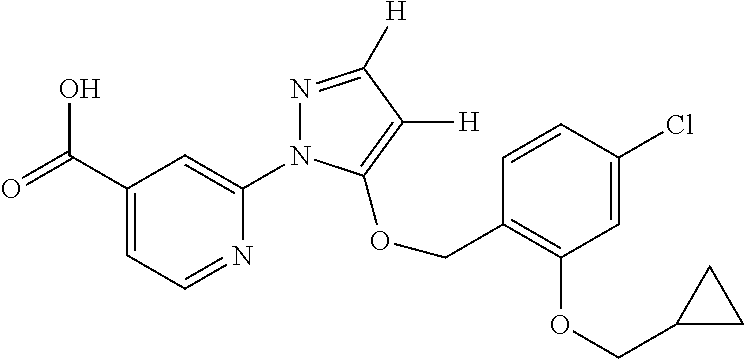
2-[5-[[4-chloro-2- (cyclopropylmethoxy)phenyl] methoxy]pyrazol-1-yl]pyridine-4- carboxylic acid 107 
2-[5-[(4-chloro-2- propoxyphenyl)methoxy]pyrazol- 1-yl]pyridine-4-carboxylic acid 108 
2-[5-[[4-chloro-2-(2,2,2- trifluoroethoxy)phenyl]methoxy] pyrazol-1-yl]pyridine-4-carboxylic acid 109 
2-[5-[(4-fluorophenyl)methoxy]-4- (2-hydroxyethyl)pyrazol-1- yl]pyridine-4-carboxylic acid 110 
2-[4-[2-(dimethylamino)ethyl]-5-[(4- fluorophenyl)methoxy]pyrazol-1- yl]pyridine-4-carboxylic acid 111 
2-[5-[(2-butoxy-4- chlorophenyl)methoxy]pyrazol-1- yl]pyridine-4-carboxylic acid 112 
2-[5-[[4-chloro-2-(2- methylpropoxy)phenyl]methoxy] pyrazol-1-yl]pyridine-4-carboxylic acid 113 
2-[5-[(4-chloro-2-propan-2- yloxyphenyl)methoxy]pyrazol-1- yl]pyridine-4-carboxylic acid 114 
2-[5-[(2-butan-2-yloxy-4- chlorophenyl)methoxy]pyrazol-1- yl]pyridine-4-carboxylic acid 115 
2-[5-[(4-chloro-2- ethoxyphenyl)methoxy]pyrazol-1- yl]pyridine-4-carboxylic acid 116 
2-[5-[[4-chloro-2-(2- methoxyethoxy)phenyl]methoxy] pyrazol-1-yl]pyridine-4-carboxylic acid 117 
2-[5-[[4-chloro-2-[(4- fluorophenyl)methoxy]phenyl] methoxy]pyrazol-1-yl]pyridine-4- carboxylic acid 118 
2-[5-[[4-fluoro-2-[(4- fluorophenyl)methoxy]phenyl] methoxy]pyrazol-1-yl]pyridine-4- carboxylic acid 119 
2-[5-[[4-fluoro-2-[(E)-2-(4- fluorophenyl)ethenyl]phenyl] methoxy]pyrazol-1-yl]pyridine-4- carboxylic acid 120 
2-[5-[[4-chloro-2-[(E)-2-(4- fluorophenyl)ethenyl]phenyl] methoxy]pyrazol-1-yl]pyridine-4- carboxylic acid 121 
2-[5-[[4-fluoro-2-[2-(4- fluorophenyl)ethyl]phenyl] methoxy]pyrazol-1-yl]pyridine-4- carboxylic acid 122 
2-[5-[[4-chloro-2-[2-(4- fluorophenyl)ethyl]phenyl] methoxy]pyrazol-1-yl]pyridine-4- carboxylic acid 123 
2-[5-(2,3-dihydro-1-benzofuran-7- ylmethoxy)pyrazol-1-yl]pyridine- 4-carboxylic acid 124 
2-[5-[(2,2-dimethyl-3H-1- benzofuran-7-yl)methoxy]pyrazol- 1-yl]pyridine-4-carboxylic acid 125 
2-[5-[(4-cyano-2- methylphenyl)methoxy]pyrazol-1- yl]pyridine-4-carboxylic acid 126 
2-[5-[(4-cyano-2- ethylphenyl)methoxy]pyrazol-1- yl]pyridine-4-carboxylic acid 127 
2-[5-[(4-chloro-2- ethylphenyl)methoxy]pyrazol-1- yl]pyridine-4-carboxylic acid 128 
2-[5-[(4-fluoro-2- ethylphenyl)methoxy]pyrazol-1- yl]pyridine-4-carboxylic acid 129 
2-[5-[(2-ethyl-4- fluorophenyl)methoxy]pyrazol-1- yl]pyridine-4-carboxylic acid 130 
2-[5-[(2-chloro-4- methylphenyl)methoxy]pyrazol-1- yl]pyridine-4-carboxylic acid 131 
2-[5-[(2-fluoro-4- methylphenyl)methoxy]pyrazol-1- yl]pyridine-4-carboxylic acid 132 
2-[5-[(2,4- dimethylphenyl)methoxy]pyrazol- 1-yl]pyridine-4-carboxylic acid 133 
2-[5-[(2-methoxy-4- methylphenyl)methoxy]pyrazol-1- yl]pyridine-4-carboxylic acid 134 
2-[5-[(2-cyano-4- methylphenyl)methoxy]pyrazol-1- yl]pyridine-4-carboxylic acid 135 
2-[5-[(2-ethyl-4- methylphenyl)methoxy]pyrazol-1- yl]pyridine-4-carboxylic acid 136 
2-[5-[[4-chloro-2-(1- phenylethoxy)phenyl]methoxy] pyrazol-1-yl]pyridine-4-carboxylic acid 137 
2-[5-[[4-fluoro-2-(1- phenylethoxy)phenyl]methoxy] pyrazol-1-yl]pyridine-4-carboxylic acid 138 
2-[5-[[4-chloro-3-[(4- fluorophenyl)methoxy]phenyl] methoxy]pyrazol-1-yl]pyridine-4- carboxylic acid 139 
2-[5-[[4-fluoro-3-[(4- fluorophenyl)methoxy]phenyl] methoxy]pyrazol-1-yl]pyridine-4- carboxylic acid 140 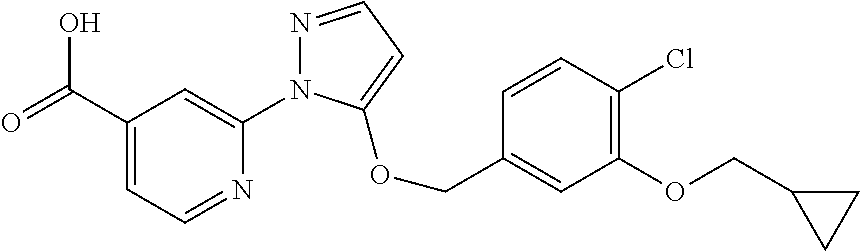
2-[5-[[4-chloro-3- (cyclopropylmethoxy)phenyl] methoxy]pyrazol-1-yl]pyridine-4- carboxylic acid 141 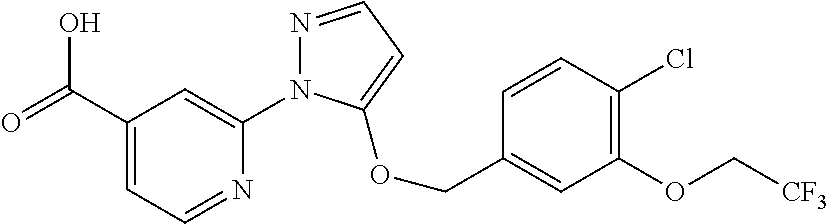
2-[5-[[4-chloro-3-(2,2,2- trifluoroethoxy)phenyl]methoxy] pyrazol-1-yl]pyridine-4-carboxylic acid 142 
2-[5-[(4-bromo-2- methylphenyl)methoxy]pyrazol-1- yl]pyridine-4-carboxylic acid 143 
2-[5-[(4-bromo-2- methoxyphenyl)methoxy]pyrazol- 1-yl]pyridine-4-carboxylic acid 144 
2-[5-[(4-iodo-2- methylphenyl)methoxy]pyrazol-1- yl]pyridine-4-carboxylic acid 145 
2-[5-[(4-iodo-2- methoxyphenyl)methoxy]pyrazol- 1-yl]pyridine-4-carboxylic acid 146 
2-[5-[(5-fluoro-2,3-dihydro-1H- inden-1-yl)oxy]pyrazol-1- yl]pyridine-4-carboxylic acid 147 
2-[5-[(5-chloro-2,3-dihydro-1H- inden-1-yl)oxy]pyrazol-1- yl]pyridine-4-carboxylic acid 148 
2-[5-[(6-fluoro-1,2,3,4- tetrahydronaphthalen-1- yl)oxy]pyrazol-1-yl]pyridine-4- carboxylic acid 149 
2-[5-[(6-chloro-1,2,3,4- tetrahydronaphthalen-1- yl)oxy]pyrazol-1-yl]pyridine-4- carboxylic acid 150 
2-[5-[(2-chloro-4- ethylphenyl)methoxy]pyrazol-1- yl]pyridine-4-carboxylic acid 151 
2-[5-[(4-ethyl-2- fluorophenyl)methoxy]pyrazol-1- yl]pyridine-4-carboxylic acid 152 
2-[5-[(2-chloro-4- cyclopropylphenyl)methoxy]pyrazol- 1-yl]pyridine-4-carboxylic acid 153 
2-[5-[(4-cyclopropyl-2- fluorophenyl)methoxy]pyrazol-1- yl]pyridine-4-carboxylic acid 154 
2-[5-[(3-chloro-4- cyclopropylphenyl)methoxy] pyrazol-1-yl]pyridine-4-carboxylic acid 155 
2-[5-[(4-cyclopropyl-3- fluorophenyl)methoxy]pyrazol-1- yl]pyridine-4-carboxylic acid 156 
2-[4-[2-[(4-fluorophenyl)methyl- methylamino]ethyl]pyrazol-1- yl]pyridine-4-carboxylic acid 157 
N-cyano-2-[4-[2-[(4- fluorophenyl)methyl- methylamino]ethyl]pyrazol-1- yl]pyridine-4-carboxamide 158 
2-[3-(4-chlorophenyl)-5- hydroxypyrazol-1-yl]pyridine-4- carboxylic acid 159 
2-[3-(3-chlorophenyl)-5- hydroxypyrazol-1-yl]pyridine-4- carboxylic acid 160 
2-(3-cyclopentyl-5- hydroxypyrazol-1-yl)pyridine-4- carboxylic acid 161 
2-[3-[(2,6-difluorophenyl)methyl]- 5-hydroxypyrazol-1-yl]pyridine-4- carboxylic acid 162 
2-[5-hydroxy-3-(1- phenylethyl)pyrazol-1-yl]pyridine- 4-carboxylic acid 163 
2-[3-[(2-chlorophenyl)methyl]-5- hydroxypyrazol-1-yl]pyridine-4- carboxylic acid 164 
2-[3-[(3-chlorophenyl)methyl]-5- hydroxypyrazol-1-yl]pyridine-4- carboxylic acid 165 
2-[3-[(4-chlorophenyl)methyl]-5- hydroxypyrazol-1-yl]pyridine-4- carboxylic acid 166 
5-(1-phenylethyl)-2-[4-(1H- tetrazol-5-yl)pyridin-2-yl]pyrazol- 3-ol 167 
5-[(2-chlorophenyl)methyl]-2-[4- (1H-tetrazol-5-yl)pyridin-2- yl]pyrazol-3-ol 168 
5-[(3-chlorophenyl)methyl]-2-[4- (1H-tetrazol-5-yl)pyridin-2- yl]pyrazol-3-ol 169 
5-[(4-chlorophenyl)methyl]-2-[4- (1H-tetrazol-5-yl)pyridin-2- yl]pyrazol-3-ol 170 
2-[3-[2-(4-chlorophenyl)propan-2- yl]-5-hydroxypyrazol-1- yl]pyridine-4-carboxylic acid 171 
2-[3-[1-(4- chlorophenyl)cyclopropyl]-5- hydroxypyrazol-1-yl]pyridine-4- carboxylic acid 172 
2-[3-[(3,5- dichlorophenyl)methyl]-5- hydroxypyrazol-1-yl]pyridine-4- carboxylic acid 173 
2-[3-[(4-fluoro-2- methylphenyl)methyl]-5- hydroxypyrazol-1-yl]pyridine-4- carboxylic acid 174 
2-[3-[(2-fluoro-4- methylphenyl)methyl]-5- hydroxypyrazol-1-yl]pyridine-4- carboxylic acid 175 
2-[3-[(2,4-difluorophenyl)methyl]- 5-hydroxypyrazol-1-yl]pyridine-4- carboxylic acid - In additional embodiments, the substituted pyrazolylpyridine derivative compound disclosed herein is selected from a compound of Table 2.
-
TABLE 2 


- The compounds used in the reactions described herein are made according to organic synthesis techniques known to those skilled in this art, starting from commercially available chemicals and/or from compounds described in the chemical literature. “Commercially available chemicals” are obtained from standard commercial sources including Acros Organics (Pittsburgh, Pa.), Aldrich Chemical (Milwaukee, Wis., including Sigma Chemical and Fluka), Apin Chemicals Ltd. (Milton Park, UK), Avocado Research (Lancashire, U.K.), BDH Inc. (Toronto, Canada), Bionet (Cornwall, U.K.), Chemservice Inc. (West Chester, Pa.), Crescent Chemical Co. (Hauppauge, N.Y.), Eastman Organic Chemicals, Eastman Kodak Company (Rochester, N.Y.), Fisher Scientific Co. (Pittsburgh, Pa.), Fisons Chemicals (Leicestershire, UK), Frontier Scientific (Logan, Utah), ICN Biomedicals, Inc. (Costa Mesa, Calif.), Key Organics (Cornwall, U.K.), Lancaster Synthesis (Windham, N.H.), Maybridge Chemical Co. Ltd. (Cornwall, U.K.), Parish Chemical Co. (Orem, Utah), Pfaltz & Bauer, Inc. (Waterbury, Conn.), Polyorganix (Houston, Tex.), Pierce Chemical Co. (Rockford, Ill.), Riedel de Haen AG (Hanover, Germany), Spectrum Quality Product, Inc. (New Brunswick, N.J.), TCI America (Portland, Oreg.), Trans World Chemicals, Inc. (Rockville, Md.), and Wako Chemicals USA, Inc. (Richmond, Va.).
- Methods known to one of ordinary skill in the art are identified through various reference books and databases. Suitable reference books and treatise that detail the synthesis of reactants useful in the preparation of compounds described herein, or provide references to articles that describe the preparation, include for example, “Synthetic Organic Chemistry”, John Wiley & Sons, Inc., New York; S. R. Sandler et al., “Organic Functional Group Preparations,” 2nd Ed., Academic Press, New York, 1983; H. O. House, “Modern Synthetic Reactions”, 2nd Ed., W. A. Benjamin, Inc. Menlo Park, Calif. 1972; T. L. Gilchrist, “Heterocyclic Chemistry”, 2nd Ed., John Wiley & Sons, New York, 1992; J. March, “Advanced Organic Chemistry: Reactions, Mechanisms and Structure”, 4th Ed., Wiley-Interscience, New York, 1992. Additional suitable reference books and treatise that detail the synthesis of reactants useful in the preparation of compounds described herein, or provide references to articles that describe the preparation, include for example, Fuhrhop, J. and Penzlin G. “Organic Synthesis: Concepts, Methods, Starting Materials”, Second, Revised and Enlarged Edition (1994) John Wiley & Sons ISBN: 3-527-29074-5; Hoffman, R. V. “Organic Chemistry, An Intermediate Text” (1996) Oxford University Press, ISBN 0-19-509618-5; Larock, R. C. “Comprehensive Organic Transformations: A Guide to Functional Group Preparations” 2nd Edition (1999) Wiley-VCH, ISBN: 0-471-19031-4; March, J. “Advanced Organic Chemistry: Reactions, Mechanisms, and Structure” 4th Edition (1992) John Wiley & Sons, ISBN: 0-471-60180-2; Otera, J. (editor) “Modern Carbonyl Chemistry” (2000) Wiley-VCH, ISBN: 3-527-29871-1; Patai, S. “Patai's 1992 Guide to the Chemistry of Functional Groups” (1992) Interscience ISBN: 0-471-93022-9; Solomons, T. W. G. “Organic Chemistry” 7th Edition (2000) John Wiley & Sons, ISBN: 0-471-19095-0; Stowell, J. C., “Intermediate Organic Chemistry” 2nd Edition (1993) Wiley-Interscience, ISBN: 0-471-57456-2; “Industrial Organic Chemicals: Starting Materials and Intermediates: An Ullmann's Encyclopedia” (1999) John Wiley & Sons, ISBN: 3-527-29645-X, in 8 volumes; “Organic Reactions” (1942-2000) John Wiley & Sons, in over 55 volumes; and “Chemistry of Functional Groups” John Wiley & Sons, in 73 volumes.
- Specific and analogous reactants may also be identified through the indices of known chemicals prepared by the Chemical Abstract Service of the American Chemical Society, which are available in most public and university libraries, as well as through on-line databases (the American Chemical Society, Washington, D.C., may be contacted for more details). Chemicals that are known but not commercially available in catalogs may be prepared by custom chemical synthesis houses, where many of the standard chemical supply houses (e.g., those listed above) provide custom synthesis services. A reference for the preparation and selection of pharmaceutical salts of the substituted pyrazolylpyridine derivative compounds described herein is P. H. Stahl & C. G. Wermuth “Handbook of Pharmaceutical Salts”, Verlag Helvetica Chimica Acta, Zurich, 2002.
- The substituted pyrazolylpyridine and pyrazolylpyridazine derivative compounds are prepared by the general synthetic routes described below in Schemes 1-8.
-

- One method for preparing compounds such as compound 1-2 is provided in Scheme 1. 2-Chloroisonicotinic acid or 6-chloropyridazine-4-carboxylic acid are treated with hydrazine hydrate in an organic solvent, such as 1,4-dioxane, under reflux conditions (e.g., about 100° C.) to give intermediates 1-1. Subsequent reaction with substituted acetoacetyl ester in AcOH under heating conditions affords compound s1-2.
-

- A method for preparing compounds such as compounds 2-3 is provided in Scheme 2. 2-Chloroisonicotinonitrile or 6-chloropyridazine-4-carbonitrile are treated with hydrazine hydrate in a mixture of an alcoholic solvent (such as 1-butanol) and an organic solvent (such as THF) at elevated temperature (e.g. about 60-100° C.) to give intermediates 2-1. Subsequent reaction with an acetoacetyl ester in a mixture of an alcoholic solvent (such as ethanol) heated to reflux in presence of acetic acid provides cyclized hydroxypyrazole pyridine intermediates 2-2. Hydrolysis using concentrated sodium hydroxide solution (such as 5-10 N) in ethanol provides the acids 2-3.
-

- Two methods of preparing acetoacetyl esters are provided in Scheme 3. In the first method, a substituted acetophenone is treated with diethyl carbonate and sodium hydride in an organic solvent such as THF to give ketoester 3-2. In the second method, an acetyl chloride can is reacted with 2,2-dimethyl-1,3-dioxane-4,6-dione in presence of a base, such as pyridine, in an organic solvent, such as DCM, to give intermediate 3-3. Ketoesters such as 3-2 and 3-3 are condensed with 2-hydrazinylisonicotinonitrile, 6-hydrazinylpyridazine-4-carbonitrile, 2-hydrazinylpyrimidine-4-carbonitrile or 6-hydrazinylpyrimidine-4-carbonitrile to generate hydroxypyrazole pyridine, hydroxypyrazole pyridazine, and hydroxypyrazole pyrimidine analogs.
-

- A method for preparing compounds such as compounds 4-3 is provided in Scheme 4. Substituted acetophenones are reacted with either DMF-DMA or (1,1-dimethoxy-ethyl)-dimethylamine under heating conditions (e.g. about 100-120° C.) to give intermediate 4-1. Subsequent cyclization with 2-hydrazylisonicotinonitrile or 6-hydrazinylpyridazine-4-carbonitrile, either as free bases or hydrochloride salts, in an alcohol solvent such as 2-methoxyethanol (if hydrochloride salt is used), or ethanol in the presence of acetic acid (if the free bases of compounds 2-1 are used) under heating conditions provides intermediates 4-2. Hydrolysis of the nitrile group using concentrated sodium hydroxide solution (5-10 M) in ethanol with heat affords the acid products 4-3.
-

- A method for preparing compounds such as compounds 5-3 is provided in Scheme 5. Cyclization of 2-hydrazinylisoniconinonitrile or 6-hydrazinylpyridazine-4-carbonitrile with ethyl 3-oxobutanoate in an alcoholic solvent, such as ethanol, in presence of acetic acid provides intermediates 5-1. Alkylation of the hydroxyl group using an alkyl halide, such as alkyl bromide or alkyl iodide, in an organic solvent, such as DMF, in the presence of a base, e.g. K2CO3, gives products 5-2. Subsequent hydrolysis using concentrated NaOH in alcohol provides the acid products 5-3.
-

- A method to prepare compounds such as compound 6-4 and 6-5 is provided in Scheme 6. 2-Hydrazinyl-isonicotinonitrile or 6-hydrazinylpyridazine-4-carbonitrile react with ethyl (2E)-3-(dimethylamino)prop-2-enoate in ethanol in the presence of acetic acid to give intermediates 6-1. Upon treatment with a strong base, such as potassium t-butoxide, the hydroxypyrazole intermediates 6-2 is obtained. A Mitsunobu reaction, wherein intermediates 6-2 are treated with an alcohol, an azadicarboxylate, such as DIAD, a ligand, such as triphenylphosphine, in an organic solvent, such as THF, gives a mixture of O-alkylation and N-alkylation products. Separation via flash column chromatography provides the desired O-alkylation products 6-3, which are then hydrolyzed to the acids 6-4. The acids are then treated with excess diazomethane (e.g. 10 equiv.) in an organic solvent such as THF to give the methyl esters, compounds 6-5.
-

- Methods for preparing compounds of formula 7-2 and 7-3 are provided in Scheme 7. Treatment of acids 7-1 with hydroxylamine hydrochloride in the presence of a coupling reagent, such as HATU, in a solvent, such as DMF, at room temperature for 1 to 24 hours provides compounds 7-2. Compounds 7-1 can also be used to prepare N-acylcyanamides such as compound 7-3. Treatment of 7-1 with cyanamide in the presence of an acid coupling reagent, such as HATU, in a solvent, such as DMF, at room temperature for 1 to 24 hours provides compounds 7-3.
-

- A method for preparing compounds of formula 8-2 is provided in Scheme 8. Treatment of the nitrile intermediates 8-1 with sodium azide and ammonium chloride in DMF followed by heating to 90° C. for 2 to 24 hours provides the desired tetrazole derivatives 8-2.
- The substituted pyrazolylpyrimidine derivative compounds are prepared by the general synthetic routes described below in Schemes 9-15.
-

- One method for preparing compounds such as compounds 9-2 is provided in Scheme 9. 6-Chloropyrimidine-4-carboxylic acid or 2-chloropyrimidine-4-carboxylic acid are treated with hydrazine hydrate in an organic solvent, such as 1,4-dioxane, under reflux conditions (e.g., about 100° C.) to give intermediates 9-1. Subsequent reaction with substituted acetoacetyl ester in AcOH under heating conditions affords compounds 9-2.
-

- A method for preparing compounds such as compounds 10-3 is provided in Scheme 10. 2-Chloropyrimidine-4-carbonitrile or 6-chloropyrimidine-4-carbonitrile are treated with hydrazine hydrate in a mixture of an alcoholic solvent (such as 1-butanol) and an organic solvent (such as THF) at elevated temperature (e.g. about 60-100° C.) to give intermediates 10-1. Subsequent reaction with an acetoacetyl ester in a mixture of an alcoholic solvent (such as ethanol) heated to reflux in presence of acetic acid provides cyclized hydroxypyrazole pyridine intermediates 10-2. Hydrolysis using concentrated sodium hydroxide solution (such as 5-10 N) in ethanol provides the acids 10-3.
-

- A method for preparing compounds such as compounds 11-3 is provided in Scheme 11. Cyclization of 2-hydrazinylpyrimidine-4-carbonitrile or 6-hydrazinylpyrimidine-4-carbonitrile either as free base or hydrochloride salts with intermediate 4-1, in an alcohol solvent such as 2-methoxyethanol (if hydrochloride salts are used), or ethanol in the presence of acetic acid (if the free base of compounds 10-1 are used) under heating conditions provides intermediates 11-2. Hydrolysis of the nitrile group using concentrated sodium hydroxide solution (5-10 M) in ethanol with heat affords the acid products 11-3.
-

- A method for preparing compounds such as compounds 12-3 is provided in Scheme 12. Cyclization of 2-hydrazinylpyrimidine-4-carbonitrile or 6-hydrazinylpyrimidine-4-carbonitrile with ethyl 3-oxobutanoate in an alcoholic solvent, such as ethanol, in presence of acetic acid provides intermediates 12-1. Alkylation of the hydroxyl group using an alkyl halide, such as alkyl bromide or alkyl iodide, in an organic solvent, such as DMF, in the presence of a base, e.g. K2CO3, gives products 12-2. Subsequent hydrolysis using concentrated NaOH in alcohol provides the acid products 12-3.
-

- A method to prepare compounds such as compounds 13-4 or 13-5 is provided in Scheme 13. 2-Hydrazinylpyrimidine-4-carbonitrile or 6-hydrazinylpyrimidine-4-carbonitrile react with ethyl (2E)-3-(dimethylamino)prop-2-enoate in ethanol in the presence of acetic acid to give intermediates 13-1. Upon treatment with a strong base, such as potassium t-butoxide, the hydroxypyrazole intermediates 13-2 are obtained. A Mitsunobu reaction, wherein intermediates 13-2 are treated with an alcohol, an azadicarboxylate, such as DIAD, a ligand, such as triphenylphosphine, in an organic solvent, such as THF, gives a mixture of O-alkylation and N-alkylation products. Separation via flash column chromatography provides the desired O-alkylation products 13-3, which is then hydrolyzed to the acids 13-4. The acids are then treated with excess diazomethane (e.g. 10 equiv.) in an organic solvent such as THF to give the methyl esters, compounds 13-5.
-

- Methods for preparing compounds of formula 14-2 and 14-3 are provided in Scheme 14. Treatment of acids 14-1 with hydroxylamine hydrochloride in the presence of a coupling reagent, such as HATU, in a solvent, such as DMF, at room temperature for 1 to 24 hours provides compounds 14-2. Compounds 14-1 can also be used to prepare N-acylcyanamides such as compounds 14-3. Treatment of 14-1 with cyanamide in the presence of an acid coupling reagent, such as HATU, in a solvent, such as DMF, at room temperature for 1 to 24 hours provides compounds 14-3.
-

- A method for preparing compounds of formula 15-2 is provided in Scheme 15. Treatment of the nitrile intermediates 15-1 with sodium azide and ammonium chloride in DMF followed by heating to 90° C. for 2 to 24 hours provides the desired tetrazole derivatives 15-2.
- In each of the above reaction procedures or schemes, the various substituents may be selected from among the various substituents otherwise taught herein.
- In each of the above reaction procedures or schemes, the various substituents may be selected from among the various substituents otherwise taught herein.
- Chromatin is the complex of DNA and protein that makes up chromosomes. Histones are the major protein component of chromatin, acting as spools around which DNA winds. Changes in chromatin structure are affected by covalent modifications of histone proteins and by non-histone binding proteins. Several classes of enzymes are known which can covalently modify histones at various sites.
- Proteins can be post-translationally modified by methylation on amino groups of lysines and guanidino groups of arginines or carboxymethylated on aspartate, glutamate, or on the C-terminus of the protein. Post-translational protein methylation has been implicated in a variety of cellular processes such as RNA processing, receptor mediated signaling, and cellular differentiation. Post-translational protein methylation is widely known to occur on histones, such reactions known to be catalyzed by histone methyltransferases, which transfer methyl groups from S-adenyosyl methionine (SAM) to histones. Histone methylation is known to participate in a diverse range of biological processes including heterochromatin formation, X-chromosome inactivation, and transcriptional regulation (Lachner et al., (2003) J. Cell Sci. 116:2117-2124; Margueron et al., (2005) Curr. Opin. Genet. Dev. 15:163-176).
- Unlike acetylation, which generally correlates with transcriptional activation, whether histone methylation leads to transcription activation or repression depends on the particular site of methylation and the degree of methylation (e.g., whether a particular histone lysine residue is mono-, di-, or tri-methylated). However, generally, methylation on H3K9, H3K27 and H4K20 is linked to gene silencing, while methylation on H3K4, H3K36, and H3K79 is generally associated with active gene expression. In addition, tri- and di-methylation of H3K4 generally marks the transcriptional start sites of actively transcribed genes, whereas mono-methylation of H3K4 is associated with enhancer sequences.
- A “demethylase” or “protein demethylase,” as referred to herein, refers to an enzyme that removes at least one methyl group from an amino acid side chain. Some demethylases act on histones, e.g., act as a histone H3 or H4 demethylase. For example, an H3 demethylase may demethylate one or more of H3K4, H3K9, H3K27, H3K36 and/or H3K79. Alternately, an H4 demethylase may demethylate histone H4K20. Demethylases are known to demethylate either a mono-, di- and/or a tri-methylated substrate. Further, histone demethylases can act on a methylated core histone substrate, a mononucleosome substrate, a dinucleosome substrate and/or an oligonucleosome substrate, peptide substrate and/or chromatin (e.g., in a cell-based assay).
- The first lysine demethylase discovered was lysine specific demethylase 1 (LSD1/KDM1), which demethylates both mono- and di-methylated H3K4 or H3K9, using flavin as a cofactor. A second class of Jumonji C (JmjC) domain containing histone demthylases were predicted, and confirmed when a H3K36 demethylase was found using a formaldehyde release assay, which was named JmjC domain containing histone demethylase 1 (JHDM1/KDM2A).
- More JmjC domain-containing proteins were subsequently identified and they can be phylogenetically clustered into seven subfamilies: JHDM1, JHDM2, JHDM3, JMJD2, JARID, PHF2/PHF8, UTX/UTY, and JmjC domain only.
- The JMJD2 family of proteins are a family of histone-demethylases known to demethylate tri- and di-methylated H3-K9, and were the first identified histone tri-methyl demethylases. In particular, ectopic expression of JMJD2 family members was found to dramatically decrease levels of tri- and di-methylated H3-K9, while increasing levels of mono-methylated H3-K9, which delocalized Heterochromatin Protein 1 (HP1) and reduced overall levels of heterochromatin in vivo. Members of the JMJD2 subfamily of jumonji proteins include JMJD2C and its homologues JMJD2A, JMJD2B, JMJD2D and JMJD2E. Common structural features found in the JMJD2 subfamily of Jumonji proteins include the JmjN, JmjC, PHD and Tdr sequences.
- JMJD2C, also known as GASC1 and KDM4C, is known to demethylate tri-methylated H3K9 and H3K36. Histone demethylation by JMJD2C occurs via a hydroxylation reaction dependent on iron and α-ketoglutarate, wherein oxidative decarboxylation of α-ketoglutarate by JMJD2C produces carbon dioxide, succinate, and ferryl and ferryl subsequently hydroxylates a methyl group of lysine H3K9, releasing formaldehyde. JMJD2C is known to modulate regulation of adipogenesis by the nuclear receptor PPARy and is known to be involved in regulation of self-renewal in embryonic stem cells.
- As used herein, a “JARID protein” includes proteins in the JARID1 subfamily (e.g., JARID1A, JARID1B, JARID1C and JARID1D proteins) and the JARID2 subfamily, as well as homologues thereof. A further description and listing of JARID proteins can be found in Klose et al. (2006) Nature Reviews/Genetics 7:715-727. The JARID1 family contains several conserved domains: JmjN, ARID, JmjC, PHD and a C5HC2 zing finger.
- JARID1A, also called KDM5A or RBP2, was initially found as a binding partner of retinoblastoma (Rb) protein. JARID1A was subsequently found to function as a demethylase of tri- and di-methylated H3K4, and has been found to promote cell growth, while inhibiting senescence and differentiation. For instance, abrogation of JARID1A from mouse cells inhibits cell growth, induces senescence and differentiation, and causes loss of pluripotency of embryonic stem cells in vitro. JARID1A has been found to be overexpressed in gastric cancer and the loss of JARID1A has been found to reduce tumorigenesis in a mouse cancer model. Additionally, studies have demonstrated that loss of the retinoblastome binding protein 2 (RBP2) histone demethylase suppresses tumorigenesis in mice lacking Rb1 or Men1 (Lin et al. Proc. Natl. Acad. Sci. USA, Aug. 16, 2011, 108(33),13379-86; doi: 10.1073/pnas.1110104108) and the authors of the study concluded that RBP2-inhibitory drugs would have anti-cancer activity.
- JARID1B, also referred to as KDM5B and PLU1, was originally found in experiments to discover genes regulated by the HER2 tyrosine kinase. JARID1B has consistently been found to be expressed in breast cancer cell lines, although restriction of JARID1B has been found in normal adult tissues, with the exception of the testis. In addition, 90% of invasive ductal carcinomas have been found to express JARID1B. In addition, JARID1B has been found to be up-regulated in prostate cancers, while having more limited expression in benign prostate, and has also been found to be up-regulated in bladder cancer and lung cancer (both SCLC and NSCLC). JARID1B has also been found to repress tumor suppressor genes such as BRCA1, CAV1 and 14-3-3σ, and knockdown of JARID1B was found to increase the levels of tri-methylated H3K4 at these genes.
- F-box and leucine-rich repeat protein 10 (FBXL10) and F-box and leucine-rich repeat protein 11 (FBXL11) are multifunctional F-box family proteins that demethylate histone H3 through a hydroxylation based mechanism. FBXL10, also known as lysine (K)-specific demethylase 2B (KDM2B) or Jumonji C domain-containing histone demethylase 1B (JHDM1B), preferentially demethylates trimethylated K4 and dimethylated K36 of histone H3, but contains weak or no activity for mono- and tri-methylated H3-K36. FBXL10 contains three domains, a catalytic JMJC domain, an F-box domain and a CXXC DNA-binding domain. The N-terminal JMJC domain coordinates iron and α-ketoglutarate to catalyze demethylation through the hydroxylation based mechanism. The CXXC DNA-binding domain allows FBXL10 to preferentially bind to transcribed region of the ribosomal RNA, leading to repression of the ribosomal RNA gene transcription and ultimately leading to inhibition of cell growth and proliferation. FBXL10 has been found to be overexpressed in acute myeloid leukemia, bladder carcinoma and pancreatic ductal adenocarcinoma. Recently, it has been demonstrated that FBXL10 regulates the expression of Polycomb target genes, those proteins are epigenetic regulators essential for stem cell differentiation. This regulation implicates FBXL10's involvement in tumorigenesis through the regulation of these Polycomb target genes.
- FBXL11, also known as KDM2A or JHDM1A, demethylates mono- and di-methylated K36 of histone H3. The COX DNA-binding domain recognizes non-methylated DNA and targets CpG island regions where it specifically removes H3K3 methylation. Further, FBXL11 is required to maintain a heterochromatic state, sustain centromeric integrity and genomic stability during mitosis. In addition, FBXL11 is a key negative regulator of NF-KB. Overexpression of FBXL11 has been observed in non-small cell lung cancer (NSCLC) where FBXL11 upregulates phosphor-ERK1/2 by repressing DUSP3 expression in NSCLC cell lines. Negative regulation of gluconeogenic gene expression by FBXL11 results in suppression of two rate-limiting gluconeogenic enzymes, critical for maintaining blood glucose homeostasis.
- In an additional embodiment is a method for inhibiting a histone-demethylase enzyme comprising contacting a histone demethylase enzyme with a compound of Formula (I) or a tautomer, stereoisomer, geometric isomer, N-oxide, or pharmaceutically acceptable salt thereof,
-

- wherein,
- R1 is hydrogen, halogen, —OH, —OR5, —N(R5)2, alkyl, carbocyclyl, heterocyclyl, aryl, heteroaryl, carbocyclylalkyl, heterocyclylalkyl, aralkyl, or heteroarylalkyl;
- R2 is hydrogen, —OH, —OR5, —N(R5)2, alkyl, carbocyclyl, heterocyclyl, aryl, heteroaryl, carbocyclylalkyl, heterocyclylalkyl, aralkyl, or heteroarylalkyl;
- R3 is hydrogen, halogen, —OH, —OR5, —N(R5)2, alkyl, carbocyclyl, heterocyclyl, aryl, heteroaryl, carbocyclylalkyl, heterocyclylalkyl, aralkyl, or heteroarylalkyl;
- R4 is hydrogen or alkyl;
- each R5 is independently hydrogen, alkyl, carbocyclyl, heterocyclyl, aryl, heteroaryl, carbocyclylalkyl, heterocyclylalkyl, aralkyl, or heteroarylalkyl;
- with the provision:
- if R2 and R3 are both hydrogen, then R1 is not hydrogen, methyl, trifluoromethyl, isopropyl or cyclopropyl; or
- if R1 and R3 are both hydrogen, then R2 is not methyl, or trifluoromethyl; or
- if R1 and R3 are both methyl, then R2 is not hydrogen, methyl or ethyl; or
- if R1 and R2 are hydrogen, then R3 is not
-

- In an additional embodiment is a method for inhibiting a histone-demethylase enzyme comprising contacting a histone demethylase enzyme with a compound of Formula (II) or a tautomer, stereoisomer, geometric isomer, N-oxide, or pharmaceutically acceptable salt thereof,
-

- wherein,
- R1 is hydrogen, halogen, —OH, —OR5, —N(R5)2, alkyl, carbocyclyl, heterocyclyl, aryl, heteroaryl, carbocyclylalkyl, heterocyclylalkyl, aralkyl, or heteroarylalkyl;
- R2 is hydrogen, halogen, —OH, —OR5, —N(R5)2, alkyl, carbocyclyl, heterocyclyl, aryl, heteroaryl, carbocyclylalkyl, heterocyclylalkyl, aralkyl, or heteroarylalkyl;
- R4 is hydrogen or alkyl; and
- each R5 is independently hydrogen, alkyl, carbocyclyl, heterocyclyl, aryl, heteroaryl, carbocyclylalkyl, heterocyclylalkyl, aralkyl, or heteroarylalkyl.
- In an additional embodiment is a method for inhibiting a histone-demethylase enzyme comprising contacting a histone demethylase enzyme with a compound of Formula (III) or a tautomer, stereoisomer, geometric isomer, N-oxide, or pharmaceutically acceptable salt thereof,
-

- wherein,
- R1 is hydrogen, halogen, —OH, —OR5, —N(R5)2, alkyl, carbocyclyl, heterocyclyl, aryl, heteroaryl, carbocyclylalkyl, heterocyclylalkyl, aralkyl, or heteroarylalkyl;
- R2 is hydrogen, halogen, —OH, —OR5, —N(R5)2, alkyl, carbocyclyl, heterocyclyl, aryl, heteroaryl, carbocyclylalkyl, heterocyclylalkyl, aralkyl, or heteroarylalkyl;
- R3 is C2-C10 alkyl, carbocyclyl, heterocyclyl, aryl, heteroaryl, carbocyclylalkyl, heterocyclylalkyl, aralkyl, or heteroarylalkyl;
- R4 is hydrogen or alkyl; and
- each R5 is independently hydrogen, alkyl, carbocyclyl, heterocyclyl, aryl, heteroaryl, carbocyclylalkyl, heterocyclylalkyl, aralkyl, or heteroarylalkyl.
- In an additional embodiment is a method for inhibiting a histone-demethylase enzyme comprising contacting a histone demethylase enzyme with a compound of Formula (IV) or a tautomer, stereoisomer, geometric isomer, N-oxide, or pharmaceutically acceptable salt thereof,
-

- wherein,
- R1 is hydrogen, halogen, —OH, —OR5, —N(R5)2, alkyl, carbocyclyl, heterocyclyl, aryl, heteroaryl, carbocyclylalkyl, heterocyclylalkyl, aralkyl, or heteroarylalkyl;
- R2 is hydrogen, halogen, —OH, —OR5, —N(R5)2, alkyl, carbocyclyl, heterocyclyl, aryl, heteroaryl, carbocyclylalkyl, heterocyclylalkyl, aralkyl, or heteroarylalkyl;
- R3 is —O—X—Y;
- R4 is hydrogen or alkyl;
- each R5 is independently hydrogen, alkyl, carbocyclyl, heterocyclyl, aryl, heteroaryl, carbocyclylalkyl, heterocyclylalkyl, aralkyl, or heteroarylalkyl;
- X is C1-C8 alkylene or
-

- where n is 0 to 4; and
- Y is hydrogen, carbocyclyl, aryl, or heteroaryl.
- In an additional embodiment is a method for inhibiting a histone-demethylase enzyme comprising contacting a histone demethylase enzyme with a compound of Formula (V) or a tautomer, stereoisomer, geometric isomer, N-oxide, or pharmaceutically acceptable salt thereof,
-

- wherein,
- R1 is hydrogen, halogen, —OH, —OR5, —N(R5)2, alkyl, carbocyclyl, heterocyclyl, aryl, heteroaryl, carbocyclylalkyl, heterocyclylalkyl, aralkyl, or heteroarylalkyl;
- R2 is hydrogen, halogen, —OH, —OR5, —N(R5)2, alkyl, carbocyclyl, heterocyclyl, aryl, heteroaryl, carbocyclylalkyl, heterocyclylalkyl, aralkyl, or heteroarylalkyl;
- R3 is hydrogen, halogen, —OH, —OR5, —N(R5)2, alkyl, carbocyclyl, heterocyclyl, aryl, heteroaryl, carbocyclylalkyl, heterocyclylalkyl, aralkyl, or heteroarylalkyl;
- R4 is hydrogen or alkyl; and
- each R5 is independently hydrogen, alkyl, carbocyclyl, heterocyclyl, aryl, heteroaryl, carbocyclylalkyl, heterocyclylalkyl, aralkyl, or heteroarylalkyl.
- In an additional embodiment is a method for inhibiting a histone-demethylase enzyme comprising contacting a histone demethylase enzyme with a compound of Formula (VI) or a tautomer, stereoisomer, geometric isomer, N-oxide, or pharmaceutically acceptable salt thereof,
-

- wherein,
- R1 is hydrogen, halogen, —OH, —OR5, —N(R5)2, alkyl, carbocyclyl, heterocyclyl, aryl, heteroaryl, carbocyclylalkyl, heterocyclylalkyl, aralkyl, or heteroarylalkyl;
- R2 is hydrogen, halogen, —OH, —OR5, —N(R5)2, alkyl, carbocyclyl, heterocyclyl, aryl, heteroaryl, carbocyclylalkyl, heterocyclylalkyl, aralkyl, or heteroarylalkyl;
- R3 is hydrogen, halogen, —OH, —OR5, —N(R5)2, alkyl, carbocyclyl, heterocyclyl, aryl, heteroaryl, carbocyclylalkyl, heterocyclylalkyl, aralkyl, or heteroarylalkyl;
- R4 is hydrogen or alkyl;
- each R5 is independently hydrogen, alkyl, carbocyclyl, heterocyclyl, aryl, heteroaryl, carbocyclylalkyl, heterocyclylalkyl, aralkyl, or heteroarylalkyl.
- In an additional embodiment is a method for inhibiting a histone-demethylase enzyme comprising contacting a histone demethylase enzyme with a compound of Formula (VII)-(XIV) or a tautomer, stereoisomer, geometric isomer, N-oxide, or pharmaceutically acceptable salt thereof
- In an additional embodiment is the method for inhibiting a histone-demethylase enzyme, wherein the histone-demethylase enzyme comprises a JmjC domain. In an additional embodiment is the method for inhibiting a histone-demethylase enzyme, wherein the histone-demethylase enzyme is selected from JARID1A, JARID1B, JMJD2C, JMJD2A, or FBXL10.
- Disclosed herein are methods of modulating demethylation in a cell or in a subject, either generally or with respect to one or more specific target genes. Demethylation can be modulated to control a variety of cellular functions, including without limitation: differentiation; proliferation; apoptosis; tumorigenesis, leukemogenesis or other oncogenic transformation events; hair loss; or sexual differentiation. For example, in particular embodiments, the invention provides a method of treating a disease regulated by histone methylation and/or demethylation in a subject in need thereof by modulating the activity of a demethylase comprising a JmjC domain (e.g., a histone demethylase such as a JHDM protein(s)).
- In an additional embodiment is a method for treating cancer in subject comprising administering to the subject in need thereof a composition comprising a compound of Formula (I) or a tautomer, stereoisomer, geometric isomer, N-oxide, or pharmaceutically acceptable salt thereof,
-

- wherein,
- R1 is hydrogen, halogen, —OH, —OR5, —N(R5)2, alkyl, carbocyclyl, heterocyclyl, aryl, heteroaryl, carbocyclylalkyl, heterocyclylalkyl, aralkyl, or heteroarylalkyl;
- R2 is hydrogen, —OH, —OR5, —N(R5)2, alkyl, carbocyclyl, heterocyclyl, aryl, heteroaryl, carbocyclylalkyl, heterocyclylalkyl, aralkyl, or heteroarylalkyl;
- R3 is hydrogen, halogen, —OH, —OR5, —N(R5)2, alkyl, carbocyclyl, heterocyclyl, aryl, heteroaryl, carbocyclylalkyl, heterocyclylalkyl, aralkyl, or heteroarylalkyl;
- R4 is hydrogen or alkyl;
- each R5 is independently hydrogen, alkyl, carbocyclyl, heterocyclyl, aryl, heteroaryl, carbocyclylalkyl, heterocyclylalkyl, aralkyl, or heteroarylalkyl;
- with the provision:
- if R2 and R3 are both hydrogen, then R1 is not hydrogen, methyl, trifluoromethyl, isopropyl or cyclopropyl; or
- if R1 and R3 are both hydrogen, then R2 is not methyl, or trifluoromethyl; or
- if R1 and R3 are both methyl, then R2 is not hydrogen, methyl or ethyl; or
- if R1 and R2 are hydrogen, then R3 is not
-

- In an additional embodiment is a method for treating cancer in subject comprising administering to the subject in need thereof a composition comprising a compound of Formula (II) or a tautomer, stereoisomer, geometric isomer, N-oxide, or pharmaceutically acceptable salt thereof,
-

- wherein,
- R1 is hydrogen, halogen, —OH, —OR5, —N(R5)2, alkyl, carbocyclyl, heterocyclyl, aryl, heteroaryl, carbocyclylalkyl, heterocyclylalkyl, aralkyl, or heteroarylalkyl;
- R2 is hydrogen, halogen, —OH, —OR5, —N(R5)2, alkyl, carbocyclyl, heterocyclyl, aryl, heteroaryl, carbocyclylalkyl, heterocyclylalkyl, aralkyl, or heteroarylalkyl;
- R4 is hydrogen or alkyl; and
- each R5 is independently hydrogen, alkyl, carbocyclyl, heterocyclyl, aryl, heteroaryl, carbocyclylalkyl, heterocyclylalkyl, aralkyl, or heteroarylalkyl.
- In an additional embodiment is a method for treating cancer in subject comprising administering to the subject in need thereof a composition comprising a compound of Formula (III) or a tautomer, stereoisomer, geometric isomer, N-oxide, or pharmaceutically acceptable salt thereof,
-

- wherein,
- R1 is hydrogen, halogen, —OH, —OR5, —N(R5)2, alkyl, carbocyclyl, heterocyclyl, aryl, heteroaryl, carbocyclylalkyl, heterocyclylalkyl, aralkyl, or heteroarylalkyl;
- R2 is hydrogen, halogen, —OH, —OR5, —N(R5)2, alkyl, carbocyclyl, heterocyclyl, aryl, heteroaryl, carbocyclylalkyl, heterocyclylalkyl, aralkyl, or heteroarylalkyl;
- R3 is C2-C10 alkyl, carbocyclyl, heterocyclyl, aryl, heteroaryl, carbocyclylalkyl, heterocyclylalkyl, aralkyl, or heteroarylalkyl;
- R4 is hydrogen or alkyl; and
- each R5 is independently hydrogen, alkyl, carbocyclyl, heterocyclyl, aryl, heteroaryl, carbocyclylalkyl, heterocyclylalkyl, aralkyl, or heteroarylalkyl.
- In an additional embodiment is a method for treating cancer in subject comprising administering to the subject in need thereof a composition comprising a compound of Formula (IV) or a tautomer, stereoisomer, geometric isomer, N-oxide, or pharmaceutically acceptable salt thereof,
-

- wherein,
- R1 is hydrogen, halogen, —OH, —OR5, —N(R5)2, alkyl, carbocyclyl, heterocyclyl, aryl, heteroaryl, carbocyclylalkyl, heterocyclylalkyl, aralkyl, or heteroarylalkyl;
- R2 is hydrogen, halogen, —OH, —OR5, —N(R5)2, alkyl, carbocyclyl, heterocyclyl, aryl, heteroaryl, carbocyclylalkyl, heterocyclylalkyl, aralkyl, or heteroarylalkyl;
- R3 is —O—X—Y;
- R4 is hydrogen or alkyl;
- each R5 is independently hydrogen, alkyl, carbocyclyl, heterocyclyl, aryl, heteroaryl, carbocyclylalkyl, heterocyclylalkyl, aralkyl, or heteroarylalkyl;
- X is C1-C8 alkylene or
-

- where n is 0 to 4; and
- Y is hydrogen, carbocyclyl, aryl, or heteroaryl.
- In an additional embodiment is a method for treating cancer in subject comprising administering to the subject in need thereof a composition comprising a compound of Formula (V) or a tautomer, stereoisomer, geometric isomer, N-oxide, or pharmaceutically acceptable salt thereof,
-

- wherein,
- R1 is hydrogen, halogen, —OH, —OR5, —N(R5)2, alkyl, carbocyclyl, heterocyclyl, aryl, heteroaryl, carbocyclylalkyl, heterocyclylalkyl, aralkyl, or heteroarylalkyl;
- R2 is hydrogen, halogen, —OH, —OR5, —N(R5)2, alkyl, carbocyclyl, heterocyclyl, aryl, heteroaryl, carbocyclylalkyl, heterocyclylalkyl, aralkyl, or heteroarylalkyl;
- R3 is hydrogen, halogen, —OH, —OR5, —N(R5)2, alkyl, carbocyclyl, heterocyclyl, aryl, heteroaryl, carbocyclylalkyl, heterocyclylalkyl, aralkyl, or heteroarylalkyl;
- R4 is hydrogen or alkyl; and
- each R5 is independently hydrogen, alkyl, carbocyclyl, heterocyclyl, aryl, heteroaryl, carbocyclylalkyl, heterocyclylalkyl, aralkyl, or heteroarylalkyl.
- In an additional embodiment is a method for treating cancer in subject comprising administering to the subject in need thereof a composition comprising a compound of Formula (VI) or a tautomer, stereoisomer, geometric isomer, N-oxide, or pharmaceutically acceptable salt thereof,
-

- wherein,
- R1 is hydrogen, halogen, —OH, —OR5, —N(R5)2, alkyl, carbocyclyl, heterocyclyl, aryl, heteroaryl, carbocyclylalkyl, heterocyclylalkyl, aralkyl, or heteroarylalkyl;
- R2 is hydrogen, halogen, —OH, —OR5, —N(R5)2, alkyl, carbocyclyl, heterocyclyl, aryl, heteroaryl, carbocyclylalkyl, heterocyclylalkyl, aralkyl, or heteroarylalkyl;
- R3 is hydrogen, halogen, —OH, —OR5, —N(R5)2, alkyl, carbocyclyl, heterocyclyl, aryl, heteroaryl, carbocyclylalkyl, heterocyclylalkyl, aralkyl, or heteroarylalkyl;
- R4 is hydrogen or alkyl;
- each R5 is independently hydrogen, alkyl, carbocyclyl, heterocyclyl, aryl, heteroaryl, carbocyclylalkyl, heterocyclylalkyl, aralkyl, or heteroarylalkyl.
- In a further embodiment is the method for treating cancer in a subject wherein the cancer is selected from prostate cancer, breast cancer, bladder cancer, lung cancer or melanoma.
- In an additional embodiment is a method for inhibiting the growth of a tumor comprising administering a composition comprising a compound of Formula (I), (II), (III), (IV), (V), or (VI) or a pharmaceutically acceptable salt thereof, wherein the tumor is characterized by a loss of retinoblastoma gene (RB1) function.
- In an additional embodiment is a method for inhibiting the growth of a tumor comprising administering a composition comprising a compound of Formula (I), (II), (III), (IV), (V), or (VI), or a pharmaceutically acceptable salt thereof, wherein the tumor is characterized by a loss of multiple endocrine neoplasia type 1 gene (Men1) function.
- In an additional embodiment is a method for inhibiting the growth of a tumor comprising administering a composition comprising a compound of Formula (VII)-(XIV) or a pharmaceutically acceptable salt thereof, wherein the tumor is characterized by a loss of retinoblastoma gene (RB1) function.
- In an additional embodiment is a method for inhibiting the growth of a tumor comprising administering a composition comprising a compound of Formula (VII)-(XIV), or a pharmaceutically acceptable salt thereof, wherein the tumor is characterized by a loss of multiple endocrine neoplasia type 1 gene (Men1) function.
- In an additional embodiment is a method for treating cancer in subject comprising administering to the subject in need thereof a composition comprising a compound of Formula (VII)-(XIV) or a tautomer, stereoisomer, geometric isomer, N-oxide, or pharmaceutically acceptable salt thereof. In a further embodiment is the method for treating cancer in a subject wherein the cancer is selected from prostate cancer, breast cancer, bladder cancer, lung cancer or melanoma.
- In certain embodiments, a substituted pyrazolylpyridine, pyrazolylpyridazine, or pyrazolylpyrimidine derivative compound as described herein is administered as a pure chemical. In other embodiments, the substituted pyrazolylpyridine, pyrazolylpyridazine, or pyrazolylpyrimidine derivative compound as described is combined with a pharmaceutically suitable or acceptable carrier (also referred to herein as a pharmaceutically suitable (or acceptable) excipient, physiologically suitable (or acceptable) excipient, or physiologically suitable (or acceptable) carrier) selected on the basis of a chosen route of administration and standard pharmaceutical practice as described, for example, in Remington: The Science and Practice of Pharmacy (Gennaro, 21st Ed. Mack Pub. Co., Easton, Pa. (2005)), the disclosure of which is hereby incorporated herein by reference, in its entirety.
- Accordingly, provided herein is a pharmaceutical composition comprising at least one substituted pyrazolylpyridine derivative compound, or a stereoisomer, prodrug, pharmaceutically acceptable salt, hydrate, solvate, or N-oxide thereof, together with one or more pharmaceutically acceptable carriers and, optionally, other therapeutic and/or prophylactic ingredients. Also provided herein is a pharmaceutical composition comprising at least one substituted pyrazolylpyridazine derivative compound, or a stereoisomer, prodrug, pharmaceutically acceptable salt, hydrate, solvate, or N-oxide thereof, together with one or more pharmaceutically acceptable carriers and, optionally, other therapeutic and/or prophylactic ingredients. Further provided herein is a pharmaceutical composition comprising at least one substituted pyrazolylpyrimidine derivative compound, or a stereoisomer, prodrug, pharmaceutically acceptable salt, hydrate, solvate, or N-oxide thereof, together with one or more pharmaceutically acceptable carriers and, optionally, other therapeutic and/or prophylactic ingredients. The carrier(s) (or excipient(s)) is acceptable or suitable if the carrier is compatible with the other ingredients of the composition and not deleterious to the recipient (i.e., the subject) of the composition.
- One embodiment provides a pharmaceutical composition comprising a pharmaceutically acceptable carrier and a compound of Formulas (I)-(V) or a tautomer, stereoisomer, geometric isomer, N-oxide, or pharmaceutically acceptable salt thereof.
- One embodiment provides a pharmaceutical composition comprising a pharmaceutically acceptable carrier and a compound of Formulas (VII)-(XIV) or a tautomer, stereoisomer, geometric isomer, N-oxide, or pharmaceutically acceptable salt thereof.
- In certain embodiments, the substituted pyrazolylpyridine derivative compound as described by Formulas (I)-(V) is substantially pure, in that it contains less than about 5%, or less than about 1%, or less than about 0.1%, of other organic small molecules, such as contaminating intermediates or by-products that are created, for example, in one or more of the steps of a synthesis method. In certain embodiments, the compound as described by Formulas (VII)-(XIV) is substantially pure, in that it contains less than about 5%, or less than about 1%, or less than about 0.1%, of other organic small molecules, such as contaminating intermediates or by-products that are created, for example, in one or more of the steps of a synthesis method.
- Suitable oral dosage forms include, for example, tablets, pills, sachets, or capsules of hard or soft gelatin, methylcellulose or of another suitable material easily dissolved in the digestive tract. Suitable nontoxic solid carriers can be used which include, for example, pharmaceutical grades of mannitol, lactose, starch, magnesium stearate, sodium saccharin, talcum, cellulose, glucose, sucrose, magnesium carbonate, and the like. (See, e.g., Remington: The Science and Practice of Pharmacy (Gennaro, 21st Ed. Mack Pub. Co., Easton, Pa. (2005)).
- The dose of the composition comprising at least one substituted pyrazolylpyridine derivative compound as described herein may differ, depending upon the patient's (e.g., human) condition, that is, stage of the disease, general health status, age, and other factors that a person skilled in the medical art will use to determine dose.
- Pharmaceutical compositions may be administered in a manner appropriate to the disease to be treated (or prevented) as determined by persons skilled in the medical arts. An appropriate dose and a suitable duration and frequency of administration will be determined by such factors as the condition of the patient, the type and severity of the patient's disease, the particular form of the active ingredient, and the method of administration. In general, an appropriate dose and treatment regimen provides the composition(s) in an amount sufficient to provide therapeutic and/or prophylactic benefit (e.g., an improved clinical outcome, such as more frequent complete or partial remissions, or longer disease-free and/or overall survival, or a lessening of symptom severity. Optimal doses may generally be determined using experimental models and/or clinical trials. The optimal dose may depend upon the body mass, weight, or blood volume of the patient.
- Oral doses can typically range from about 1.0 mg to about 1000 mg, one to four times, or more, per day.
- Other embodiments and uses will be apparent to one skilled in the art in light of the present disclosures. The following examples are provided merely as illustrative of various embodiments and shall not be construed to limit the invention in any way.
- Unless otherwise noted, reagents and solvents were used as received from commercial suppliers Anhydrous solvents and oven-dried glassware were used for synthetic transformations sensitive to moisture and/or oxygen. Yields were not optimized. Reaction times are approximate and were not optimized. Column chromatography and thin layer chromatography (TLC) were performed on silica gel unless otherwise noted. Spectra are given in ppm (6) and coupling constants, J are reported in Hertz. For proton spectra the solvent peak was used as the reference peak.
-

- To a solution of 2-chloropyridine-4-carboxylic acid (1.57 g, 100 mmol) in 1,4-dioxane (30 mL) was added hydrazine hydrate (1.0 g, 200 mmol) dropwise at rt. The reaction mixture was heated at 100° C. overnight. The mixture was concentrated, and the residue was purified by flash column chromatography (CH2Cl2/MeOH=20/1) to afford the title compound (650 mg, 42%) as a white solid. [M+H] Calc'd for C6H7N3O2, 154; Found, 154.
-

- A mixture of 2-hydrazinylpyridine-4-carboxylic acid (306 mg, 2 mmol, PREPARATION 1) and ethyl 3-oxobutanoate (390 mg, 3 mmol) in AcOH (5 mL) was stirred at 100° C. overnight. The reaction mixture was cooled, concentrated, and purified by prep-HPLC to afford the title compound (72 mg, 16%) as yellow solid. 1H NMR (400 MHz, CD3OD): δ 2.72 (3H, s), 4.86 (1H, s), 7.71 (1H, d, J=4.8 Hz), 8.55 (1H, d J=4.8 Hz), 8.81 (1H, s). [M+H] Calc'd for C10H9N3O3, 220; Found, 220.
-

- The title compound was prepared in 24% yield from 2-hydrazinylpyridine-4-carboxylic acid and ethyl 3-cyclopropyl-3-oxopropanoate according to the procedure for the preparation of Example 1. 1H NMR (400 MHz, CD3OD): δ 0.83-0.88 (2H, m), 1.05-1.09 (2H, m), 1.88-1.91 (1H, m), 4.86 (1H, s), 7.70 (1H, dd, J=5.2, 1.2 Hz), 8.54 (1H, d, J=5.2 Hz), 8.75 (1H, s). [M+H] Calc'd for C12H11N3O3, 246; Found, 246.
-

- To a solution of 2-chloropyridine-4-carbonitrile (20.0 g, 144 mmol) in 1-butanol (150 mL) was added 1 M solution of hydrazine hydrate in THF (303 mL, 303 mmol) dropwise at rt. It was then heated at 60° C. overnight. The mixture was concentrated, and the residue was purified by flash column chromatography (CH2Cl2/MeOH=20/1) to afford the title compound (3.5 g, 18%) as a white solid. [M+H] Calc'd for C6H6N4, 135; Found, 135.
-

- A mixture of 2-hydrazinylpyridine-4-carbonitrile (134 mg, 1 mmol, PREPARATION 2) and 2-methyl-3-oxo-butyric acid ethyl ester (158 mg, 1.1 mmol) in EtOH (5 mL) and AcOH (1 mL) was stirred at 90° C. overnight. The reaction mixture was cooled, concentrated, and purified by flash column chromatography (CH2Cl2) to afford the title compound (100 mg, 47%) as an orange solid. [M+H] Calc'd for C11H10N4O, 215; Found, 215.
-

- To a solution of 2-(5-hydroxy-3,4-dimethyl-1H-pyrazol-1-yl)pyridine-4-carbonitrile (100 mg, 0.47 mmol) in EtOH (5 mL) was added 5 M NaOH (2 mL) at rt, then stirred at 90° C. for 1 h. The reaction mixture was cooled, acidified with 1 N HCl to pH=3, filtered to give a yellow solid, then recrystallized from EtOH to afford the title compound (22 mg, 21%) as a white solid. 1H NMR (400 MHz, CD3OD): δ 1.84 (3H, s), 2.23 (3H, s), 7.71 (1H, dd, J=4.8, 1.2 Hz), 8.52 (1H, d, J=5.2 Hz), 8.65 (1H, s). [M+H] Calc'd for C11H11N3O3, 234; Found, 234.
-

- The title compound was prepared in 29% yield from 2-hydrazinylpyridine-4-carbonitrile (PREPARATION 2) and 3-oxo-2-phenyl-butyric acid ethyl ester according to the procedure for the preparation of Example 3, part A. [M+H] Calc'd for C16H12N4O, 277; Found, 277.
-

- The title compound was prepared in 59% yield from 2-(5-hydroxy-3-methyl-4-phenyl-1H-pyrazol-1-yl)pyridine-4-carbonitrile according to the procedure for the preparation of Example 3, part B. 1H NMR (400 MHz, CD3OD): δ 2.31 (3H, s), 7.15 (1H, t, J=7.6 Hz), 7.30 (2H, t, J=7.6 Hz), 7.44 (2H, d, J=7.2 Hz), 7.64 (1H, d, J=4.8 Hz), 8.48 (1H, d, J=5.2 Hz), 8.81-8.82 (1H, m). [M+H] Calc'd for C16H13N3O3, 296; Found, 296.
-

- The title compound was prepared in 48% yield from 2-hydrazinylpyridine-4-carbonitrile (PREPARATION 2) and ethyl 3-(2-fluorophenyl)-3-oxopropanoate according to the procedure for the preparation of Example 3, part A. 1H NMR (300 MHz, DMSO-d6): δ 6.15-6.17 (1H, m), 7.13-7.41 (4H, m), 8.07-8.12 (1H, m), 8.34 (1H, s), 8.48-8.50 (1H, m), 11.64 (1H, s). [M+H] Calc'd for C15H9FN4O, 281; Found, 281.
-

- The title compound was prepared in 75% yield from 2-[3-(2-fluorophenyl)-5-hydroxy-1H-pyrazol-1-yl]pyridine-4-carbonitrile according to the procedure for the preparation of Example 3, part B. 1H NMR (400 MHz, DMSO-d6): δ 6.06 (1H, s), 7.29-7.34 (2H, m), 7.44-7.45 (1H, m), 7.78-7.79 (1H, m), 8.01-8.05 (1H, m), 8.26 (1H, s), 8.68 (1H, d, J=5.2 Hz). [M+H] Calc'd for C15H10FN3O3, 300; Found, 300.
-

- The title compound was prepared in 44% yield from 2-hydrazinylpyridine-4-carbonitrile (PREPARATION 2) and ethyl 3-oxohexanoate according to the procedure for the preparation of Example 3, part A. [M+H] Calc'd for C12H12N4O, 229; Found, 229.
-

- The title compound was prepared in 78% yield from 2-(5-hydroxy-3-propyl-1H-pyrazol-1-yl)pyridine-4-carbonitrile according to the procedure for the preparation of Example 3, part B. 1H NMR (400 MHz, CD3OD): δ 1.05 (3H, t, J=6.8 Hz), 1.71-1.80 (2H, m), 2.61 (3H, t, J=7.2 Hz), 4.87 (1H, s), 7.75 (1H, d, J=4.8 Hz), 8.58 (1H, d, J=5.2 Hz), 8.83-8.85 (1H, m). [M+H] Calc'd for C12H13N3O3, 248; Found, 248.
-

- Sodium hydride (1.45 g, 36 mmol) and diethyl carbonate (2.14 g, 18 mmol) were suspended in 10 ml of THF. 1-(2-Chlorophenyl)ethanone (1.4 g, 9 mmol) was gradually added into the reaction flask, maintaining the reaction mixture temperature at 40° C. for 2 h. Then 1 mL of ethanol was added thereto and heated under reflux conditions for 4 h. After cooling, 1 mL of ethanol was added and the mixture was poured onto ice water, and extracted with ether. Ether extracts are combined, washed with water, dried with anhydrous magnesium sulfate, and evaporated. The resulting oil is purified by flash column chromatography (PE/EA=50/1) to afford the title compound (680 mg, 34%) as a yellow oil. 1H NMR (400 MHz, CDCl3): δ 1.24 (3H, t, J=6.8 Hz), 4.03 (2H, s), 4.19 (2H, q, J=6.8 Hz), 7.31-7.36 (2H, m), 7.42-7.45 (2H, m). [M+H] Calc'd for C11H11ClO3, 227; Found, 227.
-

- The title compound was prepared in 75% yield from 2-hydrazinylpyridine-4-carbonitrile (PREPARATION 2) and ethyl 3-(2-chlorophenyl)-3-oxopropanoate according to the procedure for the preparation of Example 3, part A. [M+H] Calc'd for C15H9ClN4O, 297; Found, 297.
-

- The title compound was prepared in 72% yield from 2-[3-(2-chlorophenyl)-5-hydroxy-1H-pyrazol-1-yl]pyridine-4-carbonitrile according to the procedure for the preparation of Example 3, part B. 1H NMR (400 MHz, CD3OD): δ 4.81 (1H, s), 7.35-7.37 (2H, m), 7.48-7.49 (1H, m), 7.78-7.79 (2H, m), 8.54-8.55 (2H, m). [M+H] Calc'd for C15H10ClN3O3, 316; Found, 316.
-

- To a solution of phenylacetyl chloride (1 mL, 7.56 mmol) was added dropwise a solution of 2,2-dimethyl-1,3-dioxane-4,6-dione (1.09 g, 7.56 mmol) and pyridine (1.3 mL) in CH2Cl2 (20 mL) at 0° C. The solution was stirred for 30 min at 0° C., then allowed to warm slowly to rt and stirred overnight. The reaction mixture was then washed with 10% aqueous HCl (2×10 mL). The organic layer was dried (MgSO4), filtered, and concentrated under reduced pressure. The crude residue was dissolved in EtOH (20 mL) and heated under reflux conditions for 4 h. The mixture was cooled to rt and then concentrated under reduced pressure. The resulting oil was purified by flash column chromatography (PE/EA=1/4) to afford the title compound (600 mg, 38%) as a yellow oil. [M+H] Calc'd for C12H14O3, 207; Found, 207.
-

- The title compound was prepared in 53% yield from 2-hydrazinylpyridine-4-carbonitrile (PREPARATION 2) and ethyl 3-oxo-4-phenylbutanoate according to the procedure for the preparation of Example 3, part A. [M+H] Calc'd for C16H12N4O, 277; Found, 277.
-

- The title compound was prepared in 78% yield from 2-(3-benzyl-5-hydroxy-1H-pyrazol-1-yl)pyridine-4-carbonitrile according to the procedure for the preparation of Example 3, part B. 1H NMR (400 MHz, CD3OD): δ 3.96 (2H, s), 4.88 (1H, s), 7.24-7.27 (1H, m), 7.34-7.37 (4H, m), 7.75-7.77 (1H, m), 8.58 (1H, d, J=5.2 Hz), 8.76 (1H, s). [M+H] Calc'd for C16H13N3O3, 296; Found, 296.
-

- The title compound was prepared in 39% yield from 2-hydrazinylpyridine-4-carbonitrile (PREPARATION 2) and methyl 4-methoxy-3-oxobutanoate according to the procedure for the preparation of Example 3, part A. [M+H] Calc'd for C11H10N4O2, 231; Found, 231.
-

- The title compound was prepared in 19% yield from 2-[5-hydroxy-3-(methoxymethyl)-1H-pyrazol-1-yl]pyridine-4-carbonitrile according to the procedure for the preparation of Example 3, part B. 1H NMR (400 MHz, CD3OD): δ 3.33 (3H, s), 4.44 (2H, s), 4.78 (1H, s), 7.69 (1H, d, J=5.2, 0.8 Hz), 8.46-7.48 (2H, m). [M+H] Calc'd for C11HnN3O4, 250; Found, 250.
-

- The title compound was prepared in 58% yield from 2-hydrazinylpyridine-4-carbonitrile (PREPARATION 2) and methyl 3-oxo-4-phenoxybutanoate according to the procedure for the preparation of Example 3, part A. [M+H] Calc'd for C16H12N4O2, 293; Found, 293.
-

- The title compound was prepared in 49% yield from 2-[5-hydroxy-3-(phenoxymethyl)-1H-pyrazol-1-yl]pyridine-4-carbonitrile according to the procedure for the preparation of Example 3, part B. 1H NMR (400 MHz, CD3OD): δ 4.75 (1H, s), 4.95 (2H, s), 6.85 (1H, t, J=7.6 Hz), 6.92 (2H, d, J=8.0 Hz), 7.18 (2H, t, J=7.2 Hz), 7.68 (1H, dd, J=4.8, 1.2 Hz), 8.41-8.46 (2H, m). [M+H] Calc'd for C16H13N3O4, 312; Found, 312.
-

- A mixture of 2-hydrazinylpyridine-4-carbonitrile (5.36 g, 40 mmol, PREPARATION 2), diethyl (ethoxymethylidene)propanedioate (8.64 g, 40 mmol) and K2CO3 (10.76 g, 80 mmol) in H2O (100 mL) was stirred at 100° C. for 4 h. The reaction mixture was cooled to rt and filtered to afford the title compound (2.5 g, 24%) as a yellow solid. 1H NMR (400 MHz, CDCl3): δ 1.19 (3H, t, J=7.2 Hz), 4.02 (2H, q, J=7.2 Hz), 7.38 (1H, dd, J=4.8, 1.6 Hz), 7.53 (1H, s), 8.53 (1H, d, J=5.2 Hz), 8.79 (1H, s). [M+H] Calc'd for C12H10N4O3, 259; Found, 259.
-

- To a solution of ethyl 1-(4-cyanopyridin-2-yl)-5-hydroxy-1H-pyrazole-4-carboxylate (2.0 g, 7.7 mmol) in EtOH (50 mL) was added 5 M NaOH (20 mL) at rt, then stirred at 90° C. overnight. The reaction mixture was cooled, acidified with 1 N HCl to pH=3, filtered to give a yellow solid, then crystallized from EtOH to afford the title compound (1.7 g, 88%) as a yellow solid. [M+H] Calc'd for C10H7N3O5, 250; Found, 250.
-

- A solution of 2-(4-carboxy-5-hydroxy-1H-pyrazol-1-yl)pyridine-4-carboxylic acid (1.7 g, 6.8 mmol) in conc. HCl (50 mL) was heated at 90° C. for 2 h. The reaction mixture was cooled, extracted with EtOAc (200 mL), and washed with water and brine. The organic phase was dried, concentrated, and recrystallized from EtOH to afford the title compound (230 mg, 47%) as a yellow solid. 1H NMR (400 MHz, CD3OD): δ 4.86 (1H, s), 7.68 (1H, s), 7.80 (1H, d, J=5.2 Hz), 8.60 (1H, d, J=1.6 Hz), 8.73 (1H, br). [M+H] Calc'd for C9H7N3O3, 206; Found, 206.
-

- To a solution of 2-hydrazinylpyridine-4-carbonitrile (2.13 g, 16 mmol, PREPARATION 2) in EtOAc (10 mL) was added HCl (4 M in EtOAc, 15 mL) at rt. It was then stirred at rt for 30 min. The reaction mixture was filtered and washed with EtOAc and dried to give the title compound (3.13 g, 95%) as a yellow solid.
-

- A solution of 1-(4-methylphenyl)ethanone (1.34 g, 10 mmol) in DMF-DMA (10 mL) was stirred at 100° C. overnight. The reaction mixture was cooled, concentrated, and purified by flash column chromatography (PE/EA=4:1˜2:1) to give the title compound (1.40 g, 74%) as a yellow solid. 1H NMR (400 MHz, CDCl3): δ 2.37 (3H, s), 2.95-3.11 (6H, m), 6.72 (1H, d, J=12.0 Hz), 7.21 (2H, d, J=8.0 Hz), 7.78-7.82 (m, 3H).
-
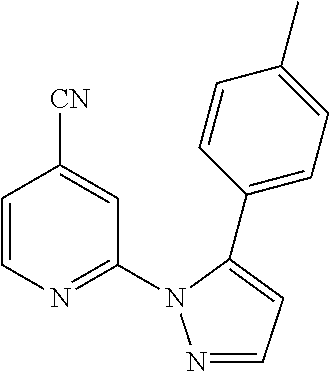
- A mixture of 2-hydrazinylpyridine-4-carbonitrile hydrochloride salt (124 mg, 0.6 mmol, PREPARATION 3) and (2E)-3-(dimethylamino)-1-(4-methylphenyl)prop-2-en-1-one (95 mg, 0.5 mmol) in 2-methoxyethanol (3 mL) was stirred at 100° C. for 2 h. The reaction mixture was cooled, concentrated, and dissolved in EtOAc and then washed with water and brine. The organic phase was dried, concentrated, triturated with EA/PE (1:10, 5 mL), filtered, and dried to give the title compound (120 mg, 92%) as a yellow solid. 1H NMR (400 MHz, CDCl3): δ 2.38 (3H, s), 6.49 (1H, d, J=1.6 Hz), 7.16 (4H, s), 7.38 (1H, dd, J=5.2, 1.2 Hz), 7.76 (1H, d, J=1.2 Hz), 7.90 (1H, s), 8.44 (1H, d, J=5.2 Hz).
-

- To a solution of 2-[5-(4-methylphenyl)-1H-pyrazol-1-yl]pyridine-4-carbonitrile (120 mg, 0.46 mmol) in EtOH (1 mL) was added 10 M NaOH (1 mL) at rt, then stirred at 90° C. for 1 h. The reaction mixture was cooled, acidified with 1 N HCl to pH=3, extracted with EtOAc (20 mL), and washed with water and brine. The organic phase was dried, concentrated, triturated with EA/PE (1:1, 5 mL), filtered, and dried to give the title compound (60 mg, 47%) as a brown solid. 1H NMR (400 MHz, DMSO-d6): δ 2.30 (3H, s), 6.65 (1H, d, J=2.0 Hz), 7.13 (4H, s), 7.77 (1H, dd, J=4.8, 1.2 Hz), 7.82 (1H, d, J=1.2 Hz), 8.44 (1H, d, J=4.8 Hz), 13.97 (1H, br s). [M+H] Calc'd for C16H13N3O2, 280; Found, 280.
-

- The title compound was prepared in 35% yield from 1-(3-methylphenyl)ethanone and DMF-DMA according to the procedure for the preparation of Example 12, part A. 1H NMR (400 MHz, CDCl3): δ 2.39 (3H, s), 2.79-3.11 (6H, m), 5.70 (1H, d, J=12.4 Hz), 7.24-7.31 (2H, m), 7.66-7.71 (2H, m), 7.78 (1H, d, J=12.4 Hz).
-

- The title compound was prepared in quantitative yield from 2-hydrazinylpyridine-4-carbonitrile hydrochloride salt (PREPARATION 3) and (2E)-3-(dimethylamino)-1-(3-methylphenyl)prop-2-en-1-one according to the procedure for the preparation of Example 12, part B. 1H NMR (400 MHz, CDCl3): δ 2.35 (3H, s), 6.51 (1H, d, J=1.6 Hz), 7.00 (1H, d, J=3.2 Hz), 7.22 (3H, m), 7.38 (1H, dd, J=5.2, 1.2 Hz), 7.77 (1H, d, J=1.6 Hz), 7.92 (1H, s), 8.42 (1H, d, J=4.8 Hz).
-

- The title compound was prepared in 44% yield from 2-[5-(3-methylphenyl)-1H-pyrazol-1-yl]pyridine-4-carbonitrile according to the procedure for the preparation of Example 12, part C. 1H NMR (400 MHz, DMSO-d6): δ 2.27 (3H, s), 6.67 (1H, d, J=1.6 Hz), 6.97 (1H, d, J=7.6 Hz), 7.13-7.21 (3H, m), 7.78 (1H, d, J=4.4 Hz), 7.83 (1H, d, J=1.6 Hz), 8.09 (1H, s), 8.43 (1H, d, J=5.2 Hz), 13.90 (1H, br s). [M+H] Calc'd for C16H13N3O2, 280; Found, 280.
-

- The title compound was prepared in 82% yield from 1-(2,4-difluorophenyl)ethanone and DMF-DMA according to the procedure for the preparation of Example 12, part A. 1H NMR (400 MHz, CDCl3): δ 2.90 (3H, s), 3.11 (3H, s), 5.59-5.62 (1H, m), 6.77-6.83 (1H, m), 6.88-6.93 (m, 1H), 7.75-7.83 (2H, m).
-

- The title compound was prepared in 83% yield from 2-hydrazinylpyridine-4-carbonitrile hydrochloride salt (PREPARATION 3) and (2E)-1-(2,4-difluorophenyl)-3-(dimethylamino)prop-2-en-1-one according to the procedure for the preparation of Example 12, part B. 1H NMR (400 MHz, CDCl3): δ 6.51 (1H, d, J=1.6 Hz), 6.77-6.82 (1H, m), 6.92-6.97 (1H, m), 7.34-7.40 (2H, m), 7.80 (1H, d, J=2.0 Hz), 8.20 (1H, s), 8.27 (1H, dd, J=5.2, 1.2 Hz).
-

- The title compound was prepared in 50% yield from 2-[5-(2,4-difluorophenyl)-1H-pyrazol-1-yl]pyridine-4-carbonitrile according to the procedure for the preparation of Example 12, part C. 1H NMR (400 MHz, DMSO-d6): δ 6.72 (1H, d, J=2.0 Hz), 7.13-7.18 (1H, m), 7.23-7.28 (1H, m), 7.48-7.53 (1H, m), 7.72 (1H, dd, J=5.2, 1.2 Hz), 7.93 (1H, d, J=1.6 Hz), 8.22 (1H, s), 8.33 (1H, d, J=5.2 Hz), 13.92 (1H, br s). [M+H] Calc'd for C15H9F2N3O2, 302; Found, 302.
-

- The title compound was prepared in 84% yield from 1-(3,4-difluorophenyl)ethanone and DMF-DMA according to the procedure for the preparation of Example 12, part A. 1H NMR (400 MHz, CDCl3): δ 2.93 (3H, s), 3.16 (3H, s), 5.62 (1H, d, J=12.0 Hz), 7.13-7.20 (1H, m), 7.63-7.76 (2H, m), 7.83 (1H, d, J=12.0 Hz).
-

- The title compound was prepared in 83% yield from 2-hydrazinylpyridine-4-carbonitrile hydrochloride salt (PREPARATION 3) and (2E)-1-(3,4-difluorophenyl)-3-(dimethylamino)prop-2-en-1-one according to the procedure for the preparation of Example 12, part B. 1H NMR (400 MHz, CDCl3): δ 6.50 (1H, d, J=1.6 Hz), 7.01-7.04 (1H, m), 7.11-7.18 (2H, m), 7.38-7.40 (1H, m), 7.77 (1H, d, J=2.0 Hz), 8.12 (1H, s), 8.36 (1H, d, J=4.8 Hz).
-

- The title compound was prepared in 48% yield from 2-[5-(3,4-difluorophenyl)-1H-pyrazol-1-yl]pyridine-4-carbonitrile according to the procedure for the preparation of Example 12, part C. 1H NMR (400 MHz, DMSO-d6): δ 6.74 (1H, d, J=1.2 Hz), 7.11-7.13 (1H, m), 7.37-7.46 (2H, m), 7.76-7.78 (1H, m), 7.87 (1H, d, J=1.6 Hz), 8.17 (1H, s), 8.41 (1H, d, J=5.2 Hz), 13.97 (1H, br s). [M+H] Calc'd for C15H9F2N3O2, 302; Found, 302.
-

- The title compound was prepared in 92% yield from 1-(3-fluorophenyl)ethanone and DMF-DMA according to the procedure for the preparation of Example 12, part A. 1H NMR (400 MHz, CDCl3): δ 2.93 (3H, s), 3.15 (3H, s), 5.65 (1H, d, J=12.4 Hz), 7.11-7.16 (1H, m), 7.34-7.39 (1H, m), 7.57-7.67 (2H, m), 7.81 (1H, d, J=12.4 Hz).
-

- The title compound was prepared in 98% yield from 2-hydrazinylpyridine-4-carbonitrile hydrochloride salt (PREPARATION 3) and (2E)-3-(dimethylamino)-1-(3-fluorophenyl)prop-2-en-1-one according to the procedure for the preparation of Example 12, part B. 1H NMR (400 MHz, CDCl3): δ 6.53 (1H, d, J=1.6 Hz), 6.99-7.10 (3H, m), 7.29-7.35 (1H, m), 7.38-7.40 (1H, m), 7.78 (1H, d, J=2.0 Hz), 8.05 (1H, s), 8.38 (1H, d, J=4.8 Hz).
-

- The title compound was prepared in 57% yield from 2-[5-(3-fluorophenyl)-1H-pyrazol-1-yl]pyridine-4-carbonitrile according to the procedure for the preparation of Example 12, part C. 1H NMR (400 MHz, DMSO-d6): δ 6.76 (1H, d, J=1.2 Hz), 6.77-7.19 (3H, m), 7.36-7.39 (1H, m), 7.78 (1H, dd, J=5.2, 1.2 Hz), 7.87 (1H, d, J=1.2 Hz), 8.15 (1H, s), 8.42 (1H, d, J=4.8 Hz), 13.86 (1H, br s). [M+H] Calc'd for C15H10FN3O2, 284; Found, 284.
-

- The title compound was prepared in 89% yield from 1-(3-methoxyphenyl)ethanone and DMF-DMA according to the procedure for the preparation of Example 12, part A. 1H NMR (400 MHz, CDCl3): δ 2.94 (3H, s), 3.13 (3H, s), 3.85 (3H, s), 7.69 (1H, d, J=12.4 Hz), 6.98-7.01 (1H, m), 7.29-7.46 (3H, m), 7.79 (1H, d, J=12.4 Hz).
-

- The title compound was prepared in 98% yield from 2-hydrazinylpyridine-4-carbonitrile hydrochloride salt (PREPARATION 3) and (2E)-3-(dimethylamino)-1-(3-methoxyphenyl)prop-2-en-1-one according to the procedure for the preparation of Example 12, part B. 1H NMR (400 MHz, CDCl3): δ 3.78 (3H, s), 6.53 (1H, s), 6.81-6.85 (2H, m), 6.90-6.93 (1H, m), 7.24-7.28 (1H, m), 7.38 (1H, dd, J=5.6, 1.2 Hz), 7.77 (1H, d, J=2.0 Hz), 7.93 (1H, s), 8.44 (1H, dd, J=5.2, 0.8 Hz).
-
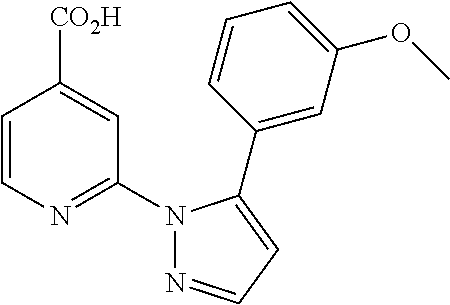
- The title compound was prepared in 93% yield from 2-[5-(3-methoxyphenyl)-1H-pyrazol-1-yl]pyridine-4-carbonitrile according to the procedure for the preparation of Example 12, part C. 1H NMR (300 MHz, DMSO-d6): δ 3.67 (3H, s), 6.71-6.92 (4H, m), 7.21-7.26 (1H, m), 7.78-7.84 (2H, m), 8.09 (1H, s), 8.45 (1H, d, J=5.1 Hz).
-

- To a solution of 2-[5-(3-methoxyphenyl)-1H-pyrazol-1-yl]pyridine-4-carboxylic acid (160 mg, 0.54 mmol) in CH2Cl2 (5 mL) was added 1 M BBr3 in CH2Cl2 (5 mL) at 0° C., then stirred at 45° C. overnight. The reaction mixture was cooled, concentrated and dissolved with EtOAc, then washed with water and brine. The organic phase was dried, concentrated and purified by prep-HPLC to give the title compound (54 mg, 35%) as a yellow solid. 1H NMR (400 MHz, DMSO-d6): δ 6.60-6.65 (3H, m), 6.71 (1H, dd, J=8.4, 2.0 Hz), 7.11 (1H, t, J=8.0 Hz), 7.78-7.82 (2H, m), 8.04 (1H, s), 8.48 (1H, d, J=5.2 Hz), 9.46 (1H, s), 13.93 (1H, br s). [M+H] Calc'd for C15H11N3O3, 282; Found, 282.
-

- The title compound was prepared in 88% yield from 1-(4-methoxyphenyl)ethanone and DMF-DMA according to the procedure for the preparation of Example 12, part A. 1H NMR (400 MHz, CDCl3): δ 2.88-3.06 (6H, br s), 3.85 (3H, s), 5.71 (1H, d, J=12.0 Hz), 6.91 (2H, d, J=8.8 Hz), 7.84 (1H, d, J=12.0 Hz), 7.91 (2H, d, J=8.8 Hz).
-

- The title compound was prepared in 100% yield from 2-hydrazinylpyridine-4-carbonitrile hydrochloride salt (PREPARATION 3) and (2E)-3-(dimethylamino)-1-(4-methoxyphenyl)prop-2-en-1-one according to the procedure for the preparation of Example 12, part B. 1H NMR (400 MHz, CDCl3): δ 3.84 (3H, s), 6.46 (1H, d, J=5.6 Hz), 6.88 (2H, dd, J=6.8, 2.0 Hz), 7.20 (2H, dd, J=6.4, 2.0 Hz), 7.37 (1H, dd, J=5.2, 1.6 Hz), 7.75 (1H, d, J=1.6 Hz), 7.91 (1H, s), 8.44 (1H, dd, J=4.8, 0.8 Hz).
-

- The title compound was prepared in 79% yield from 2-[5-(4-methoxyphenyl)-1H-pyrazol-1-yl]pyridine-4-carbonitrile according to the procedure for the preparation of Example 12, part C. 1H NMR (300 MHz, DMSO-d6): δ 3.76 (3H, s), 6.61 (1H, s), 6.88-6.91 (2H, m), 7.16-7.19 (2H, m), 7.76-7.80 (2H, m), 8.06 (1H, s), 8.45 (1H, d, J=5.1 Hz).
-

- The title compound was prepared in 32% yield from 2-[5-(4-methoxyphenyl)-1H-pyrazol-1-yl]pyridine-4-carbonitrile according to the procedure for the preparation of Example 17, part D. 1H NMR (400 MHz, DMSO-d6): δ 6.56 (1H, d, J=2.0 Hz), 6.71 (2H, d, J=8.4 Hz), 7.05 (2H, d, J=8.4 Hz), 7.76-7.78 (2H, m), 8.02 (1H, s), 8.48 (1H, d, J=4.8 Hz), 9.63 (1H, s), 13.89 (1H, br s). [M+H] Calc'd for C15H11N3O3, 282; Found, 282.
-

- The title compound was prepared in 87% yield from 1-[4-(methylsulfonyl)phenyl]ethanone and DMF-DMA according to the procedure for the preparation of Example 12, part A. 1H NMR (400 MHz, CDCl3): δ 2.96 (3H, s), 3.06 (3H, s), 3.19 (3H, s), 5.66 (1H, d, J=12 Hz), 7.83 (1H, d, J=12 Hz), 7.96-8.04 (4H, m).
-

- The title compound was prepared in 100% yield from 2-hydrazinylpyridine-4-carbonitrile hydrochloride salt (PREPARATION 3) and (2E)-3-(dimethylamino)-1-[4-(methylsulfonyl)phenyl]prop-2-en-1-one according to the procedure for the preparation of Example 12, part B. 1H NMR (400 MHz, CDCl3): δ 3.10 (3H, s), 6.58 (1H, d, J=1.6 Hz), 7.39 (1H, dd, J=5.2, 1.2 Hz), 7.51 (2H, d, J=8.4 Hz), 7.81 (1H, d, J=1.6 Hz), 7.93 (2H, d, J=8.4 Hz), 8.20 (1H, s), 8.29 (1H, d, J=5.2 Hz).
-

- The title compound was prepared in 44% yield from 2-{5-[4-(methylsulfonyl)phenyl]-1H-pyrazol-1-yl}pyridine-4-carbonitrile according to the procedure for the preparation of Example 12, part C. 1H NMR (400 MHz, DMSO-d6): δ 3.25 (3H, s), 6.84 (1H, d, J=1.6 Hz), 7.57 (2H, d, J=8.4 Hz), 7.05 (1H, dd, J=4.8, 1.2 Hz), 7.87-7.93 (3H, m), 8.22 (1H, s), 8.40 (1H, d, J=4.8 Hz), 13.98 (1H, br s). [M+H] Calc'd for C16H13N3O4S, 344; Found, 344.
-

- The title compound was prepared in 49% yield from 1-(3-hydroxy-4-methylphenyl)ethanone and DMF-DMA according to the procedure for the preparation of Example 12, part A. 1H NMR (400 MHz, CDCl3): δ 2.25 (3H, s), 2.95-3.10 (6H, m), 3.89 (3H, s), 5.72 (1H, d, J=12.0 Hz), 7.14 (1H, d, J=7.6 Hz), 7.37 (1H, dd, J=7.6, 1.2 Hz), 7.45 (1H, d, J=1.2 Hz) 7.80 (1H, d, J=12.4 Hz). [M+H] Calc'd for C12H15NO2, 220; Found, 220.
-

- The title compound was prepared in 100% yield from 2-hydrazinylpyridine-4-carbonitrile hydrochloride salt (PREPARATION 3) and (2E)-3-(dimethylamino)-1-(3-methoxy-4-methylphenyl)prop-2-en-1-one according to the procedure for the preparation of Example 12, part B. 1H NMR (400 MHz, CDCl3): δ 2.24 (3H, s), 3.73 (3H, s), 6.51 (1H, d, J=1.6 Hz), 6.71-6.75 (2H, m), 7.08 (1H, d, J=8.0 Hz), 7.39 (1H, dd, J=5.2, 1.2 Hz), 7.77 (1H, d, J=1.2 Hz), 7.90 (1H, s), 8.47 (1H, d, J=5.2 Hz). [M+H] Calc'd for C17H14N4O, 291; Found, 291.
-

- The title compound was prepared in 53% yield from 2-[5-(3-methoxy-4-methylphenyl)-1H-pyrazol-1-yl]pyridine-4-carbonitrile according to the procedure for the preparation of Example 12, part C. 1H NMR (400 MHz, DMSO-d6): δ 2.13 (3H, s), 3.63 (3H, s), 6.69-6.71 (2H, m), 6.79 (1H, d, J=1.6 Hz), 7.07 (1H, d, J=7.6 Hz), 7.78-7.83 (2H, m), 8.08 (1H, s), 8.48 (1H, d, J=4.8 Hz), 13.92 (1H, br s). [M+H] Calc'd for C17H15N3O3, 310; Found, 310.
-

- The title compound was prepared in 24% yield from 2-(5-(3-methoxy-4-methylphenyl)-1H-pyrazol-1-yl)isonicotinic acid according to the procedure for the preparation of Example 17, part D. 1H NMR (400 MHz, DMSO-d6): δ 2.09 (3H, s), 6.57-6.61 (3H, m), 7.00 (1H, d, J=7.2 Hz), 7.79 (2H, dd, J=4.0, 2.0 Hz), 8.02 (1H, s), 8.50 (1H, d, J=4.8 Hz), 9.30 (1H, s), 13.92 (1H, br s). [M+H] Calc'd for C16H13N3O3, 296; Found, 296.
-

- The title compound was prepared in 43% yield from 1-(4-chloro-3-hydroxyphenyl)ethanone and DMF-DMA according to the procedure for the preparation of Example 12, part A. 1H NMR (400 MHz, CDCl3): δ 2.94 (3H, br s), δ 3.16 (3H, br s), 3.97 (3H, s), 5.67 (1H, d, J=12.4 Hz), 7.38 (2H, s), 7.56 (1H, s), 7.81 (1H, d, J=12.4 Hz). [M+H] Calc'd for C11H12ClNO2, 240; Found, 240.
-

- The title compound was prepared in 74% yield from 2-hydrazinylpyridine-4-carbonitrile hydrochloride salt (PREPARATION 3) and (2E)-1-(4-chloro-3-methoxyphenyl)-3-(dimethylamino)prop-2-en-1-one according to the procedure for the preparation of Example 12, part B. 1H NMR (400 MHz, CDCl3): δ 3.82 (3H, s), 6.53 (1H, d, J=2.0 Hz), 6.78 (1H, d, J=2.4 Hz), 6.89 (1H, d, J=1.6 Hz), 7.32 (1H, d, J=8.0 Hz), 7.39 (1H, dd, J=5.2, 1.2 Hz), 7.78 (1H, d, J=1.2 Hz), 8.07 (1H, s), 8.39 (1H, dd, J=5.2, 0.8 Hz). [M+H] Calc'd for C16H11ClN4O, 311; Found, 311.
-

- The title compound was prepared in 71% yield from 2-[5-(4-chloro-3-methoxyphenyl)-1H-pyrazol-1-yl]pyridine-4-carbonitrile according to the procedure for the preparation of Example 12, part C. 1H NMR (400 MHz, CDCl3): δ 3.79 (3H, s), 6.55 (1H, d, J=1.2 Hz), 6.79 (1H, s), 6.87 (1H, d, J=2.0 Hz), 7.30 (1H, d, J=8.4 Hz), 7.82 (2H, s), 8.15 (1H, s), 8.32 (1H, s), 8.46 (1H, d, J=4.8 Hz). [M+H] Calc'd for C16H12ClN3O3, 330; Found, 330.
-

- The title compound was prepared in 19% yield from 2-(5-(4-chloro-3-methoxyphenyl)-1H-pyrazol-1-yl)isonicotinic acid according to the procedure for the preparation of Example 17, part D. 1H NMR (400 MHz, CD3OD): δ 6.51 (1H, s), 6.60 (1H, dd, J=8.4, 2.0 Hz), 6.66 (1H, d, J=2.0 Hz), 7.14 (1H, d, J=8.4 Hz), 7.68 (1H, s), 7.77 (1H, d, J=4.4 Hz), 7.93 (1H, s), 8.39 (1H, s). [M+H] Calc'd for C15H10ClN3O3, 316; Found, 316.
-

- To a solution of 6-bromo-1H-indazole (5.0 g, 25.4 mmol) in 40 mL THF was added dropwise n-BuLi (2.5M, 30 mL, 76.2 mmol) at −65° C., and the mixture was stirred for 2 h. Then, N-methoxy-N-methylacetamide (2.9 g, 27.9 mmol) was added. The reaction mixture was stirred for another 2 h at −65° C., then quenched with 40 mL H2O. The mixture was extracted with EtOAc (3×50 mL). The combined organic layers were washed with 100 mL brine, dried, and concentrated to dryness. The residue was purified by flash column chromatography (PE/EA=40/1) to give the title compound 24-a (370 mg, 9%) as a yellow solid. [M+H] Calc'd for C9H8N2O, 161; Found, 161.
-

- To a solution of 1-(1H-indazol-6-yl)ethanone 24-a (200 mg, 1.25 mmol) in 4 mL DMF was added NaH (77 mg, 1.9 mmol) at 0-5° C., and the mixture was stirred for 1 h at 0-5° C. 2-(Trimethylsilyl)ethoxymethyl chloride (215 mg, 1.29 mmol) was then added. The mixture was stirred for 2 h prior to the addition of 5 mL H2O. The reaction mixture was extracted (3×10 mL EtOAc), dried, and concentrated to dryness to give a mixture of the products 24-b1 and 24-b2 (280 mg, 77%) as a yellow oil, which was used without further purification for the next synthetic step. [M+H] Calc'd for C15H22N2O2Si, 291; Found, 291.
-

- To a regioisomeric mixture of compound 3 (700 mg, 2.4 mmol) in 10 mL DMF was added 2 mL DMF-DMA, and the mixture was heated to 115° C. and stirred for 4 h. The reaction mixture was cooled and concentrated to dryness to give the crude product 24-c1 and 24-c2 (900 mg, 100%) as a yellow oil, and was used without further purification for the next synthetic step. [M+H] Calc'd for C18H27N3O2Si, 346; Found, 346.
-

- A mixture of compounds 24-c1 and 24-c2 (900 mg, 2.6 mmol) and 2-hydrazinylpyridine-4-carbonitrile (350 mg, 2.6 mmol) in EtOH (10 mL) and AcOH (2 mL) was stirred at 90° C. overnight. The reaction mixture was cooled, concentrated, and purified by prep-HPLC to afford compounds 24-d1 and 24-d2 (390 mg, 36%), and was used without further purification for the next synthetic step. [M+H] Calc'd for C22H24N6OSi, 417; Found, 417.
-

- To a solution of compounds 24-d1 and 24-d2 (390 mg, 0.94 mmol) in EtOH (10 mL) was added 5 M NaOH (2 mL) at rt, then stirred at 90° C. for 1 h. The reaction mixture was cooled, acidified with 1 N HCl to pH=3, filtered to give a yellow solid, and recrystallized from EtOH to afford compounds 24-e1 and 24-e2 (230 mg, 56%) as a white solid, which was used without further purification for the next synthetic step. [M+H] Calc'd for C22H25N5O3Si, 436; Found, 436.
-

- The solution of compounds 24-e1 and 24-e2 (50 mg, 0.12 mmol) in HCl/EtOAc (6 M, 10 mmol) was stirred overnight at rt. The reaction mixture was filtered, and the solids were stirred with EtOAc/PE (0.5 mL/5 mL) for 1 h. After filtration, the solids were washed with hexane to give the title compound (13 mg, 37%) as a yellow solid. 1H NMR (400 MHz, MeOD-d4): δ 6.75 (1H, s), 7.06 (1H, dd, J=6.8, 1.6 Hz), 7.51 (1H, s), 7.77 (1H, d, J=8.4 Hz), 7.88 (2H, s), 8.14 (2H, d, J=1.2 Hz), 8.45 (1H, d, J=2.0 Hz). [M+H] Calc'd for C16H11N5O2, 306; Found, 306.
-

- To a solution of compound 24-e1 and 24-e2 (50 mg, 0.12 mmol) in CH2Cl2/DMF (2 mL/1 drop) was added oxalyl chloride (0.5 mL), and the mixture was stirred for 1 h at rt. Then the reaction mixture was added dropwise to MeOH (1 mL), and the resultant mixture was stirred for 30 min at rt. Removal of volatiles provided compounds 25-a1 and 25-a2 (60 mg, 100%) as a yellow solid, which was used without further purification for the next synthetic step. [M+H] Calc'd for C23H27N5O3Si, 450; Found, 450.
-

- The solution of compounds 25-a1 and 25-a2 (60 mg, 0.12 mmol) in TFA/CH2Cl2 (0.5 mL/2 mL) was stirred overnight at rt. The mixture was concentrated, and the residue was adjusted to pH=8 with saturated aq. NaHCO3. The mixture was extracted with CH2Cl2. The combined organic layers were washed with brine, dried over Na2SO4, filtered, concentrated, and purified by prep-HPLC to afford the title compound (10 mg, 28%) as a yellow solid. 1H NMR (400 MHz, MeOD-d4): δ 3.96 (3H, s), 6.74 (1H, d, J=1.6 Hz), 7.00 (1H, dd, J=8.4, 1.2 Hz), 7.50 (1H, s), 7.74 (1H, d, J=8.4 Hz), 7.87 (2H, m), 8.07 (1H, s), 8.13 (1H, s), 8.46 (1H, d, J=7.2 Hz). [M+H] Calc'd for C17H13N5O2, 320; Found, 320.
-

- A mixture of acetophenone (8.0 g, 66.58 mmol, 1.0 eq) and DMF (5.8 g, 79.90 mmol, 1.2 eq.) in 10.0 mL of DMA in a 25-mL microwave vial was irradiated at 115° C. for 0.5-1 h. The crude reaction mixture was triturated with n-hexane, and the resultant solid was filtered to afford the title compound as a pale yellow solid (3.4 g. 29.3% yield). [M+H] Calc'd for C11H13NO, 176; Found, 176.
-

- To a solution of 2-hydrazinylisonicotinonitrile (100 mg, 0.75 mmol, 1.0 eq., PREPARATION 2) and (E)-3-(dimethylamino)-1-phenylprop-2-en-1-one (132 mg, 0.75 mmol, 1.0 eq.) in ethanol (10 mL) was added 2-5 drops of AcOH. The reaction mixture was under reflux conditions for 12 h. After reaction completion, volatiles were removed under reduced pressure, and the resultant crude material was purified by flash column chromatography (20% EtOAc/hexane) to obtain the title compound as a yellow oil (150 mg, 81% yield). [M+H] Calc'd for C15H10N4, 247.09; Found 247.
-

- To a stirred solution of 2-(5-phenyl-1H-pyrazol-1-yl)isonicotinonitrile (100 mg, 0.41 mmol) in EtOH (10 mL) was added a solution of 25% NaOH in water (1.0 mL). The reaction mixture was heated under reflux conditions at 80° C. for 1 h. After reaction completion, the solvent was removed, and the resultant mixture was diluted with water, and the pH was adjusted to pH=4-5 with 2.0 N HCl. The mixture was extracted with EtOAc (3×15 mL), the combined organic layers were dried over Na2SO4, and the solvent was removed to obtain pale yellow solid, which was washed with hexane and dried under reduced pressure to afford the title compound (60 mg, 55% yield). 1H NMR (300 MHz, DMSO-d6) δ 8.5 (S, 1H), 8.2 (d, 1H, J=2.1 Hz), 7.9 (s, 1H), 7.78 (s, 1H), 7.7 (d, 1H, J=2.7 Hz), 7.3 (m, 2H), 7.2 (m, 1H), 6.65 (s, 2H). [M+H] Calc'd for C15H11N3O2, 266; Found, 266.
-

- The title compound was prepared in 39% yield from 1-(4-fluorophenyl)ethanone according to the procedure for the preparation of Example 26, part A. 1H NMR (500 MHz, CDCl3) δ 7.91 (dd, 2H, J=5.8, 7.7 Hz), 7.79 (d, 1H, J=12.6 Hz), 7.0 (t, 2H, J=8.7, 7.7 Hz), 5.6 (d, 1H, J=12.6 Hz), 3.14 (s, 3H), 2.92 (s, 3H). [M+H] Calc'd for C11H12FNO, 193; Found, 193.
-

- The title compound was prepared in 32% yield from 2-hydrazinylisonicotinonitrile (PREPARATION 2) and (E)-3-(dimethylamino)-1-(4-fluorophenyl)prop-2-en-1-one according to the procedure for the preparation of Example 26, part B. 1H NMR (500 MHz, CDCl3) δ 8.36 (d, 1H, J=4.8 Hz), 8.0 (s, 1H), 7.7 (s, 1H), 7.37 (d, 1H, J=3.8 Hz), 7.25 (d, 2H, J=5.8), 7.0 (t, 2H, J=8.7 Hz, 1H), 6.45 (s, 1H). [M+H] Calc'd for C15H9FN4, 265; Found, 265.
-

- The title compound was prepared in 35% yield from 2-(5-(4-fluorophenyl)-1H-pyrazol-1-yl)isonicotinonitrile according to the procedure for the preparation of Example 26, part C. 1H NMR (500 MHz, DMSO-d6): δ 8.8 (d, 1H, J=4.4 Hz), 8.5 (s, 1H), 8.26 (s, 1H), 8.2 (d, 1H, J=4.4 Hz), 7.74 (t, 2H, J=7.7 Hz), 7.54 (t, 2H, J=7.7 Hz), 7.1 (s, 1H). [M+H] Calc'd for C15H10FN3O2, 283; Found, 283.
-

- To a solution of 2-(methylsulfanyl)phenol (4.2 g, 30 mmol) in CS2 (50 mL) was added dropwise acetyl chloride (5.2 g, 66 mmol) at 0° C. for 10 min. The resulting mixture was stirred for 20 min at rt. Then AlCl3 (10.8 g, 81 mmol) was added, and the reaction mixture was heated under reflux conditions for 3 h. The reaction mixture was poured into ice water, conc. HCl (5 mL) was added, and the reaction mixture was extracted with CH2Cl2. The combined organic layers were washed with brine, dried over Na2SO4 and concentrated. The residue was dissolved in CH2Cl2 (50 mL), cooled to 0° C. and treated successively with acetyl chloride (1.2 g, 15 mmol) and triethylamine (1.5 g, 15 mmol). The mixture was stirred at rt for 2 h and poured into water. After separation of the layers, the organic phase was washed successively with water, 3 N HCl and 10% aq. KHCO3, dried over Na2SO4, and evaporated to dryness. Recrystallization of the resulting solid from benzene-hexane afforded the title compound (2.5 g, 37%). 1H NMR (400 MHz, CDCl3): δ 2.08 (3H, s), 2.47 (3H, s), 2.55 (3H, s), 7.26 (1H, d, J=4.8 Hz), 7.57 (1H, d, J=4.8 Hz), 7.60 (1H, s).
-

- To a solution of 5-acetyl-2-(methylsulfanyl)phenyl acetate (2.24 g, 10 mmol) in CH2Cl2 (20 mL) was added mCPBA (8.62 g, 50 mmol) at 0° C. and the mixture was stirred at rt for 3 h. A solution of NaHCO3 was added and extracted with CH2Cl2. The organic phase was washed successively with water, 3 N HCl and 10% aq. KHCO3, dried over Na2SO4, and evaporated to afford the crude product (2.1 g, 82%). 1H NMR (400 MHz, CDCl3): δ 2.10 (3H, s), 2.57 (3H, s), 2.84 (3H, s), 7.86 (1H, d, J=4.8 Hz), 7.93 (1H, s), 8.05 (1H, d, J=4.8 Hz).
-

- A solution of 5-acetyl-2-(methylsulfonyl)phenyl acetate (1.5 g, 5.8 mmol) and DMF-DMA (1.2 g, 10 mmol) in DMF (20 mL) was stirred at 100° C. overnight. The reaction mixture was cooled, concentrated, and purified by flash column chromatography (PE/EtOAc=4:1˜2:1) to give the title compound (0.5 g, 30%). [M+H] Calc'd for C13H17NO4S, 284; Found, 284.
-

- A mixture of 5-[(2E)-3-(dimethylamino)prop-2-enoyl]-2-(methylsulfonyl)phenyl acetate (1.5 g, 5.3 mmol) and 2-hydrazinylisonicotinonitrile (0.8 g, 6 mmol, PREPARATION 2) in EtOH (15 mL) and AcOH (3 mL) was stirred at 90° C. overnight. The reaction mixture was cooled, concentrated, and purified by prep-HPLC to afford the title compound (270 mg, 14%). 1H NMR (400 MHz, CDCl3): δ 3.26 (3H, s), 3.96 (3H, s), 6.58 (1H, d, J=1.6 Hz), 6.96 (1H, dd, J=8.4, 1.2 Hz), 7.05 (1H, d, J=1.2 Hz), 7.41 (1H, dd, J=4.8, 1.2 Hz), 7.81 (1H, d, J=2.0 Hz), 7.93 (1H, d, J=8.4 Hz), 8.18 (1H, s), 8.35 (1H, d, J=4.8 Hz). [M+H] Calc'd for C17H14N4O3S, 355; Found, 355.
-

- To a solution of 2-{5-[3-methoxy-4-(methylsulfonyl)phenyl]-1H-pyrazol-1-yl}pyridine-4-carbonitrile (270 mg, 0.76 mmol) in EtOH (5 mL) was added 5 M NaOH (2 mL) at rt, then stirred at 90° C. for 1 h. The reaction mixture was cooled, acidified with 1 N HCl to pH=3, filtered to give a yellow solid, then recrystallized from EtOH to afford the title compound (230 mg, 80%) as a white solid. [M+H] Calc'd for C17H15N3O5S, 374; Found, 374.
-

- The title compound was prepared in 6% yield from 2-{5-[3-methoxy-4-(methylsulfonyl)phenyl]-1H-pyrazol-1-yl}pyridine-4-carboxylic acid according to the procedure for the preparation of Example 17, part D. 1H NMR (400 MHz, DMSO-d6): δ 3.21 (3H, s), 6.78 (1H, d, J=1.6 Hz), 6.89-6.92 (2H, m), 7.65 (1H, d, J=8.0 Hz), 7.81-7.82 (1H, m), 7.90 (1H, d, J=2.0 Hz), 8.16 (1H, s), 8.48 (1H, d, J=4.8 Hz), 11.12 (1H, br). [M+H] Calc'd for C16H13N3O5S, 360; Found, 360.
-

- A solution of 1-(4-methylphenyl)ethanone (2.0 g, 15 mmol) in (1,1-dimethoxy-ethyl)-dimethyl-amine was heated to 120° C. and stirred overnight. The reaction mixture was cooled and concentrated to dryness. The residue was stirred with 25 mL hexane for 1 h and filtered. The solids were washed with hexane and then dried to give the title compound (1.8 g, 60%) as a yellow solid. 1H NMR (400 MHz, CDCl3): δ 2.37 (3H, s), 2.65 (3H, s), 3.07 (6H, s), 5.68 (1H, s), 7.19 (2H, d, J=7.6 Hz), 7.77 (2H, d, J=8.0 Hz). [M+H] Calc'd for C13H17NO, 204; Found, 204.
-

- To a solution of (2E)-3-(dimethylamino)-1-(4-methylphenyl)but-2-en-1-one (227 mg, 1.1 mmol) and 2-hydrazinylisonicotinonitrile (150 mg, 1.1 mmol, PREPARATION 2) in 10 mL EtOH was added 2 mL AcOH. The reaction mixture was heated under reflux conditions overnight before being cooled and concentrated to dryness. The residue was adjusted to pH >8 with saturated aq. K2CO3 and then extracted with EtOAc (3×10 mL). The combined organic layers were washed with 20 mL brine, dried, and concentrated to dryness to give the title compound (170 mg, 55.6%) as a yellow solid. 1H NMR (400 MHz, CDCl3): δ 2.38 (6H, s), 6.30 (1H, s), 7.15 (4H, s), 7.33 (1H, d, J=4.0 Hz), 7.78 (1H, s), 8.44 (1H, d, J=4.8 Hz). [M+H] Calc'd for C17H14N4, 275; Found, 275.
-

- The title compound was prepared in 22% yield from 2-[3-methyl-5-(4-methylphenyl)-1H-pyrazol-1-yl]pyridine-4-carbonitrile according to the procedure for the preparation of Example 28, part E. 1H NMR (300 MHz, DMSO-d6): δ 2.28 (3H, s), 2.30 (3H, s), 6.44 (1H, s), 7.15 (4H, s), 7.72 (1H, d, J=4.5 Hz), 8.06 (1H, s), 8.70 (1H, d, J=4.5 Hz). [M+H] Calc'd for C17H15N3O2, 294; Found, 294.
-

- To a suspension of NaH (60%, 106 mg, 4.44 mmol) in 2 mL propionic acid ethyl ester was added 1-(4-methylphenyl)ethanone (500 mg, 3.7 mmol) at 0-5° C. The reaction mixture was stirred overnight at rt. Water was added, and the mixture was extracted with EtOAc (3×50 mL). The organic layers were washed with brine, dried over Na2SO4, and concentrated to dryness. The residue was purified by flash column chromatography (PE/EtOAc=10/1) to give the title compound (370 mg, 52%) as a yellow oil. 1H NMR (400 MHz, CDCl3): δ 1.22 (3H, m), 2.45 (5H, m), 6.17 (2H, s), 7.27 (2H, d, J=10 Hz), 7.81 (2H, d, J=11.2 Hz). [M+H] Calc'd for C12H14O2, 191; Found, 191.
-

- To a solution of 1-(4-methylphenyl)pentane-1,3-dione (370 mg, 1.9 mmol) and 2-hydrazinylisonicotinonitrile (150 mg, 1.1 mmol, PREPARATION 2) in 10 mL EtOH was added 2 mL AcOH. The reaction mixture was heated under reflux conditions overnight before being cooled and concentrated to dryness. The residue was adjusted to pH >8 with saturated aq. K2CO3, then extracted by EtOAc (10 mL×3). The combined organic layers were washed with 20 mL brine, dried over Na2SO4, concentrated, and purified by flash column chromatography (PE/EtOAc=10/1) to give the title compound (560 mg, 77%) as a yellow solid. 1H NMR (400 MHz, CDCl3): δ 1.33 (3H, m), 2.38 (3H, s), 2.76 (2H, m), 6.33 (1H, s), 7.15 (4H, m), 7.31 (1H, m), 7.82 (1H, s), 8.42 (1H, m). [M+H] Calc'd for C18H16N4, 289; Found, 289.
-

- The title compound was prepared in 69% yield from 2-[3-ethyl-5-(4-methylphenyl)-1H-pyrazol-1-yl]pyridine-4-carbonitrile according to the procedure for the preparation of Example 28, part E. 1H NMR (400 MHz, DMSO-d6): δ 1.26 (3H, m), 2.30 (3H, s), 2.66 (2H, m), 6.33 (1H, s), 7.12 (4H, m), 7.72 (1H, m), 8.07 (1H, s), 8.39 (1H, d, J=4.8 Hz), 13.88 (1H, s). [M+H] Calc'd for C18H17N3O2, 308; Found, 308.
-

- A mixture of 2-hydrazinylisonicotinonitrile (268 mg, 2 mmol, PREPARATION 2) and (3E)-4-(dimethylamino)but-3-en-2-one (339 mg, 3 mmol) in EtOH (5 mL) and AcOH (1 mL) was stirred at 90° C. overnight. The reaction mixture was cooled, concentrated, and purified by prep-HPLC to afford compound 31-a1 (90 mg) and compound 31-a2 (150 mg). 31-a1: 1H NMR (400 MHz, CDCl3): δ 2.38 (3H, s), 6.29 (1H, d, J=2.8 Hz), 7.32 (1H, dd J=5.2, 1.2 Hz), 8.18 (1H, s), 8.42 (1H, d, J=2.8 Hz), 8.52-8.53 (1H, m). [M+H] Calc'd for C10H8N4, 185; Found, 185.
- 31-a2: 1H NMR (400 MHz, CDCl3): δ 2.71 (3H, s), 6.22 (1H, d, J=0.8 Hz), 7.36 (1H, dd, J=4.8, 1.2 Hz), 7.61 (1H, d, J=1.2 Hz), 8.26 (1H, d, J=2.8 Hz), 8.57 (1H, dd, J=5.2, 0.8 Hz). [M+H] Calc'd for C10H8N4, 185; Found, 185.
-

- The title compound was prepared in 53% yield from 2-(5-methyl-1H-pyrazol-1-yl)pyridine-4-carbonitrile (31-a1) according to the procedure for the preparation of Example 28, part E. 1H NMR (400 MHz, DMSO-d6): δ 2.31 (3H, s), 6.42 (1H, d, J=2.8 Hz), 7.70 (1H, dd J=5.2, 1.2 Hz), 8.25 (1H, s), 8.53 (1H, d, J=2.8 Hz), 8.61 (1H, d, J=5.2 Hz), 13.86 (1H, s). [M+H] Calc'd for C10H9N3O2, 204; Found, 204.
-

- A solution of 1-phenylpropan-2-ol (2.72 g, 20 mmol) in CH2Cl2 (20 mL) was added pyridinium chlorochromate (PCC, 5.4 g, 25 mmol) at 0° C. and the mixture was stirred for 3 h. The mixture was concentrated and purified by flash column chromatography (PE/EtOAc=20:1) to give the title compound (2.3 g, 84%) as a yellow oil.
-

- To a solution of 1-phenylpropan-2-one (1.78 g, 13 mmol) in anhydrous diethyl ether (50 ml) containing sodium cut in small pieces (299 mg, 13 mmol), ethyl formate (1.4 g, 20 mmol) was added slowly with stirring and ice-cooling. After standing overnight at rt, water was added, and the ether layer was washed with water. The organic phase was dried, concentrated, and purified by flash column chromatography (PE/EtOAc=10:1) to give the title compound (1.2 g, 57%) as a yellow oil.
-

- A solution of (3E)-4-hydroxy-1-phenylbut-3-en-2-one (1.2 g, 7.4 mmol) in THF (20 mL) was added dimethylamine hydrochloride (1.8 g, 22.2 mmol), K2CO3 (6.1 g, 44.4 mmol) and the mixture was stirred at rt overnight. The mixture was concentrated and purified by flash column chromatography (PE/EtOAc=10:1) to give the title compound (0.6 g, 43%) as a yellow oil. [M+H] Calc'd for C12H15NO, 190; Found, 190.
-

- A mixture of 2-hydrazinylisonicotinonitrile (268 mg, 2 mmol, PREPARATION 2) and (3E)-4-(dimethylamino)-1-phenylbut-3-en-2-one (567 mg, 3 mmol) in EtOH (5 mL) and AcOH (1 mL) was stirred at 90° C. overnight. The reaction mixture was cooled, concentrated, and purified by prep-HPLC to afford compound 32-d1 (100 mg) and compound 32-d2 (110 mg).
- 32-d1: [M+H] Calc'd for C16H12N4, 261; Found, 261.
- 32-d2: [M+H] Calc'd for C16H12N4, 261; Found, 261.
-

- The title compound was prepared in 57% yield from 2-(5-benzyl-1H-pyrazol-1-yl)pyridine-4-carbonitrile (32-d1) according to the procedure for the preparation of Example 28, part E. 1H NMR (300 MHz, DMSO-d6): δ 4.03 (2H, s), 6.40 (1H, d, J=2.4 Hz), 7.21-7.25 (1H, m), 7.27-7.32 (4H, m), 7.70 (1H, dd, J=4.8, 1.2 Hz), 8.27 (1H, s), 8.54 (1H, d, J=2.4 Hz), 8.60 (1H, d, J=5.4 Hz). [M+H] Calc'd for C16H13N3O2, 280; Found, 280.
-

- The title compound was prepared in 30% yield from 2-(3-benzyl-1H-pyrazol-1-yl)pyridine-4-carbonitrile (32-d2) according to the procedure for the preparation of Example 28, part E. 1H NMR (300 MHz, DMSO-d6): δ 4.53 (2H, s), 6.19 (1H, s), 7.17-7.27 (5H, m), 7.69-7.72 (2H, m), 8.20 (1H, s), 8.60 (1H, d, J=4.8 Hz). [M+H] Calc'd for C16H13N3O2, 280; Found, 280.
-

- A solution of 4-phenylbutan-2-one (3.96 g, 20 mmol) and DMF-DMA (2.4 g, 20 mmol) in DMF (10 mL) was stirred at 100° C. overnight. The reaction mixture was cooled, concentrated, and purified by silica gel column (PE/EA=4:1˜2:1) to give the title compound (1.5 g, 37%) as a yellow oil.
-

- A mixture of 2-hydrazinylisonicotinonitrile (268 mg, 2 mmol, PREPARATION 2) and (1E)-1-(dimethylamino)-5-phenylpent-1-en-3-one (406 mg, 2 mmol) in EtOH (5 mL) and AcOH (1 mL) was stirred at 90° C. overnight. The reaction mixture was cooled, concentrated, and purified by prep-HPLC to afford compound 34-b1 (92 mg) and compound 34-b2 (180 mg).
- 34-b1: [M+H] Calc'd for C17H14N4, 275; Found, 275.
- 34-b2: [M+H] Calc'd for C17H14N4, 275; Found, 275.
-

- The title compound was prepared in 46% yield from 2-[5-(2-phenylethyl)-1H-pyrazol-1-yl]pyridine-4-carbonitrile (34-b1) according to the procedure for the preparation of Example 28, part E. 1H NMR (400 MHz, DMSO-d6): δ 2.95-3.03 (4H, m), 6.46 (1H, d, J=2.4 Hz), 7.16-7.21 (1H, m), 7.26-7.29 (4H, m), 7.70 (1H, dd, J=4.2, 1.2 Hz), 8.26 (1H, s), 8.53 (1H, d, J=2.4 Hz), 8.61 (1H, d, J=5.2 Hz). [M+H] Calc'd for C17H15N3O2, 294; Found, 294.
-

- The title compound was prepared in 61% yield from 2-[3-(2-phenylethyl)-1H-pyrazol-1-yl]pyridine-4-carbonitrile (34-b2) according to the procedure for the preparation of Example 28, part E. 1H NMR (400 MHz, DMSO-d6): δ 2.93 (2H, t, J=7.6 Hz), 3.41 (2H, t, J=7.6 Hz), 6.41 (1H, s), 7.15-7.29 (5H, m), 7.70 (1H, d, J=1.6 Hz), 7.75 (1H, dd, J=4.2, 1.6 Hz) 8.23 (s, 1H), 8.69 (1H, d, J=4.2 Hz), 13.86 (1H, br). [M+H] Calc'd for C17H15N3O2, 294; Found, 294.
-

- A solution of 1-phenylpropan-2-one (2.3 g, 20 mmol) and DMF-DMA (2.4 g, 20 mmol) in DMF (10 mL) was stirred at 100° C. overnight. The reaction mixture was cooled, concentrated, and purified by silica gel column (PE/EtOAc=4:1˜2:1) to give the title compound (0.7 g, 18%) as a yellow oil.
-

- The title compound was prepared in 34% yield from (3E)-4-(dimethylamino)-3-phenylbut-3-en-2-one and 2-hydrazinylisonicotinonitrile (PREPARATION 2) according to the procedure for the preparation of Example 28, part D. [M+H] Calc'd for C16H12N4, 261; Found, 261.
-

- The title compound was prepared in 41% yield from 2-(5-methyl-4-phenyl-1H-pyrazol-1-yl)pyridine-4-carbonitrile according to the procedure for the preparation of Example 28, part E. 1H NMR (400 MHz, DMSO-d6): δ 2.72 (3H, s), 7.32-7.36 (1H, m), 7.45-7.51 (4H, m), 7.79 (1H, dd, J=4.8, 1.2 Hz), 7.98 (1H, s), 8.29 (1H, s), 8.71 (1H, d, J=4.8 Hz), 13.90-13.91 (1H, broad). [M+H] Calc'd for C16H13N3O2, 280; Found, 280.
-

- A mixture of 2-hydrazinylisonicotinonitrile (536 mg, 4 mmol, PREPARATION 2) and ethyl 3-oxobutanoate (780 mg, 6 mmol) in EtOH (10 mL) and AcOH (2 mL) was stirred at 90° C. overnight. The reaction mixture was cooled, concentrated, and purified by flash column chromatography (CH2Cl2) to afford the title compound (500 mg, 67%) as a yellow solid. [M+H] Calc'd for C10H8N4O, 201; Found, 201.
-

- To a solution of 2-(5-hydroxy-3-methyl-1H-pyrazol-1-yl)pyridine-4-carbonitrile (200 mg, 1 mmol) and K2CO3 (276 mg, 2 mmol) in DMF was added MeI (213 mg, 1.5 mmol) dropwise at −20° C. The mixture was warmed to 0° C. and stirred for 3 h. Water was added, and the reaction mixture was extracted with EtOAc, then washed with water and brine. The organic phase was dried, concentrated, and purified by prep-HPLC to afford the title compound (50 mg). [M+H] Calc'd for C11H10N4O, 215; Found, 215.
-

- The title compound was prepared in 81% yield from 2-(5-methoxy-3-methyl-1H-pyrazol-1-yl)pyridine-4-carbonitrile according to the procedure for the preparation of Example 28, part E. 1H NMR (400 MHz, DMSO-d6): δ 2.19 (3H, s), 4.33 (3H, s), 5.78 (1H, s), 7.69 (1H, d, J=4.4 Hz), 8.04 (1H, s), 8.63 (1H, d, J=5.2 Hz). [M+H] Calc'd for C11H11N3O3, 234; Found, 234.
-

- To a solution of 2-(5-hydroxy-3-methyl-1H-pyrazol-1-yl)pyridine-4-carbonitrile (300 mg, 1.5 mmol) and K2CO3 (518 mg, 3.75 mmol) in DMF was added benzyl bromide (308 mg, 1.8 mmol) dropwise at −20° C., then the mixture was warmed to 0° C. and stirred for 3 h. Water was added, and the reaction mixture was extracted with EtOAc, then washed with water and brine. The organic phase was dried, concentrated, and purified by prep-HPLC to afford the title compound (20 mg). [M+H] calc'd for C17H14N4O, 291; Found, 291.
-

- The title compound was prepared in 29% yield from 2-[5-(benzyloxy)-3-methyl-1H-pyrazol-1-yl]pyridine-4-carbonitrile according to the procedure for the preparation of Example 28, part E. 1H NMR (400 MHz, CD3OD): δ 2.23 (3H, s), 5.26 (2H, s), 5.73 (1H, s), 7.30-7.38 (3H, s), 7.44-7.46 (2H, m), 7.74 (1H, d, J=4.8 Hz), 8.18 (1H, s), 8.49 (1H, d, J=4.4 Hz). [M+H] Calc'd for C17H15N3O3, 310; Found, 310.
-

- To a solution of 2-hydrazinylisonicotinonitrile (500 mg, 3.73 mmol, PREPARATION 2) and ethyl (2E)-3-(dimethylamino)prop-2-enoate (534 mg, 3.73 mmol) in 20 mL EtOH was added 4 mL AcOH, before the mixture was heated under reflux conditions overnight. The reaction mixture was cooled and concentrated to dryness. The residue was adjusted to pH >8 with sat′d. aq. NaHCO3 and extracted with EtOAc. The combined organic layers were washed with brine, dried, and concentrated to dryness. The residue was purified by flash column chromatography (PE/EtOAc=5/1) to give the title compound (300 mg, 35%) as a yellow solid. [M+H] Calc'd for C11H12N4O2, 233; Found, 233.
-

- To a solution of ethyl (2E)-3-[2-(4-cyanopyridin-2-yl)hydrazinyl]prop-2-enoate (2.0 g, 8.62 mmol) in 30 mL EtOH was added t-BuOK (1.93 g, 17.24 mmol) at 0-5° C. The mixture was stirred for 3 days at rt. The mixture was adjusted to pH=6 with 1 N HCl with cooling. The mixture was extracted with EtOAc (3×100 mL). The organic layers were washed with 200 ml brine, dried over Na2SO4, and concentrated to dryness. The resultant residue was stirred with PE/EtOAc (10/10 mL) for 30 min and filtered to give the title compound (500 mg, 31%) as a red solid. 1H NMR (400 MHz, CDCl3): δ 4.63 (1H, s), 7.12 (1H, dd, J=4.8, 1.2 Hz), 7.16 (1H, s), 8.35 (1H, d, J=4.4 Hz), 8.43 (1H, s). [M+H] Calc'd for C9H6N4O, 187; Found, 187.
-

- To a solution of 2-(5-hydroxy-1H-pyrazol-1-yl)pyridine-4-carbonitrile (186 mg, 1 mmol), phenylmethan-1-ol (216 mg, 2 mmol), and PPh3 (523 mg, 2 mmol) in THF (10 mL) was added dropwise DIAD (402 mg, 2 mmoL) at 0° C. under N2.Then the mixture was stirred at rt overnight. Water was added, and the reaction mixture was extracted with EtOAc, then washed with water and brine. The organic phase was dried, concentrated, and purified by prep-HPLC to afford the title compound (60 mg). 1H NMR (400 MHz, CDCl3): δ 5.25 (2H, s), 5.75 (1H, d, J=2.0 Hz), 7.36-7.44 (5H, m), 7.57 (1H, d, J=2.0 Hz), 8.04 (1H, s), 8.71 (1H, d, J=5.2 Hz). [M+H] Calc'd for C16H12N4O, 277; Found, 277.
-

- The title compound was prepared in 31% yield from 2-[5-(benzyloxy)-1H-pyrazol-1-yl]pyridine-4-carbonitrileaccording according to the procedure for the preparation of Example 28, part E. 1H NMR (400 MHz, DMSO-d6): δ 5.28 (2H, s), 5.92 (1H, br), 7.24-7.29 (3H, m), 7.30-7.32 (2H, m), 7.39-7.42 (1H, m), 7.56 (1H, br), 8.24 (1H, s), 8.60 (1H, s). [M+H] Calc'd for C16H13N3O3, 296; Found, 296.
-

- To a mixture of 2-(5-hydroxy-1H-pyrazol-1-yl)pyridine-4-carbonitrile (185 mg, 0.99 mmol), 4-fluorobenzyl alcohol (188 mg, 1.49 mol), PPh3 (391 mg, 1.49 mmol) and THF (4 mL) cooled in an ice-water bath, TMAD (257 mg, 1.49 mmol) was added. The reaction mixture was stirred overnight at rt, filtered, and concentrated before purification by prep-HPLC to give the title compound (40 mg, 13%). 1H NMR (400 MHz, CDCl3): δ 5.14 (2H, s), 5.68 (1H, s), 7.00-7.05 (2H, m), 7.33-7.36 (3H, m), 7.52 (1H, s), 7.96 (1H, s), 8.64 (1H, s). [M+H] Calc'd for C16H11FN4O, 295; Found, 295.
-

- The title compound was prepared in 47% yield from 2-{5-[(4-fluorobenzyl)oxy]-1H-pyrazol-1-yl}pyridine-4-carbonitrile according to the procedure for the preparation of Example 28, part E. 1H NMR (400 MHz, DMSO-d6): δ 5.27 (2H, s), 6.01 (1H, d, J=2.0 Hz), 7.19-7.24 (2H, m), 7.52-7.60 (3H, m), 7.76 (1H, d, J=4.8 Hz), 8.08 (1H, s), 8.68 (1H, d, J=4.8 Hz). [M+H] Calc'd for C16H12FN3O3, 313; Found, 313.
-

- The title compound was prepared in 27% yield from 2-(5-hydroxy-1H-pyrazol-1-yl)pyridine-4-carbonitrile and 3-fluorobenzyl alcohol according to the procedure for the preparation of Example 39, part C. 1H NMR (400 MHz, CDCl3): δ 5.24 (2H, s), 5.73 (1H, d, J=2.0 Hz), 7.03-7.05 (1H, m), 7.07-7.21 (2H, m), 7.36-7.38 (1H, m), 7.40-7.42 (1H, m), 7.57 (1H, d, J=2.0 Hz), 8.04 (1H, s), 8.71 (1H, d, J=4.2 Hz). [M+H] Calc'd for C16H11FN4O, 295; Found, 295.
-

- The title compound was prepared in 50% yield from 2-{5-[(3-fluorobenzyl)oxy]-1H-pyrazol-1-yl}pyridine-4-carbonitrile according to the procedure for the preparation of Example 28, part E. 1H NMR (400 MHz, DMSO-d6): δ 5.20 (2H, s), 5.86 (1H, s), 6.93-6.98 (1H, m), 7.13-7.19 (2H, m), 7.26-7.31 (1H, m), 7.49 (1H, d, J=1.2 Hz), 7.75 (1H, d, J=4.8 Hz), 8.18 (1H, s), 8.56 (1H, d, J=4.8 Hz). [M+H] Calc'd for C16H12FN3O3, 313; Found, 313.
-

- The title compound was prepared in 13% yield from 2-(5-hydroxy-1H-pyrazol-1-yl)pyridine-4-carbonitrile and 3-methoxybenzyl alcohol according to the procedure for the preparation of Example 39, part C. [M+H] Calc'd for C17H14N4O2, 307; Found, 307.
-

- The title compound was prepared in 22% yield from 2-{5-[(3-methoxybenzyl)oxy]-1H-pyrazol-1-yl}pyridine-4-carbonitrile according to the procedure for the preparation of Example 28, part E. 1H NMR (400 MHz, DMSO-d6): δ 3.75 (3H, s), 5.26 (2H, s), 6.01 (1H, d, J=2.0 Hz), 6.85-6.87 (1H, m), 7.04-7.07 (2H, m), 7.27-7.29 (1H, m), 7.60 (1H, d, J=2.0 Hz), 7.77 (1H, d, J=4.8 Hz), 8.09 (1H, s), 8.70 (1H, d, J=5.2 Hz). [M+H] Calc'd for C17H15N3O4, 326; Found, 326.
-

- The title compound was prepared in 14% yield from 2-(5-hydroxy-1H-pyrazol-1-yl)pyridine-4-carbonitrile and 4-methoxybenzyl alcohol according to the procedure for the preparation of Example 39, part C. 1H NMR (400 MHz, CDCl3): δ 3.81 (3H, s), 5.17 (2H, s), 5.75 (1H, d, J=2.0 Hz), 6.91-6.93 (2H, m), 7.34-7.39 (3H, m), 7.57 (1H, d, J=2.0 Hz), 8.01 (1H, s), 8.69 (1H, d, J=4.8 Hz). [M+H] Calc'd for C17H14N4O2, 307; Found, 307.
-

- The title compound was prepared in 62% yield from 2-{5-[(4-methoxybenzyl)oxy]-1H-pyrazol-1-yl}pyridine-4-carbonitrile according to the procedure for the preparation of Example 28, part E. 1H NMR (400 MHz, CD3OD): δ 3.82 (3H, s), 5.24 (2H, s), 5.99 (1H, d, J=2.0 Hz), 6.93-6.95 (2H, m), 7.41-7.43 (2H, m), 7.61 (1H, d, J=2.0 Hz), 7.86 (1H, d, J=5.2 Hz), 8.28 (1H, s), 8.67 (1H, d, J=4.8 Hz). [M+H] Calc'd for C17H15N3O4, 326; Found, 326.
-

- A solution of 2-hexanone (2.0 g, 20 mmol) and DMF-DMA (2.4 g, 20 mmol) in DMF (10 mL) was stirred at 100° C. overnight. The reaction mixture was cooled, concentrated, and purified by flash column chromatography (PE/EtOAc=4:1˜2:1) to give the title compound (0.6 g, 19%) as yellow oil.
-

- A mixture of 2-hydrazinylisonicotinonitrile (268 mg, 2 mmol, PREPARATION 2) and (1E)-1-(dimethylamino)hept-1-en-3-one (310 mg, 2 mmol) in EtOH (5 mL) and AcOH (1 mL) was stirred at 90° C. overnight. The reaction mixture was cooled, concentrated, and purified by prep-HPLC to afford compound 44-b1 (60 mg) and compound 44-b2 (100 mg).
- 44-b1: [M+H] Calc'd for C13H14N4, 227; Found, 227.
- 44-b2: [M+H] Calc'd for C13H14N4, 227; Found, 227.
-

- The title compound was prepared in 34% yield from 2-(5-butyl-1H-pyrazol-1-yl)pyridine-4-carbonitrile (44-b1) according to the procedure for the preparation of Example 28, part E. 1H NMR (400 MHz, DMSO-d6): δ 0.92 (3H, t, J=7.6 Hz), 1.34-1.40 (2H, m), 1.61-1.67 (2H, m), 2.66 (2H, t, J=7.6 Hz), 6.45 (1H, d, J=2.4 Hz), 7.69-7.71 (1H, m), 8.25 (1H, s), 8.52 (1H, d, J=2.8 Hz), 8.61 (1H, d, J=5.2 Hz). [M+H] Calc'd for C13H15N3O2, 246; Found, 246.
-

- The title compound was prepared in 55% yield from 2-(3-butyl-1H-pyrazol-1-yl)pyridine-4-carbonitrile (44-b2) according to the procedure for the preparation of Example 28, part E. 1H NMR (400 MHz, DMSO-d6): δ 0.89 (3H, t, J=7.6 Hz), 1.32-1.38 (2H, m), 1.57-1.61 (2H, m), 3.11 (2H, t, J=7.6 Hz), 6.36 (1H, d, J=0.8 Hz), 7.68 (1H, d, J=1.6 Hz), 7.74-7.76 (1H, m), 8.25 (1H, s), 8.66 (1H, d, J=5.2 Hz). [M+H] Calc'd for C13H15N3O2, 246; Found, 246.
-

- A solution of 1-(4-bromophenyl)ethanone (2.0 g, 10 mmol) in DMF-DMA (25 mL) was stirred at 100° C. for 16 h. The solution was concentrated and purified by flash column chromatography (hexanes:EtOAc=4:1˜2:1) to give the title compound (1.57 g, 61%) as an orange-brown solid.
-

- A solution of (2E)-1-(4-bromophenyl)-3-(dimethylamino)prop-2-en-1-one (100 mg, 0.39 mmol) and 2-hydrazinylpyridine-4-carbonitrile hydrochloride salt (90 mg, 0.43 mmol, PREPARATION 3) in MeOH (10 mL) was heated under reflux conditions for 30 min and then cooled to rt. The solution was concentrated, and the residue was purified by flash column chromatography (hexanes:EtOAc=1:1) to give the title compound (108 mg, 85%) as an orange-yellow solid.
-

- To a solution of 2-[5-(4-bromophenyl)-1H-pyrazol-1-yl]pyridine-4-carbonitrile (100 mg, 0.31 mmol) in MeOH (4 mL) was added 10 N NaOH (4 mL), and the solution was heated under reflux conditions for 1 h. The solution was then cooled to 0° C. and the pH was adjusted to pH=2 by dropwise addition of 12 N HCl. The resulting precipitate was filtered to give the title compound (92 mg, 87%) as an off-white solid. 1H NMR (400 MHz, CD3OD): δ 6.64 (1H, s), 7.16 (2H, d, J=8.8 Hz), 7.48 (2H, d, J=8.8 Hz), 7.79 (1H, s), 7.84 (1H, d, J=8.4 Hz), 8.13 (1H, s), 8.42 (1H, d, J=8.4 Hz). [M+H] Calc'd for C15H10BrN3O2, 344; Found, 344.
-

- A solution of 1-[4-(dimethylamino)phenyl]ethanone (500 mg, 3.1 mmol) in DMF-DMA (10 mL), toluene (10 mL), and AcOH (2 drops), was heated under reflux conditions for 48 h. The solution was concentrated and purified by flash column chromatography (hexanes:EtOAc=8:2˜1:1) to give the title compound (121 mg, 18%) as a yellow solid.
-

- The title compound was prepared in 69% yield from 2-hydrazinylpyridine-4-carbonitrile hydrochloride salt (PREPARATION 3) and (2E)-3-(dimethylamino)-1-[4-(dimethylamino)phenyl]prop-2-en-1-one according to the procedure for the preparation of Example 46, part B.
-

- The title compound was prepared in 47% yield from 2-{5-[4-(dimethylamino)phenyl]-1H-pyrazol-1-yl}pyridine-4-carbonitrile according to the procedure for the preparation of Example 46, part B. 1H NMR (400 MHz, DMSO-d6): δ 2.88 (6H, s), 6.53 (1H, s), 6.63 (2H, d, J=16 Hz), 7.06 (2H, d, J=16 Hz), 7.73 (1H, s), 7.77 (1H, d, J=8 Hz), 8.00 (1H, s), 8.48 (1H, d, J=8 Hz). [M+H] Calc'd for C17H16N4O2, 309; Found, 309.
-

- Sodium (1.0 g, 43 mmol) was dissolved in MeOH (50 mL) and then evaporated to a dry white powder. To the powder was added MTBE (100 mL) and diethyloxalate (5.14 g, 35.2 mmol). To the resulting solution was added a solution of 1-(4-methylphenyl)ethanone (5.0 g, 37.3 mmol) in MTBE (50 mL) dropwise over 45 min. The resulting suspension was allowed to stir for 1 h, and the precipitate was filtered and washed with MTBE/hexanes (1:1, 50 mL). The solid was suspended in 1 N HCl (100 mL) and extracted with EtOAc (2×100 mL). The combined extracts were dried (MgSO4), filtered, and concentrated to an oily residue which crystallized on standing at rt. The yellow solid was triturated with MTBE/hexanes (1:1) and filtered to give the title compound (3.76 g, 46%) as a white solid.
-

- A solution of methyl 4-(4-methylphenyl)-2,4-dioxobutanoate (500 mg, 22.7 mmol) and 2-hydrazinylpyridine-4-carbonitrile hydrochloride salt (500 mg, 24.2 mmol, PREPARATION 3) in AcOH (10 mL) was heated at 100° C. for 30 min and cooled to rt. The solution was concentrated to an oily residue which was partitioned between EtOAc (50 mL) and water (50 mL). The pH was adjusted to pH=8 using a saturated aq. Na2CO3 solution. The organics were dried (MgSO4), filtered, and concentrated to give a solid which was triturated with MTBE/hexanes (1:1) and filtered to give the title compound (613 mg, 85%) as a yellow solid. 1H NMR (400 MHz, CD3OD): δ 2.48 (3H, s), 3.92 (3H, s), 7.01 (1H, s), 7.08-7.21 (4H, m), 7.71 (1H, d, J=4.8 Hz), 8.12 (1H, s), 8.48 (1H, d, J=4.8 Hz), 8.00 (1H, s), 8.48 (1H, d, J=8 Hz).
-

- A solution of methyl 1-(4-cyanopyridin-2-yl)-5-(4-methylphenyl)-1H-pyrazole-3-carboxylate (500 mg, 1.57 mmol) in DMF/THF (1:1, 15 mL) was heated to 65° C. and NaOH (628 mg, 15.7 mmol) in water (1 mL) was added. The resulting solution was stirred at 65° C. and monitored by TLC. The reaction was cooled to rt at the point where a second more polar eluting product (relative to the product spot) began to form. The pH of the solution was adjusted to pH=4 with 6 N HCl, and the reaction mixture was extracted with EtOAc (2×50 mL). The organic layers were combined, washed with water (2×50 mL), dried (MgSO4), filtered, concentrated, and purified by flash column chromatography (EtOAc:hexanes=40:60) to give the title compound (196 mg, 41%).
-

- To a solution of 1-(4-cyanopyridin-2-yl)-5-(4-methylphenyl)-1H-pyrazole-3-carboxylic acid (190 mg, 0.63 mmol) in THF (5 mL) at 0° C. was added isobutyl chloroformate (93.8 mg, 0.69 mmol) followed by dropwise addition of a solution of TEA (76.4 mg, 0.76 mmol) in THF (0.5 mL). The resulting suspension was allowed to stir at rt for 1 h before NaN3 (203 mg, 3.12 mmol) in water (1 mL) was added. The solution was stirred an additional hour. The solution was diluted with water (20 mL) and extracted with EtOAc (2×20 mL). The organic layers were dried (MgSO4), filtered, and concentrated, and the residue dissolved in tert-butyl alcohol (20 mL). The solution was heated at 75° C. for 4 h until TLC indicated the rearrangement reaction to be complete. The solution was diluted with water (10 mL) and extracted with EtOAc (2×20 mL). The organic layers were dried (MgSO4), filtered, concentrated, and purified by flash column chromatography (EtOAc/hexanes=30:70) to give the title compound (152 mg, 65%) as a white solid.
-

- A solution of tert-butyl[1-(4-cyanopyridin-2-yl)-5-(4-methylphenyl)-1H-pyrazol-3-yl]carbamate (150 mg, 0.4 mmol) in TFA (2 mL) was heated to 50° C. for 30 min and evaporated to an oily residue. To the residue was added 10 N NaOH (2 mL) followed by MeOH (2 mL). The solution was stirred at 70° C. for 4 h and then cooled to rt. Solvent was evaporated, and the pH of the resulting aqueous phase was carefully adjusted to pH=5.5 using conc. HCl and then 1 N HCl. The resulting mixture was extracted with EtOAc (2×20 mL). The organic layers were dried (MgSO4), filtered, concentrated to an oil, and purified by flash column chromatography (MeOH/EtOAc=5:95) to give the title compound (56 mg, 48%) as a beige solid. 1H NMR (400 MHz, DMSO-d6): δ 2.28 (3H, s), 5.73 (1H, s), 5.82 (1H, s), 7.05-7.18 (4H, m), 7.51 (1H, d, J=5.2 Hz), 8.02 (1H, s), 8.22 (1H, d, J=5.2 Hz). [M+H] Calc'd for C16H14N4O2, 295; Found, 295.
-

- To an ice-cooled solution of methyl 1H-indazole-6-carboxylate (502 mg, 2.84 mmol), DMAP (69 mg, 0.57 mmol) and Et3N (431 mg, 4.26 mmol) in THF (10 mL) was added Boc2O (743 mg, 3.41 mmol) slowly. The reaction mixture was stirred overnight at room temperature. It was then concentrated, the residue was extracted with ethyl acetate, collected the organic phase, concentrated for gel chromatograph to provide 797 mg of the title compound (100%). 1H NMR (400 MHz, CDCl3): δ 1.74 (9H, s), 3.97 (3H, s), 7.77 (1H, dd, J=0.4 Hz, J=8.4 Hz), 7.95 (1H, dd, J=1.2 Hz, J=8.4 Hz), 8.21 (1H, d, J=0.8 Hz), 8.90 (1H, s). [M+H] Calc'd for C14H16N2O4, 277, 221, 177; Found, 221.
-

- A solution of 1-tert-butyl 6-methyl 1H-indazole-1,6-dicarboxylate (766 mg, 2.76 mmol) in anhydrous THF (11 mL) was cooled to −30° C., LiAlH4 (210 mg, 5.53 mmol) was added in portions below −30° C., and the mixture was stirred at this temperature for 1.5 h, added water: 10% NaOH: water=0.8 mL: 2.4 mL: 0.8 mL carefully, filtered, and the filtrate was concentrated and purified by silica gel chromatograph to afford 100 mg of the title compound (14%). 1H NMR (400 MHz, CDCl3): δ 1.72 (9H, s), 4.86 (2H, s), 7.33 (1H, d, J=8.0 Hz), 7.69 (1H, d, J=8.4 Hz), 8.13 (1H, s), 8.21 (1H, s). [M+H] Calc'd for C13H16N2O3, 249; Found, 249.
-

- The title compound was prepared in 17% yield from 2-(5-hydroxy-1H-pyrazol-1-yl)pyridine-4-carbonitrile and tert-butyl 6-(hydroxymethyl)-1H-indazole-1-carboxylate according to the procedure for the preparation of Example 39, part C. 1H NMR (400 MHz, CDCl3): δ 1.71 (9H, s), 5.41 (2H, s), 5.78 (1H, d, J=1.6 Hz), 7.37-7.42 (2H, m), 7.57 (1H, d, J=1.6 Hz), 7.76 (1H, d, J=8.0 Hz), 8.07 (1H, s), 8.17 (1H, s), 8.41 (1H, s), 8.78 (1H, d, J=8.4 Hz). [M+H] Calc'd for C22H20N6O3, 417; Found, 417.
-

- To a solution of tert-butyl 5-((1-(4-cyanopyridin-2-yl)-1H-pyrazol-5-yloxy)methyl)-1H-indazole-1-carboxylate (65 mg, 0.15 mmol) in ethyl acetate (2 mL) was added HCl in EtOAc (5 mL) and the mixture was stirred for 2 h. Solvent was removed and the residue was dissolved with ethanol (2 mL), NaOH (2.5 mL, 5M) was added, the mixture was then stirred for 6 h at 90° C. Cooled to 0° C., and the solution was acidified with HCl (2N) (pH=4), filtered, the solid was purified by HPLC to afford 8 mg of the title compound (15%). 1H NMR (400 MHz, CD3OD): δ 3.86 (2H, s), 4.91 (1H, s), 7.15 (1H, d, J=8.0 Hz), 7.45 (1H, s), 7.55 (1H, s), 7.71 (1H, d, J=8.0 Hz), 7.78 (1H, d, J=4.8 Hz), 7.99 (1H, s), 8.59 (1H, d, J=4.8 Hz), 8.83 (1H, s). [M+H] Calc'd for C17H13N5O3, 336; Found, 336.
-

- To an ice-cooled solution of methyl 1H-indazole-6-carboxylate (566 mg, 3.21 mmol) was added NaH (154 mg, 3.85 mmol), the mixture was then stirred at room temperature for 30 min. Methyl iodide (547 mg, 3.85 mmol) was added drop wise, and the reaction mixture was stirred overnight. Cooled to 0° C., added water and extracted with ethyl acetate. The organic phase was concentrated and purified by gel chromatograph to provide 130 mg of methyl 1-methyl-1H-indazole-6-carboxylate and 230 mg of methyl 2-methyl-2H-indazole-6-carboxylate, 59%. 1H NMR for methyl 1-methyl-1H-indazole-6-carboxylate: 1H NMR (400 MHz, CDCl3): δ 3.97 (3H, s), 4.14 (3H, s), 7.74-7.82 (2H, m), 8.02 (1H, s), 8.17 (1H, d, J=0.8 Hz). 1H NMR for methyl 2-methyl-2H-indazole-6-carboxylate: 1H NMR (400 MHz, CDCl3): δ 3.94 (3H, s), 4.25 (3H, s), 7.65-7.72 (2H, m), 7.92 (1H, s), 8.47 (1H, d, J=1.2 Hz). [M+H] Calc'd for C10H10N2O2, 191; Found, 191.
-

- A solution of methyl 1-methyl-1H-indazole-6-carboxylate (230 mg, 1.21 mmol, PREPARATION 4) in anhydrous THF (4 mL) was cooled to 0° C., LiAlH4 (92 mg, 2.42 mmol) was added in portions below 0° C., and the mixture was then stirred at 0° C. for 1.5 h, added water: 10% NaOH: water=0.2 mL: 0.2 mL: 0.6 mL carefully, filtered, and the filtrate was concentrated and purified by silica gel flash column to give 192 mg of crude product which was used directly for next step (98%). [M+H] Calc'd for C9H10N2O, 163; Found, 163.
-

- The title compound was prepared in 11% yield from 2-(5-hydroxy-1H-pyrazol-1-yl)pyridine-4-carbonitrile and (1-methyl-1H-indazol-6-yl)methanol according to the procedure for the preparation of Example 39, part C. 1H NMR (400 MHz, CDCl3): δ 4.09 (3H, s), 5.40 (2H, s), 5.78 (1H, d, J=1.6 Hz), 7.19-7.17 (1H, m), 7.40 (1H, dd, J=1.2 Hz, J=5.2 Hz), 7.51 (1H, s), 7.58 (1H, d, J=2.0 Hz), 7.75 (1H, s, J=8.4 Hz), 7.99 (1H, d, J=0.4 Hz), 8.07 (1H, s), 8.71 (1H, d, J=8.4 Hz). [M+H] Calc'd for C18H14N6O, 331; Found, 331.
-

- The title compound was prepared in 45% yield from 2-{5-[(1-methyl-1H-indazol-6-yl)methoxy]-1H-pyrazol-1-yl}pyridine-4-carbonitrile according to the procedure for the preparation of Example 28, part E. 1H NMR (400 MHz, DMSO-d6): δ 4.03 (3H, s), 5.42 (2H, s), 6.07 (1H, d, J=1.6 Hz), 7.22 (1H, dd, J=0.8 Hz, J=8.4 Hz), 7.60 (1H, d, J=1.6 Hz), 7.75-7.78 (3H, m), 8.04 (1H, s), 8.11 (1H, s), 8.71 (1H, d, J=4.8 Hz), 13.86 (1H, d, J=4.0 Hz). [M+H] Calc'd for C18H15N5O3, 350; Found, 350.
-

- The title compound was prepared in 71% yield from methyl 2-methyl-2H-indazole-6-carboxylate according to the procedure for the preparation of Example 50, part A. [M+H] Calc'd for C9H10N2O, 163; Found, 163.
-

- The title compound was prepared in 23% yield from 2-(5-hydroxy-1H-pyrazol-1-yl)pyridine-4-carbonitrile and (2-methyl-2H-indazol-6-yl)methanol according to the procedure for the preparation of Example 39, part C. 1H NMR (400 MHz, DMSO-d6): δ 4.16 (3H, s), 5.35 (2H, s), 6.05 (1H, d, J=2.0 Hz), 7.11 (1H, dd, J=2.0 Hz, J=8.4 Hz), 7.61 (1H, d, J=2.4 Hz), 7.68-7.71 (2H, m), 7.81 (1H, dd, J=1.2 Hz, J=5.2 Hz), 8.07 (1H, s), 8.32 (1H, s), 8.75 (1H, dd, J=0.4 Hz, J=3.2 Hz). [M+H] Calc'd for C18H14N6O, 331; Found, 331.
-

- The title compound was prepared in 45% yield from 2-{5-[(2-methyl-2H-indazol-5-yl)methoxy]-1H-pyrazol-1-yl}pyridine-4-carbonitrile according to the procedure for the preparation of Example 28, part E. 1H NMR (400 MHz, DMSO-d6): δ 4.15 (3H, s), 5.34 (2H, s), 6.04 (1H, d, J=1.6 Hz), 7.11 (1H, dd, J=1.2 Hz, J=8.8 Hz), 7.58 (1H, d, J=1.6 Hz), 7.68 (1H, d, J=8.8 Hz), 7.71 (1H, s), 7.75 (1H, dd, J=1.2 Hz, J=4.8 Hz), 8.08 (1H, s), 8.32 (1H, s), 8.68 (1H, d, J=4.8 Hz), 13.84 (1H, s). [M+H] Calc'd for C15H15N5O3, 350; Found, 350.
-

- The title compound was prepared from 2-(5-hydroxy-1H-pyrazol-1-yl)pyridine-4-carbonitrile and (3,4-difluorophenyl)methanol according to the procedure for the preparation of Example 39, part C. 1H NMR (400 MHz, CDCl3): δ 5.19 (2H, s), 5.73 (1H, d, J=2.0 Hz), 7.16-7.34 (3H, m), 7.41-7.42 (1H, m), 7.57 (1H, s, J=2.0 Hz), 8.04 (1H, s), 8.70 (1H, s, J=4.4 Hz). [M+H] Calc'd for C16H10F2N4O, 313; Found, 313.
-

- The title compound was prepared from 2-{5-[(3,4-difluorobenzyl)oxy]-1H-pyrazol-1-yl}pyridine-4-carbonitrile according to the procedure for the preparation of Example 28, part E. 1H NMR (400 MHz, DMSO-d6): δ 5.28 (2H, s), 6.02 (1H, d, J=2.0 Hz), 7.35-7.37 (1H, m), 7.43-7.50 (1H, m), 7.55-7.61 (2H, m), 7.76 (1H, dd, J=1.2 Hz, J=5.2 Hz), 8.08 (1H, s), 8.69 (1H, d, J=5.2 Hz), 13.90 (1H, d, J=1.6 Hz). [M+H] Calc'd for C16H11F2N3O3, 332; Found, 332.
-

- The title compound was prepared from 2-(5-hydroxy-1H-pyrazol-1-yl)pyridine-4-carbonitrile and (4-chlorophenyl)methanol according to the procedure for the preparation of Example 39, part C. 1H NMR (400 MHz, CDCl3): δ 5.21 (2H, s), 6.72 (1H, d, J=2.0 Hz), 7.26 (1H, s), 7.37-7.47 (4H, m), 7.56 (1H, d, J=2.0 Hz), 8.03 (1H, s), 8.69 (1H, d, J=4.8 Hz) [M+H] Calc'd for C16H11ClN4O, 311; Found, 311.
-

- The title compound was prepared from 2-{5-[(4-chlorobenzyl)oxy]-1H-pyrazol-1-yl}pyridine-4-carbonitrile according to the procedure for the preparation of Example 28, part E. 1H NMR (300 MHz, DMSO-d6): δ 5.28 (2H, s), 6.00 (1H, d, J=1.8 Hz), 7.42-7.57 (4H, m), 7.60 (1H, d, J=1.8 Hz), 7.75-7.76 (1H, m), 8.08 (1H, s), 8.68 (1H, t, J=4.8 Hz), 13.89 (1H, d, J=3.6 Hz). [M+H] Calc'd for C16H12ClN3O3, 330; Found, 330.
-

- The title compound was prepared from 2-(5-hydroxy-1H-pyrazol-1-yl)pyridine-4-carbonitrile and [4-(trifluoromethyl)phenyl]methanol according to the procedure for the preparation of Example 39, part C. 1H NMR (400 MHz, CDCl3): δ 5.31 (2H, s), 5.73 (1H, d, J=1.6 Hz), 7.42 (1H, dd, J=1.2 Hz, J=4.8 Hz), 7.55-7.57 (3H, m), 7.66-7.68 (2H, m), 8.05 (1H, s), 8.70 (1H, d, J=4.8 Hz). [M+H] Calc'd for C17H11F3N4O, 345; Found, 345.
-

- The title compound was prepared from 2-(5-{[4-(trifluoromethyl)benzyl]oxy}-1H-pyrazol-1-yl)pyridine-4-carbonitrile according to the procedure for the preparation of Example 28, part E. 1H NMR (400 MHz, DMSO-d6): δ 5.41 (2H, s), 6.01 (1H, d, J=1.6 Hz), 7.61 (1H, d, J=1.6 Hz), 7.70-7.78 (5H, m), 8.11 (1H, s), 8.71 (1H, d, J=5.2 Hz), 13.90-13.92 (1H, m). [M+H] Calc'd for C17H12F3N3O3, 364; Found, 364.
-

- The title compound was prepared from 2-(5-hydroxy-1H-pyrazol-1-yl)pyridine-4-carbonitrile and (4-methylphenyl)methanol according to the procedure for the preparation of Example 39, part C. 1H NMR (400 MHz, CDCl3): δ 2.36 (3H, s), 5.20 (2H, s), 5.74 (1H, s, J=1.6 Hz), 7.19-7.32 (4H, m), 7.38 (1H, dd, J=1.2 Hz, J=4.8 Hz), 7.56 (1H, s, J=1.2 Hz), 8.02 (1H, s), 8.70 (1H, s, J=4.8 Hz). [M+H] Calc'd for C17H14N4O, 291; Found, 291.
-

- The title compound was prepared from 2-{5-[(4-methylbenzyl)oxy]-1H-pyrazol-1-yl}pyridine-4-carbonitrile according to the procedure for the preparation of Example 28, part E. 1H NMR (400 MHz, DMSO-d6): δ 2.97 (s, 3H), 5.22 (2H, s), 6.00 (1H, d, J=1.6 Hz), 7.18-7.37 (4H, m), 7.58 (1H, d, J=2.0 Hz), 7.75 (1H, dd, J=1.6 Hz, J=5.2 Hz), 8.07 (1H, s), 8.68 (1H, d, J=4.8 Hz), 13.87 (1H, s). [M+H] Calc'd for C17H15N3O3, 310; Found, 310.
-

- The title compound was prepared from 2-(5-hydroxy-1H-pyrazol-1-yl)pyridine-4-carbonitrile and (4-ethylphenyl)methanol according to the procedure for the preparation of Example 39, part C. 1H NMR (400 MHz, CDCl3): δ 1.26 (3H, t, J=6.0 Hz)), 2.66 (2H, q, J=6.0 Hz), 5.01 (2H, s), 5.75 (1H, d, J=2.0 Hz), 7.22-7.35 (4H, m), 7.39 (1H, dd, J=0.8 Hz, J=4.8 Hz), 7.57 (1H, d, J=2.0 Hz), 8.02 (1H, s), 8.71 (1H, d, J=4.8 Hz). [M+H] Calc'd for C18H16N4O, 305; Found, 305.
-

- The title compound was prepared from 2-{5-[(4-ethylbenzyl)oxy]-1H-pyrazol-1-yl}pyridine-4-carbonitrile according to the procedure for the preparation of Example 28, part E. 1H NMR (400 MHz, DMSO-d6): δ 1.16 (3H, t, J=8.0 Hz), 2.59 (2H, q, J=8.0 Hz), 5.23 (2H, s), 6.00 (1H, d, J=1.6 Hz), 7.21-7.39 (4H, m), 7.58 (1H, d, J=2.0 Hz), 7.74 (1H, dd, J=0.8 Hz, J=4.8 Hz), 8.07 (1H, s), 8.68 (1H, d, J=4.8 Hz), 13.88 (1H, s). [M+H] Calc'd for C18H17N3O3, 324; Found, 324.
-

- The title compound was prepared from 2-(5-hydroxy-1H-pyrazol-1-yl)pyridine-4-carbonitrile and (4-bromophenyl)methanol according to the procedure for the preparation of Example 39, part C. 1H NMR (400 MHz, CDCl3): δ 5.19 (2H, s), 5.72 (1H, s), 7.30-7.32 (2H, m), 7.41 (1H, d, J=0.8 Hz, J=5.2 Hz), 7.52-7.54 (2H, m), 7.56 (1H, d, J=0.8 Hz), 8.03 (1H, s), 8.69 (1H, d, J=4.0 Hz). [M+H] Calc'd for C16H11BrN4O, 355; Found, 355.
-

- The title compound was prepared from 2-{5-[(4-bromobenzyl)oxy]-1H-pyrazol-1-yl}pyridine-4-carbonitrile according to the procedure for the preparation of Example 28, part E. 1H NMR (400 MHz, DMSO-d6): δ 5.27 (2H, s), 6.00 (1H, d, J=2.0 Hz), 7.44-7.46 (2H, m), 7.58-7.60 (3H, m), 7.76 (1H, d, J=1.2 Hz, J=4.8 Hz), 8.09 (1H, s), 8.69 (1H, d, J=5.2 Hz), 13.90 (1H, s). [M+H] Calc'd for C16H12BrN3O3, 374; Found, 374.
-

- The title compound was prepared from 2-(5-hydroxy-1H-pyrazol-1-yl)pyridine-4-carbonitrile and (3-chlorophenyl)methanol according to the procedure for the preparation of Example 39, part C. 1H NMR (400 MHz, CDCl3): δ 5.22 (2H, s), 5.73 (1H, d, J=1.6 Hz), 7.30-7.35 (3H, m) 7.41-7.43 (1H, m), 7.47 (1H, s), 7.57 (1H, d, J=2.0 Hz), 8.05 (1H, s), 8.72 (1H, d, J=5.2 Hz). [M+H] Calc'd for C16H11ClN4O, 311; Found, 311.
-

- The title compound was prepared from 2-{5-[(3-chlorobenzyl)oxy]-1H-pyrazol-1-yl}pyridine-4-carbonitrile according to the procedure for the preparation of Example 28, part E. 1H NMR (400 MHz, DMSO-d6): δ 5.31 (2H, s), 6.01 (1H, d, J=1.2 Hz), 7.41-7.44 (3H, m), 7.59-7.61 (2H, m), 7.77 (1H, d, J=4.8 Hz), 8.09 (1H, s), 8.70 (1H, d, J=4.8 Hz), 13.90 (1H, s). [M+H] Calc'd for C16H12ClN3O3, 330; Found, 330.
-

- The title compound was prepared from 2-(5-hydroxy-1H-pyrazol-1-yl)pyridine-4-carbonitrile and (2-fluorophenyl)methanol according to the procedure for the preparation of Example 39, part C. 1H NMR (400 MHz, CDCl3): δ 5.31 (2H, s), 5.81 (1H, d, J=1.6 Hz), 7.09-7.20 (2H, m), 7.36-7.41 (2H, m), 7.48-7.51 (1H, m), 7.58 (1H, d, J=2.0 Hz), 8.03 (1H, s), 8.70 (1H, d, J=5.2 Hz). [M+H] Calc'd for C16H11FN4O, 295; Found, 295.
-

- The title compound was prepared from 2-{5-[(2-fluorobenzyl)oxy]-1H-pyrazol-1-yl}pyridine-4-carbonitrile according to the procedure for the preparation of Example 28, part E. 1H NMR (300 MHz, DMSO-d6): δ 5.33 (2H, s), 6.07 (1H, d, J=1.8 Hz), 7.21-7.27 (2H, m), 7.39-7.47 (1H, m), 7.60-7.64 (2H, m), 7.74 (1H, dd, J=1.2 Hz, J=4.8 Hz), 8.08 (1H, s), 8.67 (1H, d, J=2.4 Hz), 13.84 (1H, s). [M+H] Calc'd for C16H12FN3O3, 314; Found, 314.
-

- The title compound was prepared from 2-(5-hydroxy-1H-pyrazol-1-yl)pyridine-4-carbonitrile and pyridin-3-ylmethanol according to the procedure for the preparation of Example 39, part C. 1H NMR (400 MHz, CDCl3): δ 5.27 (2H, s), 5.78 (1H, d, J=2.0 Hz), 7.41 (1H, dd, J=1.2 Hz, J=5.2 Hz), 7.36 (1H, dd, J=4.8 Hz, J=7.6 Hz), 7.58 (1H, d, J=2.0 Hz), 7.80 (1H, d, J=8.0 Hz), 8.03 (1H, s), 8.63 (1H, dd, J=1.2 Hz, J=4.8 Hz), 8.69-8.72 (2H, m). [M+H] Calc'd for C15H11N5O, 278; Found, 278.
-

- The title compound was prepared from 2-[5-(pyridin-3-ylmethoxy)-1H-pyrazol-1-yl]pyridine-4-carbonitrile according to the procedure for the preparation of Example 28, part E. 1H NMR (400 MHz, DMSO-d6): δ 5.47 (2H, s), 6.09 (1H, d, J=2.0 Hz), 7.64 (1H, d, J=1.6 Hz), 7.78 (1H, dd, J=1.2 Hz, J=5.2 Hz), 7.75-7.88 (1H, m), 8.11 (1H, s), 8.40 (1H, d, J=8.0 Hz), 8.72 (1H, d, J=5.2 Hz), 8.80 (1H, d, J=5.2 Hz), 8.95 (1H, s), 13.98 (1H, s). [M+H] Calc'd for C15H12N4O3, 297; Found, 297.
-

- The title compound was prepared from 2-(5-hydroxy-1H-pyrazol-1-yl)pyridine-4-carbonitrile and pyridin-4-ylmethanol according to the procedure for the preparation of Example 39, part C. 1H NMR (400 MHz, CDCl3): δ 5.29 (2H, d, J=9.2 Hz), 5.72 (1H, d, J=2.0 Hz), 7.38 (2H, d, J=6.4 Hz), 7.44 (1H, dd, J=1.6 Hz, J=5.2 Hz), 7.57 (1H, d, J=2.0 Hz), 8.09 (1H, s), 8.65 (2H, d, J=5.2 Hz), 8.72 (1H, d, J=5.2 Hz). [M+H] Calc'd for C15H11N5O, 278; Found, 278.
-

- The title compound was prepared from 2-[5-(pyridin-4-ylmethoxy)-1H-pyrazol-1-yl]pyridine-4-carbonitrile according to the procedure for the preparation of Example 28, part E. 1H NMR (400 MHz, DMSO-d6): δ 5.50 (2H, s), 6.01 (1H, d, J=1.6 Hz), 7.63 (1H, d, J=2.0 Hz), 7.75 (2H, d, J=6.4 Hz), 7.80 (1H, dd, J=1.2 Hz, J=5.2 Hz), 8.15 (1H, s), 8.74-8.75 (3H, m), 13.98 (1H, s). [M+H] Calc'd for C15H12N4O3, 297; Found, 297.
-

- A solution of compound 2-(5-(benzyloxy)-1H-pyrazol-1-yl)isonicotinic acid (32 mg, 011 mmol, 1.0 eq.) in THF was added CH2N2 (˜10 eq.), the mixture was stirred for 30 min; the solvent was removed to obtain the desired product (25 mg). 1H NMR (400 MHz, CDCl3): δ 3.88 (3H, s), 5.18 (2H, s), 5.69 (1H, s), 7.28-7.39 (5H, m), 7.51 (1H, s), 7.69 (1H, d, J=4.4 Hz), 8.28 (1H, s), 8.65 (1H, s). [M+H] Calc'd for C17H15N3O3, 310; Found, 310.
-

- The title compound was prepared from 2-{5-[(3,4-difluorobenzyl)oxy]-1H-pyrazol-1-yl}pyridine-4-carboxylic acid according to the procedure for the preparation of Example 62. 1H NMR (400 MHz, CDCl3): δ 3.90 (3H, s), 5.12 (2H, s), 5.68 (1H, s), 7.09-7.13 (2H, m), 7.24-7.29 (1H, m), 7.52 (1H, s), 7.72 (1H, d, J=4.8 Hz), 8.26 (1H, s), 8.65 (1H, s). [M+H] Calc'd for C17H13F2N3O3, 346; Found, 346.
-

- The title compound was prepared from 2-{5-[(4-chlorobenzyl)oxy]-1H-pyrazol-1-yl}pyridine-4-carboxylic acid according to the procedure for the preparation of Example 62. 1H NMR (400 MHz, CDCl3): δ 3.89 (3H, s), 5.14 (2H, s), 5.67 (1H, s), 7.28-7.33 (4H, m), 7.50 (1H, s), 7.70 (1H, d, J=4.8 Hz), 8.25 (1H, s), 8.63 (1H, s). [M+H] Calc'd for C17H14ClN3O3, 344; Found, 344.
-

- The title compound was prepared from 2-(5-{[4-(trifluoromethyl)benzyl]oxy}-1H-pyrazol-1-yl)pyridine-4-carboxylic acid according to the procedure for the preparation of Example 62. 1H NMR (400 MHz, CDCl3): δ 3.96 (3H, s), 5.30 (2H, s), 5.75 (1H, s), 7.57-7.59 (3H, m), 7.65-7.67 (2H, m), 7.78 (1H, d, J=4.8 Hz), 8.34 (1H, s), 8.71 (1H, s). [M+H] Calc'd for C15H14F3N3O3, 378; Found, 378.
-

- The title compound was prepared from 2-{5-[(4-methylbenzyl)oxy]-1H-pyrazol-1-yl}pyridine-4-carboxylic acid according to the procedure for the preparation of Example 62. 1H NMR (400 MHz, CDCl3): δ 2.29 (3H, s), 3.88 (3H, s), 5.13 (2H, s), 5.67 (1H, s), 7.11-7.27 (4H, m), 7.50 (1H, d, J=1.2 Hz), 8.67 (1H, dd, J=0.8 Hz, J=4.8 Hz), 8.26 (1H, s), 8.63 (1H, d, J=4.4 Hz). [M+H] Calc'd for C18H17N3O3, 324; Found, 324.
-

- The title compound was prepared from 2-{5-[(4-ethylbenzyl)oxy]-1H-pyrazol-1-yl}pyridine-4-carboxylic acid according to the procedure for the preparation of Example 62. 1H NMR (400 MHz, CDCl3): δ 1.17 (3H, t, J=7.6 Hz), 2.59 (2H, q, J=7.6 Hz), 3.88 (3H, s), 5.14 (2H, s), 5.68 (1H, d, J=1.2 Hz), 7.14-7.30 (4H, m), 7.50 (1H, d, J=1.2 Hz), 7.68 (1H, d, J=5.2 Hz), 8.27 (1H, s), 8.63 (1H, d, J=4.8 Hz). [M+H] Calc'd for C19H19N3O3, 338; Found, 338.
-

- The title compound was prepared from 2-{5-[(4-bromobenzyl)oxy]-1H-pyrazol-1-yl}pyridine-4-carboxylic acid according to the procedure for the preparation of Example 62. 1H NMR (400 MHz, CDCl3): δ 3.89 (3H, s), 5.13 (2H, s), 5.67 (1H, s), 7.25-7.46 (4H, m), 7.52 (1H, s), 7.71 (1H, d, J=4.8 Hz), 8.26 (1H, s), 8.64 (1H, s). [M+H] Calc'd for C17H14BrN3O3, 388; Found, 388.
-

- The title compound was prepared from 2-{5-[(4-fluorobenzyl)oxy]-1H-pyrazol-1-yl}pyridine-4-carboxylic acid according to the procedure for the preparation of Example 62. 1H NMR (400 MHz, CDCl3): δ 3.88 (3H, s), 5.14 (2H, s), 5.68 (1H, s), 6.99-7.03 (2H, m), 7.34-7.38 (2H, m), 7.51 (1H, s), 7.69 (1H, d, J=4.8 Hz), 8.25 (1H, s), 8.63 (1H, s). [M+H] Calc'd for C17H14FN3O3, 328; Found, 328.
-

- The title compound was prepared from 2-{5-[(3-fluorobenzyl)oxy]-1H-pyrazol-1-yl}pyridine-4-carboxylic acid according to the procedure for the preparation of Example 62. 1H NMR (400 MHz, CDCl3): δ 3.90 (3H, s), 5.17 (2H, s), 5.68 (1H, s), 6.95-7.00 (1H, m), 7.14 (2H, d, J=8.0 Hz), 7.26-7.32 (1H, m), 7.52 (1H, s), 7.72 (1H, d, J=5.2 Hz), 8.28 (1H, s), 8.65 (1H, d, J=3.6 Hz). [M+H] Calc'd for C17H14FN3O3, 328; Found, 328.
-

- The title compound was prepared from 2-(5-hydroxy-1H-pyrazol-1-yl)pyridine-4-carbonitrile and (4,4-difluorocyclohexyl)methanol according to the procedure for the preparation of Example 39, part C. 1H NMR (400 MHz, CDCl3): δ 1.40-1.43 (2H, m), 1.66-1.74 (2H, m), 1.84-1.88 (3H, m), 2.08-2.11 (2H, m), 3.97 (2H, d, J=6.0 Hz), 5.62 (1H, d, J=1.6 Hz), 7.33 (1H, d, J=4.8 Hz), 7.50 (1H, d, J=1.6 Hz), 7.94 (1H, s), 8.61 (1H, d, J=5.2 Hz). [M+H] Calc'd for C16H16F2N4O, 319; Found, 319.
-

- The title compound was prepared from 2-{5-[(4,4-difluorocyclohexyl)methoxy]-1H-pyrazol-1-yl}pyridine-4-carbonitrile according to the procedure for the preparation of Example 28, part E. 1H NMR (400 MHz, DMSO-d6): δ 1.34-1.37 (2H, m), 1.78-2.04 (7H, m), 4.06 (2H, d, J=8.4 Hz), 5.94 (1H, d, J=1.6 Hz), 7.58 (1H, d, J=1.6 Hz), 7.75 (1H, dd, J=1.2 Hz, J=4.8 Hz), 8.07 (1H, s), 8.66 (1H, d, J=5.2 Hz), 13.89 (1H, s). [M+H] Calc'd for C16H17F2N3O3, 338; Found, 338.
-

- The title compound was prepared from 2-(5-hydroxy-1H-pyrazol-1-yl)pyridine-4-carbonitrile and (3-bromophenyl)methanol according to the procedure for the preparation of Example 39, part C. 1H NMR (400 MHz, CDCl3): δ 5.22 (2H, s), 5.74 (1H, s), 7.28 (1H, d, J=7.6 Hz), 7.35 (1H, d, J=7.6 Hz), 7.42 (1H, d, J=4.4 Hz), 7.49 (1H, d, J=8.0 Hz), 7.57 (1H, d, J=1.2 Hz), 7.64 (1H, s), 8.05 (1H, s), 8.72 (1H, d, J=4.8 Hz). [M+H] Calc'd for C16H11BrN4O, 355; Found, 355.
-
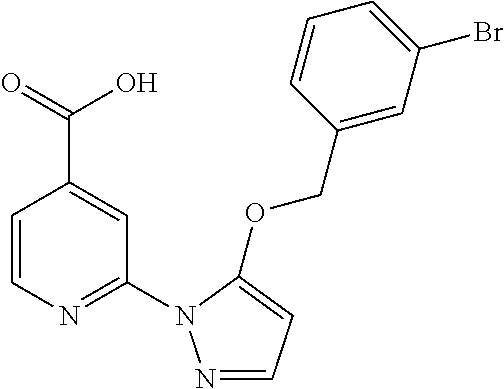
- The title compound was prepared from 2-{5-[(3-bromobenzyl)oxy]-1H-pyrazol-1-yl}pyridine-4-carbonitrile according to the procedure for the preparation of Example 28, part E. 1H NMR (400 MHz, DMSO-d6): δ 5.30 (2H, s), 6.01 (1H, d, J=1.6 Hz), 7.36 (1H, t, J=8.0 Hz), 7.47-7.55 (2H, m), 7.61 (1H, d, J=2.0 Hz), 7.73 (1H, s), 8.77 (1H, dd, J=0.8 Hz, J=4.8 Hz), 8.09 (1H, s), 8.70 (1H, d, J=5.2 Hz), 13.89 (1H, s). [M+H] Calc'd for C16H12BrN3O3, 374; Found, 374.
-

- The title compound was prepared from 2-(5-hydroxy-1H-pyrazol-1-yl)pyridine-4-carbonitrile and 3-(hydroxymethyl)phenyl acetate according to the procedure for the preparation of Example 39, part C. 1H NMR (400 MHz, CDCl3): δ 2.24 (3H, s), 5.17 (2H, s), 5.66 (1H, d, J=1.6 Hz), 7.01-7.03 (1H, m), 7.14 (1H, s), 7.20-7.22 (1H, m), 7.32-7.36 (2H, m), 7.49 (1H, d, J=1.6 Hz), 7.97 (1H, s), 8.63 (1H, d, J=4.8 Hz). [M+H] Calc'd for C18H14N4O3, 335; Found, 335.
-

- The title compound was prepared from 3-({[1-(4-cyanopyridin-2-yl)-1H-pyrazol-5-yl]oxy}methyl)phenyl acetate according to the procedure for the preparation of Example 28, part E. 1H NMR (400 MHz, DMSO-d6): δ 5.20 (2H, s), 5.97 (1H, d, J=1.6 Hz), 6.70-6.72 (1H, m), 6.85-6.89 (2H, m), 7.15-7.18 (1H, m), 7.58 (1H, d, J=1.2 Hz), 7.76-7.77 (1H, m), 8.08 (1H, s), 8.70 (1H, d, J=5.2 Hz), 9.48 (1H, s), 13.89 (1H, s). [M+H] Calc'd for C16H13N3O4, 312; Found, 312.
-

- The title compound was prepared from 2-(5-hydroxy-1H-pyrazol-1-yl)pyridine-4-carbonitrile and (4-chloro-3-fluorophenynmethanol according to the procedure for the preparation of Example 39, part C. 1H NMR (400 MHz, CDCl3): δ 5.21 (2H, s), 5.72 (1H, d, J=1.6 Hz), 7.15 (1H, d, J=8.0 Hz), 7.28 (1H, dd, J=1.6 Hz, J=9.6 Hz), 7.40-7.44 (2H, m), 7.57 (1H, d, J=2.08 Hz), 8.04 (1H, s), 8.70 (1H, d, J=4.8 Hz). [M+H] Calc'd for C16H10ClFN4O, 329; Found, 329.
-

- The title compound was prepared from 2-{5-[(4-chloro-3-fluorobenzyl)oxy]-1H-pyrazol-1-yl}pyridine-4-carbonitrile according to the procedure for the preparation of Example 28, part E. 1H NMR (400 MHz, DMSO-d6): δ 5.31 (2H, s), 6.01 (1H, d, J=2.0 Hz), 7.36 (1H, d, J=8.4 Hz), 7.55 (1H, dd, J=2.0 Hz, J=10.4 Hz), 7.60-7.64 (2H, m), 8.77 (1H, dd, J=0.8 Hz, J=4.8 Hz), 8.10 (1H, s), 8.70 (1H, d, J=4.8 Hz), 13.88 (1H, d, J=3.2 Hz). [M+H] Calc'd for C16H11ClFN3O3, 348; Found, 348.
-

- The title compound was prepared from 2-(5-hydroxy-1H-pyrazol-1-yl)pyridine-4-carbonitrile and (4-chloro-2-fluorophenyl)methanol according to the procedure for the preparation of Example 39, part C. 1H NMR (400 MHz, CDCl3): δ 5.19 (2H, s), 5.72 (1H, d, J=1.6 Hz), 7.07-7.13 (2H, m), 7.33-7.41 (2H, m), 7.51 (1H, d, J=2.0 Hz), 7.95 (1H, s), 8.62 (1H, d, J=5.2 Hz). [M+H] Calc'd for C16H10ClFN4O, 329; Found, 329.
-

- The title compound was prepared from 2-{5-[(4-chloro-2-fluorobenzyl)oxy]-1H-pyrazol-1-yl}pyridine-4-carbonitrile according to the procedure for the preparation of Example 28, part E. 1H NMR (400 MHz, DMSO-d6): δ 5.32 (2H, s), 6.08 (1H, d, J=1.6 Hz), 7.34 (1H, dd, J=1.6 Hz, J=8.0 Hz), 7.49 (1H, dd, J=2.0 Hz, J=9.6 Hz), 7.61-7.68 (2H, m), 7.75 (1H, dd, J=1.6 Hz, J=5.2 Hz), 8.05 (1H, s), 8.67 (1H, d, J=5.2 Hz), 13.89 (1H, s). [M+H] Calc'd for C16H11ClFN3O3, 348; Found, 348.
-

- The title compound was prepared from 2-(5-hydroxy-1H-pyrazol-1-yl)pyridine-4-carbonitrile and (3-chloro-4-fluorophenyl)methanol according to the procedure for the preparation of Example 39, part C. [M+H] Calc'd for C16H10ClFN4O, 329; Found, 329.
-

- The title compound was prepared from 2-{5-[(3-chloro-4-fluorobenzyl)oxy]-1H-pyrazol-1-yl}pyridine-4-carbonitrile according to the procedure for the preparation of Example 28, part E. 1H NMR (400 MHz, DMSO-d6): δ 5.28 (2H, s), 6.02 (1H, d, J=2.0 Hz), 7.42-7.52 (2H, m), 7.61 (1H, d, J=1.6 Hz), 7.74-7.78 (2H, m), 8.08 (1H, s), 8.68 (1H, d, J=5.2 Hz), 13.90 (1H, s). [M+H] Calc'd for C16H11ClFN3O3, 348; Found, 348.
-

- The title compound was prepared from 2-(5-hydroxy-1H-pyrazol-1-yl)pyridine-4-carbonitrile and (4-cyclopropylphenyl)methanol according to the procedure for the preparation of Example 39, part C. 1H NMR (400 MHz, CDCl3): δ 0.61-0.65 (2H, m), 0.89-0.94 (2H, m), 1.91-1.84 (1H, m), 5.12 (2H, s), 5.67 (1H, d, J=1.6 Hz), 7.01-7.24 (4H, m), 7.32-7.33 (1H, m), 7.50 (1H, d, J=1.2 Hz), 7.95 (1H, s), 8.63 (1H, d, J=4.8 Hz). [M+H] Calc'd for C19H16N4O, 317; Found, 317.
-

- The title compound was prepared from 2-{5-[(4-cyclopropylbenzyl)oxy]-1H-pyrazol-1-yl}pyridine-4-carbonitrile according to the procedure for the preparation of Example 28, part E. 1H NMR (400 MHz, DMSO-d6): δ 0.64-0.67 (2H, m), 0.91-1.96 (2H, m), 1.87-1.93 (1H, m), 5.21 (2H, s), 6.00 (1H, d, J=1.6 Hz), 7.06-7.08 (2H, m), 7.33-7.35 (2H, m), 7.58 (1H, d, J=2.0 Hz), 7.74 (1H, dd, J=1.2 Hz, J=5.2 Hz), 8.06 (1H, s), 8.67 (1H, d, J=4.8 Hz), 13.91 (1H, s). [M+H] Calc'd for C19H17N3O3, 336; Found, 336.
-

- The title compound was prepared from 2-{5-[(4-chloro-3-fluorobenzyl)oxy]-1H-pyrazol-1-yl}pyridine-4-carboxylic acid according to the procedure for the preparation of Example 62. 1H NMR (400 MHz, CDCl3): δ 3.90 (3H, s), 5.14 (2H, s), 5.67 (1H, s), 7.09 (1H, d, J=8.4 Hz), 7.23 (1H, d, J=9.6 Hz), 7.35 (1H, t, J=8.0 Hz), 7.52 (1H, s), 7.72 (1H, d, J=4.4 Hz), 8.26 (1H, s), 8.64 (1H, d, J=3.6 Hz). [M+H] Calc'd for C17H13ClFN3O3, 362; Found, 362.
-

- The title compound was prepared from 2-{5-[(4-chloro-2-fluorobenzyl)oxy]-1H-pyrazol-1-yl}pyridine-4-carboxylic acid according to the procedure for the preparation of Example 62. 1H NMR (400 MHz, CDCl3): δ 3.90 (3H, s), 5.20 (2H, s), 5.73 (1H, s), 7.07 (1H, dd, J=2.0 Hz, J=9.6 Hz), 7.11 (1H, dd, J=2.0 Hz, J=9.6 Hz), 7.43 (1H, t, J=8.0 Hz), 7.52 (1H, s), 7.70 (1H, d, J=4.4 Hz), 8.24 (1H, s), 8.63 (1H, s). [M+H] Calc'd for C17H13ClFN3O3, 362; Found, 362.
-

- The title compound was prepared from 2-{5-[(3-chloro-4-fluorobenzyl)oxy]-1H-pyrazol-1-yl}pyridine-4-carboxylic acid according to the procedure for the preparation of Example 62. 1H NMR (400 MHz, CDCl3): δ 3.90 (3H, s), 5.11 (2H, s), 5.68 (1H, s), 7.09 (1H, t, J=8.4 Hz), 7.23-7.27 (1H, m), 7.48 (1H, dd, J=1.6 Hz, J=7.2 Hz), 7.51 (1H, d, J=1.2 Hz), 7.71 (1H, dd, J=1.6 Hz, J=5.2 Hz), 8.25 (1H, s), 8.64 (1H, d, J=4.4 Hz). [M+H] Calc'd for C17H13ClFN3O3, 362; Found, 362.
-

- The title compound was prepared from 2-{5-[(4-cyclopropylbenzyl)oxy]-1H-pyrazol-1-yl}pyridine-4-carboxylic acid according to the procedure for the preparation of Example 62. 1H NMR (400 MHz, CDCl3): δ 0.60-0.64 (2H, m), 0.88-0.93 (2H, m), 1.81-1.85 (1H, m), 3.89 (3H, d, J=6.4 Hz), 5.12 (2H, s), 5.67 (1H, s), 7.00-7.26 (4H, m), 7.50 (1H, s), 7.68 (1H, d, J=4.8 Hz), 8.26 (1H, s), 8.62 (1H, s). [M+H] Calc'd for C20H19N3O3, 350; Found, 350.
-

- The title compound was prepared from 2-(5-hydroxy-1H-pyrazol-1-yl)pyridine-4-carbonitrile and 1-(4-fluorophenyl)ethanol according to the procedure for the preparation of Example 39, part C. 1H NMR (400 MHz, CDCl3): δ 1.65 (3H, d, J=6.4 Hz), 5.24 (1H, q, J=6.4 Hz), 5.44 (1H, d, J=2.0 Hz), 6.95-7.00 (2H, m), 7.27-7.30 (2H, m), 7.35 (1H, dd, J=0.8 Hz, J=5.2 Hz), 7.41 (1H, d, J=2.0 Hz), 7.97 (1H, s), 8.66 (1H, d, J=4.8 Hz). [M+H] Calc'd for C17H13FN4O, 309; Found, 309.
-

- The title compound was prepared from 2-[5-[1-(4-fluorophenyl)ethoxy]pyrazol-1-yl]pyridine-4-carbonitrile according to the procedure for the preparation of Example 28, part E. 1H NMR (400 MHz, DMSO-d6) δ: 1.58 (3H, d, J=6.4 Hz), 5.53 (1H, q, J=6.4 Hz), 5.81 (1H, d, J=1.6 Hz), 7.16-7.20 (2H, m), 7.49-7.52 (3H, m), 7.76 (1H, dd, J=1.2 Hz, J=5.2 Hz), 8.05 (1H, s), 8.70 (1H, d, J=4.8 Hz), 13.97 (1H, s). LCMS (mobile phase: 5%-95% Acetonitrile-Water-0.02% NH4Ac): purity is >95%, Rt=2.587 min. [M+H] Calc'd for C17H14FN3O3, 328; Found, 328.
-

- The title compound was prepared from 2-(5-hydroxy-1H-pyrazol-1-yl)pyridine-4-carbonitrile and (3,3-difluorocyclobutyl)methanol according to the procedure for the preparation of Example 39, part C. 1H NMR (400 MHz, CDCl3): δ 2.48-2.71 (5H, m), 5.14 (2H, d, J=4.4 Hz), 5.64 (1H, d, J=1.6 Hz), 7.34 (1H, dd, J=0.4 Hz, J=4.8 Hz), 7.51 (1H, d, J=2.0 Hz), 7.93 (1H, s), 8.61 (1H, d, J=4.8 Hz). [M+H] Calc'd for C14H12F2N4O, 291; Found, 291.
-

- The title compound was prepared from 2-[5-[(3,3-difluorocyclobutyl)methoxy]pyrazol-1-yl]pyridine-4-carbonitrile according to the procedure for the preparation of Example 28, part E. 1H NMR (400 MHz, DMSO-d6): δ 2.50-2.69 (5H, m), 4.23 (2H, d, J=4.4 Hz), 5.96 (1H, d, J=2.0 Hz), 7.60 (1H, d, J=1.6 Hz), 7.76 (1H, dd, J=1.2 Hz, J=4.8 Hz), 8.07 (1H, s), 8.66 (1H, d, J=5.2 Hz), 13.87 (1H, s). LCMS (mobile phase: 5%-95% Acetonitrile-Water-0.02% NH4Ac): purity is >95%, Rt=2.273 min. [M+H] Calc'd for C14H13F2N3O3, 310; Found, 310.
-

- A solution of N,N,N′,N′-tetramethyl-1-[(2-methylpropan-2-yl)oxy]methanediamine (2.47 g, 14.19 mmol), ethyl propionate (2.17 g, 21.27 mmol) and DMF (2 mL) in a sealed tube was heated to 90° C. for 24 h. Then extracted with ethyl acetate, collected the organic phase and washed with water, brine and dried with anhydrous sodium sulfate. Organic phase was concentrated and purified by silica gel chromatograph to give 0.68 g of the title compound (30%). 1H NMR (400 MHz, CDCl3): δ 1.24 (3H, t, J=7.2 Hz), 1.95 (3H, s), 3.00 (6H, s), 4.11 (2H, q, J=7.2 Hz), 7.28 (1H, s). [M+H] Calc'd for C8H15NO2, 158; Found, 158.
-

- A solution of ethyl (E)-3-(dimethylamino)-2-methylprop-2-enoate (668 mg, 4.25 mmol) and 2-hydrazinylpyridine-4-carbonitrile (570 mg, 4.25 mmol, PREPARATION 2) in 2 mL HOAc and 10 mL EtOH was charged to a flask and the mixture was heated to 90° C. for 30 min. Cooled to room temperature and removed the solvent. The residue was dissolved in ethylacetate and water, aqueous basified with NaHCO3 sat (pH=8), extracted with ethylacetate. The organic phase was washed with brine and dried with anhydrous sodium sulfate and then purified by silica gel chromatograph to give 0.65 g of the title compound (62%). [M+H] Calc'd for C12H14N4O2, 247, Found, 247.
-

- To a cooled mixture of ethyl (E)-3-[2-(4-cyanopyridin-2-yl)hydrazinyl]-2-methylprop-2-enoate (415 mg, 1.69 mmol) in ethanol (18 mL) was added t-BuOK (568 mg, 5.06 mmol) slowly. After that, the mixture was stirred overnight, filtered, the solid was acidified with HCl (1N), filtered, collected the solid and dried to give 250 mg of the title compound (74%). 1H NMR (400 MHz, CDCl3): δ 1.93 (3H, s), 7.55 (1H, dd, J=1.2 Hz, J=4.8 Hz), 7.64 (1H, s), 8.64 (1H, d, J=4.8 Hz), 8.72 (1H, s). [M+H] Calc'd for C10H8N4O, 201, Found, 201.
-

- The title compound was prepared from 2-(5-hydroxy-4-methylpyrazol-1-yl)pyridine-4-carbonitrile and 4-fluorobenzyl alcohol according to the procedure for the preparation of Example 39, part C. 1H NMR (300 MHz, CDCl3): δ 1.91 (3H, s), 5.14 (2H, s), 7.26 (2H, s), 7.33-7.37 (3H, m), 7.46 (1H, s), 7.99 (1H, s), 8.62 (1H, d, J=5.1 Hz). [M+H] Calc'd for C17H13FN4O, 309, Found, 309.
-

- The title compound was prepared from 2-[5-[(4-fluorophenyl)methoxy]-4-methylpyrazol-1-yl]pyridine-4-carbonitrile according to the procedure for the preparation of Example 28, part E. 1H NMR (400 MHz, DMSO-d6): δ 1.89 (3H, s), 5.16 (2H, s), 7.14-7.19 (2H, m), 7.44-7.47 (2H, m), 7.53 (1H, s), 7.75 (1H, dd, J=1.6 Hz, J=4.8 Hz), 8.03 (1H, s), 8.69 (1H, d, J=5.2 Hz). LCMS (mobile phase: 5%-95% Acetonitrile-Water-0.1% TFA): purity is >95%, Rt=3.614 min. [M+H] Calc'd for C17H14FN3O3, 328; Found, 328.
-

- The title compound was prepared from N,N,N′,N′-tetramethyl-1-[(2-methylpropan-2-yl)oxy]methanediamine and ethyl butanoate according to the procedure for the preparation of Example 84, part A. [M+H] Calc'd for C9H17NO2, 172; Found, 172.
-

- The title compound was prepared from ethyl (2E)-2-(dimethylaminomethylidene)butanoate and 2-hydrazinylpyridine-4-carbonitrile (PREPARATION 2) according to the procedure for the preparation of Example 84, part B. [M+H] Calc'd for C13H16N4O2, 261, Found, 261.
-

- The title compound was prepared from ethyl (2E)-2-[[2-(4-cyanopyridin-2-yl)hydrazinyl]methylidene]butanoate according to the procedure for the preparation of Example 84, part C. [M+H] Calc'd for C11H10N4O, 215, Found, 215.
-

- The title compound was prepared from 2-(4-ethyl-5-hydroxypyrazol-1-yl)pyridine-4-carbonitrile and 4-fluorobenzyl alcohol according to the procedure for the preparation of Example 39, part C. [M+H] Calc'd for C15H18FN4O, 323, Found, 323.
-

- The title compound was prepared from 2-[4-ethyl-5-[(4-fluorophenyl)methoxy]pyrazol-1-yl]pyridine-4-carbonitrile according to the procedure for the preparation of Example 28, part E. 1H NMR (400 MHz, DMSO-d6): δ 1.11 (3H, t, J=7.6 Hz), 2.32 (2H, q, J=7.6 Hz), 5.14 (2H, s), 7.15-7.20 (2H, m), 7.44-7.47 (2H, m), 7.61 (1H, s), 7.75 (1H, dd, J=1.6 Hz, J=4.8 Hz), 8.04 (1H, s), 8.69 (1H, d, J=5.2 Hz), 13.89 (1H, s). LCMS (mobile phase: 10%-95% Acetonitrile-Water-0.02% NH4Ac): purity is >95%, Rt=2.633 min. [M+H] Calc'd for C15H16FN3O3, 342; Found, 342.
-

- The title compound was prepared from 2-(5-hydroxy-1H-pyrazol-1-yl)pyridine-4-carbonitrile and (2,4-difluorophenyl)methanol according to the procedure for the preparation of Example 39, part C. 1H NMR (400 MHz, CDCl3): δ 5.19 (2H, s), 5.74 (1H, d, J=2.0 Hz), 6.78-6.86 (2H, m), 7.33 (1H, dd, J=1.2 Hz, J=4.8 Hz), 7.39-7.45 (1H, m), 7.51 (1H, d, J=1.6 Hz), 7.94 (1H, s), 8.62 (1H, d, J=4.8 Hz). [M+H] Calc'd for C16H10F2N4O, 313; Found, 313.
-

- The title compound was prepared from 2-[5-[(2,4-difluorophenyl)methoxy]pyrazol-1-yl]pyridine-4-carbonitrile according to the procedure for the preparation of Example 28, part E. 1H NMR (400 MHz, DMSO-d6): δ 5.29 (2H, s), 6.08 (1H, d, J=2.0 Hz), 7.11-7.15 (1H, m), 7.27-7.33 (1H, m), 7.61 (1H, d, J=2.0 Hz), 7.68 (1H, dd, J=8.0, 15.6 Hz), 7.72-7.75 (1H, m), 8.04 (1H, s), 8.65 (1H, d, J=5.2 Hz). LCMS (mobile phase: 5%-95% Acetonitrile-Water-0.1% TFA): purity is >95%, Rt=3.349 min. [M+H] Calc'd for C16H11F2N3O3, 332; Found, 332.
-

- The title compound was prepared from 2-(5-hydroxy-1H-pyrazol-1-yl)pyridine-4-carbonitrile and (3,4-dichlorophenyl)methanol according to the procedure for the preparation of Example 39, part C. 1H NMR (400 MHz, CDCl3): δ 5.12 (2H, s), 5.66 (1H, d, J=1.6 Hz), 7.20 (1H, d, J=2.0 Hz), 7.35 (1H, dd, J=1.2, 5.2 Hz), 7.40 (1H, d, J=8.0 Hz), 7.52 (2H, m), 7.98 (1H, s), 8.64 (1H, d, J=4.8 Hz). [M+H] Calc'd for C16H10Cl2N4O, 345; Found, 345.
-

- The title compound was prepared from 2-[5-[(3,4-dichlorophenyl)methoxy]pyrazol-1-yl]pyridine-4-carbonitrile according to the procedure for the preparation of Example 28, part E. 1H NMR (400 MHz, DMSO-d6): δ 5.30 (2H, s), 6.01 (1H, d, J=2.0 Hz), 7.46-7.48 (1H, m), 7.60-7.67 (2H, m), 7.76-7.80 (2H, m), 8.09 (1H, s), 8.69 (1H, d, J=5.2 Hz). LCMS (mobile phase: 5%-95% Acetonitrile-Water-0.1% TFA): purity is >95%, Rt=3.773 min. [M+H] Calc'd for C16H11Cl2N3O3, 364; Found, 364.
-

- The title compound was prepared from 2-(5-hydroxy-1H-pyrazol-1-yl)pyridine-4-carbonitrile and (2,4-dichlorophenyl)methanol according to the procedure for the preparation of Example 39, part C. 1H NMR (400 MHz, CDCl3): δ 5.29 (2H, s), 5.79 (1H, d, J=1.6 Hz), 7.29-7.32 (1H, m), 7.42 (1H, dd, J=1.2, 5.2 Hz), 7.45 (1H, d, J=2.4 Hz), 7.53 (1H, d, J=8.4 Hz), 7.59 (1H, d, J=1.6 Hz), 8.06 (1H, s), 8.71 (1H, d, J=4.8 Hz). [M+H] Calc'd for C16H10Cl2N4O, 345; Found, 345.
-

- The title compound was prepared from 2-[5-[(2,4-dichlorophenyl)methoxy]pyrazol-1-yl]pyridine-4-carbonitrile according to the procedure for the preparation of Example 28, part E. 1H NMR (400 MHz, DMSO-d6): δ 5.33 (2H, s), 6.08 (1H, d, J=2.4 Hz), 7.50 (1H, dd, J=2.4, 8.4 Hz), 7.62 (1H, d, J=1.6 Hz), 7.69 (1H, d, J=1.6 Hz), 7.72 (1H, d, J=8.4 Hz), 7.76 (1H, dd, J=1.6, 4.8 Hz), 8.09 (1H, s), 8.69 (1H, d, J=4.8 Hz), 13.88 (1H, s). LCMS (mobile phase: 5%-95% Acetonitrile-Water-0.1% TFA): purity is >95%, Rt=3.773 min. [M+H] Calc'd for C16H11Cl2N3O3, 364; Found, 364.
-

- The title compound was prepared from 2-(5-hydroxy-1H-pyrazol-1-yl)pyridine-4-carbonitrile and (4-chloro-2-methylphenyl)methanol according to the procedure for the preparation of Example 39, part C. 1H NMR (400 MHz, CDCl3): δ 2.36 (3H, s), 5.18 (2H, s), 5.77 (1H, d, J=2.0 Hz), 7.18-7.22 (2H, m), 7.34 (1H, d, J=8.0 Hz), 7.39 (1H, dd, J=1.2 Hz J=5.2 Hz), 7.58 (1H, d, J=2.0 Hz), 8.00 (1H, s), 8.67 (1H, d, J=5.2 Hz). [M+H] Calc'd for C17H13ClN4O, 325; Found, 325.
-

- The title compound was prepared from 2-[5-[(4-chloro-2-methylphenyl)methoxy]pyrazol-1-yl]pyridine-4-carbonitrile according to the procedure for the preparation of Example 28, part E. 1H NMR (400 MHz, DMSO-d6): δ 2.34 (3H, s), 5.26 (2H, s), 6.09 (1H, d, J=2.0 Hz), 7.27 (1H, dd, J=2.4, 8.0 Hz), 7.31 (1H, s), 7.51 (1H, d, J=8.0 Hz), 7.61 (1H, d, J=2.0 Hz), 7.74 (1H, dd, J=1.6, 4.8 Hz), 8.05 (1H, s), 8.66 (1H, d, J=4.8 Hz), 13.92 (1H, s). LCMS (mobile phase: 5%-95% Acetonitrile-Water-0.1% TFA): purity is >95%, Rt=3.773 min. [M+H] Calc'd for C17H14ClN3O3, 344; Found, 344.
-

- The title compound was prepared from 2-(5-hydroxy-1H-pyrazol-1-yl)pyridine-4-carbonitrile and (4-chloro-2-methoxyphenyl)methanol according to the procedure for the preparation of Example 39, part C. 1H NMR (400 MHz, CDCl3): δ 3.89 (3H, s), 5.22 (2H, s), 5.78 (1H, d, J=2.0 Hz), 6.92 (1H, d, J=2.0 Hz), 6.95-6.98 (1H, m), 7.33-7.35 (1H, m), 7.39 (1H, dd, J=1.2, 5.2 Hz), 7.57-7.58 (1H, m), 8.06 (1H, s), 8.70 (1H, d, J=5.2 Hz). [M+H] Calc'd for C17H13ClN4O2, 341; Found, 341.
-

- The title compound was prepared from 2-[5-[(4-chloro-2-methoxyphenyl)methoxy]pyrazol-1-yl]pyridine-4-carbonitrile according to the procedure for the preparation of Example 28, part E. 1H NMR (400 MHz, DMSO-d6): δ 3.84 (3H, s), 5.22 (2H, s), 6.00 (1H, d, J=2.0 Hz), 7.03 (1H, dd, J=2.0, 8.4 Hz), 7.13 (1H, d, J=1.6 Hz), 7.49-7.51 (1H, m), 7.58 (1H, d, J=2.0 Hz), 7.74 (1H, dd, J=0.8 Hz, J=4.8 Hz), 8.05 (1H, s), 8.65 (1H, d, J=5.2 Hz). LCMS (mobile phase: 5%-95% Acetonitrile-Water-0.02% NH4Ac): purity is >95%, Rt=2.706 min. [M+H] Calc'd for C17H14ClN3O4, 360; Found, 360.
-

- The title compound was prepared from 2-(5-hydroxy-1H-pyrazol-1-yl)pyridine-4-carbonitrile and [4-chloro-3-(trifluoromethyl)phenyl]methanol according to the procedure for the preparation of Example 39, part C. 1H NMR (400 MHz, CDCl3): δ 5.25 (2H, s), 5.76 (1H, d, J=1.6 Hz), 7.42 (1H, dd, J=1.6, 5.2 Hz), 7.54 (2H, s), 7.58 (1H, d, J=2.0 Hz), 7.89 (1H, s), 8.00 (1H, s), 8.06 (1H, s), 8.69 (1H, d, J=4.8 Hz). [M+H] Calc'd for C17H10ClF3N4O, 379; Found, 379.
-

- The title compound was prepared from 2-[5-[[4-chloro-3-(trifluoromethyl)phenyl]methoxy]pyrazol-1-yl]pyridine-4-carbonitrile according to the procedure for the preparation of Example 28, part E. 1H NMR (400 MHz, DMSO-d6): δ 5.39 (2H, s), 6.03 (1H, d, J=2.4 Hz), 7.62 (1H, d, J=1.6 Hz), 7.75-7.80 (3H, m), 8.05 (1H, s), 8.09 (1H, s), 8.67 (1H, d, J=5.2 Hz), 13.93 (1H, s). LCMS (mobile phase: 5%-95% Acetonitrile-Water-0.1% TFA): purity is >95%, Rt=3.773 min. [M+H] Calc'd for C17H11ClF3N3O3, 398; Found, 398.
-

- To a solution of 4-chloro-2-methylbenzoic acid (800 mg, 4.69 mmol) in THF (8 mL) that was cooled at 0° C., BH3THF (14 mL, 1M in THF) was added into the solution drop wise. The mixture was then stirred at r.t. overnight. Add methanol to the system at 0° C. slowly until no gas released. Remove the solvent and the residue was extracted with ethylacetate, concentrated the organic phase to give 894 mg of the title compound (85%). 1H NMR (400 MHz, CDCl3): δ 2.36 (3H, s), 4.63 (2H, s), 7.13-7.22 (2H, m), 7.35 (1H, s).
-

- The title compound was prepared from 2-(5-hydroxy-1H-pyrazol-1-yl)pyridine-4-carbonitrile and (3-chloro-4-methylphenyl)methanol according to the procedure for the preparation of Example 39, part C. 1H NMR (400 MHz, CDCl3): δ 2.38 (3H, s), 5.18 (2H, s), 5.73 (1H, d, J=1.6 Hz), 7.19-7.25 (2H, m), 7.41 (1H, dd, J=1.2, 4.8 Hz), 7.44 (1H, s), 7.57 (1H, d, J=1.6 Hz), 8.03 (1H, s), 8.71 (1H, d, J=5.2 Hz). [M+H] Calc'd for C17H13ClN4O, 325; Found, 325.
-

- The title compound was prepared from 2-[5-[(3-chloro-4-methylphenyl)methoxy]pyrazol-1-yl]pyridine-4-carbonitrile according to the procedure for the preparation of Example 28, part E. 1H NMR (400 MHz, DMSO-d6): δ 2.31 (3H, s), 5.23 (2H, s), 5.94 (1H, d, J=2.0 Hz), 7.31-7.37 (2H, m), 7.52-7.54 (2H, m), 7.65 (1H, d, J=4.8 Hz), 7.94 (1H, s), 8.45 (1H, d, J=4.8 Hz). LCMS (mobile phase: 5%-95% Acetonitrile-Water-0.02% NH4Ac): purity is >95%, Rt=2.787 min. [M+H] Calc'd for C17H14ClN3O3, 344; Found, 344.
-

- The title compound was prepared from 2-(5-hydroxy-1H-pyrazol-1-yl)pyridine-4-carbonitrile and (3-fluoro-4-methylphenyl)methanol according to the procedure for the preparation of Example 39, part C. 1H NMR (400 MHz, CDCl3): δ 2.28 (3H, s), 5.19 (2H, s), 5.72 (1H, d, J=2.0 Hz), 7.18-7.20 (1H, m), 7.07-7.11 (2H, m), 7.41 (1H, dd, J=1.2, 4.8 Hz), 7.56 (1H, d, J=1.6 Hz), 8.03 (1H, s), 8.71 (1H, d, J=4.8 Hz). [M+H] Calc'd for C17H13FN4O, 309; Found, 309.
-

- The title compound was prepared from 2-[5-[(3-fluoro-4-methylphenyl)methoxy]pyrazol-1-yl]pyridine-4-carbonitrile according to the procedure for the preparation of Example 28, part E. 1H NMR (400 MHz, DMSO-d6): δ 2.22 (3H, s), 5.25 (2H, s), 6.00 (1H, d, J=2.0 Hz), 7.19-7.31 (3H, m), 7.59 (1H, d, J=1.6 Hz), 7.76-7.77 (1H, m), 8.07 (1H, s), 8.68 (1H, d, J=5.2 Hz), 13.91 (1H, s). LCMS (mobile phase: 5%-95% Acetonitrile-Water-0.1% TFA): purity is >95%, Rt=3.337 min. [M+H] Calc'd for C17H14FN3O3, 328; Found, 328.
-

- The title compound was prepared from 2,3-difluoro-4-methyl-benzoic acid according to the procedure for the preparation of Example 92, part A. 1H NMR (400 MHz, CDCl3): δ 2.36 (3H, s), 4.63 (2H, s), 7.13-7.22 (2H, m), 7.35 (1H, s).
-
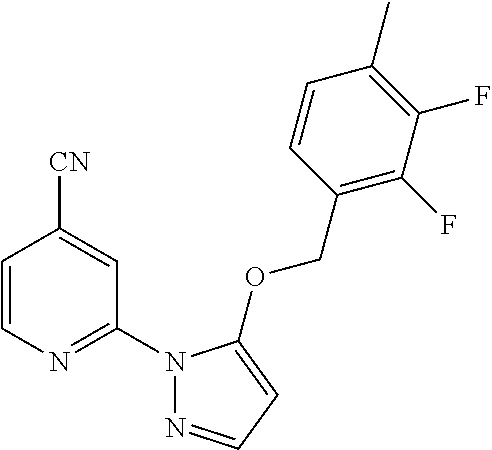
- The title compound was prepared from 2-(5-hydroxy-1H-pyrazol-1-yl)pyridine-4-carbonitrile and (2,3-difluoro-4-methylphenyl)methanol according to the procedure for the preparation of Example 39, part C. 1H NMR (400 MHz, CDCl3): δ 2.32 (3H, s), 5.28 (2H, s), 5.80 (1H, s), 6.98 (1H, d, J=6.8 Hz), 7.11 (1H, d, J=7.2 Hz), 7.40 (1H, d, J=5.2 Hz), 7.58 (1H, s), 8.01 (1H, s), 8.70 (1H, d, J=4.8 Hz). [M+H] Calc'd for C17H12F2N4O, 327; Found, 327.
-

- The title compound was prepared from 2-[5-[(2,3-difluoro-4-methylphenyl)methoxy]pyrazol-1-yl]pyridine-4-carbonitrile according to the procedure for the preparation of Example 28, part E. 1H NMR (400 MHz, DMSO-d6): δ 2.27 (3H, s), 5.32 (2H, s), 6.08 (1H, s), 7.10-7.14 (1H, m), 7.28-7.31 (1H, m), 7.61 (1H, s), 7.75 (1H, d, J=4.8 Hz), 8.03 (1H, s), 8.66 (1H, d, J=4.8 Hz), 13.90 (1H, s). LCMS (mobile phase: 5%-95% Acetonitrile-Water-0.02% NH4Ac): purity is >95%, Rt=2.269 min. [M+H] Calc'd for C17H13F2N3O3, 346; Found, 346.
-

- To a suspension of 4-ethyl benzoic acid (4.53 g, 30.16 mmol) in concentrated sulfuric acid (24 mL) at 0° C. was added nitric acid (12 mL). The mixture was stirred for 1.5 h at 0° C. Poured into ice water, filtered and dried the solid to give 5.79 g of the title compound (98%). 1H NMR (400 MHz, DMSO-d6): δ 1.23 (3H, t, J=7.2 Hz), 2.88 (2H, q, J=7.2 Hz), 7.67 (1H, d, J=8.0 Hz), 8.15 (1H, dd, J=1.6, 8.0 Hz), 8.36 (1H, d, J=1.6 Hz).
-

- To a suspension of 4-ethyl-3-nitrobenzoic acid (5.76 g, 29.53 mmol) in methanol (30 mL) at 0° C., was added SOCl2 (10.54 g, 88.61 mmol) slowly, stirred at this temperature for 1 h, then heated to 50° C. and stirred at this temperature for 3 h. Cooled to room temperature and removed the solvent, the residue was extracted with ethyl acetate, and concentrated to give 6.05 g of the title compound (98%). 1H NMR (400 MHz, CDCl3): δ 1.31 (3H, t, J=7.2 Hz), 2.97 (2H, q, J=7.2 Hz), 3.96 (3H, s), 7.47 (1H, d, J=8.4 Hz), 8.17 (1H, dd, J=1.6, 8.4 Hz), 8.52 (1H, d, J=1.6 Hz).
-

- Charged methyl 4-ethyl-3-nitrobenzoate (5.0 g, 23.92 mmol), Pd/C (500 mg) and methanol (50 mL) to a flask, purged with hydrogen and stirred at r.t. overnight. It was then filtered and concentrated to give 4.0 g of the title compound (94%). 1H NMR (400 MHz, CDCl3): δ 1.26 (3H, t, J=7.6 Hz), 2.54 (2H, q, J=7.6 Hz), 3.73 (2H, s), 3.87 (3H, s), 7.12 (1H, d, J=8.0 Hz), 7.35 (1H, s), 7.41 (1H, d, J=7.6 Hz). [M+H] Calc'd for C10H13NO2, 180; Found, 180.
-

- Charge NaNO2 (579 mg, 8.37 mmol) and concentrated sulfuric acid (6 mL) to a flask. As methyl 3-amino-4-ethylbenzoate (1.37 g, 7.62 mmol, PREPARATION 5) in acetic acid (18 mL) was added at 0° C., color of the mixture turned to yellow, and then stirred at 5° C. for 1.5 h. The solution above was added to a dark mixture of CuCl (1.65 g, 16.65 mmol) in concentrated HCl (18 mL) slowly at 0° C., stirred for 2 h, and poured into ice water, extracted with DCM, the organic phase was concentrated to give 582 mg of the title compound (38%).
- 1H NMR (400 MHz, CDCl3): δ 1.25 (3H, t, J=8.0 Hz), 2.80 (2H, q, J=7.6 Hz), 3.91 (3H, s), 7.30 (1H, d, J=7.6 Hz), 7.85 (1H, dd, J=1.2, 7.6 Hz), 8.01 (1H, d, J=1.6 Hz).
-

- To a solution of methyl 3-chloro-4-ethylbenzoate (367 mg, 1.85 mmol) in THF (5 mL) that cooled to −50° C., LiAlH4 (141 mg, 2.70 mmol) was added in portions. After which, the mixture was stirred at this temperature for 1 h. Added water (0.2 mL) slowly, followed by NaOH (aq, 10%, 0.2 mL) and water (0.6 mL), the resulted mixture was filtered and washed with THF, concentrated the filtrate to give 308 mg of the title compound (98%). 1H NMR (400 MHz, CDCl3): δ 1.22 (3H, t, J=7.6 Hz), 2.74 (2H, q, J=7.6 Hz), 4.63 (2H, d, J=5.2 Hz), 7.17-7.23 (2H, m), 7.35 (1H, s).
-

- The title compound was prepared from 2-(5-hydroxy-1H-pyrazol-1-yl)pyridine-4-carbonitrile and (3-chloro-4-ethylphenyl)methanol according to the procedure for the preparation of Example 39, part C. 1H NMR (400 MHz, CDCl3): δ 1.23 (3H, t, J=8.0 Hz), 2.76 (2H, t, J=8.0 Hz), 5.18 (2H, s), 5.74 (1H, d, J=0.8 Hz), 7.26 (2H, s), 7.40-7.44 (2H, m), 7.57 (1H, s), 8.03 (1H, s), 8.72 (1H, d, J=4.8 Hz). [M+H] Calc'd for C18H15ClN4O, 339; Found, 339.
-

- The title compound was prepared from 2-[5-[(3-chloro-4-ethylphenyl)methoxy]pyrazol-1-yl]pyridine-4-carbonitrile according to the procedure for the preparation of Example 28, part E. 1H NMR (400 MHz, DMSO-d6): δ 1.15 (3H, t, J=10.0 Hz), 2.68 (2H, q, J=10.0 Hz), 5.23 (2H, s), 5.95 (1H, d, J=2.4 Hz), 7.36 (2H, s), 7.53 (2H, d, J=2.8 Hz), 7.67 (1H, d, J=6.4 Hz), 7.96 (1H, s), 8.47 (1H, d, J=6.4 Hz). LCMS (mobile phase: 5%-95% Acetonitrile-Water-0.1% TFA): purity is >95%, Rt=3.773 min. [M+H] Calc'd for C18H16ClN3O3, 358; Found, 358.
-

- At 0° C., NaNO2 (667 mg, 9.66 mmol) was added to a solution of methyl 3-amino-4-ethylbenzoate (1.57 g, 8.78 mmol, PREPARATION 5) in Py-HF (20 mL) in portions. The mixture was then heated to 25° C. for 5 h, pour into ice water, and extracted with DCM, concentrated the organic phase for silica gel chromatograph (PE/EA=10/1) to give 650 mg of the title compound (40%). 1H NMR (400 MHz, CDCl3): δ 1.24 (3H, t, J=7.6 Hz), 2.72 (2H, q, J=7.6 Hz), 3.91 (3H, s), 7.25-7.29 (1H, m), 7.65 (1H, dd, J=1.2, 10.4 Hz), 7.75 (1H, dd, J=1.6, 8.0 Hz).
-

- The title compound was prepared from methyl 4-ethyl-3-fluorobenzoate according to the procedure for the preparation of Example 95, part B. 1H NMR (400 MHz, CDCl3): δ 1.22 (3H, t, J=8.0 Hz), 2.66 (2H, q, J=8.0 Hz), 4.64 (2H, s), 7.01-7.05 (2H, m), 7.18 (1H, t, J=8.0 Hz).
-

- The title compound was prepared from 2-(5-hydroxy-1H-pyrazol-1-yl)pyridine-4-carbonitrile and (4-ethyl-3-fluorophenyl)methanol according to the procedure for the preparation of Example 39, part C. 1H NMR (400 MHz, CDCl3): δ 1.16 (3H, t, J=7.6 Hz), 2.60 (2H, t, J=7.6 Hz), 5.13 (2H, s), 5.66 (1H, d, J=1.2 Hz), 7.02-7.05 (2H, m), 7.14-7.18 (1H, m), 7.34 (1H, d, J=5.2 Hz), 7.50 (1H, d, J=1.2 Hz), 7.96 (1H, s), 8.64 (1H, d, J=4.8 Hz). [M+H] Calc'd for C18H15FN4O, 323; Found, 323.
-

- The title compound was prepared from 2-[5-[(4-ethyl-3-fluorophenyl)methoxy]pyrazol-1-yl]pyridine-4-carbonitrile according to the procedure for the preparation of Example 28, part E. 1H NMR (400 MHz, DMSO-d6): δ 1.15 (3H, t, J=7.6 Hz), 2.61 (2H, q, J=7.6 Hz), 5.26 (2H, s), 6.01 (1H, d, J=1.6 Hz), 7.20-7.33 (3H, m), 7.60 (1H, d, J=1.6 Hz), 7.76 (1H, dd, J=1.2, 4.8 Hz), 8.08 (1H, s), 8.69 (1H, d, J=4.8 Hz) LCMS (mobile phase: 5%-95% Acetonitrile-Water-0.1% TFA): purity is >95%, Rt=3.634 min. [M+H] Calc'd for C18H16FN3O3, 342; Found, 342.
-

- A solution of methyl 2-{5-[(4-bromobenzyl)oxy]-1H-pyrazol-1-yl}pyridine-4-carboxylate (765 mg, 1.97 mmol, EXAMPLE 68) in DCM (8 mL) was purged with nitrogen and cooled to −78° C. BBr3 (6 mL, 5.93 mmol, 1M in DCM) was added at this temperature. Thereto, the mixture was stirred at the same temperature for an hour, methanol was added until no gas released, and then the above mixture was basified with NaHCO3 aq (pH=3). Extracted with ethylacetate three times, and the organic phase was washed with brine and dried with Na2SO4, concentrated and the residue was washed with ethylacetate to give 260 mg of the title compound (60%). 1H NMR (400 MHz, CD3OD): δ 4.02 (3H, s), 7.91-7.97 (2H, m), 8.69-8.70 (2H, m). [M+H] Calc'd for C10H9N3O3, 220; Found, 220.
-

- The title compound was prepared from methyl 2-(5-hydroxypyrazol-1-yl)pyridine-4-carboxylate (PREPARATION 6) and (3-cyanophenyl)methanol according to the procedure for the preparation of Example 39, part C. [M+H] Calc'd for C18H14N4O3, 335; Found, 335.
-
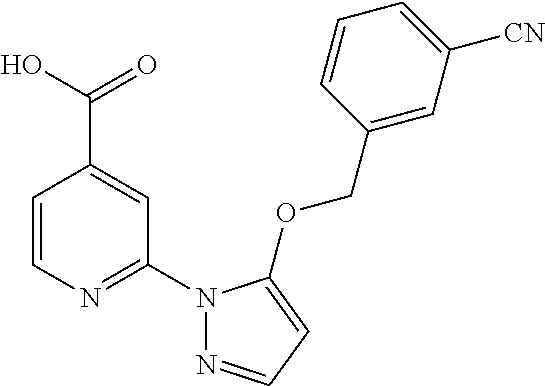
- A solution of methyl 2-[5-[(3-cyanophenyl)methoxy]pyrazol-1-yl]pyridine-4-carboxylate (1.0 eq) and LiOH.H2O (3.0 eq) in a mixture of water (2 mL) and THF (2 mL) was stirred at room temperature for 30 min. Diluted with another 2 mL water, and the mixture was washed with ethyl acetate twice (6 mL×2). The water phase was acidified with 1N HCl (pH=3), filtered and dried the solid to give the title compound. 1H NMR (400 MHz, DMSO-d6): δ 5.36 (2H, s), 6.03 (1H, s), 7.61-7.64 (2H, m), 7.77-7.78 (1H, m), 7.82-7.84 (2H, m), 7.96 (1H, s), 8.09 (1H, s), 8.69 (1H, d, J=4.4 Hz), 13.92 (1H, s). LCMS (mobile phase: 10%-95% Acetonitrile-Water-0.02% NH4Ac): purity is >95%, Rt=2.106 min. [M+H] Calc'd for C17H12N4O3, 321; Found, 321.
-

- The title compound was prepared from methyl 2-(5-hydroxypyrazol-1-yl)pyridine-4-carboxylate (PREPARATION 6) and (4-cyanophenyl)methanol according to the procedure for the preparation of Example 39, part C. [M+H] Calc'd for C18H14N4O3, 335; Found, 335.
-

- The title compound was prepared from methyl 2-[5-[(4-cyanophenyl)methoxy]pyrazol-1-yl]pyridine-4-carboxylate (EXAMPLE 98) according to the procedure for the preparation of Example 97, part B. 1H NMR (400 MHz, DMSO-d6): δ 5.41 (2H, s), 6.00 (1H, d, J=2.0 Hz), 7.61 (1H, d, J=1.6 Hz), 7.67-7.69 (2H, m), 7.77 (1H, dd, J=0.8 Hz, J=4.8 Hz), 7.87-7.89 (2H, m), 8.10 (1H, s), 8.70 (1H, d, J=5.2 Hz), 13.92 (1H, s). LCMS (mobile phase: 10%-95% Acetonitrile-Water-0.02% NH4Ac): purity is >95%, Rt=2.104 min. [M+H] Calc'd for C17H12N4O3, 321; Found, 321.
-

- The title compound was prepared from 2-[5-[(3-chloro-4-methylphenyl)methoxy]pyrazol-1-yl]pyridine-4-carboxylic acid (EXAMPLE 92) according to the procedure for the preparation of Example 62. 1H NMR (400 MHz, CDCl3): δ 2.38 (3H, s), 3.96 (3H, s), 5.18 (2H, s), 5.74 (1H, d, J=1.6 Hz), 7.21-7.26 (2H, m), 7.45 (1H, s), 7.58 (1H, d, J=2.0 Hz), 7.77-7.78 (1H, m), 8.33 (1H, s), 8.71 (1H, d, J=5.2 Hz). LCMS (mobile phase: 30%-95% Acetonitrile-Water-0.02% NH4Ac): purity is >95%, Rt=3.628 min. [M+H] Calc'd for C18H16ClN3O3, 358; Found, 358.
-

- The title compound was prepared from 2-[5-[(3-fluoro-4-methylphenyl)methoxy]pyrazol-1-yl]pyridine-4-carboxylic acid (EXAMPLE 93) according to the procedure for the preparation of Example 62. 1H NMR (400 MHz, CDCl3): δ 2.28 (3H, s), 3.97 (3H, s), 5.21 (2H, s), 5.75 (1H, s), 7.09-7.21 (3H, m), 7.60 (1H, s), 7.79 (1H, d, J=4.8 Hz), 8.35 (1H, s), 8.73 (1H, s). LCMS (mobile phase: 20%-95% Acetonitrile-Water-0.1% NH4OH): purity is >95%, Rt=3.936 min. [M+H] Calc'd for C15H16FN3O3, 342; Found, 342.
-

- The title compound was prepared from 2-[5-[(3-chloro-4-ethylphenyl)methoxy]pyrazol-1-yl]pyridine-4-carboxylic acid (EXAMPLE 95) according to the procedure for the preparation of Example 62. 1H NMR (400 MHz, CDCl3): δ 1.23 (3H, t, J=7.6 Hz), 2.76 (2H, q, J=7.6 Hz), 3.97 (3H, s), 5.18 (2H, s), 5.75 (1H, s), 7.26 (2H, s), 7.45 (1H, s), 7.58 (1H,$), 7.78 (1H, d, J=8.0 Hz), 8.33 (1H, s), 8.72 (1H, d, J=0.8 Hz). LCMS (mobile phase: 20%-95% Acetonitrile-Water-0.02% NH4OH): purity is >95%, Rt=4.602 min.
- [M+H] Calc'd for C19H18ClN3O3, 372; Found, 372.
-

- The title compound was prepared from 2-[5-[(2,3-difluoro-4-methylphenyl)methoxy]pyrazol-1-yl]pyridine-4-carboxylic acid (EXAMPLE 94) according to the procedure for the preparation of Example 62. 1H NMR (400 MHz, CDCl3): δ 2.31 (3H, s), 3.96 (3H, s), 5.27 (2H, s), 5.80 (1H, d, J=6.4 Hz), 6.94-6.97 (1H, m), 7.13-7.17 (1H, m), 7.58 (1H, s), 7.76 (1H, d, J=4.0 Hz), 8.30 (1H, s), 8.69 (1H, d, J=2.4 Hz). LCMS (mobile phase: 30%-95% Acetonitrile-Water-0.02% NH4Ac): purity is >95%, Rt=3.485 min. [M+H] Calc'd for C18H15F2N3O3, 360; Found, 360.
-

- The title compound was prepared from 2-[5-[(4-ethyl-3-fluorophenyl)methoxy]pyrazol-1-yl]pyridine-4-carboxylic acid (EXAMPLE 96) according to the procedure for the preparation of Example 62. 1H NMR (400 MHz, CDCl3): δ 1.23 (3H, t, J=7.6 Hz), 2.67 (2H, q, J=7.6 Hz), 3.97 (3H, s), 5.20 (2H, s), 5.75 (1H, d, J=1.6 Hz), 7.12-7.23 (3H, m), 7.58 (1H, d, J=2.0 Hz), 7.78 (1H, dd, J=1.6, 5.2 Hz), 8.34 (1H, s), 8.71 (1H, d, J=5.2 Hz). LCMS (mobile phase: 30%-95% Acetonitrile-Water-0.02% NH4Ac): purity is >95%, Rt=3.783 min. [M+H] Calc'd for C19H18FN3O3, 356; Found, 356.
-

- BH3 (1M in THF, 359 mL) was added into a solution of 4-chloro-2-hydroxybenzoic acid (20.63 g, 0.12 mmol) in THF (40 mL) drop wise at 0° C. After which, the mixture was stirred at r.t. overnight. Extracted with EA twice, and washed the organic phase with brine and dried with anhydrous Na2SO4, concentrated to give the title compound (12 g, 63%). 1H NMR (400 MHz, DMSO-d6): δ 4.42 (2H, s), 4.97-5.06 (1H, m), 6.77 (1H, d, J=2.0 Hz), 6.82 (1H, dd, J=2.0 Hz, 8.0 Hz), 7.27 (1H, d, J=8.4 Hz), 9.85 (1H, s).
-

- (Bromomethyl)benzene (323 mg, 1.89 mmol) was added to a mixture of 5-chloro-2-(hydroxymethyl)phenol (300 mg, 1.89 mmol, PREPARATION 7) and NaOH (1.1 mL, 2M in water) in ethanol (5 mL) at r.t. slowly. The reaction mixture was stirred overnight. Poured into ice water, and extracted with ethyl acetate twice, and washed the organic phase with water twice, brine and dried with anhydrous Na2SO4. The solvents were removed and the residue purified by silica gel chromatograph to give 120 mg of the title compound (28%).
-

- The title compound was prepared from 2-(5-hydroxy-1H-pyrazol-1-yl)pyridine-4-carbonitrile and (4-chloro-2-phenylmethoxyphenyl)methanol according to the procedure for the preparation of Example 39, part C. 1H NMR (400 MHz, CDCl3): δ 5.11 (2H, s), 5.27 (2H, s), 5.74 (1H, d, J=2.0 Hz), 6.98-7.00 (2H, m), 7.33-7.39 (7H, m), 7.55 (1H, d, J=2.0 Hz), 7.99 (1H, s), 8.67 (1H, d, J=5.2 Hz). [M+H] Calc'd for C23H17ClN4O2, 417, Found, 417.
-

- The title compound was prepared from 2-[5-[(4-chloro-2-phenylmethoxyphenyl)methoxy]pyrazol-1-yl]pyridine-4-carbonitrile according to the procedure for the preparation of Example 28, part E. 1H NMR (400 MHz, DMSO-d6): δ 5.21 (2H, s) 5.22 (2H, s), 5.92 (1H, d, J=1.6 Hz), 7.03 (1H, dd, J=1.6 Hz, J=8.0 Hz), 7.19 (1H, d, J=1.2 Hz), 7.28-7.39 (5H, m), 7.50-7.52 (2H, m), 7.65 (1H, d, J=4.8 Hz), 7.95 (1H, s), 8.44 (1H, d, J=4.8 Hz). LCMS (mobile phase: 5%-95% Acetonitrile-Water-0.1% TFA): purity is >95%, Rt=4.032 min. [M+H] Calc'd for C23H18ClN3O4, 436, Found, 436.
-

- Charged 5-chloro-2-(hydroxymethyl)phenol (616 mg, 3.88 mmol, PREPARATION 7), bromocyclopropylmethanol (525 mg, 3.88 mmol), K2CO3 (1.07 g, 7.77 mmol) and DMF (6 mL) to a flask, purged with nitrogen and heated to 80° C. overnight. Poured into ice water, and extracted with ethyl acetate twice, and washed the organic phase with water twice, brine and dried with anhydrous Na2SO4, removed the solvent for silica gel chromatograph to give 108 mg of the title compound (13%). 1H NMR (400 MHz, CDCl3): δ 0.33-0.37 (2H, m), 0.63-0.68 (2H, m), 1.26-1.28 (1H, m), 3.84 (2H, d, J=7.2 Hz), 4.67 (2H, s), 4.86 (1H, s), 6.84 (1H, d, J=1.2 Hz), 6.91 (1H, dd, J=2.0 Hz, 8.0 Hz), 7.19 (1H, d, J=7.6 Hz).
-

- The title compound was prepared from 2-(5-hydroxy-1H-pyrazol-1-yl)pyridine-4-carbonitrile and [4-chloro-2-(cyclopropylmethoxy)phenyl]methanol according to the procedure for the preparation of Example 39, part C. [M+H] Calc'd for C20H17ClN4O2, 381, Found, 381.
-

- The title compound was prepared from 2-[5-[[4-chloro-2-(cyclopropylmethoxy)phenyl]methoxy]pyrazol-1-yl]pyridine-4-carbonitrile according to the procedure for the preparation of Example 28, part E. 1H NMR (400 MHz, DMSO-d6): δ 0.28-0.29 (2H, m), 0.50-0.54 (2H, m), 1.15-1.19 (1H, m), 3.87 (2H, d, J=6.8 Hz), 5.28 (2H, s), 6.99 (1H, d, J=6.4 Hz), 6.92-6.98 (2H, m), 7.41 (1H, d, J=8.0 Hz), 7.60 (1H, s), 7.82 (1H, d, J=2.8 Hz), 8.26 (1H, s), 8.63 (1H, d, J=3.2). LCMS (mobile phase: 10%-95% Acetonitrile-Water-0.1% TFA): purity is >95%, Rt=3.611 min. [M+H] Calc'd for C20H18ClN3O4, 400, Found, 400.
-

- Charge 5-chloro-2-(hydroxymethyl)phenol (997 mg, 6.29 mmol, PREPARATION 7), iodopropane (1.17 g, 6.92 mmol), K2CO3 (1.74 g, 12.58 mmol) and DMF (6 mL) to a sealed tube. The reaction mixture was heated to 100° C. overnight. It was then poured into ice-water and extracted with ethyl acetate twice, washed the organic phase with water twice, brine and dried with Na2SO4, concentrated and purified by silica gel chromatograph to give the title compound (729 mg, 58%). 1H NMR (400 MHz, CDCl3): δ 1.05 (3H, t, J=7.2 Hz), 1.79-1.88 (2H, m), 3.96 (2H, t, J=6.4 Hz), 4.64 (2H, s), 6.85 (1H, d, J=1.2 Hz), 6.91 (1H, dd, J=1.6 Hz, 8.4 Hz), 7.20 (1H, d, J=8.0 Hz).
-

- The title compound was prepared from 2-(5-hydroxy-1H-pyrazol-1-yl)pyridine-4-carbonitrile and (4-chloro-2-propoxyphenyl)methanol according to the procedure for the preparation of Example 39, part C. 1H NMR (400 MHz, CDCl3): δ 1.01 (3H, t, J=7.2 Hz), 1.77-1.86 (2H, m), 3.98 (2H, t, J=2.4 Hz), 5.24 (2H, s), 5.78 (1H, d, J=1.6 Hz), 6.90 (1H, d, J=1.6 Hz), 6.95 (1H, dd, J=2.0 Hz, 8.4 Hz), 7.34 (1H, d, J=8.4 Hz), 7.39 (1H, dd, J=0.8 Hz, 4.8 Hz), 7.58 (1H, d, J=1.6 Hz), 8.05 (1H, d, s), 8.70 (1H, d, J=4.8 Hz). [M+H] Calc'd for C19H17ClN4O2, 369, Found, 369.
-

- The title compound was prepared from 2-[5-[(4-chloro-2-propoxyphenyl)methoxy]pyrazol-1-yl]pyridine-4-carbonitrile according to the procedure for the preparation of Example 28, part E. 1H NMR (400 MHz, DMSO-d6): δ 0.88 (3H, t, J=7.2 Hz), 1.61-1.70 (2H, m), 3.98 (2H, t, J=6.4 Hz), 5.20 (2H, s), 6.01 (1H, d, J=2.0 Hz), 7.01 (1H, dd, J=2.0 Hz, 8.4 Hz), 7.10 (1H, d, J=1.6 Hz), 7.49 (1H, d, J=8.4 Hz), 7.59 (1H, d, J=2.0 Hz), 7.74 (1H, dd, J=0.8 Hz, 5.2 Hz), 8.04 (1H, s), 8.66 (1H, d, J=4.8 Hz), 13.86 (1H, s). LCMS (mobile phase: 5%-95% Acetonitrile-Water-0.02% NH4Ac): purity is >95%, Rt=2.889 min. [M+H] Calc'd for C19H18ClN3O4, 388, Found, 388.
-
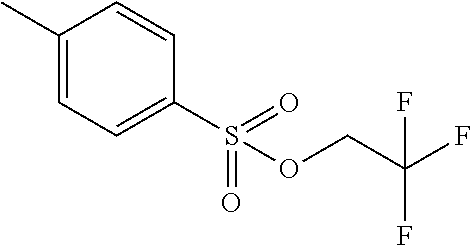
- To a solution of 4-methylbenzenesulfonyl chloride (3.4 g, 17.83 mmol) and Et3N (3.61 g, 35.66 mmol) in DCM (80 mL) was added 2,2,2-trifluoroethan-1-ol (2.32 g, 23.18 mmol) slowly, the mixture was then stirred at r.t. until TLC showed no starting material. Water was added to the reaction mixture, and extracted with DCM, collected the organic phase and washed with brine, dried with anhydrous Na2SO4, removed the solvent to give 4.2 g of the title compound (93%). 1H NMR (400 MHz, CDCl3): δ 2.47 (3H, s), 4.34 (2H, q, J=8.0 Hz), 7.38 (2H, d, J=8.0 Hz), 7.81 (2H, d, J=8.0 Hz).
-

- Charged 2,2,2-trifluoroethyl 4-methylbenzenesulfonate (1.62 g, 6.37 mmol), 5-chloro-2-(hydroxymethyl)phenol (1.01 g, 6.37 mmol, PREPARATION 7), K2CO3 (1.76 g, 12.74 mmol) and DMF (7 mL) to a flask; heated to 100° C. overnight. The reaction mixture was then poured into ice-water and extracted with EA twice, washed the organic phase with water twice, brine and dried with Na2SO4, concentrated for gel chromatograph to give the title compound (200 mg, 13%). 1H NMR (400 MHz, CDCl3): δ 4.39 (2H, q, J=8.0 Hz), 4.70 (2H, d, J=5.2 Hz), 6.83 (1H, d, J=1.6 Hz), 7.05 (1H, dd, J=1.6 Hz, 8.0 Hz), 7.33 (1H, d, J=7.6 Hz).
-

- The title compound was prepared in 81% yield from 2-(5-hydroxy-1H-pyrazol-1-yl)pyridine-4-carbonitrile and [4-chloro-2-(2,2,2-trifluoroethoxyl)phenyl]methanol according to the procedure for the preparation of Example 39, part C. 1H NMR (400 MHz, CDCl3): δ 4.43 (2H, q, J=8.0 Hz), 5.26 (2H, s), 5.79 (1H, d, J=1.6 Hz), 6.91 (1H, d, J=1.6 Hz), 7.10 (1H, dd, J=2.0 Hz, 8.4 Hz), 7.40 (1H, dd, J=1.2 Hz, 5.2 Hz), 7.44 (1H, d, J=8.0 Hz), 7.58 (1H, d, J=2.0 Hz), 8.04 (1H, s), 8.69 (1H, d, J=5.2 Hz). [M+H] Calc'd for C18H12ClF3N4O2, 409, Found, 409.
-

- The title compound was prepared from 2-[5-[[4-chloro-2-(2,2,2-trifluoroethoxyl)phenyl]methoxy]pyrazol-1-yl]pyridine-4-carbonitrile according to the procedure for the preparation of Example 28, part E. 1H NMR (400 MHz, DMSO-d6): δ 4.87 (2H, q, J=8.0 H), 5.22 (2H, s), 5.99 (1H, d, J=1.6 Hz), 7.16 (1H, dd, J=1.6 Hz, J=8.0 Hz), 7.34 (1H, d, J=1.2 Hz), 7.56-7.60 (2H, m), 7.74 (1H, dd, J=0.4 Hz, J=4.8 Hz), 8.05 (1H, s), 8.66 (1H, d, J=5.2 Hz), 13.88 (1H, s). LCMS (mobile phase: 5%-95% Acetonitrile-Water-0.1% TFA): purity is >95%, Rt=3.505 min. [M+H] Calc'd for C18H13ClF3N3O4, 428, Found, 428.
-

- Charge oxolan-2-one (9.64 g, 0.11 mmol), lithium hydroxide (4.7 g, 0.11 mmol), methanol (10 mL) and water (4 mL) to a flask. The reaction mixture was stirred at r.t. for 16 h. The solvent was removed to give the title compound (14.1 g, 100%) which was used for the next step without further purification.
-

- To a suspension of 4-hydroxybutanoyloxylithium (5.17 g, 41.03 mmol) and 1H-imidazole (4.19 g, 61.55 mmol) in DMF (20 mL) was added TBSC1 (7.42 g, 49.04 mmol) in portions at r.t. The reaction mixture was then stirred overnight. The reaction solution was poured into water and extracted with ethyl acetate three times. The organic phase separated and washed with water twice, brine and dried with anhydrous Na2SO4.It was then concentrated to give the title compound as colorless oil (8.0 g, 89%). [M+H] Calc'd for C10H21LiO3Si, 225; Found, 225.
-

- To a solution of 4-[tert-butyl(dimethyl)silyl]oxybutanoyloxylithium (8.0 g, 35.71 mmol) in ethyl acetate (10 mL), was carefully added KHSO4 (5%) to adjust pH to about 1. It was then extracted with ethyl acetate three times and organic extracts washed with brine and dried with anhydrous NaSO4. The organic extracts were concentrated to give the title compound (7.4 g, 95%). [M+H] Calc'd for C10H22O3Si, 219; Found, 219.
-

- CH2N2 (1.04 g, 248.1 mmol) in ether (10 mL) was added to 4-[tert-butyl(dimethyl)silyl]oxybutanoic acid (5.41 g, 24.81 mmol) in a flask. The mixture was stirred overnight, concentrated to give the title compound (5.44 g, 95%). 1H NMR (400 MHz, CDCl3): δ 0.03 (6H, s), 0.88 (9H, s), 1.81-184 (2H, m), 2.39 (2H, t, J=7.2 Hz), 3.63 (2H, d, J=6.4 Hz), 3.66 (3H, s). [M+H] Calc'd for C11H24O3Si, 233; Found, 233.
-

- A mixture of methyl 4-[tert-butyl(dimethyl)silyl]oxybutanoate (6.8 g, 29.31 mmol) and N,N,N′,N′-tetramethyl-1-[(2-methylpropan-2-yl)oxy]methanediamine (5.1 g, 29.31 mmol) in DMF (14 mL) in sealed tube was heated to 100° C. overnight. Added water to the mixture at 0° C. and extracted with ethyl acetate twice. The organic phase was separated and washed with water (2×) and brine and dried with anhydrous Na2SO4. The organic phase was concentrated to give the title compound (7.33 g, 91%). [M+H] Calc'd for C14H29NO3Si, 288; Found, 288.
-

- Charged methyl (2E)-4-[tert-butyl(dimethyl)silyl]oxy-2-(dimethylaminomethylidene)butanoate (7.33 g, 50%, 12.72 mmol), 2-hydrazinopyridine-4-carbonaitrile (1.70 g, 12.72 mmol), acetic acid (10 mL) and ethanol (50 mL) to a flask, the mixture was heated to 90° C. for 30 min, cooled to r.t. and basified with NaHCO3 at 0° C. to pH=8. It was then extracted with ethyl acetate twice, concentrated and purified by silica gel chromatograph (PE/EA=10/1) to give the title compound (3.3 g, 34%). 1H NMR (400 MHz, CDCl3): δ 0.04 (6H, d, J=1.6 Hz), 0.89 (9H, s), 1.96-2.17 (2H, m), 3.59 (1H, q, J=6.4 Hz), 3.69 (2H, d, J=6.0 Hz), 3.74 (3H, s), 6.91-6.92 (1H, m), 7.19 (1H, d, J=6.0 Hz), 7.38 (1H, s), 8.22 (1H, d, J=5.2 Hz), 8.33 (1H, s). [M+H] Calc'd for C18H28N4O3Si, 377; Found, 377.
-

- To a mixture of methyl (2E)-4-[tert-butyl(dimethyl)silyl]oxy-2-[[2-(4-cyanopyridin-2-yl)hydrazinyl]methylidene]butanoate (3.3 g, 8.77 mmol) in ethanol (50 mL) at 0° C. was added t-BuOK (2.95 g, 26.33 mmol). The reaction mixture was stirred overnight at r.t. It was then cooled to 0° C., diluted with ethyl acetate, and acidified with NaHSO4 (5%) to pH=3. The organic phase was separated and concentrated to a residue which was washed with PE/EA to give 300 mg of the title compound (10%). 1H NMR (400 MHz, CD3OD): δ 0.00 (6H, s), 0.85 (9H, s), 2.49 (2H, d, J=6.4 Hz), 3.74 (2H, d, J=6.4 Hz), 7.48 (1H, dd, J=1.2 Hz, 4.8 Hz), 7.60 (1H, s), 8.57 (1H, d, J=4.8 Hz), 8.61-8.63 (1H, m). [M+H] Calc'd for C17H24N4O2Si, 345; Found, 345.
-

- The title compound was prepared in 43% yield from 2-[4-[2-[tert-butyl(dimethyl)silyl]oxyethyl]-5-hydroxypyrazol-1-yl]pyridine-4-carbonitrile and (4-fluorophenyl)methanol according to the procedure for the preparation of Example 39, part C. 1H NMR (400 MHz, CDCl3): δ 0.00 (6H, s), 0.85 (9H, s), 2.50 (2H, t, J=6.4 Hz), 3.68 (2H, d, J=6.4 Hz), 5.12 (2H, s), 6.98-7.02 (2H, m), 7.30-7.34 (3H, m), 7.54 (1H, s), 7.98 (1H, s), 8.58 (1H, d, J=5.2 Hz). [M+H] Calc'd for C24H29FN4O2Si, 453; Found, 453.
-

- The title compound was prepared in 50% yield from 2-[4-[2-[tert-butyl(dimethyl)silyl]oxyethyl]-5-[(4-fluorophenyl)methoxy]pyrazol-1-yl]pyridine-4-carbonitrile (PREPARATION 8) according to the procedure for the preparation of Example 28, part E. 1H NMR (400 MHz, DMSO-d6): δ 2.47 (2H, t, J=6.4 Hz), 3.52-3.57 (2H, m), 4.73 (1H, t, J=4.8 Hz), 5.16 (2H, s), 7.17 (2H, t, J=8.8 Hz), 7.46 (2H, dd, J=6.4 Hz, 8.4 Hz), 7.61 (1H, s), 7.75 (1H, dd, J=1.6 Hz, 4.8 Hz), 8.03 (1H, s), 8.69 (1H, d, J=5.2 Hz). LCMS (mobile phase: 5%-95% Acetonitrile-Water-0.02% NH4Ac): purity is >95%, Rt=2.154 min. [M+H] Calc'd for C18H16FN3O4, 358; Found, 358.
-

- To a mixture of 2-[4-[2-[tert-butyl(dimethyl)silyl]oxyethyl]-5-[(4-fluorophenyl)methoxy]pyrazol-1-yl]pyridine-4-carbonitrile (60 mg, 0.13 mmol, PREPARATION 8) in THF (5 mL) was added 3N HCl (1 mL) at 0° C. The reaction mixture was stirred for 2 h at r.t. Cooled to 0° C., added ethyl acetate, water and acidified with NaHCO3 to pH=8, and the mixture was then extracted with ethyl acetate and concentrated to afford the title compound (40 mg, 91%). [M+H] Calc'd for C15H15FN4O2, 339; Found, 339.
-

- To a mixture of 2-[5-[(4-fluorophenyl)methoxy]-4-(2-hydroxyethyl)pyrazol-1-yl]pyridine-4-carbonitrile (40 mg, 0.12 mmol), Et3N (26 mg, 0.26 mmol) in DCM (5 mL) was added MeSO2Cl (17 mg, 0.15 mmoL) at 0° C. The reaction mixture was then stirred for 2 h at r.t. Water was added and extracted with DCM and concentrated to afford the title compound (42 mg, 87%). [M+H] Calc'd for C19H17FN4O4S, 417; Found, 417.
-

- To a solution of 2-[1-(4-cyanopyridin-2-yl)-5-[(4-fluorophenyl)methoxy]pyrazol-4-yl]ethyl methanesulfonate (42 mg, 0.1 mmol) and dimethylamine hydrochloride (41 mg, 0.5 mmol) in ACN (3 mL) was added K2CO3 (276 mg, 2 mmol) and KI (62 mg, 0.4 mmol) at rt. The reaction mixture was heated to 80° C. and stirred overnight. Filtered, solvent removed and purified byprep-HPLC to give the title compound (16 mg, 44%). 1H NMR (400 MHz, CDCl3): δ 2.45 (6H, s), 2.56-2.61 (2H, m), 2.69-2.73 (2H, m), 5.16 (2H, s), 7.03-7.07 (2H, m), 7.35-7.41 (3H, m), 7.53 (1H, s), 8.03 (1H, s), 8.64 (1H, d, J=4.8 Hz). [M+H] Calc'd for C20H20FN5O, 366; Found, 366.
-

- A mixture of 2-[4-[2-(dimethylamino)ethyl]-5-[(4-fluorophenyl)methoxy]pyrazol-1-yl]pyridine-4-carbonitrile (16 mg, 0.04 mmol) in NaOH aqueous (5M, 0.1 mL) and ethanol (2 mL) was heated to reflux for half an hour. It was then cooled in an ice-water bath, adjusted pH to 3-4, filtered, collected the solid and dried to give the title compound (11 mg, 50%). 1H NMR (400 MHz, CD3OD): δ 2.68-2.71 (2H, m), 2.81 (6H, s), 3.21-3.24 (2H, m), 5.08 (2H, s), 6.91-6.96 (2H, m), 7.24-7.27 (2H, m), 7.56 (1H, s), 7.77 (1H, d, J=4.4 Hz), 8.04 (1H, s), 8.56 (1H, br). LCMS (mobile phase: 5%-95% Acetonitrile-Water-0.02% NH4Ac): purity is >95%, Rt=2.153 min. [M+H] Calc'd for C20H21FN4O3, 385; Found, 385.
-

- Charged 5-chloro-2-(hydroxymethyl)phenol (965 mg, 6.09 mmol, PREPARATION 7), bromobutane (918 mmol, 6.70 mmol), K2CO3 (1.68 g, 12.19 mmol) and DMF (6 mL) to a sealed tube, and the mixture was heated to 100° C. overnight. After cooling to room temperature, the reaction mixture was poured into ice water, extracted with ethyl acetate twice, and the organic extract was washed with water, brine and dried with anhydrous Na2SO4. Solvent removed and the residue was purified by flash column chromatograph to give 600 mg of the title compound (46%). 1H NMR (300 MHz, CDCl3): δ 0.98 (3H, t, J=7.2 Hz), 1.46-1.56 (2H, m), 1.75-1.84 (2H, m), 2.23 (1H, t, J=6.0 Hz), 4.00 (2H, t, J=6.3 Hz), 4.64 (2H, d, J=6.3 Hz), 6.85 (1H, d, J=1.8 Hz), 6.91 (1H, dd, J=1.8 Hz, 8.1 Hz), 7.19 (1H, d, J=7.8 Hz).
-

- The title compound was prepared from 2-(5-hydroxy-1H-pyrazol-1-yl)pyridine-4-carbonitrile and (4-chloro-2-butoxyphenyl)methanol according to the procedure for the preparation of Example 39, part C. 1H NMR (400 MHz, CDCl3): δ 0.95 (3H, t, J=7.2 Hz), 1.41-1.48 (2H, m), 1.74-1.79 (2H, m), 4.01 (2H, t, J=6.4 Hz), 5.23 (2H, s), 5.77 (1H, d, J=1.6 Hz), 6.90 (1H, d, J=2.0 Hz), 6.95 (1H, dd, J=1.6 Hz, 7.6 Hz), 7.34 (1H, d, J=8.0 Hz), 7.39 (1H, dd, J=0.8 Hz, 4.8 Hz), 7.57 (1H, d, J=1.6 Hz), 8.04 (1H, s), 8.70 (1H, d, J=4.8 Hz). [M+H] Calc'd for C20H19ClN4O2, 383; Found, 383.
-

- The title compound was prepared from 2-[5-[(2-butoxy-4-chlorophenyl)methoxy]pyrazol-1-yl]pyridine-4-carbonitrile according to the procedure for the preparation of Example 28, part E. 1H NMR (400 MHz, DMSO-d6): δ 0.82 (3H, t, J=7.2 Hz), 1.27-1.36 (2H, m), 1.57-1.64 (2H, m), 4.00 (2H, t, J=6.4 Hz), 5.19 (2H, s), 5.99 (1H, d, J=2.0 Hz), 7.01 (1H, dd, J=1.6 Hz, 8.0 Hz), 7.10 (1H, d, J=1.6 Hz), 7.48 (1H, d, J=8.4 Hz), 7.59 (1H, d, J=1.6 Hz), 7.74 (1H, d, J=5.2 Hz), 8.04 (1H, s), 8.66 (1H, d, J=5.2 Hz), 13.86 (1H, s). [M+H] Calc'd for C20H20ClN3O4, 402; Found, 402.
-

- The title compound was prepared from 5-chloro-2-(hydroxymethyl)phenol (PREPARATION 7) and 1-bromo-2-methylpropane according to the procedure for the preparation of Example 111, part A. 1H NMR (400 MHz, CDCl3): δ 1.04 (6H, d, J=6.8 Hz), 2.07-2.17 (1H, m), 2.29 (1H, s), 3.75 (2H, d, J=6.4 Hz), 4.65 (2H, d, J=4.8 Hz), 6.83 (1H, d, J=2.0 Hz), 6.90 (1H, dd, J=2.0 Hz, 8.0 Hz), 7.20 (1H, d, J=8.0 Hz).
-

- The title compound was prepared from 2-(5-hydroxy-1H-pyrazol-1-yl)pyridine-4-carbonitrile and [4-chloro-2-(2-methylpropoxyl)phenyl]methanol according to the procedure for the preparation of Example 39, part C. 1H NMR (400 MHz, CDCl3): δ 1.00 (6H, d, J=6.8 Hz), 2.06-2.12 (1H, m), 3.77 (2H, d, J=6.0 Hz), 5.24 (2H, s), 5.77 (1H, d, J=2.0 Hz), 6.89 (1H, d, J=1.6 Hz), 6.95 (1H, dd, J=2.0 Hz, 8.0 Hz), 7.34 (1H, d, J=8.0 Hz), 7.39 (1H, dd, J=0.8 Hz, 4.8 Hz), 7.57 (1H, d, J=2.0 Hz), 8.03 (1H, s), 8.70 (1H, d, J=4.8 Hz). [M+H] Calc'd for C20H19ClN4O2, 383; Found, 383.
-

- The title compound was prepared from 2-[5-[[4-chloro-2-(2-methylpropoxyl)phenyl]methoxy]pyrazol-1-yl]pyridine-4-carbonitrile according to the procedure for the preparation of Example 28, part E. 1H NMR (400 MHz, DMSO-d6): δ 0.88 (6H, d, J=6.4 Hz), 1.91-1.97 (1H, m), 3.79 (2H, d, J=6.0 Hz), 5.19 (2H, s), 5.96 (1H, d, J=2.0 Hz), 7.01 (1H, dd, J=2.0 Hz, 8.4 Hz), 7.09 (1H, d, J=2.0 Hz), 7.48 (1H, d, J=8.0 Hz), 7.55 (1H, d, J=1.6 Hz), 7.68 (1H, d, J=8.4 Hz), 7.96 (1H, s), 8.52 (1H, d, J=4.4 Hz). [M+H] Calc'd for C20H20ClN3O4, 402; Found, 402.
-

- The title compound was prepared from 5-chloro-2-(hydroxymethyl)phenol (PREPARATION 7) and isopropylbromide according to the procedure for the preparation of Example 111, part A. 1H NMR (400 MHz, CDCl3): δ 1.36 (6H, d, J=6.4 Hz), 2.40 (1H, s), 4.55-4.59 (1H, m), 4.61 (2H, s), 6.86 (1H, d, J=2.0 Hz), 6.89 (1H, dd, J=1.6 Hz, 7.6 Hz), 7.18 (1H, d, J=7.6 Hz).
-

- The title compound was prepared from 2-(5-hydroxy-1H-pyrazol-1-yl)pyridine-4-carbonitrile and (4-chloro-2-propan-2-yloxyphenyl)methanol according to the procedure for the preparation of Example 39, part C. 1H NMR (400 MHz, DMSO-d6): δ 1.34 (6H, d, J=6.0 Hz), 4.56-4.62 (1H, m), 5.21 (2H, s), 5.77 (1H, d, J=1.6 Hz), 6.90 (1H, d, J=1.2 Hz), 6.93 (1H, dd, J=1.6 Hz, 8.0 Hz), 7.34 (1H, d, J=8.0 Hz), 7.39 (1H, dd, J=1.2 Hz, 5.2 Hz), 7.57 (1H, d, J=1.6 Hz), 8.04 (1H, s), 8.70 (1H, d, J=4.8 Hz). [M+H] Calc'd for C19H17ClN4O2, 369; Found, 369.
-

- The title compound was prepared from 2-[5-[(4-chloro-2-propan-2-yloxyphenyl)methoxy]pyrazol-1-yl]pyridine-4-carbonitrile according to the procedure for the preparation of Example 28, part E. 1H NMR (400 MHz, DMSO-d6): δ 1.19 (6H, d, J=6.0 Hz), 4.66-4.72 (1H, m), 5.17 (2H, s), 5.99 (1H, d, J=2.0 Hz), 6.99 (1H, dd, J=2.0 Hz, 8.0 Hz), 7.13 (1H, d, J=2.0 Hz), 7.48 (1H, d, J=8.0 Hz), 7.58 (1H, d, J=2.0 Hz), 7.74 (1H, dd, J=1.6 Hz, 5.2 Hz), 8.05 (1H, s), 8.66 (1H, d, J=4.8 Hz), 13.87 (1H, s). [M+H] Calc'd for C19H18ClN3O4, 388; Found, 388.
-

- The title compound was prepared from 5-chloro-2-(hydroxymethyl)phenol (PREPARATION 7) and 2-bromobutane according to the procedure for the preparation of Example 111, part A. 1H NMR (400 MHz, CDCl3): δ 0.98 (3H, t, J=7.6 Hz), 1.32 (3H, d, J=6.0 Hz), 1.65-1.79 (2H, m), 2.30 (1H, t, J=6.8 Hz), 4.32-4.40 (1H, m), 4.62 (2H, d, J=6.4 Hz), 6.85 (1H, d, J=1.6 Hz), 6.89 (1H, dd, J=1.6 Hz, 7.6 Hz), 7.19 (1H, d, J=8.4 Hz).
-

- The title compound was prepared from 2-(5-hydroxy-1H-pyrazol-1-yl)pyridine-4-carbonitrile and (2-butan-2-yloxy-4-chlorophenyl)methanol according to the procedure for the preparation of Example 39, part C. [M+H] Calc'd for C20H19ClN4O2, 383; Found, 383.
-

- The title compound was prepared from 2-[5-[(2-butan-2-yloxy-4-chlorophenyl)methoxy]pyrazol-1-yl]pyridine-4-carbonitrile according to the procedure for the preparation of Example 28, part E. 1H NMR (400 MHz, DMSO-d6): δ 0.82 (3H, t, J=7.6 Hz), 1.14 (3H, d, J=6.0 Hz), 1.50-1.59 (2H, m), 4.46-4.51 (1H, m), 5.15 (2H, s), 5.92 (1H, d, J=2.0 Hz), 6.98 (1H, dd, J=1.6 Hz, 8.0 Hz), 7.11 (1H, d, J=1.6 Hz), 7.47 (1H, d, J=7.6 Hz), 7.52 (1H, d, J=1.6 Hz), 7.64 (1H, d, J=4.8 Hz), 7.93 (1H, s), 8.45 (1H, d, J=4.4 Hz). [M+H] Calc'd for C20H20ClN3O4, 402; Found, 402.
-

- The title compound was prepared from 5-chloro-2-(hydroxymethyl)phenol (PREPARATION 7) and ethylbromide according to the procedure for the preparation of Example 111, part A. 1H NMR (400 MHz, CDCl3): δ 1.44 (3H, t, J=6.8 Hz), 2.24 (1H, s), 4.07 (2H, q, J=6.8 Hz), 4.64 (2H, s), 6.85 (1H, d, J=1.6 Hz), 6.91 (1H, dd, J=1.6 Hz, 7.6 Hz), 7.20 (1H, d, J=8.0 Hz).
-

- The title compound was prepared from 2-(5-hydroxy-1H-pyrazol-1-yl)pyridine-4-carbonitrile and (4-chloro-2-ethoxyphenyl)methanol according to the procedure for the preparation of Example 39, part C. 1H NMR (400 MHz, DMSO-d6): δ 1.42 (3H, t, J=6.8 Hz), 4.09 (2H, q, J=6.8 Hz), 5.23 (2H, s), 5.79 (1H, d, J=1.6 Hz), 6.90 (1H, dd, J=2.0 Hz, 8.0 Hz), 6.95 (1H, dd, J=2.0 Hz, 8.0 Hz), 7.34 (1H, d, J=8.0 Hz), 7.39 (1H, m), 7.57 (1H, d, J=2.0 Hz), 8.05 (1H, s), 8.70 (1H, d, J=5.2 Hz). [M+H] Calc'd for C18H15ClN4O2, 355; Found, 355.
-

- The title compound was prepared from 2-[5-[(4-chloro-2-ethoxyphenyl)methoxy]pyrazol-1-yl]pyridine-4-carbonitrile according to the procedure for the preparation of Example 28, part E. 1H NMR (400 MHz, DMSO-d6): δ 1.26 (3H, t, J=6.8 Hz), 4.08 (2H, q, J=6.8 Hz), 5.20 (2H, s), 6.01 (1H, d, J=2.0 Hz), 7.01 (1H, dd, J=2.0 Hz, 8.0 Hz), 7.10 (1H, d, J=2.0 Hz), 7.48 (1H, d, J=8.0 Hz), 7.59 (1H, d, J=2.0 Hz), 7.74 (1H, dd, J=1.2 Hz, 5.2 Hz), 8.05 (1H, s), 8.67 (1H, d, J=4.8 Hz), 13.87 (1H, s). [M+H] Calc'd for C18H16ClN3O4, 374; Found, 374.
-

- The title compound was prepared from 5-chloro-2-(hydroxymethyl)phenol (PREPARATION 7) and 2-methoxyethylbromide according to the procedure for the preparation of Example 111, part A. 1H NMR (400 MHz, CDCl3): δ 3.24 (3H, s), 3.73-3.75 (2H, m), 4.16-4.18 (2H, m), 4.62 (2H, s), 6.87 (1H, d, J=1.6 Hz), 6.93 (1H, dd, J=2.0 Hz, 8.0 Hz), 7.18 (1H, d, J=8.0 Hz).
-

- The title compound was prepared from 2-(5-hydroxy-1H-pyrazol-1-yl)pyridine-4-carbonitrile and (4-chloro-2-(2-methoxyethoxyl)phenyl)methanol according to the procedure for the preparation of Example 39, part C. 1H NMR (400 MHz, CDCl3): δ 3.39 (3H, s), 3.74 (2H, t, J=4.8 Hz), 4.18 (2H, t, J=4.8 Hz), 5.26 (2H, s), 5.81 (1H, s), 6.92 (1H, d, J=1.6 Hz), 6.98 (1H, dd, J=2.0 Hz, 8.0 Hz), 7.35 (1H, d, J=8.0 Hz), 7.39 (1H, d, J=5.2 Hz), 7.57 (1H, d, J=1.2 Hz), 8.06 (1H, s), 8.70 (1H, d, J=5.2 Hz). [M+H] Calc'd for C19H17ClN4O3, 385; Found, 385.
-

- The title compound was prepared from 2-[5-[[4-chloro-2-(2-methoxyethoxyl)phenyl]methoxy]pyrazol-1-yl]pyridine-4-carbonitrile according to the procedure for the preparation of Example 28, part E. 1H NMR (400 MHz, DMSO-d6): δ 3.25 (3H, s), 3.61 (2H, t, J=4.4 Hz), 4.17 (2H, t, J=4.4 Hz), 5.20 (2H, s), 6.00 (1H, d, J=2.0 Hz), 7.03 (1H, dd, J=2.0 Hz, 8.4 Hz), 7.16 (1H, d, J=1.6 Hz), 7.49 (1H, d, J=8.0 Hz), 7.59 (1H, d, J=1.6 Hz), 7.74 (1H, dd, J=1.2 Hz, 5.2 Hz), 8.06 (1H, s), 8.67 (1H, d, J=5.2 Hz), 13.85 (1H, s). [M+H] Calc'd for C19H18ClN3O5, 404; Found, 404.
-

- To a solution of 5-chloro-2-(hydroxymethyl)phenol (943 mg, 5.95 mmol) and NaOH (3.5 mL, 6.54 mmol, 2M in water) in ethanol (10 mL) was added 4-(bromomethyl)-1-fluorobenzene (1.13 g, 5.95 mmol) slowly, the mixture was then stirred at room temperature overnight. Water was added to the reaction mixture, and extracted with ethyl acetate. The organic phase was collected and washed with water, brine, and dried with anhydrous Na2SO4. The solvent was removed to give 900 mg of the title compound (57%). 1H NMR (400 MHz, CDCl3): δ 2.08 (1H, t, J=6.4 Hz), 4.67 (2H, d, J=6.4 Hz), 5.05 (2H, s), 6.93 (1H, d, J=1.2 Hz), 6.96 (1H, dd, J=1.6 Hz, 8.0 Hz), 7.07-7.11 (2H, m), 7.25 (1H, d, J=6.0 Hz), 7.37-7.40 (2H, m).
-

- The title compound was prepared from 2-(5-hydroxy-1H-pyrazol-1-yl)pyridine-4-carbonitrile and [4-chloro-2-[(4-fluorophenyl)methoxy]phenyl]methanol according to the procedure for the preparation of Example 39, part C. 1H NMR (400 MHz, CDCl3): δ 5.07 (2H, s), 5.25 (2H, s), 5.73 (1H, d, J=1.6 Hz), 6.98-7.07 (4H, m), 7.32-7.39 (4H, m), 7.55 (1H, d, J=1.6 Hz), 8.00 (1H, s), 8.67 (1H, d, J=5.2 Hz). [M+H] Calc'd for C23H16ClFN4O2, 435; Found, 435.
-

- The title compound was prepared from 2-[5-[[4-chloro-2-[(4-fluorophenyl)methoxy]phenyl]methoxy]pyrazol-1-yl]pyridine-4-carbonitrile according to the procedure for the preparation of Example 28, part E. 1H NMR (400 MHz, DMSO-d6): δ 5.17 (2H, s), 5.24 (2H, s), 5.99 (1H, s), 7.05 (1H, d, J=8.0 Hz), 7.14 (2H, t, J=8.8 Hz), 7.21 (1H, s), 7.43 (2H, dd, J=5.6 Hz, 8.0 Hz), 7.52 (1H, d, J=8.0 Hz), 7.58 (1H, s), 7.73 (1H, d, J=5.2 Hz), 8.04 (1H, s), 8.65 (1H, d, J=5.6 Hz), 13.86 (1H, s). [M+H] Calc'd for C23H17ClFN3O4, 454; Found, 454.
-

- The title compound was prepared from 5-fluoro-2-(hydroxymethyl)phenol and 4-(bromomethyl)-1-fluorobenzene according to the procedure for the preparation of Example 117, part A. 1H NMR (400 MHz, CDCl3): δ 2.07 (1H, t, J=6.8 Hz), 4.67 (2H, d, J=6.0 Hz), 5.05 (2H, s), 6.65-6.68 (2H, m), 7.07-7.11 (2H, m), 7.24-7.28 (1H, m), 7.37-7.41 (2H, m).
-

- The title compound was prepared from 2-(5-hydroxy-1H-pyrazol-1-yl)pyridine-4-carbonitrile and [4-fluoro-2-[(4-fluorophenyl)methoxy]phenyl]methanol according to the procedure for the preparation of Example 39, part C. [M+H] Calc'd for C23H16F2N4O2,419; Found, 419.
-

- The title compound was prepared from 2-[5-[[4-fluoro-2-[(4-fluorophenyl)methoxy]phenyl]methoxy]pyrazol-1-yl]pyridine-4-carbonitrile according to the procedure for the preparation of Example 28, part E. 1H NMR (400 MHz, DMSO-d6): δ 5.15 (2H, s), 5.22 (2H, s), 6.00 (1H, d, J=2.0 Hz), 6.78-6.83 (1H, m), 7.03 (1H, t, J=2.4 Hz, 11.6 Hz), 7.12 (2H, t, J=8.8 Hz), 7.42 (2H, dd, J=5.2 Hz, 8.4 Hz), 7.53 (1H, t, J=8.0 Hz), 7.57 (1H, d, J=2.0 Hz), 7.72 (1H, d, J=0.8 Hz, 4.8 Hz), 8.02 (1H, s), 8.62 (1H, d, J=5.2 Hz). [M+H] Calc'd for C23H17F2N3O4, 438; Found, 438.
-

- Charged (2-bromo-4-fluorophenyl)methanol (954 mg, 4.65 mmol), 4-fluoro-1-vinylbenzene (1.14 g, 9.31 mmol), Pd(PPh3)2Cl2 (49 mg, 0.07 mmol), Et3N (942 mg, 9.31 mmol) and DMF (5 mL) to a sealed tube, the mixture was then purged with nitrogen, heated to 150° C. for 3 h in microwave oven. The reaction mixture was filtered, the filtrate was then extracted with ethyl acetate, concentrated and purified by flash column chromatograph to give 569 mg of the title compound (50%). 1H NMR (400 MHz, CDCl3): δ 1.60 (1H, t, J=6.4 Hz), 4.78 (2H, d, J=6.4 Hz), 6.93-7.08 (4H, m), 7.31-7.35 (3H, m), 7.48-7.52 (2H, m).
-

- The title compound was prepared from 2-(5-hydroxy-1H-pyrazol-1-yl)pyridine-4-carbonitrile and [4-fluoro-2-[(E)-2-(4-fluorophenyl)ethenyl]phenyl]methanol according to the procedure for the preparation of Example 39, part C. 1H NMR (400 MHz, CDCl3): δ 5.31 (2H, s), 5.82 (1H, d, J=1.6 Hz), 6.96-7.04 (4H, m), 7.22-7.23 (1H, m), 7.34-7.41 (5H, m), 7.59 (1H, d, J=1.6 Hz), 7.90 (1H, s), 8.51 (1H, d, J=4.8 Hz). [M+H] Calc'd for C24H16F2N4O, 415; Found, 415.
-

- The title compound was prepared from 2-[5-[[4-fluoro-2-[(E)-2-(4-fluorophenyl)ethenyl]phenyl]methoxy]pyrazol-1-yl]pyridine-4-carbonitrile according to the procedure for the preparation of Example 28, part E. 1H NMR (400 MHz, DMSO-d6): δ 5.45 (2H, s), 6.13 (1H, d, J=1.6 Hz), 7.09-7.25 (4H, m), 7.38 (1H, d, J=16.0 Hz), 7.51-7.65 (6H, m), 7.98 (1H, s), 8.50 (1H, d, J=5.6 Hz), 13.83 (1H, s). [M+H] Calc'd for C24H17F2N3O3, 434; Found, 434.
-

- Added BH3 (1M in THF, 40 mL) to a solution of 2-bromo-4-chlorobenzoic acid (3.14 g, 13.33 mmol) in THF (3 mL) drop wise at 0° C. The reaction mixture was stirred at room temperature overnight. Extracted with ethyl acetate twice, and washed the organic phase with brine and dried with anhydrous Na2SO4, concentrated to give the title compound (2.5 g, 85%). 1H NMR (300 MHz, CDCl3): δ 4.72 (2H, s), 7.32 (1H, dd, J=1.8 Hz, 8.1 Hz), 7.43 (1H, d, J=8.1 Hz), 7.56 (1H, d, J=2.1 Hz).
-

- The title compound was prepared from (2-bromo-4-chlorophenyl)methanol and 4-fluoro-1-vinylbenzene according to the procedure for the preparation of Example 119, part B. 1H NMR (400 MHz, CDCl3): δ 1.72 (1H, t, J=5.6 Hz), 4.77 (2H, d, J=5.2 Hz), 6.98-7.08 (3H, m), 7.22-7.34 (3H, m), 7.47-7.50 (2H, m), 7.60 (1H, d, J=1.6 Hz).
-

- The title compound was prepared from 2-(5-hydroxy-1H-pyrazol-1-yl)pyridine-4-carbonitrile and [4-chloro-2-[(E)-2-(4-fluorophenyl)ethenyl]phenyl]methanol according to the procedure for the preparation of Example 39, part C. 1H NMR (400 MHz, CDCl3): δ 5.31 (2H, s), 5.81 (1H, d, J=2.0 Hz), 6.96-7.04 (3H, m), 7.18-7.28 (3H, m), 7.35-7.39 (3H, m), 7.59 (1H, d, J=1.6 Hz), 7.63 (1H, d, J=2.4 Hz), 7.90 (1H, s), 8.51 (1H, d, J=4.8 Hz). [M+H] Calc'd for C24H16ClFN4O, 431; Found, 431.
-

- The title compound was prepared from 2-[5-[[4-chloro-2-[(E)-2-(4-fluorophenyl)ethenyl]phenyl]methoxy]pyrazol-1-yl]pyridine-4-carbonitrile according to the procedure for the preparation of Example 28, part E. 1H NMR (400 MHz, DMSO-d6): δ 5.45 (2H, s), 6.11 (1H, d, J=2.0 Hz), 7.16-7.27 (3H, m), 7.34-7.38 (2H, m), 7.53-7.63 (5H, m), 7.80 (1H, d, J=2.0 Hz), 7.98 (1H, s), 8.48 (1H, d, J=4.8 Hz). [M+H] Calc'd for C24H17ClFN3O3, 450; Found, 450.
-

- Charged [4-fluoro-2-[(E)-2-(4-fluorophenyl)ethenyl]phenyl]methanol (568 mg, 2.31 mmol, EXAMPLE 119, part A), Pd/C (65 mg) and methanol (6 mL) to a flask, the mixture was then purged with hydrogen, stirred at room temperature overnight. It was then filtered, filtrate concentrated to give a residue which was purified by flash column chromatograph to give 214 mg of the title compound (37%). 1H NMR (400 MHz, CDCl3): δ 1.42 (1H, t, J=5.2 Hz), 2.83-2.98 (4H, m), 4.59 (2H, d, J=5.6 Hz), 6.88-6.98 (4H, m), 7.08-7.11 (2H, m), 7.29-7.33 (1H, m).
-

- The title compound was prepared from 2-(5-hydroxy-1H-pyrazol-1-yl)pyridine-4-carbonitrile and [4-fluoro-2-[2-(4-fluorophenyl)ethyl]phenyl]methanol according to the procedure for the preparation of Example 39, part C. 1H NMR (400 MHz, CDCl3): δ 2.86-2.98 (4H, m), 5.05 (2H, s), 5.73 (1H, d, J=2.0 Hz), 6.90-78.01 (6H, m), 7.33-7.39 (2H, m), 7.59 (1H, d, J=1.6 Hz), 7.95 (1H, s), 8.56 (1H, d, J=4.4 Hz). [M+H] Calc'd for C24H18F2N4O, 417; Found, 417.
-

- The title compound was prepared from 2-[5-[[4-fluoro-2-[2-(4-fluorophenyl)ethyl]phenyl]methoxy]pyrazol-1-yl]pyridine-4-carbonitrile according to the procedure for the preparation of Example 28, part E. 1H NMR (400 MHz, DMSO-d6): δ 2.80-2.93 (4H, m), 5.25 (2H, s), 6.09 (1H, d, J=1.6 Hz), 7.00-7.12 (6H, m), 7.56 (1H, dd, J=6.4 Hz, 8.4 Hz), 7.62 (1H, d, J=1.6 Hz), 7.68 (1H, dd, J=1.6 Hz, 5.2 Hz), 8.01 (1H, s), 8.55 (1H, d, J=4.8 Hz). [M+H] Calc'd for C24H19F2N3O3, 436; Found, 436.
-

- The title compound was prepared from [4-chloro-2-[(E)-2-(4-fluorophenyl)ethenyl]phenyl]methanol (EXAMPLE 120, part B) according to the procedure for the preparation of Example 121, part A. 1H NMR (400 MHz, CDCl3): δ 1.46 (1H, s), 2.84-2.94 (4H, m), 4.54 (2H, d, J=4.0 Hz), 6.84-6.98 (2H, m), 7.08-7.11 (2H, m), 7.18-7.20 (2H, m), 7.29 (1H, d, J=8.0 Hz).
-

- The title compound was prepared from 2-(5-hydroxy-1H-pyrazol-1-yl)pyridine-4-carbonitrile and [4-chloro-2-[2-(4-fluorophenyl)ethyl]phenyl]methanol according to the procedure for the preparation of Example 39, part C. 1H NMR (400 MHz, CDCl3): δ 2.86-2.95 (4H, m), 5.03 (2H, s), 5.70 (1H, d, J=2.0 Hz), 6.91-7.01 (4H, m), 7.21-7.24 (2H, m), 7.33-7.36 (2H, m), 7.58 (1H, d, J=1.6 Hz), 7.96 (1H, s), 8.57 (1H, dd, J=0.8 Hz, 5.2 Hz). [M+H] Calc'd for C24H18ClFN4O, 433; Found, 433.
-

- The title compound was prepared from 2-[5-[[4-chloro-2-[2-(4-fluorophenyl)ethyl]phenyl]methoxy]pyrazol-1-yl]pyridine-4-carbonitrile according to the procedure for the preparation of Example 28, part E. 1H NMR (400 MHz, DMSO-d6): δ 2.80-2.93 (4H, m), 5.27 (2H, s), 6.08 (1H, d, J=2.0 Hz), 7.03 (2H, t, J=9.1 Hz), 7.12 (2H, dd, J=6.0 Hz, 8.4 Hz), 7.29 (1H, dd, J=2.4 Hz, 8.4 Hz), 7.33 (1H, d, J=2.0 Hz), 7.55 (1H, d, J=8.4 Hz), 7.62 (1H, d, J=2.0 Hz), 7.69 (1H, dd, J=1.2 Hz, 5.2 Hz), 8.02 (1H, s), 8.56 (1H, d, J=5.2 Hz). [M+H] Calc'd for C24H19ClFN3O3, 452; Found, 452.
-

- Added BH3 (1M in THF, 9 mL) to a solution of 2,3-dihydro-1-benzofuran-7-carboxylic acid (481 mg, 2.93 mmol) in THF (7 mL) drop wise at 0° C., thereto, the mixture was stirred at room temperature overnight. Extracted with ethyl acetate twice, and washed the organic phase with brine and dried with anhydrous Na2SO4, concentrated to give the title compound (340 mg, 77%). 1H NMR (400 MHz, CDCl3): δ 2.09 (1H, s), 3.22 (2H, t, J=8.8 Hz), 4.61 (2H, t, J=8.8 Hz), 4.67 (2H, s), 6.83 (1H, t, J=7.6 Hz), 7.08 (1H, d, J=7.2 Hz), 7.14 (1H, d, J=7.2 Hz).
-

- The title compound was prepared from 2-(5-hydroxy-1H-pyrazol-1-yl)pyridine-4-carbonitrile and 2,3-dihydro-1-benzofuran-7-ylmethanol according to the procedure for the preparation of Example 39, part C. 1H NMR (400 MHz, CDCl3): δ 3.27 (2H, q, J=8.8 Hz), 4.68 (2H, q, J=8.8 Hz), 5.21 (2H, s), 5.83 (1H, d, J=2.0 Hz), 6.86 (1H, q, J=7.6 Hz), 7.17 (1H, d, J=7.6 Hz), 7.22 (1H, d, J=7.2 Hz), 7.37 (1H, dd, J=1.2 Hz, 4.8 Hz), 7.58 (1H, d, J=2.0 Hz), 8.14 (1H, s), 8.70 (1H, d, J=4.8 Hz). [M+H] Calc'd for C15H14N4O2, 319; Found, 319.
-

- The title compound was prepared from 2-[5-(2,3-dihydro-1-benzofuran-7-ylmethoxy)pyrazol-1-yl]pyridine-4-carbonitrile according to the procedure for the preparation of Example 28, part E. 1H NMR (400 MHz, DMSO-d6): δ 3.17 (2H, q, J=8.4 Hz), 4.55 (2H, q, J=8.4 Hz), 5.11 (2H, s), 5.93 (1H, s), 6.81 (1H, t, J=7.2 Hz), 7.18-7.20 (2H, m), 7.48 (1H, s), 7.62 (1H, d, J=4.8 Hz), 7.86 (1H, s), 8.39 (1H, d, J=5.2 Hz). [M+H] Calc'd for C18H15N3O4, 338; Found, 338.
-

- The title compound was prepared from 2-(5-hydroxy-1H-pyrazol-1-yl)pyridine-4-carbonitrile and (2,2-dimethyl-3H-1-benzofuran-7-yl)methanol according to the procedure for the preparation of Example 39, part C. 1H NMR (400 MHz, CDCl3): δ 1.48 (6H, s), 3.03 (2H, s), 5.21 (2H, s), 5.83 (1H, d, J=2.0 Hz), 6.83 (1H, q, J=8.0 Hz), 7.13 (1H, d, J=7.2 Hz), 7.18 (1H, d, J=8.0 Hz), 7.37 (1H, dd, J=0.8 Hz, 4.8 Hz), 7.56 (1H, d, J=1.6 Hz), 8.07 (1H, s), 8.70 (1H, d, J=4.8 Hz). [M+H] Calc'd for C20H18N4O2, 347; Found, 347.
-

- The title compound was prepared from 2-[5-[(2,2-dimethyl-3H-1-benzofuran-7-yl)methoxy]pyrazol-1-yl]pyridine-4-carbonitrile according to the procedure for the preparation of Example 28, part E. 1H NMR (400 MHz, DMSO-d6): δ 1.38 (6H, s), 3.00 (2H, s), 5.14 (2H, s), 6.00 (1H, d, J=2.0 Hz), 6.70-6.81 (1H, m), 7.15-7.22 (2H, m), 7.56 (1H, d, J=2.0 Hz), 7.74 (1H, dd, J=1.2 Hz, 5.2 Hz), 8.05 (1H, s), 8.66 (1H, d, J=5.2 Hz). [M+H] Calc'd for C20H19N3O4, 366; Found, 366.
-

- Charge methyl 4-cyano-2-methylbenzoate (627 mg, 3.57 mmol), THF (12 mL) and ethanol (12 mL) to a flask, followed by CaCl2 (418 mg, 3.57 mmol) and NaBH4 (265 mg, 7.16 mmol). The mixture was then stirred at room temperature overnight. Water was added, and the mixture was extracted with ethyl acetate. The organic extract was concentrated and purified by flash column chromatograph to give 325 mg of the title compound (62%). 1H NMR (300 MHz, CDCl3): δ 1.83 (1H, t, J=5.4 Hz), 2.33 (3H, s), 4.75 (2H, d, J=5.4 Hz), 7.43 (1H, s), 7.52-7.56 (2H, m).
-

- To a mixture of methyl 2-(5-hydroxypyrazol-1-yl)pyridine-4-carboxylate (PREPARATION 6, 112 mg, 0.51 mmol), 4-(hydroxymethyl)-3-methylbenzonitrile (83 mg, 0.56 mmol), PPh3 (268 mg, 1.02 mmol) and THF (6 mL) cooled in ice-water bath, DIAD (207 mg, 1.02 mmol) was added. The mixture was stirred overnight at room temperature. It was then concentrated and purified by flash column chromatograph to give 112 mg of the title compound (63%). [M+H] Calc'd for C19H16N4O3, 349; Found, 349.
-

- Charged methyl 2-[5-[(4-cyano-2-methylphenyl)methoxy]pyrazol-1-yl]pyridine-4-carboxylate (112 mg, 0.32 mmol), LiOH.H2O (14 mg, 0.32 mmol), water (2 mL) and THF (2 mL) to a flask, then the mixture was stirred at room temperature for 30 min, added another 2 mL water, and the mixture was washed with ethyl acetate twice (6 mL×2). The aqueous phase was acidified with 1N HCl (pH=3), filtered and dried the solid to give the title compound. 1H NMR (300 MHz, DMSO-d6): δ 2.37 (3H, s), 5.37 (2H, s), 6.10 (1H, d, J=1.8 Hz), 7.62 (1H, d, J=1.5 Hz), 7.70-7.77 (4H, m), 8.08 (1H, s), 8.68 (1H, d, J=5.4 Hz). [M+H] Calc'd for C18H14N4O3, 335; Found, 335.
-

- To a yellow solution of 2,2,6,6-TMPH (8.30 g, 58.88 mmol) in THF (9 mL) was added n-BuLi (25 mL) slowly at −78° C. under protection of nitrogen. Thereto, the mixture was warmed up to room temperature, stirred at this temperature for an hour, and then cooled to −78° C. again. A solution of 4-bromo-2-methylbenzoic acid (6.0 g, 28.04 mmol) in THF (60 mL) was added slowly, kept stirring at this temperature for an hour, added MeI (7.96 g, 56.07 mmol) solution (in 35 mL THF), the mixture above was then stirred overnight at room temperature. LCMS showed the reaction was completed. Water was added, the mixture was then washed with ethyl acetate. The aqueous phase was acidified to pH=1, extracted with ethyl acetate twice, and concentrated the organic phase to a residue which was trituated with PE/EA=1/1 to give 4.28 g of the title compound (67%).
-

- Charged compound 4-bromo-2-ethylbenzoic acid (2.05 g, 9.58 mmol) and methanol (20 mL) to a flask, SOCl2 (3.42 g, 28.74 mmol) was added slowly at 0° C. The reaction mixture was heated to 70° C. for three hour. Solvent was removed and the residue was dissolved in CH2Cl2, filtered, the filtrate was concentrated to a residue which was purified by flash column chromatograph to give 1.9 g of the title compound (87%).
-

- Charged methyl 4-bromo-2-ethylbenzoate (1.9 g, 7.85 mmol), Zn(CN)2 (1.48 g, 12.56 mmol), Pd (PPh3)4 (1.0 g, 0.94 mmol) and DMF (30 mL) to a flask, the system was then purged with nitrogen and heated at 100° C. for 6 h. The reaction mixture was then filtered. The filtrate was extracted with ethyl acetate and concentrated the organic phase for flash column chromatograph to give 0.6 g of the title compound (40%). 1H NMR (400 MHz, CDCl3): δ 1.24 (3H, t, J=7.6 Hz), 2.99 (2H, q, J=7.6 Hz), 3.92 (3H, s), 7.52-7.54 (1H, m), 7.57 (1H, s), 7.90 (1H, d, J=8.0 Hz).
-

- The title compound was prepared from methyl 4-cyano-2-ethylbenzoate according to the procedure for the preparation of Example 125, part A. 1H NMR (300 MHz, CDCl3): δ 1.23 (3H, t, J=5.7 Hz), 1.63 (1H, s), 2.67 (2H, q, J=5.7 Hz), 4.68 (2H, s), 7.16-7.19 (2H, m), 7.30 (1H, d, J=6.0 Hz)
-
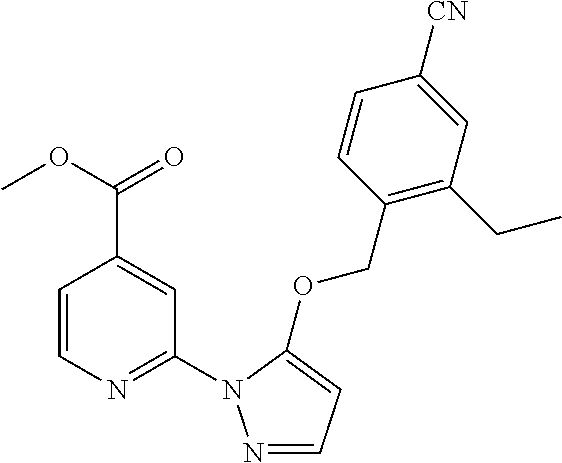
- The title compound was prepared from methyl 2-(5-hydroxypyrazol-1-yl)pyridine-4-carboxylate (PREPARATION 6) and 3-ethyl-4-(hydroxymethyl)benzonitrile according to the procedure for the preparation of Example 125, part B. 1H NMR (400 MHz, CDCl3): δ 1.26 (3H, t, J=7.6 Hz), 2.73 (2H, q, J=7.6 Hz), 3.96 (3H, s), 5.28 (2H, s), 5.77 (1H, d, J=1.2 Hz), 7.53-7.67 (4H, m), 7.77 (1H, d, J=4.8 Hz), 8.31 (1H, s), 8.67 (1H, d, J=4.8 Hz). [M+H] Calc'd for C20H18N4O3, 363; Found, 363.
-

- The title compound was prepared from methyl 2-[5-[(4-cyano-2-ethylphenyl)methoxy]pyrazol-1-yl]pyridine-4-carboxylate according to the procedure for the preparation of Example 125, part C. 1H NMR (400 MHz, DMSO-d6): δ 1.16 (3H, t, J=7.6 Hz), 2.73 (2H, q, J=7.6 Hz), 5.39 (2H, s), 6.10 (1H, s), 7.62 (1H, s), 7.69-7.76 (4H, m), 8.08 (1H, s), 8.67 (1H, d, J=5.2 Hz). [M+H] Calc'd for C19H16N4O3, 349; Found, 349.
-
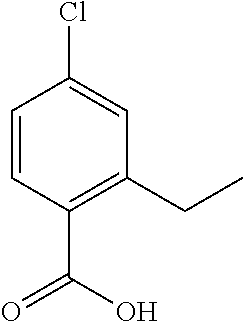
- To a yellow solution of 2,2,6,6-TMPH (5.45 g, 38.69 mmol) in THF (6 mL) was added n-BuLi (16 mL) slowly at −78° C. under protection of nitrogen, thereto, the mixture was warmed up to room temperature, stirred at this temperature for an hour, and then cooled to −78° C. again, a solution of 4-chloro-2-methylbenzoic acid (3.0 g, 17.58 mmol) in THF (30 mL) was added slowly, kept stirring at this temperature for an hour, added MeI (5.49 g, 38.69 mmol) solution (in 20 mL THF), the mixture above was then stirred overnight at room temperature. LCMS showed the completion of the reaction, added water, the mixture was then washed with ethyl acetate, the aqueous phase was acidified to pH=1, extracted with ethyl acetate twice, and concentrated the organic phase, washed the residue with PE/EA=1/1 to give 1.5 g of the title compound (46%).
-

- The title compound was prepared from 4-chloro-2-ethylbenzoic acid according to the procedure for the preparation of Example 123, part A. 1H NMR (300 MHz, CDCl3): δ 1.23 (3H, t, J=5.7 Hz), 1.63 (1H, s), 2.67 (2H, q, J=5.7 Hz), 4.68 (2H, s), 7.16-7.19 (2H, m), 7.30 (1H, d, J=6.0 Hz).
-

- The title compound was prepared from 2-(5-hydroxy-1H-pyrazol-1-yl)pyridine-4-carbonitrile and (4-chloro-2-ethylphenyl)methanol according to the procedure for the preparation of Example 39, part C. 1H NMR (400 MHz, CDCl3): δ 1.23 (3H, t, J=7.6 Hz), 2.70 (2H, q, J=7.6 Hz), 5.20 (2H, s), 5.78 (1H, d, J=2.0 Hz), 7.20 (1H, dd, J=2.4 Hz, 8.4 Hz), 7.25 (1H, d, J=1.6 Hz), 7.36 (1H, d, J=8.4 Hz), 7.39 (1H, dd, J=1.6 Hz, 5.2 Hz), 7.59 (1H, d, J=2.0 Hz), 7.99 (1H, s), 8.67 (1H, d, J=4.8 Hz). [M+H] Calc'd for C18H15ClN4O, 339; Found, 339.
-

- The title compound was prepared from 2-[5-[(4-chloro-2-ethylphenyl)methoxy]pyrazol-1-yl]pyridine-4-carbonitrile according to the procedure for the preparation of Example 28, part E. 1H NMR (400 MHz, DMSO-d6): δ 1.12 (3H, t, J=7.6 Hz), 2.69 (2H, q, J=7.6 Hz), 5.28 (2H, s), 6.10 (1H, d, J=2.0 Hz), 6.27 (1H, dd, J=2.4 Hz, 8.4 Hz), 7.31 (1H, d, J=2.0 Hz), 7.53 (1H, d, J=8.0 Hz), 7.61 (1H, d, J=2.0 Hz), 7.74 (1H, dd, J=1.2 Hz, 4.8 Hz), 8.05 (1H, s), 8.64 (1H, d, J=4.8 Hz). [M+H] Calc'd for C18H16ClN3O3, 358; Found, 358.
-

- The title compound was prepared from 4-fluoro-2-methylbenzoic acid according to the procedure for the preparation of Example 123, part A.
-

- The title compound was prepared from 2-(5-hydroxy-1H-pyrazol-1-yl)pyridine-4-carbonitrile and (4-fluoro-2-methylphenyl)methanol according to the procedure for the preparation of Example 39, part C. 1H NMR (400 MHz, CDCl3): δ 2.38 (3H, s), 5.17 (2H, s), 5.78 (1H, d, J=1.6 Hz), 6.89-6.95 (2H, m), 7.34-7.39 (2H, m), 7.58 (1H, d, J=2.4 Hz), 7.98 (1H, s), 8.67 (1H, d, J=5.2 Hz). [M+H] Calc'd for C17H13FN4O, 309, Found, 309.
-
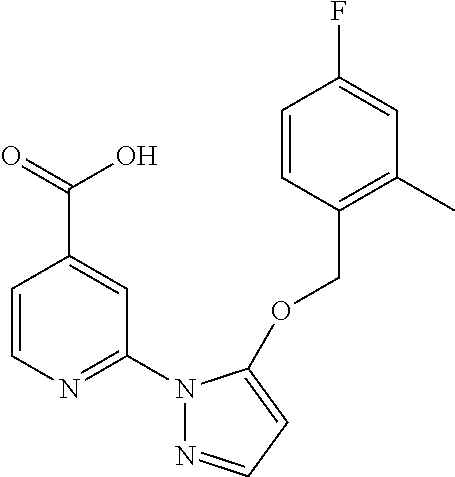
- The title compound was prepared from 2-[5-[(4-fluoro-2-methylphenyl)methoxy]pyrazol-1-yl]pyridine-4-carbonitrile according to the procedure for the preparation of Example 28, part E. 1H NMR (400 MHz, DMSO-d6): δ 2.35 (3H, s), 5.26 (2H, s), 6.10 (1H, d, J=1.2 Hz), 7.00-7.10 (2H, m), 7.51-7.54 (1H, m), 7.61 (1H, d, J=1.2 Hz), 7.74 (1H, d, J=4.4 Hz), 8.04 (1H, s), 8.65 (1H, d, J=5.2 Hz). [M+H] Calc'd for C17H14FN3O3, 328; Found, 328.
-

- The title compound was prepared from 4-fluoro-2-methylbenzoic acid according to the procedure for the preparation of Example 126, part A. 1H NMR (300 MHz, DMSO-d6): δ 1.15 (3H, t, J=7.5 Hz), 2.94 (2H, q, J=7.5 Hz), 7.07-7.20 (2H, m), 7.86 (1H, dd, J=6.3 Hz, 8.7 Hz), 12.91 (1H, s).
-

- The title compound was prepared from 2-ethyl-4-fluorobenzoic acid according to the procedure for the preparation of Example 123, part A. 1H NMR (300 MHz, CDCl3): δ 1.24 (3H, t, J=7.5 Hz), 2.71 (2H, q, J=7.5 Hz), 4.67 (2H, s), 6.84-6.95 (2H, m), 7.31 (1H, dd, J=6.3 Hz, 8.4 Hz).
-

- The title compound was prepared from 2-(5-hydroxy-1H-pyrazol-1-yl)pyridine-4-carbonitrile and (2-ethyl-4-fluorophenyl)methanol according to the procedure for the preparation of Example 39, part C. 1H NMR (400 MHz, CDCl3): δ 1.23 (3H, t, J=7.6 Hz), 2.72 (2H, q, J=7.6 Hz), 5.20 (2H, s), 5.79 (1H, d, J=2.0 Hz), 6.89-7.00 (2H, m), 7.36-7.40 (2H, m), 7.59 (1H, d, J=2.0 Hz), 7.98 (1H, s), 8.67 (1H, d, J=5.2 Hz). [M+H] Calc'd for C18H18FN4O, 323; Found, 323.
-

- The title compound was prepared from 2-[5-[(2-ethyl-4-fluorophenyl)methoxy]pyrazol-1-yl]pyridine-4-carbonitrile according to the procedure for the preparation of Example 28, part E. 1H NMR (400 MHz, DMSO-d6): δ 1.12 (3H, t, J=7.6 Hz), 2.70 (2H, q, J=7.6 Hz), 5.26 (2H, s), 6.10 (1H, d, J=2.0 Hz), 7.00-7.11 (2H, m), 7.54 (1H, dd, J=6.4 Hz, 8.4 Hz), 7.61 (1H, d, J=2.0 Hz), 7.73-7.74 (1H, m), 8.03 (1H, s), 8.63 (1H, d, J=4.8 Hz). [M+H] Calc'd for C18H16FN3O3, 342; Found, 342.
-

- The title compound was prepared from 2-chloro-4-methylbenzoic acid according to the procedure for the preparation of Example 123, part A. 1H NMR (400 MHz, CDCl3): δ 1.90 (1H, s), 2.33 (3H, s), 4.74 (2H, s), 7.07 (1H, d, J=7.6 Hz), 7.19 (1H, s), 7.33 (1H, d, J=7.6 Hz).
-

- The title compound was prepared from 2-(5-hydroxy-1H-pyrazol-1-yl)pyridine-4-carbonitrile and (2-chloro-4-methylphenyl)methanol according to the procedure for the preparation of Example 39, part C. 1H NMR (400 MHz, CDCl3): δ 2.35 (3H, s), 5.30 (2H, s), 5.80 (1H, d, J=1.6 Hz), 7.10 (1H, d, J=8.4 Hz), 7.25 (1H, d, J=3.2 Hz), 7.40 (2H, dd, J=1.2 Hz, 5.2 Hz), 7.58 (1H, d, J=2.4 Hz), 8.06 (1H, s), 8.71 (1H, d, J=5.2 Hz). [M+H] Calc'd for C17H13ClN4O, 325; Found, 325.
-

- The title compound was prepared from 2-[5-[(2-chloro-4-methylphenyl)methoxy]pyrazol-1-yl]pyridine-4-carbonitrile according to the procedure for the preparation of Example 28, part E. 1H NMR (400 MHz, DMSO-d6): δ 2.31 (3H, s), 5.28 (2H, s), 6.05 (1H, d, J=2.0 Hz), 7.19 (1H, d, J=7.6 Hz), 7.33 (1H, s), 7.55 (1H, d, J=7.6 Hz), 7.60 (1H, d, J=2.0 Hz), 7.75 (1H, dd, J=1.6 Hz, 5.2 Hz), 8.07 (1H, s), 8.67 (1H, d, J=4.8 Hz). [M+H] Calc'd for C17H14ClN3O3, 344; Found, 344.
-

- The title compound was prepared from 2-fluoro-4-methylbenzoic acid according to the procedure for the preparation of Example 123, part A. 1H NMR (300 MHz, CDCl3): δ 1.71 (1H, t, J=6.0 Hz), 2.34 (3H, s), 4.71 (2H, d, J=6.0 Hz), 6.85-6.96 (2H, m), 7.24-7.30 (1H, m).
-

- The title compound was prepared from 2-(5-hydroxy-1H-pyrazol-1-yl)pyridine-4-carbonitrile and (2-fluoro-4-methylphenyl)methanol according to the procedure for the preparation of Example 39, part C. 1H NMR (400 MHz, CDCl3): δ 2.36 (3H, s), 5.26 (2H, s), 5.80 (1H, d, J=2.0 Hz), 6.93 (1H, d, J=11.2 Hz), 6.98 (1H, d, J=8.0 Hz), 7.31-7.35 (1H, m), 7.38 (1H, dd, J=1.2 Hz, 4.8 Hz), 7.57 (1H, d, J=1.6 Hz), 8.01 (1H, s), 8.69 (1H, d, J=4.8 Hz). [M+H] Calc'd for C17H13FN4O, 309; Found, 309.
-

- The title compound was prepared from 2-[5-[(2-fluoro-4-methylphenyl)methoxy]pyrazol-1-yl]pyridine-4-carbonitrile according to the procedure for the preparation of Example 28, part E. 1H NMR (400 MHz, DMSO-d6): δ 2.31 (3H, s), 5.26 (2H, s), 6.05 (1H, d, J=2.0 Hz), 7.02-7.07 (2H, m), 7.47 (1H, t, J=7.6 Hz), 7.60 (1H, d, J=1.6 Hz), 7.74 (1H, dd, J=1.2 Hz, 5.2 Hz), 8.04 (1H, s), 8.65 (1H, d, J=5.2 Hz). [M+H] Calc'd for C17H14FN3O3, 328; Found, 328.
-

- The title compound was prepared from 2-(5-hydroxy-1H-pyrazol-1-yl)pyridine-4-carbonitrile and (2,4-dimethylphenyl)methanol according to the procedure for the preparation of Example 39, part C. [M+H] Calc'd for C18H16N4O, 305; Found, 305.
-

- The title compound was prepared from 2-[5-[(2,4-dimethylphenyl)methoxy]pyrazol-1-yl]pyridine-4-carbonitrile according to the procedure for the preparation of Example 28, part E. 1H NMR (400 MHz, DMSO-d6): δ 2.25 (3H, s), 2.29 (3H, s), 5.21 (2H, s), 6.06 (1H, d, J=2.0 Hz), 6.99 (1H, d, J=8.0 Hz), 7.02 (1H, s), 7.33 (1H, d, J=7.2 Hz), 7.59 (1H, d, J=1.6 Hz), 7.73-7.74 (1H, m), 8.03 (1H, s), 8.65 (1H, d, J=4.8 Hz), 13.83 (1H, s). [M+H] Calc'd for C18H17N3O3, 324; Found, 324.
-

- The title compound was prepared from 2-methoxy-4-methylbenzoic acid according to the procedure for the preparation of Example 123, part A. 1H NMR (300 MHz, CDCl3): δ 2.35 (3H, s), 3.85 (3H, s), 4.64 (2H, s), 6.70 (1H, s), 6.74 (1H, d, J=5.7 Hz), 7.13 (1H, d, J=5.7 Hz).
-

- The title compound was prepared from 2-(5-hydroxy-1H-pyrazol-1-yl)pyridine-4-carbonitrile and (2-methoxy-4-methylphenyl)methanol according to the procedure for the preparation of Example 39, part C. 1H NMR (400 MHz, CDCl3): δ 3.37 (3H, s), 3.89 (3H, s), 5.23 (2H, s), 5.80 (1H, d, J=2.0 Hz), 6.76-6.79 (2H, m), 7.24-7.26 (1H, m), 7.37 (1H, dd, J=1.2 Hz, 4.8 Hz), 7.58 (1H, d, J=1.6 Hz), 8.08 (1H, s), 8.70 (1H, d, J=4.4 Hz). [M+H] Calc'd for C18H16N4O2, 321, Found, 321.
-

- The title compound was prepared from 2-[5-[(2-methoxy-4-methylphenyl)methoxy]pyrazol-1-yl]pyridine-4-carbonitrile according to the procedure for the preparation of Example 28, part E. 1H NMR (400 MHz, DMSO-d6): δ 2.30 (3H, s), 3.78 (3H, s), 5.17 (2H, s), 5.99 (1H, d, J=1.6 Hz), 6.76 (1H, d, J=7.6 Hz), 6.86 (1H, s), 7.32 (1H, d, J=7.6 Hz), 7.58 (1H, d, J=1.6 Hz), 7.74 (1H, dd, J=0.8 Hz, 4.8 Hz), 8.06 (1H, s), 8.66 (1H, d, J=4.8 Hz). [M+H] Calc'd for C18H17N3O4, 340; Found, 340.
-

- The title compound was prepared from methyl 2-bromo-4-methylbenzoate according to the procedure for the preparation of Example 126, part C. 1H NMR (400 MHz, CDCl3): δ 2.45 (3H, s), 3.98 (3H, s), 7.46 (1H, d, J=6.0 Hz), 7.60 (1H, s), 8.03 (1H, d, J=6.0 Hz).
-

- The title compound was prepared from methyl 2-cyano-4-methylbenzoate according to the procedure for the preparation of Example 125, part A. 1H NMR (300 MHz, CDCl3): δ 2.44 (3H, s), 5.26 (2H, s), 7.27 (1H, d, J=7.5 Hz), 7.37 (1H, d, J=8.1 Hz), 7.67 (1H, s).
-

- The title compound was prepared from methyl 2-(5-hydroxypyrazol-1-yl)pyridine-4-carboxylate (PREPARATION 6) and 2-(hydroxymethyl)-5-methylbenzonitrile according to the procedure for the preparation of Example 125, part B. 1H NMR (400 MHz, CDCl3): δ 3.40 (3H, s), 3.97 (3H, s), 5.40 (2H, s), 5.83 (1H, d, J=1.2 Hz), 7.43 (1H, d, J=8.8 Hz), 7.50 (1H, s), 7.58-7.62 (2H, m), 7.76 (1H, d, J=5.2 Hz), 8.33 (1H, s), 8.68 (1H, d, J=5.2 Hz). [M+H] Calc'd for C19H16N4O3, 349, Found, 349.
-

- The title compound was prepared from methyl 2-[5-[(2-cyano-4-methylphenyl)methoxy]pyrazol-1-yl]pyridine-4-carboxylate according to the procedure for the preparation of Example 125, part C. 1H NMR (400 MHz, DMSO-d6): δ 2.35 (3H, s), 5.38 (2H, s), 6.08 (1H, d, J=1.2 Hz), 7.55 (1H, d, J=8.4 Hz), 6.62 (1H, d, J=1.6 Hz), 7.66 (1H, d, J=7.6 Hz), 7.71 (1H, s), 7.74 (1H, d, J=5.2 Hz), 8.04 (1H, s), 8.65 (1H, d, J=5.2 Hz). [M+H] Calc'd for C15H14N4O3, 335, Found, 335.
-

- A mixture of methyl 2-bromo-4-methylbenzoate (1.06 g, 4.63 mmol), vinyltrifluoroborate potassium salt (621 mg, 4.63 mmol), Pd(dppf)Cl2 (203 mg, 0.28 mmol) and TEA (1.40 g, 13.89 mmol) in n-PrOH (11 mL) was purged with nitrogen, and heated to 100° C. for 2 h. It was then cooled to room temperature and filtered, the filtrate was extracted with ethyl acetate twice. Organic extract was concentrated and purified by flash column chromatograph to give 500 mg of the title compound (60%). 1H NMR (400 MHz, CDCl3): δ 2.40 (3H, s), 3.88 (3H, s), 5.33 (1H, dd, J=1.2 Hz, 10.8 Hz), 5.62 (1H, dd, J=1.2 Hz, 17.6 Hz), 7.12 (1H, d, J=8.0 Hz), 7.37 (1H, s), 7.48 (1H, dd, J=10.8 Hz, 17.6 Hz), 7.80 (1H, d, J=8.0 Hz).
-

- Charged compound methyl 2-ethenyl-4-methylbenzoate (773 mg, 4.42 mmol), Pd/C (100 mg) and methanol (14 mL) to a flask, the mixture was then purged with H2, and stirred at room temperature overnight. It was then filtered, filtrated concentrated to give the title compound (646 mg, 83%). 1H NMR (300 MHz, CDCl3): δ 1.22 (3H, t, J=7.5 Hz), 2.36 (3H, s), 2.95 (2H, q, J=7.5 Hz), 3.87 (3H, s), 7.04 (1H, d, J=8.1 Hz), 7.07 (1H, s), 7.78 (1H, d, J=8.1 Hz).
-

- To a solution of compound methyl 2-ethyl-4-methylbenzoate (646 mg, 3.65 mmol) in THF (6 mL) cooled to −50° C., was added LiAlH4 (277 mg, 7.30 mmol) in portions. The mixture was stirred at this temperature for 1 h. Added water (0.3 mL) slowly, followed by NaOH (aq, 10%, 0.3 mL) and water (0.9 mL), the resulting mixture was filtered and washed with THF, concentrated the filtrate to give 518 mg of the title compound (95%). 1H NMR (400 MHz, CDCl3): δ 1.23 (3H, t, J=7.2 Hz), 1.54 (1H, s), 2.33 (3H, s), 2.68 (2H, q, J=7.6 Hz), 4.67 (2H, s), 7.01 (1H, d, J=8.0 Hz), 7.03 (1H, s), 7.23 (1H, d, J=7.6 Hz).
-

- The title compound was prepared from 2-(5-hydroxy-1H-pyrazol-1-yl)pyridine-4-carbonitrile and (2-ethyl-4-methylphenyl)methanol according to the procedure for the preparation of Example 39, part C. 1H NMR (400 MHz, CDCl3): δ 1.20 (3H, t, J=7.6 Hz), 2.35 (3H, s), 2.68 (2H, q, J=7.6 Hz), 5.21 (2H, s), 5.79 (1H, d, J=1.6 Hz), 7.03 (1H, d, J=7.6 Hz), 7.07 (1H, s), 7.27 (1H, d, J=8.4 Hz), 7.36 (1H, dd, J=1.2 Hz, 4.8 Hz), 7.58 (1H, d, J=1.6 Hz), 7.96-7.97 (1H, s), 8.66 (1H, dd, J=0.8 Hz, 5.2 Hz). [M+H] Calc'd for C19H18N4O, 319; Found, 319.
-

- The title compound was prepared from 2-[5-[(2-ethyl-4-methylphenyl)methoxy]pyrazol-1-yl]pyridine-4-carbonitrile according to the procedure for the preparation of Example 28, part E. 1H NMR (400 MHz, DMSO-d6): δ 1.10 (3H, t, J=7.6 Hz), 2.27 (3H, s), 2.64 (2H, q, J=7.6 Hz), 5.22 (2H, s), 6.07 (1H, d, J=2.0 Hz), 7.00 (1H, d, J=7.6 Hz), 7.05 (1H, s), 7.34 (1H, d, J=7.6 Hz), 7.59 (1H, d, J=2.0 Hz), 7.72 (1H, dd, J=1.6 Hz, 5.2 Hz), 8.02 (1H, s), 8.62 (1H, d, J=5.2 Hz). [M+H] Calc'd for C19H19N3O3, 338; Found, 338.
-

- Charged 5-chloro-2-(hydroxymethyl)phenol (787 mg, 4.96 mmol), (bromoethyl)benzene (1.01 g, 5.46 mmol), K2CO3 (1.37 g, 9.93 mmol) and DMF (8 mL) to a flask, heated to 100° C. overnight. Poured into ice water, and extracted with ethyl acetate twice, and washed the organic phase with water twice, brine and dried with anhydrous Na2SO4. Solvent was then removed and purified by flash column chromatograph to give 1.0 g of the title compound (77%).
-

- The title compound was prepared from 2-(5-hydroxy-1H-pyrazol-1-yl)pyridine-4-carbonitrile and [4-chloro-2-(1-phenylethoxyl)phenyl]methanol according to the procedure for the preparation of Example 39, part C. [M+H] Calc'd for C24H19ClN4O2, 431; Found, 431.
-

- The title compound was prepared from 2-[5-[[4-chloro-2-(1-phenylethoxyl)phenyl]methoxy]pyrazol-1-yl]pyridine-4-carbonitrile according to the procedure for the preparation of Example 28, part E. 1H NMR (300 MHz, DMSO-d6): δ 1.45 (3H, d, J=6.6 Hz), 5.25-5.33 (2H, m), 5.57-5.63 (1H, m), 6.05 (1H, d, J=1.8 Hz), 6.93-6.95 (2H, m), 7.21-7.35 (5H, m), 7.48 (1H, d, J=8.1 Hz), 7.61 (1H, d, J=1.2 Hz), 7.74-7.56 (1H, m), 8.08 (1H, s), 8.43 (1H, d, J=1.8 Hz). [M+H] Calc'd for C24H20ClN3O4, 450; Found, 450.
-

- The title compound was prepared from 5-fluoro-2-(hydroxymethyl)phenol and (bromoethyl)benzene according to the procedure for the preparation of Example 136, part A.
-

- The title compound was prepared from 2-(5-hydroxy-1H-pyrazol-1-yl)pyridine-4-carbonitrile and [4-fluoro-2-(1-phenylethoxyl)phenyl]methanol according to the procedure for the preparation of Example 39, part C. [M+H] Calc'd for C24H19FN4O2, 415; Found, 415.
-

- The title compound was prepared from 2-[5-[[4-fluoro-2-(1-phenylethoxyl)phenyl]methoxy]pyrazol-1-yl]pyridine-4-carbonitrile according to the procedure for the preparation of Example 28, part E. 1H NMR (300 MHz, DMSO-d6): δ 1.45 (3H, d, J=6.6 Hz), 5.24-5.32 (2H, m), 5.53-5.60 (1H, m), 6.07 (1H, d, J=2.1 Hz), 6.67-6.78 (2H, m), 7.21-7.34 (5H, m), 7.50 (1H, t, J=7.8 Hz), 7.60-7.62 (1H, m), 7.74-7.75 (1H, m), 8.07 (1H, s), 8.67 (1H, d, J=5.1 Hz). [M+H] Calc'd for C24H20FN3O4, 434; Found, 434.
-

- The title compound was prepared from 4-chloro-3-hydroxybenzoic acid according to the procedure for the preparation of Example 123, part A. 1H NMR (300 MHz, CDCl3): δ 4.39 (2H, d, J=5.7 Hz), 5.18 (1H, t, J=5.7 Hz), 6.70-6.73 (1H, m), 6.94 (1H, s), 7.23 (1H, d, J=7.8 Hz), 10.03 (1H, s).
-

- The title compound was prepared from 2-chloro-5-(hydroxymethyl)phenol and 4-(bromomethyl)-1-fluorobenzene according to the procedure for the preparation of Example 117, part A. 1H NMR (400 MHz, CDCl3): δ 1.71 (1H, t, J=6.0 Hz), 4.65 (2H, d, J=6.4 Hz), 5.12 (2H, s), 6.88-6.90 (1H, m), 7.02 (1H, d, J=2.0 Hz), 7.05-7.10 (2H, m), 7.35 (1H, d, J=8.0 Hz), 7.43-7.46 (2H, m).
-

- The title compound was prepared from 2-(5-hydroxy-1H-pyrazol-1-yl)pyridine-4-carbonitrile and [4-chloro-3-[(4-fluorophenyl)methoxy]phenyl]methanol according to the procedure for the preparation of Example 39, part C. 1H NMR (400 MHz, CDCl3): δ 5.10 (2H, s), 5.18 (2H, s), 5.68 (1H, d, J=1.6 Hz), 6.97 (1H, dd, J=1.2 Hz, 8.0 Hz), 7.03-7.07 (3H, m), 7.39-7.43 (4H, m), 7.55 (1H, d, J=1.6 Hz), 8.04 (1H, s), 8.67 (1H, d, J=5.2 Hz). [M+H] Calc'd for C23H16ClFN4O2, 435; Found, 435.
-

- The title compound was prepared from 2-[5-[[4-chloro-3-[(4-fluorophenyl)methoxy]phenyl]methoxy]pyrazol-1-yl]pyridine-4-carbonitrile according to the procedure for the preparation of Example 28, part E. 1H NMR (400 MHz, DMSO-d6): δ 5.18 (2H, s), 5.24 (2H, s), 5.92 (1H, s), 7.04-7.07 (1H, m), 7.19-7.23 (2H, m), 7.39 (1H, s), 7.44 (1H, d, J=8.4 Hz), 7.51-7.54 (3H, m), 7.65 (1H, d, J=6.4 Hz), 7.96 (1H, s), 8.43 (1H, d, J=4.8 Hz). [M+H] Calc'd for C23H17ClFN3O4, 454; Found, 454.
-

- Charge methyl 4-fluoro-3-hydroxybenzoate (519 mg, 3.05 mmol), 4-(bromomethyl)-1-fluorobenzene (577 mg, 3.05 mmol), K2CO3 (843 mg, 6.10 mmol) and ethanol (10 mL) to a flask. The mixture was then stirred at room temperature overnight. Water was added to the reaction mixture at 0° C., filtered, and the solid dried and purified by flash column chromatograph to give 571 mg of the title compound (67%). 1H NMR (400 MHz, CDCl3): δ 3.90 (3H, s), 5.13 (2H, s), 7.06-7.15 (3H, m), 7.41-7.45 (2H, m), 7.63-7.67 (1H, m), 7.71 (1H, dd, J=2.0 Hz, 8.4 Hz).
-

- To a solution of methyl 4-fluoro-3-[(4-fluorophenyl)methoxy]benzoate (571 mg, 2.05 mmol) in THF (6 mL) cooled to −50° C., was added LiAlH4 solution (4.6 mL, 4.11 mmol, 1.0 M in THF) drop wise. Thereto, the mixture was stirred at this temperature for 1 h. Added water (0.2 mL) slowly, followed by NaOH (aq, 10%, 0.2 mL) and water (0.6 mL), the resulting mixture was filtered and washed with THF, the filtrate was concentrated to give 444 mg of the title compound (86%). 1H NMR (400 MHz, CDCl3): δ 1.67 (1H, t, J=6.0 Hz), 4.62 (2H, d, J=6.0 Hz), 5.10 2H, s), 6.87-6.91 (1H, m), 7.04-7.09 (4H, m), 7.40-7.43 (2H, m).
-

- The title compound was prepared from 2-(5-hydroxy-1H-pyrazol-1-yl)pyridine-4-carbonitrile and [4-fluoro-3-[(4-fluorophenyl)methoxy]phenyl]methanol according to the procedure for the preparation of Example 39, part C. 1H NMR (400 MHz, CDCl3): δ 5.09 (2H, s), 5.16 (2H, s), 5.69 (1H, s), 6.98-7.13 (5H, m), 7.37-7.40 (3H, m), 7.56 (1H, s), 8.03 (1H, s), 8.67 (1H, d, J=4.8 Hz). [M+H] Calc'd for C23H16F2N4O2, 419; Found, 419.
-

- The title compound was prepared from 2-[5-[[4-fluoro-3-[(4-fluorophenyl)methoxy]phenyl]methoxy]pyrazol-1-yl]pyridine-4-carbonitrile according to the procedure for the preparation of Example 28, part E. 1H NMR (400 MHz, DMSO-d6): δ 5.13 (2H, s), 5.23 (2H, s), 5.98 (1H, s), 7.07 (1H, d, J=0.8 Hz), 7.18-7.25 (3H, m), 7.41 (1H, d, J=8.4 Hz), 7.48-7.51 (2H, m), 7.57 (1H, s), 7.76 (1H, d, J=3.2 Hz), 8.06 (1H, s), 8.60 (1H, s).
-

- The title compound was prepared from 2-chloro-5-(hydroxymethyl)phenol and bromocyclopropylmethanol according to the procedure for the preparation of Example 111, part A. 1H NMR (400 MHz, CDCl3): δ 0.36-0.40 (2H, m), 0.62-0.67 (2H, m), 1.29-1.33 (1H, m), 1.76 (1H, s), 3.89 (2H, d, J=6.8 Hz), 4.64 (2H, s), 6.84-6.86 (1H, m), 6.94 (1H, d, J=2.0 Hz), 7.32 (1H, d, J=8.0 Hz).
-

- The title compound was prepared from 2-(5-hydroxy-1H-pyrazol-1-yl)pyridine-4-carbonitrile and [4-chloro-3-(cyclopropylmethoxy)phenyl]methanol according to the procedure for the preparation of Example 39, part C. 1H NMR (400 MHz, CDCl3): δ 0.36-0.40 (2H, m), 0.62-0.67 (2H, m), 1.25-1.32 (1H, m), 3.88 (2H, d, J=6.8 Hz), 5.18 (2H, s), 5.72 (1H, d, J=1.6 Hz), 6.92 (1H, dd, J=4.0 Hz, 8.0 Hz), 7.01 (1H, d, J=1.6 Hz), 7.37 (1H, d, J=8.0 Hz), 7.40 (1H, dd, J=1.2 Hz, 5.2 Hz), 7.56 (1H, d, J=2.0 Hz), 8.04 (1H, s), 8.68 (1H, d, J=5.2 Hz). [M+H] Calc'd for C20H17ClN4O2, 381; Found, 381.
-

- The title compound was prepared from 2-[5-[[4-chloro-3-(cyclopropylmethoxy)phenyl]methoxy]pyrazol-1-yl]pyridine-4-carbonitrile according to the procedure for the preparation of Example 28, part E. 1H NMR (400 MHz, DMSO-d6): δ 0.30-0.34 (2H, m), 0.54-0.58 (2H, m), 1.19-1.25 (1H, m), 3.87 (2H, d, J=6.4 Hz), 5.26 (2H, s), 6.01 (1H, d, J=1.6 Hz), 7.03 (1H, dd, J=1.6 Hz, 8.0 Hz), 7.25 (1H, d, J=1.6 Hz), 7.41 (1H, d, J=8.0 Hz), 7.59 (1H, d, J=2.0 Hz), 7.77 (1H, dd, J=1.6 Hz, 4.8 Hz), 8.08 (1H, s), 8.67 (1H, d, J=4.8 Hz). [M+H] Calc'd for C20H18ClN3O4, 400; Found, 400.
-

- A mixture of 2,2,2-trifluoroethyl 4-methylbenzenesulfonate (1.34 g, 5.28 mmol), 2-chloro-5-(hydroxymethyl)phenol (837 mg, 5.28 mmol), K2CO3 (1.46 g, 10.56 mmol) and DMF (9 mL) was heated to 100° C. overnight. It was then poured into ice-water and extracted with ethyl acetate twice. Organic phase washed with water twice, brine and dried with Na2SO4, concentrated to a residue which was purified by flash column chromatograph to give the title compound (903 mg, 75%). 1H NMR (400 MHz, CDCl3): δ 1.77 (1H, t, J=5.6 Hz), 4.42 (2H, q, J=8.0 Hz), 4.68 (2H, d, J=5.2 Hz), 6.99 (1H, dd, J=1.6 Hz, 8.0 Hz), 7.02 (1H, s), 7.37 (1H, d, J=8.0 Hz).
-

- The title compound was prepared from 2-(5-hydroxy-1H-pyrazol-1-yl)pyridine-4-carbonitrile and [4-chloro-3-(2,2,2-trifluoroethoxyl)phenyl]methanol according to the procedure for the preparation of Example 39, part C. 1H NMR (400 MHz, CDCl3): δ 4.41 (2H, d, J=7.6 Hz), 5.20 (2H, s), 5.73 (1H, d, J=2.0 Hz), 7.08 (1H, dd, J=2.0 Hz, 8.0 Hz), 7.14 (1H, d, J=2.0 Hz), 7.41-7.44 (2H, m), 7.57 (1H, d, J=1.6 Hz), 8.05 (1H, s), 8.67 (1H, d, J=4.8 Hz). [M+H] Calc'd for C18H12ClF3N4O2, 409; Found, 409.
-

- The title compound was prepared from 2-[5-[[4-chloro-3-(2,2,2-trifluoroethoxyl)phenyl]methoxy]pyrazol-1-yl]pyridine-4-carbonitrile according to the procedure for the preparation of Example 28, part E. 1H NMR (400 MHz, DMSO-d6): δ 4.81-4.87 (2H, m), 5.26 (2H, s), 6.01 (1H, d, J=1.6 Hz), 7.17-7.20 (1H, m), 7.44 (1H, s), 7.50 (1H, d, J=8.0 Hz), 7.60 (1H, d, J=2.0 Hz), 7.76 (1H, dd, J=1.6 Hz, 5.2 Hz), 8.10 (1H, s), 8.68 (1H, d, J=5.2 Hz). [M+H] Calc'd for C18H13ClF3N3O4, 428; Found, 428.
- 2-[5-[(4-bromo-2-methylphenyl)methoxy]pyrazol-1-yl]pyridine-4-carbonitrile
-

- The title compound was prepared from 2-(5-hydroxy-1H-pyrazol-1-yl)pyridine-4-carbonitrile and (4-bromo-3-methylphenyl)methanol according to the procedure for the preparation of Example 39, part C. [M+H] Calc'd for C17H13BrN4O, 369; Found, 369.
-

- The title compound was prepared from 2-[5-[(4-bromo-2-methylphenyl)methoxy]pyrazol-1-yl]pyridine-4-carbonitrile according to the procedure for the preparation of Example 28, part E. 1H NMR (400 MHz, DMSO-d6): δ 2.33 (3H, s), 5.24 (2H, s), 6.08 (1H, s), 7.39-7.45 (3H, m), 7.61 (1H, s), 7.74 (1H, d, J=4.4 Hz), 8.06 (1H, s), 8.66 (1H, d, J=4.8 Hz). [M+H] Calc'd for C17H14BrN3O3, 388; Found, 388.
-

- The title compound was prepared from 2-(5-hydroxy-1H-pyrazol-1-yl)pyridine-4-carbonitrile and (4-bromo-3-methoxyphenyl)methanol according to the procedure for the preparation of Example 39, part C. 1H NMR (400 MHz, CDCl3): δ 3.89 (3H, s), 5.20 (2H, s), 5.77 (1H, d, J=1.6 Hz), 7.06 (1H, d, J=1.2 Hz), 7.12 (1H, dd, J=1.6 Hz, 8.0 Hz), 7.28 (1H, d, J=8.0 Hz), 7.39 (1H, dd, J=1.2 Hz, 4.8 Hz), 7.57 (1H, d, J=2.0 Hz), 8.05 (1H, t, J=0.8 Hz), 8.70 (1H, d, J=0.8 Hz, 4.8 Hz). [M+H] Calc'd for C17H13BrN4O2, 385; Found, 385.
-

- The title compound was prepared from 2-[5-[(4-bromo-2-methoxyphenyl)methoxy]pyrazol-1-yl]pyridine-4-carbonitrile according to the procedure for the preparation of Example 28, part E. 1H NMR (400 MHz, DMSO-d6): δ 3.83 (3H, s), 5.18 (2H, s), 6.01 (1H, s), 7.17 (1H, d, J=8.0 Hz), 7.24 (1H, s), 7.43 (1H, d, J=8.4 Hz), 7.59 (1H, s), 7.74 (1H, d, J=4.8 Hz), 8.07 (1H, s), 8.67 (1H, d, J=5.2 Hz). [M+H] Calc'd for C17H141 N3O4, 404; Found, 404.
-

- The title compound was prepared from 4-iodo-2-methylbenzoic acid according to the procedure for the preparation of Example 123, part A. 1H NMR (400 MHz, CDCl3): δ 2.29 (3H, s), 4.64 (2H, s), 7.09-7.11 (1H, m), 7.53-7.54 (2H, m).
-

- The title compound was prepared from 2-(5-hydroxy-1H-pyrazol-1-yl)pyridine-4-carbonitrile and (4-iodo-2-methylphenyl)methanol according to the procedure for the preparation of Example 39, part C. 1H NMR (400 MHz, CDCl3): δ 2.33 (3H, s), 5.15 (2H, s), 5.76 (1H, d, J=1.6 Hz), 7.14 (1H, d, J=8.0 Hz), 7.39 (1H, dd, J=1.6 Hz, 5.2 Hz), 7.55-7.59 (3H, m), 8.00 (1H, s), 8.66 (1H, d, J=5.2 Hz). [M+H] Calc'd for C17H13IN4O, 417; Found, 417.
-

- The title compound was prepared from 2-[5-[(4-iodo-2-methylphenyl)methoxy]pyrazol-1-yl]pyridine-4-carbonitrile according to the procedure for the preparation of Example 28, part E. 1H NMR (400 MHz, DMSO-d6): δ 2.30 (3H, s), 5.22 (2H, s), 6.06 (1H, s), 7.28 (1H, d, J=8.0 Hz), 7.56-7.61 (3H, m), 7.74 (1H, d, J=4.8 Hz), 8.05 (1H, s), 8.65 (1H, d, J=4.8 Hz). [M+H] Calc'd for C17H14IN3O3, 436; Found, 436.
-

- A solution of methyl 4-iodo-2-methoxybenzoate (840 mg, 2.88 mmol) in THF was purged with nitrogen and cooled to −78° C. DIBALH (6 mL, 5.75 mmol, 1M in toluene) was added slowly. The mixture was then stirred at the same temperature for an hour. Saturated aqueous NH4Cl solution was added, followed by extraction with ethyl acetate twice. The organic phase was then washed with brine and dried with anhydrous Na2SO4. Solvent was removed and the resulting residue purified by flash column chromatograph to give 237 mg of the title compound (31%). 1H NMR (400 MHz, CDCl3): δ 2.17 (1H, s), 3.84 (3H, s), 4.62 (2H, d, J=4.0 Hz), 7.01 (1H, d, J=7.6 Hz), 7.18 (1H, s), 7.29 (1H, d, J=8.0 Hz).
-

- The title compound was prepared from 2-(5-hydroxy-1H-pyrazol-1-yl)pyridine-4-carbonitrile and (4-iodo-2-methoxyphenyl)methanol according to the procedure for the preparation of Example 39, part C. 1H NMR (400 MHz, CDCl3): δ 3.88 (3H, s), 5.20 (2H, s), 5.77 (1H, d, J=2.0 Hz), 7.13 (1H, d, J=8.0 Hz), 7.23 (1H, d, J=1.6 Hz), 7.33 (1H, dd, J=1.6 Hz, 8.0 Hz), 7.39 (1H, dd, J=1.2 Hz, 4.8 Hz), 7.57 (1H, d, J=2.0 Hz), 8.05 (1H, t, J=1.2 Hz), 8.70 (1H, d, J=0.8 Hz, 5.2 Hz). [M+H] Calc'd for C17H131 N4O2, 433; Found, 433.
-

- The title compound was prepared from 2-[5-[(4-iodo-2-methoxyphenyl)methoxy]pyrazol-1-yl]pyridine-4-carbonitrile according to the procedure for the preparation of Example 28, part E. 1H NMR (400 MHz, DMSO-d6): δ 3.82 (3H, s), 5.15 (2H, s), 5.93 (1H, d, J=1.6 Hz), 7.25 (1H, d, J=8.0 Hz), 7.33-7.35 (2H, m), 7.52 (1H, d, J=2.0 Hz), 7.67 (1H, d, J=4.8 Hz), 7.97 (1H, s), 8.50 (1H, d, J=4.8 Hz). [M+H] Calc'd for C17H141 N3O4, 451; Found, 451.
-

- Charged 5-fluoro-2,3-dihydroinden-1-one (486 mg, 3.22 mmol), methanol (8 mL) and dichloromethane (4 mL) to a flask, the mixture was cooled to 0° C. and NaBH4 (119 mg, 3.22 mmol) was added in portions. The reaction mixture was stirred at 0° C. for 15 min, warmed up to room temperature and stirred for 30 min. Added water, extracted with ethyl acetate twice, and washed the organic phase with brine and dried with anhydrous Na2SO4, concentrated to give the title compound (488 mg, 100%). 1H NMR (400 MHz, CDCl3): δ 1.94-2.02 (1H, m), 2.46-2.55 (1H, m), 2.76-7.84 (1H, m), 3.01-3.08 (1H, m), 5.20 (2H, t, J=5.6 Hz), 6.89-6.93 (2H, m), 7.32-7.36 (1H, m).
-

- The title compound was prepared from 2-(5-hydroxy-1H-pyrazol-1-yl)pyridine-4-carbonitrile and 5-fluoro-2,3-dihydro-1H-inden-1-ol according to the procedure for the preparation of Example 39, part C. 1H NMR (400 MHz, CDCl3): δ 2.39-2.46 (1H, m), 2.59-2.64 (1H, m), 2.90-2.98 (1H, m), 3.13-3.20 (1H, m), 5.72-5.75 (1H, m), 5.84 (1H, d, J=1.6 Hz), 6.89-6.94 (1H, m), 6.98 (1H, d, J=8.8 Hz), 7.34-7.37 (2H, m), 7.62 (1H, d, J=1.6 Hz), 7.86 (1H, s), 8.64 (1H, d, J=4.8 Hz). [M+H] Calc'd for C15H13FN4O, 321; Found, 321.
-

- The title compound was prepared from 2-[5-[(5-fluoro-2,3-dihydro-1H-inden-1-yl)oxy]pyrazol-1-yl]pyridine-4-carbonitrile according to the procedure for the preparation of Example 28, part E. 1H NMR (800 MHz, CD3OD-d4): δ 2.38-2.45 (1H, m), 2.59-2.68 (1H, m), 2.92-2.99 (1H, m), 3.16-3.24 (1H, m), 5.85-5.87 (1H, m), 6.12 (1H, d, J=3.2 Hz), 6.90-6.95 (1H, m), 7.02 (1H, dd, J=4.0 Hz, 18.4 Hz), 7.43 (1H, dd, J=10.4 Hz, 17.6 Hz), 7.66 (1H, d, J=3.2 Hz), 7.81 (1H, dd, J=2.4 Hz, 9.6 Hz), 8.10 (1H, s), 8.61 (1H, d, J=9.6 Hz). [M+H] Calc'd for C18H14FN3O3, 340; Found, 340.
-

- The title compound was prepared from 5-chloro-2,3-dihydroinden-1-one according to the procedure for the preparation of Example 146, part A.
-

- The title compound was prepared from 2-(5-hydroxy-1H-pyrazol-1-yl)pyridine-4-carbonitrile and 5-chloro-2,3-dihydro-1H-inden-1-ol according to the procedure for the preparation of Example 39, part C. 1H NMR (400 MHz, CDCl3): δ 2.36-2.44 (1H, m), 2.57-2.66 (1H, m), 2.90-2.98 (1H, m), 3.12-3.20 (1H, m), 5.73-5.75 (1H, m), 5.85 (1H, d, J=2.0 Hz), 7.20 (1H, d, J=8.0 Hz), 7.29 (1H, s), 7.32 (1H, d, J=8.0 Hz), 7.36 (1H, dd, J=1.8 Hz, 4.8 Hz), 7.63 (1H, d, J=2.0 Hz), 7.87 (1H, s), 8.65 (1H, d, J=4.8 Hz). [M+H] Calc'd for C18H13ClN4O, 337; Found, 337.
-

- The title compound was prepared from 2-[5-[(5-chloro-2,3-dihydro-1H-inden-1-yl)oxy]pyrazol-1-yl]pyridine-4-carbonitrile according to the procedure for the preparation of Example 28, part E. 1H NMR (400 MHz, CD3OD-d4): δ 2.35-2.43 (1H, m), 2.59-2.68 (1H, m), 2.92-2.99 (1H, m), 3.14-3.22 (1H, m), 5.85-5.87 (1H, m), 6.13 (1H, d, J=1.6 Hz), 7.02 (1H, dd, J=1.6 Hz, 8.0 Hz), 7.30 (1H, s), 7.39 (1H, d, J=8.0 Hz), 7.66 (1H, d, J=1.6 Hz), 7.81 (1H, dd, J=1.6 Hz, 5.2 Hz), 8.11 (1H, s), 8.61 (1H, d, J=4.8 Hz). [M+H] Calc'd for C18H14ClN3O3, 356; Found, 356.
-

- The title compound was prepared from 6-fluoro-3,4-dihydro-2H-naphthalen-1-one according to the procedure for the preparation of Example 146, part A. 1H NMR (400 MHz, CDCl3): δ 1.69-2.01 (4H, m), 2.66-2.84 (2H, m), 4.85 (1H, t, J=4.4 Hz), 6.78 (1H, dd, J=2.4 Hz, 9.6 Hz), 6.86-6.91 (1H, m), 7.38 (1H, dd, J=6.0 Hz, 8.4 Hz).
-

- The title compound was prepared from 2-(5-hydroxy-1H-pyrazol-1-yl)pyridine-4-carbonitrile and 6-fluoro-1,2,3,4-tetrahydronaphthalen-1-ol according to the procedure for the preparation of Example 39, part C. 1H NMR (400 MHz, CDCl3): δ 1.82-1.88 (1H, m), 1.99-2.10 (2H, m), 2.28-2.34 (1H, m), 2.74-2.94 (2H, m), 5.35 (1H, t, J=4.0 Hz), 5.85 (1H, d, J=1.6 Hz), 6.84-6.89 (2H, m), 7.29 (1H, dd, J=5.6 Hz, 8.4 Hz), 7.36 (1H, dd, J=0.8 Hz, 4.8 Hz), 7.63 (1H, d, J=2.0 Hz), 7.86 (1H, s), 8.65 (1H, d, J=4.8 Hz). [M+H] Calc'd for C19H15FN4O, 335; Found, 335.
-

- The title compound was prepared from 2-[5-[(6-fluoro-1,2,3,4-tetrahydronaphthalen-1-yl)oxy]pyrazol-1-yl]pyridine-4-carbonitrile according to the procedure for the preparation of Example 28, part E. 1H NMR (400 MHz, CD3OD-d4): δ 1.71-1.76 (1H, m), 1.93-1.97 (2H, m), 2.20-2.24 (1H, m), 2.63-2.77 (2H, m), 5.36-5.37 (1H, m), 6.01 (1H, d, J=1.6 Hz), 6.72-6.77 (2H, m), 7.19 (1H, dd, J=6.0 Hz, 8.4 Hz), 7.54 (1H, d, J=1.6 Hz), 7.69 (1H, d, J=4.8 Hz), 7.97 (1H, s), 8.49 (1H, d, J=4.8 Hz). [M+H] Calc'd for C19H16FN3O3, 354; Found, 354.
-

- The title compound was prepared from 6-chloro-3,4-dihydro-2H-naphthalen-1-one according to the procedure for the preparation of Example 146, part A. 1H NMR (400 MHz, CDCl3): δ 1.67 (1H, d, J=5.6 Hz), 1.75-2.01 (3H, m), 2.67-2.82 (2H, m), 4.74 (1H, t, J=4.4 Hz), 7.09 (1H, s), 7.16 (1H, dd, J=2.4 Hz, 8.4 Hz), 7.36 (1H, d, J=8.0 Hz).
-

- The title compound was prepared from 2-(5-hydroxy-1H-pyrazol-1-yl)pyridine-4-carbonitrile and 6-chloro-1,2,3,4-tetrahydronaphthalen-1-ol according to the procedure for the preparation of Example 39, part C. [M+H] Calc'd for C19H15ClN4O, 351; Found, 351.
-

- The title compound was prepared from 2-[5-[(6-chloro-1,2,3,4-tetrahydronaphthalen-1-yl)oxy]pyrazol-1-yl]pyridine-4-carbonitrile according to the procedure for the preparation of Example 28, part E. 1H NMR (400 MHz, CD3OD-d4): δ 1.80-1.87 (1H, m), 2.02-2.11 (2H, m), 2.26-2.32 (1H, m), 2.69-2.89 (2H, m), 5.43-5.45 (1H, m), 6.08 (1H, d, J=2.4 Hz), 7.12-7.13 (2H, m), 7.26-7.29 (1H, m), 7.62 (1H, d, J=2.0 Hz), 7.76 (1H, dd, J=1.2 Hz, 5.2 Hz), 8.04 (1H, s), 8.50 (1H, d, J=5.2 Hz). [M+H] Calc'd for C19H16ClN3O3, 370; Found, 370.
-

- To a mixture of 4-bromo-2-chlorobenzoic acid (6.11 g, 25.94 mmol) in methanol (60 mL) cooled to 0° C. was added SOCl2 (6.17 g, 51.89 mmol) drop wise. The reaction mixture was stirred at 0° C. for 15 min then at 70° C. for 3 h. It was then cooled to room temperature and removed the solvent. The residue was purified by flash column chromatograph to give 5.52 g of the title compound (85%). 1H NMR (400 MHz, CDCl3): δ 3.92 (3H, s), 7.45 (1H, dd, J=2.0 Hz, 8.4 Hz), 7.63 (1H, d, J=2.0 Hz), 7.71 (1H, d, J=8.4 Hz).
-

- The title compound was prepared from methyl 4-bromo-2-chlorobenzoate and vinyltrifluoroborate potassium salt according to the procedure for the preparation of Example 135, part A. 1H NMR (400 MHz, CDCl3): δ 3.92 (3H, s), 5.41 (1H, d, J=11.2 Hz), 5.85 (1H, d, J=9.2 Hz), 6.66 (1H, dd, J=11.2 Hz, 17.6 Hz), 7.32 (1H, d, J=8.0 Hz), 7.47 (1H, s), 7.81 (1H, d, J=8.0 Hz).
-

- Charged methyl 2-chloro-4-ethenylbenzoate (437 mg, 2.23 mmol), BaSO4/Pd (100 mg, 5%) and ethyl acetate (9 mL) to a flask, the mixture was then purged with H2, and stirred at room temperature for 4 h. The reaction mixture was then filtered, concentrated to give 424 mg of the title compound (96%). 1H NMR (400 MHz, CDCl3): δ 1.24 (3H, t, J=7.6 Hz), 2.65 (2H, q, J=7.6 Hz), 3.91 (3H, s), 7.12 (1H, dd, J=1.2 Hz, 8.4 Hz), 7.28 (1H, d, J=1.6 Hz), 7.77 (1H, d, J=8.0 Hz).
-

- The title compound was prepared from methyl 2-chloro-4-ethylbenzoate according to the procedure for the preparation of Example 135, part C. The crude product was used for the next step without further purification.
-

- The title compound was prepared from 2-(5-hydroxy-1H-pyrazol-1-yl)pyridine-4-carbonitrile and (2-chloro-4-ethylphenyl)methanol according to the procedure for the preparation of Example 39, part C. 1H NMR (400 MHz, CDCl3): δ 1.24 (3H, t, J=7.6 Hz), 2.65 (2H, q, J=7.6 Hz), 5.30 (2H, s), 5.80 (1H, d, J=2.0 Hz), 7.12-7.14 (1H, m), 7.26 (1H, s), 7.39 (1H, dd, J=1.6 Hz, 4.8 Hz), 7.43 (1H, d, J=8.0 Hz), 7.58 (1H, d, J=2.0 Hz), 8.06 (1H, s), 8.71 (1H, d, J=4.4 Hz). [M+H] Calc'd for C18H15ClN4O, 339; Found, 339.
-

- The title compound was prepared from 2-[5-[(2-chloro-4-ethylphenyl)methoxy]pyrazol-1-yl]pyridine-4-carbonitrile according to the procedure for the preparation of Example 28, part E. 1H NMR (400 MHz, DMSO-d6): δ 1.17 (3H, t, J=7.6 Hz), 2.61 (2H, q, J=7.6 Hz), 5.29 (2H, s), 6.06 (1H, d, J=2.0 Hz), 7.22 (1H, d, J=2.0 Hz, 8.0 Hz), 7.34 (1H, d, J=1.2 Hz), 7.58 (1H, d, J=8.0 Hz), 7.60 (1H, d, J=2.0 Hz), 7.75 (1H, dd, J=1.2 Hz, 4.8 Hz), 8.07 (1H, s), 8.67 (1H, d, J=5.2 Hz). [M+H] Calc'd for C18H16ClN3O3, 358; Found, 358.
-

- The title compound was prepared from 4-bromo-2-fluorobenzoic acid according to the procedure for the preparation of Example 150, part A. The crude product was used for the next step without further purification.
-

- The title compound was prepared from methyl 4-bromo-2-fluorobenzoate and vinyltrifluoroborate potassium salt according to the procedure for the preparation of Example 135, part A. 1H NMR (300 MHz, CDCl3): δ 3.92 (3H, s), 5.43 (1H, d, J=11.1 Hz), 5.86 (1H, d, J=17.4 Hz), 6.69 (1H, dd, J=11.1 Hz, 17.4 Hz), 7.15 (1H, d, J=12.0 Hz), 7.21 (1H, dd, J=0.9 Hz, 7.8 Hz), 7.89 (1H, t, J=8.1 Hz).
-

- The title compound was prepared from methyl 4-ethenyl-2-fluorobenzoate according to the procedure for the preparation of Example 150, part C. 1H NMR (400 MHz, CDCl3): 1.24 (3H, t, J=7.6 Hz), 2.68 (2H, q, J=7.6 Hz), 3.91 (3H, s), 6.96 (1H, dd, J=11.6 Hz), 7.02 (1H, d, J=1.6 Hz, 8.0 Hz), 7.82-7.86 (1H, m).
-

- The title compound was prepared from methyl 4-ethyl-2-fluorobenzoate according to the procedure for the preparation of Example 135, part C. The crude product was used for the next step without further purification.
-

- The title compound was prepared from 2-(5-hydroxy-1H-pyrazol-1-yl)pyridine-4-carbonitrile and (4-ethyl-2-fluorophenyl)methanol according to the procedure for the preparation of Example 39, part C. 1H NMR (400 MHz, CDCl3): δ 1.23 (3H, t, J=7.6 Hz), 2.66 (2H, q, J=7.6 Hz), 5.26 (2H, s), 5.81 (1H, d, J=2.0 Hz), 6.95 (1H, d, J=11.2 Hz), 7.00 (1H, d, J=7.6 Hz), 7.35 (1H, d, J=8.0 Hz), 7.38 (1H, dd, J=1.6 Hz, 5.2 Hz), 7.57 (1H, d, J=1.6 Hz), 8.00-8.01 (1H, m), 8.69 (1H, d, J=0.8 Hz, 5.2 Hz). [M+H] Calc'd for C18H15FN4O, 323; Found, 323.
-

- The title compound was prepared from 2-[5-[(4-ethyl-2-fluorophenyl)methoxy]pyrazol-1-yl]pyridine-4-carbonitrile according to the procedure for the preparation of Example 28, part E. 1H NMR (400 MHz, DMSO-d6): δ 1.17 (3H, t, J=7.6 Hz), 2.61 (2H, q, J=7.6 Hz), 5.27 (2H, s), 6.06 (1H, d, J=1.6 Hz), 7.06-7.10 (2H, m), 7.47-7.51 (1H, m), 7.60 (1H, d, J=2.0 Hz), 7.74 (1H, dd, J=1.6 Hz, 5.2 Hz), 8.04 (1H, d, J=0.8 Hz), 8.65-8.67 (1H, m). [M+H] Calc'd for C18H16FN3O3, 342; Found, 342.
-

- Charged methyl 4-bromo-2-chlorobenzoate (1.50 g, 6.01 mmol), cyclopropylboronic acid (931 mg, 10.82 mmol), Pd(PPh3)4 (347 mg, 0.30 mmol), K3PO4 (1.82 g, 18.04 mmol), toluene (15 mL) and water (15 mL) to a flask, the mixture was then purged with nitrogen, and heated to 110° C. overnight. It was then cooled to room temperature and filtered, the filtrate was extracted with ethylacetate twice, concentrated the organic phase and purified by flash column chromatograph to give 800 mg of the title compound (63%). 1H NMR (400 MHz, CDCl3): δ 0.73-0.77 (2H, m), 0.98-1.07 (2H, m), 1.85-1.90 (1H, m), 3.90 (3H, s), 6.96 (1H, dd, J=1.6 Hz, 8.0 Hz), 7.11 (1H, d, J=1.6 Hz), 7.74 (1H, d, J=8.0 Hz).
-

- The title compound was prepared from methyl 2-chloro-4-cyclopropylbenzoate according to the procedure for the preparation of Example 135, part C. 1H NMR (400 MHz, CDCl3): δ 0.65-0.70 (2H, m), 0.95-1.00 (2H, m), 1.83-1.90 (1H, m), 1.96 (1H, t, J=6.0 Hz), 4.72 (2H, d, J=6.0 Hz), 6.97 (1H, dd, J=1.6 Hz, 8.0 Hz), 7.06 (1H, d, J=1.6 Hz), 7.32 (1H, d, J=8.0 Hz).
-

- The title compound was prepared from 2-(5-hydroxy-1H-pyrazol-1-yl)pyridine-4-carbonitrile and (2-chloro-4-cyclopropylphenyl)methanol according to the procedure for the preparation of Example 39, part C. [M+H] Calc'd for C19H15ClN4O, 351; Found, 351.
-

- The title compound was prepared from 2-[5-[(2-chloro-4-cyclopropylphenyl)methoxy]pyrazol-1-yl]pyridine-4-carbonitrile according to the procedure for the preparation of Example 28, part E. 1H NMR (400 MHz, DMSO-d6): δ 0.69-0.73 (2H, m), 0.94-0.99 (2H, m), 1.90-1.97 (1H, m), 5.26 (2H, s), 6.03 (1H, d, J=1.6 Hz), 7.07 (1H, d, J=8.4 Hz), 7.20 (1H, d, J=1.2 Hz), 7.52 (1H, d, J=7.6 Hz), 7.58 (1H, d, J=1.2 Hz), 7.73 (1H, d, J=4.8 Hz), 8.04 (1H, s), 8.61 (1H, d, J=5.2 Hz). [M+H] Calc'd for C19H16ClN3O3, 370; Found, 370.
-

- The title compound was prepared from methyl 4-bromo-2-fluorobenzoate and cyclopropylboronic acid according to the procedure for the preparation of EXAMPLE 152, part A. 1H NMR (400 MHz, CDCl3): δ 0.74-0.78 (2H, m), 1.04-1.09 (2H, m), 1.87-1.94 (1H, m), 3.90 (3H, s), 6.75-6.79 (1H, m), 6.86-6.89 (1H, m), 7.79-7.82 (1H, m).
-

- The title compound was prepared from methyl 4-cyclopropyl-2-fluorobenzoate according to the procedure for the preparation of Example 135, part C. 1H NMR (400 MHz, CDCl3): δ 0.66-0.70 (2H, m), 0.95-1.00 (2H, m), 1.77 (1H, t, J=6.0 Hz), 1.84-1.91 (1H, m), 4.69 (2H, d, J=6.0 Hz), 6.71-6.75 (1H, m), 6.85-6.87 (1H, m), 7.24-7.28 (1H, m).
-

- The title compound was prepared from 2-(5-hydroxy-1H-pyrazol-1-yl)pyridine-4-carbonitrile and (4-cyclopropyl-2-fluorophenyl)methanol according to the procedure for the preparation of Example 39, part C. 1H NMR (800 MHz, CDCl3): δ 0.68-0.73 (2H, m), 0.99-1.04 (2H, m), 1.86-1.92 (1H, m), 5.24 (2H, s), 5.80 (1H, d, J=4.0 Hz), 6.78 (1H, dd, J=4.0 Hz, 23.2 Hz), 6.88 (1H, dd, J=3.2 Hz, 16.0 Hz), 7.30-7.34 (1H, m), 7.39 (1H, dd, J=1.6 Hz, 9.6 Hz), 7.57 (1H, d, J=3.2 Hz), 8.00 (1H, s), 8.69 (1H, d, J=9.6 Hz). [M+H] Calc'd for C19H18FN4O, 335; Found, 335.
-

- The title compound was prepared from 2-[5-[(4-cyclopropyl-2-fluorophenyl)methoxy]pyrazol-1-yl]pyridine-4-carbonitrile according to the procedure for the preparation of Example 28, part E. 1H NMR (400 MHz, DMSO-d6): δ 0.69-0.73 (2H, m), 0.95-0.99 (2H, m), 1.90-1.97 (1H, m), 5.24 (2H, s), 6.05 (1H, d, J=2.0 Hz), 6.91-6.96 (2H, m), 7.42-7.46 (1H, m), 7.59 (1H, d, J=2.0 Hz), 7.73 (1H, dd, J=1.6 Hz, 4.8 Hz), 8.03 (1H, s), 8.64-8.65 (1H, m). [M+H] Calc'd for C19H16FN3O3, 354; Found, 354.
-

- The title compound was prepared from methyl 4-bromo-3-chlorobenzoate and cyclopropylboronic acid according to the procedure for the preparation of EXAMPLE 152, part A. 1H NMR (400 MHz, CDCl3): δ 0.73-0.77 (2H, m), 1.07-1.12 (2H, m), 2.24-2.30 (1H, m), 3.90 (3H, s), 6.93 (1H, d, J=8.0 Hz), 7.80 (1H, dd, J=1.6 Hz, 8.0 Hz), 8.01 (1H, d, J=1.6 Hz).
-

- The title compound was prepared from methyl 3-chloro-4-cyclopropylbenzoate according to the procedure for the preparation of Example 135, part C. The crude product was used for next step without further purifications.
-

- The title compound was prepared from 2-(5-hydroxy-1H-pyrazol-1-yl)pyridine-4-carbonitrile and (3-chloro-4-cyclopropylphenyl)methanol according to the procedure for the preparation of Example 39, part C. 1H NMR (400 MHz, CDCl3): δ 0.68-0.71 (2H, m), 1.01-1.06 (2H, m), 2.16-2.23 (1H, m), 5.17 (2H, s), 5.73 (1H, d, J=2.0 Hz), 6.94 (1H, d, J=8.0 Hz), 7.20 (1H, dd, J=1.6 Hz, 8.0 Hz), 7.40 (1H, dd, J=1.2 Hz, 5.2 Hz), 7.45 (1H, d, J=1.6 Hz), 7.56 (1H, d, J=1.6 Hz), 8.03 (1H, s), 8.71 (1H, d, J=4.8 Hz). [M+H] Calc'd for C19H15ClN4O, 351; Found, 351.
-

- The title compound was prepared from 2-[5-[(3-chloro-4-cyclopropylphenyl)methoxy]pyrazol-1-yl]pyridine-4-carbonitrile according to the procedure for the preparation of Example 28, part E. 1H NMR (400 MHz, DMSO-d6): δ 0.66-0.75 (2H, m), 0.95-1.07 (2H, m), 2.09-2.16 (1H, m), 5.24 (2H, s), 6.00 (1H, s), 7.03 (1H, d, J=8.4 Hz), 7.33 (1H, d, J=8.4 Hz), 7.57 (2H, d, J=17.6 Hz), 7.76 (1H, d, J=4.0 Hz), 8.07 (1H, s), 8.68 (1H, d, J=4.8 Hz). [M+H] Calc'd for C19H16ClN3O3, 370; Found, 370.
-

- The title compound was prepared from methyl 4-bromo-3-fluorobenzoate and cyclopropylboronic acid according to the procedure for the preparation of EXAMPLE 152, part A. 1H NMR (400 MHz, CDCl3): δ 0.77-0.81 (2H, m), 1.04-1.09 (2H, m), 2.12-2.16 (1H, m), 3.89 (3H, s), 6.88-6.92 (1H, m), 7.63-7.66 (1H, m), 7.69-7.72 (1H, m).
-

- The title compound was prepared from methyl 4-cyclopropyl-3-fluorobenzoate according to the procedure for the preparation of Example 135, part C. The crude product was used for next step without further purifications.
-

- The title compound was prepared from 2-(5-hydroxy-1H-pyrazol-1-yl)pyridine-4-carbonitrile and (4-cyclopropyl-3-fluorophenyl)methanol according to the procedure for the preparation of Example 39, part C. 1H NMR (400 MHz, CDCl3): δ 0.71-0.75 (2H, m), 0.96-1.02 (2H, m), 2.06-2.10 (1H, m), 5.17 (2H, s), 5.72 (1H, d, J=1.6 Hz), 6.88-6.92 (1H, m), 7.07-7.10 (2H, m), 7.40 (1H, dd, J=1.6 Hz, 5.2 Hz), 7.55 (1H, d, J=2.0 Hz), 8.02 (1H, s), 8.70 (1H, d, J=5.2 Hz). [M+H] Calc'd for C19H18FN4O, 335; Found, 335.
-

- The title compound was prepared from 2-[5-[(4-cyclopropyl-3-fluorophenyl)methoxy]pyrazol-1-yl]pyridine-4-carbonitrile according to the procedure for the preparation of Example 28, part E. 1H NMR (400 MHz, DMSO-d6): δ 0.69-0.73 (2H, m), 0.94-0.99 (2H, m), 1.98-2.04 (1H, m), 5.24 (2H, s), 5.99 (1H, d, J=1.6 Hz), 6.98-7.01 (1H, m), 7.20 (1H, d, J=8.0 Hz), 7.24 (1H, dd, J=1.6 Hz, 11.6 Hz), 7.58 (1H, d, J=2.0 Hz), 7.76 (1H, dd, J=1.6 Hz, 4.8 Hz), 8.07 (1H, s), 8.68 (1H, dd, J=0.4 Hz, 4.8 Hz). [M+H] Calc'd for C19H16FN3O3, 354; Found, 354.
-

- A mixture of 2-chloropyridine-4-carbonitrile (1.38 g, 10 mmol), tert-butyl-dimethyl-[2-(1H-pyrazol-4-yl)ethoxy]silane (2.481 g, 11 mmol) in NMP (30 mL) was stirred for 5 hr at 150° C. Then the reaction mixture was cooled to room temperature and poured into water and extracted with ethyl acetate three times. Organic extracts collected and washed with water twice, brine and dried with anhydrous Na2SO4. It was then concentrated and purified by flash column chromatograph to give the title compound (1.2 g, 36%). [M+H] Calc'd for C17H24N4O3Si, 329; Found, 329.
-

- To a solution of 2-[4-[2-[tert-butyl(dimethyl)silyl]oxyethyl]pyrazol-1-yl]pyridine-4-carbonitrile (1.2 g, 3.6 mmol) in THF (15 mL) at 0° C. was added 3N HCl (5 mL). The reaction mixture was then stirred for 2 hours at room temperature. Cool to 0° C., added ethyl acetate, water and acidified with NaHCO3 to pH=8. The mixture was then extracted with ethylacetate, concentrated to afford the title compound (700 mg, 91%). [M+H] Calc'd for C11H10N4O, 215; Found, 215.
-

- To a mixture of 2-[4-(2-hydroxyethyl)pyrazol-1-yl]pyridine-4-carbonitrile (700 mg, 3.3 mmol), Et3N (670 mg, 6.6 mmol) in DCM (15 mL) was added MeSO2Cl (410 mg, 3.6 mmoL) at 0° C., the mixture was then stirred for 2 hours at room temperature, water was added and extracted with DCM and concentrated give the title compound (830 mg, 87%). [M+H] Calc'd for C12H12N4O3S, 293; Found, 293.
-

- To a mixture of 2-[1-(4-cyanopyridin-2-yl)pyrazol-4-yl]ethyl methanesulfonate (476 mg, 1.6 mmol) and (4-flouro-benzyl)-methyl-amine (444 mg, 3.2 mmol) in ACN (30 mL) at rt was added K2CO3 (4.5 g, 32 mmol) and KI (1.0 g, 6.2 mmol. The reaction mixture was heated to 80° C. and stirred overnight. Filtered, solvent removed and purified by prep-HPLC to give the title compound (270 mg, 50%). [M+H] Calc'd for C19H18FN5, 336; Found, 336.
-

- Charged 2-[4-[2-[(4-fluorophenyl)methyl-methylamino]ethyl]pyrazol-1-yl]pyridine-4-carbonitrile (270 mg, 0.8 mmol), NaOH aqueous (5M, 0.5 mL) and ethanol (10 mL) to a flask, the mixture was then heated to reflux for half an hour, cooled in an ice-water bath, adjusted PH to 3-4, filtered, collected the solid and dried to give the title compound (226 mg, 80%). 1H NMR (400 MHz, DMSO-d6): 2.70 (3H, s), 3.01-3.06 (2H, m), 3.25-3.27 (1H, m), 3.31-3.39 (1H, m), 4.26-4.30 (1H, m), 4.44-4.48 (1H, m), 7.29-7.34 (2H, m), 7.64-7.68 (2H, m), 7.74-7.76 (1H, m), 7.81 (1H, s), 8.28 (1H, s), 8.61 (s, 1H), 8.64 (1H, J=5.2 Hz, d), 10.49 (1H, br). [M+H] Calc'd for C19H19FN4O2, 355; Found, 355.
-

- A mixture of 2-[4-[2-[(4-fluorophenyl)methyl-methylamino]ethyl]pyrazol-1-yl]pyridine-4-carboxylic acid (70 mg, 0.2 mmol), cyanamide (17 mg, 0.4 mmol), HATU (113 mg, 0.3 mmol) and DIEA (59 mg, 0.6 mmol) in DMF (3 mL) was stirred at room temperature for 3 hours. The mixture was concentrated and purified by prep-HPLC to give the compound (15 mg, 20%). 1H NMR (400 MHz, DMSO-d6): 2.67-2.74 (3H, m), 2.94-2.98 (2H, m), 3.28 (1H, m), 3.43-3.45 (1H, m), 4.26-4.30 (1H, m), 4.44-4.48 (1H, m), 7.31-7.36 (2H, m), 7.59-7.61 (2H, m), 7.70-7.71 (1H, m), 7.76 (1H, s), 8.31 (1H, s), 8.42 (1H, d, J=5.2 Hz), 8.58 (1H, s), 9.56 (1H, br). [M+H] Calc'd for C20H19FN6O, 379; Found, 379.
-

- To a mixture of ethyl 3-(4-chlorophenyl)-3-oxopropanoate (500 mg, 2.2 mmol) and 2-hydrazinylpyridine-4-carbonitrile (PREPARATION 2, 296 mg, 2.2 mmol) in EtOH (15 mL) was added AcOH (2 mL) at r.t. The reaction mixture was stirred at 90° C. overnight. After the reaction was completed, the mixture was concentrated, washed with PE/EA (10 mL, V/V=1/1) to give the title compound (500 mg, 76%) as a brown solid and used as crude for next step.
-

- To a solution of 2-[3-(4-chlorophenyl)-5-hydroxypyrazol-1-yl]pyridine-4-carbonitrile (250 mg, 0.85 mmol) in EtOH (10 mL) and water (5 mL) was added NaOH (168 mg, 4.2 mmol) at r.t. The reaction mixture was stirred at 90° C. for 2 h. Removed EtOH, acidified with 1N HCl to pH 5, filtered, washed with ethyl acetate (5 mL) to give the title compound (200 mg, 75%) as a brown solid. 1H NMR (400 MHz, DMSO-d6): δ 6.20 (1H, s), 7.50 (2H, d, J=8.4 Hz), 7.76 (1H, d, J=4.0 Hz), 7.91 (2H, d, J=8.4 Hz), 8.26 (1H, s), 8.65 (1H, d, J=5.2 Hz), 12.20 (1H, brs), 13.96 (1H, brs). [M+H] Calc'd for C15H10ClN3O3, 316; Found, 316.
-

- The title compound was prepared in 53% yield from 2-hydrazinylpyridine-4-carbonitrile (PREPARATION 2) and ethyl 3-(3-chlorophenyl)-3-oxopropanoate according to the procedure for the preparation of Example 158, part A.
-

- The title compound was prepared in 75% yield from 2-[3-(3-chlorophenyl)-5-hydroxypyrazol-1-yl]pyridine-4-carbonitrile according to the procedure for the preparation of Example 158, part B. 1H NMR (300 MHz, DMSO-d6): δ 6.18 (1H, s), 7.40-7.49 (2H, m), 7.73 (1H, d, J=4.2 Hz), 7.83-7.90 (2H, m), 8.33 (1H, s), 8.57 (1H, d, J=4.8 Hz). [M+H] Calc'd for C15H10ClN3O3, 316; Found, 316.
-

- The title compound was prepared in 72% yield from 2-hydrazinylpyridine-4-carbonitrile (PREPARATION 2) and ethyl 3-cyclopentyl-3-oxopropanoate according to the procedure for the preparation of Example 158, part A.
-

- The title compound was prepared in 75% yield from 2-(3-cyclopentyl-5-hydroxypyrazol-1-yl)pyridine-4-carbonitrile according to the procedure for the preparation of Example 158, part B. 1H NMR (400 MHz, CD3OD): δ 1.71-1.85 (6H, m), 2.11-2.14 (2H, m), 3.04-3.08 (1H, m), 7.73 (1H, dd, J=0.8, 5.2 Hz), 8.57 (1H, d, J=5.2 Hz), 8.82 (1H, s). [M+H] Calc'd for C14H15N3O3, 274; Found, 274.
-

- The title compound was prepared from 2-(2,6-difluorophenyl)acetic acid and 3-methoxy-3-oxopropanoic acid potassium salt according to the procedure for the preparation of Example 170, part A. 1H NMR (300 MHz, CDCl3): δ 3.56 (2H, s), 3.75 (3H, s), 3.92 (2H, s), 6.89-6.93 (2H, m), 7.22-7.27 (1H, m).
-

- The title compound was prepared from 2-hydrazinylpyridine-4-carbonitrile (PREPARATION 2) and methyl 4-(2,6-difluorophenyl)-3-oxobutanoate according to the procedure for the preparation of Example 158, part A.
-

- The title compound was prepared in 26% yield from 2-[3-[(2,6-difluorophenyl)methyl]-5-hydroxypyrazol-1-yl]pyridine-4-carbonitrile according to the procedure for the preparation of Example 158, part B. 1H NMR (300 MHz, CD3OD/DMSO-d6): δ 3.92 (2H, s), 7.03-7.08 (2H, m), 7.32-7.37 (1H, m), 7.65-7.67 (1H, m), 8.54 (1H, d, J=5.1 Hz). [M+H] Calc'd for C16H11F2N3O3, 332; Found, 332.
-

- To a solution of 2-phenylpropanoic acid (5.0 g, 33.3 mmol) in DCM (50 mL) was added (COCl)2 (8.5 g, 66.7 mmol) and 2 drops of DMF in ice-bath. The reaction mixture was stirred at r.t. for 2 h. After the reaction was completed, the reaction mixture was concentrated under reduced pressure. To a solution of pyridine (6 mL) in DCM (50 mL) was added 2,2-dimethyl-1,3-dioxane-4,6-dione (5.8 g, 40.0 mmol) and the above residue in ice-bath. The reaction mixture was stirred at r.t. for 2 h. Diluted with 1N HCl (50 mL), extracted with DCM (50 mL×3), washed with brine (50 mL), dried over Na2SO4, filtered, concentrated to give a residue. The residue was dissolved in EtOH (50 mL) and then stirred at reflux for 3 h. Removed solvent, purified by flash column chromatography to give the title compound (3.6 g, 49%) as a yellow oil. 1H NMR (400 MHz, CDCl3): δ 1.22 (3H, t, J=7.2 Hz), 1.41 (3H, d, J=7.2 Hz), 3.28 (1H, d, J=15.6 Hz), 3.40 (1H, d, J=15.6 Hz), 3.89-3.91 (1H, m), 4.11-4.14 (2H, m), 7.20-7.22 (2H, m), 7.27-7.36 (3H, m).
-

- The title compound was prepared in 40% yield from 2-hydrazinylpyridine-4-carbonitrile (PREPARATION 2) and ethyl 3-oxo-4-phenylpentanoate according to the procedure for the preparation of Example 158, part A.
-

- The title compound was prepared in 40% yield from 2-[5-hydroxy-3-(1-phenylethyl)pyrazol-1-yl]pyridine-4-carbonitrile according to the procedure for the preparation of Example 158, part B. 1H NMR (300 MHz, CD3OD): δ 1.65 (3H, d, J=7.2 Hz), 4.09-4.16 (1H, m), 7.23-7.25 (1H, m), 7.29-7.36 (4H, m), 7.72 (1H, dd, J=1.2, 5.1 Hz), 8.53 (1H, d, J=5.4 Hz), 8.70 (1H, s). [M+H] Calc'd for C17H15N3O3, 310; Found, 310.
-

- The title compound was prepared in 43% yield from 2-(2-chlorophenyl)acetic acid and 2,2-dimethyl-1,3-dioxane-4,6-dione according to the procedure for the preparation of Example 162, part A.
-

- The title compound was prepared in 39% yield from 2-hydrazinylpyridine-4-carbonitrile (PREPARATION 2) and ethyl 4-(2-chlorophenyl)-3-oxobutanoate according to the procedure for the preparation of Example 158, part A.
-

- The title compound was prepared in 57% yield from 2-[3-[(2-chlorophenyl)methyl]-5-hydroxypyrazol-1-yl]pyridine-4-carbonitrile according to the procedure for the preparation of Example 158, part B. 1H NMR (300 MHz, CD3OD): δ 4.07 (2H, s), 7.25-7.29 (2H, m), 7.37-7.43 (2H, m), 7.72 (1H, dd, J=0.9, 3.9 Hz), 8.52 (1H, d, J=4.2 Hz), 8.65 (1H, brs). [M+H] Calc'd for C16H12ClN3O3, 330; Found, 330.
-

- The title compound was prepared in 43% yield from 2-(3-chlorophenyl)acetic acid and 2,2-dimethyl-1,3-dioxane-4,6-dione according to the procedure for the preparation of Example 162, part A.
-

- The title compound was prepared in 32% yield from 2-hydrazinylpyridine-4-carbonitrile (PREPARATION 2) and ethyl 4-(3-chlorophenyl)-3-oxobutanoate according to the procedure for the preparation of Example 158, part A.
-

- The title compound was prepared in 47% yield from 2-[3-[(3-chlorophenyl)methyl]-5-hydroxypyrazol-1-yl]pyridine-4-carbonitrile according to the procedure for the preparation of Example 158, part B. 1H NMR (400 MHz, CD3OD): δ 3.92 (2H, s), 7.25-7.34 (4H, m), 7.73 (1H, dd, J=5.2 Hz), 8.53 (1H, d, J=5.2 Hz), 8.66 (1H, brs). [M+H] Calc'd for C16H12ClN3O3, 330; Found, 330.
-

- The title compound was prepared in 43% yield from 2-(4-chlorophenyl)acetic acid and 2,2-dimethyl-1,3-dioxane-4,6-dione according to the procedure for the preparation of Example 162, part A.
-

- The title compound was prepared in 32% yield from 2-hydrazinylpyridine-4-carbonitrile (PREPARATION 2) and ethyl 4-(4-chlorophenyl)-3-oxobutanoate according to the procedure for the preparation of Example 158, part A.
-

- The title compound was prepared in 61% yield from 2-[3-[(4-chlorophenyl)methyl]-5-hydroxypyrazol-1-yl]pyridine-4-carbonitrile according to the procedure for the preparation of Example 158, part B. 1H NMR (400 MHz, CD3OD): δ 3.91 (2H, s), 7.29-7.31 (4H, m), 7.72 (1H, dd, J=1.2, 5.2 Hz), 8.51 (1H, d, J=5.2 Hz), 8.63 (1H, brs). [M+H] Calc'd for C16H12ClN3O3, 330; Found, 330.
-

- To a suspension of 2-[5-hydroxy-3-(1-phenylethyl)pyrazol-1-yl]pyridine-4-carbonitrile (150 mg, 0.5 mmol), NH4Cl (278 mg, 5.2 mmol) in DMF (5 mL) was added NaN3 (338 mg, 5.2 mmol) at r.t. The reaction mixture was stirred at 110° C. for 2 h in a microwave oven. The reaction mixture was then filtered and purified by pre-HPLC to give the title compound (100 mg, 58%) as a brown solid. 1H NMR (400 MHz, CD3OD): δ 1.64 (3H, d, J=7.2 Hz), 4.07-4.12 (1H, m), 7.17-7.19 (1H, m), 7.20-7.35 (4H, m), 7.83 (1H, dd, J=1.2, 5.2 Hz), 8.43 (1H, d, J=5.2 Hz), 8.74 (1H, s). [M+H] Calc'd for C17H15N7O, 334; Found, 334.
-

- The title compound was prepared in 47% yield from 2-[3-[(2-chlorophenyl)methyl]-5-hydroxypyrazol-1-yl]pyridine-4-carbonitrile according to the procedure for the preparation of Example 166. 1H NMR (400 MHz, CD3OD): δ 4.06 (2H, s), 7.23-7.28 (2H, m), 7.37-7.41 (2H, m), 7.85 (1H, dd, J=1.2, 5.2 Hz), 8.44 (1H, d, J=5.2 Hz), 8.70 (1H, s). [M+H] Calc'd for C16H12 ClN7O, 354; Found, 354.
-

- The title compound was prepared in 43% yield from 2-[3-[(3-chlorophenyl)methyl]-5-hydroxypyrazol-1-yl]pyridine-4-carbonitrile according to the procedure for the preparation of Example 166. 1H NMR (400 MHz, CD3OD): δ 3.91 (2H, s), 7.21-7.33 (4H, m), 7.85 (1H, dd, J=1.6, 5.6 Hz), 8.47 (1H, d, J=5.2 Hz), 8.72 (1H, s). [M+H] Calc'd for C16H12 ClN7O, 354; Found, 354.
-

- The title compound was prepared in 47% yield from 2-[3-[(4-chlorophenyl)methyl]-5-hydroxypyrazol-1-yl]pyridine-4-carbonitrile according to the procedure for the preparation of Example 166. 1H NMR (400 MHz, CD3OD): δ 3.97 (2H, s), 7.35 (4H, s), 7.91 (1H, dd, J=1.2, 5.2 Hz), 8.62 (1H, d, J=5.2 Hz), 8.85 (1H, s). [M+H] Calc'd for C16H12 ClN7O, 354; Found, 354.
-

- To a solution of 2-(4-chlorophenyl)-2-methylpropanoic acid (200 mg, 1.01 mmol) in THF (20 mL) was added CDI (172 mg, 1.06 mmol) at rt. The reaction mixture was stirred at rt for 2 h. Added MgCl2 (105 mg, 1.11 mmol) and 3-methoxy-3-oxopropanoic acid potassium salt (173 mg, 1.11 mmol) at rt. The mixture was stirred at 60° C. overnight. Dilute with ethyl acetate (100 mL), washed with 0.5 N HCl (20 mL×2) and brine (50 mL), dried over Na2SO4, filtered, concentrated, purified by flash column chromatography to give the title compound (60 mg, 23%) as a yellow oil. 1H NMR (300 MHz, CDCl3): δ 1.51 (6H, s), 3.28 (2H, s), 3.67 (3H, s), 7.20-7.30 (2H, m), 7.34-7.37 (2H, m).
-

- The title compound was prepared from 2-hydrazinylpyridine-4-carbonitrile (PREPARATION 2) and methyl 4-(4-chlorophenyl)-4-methyl-3-oxopentanoate according to the procedure for the preparation of Example 158, part A.
-

- The title compound was prepared in 40% yield from 2-[3-[2-(4-chlorophenyl)propan-2-yl]-5-hydroxypyrazol-1-yl]pyridine-4-carbonitrile according to the procedure for the preparation of Example 158, part B. 1H NMR (300 MHz, CD3OD/DMSO-d6): δ 1.58 (6H, s), 7.27-7.35 (4H, m), 7.66-7.69 (1H, m), 8.18-8.19 (1H, m), 8.53 (1H, dd, J=0.6, 5.1 Hz). [M+H] Calc'd for C18H16ClN3O3, 358; Found, 358.
-
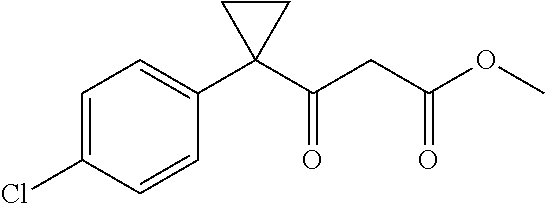
- The title compound was prepared in 78% yield from 1-(4-chlorophenyl)cyclopropane-1-carboxylic acid and 3-methoxy-3-oxopropanoic acid potassium salt according to the procedure for the preparation of Example 170, part A. 1H NMR (300 MHz, CDCl3): δ 1.22-1.26 (2H, m), 1.70-1.74 (2H, m), 3.35 (2H, s), 3.67 (3H, s), 7.29-7.34 (4H, m).
-

- The title compound was prepared from 2-hydrazinylpyridine-4-carbonitrile (PREPARATION 2) and methyl 3-[1-(4-chlorophenyl)cyclopropyl]-3-oxopropanoate according to the procedure for the preparation of Example 158, part A.
-

- The title compound was prepared in 36% yield from 2-[3-[1-(4-chlorophenyl)cyclopropyl]-5-hydroxypyrazol-1-yl]pyridine-4-carbonitrile according to the procedure for the preparation of Example 158, part B. 1H NMR (300 MHz, CD3OD/DMSO-d6): δ 1.19-1.21 (2H, m), 1.40-1.42 (2H, m), 7.29-7.36 (4H, m), 7.64-7.65 (1H, m), 8.15 (1H, brs), 8.50 (1H, d, J=5.4 Hz). [M+H] Calc'd for C18H14ClN3O3, 356; Found, 356.
-

- The title compound was prepared in 78% yield from 2-(3,5-dichlorophenyl)acetic acid and 3-methoxy-3-oxopropanoic acid potassium salt according to the procedure for the preparation of Example 170, part A.
-

- The title compound was prepared from 2-hydrazinylpyridine-4-carbonitrile (PREPARATION 2) and methyl 4-(3,5-dichlorophenyl)-3-oxobutanoate according to the procedure for the preparation of Example 158, part A.
-

- The title compound was prepared in 59% yield from 2-[3-[(3,5-dichlorophenyl)methyl]-5-hydroxypyrazol-1-yl]pyridine-4-carbonitrile according to the procedure for the preparation of Example 158, part B. 1H NMR (300 MHz, CD3OD/DMSO-d6): δ 4.06 (2H, m), 7.52-7.54 (3H, m), 7.83-7.84 (1H, m), 8.72 (1H, d, J=5.1 Hz). [M+H] Calc'd for C16H11Cl2N3O3, 364; Found, 364.
-

- The title compound was prepared in 78% yield from 2-(4-fluoro-2-methylphenyl)acetic acid and 3-methoxy-3-oxopropanoic acid potassium salt according to the procedure for the preparation of Example 170, part A. 1H NMR (300 MHz, CDCl3): δ 2.24 (3H, s), 3.47 (2H, s), 3.74 (3H, s), 3.83 (2H, s), 6.88-6.94 (2H, m), 7.07-7.12 (1H, m).
-

- The title compound was prepared from 2-hydrazinylpyridine-4-carbonitrile (PREPARATION 2) and methyl 4-(4-fluoro-2-methylphenyl)-3-oxobutanoate according to the procedure for the preparation of Example 158, part A.
-

- The title compound was prepared in 41% yield from 2-[3-[(4-fluoro-2-methylphenyl)methyl]-5-hydroxypyrazol-1-yl]pyridine-4-carbonitrile according to the procedure for the preparation of Example 158, part B. 1H NMR (300 MHz, CD3OD): δ 2.34 (3H, s), 3.92 (2H, s), 6.87-6.98 (2H, m), 7.23-7.28 (1H, m), 7.75 (1H, dd, J=1.2, 5.1 Hz), 8.55 (1H, d, J=5.1 Hz), 8.72 (1H, brs). [M+H] Calc'd for C17H14FN3O3, 328; Found, 328.
-

- The title compound was prepared from 2-(2-fluoro-4-methylphenyl)acetic acid and 3-methoxy-3-oxopropanoic acid potassium salt according to the procedure for the preparation of Example 170, part A. 1H NMR (300 MHz, CDCl3): δ 2.35 (3H, s), 3.52 (2H, s), 3.74 (3H, s), 3.83 (2H, s), 6.89-6.95 (2H, m), 7.05-7.08 (1H, m).
-

- The title compound was prepared from 2-hydrazinylpyridine-4-carbonitrile (PREPARATION 2) and methyl 4-(2-fluoro-4-methylphenyl)-3-oxobutanoate according to the procedure for the preparation of Example 158, part A.
-

- The title compound was prepared from 2-[3-[(2-fluoro-4-methylphenyl)methyl]-5-hydroxypyrazol-1-yl]pyridine-4-carbonit according to the procedure for the preparation of Example 158, part B. 1H NMR (300 MHz, CD3OD): δ 2.33 (3H, s), 3.92 (2H, s), 6.92-6.97 (2H, m), 7.18-7.24 (1H, m), 7.73 (1H, d, J=4.8 Hz), 8.54 (1H, d, J=4.8 Hz), 8.69 (1H, brs). [M+H] Calc'd for C17H14FN3O3, 328; Found, 328.
-

- The title compound was prepared from 2-(2,4-difluorophenyl)acetic acid and 3-methoxy-3-oxopropanoic acid potassium salt according to the procedure for the preparation of Example 170, part A. 1H NMR (300 MHz, CDCl3): δ 3.54 (2H, s), 3.76 (3H, s), 3.86 (2H, s), 6.83-6.90 (2H, m), 7.13-7.19 (1H, m).
-

- The title compound was prepared from 2-hydrazinylpyridine-4-carbonitrile (PREPARATION 2) and methyl 4-(2,4-difluorophenyl)-3-oxobutanoate according to the procedure for the preparation of Example 158, part A.
-

- The title compound was prepared in 20% yield from 2-[3-[(2,4-difluorophenyl)methyl]-5-hydroxypyrazol-1-yl]pyridine-4-carbonitrile according to the procedure for the preparation of Example 158, part B. 1H NMR (300 MHz, CD3OD/DMSO-d6): δ 3.88 (2H, s), 6.97-7.04 (1H, m), 7.11-7.17 (1H, m), 7.37-7.43 (1H, m), 7.65-7.66 (1H, m), 8.56 (1H, d, J=5.1 Hz). [M+H] Calc'd for C16H11F2N3O3, 332; Found, 332.
- This assay determines the ability of a test compound to inhibit Jarid1A, Jarid1B, JMJD2C, and JMJD2A demethylase activity. Baculovirus expressed Jarid1A (GenBank Accession #NM 001042603, AA1-1090) was purchased from BPS Bioscience (Cat#50110). Baculovirus expressed Jarid1B (GenBank Accession #NM—006618, AA 2-751) was purchased from BPS Bioscience (Cat #50121) or custom made by MolecularThroughput. Baculovirus expressed JMJD2C (GenBank Accession #BC143571, AA 2-372) was purchased from BPS Bioscience (Cat#50105). Baculovirus expressed JMJD2A (GenBank Accession #NM 014663, AA 1-350) was purchased from BPS Bioscience (Cat#50123). Baculovirus expressed FBXL10 (GenBank Accession #NM 032590, AA 1-650) was purchased from BPS Bioscience (Cat#50120).
- The enzymatic assay of Jarid1A activity is based upon Time Resolved-Fluorescence Resonance Energy Transfer (TR-FRET) detection. The ability of test compounds to inhibit the activity of Jarid1A was determined in 384-well plate format under the following reaction conditions: 1 nM Jarid1A, 300 nM H3K4me3-biotin labeled peptide (Anaspec cat #64357), 2 μM alphα-ketoglutaric acid in assay buffer of 50 mM HEPES, pH7.3, 0.005% Brij35, 0.5 mM TCEP, 0.2 mg/ml BSA, 50 μM sodium L-ascorbate, and 2 μM ammonium iron(II) sulfate. Reaction product was determined quantitatively by TR-FRET after the addition of detection reagent Phycolink Streptavidin-allophycocyanin (Prozyme) and Europium-anti-mono- or di-methylated histone H3 lysine 4 (H3K4me1-2) antibody (PerkinElmer) in the presence of 5 mM EDTA in LANCE detection buffer (PerkinElmer) at a final concentration of 25 nM and 1 nM, respectively.
- The assay reaction was initiated by the following: 2 μl of the mixture of 900 nM H3K4me3-biotin labeled peptide and 6 μM alphα-ketoglutaric acid with 2 μl of 11-point serial diluted inhibitor in 3% DMSO was added to each well of plate, followed by the addition of 2 μl of 3 nM Jarid1A to initiate the reaction. The reaction mixture was incubated at room temperature for 30 minutes, and terminated by the addition of 6 μl of 5 mM EDTA in LANCE detection buffer containing 50 nM Phycolink Streptavidin-allophycocyanin and 2 nM Europium-anti-H3K4me1-2 antibody. Plates were read by EnVisionMultilabel Reader in TR-FRET mode (excitation at 320 nm, emission at 615 nm and 665 nm) after 1 hour incubation at room temperature. A ratio was calculated (665/615) for each well and fitted to determine inhibition constant (IC50).
- The ability of test compounds to inhibit the activity of Jarid1B was determined in 384-well plate format under the following reaction conditions: 0.8 nM Jarid1B, 300 nM H3K4me3-biotin labeled peptide (Anaspec cat #64357), 2 μM alphα-ketoglutaric acid in assay buffer of 50 mM HEPES, pH7.3, 0.005% Brij35, 0.5 mM TCEP, 0.2 mg/ml BSA, 50 μM sodium L-ascorbate, and 2 μM ammonium iron(II) sulfate. Reaction product was determined quantitatively by TR-FRET after the addition of detection reagent Phycolink Streptavidin-allophycocyanin (Prozyme) and Europium-anti-mono- or di-methylated histone H3 lysine 4 (H3K4me1-2) antibody (PerkinElmer) in the presence of 5 mM EDTA in LANCE detection buffer (PerkinElmer) at a final concentration of 25 nM and 1 nM, respectively.
- The assay reaction was initiated by the following: 2 μl of the mixture of 900 nM H3K4me3-biotin labeled peptide and 6 μM alphα-ketoglutaric acid with 2 μl of 11-point serial diluted inhibitor in 3% DMSO was added to each well of the plate, followed by the addition of 2 μl of 2.4 nM Jarid1B to initiate the reaction. The reaction mixture was incubated at room temperature for 30 minutes, and terminated by the addition of 6 μl of 5 mM EDTA in LANCE detection buffer containing 50 nM Phycolink Streptavidin-allophycocyanin and 2 nM Europium-anti-H3K4me1-2 antibody. Plates were read by EnVisionMultilabel Reader in TR-FRET mode (excitation at 320 nm, emission at 615 nm and 665 nm) after 1 hour incubation at room temperature. A ratio was calculated (665/615) for each well and fitted to determine inhibition constant (IC50).
- The ability of test compounds to inhibit the activity of JMJD2C was determined in 384-well plate format under the following reaction conditions: 0.3 nM JMJD2C, 300 nM H3K9me3-biotin labeled peptide (Anaspec cat #64360), 2 μM alphα-ketoglutaric acid in assay buffer of 50 mM HEPES, pH7.3, 0.005% Brij35, 0.5 mM TCEP, 0.2 mg/ml BSA, 50 μM sodium L-ascorbate, and 2 μM ammonium iron(II) sulfate. Reaction product was determined quantitatively by TR-FRET after the addition of detection reagent Phycolink Streptavidin-allophycocyanin (Prozyme) and Europium-anti-di-methylated histone H3 lysine 9 (H3K9me2) antibody (PerkinElmer) in the presence of 5 mM EDTA in LANCE detection buffer (PerkinElmer) at a final concentration of 50 nM and 1 nM, respectively.
- The assay reaction was initiated by the following: 2 μl of the mixture of 900 nM H3K9me3-biotin labeled peptide and 6 μM alphα-ketoglutaric acid with 2 μl of 11-point serial diluted inhibitor in 3% DMSO were added to each well of the plate, followed by the addition of 2 μl of 0.9 nM JMJD2C to initiate the reaction. The reaction mixture was incubated at room temperature for 30 minutes, and terminated by the addition of 6 μl of 5 mM EDTA in LANCE detection buffer containing 100 nM Phycolink Streptavidin-allophycocyanin and 2 nM Europium-anti-H3K9me2 antibody. Plates were read by EnVisionMultilabel Reader in TR-FRET mode (excitation at 320 nm, emission at 615 nm and 665 nm) after 1 hour incubation at room temperature. A ratio was calculated (665/615) for each well and fitted to determine inhibition constant (IC50).
- The ability of test compounds to inhibit the activity of JMJD2A was determined in 384-well plate format under the following reaction conditions: 2 nM JMJD2A, 300 nM H3K9me3-biotin labeled peptide (Anaspec cat #64360), 2 μM alphα-ketoglutaric acid in assay buffer of 50 mM HEPES, pH7.3, 0.005% Brij35, 0.5 mM TCEP, 0.2 mg/ml BSA, 50 μM sodium L-ascorbate, and 2 μM ammonium iron(II) sulfate. Reaction product was determined quantitatively by TR-FRET after the addition of detection reagent Phycolink Streptavidin-allophycocyanin (Prozyme) and Europium-anti-di-methylated histone H3 lysine 9 (H3K9me2) antibody (PerkinElmer) in the presence of 5 mM EDTA in LANCE detection buffer (PerkinElmer) at a final concentration of 50 nM and 1 nM, respectively.
- The assay reaction was initiated by the following: 2 μl of the mixture of 900 nM H3K9me3-biotin labeled peptide and 6 μM alphα-ketoglutaric acid with 2 μl of 11-point serial diluted inhibitor in 3% DMSO were added to each well of plate, followed by the addition of 2 μl of 6 nM JMJD2A to initiate the reaction. The reaction mixture was incubated at room temperature for 30 minutes, and terminated by the addition of 6 μl of 5 mM EDTA in LANCE detection buffer containing 100 nM Phycolink Streptavidin-allophycocyanin and 2 nM Europium-anti-H3K9me2 antibody. Plates were read by EnVisionMultilabel Reader in TR-FRET mode (excitation at 320 nm, emission at 615 nm and 665 nm) after 1 hour incubation at room temperature. A ratio was calculated (665/615) for each well and fitted to determine inhibition constant (IC50).
- The ability of test compounds to inhibit the activity of FBXL10 was determined in 384-well plate format under the following reaction conditions: 0.3 nM FBXL10, 30 nM H3K36me2-biotin labeled peptide (Anaspec cat #64442), 0.2 μM alphα-ketoglutaric acid in assay buffer of 50 mM HEPES, pH7.3, 0.005% Brij35, 0.5 mM TCEP, 0.2 mg/ml BSA, 50 μM sodium L-ascorbate, and 5 μM ammonium iron(II) sulfate. Reaction product was determined quantitatively by AlphaScreen detection after the addition of detection reagents anti-H3K36me1 antibody, AlphaScreen® Streptavidin-coated Donor beads, and AlphaScreen® Protein A Acceptor beads in 50 mM HEPES, pH7.3, 10 mM NaCl, 0.005% Brij35, 5 mM EDTA, 2 mg/ml BSA to final 10 μg/ml beads.
- The assay reaction was initiated by the following: 3 μl of the mixture of 90 nM H3K36me2-biotin labeled peptide and 0.6 μM alphα-ketoglutaric acid with 3 μl of 11-point serial diluted inhibitor in 3% DMSO were added to each well of 384 well Proxiplate (Perkin Elmer), followed by the addition of 3 μl of 0.9 nM FBXL10 to initiate the reaction. The reaction mixture was incubated at room temperature for 30 minutes, and terminated by the addition of 3 μl of 50 mM HEPES, pH7.3, 10 mM NaCl, 0.005% Brij35, 5 mM EDTA, 2 mg/ml BSA containing appropriate dilution of anti H3K36me1 antibody. Plates were incubated at room temperature for 40 minutes, followed by addition of 3 μl of 50 μg/ml AlphaScreen® Streptavidin-coated Donor beads and AlphaScreen® Protein A Acceptor beads in 50 mM HEPES, pH7.3, 10 mM NaCl, 0.005% Brij35, 5 mM EDTA, 2 mg/ml BSA. Plates were read by EnVisionMultilabel Reader in AlphaScreen mode after a minimum of 2 hour or up to overnight incubation at room temperature. The AlphaScreen signal for each well was used to determine inhibition constant (IC50).
- The ability of the compounds disclosed herein to inhibit demethylase activity was quantified and the respective IC50 value was determined. Tables 3 provides the IC50 values of various compounds disclosed herein.
-
TABLE 3 Chemical Synthesis JARID1A JARID1B JMJD2C JMJD2A FBXL10 Example Name IC50 (μM) IC50 (μM) IC50 (μM) IC50 (μM) IC50 (μM) 1 2-(5-hydroxy-3-methyl-1H- B A B B pyrazol-1-yl)isonicotinic acid 2 2-(3-cyclopropyl-5-hydroxy- A A B B A 1H-pyrazol-1-yl)isonicotinic acid 3 2-(5-hydroxy-3,4-dimethyl- B A B B 1H-pyrazol-1-yl)isonicotinic acid 4 2-(5-hydroxy-3-methyl-4- C C C B phenyl-1H-pyrazol-1- yl)isonicotinic acid 5 2-(3-(2-fluorophenyl)-5- C C C A hydroxy-1H-pyrazol-1- yl)isonicotinic acid 6 2-(5-hydroxy-3-propyl-1H- B B B B pyrazol-1-yl)isonicotinic acid 7 2-(3-(2-chlorophenyl)-5- C C D A hydroxy-1H-pyrazol-1- yl)isonicotinic acid 8 2-(3-benzyl-5-hydroxy-1H- B B C A pyrazol-1-yl)isonicotinic acid 9 2-(5-hydroxy-3- B B C A (methoxymethyl)-1H-pyrazol- 1-yl)isonicotinic acid 10 2-(5-hydroxy-3- C B D A (phenoxymethyl)-1H-pyrazol- 1-yl)isonicotinic acid 11 2-(5-hydroxy-1H-pyrazol-1- A A B B yl)isonicotinic acid 12 2-(5-p-tolyl-1H-pyrazol-1- B B B B yl)isonicotinic acid 13 2-(5-m-tolyl-1H-pyrazol-1- B B B yl)isonicotinic acid 14 2-(5-(2,4-difluorophenyl)-1H- B B B B pyrazol-1-yl)isonicotinic acid 15 2-(5-(3,4-difluorophenyl)-1H- B B B pyrazol-1-yl)isonicotinic acid 16 2-(5-(3-fluorophenyl)-1H- B B B pyrazol-1-yl)isonicotinic acid 17 2-(5-(3-hydroxyphenyl)-1H- B B B B pyrazol-1-yl)isonicotinic acid 18 2-(5-(4-hydroxyphenyl)-1H- B B B pyrazol-1-yl)isonicotinic acid 19 2-(5-(4- B B C (methylsulfonyl)phenyl)-1H- pyrazol-1-yl)isonicotinic acid 20 2-(5-(3-methoxy-4- B B C methylphenyl)-1H-pyrazol-1- yl)isonicotinic acid 21 2-(5-(3-hydroxy-4- A A B methylphenyl)-1H-pyrazol-1- yl)isonicotinic acid 22 2-(5-(4-chloro-3- B B C methoxyphenyl)-1H-pyrazol- 1-yl)isonicotinic acid 23 2-(5-(4-chloro-3- B B C hydroxyphenyl)-1H-pyrazol- 1-yl)isonicotinic acid 24 2-[5-(1H-indazol-6-yl)-1H- B B C pyrazol-1-yl]pyridine-4- carboxylic acid 25 methyl 2-[5-1H-indazol-6- yl)-1H-pyrazol-1-yl]pyridine- 4-carboxylate 26 2-(5-phenyl-1H-pyrazol-1- C C C yl)isonicotinic acid 27 2-(5-(4-fluorophenyl)-1H- B B B D pyrazol-1-yl)isonicotinic acid 28 2-(5-(3-hydroxy-4- B B C (methylsulfonyl)phenyl)-1H- pyrazol-1-yl)isonicotinic acid 29 2-(3-methyl-5-p-tolyl-1H- C C C pyrazol-1-yl)isonicotinic acid 30 2-(3-ethyl-5-p-tolyl-1H- C B C pyrazol-1-yl)isonicotinic acid 31 2-(5-methyl-1H-pyrazol-1- C C B yl)isonicotinic acid 32 2-(5-benzyl-1H-pyrazol-1- D D D C yl)isonicotinic acid 33 2-(3-benzyl-1H-pyrazol-1- C C C C yl)isonicotinic acid 34 2-(5-phenethyl-1H-pyrazol-1- C C D yl)isonicotinic acid 35 2-(3-phenethyl-1H-pyrazol-1- B B B B yl)isonicotinic acid 36 2-(5-methyl-4-phenyl-1H- B B D pyrazol-1-yl)isonicotinic acid 37 2-(5-methoxy-3-methyl-1H- C C C pyrazol-1-yl)isonicotinic acid 38 2-(5-(benzyloxy)-3-methyl- B A B 1H-pyrazol-1-yl)isonicotinic acid 39 2-(5-(benzyloxy)-1H-pyrazol- A A A A 1-yl)isonicotinic acid 40 2-{5-[(4-fluorobenzyl)oxy]- A A A D 1H-pyrazol-1-yl}pyridine-4- carboxylic acid 41 2-{5-[(3-fluorobenzyl)oxy]- A A A 1H-pyrazol-1-yl}pyridine-4- carboxylic acid 42 2-{5-[(3-methoxybenzyl)oxy]- A A A 1H-pyrazol-1-yl}pyridine-4- carboxylic acid 43 2-{5-[(4-methoxybenzyl)oxy]- A A B 1H-pyrazol-1-yl}pyridine-4- carboxylic acid 44 2-(5-butyl-1H-pyrazol-1- C C D yl)isonicotinic acid 45 2-(3-butyl-1H-pyrazol-1- B B B yl)pyridine-4-carboxylic acid 46 2-(5-(4-bromophenyl)-1H- B B C pyrazol-1-yl)isonicotinic acid 47 2-{5-[4- B B C (dimethylamino)phenyl]-1H- pyrazol-1-yl}pyridine-4- carboxylic acid 48 2-[3-amino-5-(4- A B C methylphenyl)-1H-pyrazol-1- yl]pyridine-4-carboxylic acid 49 2-[5-(1H-indazol-6- B B C B ylmethoxy)-1H-pyrazol-1- yl]pyridine-4-carboxylic acid 50 2-{5-[(1-methyl-1H-indazol- A A B B 6-yl)methoxy]-1H-pyrazol-1- yl}pyridine-4-carboxylic acid 51 2-{5-[(1-methyl-1H-indazol- A A B 6-yl)methoxy]-1H-pyrazol-1- yl}pyridine-4-carboxylic acid 52 2-{5-[(3,4- A A B difluorobenzyl)oxy]-1H- pyrazol-1-yl}pyridine-4- carboxylic acid 53 2-{5-[(4-chlorobenzyl)oxy]- A A A 1H-pyrazol-1-yl}pyridine-4- carboxylic acid 54 2-(5-{[4- A A B (trifluoromethyl)benzyl]oxy}- 1H-pyrazol-1-yl)pyridine-4- carboxylic acid 55 2-{5-[(4-methylbenzyl)oxy]- A A A C 1H-pyrazol-1-yl}pyridine-4- carboxylic acid 56 2-{5-[(4-ethylbenzyl)oxy]-1H- A A B C pyrazol-1-yl}pyridine-4- carboxylic acid 57 2-{5-[(4-bromobenzyl)oxy]- A A A 1H-pyrazol-1-yl}pyridine-4- carboxylic acid 58 2-{5-[(3-chlorobenzyl)oxy]- A A A 1H-pyrazol-1-yl}pyridine-4- carboxylic acid 59 2-{5-[(2-fluorobenzyl)oxy]- A A A 1H-pyrazol-1-yl}pyridine-4- carboxylic acid 60 2-[5-(pyridin-3-ylmethoxy)- A A B 1H-pyrazol-1-yl]pyridine-4- carboxylic acid 61 2-[5-(pyridin-4-ylmethoxy)- A A A 1H-pyrazol-1-yl]pyridine-4- carboxylic acid 62 methyl 2-{5-[(4- fluorobenzyl)oxy]-1H- pyrazol-1-yl}pyridine-4- carboxylate 63 methyl 2-{5-[(3,4- difluorobenzyl)oxy]-1H- pyrazol-1-yl}pyridine-4- carboxylate 64 methyl 2-{5-[(4- chlorobenzyl)oxy]-1H- pyrazol-1-yl}pyridine-4- carboxylate 65 methyl 2-(5-{[4- (trifluoromethyl)benzyl]oxy}- 1H-pyrazol-1-yl)pyridine-4- carboxylate 66 methyl 2-{5-[(4- methylbenzyl)oxy]-1H- pyrazol-1-yl}pyridine-4- carboxylate 67 methyl 2-{5-[(4- ethylbenzyl)oxy]-1H-pyrazol- 1-yl}pyridine-4-carboxylate 68 methyl 2-{5-[(4- bromobenzyl)oxy]-1H- pyrazol-1-yl}pyridine-4- carboxylate 69 methyl 2-[5-(benzyloxy)-1H- pyrazol-1-yl]pyridine-4- carboxylate 70 methyl 2-{5-[(3- fluorobenzyl)oxy]-1H- pyrazol-1-yl}pyridine-4- carboxylate 71 2-{5-[(4,4- A A B difluorocyclohexyl)methoxy]- 1H-pyrazol-1-yl}pyridine-4- carboxylic acid 72 2-{5-[(3-bromobenzyl)oxy]- A A A 1H-pyrazol-1-yl}pyridine-4- carboxylic acid 73 2-{5-[(3-hydroxybenzyl)oxy]- A A A 1H-pyrazol-1-yl}pyridine-4- carboxylic acid 74 2-{5-[(4-chloro-3- A A A fluorobenzyl)oxy]-1H- pyrazol-1-yl}pyridine-4- carboxylic acid 75 2-{5-[(4-chloro-2- A A A fluorobenzyl)oxy]-1H- pyrazol-1-yl}pyridine-4- carboxylic acid 76 2-{5-[(3-chloro-4- A A A fluorobenzyl)oxy]-1H- pyrazol-1-yl}pyridine-4- carboxylic acid 77 2-{5-[(4- A A B cyclopropylbenzyl)oxy]-1H- pyrazol-1-yl}pyridine-4- carboxylic acid 78 methyl 2-{5-[(4-chloro-3- fluorobenzyl)oxy]-1H- pyrazol-1-yl}pyridine-4- carboxylate 79 methyl 2-{5-[(4-chloro-2- fluorobenzyl)oxy]-1H- pyrazol-1-yl}pyridine-4- carboxylate 80 methyl 2-{5-[(3-chloro-4- fluorobenzyl)oxy]-1H- pyrazol-1-yl}pyridine-4- carboxylate 81 methyl 2-{5-[(4- cyclopropylbenzyl)oxy]-1H- pyrazol-1-yl}pyridine-4- carboxylate 82 2-[5-[1-(4- A A B fluorophenyl)ethoxy]pyrazol- 1-yl]pyridine-4-carboxylic acid 83 2-[5-[(3,3- A A A difluorocyclobutyl)methoxy] pyrazol-1-yl]pyridine-4- carboxylic acid 84 2-[5-[(4- A A B fluorophenyl)methoxy]-4- methylpyrazol-1-yl]pyridine- 4-carboxylic acid 85 2-[4-ethyl-5-[(4- A A B fluorophenyl)methoxy]pyrazol- 1-yl]pyridine-4-carboxylic acid 86 2-[5-[(2,4- A A B difluorophenyl)methoxy]pyrazol- 1-yl]pyridine-4-carboxylic acid 87 2-[5-[(3,4- A A B dichlorophenyl)methoxy]pyrazol- 1-yl]pyridine-4-carboxylic acid 88 2-[5-[(2,4- A A B dichlorophenyl)methoxy]pyrazol- 1-yl]pyridine-4-carboxylic acid 89 2-[5-[(4-chloro-2- A A B B methylphenyl)methoxy]pyrazol- 1-yl]pyridine-4-carboxylic acid 90 2-[5-[(4-chloro-2- A A A methoxyphenyl)methoxy]pyrazol- 1-yl]pyridine-4-carboxylic acid 91 2-[5-[[4-chloro-3- A A B (trifluoromethyl)phenyl]methoxy] pyrazol-1-yl]pyridine-4- carboxylic acid 92 2-[5-[(3-chloro-4- A A A C methylphenyl)methoxy]pyrazol- 1-yl]pyridine-4-carboxylic acid 93 2-[5-[(3-fluoro-4- A A A methylphenyl)methoxy]pyrazol- 1-yl]pyridine-4-carboxylic acid 94 2-[5-[(2,3-difluoro-4- A A A methylphenyl)methoxy]pyrazol- 1-yl]pyridine-4-carboxylic acid 95 2-[5-[(3-chloro-4- A A B ethylphenyl)methoxy]pyrazol- 1-yl]pyridine-4-carboxylic acid 96 2-[5-[(4-ethyl-3- A A B fluorophenyl)methoxy]pyrazol- 1-yl]pyridine-4-carboxylic acid 97 2-[5-[(3- A A A cyanophenyl)methoxy]pyrazol- 1-yl]pyridine-4-carboxylic acid 98 methyl 2-[5-[(4- cyanophenyl)methoxy]pyrazol- 1-yl]pyridine-4-carboxylate 99 2-[5-[(4- A A A C cyanophenyl)methoxy]pyrazol- 1-yl]pyridine-4-carboxylic acid 100 methyl 2-[5-[(3-chloro-4- methylphenyl)methoxy]pyrazol- 1-yl]pyridine-4-carboxylate 101 methyl 2-[5-[(3-fluoro-4- methylphenyl)methoxy]pyrazol- 1-yl]pyridine-4-carboxylate 102 methyl 2-[5-[(3-chloro-4- ethylphenyl)methoxy]pyrazol- 1-yl]pyridine-4-carboxylate 103 methyl 2-[5-[(2,3-difluoro-4- methylphenyl)methoxy]pyrazol- 1-yl]pyridine-4-carboxylate 104 methyl 2-[5-[(4-ethyl-3- fluorophenyl)methoxy]pyrazol- 1-yl]pyridine-4-carboxylate 105 2-[5-[(4-chloro-2- A A B B phenylmethoxyphenyl)methoxy] pyrazol-1-yl]pyridine-4- carboxylic acid 106 2-[5-[[4-chloro-2- A A B C (cyclopropylmethoxy)phenyl] methoxy]pyrazol-1- yl]pyridine-4-carboxylic acid 107 2-[5-[(4-chloro-2- propoxyphenyl)methoxy]pyrazol- 1-yl]pyridine-4-carboxylic acid 108 2-[5-[[4-chloro-2-(2,2,2- A A B C trifluoroethoxy)phenyl]methoxy] pyrazol-1-yl]pyridine-4- carboxylic acid 109 2-[5-[(4- A A C fluorophenyl)methoxy]-4-(2- hydroxyethyl)pyrazol-1- yl]pyridine-4-carboxylic acid 110 2-[4-[2- A A B (dimethylamino)ethyl]-5-[(4- fluorophenyl)methoxy]pyrazol- 1-yl]pyridine-4-carboxylic acid 111 2-[5-[(2-butoxy-4- B B C C C chlorophenyl)methoxy]pyrazol- 1-yl]pyridine-4-carboxylic acid 112 2-[5-[[4-chloro-2-(2- B B C C C methylpropoxy)phenyl]methoxy] pyrazol-1-yl]pyridine-4- carboxylic acid 113 2-[5-[(4-chloro-2-propan-2- B B C yloxyphenyl)methoxy]pyrazol- 1-yl]pyridine-4-carboxylic acid 114 2-[5-[(2-butan-2-yloxy-4- B B C chlorophenyl)methoxy]pyrazol- 1-yl]pyridine-4-carboxylic acid 115 2-[5-[(4-chloro-2- A A B ethoxyphenyl)methoxy]pyrazol- 1-yl]pyridine-4-carboxylic acid 116 2-[5-[[4-chloro-2-(2- A A B methoxyethoxy)phenyl]methoxy] pyrazol-1-yl]pyridine-4- carboxylic acid 117 2-[5-[[4-chloro-2-[(4- B B C C C fluorophenyl)methoxy]phenyl] methoxy]pyrazol-1- yl]pyridine-4-carboxylic acid 118 2-[5-[[4-fluoro-2-[(4- A A B B C fluorophenyl)methoxy]phenyl] methoxy]pyrazol-1- yl]pyridine-4-carboxylic acid 119 2-[5-[[4-fluoro-2-[(E)-2-(4- B B C fluorophenyl)ethenyl]phenyl] methoxy]pyrazol-1- yl]pyridine-4-carboxylic acid 120 2-[5-[[4-chloro-2-[(E)-2-(4- B B C fluorophenyl)ethenyl]phenyl] methoxy]pyrazol-1- yl]pyridine-4-carboxylic acid 121 2-[5-[[4-fluoro-2-[2-(4- B B C fluorophenyl)ethyl]phenyl] methoxy]pyrazol-1-yl]pyridine- 4-carboxylic acid 122 2-[5-[[4-chloro-2-[2-(4- B B C fluorophenyl)ethyl]phenyl] methoxy]pyrazol-1-yl]pyridine- 4-carboxylic acid 123 2-[5-(2,3-dihydro-1- A A B benzofuran-7- ylmethoxy)pyrazol-1- yl]pyridine-4-carboxylic acid 124 2-[5-[(2,2-dimethyl-3H-1- B A B benzofuran-7- yl)methoxy]pyrazol-1- yl]pyridine-4-carboxylic acid 125 2-[5-[(4-cyano-2- A A B methylphenyl)methoxy]pyrazol- 1-yl]pyridine-4-carboxylic acid 126 2-[5-[(4-cyano-2- A A B ethylphenyl)methoxy]pyrazol- 1-yl]pyridine-4-carboxylic acid 127 2-[5-[(4-chloro-2- B B C ethylphenyl)methoxy]pyrazol- 1-yl]pyridine-4-carboxylic acid 128 2-[5-[(4-fluoro-2- A A B methylphenyl)methoxy]pyrazol- 1-yl]pyridine-4-carboxylic acid 129 2-[5-[(2-ethyl-4- A A B fluorophenyl)methoxy]pyrazol- 1-yl]pyridine-4-carboxylic acid 130 2-[5-[(2-chloro-4- B B C B C methylphenyl)methoxy]pyrazol- 1-yl]pyridine-4-carboxylic acid 131 2-[5-[(2-fluoro-4- A A B methylphenyl)methoxy]pyrazol- 1-yl]pyridine-4-carboxylic acid 132 2-[5-[(2,4- A A B B C dimethylphenyl)methoxy]pyrazol- 1-yl]pyridine-4-carboxylic acid 133 2-[5-[(2-methoxy-4- A A B B C methylphenyl)methoxy]pyrazol- 1-yl]pyridine-4-carboxylic acid 134 2-[5-[(2-cyano-4- A A B methylphenyl)methoxy]pyrazol- 1-yl]pyridine-4-carboxylic acid 135 2-[5-[(2-ethyl-4- B B C methylphenyl)methoxy]pyrazol- 1-yl]pyridine-4-carboxylic acid 136 2-[5-[[4-chloro-2-(1- phenylethoxy)phenyl]methoxy] B B C pyrazol-1-yl]pyridine-4- carboxylic acid 137 2-[5-[[4-fluoro-2-(1- B B C phenylethoxy)phenyl]methoxy] pyrazol-1-yl]pyridine-4- carboxylic acid 138 2-[5-[[4-chloro-3-[(4- A A B fluorophenyl)methoxy]phenyl] methoxy]pyrazol-1- yl]pyridine-4-carboxylic acid 139 2-[5-[[4-fluoro-3-[(4- A A B fluorophenyl)methoxy]phenyl] methoxy]pyrazol-1- yl]pyridine-4-carboxylic acid 140 2-[5-[[4-chloro-3- B B B B C (cyclopropylmethoxy)phenyl] methoxy]pyrazol-1- yl]pyridine-4-carboxylic acid 141 2-[5-[[4-chloro-3-(2,2,2- A A B trifluoroethoxy)phenyl]methoxy] pyrazol-1-yl]pyridine-4- carboxylic acid 142 2-[5-[(4-bromo-2- B B B methylphenyl)methoxy]pyrazol- 1-yl]pyridine-4-carboxylic acid 143 2-[5-[(4-bromo-2- A A B methoxyphenyl)methoxy]pyrazol- 1-yl]pyridine-4-carboxylic acid 144 2-[5-[(4-iodo-2- A A B methylphenyl)methoxy]pyrazol- 1-yl]pyridine-4-carboxylic acid 145 2-[5-[(4-iodo-2- A A B methoxyphenyl)methoxy]pyrazol- 1-yl]pyridine-4-carboxylic acid 146 2-[5-[(5-fluoro-2,3-dihydro- B B B 1H-inden-1-yl)oxy]pyrazol-1- yl]pyridine-4-carboxylic acid 147 2-[5-[(5-chloro-2,3-dihydro- B B C 1H-inden-1-yl)oxy]pyrazol-1- yl]pyridine-4-carboxylic acid 148 2-[5-[(6-fluoro-1,2,3,4- B B C tetrahydronaphthalen-1- yl)oxy]pyrazol-1-yl]pyridine- 4-carboxylic acid 149 2-[5-[(6-chloro-1,2,3,4- B A C tetrahydronaphthalen-1- yl)oxy]pyrazol-1-yl]pyridine- 4-carboxylic acid 150 2-[5-[(2-chloro-4- ethylphenyl)methoxy]pyrazol- B B C 1-yl]pyridine-4-carboxylic acid 151 2-[5-[(4-ethyl-2- B A C fluorophenyl)methoxy]pyrazol- 1-yl]pyridine-4-carboxylic acid 152 2-[5-[(2-chloro-4- B B C cyclopropylphenyl)methoxy] pyrazol-1-yl]pyridine-4- carboxylic acid 153 2-[5-[(4-cyclopropyl-2- B B C fluorophenyl)methoxy]pyrazol- 1-yl]pyridine-4-carboxylic acid 154 2-[5-[(3-chloro-4- B B C cyclopropylphenyl)methoxy] pyrazol-1-yl]pyridine-4- carboxylic acid 155 2-[5-[(4-cyclopropyl-3- B A C fluorophenyl)methoxy]pyrazol- 1-yl]pyridine-4-carboxylic acid 156 2-[4-[2-[(4- A A A D fluorophenyl)methyl- methylamino]ethyl]pyrazol-1- yl]pyridine-4-carboxylic acid 157 N-cyano-2-[4-[2-[(4- A A A fluorophenyl)methyl- methylamino]ethyl]pyrazol-1- yl]pyridine-4-carboxamide 158 2-(3-(4-chlorophenyl)-5- C C C C A hydroxypyrazol-1-yl]pyridine- 4-carboxylic acid 159 2-(3-(3-chlorophenyl)-5- C C C D A hydroxypyrazol-1-yl]pyridine- 4-carboxylic acid 160 2-(3-cyclopentyl-5- C B C D A hydroxypyrazol-1-yl)pyridine- 4-carboxylic acid 161 2-[3-[(2,6- C A difluorophenyl)methyl]-5- hydroxypyrazol-1-yl]pyridine- 4-carboxylic acid 162 2-[5-hydroxy-3-(1- C C D A phenylethyl)pyrazol-1- yl]pyridine-4-carboxylic acid 163 2-[3-[(2- C C D A chlorophenyl)methyl]-5- hydroxypyrazol-1-yl]pyridine- 4-carboxylic acid 164 2-[3-[(3- C C D A chlorophenyl)methyl]-5- hydroxypyrazol-1-yl]pyridine- 4-carboxylic acid 165 2-[3-[(4- B C D A chlorophenyl)methyl]-5- hydroxypyrazol-1-yl]pyridine- 4-carboxylic acid 166 5-(1-phenylethyl)-2-[4-(1H- C A tetrazol-5-yl)pyridin-2- yl]pyrazol-3-ol 167 5-[(2-chlorophenyl)methyl]-2- C A [4-(1H-tetrazol-5-yl)pyridin- 2-yl]pyrazol-3-ol C A 168 5-[(3-chlorophenyl)methyl]-2- [4-(1H-tetrazol-5-yl)pyridin- 2-yl]pyrazol-3-ol C C D A 169 5-[(4-chlorophenyl)methyl]-2- [4-(1H-tetrazol-5-yl)pyridin- 2-yl]pyrazol-3-ol 170 2-[3-[2-(4- C A chlorophenyl)propan-2-yl]-5- hydroxypyrazol-1-yl]pyridine- 4-carboxylic acid 171 2-[3-[1-(4- C A chlorophenyl)cyclopropyl]-5- hydroxypyrazol-1-yl]pyridine- 4-carboxylic acid 172 2-[3-[(3,5- C B dichlorophenyl)methyl]-5- hydroxypyrazol-1-yl]pyridine- 4-carboxylic acid 173 2-(3-[(4-fluoro-2- C A methylphenyl)methyl]-5- hydroxypyrazol-1-yl]pyridine- 4-carboxylic acid 174 2-(3-[(2-fluoro-4- C A methylphenyl)methyl]-5- hydroxypyrazol-1-yl]pyridine- 4-carboxylic acid 175 2-(3-[(2,4- C A difluorophenyl)methyl]-5- hydroxypyrazol-1-yl]pyridine- 4-carboxylic acid Note: Biochemical assay IC50 data are designated within the following ranges: A: ≦0.10 μM B: >0.10 μM to ≦1.0 μM C: >1.0 μM to ≦10 μM D: >10 μM - An assay to measure the degree of cellular inhibition of KDM5A and 5B was developed. This quantitative immuno-blotting assay measures the amount tri-methylated histone H3 at amino acid Lysine number 4, a specific substrate and product of the direct enzymatic activity of the histone demethylases KDM5A and KDM5B from extracts of the ZR-75-1 breast cancer cell line. Upon analysis a correlation was observed between the inhibition of these enzymes in a biochemical assay and the degree of inhibition of these enzymes within cancer cell lines.
- This assay is a fluorometric immunoassay for the quantification of tri-methyl H3K4 extracted from cells treated with test compound and is used as a measure of the cellular inhibition of KDM5A/B.
- ZR-75-1 (PTEN null, ER+) breast cancer cells numbering 50,000 (ATCC) were seeded into each well of a 96-well tissue culture treated plate and then exposed to an 11 point dilution of test compound with final concentration ranges of test compound ranging from 2000 uM to 10 nM. Cells were left in the presence of test compound for 72 hours. Extracts were prepared containing all of the cellular histone material using detergent based lysis and sonication methods. These lysates were subsequently normalized for total protein content using a colorimetric bicinchonic acid assay (MicroBCA Pierce/Thermo Scientific). Normalized cell extracts were then subjected to typical immuno-blotting procedures using NuPage reagents (Life Technologies). Electrophoretically separated histones were then transferred and immobilized using polyvinylidene difluoride membrane (Immobilon-FL Millipore). The amount of tri-methylated lysine 4 of histone H3 was detected using an antibody specific to the tri-methylated state (Cell Signaling Technologies) and quantified on an infrared imager using a densitometry software package (Odyssey CLx, Image Studio, Li-Cor). This background subtracted densitometry value was reported as a ration of the GAPDH amount for that sample and then calculated as a percent of the DMSO treated sample. The software package XL-fit (IDBS) was then used to calculate a relative IC50 value for the dilution series of a given test compound according to the equation:
-
fit=(D+((Vmax*(x̂n))/((x̂n)+(Km̂n)))). - Table 4 provides the cellular IC50 values of various compounds disclosed herein.
-
TABLE 4 Example Cellular IC50 (μM) 39 C 40 B 41 D 50 D 52 B 53 B 55 B 56 B 57 B 58 B 62 C 63 B 64 B 71 C 72 C 74 C 75 C 76 C 86 C 87 B 89 A 90 B 92 B 93 B 94 C 98 C 99 B 115 B 117 C 118 C 121 C 124 D 125 C 126 D 127 C 128 B 129 C 130 C 131 C 132 B 133 B 134 C 136 C 137 C 138 C 139 B 140 C 141 C 142 C 144 C 145 C 151 C Note: Cellular assay IC50 data are designated within the following ranges: A: ≦0.10 μM B: >0.10 μM to ≦1.0 μM C: >1.0 μM to ≦10 μM D: >10 μM - Time release pellets containing 0.72 mg 17-P Estradiol are subcutaneously implanted into nu/nu mice. MCF-7 cells are grown in RPMI containing 10% FBS at 5% CO2, 37° C. Cells are spun down and re-suspended in 50% RPMI (serum free) and 50% Matrigel at 1×10⁷ cells/mL. MCF-7 cells are subcutaneously injected (100 μL/animal) on the right flank 2-3 days post pellet implantation and tumor volume (length x width2/2) is monitored bi-weekly. When tumors reach an average volume of ˜200 mm3 animals are randomized and treatment is started. Animals are treated with vehicle or compound daily for 4 weeks. Tumor volume and body weight are monitored bi-weekly throughout the study. At the conclusion of the treatment period, plasma and tumor samples are taken for pharmacokinetic and pharmacodynamic analyses, respectively.
- A tablet is prepared by mixing 48% by weigh of a compound of Formula (I) or a pharmaceutically acceptable salt thereof, 45% by weight of microcrystalline cellulose, 5% by weight of low-substituted hydroxypropyl cellulose, and 2% by weight of magnesium stearate. Tablets are prepared by direct compression. The total weight of the compressed tablets is maintained at 250-500 mg.
Claims (25)


Priority Applications (1)
| Application Number | Priority Date | Filing Date | Title |
|---|---|---|---|
| US14/650,241 US9604961B2 (en) | 2012-12-06 | 2013-12-05 | Histone demethylase inhibitors |
Applications Claiming Priority (4)
| Application Number | Priority Date | Filing Date | Title |
|---|---|---|---|
| US201261734330P | 2012-12-06 | 2012-12-06 | |
| US201361784414P | 2013-03-14 | 2013-03-14 | |
| US14/650,241 US9604961B2 (en) | 2012-12-06 | 2013-12-05 | Histone demethylase inhibitors |
| PCT/US2013/073424 WO2014089364A1 (en) | 2012-12-06 | 2013-12-05 | Histone demethylase inhibitors |
Related Parent Applications (1)
| Application Number | Title | Priority Date | Filing Date |
|---|---|---|---|
| PCT/US2013/073424 A-371-Of-International WO2014089364A1 (en) | 2012-12-06 | 2013-12-05 | Histone demethylase inhibitors |
Related Child Applications (1)
| Application Number | Title | Priority Date | Filing Date |
|---|---|---|---|
| US15/434,472 Division US10173996B2 (en) | 2012-12-06 | 2017-02-16 | Histone demethylase inhibitors |
Publications (2)
| Publication Number | Publication Date |
|---|---|
| US20160002201A1 true US20160002201A1 (en) | 2016-01-07 |
| US9604961B2 US9604961B2 (en) | 2017-03-28 |
Family
ID=50884011
Family Applications (7)
| Application Number | Title | Priority Date | Filing Date |
|---|---|---|---|
| US14/098,415 Active 2033-12-15 US8987461B2 (en) | 2012-12-06 | 2013-12-05 | Histone demethylase inhibitors |
| US14/650,241 Active US9604961B2 (en) | 2012-12-06 | 2013-12-05 | Histone demethylase inhibitors |
| US14/630,091 Active US9107916B2 (en) | 2012-12-06 | 2015-02-24 | Histone demethylase inhibitors |
| US14/755,791 Active US9458129B2 (en) | 2012-12-06 | 2015-06-30 | Histone demethylase inhibitors |
| US15/230,966 Active US9714230B2 (en) | 2012-12-06 | 2016-08-08 | Histone demethylase inhibitors |
| US15/434,472 Active US10173996B2 (en) | 2012-12-06 | 2017-02-16 | Histone demethylase inhibitors |
| US15/619,363 Active US9908865B2 (en) | 2012-12-06 | 2017-06-09 | Histone demethylase inhibitors |
Family Applications Before (1)
| Application Number | Title | Priority Date | Filing Date |
|---|---|---|---|
| US14/098,415 Active 2033-12-15 US8987461B2 (en) | 2012-12-06 | 2013-12-05 | Histone demethylase inhibitors |
Family Applications After (5)
| Application Number | Title | Priority Date | Filing Date |
|---|---|---|---|
| US14/630,091 Active US9107916B2 (en) | 2012-12-06 | 2015-02-24 | Histone demethylase inhibitors |
| US14/755,791 Active US9458129B2 (en) | 2012-12-06 | 2015-06-30 | Histone demethylase inhibitors |
| US15/230,966 Active US9714230B2 (en) | 2012-12-06 | 2016-08-08 | Histone demethylase inhibitors |
| US15/434,472 Active US10173996B2 (en) | 2012-12-06 | 2017-02-16 | Histone demethylase inhibitors |
| US15/619,363 Active US9908865B2 (en) | 2012-12-06 | 2017-06-09 | Histone demethylase inhibitors |
Country Status (7)
| Country | Link |
|---|---|
| US (7) | US8987461B2 (en) |
| EP (2) | EP3763367A1 (en) |
| JP (1) | JP6256771B2 (en) |
| CA (1) | CA2894399A1 (en) |
| ES (1) | ES2834959T3 (en) |
| MX (1) | MX2015007205A (en) |
| WO (1) | WO2014089364A1 (en) |
Cited By (1)
| Publication number | Priority date | Publication date | Assignee | Title |
|---|---|---|---|---|
| USD1000624S1 (en) | 2019-12-27 | 2023-10-03 | Thomas Nichols | Personal care device with camera |
Families Citing this family (76)
| Publication number | Priority date | Publication date | Assignee | Title |
|---|---|---|---|---|
| DK2903968T3 (en) | 2012-10-02 | 2017-01-30 | Gilead Sciences Inc | INHIBITORS OF HISTON DEMETHYLASES |
| CA2894399A1 (en) | 2012-12-06 | 2014-06-12 | Quanticel Pharmaceuticals, Inc. | Histone demethylase inhibitors |
| PE20151667A1 (en) | 2013-02-27 | 2015-11-27 | Epitherapeutics Aps | HISTONE DESMETILASE INHIBITORS |
| JP2017066030A (en) * | 2014-02-04 | 2017-04-06 | アグロカネショウ株式会社 | Novel pyrazole derivative and agricultural agent containing the same as active ingredient |
| SG11201608303QA (en) | 2014-04-04 | 2016-11-29 | Del Mar Pharmaceuticals | Use of dianhydrogalactitol and analogs or derivatives thereof to treat non-small-cell carcinoma of the lung and ovarian cancer |
| SI3160952T1 (en) * | 2014-06-25 | 2021-07-30 | Celgene Quanticel Research, Inc. | Histone demethylase inhibitors |
| CN106573893B (en) | 2014-07-31 | 2020-06-09 | 巴斯夫欧洲公司 | Method for preparing pyrazole |
| CN107074846B (en) | 2014-08-12 | 2020-05-19 | 先正达参股股份有限公司 | Pesticidally active heterocyclic derivatives with sulphur containing substituents |
| SG11201701182VA (en) | 2014-08-27 | 2017-03-30 | Gilead Sciences Inc | Compounds and methods for inhibiting histone demethylases |
| US9896436B2 (en) | 2014-09-16 | 2018-02-20 | Celgene Quanticel Research, Inc. | Histone demethylase inhibitors |
| BR112017005128A2 (en) | 2014-09-16 | 2018-07-31 | Celgene Quanticel Res Inc | histone demethylase inhibitors |
| CA3187499A1 (en) | 2015-05-11 | 2016-11-17 | Eric George KLAUBER | Process for preparing 4-amino-pyridazines |
| CA3010561C (en) | 2016-02-02 | 2024-04-16 | Basf Se | Catalytic hydrogenation process for preparing pyrazoles |
| US20190055212A1 (en) * | 2016-02-16 | 2019-02-21 | Stephen Gwaltney | Histone demethylase inhibitors |
| WO2017161033A1 (en) * | 2016-03-15 | 2017-09-21 | Celgene Quanticel Research, Inc. | Histone demethylase inhibitors |
| US10150754B2 (en) | 2016-04-19 | 2018-12-11 | Celgene Quanticel Research, Inc. | Histone demethylase inhibitors |
| WO2017198785A1 (en) * | 2016-05-18 | 2017-11-23 | Ieo - Istituto Europeo Di Oncologia S.R.L. | Oxime derivatives useful as inhibitors of histone demethylase kdm4c |
| BR102017010009A2 (en) | 2016-05-27 | 2017-12-12 | Gilead Sciences, Inc. | COMPOUNDS FOR THE TREATMENT OF HEPATITIS B VIRUS INFECTION |
| EA201892375A1 (en) | 2016-05-27 | 2019-08-30 | Джилид Сайэнс, Инк. | METHODS FOR TREATING INFECTIONS CAUSED BY HEPATITIS B VIRUS |
| WO2017207813A1 (en) | 2016-06-03 | 2017-12-07 | Oryzon Genomics, S.A. | Heteroaryl-carboxylic acids as histone demethylase inhibitors |
| JOP20190024A1 (en) | 2016-08-26 | 2019-02-19 | Gilead Sciences Inc | Substituted pyrrolizine compounds and uses thereof |
| AU2017318601B2 (en) | 2016-09-02 | 2020-09-03 | Gilead Sciences, Inc. | Toll like receptor modulator compounds |
| WO2018045150A1 (en) | 2016-09-02 | 2018-03-08 | Gilead Sciences, Inc. | 4,6-diamino-pyrido[3,2-d]pyrimidine derivaties as toll like receptor modulators |
| KR20230010826A (en) | 2016-10-14 | 2023-01-19 | 프리시젼 바이오사이언시스 인코포레이티드 | Engineered meganucleases specific for recognition sequences in the hepatitis b virus genome |
| TW202510891A (en) | 2017-01-31 | 2025-03-16 | 美商基利科學股份有限公司 | Crystalline forms of tenofovir alafenamide |
| UY37581A (en) | 2017-02-02 | 2018-08-31 | Gilead Sciences Inc | COMPOUNDS FOR THE TREATMENT OF HEPATITIS B VIRUS INFECTION |
| EP3600301B1 (en) | 2017-03-30 | 2024-07-03 | Albert-Ludwigs-Universität Freiburg | Kdm4 inhibitors |
| BR102018007822A2 (en) | 2017-04-20 | 2018-11-06 | Gilead Sciences, Inc. | compound, methods for inhibiting pd-1, pd-11 and / or interaction of pd-1 / pd-11 and for cancer treatment, pharmaceutical composition, and kit for treating or preventing cancer or a disease or condition |
| WO2018219478A1 (en) | 2017-06-02 | 2018-12-06 | Oryzon Genomics, S.A. | Heteroaryl-carboxamides as histone demethylase inhibitors |
| WO2019123339A1 (en) | 2017-12-20 | 2019-06-27 | Institute Of Organic Chemistry And Biochemistry Ascr, V.V.I. | 2'3' cyclic dinucleotides with phosphonate bond activating the sting adaptor protein |
| EP3728283B1 (en) | 2017-12-20 | 2023-11-22 | Institute of Organic Chemistry and Biochemistry ASCR, V.V.I. | 3'3' cyclic dinucleotides with phosphonate bond activating the sting adaptor protein |
| CR20200347A (en) | 2018-02-13 | 2020-09-23 | Gilead Sciences Inc | Pd-1/pd-l1 inhibitors |
| JP7050165B2 (en) | 2018-02-26 | 2022-04-07 | ギリアード サイエンシーズ, インコーポレイテッド | Substituted pyrrolidine compounds as HBV replication inhibitors |
| US10870691B2 (en) | 2018-04-05 | 2020-12-22 | Gilead Sciences, Inc. | Antibodies and fragments thereof that bind hepatitis B virus protein X |
| TWI818007B (en) | 2018-04-06 | 2023-10-11 | 捷克科學院有機化學與生物化學研究所 | 2'3'-cyclic dinucleotides |
| TW202005654A (en) | 2018-04-06 | 2020-02-01 | 捷克科學院有機化學與生物化學研究所 | 2'2'-cyclic dinucleotides |
| TWI833744B (en) | 2018-04-06 | 2024-03-01 | 捷克科學院有機化學與生物化學研究所 | 3'3'-cyclic dinucleotides |
| US11142750B2 (en) | 2018-04-12 | 2021-10-12 | Precision Biosciences, Inc. | Optimized engineered meganucleases having specificity for a recognition sequence in the Hepatitis B virus genome |
| TWI712412B (en) | 2018-04-19 | 2020-12-11 | 美商基利科學股份有限公司 | Pd-1/pd-l1 inhibitors |
| US20190359645A1 (en) | 2018-05-03 | 2019-11-28 | Institute Of Organic Chemistry And Biochemistry Ascr, V.V.I. | 2'3'-cyclic dinucleotides comprising carbocyclic nucleotide |
| SG11202012425QA (en) | 2018-07-13 | 2021-01-28 | Gilead Sciences Inc | Pd-1/pd-l1 inhibitors |
| WO2020028097A1 (en) | 2018-08-01 | 2020-02-06 | Gilead Sciences, Inc. | Solid forms of (r)-11-(methoxymethyl)-12-(3-methoxypropoxy)-3,3-dimethyl-8-0x0-2,3,8,13b-tetrahydro-1h-pyrido[2,1-a]pyrrolo[1,2-c] phthalazine-7-c arboxylic acid |
| WO2020086556A1 (en) | 2018-10-24 | 2020-04-30 | Gilead Sciences, Inc. | Pd-1/pd-l1 inhibitors |
| WO2020092528A1 (en) | 2018-10-31 | 2020-05-07 | Gilead Sciences, Inc. | Substituted 6-azabenzimidazole compounds having hpk1 inhibitory activity |
| US11203591B2 (en) | 2018-10-31 | 2021-12-21 | Gilead Sciences, Inc. | Substituted 6-azabenzimidazole compounds |
| WO2020178770A1 (en) | 2019-03-07 | 2020-09-10 | Institute Of Organic Chemistry And Biochemistry Ascr, V.V.I. | 3'3'-cyclic dinucleotides and prodrugs thereof |
| EP3934757B1 (en) | 2019-03-07 | 2023-02-22 | Institute of Organic Chemistry and Biochemistry ASCR, V.V.I. | 2'3'-cyclic dinucleotides and prodrugs thereof |
| WO2020178768A1 (en) | 2019-03-07 | 2020-09-10 | Institute Of Organic Chemistry And Biochemistry Ascr, V.V.I. | 3'3'-cyclic dinucleotide analogue comprising a cyclopentanyl modified nucleotide as sting modulator |
| TWI751516B (en) | 2019-04-17 | 2022-01-01 | 美商基利科學股份有限公司 | Solid forms of a toll-like receptor modulator |
| TW202212339A (en) | 2019-04-17 | 2022-04-01 | 美商基利科學股份有限公司 | Solid forms of a toll-like receptor modulator |
| EP3972695A1 (en) | 2019-05-23 | 2022-03-30 | Gilead Sciences, Inc. | Substituted exo-methylene-oxindoles which are hpk1/map4k1 inhibitors |
| JP7237311B2 (en) * | 2019-06-06 | 2023-03-13 | 京都府公立大学法人 | Compounds, pharmaceutical compositions, KDM5C inhibitors and antidepressants |
| CN110128347A (en) * | 2019-06-17 | 2019-08-16 | 韶远科技(上海)有限公司 | A kind of synthetic method of 1-methyl-1H-indazole-6-carboxylic acid |
| WO2020263830A1 (en) | 2019-06-25 | 2020-12-30 | Gilead Sciences, Inc. | Flt3l-fc fusion proteins and methods of use |
| US20220257619A1 (en) | 2019-07-18 | 2022-08-18 | Gilead Sciences, Inc. | Long-acting formulations of tenofovir alafenamide |
| WO2021034804A1 (en) | 2019-08-19 | 2021-02-25 | Gilead Sciences, Inc. | Pharmaceutical formulations of tenofovir alafenamide |
| DK4037708T3 (en) | 2019-09-30 | 2024-09-30 | Gilead Sciences Inc | HBV vaccines and methods of treating HBV |
| DK4069729T3 (en) | 2019-12-06 | 2025-04-07 | Prec Biosciences Inc | OPTIMIZED, MODIFIED MEGANUCLEASES WITH SPECIFICITY FOR A RECOGNITION SEQUENCE IN THE HEPATITIS B VIRUS GENOME |
| AR121618A1 (en) * | 2020-03-20 | 2022-06-22 | Akebia Therapeutics Inc | PHD INHIBITOR COMPOUNDS, COMPOSITIONS AND METHODS OF USE |
| EP4121426A1 (en) * | 2020-03-20 | 2023-01-25 | Akebia Therapeutics Inc. | Phd inhibitor compounds, compositions, and use |
| JP2023518543A (en) * | 2020-03-20 | 2023-05-02 | アケビア セラピューティクス インコーポレイテッド | PHD INHIBITOR COMPOUNDS, COMPOSITIONS AND THEIR USE |
| WO2021188959A1 (en) | 2020-03-20 | 2021-09-23 | Gilead Sciences, Inc. | Prodrugs of 4'-c-substituted-2-halo-2'-deoxyadenosine nucleosides and methods of making and using the same |
| EP4192474B1 (en) | 2020-08-07 | 2025-09-10 | Gilead Sciences, Inc. | Prodrugs of phosphonamide nucleotide analogues and their pharmaceutical use |
| WO2022063050A1 (en) * | 2020-09-28 | 2022-03-31 | 四川科伦博泰生物医药股份有限公司 | Pyrazole compound and preparation method therefor and use thereof |
| TW202406932A (en) | 2020-10-22 | 2024-02-16 | 美商基利科學股份有限公司 | Interleukin-2-fc fusion proteins and methods of use |
| WO2022241134A1 (en) | 2021-05-13 | 2022-11-17 | Gilead Sciences, Inc. | COMBINATION OF A TLR8 MODULATING COMPOUND AND ANTI-HBV siRNA THERAPEUTICS |
| AU2022299051B2 (en) | 2021-06-23 | 2025-03-13 | Gilead Sciences, Inc. | Diacylglyercol kinase modulating compounds |
| JP7651018B2 (en) | 2021-06-23 | 2025-03-25 | ギリアード サイエンシーズ, インコーポレイテッド | Diacylglycerol kinase modulating compounds |
| JP7686091B2 (en) | 2021-06-23 | 2025-05-30 | ギリアード サイエンシーズ, インコーポレイテッド | Diacylglycerol kinase modulating compounds |
| MX2023014762A (en) | 2021-06-23 | 2024-01-15 | Gilead Sciences Inc | DIACYL GLYCEROL KINASE MODULATING COMPOUNDS. |
| JP7850053B2 (en) * | 2022-10-14 | 2026-04-22 | 三菱ガス化学ネクスト株式会社 | Method for producing 1-alkyl-5-hydroxypyrazole |
| EP4617260A1 (en) * | 2022-11-09 | 2025-09-17 | Mitsubishi Gas Chemical Next Company, Inc. | Production method for 1-alkyl-5-hydroxypyrazole |
| WO2025240243A1 (en) | 2024-05-13 | 2025-11-20 | Gilead Sciences, Inc. | Combination therapies with bulevirtide and an inhibitory nucleic acid targeting hepatitis b virus |
| WO2025240242A1 (en) | 2024-05-13 | 2025-11-20 | Gilead Sciences, Inc. | Combination therapies with ribavirin |
| WO2025240244A1 (en) | 2024-05-13 | 2025-11-20 | Gilead Sciences, Inc. | Combination therapies comprising bulevirtide and lonafarnib for use in the treatment of hepatitis d virus infection |
| WO2025240246A1 (en) | 2024-05-13 | 2025-11-20 | Gilead Sciences, Inc. | Combination therapies with ribavirin |
Family Cites Families (138)
| Publication number | Priority date | Publication date | Assignee | Title |
|---|---|---|---|---|
| FI68369C (en) | 1983-03-01 | 1985-09-10 | Waertsilae Oy Ab | coating method |
| US4824859A (en) | 1983-05-21 | 1989-04-25 | Fisons Plc. | Pyrazoline compounds compositions and use |
| FI855180A7 (en) | 1985-01-18 | 1986-07-19 | Nissan Chemical Ind Ltd | Pyrazolesulfonamide derivative, method for its preparation and herbicide containing it. |
| US4699647A (en) | 1985-05-30 | 1987-10-13 | E. I. Du Pont De Nemours And Company | Herbicidal sulfonamides |
| DE3528477A1 (en) | 1985-08-08 | 1987-02-19 | Bayer Ag | 1-ARYL-PYRAZOLE |
| DE3538731A1 (en) | 1985-10-31 | 1987-05-07 | Bayer Ag | 1-ARYL-4-NITRO-PYRAZOLE |
| DE3539844A1 (en) | 1985-11-09 | 1987-05-14 | Bayer Ag | SUBSTITUTED 5-AMINO-1-ARYL-PYRAZOLE |
| DE3543034A1 (en) | 1985-12-05 | 1987-06-11 | Bayer Ag | 5-PERFLUORACYLAMINO-4-NITRO-1-ARYL-PYRAZOLE SALTS |
| DE3543035A1 (en) | 1985-12-05 | 1987-06-11 | Bayer Ag | 5-FLUORACYLAMINO-4-NITRO-1-ARYL-PYRAZOLE |
| DE3600950A1 (en) | 1986-01-15 | 1987-07-16 | Bayer Ag | 5-ACYLAMIDO-1-ARYL-PYRAZOLE |
| DE3609542A1 (en) | 1986-03-21 | 1987-10-01 | Bayer Ag | 5-ACYLAMINO-PYRAZOLE DERIVATIVES |
| DE3625686A1 (en) | 1986-07-30 | 1988-02-04 | Bayer Ag | 4-CYANO (NITRO) -5-OXY (THIO) -PYRAZOLE DERIVATIVES |
| DE3628892A1 (en) | 1986-08-26 | 1988-03-10 | Bayer Ag | SUBSTITUTED 1-ARYL-3-TERT.-BUTYL-PYRAZOLE |
| DE3631003A1 (en) | 1986-09-12 | 1988-03-24 | Bayer Ag | METHOD FOR PRODUCING 4-SUBSTITUTED 1-ARYL-5-AMINO-PYRAZOLES |
| DE3637710A1 (en) | 1986-11-05 | 1988-05-11 | Bayer Ag | 5-ACYLAMINO-PYRAZOLE DERIVATIVES |
| DE3707551A1 (en) | 1987-03-10 | 1988-09-22 | Bayer Ag | SUBSTITUTED 1-ARYLPYRAZOLE |
| DE3721868A1 (en) | 1987-07-02 | 1989-01-12 | Bayer Ag | 1-ARYLPYRAZOLE |
| DE3911556A1 (en) | 1989-04-08 | 1990-10-11 | Bayer Ag | SUBSTITUTED 1-ARYLPYRAZOLE |
| DE4023488A1 (en) | 1990-07-24 | 1992-01-30 | Bayer Ag | 1- (PYRI (MI) DYL- (2)) -5-HYDROXY-PYRAZOLE MICROBICIDES |
| US5298368A (en) | 1991-04-23 | 1994-03-29 | Eastman Kodak Company | Photographic coupler compositions and methods for reducing continued coupling |
| US5292844A (en) | 1991-05-22 | 1994-03-08 | Minnesota Mining And Manufacturing Company | Vinyl acetate modified suspension polymer beads, adhesives made therefrom and a method of making |
| US5262284A (en) | 1991-07-15 | 1993-11-16 | Eastman Kodak Company | Arylidene pyrazolone coupler |
| DE4126244A1 (en) | 1991-08-08 | 1993-02-11 | Bayer Ag | MASS COLORING OF PLASTICS |
| US5250405A (en) | 1991-08-29 | 1993-10-05 | Eastman Kodak Company | Color photographic materials including magenta coupler, inhibitor-releasing coupler and carbonamide compound, and methods |
| US5200309A (en) | 1991-08-29 | 1993-04-06 | Eastman Kodak Company | Color photographic materials including magenta coupler, carbonamide compound and aniline or amine compound, and methods |
| US5376519A (en) | 1992-04-23 | 1994-12-27 | Eastman Kodak Company | Photographic material containing a coupler composition comprising magenta coupler, phenolic solvent, and at least one aniline or amine |
| US5340707A (en) | 1992-09-16 | 1994-08-23 | Konica Corporation | Silver halide photographic light-sensitive material |
| ZA942125B (en) | 1993-03-26 | 1994-11-10 | Shell Res Ltd | Herbicidal heterocyclic compounds. |
| US5389504A (en) | 1993-06-24 | 1995-02-14 | Eastman Kodak Company | Color photographic elements containing a combination of pyrazolone and pyrazoloazole couplers |
| DE69522513T2 (en) | 1994-06-23 | 2002-04-11 | Eastman Kodak Co., Rochester | Photographic two-equivalent magenta couplers with activity modifying ballast groups |
| DE69622148T2 (en) | 1995-09-28 | 2002-10-31 | Suntory Limited, Osaka | CHINAZOZINE DERIVATIVES AND THEIR USE |
| JP2001508767A (en) | 1996-12-02 | 2001-07-03 | 藤沢薬品工業株式会社 | Indole-urea derivatives having 5-HT antagonism |
| US5821043A (en) | 1996-12-30 | 1998-10-13 | Eastman Kodak Company | 1,2,4-triazole-releasing pyrazolone DIR couplers |
| ZA981934B (en) | 1997-03-10 | 1999-09-06 | Rhone Poulenc Agrochimie | Pesticidal 1-aryl-3-iminopyrazoles. |
| US5958662A (en) | 1997-03-25 | 1999-09-28 | Eastman Kodak Company | Photographic element containing a DIR coupler |
| US5942381A (en) | 1997-06-12 | 1999-08-24 | Eastman Kodak Company | Photographic element and process employing active, stable benzotriazole-releasing DIR couplers |
| US5998424A (en) | 1997-06-19 | 1999-12-07 | Dupont Pharmaceuticals Company | Inhibitors of factor Xa with a neutral P1 specificity group |
| BR9812041B1 (en) | 1997-09-05 | 2009-08-11 | process for the preparation of non-acylated (hetero) aromatic hydroxylamine derivatives. | |
| DE19804486A1 (en) | 1998-02-05 | 1999-08-12 | Basf Ag | 2- (pyrazolyloxy) pyridin-3-ylacetic acid derivatives, agents containing them and their |
| US6121271A (en) | 1998-05-12 | 2000-09-19 | American Home Products Corporation | Naphtho[2,3-B]heteroar-4-yl derivatives |
| US6010839A (en) | 1998-06-26 | 2000-01-04 | Eastman Kodak Company | Color photographic elements containing yellow-colored magenta dye-forming masking couplers |
| US20030191279A1 (en) | 1999-08-27 | 2003-10-09 | Goldstein Steven Wayne | Urea derivatives useful as anticancer agents |
| US6132943A (en) | 1999-10-14 | 2000-10-17 | Eastman Kodak Company | Color photographic elements containing yellow-colored magenta dye-forming masking couplers |
| JP2001335714A (en) | 2000-03-22 | 2001-12-04 | Fuji Photo Film Co Ltd | Azo pigment, method for producing the same, inkjet ink, and inkjet recording method |
| AU2001255600A1 (en) | 2000-04-25 | 2001-11-07 | Pharmacia Corporation | Regioselective synthesis of 3,4-di(carbocyclyl or heterocyclyl)thiophenes |
| JP4113323B2 (en) | 2000-08-07 | 2008-07-09 | 富士フイルム株式会社 | Azo dye, ink jet recording ink containing the same, and ink jet recording method |
| US6710058B2 (en) | 2000-11-06 | 2004-03-23 | Bristol-Myers Squibb Pharma Company | Monocyclic or bicyclic carbocycles and heterocycles as factor Xa inhibitors |
| JP2002167531A (en) | 2000-11-29 | 2002-06-11 | Fuji Photo Film Co Ltd | Ink composition for ink-jet recording and image forming method |
| US6673818B2 (en) | 2001-04-20 | 2004-01-06 | Pharmacia Corporation | Fluoro-substituted benzenesulfonyl compounds for the treatment of inflammation |
| US6603000B2 (en) | 2001-07-11 | 2003-08-05 | Boehringer Ingelheim Pharmaceuticals, Inc. | Synthesis for heteroarylamine compounds |
| US7038057B2 (en) | 2001-08-13 | 2006-05-02 | E.I. Du Pont De Nemours And Company | Substituted 1H-dihydropyrazoles, their preparation and use |
| TWI312274B (en) | 2001-08-13 | 2009-07-21 | Du Pont | Method for controlling particular insect pests by applying anthranilamide compounds |
| TWI356822B (en) | 2001-08-13 | 2012-01-21 | Du Pont | Novel substituted dihydro 3-halo-1h-pyrazole-5-car |
| BR0212183B1 (en) | 2001-08-16 | 2014-10-21 | Du Pont | COMPOUND OF SUBSTITUTED ANTRANILAMIDE, ITS N-OXIDES AND SALTS, METHOD FOR CONTROLING AN INVERTEBRATE PEST AND COMPOSITION FOR CONTROLING AN INVERTEBRATE PEST |
| SE0103644D0 (en) | 2001-11-01 | 2001-11-01 | Astrazeneca Ab | Therapeutic isoquinoline compounds |
| AU2003245773A1 (en) | 2002-02-15 | 2003-09-04 | Glaxo Group Limited | Vanilloid receptor modulators |
| US7560563B2 (en) | 2002-07-23 | 2009-07-14 | Kuraray Co., Ltd. | Process for producing 2-substituted pyridine derivative |
| TWI343376B (en) | 2002-07-31 | 2011-06-11 | Du Pont | Method for preparing 3-halo-4, 5-dihydro-1h-pyrazoles |
| TWI326283B (en) | 2002-07-31 | 2010-06-21 | Du Pont | Method for preparing fused oxazinones |
| PA8578101A1 (en) | 2002-08-13 | 2004-05-07 | Warner Lambert Co | HETEROBIARILO DERIVATIVES AS METALOPROTEINASE IN MATRIX INHIBITORS |
| BR0315508A (en) | 2002-10-23 | 2005-08-23 | Banyu Pharma Co Ltd | Process for preparing pyrazole compounds |
| MXPA05005025A (en) | 2002-11-15 | 2005-08-03 | Du Pont | Novel anthranilamide insecticides. |
| WO2004062665A1 (en) | 2003-01-16 | 2004-07-29 | Sb Pharmco Puerto Rico Inc | Heteroaryl- substituted pyrrolo` 2, 3- b! pyridine derivatives as crf receptor antagonists |
| EP1594512A4 (en) | 2003-02-11 | 2007-07-11 | Kemia Inc | Compounds for the treatment of viral infection |
| TWI367882B (en) | 2003-03-26 | 2012-07-11 | Du Pont | Preparation and use of 2-substituted-5-oxo-3-pyrazolidinecarboxylates |
| EP1631564A1 (en) | 2003-06-12 | 2006-03-08 | E.I. Dupont De Nemours And Company | Method for preparing fused oxazinones |
| WO2005023773A1 (en) | 2003-09-04 | 2005-03-17 | Pfizer Limited | Process for the preparation of substituted aryl pyrazoles |
| GB0323585D0 (en) | 2003-10-08 | 2003-11-12 | Glaxo Group Ltd | Compounds |
| DE10353281A1 (en) | 2003-11-14 | 2005-06-16 | Bayer Cropscience Ag | Combination of active ingredients with insecticidal and acaricidal properties |
| DE102004006075A1 (en) | 2003-11-14 | 2005-06-16 | Bayer Cropscience Ag | Composition for controlling animal pests comprises a synergistic combination of a nicotinergic acetylcholine receptor agonist or antagonist and an anthranilamide derivative |
| DE102004021564A1 (en) | 2003-11-14 | 2005-07-07 | Bayer Cropscience Ag | Composition for controlling animal pests comprises a synergistic combination of a pyrethroid and an anthranilic acid derivative |
| US8821898B2 (en) | 2003-12-04 | 2014-09-02 | Bayer Cropscience Ag | Active compound combinations having insecticidal and acaricidal properties |
| DE10356550A1 (en) | 2003-12-04 | 2005-07-07 | Bayer Cropscience Ag | Drug combinations with insecticidal properties |
| US20070142327A1 (en) | 2003-12-04 | 2007-06-21 | Bayer Cropscience Aktiengesellschaft | Active compound combinations having insecticidal properties |
| DE102004023635A1 (en) | 2004-05-10 | 2006-04-13 | Grünenthal GmbH | Heteroaryl-substituted cyclohexyl-1,4-diamine derivatives |
| KR101195801B1 (en) | 2004-06-18 | 2012-11-05 | 밀레니엄 파머슈티컬스 인코퍼레이티드 | Factor xa inhibitors |
| DE102004031100A1 (en) | 2004-06-28 | 2006-01-12 | Bayer Cropscience Ag | anthranilamides |
| DE102004035134A1 (en) | 2004-07-20 | 2006-02-16 | Bayer Cropscience Ag | Selective insecticides based on Halogenalkylnicotinsäurederivaten, Anthranilsäureamiden or phthalic diamides and safeners |
| JP2008510766A (en) | 2004-08-27 | 2008-04-10 | ゲーペーツェー ビオテック アーゲー | Pyrimidine derivatives |
| EP2402323A3 (en) | 2004-10-13 | 2012-05-30 | PTC Therapeutics, Inc. | Pyrazole or triazole compounds and their use for the manufacture of a medicament for treating somatic mutation-related diseases |
| US20080119505A1 (en) | 2005-02-01 | 2008-05-22 | Altana Pharma Ag | Novel 6-Pyridylphenanthridines |
| US20080167316A1 (en) | 2005-03-02 | 2008-07-10 | Altana Pharma Ag | 6-Heteroaryl-1,2,3,4,4A, 10B-Hexahydrophenanthridines as Pde4-Inhibitors for the Treatment of Inflammatory Disorders |
| EP1728790A1 (en) | 2005-06-01 | 2006-12-06 | Max-Delbrück-Centrum Für Molekulare Medizin | Shp-2 inhibitors, pharmaceutical compositions comprising them and their use for treating phosphatase-mediated diseases |
| JP2008545744A (en) | 2005-06-02 | 2008-12-18 | バイエル・クロツプサイエンス・アクチエンゲゼルシヤフト | Phenylalkyl-substituted heteroaryl derivatives |
| US7456195B2 (en) | 2005-06-24 | 2008-11-25 | Bristol-Myers Squibb Company | Phenylglycinamide and pyridylglycinamide derivatives useful as anticoagulants |
| JP5474346B2 (en) | 2005-07-07 | 2014-04-16 | ビーエーエスエフ ソシエタス・ヨーロピア | N-thio-anthranilamide compounds and their use as pesticides |
| WO2007131538A1 (en) | 2005-07-15 | 2007-11-22 | Laboratorios Del Dr. Esteve, S.A. | Azepane- or azocane-substituted pyrazoline compounds, their preparation and use as medicaments |
| EP1937691A1 (en) | 2005-10-21 | 2008-07-02 | Dow Agrosciences LLC | Thieno-pyrimidine compounds having fungicidal activity |
| US7531482B2 (en) | 2005-10-21 | 2009-05-12 | Dow Agrosciences Llc | Thieno-pyrimidine compounds having fungicidal activity |
| WO2007061763A2 (en) | 2005-11-22 | 2007-05-31 | Merck & Co., Inc. | Indole orexin receptor antagonists |
| WO2007063868A1 (en) | 2005-11-29 | 2007-06-07 | Toray Industries, Inc. | Arylmethylene urea derivative and use thereof |
| AU2006322067A1 (en) | 2005-12-06 | 2007-06-14 | Merck Sharp & Dohme Corp. | Morpholine carboxamide prokineticin receptor antagonists |
| DE102005059470A1 (en) | 2005-12-13 | 2007-06-14 | Bayer Cropscience Ag | Insecticidal compositions having improved activity |
| RU2462246C2 (en) | 2006-03-30 | 2012-09-27 | ПиТиСи ТЕРАПЬЮТИКС, ИНК. | Method for producing functional protein from dna having nonsense mutations, and treating associated disorders |
| KR101325062B1 (en) | 2006-05-19 | 2013-11-05 | 삼성디스플레이 주식회사 | Luminescent heteronuclear copper(I)-iridium(III) complex and organic electroluminescence device using the same |
| BRPI0714440A2 (en) | 2006-07-21 | 2013-04-24 | Irm Llc | itpkb inhibitor compound, use thereof and pharmaceutical composition |
| WO2008023235A1 (en) | 2006-08-25 | 2008-02-28 | Pfizer Products Inc. | Pyrazole derivatives as anti-platelet and anti-thrombotic agents |
| ES2559521T3 (en) | 2006-10-16 | 2016-02-12 | Thesan Pharmaceuticals, Inc. | Therapeutic pyrazolyl thienopyridines |
| KR20090094125A (en) * | 2006-12-08 | 2009-09-03 | 엑셀리시스, 인코포레이티드 | Lxr and fxr modulators |
| CN101611007A (en) | 2006-12-20 | 2009-12-23 | 先灵公司 | Novel JNK Inhibitors |
| EP1958934A1 (en) | 2007-02-16 | 2008-08-20 | Bayer Schering Pharma Aktiengesellschaft | Tetrahydronaphthalenylamides, a process for their production and their use as anti-inflammatory agents |
| WO2008106202A1 (en) | 2007-02-27 | 2008-09-04 | Housey Gerard M | Theramutein modulators |
| MX2009010491A (en) | 2007-04-11 | 2009-11-09 | Kissei Pharmaceutical | 5-membered heterocyclic derivative and use thereof for medical purposes. |
| US8071035B2 (en) | 2007-04-12 | 2011-12-06 | Siemens Medical Solutions Usa, Inc. | Microfluidic radiosynthesis system for positron emission tomography biomarkers |
| WO2008128335A1 (en) | 2007-04-20 | 2008-10-30 | Merck Frosst Canada Ltd. | Novel heteroaromatic compounds as inhibitors of stearoyl-coenzyme a delta-9 desaturase |
| US20100137312A1 (en) | 2007-05-15 | 2010-06-03 | Neurosearch A/S | Novel aromatic heterocyclic carboxylic acid amide derivatives useful as potassium channel modulators |
| US7776877B2 (en) | 2007-06-22 | 2010-08-17 | Chemocentryx, Inc. | N-(2-(hetaryl)aryl) arylsulfonamides and N-(2-(hetaryl) hetaryl arylsulfonamides |
| WO2009022171A1 (en) | 2007-08-13 | 2009-02-19 | Astrazeneca Ab | Pyridinyiioxy pyridines as alk5 inhibitors |
| CA2705848C (en) | 2007-11-21 | 2016-02-02 | Bio-Rad Laboratories, Inc. | Photoluminescent metal complexes for protein staining |
| WO2009073973A1 (en) | 2007-12-11 | 2009-06-18 | Merck Frosst Canada Ltd. | Novel heteroaromatic compounds as inhibitors of stearoyl-coenzyme a delta-9 desaturase |
| NZ586104A (en) | 2007-12-20 | 2012-02-24 | Astrazeneca Ab | Carbamoyl compounds as dgat1 inhibitors 190 |
| EP2252615A1 (en) | 2008-01-25 | 2010-11-24 | Arena Pharmaceuticals, Inc. | Dihydro- 1h- pyrrolo [1,2-a]indol-1-yl carboxylic derivatives which act as s1p1 agonists |
| CA2721060A1 (en) | 2008-04-09 | 2009-10-15 | Infinity Pharmaceuticals, Inc. | Inhibitors of fatty acid amide hydrolase |
| WO2009137657A1 (en) | 2008-05-08 | 2009-11-12 | Bristol-Myers Squibb Company | 2-aryl glycinamide derivatives |
| AU2009281457A1 (en) | 2008-08-14 | 2010-02-18 | Bayer Cropscience Ag | Insecticidal 4-phenyl-1H-pyrazoles |
| GB0818907D0 (en) | 2008-10-15 | 2008-11-19 | Isis Innovation | Histone lysine demethylase inhibitors |
| EA022417B1 (en) | 2008-10-21 | 2015-12-30 | Саймабэй Терапевтикс, Инк. | Aryl gpr120 receptor agonists and uses thereof |
| SG171954A1 (en) | 2008-12-04 | 2011-07-28 | Hoffmann La Roche | Pyridazinone derivatives |
| AU2010213749B2 (en) | 2009-02-11 | 2015-01-22 | Dow Agrosciences Llc | Pesticidal compositions |
| WO2010124097A2 (en) | 2009-04-22 | 2010-10-28 | Paratek Pharmaceuticals, Inc. | Transcription factor modulating compounds and methods of use thereof |
| US9149465B2 (en) | 2009-05-18 | 2015-10-06 | Infinity Pharmaceuticals, Inc. | Isoxazolines as inhibitors of fatty acid amide hydrolase |
| US8927551B2 (en) | 2009-05-18 | 2015-01-06 | Infinity Pharmaceuticals, Inc. | Isoxazolines as inhibitors of fatty acid amide hydrolase |
| KR101280160B1 (en) | 2009-09-02 | 2013-06-28 | 이화여자대학교 산학협력단 | Pyrezole derivatives, preparation thereof and composition comprising the same for prevention and treatment of osteoporosis |
| KR101280198B1 (en) * | 2009-09-02 | 2013-06-28 | 이화여자대학교 산학협력단 | pyrazole derivatives, preparation thereof and composition comprising the same for prevention and treatment of osteoporosis |
| US8394858B2 (en) | 2009-12-03 | 2013-03-12 | Novartis Ag | Cyclohexane derivatives and uses thereof |
| AU2010330743A1 (en) | 2009-12-18 | 2012-07-05 | Activesite Pharmaceuticals, Inc. | Prodrugs of inhibitors of plasma kallikrein |
| US8598211B2 (en) | 2009-12-22 | 2013-12-03 | Abbvie Inc. | Carboxamide compounds and their use as calpain inhibitors IV |
| US9051304B2 (en) | 2009-12-22 | 2015-06-09 | AbbVie Deutschland GmbH & Co. KG | Carboxamide compounds and their use as calpain inhibitors V |
| US20130023534A1 (en) | 2010-03-26 | 2013-01-24 | Casillas Linda N | Pyrazolyl-pyrimidines as kinase inhibitors |
| US9024041B2 (en) | 2010-04-08 | 2015-05-05 | Respivert Ltd. | P38 MAP kinase inhibitors |
| WO2011143365A1 (en) | 2010-05-13 | 2011-11-17 | Amgen Inc. | Nitrogen heterocyclic compounds useful as pde10 inhibitors |
| WO2012004293A2 (en) | 2010-07-08 | 2012-01-12 | Bayer Cropscience Ag | Insecticide and fungicide active ingredient combinations |
| WO2012061169A1 (en) | 2010-11-01 | 2012-05-10 | Boehringer Ingelheim International Gmbh | Benzimidazole inhibitors of leukotriene production |
| CA2815179A1 (en) | 2010-11-10 | 2012-05-18 | Actelion Pharmaceuticals Ltd | Lactam derivatives useful as orexin receptor antagonists |
| EP2457900A1 (en) | 2010-11-25 | 2012-05-30 | Almirall, S.A. | New pyrazole derivatives having CRTh2 antagonistic behaviour |
| CN103261188A (en) | 2010-12-17 | 2013-08-21 | 先正达参股股份有限公司 | Insecticidal compounds |
| EP2592154A1 (en) * | 2011-11-09 | 2013-05-15 | Cellzome Ag | Immobilization products and methods for the identification of histone demethylase interacting molecules and for the purification of histone demethylase proteins |
| CA2894399A1 (en) | 2012-12-06 | 2014-06-12 | Quanticel Pharmaceuticals, Inc. | Histone demethylase inhibitors |
-
2013
- 2013-12-05 CA CA2894399A patent/CA2894399A1/en not_active Abandoned
- 2013-12-05 US US14/098,415 patent/US8987461B2/en active Active
- 2013-12-05 EP EP20194603.5A patent/EP3763367A1/en not_active Withdrawn
- 2013-12-05 ES ES13861234T patent/ES2834959T3/en active Active
- 2013-12-05 US US14/650,241 patent/US9604961B2/en active Active
- 2013-12-05 MX MX2015007205A patent/MX2015007205A/en unknown
- 2013-12-05 WO PCT/US2013/073424 patent/WO2014089364A1/en not_active Ceased
- 2013-12-05 JP JP2015545854A patent/JP6256771B2/en not_active Expired - Fee Related
- 2013-12-05 EP EP13861234.6A patent/EP2928471B1/en active Active
-
2015
- 2015-02-24 US US14/630,091 patent/US9107916B2/en active Active
- 2015-06-30 US US14/755,791 patent/US9458129B2/en active Active
-
2016
- 2016-08-08 US US15/230,966 patent/US9714230B2/en active Active
-
2017
- 2017-02-16 US US15/434,472 patent/US10173996B2/en active Active
- 2017-06-09 US US15/619,363 patent/US9908865B2/en active Active
Cited By (1)
| Publication number | Priority date | Publication date | Assignee | Title |
|---|---|---|---|---|
| USD1000624S1 (en) | 2019-12-27 | 2023-10-03 | Thomas Nichols | Personal care device with camera |
Also Published As
| Publication number | Publication date |
|---|---|
| EP2928471B1 (en) | 2020-10-14 |
| US10173996B2 (en) | 2019-01-08 |
| US9714230B2 (en) | 2017-07-25 |
| JP6256771B2 (en) | 2018-01-10 |
| JP2016501882A (en) | 2016-01-21 |
| EP2928471A1 (en) | 2015-10-14 |
| US9458129B2 (en) | 2016-10-04 |
| US20170158664A1 (en) | 2017-06-08 |
| US9908865B2 (en) | 2018-03-06 |
| EP2928471A4 (en) | 2016-06-15 |
| US20160068507A1 (en) | 2016-03-10 |
| ES2834959T3 (en) | 2021-06-21 |
| US20140194469A1 (en) | 2014-07-10 |
| US8987461B2 (en) | 2015-03-24 |
| CA2894399A1 (en) | 2014-06-12 |
| US20170275266A1 (en) | 2017-09-28 |
| US20150164872A1 (en) | 2015-06-18 |
| EP3763367A1 (en) | 2021-01-13 |
| US20160347733A1 (en) | 2016-12-01 |
| US9604961B2 (en) | 2017-03-28 |
| WO2014089364A1 (en) | 2014-06-12 |
| MX2015007205A (en) | 2016-03-31 |
| US9107916B2 (en) | 2015-08-18 |
Similar Documents
| Publication | Publication Date | Title |
|---|---|---|
| US10173996B2 (en) | Histone demethylase inhibitors | |
| US10273222B2 (en) | Histone demethylase inhibitors | |
| US10494369B2 (en) | Histone demethylase inhibitors | |
| US10071984B2 (en) | Histone demethylase inhibitors | |
| US10231957B2 (en) | Histone demethylase inhibitors | |
| US9896436B2 (en) | Histone demethylase inhibitors |
Legal Events
| Date | Code | Title | Description |
|---|---|---|---|
| AS | Assignment |
Owner name: QUANTICEL PHARMACEUTICALS, INC., CALIFORNIA Free format text: ASSIGNMENT OF ASSIGNORS INTEREST;ASSIGNORS:NIE, ZHE;STAFFORD, JEFFREY ALAN;VEAL, JAMES MARVIN;AND OTHERS;REEL/FRAME:033046/0096 Effective date: 20131204 |
|
| AS | Assignment |
Owner name: QUANTICEL PHARMACEUTICALS, INC., CALIFORNIA Free format text: ASSIGNMENT OF ASSIGNORS INTEREST;ASSIGNORS:NIE, ZHE;STAFFORD, JEFFREY ALAN;VEAL, JAMES MARVIN;AND OTHERS;SIGNING DATES FROM 20150624 TO 20150625;REEL/FRAME:036165/0626 |
|
| AS | Assignment |
Owner name: CELGENE QUANTICEL RESEARCH, INC., CALIFORNIA Free format text: ASSIGNMENT OF ASSIGNORS INTEREST;ASSIGNOR:QUANTICEL PHARMACEUTICALS, INC.;REEL/FRAME:038399/0685 Effective date: 20160408 |
|
| AS | Assignment |
Owner name: CELGENE QUANTICEL RESEARCH, INC, CALIFORNIA Free format text: ASSIGNMENT OF ASSIGNORS INTEREST;ASSIGNOR:QUANTICEL PHARMACEUTICALS, INC,;REEL/FRAME:039220/0332 Effective date: 20160721 |
|
| STCF | Information on status: patent grant |
Free format text: PATENTED CASE |
|
| MAFP | Maintenance fee payment |
Free format text: PAYMENT OF MAINTENANCE FEE, 4TH YEAR, LARGE ENTITY (ORIGINAL EVENT CODE: M1551); ENTITY STATUS OF PATENT OWNER: LARGE ENTITY Year of fee payment: 4 |
|
| MAFP | Maintenance fee payment |
Free format text: PAYMENT OF MAINTENANCE FEE, 8TH YEAR, LARGE ENTITY (ORIGINAL EVENT CODE: M1552); ENTITY STATUS OF PATENT OWNER: LARGE ENTITY Year of fee payment: 8 |