US20150364983A1 - System and Method for Efficient Circuit Switching Using a Double-Ended Line Driver Circuit - Google Patents
System and Method for Efficient Circuit Switching Using a Double-Ended Line Driver Circuit Download PDFInfo
- Publication number
- US20150364983A1 US20150364983A1 US14/335,803 US201414335803A US2015364983A1 US 20150364983 A1 US20150364983 A1 US 20150364983A1 US 201414335803 A US201414335803 A US 201414335803A US 2015364983 A1 US2015364983 A1 US 2015364983A1
- Authority
- US
- United States
- Prior art keywords
- driver circuit
- current
- circuit
- end driver
- set forth
- Prior art date
- Legal status (The legal status is an assumption and is not a legal conclusion. Google has not performed a legal analysis and makes no representation as to the accuracy of the status listed.)
- Granted
Links
Images


Classifications
-
- H—ELECTRICITY
- H02—GENERATION; CONVERSION OR DISTRIBUTION OF ELECTRIC POWER
- H02M—APPARATUS FOR CONVERSION BETWEEN AC AND AC, BETWEEN AC AND DC, OR BETWEEN DC AND DC, AND FOR USE WITH MAINS OR SIMILAR POWER SUPPLY SYSTEMS; CONVERSION OF DC OR AC INPUT POWER INTO SURGE OUTPUT POWER; CONTROL OR REGULATION THEREOF
- H02M1/00—Details of apparatus for conversion
- H02M1/08—Circuits specially adapted for the generation of control voltages for semiconductor devices incorporated in static converters
-
- H—ELECTRICITY
- H02—GENERATION; CONVERSION OR DISTRIBUTION OF ELECTRIC POWER
- H02M—APPARATUS FOR CONVERSION BETWEEN AC AND AC, BETWEEN AC AND DC, OR BETWEEN DC AND DC, AND FOR USE WITH MAINS OR SIMILAR POWER SUPPLY SYSTEMS; CONVERSION OF DC OR AC INPUT POWER INTO SURGE OUTPUT POWER; CONTROL OR REGULATION THEREOF
- H02M3/00—Conversion of DC power input into DC power output
- H02M3/02—Conversion of DC power input into DC power output without intermediate conversion into AC
- H02M3/04—Conversion of DC power input into DC power output without intermediate conversion into AC by static converters
- H02M3/10—Conversion of DC power input into DC power output without intermediate conversion into AC by static converters using discharge tubes with control electrode or semiconductor devices with control electrode
- H02M3/145—Conversion of DC power input into DC power output without intermediate conversion into AC by static converters using discharge tubes with control electrode or semiconductor devices with control electrode using devices of a triode or transistor type requiring continuous application of a control signal
- H02M3/155—Conversion of DC power input into DC power output without intermediate conversion into AC by static converters using discharge tubes with control electrode or semiconductor devices with control electrode using devices of a triode or transistor type requiring continuous application of a control signal using semiconductor devices only
- H02M3/156—Conversion of DC power input into DC power output without intermediate conversion into AC by static converters using discharge tubes with control electrode or semiconductor devices with control electrode using devices of a triode or transistor type requiring continuous application of a control signal using semiconductor devices only with automatic control of output voltage or current, e.g. switching regulators
- H02M3/158—Conversion of DC power input into DC power output without intermediate conversion into AC by static converters using discharge tubes with control electrode or semiconductor devices with control electrode using devices of a triode or transistor type requiring continuous application of a control signal using semiconductor devices only with automatic control of output voltage or current, e.g. switching regulators including plural semiconductor devices as final control devices for a single load
-
- H—ELECTRICITY
- H02—GENERATION; CONVERSION OR DISTRIBUTION OF ELECTRIC POWER
- H02J—ELECTRIC POWER NETWORKS; CIRCUIT ARRANGEMENTS OR SYSTEMS FOR SUPPLYING OR DISTRIBUTING ELECTRIC POWER; SYSTEMS FOR STORING ELECTRIC ENERGY
- H02J1/00—Circuit arrangements for DC mains or DC distribution networks
- H02J1/08—Three-wire DC power distribution systems; Systems having more than three wires
- H02J1/082—DC supplies with two or more different DC voltage levels
-
- H—ELECTRICITY
- H02—GENERATION; CONVERSION OR DISTRIBUTION OF ELECTRIC POWER
- H02M—APPARATUS FOR CONVERSION BETWEEN AC AND AC, BETWEEN AC AND DC, OR BETWEEN DC AND DC, AND FOR USE WITH MAINS OR SIMILAR POWER SUPPLY SYSTEMS; CONVERSION OF DC OR AC INPUT POWER INTO SURGE OUTPUT POWER; CONTROL OR REGULATION THEREOF
- H02M1/00—Details of apparatus for conversion
- H02M1/0048—Circuits or arrangements for reducing losses
- H02M1/0054—Transistor switching losses
-
- H—ELECTRICITY
- H02—GENERATION; CONVERSION OR DISTRIBUTION OF ELECTRIC POWER
- H02M—APPARATUS FOR CONVERSION BETWEEN AC AND AC, BETWEEN AC AND DC, OR BETWEEN DC AND DC, AND FOR USE WITH MAINS OR SIMILAR POWER SUPPLY SYSTEMS; CONVERSION OF DC OR AC INPUT POWER INTO SURGE OUTPUT POWER; CONTROL OR REGULATION THEREOF
- H02M1/00—Details of apparatus for conversion
- H02M1/0083—Converters characterised by their input or output configuration
- H02M1/0087—Converters characterised by their input or output configuration adapted for receiving as input a current source
-
- H02M2001/0054—
-
- Y—GENERAL TAGGING OF NEW TECHNOLOGICAL DEVELOPMENTS; GENERAL TAGGING OF CROSS-SECTIONAL TECHNOLOGIES SPANNING OVER SEVERAL SECTIONS OF THE IPC; TECHNICAL SUBJECTS COVERED BY FORMER USPC CROSS-REFERENCE ART COLLECTIONS [XRACs] AND DIGESTS
- Y02—TECHNOLOGIES OR APPLICATIONS FOR MITIGATION OR ADAPTATION AGAINST CLIMATE CHANGE
- Y02B—CLIMATE CHANGE MITIGATION TECHNOLOGIES RELATED TO BUILDINGS, e.g. HOUSING, HOUSE APPLIANCES OR RELATED END-USER APPLICATIONS
- Y02B70/00—Technologies for an efficient end-user side electric power management and consumption
- Y02B70/10—Technologies improving the efficiency by using switched-mode power supplies [SMPS], i.e. efficient power electronics conversion e.g. power factor correction or reduction of losses in power supplies or efficient standby modes
Definitions
- the present invention relates to the field of electronic circuits.
- the present invention discloses techniques for reducing energy usage in electronic switching circuits.
- Electric lighting has been improving efficiency by moving from inefficient traditional incandescent light bulbs to fluorescent lighting using compact fluorescent light (CFL) bulbs and light-emitting diode (LED) lighting systems.
- CFL compact fluorescent light
- LED light-emitting diode
- increased electrical energy efficiency can improve the operating performance of electronic products.
- any mobile electronic device such as a tablet computer or cellular telephone
- the battery-powered operating time of such mobile electronics can be lengthened such that the mobile electronic device can be used for a longer time period between recharges.
- Electronic circuits consume energy in multiple different manners. Energy is often consumed generating light, generating sound, transmitting a signal, or operating a motor on some type of output circuit. However, energy is also consumed in other unintentional manners. For example, the resistance of transmission conductors causes conductors to heat up thus causing transmission losses. Another type of unintentional loss is switching losses caused by transistors that switch between on and off states. It would therefore be desirable to reduce the unintentional switching losses within electronic circuits to improve energy efficiency.
- FIG. 1 illustrates a diagrammatic representation of a machine in the example form of a computer system within which a set of instructions, for causing the machine to perform any one or more of the methodologies discussed herein, may be executed.
- FIG. 2A illustrates a circuit for controlling a current loop used to provide a modulated current loop to a set of controlled circuit nodes that are wired in a daisy-chain manner to receive electrical power and data signals.
- FIG. 2B illustrates the circuit of FIG. 2A wherein the series arranged circuit nodes have been replaced with a block labelled as String and some voltage levels are listed.
- FIG. 3A illustrates a circuit system wherein a copy of the driver circuit of FIG. 2B is mirrored and added to the right of the driver circuit in FIG. 2B .
- FIG. 3B illustrates the combined system wherein String A and String B of FIG. 3A have been combined into a single String.
- FIG. 4 illustrates a further improved dual-ended driver circuit that has been designed to operate even more efficiently by adding a capacitor.
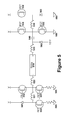
- FIG. 5 illustrates a more complex driver circuit that can further reduce the energy losses of the driver circuit.
- FIG. 1 illustrates a diagrammatic representation of a machine in the example form of a computer system 100 that may be used to implement portions of the present disclosure or benefit from the disclosure.
- computer system 100 there are a set of instructions 124 that may be executed for causing the machine to perform any one or more of the methodologies discussed herein.
- the machine In a networked deployment, the machine may operate in the capacity of a server machine or a client machine in client-server network environment, or as a peer machine in a peer-to-peer (or distributed) network environment.
- the machine may be a personal computer (PC), a tablet PC, a set-top box (STB), a Personal Digital Assistant (PDA), a cellular telephone, a web appliance, a network router, switch or bridge, or any machine capable of executing a set of computer instructions (sequential or otherwise) that specify actions to be taken by that machine.
- PC personal computer
- PDA Personal Digital Assistant
- STB set-top box
- WPA Personal Digital Assistant
- a cellular telephone a web appliance
- network router switch or bridge
- machine any machine capable of executing a set of computer instructions (sequential or otherwise) that specify actions to be taken by that machine.
- machine shall also be taken to include any collection of machines that individually or jointly execute a set (or multiple sets) of instructions to perform any one or more of the methodologies discussed herein.
- the example computer system 100 includes a processor 102 (e.g., a central processing unit (CPU), a graphics processing unit (GPU) or both), a main memory 104 and a static memory 106 , which communicate with each other via a bus 108 .
- the computer system 100 may further include a video display adapter 110 that drives a video display system 115 such as a Liquid Crystal Display (LCD) or a Cathode Ray Tube (CRT).
- the computer system 100 also includes an alphanumeric input device 112 (e.g., a keyboard), a cursor control device 114 (e.g., a mouse or trackball), a disk drive unit 116 , an output signal generation device 118 , and a network interface device 120 .
- the disk drive unit 116 includes a machine-readable medium 122 on which is stored one or more sets of computer instructions and data structures (e.g., instructions 124 also known as ‘software’) embodying or utilized by any one or more of the methodologies or functions described herein.
- the instructions 124 may also reside, completely or at least partially, within the main memory 104 and/or within the processor 102 during execution thereof by the computer system 100 , the main memory 104 and the processor 102 also constituting machine-readable media. Note that the example computer system 100 illustrates only one possible example and that other computers may not have all of the components illustrated in FIG. 1
- the instructions 124 may further be transmitted or received over a computer network 126 via the network interface device 120 . Such transmissions may occur utilizing any one of a number of well-known transfer protocols such as the File Transport Protocol (FTP).
- FTP File Transport Protocol
- machine-readable medium 122 is shown in an example embodiment to be a single medium, the term “machine-readable medium” should be taken to include a single medium or multiple media (e.g., a centralized or distributed database, and/or associated caches and servers) that store the one or more sets of instructions.
- the term “machine-readable medium” shall also be taken to include any medium that is capable of storing, encoding or carrying a set of instructions for execution by the machine and that cause the machine to perform any one or more of the methodologies described herein, or that is capable of storing, encoding or carrying data structures utilized by or associated with such a set of instructions.
- the term “machine-readable medium” shall accordingly be taken to include, but not be limited to, solid-state memories, optical media, and magnetic media.
- module includes an identifiable portion of code, computational or executable instructions, data, or computational object to achieve a particular function, operation, processing, or procedure.
- a module need not be implemented in software; a module may be implemented in software, hardware/circuitry, or a combination of software and hardware.
- a computer system may comprise a very small microcontroller system.
- a microcontroller may comprise a single integrated circuit that contains the four main components that create a computer system: an arithmetic and logic unit (ALU), a control unit, a memory system, and an input and output system (collectively termed I/O).
- ALU arithmetic and logic unit
- control unit a control unit
- memory system a memory system
- I/O input and output system
- FIG. 2A illustrates a switching circuit for controlling a current loop used to provide a modulated current loop to a set of controlled circuit nodes 270 - 1 to 270 -N that are wired in a daisy-chain manner to receive electrical power and data signals.
- a nominally constant current source Vsupply 211 provides nominally constant direct current that passes through a series of circuit nodes 270 - 1 to 270 -N to ground 265 .
- the nominally constant direct current may be modulated using field effect transistor (FET) 261 that may interrupt the current loop thereby modulating changes in the nominally constant current on the line.
- FET field effect transistor
- An inductor 262 ensures that although the current level may be modulated, current will generally continue to flow.
- the switching circuit disclosed in FIG. 2A can be used in many different applications wherein a modulated direct current is required. Detailed information on one application of the switching circuit of FIG. 2A can be found in the U.S. Patent entitled “System And Method For Lighting Power And Control System” issued on Jan. 1, 2013 having U.S. Pat. No. 8,344,659 which is hereby incorporated by reference in its entirety.
- FIG. 2B illustrates the circuit of FIG. 2A wherein the series-arranged set of circuit nodes 270 - 1 to 270 -N have been replaced with a block labelled as String 270 to simplify the diagram. All later references to a block labelled ‘String’ in this document can be replaced with a set of series-arranged set of circuit nodes such as 270 - 1 to 270 -N from FIG. 2A .
- the highest supply voltage of V Volts is used for Vclamp 212 . If the current ramp rate (for modulating the current) on the inductor 262 is to be kept with a 2:1 ratio max:min slope, then the voltage at the string supply (VSupply 211 ) should be 2/3 V Volts and the voltage across the String 270 should be between 0 and 1/3 V Volts. Thus, even though V Volts (at Vclamp 212 ) of potential are required to operate the switching circuit of FIG. 2B , only 1/3 V Volts of potential are supplied to the String 270 that performs the desired work. Thus, much of the volt potential is not used to produce useful work.
- the switching losses of the circuit are significant. Specifically, the switching losses, which have a voltage dependence of C*V 2 in the system where C is parasitic capacitance, have a driving voltage that is three ( 3 ) times the voltage that can be delivered to the string 270 . These switching losses represent energy that will be lost as heat and not able to do productive work. Thus, it would be very desirable to reduce the voltage change relative to the voltage delivered to the string to significantly improve the energy efficiency of the switch circuit of FIG. 2B .
- FIG. 3A illustrates a first improved driver circuit system wherein a copy of the driver circuit of FIG. 2B is mirrored and added to the right of the original driver.
- a “double-ended” driver circuit is used to drive the circuit system.
- the original driver circuit with driver FET 361 drives String A 375 and the mirrored driver circuit with driver FET 367 drives String B 377 .
- the voltages of the two driver circuits may be adjusted such that the undriven ends of the String A 375 and String B 377 (at the center of FIG. 3A ) are both at 2/3 V volts as illustrated. If both driver FETs ( 361 and 367 ) are being driven with the same control signal, then the center point where 2/3 V volts was being supplied can be dropped out since the combined string will still be driven correctly due to the circuit symmetry.
- FIG. 3B illustrates the combined system wherein the 2/3 V source has been dropped out of the center of the diagram and String A 375 and String B 377 have been combined together into a single String 379 .
- the driver circuit is a double-ended driver circuit with a head end comprising FET 367 and inductor 368 and a tail end comprising inductor 362 and FET 361 .
- the highest voltage in the system is 4/3 V Volts (on the head end of the driver circuit) but the String 379 that performs the work can receive a total of 2/3 V Volts to perform useful work.
- the String 379 voltage (2/3 V) to supply voltage (4/3 V) ratio there is a noticeable improvement in the String 379 voltage (2/3 V) to supply voltage (4/3 V) ratio.
- the switching circuits on both sides of the line driver circuit see a voltage swing of 1 V volts (V to 0 on the left side and 4/3 V to 1/3 V on the right side) and yet the String 379 obtains 2/3 V.
- the double-ended line driver circuit of FIG. 3B requires three different voltage sources (V, 4/3 V, and 1/3 V) in order to operate.
- the next section of this document will describe a double-ended line driver circuit that only uses two voltage sources.
- the double-ended line driver circuit of FIG. 3B may also be modified by adding zero voltage switch inductors and transistors to the driver circuit in order to reduce the switching losses and turn-on losses in the transistors as will be later described with reference to FIG. 5 .
- FIG. 4 illustrates an alternate double-ended driver circuit that has been designed to operate with only two voltage sources (V and 1/3V) instead of the three voltage sources required by the double-ended driver circuit of FIG. 3B .
- the alternate doubled-ended driver circuit includes a Capacitor 440 on the head end driver circuit.
- the capacitor 440 will maintain a nearly constant voltage of 1/3 V Volts thus allowing the two right-hand supply voltages to be shifted down by 1/3 V Volts (from the amounts in the right-hand driver circuit of FIG. 3B ) to V Volts (at the top of the head end driver circuit) and ground (at the bottom of the head end driver circuit).
- driver FET 469 can be turned on to maintain the 1/3 V Volt charge on Capacitor 440 using current passed through diode 450 .
- the voltage across String 479 is 2/3 of the system supply voltage of V Volts. This means that supply voltage needed for the circuit in FIG. 4 is one half of the supply voltage required in the original single-ended driver circuit of FIG. 2B to achieve the same voltage across String 479 .
- the improved double-ended driver circuit of FIG. 4 provides significant advantages over the original single-ended driver circuit of FIG. 2B .
- the diodes 463 and 450 in the double-ended driver circuit may be replaced by MOSFET switches in order to reduce conduction losses within the circuit.
- Replacing diode 450 can be more advantageous, since diode 450 carries more average current than diode 463 such that the conduction losses on diode 450 are larger.
- diode 450 switches with driver FET 469
- a MOSFET switch used to replace diode 450 can be controlled by the same driver line that operates driver FET 469 , with simply a level-shifting capacitor coupled to its gate.
- the driver circuit of FIG. 4 improves the circuit energy efficiency compared to the original driver circuit of FIGS. 2A and 2B . However, there is still some energy inefficiency within the driver circuit of FIG. 4 .
- the double-ended driver circuit of FIG. 4 still has substantial C*V 2 switching losses and Field Effect Transistor (FET) turn-on losses that occur when the various transistors are turned on.
- FET Field Effect Transistor
- additional improvements can be made to the double-ended driver circuit of FIG. 4 to further reduce the energy losses in the double-ended driver circuit. Specifically, a set of zero voltage switch inductors and transistors may be added to reduce these energy losses that occur within the transistors.
- FIG. 5 illustrates a more complex double-ended driver circuit that can further reduce the energy losses of the double-ended driver circuit of FIG. 4 .
- a key concept in the driver circuit of FIG. 5 is that energy stored as current within inductors can be used to reduce C*V 2 or FET turn-on losses by reducing the transistor voltage swings. This is accomplished by adding a set of zero voltage switch inductors and transistors to the driver circuit. These zero voltage switch inductors and transistors cause the voltage difference between the drain and source to be at or around zero volts when a transistor switch occurs.
- FET 553 is turned on while FET 551 is on.
- FET 551 turns off, the current flowing through inductor 532 drives the voltage at the node between FET 551 and FET 552 to V Volts at which point FET 552 can be turned on with very little C*V 2 or FET turn-on losses (since there will be no voltage difference between the V Volt source for FET 552 and the V Volts created by inductor 532 at the node between FET 551 and FET 552 ).
- FET 553 is then turned off. That current in inductor 531 stores energy that will be used to help turn on FETs with little energy loss. Specifically, when FET 553 is turned off, the current in inductor 531 is allowed to circulate via diode 561 and FET 552 . Later when FET 552 is turned off, the energy from the current in inductor 531 drives the voltage at the node between FET 551 and FET 552 to 0 V such that FET 551 can then be turned on with very little C*V 2 or FET turn-on losses. (Again this is due to zero voltage across FET 551 due to the OV ground 565 and the 0V created by inductor 531 at the node between FET 551 and FET 552 .)
- the preceding paragraph describes the operations of the transistors of the left-hand side of the driver circuit in FIG. 5 .
- the very same set of operations takes place in the mirrored driver circuit on the right-hand side of the doubled-ended driver circuit to achieve the same energy efficiency on the right-hand side driver circuit
- adding capacitance across FET 551 , FET 553 , diode 563 and FET 555 can further improve the energy efficiency of the driver circuit.
- the added capacitance will reduce the voltage swing on transistors as the transistors turn off. Since the capacitance is charged by inductors, to a first order it is lossless, so until the inductor parasitics dominate the system, the reduction in transistor turn off losses can be improved as the capacitor value increases.
- Additional modifications may be made to the improved double-ended driver circuit of FIG. 5 to even further improve the efficiency of the driver circuit.
- the diodes within the driver circuit illustrated in FIG. 5 may be replaced with transistors to further reduce conduction losses.
- a set of zero voltage switch inductors and transistors have been added to the driver circuit design of FIG. 4 to create the driver circuit of FIG. 5 . These added inductors and transistors reduce the voltage on transistors when switches of the transistors occur and thereby reduce switching and turn-on losses. These same zero voltage switch inductors and transistors can be added to the driver circuit design of FIG. 3B to reduce the switching and turn-on losses in that particular driver circuit.
Landscapes
- Engineering & Computer Science (AREA)
- Power Engineering (AREA)
- Dc-Dc Converters (AREA)
Abstract
Description
- The present U.S. patent application claims the benefit of the previous U.S. Provisional Patent Application entitled “System And Method For Efficient Circuit Switching Using A Doubled Ended Line Driver Circuit” filed on Jun. 12, 2014 having Ser. No. 62/011,537.
- The present invention relates to the field of electronic circuits. In particular, but not by way of limitation, the present invention discloses techniques for reducing energy usage in electronic switching circuits.
- With the rising costs of electricity production and the threat of carbon emission caused climate change, energy efficiency has long been a very important design consideration for the designers of any electronic product. Electric lighting has been improving efficiency by moving from inefficient traditional incandescent light bulbs to fluorescent lighting using compact fluorescent light (CFL) bulbs and light-emitting diode (LED) lighting systems.
- In addition to the energy cost savings and the environmental benefits, increased electrical energy efficiency can improve the operating performance of electronic products. For example, by increasing the energy efficiency of any mobile electronic device such as a tablet computer or cellular telephone, the battery-powered operating time of such mobile electronics can be lengthened such that the mobile electronic device can be used for a longer time period between recharges. Thus, there are many reasons to improve the energy efficiency of electronic products.
- Electronic circuits consume energy in multiple different manners. Energy is often consumed generating light, generating sound, transmitting a signal, or operating a motor on some type of output circuit. However, energy is also consumed in other unintentional manners. For example, the resistance of transmission conductors causes conductors to heat up thus causing transmission losses. Another type of unintentional loss is switching losses caused by transistors that switch between on and off states. It would therefore be desirable to reduce the unintentional switching losses within electronic circuits to improve energy efficiency.
- In the drawings, which are not necessarily drawn to scale, like numerals describe substantially similar components throughout the several views. Like numerals having different letter suffixes represent different instances of substantially similar components. The drawings illustrate generally, by way of example, but not by way of limitation, various embodiments discussed in the present document.
-
FIG. 1 illustrates a diagrammatic representation of a machine in the example form of a computer system within which a set of instructions, for causing the machine to perform any one or more of the methodologies discussed herein, may be executed. -
FIG. 2A illustrates a circuit for controlling a current loop used to provide a modulated current loop to a set of controlled circuit nodes that are wired in a daisy-chain manner to receive electrical power and data signals. -
FIG. 2B illustrates the circuit ofFIG. 2A wherein the series arranged circuit nodes have been replaced with a block labelled as String and some voltage levels are listed. -
FIG. 3A illustrates a circuit system wherein a copy of the driver circuit ofFIG. 2B is mirrored and added to the right of the driver circuit inFIG. 2B . -
FIG. 3B illustrates the combined system wherein String A and String B ofFIG. 3A have been combined into a single String. -
FIG. 4 illustrates a further improved dual-ended driver circuit that has been designed to operate even more efficiently by adding a capacitor. -
FIG. 5 illustrates a more complex driver circuit that can further reduce the energy losses of the driver circuit. - The following detailed description includes references to the accompanying drawings, which form a part of the detailed description. The drawings show illustrations in accordance with example embodiments. These embodiments, which are also referred to herein as “examples,” are described in enough detail to enable those skilled in the art to practice the invention. It will be apparent to one skilled in the art that specific details in the example embodiments are not required in order to practice the present invention. The example embodiments may be combined, other embodiments may be utilized, or structural, logical and electrical changes may be made without departing from the scope what is claimed. The following detailed description is, therefore, not to be taken in a limiting sense, and the scope is defined by the appended claims and their equivalents.
- In this document, the terms “a” or “an” are used, as is common in patent documents, to include one or more than one. In this document, the term “or” is used to refer to a nonexclusive or, such that “A or B” includes “A but not B,” “B but not A,” and “A and B,” unless otherwise indicated. Furthermore, all publications, patents, and patent documents referred to in this document are incorporated by reference herein in their entirety, as though individually incorporated by reference. In the event of inconsistent usages between this document and those documents so incorporated by reference, the usage in the incorporated reference(s) should be considered supplementary to that of this document; for irreconcilable inconsistencies, the usage in this document controls.
- Computer Systems
- Some embodiments of the present disclosure may use computer systems since computer systems are very often used to control electrical circuit systems.
FIG. 1 illustrates a diagrammatic representation of a machine in the example form of acomputer system 100 that may be used to implement portions of the present disclosure or benefit from the disclosure. Withincomputer system 100 there are a set ofinstructions 124 that may be executed for causing the machine to perform any one or more of the methodologies discussed herein. In a networked deployment, the machine may operate in the capacity of a server machine or a client machine in client-server network environment, or as a peer machine in a peer-to-peer (or distributed) network environment. The machine may be a personal computer (PC), a tablet PC, a set-top box (STB), a Personal Digital Assistant (PDA), a cellular telephone, a web appliance, a network router, switch or bridge, or any machine capable of executing a set of computer instructions (sequential or otherwise) that specify actions to be taken by that machine. Furthermore, while only a single machine is illustrated, the term “machine” shall also be taken to include any collection of machines that individually or jointly execute a set (or multiple sets) of instructions to perform any one or more of the methodologies discussed herein. - The
example computer system 100 includes a processor 102 (e.g., a central processing unit (CPU), a graphics processing unit (GPU) or both), amain memory 104 and astatic memory 106, which communicate with each other via abus 108. Thecomputer system 100 may further include a video display adapter 110 that drives avideo display system 115 such as a Liquid Crystal Display (LCD) or a Cathode Ray Tube (CRT). Thecomputer system 100 also includes an alphanumeric input device 112 (e.g., a keyboard), a cursor control device 114 (e.g., a mouse or trackball), adisk drive unit 116, an outputsignal generation device 118, and a network interface device 120. - The
disk drive unit 116 includes a machine-readable medium 122 on which is stored one or more sets of computer instructions and data structures (e.g.,instructions 124 also known as ‘software’) embodying or utilized by any one or more of the methodologies or functions described herein. Theinstructions 124 may also reside, completely or at least partially, within themain memory 104 and/or within theprocessor 102 during execution thereof by thecomputer system 100, themain memory 104 and theprocessor 102 also constituting machine-readable media. Note that theexample computer system 100 illustrates only one possible example and that other computers may not have all of the components illustrated inFIG. 1 - The
instructions 124 may further be transmitted or received over acomputer network 126 via the network interface device 120. Such transmissions may occur utilizing any one of a number of well-known transfer protocols such as the File Transport Protocol (FTP). - While the machine-readable medium 122 is shown in an example embodiment to be a single medium, the term “machine-readable medium” should be taken to include a single medium or multiple media (e.g., a centralized or distributed database, and/or associated caches and servers) that store the one or more sets of instructions. The term “machine-readable medium” shall also be taken to include any medium that is capable of storing, encoding or carrying a set of instructions for execution by the machine and that cause the machine to perform any one or more of the methodologies described herein, or that is capable of storing, encoding or carrying data structures utilized by or associated with such a set of instructions. The term “machine-readable medium” shall accordingly be taken to include, but not be limited to, solid-state memories, optical media, and magnetic media.
- For the purposes of this specification, the term “module” includes an identifiable portion of code, computational or executable instructions, data, or computational object to achieve a particular function, operation, processing, or procedure. A module need not be implemented in software; a module may be implemented in software, hardware/circuitry, or a combination of software and hardware.
- In the present disclosure, a computer system may comprise a very small microcontroller system. A microcontroller may comprise a single integrated circuit that contains the four main components that create a computer system: an arithmetic and logic unit (ALU), a control unit, a memory system, and an input and output system (collectively termed I/O). Microcontrollers are very small and inexpensive integrated circuits that are very often used in digital electronic devices.
- Current Loop for Serial Circuit Nodes Overview
-
FIG. 2A illustrates a switching circuit for controlling a current loop used to provide a modulated current loop to a set of controlled circuit nodes 270-1 to 270-N that are wired in a daisy-chain manner to receive electrical power and data signals. Specifically, a nominally constantcurrent source Vsupply 211 provides nominally constant direct current that passes through a series of circuit nodes 270-1 to 270-N to ground 265. The nominally constant direct current may be modulated using field effect transistor (FET) 261 that may interrupt the current loop thereby modulating changes in the nominally constant current on the line. Aninductor 262 ensures that although the current level may be modulated, current will generally continue to flow. - The switching circuit disclosed in
FIG. 2A can be used in many different applications wherein a modulated direct current is required. Detailed information on one application of the switching circuit ofFIG. 2A can be found in the U.S. Patent entitled “System And Method For Lighting Power And Control System” issued on Jan. 1, 2013 having U.S. Pat. No. 8,344,659 which is hereby incorporated by reference in its entirety. -
FIG. 2B illustrates the circuit ofFIG. 2A wherein the series-arranged set of circuit nodes 270-1 to 270-N have been replaced with a block labelled asString 270 to simplify the diagram. All later references to a block labelled ‘String’ in this document can be replaced with a set of series-arranged set of circuit nodes such as 270-1 to 270-N fromFIG. 2A . - In the circuit for controlling a current loop illustrated in
FIG. 2B , the highest supply voltage of V Volts is used forVclamp 212. If the current ramp rate (for modulating the current) on theinductor 262 is to be kept with a 2:1 ratio max:min slope, then the voltage at the string supply (VSupply 211) should be 2/3 V Volts and the voltage across theString 270 should be between 0 and 1/3 V Volts. Thus, even though V Volts (at Vclamp 212) of potential are required to operate the switching circuit ofFIG. 2B , only 1/3 V Volts of potential are supplied to theString 270 that performs the desired work. Thus, much of the volt potential is not used to produce useful work. - In the driver circuit arrangement of
FIG. 2B the switching losses of the circuit are significant. Specifically, the switching losses, which have a voltage dependence of C*V2 in the system where C is parasitic capacitance, have a driving voltage that is three (3) times the voltage that can be delivered to thestring 270. These switching losses represent energy that will be lost as heat and not able to do productive work. Thus, it would be very desirable to reduce the voltage change relative to the voltage delivered to the string to significantly improve the energy efficiency of the switch circuit ofFIG. 2B . - Operating with higher voltages can increase the cost of constructing a circuit. For example, to handle higher voltage levels the electrical components (transistors, inductors, diodes, capacitors, etc.), insulation, and isolation costs of the driver circuit may increase. Thus, in addition to the energy efficiency increases there are additional reasons that obtaining a higher string voltage (the voltage across String 270) relative to supply voltage (the V Volts provided to
Vclamp 212 in this circuit) for the driver circuit can be beneficial. - Improved Double-Ended Current Loop Driver Circuit
-
FIG. 3A illustrates a first improved driver circuit system wherein a copy of the driver circuit ofFIG. 2B is mirrored and added to the right of the original driver. Thus, a “double-ended” driver circuit is used to drive the circuit system. The original driver circuit withdriver FET 361 drivesString A 375 and the mirrored driver circuit withdriver FET 367 drivesString B 377. - The voltages of the two driver circuits may be adjusted such that the undriven ends of the
String A 375 and String B 377 (at the center ofFIG. 3A ) are both at 2/3 V volts as illustrated. If both driver FETs (361 and 367) are being driven with the same control signal, then the center point where 2/3 V volts was being supplied can be dropped out since the combined string will still be driven correctly due to the circuit symmetry. -
FIG. 3B illustrates the combined system wherein the 2/3 V source has been dropped out of the center of the diagram andString A 375 andString B 377 have been combined together into asingle String 379. The driver circuit is a double-ended driver circuit with a headend comprising FET 367 andinductor 368 and a tailend comprising inductor 362 andFET 361. - In the combined double-ended driver system of
FIG. 3B , the highest voltage in the system is 4/3 V Volts (on the head end of the driver circuit) but theString 379 that performs the work can receive a total of 2/3 V Volts to perform useful work. Thus, there is a noticeable improvement in theString 379 voltage (2/3 V) to supply voltage (4/3 V) ratio. Furthermore, the switching circuits on both sides of the line driver circuit see a voltage swing of 1 V volts (V to 0 on the left side and 4/3 V to 1/3 V on the right side) and yet theString 379 obtains 2/3 V. - The double-ended line driver circuit of
FIG. 3B requires three different voltage sources (V, 4/3 V, and 1/3 V) in order to operate. The next section of this document will describe a double-ended line driver circuit that only uses two voltage sources. The double-ended line driver circuit ofFIG. 3B may also be modified by adding zero voltage switch inductors and transistors to the driver circuit in order to reduce the switching losses and turn-on losses in the transistors as will be later described with reference toFIG. 5 . - Alternate Double-Ended Current Loop Driver Circuit
-
FIG. 4 illustrates an alternate double-ended driver circuit that has been designed to operate with only two voltage sources (V and 1/3V) instead of the three voltage sources required by the double-ended driver circuit ofFIG. 3B . Referring toFIG. 4 , the alternate doubled-ended driver circuit includes aCapacitor 440 on the head end driver circuit. During driver circuit operation, thecapacitor 440 will maintain a nearly constant voltage of 1/3 V Volts thus allowing the two right-hand supply voltages to be shifted down by 1/3 V Volts (from the amounts in the right-hand driver circuit ofFIG. 3B ) to V Volts (at the top of the head end driver circuit) and ground (at the bottom of the head end driver circuit). Whenever tailend driver FET 461 and headend driver FET 467 are turned off thendriver FET 469 can be turned on to maintain the 1/3 V Volt charge onCapacitor 440 using current passed throughdiode 450. - With the alternate double-ended driver circuit design of
FIG. 4 , the voltage acrossString 479 is 2/3 of the system supply voltage of V Volts. This means that supply voltage needed for the circuit inFIG. 4 is one half of the supply voltage required in the original single-ended driver circuit ofFIG. 2B to achieve the same voltage acrossString 479. Thus, the improved double-ended driver circuit ofFIG. 4 provides significant advantages over the original single-ended driver circuit ofFIG. 2B . - During operation, half of the maximum string output power will always be drawn from the 1/3 V Volt supply through
capacitor 450. If the voltage across thestring 479 is 0 then all of this power (minus losses) will be return out of the V rail. Additional circuitry will need to convert this power and return it to the 1/3 V rail. If the voltage across thestring 479 is 2/3 V Volts, then half the power will still come from the 1/3 V Volt supply, but now the other half will come from the V rail supply. - Referring to
FIG. 4 , thediodes diode 450 can be more advantageous, sincediode 450 carries more average current thandiode 463 such that the conduction losses ondiode 450 are larger. Furthermore, sincediode 450 switches withdriver FET 469, a MOSFET switch used to replacediode 450 can be controlled by the same driver line that operatesdriver FET 469, with simply a level-shifting capacitor coupled to its gate. - Further Improved Double-Ended Current Loop Driver Circuit Variation
- The driver circuit of
FIG. 4 improves the circuit energy efficiency compared to the original driver circuit ofFIGS. 2A and 2B . However, there is still some energy inefficiency within the driver circuit ofFIG. 4 . For example, the double-ended driver circuit ofFIG. 4 still has substantial C*V2 switching losses and Field Effect Transistor (FET) turn-on losses that occur when the various transistors are turned on. Thus, additional improvements can be made to the double-ended driver circuit ofFIG. 4 to further reduce the energy losses in the double-ended driver circuit. Specifically, a set of zero voltage switch inductors and transistors may be added to reduce these energy losses that occur within the transistors. -
FIG. 5 illustrates a more complex double-ended driver circuit that can further reduce the energy losses of the double-ended driver circuit ofFIG. 4 . A key concept in the driver circuit ofFIG. 5 is that energy stored as current within inductors can be used to reduce C*V2 or FET turn-on losses by reducing the transistor voltage swings. This is accomplished by adding a set of zero voltage switch inductors and transistors to the driver circuit. These zero voltage switch inductors and transistors cause the voltage difference between the drain and source to be at or around zero volts when a transistor switch occurs. - Referring to the left-hand side of the double-ended driver circuit of
FIG. 5 ,FET 553 is turned on whileFET 551 is on. WhenFET 551 turns off, the current flowing throughinductor 532 drives the voltage at the node betweenFET 551 andFET 552 to V Volts at whichpoint FET 552 can be turned on with very little C*V2 or FET turn-on losses (since there will be no voltage difference between the V Volt source forFET 552 and the V Volts created byinductor 532 at the node betweenFET 551 and FET 552). - Once the current in
inductor 531 ramps up to a value larger than the string current,FET 553 is then turned off. That current ininductor 531 stores energy that will be used to help turn on FETs with little energy loss. Specifically, whenFET 553 is turned off, the current ininductor 531 is allowed to circulate viadiode 561 andFET 552. Later whenFET 552 is turned off, the energy from the current ininductor 531 drives the voltage at the node betweenFET 551 andFET 552 to 0 V such thatFET 551 can then be turned on with very little C*V2 or FET turn-on losses. (Again this is due to zero voltage acrossFET 551 due to theOV ground 565 and the 0V created byinductor 531 at the node betweenFET 551 andFET 552.) - Once the current in
inductor 531 decays, the voltage at the node betweendiode 561 andFET 553 drops to 0 V such thatFET 553 can then be turned on with little C*V2 or Field Effect Transistor (FET) turn-on losses. (Once again this is due to zero voltage acrossFET 553 due to theOV ground 565 and the OV betweendiode 561 andFET 553.) At this point the driver circuit system is back in the starting state for another cycle. Note that with the driver circuit system disclosed inFIG. 5 , all of the transistors in the circuit turn on with minimal losses since the transistors turn on at a low voltage. - The preceding paragraph describes the operations of the transistors of the left-hand side of the driver circuit in
FIG. 5 . The very same set of operations takes place in the mirrored driver circuit on the right-hand side of the doubled-ended driver circuit to achieve the same energy efficiency on the right-hand side driver circuit In some cases adding capacitance acrossFET 551,FET 553,diode 563 andFET 555 can further improve the energy efficiency of the driver circuit. Specifically, the added capacitance will reduce the voltage swing on transistors as the transistors turn off. Since the capacitance is charged by inductors, to a first order it is lossless, so until the inductor parasitics dominate the system, the reduction in transistor turn off losses can be improved as the capacitor value increases. - Additional modifications may be made to the improved double-ended driver circuit of
FIG. 5 to even further improve the efficiency of the driver circuit. For example, as with the driver circuit ofFIG. 4 , the diodes within the driver circuit illustrated inFIG. 5 may be replaced with transistors to further reduce conduction losses. - As set forth in the description of
FIG. 5 , a set of zero voltage switch inductors and transistors have been added to the driver circuit design ofFIG. 4 to create the driver circuit ofFIG. 5 . These added inductors and transistors reduce the voltage on transistors when switches of the transistors occur and thereby reduce switching and turn-on losses. These same zero voltage switch inductors and transistors can be added to the driver circuit design ofFIG. 3B to reduce the switching and turn-on losses in that particular driver circuit. - The preceding technical disclosure is intended to be illustrative, and not restrictive. For example, the above-described embodiments (or one or more aspects thereof) may be used in combination with each other. Other embodiments will be apparent to those of skill in the art upon reviewing the above description. The scope of the claims should, therefore, be determined with reference to the appended claims, along with the full scope of equivalents to which such claims are entitled. In the appended claims, the terms “including” and “in which” are used as the plain-English equivalents of the respective terms “comprising” and “wherein.” Also, in the following claims, the terms “including” and “comprising” are open-ended, that is, a system, device, article, or process that includes elements in addition to those listed after such a term in a claim are still deemed to fall within the scope of that claim. Moreover, in the following claims, the terms “first,” “second,” and “third,” etc. are used merely as labels, and are not intended to impose numerical requirements on their objects.
- The Abstract is provided to comply with 37 C.F.R. §1.72(b), which requires that it allow the reader to quickly ascertain the nature of the technical disclosure. The abstract is submitted with the understanding that it will not be used to interpret or limit the scope or meaning of the claims. Also, in the above Detailed Description, various features may be grouped together to streamline the disclosure. This should not be interpreted as intending that an unclaimed disclosed feature is essential to any claim. Rather, inventive subject matter may lie in less than all features of a particular disclosed embodiment. Thus, the following claims are hereby incorporated into the Detailed Description, with each claim standing on its own as a separate embodiment.
- What is claimed is
Claims (20)
Priority Applications (1)
| Application Number | Priority Date | Filing Date | Title |
|---|---|---|---|
| US14/335,803 US10305380B2 (en) | 2014-06-12 | 2014-07-18 | System and method for efficient circuit switching using a double-ended line driver circuit |
Applications Claiming Priority (2)
| Application Number | Priority Date | Filing Date | Title |
|---|---|---|---|
| US201462011537P | 2014-06-12 | 2014-06-12 | |
| US14/335,803 US10305380B2 (en) | 2014-06-12 | 2014-07-18 | System and method for efficient circuit switching using a double-ended line driver circuit |
Publications (2)
| Publication Number | Publication Date |
|---|---|
| US20150364983A1 true US20150364983A1 (en) | 2015-12-17 |
| US10305380B2 US10305380B2 (en) | 2019-05-28 |
Family
ID=54836997
Family Applications (1)
| Application Number | Title | Priority Date | Filing Date |
|---|---|---|---|
| US14/335,803 Active 2036-04-06 US10305380B2 (en) | 2014-06-12 | 2014-07-18 | System and method for efficient circuit switching using a double-ended line driver circuit |
Country Status (1)
| Country | Link |
|---|---|
| US (1) | US10305380B2 (en) |
Cited By (1)
| Publication number | Priority date | Publication date | Assignee | Title |
|---|---|---|---|---|
| US9467122B2 (en) * | 2014-08-29 | 2016-10-11 | Freescale Semiconductor, Inc. | Switching scheme to extend maximum input voltage range of a DC-to-DC voltage converter |
Citations (7)
| Publication number | Priority date | Publication date | Assignee | Title |
|---|---|---|---|---|
| US7265527B1 (en) * | 2006-10-12 | 2007-09-04 | Micrel, Inc. | Direct current multiplier |
| US20100060200A1 (en) * | 2008-09-05 | 2010-03-11 | Lutron Electronics Co., Inc. | Electronic ballast having a symmetric topology |
| US20100060179A1 (en) * | 2008-09-05 | 2010-03-11 | Newman Jr Robert C | Electronic ballast having a partially self-oscillating inverter circuit |
| US8188682B2 (en) * | 2006-07-07 | 2012-05-29 | Maxim Integrated Products, Inc. | High current fast rise and fall time LED driver |
| US20120217950A1 (en) * | 2009-11-06 | 2012-08-30 | Neofocal Systems, Inc. | Method And Circuit For Catching Excess Current |
| US20120299480A1 (en) * | 2009-11-06 | 2012-11-29 | Neofocal Systems, Inc. | System And Method For Current Modulated Data Transmission |
| US8847511B1 (en) * | 2013-06-18 | 2014-09-30 | I-Shou University | Light emitting diode driving circuit |
-
2014
- 2014-07-18 US US14/335,803 patent/US10305380B2/en active Active
Patent Citations (7)
| Publication number | Priority date | Publication date | Assignee | Title |
|---|---|---|---|---|
| US8188682B2 (en) * | 2006-07-07 | 2012-05-29 | Maxim Integrated Products, Inc. | High current fast rise and fall time LED driver |
| US7265527B1 (en) * | 2006-10-12 | 2007-09-04 | Micrel, Inc. | Direct current multiplier |
| US20100060200A1 (en) * | 2008-09-05 | 2010-03-11 | Lutron Electronics Co., Inc. | Electronic ballast having a symmetric topology |
| US20100060179A1 (en) * | 2008-09-05 | 2010-03-11 | Newman Jr Robert C | Electronic ballast having a partially self-oscillating inverter circuit |
| US20120217950A1 (en) * | 2009-11-06 | 2012-08-30 | Neofocal Systems, Inc. | Method And Circuit For Catching Excess Current |
| US20120299480A1 (en) * | 2009-11-06 | 2012-11-29 | Neofocal Systems, Inc. | System And Method For Current Modulated Data Transmission |
| US8847511B1 (en) * | 2013-06-18 | 2014-09-30 | I-Shou University | Light emitting diode driving circuit |
Cited By (1)
| Publication number | Priority date | Publication date | Assignee | Title |
|---|---|---|---|---|
| US9467122B2 (en) * | 2014-08-29 | 2016-10-11 | Freescale Semiconductor, Inc. | Switching scheme to extend maximum input voltage range of a DC-to-DC voltage converter |
Also Published As
| Publication number | Publication date |
|---|---|
| US10305380B2 (en) | 2019-05-28 |
Similar Documents
| Publication | Publication Date | Title |
|---|---|---|
| TWI716160B (en) | Pixel circuit | |
| CN105654905B (en) | Shift register and its driving method, drive circuit and display device | |
| CN102654974B (en) | Pixel unit drive circuit, pixel unit drive method and display device | |
| CN106469539A (en) | Display panel and pixel circuit | |
| KR102748937B1 (en) | Emission controlling driver and display apparatus including the same | |
| CN102593151B (en) | Pixel structure, driving method thereof, and self-luminous display using same | |
| US20150245439A1 (en) | Light emitting diode string driving method | |
| CN103456269A (en) | Shift register circuit | |
| CN110176215A (en) | Display panel and display device | |
| CN118737057A (en) | Pixel circuit driving method and display device | |
| CN101763807A (en) | Driving device for light emitting element | |
| CN117095638A (en) | Microdisplay circuit and control method, display chip and electronic equipment | |
| CN115565491A (en) | Pixel circuit with bandwidth compensation and operation method thereof | |
| US10305380B2 (en) | System and method for efficient circuit switching using a double-ended line driver circuit | |
| CN112669777B (en) | Pixel circuit | |
| TWI540565B (en) | Multiplex driver and display device | |
| CN106373528B (en) | Display device, pixel driving circuit and pixel driving method | |
| CN101227775A (en) | pixel circuit | |
| CN110033731B (en) | Composite driving display panel | |
| US11996774B2 (en) | System and method for zero voltage switching and switch capacitor modulation | |
| CN113889037B (en) | Display panel and driving method thereof | |
| CN103560575B (en) | A kind of electric supply installation and electronic equipment | |
| CN111081189B (en) | Pixel driving circuit and display device | |
| TWI688934B (en) | Pixel circuit | |
| CN208834748U (en) | An a kind of bit memory circuit for amoled plate sub-pixel |
Legal Events
| Date | Code | Title | Description |
|---|---|---|---|
| AS | Assignment |
Owner name: NEOFOCAL SYSTEMS, INC., OREGON Free format text: ASSIGNMENT OF ASSIGNORS INTEREST;ASSIGNOR:PETING, MARK;REEL/FRAME:041446/0601 Effective date: 20170222 |
|
| STPP | Information on status: patent application and granting procedure in general |
Free format text: NOTICE OF ALLOWANCE MAILED -- APPLICATION RECEIVED IN OFFICE OF PUBLICATIONS |
|
| STPP | Information on status: patent application and granting procedure in general |
Free format text: PUBLICATIONS -- ISSUE FEE PAYMENT RECEIVED |
|
| STPP | Information on status: patent application and granting procedure in general |
Free format text: PUBLICATIONS -- ISSUE FEE PAYMENT VERIFIED |
|
| STCF | Information on status: patent grant |
Free format text: PATENTED CASE |
|
| MAFP | Maintenance fee payment |
Free format text: PAYMENT OF MAINTENANCE FEE, 4TH YR, SMALL ENTITY (ORIGINAL EVENT CODE: M2551); ENTITY STATUS OF PATENT OWNER: SMALL ENTITY Year of fee payment: 4 |
|
| AS | Assignment |
Owner name: DALY, BRENDAN, NEW HAMPSHIRE Free format text: SECURITY INTEREST;ASSIGNOR:NEOFOCAL SYSTEMS, INC.;REEL/FRAME:068298/0494 Effective date: 20171130 |