US20140188198A1 - Hypodermic needle with fiberoptic extension - Google Patents
Hypodermic needle with fiberoptic extension Download PDFInfo
- Publication number
- US20140188198A1 US20140188198A1 US13/954,063 US201313954063A US2014188198A1 US 20140188198 A1 US20140188198 A1 US 20140188198A1 US 201313954063 A US201313954063 A US 201313954063A US 2014188198 A1 US2014188198 A1 US 2014188198A1
- Authority
- US
- United States
- Prior art keywords
- light
- fiberoptic
- light source
- filament
- insertion tip
- Prior art date
- Legal status (The legal status is an assumption and is not a legal conclusion. Google has not performed a legal analysis and makes no representation as to the accuracy of the status listed.)
- Abandoned
Links
- 238000003780 insertion Methods 0.000 claims abstract description 14
- 230000037431 insertion Effects 0.000 claims abstract description 14
- 201000010099 disease Diseases 0.000 claims abstract description 8
- 208000037265 diseases, disorders, signs and symptoms Diseases 0.000 claims abstract description 8
- 238000000034 method Methods 0.000 claims description 11
- 241000894006 Bacteria Species 0.000 description 4
- 208000014674 injury Diseases 0.000 description 2
- 230000008733 trauma Effects 0.000 description 2
- 208000035143 Bacterial infection Diseases 0.000 description 1
- 206010028980 Neoplasm Diseases 0.000 description 1
- 208000022362 bacterial infectious disease Diseases 0.000 description 1
- 201000011510 cancer Diseases 0.000 description 1
- 230000030833 cell death Effects 0.000 description 1
- 230000008030 elimination Effects 0.000 description 1
- 238000003379 elimination reaction Methods 0.000 description 1
- 239000000835 fiber Substances 0.000 description 1
- 238000012986 modification Methods 0.000 description 1
- 230000004048 modification Effects 0.000 description 1
- 230000002035 prolonged effect Effects 0.000 description 1
- 238000011084 recovery Methods 0.000 description 1
Images

Classifications
-
- A—HUMAN NECESSITIES
- A61—MEDICAL OR VETERINARY SCIENCE; HYGIENE
- A61N—ELECTROTHERAPY; MAGNETOTHERAPY; RADIATION THERAPY; ULTRASOUND THERAPY
- A61N5/00—Radiation therapy
- A61N5/06—Radiation therapy using light
- A61N5/0601—Apparatus for use inside the body
-
- A—HUMAN NECESSITIES
- A61—MEDICAL OR VETERINARY SCIENCE; HYGIENE
- A61N—ELECTROTHERAPY; MAGNETOTHERAPY; RADIATION THERAPY; ULTRASOUND THERAPY
- A61N5/00—Radiation therapy
- A61N5/06—Radiation therapy using light
- A61N5/0613—Apparatus adapted for a specific treatment
- A61N5/0624—Apparatus adapted for a specific treatment for eliminating microbes, germs, bacteria on or in the body
-
- A—HUMAN NECESSITIES
- A61—MEDICAL OR VETERINARY SCIENCE; HYGIENE
- A61N—ELECTROTHERAPY; MAGNETOTHERAPY; RADIATION THERAPY; ULTRASOUND THERAPY
- A61N5/00—Radiation therapy
- A61N5/06—Radiation therapy using light
- A61N5/0601—Apparatus for use inside the body
- A61N2005/0612—Apparatus for use inside the body using probes penetrating tissue; interstitial probes
-
- A—HUMAN NECESSITIES
- A61—MEDICAL OR VETERINARY SCIENCE; HYGIENE
- A61N—ELECTROTHERAPY; MAGNETOTHERAPY; RADIATION THERAPY; ULTRASOUND THERAPY
- A61N5/00—Radiation therapy
- A61N5/06—Radiation therapy using light
- A61N2005/063—Radiation therapy using light comprising light transmitting means, e.g. optical fibres
-
- A—HUMAN NECESSITIES
- A61—MEDICAL OR VETERINARY SCIENCE; HYGIENE
- A61N—ELECTROTHERAPY; MAGNETOTHERAPY; RADIATION THERAPY; ULTRASOUND THERAPY
- A61N5/00—Radiation therapy
- A61N5/06—Radiation therapy using light
- A61N2005/065—Light sources therefor
- A61N2005/0651—Diodes
-
- A—HUMAN NECESSITIES
- A61—MEDICAL OR VETERINARY SCIENCE; HYGIENE
- A61N—ELECTROTHERAPY; MAGNETOTHERAPY; RADIATION THERAPY; ULTRASOUND THERAPY
- A61N5/00—Radiation therapy
- A61N5/06—Radiation therapy using light
- A61N2005/0658—Radiation therapy using light characterised by the wavelength of light used
- A61N2005/0661—Radiation therapy using light characterised by the wavelength of light used ultraviolet
Definitions
- the present invention is relates to a fiberoptic cable disposed inside a hypodermic needle for applying UV light to a diseased area of the body in order to treat the disease.
- Medical procedures for treating diseased tissue often involve cutting into the patient and removing the tissue. These procedures can have many complications and can involve a painful and prolonged recovery. It would be desirable to be able to treat the diseased tissue without causing unnecessary physical trauma to the patient.
- UV (ultraviolet) light is often used to kill bacteria and is also a known cell killer.
- IR (infrared) light is also used to kill diseased cells, such as cancerous cells.
- a device comprising a hypodermic needle having a hollow shaft and an insertion tip, at least one fiberoptic filament extending through the needle to the insertion tip, and a UV light source connected to the fiberoptic filament.
- the UV light source is adapted to transmit UV light at a wavelength of 280-100 nm, which is the range in which the UV light interferes with a cell's DNA and can destroy diseased cells and bacteria. Studies have shown that UV light has intense peaks at UV wavelengths of 253.7 nanometers (nm) and a lesser peak at 184.9 nm. Research has shown that the optimum UV wavelength range to destroy bacteria is between 250 nm and 270 nm.
- the least one fiberoptic component is made up of a plurality of fiberoptic filaments forming a fiberoptic cable.
- the UV light source is a light emitting diode (LED).
- the LED is small and lightweight, so makes an ideal light source for use with the invention, which is intended to be a portable device. Other sources of UV light could also be used.
- the present invention also comprises a method for treating disease using a device comprising a hypodermic needle having a hollow shaft and an insertion tip, at least one fiberoptic filament extending through the needle to the insertion tip, and a UV light source connected to the fiberoptic filament, the UV light source adapted to transmit UV light at a wavelength of 280-100 nm.
- the UV light can be supplied in either a continuous beam or in a pulsed sequence. If a pulsed sequence is used, the sequence can include at least three pulses.
- the method can be repeated as many times as necessary to achieve sufficient treatment of the patient.
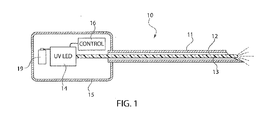
- FIG. 1 shows a cross-sectional view of a device according to the invention.
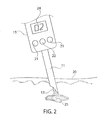
- FIG. 2 shows the device in use on a patient.
- FIG. 1 shows the device 10 , which comprises a hypodermic needle 11 with a hollow interior 12 , through which a fiberoptic cable 13 extends. Needle 11 could be made in various sizes, depending on the size of cable 13 . Cable 13 is made of a plurality of fiber optic filaments encased in a covering. Cable 13 is connected to a UV light source formed by a Light Emitting Diode (LED) 14 , which is encased in a housing 15 connected to needle 11 . LED 14 creates UV light, which travels down cable 13 to its end.
- LED Light Emitting Diode
- LED 14 creates UV light in a wavelength of 250-270 nm, which is the wavelength at which the DNA inside bacteria and cells becomes disrupted, thus causing cell death.
- LED 14 can be configured to emit a constant beam of light, or can be a pulsed beam.
- a controller 16 can be connected to LED 14 to control the type of beam being emitted, as well as to turn the beam on and off.
- Power to the LED 14 could be supplied by a battery 19 i incorporated into housing 15 , or by any conventional power supply means. Use of a battery means that device 10 is portable and can be used anywhere, without the need for an electrical connection.
- the device 10 in use is shown in FIG. 2 .
- needle 11 is inserted into a patient 20 to a depth where needle 10 is in the vicinity of the area to be treated.
- the area to be treated could have a bacterial infection, cancer or other disease.
- power is supplied via controller 16 to LED 14 , to send UV light 25 through cable 13 .
- Housing 15 is supplied with controllers 21 for turning the light on, 22 for turning the power off, and 23 creating a pulsed light emissions.
- a display screen 24 can show the duration of the light supplied, either in time or in number of pulses, as well as any other desired information.
- the needle 11 is removed from the patient 20 .
- the treatment can be repeated as many times as necessary and in multiple locations to achieve elimination of the disease.
Landscapes
- Health & Medical Sciences (AREA)
- Engineering & Computer Science (AREA)
- Biomedical Technology (AREA)
- Pathology (AREA)
- Nuclear Medicine, Radiotherapy & Molecular Imaging (AREA)
- Radiology & Medical Imaging (AREA)
- Life Sciences & Earth Sciences (AREA)
- Animal Behavior & Ethology (AREA)
- General Health & Medical Sciences (AREA)
- Public Health (AREA)
- Veterinary Medicine (AREA)
- Radiation-Therapy Devices (AREA)
Abstract
A device for treating disease has a hypodermic needle having a hollow shaft and an insertion tip, at least one fiberoptic filament extending through the needle to the insertion tip, and a UV light source connected to the fiberoptic filament. The UV light source is adapted to transmit UV light at a wavelength of 280-100 nm. The hypodermic needle is inserted into a patient until the insertion tip is located in an area to be treated, and the UV light is supplied to the at least one fiberoptic filament, so that the light travels along the filament to the area to be treated.
Description
- This application claims priority under 35 U.S.C. 119(e) of U.S. Provisional Application Ser. No. 61/747,337, filed on Dec. 30, 2012.
- 1. Field of the Invention
- The present invention is relates to a fiberoptic cable disposed inside a hypodermic needle for applying UV light to a diseased area of the body in order to treat the disease.
- 2. The Prior Art
- Medical procedures for treating diseased tissue often involve cutting into the patient and removing the tissue. These procedures can have many complications and can involve a painful and prolonged recovery. It would be desirable to be able to treat the diseased tissue without causing unnecessary physical trauma to the patient.
- UV (ultraviolet) light is often used to kill bacteria and is also a known cell killer. IR (infrared) light is also used to kill diseased cells, such as cancerous cells.
- It is an object of the invention to provide a device and method for treating disease. by using UV light supplied to a diseased area without causing unnecessary trauma to the patient. It is another object of the invention to provide a device and method for treating disease that is portable and simple and economic to use.
- These and other objects are accomplished by a device comprising a hypodermic needle having a hollow shaft and an insertion tip, at least one fiberoptic filament extending through the needle to the insertion tip, and a UV light source connected to the fiberoptic filament. The UV light source is adapted to transmit UV light at a wavelength of 280-100 nm, which is the range in which the UV light interferes with a cell's DNA and can destroy diseased cells and bacteria. Studies have shown that UV light has intense peaks at UV wavelengths of 253.7 nanometers (nm) and a lesser peak at 184.9 nm. Research has shown that the optimum UV wavelength range to destroy bacteria is between 250 nm and 270 nm.
- In one embodiment, the least one fiberoptic component is made up of a plurality of fiberoptic filaments forming a fiberoptic cable.
- In a preferred embodiment, the UV light source is a light emitting diode (LED). The LED is small and lightweight, so makes an ideal light source for use with the invention, which is intended to be a portable device. Other sources of UV light could also be used.
- The present invention also comprises a method for treating disease using a device comprising a hypodermic needle having a hollow shaft and an insertion tip, at least one fiberoptic filament extending through the needle to the insertion tip, and a UV light source connected to the fiberoptic filament, the UV light source adapted to transmit UV light at a wavelength of 280-100 nm. The involves inserting the hypodermic needle into a patient until the insertion tip is located in an area to be treated; and supplying UV light to the at least one fiberoptic filament, so that the light travels along the filament to the area to be treated.
- The UV light can be supplied in either a continuous beam or in a pulsed sequence. If a pulsed sequence is used, the sequence can include at least three pulses.
- The method can be repeated as many times as necessary to achieve sufficient treatment of the patient.
- Other objects and features of the present invention will become apparent from the following detailed description considered in connection with the accompanying drawings. It is to be understood, however, that the drawings are designed as an illustration only and not as a definition of the limits of the invention.
- In the drawings, wherein similar reference characters denote similar elements throughout the several views:
-
FIG. 1 shows a cross-sectional view of a device according to the invention; and -
FIG. 2 shows the device in use on a patient. - Referring now in detail to the drawings and, in particular,
FIG. 1 shows thedevice 10, which comprises ahypodermic needle 11 with ahollow interior 12, through which afiberoptic cable 13 extends.Needle 11 could be made in various sizes, depending on the size ofcable 13.Cable 13 is made of a plurality of fiber optic filaments encased in a covering.Cable 13 is connected to a UV light source formed by a Light Emitting Diode (LED) 14, which is encased in ahousing 15 connected toneedle 11.LED 14 creates UV light, which travels downcable 13 to its end.LED 14 creates UV light in a wavelength of 250-270 nm, which is the wavelength at which the DNA inside bacteria and cells becomes disrupted, thus causing cell death.LED 14 can be configured to emit a constant beam of light, or can be a pulsed beam. Acontroller 16 can be connected toLED 14 to control the type of beam being emitted, as well as to turn the beam on and off. - Power to the
LED 14 could be supplied by a battery 19 i incorporated intohousing 15, or by any conventional power supply means. Use of a battery means thatdevice 10 is portable and can be used anywhere, without the need for an electrical connection. - The
device 10 in use is shown inFIG. 2 . In use,needle 11 is inserted into apatient 20 to a depth whereneedle 10 is in the vicinity of the area to be treated. The area to be treated could have a bacterial infection, cancer or other disease. After insertion, power is supplied viacontroller 16 toLED 14, to sendUV light 25 throughcable 13.Housing 15 is supplied withcontrollers 21 for turning the light on, 22 for turning the power off, and 23 creating a pulsed light emissions. Adisplay screen 24 can show the duration of the light supplied, either in time or in number of pulses, as well as any other desired information. - Once the treatment is completed, the
needle 11 is removed from thepatient 20. The treatment can be repeated as many times as necessary and in multiple locations to achieve elimination of the disease. - Accordingly, while only a few embodiments of the present invention have been shown and described, it is obvious that many changes and modifications may be made thereunto without departing from the spirit and scope of the invention.
Claims (10)
1. A device for transmitting UV light to a target, comprising:
a hypodermic needle having a hollow shaft and an insertion tip;
at least one fiberoptic filament extending through the needle to the insertion tip; and
a UV light source connected to the fiberoptic filament, the UV light source adapted to transmit UV light at a wavelength of 280-100 nm.
2. The device according to claim 1 , wherein the light source is adapted to transmit UV light at a wavelength of 250-270 nm.
3. The device according to claim 1 , wherein said at least one fiberoptic filament comprises a plurality of fiberoptic filaments forming a fiberoptic cable.
4. The device according to claim 1 , wherein the light source is a light emitting diode (LED).
5. The device according to claim 1 , further comprising a controller connected to the UV light source for controlling power to the light source.
6. The device according to claim 1 , wherein the light source is powered by a battery.
7. A method for treating disease using a device comprising a hypodermic needle having a hollow shaft and an insertion tip, at least one fiberoptic filament extending through the needle to the insertion tip, and a UV light source connected to the fiberoptic filament, the UV light source adapted to transmit UV light at a wavelength of 280-100 nm, the method comprising the following steps:
inserting the hypodermic needle into a patient until the insertion tip is located in an area to be treated; and
supplying UV light to the at least one fiberoptic filament, so that the light travels along the filament to the area to be treated.
8. The method according to claim 7 , wherein the step of supplying includes supplying the UV light in a pulsed sequence.
9. The method according to claim 8 , wherein the sequence includes at least three pulses.
10. The method according to claim 7 , further including repeating the steps of inserting and suppling.
Priority Applications (1)
| Application Number | Priority Date | Filing Date | Title |
|---|---|---|---|
| US13/954,063 US20140188198A1 (en) | 2012-12-30 | 2013-07-30 | Hypodermic needle with fiberoptic extension |
Applications Claiming Priority (2)
| Application Number | Priority Date | Filing Date | Title |
|---|---|---|---|
| US201261747337P | 2012-12-30 | 2012-12-30 | |
| US13/954,063 US20140188198A1 (en) | 2012-12-30 | 2013-07-30 | Hypodermic needle with fiberoptic extension |
Publications (1)
| Publication Number | Publication Date |
|---|---|
| US20140188198A1 true US20140188198A1 (en) | 2014-07-03 |
Family
ID=51018076
Family Applications (1)
| Application Number | Title | Priority Date | Filing Date |
|---|---|---|---|
| US13/954,063 Abandoned US20140188198A1 (en) | 2012-12-30 | 2013-07-30 | Hypodermic needle with fiberoptic extension |
Country Status (1)
| Country | Link |
|---|---|
| US (1) | US20140188198A1 (en) |
Cited By (2)
| Publication number | Priority date | Publication date | Assignee | Title |
|---|---|---|---|---|
| US10180248B2 (en) | 2015-09-02 | 2019-01-15 | ProPhotonix Limited | LED lamp with sensing capabilities |
| GB2613611A (en) * | 2021-12-09 | 2023-06-14 | Dyson Technology Ltd | Device for stimulating vitamin D production |
Citations (5)
| Publication number | Priority date | Publication date | Assignee | Title |
|---|---|---|---|---|
| US20040199151A1 (en) * | 2003-04-03 | 2004-10-07 | Ceramoptec Industries, Inc. | Power regulated medical underskin irradiation treament system |
| US20080188835A1 (en) * | 2005-05-18 | 2008-08-07 | Cooltouch Incorporated | Treatment of cellulite and adipose tissue with mid-infrared radiation |
| US20100063493A1 (en) * | 2006-03-13 | 2010-03-11 | Bruno Anastasie | Laser instrument for vascular occlusion, in particular for intravenous treatment, and for perforation or detersion of tissue |
| US20100160838A1 (en) * | 2008-12-22 | 2010-06-24 | Yosef Krespi | Two step mammalian biofilm treatment processes and systems |
| US20110238002A1 (en) * | 2010-03-25 | 2011-09-29 | Abdula Kurkayev | Device for photo-dynamic therapy of a living organism's tissues |
-
2013
- 2013-07-30 US US13/954,063 patent/US20140188198A1/en not_active Abandoned
Patent Citations (5)
| Publication number | Priority date | Publication date | Assignee | Title |
|---|---|---|---|---|
| US20040199151A1 (en) * | 2003-04-03 | 2004-10-07 | Ceramoptec Industries, Inc. | Power regulated medical underskin irradiation treament system |
| US20080188835A1 (en) * | 2005-05-18 | 2008-08-07 | Cooltouch Incorporated | Treatment of cellulite and adipose tissue with mid-infrared radiation |
| US20100063493A1 (en) * | 2006-03-13 | 2010-03-11 | Bruno Anastasie | Laser instrument for vascular occlusion, in particular for intravenous treatment, and for perforation or detersion of tissue |
| US20100160838A1 (en) * | 2008-12-22 | 2010-06-24 | Yosef Krespi | Two step mammalian biofilm treatment processes and systems |
| US20110238002A1 (en) * | 2010-03-25 | 2011-09-29 | Abdula Kurkayev | Device for photo-dynamic therapy of a living organism's tissues |
Cited By (3)
| Publication number | Priority date | Publication date | Assignee | Title |
|---|---|---|---|---|
| US10180248B2 (en) | 2015-09-02 | 2019-01-15 | ProPhotonix Limited | LED lamp with sensing capabilities |
| GB2613611A (en) * | 2021-12-09 | 2023-06-14 | Dyson Technology Ltd | Device for stimulating vitamin D production |
| GB2613611B (en) * | 2021-12-09 | 2024-12-04 | Dyson Technology Ltd | Device for stimulating vitamin D production |
Similar Documents
| Publication | Publication Date | Title |
|---|---|---|
| US7736382B2 (en) | Apparatus for optical stimulation of nerves and other animal tissue | |
| US7988688B2 (en) | Miniature apparatus and method for optical stimulation of nerves and other animal tissue | |
| US10130424B2 (en) | Multiple beam laser treatment device | |
| US20190142516A1 (en) | Dual wavelength laser treatment device | |
| EP3037131A3 (en) | Method and apparatus for acne treatment using low intensity light therapy | |
| KR101329862B1 (en) | Nasal light irradiation device | |
| US20170007845A1 (en) | Method and Apparatus for Proximity Control in Cold Plasma Medical Devices | |
| KR20210129711A (en) | light irradiation device | |
| JP2010012268A (en) | Invasive dual-wavelength laser acupuncture | |
| WO2007120678A3 (en) | Side-firing linear optic array for interstitial optical therapy and monitoring using compact helical geometry | |
| EP3599983B1 (en) | Endoscopes | |
| WO2011085299A3 (en) | Device and method for underskin radiation treatment of adipose tissue | |
| WO2012011013A3 (en) | Improvements in phototherapy | |
| KR102136840B1 (en) | Medical Intubation device capable of light irradiation treatment | |
| EP2672913B1 (en) | Laser generator for deep tissue laser treatment using low intensity laser therapy causing selective destruction of nociceptive nerves | |
| JP2018175023A (en) | Catheter device and catheter position confirmation method | |
| KR20220145685A (en) | LED-cap assisted endoscopic low-level laser therapy | |
| WO2025117795A3 (en) | Methods and devices for photobiomodulation | |
| US11383092B2 (en) | Reactive gas application apparatus | |
| CN106039593A (en) | Laser irradiation system based on tissue blood oxygen detection | |
| DE102019116223A1 (en) | Mobile surgical lamp | |
| KR101902573B1 (en) | Hair care device | |
| WO2011034121A1 (en) | Hair growth device | |
| KR20090008483A (en) | Infrared ray distribution and illumination device for medical treatment of hair and scalp | |
| US20110015575A1 (en) | Spinal needle light guide apparatus and method of delivery |
Legal Events
| Date | Code | Title | Description |
|---|---|---|---|
| STCB | Information on status: application discontinuation |
Free format text: ABANDONED -- FAILURE TO RESPOND TO AN OFFICE ACTION |