US20120319366A1 - Height control valve assembly for axle/suspension systems - Google Patents
Height control valve assembly for axle/suspension systems Download PDFInfo
- Publication number
- US20120319366A1 US20120319366A1 US13/517,890 US201213517890A US2012319366A1 US 20120319366 A1 US20120319366 A1 US 20120319366A1 US 201213517890 A US201213517890 A US 201213517890A US 2012319366 A1 US2012319366 A1 US 2012319366A1
- Authority
- US
- United States
- Prior art keywords
- control valve
- height control
- axle
- vehicle
- link
- Prior art date
- Legal status (The legal status is an assumption and is not a legal conclusion. Google has not performed a legal analysis and makes no representation as to the accuracy of the status listed.)
- Granted
Links
- 239000000725 suspension Substances 0.000 title claims abstract description 96
- 239000012530 fluid Substances 0.000 claims abstract description 16
- 238000004891 communication Methods 0.000 claims abstract description 9
- 230000001105 regulatory effect Effects 0.000 claims abstract description 5
- 239000002184 metal Substances 0.000 claims description 5
- 238000013461 design Methods 0.000 description 31
- 230000000712 assembly Effects 0.000 description 22
- 238000000429 assembly Methods 0.000 description 22
- 230000004913 activation Effects 0.000 description 11
- 238000009434 installation Methods 0.000 description 9
- 230000003247 decreasing effect Effects 0.000 description 7
- 238000012423 maintenance Methods 0.000 description 7
- 230000007935 neutral effect Effects 0.000 description 6
- 230000003213 activating effect Effects 0.000 description 4
- 230000007423 decrease Effects 0.000 description 4
- 230000008901 benefit Effects 0.000 description 3
- 238000010276 construction Methods 0.000 description 3
- 238000000034 method Methods 0.000 description 3
- 230000035945 sensitivity Effects 0.000 description 3
- 230000002411 adverse Effects 0.000 description 2
- 239000006096 absorbing agent Substances 0.000 description 1
- 230000003466 anti-cipated effect Effects 0.000 description 1
- 238000011161 development Methods 0.000 description 1
- 238000002789 length control Methods 0.000 description 1
- 239000000463 material Substances 0.000 description 1
- 230000035939 shock Effects 0.000 description 1
Images




Classifications
-
- B—PERFORMING OPERATIONS; TRANSPORTING
- B60—VEHICLES IN GENERAL
- B60G—VEHICLE SUSPENSION ARRANGEMENTS
- B60G17/00—Resilient suspensions having means for adjusting the spring or vibration-damper characteristics, for regulating the distance between a supporting surface and a sprung part of vehicle or for locking suspension during use to meet varying vehicular or surface conditions, e.g. due to speed or load
- B60G17/02—Spring characteristics, e.g. mechanical springs and mechanical adjusting means
- B60G17/04—Spring characteristics, e.g. mechanical springs and mechanical adjusting means fluid spring characteristics
- B60G17/052—Pneumatic spring characteristics
- B60G17/0523—Regulating distributors or valves for pneumatic springs
- B60G17/0525—Height adjusting or levelling valves
-
- B—PERFORMING OPERATIONS; TRANSPORTING
- B60—VEHICLES IN GENERAL
- B60G—VEHICLE SUSPENSION ARRANGEMENTS
- B60G11/00—Resilient suspensions characterised by arrangement, location or kind of springs
- B60G11/26—Resilient suspensions characterised by arrangement, location or kind of springs having fluid springs only, e.g. hydropneumatic springs
- B60G11/27—Resilient suspensions characterised by arrangement, location or kind of springs having fluid springs only, e.g. hydropneumatic springs wherein the fluid is a gas
-
- B—PERFORMING OPERATIONS; TRANSPORTING
- B60—VEHICLES IN GENERAL
- B60G—VEHICLE SUSPENSION ARRANGEMENTS
- B60G17/00—Resilient suspensions having means for adjusting the spring or vibration-damper characteristics, for regulating the distance between a supporting surface and a sprung part of vehicle or for locking suspension during use to meet varying vehicular or surface conditions, e.g. due to speed or load
- B60G17/015—Resilient suspensions having means for adjusting the spring or vibration-damper characteristics, for regulating the distance between a supporting surface and a sprung part of vehicle or for locking suspension during use to meet varying vehicular or surface conditions, e.g. due to speed or load the regulating means comprising electric or electronic elements
- B60G17/019—Resilient suspensions having means for adjusting the spring or vibration-damper characteristics, for regulating the distance between a supporting surface and a sprung part of vehicle or for locking suspension during use to meet varying vehicular or surface conditions, e.g. due to speed or load the regulating means comprising electric or electronic elements characterised by the type of sensor or the arrangement thereof
-
- B—PERFORMING OPERATIONS; TRANSPORTING
- B60—VEHICLES IN GENERAL
- B60G—VEHICLE SUSPENSION ARRANGEMENTS
- B60G9/00—Resilient suspensions of a rigid axle or axle housing for two or more wheels
- B60G9/003—Resilient suspensions of a rigid axle or axle housing for two or more wheels the axle being rigidly connected to a trailing guiding device
-
- F—MECHANICAL ENGINEERING; LIGHTING; HEATING; WEAPONS; BLASTING
- F16—ENGINEERING ELEMENTS AND UNITS; GENERAL MEASURES FOR PRODUCING AND MAINTAINING EFFECTIVE FUNCTIONING OF MACHINES OR INSTALLATIONS; THERMAL INSULATION IN GENERAL
- F16B—DEVICES FOR FASTENING OR SECURING CONSTRUCTIONAL ELEMENTS OR MACHINE PARTS TOGETHER, e.g. NAILS, BOLTS, CIRCLIPS, CLAMPS, CLIPS OR WEDGES; JOINTS OR JOINTING
- F16B9/00—Connections of rods or tubular parts to flat surfaces at an angle
- F16B9/05—Connections of rods or tubular parts to flat surfaces at an angle by way of an intermediate member
- F16B9/056—Connections of rods or tubular parts to flat surfaces at an angle by way of an intermediate member the intermediate member extending through the flat surface; the rod or tubular part extending through the flat surface
-
- B—PERFORMING OPERATIONS; TRANSPORTING
- B60—VEHICLES IN GENERAL
- B60G—VEHICLE SUSPENSION ARRANGEMENTS
- B60G2200/00—Indexing codes relating to suspension types
- B60G2200/30—Rigid axle suspensions
- B60G2200/31—Rigid axle suspensions with two trailing arms rigidly connected to the axle
-
- B—PERFORMING OPERATIONS; TRANSPORTING
- B60—VEHICLES IN GENERAL
- B60G—VEHICLE SUSPENSION ARRANGEMENTS
- B60G2202/00—Indexing codes relating to the type of spring, damper or actuator
- B60G2202/10—Type of spring
- B60G2202/15—Fluid spring
- B60G2202/152—Pneumatic spring
-
- B—PERFORMING OPERATIONS; TRANSPORTING
- B60—VEHICLES IN GENERAL
- B60G—VEHICLE SUSPENSION ARRANGEMENTS
- B60G2204/00—Indexing codes related to suspensions per se or to auxiliary parts
- B60G2204/10—Mounting of suspension elements
- B60G2204/11—Mounting of sensors thereon
- B60G2204/116—Sensors coupled to the suspension arm
-
- B—PERFORMING OPERATIONS; TRANSPORTING
- B60—VEHICLES IN GENERAL
- B60G—VEHICLE SUSPENSION ARRANGEMENTS
- B60G2204/00—Indexing codes related to suspensions per se or to auxiliary parts
- B60G2204/10—Mounting of suspension elements
- B60G2204/11—Mounting of sensors thereon
- B60G2204/116—Sensors coupled to the suspension arm
- B60G2204/1162—Sensors coupled to the suspension arm directly mounted on the suspension arm
-
- B—PERFORMING OPERATIONS; TRANSPORTING
- B60—VEHICLES IN GENERAL
- B60G—VEHICLE SUSPENSION ARRANGEMENTS
- B60G2204/00—Indexing codes related to suspensions per se or to auxiliary parts
- B60G2204/10—Mounting of suspension elements
- B60G2204/20—Mounting of accessories, e.g. pump, compressor
-
- B—PERFORMING OPERATIONS; TRANSPORTING
- B60—VEHICLES IN GENERAL
- B60G—VEHICLE SUSPENSION ARRANGEMENTS
- B60G2206/00—Indexing codes related to the manufacturing of suspensions: constructional features, the materials used, procedures or tools
- B60G2206/01—Constructional features of suspension elements, e.g. arms, dampers, springs
- B60G2206/10—Constructional features of arms
- B60G2206/11—Constructional features of arms the arm being a radius or track or torque or steering rod or stabiliser end link
-
- B—PERFORMING OPERATIONS; TRANSPORTING
- B60—VEHICLES IN GENERAL
- B60G—VEHICLE SUSPENSION ARRANGEMENTS
- B60G2206/00—Indexing codes related to the manufacturing of suspensions: constructional features, the materials used, procedures or tools
- B60G2206/01—Constructional features of suspension elements, e.g. arms, dampers, springs
- B60G2206/70—Materials used in suspensions
- B60G2206/72—Steel
- B60G2206/724—Wires, bars or the like
-
- B—PERFORMING OPERATIONS; TRANSPORTING
- B60—VEHICLES IN GENERAL
- B60G—VEHICLE SUSPENSION ARRANGEMENTS
- B60G2300/00—Indexing codes relating to the type of vehicle
- B60G2300/02—Trucks; Load vehicles
- B60G2300/026—Heavy duty trucks
-
- B—PERFORMING OPERATIONS; TRANSPORTING
- B60—VEHICLES IN GENERAL
- B60G—VEHICLE SUSPENSION ARRANGEMENTS
- B60G2400/00—Indexing codes relating to detected, measured or calculated conditions or factors
- B60G2400/25—Stroke; Height; Displacement
- B60G2400/252—Stroke; Height; Displacement vertical
-
- B—PERFORMING OPERATIONS; TRANSPORTING
- B60—VEHICLES IN GENERAL
- B60G—VEHICLE SUSPENSION ARRANGEMENTS
- B60G2500/00—Indexing codes relating to the regulated action or device
- B60G2500/20—Spring action or springs
- B60G2500/202—Height or leveling valve for air-springs
-
- F—MECHANICAL ENGINEERING; LIGHTING; HEATING; WEAPONS; BLASTING
- F16—ENGINEERING ELEMENTS AND UNITS; GENERAL MEASURES FOR PRODUCING AND MAINTAINING EFFECTIVE FUNCTIONING OF MACHINES OR INSTALLATIONS; THERMAL INSULATION IN GENERAL
- F16B—DEVICES FOR FASTENING OR SECURING CONSTRUCTIONAL ELEMENTS OR MACHINE PARTS TOGETHER, e.g. NAILS, BOLTS, CIRCLIPS, CLAMPS, CLIPS OR WEDGES; JOINTS OR JOINTING
- F16B9/00—Connections of rods or tubular parts to flat surfaces at an angle
- F16B9/02—Detachable connections
-
- F—MECHANICAL ENGINEERING; LIGHTING; HEATING; WEAPONS; BLASTING
- F16—ENGINEERING ELEMENTS AND UNITS; GENERAL MEASURES FOR PRODUCING AND MAINTAINING EFFECTIVE FUNCTIONING OF MACHINES OR INSTALLATIONS; THERMAL INSULATION IN GENERAL
- F16C—SHAFTS; FLEXIBLE SHAFTS; ELEMENTS OR CRANKSHAFT MECHANISMS; ROTARY BODIES OTHER THAN GEARING ELEMENTS; BEARINGS
- F16C7/00—Connecting-rods or like links pivoted at both ends; Construction of connecting-rod heads
- F16C7/02—Constructions of connecting-rods with constant length
Definitions
- the invention relates generally to the art of air-ride axle/suspension systems for heavy-duty wheeled vehicles, such as tractor-trailers or semi-trailers, which cushion the ride and stabilize the vehicle during operation. More particularly, the invention is directed to a height control valve assembly utilized in connection with air-ride axle/suspension systems. More specifically, the invention is directed to a height control valve and link that more efficiently connects the control arm of the height control valve to the beam of the air-ride axle/suspension system, eliminating the brackets and hardware typically associated with attaching the height control valve link to the frame of the vehicle and to the beam of the axle/suspension system.
- the height control valve assembly of the present invention results in fewer parts, reduced weight and more simplified installation of the height control valve and link, thereby reducing installation and maintenance cost, and reducing undesirable tolerance stacks associated with multiple bracket configurations prevalent in the prior art.
- Heavy-duty vehicles such as tractor-trailers typically include two or more leading or trailing arm suspension assemblies that connect the wheel bearing axles of the vehicle to the frame of the vehicle.
- Early suspension designs included heavy leaf-spring suspensions which resulted in a relatively rough ride to the cargo and/or passengers carried by the vehicle, and did not allow loads to equalize among the axles in all situations, thus creating the need for an axle/suspension system with softer ride characteristics and more efficient equalization characteristics.
- the subsequent development of air-ride axle/suspension systems provided greater load equalization among multiple axles for semi-trailers as well as improved ride quality for individual axles.
- heavy-duty vehicles that transport freight often include leading or trailing arm air-ride axle/suspension systems, which use air springs to cushion the ride of the vehicle.
- Pneumatic control of these air springs is an important feature of air-ride axle/suspension systems. More particularly, it is important for a cushioned vehicle ride, and for optimum axle/suspension system performance and longevity to attempt to maintain a consistent predetermined distance between the vehicle frame and the travel surface. This predetermined distance is known in the art as the design ride height of the vehicle. The operating conditions of the vehicle must be considered in order to establish the design ride height of the vehicle.
- axle/suspension system when a heavy-duty vehicle executes certain maneuvers, such as making a hard turn or traveling over rough terrain, the forces imposed on the axle/suspension system by such maneuvers cause the axle/suspension system to articulate, or pivot and/or flex, beneath the vehicle frame which the system supports.
- an axle/suspension system is designed so that the anticipated range of articulation, pivoting and/or flexing occurs about a nominal predetermined position, and that nominal position is set as the design ride height of the vehicle. This articulation, pivoting and/or flexing can also be caused by the loading and unloading of the vehicle.
- the air springs of the axle/suspension system are adjusted to ensure that the vehicle is at design ride height.
- the adjustment of the air springs of the axle/suspension system is typically automatically accomplished by a height control valve assembly or leveling valve assembly which is in fluid communication with an air source and with the air springs.
- a mechanically operated valve typically is employed, and is known in the art as a height control valve or leveling valve.
- the height control valve is typically mounted on a bracket that is in turn attached to the frame or hanger of the vehicle.
- the height control valve is in fluid communication with a compressed air source, such as an air supply tank, and is also in fluid communication with the vehicle air springs.
- the height control valve includes a control arm that is capable of being raised or lowered in order to direct air from the compressed air source to the air springs or alternatively from the air springs to atmosphere.
- the control arm is attached to a link that is bolted to the control arm on one end and bolted to a bracket at the other end.
- the bracket is in turn typically rigidly attached to the brake chamber mount of the brake assembly or to one of the beams of the axle/suspension system.
- the height control valve along with the brackets and the link and the associated hardware that fastens these parts together, is known as the height control valve assembly. Adjustments to the height control valve assembly, including the link that controls activation of the valve, enable the design ride height to be achieved before the vehicle travels over the road.
- the height control valve acts to maintain the design ride height. That is, when the air springs are compressed, the height control valve supplies air to the air springs from a vehicle air reservoir. Conversely, when the air springs are in an extended position, the height control valve exhausts air from the springs to atmosphere. The amount of air that is supplied or exhausted is based on the duration of the articulation and the flow rate of the height control valve at a given position.
- Prior art height control valve assemblies often include links that are formed from metal plates having a plurality of aligned openings.
- the plates are attached to one another via fasteners that are disposed through selected ones of the aligned openings.
- fasteners By removing the fasteners and moving the plates in opposite directions with respect to one another and then replacing the fasteners, the length of the link can be increased or decreased.
- these types of prior art links are mechanically adjustable, which can potentially lead to improper adjustment of the ride height of the vehicle due to human error.
- prior art height control valve assemblies typically include brackets on the vehicle frame and brackets on the beam or brake chamber mount of the axle/suspension system that are distant from one another, the control arm of these prior art height control valve assemblies is quite long, resulting in a smaller range of activation, which can reduce performance of the height control valve.
- prior art height control valve assemblies include at least two brackets, one bracket attaching the height control valve to the vehicle frame or hanger, and the other bracket attaching the link of the height control valve to one of the beams or brake chamber mounts of the axle/suspension system, the combination of brackets and adjustable links make installation complicated, require increased maintenance and result in undesirable tolerance stacks that can potentially cause an inaccurate design ride height for the vehicle.
- the height control valve assembly of the present invention solves the problems associated with prior art height control valve assemblies by utilizing a height control valve that mounts directly to the vehicle frame and which incorporates a non-adjustable wire link that attaches directly to one of the beams of the axle/suspension system, thereby eliminating all of the brackets and associated hardware of the prior art height control valve assemblies, resulting in easier installation, decreased maintenance costs and reduced weight. Moreover, because the brackets attaching the height control valve assembly to the frame or hanger and the beam are eliminated, the height control valve assembly of the present invention reduces undesirable tolerance stacks associated with those brackets, and thereby reduces the possibility of human error adversely affecting the design ride height of the vehicle. The height control valve assembly of the present invention also allows for utilization of a relatively shorter control arm, that in turn allows a wider range of activation for the height control valve, resulting in increased sensitivity and performance of the system.
- Objectives of the present invention include providing a height control valve assembly that eliminates the brackets and hardware of prior art height control valve assemblies, resulting in easier installation, decreased maintenance costs and reduced weight.
- a further objective of the present invention is to provide a height control valve assembly that reduces undesirable tolerance stacks associated with prior art height control assemblies, thereby reducing the possibility of human error adversely affecting the design ride height of the vehicle.
- Yet another objective of the present invention is to provide a height control valve assembly that allows a wider range of activation for the height control valve, resulting in increased sensitivity and performance of the system.
- Still another objective of the present invention is to provide a height control valve assembly that is generally not adjustable by the operator of the vehicle.
- the height control valve assembly of the present invention which includes a height control valve mounted on a frame of the vehicle, the height control valve in fluid communication with a compressed air source, with at least one air spring of the vehicle, and with atmosphere.
- the height control valve includes flow control means for regulating fluid flow through the height control valve.
- a control arm is operatively attached to the flow control means, the control arm regulating fluid flow through the height control valve during operation of the vehicle.
- the height control valve further includes a link having a first end and a second end. The first end of the link is operatively attached to the control arm. The second end of the link is disposed through an opening formed in a beam of the axle/suspension system to attach the second end of the link to the beam.
- FIG. 1 is a fragmentary outboard elevational view of the driver side suspension assembly and an axle of an air-ride trailing arm beam-type axle/suspension system, and showing a prior art height control valve assembly;
- FIG. 1A is a fragmentary rear perspective view of the beam mounting bracket shown in FIG. 1 ;
- FIG. 1B is a fragmentary front perspective view of the prior art height control valve assembly shown in FIG. 1 ;
- FIG. 1C is an enlarged fragmentary outboard perspective view of the frame mounting bracket shown in FIG. 1 ;
- FIG. 1D is a schematic representation of a typical pneumatic control system incorporating the prior art height control valve assembly of FIG. 1 , and showing relative positions of the air springs and axles of a pair of air-ride axle/suspension systems;
- FIG. 1E is an enlarged elevational view of the height control valve of the prior art height control valve assembly shown in FIG. 1 , with the range of various valve control arm positions represented by broken lines and arrows, and showing an exhaust conduit attached to the height control valve;
- FIG. 2 is a fragmentary rear outboard perspective view of portions of the driver side suspension assembly and an axle of an air-ride trailing arm beam-type axle/suspension system, showing another prior art height control valve assembly mounted on the vehicle frame by a bracket, and also showing the relatively long control arm of the height control valve, and the link attached to the suspension assembly by a bracket;
- FIG. 3 is a fragmentary elevational view of a preferred embodiment height control valve assembly of the present invention, showing the shortened control arm attached to the height control valve and to the link, which is in turn attached to one of the beams of the axle/suspension system;
- FIG. 3A is a schematic representation of a typical pneumatic control system incorporating the preferred embodiment height control valve assembly of the present invention, showing relative positions of the air springs and axles of a pair of air-ride axle/suspension systems;
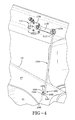
- FIG. 4 is a fragmentary front bottom perspective view of the preferred embodiment height control valve assembly of the present invention shown in FIG. 3 with portions represented by broken lines, showing the link attached to the control arm of the height control valve and also pivotally seated in the opening of one of the beams of the axle/suspension system;
- FIG. 5 is a view similar to FIG. 3 , but showing the control arm of the height control valve in an exhaust position when the axle/suspension system is in an extended or rebound position;
- FIG. 6 is a view similar to FIG. 3 , but showing the control arm of the height control valve in a fill position when the axle/suspension system is in a compressed or jounce position;
- FIG. 7 is a perspective view of the link of the preferred embodiment height control valve assembly of the present invention, and showing the control arm mount and the generally Z-shaped beam mount of the link.
- FIGS. 1 and 1B a prior art height control valve assembly is shown in FIGS. 1 and 1B and indicated by numeral 34 , and will now be described together with the environment in which it is utilized.
- an air-ride axle/suspension system 10 while shown as a trailing arm beam-type axle/suspension system, also includes other types of heavy-duty vehicle air-ride axle/suspension systems known to those skilled in the art, such as leading arm beam-type air-ride axle/suspension systems and air-ride axle/suspension systems having arms other than box beam-type, such as spring beams.
- a vehicle frame 12 is generally representative of various types of frames commonly used for heavy-duty vehicles, including primary frames and/or floor structures that do not support a subframe, primary frames and/or floor structures that do support a subframe, and subframes themselves.
- the subframe can be non-movable or movable, the latter being commonly referred to as a slider box.
- axle/suspension system 10 includes a pair of generally identical suspension assemblies 14 (only one shown), each suspended from a respective one of a pair of transversely spaced frame hangers 16 (only one shown). Each hanger 16 is secured to and depends from frame 12 of the heavy-duty vehicle. Inasmuch as suspension assemblies 14 are identical to one another, only one will be described hereinbelow and shown in FIGS. 1 and 1B .
- Suspension assembly 14 includes a trailing arm type suspension beam 18 , which is pivotally mounted at its front end 20 on hanger 16 in a usual manner through the use of a suitable pivot and bushing assembly 22 .
- An air spring 24 is suitably mounted on and extends between the upper surface of a rear end 26 of suspension beam 18 and frame 12 .
- a shock absorber 2 also typically is mounted on and extends between beam 18 and hanger 16 .
- a brake chamber mount 30 and other components of a brake system (not shown) are attached to beam 18 via the brake chamber mount.
- An axle 32 extends between and is captured in the pair of suspension beams 18 , and one or more wheels (not shown) are mounted on each end of the axle.
- FIG. 1D A typical prior art pneumatic control system, which utilizes height control valve assembly 34 such as the one shown in FIGS. 1 and 1B , is shown in FIG. 1D , is indicated generally at 35 , and will be described below.
- Prior art height control valve assembly 34 ( FIGS. 1 and 1B ) includes a height control valve 70 , a control arm 48 , a link 50 , a beam mounting bracket 54 and a frame mounting bracket 36 . More particularly and with additional reference to FIG. 1C , height control valve assembly 34 is shown mounted on frame 12 ( FIG. 1B ) via frame mounting bracket 36 . Height control valve assembly 34 is mounted on bracket 36 by bolts 6 and a pair of nuts 3 .
- frame mounting bracket 36 is formed with an elongated longitudinally-extending top opening 4 and a pair of circular bottom openings 5 (only one shown). Each one of a pair of threaded bolts 6 extends from height control valve 70 and is disposed through top elongated opening 4 and through one of the pair of bottom openings 5 (only one shown), respectively, and nuts 3 are threaded onto the bolts to attach the height control valve to frame mounting bracket 36 .
- Frame link 50 is pivotally connected at its upper end to control 48 via fastener 52 , and is also pivotally connected at its lower end to beam 18 via beam mounting bracket 54 and fastener 56 .
- Link 50 includes a two-piece construction. More particularly, link 50 includes an upper portion 81 and a lower portion 82 .
- Both upper and lower portions 81 , 82 include a plurality of selectively alignable openings 83 . Selected ones of openings 83 of upper portion 81 and lower portion 82 are aligned with one another to enable the upper portion and the lower portion of the link to be attached to each other by fasteners 84 in order to form link 50 . By moving upper portion 81 and lower portion 82 in opposite directions with respect to one another, link 50 can be lengthened or shortened, thus raising or lowering, respectively, the design ride height of the vehicle.
- Beam mounting bracket 54 is in turn mounted on brake chamber mount 30 by fasteners (not shown) which extend through a pair of openings 7 formed in the beam mounting bracket ( FIG. 1A ).
- pneumatic control system 35 includes an air reservoir conduit 38 which is in fluid communication with height control valve 70 via an air reservoir fitting 40 , and provides compressed air to the height control valve from an air reservoir (not shown), such as an air tank, as known to those skilled in the art.
- an air spring conduit 42 is in fluid communication with height control valve 70 via an air spring fitting 44 , and the air spring conduit branches off to each of a pair of front and rear air springs 24 , to enable the height control valve to route compressed air to and from the front and rear air springs based on certain operational conditions, as will be described below.
- An exhaust conduit 46 ( FIG.
- 1E is in fluid communication with and extends from height control valve 70 , enabling the height control valve to exhaust compressed air to atmosphere, as will also be described in detail below. It is understood that additional pneumatic and/or electronic components (not shown) that are known and used in the art, such as electronic controllers, valves, vents and pneumatic lines, may be used in conjunction with conduits 38 , 42 , 46 and/or height control valve 70 .
- height control valve 70 is a three-way valve that includes control arm 48 , wherein the position of the control arm controls the operation of the height control valve. More particularly, when control arm 48 is in a horizontal or neutral position A, height control valve 70 is closed and does not route compressed air from air reservoir conduit 38 ( FIG. 1D ) to air springs 24 via air spring conduits 42 , nor does it exhaust air from the air springs to atmosphere via exhaust conduit 46 . When control arm 48 is in fill position range B, height control valve 70 routes compressed air from air reservoir conduit 38 to air spring conduits 42 ( FIG. 1D ) and thus to air springs 24 , thereby inflating the air springs.
- control arm 48 When control arm 48 is in an exhaust position range C, height control valve 70 exhausts air from air springs 24 via air spring conduits 42 , and communicates the exhausted air to exhaust conduit 46 and thus to atmosphere. Automatic actuation of control arm 48 , and thus activation of the operation of height control valve 70 , is provided by control arm link 50 , as shown in FIG. 1 .
- axle/suspension system 10 articulates to an air spring extended position
- link 50 moves control arm 48 downwardly from neutral position A to exhaust position range C, as shown in FIG. 1E , thereby activating height control valve 70 and causing the height control valve to exhaust compressed air from air spring 24 via exhaust conduit 46 to atmosphere, and in turn returning beam 18 to the design ride height.
- prior art pneumatic control system 35 maintains the design ride height of axle/suspension system 10 when the axle/suspension system articulates during vehicle operation or during unloading/loading of the vehicle.
- prior art height control valve assembly 34 ′ includes height control valve 70 ′, control arm 48 ′, link 50 ′, beam mounting bracket 54 ′ and frame mounting bracket 36 ′. More particularly, height control valve assembly 34 ′ is shown mounted on frame 12 of the vehicle by frame mounting bracket 36 ′.
- Link 50 ′ is pivotally connected at its upper end to control arm 48 ′ via fastener 52 ′, and is also pivotally connected at its lower end to beam 18 of suspension assembly 14 via beam mounting bracket 54 ′ and fastener 56 ′.
- Link 50 ′ shown in FIG. 2 , includes a two-piece construction.
- link 50 ′ includes an upper portion 81 ′ and a lower portion 82 ′.
- Both upper and lower portions 81 ′, 82 ′ include a plurality of selectively alignable openings 83 ′. Selected ones of openings 83 ′ of upper portion 81 ′ and lower portion 82 ′ are aligned with one another to enable the upper portion and the lower portion of link 50 ′ to be attached to each other by fasteners 84 ′ in order to form the link.
- link 50 ′ By moving upper portion 81 ′ and lower portion 82 ′ in opposite directions with respect to one another, link 50 ′ can be lengthened or shortened, thus raising or lowering, respectively, the design ride height of the vehicle.
- a design ride height that is too low can cause axle/suspension system 10 to bottom out during operation of the vehicle, which can in turn result in damage to the frame and/or the axle/suspension system.
- a design ride height that is too high can also potentially cause damage to the axle/suspension system; for example, the air spring can become over-extended causing potential damage to the air spring. Therefore, it is desirable to have a height control valve assembly that is non-adjustable in order to reduce the problems associated with adjustable height control valve assemblies that can potentially lead to a design ride height that is either too low or too high.
- prior art height control valve assemblies 34 , 34 ′ often include links 50 , 50 ′ that are formed from metal plates having aligned openings 83 , 83 ′. These types of links are adjustable, which can lead to improper adjustment of the ride height of the vehicle due to human error. Also, because prior art height control valve assemblies 34 , 34 ′ typically include brackets 36 , 36 ′ on the vehicle frame and brackets 54 , 54 ′ on the beam of the axle/suspension system that are relatively distant from one another, control arms 48 , 48 ′ of the prior art height control valve assemblies are relatively long, resulting in a smaller range of activation, thereby reducing performance of the height control valve.
- height control valves 70 , 70 ′ are metered, the decreased range of activation of the height control valve in turn causes decreased flow through the height control valve, thereby decreasing performance of the height control valve during operation of the vehicle.
- prior art height control valve assemblies 34 , 34 ′ include at least two brackets 36 , 36 ′ and 54 , 54 ′, one bracket attaching the height control valve to the vehicle frame, and the other bracket attaching the link of the height control valve to one of the beams or other component mount on the beam of the axle/suspension system, the combination of brackets and adjustable or nonadjustable links make installation of the height control valve assembly complicated, require more maintenance, are heavy, and lead to an undesirable tolerance stack that can potentially cause an inaccurate ride height for the vehicle.
- tolerances in openings 7 of beam mounting bracket 54 and openings 4 and 5 of frame mounting bracket 36 can result in a shift in the ride height of up to about 1.0 inch, resulting in a ride height that is either too high or too low.
- operating the vehicle with a design ride height that is either too high or too low can potentially cause damage to the components of frame 12 and/or axle/suspension system 10 of the vehicle during operation.
- the height control valve assembly for an axle/suspension system of the present invention overcomes the problems associated with prior art height control valve assemblies 34 , and is described in detail below.
- FIGS. 3-7 A preferred embodiment of a height control valve assembly for an axle/suspension system of the present invention is shown generally at 134 in FIGS. 3-7 , and now will be described in detail below.
- Height control valve assembly 134 for an axle/suspension system of the present invention includes a height control valve 170 , a control arm 148 and a link 150 . More particularly, height control valve 170 is shown mounted directly on vehicle frame 12 via a pair of threaded bolts 180 . More specifically, bolts 180 extend through height control valve 170 and are disposed through a pair of aligned openings (not shown) formed in vehicle frame 12 . A fastener (not shown), such as a nut, is threadably engaged with each bolt 180 in order to mount height control valve 170 of height control valve assembly 134 to frame 12 .
- link 150 is pivotally connected at its upper end to control arm 148 via fastener 152 , and is also pivotally connected at its lower end to beam 18 via generally Z-shaped or stepped bottom portion 155 .
- link 150 preferably is formed from a metal rod having a generally circular cross-sectional shape.
- the upper end of link 150 is formed with a loop 157 .
- An insert 159 having a generally circular disk shape is formed with a semi-circular recess 192 ( FIG. 7 ) around its circumference.
- the recess of insert 159 cooperates with loop 157 such that the insert is held within the link loop.
- Insert 159 is formed with an opening 191 for receipt of fastener 152 to pivotally attach the upper end of link 150 to control arm 148 of height control valve 170 .
- Z-shaped bottom portion 155 of link 150 preferably is formed with first and second bends 193 , 194 , respectively.
- a generally straight portion 197 extends between first bend 193 and second bend 194 and is generally perpendicular to a middle portion 199 of link 150 .
- a generally straight end 196 is formed at the end of Z-shaped link bottom portion 155 and is generally parallel to middle portion 199 of link 150 .
- Straight end 196 , second bend 194 and a portion of straight portion 197 of Z-shaped link bottom portion 155 are disposed through an opening 198 formed in an insert 199 that is disposed into an opening 190 formed in sidewall 17 of beam 18 .
- Opening 191 of insert 159 is aligned with an opening (not shown) formed in control arm 148 , and fastener 152 is disposed through the aligned openings to connect the upper end of link 150 to the control arm.
- Second bend 194 of Z-shaped link bottom portion 155 retains the bottom end of link 150 in insert opening 198 of beam 18 without additional attachment.
- a single fastener at the upper end of link 150 is utilized in order to connect the link to both frame 12 and beam 18 of axle/suspension system 10 . This simplifies installation of height control valve assembly 134 of the present invention and makes the height control valve assembly non-adjustable.
- a distance D between straight portion 197 and opening 191 of insert 159 sets the design ride height of the vehicle. Because the distance is not adjustable it cannot be changed. This, plus the fact that opening 198 in beam sidewall 17 as well as the location of height control valve 170 are fixed, assures that height control valve assembly 134 of the present invention is set at the desired design ride height during maintenance or installation of the assembly. Moreover, height control valve assembly 134 does not need to be adjusted by the end user, which eliminates the possibility of end user error improperly affecting the design ride height of the vehicle.
- height control valve assembly 134 for axle/suspension systems of the present invention is the relatively reduced or shortened length of lever arm 148 . Because height control valve 170 is attached directly to frame 12 and also directly to beam sidewall 17 via link lower Z-shaped portion 155 , which are substantially vertically aligned above and below one another, without using brackets and the like, reduced length control arm 148 can be utilized and thereby increases the range of activation of height control valve 170 . Because height control valve 170 is metered, the increased range of activation of the height control valve in turn increases flow through the height control valve, thereby increasing performance of the height control valve during operation of the vehicle.
- height control valve 170 is a three-way valve that includes a flow control means (not shown) and a control arm 148 , wherein the position of the control arm regulates the flow of fluid through the height control valve. More particularly, when control arm 148 is in a horizontal or neutral position A, height control valve 170 is closed and does not route compressed air from air reservoir conduit 38 ( FIG. 3A ) to air springs 24 via air spring conduits 42 , nor does it exhaust air from the air springs to atmosphere via exhaust conduit 46 . When control arm 148 is in fill position range B ( FIG. 6 ), height control valve 170 routes compressed air from air reservoir conduit 38 to air spring conduits 42 ( FIG.
- control arm 148 When control arm 148 is in an exhaust position range C ( FIG. 5 ), height control valve 170 exhausts air from air springs 24 via air spring conduits 42 , and communicates the exhausted air to the exhaust conduit (not shown) and thus to atmosphere. Automatic actuation of control arm 148 , and thus activation of the operation of height control valve 170 , is provided by control arm link 150 .
- axle/suspension system 10 articulates to an air spring extended position ( FIG. 5 )
- the distance between vehicle frame 12 and beam 18 increases, extending air spring 24 .
- link 150 moves control arm 148 downwardly from neutral position A to exhaust position range C, as shown in FIG. 5 , thereby activating height control valve 170 and causing the height control valve to exhaust compressed air from air spring 24 via exhaust conduit 46 ( FIG. 3A ) to atmosphere, and in turn returning beam 18 to the design ride height.
- height control valve assembly 134 for an axle/suspension system of the present invention by utilizing height control valve 170 that mounts directly to vehicle frame 12 and which utilizes a non-adjustable wire link 150 that attaches directly to beam 18 of the axle/suspension system.
- This direct attachment of link 150 directly to beam 18 is accomplished without fasteners using link Z-shaped lower portion 155 disposed through opening 198 formed in beam sidewall 17 , thereby eliminating all of the brackets and associated hardware of prior art height control valve assemblies 34 shown and described above, resulting in reduced weight, easier installation and decreased maintenance costs, as well as reducing undesirable tolerance stacks associated with the multiple bracket configurations of prior art height control valve assemblies.
- Height control valve assembly 134 of the present invention because it is generally non-adjustable, reduces the possibility of end user error affecting the design ride height of the vehicle and allows for utilization of shorter control arm 148 , that in turn allows a wider range of activation for the height control valve, which in turn increases the sensitivity and performance of the system.
- height control valve assembly 134 for axle/suspension systems of the present invention could be utilized in conjunction with all types of height control valves known in the art, without changing the overall concept or operation of the present invention. It is also contemplated that different shapes and sizes of link 150 and Z-shaped lower portion 155 of height control valve assembly 134 of the present invention could be utilized, without changing the overall concept or operation of the present invention. It is contemplated that materials other than metal or wire could be utilized to form link 150 , without changing the overall concept or operation of the present invention. It is also contemplated that other types of connection means for connecting link 150 to control 148 could be utilized, without changing the overall concept or operation of the present invention.
- height control valve assembly 134 for axle/suspension systems of the present invention could be utilized with all types of air-ride axle/suspension systems known in the art, including those utilizing spring beams or other beam configurations, without changing the overall concept or operation of the present invention. It is also contemplated that height control valve assembly 134 for axle/suspension systems of the present invention could be utilized in conjunction with all known types of pneumatic systems, without changing the overall concept or operation of the present invention.
- height control valve assembly 134 for axle/suspension systems of the present invention could be utilized with additional pneumatic and/or electronic components (not shown) that are known and used in the art, such as electronic controllers, valves, vents and pneumatic lines, without changing the overall concept or operation of the present invention.
- the height control valve assembly of the present invention is simplified, provides an effective, safe, inexpensive and efficient structure and method which achieves all the enumerated objectives, provides for eliminating difficulties encountered with prior height control valve assemblies, and solves problems and obtains new results in the art.
Landscapes
- Engineering & Computer Science (AREA)
- Mechanical Engineering (AREA)
- General Engineering & Computer Science (AREA)
- Vehicle Body Suspensions (AREA)
Abstract
Description
- This application claims the benefit of U.S. Provisional Patent Application Ser. No. 61/496,734, filed Jun. 14, 2011.
- 1. Field of the Invention
- The invention relates generally to the art of air-ride axle/suspension systems for heavy-duty wheeled vehicles, such as tractor-trailers or semi-trailers, which cushion the ride and stabilize the vehicle during operation. More particularly, the invention is directed to a height control valve assembly utilized in connection with air-ride axle/suspension systems. More specifically, the invention is directed to a height control valve and link that more efficiently connects the control arm of the height control valve to the beam of the air-ride axle/suspension system, eliminating the brackets and hardware typically associated with attaching the height control valve link to the frame of the vehicle and to the beam of the axle/suspension system. The height control valve assembly of the present invention results in fewer parts, reduced weight and more simplified installation of the height control valve and link, thereby reducing installation and maintenance cost, and reducing undesirable tolerance stacks associated with multiple bracket configurations prevalent in the prior art.
- 2. Background Art
- Heavy-duty vehicles such as tractor-trailers typically include two or more leading or trailing arm suspension assemblies that connect the wheel bearing axles of the vehicle to the frame of the vehicle. Early suspension designs included heavy leaf-spring suspensions which resulted in a relatively rough ride to the cargo and/or passengers carried by the vehicle, and did not allow loads to equalize among the axles in all situations, thus creating the need for an axle/suspension system with softer ride characteristics and more efficient equalization characteristics. The subsequent development of air-ride axle/suspension systems provided greater load equalization among multiple axles for semi-trailers as well as improved ride quality for individual axles.
- As a result, heavy-duty vehicles that transport freight often include leading or trailing arm air-ride axle/suspension systems, which use air springs to cushion the ride of the vehicle. Pneumatic control of these air springs is an important feature of air-ride axle/suspension systems. More particularly, it is important for a cushioned vehicle ride, and for optimum axle/suspension system performance and longevity to attempt to maintain a consistent predetermined distance between the vehicle frame and the travel surface. This predetermined distance is known in the art as the design ride height of the vehicle. The operating conditions of the vehicle must be considered in order to establish the design ride height of the vehicle. That is, when a heavy-duty vehicle executes certain maneuvers, such as making a hard turn or traveling over rough terrain, the forces imposed on the axle/suspension system by such maneuvers cause the axle/suspension system to articulate, or pivot and/or flex, beneath the vehicle frame which the system supports. Typically, an axle/suspension system is designed so that the anticipated range of articulation, pivoting and/or flexing occurs about a nominal predetermined position, and that nominal position is set as the design ride height of the vehicle. This articulation, pivoting and/or flexing can also be caused by the loading and unloading of the vehicle.
- More specifically, after a heavy-duty vehicle is loaded with freight, or after freight is unloaded from the vehicle, the air springs of the axle/suspension system are adjusted to ensure that the vehicle is at design ride height. The adjustment of the air springs of the axle/suspension system is typically automatically accomplished by a height control valve assembly or leveling valve assembly which is in fluid communication with an air source and with the air springs. When the vehicle is loaded with freight and the air springs of the axle/suspension system are compressed, causing the vehicle frame to be positioned below design ride height or closer to the travel surface, compressed air is supplied to the air springs, thereby inflating/extending them and, in turn, causing the axle/suspension system to raise the vehicle frame to the design ride height. Conversely, when the vehicle is unloaded and the air springs of the axle/suspension system are extended, causing the vehicle frame to be positioned above design ride height or further away from the travel surface, air is exhausted from the air springs, thereby deflating/compressing them until the axle/suspension system lowers the vehicle frame to the design ride height.
- To control the flow of air into the air springs, and the exhaustion of air from the air springs, a mechanically operated valve typically is employed, and is known in the art as a height control valve or leveling valve. The height control valve is typically mounted on a bracket that is in turn attached to the frame or hanger of the vehicle. The height control valve is in fluid communication with a compressed air source, such as an air supply tank, and is also in fluid communication with the vehicle air springs. The height control valve includes a control arm that is capable of being raised or lowered in order to direct air from the compressed air source to the air springs or alternatively from the air springs to atmosphere. The control arm is attached to a link that is bolted to the control arm on one end and bolted to a bracket at the other end. The bracket is in turn typically rigidly attached to the brake chamber mount of the brake assembly or to one of the beams of the axle/suspension system. The height control valve, along with the brackets and the link and the associated hardware that fastens these parts together, is known as the height control valve assembly. Adjustments to the height control valve assembly, including the link that controls activation of the valve, enable the design ride height to be achieved before the vehicle travels over the road.
- Also, as the vehicle travels over the road and the driver executes maneuvers that cause the axle/suspension system to articulate between positions that compress the air springs and positions that extend them, the height control valve acts to maintain the design ride height. That is, when the air springs are compressed, the height control valve supplies air to the air springs from a vehicle air reservoir. Conversely, when the air springs are in an extended position, the height control valve exhausts air from the springs to atmosphere. The amount of air that is supplied or exhausted is based on the duration of the articulation and the flow rate of the height control valve at a given position.
- Prior art height control valve assemblies often include links that are formed from metal plates having a plurality of aligned openings. The plates are attached to one another via fasteners that are disposed through selected ones of the aligned openings. By removing the fasteners and moving the plates in opposite directions with respect to one another and then replacing the fasteners, the length of the link can be increased or decreased. As a result, these types of prior art links are mechanically adjustable, which can potentially lead to improper adjustment of the ride height of the vehicle due to human error. Also, because prior art height control valve assemblies typically include brackets on the vehicle frame and brackets on the beam or brake chamber mount of the axle/suspension system that are distant from one another, the control arm of these prior art height control valve assemblies is quite long, resulting in a smaller range of activation, which can reduce performance of the height control valve. Moreover, because prior art height control valve assemblies include at least two brackets, one bracket attaching the height control valve to the vehicle frame or hanger, and the other bracket attaching the link of the height control valve to one of the beams or brake chamber mounts of the axle/suspension system, the combination of brackets and adjustable links make installation complicated, require increased maintenance and result in undesirable tolerance stacks that can potentially cause an inaccurate design ride height for the vehicle.
- The height control valve assembly of the present invention solves the problems associated with prior art height control valve assemblies by utilizing a height control valve that mounts directly to the vehicle frame and which incorporates a non-adjustable wire link that attaches directly to one of the beams of the axle/suspension system, thereby eliminating all of the brackets and associated hardware of the prior art height control valve assemblies, resulting in easier installation, decreased maintenance costs and reduced weight. Moreover, because the brackets attaching the height control valve assembly to the frame or hanger and the beam are eliminated, the height control valve assembly of the present invention reduces undesirable tolerance stacks associated with those brackets, and thereby reduces the possibility of human error adversely affecting the design ride height of the vehicle. The height control valve assembly of the present invention also allows for utilization of a relatively shorter control arm, that in turn allows a wider range of activation for the height control valve, resulting in increased sensitivity and performance of the system.
- Objectives of the present invention include providing a height control valve assembly that eliminates the brackets and hardware of prior art height control valve assemblies, resulting in easier installation, decreased maintenance costs and reduced weight.
- A further objective of the present invention is to provide a height control valve assembly that reduces undesirable tolerance stacks associated with prior art height control assemblies, thereby reducing the possibility of human error adversely affecting the design ride height of the vehicle.
- Yet another objective of the present invention is to provide a height control valve assembly that allows a wider range of activation for the height control valve, resulting in increased sensitivity and performance of the system.
- Still another objective of the present invention is to provide a height control valve assembly that is generally not adjustable by the operator of the vehicle.
- These objectives and advantages are obtained by the height control valve assembly of the present invention, which includes a height control valve mounted on a frame of the vehicle, the height control valve in fluid communication with a compressed air source, with at least one air spring of the vehicle, and with atmosphere. The height control valve includes flow control means for regulating fluid flow through the height control valve. A control arm is operatively attached to the flow control means, the control arm regulating fluid flow through the height control valve during operation of the vehicle. The height control valve further includes a link having a first end and a second end. The first end of the link is operatively attached to the control arm. The second end of the link is disposed through an opening formed in a beam of the axle/suspension system to attach the second end of the link to the beam.
- The preferred embodiment of the present invention, illustrative of the best mode in which applicant has contemplated applying the principles, is set forth in the following description and is shown in the drawings, and is particularly and distinctly pointed out and set forth in the appended claims.
-
FIG. 1 is a fragmentary outboard elevational view of the driver side suspension assembly and an axle of an air-ride trailing arm beam-type axle/suspension system, and showing a prior art height control valve assembly; -
FIG. 1A is a fragmentary rear perspective view of the beam mounting bracket shown inFIG. 1 ; -
FIG. 1B is a fragmentary front perspective view of the prior art height control valve assembly shown inFIG. 1 ; -
FIG. 1C is an enlarged fragmentary outboard perspective view of the frame mounting bracket shown inFIG. 1 ; -
FIG. 1D is a schematic representation of a typical pneumatic control system incorporating the prior art height control valve assembly ofFIG. 1 , and showing relative positions of the air springs and axles of a pair of air-ride axle/suspension systems; -
FIG. 1E is an enlarged elevational view of the height control valve of the prior art height control valve assembly shown inFIG. 1 , with the range of various valve control arm positions represented by broken lines and arrows, and showing an exhaust conduit attached to the height control valve; -
FIG. 2 is a fragmentary rear outboard perspective view of portions of the driver side suspension assembly and an axle of an air-ride trailing arm beam-type axle/suspension system, showing another prior art height control valve assembly mounted on the vehicle frame by a bracket, and also showing the relatively long control arm of the height control valve, and the link attached to the suspension assembly by a bracket; -
FIG. 3 is a fragmentary elevational view of a preferred embodiment height control valve assembly of the present invention, showing the shortened control arm attached to the height control valve and to the link, which is in turn attached to one of the beams of the axle/suspension system; -
FIG. 3A is a schematic representation of a typical pneumatic control system incorporating the preferred embodiment height control valve assembly of the present invention, showing relative positions of the air springs and axles of a pair of air-ride axle/suspension systems; -
FIG. 4 is a fragmentary front bottom perspective view of the preferred embodiment height control valve assembly of the present invention shown inFIG. 3 with portions represented by broken lines, showing the link attached to the control arm of the height control valve and also pivotally seated in the opening of one of the beams of the axle/suspension system; -
FIG. 5 is a view similar toFIG. 3 , but showing the control arm of the height control valve in an exhaust position when the axle/suspension system is in an extended or rebound position; -
FIG. 6 is a view similar toFIG. 3 , but showing the control arm of the height control valve in a fill position when the axle/suspension system is in a compressed or jounce position; and -
FIG. 7 is a perspective view of the link of the preferred embodiment height control valve assembly of the present invention, and showing the control arm mount and the generally Z-shaped beam mount of the link. - Similar numerals refer to similar parts throughout the drawings.
- So that the structure and resulting advantages of the present invention can be better understood, a prior art height control valve assembly is shown in
FIGS. 1 and 1B and indicated bynumeral 34, and will now be described together with the environment in which it is utilized. It is important to note that an air-ride axle/suspension system 10, while shown as a trailing arm beam-type axle/suspension system, also includes other types of heavy-duty vehicle air-ride axle/suspension systems known to those skilled in the art, such as leading arm beam-type air-ride axle/suspension systems and air-ride axle/suspension systems having arms other than box beam-type, such as spring beams. It is also important to note that avehicle frame 12 is generally representative of various types of frames commonly used for heavy-duty vehicles, including primary frames and/or floor structures that do not support a subframe, primary frames and/or floor structures that do support a subframe, and subframes themselves. For primary frames and/or floor structures that do support a subframe, the subframe can be non-movable or movable, the latter being commonly referred to as a slider box. - With continued reference to
FIGS. 1 and 1B , axle/suspension system 10 includes a pair of generally identical suspension assemblies 14 (only one shown), each suspended from a respective one of a pair of transversely spaced frame hangers 16 (only one shown). Eachhanger 16 is secured to and depends fromframe 12 of the heavy-duty vehicle. Inasmuch assuspension assemblies 14 are identical to one another, only one will be described hereinbelow and shown inFIGS. 1 and 1B . -
Suspension assembly 14 includes a trailing armtype suspension beam 18, which is pivotally mounted at itsfront end 20 onhanger 16 in a usual manner through the use of a suitable pivot andbushing assembly 22. Anair spring 24 is suitably mounted on and extends between the upper surface of arear end 26 ofsuspension beam 18 andframe 12. Ashock absorber 2 also typically is mounted on and extends betweenbeam 18 andhanger 16. Abrake chamber mount 30 and other components of a brake system (not shown) are attached tobeam 18 via the brake chamber mount. Anaxle 32 extends between and is captured in the pair of suspension beams 18, and one or more wheels (not shown) are mounted on each end of the axle. - A typical prior art pneumatic control system, which utilizes height
control valve assembly 34 such as the one shown inFIGS. 1 and 1B , is shown inFIG. 1D , is indicated generally at 35, and will be described below. Prior art height control valve assembly 34 (FIGS. 1 and 1B ) includes aheight control valve 70, acontrol arm 48, alink 50, abeam mounting bracket 54 and aframe mounting bracket 36. More particularly and with additional reference toFIG. 1C , heightcontrol valve assembly 34 is shown mounted on frame 12 (FIG. 1B ) viaframe mounting bracket 36. Heightcontrol valve assembly 34 is mounted onbracket 36 bybolts 6 and a pair of nuts 3. More specifically,frame mounting bracket 36 is formed with an elongated longitudinally-extending top opening 4 and a pair of circular bottom openings 5 (only one shown). Each one of a pair of threadedbolts 6 extends fromheight control valve 70 and is disposed through top elongated opening 4 and through one of the pair of bottom openings 5 (only one shown), respectively, andnuts 3 are threaded onto the bolts to attach the height control valve to frame mountingbracket 36.Frame link 50 is pivotally connected at its upper end to control 48 viafastener 52, and is also pivotally connected at its lower end tobeam 18 viabeam mounting bracket 54 andfastener 56.Link 50, includes a two-piece construction. More particularly, link 50 includes anupper portion 81 and alower portion 82. Both upper andlower portions alignable openings 83. Selected ones ofopenings 83 ofupper portion 81 andlower portion 82 are aligned with one another to enable the upper portion and the lower portion of the link to be attached to each other byfasteners 84 in order to formlink 50. By movingupper portion 81 andlower portion 82 in opposite directions with respect to one another, link 50 can be lengthened or shortened, thus raising or lowering, respectively, the design ride height of the vehicle.Beam mounting bracket 54 is in turn mounted onbrake chamber mount 30 by fasteners (not shown) which extend through a pair of openings 7 formed in the beam mounting bracket (FIG. 1A ). - Turning now to
FIG. 1E ,pneumatic control system 35 includes anair reservoir conduit 38 which is in fluid communication withheight control valve 70 via an air reservoir fitting 40, and provides compressed air to the height control valve from an air reservoir (not shown), such as an air tank, as known to those skilled in the art. With continuing reference toFIG. 1D , anair spring conduit 42 is in fluid communication withheight control valve 70 via anair spring fitting 44, and the air spring conduit branches off to each of a pair of front and rear air springs 24, to enable the height control valve to route compressed air to and from the front and rear air springs based on certain operational conditions, as will be described below. An exhaust conduit 46 (FIG. 1E ) is in fluid communication with and extends fromheight control valve 70, enabling the height control valve to exhaust compressed air to atmosphere, as will also be described in detail below. It is understood that additional pneumatic and/or electronic components (not shown) that are known and used in the art, such as electronic controllers, valves, vents and pneumatic lines, may be used in conjunction withconduits height control valve 70. - Referring now to
FIGS. 1 and 1E ,height control valve 70 is a three-way valve that includescontrol arm 48, wherein the position of the control arm controls the operation of the height control valve. More particularly, whencontrol arm 48 is in a horizontal or neutral position A,height control valve 70 is closed and does not route compressed air from air reservoir conduit 38 (FIG. 1D ) to air springs 24 viaair spring conduits 42, nor does it exhaust air from the air springs to atmosphere viaexhaust conduit 46. Whencontrol arm 48 is in fill position range B,height control valve 70 routes compressed air fromair reservoir conduit 38 to air spring conduits 42 (FIG. 1D ) and thus to air springs 24, thereby inflating the air springs. Whencontrol arm 48 is in an exhaust position range C,height control valve 70 exhausts air from air springs 24 viaair spring conduits 42, and communicates the exhausted air to exhaustconduit 46 and thus to atmosphere. Automatic actuation ofcontrol arm 48, and thus activation of the operation ofheight control valve 70, is provided bycontrol arm link 50, as shown inFIG. 1 . - During vehicle operation, when axle/
suspension system 10 articulates to an air spring compressed position, the distance betweenvehicle frame 12 andbeam 18 decreases, compressingair spring 24. Becauseheight control valve 70 is connected tovehicle frame 12, the height control valve remains a substantially constant distance from the vehicle frame. To maintain design ride height, when the distance betweenvehicle frame 12 andbeam 18 decreases, link 50 moves controlarm 48 upwardly from neutral position A to fill position range B, as shown inFIG. 1E , thereby activatingheight control valve 70 and causing the height control valve to route compressed air fromair reservoir conduit 38 to air springs 24 via air spring conduits 42 (FIG. 1D ), thereby inflating air springs 24, and inturn returning beam 18 to the design ride height. - Conversely, when axle/
suspension system 10 articulates to an air spring extended position, the distance betweenvehicle frame 12 andbeam 18 increases, extendingair spring 24. To maintain ride height, when the distance betweenvehicle frame 12 andbeam 18 increases, link 50 moves controlarm 48 downwardly from neutral position A to exhaust position range C, as shown inFIG. 1E , thereby activatingheight control valve 70 and causing the height control valve to exhaust compressed air fromair spring 24 viaexhaust conduit 46 to atmosphere, and inturn returning beam 18 to the design ride height. As set forth above, prior artpneumatic control system 35 maintains the design ride height of axle/suspension system 10 when the axle/suspension system articulates during vehicle operation or during unloading/loading of the vehicle. - Turning now to
FIG. 2 , another prior art height control valve assembly is indicated at 34′, and will now be described. More specifically, prior art heightcontrol valve assembly 34′ includesheight control valve 70′,control arm 48′, link 50′,beam mounting bracket 54′ and frame mountingbracket 36′. More particularly, heightcontrol valve assembly 34′ is shown mounted onframe 12 of the vehicle byframe mounting bracket 36′.Link 50′ is pivotally connected at its upper end to controlarm 48′ viafastener 52′, and is also pivotally connected at its lower end tobeam 18 ofsuspension assembly 14 viabeam mounting bracket 54′ andfastener 56′.Link 50′, shown inFIG. 2 , includes a two-piece construction. More particularly, link 50′ includes anupper portion 81′ and alower portion 82′. Both upper andlower portions 81′,82′ include a plurality of selectivelyalignable openings 83′. Selected ones ofopenings 83′ ofupper portion 81′ andlower portion 82′ are aligned with one another to enable the upper portion and the lower portion oflink 50′ to be attached to each other byfasteners 84′ in order to form the link. By movingupper portion 81′ andlower portion 82′ in opposite directions with respect to one another, link 50′ can be lengthened or shortened, thus raising or lowering, respectively, the design ride height of the vehicle. - Such adjustability in both prior art height control valve assemblies is often desired by users of the heavy-duty vehicle; however, such adjustability can lead to potential problems for the heavy-duty vehicle as will be described below.
- A design ride height that is too low can cause axle/
suspension system 10 to bottom out during operation of the vehicle, which can in turn result in damage to the frame and/or the axle/suspension system. A design ride height that is too high can also potentially cause damage to the axle/suspension system; for example, the air spring can become over-extended causing potential damage to the air spring. Therefore, it is desirable to have a height control valve assembly that is non-adjustable in order to reduce the problems associated with adjustable height control valve assemblies that can potentially lead to a design ride height that is either too low or too high. - As set forth above, prior art height
control valve assemblies links openings control valve assemblies brackets brackets arms height control valves control valve assemblies brackets beam mounting bracket 54 andopenings 4 and 5 offrame mounting bracket 36 can result in a shift in the ride height of up to about 1.0 inch, resulting in a ride height that is either too high or too low. As set forth above, operating the vehicle with a design ride height that is either too high or too low can potentially cause damage to the components offrame 12 and/or axle/suspension system 10 of the vehicle during operation. The height control valve assembly for an axle/suspension system of the present invention overcomes the problems associated with prior art heightcontrol valve assemblies 34, and is described in detail below. - A preferred embodiment of a height control valve assembly for an axle/suspension system of the present invention is shown generally at 134 in
FIGS. 3-7 , and now will be described in detail below. - Height
control valve assembly 134 for an axle/suspension system of the present invention includes aheight control valve 170, acontrol arm 148 and alink 150. More particularly,height control valve 170 is shown mounted directly onvehicle frame 12 via a pair of threadedbolts 180. More specifically,bolts 180 extend throughheight control valve 170 and are disposed through a pair of aligned openings (not shown) formed invehicle frame 12. A fastener (not shown), such as a nut, is threadably engaged with eachbolt 180 in order to mountheight control valve 170 of heightcontrol valve assembly 134 to frame 12. - Turning now to an important feature of the present invention, link 150 is pivotally connected at its upper end to control
arm 148 viafastener 152, and is also pivotally connected at its lower end tobeam 18 via generally Z-shaped or steppedbottom portion 155. More particularly, link 150 preferably is formed from a metal rod having a generally circular cross-sectional shape. The upper end oflink 150 is formed with aloop 157. Aninsert 159 having a generally circular disk shape is formed with a semi-circular recess 192 (FIG. 7 ) around its circumference. The recess ofinsert 159 cooperates withloop 157 such that the insert is held within the link loop.Insert 159 is formed with anopening 191 for receipt offastener 152 to pivotally attach the upper end oflink 150 to controlarm 148 ofheight control valve 170. - Generally Z-shaped
bottom portion 155 oflink 150 preferably is formed with first andsecond bends straight portion 197 extends betweenfirst bend 193 andsecond bend 194 and is generally perpendicular to amiddle portion 199 oflink 150. A generallystraight end 196 is formed at the end of Z-shaped linkbottom portion 155 and is generally parallel tomiddle portion 199 oflink 150. In order to better understand the operation oflink 150, the connection of the link tobeam 18 of the axle/suspension system and toheight control valve 170 now will be described below. -
Straight end 196,second bend 194 and a portion ofstraight portion 197 of Z-shaped linkbottom portion 155 are disposed through anopening 198 formed in aninsert 199 that is disposed into anopening 190 formed insidewall 17 ofbeam 18. Opening 191 ofinsert 159 is aligned with an opening (not shown) formed incontrol arm 148, andfastener 152 is disposed through the aligned openings to connect the upper end oflink 150 to the control arm.Second bend 194 of Z-shaped linkbottom portion 155 retains the bottom end oflink 150 in insert opening 198 ofbeam 18 without additional attachment. Thus only a single fastener at the upper end oflink 150 is utilized in order to connect the link to bothframe 12 andbeam 18 of axle/suspension system 10. This simplifies installation of heightcontrol valve assembly 134 of the present invention and makes the height control valve assembly non-adjustable. - As can be seen, a distance D between
straight portion 197 and opening 191 ofinsert 159 sets the design ride height of the vehicle. Because the distance is not adjustable it cannot be changed. This, plus the fact that opening 198 inbeam sidewall 17 as well as the location ofheight control valve 170 are fixed, assures that heightcontrol valve assembly 134 of the present invention is set at the desired design ride height during maintenance or installation of the assembly. Moreover, heightcontrol valve assembly 134 does not need to be adjusted by the end user, which eliminates the possibility of end user error improperly affecting the design ride height of the vehicle. - Yet another important feature of height
control valve assembly 134 for axle/suspension systems of the present invention is the relatively reduced or shortened length oflever arm 148. Becauseheight control valve 170 is attached directly to frame 12 and also directly tobeam sidewall 17 via link lower Z-shapedportion 155, which are substantially vertically aligned above and below one another, without using brackets and the like, reducedlength control arm 148 can be utilized and thereby increases the range of activation ofheight control valve 170. Becauseheight control valve 170 is metered, the increased range of activation of the height control valve in turn increases flow through the height control valve, thereby increasing performance of the height control valve during operation of the vehicle. - Referring now to
FIGS. 3 , 3A, 5 and 6,height control valve 170 is a three-way valve that includes a flow control means (not shown) and acontrol arm 148, wherein the position of the control arm regulates the flow of fluid through the height control valve. More particularly, whencontrol arm 148 is in a horizontal or neutral position A,height control valve 170 is closed and does not route compressed air from air reservoir conduit 38 (FIG. 3A ) to air springs 24 viaair spring conduits 42, nor does it exhaust air from the air springs to atmosphere viaexhaust conduit 46. Whencontrol arm 148 is in fill position range B (FIG. 6 ),height control valve 170 routes compressed air fromair reservoir conduit 38 to air spring conduits 42 (FIG. 3A ) and thus to air springs 24, thereby inflating the air springs. Whencontrol arm 148 is in an exhaust position range C (FIG. 5 ),height control valve 170 exhausts air from air springs 24 viaair spring conduits 42, and communicates the exhausted air to the exhaust conduit (not shown) and thus to atmosphere. Automatic actuation ofcontrol arm 148, and thus activation of the operation ofheight control valve 170, is provided bycontrol arm link 150. - During vehicle operation, when axle/
suspension system 10 articulates to an air spring compressed position (FIG. 6 ), the distance betweenvehicle frame 12 andbeam 18 decreases, compressingair spring 24. Becauseheight control valve 170 is connected tovehicle frame 12, the height control valve remains a substantially constant distance from the vehicle frame. To maintain design ride height, when the distance betweenvehicle frame 12 andbeam 18 decreases, link 150 movescontrol arm 148 upwardly from neutral position A to fill position range B, as shown inFIG. 6 , thereby activatingheight control valve 170 and causing the height control valve to route compressed air fromair reservoir conduit 38 to air springs 24 via air spring conduits 42 (FIG. 3A ), thereby inflating air springs 24, and inturn returning beam 18 to the design ride height. - Conversely, when axle/
suspension system 10 articulates to an air spring extended position (FIG. 5 ), the distance betweenvehicle frame 12 andbeam 18 increases, extendingair spring 24. To maintain ride height, when the distance betweenvehicle frame 12 andbeam 18 increases, link 150 movescontrol arm 148 downwardly from neutral position A to exhaust position range C, as shown inFIG. 5 , thereby activatingheight control valve 170 and causing the height control valve to exhaust compressed air fromair spring 24 via exhaust conduit 46 (FIG. 3A ) to atmosphere, and inturn returning beam 18 to the design ride height. - The problems associated with prior art height
control valve assemblies 34 are solved by heightcontrol valve assembly 134 for an axle/suspension system of the present invention by utilizingheight control valve 170 that mounts directly tovehicle frame 12 and which utilizes anon-adjustable wire link 150 that attaches directly tobeam 18 of the axle/suspension system. This direct attachment oflink 150 directly tobeam 18 is accomplished without fasteners using link Z-shapedlower portion 155 disposed throughopening 198 formed inbeam sidewall 17, thereby eliminating all of the brackets and associated hardware of prior art heightcontrol valve assemblies 34 shown and described above, resulting in reduced weight, easier installation and decreased maintenance costs, as well as reducing undesirable tolerance stacks associated with the multiple bracket configurations of prior art height control valve assemblies. Heightcontrol valve assembly 134 of the present invention, because it is generally non-adjustable, reduces the possibility of end user error affecting the design ride height of the vehicle and allows for utilization ofshorter control arm 148, that in turn allows a wider range of activation for the height control valve, which in turn increases the sensitivity and performance of the system. - It is contemplated that height
control valve assembly 134 for axle/suspension systems of the present invention could be utilized in conjunction with all types of height control valves known in the art, without changing the overall concept or operation of the present invention. It is also contemplated that different shapes and sizes oflink 150 and Z-shapedlower portion 155 of heightcontrol valve assembly 134 of the present invention could be utilized, without changing the overall concept or operation of the present invention. It is contemplated that materials other than metal or wire could be utilized to formlink 150, without changing the overall concept or operation of the present invention. It is also contemplated that other types of connection means for connectinglink 150 to control 148 could be utilized, without changing the overall concept or operation of the present invention. It is further contemplated that heightcontrol valve assembly 134 for axle/suspension systems of the present invention could be utilized with all types of air-ride axle/suspension systems known in the art, including those utilizing spring beams or other beam configurations, without changing the overall concept or operation of the present invention. It is also contemplated that heightcontrol valve assembly 134 for axle/suspension systems of the present invention could be utilized in conjunction with all known types of pneumatic systems, without changing the overall concept or operation of the present invention. It is further contemplated that heightcontrol valve assembly 134 for axle/suspension systems of the present invention could be utilized with additional pneumatic and/or electronic components (not shown) that are known and used in the art, such as electronic controllers, valves, vents and pneumatic lines, without changing the overall concept or operation of the present invention. - Accordingly, the height control valve assembly of the present invention is simplified, provides an effective, safe, inexpensive and efficient structure and method which achieves all the enumerated objectives, provides for eliminating difficulties encountered with prior height control valve assemblies, and solves problems and obtains new results in the art.
- In the foregoing description, certain terms have been used for brevity, clearness and understanding; but no unnecessary limitations are to be implied therefrom beyond the requirements of the prior art, because such terms are used for descriptive purposes and are intended to be broadly construed.
- Moreover, the description and illustration of the invention is by way of example, and the scope of the invention is not limited to the exact details shown or described.
- Having now described the features, discoveries and principles of the invention, the manner in which the height control valve assembly of the present invention is used and installed, the characteristics of the construction, arrangement and method steps, and the advantageous, new and useful results obtained; the new and useful structures, devices, elements, arrangements, process, parts and combinations are set forth in the appended claims.
Claims (13)
Priority Applications (1)
| Application Number | Priority Date | Filing Date | Title |
|---|---|---|---|
| US13/517,890 US8523191B2 (en) | 2011-06-14 | 2012-06-14 | Height control valve assembly for axle/suspension systems |
Applications Claiming Priority (2)
| Application Number | Priority Date | Filing Date | Title |
|---|---|---|---|
| US201161496734P | 2011-06-14 | 2011-06-14 | |
| US13/517,890 US8523191B2 (en) | 2011-06-14 | 2012-06-14 | Height control valve assembly for axle/suspension systems |
Publications (2)
| Publication Number | Publication Date |
|---|---|
| US20120319366A1 true US20120319366A1 (en) | 2012-12-20 |
| US8523191B2 US8523191B2 (en) | 2013-09-03 |
Family
ID=47353071
Family Applications (1)
| Application Number | Title | Priority Date | Filing Date |
|---|---|---|---|
| US13/517,890 Active US8523191B2 (en) | 2011-06-14 | 2012-06-14 | Height control valve assembly for axle/suspension systems |
Country Status (10)
| Country | Link |
|---|---|
| US (1) | US8523191B2 (en) |
| EP (1) | EP2720889B1 (en) |
| CN (1) | CN103619621B (en) |
| AU (1) | AU2012271602B2 (en) |
| BR (1) | BR112013031092A2 (en) |
| CA (1) | CA2836136C (en) |
| ES (1) | ES2704981T3 (en) |
| MX (1) | MX337974B (en) |
| TR (1) | TR201820951T4 (en) |
| WO (1) | WO2012174197A1 (en) |
Cited By (11)
| Publication number | Priority date | Publication date | Assignee | Title |
|---|---|---|---|---|
| US20140083232A1 (en) * | 2012-08-31 | 2014-03-27 | Fanuc Corporation | Parallel link robot connected by ball joints |
| WO2015038430A1 (en) * | 2013-09-10 | 2015-03-19 | Firestone Industrial Products Company, Llc | Inflation valve bracket for an air spring assembly on a vehicle |
| CN104859398A (en) * | 2014-02-21 | 2015-08-26 | 陕西重型汽车有限公司 | Height adjusting mechanisms for air suspensions of automobile |
| CN107571707A (en) * | 2017-09-21 | 2018-01-12 | 安徽安凯汽车股份有限公司 | A kind of IFS Independent Front Suspension levelling valve fixing support assembly and its measuring method |
| EP2754934B1 (en) * | 2013-01-11 | 2018-11-07 | KNORR-BREMSE Systeme für Nutzfahrzeuge GmbH | Valve and method for assembling a valve |
| US20190054787A1 (en) * | 2017-08-16 | 2019-02-21 | Hendrickson Usa, L.L.C. | Axle/suspension system with down stop |
| EP4140786A1 (en) * | 2021-08-25 | 2023-03-01 | Kubota Corporation | Vehicle suspension link device and system, and work vehicle with such system |
| CN116448351A (en) * | 2023-06-14 | 2023-07-18 | 威海博胜气动液压有限公司 | Automatic test bench and test method for altitude valve |
| EP4306345A1 (en) * | 2022-07-11 | 2024-01-17 | Volvo Truck Corporation | Air suspension system having a damped linkage rod assembly for controlling a height-leveling air valve |
| DE102023204258A1 (en) * | 2023-05-09 | 2024-11-14 | Zf Friedrichshafen Ag | storage arrangement for a motor vehicle |
| US20260021685A1 (en) * | 2024-07-19 | 2026-01-22 | Hyundai Motor Company | Frame assembly and vehicle including the same |
Families Citing this family (7)
| Publication number | Priority date | Publication date | Assignee | Title |
|---|---|---|---|---|
| US10479159B2 (en) * | 2016-04-04 | 2019-11-19 | Barksdale, Inc. | Ride height leveling with selectable configurations: system and method |
| US10493798B2 (en) | 2017-03-24 | 2019-12-03 | Cnh Industrial America Llc | Air strut suspension system for a self-propelled high ground clearance product applicator |
| EP3695994B1 (en) * | 2019-02-15 | 2025-04-16 | KNORR-BREMSE Systeme für Nutzfahrzeuge GmbH | Possibilities for automating a raising and lowering air spring suspension system |
| WO2023200784A1 (en) * | 2022-04-11 | 2023-10-19 | James Richard Myers | Pneumatic gauge and pressure control device and pneumatic system including same |
| KR102696060B1 (en) * | 2022-06-30 | 2024-08-19 | 현대모비스 주식회사 | Vehicle height adjusting device |
| EP4375172A1 (en) * | 2022-11-28 | 2024-05-29 | Volvo Truck Corporation | An air supply control arrangement for a heavy duty vehicle comprising a lift axle |
| EP4596269A1 (en) * | 2024-02-02 | 2025-08-06 | ZF CV Systems Europe BV | Cabin levelling valve and system, commercial vehicle, method of assembling a cabin levelling valve, and use of a cabin levelling valve |
Citations (20)
| Publication number | Priority date | Publication date | Assignee | Title |
|---|---|---|---|---|
| US2962296A (en) * | 1958-01-06 | 1960-11-29 | Gen Motors Corp | Fluid suspension and control system therefor |
| US3036844A (en) * | 1956-04-12 | 1962-05-29 | Dawson Vogel Engineering Compa | Apparatus for controlling vehicle suspension |
| US3092397A (en) * | 1959-09-11 | 1963-06-04 | Mather Spring Co | Vehicle levelizing mechanism |
| US3145032A (en) * | 1957-10-28 | 1964-08-18 | Bendix Westinghouse Automotive | Load controlled valve for vehicle air springs |
| US3480293A (en) * | 1966-09-15 | 1969-11-25 | Arthur E Vogel | Control system for vehicle suspensions |
| US3768115A (en) * | 1971-06-14 | 1973-10-30 | Ford Motor Co | Anti-rattle bushing |
| US4088356A (en) * | 1975-09-16 | 1978-05-09 | Wilmot-Breeden Limited | Pivotal connections |
| US4181337A (en) * | 1978-02-17 | 1980-01-01 | Caterpillar Tractor Co. | Door holding apparatus |
| US4614247A (en) * | 1984-10-26 | 1986-09-30 | Airstream, Inc. | Composite multi-axle suspension for vehicles |
| US4630330A (en) * | 1984-09-22 | 1986-12-23 | Daimler-Benz Aktiengesellschaft | Fastening clip rotatable in a housing bore |
| US5353988A (en) * | 1990-12-07 | 1994-10-11 | Gallenberg Ronald J | Suspension assembly for vehicle |
| US5855447A (en) * | 1994-06-20 | 1999-01-05 | Musashi Seimitsu Kogyo Kabushiki Kaisha | Ball joint assembly |
| US5860450A (en) * | 1997-07-17 | 1999-01-19 | Hadley Products Corporation | Height control valve for vehicle leveling system |
| US5902050A (en) * | 1996-05-31 | 1999-05-11 | Lord Corporation | Spherical elastomeric bearing assembly |
| US6036200A (en) * | 1996-12-12 | 2000-03-14 | Hyundai Motor Company | Rolling reducing apparatus for a vehicle |
| US6076840A (en) * | 1998-05-19 | 2000-06-20 | American Axle & Manufacturing, Inc. | Self-locking plug-in stabilizer bar links |
| US20090194179A1 (en) * | 2008-02-04 | 2009-08-06 | Hendrickson Usa, L.L.C. | Multi-stage height control valve including position sensitive pilot signal and pressure boost for vehicle air springs |
| US20100213397A1 (en) * | 2009-02-24 | 2010-08-26 | Hadley Products | Height control valve for vehicle leveling system |
| US7806417B1 (en) * | 2008-09-08 | 2010-10-05 | Hwh Corporation | Height averaging means for use with a motor vehicle suspension control system |
| US20120043735A1 (en) * | 2010-07-13 | 2012-02-23 | Andreas Grauer | Linkage System and Apparatus for Vehicles |
Family Cites Families (18)
| Publication number | Priority date | Publication date | Assignee | Title |
|---|---|---|---|---|
| US1605417A (en) * | 1923-10-23 | 1926-11-02 | American Car & Foundry Co | Brake-rod jaw |
| US2293582A (en) * | 1938-11-14 | 1942-08-18 | Carr Fastener Company Of Austr | Ball and socket joint |
| US2243286A (en) * | 1939-01-20 | 1941-05-27 | Karl K Probst | Flexible link |
| US2989983A (en) | 1957-09-13 | 1961-06-27 | Bendix Westinghouse Automotive | Load control valve for vehicle air springs |
| US2967064A (en) | 1957-09-13 | 1961-01-03 | Bendix Westinghouse Automotive | Load control valve for vehicle air springs |
| JPS58108064U (en) * | 1982-01-19 | 1983-07-22 | 株式会社デンソー | Vehicle door lock device |
| US4566350A (en) * | 1983-01-27 | 1986-01-28 | Ohi Seisakusho Co., Ltd. | Lever assembly |
| US5560591A (en) | 1995-05-02 | 1996-10-01 | Hadley Products | Leveling valve for air springs |
| US5651555A (en) | 1995-11-13 | 1997-07-29 | Barksdale, Inc. | Fluid-operated leveling valve systems |
| JPH09291929A (en) * | 1996-04-25 | 1997-11-11 | Aisin Seiki Co Ltd | Link |
| SE512146C2 (en) | 1997-01-24 | 2000-01-31 | Volvo Ab | Device and box for driving position control for an air-sprung vehicle |
| US6035457A (en) * | 1997-10-29 | 2000-03-14 | Richard L. Krause, Jr. | Toilet tank flush handle |
| US6089551A (en) | 1998-02-10 | 2000-07-18 | Crowe Manufacturing Services, Inc. | Height control valve with integral dump device |
| CN100475581C (en) * | 1999-08-24 | 2009-04-08 | 哈尔德克斯制动器公司 | height control valve |
| EP1533150A3 (en) * | 1999-08-24 | 2006-11-29 | Haldex Brake Corporation | Trailing arm suspension with height control valve |
| US7077408B2 (en) * | 2003-11-20 | 2006-07-18 | Chassispro, Llc | Stabilizing air suspension system |
| EP1943115B8 (en) | 2005-11-04 | 2010-07-21 | Hendrickson International Corporation | Height control valve for vehicle axle/suspension system |
| JP2007146982A (en) * | 2005-11-29 | 2007-06-14 | Aisin Seiki Co Ltd | Ball joint |
-
2012
- 2012-06-14 CA CA2836136A patent/CA2836136C/en active Active
- 2012-06-14 ES ES12800092T patent/ES2704981T3/en active Active
- 2012-06-14 EP EP12800092.4A patent/EP2720889B1/en active Active
- 2012-06-14 US US13/517,890 patent/US8523191B2/en active Active
- 2012-06-14 MX MX2013013873A patent/MX337974B/en active IP Right Grant
- 2012-06-14 WO PCT/US2012/042380 patent/WO2012174197A1/en not_active Ceased
- 2012-06-14 BR BR112013031092A patent/BR112013031092A2/en active Search and Examination
- 2012-06-14 CN CN201280029057.3A patent/CN103619621B/en not_active Expired - Fee Related
- 2012-06-14 TR TR2018/20951T patent/TR201820951T4/en unknown
- 2012-06-14 AU AU2012271602A patent/AU2012271602B2/en not_active Ceased
Patent Citations (20)
| Publication number | Priority date | Publication date | Assignee | Title |
|---|---|---|---|---|
| US3036844A (en) * | 1956-04-12 | 1962-05-29 | Dawson Vogel Engineering Compa | Apparatus for controlling vehicle suspension |
| US3145032A (en) * | 1957-10-28 | 1964-08-18 | Bendix Westinghouse Automotive | Load controlled valve for vehicle air springs |
| US2962296A (en) * | 1958-01-06 | 1960-11-29 | Gen Motors Corp | Fluid suspension and control system therefor |
| US3092397A (en) * | 1959-09-11 | 1963-06-04 | Mather Spring Co | Vehicle levelizing mechanism |
| US3480293A (en) * | 1966-09-15 | 1969-11-25 | Arthur E Vogel | Control system for vehicle suspensions |
| US3768115A (en) * | 1971-06-14 | 1973-10-30 | Ford Motor Co | Anti-rattle bushing |
| US4088356A (en) * | 1975-09-16 | 1978-05-09 | Wilmot-Breeden Limited | Pivotal connections |
| US4181337A (en) * | 1978-02-17 | 1980-01-01 | Caterpillar Tractor Co. | Door holding apparatus |
| US4630330A (en) * | 1984-09-22 | 1986-12-23 | Daimler-Benz Aktiengesellschaft | Fastening clip rotatable in a housing bore |
| US4614247A (en) * | 1984-10-26 | 1986-09-30 | Airstream, Inc. | Composite multi-axle suspension for vehicles |
| US5353988A (en) * | 1990-12-07 | 1994-10-11 | Gallenberg Ronald J | Suspension assembly for vehicle |
| US5855447A (en) * | 1994-06-20 | 1999-01-05 | Musashi Seimitsu Kogyo Kabushiki Kaisha | Ball joint assembly |
| US5902050A (en) * | 1996-05-31 | 1999-05-11 | Lord Corporation | Spherical elastomeric bearing assembly |
| US6036200A (en) * | 1996-12-12 | 2000-03-14 | Hyundai Motor Company | Rolling reducing apparatus for a vehicle |
| US5860450A (en) * | 1997-07-17 | 1999-01-19 | Hadley Products Corporation | Height control valve for vehicle leveling system |
| US6076840A (en) * | 1998-05-19 | 2000-06-20 | American Axle & Manufacturing, Inc. | Self-locking plug-in stabilizer bar links |
| US20090194179A1 (en) * | 2008-02-04 | 2009-08-06 | Hendrickson Usa, L.L.C. | Multi-stage height control valve including position sensitive pilot signal and pressure boost for vehicle air springs |
| US7806417B1 (en) * | 2008-09-08 | 2010-10-05 | Hwh Corporation | Height averaging means for use with a motor vehicle suspension control system |
| US20100213397A1 (en) * | 2009-02-24 | 2010-08-26 | Hadley Products | Height control valve for vehicle leveling system |
| US20120043735A1 (en) * | 2010-07-13 | 2012-02-23 | Andreas Grauer | Linkage System and Apparatus for Vehicles |
Cited By (16)
| Publication number | Priority date | Publication date | Assignee | Title |
|---|---|---|---|---|
| US9737985B2 (en) * | 2012-08-31 | 2017-08-22 | Fanuc Corporation | Parallel link robot connected by ball joints |
| US20140083232A1 (en) * | 2012-08-31 | 2014-03-27 | Fanuc Corporation | Parallel link robot connected by ball joints |
| EP2754934B1 (en) * | 2013-01-11 | 2018-11-07 | KNORR-BREMSE Systeme für Nutzfahrzeuge GmbH | Valve and method for assembling a valve |
| WO2015038430A1 (en) * | 2013-09-10 | 2015-03-19 | Firestone Industrial Products Company, Llc | Inflation valve bracket for an air spring assembly on a vehicle |
| US9649906B2 (en) | 2013-09-10 | 2017-05-16 | Firestone Industrial Products Company, Llc | Inflation valve bracket for an air spring assembly on a vehicle |
| CN104859398A (en) * | 2014-02-21 | 2015-08-26 | 陕西重型汽车有限公司 | Height adjusting mechanisms for air suspensions of automobile |
| US10759245B2 (en) * | 2017-08-16 | 2020-09-01 | Hendrickson Usa, L.L.C. | Axle/suspension system with down stop |
| US20190054787A1 (en) * | 2017-08-16 | 2019-02-21 | Hendrickson Usa, L.L.C. | Axle/suspension system with down stop |
| CN107571707A (en) * | 2017-09-21 | 2018-01-12 | 安徽安凯汽车股份有限公司 | A kind of IFS Independent Front Suspension levelling valve fixing support assembly and its measuring method |
| EP4140786A1 (en) * | 2021-08-25 | 2023-03-01 | Kubota Corporation | Vehicle suspension link device and system, and work vehicle with such system |
| US11878564B2 (en) | 2021-08-25 | 2024-01-23 | Kubota Corporation | Vehicle suspension link device and system, and work vehicle with such system |
| EP4306345A1 (en) * | 2022-07-11 | 2024-01-17 | Volvo Truck Corporation | Air suspension system having a damped linkage rod assembly for controlling a height-leveling air valve |
| US12043077B2 (en) | 2022-07-11 | 2024-07-23 | Volvo Truck Corporation | Air suspension system having a damped linkage rod assembly for controlling a height-leveling air valve |
| DE102023204258A1 (en) * | 2023-05-09 | 2024-11-14 | Zf Friedrichshafen Ag | storage arrangement for a motor vehicle |
| CN116448351A (en) * | 2023-06-14 | 2023-07-18 | 威海博胜气动液压有限公司 | Automatic test bench and test method for altitude valve |
| US20260021685A1 (en) * | 2024-07-19 | 2026-01-22 | Hyundai Motor Company | Frame assembly and vehicle including the same |
Also Published As
| Publication number | Publication date |
|---|---|
| EP2720889A4 (en) | 2015-04-08 |
| AU2012271602B2 (en) | 2016-01-21 |
| BR112013031092A2 (en) | 2016-12-06 |
| US8523191B2 (en) | 2013-09-03 |
| MX2013013873A (en) | 2014-01-23 |
| CN103619621A (en) | 2014-03-05 |
| AU2012271602A1 (en) | 2013-11-28 |
| CA2836136C (en) | 2016-07-26 |
| EP2720889B1 (en) | 2018-10-17 |
| WO2012174197A1 (en) | 2012-12-20 |
| EP2720889A1 (en) | 2014-04-23 |
| MX337974B (en) | 2016-03-29 |
| TR201820951T4 (en) | 2019-01-21 |
| ES2704981T3 (en) | 2019-03-21 |
| CN103619621B (en) | 2016-07-06 |
| NZ617436A (en) | 2015-11-27 |
| CA2836136A1 (en) | 2012-12-20 |
Similar Documents
| Publication | Publication Date | Title |
|---|---|---|
| US8523191B2 (en) | Height control valve assembly for axle/suspension systems | |
| US8459666B2 (en) | Side-beam lift assembly for heavy-duty vehicles | |
| US7841608B2 (en) | Pneumatic proportioning system for vehicle air springs | |
| US6416069B1 (en) | Underbeam axle lift assembly | |
| US8047558B2 (en) | Heavy-duty vehicle axle/suspension system | |
| US8851492B2 (en) | Mechanical stop for axle/suspension systems | |
| US9809073B2 (en) | Tapered axle/suspension system beam for heavy-duty vehicles | |
| US20190337349A1 (en) | Pneumatic control system for vehicles and other loaded structures | |
| US7621537B2 (en) | Height control valve for vehicle axle/suspension system | |
| NZ617436B2 (en) | Height control valve assembly for axle/suspension systems |
Legal Events
| Date | Code | Title | Description |
|---|---|---|---|
| AS | Assignment |
Owner name: HENDRICKSON USA, L.L.C., ILLINOIS Free format text: ASSIGNMENT OF ASSIGNORS INTEREST;ASSIGNOR:YAGIELA, MICHAEL W.;REEL/FRAME:028433/0736 Effective date: 20120619 |
|
| STCF | Information on status: patent grant |
Free format text: PATENTED CASE |
|
| FPAY | Fee payment |
Year of fee payment: 4 |
|
| MAFP | Maintenance fee payment |
Free format text: PAYMENT OF MAINTENANCE FEE, 8TH YEAR, LARGE ENTITY (ORIGINAL EVENT CODE: M1552); ENTITY STATUS OF PATENT OWNER: LARGE ENTITY Year of fee payment: 8 |
|
| MAFP | Maintenance fee payment |
Free format text: PAYMENT OF MAINTENANCE FEE, 12TH YEAR, LARGE ENTITY (ORIGINAL EVENT CODE: M1553); ENTITY STATUS OF PATENT OWNER: LARGE ENTITY Year of fee payment: 12 |