US20120249275A1 - Insulation for Power Transformers - Google Patents
Insulation for Power Transformers Download PDFInfo
- Publication number
- US20120249275A1 US20120249275A1 US13/244,517 US201113244517A US2012249275A1 US 20120249275 A1 US20120249275 A1 US 20120249275A1 US 201113244517 A US201113244517 A US 201113244517A US 2012249275 A1 US2012249275 A1 US 2012249275A1
- Authority
- US
- United States
- Prior art keywords
- transformer
- power transformer
- fiber
- composite
- sheath
- Prior art date
- Legal status (The legal status is an assumption and is not a legal conclusion. Google has not performed a legal analysis and makes no representation as to the accuracy of the status listed.)
- Abandoned
Links
- 238000009413 insulation Methods 0.000 title description 21
- 239000000835 fiber Substances 0.000 claims abstract description 97
- 239000002131 composite material Substances 0.000 claims abstract description 86
- 239000000463 material Substances 0.000 claims abstract description 25
- 239000012802 nanoclay Substances 0.000 claims abstract description 24
- 239000002245 particle Substances 0.000 claims abstract description 21
- 239000011230 binding agent Substances 0.000 claims abstract description 11
- 239000012809 cooling fluid Substances 0.000 claims description 13
- -1 polyethylene terephthalate Polymers 0.000 claims description 12
- 229920000139 polyethylene terephthalate Polymers 0.000 claims description 8
- 239000005020 polyethylene terephthalate Substances 0.000 claims description 8
- GUJOJGAPFQRJSV-UHFFFAOYSA-N dialuminum;dioxosilane;oxygen(2-);hydrate Chemical compound O.[O-2].[O-2].[O-2].[Al+3].[Al+3].O=[Si]=O.O=[Si]=O.O=[Si]=O.O=[Si]=O GUJOJGAPFQRJSV-UHFFFAOYSA-N 0.000 claims description 6
- 229910052901 montmorillonite Inorganic materials 0.000 claims description 6
- 239000004697 Polyetherimide Substances 0.000 claims description 4
- 229920000265 Polyparaphenylene Polymers 0.000 claims description 4
- UCKMPCXJQFINFW-UHFFFAOYSA-N Sulphide Chemical compound [S-2] UCKMPCXJQFINFW-UHFFFAOYSA-N 0.000 claims description 4
- 229920001707 polybutylene terephthalate Polymers 0.000 claims description 4
- 229920001601 polyetherimide Polymers 0.000 claims description 4
- HPTYUNKZVDYXLP-UHFFFAOYSA-N aluminum;trihydroxy(trihydroxysilyloxy)silane;hydrate Chemical compound O.[Al].[Al].O[Si](O)(O)O[Si](O)(O)O HPTYUNKZVDYXLP-UHFFFAOYSA-N 0.000 claims description 3
- 229910000278 bentonite Inorganic materials 0.000 claims description 3
- 239000000440 bentonite Substances 0.000 claims description 3
- SVPXDRXYRYOSEX-UHFFFAOYSA-N bentoquatam Chemical compound O.O=[Si]=O.O=[Al]O[Al]=O SVPXDRXYRYOSEX-UHFFFAOYSA-N 0.000 claims description 3
- 229910052621 halloysite Inorganic materials 0.000 claims description 3
- 229910000271 hectorite Inorganic materials 0.000 claims description 3
- KWLMIXQRALPRBC-UHFFFAOYSA-L hectorite Chemical compound [Li+].[OH-].[OH-].[Na+].[Mg+2].O1[Si]2([O-])O[Si]1([O-])O[Si]([O-])(O1)O[Si]1([O-])O2 KWLMIXQRALPRBC-UHFFFAOYSA-L 0.000 claims description 3
- NLYAJNPCOHFWQQ-UHFFFAOYSA-N kaolin Chemical compound O.O.O=[Al]O[Si](=O)O[Si](=O)O[Al]=O NLYAJNPCOHFWQQ-UHFFFAOYSA-N 0.000 claims description 3
- 229910052622 kaolinite Inorganic materials 0.000 claims description 3
- 150000004760 silicates Chemical class 0.000 claims description 3
- 239000012815 thermoplastic material Substances 0.000 claims description 3
- 229920012266 Poly(ether sulfone) PES Polymers 0.000 claims description 2
- 229920001577 copolymer Polymers 0.000 claims description 2
- 239000011810 insulating material Substances 0.000 claims description 2
- 238000002844 melting Methods 0.000 claims description 2
- 230000008018 melting Effects 0.000 claims description 2
- 239000011112 polyethylene naphthalate Substances 0.000 claims description 2
- 239000012798 spherical particle Substances 0.000 claims 1
- 229920002678 cellulose Polymers 0.000 description 7
- 239000001913 cellulose Substances 0.000 description 7
- 239000012530 fluid Substances 0.000 description 6
- 238000000034 method Methods 0.000 description 6
- 238000010438 heat treatment Methods 0.000 description 5
- 238000010292 electrical insulation Methods 0.000 description 4
- 239000004927 clay Substances 0.000 description 3
- 238000010276 construction Methods 0.000 description 3
- 238000004519 manufacturing process Methods 0.000 description 3
- 230000004048 modification Effects 0.000 description 3
- 238000012986 modification Methods 0.000 description 3
- 238000004804 winding Methods 0.000 description 3
- 239000000956 alloy Substances 0.000 description 2
- 229910045601 alloy Inorganic materials 0.000 description 2
- 230000006835 compression Effects 0.000 description 2
- 238000007906 compression Methods 0.000 description 2
- 150000002148 esters Chemical class 0.000 description 2
- 239000012774 insulation material Substances 0.000 description 2
- 239000011159 matrix material Substances 0.000 description 2
- 239000002480 mineral oil Substances 0.000 description 2
- 235000010446 mineral oil Nutrition 0.000 description 2
- 239000002114 nanocomposite Substances 0.000 description 2
- RNFJDJUURJAICM-UHFFFAOYSA-N 2,2,4,4,6,6-hexaphenoxy-1,3,5-triaza-2$l^{5},4$l^{5},6$l^{5}-triphosphacyclohexa-1,3,5-triene Chemical compound N=1P(OC=2C=CC=CC=2)(OC=2C=CC=CC=2)=NP(OC=2C=CC=CC=2)(OC=2C=CC=CC=2)=NP=1(OC=1C=CC=CC=1)OC1=CC=CC=C1 RNFJDJUURJAICM-UHFFFAOYSA-N 0.000 description 1
- 244000025254 Cannabis sativa Species 0.000 description 1
- 235000012766 Cannabis sativa ssp. sativa var. sativa Nutrition 0.000 description 1
- 235000012765 Cannabis sativa ssp. sativa var. spontanea Nutrition 0.000 description 1
- 229920000742 Cotton Polymers 0.000 description 1
- 241000208202 Linaceae Species 0.000 description 1
- 235000004431 Linum usitatissimum Nutrition 0.000 description 1
- BPQQTUXANYXVAA-UHFFFAOYSA-N Orthosilicate Chemical compound [O-][Si]([O-])([O-])[O-] BPQQTUXANYXVAA-UHFFFAOYSA-N 0.000 description 1
- 239000002253 acid Substances 0.000 description 1
- 230000032683 aging Effects 0.000 description 1
- 229910000323 aluminium silicate Inorganic materials 0.000 description 1
- 230000004888 barrier function Effects 0.000 description 1
- 230000009286 beneficial effect Effects 0.000 description 1
- 235000009120 camo Nutrition 0.000 description 1
- 150000001768 cations Chemical class 0.000 description 1
- 235000005607 chanvre indien Nutrition 0.000 description 1
- 238000001816 cooling Methods 0.000 description 1
- 239000000110 cooling liquid Substances 0.000 description 1
- 230000001419 dependent effect Effects 0.000 description 1
- HNPSIPDUKPIQMN-UHFFFAOYSA-N dioxosilane;oxo(oxoalumanyloxy)alumane Chemical compound O=[Si]=O.O=[Al]O[Al]=O HNPSIPDUKPIQMN-UHFFFAOYSA-N 0.000 description 1
- 239000002657 fibrous material Substances 0.000 description 1
- 239000003063 flame retardant Substances 0.000 description 1
- 239000011487 hemp Substances 0.000 description 1
- 229910052500 inorganic mineral Inorganic materials 0.000 description 1
- 239000000155 melt Substances 0.000 description 1
- 239000002184 metal Substances 0.000 description 1
- 239000011707 mineral Substances 0.000 description 1
- 239000000203 mixture Substances 0.000 description 1
- 239000002105 nanoparticle Substances 0.000 description 1
- 239000000615 nonconductor Substances 0.000 description 1
- 239000012466 permeate Substances 0.000 description 1
- 229920000642 polymer Polymers 0.000 description 1
- 239000007787 solid Substances 0.000 description 1
- 239000002904 solvent Substances 0.000 description 1
- 239000000126 substance Substances 0.000 description 1
- 210000002268 wool Anatomy 0.000 description 1
Images



Classifications
-
- H—ELECTRICITY
- H01—ELECTRIC ELEMENTS
- H01F—MAGNETS; INDUCTANCES; TRANSFORMERS; SELECTION OF MATERIALS FOR THEIR MAGNETIC PROPERTIES
- H01F27/00—Details of transformers or inductances, in general
- H01F27/28—Coils; Windings; Conductive connections
- H01F27/32—Insulating of coils, windings, or parts thereof
-
- H—ELECTRICITY
- H01—ELECTRIC ELEMENTS
- H01B—CABLES; CONDUCTORS; INSULATORS; SELECTION OF MATERIALS FOR THEIR CONDUCTIVE, INSULATING OR DIELECTRIC PROPERTIES
- H01B3/00—Insulators or insulating bodies characterised by the insulating materials; Selection of materials for their insulating or dielectric properties
- H01B3/18—Insulators or insulating bodies characterised by the insulating materials; Selection of materials for their insulating or dielectric properties mainly consisting of organic substances
- H01B3/48—Insulators or insulating bodies characterised by the insulating materials; Selection of materials for their insulating or dielectric properties mainly consisting of organic substances fibrous materials
-
- Y—GENERAL TAGGING OF NEW TECHNOLOGICAL DEVELOPMENTS; GENERAL TAGGING OF CROSS-SECTIONAL TECHNOLOGIES SPANNING OVER SEVERAL SECTIONS OF THE IPC; TECHNICAL SUBJECTS COVERED BY FORMER USPC CROSS-REFERENCE ART COLLECTIONS [XRACs] AND DIGESTS
- Y10—TECHNICAL SUBJECTS COVERED BY FORMER USPC
- Y10T—TECHNICAL SUBJECTS COVERED BY FORMER US CLASSIFICATION
- Y10T428/00—Stock material or miscellaneous articles
- Y10T428/29—Coated or structually defined flake, particle, cell, strand, strand portion, rod, filament, macroscopic fiber or mass thereof
- Y10T428/2913—Rod, strand, filament or fiber
- Y10T428/2929—Bicomponent, conjugate, composite or collateral fibers or filaments [i.e., coextruded sheath-core or side-by-side type]
- Y10T428/2931—Fibers or filaments nonconcentric [e.g., side-by-side or eccentric, etc.]
Definitions
- the present invention relates generally to insulation. More particularly, the present invention relates to insulation for power transformers.
- cellulose-based insulation materials that are impregnated with dielectric fluids. More specifically, such insulation systems include cellulose-based materials that are positioned between turns, between discs and sections, between layers, between windings and between components at high voltage and ground potential parts (e.g., cores, structural members and tanks).
- transformers In order to operate, currently available transformers typically include insulation materials that have a moisture content of less than 0.5% by weight. However, since cellulose naturally absorbs between 3 and 6 weight percent of moisture, a relatively costly process of heating under vacuum is typically performed before cellulose is suitable for use in a power transformer. Even pursuant to such a heating/vacuum process, as the cellulose ages (i.e., degrades over time), moisture eventually forms, as does acid, which accelerates the aging process.
- Embodiments of the present invention advantageously provide insulation for power transformers.
- a power transformer includes a first transformer component, a second transformer component, and a composite structure positioned between the first transformer component and the second transformer component.
- the composite structure includes a first composite fiber having at least one base fiber, a sheath of binder material and nanoclay particles, and a second composite fiber, having at least one base fiber, which is bound to the first composite fiber by at least a portion of the sheath.
- a power transformer in another embodiment, includes a first transformer component, a second transformer component, and a composite structure positioned between the first transformer component and the second transformer component.
- the composite structure includes a first composite fiber having at least one base fiber, a means for sheathing the base fiber, and a second composite fiber, having at least one base fiber, which is bound to the first composite fiber by at least a portion of the means for sheathing.
- an insulating material for a power transformer includes a first composite fiber having at least one base fiber, a sheath of binder material and nanoclay particles, and a second composite fiber, having at least one base fiber, which is bound to the first composite fiber by at least a portion of the sheath.
- FIG. 1 is a perspective view of a cross-section of a high-voltage, fluid-filled power transformer according to an embodiment of the present invention.
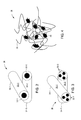
- FIG. 2 includes a perspective view of a composite structure according to an embodiment of the present invention that may be used as part of an insulation system for the transformer illustrated in FIG. 1 .
- FIG. 3 includes a perspective view of a composite structure according to another embodiment of the present invention that also may be used as part of an insulation system for the transformer illustrated in FIG. 1 .
- FIG. 4 includes a perspective view of a composite structure according to yet another embodiment of the present invention that also may be used as part of an insulation system for the transformer illustrated in FIG. 1 .
- FIG. 5 is a flowchart illustrating steps of a method of fabricating a power transformer according to an embodiment of the present invention.
- various embodiments of the present invention provide an improved electrical insulation, method of making the improved electrical insulation, and electrical system utilizing the improved electrical insulation.
- the improved electrical insulation generally includes a nanoclay or nanoclay particles.
- nanoclay is defined as a mineral silicate particle in the size range of about 1 nanometer (nm) to about 10,000 nm.
- suitable nanoclays include silicates such as montmorillonite, bentonite, kaolinite, hectorite, halloysite, and the like.
- the resulting electrical insulator has improved temperature performance such as, for example improved thermal stability; increased dimensional stability; improved flame retardant properties; increased modulus and tensile strengths; improved barrier properties against moisture, solvents, chemical vapors, and the like; lower density; and the like.
- FIG. 1 is a perspective view of a cross-section of a high-voltage, fluid-filled power transformer 10 according to an embodiment of the present invention.
- the transformer 10 includes a variety of transformer components that all may have insulation positioned between and/or around them. More specifically, the transformer 10 includes current transformer (CT) supports 12 , support blocks 14 , locking strips 16 , winding cylinders 18 , lead supports 20 , radical spacers 22 and end blocks 24 . For purposes of clarity, the insulation is not illustrated in FIG. 1 .
- CT current transformer
- a cooling fluid e.g., an electrical or dielectric insulating fluid such as, for example, a napthenic mineral oil, a paraffinic-based mineral oil including isoparaffins, synthetic esters and natural esters (e.g., FR3TM) flows between the transformer components 12 , 14 , 16 , 18 , 20 , 22 , 24 and is in contact with the above-mentioned insulation, typically with at least some flow therethrough as well.
- the cooling fluid is not illustrated in FIG. 1 .
- the cooling fluid is selected not only to cool components within the transformer 10 during the operation thereof but also to physically withstand the conditions (e.g., temperature levels, voltage and current levels, etc.) found within the transformer 10 during the operation thereof. Further, the cooling fluid is selected to be chemically inert with respect to the transformer components and with respect to the insulation that is positioned between these components.
- FIG. 2 includes a perspective view of a composite structure 26 , according to an embodiment of the present invention that may be used as part of the above-mentioned insulation system for the transformer 10 illustrated in FIG. 1 .
- the composite structure 26 includes many composite fibers 30 , each of which includes an least one base fiber 32 .
- two composite fibers 30 - 1 and 30 - 2 are depicted in FIG. 2 , each having a single base fiber, i.e., base fiber 32 - 1 and base fiber 32 - 2 .
- all of the composite fibers 30 include a sheath 34 of binder material adhered to, extruded over, etc., their respective base fibers 32 .
- sheaths 34 - 1 and 34 - 2 are bound to each other, which bind composite fibers 30 - 1 and 30 - 2 together.
- at least some of the composite fibers 30 do not include a sheath 34 (not depicted for clarity), and are bound to those proximate composite fibers 30 that include a sheath 34 .
- base fibers 30 and/or sheaths 34 include a suitable nanoclay.
- suitable nanoclays may be available at Sigma-Aldrich (St. Louis, Mo.).
- a specific example of a suitable nanoclay includes montmorillonite having about a 1 nm thick aluminosilicate layers surface-substituted with metal cations and stacked in about 10 ⁇ m-sized multilayer stacks. Depending on surface modification of the clay layers, montmorillonite may be dispersed in a polymer matrix to form polymer-clay nanocomposite. Within the nanocomposite individual nm-thick clay layers may be fully separated to form plate-like nanoparticles with very high (nm ⁇ m) aspect ratio (e.g., 1:100, and the like).
- the diameter of composite fiber 30 is typically on the order of microns and the length of each composite fiber 30 is typically on the order of millimeters or centimeters. As such, thousands or even millions of such composite fibers 30 are bound together to form the above-mentioned insulation system.
- the insulation system once formed, is then positioned between the various components of the transformer 10 illustrated in FIG. 1 . Since the sheath binder material does not form a continuous matrix, the above-mentioned cooling fluid is capable of impregnating and, at least to some extent, of flowing through the composite structure 26 .
- FIG. 3 includes a perspective view of a composite structure 28 according to another embodiment of the present invention that also may be used as part of an insulation system for the transformer 10 illustrated in FIG. 1 .
- composite fibers 30 include several base fibers 32 , such as, for example, two, three, four, etc., and sheath 34 adheres to, is extruded over, etc., all of the base fibers 32 of each composite fiber 30 .
- two composite fibers 30 - 1 and 30 - 2 are depicted in FIG. 3 , each having three base fibers, i.e., base fibers 32 - 1 and base fibers 32 - 2 .
- all of the composite fibers 30 include a sheath 34 , as illustrated in FIG. 3 .
- the sheaths 34 are bound to each other, which bind composite fibers 30 - 1 and 30 - 2 together.
- at least some of the composite fibers 30 do not include a sheath 34 (not depicted for clarity), and are bound to those proximate composite fibers 30 that include a sheath 34 .
- composite structure 26 is simple to fabricate, while composite structure 28 has greater mechanical strength.
- FIG. 4 includes a perspective view of a composite structure 36 according to yet another embodiment of the present invention that also may be used as part of an insulation system for the transformer 10 illustrated in FIG. 1 .
- particles 35 of solid binding material are adhered to at least two base fibers 32 .
- Composite structure 36 advantageously has a high porosity.
- base fibers 32 can be made from a suitable material.
- base fibers 32 include a relatively high-melting-point thermoplastic material, while in other embodiments, base fibers 32 include a staple fiber material, such as, for example, natural materials such as, for example, raw cotton, wool, hemp, or flax.
- materials contemplated by the present invention include one or more of polyethylene terephthalate (PET), polyphenylene sulphide (PPS), polyetherimide (PEI), polyethylene naphthalate (PEN) and polyethersulfone (PES).
- base fibers 32 are made from materials/composites/alloys that are mechanically and chemically stable at the maximum operating temperature of the transformer 10 . Also, base fibers 32 can be made from materials/composites/alloys that are mechanically and chemically stable at the melting temperature of sheaths 34 .
- Base fibers 32 can be formed from the same material, or, alternatively, some of the base fibers 32 can be formed from one or more different materials. For example, referring to FIGS. 2 and 3 , base fiber 32 - 1 can be made from a different material than base fiber 32 - 2 .
- sheaths 34 can be made from a suitable material.
- sheaths 34 include at least one of an amorphous and a crystalline thermoplastic material that is mechanically and chemically stable when in contact with the above-mentioned cooling fluid.
- sheaths 34 include at least one of a copolymer of polyethylene terephthalate (CoPET), amorphous PET, polybutylene terephthalate (PBT) and undrawn polyphenylene sulphide (PPS).
- CoPET polyethylene terephthalate
- PBT polybutylene terephthalate
- PPS undrawn polyphenylene sulphide
- the weight ratio of composite fibers 30 to sheaths 34 is between approximately 8:1 and approximately 1:1.
- composite structures 26 , 28 , 36 have densities of between approximately 0.5 g/cm 3 and approximately 1.20 g/cm 3 .
- the material(s) for the composite fibers 30 and the sheaths 34 are selected to have dielectric characteristics that are substantially similar to those of the cooling fluid used in the transformer 10 .
- nanoclay particles may be added to base fibers 32 and/or sheaths 34 , such as, for example, silicates such as montmorillonite, bentonite, kaolinite, hectorite, halloysite, and the like in the size range of about 1 nm to about 10,000 nm. More particularly, the nanoclay may include plate-like particles having a size of about 1 nm to about 100 nm in height and a length and width of about 10 to 100 times the height.
- composite fibers 30 may include any suitable amount of the nanoclay. Examples of suitable amounts includes about 0.1% weight/weight (w/w) to about 60% w/w. In one example, the nanoclay may be about 0.5 to 7% w/w of the composite fibers 30 .
- FIG. 5 is a flowchart illustrating steps of a method for insulating a power transformer 10 , according to an embodiment of the present invention.
- a plurality of composite fibers 30 are formed ( 50 ).
- Each composite fiber includes at least one base fiber 32 , a sheath 34 of binder material and nanoclays.
- nanoclays are included only in the base fibers 32
- nanoclays are included only in the sheaths 34
- nanoclays are included in both the base fibers 32 and the sheaths 34 .
- sheaths 34 are can be formed by co-extruding binder material onto base fibers 32 ; other processes are also contemplated.
- a composite structure 26 , 28 is formed ( 52 ) by heating the plurality of composite fibers 30 , which melts the sheaths 34 and binds the composite fibers 30 together. Compression may also be used to advantage, either before, during or after heating. According to certain embodiments of the present invention, heating and optionally compressing produce a composite structure having a density of between approximately 0.5 g/cm 3 and approximately 1.20 g/cm 3 . Other densities are also within the scope of the present invention. In addition to increasing the overall density of the composite structure, compression may stretch some of the composite fibers 30 contained therein, which results in an increased crystallinity in the composite structure, which can be beneficial in certain instances.
- the composite structure 26 , 28 is positioned ( 54 ) between at least two components of a power transformer.
- the composite structure may be placed between any or all of the current transformer (CT) supports 12 , support blocks 14 , locking strips 16 , winding cylinders 18 , lead supports 20 , radical spacers 22 and/or end blocks 24 illustrated in FIG. 1 .
- CT current transformer
- the composite structure may be formed into one or more shapes that may be easily introduced into various spaces within power transformer 10 .
- a cooling fluid is introduced ( 56 ) into the power transformer.
- the cooling fluid cools the power transformer components and fluidly couples the composite structure 26 , 28 and the transformer components.
- the cooling fluid may be, for example, an electrical or dielectric insulating fluid. Because of the high porosity of the composite material 26 , 28 , the cooling liquid will substantially permeate the composite material 26 , 28 , and provide better dielectric properties than other known structures. Additionally, the base fiber and binder material can be selected for dielectric characteristics that are substantially similar to those of the cooling fluid. Such a selection of dielectrically compatible materials allows for more efficient operation of power transformers according to the present invention.
- the insulation systems discussed above may allow for the power transformers in which they are included to operate at higher temperatures.
- operating temperature range of between 155° C. and 180° C. are attainable, though these temperature ranges are not limiting of the overall invention. Since higher operating temperature reduce the size requirements of power transformers, transformers according to the present invention designed for a particular application may be smaller than currently available transformers, thereby requiring fewer materials and reducing the overall cost of forming/manufacturing the transformer.
- MVA megavolt ampere
- transformers having a smaller physical footprint may be provided from transformers having a smaller physical footprint than currently available transformers.
- certain transformers according to the present invention reduce the probability of endangering the reliability of the transformer due to thermal overload.
- novel structure of the insulation systems discussed above make them more capable of retaining their compressible characteristics over time then currently available systems (i.e., there is less creep and no need to re-tighten).
Landscapes
- Engineering & Computer Science (AREA)
- Power Engineering (AREA)
- Physics & Mathematics (AREA)
- Spectroscopy & Molecular Physics (AREA)
- Organic Insulating Materials (AREA)
Abstract
A power transformer is provided that includes a first transformer component, a second transformer component, and a composite structure positioned between the first transformer component and the second transformer component. The composite structure includes a first composite fiber having at least one base fiber, a sheath of binder material, and nanoclay particles, and a second composite fiber, having at least one base fiber, bound to the first composite fiber by at least a portion of the sheath.
Description
- This application is a Continuation-In-Part (CIP) of U.S. patent application Ser. No. 12/540,437, filed Aug. 13, 2009, which is incorporated herein by reference in its entirety.
- The present invention relates generally to insulation. More particularly, the present invention relates to insulation for power transformers.
- Currently available high-voltage, fluid-filled power transformers utilize cellulose-based insulation materials that are impregnated with dielectric fluids. More specifically, such insulation systems include cellulose-based materials that are positioned between turns, between discs and sections, between layers, between windings and between components at high voltage and ground potential parts (e.g., cores, structural members and tanks).
- In order to operate, currently available transformers typically include insulation materials that have a moisture content of less than 0.5% by weight. However, since cellulose naturally absorbs between 3 and 6 weight percent of moisture, a relatively costly process of heating under vacuum is typically performed before cellulose is suitable for use in a power transformer. Even pursuant to such a heating/vacuum process, as the cellulose ages (i.e., degrades over time), moisture eventually forms, as does acid, which accelerates the aging process.
- Since the rate at which cellulose ages is dependent upon temperature, normal operating temperatures of currently available power transformers is 105° C. or less. For the same reason, the maximum operating temperature of such transformers is 120° C. or less. As more power is transferred, the higher losses due to higher current generate higher temperatures. As such, cellulose-based insulation systems limit the operational efficiency of power transformers.
- Embodiments of the present invention advantageously provide insulation for power transformers.
- In one embodiment, a power transformer includes a first transformer component, a second transformer component, and a composite structure positioned between the first transformer component and the second transformer component. The composite structure includes a first composite fiber having at least one base fiber, a sheath of binder material and nanoclay particles, and a second composite fiber, having at least one base fiber, which is bound to the first composite fiber by at least a portion of the sheath.
- In another embodiment, a power transformer includes a first transformer component, a second transformer component, and a composite structure positioned between the first transformer component and the second transformer component. The composite structure includes a first composite fiber having at least one base fiber, a means for sheathing the base fiber, and a second composite fiber, having at least one base fiber, which is bound to the first composite fiber by at least a portion of the means for sheathing.
- In a further embodiment, an insulating material for a power transformer includes a first composite fiber having at least one base fiber, a sheath of binder material and nanoclay particles, and a second composite fiber, having at least one base fiber, which is bound to the first composite fiber by at least a portion of the sheath.
- There has thus been outlined, rather broadly, certain embodiments of the invention in order that the detailed description thereof herein may be better understood, and in order that the present contribution to the art may be better appreciated. There are, of course, additional embodiments of the invention that will be described below and which will form the subject matter of the claims appended hereto.
- In this respect, before explaining at least one embodiment of the invention in detail, it is to be understood that the invention is not limited in its application to the details of construction and to the arrangements of the components set forth in the following description or illustrated in the drawings. The invention is capable of embodiments in addition to those described and of being practiced and carried out in various ways. Also, it is to be understood that the phraseology and terminology employed herein, as well as the abstract, are for the purpose of description and should not be regarded as limiting.
- As such, those skilled in the art will appreciate that the conception upon which this disclosure is based may readily be utilized as a basis for the designing of other structures, methods and systems for carrying out the several purposes of the present invention. It is important, therefore, that the claims be regarded as including such equivalent constructions insofar as they do not depart from the spirit and scope of the present invention.
-
FIG. 1 is a perspective view of a cross-section of a high-voltage, fluid-filled power transformer according to an embodiment of the present invention. -
FIG. 2 includes a perspective view of a composite structure according to an embodiment of the present invention that may be used as part of an insulation system for the transformer illustrated inFIG. 1 . -
FIG. 3 includes a perspective view of a composite structure according to another embodiment of the present invention that also may be used as part of an insulation system for the transformer illustrated inFIG. 1 . -
FIG. 4 includes a perspective view of a composite structure according to yet another embodiment of the present invention that also may be used as part of an insulation system for the transformer illustrated inFIG. 1 . -
FIG. 5 is a flowchart illustrating steps of a method of fabricating a power transformer according to an embodiment of the present invention. - In general, various embodiments of the present invention provide an improved electrical insulation, method of making the improved electrical insulation, and electrical system utilizing the improved electrical insulation. The improved electrical insulation generally includes a nanoclay or nanoclay particles. For the purpose of this disclosure, the term, “nanoclay” is defined as a mineral silicate particle in the size range of about 1 nanometer (nm) to about 10,000 nm. In general, examples of suitable nanoclays include silicates such as montmorillonite, bentonite, kaolinite, hectorite, halloysite, and the like. It is an advantage of one or more embodiments of the invention that the resulting electrical insulator has improved temperature performance such as, for example improved thermal stability; increased dimensional stability; improved flame retardant properties; increased modulus and tensile strengths; improved barrier properties against moisture, solvents, chemical vapors, and the like; lower density; and the like.
- Embodiments of the present invention will now be described with reference to the drawing figures, in which like reference numerals refer to like parts throughout.
FIG. 1 is a perspective view of a cross-section of a high-voltage, fluid-filledpower transformer 10 according to an embodiment of the present invention. As illustrated inFIG. 1 , thetransformer 10 includes a variety of transformer components that all may have insulation positioned between and/or around them. More specifically, thetransformer 10 includes current transformer (CT) supports 12,support blocks 14,locking strips 16,winding cylinders 18, lead supports 20,radical spacers 22 andend blocks 24. For purposes of clarity, the insulation is not illustrated inFIG. 1 . - In operation, a cooling fluid (e.g., an electrical or dielectric insulating fluid such as, for example, a napthenic mineral oil, a paraffinic-based mineral oil including isoparaffins, synthetic esters and natural esters (e.g., FR3™) flows between the
transformer components FIG. 1 . The cooling fluid is selected not only to cool components within thetransformer 10 during the operation thereof but also to physically withstand the conditions (e.g., temperature levels, voltage and current levels, etc.) found within thetransformer 10 during the operation thereof. Further, the cooling fluid is selected to be chemically inert with respect to the transformer components and with respect to the insulation that is positioned between these components. -
FIG. 2 includes a perspective view of acomposite structure 26, according to an embodiment of the present invention that may be used as part of the above-mentioned insulation system for thetransformer 10 illustrated inFIG. 1 . - The
composite structure 26 includes many composite fibers 30, each of which includes an least onebase fiber 32. For convenience, two composite fibers 30-1 and 30-2 are depicted inFIG. 2 , each having a single base fiber, i.e., base fiber 32-1 and base fiber 32-2. In one embodiment, all of the composite fibers 30 include a sheath 34 of binder material adhered to, extruded over, etc., theirrespective base fibers 32. As depicted inFIG. 2 , sheaths 34-1 and 34-2 are bound to each other, which bind composite fibers 30-1 and 30-2 together. In another embodiment, at least some of the composite fibers 30 do not include a sheath 34 (not depicted for clarity), and are bound to those proximate composite fibers 30 that include a sheath 34. - In various embodiments of the invention, base fibers 30 and/or sheaths 34 include a suitable nanoclay. Particularly suitable nanoclays may be available at Sigma-Aldrich (St. Louis, Mo.). A specific example of a suitable nanoclay includes montmorillonite having about a 1 nm thick aluminosilicate layers surface-substituted with metal cations and stacked in about 10 μm-sized multilayer stacks. Depending on surface modification of the clay layers, montmorillonite may be dispersed in a polymer matrix to form polymer-clay nanocomposite. Within the nanocomposite individual nm-thick clay layers may be fully separated to form plate-like nanoparticles with very high (nm×μm) aspect ratio (e.g., 1:100, and the like).
- Although smaller and larger dimensions are also within the scope of the present invention, the diameter of composite fiber 30 is typically on the order of microns and the length of each composite fiber 30 is typically on the order of millimeters or centimeters. As such, thousands or even millions of such composite fibers 30 are bound together to form the above-mentioned insulation system. The insulation system, once formed, is then positioned between the various components of the
transformer 10 illustrated inFIG. 1 . Since the sheath binder material does not form a continuous matrix, the above-mentioned cooling fluid is capable of impregnating and, at least to some extent, of flowing through thecomposite structure 26. -
FIG. 3 includes a perspective view of acomposite structure 28 according to another embodiment of the present invention that also may be used as part of an insulation system for thetransformer 10 illustrated inFIG. 1 . - In the
composite structure 28, composite fibers 30 includeseveral base fibers 32, such as, for example, two, three, four, etc., and sheath 34 adheres to, is extruded over, etc., all of thebase fibers 32 of each composite fiber 30. For convenience, two composite fibers 30-1 and 30-2 are depicted inFIG. 3 , each having three base fibers, i.e., base fibers 32-1 and base fibers 32-2. In one embodiment, all of the composite fibers 30 include a sheath 34, as illustrated inFIG. 3 . The sheaths 34 are bound to each other, which bind composite fibers 30-1 and 30-2 together. In another embodiment, at least some of the composite fibers 30 do not include a sheath 34 (not depicted for clarity), and are bound to those proximate composite fibers 30 that include a sheath 34. - Advantageously,
composite structure 26 is simple to fabricate, whilecomposite structure 28 has greater mechanical strength. -
FIG. 4 includes a perspective view of acomposite structure 36 according to yet another embodiment of the present invention that also may be used as part of an insulation system for thetransformer 10 illustrated inFIG. 1 . In this embodiment,particles 35 of solid binding material are adhered to at least twobase fibers 32.Composite structure 36 advantageously has a high porosity. - In general,
base fibers 32 can be made from a suitable material. In some embodiments,base fibers 32 include a relatively high-melting-point thermoplastic material, while in other embodiments,base fibers 32 include a staple fiber material, such as, for example, natural materials such as, for example, raw cotton, wool, hemp, or flax. For example, materials contemplated by the present invention include one or more of polyethylene terephthalate (PET), polyphenylene sulphide (PPS), polyetherimide (PEI), polyethylene naphthalate (PEN) and polyethersulfone (PES). According to certain embodiments of the present invention,base fibers 32 are made from materials/composites/alloys that are mechanically and chemically stable at the maximum operating temperature of thetransformer 10. Also,base fibers 32 can be made from materials/composites/alloys that are mechanically and chemically stable at the melting temperature of sheaths 34. -
Base fibers 32 can be formed from the same material, or, alternatively, some of thebase fibers 32 can be formed from one or more different materials. For example, referring toFIGS. 2 and 3 , base fiber 32-1 can be made from a different material than base fiber 32-2. - Similarly, sheaths 34 can be made from a suitable material. In certain embodiments, sheaths 34 include at least one of an amorphous and a crystalline thermoplastic material that is mechanically and chemically stable when in contact with the above-mentioned cooling fluid. In one embodiment, sheaths 34 include at least one of a copolymer of polyethylene terephthalate (CoPET), amorphous PET, polybutylene terephthalate (PBT) and undrawn polyphenylene sulphide (PPS).
- While no particular restrictions are generally placed upon the relative weight or volume percentages of composite fibers 30 to sheaths 34, in certain embodiments of the present invention, the weight ratio of composite fibers 30 to sheaths 34 is between approximately 8:1 and approximately 1:1. Also, although other densities are also contemplated by the present invention,
composite structures transformer 10. - As mentioned above, nanoclay particles may be added to
base fibers 32 and/or sheaths 34, such as, for example, silicates such as montmorillonite, bentonite, kaolinite, hectorite, halloysite, and the like in the size range of about 1 nm to about 10,000 nm. More particularly, the nanoclay may include plate-like particles having a size of about 1 nm to about 100 nm in height and a length and width of about 10 to 100 times the height. In many embodiments, composite fibers 30 may include any suitable amount of the nanoclay. Examples of suitable amounts includes about 0.1% weight/weight (w/w) to about 60% w/w. In one example, the nanoclay may be about 0.5 to 7% w/w of the composite fibers 30. -
FIG. 5 is a flowchart illustrating steps of a method for insulating apower transformer 10, according to an embodiment of the present invention. - A plurality of composite fibers 30 are formed (50). Each composite fiber includes at least one
base fiber 32, a sheath 34 of binder material and nanoclays. In one embodiment, nanoclays are included only in thebase fibers 32, in another embodiment, nanoclays are included only in the sheaths 34, while in a further embodiment, nanoclays are included in both thebase fibers 32 and the sheaths 34. According to certain embodiments of the present invention, sheaths 34 are can be formed by co-extruding binder material ontobase fibers 32; other processes are also contemplated. - A
composite structure - The
composite structure cylinders 18, lead supports 20,radical spacers 22 and/or end blocks 24 illustrated inFIG. 1 . As such, according to certain embodiments of the present invention, the composite structure may be formed into one or more shapes that may be easily introduced into various spaces withinpower transformer 10. - A cooling fluid is introduced (56) into the power transformer. The cooling fluid cools the power transformer components and fluidly couples the
composite structure composite material composite material - As will be appreciated by one of skill in the art upon practicing one or more embodiments of the present invention, several advantages are provided by the apparatuses and methods discussed above. For example, the insulation systems discussed above may allow for the power transformers in which they are included to operate at higher temperatures. In fact, according to certain embodiments of the present invention, operating temperature range of between 155° C. and 180° C. are attainable, though these temperature ranges are not limiting of the overall invention. Since higher operating temperature reduce the size requirements of power transformers, transformers according to the present invention designed for a particular application may be smaller than currently available transformers, thereby requiring fewer materials and reducing the overall cost of forming/manufacturing the transformer.
- Because of the enhanced insulating and cooling of certain power transformers according to the present invention, more megavolt ampere (MVA) (i.e., electrical power) may be provided from transformers having a smaller physical footprint than currently available transformers. Also, because of the novel composition of the components in the above-mentioned insulation systems, certain transformers according to the present invention reduce the probability of endangering the reliability of the transformer due to thermal overload. In addition, the novel structure of the insulation systems discussed above make them more capable of retaining their compressible characteristics over time then currently available systems (i.e., there is less creep and no need to re-tighten).
- The many features and advantages of the invention are apparent from the detailed specification, and thus, it is intended by the appended claims to cover all such features and advantages of the invention which fall within the true spirit and scope of the invention. Further, since numerous modifications and variations will readily occur to those skilled in the art, it is not desired to limit the invention to the exact construction and operation illustrated and described, and accordingly, all suitable modifications and equivalents may be resorted to, falling within the scope of the invention.
Claims (20)
1. A power transformer, comprising:
a first transformer component;
a second transformer component; and
a composite structure, positioned between the first transformer component and the second transformer component, including:
a first composite fiber having at least one base fiber, a sheath of binder material, and nanoclay particles, and
a second composite fiber, having at least one base fiber, bound to the first composite fiber by at least a portion of the sheath.
2. The power transformer of claim 1 , further comprising a cooling fluid, fluidly coupled to the first transformer component, the second transformer component and the composite structure, to cool the first transformer component and the second transformer component during operation.
3. The power transformer of claim 1 , wherein the nanoclay particles are included only in the sheath.
4. The power transformer of claim 1 , wherein the nanoclay particles are included only in the base fiber.
5. The power transformer of claim 1 , wherein the second base fiber includes a sheath of binder material and nanoclay particles.
6. The power transformer of claim 5 , wherein the nanoclay particles are included only in the base fiber or the sheath of the first and second composite fibers.
7. The power transformer of claim 1 , wherein the composite structure has a weight/weight (w/w) ratio of nanoclay particles of between 0.1% and 60%.
8. The power transformer of claim 7 , wherein the composite structure has a w/w ratio of nanoclay particles of between 0.5% and 7%.
9. The power transformer of claim 1 , wherein the nanoclay particles include spherical particles have an average diameter of between 1 nm and 10,000 nm.
10. The power transformer of claim 1 , wherein the nanoclay particles include plate-like particles having a height between 1 nm to 100 nm, a length of between 10 to 100 times the height, and a width of between 10 to 100 times the height.
11. The power transformer of claim 1 , wherein the nanoclay particles include silicates selected from the group consisting of montmorillonite, bentonite, kaolinite, hectorite, and halloysite.
12. The power transformer of claim 11 , wherein the nanoclay particles include montmorillonite.
13. The power transformer of claim 1 , wherein the base fibers include a high melting point thermoplastic material.
14. The power transformer of claim 1 , wherein the base fibers includes at least one of polyethylene terephthalate (PET), polyphenylene sulphide (PPS), polyetherimide (PEI), polyethylene naphthalate (PEN) and polyethersulfone (PES).
15. The power transformer of claim 1 , wherein the sheath includes at least one of a copolymer of polyethylene terephthalate (CoPET), amorphous PET, polybutylene terephthalate (PBT) and undrawn polyphenylene sulphide (PPS).
16. The power transformer of claim 1 , wherein the sheath extends along a portion of the base fiber.
17. The power transformer of claim 1 , wherein the composite structure has a density of between 0.5 g/cm3 and 1.20 g/cm3.
18. A power transformer, comprising:
a first transformer component;
a second transformer component; and
a composite structure, positioned between the first transformer component and the second transformer component, including:
a first composite fiber having at least one base fiber, a means for sheathing the base fiber, and
a second composite fiber, having at least one base fiber, bound to the first composite fiber by at least a portion of the means for sheathing.
19. The power transformer of claim 18 , further comprising a cooling fluid, fluidly coupled to the first transformer component, the second transformer component and the composite structure, to cool the first transformer component and the second transformer component during operation.
20. An insulating material for a power transformer, comprising:
a first composite fiber having at least one base fiber, a sheath of binder material, and nanoclay particles, and
a second composite fiber, having at least one base fiber, bound to the first composite fiber by at least a portion of the sheath.
Priority Applications (2)
| Application Number | Priority Date | Filing Date | Title |
|---|---|---|---|
| US13/244,517 US20120249275A1 (en) | 2009-08-13 | 2011-09-25 | Insulation for Power Transformers |
| PCT/US2012/056821 WO2013044202A1 (en) | 2011-09-25 | 2012-09-24 | Insulation for power transformers |
Applications Claiming Priority (2)
| Application Number | Priority Date | Filing Date | Title |
|---|---|---|---|
| US12/540,437 US8085120B2 (en) | 2009-08-13 | 2009-08-13 | Solid insulation for fluid-filled transformer and method of fabrication thereof |
| US13/244,517 US20120249275A1 (en) | 2009-08-13 | 2011-09-25 | Insulation for Power Transformers |
Related Parent Applications (1)
| Application Number | Title | Priority Date | Filing Date |
|---|---|---|---|
| US12/540,437 Continuation-In-Part US8085120B2 (en) | 2009-08-13 | 2009-08-13 | Solid insulation for fluid-filled transformer and method of fabrication thereof |
Publications (1)
| Publication Number | Publication Date |
|---|---|
| US20120249275A1 true US20120249275A1 (en) | 2012-10-04 |
Family
ID=46926442
Family Applications (1)
| Application Number | Title | Priority Date | Filing Date |
|---|---|---|---|
| US13/244,517 Abandoned US20120249275A1 (en) | 2009-08-13 | 2011-09-25 | Insulation for Power Transformers |
Country Status (1)
| Country | Link |
|---|---|
| US (1) | US20120249275A1 (en) |
Cited By (1)
| Publication number | Priority date | Publication date | Assignee | Title |
|---|---|---|---|---|
| US9818525B2 (en) | 2015-06-18 | 2017-11-14 | Lsis Co., Ltd. | Cooling device of power transformer |
Citations (14)
| Publication number | Priority date | Publication date | Assignee | Title |
|---|---|---|---|---|
| US1703934A (en) * | 1929-03-05 | Electric-current converter | ||
| US3485390A (en) * | 1967-09-25 | 1969-12-23 | Triax Co | Storage system with a transfer mechanism for an article handling vehicle |
| US3695984A (en) * | 1968-01-08 | 1972-10-03 | Westinghouse Electric Corp | Novel micaceous insulation |
| US4095205A (en) * | 1977-07-28 | 1978-06-13 | Westinghouse Electric Corp. | Transformer with improved insulator |
| US5546261A (en) * | 1993-03-26 | 1996-08-13 | Ngk Insulators, Ltd. | Superconducting fault current limiter |
| US6190775B1 (en) * | 2000-02-24 | 2001-02-20 | Siemens Westinghouse Power Corporation | Enhanced dielectric strength mica tapes |
| US6930254B2 (en) * | 2003-08-14 | 2005-08-16 | Electric Power Research Institute | Chemically-doped composite insulator for early detection of potential failures due to exposure of the fiberglass rod |
| US7201572B2 (en) * | 2003-01-08 | 2007-04-10 | 3M Innovative Properties Company | Ceramic fiber composite and method for making the same |
| US7348298B2 (en) * | 2002-05-30 | 2008-03-25 | Ashland Licensing And Intellectual Property, Llc | Enhancing thermal conductivity of fluids with graphite nanoparticles and carbon nanotube |
| US20090151926A1 (en) * | 2005-05-21 | 2009-06-18 | Hall David R | Inductive Power Coupler |
| US7586717B2 (en) * | 2006-01-13 | 2009-09-08 | European High Temperature Superconductors Gmbh & Co. Kg | Electrical device for current conditioning |
| US7781698B2 (en) * | 2005-05-27 | 2010-08-24 | Snecma | Process for manufacturing a coiled insert of coated filaments |
| US7976731B2 (en) * | 2005-10-26 | 2011-07-12 | Maverick Corporation | Metal complexes for enhanced dispersion of nanomaterials, compositions and methods therefor |
| US8240108B2 (en) * | 2006-11-08 | 2012-08-14 | John M Pyo | Modular building block system and method of manufacture |
-
2011
- 2011-09-25 US US13/244,517 patent/US20120249275A1/en not_active Abandoned
Patent Citations (14)
| Publication number | Priority date | Publication date | Assignee | Title |
|---|---|---|---|---|
| US1703934A (en) * | 1929-03-05 | Electric-current converter | ||
| US3485390A (en) * | 1967-09-25 | 1969-12-23 | Triax Co | Storage system with a transfer mechanism for an article handling vehicle |
| US3695984A (en) * | 1968-01-08 | 1972-10-03 | Westinghouse Electric Corp | Novel micaceous insulation |
| US4095205A (en) * | 1977-07-28 | 1978-06-13 | Westinghouse Electric Corp. | Transformer with improved insulator |
| US5546261A (en) * | 1993-03-26 | 1996-08-13 | Ngk Insulators, Ltd. | Superconducting fault current limiter |
| US6190775B1 (en) * | 2000-02-24 | 2001-02-20 | Siemens Westinghouse Power Corporation | Enhanced dielectric strength mica tapes |
| US7348298B2 (en) * | 2002-05-30 | 2008-03-25 | Ashland Licensing And Intellectual Property, Llc | Enhancing thermal conductivity of fluids with graphite nanoparticles and carbon nanotube |
| US7201572B2 (en) * | 2003-01-08 | 2007-04-10 | 3M Innovative Properties Company | Ceramic fiber composite and method for making the same |
| US6930254B2 (en) * | 2003-08-14 | 2005-08-16 | Electric Power Research Institute | Chemically-doped composite insulator for early detection of potential failures due to exposure of the fiberglass rod |
| US20090151926A1 (en) * | 2005-05-21 | 2009-06-18 | Hall David R | Inductive Power Coupler |
| US7781698B2 (en) * | 2005-05-27 | 2010-08-24 | Snecma | Process for manufacturing a coiled insert of coated filaments |
| US7976731B2 (en) * | 2005-10-26 | 2011-07-12 | Maverick Corporation | Metal complexes for enhanced dispersion of nanomaterials, compositions and methods therefor |
| US7586717B2 (en) * | 2006-01-13 | 2009-09-08 | European High Temperature Superconductors Gmbh & Co. Kg | Electrical device for current conditioning |
| US8240108B2 (en) * | 2006-11-08 | 2012-08-14 | John M Pyo | Modular building block system and method of manufacture |
Cited By (1)
| Publication number | Priority date | Publication date | Assignee | Title |
|---|---|---|---|---|
| US9818525B2 (en) | 2015-06-18 | 2017-11-14 | Lsis Co., Ltd. | Cooling device of power transformer |
Similar Documents
| Publication | Publication Date | Title |
|---|---|---|
| US9343222B2 (en) | Insulation for power transformers | |
| EP2465121B1 (en) | Solid insulation for fluid-filled transformer and method of fabrication thereof | |
| CN101405820B (en) | Insulation for Transformers | |
| US9928935B2 (en) | Electrical insulation system | |
| US20110115488A1 (en) | Casting compound suitable for casting an electronic module, in particular a large-volume coil such as a gradient coil | |
| US20140327335A1 (en) | Electromagnetic coils, method of manufacturing same, and insulating tapes | |
| US10685773B2 (en) | Transformer insulation | |
| Wang et al. | Highly thermally conductive polymer composite enhanced by constructing a dual thermal conductivity network | |
| WO2012013543A2 (en) | Insulation system having improved partial discharge strength | |
| KR101918436B1 (en) | Inorganic electrical insulation material | |
| Yang et al. | Micro/Nanofiber-Network Assembled Aramid Paper with Excellent Mechanical and Electrical Insulating Properties | |
| WO2013044202A1 (en) | Insulation for power transformers | |
| Kim et al. | Thermal and electrical stabilities of GdBCO magnets impregnated with epoxy composites using surface-treated carbon nanotube fillers | |
| EP4047620A1 (en) | Insulation system with solid insulating material and impregnating resin | |
| AU2010282381B2 (en) | Solid insulation for fluid-filled transformer and method of fabrication thereof | |
| KR102576672B1 (en) | Hollow particles, manufacturing method thereof and thermal-resistance fluid composition comprising the same | |
| Tuncer et al. | Industrial applications perspective of nanodielectrics | |
| Izzati et al. | Comparative study on partial discharge characteristic in polymer-nanocomposite as electrical insulating material | |
| Xu et al. | Nanotechnology: From Materials Science to Insulation Design | |
| US9281098B2 (en) | Dry type electrical insulation | |
| EP2401747A1 (en) | Electric component and method for producing an electric component |
Legal Events
| Date | Code | Title | Description |
|---|---|---|---|
| AS | Assignment |
Owner name: WAUKESHA ELECTRIC SYSTEMS, INC., WISCONSIN Free format text: ASSIGNMENT OF ASSIGNORS INTEREST;ASSIGNORS:GOLNER, THOMAS M.;MEHTA, SHIRISH P.;VARANASI, PADMA P.;SIGNING DATES FROM 20111115 TO 20111117;REEL/FRAME:027300/0253 |
|
| STCB | Information on status: application discontinuation |
Free format text: ABANDONED -- AFTER EXAMINER'S ANSWER OR BOARD OF APPEALS DECISION |