US20120249193A1 - Measurement initialization circuitry - Google Patents
Measurement initialization circuitry Download PDFInfo
- Publication number
- US20120249193A1 US20120249193A1 US13/074,945 US201113074945A US2012249193A1 US 20120249193 A1 US20120249193 A1 US 20120249193A1 US 201113074945 A US201113074945 A US 201113074945A US 2012249193 A1 US2012249193 A1 US 2012249193A1
- Authority
- US
- United States
- Prior art keywords
- signal
- delay line
- variable delay
- stop
- clock signal
- Prior art date
- Legal status (The legal status is an assumption and is not a legal conclusion. Google has not performed a legal analysis and makes no representation as to the accuracy of the status listed.)
- Granted
Links
Images




Classifications
-
- G—PHYSICS
- G11—INFORMATION STORAGE
- G11C—STATIC STORES
- G11C7/00—Arrangements for writing information into, or reading information out from, a digital store
-
- H—ELECTRICITY
- H03—ELECTRONIC CIRCUITRY
- H03L—AUTOMATIC CONTROL, STARTING, SYNCHRONISATION OR STABILISATION OF GENERATORS OF ELECTRONIC OSCILLATIONS OR PULSES
- H03L7/00—Automatic control of frequency or phase; Synchronisation
- H03L7/06—Automatic control of frequency or phase; Synchronisation using a reference signal applied to a frequency- or phase-locked loop
- H03L7/08—Details of the phase-locked loop
- H03L7/081—Details of the phase-locked loop provided with an additional controlled phase shifter
- H03L7/0812—Details of the phase-locked loop provided with an additional controlled phase shifter and where no voltage or current controlled oscillator is used
-
- G—PHYSICS
- G11—INFORMATION STORAGE
- G11C—STATIC STORES
- G11C7/00—Arrangements for writing information into, or reading information out from, a digital store
- G11C7/20—Memory cell initialisation circuits, e.g. when powering up or down, memory clear, latent image memory
-
- G—PHYSICS
- G11—INFORMATION STORAGE
- G11C—STATIC STORES
- G11C7/00—Arrangements for writing information into, or reading information out from, a digital store
- G11C7/22—Read-write [R-W] timing or clocking circuits; Read-write [R-W] control signal generators or management
-
- G—PHYSICS
- G11—INFORMATION STORAGE
- G11C—STATIC STORES
- G11C7/00—Arrangements for writing information into, or reading information out from, a digital store
- G11C7/22—Read-write [R-W] timing or clocking circuits; Read-write [R-W] control signal generators or management
- G11C7/222—Clock generating, synchronizing or distributing circuits within memory device
-
- G—PHYSICS
- G11—INFORMATION STORAGE
- G11C—STATIC STORES
- G11C8/00—Arrangements for selecting an address in a digital store
-
- H—ELECTRICITY
- H03—ELECTRONIC CIRCUITRY
- H03K—PULSE TECHNIQUE
- H03K5/00—Manipulating of pulses not covered by one of the other main groups of this subclass
- H03K5/13—Arrangements having a single output and transforming input signals into pulses delivered at desired time intervals
- H03K5/14—Arrangements having a single output and transforming input signals into pulses delivered at desired time intervals by the use of delay lines
-
- H—ELECTRICITY
- H03—ELECTRONIC CIRCUITRY
- H03L—AUTOMATIC CONTROL, STARTING, SYNCHRONISATION OR STABILISATION OF GENERATORS OF ELECTRONIC OSCILLATIONS OR PULSES
- H03L7/00—Automatic control of frequency or phase; Synchronisation
- H03L7/06—Automatic control of frequency or phase; Synchronisation using a reference signal applied to a frequency- or phase-locked loop
- H03L7/08—Details of the phase-locked loop
-
- H—ELECTRICITY
- H03—ELECTRONIC CIRCUITRY
- H03L—AUTOMATIC CONTROL, STARTING, SYNCHRONISATION OR STABILISATION OF GENERATORS OF ELECTRONIC OSCILLATIONS OR PULSES
- H03L7/00—Automatic control of frequency or phase; Synchronisation
- H03L7/06—Automatic control of frequency or phase; Synchronisation using a reference signal applied to a frequency- or phase-locked loop
- H03L7/08—Details of the phase-locked loop
- H03L7/081—Details of the phase-locked loop provided with an additional controlled phase shifter
- H03L7/0812—Details of the phase-locked loop provided with an additional controlled phase shifter and where no voltage or current controlled oscillator is used
- H03L7/0816—Details of the phase-locked loop provided with an additional controlled phase shifter and where no voltage or current controlled oscillator is used the controlled phase shifter and the frequency- or phase-detection arrangement being connected to a common input
Definitions
- Embodiments of the invention relate generally to semiconductor memory, and particularly, to measurement initialization circuitry which may be used, for example, in delay locked loops.
- the integrated circuit may be clocked by an external clock signal and perform operations at predetermined times relative to the rising and falling edges of the applied clock signal.
- Examples of synchronous integrated circuits include synchronous memory devices such as synchronous dynamic random access memories (“SDRAMs”), synchronous static random access memories (“SSRAMs”), and packetized memories like SLDRAMs and RDRAMs, and include other types of integrated circuits as well, such as microprocessors.
- SDRAMs synchronous dynamic random access memories
- SSRAMs synchronous static random access memories
- packetized memories like SLDRAMs and RDRAMs
- microprocessors packetized memories
- the timing of signals external to a synchronous memory device may be determined by the external clock signal, and operations within the memory device are typically synchronized to external operations. For example, data output may be placed on a data bus of the memory device in synchronism with the external clock signal, and the memory device may output data at the proper times.
- an internal clock signal may be developed in response to the external clock signal, and is typically applied to latches contained in the memory device to clock data.
- the internal clock signal and external clock must be synchronized to ensure the internal clock signal clocks the latches at the proper times to successfully capture the commands.
- “external” refers to signals and operations outside of the memory device
- “internal” refers to signals and operations within the memory device.
- examples in the present description are directed to synchronous memory devices, the principles described herein are equally applicable to other types of synchronous integrated circuits.
- FIG. 1 is a schematic illustration of a conventional DLL circuit 100 for providing an approximate delay that closely matches the phase difference between input and output clock signals.
- the DLL circuit 100 uses a feedback configuration that operates to feed back a phase difference-related signal to control one or more delay lines, such as a variable delay line 112 , for advancing or delaying the timing of one clock signal to “lock” to a second clock signal.
- An external clock signal is initially applied to the DLL circuit 100 and received by an input buffer 104 that provides a buffered clock signal DLY_REF to the DLL circuit 100 .
- the DLY_REF signal is delayed relative to the external clock signal due to a propagation delay of the input buffer 104 .
- the DLY_REF signal is then applied to variable delay line 112 , which include a number of delay stages that are selected by a shift register 120 to apply a measured delay for adjusting the phase of the DLY_REF signal.
- the shift register 120 controls adjustments to the variable delay line 112 by providing shift control signals 134 in response to receiving control signals from a phase detector 130 .
- variable delay line 112 applies a measured delay to adjust the phase of the DLY_REF signal near the desired phase for achieving the phase lock condition.
- the variable delay line 112 generates an output signal CLK_OUT, whose phase is compared to the DLY_REF signal to determine whether the locking condition has been achieved.
- CLK_OUT signal is provided to a model delay circuit 140 that duplicates inherent delays added to the applied external clock signal as it propagates through the delay loop, such as the input buffer 104 plus output path delay that may occur after the DLL.
- the model delay circuit 140 then provides a feedback signal DLY_FB to the phase detector 130 .
- the phase detector 130 compares the phases of the DLY_REF signal and the DLY_FB signal to generate shift selection signals 132 to the shift register 120 to control the variable delay line 112 .
- the shift selection signal instructs the shift register 120 to increase the delay of the variable delay line 112 when the DLY_FB signal leads the DLY_REF signal, or decrease the delay in the opposite case.
- the delay may be increased or decreased by adding or subtracting a number of stages used in the variable delay line 112 , where the variable delay line 112 includes number of delay stages. In this manner, the DLL 100 may synchronize an internal clock signal CLK_OUT with an external clock signal.
- the DLL 100 may take a certain amount of time to achieve a “locked” condition. This time may be shortened if the variable delay line 112 was initially set to a delay which approximates the anticipated needed delay to synchronize the internal and external clock signals. Minimal delay may be preferable for locking purposes due to lower power being consumed.
- some DLL circuits may include a measurement initialization capability.
- FIG. 2 is a schematic illustration of a portion of a DLL including circuitry for measurement initialization. To highlight the measurement initialization circuitry, not all of the DLL circuitry (such as the phase detector) is shown in FIG. 2 .
- An external clock signal is provided to an input buffer 201 to generate a ref_clk signal.
- the ref_clk signal is provided to an input of a multiplexer 203 .
- the multiplexer 203 may select an input corresponding to a control signal MUX received from a controller 210 .
- the multiplexer 203 may be configured to allow the ref_clk signal to be provided to the variable delay line 205 .
- the variable delay line 205 may be initially set to provide a minimal delay, that is set to minimize the t DLL time shown in FIG. 2 , such that minimal delay stages may be used.
- the variable delay line 205 may be set in this manner responsive to a control signals vdl_cntrl from the controller 210 .
- the model delay 212 may generally model delays outside of the delay loop, such as delays from input buffers, etc.
- the model delay 212 then provides a signal to a t AC trim block 214 .
- the t AC trim block 214 may generally compensate for access time delays as specified by a particular system.
- the t AC trim block 214 may then provide a signal to a latch 216 , converting the received signal to signal (e.g. an edge or pulse) a ‘Start’ signal.
- the ‘Start’ signal may be provided to a buffer 218 which may then provide the signal to a second input of the multiplexer 203 .
- the multiplexer may be controlled to then provide the ‘Start’ signal to the variable delay line 205 . In this manner, a ‘Start’ signal begins propagating through the variable delay line 205 .
- the ref_clk signal may also be provided directly to the t AC trim block 214 .
- the t AC trim block 214 may then provide the delayed signal to a latch 220 , which may convert the ref_clk signal to a signal, referred to as a ‘Stop’ signal (e.g. edge or pulse).
- the ‘Stop’ signal may be provided to a buffer 222 and then provided to latches in the stages of the variable delay line 205 . In this manner, the ‘Stop’ signal may stop (e.g. latch) the ‘Start’ signal as it propagates through the variable delay line 205 .
- variable delay line 205 Information regarding the number of stages the ‘Start’ signal propagated through before receipt of the ‘Stop’ signal may be provided by the variable delay line 205 in the form of a vdl_meas signal indicating the stage at which the ‘Start’ signal was latched.
- the controller 210 may accordingly set the variable delay line 205 to use that number of stages through the vdl_cntl signal. In this manner, the variable delay line 205 may be initialized to a particular number of stages.
- the multiplexer 203 is configured to select the ref_clk input to provide to the variable delay line 205 .
- the output of the variable delay line 205 may be provided to an output buffer 225 to generate a synchronized output signal.
- a phase detector may be used to compare the phase of the ref_clk signal and the clk_fb signal and adjust the delay of the variable delay line 205 during operation.
- a delay between the external clock signal and the synchronized output signal may be N*t CK .
- FIG. 3 is a schematic illustration of another portion of a DLL including circuitry for implementing the measurement initialization scheme shown in FIG. 2 .
- a flip-flop 302 may receive a high signal (e.g. a logic ‘1’, which may be V CC ) at its D input and a reference clock signal ref_clk at its clock input.
- the flip-flop 302 may provide a signal to the serial buffers 304 and 306 , modeling delay, as with the model delay 212 of FIG. 2 .
- the output of the buffer 306 may be considered the ‘Start’ signal and provided to a variable delay line 310 .
- the ‘Start’ signal from the output of the buffer 306 may also be provided to the D input of a flip-flop 312 .
- the ref_clk signal may also be applied to the clock input of the flip-flop 312 .
- the flip-flop 312 may provide a ‘Stop’ signal at the next rising edge of the ref_clk signal following the receipt of the ‘Start’ signal.
- the ‘Stop’ signal may be provided to the delay line 310 to latch the propagating ‘Start’ signal.
- FIG. 1 is a schematic illustration of a conventional DLL circuit.
- FIG. 2 is a schematic illustration of a portion of a DLL including circuitry for measurement initialization.
- FIG. 3 is a schematic illustration of another portion of a DLL including circuitry for implementing the measurement initialization scheme shown in FIG. 2 .
- FIG. 4 is an example timing diagram illustrating operation of the measurement in initialization schemes shown in FIGS. 2 and 3 .
- FIG. 5 is a schematic illustration of a DLL including measurement initialization circuitry according to an embodiment of the present invention.
- FIG. 6 is a schematic illustration of another portion of a DLL including circuitry for implementing the measurement initialization scheme shown in FIG. 5 .
- FIG. 7 is an example timing diagram illustrating operation of the measurement in initialization schemes shown in FIGS. 5 and 6 .
- FIG. 8 is a schematic illustration of a portion of DLL circuitry including circuitry utilized to determine clock inversion in accordance with embodiments of the present invention.
- FIG. 9 is a schematic illustration of a portion of a memory according to an embodiment of the present invention.
- an initial number of stages of a variable delay line may be set by measuring the number of stages a ‘Start’ signal propagates through prior to receipt of a ‘Stop’ signal.
- the examples described above generated the ‘Stop’ signal based on a next rising edge of a reference clock signal following generation of the ‘Start’ signal. This may generate unnecessary delay in initializing the variable delay line in situations where a falling edge of the clock signal arrives first following the generation of the ‘Start’ signal.
- FIG. 4 is an example timing diagram illustrating operation of the measurement in initialization schemes shown in FIGS. 2 and 3 .
- FIG. 4 illustrates the ref_clk signal 410 .
- the start signal 415 transitions high.
- the stop signal 420 transitions high.
- the shaded block 430 represents unnecessary added delay beyond the time of the next falling edge of the ref_clk signal following transition of the start signal 415 . That is, if the falling edge of the ref_clk signal could be used to initiate a transition of the stop signal 420 , the amount of time required to measure an initialization delay through the variable delay line of a DLL may be reduced.
- embodiments of the present invention may utilize either a rising or falling edge of a reference clock signal to generate a ‘Stop’ signal, propagation the stopping of a ‘Start’ signal in a variable delay line. In many cases, this may save 1 ⁇ 2 t CK of delay relative to systems utilizing only the rising edge of a clock signal to generate a ‘Stop’ signal.
- FIG. 5 is a schematic illustration of a DLL including measurement initialization circuitry according to an embodiment of the present invention.
- the measurement initialization circuitry includes many components analogous to those shown in FIG. 2 , which will not be described here again for brevity.
- input buffer 501 , MUX 503 , t AC trim block 514 , model delay 512 , output buffer 525 , and latch 526 operate in analogous manner with the corresponding components shown in FIG. 2 .
- the ‘Start’ signal may be generated by the latch 526 .
- the ‘Stop’ signal may be generated differently in the embodiment of FIG. 5 .
- the latch 520 is configured to receive a delayed ref_clk signal from the t AC trim block 514 .
- the latch 520 generates a signal (e.g. a pulse) both on the rising and the falling edge of the ref_clk signal.
- the signal generated responsive to the rising edge of the ref_clk signal is provided to a buffer 522 .
- the signal generated responsive to the falling edge of the ref_clk signal is provided to a buffer 523 .
- two ‘Stop’ signals may be generated—one corresponding to a rising edge of the ref_clk signal, and one to the falling edge.
- the buffer 522 provides the ‘Stop’ signal generated responsive to the rising edge of the ref_clk signal to the multiplexers 550 and 552 .
- the buffer 523 provides the ‘Stop signal generated responsive to the falling edge of the ref_clk signal to the multiplexer 552 .
- the multiplexer 550 may provide the received ‘Stop’ signal to the odd latches of the variable delay line 505 during both a measurement initialization mode and a normal mode of operation.
- the multiplexer 550 may be implemented as a multiplexer or a buffer. However, the multiplexer 552 is configured to receive a control signal, MeasEn, from the controller 510 .
- the multiplexer 552 may provide the ‘Stop’ signal generated responsive to the falling edge of the ref_clk signal, e.g. the ‘Stop’ signal from the buffer 523 , to the even latches of the variable delay line 505 .
- the multiplexer 552 provides the Stop signal generated responsive to the rising edge to the even latches.
- the buffer 522 provides a ‘shift clock’ signal to both the even and odd latches of the variable delay line 505 .
- the odd latches receive the ‘Stop’ signal from the buffer 522 while the even latches receive the ‘Stop’ signal from the buffer 523 .
- either the ‘Stop’ signal received from the buffer 522 , generated responsive to a rising edge of the ref_clk signal, or the ‘Stop’ signal received from the buffer 523 , generated responsive to a falling edge of the ref_clk signal, may stop propagation of a ‘Start’ signal through the variable delay line 505 .
- a 1 ⁇ 2 t CK time may be saved when the falling edge of the ref_clk signal is the next edge after the ‘Start’ signal begins propagating through the variable delay line 505 .
- the ‘Start’ signal begins propagating through the variable delay line 505 , it will stop propagating through the variable delay line 505 responsive to the first to occur of the next rising edge of the ref_clk signal or the next falling edge of the ref_clk signal.
- the multiplexer 503 may initially provide the ref_clk signal to the variable delay line 505 .
- the variable delay line 505 may then provide a delayed version of the ref_clk signal to the model delay 512 .
- the model delay 512 may provide a further delayed version of the ref_clk signal to the t AC trim block 514 .
- the t AC trim block 514 may provide the delayed version of the ref_clk signal to the latch 526 , generating the ‘Start’ signal, which may be a pulse or an edge, for example.
- the ‘Start’ signal is provided to the buffer 518 which in turn provides the signal to the multiplexer 503 .
- the multiplexer 503 may receive a MUX signal from the controller 510 indicating measurement initialization mode, and select the input received from the buffer 518 (the lower shown input in FIG. 5 ) to provide to the variable delay line 505 . Responsive thereto, the ‘Start’ signal begins propagating through the variable delay line 505 .
- the ref_clk signal may be provided to the t AC trim block 514 .
- the delayed ref_clk signal may then be provided to the latch 520 , which generates a ‘Stop’ signal responsive to both the rising and the falling edge of the ref_clk signal received by the latch 520 .
- the signal generated responsive to the rising edge may be provided to the multiplexer 520 , while the signal generated responsive to the falling edge may be provided to the multiplexer 552 .
- the multiplexer 550 may be configured to provide the signal generated responsive to the rising edge to the odd latches of the variable delay line 505 and the multiplexer 552 may be configured to provide the signal generated responsive to the falling edge to the even latches of the variable delay line 505 .
- Whichever signal arrives first after the ‘Start’ signal begins propagating through the variable delay line 505 may stop the propagation of the variable delay line.
- a number of stages through which the ‘Start’ signal propagates, which may be represented by the vdl_meas signal, may be used to set an initial delay amount of the variable delay line during normal operation mode.
- the vdl_meas signal may indicate whether an even or odd number of stages had been propagated through. As will be described further, this may be used to determine whether or not to employ input clock inversion.
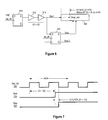
- FIG. 6 is a schematic illustration of another portion of a DLL including circuitry for implementing the measurement initialization scheme shown in FIG. 5 .
- a high signal e.g. a logic ‘1’, which may be Vcc
- Vcc a logic ‘1’
- the Q output of the flip-flop 610 may be connected to buffer 612 which in turn is coupled to buffer 614 .
- the buffers 612 and 614 provide a delay of D 1 +D 2 .
- the output of the buffer 614 may be considered the ‘Start’ signal which may begin propagating through a variable delay line 620 .
- the Start signal may be provided to a data input of 622 , and the ref_clk signal provided to the clock input of 622 .
- An inverted ref_clk signal may be provided to another clock input of 622 .
- the Q output of 622 may then provide a ‘Stop’ signal to the delay line 620 .
- the ‘Stop’ signal provided by the Q output of 622 may correspond to a rising edge of the ref_clk signal.
- the Q output of 622 may also provide a ‘Stop’ signal, shown as ‘Stop 2 ’ in FIG. 6 to the variable delay line 620 .
- the ‘Stop 2 ’ signal may correspond to a falling edge of the ref_clk signal. In this manner, the first to arrive of the ‘Stop’ or the Stop 2 ′ signal may stop propagation of the ‘Start’ signal through the variable delay line 620 .
- FIG. 7 is an example timing diagram illustrating operation of the measurement in initialization schemes shown in FIGS. 5 and 6 .
- the ref_clk signal 700 is shown. Following a delay period of D 1 +D 2 after a rising edge of the ref_clk signal 700 , the Start signal 710 transitions high.
- the Stop signal 715 transitions high at the next falling edge of the ref_clk signal 700 .
- the transition of the Stop signal 715 may stop propagation of the Start signal through a variable delay line. Note that, in contrast to the timing diagram in FIG. 4 , the ability to generate a Stop signal transition responsive to a falling edge of the ref_clk signal has saved 1 ⁇ 2 a ref_clk period of time in propagating the Start signal through the variable delay line.
- embodiments of the present invention may include measurement initialization circuitry configured to stop propagation of a ‘Start’ signal through a variable delay line at either a rising or a falling edge of a reference clock signal. Embodiments of the present invention may further utilize information about the propagation of the ‘Start’ signal in deciding whether or not to invert a clock signal used in a DLL. In some examples, the identification of which ‘Stop’ signal stopped the propagation of the ‘Start’ signal may be used to decide when to utilize clock inversion.
- FIG. 8 is a schematic illustration of a portion of DLL circuitry including circuitry utilized to determine clock inversion in accordance with embodiments of the present invention.
- the measurement initialization circuitry shown in FIG. 8 is the same as that shown in FIG. 5 , with the same reference numbers used. Those common elements will not be described here again for brevity.
- a vdl_meas signal from the variable delay line 505 may indicate how far the ‘Start’ signal propagated through the variable delay line 505 during measurement initialization.
- the ‘Start’ signal may be stopped responsive to a ‘Stop’ signal generated using either a rising or a falling edge of a ref_clk signal.
- the vdl_meas signal may be indicative of which ‘Stop’ signal stopped the propagation.
- a DLL may be able to achieve a faster locked condition if either a ref_clk signal or a feedback clock signal are inverted prior to comparison by a phase detector.
- Examples of the present invention may make a determination about whether to invert a ref_clk signal or a feedback clock signal based on information obtained during the measurement initialization mode.
- a phase detector 805 is shown which, during normal operation is configured to receive a ref_clk signal from the buffer 501 and a fb_clk signal from the model delay block 512 (after TACtrim block). The phase detector 805 may then compare the phase of the ref_clk and fb_clk signals and provide a phase-dependent output signal to the variable delay line 505 to increase or decrease the delay of the variable delay line.
- the vdl_meas signal corresponding to a number of stages through which the ‘Start’ signal propagated during measurement initialization mode may be provided to the controller 510 .
- the controller 510 may generate an Invert signal based on the vdl_meas signal. In particular, if the vdl_meas signal indicates that the ‘Start’ signal was latched on a falling edge of the ref_clk signal, for example the ‘Start’ signal was latched by an even latch of the variable delay line 505 .
- the controller 510 may generate an Invert signal causing a clock signal to be inverted prior to phase detection. This may be implemented in any of a variety of ways, including inverting the ref_clk signal before or after it traverses the variable delay line.
- the Invert signal may be provided to the input buffer 501 to cause the input buffer to serve as an inverting buffer and provide an inverted ref_clk signal to the phase detector 805 .
- the Invert signal may be provided to the multiplexer 503 to cause the multiplexer 503 to act as an inverting multiplexer and pass an inverted ref_clk signal to the variable delay line 505 .
- Other locations for inversion are possible, but note that the inversion decision may be made based on a location of latching the ‘Start’ signal. That is, an input clock may be inverted at the input buffer, before entering the delay line, or after traversing the delay line but before input to the phase detector.
- FIG. 9 is a schematic illustration of a portion of a memory 900 according to an embodiment of the present invention.
- the memory 900 includes an array 902 of memory cells, which may be, for example, DRAM memory cells, SRAM memory cells, flash memory cells, or some other type of memory cells.
- the memory system 900 includes a command decoder 906 that receives memory commands through a command bus 908 and generates corresponding control signals within the memory system 900 to carry out various memory operations.
- the command decoder 906 responds to memory commands applied to the command bus 908 to perform various operations on the memory array 902 .
- the command decoder 906 is used to generate internal control signals to read data from and write data to the memory array 902 .
- Row and column address signals are applied to the memory system 900 through an address bus 920 and provided to an address latch 910 .
- the address latch then outputs a separate column address and a separate row address.
- the row and column addresses are provided by the address latch 910 to a row address decoder 922 and a column address decoder 928 , respectively.
- the column address decoder 928 selects bit lines extending through the array 902 corresponding to respective column addresses.
- the row address decoder 922 is connected to word line driver 924 that activates respective rows of memory cells in the array 902 corresponding to received row addresses.
- the selected data line e.g., a bit line or bit lines
- a received column address are coupled to a read/write circuitry 930 to provide read data to a data output buffer 934 via an input-output data bus 940 .
- Write data are applied to the memory array 802 through a data input buffer 944 and the memory array read/write circuitry 930 .
- a clock signal generator 950 is configured to receive an external clock signal and generate a synchronized internal clock signal in accordance with embodiments of the present invention.
- the clock signal generator 950 may include, for example, a DLL including a portion of the DLL shown in FIGS. 5 , 6 , and/or 8 .
- the clock signal generator 950 may receive an external clock signal applied to the memory system 900 and may generate a synchronized internal clock signal which may be supplied to the command decoder 906 , address latch 910 , and/or input buffer 944 to facilitate the latching of command, address, and data signals in accordance with the external clock.
- Memory systems in accordance with embodiments of the present invention may be used in any of a variety of electronic devices including, but not limited to, computing systems, electronic storage systems, cameras, phones, wireless devices, displays, chip sets, set top boxes, or gaming systems.
Landscapes
- Physics & Mathematics (AREA)
- Nonlinear Science (AREA)
- Engineering & Computer Science (AREA)
- Microelectronics & Electronic Packaging (AREA)
- Dram (AREA)
- Pulse Circuits (AREA)
- Stabilization Of Oscillater, Synchronisation, Frequency Synthesizers (AREA)
- Tests Of Electronic Circuits (AREA)
Abstract
Description
- Embodiments of the invention relate generally to semiconductor memory, and particularly, to measurement initialization circuitry which may be used, for example, in delay locked loops.
- In synchronous integrated circuits, the integrated circuit may be clocked by an external clock signal and perform operations at predetermined times relative to the rising and falling edges of the applied clock signal. Examples of synchronous integrated circuits include synchronous memory devices such as synchronous dynamic random access memories (“SDRAMs”), synchronous static random access memories (“SSRAMs”), and packetized memories like SLDRAMs and RDRAMs, and include other types of integrated circuits as well, such as microprocessors. The timing of signals external to a synchronous memory device may be determined by the external clock signal, and operations within the memory device are typically synchronized to external operations. For example, data output may be placed on a data bus of the memory device in synchronism with the external clock signal, and the memory device may output data at the proper times. To output data at proper timings, an internal clock signal may be developed in response to the external clock signal, and is typically applied to latches contained in the memory device to clock data. The internal clock signal and external clock must be synchronized to ensure the internal clock signal clocks the latches at the proper times to successfully capture the commands. In the present description, “external” refers to signals and operations outside of the memory device, and “internal” refers to signals and operations within the memory device. Moreover, although examples in the present description are directed to synchronous memory devices, the principles described herein are equally applicable to other types of synchronous integrated circuits.
- To synchronize external and internal clock signals in modern synchronous memory devices, a number of different approaches have been considered and utilized, including delay locked loops (“DLLs”), as will be appreciated by those skilled in the art. As used herein, the term synchronized includes signals that are coincident and signals that have a desired delay relative to one another.
FIG. 1 is a schematic illustration of aconventional DLL circuit 100 for providing an approximate delay that closely matches the phase difference between input and output clock signals. TheDLL circuit 100 uses a feedback configuration that operates to feed back a phase difference-related signal to control one or more delay lines, such as avariable delay line 112, for advancing or delaying the timing of one clock signal to “lock” to a second clock signal. - An external clock signal is initially applied to the
DLL circuit 100 and received by aninput buffer 104 that provides a buffered clock signal DLY_REF to theDLL circuit 100. The DLY_REF signal is delayed relative to the external clock signal due to a propagation delay of theinput buffer 104. The DLY_REF signal is then applied tovariable delay line 112, which include a number of delay stages that are selected by ashift register 120 to apply a measured delay for adjusting the phase of the DLY_REF signal. The shift register 120 controls adjustments to thevariable delay line 112 by providingshift control signals 134 in response to receiving control signals from aphase detector 130. In response to theshift control signals 134, thevariable delay line 112 applies a measured delay to adjust the phase of the DLY_REF signal near the desired phase for achieving the phase lock condition. Thevariable delay line 112 generates an output signal CLK_OUT, whose phase is compared to the DLY_REF signal to determine whether the locking condition has been achieved. The CLK_OUT signal is provided to amodel delay circuit 140 that duplicates inherent delays added to the applied external clock signal as it propagates through the delay loop, such as theinput buffer 104 plus output path delay that may occur after the DLL. Themodel delay circuit 140 then provides a feedback signal DLY_FB to thephase detector 130. Thephase detector 130 compares the phases of the DLY_REF signal and the DLY_FB signal to generateshift selection signals 132 to theshift register 120 to control thevariable delay line 112. The shift selection signal instructs theshift register 120 to increase the delay of thevariable delay line 112 when the DLY_FB signal leads the DLY_REF signal, or decrease the delay in the opposite case. The delay may be increased or decreased by adding or subtracting a number of stages used in thevariable delay line 112, where thevariable delay line 112 includes number of delay stages. In this manner, theDLL 100 may synchronize an internal clock signal CLK_OUT with an external clock signal. - As was described above, the
DLL 100 may take a certain amount of time to achieve a “locked” condition. This time may be shortened if thevariable delay line 112 was initially set to a delay which approximates the anticipated needed delay to synchronize the internal and external clock signals. Minimal delay may be preferable for locking purposes due to lower power being consumed. In order to provide this initial delay, some DLL circuits may include a measurement initialization capability.FIG. 2 is a schematic illustration of a portion of a DLL including circuitry for measurement initialization. To highlight the measurement initialization circuitry, not all of the DLL circuitry (such as the phase detector) is shown inFIG. 2 . - An external clock signal is provided to an
input buffer 201 to generate a ref_clk signal. The ref_clk signal is provided to an input of amultiplexer 203. Themultiplexer 203 may select an input corresponding to a control signal MUX received from acontroller 210. Initially, themultiplexer 203 may be configured to allow the ref_clk signal to be provided to thevariable delay line 205. Thevariable delay line 205 may be initially set to provide a minimal delay, that is set to minimize the tDLL time shown inFIG. 2 , such that minimal delay stages may be used. Thevariable delay line 205 may be set in this manner responsive to a control signals vdl_cntrl from thecontroller 210. After the ref_clk signal passes through thevariable delay line 205, it is provided to amodel delay 212. Themodel delay 212 may generally model delays outside of the delay loop, such as delays from input buffers, etc. Themodel delay 212 then provides a signal to a tACtrim block 214. The tAC trim block 214 may generally compensate for access time delays as specified by a particular system. The tAC trim block 214 may then provide a signal to alatch 216, converting the received signal to signal (e.g. an edge or pulse) a ‘Start’ signal. The ‘Start’ signal may be provided to abuffer 218 which may then provide the signal to a second input of themultiplexer 203. The multiplexer may be controlled to then provide the ‘Start’ signal to thevariable delay line 205. In this manner, a ‘Start’ signal begins propagating through thevariable delay line 205. - The ref_clk signal may also be provided directly to the tAC trim block 214. The tAC trim block 214 may then provide the delayed signal to a
latch 220, which may convert the ref_clk signal to a signal, referred to as a ‘Stop’ signal (e.g. edge or pulse). The ‘Stop’ signal may be provided to abuffer 222 and then provided to latches in the stages of thevariable delay line 205. In this manner, the ‘Stop’ signal may stop (e.g. latch) the ‘Start’ signal as it propagates through thevariable delay line 205. Information regarding the number of stages the ‘Start’ signal propagated through before receipt of the ‘Stop’ signal may be provided by thevariable delay line 205 in the form of a vdl_meas signal indicating the stage at which the ‘Start’ signal was latched. Thecontroller 210 may accordingly set thevariable delay line 205 to use that number of stages through the vdl_cntl signal. In this manner, thevariable delay line 205 may be initialized to a particular number of stages. - During normal operation, the
multiplexer 203 is configured to select the ref_clk input to provide to thevariable delay line 205. The output of thevariable delay line 205 may be provided to anoutput buffer 225 to generate a synchronized output signal. Although not shown inFIG. 2 , recall a phase detector may be used to compare the phase of the ref_clk signal and the clk_fb signal and adjust the delay of thevariable delay line 205 during operation. Following lock, a delay between the external clock signal and the synchronized output signal may be N*tCK. -
FIG. 3 is a schematic illustration of another portion of a DLL including circuitry for implementing the measurement initialization scheme shown inFIG. 2 . A flip-flop 302 may receive a high signal (e.g. a logic ‘1’, which may be VCC) at its D input and a reference clock signal ref_clk at its clock input. The flip-flop 302 may provide a signal to theserial buffers model delay 212 ofFIG. 2 . The output of thebuffer 306 may be considered the ‘Start’ signal and provided to avariable delay line 310. The ‘Start’ signal from the output of thebuffer 306 may also be provided to the D input of a flip-flop 312. The ref_clk signal may also be applied to the clock input of the flip-flop 312. In this manner, the flip-flop 312 may provide a ‘Stop’ signal at the next rising edge of the ref_clk signal following the receipt of the ‘Start’ signal. The ‘Stop’ signal may be provided to thedelay line 310 to latch the propagating ‘Start’ signal. -
FIG. 1 is a schematic illustration of a conventional DLL circuit. -
FIG. 2 is a schematic illustration of a portion of a DLL including circuitry for measurement initialization. -
FIG. 3 is a schematic illustration of another portion of a DLL including circuitry for implementing the measurement initialization scheme shown inFIG. 2 . -
FIG. 4 is an example timing diagram illustrating operation of the measurement in initialization schemes shown inFIGS. 2 and 3 . -
FIG. 5 is a schematic illustration of a DLL including measurement initialization circuitry according to an embodiment of the present invention. -
FIG. 6 is a schematic illustration of another portion of a DLL including circuitry for implementing the measurement initialization scheme shown inFIG. 5 . -
FIG. 7 is an example timing diagram illustrating operation of the measurement in initialization schemes shown inFIGS. 5 and 6 . -
FIG. 8 is a schematic illustration of a portion of DLL circuitry including circuitry utilized to determine clock inversion in accordance with embodiments of the present invention. -
FIG. 9 is a schematic illustration of a portion of a memory according to an embodiment of the present invention. - Certain details are set forth below to provide a sufficient understanding of embodiments of the invention. However, it will be clear to one skilled in the art that embodiments of the invention may be practiced without various of these particular details. In some instances, well-known circuits, control signals, timing protocols, and software operations have not been shown in detail in order to avoid unnecessarily obscuring the described embodiments of the invention.
- Recall, as described above with reference to
FIGS. 2 and 3 , an initial number of stages of a variable delay line may be set by measuring the number of stages a ‘Start’ signal propagates through prior to receipt of a ‘Stop’ signal. The examples described above generated the ‘Stop’ signal based on a next rising edge of a reference clock signal following generation of the ‘Start’ signal. This may generate unnecessary delay in initializing the variable delay line in situations where a falling edge of the clock signal arrives first following the generation of the ‘Start’ signal. -
FIG. 4 is an example timing diagram illustrating operation of the measurement in initialization schemes shown inFIGS. 2 and 3 .FIG. 4 illustrates theref_clk signal 410. At a time D1+D2 of delay following a first rising edge of the ref_clk signal, the start signal 415 transitions high. At a time corresponding to the next rising edge of the ref_clk signal following the high transition of thestart signal 415, the stop signal 420 transitions high. Theshaded block 430 represents unnecessary added delay beyond the time of the next falling edge of the ref_clk signal following transition of thestart signal 415. That is, if the falling edge of the ref_clk signal could be used to initiate a transition of thestop signal 420, the amount of time required to measure an initialization delay through the variable delay line of a DLL may be reduced. - Accordingly, embodiments of the present invention may utilize either a rising or falling edge of a reference clock signal to generate a ‘Stop’ signal, propagation the stopping of a ‘Start’ signal in a variable delay line. In many cases, this may save ½ tCK of delay relative to systems utilizing only the rising edge of a clock signal to generate a ‘Stop’ signal.
-
FIG. 5 is a schematic illustration of a DLL including measurement initialization circuitry according to an embodiment of the present invention. The measurement initialization circuitry includes many components analogous to those shown inFIG. 2 , which will not be described here again for brevity. For example,input buffer 501,MUX 503, tACtrim block 514,model delay 512,output buffer 525, and latch 526 operate in analogous manner with the corresponding components shown inFIG. 2 . The ‘Start’ signal may be generated by thelatch 526. However, the ‘Stop’ signal may be generated differently in the embodiment ofFIG. 5 . Thelatch 520 is configured to receive a delayed ref_clk signal from the tACtrim block 514. Thelatch 520 generates a signal (e.g. a pulse) both on the rising and the falling edge of the ref_clk signal. The signal generated responsive to the rising edge of the ref_clk signal is provided to abuffer 522. The signal generated responsive to the falling edge of the ref_clk signal is provided to abuffer 523. In this manner, two ‘Stop’ signals may be generated—one corresponding to a rising edge of the ref_clk signal, and one to the falling edge. - The
buffer 522 provides the ‘Stop’ signal generated responsive to the rising edge of the ref_clk signal to themultiplexers buffer 523 provides the ‘Stop signal generated responsive to the falling edge of the ref_clk signal to themultiplexer 552. Themultiplexer 550 may provide the received ‘Stop’ signal to the odd latches of thevariable delay line 505 during both a measurement initialization mode and a normal mode of operation. Themultiplexer 550 may be implemented as a multiplexer or a buffer. However, themultiplexer 552 is configured to receive a control signal, MeasEn, from thecontroller 510. When the control signal MeasEn indicates measurement initialization mode, themultiplexer 552 may provide the ‘Stop’ signal generated responsive to the falling edge of the ref_clk signal, e.g. the ‘Stop’ signal from thebuffer 523, to the even latches of thevariable delay line 505. When the control signal MeasEn indicates normal mode, however, themultiplexer 552 provides the Stop signal generated responsive to the rising edge to the even latches. Accordingly, during a normal mode of operation thebuffer 522 provides a ‘shift clock’ signal to both the even and odd latches of thevariable delay line 505. However, during measurement initialization mode, the odd latches receive the ‘Stop’ signal from thebuffer 522 while the even latches receive the ‘Stop’ signal from thebuffer 523. - Accordingly, either the ‘Stop’ signal received from the
buffer 522, generated responsive to a rising edge of the ref_clk signal, or the ‘Stop’ signal received from thebuffer 523, generated responsive to a falling edge of the ref_clk signal, may stop propagation of a ‘Start’ signal through thevariable delay line 505. In this manner, a ½ tCK time may be saved when the falling edge of the ref_clk signal is the next edge after the ‘Start’ signal begins propagating through thevariable delay line 505. That is, once the ‘Start’ signal begins propagating through thevariable delay line 505, it will stop propagating through thevariable delay line 505 responsive to the first to occur of the next rising edge of the ref_clk signal or the next falling edge of the ref_clk signal. - For example, recall the
multiplexer 503 may initially provide the ref_clk signal to thevariable delay line 505. Thevariable delay line 505 may then provide a delayed version of the ref_clk signal to themodel delay 512. Themodel delay 512 may provide a further delayed version of the ref_clk signal to the tACtrim block 514. The tACtrim block 514 may provide the delayed version of the ref_clk signal to thelatch 526, generating the ‘Start’ signal, which may be a pulse or an edge, for example. The ‘Start’ signal is provided to thebuffer 518 which in turn provides the signal to themultiplexer 503. Themultiplexer 503 may receive a MUX signal from thecontroller 510 indicating measurement initialization mode, and select the input received from the buffer 518 (the lower shown input inFIG. 5 ) to provide to thevariable delay line 505. Responsive thereto, the ‘Start’ signal begins propagating through thevariable delay line 505. - Recall also the ref_clk signal may be provided to the tAC
trim block 514. The delayed ref_clk signal may then be provided to thelatch 520, which generates a ‘Stop’ signal responsive to both the rising and the falling edge of the ref_clk signal received by thelatch 520. The signal generated responsive to the rising edge may be provided to themultiplexer 520, while the signal generated responsive to the falling edge may be provided to themultiplexer 552. During measurement initialization mode, themultiplexer 550 may be configured to provide the signal generated responsive to the rising edge to the odd latches of thevariable delay line 505 and themultiplexer 552 may be configured to provide the signal generated responsive to the falling edge to the even latches of thevariable delay line 505. Whichever signal arrives first after the ‘Start’ signal begins propagating through thevariable delay line 505 may stop the propagation of the variable delay line. A number of stages through which the ‘Start’ signal propagates, which may be represented by the vdl_meas signal, may be used to set an initial delay amount of the variable delay line during normal operation mode. The vdl_meas signal may indicate whether an even or odd number of stages had been propagated through. As will be described further, this may be used to determine whether or not to employ input clock inversion. - In this manner, the total delay between an external clock and a synchronized output clock may be (N−½)tCK in some examples and may be NtCK in other examples. Accordingly, the total delay is written in
FIG. 5 as N′*0.5tCK where N′*0.5=(N−½) or (N). -
FIG. 6 is a schematic illustration of another portion of a DLL including circuitry for implementing the measurement initialization scheme shown inFIG. 5 . A high signal (e.g. a logic ‘1’, which may be Vcc) may be provided to a data input of a flip-flop 610, while a reference clock signal is provided to the clock input of the flip-flop 610. The Q output of the flip-flop 610 may be connected to buffer 612 which in turn is coupled to buffer 614. Thebuffers buffer 614 may be considered the ‘Start’ signal which may begin propagating through avariable delay line 620. The Start signal may be provided to a data input of 622, and the ref_clk signal provided to the clock input of 622. An inverted ref_clk signal may be provided to another clock input of 622. The Q output of 622 may then provide a ‘Stop’ signal to thedelay line 620. The ‘Stop’ signal provided by the Q output of 622 may correspond to a rising edge of the ref_clk signal. TheQ output of 622 may also provide a ‘Stop’ signal, shown as ‘Stop2’ inFIG. 6 to thevariable delay line 620. The ‘Stop2’ signal may correspond to a falling edge of the ref_clk signal. In this manner, the first to arrive of the ‘Stop’ or the Stop2′ signal may stop propagation of the ‘Start’ signal through thevariable delay line 620. -
FIG. 7 is an example timing diagram illustrating operation of the measurement in initialization schemes shown inFIGS. 5 and 6 . Theref_clk signal 700 is shown. Following a delay period of D1+D2 after a rising edge of theref_clk signal 700, the Start signal 710 transitions high. The Stop signal 715 transitions high at the next falling edge of theref_clk signal 700. The transition of the Stop signal 715 may stop propagation of the Start signal through a variable delay line. Note that, in contrast to the timing diagram inFIG. 4 , the ability to generate a Stop signal transition responsive to a falling edge of the ref_clk signal has saved ½ a ref_clk period of time in propagating the Start signal through the variable delay line. - As has been described above, embodiments of the present invention may include measurement initialization circuitry configured to stop propagation of a ‘Start’ signal through a variable delay line at either a rising or a falling edge of a reference clock signal. Embodiments of the present invention may further utilize information about the propagation of the ‘Start’ signal in deciding whether or not to invert a clock signal used in a DLL. In some examples, the identification of which ‘Stop’ signal stopped the propagation of the ‘Start’ signal may be used to decide when to utilize clock inversion.
-
FIG. 8 is a schematic illustration of a portion of DLL circuitry including circuitry utilized to determine clock inversion in accordance with embodiments of the present invention. The measurement initialization circuitry shown inFIG. 8 is the same as that shown inFIG. 5 , with the same reference numbers used. Those common elements will not be described here again for brevity. Recall, however, that following a measurement initialization mode, a vdl_meas signal from thevariable delay line 505 may indicate how far the ‘Start’ signal propagated through thevariable delay line 505 during measurement initialization. The ‘Start’ signal may be stopped responsive to a ‘Stop’ signal generated using either a rising or a falling edge of a ref_clk signal. The vdl_meas signal may be indicative of which ‘Stop’ signal stopped the propagation. - In some examples, a DLL may be able to achieve a faster locked condition if either a ref_clk signal or a feedback clock signal are inverted prior to comparison by a phase detector. Examples of the present invention may make a determination about whether to invert a ref_clk signal or a feedback clock signal based on information obtained during the measurement initialization mode. Referring to
FIG. 8 , aphase detector 805 is shown which, during normal operation is configured to receive a ref_clk signal from thebuffer 501 and a fb_clk signal from the model delay block 512 (after TACtrim block). Thephase detector 805 may then compare the phase of the ref_clk and fb_clk signals and provide a phase-dependent output signal to thevariable delay line 505 to increase or decrease the delay of the variable delay line. - The vdl_meas signal corresponding to a number of stages through which the ‘Start’ signal propagated during measurement initialization mode may be provided to the
controller 510. Thecontroller 510 may generate an Invert signal based on the vdl_meas signal. In particular, if the vdl_meas signal indicates that the ‘Start’ signal was latched on a falling edge of the ref_clk signal, for example the ‘Start’ signal was latched by an even latch of thevariable delay line 505. That is, if the ‘Stop’ signal generated in accordance with the falling edge of the ref_clk signal and provided to the even latches of thevariable delay line 505 through themultiplexer 552 latched the ‘Start’ signal, that may indicate that the DLL may be able to lock faster during normal mode if a clock signal was inverted prior to phase detection. Accordingly, thecontroller 510 may generate an Invert signal causing a clock signal to be inverted prior to phase detection. This may be implemented in any of a variety of ways, including inverting the ref_clk signal before or after it traverses the variable delay line. In one example, the Invert signal may be provided to theinput buffer 501 to cause the input buffer to serve as an inverting buffer and provide an inverted ref_clk signal to thephase detector 805. In another example, the Invert signal may be provided to themultiplexer 503 to cause themultiplexer 503 to act as an inverting multiplexer and pass an inverted ref_clk signal to thevariable delay line 505. Other locations for inversion are possible, but note that the inversion decision may be made based on a location of latching the ‘Start’ signal. That is, an input clock may be inverted at the input buffer, before entering the delay line, or after traversing the delay line but before input to the phase detector. -
FIG. 9 is a schematic illustration of a portion of amemory 900 according to an embodiment of the present invention. Thememory 900 includes anarray 902 of memory cells, which may be, for example, DRAM memory cells, SRAM memory cells, flash memory cells, or some other type of memory cells. Thememory system 900 includes acommand decoder 906 that receives memory commands through acommand bus 908 and generates corresponding control signals within thememory system 900 to carry out various memory operations. Thecommand decoder 906 responds to memory commands applied to thecommand bus 908 to perform various operations on thememory array 902. For example, thecommand decoder 906 is used to generate internal control signals to read data from and write data to thememory array 902. Row and column address signals are applied to thememory system 900 through anaddress bus 920 and provided to anaddress latch 910. The address latch then outputs a separate column address and a separate row address. - The row and column addresses are provided by the
address latch 910 to arow address decoder 922 and acolumn address decoder 928, respectively. Thecolumn address decoder 928 selects bit lines extending through thearray 902 corresponding to respective column addresses. Therow address decoder 922 is connected toword line driver 924 that activates respective rows of memory cells in thearray 902 corresponding to received row addresses. The selected data line (e.g., a bit line or bit lines) corresponding to a received column address are coupled to a read/write circuitry 930 to provide read data to adata output buffer 934 via an input-output data bus 940. Write data are applied to the memory array 802 through adata input buffer 944 and the memory array read/write circuitry 930. - A
clock signal generator 950 is configured to receive an external clock signal and generate a synchronized internal clock signal in accordance with embodiments of the present invention. Theclock signal generator 950 may include, for example, a DLL including a portion of the DLL shown inFIGS. 5 , 6, and/or 8. Theclock signal generator 950 may receive an external clock signal applied to thememory system 900 and may generate a synchronized internal clock signal which may be supplied to thecommand decoder 906,address latch 910, and/orinput buffer 944 to facilitate the latching of command, address, and data signals in accordance with the external clock. - Memory systems in accordance with embodiments of the present invention may be used in any of a variety of electronic devices including, but not limited to, computing systems, electronic storage systems, cameras, phones, wireless devices, displays, chip sets, set top boxes, or gaming systems.
- From the foregoing it will be appreciated that, although specific embodiments of the invention have been described herein for purposes of illustration, various modifications may be made without deviating from the spirit and scope of the invention.
Claims (34)
Priority Applications (7)
| Application Number | Priority Date | Filing Date | Title |
|---|---|---|---|
| US13/074,945 US8604850B2 (en) | 2011-03-29 | 2011-03-29 | Measurement initialization circuitry |
| KR1020137028083A KR101562723B1 (en) | 2011-03-29 | 2012-03-08 | Measurement initialization circuitry |
| PCT/US2012/028198 WO2012134755A2 (en) | 2011-03-29 | 2012-03-08 | Measurement initialization circuitry |
| CN201280016528.7A CN103460294B (en) | 2011-03-29 | 2012-03-08 | Vairable delay line, delay-locked loop, measurement initializing circuit and initial method thereof |
| TW101111181A TWI474328B (en) | 2011-03-29 | 2012-03-29 | Measurement initialization circuitry of a delay locked loop and method of initializing the same |
| US14/102,166 US8841949B2 (en) | 2011-03-29 | 2013-12-10 | Measurement initialization circuitry |
| US14/482,846 US9419628B2 (en) | 2011-03-29 | 2014-09-10 | Measurement initialization circuitry |
Applications Claiming Priority (1)
| Application Number | Priority Date | Filing Date | Title |
|---|---|---|---|
| US13/074,945 US8604850B2 (en) | 2011-03-29 | 2011-03-29 | Measurement initialization circuitry |
Related Child Applications (1)
| Application Number | Title | Priority Date | Filing Date |
|---|---|---|---|
| US14/102,166 Continuation US8841949B2 (en) | 2011-03-29 | 2013-12-10 | Measurement initialization circuitry |
Publications (2)
| Publication Number | Publication Date |
|---|---|
| US20120249193A1 true US20120249193A1 (en) | 2012-10-04 |
| US8604850B2 US8604850B2 (en) | 2013-12-10 |
Family
ID=46926386
Family Applications (3)
| Application Number | Title | Priority Date | Filing Date |
|---|---|---|---|
| US13/074,945 Active 2031-08-29 US8604850B2 (en) | 2011-03-29 | 2011-03-29 | Measurement initialization circuitry |
| US14/102,166 Active US8841949B2 (en) | 2011-03-29 | 2013-12-10 | Measurement initialization circuitry |
| US14/482,846 Active 2031-05-25 US9419628B2 (en) | 2011-03-29 | 2014-09-10 | Measurement initialization circuitry |
Family Applications After (2)
| Application Number | Title | Priority Date | Filing Date |
|---|---|---|---|
| US14/102,166 Active US8841949B2 (en) | 2011-03-29 | 2013-12-10 | Measurement initialization circuitry |
| US14/482,846 Active 2031-05-25 US9419628B2 (en) | 2011-03-29 | 2014-09-10 | Measurement initialization circuitry |
Country Status (5)
| Country | Link |
|---|---|
| US (3) | US8604850B2 (en) |
| KR (1) | KR101562723B1 (en) |
| CN (1) | CN103460294B (en) |
| TW (1) | TWI474328B (en) |
| WO (1) | WO2012134755A2 (en) |
Cited By (5)
| Publication number | Priority date | Publication date | Assignee | Title |
|---|---|---|---|---|
| US9294106B2 (en) * | 2014-07-03 | 2016-03-22 | Stmicroelectronics International N.V. | Capacitance multiplier and loop filter noise reduction in a PLL |
| US9407273B1 (en) * | 2015-06-04 | 2016-08-02 | Intel Corporation | Digital delay-locked loop (DLL) training |
| US9419628B2 (en) | 2011-03-29 | 2016-08-16 | Micron Technology, Inc. | Measurement initialization circuitry |
| US10333532B2 (en) | 2017-09-07 | 2019-06-25 | Micron Technology, Inc. | Apparatuses and methods for detecting a loop count in a delay-locked loop |
| CN116230061A (en) * | 2021-12-02 | 2023-06-06 | 美光科技公司 | Apparatus and method for delayed measurement initialization |
Families Citing this family (3)
| Publication number | Priority date | Publication date | Assignee | Title |
|---|---|---|---|---|
| US9768760B2 (en) | 2015-03-11 | 2017-09-19 | Micron Technology, Inc. | Synchronized semiconductor device with phase adjustment circuit |
| US9806701B1 (en) * | 2016-12-09 | 2017-10-31 | Globalfoundries Inc. | Digital frequency multiplier to generate a local oscillator signal in FDSOI technology |
| JP7717102B2 (en) * | 2023-01-13 | 2025-08-01 | 華邦電子股▲ふん▼有限公司 | Control circuit and semiconductor memory device |
Family Cites Families (23)
| Publication number | Priority date | Publication date | Assignee | Title |
|---|---|---|---|---|
| JP3764560B2 (en) * | 1997-06-20 | 2006-04-12 | 株式会社ルネサステクノロジ | Digital delay circuit and digital PLL circuit |
| US6255880B1 (en) * | 1999-10-25 | 2001-07-03 | Xilinx, Inc. | One-shot DLL circuit and method |
| US6950487B2 (en) * | 2001-05-18 | 2005-09-27 | Micron Technology, Inc. | Phase splitter using digital delay locked loops |
| JP2005136798A (en) * | 2003-10-31 | 2005-05-26 | Renesas Technology Corp | Clock generating system, and semiconductor integrated circuit |
| KR100553833B1 (en) | 2003-12-24 | 2006-02-24 | 삼성전자주식회사 | Inversion control circuit and method of delay synchronization circuit, delay synchronization circuit and semiconductor memory device using same |
| KR100537196B1 (en) | 2004-03-05 | 2005-12-16 | 주식회사 하이닉스반도체 | Delay locked loop in semiconductor memory device and its clock locking method |
| US7095261B2 (en) * | 2004-05-05 | 2006-08-22 | Micron Technology, Inc. | Clock capture in clock synchronization circuitry |
| TW200707911A (en) * | 2005-08-15 | 2007-02-16 | Univ Nat Chunghsing | Low-jitter delay-locked loop realignment working cycle adjustor |
| KR100735548B1 (en) | 2006-01-10 | 2007-07-04 | 삼성전자주식회사 | Delay Synchronization Circuit and Method |
| US7339364B2 (en) * | 2006-06-19 | 2008-03-04 | International Business Machines Corporation | Circuit and method for on-chip jitter measurement |
| US7433262B2 (en) * | 2006-08-22 | 2008-10-07 | Atmel Corporation | Circuits to delay a signal from DDR-SDRAM memory device including an automatic phase error correction |
| US7671648B2 (en) | 2006-10-27 | 2010-03-02 | Micron Technology, Inc. | System and method for an accuracy-enhanced DLL during a measure initialization mode |
| US7443216B2 (en) | 2007-02-20 | 2008-10-28 | Micron Technology, Inc. | Trimmable delay locked loop circuitry with improved initialization characteristics |
| JP4357538B2 (en) * | 2007-03-07 | 2009-11-04 | 株式会社日立製作所 | Semiconductor integrated circuit device |
| US7474136B2 (en) * | 2007-05-08 | 2009-01-06 | Promos Technologies Pte.Ltd. | Use of multiple voltage controlled delay lines for precise alignment and duty cycle control of the data output of a DDR memory device |
| WO2009037831A1 (en) * | 2007-09-19 | 2009-03-26 | Sanyo Electric Co., Ltd. | Flip-flop circuit |
| JP5448324B2 (en) | 2007-10-23 | 2014-03-19 | ピーエスフォー ルクスコ エスエイアールエル | DLL circuit, semiconductor device including the same, and data processing system |
| KR20090074969A (en) | 2008-01-03 | 2009-07-08 | 삼성전자주식회사 | Semiconductor memory device for controlling latency |
| TWI388123B (en) * | 2008-02-28 | 2013-03-01 | Japan Display West Inc | Phase detector, phase comparator, and clock synchronizing device |
| KR20100099545A (en) | 2009-03-03 | 2010-09-13 | 삼성전자주식회사 | Delay locked loop and semi-conductor memory device using the same |
| JP2011061457A (en) | 2009-09-09 | 2011-03-24 | Elpida Memory Inc | Clock generating circuit, semiconductor device including the same, and data processing system |
| JP2011176615A (en) * | 2010-02-24 | 2011-09-08 | Elpida Memory Inc | Clock control circuit and semiconductor device including the same |
| US8604850B2 (en) | 2011-03-29 | 2013-12-10 | Micron Technology, Inc. | Measurement initialization circuitry |
-
2011
- 2011-03-29 US US13/074,945 patent/US8604850B2/en active Active
-
2012
- 2012-03-08 CN CN201280016528.7A patent/CN103460294B/en active Active
- 2012-03-08 WO PCT/US2012/028198 patent/WO2012134755A2/en not_active Ceased
- 2012-03-08 KR KR1020137028083A patent/KR101562723B1/en active Active
- 2012-03-29 TW TW101111181A patent/TWI474328B/en active
-
2013
- 2013-12-10 US US14/102,166 patent/US8841949B2/en active Active
-
2014
- 2014-09-10 US US14/482,846 patent/US9419628B2/en active Active
Cited By (7)
| Publication number | Priority date | Publication date | Assignee | Title |
|---|---|---|---|---|
| US9419628B2 (en) | 2011-03-29 | 2016-08-16 | Micron Technology, Inc. | Measurement initialization circuitry |
| US9294106B2 (en) * | 2014-07-03 | 2016-03-22 | Stmicroelectronics International N.V. | Capacitance multiplier and loop filter noise reduction in a PLL |
| US9407273B1 (en) * | 2015-06-04 | 2016-08-02 | Intel Corporation | Digital delay-locked loop (DLL) training |
| US10333532B2 (en) | 2017-09-07 | 2019-06-25 | Micron Technology, Inc. | Apparatuses and methods for detecting a loop count in a delay-locked loop |
| US10560108B2 (en) | 2017-09-07 | 2020-02-11 | Micron Technology, Inc. | Apparatuses and methods for detecting a loop count in a delay-locked loop |
| US10700689B2 (en) | 2017-09-07 | 2020-06-30 | Micron Technology, Inc. | Apparatuses and methods for detecting a loop count in a delay-locked loop |
| CN116230061A (en) * | 2021-12-02 | 2023-06-06 | 美光科技公司 | Apparatus and method for delayed measurement initialization |
Also Published As
| Publication number | Publication date |
|---|---|
| US8841949B2 (en) | 2014-09-23 |
| US8604850B2 (en) | 2013-12-10 |
| KR20130139349A (en) | 2013-12-20 |
| TWI474328B (en) | 2015-02-21 |
| KR101562723B1 (en) | 2015-10-22 |
| WO2012134755A3 (en) | 2012-12-27 |
| CN103460294A (en) | 2013-12-18 |
| WO2012134755A2 (en) | 2012-10-04 |
| TW201303879A (en) | 2013-01-16 |
| CN103460294B (en) | 2016-05-25 |
| US20140375366A1 (en) | 2014-12-25 |
| US20140097880A1 (en) | 2014-04-10 |
| US9419628B2 (en) | 2016-08-16 |
Similar Documents
| Publication | Publication Date | Title |
|---|---|---|
| US9419628B2 (en) | Measurement initialization circuitry | |
| US8350607B2 (en) | System and method for an accuracy-enhanced DLL during a measure initialization mode | |
| US7649390B2 (en) | Delay locked loop for high speed semiconductor memory device | |
| US6605969B2 (en) | Method and circuit for adjusting the timing of ouput data based on an operational mode of output drivers | |
| US9536591B1 (en) | Staggered DLL clocking on N-Detect QED to minimize clock command and delay path | |
| US6989700B2 (en) | Delay locked loop in semiconductor memory device and its clock locking method | |
| CN111066085B (en) | Apparatus and method for detecting loop counts in delay locked loops | |
| US20170309320A1 (en) | Methods and apparatuses including command delay adjustment circuit | |
| US7915934B2 (en) | Delay locked loop circuit and operational method thereof | |
| JP2007097182A (en) | Delay locked loop | |
| US7099232B2 (en) | Delay locked loop device | |
| US8144530B2 (en) | Semiconductor memory device and method for generating output enable signal | |
| KR101076889B1 (en) | data output control circuit | |
| US8081021B2 (en) | Delay locked loop | |
| US7616037B2 (en) | Method and apparatus for controlling power-down mode of delay locked loop | |
| US7408394B2 (en) | Measure control delay and method having latching circuit integral with delay circuit | |
| US7817493B2 (en) | Semiconductor memory apparatus and method of driving the same | |
| US7777542B2 (en) | Delay locked loop | |
| US7453753B2 (en) | Semiconductor memory apparatus | |
| KR102099406B1 (en) | Semiconductor apparatus | |
| TW202429452A (en) | Control circuit and semiconductor memory device |
Legal Events
| Date | Code | Title | Description |
|---|---|---|---|
| AS | Assignment |
Owner name: MICRON TECHNOLOGY, INC., IDAHO Free format text: ASSIGNMENT OF ASSIGNORS INTEREST;ASSIGNORS:WILLEY, AARON;MA, YANTAO;SIGNING DATES FROM 20110304 TO 20110322;REEL/FRAME:026044/0414 |
|
| STCF | Information on status: patent grant |
Free format text: PATENTED CASE |
|
| AS | Assignment |
Owner name: U.S. BANK NATIONAL ASSOCIATION, AS COLLATERAL AGENT, CALIFORNIA Free format text: SECURITY INTEREST;ASSIGNOR:MICRON TECHNOLOGY, INC.;REEL/FRAME:038669/0001 Effective date: 20160426 Owner name: U.S. BANK NATIONAL ASSOCIATION, AS COLLATERAL AGEN Free format text: SECURITY INTEREST;ASSIGNOR:MICRON TECHNOLOGY, INC.;REEL/FRAME:038669/0001 Effective date: 20160426 |
|
| AS | Assignment |
Owner name: MORGAN STANLEY SENIOR FUNDING, INC., AS COLLATERAL AGENT, MARYLAND Free format text: PATENT SECURITY AGREEMENT;ASSIGNOR:MICRON TECHNOLOGY, INC.;REEL/FRAME:038954/0001 Effective date: 20160426 Owner name: MORGAN STANLEY SENIOR FUNDING, INC., AS COLLATERAL Free format text: PATENT SECURITY AGREEMENT;ASSIGNOR:MICRON TECHNOLOGY, INC.;REEL/FRAME:038954/0001 Effective date: 20160426 |
|
| FPAY | Fee payment |
Year of fee payment: 4 |
|
| AS | Assignment |
Owner name: U.S. BANK NATIONAL ASSOCIATION, AS COLLATERAL AGENT, CALIFORNIA Free format text: CORRECTIVE ASSIGNMENT TO CORRECT THE REPLACE ERRONEOUSLY FILED PATENT #7358718 WITH THE CORRECT PATENT #7358178 PREVIOUSLY RECORDED ON REEL 038669 FRAME 0001. ASSIGNOR(S) HEREBY CONFIRMS THE SECURITY INTEREST;ASSIGNOR:MICRON TECHNOLOGY, INC.;REEL/FRAME:043079/0001 Effective date: 20160426 Owner name: U.S. BANK NATIONAL ASSOCIATION, AS COLLATERAL AGEN Free format text: CORRECTIVE ASSIGNMENT TO CORRECT THE REPLACE ERRONEOUSLY FILED PATENT #7358718 WITH THE CORRECT PATENT #7358178 PREVIOUSLY RECORDED ON REEL 038669 FRAME 0001. ASSIGNOR(S) HEREBY CONFIRMS THE SECURITY INTEREST;ASSIGNOR:MICRON TECHNOLOGY, INC.;REEL/FRAME:043079/0001 Effective date: 20160426 |
|
| AS | Assignment |
Owner name: JPMORGAN CHASE BANK, N.A., AS COLLATERAL AGENT, ILLINOIS Free format text: SECURITY INTEREST;ASSIGNORS:MICRON TECHNOLOGY, INC.;MICRON SEMICONDUCTOR PRODUCTS, INC.;REEL/FRAME:047540/0001 Effective date: 20180703 Owner name: JPMORGAN CHASE BANK, N.A., AS COLLATERAL AGENT, IL Free format text: SECURITY INTEREST;ASSIGNORS:MICRON TECHNOLOGY, INC.;MICRON SEMICONDUCTOR PRODUCTS, INC.;REEL/FRAME:047540/0001 Effective date: 20180703 |
|
| AS | Assignment |
Owner name: MICRON TECHNOLOGY, INC., IDAHO Free format text: RELEASE BY SECURED PARTY;ASSIGNOR:U.S. BANK NATIONAL ASSOCIATION, AS COLLATERAL AGENT;REEL/FRAME:047243/0001 Effective date: 20180629 |
|
| AS | Assignment |
Owner name: MICRON TECHNOLOGY, INC., IDAHO Free format text: RELEASE BY SECURED PARTY;ASSIGNOR:MORGAN STANLEY SENIOR FUNDING, INC., AS COLLATERAL AGENT;REEL/FRAME:050937/0001 Effective date: 20190731 |
|
| AS | Assignment |
Owner name: MICRON SEMICONDUCTOR PRODUCTS, INC., IDAHO Free format text: RELEASE BY SECURED PARTY;ASSIGNOR:JPMORGAN CHASE BANK, N.A., AS COLLATERAL AGENT;REEL/FRAME:051028/0001 Effective date: 20190731 Owner name: MICRON TECHNOLOGY, INC., IDAHO Free format text: RELEASE BY SECURED PARTY;ASSIGNOR:JPMORGAN CHASE BANK, N.A., AS COLLATERAL AGENT;REEL/FRAME:051028/0001 Effective date: 20190731 |
|
| MAFP | Maintenance fee payment |
Free format text: PAYMENT OF MAINTENANCE FEE, 8TH YEAR, LARGE ENTITY (ORIGINAL EVENT CODE: M1552); ENTITY STATUS OF PATENT OWNER: LARGE ENTITY Year of fee payment: 8 |
|
| MAFP | Maintenance fee payment |
Free format text: PAYMENT OF MAINTENANCE FEE, 12TH YEAR, LARGE ENTITY (ORIGINAL EVENT CODE: M1553); ENTITY STATUS OF PATENT OWNER: LARGE ENTITY Year of fee payment: 12 |