US20120225089A1 - Novel conjugates, preparation thereof, and therapeutic use thereof - Google Patents
Novel conjugates, preparation thereof, and therapeutic use thereof Download PDFInfo
- Publication number
- US20120225089A1 US20120225089A1 US13/331,259 US201113331259A US2012225089A1 US 20120225089 A1 US20120225089 A1 US 20120225089A1 US 201113331259 A US201113331259 A US 201113331259A US 2012225089 A1 US2012225089 A1 US 2012225089A1
- Authority
- US
- United States
- Prior art keywords
- group
- rcg
- alkyl
- compound
- binding agent
- Prior art date
- Legal status (The legal status is an assumption and is not a legal conclusion. Google has not performed a legal analysis and makes no representation as to the accuracy of the status listed.)
- Granted
Links
- 238000002360 preparation method Methods 0.000 title description 28
- 230000001225 therapeutic effect Effects 0.000 title description 3
- 150000001875 compounds Chemical class 0.000 claims abstract description 133
- PSNOPSMXOBPNNV-VVCTWANISA-N cryptophycin 1 Chemical compound C1=C(Cl)C(OC)=CC=C1C[C@@H]1C(=O)NC[C@@H](C)C(=O)O[C@@H](CC(C)C)C(=O)O[C@H]([C@H](C)[C@@H]2[C@H](O2)C=2C=CC=CC=2)C/C=C/C(=O)N1 PSNOPSMXOBPNNV-VVCTWANISA-N 0.000 claims abstract description 113
- 238000000034 method Methods 0.000 claims abstract description 78
- 229930188224 Cryptophycin Natural products 0.000 claims abstract description 15
- PSNOPSMXOBPNNV-UHFFFAOYSA-N cryptophycin-327 Natural products C1=C(Cl)C(OC)=CC=C1CC1C(=O)NCC(C)C(=O)OC(CC(C)C)C(=O)OC(C(C)C2C(O2)C=2C=CC=CC=2)CC=CC(=O)N1 PSNOPSMXOBPNNV-UHFFFAOYSA-N 0.000 claims abstract description 13
- 108010006226 cryptophycin Proteins 0.000 claims abstract description 12
- 239000000243 solution Substances 0.000 claims description 236
- -1 —OH Chemical group 0.000 claims description 70
- 125000004169 (C1-C6) alkyl group Chemical group 0.000 claims description 65
- 239000011230 binding agent Substances 0.000 claims description 63
- 125000005647 linker group Chemical group 0.000 claims description 58
- 125000001997 phenyl group Chemical group [H]C1=C([H])C([H])=C(*)C([H])=C1[H] 0.000 claims description 45
- 230000006870 function Effects 0.000 claims description 30
- 125000002496 methyl group Chemical group [H]C([H])([H])* 0.000 claims description 27
- 125000005843 halogen group Chemical group 0.000 claims description 24
- 239000003795 chemical substances by application Substances 0.000 claims description 20
- 150000001413 amino acids Chemical class 0.000 claims description 19
- 125000001424 substituent group Chemical group 0.000 claims description 17
- 125000003118 aryl group Chemical group 0.000 claims description 14
- 125000004178 (C1-C4) alkyl group Chemical group 0.000 claims description 13
- 125000003636 chemical group Chemical group 0.000 claims description 13
- 125000000592 heterocycloalkyl group Chemical group 0.000 claims description 13
- 206010028980 Neoplasm Diseases 0.000 claims description 12
- 125000001309 chloro group Chemical group Cl* 0.000 claims description 12
- 125000006272 (C3-C7) cycloalkyl group Chemical group 0.000 claims description 10
- 125000001072 heteroaryl group Chemical group 0.000 claims description 10
- 230000008569 process Effects 0.000 claims description 10
- 201000011510 cancer Diseases 0.000 claims description 9
- 230000021615 conjugation Effects 0.000 claims description 9
- 150000002118 epoxides Chemical group 0.000 claims description 8
- 108090000623 proteins and genes Proteins 0.000 claims description 8
- 125000000391 vinyl group Chemical group [H]C([*])=C([H])[H] 0.000 claims description 8
- KDXKERNSBIXSRK-UHFFFAOYSA-N Lysine Natural products NCCCCC(N)C(O)=O KDXKERNSBIXSRK-UHFFFAOYSA-N 0.000 claims description 7
- 125000000217 alkyl group Chemical group 0.000 claims description 7
- 125000000956 methoxy group Chemical group [H]C([H])([H])O* 0.000 claims description 7
- 102000004169 proteins and genes Human genes 0.000 claims description 7
- 125000000229 (C1-C4)alkoxy group Chemical group 0.000 claims description 6
- 125000004209 (C1-C8) alkyl group Chemical group 0.000 claims description 6
- 125000002252 acyl group Chemical group 0.000 claims description 6
- 239000007864 aqueous solution Substances 0.000 claims description 6
- 125000000449 nitro group Chemical group [O-][N+](*)=O 0.000 claims description 6
- 125000002924 primary amino group Chemical group [H]N([H])* 0.000 claims description 6
- 238000001228 spectrum Methods 0.000 claims description 6
- 125000004423 acyloxy group Chemical group 0.000 claims description 5
- 125000003545 alkoxy group Chemical group 0.000 claims description 5
- 238000004519 manufacturing process Methods 0.000 claims description 5
- 108010021625 Immunoglobulin Fragments Proteins 0.000 claims description 4
- 102000008394 Immunoglobulin Fragments Human genes 0.000 claims description 4
- 238000002835 absorbance Methods 0.000 claims description 4
- 238000010521 absorption reaction Methods 0.000 claims description 4
- 125000002947 alkylene group Chemical group 0.000 claims description 4
- 125000004435 hydrogen atom Chemical group [H]* 0.000 claims description 4
- 125000000325 methylidene group Chemical group [H]C([H])=* 0.000 claims description 4
- 125000003161 (C1-C6) alkylene group Chemical group 0.000 claims description 3
- 108091034117 Oligonucleotide Proteins 0.000 claims description 3
- 125000004429 atom Chemical group 0.000 claims description 3
- 239000003446 ligand Substances 0.000 claims description 3
- 229920001542 oligosaccharide Polymers 0.000 claims description 3
- 150000002482 oligosaccharides Chemical class 0.000 claims description 3
- 108090000765 processed proteins & peptides Proteins 0.000 claims description 3
- JJAHTWIKCUJRDK-UHFFFAOYSA-N succinimidyl 4-(N-maleimidomethyl)cyclohexane-1-carboxylate Chemical compound C1CC(CN2C(C=CC2=O)=O)CCC1C(=O)ON1C(=O)CCC1=O JJAHTWIKCUJRDK-UHFFFAOYSA-N 0.000 claims description 3
- 125000006832 (C1-C10) alkylene group Chemical group 0.000 claims description 2
- 125000006833 (C1-C5) alkylene group Chemical group 0.000 claims description 2
- 125000006557 (C2-C5) alkylene group Chemical group 0.000 claims description 2
- 125000006552 (C3-C8) cycloalkyl group Chemical group 0.000 claims description 2
- FPKVOQKZMBDBKP-UHFFFAOYSA-N 1-[4-[(2,5-dioxopyrrol-1-yl)methyl]cyclohexanecarbonyl]oxy-2,5-dioxopyrrolidine-3-sulfonic acid Chemical compound O=C1C(S(=O)(=O)O)CC(=O)N1OC(=O)C1CCC(CN2C(C=CC2=O)=O)CC1 FPKVOQKZMBDBKP-UHFFFAOYSA-N 0.000 claims description 2
- AQEROFMJBJSTGO-UHFFFAOYSA-N 3-[acetyl(bromo)amino]-2-(2,5-dioxopyrrolidin-1-yl)propanoic acid Chemical compound CC(=O)N(Br)CC(C(O)=O)N1C(=O)CCC1=O AQEROFMJBJSTGO-UHFFFAOYSA-N 0.000 claims description 2
- 125000004648 C2-C8 alkenyl group Chemical group 0.000 claims description 2
- 125000004649 C2-C8 alkynyl group Chemical group 0.000 claims description 2
- 125000002843 carboxylic acid group Chemical group 0.000 claims description 2
- 125000003588 lysine group Chemical group [H]N([H])C([H])([H])C([H])([H])C([H])([H])C([H])([H])C([H])(N([H])[H])C(*)=O 0.000 claims description 2
- 125000001453 quaternary ammonium group Chemical group 0.000 claims description 2
- 239000000203 mixture Substances 0.000 abstract description 249
- YMWUJEATGCHHMB-UHFFFAOYSA-N Dichloromethane Chemical compound ClCCl YMWUJEATGCHHMB-UHFFFAOYSA-N 0.000 description 307
- OKKJLVBELUTLKV-UHFFFAOYSA-N Methanol Chemical compound OC OKKJLVBELUTLKV-UHFFFAOYSA-N 0.000 description 273
- 238000006243 chemical reaction Methods 0.000 description 151
- IAZDPXIOMUYVGZ-WFGJKAKNSA-N Dimethyl sulfoxide Chemical compound [2H]C([2H])([2H])S(=O)C([2H])([2H])[2H] IAZDPXIOMUYVGZ-WFGJKAKNSA-N 0.000 description 146
- WYURNTSHIVDZCO-UHFFFAOYSA-N Tetrahydrofuran Chemical compound C1CCOC1 WYURNTSHIVDZCO-UHFFFAOYSA-N 0.000 description 130
- 0 CCCICC(CCC1C*)=CC=C1C=C[C@](*)C(CC(*)C(*)C(N[C@](Cc1ccccc1)C(NCC(C(OC1(*)*)=O)(O)O)=O)=O)NC1=N Chemical compound CCCICC(CCC1C*)=CC=C1C=C[C@](*)C(CC(*)C(*)C(N[C@](Cc1ccccc1)C(NCC(C(OC1(*)*)=O)(O)O)=O)=O)NC1=N 0.000 description 127
- XEKOWRVHYACXOJ-UHFFFAOYSA-N Ethyl acetate Chemical compound CCOC(C)=O XEKOWRVHYACXOJ-UHFFFAOYSA-N 0.000 description 97
- WEVYAHXRMPXWCK-UHFFFAOYSA-N Acetonitrile Chemical compound CC#N WEVYAHXRMPXWCK-UHFFFAOYSA-N 0.000 description 96
- CSNNHWWHGAXBCP-UHFFFAOYSA-L Magnesium sulfate Chemical compound [Mg+2].[O-][S+2]([O-])([O-])[O-] CSNNHWWHGAXBCP-UHFFFAOYSA-L 0.000 description 94
- ZMANZCXQSJIPKH-UHFFFAOYSA-N Triethylamine Chemical compound CCN(CC)CC ZMANZCXQSJIPKH-UHFFFAOYSA-N 0.000 description 85
- 239000003880 polar aprotic solvent Substances 0.000 description 85
- XLYOFNOQVPJJNP-UHFFFAOYSA-N water Substances O XLYOFNOQVPJJNP-UHFFFAOYSA-N 0.000 description 81
- 230000002829 reductive effect Effects 0.000 description 78
- 238000005160 1H NMR spectroscopy Methods 0.000 description 76
- FAPWRFPIFSIZLT-UHFFFAOYSA-M Sodium chloride Chemical compound [Na+].[Cl-] FAPWRFPIFSIZLT-UHFFFAOYSA-M 0.000 description 76
- 238000004895 liquid chromatography mass spectrometry Methods 0.000 description 75
- ZMXDDKWLCZADIW-UHFFFAOYSA-N N,N-Dimethylformamide Chemical compound CN(C)C=O ZMXDDKWLCZADIW-UHFFFAOYSA-N 0.000 description 72
- 239000000562 conjugate Substances 0.000 description 72
- XKRFYHLGVUSROY-UHFFFAOYSA-N Argon Chemical compound [Ar] XKRFYHLGVUSROY-UHFFFAOYSA-N 0.000 description 70
- 238000003756 stirring Methods 0.000 description 68
- 229920001223 polyethylene glycol Polymers 0.000 description 64
- LFQSCWFLJHTTHZ-UHFFFAOYSA-N Ethanol Chemical compound CCO LFQSCWFLJHTTHZ-UHFFFAOYSA-N 0.000 description 59
- 238000011282 treatment Methods 0.000 description 57
- 238000004587 chromatography analysis Methods 0.000 description 56
- VYPSYNLAJGMNEJ-UHFFFAOYSA-N Silicium dioxide Chemical compound O=[Si]=O VYPSYNLAJGMNEJ-UHFFFAOYSA-N 0.000 description 55
- 239000012074 organic phase Substances 0.000 description 55
- 239000000741 silica gel Substances 0.000 description 55
- 229910002027 silica gel Inorganic materials 0.000 description 55
- 239000012043 crude product Substances 0.000 description 49
- 235000019439 ethyl acetate Nutrition 0.000 description 48
- VEXZGXHMUGYJMC-UHFFFAOYSA-N Hydrochloric acid Chemical compound Cl VEXZGXHMUGYJMC-UHFFFAOYSA-N 0.000 description 47
- 229910052943 magnesium sulfate Inorganic materials 0.000 description 47
- 239000007787 solid Substances 0.000 description 47
- 238000001914 filtration Methods 0.000 description 45
- 150000002148 esters Chemical class 0.000 description 43
- 239000003921 oil Substances 0.000 description 40
- JGFZNNIVVJXRND-UHFFFAOYSA-N N,N-Diisopropylethylamine (DIPEA) Chemical compound CCN(C(C)C)C(C)C JGFZNNIVVJXRND-UHFFFAOYSA-N 0.000 description 38
- UIIMBOGNXHQVGW-UHFFFAOYSA-M Sodium bicarbonate Chemical compound [Na+].OC([O-])=O UIIMBOGNXHQVGW-UHFFFAOYSA-M 0.000 description 38
- 150000001412 amines Chemical class 0.000 description 38
- 239000000872 buffer Substances 0.000 description 38
- 125000001301 ethoxy group Chemical group [H]C([H])([H])C([H])([H])O* 0.000 description 38
- 239000002253 acid Substances 0.000 description 37
- 229910052786 argon Inorganic materials 0.000 description 35
- 150000002009 diols Chemical group 0.000 description 35
- RTZKZFJDLAIYFH-UHFFFAOYSA-N Diethyl ether Chemical compound CCOCC RTZKZFJDLAIYFH-UHFFFAOYSA-N 0.000 description 34
- SECXISVLQFMRJM-UHFFFAOYSA-N N-Methylpyrrolidone Chemical compound CN1CCCC1=O SECXISVLQFMRJM-UHFFFAOYSA-N 0.000 description 34
- 239000000460 chlorine Substances 0.000 description 34
- 229920006395 saturated elastomer Polymers 0.000 description 34
- 230000004913 activation Effects 0.000 description 33
- 238000001994 activation Methods 0.000 description 33
- DTQVDTLACAAQTR-UHFFFAOYSA-N trifluoroacetic acid Substances OC(=O)C(F)(F)F DTQVDTLACAAQTR-UHFFFAOYSA-N 0.000 description 33
- RYHBNJHYFVUHQT-UHFFFAOYSA-N 1,4-Dioxane Chemical compound C1COCCO1 RYHBNJHYFVUHQT-UHFFFAOYSA-N 0.000 description 31
- BDAGIHXWWSANSR-UHFFFAOYSA-N methanoic acid Natural products OC=O BDAGIHXWWSANSR-UHFFFAOYSA-N 0.000 description 31
- QOSSAOTZNIDXMA-UHFFFAOYSA-N Dicylcohexylcarbodiimide Chemical compound C1CCCCC1N=C=NC1CCCCC1 QOSSAOTZNIDXMA-UHFFFAOYSA-N 0.000 description 30
- 125000001495 ethyl group Chemical group [H]C([H])([H])C([H])([H])* 0.000 description 30
- FXHOOIRPVKKKFG-UHFFFAOYSA-N N,N-Dimethylacetamide Chemical compound CN(C)C(C)=O FXHOOIRPVKKKFG-UHFFFAOYSA-N 0.000 description 29
- QTBSBXVTEAMEQO-UHFFFAOYSA-N acetic acid Substances CC(O)=O QTBSBXVTEAMEQO-UHFFFAOYSA-N 0.000 description 29
- 238000010511 deprotection reaction Methods 0.000 description 27
- HEMHJVSKTPXQMS-UHFFFAOYSA-M Sodium hydroxide Chemical compound [OH-].[Na+] HEMHJVSKTPXQMS-UHFFFAOYSA-M 0.000 description 24
- 239000007822 coupling agent Substances 0.000 description 24
- 239000011780 sodium chloride Substances 0.000 description 24
- 125000000816 ethylene group Chemical group [H]C([H])([*:1])C([H])([H])[*:2] 0.000 description 22
- 239000002243 precursor Substances 0.000 description 22
- 210000004027 cell Anatomy 0.000 description 21
- VHYFNPMBLIVWCW-UHFFFAOYSA-N 4-Dimethylaminopyridine Chemical compound CN(C)C1=CC=NC=C1 VHYFNPMBLIVWCW-UHFFFAOYSA-N 0.000 description 20
- 150000001732 carboxylic acid derivatives Chemical group 0.000 description 20
- 239000003480 eluent Substances 0.000 description 20
- 239000002904 solvent Substances 0.000 description 20
- 239000000047 product Substances 0.000 description 19
- 230000004224 protection Effects 0.000 description 19
- 239000011734 sodium Substances 0.000 description 19
- GQHTUMJGOHRCHB-UHFFFAOYSA-N 2,3,4,6,7,8,9,10-octahydropyrimido[1,2-a]azepine Chemical compound C1CCCCN2CCCN=C21 GQHTUMJGOHRCHB-UHFFFAOYSA-N 0.000 description 18
- 150000004703 alkoxides Chemical class 0.000 description 17
- 239000008346 aqueous phase Substances 0.000 description 17
- XBDQKXXYIPTUBI-UHFFFAOYSA-N dimethylselenoniopropionate Natural products CCC(O)=O XBDQKXXYIPTUBI-UHFFFAOYSA-N 0.000 description 17
- XXROGKLTLUQVRX-UHFFFAOYSA-N allyl alcohol Chemical compound OCC=C XXROGKLTLUQVRX-UHFFFAOYSA-N 0.000 description 16
- 230000015572 biosynthetic process Effects 0.000 description 16
- 229940125782 compound 2 Drugs 0.000 description 16
- 238000010534 nucleophilic substitution reaction Methods 0.000 description 16
- RIOQSEWOXXDEQQ-UHFFFAOYSA-N triphenylphosphine Chemical compound C1=CC=CC=C1P(C=1C=CC=CC=1)C1=CC=CC=C1 RIOQSEWOXXDEQQ-UHFFFAOYSA-N 0.000 description 16
- WMFOQBRAJBCJND-UHFFFAOYSA-M Lithium hydroxide Chemical compound [Li+].[OH-] WMFOQBRAJBCJND-UHFFFAOYSA-M 0.000 description 15
- 238000001035 drying Methods 0.000 description 15
- 229910000030 sodium bicarbonate Inorganic materials 0.000 description 15
- 229910000104 sodium hydride Inorganic materials 0.000 description 15
- PXIPVTKHYLBLMZ-UHFFFAOYSA-N Sodium azide Chemical compound [Na+].[N-]=[N+]=[N-] PXIPVTKHYLBLMZ-UHFFFAOYSA-N 0.000 description 14
- DHXVGJBLRPWPCS-UHFFFAOYSA-N Tetrahydropyran Chemical compound C1CCOCC1 DHXVGJBLRPWPCS-UHFFFAOYSA-N 0.000 description 14
- 239000002254 cytotoxic agent Substances 0.000 description 14
- 229940127089 cytotoxic agent Drugs 0.000 description 14
- PZBFGYYEXUXCOF-UHFFFAOYSA-N TCEP Chemical compound OC(=O)CCP(CCC(O)=O)CCC(O)=O PZBFGYYEXUXCOF-UHFFFAOYSA-N 0.000 description 13
- 125000000466 oxiranyl group Chemical group 0.000 description 13
- 239000002798 polar solvent Substances 0.000 description 13
- YXFVVABEGXRONW-UHFFFAOYSA-N Toluene Chemical compound CC1=CC=CC=C1 YXFVVABEGXRONW-UHFFFAOYSA-N 0.000 description 12
- HAXFWIACAGNFHA-UHFFFAOYSA-N aldrithiol Chemical compound C=1C=CC=NC=1SSC1=CC=CC=N1 HAXFWIACAGNFHA-UHFFFAOYSA-N 0.000 description 12
- 229940024606 amino acid Drugs 0.000 description 12
- 235000001014 amino acid Nutrition 0.000 description 12
- 231100000433 cytotoxic Toxicity 0.000 description 12
- 231100000599 cytotoxic agent Toxicity 0.000 description 12
- 230000001472 cytotoxic effect Effects 0.000 description 12
- 238000001704 evaporation Methods 0.000 description 12
- 239000000178 monomer Substances 0.000 description 12
- JKMHFZQWWAIEOD-UHFFFAOYSA-N 2-[4-(2-hydroxyethyl)piperazin-1-yl]ethanesulfonic acid Chemical compound OCC[NH+]1CCN(CCS([O-])(=O)=O)CC1 JKMHFZQWWAIEOD-UHFFFAOYSA-N 0.000 description 11
- JDFXJJLFADUZIY-UHFFFAOYSA-N CON1C(=O)CCC1=O Chemical compound CON1C(=O)CCC1=O JDFXJJLFADUZIY-UHFFFAOYSA-N 0.000 description 11
- AFVFQIVMOAPDHO-UHFFFAOYSA-N Methanesulfonic acid Chemical compound CS(O)(=O)=O AFVFQIVMOAPDHO-UHFFFAOYSA-N 0.000 description 11
- 238000005804 alkylation reaction Methods 0.000 description 11
- 239000003153 chemical reaction reagent Substances 0.000 description 11
- IXCSERBJSXMMFS-UHFFFAOYSA-N hydrogen chloride Substances Cl.Cl IXCSERBJSXMMFS-UHFFFAOYSA-N 0.000 description 11
- 229910000041 hydrogen chloride Inorganic materials 0.000 description 11
- 238000006722 reduction reaction Methods 0.000 description 11
- 125000000999 tert-butyl group Chemical group [H]C([H])([H])C(*)(C([H])([H])[H])C([H])([H])[H] 0.000 description 11
- FPQQSJJWHUJYPU-UHFFFAOYSA-N 3-(dimethylamino)propyliminomethylidene-ethylazanium;chloride Chemical compound Cl.CCN=C=NCCCN(C)C FPQQSJJWHUJYPU-UHFFFAOYSA-N 0.000 description 10
- OSWFIVFLDKOXQC-UHFFFAOYSA-N 4-(3-methoxyphenyl)aniline Chemical compound COC1=CC=CC(C=2C=CC(N)=CC=2)=C1 OSWFIVFLDKOXQC-UHFFFAOYSA-N 0.000 description 10
- 239000012505 Superdex™ Substances 0.000 description 10
- 150000001298 alcohols Chemical class 0.000 description 10
- 230000008859 change Effects 0.000 description 10
- 238000001816 cooling Methods 0.000 description 10
- 235000019253 formic acid Nutrition 0.000 description 10
- 239000012528 membrane Substances 0.000 description 10
- 230000009467 reduction Effects 0.000 description 10
- 239000007858 starting material Substances 0.000 description 10
- 238000006467 substitution reaction Methods 0.000 description 10
- 238000004809 thin layer chromatography Methods 0.000 description 10
- ONDSBJMLAHVLMI-UHFFFAOYSA-N trimethylsilyldiazomethane Chemical compound C[Si](C)(C)[CH-][N+]#N ONDSBJMLAHVLMI-UHFFFAOYSA-N 0.000 description 10
- 229960000549 4-dimethylaminophenol Drugs 0.000 description 9
- CSCPPACGZOOCGX-UHFFFAOYSA-N Acetone Chemical compound CC(C)=O CSCPPACGZOOCGX-UHFFFAOYSA-N 0.000 description 9
- NLXLAEXVIDQMFP-UHFFFAOYSA-N Ammonia chloride Chemical compound [NH4+].[Cl-] NLXLAEXVIDQMFP-UHFFFAOYSA-N 0.000 description 9
- 239000007995 HEPES buffer Substances 0.000 description 9
- 229910019142 PO4 Inorganic materials 0.000 description 9
- 230000009471 action Effects 0.000 description 9
- 230000029936 alkylation Effects 0.000 description 9
- 125000001797 benzyl group Chemical group [H]C1=C([H])C([H])=C(C([H])=C1[H])C([H])([H])* 0.000 description 9
- 239000007795 chemical reaction product Substances 0.000 description 9
- 238000007429 general method Methods 0.000 description 9
- 150000004702 methyl esters Chemical class 0.000 description 9
- 238000005897 peptide coupling reaction Methods 0.000 description 9
- NBIIXXVUZAFLBC-UHFFFAOYSA-K phosphate Chemical compound [O-]P([O-])([O-])=O NBIIXXVUZAFLBC-UHFFFAOYSA-K 0.000 description 9
- 239000010452 phosphate Substances 0.000 description 9
- 229910052708 sodium Inorganic materials 0.000 description 9
- ISXSCDLOGDJUNJ-UHFFFAOYSA-N tert-butyl prop-2-enoate Chemical compound CC(C)(C)OC(=O)C=C ISXSCDLOGDJUNJ-UHFFFAOYSA-N 0.000 description 9
- UMGDCJDMYOKAJW-UHFFFAOYSA-N thiourea Chemical compound NC(N)=S UMGDCJDMYOKAJW-UHFFFAOYSA-N 0.000 description 9
- 239000003643 water by type Substances 0.000 description 9
- YYROPELSRYBVMQ-UHFFFAOYSA-N 4-toluenesulfonyl chloride Chemical compound CC1=CC=C(S(Cl)(=O)=O)C=C1 YYROPELSRYBVMQ-UHFFFAOYSA-N 0.000 description 8
- IAZDPXIOMUYVGZ-UHFFFAOYSA-N Dimethylsulphoxide Chemical compound CS(C)=O IAZDPXIOMUYVGZ-UHFFFAOYSA-N 0.000 description 8
- DHMQDGOQFOQNFH-UHFFFAOYSA-N Glycine Chemical compound NCC(O)=O DHMQDGOQFOQNFH-UHFFFAOYSA-N 0.000 description 8
- DGAQECJNVWCQMB-PUAWFVPOSA-M Ilexoside XXIX Chemical compound C[C@@H]1CC[C@@]2(CC[C@@]3(C(=CC[C@H]4[C@]3(CC[C@@H]5[C@@]4(CC[C@@H](C5(C)C)OS(=O)(=O)[O-])C)C)[C@@H]2[C@]1(C)O)C)C(=O)O[C@H]6[C@@H]([C@H]([C@@H]([C@H](O6)CO)O)O)O.[Na+] DGAQECJNVWCQMB-PUAWFVPOSA-M 0.000 description 8
- KFZMGEQAYNKOFK-UHFFFAOYSA-N Isopropanol Chemical compound CC(C)O KFZMGEQAYNKOFK-UHFFFAOYSA-N 0.000 description 8
- 239000007832 Na2SO4 Substances 0.000 description 8
- PMZURENOXWZQFD-UHFFFAOYSA-L Sodium Sulfate Chemical compound [Na+].[Na+].[O-]S([O-])(=O)=O PMZURENOXWZQFD-UHFFFAOYSA-L 0.000 description 8
- 150000001299 aldehydes Chemical class 0.000 description 8
- 238000004458 analytical method Methods 0.000 description 8
- 239000012062 aqueous buffer Substances 0.000 description 8
- 239000003586 protic polar solvent Substances 0.000 description 8
- 229910052938 sodium sulfate Inorganic materials 0.000 description 8
- LWIHDJKSTIGBAC-UHFFFAOYSA-K tripotassium phosphate Chemical compound [K+].[K+].[K+].[O-]P([O-])([O-])=O LWIHDJKSTIGBAC-UHFFFAOYSA-K 0.000 description 8
- WZZBNLYBHUDSHF-DHLKQENFSA-N 1-[(3s,4s)-4-[8-(2-chloro-4-pyrimidin-2-yloxyphenyl)-7-fluoro-2-methylimidazo[4,5-c]quinolin-1-yl]-3-fluoropiperidin-1-yl]-2-hydroxyethanone Chemical compound CC1=NC2=CN=C3C=C(F)C(C=4C(=CC(OC=5N=CC=CN=5)=CC=4)Cl)=CC3=C2N1[C@H]1CCN(C(=O)CO)C[C@@H]1F WZZBNLYBHUDSHF-DHLKQENFSA-N 0.000 description 7
- QGZKDVFQNNGYKY-UHFFFAOYSA-N Ammonia Chemical compound N QGZKDVFQNNGYKY-UHFFFAOYSA-N 0.000 description 7
- RHGKLRLOHDJJDR-BYPYZUCNSA-N L-citrulline Chemical compound NC(=O)NCCC[C@H]([NH3+])C([O-])=O RHGKLRLOHDJJDR-BYPYZUCNSA-N 0.000 description 7
- 239000012359 Methanesulfonyl chloride Substances 0.000 description 7
- 230000003197 catalytic effect Effects 0.000 description 7
- 238000011065 in-situ storage Methods 0.000 description 7
- 239000011159 matrix material Substances 0.000 description 7
- QARBMVPHQWIHKH-UHFFFAOYSA-N methanesulfonyl chloride Chemical compound CS(Cl)(=O)=O QARBMVPHQWIHKH-UHFFFAOYSA-N 0.000 description 7
- NLKNQRATVPKPDG-UHFFFAOYSA-M potassium iodide Chemical compound [K+].[I-] NLKNQRATVPKPDG-UHFFFAOYSA-M 0.000 description 7
- 238000010992 reflux Methods 0.000 description 7
- KSXVEOLRERRELV-UHFFFAOYSA-N tert-butyl 3-[2-[2-(2-hydroxyethoxy)ethoxy]ethoxy]propanoate Chemical compound CC(C)(C)OC(=O)CCOCCOCCOCCO KSXVEOLRERRELV-UHFFFAOYSA-N 0.000 description 7
- CWXPZXBSDSIRCS-UHFFFAOYSA-N tert-butyl piperazine-1-carboxylate Chemical compound CC(C)(C)OC(=O)N1CCNCC1 CWXPZXBSDSIRCS-UHFFFAOYSA-N 0.000 description 7
- 150000003573 thiols Chemical class 0.000 description 7
- VLBWEJJOETYCSE-UHFFFAOYSA-N 2-Methyl-2-(methyldithio)propanal Chemical compound CSSC(C)(C)C=O VLBWEJJOETYCSE-UHFFFAOYSA-N 0.000 description 6
- YSUIQYOGTINQIN-UZFYAQMZSA-N 2-amino-9-[(1S,6R,8R,9S,10R,15R,17R,18R)-8-(6-aminopurin-9-yl)-9,18-difluoro-3,12-dihydroxy-3,12-bis(sulfanylidene)-2,4,7,11,13,16-hexaoxa-3lambda5,12lambda5-diphosphatricyclo[13.2.1.06,10]octadecan-17-yl]-1H-purin-6-one Chemical compound NC1=NC2=C(N=CN2[C@@H]2O[C@@H]3COP(S)(=O)O[C@@H]4[C@@H](COP(S)(=O)O[C@@H]2[C@@H]3F)O[C@H]([C@H]4F)N2C=NC3=C2N=CN=C3N)C(=O)N1 YSUIQYOGTINQIN-UZFYAQMZSA-N 0.000 description 6
- 125000003903 2-propenyl group Chemical group [H]C([*])([H])C([H])=C([H])[H] 0.000 description 6
- IMNFDUFMRHMDMM-UHFFFAOYSA-N N-Heptane Chemical compound CCCCCCC IMNFDUFMRHMDMM-UHFFFAOYSA-N 0.000 description 6
- KDLHZDBZIXYQEI-UHFFFAOYSA-N Palladium Chemical compound [Pd] KDLHZDBZIXYQEI-UHFFFAOYSA-N 0.000 description 6
- NQRYJNQNLNOLGT-UHFFFAOYSA-N Piperidine Chemical compound C1CCNCC1 NQRYJNQNLNOLGT-UHFFFAOYSA-N 0.000 description 6
- KWYUFKZDYYNOTN-UHFFFAOYSA-M Potassium hydroxide Chemical compound [OH-].[K+] KWYUFKZDYYNOTN-UHFFFAOYSA-M 0.000 description 6
- KEAYESYHFKHZAL-UHFFFAOYSA-N Sodium Chemical compound [Na] KEAYESYHFKHZAL-UHFFFAOYSA-N 0.000 description 6
- LNUFLCYMSVYYNW-ZPJMAFJPSA-N [(2r,3r,4s,5r,6r)-2-[(2r,3r,4s,5r,6r)-6-[(2r,3r,4s,5r,6r)-6-[(2r,3r,4s,5r,6r)-6-[[(3s,5s,8r,9s,10s,13r,14s,17r)-10,13-dimethyl-17-[(2r)-6-methylheptan-2-yl]-2,3,4,5,6,7,8,9,11,12,14,15,16,17-tetradecahydro-1h-cyclopenta[a]phenanthren-3-yl]oxy]-4,5-disulfo Chemical compound O([C@@H]1[C@@H](COS(O)(=O)=O)O[C@@H]([C@@H]([C@H]1OS(O)(=O)=O)OS(O)(=O)=O)O[C@@H]1[C@@H](COS(O)(=O)=O)O[C@@H]([C@@H]([C@H]1OS(O)(=O)=O)OS(O)(=O)=O)O[C@@H]1[C@@H](COS(O)(=O)=O)O[C@H]([C@@H]([C@H]1OS(O)(=O)=O)OS(O)(=O)=O)O[C@@H]1C[C@@H]2CC[C@H]3[C@@H]4CC[C@@H]([C@]4(CC[C@@H]3[C@@]2(C)CC1)C)[C@H](C)CCCC(C)C)[C@H]1O[C@H](COS(O)(=O)=O)[C@@H](OS(O)(=O)=O)[C@H](OS(O)(=O)=O)[C@H]1OS(O)(=O)=O LNUFLCYMSVYYNW-ZPJMAFJPSA-N 0.000 description 6
- SORGEQQSQGNZFI-UHFFFAOYSA-N [azido(phenoxy)phosphoryl]oxybenzene Chemical compound C=1C=CC=CC=1OP(=O)(N=[N+]=[N-])OC1=CC=CC=C1 SORGEQQSQGNZFI-UHFFFAOYSA-N 0.000 description 6
- 230000003213 activating effect Effects 0.000 description 6
- 239000003054 catalyst Substances 0.000 description 6
- 239000013065 commercial product Substances 0.000 description 6
- 229940125904 compound 1 Drugs 0.000 description 6
- 230000001143 conditioned effect Effects 0.000 description 6
- 238000011033 desalting Methods 0.000 description 6
- 238000000132 electrospray ionisation Methods 0.000 description 6
- 229960003692 gamma aminobutyric acid Drugs 0.000 description 6
- 238000002523 gelfiltration Methods 0.000 description 6
- ZDXPYRJPNDTMRX-UHFFFAOYSA-N glutamine Natural products OC(=O)C(N)CCC(N)=O ZDXPYRJPNDTMRX-UHFFFAOYSA-N 0.000 description 6
- 239000001963 growth medium Substances 0.000 description 6
- HNDVDQJCIGZPNO-UHFFFAOYSA-N histidine Natural products OC(=O)C(N)CC1=CN=CN1 HNDVDQJCIGZPNO-UHFFFAOYSA-N 0.000 description 6
- 235000018977 lysine Nutrition 0.000 description 6
- 230000003647 oxidation Effects 0.000 description 6
- 238000007254 oxidation reaction Methods 0.000 description 6
- 238000000746 purification Methods 0.000 description 6
- 238000007127 saponification reaction Methods 0.000 description 6
- NDVLTYZPCACLMA-UHFFFAOYSA-N silver oxide Chemical compound [O-2].[Ag+].[Ag+] NDVLTYZPCACLMA-UHFFFAOYSA-N 0.000 description 6
- 239000012312 sodium hydride Substances 0.000 description 6
- FVAUCKIRQBBSSJ-UHFFFAOYSA-M sodium iodide Chemical compound [Na+].[I-] FVAUCKIRQBBSSJ-UHFFFAOYSA-M 0.000 description 6
- 239000012321 sodium triacetoxyborohydride Substances 0.000 description 6
- FPGGTKZVZWFYPV-UHFFFAOYSA-M tetrabutylammonium fluoride Chemical compound [F-].CCCC[N+](CCCC)(CCCC)CCCC FPGGTKZVZWFYPV-UHFFFAOYSA-M 0.000 description 6
- VXUYXOFXAQZZMF-UHFFFAOYSA-N titanium(IV) isopropoxide Chemical compound CC(C)O[Ti](OC(C)C)(OC(C)C)OC(C)C VXUYXOFXAQZZMF-UHFFFAOYSA-N 0.000 description 6
- AOSZTAHDEDLTLQ-AZKQZHLXSA-N (1S,2S,4R,8S,9S,11S,12R,13S,19S)-6-[(3-chlorophenyl)methyl]-12,19-difluoro-11-hydroxy-8-(2-hydroxyacetyl)-9,13-dimethyl-6-azapentacyclo[10.8.0.02,9.04,8.013,18]icosa-14,17-dien-16-one Chemical compound C([C@@H]1C[C@H]2[C@H]3[C@]([C@]4(C=CC(=O)C=C4[C@@H](F)C3)C)(F)[C@@H](O)C[C@@]2([C@@]1(C1)C(=O)CO)C)N1CC1=CC=CC(Cl)=C1 AOSZTAHDEDLTLQ-AZKQZHLXSA-N 0.000 description 5
- VIJSPAIQWVPKQZ-BLECARSGSA-N (2s)-2-[[(2s)-2-[[(2s)-2-[[(2s)-2-[[(2s)-2-[[(2s)-2-acetamido-5-(diaminomethylideneamino)pentanoyl]amino]-4-methylpentanoyl]amino]-4,4-dimethylpentanoyl]amino]-4-methylpentanoyl]amino]propanoyl]amino]-5-(diaminomethylideneamino)pentanoic acid Chemical compound NC(=N)NCCC[C@@H](C(O)=O)NC(=O)[C@H](C)NC(=O)[C@H](CC(C)C)NC(=O)[C@H](CC(C)(C)C)NC(=O)[C@H](CC(C)C)NC(=O)[C@H](CCCNC(N)=N)NC(C)=O VIJSPAIQWVPKQZ-BLECARSGSA-N 0.000 description 5
- MHSLDASSAFCCDO-UHFFFAOYSA-N 1-(5-tert-butyl-2-methylpyrazol-3-yl)-3-(4-pyridin-4-yloxyphenyl)urea Chemical compound CN1N=C(C(C)(C)C)C=C1NC(=O)NC(C=C1)=CC=C1OC1=CC=NC=C1 MHSLDASSAFCCDO-UHFFFAOYSA-N 0.000 description 5
- JYWKEVKEKOTYEX-UHFFFAOYSA-N 2,6-dibromo-4-chloroiminocyclohexa-2,5-dien-1-one Chemical compound ClN=C1C=C(Br)C(=O)C(Br)=C1 JYWKEVKEKOTYEX-UHFFFAOYSA-N 0.000 description 5
- FQMZXMVHHKXGTM-UHFFFAOYSA-N 2-(1-adamantyl)-n-[2-[2-(2-hydroxyethylamino)ethylamino]quinolin-5-yl]acetamide Chemical compound C1C(C2)CC(C3)CC2CC13CC(=O)NC1=CC=CC2=NC(NCCNCCO)=CC=C21 FQMZXMVHHKXGTM-UHFFFAOYSA-N 0.000 description 5
- QBWKPGNFQQJGFY-QLFBSQMISA-N 3-[(1r)-1-[(2r,6s)-2,6-dimethylmorpholin-4-yl]ethyl]-n-[6-methyl-3-(1h-pyrazol-4-yl)imidazo[1,2-a]pyrazin-8-yl]-1,2-thiazol-5-amine Chemical compound N1([C@H](C)C2=NSC(NC=3C4=NC=C(N4C=C(C)N=3)C3=CNN=C3)=C2)C[C@H](C)O[C@H](C)C1 QBWKPGNFQQJGFY-QLFBSQMISA-N 0.000 description 5
- SLMVEZKWNOGJPD-UHFFFAOYSA-N 4-(pyridin-2-yldisulfanyl)butanoic acid Chemical compound OC(=O)CCCSSC1=CC=CC=N1 SLMVEZKWNOGJPD-UHFFFAOYSA-N 0.000 description 5
- VHUUQVKOLVNVRT-UHFFFAOYSA-N Ammonium hydroxide Chemical compound [NH4+].[OH-] VHUUQVKOLVNVRT-UHFFFAOYSA-N 0.000 description 5
- FERIUCNNQQJTOY-UHFFFAOYSA-M Butyrate Chemical compound CCCC([O-])=O FERIUCNNQQJTOY-UHFFFAOYSA-M 0.000 description 5
- FERIUCNNQQJTOY-UHFFFAOYSA-N Butyric acid Chemical compound CCCC(O)=O FERIUCNNQQJTOY-UHFFFAOYSA-N 0.000 description 5
- SEEYREPSKCQBBF-UHFFFAOYSA-N CN1C(=O)C=CC1=O Chemical compound CN1C(=O)C=CC1=O SEEYREPSKCQBBF-UHFFFAOYSA-N 0.000 description 5
- 229940126657 Compound 17 Drugs 0.000 description 5
- LVDRREOUMKACNJ-BKMJKUGQSA-N N-[(2R,3S)-2-(4-chlorophenyl)-1-(1,4-dimethyl-2-oxoquinolin-7-yl)-6-oxopiperidin-3-yl]-2-methylpropane-1-sulfonamide Chemical compound CC(C)CS(=O)(=O)N[C@H]1CCC(=O)N([C@@H]1c1ccc(Cl)cc1)c1ccc2c(C)cc(=O)n(C)c2c1 LVDRREOUMKACNJ-BKMJKUGQSA-N 0.000 description 5
- NFHFRUOZVGFOOS-UHFFFAOYSA-N Pd(PPh3)4 Substances [Pd].C1=CC=CC=C1P(C=1C=CC=CC=1)C1=CC=CC=C1.C1=CC=CC=C1P(C=1C=CC=CC=1)C1=CC=CC=C1.C1=CC=CC=C1P(C=1C=CC=CC=1)C1=CC=CC=C1.C1=CC=CC=C1P(C=1C=CC=CC=1)C1=CC=CC=C1 NFHFRUOZVGFOOS-UHFFFAOYSA-N 0.000 description 5
- 125000003158 alcohol group Chemical group 0.000 description 5
- 150000001350 alkyl halides Chemical class 0.000 description 5
- XRWSZZJLZRKHHD-WVWIJVSJSA-N asunaprevir Chemical compound O=C([C@@H]1C[C@H](CN1C(=O)[C@@H](NC(=O)OC(C)(C)C)C(C)(C)C)OC1=NC=C(C2=CC=C(Cl)C=C21)OC)N[C@]1(C(=O)NS(=O)(=O)C2CC2)C[C@H]1C=C XRWSZZJLZRKHHD-WVWIJVSJSA-N 0.000 description 5
- KGNDCEVUMONOKF-UGPLYTSKSA-N benzyl n-[(2r)-1-[(2s,4r)-2-[[(2s)-6-amino-1-(1,3-benzoxazol-2-yl)-1,1-dihydroxyhexan-2-yl]carbamoyl]-4-[(4-methylphenyl)methoxy]pyrrolidin-1-yl]-1-oxo-4-phenylbutan-2-yl]carbamate Chemical compound C1=CC(C)=CC=C1CO[C@H]1CN(C(=O)[C@@H](CCC=2C=CC=CC=2)NC(=O)OCC=2C=CC=CC=2)[C@H](C(=O)N[C@@H](CCCCN)C(O)(O)C=2OC3=CC=CC=C3N=2)C1 KGNDCEVUMONOKF-UGPLYTSKSA-N 0.000 description 5
- 230000008033 biological extinction Effects 0.000 description 5
- 239000003638 chemical reducing agent Substances 0.000 description 5
- 229940125833 compound 23 Drugs 0.000 description 5
- 229940125961 compound 24 Drugs 0.000 description 5
- 229940125846 compound 25 Drugs 0.000 description 5
- FAMRKDQNMBBFBR-BQYQJAHWSA-N diethyl azodicarboxylate Substances CCOC(=O)\N=N\C(=O)OCC FAMRKDQNMBBFBR-BQYQJAHWSA-N 0.000 description 5
- KPUWHANPEXNPJT-UHFFFAOYSA-N disiloxane Chemical compound [SiH3]O[SiH3] KPUWHANPEXNPJT-UHFFFAOYSA-N 0.000 description 5
- 125000002228 disulfide group Chemical group 0.000 description 5
- 238000010828 elution Methods 0.000 description 5
- FHBSGPWHCCIQPG-UHFFFAOYSA-N hydroxy-methyl-oxo-sulfanylidene-$l^{6}-sulfane Chemical class CS(S)(=O)=O FHBSGPWHCCIQPG-UHFFFAOYSA-N 0.000 description 5
- 229940127121 immunoconjugate Drugs 0.000 description 5
- 230000004048 modification Effects 0.000 description 5
- 238000012986 modification Methods 0.000 description 5
- 238000006268 reductive amination reaction Methods 0.000 description 5
- 238000003786 synthesis reaction Methods 0.000 description 5
- CNHYKKNIIGEXAY-UHFFFAOYSA-N thiolan-2-imine Chemical compound N=C1CCCS1 CNHYKKNIIGEXAY-UHFFFAOYSA-N 0.000 description 5
- 125000005490 tosylate group Chemical group 0.000 description 5
- 238000000870 ultraviolet spectroscopy Methods 0.000 description 5
- ASGMFNBUXDJWJJ-JLCFBVMHSA-N (1R,3R)-3-[[3-bromo-1-[4-(5-methyl-1,3,4-thiadiazol-2-yl)phenyl]pyrazolo[3,4-d]pyrimidin-6-yl]amino]-N,1-dimethylcyclopentane-1-carboxamide Chemical compound BrC1=NN(C2=NC(=NC=C21)N[C@H]1C[C@@](CC1)(C(=O)NC)C)C1=CC=C(C=C1)C=1SC(=NN=1)C ASGMFNBUXDJWJJ-JLCFBVMHSA-N 0.000 description 4
- GHYOCDFICYLMRF-UTIIJYGPSA-N (2S,3R)-N-[(2S)-3-(cyclopenten-1-yl)-1-[(2R)-2-methyloxiran-2-yl]-1-oxopropan-2-yl]-3-hydroxy-3-(4-methoxyphenyl)-2-[[(2S)-2-[(2-morpholin-4-ylacetyl)amino]propanoyl]amino]propanamide Chemical compound C1(=CCCC1)C[C@@H](C(=O)[C@@]1(OC1)C)NC([C@H]([C@@H](C1=CC=C(C=C1)OC)O)NC([C@H](C)NC(CN1CCOCC1)=O)=O)=O GHYOCDFICYLMRF-UTIIJYGPSA-N 0.000 description 4
- YJLIKUSWRSEPSM-WGQQHEPDSA-N (2r,3r,4s,5r)-2-[6-amino-8-[(4-phenylphenyl)methylamino]purin-9-yl]-5-(hydroxymethyl)oxolane-3,4-diol Chemical compound C=1C=C(C=2C=CC=CC=2)C=CC=1CNC1=NC=2C(N)=NC=NC=2N1[C@@H]1O[C@H](CO)[C@@H](O)[C@H]1O YJLIKUSWRSEPSM-WGQQHEPDSA-N 0.000 description 4
- UDQTXCHQKHIQMH-KYGLGHNPSA-N (3ar,5s,6s,7r,7ar)-5-(difluoromethyl)-2-(ethylamino)-5,6,7,7a-tetrahydro-3ah-pyrano[3,2-d][1,3]thiazole-6,7-diol Chemical compound S1C(NCC)=N[C@H]2[C@@H]1O[C@H](C(F)F)[C@@H](O)[C@@H]2O UDQTXCHQKHIQMH-KYGLGHNPSA-N 0.000 description 4
- HUWSZNZAROKDRZ-RRLWZMAJSA-N (3r,4r)-3-azaniumyl-5-[[(2s,3r)-1-[(2s)-2,3-dicarboxypyrrolidin-1-yl]-3-methyl-1-oxopentan-2-yl]amino]-5-oxo-4-sulfanylpentane-1-sulfonate Chemical compound OS(=O)(=O)CC[C@@H](N)[C@@H](S)C(=O)N[C@@H]([C@H](C)CC)C(=O)N1CCC(C(O)=O)[C@H]1C(O)=O HUWSZNZAROKDRZ-RRLWZMAJSA-N 0.000 description 4
- MPDDTAJMJCESGV-CTUHWIOQSA-M (3r,5r)-7-[2-(4-fluorophenyl)-5-[methyl-[(1r)-1-phenylethyl]carbamoyl]-4-propan-2-ylpyrazol-3-yl]-3,5-dihydroxyheptanoate Chemical compound C1([C@@H](C)N(C)C(=O)C2=NN(C(CC[C@@H](O)C[C@@H](O)CC([O-])=O)=C2C(C)C)C=2C=CC(F)=CC=2)=CC=CC=C1 MPDDTAJMJCESGV-CTUHWIOQSA-M 0.000 description 4
- NOEOPSZGZMZGEV-YXCXXXRFSA-N (3s,10r,13e,16s)-10-[(3-chloro-4-methoxyphenyl)methyl]-6,6-dimethyl-3-(2-methylpropyl)-16-[(1s)-1-[(2r,3r)-3-[4-(sulfanylmethyl)phenyl]oxiran-2-yl]ethyl]-1,4-dioxa-8,11-diazacyclohexadec-13-ene-2,5,9,12-tetrone Chemical compound C1=C(Cl)C(OC)=CC=C1C[C@@H]1C(=O)NCC(C)(C)C(=O)O[C@@H](CC(C)C)C(=O)O[C@H]([C@H](C)[C@@H]2[C@H](O2)C=2C=CC(CS)=CC=2)C/C=C/C(=O)N1 NOEOPSZGZMZGEV-YXCXXXRFSA-N 0.000 description 4
- YQOLEILXOBUDMU-KRWDZBQOSA-N (4R)-5-[(6-bromo-3-methyl-2-pyrrolidin-1-ylquinoline-4-carbonyl)amino]-4-(2-chlorophenyl)pentanoic acid Chemical compound CC1=C(C2=C(C=CC(=C2)Br)N=C1N3CCCC3)C(=O)NC[C@H](CCC(=O)O)C4=CC=CC=C4Cl YQOLEILXOBUDMU-KRWDZBQOSA-N 0.000 description 4
- IQFYYKKMVGJFEH-OYDXRQHMSA-N 1-[(2r,4s,5s)-4-hydroxy-5-(hydroxymethyl)oxolan-2-yl]-5-methylpyrimidine-2,4-dione Chemical compound O=C1NC(=O)C(C)=CN1[C@@H]1O[C@H]([14CH2]O)[C@@H](O)C1 IQFYYKKMVGJFEH-OYDXRQHMSA-N 0.000 description 4
- VCUXVXLUOHDHKK-UHFFFAOYSA-N 2-(2-aminopyrimidin-4-yl)-4-(2-chloro-4-methoxyphenyl)-1,3-thiazole-5-carboxamide Chemical compound ClC1=CC(OC)=CC=C1C1=C(C(N)=O)SC(C=2N=C(N)N=CC=2)=N1 VCUXVXLUOHDHKK-UHFFFAOYSA-N 0.000 description 4
- PYRKKGOKRMZEIT-UHFFFAOYSA-N 2-[6-(2-cyclopropylethoxy)-9-(2-hydroxy-2-methylpropyl)-1h-phenanthro[9,10-d]imidazol-2-yl]-5-fluorobenzene-1,3-dicarbonitrile Chemical compound C1=C2C3=CC(CC(C)(O)C)=CC=C3C=3NC(C=4C(=CC(F)=CC=4C#N)C#N)=NC=3C2=CC=C1OCCC1CC1 PYRKKGOKRMZEIT-UHFFFAOYSA-N 0.000 description 4
- TVTJUIAKQFIXCE-HUKYDQBMSA-N 2-amino-9-[(2R,3S,4S,5R)-4-fluoro-3-hydroxy-5-(hydroxymethyl)oxolan-2-yl]-7-prop-2-ynyl-1H-purine-6,8-dione Chemical compound NC=1NC(C=2N(C(N(C=2N=1)[C@@H]1O[C@@H]([C@H]([C@H]1O)F)CO)=O)CC#C)=O TVTJUIAKQFIXCE-HUKYDQBMSA-N 0.000 description 4
- 108091023037 Aptamer Proteins 0.000 description 4
- CPELXLSAUQHCOX-UHFFFAOYSA-M Bromide Chemical compound [Br-] CPELXLSAUQHCOX-UHFFFAOYSA-M 0.000 description 4
- JQUCWIWWWKZNCS-LESHARBVSA-N C(C1=CC=CC=C1)(=O)NC=1SC[C@H]2[C@@](N1)(CO[C@H](C2)C)C=2SC=C(N2)NC(=O)C2=NC=C(C=C2)OC(F)F Chemical compound C(C1=CC=CC=C1)(=O)NC=1SC[C@H]2[C@@](N1)(CO[C@H](C2)C)C=2SC=C(N2)NC(=O)C2=NC=C(C=C2)OC(F)F JQUCWIWWWKZNCS-LESHARBVSA-N 0.000 description 4
- XAJRDVSGZNICER-UHFFFAOYSA-N CC1=CN=C(SSCCOCCOCCC(=O)ON2C(=O)CC(C)C2=O)C(C)=C1 Chemical compound CC1=CN=C(SSCCOCCOCCC(=O)ON2C(=O)CC(C)C2=O)C(C)=C1 XAJRDVSGZNICER-UHFFFAOYSA-N 0.000 description 4
- RUJJTSDHZOYRTQ-UHFFFAOYSA-N CCC(C)(C)C.CS Chemical compound CCC(C)(C)C.CS RUJJTSDHZOYRTQ-UHFFFAOYSA-N 0.000 description 4
- BVKZGUZCCUSVTD-UHFFFAOYSA-L Carbonate Chemical compound [O-]C([O-])=O BVKZGUZCCUSVTD-UHFFFAOYSA-L 0.000 description 4
- 229940127007 Compound 39 Drugs 0.000 description 4
- 108010002156 Depsipeptides Proteins 0.000 description 4
- ZAFNJMIOTHYJRJ-UHFFFAOYSA-N Diisopropyl ether Chemical compound CC(C)OC(C)C ZAFNJMIOTHYJRJ-UHFFFAOYSA-N 0.000 description 4
- XTHFKEDIFFGKHM-UHFFFAOYSA-N Dimethoxyethane Chemical compound COCCOC XTHFKEDIFFGKHM-UHFFFAOYSA-N 0.000 description 4
- 239000006144 Dulbecco’s modified Eagle's medium Substances 0.000 description 4
- KCXVZYZYPLLWCC-UHFFFAOYSA-N EDTA Chemical compound OC(=O)CN(CC(O)=O)CCN(CC(O)=O)CC(O)=O KCXVZYZYPLLWCC-UHFFFAOYSA-N 0.000 description 4
- GKQLYSROISKDLL-UHFFFAOYSA-N EEDQ Chemical compound C1=CC=C2N(C(=O)OCC)C(OCC)C=CC2=C1 GKQLYSROISKDLL-UHFFFAOYSA-N 0.000 description 4
- WHUUTDBJXJRKMK-UHFFFAOYSA-N Glutamic acid Natural products OC(=O)C(N)CCC(O)=O WHUUTDBJXJRKMK-UHFFFAOYSA-N 0.000 description 4
- CKLJMWTZIZZHCS-REOHCLBHSA-N L-aspartic acid Chemical compound OC(=O)[C@@H](N)CC(O)=O CKLJMWTZIZZHCS-REOHCLBHSA-N 0.000 description 4
- AGPKZVBTJJNPAG-WHFBIAKZSA-N L-isoleucine Chemical compound CC[C@H](C)[C@H](N)C(O)=O AGPKZVBTJJNPAG-WHFBIAKZSA-N 0.000 description 4
- ROHFNLRQFUQHCH-YFKPBYRVSA-N L-leucine Chemical compound CC(C)C[C@H](N)C(O)=O ROHFNLRQFUQHCH-YFKPBYRVSA-N 0.000 description 4
- COLNVLDHVKWLRT-QMMMGPOBSA-N L-phenylalanine Chemical compound OC(=O)[C@@H](N)CC1=CC=CC=C1 COLNVLDHVKWLRT-QMMMGPOBSA-N 0.000 description 4
- OUYCCCASQSFEME-QMMMGPOBSA-N L-tyrosine Chemical compound OC(=O)[C@@H](N)CC1=CC=C(O)C=C1 OUYCCCASQSFEME-QMMMGPOBSA-N 0.000 description 4
- 239000004472 Lysine Substances 0.000 description 4
- YNAVUWVOSKDBBP-UHFFFAOYSA-N Morpholine Chemical compound C1COCCN1 YNAVUWVOSKDBBP-UHFFFAOYSA-N 0.000 description 4
- QOVYHDHLFPKQQG-NDEPHWFRSA-N N[C@@H](CCC(=O)N1CCC(CC1)NC1=C2C=CC=CC2=NC(NCC2=CN(CCCNCCCNC3CCCCC3)N=N2)=N1)C(O)=O Chemical compound N[C@@H](CCC(=O)N1CCC(CC1)NC1=C2C=CC=CC2=NC(NCC2=CN(CCCNCCCNC3CCCCC3)N=N2)=N1)C(O)=O QOVYHDHLFPKQQG-NDEPHWFRSA-N 0.000 description 4
- XYFCBTPGUUZFHI-UHFFFAOYSA-N Phosphine Chemical compound P XYFCBTPGUUZFHI-UHFFFAOYSA-N 0.000 description 4
- 239000012507 Sephadex™ Substances 0.000 description 4
- 229930006000 Sucrose Natural products 0.000 description 4
- CZMRCDWAGMRECN-UGDNZRGBSA-N Sucrose Chemical compound O[C@H]1[C@H](O)[C@@H](CO)O[C@@]1(CO)O[C@@H]1[C@H](O)[C@@H](O)[C@H](O)[C@@H](CO)O1 CZMRCDWAGMRECN-UGDNZRGBSA-N 0.000 description 4
- KZSNJWFQEVHDMF-UHFFFAOYSA-N Valine Natural products CC(C)C(N)C(O)=O KZSNJWFQEVHDMF-UHFFFAOYSA-N 0.000 description 4
- LJOOWESTVASNOG-UFJKPHDISA-N [(1s,3r,4ar,7s,8s,8as)-3-hydroxy-8-[2-[(4r)-4-hydroxy-6-oxooxan-2-yl]ethyl]-7-methyl-1,2,3,4,4a,7,8,8a-octahydronaphthalen-1-yl] (2s)-2-methylbutanoate Chemical compound C([C@H]1[C@@H](C)C=C[C@H]2C[C@@H](O)C[C@@H]([C@H]12)OC(=O)[C@@H](C)CC)CC1C[C@@H](O)CC(=O)O1 LJOOWESTVASNOG-UFJKPHDISA-N 0.000 description 4
- BIWLZRYQMYYVBY-UHFFFAOYSA-N [3-(2,5-dioxopyrrolidin-1-yl)pyridin-2-yl] propanedithioate Chemical compound CCC(=S)SC1=NC=CC=C1N1C(=O)CCC1=O BIWLZRYQMYYVBY-UHFFFAOYSA-N 0.000 description 4
- 230000009435 amidation Effects 0.000 description 4
- 238000007112 amidation reaction Methods 0.000 description 4
- 125000003277 amino group Chemical group 0.000 description 4
- 239000012298 atmosphere Substances 0.000 description 4
- UCMIRNVEIXFBKS-UHFFFAOYSA-N beta-alanine Chemical compound NCCC(O)=O UCMIRNVEIXFBKS-UHFFFAOYSA-N 0.000 description 4
- PFYXSUNOLOJMDX-UHFFFAOYSA-N bis(2,5-dioxopyrrolidin-1-yl) carbonate Chemical compound O=C1CCC(=O)N1OC(=O)ON1C(=O)CCC1=O PFYXSUNOLOJMDX-UHFFFAOYSA-N 0.000 description 4
- 125000004432 carbon atom Chemical group C* 0.000 description 4
- 125000003178 carboxy group Chemical group [H]OC(*)=O 0.000 description 4
- 229960002173 citrulline Drugs 0.000 description 4
- 229940125797 compound 12 Drugs 0.000 description 4
- 229940125810 compound 20 Drugs 0.000 description 4
- 229940125851 compound 27 Drugs 0.000 description 4
- 229940127204 compound 29 Drugs 0.000 description 4
- 229940126540 compound 41 Drugs 0.000 description 4
- 229940125936 compound 42 Drugs 0.000 description 4
- 229940125844 compound 46 Drugs 0.000 description 4
- 229940125898 compound 5 Drugs 0.000 description 4
- 238000006352 cycloaddition reaction Methods 0.000 description 4
- 235000018417 cysteine Nutrition 0.000 description 4
- HPNMFZURTQLUMO-UHFFFAOYSA-N diethylamine Chemical compound CCNCC HPNMFZURTQLUMO-UHFFFAOYSA-N 0.000 description 4
- 238000002474 experimental method Methods 0.000 description 4
- 239000012634 fragment Substances 0.000 description 4
- BTCSSZJGUNDROE-UHFFFAOYSA-N gamma-aminobutyric acid Chemical compound NCCCC(O)=O BTCSSZJGUNDROE-UHFFFAOYSA-N 0.000 description 4
- JAXFJECJQZDFJS-XHEPKHHKSA-N gtpl8555 Chemical compound OC(=O)C[C@H](N)C(=O)N[C@@H](CCC(O)=O)C(=O)N[C@@H](C(C)C)C(=O)N[C@@H](C(C)C)C(=O)N1CCC[C@@H]1C(=O)N[C@H](B1O[C@@]2(C)[C@H]3C[C@H](C3(C)C)C[C@H]2O1)CCC1=CC=C(F)C=C1 JAXFJECJQZDFJS-XHEPKHHKSA-N 0.000 description 4
- NPZTUJOABDZTLV-UHFFFAOYSA-N hydroxybenzotriazole Substances O=C1C=CC=C2NNN=C12 NPZTUJOABDZTLV-UHFFFAOYSA-N 0.000 description 4
- RENRQMCACQEWFC-UGKGYDQZSA-N lnp023 Chemical compound C1([C@H]2N(CC=3C=4C=CNC=4C(C)=CC=3OC)CC[C@@H](C2)OCC)=CC=C(C(O)=O)C=C1 RENRQMCACQEWFC-UGKGYDQZSA-N 0.000 description 4
- GTCAXTIRRLKXRU-UHFFFAOYSA-N methyl carbamate Chemical compound COC(N)=O GTCAXTIRRLKXRU-UHFFFAOYSA-N 0.000 description 4
- 125000000250 methylamino group Chemical group [H]N(*)C([H])([H])[H] 0.000 description 4
- 239000008363 phosphate buffer Substances 0.000 description 4
- BWHMMNNQKKPAPP-UHFFFAOYSA-L potassium carbonate Chemical compound [K+].[K+].[O-]C([O-])=O BWHMMNNQKKPAPP-UHFFFAOYSA-L 0.000 description 4
- 229910000160 potassium phosphate Inorganic materials 0.000 description 4
- 235000011009 potassium phosphates Nutrition 0.000 description 4
- 239000000843 powder Substances 0.000 description 4
- 235000019260 propionic acid Nutrition 0.000 description 4
- 239000012429 reaction media Substances 0.000 description 4
- 238000003998 size exclusion chromatography high performance liquid chromatography Methods 0.000 description 4
- BEOOHQFXGBMRKU-UHFFFAOYSA-N sodium cyanoborohydride Chemical compound [Na+].[B-]C#N BEOOHQFXGBMRKU-UHFFFAOYSA-N 0.000 description 4
- 239000005720 sucrose Substances 0.000 description 4
- 239000000725 suspension Substances 0.000 description 4
- DYHSDKLCOJIUFX-UHFFFAOYSA-N tert-butoxycarbonyl anhydride Chemical compound CC(C)(C)OC(=O)OC(=O)OC(C)(C)C DYHSDKLCOJIUFX-UHFFFAOYSA-N 0.000 description 4
- 125000003396 thiol group Chemical group [H]S* 0.000 description 4
- QAEDZJGFFMLHHQ-UHFFFAOYSA-N trifluoroacetic anhydride Chemical compound FC(F)(F)C(=O)OC(=O)C(F)(F)F QAEDZJGFFMLHHQ-UHFFFAOYSA-N 0.000 description 4
- UAOUIVVJBYDFKD-XKCDOFEDSA-N (1R,9R,10S,11R,12R,15S,18S,21R)-10,11,21-trihydroxy-8,8-dimethyl-14-methylidene-4-(prop-2-enylamino)-20-oxa-5-thia-3-azahexacyclo[9.7.2.112,15.01,9.02,6.012,18]henicosa-2(6),3-dien-13-one Chemical compound C([C@@H]1[C@@H](O)[C@@]23C(C1=C)=O)C[C@H]2[C@]12C(N=C(NCC=C)S4)=C4CC(C)(C)[C@H]1[C@H](O)[C@]3(O)OC2 UAOUIVVJBYDFKD-XKCDOFEDSA-N 0.000 description 3
- SZUVGFMDDVSKSI-WIFOCOSTSA-N (1s,2s,3s,5r)-1-(carboxymethyl)-3,5-bis[(4-phenoxyphenyl)methyl-propylcarbamoyl]cyclopentane-1,2-dicarboxylic acid Chemical compound O=C([C@@H]1[C@@H]([C@](CC(O)=O)([C@H](C(=O)N(CCC)CC=2C=CC(OC=3C=CC=CC=3)=CC=2)C1)C(O)=O)C(O)=O)N(CCC)CC(C=C1)=CC=C1OC1=CC=CC=C1 SZUVGFMDDVSKSI-WIFOCOSTSA-N 0.000 description 3
- NKUZQMZWTZAPSN-UHFFFAOYSA-N (2,5-dioxopyrrolidin-1-yl) 2-bromoacetate Chemical compound BrCC(=O)ON1C(=O)CCC1=O NKUZQMZWTZAPSN-UHFFFAOYSA-N 0.000 description 3
- VRDGQQTWSGDXCU-UHFFFAOYSA-N (2,5-dioxopyrrolidin-1-yl) 2-iodoacetate Chemical compound ICC(=O)ON1C(=O)CCC1=O VRDGQQTWSGDXCU-UHFFFAOYSA-N 0.000 description 3
- BONNYNBXMCRXBJ-UHFFFAOYSA-N (2,5-dioxopyrrolidin-1-yl) 3-[2-[2-[2-[2-[(2-bromoacetyl)amino]ethoxy]ethoxy]ethoxy]ethoxy]propanoate Chemical compound BrCC(=O)NCCOCCOCCOCCOCCC(=O)ON1C(=O)CCC1=O BONNYNBXMCRXBJ-UHFFFAOYSA-N 0.000 description 3
- WWTBZEKOSBFBEM-SPWPXUSOSA-N (2s)-2-[[2-benzyl-3-[hydroxy-[(1r)-2-phenyl-1-(phenylmethoxycarbonylamino)ethyl]phosphoryl]propanoyl]amino]-3-(1h-indol-3-yl)propanoic acid Chemical compound N([C@@H](CC=1C2=CC=CC=C2NC=1)C(=O)O)C(=O)C(CP(O)(=O)[C@H](CC=1C=CC=CC=1)NC(=O)OCC=1C=CC=CC=1)CC1=CC=CC=C1 WWTBZEKOSBFBEM-SPWPXUSOSA-N 0.000 description 3
- QFLWZFQWSBQYPS-AWRAUJHKSA-N (3S)-3-[[(2S)-2-[[(2S)-2-[5-[(3aS,6aR)-2-oxo-1,3,3a,4,6,6a-hexahydrothieno[3,4-d]imidazol-4-yl]pentanoylamino]-3-methylbutanoyl]amino]-3-(4-hydroxyphenyl)propanoyl]amino]-4-[1-bis(4-chlorophenoxy)phosphorylbutylamino]-4-oxobutanoic acid Chemical compound CCCC(NC(=O)[C@H](CC(O)=O)NC(=O)[C@H](Cc1ccc(O)cc1)NC(=O)[C@@H](NC(=O)CCCCC1SC[C@@H]2NC(=O)N[C@H]12)C(C)C)P(=O)(Oc1ccc(Cl)cc1)Oc1ccc(Cl)cc1 QFLWZFQWSBQYPS-AWRAUJHKSA-N 0.000 description 3
- IWZSHWBGHQBIML-ZGGLMWTQSA-N (3S,8S,10R,13S,14S,17S)-17-isoquinolin-7-yl-N,N,10,13-tetramethyl-2,3,4,7,8,9,11,12,14,15,16,17-dodecahydro-1H-cyclopenta[a]phenanthren-3-amine Chemical compound CN(C)[C@H]1CC[C@]2(C)C3CC[C@@]4(C)[C@@H](CC[C@@H]4c4ccc5ccncc5c4)[C@@H]3CC=C2C1 IWZSHWBGHQBIML-ZGGLMWTQSA-N 0.000 description 3
- OOKAZRDERJMRCJ-KOUAFAAESA-N (3r)-7-[(1s,2s,4ar,6s,8s)-2,6-dimethyl-8-[(2s)-2-methylbutanoyl]oxy-1,2,4a,5,6,7,8,8a-octahydronaphthalen-1-yl]-3-hydroxy-5-oxoheptanoic acid Chemical compound C1=C[C@H](C)[C@H](CCC(=O)C[C@@H](O)CC(O)=O)C2[C@@H](OC(=O)[C@@H](C)CC)C[C@@H](C)C[C@@H]21 OOKAZRDERJMRCJ-KOUAFAAESA-N 0.000 description 3
- STPKWKPURVSAJF-LJEWAXOPSA-N (4r,5r)-5-[4-[[4-(1-aza-4-azoniabicyclo[2.2.2]octan-4-ylmethyl)phenyl]methoxy]phenyl]-3,3-dibutyl-7-(dimethylamino)-1,1-dioxo-4,5-dihydro-2h-1$l^{6}-benzothiepin-4-ol Chemical compound O[C@H]1C(CCCC)(CCCC)CS(=O)(=O)C2=CC=C(N(C)C)C=C2[C@H]1C(C=C1)=CC=C1OCC(C=C1)=CC=C1C[N+]1(CC2)CCN2CC1 STPKWKPURVSAJF-LJEWAXOPSA-N 0.000 description 3
- KKHFRAFPESRGGD-UHFFFAOYSA-N 1,3-dimethyl-7-[3-(n-methylanilino)propyl]purine-2,6-dione Chemical compound C1=NC=2N(C)C(=O)N(C)C(=O)C=2N1CCCN(C)C1=CC=CC=C1 KKHFRAFPESRGGD-UHFFFAOYSA-N 0.000 description 3
- KQZLRWGGWXJPOS-NLFPWZOASA-N 1-[(1R)-1-(2,4-dichlorophenyl)ethyl]-6-[(4S,5R)-4-[(2S)-2-(hydroxymethyl)pyrrolidin-1-yl]-5-methylcyclohexen-1-yl]pyrazolo[3,4-b]pyrazine-3-carbonitrile Chemical compound ClC1=C(C=CC(=C1)Cl)[C@@H](C)N1N=C(C=2C1=NC(=CN=2)C1=CC[C@@H]([C@@H](C1)C)N1[C@@H](CCC1)CO)C#N KQZLRWGGWXJPOS-NLFPWZOASA-N 0.000 description 3
- ONBQEOIKXPHGMB-VBSBHUPXSA-N 1-[2-[(2s,3r,4s,5r)-3,4-dihydroxy-5-(hydroxymethyl)oxolan-2-yl]oxy-4,6-dihydroxyphenyl]-3-(4-hydroxyphenyl)propan-1-one Chemical compound O[C@@H]1[C@H](O)[C@@H](CO)O[C@H]1OC1=CC(O)=CC(O)=C1C(=O)CCC1=CC=C(O)C=C1 ONBQEOIKXPHGMB-VBSBHUPXSA-N 0.000 description 3
- UNILWMWFPHPYOR-KXEYIPSPSA-M 1-[6-[2-[3-[3-[3-[2-[2-[3-[[2-[2-[[(2r)-1-[[2-[[(2r)-1-[3-[2-[2-[3-[[2-(2-amino-2-oxoethoxy)acetyl]amino]propoxy]ethoxy]ethoxy]propylamino]-3-hydroxy-1-oxopropan-2-yl]amino]-2-oxoethyl]amino]-3-[(2r)-2,3-di(hexadecanoyloxy)propyl]sulfanyl-1-oxopropan-2-yl Chemical compound O=C1C(SCCC(=O)NCCCOCCOCCOCCCNC(=O)COCC(=O)N[C@@H](CSC[C@@H](COC(=O)CCCCCCCCCCCCCCC)OC(=O)CCCCCCCCCCCCCCC)C(=O)NCC(=O)N[C@H](CO)C(=O)NCCCOCCOCCOCCCNC(=O)COCC(N)=O)CC(=O)N1CCNC(=O)CCCCCN\1C2=CC=C(S([O-])(=O)=O)C=C2CC/1=C/C=C/C=C/C1=[N+](CC)C2=CC=C(S([O-])(=O)=O)C=C2C1 UNILWMWFPHPYOR-KXEYIPSPSA-M 0.000 description 3
- WGFNXGPBPIJYLI-UHFFFAOYSA-N 2,6-difluoro-3-[(3-fluorophenyl)sulfonylamino]-n-(3-methoxy-1h-pyrazolo[3,4-b]pyridin-5-yl)benzamide Chemical compound C1=C2C(OC)=NNC2=NC=C1NC(=O)C(C=1F)=C(F)C=CC=1NS(=O)(=O)C1=CC=CC(F)=C1 WGFNXGPBPIJYLI-UHFFFAOYSA-N 0.000 description 3
- ANOJXMUSDYSKET-UHFFFAOYSA-N 2-[2-[2-(2-aminoethoxy)ethoxy]ethoxy]ethanol Chemical compound NCCOCCOCCOCCO ANOJXMUSDYSKET-UHFFFAOYSA-N 0.000 description 3
- VVCMGAUPZIKYTH-VGHSCWAPSA-N 2-acetyloxybenzoic acid;[(2s,3r)-4-(dimethylamino)-3-methyl-1,2-diphenylbutan-2-yl] propanoate;1,3,7-trimethylpurine-2,6-dione Chemical compound CC(=O)OC1=CC=CC=C1C(O)=O.CN1C(=O)N(C)C(=O)C2=C1N=CN2C.C([C@](OC(=O)CC)([C@H](C)CN(C)C)C=1C=CC=CC=1)C1=CC=CC=C1 VVCMGAUPZIKYTH-VGHSCWAPSA-N 0.000 description 3
- NPRYCHLHHVWLQZ-TURQNECASA-N 2-amino-9-[(2R,3S,4S,5R)-4-fluoro-3-hydroxy-5-(hydroxymethyl)oxolan-2-yl]-7-prop-2-ynylpurin-8-one Chemical compound NC1=NC=C2N(C(N(C2=N1)[C@@H]1O[C@@H]([C@H]([C@H]1O)F)CO)=O)CC#C NPRYCHLHHVWLQZ-TURQNECASA-N 0.000 description 3
- DQAZPZIYEOGZAF-UHFFFAOYSA-N 4-ethyl-n-[4-(3-ethynylanilino)-7-methoxyquinazolin-6-yl]piperazine-1-carboxamide Chemical compound C1CN(CC)CCN1C(=O)NC(C(=CC1=NC=N2)OC)=CC1=C2NC1=CC=CC(C#C)=C1 DQAZPZIYEOGZAF-UHFFFAOYSA-N 0.000 description 3
- BYMCKHOSPXAEDG-UHFFFAOYSA-N 4-methyl-4-(methyldisulfanyl)-1-piperazin-1-ylpentan-1-one;hydrochloride Chemical compound Cl.CSSC(C)(C)CCC(=O)N1CCNCC1 BYMCKHOSPXAEDG-UHFFFAOYSA-N 0.000 description 3
- XFJBGINZIMNZBW-CRAIPNDOSA-N 5-chloro-2-[4-[(1r,2s)-2-[2-(5-methylsulfonylpyridin-2-yl)oxyethyl]cyclopropyl]piperidin-1-yl]pyrimidine Chemical compound N1=CC(S(=O)(=O)C)=CC=C1OCC[C@H]1[C@@H](C2CCN(CC2)C=2N=CC(Cl)=CN=2)C1 XFJBGINZIMNZBW-CRAIPNDOSA-N 0.000 description 3
- RSIWALKZYXPAGW-NSHDSACASA-N 6-(3-fluorophenyl)-3-methyl-7-[(1s)-1-(7h-purin-6-ylamino)ethyl]-[1,3]thiazolo[3,2-a]pyrimidin-5-one Chemical compound C=1([C@@H](NC=2C=3N=CNC=3N=CN=2)C)N=C2SC=C(C)N2C(=O)C=1C1=CC=CC(F)=C1 RSIWALKZYXPAGW-NSHDSACASA-N 0.000 description 3
- CGVXYHLCASLYQD-UHFFFAOYSA-N C=CCOC(=O)CCC(=O)N1CCNCC1 Chemical compound C=CCOC(=O)CCC(=O)N1CCNCC1 CGVXYHLCASLYQD-UHFFFAOYSA-N 0.000 description 3
- OMYOJDLCFAUIHN-UHFFFAOYSA-N CC(=O)N1C=CC=C1 Chemical compound CC(=O)N1C=CC=C1 OMYOJDLCFAUIHN-UHFFFAOYSA-N 0.000 description 3
- CQYMIRKWFPQWHN-UHFFFAOYSA-N CC.COC1=CC=CC=C1 Chemical compound CC.COC1=CC=CC=C1 CQYMIRKWFPQWHN-UHFFFAOYSA-N 0.000 description 3
- BOKALAAWCKGCBK-UHFFFAOYSA-N CC1=CN=C(SSC(C)(C)CC(C)(C)C(=O)ON2C(=O)CC(C)C2=O)C(C)=C1 Chemical compound CC1=CN=C(SSC(C)(C)CC(C)(C)C(=O)ON2C(=O)CC(C)C2=O)C(C)=C1 BOKALAAWCKGCBK-UHFFFAOYSA-N 0.000 description 3
- OTWQZCCZOIJBTP-UHFFFAOYSA-N CC1=CN=C(SSCC(C(=O)ON2C(=O)CC(C)C2=O)S(=O)(=O)O)C(C)=C1 Chemical compound CC1=CN=C(SSCC(C(=O)ON2C(=O)CC(C)C2=O)S(=O)(=O)O)C(C)=C1 OTWQZCCZOIJBTP-UHFFFAOYSA-N 0.000 description 3
- AASBXERNXVFUEJ-UHFFFAOYSA-N CCC(=O)ON1C(=O)CCC1=O Chemical compound CCC(=O)ON1C(=O)CCC1=O AASBXERNXVFUEJ-UHFFFAOYSA-N 0.000 description 3
- NWGDTCNZVQVFBB-UHFFFAOYSA-N CCC(C)(C)C.CSC(C)(C)C Chemical compound CCC(C)(C)C.CSC(C)(C)C NWGDTCNZVQVFBB-UHFFFAOYSA-N 0.000 description 3
- GNPUZZKXIJOTMR-SVZJEKHMSA-N COC1=CC=C(C[C@H]2NC(=O)/C=C/C[C@@H]([C@H](C)[C@H]3O[C@@H]3C3=CC=C(CN4CCN(C(=O)CCC(C)(C)S)CC4)C=C3)OC(=O)[C@H](CC(C)C)OC(=O)C(C)(C)CNC2=O)C=C1Cl.COC1=CC=C(C[C@H]2NC(=O)/C=C/C[C@@H]([C@H](C)[C@H]3O[C@@H]3C3=CC=C(CN4CCN(C(=O)CCC(C)(C)SSC)CC4)C=C3)OC(=O)[C@H](CC(C)C)OC(=O)C(C)(C)CNC2=O)C=C1Cl Chemical compound COC1=CC=C(C[C@H]2NC(=O)/C=C/C[C@@H]([C@H](C)[C@H]3O[C@@H]3C3=CC=C(CN4CCN(C(=O)CCC(C)(C)S)CC4)C=C3)OC(=O)[C@H](CC(C)C)OC(=O)C(C)(C)CNC2=O)C=C1Cl.COC1=CC=C(C[C@H]2NC(=O)/C=C/C[C@@H]([C@H](C)[C@H]3O[C@@H]3C3=CC=C(CN4CCN(C(=O)CCC(C)(C)SSC)CC4)C=C3)OC(=O)[C@H](CC(C)C)OC(=O)C(C)(C)CNC2=O)C=C1Cl GNPUZZKXIJOTMR-SVZJEKHMSA-N 0.000 description 3
- PZSDWEKDTOXAEG-UHFFFAOYSA-N CSSC(C)(C)CCC(=O)N1CCNCC1 Chemical compound CSSC(C)(C)CCC(=O)N1CCNCC1 PZSDWEKDTOXAEG-UHFFFAOYSA-N 0.000 description 3
- ISKPXFQWUNFUCO-UHFFFAOYSA-N CSSC(C)(C)CN1CCNCC1 Chemical compound CSSC(C)(C)CN1CCNCC1 ISKPXFQWUNFUCO-UHFFFAOYSA-N 0.000 description 3
- 239000004471 Glycine Substances 0.000 description 3
- UFHFLCQGNIYNRP-UHFFFAOYSA-N Hydrogen Chemical compound [H][H] UFHFLCQGNIYNRP-UHFFFAOYSA-N 0.000 description 3
- OPFJDXRVMFKJJO-ZHHKINOHSA-N N-{[3-(2-benzamido-4-methyl-1,3-thiazol-5-yl)-pyrazol-5-yl]carbonyl}-G-dR-G-dD-dD-dD-NH2 Chemical compound S1C(C=2NN=C(C=2)C(=O)NCC(=O)N[C@H](CCCN=C(N)N)C(=O)NCC(=O)N[C@H](CC(O)=O)C(=O)N[C@H](CC(O)=O)C(=O)N[C@H](CC(O)=O)C(N)=O)=C(C)N=C1NC(=O)C1=CC=CC=C1 OPFJDXRVMFKJJO-ZHHKINOHSA-N 0.000 description 3
- 239000002033 PVDF binder Substances 0.000 description 3
- PNUZDKCDAWUEGK-CYZMBNFOSA-N Sitafloxacin Chemical class C([C@H]1N)N(C=2C(=C3C(C(C(C(O)=O)=CN3[C@H]3[C@H](C3)F)=O)=CC=2F)Cl)CC11CC1 PNUZDKCDAWUEGK-CYZMBNFOSA-N 0.000 description 3
- HEDRZPFGACZZDS-MICDWDOJSA-N Trichloro(2H)methane Chemical compound [2H]C(Cl)(Cl)Cl HEDRZPFGACZZDS-MICDWDOJSA-N 0.000 description 3
- DTQVDTLACAAQTR-UHFFFAOYSA-M Trifluoroacetate Chemical compound [O-]C(=O)C(F)(F)F DTQVDTLACAAQTR-UHFFFAOYSA-M 0.000 description 3
- XSQUKJJJFZCRTK-UHFFFAOYSA-N Urea Natural products NC(N)=O XSQUKJJJFZCRTK-UHFFFAOYSA-N 0.000 description 3
- SPXSEZMVRJLHQG-XMMPIXPASA-N [(2R)-1-[[4-[(3-phenylmethoxyphenoxy)methyl]phenyl]methyl]pyrrolidin-2-yl]methanol Chemical compound C(C1=CC=CC=C1)OC=1C=C(OCC2=CC=C(CN3[C@H](CCC3)CO)C=C2)C=CC=1 SPXSEZMVRJLHQG-XMMPIXPASA-N 0.000 description 3
- IOSLINNLJFQMFF-XMMPIXPASA-N [(2R)-1-[[4-[[3-[(4-fluorophenyl)methylsulfanyl]phenoxy]methyl]phenyl]methyl]pyrrolidin-2-yl]methanol Chemical compound FC1=CC=C(CSC=2C=C(OCC3=CC=C(CN4[C@H](CCC4)CO)C=C3)C=CC=2)C=C1 IOSLINNLJFQMFF-XMMPIXPASA-N 0.000 description 3
- PSLUFJFHTBIXMW-WYEYVKMPSA-N [(3r,4ar,5s,6s,6as,10s,10ar,10bs)-3-ethenyl-10,10b-dihydroxy-3,4a,7,7,10a-pentamethyl-1-oxo-6-(2-pyridin-2-ylethylcarbamoyloxy)-5,6,6a,8,9,10-hexahydro-2h-benzo[f]chromen-5-yl] acetate Chemical compound O([C@@H]1[C@@H]([C@]2(O[C@](C)(CC(=O)[C@]2(O)[C@@]2(C)[C@@H](O)CCC(C)(C)[C@@H]21)C=C)C)OC(=O)C)C(=O)NCCC1=CC=CC=N1 PSLUFJFHTBIXMW-WYEYVKMPSA-N 0.000 description 3
- BWVAOONFBYYRHY-UHFFFAOYSA-N [4-(hydroxymethyl)phenyl]methanol Chemical compound OCC1=CC=C(CO)C=C1 BWVAOONFBYYRHY-UHFFFAOYSA-N 0.000 description 3
- 150000007513 acids Chemical class 0.000 description 3
- BHELZAPQIKSEDF-UHFFFAOYSA-N allyl bromide Chemical compound BrCC=C BHELZAPQIKSEDF-UHFFFAOYSA-N 0.000 description 3
- 239000000427 antigen Substances 0.000 description 3
- 108091007433 antigens Proteins 0.000 description 3
- 102000036639 antigens Human genes 0.000 description 3
- 239000002246 antineoplastic agent Substances 0.000 description 3
- 150000001540 azides Chemical class 0.000 description 3
- 125000000852 azido group Chemical group *N=[N+]=[N-] 0.000 description 3
- KQIADDMXRMTWHZ-UHFFFAOYSA-N chloro-tri(propan-2-yl)silane Chemical compound CC(C)[Si](Cl)(C(C)C)C(C)C KQIADDMXRMTWHZ-UHFFFAOYSA-N 0.000 description 3
- 238000003776 cleavage reaction Methods 0.000 description 3
- 229940126543 compound 14 Drugs 0.000 description 3
- 229940126142 compound 16 Drugs 0.000 description 3
- 229940126086 compound 21 Drugs 0.000 description 3
- 229940126208 compound 22 Drugs 0.000 description 3
- 229940125877 compound 31 Drugs 0.000 description 3
- 229940127573 compound 38 Drugs 0.000 description 3
- 229940127271 compound 49 Drugs 0.000 description 3
- 229940125900 compound 59 Drugs 0.000 description 3
- NKLCNNUWBJBICK-UHFFFAOYSA-N dess–martin periodinane Chemical compound C1=CC=C2I(OC(=O)C)(OC(C)=O)(OC(C)=O)OC(=O)C2=C1 NKLCNNUWBJBICK-UHFFFAOYSA-N 0.000 description 3
- 238000010790 dilution Methods 0.000 description 3
- 239000012895 dilution Substances 0.000 description 3
- 239000006185 dispersion Substances 0.000 description 3
- 238000006073 displacement reaction Methods 0.000 description 3
- GWNFQAKCJYEJEW-UHFFFAOYSA-N ethyl 3-[8-[[4-methyl-5-[(3-methyl-4-oxophthalazin-1-yl)methyl]-1,2,4-triazol-3-yl]sulfanyl]octanoylamino]benzoate Chemical compound CCOC(=O)C1=CC(NC(=O)CCCCCCCSC2=NN=C(CC3=NN(C)C(=O)C4=CC=CC=C34)N2C)=CC=C1 GWNFQAKCJYEJEW-UHFFFAOYSA-N 0.000 description 3
- 238000011156 evaluation Methods 0.000 description 3
- 238000002270 exclusion chromatography Methods 0.000 description 3
- 239000000706 filtrate Substances 0.000 description 3
- 239000001257 hydrogen Substances 0.000 description 3
- 229910052739 hydrogen Inorganic materials 0.000 description 3
- 230000007062 hydrolysis Effects 0.000 description 3
- 238000006460 hydrolysis reaction Methods 0.000 description 3
- 230000005764 inhibitory process Effects 0.000 description 3
- INQOMBQAUSQDDS-UHFFFAOYSA-N iodomethane Chemical compound IC INQOMBQAUSQDDS-UHFFFAOYSA-N 0.000 description 3
- 238000005649 metathesis reaction Methods 0.000 description 3
- 239000002480 mineral oil Substances 0.000 description 3
- 235000010446 mineral oil Nutrition 0.000 description 3
- DUWWHGPELOTTOE-UHFFFAOYSA-N n-(5-chloro-2,4-dimethoxyphenyl)-3-oxobutanamide Chemical compound COC1=CC(OC)=C(NC(=O)CC(C)=O)C=C1Cl DUWWHGPELOTTOE-UHFFFAOYSA-N 0.000 description 3
- VLKZOEOYAKHREP-UHFFFAOYSA-N n-Hexane Chemical compound CCCCCC VLKZOEOYAKHREP-UHFFFAOYSA-N 0.000 description 3
- IOMMMLWIABWRKL-WUTDNEBXSA-N nazartinib Chemical compound C1N(C(=O)/C=C/CN(C)C)CCCC[C@H]1N1C2=C(Cl)C=CC=C2N=C1NC(=O)C1=CC=NC(C)=C1 IOMMMLWIABWRKL-WUTDNEBXSA-N 0.000 description 3
- PIDFDZJZLOTZTM-KHVQSSSXSA-N ombitasvir Chemical compound COC(=O)N[C@@H](C(C)C)C(=O)N1CCC[C@H]1C(=O)NC1=CC=C([C@H]2N([C@@H](CC2)C=2C=CC(NC(=O)[C@H]3N(CCC3)C(=O)[C@@H](NC(=O)OC)C(C)C)=CC=2)C=2C=CC(=CC=2)C(C)(C)C)C=C1 PIDFDZJZLOTZTM-KHVQSSSXSA-N 0.000 description 3
- 239000003960 organic solvent Substances 0.000 description 3
- 150000002923 oximes Chemical class 0.000 description 3
- 229920002981 polyvinylidene fluoride Polymers 0.000 description 3
- 239000002244 precipitate Substances 0.000 description 3
- 230000035755 proliferation Effects 0.000 description 3
- MUWVIMJPXKIXJK-UHFFFAOYSA-N prop-2-enyl 2-bromoacetate Chemical compound BrCC(=O)OCC=C MUWVIMJPXKIXJK-UHFFFAOYSA-N 0.000 description 3
- 125000001436 propyl group Chemical group [H]C([*])([H])C([H])([H])C([H])([H])[H] 0.000 description 3
- 235000018102 proteins Nutrition 0.000 description 3
- 230000007017 scission Effects 0.000 description 3
- 229910001923 silver oxide Inorganic materials 0.000 description 3
- 239000012536 storage buffer Substances 0.000 description 3
- 239000000126 substance Substances 0.000 description 3
- UXXXKFDWPHWNMF-UHFFFAOYSA-N tert-butyl N-[2-[2-(1-hydroxyethoxy)ethoxy]ethyl]carbamate Chemical compound C(=O)(OC(C)(C)C)NCCOCCOC(C)O UXXXKFDWPHWNMF-UHFFFAOYSA-N 0.000 description 3
- OGNSCSPNOLGXSM-UHFFFAOYSA-N (+/-)-DABA Natural products NCCC(N)C(O)=O OGNSCSPNOLGXSM-UHFFFAOYSA-N 0.000 description 2
- UGNIYGNGCNXHTR-SFHVURJKSA-N (2s)-2-(9h-fluoren-9-ylmethoxycarbonylamino)-3-methylbutanoic acid Chemical compound C1=CC=C2C(COC(=O)N[C@@H](C(C)C)C(O)=O)C3=CC=CC=C3C2=C1 UGNIYGNGCNXHTR-SFHVURJKSA-N 0.000 description 2
- AGGWFDNPHKLBBV-YUMQZZPRSA-N (2s)-2-[[(2s)-2-amino-3-methylbutanoyl]amino]-5-(carbamoylamino)pentanoic acid Chemical compound CC(C)[C@H](N)C(=O)N[C@H](C(O)=O)CCCNC(N)=O AGGWFDNPHKLBBV-YUMQZZPRSA-N 0.000 description 2
- STBLNCCBQMHSRC-BATDWUPUSA-N (2s)-n-[(3s,4s)-5-acetyl-7-cyano-4-methyl-1-[(2-methylnaphthalen-1-yl)methyl]-2-oxo-3,4-dihydro-1,5-benzodiazepin-3-yl]-2-(methylamino)propanamide Chemical compound O=C1[C@@H](NC(=O)[C@H](C)NC)[C@H](C)N(C(C)=O)C2=CC(C#N)=CC=C2N1CC1=C(C)C=CC2=CC=CC=C12 STBLNCCBQMHSRC-BATDWUPUSA-N 0.000 description 2
- AXKGIPZJYUNAIW-UHFFFAOYSA-N (4-aminophenyl)methanol Chemical compound NC1=CC=C(CO)C=C1 AXKGIPZJYUNAIW-UHFFFAOYSA-N 0.000 description 2
- FQJYKXVQABPCRA-UHFFFAOYSA-M (4-bromophenyl)methyl-triphenylphosphanium;bromide Chemical compound [Br-].C1=CC(Br)=CC=C1C[P+](C=1C=CC=CC=1)(C=1C=CC=CC=1)C1=CC=CC=C1 FQJYKXVQABPCRA-UHFFFAOYSA-M 0.000 description 2
- CLECMSNCZUMKLM-UHFFFAOYSA-N (4-ethenylphenyl)methanol Chemical compound OCC1=CC=C(C=C)C=C1 CLECMSNCZUMKLM-UHFFFAOYSA-N 0.000 description 2
- NXLNNXIXOYSCMB-UHFFFAOYSA-N (4-nitrophenyl) carbonochloridate Chemical compound [O-][N+](=O)C1=CC=C(OC(Cl)=O)C=C1 NXLNNXIXOYSCMB-UHFFFAOYSA-N 0.000 description 2
- VUEGYUOUAAVYAS-JGGQBBKZSA-N (6ar,9s,10ar)-9-(dimethylsulfamoylamino)-7-methyl-6,6a,8,9,10,10a-hexahydro-4h-indolo[4,3-fg]quinoline Chemical compound C1=CC([C@H]2C[C@@H](CN(C)[C@@H]2C2)NS(=O)(=O)N(C)C)=C3C2=CNC3=C1 VUEGYUOUAAVYAS-JGGQBBKZSA-N 0.000 description 2
- 125000003088 (fluoren-9-ylmethoxy)carbonyl group Chemical group 0.000 description 2
- DEVSOMFAQLZNKR-RJRFIUFISA-N (z)-3-[3-[3,5-bis(trifluoromethyl)phenyl]-1,2,4-triazol-1-yl]-n'-pyrazin-2-ylprop-2-enehydrazide Chemical compound FC(F)(F)C1=CC(C(F)(F)F)=CC(C2=NN(\C=C/C(=O)NNC=3N=CC=NC=3)C=N2)=C1 DEVSOMFAQLZNKR-RJRFIUFISA-N 0.000 description 2
- BDNKZNFMNDZQMI-UHFFFAOYSA-N 1,3-diisopropylcarbodiimide Chemical compound CC(C)N=C=NC(C)C BDNKZNFMNDZQMI-UHFFFAOYSA-N 0.000 description 2
- ASOKPJOREAFHNY-UHFFFAOYSA-N 1-Hydroxybenzotriazole Chemical compound C1=CC=C2N(O)N=NC2=C1 ASOKPJOREAFHNY-UHFFFAOYSA-N 0.000 description 2
- WEGOLYBUWCMMMY-UHFFFAOYSA-N 1-bromo-2-propanol Chemical compound CC(O)CBr WEGOLYBUWCMMMY-UHFFFAOYSA-N 0.000 description 2
- FMKGJQHNYMWDFJ-CVEARBPZSA-N 2-[[4-(2,2-difluoropropoxy)pyrimidin-5-yl]methylamino]-4-[[(1R,4S)-4-hydroxy-3,3-dimethylcyclohexyl]amino]pyrimidine-5-carbonitrile Chemical compound FC(COC1=NC=NC=C1CNC1=NC=C(C(=N1)N[C@H]1CC([C@H](CC1)O)(C)C)C#N)(C)F FMKGJQHNYMWDFJ-CVEARBPZSA-N 0.000 description 2
- WAMWSIDTKSNDCU-UHFFFAOYSA-N 2-azaniumyl-2-cyclohexylacetate Chemical compound OC(=O)C(N)C1CCCCC1 WAMWSIDTKSNDCU-UHFFFAOYSA-N 0.000 description 2
- LSTRKXWIZZZYAS-UHFFFAOYSA-N 2-bromoacetyl bromide Chemical compound BrCC(Br)=O LSTRKXWIZZZYAS-UHFFFAOYSA-N 0.000 description 2
- LFOIDLOIBZFWDO-UHFFFAOYSA-N 2-methoxy-6-[6-methoxy-4-[(3-phenylmethoxyphenyl)methoxy]-1-benzofuran-2-yl]imidazo[2,1-b][1,3,4]thiadiazole Chemical compound N1=C2SC(OC)=NN2C=C1C(OC1=CC(OC)=C2)=CC1=C2OCC(C=1)=CC=CC=1OCC1=CC=CC=C1 LFOIDLOIBZFWDO-UHFFFAOYSA-N 0.000 description 2
- BKOOMYPCSUNDGP-UHFFFAOYSA-N 2-methylbut-2-ene Chemical compound CC=C(C)C BKOOMYPCSUNDGP-UHFFFAOYSA-N 0.000 description 2
- WUKANDNCRFGEHC-UHFFFAOYSA-N 3-(dimethylamino)propyl-(ethyliminomethylidene)azanium;chloride;hydrochloride Chemical compound Cl.Cl.CCN=C=NCCCN(C)C WUKANDNCRFGEHC-UHFFFAOYSA-N 0.000 description 2
- RQFUZUMFPRMVDX-UHFFFAOYSA-N 3-Bromo-1-propanol Chemical compound OCCCBr RQFUZUMFPRMVDX-UHFFFAOYSA-N 0.000 description 2
- DKUZHSDZSMQOGQ-UHFFFAOYSA-N 3-[2-[2-[2-(2-aminoethoxy)ethoxy]ethoxy]ethoxy]propanoic acid Chemical compound NCCOCCOCCOCCOCCC(O)=O DKUZHSDZSMQOGQ-UHFFFAOYSA-N 0.000 description 2
- YEIYIPDFZMLJQH-UHFFFAOYSA-N 3-[2-[2-[2-[2-[(2-methylpropan-2-yl)oxycarbonylamino]ethoxy]ethoxy]ethoxy]ethoxy]propanoic acid Chemical compound CC(C)(C)OC(=O)NCCOCCOCCOCCOCCC(O)=O YEIYIPDFZMLJQH-UHFFFAOYSA-N 0.000 description 2
- WYFCZWSWFGJODV-MIANJLSGSA-N 4-[[(1s)-2-[(e)-3-[3-chloro-2-fluoro-6-(tetrazol-1-yl)phenyl]prop-2-enoyl]-5-(4-methyl-2-oxopiperazin-1-yl)-3,4-dihydro-1h-isoquinoline-1-carbonyl]amino]benzoic acid Chemical compound O=C1CN(C)CCN1C1=CC=CC2=C1CCN(C(=O)\C=C\C=1C(=CC=C(Cl)C=1F)N1N=NN=C1)[C@@H]2C(=O)NC1=CC=C(C(O)=O)C=C1 WYFCZWSWFGJODV-MIANJLSGSA-N 0.000 description 2
- GYFCEVXCVFNSCL-UHFFFAOYSA-N 4-methyl-4-(methyldisulfanyl)pentanoic acid Chemical compound CSSC(C)(C)CCC(O)=O GYFCEVXCVFNSCL-UHFFFAOYSA-N 0.000 description 2
- 239000004475 Arginine Substances 0.000 description 2
- CXSSWEBEHUYETJ-UHFFFAOYSA-N C#CCCCC(=O)ON1C(=O)CCC1=O Chemical compound C#CCCCC(=O)ON1C(=O)CCC1=O CXSSWEBEHUYETJ-UHFFFAOYSA-N 0.000 description 2
- VLRLJCISCGNPRW-UHFFFAOYSA-N C#CCCOCCOCCOCCOCCC(=O)ON1C(=O)CCC1=O Chemical compound C#CCCOCCOCCOCCOCCC(=O)ON1C(=O)CCC1=O VLRLJCISCGNPRW-UHFFFAOYSA-N 0.000 description 2
- GRIZGOGILWMGRU-UHFFFAOYSA-N C#CCOCCOCCOCCOCCC(=O)ON1C(=O)CCC1=O Chemical compound C#CCOCCOCCOCCOCCC(=O)ON1C(=O)CCC1=O GRIZGOGILWMGRU-UHFFFAOYSA-N 0.000 description 2
- KLFAHNYDZZLYDZ-UHFFFAOYSA-N C.CON1C(=O)CC(C)C1=O.CON1C(=O)CCC1=O.CON1N=NC2=CC=CC=C21 Chemical compound C.CON1C(=O)CC(C)C1=O.CON1C(=O)CCC1=O.CON1N=NC2=CC=CC=C21 KLFAHNYDZZLYDZ-UHFFFAOYSA-N 0.000 description 2
- DRCQUHXENQZDBR-UHFFFAOYSA-N C=C.O=C(CSSC1=NC=CC=C1)ON1C(=O)CCC1=O Chemical compound C=C.O=C(CSSC1=NC=CC=C1)ON1C(=O)CCC1=O DRCQUHXENQZDBR-UHFFFAOYSA-N 0.000 description 2
- NZAABYFJNNSDAA-JEQSDNEJSA-N C=CC(C)C(=O)[C@H](CCCCN)NNC(=O)CCCSSC(C)(C)CCC(=O)N1CCN(CC2=CC=C([C@H]3O[C@@H]3[C@@H](C)[C@@H]3C/C=C/C(=O)N[C@H](CC4=CC=C(OC)C(Cl)=C4)C(=O)NCC(C)(C)C(=O)O[C@@H](CC(C)C)C(=O)O3)C=C2)CC1.C=CCC Chemical compound C=CC(C)C(=O)[C@H](CCCCN)NNC(=O)CCCSSC(C)(C)CCC(=O)N1CCN(CC2=CC=C([C@H]3O[C@@H]3[C@@H](C)[C@@H]3C/C=C/C(=O)N[C@H](CC4=CC=C(OC)C(Cl)=C4)C(=O)NCC(C)(C)C(=O)O[C@@H](CC(C)C)C(=O)O3)C=C2)CC1.C=CCC NZAABYFJNNSDAA-JEQSDNEJSA-N 0.000 description 2
- RBMCCWCPQQBQMI-UHFFFAOYSA-N C=CCCCC(=O)ON1C(=O)CCC1=O Chemical compound C=CCCCC(=O)ON1C(=O)CCC1=O RBMCCWCPQQBQMI-UHFFFAOYSA-N 0.000 description 2
- USKVHKSWEFEMCE-UHFFFAOYSA-N C=CCCOCCOCCOCCOCCC(=O)ON1C(=O)CCC1=O Chemical compound C=CCCOCCOCCOCCOCCC(=O)ON1C(=O)CCC1=O USKVHKSWEFEMCE-UHFFFAOYSA-N 0.000 description 2
- REQRRAKSXUITBN-RLWLMLJZSA-N C=CCOC(=O)CCCC(=O)N[C@H](C(=O)C[C@@H](CCCCNC(N)=O)C(=O)NC1=CC=C(CO)C=C1)C(C)C Chemical compound C=CCOC(=O)CCCC(=O)N[C@H](C(=O)C[C@@H](CCCCNC(N)=O)C(=O)NC1=CC=C(CO)C=C1)C(C)C REQRRAKSXUITBN-RLWLMLJZSA-N 0.000 description 2
- ZFOOXAXHVIJYMN-UHFFFAOYSA-N C=CCOC(=O)CCOCCOCCOCCN1CCNCC1 Chemical compound C=CCOC(=O)CCOCCOCCOCCN1CCNCC1 ZFOOXAXHVIJYMN-UHFFFAOYSA-N 0.000 description 2
- NWUNFVNJFQFJRL-UHFFFAOYSA-N C=CCOC(=O)CCOCCOCCOCCO Chemical compound C=CCOC(=O)CCOCCOCCOCCO NWUNFVNJFQFJRL-UHFFFAOYSA-N 0.000 description 2
- DIBOIDKUHUAJCG-YDYNHKSESA-N C=CCOC(=O)CCOCCOCCOCCOCCC(=O)N[C@H](C(=O)C[C@@H](CCCCNC(N)=O)C(=O)NC1=CC=C(CO)C=C1)C(C)C Chemical compound C=CCOC(=O)CCOCCOCCOCCOCCC(=O)N[C@H](C(=O)C[C@@H](CCCCNC(N)=O)C(=O)NC1=CC=C(CO)C=C1)C(C)C DIBOIDKUHUAJCG-YDYNHKSESA-N 0.000 description 2
- FSWVDKYFDURBJG-UHFFFAOYSA-N C=CCOC(=O)CCOCCOCCOCCOCCC(=O)O Chemical compound C=CCOC(=O)CCOCCOCCOCCOCCC(=O)O FSWVDKYFDURBJG-UHFFFAOYSA-N 0.000 description 2
- OOXJOXPAPQALBR-UHFFFAOYSA-N C=CCOC(=O)CN1CCNCC1 Chemical compound C=CCOC(=O)CN1CCNCC1 OOXJOXPAPQALBR-UHFFFAOYSA-N 0.000 description 2
- AZKPTEVGTAQJDJ-UHFFFAOYSA-N CC(SSC1=NC=CC=C1)C(=O)ON1C(=O)CCC1=O Chemical compound CC(SSC1=NC=CC=C1)C(=O)ON1C(=O)CCC1=O AZKPTEVGTAQJDJ-UHFFFAOYSA-N 0.000 description 2
- VIHYIVKEECZGOU-UHFFFAOYSA-N CC([n]1cncc1)=O Chemical compound CC([n]1cncc1)=O VIHYIVKEECZGOU-UHFFFAOYSA-N 0.000 description 2
- IPZBXFUOXCHMIK-UHFFFAOYSA-O CC1(C)CC(=[NH2+])SC1(C)C Chemical compound CC1(C)CC(=[NH2+])SC1(C)C IPZBXFUOXCHMIK-UHFFFAOYSA-O 0.000 description 2
- HKJDNMRNLVJJSY-UHFFFAOYSA-N CCC(=O)CCCOCCC(=O)ON1C(=O)CCC1=O Chemical compound CCC(=O)CCCOCCC(=O)ON1C(=O)CCC1=O HKJDNMRNLVJJSY-UHFFFAOYSA-N 0.000 description 2
- LWKKOFOGOKHAOT-UHFFFAOYSA-N CCCOCCCC(=O)CCC(C)(C)C.S=S Chemical compound CCCOCCCC(=O)CCC(C)(C)C.S=S LWKKOFOGOKHAOT-UHFFFAOYSA-N 0.000 description 2
- OPPJQSLBAXKQFK-UHFFFAOYSA-N CCCOCCN(C)CC(C)(C)C.S=S Chemical compound CCCOCCN(C)CC(C)(C)C.S=S OPPJQSLBAXKQFK-UHFFFAOYSA-N 0.000 description 2
- KUYKCSJEQRJGNM-UHFFFAOYSA-N CN(CC(C)(C)SSCCCC(=O)ON1C(=O)CCC1=O)C(=O)Cl Chemical compound CN(CC(C)(C)SSCCCC(=O)ON1C(=O)CCC1=O)C(=O)Cl KUYKCSJEQRJGNM-UHFFFAOYSA-N 0.000 description 2
- RAEQXAYOMGCCQZ-UHFFFAOYSA-N COS(=O)(=O)C1CC(=O)N(OC(=O)C2CCC(CN3C(=O)C=CC3=O)CC2)C1=O Chemical compound COS(=O)(=O)C1CC(=O)N(OC(=O)C2CCC(CN3C(=O)C=CC3=O)CC2)C1=O RAEQXAYOMGCCQZ-UHFFFAOYSA-N 0.000 description 2
- LJDVSHJTTFQDQL-UHFFFAOYSA-N CSSC1=NC=C(C)C=C1C.CSSC1=NC=CC=C1 Chemical compound CSSC1=NC=C(C)C=C1C.CSSC1=NC=CC=C1 LJDVSHJTTFQDQL-UHFFFAOYSA-N 0.000 description 2
- BHANCCMWYDZQOR-UHFFFAOYSA-N CSSC1=NC=CC=C1 Chemical compound CSSC1=NC=CC=C1 BHANCCMWYDZQOR-UHFFFAOYSA-N 0.000 description 2
- PKMUHQIDVVOXHQ-HXUWFJFHSA-N C[C@H](C1=CC(C2=CC=C(CNC3CCCC3)S2)=CC=C1)NC(C1=C(C)C=CC(NC2CNC2)=C1)=O Chemical compound C[C@H](C1=CC(C2=CC=C(CNC3CCCC3)S2)=CC=C1)NC(C1=C(C)C=CC(NC2CNC2)=C1)=O PKMUHQIDVVOXHQ-HXUWFJFHSA-N 0.000 description 2
- CYIPYUAFGIHFLZ-UHFFFAOYSA-N C[S+](C)SCCCN Chemical compound C[S+](C)SCCCN CYIPYUAFGIHFLZ-UHFFFAOYSA-N 0.000 description 2
- 239000005046 Chlorosilane Substances 0.000 description 2
- 229940126639 Compound 33 Drugs 0.000 description 2
- BWGNESOTFCXPMA-UHFFFAOYSA-N Dihydrogen disulfide Chemical compound SS BWGNESOTFCXPMA-UHFFFAOYSA-N 0.000 description 2
- 108010016626 Dipeptides Proteins 0.000 description 2
- 239000004386 Erythritol Substances 0.000 description 2
- 238000005727 Friedel-Crafts reaction Methods 0.000 description 2
- 238000006736 Huisgen cycloaddition reaction Methods 0.000 description 2
- AHLPHDHHMVZTML-BYPYZUCNSA-N L-Ornithine Chemical compound NCCC[C@H](N)C(O)=O AHLPHDHHMVZTML-BYPYZUCNSA-N 0.000 description 2
- QNAYBMKLOCPYGJ-REOHCLBHSA-N L-alanine Chemical compound C[C@H](N)C(O)=O QNAYBMKLOCPYGJ-REOHCLBHSA-N 0.000 description 2
- ZGUNAGUHMKGQNY-ZETCQYMHSA-N L-alpha-phenylglycine zwitterion Chemical compound OC(=O)[C@@H](N)C1=CC=CC=C1 ZGUNAGUHMKGQNY-ZETCQYMHSA-N 0.000 description 2
- ODKSFYDXXFIFQN-BYPYZUCNSA-P L-argininium(2+) Chemical compound NC(=[NH2+])NCCC[C@H]([NH3+])C(O)=O ODKSFYDXXFIFQN-BYPYZUCNSA-P 0.000 description 2
- FFEARJCKVFRZRR-BYPYZUCNSA-N L-methionine Chemical compound CSCC[C@H](N)C(O)=O FFEARJCKVFRZRR-BYPYZUCNSA-N 0.000 description 2
- QIVBCDIJIAJPQS-VIFPVBQESA-N L-tryptophane Chemical compound C1=CC=C2C(C[C@H](N)C(O)=O)=CNC2=C1 QIVBCDIJIAJPQS-VIFPVBQESA-N 0.000 description 2
- KZSNJWFQEVHDMF-BYPYZUCNSA-N L-valine Chemical compound CC(C)[C@H](N)C(O)=O KZSNJWFQEVHDMF-BYPYZUCNSA-N 0.000 description 2
- 229930190887 Leptomycin Natural products 0.000 description 2
- ROHFNLRQFUQHCH-UHFFFAOYSA-N Leucine Natural products CC(C)CC(N)C(O)=O ROHFNLRQFUQHCH-UHFFFAOYSA-N 0.000 description 2
- 239000002841 Lewis acid Substances 0.000 description 2
- 206010058467 Lung neoplasm malignant Diseases 0.000 description 2
- BAVYZALUXZFZLV-UHFFFAOYSA-N Methylamine Chemical compound NC BAVYZALUXZFZLV-UHFFFAOYSA-N 0.000 description 2
- 238000006751 Mitsunobu reaction Methods 0.000 description 2
- MZRVEZGGRBJDDB-UHFFFAOYSA-N N-Butyllithium Chemical compound [Li]CCCC MZRVEZGGRBJDDB-UHFFFAOYSA-N 0.000 description 2
- NQTADLQHYWFPDB-UHFFFAOYSA-N N-Hydroxysuccinimide Chemical compound ON1C(=O)CCC1=O NQTADLQHYWFPDB-UHFFFAOYSA-N 0.000 description 2
- 238000005481 NMR spectroscopy Methods 0.000 description 2
- RHGKLRLOHDJJDR-UHFFFAOYSA-N Ndelta-carbamoyl-DL-ornithine Natural products OC(=O)C(N)CCCNC(N)=O RHGKLRLOHDJJDR-UHFFFAOYSA-N 0.000 description 2
- UICKXBMUURASHF-UHFFFAOYSA-N O=C(CCOCCOCCOCCOCCOCCOCCBr)ON1C(=O)CCC1=O Chemical compound O=C(CCOCCOCCOCCOCCOCCOCCBr)ON1C(=O)CCC1=O UICKXBMUURASHF-UHFFFAOYSA-N 0.000 description 2
- XXHNZNCYSIRYHC-UHFFFAOYSA-N O=C(CI)CCCOCCC(=O)ON1C(=O)CCC1=O Chemical compound O=C(CI)CCCOCCC(=O)ON1C(=O)CCC1=O XXHNZNCYSIRYHC-UHFFFAOYSA-N 0.000 description 2
- FESBLJBMZSNPOK-UHFFFAOYSA-N O=C(CI)NC1=CC(C(=O)ON2C(=O)CCC2=O)=CC=C1 Chemical compound O=C(CI)NC1=CC(C(=O)ON2C(=O)CCC2=O)=CC=C1 FESBLJBMZSNPOK-UHFFFAOYSA-N 0.000 description 2
- HWTXXNAQBWZFHL-UHFFFAOYSA-N O=C(O)CCOCCOCCOCCS Chemical compound O=C(O)CCOCCOCCOCCS HWTXXNAQBWZFHL-UHFFFAOYSA-N 0.000 description 2
- ROQDERRDPVFSDR-UHFFFAOYSA-N O=C(ON1C(=O)CCC1=O)C1CCC(CC2C(=O)C=CC2=O)CC1 Chemical compound O=C(ON1C(=O)CCC1=O)C1CCC(CC2C(=O)C=CC2=O)CC1 ROQDERRDPVFSDR-UHFFFAOYSA-N 0.000 description 2
- AHLPHDHHMVZTML-UHFFFAOYSA-N Orn-delta-NH2 Natural products NCCCC(N)C(O)=O AHLPHDHHMVZTML-UHFFFAOYSA-N 0.000 description 2
- UTJLXEIPEHZYQJ-UHFFFAOYSA-N Ornithine Natural products OC(=O)C(C)CCCN UTJLXEIPEHZYQJ-UHFFFAOYSA-N 0.000 description 2
- 229910018830 PO3H Inorganic materials 0.000 description 2
- OFBQJSOFQDEBGM-UHFFFAOYSA-N Pentane Chemical compound CCCCC OFBQJSOFQDEBGM-UHFFFAOYSA-N 0.000 description 2
- 102000000447 Peptide-N4-(N-acetyl-beta-glucosaminyl) Asparagine Amidase Human genes 0.000 description 2
- 108010055817 Peptide-N4-(N-acetyl-beta-glucosaminyl) Asparagine Amidase Proteins 0.000 description 2
- ONIBWKKTOPOVIA-UHFFFAOYSA-N Proline Natural products OC(=O)C1CCCN1 ONIBWKKTOPOVIA-UHFFFAOYSA-N 0.000 description 2
- JUJWROOIHBZHMG-UHFFFAOYSA-N Pyridine Chemical compound C1=CC=NC=C1 JUJWROOIHBZHMG-UHFFFAOYSA-N 0.000 description 2
- XYONNSVDNIRXKZ-UHFFFAOYSA-N S-methyl methanethiosulfonate Chemical compound CSS(C)(=O)=O XYONNSVDNIRXKZ-UHFFFAOYSA-N 0.000 description 2
- 229910006069 SO3H Inorganic materials 0.000 description 2
- MTCFGRXMJLQNBG-UHFFFAOYSA-N Serine Natural products OCC(N)C(O)=O MTCFGRXMJLQNBG-UHFFFAOYSA-N 0.000 description 2
- CDBYLPFSWZWCQE-UHFFFAOYSA-L Sodium Carbonate Chemical compound [Na+].[Na+].[O-]C([O-])=O CDBYLPFSWZWCQE-UHFFFAOYSA-L 0.000 description 2
- WQDUMFSSJAZKTM-UHFFFAOYSA-N Sodium methoxide Chemical compound [Na+].[O-]C WQDUMFSSJAZKTM-UHFFFAOYSA-N 0.000 description 2
- 229940123237 Taxane Drugs 0.000 description 2
- AYFVYJQAPQTCCC-UHFFFAOYSA-N Threonine Natural products CC(O)C(N)C(O)=O AYFVYJQAPQTCCC-UHFFFAOYSA-N 0.000 description 2
- 239000004473 Threonine Substances 0.000 description 2
- QIVBCDIJIAJPQS-UHFFFAOYSA-N Tryptophan Natural products C1=CC=C2C(CC(N)C(O)=O)=CNC2=C1 QIVBCDIJIAJPQS-UHFFFAOYSA-N 0.000 description 2
- 238000007239 Wittig reaction Methods 0.000 description 2
- XFDKWHAYGYSXOX-UHFFFAOYSA-N [4-(bromomethyl)phenyl]methoxy-tri(propan-2-yl)silane Chemical compound CC(C)[Si](C(C)C)(C(C)C)OCC1=CC=C(CBr)C=C1 XFDKWHAYGYSXOX-UHFFFAOYSA-N 0.000 description 2
- YYULROINNKAMIB-UHFFFAOYSA-N [N-]=[N+]=NCCCC(=O)ON1C(=O)CCC1=O Chemical compound [N-]=[N+]=NCCCC(=O)ON1C(=O)CCC1=O YYULROINNKAMIB-UHFFFAOYSA-N 0.000 description 2
- BNLXVOZUEBSSRI-UHFFFAOYSA-N [N-]=[N+]=NCCOCCOCCOCCC(=O)ON1C(=O)CCC1=O Chemical compound [N-]=[N+]=NCCOCCOCCOCCC(=O)ON1C(=O)CCC1=O BNLXVOZUEBSSRI-UHFFFAOYSA-N 0.000 description 2
- SMNRFWMNPDABKZ-WVALLCKVSA-N [[(2R,3S,4R,5S)-5-(2,6-dioxo-3H-pyridin-3-yl)-3,4-dihydroxyoxolan-2-yl]methoxy-hydroxyphosphoryl] [[[(2R,3S,4S,5R,6R)-4-fluoro-3,5-dihydroxy-6-(hydroxymethyl)oxan-2-yl]oxy-hydroxyphosphoryl]oxy-hydroxyphosphoryl] hydrogen phosphate Chemical compound OC[C@H]1O[C@H](OP(O)(=O)OP(O)(=O)OP(O)(=O)OP(O)(=O)OC[C@H]2O[C@H]([C@H](O)[C@@H]2O)C2C=CC(=O)NC2=O)[C@H](O)[C@@H](F)[C@@H]1O SMNRFWMNPDABKZ-WVALLCKVSA-N 0.000 description 2
- WREOTYWODABZMH-DTZQCDIJSA-N [[(2r,3s,4r,5r)-3,4-dihydroxy-5-[2-oxo-4-(2-phenylethoxyamino)pyrimidin-1-yl]oxolan-2-yl]methoxy-hydroxyphosphoryl] phosphono hydrogen phosphate Chemical compound O[C@@H]1[C@H](O)[C@@H](COP(O)(=O)OP(O)(=O)OP(O)(O)=O)O[C@H]1N(C=C\1)C(=O)NC/1=N\OCCC1=CC=CC=C1 WREOTYWODABZMH-DTZQCDIJSA-N 0.000 description 2
- 230000010933 acylation Effects 0.000 description 2
- 238000005917 acylation reaction Methods 0.000 description 2
- WNLRTRBMVRJNCN-UHFFFAOYSA-N adipic acid Chemical compound OC(=O)CCCCC(O)=O WNLRTRBMVRJNCN-UHFFFAOYSA-N 0.000 description 2
- 235000004279 alanine Nutrition 0.000 description 2
- 150000001335 aliphatic alkanes Chemical class 0.000 description 2
- 230000003698 anagen phase Effects 0.000 description 2
- ODKSFYDXXFIFQN-UHFFFAOYSA-N arginine Natural products OC(=O)C(N)CCCNC(N)=N ODKSFYDXXFIFQN-UHFFFAOYSA-N 0.000 description 2
- 235000003704 aspartic acid Nutrition 0.000 description 2
- RWCCWEUUXYIKHB-UHFFFAOYSA-N benzophenone Chemical compound C=1C=CC=CC=1C(=O)C1=CC=CC=C1 RWCCWEUUXYIKHB-UHFFFAOYSA-N 0.000 description 2
- 239000012965 benzophenone Substances 0.000 description 2
- KCXMKQUNVWSEMD-UHFFFAOYSA-N benzyl chloride Chemical compound ClCC1=CC=CC=C1 KCXMKQUNVWSEMD-UHFFFAOYSA-N 0.000 description 2
- 229940073608 benzyl chloride Drugs 0.000 description 2
- 125000000440 benzylamino group Chemical group [H]N(*)C([H])([H])C1=C([H])C([H])=C([H])C([H])=C1[H] 0.000 description 2
- 229940000635 beta-alanine Drugs 0.000 description 2
- OQFSQFPPLPISGP-UHFFFAOYSA-N beta-carboxyaspartic acid Natural products OC(=O)C(N)C(C(O)=O)C(O)=O OQFSQFPPLPISGP-UHFFFAOYSA-N 0.000 description 2
- RLECCBFNWDXKPK-UHFFFAOYSA-N bis(trimethylsilyl)sulfide Chemical compound C[Si](C)(C)S[Si](C)(C)C RLECCBFNWDXKPK-UHFFFAOYSA-N 0.000 description 2
- MCQRPQCQMGVWIQ-UHFFFAOYSA-N boron;methylsulfanylmethane Chemical compound [B].CSC MCQRPQCQMGVWIQ-UHFFFAOYSA-N 0.000 description 2
- 150000001649 bromium compounds Chemical class 0.000 description 2
- PVEOYINWKBTPIZ-UHFFFAOYSA-N but-3-enoic acid Chemical compound OC(=O)CC=C PVEOYINWKBTPIZ-UHFFFAOYSA-N 0.000 description 2
- 238000004364 calculation method Methods 0.000 description 2
- HXCHCVDVKSCDHU-LULTVBGHSA-N calicheamicin Chemical compound C1[C@H](OC)[C@@H](NCC)CO[C@H]1O[C@H]1[C@H](O[C@@H]2C\3=C(NC(=O)OC)C(=O)C[C@](C/3=C/CSSSC)(O)C#C\C=C/C#C2)O[C@H](C)[C@@H](NO[C@@H]2O[C@H](C)[C@@H](SC(=O)C=3C(=C(OC)C(O[C@H]4[C@@H]([C@H](OC)[C@@H](O)[C@H](C)O4)O)=C(I)C=3C)OC)[C@@H](O)C2)[C@@H]1O HXCHCVDVKSCDHU-LULTVBGHSA-N 0.000 description 2
- 229930195731 calicheamicin Natural products 0.000 description 2
- 239000006285 cell suspension Substances 0.000 description 2
- KOPOQZFJUQMUML-UHFFFAOYSA-N chlorosilane Chemical compound Cl[SiH3] KOPOQZFJUQMUML-UHFFFAOYSA-N 0.000 description 2
- 235000013477 citrulline Nutrition 0.000 description 2
- 229940125773 compound 10 Drugs 0.000 description 2
- 229940125758 compound 15 Drugs 0.000 description 2
- 229940125878 compound 36 Drugs 0.000 description 2
- 229940126545 compound 53 Drugs 0.000 description 2
- 229940127113 compound 57 Drugs 0.000 description 2
- 229940126179 compound 72 Drugs 0.000 description 2
- 229910000365 copper sulfate Inorganic materials 0.000 description 2
- ARUVKPQLZAKDPS-UHFFFAOYSA-L copper(II) sulfate Chemical compound [Cu+2].[O-][S+2]([O-])([O-])[O-] ARUVKPQLZAKDPS-UHFFFAOYSA-L 0.000 description 2
- 230000008878 coupling Effects 0.000 description 2
- 238000010168 coupling process Methods 0.000 description 2
- 238000005859 coupling reaction Methods 0.000 description 2
- 125000000753 cycloalkyl group Chemical group 0.000 description 2
- 125000000113 cyclohexyl group Chemical group [H]C1([H])C([H])([H])C([H])([H])C([H])(*)C([H])([H])C1([H])[H] 0.000 description 2
- XUJNEKJLAYXESH-UHFFFAOYSA-N cysteine Natural products SCC(N)C(O)=O XUJNEKJLAYXESH-UHFFFAOYSA-N 0.000 description 2
- 150000001945 cysteines Chemical class 0.000 description 2
- 230000003247 decreasing effect Effects 0.000 description 2
- 230000018044 dehydration Effects 0.000 description 2
- 238000006297 dehydration reaction Methods 0.000 description 2
- 238000011026 diafiltration Methods 0.000 description 2
- 239000000539 dimer Substances 0.000 description 2
- JRBPAEWTRLWTQC-UHFFFAOYSA-N dodecylamine Chemical compound CCCCCCCCCCCCN JRBPAEWTRLWTQC-UHFFFAOYSA-N 0.000 description 2
- 229940009714 erythritol Drugs 0.000 description 2
- 230000032050 esterification Effects 0.000 description 2
- 238000005886 esterification reaction Methods 0.000 description 2
- 125000001033 ether group Chemical group 0.000 description 2
- 235000013922 glutamic acid Nutrition 0.000 description 2
- 239000004220 glutamic acid Substances 0.000 description 2
- VANNPISTIUFMLH-UHFFFAOYSA-N glutaric anhydride Chemical compound O=C1CCCC(=O)O1 VANNPISTIUFMLH-UHFFFAOYSA-N 0.000 description 2
- XKUKSGPZAADMRA-UHFFFAOYSA-N glycyl-glycyl-glycine Chemical compound NCC(=O)NCC(=O)NCC(O)=O XKUKSGPZAADMRA-UHFFFAOYSA-N 0.000 description 2
- 238000004128 high performance liquid chromatography Methods 0.000 description 2
- XNXVOSBNFZWHBV-UHFFFAOYSA-N hydron;o-methylhydroxylamine;chloride Chemical compound Cl.CON XNXVOSBNFZWHBV-UHFFFAOYSA-N 0.000 description 2
- 238000004191 hydrophobic interaction chromatography Methods 0.000 description 2
- 150000002466 imines Chemical class 0.000 description 2
- 238000010348 incorporation Methods 0.000 description 2
- 238000011534 incubation Methods 0.000 description 2
- 125000000959 isobutyl group Chemical group [H]C([H])([H])C([H])(C([H])([H])[H])C([H])([H])* 0.000 description 2
- 238000010829 isocratic elution Methods 0.000 description 2
- AGPKZVBTJJNPAG-UHFFFAOYSA-N isoleucine Natural products CCC(C)C(N)C(O)=O AGPKZVBTJJNPAG-UHFFFAOYSA-N 0.000 description 2
- 229960000310 isoleucine Drugs 0.000 description 2
- 125000001449 isopropyl group Chemical group [H]C([H])([H])C([H])(*)C([H])([H])[H] 0.000 description 2
- ZLVXBBHTMQJRSX-VMGNSXQWSA-N jdtic Chemical compound C1([C@]2(C)CCN(C[C@@H]2C)C[C@H](C(C)C)NC(=O)[C@@H]2NCC3=CC(O)=CC=C3C2)=CC=CC(O)=C1 ZLVXBBHTMQJRSX-VMGNSXQWSA-N 0.000 description 2
- 150000007517 lewis acids Chemical class 0.000 description 2
- 201000005202 lung cancer Diseases 0.000 description 2
- 208000020816 lung neoplasm Diseases 0.000 description 2
- 150000002669 lysines Chemical class 0.000 description 2
- 230000014759 maintenance of location Effects 0.000 description 2
- 238000004949 mass spectrometry Methods 0.000 description 2
- 239000002609 medium Substances 0.000 description 2
- 229930182817 methionine Natural products 0.000 description 2
- YDCHPLOFQATIDS-UHFFFAOYSA-N methyl 2-bromoacetate Chemical compound COC(=O)CBr YDCHPLOFQATIDS-UHFFFAOYSA-N 0.000 description 2
- GRABDBIXLNGWAA-UHFFFAOYSA-N methyl 2-piperazin-1-ylacetate;hydrochloride Chemical compound Cl.COC(=O)CN1CCNCC1 GRABDBIXLNGWAA-UHFFFAOYSA-N 0.000 description 2
- NAZMDZRFXBCRJJ-UHFFFAOYSA-N n,2-dimethyl-2-(pyridin-2-yldisulfanyl)propan-1-amine Chemical compound CNCC(C)(C)SSC1=CC=CC=N1 NAZMDZRFXBCRJJ-UHFFFAOYSA-N 0.000 description 2
- YCJZWBZJSYLMPB-UHFFFAOYSA-N n-(2-chloropyrimidin-4-yl)-2,5-dimethyl-1-phenylimidazole-4-carboxamide Chemical compound CC=1N(C=2C=CC=CC=2)C(C)=NC=1C(=O)NC1=CC=NC(Cl)=N1 YCJZWBZJSYLMPB-UHFFFAOYSA-N 0.000 description 2
- HQFYIDOMCULPIW-UHFFFAOYSA-N n-methylprop-2-yn-1-amine Chemical compound CNCC#C HQFYIDOMCULPIW-UHFFFAOYSA-N 0.000 description 2
- 229910052757 nitrogen Inorganic materials 0.000 description 2
- 238000011275 oncology therapy Methods 0.000 description 2
- 229960003104 ornithine Drugs 0.000 description 2
- 229910052760 oxygen Inorganic materials 0.000 description 2
- 229910052763 palladium Inorganic materials 0.000 description 2
- NXJCBFBQEVOTOW-UHFFFAOYSA-L palladium(2+);dihydroxide Chemical compound O[Pd]O NXJCBFBQEVOTOW-UHFFFAOYSA-L 0.000 description 2
- VLTRZXGMWDSKGL-UHFFFAOYSA-N perchloric acid Chemical compound OCl(=O)(=O)=O VLTRZXGMWDSKGL-UHFFFAOYSA-N 0.000 description 2
- 230000010412 perfusion Effects 0.000 description 2
- COLNVLDHVKWLRT-UHFFFAOYSA-N phenylalanine Natural products OC(=O)C(N)CC1=CC=CC=C1 COLNVLDHVKWLRT-UHFFFAOYSA-N 0.000 description 2
- 229910000073 phosphorus hydride Inorganic materials 0.000 description 2
- 229910000027 potassium carbonate Inorganic materials 0.000 description 2
- ZBJSHDVMDCJOEZ-UHFFFAOYSA-N potassium;1h-naphthalen-1-ide Chemical compound [K+].[C-]1=CC=CC2=CC=CC=C21 ZBJSHDVMDCJOEZ-UHFFFAOYSA-N 0.000 description 2
- YORCIIVHUBAYBQ-UHFFFAOYSA-N propargyl bromide Chemical compound BrCC#C YORCIIVHUBAYBQ-UHFFFAOYSA-N 0.000 description 2
- WHMDPDGBKYUEMW-UHFFFAOYSA-N pyridine-2-thiol Chemical compound SC1=CC=CC=N1 WHMDPDGBKYUEMW-UHFFFAOYSA-N 0.000 description 2
- UOWVMDUEMSNCAV-WYENRQIDSA-N rachelmycin Chemical compound C1([C@]23C[C@@H]2CN1C(=O)C=1NC=2C(OC)=C(O)C4=C(C=2C=1)CCN4C(=O)C1=CC=2C=4CCN(C=4C(O)=C(C=2N1)OC)C(N)=O)=CC(=O)C1=C3C(C)=CN1 UOWVMDUEMSNCAV-WYENRQIDSA-N 0.000 description 2
- 230000035484 reaction time Effects 0.000 description 2
- 238000012552 review Methods 0.000 description 2
- 238000000926 separation method Methods 0.000 description 2
- 210000002966 serum Anatomy 0.000 description 2
- PPASLZSBLFJQEF-RKJRWTFHSA-M sodium ascorbate Substances [Na+].OC[C@@H](O)[C@H]1OC(=O)C(O)=C1[O-] PPASLZSBLFJQEF-RKJRWTFHSA-M 0.000 description 2
- 235000010378 sodium ascorbate Nutrition 0.000 description 2
- 229960005055 sodium ascorbate Drugs 0.000 description 2
- 235000017557 sodium bicarbonate Nutrition 0.000 description 2
- 235000009518 sodium iodide Nutrition 0.000 description 2
- JQWHASGSAFIOCM-UHFFFAOYSA-M sodium periodate Chemical compound [Na+].[O-]I(=O)(=O)=O JQWHASGSAFIOCM-UHFFFAOYSA-M 0.000 description 2
- PPASLZSBLFJQEF-RXSVEWSESA-M sodium-L-ascorbate Chemical compound [Na+].OC[C@H](O)[C@H]1OC(=O)C(O)=C1[O-] PPASLZSBLFJQEF-RXSVEWSESA-M 0.000 description 2
- KDYFGRWQOYBRFD-UHFFFAOYSA-L succinate(2-) Chemical compound [O-]C(=O)CCC([O-])=O KDYFGRWQOYBRFD-UHFFFAOYSA-L 0.000 description 2
- 125000000020 sulfo group Chemical group O=S(=O)([*])O[H] 0.000 description 2
- 229910052717 sulfur Inorganic materials 0.000 description 2
- RAHZWNYVWXNFOC-UHFFFAOYSA-N sulfur dioxide Inorganic materials O=S=O RAHZWNYVWXNFOC-UHFFFAOYSA-N 0.000 description 2
- 230000004083 survival effect Effects 0.000 description 2
- NZVUWEZJFULOOK-UHFFFAOYSA-N tert-butyl 4-(2-methoxy-2-oxoethyl)piperazine-1-carboxylate Chemical compound COC(=O)CN1CCN(C(=O)OC(C)(C)C)CC1 NZVUWEZJFULOOK-UHFFFAOYSA-N 0.000 description 2
- HTGYPXFCXBZOIN-UHFFFAOYSA-N tert-butyl 4-[4-methyl-4-(methyldisulfanyl)pentanoyl]piperazine-1-carboxylate Chemical compound CSSC(C)(C)CCC(=O)N1CCN(C(=O)OC(C)(C)C)CC1 HTGYPXFCXBZOIN-UHFFFAOYSA-N 0.000 description 2
- BCNZYOJHNLTNEZ-UHFFFAOYSA-N tert-butyldimethylsilyl chloride Chemical compound CC(C)(C)[Si](C)(C)Cl BCNZYOJHNLTNEZ-UHFFFAOYSA-N 0.000 description 2
- 125000001981 tert-butyldimethylsilyl group Chemical group [H]C([H])([H])[Si]([H])(C([H])([H])[H])[*]C(C([H])([H])[H])(C([H])([H])[H])C([H])([H])[H] 0.000 description 2
- UWHCKJMYHZGTIT-UHFFFAOYSA-N tetraethylene glycol Chemical compound OCCOCCOCCOCCO UWHCKJMYHZGTIT-UHFFFAOYSA-N 0.000 description 2
- 125000000025 triisopropylsilyl group Chemical group C(C)(C)[Si](C(C)C)(C(C)C)* 0.000 description 2
- OUYCCCASQSFEME-UHFFFAOYSA-N tyrosine Natural products OC(=O)C(N)CC1=CC=C(O)C=C1 OUYCCCASQSFEME-UHFFFAOYSA-N 0.000 description 2
- 229960004295 valine Drugs 0.000 description 2
- 239000004474 valine Substances 0.000 description 2
- XMGQYMWWDOXHJM-JTQLQIEISA-N (+)-α-limonene Chemical compound CC(=C)[C@@H]1CCC(C)=CC1 XMGQYMWWDOXHJM-JTQLQIEISA-N 0.000 description 1
- ABJSOROVZZKJGI-OCYUSGCXSA-N (1r,2r,4r)-2-(4-bromophenyl)-n-[(4-chlorophenyl)-(2-fluoropyridin-4-yl)methyl]-4-morpholin-4-ylcyclohexane-1-carboxamide Chemical compound C1=NC(F)=CC(C(NC(=O)[C@H]2[C@@H](C[C@@H](CC2)N2CCOCC2)C=2C=CC(Br)=CC=2)C=2C=CC(Cl)=CC=2)=C1 ABJSOROVZZKJGI-OCYUSGCXSA-N 0.000 description 1
- LLXVXPPXELIDGQ-UHFFFAOYSA-N (2,5-dioxopyrrolidin-1-yl) 3-(2,5-dioxopyrrol-1-yl)benzoate Chemical compound C=1C=CC(N2C(C=CC2=O)=O)=CC=1C(=O)ON1C(=O)CCC1=O LLXVXPPXELIDGQ-UHFFFAOYSA-N 0.000 description 1
- JKHVDAUOODACDU-UHFFFAOYSA-N (2,5-dioxopyrrolidin-1-yl) 3-(2,5-dioxopyrrol-1-yl)propanoate Chemical compound O=C1CCC(=O)N1OC(=O)CCN1C(=O)C=CC1=O JKHVDAUOODACDU-UHFFFAOYSA-N 0.000 description 1
- JSHOVKSMJRQOGY-UHFFFAOYSA-N (2,5-dioxopyrrolidin-1-yl) 4-(pyridin-2-yldisulfanyl)butanoate Chemical compound O=C1CCC(=O)N1OC(=O)CCCSSC1=CC=CC=N1 JSHOVKSMJRQOGY-UHFFFAOYSA-N 0.000 description 1
- UIUQQGXZEMJNCH-UHFFFAOYSA-N (2,5-dioxopyrrolidin-1-yl) 4-methyl-4-(methyldisulfanyl)pentanoate Chemical compound CSSC(C)(C)CCC(=O)ON1C(=O)CCC1=O UIUQQGXZEMJNCH-UHFFFAOYSA-N 0.000 description 1
- WCMOHMXWOOBVMZ-UHFFFAOYSA-N (2,5-dioxopyrrolidin-1-yl) 6-[3-(2,5-dioxopyrrol-1-yl)propanoylamino]hexanoate Chemical compound O=C1CCC(=O)N1OC(=O)CCCCCNC(=O)CCN1C(=O)C=CC1=O WCMOHMXWOOBVMZ-UHFFFAOYSA-N 0.000 description 1
- IUSARDYWEPUTPN-OZBXUNDUSA-N (2r)-n-[(2s,3r)-4-[[(4s)-6-(2,2-dimethylpropyl)spiro[3,4-dihydropyrano[2,3-b]pyridine-2,1'-cyclobutane]-4-yl]amino]-3-hydroxy-1-[3-(1,3-thiazol-2-yl)phenyl]butan-2-yl]-2-methoxypropanamide Chemical compound C([C@H](NC(=O)[C@@H](C)OC)[C@H](O)CN[C@@H]1C2=CC(CC(C)(C)C)=CN=C2OC2(CCC2)C1)C(C=1)=CC=CC=1C1=NC=CS1 IUSARDYWEPUTPN-OZBXUNDUSA-N 0.000 description 1
- KQRHTCDQWJLLME-XUXIUFHCSA-N (2s)-2-[[(2s)-2-[[(2s)-2-[[(2s)-2-aminopropanoyl]amino]-4-methylpentanoyl]amino]propanoyl]amino]-4-methylpentanoic acid Chemical compound CC(C)C[C@@H](C(O)=O)NC(=O)[C@H](C)NC(=O)[C@H](CC(C)C)NC(=O)[C@H](C)N KQRHTCDQWJLLME-XUXIUFHCSA-N 0.000 description 1
- ALBODLTZUXKBGZ-JUUVMNCLSA-N (2s)-2-amino-3-phenylpropanoic acid;(2s)-2,6-diaminohexanoic acid Chemical compound NCCCC[C@H](N)C(O)=O.OC(=O)[C@@H](N)CC1=CC=CC=C1 ALBODLTZUXKBGZ-JUUVMNCLSA-N 0.000 description 1
- NXANCGLEAZDATM-YBIUGZQASA-N (3s,10r,13e,16s)-10-[(3-chloro-4-methoxyphenyl)methyl]-16-[(1s)-1-[(2r)-3-(4-chloro-2-methylphenyl)oxiran-2-yl]ethyl]-6,6-dimethyl-3-(2-methylpropyl)-1,4-dioxa-8,11-diazacyclohexadec-13-ene-2,5,9,12-tetrone Chemical compound C1=C(Cl)C(OC)=CC=C1C[C@@H]1C(=O)NCC(C)(C)C(=O)O[C@@H](CC(C)C)C(=O)O[C@H]([C@H](C)[C@@H]2C(O2)C=2C(=CC(Cl)=CC=2)C)C/C=C/C(=O)N1 NXANCGLEAZDATM-YBIUGZQASA-N 0.000 description 1
- VGYCIPORVJQZDT-YXCXXXRFSA-N (3s,10r,13e,16s)-16-[(1s)-1-[(2r,3r)-3-[4-(aminomethyl)phenyl]oxiran-2-yl]ethyl]-10-[(3-chloro-4-methoxyphenyl)methyl]-6,6-dimethyl-3-(2-methylpropyl)-1,4-dioxa-8,11-diazacyclohexadec-13-ene-2,5,9,12-tetrone Chemical compound C1=C(Cl)C(OC)=CC=C1C[C@@H]1C(=O)NCC(C)(C)C(=O)O[C@@H](CC(C)C)C(=O)O[C@H]([C@H](C)[C@@H]2[C@H](O2)C=2C=CC(CN)=CC=2)C/C=C/C(=O)N1 VGYCIPORVJQZDT-YXCXXXRFSA-N 0.000 description 1
- XJXDEQFEEDJZSK-YXCXXXRFSA-N (3s,10r,13e,16s)-16-[(1s)-1-[(2r,3r)-3-[4-(azidomethyl)phenyl]oxiran-2-yl]ethyl]-10-[(3-chloro-4-methoxyphenyl)methyl]-6,6-dimethyl-3-(2-methylpropyl)-1,4-dioxa-8,11-diazacyclohexadec-13-ene-2,5,9,12-tetrone Chemical compound C1=C(Cl)C(OC)=CC=C1C[C@@H]1C(=O)NCC(C)(C)C(=O)O[C@@H](CC(C)C)C(=O)O[C@H]([C@H](C)[C@@H]2[C@H](O2)C=2C=CC(CN=[N+]=[N-])=CC=2)C/C=C/C(=O)N1 XJXDEQFEEDJZSK-YXCXXXRFSA-N 0.000 description 1
- VGYCIPORVJQZDT-RPSABYHKSA-N (3s,10r,13e,16s)-16-[(1s)-1-[(2s,3s)-3-[4-(aminomethyl)phenyl]oxiran-2-yl]ethyl]-10-[(3-chloro-4-methoxyphenyl)methyl]-6,6-dimethyl-3-(2-methylpropyl)-1,4-dioxa-8,11-diazacyclohexadec-13-ene-2,5,9,12-tetrone Chemical compound C1=C(Cl)C(OC)=CC=C1C[C@@H]1C(=O)NCC(C)(C)C(=O)O[C@@H](CC(C)C)C(=O)O[C@H]([C@H](C)[C@H]2[C@@H](O2)C=2C=CC(CN)=CC=2)C/C=C/C(=O)N1 VGYCIPORVJQZDT-RPSABYHKSA-N 0.000 description 1
- UXSSFYFNJRMQQW-WCANTCILSA-N (3s,6r,10r,13e,16s)-10-[(3-chloro-4-methoxyphenyl)methyl]-16-[(1s)-1-[(2r)-3-(4-chloro-2-methylphenyl)oxiran-2-yl]ethyl]-6-methyl-3-(2-methylpropyl)-1,4-dioxa-8,11-diazacyclohexadec-13-ene-2,5,9,12-tetrone Chemical compound C1=C(Cl)C(OC)=CC=C1C[C@@H]1C(=O)NC[C@@H](C)C(=O)O[C@@H](CC(C)C)C(=O)O[C@H]([C@H](C)[C@@H]2C(O2)C=2C(=CC(Cl)=CC=2)C)C/C=C/C(=O)N1 UXSSFYFNJRMQQW-WCANTCILSA-N 0.000 description 1
- XBLWUZUTFMEGOR-UHFFFAOYSA-M (4-ethenylphenyl)methyl-triphenylphosphanium;bromide Chemical compound [Br-].C1=CC(C=C)=CC=C1C[P+](C=1C=CC=CC=1)(C=1C=CC=CC=1)C1=CC=CC=C1 XBLWUZUTFMEGOR-UHFFFAOYSA-M 0.000 description 1
- LMDZBCPBFSXMTL-UHFFFAOYSA-N 1-ethyl-3-(3-dimethylaminopropyl)carbodiimide Chemical compound CCN=C=NCCCN(C)C LMDZBCPBFSXMTL-UHFFFAOYSA-N 0.000 description 1
- NRKYWOKHZRQRJR-UHFFFAOYSA-N 2,2,2-trifluoroacetamide Chemical group NC(=O)C(F)(F)F NRKYWOKHZRQRJR-UHFFFAOYSA-N 0.000 description 1
- GXXXUZIRGXYDFP-UHFFFAOYSA-N 2-(4-methylphenyl)acetic acid Chemical compound CC1=CC=C(CC(O)=O)C=C1 GXXXUZIRGXYDFP-UHFFFAOYSA-N 0.000 description 1
- FGDJUEZBMFELRW-UHFFFAOYSA-N 2-[2-[2-(2-hydroxyethoxy)ethoxy]ethoxy]ethyl 4-methylbenzenesulfonate Chemical compound CC1=CC=C(S(=O)(=O)OCCOCCOCCOCCO)C=C1 FGDJUEZBMFELRW-UHFFFAOYSA-N 0.000 description 1
- WQMJFCWQBPUZCK-UHFFFAOYSA-N 2-[2-[2-(2-prop-2-ynoxyethoxy)ethoxy]ethoxy]ethanol Chemical compound OCCOCCOCCOCCOCC#C WQMJFCWQBPUZCK-UHFFFAOYSA-N 0.000 description 1
- NWLAEQSWDZYPBV-UHFFFAOYSA-N 2-[2-[2-[2-[(2-methylpropan-2-yl)oxycarbonylamino]ethoxy]ethoxy]ethoxy]ethyl 4-methylbenzenesulfonate Chemical compound CC1=CC=C(S(=O)(=O)OCCOCCOCCOCCNC(=O)OC(C)(C)C)C=C1 NWLAEQSWDZYPBV-UHFFFAOYSA-N 0.000 description 1
- WEZDRVHTDXTVLT-GJZGRUSLSA-N 2-[[(2s)-2-[[(2s)-2-[(2-aminoacetyl)amino]-3-phenylpropanoyl]amino]-4-methylpentanoyl]amino]acetic acid Chemical compound OC(=O)CNC(=O)[C@H](CC(C)C)NC(=O)[C@@H](NC(=O)CN)CC1=CC=CC=C1 WEZDRVHTDXTVLT-GJZGRUSLSA-N 0.000 description 1
- IZDJJYRXECMSLX-UHFFFAOYSA-N 2-chloro-5-methylpyridine-3-carbaldehyde Chemical compound CC1=CN=C(Cl)C(C=O)=C1 IZDJJYRXECMSLX-UHFFFAOYSA-N 0.000 description 1
- NJUMHPXJVKDMAW-UHFFFAOYSA-N 3-[2-[2-(2-hydroxyethoxy)ethoxy]ethoxy]propanoic acid Chemical compound OCCOCCOCCOCCC(O)=O NJUMHPXJVKDMAW-UHFFFAOYSA-N 0.000 description 1
- GWIACWQVTBMVEI-UHFFFAOYSA-N 3-[2-[2-[2-(2-prop-2-ynoxyethoxy)ethoxy]ethoxy]ethoxy]propanoic acid Chemical compound OC(=O)CCOCCOCCOCCOCCOCC#C GWIACWQVTBMVEI-UHFFFAOYSA-N 0.000 description 1
- WBBQJCXYJYPMSA-UHFFFAOYSA-N 3-[2-[2-[2-[2-[[2-[(2-methylpropan-2-yl)oxy]-2-oxoethyl]amino]ethoxy]ethoxy]ethoxy]ethoxy]propanoic acid Chemical compound CC(C)(C)OC(=O)CNCCOCCOCCOCCOCCC(O)=O WBBQJCXYJYPMSA-UHFFFAOYSA-N 0.000 description 1
- GBPJQBDDYXDSNH-UHFFFAOYSA-N 3-[2-[2-[3-(2,5-dioxopyrrol-1-yl)propanoylamino]ethoxy]ethoxy]propanoic acid Chemical compound OC(=O)CCOCCOCCNC(=O)CCN1C(=O)C=CC1=O GBPJQBDDYXDSNH-UHFFFAOYSA-N 0.000 description 1
- PBVAJRFEEOIAGW-UHFFFAOYSA-N 3-[bis(2-carboxyethyl)phosphanyl]propanoic acid;hydrochloride Chemical compound Cl.OC(=O)CCP(CCC(O)=O)CCC(O)=O PBVAJRFEEOIAGW-UHFFFAOYSA-N 0.000 description 1
- NHQDETIJWKXCTC-UHFFFAOYSA-N 3-chloroperbenzoic acid Chemical compound OOC(=O)C1=CC=CC(Cl)=C1 NHQDETIJWKXCTC-UHFFFAOYSA-N 0.000 description 1
- 125000003682 3-furyl group Chemical group O1C([H])=C([*])C([H])=C1[H] 0.000 description 1
- FVVLNTONACGHGU-UHFFFAOYSA-N 4-[4-(2,5-dioxopyrrol-1-yl)phenyl]butanoic acid Chemical compound C1=CC(CCCC(=O)O)=CC=C1N1C(=O)C=CC1=O FVVLNTONACGHGU-UHFFFAOYSA-N 0.000 description 1
- ALYNCZNDIQEVRV-UHFFFAOYSA-N 4-aminobenzoic acid Chemical compound NC1=CC=C(C(O)=O)C=C1 ALYNCZNDIQEVRV-UHFFFAOYSA-N 0.000 description 1
- WAGMYTXJRVPMGW-UHFFFAOYSA-N 4-azidobutanoic acid Chemical compound OC(=O)CCCN=[N+]=[N-] WAGMYTXJRVPMGW-UHFFFAOYSA-N 0.000 description 1
- DMAYBPBPEUFIHJ-UHFFFAOYSA-N 4-bromobut-1-ene Chemical compound BrCCC=C DMAYBPBPEUFIHJ-UHFFFAOYSA-N 0.000 description 1
- XLYOGWXIKVUXCL-UHFFFAOYSA-N 4-bromobut-1-yne Chemical compound BrCCC#C XLYOGWXIKVUXCL-UHFFFAOYSA-N 0.000 description 1
- PVFOHMXILQEIHX-UHFFFAOYSA-N 8-[(6-bromo-1,3-benzodioxol-5-yl)sulfanyl]-9-[2-(2-bromophenyl)ethyl]purin-6-amine Chemical compound C=1C=2OCOC=2C=C(Br)C=1SC1=NC=2C(N)=NC=NC=2N1CCC1=CC=CC=C1Br PVFOHMXILQEIHX-UHFFFAOYSA-N 0.000 description 1
- 208000031261 Acute myeloid leukaemia Diseases 0.000 description 1
- QXRNAOYBCYVZCD-BQBZGAKWSA-N Ala-Lys Chemical compound C[C@H](N)C(=O)N[C@H](C(O)=O)CCCCN QXRNAOYBCYVZCD-BQBZGAKWSA-N 0.000 description 1
- OMNVYXHOSHNURL-WPRPVWTQSA-N Ala-Phe Chemical compound C[C@H](N)C(=O)N[C@H](C(O)=O)CC1=CC=CC=C1 OMNVYXHOSHNURL-WPRPVWTQSA-N 0.000 description 1
- MQWHSOFWNXGICJ-IGFSWITOSA-N B.C1CCOC1.CO/N=C/C(C)(C)SSC.CSSC(C)(C)CN.[CH2+]SC Chemical compound B.C1CCOC1.CO/N=C/C(C)(C)SSC.CSSC(C)(C)CN.[CH2+]SC MQWHSOFWNXGICJ-IGFSWITOSA-N 0.000 description 1
- WKBOTKDWSSQWDR-UHFFFAOYSA-N Bromine atom Chemical group [Br] WKBOTKDWSSQWDR-UHFFFAOYSA-N 0.000 description 1
- RVZVZKSMMZZVFF-UHFFFAOYSA-N C#CCC(=O)O.C#CCC(=O)ON1C(=O)CCC1=O Chemical compound C#CCC(=O)O.C#CCC(=O)ON1C(=O)CCC1=O RVZVZKSMMZZVFF-UHFFFAOYSA-N 0.000 description 1
- ASVQKRFMRKDHTD-UHFFFAOYSA-N C#CCC(C)=O Chemical compound C#CCC(C)=O ASVQKRFMRKDHTD-UHFFFAOYSA-N 0.000 description 1
- HYDAEDXXFPPLQI-UHFFFAOYSA-N C#CCCCC(C)=O Chemical compound C#CCCCC(C)=O HYDAEDXXFPPLQI-UHFFFAOYSA-N 0.000 description 1
- CLDYLCWOSIZAKS-HHUIRVPUSA-N C#CCN(C)CC1=CC=C([C@H]2O[C@@H]2[C@@H](C)[C@@H]2C/C=C/C(=O)N[C@H](CC3=CC=C(OC)C(Cl)=C3)C(=O)NCC(C)(C)C(=O)O[C@@H](CC(C)C)C(=O)O2)C=C1.COC1=CC=C(C[C@H]2NC(=O)/C=C/C[C@@H]([C@H](C)[C@H]3O[C@@H]3C3=CC=C(CCl)C=C3)OC(=O)[C@H](CC(C)C)OC(=O)C(C)(C)CNC2=O)C=C1Cl Chemical compound C#CCN(C)CC1=CC=C([C@H]2O[C@@H]2[C@@H](C)[C@@H]2C/C=C/C(=O)N[C@H](CC3=CC=C(OC)C(Cl)=C3)C(=O)NCC(C)(C)C(=O)O[C@@H](CC(C)C)C(=O)O2)C=C1.COC1=CC=C(C[C@H]2NC(=O)/C=C/C[C@@H]([C@H](C)[C@H]3O[C@@H]3C3=CC=C(CCl)C=C3)OC(=O)[C@H](CC(C)C)OC(=O)C(C)(C)CNC2=O)C=C1Cl CLDYLCWOSIZAKS-HHUIRVPUSA-N 0.000 description 1
- CXDHQRDYJRVLBT-YRVLKINUSA-N C#CCN(C)CC1=CC=C([C@H]2O[C@@H]2[C@@H](C)[C@@H]2C/C=C/C(=O)N[C@H](CC3=CC=C(OC)C(Cl)=C3)C(=O)NCC(C)(C)C(=O)O[C@@H](CC(C)C)C(=O)O2)C=C1.COC1=CC=C(C[C@H]2NC(=O)/C=C/C[C@@H]([C@H](C)[C@H]3O[C@@H]3C3=CC=C(CN(C)CC4=CN(CCCC(=O)O)N=N4)C=C3)OC(=O)[C@H](CC(C)C)OC(=O)C(C)(C)CNC2=O)C=C1Cl Chemical compound C#CCN(C)CC1=CC=C([C@H]2O[C@@H]2[C@@H](C)[C@@H]2C/C=C/C(=O)N[C@H](CC3=CC=C(OC)C(Cl)=C3)C(=O)NCC(C)(C)C(=O)O[C@@H](CC(C)C)C(=O)O2)C=C1.COC1=CC=C(C[C@H]2NC(=O)/C=C/C[C@@H]([C@H](C)[C@H]3O[C@@H]3C3=CC=C(CN(C)CC4=CN(CCCC(=O)O)N=N4)C=C3)OC(=O)[C@H](CC(C)C)OC(=O)C(C)(C)CNC2=O)C=C1Cl CXDHQRDYJRVLBT-YRVLKINUSA-N 0.000 description 1
- CHAFZABCLKAMST-UHFFFAOYSA-N C#CCOCCOCC(=O)O.C#CCOCCOCC(=O)OC(C)(C)C.C#CCOCCOCC(=O)ON1C(=O)CCC1O.CC(C)(C)OC(=O)COCCO.CCC(=O)OC(C)(C)C.[H]OCCOC1CCCCO1 Chemical compound C#CCOCCOCC(=O)O.C#CCOCCOCC(=O)OC(C)(C)C.C#CCOCCOCC(=O)ON1C(=O)CCC1O.CC(C)(C)OC(=O)COCCO.CCC(=O)OC(C)(C)C.[H]OCCOC1CCCCO1 CHAFZABCLKAMST-UHFFFAOYSA-N 0.000 description 1
- JZNRXZNHPRZMTR-UHFFFAOYSA-N C#CCOCCOCCC(=O)O.C#CCOCCOCCC(=O)OC(C)(C)C.C#CCOCCOCCC(=O)ON1C(=O)CCC1=O.C=CC(=O)OC(C)(C)C.[H]OCCO.[H]OCCOCCC(=O)OC(C)(C)C Chemical compound C#CCOCCOCCC(=O)O.C#CCOCCOCCC(=O)OC(C)(C)C.C#CCOCCOCCC(=O)ON1C(=O)CCC1=O.C=CC(=O)OC(C)(C)C.[H]OCCO.[H]OCCOCCC(=O)OC(C)(C)C JZNRXZNHPRZMTR-UHFFFAOYSA-N 0.000 description 1
- ZWYWRCNIGQQPLN-UHFFFAOYSA-N C#CCOCCOCCC(=O)O.C#CCOCCOCCC(=O)OC(C)(C)C.C#CCOCCOCCC(=O)ON1C(=O)CCC1=O.CC(C)(C)OC(=O)CCOCCO Chemical compound C#CCOCCOCCC(=O)O.C#CCOCCOCCC(=O)OC(C)(C)C.C#CCOCCOCCC(=O)ON1C(=O)CCC1=O.CC(C)(C)OC(=O)CCOCCO ZWYWRCNIGQQPLN-UHFFFAOYSA-N 0.000 description 1
- FABXNHXVBSDZGO-UHFFFAOYSA-N C#CCOCCOCCOCCOCCO.C#CCOCCOCCOCCOCCOCCC(=O)OC(C)(C)C Chemical compound C#CCOCCOCCOCCOCCO.C#CCOCCOCCOCCOCCOCCC(=O)OC(C)(C)C FABXNHXVBSDZGO-UHFFFAOYSA-N 0.000 description 1
- PHWLYSNRVBLRPD-UHFFFAOYSA-N C#CCOCCOCCOCCOCCO.OCCOCCOCCOCCO Chemical compound C#CCOCCOCCOCCOCCO.OCCOCCOCCOCCO PHWLYSNRVBLRPD-UHFFFAOYSA-N 0.000 description 1
- BRMIRBKJTPHCGW-UHFFFAOYSA-N C#CCOCCOCCOCCOCCOCCC(=O)O.C#CCOCCOCCOCCOCCOCCC(=O)OC(C)(C)C Chemical compound C#CCOCCOCCOCCOCCOCCC(=O)O.C#CCOCCOCCOCCOCCOCCC(=O)OC(C)(C)C BRMIRBKJTPHCGW-UHFFFAOYSA-N 0.000 description 1
- MWFSPTFHOSJJFU-UHFFFAOYSA-N C.C=C1CCC(=O)N1OC(=O)CC(=O)OCN1C(=O)C=CC1=O.C=C1CCC(=O)N1OC(=O)CC1=CC=C(N2C(=O)C=CC2=O)C=C1.C=C1CCC(=O)N1OC(=O)CCOCCNC(=O)CCN1C(=O)C=CC1=O.C=C1CCC(=O)N1OC(=O)CNC(=O)CCN1C(=O)C=CC1=O.CC(=O)ON1C(=O)CCC1=O.O=C(CN1C(=O)C=CC1=O)ON1C(=O)CCC1=O.O=C1C=CC(=O)N1C1=CC=CC=C1 Chemical compound C.C=C1CCC(=O)N1OC(=O)CC(=O)OCN1C(=O)C=CC1=O.C=C1CCC(=O)N1OC(=O)CC1=CC=C(N2C(=O)C=CC2=O)C=C1.C=C1CCC(=O)N1OC(=O)CCOCCNC(=O)CCN1C(=O)C=CC1=O.C=C1CCC(=O)N1OC(=O)CNC(=O)CCN1C(=O)C=CC1=O.CC(=O)ON1C(=O)CCC1=O.O=C(CN1C(=O)C=CC1=O)ON1C(=O)CCC1=O.O=C1C=CC(=O)N1C1=CC=CC=C1 MWFSPTFHOSJJFU-UHFFFAOYSA-N 0.000 description 1
- NHIDMTUWOWVKOW-UHFFFAOYSA-N C.C=CC(=O)OC(C)(C)C.C=CCOC(=O)CCOCCO.CC(C)(C)OC(=O)CCOCCO.O=C(O)CCOCCO.[H]OCCO Chemical compound C.C=CC(=O)OC(C)(C)C.C=CCOC(=O)CCOCCO.CC(C)(C)OC(=O)CCOCCO.O=C(O)CCOCCO.[H]OCCO NHIDMTUWOWVKOW-UHFFFAOYSA-N 0.000 description 1
- GQZMZBQRRPUCIG-UHFFFAOYSA-N C.C=CCOC(=O)COCCO.CC(C)(C)OC(=O)COCCOC1CCCCO1.CCC(=O)OC(C)(C)C.O=C(O)COCCO.[H]OCCOC1CCCCO1 Chemical compound C.C=CCOC(=O)COCCO.CC(C)(C)OC(=O)COCCOC1CCCCO1.CCC(=O)OC(C)(C)C.O=C(O)COCCO.[H]OCCOC1CCCCO1 GQZMZBQRRPUCIG-UHFFFAOYSA-N 0.000 description 1
- LIUZSNYPULPQIE-UHFFFAOYSA-N C.CC(C)(C)CC(C)(C)C(C)(C)C.CC(C)(C)CC(C)(C)C(C)(C)C Chemical compound C.CC(C)(C)CC(C)(C)C(C)(C)C.CC(C)(C)CC(C)(C)C(C)(C)C LIUZSNYPULPQIE-UHFFFAOYSA-N 0.000 description 1
- CIDVCDPQUOWCKN-ZIDOSWBXSA-N C.CC/C=N/OC.CCCN.CON.Cl.[H]C(=O)CC Chemical compound C.CC/C=N/OC.CCCN.CON.Cl.[H]C(=O)CC CIDVCDPQUOWCKN-ZIDOSWBXSA-N 0.000 description 1
- PBRLLYXRTQMNQT-UHFFFAOYSA-O C.CC1(C)CC(=[NH2+])SC1(C)C Chemical compound C.CC1(C)CC(=[NH2+])SC1(C)C PBRLLYXRTQMNQT-UHFFFAOYSA-O 0.000 description 1
- KYCITWYAJXGCKI-IXMSGWGYSA-N C/N=C/C(C)(C)SSC.C1CCOC1.CC(=O)O[BH-](OC(C)=O)OC(C)=O.CNCC(C)(C)SSC.[Na+] Chemical compound C/N=C/C(C)(C)SSC.C1CCOC1.CC(=O)O[BH-](OC(C)=O)OC(C)=O.CNCC(C)(C)SSC.[Na+] KYCITWYAJXGCKI-IXMSGWGYSA-N 0.000 description 1
- QROIBCPFIUUNBD-WVKUUHRJSA-N C/N=C/C(C)(C)SSC.CN.CSSC(C)(C)C=O Chemical compound C/N=C/C(C)(C)SSC.CN.CSSC(C)(C)C=O QROIBCPFIUUNBD-WVKUUHRJSA-N 0.000 description 1
- RQUOPWALHSLRJT-FNORWQNLSA-N C/N=C/CCS[S+](C)C Chemical compound C/N=C/CCS[S+](C)C RQUOPWALHSLRJT-FNORWQNLSA-N 0.000 description 1
- JFXUHQFQCSOZPB-UHFFFAOYSA-N C=C.CC(C)(C)C(=O)CSSC1=NC=CC=C1 Chemical compound C=C.CC(C)(C)C(=O)CSSC1=NC=CC=C1 JFXUHQFQCSOZPB-UHFFFAOYSA-N 0.000 description 1
- KVGXFLGFZCHKCI-UHFFFAOYSA-N C=C.CCS(=S)CC(=O)NC Chemical compound C=C.CCS(=S)CC(=O)NC KVGXFLGFZCHKCI-UHFFFAOYSA-N 0.000 description 1
- SJAXHZVTPOCJLI-UHFFFAOYSA-N C=C.CNC(=O)CSSC1=NC=CC=C1 Chemical compound C=C.CNC(=O)CSSC1=NC=CC=C1 SJAXHZVTPOCJLI-UHFFFAOYSA-N 0.000 description 1
- NZNULWXJLLTVDL-UHFFFAOYSA-N C=C1CC(C)(C)C(C)(C)S1 Chemical compound C=C1CC(C)(C)C(C)(C)S1 NZNULWXJLLTVDL-UHFFFAOYSA-N 0.000 description 1
- YDEQMSFRYNLREU-UHFFFAOYSA-N C=C1CCCS1 Chemical compound C=C1CCCS1 YDEQMSFRYNLREU-UHFFFAOYSA-N 0.000 description 1
- OJWCYKNFVUZXDE-UHFFFAOYSA-N C=CC(=O)OC(C)(C)C.C=CC(=O)OC(C)(C)C.C=CCOC(=O)CCOCCOCCC(=O)O.C=CCOC(=O)CCOCCOCCC(=O)OC(C)(C)C.CC(C)(C)OC(=O)CCOCCOCCC(=O)O.COC(=O)CCOCCO.COC(=O)CCOCCOCCC(=O)OC(C)(C)C.O=C(O)CCOCCOC(=O)C(F)(F)F.[H]OCCO.[H]OCCOCCC(=O)OC(C)(C)C Chemical compound C=CC(=O)OC(C)(C)C.C=CC(=O)OC(C)(C)C.C=CCOC(=O)CCOCCOCCC(=O)O.C=CCOC(=O)CCOCCOCCC(=O)OC(C)(C)C.CC(C)(C)OC(=O)CCOCCOCCC(=O)O.COC(=O)CCOCCO.COC(=O)CCOCCOCCC(=O)OC(C)(C)C.O=C(O)CCOCCOC(=O)C(F)(F)F.[H]OCCO.[H]OCCOCCC(=O)OC(C)(C)C OJWCYKNFVUZXDE-UHFFFAOYSA-N 0.000 description 1
- YXHWEEYCWSBDJD-UHFFFAOYSA-N C=CC(=O)OC(C)(C)C.C=CCOC(=O)COCCOCCC(=O)O.C=CCOC(=O)COCCOCCC(=O)OC(C)(C)C.CC(C)(C)OC(=O)CCOCCOCC(=O)O.CC(C)(C)OC(=O)COCCOC1CCCCO1.CCC(=O)OC(C)(C)C.COC(=O)COCCO.COC(=O)COCCOCCC(=O)OC(C)(C)C.O=C(O)COCCOC(=O)C(F)(F)F.[H]OCCOC1CCCCO1 Chemical compound C=CC(=O)OC(C)(C)C.C=CCOC(=O)COCCOCCC(=O)O.C=CCOC(=O)COCCOCCC(=O)OC(C)(C)C.CC(C)(C)OC(=O)CCOCCOCC(=O)O.CC(C)(C)OC(=O)COCCOC1CCCCO1.CCC(=O)OC(C)(C)C.COC(=O)COCCO.COC(=O)COCCOCCC(=O)OC(C)(C)C.O=C(O)COCCOC(=O)C(F)(F)F.[H]OCCOC1CCCCO1 YXHWEEYCWSBDJD-UHFFFAOYSA-N 0.000 description 1
- PFSXXDVDSSACLW-UHFFFAOYSA-N C=CC(=O)OC(C)(C)C.C=CCOCCOCCC(=O)O.C=CCOCCOCCC(=O)OC(C)(C)C.C=CCOCCOCCC(=O)ON1C(=O)CCC1=O.CC(C)(C)OC(=O)CCOCCO.[H]OCCO Chemical compound C=CC(=O)OC(C)(C)C.C=CCOCCOCCC(=O)O.C=CCOCCOCCC(=O)OC(C)(C)C.C=CCOCCOCCC(=O)ON1C(=O)CCC1=O.CC(C)(C)OC(=O)CCOCCO.[H]OCCO PFSXXDVDSSACLW-UHFFFAOYSA-N 0.000 description 1
- BBHQEEJBABCMTB-UHFFFAOYSA-N C=CC(=O)OC(C)(C)C.CC(C)(C)OC(=O)CCOCCN=[N+]=[N-].[H]OCCN=[N+]=[N-].[N-]=[N+]=NCCOCCC(=O)O.[N-]=[N+]=NCCOCCC(=O)ON1C(=O)CCC1=O Chemical compound C=CC(=O)OC(C)(C)C.CC(C)(C)OC(=O)CCOCCN=[N+]=[N-].[H]OCCN=[N+]=[N-].[N-]=[N+]=NCCOCCC(=O)O.[N-]=[N+]=NCCOCCC(=O)ON1C(=O)CCC1=O BBHQEEJBABCMTB-UHFFFAOYSA-N 0.000 description 1
- RXEBDRGWXNVWFQ-UHFFFAOYSA-N C=CC(=O)OC(C)(C)C.CC(C)(C)OC(=O)CCOCCOS(C)(=O)=O.CCCOCCC(=O)O.CCCOCCC(=O)OC(C)(C)C.CCCOCCC(=O)ON1C(=O)CCC1=O.[H]OCCO.[H]OCCOCCC(=O)OC(C)(C)C Chemical compound C=CC(=O)OC(C)(C)C.CC(C)(C)OC(=O)CCOCCOS(C)(=O)=O.CCCOCCC(=O)O.CCCOCCC(=O)OC(C)(C)C.CCCOCCC(=O)ON1C(=O)CCC1=O.[H]OCCO.[H]OCCOCCC(=O)OC(C)(C)C RXEBDRGWXNVWFQ-UHFFFAOYSA-N 0.000 description 1
- SHNKAHUNOAAHBQ-UHFFFAOYSA-N C=CC(=O)OC(C)(C)C.COC(=O)CCOCCOS(C)(=O)=O.O=C(O)CCOCCOC(=O)C(F)(F)F.O=C(O)CCOCCS.[H]OCCO.[H]OCCOCCC(=O)OC.[H]OCCOCCC(=O)OC(C)(C)C Chemical compound C=CC(=O)OC(C)(C)C.COC(=O)CCOCCOS(C)(=O)=O.O=C(O)CCOCCOC(=O)C(F)(F)F.O=C(O)CCOCCS.[H]OCCO.[H]OCCOCCC(=O)OC.[H]OCCOCCC(=O)OC(C)(C)C SHNKAHUNOAAHBQ-UHFFFAOYSA-N 0.000 description 1
- SQAAEBXOPWDCEW-FOQNPGTJSA-N C=CC(C)C(=O)[C@H](CCCCN)NNC(=O)CCCSSC(C)(C)CCC(=O)N1CCN(CC2=CC=C([C@H]3O[C@@H]3[C@@H](C)[C@@H]3C/C=C/C(=O)N[C@H](CC4=CC=C(OC)C(Cl)=C4)C(=O)NC[C@@H](C)C(=O)O[C@@H](CC(C)C)C(=O)O3)C=C2)CC1.C=CCC Chemical compound C=CC(C)C(=O)[C@H](CCCCN)NNC(=O)CCCSSC(C)(C)CCC(=O)N1CCN(CC2=CC=C([C@H]3O[C@@H]3[C@@H](C)[C@@H]3C/C=C/C(=O)N[C@H](CC4=CC=C(OC)C(Cl)=C4)C(=O)NC[C@@H](C)C(=O)O[C@@H](CC(C)C)C(=O)O3)C=C2)CC1.C=CCC SQAAEBXOPWDCEW-FOQNPGTJSA-N 0.000 description 1
- MEJLXKHJFDORFY-UQSAIXJBSA-N C=CC(C)N[C@@H](CCCCN)C(=O)NC(=O)CCCC1=CN(CC2=CC=C([C@H]3O[C@@H]3[C@@H](C)[C@@H]3C/C=C/C(=O)N[C@H](CC4=CC=C(OC)C(Cl)=C4)C(=O)NCC(C)(C)C(=O)O[C@@H](CC(C)C)C(=O)O3)C=C2)N=N1.C=CCC Chemical compound C=CC(C)N[C@@H](CCCCN)C(=O)NC(=O)CCCC1=CN(CC2=CC=C([C@H]3O[C@@H]3[C@@H](C)[C@@H]3C/C=C/C(=O)N[C@H](CC4=CC=C(OC)C(Cl)=C4)C(=O)NCC(C)(C)C(=O)O[C@@H](CC(C)C)C(=O)O3)C=C2)N=N1.C=CCC MEJLXKHJFDORFY-UQSAIXJBSA-N 0.000 description 1
- RDYYHNQRXBIBSB-KITIDDKCSA-N C=CC(C)N[C@@H](CCCCN)C(=O)NC(=O)CCCSSC(C)(C)CN(C)CCOCCOCCOCCN(C)CC.C=CCC.COC1=CC=C(C[C@H]2NC(=O)/C=C/C[C@@H]([C@H](C)[C@H]3O[C@@H]3C3=CC=C(C)C=C3)OC(=O)[C@H](CC(C)C)OC(=O)C(C)(C)CNC2=O)C=C1Cl Chemical compound C=CC(C)N[C@@H](CCCCN)C(=O)NC(=O)CCCSSC(C)(C)CN(C)CCOCCOCCOCCN(C)CC.C=CCC.COC1=CC=C(C[C@H]2NC(=O)/C=C/C[C@@H]([C@H](C)[C@H]3O[C@@H]3C3=CC=C(C)C=C3)OC(=O)[C@H](CC(C)C)OC(=O)C(C)(C)CNC2=O)C=C1Cl RDYYHNQRXBIBSB-KITIDDKCSA-N 0.000 description 1
- BMPJZEFHWJPMIO-CYFVTQSZSA-N C=CC.C=CC.CCN1CCN(C(=O)CCC(C)(C)SCC(=O)NCCOCCOCCOCCOCCC(=O)NN[C@@H](CCCCN)C(C)=O)CC1.COC1=CC=C(C[C@H]2NC(=O)/C=C/C[C@@H]([C@H](C)[C@H]3O[C@@H]3C3=CC=C(C)C=C3)OC(=O)[C@H](CC(C)C)OC(=O)C(C)(C)CNC2=O)C=C1Cl Chemical compound C=CC.C=CC.CCN1CCN(C(=O)CCC(C)(C)SCC(=O)NCCOCCOCCOCCOCCC(=O)NN[C@@H](CCCCN)C(C)=O)CC1.COC1=CC=C(C[C@H]2NC(=O)/C=C/C[C@@H]([C@H](C)[C@H]3O[C@@H]3C3=CC=C(C)C=C3)OC(=O)[C@H](CC(C)C)OC(=O)C(C)(C)CNC2=O)C=C1Cl BMPJZEFHWJPMIO-CYFVTQSZSA-N 0.000 description 1
- UQQWCNIQUCKQTR-RWCRYMPASA-N C=CC.C=CC.CCOC(=O)CCCOCCOCCOCCOCCC(=O)CN[C@@H](CCCCN)C(C)=O.COC1=CC=C(C[C@H]2NC(=O)/C=C/C[C@@H]([C@H](C)[C@@H]3O[C@H]3C3=CC=C(C)C=C3)OC(=O)[C@H](CC(C)C)OC(=O)C(C)(C)CNC2=O)C=C1Cl Chemical compound C=CC.C=CC.CCOC(=O)CCCOCCOCCOCCOCCC(=O)CN[C@@H](CCCCN)C(C)=O.COC1=CC=C(C[C@H]2NC(=O)/C=C/C[C@@H]([C@H](C)[C@@H]3O[C@H]3C3=CC=C(C)C=C3)OC(=O)[C@H](CC(C)C)OC(=O)C(C)(C)CNC2=O)C=C1Cl UQQWCNIQUCKQTR-RWCRYMPASA-N 0.000 description 1
- DAUCGEYUMYWJJE-UHFFFAOYSA-N C=CCC(=O)O.C=CCC(=O)ON1C(=O)CCC1=O Chemical compound C=CCC(=O)O.C=CCC(=O)ON1C(=O)CCC1=O DAUCGEYUMYWJJE-UHFFFAOYSA-N 0.000 description 1
- JJVHJHWEVLXYCJ-UHFFFAOYSA-N C=CCCCC(C)=O Chemical compound C=CCCCC(C)=O JJVHJHWEVLXYCJ-UHFFFAOYSA-N 0.000 description 1
- VDTUJQCSPFYIKZ-UHFFFAOYSA-N C=CCCOC Chemical compound C=CCCOC VDTUJQCSPFYIKZ-UHFFFAOYSA-N 0.000 description 1
- FRJHJQCGRXIBPN-UHFFFAOYSA-N C=CCCOCCOCCC(ON(C(CC1)=O)C1=O)=O Chemical compound C=CCCOCCOCCC(ON(C(CC1)=O)C1=O)=O FRJHJQCGRXIBPN-UHFFFAOYSA-N 0.000 description 1
- DRCGZHVWTGOYJE-UHFFFAOYSA-N C=CCOC(=O)Br.O=C(Br)CBr Chemical compound C=CCOC(=O)Br.O=C(Br)CBr DRCGZHVWTGOYJE-UHFFFAOYSA-N 0.000 description 1
- BPGGESTWZFJFPF-UHFFFAOYSA-N C=CCOC(=O)CC(=O)N1CCN(C(=O)OC(C)(C)C)CC1.C=CCOC(=O)CC(=O)N1CCNCC1.CC(C)(C)OC(=O)N1CCN(C(=O)CC(=O)O)CC1.CC(C)(C)OC(=O)N1CCNCC1.COC(=O)CC(=O)N1CCN(C(=O)OC(C)(C)C)CC1.COC(=O)CC(=O)O.Cl Chemical compound C=CCOC(=O)CC(=O)N1CCN(C(=O)OC(C)(C)C)CC1.C=CCOC(=O)CC(=O)N1CCNCC1.CC(C)(C)OC(=O)N1CCN(C(=O)CC(=O)O)CC1.CC(C)(C)OC(=O)N1CCNCC1.COC(=O)CC(=O)N1CCN(C(=O)OC(C)(C)C)CC1.COC(=O)CC(=O)O.Cl BPGGESTWZFJFPF-UHFFFAOYSA-N 0.000 description 1
- HFZYUMZSTCNAHF-OXAZQQRFSA-N C=CCOC(=O)CC(=O)N[C@H](C(=O)C[C@@H](CCCNC(N)=O)C(=O)NC1=CC=C(CO)C=C1)C(C)C.C=CCOC(=O)CC(=O)O.C=CCOC(=O)CC(=O)ON1C(=O)CCC1=O.CC(C)[C@H](C)C(=O)C[C@@H](CCCNC(N)=O)C(=O)NC1=CC=C(CO)C=C1.CC(C)[C@H](C)C(=O)C[C@@H](CCCNC(N)=O)C(=O)O.CC(C)[C@H](C)C(=O)O.CC(C)[C@H](C)C(=O)ON1C(=O)CCC1=O.CC(C)[C@H](N)C(=O)C[C@@H](CCCNC(N)=O)C(=O)NC1=CC=C(CO)C=C1.NC(=O)NCCC[C@H](N)C(=O)O Chemical compound C=CCOC(=O)CC(=O)N[C@H](C(=O)C[C@@H](CCCNC(N)=O)C(=O)NC1=CC=C(CO)C=C1)C(C)C.C=CCOC(=O)CC(=O)O.C=CCOC(=O)CC(=O)ON1C(=O)CCC1=O.CC(C)[C@H](C)C(=O)C[C@@H](CCCNC(N)=O)C(=O)NC1=CC=C(CO)C=C1.CC(C)[C@H](C)C(=O)C[C@@H](CCCNC(N)=O)C(=O)O.CC(C)[C@H](C)C(=O)O.CC(C)[C@H](C)C(=O)ON1C(=O)CCC1=O.CC(C)[C@H](N)C(=O)C[C@@H](CCCNC(N)=O)C(=O)NC1=CC=C(CO)C=C1.NC(=O)NCCC[C@H](N)C(=O)O HFZYUMZSTCNAHF-OXAZQQRFSA-N 0.000 description 1
- CHLVQBMBVLOIQN-UHFFFAOYSA-N C=CCOC(=O)CCC(=O)N1CCN(C(=O)OC(C)(C)C)CC1.C=CCOC(=O)CCC(=O)N1CCNCC1.CC(C)(C)OC(=O)N1CCN(C(=O)CCC(=O)O)CC1.CC(C)(C)OC(=O)N1CCNCC1.Cl.O=C1CCC(=O)O1 Chemical compound C=CCOC(=O)CCC(=O)N1CCN(C(=O)OC(C)(C)C)CC1.C=CCOC(=O)CCC(=O)N1CCNCC1.CC(C)(C)OC(=O)N1CCN(C(=O)CCC(=O)O)CC1.CC(C)(C)OC(=O)N1CCNCC1.Cl.O=C1CCC(=O)O1 CHLVQBMBVLOIQN-UHFFFAOYSA-N 0.000 description 1
- DXOPABIYZSNPAA-WBFKSZFBSA-N C=CCOC(=O)CCCOCCC(=O)N[C@H](C(=O)C[C@@H](CCCNC(N)=O)C(=O)NC1=CC=C(CO)C=C1)C(C)C.C=CCOC(=O)CCCOCCC(=O)O.C=CCOC(=O)CCCOCCC(=O)ON1C(=O)CCC1=O.CC(C)[C@H](C)C(=O)C[C@@H](CCCNC(N)=O)C(=O)NC1=CC=C(CO)C=C1.CC(C)[C@H](C)C(=O)C[C@@H](CCCNC(N)=O)C(=O)O.CC(C)[C@H](C)C(=O)O.CC(C)[C@H](C)C(=O)ON1C(=O)CCC1=O.CC(C)[C@H](N)C(=O)C[C@@H](CCCNC(N)=O)C(=O)NC1=CC=C(CO)C=C1.NC(=O)NCCC[C@H](N)C(=O)O Chemical compound C=CCOC(=O)CCCOCCC(=O)N[C@H](C(=O)C[C@@H](CCCNC(N)=O)C(=O)NC1=CC=C(CO)C=C1)C(C)C.C=CCOC(=O)CCCOCCC(=O)O.C=CCOC(=O)CCCOCCC(=O)ON1C(=O)CCC1=O.CC(C)[C@H](C)C(=O)C[C@@H](CCCNC(N)=O)C(=O)NC1=CC=C(CO)C=C1.CC(C)[C@H](C)C(=O)C[C@@H](CCCNC(N)=O)C(=O)O.CC(C)[C@H](C)C(=O)O.CC(C)[C@H](C)C(=O)ON1C(=O)CCC1=O.CC(C)[C@H](N)C(=O)C[C@@H](CCCNC(N)=O)C(=O)NC1=CC=C(CO)C=C1.NC(=O)NCCC[C@H](N)C(=O)O DXOPABIYZSNPAA-WBFKSZFBSA-N 0.000 description 1
- RONPNNUTVYZKIJ-UHFFFAOYSA-N C=CCOC(=O)CCOCCC.C=CCOC(=O)CCOCCN1CCN(C(=O)OC(C)(C)C)CC1.C=CCOC(=O)CCOCCN1CCNCC1.C=CCOC(=O)CCOCCO.CC(C)(C)OC(=O)CCOCCO.Cl.O=C(O)CCOCCO Chemical compound C=CCOC(=O)CCOCCC.C=CCOC(=O)CCOCCN1CCN(C(=O)OC(C)(C)C)CC1.C=CCOC(=O)CCOCCN1CCNCC1.C=CCOC(=O)CCOCCO.CC(C)(C)OC(=O)CCOCCO.Cl.O=C(O)CCOCCO RONPNNUTVYZKIJ-UHFFFAOYSA-N 0.000 description 1
- PCFVVOCGYAXWKR-UHFFFAOYSA-N C=CCOC(=O)CCOCCO.CC(C)(C)OC(=O)CCOCCO.O=C(O)CCOCCO Chemical compound C=CCOC(=O)CCOCCO.CC(C)(C)OC(=O)CCOCCO.O=C(O)CCOCCO PCFVVOCGYAXWKR-UHFFFAOYSA-N 0.000 description 1
- FLUUGAWMTNLAGW-UHFFFAOYSA-N C=CCOC(=O)CCOCCOCCN.C=CCOC(=O)CCOCCOCCNC.CNCCOCCOCCC(=O)O.Cl Chemical compound C=CCOC(=O)CCOCCOCCN.C=CCOC(=O)CCOCCOCCNC.CNCCOCCOCCC(=O)O.Cl FLUUGAWMTNLAGW-UHFFFAOYSA-N 0.000 description 1
- BUHXBQWAOQSMOO-UHFFFAOYSA-N C=CCOC(=O)CCOCCOCCOCCN1CCN(C(=O)OC(C)(C)C)CC1.C=CCOC(=O)CCOCCOCCOCCN1CCNCC1 Chemical compound C=CCOC(=O)CCOCCOCCOCCN1CCN(C(=O)OC(C)(C)C)CC1.C=CCOC(=O)CCOCCOCCOCCN1CCNCC1 BUHXBQWAOQSMOO-UHFFFAOYSA-N 0.000 description 1
- MVRIGZRCLHEGJO-UHFFFAOYSA-N C=CCOC(=O)CCOCCOCCOCCN1CCN(C(=O)OC(C)(C)C)CC1.C=CCOC(=O)CCOCCOCCOCCO Chemical compound C=CCOC(=O)CCOCCOCCOCCN1CCN(C(=O)OC(C)(C)C)CC1.C=CCOC(=O)CCOCCOCCOCCO MVRIGZRCLHEGJO-UHFFFAOYSA-N 0.000 description 1
- RJLCEDIXRQOHMN-JCVAWQRGSA-N C=CCOC(=O)CCOCCOCCOCCN1CCN(CC2=CC=C([C@H]3O[C@@H]3[C@@H](C)[C@@H]3C/C=C/C(=O)N[C@H](CC4=CC=C(OC)C(Cl)=C4)C(=O)NCC(C)(C)C(=O)O[C@@H](CC(C)C)C(=O)O3)C=C2)CC1.COC1=CC=C(C[C@H]2NC(=O)/C=C/C[C@@H]([C@H](C)[C@H]3O[C@@H]3C3=CC=C(CCl)C=C3)OC(=O)[C@H](CC(C)C)OC(=O)C(C)(C)CNC2=O)C=C1Cl Chemical compound C=CCOC(=O)CCOCCOCCOCCN1CCN(CC2=CC=C([C@H]3O[C@@H]3[C@@H](C)[C@@H]3C/C=C/C(=O)N[C@H](CC4=CC=C(OC)C(Cl)=C4)C(=O)NCC(C)(C)C(=O)O[C@@H](CC(C)C)C(=O)O3)C=C2)CC1.COC1=CC=C(C[C@H]2NC(=O)/C=C/C[C@@H]([C@H](C)[C@H]3O[C@@H]3C3=CC=C(CCl)C=C3)OC(=O)[C@H](CC(C)C)OC(=O)C(C)(C)CNC2=O)C=C1Cl RJLCEDIXRQOHMN-JCVAWQRGSA-N 0.000 description 1
- WXOIYNCLGLHFOM-DRDIHAONSA-N C=CCOC(=O)CCOCCOCCOCCN1CCN(CC2=CC=C([C@H]3O[C@@H]3[C@@H](C)[C@@H]3C/C=C/C(=O)N[C@H](CC4=CC=C(OC)C(Cl)=C4)C(=O)NCC(C)(C)C(=O)O[C@@H](CC(C)C)C(=O)O3)C=C2)CC1.COC1=CC=C(C[C@H]2NC(=O)/C=C/C[C@@H]([C@H](C)[C@H]3O[C@@H]3C3=CC=C(CN4CCN(CCOCCOCCOCCC(=O)O)CC4)C=C3)OC(=O)[C@H](CC(C)C)OC(=O)C(C)(C)CNC2=O)C=C1Cl Chemical compound C=CCOC(=O)CCOCCOCCOCCN1CCN(CC2=CC=C([C@H]3O[C@@H]3[C@@H](C)[C@@H]3C/C=C/C(=O)N[C@H](CC4=CC=C(OC)C(Cl)=C4)C(=O)NCC(C)(C)C(=O)O[C@@H](CC(C)C)C(=O)O3)C=C2)CC1.COC1=CC=C(C[C@H]2NC(=O)/C=C/C[C@@H]([C@H](C)[C@H]3O[C@@H]3C3=CC=C(CN4CCN(CCOCCOCCOCCC(=O)O)CC4)C=C3)OC(=O)[C@H](CC(C)C)OC(=O)C(C)(C)CNC2=O)C=C1Cl WXOIYNCLGLHFOM-DRDIHAONSA-N 0.000 description 1
- WMKUAEUGNVODJH-UHFFFAOYSA-N C=CCOC(=O)CCOCCOCCOCCO.O=C(O)CCOCCOCCOCCO Chemical compound C=CCOC(=O)CCOCCOCCOCCO.O=C(O)CCOCCOCCOCCO WMKUAEUGNVODJH-UHFFFAOYSA-N 0.000 description 1
- GBLBQRROTBKXEA-UHFFFAOYSA-N C=CCOC(=O)CCOCCOCCOCCOCCCC(=O)OC(C)(C)C.C=CCOC(=O)CCOCCOCCOCCOCCN.Cl Chemical compound C=CCOC(=O)CCOCCOCCOCCOCCCC(=O)OC(C)(C)C.C=CCOC(=O)CCOCCOCCOCCOCCN.Cl GBLBQRROTBKXEA-UHFFFAOYSA-N 0.000 description 1
- UCHDEVFVECLCFI-UHFFFAOYSA-N C=CCOC(=O)CCOCCOCCOCCOCCCC(=O)OC(C)(C)C.CC(C)(C)OC(=O)CCCOCCOCCOCCOCCC(=O)O Chemical compound C=CCOC(=O)CCOCCOCCOCCOCCCC(=O)OC(C)(C)C.CC(C)(C)OC(=O)CCCOCCOCCOCCOCCC(=O)O UCHDEVFVECLCFI-UHFFFAOYSA-N 0.000 description 1
- PNKYXUHCGVOSPE-YBVRESRSSA-N C=CCOC(=O)CCOCCOCCOCCOCCCCC1=CC=C([C@H]2O[C@@H]2[C@@H](C)[C@@H]2C/C=C/C(=O)N[C@H](CC3=CC=C(OC)C(Cl)=C3)C(=O)NCC(C)(C)C(=O)O[C@@H](CC(C)C)C(=O)O2)C=C1.COC1=CC=C(C[C@H]2NC(=O)/C=C/C[C@@H]([C@H](C)[C@H]3O[C@@H]3C3=CC=C(CCl)C=C3)OC(=O)[C@H](CC(C)C)OC(=O)C(C)(C)CNC2=O)C=C1Cl Chemical compound C=CCOC(=O)CCOCCOCCOCCOCCCCC1=CC=C([C@H]2O[C@@H]2[C@@H](C)[C@@H]2C/C=C/C(=O)N[C@H](CC3=CC=C(OC)C(Cl)=C3)C(=O)NCC(C)(C)C(=O)O[C@@H](CC(C)C)C(=O)O2)C=C1.COC1=CC=C(C[C@H]2NC(=O)/C=C/C[C@@H]([C@H](C)[C@H]3O[C@@H]3C3=CC=C(CCl)C=C3)OC(=O)[C@H](CC(C)C)OC(=O)C(C)(C)CNC2=O)C=C1Cl PNKYXUHCGVOSPE-YBVRESRSSA-N 0.000 description 1
- IFDYEWLRVXNTRB-UHFFFAOYSA-N C=CCOC(=O)CCOCCOCCOCCOCCN(C)C(=O)OC(C)(C)C.C=CCOC(=O)CCOCCOCCOCCOCCNC Chemical compound C=CCOC(=O)CCOCCOCCOCCOCCN(C)C(=O)OC(C)(C)C.C=CCOC(=O)CCOCCOCCOCCOCCNC IFDYEWLRVXNTRB-UHFFFAOYSA-N 0.000 description 1
- HEGRFLGZKPPDTF-UHFFFAOYSA-N C=CCOC(=O)CCOCCOCCOCCOCCN(C)C(=O)OC(C)(C)C.CN(CCOCCOCCOCCOCCC(=O)O)C(=O)OC(C)(C)C Chemical compound C=CCOC(=O)CCOCCOCCOCCOCCN(C)C(=O)OC(C)(C)C.CN(CCOCCOCCOCCOCCC(=O)O)C(=O)OC(C)(C)C HEGRFLGZKPPDTF-UHFFFAOYSA-N 0.000 description 1
- DCFHWDOXNBYVBC-HCNVARLLSA-N C=CCOC(=O)CCOCCOCCOCCOCCN(C)CC1=CC=C([C@H]2O[C@@H]2[C@@H](C)[C@@H]2C/C=C/C(=O)N[C@H](CC3=CC=C(OC)C(Cl)=C3)C(=O)NCC(C)(C)C(=O)O[C@@H](CC(C)C)C(=O)O2)C=C1.COC1=CC=C(C[C@H]2NC(=O)/C=C/C[C@@H]([C@H](C)[C@H]3O[C@@H]3C3=CC=C(CCl)C=C3)OC(=O)[C@H](CC(C)C)OC(=O)C(C)(C)CNC2=O)C=C1Cl Chemical compound C=CCOC(=O)CCOCCOCCOCCOCCN(C)CC1=CC=C([C@H]2O[C@@H]2[C@@H](C)[C@@H]2C/C=C/C(=O)N[C@H](CC3=CC=C(OC)C(Cl)=C3)C(=O)NCC(C)(C)C(=O)O[C@@H](CC(C)C)C(=O)O2)C=C1.COC1=CC=C(C[C@H]2NC(=O)/C=C/C[C@@H]([C@H](C)[C@H]3O[C@@H]3C3=CC=C(CCl)C=C3)OC(=O)[C@H](CC(C)C)OC(=O)C(C)(C)CNC2=O)C=C1Cl DCFHWDOXNBYVBC-HCNVARLLSA-N 0.000 description 1
- GSNXQVGBAQKFMB-DYXMTOFASA-N C=CCOC(=O)CCOCCOCCOCCOCCN(C)CC1=CC=C([C@H]2O[C@@H]2[C@@H](C)[C@@H]2C/C=C/C(=O)N[C@H](CC3=CC=C(OC)C(Cl)=C3)C(=O)NCC(C)(C)C(=O)O[C@@H](CC(C)C)C(=O)O2)C=C1.COC1=CC=C(C[C@H]2NC(=O)/C=C/C[C@@H]([C@H](C)[C@H]3O[C@@H]3C3=CC=C(CN(C)CCOCCOCCOCCOCCC(=O)O)C=C3)OC(=O)[C@H](CC(C)C)OC(=O)C(C)(C)CNC2=O)C=C1Cl Chemical compound C=CCOC(=O)CCOCCOCCOCCOCCN(C)CC1=CC=C([C@H]2O[C@@H]2[C@@H](C)[C@@H]2C/C=C/C(=O)N[C@H](CC3=CC=C(OC)C(Cl)=C3)C(=O)NCC(C)(C)C(=O)O[C@@H](CC(C)C)C(=O)O2)C=C1.COC1=CC=C(C[C@H]2NC(=O)/C=C/C[C@@H]([C@H](C)[C@H]3O[C@@H]3C3=CC=C(CN(C)CCOCCOCCOCCOCCC(=O)O)C=C3)OC(=O)[C@H](CC(C)C)OC(=O)C(C)(C)CNC2=O)C=C1Cl GSNXQVGBAQKFMB-DYXMTOFASA-N 0.000 description 1
- JVAYAZXKUAHBIE-UHFFFAOYSA-N C=CCOC(=O)CN1CCCCC1.C=CCOC(=O)CN1CCN(C)CC1.CN1CCNCC1.Cl Chemical compound C=CCOC(=O)CN1CCCCC1.C=CCOC(=O)CN1CCN(C)CC1.CN1CCNCC1.Cl JVAYAZXKUAHBIE-UHFFFAOYSA-N 0.000 description 1
- OHONDQWYVQFJPF-UHFFFAOYSA-N C=CCOC(=O)CN1CCN(C(=O)OC(C)(C)C)CC1.C=CCOC(=O)CN1CCNCC1.Cl Chemical compound C=CCOC(=O)CN1CCN(C(=O)OC(C)(C)C)CC1.C=CCOC(=O)CN1CCNCC1.Cl OHONDQWYVQFJPF-UHFFFAOYSA-N 0.000 description 1
- RCPGTRQSDRYUMD-UHFFFAOYSA-N C=CCOC(=O)CN1CCN(C(=O)OC(C)(C)C)CC1.CC(C)(C)OC(=O)N1CCNCC1 Chemical compound C=CCOC(=O)CN1CCN(C(=O)OC(C)(C)C)CC1.CC(C)(C)OC(=O)N1CCNCC1 RCPGTRQSDRYUMD-UHFFFAOYSA-N 0.000 description 1
- WILJVPRRWIQYCA-LJNXQMAKSA-N C=CCOC(=O)CN1CCN(CC2=CC=C([C@H]3O[C@@H]3[C@@H](C)[C@@H]3C/C=C/C(=O)N[C@H](CC4=CC=C(OC)C(Cl)=C4)C(=O)NCC(C)(C)C(=O)O[C@@H](CC(C)C)C(=O)O3)C=C2)CC1.COC1=CC=C(C[C@H]2NC(=O)/C=C/C[C@@H]([C@H](C)[C@H]3O[C@@H]3C3=CC=C(CCl)C=C3)OC(=O)[C@H](CC(C)C)OC(=O)C(C)(C)CNC2=O)C=C1Cl Chemical compound C=CCOC(=O)CN1CCN(CC2=CC=C([C@H]3O[C@@H]3[C@@H](C)[C@@H]3C/C=C/C(=O)N[C@H](CC4=CC=C(OC)C(Cl)=C4)C(=O)NCC(C)(C)C(=O)O[C@@H](CC(C)C)C(=O)O3)C=C2)CC1.COC1=CC=C(C[C@H]2NC(=O)/C=C/C[C@@H]([C@H](C)[C@H]3O[C@@H]3C3=CC=C(CCl)C=C3)OC(=O)[C@H](CC(C)C)OC(=O)C(C)(C)CNC2=O)C=C1Cl WILJVPRRWIQYCA-LJNXQMAKSA-N 0.000 description 1
- WBILUZYFWJECGG-UHFFFAOYSA-N C=CCOC(=O)COCCN1CCN(C(=O)OC(C)(C)C)CC1.C=CCOC(=O)COCCN1CCNCC1.C=CCOC(=O)COCCO.C=CCOC(=O)COCCOS(C)(=O)=O.CC(C)(C)OC(=O)COCCOC1CCCCO1.CCC(=O)OC(C)(C)C.Cl.O=C(O)COCCO.[H]OCCOC1CCCCO1 Chemical compound C=CCOC(=O)COCCN1CCN(C(=O)OC(C)(C)C)CC1.C=CCOC(=O)COCCN1CCNCC1.C=CCOC(=O)COCCO.C=CCOC(=O)COCCOS(C)(=O)=O.CC(C)(C)OC(=O)COCCOC1CCCCO1.CCC(=O)OC(C)(C)C.Cl.O=C(O)COCCO.[H]OCCOC1CCCCO1 WBILUZYFWJECGG-UHFFFAOYSA-N 0.000 description 1
- ALJKGDMFSXJLBJ-UHFFFAOYSA-N C=CCOC(=O)COCCOCCN.C=CCOC(=O)COCCOCCN=C(C1=CC=CC=C1)C1=CC=CC=C1.CCC(=O)OC.COC(=O)COCCOCCN=C(C1=CC=CC=C1)C1=CC=CC=C1.O=C(O)COCCOCCN=C(C1=CC=CC=C1)C1=CC=CC=C1.OCCOCCN=C(C1=CC=CC=C1)C1=CC=CC=C1 Chemical compound C=CCOC(=O)COCCOCCN.C=CCOC(=O)COCCOCCN=C(C1=CC=CC=C1)C1=CC=CC=C1.CCC(=O)OC.COC(=O)COCCOCCN=C(C1=CC=CC=C1)C1=CC=CC=C1.O=C(O)COCCOCCN=C(C1=CC=CC=C1)C1=CC=CC=C1.OCCOCCN=C(C1=CC=CC=C1)C1=CC=CC=C1 ALJKGDMFSXJLBJ-UHFFFAOYSA-N 0.000 description 1
- OHLHMXBMTJGQIF-UHFFFAOYSA-N C=CCOCCOCC(=O)O.C=CCOCCOCC(=O)OC(C)(C)C.C=CCOCCOCC(=O)ON1C(=O)CCC1O.CC(C)(C)OC(=O)COCCO.CCC(=O)OC(C)(C)C.[H]OCCOC1CCCCO1 Chemical compound C=CCOCCOCC(=O)O.C=CCOCCOCC(=O)OC(C)(C)C.C=CCOCCOCC(=O)ON1C(=O)CCC1O.CC(C)(C)OC(=O)COCCO.CCC(=O)OC(C)(C)C.[H]OCCOC1CCCCO1 OHLHMXBMTJGQIF-UHFFFAOYSA-N 0.000 description 1
- YQYNSCHKCTYZLU-UHFFFAOYSA-N C=CCOCCOCCC(=O)O.C=CCOCCOCCC(=O)OC(C)(C)C.C=CCOCCOCCC(=O)ON1C(=O)CCC1=O.CC(C)(C)OC(=O)CCOCCO Chemical compound C=CCOCCOCCC(=O)O.C=CCOCCOCCC(=O)OC(C)(C)C.C=CCOCCOCCC(=O)ON1C(=O)CCC1=O.CC(C)(C)OC(=O)CCOCCO YQYNSCHKCTYZLU-UHFFFAOYSA-N 0.000 description 1
- VDXSKAJLDCROKZ-UHFFFAOYSA-N C=NCCOCCC(ON(C(CC1)=O)C1=O)=O Chemical compound C=NCCOCCC(ON(C(CC1)=O)C1=O)=O VDXSKAJLDCROKZ-UHFFFAOYSA-N 0.000 description 1
- JSVBEFPRZQFAJS-FNORWQNLSA-N CC(=O)C/C=C/C(C)(C)C Chemical compound CC(=O)C/C=C/C(C)(C)C JSVBEFPRZQFAJS-FNORWQNLSA-N 0.000 description 1
- UDHFREQUZLTIAY-KCKQSJSWSA-N CC(=O)CC(=O)C[2H]CC(C)(C)C Chemical compound CC(=O)CC(=O)C[2H]CC(C)(C)C UDHFREQUZLTIAY-KCKQSJSWSA-N 0.000 description 1
- YDUGWAJJEGKCGT-UHFFFAOYSA-N CC(=O)CC(=O)N1CCN(CC(C)(C)C)CC1 Chemical compound CC(=O)CC(=O)N1CCN(CC(C)(C)C)CC1 YDUGWAJJEGKCGT-UHFFFAOYSA-N 0.000 description 1
- YAGLMUHGIJFXOR-UHFFFAOYSA-N CC(=O)CC(=O)N1CCNCC1 Chemical compound CC(=O)CC(=O)N1CCNCC1 YAGLMUHGIJFXOR-UHFFFAOYSA-N 0.000 description 1
- HSVDTOOOIGAWHG-AMGIVPHBSA-N CC(=O)CC(=O)N[C@H](C(=O)C[C@@H](CCCNC(N)=O)C(=O)NC1=CC=C(COC(=O)CCC(C)(C)C)C=C1)C(C)C Chemical compound CC(=O)CC(=O)N[C@H](C(=O)C[C@@H](CCCNC(N)=O)C(=O)NC1=CC=C(COC(=O)CCC(C)(C)C)C=C1)C(C)C HSVDTOOOIGAWHG-AMGIVPHBSA-N 0.000 description 1
- AMXWZGVSGRSKDS-UHFFFAOYSA-N CC(=O)CC1=CN(CC(C)(C)C)N=N1 Chemical compound CC(=O)CC1=CN(CC(C)(C)C)N=N1 AMXWZGVSGRSKDS-UHFFFAOYSA-N 0.000 description 1
- XJFIPJBAVKNIEZ-CUBQBAPOSA-N CC(=O)CCC(=O)N[C@H](C(=O)N[C@@H](CCCCC(N)=O)C(=O)NC1=CC=C(COC(=O)CCC(C)(C)C)C=C1)C(C)C Chemical compound CC(=O)CCC(=O)N[C@H](C(=O)N[C@@H](CCCCC(N)=O)C(=O)NC1=CC=C(COC(=O)CCC(C)(C)C)C=C1)C(C)C XJFIPJBAVKNIEZ-CUBQBAPOSA-N 0.000 description 1
- QCRZBZYBZJGXKU-UHFFFAOYSA-N CC(=O)CCC(=O)OCC(C)(C)C Chemical compound CC(=O)CCC(=O)OCC(C)(C)C QCRZBZYBZJGXKU-UHFFFAOYSA-N 0.000 description 1
- DFKVQPCNUXLROE-UHFFFAOYSA-N CC(=O)CCN1CCN(CC(C)(C)C)CC1 Chemical compound CC(=O)CCN1CCN(CC(C)(C)C)CC1 DFKVQPCNUXLROE-UHFFFAOYSA-N 0.000 description 1
- VWGUALRLEURLOL-UHFFFAOYSA-N CC(=O)CCOC(=O)CC(C)(C)C Chemical compound CC(=O)CCOC(=O)CC(C)(C)C VWGUALRLEURLOL-UHFFFAOYSA-N 0.000 description 1
- TWRXSESKCCXNLA-UHFFFAOYSA-N CC(=O)CCOC(=O)OCC(C)(C)C Chemical compound CC(=O)CCOC(=O)OCC(C)(C)C TWRXSESKCCXNLA-UHFFFAOYSA-N 0.000 description 1
- CLUGWLVIRSYFPL-FNORWQNLSA-N CC(=O)CCOC/C=C/C(C)(C)C Chemical compound CC(=O)CCOC/C=C/C(C)(C)C CLUGWLVIRSYFPL-FNORWQNLSA-N 0.000 description 1
- MJZNXVLIOJPTQY-UHFFFAOYSA-N CC(=O)CCOCC1=CN(CC(C)(C)C)N=N1 Chemical compound CC(=O)CCOCC1=CN(CC(C)(C)C)N=N1 MJZNXVLIOJPTQY-UHFFFAOYSA-N 0.000 description 1
- BAKLDTWTPOONMA-BQAIFWTASA-N CC(=O)CCOCCOCCOCCOCCNC(=O)CSC(C)(C)CCC(C)=O.COC1=CC=C(C[C@H]2NC(=O)/C=C/C[C@@H]([C@H](C)[C@H]3O[C@@H]3C3=CC=C(CN(C)CC4=CN(CCCC(C)=O)N=N4)C=C3)OC(=O)[C@H](CC(C)C)OC(=O)C(C)(C)CNC2=O)C=C1Cl.COC1=CC=C(C[C@H]2NC(=O)/C=C/C[C@@H]([C@H](C)[C@H]3O[C@@H]3C3=CC=C(CN4C=C(CCCC(C)=O)N=N4)C=C3)OC(=O)[C@H](CC(C)C)OC(=O)C(C)(C)CNC2=O)C=C1Cl.COC1=CC=C(C[C@H]2NC(=O)/C=C/C[C@@H]([C@H](C)[C@H]3O[C@@H]3C3=CC=C(CN4C=C(COCCOCCOCCOCCOCCC(C)=O)N=N4)C=C3)OC(=O)[C@H](CC(C)C)OC(=O)C(C)(C)CNC2=O)C=C1Cl.COC1=CC=C(C[C@H]2NC(=O)/C=C/C[C@@H]([C@H](C)[C@H]3O[C@@H]3C3=CC=C(CN4CCN(C)CC4)C=C3)OC(=O)[C@H](CC(C)C)OC(=O)C(C)(C)CNC2=O)C=C1Cl.COC1=CC=C(C[C@H]2NC(=O)/C=C/C[C@@H]([C@H](C)[C@H]3O[C@@H]3C3=CC=C(COC(=O)CCCOCCOCCOCCOCCC(C)=O)C=C3)OC(=O)[C@H](CC(C)C)OC(=O)C(C)(C)CNC2=O)C=C1Cl Chemical compound CC(=O)CCOCCOCCOCCOCCNC(=O)CSC(C)(C)CCC(C)=O.COC1=CC=C(C[C@H]2NC(=O)/C=C/C[C@@H]([C@H](C)[C@H]3O[C@@H]3C3=CC=C(CN(C)CC4=CN(CCCC(C)=O)N=N4)C=C3)OC(=O)[C@H](CC(C)C)OC(=O)C(C)(C)CNC2=O)C=C1Cl.COC1=CC=C(C[C@H]2NC(=O)/C=C/C[C@@H]([C@H](C)[C@H]3O[C@@H]3C3=CC=C(CN4C=C(CCCC(C)=O)N=N4)C=C3)OC(=O)[C@H](CC(C)C)OC(=O)C(C)(C)CNC2=O)C=C1Cl.COC1=CC=C(C[C@H]2NC(=O)/C=C/C[C@@H]([C@H](C)[C@H]3O[C@@H]3C3=CC=C(CN4C=C(COCCOCCOCCOCCOCCC(C)=O)N=N4)C=C3)OC(=O)[C@H](CC(C)C)OC(=O)C(C)(C)CNC2=O)C=C1Cl.COC1=CC=C(C[C@H]2NC(=O)/C=C/C[C@@H]([C@H](C)[C@H]3O[C@@H]3C3=CC=C(CN4CCN(C)CC4)C=C3)OC(=O)[C@H](CC(C)C)OC(=O)C(C)(C)CNC2=O)C=C1Cl.COC1=CC=C(C[C@H]2NC(=O)/C=C/C[C@@H]([C@H](C)[C@H]3O[C@@H]3C3=CC=C(COC(=O)CCCOCCOCCOCCOCCC(C)=O)C=C3)OC(=O)[C@H](CC(C)C)OC(=O)C(C)(C)CNC2=O)C=C1Cl BAKLDTWTPOONMA-BQAIFWTASA-N 0.000 description 1
- HTPXQGAZGVUUOK-UHFFFAOYSA-N CC(=O)CCSCC(C)(C)C Chemical compound CC(=O)CCSCC(C)(C)C HTPXQGAZGVUUOK-UHFFFAOYSA-N 0.000 description 1
- GHJSJDMIPQIWCF-UHFFFAOYSA-N CC(=O)CN1CCN(CC(C)(C)C)CC1 Chemical compound CC(=O)CN1CCN(CC(C)(C)C)CC1 GHJSJDMIPQIWCF-UHFFFAOYSA-N 0.000 description 1
- LWAQMFOMLLTHKZ-UHFFFAOYSA-N CC(=O)CN1CCNCC1 Chemical compound CC(=O)CN1CCNCC1 LWAQMFOMLLTHKZ-UHFFFAOYSA-N 0.000 description 1
- LLJHECWEERQANS-UHFFFAOYSA-N CC(=O)CN=[N+]=[N-] Chemical compound CC(=O)CN=[N+]=[N-] LLJHECWEERQANS-UHFFFAOYSA-N 0.000 description 1
- NJXPTIYORMQXSD-UHFFFAOYSA-N CC(=O)ON1C(=O)CCC1=O.O=C1C=CC(=O)N1C1=CC=CC=C1 Chemical compound CC(=O)ON1C(=O)CCC1=O.O=C1C=CC(=O)N1C1=CC=CC=C1 NJXPTIYORMQXSD-UHFFFAOYSA-N 0.000 description 1
- ZDULIGIXZRCAQK-UXBLZVDNSA-N CC(C)(C)/C=C/CCCC(=O)ON1C(=O)CCC1=O Chemical compound CC(C)(C)/C=C/CCCC(=O)ON1C(=O)CCC1=O ZDULIGIXZRCAQK-UXBLZVDNSA-N 0.000 description 1
- AWFMNNPJMONLHA-RUDMXATFSA-N CC(C)(C)/C=C/CCOCCOCCOCCOCCC(=O)ON1C(=O)CCC1=O Chemical compound CC(C)(C)/C=C/CCOCCOCCOCCOCCC(=O)ON1C(=O)CCC1=O AWFMNNPJMONLHA-RUDMXATFSA-N 0.000 description 1
- NXWJQZBXGVXCEL-UHFFFAOYSA-N CC(C)(C)C(=O)C1=CC=CC(NC(=O)CI)=C1 Chemical compound CC(C)(C)C(=O)C1=CC=CC(NC(=O)CI)=C1 NXWJQZBXGVXCEL-UHFFFAOYSA-N 0.000 description 1
- NGGLUMCBNHFRAG-UHFFFAOYSA-N CC(C)(C)C(=O)C1CCC(CN2C(=O)C=CC2=O)CC1 Chemical compound CC(C)(C)C(=O)C1CCC(CN2C(=O)C=CC2=O)CC1 NGGLUMCBNHFRAG-UHFFFAOYSA-N 0.000 description 1
- NOIKLWSYHPBOCJ-UHFFFAOYSA-N CC(C)(C)C(=O)CCOCCCC(=O)CI Chemical compound CC(C)(C)C(=O)CCOCCCC(=O)CI NOIKLWSYHPBOCJ-UHFFFAOYSA-N 0.000 description 1
- TUOWATVFQUHVIR-UHFFFAOYSA-O CC(C)(C)C(=[NH2+])CC(C)(C)C(C)(C)S Chemical compound CC(C)(C)C(=[NH2+])CC(C)(C)C(C)(C)S TUOWATVFQUHVIR-UHFFFAOYSA-O 0.000 description 1
- PSGYMGSMYQLYPK-UHFFFAOYSA-N CC(C)(C)C.CS Chemical compound CC(C)(C)C.CS PSGYMGSMYQLYPK-UHFFFAOYSA-N 0.000 description 1
- UCCUZMJRIOEYQY-UHFFFAOYSA-N CC(C)(C)CC(=O)OCCOCCOCCOCCC(=O)ON1C(=O)CCC1=O Chemical compound CC(C)(C)CC(=O)OCCOCCOCCOCCC(=O)ON1C(=O)CCC1=O UCCUZMJRIOEYQY-UHFFFAOYSA-N 0.000 description 1
- PQTFLIXORDCQNC-UHFFFAOYSA-N CC(C)(C)CCC(=O)CCOCCOCCOCCOCCC(=O)ON1C(=O)CCC1=O Chemical compound CC(C)(C)CCC(=O)CCOCCOCCOCCOCCC(=O)ON1C(=O)CCC1=O PQTFLIXORDCQNC-UHFFFAOYSA-N 0.000 description 1
- PJCMZOSLISSTRE-UHFFFAOYSA-N CC(C)(C)CCC(=O)OCCOCCOCCOCCC(=O)ON1C(=O)CCC1=O Chemical compound CC(C)(C)CCC(=O)OCCOCCOCCOCCC(=O)ON1C(=O)CCC1=O PJCMZOSLISSTRE-UHFFFAOYSA-N 0.000 description 1
- WHMWGRBNJWDZSX-UHFFFAOYSA-N CC(C)(C)CN1C=C(CCCC(=O)ON2C(=O)CCC2=O)N=N1 Chemical compound CC(C)(C)CN1C=C(CCCC(=O)ON2C(=O)CCC2=O)N=N1 WHMWGRBNJWDZSX-UHFFFAOYSA-N 0.000 description 1
- ROAXYVHOXCZRRO-UHFFFAOYSA-N CC(C)(C)CN1C=C(CCOCCOCCOCCOCCC(=O)ON2C(=O)CCC2=O)N=N1 Chemical compound CC(C)(C)CN1C=C(CCOCCOCCOCCOCCC(=O)ON2C(=O)CCC2=O)N=N1 ROAXYVHOXCZRRO-UHFFFAOYSA-N 0.000 description 1
- HPSXLMVIYSZZFO-UHFFFAOYSA-N CC(C)(C)CN1C=C(COCCOCCOCCOCCOCCC(=O)ON2C(=O)CCC2=O)N=N1 Chemical compound CC(C)(C)CN1C=C(COCCOCCOCCOCCOCCC(=O)ON2C(=O)CCC2=O)N=N1 HPSXLMVIYSZZFO-UHFFFAOYSA-N 0.000 description 1
- AKYCMYDHZLIFCP-UHFFFAOYSA-N CC(C)(C)CN1CCN(C(=O)CCC(=O)ON2C(=O)CCC2=O)CC1 Chemical compound CC(C)(C)CN1CCN(C(=O)CCC(=O)ON2C(=O)CCC2=O)CC1 AKYCMYDHZLIFCP-UHFFFAOYSA-N 0.000 description 1
- SYHGIMWWMGCQDX-UHFFFAOYSA-N CC(C)(C)CN1CCN(C(=O)CCC(C)(C)S)CC1 Chemical compound CC(C)(C)CN1CCN(C(=O)CCC(C)(C)S)CC1 SYHGIMWWMGCQDX-UHFFFAOYSA-N 0.000 description 1
- REWYFXMHNNMGTE-UHFFFAOYSA-N CC(C)(C)CN1CCN(C(=O)CCC(C)(C)SCC(=O)ON2C(=O)CCC2=O)CC1 Chemical compound CC(C)(C)CN1CCN(C(=O)CCC(C)(C)SCC(=O)ON2C(=O)CCC2=O)CC1 REWYFXMHNNMGTE-UHFFFAOYSA-N 0.000 description 1
- ISQZYPYEPZBXJA-UHFFFAOYSA-N CC(C)(C)CN1CCN(C(=O)CCC(C)(C)SCCOCCOCCOCCOCCOCCOCCC(=O)ON2C(=O)CCC2=O)CC1 Chemical compound CC(C)(C)CN1CCN(C(=O)CCC(C)(C)SCCOCCOCCOCCOCCOCCOCCC(=O)ON2C(=O)CCC2=O)CC1 ISQZYPYEPZBXJA-UHFFFAOYSA-N 0.000 description 1
- WTHDJXBKPOLFGO-UHFFFAOYSA-N CC(C)(C)CN1CCN(CC(=O)ON2C(=O)CCC2=O)CC1 Chemical compound CC(C)(C)CN1CCN(CC(=O)ON2C(=O)CCC2=O)CC1 WTHDJXBKPOLFGO-UHFFFAOYSA-N 0.000 description 1
- VIHDZZLZCGBEJR-UHFFFAOYSA-N CC(C)(C)CN1CCN(CC(C)(C)S)CC1 Chemical compound CC(C)(C)CN1CCN(CC(C)(C)S)CC1 VIHDZZLZCGBEJR-UHFFFAOYSA-N 0.000 description 1
- GNXLKPBFXSPIFP-UHFFFAOYSA-N CC(C)(C)CN1CCN(CCOCCOCCOCCOCCC(=O)ON2C(=O)CCC2=O)CC1 Chemical compound CC(C)(C)CN1CCN(CCOCCOCCOCCOCCC(=O)ON2C(=O)CCC2=O)CC1 GNXLKPBFXSPIFP-UHFFFAOYSA-N 0.000 description 1
- GQCKIDJPOZZFQM-UHFFFAOYSA-N CC(C)(C)COC(=O)CCOCCOCCOCCOCCC(=O)ON1C(=O)CCC1=O Chemical compound CC(C)(C)COC(=O)CCOCCOCCOCCOCCC(=O)ON1C(=O)CCC1=O GQCKIDJPOZZFQM-UHFFFAOYSA-N 0.000 description 1
- DRUQNBBZZBKGHJ-UHFFFAOYSA-N CC(C)(C)COC(=O)OCCOCCOCCOCCC(=O)ON1C(=O)CCC1=O Chemical compound CC(C)(C)COC(=O)OCCOCCOCCOCCC(=O)ON1C(=O)CCC1=O DRUQNBBZZBKGHJ-UHFFFAOYSA-N 0.000 description 1
- XOMSZESTEKRTJE-UHFFFAOYSA-N CC(C)(C)CSCCOCCOCCOCCC(=O)ON1C(=O)CCC1=O Chemical compound CC(C)(C)CSCCOCCOCCOCCC(=O)ON1C(=O)CCC1=O XOMSZESTEKRTJE-UHFFFAOYSA-N 0.000 description 1
- CBICFZIXHFMJKK-UHFFFAOYSA-N CC(C)(C)OC(=O)CCCOCCOCCOCCN=[N+]=[N-].CC1=CC=C(S(=O)(=O)OCCOCCOCCOCCCC(=O)OC(C)(C)C)C=C1 Chemical compound CC(C)(C)OC(=O)CCCOCCOCCOCCN=[N+]=[N-].CC1=CC=C(S(=O)(=O)OCCOCCOCCOCCCC(=O)OC(C)(C)C)C=C1 CBICFZIXHFMJKK-UHFFFAOYSA-N 0.000 description 1
- CLANWRHGYMCTPP-UHFFFAOYSA-N CC(C)(C)OC(=O)CCCOCCOCCOCCN=[N+]=[N-].CN(CCOCCOCCOCCN=[N+]=[N-])C(=O)OC(C)(C)C Chemical compound CC(C)(C)OC(=O)CCCOCCOCCOCCN=[N+]=[N-].CN(CCOCCOCCOCCN=[N+]=[N-])C(=O)OC(C)(C)C CLANWRHGYMCTPP-UHFFFAOYSA-N 0.000 description 1
- XCCAPVXEWLOFRS-UHFFFAOYSA-N CC(C)(C)OC(=O)CCCOCCOCCOCCO.CC1=CC=C(S(=O)(=O)OCCOCCOCCOCCCC(=O)OC(C)(C)C)C=C1 Chemical compound CC(C)(C)OC(=O)CCCOCCOCCOCCO.CC1=CC=C(S(=O)(=O)OCCOCCOCCOCCCC(=O)OC(C)(C)C)C=C1 XCCAPVXEWLOFRS-UHFFFAOYSA-N 0.000 description 1
- XLZFHGBYJISHIH-UHFFFAOYSA-N CC(C)(C)OC(=O)CCCOCCOCCOCCO.[N-]=[N+]=NCCOCCOCCOCCO Chemical compound CC(C)(C)OC(=O)CCCOCCOCCOCCO.[N-]=[N+]=NCCOCCOCCOCCO XLZFHGBYJISHIH-UHFFFAOYSA-N 0.000 description 1
- FXTQVAGSYKXGSX-UHFFFAOYSA-N CC(C)(C)OC(=O)CCCOCCOCCOCCOCCC(=O)O.CN(CCOCCOCCOCCOCCC(=O)O)C(=O)OC(C)(C)C Chemical compound CC(C)(C)OC(=O)CCCOCCOCCOCCOCCC(=O)O.CN(CCOCCOCCOCCOCCC(=O)O)C(=O)OC(C)(C)C FXTQVAGSYKXGSX-UHFFFAOYSA-N 0.000 description 1
- OXKBFGKEXJWNJA-UHFFFAOYSA-N CC(C)(C)OC(=O)CCOCCO.CCCOCCC(=O)O.CCCOCCC(=O)OC(C)(C)C.CCCOCCC(=O)OC(C)(C)C.CCCOCCC(=O)ON1C(=O)CCC1=O Chemical compound CC(C)(C)OC(=O)CCOCCO.CCCOCCC(=O)O.CCCOCCC(=O)OC(C)(C)C.CCCOCCC(=O)OC(C)(C)C.CCCOCCC(=O)ON1C(=O)CCC1=O OXKBFGKEXJWNJA-UHFFFAOYSA-N 0.000 description 1
- YSLPVMADFZTMCG-UHFFFAOYSA-N CC(C)(C)OC(=O)CCOCCO.CCCOCCC(=O)OC.COC(=O)CCOCCO.O=C(O)CCOCCO.O=C(O)CCOCCS Chemical compound CC(C)(C)OC(=O)CCOCCO.CCCOCCC(=O)OC.COC(=O)CCOCCO.O=C(O)CCOCCO.O=C(O)CCOCCS YSLPVMADFZTMCG-UHFFFAOYSA-N 0.000 description 1
- STPSQRYLJMWZFZ-UHFFFAOYSA-N CC(C)(C)OC(=O)CCOCCOCCOCCO.O=C(O)CCOCCOCCOCCO Chemical compound CC(C)(C)OC(=O)CCOCCOCCOCCO.O=C(O)CCOCCOCCOCCO STPSQRYLJMWZFZ-UHFFFAOYSA-N 0.000 description 1
- IXQJHJHOPIADHT-UHFFFAOYSA-N CC(C)(C)OC(=O)COCCN=[N+]=[N-].CCC(=O)OC(C)(C)C.[H]OCCN=[N+]=[N-].[N-]=[N+]=NCCOCC(=O)O.[N-]=[N+]=NCCOCC(=O)ON1C(=O)CCC1=O Chemical compound CC(C)(C)OC(=O)COCCN=[N+]=[N-].CCC(=O)OC(C)(C)C.[H]OCCN=[N+]=[N-].[N-]=[N+]=NCCOCC(=O)O.[N-]=[N+]=NCCOCC(=O)ON1C(=O)CCC1=O IXQJHJHOPIADHT-UHFFFAOYSA-N 0.000 description 1
- ZRRGSQLZOAQREC-UHFFFAOYSA-N CC(C)(C)OC(=O)COCCO.CC(C)(C)OC(=O)COCCOS(C)(=O)=O.CCC(=O)OC(C)(C)C.CCCOCC(=O)O.CCCOCC(=O)OC(C)(C)C.CCCOCC(=O)ON1C(=O)CCC1=O.[H]OCCOC1CCCCO1 Chemical compound CC(C)(C)OC(=O)COCCO.CC(C)(C)OC(=O)COCCOS(C)(=O)=O.CCC(=O)OC(C)(C)C.CCCOCC(=O)O.CCCOCC(=O)OC(C)(C)C.CCCOCC(=O)ON1C(=O)CCC1=O.[H]OCCOC1CCCCO1 ZRRGSQLZOAQREC-UHFFFAOYSA-N 0.000 description 1
- IQZGPDDUGHQZDL-UHFFFAOYSA-N CC(C)(C)OC(=O)COCCO.CCC(=O)OC(C)(C)C.COC(=O)COCCO.COC(=O)COCCOS(C)(=O)=O.O=C(O)COCCOC(=O)C(F)(F)F.O=C(O)COCCS.[H]OCCOC1CCCCO1 Chemical compound CC(C)(C)OC(=O)COCCO.CCC(=O)OC(C)(C)C.COC(=O)COCCO.COC(=O)COCCOS(C)(=O)=O.O=C(O)COCCOC(=O)C(F)(F)F.O=C(O)COCCS.[H]OCCOC1CCCCO1 IQZGPDDUGHQZDL-UHFFFAOYSA-N 0.000 description 1
- LJRDFDDFTLTJSN-UHFFFAOYSA-N CC(C)(C)OC(=O)COCCOCCN=C(C1=CC=CC=C1)C1=CC=CC=C1.CCC(=O)NCCOCCOCC(=O)ON1C(=O)CCC1=O.CCC(=O)OC.NCCOCCOCC(=O)O.OCCOCCN=C(C1=CC=CC=C1)C1=CC=CC=C1 Chemical compound CC(C)(C)OC(=O)COCCOCCN=C(C1=CC=CC=C1)C1=CC=CC=C1.CCC(=O)NCCOCCOCC(=O)ON1C(=O)CCC1=O.CCC(=O)OC.NCCOCCOCC(=O)O.OCCOCCN=C(C1=CC=CC=C1)C1=CC=CC=C1 LJRDFDDFTLTJSN-UHFFFAOYSA-N 0.000 description 1
- TYPQVCRYVFXNOI-UHFFFAOYSA-N CC(C)(C)OC(=O)N1CCNCC1.COC(=O)CN1CCN(C(=O)OC(C)(C)C)CC1 Chemical compound CC(C)(C)OC(=O)N1CCNCC1.COC(=O)CN1CCN(C(=O)OC(C)(C)C)CC1 TYPQVCRYVFXNOI-UHFFFAOYSA-N 0.000 description 1
- QYMJIRIYMSUMSG-UHFFFAOYSA-N CC(C)(C)OC(=O)N1CCNCC1.CSSC(C)(C)CN1CCN(C(=O)OC(C)(C)C)CC1 Chemical compound CC(C)(C)OC(=O)N1CCNCC1.CSSC(C)(C)CN1CCN(C(=O)OC(C)(C)C)CC1 QYMJIRIYMSUMSG-UHFFFAOYSA-N 0.000 description 1
- IAYGTFVQNKPJIC-UHFFFAOYSA-N CC(C)(C)OC(=O)NCCOCCN.CC(C)(C)OC(=O)NCCOCCN=[N+]=[N-].CC1=CC=C(S(=O)(=O)OCCOCCNC(=O)OC(C)(C)C)C=C1.CCC(=O)CCCOCCN.CCC(=O)CCCOCCNC(=O)OC(C)(C)C.Cl.[H]C(=O)CC.[H]OCCNC(=O)OC(C)(C)C Chemical compound CC(C)(C)OC(=O)NCCOCCN.CC(C)(C)OC(=O)NCCOCCN=[N+]=[N-].CC1=CC=C(S(=O)(=O)OCCOCCNC(=O)OC(C)(C)C)C=C1.CCC(=O)CCCOCCN.CCC(=O)CCCOCCNC(=O)OC(C)(C)C.Cl.[H]C(=O)CC.[H]OCCNC(=O)OC(C)(C)C IAYGTFVQNKPJIC-UHFFFAOYSA-N 0.000 description 1
- PEENFMGPZNSYKK-UHFFFAOYSA-N CC(C)(C)OC(=O)NCCOCCN.CC(C)(C)OC(=O)NCCOCCN=[N+]=[N-].CC1=CC=C(S(=O)(=O)OCCOCCNC(=O)OC(C)(C)C)C=C1.CCCCCCOCCN.CCCCCCOCCNC(=O)OC(C)(C)C.Cl.[H]C(=O)CC.[H]OCCNC(=O)OC(C)(C)C Chemical compound CC(C)(C)OC(=O)NCCOCCN.CC(C)(C)OC(=O)NCCOCCN=[N+]=[N-].CC1=CC=C(S(=O)(=O)OCCOCCNC(=O)OC(C)(C)C)C=C1.CCCCCCOCCN.CCCCCCOCCNC(=O)OC(C)(C)C.Cl.[H]C(=O)CC.[H]OCCNC(=O)OC(C)(C)C PEENFMGPZNSYKK-UHFFFAOYSA-N 0.000 description 1
- UHVIGDRZQNFINL-UHFFFAOYSA-N CC(C)(C)OC(=O)NCCOCCN=[N+]=[N-].CC1=CC=C(S(=O)(=O)OCCOCCNC(=O)OC(C)(C)C)C=C1.CCC(=O)CCCOCCN(C)C(=O)OC(C)(C)C.CCC(=O)O.CCCOCCCC(=O)CC.CN(CCOCCN)C(=O)OC(C)(C)C.CN(CCOCCN=[N+]=[N-])C(=O)OC(C)(C)C.Cl.[H]OCCNC(=O)OC(C)(C)C Chemical compound CC(C)(C)OC(=O)NCCOCCN=[N+]=[N-].CC1=CC=C(S(=O)(=O)OCCOCCNC(=O)OC(C)(C)C)C=C1.CCC(=O)CCCOCCN(C)C(=O)OC(C)(C)C.CCC(=O)O.CCCOCCCC(=O)CC.CN(CCOCCN)C(=O)OC(C)(C)C.CN(CCOCCN=[N+]=[N-])C(=O)OC(C)(C)C.Cl.[H]OCCNC(=O)OC(C)(C)C UHVIGDRZQNFINL-UHFFFAOYSA-N 0.000 description 1
- ZRQNHPKUCZYBJL-UHFFFAOYSA-N CC(C)(C)OC(=O)NCCOCCN=[N+]=[N-].CC1=CC=C(S(=O)(=O)OCCOCCNC(=O)OC(C)(C)C)C=C1.CCCCCCOCCC.CCCCCCOCCC.CCCOCCN.CCCOCCN=[N+]=[N-].Cl.[H]C(=O)CC.[H]OCCNC(=O)OC(C)(C)C Chemical compound CC(C)(C)OC(=O)NCCOCCN=[N+]=[N-].CC1=CC=C(S(=O)(=O)OCCOCCNC(=O)OC(C)(C)C)C=C1.CCCCCCOCCC.CCCCCCOCCC.CCCOCCN.CCCOCCN=[N+]=[N-].Cl.[H]C(=O)CC.[H]OCCNC(=O)OC(C)(C)C ZRQNHPKUCZYBJL-UHFFFAOYSA-N 0.000 description 1
- QZUGPRKIARYRPR-UHFFFAOYSA-N CC(C)(C)OC(=O)NCCOCCO.CC(C)(C)OC(=O)NCCOCCS.CCCOCCN.CCCOCCNC(=O)OC(C)(C)C.CCCOCCNC(=O)OC(C)(C)C.Cl Chemical compound CC(C)(C)OC(=O)NCCOCCO.CC(C)(C)OC(=O)NCCOCCS.CCCOCCN.CCCOCCNC(=O)OC(C)(C)C.CCCOCCNC(=O)OC(C)(C)C.Cl QZUGPRKIARYRPR-UHFFFAOYSA-N 0.000 description 1
- SHXHBPWAOHADPK-UHFFFAOYSA-N CC(C)(C)OC(N(C)CCOCCOCCOCCN(C)CCCS[S+](C)C)=O Chemical compound CC(C)(C)OC(N(C)CCOCCOCCOCCN(C)CCCS[S+](C)C)=O SHXHBPWAOHADPK-UHFFFAOYSA-N 0.000 description 1
- PWUACCDQDCKTPS-UHFFFAOYSA-N CC(C)(C)OC(N(C)CCOCCOCCOCCNCCCS[S+](C)C)=O Chemical compound CC(C)(C)OC(N(C)CCOCCOCCOCCNCCCS[S+](C)C)=O PWUACCDQDCKTPS-UHFFFAOYSA-N 0.000 description 1
- BHOQLGKJWNBICY-UHFFFAOYSA-N CC(C)(C)OC(N1CCN(CC(C)(C)S(CC(C)(C)OC(N2CCNCC2)=O)SC)CC1)=O Chemical compound CC(C)(C)OC(N1CCN(CC(C)(C)S(CC(C)(C)OC(N2CCNCC2)=O)SC)CC1)=O BHOQLGKJWNBICY-UHFFFAOYSA-N 0.000 description 1
- KSKMLCCURVTKHS-UHFFFAOYSA-N CC(C)(C)OC(N1CCN(CCCS[S+](C)C)CC1)=O Chemical compound CC(C)(C)OC(N1CCN(CCCS[S+](C)C)CC1)=O KSKMLCCURVTKHS-UHFFFAOYSA-N 0.000 description 1
- NLARCNUACASZJZ-UHFFFAOYSA-N CC(C)(CNC)SSC Chemical compound CC(C)(CNC)SSC NLARCNUACASZJZ-UHFFFAOYSA-N 0.000 description 1
- QNERZXITGBGEJS-KBVDWELGSA-N CC(C)C[C@@H](C(O[C@@H](C/C=C/C(N[C@H](Cc(cc1)cc(Cl)c1OC)C(NCC1(C)C)=O)=O)[C@H](C)[C@H]2O[C@@H]2c2ccc(C[n]3nnc(CCCC(O)=O)c3)cc2)=O)OC1=O Chemical compound CC(C)C[C@@H](C(O[C@@H](C/C=C/C(N[C@H](Cc(cc1)cc(Cl)c1OC)C(NCC1(C)C)=O)=O)[C@H](C)[C@H]2O[C@@H]2c2ccc(C[n]3nnc(CCCC(O)=O)c3)cc2)=O)OC1=O QNERZXITGBGEJS-KBVDWELGSA-N 0.000 description 1
- LSROETIZBZZBDM-KIMDCMBDSA-N CC(C)C[C@@H](C(O[C@@H](C/C=C/C(N[C@H](Cc(cc1Cl)ccc1OC)C(NCC1(C)C)=O)=O)[C@H](C)[C@@H]2O[C@H]2c2ccc(COC(NCCOCCOCCOCCOCCC(O)=O)=O)cc2)=O)OC1=O Chemical compound CC(C)C[C@@H](C(O[C@@H](C/C=C/C(N[C@H](Cc(cc1Cl)ccc1OC)C(NCC1(C)C)=O)=O)[C@H](C)[C@@H]2O[C@H]2c2ccc(COC(NCCOCCOCCOCCOCCC(O)=O)=O)cc2)=O)OC1=O LSROETIZBZZBDM-KIMDCMBDSA-N 0.000 description 1
- NMQRSXWZSFCAMO-QNLPTKCRSA-N CC(C)[C@H](NC(=O)CCCC(=O)ON1C(=O)CCC1=O)C(=O)C[C@@H](CCCNC(N)=O)C(=O)NC1=CC=C(COC(=O)CCC(C)(C)C)C=C1 Chemical compound CC(C)[C@H](NC(=O)CCCC(=O)ON1C(=O)CCC1=O)C(=O)C[C@@H](CCCNC(N)=O)C(=O)NC1=CC=C(COC(=O)CCC(C)(C)C)C=C1 NMQRSXWZSFCAMO-QNLPTKCRSA-N 0.000 description 1
- TZXLQYWVXDUYLA-GSSDHLSPSA-N CC(C)[C@H](NC(=O)CCOCCOCCOCCOCCC(=O)ON1C(=O)CCC1=O)C(=O)N[C@@H](CCCCC(N)=O)C(=O)NC1=CC=C(COC(=O)CCC(C)(C)C)C=C1 Chemical compound CC(C)[C@H](NC(=O)CCOCCOCCOCCOCCC(=O)ON1C(=O)CCC1=O)C(=O)N[C@@H](CCCCC(N)=O)C(=O)NC1=CC=C(COC(=O)CCC(C)(C)C)C=C1 TZXLQYWVXDUYLA-GSSDHLSPSA-N 0.000 description 1
- SPOQUKGDCLHSOD-XZODLIHASA-N CC(C)[C@H](NC(=O)OCC1C2=C(C=CC=C2)C2=C1/C=C\C=C/2)C(=O)C[C@@H](CCCNC(N)=O)C(=O)NC1=CC=C(COC(=O)CCC2=CC=C([C@@H]3O[C@H]3[C@@H](C)[C@H](C)C/C=C/C=O)C=C2)C=C1.COC1=CC=C(C[C@@H](N)C(=O)NCC(C)(C)C(=O)O[C@@H](CC(C)C)C(=O)O)C=C1Cl.COC1=CC=C(C[C@H]2NC(=O)/C=C/C[C@@H]([C@H](C)[C@@H]3O[C@H]3C3=CC=C(CCC(=O)OCC4=CC=C(NC(=O)[C@H](CCCNC(N)=O)CC(=O)[C@@H](N)C(C)C)C=C4)C=C3)OC(=O)[C@H](CC(C)C)OC(=O)C(C)(C)CNC2=O)C=C1Cl Chemical compound CC(C)[C@H](NC(=O)OCC1C2=C(C=CC=C2)C2=C1/C=C\C=C/2)C(=O)C[C@@H](CCCNC(N)=O)C(=O)NC1=CC=C(COC(=O)CCC2=CC=C([C@@H]3O[C@H]3[C@@H](C)[C@H](C)C/C=C/C=O)C=C2)C=C1.COC1=CC=C(C[C@@H](N)C(=O)NCC(C)(C)C(=O)O[C@@H](CC(C)C)C(=O)O)C=C1Cl.COC1=CC=C(C[C@H]2NC(=O)/C=C/C[C@@H]([C@H](C)[C@@H]3O[C@H]3C3=CC=C(CCC(=O)OCC4=CC=C(NC(=O)[C@H](CCCNC(N)=O)CC(=O)[C@@H](N)C(C)C)C=C4)C=C3)OC(=O)[C@H](CC(C)C)OC(=O)C(C)(C)CNC2=O)C=C1Cl SPOQUKGDCLHSOD-XZODLIHASA-N 0.000 description 1
- SWDSZYASZPHRLF-JDKPOGLXSA-N CC(C)[C@H](NC(=O)OCC1C2=C(C=CC=C2)C2=C1/C=C\C=C/2)C(=O)C[C@H](CCCNC(N)=O)C(=O)NC1=CC=C(COC(=O)OC2=CC=C([N+](=O)[O-])C=C2)C=C1.COC1=CC=C(C[C@H]2NC(=O)/C=C/CC([C@H](C)[C@@H]3O[C@H]3C3=CC=C(CN)C=C3)OC(=O)[C@H](CC(C)C)OC(=O)C(C)(C)CNC2=O)C=C1Cl.COC1=CC=C(C[C@H]2NC(=O)/C=C/C[C@@H]([C@H](C)[C@@H]3O[C@H]3C3=CC=C(CCC(=O)OCC4=CC=C(NC(=O)C(CCCNC(N)=O)CC(=O)[C@@H](NC(=O)OCC5C6=C(C=CC=C6)C6=C5/C=C\C=C/6)C(C)C)C=C4)C=C3)OC(=O)[C@H](CC(C)C)OC(=O)C(C)(C)CNC2=O)C=C1Cl Chemical compound CC(C)[C@H](NC(=O)OCC1C2=C(C=CC=C2)C2=C1/C=C\C=C/2)C(=O)C[C@H](CCCNC(N)=O)C(=O)NC1=CC=C(COC(=O)OC2=CC=C([N+](=O)[O-])C=C2)C=C1.COC1=CC=C(C[C@H]2NC(=O)/C=C/CC([C@H](C)[C@@H]3O[C@H]3C3=CC=C(CN)C=C3)OC(=O)[C@H](CC(C)C)OC(=O)C(C)(C)CNC2=O)C=C1Cl.COC1=CC=C(C[C@H]2NC(=O)/C=C/C[C@@H]([C@H](C)[C@@H]3O[C@H]3C3=CC=C(CCC(=O)OCC4=CC=C(NC(=O)C(CCCNC(N)=O)CC(=O)[C@@H](NC(=O)OCC5C6=C(C=CC=C6)C6=C5/C=C\C=C/6)C(C)C)C=C4)C=C3)OC(=O)[C@H](CC(C)C)OC(=O)C(C)(C)CNC2=O)C=C1Cl SWDSZYASZPHRLF-JDKPOGLXSA-N 0.000 description 1
- SWDSZYASZPHRLF-HYHQJPLJSA-N CC(C)[C@H](NC(=O)OCC1C2=C(C=CC=C2)C2=C1/C=C\C=C/2)C(=O)C[C@H](CCCNC(N)=O)C(=O)NC1=CC=C(COC(=O)OC2=CC=C([N+](=O)[O-])C=C2)C=C1.COC1=CC=C(C[C@H]2NC(=O)/C=C/CC([C@H](C)[C@H]3O[C@@H]3C3=CC=C(CN)C=C3)OC(=O)[C@H](CC(C)C)OC(=O)C(C)(C)CNC2=O)C=C1Cl.COC1=CC=C(C[C@H]2NC(=O)/C=C/C[C@@H]([C@H](C)[C@H]3O[C@@H]3C3=CC=C(CCC(=O)OCC4=CC=C(NC(=O)[C@@H](CCCNC(N)=O)CC(=O)[C@@H](NC(=O)OCC5C6=C(C=CC=C6)C6=C5/C=C\C=C/6)C(C)C)C=C4)C=C3)OC(=O)[C@H](CC(C)C)OC(=O)C(C)(C)CNC2=O)C=C1Cl Chemical compound CC(C)[C@H](NC(=O)OCC1C2=C(C=CC=C2)C2=C1/C=C\C=C/2)C(=O)C[C@H](CCCNC(N)=O)C(=O)NC1=CC=C(COC(=O)OC2=CC=C([N+](=O)[O-])C=C2)C=C1.COC1=CC=C(C[C@H]2NC(=O)/C=C/CC([C@H](C)[C@H]3O[C@@H]3C3=CC=C(CN)C=C3)OC(=O)[C@H](CC(C)C)OC(=O)C(C)(C)CNC2=O)C=C1Cl.COC1=CC=C(C[C@H]2NC(=O)/C=C/C[C@@H]([C@H](C)[C@H]3O[C@@H]3C3=CC=C(CCC(=O)OCC4=CC=C(NC(=O)[C@@H](CCCNC(N)=O)CC(=O)[C@@H](NC(=O)OCC5C6=C(C=CC=C6)C6=C5/C=C\C=C/6)C(C)C)C=C4)C=C3)OC(=O)[C@H](CC(C)C)OC(=O)C(C)(C)CNC2=O)C=C1Cl SWDSZYASZPHRLF-HYHQJPLJSA-N 0.000 description 1
- QRMXEXMXXRNSLH-UHFFFAOYSA-N CC(C=NOC)S[S+](C)C Chemical compound CC(C=NOC)S[S+](C)C QRMXEXMXXRNSLH-UHFFFAOYSA-N 0.000 description 1
- KXUWJZIYJYZQIE-UHFFFAOYSA-N CC(SSC1=NC=CC=C1)C(=O)C(C)(C)C Chemical compound CC(SSC1=NC=CC=C1)C(=O)C(C)(C)C KXUWJZIYJYZQIE-UHFFFAOYSA-N 0.000 description 1
- OVMOAVRAZWDNRX-UHFFFAOYSA-N CC/[SH]=[SH]/C(C)C(=O)NC Chemical compound CC/[SH]=[SH]/C(C)C(=O)NC OVMOAVRAZWDNRX-UHFFFAOYSA-N 0.000 description 1
- IVAIPDXXEULLHC-UHFFFAOYSA-N CC1=CC=C(S(=O)(=O)OCCOCCOCCOCCO)C=C1.OCCOCCOCCOCCO Chemical compound CC1=CC=C(S(=O)(=O)OCCOCCOCCOCCO)C=C1.OCCOCCOCCOCCO IVAIPDXXEULLHC-UHFFFAOYSA-N 0.000 description 1
- DYTQMHCRSHURDT-UHFFFAOYSA-N CC1=CC=C(S(=O)(=O)OCCOCCOCCOCCO)C=C1.[N-]=[N+]=NCCOCCOCCOCCO Chemical compound CC1=CC=C(S(=O)(=O)OCCOCCOCCOCCO)C=C1.[N-]=[N+]=NCCOCCOCCOCCO DYTQMHCRSHURDT-UHFFFAOYSA-N 0.000 description 1
- YDQCOMFDUBMMAM-UHFFFAOYSA-N CC1=CN=C(SSC(C)(C)CC(C)(C)C(=O)C(C)(C)C)C(C)=C1 Chemical compound CC1=CN=C(SSC(C)(C)CC(C)(C)C(=O)C(C)(C)C)C(C)=C1 YDQCOMFDUBMMAM-UHFFFAOYSA-N 0.000 description 1
- LHQCSJOLTDKTBE-UHFFFAOYSA-N CC1=CN=C(SSCC(C(=O)C(C)(C)C)S(=O)(=O)O)C(C)=C1 Chemical compound CC1=CN=C(SSCC(C(=O)C(C)(C)C)S(=O)(=O)O)C(C)=C1 LHQCSJOLTDKTBE-UHFFFAOYSA-N 0.000 description 1
- YHRDXIIDLQUUGL-UHFFFAOYSA-N CC1=CN=C(SSCCOCCOCCC(=O)C(C)(C)C)C(C)=C1 Chemical compound CC1=CN=C(SSCCOCCOCCC(=O)C(C)(C)C)C(C)=C1 YHRDXIIDLQUUGL-UHFFFAOYSA-N 0.000 description 1
- GDOPTJXRTPNYNR-UHFFFAOYSA-N CC1CCCC1 Chemical compound CC1CCCC1 GDOPTJXRTPNYNR-UHFFFAOYSA-N 0.000 description 1
- BARYVXFFVQIMLI-UHFFFAOYSA-N CCC(=O)CC(C)(C)C Chemical compound CCC(=O)CC(C)(C)C BARYVXFFVQIMLI-UHFFFAOYSA-N 0.000 description 1
- JFOYPTDKGWWSPR-UHFFFAOYSA-N CCC(=O)CC(C)(C)C.CN1C(=O)C=CC1=O Chemical compound CCC(=O)CC(C)(C)C.CN1C(=O)C=CC1=O JFOYPTDKGWWSPR-UHFFFAOYSA-N 0.000 description 1
- VUFFMXUXHYUGPE-KHWBWMQUSA-N CCC(=O)C[2H]CC(C)(C)C Chemical compound CCC(=O)C[2H]CC(C)(C)C VUFFMXUXHYUGPE-KHWBWMQUSA-N 0.000 description 1
- MALPIFVLOVAPNJ-UHFFFAOYSA-N CCC(=O)N1CCN(C)CC1.CCC(=O)N1CCNCC1.CCC(=O)O.CCC(=O)ON1C(=O)CCC1=O.CN1CCNCC1.Cl Chemical compound CCC(=O)N1CCN(C)CC1.CCC(=O)N1CCNCC1.CCC(=O)O.CCC(=O)ON1C(=O)CCC1=O.CN1CCNCC1.Cl MALPIFVLOVAPNJ-UHFFFAOYSA-N 0.000 description 1
- SFPJYONZQNBXPC-UHFFFAOYSA-N CCC(=O)N1CCN(CC(C)(C)C)CC1 Chemical compound CCC(=O)N1CCN(CC(C)(C)C)CC1 SFPJYONZQNBXPC-UHFFFAOYSA-N 0.000 description 1
- USNGDLJSPWXQAP-MVGCYHOGSA-N CCC(=O)N1CCN(CC2=CC=C([C@H]3O[C@@H]3[C@@H](C)[C@@H]3C/C=C/C(=O)N[C@H](CC4=CC=C(OC)C(Cl)=C4)C(=O)NCC(C)(C)C(=O)O[C@@H](CC(C)C)C(=O)O3)C=C2)CC1.CCC(C)(C)SCC(=O)NCCOCCOCCOCCOCCC(=O)ON1C(=O)CCC1=O Chemical compound CCC(=O)N1CCN(CC2=CC=C([C@H]3O[C@@H]3[C@@H](C)[C@@H]3C/C=C/C(=O)N[C@H](CC4=CC=C(OC)C(Cl)=C4)C(=O)NCC(C)(C)C(=O)O[C@@H](CC(C)C)C(=O)O3)C=C2)CC1.CCC(C)(C)SCC(=O)NCCOCCOCCOCCOCCC(=O)ON1C(=O)CCC1=O USNGDLJSPWXQAP-MVGCYHOGSA-N 0.000 description 1
- MHEXAOKJOGWPCK-UHFFFAOYSA-N CCC(=O)NC1=CC(C(=O)ON2C(=O)CCC2=O)=CC=C1 Chemical compound CCC(=O)NC1=CC(C(=O)ON2C(=O)CCC2=O)=CC=C1 MHEXAOKJOGWPCK-UHFFFAOYSA-N 0.000 description 1
- BBUXZNDGDHWBDH-UHFFFAOYSA-N CCC(=O)NC1=CC(C(=O)ON2C(=O)CCC2=O)=CC=C1.CCC(=O)ON1C(=O)CCC1=O Chemical compound CCC(=O)NC1=CC(C(=O)ON2C(=O)CCC2=O)=CC=C1.CCC(=O)ON1C(=O)CCC1=O BBUXZNDGDHWBDH-UHFFFAOYSA-N 0.000 description 1
- LOACOGWOASEKRF-UHFFFAOYSA-N CCC(=O)NCCOCCOCCC(=O)ON1C(=O)CCC1=O.NCCOCCOCCC(=O)O Chemical compound CCC(=O)NCCOCCOCCC(=O)ON1C(=O)CCC1=O.NCCOCCOCCC(=O)O LOACOGWOASEKRF-UHFFFAOYSA-N 0.000 description 1
- BHVSEUPYHHPQEG-GGMFNZDASA-N CCC(=O)N[C@H](C(=O)C[C@@H](CCCNC(N)=O)C(=O)NC)C(C)C.OCC1=CC=CC=C1 Chemical compound CCC(=O)N[C@H](C(=O)C[C@@H](CCCNC(N)=O)C(=O)NC)C(C)C.OCC1=CC=CC=C1 BHVSEUPYHHPQEG-GGMFNZDASA-N 0.000 description 1
- LFXFHBGAQYBKQS-UHFFFAOYSA-N CCC(=O)OC.COC(=O)CN=[N+]=[N-].[N-]=[N+]=NCC(=O)O.[N-]=[N+]=NCC(=O)ON1C(=O)CCC1=O Chemical compound CCC(=O)OC.COC(=O)CN=[N+]=[N-].[N-]=[N+]=NCC(=O)O.[N-]=[N+]=NCC(=O)ON1C(=O)CCC1=O LFXFHBGAQYBKQS-UHFFFAOYSA-N 0.000 description 1
- TUCYPIOEENJANZ-UHFFFAOYSA-N CCC(C)(C)C.CSCC(C)=O Chemical compound CCC(C)(C)C.CSCC(C)=O TUCYPIOEENJANZ-UHFFFAOYSA-N 0.000 description 1
- BFCKQDQIJORQTH-UHFFFAOYSA-N CCC(C)(C)C.CSCCC(C)=O Chemical compound CCC(C)(C)C.CSCCC(C)=O BFCKQDQIJORQTH-UHFFFAOYSA-N 0.000 description 1
- ZWEHNKRNPOVVGH-UHFFFAOYSA-N CCC(C)=O Chemical compound CCC(C)=O ZWEHNKRNPOVVGH-UHFFFAOYSA-N 0.000 description 1
- GVYCIKBUZCHRLM-UXXINXHTSA-N CCC1=CC=C([C@H]2O[C@@H]2[C@@H](C)[C@@H]2C/C=C/C(=O)N[C@H](CC3=CC=C(OC)C(Cl)=C3)C(=O)NCC(C)(C)C(=O)O[C@@H](CC(C)C)C(=O)O2)C=C1.COC1=CC=C(C[C@H]2NC(=O)/C=C/C[C@@H]([C@H](C)[C@H]3O[C@@H]3C3=CC=C(CCCCOCCOCCOCCOCCC(C)=O)C=C3)OC(=O)[C@H](CC(C)C)OC(=O)C(C)(C)CNC2=O)C=C1Cl.COC1=CC=C(C[C@H]2NC(=O)/C=C/C[C@@H]([C@H](C)[C@H]3O[C@@H]3C3=CC=C(CN(C)CCOCCOCCOCCCC(=O)CCC(C)(C)C)C=C3)OC(=O)[C@H](CC(C)C)OC(=O)C(C)(C)CNC2=O)C=C1Cl.COC1=CC=C(C[C@H]2NC(=O)/C=C/C[C@@H]([C@H](C)[C@H]3O[C@@H]3C3=CC=C(CN(C)CCOCCOCCOCCOCCC(C)=O)C=C3)OC(=O)[C@H](CC(C)C)OC(=O)C(C)(C)CNC2=O)C=C1Cl.COC1=CC=C(C[C@H]2NC(=O)/C=C/C[C@@H]([C@H](C)[C@H]3O[C@@H]3C3=CC=C(CN4CCN(CC(C)=O)CC4)C=C3)OC(=O)[C@H](CC(C)C)OC(=O)C(C)(C)CNC2=O)C=C1Cl.COC1=CC=C(C[C@H]2NC(=O)/C=C/C[C@@H]([C@H](C)[C@H]3O[C@@H]3C3=CC=C(CN4CCN(CCOCCOCCOCCC(C)=O)CC4)C=C3)OC(=O)[C@H](CC(C)C)OC(=O)C(C)(C)CNC2=O)C=C1Cl Chemical compound CCC1=CC=C([C@H]2O[C@@H]2[C@@H](C)[C@@H]2C/C=C/C(=O)N[C@H](CC3=CC=C(OC)C(Cl)=C3)C(=O)NCC(C)(C)C(=O)O[C@@H](CC(C)C)C(=O)O2)C=C1.COC1=CC=C(C[C@H]2NC(=O)/C=C/C[C@@H]([C@H](C)[C@H]3O[C@@H]3C3=CC=C(CCCCOCCOCCOCCOCCC(C)=O)C=C3)OC(=O)[C@H](CC(C)C)OC(=O)C(C)(C)CNC2=O)C=C1Cl.COC1=CC=C(C[C@H]2NC(=O)/C=C/C[C@@H]([C@H](C)[C@H]3O[C@@H]3C3=CC=C(CN(C)CCOCCOCCOCCCC(=O)CCC(C)(C)C)C=C3)OC(=O)[C@H](CC(C)C)OC(=O)C(C)(C)CNC2=O)C=C1Cl.COC1=CC=C(C[C@H]2NC(=O)/C=C/C[C@@H]([C@H](C)[C@H]3O[C@@H]3C3=CC=C(CN(C)CCOCCOCCOCCOCCC(C)=O)C=C3)OC(=O)[C@H](CC(C)C)OC(=O)C(C)(C)CNC2=O)C=C1Cl.COC1=CC=C(C[C@H]2NC(=O)/C=C/C[C@@H]([C@H](C)[C@H]3O[C@@H]3C3=CC=C(CN4CCN(CC(C)=O)CC4)C=C3)OC(=O)[C@H](CC(C)C)OC(=O)C(C)(C)CNC2=O)C=C1Cl.COC1=CC=C(C[C@H]2NC(=O)/C=C/C[C@@H]([C@H](C)[C@H]3O[C@@H]3C3=CC=C(CN4CCN(CCOCCOCCOCCC(C)=O)CC4)C=C3)OC(=O)[C@H](CC(C)C)OC(=O)C(C)(C)CNC2=O)C=C1Cl GVYCIKBUZCHRLM-UXXINXHTSA-N 0.000 description 1
- XGJCSYBLFOYHMM-YLCXCWDSSA-N CCCC(=O)N[C@H](C(=O)C[C@@H](CCCNC(N)=O)C(=O)NC)C(C)C.OCC1=CC=CC=C1 Chemical compound CCCC(=O)N[C@H](C(=O)C[C@@H](CCCNC(N)=O)C(=O)NC)C(C)C.OCC1=CC=CC=C1 XGJCSYBLFOYHMM-YLCXCWDSSA-N 0.000 description 1
- XNLICIUVMPYHGG-UHFFFAOYSA-N CCCC(C)=O Chemical compound CCCC(C)=O XNLICIUVMPYHGG-UHFFFAOYSA-N 0.000 description 1
- FWPDOTWYMIGBLE-UHFFFAOYSA-N CCCCN(C)CC(C)(C)C Chemical compound CCCCN(C)CC(C)(C)C FWPDOTWYMIGBLE-UHFFFAOYSA-N 0.000 description 1
- QLEIDMAURCRVCX-UHFFFAOYSA-N CCCN1CCNCC1 Chemical compound CCCN1CCNCC1 QLEIDMAURCRVCX-UHFFFAOYSA-N 0.000 description 1
- TVPPZASKIXGUJQ-UHFFFAOYSA-N CCCN=[N+]=[N-] Chemical compound CCCN=[N+]=[N-] TVPPZASKIXGUJQ-UHFFFAOYSA-N 0.000 description 1
- HDFGOPSGAURCEO-UHFFFAOYSA-N CCN1C(=O)C=CC1=O Chemical compound CCN1C(=O)C=CC1=O HDFGOPSGAURCEO-UHFFFAOYSA-N 0.000 description 1
- NBXCPDYOLVVJFX-UHFFFAOYSA-N CCN1CCN(C)CC1.CCN1CCNCC1.CN1CCNCC1.Cl.[H]C(=O)CC Chemical compound CCN1CCN(C)CC1.CCN1CCNCC1.CN1CCNCC1.Cl.[H]C(=O)CC NBXCPDYOLVVJFX-UHFFFAOYSA-N 0.000 description 1
- HPZNBABSZQPKIK-UHFFFAOYSA-N CCN1CCN(CC(C)(C)C)CC1 Chemical compound CCN1CCN(CC(C)(C)C)CC1 HPZNBABSZQPKIK-UHFFFAOYSA-N 0.000 description 1
- WGCYRFWNGRMRJA-UHFFFAOYSA-N CCN1CCNCC1 Chemical compound CCN1CCNCC1 WGCYRFWNGRMRJA-UHFFFAOYSA-N 0.000 description 1
- MMGNIHKLCGLRGS-UHFFFAOYSA-N CCOC(=O)CCCBr.CCOC(=O)CCCN=[N+]=[N-] Chemical compound CCOC(=O)CCCBr.CCOC(=O)CCCN=[N+]=[N-] MMGNIHKLCGLRGS-UHFFFAOYSA-N 0.000 description 1
- WRQWUTJWKGCNOI-UHFFFAOYSA-N CCOC(=O)CCCN=[N+]=[N-].[N-]=[N+]=NCCCC(=O)O Chemical compound CCOC(=O)CCCN=[N+]=[N-].[N-]=[N+]=NCCCC(=O)O WRQWUTJWKGCNOI-UHFFFAOYSA-N 0.000 description 1
- MQEDCLYHADIJDW-UHFFFAOYSA-N CCSC1CC(=O)N(CC2CCC(C(=O)NC)CC2)C1=O Chemical compound CCSC1CC(=O)N(CC2CCC(C(=O)NC)CC2)C1=O MQEDCLYHADIJDW-UHFFFAOYSA-N 0.000 description 1
- RRTDQKNHVFGWLS-UHFFFAOYSA-N CCSSCCOCCOCCC(=O)NC Chemical compound CCSSCCOCCOCCC(=O)NC RRTDQKNHVFGWLS-UHFFFAOYSA-N 0.000 description 1
- 229940124295 CD38 monoclonal antibody Drugs 0.000 description 1
- YIWKLLIVQUTWHE-UHFFFAOYSA-N CN(CC(C)(C)S)C1CCN(CC(C)(C)C)CC1 Chemical compound CN(CC(C)(C)S)C1CCN(CC(C)(C)C)CC1 YIWKLLIVQUTWHE-UHFFFAOYSA-N 0.000 description 1
- DJJNTJBLRCXLTP-UHFFFAOYSA-N CN(CC(C)(C)SSCCCC(=O)ON1C(=O)CCC1=O)C(=O)OCC(C)(C)C Chemical compound CN(CC(C)(C)SSCCCC(=O)ON1C(=O)CCC1=O)C(=O)OCC(C)(C)C DJJNTJBLRCXLTP-UHFFFAOYSA-N 0.000 description 1
- HGPKGZCHWTVHFY-UHFFFAOYSA-N CN(CC1=CN(CCOCCOCCOCCC(=O)ON2C(=O)CCC2=O)N=N1)CC(C)(C)C Chemical compound CN(CC1=CN(CCOCCOCCOCCC(=O)ON2C(=O)CCC2=O)N=N1)CC(C)(C)C HGPKGZCHWTVHFY-UHFFFAOYSA-N 0.000 description 1
- YECOSJGJRWLNFN-UHFFFAOYSA-N CN(CCOCCOCCOCCCC(=O)CCC(C)(C)S)CC(C)(C)C Chemical compound CN(CCOCCOCCOCCCC(=O)CCC(C)(C)S)CC(C)(C)C YECOSJGJRWLNFN-UHFFFAOYSA-N 0.000 description 1
- KWGFZDBSZZEWOM-UHFFFAOYSA-N CN(CCOCCOCCOCCN(C)CC(C)(C)S)CC(C)(C)C Chemical compound CN(CCOCCOCCOCCN(C)CC(C)(C)S)CC(C)(C)C KWGFZDBSZZEWOM-UHFFFAOYSA-N 0.000 description 1
- RBRVIQWJDKICSB-UHFFFAOYSA-N CN(CCOCCOCCOCCN)C(=O)OC(C)(C)C.CN(CCOCCOCCOCCN=[N+]=[N-])C(=O)OC(C)(C)C Chemical compound CN(CCOCCOCCOCCN)C(=O)OC(C)(C)C.CN(CCOCCOCCOCCN=[N+]=[N-])C(=O)OC(C)(C)C RBRVIQWJDKICSB-UHFFFAOYSA-N 0.000 description 1
- NZFWIBTVJQFDAL-UHFFFAOYSA-N CN(CCOCCOCCOCCN)C(=O)OC(C)(C)C.CSSC(C)(C)CCC(=O)CCCOCCOCCOCCN(C)C(=O)OC(C)(C)C.CSSC(C)(C)CCC(=O)ON1C(=O)CCC1=O Chemical compound CN(CCOCCOCCOCCN)C(=O)OC(C)(C)C.CSSC(C)(C)CCC(=O)CCCOCCOCCOCCN(C)C(=O)OC(C)(C)C.CSSC(C)(C)CCC(=O)ON1C(=O)CCC1=O NZFWIBTVJQFDAL-UHFFFAOYSA-N 0.000 description 1
- KLHXQOJXUDDUFY-UHFFFAOYSA-N CN(CCOCCOCCOCCN)C(=O)OC(C)(C)C.CSSC(C)(C)CCCCOCCOCCOCCN(C)C(=O)OC(C)(C)C Chemical compound CN(CCOCCOCCOCCN)C(=O)OC(C)(C)C.CSSC(C)(C)CCCCOCCOCCOCCN(C)C(=O)OC(C)(C)C KLHXQOJXUDDUFY-UHFFFAOYSA-N 0.000 description 1
- UBYMYPPRPBZPIP-UHFFFAOYSA-N CN.CN1C(=O)C=CC1=O.CS.O=C(CN1C(=O)C=CC1=O)ON1C(=O)CCC1=O.O=C1C=CC(=O)N1CN1C(=O)C=CC1=O Chemical compound CN.CN1C(=O)C=CC1=O.CS.O=C(CN1C(=O)C=CC1=O)ON1C(=O)CCC1=O.O=C1C=CC(=O)N1CN1C(=O)C=CC1=O UBYMYPPRPBZPIP-UHFFFAOYSA-N 0.000 description 1
- IZOZUHXACIEHHO-UHFFFAOYSA-N CNC(=O)C(C)(C)CC(C)(C)SSC Chemical compound CNC(=O)C(C)(C)CC(C)(C)SSC IZOZUHXACIEHHO-UHFFFAOYSA-N 0.000 description 1
- DIZGTFPOERJBNI-UHFFFAOYSA-N CNC(=O)C(C)(C)CC(C)(C)SSC1=NC=C(C)C=C1C Chemical compound CNC(=O)C(C)(C)CC(C)(C)SSC1=NC=C(C)C=C1C DIZGTFPOERJBNI-UHFFFAOYSA-N 0.000 description 1
- UELWZTQTFMPFEI-UHFFFAOYSA-N CNC(=O)C(C)SSC1=NC=CC=C1 Chemical compound CNC(=O)C(C)SSC1=NC=CC=C1 UELWZTQTFMPFEI-UHFFFAOYSA-N 0.000 description 1
- XPMUDKBLUDPRBC-UHFFFAOYSA-N CNC(=O)C(CSSC)S(=O)(=O)O Chemical compound CNC(=O)C(CSSC)S(=O)(=O)O XPMUDKBLUDPRBC-UHFFFAOYSA-N 0.000 description 1
- FIMRNCMELKYSRO-UHFFFAOYSA-N CNC(=O)C(CSSC1=NC=C(C)C=C1C)S(=O)(=O)O Chemical compound CNC(=O)C(CSSC1=NC=C(C)C=C1C)S(=O)(=O)O FIMRNCMELKYSRO-UHFFFAOYSA-N 0.000 description 1
- DZHMEXYGCQFLPZ-UHFFFAOYSA-N CNC(=O)C1=CC=CC(NC(=O)CSC)=C1 Chemical compound CNC(=O)C1=CC=CC(NC(=O)CSC)=C1 DZHMEXYGCQFLPZ-UHFFFAOYSA-N 0.000 description 1
- TWJYSCHFPMQJTC-UHFFFAOYSA-N CNC(=O)C1CCC(CN2C(=O)C=CC2=O)CC1 Chemical compound CNC(=O)C1CCC(CN2C(=O)C=CC2=O)CC1 TWJYSCHFPMQJTC-UHFFFAOYSA-N 0.000 description 1
- CLVNDRWALBNLDV-UHFFFAOYSA-N CNC(=O)CCOCCCC(=O)CCSC Chemical compound CNC(=O)CCOCCCC(=O)CCSC CLVNDRWALBNLDV-UHFFFAOYSA-N 0.000 description 1
- KDVOGQTXUCFIIN-UHFFFAOYSA-N CNC(=O)CCOCCCC(=O)CI Chemical compound CNC(=O)CCOCCCC(=O)CI KDVOGQTXUCFIIN-UHFFFAOYSA-N 0.000 description 1
- YGRRHPNWFNZCFW-UHFFFAOYSA-N CNC(=O)CCOCCOCCSSC1=NC=C(C)C=C1C Chemical compound CNC(=O)CCOCCOCCSSC1=NC=C(C)C=C1C YGRRHPNWFNZCFW-UHFFFAOYSA-N 0.000 description 1
- AQXWCZGHGXWGAL-UHFFFAOYSA-N CNC(=O)CI Chemical compound CNC(=O)CI AQXWCZGHGXWGAL-UHFFFAOYSA-N 0.000 description 1
- OJEGAMHXVWSGDH-UHFFFAOYSA-N CNC(=O)CSC Chemical compound CNC(=O)CSC OJEGAMHXVWSGDH-UHFFFAOYSA-N 0.000 description 1
- OBADWOZVGNWNCC-UHFFFAOYSA-N CNC(=O)CSSC Chemical compound CNC(=O)CSSC OBADWOZVGNWNCC-UHFFFAOYSA-N 0.000 description 1
- UNDLBJUEKINRSK-BEWGQHCFSA-N CNC(=O)[C@@H](CC(=O)[C@H](CC(=O)O)NC(=O)[C@@H](CC(=O)CC[C@H](NC(=O)C1=CC=C(NCC2=NC3=C(N=C2)N=C(N)NC3=O)C=C1)C(=O)O)[C@@H](O)[C@H](O)[C@H](O)CO)[C@@H](O)[C@H](O)[C@H](O)CO.COC1=CC=C(C[C@H]2NC(=O)/C=C/C[C@@H]([C@H](C)[C@@H](OC(=O)OCCSSCC(NC(=O)[C@@H](CC(=O)[C@@H](C)CC(=O)O)[C@@H](O)[C@H](O)[C@H](O)CO)C(=O)O)[C@@H](Cl)C3=CC=CC=C3)OC(=O)[C@H](CC(C)C)OC(=O)C(C)(C)CNC2=O)C=C1Cl Chemical compound CNC(=O)[C@@H](CC(=O)[C@H](CC(=O)O)NC(=O)[C@@H](CC(=O)CC[C@H](NC(=O)C1=CC=C(NCC2=NC3=C(N=C2)N=C(N)NC3=O)C=C1)C(=O)O)[C@@H](O)[C@H](O)[C@H](O)CO)[C@@H](O)[C@H](O)[C@H](O)CO.COC1=CC=C(C[C@H]2NC(=O)/C=C/C[C@@H]([C@H](C)[C@@H](OC(=O)OCCSSCC(NC(=O)[C@@H](CC(=O)[C@@H](C)CC(=O)O)[C@@H](O)[C@H](O)[C@H](O)CO)C(=O)O)[C@@H](Cl)C3=CC=CC=C3)OC(=O)[C@H](CC(C)C)OC(=O)C(C)(C)CNC2=O)C=C1Cl UNDLBJUEKINRSK-BEWGQHCFSA-N 0.000 description 1
- KGDCDYHUPMFWFR-UHFFFAOYSA-O CNC(=[NH2+])CC(C)(C)C(C)(C)/[SH]=[SH]/C Chemical compound CNC(=[NH2+])CC(C)(C)C(C)(C)/[SH]=[SH]/C KGDCDYHUPMFWFR-UHFFFAOYSA-O 0.000 description 1
- LVDGGGOLORNROT-UHFFFAOYSA-O CNC(=[NH2+])CC(C)(C)C(C)(C)S Chemical compound CNC(=[NH2+])CC(C)(C)C(C)(C)S LVDGGGOLORNROT-UHFFFAOYSA-O 0.000 description 1
- IEMQTPNEALQFBX-UHFFFAOYSA-N CNCC(C)(C)SSC.CNCC(C)(C)SSC1=NC=CC=C1 Chemical compound CNCC(C)(C)SSC.CNCC(C)(C)SSC1=NC=CC=C1 IEMQTPNEALQFBX-UHFFFAOYSA-N 0.000 description 1
- OVZZOMZVVJLTQB-NWWMAXPASA-N CNCC(C)(C)SSC1=NC=CC=C1.COC1=CC=C(C[C@H]2NC(=O)/C=C/C[C@@H]([C@H](C)[C@@H]3O[C@H]3C3=CC=C(COC(=O)N(C)CC(C)(C)SSC4=NC=CC=C4)C=C3)OC(=O)[C@H](CC(C)C)OC(=O)C(C)(C)CNC2=O)C=C1Cl.COC1=CC=C(C[C@H]2NC(=O)/C=C/C[C@@H]([C@H](C)[C@@H]3O[C@H]3C3=CC=C(COC(=O)OC4=CC=C([N+](=O)[O-])C=C4)C=C3)OC(=O)[C@H](CC(C)C)OC(=O)C(C)(C)CNC2=O)C=C1Cl Chemical compound CNCC(C)(C)SSC1=NC=CC=C1.COC1=CC=C(C[C@H]2NC(=O)/C=C/C[C@@H]([C@H](C)[C@@H]3O[C@H]3C3=CC=C(COC(=O)N(C)CC(C)(C)SSC4=NC=CC=C4)C=C3)OC(=O)[C@H](CC(C)C)OC(=O)C(C)(C)CNC2=O)C=C1Cl.COC1=CC=C(C[C@H]2NC(=O)/C=C/C[C@@H]([C@H](C)[C@@H]3O[C@H]3C3=CC=C(COC(=O)OC4=CC=C([N+](=O)[O-])C=C4)C=C3)OC(=O)[C@H](CC(C)C)OC(=O)C(C)(C)CNC2=O)C=C1Cl OVZZOMZVVJLTQB-NWWMAXPASA-N 0.000 description 1
- QTLFXYYQLXGUAS-UHFFFAOYSA-N CNCCOCCOCCOCCCC(=O)CCC(C)(C)SSC.CSSC(C)(C)CCC(=O)CCCOCCOCCOCCN(C)C(=O)OC(C)(C)C Chemical compound CNCCOCCOCCOCCCC(=O)CCC(C)(C)SSC.CSSC(C)(C)CCC(=O)CCCOCCOCCOCCN(C)C(=O)OC(C)(C)C QTLFXYYQLXGUAS-UHFFFAOYSA-N 0.000 description 1
- OTLAWYJIXDKCTF-UHFFFAOYSA-N CNCCOCCOCCOCCN(C)CC(C)(C)SSC.CSSC(C)(C)CN(C)CCOCCOCCOCCN(C)C(=O)OC(C)(C)C Chemical compound CNCCOCCOCCOCCN(C)CC(C)(C)SSC.CSSC(C)(C)CN(C)CCOCCOCCOCCN(C)C(=O)OC(C)(C)C OTLAWYJIXDKCTF-UHFFFAOYSA-N 0.000 description 1
- IVBWXNLWTHHAHC-UHFFFAOYSA-N CNCCOCCOCCOCCN(C)CCCS[S+](C)C Chemical compound CNCCOCCOCCOCCN(C)CCCS[S+](C)C IVBWXNLWTHHAHC-UHFFFAOYSA-N 0.000 description 1
- CDPCKMRWOUPJFH-WVKUUHRJSA-N CO/N=C/C(C)(C)SSC.CON.CSSC(C)(C)C=O.Cl Chemical compound CO/N=C/C(C)(C)SSC.CON.CSSC(C)(C)C=O.Cl CDPCKMRWOUPJFH-WVKUUHRJSA-N 0.000 description 1
- DSOMVBMZYKXWHH-QIFKBZOGSA-N COC(=O)CCCC1=CN(CC2=CC=C([C@H]3O[C@@H]3[C@@H](C)[C@@H]3C/C=C/C(=O)N[C@H](CC4=CC=C(OC)C(Cl)=C4)C(=O)NCC(C)(C)C(=O)O[C@@H](CC(C)C)C(=O)O3)C=C2)N=N1.COC1=CC=C(C[C@H]2NC(=O)/C=C/C[C@@H]([C@H](C)[C@H]3O[C@@H]3C3=CC=C(CN4C=C(CCCC(=O)O)N=N4)C=C3)OC(=O)[C@H](CC(C)C)OC(=O)C(C)(C)CNC2=O)C=C1Cl Chemical compound COC(=O)CCCC1=CN(CC2=CC=C([C@H]3O[C@@H]3[C@@H](C)[C@@H]3C/C=C/C(=O)N[C@H](CC4=CC=C(OC)C(Cl)=C4)C(=O)NCC(C)(C)C(=O)O[C@@H](CC(C)C)C(=O)O3)C=C2)N=N1.COC1=CC=C(C[C@H]2NC(=O)/C=C/C[C@@H]([C@H](C)[C@H]3O[C@@H]3C3=CC=C(CN4C=C(CCCC(=O)O)N=N4)C=C3)OC(=O)[C@H](CC(C)C)OC(=O)C(C)(C)CNC2=O)C=C1Cl DSOMVBMZYKXWHH-QIFKBZOGSA-N 0.000 description 1
- YWMDVSANWDMDMA-XBYKGKCCSA-N COC(=O)CCCN1C=C(CN(C)CC2=CC=C([C@H]3O[C@@H]3[C@@H](C)[C@@H]3C/C=C/C(=O)N[C@H](CC4=CC=C(OC)C(Cl)=C4)C(=O)NCC(C)(C)C(=O)O[C@@H](CC(C)C)C(=O)O3)C=C2)N=N1.COC1=CC=C(C[C@H]2NC(=O)/C=C/C[C@@H]([C@H](C)[C@H]3O[C@@H]3C3=CC=C(CN(C)CC4=CN(CCCC(=O)O)N=N4)C=C3)OC(=O)[C@H](CC(C)C)OC(=O)C(C)(C)CNC2=O)C=C1Cl Chemical compound COC(=O)CCCN1C=C(CN(C)CC2=CC=C([C@H]3O[C@@H]3[C@@H](C)[C@@H]3C/C=C/C(=O)N[C@H](CC4=CC=C(OC)C(Cl)=C4)C(=O)NCC(C)(C)C(=O)O[C@@H](CC(C)C)C(=O)O3)C=C2)N=N1.COC1=CC=C(C[C@H]2NC(=O)/C=C/C[C@@H]([C@H](C)[C@H]3O[C@@H]3C3=CC=C(CN(C)CC4=CN(CCCC(=O)O)N=N4)C=C3)OC(=O)[C@H](CC(C)C)OC(=O)C(C)(C)CNC2=O)C=C1Cl YWMDVSANWDMDMA-XBYKGKCCSA-N 0.000 description 1
- MRBYXBXAMHDLPI-UHFFFAOYSA-N COC(=O)CN1CCN(C(=O)OC(C)(C)C)CC1.COC(=O)CN1CCNCC1.Cl Chemical compound COC(=O)CN1CCN(C(=O)OC(C)(C)C)CC1.COC(=O)CN1CCNCC1.Cl MRBYXBXAMHDLPI-UHFFFAOYSA-N 0.000 description 1
- CJZSMLWEFCZMGQ-WFILBYMBSA-N COC(=O)CN1CCN(CC2=CC=C([C@H]3O[C@@H]3[C@@H](C)[C@@H]3C/C=C/C(=O)N[C@H](CC4=CC=C(OC)C(Cl)=C4)C(=O)NCC(C)(C)C(=O)O[C@@H](CC(C)C)C(=O)O3)C=C2)CC1.COC1=CC=C(C[C@H]2NC(=O)/C=C/C[C@@H]([C@H](C)[C@H]3O[C@@H]3C3=CC=C(CO)C=C3)OC(=O)[C@H](CC(C)C)OC(=O)C(C)(C)CNC2=O)C=C1Cl Chemical compound COC(=O)CN1CCN(CC2=CC=C([C@H]3O[C@@H]3[C@@H](C)[C@@H]3C/C=C/C(=O)N[C@H](CC4=CC=C(OC)C(Cl)=C4)C(=O)NCC(C)(C)C(=O)O[C@@H](CC(C)C)C(=O)O3)C=C2)CC1.COC1=CC=C(C[C@H]2NC(=O)/C=C/C[C@@H]([C@H](C)[C@H]3O[C@@H]3C3=CC=C(CO)C=C3)OC(=O)[C@H](CC(C)C)OC(=O)C(C)(C)CNC2=O)C=C1Cl CJZSMLWEFCZMGQ-WFILBYMBSA-N 0.000 description 1
- JFFUNXOLFJRJKQ-UHFFFAOYSA-N COC1=C(F)C(F)=C(C)C(F)=C1F.COC1=CC=C([N+](=O)[O-])C=C1 Chemical compound COC1=C(F)C(F)=C(C)C(F)=C1F.COC1=CC=C([N+](=O)[O-])C=C1 JFFUNXOLFJRJKQ-UHFFFAOYSA-N 0.000 description 1
- FEHVUIWKVOMHMX-XUHPZZJUSA-N COC1=CC=C(C[C@@H](NC(=O)/C=C/CC(C)[C@H](C)[C@@H]2O[C@H]2C2=CC=C(CCC(=O)OCC3=CC=C(NC(=O)[C@H](CCCNC(N)=O)CC(=O)[C@@H](NC(=O)CCCC(=O)O)C(C)C)C=C3)C=C2)C(=O)NCC(C)(C)C(=O)O[C@@H](CC(C)C)C(=O)O)C=C1Cl.COC1=CC=C(C[C@H]2NC(=O)/C=C/CC([C@H](C)[C@@H]3O[C@H]3C3=CC=C(CCC(=O)OCC4=CC=C(NC(=O)[C@H](CCCNC(N)=O)CC(=O)[C@@H](NC(=O)CCCC(=O)ON5C(=O)CCC5=O)C(C)C)C=C4)C=C3)OC(=O)[C@H](CC(C)C)OC(=O)C(C)(C)CNC2=O)C=C1Cl Chemical compound COC1=CC=C(C[C@@H](NC(=O)/C=C/CC(C)[C@H](C)[C@@H]2O[C@H]2C2=CC=C(CCC(=O)OCC3=CC=C(NC(=O)[C@H](CCCNC(N)=O)CC(=O)[C@@H](NC(=O)CCCC(=O)O)C(C)C)C=C3)C=C2)C(=O)NCC(C)(C)C(=O)O[C@@H](CC(C)C)C(=O)O)C=C1Cl.COC1=CC=C(C[C@H]2NC(=O)/C=C/CC([C@H](C)[C@@H]3O[C@H]3C3=CC=C(CCC(=O)OCC4=CC=C(NC(=O)[C@H](CCCNC(N)=O)CC(=O)[C@@H](NC(=O)CCCC(=O)ON5C(=O)CCC5=O)C(C)C)C=C4)C=C3)OC(=O)[C@H](CC(C)C)OC(=O)C(C)(C)CNC2=O)C=C1Cl FEHVUIWKVOMHMX-XUHPZZJUSA-N 0.000 description 1
- YFSZBSAUVIPAOA-IPEXGVJHSA-N COC1=CC=C(C[C@@H](NC(=O)/C=C/CC(C)[C@H](C)[C@H]2O[C@@H]2C2=CC=C(CCC(=O)OCC3=CC=C(NC(=O)[C@H](CCCNC(N)=O)CC(=O)[C@@H](NC(=O)OCC4C5=C(C=CC=C5)C5=C4/C=C\C=C/5)C(C)C)C=C3)C=C2)C(=O)NCC(C)(C)C(=O)O[C@@H](CC(C)C)C(=O)O)C=C1Cl.COC1=CC=C(C[C@H]2NC(=O)/C=C/CC([C@H](C)[C@H]3O[C@@H]3C3=CC=C(CCC(=O)OCC4=CC=C(NC(=O)[C@H](CCCNC(N)=O)CC(=O)[C@@H](N)C(C)C)C=C4)C=C3)OC(=O)[C@H](CC(C)C)OC(=O)C(C)(C)CNC2=O)C=C1Cl Chemical compound COC1=CC=C(C[C@@H](NC(=O)/C=C/CC(C)[C@H](C)[C@H]2O[C@@H]2C2=CC=C(CCC(=O)OCC3=CC=C(NC(=O)[C@H](CCCNC(N)=O)CC(=O)[C@@H](NC(=O)OCC4C5=C(C=CC=C5)C5=C4/C=C\C=C/5)C(C)C)C=C3)C=C2)C(=O)NCC(C)(C)C(=O)O[C@@H](CC(C)C)C(=O)O)C=C1Cl.COC1=CC=C(C[C@H]2NC(=O)/C=C/CC([C@H](C)[C@H]3O[C@@H]3C3=CC=C(CCC(=O)OCC4=CC=C(NC(=O)[C@H](CCCNC(N)=O)CC(=O)[C@@H](N)C(C)C)C=C4)C=C3)OC(=O)[C@H](CC(C)C)OC(=O)C(C)(C)CNC2=O)C=C1Cl YFSZBSAUVIPAOA-IPEXGVJHSA-N 0.000 description 1
- LAHPYTGOVOPNIP-NPBCKTBASA-N COC1=CC=C(C[C@@H]2NC(=O)/C=C/C[C@H]([C@H](C)C(O)C(Cl)C3=CC=C(COC(=O)C(C)(C)CN)C=C3)OC(=O)[C@H](CC(C)C)OC(=O)C(C)(C)CNC2=O)C=C1Cl Chemical compound COC1=CC=C(C[C@@H]2NC(=O)/C=C/C[C@H]([C@H](C)C(O)C(Cl)C3=CC=C(COC(=O)C(C)(C)CN)C=C3)OC(=O)[C@H](CC(C)C)OC(=O)C(C)(C)CNC2=O)C=C1Cl LAHPYTGOVOPNIP-NPBCKTBASA-N 0.000 description 1
- AVXXBVGNYJOUMB-PUGZBLIQSA-N COC1=CC=C(C[C@H]2CC(=O)/C=C/C[C@@H]([C@H](C)[C@H]3O[C@@H]3C3=CC=C(C)C=C3)OC(=O)[C@H](CC(C)C)OC(=O)C(C)(C)CNC2=O)C=C1Cl Chemical compound COC1=CC=C(C[C@H]2CC(=O)/C=C/C[C@@H]([C@H](C)[C@H]3O[C@@H]3C3=CC=C(C)C=C3)OC(=O)[C@H](CC(C)C)OC(=O)C(C)(C)CNC2=O)C=C1Cl AVXXBVGNYJOUMB-PUGZBLIQSA-N 0.000 description 1
- HUPONIODMLVSPT-CXLOTYMVSA-N COC1=CC=C(C[C@H]2NC(=O)/C=C/CC([C@H](C)[C@@H]3O[C@H]3C3=CC=C(CCC(=O)OCC4=CC=C(NC(=O)[C@H](CCCNC(N)=O)CC(=O)[C@@H](N)C(C)C)C=C4)C=C3)OC(=O)[C@H](CC(C)C)OC(=O)C(C)(C)CNC2=O)C=C1Cl.COC1=CC=C(C[C@H]2NC(=O)/C=C/CC([C@H](C)[C@@H]3O[C@H]3C3=CC=C(CCC(=O)OCC4=CC=C(NC(=O)[C@H](CCCNC(N)=O)CC(=O)[C@@H](NC(=O)CCCC(=O)O)C(C)C)C=C4)C=C3)OC(=O)[C@H](CC(C)C)OC(=O)C(C)(C)CNC2=O)C=C1Cl Chemical compound COC1=CC=C(C[C@H]2NC(=O)/C=C/CC([C@H](C)[C@@H]3O[C@H]3C3=CC=C(CCC(=O)OCC4=CC=C(NC(=O)[C@H](CCCNC(N)=O)CC(=O)[C@@H](N)C(C)C)C=C4)C=C3)OC(=O)[C@H](CC(C)C)OC(=O)C(C)(C)CNC2=O)C=C1Cl.COC1=CC=C(C[C@H]2NC(=O)/C=C/CC([C@H](C)[C@@H]3O[C@H]3C3=CC=C(CCC(=O)OCC4=CC=C(NC(=O)[C@H](CCCNC(N)=O)CC(=O)[C@@H](NC(=O)CCCC(=O)O)C(C)C)C=C4)C=C3)OC(=O)[C@H](CC(C)C)OC(=O)C(C)(C)CNC2=O)C=C1Cl HUPONIODMLVSPT-CXLOTYMVSA-N 0.000 description 1
- ISWIULGXIWLCPS-VQXHEWGOSA-N COC1=CC=C(C[C@H]2NC(=O)/C=C/CC([C@H](C)[C@H]3O[C@@H]3C3=CC=C(CCC(=O)OCC4=CC=C(NC(=O)C(CCCNC(N)=O)CC(=O)[C@@H](NC(=O)CCCC(=O)O)C(C)C)C=C4)C=C3)OC(=O)[C@H](CC(C)C)OC(=O)C(C)(C)CNC2=O)C=C1Cl.COC1=CC=C(C[C@H]2NC(=O)/C=C/CC([C@H](C)[C@H]3O[C@@H]3C3=CC=C(CCC(=O)OCC4=CC=C(NC(=O)[C@@H](CCCNC(N)=O)CC(=O)[C@@H](NC(=O)CCCC(=O)ON5C(=O)CCC5=O)C(C)C)C=C4)C=C3)OC(=O)[C@H](CC(C)C)OC(=O)C(C)(C)CNC2=O)C=C1Cl Chemical compound COC1=CC=C(C[C@H]2NC(=O)/C=C/CC([C@H](C)[C@H]3O[C@@H]3C3=CC=C(CCC(=O)OCC4=CC=C(NC(=O)C(CCCNC(N)=O)CC(=O)[C@@H](NC(=O)CCCC(=O)O)C(C)C)C=C4)C=C3)OC(=O)[C@H](CC(C)C)OC(=O)C(C)(C)CNC2=O)C=C1Cl.COC1=CC=C(C[C@H]2NC(=O)/C=C/CC([C@H](C)[C@H]3O[C@@H]3C3=CC=C(CCC(=O)OCC4=CC=C(NC(=O)[C@@H](CCCNC(N)=O)CC(=O)[C@@H](NC(=O)CCCC(=O)ON5C(=O)CCC5=O)C(C)C)C=C4)C=C3)OC(=O)[C@H](CC(C)C)OC(=O)C(C)(C)CNC2=O)C=C1Cl ISWIULGXIWLCPS-VQXHEWGOSA-N 0.000 description 1
- HUPONIODMLVSPT-ZZTCDNEPSA-N COC1=CC=C(C[C@H]2NC(=O)/C=C/CC([C@H](C)[C@H]3O[C@@H]3C3=CC=C(CCC(=O)OCC4=CC=C(NC(=O)[C@H](CCCNC(N)=O)CC(=O)[C@@H](N)C(C)C)C=C4)C=C3)OC(=O)[C@H](CC(C)C)OC(=O)C(C)(C)CNC2=O)C=C1Cl.COC1=CC=C(C[C@H]2NC(=O)/C=C/CC([C@H](C)[C@H]3O[C@@H]3C3=CC=C(CCC(=O)OCC4=CC=C(NC(=O)[C@H](CCCNC(N)=O)CC(=O)[C@@H](NC(=O)CCCC(=O)O)C(C)C)C=C4)C=C3)OC(=O)[C@H](CC(C)C)OC(=O)C(C)(C)CNC2=O)C=C1Cl Chemical compound COC1=CC=C(C[C@H]2NC(=O)/C=C/CC([C@H](C)[C@H]3O[C@@H]3C3=CC=C(CCC(=O)OCC4=CC=C(NC(=O)[C@H](CCCNC(N)=O)CC(=O)[C@@H](N)C(C)C)C=C4)C=C3)OC(=O)[C@H](CC(C)C)OC(=O)C(C)(C)CNC2=O)C=C1Cl.COC1=CC=C(C[C@H]2NC(=O)/C=C/CC([C@H](C)[C@H]3O[C@@H]3C3=CC=C(CCC(=O)OCC4=CC=C(NC(=O)[C@H](CCCNC(N)=O)CC(=O)[C@@H](NC(=O)CCCC(=O)O)C(C)C)C=C4)C=C3)OC(=O)[C@H](CC(C)C)OC(=O)C(C)(C)CNC2=O)C=C1Cl HUPONIODMLVSPT-ZZTCDNEPSA-N 0.000 description 1
- JAFRLBQPLWMXGJ-RSZGUWLGSA-N COC1=CC=C(C[C@H]2NC(=O)/C=C/C[C@@H]([C@H](C)/C=C/C3=CC=C(COC(=O)C(C)(C)CCC(=O)OC(C)(C)C)C=C3)OC(=O)[C@H](CC(C)C)OC(=O)C(C)(C)CNC2=O)C=C1Cl.COC1=CC=C(C[C@H]2NC(=O)/C=C/C[C@@H]([C@H](C)[C@@H](O)[C@@H](Cl)C3=CC=C(COC(=O)C(C)(C)CCC(=O)OC(C)(C)C)C=C3)OC(=O)[C@H](CC(C)C)OC(=O)C(C)(C)CNC2=O)C=C1Cl.COC1=CC=C(C[C@H]2NC(=O)/C=C/C[C@@H]([C@H](C)[C@H]3O[C@@H]3C3=CC=C(CCCCNC(=O)OC(C)(C)C)C=C3)OC(=O)[C@H](CC(C)C)OC(=O)C(C)(C)CNC2=O)C=C1Cl.COC1=CC=C(C[C@H]2NC(=O)/C=C/C[C@@H]([C@H](C)[C@H]3O[C@@H]3C3=CC=C(CN4CCN(C(=O)OC(C)(C)C)CC4)C=C3)OC(=O)[C@H](CC(C)C)OC(=O)C(C)(C)CNC2=O)C=C1Cl Chemical compound COC1=CC=C(C[C@H]2NC(=O)/C=C/C[C@@H]([C@H](C)/C=C/C3=CC=C(COC(=O)C(C)(C)CCC(=O)OC(C)(C)C)C=C3)OC(=O)[C@H](CC(C)C)OC(=O)C(C)(C)CNC2=O)C=C1Cl.COC1=CC=C(C[C@H]2NC(=O)/C=C/C[C@@H]([C@H](C)[C@@H](O)[C@@H](Cl)C3=CC=C(COC(=O)C(C)(C)CCC(=O)OC(C)(C)C)C=C3)OC(=O)[C@H](CC(C)C)OC(=O)C(C)(C)CNC2=O)C=C1Cl.COC1=CC=C(C[C@H]2NC(=O)/C=C/C[C@@H]([C@H](C)[C@H]3O[C@@H]3C3=CC=C(CCCCNC(=O)OC(C)(C)C)C=C3)OC(=O)[C@H](CC(C)C)OC(=O)C(C)(C)CNC2=O)C=C1Cl.COC1=CC=C(C[C@H]2NC(=O)/C=C/C[C@@H]([C@H](C)[C@H]3O[C@@H]3C3=CC=C(CN4CCN(C(=O)OC(C)(C)C)CC4)C=C3)OC(=O)[C@H](CC(C)C)OC(=O)C(C)(C)CNC2=O)C=C1Cl JAFRLBQPLWMXGJ-RSZGUWLGSA-N 0.000 description 1
- MZURWDNFTKUEND-YMINHCMESA-N COC1=CC=C(C[C@H]2NC(=O)/C=C/C[C@@H]([C@H](C)C3OC3C3=CC=C(CCC(=O)CNC(=O)OC(C)(C)C)C=C3)OC(=O)[C@H](CC(C)C)OC(=O)C(C)(C)CNC2=O)C=C1Cl.COC1=CC=C(C[C@H]2NC(=O)/C=C/C[C@@H]([C@H](C)[C@@H](O)[C@@H](Cl)C3=CC=C(COC(=O)CNC(=O)OC(C)(C)C)C=C3)OC(=O)[C@H](CC(C)C)OC(=O)C(C)(C)CNC2=O)C=C1Cl.COC1=CC=C(C[C@H]2NC(=O)/C=C/C[C@@H]([C@H](C)[C@@H](O)[C@@H](Cl)C3=CC=C(COC(=O)CNC(=O)OC(C)(C)C)C=C3)OC(=O)[C@H](CC(C)C)OC(=O)C(C)(C)CNC2=O)C=C1Cl.COC1=CC=C(C[C@H]2NC(=O)/C=C/C[C@@H]([C@H](C)[C@H]3O[C@@H]3C3=CC=C(COC(=O)CNC(=O)OC(C)(C)C)C=C3)OC(=O)[C@H](CC(C)C)OC(=O)C(C)(C)CNC2=O)C=C1Cl.COC1=CC=C(C[C@H]2NC(=O)/C=C/C[C@@H]([C@H](C)[C@H]3O[C@@H]3C3=CC=C(NC(=O)CCC(=O)OCC4C5=C(C=CC=C5)C5=C4/C=C\C=C/5)C=C3)OC(=O)[C@H](CC(C)C)OC(=O)C(C)(C)CNC2=O)C=C1Cl Chemical compound COC1=CC=C(C[C@H]2NC(=O)/C=C/C[C@@H]([C@H](C)C3OC3C3=CC=C(CCC(=O)CNC(=O)OC(C)(C)C)C=C3)OC(=O)[C@H](CC(C)C)OC(=O)C(C)(C)CNC2=O)C=C1Cl.COC1=CC=C(C[C@H]2NC(=O)/C=C/C[C@@H]([C@H](C)[C@@H](O)[C@@H](Cl)C3=CC=C(COC(=O)CNC(=O)OC(C)(C)C)C=C3)OC(=O)[C@H](CC(C)C)OC(=O)C(C)(C)CNC2=O)C=C1Cl.COC1=CC=C(C[C@H]2NC(=O)/C=C/C[C@@H]([C@H](C)[C@@H](O)[C@@H](Cl)C3=CC=C(COC(=O)CNC(=O)OC(C)(C)C)C=C3)OC(=O)[C@H](CC(C)C)OC(=O)C(C)(C)CNC2=O)C=C1Cl.COC1=CC=C(C[C@H]2NC(=O)/C=C/C[C@@H]([C@H](C)[C@H]3O[C@@H]3C3=CC=C(COC(=O)CNC(=O)OC(C)(C)C)C=C3)OC(=O)[C@H](CC(C)C)OC(=O)C(C)(C)CNC2=O)C=C1Cl.COC1=CC=C(C[C@H]2NC(=O)/C=C/C[C@@H]([C@H](C)[C@H]3O[C@@H]3C3=CC=C(NC(=O)CCC(=O)OCC4C5=C(C=CC=C5)C5=C4/C=C\C=C/5)C=C3)OC(=O)[C@H](CC(C)C)OC(=O)C(C)(C)CNC2=O)C=C1Cl MZURWDNFTKUEND-YMINHCMESA-N 0.000 description 1
- LKTHKUQQOCSXNE-DAKNSGGTSA-N COC1=CC=C(C[C@H]2NC(=O)/C=C/C[C@@H]([C@H](C)[C@@H](O)[C@@H](Cl)C3=CC=CC=C3)OC(=O)[C@H](CC(C)C)OC(=O)C(C)(C)CNC2=O)C=C1Cl.COC1=CC=C(C[C@H]2NC(=O)/C=C/C[C@@H]([C@H](C)[C@@H](ONCC=O)[C@@H](Cl)C3=CC=CC=C3)OC(=O)[C@H](CC(C)C)OC(=O)C(C)(C)CNC2=O)C=C1Cl.COC1=CC=C(C[C@H]2NC(=O)/C=C/C[C@@H]([C@H](C)[C@H]3O[C@@H]3C3=CC=CC=C3)OC(=O)[C@H](CC(C)C)OC(=O)C(C)(C)CNC2=O)C=C1Cl.COC1=CC=C(C[C@H]2NC(=O)/C=C/C[C@@H]([C@H](C)[C@H]3O[C@@H]3C3=CC=CC=C3)OC(=O)[C@H](CC(C)C)OC(=O)[C@H](C)CNC2=O)C=C1Cl Chemical compound COC1=CC=C(C[C@H]2NC(=O)/C=C/C[C@@H]([C@H](C)[C@@H](O)[C@@H](Cl)C3=CC=CC=C3)OC(=O)[C@H](CC(C)C)OC(=O)C(C)(C)CNC2=O)C=C1Cl.COC1=CC=C(C[C@H]2NC(=O)/C=C/C[C@@H]([C@H](C)[C@@H](ONCC=O)[C@@H](Cl)C3=CC=CC=C3)OC(=O)[C@H](CC(C)C)OC(=O)C(C)(C)CNC2=O)C=C1Cl.COC1=CC=C(C[C@H]2NC(=O)/C=C/C[C@@H]([C@H](C)[C@H]3O[C@@H]3C3=CC=CC=C3)OC(=O)[C@H](CC(C)C)OC(=O)C(C)(C)CNC2=O)C=C1Cl.COC1=CC=C(C[C@H]2NC(=O)/C=C/C[C@@H]([C@H](C)[C@H]3O[C@@H]3C3=CC=CC=C3)OC(=O)[C@H](CC(C)C)OC(=O)[C@H](C)CNC2=O)C=C1Cl LKTHKUQQOCSXNE-DAKNSGGTSA-N 0.000 description 1
- BQBLSLUOKZGIJP-NKYZMNNHSA-N COC1=CC=C(C[C@H]2NC(=O)/C=C/C[C@@H]([C@H](C)[C@@H]3O[C@H]3C3=CC=C(CCC(=O)OCC4=CC=C(NC(=O)[C@H](CCCNC(N)=O)CC(=O)[C@@H](NC(=O)CCCC(=O)ON5C(=O)CCC5=O)C(C)C)C=C4)C=C3)OC(=O)[C@H](CC(C)C)OC(=O)C(C)(C)CNC2=O)C=C1Cl Chemical compound COC1=CC=C(C[C@H]2NC(=O)/C=C/C[C@@H]([C@H](C)[C@@H]3O[C@H]3C3=CC=C(CCC(=O)OCC4=CC=C(NC(=O)[C@H](CCCNC(N)=O)CC(=O)[C@@H](NC(=O)CCCC(=O)ON5C(=O)CCC5=O)C(C)C)C=C4)C=C3)OC(=O)[C@H](CC(C)C)OC(=O)C(C)(C)CNC2=O)C=C1Cl BQBLSLUOKZGIJP-NKYZMNNHSA-N 0.000 description 1
- CGAMFMXIANMLJP-DRGYEKKHSA-N COC1=CC=C(C[C@H]2NC(=O)/C=C/C[C@@H]([C@H](C)[C@@H]3O[C@H]3C3=CC=C(CCC(=O)OCC4=CC=C(NC(=O)[C@H](CCCNC(N)=O)CC(=O)[C@@H](NC(=O)CCCC(C)=O)C(C)C)C=C4)C=C3)OC(=O)[C@H](CC(C)C)OC(=O)C(C)(C)CNC2=O)C=C1Cl.COC1=CC=C(C[C@H]2NC(=O)/C=C/C[C@@H]([C@H](C)[C@@H]3O[C@H]3C3=CC=C(COC(=O)N(C)CC(C)(C)C)C=C3)OC(=O)[C@H](CC(C)C)OC(=O)C(C)(C)CNC2=O)C=C1Cl.COC1=CC=C(C[C@H]2NC(=O)/C=C/C[C@@H]([C@H](C)[C@H]3O[C@@H]3C3=CC=C(CCC(=O)OCC4=CC=C(NC(=O)[C@H](CCCNC(N)=O)CC(=O)[C@@H](NC(=O)CCCC(C)=O)C(C)C)C=C4)C=C3)OC(=O)[C@H](CC(C)C)OC(=O)C(C)(C)CNC2=O)C=C1Cl Chemical compound COC1=CC=C(C[C@H]2NC(=O)/C=C/C[C@@H]([C@H](C)[C@@H]3O[C@H]3C3=CC=C(CCC(=O)OCC4=CC=C(NC(=O)[C@H](CCCNC(N)=O)CC(=O)[C@@H](NC(=O)CCCC(C)=O)C(C)C)C=C4)C=C3)OC(=O)[C@H](CC(C)C)OC(=O)C(C)(C)CNC2=O)C=C1Cl.COC1=CC=C(C[C@H]2NC(=O)/C=C/C[C@@H]([C@H](C)[C@@H]3O[C@H]3C3=CC=C(COC(=O)N(C)CC(C)(C)C)C=C3)OC(=O)[C@H](CC(C)C)OC(=O)C(C)(C)CNC2=O)C=C1Cl.COC1=CC=C(C[C@H]2NC(=O)/C=C/C[C@@H]([C@H](C)[C@H]3O[C@@H]3C3=CC=C(CCC(=O)OCC4=CC=C(NC(=O)[C@H](CCCNC(N)=O)CC(=O)[C@@H](NC(=O)CCCC(C)=O)C(C)C)C=C4)C=C3)OC(=O)[C@H](CC(C)C)OC(=O)C(C)(C)CNC2=O)C=C1Cl CGAMFMXIANMLJP-DRGYEKKHSA-N 0.000 description 1
- SGDJQYAHIQHPSS-NPHQUBOOSA-N COC1=CC=C(C[C@H]2NC(=O)/C=C/C[C@@H]([C@H](C)[C@@H]3O[C@H]3C3=CC=C(CN)C=C3)OC(=O)[C@H](CC(C)C)OC(=O)C(C)(C)CNC2=O)C=C1Cl.COC1=CC=C(C[C@H]2NC(=O)/C=C/C[C@@H]([C@H](C)[C@@H]3O[C@H]3C3=CC=C(CN=[N+]=[N-])C=C3)OC(=O)[C@H](CC(C)C)OC(=O)C(C)(C)CNC2=O)C=C1Cl Chemical compound COC1=CC=C(C[C@H]2NC(=O)/C=C/C[C@@H]([C@H](C)[C@@H]3O[C@H]3C3=CC=C(CN)C=C3)OC(=O)[C@H](CC(C)C)OC(=O)C(C)(C)CNC2=O)C=C1Cl.COC1=CC=C(C[C@H]2NC(=O)/C=C/C[C@@H]([C@H](C)[C@@H]3O[C@H]3C3=CC=C(CN=[N+]=[N-])C=C3)OC(=O)[C@H](CC(C)C)OC(=O)C(C)(C)CNC2=O)C=C1Cl SGDJQYAHIQHPSS-NPHQUBOOSA-N 0.000 description 1
- CYRHHEVPONEKIM-NPHQUBOOSA-N COC1=CC=C(C[C@H]2NC(=O)/C=C/C[C@@H]([C@H](C)[C@@H]3O[C@H]3C3=CC=C(CN=[N+]=[N-])C=C3)OC(=O)[C@H](CC(C)C)OC(=O)C(C)(C)CNC2=O)C=C1Cl.COC1=CC=C(C[C@H]2NC(=O)/C=C/C[C@@H]([C@H](C)[C@@H]3O[C@H]3C3=CC=C(CO)C=C3)OC(=O)[C@H](CC(C)C)OC(=O)C(C)(C)CNC2=O)C=C1Cl Chemical compound COC1=CC=C(C[C@H]2NC(=O)/C=C/C[C@@H]([C@H](C)[C@@H]3O[C@H]3C3=CC=C(CN=[N+]=[N-])C=C3)OC(=O)[C@H](CC(C)C)OC(=O)C(C)(C)CNC2=O)C=C1Cl.COC1=CC=C(C[C@H]2NC(=O)/C=C/C[C@@H]([C@H](C)[C@@H]3O[C@H]3C3=CC=C(CO)C=C3)OC(=O)[C@H](CC(C)C)OC(=O)C(C)(C)CNC2=O)C=C1Cl CYRHHEVPONEKIM-NPHQUBOOSA-N 0.000 description 1
- CRJOIJHFTKCWSJ-ABKIGEEBSA-N COC1=CC=C(C[C@H]2NC(=O)/C=C/C[C@@H]([C@H](C)[C@@H]3O[C@H]3C3=CC=C(CO)C=C3)OC(=O)[C@H](CC(C)C)OC(=O)C(C)(C)CNC2=O)C=C1Cl.COC1=CC=C(C[C@H]2NC(=O)/C=C/C[C@@H]([C@H](C)[C@@H]3O[C@H]3C3=CC=C(COC(=O)OC4=CC=C([N+](=O)[O-])C=C4)C=C3)OC(=O)[C@H](CC(C)C)OC(=O)C(C)(C)CNC2=O)C=C1Cl Chemical compound COC1=CC=C(C[C@H]2NC(=O)/C=C/C[C@@H]([C@H](C)[C@@H]3O[C@H]3C3=CC=C(CO)C=C3)OC(=O)[C@H](CC(C)C)OC(=O)C(C)(C)CNC2=O)C=C1Cl.COC1=CC=C(C[C@H]2NC(=O)/C=C/C[C@@H]([C@H](C)[C@@H]3O[C@H]3C3=CC=C(COC(=O)OC4=CC=C([N+](=O)[O-])C=C4)C=C3)OC(=O)[C@H](CC(C)C)OC(=O)C(C)(C)CNC2=O)C=C1Cl CRJOIJHFTKCWSJ-ABKIGEEBSA-N 0.000 description 1
- RNEZOKINHALDFG-NDLFTDGDSA-N COC1=CC=C(C[C@H]2NC(=O)/C=C/C[C@@H]([C@H](C)[C@@H]3O[C@H]3C3=CC=C(COC(=O)CCCOCCOCCOCCOCCC(=O)O)C=C3)OC(=O)[C@H](CC(C)C)OC(=O)C(C)(C)CNC2=O)C=C1Cl.COC1=CC=C(C[C@H]2NC(=O)/C=C/C[C@@H]([C@H](C)[C@@H]3O[C@H]3C3=CC=C(COC(=O)CCCOCCOCCOCCOCCC(=O)ON4C(=O)CCC4=O)C=C3)OC(=O)[C@H](CC(C)C)OC(=O)C(C)(C)CNC2=O)C=C1Cl Chemical compound COC1=CC=C(C[C@H]2NC(=O)/C=C/C[C@@H]([C@H](C)[C@@H]3O[C@H]3C3=CC=C(COC(=O)CCCOCCOCCOCCOCCC(=O)O)C=C3)OC(=O)[C@H](CC(C)C)OC(=O)C(C)(C)CNC2=O)C=C1Cl.COC1=CC=C(C[C@H]2NC(=O)/C=C/C[C@@H]([C@H](C)[C@@H]3O[C@H]3C3=CC=C(COC(=O)CCCOCCOCCOCCOCCC(=O)ON4C(=O)CCC4=O)C=C3)OC(=O)[C@H](CC(C)C)OC(=O)C(C)(C)CNC2=O)C=C1Cl RNEZOKINHALDFG-NDLFTDGDSA-N 0.000 description 1
- ZPMDWPUWHRJZML-JIFODYNTSA-N COC1=CC=C(C[C@H]2NC(=O)/C=C/C[C@@H]([C@H](C)[C@@H]3O[C@H]3C3=CC=C(COC(=O)CCCOCCOCCOCCOCCC(=O)O)C=C3)OC(=O)[C@H](CC(C)C)OC(=O)C(C)(C)CNC2=O)C=C1Cl.COC1=CC=C(C[C@H]2NC(=O)/C=C/C[C@@H]([C@H](C)[C@@H]3O[C@H]3C3=CC=C(COC(=O)OC4=CC=C([N+](=O)[O-])C=C4)C=C3)OC(=O)[C@H](CC(C)C)OC(=O)C(C)(C)CNC2=O)C=C1Cl Chemical compound COC1=CC=C(C[C@H]2NC(=O)/C=C/C[C@@H]([C@H](C)[C@@H]3O[C@H]3C3=CC=C(COC(=O)CCCOCCOCCOCCOCCC(=O)O)C=C3)OC(=O)[C@H](CC(C)C)OC(=O)C(C)(C)CNC2=O)C=C1Cl.COC1=CC=C(C[C@H]2NC(=O)/C=C/C[C@@H]([C@H](C)[C@@H]3O[C@H]3C3=CC=C(COC(=O)OC4=CC=C([N+](=O)[O-])C=C4)C=C3)OC(=O)[C@H](CC(C)C)OC(=O)C(C)(C)CNC2=O)C=C1Cl ZPMDWPUWHRJZML-JIFODYNTSA-N 0.000 description 1
- XCQNRUFDJHNIBB-QKSBKHBSSA-N COC1=CC=C(C[C@H]2NC(=O)/C=C/C[C@@H]([C@H](C)[C@@H]3O[C@H]3C3=CC=C(COC(=O)CCCOCCOCCOCCOCCC(=O)ON4C(=O)CCC4=O)C=C3)OC(=O)[C@H](CC(C)C)OC(=O)C(C)(C)CNC2=O)C=C1Cl Chemical compound COC1=CC=C(C[C@H]2NC(=O)/C=C/C[C@@H]([C@H](C)[C@@H]3O[C@H]3C3=CC=C(COC(=O)CCCOCCOCCOCCOCCC(=O)ON4C(=O)CCC4=O)C=C3)OC(=O)[C@H](CC(C)C)OC(=O)C(C)(C)CNC2=O)C=C1Cl XCQNRUFDJHNIBB-QKSBKHBSSA-N 0.000 description 1
- CFNHMPWRCPYZFX-DHXPDEPCSA-N COC1=CC=C(C[C@H]2NC(=O)/C=C/C[C@@H]([C@H](C)[C@@H]3O[C@H]3C3=CC=C(COC(=O)N(C)CC(C)(C)SSC4=NC=CC=C4)C=C3)OC(=O)[C@H](CC(C)C)OC(=O)C(C)(C)CNC2=O)C=C1Cl Chemical compound COC1=CC=C(C[C@H]2NC(=O)/C=C/C[C@@H]([C@H](C)[C@@H]3O[C@H]3C3=CC=C(COC(=O)N(C)CC(C)(C)SSC4=NC=CC=C4)C=C3)OC(=O)[C@H](CC(C)C)OC(=O)C(C)(C)CNC2=O)C=C1Cl CFNHMPWRCPYZFX-DHXPDEPCSA-N 0.000 description 1
- BQBLSLUOKZGIJP-PDKOIGJPSA-N COC1=CC=C(C[C@H]2NC(=O)/C=C/C[C@@H]([C@H](C)[C@H]3O[C@@H]3C3=CC=C(CCC(=O)OCC4=CC=C(NC(=O)[C@H](CCCNC(N)=O)CC(=O)[C@@H](NC(=O)CCCC(=O)ON5C(=O)CCC5=O)C(C)C)C=C4)C=C3)OC(=O)[C@H](CC(C)C)OC(=O)C(C)(C)CNC2=O)C=C1Cl Chemical compound COC1=CC=C(C[C@H]2NC(=O)/C=C/C[C@@H]([C@H](C)[C@H]3O[C@@H]3C3=CC=C(CCC(=O)OCC4=CC=C(NC(=O)[C@H](CCCNC(N)=O)CC(=O)[C@@H](NC(=O)CCCC(=O)ON5C(=O)CCC5=O)C(C)C)C=C4)C=C3)OC(=O)[C@H](CC(C)C)OC(=O)C(C)(C)CNC2=O)C=C1Cl BQBLSLUOKZGIJP-PDKOIGJPSA-N 0.000 description 1
- DYLCZFBFXPVCGN-CFJFFPMMSA-N COC1=CC=C(C[C@H]2NC(=O)/C=C/C[C@@H]([C@H](C)[C@H]3O[C@@H]3C3=CC=C(CCCC(C)(C)C)C=C3)OC(=O)[C@H](CC(C)C)OC(=O)C(C)(C)CNC2=O)C=C1Cl.COC1=CC=C(C[C@H]2NC(=O)/C=C/C[C@@H]([C@H](C)[C@H]3O[C@@H]3C3=CC=C(CN(C)CC(C)(C)C)C=C3)OC(=O)[C@H](CC(C)C)OC(=O)C(C)(C)CNC2=O)C=C1Cl.COC1=CC=C(C[C@H]2NC(=O)/C=C/C[C@@H]([C@H](C)[C@H]3O[C@@H]3C3=CC=C(CN(C)CCOCCOCCOCCN(C)CC(C)(C)C)C=C3)OC(=O)[C@H](CC(C)C)OC(=O)C(C)(C)CNC2=O)C=C1Cl.COC1=CC=C(C[C@H]2NC(=O)/C=C/C[C@@H]([C@H](C)[C@H]3O[C@@H]3C3=CC=C(CN4CCN(C(=O)CCC(C)(C)C)CC4)C=C3)OC(=O)[C@H](CC(C)C)OC(=O)C(C)(C)CNC2=O)C=C1Cl.COC1=CC=C(C[C@H]2NC(=O)/C=C/C[C@@H]([C@H](C)[C@H]3O[C@@H]3C3=CC=C(CN4CCN(C(=O)CCC(C)(C)C)CC4)C=C3)OC(=O)[C@H](CC(C)C)OC(=O)[C@H](C)CNC2=O)C=C1Cl.COC1=CC=C(C[C@H]2NC(=O)/C=C/C[C@@H]([C@H](C)[C@H]3O[C@@H]3C3=CC=C(CN4CCN(CC(C)(C)C)CC4)C=C3)OC(=O)[C@H](CC(C)C)OC(=O)C(C)(C)CNC2=O)C=C1Cl Chemical compound COC1=CC=C(C[C@H]2NC(=O)/C=C/C[C@@H]([C@H](C)[C@H]3O[C@@H]3C3=CC=C(CCCC(C)(C)C)C=C3)OC(=O)[C@H](CC(C)C)OC(=O)C(C)(C)CNC2=O)C=C1Cl.COC1=CC=C(C[C@H]2NC(=O)/C=C/C[C@@H]([C@H](C)[C@H]3O[C@@H]3C3=CC=C(CN(C)CC(C)(C)C)C=C3)OC(=O)[C@H](CC(C)C)OC(=O)C(C)(C)CNC2=O)C=C1Cl.COC1=CC=C(C[C@H]2NC(=O)/C=C/C[C@@H]([C@H](C)[C@H]3O[C@@H]3C3=CC=C(CN(C)CCOCCOCCOCCN(C)CC(C)(C)C)C=C3)OC(=O)[C@H](CC(C)C)OC(=O)C(C)(C)CNC2=O)C=C1Cl.COC1=CC=C(C[C@H]2NC(=O)/C=C/C[C@@H]([C@H](C)[C@H]3O[C@@H]3C3=CC=C(CN4CCN(C(=O)CCC(C)(C)C)CC4)C=C3)OC(=O)[C@H](CC(C)C)OC(=O)C(C)(C)CNC2=O)C=C1Cl.COC1=CC=C(C[C@H]2NC(=O)/C=C/C[C@@H]([C@H](C)[C@H]3O[C@@H]3C3=CC=C(CN4CCN(C(=O)CCC(C)(C)C)CC4)C=C3)OC(=O)[C@H](CC(C)C)OC(=O)[C@H](C)CNC2=O)C=C1Cl.COC1=CC=C(C[C@H]2NC(=O)/C=C/C[C@@H]([C@H](C)[C@H]3O[C@@H]3C3=CC=C(CN4CCN(CC(C)(C)C)CC4)C=C3)OC(=O)[C@H](CC(C)C)OC(=O)C(C)(C)CNC2=O)C=C1Cl DYLCZFBFXPVCGN-CFJFFPMMSA-N 0.000 description 1
- NYZRHRNCKBSEDG-SZADFHKVSA-N COC1=CC=C(C[C@H]2NC(=O)/C=C/C[C@@H]([C@H](C)[C@H]3O[C@@H]3C3=CC=C(CCCC(C)(C)S)C=C3)OC(=O)[C@H](CC(C)C)OC(=O)C(C)(C)CNC2=O)C=C1Cl Chemical compound COC1=CC=C(C[C@H]2NC(=O)/C=C/C[C@@H]([C@H](C)[C@H]3O[C@@H]3C3=CC=C(CCCC(C)(C)S)C=C3)OC(=O)[C@H](CC(C)C)OC(=O)C(C)(C)CNC2=O)C=C1Cl NYZRHRNCKBSEDG-SZADFHKVSA-N 0.000 description 1
- QOFWCJRFIVLHTJ-IHSRNQIKSA-N COC1=CC=C(C[C@H]2NC(=O)/C=C/C[C@@H]([C@H](C)[C@H]3O[C@@H]3C3=CC=C(CCCC(C)(C)S)C=C3)OC(=O)[C@H](CC(C)C)OC(=O)C(C)(C)CNC2=O)C=C1Cl.COC1=CC=C(C[C@H]2NC(=O)/C=C/C[C@@H]([C@H](C)[C@H]3O[C@@H]3C3=CC=C(CCCC(C)(C)SSC)C=C3)OC(=O)[C@H](CC(C)C)OC(=O)C(C)(C)CNC2=O)C=C1Cl Chemical compound COC1=CC=C(C[C@H]2NC(=O)/C=C/C[C@@H]([C@H](C)[C@H]3O[C@@H]3C3=CC=C(CCCC(C)(C)S)C=C3)OC(=O)[C@H](CC(C)C)OC(=O)C(C)(C)CNC2=O)C=C1Cl.COC1=CC=C(C[C@H]2NC(=O)/C=C/C[C@@H]([C@H](C)[C@H]3O[C@@H]3C3=CC=C(CCCC(C)(C)SSC)C=C3)OC(=O)[C@H](CC(C)C)OC(=O)C(C)(C)CNC2=O)C=C1Cl QOFWCJRFIVLHTJ-IHSRNQIKSA-N 0.000 description 1
- OEMPDDKNGFPVBP-AAJQJMJWSA-N COC1=CC=C(C[C@H]2NC(=O)/C=C/C[C@@H]([C@H](C)[C@H]3O[C@@H]3C3=CC=C(CCCC(C)(C)SSC)C=C3)OC(=O)[C@H](CC(C)C)OC(=O)C(C)(C)CNC2=O)C=C1Cl.COC1=CC=C(C[C@H]2NC(=O)/C=C/C[C@@H]([C@H](C)[C@H]3O[C@@H]3C3=CC=C(CCl)C=C3)OC(=O)[C@H](CC(C)C)OC(=O)C(C)(C)CNC2=O)C=C1Cl Chemical compound COC1=CC=C(C[C@H]2NC(=O)/C=C/C[C@@H]([C@H](C)[C@H]3O[C@@H]3C3=CC=C(CCCC(C)(C)SSC)C=C3)OC(=O)[C@H](CC(C)C)OC(=O)C(C)(C)CNC2=O)C=C1Cl.COC1=CC=C(C[C@H]2NC(=O)/C=C/C[C@@H]([C@H](C)[C@H]3O[C@@H]3C3=CC=C(CCl)C=C3)OC(=O)[C@H](CC(C)C)OC(=O)C(C)(C)CNC2=O)C=C1Cl OEMPDDKNGFPVBP-AAJQJMJWSA-N 0.000 description 1
- RTDMMCUQPKSKSC-NIFAHGLDSA-N COC1=CC=C(C[C@H]2NC(=O)/C=C/C[C@@H]([C@H](C)[C@H]3O[C@@H]3C3=CC=C(CCCCOCCOCCOCCOCCC(=O)ON4C(=O)CCC4=O)C=C3)OC(=O)[C@H](CC(C)C)OC(=O)C(C)(C)CNC2=O)C=C1Cl Chemical compound COC1=CC=C(C[C@H]2NC(=O)/C=C/C[C@@H]([C@H](C)[C@H]3O[C@@H]3C3=CC=C(CCCCOCCOCCOCCOCCC(=O)ON4C(=O)CCC4=O)C=C3)OC(=O)[C@H](CC(C)C)OC(=O)C(C)(C)CNC2=O)C=C1Cl RTDMMCUQPKSKSC-NIFAHGLDSA-N 0.000 description 1
- FILQBCPDYZEFMY-XPQIWEQVSA-N COC1=CC=C(C[C@H]2NC(=O)/C=C/C[C@@H]([C@H](C)[C@H]3O[C@@H]3C3=CC=C(CCl)C=C3)OC(=O)[C@H](CC(C)C)OC(=O)C(C)(C)CNC2=O)C=C1Cl.COC1=CC=C(C[C@H]2NC(=O)/C=C/C[C@@H]([C@H](C)[C@H]3O[C@@H]3C3=CC=C(CN(C)CC(C)(C)SSC)C=C3)OC(=O)[C@H](CC(C)C)OC(=O)C(C)(C)CNC2=O)C=C1Cl Chemical compound COC1=CC=C(C[C@H]2NC(=O)/C=C/C[C@@H]([C@H](C)[C@H]3O[C@@H]3C3=CC=C(CCl)C=C3)OC(=O)[C@H](CC(C)C)OC(=O)C(C)(C)CNC2=O)C=C1Cl.COC1=CC=C(C[C@H]2NC(=O)/C=C/C[C@@H]([C@H](C)[C@H]3O[C@@H]3C3=CC=C(CN(C)CC(C)(C)SSC)C=C3)OC(=O)[C@H](CC(C)C)OC(=O)C(C)(C)CNC2=O)C=C1Cl FILQBCPDYZEFMY-XPQIWEQVSA-N 0.000 description 1
- YUFYGCAAQYKSJG-SOYLLJNKSA-N COC1=CC=C(C[C@H]2NC(=O)/C=C/C[C@@H]([C@H](C)[C@H]3O[C@@H]3C3=CC=C(CCl)C=C3)OC(=O)[C@H](CC(C)C)OC(=O)C(C)(C)CNC2=O)C=C1Cl.COC1=CC=C(C[C@H]2NC(=O)/C=C/C[C@@H]([C@H](C)[C@H]3O[C@@H]3C3=CC=C(CN(C)CCOCCOCCOCCCC(=O)CCC(C)(C)S)C=C3)OC(=O)[C@H](CC(C)C)OC(=O)C(C)(C)CNC2=O)C=C1Cl Chemical compound COC1=CC=C(C[C@H]2NC(=O)/C=C/C[C@@H]([C@H](C)[C@H]3O[C@@H]3C3=CC=C(CCl)C=C3)OC(=O)[C@H](CC(C)C)OC(=O)C(C)(C)CNC2=O)C=C1Cl.COC1=CC=C(C[C@H]2NC(=O)/C=C/C[C@@H]([C@H](C)[C@H]3O[C@@H]3C3=CC=C(CN(C)CCOCCOCCOCCCC(=O)CCC(C)(C)S)C=C3)OC(=O)[C@H](CC(C)C)OC(=O)C(C)(C)CNC2=O)C=C1Cl YUFYGCAAQYKSJG-SOYLLJNKSA-N 0.000 description 1
- MNMZXMDOVQQCRM-OHHLOBDWSA-N COC1=CC=C(C[C@H]2NC(=O)/C=C/C[C@@H]([C@H](C)[C@H]3O[C@@H]3C3=CC=C(CCl)C=C3)OC(=O)[C@H](CC(C)C)OC(=O)C(C)(C)CNC2=O)C=C1Cl.COC1=CC=C(C[C@H]2NC(=O)/C=C/C[C@@H]([C@H](C)[C@H]3O[C@@H]3C3=CC=C(CN(C)CCOCCOCCOCCN(C)CC(C)(C)SSC)C=C3)OC(=O)[C@H](CC(C)C)OC(=O)C(C)(C)CNC2=O)C=C1Cl Chemical compound COC1=CC=C(C[C@H]2NC(=O)/C=C/C[C@@H]([C@H](C)[C@H]3O[C@@H]3C3=CC=C(CCl)C=C3)OC(=O)[C@H](CC(C)C)OC(=O)C(C)(C)CNC2=O)C=C1Cl.COC1=CC=C(C[C@H]2NC(=O)/C=C/C[C@@H]([C@H](C)[C@H]3O[C@@H]3C3=CC=C(CN(C)CCOCCOCCOCCN(C)CC(C)(C)SSC)C=C3)OC(=O)[C@H](CC(C)C)OC(=O)C(C)(C)CNC2=O)C=C1Cl MNMZXMDOVQQCRM-OHHLOBDWSA-N 0.000 description 1
- TZVUPUCFAWEQGM-VWGCZMOYSA-N COC1=CC=C(C[C@H]2NC(=O)/C=C/C[C@@H]([C@H](C)[C@H]3O[C@@H]3C3=CC=C(CCl)C=C3)OC(=O)[C@H](CC(C)C)OC(=O)C(C)(C)CNC2=O)C=C1Cl.COC1=CC=C(C[C@H]2NC(=O)/C=C/C[C@@H]([C@H](C)[C@H]3O[C@@H]3C3=CC=C(CN4CCN(C(=O)CCC(C)(C)SSC)CC4)C=C3)OC(=O)[C@H](CC(C)C)OC(=O)C(C)(C)CNC2=O)C=C1Cl Chemical compound COC1=CC=C(C[C@H]2NC(=O)/C=C/C[C@@H]([C@H](C)[C@H]3O[C@@H]3C3=CC=C(CCl)C=C3)OC(=O)[C@H](CC(C)C)OC(=O)C(C)(C)CNC2=O)C=C1Cl.COC1=CC=C(C[C@H]2NC(=O)/C=C/C[C@@H]([C@H](C)[C@H]3O[C@@H]3C3=CC=C(CN4CCN(C(=O)CCC(C)(C)SSC)CC4)C=C3)OC(=O)[C@H](CC(C)C)OC(=O)C(C)(C)CNC2=O)C=C1Cl TZVUPUCFAWEQGM-VWGCZMOYSA-N 0.000 description 1
- BFFIPRUVCVBJEK-PBHQVTRMSA-N COC1=CC=C(C[C@H]2NC(=O)/C=C/C[C@@H]([C@H](C)[C@H]3O[C@@H]3C3=CC=C(CCl)C=C3)OC(=O)[C@H](CC(C)C)OC(=O)C(C)(C)CNC2=O)C=C1Cl.COC1=CC=C(C[C@H]2NC(=O)/C=C/C[C@@H]([C@H](C)[C@H]3O[C@@H]3C3=CC=C(CN4CCN(CC(C)(C)SSC)CC4)C=C3)OC(=O)[C@H](CC(C)C)OC(=O)C(C)(C)CNC2=O)C=C1Cl Chemical compound COC1=CC=C(C[C@H]2NC(=O)/C=C/C[C@@H]([C@H](C)[C@H]3O[C@@H]3C3=CC=C(CCl)C=C3)OC(=O)[C@H](CC(C)C)OC(=O)C(C)(C)CNC2=O)C=C1Cl.COC1=CC=C(C[C@H]2NC(=O)/C=C/C[C@@H]([C@H](C)[C@H]3O[C@@H]3C3=CC=C(CN4CCN(CC(C)(C)SSC)CC4)C=C3)OC(=O)[C@H](CC(C)C)OC(=O)C(C)(C)CNC2=O)C=C1Cl BFFIPRUVCVBJEK-PBHQVTRMSA-N 0.000 description 1
- GZZOHQVJHGWZRS-WIBSAMEESA-N COC1=CC=C(C[C@H]2NC(=O)/C=C/C[C@@H]([C@H](C)[C@H]3O[C@@H]3C3=CC=C(CCl)C=C3)OC(=O)[C@H](CC(C)C)OC(=O)C(C)(C)CNC2=O)C=C1Cl.COC1=CC=C(C[C@H]2NC(=O)/C=C/C[C@@H]([C@H](C)[C@H]3O[C@@H]3C3=CC=C(CO)C=C3)OC(=O)[C@H](CC(C)C)OC(=O)C(C)(C)CNC2=O)C=C1Cl Chemical compound COC1=CC=C(C[C@H]2NC(=O)/C=C/C[C@@H]([C@H](C)[C@H]3O[C@@H]3C3=CC=C(CCl)C=C3)OC(=O)[C@H](CC(C)C)OC(=O)C(C)(C)CNC2=O)C=C1Cl.COC1=CC=C(C[C@H]2NC(=O)/C=C/C[C@@H]([C@H](C)[C@H]3O[C@@H]3C3=CC=C(CO)C=C3)OC(=O)[C@H](CC(C)C)OC(=O)C(C)(C)CNC2=O)C=C1Cl GZZOHQVJHGWZRS-WIBSAMEESA-N 0.000 description 1
- DIRLCQTWDYKDOW-LCDKUSHYSA-N COC1=CC=C(C[C@H]2NC(=O)/C=C/C[C@@H]([C@H](C)[C@H]3O[C@@H]3C3=CC=C(CCl)C=C3)OC(=O)[C@H](CC(C)C)OC(=O)C(C)(C)CNC2=O)C=C1Cl.COC1=CC=C(C[C@H]2NC(=O)/C=C/C[C@@H]([C@H](C)[C@H]3O[C@@H]3C3=CC=C(CSSCC4=CC=C([C@H]5O[C@@H]5[C@@H](C)[C@@H]5C/C=C/C(=O)N[C@H](CC6=CC=C(OC)C(Cl)=C6)C(=O)NCC(C)(C)C(=O)O[C@@H](CC(C)C)C(=O)O5)C=C4)C=C3)OC(=O)[C@H](CC(C)C)OC(=O)C(C)(C)CNC2=O)C=C1Cl Chemical compound COC1=CC=C(C[C@H]2NC(=O)/C=C/C[C@@H]([C@H](C)[C@H]3O[C@@H]3C3=CC=C(CCl)C=C3)OC(=O)[C@H](CC(C)C)OC(=O)C(C)(C)CNC2=O)C=C1Cl.COC1=CC=C(C[C@H]2NC(=O)/C=C/C[C@@H]([C@H](C)[C@H]3O[C@@H]3C3=CC=C(CSSCC4=CC=C([C@H]5O[C@@H]5[C@@H](C)[C@@H]5C/C=C/C(=O)N[C@H](CC6=CC=C(OC)C(Cl)=C6)C(=O)NCC(C)(C)C(=O)O[C@@H](CC(C)C)C(=O)O5)C=C4)C=C3)OC(=O)[C@H](CC(C)C)OC(=O)C(C)(C)CNC2=O)C=C1Cl DIRLCQTWDYKDOW-LCDKUSHYSA-N 0.000 description 1
- DVKASKCYGDBECR-IONIXOLPSA-N COC1=CC=C(C[C@H]2NC(=O)/C=C/C[C@@H]([C@H](C)[C@H]3O[C@@H]3C3=CC=C(CCl)C=C3)OC(=O)[C@H](CC(C)C)OC(=O)[C@H](C)CNC2=O)C=C1Cl.COC1=CC=C(C[C@H]2NC(=O)/C=C/C[C@@H]([C@H](C)[C@H]3O[C@@H]3C3=CC=C(CN4CCN(C(=O)CCC(C)(C)SSC)CC4)C=C3)OC(=O)[C@H](CC(C)C)OC(=O)C(C)(C)CNC2=O)C=C1Cl Chemical compound COC1=CC=C(C[C@H]2NC(=O)/C=C/C[C@@H]([C@H](C)[C@H]3O[C@@H]3C3=CC=C(CCl)C=C3)OC(=O)[C@H](CC(C)C)OC(=O)[C@H](C)CNC2=O)C=C1Cl.COC1=CC=C(C[C@H]2NC(=O)/C=C/C[C@@H]([C@H](C)[C@H]3O[C@@H]3C3=CC=C(CN4CCN(C(=O)CCC(C)(C)SSC)CC4)C=C3)OC(=O)[C@H](CC(C)C)OC(=O)C(C)(C)CNC2=O)C=C1Cl DVKASKCYGDBECR-IONIXOLPSA-N 0.000 description 1
- AWRGNMGLGOLWRA-SAVYIZRPSA-N COC1=CC=C(C[C@H]2NC(=O)/C=C/C[C@@H]([C@H](C)[C@H]3O[C@@H]3C3=CC=C(CCl)C=C3)OC(=O)[C@H](CC(C)C)OC(=O)[C@H](C)CNC2=O)C=C1Cl.COC1=CC=C(C[C@H]2NC(=O)/C=C/C[C@@H]([C@H](C)[C@H]3O[C@@H]3C3=CC=C(CO)C=C3)OC(=O)[C@H](CC(C)C)OC(=O)[C@H](C)CNC2=O)C=C1Cl Chemical compound COC1=CC=C(C[C@H]2NC(=O)/C=C/C[C@@H]([C@H](C)[C@H]3O[C@@H]3C3=CC=C(CCl)C=C3)OC(=O)[C@H](CC(C)C)OC(=O)[C@H](C)CNC2=O)C=C1Cl.COC1=CC=C(C[C@H]2NC(=O)/C=C/C[C@@H]([C@H](C)[C@H]3O[C@@H]3C3=CC=C(CO)C=C3)OC(=O)[C@H](CC(C)C)OC(=O)[C@H](C)CNC2=O)C=C1Cl AWRGNMGLGOLWRA-SAVYIZRPSA-N 0.000 description 1
- AJFVTHXEHRHVNW-IOPDKWRTSA-N COC1=CC=C(C[C@H]2NC(=O)/C=C/C[C@@H]([C@H](C)[C@H]3O[C@@H]3C3=CC=C(CN(C)CC(C)(C)S)C=C3)OC(=O)[C@H](CC(C)C)OC(=O)C(C)(C)CNC2=O)C=C1Cl Chemical compound COC1=CC=C(C[C@H]2NC(=O)/C=C/C[C@@H]([C@H](C)[C@H]3O[C@@H]3C3=CC=C(CN(C)CC(C)(C)S)C=C3)OC(=O)[C@H](CC(C)C)OC(=O)C(C)(C)CNC2=O)C=C1Cl AJFVTHXEHRHVNW-IOPDKWRTSA-N 0.000 description 1
- ZOWRJAFFVBXMLY-OUSPBUCGSA-N COC1=CC=C(C[C@H]2NC(=O)/C=C/C[C@@H]([C@H](C)[C@H]3O[C@@H]3C3=CC=C(CN(C)CC(C)(C)S)C=C3)OC(=O)[C@H](CC(C)C)OC(=O)C(C)(C)CNC2=O)C=C1Cl.COC1=CC=C(C[C@H]2NC(=O)/C=C/C[C@@H]([C@H](C)[C@H]3O[C@@H]3C3=CC=C(CN(C)CC(C)(C)SSC)C=C3)OC(=O)[C@H](CC(C)C)OC(=O)C(C)(C)CNC2=O)C=C1Cl Chemical compound COC1=CC=C(C[C@H]2NC(=O)/C=C/C[C@@H]([C@H](C)[C@H]3O[C@@H]3C3=CC=C(CN(C)CC(C)(C)S)C=C3)OC(=O)[C@H](CC(C)C)OC(=O)C(C)(C)CNC2=O)C=C1Cl.COC1=CC=C(C[C@H]2NC(=O)/C=C/C[C@@H]([C@H](C)[C@H]3O[C@@H]3C3=CC=C(CN(C)CC(C)(C)SSC)C=C3)OC(=O)[C@H](CC(C)C)OC(=O)C(C)(C)CNC2=O)C=C1Cl ZOWRJAFFVBXMLY-OUSPBUCGSA-N 0.000 description 1
- YBVYINLWWYCNSK-NHZYREHCSA-N COC1=CC=C(C[C@H]2NC(=O)/C=C/C[C@@H]([C@H](C)[C@H]3O[C@@H]3C3=CC=C(CN(C)CC4=CN(CCCC(=O)O)N=N4)C=C3)OC(=O)[C@H](CC(C)C)OC(=O)C(C)(C)CNC2=O)C=C1Cl.COC1=CC=C(C[C@H]2NC(=O)/C=C/C[C@@H]([C@H](C)[C@H]3O[C@@H]3C3=CC=C(CN(C)CC4=CN(CCCC(=O)ON5C(=O)CCC5=O)N=N4)C=C3)OC(=O)[C@H](CC(C)C)OC(=O)C(C)(C)CNC2=O)C=C1Cl Chemical compound COC1=CC=C(C[C@H]2NC(=O)/C=C/C[C@@H]([C@H](C)[C@H]3O[C@@H]3C3=CC=C(CN(C)CC4=CN(CCCC(=O)O)N=N4)C=C3)OC(=O)[C@H](CC(C)C)OC(=O)C(C)(C)CNC2=O)C=C1Cl.COC1=CC=C(C[C@H]2NC(=O)/C=C/C[C@@H]([C@H](C)[C@H]3O[C@@H]3C3=CC=C(CN(C)CC4=CN(CCCC(=O)ON5C(=O)CCC5=O)N=N4)C=C3)OC(=O)[C@H](CC(C)C)OC(=O)C(C)(C)CNC2=O)C=C1Cl YBVYINLWWYCNSK-NHZYREHCSA-N 0.000 description 1
- OCNIQRRQKYSKCE-MKEUQLPYSA-N COC1=CC=C(C[C@H]2NC(=O)/C=C/C[C@@H]([C@H](C)[C@H]3O[C@@H]3C3=CC=C(CN(C)CC4=CN(CCCC(=O)ON5C(=O)CCC5=O)N=N4)C=C3)OC(=O)[C@H](CC(C)C)OC(=O)C(C)(C)CNC2=O)C=C1Cl Chemical compound COC1=CC=C(C[C@H]2NC(=O)/C=C/C[C@@H]([C@H](C)[C@H]3O[C@@H]3C3=CC=C(CN(C)CC4=CN(CCCC(=O)ON5C(=O)CCC5=O)N=N4)C=C3)OC(=O)[C@H](CC(C)C)OC(=O)C(C)(C)CNC2=O)C=C1Cl OCNIQRRQKYSKCE-MKEUQLPYSA-N 0.000 description 1
- IXZGMSJNYOACPL-KFBWRVGJSA-N COC1=CC=C(C[C@H]2NC(=O)/C=C/C[C@@H]([C@H](C)[C@H]3O[C@@H]3C3=CC=C(CN(C)CCOCCOCCOCCCC(=O)CCC(C)(C)S)C=C3)OC(=O)[C@H](CC(C)C)OC(=O)C(C)(C)CNC2=O)C=C1Cl Chemical compound COC1=CC=C(C[C@H]2NC(=O)/C=C/C[C@@H]([C@H](C)[C@H]3O[C@@H]3C3=CC=C(CN(C)CCOCCOCCOCCCC(=O)CCC(C)(C)S)C=C3)OC(=O)[C@H](CC(C)C)OC(=O)C(C)(C)CNC2=O)C=C1Cl IXZGMSJNYOACPL-KFBWRVGJSA-N 0.000 description 1
- OMIXVIZCBORONM-YXMNZUPHSA-N COC1=CC=C(C[C@H]2NC(=O)/C=C/C[C@@H]([C@H](C)[C@H]3O[C@@H]3C3=CC=C(CN(C)CCOCCOCCOCCN(C)CC(C)(C)S)C=C3)OC(=O)[C@H](CC(C)C)OC(=O)C(C)(C)CNC2=O)C=C1Cl Chemical compound COC1=CC=C(C[C@H]2NC(=O)/C=C/C[C@@H]([C@H](C)[C@H]3O[C@@H]3C3=CC=C(CN(C)CCOCCOCCOCCN(C)CC(C)(C)S)C=C3)OC(=O)[C@H](CC(C)C)OC(=O)C(C)(C)CNC2=O)C=C1Cl OMIXVIZCBORONM-YXMNZUPHSA-N 0.000 description 1
- SHJCAHMUXKQDPV-KLZJGALDSA-N COC1=CC=C(C[C@H]2NC(=O)/C=C/C[C@@H]([C@H](C)[C@H]3O[C@@H]3C3=CC=C(CN(C)CCOCCOCCOCCN(C)CC(C)(C)S)C=C3)OC(=O)[C@H](CC(C)C)OC(=O)C(C)(C)CNC2=O)C=C1Cl.COC1=CC=C(C[C@H]2NC(=O)/C=C/C[C@@H]([C@H](C)[C@H]3O[C@@H]3C3=CC=C(CN(C)CCOCCOCCOCCN(C)CC(C)(C)SSC)C=C3)OC(=O)[C@H](CC(C)C)OC(=O)C(C)(C)CNC2=O)C=C1Cl Chemical compound COC1=CC=C(C[C@H]2NC(=O)/C=C/C[C@@H]([C@H](C)[C@H]3O[C@@H]3C3=CC=C(CN(C)CCOCCOCCOCCN(C)CC(C)(C)S)C=C3)OC(=O)[C@H](CC(C)C)OC(=O)C(C)(C)CNC2=O)C=C1Cl.COC1=CC=C(C[C@H]2NC(=O)/C=C/C[C@@H]([C@H](C)[C@H]3O[C@@H]3C3=CC=C(CN(C)CCOCCOCCOCCN(C)CC(C)(C)SSC)C=C3)OC(=O)[C@H](CC(C)C)OC(=O)C(C)(C)CNC2=O)C=C1Cl SHJCAHMUXKQDPV-KLZJGALDSA-N 0.000 description 1
- PNUVULZWLDLLHS-AYLOYIJLSA-N COC1=CC=C(C[C@H]2NC(=O)/C=C/C[C@@H]([C@H](C)[C@H]3O[C@@H]3C3=CC=C(CN(C)CCOCCOCCOCCOCCC(=O)O)C=C3)OC(=O)[C@H](CC(C)C)OC(=O)C(C)(C)CNC2=O)C=C1Cl.COC1=CC=C(C[C@H]2NC(=O)/C=C/C[C@@H]([C@H](C)[C@H]3O[C@@H]3C3=CC=C(CN(C)CCOCCOCCOCCOCCC(=O)ON4C(=O)CCC4=O)C=C3)OC(=O)[C@H](CC(C)C)OC(=O)C(C)(C)CNC2=O)C=C1Cl Chemical compound COC1=CC=C(C[C@H]2NC(=O)/C=C/C[C@@H]([C@H](C)[C@H]3O[C@@H]3C3=CC=C(CN(C)CCOCCOCCOCCOCCC(=O)O)C=C3)OC(=O)[C@H](CC(C)C)OC(=O)C(C)(C)CNC2=O)C=C1Cl.COC1=CC=C(C[C@H]2NC(=O)/C=C/C[C@@H]([C@H](C)[C@H]3O[C@@H]3C3=CC=C(CN(C)CCOCCOCCOCCOCCC(=O)ON4C(=O)CCC4=O)C=C3)OC(=O)[C@H](CC(C)C)OC(=O)C(C)(C)CNC2=O)C=C1Cl PNUVULZWLDLLHS-AYLOYIJLSA-N 0.000 description 1
- ZDHAHBGZSACGPJ-WFBOLYNRSA-N COC1=CC=C(C[C@H]2NC(=O)/C=C/C[C@@H]([C@H](C)[C@H]3O[C@@H]3C3=CC=C(CN(C)CCOCCOCCOCCOCCC(=O)ON4C(=O)CCC4=O)C=C3)OC(=O)[C@H](CC(C)C)OC(=O)C(C)(C)CNC2=O)C=C1Cl Chemical compound COC1=CC=C(C[C@H]2NC(=O)/C=C/C[C@@H]([C@H](C)[C@H]3O[C@@H]3C3=CC=C(CN(C)CCOCCOCCOCCOCCC(=O)ON4C(=O)CCC4=O)C=C3)OC(=O)[C@H](CC(C)C)OC(=O)C(C)(C)CNC2=O)C=C1Cl ZDHAHBGZSACGPJ-WFBOLYNRSA-N 0.000 description 1
- SGDJQYAHIQHPSS-WIBSAMEESA-N COC1=CC=C(C[C@H]2NC(=O)/C=C/C[C@@H]([C@H](C)[C@H]3O[C@@H]3C3=CC=C(CN)C=C3)OC(=O)[C@H](CC(C)C)OC(=O)C(C)(C)CNC2=O)C=C1Cl.COC1=CC=C(C[C@H]2NC(=O)/C=C/C[C@@H]([C@H](C)[C@H]3O[C@@H]3C3=CC=C(CN=[N+]=[N-])C=C3)OC(=O)[C@H](CC(C)C)OC(=O)C(C)(C)CNC2=O)C=C1Cl Chemical compound COC1=CC=C(C[C@H]2NC(=O)/C=C/C[C@@H]([C@H](C)[C@H]3O[C@@H]3C3=CC=C(CN)C=C3)OC(=O)[C@H](CC(C)C)OC(=O)C(C)(C)CNC2=O)C=C1Cl.COC1=CC=C(C[C@H]2NC(=O)/C=C/C[C@@H]([C@H](C)[C@H]3O[C@@H]3C3=CC=C(CN=[N+]=[N-])C=C3)OC(=O)[C@H](CC(C)C)OC(=O)C(C)(C)CNC2=O)C=C1Cl SGDJQYAHIQHPSS-WIBSAMEESA-N 0.000 description 1
- LLLGHTYMUQXNIH-CTTYQZSOSA-N COC1=CC=C(C[C@H]2NC(=O)/C=C/C[C@@H]([C@H](C)[C@H]3O[C@@H]3C3=CC=C(CN4C=C(CCCC(=O)O)N=N4)C=C3)OC(=O)[C@H](CC(C)C)OC(=O)C(C)(C)CNC2=O)C=C1Cl.COC1=CC=C(C[C@H]2NC(=O)/C=C/C[C@@H]([C@H](C)[C@H]3O[C@@H]3C3=CC=C(CN4C=C(CCCC(=O)ON5C(=O)CCC5=O)N=N4)C=C3)OC(=O)[C@H](CC(C)C)OC(=O)C(C)(C)CNC2=O)C=C1Cl Chemical compound COC1=CC=C(C[C@H]2NC(=O)/C=C/C[C@@H]([C@H](C)[C@H]3O[C@@H]3C3=CC=C(CN4C=C(CCCC(=O)O)N=N4)C=C3)OC(=O)[C@H](CC(C)C)OC(=O)C(C)(C)CNC2=O)C=C1Cl.COC1=CC=C(C[C@H]2NC(=O)/C=C/C[C@@H]([C@H](C)[C@H]3O[C@@H]3C3=CC=C(CN4C=C(CCCC(=O)ON5C(=O)CCC5=O)N=N4)C=C3)OC(=O)[C@H](CC(C)C)OC(=O)C(C)(C)CNC2=O)C=C1Cl LLLGHTYMUQXNIH-CTTYQZSOSA-N 0.000 description 1
- KPNZFEAVPZJKCD-YWRBMCDASA-N COC1=CC=C(C[C@H]2NC(=O)/C=C/C[C@@H]([C@H](C)[C@H]3O[C@@H]3C3=CC=C(CN4C=C(CCCC(=O)O)N=N4)C=C3)OC(=O)[C@H](CC(C)C)OC(=O)C(C)(C)CNC2=O)C=C1Cl.COC1=CC=C(C[C@H]2NC(=O)/C=C/C[C@@H]([C@H](C)[C@H]3O[C@@H]3C3=CC=C(CN=[N+]=[N-])C=C3)OC(=O)[C@H](CC(C)C)OC(=O)C(C)(C)CNC2=O)C=C1Cl Chemical compound COC1=CC=C(C[C@H]2NC(=O)/C=C/C[C@@H]([C@H](C)[C@H]3O[C@@H]3C3=CC=C(CN4C=C(CCCC(=O)O)N=N4)C=C3)OC(=O)[C@H](CC(C)C)OC(=O)C(C)(C)CNC2=O)C=C1Cl.COC1=CC=C(C[C@H]2NC(=O)/C=C/C[C@@H]([C@H](C)[C@H]3O[C@@H]3C3=CC=C(CN=[N+]=[N-])C=C3)OC(=O)[C@H](CC(C)C)OC(=O)C(C)(C)CNC2=O)C=C1Cl KPNZFEAVPZJKCD-YWRBMCDASA-N 0.000 description 1
- KRYKTFDULBJTLC-NPTXYCKDSA-N COC1=CC=C(C[C@H]2NC(=O)/C=C/C[C@@H]([C@H](C)[C@H]3O[C@@H]3C3=CC=C(CN4C=C(CCCC(=O)ON5C(=O)CCC5=O)N=N4)C=C3)OC(=O)[C@H](CC(C)C)OC(=O)C(C)(C)CNC2=O)C=C1Cl Chemical compound COC1=CC=C(C[C@H]2NC(=O)/C=C/C[C@@H]([C@H](C)[C@H]3O[C@@H]3C3=CC=C(CN4C=C(CCCC(=O)ON5C(=O)CCC5=O)N=N4)C=C3)OC(=O)[C@H](CC(C)C)OC(=O)C(C)(C)CNC2=O)C=C1Cl KRYKTFDULBJTLC-NPTXYCKDSA-N 0.000 description 1
- LRVNXLAMSXDIAV-YNBHEZGOSA-N COC1=CC=C(C[C@H]2NC(=O)/C=C/C[C@@H]([C@H](C)[C@H]3O[C@@H]3C3=CC=C(CN4C=C(COCCOCCOCCOCCOCCC(=O)ON5C(=O)CCC5=O)N=N4)C=C3)OC(=O)[C@H](CC(C)C)OC(=O)C(C)(C)CNC2=O)C=C1Cl Chemical compound COC1=CC=C(C[C@H]2NC(=O)/C=C/C[C@@H]([C@H](C)[C@H]3O[C@@H]3C3=CC=C(CN4C=C(COCCOCCOCCOCCOCCC(=O)ON5C(=O)CCC5=O)N=N4)C=C3)OC(=O)[C@H](CC(C)C)OC(=O)C(C)(C)CNC2=O)C=C1Cl LRVNXLAMSXDIAV-YNBHEZGOSA-N 0.000 description 1
- RVZYXFREGQPRDK-UCJMWRAZSA-N COC1=CC=C(C[C@H]2NC(=O)/C=C/C[C@@H]([C@H](C)[C@H]3O[C@@H]3C3=CC=C(CN4C=C(COCCOCCOCCOCCOCCC(=O)ON5C(=O)CCC5=O)N=N4)C=C3)OC(=O)[C@H](CC(C)C)OC(=O)C(C)(C)CNC2=O)C=C1Cl.COC1=CC=C(C[C@H]2NC(=O)/C=C/C[C@@H]([C@H](C)[C@H]3O[C@@H]3C3=CC=C(CN=[N+]=[N-])C=C3)OC(=O)[C@H](CC(C)C)OC(=O)C(C)(C)CNC2=O)C=C1Cl Chemical compound COC1=CC=C(C[C@H]2NC(=O)/C=C/C[C@@H]([C@H](C)[C@H]3O[C@@H]3C3=CC=C(CN4C=C(COCCOCCOCCOCCOCCC(=O)ON5C(=O)CCC5=O)N=N4)C=C3)OC(=O)[C@H](CC(C)C)OC(=O)C(C)(C)CNC2=O)C=C1Cl.COC1=CC=C(C[C@H]2NC(=O)/C=C/C[C@@H]([C@H](C)[C@H]3O[C@@H]3C3=CC=C(CN=[N+]=[N-])C=C3)OC(=O)[C@H](CC(C)C)OC(=O)C(C)(C)CNC2=O)C=C1Cl RVZYXFREGQPRDK-UCJMWRAZSA-N 0.000 description 1
- PJNMNSHVRLJLBA-SSRHJBGKSA-N COC1=CC=C(C[C@H]2NC(=O)/C=C/C[C@@H]([C@H](C)[C@H]3O[C@@H]3C3=CC=C(CN4CCN(C(=O)CCC(C)(C)S)CC4)C=C3)OC(=O)[C@H](CC(C)C)OC(=O)C(C)(C)CNC2=O)C=C1Cl Chemical compound COC1=CC=C(C[C@H]2NC(=O)/C=C/C[C@@H]([C@H](C)[C@H]3O[C@@H]3C3=CC=C(CN4CCN(C(=O)CCC(C)(C)S)CC4)C=C3)OC(=O)[C@H](CC(C)C)OC(=O)C(C)(C)CNC2=O)C=C1Cl PJNMNSHVRLJLBA-SSRHJBGKSA-N 0.000 description 1
- SXUHTRKIIMXENX-XHLRDGAQSA-N COC1=CC=C(C[C@H]2NC(=O)/C=C/C[C@@H]([C@H](C)[C@H]3O[C@@H]3C3=CC=C(CN4CCN(C(=O)CCC(C)(C)S)CC4)C=C3)OC(=O)[C@H](CC(C)C)OC(=O)C(C)(C)CNC2=O)C=C1Cl.COC1=CC=C(C[C@H]2NC(=O)/C=C/C[C@@H]([C@H](C)[C@H]3O[C@@H]3C3=CC=C(CN4CCN(C(=O)CCC(C)(C)SCC(=O)NCCOCCOCCOCCOCCC(=O)ON5C(=O)CCC5=O)CC4)C=C3)OC(=O)[C@H](CC(C)C)OC(=O)C(C)(C)CNC2=O)C=C1Cl Chemical compound COC1=CC=C(C[C@H]2NC(=O)/C=C/C[C@@H]([C@H](C)[C@H]3O[C@@H]3C3=CC=C(CN4CCN(C(=O)CCC(C)(C)S)CC4)C=C3)OC(=O)[C@H](CC(C)C)OC(=O)C(C)(C)CNC2=O)C=C1Cl.COC1=CC=C(C[C@H]2NC(=O)/C=C/C[C@@H]([C@H](C)[C@H]3O[C@@H]3C3=CC=C(CN4CCN(C(=O)CCC(C)(C)SCC(=O)NCCOCCOCCOCCOCCC(=O)ON5C(=O)CCC5=O)CC4)C=C3)OC(=O)[C@H](CC(C)C)OC(=O)C(C)(C)CNC2=O)C=C1Cl SXUHTRKIIMXENX-XHLRDGAQSA-N 0.000 description 1
- QSOQPHSEHPIYGG-BNNYNIBRSA-N COC1=CC=C(C[C@H]2NC(=O)/C=C/C[C@@H]([C@H](C)[C@H]3O[C@@H]3C3=CC=C(CN4CCN(C(=O)CCC(C)(C)S)CC4)C=C3)OC(=O)[C@H](CC(C)C)OC(=O)[C@H](C)CNC2=O)C=C1Cl Chemical compound COC1=CC=C(C[C@H]2NC(=O)/C=C/C[C@@H]([C@H](C)[C@H]3O[C@@H]3C3=CC=C(CN4CCN(C(=O)CCC(C)(C)S)CC4)C=C3)OC(=O)[C@H](CC(C)C)OC(=O)[C@H](C)CNC2=O)C=C1Cl QSOQPHSEHPIYGG-BNNYNIBRSA-N 0.000 description 1
- BAMUUBMJHJGLIL-VWGCZMOYSA-N COC1=CC=C(C[C@H]2NC(=O)/C=C/C[C@@H]([C@H](C)[C@H]3O[C@@H]3C3=CC=C(CN4CCN(C(=O)CCC(C)(C)SSC)CC4)C=C3)OC(=O)[C@H](CC(C)C)OC(=O)C(C)(C)CNC2=O)C=C1Cl.COC1=CC=C(C[C@H]2NC(=O)/C=C/C[C@@H]([C@H](C)[C@H]3O[C@@H]3C3=CC=C(CO)C=C3)OC(=O)[C@H](CC(C)C)OC(=O)C(C)(C)CNC2=O)C=C1Cl Chemical compound COC1=CC=C(C[C@H]2NC(=O)/C=C/C[C@@H]([C@H](C)[C@H]3O[C@@H]3C3=CC=C(CN4CCN(C(=O)CCC(C)(C)SSC)CC4)C=C3)OC(=O)[C@H](CC(C)C)OC(=O)C(C)(C)CNC2=O)C=C1Cl.COC1=CC=C(C[C@H]2NC(=O)/C=C/C[C@@H]([C@H](C)[C@H]3O[C@@H]3C3=CC=C(CO)C=C3)OC(=O)[C@H](CC(C)C)OC(=O)C(C)(C)CNC2=O)C=C1Cl BAMUUBMJHJGLIL-VWGCZMOYSA-N 0.000 description 1
- SXPXLFWUQSEIHV-OGCCIAEMSA-N COC1=CC=C(C[C@H]2NC(=O)/C=C/C[C@@H]([C@H](C)[C@H]3O[C@@H]3C3=CC=C(CN4CCN(CC(=O)O)CC4)C=C3)OC(=O)[C@H](CC(C)C)OC(=O)C(C)(C)CNC2=O)C=C1Cl.COC1=CC=C(C[C@H]2NC(=O)/C=C/C[C@@H]([C@H](C)[C@H]3O[C@@H]3C3=CC=C(CN4CCN(CC(=O)ON5C(=O)CCC5=O)CC4)C=C3)OC(=O)[C@H](CC(C)C)OC(=O)C(C)(C)CNC2=O)C=C1Cl Chemical compound COC1=CC=C(C[C@H]2NC(=O)/C=C/C[C@@H]([C@H](C)[C@H]3O[C@@H]3C3=CC=C(CN4CCN(CC(=O)O)CC4)C=C3)OC(=O)[C@H](CC(C)C)OC(=O)C(C)(C)CNC2=O)C=C1Cl.COC1=CC=C(C[C@H]2NC(=O)/C=C/C[C@@H]([C@H](C)[C@H]3O[C@@H]3C3=CC=C(CN4CCN(CC(=O)ON5C(=O)CCC5=O)CC4)C=C3)OC(=O)[C@H](CC(C)C)OC(=O)C(C)(C)CNC2=O)C=C1Cl SXPXLFWUQSEIHV-OGCCIAEMSA-N 0.000 description 1
- CMVLBHOMWYVDTN-LIDAWCOVSA-N COC1=CC=C(C[C@H]2NC(=O)/C=C/C[C@@H]([C@H](C)[C@H]3O[C@@H]3C3=CC=C(CN4CCN(CC(=O)ON5C(=O)CCC5=O)CC4)C=C3)OC(=O)[C@H](CC(C)C)OC(=O)C(C)(C)CNC2=O)C=C1Cl Chemical compound COC1=CC=C(C[C@H]2NC(=O)/C=C/C[C@@H]([C@H](C)[C@H]3O[C@@H]3C3=CC=C(CN4CCN(CC(=O)ON5C(=O)CCC5=O)CC4)C=C3)OC(=O)[C@H](CC(C)C)OC(=O)C(C)(C)CNC2=O)C=C1Cl CMVLBHOMWYVDTN-LIDAWCOVSA-N 0.000 description 1
- SSXOUOIYEPLWBG-FTUGAFIZSA-N COC1=CC=C(C[C@H]2NC(=O)/C=C/C[C@@H]([C@H](C)[C@H]3O[C@@H]3C3=CC=C(CN4CCN(CC(C)(C)S)CC4)C=C3)OC(=O)[C@H](CC(C)C)OC(=O)C(C)(C)CNC2=O)C=C1Cl Chemical compound COC1=CC=C(C[C@H]2NC(=O)/C=C/C[C@@H]([C@H](C)[C@H]3O[C@@H]3C3=CC=C(CN4CCN(CC(C)(C)S)CC4)C=C3)OC(=O)[C@H](CC(C)C)OC(=O)C(C)(C)CNC2=O)C=C1Cl SSXOUOIYEPLWBG-FTUGAFIZSA-N 0.000 description 1
- OPGRUOXQYVMKGJ-OQKWIRQJSA-N COC1=CC=C(C[C@H]2NC(=O)/C=C/C[C@@H]([C@H](C)[C@H]3O[C@@H]3C3=CC=C(CN4CCN(CC(C)(C)S)CC4)C=C3)OC(=O)[C@H](CC(C)C)OC(=O)C(C)(C)CNC2=O)C=C1Cl.COC1=CC=C(C[C@H]2NC(=O)/C=C/C[C@@H]([C@H](C)[C@H]3O[C@@H]3C3=CC=C(CN4CCN(CC(C)(C)SSC)CC4)C=C3)OC(=O)[C@H](CC(C)C)OC(=O)C(C)(C)CNC2=O)C=C1Cl Chemical compound COC1=CC=C(C[C@H]2NC(=O)/C=C/C[C@@H]([C@H](C)[C@H]3O[C@@H]3C3=CC=C(CN4CCN(CC(C)(C)S)CC4)C=C3)OC(=O)[C@H](CC(C)C)OC(=O)C(C)(C)CNC2=O)C=C1Cl.COC1=CC=C(C[C@H]2NC(=O)/C=C/C[C@@H]([C@H](C)[C@H]3O[C@@H]3C3=CC=C(CN4CCN(CC(C)(C)SSC)CC4)C=C3)OC(=O)[C@H](CC(C)C)OC(=O)C(C)(C)CNC2=O)C=C1Cl OPGRUOXQYVMKGJ-OQKWIRQJSA-N 0.000 description 1
- LVSXFEVQAQQBAP-SEAIVCPXSA-N COC1=CC=C(C[C@H]2NC(=O)/C=C/C[C@@H]([C@H](C)[C@H]3O[C@@H]3C3=CC=C(CN4CCN(CCOCCOCCOCCC(=O)O)CC4)C=C3)OC(=O)[C@H](CC(C)C)OC(=O)C(C)(C)CNC2=O)C=C1Cl.COC1=CC=C(C[C@H]2NC(=O)/C=C/C[C@@H]([C@H](C)[C@H]3O[C@@H]3C3=CC=C(CN4CCN(CCOCCOCCOCCC(=O)ON5C(=O)CCC5=O)CC4)C=C3)OC(=O)[C@H](CC(C)C)OC(=O)C(C)(C)CNC2=O)C=C1Cl Chemical compound COC1=CC=C(C[C@H]2NC(=O)/C=C/C[C@@H]([C@H](C)[C@H]3O[C@@H]3C3=CC=C(CN4CCN(CCOCCOCCOCCC(=O)O)CC4)C=C3)OC(=O)[C@H](CC(C)C)OC(=O)C(C)(C)CNC2=O)C=C1Cl.COC1=CC=C(C[C@H]2NC(=O)/C=C/C[C@@H]([C@H](C)[C@H]3O[C@@H]3C3=CC=C(CN4CCN(CCOCCOCCOCCC(=O)ON5C(=O)CCC5=O)CC4)C=C3)OC(=O)[C@H](CC(C)C)OC(=O)C(C)(C)CNC2=O)C=C1Cl LVSXFEVQAQQBAP-SEAIVCPXSA-N 0.000 description 1
- HIWKECFDMNYCNI-CPRFUFQPSA-N COC1=CC=C(C[C@H]2NC(=O)/C=C/C[C@@H]([C@H](C)[C@H]3O[C@@H]3C3=CC=C(CN4CCN(CCOCCOCCOCCC(=O)ON5C(=O)CCC5=O)CC4)C=C3)OC(=O)[C@H](CC(C)C)OC(=O)C(C)(C)CNC2=O)C=C1Cl Chemical compound COC1=CC=C(C[C@H]2NC(=O)/C=C/C[C@@H]([C@H](C)[C@H]3O[C@@H]3C3=CC=C(CN4CCN(CCOCCOCCOCCC(=O)ON5C(=O)CCC5=O)CC4)C=C3)OC(=O)[C@H](CC(C)C)OC(=O)C(C)(C)CNC2=O)C=C1Cl HIWKECFDMNYCNI-CPRFUFQPSA-N 0.000 description 1
- CYRHHEVPONEKIM-WIBSAMEESA-N COC1=CC=C(C[C@H]2NC(=O)/C=C/C[C@@H]([C@H](C)[C@H]3O[C@@H]3C3=CC=C(CN=[N+]=[N-])C=C3)OC(=O)[C@H](CC(C)C)OC(=O)C(C)(C)CNC2=O)C=C1Cl.COC1=CC=C(C[C@H]2NC(=O)/C=C/C[C@@H]([C@H](C)[C@H]3O[C@@H]3C3=CC=C(CO)C=C3)OC(=O)[C@H](CC(C)C)OC(=O)C(C)(C)CNC2=O)C=C1Cl Chemical compound COC1=CC=C(C[C@H]2NC(=O)/C=C/C[C@@H]([C@H](C)[C@H]3O[C@@H]3C3=CC=C(CN=[N+]=[N-])C=C3)OC(=O)[C@H](CC(C)C)OC(=O)C(C)(C)CNC2=O)C=C1Cl.COC1=CC=C(C[C@H]2NC(=O)/C=C/C[C@@H]([C@H](C)[C@H]3O[C@@H]3C3=CC=C(CO)C=C3)OC(=O)[C@H](CC(C)C)OC(=O)C(C)(C)CNC2=O)C=C1Cl CYRHHEVPONEKIM-WIBSAMEESA-N 0.000 description 1
- HWTFVJLXYHFCHT-LCDKUSHYSA-N COC1=CC=C(C[C@H]2NC(=O)/C=C/C[C@@H]([C@H](C)[C@H]3O[C@@H]3C3=CC=C(CS)C=C3)OC(=O)[C@H](CC(C)C)OC(=O)C(C)(C)CNC2=O)C=C1Cl.COC1=CC=C(C[C@H]2NC(=O)/C=C/C[C@@H]([C@H](C)[C@H]3O[C@@H]3C3=CC=C(CSSCC4=CC=C([C@H]5O[C@@H]5[C@@H](C)[C@@H]5C/C=C/C(=O)N[C@H](CC6=CC=C(OC)C(Cl)=C6)C(=O)NCC(C)(C)C(=O)O[C@@H](CC(C)C)C(=O)O5)C=C4)C=C3)OC(=O)[C@H](CC(C)C)OC(=O)C(C)(C)CNC2=O)C=C1Cl Chemical compound COC1=CC=C(C[C@H]2NC(=O)/C=C/C[C@@H]([C@H](C)[C@H]3O[C@@H]3C3=CC=C(CS)C=C3)OC(=O)[C@H](CC(C)C)OC(=O)C(C)(C)CNC2=O)C=C1Cl.COC1=CC=C(C[C@H]2NC(=O)/C=C/C[C@@H]([C@H](C)[C@H]3O[C@@H]3C3=CC=C(CSSCC4=CC=C([C@H]5O[C@@H]5[C@@H](C)[C@@H]5C/C=C/C(=O)N[C@H](CC6=CC=C(OC)C(Cl)=C6)C(=O)NCC(C)(C)C(=O)O[C@@H](CC(C)C)C(=O)O5)C=C4)C=C3)OC(=O)[C@H](CC(C)C)OC(=O)C(C)(C)CNC2=O)C=C1Cl HWTFVJLXYHFCHT-LCDKUSHYSA-N 0.000 description 1
- AZNMOUKRJIOTIR-UHFFFAOYSA-N CON1C(=O)CC(S(=O)(=O)OC)C1=O.CON1C(=O)CCC1=O.CON1N=NC2=C\C=C/C=C\21 Chemical compound CON1C(=O)CC(S(=O)(=O)OC)C1=O.CON1C(=O)CCC1=O.CON1N=NC2=C\C=C/C=C\21 AZNMOUKRJIOTIR-UHFFFAOYSA-N 0.000 description 1
- RDOXTESZEPMUJZ-UHFFFAOYSA-N COc1ccccc1 Chemical compound COc1ccccc1 RDOXTESZEPMUJZ-UHFFFAOYSA-N 0.000 description 1
- VLQBSKLZRSUMTJ-UHFFFAOYSA-N CSC1=NC=CC=C1 Chemical compound CSC1=NC=CC=C1 VLQBSKLZRSUMTJ-UHFFFAOYSA-N 0.000 description 1
- YRUKQBNTWXFUBV-UHFFFAOYSA-N CSCC(=O)N1CCNCC1 Chemical compound CSCC(=O)N1CCNCC1 YRUKQBNTWXFUBV-UHFFFAOYSA-N 0.000 description 1
- RSOBXTBTZNMWND-UHFFFAOYSA-N CSSC(C)(C)CCC(=O)N1CCN(C(=O)OC(C)(C)C)CC1.CSSC(C)(C)CCC(=O)N1CCNCC1.Cl Chemical compound CSSC(C)(C)CCC(=O)N1CCN(C(=O)OC(C)(C)C)CC1.CSSC(C)(C)CCC(=O)N1CCNCC1.Cl RSOBXTBTZNMWND-UHFFFAOYSA-N 0.000 description 1
- JFMPPFPDMJUIEV-UHFFFAOYSA-N CSSC(C)(C)CCC(=O)N1CCN(C(=O)OC(C)(C)C)CC1.CSSC(C)(C)CCC(=O)ON1C(=O)CCC1=O Chemical compound CSSC(C)(C)CCC(=O)N1CCN(C(=O)OC(C)(C)C)CC1.CSSC(C)(C)CCC(=O)ON1C(=O)CCC1=O JFMPPFPDMJUIEV-UHFFFAOYSA-N 0.000 description 1
- AUQNNTFQIYGWBK-UHFFFAOYSA-N CSSC(C)(C)CCC(=O)O.CSSC(C)(C)CCC(=O)ON1C(=O)CCC1=O Chemical compound CSSC(C)(C)CCC(=O)O.CSSC(C)(C)CCC(=O)ON1C(=O)CCC1=O AUQNNTFQIYGWBK-UHFFFAOYSA-N 0.000 description 1
- SVKGDJUPJHEIDS-UHFFFAOYSA-N CSSC(C)(C)CN1CCN(C(=O)OC(C)(C)C)CC1.CSSC(C)(C)CN1CCNCC1.Cl Chemical compound CSSC(C)(C)CN1CCN(C(=O)OC(C)(C)C)CC1.CSSC(C)(C)CN1CCNCC1.Cl SVKGDJUPJHEIDS-UHFFFAOYSA-N 0.000 description 1
- HGPPRNRUNRGONC-UHFFFAOYSA-N C[S+](C)SCCCN1CCNCC1.Cl Chemical compound C[S+](C)SCCCN1CCNCC1.Cl HGPPRNRUNRGONC-UHFFFAOYSA-N 0.000 description 1
- KXDHJXZQYSOELW-UHFFFAOYSA-N Carbamic acid Chemical group NC(O)=O KXDHJXZQYSOELW-UHFFFAOYSA-N 0.000 description 1
- CKDWPUIZGOQOOM-UHFFFAOYSA-N Carbamyl chloride Chemical compound NC(Cl)=O CKDWPUIZGOQOOM-UHFFFAOYSA-N 0.000 description 1
- VEXZGXHMUGYJMC-UHFFFAOYSA-M Chloride anion Chemical compound [Cl-] VEXZGXHMUGYJMC-UHFFFAOYSA-M 0.000 description 1
- KZBUYRJDOAKODT-UHFFFAOYSA-N Chlorine Chemical compound ClCl KZBUYRJDOAKODT-UHFFFAOYSA-N 0.000 description 1
- 238000006273 Corey-Chaykovsky epoxidation reaction Methods 0.000 description 1
- 241001337994 Cryptococcus <scale insect> Species 0.000 description 1
- VMQMZMRVKUZKQL-UHFFFAOYSA-N Cu+ Chemical compound [Cu+] VMQMZMRVKUZKQL-UHFFFAOYSA-N 0.000 description 1
- 241000192700 Cyanobacteria Species 0.000 description 1
- RWSOTUBLDIXVET-UHFFFAOYSA-N Dihydrogen sulfide Chemical class S RWSOTUBLDIXVET-UHFFFAOYSA-N 0.000 description 1
- VGGSQFUCUMXWEO-UHFFFAOYSA-N Ethene Chemical compound C=C VGGSQFUCUMXWEO-UHFFFAOYSA-N 0.000 description 1
- 239000005977 Ethylene Substances 0.000 description 1
- IAYPIBMASNFSPL-UHFFFAOYSA-N Ethylene oxide Chemical group C1CO1 IAYPIBMASNFSPL-UHFFFAOYSA-N 0.000 description 1
- MZZSCEANQDPJER-ONGXEEELSA-N Gly-Ala-Phe Chemical compound NCC(=O)N[C@@H](C)C(=O)N[C@H](C(O)=O)CC1=CC=CC=C1 MZZSCEANQDPJER-ONGXEEELSA-N 0.000 description 1
- 108010009504 Gly-Phe-Leu-Gly Proteins 0.000 description 1
- 239000007818 Grignard reagent Substances 0.000 description 1
- 102000009465 Growth Factor Receptors Human genes 0.000 description 1
- 108010009202 Growth Factor Receptors Proteins 0.000 description 1
- 101000610640 Homo sapiens U4/U6 small nuclear ribonucleoprotein Prp3 Proteins 0.000 description 1
- 239000007836 KH2PO4 Substances 0.000 description 1
- 238000005577 Kumada cross-coupling reaction Methods 0.000 description 1
- FADYJNXDPBKVCA-UHFFFAOYSA-N L-Phenylalanyl-L-lysin Natural products NCCCCC(C(O)=O)NC(=O)C(N)CC1=CC=CC=C1 FADYJNXDPBKVCA-UHFFFAOYSA-N 0.000 description 1
- FYYHWMGAXLPEAU-UHFFFAOYSA-N Magnesium Chemical compound [Mg] FYYHWMGAXLPEAU-UHFFFAOYSA-N 0.000 description 1
- PEEHTFAAVSWFBL-UHFFFAOYSA-N Maleimide Chemical compound O=C1NC(=O)C=C1 PEEHTFAAVSWFBL-UHFFFAOYSA-N 0.000 description 1
- 241001529936 Murinae Species 0.000 description 1
- XJXDEQFEEDJZSK-RPSABYHKSA-N N(=[N+]=[N-])CC1=CC=C(C=C1)[C@H]1[C@@H](O1)[C@@H](C)[C@@H]1C/C=C/C(N[C@@H](C(NCC(C(O[C@H](C(O1)=O)CC(C)C)=O)(C)C)=O)CC1=CC(=C(C=C1)OC)Cl)=O Chemical compound N(=[N+]=[N-])CC1=CC=C(C=C1)[C@H]1[C@@H](O1)[C@@H](C)[C@@H]1C/C=C/C(N[C@@H](C(NCC(C(O[C@H](C(O1)=O)CC(C)C)=O)(C)C)=O)CC1=CC(=C(C=C1)OC)Cl)=O XJXDEQFEEDJZSK-RPSABYHKSA-N 0.000 description 1
- XIXPXDJGPZRUST-UHFFFAOYSA-N NCCOCCOCCOCCOCCC(=O)O.O=C(CBr)NCCOCCOCCOCCOCCC(=O)ON1C(=O)CCC1=O Chemical compound NCCOCCOCCOCCOCCC(=O)O.O=C(CBr)NCCOCCOCCOCCOCCC(=O)ON1C(=O)CCC1=O XIXPXDJGPZRUST-UHFFFAOYSA-N 0.000 description 1
- PXHVJJICTQNCMI-UHFFFAOYSA-N Nickel Chemical compound [Ni] PXHVJJICTQNCMI-UHFFFAOYSA-N 0.000 description 1
- 241000192656 Nostoc Species 0.000 description 1
- 241000192673 Nostoc sp. Species 0.000 description 1
- SYAPAWNVKQCTEB-UHFFFAOYSA-N O=C(CC(=O)ON1C(=O)CCC1=O)OCN1C(=O)C=CC1=O Chemical compound O=C(CC(=O)ON1C(=O)CCC1=O)OCN1C(=O)C=CC1=O SYAPAWNVKQCTEB-UHFFFAOYSA-N 0.000 description 1
- RFBOLBORLAOARY-UHFFFAOYSA-N O=C(CC1=CC=C(N2C(=O)C=CC2=O)C=C1)ON1C(=O)CCC1=O Chemical compound O=C(CC1=CC=C(N2C(=O)C=CC2=O)C=C1)ON1C(=O)CCC1=O RFBOLBORLAOARY-UHFFFAOYSA-N 0.000 description 1
- DBOCLTMMARJTQL-UHFFFAOYSA-N O=C(CCN1C(=O)C=CC1=O)NCC(=O)ON1C(=O)CCC1=O Chemical compound O=C(CCN1C(=O)C=CC1=O)NCC(=O)ON1C(=O)CCC1=O DBOCLTMMARJTQL-UHFFFAOYSA-N 0.000 description 1
- QXGYXAOYQWRQRZ-UHFFFAOYSA-N O=C(CCN1C(=O)C=CC1=O)NCCOCCC(=O)ON1C(=O)CCC1=O Chemical compound O=C(CCN1C(=O)C=CC1=O)NCCOCCC(=O)ON1C(=O)CCC1=O QXGYXAOYQWRQRZ-UHFFFAOYSA-N 0.000 description 1
- BRSXNXKPJLRRRT-UHFFFAOYSA-N O=C(CI)NCCOCCC(ON(C(CC1)=O)C1=O)=O Chemical compound O=C(CI)NCCOCCC(ON(C(CC1)=O)C1=O)=O BRSXNXKPJLRRRT-UHFFFAOYSA-N 0.000 description 1
- TYKASZBHFXBROF-UHFFFAOYSA-N O=C(CN1C(=O)C=CC1=O)ON1C(=O)CCC1=O Chemical compound O=C(CN1C(=O)C=CC1=O)ON1C(=O)CCC1=O TYKASZBHFXBROF-UHFFFAOYSA-N 0.000 description 1
- 108700020796 Oncogene Proteins 0.000 description 1
- 102000043276 Oncogene Human genes 0.000 description 1
- MIDZLCFIAINOQN-WPRPVWTQSA-N Phe-Ala Chemical compound OC(=O)[C@H](C)NC(=O)[C@@H](N)CC1=CC=CC=C1 MIDZLCFIAINOQN-WPRPVWTQSA-N 0.000 description 1
- RBRNEFJTEHPDSL-ACRUOGEOSA-N Phe-Phe-Lys Chemical compound C([C@@H](C(=O)N[C@@H](CCCCN)C(O)=O)NC(=O)[C@@H](N)CC=1C=CC=CC=1)C1=CC=CC=C1 RBRNEFJTEHPDSL-ACRUOGEOSA-N 0.000 description 1
- 240000004808 Saccharomyces cerevisiae Species 0.000 description 1
- 101001110823 Saccharomyces cerevisiae (strain ATCC 204508 / S288c) 60S ribosomal protein L6-A Proteins 0.000 description 1
- 101000712176 Saccharomyces cerevisiae (strain ATCC 204508 / S288c) 60S ribosomal protein L6-B Proteins 0.000 description 1
- 102100040374 U4/U6 small nuclear ribonucleoprotein Prp3 Human genes 0.000 description 1
- JKHXYJKMNSSFFL-IUCAKERBSA-N Val-Lys Chemical compound CC(C)[C@H](N)C(=O)N[C@H](C(O)=O)CCCCN JKHXYJKMNSSFFL-IUCAKERBSA-N 0.000 description 1
- QWLLBHFGFROUOD-WTRHXODISA-N [3H]C(=O)OCC1=CC=C(CC)C=C1 Chemical compound [3H]C(=O)OCC1=CC=C(CC)C=C1 QWLLBHFGFROUOD-WTRHXODISA-N 0.000 description 1
- KWWZHGMRGBYROH-UHFFFAOYSA-N [H]N(CCOCCOCCOCCOCCC(=O)ON1C(=O)CCC1=O)C(=O)CSC(C)(C)CCC(=O)N1CCN(CC(C)(C)C)CC1 Chemical compound [H]N(CCOCCOCCOCCOCCC(=O)ON1C(=O)CCC1=O)C(=O)CSC(C)(C)CCC(=O)N1CCN(CC(C)(C)C)CC1 KWWZHGMRGBYROH-UHFFFAOYSA-N 0.000 description 1
- WRVMIHPHRKYLGJ-GVXDJHMMSA-M [O-]S(=O)(=O)C(F)(F)F.C[C@@H]1CC[C@@H]2C[C@H]1[S@@+](Cc1ccc(C=C)cc1)C2(C)C Chemical compound [O-]S(=O)(=O)C(F)(F)F.C[C@@H]1CC[C@@H]2C[C@H]1[S@@+](Cc1ccc(C=C)cc1)C2(C)C WRVMIHPHRKYLGJ-GVXDJHMMSA-M 0.000 description 1
- 125000000738 acetamido group Chemical group [H]C([H])([H])C(=O)N([H])[*] 0.000 description 1
- 125000002777 acetyl group Chemical group [H]C([H])([H])C(*)=O 0.000 description 1
- 230000002378 acidificating effect Effects 0.000 description 1
- 238000005377 adsorption chromatography Methods 0.000 description 1
- 238000012382 advanced drug delivery Methods 0.000 description 1
- 238000001042 affinity chromatography Methods 0.000 description 1
- 108010054982 alanyl-leucyl-alanyl-leucine Proteins 0.000 description 1
- 108010011559 alanylphenylalanine Proteins 0.000 description 1
- 150000001338 aliphatic hydrocarbons Chemical class 0.000 description 1
- 150000001345 alkine derivatives Chemical class 0.000 description 1
- 125000000746 allylic group Chemical group 0.000 description 1
- 150000001408 amides Chemical class 0.000 description 1
- 229940064734 aminobenzoate Drugs 0.000 description 1
- 229910021529 ammonia Inorganic materials 0.000 description 1
- VZTDIZULWFCMLS-UHFFFAOYSA-N ammonium formate Chemical compound [NH4+].[O-]C=O VZTDIZULWFCMLS-UHFFFAOYSA-N 0.000 description 1
- 230000033115 angiogenesis Effects 0.000 description 1
- 230000001093 anti-cancer Effects 0.000 description 1
- 230000002927 anti-mitotic effect Effects 0.000 description 1
- 239000000611 antibody drug conjugate Substances 0.000 description 1
- 229940049595 antibody-drug conjugate Drugs 0.000 description 1
- 238000013459 approach Methods 0.000 description 1
- 239000000010 aprotic solvent Substances 0.000 description 1
- 239000012300 argon atmosphere Substances 0.000 description 1
- IVRMZWNICZWHMI-UHFFFAOYSA-N azide group Chemical group [N-]=[N+]=[N-] IVRMZWNICZWHMI-UHFFFAOYSA-N 0.000 description 1
- 230000008901 benefit Effects 0.000 description 1
- FCDPQMAOJARMTG-UHFFFAOYSA-M benzylidene-[1,3-bis(2,4,6-trimethylphenyl)imidazolidin-2-ylidene]-dichlororuthenium;tricyclohexylphosphanium Chemical compound C1CCCCC1[PH+](C1CCCCC1)C1CCCCC1.CC1=CC(C)=CC(C)=C1N(CCN1C=2C(=CC(C)=CC=2C)C)C1=[Ru](Cl)(Cl)=CC1=CC=CC=C1 FCDPQMAOJARMTG-UHFFFAOYSA-M 0.000 description 1
- 238000010364 biochemical engineering Methods 0.000 description 1
- 125000001246 bromo group Chemical group Br* 0.000 description 1
- AOJDZKCUAATBGE-UHFFFAOYSA-N bromomethane Chemical compound Br[CH2] AOJDZKCUAATBGE-UHFFFAOYSA-N 0.000 description 1
- 125000000484 butyl group Chemical group [H]C([*])([H])C([H])([H])C([H])([H])C([H])([H])[H] 0.000 description 1
- DVECBJCOGJRVPX-UHFFFAOYSA-N butyryl chloride Chemical compound CCCC(Cl)=O DVECBJCOGJRVPX-UHFFFAOYSA-N 0.000 description 1
- 150000001720 carbohydrates Chemical group 0.000 description 1
- MOIPGXQKZSZOQX-UHFFFAOYSA-N carbonyl bromide Chemical class BrC(Br)=O MOIPGXQKZSZOQX-UHFFFAOYSA-N 0.000 description 1
- 239000000919 ceramic Substances 0.000 description 1
- 238000012512 characterization method Methods 0.000 description 1
- 229910052801 chlorine Inorganic materials 0.000 description 1
- XENVCRGQTABGKY-ZHACJKMWSA-N chlorohydrin Chemical group CC#CC#CC#CC#C\C=C\C(Cl)CO XENVCRGQTABGKY-ZHACJKMWSA-N 0.000 description 1
- 229940126214 compound 3 Drugs 0.000 description 1
- 229940125807 compound 37 Drugs 0.000 description 1
- 239000006184 cosolvent Substances 0.000 description 1
- 108010089438 cryptophycin 1 Proteins 0.000 description 1
- 125000006165 cyclic alkyl group Chemical group 0.000 description 1
- 125000004122 cyclic group Chemical group 0.000 description 1
- 125000001995 cyclobutyl group Chemical group [H]C1([H])C([H])([H])C([H])(*)C1([H])[H] 0.000 description 1
- 125000001511 cyclopentyl group Chemical group [H]C1([H])C([H])([H])C([H])([H])C([H])(*)C1([H])[H] 0.000 description 1
- 125000001559 cyclopropyl group Chemical group [H]C1([H])C([H])([H])C1([H])* 0.000 description 1
- 230000022811 deglycosylation Effects 0.000 description 1
- 238000011161 development Methods 0.000 description 1
- 230000018109 developmental process Effects 0.000 description 1
- 238000000502 dialysis Methods 0.000 description 1
- PIZLBWGMERQCOC-UHFFFAOYSA-N dibenzyl carbonate Chemical compound C=1C=CC=CC=1COC(=O)OCC1=CC=CC=C1 PIZLBWGMERQCOC-UHFFFAOYSA-N 0.000 description 1
- 125000002147 dimethylamino group Chemical group [H]C([H])([H])N(*)C([H])([H])[H] 0.000 description 1
- HCUYBXPSSCRKRF-UHFFFAOYSA-N diphosgene Chemical compound ClC(=O)OC(Cl)(Cl)Cl HCUYBXPSSCRKRF-UHFFFAOYSA-N 0.000 description 1
- ZPWVASYFFYYZEW-UHFFFAOYSA-L dipotassium hydrogen phosphate Chemical compound [K+].[K+].OP([O-])([O-])=O ZPWVASYFFYYZEW-UHFFFAOYSA-L 0.000 description 1
- 229910000396 dipotassium phosphate Inorganic materials 0.000 description 1
- 125000005414 dithiopyridyl group Chemical group 0.000 description 1
- VHJLVAABSRFDPM-QWWZWVQMSA-N dithiothreitol Chemical compound SC[C@@H](O)[C@H](O)CS VHJLVAABSRFDPM-QWWZWVQMSA-N 0.000 description 1
- 229940079593 drug Drugs 0.000 description 1
- 239000003814 drug Substances 0.000 description 1
- 229940000406 drug candidate Drugs 0.000 description 1
- 229960001484 edetic acid Drugs 0.000 description 1
- 238000005516 engineering process Methods 0.000 description 1
- BJXYHBKEQFQVES-NWDGAFQWSA-N enpatoran Chemical compound N[C@H]1CN(C[C@H](C1)C(F)(F)F)C1=C2C=CC=NC2=C(C=C1)C#N BJXYHBKEQFQVES-NWDGAFQWSA-N 0.000 description 1
- ZPQNOPCJUCMNTL-UHFFFAOYSA-N ethyl 4-azidobutanoate Chemical compound CCOC(=O)CCCN=[N+]=[N-] ZPQNOPCJUCMNTL-UHFFFAOYSA-N 0.000 description 1
- XBPOBCXHALHJFP-UHFFFAOYSA-N ethyl 4-bromobutanoate Chemical compound CCOC(=O)CCCBr XBPOBCXHALHJFP-UHFFFAOYSA-N 0.000 description 1
- FAMRKDQNMBBFBR-UHFFFAOYSA-N ethyl n-ethoxycarbonyliminocarbamate Chemical compound CCOC(=O)N=NC(=O)OCC FAMRKDQNMBBFBR-UHFFFAOYSA-N 0.000 description 1
- 230000007717 exclusion Effects 0.000 description 1
- 238000000605 extraction Methods 0.000 description 1
- 239000004222 ferrous gluconate Substances 0.000 description 1
- 239000012467 final product Substances 0.000 description 1
- 239000006260 foam Substances 0.000 description 1
- ZHNUHDYFZUAESO-UHFFFAOYSA-N formamide Substances NC=O ZHNUHDYFZUAESO-UHFFFAOYSA-N 0.000 description 1
- 125000002485 formyl group Chemical group [H]C(*)=O 0.000 description 1
- 238000007306 functionalization reaction Methods 0.000 description 1
- 239000000499 gel Substances 0.000 description 1
- 229960003297 gemtuzumab ozogamicin Drugs 0.000 description 1
- 125000003630 glycyl group Chemical group [H]N([H])C([H])([H])C(*)=O 0.000 description 1
- 108010075431 glycyl-alanyl-phenylalanine Proteins 0.000 description 1
- 108010067216 glycyl-glycyl-glycine Proteins 0.000 description 1
- YMAWOPBAYDPSLA-UHFFFAOYSA-N glycylglycine Chemical compound [NH3+]CC(=O)NCC([O-])=O YMAWOPBAYDPSLA-UHFFFAOYSA-N 0.000 description 1
- 150000004795 grignard reagents Chemical class 0.000 description 1
- 125000001188 haloalkyl group Chemical group 0.000 description 1
- 150000003977 halocarboxylic acids Chemical class 0.000 description 1
- 229910052736 halogen Inorganic materials 0.000 description 1
- 238000010438 heat treatment Methods 0.000 description 1
- 125000005842 heteroatom Chemical group 0.000 description 1
- VPFMEXRVUOPYRG-UHFFFAOYSA-N hex-5-ynoic acid Chemical compound OC(=O)CCCC#C VPFMEXRVUOPYRG-UHFFFAOYSA-N 0.000 description 1
- 125000004836 hexamethylene group Chemical group [H]C([H])([*:2])C([H])([H])C([H])([H])C([H])([H])C([H])([H])C([H])([H])[*:1] 0.000 description 1
- 125000004051 hexyl group Chemical group [H]C([H])([H])C([H])([H])C([H])([H])C([H])([H])C([H])([H])C([H])([H])* 0.000 description 1
- 238000004896 high resolution mass spectrometry Methods 0.000 description 1
- 238000005984 hydrogenation reaction Methods 0.000 description 1
- 230000002209 hydrophobic effect Effects 0.000 description 1
- 125000004356 hydroxy functional group Chemical group O* 0.000 description 1
- 229910052588 hydroxylapatite Inorganic materials 0.000 description 1
- 238000001727 in vivo Methods 0.000 description 1
- JDNTWHVOXJZDSN-UHFFFAOYSA-N iodoacetic acid Chemical compound OC(=O)CI JDNTWHVOXJZDSN-UHFFFAOYSA-N 0.000 description 1
- 238000005342 ion exchange Methods 0.000 description 1
- 238000002955 isolation Methods 0.000 description 1
- 239000007788 liquid Substances 0.000 description 1
- 239000011777 magnesium Substances 0.000 description 1
- 229910052749 magnesium Inorganic materials 0.000 description 1
- 238000001819 mass spectrum Methods 0.000 description 1
- 125000001570 methylene group Chemical group [H]C([H])([*:1])[*:2] 0.000 description 1
- 229910000402 monopotassium phosphate Inorganic materials 0.000 description 1
- 230000035772 mutation Effects 0.000 description 1
- SQDFHQJTAWCFIB-UHFFFAOYSA-N n-methylidenehydroxylamine Chemical compound ON=C SQDFHQJTAWCFIB-UHFFFAOYSA-N 0.000 description 1
- 229930014626 natural product Natural products 0.000 description 1
- 125000001971 neopentyl group Chemical group [H]C([*])([H])C(C([H])([H])[H])(C([H])([H])[H])C([H])([H])[H] 0.000 description 1
- 125000004433 nitrogen atom Chemical group N* 0.000 description 1
- 238000002414 normal-phase solid-phase extraction Methods 0.000 description 1
- 239000012038 nucleophile Substances 0.000 description 1
- 238000005580 one pot reaction Methods 0.000 description 1
- 125000002734 organomagnesium group Chemical group 0.000 description 1
- 229940127084 other anti-cancer agent Drugs 0.000 description 1
- 238000007248 oxidative elimination reaction Methods 0.000 description 1
- 125000000636 p-nitrophenyl group Chemical group [H]C1=C([H])C(=C([H])C([H])=C1*)[N+]([O-])=O 0.000 description 1
- LXNAVEXFUKBNMK-UHFFFAOYSA-N palladium(II) acetate Substances [Pd].CC(O)=O.CC(O)=O LXNAVEXFUKBNMK-UHFFFAOYSA-N 0.000 description 1
- YJVFFLUZDVXJQI-UHFFFAOYSA-L palladium(ii) acetate Chemical compound [Pd+2].CC([O-])=O.CC([O-])=O YJVFFLUZDVXJQI-UHFFFAOYSA-L 0.000 description 1
- XYJRXVWERLGGKC-UHFFFAOYSA-D pentacalcium;hydroxide;triphosphate Chemical compound [OH-].[Ca+2].[Ca+2].[Ca+2].[Ca+2].[Ca+2].[O-]P([O-])([O-])=O.[O-]P([O-])([O-])=O.[O-]P([O-])([O-])=O XYJRXVWERLGGKC-UHFFFAOYSA-D 0.000 description 1
- 125000001147 pentyl group Chemical group C(CCCC)* 0.000 description 1
- 238000009521 phase II clinical trial Methods 0.000 description 1
- 108010024607 phenylalanylalanine Proteins 0.000 description 1
- PMOIAJVKYNVHQE-UHFFFAOYSA-N phosphanium;bromide Chemical compound [PH4+].[Br-] PMOIAJVKYNVHQE-UHFFFAOYSA-N 0.000 description 1
- RFIOZSIHFNEKFF-UHFFFAOYSA-M piperazine-1-carboxylate Chemical compound [O-]C(=O)N1CCNCC1 RFIOZSIHFNEKFF-UHFFFAOYSA-M 0.000 description 1
- 239000003495 polar organic solvent Substances 0.000 description 1
- GNSKLFRGEWLPPA-UHFFFAOYSA-M potassium dihydrogen phosphate Chemical compound [K+].OP(O)([O-])=O GNSKLFRGEWLPPA-UHFFFAOYSA-M 0.000 description 1
- 230000003389 potentiating effect Effects 0.000 description 1
- 229940002612 prodrug Drugs 0.000 description 1
- 239000000651 prodrug Substances 0.000 description 1
- JKANAVGODYYCQF-UHFFFAOYSA-N prop-2-yn-1-amine Chemical compound NCC#C JKANAVGODYYCQF-UHFFFAOYSA-N 0.000 description 1
- QQONPFPTGQHPMA-UHFFFAOYSA-N propylene Natural products CC=C QQONPFPTGQHPMA-UHFFFAOYSA-N 0.000 description 1
- 125000004805 propylene group Chemical group [H]C([H])([H])C([H])([*:1])C([H])([H])[*:2] 0.000 description 1
- 230000004845 protein aggregation Effects 0.000 description 1
- 238000000425 proton nuclear magnetic resonance spectrum Methods 0.000 description 1
- UMJSCPRVCHMLSP-UHFFFAOYSA-N pyridine Natural products COC1=CC=CN=C1 UMJSCPRVCHMLSP-UHFFFAOYSA-N 0.000 description 1
- IUVKMZGDUIUOCP-BTNSXGMBSA-N quinbolone Chemical compound O([C@H]1CC[C@H]2[C@H]3[C@@H]([C@]4(C=CC(=O)C=C4CC3)C)CC[C@@]21C)C1=CCCC1 IUVKMZGDUIUOCP-BTNSXGMBSA-N 0.000 description 1
- 239000002516 radical scavenger Substances 0.000 description 1
- 239000011541 reaction mixture Substances 0.000 description 1
- 230000009257 reactivity Effects 0.000 description 1
- 238000004366 reverse phase liquid chromatography Methods 0.000 description 1
- 150000003839 salts Chemical class 0.000 description 1
- 229930000044 secondary metabolite Natural products 0.000 description 1
- WBHQBSYUUJJSRZ-UHFFFAOYSA-M sodium bisulfate Chemical compound [Na+].OS([O-])(=O)=O WBHQBSYUUJJSRZ-UHFFFAOYSA-M 0.000 description 1
- 229910000342 sodium bisulfate Inorganic materials 0.000 description 1
- 229910000029 sodium carbonate Inorganic materials 0.000 description 1
- VUFNRPJNRFOTGK-UHFFFAOYSA-M sodium;1-[4-[(2,5-dioxopyrrol-1-yl)methyl]cyclohexanecarbonyl]oxy-2,5-dioxopyrrolidine-3-sulfonate Chemical compound [Na+].O=C1C(S(=O)(=O)[O-])CC(=O)N1OC(=O)C1CCC(CN2C(C=CC2=O)=O)CC1 VUFNRPJNRFOTGK-UHFFFAOYSA-M 0.000 description 1
- 238000004611 spectroscopical analysis Methods 0.000 description 1
- 210000002536 stromal cell Anatomy 0.000 description 1
- 230000008685 targeting Effects 0.000 description 1
- QTZDUJVZYGUSQJ-UHFFFAOYSA-N tert-Butyl (2-(2-(2-(2-azidoethoxy)ethoxy)ethoxy)ethyl)carbamate Chemical compound CC(C)(C)OC(=O)NCCOCCOCCOCCN=[N+]=[N-] QTZDUJVZYGUSQJ-UHFFFAOYSA-N 0.000 description 1
- YPLMNICQRHSVNT-UHFFFAOYSA-N tert-butyl 3-[2-[2-[2-(2-prop-2-ynoxyethoxy)ethoxy]ethoxy]ethoxy]propanoate Chemical compound CC(C)(C)OC(=O)CCOCCOCCOCCOCCOCC#C YPLMNICQRHSVNT-UHFFFAOYSA-N 0.000 description 1
- MFPWEWYKQYMWRO-UHFFFAOYSA-N tert-butyl carboxy carbonate Chemical compound CC(C)(C)OC(=O)OC(O)=O MFPWEWYKQYMWRO-UHFFFAOYSA-N 0.000 description 1
- GLZQUZDQYRPFJI-UHFFFAOYSA-N tert-butyl n-[2-[2-[2-(2-aminoethoxy)ethoxy]ethoxy]ethyl]-n-methylcarbamate Chemical compound CC(C)(C)OC(=O)N(C)CCOCCOCCOCCN GLZQUZDQYRPFJI-UHFFFAOYSA-N 0.000 description 1
- XVSKFYZDRLWNNA-UHFFFAOYSA-N tert-butyl n-[2-[2-[2-(2-azidoethoxy)ethoxy]ethoxy]ethyl]-n-methylcarbamate Chemical compound CC(C)(C)OC(=O)N(C)CCOCCOCCOCCN=[N+]=[N-] XVSKFYZDRLWNNA-UHFFFAOYSA-N 0.000 description 1
- XKKDQIAPTPFIGW-UHFFFAOYSA-N tert-butyl n-[2-[2-[2-(2-hydroxyethoxy)ethoxy]ethoxy]ethyl]carbamate Chemical compound CC(C)(C)OC(=O)NCCOCCOCCOCCO XKKDQIAPTPFIGW-UHFFFAOYSA-N 0.000 description 1
- FIFZMBGJTLUVIG-UHFFFAOYSA-N tert-butyl n-methyl-n-[2-[2-[2-[2-[[4-methyl-4-(methyldisulfanyl)pentanoyl]amino]ethoxy]ethoxy]ethoxy]ethyl]carbamate Chemical compound CSSC(C)(C)CCC(=O)NCCOCCOCCOCCN(C)C(=O)OC(C)(C)C FIFZMBGJTLUVIG-UHFFFAOYSA-N 0.000 description 1
- 150000003512 tertiary amines Chemical class 0.000 description 1
- HJUGFYREWKUQJT-UHFFFAOYSA-N tetrabromomethane Chemical compound BrC(Br)(Br)Br HJUGFYREWKUQJT-UHFFFAOYSA-N 0.000 description 1
- DZLFLBLQUQXARW-UHFFFAOYSA-N tetrabutylammonium Chemical compound CCCC[N+](CCCC)(CCCC)CCCC DZLFLBLQUQXARW-UHFFFAOYSA-N 0.000 description 1
- YLQBMQCUIZJEEH-UHFFFAOYSA-N tetrahydrofuran Natural products C=1C=COC=1 YLQBMQCUIZJEEH-UHFFFAOYSA-N 0.000 description 1
- 125000000383 tetramethylene group Chemical group [H]C([H])([*:1])C([H])([H])C([H])([H])C([H])([H])[*:2] 0.000 description 1
- DUYAAUVXQSMXQP-UHFFFAOYSA-M thioacetate Chemical compound CC([S-])=O DUYAAUVXQSMXQP-UHFFFAOYSA-M 0.000 description 1
- 238000006177 thiolation reaction Methods 0.000 description 1
- 125000002088 tosyl group Chemical group [H]C1=C([H])C(=C([H])C([H])=C1C([H])([H])[H])S(*)(=O)=O 0.000 description 1
- 238000005809 transesterification reaction Methods 0.000 description 1
- ITMCEJHCFYSIIV-UHFFFAOYSA-M triflate Chemical compound [O-]S(=O)(=O)C(F)(F)F ITMCEJHCFYSIIV-UHFFFAOYSA-M 0.000 description 1
- WNOKPZUDLDIWHX-UHFFFAOYSA-M triphenyl-[[4-[tri(propan-2-yl)silyloxymethyl]phenyl]methyl]phosphanium;bromide Chemical compound [Br-].C1=CC(CO[Si](C(C)C)(C(C)C)C(C)C)=CC=C1C[P+](C=1C=CC=CC=1)(C=1C=CC=CC=1)C1=CC=CC=C1 WNOKPZUDLDIWHX-UHFFFAOYSA-M 0.000 description 1
- 210000004881 tumor cell Anatomy 0.000 description 1
- 238000000108 ultra-filtration Methods 0.000 description 1
- 108010073969 valyllysine Proteins 0.000 description 1
- 238000010792 warming Methods 0.000 description 1
- 238000005406 washing Methods 0.000 description 1
Images

Classifications
-
- C—CHEMISTRY; METALLURGY
- C07—ORGANIC CHEMISTRY
- C07D—HETEROCYCLIC COMPOUNDS
- C07D273/00—Heterocyclic compounds containing rings having nitrogen and oxygen atoms as the only ring hetero atoms, not provided for by groups C07D261/00 - C07D271/00
- C07D273/08—Heterocyclic compounds containing rings having nitrogen and oxygen atoms as the only ring hetero atoms, not provided for by groups C07D261/00 - C07D271/00 having two nitrogen atoms and more than one oxygen atom
-
- A—HUMAN NECESSITIES
- A61—MEDICAL OR VETERINARY SCIENCE; HYGIENE
- A61K—PREPARATIONS FOR MEDICAL, DENTAL OR TOILETRY PURPOSES
- A61K31/00—Medicinal preparations containing organic active ingredients
- A61K31/33—Heterocyclic compounds
- A61K31/395—Heterocyclic compounds having nitrogen as a ring hetero atom, e.g. guanethidine or rifamycins
-
- A—HUMAN NECESSITIES
- A61—MEDICAL OR VETERINARY SCIENCE; HYGIENE
- A61K—PREPARATIONS FOR MEDICAL, DENTAL OR TOILETRY PURPOSES
- A61K31/00—Medicinal preparations containing organic active ingredients
- A61K31/33—Heterocyclic compounds
- A61K31/395—Heterocyclic compounds having nitrogen as a ring hetero atom, e.g. guanethidine or rifamycins
- A61K31/495—Heterocyclic compounds having nitrogen as a ring hetero atom, e.g. guanethidine or rifamycins having six-membered rings with two or more nitrogen atoms as the only ring heteroatoms, e.g. piperazine or tetrazines
- A61K31/496—Non-condensed piperazines containing further heterocyclic rings, e.g. rifampin, thiothixene or sparfloxacin
-
- A—HUMAN NECESSITIES
- A61—MEDICAL OR VETERINARY SCIENCE; HYGIENE
- A61P—SPECIFIC THERAPEUTIC ACTIVITY OF CHEMICAL COMPOUNDS OR MEDICINAL PREPARATIONS
- A61P35/00—Antineoplastic agents
-
- C—CHEMISTRY; METALLURGY
- C07—ORGANIC CHEMISTRY
- C07D—HETEROCYCLIC COMPOUNDS
- C07D245/00—Heterocyclic compounds containing rings of more than seven members having two nitrogen atoms as the only ring hetero atoms
- C07D245/04—Heterocyclic compounds containing rings of more than seven members having two nitrogen atoms as the only ring hetero atoms condensed with carbocyclic rings or ring systems
- C07D245/06—Heterocyclic compounds containing rings of more than seven members having two nitrogen atoms as the only ring hetero atoms condensed with carbocyclic rings or ring systems condensed with one six-membered ring
Definitions
- WO 2009/002 993 describes cytotoxic conjugates of formula B-L-A comprising hydrophilic linkers, for example the linker of formula:
- FIG. 2 illustrates the modification of an amino group of a binding agent with iminothiolane.
- RCG1 may be chosen from one of those described in the examples.
- Y represents a group —O—, —OCO—, —OCOO—, —OCONR 12 —, —NR 12 —, —NR 12 CO—, —NR 12 CONR′ 12 —, —NR 12 COO— or —S(O) q —, the atom O or the group NR 12 being attached to G′′;
- R 12 , R′ 12 , R 13 , R 14 , R 15 and R 16 , R 17 and R 18 represent, independently of each other, H or a group (C 1 -C 6 )alkyl;
- the reaction is performed in an anhydrous polar aprotic solvent such as THF by treatment of an unsaturated acid protected in ester form with the alkoxide generated by the action of sodium in catalytic amount.
- anhydrous polar aprotic solvent such as THF
- the solution of the conjugate may undergo an ultrafiltration and/or diafiltration step (iii). After these steps, the conjugate in aqueous solution is thus obtained.
- UV spectroscopy may be a method used for determining the DAR. This method is based on that presented in Antony S. Dimitrov (ed), LLC, 2009, “Therapeutic Antibodies and Protocols”, vol. 525, 445, Springer Science. It consists in measuring the absorbance of a solution of conjugate after the separation step (ii) at two wavelengths noted ⁇ 1 and ⁇ 2. The following molar extinction coefficients of the naked antibody and of the cryptophycin derivative measured prior to conjugation are used.
Landscapes
- Chemical & Material Sciences (AREA)
- Organic Chemistry (AREA)
- Health & Medical Sciences (AREA)
- Public Health (AREA)
- Veterinary Medicine (AREA)
- Medicinal Chemistry (AREA)
- Pharmacology & Pharmacy (AREA)
- Life Sciences & Earth Sciences (AREA)
- Animal Behavior & Ethology (AREA)
- General Health & Medical Sciences (AREA)
- Epidemiology (AREA)
- Nuclear Medicine, Radiotherapy & Molecular Imaging (AREA)
- General Chemical & Material Sciences (AREA)
- Chemical Kinetics & Catalysis (AREA)
- Pharmaceuticals Containing Other Organic And Inorganic Compounds (AREA)
- Nitrogen And Oxygen Or Sulfur-Condensed Heterocyclic Ring Systems (AREA)
- Medicinal Preparation (AREA)
- Acyclic And Carbocyclic Compounds In Medicinal Compositions (AREA)
- Peptides Or Proteins (AREA)
- Plural Heterocyclic Compounds (AREA)
- Saccharide Compounds (AREA)
- Medicines Containing Antibodies Or Antigens For Use As Internal Diagnostic Agents (AREA)
Abstract
Description
- This application is a continuation of International application No. PCT/FR2010/050986, filed May 20, 2010, which claims the benefit of priority of French Patent Application No. 0903170, filed Jun. 29, 2009 and French Patent Application No. 0905651, filed Nov. 25, 2009, all of which are incorporated herein by reference.
- The present invention relates to cryptophycin conjugates, to compositions containing them and to their therapeutic use, especially as anticancer agents. The invention also relates to the process for preparing these compounds and to the cryptophycin derivatives themselves.
- Cryptophycins are secondary metabolites belonging to the class of depsipeptide macrocycles produced by cyanobacteria of the genus Nostoc. Their name refers to the fact that they are highly cytotoxic towards yeasts of the genus Cryptococcus. The first representative of this class of molecules, cryptophycin-1 (C-1), was isolated in 1990 from cyanobacterium Nostoc sp (ATCC 53789) (see Eiβler S., et al., Synthesis 2006, 22, 3747-3789). The structure, the general formula and the numbering of the carbon atoms of these compounds, as described in WO 98/08505, are recalled below:
-

- Cryptophycins C1 and C-52, which are characterized by an epoxide function represented below, have anticancer properties. Phase II clinical trials in lung cancer were conducted with C-52 (LY 355073): see Edelman M. J., et al., Lung Cancer 2003, 39, 197-199; Sessa C., et al., Eur. J. Cancer 2002, 38, 2388-96. Cryptophycin C-55, a prodrug of C-52, is itself characterized by a chlorohydrin function instead of the epoxide function (Bionpally R. R., et al., Cancer Chemother Pharmacol 2003, 52, 25-33). C-55 proved to be very active, but is not stable in solution. Derivatives of chlorohydrin glycinate type such as the compound C-55 Gly have also been described as gaining in stability (Liang J., et al., Investigational New Drugs 2005, 23, 213-224).
-

- Conjugate chemistry has been known for many years and has been applied to several families of cytotoxic agents, for instance the maytansinoids (WO 04/103 272), taxanes (WO 06/061 258), tomaymycins (WO 09/016,516), leptomycins (WO 07/144,709), CC-1065 and analogues thereof (WO 2007/102 069); see also, with regard to conjugates, Monneret C., et al., Bulletin du Cancer. 2000, 87(11), 829-38; Ricart A. D., et al., Nature Clinical Practice Oncology 2007, 4, 245-255. However, it has not been applied to cryptophycin derivatives conjugated to antibodies or to other targeting agents.
- The technical problem that the present invention intends to solve is that of proposing novel conjugates based on cryptophycin derivatives, and also novel cryptophycin derivatives that are suitable for being conjugated.
- EP 0 830 136 and WO 98/08505 describe cryptophycin derivatives but do not describe cryptophycin conjugates. WO 98/08505 describes cryptophycin derivatives of formula (A):
-

- in which Ar may represent a group Ar′ of formula:
-

- in which R54 represents H, a group (C1-C6)alkyl, (C1-C6)alkyl(R57, R57′, R57″), aryl, phenyl, heterocycloalkyl, a halogen atom, COOR57, PO3H, SO3H, SO2R58, NR59R60, NHOR61, NHOR61′, CN, NO2, OR62, CH2OR62′, CH2NR96R96′, (C1-C6)alkylOR100,
-

- SR63; R55 and R56 represent H, a group (C1-C6)alkyl, C(R57R57′R57″), aryl, phenyl, heterocycloalkyl, a halogen atom, COOR57, PO3H, SO3H, SO2R58, NR59R60, NHOR61, NHCHR61′, CN, NO2, OR62, CH2OR62′, CH2OCOR95, CH2NR96R96′, (C1-C6)alkylOR100, (C1-C6)alkylNR59R60. WO 98/08505 especially describes the following compounds:
-

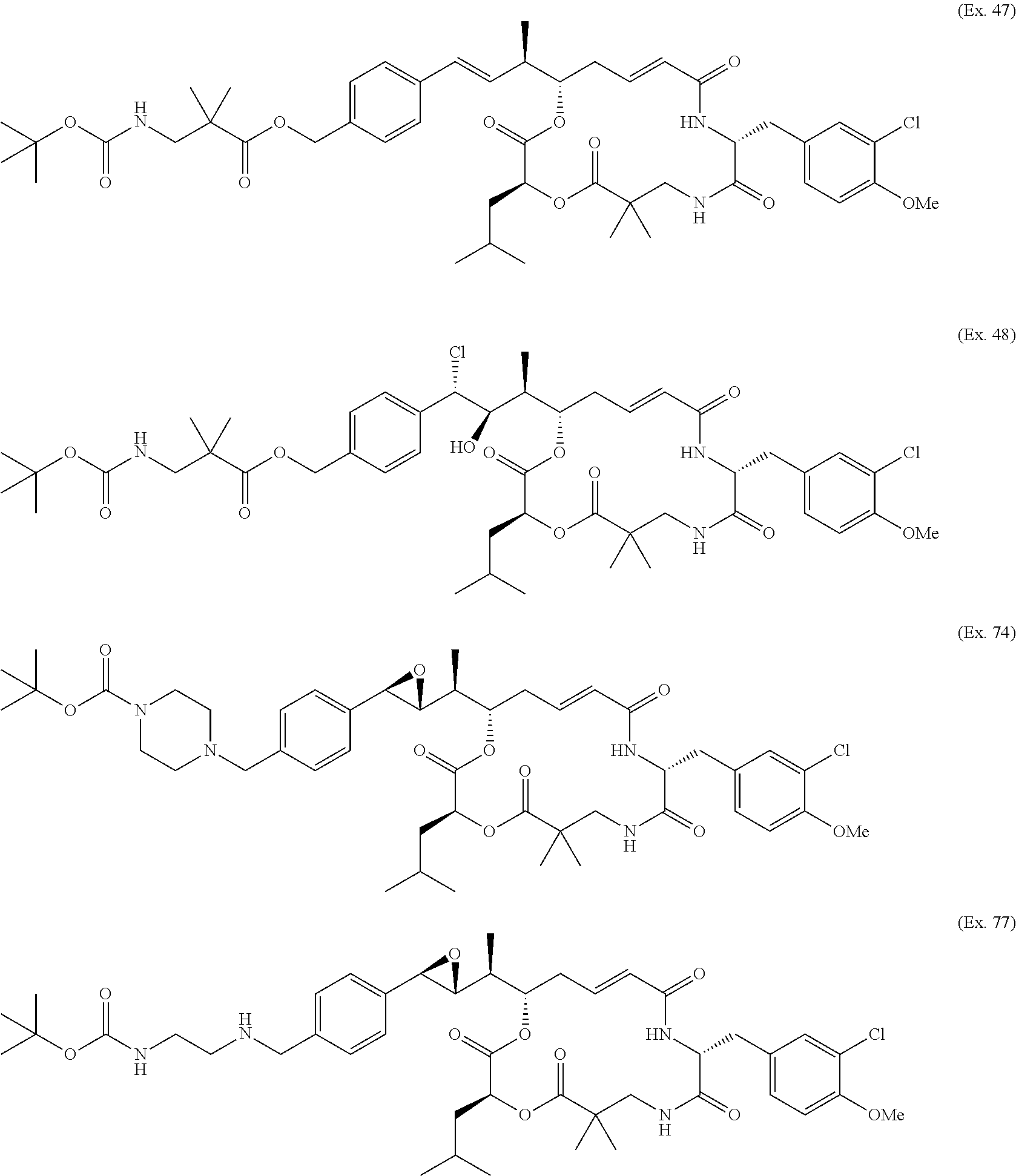
- which are characterized by the end group —NHC(═O)Ot-Bu. WO 98/08505 does not specify that these compounds are suitable for or intended to be conjugated.
- US 2007/0 213 511 describes calicheamicin immunoconjugates. Among these, mention is made of Mylotarg® (or CMA-676), which is a calicheamicin immunoconjugate used in the treatment of AML (anti-CD33-calicheamicin). See also in respect of conjugates: WO 2006/042 240.
- Al-awar R. S., et al., J. Med. Chem. 2003, 46(14), 2985-3007 and Al-awar R. S., et al., Mol. Cancer Ther. 2004, 3(9), 1061-1067 describe cryptophycin derivatives, and also their in vivo evaluations.
- WO 08/010,101 describes an anti-EphA2 monoclonal antibody and also the corresponding conjugates comprising one or more molecules of a cytotoxic compound attached to the monoclonal antibody. WO 08/047,242 describes an anti-CD38 monoclonal antibody and also the corresponding conjugates comprising one or more molecules of a cytotoxic compound attached to the monoclonal antibody. The cytotoxic compound may be chosen from maytansinoids, taxanes, tomaymycins, leptomycins and CC-1065 and analogues thereof.
- WO 2009/126 934 describes anti-CD70 antibodies and their conjugates with cytotoxic compounds; cryptophycin is mentioned among the cytotoxic agents. WO 2009/134 976 describes conjugates with an optimized degree of substitution for delivering the required amount of cytotoxic agent into the cell; cryptophycin is mentioned among the cytotoxic agents.
- WO 2005/116 255 describes conjugates of aptamers and of a cytotoxic agent that may be a cryptophycin (see [0037] and Table 2), the linker possibly comprising a PEG chain ([0038]). More particularly, the cryptophycin Cryp-NH2 is described:
-

- and also its conjugates of aptamers with the following linkers: NHS-PEG-erythritol, pNP-PEG-erythritol, NHS-PEG-octaPEG, pNP-PEG-octaPEG and PEG-comb (Tables 3 and 4). The nature of the sequence on the phenyl ring (—CH2O—C(═O)—CMe2-CH2NH— . . . ) is different from that which is envisaged in the present invention. WO 2006/096 754 also describes conjugates of aptamers and of a cytotoxic agent that may also be a cryptophycin.
- WO 2009/002 993 describes cytotoxic conjugates of formula B-L-A comprising hydrophilic linkers, for example the linker of formula:
-

- The cytotoxic agent may be a cryptophycin (page 46), but the point of attachment of the linker is not specified. An example of a conjugate is EC0262:
-

- whose linker and point of attachment are different from those envisaged in the present invention.
-
FIG. 1 illustrates the modification of an amino group of a binding agent with SPDP. -
FIG. 2 illustrates the modification of an amino group of a binding agent with iminothiolane. - The following definitions apply:
-
- conjugate: a cell binding agent to which is covalently attached at least one molecule of a cytotoxic compound;
- cell binding agent: a molecule with affinity for a biological target: it may be, for example, a ligand, a protein, an antibody, more particularly a monoclonal antibody, a protein or antibody fragment, a peptide, an oligonucleotide or an oligosaccharide. The function of the binding agent is to direct the biologically active compound as a cytotoxic agent towards the biological target.
- Preferably, the binding agent is not an aptamer;
-
- biological target: an antigen (or group of antigens) preferably located at the surface of cancer cells or stromal cells associated with this tumour; these antigens may be, for example, a growth factor receptor, an oncogene product or mutated “tumour suppressant” gene product, an angiogenesis-related molecule, an adhesion molecule;
- linker: a group of atoms that can covalently attach a cytotoxic compound to the binding agent;
- alkyl group: a saturated aliphatic hydrocarbon-based group obtained by removing a hydrogen atom from an alkane. The alkyl group may be linear or branched. Examples that may be mentioned include methyl, ethyl, propyl, isopropyl, butyl, isobutyl, tert-butyl, pentyl, 2,2-dimethylpropyl and hexyl groups;
- cycloalkyl group: a cyclic alkyl group comprising between 3 and 8 carbon atoms engaged in the cyclic structure. Examples that may be mentioned include cyclopropyl, cyclobutyl, cyclopentyl and cyclohexyl groups;
- heterocycloalkyl group: a cycloalkyl group comprising at least one heteroatom (O, S or N) engaged in the ring and connected to the carbon atoms forming the ring;
- alkoxy group: a group —O-alkyl, in which the alkyl group is as defined above;
- alkanoyloxy group: a group —O—CO-alkyl, in which the alkyl group is as defined above;
- alkylene group: a saturated divalent group of empirical formula —CnH2n—, obtained by removing two hydrogen atoms from an alkane. Examples that may be mentioned include methylene (—CH2—), ethylene (—CH2CH2—), propylene (—CH2CH2CH2—), butylene (—CH2CH2CH2CH2—) and hexylene (—CH2CH2CH2CH2CH2CH2—) groups or the following branched groups
-

-
- preferably, the alkylene group is of the formula —(CH2)n—, n representing an integer;
- in the ranges of values, the limits are included (e.g. a range of the type “n ranging from 1 to 6” or “between 1 and 6” includes limits 1 and 6).
- EtOAc: ethyl acetate; ALK: (C1-C12)alkylene group, more particularly (C1-C6)alkylene, more particularly of the form —(CH2)n—, n being an integer from 1 to 12 and preferably from 1 to 6; aq.: aqueous; TLC: thin-layer chromatography; MSC: methanesulfonyl chloride; crypto denotes the unit of formula
-

- crypto especially denoting one of the D1-D8 cryptophycin derivatives described later or a cryptophycin derivative of an example; Rf: retention factor; DAR: degree of substitution (drug-antibody ratio); DBU: 1,8-diazabicyclo[5.4.0-]undec-7-ene; DCC: N,N′-dicyclohexylcarbodiimide; DCM: dichloromethane; DEAD: diethyl azodicarboxylate; DIC: N,N′-diisopropylcarbodiimide; DIPEA: N,N-diisopropylethylamine; DMA: dimethylacetamide; DMAP: 4-dimethylaminopyridine; DME: dimethoxyethane; DMF: dimethylformamide; DMSO: dimethyl sulfoxide; EEDQ: 2-ethoxy-1-ethoxycarbonyl-1,2-dihydroquinoline; EDCl: N-(3-dimethylaminopropyl)-N′-ethylcarbodiimide; EDTA: ethylene-diaminetetraacetic acid; eq.: equivalent; Fmoc: fluorenylmethoxycarbonyl; HOBt: 1-hydroxybenzotriazole; HEPES: 4-(2-hydroxyethyl)-1-piperazineethanesulfonic acid; mCPBA: m-chloroperbenzoic acid; NHS: N-hydroxysuccinimide; NMP: N-methylpyrrolidinone; AP: atmospheric pressure; PABAC: “para-aminobenzyl alcohol carbonate”; RP: reduced pressure; SEC: steric exclusion chromatography; SPE: solid-phase extraction; RT: room temperature; TBDMS: tert-butyldimethylsilyl; TCEP: tris(2-carboxyethyl)phosphine hydrochloride; TEA: triethylamine; TFA: trifluoroacetic acid; TIPS: triisopropylsilyl; THF: tetrahydrofuran; tR: retention time.
- The invention relates to a binding agent to which is attached at least one cryptophycin derivative of formula (I):
-

- in which:
-
- R1 represents a halogen atom and R2 represents a group —OH, an acyl group derived from an amino acid AA or a group (C1-C4)alkanoyloxy;
- or alternatively R1 and R2 form an epoxide unit;
-
- AA denotes a natural or unnatural amino acid;
- R3 represents a group (C1-C6)alkyl;
- R4 and R5 both represent H or together form a double bond CH═CH between C13 and C14;
- R6 and R7 represent, independently of each other, H or a group (C1:C6)alkyl;
- R8 and R9 represent, independently of each other, H or a group (C1-C6)alkyl;
- R10 represents at least one substituent of the phenyl nucleus chosen from: H, a group —OH, (C1-C4)alkoxy, a halogen atom or a group —NH2, —NH(C1-C6)alkyl or —N(C1-C6)alkyl2;
- R11 represents at least one substituent of the phenyl nucleus chosen from H and a group (C1-C4)alkyl;
- the binding agent and the cryptophycin derivative being covalently attached, the attachment being in the ortho (o), meta (m) or para (p) position of the phenyl nucleus bearing the unit CR1.
-

- R1 represents a halogen atom, more particularly Cl, R3 represents a group (C1-C6)alkyl, more particularly Me, R6 and R7 represent, independently of each other, H or a group (C1-C6)alkyl; more particularly, they represent, independently of each other, H or a group Me, R8 and R9 represent, independently of each other, H or a group (C1-C6)alkyl; more particularly, R8 represents H and R9 represents isobutyl.
- R10 represents at least one substituent of the phenyl nucleus chosen from H, a group OH, (C1-C4)alkoxy or a halogen atom. It may also be a group —NH2, —NH(C1-C6)alkyl or —N(C1-C6)alkyl2 such as, for example, —NH2 or —NMe2, preferably in position 3 or 4 on the phenyl nucleus. More particularly, the phenyl nucleus comprises two substituents in positions 3 and 4 on the phenyl nucleus. Preferably, it is 3-Cl and 4-methoxy. R11 represents at least one substituent of the phenyl nucleus chosen from H and a group (C1-C4)alkyl; more particularly H.
- More particularly, one of the substituents R1 to R11 may be chosen from those described in the examples. Each substituent R1 to R11, may also adopt one of the spatial configurations (e.g. R or S or alternatively Z or E) as described in the examples.
- AA represents a natural or unnatural amino acid. It may be an α, β or γ amino acid. Mention may be made especially of the following amino acids: alanine (Ala), β-alanine, 2-amino-2-cyclohexylacetic acid, 2-amino-2-phenylacetic acid, arginine (Arg), aspartic acid (Asp), cysteine (Cys), glutamine (Gln), glutamic acid (Glu), glycine (Gly), histidine (His), isoleucine (Ile), leucine (Leu), lysine (Lys), methionine (Met), phenylalanine (Phe), proline (Pro), serine (Ser), threonine (Thr), tryptophan (Trp), tyrosine (Tyr), valine (Val), γ-aminobutyric acid, α,α-dimethyl-γ-aminobutyric acid, β,β-dimethyl-γ-aminobutyric acid, ornithine (Orn), citrulline (Cit) and also the protected forms of the said amino acids (e.g. acetyl, formyl, tosyl, nitro). Preferably, it is a natural amino acid. More particularly, it is glycine.
- R1 and R2 may also together form an epoxide unit.
- The attachment between the cryptophycin derivative and the binding agent is produced by means of a linker L positioned in an ortho (o), meta (m) or para (p) position of the phenyl nucleus bearing the unit CR1; thus, the cryptophycin derivative capable of conjugation has the formula (II):
-

- The attachment to the binding agent takes place at the other end of the linker L on a reactive group present on the binding agent. Thus, L comprises at least one reactive chemical group (RCG1) that is reactive towards a reactive chemical group (RCG2) present on the binding agent. The reaction between RCG1 and RCG2 ensures the attachment of the compound of formula (II) to the binding agent by formation of a covalent bond. Thus, the cryptophycin derivative of formula (II) is able to be conjugated to a binding agent.
- The cryptophycin derivatives of the present invention, including those that are illustrated, may exist in the form of bases or of acid-addition salts, especially of pharmaceutically acceptable acids.
- Examples of RCG1 that may be mentioned include:
- (i) the reactive group —SZa for which Za represents H or the group —SRa and Ra represents a group (C1-C6)alkyl, (C3-C7)cycloalkyl, aryl, heteroaryl or (C3-C7)heterocycloalkyl;
(ii) the reactive group —C(═O)—ZbRb for which Zb represents a single bond, —O— or —NH—, more particularly —O—, and Rb represents H or a group (C1-C6)alkyl, (C3-C7)cycloalkyl, aryl, heteroaryl or (C3-C7)heterocycloalkyl;
(iii) one of the following reactive groups: —Cl, —N3, —OH, —NH2, the maleimido -

- or haloacetamido
-

- reactive group with R12 representing H or a group (C1-C6)alkyl, more particularly Me in the case of the compounds of formula (III):
-

- comprising the group G=—(CH2)nY with Y=—Cl, —N3, —OH, —NH2,
-

- with R12 representing H or a group (C1-C6)alkyl, more particularly Me;
(iv) the reactive group maleimido -

- or haloacetamido
-

- with R12 representing H or a group (C1-C6)alkyl, more particularly Me.
- More particularly, —SZa may represent —SH or —SS(C1-C6)alkyl, especially —SSMe or —SS— heteroaryl, especially
-

- (X1 and X2 being defined hereinbelow). More particularly, —ZbRb may represent —OH, —OCH3, —OCH2CH═CH2,
-

- or the group
-

- in which GI represents at least one electroinductive group such as —NO2 or -Hal, especially —F. They may be, for example, the following groups:
-

- Another type of group —C(═O)ZbRb is the following:
-

- The reactive groups —SH and
-

- show good reactivity. More particularly, RCG1 may be chosen from one of those described in the examples.
- Examples of RCG2 that may be mentioned include ε-amino groups of lysines borne by the side chains of the lysine residues that are present at the surface of an antibody, the saccharide groups of the hinge region or the thiols of cysteines by reducing intra-chain disulfide bonds (Garnett M. C., et al., Advanced Drug Delivery Reviews 2001, 53, 171-216). More recently, other approaches have been considered, for instance the introduction of cysteines by mutation (Junutula J. R., et al., Nature Biotechnology 2008, 26, 925-932; WO 09/026,274) or the introduction of unnatural amino acids allowing other types of chemistry (de Graaf A. J., et al., Bioconjugate Chem. 2009, Publication Date (Web): Feb. 3, 2009 (Review); DOI: 10.1021/bc800294a; WO 2006/069 246 and according to Chin J. W., et al., JACS 2002, 124, 9026-9027 (technology ReCode®)). These modes of attachment used with antibodies are applicable to all of the known binding agents as a function of their structure.
- It is also possible to chemically modify the binding agent so as to introduce novel reactive chemical groups RCG2. Thus, it is well known to those skilled in the art how to modify an antibody with the aid of a modifying agent (see especially WO 2005/077 090 page 14). The modification makes it possible to improve the conjugation reaction and to use a wider variety of groups RCG1.
- The modifying agent may be an activated ester NHS of formula
-

- in which R represents a group (C1-C6)alkyl, aryl, heteroaryl, (C3-C7)cycloalkyl, (C3-C7)heterocycloalkyl and ALK represents a group (C1-C6)alkylene; for example, it is possible to use N-succinimidyl pyridyldithiopropionate (SPDP) or N-succinimidyl pyridyldithiobutyrate (SPDB or the N-hydroxy-succinimidyl ester of 4-(2-pyridyldithio)butanoic acid) so as to introduce dithiopyridyl reactive groups RCG2 (see Bourdon M. A., et al., Biochem. J. 1978, 173, 723-737; U.S. Pat. No. 5,208,020) which may then react with a reactive chemical group RCG1 of the type —SH present on the linker of the cryptophycin derivative so as to form a novel —S—S— bond (see Ex. 9 for a conjugate with a disulfide bond). The N-hydroxysuccinimide group preferentially reacts on the amino groups present on the antibody so as to form amide bonds. Another example of a modifying agent is described in WO 2004/016 801 of formula
-

- or a pegylated analogue of formula
-

- described in WO 2009/134 976 or a sulfonic analogue of formula
-

- described in WO 2009/134 977 in which:
-
- X3, X4, X5 and X6 represent H or a (C1-C6)alkyl group,
- X1 and X2 represent —H, —CONX8X9, —NO2, —X8 and —X9 representing H or a group (C1-C6)alkyl,
- X7 represents —SO3 −M+ or H, or alternatively a quaternary ammonium group,
- a denotes an integer from 0 to 4 and b denotes an integer ranging from 0 to 2000 and preferably between 1 and 200; a and b may take all the values between, respectively, 0 and 4 or between 0 and 2000.
- Another example of a modifying agent is succinimidyl-4-(N-maleimidomethyl)cyclohexane-1-carboxylate (SMCC), a similar compound described in EP 0 306 943 or a sulfo-SMCC (sulfosuccinimidyl 4-(N-maleimidomethyl)cyclohexane-1-carboxylate). Other examples that may be mentioned include:
-

- such as N-succinimidyl 3-maleimidopropanoate;
-

- such as N-succinimidyl 6-(3-maleimidopropionamido)hexanoate;
-

- b being an integer between 0 and 2000 and preferably between 1 and 200 (b may take all the values between 0 and 2000), such as N-succinimidyl 3-(2-{2-[3-maleimidopropionylamino]ethoxy}ethoxy)propanoate or SM(PEG)2;
-

- such as maleimidoethyl N-succinimidyl succinate;
-

- such as N-succinimidyl 4-(4-maleimidophenyl)butanoate, or
-

- such as N-succinimidyl 3-maleimidobenzoate.
- Another example of a modifying agent described in WO 90/06774 is of the formula
-

- in which:
-
- Hal represents a halogen atom;
- X10 represents a halogen atom or a group COOX14, nitro, unsubstituted or halogenated (C1-C8)alkyl, unsubstituted or halogenated (C1-C8)alkoxy, unsubstituted or halogenated (C2-C8)alkenyl, unsubstituted or halogenated (C2-C8)alkynyl, unsubstituted (C3-C8)cycloalkyl, aryl that is unsubstituted or substituted with one to three substituents selected from amino, halogen atom, unsubstituted or halogenated (C1-C8)alkyl group, unsubstituted or halogenated (C1-C8)alkoxy;
- each of the X11, X12 and X13 independently represents a hydrogen atom or may represent X3; or X10 and X11 together form a ring (C2-C5)alkylene, which is unsubstituted or substituted with one to five groups (C1-C4)alkyl;
- or X10 and X11 form, together with X12, a ring (C1-C5)alkylene, which is unsubstituted or substituted with one to five groups (C1-C4) alkyl;
- and X14 is —H or a group (C1-C8)alkyl.
- Preferably, Hal represents a chlorine or bromine atom. The table below presents possibilities for X10-X13:
-
X10 X11 X12 X13 Hal Me H H H Cl Ph H H H Cl t-Bu H H H Cl Me Me H H Cl (—CH2(CH2)3CH2—) H H Cl H (—CH2(CH2)3CH2—) H Cl Et H H H Br Et Me H H Cl 
H H H Cl Me H Me H Cl H H Me Me Cl Ph Me H H Cl 4-ClPh H H H Cl 3-furanyl H H H Cl i-Pr H H H Cl Me Me Me Me Cl C6H11 H H H Cl CH2Br H H H Cl CF3 H H H Cl CH═CH2 H H H Cl 2-NH2Ph H H H Cl - An example of a preferred iminothiolane is the following:
-

- Another example of a modifying agent is succinimidyl-4-(N-iodoacetyl)aminobenzoate
-

- or similar compounds, among which are succinimidyl-N-iodoacetate
-

- succinimidyl-N-bromoacetate (SBA), or succinimidyl-3-(N-bromoacetamido)propionate (SBAP) or a similar pegylated compound described in WO 2009/134 976
-

- b being as described previously.
FIGS. 1 and 2 illustrate the modification of an amino group of a binding agent with SPDP or with the preferred iminothiolane above. - Thus, it is possible to introduce onto the binding agent disulfide groups RCG2 (—SSR), especially of pyridyldisulfide type
-

- in the case where RCG1 represents —SH. Similarly, it is possible to introduce onto the binding agent thiol groups RCG2 (—SH), for example with an iminothiolane, in the case where RCG1 represents disulfide (i.e. RCG1=—SZa with Za≠H, for example Za=
-

- ). In both cases, the covalent bond that forms by reaction between RCG1 and RCG2 is a cleavable disulfide bond.
- It is also possible, in the case where RCG1 represents —SH, to introduce onto the surface of the binding agent RCG2 groups of maleimido type (
-

- ) or haloacetamido type (e.g. bromo- or iodoacetamido
-

- ). Reciprocally, it is possible to introduce onto the binding agent thiol groups RCG2 (—SH), for example with an iminothiolane, in the case where RCG1 represents
-

- In this case, the covalent bond that forms by reaction between RCG1 and RCG2 is an uncleavable sulfide bond.
-
TABLE I examples of modifications of a binding agent when RCG1 = —SZa example after reaction of an amino RCG2 at the surface of the binding group, especially lysine, of an antibody modifying agent agent noted MAb 


modifying agent conjugate 


g: number of RCG2 functions on a modified binding agent; d: number of cryptophycin derivatives on the binding agent MAb L* = fragment of a linker L comprising RCG1 = —SZa and such that L = —L*SZa - More particularly, in the case where RCG1 is of the type (iii) above, it is possible to chemically modify the binding agent using an adequate modifying agent or to introduce one or more unnatural amino acids so as to introduce the adequate functions RCG2. For example:
-
- with a function —N3: RCG2 may be a group —C≡CH;
- with a function —OH or —NH2: RCG2 may be a carboxylic acid function;
- with a function —Cl: RCG2 may be a group —SH.
- In the case where RCG1 represents a maleimido
-

- or haloacetamido
-

- reactive group with R12 representing H or (C1-C6)alkyl, more particularly Me, the cryptophycin derivative may be represented by the formula (IIa) or (IIb) below:
-

- (L* represents a fragment of a linker L such that L=-L*-maleimido or L=-L*-haloacetamido)
- The cryptophycin derivative may be, in the series C-52 and C-1, one of the following D1-D8:
-


- or an equivalent unit described in one of the examples.
- More particularly, L is in the para position of the unit RC1.
- The compounds of formula (II) are prepared according to Scheme 1 starting with a cryptophycin derivative of formula (III) and a linker precursor (LP):
-

- G represents the group —CH═CH2, —(CH2)nY or —(C1-C6)alkylene-Y with n being an integer ranging from 1 to 6 and Y representing —OH, —SH, —Cl, —OLG in which LG denotes a leaving group, for instance a mesylate (OMs) or tosylate group, or alternatively Y represents —N3, —NH2, —COON, —NR12—CH2—C≡CH in which R12 represents H or a group (C1-C6)alkyl, more particularly a methyl group. The linker precursor LP has the function of introducing the linker L into the cryptophycin derivative after reaction between the group G and a chemical function present on LP.
- G may also represent the group
-

- (i.e. Y represents the group
-

- )chosen from one of the following 9 groups (R12 and R′12 represent H or a group (C1-C6)alkyl):
-

- In Scheme 1, several steps and/or reactions may be necessary to arrive at the cryptophycin derivative (II) starting from the cryptophycin derivative (III). Thus, for example, in the case where Za=H, it is preferred to introduce a linker L for which Za=—S(C1-C6)alkyl using the corresponding linker precursor, and then to reduce the disulfide function —SS(C1-C6)alkyl to a thiol function —SH.
- It is possible to use in order to do this, for example, TCEP: see in this respect Burns J. A., et al., J. Org. Chem. 1991, 56(8), 2648-2650. This conversion —SS(C1-C6)alkyl→—SH may apply, for example, to the linkers L1-4 and L21-23 of Table II.
- Similarly, in the case where ZbRb=
-

- a linker L for which ZbRb=—O-allyl may be introduced using the corresponding linker precursor, followed by deprotecting the function —COOH and introducing
-

- Deprotection may be performed by treatment with a palladium catalyst, for example Pd(PPh3)4 in the presence of a “scavenger” amine, for example morpholine; the activation may be performed with N,N′-disuccinimidyl carbonate in the presence of a base, for example DIPEA or with NHS in the presence of a coupling agent, for example DCC. This conversion of a group ZbRb into another group ZbRb (e.g. —O-allyl→
-

- ) may be applied to obtain other groups ZbRb, especially those described above.
- In the case where R1 represents a halogen atom and R2 represents an acyl group, it is preferred first to prepare a compound of formula (II) for which R2 represents a group —OH (once the linker has been introduced), and then to introduce the acyl group using the corresponding acylating compound.
- Schemes 1′ and 1″ similarly illustrate the preparation of a cryptophycin derivative comprising a linker comprising, respectively, a maleimido or haloacetamido group (L* represents a fragment of a linker such that L=-L*-maleimido or L=-L*-haloacetamido).
-

-

- These derivatives are obtained by reaction between a cryptophycin derivative comprising a linker L′ comprising an amino or thiol group and a modifying agent for introducing, respectively, a maleimido or haloacetamido group.
-
-
- nucleophilic substitution between a linker precursor LP bearing an amine function —NH— (an amine salt may also be suitable for use) and G=—(CH2)nCl or —(CH2)nOMs (see, for example, Table II, LP1-4, LP7a, LP8-10, LP21-23): this reaction may be performed in a polar aprotic solvent in the presence of a base, for instance TEA or DIPEA. See Ex. 1, compound 7 or Ex. 15, compound 48;
- acylation between a linker precursor LP bearing a carbamoyl halide function and G=—(CH2)nOH (see, for example, Table II, LP5): this reaction may be performed in a polar aprotic solvent in the presence of an amine base, for instance TEA.
- According to one variant, it is also possible to react a linker precursor LP bearing an amine function —NH— and G=—(CH2)nO—C(═O)—O-(4-nitrophenyl) obtained from G=—(CH2)nOH and p-nitrophenyl chloroformate (activation of the alcohol in the form of carbonate) according to the scheme below (R12=H or (C1-C6)alkyl):
-
—NHR12+crypto-(CH2)nO—C(═O)—O-(4-nitrophenyl)→crypto-(CH2)nO—C(═O)—NR12— -
- the activation of an alcohol in the form of carbonate may also be used to react a linker precursor bearing a function —OH and G=—(CH2)nNH2 or —(CH2)nOH to obtain, respectively, a carbamate function (—O—C(═O)—NH—) or carbonate (—O—C(═O)—O—) according to the following respective schemes:
-
—O—C(═O)—O-(4-nitrophenyl)+crypto-(CH2)nNH2→crypto-(CH2)nNH—C(═O)—O— -
—OH+crypto-(CH2)nO—C(═O)—O-(4-nitrophenyl)→crypto-(CH2)nO—C(═O)—O—. - (see, for example, Table II, LP6a-6b, LP24-25)
-
- esterification between a linker precursor LP bearing an acid function —COOH and G=—(CH2)nOH (see, for example, Table II, LP14b): this reaction may be performed in a polar aprotic solvent in the presence of an amine base, for instance DMAP and a coupling agent, for example DCC;
- amidation between a linker precursor LP bearing an acid function —COOH and G=—(CH2)nNH2 (see, for example, Table II, LP14a): this reaction may be performed in a polar aprotic solvent in the presence of a coupling agent, for example EDCl or HOBt;
- amidation between a linker precursor LP bearing a function —NH2 and G=—(CH2)nCOOH (see, for example, Table II, LP7c): this reaction may be performed in a polar aprotic solvent in the presence of a coupling agent, for example EDCl or HOBt;
- 1,3-dipolar cycloaddition (also known as “click” chemistry) between a linker precursor LP bearing an alkyne terminal function and G=—(CH2)—N3 or alternatively a linker precursor LP bearing an azide function and G=—(CH2)nNR12—CH2C═CH (see, for example, Table II, LP15-18): this reaction may be performed in a polar solvent in the presence of Cu(I) as catalyst (see in this respect the Huisgen cycloaddition: Rostovtsev V. V., et al., Angew. Chem. Int. Ed. 2002, 41, 2596-2599; Tornoe C. W., et al., J. Org. Chem. 2002, 67, 3057-3064);
- metathesis between a linker precursor LP bearing an ethylenic end function and G=—CH═CH2 (see Table II, LP19, LP20): this reaction may be performed in a polar aprotic solvent in the presence of a second-generation Grubbs catalyst (CAS No. 246047-72-3, see in this respect Poeylaut-Palena A. A., et al., J. Org. Chem. 2008, 73, 2024-2027).
- The linker L may be chosen from one of the following:
- -G′ X (CR13R14)t(OCH2CH2)y(CR15R16)u Q RCG1;
- -G′ X (CR13R14)t(OCH2CH2)y—Y′—(CR15R16)u Q RCG1;
- -G′ X (CR13R14)t(CR17═CR18)(CR15R16)u(OCH2CH2)y Q RCG1;
- -G′ X (CR13R14)t(OCH2CH2)y(CR17═CR18)(CR15R16)u Q RCG1;
- -G′ X (CR13R14)t-phenyl-(CR15R16)u Y′ Q RCG1; -G′ X (CR13R14)t-furyl-(CR15R16)u Y′ Q RCG1;
- -G′ X (CR13R14)t-oxazolyl-(CR15R16)u Y′ Q RCG1; -G′ X (CR13R14)t-thiazolyl-(CR15R16)u Y′ Q RCG1;
- -G′ X (CR13R14)t-thienyl-(CR15R16)u Y′ Q RCG1; -G′ X (CR13R14)t-imidazolyl-(CR15R16)u Y′ Q RCG1;
- -G′ X (CR13R14)t-piperazinyl-CO(CR15R16)u Y′ Q RCG1; -G′ X (CR13R14)t-piperidyl-methyl-NR12—CO(CR15R16)u Y′ Q RCG1; -G′ X (CR13R14)t-piperidyl-(CR15R16)u Y′ Q RCG1; -G′ X (CR13R14)t-piperidyl-NR12—(CR15R16)u Y′ Q RCG1; -G′ X (CR13R14)t-triazolyl-(CR15R16)u Y′ Q RCG1; -G′ X (CR13R14)t-triazolyl-(CR15R16)u Y′ Q RCG1;
- -G′ X (CR13R14)t-phenyl-(CR15R16)u Q RCG1; -G′ X (CR13R14)t-furyl-(CR15R16)u Q RCG1, -G′ X (CR13R14)t-oxazolyl-(CR15R16)u Q RCG1; -G′ X (CR13R14)t-thiazolyl-(CR15R16)u Q RCG1; -G′ X (CR13R14)t-thienyl-(CR15R16)u Q RCG1; -G′ X (CR13R14)t-imidazolyl-(CR15R16)u Q RCG1; -G′ X (CR13R14)t-piperazinyl-(CR15R16)u Q RCG1; -G′ X (CR13R14)t-piperidyl-(CR15R16)u Q RCG1; -G′ X (CR13R14)t-piperidyl-methyl-NR12—(CR15R16)u Q RCG1; -G′ X (CR13R14)t-piperidyl-NR12—(CR15R16)u Q RCG1; -G′ X (CR13R14)t-triazolyl-(CR15R16)u Q RCG1;
or - -G″ Y (CR13R14)t(OCH2CH2)y(CR15R16)u Q RCG1;
- -G″ Y (CR13R14)t(OCH2CH2)yY′—(CR15R16)u Q RCG1;
- -G″ Y (CR13R14)t(CR17═CR18)(CR15R16)u(OCH2CH2)y Q RCG1;
- -G″ Y (CR13R14)t(OCH2CH2)y(CR17═CR18)(CR15R16)u Q RCG1;
- -G″ Y (CR13R14)t-phenyl-(CR15R16)u Y′ Q RCG1; -G″ Y (CR13R14)t-furyl-(CR75R16)u Y′ Q RCG1; -G″ Y (CR13R14)t-oxazolyl-(CR15R16)u Y′ Q RCG1; -G″ Y (CR13R14)t-thiazolyl-(CR15R16)u Y′ Q RCG1; -G″ Y (CR13R14)t-thienyl-(CR15R16)u Y′ Q RCG1; -G″ Y (CR13R14)t-imidazolyl-(CR15R16)u Y′ Q RCG1;
- -G″ Y (CR13R14)t-piperazinyl-CO(CR15R16)u Y′ Q RCG1; -G″ Y (CR13R14)t-piperidyl-methyl-NR12—CO(CR15R16)u Y′ Q RCG1; -G″ Y (CR13R14)t-piperidyl-(CR15R16)u Y′ Q RCG1; -G″ Y (CR13R14)t-piperidyl-NR12—(CR15R16)u Y′ Q RCG1; -G″ Y (CR13R14)t-triazolyl-(CR15R16)u Y′ Q RCG1;
- -G″ Y (CR13R14)t-phenyl-(CR15R16)u Q RCG1; -G″ Y (CR13R14)t-furyl-(CR15R16)u Q RCG1, -G″ Y (CR13R14)t-oxazolyl-(CR15R16)u Q RCG1; -G″ Y (CR13R14)t-thiazolyl-(CR15R16)u Q RCG1; -G″ Y (CR13R14)t-thienyl-(CR15R16)u Q RCG1; -G″ V (CR13R14)t-imidazolyl-(CR15R16)u Q RCG1; -G″ Y (CR13R14)t-piperazinyl-(CR15R16)u Q RCG1; -G″ Y (CR13R14)t-piperazinyl-(CR15R16)u Q RCG1; G″ Y (CR13R14)t-piperidyl-(CR15R16)u Q RCG1; -G″ Y (CR13R14)t-piperidyl-methyl-NR12—(CR15R16)u Q RCG1; -G″ Y (CR13R14)t-piperidyl-NR12—(CR15R16)u Q RCG1; -G″ Y (CR13R14)t-triazolyl-(CR15R16)u Q RCG1;
- G′ represents a group —CH═CH— or —(CH2)n—;
- G″ represents a group —(CH2)n—;
- n represents an integer ranging from 1 to 6;
- X represents a single bond or a group —CO—, —COO— or —CONR12—, the group CO being attached to G′;
- Y represents a group —O—, —OCO—, —OCOO—, —OCONR12—, —NR12—, —NR12CO—, —NR12CONR′12—, —NR12COO— or —S(O)q—, the atom O or the group NR12 being attached to G″;
- Y′ represents a group —O—, —OCO—, —OCOO—, —OCONR12—, —NR12—, —NR12COO—, —NR12CONR′12—, —NR12COO—, —S(O)q—, —CO—, —COO—, or —CONR12—;
- R12, R′12, R13, R14, R15 and R16, R17 and R18 represent, independently of each other, H or a group (C1-C6)alkyl;
- t, u and y represent integers that may range from 0 (in the case of the absent group) to 20 and such that t+u+y is greater than or equal to 1;
- q represents an integer that may be 0, 1 or 2;
- Q represents a single bond, a group (C1-C10)alkylene or a group (OCH2CH2)i, i being an integer ranging from 1 to 20, more particularly from 1 to 10, even more particularly from 1 to 8 or from 1 to 6, and even more particularly from 2 to 5. i may take each of the values of these ranges, and may especially be 2, 3, 4 or 5.
- In the case of the linker of formula -G″ Y (CR13R14)t(OCH2CH2)y—Y′—(CR15R16)u Q RCG1, if y is 0 (no PEG group) and if Q represents a single bond, then u cannot be 0. More particularly, linkers comprising the terminal group —NR12—C(═O)—O— (Y′=NR12; u=0; Q=single bond and RCG1=—C(═O)ZbRb) are excluded.
- y represents an integer ranging from 0 to 20, more particularly from 1 to 20, even more particularly from 1 to 10, from 1 to 8 or from 1 to 6, and even more particularly from 2 to 5. y may take each of the values of these ranges, and may especially be 2, 3, 4 or 5.
- Some of these linkers have been described in patent applications WO 07/085,930 and WO 09/016,516.
- The linker L may be chosen from one of those of formula (IV):
-

- in which:
-
- (AA)w represents a sequence of w amino acids AA connected together via peptide bonds;
- w represents an integer ranging from 1 to 12 and preferably from 1 to 6;
- n represents an integer ranging from 1 to 6;
- D represents one of the following units:
-

- for which:
-
- R12 represents H or a group (C1-C6)alkyl;
- R19, R20, R21 and R22 represent, independently of each other, H, a halogen atom, —OH, —CN or a group (C1-C4)alkyl;
- T attached to (CH2)n represents NR12 or O;
- V1 represents O, S or NR12;
- V2 represents CR22 or N;
- V3, V4 and V5 are chosen, independently of each other, from CR22 and N.
- An example of D2 is as follows:
-

- AA denotes a natural or unnatural amino acid, more particularly chosen from: alanine (Ala), β-alanine, 2-amino-2-cyclohexylacetic acid, 2-amino-2-phenylacetic acid, arginine (Arg), aspartic acid (Asp), cysteine (Cys), glutamine (Gln), glutamic acid (Glu), glycine (Gly), histidine (His), isoleucine (Ile), leucine (Leu), lysine (Lys), methionine (Met), phenylalanine (Phe), proline (Pro), serine (Ser), threonine (Thr), tryptophan (Trp), tyrosine (Tyr), valine (Val), γ-aminobutyric acid, α,α-dimethyl-γ-aminobutyric acid, β,β-dimethyl-γ-aminobutyric acid, ornithine (Orn), citrulline (Cit).
- The sequence (AA)w has the formula:
-

- in which R23 represents a residue of one of the amino acids described above. Examples of sequences are as follows: Gly-Gly, Phe-Lys, Val-Lys, Val-Cit, Phe-Phe-Lys, D-Phe-Phe-Lys, Gly-Phe-Lsy, Ala-Lys, Val-Cit, Phe-Cit, Leu-Cit, Ile-Cit, Trp-Cit, Phe-Ala, Ala-Phe, Gly-Gly-Gly, Gly-Ala-Phe, Gly-Val-Cit, Gly-Phe-Leu-Cit, Gly-Phe-Leu-Gly, Ala-Leu-Ala-Leu.
- The linker precursors are those comprising the corresponding —OH units:
-

- WO 2005/082 023 (see especially pages 61-64) describes how to obtain certain linker precursors. The preparations of the linker precursors LP25 and LP26 described below may also be used for obtaining other similar linker precursors comprising another sequence (AA)w.
- The linker L may also be chosen from one of those described in Table II or from the illustrated compounds. In all the formulae of linkers, NR12 or NR'12 more particularly represents NH or NMe.
- In the Case where G=—(CH2)nOH or —CH═CH2
-


- P1 is prepared according to the teaching of patent applications WO 98/08505, WO 00/23429 or WO 00/34252 and also the following publications: Rej R., et al., J. Org. Chem. 1996, 61, 6289-6295; Salamonczyk G. M., et al., J. Org. Chem. 1996, 61, 6893-6900 or J. Med. Chem. 1999, 42 (14), 2588-2603 (incorporated herein by reference). In pages 158-159 of “The isolation, characterization and development of a novel class of potent antimitotic macrocyclic depsipeptides: the cryptophycins”, Chap. 9, in “Anticancer agents from natural products”, Taylor & Francis, CRC press book, ISBN=0-8493-1863-7 are given in the synthetic schemes for preparing the various cryptophycin fragments (A, B, C and D) and for producing P1. Rej R., et al., J. Org. Chem. 1996, 61, 6289-6295 describes in Schemes 1-6 the route of access to one of the cryptophycin derivatives of
FIG. 1 , but these schemes may apply to the preparation of P1 using suitable starting reagents. - P1 allows the preparation of other cryptophycin derivatives with the aid of the steps detailed hereinbelow:
- Opening of the epoxide ring of P1 in acidic medium so as to obtain the diol function. Concentrated perchloric acid may be used, for example;
- Oxidative cleavage of the diol using, for example, sodium periodate;
- Step (iii):
- Wittig reaction using a suitable phosphonium halide, for example a bromide, and a strong base, for instance BuLi;
- Corey-Chaykovsky epoxidation reaction involving a chiral sulfonium salt, for example a triflate, in the presence of a base, for instance KOH;
- Deprotection of the silyl ether using, for example, a tetrabutylammonium fluoride solution.
- 4-(Triisopropylsiloxymethyl)benzyltriphenylphosphonium bromide is obtained from 1-(bromomethyl)-4-(triisopropylsiloxymethyl)benzene (CAS No. 934667-38-6), the preparation of which starting from 1,4-benzenedimethanol (CAS No. 589-29-7, commercial product) is described by Potter R. G., et al., Organic Letters 2007, 9(7), 1187-1190. The compounds for which R11 represents a group (C1-C4)alkyl are obtained in a similar manner starting with the corresponding diol, which is either a commercial product or is obtained by Friedel-Crafts C-alkylation starting with 1,4-benzenedimethanol.
- Starting with 1-(bromomethyl)-4-(triisopropylsiloxymethyl)benzene (CAS No. 135408-73-0), the preparation of which is described in Scheme 4a of EP 0 496 548 or on page 83 of the article by Nevill C. R. Jr., et al., Bioorganic & Med. Chem. Lett. 1991, 1(1), 83-86, the corresponding phosphonium bromide may be obtained. The compounds for which R11 represents a group (C1-C4)alkyl are obtained in a similar manner from a compound equivalent to compound 1 described on page 83 of the article by Nevill C. R. Jr., et al., Bioorganic & Med. Chem. Lett. 1991, 1(1), 83-86, which is either a commercial product or is obtained by Friedel-Crafts C-alkylation starting with p-tolylacetic acid.
- (1R,4R,5R,6R)-4,7,7-Trimethyl-6-(4-vinylbenzyl)-6-thionia-bicyclo[3.2.1]octane trifluoromethanesulfonate used in step (iv) is obtained from (1R,4R,5R)-isothiocineole (see Aggarwal V. et al., JACS 2010, 132, 1828-1830), the preparation of which from (R)-limonene (CAS No. 95327-98-3, commercial product) is described in this same reference. Triphenyl(p-vinylbenzyl)phosphonium bromide (CAS No. 118766-51-1) is obtained from the corresponding bromo derivative (see Drefahl G., et al., Chem. Ber. 1961, 94(8), 2002-2010), the preparation of which starting with 4-vinylbenzyl alcohol (CAS No. 1074-61-9, commercial product) is described in the article by Shimomura O., et al., Tetrahedron 2005, 61, 12160-12167.
- Starting with P7 or P8, which are compounds of formula (III) for which G=—(CH2)nOH, other compounds of formula (III) containing other groups G may be obtained.
- In the Case where G=—(CH2)nCl or —(CH2)nN3
-

- Starting with the group G=—CH2OH, the groups G=—CH2Cl or —CH2N3 may be obtained:
-
- the introduction of —Cl may be performed in the presence of CMS: see Ex. 1, compound 2;
- the azidation may be performed in the presence of diphenylphosphorazide (PhO)2P(═O)N3 and a base, for example DBU. Scheme 3 describes these reactions for the case n=1, but it may also apply for n>1.
In the Case where G=—(CH2)nCOOH
-

- Starting with the group G=—(CH2)2OH, the group G=—CH2COOH may be obtained via an oxidation. Scheme 4 describes a double oxidation: 1st oxidation using the Dess-Martin reagent (see “Encyclopedia of Reagents for Organic Synthesis”; Paquette L. A., Ed.; Wiley: Chichester, UK, 1995, Vol. 7, 4982-4987 or Boeckman R. K. Jr., et al., J. J. “The Dess-Martin Periodinane” Org. Synth. 2004, 10, 696-702) followed by a 2nd oxidation of Pinnick type in the presence of 2-methyl-2-butene (Pinnick H. W., Tetrahedron 1981, 37, 2091-2096). Scheme 4 describes these reactions for the case of a starting compound for which n=2, but it may also apply for n>2.
- In the Case where G=—(CH2)nNH2
-

- Starting with the group G=—CH2N3, the preparation of which is described in Scheme 3, the group G=—CH2NH2 may be obtained with the aid of a reduction reaction using a phosphine such as TCEP. In this respect, see: Faucher A.-M. et al., Synthetic Comm. 2003, 33, 3503-3511:
-

- According to one variant, starting with the group G=—CH2OH, the group G=—CH2NH2 may be obtained with the aid of a Mitsunobu reaction using triphenylphosphine and DEAD. In this respect, see: Mitsunobu O., Synthesis 1981, 1-28; Hughes D. L., Org. Reactions 1992, 42, 335-656; Hughes D. L., Org. Prep. 1996, 28, 127-164. Schemes 5 and 5′ describe the case n=1, but they may also apply for n>1.
- In the Case where G=—(CH2)n—NR12—CH2C≡CH
- Starting with the group G=—(CH2)nCl, the group G=—(CH2)n—NR12—CH2—C≡CH may be obtained with the aid of a nucleophilic substitution using the compound of formula NHR12—CH2—C≡CH(R12=H: propargylamine; R12=(C1-C6)alkyl: prepared according to Mock W. L., et al., J. Org. Chem. 1989, 54 (22), 5302-8).
- In the Case where G=—(CH2)n—SH
-

- Starting with the group G=—(CH2)nCl, the group G=—(CH2)nSH may be obtained via a direct functionalization with the aid of tetrabutylammonium trimethylsilylthiolate prepared in situ from tetrabutylammonium fluoride and hexamethyldisilathiane according to Hu J. et al., J. Org. Chem. 1999, 64, 4959-4961 (see Ex. 8). Scheme 6 describes this reaction for the case n=1, but it may also apply for n>1. In the course of this reaction, the intermediate dimer having the formula below may be formed:
-

- In the Case where G=-ALK-SH
-

- P3 allows the preparation of other cryptophycin derivatives according to Scheme 7:
- Wittig reaction using a suitable phosphonium halide, for example a bromide, and a strong base, for instance BuLi;
- Kumada coupling using a suitable Grignard reagent, for example an alkoxymagnesium bromide protected in silyl ether form, in the presence of a palladium or nickel catalyst (see, for example, Organic Letters 2009, 11, 5686-5689 or Synthesis 2009, 141, 2408-2412).
- Steps (iii) to (v) are described in Scheme 2 and step (vi) is described in Scheme 6.
- (4-Bromobenzyl)triphenylphosphonium bromide is a commercial product (CAS No. 51044-13-4). The alkoxymagnesium bromides protected in silyl ether form may be prepared from the corresponding bromo alcohols by protection of the alcohol function with the appropriate chlorosilane, followed by formation of the organomagnesium reagent in the presence of magnesium in an anhydrous polar aprotic solvent, for instance THF (see, for example, Organic Letters 2005, 7, 183-186). The linear or branched bromo alcohols containing 1 to 6 carbon atoms are commercially available, for instance 3-bromo-1-propanol (CAS No. 627-18-9) or 1-bromo-2-propanol (CAS No. 19686-73-8) or may be prepared from the corresponding bromo esters or bromo ketones according to methods described in the literature. The chlorosilane may be, for example, tert-butyldimethylchlorosilane (CAS No. 18162-48-6) or triisopropylchlorosilane (CAS No. 13154-24-0).
- In the Case where G=—(CH1)n-maleimido
-

- In addition to Scheme 1′ which describes a method for preparing cryptophycin derivatives comprising a maleimido unit, starting with the group G=—CH2OH, the group G=
-

- may be obtained via a Mitsunobu reaction in the presence of triphenylphosphine and DEAD according to Matuszak N. et al., J. Med. Chem. 2009, 52, 7410-7420. Scheme 8 describes this reaction for the case n=1, but it may also apply for n>1.
- Schemes 1-8
- Above are given for a linker in the para position, but may identically apply for the ortho or meta positions. Similarly, they are given for a cryptophycin derivative, but may also apply to the preparation of other derivatives of formula (II), especially D1-D8.
- More particularly, in the case of C-52, the following compounds may be used, the preparations of which are described in Al-awar R. S., et al., J. Med. Chem. 2003, 46, 2985-3007 or in WO 98/08505:
-

- G=—CH2OH: compound 31b of Scheme 5
G=—CH2CH2OH: compound 49 of Scheme 9
G=—CH2COOH: compound 51 of Scheme 9 or Ex. 81 of WO 98/08505 - Moreover, starting with compound 31b for which G=—CH2OH, it is possible to obtain the compounds for which G=—CH2Cl or —CH2N3:
-
- G=—CH2Cl: see Example 1, compound 2;
- G=—CH2N3: the conversion of —CH2OH into —CH2N3 may be performed in a polar aprotic solvent in the presence of dipherlylphosphorazide and a base such as DBU, see Example 19, compound 60;
- G=—CH2-maleimido: the conversion of —CH2OH into —CH2-maleimido may be performed in a polar aprotic solvent in the presence of maleimide, triphenylphosphine and DEAD.
- The teaching of J. Med. Chem. 2003, 46, 2985-3007 may apply to other cryptophycin derivatives comprising other substituents R6-R9.
- LP may be one of the following:
- LP1
-

- prepared according to the scheme below:
-

- Activation of the acid using NHS; the activation is performed at RT in the presence of a coupling agent, for instance 1-(3-dimethylaminopropyl)-3-ethylcarbodiimide hydrochloride dissolved in an anhydrous aprotic solvent such as DCM. The procedure may be based on the conditions of Example 1, compound 4.
- Amidation with piperidine N-Boc; the peptide coupling is performed in a polar aprotic solvent at RT in the presence of a base, which may be a tertiary amine, for instance TEA or DIPEA. The solvent may be DMF. The procedure may be based on the conditions of Example 1, compound 5.
- Step (iii):
- Deprotection of the amine using an acid solution, for example hydrochloric acid (for example as a solution in dioxane). The procedure may be based on the conditions of Example 1, compound 6.
- The starting acid, for example 4-methyl-4-(methyldithio)pentanoic acid, may be commercially available or prepared from a halocarboxylic acid by successive treatments with potassium thioacetate and a derivative of methanethiosulfonate type. See also U.S. Pat. No. 2,719,170.
- LP2
-

- prepared according to the scheme below:
-

- Reductive amination with an aldehyde; the reaction is performed at RT in an anhydrous polar aprotic solvent such as THF in two steps: formation of an intermediate complex in the presence of titanium isopropoxide followed by in situ reduction with a reducing agent, for instance sodium cyanoborohydride. The procedure may be based on the conditions of Example 5, compound 17.
- Deprotection of the amine with an acid solution, for example hydrochloric acid (for example as a solution in dioxane). The procedure may be based on the conditions of Example 5, compound 18.
- The starting aldehyde, for example 2-methyl-2-(methyldithio)propanal, may be commercially available or prepared by oxidation of an alcohol bearing a disulfide unit obtained from a suitably protected halogenated alcohol (for example in silyl ether form) by successive treatments with potassium thioacetate and a derivative of methanethiosulfonate type.
- LP3 ZaS-ALK-NHR12 prepared according to the schemes below:
- In the Case where R12=H
-

- Formation of an oxime; the aldehyde described previously is dissolved in a polar protic solvent such as ethanol and then treated with O-methylhydroxylamine hydrochloride at reflux in the presence of a base such as sodium hydroxide. The procedure may be based on the conditions of Example 3, compound 11.
- Reduction of the oxime; the oxime is reduced via a treatment at reflux with a solution of borane-dimethyl sulfide in an anhydrous polar aprotic solvent such as THF. The procedure may be based on the conditions of Example 3, compound 12.
- In the Case where R12≠H
-

- Reductive amination with an aldehyde; the reaction is performed at RT in an anhydrous polar aprotic solvent such as THF in the presence of a reducing agent, for instance sodium triacetoxyborohydride.
- LP4
-

- prepared according to the scheme below:
-

- This linker is prepared in a similar manner to that presented for LP2.
- Reductive amination with an aldehyde; the reaction is performed at RT in an anhydrous polar aprotic solvent such as THF, in two steps: formation of an intermediate complex in the presence of titanium isopropoxide, followed by in situ reduction with a reducing agent such as sodium cyanoborohydride. The procedure may be based on the conditions of Example 5, compound 17.
- Deprotection of the amine with an acid solution, for example hydrochloric acid (for example in solution in dioxane). The procedure may be based on the conditions of Example 5, compound 18.
- LP5
-

- prepared according to the scheme below:
-

- Protection of the amine; the reaction is performed at RT in a polar aprotic solvent such as DCM by treating the amine with di-tert-butyl dicarbonate in the presence of a base, for instance TEA.
- Conversion of the alcohol to a bromide; the reaction is performed at RT in a polar aprotic solvent such as THF, by treating the alcohol function with CBr4 in the presence of a phosphine, for example triphenylphosphine; see in this respect Appel R. Angew. Chem. Int. Ed. Engl. 1975, 14, 801-811 or Desmaris N., et al., Tetrahedron Letters 2003, 44(41), 7589-7591.
- Step (iii):
- Substitution of the bromide with thioacetate; the reaction is performed at RT in an anhydrous polar aprotic solvent such as DMF, using potassium thioacetate as nucleophile.
- Formation of the disulfide bond; the reaction is performed in an anhydrous polar protic solvent such as methanol in the presence of a base, for instance sodium methoxide and a reagent comprising a pyridyl disulfide unit.
- According to one variant:
- Activation of the alcohol in mesylate form; the reaction is performed in an anhydrous polar aprotic solvent such as DCM by treatment with mesyl chloride in the presence of a base, for instance TEA.
- Formation of the free thiol; the reaction is performed in a refluxing polar protic solvent such as an ethanol/water mixture, in two successive steps: displacement of the mesylate with thiourea, followed by in situ hydrolysis of the isothiouronium salt by adding a base such as NaOH.
- Step (vii):
- Activation of the thiol in the form of pyridyl disulfide; the reaction is performed at RT in a polar protic solvent such as ethanol, by treatment with a reagent comprising a pyridyl disulfide unit in the presence of an acid such as acetic acid.
- Step (viii):
- Deprotection of the amine with an acid solution, for example hydrochloric acid (for example in solution in dioxane).
- Activation of the amine in the form of carbamoyl chloride; the reaction is performed in an anhydrous polar aprotic solvent such as DCM, by treatment with diphosgene in the presence of a base such as TEA.
- LP6 RbZb-OC-ALK-(OCH2CH2)i—OH prepared according to the scheme below:
- In the Case where ALK=CH2CH2
- Route A:
-

- Route B:
-

- Deprotection with a solution of hydrochloric acid (for example solution in dioxane) or of trifluoroacetic acid.
- Protection of the carboxylic acid in allylic ester form; the reaction is performed at RT in a polar aprotic solvent such as DMF in the presence of allyl bromide and of a base such as potassium carbonate.
- Step (iii):
- Elongation of the PEG chain; the reaction is performed in an anhydrous polar aprotic solvent such as THF, by treatment of an unsaturated acid protected in ester form with the alkoxide generated by the action of sodium in catalytic amount.
- In the Case where ALK≠CH2CH2
-

- Elongation of the PEG chain; the reaction is performed in an anhydrous polar aprotic solvent such as THF or DMF by treatment of a halogenated ester with the alkoxide of a PEG diol monoprotected in tetrahydropyran (THP) ether form. The preparation of this type of monoprotected PEG diol is well described in the literature: see, for example, Richard A. et al. Chem. Eur. J. 2005, 11, 7315-7321 or Sakellariou E. G., et al. Tetrahedron 2003, 59, 9083-9090. The PEG alcohols comprising an acid function protected in tert-butyl ester form are commercially available (for instance tert-butyl 12-hydroxy-4,7,10-trioxadodecanoate) or prepared from tert-butyl acrylate and a PEG diol. The starting PEG diols are commercially available for i=3 to 12.
- LP7 RbZbOC-ALK-(OCH2CH2)i—NHR12 prepared according to the schemes below:
- In the Case where ALK=CH2CH2
- In the Case where R12=H
-

- In the Case where R12≠H
-

- In the Case where ALK≠CH2CH2
- In the Case where R12=H
-

- In the Case where R12≠H
-

- Protection of the carboxylic acid in allylic ester form; the reaction is performed at RT in a polar aprotic solvent such as DCM in the presence of allyl alcohol, a coupling agent such as EDCl and a base such as DMAP. The procedure may be based on the conditions of Example 14, compound 42.
- Deprotection using a solution of hydrochloric acid (for example solution in dioxane) or of trifluoroacetic acid. The procedure may be based on the conditions of Example 14, compound 43.
- Step (iii):
- Alkylation of the nitrogen atom; the reaction is performed in an anhydrous polar aprotic solvent such as THF by treatment with a base such as NaH in the presence of a reagent bearing a nucleofugal group such as an alkyl halide. The procedure may be based on the conditions of Example 15, compound 46.
- Elongation of the PEG chain; the reaction is performed in an anhydrous polar aprotic solvent such as THF or DMF by treatment of a halogenated ester with the alkoxide of a benzophenone-imine-PEG-alcohol generated via the action of NaH or potassium naphthalenide as described in WO 2007/127 440;
- Saponification of the ester; the reaction is performed by reacting the ester with lithium hydroxide in the presence of water.
- Protection of the amine; the reaction is performed at RT in a polar aprotic solvent such as DCM by treating the amine with di-tert-butyl dicarbonate in the presence of a base, for instance TEA.
- The amino-PEG-acids are commercially available for i=3, 5, 6, 10 or may be prepared from tert-butyl acrylate and the corresponding amino-PEG-alcohol.
- The amino-PEG-alcohols are commercially available, for example for i=3, 4, 7, 8 or may be prepared from the PEG diols, which are commercially available for i=3 to 12, according to the procedure described in U.S. Pat. No. 7,230,101. The protection of the amine function with benzophenone may be performed by azeotropic dehydration in the presence of a Lewis acid such as BF3 etherate.
- LP8
-

- prepared according to the schemes below:
In the Case where ALK=CH2CH2 -

- Deprotection of the starting compound using a solution of hydrochloric acid (for example solution in dioxane) or of trifluoroacetic acid. The procedure may be based on the conditions of Example 16, compound 50.
- Protection of the carboxylic acid function in allylic ester form; the reaction is performed at RT in a polar aprotic solvent such as DMF in the presence of allyl bromide and a base such as potassium carbonate. The procedure may be based on the conditions of Example 16, compound 51.
- Step (iii):
- Activation of the alcohol in mesylate form; the reaction is performed in an anhydrous polar aprotic solvent such as DCM by treatment with mesyl chloride in the presence of a base such as TEA.
- Reaction between the mesylate function and the amine function of the compound
-

- (alkylation); the reaction is performed at RT in an anhydrous polar aprotic solvent such as DCM in the presence of a base such as TEA. The procedure may be based on the conditions of Example 16, compound 52.
In the Case where ALK≠CH2CH2 -

- Elongation of the PEG chain; the reaction is performed in an anhydrous polar aprotic solvent such as THF or DMF by treatment of a halogenated ester with the alkoxide of a PEG diol monoprotected in tetrahydropyran (THP) ether form. The preparation of this type of monoprotected PEG diol is well described in the literature: see, for example, Richard A. et al. Chem. Eur. J. 2005, 11, 7315-7321 or Sakellariou E. G., et al. Tetrahedron 2003, 59, 9083-9090. The PEG alcohols comprising an acid function protected in tert-butyl ester form are commercially available (for instance tert-butyl 12-hydroxy-4,7,10-trioxadodecanoate) or prepared from tert-butyl acrylate and a PEG diol. The starting PEG diols are commercially available for i=3 to 12.
- LP9
-

- prepared according to the scheme below:
-

- Alkylation of the amine; the reaction is performed in an anhydrous polar aprotic solvent such as acetonitrile with an allyl haloalkylcarboxylate, for instance allyl bromoacetate, in the presence of a base, for instance TEA. The procedure may be based on the conditions of Example 13, compound 38.
- Deprotection of the amine using an acid solution, for example hydrochloric acid (for example in solution in dioxane). The procedure may be based on the conditions of Example 13, compound 39.
- The allyl haloalkylcarboxylate may be obtained from allyl alcohol and the corresponding haloacyl halide and is commercially available for ALK=—(CH2)1-6— (for instance bromoacetyl bromide or 4-butanoyl chloride).
- LP10
-

- prepared according to the schemes below:
In the Case where ALK=CH2CH2 -

- In the Case where ALK≠CH2CH2
-

- Opening of the cyclic anhydride; the reaction is performed at RT in an anhydrous polar aprotic solvent such as DCM in the presence of a base such as TEA.
- Protection of the carboxylic acid in allylic ester form; the reaction is performed at RT in a polar aprotic solvent such as DCM in the presence of allyl alcohol, a coupling agent such as EDCl and a base such as DMAP.
- Step (iii):
- Deprotection using a solution of hydrochloric acid (for example solution in dioxane).
- Peptide coupling; the reaction between the carboxylic acid and the amine is performed at RT in a polar aprotic solvent such as DCM in the presence of a coupling agent such as the DIC/HOBt system.
- Saponification of the methyl ester; the reaction is performed at RT in a mixture of polar solvents such as a THF/water mixture in the presence of lithium hydroxide.
- The diacids monoprotected in methyl ester form are commercially available for ALK=—(CH2)1-6-(such as the monomethyl ester of 1,6-hexanedioic acid).
-

- prepared according to the schemes below:
In the Case where ALK=CH2CH2 - In the Case where R12=H
-

- Formation of the amide and activation of the acid; the two steps are performed successively in a polar aprotic solvent such as DCM: reaction between the amine function and the N-hydroxysuccinimidyl haloacetate, followed by in situ addition of a coupling agent such as DIC. The procedure may be based on the conditions of Example 17, compound 56.
- In the Case where R12≠H
-

- Protections of the carboxylic acid in methyl ester form and of the amine in trifluoroacetamide form; the reaction is performed in two successive steps in a polar aprotic solvent such as DCM: protection of the acid by treatment with trimethylsilyldiazomethane in the presence of methanol, followed by protection of the amine by addition of trifluoroacetic anhydride and of a base such as TEA.
- Step (iii):
- Alkylation of the amine and saponification of the ester; the reaction is performed in two successive steps in an anhydrous polar aprotic solvent such as THF: alkylation of the amine by treatment with a base such as NaH in the presence of a reagent bearing a nucleofugal group, for instance an alkyl halide R12Hal, followed by addition of lithium hydroxide and water.
- Following step (iii), the reactions of step (i) for the case where R12=H are repeated.
- In the Case where ALK≠CH2CH2
- In the Case where R12=H
-

- In the Case where R12≠H
-

- Elongation of the PEG chain; the reaction is performed in an anhydrous polar aprotic solvent such as THF or DMF by treatment of a halogenated ester with the alkoxide of a benzophenone-imine-PEG-alcohol generated via the action of NaH or potassium naphthalenide (cf. WO 2007/127 440);
- Selective cleavage of the imine by hydrogenation in the presence of palladium-on-charcoal (cf. Wessjohann, L. et al., Synthesis 1989, 5, 359-63);
- Protection of the amine by addition of trifluoroacetic anhydride and of a base such as TEA.
- The amino-PEG-acids are commercially available for i=3, 5, 6, 10 or may be prepared from tert-butyl acrylate and the corresponding amino-PEG-alcohol.
- The amino-PEG-alcohols are commercially available, for example for i=3, 4, 7, 8 or may be prepared from the PEG diols, which are commercially available for i=3 to 12, according to the procedure described in U.S. Pat. No. 7,230,101. The protection of the amine function with benzophenone may be performed by azeotropic dehydration in the presence of a Lewis acid such as BF3 etherate.
-

- LP12
- prepared according to the schemes below:
In the Case where ALK=CH2CH2 - Route A:
-

- Route B:
-

- In the Case where ALK≠CH2CH2
-

- Activation of the alcohol in mesylate form; the reaction is performed in an anhydrous polar aprotic solvent such as DCM by treatment with mesyl chloride in the presence of a base such as TEA.
- Mesylate/halogen exchange; the reaction is performed in a refluxing polar aprotic solvent such as acetone, with a sodium halide such as sodium iodide.
- Step (iii):
- Deprotection using a solution of hydrochloric acid (for example solution in dioxane) or of trifluoroacetic acid.
- Activation of the acid; the reaction is performed at RT in a polar aprotic solvent such as DCM by treatment with NHS in the presence of a coupling agent such as DCC.
- Elongation of the PEG chain; the reaction is performed in an anhydrous polar aprotic solvent such as THF by treatment of an unsaturated acid protected in ester form with the alkoxide generated by the action of sodium in catalytic amount.
- Elongation of the PEG chain; the reaction is performed in an anhydrous polar aprotic solvent such as THF or DMF by treatment of a halogenated ester with the alkoxide of PEG diol monoprotected as the tetrahydropyran (THP) ether. The preparation of this type of monoprotected PEG diol is well described in the literature: see, for example, Richard A. et al. Chem. Eur. J. 2005, 11, 7315-7321 or Sakellariou E. G., et al. Tetrahedron 2003, 59, 9083-9090. The intermediate formed is selectively hydrolysed at pH 5 to the hydroxy ester.
- The PEG alcohols comprising an acid function protected in tert-butyl ester form are commercially available (for instance tert-butyl 12-hydroxy-4,7,10-trioxadodecanoate) or prepared from tert-butyl acrylate and a PEG diol. The starting PEG diols are commercially available for i=3 to 12.
- LP13 RbZb-CO-ALK-(OCH2CH2)i-SH prepared according to the schemes below:
- In the Case where ALK=CH2CH2
- Route A:
-

- Route B:
-

- In the Case where ALK≠CH2CH2
-

- Deprotection using a solution of hydrochloric acid (e.g. solution in dioxane) or of trifluoroacetic acid. In the latter case, trifluoroacetate of the hydroxy function may be formed. It is cleaved during the following step (ii).
- Protection of the carboxylic acid in methyl ester form; the reaction is performed at RT in a polar aprotic solvent such as methanol, by treatment with trimethylsilyldiazomethane.
- Step (iii):
- Activation of the alcohol in mesylate form; the reaction is performed in an anhydrous polar aprotic solvent such as DCM by treatment with mesyl chloride in the presence of a base such as TEA.
- Formation of the free thiol and saponification of the methyl ester; the reaction is performed in a refluxing polar protic solvent, such as an ethanol/water mixture, in two successive steps: displacement of the mesylate with thiourea, followed by in situ hydrolysis of the isothiouronium salt by addition of a base such as sodium hydroxide.
- Elongation of the PEG chain; the reaction is performed in an anhydrous polar aprotic solvent such as THF by treatment of an unsaturated acid protected in ester form with the alkoxide generated by the action of sodium in catalytic amount.
- Elongation of the PEG chain; the reaction is performed in an anhydrous polar aprotic solvent such as THF or DMF by treatment of a halogenated ester with the alkoxide of the PEG diol monoprotected as the tetrahydropyran (THP) ether. The preparation of this type of monoprotected PEG diol is well known in the literature: see, for example, Richard A. et al. Chem. Eur. J. 2005, 11, 7315-7321 or Sakellariou E. G., et al. Tetrahedron 2003, 59, 9083-9090. The linker with n=8 (3-[2-mercaptoethoxyhepta(ethyleneoxy)]propionic acid) is commercially available. The PEG alcohols comprising an acid function protected in tert-butyl ester form are commercially available (for instance tert-butyl 12-hydroxy-4,7,10-trioxadodecanoate) or prepared from tert-butyl acrylate and a PEG diol. The starting PEG diols are commercially available for i=3 to 12.
- LP14
-

- prepared according to the scheme below:
In the Case where ALK=CH2CH2 -

- In the Case where ALK≠CH2CH2
-

- Elongation of the PEG chain; the reaction is performed in an anhydrous polar aprotic solvent, such as THF, by treatment of an unsaturated acid protected in ester form with the alkoxide generated by the action of sodium in catalytic amount.
- Deprotection using a solution of hydrochloric acid (for example solution in dioxane) or of trifluoroacetic acid. In the latter case, trifluoroacetate of the alcohol function optionally present on the structure may be formed. This trifluoroacetate is cleaved during the following step (iii).
- Step (iii):
- Protection of the carboxylic acid in methyl ester form; the reaction is performed at RT in a polar aprotic solvent such as methanol, by treatment with trimethylsilyldiazomethane.
- Saponification of the methyl ester; the reaction is performed at RT in a mixture of polar solvents such as a THF/water mixture in the presence of lithium hydroxide.
- Protection of the carboxylic acid in allyl ester form; the reaction is performed at RT in a polar aprotic solvent such as DCM in the presence of allyl alcohol, a coupling agent such as EDCl and a base such as DMAP.
- Elongation of the PEG chain; the reaction is performed in an anhydrous polar aprotic solvent such as THF or DMF by treatment of a halogenated ester with the alkoxide of the PEG diol monoprotected as the tetrahydropyran (THP) ether. The preparation of this type of monoprotected PEG diol is well described in the literature: see, for example, Richard A. et al. Chem. Eur. J. 2005, 11, 7315-7321 or Sakellariou E. G., et al. Tetrahedron 2003, 59, 9083-9090.
- The starting PEG diols are commercially available for i=3 to 12.
- LP15
-

- prepared according to the schemes below:
In the Case where ALK=CH2CH2 - Route A:
-

- Route B:
-

- In the Case where ALK≠CH2CH2
-

- Nucleophilic substitution; the reaction is performed in an anhydrous polar aprotic solvent such as THF, in the presence of a base such as NaH and of an alkynyl halide such as propargyl bromide or 4-bromo-1-butyne. The procedure may be based on the conditions of Example 20, compound 63.
- Deprotection using a solution of hydrochloric acid (for example solution in dioxane) or of trifluoroacetic acid. The procedure may be based on the conditions of Example 20, compound 65.
- Step (iii):
- Activation of the carboxylic acid in NHS ester form; the reaction is performed at RT in a polar aprotic solvent such as DCM by treatment with NHS in the presence of a coupling agent such as supported DCC.
- Elongation of the PEG chain; the reaction is performed in an anhydrous polar aprotic solvent such as THF by treatment of an unsaturated acid protected in ester form with the alkoxide generated by the action of sodium in catalytic amount. The procedure may be based on the conditions of Example 20, compound 64.
- Elongation of the PEG chain; the reaction is performed in an anhydrous polar aprotic solvent such as THF or DMF by treatment of a halogenated ester with the alkoxide of the PEG diol monoprotected as the tetrahydropyran (THP) ether. The preparation of this type of monoprotected PEG diol is well described in the literature: see, for example, Richard A. et al. Chem. Eur. J. 2005, 11, 7315-7321 or Sakellariou E. G., et al. Tetrahedron 2003, 59, 9083-9090.
- The PEG alcohols comprising an acid function protected in tert-butyl ester form are commercially available (for instance tert-butyl 12-hydroxy-4,7,10-trioxadodecanoate) or prepared from tert-butyl acrylate and a PEG diol. The starting PEG diols are commercially available for i=3 to 12.
- LP16
-

- prepared according to the schemes below:
In the Case where ALK=CH2CH2 -

- In the Case where ALK≠CH2CH2
-

- Elongation of the PEG chain; the reaction is performed in an anhydrous polar aprotic solvent such as THF by treatment of an unsaturated acid protected in ester form with the alkoxide generated by the action of sodium in catalytic amount.
- Deprotection using a solution of hydrochloric acid (for example solution in dioxane) or of trifluoroacetic acid.
- Step (iii):
- Activation of the carboxylic acid in NHS ester form; the reaction is performed at RT in a polar aprotic solvent such as DCM by treatment with NHS in the presence of a coupling agent such as supported DCC.
- Elongation of the hydroxyazido PEG chain; the reaction is performed in an anhydrous polar aprotic solvent such as THF or DMF by treatment of a halogenated ester with the alkoxide of hydroxyazido PEG.
- The azido PEG alcohols are commercially available or may be prepared from the corresponding PEG alcohols that are commercially available for i=3 to 12.
- LP17
-

- prepared according to the scheme below:
-

- Activation of the carboxylic acid in NHS ester form; the reaction is performed at RT in a polar aprotic solvent such as DCM by treatment with NHS in the presence of a coupling agent such as supported DCC.
- The acids bearing an acetylenic group are commercially available for ALK=—(CH2)m— with m=1 to 10 (for instance 3-butynoic acid).
- LP18
-

- prepared according to the scheme below:
-

- Nucleophilic substitution of the halide by the azide; the reaction is performed in a polar aprotic solvent such as acetone, in the presence of sodium azide.
- Saponification of the methyl ester; the reaction is performed at RT in a mixture of polar solvents such as a THF/water mixture in the presence of lithium hydroxide.
- Step (iii):
- Activation of the carboxylic acid in NHS ester form; the reaction is performed at RT in a polar aprotic solvent such as DCM by treatment with NHS in the presence of a coupling agent such as supported DCC.
- The methyl esters bearing a haloalkyl unit are commercially available for ALK=—(CH2)m— with m=1 to 6 (for instance methyl bromoacetate).
- LP19
-

- prepared according to the schemes below:
In the Case where ALK=CH2CH2 - Route A:
-

- Route B:
-

- In the Case where ALK≠CH2CH2
-

- Nucleophilic substitution; the reaction is performed in an anhydrous polar aprotic solvent such as THF in the presence of a base such as NaH and of an alkenyl halide such as allyl bromide or 4-bromo-1-butene.
- Deprotection using a solution of hydrochloric acid (for example solution in dioxane) or of trifluoroacetic acid.
- Step (iii):
- Activation of the carboxylic acid in NHS ester form; the reaction is performed at RT in a polar aprotic solvent such as DCM by treatment with NHS in the presence of a coupling agent such as supported DCC.
- Elongation of the PEG chain; the reaction is performed in an anhydrous polar aprotic solvent such as THF by treatment of an unsaturated acid protected in ester form with the alkoxide generated by the action of sodium in catalytic amount.
- Elongation of the PEG chain; the reaction is performed in an anhydrous polar aprotic solvent such as THF or DMF by treatment of a halogenated ester with the alkoxide of the PEG diol monoprotected as the tetrahydropyran (THP) ether. The preparation of this type of monoprotected PEG, diol is well described in the literature: see, for example, Richard A. et al. Chem. Eur. J. 2005, 11, 7315-7321 or Sakellariou E. G., et al. Tetrahedron 2003, 59, 9083-9090. The PEG alcohols comprising an acid function protected in tert-butyl ester form are commercially available (for instance tert-butyl 12-hydroxy-4,7,10-trioxadodecanoate) or prepared from tert-butyl acrylate and a PEG diol. The starting PEG diols are commercially available for i=3 to 12.
- LP20
-

- prepared according to the scheme below:
-

- Activation of the carboxylic acid in NHS ester form; the reaction is performed at RT in a polar aprotic solvent such as DCM by treatment with NHS in the presence of a coupling agent such as supported DCC.
- The acids bearing an ethylenic group are commercially available for ALK=—(CH2)m— with m=1 to 10 (for instance 3-butenoic acid).
- LP21 ZaS-ALK-CH2—NR12—(CH2CH2O)i—CH2CH2—NHR′12 prepared according to the schemes below:
- In the Case where R12 and R′12=H
-

- In the Case where R12≠H and R′12=H
-

- In the Case where R12=H and R′12≠H
-

- In the Case where R12 and R′12≠H
-

- Activation of the alcohol in tosylate form; the reaction is performed in a polar aprotic solvent such as DCM by treatment with tosyl chloride in the presence of silver oxide and potassium iodide. The procedure may be based on the conditions of Example 6, compound 23.
- Nucleophilic substitution of the tosylate; the reaction is performed in a polar aprotic solvent such as acetonitrile by treatment with sodium azide. The procedure may be based on the conditions of Example 6, compound 24.
- Step (iii):
- Reduction of the azide; the reaction is performed in a polar solvent such as a THF/water mixture in the presence of triphenylphosphine. The procedure may be based on the conditions of Example 6, compound 26.
- Reductive amination with an aldehyde; the reaction is performed at RT in an anhydrous polar aprotic solvent such as DCM in the presence of a reducing agent such as sodium triacetoxyborohydride and, if necessary, acetic acid as catalyst. The procedure may be based on the conditions of Example 6, compound 27.
- Deprotection using a solution of hydrochloric acid (for example solution in dioxane) or of trifluoroacetic acid. The procedure may be based on the conditions of Example 6, compound 29.
- Protection of the NHBoc function; the reaction is performed in a polar aprotic solvent such as THF or DMF by treatment with 1 equivalent of base such as sodium hydride, followed by a benzyl halide such as benzyl chloride.
- Step (vii):
- Cleavage of the benzyl group and reduction of the azido function; the reaction is performed in a protic solvent such as methanol with hydrogen in the presence of a catalyst such as palladium hydroxide.
- Step (viii):
- Alkylation of the amine; the reaction is performed in an anhydrous polar aprotic solvent such as THF by treatment with a base such as sodium hydride in the presence of a reagent bearing a nucleofugal group such as an alkyl halide. The procedure may be based on the conditions of Example 6, compound 25.
- The amino-PEG-alcohols optionally protected with a Boc group on the amine function are commercially available (for instance N-Boc-aminoethoxyethoxyethanol or 1-amino-3,6,9-trioxaundecanyl-11-ol) or may be prepared from PEG diols, which are commercially available for i=3 to 12, according to the procedure described in U.S. Pat. No. 7,230,101. The aldehyde ZaSS-ALK-CHO, for example 2-methyl-2-(methyldithio)propanal, is commercially available or may be prepared by oxidation of an alcohol bearing a disulfide unit obtained from a suitably protected halogenated alcohol (for example in silyl ether form) by successive treatments with potassium thioacetate and a derivative of methanethiosulfonate type.
- LP22
-

- prepared according to the schemes below:
In the Case where R12 and R′12=H -

- In the Case where R12≠H and R′12=H
-

- In the Case where R12=H and R′12≠H
-

- In the Case where R12 and R′12≠H
-

- Activation of the alcohol in tosylate form; the reaction is performed in a polar aprotic solvent such as DCM by treatment with tosyl chloride in the presence of silver oxide and potassium iodide. The process may be based on the conditions of Example 6, compound 23.
- Nucleophilic substitution of the tosylate; the reaction is performed in a polar aprotic solvent such as acetonitrile by treatment with sodium azide. The process may be based on the conditions of Example 6, compound 24.
- Step (iii):
- Reduction of the azide; the reaction is performed in a polar solvent such as a THF/water mixture in the presence of triphenylphosphine. The procedure may be based on the conditions of Example 6, compound 26.
- Peptide coupling; the reaction is performed in a polar aprotic solvent such as dimethylformamide in the presence of coupling agents such as the N,N′-diisopropylcarbodiimide/1-hydroxybenzotriazole system and of a base such as TEA.
- Deprotection using a solution of hydrochloric acid (for example solution in dioxane) or of trifluoroacetic acid. The procedure may be based on the conditions of Example 7, compound 32.
- Protection of the function NHBoc; the reaction is performed in a polar aprotic solvent such as THF or DMF by treatment with 1 equivalent of base such as sodium hydride, followed by a benzyl halide such as benzyl chloride.
- Step (vii):
- Cleavage of the benzyl group and reduction of the azido function; the reaction is performed in a protic solvent such as methanol, with hydrogen in the presence of a catalyst such as palladium hydroxide.
- Step (viii):
- Alkylation of the amine by reductive amination with an aldehyde; the reaction is performed at RT in an anhydrous polar aprotic solvent such as DCM in the presence of a reducing agent such as sodium triacetoxyborohydride and, if necessary, acetic acid as catalyst.
- Alkylation of the NHBoc group; the reaction is performed in an anhydrous polar aprotic solvent such as THF by treatment with a base such as sodium hydride in the presence of a reagent bearing a nucleofugal group such as an alkyl halide. The procedure may be based on the conditions of Example 6, compound 25.
- The amino-PEG-alcohols protected or otherwise with a Boc group on the amine function are commercially available (for instance N-Boc-aminoethoxyethoxyethanol or 1-amino-3,6,9-trioxaundecanyl-11-ol) or may be prepared from the PEG diols, which are commercially available for i=3 to 12, according to the procedure described in U.S. Pat. No. 7,230,101. The carboxylic acid ZaS-ALK-CO2H, for example 4-methyl-4-(methyldithio)pentanoic acid, may be commercially available or prepared from a halogenated carboxylic acid via successive treatments with potassium thioacetate and a derivative of methanethiosulfonate type.
- LP23 ZaS-(CH2CH2O)i—CH2CH2—NHR12 prepared according to the schemes below:
- In the Case where R12=H
-

- In the Case where R12≠H
-

- Activation of the alcohol in mesylate form; the reaction is performed in an anhydrous polar aprotic solvent such as DCM by treatment with mesyl chloride in the presence of a base such as TEA.
- Formation of the free thiol; the reaction is performed in a refluxing polar protic solvent such as an ethanol/water mixture in two successive steps: displacement of the mesylate with thiourea, followed by in situ hydrolysis of the isothiouronium salt by addition of a base such as sodium hydroxide.
- Step (iii):
- Protection of the thiol; the reaction is performed in a mixture of polar solvents such as an ethanol/water mixture with a reagent comprising a methanethiosulfonate function, for instance methyl methanethiosulfonate, in the presence of a base such as sodium carbonate.
- Deprotection using a solution of hydrochloric acid (for example a solution in dioxane) or of trifluoroacetic acid.
- Alkylation of the amine; the reaction is performed in an anhydrous polar aprotic solvent such as THF by treatment with a base such as sodium hydride in the presence of a reagent bearing a nucleofugal group, such as an alkyl halide.
- The amino-PEG-alcohols protected or not protected with a Boc group on the amine function are commercially available (for instance N-Boc-aminoethoxyethoxyethanol or 1-amino-3,6,9-trioxaundecanyl-11-ol) or may be prepared from PEG diols, which are commercially available for i=3 to 12, according to the procedure described in U.S. Pat. No. 7,230,101.
- LP24
-

- prepared according to the scheme below:
-

- Activation of the Fmoc-L-valine in the form of the NHS ester; the reaction is performed in an anhydrous polar aprotic solvent such as THF by treatment with NHS in the presence of a coupling agent such as DCC.
- Peptide coupling between Fmoc-L-valine-NHS and L-citrulline; the reaction is performed in a polar solvent such as a dimethoxyethane/THF/water mixture in the presence of a base such as sodium bicarbonate.
- Step (iii):
- Peptide coupling with 4-aminobenzyl alcohol; the reaction is performed in a polar solvent such as a DCM/methanol mixture in the presence of a coupling agent such as EEDQ.
- Deprotection of the amine Fmoc; the reaction is performed in a polar solvent such as a DCM/methanol mixture in the presence of a base such as diethylamine.
- Activation of the carboxylic acid in NHS ester form; the reaction is performed in a polar aprotic solvent such as DCM by treatment with NHS in the presence of a coupling agent such as EDCl hydrochloride.
- Peptide coupling between the dipeptide and the NHS ester; the reaction is performed at RT in a polar aprotic solvent such as a DCM/acetonitrile mixture.
- The diacids monoprotected in allylic ester form are commercially available for n=2 (monoallyl succinate) or may be prepared by transesterification of the methyl or t-butyl monoesters, which are commercially available for n=2 to 6.
- LP25
-

- prepared according to the scheme below:
-

- Activation of Fmoc-L-valine in NHS ester form; the reaction is performed in an anhydrous polar aprotic solvent such as THF by treatment with NHS in the presence of a coupling agent such as DCC.
- Peptide coupling between Fmoc-L-valine-NHS and L-citrulline; the reaction is performed in a polar solvent such as a DME/THF/water mixture in the presence of a base such as sodium bicarbonate.
- Step (iii):
- Peptide coupling with 4-aminobenzyl alcohol; the reaction is performed in a polar solvent such as a DCM/methanol mixture in the presence of a coupling agent such as EEDQ.
- Deprotection of the amine Fmoc; the reaction is performed in a polar solvent such as a DCM/methanol mixture in the presence of a base such as diethylamine.
- Activation of the carboxylic acid in NHS ester form; the reaction is performed at RT in a polar aprotic solvent such as DCM by treatment with NHS in the presence of a coupling agent such as supported DCC.
- Peptide coupling between the dipeptide and the NHS ester; the reaction is performed at RT in a polar aprotic solvent such as a DCM/acetonitrile mixture. The PEG diacids monoprotected in allylic form are prepared according to the description of the preparation of the linker L14.
- LP26
-

- 2,5-Dioxopyrrolidin-1-yl bromoacetate and iodoacetate are commercial products, whose CAS numbers are, respectively, 42014-51-7 and 39028-27-8.
-
TABLE II Cryptophycin derivatives of formula (II)2,5 Linker precursors Linker family derived from the LP examples of LP G Reaction(s)1 L precursor LP LP1 
—(CH2)nCl Nucleophilic substitution [for Za = H, additional reduction step] L1 
LP2 
—(CH2)nCl L2 
LP3 
—(CH2)nCl L3 
LP4 
—(CH2)nCl L4 
LP5 
—(CH2)nOH Acylation L5 
LP6 
—(CH2)nOH —(CH2)nNH2 
L6a L6b 

—(CH2)nCO2H 
L6c 
LP7 
—(CH2)nCl 
L7a 
—(CH2)nOH 
L7b 
—(CH2)nCO2H 
L7c 
LP8 LP9 

—(CH2)nCl —(CH2)nCl 
L8 L9 

LP10 
—(CH2)nCl ZbRb = deprotection, activation with NHS] L10 
LP11 

nucleophilic substitution L11 
LP12 

nucleophilic substitution L12 
LP13 
—(CH2)nCl nucleophilic substitution L13 
LP14 
—(CH2)nNH2 amidation, deprotection, activation L14a 
—(CH2)nOH esterification, deprotection, activation L14b 
LP15 
—(CH2)nN3 cycloaddition L15 

LP16 
—(CH2)nNR12— CH2C≡CH cycloaddition L16 
LP17 
—(CH2)nN3 cycloaddition L17 
LP18 
—(CH2)nNR12— CH2C≡CH cycloaddition L18 
LP19 
—CH═CH2 metathesis L19 
LP20 
—CH═CH2 metathesis L20 
LP21 
—(CH2)nCl nucleophilic substitution [for Za = H, additional reduction step] L21 
LP22 
—(CH2)nCl L22 
LP23 MeSS—(CH2CH2O)3—CH2CH2—NHR12 R12 = H or Me —(CH2)nCl L23 
LP24 
—(CH2)nNH2 activation, coupling, deprotection, activation L24 
LP25 
—(CH2)nNH2 activation, coupling, deprotection, activation L25 
LP26 

nucleophilic substitution L26 
Linker Precursors Cryptophycin derivatives of formula (II)2,5 LP examples of LP 
LP1 

LP2 

LP3 

LP4 

LP5 

LP6 


LP7 


LP8 

LP9 

LP10 

LP11 

LP12 

LP13 

LP14 


LP15 


LP16 

LP17 

LP18 

LP19 

LP20 

LP21 

LP22 

LP23 MeSS—(CH2CH2O)3—CH2CH2—NHR12 R12 = H or Me 
LP24 

LP25 

LP26 

1for further details, see also the “examples of reactions” section above. 2the examples are given for a particular cryptophycin derivative, but may apply to any cryptophycin derivative of formula (II), especially D1 -D8. 
5in Table II, L is given here in the para position, but it is possible to obtain compounds in a similar manner with L in an ortho or meta position. - The conjugate is obtained via the process that consists in:
- (i) placing in contact and leaving to react an optionally buffered aqueous solution of the binding agent and a solution of the cryptophycin derivative of formula (II);
(ii) and then in optionally separating the conjugate formed in step (i) from the cryptophycin derivative and/or from the unreacted binding agent and/or from any aggregates formed. - More particularly, in step (ii) the conjugate from step (i) is separated only from the unreacted cryptophycin derivative and from any aggregates formed, and any unreacted binding agent is left in the solution.
- The function of the placing in contact is to react the chemical groups RCG1 and RCG2 in order to ensure attachment of the cryptophycin derivative to the binding agent by formation of a covalent bond; preferably
-
- when RCG1 represents —SZa: the binding agent is modified with a modifying agent so as to introduce onto the binding agent suitable groups RCG2, especially those described in the 2nd column of the Table I:
- disulfide chemical groups in the case where RCG1 represents —SH;
- thiol chemical groups in the case where RCG1 represents —SZa with Za≠H;
- maleimido or iodoacetamido chemical groups in the case where RCG1 represents —SH;
- In the case of an antibody (MAb), the formulae of the conjugates are found in the 4th column of Table I;
- when RCG1 represents —C(═O)—ZbRb: the reaction preferably takes place on the amino functions of the binding agent, especially the c-amino groups borne by the side chains of the lysine (Lys) residues of an antibody. In the case of an antibody (MAb), a conjugate of the following formula is obtained in this case: MAb-[NH—C(═O)-L*-Crypto]d with L*=fragment of a linker L comprising RCG1=—C(═O)—ZbRb and such that L=-L*C(═O)—ZbRb;
- in the presence of a cryptophycin derivative of formula (III) with G=—(CH2)nY, the binding agent comprises groups —SH when Y=—Cl, groups —C≡CH when Y=—N3 or carboxylic acid groups when Y=—OH or —NH2;
- in the presence of a cryptophycin derivative comprising a reactive chemical group RCG1 of maleimido or haloacetamido type, the binding agent comprises thiol chemical groups.
- when RCG1 represents —SZa: the binding agent is modified with a modifying agent so as to introduce onto the binding agent suitable groups RCG2, especially those described in the 2nd column of the Table I:
- The term “aggregates” means associations that may form between two or more binding agents, the binding agents possibly having been modified by conjugation. Aggregates are liable to form under the influence of a wide variety of parameters such as a high concentration of binding agent in the solution, the pH of the solution, high shear forces, the number of grafted dimers and their hydrophobic nature, the temperature (see the references cited in the introduction of J. Membrane Sci. 2008, 318, 311-316), the influence of some of them not, however, having been clearly elucidated. In the case of proteins or antibodies, reference may be made to AAPS Journal, “Protein Aggregation and Bioprocessing” 2006, 8(3), E572-E579. The aggregate content may be determined via known techniques such as SEC (see in this respect Analytical Biochemistry 1993, 212 (2), 469-480).
- The aqueous solution of the binding agent may be buffered, for example with buffers such as potassium phosphate or N-2-hydroxyethylpiperazine-N′-2-ethanesulfonic acid (HEPES buffer) or a mixture of buffers such as buffer A described later. The buffer depends on the nature of the binding agent. The cryptophycin derivative is dissolved in a polar organic solvent, for example DMSO or DMA.
- The reaction takes place at a temperature generally of between 20 and 40° C. The reaction time may vary between 1 and 24 hours. The reaction between the antibody and the cryptophycin derivative may be monitored by SEC with a refractometric and/or ultraviolet detector in order to determine its degree of progress. If the degree of substitution is insufficient, the reaction can be left for longer and/or cryptophycin derivative can be added. Reference may be made to the general method given in the examples section for further details regarding particular conditions. Particular embodiments are described in Examples 9, 10, 11, 25, 26 and 27.
- A person skilled in the art has at his disposal various chromatographic techniques for the separation of step (ii): the conjugate may be purified, for example, by steric exclusion chromatography (SEC), by adsorption chromatography (for instance ion exchange, IEC), by hydrophobic interaction chromatography (HIC), by affinity chromatography, by chromatography on mixed supports such as ceramic hydroxyapatite, or by HPLC. Purification by dialysis or diafiltration may also be used.
- After step (i) or (ii), the solution of the conjugate may undergo an ultrafiltration and/or diafiltration step (iii). After these steps, the conjugate in aqueous solution is thus obtained.
- The antibody (see in this respect, Janeway et al. “Immunobiology”, 5th edition, 2001, Garland Publishing, New York) may be chosen from those described especially in WO 04/043 344, WO 08/010,101, WO 08/047,242, WO 05/009 369 (anti CA6) or WO 2010/014 812. The antibody may optionally be modified with a modifying agent so as to promote the attachment of the cryptophycin derivative (see above). The antibody may especially be monoclonal, polyclonal or multispecific. It may also be an antibody fragment. It may also be a murine, human, humanized or chimeric antibody.
- A conjugate generally comprises from about 1 to 10 cryptophycin derivatives covalently attached to the binding agent (this is the degree of grafting or “drug-to-antibody ratio” or “DAR”). This number varies as a function of the nature of the binding agent and of the cryptophycin derivative, and also of the operating conditions used in the conjugation process (for example the number of equivalents of cryptophycin derivative relative to the binding agent, the reaction time, the nature of the solvent and of any cosolvent). Placing of the binding agent and the cryptophycin derivative in contact leads to a mixture comprising several conjugates that are individually distinguished from each other by different DARs; optionally the unreacted binding agent; optionally aggregates. The DAR that is determined on the final solution thus corresponds to an average DAR.
- In the case where the binding agent is an antibody, UV spectroscopy may be a method used for determining the DAR. This method is based on that presented in Antony S. Dimitrov (ed), LLC, 2009, “Therapeutic Antibodies and Protocols”, vol. 525, 445, Springer Science. It consists in measuring the absorbance of a solution of conjugate after the separation step (ii) at two wavelengths noted λ1 and λ2. The following molar extinction coefficients of the naked antibody and of the cryptophycin derivative measured prior to conjugation are used.
- The absorbances of the conjugate solution at λ1 and λ2 (Aλ1) and (Aλ2) are measured either on the corresponding peak of the SEC spectrum (this allows calculation of a “DAR(SEC)”) or by using a standard UV spectrophotometer (this allows calculation of a “DAR(UV)”). The absorbances may be expressed in the form:
-
A λ1=(c D×εDλ1)+(c A×εAλ1) -
A λ2=(c D×εDλ2)+(c A×εAλ2) - for which equations:
-
- cD, and cA denote, respectively, the concentrations in the solution of the part of the conjugate relative to the cryptophycin derivative and the part of the conjugate relative to the antibody;
- εDλ1 and εDλ2 denote, respectively, the molar absorption coefficients for the cryptophycin derivative before conjugation at the two wavelengths λ1 and λ2, these coefficients measured on the compounds of formula (II) of the type SZa with Za=-SMe or of the type —C(═O)—ZbRb with ZbRb=OMe or OCH2—CH═CH2;
- εAλ1 and εAλ2 denote, respectively, the molar absorption coefficients of the naked antibody at the wavelengths λ1 and λ2.
- The term “naked antibody” means the antibody to which no cryptophycin derivative is attached, i.e. the antibody before the conjugation step.
- Resolution of these two equations leads to:
-
c D=[(εAλ1 ×A λ2)−(εAλ2 ×A λ1)]/[(εDλ2×εAλ1)−(εAλ2×εDλ1)] -
c A =[A λ1−(c D×εDλ1)]/εAλ1 - The average DAR thus corresponds to cD/cA. In the case of cryptophycin derivatives, the wavelength λ1=280 nm may be considered, and, depending on the nature of the cryptophycin derivative, λ2 is chosen in the specific wavelength range 246 nm-252 nm. The DAR(UV) is preferably greater than 0.5, more particularly between 1 and 10 and even more particularly between 2 and 7.
- The conjugate may be used as an anticancer agent. Owing to the presence of the binding agent, the conjugate is made highly selective towards tumour cells rather than healthy cells. This makes it possible to direct the cryptophycin derivative in an environment similar thereto or directly therein; (in this respect, see the following publications that describe the use of monoclonal antibody conjugates in cancer treatment: “Antibody-drug conjugates for cancer therapy” Carter P. J., et al., Cancer J. 2008, 14, 154-169; “Targeted cancer therapy: conferring specificity to cytotoxic drugs” Chari R., Acc. Chem. Res. 2008, 41, 98-107). It is possible to treat solid or liquid cancers. The conjugate may be used alone or in combination with at least one other anticancer agent.
- The conjugate is formulated in the form of a buffered aqueous solution at a concentration generally of between 1 and 10 mg/ml. This solution may be injected in perfusion form per se or may be rediluted to form a perfusion solution.
- The analysis is performed on a Waters ZQ machine and an XBridge C18 2.5 μm (3×50 mm) column at 70° C. with a flow rate of 0.9 ml/min, an elution gradient (7 min) of (A) water/0.1% formic acid and of (B) acetonitrile/0.1% formic acid (gradient: from 5% to 100% B′ over 5.3 minutes; 5.5 minutes: 100% B; 6.3 minutes: 5% B) and an electrospray ionization in positive and/or negative mode.
- The analysis is performed on a Waters HPLC-SQD machine and an Acquity BEH C18 1.7 μm (2.1×50 mm) column at 50° C. with a flow rate of 1 ml/min, an elution gradient (2 minutes) of (A) water/0.1% formic acid and of (B) acetonitrile/0.1% formic acid (gradient: from 5% to 50% B over 0.8 minute; 1.2 minutes: 100% B; 1.85 minutes: 100% B; 1.95 minutes: 5% B) and electrospray ionization in positive and/or negative mode.
- The analysis is performed on a Waters HPLC-SQD machine and an Acquity BEH C18 1.7 μm (2.1×50 mm) column at 70° C. with a flow rate of 1 ml/min, an elution gradient (2 minutes) of (A) water/0.1% formic acid and of (B) acetonitrile/0.1% formic acid (gradient: from 5% to 50% B over 1 minute; 1.3 minutes: 100% B; 1.45 minutes: 100% B; 1.75 minutes: 5% B) and electrospray ionization in positive and/or negative mode.
- The analysis is performed on a Waters ZQ machine and a Phenomenex Kinetex C18 100A 2.6 μm (3×50 mm) column at 45° C. with a flow rate of 1 ml/minute, an elution gradient (6 minutes) of (A) water/0.1% formic acid and of (B) acetonitrile/0.1% formic acid (gradient: 6% B: 0.8 minute; from 6% to 100% B over 4.1 minutes; 4.8 minutes: 100% B; 5.0-6.0 minutes: 6% B) and electrospray ionization in positive and/or negative mode.
- The analysis is performed on a Waters ZQ machine and a Phenomenex Kinetex C18 2.6 μm (3×1000 mm) column at 50° C. with a flow rate of 0.8 ml/minute, an elution gradient (8 minutes) of (A) water/0.1% formic acid and of (B) acetonitrile/0.1% formic acid (gradient: 4% B: 0.15 minute; from 4% to 100% B over 6.85 minutes; 7.1 minutes: 100% B; 7.4-8.2 minutes: 4% B) and electrospray ionization in positive and/or negative mode.
- The spectra were acquired by direct introduction onto a Waters GCT of machine (direct introduction without LC).
- The analysis may necessitate a prior step of deglycosylation of the conjugate. This is performed by adding to the conjugate solution 2% by volume of a solution of enzyme PNGase F (prepared by making up to 100 ml a flask of 100 units of lyophilizate of N-glycanase enzyme with MilliQ water). The solution is homogenized by vortex and incubated at 37° C. for 19 hours. The deglycosylated sample is ready to be analyzed by SEC-HRMS. The chromatographic analysis is performed on an Agilent HP1100 machine and a Waters Biosuite 250 HR SEC 4 μm (4.6×300 mm) column at 30° C. with a flow rate of 0.4 ml/minute and an isocratic elution of (A) 25 mM ammonium formate pH=7/(B) acetonitrile 70/30 for 15 minutes. The mass spectrometry is performed on a Waters QTOF II machine with electrospray ionization in positive mode. The mass spectra are deconvoluted with the Waters MaxEnt1 software.
- The analysis is performed on a Merck Lachrom Elite HPLC machine with an L2455 DAD spectrophotometric detector and a Tosoh Bioscience TSKgel G3000 SWXL 5 μm (7.8×300 mm) column with a flow rate of 0.5 ml/minute and an isocratic elution of 30 minutes with a pH 7 buffer containing 0.2 M of KCl, 0.052 M of KH2PO4, 0.107 M of K2HPO4 and 20% by volume of isopropanol.
- The 1H NMR spectra were acquired on a Bruker Avance spectrometer, either of model DRX-300, DRX-400, DRX-500 or DMX-600. The chemical shifts are given in ppm.
- General Method Used for Preparing the Conjugates in the Case of the Cryptophycin Derivatives Comprising a Linker L Ending with —SZa
- The antibody is first modified with an activated NHS ester, so as to introduce onto its surface pyridyldisulfide groups. A solution of antibody hu2H11 in an aqueous pH 6.5 buffer containing 0.05 M of potassium phosphate and 0.05 M of NaCl (referred to as buffer A) is treated with 5 to 10 eq. of the NHS activated ester dissolved in DMA such that the final antibody concentration is between 5 and 10 mg/ml and the percentage of DMA in the aqueous buffer is 5%. The reaction is continued for 2 hours at RT. The mixture is deposited onto a filtration column on gel (Sephadex™ G25 matrix, GE Healthcare) pre-equilibrated in an aqueous pH 8 buffer containing 0.05 M of HEPES, 0.05 M of NaCl and 2 mM of EDTA. The modified antibody is eluted with the pH 8 HEPES buffer, collected and then assayed by UV spectrometry so as to determine the antibody concentration of the sample and the number of pyridyldisulfide groups. A specimen of the modified antibody is treated with dithiothreitol so as to reduce the disulfide bond, and the pyridine-2-thione released is assayed by spectrometry (extinction coefficients: ε343 nm: 8080 M−1cm−1, ε280 nm: 5100 M−1 cm−1 for pyridine-2-thione, and ε280 nm: 208380 M−1 cm−1 for the antibody). On average, from 3 to 6 pyridyldisulfide groups are grafted per antibody molecule.
- The modified antibody solution from the 1st step is diluted in the aqueous pH 8 buffer described above and then treated with a solution of the cryptophycin derivative (5 eq.) such that the final antibody concentration is 3 mg/ml and the percentage of DMA in the aqueous buffer is 20%; the number of equivalents of cryptophycin derivative is expressed relative to the number of pyridyldisulfide molecules introduced during the first step. The reaction is continued overnight at 30° C. or with stirring at about 2000 rpm. The mixture is analyzed by SEC HPLC so as to determine the degree of grafting of the cryptophycin derivative onto the antibody. If the degree of substitution is insufficient, the mixture is treated with an additional 1 to 5 eq. of cryptophycin derivative in DMA for 3 hours at 30° C. or with stirring at about 2000 rpm. The mixture is filtered through a Millex®-SV 5 μm filter (PVDF membrane, Durapore, Millipore) and then purified by gel filtration using a Superdex 200 pg matrix (HiLoad 16/60 desalting column, GE Healthcare) pre-equilibrated with an aqueous pH 6.5 buffer containing 0.01 M of phosphate, 0.14 M of NaCl and 10% to 20% of NMP. The fractions containing the conjugated antibody in monomer form are collected, pooled and concentrated on Amicon Ultra-15 (Ultracel 10 k or 50 k membrane, Millipore) to a concentration of between 2 and 5 mg/ml. A change of buffer is finally performed so as to remove the organic solvent from the conjugate storage buffer. The conjugate is deposited on a gel filtration column composed of a Sephadex™ G25 matrix (Nap-5, -10, PD-10, Hiprep 26/10 desalting columns, GE Healthcare) pre-equilibrated with an aqueous buffer whose composition and pH are suited to each conjugate. The final conjugate is assayed by UV spectrometry using the extinction coefficients determined for the antibody and the corresponding cryptophycin derivative so as to measure the antibody concentration and the average cytotoxic number per antibody. The degree of substitution may also be calculated from the deconvolution of the SEC-HRMS spectrum of the conjugate.
- The antibody is first modified by an activated NHS ester, so as to introduce onto its surface pyridyldisulfide groups. A solution of antibody hu2H11 in an aqueous pH 6.5 buffer containing 0.05 M of potassium phosphate and 0.05 M of NaCl is diluted with the pH 6.5 phosphate buffer and an aqueous 1N solution of HEPES such that the final proportion of initial pH 6.5 phosphate buffer and of HEPES is 96/4, in order to obtain a pH≈7.5-8. This antibody solution is treated with 5 to 10 eq. of the NHS activated ester dissolved in DMA such that the final antibody concentration is between 5 and 10 mg/ml and the percentage of DMA in the aqueous buffer is 5%. The reaction is continued for 2 hours at RT. The antibody solution thus modified is directly diluted with a 96/4 mixture of pH 6.5 phosphate buffer and of HEPES and then treated with a solution of the cryptophycin derivative (4 eq.) in DMA such that the final antibody concentration is 3 mg/ml and the percentage of DMA in the aqueous buffer is 20%; the number of equivalents of cryptophycin derivative is expressed relative to the number of equivalents of NHS activated ester introduced during the first step. The reaction is continued overnight at 30° C. or with stirring at about 2000 rpm. The mixture is analyzed by SEC HPLC so as to determine the degree of grafting of the cryptophycin derivative onto the antibody. If the degree of substitution is insufficient, the mixture is treated with a further 1 to 5 eq. of cryptophycin derivative in DMA for 3 hours at 30° C. or with stirring at about 2000 rpm. The mixture is filtered through a Millex®-SV 5 μm filter (PVDF membrane, Durapore, Millipore) and then purified by gel filtration using a Superdex 200 pg matrix (HiLoad 16/60 desalting column, GE Healthcare) pre-equilibrated in an aqueous pH 6.5 buffer containing 0.01 M of phosphate, 0.14 M of NaCl and 10% to 20% of NMP. The fractions containing the conjugated antibody in monomer form are collected, pooled and concentrated on Amicon Ultra-15 (Ultracel 10 k or 50 k membrane, Millipore) to a concentration of between 2 and 5 mg/ml. A change of buffer is finally performed so as to remove the organic solvent from the conjugate storage buffer. The conjugate is deposited on a gel filtration column composed of a Sephadex™ G25 matrix (Nap-5, -10, PD-10, Hiprep 26/10 desalting columns, GE Healthcare) pre-equilibrated with an aqueous buffer whose composition and pH are suited to each conjugate. The final conjugate is assayed by UV spectrometry using the extinction coefficients determined for the antibody and the corresponding cryptophycin derivative so as to measure the antibody concentration and the average cytotoxic number per antibody. The degree of substitution may also be calculated from the deconvolution of the SEC-HRMS spectrum of the conjugate.
- General Method Used for Preparing the Conjugates in the Case of Cryptophycin Derivatives Comprising a Linker Ending with —C=(═O)ZbRb
- A solution of antibody hu2H11 in an aqueous pH 8 buffer containing 0.05 M of HEPES, 0.05 M of NaCl and 2 mM of EDTA or composed of a 96/4 mixture of an aqueous pH 6.5 buffer containing 0.05 M of potassium phosphate and 0.05 M of NaCl/1N HEPES is treated with an excess of a solution in DMA on the cryptophycin derivative such that the final antibody concentration is 3 mg/ml and the percentage of DMA in the aqueous buffer is 20%. The reaction is continued for 3 hours at 30° C. or with stirring at about 2000 rpm. The mixture is analyzed by SEC HPLC so as to determine the degree of grafting of cytotoxic agent on the population of monomer antibodies. If the degree of substitution is insufficient, the mixture is treated with a further 1 to 5 eq. of cryptophycin derivative in DMA for 3 hours at 30° C. or with stirring at about 2000 rpm. The mixture is filtered through a Millex®-SV 5 μm filter (PVDF membrane, Durapore, Millipore) and then purified by gel filtration using a Superdex 200 pg matrix (HiLoad 16/60 desalting column, GE Healthcare) pre-equilibrated in an aqueous pH 6.5 buffer containing 0.01 M of phosphate, 0.14 M of NaCl and 10% to 20% of NMP. The fractions containing the conjugated antibody in monomer form are collected, pooled and concentrated on Amicon Ultra-15 (Ultracel 10 k or 50 k membrane, Millipore) to a concentration of between 2 and 5 mg/ml. A change of buffer is finally performed so as to remove the organic solvent from the conjugate storage buffer. The conjugate is deposited on a gel filtration column composed of a Sephadex™ G25 matrix (Nap-5, -10, PD-10 columns or Hiprep 26/10 desalting column, GE Healthcare) pre-equilibrated with an aqueous buffer whose composition and pH are suited to each conjugate. The final conjugate is assayed by UV spectrometry using the extinction coefficients determined for the antibody and the corresponding cryptophycin derivative, so as to measure the antibody concentration and the degree of grafting. The degree of substitution may also be calculated from the deconvolution of the SEC-HRMS spectrum of the conjugate.
- The methods described for the case of the antibody hu2H11 may also be similarly applied to other antibodies, and also to other binding agents.
-

-

- Compound 1 (30 mg; 42.9 μmol, prepared according to Al-awar R. S., et al., J. Med. Chem. 2003, 46, 2985-3007) is dissolved in anhydrous DMF (2 ml) and the mixture is cooled to 0° C., followed by addition of TEA (107 μmol) and then CMS (64.6 μmol). After 15 minutes, the bath is removed and stirring is continued for 12 hours at RT. The mixture is diluted by adding EtOAc (2 ml) and the organic phase is washed with water (2×1 ml), with saturated aqueous NaHCO3 solution (1 ml) and with saturated aqueous NaCl solution (1 ml). The organic phase is dried over MgSO4 and, after filtering and evaporating off the solvents under reduced pressure, product 2 is obtained in the form of a colourless oil that crystallizes (25 mg; 81%). 1H NMR (500 MHz, DMSO-d6): 0.77-0.83 (m, 6H); 1.02 (s, 3H); 1.04-1.07 (m, 3H); 1.14 (s, 3H); 1.29-1.36 (m, 1H); 1.54-1.63 (m, 2H); 1.80-1.87 (m, 1H); 2.24-2.33 (m, 1H); 2.63-2.73 (m, 2H); 2.96-3.06 (m, 3H); 3.28-3.32 (m, 1H); 3.83 (s, 3H); 3.93 (d, J=1.6 Hz, 1H); 4.27 (ddd, J=11.3, 8.0, 3.6 Hz, 1H); 4.78 (s, 2H); 4.93 (dd, J=9.6, 3.6 Hz, 1H); 5.13 (dd, J=10.8, 5.1 Hz, 1H); 5.81 (d, J=14.8 Hz, 1H); 6.49 (ddd, J=15.0, 11.2, 3.7 Hz, 1H); 7.07 (d, J=8.5 Hz, 1H); 7.18 (dd, J=8.5, 1.9 Hz, 1H); 7.23 (d, J=9.6 Hz, 1H); 7.29 (d, J=1.9 Hz, 1H); 7.34 (d, J=8.2 Hz, 2H); 7.47 (d, J=8.2 Hz, 2H); 8.35 (d, J=8.2 Hz, 1H). LCMS (A1): ES m/z=713 [M+H]+; m/z=715 [M−H]−; tR=5.17 min.
-

- To a solution, purged with argon, of compound 3 (3.05 g, 15.7 mmol, prepared according to WO 2007/085 930) in DCM (30 ml) are successively added NHS (17.3 mmol) and EDCl chloride (17.3 mmol). The mixture is stirred for 3 hours at RT and then washed with pH 6 phosphate buffer (2×30 ml) and then with saturated NaCl solution (30 ml), dried over MgSO4 and concentrated to dryness. The amber-coloured oil obtained, which crystallizes, is washed with a 75/25 heptane/EtOAc mixture and filtered through a sinter funnel to give compound 4 in the form of a white solid (2.08 g, 45%). The filtrate is concentrated to dryness and the crude product obtained is purified by chromatography on silica gel, eluting with a heptane/EtOAc mixture from 50/50 to 0/100. The fractions containing the expected product are concentrated to dryness and taken up in isopropyl ether (5 ml); the precipitate is filtered through a sinter funnel to give the expected compound 4 (1 g, 22%). 1H NMR (400 MHz, DMSO-d6): 1.29 (s, 6H); 1.92 to 1.98 (m, 2H); 2.41 (s, 3H); 2.72 to 2.78 (m, 2H); 2.81 (s, 4H). LCMS (A4): El, m/z=291 [M+H]+.
-

- Compound 4 (200 mg, 686 μmol), 1-Boc-piperazine (686 μmol), TEA (755 μmol) and DMF (1.6 ml) are placed in a Wheatton tube. The mixture is stirred at RT overnight and then diluted with EtOAc (5 ml), washed with water (2×5 ml) dried over MgSO4 and concentrated to dryness. The crude product is taken up in isopropyl ether (3 ml); the precipitate is filtered through a sinter funnel to give compound 5 (213 g, 86%). 1H NMR (400 MHz, DMSO-d6): 1.27 (s, 6H); 1.41 (s, 9 H); 1.73 to 1.87 (m, 2H); 2.34 to 2.41 (m, 2H); 2.40 (s, 3H); 3.23 to 3.36 (partially masked m, 4 H); 3.39 to 3.45 (m, 4H). LCMS (A2): ES m/z=363 [M+H]+; m/z=307 [M+H—C4H8]−; tR=1.08 min.
-

- To a solution of compound 5 (213 mg, 588 μmol) in dioxane (4.4 ml) is added a 4M solution of HCl in dioxane (4.4 ml). Stirring is continued for 4 hours at RT. The mixture is filtered through a sinter funnel and the solid obtained is rinsed with dioxane (2 ml) and then with isopropyl ether (2 ml) to give compound 6 (132 mg, 75%) in the form of a cream-coloured solid. 1H NMR (500 MHz, DMSO-d6): 1.27 (s, 6H); 1.73 to 1.85 (m, 2H); 2.37 to 2.45 (m, 2H); 2.40 (s, 3H); 2.98 to 3.15 (m, 4H); 3.62 to 3.73 (m, 4H); 9.39 (broad m, 2H). LCMS (A1): ES m/z=263 [M+H]+; tR=2.40 min.
-

- Compound 1 (20.3 mg; 29.0 μmol) is dissolved in anhydrous DMF (0.77 ml) and TEA (72.6 μmol), and then CMS (43.6 μmol) is added. After 12 hours at RT, the product 2 formed is not isolated, and TEA (58.0 μmol) and then 4-methyl-4-methyldisulfanyl-1-piperazin-1-ylpentan-1-one hydrochloride 6 (34.8 μmol) are added. The mixture is stirred for a further 72 hours at RT and then diluted with EtOAc (10 ml). The organic phase is washed with water (2×2 ml), with saturated aqueous NaHCO3 solution (2 ml) and with saturated aqueous NaCl solution (2 ml). After drying over MgSO4 and filtering, the solvents are evaporated off under reduced pressure. The crude reaction product is purified by chromatography on silica gel, eluting with a 99/1 to 98/2 DCM/methanol mixture. A white solid, 7, is obtained (5.7 mg; 21%). TLC (DCM 90/MeOH 10): Rf=0.6; 1H NMR (400 MHz, DMSO-d6): 0.75-0.81 (m, 6H); 1.01 (s, 3H); 1.05 (d, J=6.8 Hz, 3 H); 1.12 (s, 3H); 1.26 (s, 6H); 1.28-1.33 (m, 1H); 1.52-1.61 (m, 2H); 1.76-1.83 (m, 2H); 2.27-2.38 (m, 4H); 2.39 (s, 3H); 2.64-2.74 (m, 2H); 2.95-3.05 (m, 2H); 3.24-3.34 (m, 6H); 3.44 (br. s., 4H); 3.49 (s, 2H); 3.81 (s, 3H); 3.88 (d, J=1.7 Hz, 1H); 4.22-4.29 (m, 1H); 4.92 (dd, J=9.9, 3.5 Hz, 1H); 5.08-5.15 (m, 1H); 5.81 (d, J=14.2 Hz, 1H); 6.48 (ddd, J=15.2, 11.3, 3.5 Hz, 1H); 7.05 (d, J=8.6 Hz, 1H); 7.17 (dd, J=8.4, 2.3 Hz, 1H); 7.22 (d, J=9.3 Hz, 1H); 7.25-7.34 (m, 5H); 8.34 (d, J=8.1 Hz, 1H); LCMS (A1): ES m/z=943 [M+H]+; m/z=941 [M−H]−; tR=4.03 min.
-

- Product 7 (9.6 mg; 10.2 μmol) is dissolved in a mixture of ethanol (1.2 ml)/water (1 ml) and the mixture becomes cloudy. TCEP (25.4 μmol) is then added and the mixture is stirred for 5 hours at RT. The mixture is diluted by adding EtOAc and the organic phase is washed with a 1/1 mixture in water and saturated aqueous NH4Cl solution (1 ml). After drying the organic phase over MgSO4, filtering and evaporating off the solvents under reduced pressure, the final product, Ex. 1, is obtained in the form of a white solid (6.5 mg; 71%). TLC (DCM 90/MeOH 10): Rf=0.56; 1H NMR (500 MHz, DMSO-d6): 0.76-0.81 (m, 6H); 1.01 (s, 3H); 1.06 (d, J=6:8 Hz, 3H); 1.13 (s, 3H); 1.24 (s, 6H); 1.27-1.31 (m, 1H); 1.56-1.64 (m, 2H); 1.73-1.85 (m, 3H); 2.26-2.33 (m, 3H); 2.36-2.45 (m, 4H); 2.63-2.75 (m, 2H); 2.95-3.06 (m, 3H); 3.34-3.36 (m, 1H); 3.42-3.51 (m, 6H); 3.82 (s, 3H); 3.89 (s, 1H); 4.22-4.29 (m, 1H); 4.92 (dd, J=9.8, 3.4 Hz, 1 H); 5.12 (dd, J=10.8, 4.9 Hz, 1H); 5.81 (d, J=15.2 Hz, 1H); 6.48 (ddd, J=15.0, 11.4, 3.4 Hz, 1 H); 7.06 (d, J=8.3 Hz, 1H); 7.18 (dd, J=8.3, 1.5 Hz, 1H); 7.24 (d, J=9.8 Hz, 1H); 7.26-7.36 (m, 5H); 8.37 (d, J=7.8 Hz, 1H); LCMS (A2): ES m/z=897 [M+H]+; m/z=895 [M−H]−; tR=0.97 min.
-

-

- Compound 8 (49 mg; 71.4 μmol, which may be prepared according to Al-awar R. S., et al., J. Med. Chem. 2003, 46, 2985-3007) is dissolved in anhydrous DCM (5 ml) and the mixture is cooled to 0° C., followed by addition of DIPEA (428 μmol) and then CMS (214 μmol). The mixture is allowed to return to RT and stirring is continued for 40 hours at RT. The mixture is hydrolyzed with 5 ml of water and the aqueous phase is extracted with DCM (3×5 ml). The organic phases are combined, washed with saturated aqueous NaHCO3 solution (10 ml) and with saturated aqueous NaCl solution (10 ml) and dried over MgSO4. After filtering and evaporating off the solvents under reduced pressure, the crude product is purified by chromatography on silica gel, eluting with a 100/0 to 90/10 DCM/MeOH mixture. Compound 9 is obtained in the form of a white solid (37 mg; 79%). 1H NMR (500 MHz, DMSO-d6): 0.78 (d, J=6.6 Hz, 3H); 0.80 (d, J=6.6 Hz, 3H); 1.01 (d, J=6.9 Hz, 3H); 1.05 (d, J=6.9 Hz, 3H); 1.30 (m, 1H); 1.54 (m, 1H); 1.60 (m, 1 H); 1.82 (m, 1H); 2.27 (m, 1H); 2.60 to 2.78 (m, 3H); 2.97 to 3.05 (m, 2H); 3.15 (m, 1H); 3.41 (m, 1H); 3.81 (s, 3H); 3.92 (d, J=1.6 Hz, 1H); 4.26 (ddd, J=3.8 and 8.2 and 11.5 Hz, 1H); 4.77 (s, 2H); 4.88 (dd, J=3.8 and 9.6 Hz, 1H); 5.12 (ddd, J=1.5 and 5.3 and 11.2 Hz, 1H); 5.80 (dd, J=1.5 and 15.0 Hz, 1H); 6.47 (ddd, J=3.7 and 11.2 and 15.0 Hz, 1H); 7.05 (d, J=8.5 Hz, 1H); 7.17 (dd, J=2.2 and 8.5 Hz, 1H); 7.23 (dd, J=2.7 and 9.1 Hz, 1H); 7.29 (d, J=2.2 Hz, 1H); 7.32 (d, J=8.2 Hz, 2H); 7.45 (d, J=8.2 Hz, 2H); 8.34 (d, J=8.2 Hz, 1H). LCMS (A2): ES m/z=703 [M+H]+; m/z=701 [M−H]−; m/z=747 [M−H+HCO2H]− base peak; tR=1.17 min.
-

- Compound 9 (36.6 mg; 52 μmol) is dissolved in anhydrous acetonitrile (3 ml), followed by successive addition of DIPEA (260 μmol) and Compound 6 (156 μmol). The reaction medium is stirred for 20 hours at RT and then hydrolyzed by addition of 4 ml of water. The aqueous phase is extracted with EtOAc (3×4 ml) and the organic phases are combined, washed with saturated aqueous NaHCO3 solution (5 ml) and with saturated aqueous NaCl solution (5 ml). After drying over MgSO4 and filtering, the solvents are evaporated off under reduced pressure. The crude reaction product is purified by chromatography on silica gel, eluting with a 100/0 to 95/5 DCM/methanol mixture. Compound 10 is obtained in the form of a white solid (39 mg; 80%). 1H NMR (500 MHz, DMSO-d6): 0.78 (d, J=6.6 Hz, 3H); 0.80 (d, J=6.6 Hz, 3H); 1.01 (d, J=6.9 Hz, 3H); 1.05 (d, J=6.9 Hz, 3H); 1.26 (s, 6H); 1.30 (m, 1H); 1.53 (m, 1H); 1.60 (m, 1H); 1.75 to 1.84 (m, 3H); 2.26 to 2.37 (m, 7H); 2.39 (s, 3H); 2.61 to 2.77 (m, 3H); 2.96 to 3.05 (m, 2H); 3.15 (m, 1H); 3.38 (partially masked m, 1H); 3.44 (m, 4H); 3.48 (s, 2H); 3.81 (s, 3H); 3.88 (d, J=1.6 Hz, 1H); 4.27 (ddd, J=4.0 and 8.1 and 11.5 Hz, 1H); 4.88 (dd, J=3.8 and 9.6 Hz, 1H); 5.12 (ddd, J=1.6 and 5.3 and 11.5 Hz, 1H); 5.80 (dd, J=1.6 and 15.1 Hz, 1H); 6.47 (ddd, J=3.6 and 11.5 and 15.1 Hz, 1H); 7.05 (d, J=8.5 Hz, 1H); 7.17 (dd, J=2.2 and 8.5 Hz, 1H); 7.23 (dd, J=2.6 and 9.2 Hz, 1H); 7.27 (d, J=8.4 Hz, 2H); 7.29 (d, J=2.2 Hz, 1H); 7.32 (d, J=8.4 Hz, 2H); 8.35 (d, J=8.1 Hz, 1H). LCMS (A2): ES m/z=929 [M+H]+; m/z=927 [M−H]−; m/z=973 [M−H+HCO2H]− base peak; tR=0.99 min.
-

- Product 10 (34 mg; 36.6 μmol) is dissolved in a mixture of ethanol (4.3 ml)/water (3.6 ml) and the mixture turns cloudy. TCEP (146 μmol) is then added, the mixture becomes colourless, and is stirred for 2 hours at RT. The mixture is diluted by adding EtOAc (20 ml) and the organic phase is washed with a 1/1 mixture of water and saturated aqueous NH4Cl solution (20 ml). The aqueous phase is extracted with 2×20 ml of EtOAc and the organic phases are combined and washed with saturated NaCl solution (20 ml). After drying over MgSO4, filtering and evaporating off the solvents under reduced pressure, the crude product is purified by chromatography on silica gel, eluting with a 98/2 to 90/10 DCM/MeOH mixture. The compound Ex. 2 is obtained in the form of a white solid (28.2 mg; 87%). 1H NMR (500 MHz, DMSO-d6): 0.77 (d, J=6.6 Hz, 3H); 0.79 (d, J=6.6 Hz, 3H); 1.01 (d, J=6.9 Hz, 3H); 1.04 (d, J=6.9 Hz, 3H); 1.27 (m, 1H); 1.31 (s, 6H); 1.53 (m, 1H); 1.59 (m, 1H); 1.77 (m, 2H); 1.82 (m, 1H); 2.24 to 2.32 (m, 3H); 2.34 to 2.44 (m, 4H); 2.62 to 2.76 (m, 4H); 2.98 to 3.04 (m, 2H); 3.15 (m, 1H); 3.41 (m, 1H); 3.46 (m, 4H); 3.48 (s, 2 H); 3.81 (s, 3H); 3.88 (d, J=2.0 Hz, 1H); 4.26 (ddd, J=3.4 and 8.3 and 11.5 Hz, 1H); 4.88 (dd, J=3.7 and 10.0 Hz, 1H); 5.12 (ddd, J=2.0 and 5.3 and 11.1 Hz, 1H); 5.80 (dd, J=2.0 and 15.0 Hz, 1H); 6.47 (ddd, J=3.7 and 11.1 and 15.0 Hz, 1H); 7.05 (d, J=8.3 Hz, 1H); 7.17 (dd, J=2.0 and 8.3 Hz, 1H); 7.23 (dd, J=2.9 and 9.3 Hz, 1H); 7.27 (d, J=8.5 Hz, 2H); 7.29 (d, J=2.0 Hz, 1H); 7.32 (d, J=8.5 Hz, 2H); 8.35 (d, J=8.3 Hz, 1H). LCMS (A2): ES m/z=883 [M+H]+; m/z=881 [M−H]−; tR=0.92 min.
-

-

- 5 g (33.3 mmol) of 2-(methyldithio)isobutyraldehyde are dissolved in 50 ml of ethanol, under an inert atmosphere. A suspension of 5.56 g (66.54 mmol) of O-methylhydroxylamine chloride in 50 ml of ethanol and then 6.65 ml (66.54 mmol) of NaOH are successively added. The cloudy white mixture is refluxed overnight. After cooling to RT, the mixture is poured into 500 ml of water. The aqueous phase is extracted with EtOAc (3×175 ml), and the combined organic phases are washed with saturated NaCl solution (200 ml) and dried over MgSO4. After filtering and concentrating under reduced pressure, compound 11 is obtained in the form of a colourless oil (5.89 g, 32.9 mmol).
-

- 1.78 g (9.9 mmol) of oxime ether 11, 19 ml of anhydrous THF and 99.5 ml of a 2M solution of borane-methyl sulfide in THF are successively introduced, at RT, into a round-bottomed flask purged with argon. The mixture is refluxed for 16 hours. The reaction is then stopped and the mixture is allowed to cool to RT, followed by cautious dropwise addition of 100 ml of MeOH at 0° C. while the foam forms, and then at RT. The mixture is evaporated under reduced pressure to give about 2.8 g of a yellow oil, which is taken up in 30 ml of a 5 to 6N solution of HCl in isopropanol. The mixture is refluxed for 1 hour and then left at RT overnight. After evaporating under reduced pressure, the residue obtained is taken up in 80 ml of 1N HCl and then extracted with diethyl ether (3×20 ml). The aqueous phase is treated with aqueous 30% ammonia until a pH of 12.5-13 is obtained, i.e. 12 ml (pale purple aqueous phase) and then extracted again with 3×20 ml of ether. The organic phases are combined, dried over MgSO4, filtered and evaporated to dryness under reduced pressure to give 760 mg of crude product. This residue is finally purified by chromatography on silica gel, eluting with a 100/0 to 90/10 DCM/methanol mixture. Compound 12 is obtained in the form of a pale yellow oil (301 mg, 20%). LCMS (A2): ES m/z=152 [M+H]+; tR=0.27 min.
-

- To a solution, purged with argon, of 25 mg (35 μmol) of compound 2 in 3.1 ml of anhydrous DMF are successively added, at RT, 9.8 μl (70 μmol) of TEA and 6.3 mg (42 μmol) of compound 12. Stirring is continued at 40° C. After reaction for 72 hours, some starting compound 2 remains, so a further 9.8 μl (70 μmol) of TEA and 6.3 mg (42 μmol) of the amine 12 are added. After a further 72 hours at 40° C., some compound 2 still remains: 6.3 mg (42 μmol) of the amine 12 are added and stirring is continued at 40° C. One day later, the reaction is complete. The mixture is diluted in 10 ml of EtOAc, washed with 2×10 ml of water, with 10 ml of saturated NaHCO3 solution and 10 ml of saturated NaCl solution. After drying the organic phase over MgSO4, it is filtered and then evaporated under reduced pressure to give 30 mg of crude product. This residue is purified by chromatography on silica gel, eluting with a 98/2 to 93/7 DCM/methanol mixture. Compound 13 is obtained in the form of a white powder (23.3 mg, 81%). TLC (DCM 90/MeOH 10): Rf=0.55; 1H NMR (500 MHz, DMSO-d6): 0.76 to 0.81 (m, 6H); 1.02 (s, 3H); 1.07 (d, J=6.9 Hz, 3H); 1.13 (s, 3H); 1.27 to 1.33 (m, 7H); 1.52 to 1.63 (m, 2H); 1.82 (sxt, J=6.8 Hz, 1H); 2.06 (broad s, 1H); 2.25 to 2.34 (m, 1H); 2.37 (s, 3H); 2.57 (s, 2H); 2.66 to 2.76 (m, 2H); 2.97 to 3.06 (m, 3H); 3.33 to 3.38 (m, 1H); 3.75 (s, 2H); 3.83 (s, 3H); 3.88 (d, J=1.6 Hz, 1H); 4.27 (ddd, J=3.7 and 8.0 and 11.4 Hz, 1H); 4.93 (dd, J=3.7 and 9.7 Hz, 1H); 5.12 (dd, J=5.8 and 11.3 Hz, 1H); 5.82 (dd, J=1.5 and 15.2 Hz, 1H); 6.49 (ddd, J=3.8 and 11.3 and 15.2 Hz, 1H); 7.07 (d, J=8.5 Hz, 1H); 7.18 (dd, J=1.9 and 8.5 Hz, 1H); 7.23 (dd, J=2.6 and 9.5 Hz, 1H); 7.26 (d, J=8.2 Hz, 2H); 7.30 (d, J=1.9 Hz, 1H); 7.35 (d, J=8.2 Hz, 2H); 8.35 (d, J=8.0 Hz, 1H). LCMS (A2): ES m/z=832 [M+H]+; m/z=830 [M−H]−; tR=0.96 min.
-

- Product 13 (10.6 mg; 12.8 μmol) is dissolved in a mixture of ethanol (1.5 ml)/water (1.26 ml). TCEP (9.1 mg, 31.9 μmol) is then added and the mixture is stirred for 2 hours 30 minutes at RT. The mixture is diluted in 15 ml of EtOAc and the organic phase is washed with a 1/1 mixture of water and saturated aqueous NH4Cl solution (5 ml). After drying the organic phase over MgSO4, filtering and evaporating off the solvents under reduced pressure, the crude product obtained is finally purified by chromatography on silica gel, eluting with a 98/2 to 92/8 DCM/methanol mixture. The compound Ex. 3 is obtained in the form of a white solid (6.4 mg; 63%). TLC (DCM 90/MeOH 10): Rf=0.47; 1H NMR (500 MHz, DMSO-d6): 0.80 to 0.86 (m, 6H); 1.06 (s, 3H); 1.11 (d, J=6.9 Hz, 3H); 1.18 (s, 3H); 1.31 to 1.38 (m, 7H); 1.57 to 1.67 (m, 2H); 1.87 (sxt, J=6.8 Hz, 1H); 2.29 to 2.38 (m, 1H); 2.56 (s, 2H); 2.70 to 2.80 (m, 2H); 3.00 to 3.11 (m, 3H); 3.39 to 3.43 (m, 1H); 3.82 (s, 2H); 3.87 (s, 3H); 3.92 (d, J=1.9 Hz, 1H); 4.31 (ddd, J=3.6 and 8.0 and 11.5 Hz, 1 H); 4.97 (dd, J=3.7 and 9.7 Hz, 1H); 5.17 (dd, J=5.8 and 11.3 Hz, 1H); 5.86 (dd, J=1.4 and 15.1 Hz, 1H); 6.54 (ddd, J=3.8 and 11.3 and 15.1 Hz, 1H); 7.11 (d, J=8.7 Hz, 1H); 7.23 (dd, J=1.9 and 8.7 Hz, 1H); 7.27 (dd, J=2.7 and 9.6 Hz, 1H); 7.31 (d, J=8.0 Hz, 2H); 7.34 (d, J=1.9 Hz, 1H); 7.42 (d, J=8.0 Hz, 2H); 8.40 (d, J=8.0 Hz, 1H). LCMS (A2): ES m/z=786 [M+H]+; m/z=784 [M−H]−; tR=0.92 min.
-

-

- 1 g (6.66 mmol) of 2-(methyldithio)isobutyraldehyde are dissolved in 10 ml of anhydrous THF, under an inert atmosphere. A 2M solution of methylamine in THF (33.3 ml, 66.6 mmol) is added and the mixture is then stirred for 5 hours at RT. It is diluted in 50 ml of EtOAc, washed with water (30 ml) and with saturated NaCl solution (30 ml) and dried over MgSO4. After filtering and concentrating under reduced pressure, compound 14 is obtained in the form of a pale yellow oil (1.01 g, 93%). 1H NMR (400 MHz, chloroform-d): 1.46 (s, 6H); 2.36 (s, 3H); 3.32 (s, 3H); 7.52 (s, 1H).
-

- A solution of compound 14 (1.01 g, 6.185 mmol) in 30 ml of THF is purged with argon and cooled to 0° C., followed by addition, at 0° C., of 1.44 g (6.80 mmol) of sodium triacetoxyborohydride. Stirring is continued for 15 hours at RT: some starting imine remains; 1.44 g (6.80 mmol) of sodium triacetoxyborohydride and 354 μl (6.185 mmol) of acetic acid are added at 0° C. and stirring is then continued for 3 hours at RT. The mixture is diluted in 50 ml of EtOAc and washed with water (50 ml). The pH of the aqueous phase is adjusted to about 12 by adding 14 ml of aqueous 1N sodium hydroxide solution, and it is then extracted with diethyl ether (3×50 ml). The organic phases are combined, washed with saturated NaCl solution (50 ml) and dried over MgSO4. After filtering and concentrating under reduced pressure, compound 15 is obtained in the form of a colourless oil (695 mg, 68%). 1H NMR (400 MHz, DMSO-d6): 1.25 (s, 6H); 1.47 (broad m, 1H); 2.31 (s, 3H); 2.38 (s, 3H); 2.53 (m, 2H). LCMS (A2): ES m/z=166 [M+H]+; tR=0.28 min.
-

- Compound 16 may be obtained by nucleophilic substitution of the chloro group of the derivative 2 with the amine 15 by applying the method described for the preparation of compound 30.
-

- Example 4 may be obtained by applying the method described for the preparation of Example 6 to compound 16.
-

-

- To a solution, purged with argon, of 1-Boc-piperazine (1.0 g, 5.37 mmol) in anhydrous THF (20 ml) are added 2-(methyldithio)isobutyraldehyde (5.37 mmol) and titanium(IV) isopropoxide (6.71 mmol). The mixture is stirred for 20 minutes at RT, and a further addition of 2-(methyldithio)-isobutyraldehyde (5.37 mmol) and of titanium(IV) isopropoxide (6.71 mmol) is performed. Stirring is continued for 2 hours, and then 12 ml of ethanol are added and stirring is continued for 5 minutes. Sodium cyanoborohydride (5.37 mmol) is added and the mixture is stirred for 1 hour, followed by addition of a further 5.37 mmol of sodium cyanoborohydride. Stirring is continued for 1 hour. The mixture is concentrated to dryness and then taken up in EtOAc. Water is added, causing the formation of a precipitate, which is filtered off on a sinter funnel and rinsed with EtOAc and water. The solid obtained is dissolved in aqueous 1N HCl solution (50 ml) and the medium is neutralized with aqueous 5N NaOH solution and then extracted with DCM. The organic phases are combined, washed with saturated NaCl solution, dried over MgSO4, filtered and concentrated under reduced pressure. The crude product is purified by chromatography on silica gel, eluting with a 100/0 to 97/3 DCM/methanol mixture. Compound 17 is obtained in the form of a pale yellow oil (650 mg; 40%). 1H NMR (400 MHz, DMSO-d6): 1.26 (s, 6H); 1.39 (s, 9 H); 2.39 (s, 3H); 2.42 (s, 2H); 2.44 to 2.48 (m, 4H); 3.27 (partially masked m, 4H). LCMS (A1): ES m/z=321 [M+H]+; m/z=265 base peak; tR=3.02 min.
-

- To a solution of compound 17 (322 mg, 1.01 mmol) in dioxane (13 ml) is added a 4M solution of HCl in dioxane (5 ml). Stirring is continued for 16 hours at RT. The mixture is filtered through a sinter funnel and the solid obtained is rinsed with dioxane to give compound 18 (231 mg, 90%) in the form of a white powder. 1H NMR (400 MHz, DMSO-d6): 1.31 (broad s, 6H); 2.42 (s, 3H); 2.59 to 3.38 (very broad m, 10H); 8.78 (broad m, 2H). LCMS (A2): ES m/z=221 [M+H]+; tR=0.46 min.
-

- To a solution, purged with argon, of compound 2 (15.02 mg, 20.93 μmol) in anhydrous DMF (0.9 ml) is added a solution of compound 18 (25.12 μmol) and TEA (52.3 μmol) in DMF (1 ml). The mixture is stirred at 40° C. under argon. After 24 hours, 25.12 μmol of compound 18 and 31.4 μmol of TEA are added. After a further 24 hours at 40° C., the reaction is complete. The mixture is diluted with EtOAc (6 ml) and washed with water (2×6 ml), with saturated NaHCO3 solution (6 ml) and with saturated NaCl solution (6 ml). After drying the organic phase over MgSO4, it is filtered and then evaporated under reduced pressure to give 46 mg of crude product. The residue is purified by chromatography on silica gel, eluting with a 100/0 to 95/5 DCM/methanol mixture. Compound 19 is obtained in the form of a white powder (5.2 mg, 28%). 1H NMR (500 MHz, DMSO-d6): 0.76 (d, J=6.4 Hz, 3H); 0.78 (d, J=6.4 Hz, 3H); 1.01 (s, 3H); 1.06 (d, J=6.8 Hz, 3H); 1.13 (s, 3H); 1.25 (s, 6H); 1.27 to 1.33 (m, 1H); 1.51 to 1.63 (m, 2H); 1.76 to 1.85 (m, 1H); 2.23 to 2.32 (m, 1H); 2.37 (m, 4H); 2.39 (s, 3H); 2.41 (s, 2H); 2.53 to 2.56 (m, 4H); 2.63 to 2.76 (m, 2H); 2.94 to 3.06 (m, 3H); 3.34 (partially masked m, 1H); 3.40 to 3.48 (m, 2H); 3.82 (s, 3H); 3.87 (d, J=2.0 Hz, 1H); 4.26 (ddd, J=3.8 and 7.8 and 11.3 Hz, 1H); 4.92 (dd, J=3.8 and 9.8 Hz, 1H); 5.07 to 5.14 (m, 1H); 5.81 (d, J=15.2 Hz, 1H); 6.48 (ddd, J=3.8 and 11.3 and 15.2 Hz, 1H); 7.06 (d, J=8.5 Hz, 1H); 7.18 (dd, J=2.2 and 8.5 Hz, 1H); 7.21 to 7.32 (m, 6H); 8.35 (d, J=8.3 Hz, 1H). LCMS (A1): ES m/z=901 [M+H]+; m/z=451 base peak; tR=4.33 min.
-

- Product 19 (5.7 mg; 6.3 μmol) is dissolved in a mixture of ethanol (0.8 ml)/water (0.5 ml). TCEP (4.54 mg, 15.83 μmol) is then added and the mixture is stirred for 1 hour at RT. The mixture is diluted in 7 ml of EtOAc and the organic phase is washed with a 1/1 mixture of water and saturated aqueous NH4Cl solution (7 ml). After drying the organic phase over MgSO4, filtering and evaporating off the solvents under reduced pressure, the crude product obtained is purified by chromatography on silica gel, eluting with a 99/1 to 95/5 DCM/methanol mixture. The compound Ex. 5 is obtained in the form of a white solid (2.95 mg; 55%). 1H NMR (500 MHz, DMSO-d6): 0.77 (d, J=6.3 Hz, 3H); 0.78 (d, J=6.3 Hz, 3H); 1.02 (s, 3H); 1.06 (d, J=6.9 Hz, 3 H); 1.13 (s, 3H); 1.27 (s, 6H); 1.29 to 1.34 (m, 1H); 1.52 to 1.63 (m, 2H); 1.82 (m, 1H); 2.29 (m, 1H); 2.37 (s, 2H); 2.39 to 2.41 (m, 4H); 2.57 to 2.62 (m, 4H); 2.65 to 2.76 (m, 2H); 2.96 to 3.06 (m, 3H); 3.34 (partially masked m, 1H); 3.46 (s, 2H); 3.83 (s, 3H); 3.88 (d, J=2.2 Hz, 1H); 4.27 (ddd, J=3.7 and 8.0 and 11.5 Hz, 1H); 4.93 (dd, J=3.7 and 9.7 Hz, 1H); 5.12 (m, 1H); 5.82 (d, J=15.2 Hz, 1H); 6.49 (ddd, J=3.7 and 11.5 and 15.2 Hz, 1H); 7.07 (d, J=8.5 Hz, 1 H); 7.18 (dd, J=2.2 and 8.5 Hz, 1H); 7.21 to 7.33 (m, 6H); 8.36 (d, J=8.0 Hz, 1H). LCMS (A1): ES m/z=855 [M+H]+; m/z=428 [M+2H]2+ base peak; tR=4.13 min.
-

-

- To a solution, purged under argon and cooled to 0° C., of 5 g (25.74 mmol) of tetraethylene glycol in 68.7 ml of DCM are successively added portionwise, so as to maintain suitable stirring, 8.95 g (38.61 mmol) of silver oxide and 5.40 g (28.31 mmol) of tosyl chloride. 855 mg (5.15 mmol) of KI are added portionwise so as to maintain the temperature of the mixture below 5° C. Stirring is continued for 1 hour while keeping the temperature below 5° C. After warming to RT, the mixture is filtered through Clarcel, the residue is rinsed with DCM and the filtrate is then concentrated to dryness under reduced pressure. The crude product is purified by chromatography on silica gel, using a 99/1 to 95/5 DCM/methanol mixture as eluent. Compound 20 is obtained in the form of a colourless oil (5.4 g, 60%). 1H NMR (400 MHz, DMSO-d6): 2.43 (s, 3H); 3.40 (m, 2H); 3.44 to 3.52 (m, 10H); 3.58 (m, 2H); 4.11 (m, 2H); 4.53 (t, J=5.4 Hz, 1H); 7.48 (d, J=8.3 Hz, 2H); 7.78 (d, J=8.3 Hz, 2H). LCMS (A2): ES m/z=349 [M+H]+; m/z=371 [M+Na]+; tR=0.69 min.
-

- To a solution of 5.4 g (15.51 mmol) of compound 20 in 40.6 ml of anhydrous acetonitrile are added 1.34 g (20.63 mmol) of NaN3 and the mixture is then refluxed for 6 hours 30 minutes. After cooling to RT, the mixture is filtered through Clarcel and concentrated under reduced pressure. Some starting compound 20 remains: the crude product is taken up in 25 ml of anhydrous acetonitrile and 230 mg (3.5 mmol) of NaN3 are added. The mixture is refluxed for 5 hours. After cooling to RT, it is filtered through Clarcel and concentrated to dryness under reduced pressure to give compound 21 in the form of a pale yellow oil (3.37 g, 99%). 1H NMR (400 MHz, DMSO-d6): 3.37 to 3.43 (m, 4H); 3.45 to 3.58 (m, 10H); 3.60 (m, 2H); 4.54 (t, J=5.1 Hz, 1H). LCMS (A2): ES m/z=220 [M+H]+; m/z=242 [M+Na]+ base peak; tR=0.39 min.
-

- To a solution, rendered inert under argon, of 320 mg of 10% palladium-on-charcoal in 5 ml of EtOAc is added a solution of 3.25 g (14.8 mmol) of compound 21, 6.46 g (29.6 mmol) of tert-butyl dicarbonate and 4.13 ml (29.6 mmol) of TEA in 45 ml of EtOAc. The reaction is performed for 17 hours at 30° C. under a hydrogen pressure of 2 bar. After cooling to RT and atmospheric pressure, the mixture is filtered through Clarcel and concentrated under reduced pressure. The crude product is purified by chromatography on silica gel, using a 98/2 to 90/10 DCM/methanol mixture as eluent. Compound 22 is obtained in the form of a colourless oil (2.92 g, 67%). 1H NMR (400 MHz, DMSO-d6): 1.37 (s, 9H); 3.06 (q, J=6.1 Hz, 2H); 3.37 (t, J=6.1 Hz, 2H); 3.42 (m, 2H); 3.46 to 3.53 (m, 10H); 4.54 (broad t, J=5.1 Hz, 1H); 6.71 (broad t, J=6.1 Hz, 1H). LCMS (A1): ES m/z=316 [M+Na]+; m/z=194 base peak; tR=2.81 min.
-

- To a solution, purged with argon, of 3.06 g (10.42 mmol) of compound 22 in 20 ml of DCM are added 2.53 ml (31.26 mmol) of pyridine. The mixture is cooled to 0° C., followed by dropwise addition of a solution of 2.98 g (15.63 mmol) of tosyl chloride in 10 ml of DCM. Stirring is continued for 15 hours at RT. The mixture is diluted in 20 ml of DCM, washed with saturated NaHCO3 solution (30 ml), with water (2×30 ml) and with saturated NaCl solution (30 ml) and dried over MgSO4. After filtering and concentrating under reduced pressure, the crude product is purified by chromatography on silica gel, using a 100/0 to 90/10 DCM/methanol mixture as eluent. Compound 23 is obtained in the form of a pale yellow oil (4.38 g, 94%). 1H NMR (400 MHz, DMSO-d6): 1.37 (s, 9H); 2.42 (s, 3H); 3.05 (q, J=6.1 Hz, 2H); 3.36 (t, J=6.1 Hz, 2H); 3.46 (m, 8H); 3.58 (m, 2H); 4.10 (m, 2H); 6.71 (broad t, J=6.1 Hz, 1H); 7.48 (d, J=7.8 Hz, 2H); 7.78 (d, J=7.8 Hz, 2H). LCMS (A2): ES m/z=448 [M+H]+; m/z=470 [M+Na]+; m/z=348 base peak; m/z=492 [M−H+HCO2H]−; tR=1.00 min.
-

- To a solution of 4.38 g (9.79 mmol) of compound 23 in 25 ml of acetonitrile are added 846 mg (13.02 mmol) of sodium azide and the mixture is then refluxed for 6 hours. A large proportion of starting compound remains: after cooling to RT, 1.7 g (26.13 mmol) are added to the mixture. Stirring is continued at reflux for 24 hours. After cooling to RT, the mixture is filtered through Clarcel and concentrated under reduced pressure. The crude product is purified by chromatography on silica gel, using a 98/2 to 90/10 DCM/methanol mixture as eluent. Compound 24 is obtained in the form of a pale yellow oil (2.16 g, 69%). 1H NMR (400 MHz, DMSO-d6): 1.37 (s, 9H); 3.06 (q, J=6.1 Hz, 2H); 3.34 to 3.43 (m, 4H); 3.46 to 3.58 (m, 8H); 3.60 (m, 2H); 6.70 (broad t, J=6.1 Hz, 1H). LCMS (A2): ES m/z=341 [M+Na]+; tR=0.81 min.
-

- To a solution, purged with argon and cooled to 0° C., of 2.06 g (6.47 mmol) of compound 24 in 25 ml of anhydrous THF are successively added, at 0° C., 854 mg (21.35 mmol) of 60% NaH as a dispersion in mineral oil (portionwise) and 886 μl (14.23 mmol) of methyl iodide. Stirring is continued for 1 hour at 0° C. and then for 16 hours at RT. The mixture is filtered through Clarcel, washed with THF and concentrated under reduced pressure. The crude product is purified by chromatography on silica gel, using a 99/1 to 90/10 DCM/methanol mixture as eluent. Compound 25 is obtained in the form of a colourless oil (1.67 g, 78%). 1H NMR (400 MHz, DMSO-d6): 1.39 (s, 9H); 2.80 (broad s, 3H); 3.29 (partially masked t, J=5.6 Hz, 2H); 3.38 (m, 2H); 3.46 to 3.56 (m, 10H); 3.60 (t, J=5.4 Hz, 2H).
-

- To a solution, purged with argon, of 1.66 g (4.99 mmol) of compound 25 in 20 ml of THF are successively added 1.31 g (4.994 mmol) of triphenylphosphine and 108 μl (5.99 mmol) of water. Stirring is continued for 25 hours 30 minutes and the mixture is then concentrated to dryness and purified by SPE filtration on an SCX cartridge (Varian) conditioned and washed with methanol and then eluted with a 0.5 N solution of aqueous ammonia in methanol. Compound 26 is obtained in the form of a colourless oil (1.23 g, 80%). 1H NMR (400 MHz, DMSO-d6): 1.39 (s, 9 H); 2.65 (t, J=5.9 Hz, 2H); 2.80 (broad s, 3H); 3.29 (t, J=5.9 Hz, 2H); 3.36 (t, J=5.7 Hz, 2H); 3.45 to 3.56 (m, 10H). LCMS (A2): ES m/z=307 [M+H]+; tR=0.49 min.
-

- To a solution, purged with argon, of 131 mg (426 μmol) of compound 26 in 3 ml of DCM are successively added 64 mg (426 μmol) of 2-methyldithioisobutyraldehyde, 126 mg (596 μmol) of sodium triacetoxyborohydride and 24.4 μl (426 μmol) of acetic acid. Stirring is continued for 6 hours at RT under argon, the reaction is quenched by addition of 1 ml of aqueous 1N sodium hydroxide solution and then the mixture is extracted with 10 ml of diethyl ether. After concentrating under reduced pressure, the crude product is purified by chromatography on silica gel, using a 90/10 DCM/isopropanol mixture as eluent, which does not make it possible to separate out the expected product from the residual starting amine. The product obtained is again purified by RP18 reverse-phase chromatography using a 95/5 to 5/95 water/acetonitrile mixture as eluent. Compound 27 is obtained in the form of a colourless oil (67 mg, 36%). 1H NMR (400 MHz, DMSO-d6): 1.25 (s, 6H); 1.39 (s, 9H); 1.58 (broad m, 1H); 2.38 (s, 3H); 2.59 (s, 2 H); 2.68 (t, J=5.6 Hz, 2H); 2.80 (broad s, 3H); 3.46 (t, J=5.6 Hz, 2H); 3.48 to 3.54 (m, 12H). LCMS (A1): ES m/z=441 [M+H]+; tR=3.29 min.
-

- To a solution, purged with argon and cooled to 0° C., of 65 mg (148 μmol) of compound 27 in 1 ml of DCM are successively added 19.5 mg (487 μmol) of NaH as a 60% dispersion in a mineral oil and 20 μl (325 μmol) of methyl iodide. Stirring is continued for 45 minutes at 0° C. and then for 72 hours at RT. The mixture is filtered through Clarcel and then concentrated under reduced pressure. The crude product is purified by chromatography on silica gel, using a 99/1 to 90/10 DCM/methanol mixture as eluent. Compound 28 is obtained in the form of a colourless oil (43 mg, 64%). 1H NMR (400 MHz, DMSO-d6): 1.25 (s, 6H); 1.39 (s, 9H); 2.32 (s, 3H); 2.39 (s, 3H); 2.54 (m, 2H); 2.61 (t, J=6.1 Hz, 2H); 2.80 (broad s, 3H); 3.42 to 3.54 (m, 14H). LCMS (A2): ES m/z=455 [M+H]+; tR=0.77 min.
-

- To a solution of 43 mg (95 μmol) of compound 28 in 1.5 ml of DCM are added 351 μl of TFA. Stirring is continued for 5 hours at RT and the mixture is then concentrated to dryness. The crude product is purified by SPE filtration on an SCX cartridge (Varian) conditioned and washed with methanol, and then eluted with a 0.5 N solution of aqueous ammonia in methanol. Compound 29 is obtained in the form of a colourless oil (25 mg, 75%). 1H NMR (400 MHz, DMSO-d6): 1.25 (s, 6H); 1.75 (broad m, 1H); 2.27 (s, 3H); 2.32 (s, 3H); 2.39 (s, 3H); 2.53 (m, 2H); 2.57 to 2.64 (m, 4H); 3.44 (t, J=5.7 Hz, 2H); 3.46 to 3.55 (m, 10H). LCMS (A2): ES m/z=355 [M+H]+; tR=0.30 min.
-

- To a solution, purged with argon, of 15.3 mg (21.3 μmol) of compound 2 in 1 ml of anhydrous acetonitrile are successively added 18.6 μl (106.6 μmol) of DIPEA and a solution of 22.7 mg (64 μmol) of compound 29 in 1 ml of anhydrous acetonitrile. Stirring is continued for 24 hours under argon at 40° C. After cooling to RT, the mixture is diluted with 7 ml of EtOAc, washed with water (2×3 ml), with saturated NaHCO3 solution (3 ml) and with saturated NaCl solution (3 ml) and dried over MgSO4. After filtering and concentrating under reduced pressure, the crude product is purified by chromatography on silica gel, using a 90/10 DCM/methanol mixture as eluent. Compound 30 is obtained in the form of a colourless solid (14.6 mg, 66%). 1H NMR (500 MHz, DMSO-d6): 0.76 (d, J=6.1 Hz, 3H); 0.76 (d, J=6.1 Hz, 3H); 1.00 (s, 3H); 1.04 (d, J=6.8 Hz, 3H); 1.12 (s, 3H); 1.24 (s, 6H); 1.29 (m, 1H); 1.50 to 1.62 (m, 2H); 1.81 (m, 1H); 2.15 (s, 3H); 2.27 (m, 1H); 2.31 (s, 3H); 2.38 (s, 3H); 2.45 to 2.54 (partially masked m, 4H); 2.60 (t, J=6.1 Hz, 2H); 2.63 to 2.75 (m, 2H); 2.92 to 3.06 (m, 3H); 3.25 to 3.35 (partially masked m, 1H); 3.44 to 3.54 (m, 14H); 3.81 (s, 3H); 3.87 (d, J=2.0 Hz, 1H); 4.25 (ddd, J=3.9 and 8.3 and 11.7 Hz, 1H); 4.91 (dd, J=3.4 and 9.8 Hz, 1H); 5.11 (ddd, J=1.5 and 5.7 and 11.5 Hz, 1H); 5.80 (dd, J=1.5 and 15.5 Hz, 1H); 6.47 (ddd, J=3.5 and 11.5 and 15.5 Hz, 1H); 7.05 (d, J=8.8 Hz, 1H); 7.17 (dd, J=2.0 and 8.8 Hz, 1H); 7.20 to 7.26 (m, 3H); 7.27 to 7.33 (m, 3H); 8.35 (d, J=8.3 Hz, 1H). LCMS (A2): ES m/z=1035 [M+H]+; m/z=518 [M+2H]2+ base peak; tR=0.86 min.
-

- To a solution of 10.9 mg (10.5 μmol) of compound 30 in 1.24 ml of ethanol is added a solution of 12.06 mg (42.1 μmol) of TCEP in 1.04 ml of water. Stirring is continued for 4 hours at RT. The mixture is diluted with 6 ml of EtOAc, washed with a 1/1 mixture of water/NH4Clsat (6 ml) and with saturated NaCl solution (6 ml), and dried over MgSO4. After filtering and concentrating under reduced pressure, the crude product is purified by chromatography on silica gel, using a 99/1 to 90/10 DCM/methanol mixture. Compound Ex. 6 is obtained in the form of a white solid (7.36 mg, 71%). 1H NMR (500 MHz, DMSO-d6): 0.76 (d, J=5.9 Hz, 3H); 0.78 (d, J=5.9 Hz, 3H); 1.00 (s, 3H); 1.04 (d, J=6.8 Hz, 3H); 1.12 (s, 3H); 1.25 (s, 6H); 1.28 (m, 1H); 1.51 to 1.62 (m, 2H); 1.80 (m, 1H); 2.15 (s, 3H); 2.27 (m, 1H); 2.34 (s, 3H); 2.44 (s, 2H); 2.51 (t, J=6.4 Hz, 2H); 2.60 (s, 1H); 2.63 (t, J=6.4 Hz, 2H); 2.66 to 2.74 (m, 2H); 2.93 to 3.04 (m, 3H); 3.25 to 3.37 (partially masked m, 1H); 3.45 to 3.55 (m, 14H); 3.81 (s, 3H); 3.87 (d, J=1.5 Hz, 1H); 4.25 (ddd, J=3.7 and 8.0 and 11.5 Hz, 1H); 4.91 (dd, J=3.4 and 9.8 Hz, 1H); 5.11 (ddd, J=1.5 and 5.6 and 11.5 Hz, 1H); 5.80 (dd, J=1.5 and 15.2 Hz, 1H); 6.47 (ddd, J=3.9 and 11.5 and 15.2 Hz, 1H); 7.05 (d, J=8.8 Hz, 1H); 7.17 (dd, J=2.2 and 8.8 Hz, 1H); 7.20 to 7.26 (m, 3H); 7.27 to 7.32 (m, 3H); 8.35 (d, J=8.0 Hz, 1H), LCMS (A1): ES m/z=989 [M+H]+; m/z=495 [M+2H]2+ base peak; tR=3.24 min.
-

-

- 270 mg (649 μmol) of compound 4, 199 mg (649 μmol) of compound 26 are dissolved in 1.5 ml of DMF, and 100 μl (714 μmol) of TEA are then added to the mixture. Stirring is continued for 16 hours at RT. The mixture is diluted with 10 ml of EtOAc, washed with water (2×5 ml) and with saturated NaCl solution (5 ml) and dried over MgSO4. After filtering and concentrating under reduced pressure, the crude product is purified by chromatography on silica gel, using a 98/2 to 90/10 DCM/methanol mixture as eluent. Compound 31 is obtained in the form of a colourless oil (251 mg, 80%). 1H NMR (400 MHz, DMSO-d6): 1.24 (s, 6H); 1.39 (s, 9H); 1.79 (m, 2H); 2.16 (m, 2H); 2.40 (s, 3H); 2.80 (broad s, 3H); 3.18 (q, J=5.9 Hz, 2H); 3.39 (t, J=5.9 Hz, 2H); 3.45 to 3.54 (m, 12H); 7.88 (broad t, J=5.9 Hz, 1H). LCMS (A2): ES m/z=483 [M+H]+; m/z=505 [M+Na]+; m/z=527 [M−H+HCO2H]−; tR=1.04 min.
-

- To a solution of 251 mg (520 μmol) of compound 31 in 8 ml of DCM are added 1.93 ml (26 mmol) of TFA. Stirring is continued for 3 hours at RT and the mixture is then concentrated to dryness. The crude product is dissolved in a minimum amount of DCM and then entrained several times with toluene. The crude product is purified by SPE filtration on an SCX cartridge (Varian) conditioned and washed with methanol and then eluted with a 0.5 N solution of aqueous ammonia in methanol. Compound 32 is obtained in the form of a colourless oil (159 mg, 80%). 1H NMR (400 MHz, DMSO-d6): 1.24 (s, 6H); 1.79 (m; 2H); 2.15 (m, 2H); 2.27 (s, 3H); 2.40 (s, 3H); 2.58 (t, J=5.7 Hz, 2H); 3.18 (q, J=5.7 Hz, 2H); 3.39 (t, J=5.7 Hz, 2H); 3.44 (t, J=5.7 Hz, 2H); 3.47 to 3.54 (m, 8H); 7.89 (broad t, J=5.7 Hz, 1H), LCMS (A1): ES m/z=383 [M+H]+; tR=2.68 min.
-

- Example 7 may be obtained by nucleophilic substitution of the chloro group of derivative 2 with the amine 32 by applying the method described for the preparation of compound 30, followed by reduction of the disulfide by applying the method described for the preparation of Example 6.
-

-

- Compound 2 (24.5 mg; 34.1 μmol) is dissolved in anhydrous THF (2.5 ml) and the mixture is cooled to −10° C., followed by addition of hexamethyldisilathiane (44.3 μmol) and then a 1M solution of tetrabutylammonium fluoride in THF (40.9 μmol). The mixture is cooled to room temperature and stirring is continued for 1 hour 30 minutes. The mixture is diluted by adding EtOAc (5 ml) and the organic phase is washed with saturated aqueous NH4Cl solution (5 ml). The aqueous phase is extracted with EtOAc (2×5 ml). The organic phases are combined and washed with saturated aqueous NaCl solution (5 ml). After drying over MgSO4 and filtering, the solvents are evaporated off under reduced pressure. The crude reaction product is purified by chromatography on silica gel, eluting with a 100/0 to 97/3 DCM/methanol mixture as eluent. A white solid, compound 33, is obtained (19 mg; 78%). 1H NMR (400 MHz, DMSO-d6): 0.78 (m, 12H); 1.00 (s, 6H); 1.04 (d, J=6.8 Hz, 6H); 1.11 (s, 6H); 1.30 (m, 2H); 1.49-1.63 (m, 4H); 1.82 (m, 2H); 2.26 (m, 2H); 2.63-2.72 (m, 4H); 2.93-3.05 (m, 6H); 3.25-3.37 (partially masked m, 2H); 3.81 (s, 6H); 3.82 (s, 4H); 3.89 (d, J=2.0 Hz, 2H); 4.25 (ddd, J=3.7, 8.0 and 11.5 Hz, 2H); 4.91 (dd, J=3.7, 9.6 Hz, 2H); 5.10 (ddd, J=1.3, 5.3 and 10.8 Hz, 2H); 5.79 (dd, J=1.3, 15.3 Hz, 2H); 6.47 (ddd, J=3.7, 10.8 and 15.3 Hz, 2H); 7.05 (d, J=8.6 Hz, 2H); 7.17 (dd, J=2.0, 8.6 Hz, 2H); 7.22 (dd, J=2.5, 9.3 Hz, 2H); 7.26-7.32 (m, 10H); 8.34 (d, J=8.0 Hz, 2H), LCMS (A2): ES m/z=1427 [M+H]+; tR=1.31 min.
-

- Compound 33 (11 mg; 7.7 μmol) is dissolved in methanol (8.8 ml). TCEP (76.7 μmol) dissolved in 2.2 ml of water is then added and the mixture is stirred for 2 hours at RT. The mixture is diluted in 20 ml of EtOAc and the organic phase is washed with a 1/1 mixture of water and of saturated aqueous NH4Cl solution (20 ml). The aqueous phase is extracted with EtOAc (2×15 ml). The organic phases are combined, washed with saturated aqueous NaCl solution (15 ml). After drying over MgSO4 and filtering, the solvents are evaporated off under reduced pressure. The crude reaction product is purified by chromatography on silica gel, eluting with a 100/0 to 95/5 DCM/methanol mixture. A white solid, Ex. 8, is obtained (4.7 mg; 31%). 1H NMR (400 MHz, DMSO-d6): 0.79 (d, J=6.4 Hz, 6H); 1.00 (s, 3H); 1.05 (d, J=6.9 Hz, 3H); 1.12 (s, 3H); 1.30 (m, 1H); 1.50-1.63 (m, 2H); 1.80 (m, 1H); 2.27 (m, 1H); 2.62-2.75 (m, 2H); 2.84 (broad t, J=6.5 Hz, 1H); 2.93-3.06 (m, 3H); 3.34 (partially masked m, 1H); 3.73 (broad d, J=6.5 Hz, 2 H); 3.81 (s., 3H); 3.87 (d, J=1.6 Hz, 1H); 4.25 (ddd, J=3.7, 8.0 and 11.4 Hz, 1H); 4.91 (dd, J=3.6, 9.6 Hz, 1H); 5.11 (ddd, J=1.3, 5.3 and 11.4 Hz, 1H); 5.79 (dd, J=1.3, 15.2 Hz, 1H); 6.47 (ddd, J=3.4, 11.3 and 15.2 Hz, 1H); 7.05 (d, J=8.5 Hz, 1H); 7.17 (dd, J=1.9, 8.5 Hz, 1H); 7.22 (dd, J=2.3, 9.5 Hz, 1H); 7.25 (d, J=8.3 Hz, 2H); 7.28 (d, J=1.9 Hz, 2H); 7.35 (d, J=8.3 Hz, 2H); 8.34 (d, J=8.0 Hz, 2H). LCMS (A2): ES m/z=715 [M+H]+; m/z=713 [M−H]−; tR=1.18 min.
-

- According to the general two-step method, 10.4 mg (0.071 μmol, 1.174 ml) of naked antibody hu2H11 with an initial concentration of 8.86 mg/ml are treated with 7 eq. of the N-hydroxy-succinimidyl ester of 4-(2-pyridyldithio)butanoic acid (0.16 mg, 0.496 μmol) dissolved in 34.2 μl of DMA such that the final antibody concentration is 8 mg/ml in the mixture. After purification, 2.2 ml of modified antibody hu2H11 at a concentration of 4.28 mg/ml (9.42 mg, 91%) are Obtained with, on average, 4.68 pyridyldisulfide molecules per antibody. 1.68 ml (7.2 mg, 0.049 μmol) of modified antibody hu2H11 are treated with 1.03 mg of (E)-(3S,10R,16S)-10-(3-chloro-4-methoxy-benzyl)-3-isobutyl-16-[(S)-1-((2R,3R)-3-{4-[4-(4-mercapto-4-methylpentanoyl)piperazin-1-ylmethyl]phenyl}oxiranyl)ethyl]-6,6-dimethyl-1,4-dioxa-8,11-diazacyclohexadec-13-ene-2,5,9,12-tetraone (compound Ex. 1, 1.148 μmol) dissolved in 101.2 μl of DMA. After purification on Superdex in the presence of 10% NMP and concentration on Amicon Ultra-15, the final change of buffer is performed in an aqueous pH 6.5 buffer containing 0.01 M of phosphate and 0.14 M of NaCl. 1.5 ml of conjugate Ex. 9 are thus obtained at a concentration of 1.1 mg/ml with, on average, 3 cryptophycin derivatives per antibody (HRMS) and a monomer purity of 99.9%.
-

- According to the one-step general method, 13.5 mg (0.092 μmol, 1.318 ml) of naked antibody hu2H11 at an initial concentration of 10.24 mg/ml are treated with 6 eq. of the N-hydroxy-succinimidyl ester of 4-(2-pyridyldithio)butanoic acid (0.18 mg, 0.551 μmol) dissolved in 38.4 μl of DMA such that the final antibody concentration is 9 mg/ml in the mixture. After stirring for 2 hours at about 2000 rpm at RT, 1.333 ml (12.0 mg, 0.081 μmol) of the mixture of modified antibody hu2H11, 1.760 ml of pH 7.5-8 buffer, 543 μl of DMA and then 1.73 mg of (E)-(3S,6R,10R,16S)-10-(3-chloro-4-methoxybenzyl)-3-isobutyl-16-[(S)-1-((2R,3R)-3-{-4,4-(4-mercapto-4-methyl-pentanoyl)piperazin-1-ylmethyl]phenyl}oxiranyl)ethyl]-6-methyl-1,4-dioxa-8,11-diazacyclohexa-dec-13-ene-2,5,9,12-tetraone (compound Ex. 2, 1.958 μmol) dissolved in 182 μl of DMA are successively added. After purification on Superdex in the presence of 20% of NMP and concentration on Amicon Ultra-15, the final buffer change is performed in an aqueous pH 6.5 buffer containing 0.01 M of histidine, 10% of sucrose (w/v) and 5% of NMP (v/v). 1.5 ml of conjugate Ex. 10 are thus obtained at a concentration of 2.83 mg/ml with, on average, 3.7 cryptophycin derivatives per antibody and a monomeric purity of 98.8%.
-

- According to the one-step general method, 9.45 mg (0.064 μmol, 0.923 ml) of naked antibody hu2H11 at an initial concentration of 10.24 mg/ml are treated with 6 eq. of the N-hydroxy-succinimidyl ester of 4-(2-pyridyldithio)butanoic acid (0.13 mg, 0.398 μmol) dissolved in 26.88 μl of DMA, such that the final antibody concentration is 9 mg/ml in the mixture. After stirring for 2 hours at about 2000 rpm at RT, 1.0 ml (9.0 mg, 0.061 μmol) of the reaction medium of modified antibody hu2H11, 1.45 ml of pH≈7.5-8 buffer, 265 μl of DMA and then 1.26 mg of (E)(3S,10R,16S)-10-(3-chloro-4-methoxybenzyl)-3-isobutyl-16-[(S)-1-((2R,3R)-3-{4-[4-(2-mercapto-2-methylpropyl)piperazin-1-ylmethyl]phenyl}oxiranyl)ethyl]-6,6-dimethyl-1,4-dioxa-8,11-diazacyclohexadec-13-ene-2,5,9,12-tetraone (compound Ex. 5, 1.472 μmol) dissolved in 285 μl of DMA are successively added. After purification on Superdex in the presence of 20% of NMP and concentration on Amicon Ultra-15, the final buffer change is formed in an aqueous pH 6.5 buffer containing 0.01 M of histidine, 10% of sucrose (w/v) and 5% of NMP (v/v). 2.5 ml of conjugate Ex. 12 are thus obtained at a concentration of 1.70 mg/ml with, on average, 3.7/3.1 cryptophycin derivatives (UV/HRMS) per antibody and a monomer purity of 98.0%.
-

- According to the one-step general method, 10.31 mg (0.070 μmol, 1.006 ml) of naked antibody hu2H11 at an initial concentration of 10.24 mg/ml are treated with 6 eq. of the N-hydroxy-succinimidyl ester of 4-(2-pyridyldithio)butanoic acid (0.14 mg, 0.429 μmol) dissolved in 29.32 μl of DMA, such that the final antibody concentration is 9 mg/ml in the mixture. After stirring for 2 hours at about 2000 rpm at RT, 1.595 ml of pH≈7.5-8 buffer, 291 μl of DMA and then 1.60 mg of (E)-(3S,10R,16S)-10-(3-chloro-4-methoxybenzyl)-3-isobutyl-16-[(S)-1-((2R,3R)-3-{4-[4-({2-[2-(2-{2-methyl[2-mercapto-2-methylpropyl]aminoethoxy}ethoxy)ethoxy]ethyl}methylamino)methyl]-phenyl}oxiranyl)ethyl]-6,6-dimethyl-1,4-dioxa-8,11-diazacyclohexadec-13-ene-2,5,9,12-tetraone (compound Ex. 6, 1.617 μmol) dissolved in 314 μl of DMA are successively added to 1.1 ml (9.9 mg, 0.067 μmol) of the mixture of modified antibody hu2H11. After purification on Superdex in the presence of 20% of NMP and concentrating on Amicon Ultra-15, the final buffer change is performed in an aqueous pH 6.5 buffer containing 0.01 M of histidine, 10% of sucrose (w/v) and 5% of NMP (v/v). 3 ml of conjugate Ex. 12 at a concentration of 1.97 mg/ml are thus obtained with, on average, 3.4 cryptophycin derivatives per antibody (HRMS) and a monomer purity of 99.8%.
-

-

- 200 mg (1.07 mmol) of tert-butyl piperazine-1-carboxylate are dissolved in anhydrous acetonitrile (10 ml). TEA (1.07 mmol) and then methyl bromoacetate (1.61 mmol) are then added. The white suspension is stirred for 48 hours at RT, followed by addition of saturated aqueous NaHCO3 solution (10 ml). The aqueous phase is extracted with DCM (3×10 ml) and the organic phases are combined, washed with saturated aqueous NaCl solution and dried over MgSO4. After filtering and evaporating off the solvents under reduced pressure, the crude product is obtained. This crude product is purified by chromatography on silica gel, eluting with a 98/2 DCM/methanol mixture. The expected product 34, a colourless oil, is thus obtained (174.8 mg; 63%). TLC (DCM 90/MeOH 10): Rf=0.66; 1H NMR (300 MHz, DMSO-d6): 1.39 (s, 9H); 2.40 to 2.48 (m, 4H); 3.25 (s, 2H); 3.28 to 3.33 (partially masked m, 4H); 3.61 (s, 3H).
-

- Compound 34 (174 mg; 0.67 mmol) is dissolved in anhydrous dioxane (5 ml) and a 4 M solution of HCl in dioxane (0.02 mmol) is added. The mixture is stirred for 5 hours at RT and the suspension is then filtered on a sinter funnel. The solid thus obtained is washed with dioxane (2 ml) and then with isopropyl ether (2 ml), and then dried under vacuum. A beige-coloured solid, 35, is obtained (131 mg; 100%). 1H NMR (300 MHz, DMSO-d6): 2.88 to 2.97 (m, 4H); 3.09 to 3.19 (m, 4H); 3.53 to 3.59 (m, 2H); 3.65 (s, 3H); 8.65 to 9.22 (broad m, 2H).
-

- The derivative 1 (20 mg; 28.6 μmol) is dissolved in anhydrous DCM (1 ml), and TEA (71.5 μmol) and then CMS (45.8 μmol) are added. After 12 hours at RT, the product 2 formed is not isolated. TEA (85.7 μmol) and then methyl piperazin-1-ylacetate hydrochloride 35 (42.8 μmol) are added. The mixture is stirred for a further 72 hours at RT, followed by addition of anhydrous DMF (1 ml) and NaI (30 μmol). The mixture is stirred for 48 hours at 45° C., followed by dilution with EtOAc (5 ml). The organic phase is washed with water (2×2 ml), with saturated aqueous NaHCO3 solution (2 ml) and with saturated aqueous NaCl solution (2 ml). After drying over MgSO4 and filtering, the solvents are evaporated off under reduced pressure. The crude reaction product is purified by chromatography on silica gel, eluting with a 100/0 to 98/2 DCM/methanol mixture. Compound 36 is obtained in the form of a white solid (8.2 mg; 34%). TLC (DCM 90/MeOH 10): Rf=0.45; 1H NMR (400 MHz, DMSO-d6): 0.77 (d, J=6.1 Hz, 3H); 0.78 (d, J=6.1 Hz, 3H); 1.00 (s, 3H); 1.05 (d, J=7.1 Hz, 3H); 1.12 (s, 3H); 1.27 to 1.32 (m, 1H); 1.50 to 1.60 (m, 2H); 1.74 to 1.84 (m, 1 H); 2.21 to 2.30 (m, 1H); 2.37 (broad s, 4H); 2.64 to 2.74 (m, 2H); 2.94 to 3.06 (m, 3H); 3.18 to 3.52 (partially masked m, 9H); 3.60 (s, 3H); 3.81 (s, 3H); 3.87 (d, J=2.0 Hz, 1H); 4.20 to 4.31 (m, 1H); 4.91 (dd, J=3.8 and 9.9 Hz, 1H); 5.11 (m, 1H); 5.80 (d, J=15.2 Hz, 1H); 6.48 (ddd, J=3.8 and 11.2 and 15.2 Hz, 1H); 7.05 (d, J=8.3 Hz, 1H); 7.17 (dd, J=2.2 and 8.3 Hz, 1H); 7.20 to 7.33 (m, 6H); 8.34 (d, J=8.1 Hz, 1H). LCMS (A1): ES m/z=839 [M+H]+; m/z=420 [M+2H]2+ (base peak); m/z=837 [M−H]−; m/z=883 [M+HCO2H—H]− (base peak); tR=3.57 min.
-

- 288 mg (4.95 mmol) of allyl alcohol are dissolved in 25 ml of DCM. The solution is cooled to 0° C. and then 760 μl (5.45 mmol) of TEA and 3.03 mg (24.8 μmol) of DMAP are added. The mixture is stirred at 0° C. and 1.0 g (4.95 mmol) of bromoacetyl bromide is then added. The reaction is continued overnight at RT. Water is added to the mixture; the aqueous phase is washed with DCM. The organic fractions are combined, washed with water and with saturated NaCl solution and dried over MgSO4. After filtering and evaporating off the solvents under reduced pressure, product 37 is obtained (747 mg, 84%). 1H NMR (400 MHz, DMSO-d6): 4.18 (s, 2H); 4.64 (td, J=1.5 and 5.4 Hz, 2H); 5.25 (qd, J=1.5 and 10.5 Hz, 1H); 5.35 (qd, J=1.5 and 17.2 Hz, 1H); 5.92 (tdd, J=5.4 and 10.5 and 17.2 Hz, 1H).
-

- To a solution of 200 mg (1.07 mmol) of 1-Boc-piperazine in 8 ml of acetonitrile are added 150 μl (1.07 mmol) of TEA and 250 mg (1.40 mmol) of allyl bromoacetate 37. The mixture is stirred at RT overnight. The reaction is stopped by adding saturated NaHCO3 solution. The mixture is extracted with EtOAc (3 times); the organic phases are combined, washed with saturated NaCl solution and dried over MgSO4. After filtering and evaporating off the solvent under reduced pressure, the crude product is purified by chromatography on silica gel, eluting with a 100/0 to 95/5 DCM/methanol mixture. The expected product 38 is obtained in the form of a yellow oil (314 mg; 100%). 1H NMR (400 MHz, DMSO-d6): 1.39 (s, 9H); 2.45 to 2.48 (m, 4H); 3.25 to 3.34 (partially masked m, 6H); 4.57 (td, J=1.5 and 5.6 Hz, 2H); 5.22 (qd, J=1.5 and 10.3 Hz, 1H); 5.30 (qd, J=1.5 and 17.1 Hz, 1H); 5.83 to 5.98 (m, 1H). LCMS (A2):ES m/z=285 [M+H]+; m/z=229 base peak; tR=0.51 min.
-

- 314 mg (1.10 mmol) of compound 38 are dissolved in 12.6 ml of dioxane, followed by addition of 5.5 ml (22.0 mmol) of a 4M solution of HCl in dioxane. Stirring is continued overnight at RT. The mixture is concentrated to dryness to give the expected compound 39 in the form of a yellow oil (260 mg; 100%). 1H NMR (400 MHz, DMSO-d6): 2.79 to 2.88 (m, 4H); 3.07 to 3.15 (m, 4H); 3.48 to 3.51 (m, 2H); 4.60 (td, J=1.5 and 5.6 Hz, 2H); 5.23 (qd, J=1.5 and 10.3 Hz, 1H); 5.32 (qd, J=1.5 and 7.4 Hz, 1H); 5.86 to 5.98 (m, 1H); 8.74 (broad s, 2H). LCMS (A2): ES m/z=185 [M+H]+; tR=0.19 min.
-

- To a solution, purged with argon, of compound 2 (28.3 mg, 39.5 μmol) in anhydrous acetonitrile (2.5 ml) is added a solution of compound 39 (118.5 μmol) and TEA (198 μmol) in anhydrous acetonitrile (1 ml). Stirring is continued for 24 hours at 40° C. The mixture is diluted in EtOAc (10 ml). The organic phase is washed with water (10 ml), with saturated aqueous NaHCO3 solution (10 ml) and saturated aqueous NaCl solution (10 ml). After drying over MgSO4 and filtering, the solvents are evaporated off under reduced pressure. The crude reaction product is purified by chromatography on silica gel, eluting with a 98/2 DCM/methanol mixture. Compound 40 is obtained in the form of a white solid (19.2 mg; 56%). 1H NMR (500 MHz, DMSO-d6): 0.75 (d, J=6.3 Hz, 3H); 0.77 (d, J=6.3 Hz, 3H); 1.00 (s, 3H); 1.05 (d, J=6.9 Hz, 3H); 1.12 (s, 3H); 1.25 to 1.33 (m, 1H); 1.50 to 1.61 (m, 2H); 1.74 to 1.84 (m, 1H); 2.27 (dt, J=11.3 and 14.2 Hz, 1H); 2.32 to 2.42 (m, 4H); 2.52 (partially masked m, 4H); 2.64 to 2.74 (m, 2H); 2.94 to 3.05 (m, 3H); 3.25 (s, 2H); 3.32 to 3.35 (partially masked m, 1H); 3.40 to 3.48 (m, 2H); 3.81 (s, 3H); 3.87 (d, J=1.6 Hz, 1H); 4.25 (ddd, J=3.7 and 8.0 and 11.6 Hz, 1H); 4.56 (td, J=1.5 and 5.5 Hz, 2H); 4.91 (dd, J=3.7 and 9.7 Hz, 1H); 5.11 (m, 1H); 5.21 (qd, J=1.5 and 10.5 Hz, 1H); 5.30 (qd, J=1.5 and 17.3 Hz, 1H); 5.80 (d, J=16.2 Hz, 1H); 5.86 to 5.95 (m, 1H); 6.47 (ddd, J=3.8 and 11.2 and 15.2 Hz, 1H); 7.05 (d, J=8.5 Hz, 1H); 7.17 (dd, J=2.2 and 8.5 Hz, 1H); 7.19 to 7.32 (m, 6H); 8.34 (d, J=8.0 Hz, 1H). LCMS (A2): ES m/z=865 [M+H]+; m/z=433.5 [M+2H]2+ (base peak); m/z=863 [M−H]−; m/z=909 [M+HCO2H—H]−; tR=0.92 min.
-

- To a solution under argon of compound 40 (12.8 mg, 14.8 μmol) in anhydrous THE are added tetrakis(triphenylphosphine)palladium (1.48 μmol) and morpholine (148 μmol). After reaction for 3 hours, the mixture is concentrated to dryness and taken up in 5 ml of DCM. The organic phase is washed with 1 ml of 0.1N HCl solution in 3 ml of water (pH≈5), dried over MgSO4, filtered and evaporated to give compound 41 (6.7 mg, 55%). 1H NMR (500 MHz, DMSO-d6): 0.76 (d, J=6.0 Hz, 3H); 0.78 (d, J=6.0 Hz, 3H); 1.00 (s, 3H); 1.05 (d, J=6.9 Hz, 3H); 1.12 (s, 3H); 1.28 (m, 1H); 1.52 to 1.59 (m, 2H); 1.76 to 1.84 (m, 1H); 2.21 to 2.32 (m, 1H); 2.42 (d, J=6.6 Hz, 4H); 2.58 to 2.76 (m, 6H); 2.97 to 3.09 (m, 3H); 3.14 (broad s, 2H); 3.33 (masked m, 1H); 3.46 (broad s, 2H); 3.81 (s, 3H); 3.87 (d, J=1.8 Hz, 1H); 4.20 to 4.29 (m, 1H); 4.89 to 4.93 (m, 1H); 5.06 to 5.14 (m, 1H); 5.80 (d, J=15.2 Hz, 1H); 6.43 to 6.50 (m, 1H); 7.05 (d, J=8.5 Hz, 1H); 7.17 (dd, J=2.2 and 8.5 Hz, 1H); 7.20 to 7.32 (m, 6H); 8.34 (d, J=8.0 Hz, 1H). LCMS (A2): ES m/z=825 [M+H]+; m/z=413 [M+2H]2+ (base peak); m/z=823 [M−H]−; tR=0.86 min.
-

- Example 13 may be obtained by activating the acid 41 according to the method described for Example 18.
-

-

- To a solution of Boc-15-amino-4,7,10,13-tetraoxapentadecanoic acid (50 mg, 137 μmol) in 1.25 ml of DCM are successively added EDCl hydrochloride (164.2 μmol), DMAP (13.7 μmol) and allyl alcohol (164.2 μmol). The mixture is stirred at RT for 16 hours and then evaporated to dryness. The crude product is purified by chromatography on silica gel, eluting with a 100/0 to 95/5 DCM/methanol mixture. Compound 42 is obtained in the form of a colourless oil (37.5 mg; 67%). 1H NMR (400 MHz, DMSO-d6): 1.37 (s, 9H); 2.57 (t, J=6.1 Hz, 2H); 3.06 (q, J=6.1 Hz, 2 H); 3.37 (t, J=6.1 Hz, 2H); 3.44 to 3.53 (m, 12H); 3.64 (t, J=6.1 Hz, 2H); 4.55 (td, J=1.6 and 5.4 Hz, 2H); 5.20 (qd, J=1.6 and 10.5 Hz, 1H); 5.30 (qd, J=1.6 and 17.3 Hz, 1H); 5.90 (tdd, J=5.4 and 10.5 and 17.3 Hz, 1H); 6.70 (broad t, J=6.1 Hz, 1H). LCMS (A2) ES m/z=406 [M+H]+; m/z=428 [M+Na]+; m/z=306 base peak; tR=0.91 min.
-

- To a solution of compound 42 (37.5 mg, 92.5 μmol) in 2 ml of dioxane are added 460 μl (1.85 mmol) of a 4M solution of hydrogen chloride in dioxane. Stirring is continued at RT overnight and the reaction medium is then evaporated to dryness to give compound 43 in the form of a colourless oil (31 mg, quantitative). 1H NMR (400 MHz, DMSO-d6): 2.58 (t, J=6.1 Hz, 2 H); 2.96 (t, J=5.4 Hz, 2H); 3.48 to 3.53 (m, 8H); 3.55 to 3.58 (m, 4H); 3.60 (t, J=5.4 Hz, 2H); 3.65 (t, J=6.1 Hz, 2H); 4.56 (td, J=1.6 and 5.4 Hz, 2H); 5.21 (qd, J=1.6 and 10.5 Hz, 1H); 5.30 (qd, J=1.6 and 17.3 Hz, 1H); 5.91 (tdd, J=5.4 and 10.5 and 17.3 Hz, 1H); 7.91 (broad m, 3H). LCMS (A2): ES m/z=306 [M+H]+; tR=0.42 min.
-

- To a solution, purged with argon, of compound 2 (12.7 mg, 17.7 μmol) in 1.48 ml of anhydrous acetonitrile are successively added 22.2 μl of TEA (159 μmol) and 30.2 mg of compound 43 (88.4 μmol). Stirring is continued at 40° C. for 24 hours. Some starting compound 2 remains; 22.2 μl of TEA (159 μmol) and 30.2 mg of compound 43 (88.4 μmol) are added to the mixture and stirring is continued at 40° C. for a further 48 hours. 2 ml of water are added to the mixture, which is then extracted with 2×2 ml of EtOAc. The organic phases are combined, washed with saturated NaHCO3 solution (2 ml) and with saturated sodium chloride solution (2 ml) and dried over MgSO4. After filtering and concentrating under reduced pressure, the crude reaction product is purified by chromatography on silica gel, eluting with a 100/0 to 95/5 DCM/methanol mixture. Compound 44 is obtained in the form of a white solid (4.8 mg; 27%). 1H NMR (500 MHz, DMSO-d6): 0.77 (m, 6 H); 1.00 (s, 3H); 1.05 (d, J=6.9 Hz, 3H); 1.12 (s, 3H); 1.29 (m, 1H); 1.49 to 1.60 (m, 2H); 1.81 (m, 1H); 2.26 (m, 1H); 2.56 (t, J=6.1 Hz, 2H); 2.61 to 2.73 (m, 4H); 2.93 to 3.04 (m, 3H); 3.28 to 3.38 (partially masked m, 1H); 3.45 to 3.53 (m, 14H); 3.63 (t, J=6.1 Hz, 2H); 3.72 (s, 2H); 3.81 (s, 3H); 3.86 (broad s, 1H); 4.25 (ddd, J=3.4 and 8.2 and 11.4 Hz, 1H); 4.55 (dm, J=5.4 Hz, 2H); 4.90 (dd, J=3.9 and 9.8 Hz, 1H); 5.11 (ddd, J=1.4 and 5.4 and 11.2 Hz, 1H); 5.19 (dm, J=10.8 Hz, 1H); 5.29 (dm, J=17.2 Hz, 1H); 5.79 (dd, J=1.4 and 15.2 Hz, 1H); 5.90 (m, 1H); 6.47 (ddd, J=3.9 and 11.2 and 15.2 Hz, 1H); 7.05 (d, J=8.8 Hz, 1H); 7.17 (dd, J=2.0 and 8.8 Hz, 1H); 7.21 (m, 1H); 7.24 (d, J=8.3 Hz, 2H); 7.28 (d, J=2.0 Hz, 1H); 7.33 (d, J=8.3 Hz, 2H); 8.35 (d, J=8.2 Hz, 1H). LCMS (A2): ES m/z=986 [M+H]+; m/z=493.5 [M+2H]2+ base peak; m/z=984 [M−H]−; m/z=1030 [M−H+HCO2H]− base peak; tR=0.95 min.
-

- Example 14 may be obtained by deprotecting compound 44 according to the method described for compound 41 and by activating the acid obtained according to the method described for Example 18.
-

-

- 520 mg (1.423 mmol) of Boc-15-amino-4,7,10,13-tetraoxapentadecanoic acid are dissolved in 14 ml of anhydrous THF and the mixture is then cooled to 0° C., followed by addition, by spatula, of 85.4 mg (2.135 mmol) of sodium hydride. Stirring is continued for 10 minutes at 0° C., and then 150.6 μl (2.419 mmol) of methyl iodide are added at 0° C. The temperature is allowed to return to RT and stirring is continued for 2 hours. 8 ml of water are added to the mixture, the pH of which is then acidified by addition of acetic acid to obtain pH≈4. It is extracted with 3×10 ml of EtOAc. The organic phases are combined, washed with 10 ml of saturated NaCl solution and dried over MgSO4. After filtering and concentrating to dryness under reduced pressure, compound 45 is obtained in the form of a colourless oil (414 mg, 77%). 1H NMR (400 MHz, DMSO-d6): 1.38 (s, 9 H); 2.43 (t, J=6.4 Hz, 2H); 2.80 (broad s, 3H); 3.29 (t, J=5.9 Hz, 2H); 3.45 to 3.52 (m, 14H); 3.60 (t, J=6.4 Hz, 2H); 12.01 (broad m, 1H). LCMS (A2): ES m/z=402 [M+Na]+; m/z=378 [M−H]−; m/z=280 base peak; tR=0.95 min.
-

- To a solution of 540 mg (1.423 mmol) of compound 45 in 15 ml of anhydrous DCM are successively added 327 mg (1.71 mmol) of EDCl, 17.4 mg (142 μmol) of DMAP and 116 μl (1.71 mmol) of allyl alcohol. Stirring is continued for 15 hours at RT and the mixture is then concentrated to dryness. The crude product obtained is purified by chromatography on silica gel, eluting with a 100/0 to 90/10 DCM/methanol mixture. Compound 46 is obtained in the form of a colourless oil (337 mg; 56%). 1H NMR (400 MHz, DMSO-d6): 1.38 (s, 9H); 2.57 (t, J=6.1 Hz, 2 H); 2.80 (broad s, 3H); 3.22 to 3.33 (partially masked m, 2H); 3.44 to 3.54 (m, 14H); 3.64 (t, J=6.1 Hz, 2H); 4.55 (broad d, J=4.9 Hz, 2H); 5.20 (broad d, J=10.3 Hz, 1H); 5.30 (broad d, J=17.1 Hz, 1H); 5.90 (m, 1H). LCMS (A2): ES m/z=442 [M+Na]+; m/z=320 base peak; tR=0.98 min.
-

- To a solution of 337 mg (0.802 mmol) of compound 46 in 20 ml of DCM are added 1.19 ml (16.04 mmol) of TFA. Stirring is continued for 3 hours at RT and the mixture is then concentrated to dryness under reduced pressure. The crude product is purified by SPE filtration on an SCX cartridge (Varian) conditioned and washed with methanol, and then eluted with a 0.5 N solution of aqueous ammonia in methanol. Compound 47 is obtained in the form of a colourless oil (208 mg, 81%). 1H NMR (400 MHz, DMSO-d6): 2.27 (s, 3H); 2.54 to 2.61 (m, 4H); 3.44 (t, J=5.6 Hz, 2 H); 3.47 to 3.52 (m, 12H); 3.65 (t, J=6.2 Hz, 2H); 4.56 (broad d, J=5.4 Hz, 2H); 5.20 (broad d, J=10.5 Hz, 1H); 5.30 (broad d, J=17.2 Hz, 1H); 5.90 (m, 1H). LCMS (A2): ES m/z=320 [M+H]+; tR=0.42 min.
-

- To a solution, purged with argon, of compound 2 (40 mg, 55.7 μmol) in 5 ml of anhydrous acetonitrile are successively added 48.5 μl of DIPEA (279 μmol) and 53 mg of compound 47 (167 μmol). Stirring is continued at 40° C. for 15 hours; 5 ml of water are added to the mixture, which is then extracted with 4×5 ml of EtOAc. The organic phases are combined, washed with saturated NaHCO3 solution (5 ml) and with saturated NaCl solution (5 ml) and dried over MgSO4. After filtering and concentrating under reduced pressure, the crude reaction product is purified by chromatography on silica gel, eluting with a 100/0 to 90/10 DCM/methanol mixture. Compound 48 is obtained in the form of a colourless solid (45.3 mg; 80%). 1H NMR (500 MHz, DMSO-d6): 0.76 (d, J=5.9 Hz, 3H); 0.78 (d, J=5.9 Hz, 3H); 1.00 (s, 3H); 1.04 (d, J=6.8 Hz, 3H); 1.12 (s, 3 H); 1.29 (m, 1H); 1.50 to 1.61 (m, 2H); 1.80 (m, 1H); 2.15 (s, 3H); 2.28 (m, 1H); 2.52 (t, J=6.4 Hz, 2H); 2.56 (t, J=6.4 Hz, 2H); 2.63 to 2.73 (m, 2H); 2.94 to 3.06 (m, 3H); 3.25 to 3.35 (partially masked m, 1H); 3.48 (s, 2H); 3.49 to 3.51 (m, 12H); 3.52 (t, J=6.4 Hz, 2H); 3.63 (t, J=6.4 Hz, 2H); 3.81 (s, 3H); 3.87 (d, J=1.5 Hz, 1H); 4.25 (ddd, J=3.4 and 8.3 and 11.5 Hz, 1 H); 4.55 (broad d, J=5.0 Hz, 2H); 4.91 (dd, J=3.7 and 9.5 Hz, 1H); 5.11 (ddd, J=1.5 and 5.7 and 11.5 Hz, 1H); 5.19 (dm, J=10.3 Hz, 1H); 5.29 (dm, J=17.6 Hz, 1H); 5.80 (dd, J=1.5 and 15.2 Hz, 1H); 5.90 (m, 1H); 6.47 (ddd, J=3.7 and 11.5 and 15.2 Hz, 1H); 7.05 (d, J=8.5 Hz, 1 H); 7.17 (dd, J=2.0 and 8.5 Hz, 1H); 7.22 (dd, J=2.9 and 9.8 Hz, 1H); 7.25 (d, J=8.3 Hz, 2 H); 7.28 (d, J=2.0 Hz, 1H); 7.30 (d, J=8.3 Hz, 2H); 8.35 (d, J=8.3 Hz, 1H). LCMS (A2): ES m/z=1000 [M+H]+; m/z=500.5 [M+2H]2+; m/z=1044 [M−H+HCO2H]−; tR=1.01 min.
-

- 19 mg (18.9 μmol) of compound 48 are dissolved in 3.8 ml of anhydrous THF and purged with argon. 6 μl (18.9 μmol) of diethylamine are added to the mixture, which is stirred for 15 minutes at RT, followed by addition of 4.45 mg (19.8 μmol) of palladium(II) acetate and 18.89 mg of supported triphenylphosphine. Stirring is continued for 6 days at RT: some starting material remains, but the reaction no longer proceeds. The mixture is filtered, concentrated to dryness, taken up in 2 ml of anhydrous THF and treated with 10 μl (31.5 μmol) of diethylamine and 10 mg of tetrakis(triphenylphosphine)palladium for 1 hour. The mixture is hydrolyzed with 2 ml of aqueous 2M sodium hydrogensulfate solution and extracted with 3×2 ml of DCM. The organic phases are combined, washed with saturated NaCl solution (2 ml) and dried over MgSO4. After filtering and concentrating under reduced pressure, the crude product is purified by chromatography on diol-grafted silica gel, eluting with a 98/2 to 90/10 DCM/methanol mixture. Compound 49 is obtained in the form of a colourless solid (5.4 mg; 30%). 1H NMR (500 MHz, DMSO-d6): 0.76 (t, J=5.9 Hz, 3H); 0.78 (t, J=5.9 Hz, 3H); 1.00 (s, 3H); 1.04 (d, J=6.8 Hz, 3 H); 1.12 (s, 3H); 1.31 (m, 1H); 1.51 to 1.62 (m, 2H); 1.80 (m, 1H); 2.15 (s, 3H); 2.28 (m, 1H); 2.42 (t, J=6.4 Hz, 2H); 2.52 (t, J=6.4 Hz, 2H); 2.64 to 2.73 (m, 2H); 2.94 to 3.04 (m, 3H); 3.25 to 3.44 (partially masked m, 3H); 3.45 to 3.51 (m, 12H); 3.53 (t, J=6.4 Hz, 2H); 3.59 (t, J=6.4 Hz, 2H); 3.81 (s, 3H); 3.87 (d, J=2.0 Hz, 1H); 4.25 (ddd, J=4.2 and 7.8 and 11.5 Hz, 1H); 4.91 (dd, J=3.4 and 9.8 Hz, 1H); 5.11 (dd, J=5.4 and 11.2 Hz, 1H); 5.80 (d, J=15.2 Hz, 1H); 6.47 (ddd, J=3.7 and 11.2 and 15.2 Hz, 1H); 7.05 (d, J=8.3 Hz, 1H); 7.17 (dd, J=2.0 and 8.3 Hz, 1H); 7.21 to 7.27 (m, 3H); 7.28 to 7.32 (m, 3H); 8.38 (broad d, J=7.8 Hz, 1H); 11.22 (very broad m, 1H). LCMS (A2): ES m/z=960 [M+H]+; m/z=480.5 [M+2H]2+ base peak; m/z=958 [M−H]−; tR=0.90 min.
-

- Example 15 may be prepared by activating the acid 49 according to the method described for Example 18.
-

-

- To a solution of 300 mg (1.08 mmol) of tert-butyl 12-hydroxy-4,7,10-trioxadodecanoate in 6 ml of DCM are added 1.6 ml (21.56 mmol) of TFA. Stirring is continued at RT for 3 hours. The mixture is concentrated to dryness, taken up in a minimum amount of DCM and entrained several times with toluene to give compound 50 in the form of a pale yellow oil (240 mg, quantitative).
-

- To a solution of 240 mg (1.08 mmol) of compound 50 in 3 ml of DCM are successively added 248 mg (1.29 mmol) of EDCl, 13.2 mg (1.29 mmol) of DMAP and 88 μl (1.29 mmol) of allyl alcohol. Stirring is continued at RT for 15 hours and the mixture is then concentrated to dryness under reduced pressure, and the crude product purified by chromatography on silica gel using as eluent a 98/2 to 90/10 DCM/methanol mixture. Compound 51 is obtained in the form of a colourless oil (144 mg, 51%). 1H NMR (400 MHz, DMSO-d6): 2.57 (t, J=6.2 Hz, 2H); 3.41 (m, 2H); 3.46 to 3.52 (m, 10H); 3.65 (t, J=6.2 Hz, 2H); 4.52 (t, J=5.5 Hz, 1H); 4.56 (m, 2H); 5.20 (dm, J=10.5 Hz, 1H); 5.50 (dm, J=17.4 Hz, 1H); 5.90 (m, 1H).
-

- To a solution, cooled to 0° C., of 94 mg (357 μmol) of compound 51 in 3.7 ml of DCM are successively added 125 μl (893 μmol) of TEA and 30.4 μl (393 μmol) of mesyl chloride, and stirring is continued at RT for 1 hour. The mixture is concentrated to dryness under reduced pressure and then taken up in 5 ml of acetonitrile. 249 μl (1.785 mmol) of TEA and 200 mg (1.071 mmol) of Boc-piperazine are added to the solution and the mixture is stirred and heated for 15 hours at 40° C. After cooling to RT, the mixture is concentrated to dryness and purified by chromatography on silica gel, using a 98/2 to 90/10 DCM/methanol mixture as eluent. Compound 52 is obtained in the form of a colourless oil (69 mg, 45%). 1H NMR (400 MHz, DMSO-d6): 1.39 (s, 9H); 2.33 (m, 4H); 2.46 (t, J=5.9 Hz, 2H); 2.57 (t, J=6.2 Hz, 2H); 3.28 (partially masked m, 4H); 3.45 to 3.53 (m, 10H); 3.64 (t, J=6.2 Hz, 2H); 4.55 (m, 2H); 5.20 (dm, J=10.5 Hz, 1 H); 5.30 (dm, J=17.2 Hz, 1H); 5.90 (m, 1H).
-

- To a solution of 110 mg (256 μmol) of compound 52 in 10 ml of DCM are added 380 μl (5.11 mmol) of TFA. Stirring is continued for 24 hours at RT. The mixture is concentrated to dryness, taken up in a minimum amount of DCM and entrained several times with toluene. The crude product is purified by SPE filtration on an SCX cartridge (Varian) conditioned and washed with methanol and then eluted with a 0.5 N solution of aqueous ammonia in methanol. Compound 53 is obtained in the form of a colourless oil (47 mg, 55%). 1H NMR (400 MHz, DMSO-d6): 2.58 (t, J=6.2 Hz, 2H); 3.10 to 3.36 (broad m, 6H); 3.45 to 3.78 (partially masked m, 16H); 4.56 (m, 2H); 5.20 (dm, J=10.5 Hz, 1H); 5.30 (dm, J=17.2 Hz, 1H); 5.90 (m, 1H); 9.00 (broad m, 1H).
-

- Compound 54 may be obtained by nucleophilic substitution of the chloro group of derivative 2 with the amine 53 by applying the method described for the preparation of compound 30.
-

- Compound 55 may be obtained according to the method described for Compound 41.
-

- Example 16 may be obtained according to the method described for Example 18.
-

-

- To a solution of 3-(2-{2-[2-(2-aminoethoxy)ethoxy]ethoxy}ethoxy)propionic acid (671 mg, 2.53 mmol) in DCM (10 ml) is added a solution of 2,5-dioxopyrrolidin-1-yl bromoacetate (2.53 mmol) in 4.7 ml of DCM. Stirring is continued for 15 minutes at RT and DCC is then added to the mixture. After reaction for 4 hours, the mixture is filtered through a sinter funnel and the filtrate is then evaporated and purified by chromatography on silica gel, eluting with a 99/1 to 94/6 DCM/methanol mixture. The oil obtained (800 mg) is again purified by chromatography on a cyano-grafted silica gel, eluting with a 99/1 DCM/methanol mixture. Compound 56 is obtained in the form of a colourless oil (611 mg, 50%). 1H NMR (500 MHz, DMSO-d6): 2.81 (s, 4H); 2.92 (t, J=5.9 Hz, 2H); 3.23 (q, J=5.9 Hz, 2H); 3.43 (t, J=5.9 Hz, 2H); 3.48 to 3.55 (m, 12H); 3.72 (t, J=5.9 Hz, 2H); 3.85 (s, 2H); 8.30 (broad t, J=5.9 Hz, 1H). LCMS (A2): ES m/z=483 [M+H]+; m/z=481 [M−H]−; tR=0.51 min.
-

- To a solution, purged with argon, of compound 2 (19.8 mg, 27.6 μmol) in anhydrous acetonitrile (2.5 ml) are successively added TEA (138 μmol) and 4-methyl-4-methyldisulfanyl-1-piperazin-1-ylpentan-1-one hydrochloride 6 (83 μmol). Stirring is continued at 40° C. for 24 hours and the mixture is then diluted in EtOAc (10 ml). The organic phase is washed with water (2×10 ml), with saturated aqueous NaHCO3 solution (10 ml) and with saturated aqueous NaCl solution (10 ml). After drying over MgSO4 and filtering, the solvents are evaporated off under reduced pressure. The crude reaction product is purified by chromatography on silica gel, eluting with a 99/1 to 90/10 DCM/methanol mixture. A white powder, 7, is obtained (19.4 mg; 75%). TLC (DCM 90/MeOH 10): Rf=0.6; 1H NMR (400 MHz, DMSO-d6): 0.75-0.81 (m, 6H); 1.01 (s, 3H); 1.05 (d, J=6.8 Hz, 3H); 1.12 (s, 3H); 1.26 (s, 6H); 1.28-1.33 (m, 1H); 1.52-1.61 (m, 2H); 1.76-1.83 (m, 2H); 2.27-2.38 (m, 4H); 2.39 (s, 3H); 2.64-2.74 (m, 2H); 2.95-3.05 (m, 2H); 3.24-3.34 (m, 6H); 3.44 (br. s., 4H); 3.49 (s, 2H); 3.81 (s, 3H); 3.88 (d, J=1.7 Hz, 1H); 4.22-4.29 (m, 1H); 4.92 (dd, J=9.9, 3.5 Hz, 1H); 5.08-5.15 (m, 1H); 5.81 (d, J=14.2 Hz, 1H); 6.48 (ddd, J=15.2, 11.3, 3.5 Hz, 1H); 7.05 (d, J=8.6 Hz, 1H); 7.17 (dd, J=8.4, 2.3 Hz, 1H); 7.22 (d, J=9.3 Hz, 1H); 7.25-7.34 (m, 5H); 8.34 (d, J=8.1 Hz, 1H). LCMS (A1): ES m/z=943 [M+H]+; m/z=941 [M−H]−; tR=4.03 min.
- Note: Compound 7 may also be prepared from G=OMs (see Example 1)
-

- Compound 7 (17.9 mg; 18.97 μmol) is dissolved in a mixture of ethanol (2.2 ml)/water (1.8 ml), and the mixture turns cloudy. TCEP (47.4 μmol) is then added and the mixture is stirred for 3 hours at RT and then diluted by adding EtOAc (20 ml) and the organic phase is washed with a 1/1 mixture of water and saturated aqueous NH4Cl solution (20 ml) and then with 20 ml of saturated NaCl solution. After drying the organic phase over MgSO4, filtering and evaporating off the solvents under reduced pressure, the product Ex. 1 is obtained in the form of a white solid (15.6 mg; 92%). TLC (DCM 90/MeOH 10): Rf=0.56; 1H NMR (500 MHz, DMSO-d6): 0.76-0.81 (m, 6H); 1.01 (s, 3H); 1.06 (d, J=6.8 Hz, 3H); 1.13 (s, 3H); 1.24 (s, 6H); 1.27-1.31 (m, 1H); 1.56-1.64 (m, 2H); 1.73-1.85 (m, 3H); 2.26-2.33 (m, 3H); 2.36-2.45 (m, 4H); 2.63-2.75 (m, 2H); 2.95-3.06 (m, 3H); 3.34-3.36 (m, 1H); 3.42-3.51 (m, 6H); 3.82 (s, 3H); 3.89 (s, 1H); 4.22-4.29 (m, 1H); 4.92 (dd, J=9.8, 3.4 Hz, 1H); 5.12 (dd, J=10.8, 4.9 Hz, 1H); 5.81 (d, J=15.2 Hz, 1H); 6.48 (ddd, J=15.0, 11.4, 3.4 Hz, 1H); 7.06 (d, J=8.3 Hz, 1H); 7.18 (dd, J=8.3, 1.5 Hz, 1H); 7.24 (d, J=9.8 Hz, 1H); 7.26-7.36 (m, 5H); 8.37 (d, J=7.8 Hz, 1H). LCMS (A2): ES m/z=897 [M+H]+; m/z=895 [M−H]−; tR=0.97 min.
-

- To a solution, purged with argon, of compound Ex. 1 (15.6 mg, 17.8 μmol) in anhydrous acetonitrile (1.0 ml) are successively added DIPEA (19.12 μmol) and compound 56 (19.12 μmol). Stirring is continued at RT for 4 hours, and a further 29.5 μmol of DIPEA are then added, and stirring is continued for 16 hours. The next day, a further 29.5 μmol of compound 56 and of DIPEA are added and the mixture is heated to 50° C. After reaction for a further 24 hours, 22.6 μmol of compound 56 and 29.5 μmol of DIPEA are added and the mixture is heated at 60° C. for a further 24 hours. The heating is then stopped and stirring is continued at RT for 64 hours. The mixture is diluted in 10 ml of EtOAc and the organic phase is washed with 2×10 ml of water and then with 10 ml of saturated NaCl solution. After drying the organic phase over MgSO4, filtering and evaporating off the solvents under reduced pressure, the crude product is purified by chromatography on silica gel, eluting with a 99/1 to 90/10 DCM/methanol mixture. The product Ex. 17 is obtained in the form of a colourless solid (9.2 mg; 41%). 1H NMR (500 MHz, DMSO-d6): 0.77 to 0.82 (m, 6H): 1.02 (s, 3H): 1.06 (d, J=6.9 Hz, 3H): 1.13 (s, 3H): 1.23 (s, 6H): 1.26 to 1.35 (m, 1H): 1.52 to 1.64 (m, 2H): 1.68 to 1.77 (m, 2H): 1.78 to 1.86 (m, 1H): 2.26 to 2.33 (m, 3H): 2.35 to 2.41 (m, 4H): 2.68 to 2.76 (m, 2H): 2.82 (s, 4H): 2.93 (t, J=6.0 Hz, 2H): 2.96 to 3.07 (m, 4H): 3.13 (s, 2H): 3.20 (q, J=5.8 Hz, 2H): 3.33 (m, 1H): 3.38 to 3.57 (m, 18H): 3.73 (t, J=5.8 Hz, 2H): 3.83 (s, 3H): 3.89 (s, 2H): 4.27 (m, 1H): 4.93 (dd, J=3.8 and 10.0 Hz, 1H): 5.13 (m, 1H): 5.82 (d, J=15.4 Hz, 1H): 6.49 (ddd, J=3.8 and 11.1 and 15.4 Hz, 1H): 7.07 (d, J=8.8 Hz, 1H): 7.15 to 7.37 (m, 7H): 8.01 (t, J=5.8 Hz, 1H): 8.35 (d, J=8.0 Hz, 1H). LCMS (A2): ES m/z=1299 [M+H]+: m/z=650 [M+2H]2+: m/z=1297 [M−H]−; tR=0.92 min.
-

-

- Derivative 57 (20 mg; 28.6 μmol, prepared according to Al-awar R. S., et al., J. Med. Chem. 2003, 46, 2985-3007) is dissolved in anhydrous DCM (0.3 ml) and the solution is purged with argon, followed by addition of TEA (40 μmol) and then 4-nitrophenyl chloroformate (32.32 μmol). After stirring for 3 hours 30 minutes at RT, the mixture is hydrolyzed and diluted in 7 ml of EtOAc. The organic phase is washed with water and then with saturated NaCl solution, dried over MgSO4, filtered and evaporated to dryness to give compound 58 in the form of a white solid (23 mg, 93%). LCMS (A3): ES m/z=864 [M+H]+; m/z=908 [M+HCO2H—H]−; tR=1.43 min.
-

- To a solution, purged with argon, of compound 58 (23 mg, 26.6 μmol) in anhydrous acetonitrile (1.6 ml) are successively added 3-(2-{2-[2-(2-aminoethoxy)ethoxy]ethoxy}ethoxy)propionic acid (39.9 μmol) and TEA (53.2 μmol). After stirring for 24 hours at RT, the mixture is diluted in 10 ml of EtOAc. The organic phase is washed with 10 ml of water containing 250 μl of 0.1N HCl (pH≈4). The aqueous phase is extracted with 10 ml of EtOAc (2×); the organic phases are combined, washed with 10 ml of water and then with 10 ml of saturated NaCl solution, dried over MgSO4, filtered and evaporated to dryness to give compound 59 in the form of a very pale yellow solid (18.5 mg, 70%). LCMS (A3): ES m/z=990 [M+H]+; m/z=988 [M−H]−; tR=1.32 min.
-

- To a solution, purged with argon, of compound 59 (18.5 mg, 18.6 μmol) in THF (1.5 ml) are successively added DIPEA (55.8 μmol) and N,N′-disuccinimidyl carbonate (37.2 μmol). After stirring for 19 hours at RT, the mixture is diluted in 10 ml of EtOAc, washed with 10 ml of water (twice) and then with 10 ml of saturated NaCl solution, dried over MgSO4 and evaporated to dryness. The crude product is purified by chromatography on silica gel, eluting with a 100/0 to 0/100 heptane/EtOAc mixture containing 10% isopropanol. The product Ex. 17 is obtained in the form of a white solid (6.08 mg; 30%). 1H NMR (500 MHz, DMSO-d6): 0.83 to 0.88 (m, 6H); 0.97 (d, J=7.1 Hz, 3H); 1.02 (s, 3H); 1.15 (s, 3H); 1.47 to 1.56 (m, 1H); 1.58 to 1.68 (m, 2H); 1.82 to 1.90 (m, 1H); 2.39 to 2.47 (m, 1H); 2.60 to 2.66 (m, 1H); 2.71 (dd, J=11.5 and 14.4 Hz, 1H); 2.80 (s, 4H); 2.91 (t, J=6.0 Hz, 2H); 2.94 to 3.07 (m, 3H); 3.14 (q, J=6.0 Hz, 2H); 3.37 to 3.56 (partially masked m, 15H); 3.71 (t, J=6.0 Hz, 2H); 3.79 (m, 1H); 3.81 (s, 3H); 4.27 (ddd, J=3.8 and 8.0 and 11.3 Hz, 1H); 4.96 to 5.05 (m, 3H); 5.11 (m, 1H); 5.88 (d, J=15.4 Hz, 1H); 6.48 (ddd, J=3.8 and 11.3 and 15.4 Hz, 1H); 7.05 (d, J=8.8 Hz, 1H); 7.14 to 7.39 (m, 8H); 8.40 (d, J=8.0 Hz, 1H). LCMS (A2): ES m/z=1087 [M+H]+; m/z=1085 [M−H]−; tR=1.09 min.
-

-

- To a solution, purged with argon, of 60 mg (85.8 μmol) of compound 1 in 9 ml of anhydrous THF are added 25.9 μl (120 μmol) of diphenylphosphorazide. The mixture is stirred at RT for 10 minutes and then cooled to 0° C., followed by addition of 18.0 μl (120 μmol) of DBU. Stirring is continued at RT for 15 hours. The reaction is incomplete: 25.9 μl (120 μmol) of diphenylphosphorazide and 18.0 μl (120 μmol) of DBU are added and stirring is continued for 24 hours. Some starting compound 1 remains: 25.9 μl (120 μmol) of diphenylphosphorazide and 18.0 μl (120 μmol) of DBU are added and stirring is continued for 24 hours. The reaction mixture is hydrolyzed by addition of 6 ml of water and is then extracted with DCM (3×6 ml). The organic phases are combined, washed with saturated NaCl solution (8 ml) and dried over MgSO4. After filtering and concentrating under reduced pressure, the crude product is purified by chromatography on silica gel, using a 100/0 to 90/10 DCM/methanol mixture as eluent. Compound 60 is obtained in the form of a white solid (46 mg, 74%). 1H NMR (500 MHz, DMSO-d6): 0.76 (d, J=6.3 Hz, 3H); 0.78 (d, J=6.3 Hz, 3H); 1.00 (s, 3H); 1.05 (d, J=6.9 Hz, 3H); 1.12 (s, 3H); 1.30 (m, 1H); 1.49 to 1.63 (m, 2H); 1.82 (m, 1H); 2.27 (m, 1H); 2.63 to 2.74 (m, 2H); 2.95 to 3.05 (m, 3H); 3.25 to 3.38 (partially masked m, 1H); 3.81 (s, 3H); 3.92 (d, J=1.9 Hz, 1 H); 4.25 (ddd, J=3.6 and 8.0 and 11.5 Hz, 1H); 4.46 (s, 2H); 4.92 (dd, J=3.6 and 9.6 Hz, 1H); 5.11 (ddd, J=1.5 and 5.7 and 11.3 Hz, 1H); 5.80 (dd, J=1.5 and 15.1 Hz, 1H); 6.48 (ddd, J=3.8 and 11.3 and 15.1 Hz, 1H); 7.05 (d, J=8.6 Hz, 1H); 7.17 (dd, J=2.2 and 8.6 Hz, 1H); 7.22 (dd, J=2.6 and 9.5 Hz, 1H); 7.28 (d, J=2.2 Hz, 1H); 7.34 (d, J=8.3 Hz, 2H); 7.38 (d, J=8.3 Hz, 2H); 8.34 (d, J=8.0 Hz, 1H). LCMS (A2): ES m/z=724 [M+H]+; m/z=722 [M−H]−; m/z=768 [M−H+HCO2H]− base peak; tR=1.18 min.
-

- To a suspension of 22 mg (30.4 μmol) of compound 60 in 500 μl of water is added a solution of 6.8 mg (60.8 μmol) of 5-hexynoic acid in 500 μl of THF. 122 μl (12.2 μmol) of aqueous 0.1M copper sulfate solution and 122 μl (24.3 μmol) of aqueous 0.2M sodium ascorbate solution are then added. Stirring is continued for 2 hours at RT. The mixture is hydrolyzed by adding 2 ml of water and is then extracted with EtOAc (3×2 ml). The organic phases are combined, washed with saturated NaCl solution (3 ml) and dried over MgSO4. After filtering and concentrating under reduced pressure, the crude product is purified by chromatography on silica gel, using a 98/2 to 90/10 DCM/methanol mixture as eluent. Compound 61 is obtained in the form of a white solid (19.4 mg, 76%). 1H NMR (500 MHz, DMSO-d6): 0.73 (d, J=6.4 Hz, 3H); 0.75 (d, J=6.4 Hz, 3 H); 1.00 (s, 3H); 1.04 (d, J=6.9 Hz, 3H); 1.11 (s, 3H); 1.29 (m, 1H); 1.50 to 1.59 (m, 2H); 1.76 to 1.85 (m, 3H); 2.20 to 2.30 (m, 3H); 2.62 (t, J=7.7 Hz, 2H); 2.65 to 2.72 (m, 2H); 2.94 to 3.04 (m, 3H); 3.28 to 3.38 (partially masked m, 1H); 3.81 (s, 3H); 3.89 (d, J=1.6 Hz, 1H); 4.25 (ddd, J=3.6 and 8.0 and 11.5 Hz, 1H); 4.90 (dd, J=3.6 and 9.6 Hz, 1H); 5.10 (ddd, J=1.6 and 5.2 and 11.2 Hz, 1H); 5.53 (s, 2H); 5.78 (dd, J=1.6 and 15.0 Hz, 1H); 6.46 (ddd, J=3.7 and 11.2 and 15.0 Hz, 1H); 7.05 (d, J=8.5 Hz, 1H); 7.17 (dd, J=1.9 and 8.5 Hz, 1H); 7.22 (dd, J=2.3 and 9.5 Hz, 1H); 7.28 (d, J=1.9 Hz, 1H); 7.31 (s, 4H); 7.92 (s, 1H); 8.37 (broad d, J=8.0 Hz, 1H); 12.03 (very broad m, 1H). LCMS (A2): ES m/z=836 [M+H]+; m/z=418.5 [M+2H]2+ base peak; m/z=834 [M−H]−; tR=1.04 min.
-

- To a solution of 5 mg (6 μmol) of compound 61 in 500 μl of DCM and 200 μl of methanol are added 4.5 μl (9.0 μmol) of a 2M solution of trimethylsilyldiazomethane in hexane. Stirring is continued for 30 minutes. The mixture is concentrated under reduced pressure and purified by filtration on silica gel, eluting with a 98/2 DCM/methanol mixture. Compound 62 is obtained in the form of a white solid (5 mg, 98%). 1H NMR (500 MHz, DMSO-d6): 0.72 (d, J=6.4 Hz, 3H); 0.75 (d, J=6.4 Hz, 3H); 0.99 (s, 3H); 1.04 (d, J=6.8 Hz, 3H); 1.11 (s, 3H); 1.28 (m, 1H); 1.50 to 1.59 (m, 2H); 1.79 (m, 1H); 1.83 (m, 2H); 2.25 (m, 1H); 2.35 (t, J=7.6 Hz, 2H); 2.62 (t, J=7.6 Hz, 2H); 2.65 to 2.72 (m, 2H); 2.94 to 3.05 (m, 3H); 3.25 to 3.38 (partially masked m, 1H); 3.57 (s, 3H); 3.81 (s, 3H); 3.89 (d, J=1.5 Hz, 1H); 4.25 (ddd, J=3.7 and 8.3 and 11.4 Hz, 1H); 4.89 (dd, J=3.4 and 9.8 Hz, 1H); 5.09 (ddd, J=1.5 and 5.4 and 11.4 Hz, 1H); 5.53 (s, 2H); 5.78 (dd, J=1.5 and 15.2 Hz, 1H); 6.46 (ddd, J=3.4 and 11.4 and 15.2 Hz, 1H); 7.05 (d, J=8.8 Hz, 1H); 7.17 (dd, J=2.0 and 8.8 Hz, 1H); 7.22 (dd, J=2.5 and 9.8 Hz, 1H); 7.28 (d, J=2.0 Hz, 1H); 7.31 (s, 4H); 7.92 (s, 1H); 8.34 (d, J=8.3 Hz, 1H). LCMS (A2): ES m/z=850 [M+H]+; m/z=425.5 [M+2H]2+ base peak; m/z=848 [M−H]−; m/z=894 [M−H+HCO2H]− base peak; tR=1.11 min.
-

- To a solution, purged with argon, of 13.4 mg (16 μmol) of compound 61 in 1.2 ml of THF are successively added 8.4 μl (48.1 μmol) of DIPEA and 8.21 mg (32.04 μmol) of N,N′-disuccinimidyl carbonate. Stirring is continued at RT for 26 hours. The mixture is hydrolyzed by addition of 2 ml of water and is then extracted with 2×2 ml of EtOAc. The organic phases are combined and dried over MgSO4. After filtering and concentrating under reduced pressure, the crude product is purified by filtration on silica gel, eluting with a 98/2 DCM/methanol mixture. The product obtained contains 0.15 mol of NHS. It is taken up in 2 ml of DCM and washed with water (2×3 ml) and then dried over MgSO4. After filtering and concentrating to dryness, compound Ex. 19 is obtained in the form of a white solid (12.56 mg, 84%). 1H NMR (500 MHz, DMSO-d6): 0.73 (d, J=6.3 Hz, 3H); 0.75 (d, J=6.6 Hz, 3H); 1.00 (s, 3H); 1.04 (d, J=6.9 Hz, 3H); 1.11 (s, 3H); 1.30 (m, 1H); 1.49 to 1.60 (m, 2H); 1.79 (m, 1H); 1.95 (quin, J=7.5 Hz, 2H); 2.26 (m, 1H); 2.65 to 2.77 (m, 6 H); 2.81 (broad s, 4H); 2.92 to 3.05 (m, 3H); 3.34 (partially masked m, 1H); 3.81 (s, 3H); 3.89 (d, J=1.9 Hz, 1H); 4.25 (ddd, J=3.7 and 8.1 and 11.5 Hz, 1H); 4.90 (dd, J=3.6 and 9.6 Hz, 1 H); 5.09 (ddd, J=1.4 and 5.5 and 11.3 Hz, 1H); 5.54 (s, 2H); 5.79 (dd, J=1.4 and 15.1 Hz, 1H); 6.46 (ddd, J=3.8 and 11.3 and 15.1 Hz, 1H); 7.05 (d, J=8.5 Hz, 1H); 7.17 (dd, J=2.2 and 8.5 Hz, 1H); 7.21 (dd, J=2.5 and 9.6 Hz, 1H); 7.28 (d, J=2.2 Hz, 1H); 7.31 (s, 4H); 7.95 (s, 1 H); 8.33 (d, J=8.1 Hz, 1H). LCMS (A2): ES m/z=933 [M+H]+; m/z=467 [M+2H]2+ base peak; m/z=977 [M−H+HCO2H]− base peak; tR=1.08 min.
-

-

- To a solution, purged with argon and cooled to 0° C., of 1 g (5.15 mmol) of tetraethylene glycol in 25 ml of anhydrous THF are added 144 mg (3.60 mmol) of NaH as a 60% dispersion in a mineral oil. Stirring is continued for 30 minutes at 0° C., and 194 μl (2.58 mmol) of propargyl bromide are then added. Stirring is continued at RT for 15 hours. The mixture is concentrated under reduced pressure and the crude product is then purified by chromatography on silica gel, using a 98/2 to 90/10 DCM/methanol mixture as eluent. Compound 63 is obtained in the form of a colourless oil (789 mg, 65%). 1H NMR (400 MHz, DMSO-d6): 3.40 (t, J=2.4 Hz, 1H); 3.42 (t, J=5.5 Hz, 2H); 3.48 (q, J=5.5 Hz, 2H); 3.51 to 3.58 (m, 12H); 4.14 (d, J=2.4 Hz, 2H); 4.53 (t, J=5.5 Hz, 1 H). LCMS (A2): ES m/z=233 [M+H]+; tR=0.38 min.
-

- To a solution, purged with argon, of 790 mg (3.40 mmol) of compound 63 in 8.8 ml of anhydrous THF are added 4.4 mg (190 μmol) of sodium. The mixture is heated at 40° C. for 2 hours to fully dissolve it; after cooling to RT, 740 μl (5.09 mmol) of tert-butyl acrylate are added to the mixture. Stirring is continued for 15 hours at RT and the mixture is then concentrated under reduced pressure and the crude product is purified by chromatography on silica gel, using a 98/2 to 90/10 DCM/methanol mixture as eluent. Compound 64 is obtained in the form of a colourless oil (944 mg, 77%). 1H NMR (400 MHz, DMSO-d6): 1.44 (s, 9H); 2.41 (t, J=6.2 Hz, 2H); 3.38 (t, J=2.4 Hz, 1H); 3.46 to 3.62 (m, 16H); 3.59 (t, J=6.2 Hz, 2H); 4.14 (d, J=2.4 Hz, 2H). LCMS (A1): ES m/z=361 [M+H]+; m/z=383 [M+Na]+; tR=3.79 min.
-

- To a solution of 944 mg (2.62 mmol) of compound 64 are added 2 ml (52.4 mmol) of TFA. The mixture is stirred for 6 hours at RT and then concentrated to dryness, taken up in a minimum amount of DCM and entrained several times with toluene. Compound 65 is obtained in the form of a colourless oil (722 mg, 91%). 1H NMR (400 MHz, DMSO-d6): 2.44 (t, J=6.4 Hz, 2H); 3.39 (t, J=2.4 Hz, 1H); 3.46 to 3.56 (m, 16H); 3.60 (t, J=6.4 Hz, 2H); 4.14 (d, J=2.4 Hz, 2H); 7.44 to 9.73 (very broad m, 1H). LCMS (A2): ES m/z=305 [M+H]+; m/z=303 [M−H]−; tR=0.48 min.
-

- Example 20 may be obtained from compounds 60 and 65 according to the method described for compound 61, followed by activating the acid according to the method described for Example 19.
-

-

- To a solution, purged with argon, of 40 mg (55.7 μmol) of compound 2 in 5 ml of anhydrous acetonitrile are successively added 48.5 μl (279 μmol) of DIPEA and 13.9 μl (167 μmol) of N-methylpropargylamine. The mixture is heated at 40° C. for 15 hours. Some starting compound 2 remains: a further 48.5 μl (279 μmol) of DIPEA and 13.9 μl (167 μmol) of N-methylpropargylamine are added. After stirring for 24 hours at 40° C., the mixture is diluted with 5 ml of EtOAc and then washed with 5 ml of water. The aqueous phase is extracted with 3×5 ml of EtOAc and the organic phases are combined, washed with saturated NaHCO3 solution (10 ml) and with saturated NaCl solution (10 ml) and dried over MgSO4. After filtering and concentrating under reduced pressure, the crude product is purified by chromatography on silica gel, using a 98/2 to 90/10 DCM/methanol mixture as eluent. Compound 66 is obtained in the form of a white solid (45 mg, quant.). 1H NMR (400 MHz, DMSO-d6): 0.78 (m, 6H); 1.00 (s, 3H); 1.05 (d, J=6.8 Hz, 3H); 1.12 (s, 3H); 1.30 (m, 1H); 1.49 to 1.61 (m, 2H); 1.81 (m, 1H); 2.20 (s, 3H); 2.28 (m, 1H); 2.63 to 2.76 (m, 2H); 2.92 to 3.07 (m, 3H); 3.17 (t, J=2.4 Hz, 1H); 3.27 (d, J=2.4 Hz, 2H); 3.33 (partially masked m, 1H); 3.50 (s, 2H); 3.81 (s, 3H); 3.88 (d, J=1.7 Hz, 1H); 4.25 (ddd, J=3.4 and 7.8 and 11.4 Hz, 1H); 4.92 (dd, J=3.5 and 9.7 Hz, 1H); 5.11 (ddd, J=1.5 and 5.5 and 11.2 Hz, 1H); 5.80 (dd, J=1.5 and 15.0 Hz, 1H); 6.47 (ddd, J=3.9 and 11.2 and 15.0 Hz, 1H); 7.05 (d, J=8.6 Hz, 1H); 7.17 (dd, J=2.1 and 8.6 Hz, 1H); 7.22 (dd, J=2.1 and 9.4 Hz, 1H); 7.25 to 7.33 (m, 5H); 8.33 (d, J=7.8 Hz, 1H). LCMS (A2): ES m/z=750 [M+H]+; ES m/z=375.5 [M+2H]2+ base peak; ES m/z=748 [M−H]−; m/z=794 [M−H+HCO2H]−; tR=0.91 min.
-

- 2.86 ml (20 mmol) of ethyl 4-bromobutanoate and 2.6 g (40 mmol) of NaN3 are dissolved in 30 ml of a 2/1 acetone/water mixture. The mixture is refluxed for 7 hours. After cooling to RT and concentrating under reduced pressure, the residue is taken up in 50 ml of water. The aqueous phase is extracted with 3×30 ml of DCM. The organic phases are combined, dried over MgSO4, filtered and concentrated under reduced pressure to give compound 67 in the form of a colourless oil (3 g, 95%). 1H NMR (400 MHz, chloroform-d): 1.27 (t, J=7.2 Hz, 3H); 1.92 (m, 2 H); 2.41 (t, J=7.2 Hz, 2H); 3.36 (t, J=6.7 Hz, 2H); 4.15 (q, J=7.2 Hz, 2H).
-

- To a solution of 3 g (19.9 mmol) of compound 67 in 47 ml of methanol and 37 ml of water are added portionwise 5.58 g (99.5 mmol) of potassium hydroxide. The mixture is stirred at RT for 6 hours and then concentrated under reduced pressure to about 28 ml. The residue is diluted with 25 ml of water and extracted with 2×20 ml of DCM. The aqueous phase is acidified to pHA-0.1 by adding concentrated HCl and is then extracted with 3×25 ml of diethyl ether. The organic phases are combined, washed with saturated NaCl solution (25 ml) and dried over MgSO4. After filtering and concentrating to dryness under reduced pressure, compound 68 is obtained in the form of a colourless oil (2.05 g, 80%). 1H NMR (400 MHz, chloroform-d): 1.93 (m, 2H); 2.49 (t, J=7.1 Hz, 2H); 3.39 (t, J=6.7 Hz, 2H); 11.24 (broad m, 1H).
-

- To a solution of 24 mg (32 μmol) of compound 66 in 545 μl of THF are successively added 8.3 mg (13 μmol) of compound 68, 545 μl of water, 128 μl of an aqueous 0.1M solution of copper sulfate and 128 μl of aqueous 0.2M sodium ascorbate solution. The mixture is stirred for 45 minutes at RT and then diluted with 2 ml of water. The aqueous phase is extracted with 3×2 ml of EtOAc. The organic phases are combined, washed with saturated NaCl solution (2 ml) and filtered through MgSO4. After filtering and concentrating under reduced pressure, the crude product is purified by chromatography on diol-grafted silica gel, using a 98/2 to 90/10 DCM/methanol mixture as eluent. Compound 69 is obtained in the form of a white solid (22.6 mg, 80%). 1H NMR (500 MHz, DMSO-d6): 0.76 (d, J=6.6 Hz, 3H); 0.78 (d, J=6.6 Hz, 3H); 1.00 (s, 3H); 1.05 (d, J=6.9 Hz, 3H); 1.11 (s, 3H); 1.30 (m, 1H); 1.50 to 1.62 (m, 2H); 1.81 (m, 1H); 2.03 (m, 2H); 2.10 (s, 3H); 2.20 (t, J=7.0 Hz, 2H); 2.30 (m, 1H); 2.64 to 2.74 (m, 2H); 2.94 to 3.03 (m, 3H); 3.35 (partially masked m, 1H); 3.48 (s, 2H); 3.61 (s, 2H); 3.81 (s, 3H); 3.87 (d, J=1.6 Hz, 1H); 4.25 (ddd, J=3.7 and 7.7 and 11.5 Hz, 1H); 4.37 (t, J=7.0 Hz, 2H); 4.91 (dd, J=3.6 and 9.6 Hz, 1H); 5.11 (ddd, J=1.5 and 5.5 and 11.3 Hz, 1H); 5.80 (dd, J=1.5 and 15.1 Hz, 1H); 6.47 (ddd, J=3.7 and 11.3 and 15.1 Hz, 1H); 7.05 (d, J=8.5 Hz, 1H); 7.17 (dd, J=2.2 and 8.5 Hz, 1H); 7.23 (dd, J=2.5 and 9.8 Hz, 1H); 7.26 (d, J=8.5 Hz, 2H); 7.28 (d, J=2.2 Hz, 1H); 7.34 (d, J=8.5 Hz, 2H); 8.02 (s, 1H); 8.39 (broad d, J=7.7 Hz, 1H); 12.14 (broad m, 1H). LCMS (A2): ES m/z=879 [M+H]+; m/z=877 [M−H]−; tR=0.86 min.
-

- To a solution, purged with argon, of 5.5 mg (6.2 μmol) of compound 69 in 0.5 ml of DCM and 0.2 ml of methanol are added 4.7 μl (9.3 μmol) of trimethylsilyldiazomethane. The mixture is stirred for 45 minutes at RT and then concentrated to dryness. The crude product is purified by chromatography on silica gel, using a 98/2 to 95/5 DCM/methanol mixture as eluent. Compound 70 is obtained in the form of a white solid (3.4 mg, 62%). 1H NMR (500 MHz, DMSO-d6): 0.75 (d, J=6.6 Hz, 3H); 0.77 (d, J=6.6 Hz, 3H); 1.00 (s, 3H); 1.05 (d, J=6.9 Hz, 3H); 1.11 (s, 3H); 1.28 (m, 1H); 1.49 to 1.61 (m, 2H); 1.80 (m, 1H); 2.07 (m, 2H); 2.10 (m, 3H); 2.26 (m, 1H); 2.31 (t, J=7.0 Hz, 2H); 2.62 to 2.74 (m, 2H); 2.93 to 3.04 (m, 3H); 3.27 to 3.37 (partially masked m, 1H); 3.48 (s, 2H); 3.58 (s, 3H); 3.61 (s, 2H); 3.81 (s, 3H); 3.87 (d, J=2.0 Hz, 1H); 4.25 (ddd, J=3.7 and 8.2 and 11.6 Hz, 1H); 4.38 (t, J=7.0 Hz, 2H); 4.91 (dd, J=3.9 and 9.8 Hz, 1H); 5.11 (ddd, J=1.5 and 5.3 and 11.2 Hz, 1H); 5.79 (dd, J=1.5 and 15.2 Hz, 1H); 6.47 (ddd, J=3.9 and 11.2 and 15.2 Hz, 1H); 7.05 (d, J=8.6 Hz, 1H); 7.16 (dd, J=2.2 and 8.6 Hz, 1 H); 7.22 (dd, J=2.4 and 9.8 Hz, 1H); 7.26 (d, J=8.6 Hz, 2H); 7.28 (d, J=2.2 Hz, 1H); 7.33 (d, J=8.6 Hz, 2H); 8.03 (s, 1H); 8.34 (d, J=8.2 Hz, 1H). LCMS (A2): ES m/z=893 [M+H]+; m/z=447 [M+2H]2+ base peak; m/z=891 [M−H]−; m/z=937 [M−H+HCO2H]− base peak; tR=0.90 min.
-

- Example 21 may be obtained by activating the acid 69 according to the method described for Example 19.
-

-

- The alcohol 57 (36 mg; 51.48 μmol, prepared according to Al-awar R. S., et al., J. Med. Chem. 2003, 46, 2985-3007) is dissolved in anhydrous THF (2 ml). The solution is purged with argon and cooled in a bath of ice-cold water, followed by addition of DPPA (74 μmol) and then DBU (80 μmol). The mixture is allowed to warm to RT and stirring is continued overnight. The next day, the solution is again cooled in a bath of ice-cold water, followed by addition of a further 74 μmol of DPPA and 80 μmol of DBU. After reaction for 2 hours at 0° C. and 2 hours at RT, the mixture is hydrolyzed with 5 ml of water and then extracted 3 times with DCM. The combined organic phases are dried over Na2SO4, filtered and evaporated under reduced pressure. The crude product is then purified by chromatography on silica gel, eluting with a 100/0 to 95/5 DCM/methanol mixture. Compound 57 is obtained in the form of a colourless solid (24 mg; 64%). 1H NMR (500 MHz, DMSO-d6) δ (ppm): 0.84 (d, J=6.3 Hz, 3H); 0.86 (d, J=6.3 Hz, 3H); 0.98 (d, J=7.1 Hz, 3H); 1.03 (s, 3H); 1.15 (s, 3H); 1.48 to 1.67 (m, 3H); 1.88 (m, 1H); 2.45 (m, 1 H); 2.63 (m, 1H); 2.71 (dd, J=11.5 and 14.0 Hz, 1H); 2.97 to 3.08 (m, 3H); 3.36 (partially masked m, 1H); 3.82 (broad s, 4H); 4.28 (ddd, J=3.6 and 8.0 and 11.5 Hz, 1H); 4.44 (s, 2H); 4.99 (dd, J=3.7 and 9.5 Hz, 1H); 5.12 (ddd, J=1.4 and 5.7 and 11.4 Hz, 1H); 5.88 (dd, J=1.4 and 15.2 Hz, 1H); 6.49 (ddd, J=3.8 and 11.4 and 15.2 Hz, 1H); 7.05 (d, J=8.5 Hz, 1H); 7.18 (dd, J=2.2 and 8.5 Hz, 1H); 7.26 to 7.32 (m, 4H); 7.36 (d, J=8.5 Hz, 2H); 8.40 (d, J=8.0 Hz, 1 H). LCMS (A2): ES m/z=722 [M−H]−; m/z=724 [M+H]+; m/z=768 [M+HCO2H—H]−; tR=1.19 min.
-

- Compound 71 (22 mg, 30.38 μmol) is dissolved in a mixture of methanol (1 ml)/water (0.2 ml), followed by addition of TCEP (34.89 μmol). The solution obtained is stirred overnight at RT and then concentrated under reduced pressure. The residue is then taken up in saturated aqueous NaHCO3 solution and extracted 3 times with DCM. The combined organic phases are dried over Na2SO4, filtered and concentrated under reduced pressure. The intermediate 72 is thus obtained in the form of a colourless solid (21 mg, 99%), which is used in crude form in the following step. LCMS (A5): ES m/z=696 [M−H]−; m/z=698 [M+H]+; m/z=742 [M+HCO2H—H]−; tR=3.19 min.
-

- Compound 72 (21 mg, 30.08 μmol) is dissolved in a mixture of acetonitrile (2 ml)/anhydrous DMF (0.5 ml), followed by addition of a solution of compound 73 (23 mg, 30.1 μmol; prepared according to WO 2006/110 476) in acetonitrile (2 ml). The mixture is stirred for 22 hours at RT and then concentrated under reduced pressure. The residue is taken up in DCM and washed with saturated aqueous NaHCO3 solution and then dried over Na2SO4, filtered and concentrated under reduced pressure. The crude product is then purified by chromatography on silica gel, eluting with a 100/0 to 90/10 DCM/methanol mixture. Compound 74 is obtained in the form of a white solid (22 mg), which is used in crude form in the following step. LCMS (A5): ES m/z=1325 [M+H]+; m/z=1369 [M+HCO2H—H]−; tR=4.30 min.
-

- Compound 74 (22 mg, 16.59 μmol) is dissolved in DMF (3 ml), followed by addition of piperidine (150 μl, 1.51 mmol) and the mixture is stirred for 30 minutes at RT. The mixture is concentrated under reduced pressure; the residue is dissolved in a minimum amount of methanol and precipitated from ether. Compound 75 is thus obtained in the form of a white solid (15 mg, 82%). LCMS (A5): ES m/z=1103 [M+H]+; m/z=1101 [M−H]−; m/z=1148 [M+HCO2H—H]−; tR=3.38 min.
-

- A solution of glutaric anhydride (8 mg, 70 μmol) in anhydrous DMF (200 μl) is added to compound 75 (15 mg, 13.59 μmol) conditioned under argon. The solution obtained is stirred overnight at RT, followed by addition of saturated aqueous NH4Cl solution and extraction 3 times with DCM. The combined organic phases are dried over Na2SO4, filtered and concentrated under reduced pressure. The residue obtained is taken up in DCM and precipitated with ether. After filtering through a sinter funnel and washing with ether, compound 76 is obtained in the form of a beige-coloured solid (8 mg, 48%). 1H NMR (500 MHz, DMSO-d6) 8 (ppm): 0.80 to 0.92 (m, 12H); 0.96 (d, J=7.1 Hz, 3H); 1.02 (s, 3H); 1.15 (s, 3H); 1.30 to 1.72 (m, 9H); 1.86 (m, 1H); 2.00 (m, 1H); 2.11 to 2.26 (m, 4H); 2.42 (m, 1H); 2.60 to 2.74 (m, 2H); 2.91 to 3.11 (m, 5H); 3.38 (partially masked m, 1H); 3.76 (d, J=1.8 Hz, 1H); 3.81 (s, 3H); 4.17 (m, 3H); 4.27 (m, 1H); 4.37 (m, 1H); 4.90 to 5.04 (m, 3H); 5.11 (m, 1H); 5.50 (broad m, 2H); 5.88 (broad d, J=15.2 Hz, 1H); 6.20 (broad m, 1H); 6.48 (m, 1H); 7.06 (d, J=8.3 Hz, 1H); 7.11 to 7.32 (m, 9H); 7.60 (m, 2H); 7.75 (m, 1H); 7.89 (m, 1H); 8.28 (broad m, 1H); 8.41 (d, J=7.8 Hz, 1H); 9.92 (broad s, 1H); 12.06 (broad m, 1H). LCMS (A2): ES m/z=1217 [M+H]+; m/z=1215 [M−H]−; tR=1.05 min.
-

- Compound 76 (6 mg, 4.93 μmol) is dissolved in a mixture of DCM (0.5 ml) and DMF (0.1 ml), followed by successive addition of N,N′-disuccinimidyl carbonate (6 mg, 23.42 μmol) and DIPEA (4 μl, 22.96 μmol). After reaction for 3 hours at RT, saturated aqueous NH4Cl solution is added and the mixture is extracted 3 times with DCM. The combined organic phases are dried over Na2SO4, filtered and concentrated under reduced pressure. The crude product is purified by chromatography on silica gel, eluting with a 100/0 to 90/10 DCM/methanol mixture. Compound Ex. 22 is obtained in the form of a white solid (4 mg; 61%). 1H NMR (500 MHz, DMSO-d6) δ (ppm): 0.80 to 0.90 (m, 12H); 0.96 (d, J=7.3 Hz, 3H); 1.03 (s, 3H); 1.15 (s, 3H); 1.32 to 1.76 (m, 7H); 1.80 to 1.89 (m, 3H); 1.97 (m, 1H); 2.29 (m, 2H); 2.44 (m, 1H); 2.60 to 2.75 (m, 4H); 2.81 (s, 4H); 2.89 to 3.08 (m, 5H); 3.41 (partially masked m, 1H); 3.77 (d, J=2.0 Hz, 1H); 3.81 (s, 3H); 4.14 to 4.24 (m, 3H); 4.27 (ddd, J=3.9 and 8.3 and 11.5 Hz, 1H); 4.38 (m, 1H); 4.93 to 5.03 (m, 3H); 5.11 (m, 1H); 5.39 (broad s, 2H); 5.88 (broad d, J=15.2 Hz, 1H); 5.96 (t, J=5.9 Hz, 1H); 6.48 (ddd, J=3.7 and 11.1 and 15.2 Hz, 1H); 7.05 (d, J=8.3 Hz, 1H); 7.16 to 7.36 (m, 9H); 7.59 (d, J=7.8 Hz, 2H); 7.76 (t, J=6.1 Hz, 1H); 7.88 (d, J=8.8 Hz, 1H); 8.10 (d, J=7.3 Hz, 1H); 8.41 (d, J=8.3 Hz, 1H); 9.97 (broad s, 1H). LCMS (A2): ES m/z=1314 [M+H]+; m/z=1358 [M+HCO2H—H]−; tR=1.06 min.
-

-

- Compound 60 (23 mg, 31.76 μmol) is dissolved in a mixture of methanol (1 ml) and water (0.2 ml), folio wed by addition of TCEP (34.90 μmol) and DCM (an amount sufficient to dissolve it). The solution obtained is stirred overnight at RT and is then concentrated under reduced pressure. The residue is then taken up in saturated aqueous NaHCO3 solution and extracted 3 times with DCM. The combined organic phases are dried over Na2SO4, filtered and concentrated under reduced pressure. The crude product is finally purified by chromatography on silica gel, eluting with a 100/0 to 90/10 DCM/methanol mixture. Compound 77 is thus obtained in the form of a white solid (12 mg, 59%). 1H NMR (500 MHz, DMSO-d6) δ (ppm): 0.78 (d, J=6.4 Hz, 6H); 1.00 (s, 3H); 1.05 (d, J=6.9 Hz, 3H); 1.12 (s, 3H); 1.30 (m, 1H); 1.47 to 1.62 (m, 2H); 1.79 (m, 1 H); 2.22 to 2.32 (m, 3H); 2.63 to 2.73 (m, 2H); 2.92 to 3.05 (m, 3H); 3.35 (partially masked m, 1 H); 3.71 (s, 2H); 3.81 (s, 3H); 3.86 (d, J=1.6 Hz, 1H); 4.25 (ddd, J=3.6 and 8.0 and 11.3 Hz, 1H); 4.90 (dd, J=3.6 and 9.6 Hz, 1H); 5.11 (ddd, J=1.5 and 5.2 and 11.3 Hz, 1H); 5.79 (dd, J=1.5 and 15.0 Hz, 1H); 6.47 (ddd, J=3.6 and 11.3 and 15.0 Hz, 1H); 7.05 (d, J=8.5 Hz, 1H); 7.17 (dd, J=1.9 and 8.5 Hz, 1H); 7.19 to 7.26 (m, 3H); 7.28 (d, J=1.9 Hz, 1H); 7.34 (d, J=8.0 Hz, 2H); 8.34 (d, J=8.0 Hz, 1H). LCMS (A2): ES m/z=698 [M+H]+; m/z=696 [M−H]−; m/z=742 [M+HCO2H—H]−; tR=0.87 min.
-

- Compound 77 (10 mg, 14.32 μmol) is dissolved in anhydrous DMF (0.1 ml), followed by addition of a solution of the intermediate 73 (11 mg, 14.35 μmol; prepared according to WO 2006/110 476) in a mixture of acetonitrile (1 ml) and DMF (0.1 ml). The mixture is stirred for 3 hours at RT and then concentrated under reduced pressure. The residue is then purified by chromatography on silica gel, eluting with a 100/0 to 90/10 DCM/methanol mixture. Compound 78 is obtained in the form of a white solid (18 mg, 95%). LCMS (A5): ES m/z=1325 [M+H]+; m/z=1369 [M+HCO2H—H]−; tR=4.32 min.
-

- Compound 78 (42 mg, 31.68 μmol) is dissolved in DMF (5 ml), followed by addition of piperidine (150 μl, 1.51 mmol) and the mixture is stirred for 30 minutes at RT. The mixture is concentrated under reduced pressure and the residue is dissolved in a minimum amount of methanol and precipitated from ether. Compound 79 is thus obtained in the form of a white solid (21 mg, 60%). LCMS (A4): ES m/z=1103 [M+H]+; m/z=1101 [M−H]−; m/z=1147 [M+HCO2H—H]−; tR=3.67 min.
-

- Compound 79 (20 mg, 18.12 μmol) is dissolved in a mixture of DMF (100 μl) and anhydrous DCM (500 μl), followed by addition of glutaric anhydride (4 mg, 35.06 μmol). The solution obtained is stirred overnight at RT and then concentrated under reduced pressure. The residue is taken up in a minimum amount of DCM and methanol, precipitated from a mixture of ether and pentane, and filtered on a sinter funnel. Compound 80 is thus obtained in the form of a white solid (23 mg, 104% crude), which is used in crude form in the following step. 1H NMR (500 MHz, DMSO-d6): 0.78 (d, J=6.3 Hz, 6H); 0.84 (d, J=6.6 Hz, 3H); 0.86 (d, J=6.6 Hz, 3H); 1.00 (s, 3H); 1.04 (d, J=6.9 Hz, 3H); 1.12 (s, 3H); 1.22 to 1.47 (m, 3H); 1.51 to 1.64 (m, 3H); 1.72 (m, 3H); 1.80 (m, 1H); 1.99 (m, 1H); 2.20 (m, 4H); 2.28 (m, 1H); 2.59 to 2.73 (m, 2H); 2.90 to 3.07 (m, 5H); 3.32 (partially masked m, 1H); 3.81 (s, 3H); 3.87 (broad s, 1H); 4.19 (m, 3H); 4.24 (m, 1H); 4.38 (m, 1H); 4.91 (dd, J=3.3 and 9.6 Hz, 1H); 4.97 (broad s, 2H); 5.10 (dd, J=4.4 and 10.7 Hz, 1H); 5.40 (broad s, 2H); 5.79 (broad d, J=15.1 Hz, 1H); 5.99 (broad m, 1H); 6.47 (ddd, J=3.6 and 11.3 and 15.1 Hz, 1H); 7.05 (d, J=8.5 Hz, 1H); 7.17 (broad d, J=8.5 Hz, 1H); 7.20 to 7.34 (m, 8H); 7.60 (broad d, J=8.2 Hz, 2H); 7.76 (broad t, J=5.4 Hz, 1H); 7.83 (d, J=8.5 Hz, 1H); 8.09 (broad d, J=7.1 Hz, 1H); 8.34 (d, J=8.0 Hz, 1H); 9.95 (broad s, 1H); 11.98 (broad m, 1H). LCMS (A2): ES m/z=1217 [M+H]+; m/z=1215 [M−H]−; tR=1.03 min.
-

- Example 23 may be obtained by activating the acid 80 according to the method described for Example 22.
-

-

- To a solution of the amine 15 (478 mg, 2.90 mmol) in MeOH (35 ml) is added TCEP (831 mg, 2.9 mmol). After reaction for 2 hours at RT, the solution obtained is added dropwise, under an argon atmosphere, to a solution of 2,2′-dipyridyl disulfide (960 mg, 4.36 mmol) in ethanol (70 ml). After reaction for a further 2 hours at RT, the mixture is concentrated under reduced pressure. The residue is taken up in DCM and washed with saturated aqueous NaHCO3 solution. The organic phase is separated out and the aqueous phase is then extracted twice more with DCM. The combined organic phases are dried over Na2SO4, filtered and concentrated under reduced pressure. The crude product is purified by chromatography on silica gel, eluting with a 98/2 to 85/15 DCM/methanol mixture. Compound 81 is obtained in the form of a pale yellow oil (587 mg, 89%). 1H NMR (500 MHz, DMSO-d6): 1.25 (s, 6H); 1.80 (broad m, 1H); 2.19 (s, 3H); 2.45 (s, 2 H); 7.22 (ddd, J=1.5 and 5.0 and 7.0 Hz, 1H); 7.74 to 7.85 (m, 2H); 8.42 (ddd, J=1.1 and 1.5 and 5.0 Hz, 1H).
-

- To a solution of the intermediate 58 (21 mg, 24.3 μmol) in anhydrous DCM are successively added the amine 81 (10 mg, 43.79 μmol) and DIPEA (8 μl, 45.43 μmol). After 24 hours at RT, saturated aqueous NaHCO3 solution is added and the mixture is extracted 3 times with DCM. The combined organic phases are dried over Na2SO4, filtered and concentrated under reduced pressure. The crude product is purified by chromatography on silica gel, eluting with a 100/0 to 95/5 DCM/methanol mixture. Compound Ex. 24 is thus obtained in the form of a colourless solid (7 mg, 30%). 1H NMR (500 MHz, DMSO-d6): 0.82 (d, J=6.0 Hz, 3H); 0.84 (d, J=6.0 Hz, 3H); 0.97 (d, J=6.8 Hz, 3H); 1.03 (s, 3H); 1.14 (s, 3H); 1.25 (broad s, 6H); 1.45 to 1.68 (m, 3H); 1.88 (m, 1H); 2.42 (partially masked m, 1H); 2.58 to 2.75 (m, 2H); 2.83 to 3.09 (m, 6H); 3.34 (partially masked m, 1H); 3.46 (broad s, 2H); 3.81 (broad s, 4H); 4.28 (m, 1H); 4.91 to 5.17 (m, 4H); 5.88 (broad d, J=15.2 Hz, 1H); 6.49 (m, 1H); 7.05 (d, J=8.6 Hz, 1H); 7.15 to 7.38 (m, 8H); 7.80 (broad m, 2H); 8.39 (d, J=7.8 Hz, 1H); 8.43 (broad d, J=4.6 Hz, 1H). LCMS (A2): ES m/z=953 [M+H]+; m/z=477 [M+2H]2+; m/z=997 [M+HCO2H—H]−; tR=1.23 min.
-

- According to the general method, 8.31 mg (0.057 μmol, 1.468 ml) of naked antibody hu2H11 at a concentration of 5.66 mg/ml are treated with 5 eq. of compound Ex. 17 (0.442 mg, 0.340 μmol) dissolved in 37.3 pP of DMA, such that the final antibody concentration is 3 mg/ml in the mixture. After purifying on Superdex 200 pg and concentrating on Amicon Ultra-15 (Ultracel 50 k membrane, Millipore), 2.15 ml of conjugate are obtained at a concentration of 2.48 mg/ml with, on average, 2.2 cytotoxic units per antibody and a monomer purity of 99.7% in an aqueous pH 6.5 buffer containing 0.01 M of phosphate, 0.14 M of NaCl and 20% by volume of NMP. The final buffer change is performed in an aqueous pH 6.5 buffer containing 0.01 M of phosphate and 0.14 M of NaCl on 1 ml of conjugate. 1.5 ml of a solution of conjugate Ex. 25 at a concentration of 1.06 mg/ml with, on average, 2.8 cryptophycin derivatives (determined by UV) per antibody and a monomer purity of 99.7% are thus obtained.
-

- According to the general method, 7.8 mg (0.053 μmol, 1.458 ml) of naked antibody hu2H11 at a concentration of 5.35 mg/ml are treated with 6 eq. of compound Ex. 18 (0.578 mg, 0.531 μmol, purity 60%) dissolved in 272 μl of DMA, such that the final antibody concentration is 3 mg/ml in the mixture. After purifying on Superdex 200 pg and concentrating on Amicon Ultra-15 (Ultracel 50 k membrane, Millipore), 2.35 ml of conjugate are obtained at a concentration of 2.49 mg/ml with, on average, 2.5 cryptophycin derivatives per antibody and a monomer purity of 109% in an aqueous pH 6.5 buffer containing 0.01 M of phosphate, 0.14 M of NaCl and 20% by volume of NMP. The final buffer change is performed in an aqueous pH 6.5 buffer containing 0.01 M of phosphate and 0.14 M of sodium chloride on 1 ml of conjugate. 1.5 ml of a solution of conjugate Ex. 26 at a concentration of 0.84 mg/ml with, on average, 2.22 cryptophycin derivatives (determined by UV) per antibody and a monomer purity of 99.9% are thus obtained.
-

- According to the general method, 12 mg (81.7 μmol, 1.172 ml) of naked antibody hu2H11 at a concentration of 10.24 mg/ml are treated with 2×5 eq. of compound Ex. 19 (0.382 mg, 0.41 μmol) dissolved in 44.3 μl of DMA, such that the final antibody concentration is 3 mg/ml in the reaction medium. After purifying on Superdex 200 pg in the presence of 20% NMP and concentrating on Amicon Ultra-15 (Ultracel 50 k membrane, Millipore), 1.04 ml of conjugates are obtained in an aqueous pH 6.5 buffer containing 0.01 M of phosphate, 0.14 M of NaCl and 20% by volume of NMP. The final buffer change is performed in an aqueous pH 6.5 buffer containing 0.01 M of histidine, 10% of sucrose (w/v) and 5% of NMP (v/v). 1.5 ml of a solution of conjugate Ex. 27 at a concentration of 2.66 mg/ml with, on average, 1.4 cryptophycin derivatives (HRMS) per antibody and a monomer purity of 99.8% are thus obtained.
- The examples given above were prepared with a particular cryptophycin derivative (often the derivative D1), but may be applied to another derivative of the group D1-D8 or to the cryptophycin derivative of general formula (II). Similarly, the examples of conjugates in Examples 10, 11, 12, 25, 26 and 27 may be applied to antibodies other than hu2H11.
- Note: in said examples, -Lys- means that the attachment takes place on the ε-amino groups of the lysines of the antibody.
- Evaluation of the inhibition of proliferation of MDA-MB-231, MDA-A1 and HCT116 cell lines by the cytotoxic agents, study performed on the compounds of formula (II) of the type SZa with Za═SMe or of the type —C(═O)—ZbRb with ZbRb=OMe or OCH2—CH═CH2 The MDA-MB-231, MDA-A1 or HCT116 cells in their exponential growth phase are trypsinized and resuspended in their respective culture medium (DMEM/F12 Gibco #21331, 10% FCS Gibco #10500-056, 2 nM glutamine Gibco #25030 for the MDA cells; DMEM Gibco #11960, 10% FCS Gibco #10500-056, 2 mM glutamine Gibco #25030 for the HCT116 cells). The cell suspension is seeded in Cytostar 96-well culture plates (GE Healthcare Europe, #RPNQ0163) in the whole culture medium containing serum at a density of 5000 cells/well (MDA-MB-231, MDA-A1, HCT116). After incubation for 4 hours, successive dilutions of the cryptophycin derivatives are added to the wells at concentrations decreasing from 10−7 to 10−12 M (in triplicate for each concentration). The cells are cultured for 3 days at 37° C. under an atmosphere containing 5% CO2 in the presence of the cytotoxic agents. On the 4th day, 10 μl of a 14C-thymidine solution (0.1 μCi/well, Perkin Elmer #NEC56825000) are added to each well. The incorporation of 14C-thymidine is measured 96 hours after the start of the experiment using a microbeta radioactivity counter (Perkin Elmer). The data are expressed in the form of a percentage of survival by determining the ratio between the reduced count obtained with the cells treated with cytotoxic agent and the count obtained with the cells of the control wells (treated with the culture medium alone).
-
TABLE III IC50 (nM) HCT116 MDA-MB-231 MDA-A1 Compound 1 0.032 0.041 1.07 Compound 7 0.315 0.303 7.946 Compound 8 0.052 0.104 0.828 Compound 13 0.336 0.529 9.763 Compound 19 0.152 0.149 2.705 Compound 30 0.031 0.03 11.95 Compound 40 0.12 0.293 1.579 Compound 44 0.135 0.156 15.552 Compound 57 1.131 1.185 29.01 Compound 62 0.035 0.095 10.88 Compound 77 0.105 0.170 15.06 - MDA-MB-231, MDA-A1 or HCT116 cells in their exponential growth phase are trypsinized and resuspended in their respective culture medium (DMEM/F12 Gibco #21331, 10% FCS Gibco #10500-056, 2 nM glutamine Gibco #25030 for the MDA cells; DMEM Gibco #11960, 10% FCS Gibco #10500-056, 2 mM glutamine Gibco #25030 for the HCT116 cells). The cell suspension is seeded in Cytostar 96-well culture plates (GE Healthcare Europe, #RPNQ0163) in the whole culture medium containing serum at a density of 5000 cells/well (MDA-MB-231, MDA-A1, HCT116). After incubation for 4 hours, successive dilutions of the cryptophycin derivatives are added to the wells at concentrations decreasing from 10−7 to 10−12 M (in triplicate for each concentration). The cells are cultured at 37° C. in an atmosphere containing 5% CO2 in the presence of the antibody-cytotoxic agent immunoconjugates for 3 days. On the 4th day, 10 μl of a 14C-thymidine solution (0.1 μCi/well, Perkin Elmer #NEC56825000) are added to each well. The incorporation of 14C-thymidine is measured 96 hours after the start of the experiment with a microbeta radioactivity counter (Perkin Elmer). The data are expressed in the form of a percentage of survival by determining the ratio between the reduced count obtained with the cells treated with the immunoconjugate and the count obtained with the cells of the control wells (treated with the culture medium alone). In certain experiments, the naked antibody hu2H11 was added to the wells at a concentration of 1 μM at the start of the experiment and the inhibition of proliferation was measured as described previously.
-
TABLE IV IC50 (nM), MDA-MB-231 Conjugate in the presence of alone naked antibody Ex. 9 0.150 0.856 Ex. 25 0.710 4.918
Claims (33)


DAR═CD/CA
c D=[(εAλ1 ×A λ2)−(εAλ2 ×A λ1)]/[(εDλ2×εAλ1)−(εAλ2×εDλ1)]
c A =[A λ1−(c D×εDλ1)]/εAλ1

Applications Claiming Priority (5)
| Application Number | Priority Date | Filing Date | Title |
|---|---|---|---|
| FR0903170A FR2947269B1 (en) | 2009-06-29 | 2009-06-29 | NEW ANTICANCER COMPOUNDS |
| FR0903170 | 2009-06-29 | ||
| FR0905651 | 2009-11-25 | ||
| FR0905651A FR2947271B1 (en) | 2009-06-29 | 2009-11-25 | NEW ANTICANCER COMPOUNDS |
| PCT/FR2010/050986 WO2011001052A1 (en) | 2009-06-29 | 2010-05-20 | Novel conjugates, preparation thereof, and therapeutic use thereof |
Related Parent Applications (1)
| Application Number | Title | Priority Date | Filing Date |
|---|---|---|---|
| PCT/FR2010/050986 Continuation WO2011001052A1 (en) | 2009-06-29 | 2010-05-20 | Novel conjugates, preparation thereof, and therapeutic use thereof |
Publications (2)
| Publication Number | Publication Date |
|---|---|
| US20120225089A1 true US20120225089A1 (en) | 2012-09-06 |
| US8952147B2 US8952147B2 (en) | 2015-02-10 |
Family
ID=41611078
Family Applications (1)
| Application Number | Title | Priority Date | Filing Date |
|---|---|---|---|
| US13/331,259 Expired - Fee Related US8952147B2 (en) | 2009-06-29 | 2011-12-20 | Conjugates, preparation thereof, and therapeutic use thereof |
Country Status (30)
| Country | Link |
|---|---|
| US (1) | US8952147B2 (en) |
| EP (1) | EP2448929A1 (en) |
| JP (1) | JP5746692B2 (en) |
| KR (1) | KR101770584B1 (en) |
| CN (1) | CN102482238B (en) |
| AR (1) | AR078131A1 (en) |
| BR (1) | BRPI1015131A2 (en) |
| CA (1) | CA2766762C (en) |
| CL (1) | CL2011003229A1 (en) |
| CO (1) | CO6430462A2 (en) |
| CR (1) | CR20110670A (en) |
| DO (1) | DOP2011000376A (en) |
| EA (1) | EA024627B1 (en) |
| EC (1) | ECSP11011553A (en) |
| FR (2) | FR2947269B1 (en) |
| HN (1) | HN2011003414A (en) |
| IL (1) | IL217208A (en) |
| MA (1) | MA33465B1 (en) |
| MX (1) | MX2011013764A (en) |
| MY (1) | MY156684A (en) |
| NI (1) | NI201100219A (en) |
| NZ (1) | NZ597136A (en) |
| PE (1) | PE20121031A1 (en) |
| SG (2) | SG10201607595WA (en) |
| SV (1) | SV2011004086A (en) |
| TN (1) | TN2011000636A1 (en) |
| TW (1) | TW201110986A (en) |
| UY (1) | UY32745A (en) |
| WO (1) | WO2011001052A1 (en) |
| ZA (1) | ZA201109537B (en) |
Cited By (15)
| Publication number | Priority date | Publication date | Assignee | Title |
|---|---|---|---|---|
| US9359400B2 (en) | 2013-07-11 | 2016-06-07 | Novartis Ag | Site-specific chemoenzymatic protein modifications |
| EP3069734A1 (en) * | 2015-03-17 | 2016-09-21 | Exiris S.r.l. | Cryptophycin-based antibody-drug conjugates with novel self-immolative linkers |
| US10035817B2 (en) | 2012-10-04 | 2018-07-31 | Immunogen, Inc. | Method of purifying cell-binding agent-cytotoxic agent conjugates with a PVDF membrane |
| WO2018178277A1 (en) | 2017-03-29 | 2018-10-04 | Avicenna Oncology Gmbh | New targeted cytotoxic isocombretaquinoline derivatives and conjugates thereof |
| WO2019030284A1 (en) | 2017-08-09 | 2019-02-14 | Helmholtz-Zentrum für Infektionsforschung GmbH | New targeted cytotoxic ratjadone derivatives and conjugates thereof |
| US10233257B2 (en) | 2009-06-03 | 2019-03-19 | Immunogen, Inc. | Methods for preparing antibody-drug conjugates |
| US10233212B2 (en) | 2015-11-03 | 2019-03-19 | Industrial Technology Research Institute | Compounds, linker-drugs and ligand-drug conjugates |
| WO2019126497A1 (en) * | 2017-12-22 | 2019-06-27 | Cornell University | 18f-labeled peptide ligands useful in pet and cerenkov luminescene imaging |
| US10435432B2 (en) | 2011-03-29 | 2019-10-08 | Immunogen, Inc. | Preparation of maytansinoid antibody conjugates by a one-step process |
| WO2020058290A1 (en) | 2018-09-17 | 2020-03-26 | Centre National De La Recherche Scientifique | Drug conjugate comprising quinoline derivatives |
| EP4046996A1 (en) * | 2021-02-19 | 2022-08-24 | Universität Bielefeld | Cryptophycin compounds and conjugates thereof |
| US11471536B2 (en) | 2005-08-24 | 2022-10-18 | Immunogen, Inc. | Process for preparing purified drug conjugates |
| US12285491B2 (en) | 2016-11-14 | 2025-04-29 | Hangzhou Dac Biotech Co., Ltd. | Conjugation linkers, cell binding molecule-drug conjugates containing the linkers, methods of making and uses such conjugates with the linkers |
| US12564642B2 (en) | 2020-11-10 | 2026-03-03 | Sanofi | CEACAM5 antibody-drug conjugate formulation |
| US12570761B2 (en) | 2012-11-20 | 2026-03-10 | Sanofi | Anti-CEACAM5 antibodies and uses thereof |
Families Citing this family (37)
| Publication number | Priority date | Publication date | Assignee | Title |
|---|---|---|---|---|
| EP2845856A1 (en) | 2009-06-29 | 2015-03-11 | Incyte Corporation | Pyrimidinones as PI3K inhibitors |
| US8759359B2 (en) | 2009-12-18 | 2014-06-24 | Incyte Corporation | Substituted heteroaryl fused derivatives as PI3K inhibitors |
| EP2558463A1 (en) | 2010-04-14 | 2013-02-20 | Incyte Corporation | Fused derivatives as i3 inhibitors |
| WO2011163195A1 (en) | 2010-06-21 | 2011-12-29 | Incyte Corporation | Fused pyrrole derivatives as pi3k inhibitors |
| TW201249844A (en) | 2010-12-20 | 2012-12-16 | Incyte Corp | N-(1-(substituted-phenyl)ethyl)-9H-purin-6-amines as PI3K inhibitors |
| WO2012125629A1 (en) | 2011-03-14 | 2012-09-20 | Incyte Corporation | Substituted diamino-pyrimidine and diamino-pyridine derivatives as pi3k inhibitors |
| US9126948B2 (en) | 2011-03-25 | 2015-09-08 | Incyte Holdings Corporation | Pyrimidine-4,6-diamine derivatives as PI3K inhibitors |
| UA121539C2 (en) | 2011-09-02 | 2020-06-25 | Інсайт Холдинґс Корпорейшн | HETEROCYCLYLAMINE AS RI3K INHIBITORS |
| AR090548A1 (en) | 2012-04-02 | 2014-11-19 | Incyte Corp | BICYCLIC AZAHETEROCICLOBENCILAMINS AS PI3K INHIBITORS |
| US10077277B2 (en) | 2014-06-11 | 2018-09-18 | Incyte Corporation | Bicyclic heteroarylaminoalkyl phenyl derivatives as PI3K inhibitors |
| PT3189056T (en) * | 2014-09-03 | 2020-09-04 | Immunogen Inc | Cytotoxic benzodiazepine derivatives |
| GB201416960D0 (en) | 2014-09-25 | 2014-11-12 | Antikor Biopharma Ltd | Biological materials and uses thereof |
| UA122332C2 (en) | 2015-02-27 | 2020-10-26 | Інсайт Корпорейшн | Salts of pi3k inhibitor and processes for their preparation |
| WO2016183060A1 (en) | 2015-05-11 | 2016-11-17 | Incyte Corporation | Process for the synthesis of a phosphoinositide 3-kinase inhibitor |
| WO2016183063A1 (en) | 2015-05-11 | 2016-11-17 | Incyte Corporation | Crystalline forms of a pi3k inhibitor |
| TWI714661B (en) | 2015-11-05 | 2021-01-01 | 法商賽諾菲公司 | Novel cryptophycin compounds and conjugates, their preparation and their therapeutic use |
| WO2017136769A1 (en) * | 2016-02-04 | 2017-08-10 | Eisai R&D Management Co., Ltd. | Peptide drug conjugates |
| AU2018265333C1 (en) | 2017-05-10 | 2025-04-24 | Sanofi | Peptidic linkers and cryptophycin conjugates, useful in therapy, and their preparation |
| MX2020012826A (en) | 2018-06-01 | 2021-03-09 | Incyte Corp | DOSAGE REGIMEN FOR THE TREATMENT OF DISORDERS RELATED TO PHOSPHATIDYLINOSITOL 3-KINASES (PI3K). |
| US12018087B2 (en) | 2018-08-02 | 2024-06-25 | Dyne Therapeutics, Inc. | Muscle-targeting complexes comprising an anti-transferrin receptor antibody linked to an oligonucleotide and methods of delivering oligonucleotide to a subject |
| JP7611825B2 (en) | 2018-08-02 | 2025-01-10 | ダイン セラピューティクス,インコーポレーテッド | Muscle-targeting complexes and their uses for treating dystrophinopathies |
| US11168141B2 (en) | 2018-08-02 | 2021-11-09 | Dyne Therapeutics, Inc. | Muscle targeting complexes and uses thereof for treating dystrophinopathies |
| US12097263B2 (en) | 2018-08-02 | 2024-09-24 | Dyne Therapeutics, Inc. | Muscle targeting complexes and uses thereof for treating myotonic dystrophy |
| US20220193250A1 (en) | 2018-08-02 | 2022-06-23 | Dyne Therapeutics, Inc. | Muscle targeting complexes and uses thereof for treating facioscapulohumeral muscular dystrophy |
| US12370264B1 (en) | 2018-08-02 | 2025-07-29 | Dyne Therapeutics, Inc. | Complexes comprising an anti-transferrin receptor antibody linked to an oligonucleotide and method of delivering oligonucleotide to a subject |
| US11911484B2 (en) | 2018-08-02 | 2024-02-27 | Dyne Therapeutics, Inc. | Muscle targeting complexes and uses thereof for treating myotonic dystrophy |
| WO2021067460A1 (en) | 2019-09-30 | 2021-04-08 | The Regents Of The University Ofmichigan | Biocatalytic synthesis of cryptophycin anticancer agents |
| US12624120B2 (en) | 2020-01-31 | 2026-05-12 | Dyne Therapeutics, Inc. | Anti-transferrin receptor (TfR) antibody and uses thereof |
| US11638761B2 (en) | 2021-07-09 | 2023-05-02 | Dyne Therapeutics, Inc. | Muscle targeting complexes and uses thereof for treating Facioscapulohumeral muscular dystrophy |
| CN117980006A (en) | 2021-07-09 | 2024-05-03 | 达因疗法公司 | Muscle-targeted compounds and formulations for the treatment of dystrophinopathy |
| US11969475B2 (en) | 2021-07-09 | 2024-04-30 | Dyne Therapeutics, Inc. | Muscle targeting complexes and uses thereof for treating facioscapulohumeral muscular dystrophy |
| US11633498B2 (en) | 2021-07-09 | 2023-04-25 | Dyne Therapeutics, Inc. | Muscle targeting complexes and uses thereof for treating myotonic dystrophy |
| US11771776B2 (en) | 2021-07-09 | 2023-10-03 | Dyne Therapeutics, Inc. | Muscle targeting complexes and uses thereof for treating dystrophinopathies |
| US11672872B2 (en) | 2021-07-09 | 2023-06-13 | Dyne Therapeutics, Inc. | Anti-transferrin receptor antibody and uses thereof |
| JP2024536382A (en) | 2021-10-07 | 2024-10-04 | サノフイ | Imidazo[4,5-c]quinolin-4-amine compounds and conjugates thereof, their preparation and therapeutic use thereof |
| KR20250004770A (en) | 2022-04-15 | 2025-01-08 | 다인 세라퓨틱스, 인크. | Muscle-targeting complexes and preparations for treating myotonic dystrophy |
| KR20260046445A (en) | 2023-08-04 | 2026-04-07 | 사노피 | Imidazo[4,5-d]pyridazine compounds and conjugates thereof, preparation thereof and therapeutic application thereof |
Family Cites Families (38)
| Publication number | Priority date | Publication date | Assignee | Title |
|---|---|---|---|---|
| US2719170A (en) | 1954-07-28 | 1955-09-27 | Du Pont | Alkyl omega-carboxyalkyl disulfides and their lower alkyl esters |
| US4981979A (en) | 1987-09-10 | 1991-01-01 | Neorx Corporation | Immunoconjugates joined by thioether bonds having reduced toxicity and improved selectivity |
| FI913049A0 (en) | 1988-12-22 | 1991-06-20 | Xoma Corp | FOERHINDRANDE KOPPLINGSMEDEL OCH FOERFARANDEN. |
| US5208020A (en) | 1989-10-25 | 1993-05-04 | Immunogen Inc. | Cytotoxic agents comprising maytansinoids and their therapeutic use |
| CA2056039A1 (en) | 1991-01-22 | 1992-07-23 | Philip L. Fuchs | Carbacyclin analogs |
| AU723652B2 (en) | 1993-12-21 | 2000-08-31 | University Of Hawaii | New cryptophycins from synthesis |
| CA2264063C (en) * | 1996-08-30 | 2007-03-13 | Eli Lilly And Company | Cryptophycin compounds |
| AU1123200A (en) | 1998-10-16 | 2000-05-08 | Eli Lilly And Company | Stereoselective process for producing antineoplastic agents |
| WO2000034252A2 (en) | 1998-12-07 | 2000-06-15 | Eli Lilly And Company | Process for the preparation of cryptophycin derivatives |
| JP2005511627A (en) * | 2001-11-20 | 2005-04-28 | シアトル ジェネティクス,インコーポレーテッド | Treatment of immunological diseases using anti-CD30 antibodies |
| US20040249130A1 (en) * | 2002-06-18 | 2004-12-09 | Martin Stanton | Aptamer-toxin molecules and methods for using same |
| ES2361739T3 (en) | 2002-08-16 | 2011-06-21 | Immunogen, Inc. | RETICULANTS WITH HIGH REACTIVITY AND SOLUBILITY AND ITS USE IN THE PREPARATION OF CONJUGATES FOR THE DIRECTED SUPPLY OF DRUGS OF SMALL MOLECULE. |
| US7230101B1 (en) | 2002-08-28 | 2007-06-12 | Gpc Biotech, Inc. | Synthesis of methotrexate-containing heterodimeric molecules |
| HUE026914T2 (en) | 2002-11-07 | 2016-08-29 | Immunogen Inc | Anti-cd33 antibodies and method for treatment of acute myeloid leukemia using the same |
| KR101145506B1 (en) | 2003-05-20 | 2012-05-15 | 이뮤노젠 아이엔씨 | Improved cytotoxic agents comprising new maytansinoids |
| KR101672664B1 (en) | 2003-07-21 | 2016-11-04 | 이뮤노젠 아이엔씨 | A humanized antibody or epitope-binding fragment thereof |
| US20050175619A1 (en) | 2004-02-05 | 2005-08-11 | Robert Duffy | Methods of producing antibody conjugates |
| EP1718667B1 (en) | 2004-02-23 | 2013-01-09 | Genentech, Inc. | Heterocyclic self-immolative linkers and conjugates |
| TW200539855A (en) | 2004-03-15 | 2005-12-16 | Wyeth Corp | Calicheamicin conjugates |
| SV2006002258A (en) | 2004-10-08 | 2006-09-19 | Wyeth Corp | IMMUNOTHERAPY OF AUTOIMMUNE DISORDERS |
| EP1669358A1 (en) | 2004-12-07 | 2006-06-14 | Aventis Pharma S.A. | Cytotoxic agents comprising new taxanes |
| PL1819359T3 (en) * | 2004-12-09 | 2015-08-31 | Janssen Biotech Inc | Anti-integrin immunoconjugates, methods of their production and their use |
| US7385028B2 (en) | 2004-12-22 | 2008-06-10 | Ambrx, Inc | Derivatization of non-natural amino acids and polypeptides |
| CA2600418A1 (en) | 2005-03-07 | 2006-09-14 | Archemix Corp. | Stabilized aptamers to psma and their use as prostate cancer therapeutics |
| US7714016B2 (en) | 2005-04-08 | 2010-05-11 | Medarex, Inc. | Cytotoxic compounds and conjugates with cleavable substrates |
| ATE527262T1 (en) | 2006-01-25 | 2011-10-15 | Sanofi Sa | NEW CYTOTOXIC AGENTS CONTAINING TOMAYMYCIN DERIVATIVES |
| EP1832577A1 (en) | 2006-03-07 | 2007-09-12 | Sanofi-Aventis | Improved prodrugs of CC-1065 analogs |
| WO2007127440A2 (en) | 2006-04-27 | 2007-11-08 | Intezyne Technologies, Inc. | Heterofunctional poly(ethylene glycol) containing acid-labile amino protecting groups and uses thereof |
| EP1864682A1 (en) | 2006-06-09 | 2007-12-12 | Sanofi-Aventis | Leptomycin derivatives |
| EA020324B1 (en) | 2006-07-18 | 2014-10-30 | Санофи-Авентис | ANTIBODIES TO EphA2 EFRIN RECEPTOR AND THEIR APPLICATION |
| EP1914242A1 (en) | 2006-10-19 | 2008-04-23 | Sanofi-Aventis | Novel anti-CD38 antibodies for the treatment of cancer |
| CN104383553A (en) * | 2007-06-25 | 2015-03-04 | 恩多塞特公司 | Conjugates containing hydrophilic spacer linkers |
| SI2019104T1 (en) | 2007-07-19 | 2013-12-31 | Sanofi | Cytotoxic agents comprising new tomaymycin derivatives and their therapeutic use |
| EP2185188B1 (en) | 2007-08-22 | 2014-08-06 | Medarex, L.L.C. | Site-specific attachment of drugs or other agents to engineered antibodies with c-terminal extensions |
| KR101674097B1 (en) | 2008-04-11 | 2016-11-08 | 시애틀 지네틱스, 인크. | Detection and tratment of pancreatic, ovarian and other cancers |
| RU2487877C2 (en) | 2008-04-30 | 2013-07-20 | Иммьюноджен, Инк. | Potent conjugates and hydrophilic cross-linking agents (linkers) |
| EP2281006B1 (en) | 2008-04-30 | 2017-08-02 | Immunogen, Inc. | Cross-linkers and their uses |
| WO2010014812A2 (en) | 2008-07-30 | 2010-02-04 | The Research Foundation Of State University Of New York | Peptide compositions and methods of use |
-
2009
- 2009-06-29 FR FR0903170A patent/FR2947269B1/en not_active Expired - Fee Related
- 2009-11-25 FR FR0905651A patent/FR2947271B1/en not_active Expired - Fee Related
-
2010
- 2010-05-20 EA EA201270096A patent/EA024627B1/en not_active IP Right Cessation
- 2010-05-20 JP JP2012518108A patent/JP5746692B2/en not_active Expired - Fee Related
- 2010-05-20 BR BRPI1015131-1A patent/BRPI1015131A2/en not_active Application Discontinuation
- 2010-05-20 KR KR1020117031276A patent/KR101770584B1/en not_active Expired - Fee Related
- 2010-05-20 MY MYPI2011006289A patent/MY156684A/en unknown
- 2010-05-20 MA MA34580A patent/MA33465B1/en unknown
- 2010-05-20 CN CN201080038575.2A patent/CN102482238B/en not_active Expired - Fee Related
- 2010-05-20 SG SG10201607595WA patent/SG10201607595WA/en unknown
- 2010-05-20 NZ NZ597136A patent/NZ597136A/en not_active IP Right Cessation
- 2010-05-20 CA CA2766762A patent/CA2766762C/en not_active Expired - Fee Related
- 2010-05-20 PE PE2011002178A patent/PE20121031A1/en not_active Application Discontinuation
- 2010-05-20 WO PCT/FR2010/050986 patent/WO2011001052A1/en not_active Ceased
- 2010-05-20 MX MX2011013764A patent/MX2011013764A/en active IP Right Grant
- 2010-05-20 EP EP10728799A patent/EP2448929A1/en not_active Withdrawn
- 2010-05-20 SG SG2011097193A patent/SG177419A1/en unknown
- 2010-06-28 TW TW099121094A patent/TW201110986A/en unknown
- 2010-06-28 AR ARP100102290A patent/AR078131A1/en unknown
- 2010-06-29 UY UY0001032745A patent/UY32745A/en not_active Application Discontinuation
-
2011
- 2011-12-05 DO DO2011000376A patent/DOP2011000376A/en unknown
- 2011-12-12 TN TNP2011000636A patent/TN2011000636A1/en unknown
- 2011-12-13 CR CR20110670A patent/CR20110670A/en unknown
- 2011-12-15 SV SV2011004086A patent/SV2011004086A/en unknown
- 2011-12-19 NI NI201100219A patent/NI201100219A/en unknown
- 2011-12-20 CL CL2011003229A patent/CL2011003229A1/en unknown
- 2011-12-20 US US13/331,259 patent/US8952147B2/en not_active Expired - Fee Related
- 2011-12-23 ZA ZA2011/09537A patent/ZA201109537B/en unknown
- 2011-12-26 EC EC2011011553A patent/ECSP11011553A/en unknown
- 2011-12-26 IL IL217208A patent/IL217208A/en not_active IP Right Cessation
- 2011-12-28 HN HN2011003414A patent/HN2011003414A/en unknown
- 2011-12-29 CO CO11180696A patent/CO6430462A2/en active IP Right Grant
Non-Patent Citations (3)
| Title |
|---|
| DUMONTET. Nature Reviews: Drug Discovery, 2010, 9, 790-803. * |
| MAJOROS. Biomacromolecules, 2006, 7, 572-79. * |
| MUYS. Bioorganic and Medicinal Chemistry Letters, 1996, 6(10), 1111-16. * |
Cited By (34)
| Publication number | Priority date | Publication date | Assignee | Title |
|---|---|---|---|---|
| US11471536B2 (en) | 2005-08-24 | 2022-10-18 | Immunogen, Inc. | Process for preparing purified drug conjugates |
| US10815309B2 (en) | 2009-06-03 | 2020-10-27 | Immunogen, Inc. | Methods for preparing antibody-drug conjugates |
| US11498979B2 (en) | 2009-06-03 | 2022-11-15 | Immunogen, Inc. | Methods for preparing a purified maytansinoid conjugate in a solution |
| US10233257B2 (en) | 2009-06-03 | 2019-03-19 | Immunogen, Inc. | Methods for preparing antibody-drug conjugates |
| US11744900B2 (en) | 2011-03-29 | 2023-09-05 | Immunogen, Inc. | Preparation of maytansinoid antibody conjugates by a one-step process |
| US11090390B2 (en) | 2011-03-29 | 2021-08-17 | Immunogen, Inc. | Preparation of maytansinoid antibody conjugates by a one-step process |
| US10435432B2 (en) | 2011-03-29 | 2019-10-08 | Immunogen, Inc. | Preparation of maytansinoid antibody conjugates by a one-step process |
| US10035817B2 (en) | 2012-10-04 | 2018-07-31 | Immunogen, Inc. | Method of purifying cell-binding agent-cytotoxic agent conjugates with a PVDF membrane |
| US12570761B2 (en) | 2012-11-20 | 2026-03-10 | Sanofi | Anti-CEACAM5 antibodies and uses thereof |
| US9359400B2 (en) | 2013-07-11 | 2016-06-07 | Novartis Ag | Site-specific chemoenzymatic protein modifications |
| US10975120B2 (en) | 2013-07-11 | 2021-04-13 | Novartis Ag | Site-specific chemoenzymatic protein modifications |
| WO2016146638A1 (en) * | 2015-03-17 | 2016-09-22 | Exiris S.R.L. | Cryptophycin-based antibody-drug conjugates with novel self-immolative linkers |
| EP3069734A1 (en) * | 2015-03-17 | 2016-09-21 | Exiris S.r.l. | Cryptophycin-based antibody-drug conjugates with novel self-immolative linkers |
| US10233212B2 (en) | 2015-11-03 | 2019-03-19 | Industrial Technology Research Institute | Compounds, linker-drugs and ligand-drug conjugates |
| US10618935B2 (en) | 2015-11-03 | 2020-04-14 | Industrial Technology Research Institute | Antibody-drug conjugate (ADC) and method for forming the same |
| US10683327B2 (en) | 2015-11-03 | 2020-06-16 | Industrial Technology Research Institute | Compounds, linker-drugs and ligand-drug conjugates |
| US12285491B2 (en) | 2016-11-14 | 2025-04-29 | Hangzhou Dac Biotech Co., Ltd. | Conjugation linkers, cell binding molecule-drug conjugates containing the linkers, methods of making and uses such conjugates with the linkers |
| US12508321B2 (en) | 2016-11-14 | 2025-12-30 | Hangzhou Dac Biotech Co., Ltd. | Conjugation linkers, cell binding molecule-drug conjugates containing the linkers, methods of making and uses such conjugates with the linkers |
| US12496351B2 (en) | 2016-11-14 | 2025-12-16 | Hangzhou Dac Biotech Co., Ltd. | Conjugation linkers, cell binding molecule-drug conjugates containing the linkers, methods of making and uses such conjugates with the linkers |
| US12472265B2 (en) | 2016-11-14 | 2025-11-18 | Hangzhou Dac Biotech Co., Ltd. | Conjugation linkers, cell binding molecule-drug conjugates containing the linkers, methods of making and uses such conjugates with the linkers |
| US12433950B2 (en) | 2016-11-14 | 2025-10-07 | Hangzhou Dac Biotech Co., Ltd. | Conjugation linkers, cell binding molecule-drug conjugates containing the linkers, methods of making and uses such conjugates with the linkers |
| US12364767B2 (en) | 2016-11-14 | 2025-07-22 | Hangzhou Dac Biotech Co., Ltd. | Conjugation linkers, cell binding molecule-drug conjugates containing the linkers, methods of making and uses such conjugates with the linkers |
| WO2018178277A1 (en) | 2017-03-29 | 2018-10-04 | Avicenna Oncology Gmbh | New targeted cytotoxic isocombretaquinoline derivatives and conjugates thereof |
| WO2019030284A1 (en) | 2017-08-09 | 2019-02-14 | Helmholtz-Zentrum für Infektionsforschung GmbH | New targeted cytotoxic ratjadone derivatives and conjugates thereof |
| US12297157B2 (en) | 2017-12-22 | 2025-05-13 | Cornell University | 18F-labeled peptide ligands useful in PET and Cerenkov luminescene imaging |
| KR20200102446A (en) * | 2017-12-22 | 2020-08-31 | 코넬 유니버시티 | 18F-labeled peptide ligand useful for PET and Cherenkov luminescence imaging |
| KR102828799B1 (en) | 2017-12-22 | 2025-07-02 | 코넬 유니버시티 | 18F-labeled peptide ligands useful for PET and Cherenkov radiation imaging |
| WO2019126497A1 (en) * | 2017-12-22 | 2019-06-27 | Cornell University | 18f-labeled peptide ligands useful in pet and cerenkov luminescene imaging |
| CN111491669A (en) * | 2017-12-22 | 2020-08-04 | 康奈尔大学 | 18F-labeled peptide ligands for PET and Cerenkov luminescence imaging |
| US12172965B2 (en) | 2018-09-17 | 2024-12-24 | Universite Paris-Saclay | Drug conjugate comprising quinoline derivatives |
| WO2020058290A1 (en) | 2018-09-17 | 2020-03-26 | Centre National De La Recherche Scientifique | Drug conjugate comprising quinoline derivatives |
| US12564642B2 (en) | 2020-11-10 | 2026-03-03 | Sanofi | CEACAM5 antibody-drug conjugate formulation |
| WO2022175222A1 (en) * | 2021-02-19 | 2022-08-25 | Universität Bielefeld | Cryptophycin compounds and conjugates thereof |
| EP4046996A1 (en) * | 2021-02-19 | 2022-08-24 | Universität Bielefeld | Cryptophycin compounds and conjugates thereof |
Also Published As
Similar Documents
| Publication | Publication Date | Title |
|---|---|---|
| US8952147B2 (en) | Conjugates, preparation thereof, and therapeutic use thereof | |
| US20250000996A1 (en) | Camptothecin derivatives and conjugates thereof | |
| US8481042B2 (en) | Conjugates of pyrrolo[1,4]benzodiazepine dimers as anticancer agents | |
| US10112975B2 (en) | Benzodiazepine dimers, conjugates thereof, and methods of making and using | |
| US9056914B2 (en) | Anticancer derivatives, preparation thereof and therapeutic use thereof | |
| US20250205348A1 (en) | Novel peptidic linkers and cryptophycin conjugates, their preparation and their therapeutic use | |
| US20210163458A1 (en) | Novel cryptophycin compounds and conjugates, their preparation and their therapeutic use | |
| US20150218220A1 (en) | Amatoxin derivatives and cell-permeable conjugates thereof as inhibitors of rna polymerase | |
| CN106279352B (en) | Derivatives of dolastatin 10 and their applications | |
| US20250368632A1 (en) | Cryptophycin compounds and conjugates thereof |
Legal Events
| Date | Code | Title | Description |
|---|---|---|---|
| AS | Assignment |
Owner name: SANOFI-AVENTIS, FRANCE Free format text: ASSIGNMENT OF ASSIGNORS INTEREST;ASSIGNORS:BOURCHARD, HERVE;BRUN, MARIE-PRISCILLE;ZHANG, JIDONG;AND OTHERS;SIGNING DATES FROM 20120119 TO 20120126;REEL/FRAME:027893/0507 |
|
| AS | Assignment |
Owner name: SANOFI, FRANCE Free format text: CORRECTIVE ASSIGNMENT TO CORRECT THE ASSIGNMENT RECORDED ON MARCH 20, 2012 PREVIOUSLY RECORDED ON REEL 027893 FRAME 0507. ASSIGNOR(S) HEREBY CONFIRMS THE THE ASSIGNMENT RECORDED ON MARCH 20, 2012 SHOULD HAVE BEEN ASSIGNED TO SANOFI NOT SANOFI-AVENTIS.;ASSIGNORS:BOUCHARD, HERVE;BRUN, MARIE-PRISCILLE;ZHANG, JIDONG;AND OTHERS;SIGNING DATES FROM 20120119 TO 20120126;REEL/FRAME:028769/0105 |
|
| STCF | Information on status: patent grant |
Free format text: PATENTED CASE |
|
| MAFP | Maintenance fee payment |
Free format text: PAYMENT OF MAINTENANCE FEE, 4TH YEAR, LARGE ENTITY (ORIGINAL EVENT CODE: M1551) Year of fee payment: 4 |
|
| FEPP | Fee payment procedure |
Free format text: MAINTENANCE FEE REMINDER MAILED (ORIGINAL EVENT CODE: REM.); ENTITY STATUS OF PATENT OWNER: LARGE ENTITY |
|
| LAPS | Lapse for failure to pay maintenance fees |
Free format text: PATENT EXPIRED FOR FAILURE TO PAY MAINTENANCE FEES (ORIGINAL EVENT CODE: EXP.); ENTITY STATUS OF PATENT OWNER: LARGE ENTITY |
|
| STCH | Information on status: patent discontinuation |
Free format text: PATENT EXPIRED DUE TO NONPAYMENT OF MAINTENANCE FEES UNDER 37 CFR 1.362 |
|
| FP | Lapsed due to failure to pay maintenance fee |
Effective date: 20230210 |