US20120028045A1 - Processes for the Preparation of Indiplon and Intermediates Thereof - Google Patents
Processes for the Preparation of Indiplon and Intermediates Thereof Download PDFInfo
- Publication number
- US20120028045A1 US20120028045A1 US13/260,247 US201013260247A US2012028045A1 US 20120028045 A1 US20120028045 A1 US 20120028045A1 US 201013260247 A US201013260247 A US 201013260247A US 2012028045 A1 US2012028045 A1 US 2012028045A1
- Authority
- US
- United States
- Prior art keywords
- indiplon
- acid
- compound
- mixture
- formula
- Prior art date
- Legal status (The legal status is an assumption and is not a legal conclusion. Google has not performed a legal analysis and makes no representation as to the accuracy of the status listed.)
- Abandoned
Links
- CBIAWPMZSFFRGN-UHFFFAOYSA-N Indiplon Chemical compound CC(=O)N(C)C1=CC=CC(C=2N3N=CC(=C3N=CC=2)C(=O)C=2SC=CC=2)=C1 CBIAWPMZSFFRGN-UHFFFAOYSA-N 0.000 title claims abstract description 149
- 229950003867 indiplon Drugs 0.000 title claims abstract description 144
- 238000000034 method Methods 0.000 title claims abstract description 63
- 238000002360 preparation method Methods 0.000 title claims abstract description 31
- 239000000543 intermediate Substances 0.000 title description 14
- 239000000203 mixture Substances 0.000 claims abstract description 99
- YMWUJEATGCHHMB-UHFFFAOYSA-N Dichloromethane Chemical compound ClCCl YMWUJEATGCHHMB-UHFFFAOYSA-N 0.000 claims description 53
- 238000006243 chemical reaction Methods 0.000 claims description 43
- ZMXDDKWLCZADIW-UHFFFAOYSA-N N,N-Dimethylformamide Chemical compound CN(C)C=O ZMXDDKWLCZADIW-UHFFFAOYSA-N 0.000 claims description 42
- 150000001875 compounds Chemical class 0.000 claims description 37
- WEVYAHXRMPXWCK-UHFFFAOYSA-N Acetonitrile Chemical compound CC#N WEVYAHXRMPXWCK-UHFFFAOYSA-N 0.000 claims description 30
- 239000002904 solvent Substances 0.000 claims description 27
- 239000012535 impurity Substances 0.000 claims description 23
- 239000002245 particle Substances 0.000 claims description 19
- IAZDPXIOMUYVGZ-UHFFFAOYSA-N Dimethylsulphoxide Chemical compound CS(C)=O IAZDPXIOMUYVGZ-UHFFFAOYSA-N 0.000 claims description 18
- WYURNTSHIVDZCO-UHFFFAOYSA-N Tetrahydrofuran Chemical compound C1CCOC1 WYURNTSHIVDZCO-UHFFFAOYSA-N 0.000 claims description 18
- 238000004128 high performance liquid chromatography Methods 0.000 claims description 18
- XEKOWRVHYACXOJ-UHFFFAOYSA-N Ethyl acetate Chemical compound CCOC(C)=O XEKOWRVHYACXOJ-UHFFFAOYSA-N 0.000 claims description 15
- 239000003960 organic solvent Substances 0.000 claims description 15
- 150000003839 salts Chemical class 0.000 claims description 15
- YLQBMQCUIZJEEH-UHFFFAOYSA-N tetrahydrofuran Natural products C=1C=COC=1 YLQBMQCUIZJEEH-UHFFFAOYSA-N 0.000 claims description 13
- KWYUFKZDYYNOTN-UHFFFAOYSA-M Potassium hydroxide Chemical compound [OH-].[K+] KWYUFKZDYYNOTN-UHFFFAOYSA-M 0.000 claims description 12
- KRKNYBCHXYNGOX-UHFFFAOYSA-N citric acid Chemical compound OC(=O)CC(O)(C(O)=O)CC(O)=O KRKNYBCHXYNGOX-UHFFFAOYSA-N 0.000 claims description 12
- VEXZGXHMUGYJMC-UHFFFAOYSA-N Hydrochloric acid Chemical compound Cl VEXZGXHMUGYJMC-UHFFFAOYSA-N 0.000 claims description 11
- NBIIXXVUZAFLBC-UHFFFAOYSA-N Phosphoric acid Chemical compound OP(O)(O)=O NBIIXXVUZAFLBC-UHFFFAOYSA-N 0.000 claims description 10
- 239000002585 base Substances 0.000 claims description 10
- MUBZPKHOEPUJKR-UHFFFAOYSA-N Oxalic acid Chemical compound OC(=O)C(O)=O MUBZPKHOEPUJKR-UHFFFAOYSA-N 0.000 claims description 9
- HEDRZPFGACZZDS-UHFFFAOYSA-N Chloroform Chemical compound ClC(Cl)Cl HEDRZPFGACZZDS-UHFFFAOYSA-N 0.000 claims description 8
- 239000002253 acid Substances 0.000 claims description 8
- BDAGIHXWWSANSR-UHFFFAOYSA-N methanoic acid Natural products OC=O BDAGIHXWWSANSR-UHFFFAOYSA-N 0.000 claims description 8
- 150000002825 nitriles Chemical class 0.000 claims description 7
- RYHBNJHYFVUHQT-UHFFFAOYSA-N 1,4-Dioxane Chemical compound C1COCCO1 RYHBNJHYFVUHQT-UHFFFAOYSA-N 0.000 claims description 6
- WMFOQBRAJBCJND-UHFFFAOYSA-M Lithium hydroxide Chemical compound [Li+].[OH-] WMFOQBRAJBCJND-UHFFFAOYSA-M 0.000 claims description 6
- FXHOOIRPVKKKFG-UHFFFAOYSA-N N,N-Dimethylacetamide Chemical compound CN(C)C(C)=O FXHOOIRPVKKKFG-UHFFFAOYSA-N 0.000 claims description 6
- OFOBLEOULBTSOW-UHFFFAOYSA-N Propanedioic acid Natural products OC(=O)CC(O)=O OFOBLEOULBTSOW-UHFFFAOYSA-N 0.000 claims description 6
- HEMHJVSKTPXQMS-UHFFFAOYSA-M Sodium hydroxide Chemical compound [OH-].[Na+] HEMHJVSKTPXQMS-UHFFFAOYSA-M 0.000 claims description 6
- 150000002148 esters Chemical class 0.000 claims description 6
- 150000002170 ethers Chemical class 0.000 claims description 6
- -1 hydroxide ions Chemical class 0.000 claims description 6
- VZCYOOQTPOCHFL-UPHRSURJSA-N maleic acid Chemical compound OC(=O)\C=C/C(O)=O VZCYOOQTPOCHFL-UPHRSURJSA-N 0.000 claims description 6
- 239000011976 maleic acid Substances 0.000 claims description 6
- CWHTXVLCGAQQRA-UHFFFAOYSA-N n-[3-[3-(dimethylamino)prop-2-enoyl]phenyl]-n-methylacetamide Chemical compound CN(C)C=CC(=O)C1=CC=CC(N(C)C(C)=O)=C1 CWHTXVLCGAQQRA-UHFFFAOYSA-N 0.000 claims description 6
- FVSKHRXBFJPNKK-UHFFFAOYSA-N propionitrile Chemical compound CCC#N FVSKHRXBFJPNKK-UHFFFAOYSA-N 0.000 claims description 6
- VZCYOOQTPOCHFL-UHFFFAOYSA-N trans-butenedioic acid Natural products OC(=O)C=CC(O)=O VZCYOOQTPOCHFL-UHFFFAOYSA-N 0.000 claims description 6
- 229910000147 aluminium phosphate Inorganic materials 0.000 claims description 5
- AIWCFDGABJPHDI-UHFFFAOYSA-N n-[3-[3-(dimethylamino)prop-2-enoyl]phenyl]acetamide Chemical compound CN(C)C=CC(=O)C1=CC=CC(NC(C)=O)=C1 AIWCFDGABJPHDI-UHFFFAOYSA-N 0.000 claims description 5
- WSLDOOZREJYCGB-UHFFFAOYSA-N 1,2-Dichloroethane Chemical compound ClCCCl WSLDOOZREJYCGB-UHFFFAOYSA-N 0.000 claims description 4
- OSWFIVFLDKOXQC-UHFFFAOYSA-N 4-(3-methoxyphenyl)aniline Chemical compound COC1=CC=CC(C=2C=CC(N)=CC=2)=C1 OSWFIVFLDKOXQC-UHFFFAOYSA-N 0.000 claims description 4
- AFVFQIVMOAPDHO-UHFFFAOYSA-N Methanesulfonic acid Chemical compound CS(O)(=O)=O AFVFQIVMOAPDHO-UHFFFAOYSA-N 0.000 claims description 4
- SECXISVLQFMRJM-UHFFFAOYSA-N N-Methylpyrrolidone Chemical compound CN1CCCC1=O SECXISVLQFMRJM-UHFFFAOYSA-N 0.000 claims description 4
- QAOWNCQODCNURD-UHFFFAOYSA-N Sulfuric acid Chemical compound OS(O)(=O)=O QAOWNCQODCNURD-UHFFFAOYSA-N 0.000 claims description 4
- WPYMKLBDIGXBTP-UHFFFAOYSA-N benzoic acid Chemical compound OC(=O)C1=CC=CC=C1 WPYMKLBDIGXBTP-UHFFFAOYSA-N 0.000 claims description 4
- 235000015165 citric acid Nutrition 0.000 claims description 4
- 235000019253 formic acid Nutrition 0.000 claims description 4
- GNOIPBMMFNIUFM-UHFFFAOYSA-N hexamethylphosphoric triamide Chemical compound CN(C)P(=O)(N(C)C)N(C)C GNOIPBMMFNIUFM-UHFFFAOYSA-N 0.000 claims description 4
- JMMWKPVZQRWMSS-UHFFFAOYSA-N isopropanol acetate Natural products CC(C)OC(C)=O JMMWKPVZQRWMSS-UHFFFAOYSA-N 0.000 claims description 4
- 229940011051 isopropyl acetate Drugs 0.000 claims description 4
- GWYFCOCPABKNJV-UHFFFAOYSA-N isovaleric acid Chemical compound CC(C)CC(O)=O GWYFCOCPABKNJV-UHFFFAOYSA-N 0.000 claims description 4
- CIWBSHSKHKDKBQ-JLAZNSOCSA-N Ascorbic acid Chemical compound OC[C@H](O)[C@H]1OC(=O)C(O)=C1O CIWBSHSKHKDKBQ-JLAZNSOCSA-N 0.000 claims description 3
- 239000012022 methylating agents Substances 0.000 claims description 3
- 235000006408 oxalic acid Nutrition 0.000 claims description 3
- BMYNFMYTOJXKLE-UHFFFAOYSA-N 3-azaniumyl-2-hydroxypropanoate Chemical compound NCC(O)C(O)=O BMYNFMYTOJXKLE-UHFFFAOYSA-N 0.000 claims description 2
- 239000005711 Benzoic acid Substances 0.000 claims description 2
- GRYLNZFGIOXLOG-UHFFFAOYSA-N Nitric acid Chemical compound O[N+]([O-])=O GRYLNZFGIOXLOG-UHFFFAOYSA-N 0.000 claims description 2
- 150000008044 alkali metal hydroxides Chemical class 0.000 claims description 2
- 229910001860 alkaline earth metal hydroxide Inorganic materials 0.000 claims description 2
- 239000011668 ascorbic acid Substances 0.000 claims description 2
- 235000010323 ascorbic acid Nutrition 0.000 claims description 2
- 229960005070 ascorbic acid Drugs 0.000 claims description 2
- 235000010233 benzoic acid Nutrition 0.000 claims description 2
- AXCZMVOFGPJBDE-UHFFFAOYSA-L calcium dihydroxide Chemical compound [OH-].[OH-].[Ca+2] AXCZMVOFGPJBDE-UHFFFAOYSA-L 0.000 claims description 2
- 239000000920 calcium hydroxide Substances 0.000 claims description 2
- 229910001861 calcium hydroxide Inorganic materials 0.000 claims description 2
- XMBWDFGMSWQBCA-UHFFFAOYSA-N hydrogen iodide Chemical compound I XMBWDFGMSWQBCA-UHFFFAOYSA-N 0.000 claims description 2
- 229940071870 hydroiodic acid Drugs 0.000 claims description 2
- VTHJTEIRLNZDEV-UHFFFAOYSA-L magnesium dihydroxide Chemical compound [OH-].[OH-].[Mg+2] VTHJTEIRLNZDEV-UHFFFAOYSA-L 0.000 claims description 2
- 239000000347 magnesium hydroxide Substances 0.000 claims description 2
- 229910001862 magnesium hydroxide Inorganic materials 0.000 claims description 2
- 229940098779 methanesulfonic acid Drugs 0.000 claims description 2
- 229910017604 nitric acid Inorganic materials 0.000 claims description 2
- 235000011007 phosphoric acid Nutrition 0.000 claims description 2
- 239000002798 polar solvent Substances 0.000 claims description 2
- JOXIMZWYDAKGHI-UHFFFAOYSA-N toluene-4-sulfonic acid Chemical compound CC1=CC=C(S(O)(=O)=O)C=C1 JOXIMZWYDAKGHI-UHFFFAOYSA-N 0.000 claims description 2
- KDYFGRWQOYBRFD-UHFFFAOYSA-N Succinic acid Natural products OC(=O)CCC(O)=O KDYFGRWQOYBRFD-UHFFFAOYSA-N 0.000 claims 1
- KDYFGRWQOYBRFD-NUQCWPJISA-N butanedioic acid Chemical compound O[14C](=O)CC[14C](O)=O KDYFGRWQOYBRFD-NUQCWPJISA-N 0.000 claims 1
- LFQSCWFLJHTTHZ-UHFFFAOYSA-N Ethanol Chemical compound CCO LFQSCWFLJHTTHZ-UHFFFAOYSA-N 0.000 description 52
- CSCPPACGZOOCGX-UHFFFAOYSA-N Acetone Chemical compound CC(C)=O CSCPPACGZOOCGX-UHFFFAOYSA-N 0.000 description 51
- VLKZOEOYAKHREP-UHFFFAOYSA-N n-Hexane Chemical compound CCCCCC VLKZOEOYAKHREP-UHFFFAOYSA-N 0.000 description 37
- OKKJLVBELUTLKV-UHFFFAOYSA-N Methanol Chemical compound OC OKKJLVBELUTLKV-UHFFFAOYSA-N 0.000 description 36
- ZWEHNKRNPOVVGH-UHFFFAOYSA-N 2-Butanone Chemical compound CCC(C)=O ZWEHNKRNPOVVGH-UHFFFAOYSA-N 0.000 description 27
- XLYOFNOQVPJJNP-UHFFFAOYSA-N water Substances O XLYOFNOQVPJJNP-UHFFFAOYSA-N 0.000 description 24
- QTBSBXVTEAMEQO-UHFFFAOYSA-N Acetic acid Chemical compound CC(O)=O QTBSBXVTEAMEQO-UHFFFAOYSA-N 0.000 description 18
- 239000007787 solid Substances 0.000 description 18
- 239000000047 product Substances 0.000 description 17
- DKSHGSCMEXOBRE-UHFFFAOYSA-N (5-amino-1h-pyrazol-4-yl)-thiophen-2-ylmethanone Chemical compound NC1=NNC=C1C(=O)C1=CC=CS1 DKSHGSCMEXOBRE-UHFFFAOYSA-N 0.000 description 14
- 238000004809 thin layer chromatography Methods 0.000 description 14
- RTZKZFJDLAIYFH-UHFFFAOYSA-N Diethyl ether Chemical compound CCOCC RTZKZFJDLAIYFH-UHFFFAOYSA-N 0.000 description 13
- KFZMGEQAYNKOFK-UHFFFAOYSA-N Isopropanol Chemical compound CC(C)O KFZMGEQAYNKOFK-UHFFFAOYSA-N 0.000 description 12
- 238000010992 reflux Methods 0.000 description 12
- 229940079593 drug Drugs 0.000 description 9
- 239000003814 drug Substances 0.000 description 9
- IJGRMHOSHXDMSA-UHFFFAOYSA-N Atomic nitrogen Chemical compound N#N IJGRMHOSHXDMSA-UHFFFAOYSA-N 0.000 description 8
- 229960000583 acetic acid Drugs 0.000 description 8
- ZXEKIIBDNHEJCQ-UHFFFAOYSA-N isobutanol Chemical compound CC(C)CO ZXEKIIBDNHEJCQ-UHFFFAOYSA-N 0.000 description 8
- 230000015572 biosynthetic process Effects 0.000 description 7
- UHOVQNZJYSORNB-UHFFFAOYSA-N Benzene Chemical compound C1=CC=CC=C1 UHOVQNZJYSORNB-UHFFFAOYSA-N 0.000 description 6
- LYCAIKOWRPUZTN-UHFFFAOYSA-N Ethylene glycol Chemical compound OCCO LYCAIKOWRPUZTN-UHFFFAOYSA-N 0.000 description 6
- LRHPLDYGYMQRHN-UHFFFAOYSA-N N-Butanol Chemical compound CCCCO LRHPLDYGYMQRHN-UHFFFAOYSA-N 0.000 description 6
- YXFVVABEGXRONW-UHFFFAOYSA-N Toluene Chemical compound CC1=CC=CC=C1 YXFVVABEGXRONW-UHFFFAOYSA-N 0.000 description 6
- BTANRVKWQNVYAZ-UHFFFAOYSA-N butan-2-ol Chemical compound CCC(C)O BTANRVKWQNVYAZ-UHFFFAOYSA-N 0.000 description 6
- 238000004090 dissolution Methods 0.000 description 6
- 238000009826 distribution Methods 0.000 description 6
- 239000012362 glacial acetic acid Substances 0.000 description 6
- 239000000843 powder Substances 0.000 description 6
- 239000002244 precipitate Substances 0.000 description 6
- 239000011541 reaction mixture Substances 0.000 description 6
- 239000000725 suspension Substances 0.000 description 6
- 239000013078 crystal Substances 0.000 description 5
- INQOMBQAUSQDDS-UHFFFAOYSA-N iodomethane Chemical compound IC INQOMBQAUSQDDS-UHFFFAOYSA-N 0.000 description 5
- 150000002576 ketones Chemical class 0.000 description 5
- LYGJENNIWJXYER-UHFFFAOYSA-N nitromethane Chemical compound C[N+]([O-])=O LYGJENNIWJXYER-UHFFFAOYSA-N 0.000 description 5
- 239000012044 organic layer Substances 0.000 description 5
- 239000008194 pharmaceutical composition Substances 0.000 description 5
- 239000003826 tablet Substances 0.000 description 5
- IVSZLXZYQVIEFR-UHFFFAOYSA-N 1,3-Dimethylbenzene Natural products CC1=CC=CC(C)=C1 IVSZLXZYQVIEFR-UHFFFAOYSA-N 0.000 description 4
- SYBYTAAJFKOIEJ-UHFFFAOYSA-N 3-Methylbutan-2-one Chemical compound CC(C)C(C)=O SYBYTAAJFKOIEJ-UHFFFAOYSA-N 0.000 description 4
- 239000004215 Carbon black (E152) Substances 0.000 description 4
- BVKZGUZCCUSVTD-UHFFFAOYSA-L Carbonate Chemical compound [O-]C([O-])=O BVKZGUZCCUSVTD-UHFFFAOYSA-L 0.000 description 4
- ZAFNJMIOTHYJRJ-UHFFFAOYSA-N Diisopropyl ether Chemical compound CC(C)OC(C)C ZAFNJMIOTHYJRJ-UHFFFAOYSA-N 0.000 description 4
- XTHFKEDIFFGKHM-UHFFFAOYSA-N Dimethoxyethane Chemical compound COCCOC XTHFKEDIFFGKHM-UHFFFAOYSA-N 0.000 description 4
- LCGLNKUTAGEVQW-UHFFFAOYSA-N Dimethyl ether Chemical compound COC LCGLNKUTAGEVQW-UHFFFAOYSA-N 0.000 description 4
- YNQLUTRBYVCPMQ-UHFFFAOYSA-N Ethylbenzene Chemical compound CCC1=CC=CC=C1 YNQLUTRBYVCPMQ-UHFFFAOYSA-N 0.000 description 4
- ZHNUHDYFZUAESO-UHFFFAOYSA-N Formamide Chemical compound NC=O ZHNUHDYFZUAESO-UHFFFAOYSA-N 0.000 description 4
- IMNFDUFMRHMDMM-UHFFFAOYSA-N N-Heptane Chemical compound CCCCCCC IMNFDUFMRHMDMM-UHFFFAOYSA-N 0.000 description 4
- ATHHXGZTWNVVOU-UHFFFAOYSA-N N-methylformamide Chemical compound CNC=O ATHHXGZTWNVVOU-UHFFFAOYSA-N 0.000 description 4
- URLKBWYHVLBVBO-UHFFFAOYSA-N Para-Xylene Chemical group CC1=CC=C(C)C=C1 URLKBWYHVLBVBO-UHFFFAOYSA-N 0.000 description 4
- OFBQJSOFQDEBGM-UHFFFAOYSA-N Pentane Chemical compound CCCCC OFBQJSOFQDEBGM-UHFFFAOYSA-N 0.000 description 4
- XBDQKXXYIPTUBI-UHFFFAOYSA-M Propionate Chemical compound CCC([O-])=O XBDQKXXYIPTUBI-UHFFFAOYSA-M 0.000 description 4
- VYPSYNLAJGMNEJ-UHFFFAOYSA-N Silicium dioxide Chemical compound O=[Si]=O VYPSYNLAJGMNEJ-UHFFFAOYSA-N 0.000 description 4
- KEAYESYHFKHZAL-UHFFFAOYSA-N Sodium Chemical compound [Na] KEAYESYHFKHZAL-UHFFFAOYSA-N 0.000 description 4
- PMZURENOXWZQFD-UHFFFAOYSA-L Sodium Sulfate Chemical compound [Na+].[Na+].[O-]S([O-])(=O)=O PMZURENOXWZQFD-UHFFFAOYSA-L 0.000 description 4
- RDOXTESZEPMUJZ-UHFFFAOYSA-N anisole Chemical compound COC1=CC=CC=C1 RDOXTESZEPMUJZ-UHFFFAOYSA-N 0.000 description 4
- DKPFZGUDAPQIHT-UHFFFAOYSA-N butyl acetate Chemical compound CCCCOC(C)=O DKPFZGUDAPQIHT-UHFFFAOYSA-N 0.000 description 4
- 239000001913 cellulose Substances 0.000 description 4
- 229920002678 cellulose Polymers 0.000 description 4
- DMEGYFMYUHOHGS-UHFFFAOYSA-N cycloheptane Chemical compound C1CCCCCC1 DMEGYFMYUHOHGS-UHFFFAOYSA-N 0.000 description 4
- SBZXBUIDTXKZTM-UHFFFAOYSA-N diglyme Chemical compound COCCOCCOC SBZXBUIDTXKZTM-UHFFFAOYSA-N 0.000 description 4
- 239000003085 diluting agent Substances 0.000 description 4
- 229930195733 hydrocarbon Natural products 0.000 description 4
- 150000002430 hydrocarbons Chemical class 0.000 description 4
- PQNFLJBBNBOBRQ-UHFFFAOYSA-N indane Chemical compound C1=CC=C2CCCC2=C1 PQNFLJBBNBOBRQ-UHFFFAOYSA-N 0.000 description 4
- UAEPNZWRGJTJPN-UHFFFAOYSA-N methylcyclohexane Chemical compound CC1CCCCC1 UAEPNZWRGJTJPN-UHFFFAOYSA-N 0.000 description 4
- LQNUZADURLCDLV-UHFFFAOYSA-N nitrobenzene Chemical compound [O-][N+](=O)C1=CC=CC=C1 LQNUZADURLCDLV-UHFFFAOYSA-N 0.000 description 4
- 229910052757 nitrogen Inorganic materials 0.000 description 4
- BKIMMITUMNQMOS-UHFFFAOYSA-N nonane Chemical compound CCCCCCCCC BKIMMITUMNQMOS-UHFFFAOYSA-N 0.000 description 4
- CTQNGGLPUBDAKN-UHFFFAOYSA-N o-dimethylbenzene Natural products CC1=CC=CC=C1C CTQNGGLPUBDAKN-UHFFFAOYSA-N 0.000 description 4
- 230000001376 precipitating effect Effects 0.000 description 4
- BDERNNFJNOPAEC-UHFFFAOYSA-N propan-1-ol Chemical compound CCCO BDERNNFJNOPAEC-UHFFFAOYSA-N 0.000 description 4
- 239000012312 sodium hydride Substances 0.000 description 4
- 229910000104 sodium hydride Inorganic materials 0.000 description 4
- LMBFAGIMSUYTBN-MPZNNTNKSA-N teixobactin Chemical compound C([C@H](C(=O)N[C@@H]([C@@H](C)CC)C(=O)N[C@@H](CO)C(=O)N[C@H](CCC(N)=O)C(=O)N[C@H]([C@@H](C)CC)C(=O)N[C@@H]([C@@H](C)CC)C(=O)N[C@@H](CO)C(=O)N[C@H]1C(N[C@@H](C)C(=O)N[C@@H](C[C@@H]2NC(=N)NC2)C(=O)N[C@H](C(=O)O[C@H]1C)[C@@H](C)CC)=O)NC)C1=CC=CC=C1 LMBFAGIMSUYTBN-MPZNNTNKSA-N 0.000 description 4
- VZGDMQKNWNREIO-UHFFFAOYSA-N tetrachloromethane Chemical compound ClC(Cl)(Cl)Cl VZGDMQKNWNREIO-UHFFFAOYSA-N 0.000 description 4
- KJXTZLHYJURYQE-BQYQJAHWSA-N CC(=O)CC1=CC=CC(C(=O)/C=C/N(C)C)=C1 Chemical compound CC(=O)CC1=CC=CC(C(=O)/C=C/N(C)C)=C1 KJXTZLHYJURYQE-BQYQJAHWSA-N 0.000 description 3
- CWHTXVLCGAQQRA-CMDGGOBGSA-N CC(=O)N(C)C1=CC=CC(C(=O)/C=C/N(C)C)=C1 Chemical compound CC(=O)N(C)C1=CC=CC(C(=O)/C=C/N(C)C)=C1 CWHTXVLCGAQQRA-CMDGGOBGSA-N 0.000 description 3
- NTIZESTWPVYFNL-UHFFFAOYSA-N Methyl isobutyl ketone Chemical compound CC(C)CC(C)=O NTIZESTWPVYFNL-UHFFFAOYSA-N 0.000 description 3
- UIHCLUNTQKBZGK-UHFFFAOYSA-N Methyl isobutyl ketone Natural products CCC(C)C(C)=O UIHCLUNTQKBZGK-UHFFFAOYSA-N 0.000 description 3
- 238000007126 N-alkylation reaction Methods 0.000 description 3
- OHLUUHNLEMFGTQ-UHFFFAOYSA-N N-methylacetamide Chemical compound CNC(C)=O OHLUUHNLEMFGTQ-UHFFFAOYSA-N 0.000 description 3
- 239000004480 active ingredient Substances 0.000 description 3
- 239000008186 active pharmaceutical agent Substances 0.000 description 3
- 235000010980 cellulose Nutrition 0.000 description 3
- 238000000113 differential scanning calorimetry Methods 0.000 description 3
- 229940113088 dimethylacetamide Drugs 0.000 description 3
- 239000003937 drug carrier Substances 0.000 description 3
- GJRQTCIYDGXPES-UHFFFAOYSA-N iso-butyl acetate Natural products CC(C)COC(C)=O GJRQTCIYDGXPES-UHFFFAOYSA-N 0.000 description 3
- FGKJLKRYENPLQH-UHFFFAOYSA-M isocaproate Chemical compound CC(C)CCC([O-])=O FGKJLKRYENPLQH-UHFFFAOYSA-M 0.000 description 3
- OQAGVSWESNCJJT-UHFFFAOYSA-N isovaleric acid methyl ester Natural products COC(=O)CC(C)C OQAGVSWESNCJJT-UHFFFAOYSA-N 0.000 description 3
- 238000004519 manufacturing process Methods 0.000 description 3
- 239000003444 phase transfer catalyst Substances 0.000 description 3
- 238000001556 precipitation Methods 0.000 description 3
- 238000001953 recrystallisation Methods 0.000 description 3
- 230000001105 regulatory effect Effects 0.000 description 3
- 238000001878 scanning electron micrograph Methods 0.000 description 3
- 229910052938 sodium sulfate Inorganic materials 0.000 description 3
- 235000011152 sodium sulphate Nutrition 0.000 description 3
- 238000001757 thermogravimetry curve Methods 0.000 description 3
- XUKUURHRXDUEBC-SXOMAYOGSA-N (3s,5r)-7-[2-(4-fluorophenyl)-3-phenyl-4-(phenylcarbamoyl)-5-propan-2-ylpyrrol-1-yl]-3,5-dihydroxyheptanoic acid Chemical compound C=1C=CC=CC=1C1=C(C=2C=CC(F)=CC=2)N(CC[C@@H](O)C[C@H](O)CC(O)=O)C(C(C)C)=C1C(=O)NC1=CC=CC=C1 XUKUURHRXDUEBC-SXOMAYOGSA-N 0.000 description 2
- LZDKZFUFMNSQCJ-UHFFFAOYSA-N 1,2-diethoxyethane Chemical compound CCOCCOCC LZDKZFUFMNSQCJ-UHFFFAOYSA-N 0.000 description 2
- RRQYJINTUHWNHW-UHFFFAOYSA-N 1-ethoxy-2-(2-ethoxyethoxy)ethane Chemical compound CCOCCOCCOCC RRQYJINTUHWNHW-UHFFFAOYSA-N 0.000 description 2
- AVFZOVWCLRSYKC-UHFFFAOYSA-N 1-methylpyrrolidine Chemical compound CN1CCCC1 AVFZOVWCLRSYKC-UHFFFAOYSA-N 0.000 description 2
- JVVRJMXHNUAPHW-UHFFFAOYSA-N 1h-pyrazol-5-amine Chemical compound NC=1C=CNN=1 JVVRJMXHNUAPHW-UHFFFAOYSA-N 0.000 description 2
- HEWZVZIVELJPQZ-UHFFFAOYSA-N 2,2-dimethoxypropane Chemical compound COC(C)(C)OC HEWZVZIVELJPQZ-UHFFFAOYSA-N 0.000 description 2
- AIWCFDGABJPHDI-BQYQJAHWSA-N CC(Nc1cc(C(/C=C/N(C)C)=O)ccc1)=O Chemical compound CC(Nc1cc(C(/C=C/N(C)C)=O)ccc1)=O AIWCFDGABJPHDI-BQYQJAHWSA-N 0.000 description 2
- VTYYLEPIZMXCLO-UHFFFAOYSA-L Calcium carbonate Chemical compound [Ca+2].[O-]C([O-])=O VTYYLEPIZMXCLO-UHFFFAOYSA-L 0.000 description 2
- XDTMQSROBMDMFD-UHFFFAOYSA-N Cyclohexane Chemical compound C1CCCCC1 XDTMQSROBMDMFD-UHFFFAOYSA-N 0.000 description 2
- OIFBSDVPJOWBCH-UHFFFAOYSA-N Diethyl carbonate Chemical compound CCOC(=O)OCC OIFBSDVPJOWBCH-UHFFFAOYSA-N 0.000 description 2
- 108010010803 Gelatin Proteins 0.000 description 2
- BZLVMXJERCGZMT-UHFFFAOYSA-N Methyl tert-butyl ether Chemical compound COC(C)(C)C BZLVMXJERCGZMT-UHFFFAOYSA-N 0.000 description 2
- 229920000881 Modified starch Polymers 0.000 description 2
- AHVYPIQETPWLSZ-UHFFFAOYSA-N N-methyl-pyrrolidine Natural products CN1CC=CC1 AHVYPIQETPWLSZ-UHFFFAOYSA-N 0.000 description 2
- PPBRXRYQALVLMV-UHFFFAOYSA-N Styrene Chemical compound C=CC1=CC=CC=C1 PPBRXRYQALVLMV-UHFFFAOYSA-N 0.000 description 2
- 238000010521 absorption reaction Methods 0.000 description 2
- KXKVLQRXCPHEJC-UHFFFAOYSA-N acetic acid trimethyl ester Natural products COC(C)=O KXKVLQRXCPHEJC-UHFFFAOYSA-N 0.000 description 2
- 230000001476 alcoholic effect Effects 0.000 description 2
- 239000003513 alkali Substances 0.000 description 2
- 238000004458 analytical method Methods 0.000 description 2
- 230000008901 benefit Effects 0.000 description 2
- 239000011230 binding agent Substances 0.000 description 2
- 239000002775 capsule Substances 0.000 description 2
- 239000003795 chemical substances by application Substances 0.000 description 2
- 238000000576 coating method Methods 0.000 description 2
- 238000009833 condensation Methods 0.000 description 2
- 230000005494 condensation Effects 0.000 description 2
- 238000001816 cooling Methods 0.000 description 2
- 229920001577 copolymer Polymers 0.000 description 2
- 229940019778 diethylene glycol diethyl ether Drugs 0.000 description 2
- NKDDWNXOKDWJAK-UHFFFAOYSA-N dimethoxymethane Chemical compound COCOC NKDDWNXOKDWJAK-UHFFFAOYSA-N 0.000 description 2
- IEJIGPNLZYLLBP-UHFFFAOYSA-N dimethyl carbonate Chemical compound COC(=O)OC IEJIGPNLZYLLBP-UHFFFAOYSA-N 0.000 description 2
- VAYGXNSJCAHWJZ-UHFFFAOYSA-N dimethyl sulfate Chemical compound COS(=O)(=O)OC VAYGXNSJCAHWJZ-UHFFFAOYSA-N 0.000 description 2
- 239000002552 dosage form Substances 0.000 description 2
- 229940088679 drug related substance Drugs 0.000 description 2
- 238000001035 drying Methods 0.000 description 2
- 239000002702 enteric coating Substances 0.000 description 2
- 238000009505 enteric coating Methods 0.000 description 2
- 238000001914 filtration Methods 0.000 description 2
- WBJINCZRORDGAQ-UHFFFAOYSA-N formic acid ethyl ester Natural products CCOC=O WBJINCZRORDGAQ-UHFFFAOYSA-N 0.000 description 2
- 238000009472 formulation Methods 0.000 description 2
- 239000008273 gelatin Substances 0.000 description 2
- 229920000159 gelatin Polymers 0.000 description 2
- 235000019322 gelatine Nutrition 0.000 description 2
- 235000011852 gelatine desserts Nutrition 0.000 description 2
- 239000000463 material Substances 0.000 description 2
- 229910052751 metal Inorganic materials 0.000 description 2
- 239000002184 metal Substances 0.000 description 2
- UZKWTJUDCOPSNM-UHFFFAOYSA-N methoxybenzene Substances CCCCOC=C UZKWTJUDCOPSNM-UHFFFAOYSA-N 0.000 description 2
- GYNNXHKOJHMOHS-UHFFFAOYSA-N methyl-cycloheptane Natural products CC1CCCCCC1 GYNNXHKOJHMOHS-UHFFFAOYSA-N 0.000 description 2
- MBHINSULENHCMF-UHFFFAOYSA-N n,n-dimethylpropanamide Chemical compound CCC(=O)N(C)C MBHINSULENHCMF-UHFFFAOYSA-N 0.000 description 2
- 239000002547 new drug Substances 0.000 description 2
- TVMXDCGIABBOFY-UHFFFAOYSA-N octane Chemical compound CCCCCCCC TVMXDCGIABBOFY-UHFFFAOYSA-N 0.000 description 2
- 238000005580 one pot reaction Methods 0.000 description 2
- 239000003208 petroleum Substances 0.000 description 2
- 125000001997 phenyl group Chemical group [H]C1=C([H])C([H])=C(*)C([H])=C1[H] 0.000 description 2
- XNGIFLGASWRNHJ-UHFFFAOYSA-N phthalic acid Chemical compound OC(=O)C1=CC=CC=C1C(O)=O XNGIFLGASWRNHJ-UHFFFAOYSA-N 0.000 description 2
- 238000000634 powder X-ray diffraction Methods 0.000 description 2
- 238000011084 recovery Methods 0.000 description 2
- 239000012265 solid product Substances 0.000 description 2
- BDHFUVZGWQCTTF-UHFFFAOYSA-M sulfonate Chemical compound [O-]S(=O)=O BDHFUVZGWQCTTF-UHFFFAOYSA-M 0.000 description 2
- 238000003786 synthesis reaction Methods 0.000 description 2
- WMOVHXAZOJBABW-UHFFFAOYSA-N tert-butyl acetate Chemical compound CC(=O)OC(C)(C)C WMOVHXAZOJBABW-UHFFFAOYSA-N 0.000 description 2
- LNAZSHAWQACDHT-XIYTZBAFSA-N (2r,3r,4s,5r,6s)-4,5-dimethoxy-2-(methoxymethyl)-3-[(2s,3r,4s,5r,6r)-3,4,5-trimethoxy-6-(methoxymethyl)oxan-2-yl]oxy-6-[(2r,3r,4s,5r,6r)-4,5,6-trimethoxy-2-(methoxymethyl)oxan-3-yl]oxyoxane Chemical compound CO[C@@H]1[C@@H](OC)[C@H](OC)[C@@H](COC)O[C@H]1O[C@H]1[C@H](OC)[C@@H](OC)[C@H](O[C@H]2[C@@H]([C@@H](OC)[C@H](OC)O[C@@H]2COC)OC)O[C@@H]1COC LNAZSHAWQACDHT-XIYTZBAFSA-N 0.000 description 1
- IXPNQXFRVYWDDI-UHFFFAOYSA-N 1-methyl-2,4-dioxo-1,3-diazinane-5-carboximidamide Chemical compound CN1CC(C(N)=N)C(=O)NC1=O IXPNQXFRVYWDDI-UHFFFAOYSA-N 0.000 description 1
- APXRHPDHORGIEB-UHFFFAOYSA-N 1H-pyrazolo[4,3-d]pyrimidine Chemical class N1=CN=C2C=NNC2=C1 APXRHPDHORGIEB-UHFFFAOYSA-N 0.000 description 1
- VHUUQVKOLVNVRT-UHFFFAOYSA-N Ammonium hydroxide Chemical compound [NH4+].[OH-] VHUUQVKOLVNVRT-UHFFFAOYSA-N 0.000 description 1
- BVKZGUZCCUSVTD-UHFFFAOYSA-M Bicarbonate Chemical class OC([O-])=O BVKZGUZCCUSVTD-UHFFFAOYSA-M 0.000 description 1
- UHUXHFAGOAMSEJ-RSSNWUGYSA-M C.CC(=O)CC1=CC=CC(C(=O)/C=C/N(C)C)=C1.CC(=O)N(C)C1=CC=CC(C(=O)/C=C/N(C)C)=C1.I[IH]I.[V]I Chemical compound C.CC(=O)CC1=CC=CC(C(=O)/C=C/N(C)C)=C1.CC(=O)N(C)C1=CC=CC(C(=O)/C=C/N(C)C)=C1.I[IH]I.[V]I UHUXHFAGOAMSEJ-RSSNWUGYSA-M 0.000 description 1
- REWHTKAINSDFMJ-PPTHXSGISA-M CC(=O)CC1=CC=CC(C(=O)/C=C/N(C)C)=C1.CC(=O)N(C)C1=CC=CC(C(=O)/C=C/N(C)C)=C1.CC(=O)N(C)C1=CC=CC(C2=CC=NC3=C(C(=O)C4=CC=CS4)C=NN23)=C1.I.II.I[IH]I.NC1=NNC=C1C(=O)C1=CC=CS1.[2H]CF.[V]I Chemical compound CC(=O)CC1=CC=CC(C(=O)/C=C/N(C)C)=C1.CC(=O)N(C)C1=CC=CC(C(=O)/C=C/N(C)C)=C1.CC(=O)N(C)C1=CC=CC(C2=CC=NC3=C(C(=O)C4=CC=CS4)C=NN23)=C1.I.II.I[IH]I.NC1=NNC=C1C(=O)C1=CC=CS1.[2H]CF.[V]I REWHTKAINSDFMJ-PPTHXSGISA-M 0.000 description 1
- PLJUGDZDHPTFTP-UHFFFAOYSA-N CC(=O)CC1=CC=CC(C2=CC=NC3=C(C(=O)C4=CC=CS4)C=NN23)=C1.CNC1=CC=CC(C2=CC=NC3=C(C(=O)C4=CC=CS4)C=NN23)=C1.NC1=CC=CC(C2=CC=NC3=C(C(=O)C4=CC=CS4)C=NN23)=C1 Chemical compound CC(=O)CC1=CC=CC(C2=CC=NC3=C(C(=O)C4=CC=CS4)C=NN23)=C1.CNC1=CC=CC(C2=CC=NC3=C(C(=O)C4=CC=CS4)C=NN23)=C1.NC1=CC=CC(C2=CC=NC3=C(C(=O)C4=CC=CS4)C=NN23)=C1 PLJUGDZDHPTFTP-UHFFFAOYSA-N 0.000 description 1
- UMUPGIXHADYWAU-UHFFFAOYSA-N CC(=O)N(C)C1=CC(C2=CC=NC3=C(C(=O)C4=CC=CS4)C=NN23)=CC=C1.CC(=O)N(C)C1=CC=CC(C2=NC3=C(C(=O)C4=CC=CS4)C=NN3C=C2)=C1 Chemical compound CC(=O)N(C)C1=CC(C2=CC=NC3=C(C(=O)C4=CC=CS4)C=NN23)=CC=C1.CC(=O)N(C)C1=CC=CC(C2=NC3=C(C(=O)C4=CC=CS4)C=NN3C=C2)=C1 UMUPGIXHADYWAU-UHFFFAOYSA-N 0.000 description 1
- 229920002134 Carboxymethyl cellulose Polymers 0.000 description 1
- FBPFZTCFMRRESA-FSIIMWSLSA-N D-Glucitol Natural products OC[C@H](O)[C@H](O)[C@@H](O)[C@H](O)CO FBPFZTCFMRRESA-FSIIMWSLSA-N 0.000 description 1
- FBPFZTCFMRRESA-KVTDHHQDSA-N D-Mannitol Chemical compound OC[C@@H](O)[C@@H](O)[C@H](O)[C@H](O)CO FBPFZTCFMRRESA-KVTDHHQDSA-N 0.000 description 1
- FBPFZTCFMRRESA-JGWLITMVSA-N D-glucitol Chemical compound OC[C@H](O)[C@@H](O)[C@H](O)[C@H](O)CO FBPFZTCFMRRESA-JGWLITMVSA-N 0.000 description 1
- 239000004375 Dextrin Substances 0.000 description 1
- 229920001353 Dextrin Polymers 0.000 description 1
- 239000001856 Ethyl cellulose Substances 0.000 description 1
- ZZSNKZQZMQGXPY-UHFFFAOYSA-N Ethyl cellulose Chemical compound CCOCC1OC(OC)C(OCC)C(OCC)C1OC1C(O)C(O)C(OC)C(CO)O1 ZZSNKZQZMQGXPY-UHFFFAOYSA-N 0.000 description 1
- 102000004300 GABA-A Receptors Human genes 0.000 description 1
- 108090000839 GABA-A Receptors Proteins 0.000 description 1
- WQZGKKKJIJFFOK-GASJEMHNSA-N Glucose Natural products OC[C@H]1OC(O)[C@H](O)[C@@H](O)[C@@H]1O WQZGKKKJIJFFOK-GASJEMHNSA-N 0.000 description 1
- 229920000084 Gum arabic Polymers 0.000 description 1
- UFHFLCQGNIYNRP-UHFFFAOYSA-N Hydrogen Chemical compound [H][H] UFHFLCQGNIYNRP-UHFFFAOYSA-N 0.000 description 1
- 239000004354 Hydroxyethyl cellulose Substances 0.000 description 1
- 229920000663 Hydroxyethyl cellulose Polymers 0.000 description 1
- 229920002153 Hydroxypropyl cellulose Polymers 0.000 description 1
- 239000005909 Kieselgur Substances 0.000 description 1
- GUBGYTABKSRVRQ-QKKXKWKRSA-N Lactose Natural products OC[C@H]1O[C@@H](O[C@H]2[C@H](O)[C@@H](O)C(O)O[C@@H]2CO)[C@H](O)[C@@H](O)[C@H]1O GUBGYTABKSRVRQ-QKKXKWKRSA-N 0.000 description 1
- FYYHWMGAXLPEAU-UHFFFAOYSA-N Magnesium Chemical compound [Mg] FYYHWMGAXLPEAU-UHFFFAOYSA-N 0.000 description 1
- 229930195725 Mannitol Natural products 0.000 description 1
- VVQNEPGJFQJSBK-UHFFFAOYSA-N Methyl methacrylate Chemical compound COC(=O)C(C)=C VVQNEPGJFQJSBK-UHFFFAOYSA-N 0.000 description 1
- 229920000168 Microcrystalline cellulose Polymers 0.000 description 1
- WHNWPMSKXPGLAX-UHFFFAOYSA-N N-Vinyl-2-pyrrolidone Chemical compound C=CN1CCCC1=O WHNWPMSKXPGLAX-UHFFFAOYSA-N 0.000 description 1
- 239000004372 Polyvinyl alcohol Substances 0.000 description 1
- 208000013738 Sleep Initiation and Maintenance disease Diseases 0.000 description 1
- UIIMBOGNXHQVGW-UHFFFAOYSA-M Sodium bicarbonate Chemical class [Na+].OC([O-])=O UIIMBOGNXHQVGW-UHFFFAOYSA-M 0.000 description 1
- 229920002472 Starch Polymers 0.000 description 1
- OKJPEAGHQZHRQV-UHFFFAOYSA-N Triiodomethane Natural products IC(I)I OKJPEAGHQZHRQV-UHFFFAOYSA-N 0.000 description 1
- 235000010489 acacia gum Nutrition 0.000 description 1
- 239000000205 acacia gum Substances 0.000 description 1
- PQLVXDKIJBQVDF-UHFFFAOYSA-N acetic acid;hydrate Chemical compound O.CC(O)=O PQLVXDKIJBQVDF-UHFFFAOYSA-N 0.000 description 1
- 230000002378 acidificating effect Effects 0.000 description 1
- 150000007513 acids Chemical class 0.000 description 1
- 150000004703 alkoxides Chemical class 0.000 description 1
- 239000000908 ammonium hydroxide Substances 0.000 description 1
- 239000011260 aqueous acid Substances 0.000 description 1
- 238000000149 argon plasma sintering Methods 0.000 description 1
- WQZGKKKJIJFFOK-VFUOTHLCSA-N beta-D-glucose Chemical compound OC[C@H]1O[C@@H](O)[C@H](O)[C@@H](O)[C@@H]1O WQZGKKKJIJFFOK-VFUOTHLCSA-N 0.000 description 1
- 239000006227 byproduct Substances 0.000 description 1
- 229910000019 calcium carbonate Inorganic materials 0.000 description 1
- JUNWLZAGQLJVLR-UHFFFAOYSA-J calcium diphosphate Chemical compound [Ca+2].[Ca+2].[O-]P([O-])(=O)OP([O-])([O-])=O JUNWLZAGQLJVLR-UHFFFAOYSA-J 0.000 description 1
- CJZGTCYPCWQAJB-UHFFFAOYSA-L calcium stearate Chemical compound [Ca+2].CCCCCCCCCCCCCCCCCC([O-])=O.CCCCCCCCCCCCCCCCCC([O-])=O CJZGTCYPCWQAJB-UHFFFAOYSA-L 0.000 description 1
- 239000008116 calcium stearate Substances 0.000 description 1
- 235000013539 calcium stearate Nutrition 0.000 description 1
- 150000004649 carbonic acid derivatives Chemical class 0.000 description 1
- 235000010948 carboxy methyl cellulose Nutrition 0.000 description 1
- 239000001768 carboxy methyl cellulose Substances 0.000 description 1
- 239000008112 carboxymethyl-cellulose Substances 0.000 description 1
- 229920002301 cellulose acetate Polymers 0.000 description 1
- 238000013375 chromatographic separation Methods 0.000 description 1
- 239000011248 coating agent Substances 0.000 description 1
- 238000004440 column chromatography Methods 0.000 description 1
- 239000006184 cosolvent Substances 0.000 description 1
- 229960000913 crospovidone Drugs 0.000 description 1
- 230000001186 cumulative effect Effects 0.000 description 1
- 230000001419 dependent effect Effects 0.000 description 1
- 238000003795 desorption Methods 0.000 description 1
- 238000001514 detection method Methods 0.000 description 1
- 235000019425 dextrin Nutrition 0.000 description 1
- 235000019821 dicalcium diphosphate Nutrition 0.000 description 1
- 229910000393 dicalcium diphosphate Inorganic materials 0.000 description 1
- 238000007907 direct compression Methods 0.000 description 1
- 239000007884 disintegrant Substances 0.000 description 1
- 229940126534 drug product Drugs 0.000 description 1
- 238000007908 dry granulation Methods 0.000 description 1
- 239000000975 dye Substances 0.000 description 1
- 230000000694 effects Effects 0.000 description 1
- MVPICKVDHDWCJQ-UHFFFAOYSA-N ethyl 3-pyrrolidin-1-ylpropanoate Chemical compound CCOC(=O)CCN1CCCC1 MVPICKVDHDWCJQ-UHFFFAOYSA-N 0.000 description 1
- OAYLNYINCPYISS-UHFFFAOYSA-N ethyl acetate;hexane Chemical compound CCCCCC.CCOC(C)=O OAYLNYINCPYISS-UHFFFAOYSA-N 0.000 description 1
- 235000019325 ethyl cellulose Nutrition 0.000 description 1
- 229920001249 ethyl cellulose Polymers 0.000 description 1
- 238000011156 evaluation Methods 0.000 description 1
- 238000001704 evaporation Methods 0.000 description 1
- 230000008020 evaporation Effects 0.000 description 1
- 239000003885 eye ointment Substances 0.000 description 1
- 239000012467 final product Substances 0.000 description 1
- 235000003599 food sweetener Nutrition 0.000 description 1
- 239000007789 gas Substances 0.000 description 1
- 239000003168 generic drug Substances 0.000 description 1
- 239000008103 glucose Substances 0.000 description 1
- 229960001031 glucose Drugs 0.000 description 1
- 235000001727 glucose Nutrition 0.000 description 1
- 239000008187 granular material Substances 0.000 description 1
- 238000000227 grinding Methods 0.000 description 1
- 239000000383 hazardous chemical Substances 0.000 description 1
- 229930182851 human metabolite Natural products 0.000 description 1
- 235000019447 hydroxyethyl cellulose Nutrition 0.000 description 1
- 235000010977 hydroxypropyl cellulose Nutrition 0.000 description 1
- 239000001863 hydroxypropyl cellulose Substances 0.000 description 1
- 235000010979 hydroxypropyl methyl cellulose Nutrition 0.000 description 1
- 239000001866 hydroxypropyl methyl cellulose Substances 0.000 description 1
- 229920003088 hydroxypropyl methyl cellulose Polymers 0.000 description 1
- UFVKGYZPFZQRLF-UHFFFAOYSA-N hydroxypropyl methyl cellulose Chemical compound OC1C(O)C(OC)OC(CO)C1OC1C(O)C(O)C(OC2C(C(O)C(OC3C(C(O)C(O)C(CO)O3)O)C(CO)O2)O)C(CO)O1 UFVKGYZPFZQRLF-UHFFFAOYSA-N 0.000 description 1
- 229940031704 hydroxypropyl methylcellulose phthalate Drugs 0.000 description 1
- 229920003132 hydroxypropyl methylcellulose phthalate Polymers 0.000 description 1
- 239000005457 ice water Substances 0.000 description 1
- 238000011065 in-situ storage Methods 0.000 description 1
- 229940102223 injectable solution Drugs 0.000 description 1
- 206010022437 insomnia Diseases 0.000 description 1
- 238000002955 isolation Methods 0.000 description 1
- TYQCGQRIZGCHNB-JLAZNSOCSA-N l-ascorbic acid Chemical compound OC[C@H](O)[C@H]1OC(O)=C(O)C1=O TYQCGQRIZGCHNB-JLAZNSOCSA-N 0.000 description 1
- 239000008101 lactose Substances 0.000 description 1
- 238000002356 laser light scattering Methods 0.000 description 1
- 239000010410 layer Substances 0.000 description 1
- 239000007788 liquid Substances 0.000 description 1
- 229940031703 low substituted hydroxypropyl cellulose Drugs 0.000 description 1
- 239000007937 lozenge Substances 0.000 description 1
- 239000000314 lubricant Substances 0.000 description 1
- 229910052749 magnesium Inorganic materials 0.000 description 1
- HQKMJHAJHXVSDF-UHFFFAOYSA-L magnesium stearate Substances [Mg+2].CCCCCCCCCCCCCCCCCC([O-])=O.CCCCCCCCCCCCCCCCCC([O-])=O HQKMJHAJHXVSDF-UHFFFAOYSA-L 0.000 description 1
- 235000019359 magnesium stearate Nutrition 0.000 description 1
- 239000000594 mannitol Substances 0.000 description 1
- 235000010355 mannitol Nutrition 0.000 description 1
- 229920003145 methacrylic acid copolymer Polymers 0.000 description 1
- 229920000609 methyl cellulose Polymers 0.000 description 1
- 230000001035 methylating effect Effects 0.000 description 1
- 235000010981 methylcellulose Nutrition 0.000 description 1
- 239000001923 methylcellulose Substances 0.000 description 1
- 239000008108 microcrystalline cellulose Substances 0.000 description 1
- 229940016286 microcrystalline cellulose Drugs 0.000 description 1
- 235000019813 microcrystalline cellulose Nutrition 0.000 description 1
- 238000003801 milling Methods 0.000 description 1
- 239000002480 mineral oil Substances 0.000 description 1
- 235000010446 mineral oil Nutrition 0.000 description 1
- 230000003472 neutralizing effect Effects 0.000 description 1
- 239000006186 oral dosage form Substances 0.000 description 1
- GEVPUGOOGXGPIO-UHFFFAOYSA-N oxalic acid;dihydrate Chemical compound O.O.OC(=O)C(O)=O GEVPUGOOGXGPIO-UHFFFAOYSA-N 0.000 description 1
- 238000010951 particle size reduction Methods 0.000 description 1
- 235000010987 pectin Nutrition 0.000 description 1
- 239000001814 pectin Substances 0.000 description 1
- 229920001277 pectin Polymers 0.000 description 1
- 239000000546 pharmaceutical excipient Substances 0.000 description 1
- 239000000825 pharmaceutical preparation Substances 0.000 description 1
- 229940127557 pharmaceutical product Drugs 0.000 description 1
- XNGIFLGASWRNHJ-UHFFFAOYSA-L phthalate(2-) Chemical compound [O-]C(=O)C1=CC=CC=C1C([O-])=O XNGIFLGASWRNHJ-UHFFFAOYSA-L 0.000 description 1
- 239000006187 pill Substances 0.000 description 1
- 239000004014 plasticizer Substances 0.000 description 1
- 229920000058 polyacrylate Polymers 0.000 description 1
- 229920002451 polyvinyl alcohol Polymers 0.000 description 1
- 235000013809 polyvinylpolypyrrolidone Nutrition 0.000 description 1
- 229920000523 polyvinylpolypyrrolidone Polymers 0.000 description 1
- 229920003124 powdered cellulose Polymers 0.000 description 1
- 235000019814 powdered cellulose Nutrition 0.000 description 1
- 238000000039 preparative column chromatography Methods 0.000 description 1
- 238000012746 preparative thin layer chromatography Methods 0.000 description 1
- 239000003755 preservative agent Substances 0.000 description 1
- 238000000746 purification Methods 0.000 description 1
- 125000004528 pyrimidin-5-yl group Chemical group N1=CN=CC(=C1)* 0.000 description 1
- 238000010791 quenching Methods 0.000 description 1
- 230000000171 quenching effect Effects 0.000 description 1
- 239000012429 reaction media Substances 0.000 description 1
- 230000035484 reaction time Effects 0.000 description 1
- 229940075993 receptor modulator Drugs 0.000 description 1
- 238000009877 rendering Methods 0.000 description 1
- 238000011160 research Methods 0.000 description 1
- 238000010079 rubber tapping Methods 0.000 description 1
- 230000035945 sensitivity Effects 0.000 description 1
- 238000000926 separation method Methods 0.000 description 1
- 239000000377 silicon dioxide Substances 0.000 description 1
- 235000012239 silicon dioxide Nutrition 0.000 description 1
- 239000002002 slurry Substances 0.000 description 1
- 235000010413 sodium alginate Nutrition 0.000 description 1
- 239000000661 sodium alginate Substances 0.000 description 1
- 229940005550 sodium alginate Drugs 0.000 description 1
- 229920003109 sodium starch glycolate Polymers 0.000 description 1
- 239000008109 sodium starch glycolate Substances 0.000 description 1
- 229940079832 sodium starch glycolate Drugs 0.000 description 1
- 229940045902 sodium stearyl fumarate Drugs 0.000 description 1
- 239000000600 sorbitol Substances 0.000 description 1
- 238000001228 spectrum Methods 0.000 description 1
- 235000019698 starch Nutrition 0.000 description 1
- 239000008107 starch Substances 0.000 description 1
- 229940032147 starch Drugs 0.000 description 1
- 239000007858 starting material Substances 0.000 description 1
- 238000003756 stirring Methods 0.000 description 1
- 238000003860 storage Methods 0.000 description 1
- 239000000126 substance Substances 0.000 description 1
- 235000000346 sugar Nutrition 0.000 description 1
- 150000005846 sugar alcohols Chemical class 0.000 description 1
- 150000008163 sugars Chemical class 0.000 description 1
- 239000000829 suppository Substances 0.000 description 1
- 239000003765 sweetening agent Substances 0.000 description 1
- 238000012360 testing method Methods 0.000 description 1
- ZXUCBXRTRRIBSO-UHFFFAOYSA-L tetrabutylazanium;sulfate Chemical compound [O-]S([O-])(=O)=O.CCCC[N+](CCCC)(CCCC)CCCC.CCCC[N+](CCCC)(CCCC)CCCC ZXUCBXRTRRIBSO-UHFFFAOYSA-L 0.000 description 1
- 231100000440 toxicity profile Toxicity 0.000 description 1
- 231100000027 toxicology Toxicity 0.000 description 1
- 239000001993 wax Substances 0.000 description 1
- 238000005550 wet granulation Methods 0.000 description 1
Images


Classifications
-
- C—CHEMISTRY; METALLURGY
- C07—ORGANIC CHEMISTRY
- C07D—HETEROCYCLIC COMPOUNDS
- C07D487/00—Heterocyclic compounds containing nitrogen atoms as the only ring hetero atoms in the condensed system, not provided for by groups C07D451/00 - C07D477/00
- C07D487/02—Heterocyclic compounds containing nitrogen atoms as the only ring hetero atoms in the condensed system, not provided for by groups C07D451/00 - C07D477/00 in which the condensed system contains two hetero rings
- C07D487/04—Ortho-condensed systems
-
- Y—GENERAL TAGGING OF NEW TECHNOLOGICAL DEVELOPMENTS; GENERAL TAGGING OF CROSS-SECTIONAL TECHNOLOGIES SPANNING OVER SEVERAL SECTIONS OF THE IPC; TECHNICAL SUBJECTS COVERED BY FORMER USPC CROSS-REFERENCE ART COLLECTIONS [XRACs] AND DIGESTS
- Y10—TECHNICAL SUBJECTS COVERED BY FORMER USPC
- Y10T—TECHNICAL SUBJECTS COVERED BY FORMER US CLASSIFICATION
- Y10T428/00—Stock material or miscellaneous articles
- Y10T428/29—Coated or structually defined flake, particle, cell, strand, strand portion, rod, filament, macroscopic fiber or mass thereof
- Y10T428/2982—Particulate matter [e.g., sphere, flake, etc.]
Definitions
- the present invention relates to processes for the preparation of indiplon and intermediates thereof.
- the present invention also relates to polymorphic mixtures of indiplon and processes for the preparation thereof.
- Indiplon is a GABA-A receptor modulator, which has been filed for regulatory approval in the U.S. for treatment of primary, chronic insomnia in adult and elderly patients.
- Indiplon is chemically described as N-methyl-N-[3-[3-(thien-2-ylcarbonyl)pyrazolo[1,5-a]pyrimidin-7-yl]phenyl]acetamide and is represented by structural formula (I).
- U.S. Pat. No. 4,521,422 (the '422 patent) describes pyrazolopyrimidines derivatives, including indiplon and their pharmaceutically acceptable salts, a pharmaceutical composition and method of treatment, a process for the preparation of indiplon.
- U.S. Pat. No. 6,399,621 discloses a process, as illustrated below, for the preparation of indiplon, which involves an N-alkylation of enaminone intermediate compound of formula IV, that is carried out by using iodomethane in the presence of sodium hydride to give the N-methyl enaminone intermediate compound of formula III followed by condensation with aminopyrazole intermediate compound of formula II using glacial acetic acid at reflux conditions to afford indiplon of formula I.
- U.S. Pat. No. 6,472,528 (the '528 patent) describes a process for the preparation of indiplon comprising an N-alkylation of an enaminone intermediate compound of formula IV, that is carried out with the use of dimethyl sulfate, a phase transfer catalyst (tetrabutyl ammonium sulfate) in the presence of benzoflouride and dichloromethane as solvents at a temperature below 40° C., to give the N-methylenaminone intermediate compound of formula III, as illustrated below; then followed by condensation with aminopyrazole intermediate compound of formula II using glacial acetic acid at reflux conditions to afford indiplon of formula I.
- a phase transfer catalyst tetrabutyl ammonium sulfate
- U.S. Pat. Nos. 6,348,221 and 6,544,999 disclose polymorphic Form I and Form II of indiplon.
- U.S. Pat. No. 6,903,106 discloses polymorphic Form III of indiplon.
- the N-alkylation of the enaminone intermediate compound (IV) engages differing methodologies; where one process uses sodium hydride as a base and alternately, another process uses a phase transfer catalyst.
- the similarity of these processes affords the N-methylenaminone compound of formula III to be produced in yields of less than about 60% and purity levels of less than about 90%, which translates to a reduction in the overall yield of indiplon (I).
- the '621 and '528 patents disclose the recovery of the target indiplon product from the reaction mixture using water and glacial acetic acid. However, neither the '621 patent or the '528 patent discloses the formation or presence of by-products; and their removal or separation from the target product, should they be formed.
- the isomeric regioisomer impurity of indiplon may be formed in an amount of not less than 5%.
- the levels of impurity would make the product unacceptable to market. Additionally, said product to be marketable would require multiple purifications steps, thus rendering the process economically not feasible.
- CDER U.S. Food and Drug Administration's Center for Drug Evaluation and Research
- the present invention relates to processes for the preparation of indiplon and its polymorphic mixtures
- the present invention provides indiplon, having less than about 0.4% area of regioisomer impurity, as measured by HPLC.
- the present invention provides indiplon, prepared by the processes herein described, having a purity of at least about 99.0% as measured by HPLC.
- the present invention provides indiplon, prepared by the processes herein described, having a D 50 and D 90 particle size of less than about 50 microns.
- the present invention provides indiplon, prepared by the processes herein described, having a D 50 and D 90 particle size of less than about 10 microns.
- the present invention provides indiplon, prepared by the processes herein described, having no more than about 5000 ppm of acetone and ethanol, no more than about 3000 ppm of methanol, no more than about 1000 ppm of N,N-dimethylformamide, no more than about 600 ppm of dichloromethane, and/or no more than about 400 ppm of acetonitrile.
- the present invention provides indiplon, prepared by the processes herein described, having a specific surface area of from about 1 m 2 /g to about 15 m 2 /g as measured by Brunauer-Emmett-Teller (B.E.T)
- the present invention provides a process for preparing indiplon of formula I.
- the present invention provides a process for purifying indiplon comprising:
- the present invention provides a polymorphic mixture, comprising at least about 5 weight %, based on the total weight of the mixture, of polymorph Form I or polymorph Form II of indiplon, with remaining amount of the mixture being the other polymorph form of indiplon.
- the present invention provides a polymorphic mixture, comprising about 25 weight % to about 90 weight % of polymorph Form I of indiplon and about 75 weight % to about 10 weight % of polymorph Form II of indiplon.
- the present invention provides a polymorphic mixture, comprising about 40% of polymorph Form I of indiplon and about 60% of polymorph Form II of indiplon.
- the present invention provides a polymorphic mixture, comprising about 70% of polymorph Form I of indiplon and about 30% of polymorph Form II of indiplon.
- the present invention provides a polymorphic mixture, comprising about 75% of polymorph Form I of indiplon and about 25% of polymorph Form II of indiplon.
- the present invention provides a process for the preparation of a mixture of polymorphic Form I and II of indiplon, comprising:
- the present invention provides a polymorphic mixture of indiplon, prepared by the processes herein described, having a D 50 and D 90 particle size of less than about 50 microns.
- the present invention provides a polymorphic mixture of indiplon, prepared by the processes herein described, having a D 50 and D 90 particle size of less than about 10 microns.
- the present invention provides indiplon, prepared by the processes herein described, having no more than about 5000 ppm of acetone and ethanol, no more than about 3000 ppm of methanol, no more than about 1000 ppm of N,N-dimethylformamide, no more than about 600 ppm of dichloromethane, and/or no more than about 400 ppm of acetonitrile.
- the present invention provides a pharmaceutical composition
- a pharmaceutical composition comprising indiplon obtained by the processes herein described, and at least a pharmaceutically acceptable carrier.
- FIG. 1 Scanning Electron Micrograph (SEM) of indiplon crystal particles obtained by the process of present invention.
- FIG. 2 Differential Scanning calorimetry (DSC) thermogram of polymorphic mixture Form I and Form II of indiplon prepared by example 11.
- FIG. 3 X-ray powder diffraction (XRPD) spectrum of polymorphic mixture Form I and Form II of indiplon prepared by example 11.
- FIG. 4 Differential Scanning Calorimetry (DSC) thermogram of polymorphic mixture Form I and Form II of indiplon prepared by example 12.
- FIG. 5 Differential Scanning Calorimetry (DSC) thermogram of polymorphic mixture Form I and Form II of indiplon prepared by example 14.
- the present invention is directed to processes for the synthesis of indiplon and its polymorphic mixtures.
- the present invention provides a cost effective industrial process for the preparation of indiplon or intermediates thereof.
- the present invention provides indiplon, having less than about 0.40% area of regioisomer impurity, as measured by high performance liquid chromatography (HPLC).
- the present invention provides indiplon, prepared by the processes herein described, having a purity of at least about 99.0% as measured by HPLC.
- the present invention provides a process for preparing indiplon of formula I,
- the base that can be used which is capable of providing hydroxide ions is selected from alkali metal hydroxides such as sodium hydroxide, potassium hydroxide, lithium hydroxide and the like; alkaline earth metal hydroxides such as magnesium hydroxide, calcium hydroxide and the like; ammonium hydroxide and mixtures thereof and their aqueous or alcoholic mixtures.
- alkali and alkaline metal alkoxides, alkali and alkaline metal carbonates and bicarbonates are also contemplated, preferably potassium hydroxide.
- the organic solvent include but are not limited to halogenated solvents such as dichloromethane, ethylene dichloride, chloroform and the like; esters solvent such as ethyl acetate, isopropyl acetate and the like; nitriles such as acetonitrile, propionitrile and the like; ethers such as tetrahydrofuran, 1,4-dioxane and the like; aprotic polar solvents such as N,N-dimethyl formamide, dimethyl sulfoxide, dimethyl acetamide, N-methyl-2-pyrrolidone, hexamethyl phosphoric triamide and mixtures thereof in various proportions without limitation.
- N,N-dimethyl formamide (DMF) N,N-dimethyl formamide
- methylating agents that can be used include, but are not limited to, methyl iodide, dimethyl sulphate and the like.
- methyl iodide Preferably, methyl iodide.
- the temperatures for carrying out the reaction in a) can be from about 25° C. to about 40° C. Preferably, from about 25° C. to about 30° C.
- the reaction time for the completion of reaction can be from about 30 minutes to about 5 hours. Preferably, about 30 minutes.
- the amount of base employed in a) is from about an equimolar amount to about 5 times the equimolar amount with respect to the starting material of formula IV. Preferably an equimolar amount.
- an excess base which may be either an aqueous or an alcoholic mixture is employed, this, then, may additionally serve as the solvent.
- the acid that can be used in b) above in the reaction of compound of formula III and compound of formula II include, but are not limited to acids having the pka of below about 4 such as hydrochloric acid, hydrobromic acid, hydroiodic acid, nitric acid, sulfuric acid, phosphoric acid, citric acid, formic acid, oxalic acid, maleic acid, succininc acid, benzoic acid, ascorbic acid, paratoluene sulfonic acid, methane sulfonic acid, and the like; and their aqueous mixtures thereof.
- acids having the pka of below about 4 such as hydrochloric acid, hydrobromic acid, hydroiodic acid, nitric acid, sulfuric acid, phosphoric acid, citric acid, formic acid, oxalic acid, maleic acid, succininc acid, benzoic acid, ascorbic acid, paratoluene sulfonic acid, methane sulfonic acid, and the like
- the solvent in b) that can used include, but not limited to, a water miscible alcohol such as methanol, ethanol, isopropanol, n-butanol and the like; ketone such as acetone, methyl ethyl ketone, methyl isobutyl ketone and the like; nitrile such as acetonitrile, propionitrile and the like; and mixtures thereof in various proportions without limitation.
- a water miscible alcohol such as methanol, ethanol, isopropanol, n-butanol and the like
- ketone such as acetone, methyl ethyl ketone, methyl isobutyl ketone and the like
- nitrile such as acetonitrile, propionitrile and the like
- mixtures thereof in various proportions without limitation Preferably, methanol or ethanol is used.
- the temperatures for carrying out the reaction in b) can be from about 25° C. to about 50° C. Preferably from about 25° C. to about 35° C. More preferably from about 25° C. to 30° C.
- the time required for the completion of reaction in b) can be from about 30 minutes to about 15 hours. Preferably from about 5 to 10 hours.
- the molar amount of compound of formula II may be about 1 to about 2 times the molar amount of the compound of formula III. Preferably about 1 molar equivalent. While the molar equivalents of acid used may be about 1 to about 10 times the molar amount of the compound of formula III. Preferably, about 5 molar equivalents.
- reaction in b) is carried out in the absence of solvents, i.e., in neat conditions by employing an excess of aqueous acid.
- reaction in b) is carried without isolation of intermediates, i.e., can be carried out by one pot synthesis.
- the desired compounds of either or both formula III and formula I can be obtained from the reaction mixture by conventional means known to one of skilled in the art. Should the target compounds be produced immediately in the form of crystals, these can be optionally separated by filtration. Alternatively, a suitable recovery procedure optionally comprises: adding water; neutralizing the mixture, if necessary; extracting the mixture with a water-immiscible organic solvent; drying the extract; and distilling the solvent off.
- the product thus obtained can be, optionally further purified by conventional means, such as recrystallization or chromatographic separation techniques, for example preparative thin layer chromatography or column chromatography, notably column chromatography. Preferably by recrystallization.
- the present invention the processes are optionally carried out in situ; or by one pot synthesis.
- a compound of formulae IV or I is optionally purified by re-crystallization using a solvent or mixture of solvents.
- a compound of formulae IV or I is purified optionally by converting into a pharmaceutically acceptable salt.
- the present invention provides a process for purifying indiplon comprising:
- the solvents that can be used in a) of the process directly described above, for the dissolution of indiplon is selected from a C 1 -C 5 alcohol, a C 2 -C 9 ester, a C 3 -C 9 ketone, a C 3 -C 5 carbonate, nitriles, ethers, hydrocarbon solvents and halogenated derivatives thereof, acetic acid, dimethylformamide (DMF), dimethylacetamide (DMAC), N-methylpyrrolidine, formamide, N-methylacetamide, N-methylformamide, dimethylsulfoxide (DMSO), ethylformate, sulfonate, N,N-dimethylpropionamide, nitromethane, nitrobenzene, and hexamethylphosphoramide, and mixtures thereof and mixtures of said organic solvents and water.
- a C 1 -C 5 alcohol a C 2 -C 9 ester, a C 3 -C 9 ketone, a C 3
- DMSO nitromethane
- isopropanol isobutanol
- methylethyl ketone 1,4-dioxane
- ethylene glycol diethylene glycol dimethyl ether
- hexane hexane
- dichloromethane and mixtures thereof and mixtures of said organic solvents and water.
- the C 1 -C 5 are selected from methanol, ethanol, n-propanol, isopropanol, n-butanol, isobutanol, 2-butanol and the like;
- C 2 -C 9 ester are selected from methyl acetate, ethyl acetate, isopropyl acetate, isobutyl acetate, n-butyl acetate, t-butyl acetate and the like;
- C 3 -C 9 ketone are selected from acetone, 2-butanone, methylethyl ketone, ethylmethyl ketone, isopropylmethyl ketone, methyl isobutyl ketone and the like;
- C 3 -C 5 carbonate are selected from dimethyl carbonate, diethyl carbonate and the like;
- nitriles are selected from acetonitrile, propionitrile and the like.
- the ethers are selected from diethyl ether, dimethyl ether, dimethoxymethane, dimethoxypropane, isopropyl ether, di-isopropyl ether, methyl t-butyl ether, tetrahydrofuran (THF), dioxane, furan, ethylene glycol dimethyl ether, ethylene glycol diethyl ether, diethylene glycol dimethyl ether, diethylene glycol diethyl ether, anisole and the like.
- Hydrocarbon solvents and halogenated derivatives thereof are selected from pentane, hexane, heptane, cyclohexane, petroleum ether, toluene, benzene, cycloheptane, methylcyclohexane, ethylbenzene, m-, o-, or p-xylene, octane, indane, nonane, dichloromethane (MDC), chloroform, carbon tetrachloride, 1,2-dichloroethane and the like.
- MDC dichloromethane
- the temperature for dissolution can range from about 25° C. to about 100° C. or reflux temperatures of the solvents used. Preferably at about 30° C.
- the time period for dissolution can be range from about 30 minutes to about 5 hours. Preferably, 1 hour.
- the solution obtained is optionally filtered through celite or diatomaceous earth to separate the extraneous matter present or formed in the solution by using conventional filtration technique known in the art.
- the precipitation of solid in b) above is achieved but not limited to evaporation, cooling, drying and the like. Preferably, by cooling.
- the temperature range for precipitation of solid can be from about ⁇ 10° C. to about 30° C. Preferably about 30° C.
- the time period for complete precipitation of solid can range from about 30 minutes to about 5 hours. Preferably 1 hour.
- the obtained indiplon of formula I can be dried can be from about 25° C. to about 75° C., preferably at 50° C. and at reduced pressure of about e.g. 5 to 20 mbar, for a period of about 1 to about 10 hours. Preferably 1 hour.
- the present invention provides a polymorphic mixture, comprising at least about 5 weight %, based on the total weight of the mixture, of polymorph Form I or polymorph Form II of indiplon, with remaining amount of the mixture being the other polymorph form of indiplon.
- the present invention provides a polymorphic mixture, comprising at least about 10 weight %, based on the total weight of the mixture, of polymorph Form I or polymorph Form II of indiplon, with remaining amount of the mixture being the other polymorph form of indiplon.
- the present invention provides a polymorphic mixture, comprising at least about 15 weight %, based on the total weight of the mixture, of polymorph Form I or polymorph Form II of indiplon, with remaining amount of the mixture being the other polymorph form of indiplon.
- the present invention provides a polymorphic mixture, comprising at least about 20 weight %, based on the total weight of the mixture, of polymorph Form I or polymorph Form II of indiplon, with remaining amount of the mixture being the other polymorph form of indiplon.
- the present invention provides a polymorphic mixture, comprising at least about 25 weight %, based on the total weight of the mixture, of polymorph Form I or polymorph Form II of indiplon, with remaining amount of the mixture being the other polymorph form of indiplon.
- the present invention provides a polymorphic mixture, comprising about 25 weight % to about 90 weight % of polymorph Form I of indiplon and about 75 weight % to about 10 weight % of polymorph Form II of indiplon.
- the present invention provides a polymorphic mixture, comprising about 80 weight % ( ⁇ 5%) of polymorph Form I of indiplon and about 20 weight % ( ⁇ 5%) of polymorph Form II of indiplon
- the present invention provides a polymorphic mixture, comprising about 70 weight % ( ⁇ 5%) of polymorph Form I of indiplon and about 30 weight % ( ⁇ 5%) of polymorph Form II of indiplon
- the present invention provides a polymorphic mixture, comprising about 60 weight % ( ⁇ 5%) of polymorph Form I of indiplon and about 40 weight % ( ⁇ 5%) of polymorph Form II of indiplon.
- the present invention provides a polymorphic mixture, comprising about 50 weight % ( ⁇ 5%) of polymorph Form I of indiplon and about 50 weight % ( ⁇ 5%) of polymorph Form II of indiplon.
- the present invention provides a polymorphic mixture, comprising about 40 weight % ( ⁇ 5%) of polymorph Form I of indiplon and about 60 weight % ( ⁇ 5%) of polymorph Form II of indiplon.
- the present invention provides a polymorphic mixture, comprising about 30 weight % ( ⁇ 5%) of polymorph Form I of indiplon and about 70 weight % ( ⁇ 5%) of polymorph Form II of indiplon.
- the present invention provides a polymorphic mixture, comprising about 40% of polymorph Form I of indiplon and about 60% of polymorph Form II of indiplon.
- the present invention provides a polymorphic mixture, comprising about 70% of polymorph Form I of indiplon and about 30% of polymorph Form II of indiplon.
- the present invention provides a polymorphic mixture, comprising about 75% of polymorph Form I of indiplon and about 25% of polymorph Form II of indiplon.
- the present invention provides a process for the preparation of a mixture polymorphic Form I and II of indiplon, comprising:
- the solvent that can be used include but are not limited to C 1 -C 5 alcohol, a C 2 -C 9 ester, a C 3 -C 9 ketone, a C 3 -C 5 carbonate, nitriles, ethers, hydrocarbon solvents and halogenated derivatives thereof, acetic acid, dimethylformamide (DMF), dimethylacetamide (DMAC), N-methylpyrrolidine, formamide, N-methylacetamide, N-methylformamide, dimethylsulfoxide (DMSO), ethylformate, sulfonate, N,N-dimethylpropionamide, nitromethane, nitrobenzene, and hexamethylphosphoramide, and mixtures thereof and mixtures of said organic solvents and water.
- DMF dimethylformamide
- DMAC dimethylacetamide
- DMSO dimethylsulfoxide
- ethylformate sulfonate
- N,N-dimethylpropionamide nitromethan
- DMSO nitromethane
- isopropanol isobutanol
- methylethyl ketone 1,4-dioxane
- ethylene glycol diethylene glycol dimethyl ether
- tetrahydrofuran hexane
- dichloromethane and mixtures thereof and mixtures of said organic solvents and water.
- the C 1 -C 5 alcohol include methanol, ethanol, n-propanol, isopropanol, n-butanol, isobutanol, 2-butanol and the like;
- C 2 -C 9 ester include methyl acetate, ethyl acetate, isopropyl acetate, isobutyl acetate, n-butyl acetate, t-butyl acetate and the like;
- C 3 -C 5 carbonate includes dimethyl carbonate, diethyl carbonate and the like; nitriles such as acetonitrile, propionitrile and the like.
- the ethers include diethyl ether, dimethyl ether, dimethoxymethane, dimethoxypropane, isopropyl ether, di-isopropyl ether, methyl t-butyl ether, tetrahydrofuran (THF), dioxane, furan, ethylene glycol dimethyl ether, ethylene glycol diethyl ether, diethylene glycol dimethyl ether, diethylene glycol diethyl ether, anisole and the like.
- THF tetrahydrofuran
- Hydrocarbon solvents and halogenated derivatives thereof may include pentane, hexane, heptane, cyclohexane, petroleum ether, toluene, benzene, cycloheptane, methylcyclohexane, ethylbenzene, m-, o-, or p-xylene, octane, indane, nonane, dichloromethane (MDC), chloroform, carbon tetrachloride, 1,2-dichloroethane and the like.
- MDC dichloromethane
- pure indiplon obtained by the process of the present invention and having a purity of at least 99%, as determined by HPLC can be further recrystallized from a solvent, preferably from methanol, ethanol, or a reaction medium of water and a co-solvent such as methanol, ethanol, acetonitrile and the like in order to produce a drug substance that complies with regulatory requirements.
- a solvent preferably from methanol, ethanol, or a reaction medium of water and a co-solvent such as methanol, ethanol, acetonitrile and the like in order to produce a drug substance that complies with regulatory requirements.
- N-(3-[3-[2-thienylcarbonyl]-pyrazol-[1,5-a]pyrimidin-5-yl]phenyl)N-methylacetamide of formula V, regioisomer of indiplon has been identified as a main impurity in the synthesis of indiplon starting from 3-amino-1H-pyrazol-4-yl)-2-thienylmethanone and N-[3-[3-(dimethylamino)-1-oxo-2-propenyl]-phenyl]-N-methylacetamide. The amount of this impurity has been found to be strongly dependent on the reaction conditions.
- the following process related impurities may be formed which are NMT 0.5% area by HPLC in total in the final product indiplon.
- Indiplon obtained by the process of present invention has the purity of at least about 99.0 area % as measured by HPLC.
- the present invention provides indiplon of formula I, characterized by HPLC having a purity of at least about 99.0% and containing total impurities of about NMT 1.0%.
- indiplon obtained by the process described herein has a residual organic solvent content of less than the amount recommended for pharmaceutical products, as set forth for example in ICH guidelines and U.S. pharmacopoeia; i.e., less than about 600 ppm of dichloromethane, less than about 1000 ppm of N,N-dimethyl formamide, less than about 5000 ppm of ethanol, less than about 3000 ppm of methanol, less than about 5000 ppm of acetone and less than about 400 ppm of acetonitrile.
- Crystal particles of indiplon used herein has the surface area of about 1 to about 15 m 2 /g as measured by B.ET (Brunauer-Emmett-Teller). Preferably from about 1 to about 5 m 2 /gm. The mean particle size of about 5 to about 50 ⁇ m. Preferably of about 5 to about 20 ⁇ m.
- ⁇ m refers to “micrometer” which is 1 ⁇ 10 ⁇ 6 meter.
- crystalline particles means any combination of single crystals, aggregates and agglomerates.
- P.S.D. particle Size Distribution
- Mean particle size distribution i.e., d (0.5)
- d (0.5) means the median of said particle size distribution.
- Specific surface area is defined in units of square meters per gram (m 2 /g). It is usually measured by nitrogen absorption analysis. In this analysis, nitrogen is absorbed on the surface of the substance. The amount of the absorbed nitrogen (as measured during the absorption or the subsequent desorption process) is related to the surface area via a formula known as the B. ET. formula.
- Specific surface area of an active pharmaceutical ingredient may be affected by various factors. There is an inverse relationship between specific surface area and particle size distribution
- the available surface area for drug dissolution correlates to the rate of dissolution and solubility where a greater surface area enhances the solubility of a drug and enhances the rate of dissolution of a drug, which, in effect may improve the drug's bioavailability and potentially its toxicity profiles.
- the lack of solubility of indiplon creates a problem since the bioavailability of a water insoluble active ingredient is usually poor.
- active pharmaceutical ingredients such as indiplon with a high surface area to obtain formulations with greater bioavailability, and to compensate for any loss of surface area before formulation.
- the particle size can be determined by such techniques as, for example, Malvern light scattering, a laser light scattering technique, etc., while herein, used Malvern Mastersizer 2000. It is noted the notation D x means that X % of the particles have a diameter less than a specified diameter D.
- the particle sizes of the Indiplon can be obtained by, for example, any milling, grinding, micronizing or other particle size reduction method known in the art to bring the solid state indiplon any of the foregoing desired particle size range.
- the present invention provides a pharmaceutical composition
- a pharmaceutical composition comprising indiplon obtained by the process of present invention and suitable pharmaceutical carriers.
- the pharmaceutical compositions may be administered to a mammalian patient in any dosage form, e.g., liquid, powder, elixir, injectable solution, etc.
- Dosage forms may be adapted for administration to the patient by oral, buccal, parenteral, ophthalmic, rectal and transdermal routes.
- Oral dosage forms include, but are not limited to, tablets, pills, capsules, troches, sachets, suspensions, powders, lozenges, elixirs and the like.
- compositions comprising indiplon or its pharmaceutically acceptable salts, obtained by the process disclosed herein, and suitable pharmaceutical carriers also may be administered as suppositories, ophthalmic ointments and suspensions, and parenteral suspensions, where the most preferred route of administration is oral.
- Capsule dosages will contain the indiplon or its pharmaceutically acceptable salts which may be coated with gelatin. Tablets and powders may also be coated with an enteric coating.
- the enteric-coated powder forms may have coatings comprising phthalic acid cellulose acetate, hydroxypropylmethyl cellulose phthalate, polyvinyl alcohol phthalate, carboxymethylethyl-cellulose, a copolymer of styrene and maleic acid, a copolymer of methacrylic acid and methyl methacrylate, and like materials, and if desired, they may be employed with suitable plasticizers and/or extending agents.
- a coated tablet may have a coating on the surface of the tablet or may be a tablet comprising a powder or granules with an enteric-coating.
- compositions of the present invention may contain diluents such as cellulose-derived materials like powdered cellulose, microcrystalline cellulose, microfine cellulose, methyl cellulose, ethyl cellulose, hydroxyethyl cellulose, hydroxypropyl cellulose, hydroxypropylmethyl cellulose, carboxymethyl cellulose salts and other substituted and unsubstituted celluloses; starch; pregelatinized starch; inorganic diluents such calcium carbonate and calcium diphosphate and other diluents known to one of ordinary skill in the art.
- diluents such as cellulose-derived materials like powdered cellulose, microcrystalline cellulose, microfine cellulose, methyl cellulose, ethyl cellulose, hydroxyethyl cellulose, hydroxypropyl cellulose, hydroxypropylmethyl cellulose, carboxymethyl cellulose salts and other substituted and unsubstituted celluloses
- starch pregelatinized starch
- Suitable diluents include waxes, sugars (e.g. lactose) and sugar alcohols like mannitol and sorbitol, acrylate polymers and copolymers, as well as pectin, dextrin and gelatin.
- excipients contemplated by the present invention include binders, such as acacia gum, pregelatinized starch, sodium alginate, glucose and other binders used in wet and dry granulation and direct compression tableting processes; disintegrants such as sodium starch glycolate, crospovidone, low-substituted hydroxypropyl cellulose and others; lubricants like magnesium and calcium stearate and sodium stearyl fumarate; flavorings; sweeteners; preservatives; pharmaceutically acceptable dyes and glidants such as silicon dioxide.
- binders such as acacia gum, pregelatinized starch, sodium alginate, glucose and other binders used in wet and dry granulation and direct compression tableting processes
- disintegrants such as sodium starch glycolate, crospovidone, low-substituted hydroxypropyl cellulose and others
- lubricants like magnesium and calcium stearate and sodium stearyl fumarate
- flavorings sweeteners
- the process for the preparation of indiplon or its pharmaceutically acceptable salts of hydrochloride of the present invention are simple, eco-friendly and easily scaleable.
- the precipitated product was filtered, washed with acetone (110 ml) and dried in vacuum to obtain 175 gm of crude indiplon.
- Crude Indiplon 160 gm was dissolved in acetone (6400 ml) at reflux temperature and DM water (3200 ml) was added in about 30 min. and cooled the reaction mass at about room temperature gradually and cooled at about 10-15° C., seeded with indiplon and stirred the precipitate for about 1 hr at about 10-15°.
- the precipitated product was filtered, washed with acetone (160 ml) and dried in vacuum to obtain 70 gm of the title compound.
- N-[3-(Dimethylamino)-1-oxo-2-propenyl]-phenyl]-N-methylacetamide (2.5 gm, 0.010 mole) and (3-Amino-1H-pyrazol-4-yl)-2-thienylmethanone (2.0 gm, 0.010 mole) were dissolved in a mixture of water (30 ml), ethanol (15 ml) and phosphoric acid (0.79 gm, 0.0081 mol) and stirred for ⁇ 10 hrs at room temperature, the progress of the reaction was monitored by TLC. After the completion of the reaction, the reaction mass was filtered, then washed with water (10 ml) and acetone (10 ml). The wet solid obtained was further dried at 50° C. under vacuum to give 2.52 gm of the title compound. Purity by HPLC: 99.14%.
- N-[3-(Dimethylamino)-1-oxo-2-propenyl]-phenyl]-N-methyl acetamide (2.5 gm, 0.010 mol) and (3-Amino-1H-pyrazol-4-yl)-2-thienylmethanone (2.0 gm, 0.010 mol) were dissolved in a mixture of water (30 ml), methanol (15 ml) and ⁇ 34% w/w, aq. hydrochloric acid (0.96 gm, 0.012 mol) and stirred for ⁇ 10 hrs at room temperature, the progress of the reaction was monitored by TLC.
- the reaction mass was concentrated to obtain a residue, which was treated with methylene chloride (120 ml) and added saturated sodium bicarbonate solution and adjusted the pH to about 7.0 Stirred and separated organic layer and dried over sodium sulphate filtered and refluxed at the reflux temperature and added hexane (108 ml) at the reflux temperature, stirred and maintained reflux for about 15-20 min and cooled to about 25-30° C. and then cooled it to about 0° C.
- the precipitated product was filtered, dried in vacuum to obtain 16 gm of about 85% of Form I of indiplon and about 15% of Form II of indiplon. Purity by HPLC: 97.09%.
Landscapes
- Chemical & Material Sciences (AREA)
- Organic Chemistry (AREA)
- Pharmaceuticals Containing Other Organic And Inorganic Compounds (AREA)
- Steroid Compounds (AREA)
Abstract
The present invention relates to processes for the preparation of indiplon and its polymorphic mixtures.
Description
- This application claims the benefit to Indian Provisional Application 689/MUM/2009, filed on Mar. 24, 2009, the contents of which is incorporated by reference herein.
- 1. Technical Field
- The present invention relates to processes for the preparation of indiplon and intermediates thereof. The present invention also relates to polymorphic mixtures of indiplon and processes for the preparation thereof.
- 2. Description of the Related Art
- Indiplon is a GABA-A receptor modulator, which has been filed for regulatory approval in the U.S. for treatment of primary, chronic insomnia in adult and elderly patients. Indiplon is chemically described as N-methyl-N-[3-[3-(thien-2-ylcarbonyl)pyrazolo[1,5-a]pyrimidin-7-yl]phenyl]acetamide and is represented by structural formula (I).
-

- U.S. Pat. No. 4,521,422 (the '422 patent) describes pyrazolopyrimidines derivatives, including indiplon and their pharmaceutically acceptable salts, a pharmaceutical composition and method of treatment, a process for the preparation of indiplon.
- U.S. Pat. No. 6,399,621 (the '621 patent) discloses a process, as illustrated below, for the preparation of indiplon, which involves an N-alkylation of enaminone intermediate compound of formula IV, that is carried out by using iodomethane in the presence of sodium hydride to give the N-methyl enaminone intermediate compound of formula III followed by condensation with aminopyrazole intermediate compound of formula II using glacial acetic acid at reflux conditions to afford indiplon of formula I.
-
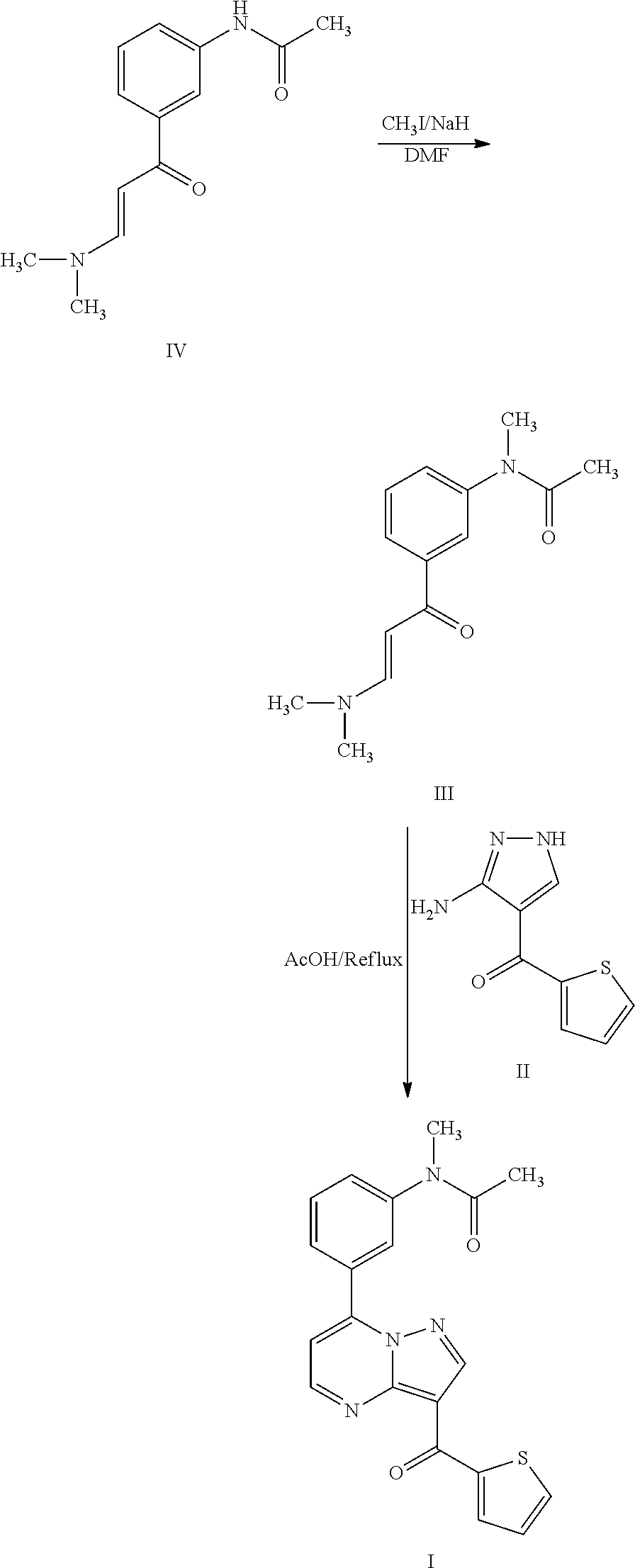
- U.S. Pat. No. 6,472,528 (the '528 patent) describes a process for the preparation of indiplon comprising an N-alkylation of an enaminone intermediate compound of formula IV, that is carried out with the use of dimethyl sulfate, a phase transfer catalyst (tetrabutyl ammonium sulfate) in the presence of benzoflouride and dichloromethane as solvents at a temperature below 40° C., to give the N-methylenaminone intermediate compound of formula III, as illustrated below; then followed by condensation with aminopyrazole intermediate compound of formula II using glacial acetic acid at reflux conditions to afford indiplon of formula I.
-

- U.S. Pat. No. 6,348,221 (the '221 patent) discloses that indiplon obtained according to U.S. Pat. No. 4,521,422 (example 1), exist as a mixture of polymorphic Form I and Form II. Neither patent teaches nor discloses the preparation of the polymorphic mixture or the ratio therewith.
- U.S. Pat. Nos. 6,348,221 and 6,544,999 disclose polymorphic Form I and Form II of indiplon. U.S. Pat. No. 6,903,106 discloses polymorphic Form III of indiplon.
- In the aforementioned processes previously discussed, the N-alkylation of the enaminone intermediate compound (IV) engages differing methodologies; where one process uses sodium hydride as a base and alternately, another process uses a phase transfer catalyst. The similarity of these processes affords the N-methylenaminone compound of formula III to be produced in yields of less than about 60% and purity levels of less than about 90%, which translates to a reduction in the overall yield of indiplon (I).
- Further, the usage of either sodium hydride as a base or phase transfer catalysts is disadvantageous, which stems from moisture sensitivity, safety concerns, storage issues, required quenching after use, which subsequently negates the suitability and feasibility of the process on an industrial scale.
- The '621 and '528 patents disclose the recovery of the target indiplon product from the reaction mixture using water and glacial acetic acid. However, neither the '621 patent or the '528 patent discloses the formation or presence of by-products; and their removal or separation from the target product, should they be formed.
- Potentially in acidic conditions the isomeric regioisomer impurity of indiplon may be formed in an amount of not less than 5%. The levels of impurity would make the product unacceptable to market. Additionally, said product to be marketable would require multiple purifications steps, thus rendering the process economically not feasible.
- Moreover, for a new drug product to gain marketing approval, manufacturers are mandated to submit to the regulatory authorities, evidence to show that the product is acceptable for human administration. Such a submission must include, among other things, analytical data to show the impurity profile of the product to demonstrate that the impurities are absent, or are present only at a negligible amount.
- Further, the U.S. Food and Drug Administration's Center for Drug Evaluation and Research (CDER) has promulgated guidelines recommending that new drug and generic drug applicants identify organic impurities of 0.1% or greater in the active ingredient. Unless an impurity is a human metabolite, has been tested for safety, or was present in a composition that was shown to be safe in clinical trials, the CDER further recommends that the drug applicant reduce the amount of the impurity in the active ingredient to below 0.1%. Thus, there is a need to isolate impurities in drug substances so that their pharmacology and toxicology can be studied.
- In light of the evolving and more rigorous requirements demanded of drug manufacturers and the prevailing disadvantages present with the prior art, there is a need for an improved process for the preparation of indiplon and its intermediates, which circumvents the usage of potentially hazardous chemicals, the likely formation of isomeric and other process-related impurities; while ensuring a target indiplon product with optimum yield and purity.
- The processes, herein described, for the preparation of indiplon and intermediates are simple, cost effective, eco-friendly and well suited on industrial scale.
- The present invention relates to processes for the preparation of indiplon and its polymorphic mixtures The present invention provides indiplon, having less than about 0.4% area of regioisomer impurity, as measured by HPLC.
- The present invention provides indiplon, prepared by the processes herein described, having a purity of at least about 99.0% as measured by HPLC.
- The present invention provides indiplon, prepared by the processes herein described, having a D50 and D90 particle size of less than about 50 microns.
- The present invention provides indiplon, prepared by the processes herein described, having a D50 and D90 particle size of less than about 10 microns.
- The present invention provides indiplon, prepared by the processes herein described, having no more than about 5000 ppm of acetone and ethanol, no more than about 3000 ppm of methanol, no more than about 1000 ppm of N,N-dimethylformamide, no more than about 600 ppm of dichloromethane, and/or no more than about 400 ppm of acetonitrile.
- The present invention provides indiplon, prepared by the processes herein described, having a specific surface area of from about 1 m2/g to about 15 m2/g as measured by Brunauer-Emmett-Teller (B.E.T)
- The present invention provides a process for preparing indiplon of formula I.
-

- comprising:
a) reacting a compound N-[3-[3-(dimethylamino)-1-oxo-2-propenyl]-phenyl]-acetamide of formula IV or salt thereof -

- with a base, capable of producing hydroxide ions and methylating agent in the presence of an organic solvent to form the compound N-[3-[3-(dimethylamino)-1-oxo-2-propenyl]-phenyl]-N-methylacetamide of formula III or a salt thereof
-

- b) reacting the compound of formula III with the compound (3-amino-1H-pyrazol-4-yl)-2-thienylmethanone of formula II or a salt thereof
-

- in the presence of an acid with a pka of below about 4 and an organic solvent.
- The present invention provides a process for purifying indiplon comprising:
- a) providing a solution of a indiplon, comprising a regioisomer impurity, in a solvent or a mixture of solvents or their aqueous mixtures and
b) precipitating the solid from the solution, and
c) recovering the solid to obtain indiplon substantially free of regioisomer. - The present invention provides a polymorphic mixture, comprising at least about 5 weight %, based on the total weight of the mixture, of polymorph Form I or polymorph Form II of indiplon, with remaining amount of the mixture being the other polymorph form of indiplon.
- The present invention provides a polymorphic mixture, comprising about 25 weight % to about 90 weight % of polymorph Form I of indiplon and about 75 weight % to about 10 weight % of polymorph Form II of indiplon.
- The present invention provides a polymorphic mixture, comprising about 40% of polymorph Form I of indiplon and about 60% of polymorph Form II of indiplon.
- The present invention provides a polymorphic mixture, comprising about 70% of polymorph Form I of indiplon and about 30% of polymorph Form II of indiplon.
- The present invention provides a polymorphic mixture, comprising about 75% of polymorph Form I of indiplon and about 25% of polymorph Form II of indiplon.
- The present invention provides a process for the preparation of a mixture of polymorphic Form I and II of indiplon, comprising:
- a) providing a solution of a indiplon, in a solvent or a mixture of solvents or their aqueous mixtures,
b) precipitating the solid from the solution, and
c) isolating the polymorphic mixture - The present invention provides a polymorphic mixture of indiplon, prepared by the processes herein described, having a D50 and D90 particle size of less than about 50 microns.
- The present invention provides a polymorphic mixture of indiplon, prepared by the processes herein described, having a D50 and D90 particle size of less than about 10 microns.
- The present invention provides indiplon, prepared by the processes herein described, having no more than about 5000 ppm of acetone and ethanol, no more than about 3000 ppm of methanol, no more than about 1000 ppm of N,N-dimethylformamide, no more than about 600 ppm of dichloromethane, and/or no more than about 400 ppm of acetonitrile.
- The present invention provides a pharmaceutical composition comprising indiplon obtained by the processes herein described, and at least a pharmaceutically acceptable carrier.
-
FIG. 1 . Scanning Electron Micrograph (SEM) of indiplon crystal particles obtained by the process of present invention. -
FIG. 2 . Differential Scanning calorimetry (DSC) thermogram of polymorphic mixture Form I and Form II of indiplon prepared by example 11. -
FIG. 3 . X-ray powder diffraction (XRPD) spectrum of polymorphic mixture Form I and Form II of indiplon prepared by example 11. -
FIG. 4 . Differential Scanning Calorimetry (DSC) thermogram of polymorphic mixture Form I and Form II of indiplon prepared by example 12. -
FIG. 5 . Differential Scanning Calorimetry (DSC) thermogram of polymorphic mixture Form I and Form II of indiplon prepared by example 14. - The present invention is directed to processes for the synthesis of indiplon and its polymorphic mixtures.
- Present health care reforms and legislation lead to evolving and increasingly rigorous requirements demanded of drug manufacturers. Subsequent therefrom and coupled with prevailing disadvantages, which may be present with the prior art processes, paves opportunities for improved processes for the preparation of indiplon and its intermediates, which could circumvent the formation of process related impurities, while ensuring a target indiplon product with optimum yield and purity.
- The present invention provides a cost effective industrial process for the preparation of indiplon or intermediates thereof.
- In one embodiment, the present invention provides indiplon, having less than about 0.40% area of regioisomer impurity, as measured by high performance liquid chromatography (HPLC).
- The present invention provides indiplon, prepared by the processes herein described, having a purity of at least about 99.0% as measured by HPLC.
- The present invention provides a process for preparing indiplon of formula I,
-

- comprising:
a) reacting a compound N-[3-[3-(dimethylamino)-1-oxo-2-propenyl]-phenyl]-acetamide of formula IV or salt thereof -

- with a base capable of producing hydroxide ions and methylating agent in the presence of an organic solvent to form the compound N-[3-[3-(dimethylamino)-1-oxo-2-propenyl]-phenyl]-N-methylacetamide of formula III or a salt thereof
-

- b) reacting the compound of formula III with the compound 3-amino-1H-pyrazol-4-yl)-2-thienylmethanone of formula II or a salt thereof
-

- in the presence of an acid with a pka of below about 4 and an organic solvent.
- In a) of the process directly described above, the base that can be used which is capable of providing hydroxide ions is selected from alkali metal hydroxides such as sodium hydroxide, potassium hydroxide, lithium hydroxide and the like; alkaline earth metal hydroxides such as magnesium hydroxide, calcium hydroxide and the like; ammonium hydroxide and mixtures thereof and their aqueous or alcoholic mixtures. The alkali and alkaline metal alkoxides, alkali and alkaline metal carbonates and bicarbonates are also contemplated, preferably potassium hydroxide.
- The organic solvent include but are not limited to halogenated solvents such as dichloromethane, ethylene dichloride, chloroform and the like; esters solvent such as ethyl acetate, isopropyl acetate and the like; nitriles such as acetonitrile, propionitrile and the like; ethers such as tetrahydrofuran, 1,4-dioxane and the like; aprotic polar solvents such as N,N-dimethyl formamide, dimethyl sulfoxide, dimethyl acetamide, N-methyl-2-pyrrolidone, hexamethyl phosphoric triamide and mixtures thereof in various proportions without limitation. Preferably, N,N-dimethyl formamide (DMF).
- Further, the methylating agents that can be used include, but are not limited to, methyl iodide, dimethyl sulphate and the like. Preferably, methyl iodide.
- The temperatures for carrying out the reaction in a) can be from about 25° C. to about 40° C. Preferably, from about 25° C. to about 30° C.
- The reaction time for the completion of reaction can be from about 30 minutes to about 5 hours. Preferably, about 30 minutes.
- The amount of base employed in a) is from about an equimolar amount to about 5 times the equimolar amount with respect to the starting material of formula IV. Preferably an equimolar amount.
- Optionally, when an excess base, which may be either an aqueous or an alcoholic mixture is employed, this, then, may additionally serve as the solvent.
- The acid that can be used in b) above in the reaction of compound of formula III and compound of formula II include, but are not limited to acids having the pka of below about 4 such as hydrochloric acid, hydrobromic acid, hydroiodic acid, nitric acid, sulfuric acid, phosphoric acid, citric acid, formic acid, oxalic acid, maleic acid, succininc acid, benzoic acid, ascorbic acid, paratoluene sulfonic acid, methane sulfonic acid, and the like; and their aqueous mixtures thereof. Preferably, phosphoric acid or maleic acid or hydrochloric acid is being used.
- The solvent in b) that can used include, but not limited to, a water miscible alcohol such as methanol, ethanol, isopropanol, n-butanol and the like; ketone such as acetone, methyl ethyl ketone, methyl isobutyl ketone and the like; nitrile such as acetonitrile, propionitrile and the like; and mixtures thereof in various proportions without limitation. Preferably, methanol or ethanol is used.
- The temperatures for carrying out the reaction in b) can be from about 25° C. to about 50° C. Preferably from about 25° C. to about 35° C. More preferably from about 25° C. to 30° C.
- The time required for the completion of reaction in b) can be from about 30 minutes to about 15 hours. Preferably from about 5 to 10 hours.
- Typically, the molar amount of compound of formula II may be about 1 to about 2 times the molar amount of the compound of formula III. Preferably about 1 molar equivalent. While the molar equivalents of acid used may be about 1 to about 10 times the molar amount of the compound of formula III. Preferably, about 5 molar equivalents.
- Optionally the reaction in b) is carried out in the absence of solvents, i.e., in neat conditions by employing an excess of aqueous acid.
- Optionally the reaction in b) is carried without isolation of intermediates, i.e., can be carried out by one pot synthesis.
- After completion of the reaction, the desired compounds of either or both formula III and formula I can be obtained from the reaction mixture by conventional means known to one of skilled in the art. Should the target compounds be produced immediately in the form of crystals, these can be optionally separated by filtration. Alternatively, a suitable recovery procedure optionally comprises: adding water; neutralizing the mixture, if necessary; extracting the mixture with a water-immiscible organic solvent; drying the extract; and distilling the solvent off. The product thus obtained can be, optionally further purified by conventional means, such as recrystallization or chromatographic separation techniques, for example preparative thin layer chromatography or column chromatography, notably column chromatography. Preferably by recrystallization.
- The compounds of formulae IV and II can be prepared according to the methods described in U.S. Pat. Nos. 6,399,521 and 7,034,154, which are incorporated herein by reference, in their entirety.
- The present invention, the processes are optionally carried out in situ; or by one pot synthesis.
- The present invention, a compound of formulae IV or I is optionally purified by re-crystallization using a solvent or mixture of solvents.
- The present invention, a compound of formulae IV or I is purified optionally by converting into a pharmaceutically acceptable salt.
- In an embodiment, the present invention provides a process for purifying indiplon comprising:
- a) providing a solution of a indiplon comprising regioisomer in a solvent or a mixture of solvents or their aqueous mixtures, and
b) precipitating the solid from the solution, and
c) recovering the solid to obtain indiplon substantially free of regioisomer. - The solvents that can be used in a) of the process directly described above, for the dissolution of indiplon is selected from a C1-C5 alcohol, a C2-C9 ester, a C3-C9 ketone, a C3-C5 carbonate, nitriles, ethers, hydrocarbon solvents and halogenated derivatives thereof, acetic acid, dimethylformamide (DMF), dimethylacetamide (DMAC), N-methylpyrrolidine, formamide, N-methylacetamide, N-methylformamide, dimethylsulfoxide (DMSO), ethylformate, sulfonate, N,N-dimethylpropionamide, nitromethane, nitrobenzene, and hexamethylphosphoramide, and mixtures thereof and mixtures of said organic solvents and water. Preferably acetone, acetonitrile, propionitrile, hexane, methanol, ethanol, isopropanol, diethyl ether, ethyl acetate, isobutyl acetate, dichloromethane, tetrahydrofuran, dimethyl formamide, dimethylsulfoxide, nitromethane and mixtures thereof and mixtures of said organic solvents and water. Preferably DMSO, nitromethane, isopropanol, isobutanol, methylethyl ketone, 1,4-dioxane, ethylene glycol, diethylene glycol dimethyl ether, hexane, dichloromethane and mixtures thereof and mixtures of said organic solvents and water. The C1-C5 are selected from methanol, ethanol, n-propanol, isopropanol, n-butanol, isobutanol, 2-butanol and the like; C2-C9 ester are selected from methyl acetate, ethyl acetate, isopropyl acetate, isobutyl acetate, n-butyl acetate, t-butyl acetate and the like; C3-C9 ketone are selected from acetone, 2-butanone, methylethyl ketone, ethylmethyl ketone, isopropylmethyl ketone, methyl isobutyl ketone and the like; C3-C5 carbonate are selected from dimethyl carbonate, diethyl carbonate and the like; nitriles are selected from acetonitrile, propionitrile and the like.
- The ethers are selected from diethyl ether, dimethyl ether, dimethoxymethane, dimethoxypropane, isopropyl ether, di-isopropyl ether, methyl t-butyl ether, tetrahydrofuran (THF), dioxane, furan, ethylene glycol dimethyl ether, ethylene glycol diethyl ether, diethylene glycol dimethyl ether, diethylene glycol diethyl ether, anisole and the like. Hydrocarbon solvents and halogenated derivatives thereof, are selected from pentane, hexane, heptane, cyclohexane, petroleum ether, toluene, benzene, cycloheptane, methylcyclohexane, ethylbenzene, m-, o-, or p-xylene, octane, indane, nonane, dichloromethane (MDC), chloroform, carbon tetrachloride, 1,2-dichloroethane and the like.
- The temperature for dissolution can range from about 25° C. to about 100° C. or reflux temperatures of the solvents used. Preferably at about 30° C.
- The time period for dissolution can be range from about 30 minutes to about 5 hours. Preferably, 1 hour.
- The solution obtained is optionally filtered through celite or diatomaceous earth to separate the extraneous matter present or formed in the solution by using conventional filtration technique known in the art.
- The precipitation of solid in b) above is achieved but not limited to evaporation, cooling, drying and the like. Preferably, by cooling.
- The temperature range for precipitation of solid can be from about −10° C. to about 30° C. Preferably about 30° C.
- The time period for complete precipitation of solid can range from about 30 minutes to about 5 hours. Preferably 1 hour.
- The obtained indiplon of formula I can be dried can be from about 25° C. to about 75° C., preferably at 50° C. and at reduced pressure of about e.g. 5 to 20 mbar, for a period of about 1 to about 10 hours. Preferably 1 hour.
- In another embodiment, the present invention provides a polymorphic mixture, comprising at least about 5 weight %, based on the total weight of the mixture, of polymorph Form I or polymorph Form II of indiplon, with remaining amount of the mixture being the other polymorph form of indiplon.
- The present invention provides a polymorphic mixture, comprising at least about 10 weight %, based on the total weight of the mixture, of polymorph Form I or polymorph Form II of indiplon, with remaining amount of the mixture being the other polymorph form of indiplon.
- The present invention provides a polymorphic mixture, comprising at least about 15 weight %, based on the total weight of the mixture, of polymorph Form I or polymorph Form II of indiplon, with remaining amount of the mixture being the other polymorph form of indiplon.
- The present invention provides a polymorphic mixture, comprising at least about 20 weight %, based on the total weight of the mixture, of polymorph Form I or polymorph Form II of indiplon, with remaining amount of the mixture being the other polymorph form of indiplon.
- The present invention provides a polymorphic mixture, comprising at least about 25 weight %, based on the total weight of the mixture, of polymorph Form I or polymorph Form II of indiplon, with remaining amount of the mixture being the other polymorph form of indiplon.
- The present invention provides a polymorphic mixture, comprising about 25 weight % to about 90 weight % of polymorph Form I of indiplon and about 75 weight % to about 10 weight % of polymorph Form II of indiplon.
- The present invention provides a polymorphic mixture, comprising about 80 weight % (±5%) of polymorph Form I of indiplon and about 20 weight % (±5%) of polymorph Form II of indiplon
- The present invention provides a polymorphic mixture, comprising about 70 weight % (±5%) of polymorph Form I of indiplon and about 30 weight % (±5%) of polymorph Form II of indiplon
- The present invention provides a polymorphic mixture, comprising about 60 weight % (±5%) of polymorph Form I of indiplon and about 40 weight % (±5%) of polymorph Form II of indiplon.
- The present invention provides a polymorphic mixture, comprising about 50 weight % (±5%) of polymorph Form I of indiplon and about 50 weight % (±5%) of polymorph Form II of indiplon.
- The present invention provides a polymorphic mixture, comprising about 40 weight % (±5%) of polymorph Form I of indiplon and about 60 weight % (±5%) of polymorph Form II of indiplon.
- The present invention provides a polymorphic mixture, comprising about 30 weight % (±5%) of polymorph Form I of indiplon and about 70 weight % (±5%) of polymorph Form II of indiplon.
- The present invention provides a polymorphic mixture, comprising about 40% of polymorph Form I of indiplon and about 60% of polymorph Form II of indiplon.
- The present invention provides a polymorphic mixture, comprising about 70% of polymorph Form I of indiplon and about 30% of polymorph Form II of indiplon.
- The present invention provides a polymorphic mixture, comprising about 75% of polymorph Form I of indiplon and about 25% of polymorph Form II of indiplon.
- In yet another embodiment, the present invention provides a process for the preparation of a mixture polymorphic Form I and II of indiplon, comprising:
- a) providing a solution of a indiplon, in a solvent or a mixture of solvents or their aqueous mixtures,
b) precipitating the solid from the solution, and
c) isolating the polymorphic mixture - The solvent that can be used include but are not limited to C1-C5 alcohol, a C2-C9 ester, a C3-C9 ketone, a C3-C5 carbonate, nitriles, ethers, hydrocarbon solvents and halogenated derivatives thereof, acetic acid, dimethylformamide (DMF), dimethylacetamide (DMAC), N-methylpyrrolidine, formamide, N-methylacetamide, N-methylformamide, dimethylsulfoxide (DMSO), ethylformate, sulfonate, N,N-dimethylpropionamide, nitromethane, nitrobenzene, and hexamethylphosphoramide, and mixtures thereof and mixtures of said organic solvents and water. Preferably DMSO, nitromethane, isopropanol, isobutanol, methylethyl ketone, 1,4-dioxane, ethylene glycol, diethylene glycol dimethyl ether, tetrahydrofuran, hexane, dichloromethane and mixtures thereof and mixtures of said organic solvents and water. The C1-C5 alcohol include methanol, ethanol, n-propanol, isopropanol, n-butanol, isobutanol, 2-butanol and the like; C2-C9 ester include methyl acetate, ethyl acetate, isopropyl acetate, isobutyl acetate, n-butyl acetate, t-butyl acetate and the like; C3-C9 ketone acetone, 2-butanone, methylethyl ketone, ethylmethyl ketone, isopropylmethyl ketone, methyl isobutyl ketone and the like; C3-C5 carbonate includes dimethyl carbonate, diethyl carbonate and the like; nitriles such as acetonitrile, propionitrile and the like. The ethers include diethyl ether, dimethyl ether, dimethoxymethane, dimethoxypropane, isopropyl ether, di-isopropyl ether, methyl t-butyl ether, tetrahydrofuran (THF), dioxane, furan, ethylene glycol dimethyl ether, ethylene glycol diethyl ether, diethylene glycol dimethyl ether, diethylene glycol diethyl ether, anisole and the like. Hydrocarbon solvents and halogenated derivatives thereof, may include pentane, hexane, heptane, cyclohexane, petroleum ether, toluene, benzene, cycloheptane, methylcyclohexane, ethylbenzene, m-, o-, or p-xylene, octane, indane, nonane, dichloromethane (MDC), chloroform, carbon tetrachloride, 1,2-dichloroethane and the like.
- If desired, pure indiplon obtained by the process of the present invention and having a purity of at least 99%, as determined by HPLC, can be further recrystallized from a solvent, preferably from methanol, ethanol, or a reaction medium of water and a co-solvent such as methanol, ethanol, acetonitrile and the like in order to produce a drug substance that complies with regulatory requirements.
- The regioisomer of indiplon is represented by formula V
-

- Formation of N-(3-[3-[2-thienylcarbonyl]-pyrazol-[1,5-a]pyrimidin-5-yl]phenyl)N-methylacetamide of formula V, regioisomer of indiplon, has been identified as a main impurity in the synthesis of indiplon starting from 3-amino-1H-pyrazol-4-yl)-2-thienylmethanone and N-[3-[3-(dimethylamino)-1-oxo-2-propenyl]-phenyl]-N-methylacetamide. The amount of this impurity has been found to be strongly dependent on the reaction conditions.
- Apart from the regioisomer described above, the following process related impurities may be formed which are NMT 0.5% area by HPLC in total in the final product indiplon.
-

- Indiplon obtained by the process of present invention has the purity of at least about 99.0 area % as measured by HPLC.
- In another embodiment, the present invention provides indiplon of formula I, characterized by HPLC having a purity of at least about 99.0% and containing total impurities of about NMT 1.0%.
- In yet another embodiment, indiplon obtained by the process described herein has a residual organic solvent content of less than the amount recommended for pharmaceutical products, as set forth for example in ICH guidelines and U.S. pharmacopoeia; i.e., less than about 600 ppm of dichloromethane, less than about 1000 ppm of N,N-dimethyl formamide, less than about 5000 ppm of ethanol, less than about 3000 ppm of methanol, less than about 5000 ppm of acetone and less than about 400 ppm of acetonitrile.
- Crystal particles of indiplon used herein has the surface area of about 1 to about 15 m2/g as measured by B.ET (Brunauer-Emmett-Teller). Preferably from about 1 to about 5 m2/gm. The mean particle size of about 5 to about 50 μm. Preferably of about 5 to about 20 μm.
-
S. No. Test Results 1 Description Yellow coloured powder 2 Sulphated ash 0.05% 3 Related Impurity by * Impurity A: Not detected HPLC **Impurity B: Below detection limit. Single maximum impurity: 0.86% Total impurities: 0.96% 4 TGA 0.2725% sample weight lost up to 100° C. 5 Particle size d(0.1) 4.949 μm Distribution d(0.5) 11.641 μm d(0.9) 24.325 μm 6 Bulk Density As such = 0.24 g/ml After tapping (750) = 0.47 g/ml as per USP method I 6 SEM (Scanning Plate shape crystals electron microscope) 7 Surface area by BET 1.41 m2/gm Impurity A: (3-Amino-1H-pyrazole-4-yl)-2-thienylmethanone. Impurity B: N-[3-(3-Dimethylamino)-1-oxo-2-propenyl]phenyl]-N-methylacetamide. - As used herein, the term “μm” refers to “micrometer” which is 1×10⁻⁶ meter.
- As used herein, “crystalline particles” means any combination of single crystals, aggregates and agglomerates.
- As used herein “Particle Size Distribution (P.S.D.)” means the cumulative volume size distribution of equivalent spherical diameters as determined by laser diffraction at 1 bar dispersive pressure in Sympatec Helos equipment.
- “Mean particle size distribution, i.e., d (0.5)” correspondingly, means the median of said particle size distribution.
- Specific surface area is defined in units of square meters per gram (m2/g). It is usually measured by nitrogen absorption analysis. In this analysis, nitrogen is absorbed on the surface of the substance. The amount of the absorbed nitrogen (as measured during the absorption or the subsequent desorption process) is related to the surface area via a formula known as the B. ET. formula.
- Specific surface area of an active pharmaceutical ingredient may be affected by various factors. There is an inverse relationship between specific surface area and particle size distribution The available surface area for drug dissolution correlates to the rate of dissolution and solubility where a greater surface area enhances the solubility of a drug and enhances the rate of dissolution of a drug, which, in effect may improve the drug's bioavailability and potentially its toxicity profiles. The lack of solubility of indiplon creates a problem since the bioavailability of a water insoluble active ingredient is usually poor. Thus there is a need in the art to prepare active pharmaceutical ingredients such as indiplon with a high surface area to obtain formulations with greater bioavailability, and to compensate for any loss of surface area before formulation.
- The particle size can be determined by such techniques as, for example, Malvern light scattering, a laser light scattering technique, etc., while herein, used Malvern Mastersizer 2000. It is noted the notation Dx means that X % of the particles have a diameter less than a specified diameter D. The particle sizes of the Indiplon can be obtained by, for example, any milling, grinding, micronizing or other particle size reduction method known in the art to bring the solid state indiplon any of the foregoing desired particle size range.
- The present invention provides a pharmaceutical composition comprising indiplon obtained by the process of present invention and suitable pharmaceutical carriers. The pharmaceutical compositions may be administered to a mammalian patient in any dosage form, e.g., liquid, powder, elixir, injectable solution, etc. Dosage forms may be adapted for administration to the patient by oral, buccal, parenteral, ophthalmic, rectal and transdermal routes. Oral dosage forms include, but are not limited to, tablets, pills, capsules, troches, sachets, suspensions, powders, lozenges, elixirs and the like. The pharmaceutical compositions comprising indiplon or its pharmaceutically acceptable salts, obtained by the process disclosed herein, and suitable pharmaceutical carriers also may be administered as suppositories, ophthalmic ointments and suspensions, and parenteral suspensions, where the most preferred route of administration is oral.
- Capsule dosages will contain the indiplon or its pharmaceutically acceptable salts which may be coated with gelatin. Tablets and powders may also be coated with an enteric coating. The enteric-coated powder forms may have coatings comprising phthalic acid cellulose acetate, hydroxypropylmethyl cellulose phthalate, polyvinyl alcohol phthalate, carboxymethylethyl-cellulose, a copolymer of styrene and maleic acid, a copolymer of methacrylic acid and methyl methacrylate, and like materials, and if desired, they may be employed with suitable plasticizers and/or extending agents. A coated tablet may have a coating on the surface of the tablet or may be a tablet comprising a powder or granules with an enteric-coating.
- Tableting compositions may have few or many components depending upon the tableting method used, the release rate desired and other factors. For example, the compositions of the present invention may contain diluents such as cellulose-derived materials like powdered cellulose, microcrystalline cellulose, microfine cellulose, methyl cellulose, ethyl cellulose, hydroxyethyl cellulose, hydroxypropyl cellulose, hydroxypropylmethyl cellulose, carboxymethyl cellulose salts and other substituted and unsubstituted celluloses; starch; pregelatinized starch; inorganic diluents such calcium carbonate and calcium diphosphate and other diluents known to one of ordinary skill in the art. Other suitable diluents include waxes, sugars (e.g. lactose) and sugar alcohols like mannitol and sorbitol, acrylate polymers and copolymers, as well as pectin, dextrin and gelatin.
- Other excipients contemplated by the present invention include binders, such as acacia gum, pregelatinized starch, sodium alginate, glucose and other binders used in wet and dry granulation and direct compression tableting processes; disintegrants such as sodium starch glycolate, crospovidone, low-substituted hydroxypropyl cellulose and others; lubricants like magnesium and calcium stearate and sodium stearyl fumarate; flavorings; sweeteners; preservatives; pharmaceutically acceptable dyes and glidants such as silicon dioxide.
- The process for the preparation of indiplon or its pharmaceutically acceptable salts of hydrochloride of the present invention are simple, eco-friendly and easily scaleable.
- The following examples are provided to enable one skilled in the art to practice the invention and are merely illustrative of the invention. The examples should not be read as limiting the scope of the invention as defined in the features and advantages.
- To a suspension of N-[3-[3-(dimethylamino)-1-oxo-2-propenyl]-phenyl]-acetamide (50 gm) in anhydrous dimethylformamide (258 ml) under nitrogen in an ice-bath was added sodium hydride (60% suspension in mineral oil)-(10.76 gm) and within about 15 minutes, it was observed that gas formation ceased. To the above reaction mixture is added a solution of methyl iodide (32.17 gm). The reaction mixture is stirred overnight and allowed to warm to room temperature. The reaction mass is then triturated with n-hexane (3×340 ml) which is discarded. The reaction mixture is then poured in ice water and extracted with methylene dichloride (3×45 ml). The organic layer is dried on sodium sulfate and evaporated to give a solid, which is triturated with a solution of n-hexane-ethyl acetate (1:1,453 ml) to give a solid product (22 gm) (Purity, ˜90%, by thin-layer chromatography, TLC)
- To a suspension of N-[3-[3-(dimethylamino)-1-oxo-2-propenyl]-phenyl]-acetamide (230 gm) in dimethylformamide (1150 ml) was added powdered potassium hydroxide (110.90 gm) and the reaction mixture was stirred at about 25° C.-30° C. for about 30 min. The reaction mass was cooled to about 0° C.-5° C. and methyl iodide (154.67 gm) was added in about 30 min at about the same temperature. After complete addition, the temperature was allowed to rise to about 20° C.-25° C., and while stirring, the reaction mass at about the same temperature until the reaction is completed (˜3 hrs) as monitored via thin-layer chromatography (TLC). To the reaction mass was added methylene chloride (500 ml) and water (500 ml), separated the organic layer and the aqueous layer was extracted with 2×500 ml methylene chloride. The combined organic layers were washed with 3×500 ml water, the subsequent organic layer was dried over sodium sulfate and concentrated to dryness to give a yellow colored solid, which was triturated with n-hexane (700 ml), filtered and dried at about 50° C. until a constant weight to give a solid product (190 gm) (Purity, ˜>95%, by TLC).
- A mixture of (3-Amino-1H-pyrazol-4-yl)-2-thienylmethanone (10 gm) and N-[3-(dimethylamino)-1-oxo-2-propenyl]-phenyl]-N-methyl acetamide (12.5 gm) in glacial acetic acid (180 ml) was refluxed for about 6 hrs, and the progress of the reaction was monitored by TLC. The reaction mass was concentrated to obtain a residue, which was treated with methylene chloride (45 ml) and triturated with n-hexane (180 ml). The precipitated product was filtered, washed with a mixture of methylene chloride and n-hexane (1:1, 90 ml) and dried under vacuum to obtain 18 gm of the title compound. Purity by HPLC: 94.88%.
- A mixture of (3-Amino-1H-pyrazol-4-yl)-2-thienylmethanone (110 gm) and N-[3-(dimethylamino)-1-oxo-2-propenyl]-phenyl]-N-methyl acetamide (140.22 gm) in glacial acetic acid (880 ml) was refluxed for about 6 hrs, and the progress of the reaction was monitored by TLC. The reaction mass was concentrated to obtain a residue, which was treated with acetone (440 ml) and stirred the precipitate for about 2 hrs at about 25-30°. The precipitated product was filtered, washed with acetone (110 ml) and dried in vacuum to obtain 175 gm of crude indiplon. Crude Indiplon (160 gm) was dissolved in acetone (6400 ml) at reflux temperature and DM water (3200 ml) was added in about 30 min. and cooled the reaction mass at about room temperature gradually and cooled at about 10-15° C., seeded with indiplon and stirred the precipitate for about 1 hr at about 10-15°. The precipitated product was filtered, washed with acetone (160 ml) and dried in vacuum to obtain 70 gm of the title compound. Crude Indiplon (35 gm) was dissolved in acetone (1750 ml) at the reflux temperature and DM water (875 ml) was added in about 30 min. and cooled the reaction mass at about room temperature gradually and cooled at about 10-15° C. and seeded with indiplon and stirred the precipitate for about 1 hr at about 10-15°. The precipitated product was filtered, washed with acetone (70 ml) and dried in vacuum to obtain 13 gm of the title compound. Regioisomer content is about 0.35%.
- N-[3-(Dimethylamino)-1-oxo-2-propenyl]-phenyl]-N-methylacetamide (2.5 gm, 0.010 mole) and (3-Amino-1H-pyrazol-4-yl)-2-thienylmethanone (2.0 gm, 0.010 mole) were dissolved in a mixture of water (30 ml), ethanol (15 ml) and phosphoric acid (0.79 gm, 0.0081 mol) and stirred for ˜10 hrs at room temperature, the progress of the reaction was monitored by TLC. After the completion of the reaction, the reaction mass was filtered, then washed with water (10 ml) and acetone (10 ml). The wet solid obtained was further dried at 50° C. under vacuum to give 2.52 gm of the title compound. Purity by HPLC: 99.14%.
- N-[3-(Dimethylamino)-1-oxo-2-propenyl]-phenyl]-N-methyl acetamide (2.5 gm, 0.010 mol) and (3-Amino-1H-pyrazol-4-yl)-2-thienylmethanone (2.0 gm, 0.010 mol) were dissolved in a mixture of water (30 ml), methanol (15 ml) and ˜34% w/w, aq. hydrochloric acid (0.96 gm, 0.012 mol) and stirred for ˜10 hrs at room temperature, the progress of the reaction was monitored by TLC. After the completion of the reaction, the reaction mass was filtered, washed with water (10 ml) and acetone (10 ml). The wet solid obtained was further dried at 50° C. under vacuum to give 2.62 gm of the title compound. Purity by HPLC: 98.79%.
- N-[3-(Dimethylamino)-1-oxo-2-propenyl]-phenyl]-N-methylacetamide (2.5 gm, 0.010 mol) and (3-Amino-1H-pyrazol-4-yl)-2-thienylmethanone (2.0 gm, 0.010 mole) were dissolved in formic acid (20 ml) and stirred at reflux temperature for ˜4 hrs, the progress of the reaction was monitored by TLC. After the completion of the reaction, the reaction mass was concentrated, the residue was triturated with acetone (20 ml) and filtered, washed with acetone (10 ml), the wet solid obtained was further dried at 45° C.-50° C. under vacuum to give 2.50 gm of the title compound. Purity by HPLC: 98.82%.
- N-[3-(Dimethylamino)-1-oxo-2-propenyl]-phenyl]-N-methyl acetamide (5 gm, 0.020 mole) and (3-Amino-1H-pyrazol-4-yl)-2-thienylmethanone (4 gm, 0.020 mole) were dissolved in a mixture of water (54 ml), ethanol (31 ml) and citric acid (3.84 gm, 0.020 mol) and stirred for about 12 hrs at room temperature, and the progress of reaction was monitored by TLC. After completion of the reaction, the reaction mass was filtered, washed with a mixture of ethanol and water (1:1,24 ml). The wet solid obtained was further dried at about 50° C. under vacuum to give 5.30 gms of the title compound. Purity by HPLC: 99.10%.
- N-[3-(Dimethylamino)-1-oxo-2-propenyl]-phenyl]-N-methyl acetamide (5 gm, 0.020 mole) and (3-Amino-1H-pyrazol-4-yl)-2-thienylmethanone (4 gm, 0.020 mole) were dissolved in a mixture of water (54 ml), ethanol (3 ml) and maleic acid (2.40 gm, 0.020 mol) and stirred for about 12 hrs at room temperature, and the progress of the reaction was monitored by TLC. After completion of reaction, the reaction mass was filtered, washed with a mixture of ethanol and water (1:1, 24 ml). The wet solid obtained was further dried at about 50° C. under vacuum to give 5.40 gms of the title compound. Purity by HPLC: 99.24%.
- N-[3-(Dimethylamino)-1-oxo-2-propenyl]-phenyl]-N-methyl acetamide (5 gm, 0.020 mole) and (3-Amino-1H-pyrazol-4-yl)-2-thienylmethanone (4 gm, 0.020 mole) were dissolved in a mixture of water (54 ml), ethanol (31 ml) and oxalic acid dihydrate (2.60 gm, 0.020 mol) and stirred for ˜12 hr at room temperature and the progress of the reaction was monitored by TLC. After completion of reaction, the reaction mass was filtered and washed with a mixture of ethanol and water (1:1, 24 ml). The wet solid obtained was further dried at 50° C. under vacuum to afford 5.10 gms of the title compound. Purity by HPLC: 98.62%.
- A mixture of (3-Amino-1H-pyrazol-4-yl)-2-thienylmethanone (12 gm) and N-[3-(dimethylamino)-1-oxo-2-propenyl]-phenyl]-N-methyl acetamide (15.29 gm) in glacial acetic acid (624 ml) was refluxed for about 6 hrs, and the progress of the reaction was monitored by TLC. The reaction mass was concentrated to obtain a residue, which was treated with methylene chloride (120 ml) and added saturated sodium bicarbonate solution and adjusted the pH to about 7.0 Stirred and separated organic layer and dried over sodium sulphate filtered and refluxed at the reflux temperature and added hexane (108 ml) at the reflux temperature, stirred and maintained reflux for about 15-20 min and cooled to about 25-30° C. and then cooled it to about 0° C. The precipitated product was filtered, dried in vacuum to obtain 16 gm of about 85% of Form I of indiplon and about 15% of Form II of indiplon. Purity by HPLC: 97.09%.
- Crude indiplon (4 gm) was dissolved in tetrahydrofuran (120 ml) at about the reflux temperature and filtered the solution and n-hexane (100 ml) was added, stirred the precipitate for about 30 min at about 80° C., gradually cooled the slurry mass at about 0-5° C. and stirred for about 1 hr at about the same temperature. The precipitated product was filtered, washed with n-hexane (4 ml) and dried in vacuum to obtain 3.5 gm of about 40% of Form I of indiplon and about 60% of Form II of indiplon.
- Crude indiplon (2 gm) was dissolved in methylene chloride (20 ml) at reflux temperature and was added n-hexane (6.0 ml) in about 10 min. and gradually cooled the reaction mass at about room temperature and thereafter cooled at about 0-5° C. and stirred for about 15 min. To the solution, 2.0 ml n-hexane was added and stirred the precipitate for about 15 min at about 0-5°. The precipitated product was filtered, washed with hexane (2 ml) and dried in vacuum to obtain 0.9 gm of about 75% of Form I of indiplon and about 25% of Form II of indiplon.
- Crude indiplon (2 gm) was dissolved in methylethylketone (100 ml) at about the reflux temperature and stirred for about 30 min at about 80° C., gradually cooled the reaction mass to about room temperature and stirred the precipitate for about 1 hr at about 25-30° C. The precipitated product was filtered, washed with methylethylketone (6 ml) and dried in vacuum to obtain 1.5 gm of about 70% of Form I of indiplon and about 30% of Form II of indiplon.
Claims (9)
1. Indiplon having less than about 0.4% area of regioisomer impurity as measured by HPLC.
2. The compound of claim 1 , having a D50 and D90 particle size of less than about 50 microns.
3. The compound of claim 2 , having a D50 and D90 particle size of less than about 10 microns.
4. The compound of claim 1 , further having a specific surface area of from about 1 m2/g to about 15 m2/g as measured by Brunauer-Emmett-Teller (B.E.T).
5. A process for the preparation of indiplon of formula I,

comprising:
a) reacting a compound N-[3-[3-(dimethylamino)-1-oxo-2-propenyl]-phenyl]-acetamide of formula IV or salt thereof

with a base capable of producing hydroxide ions and a methylating agent in the presence of an organic solvent to form the compound N-[3-[3-(dimethylamino)-1-oxo-2-propenyl]-phenyl]-N-methylacetamide of formula III or a salt thereof

b) reacting the compound of formula III with the compound 3-amino-1H-pyrazol-4-yl)-2-thienylmethanone of formula II or a salt thereof

in the presence of an acid with a pKa of below about 4 in an organic solvent.
6. The process of claim 5 , wherein the base capable of providing hydroxide ions is selected from the group comprising of alkali metal hydroxides such as sodium hydroxide, potassium hydroxide or lithium hydroxide, and alkaline earth metal hydroxides such as magnesium hydroxide, calcium hydroxide and mixtures thereof.
7. The process of claim 5 , wherein the acid with a pKa of below about 4 is selected from hydrochloric acid, hydrobromic acid, hydroiodic acid, nitric acid, sulfuric acid, phosphoric acid, citric acid, formic acid, oxalic acid, maleic acid, succinic acid, benzoic acid, ascorbic acid, paratoluenesulfonic acid, methane sulfonic acid, and their aqueous mixtures thereof.
8. The process of claim 5 , wherein the organic solvent used in the reaction of compound of formula IV with the base is a selected from halogenated solvents, dichloromethane, ethylene dichloride, chloroform, esters solvents ethyl acetate, isopropyl acetate, nitriles, acetonitrile, propionitrile, ethers tetrahydrofuran, 1,4-dioxane, aprotic polar solvents, N,N-dimethyl formamide, dimethyl sulfoxide, dimethylacetamide, N-methyl-2-pyrrolidone, hexamethyl phosphoric triamide and mixtures thereof.
9-19. (canceled)
Applications Claiming Priority (3)
| Application Number | Priority Date | Filing Date | Title |
|---|---|---|---|
| IN689/MUM/2009 | 2009-03-24 | ||
| IN689MU2009 | 2009-03-24 | ||
| PCT/IN2010/000161 WO2010109480A2 (en) | 2009-03-24 | 2010-03-18 | Processes for the preparation of indiplon and intermediates thereof |
Publications (1)
| Publication Number | Publication Date |
|---|---|
| US20120028045A1 true US20120028045A1 (en) | 2012-02-02 |
Family
ID=42781615
Family Applications (1)
| Application Number | Title | Priority Date | Filing Date |
|---|---|---|---|
| US13/260,247 Abandoned US20120028045A1 (en) | 2009-03-24 | 2010-03-18 | Processes for the Preparation of Indiplon and Intermediates Thereof |
Country Status (2)
| Country | Link |
|---|---|
| US (1) | US20120028045A1 (en) |
| WO (1) | WO2010109480A2 (en) |
Families Citing this family (1)
| Publication number | Priority date | Publication date | Assignee | Title |
|---|---|---|---|---|
| CN107793326A (en) * | 2016-08-30 | 2018-03-13 | 天津太平洋制药有限公司 | A kind of preparation method of zaleplon and its intermediate |
Citations (4)
| Publication number | Priority date | Publication date | Assignee | Title |
|---|---|---|---|---|
| WO2001010868A1 (en) * | 1999-08-10 | 2001-02-15 | Neurocrine Biosciences, Inc. | Synthesis of substituted pyrazolopyrimidines |
| US6399621B1 (en) * | 1999-08-10 | 2002-06-04 | American Cyanamid Company | N-methyl-N-(3-{3-[2-thienylcarbonyl]-pyrazol-[1, 5-α]-pyrimidin-7-yl}phenyl)acetamide and compositions and methods related thereto |
| US6544999B2 (en) * | 1999-09-02 | 2003-04-08 | Neurocrine Biosciences, Inc. | Polymorphs of N-methyl-N-(3-{3-[2- thienylcarbonyl]-pyrazol-[1,5-α]- pyrimidin-9-yl}phenyl)acetamide and compositions and methods related thereto |
| US7351710B2 (en) * | 2005-02-18 | 2008-04-01 | Mai De Ltd. | Preparation of amorphous form of indiplon |
Family Cites Families (1)
| Publication number | Priority date | Publication date | Assignee | Title |
|---|---|---|---|---|
| IL148242A0 (en) * | 1999-09-02 | 2002-09-12 | Neurocrine Biosciences Inc | Polymorphs of n-methyl-n(3-(3-[2 thienylcarbonyl] pyrazol-[1, 5-a]-pyrimidin-7-yl} phenyl) acetamide, pharmaceutical compositions containing the same and processes for the preparation thereof |
-
2010
- 2010-03-18 US US13/260,247 patent/US20120028045A1/en not_active Abandoned
- 2010-03-18 WO PCT/IN2010/000161 patent/WO2010109480A2/en active Application Filing
Patent Citations (4)
| Publication number | Priority date | Publication date | Assignee | Title |
|---|---|---|---|---|
| WO2001010868A1 (en) * | 1999-08-10 | 2001-02-15 | Neurocrine Biosciences, Inc. | Synthesis of substituted pyrazolopyrimidines |
| US6399621B1 (en) * | 1999-08-10 | 2002-06-04 | American Cyanamid Company | N-methyl-N-(3-{3-[2-thienylcarbonyl]-pyrazol-[1, 5-α]-pyrimidin-7-yl}phenyl)acetamide and compositions and methods related thereto |
| US6544999B2 (en) * | 1999-09-02 | 2003-04-08 | Neurocrine Biosciences, Inc. | Polymorphs of N-methyl-N-(3-{3-[2- thienylcarbonyl]-pyrazol-[1,5-α]- pyrimidin-9-yl}phenyl)acetamide and compositions and methods related thereto |
| US7351710B2 (en) * | 2005-02-18 | 2008-04-01 | Mai De Ltd. | Preparation of amorphous form of indiplon |
Also Published As
| Publication number | Publication date |
|---|---|
| WO2010109480A2 (en) | 2010-09-30 |
| WO2010109480A3 (en) | 2011-01-20 |
Similar Documents
| Publication | Publication Date | Title |
|---|---|---|
| US8354428B2 (en) | Solid state forms of laquinimod and its sodium salt | |
| US20110313176A1 (en) | Processes for preparing highly pure rotigotine or a pharmaceutically acceptable salt thereof | |
| JP6240164B2 (en) | Crystal of pyrrole derivative and method for producing the same | |
| US20150329546A1 (en) | Novel crystalline form of ticagrelor and process for the preparation thereof | |
| US20090247553A1 (en) | Highly Pure Paliperidone or a Pharmaceutically Acceptable Salt Thereof Substantially Free of Keto Impurity | |
| US20110021547A1 (en) | Substantially Pure and a Stable Crystalline Form of Bosentan | |
| WO2008021342A2 (en) | Amorphous and crystalline forms of 9-hydroxy-risperidone ( paliperidone ) | |
| US20110171274A1 (en) | Fesoterodine Substantially Free of Dehydroxy Impurity | |
| WO2012081031A1 (en) | Process for preparing tetrabenazine | |
| US20120022047A1 (en) | Process for the purification of eslicarbazepine acetate | |
| WO2014083139A1 (en) | Novel amorphous form of ticagrelor | |
| TWI338006B (en) | Mycophenolate mofetil impurity | |
| WO2010070677A2 (en) | A process for the preparation of prasugrel and its pharmaceutically acceptable salts thereof | |
| US20130101630A1 (en) | Highly pure varenicline or a pharmaceutically acceptable salt thereof substantially free of methylvarenicline impurity | |
| CA2890961A1 (en) | Novel polymorphs of azilsartan medoxomil | |
| JP2005523874A (en) | N- [3- (3-Cyanopyrazolo [1,5-a] pyrimidin-7-yl) phenyl] -N-ethylacetamide (Zalepron) purification method and crystal form of zaleplon obtainable by the method | |
| US9108972B2 (en) | Salts of DPP-IV inhibitor | |
| WO2007134168A2 (en) | Process for preparing duloxetine | |
| US20090149662A1 (en) | Processes for preparing zafirlukast | |
| US20090061005A1 (en) | Paliperidone Polymorphs | |
| US20080281099A1 (en) | Process for purifying valacyclovir hydrochloride and intermediates thereof | |
| US20120028045A1 (en) | Processes for the Preparation of Indiplon and Intermediates Thereof | |
| KR20230170921A (en) | Method for producing quinoline derivative compounds | |
| WO2013150544A2 (en) | Ivabradine hydrochloride solid dispersion | |
| US20100087664A1 (en) | Preparation of citalopram and salts thereof |
Legal Events
| Date | Code | Title | Description |
|---|---|---|---|
| STCB | Information on status: application discontinuation |
Free format text: ABANDONED -- FAILURE TO RESPOND TO AN OFFICE ACTION |