US20110072558A1 - Method for bonding supplemental material to textiles - Google Patents
Method for bonding supplemental material to textiles Download PDFInfo
- Publication number
- US20110072558A1 US20110072558A1 US12/569,526 US56952609A US2011072558A1 US 20110072558 A1 US20110072558 A1 US 20110072558A1 US 56952609 A US56952609 A US 56952609A US 2011072558 A1 US2011072558 A1 US 2011072558A1
- Authority
- US
- United States
- Prior art keywords
- layer
- supplemental
- ink
- fabric
- base
- Prior art date
- Legal status (The legal status is an assumption and is not a legal conclusion. Google has not performed a legal analysis and makes no representation as to the accuracy of the status listed.)
- Granted
Links
Images


Classifications
-
- A—HUMAN NECESSITIES
- A41—WEARING APPAREL
- A41H—APPLIANCES OR METHODS FOR MAKING CLOTHES, e.g. FOR DRESS-MAKING OR FOR TAILORING, NOT OTHERWISE PROVIDED FOR
- A41H43/00—Other methods, machines or appliances
- A41H43/04—Joining garment parts or blanks by gluing or welding ; Gluing presses
-
- B—PERFORMING OPERATIONS; TRANSPORTING
- B32—LAYERED PRODUCTS
- B32B—LAYERED PRODUCTS, i.e. PRODUCTS BUILT-UP OF STRATA OF FLAT OR NON-FLAT, e.g. CELLULAR OR HONEYCOMB, FORM
- B32B3/00—Layered products comprising a layer with external or internal discontinuities or unevennesses, or a layer of non-planar shape; Layered products comprising a layer having particular features of form
- B32B3/10—Layered products comprising a layer with external or internal discontinuities or unevennesses, or a layer of non-planar shape; Layered products comprising a layer having particular features of form characterised by a discontinuous layer, i.e. formed of separate pieces of material
-
- A—HUMAN NECESSITIES
- A41—WEARING APPAREL
- A41D—OUTERWEAR; PROTECTIVE GARMENTS; ACCESSORIES
- A41D1/00—Garments
-
- A—HUMAN NECESSITIES
- A41—WEARING APPAREL
- A41D—OUTERWEAR; PROTECTIVE GARMENTS; ACCESSORIES
- A41D27/00—Details of garments or of their making
- A41D27/24—Hems; Seams
- A41D27/245—Hems; Seams made by welding or gluing
-
- A—HUMAN NECESSITIES
- A43—FOOTWEAR
- A43B—CHARACTERISTIC FEATURES OF FOOTWEAR; PARTS OF FOOTWEAR
- A43B3/00—Footwear characterised by the shape or the use
- A43B3/0036—Footwear characterised by the shape or the use characterised by a special shape or design
- A43B3/0078—Footwear characterised by the shape or the use characterised by a special shape or design provided with logos, letters, signatures or the like decoration
- A43B3/0084—Arrangement of flocked decoration on shoes
-
- B—PERFORMING OPERATIONS; TRANSPORTING
- B29—WORKING OF PLASTICS; WORKING OF SUBSTANCES IN A PLASTIC STATE IN GENERAL
- B29C—SHAPING OR JOINING OF PLASTICS; SHAPING OF MATERIAL IN A PLASTIC STATE, NOT OTHERWISE PROVIDED FOR; AFTER-TREATMENT OF THE SHAPED PRODUCTS, e.g. REPAIRING
- B29C65/00—Joining or sealing of preformed parts, e.g. welding of plastics materials; Apparatus therefor
- B29C65/02—Joining or sealing of preformed parts, e.g. welding of plastics materials; Apparatus therefor by heating, with or without pressure
- B29C65/18—Joining or sealing of preformed parts, e.g. welding of plastics materials; Apparatus therefor by heating, with or without pressure using heated tools
-
- B—PERFORMING OPERATIONS; TRANSPORTING
- B29—WORKING OF PLASTICS; WORKING OF SUBSTANCES IN A PLASTIC STATE IN GENERAL
- B29C—SHAPING OR JOINING OF PLASTICS; SHAPING OF MATERIAL IN A PLASTIC STATE, NOT OTHERWISE PROVIDED FOR; AFTER-TREATMENT OF THE SHAPED PRODUCTS, e.g. REPAIRING
- B29C65/00—Joining or sealing of preformed parts, e.g. welding of plastics materials; Apparatus therefor
- B29C65/48—Joining or sealing of preformed parts, e.g. welding of plastics materials; Apparatus therefor using adhesives, i.e. using supplementary joining material; solvent bonding
- B29C65/4805—Joining or sealing of preformed parts, e.g. welding of plastics materials; Apparatus therefor using adhesives, i.e. using supplementary joining material; solvent bonding characterised by the type of adhesives
- B29C65/481—Non-reactive adhesives, e.g. physically hardening adhesives
- B29C65/4815—Hot melt adhesives, e.g. thermoplastic adhesives
-
- B—PERFORMING OPERATIONS; TRANSPORTING
- B29—WORKING OF PLASTICS; WORKING OF SUBSTANCES IN A PLASTIC STATE IN GENERAL
- B29C—SHAPING OR JOINING OF PLASTICS; SHAPING OF MATERIAL IN A PLASTIC STATE, NOT OTHERWISE PROVIDED FOR; AFTER-TREATMENT OF THE SHAPED PRODUCTS, e.g. REPAIRING
- B29C65/00—Joining or sealing of preformed parts, e.g. welding of plastics materials; Apparatus therefor
- B29C65/48—Joining or sealing of preformed parts, e.g. welding of plastics materials; Apparatus therefor using adhesives, i.e. using supplementary joining material; solvent bonding
- B29C65/52—Joining or sealing of preformed parts, e.g. welding of plastics materials; Apparatus therefor using adhesives, i.e. using supplementary joining material; solvent bonding characterised by the way of applying the adhesive
- B29C65/526—Joining or sealing of preformed parts, e.g. welding of plastics materials; Apparatus therefor using adhesives, i.e. using supplementary joining material; solvent bonding characterised by the way of applying the adhesive by printing or by transfer from the surfaces of elements carrying the adhesive, e.g. using brushes, pads, rollers, stencils or silk screens
-
- B—PERFORMING OPERATIONS; TRANSPORTING
- B29—WORKING OF PLASTICS; WORKING OF SUBSTANCES IN A PLASTIC STATE IN GENERAL
- B29C—SHAPING OR JOINING OF PLASTICS; SHAPING OF MATERIAL IN A PLASTIC STATE, NOT OTHERWISE PROVIDED FOR; AFTER-TREATMENT OF THE SHAPED PRODUCTS, e.g. REPAIRING
- B29C66/00—General aspects of processes or apparatus for joining preformed parts
- B29C66/01—General aspects dealing with the joint area or with the area to be joined
- B29C66/05—Particular design of joint configurations
- B29C66/10—Particular design of joint configurations particular design of the joint cross-sections
- B29C66/11—Joint cross-sections comprising a single joint-segment, i.e. one of the parts to be joined comprising a single joint-segment in the joint cross-section
- B29C66/112—Single lapped joints
- B29C66/1122—Single lap to lap joints, i.e. overlap joints
-
- B—PERFORMING OPERATIONS; TRANSPORTING
- B29—WORKING OF PLASTICS; WORKING OF SUBSTANCES IN A PLASTIC STATE IN GENERAL
- B29C—SHAPING OR JOINING OF PLASTICS; SHAPING OF MATERIAL IN A PLASTIC STATE, NOT OTHERWISE PROVIDED FOR; AFTER-TREATMENT OF THE SHAPED PRODUCTS, e.g. REPAIRING
- B29C66/00—General aspects of processes or apparatus for joining preformed parts
- B29C66/40—General aspects of joining substantially flat articles, e.g. plates, sheets or web-like materials; Making flat seams in tubular or hollow articles; Joining single elements to substantially flat surfaces
- B29C66/47—Joining single elements to sheets, plates or other substantially flat surfaces
- B29C66/472—Joining single elements to sheets, plates or other substantially flat surfaces said single elements being substantially flat
- B29C66/4724—Joining single elements to sheets, plates or other substantially flat surfaces said single elements being substantially flat said single elements being appliques, e.g. in the form of a text or drawing
-
- B—PERFORMING OPERATIONS; TRANSPORTING
- B29—WORKING OF PLASTICS; WORKING OF SUBSTANCES IN A PLASTIC STATE IN GENERAL
- B29C—SHAPING OR JOINING OF PLASTICS; SHAPING OF MATERIAL IN A PLASTIC STATE, NOT OTHERWISE PROVIDED FOR; AFTER-TREATMENT OF THE SHAPED PRODUCTS, e.g. REPAIRING
- B29C66/00—General aspects of processes or apparatus for joining preformed parts
- B29C66/70—General aspects of processes or apparatus for joining preformed parts characterised by the composition, physical properties or the structure of the material of the parts to be joined; Joining with non-plastics material
- B29C66/72—General aspects of processes or apparatus for joining preformed parts characterised by the composition, physical properties or the structure of the material of the parts to be joined; Joining with non-plastics material characterised by the structure of the material of the parts to be joined
- B29C66/729—Textile or other fibrous material made from plastics
-
- B—PERFORMING OPERATIONS; TRANSPORTING
- B32—LAYERED PRODUCTS
- B32B—LAYERED PRODUCTS, i.e. PRODUCTS BUILT-UP OF STRATA OF FLAT OR NON-FLAT, e.g. CELLULAR OR HONEYCOMB, FORM
- B32B7/00—Layered products characterised by the relation between layers; Layered products characterised by the relative orientation of features between layers, or by the relative values of a measurable parameter between layers, i.e. products comprising layers having different physical, chemical or physicochemical properties; Layered products characterised by the interconnection of layers
- B32B7/04—Interconnection of layers
- B32B7/12—Interconnection of layers using interposed adhesives or interposed materials with bonding properties
-
- B—PERFORMING OPERATIONS; TRANSPORTING
- B29—WORKING OF PLASTICS; WORKING OF SUBSTANCES IN A PLASTIC STATE IN GENERAL
- B29C—SHAPING OR JOINING OF PLASTICS; SHAPING OF MATERIAL IN A PLASTIC STATE, NOT OTHERWISE PROVIDED FOR; AFTER-TREATMENT OF THE SHAPED PRODUCTS, e.g. REPAIRING
- B29C65/00—Joining or sealing of preformed parts, e.g. welding of plastics materials; Apparatus therefor
- B29C65/48—Joining or sealing of preformed parts, e.g. welding of plastics materials; Apparatus therefor using adhesives, i.e. using supplementary joining material; solvent bonding
- B29C65/4805—Joining or sealing of preformed parts, e.g. welding of plastics materials; Apparatus therefor using adhesives, i.e. using supplementary joining material; solvent bonding characterised by the type of adhesives
- B29C65/483—Reactive adhesives, e.g. chemically curing adhesives
- B29C65/4845—Radiation curing adhesives, e.g. UV light curing adhesives
-
- B—PERFORMING OPERATIONS; TRANSPORTING
- B29—WORKING OF PLASTICS; WORKING OF SUBSTANCES IN A PLASTIC STATE IN GENERAL
- B29C—SHAPING OR JOINING OF PLASTICS; SHAPING OF MATERIAL IN A PLASTIC STATE, NOT OTHERWISE PROVIDED FOR; AFTER-TREATMENT OF THE SHAPED PRODUCTS, e.g. REPAIRING
- B29C66/00—General aspects of processes or apparatus for joining preformed parts
- B29C66/80—General aspects of machine operations or constructions and parts thereof
- B29C66/83—General aspects of machine operations or constructions and parts thereof characterised by the movement of the joining or pressing tools
- B29C66/832—Reciprocating joining or pressing tools
- B29C66/8322—Joining or pressing tools reciprocating along one axis
-
- B—PERFORMING OPERATIONS; TRANSPORTING
- B29—WORKING OF PLASTICS; WORKING OF SUBSTANCES IN A PLASTIC STATE IN GENERAL
- B29L—INDEXING SCHEME ASSOCIATED WITH SUBCLASS B29C, RELATING TO PARTICULAR ARTICLES
- B29L2031/00—Other particular articles
- B29L2031/48—Wearing apparel
-
- B—PERFORMING OPERATIONS; TRANSPORTING
- B41—PRINTING; LINING MACHINES; TYPEWRITERS; STAMPS
- B41M—PRINTING, DUPLICATING, MARKING, OR COPYING PROCESSES; COLOUR PRINTING
- B41M3/00—Printing processes to produce particular kinds of printed work, e.g. patterns
- B41M3/006—Patterns of chemical products used for a specific purpose, e.g. pesticides, perfumes, adhesive patterns; use of microencapsulated material; Printing on smoking articles
-
- Y—GENERAL TAGGING OF NEW TECHNOLOGICAL DEVELOPMENTS; GENERAL TAGGING OF CROSS-SECTIONAL TECHNOLOGIES SPANNING OVER SEVERAL SECTIONS OF THE IPC; TECHNICAL SUBJECTS COVERED BY FORMER USPC CROSS-REFERENCE ART COLLECTIONS [XRACs] AND DIGESTS
- Y10—TECHNICAL SUBJECTS COVERED BY FORMER USPC
- Y10T—TECHNICAL SUBJECTS COVERED BY FORMER US CLASSIFICATION
- Y10T156/00—Adhesive bonding and miscellaneous chemical manufacture
- Y10T156/10—Methods of surface bonding and/or assembly therefor
- Y10T156/1052—Methods of surface bonding and/or assembly therefor with cutting, punching, tearing or severing
-
- Y—GENERAL TAGGING OF NEW TECHNOLOGICAL DEVELOPMENTS; GENERAL TAGGING OF CROSS-SECTIONAL TECHNOLOGIES SPANNING OVER SEVERAL SECTIONS OF THE IPC; TECHNICAL SUBJECTS COVERED BY FORMER USPC CROSS-REFERENCE ART COLLECTIONS [XRACs] AND DIGESTS
- Y10—TECHNICAL SUBJECTS COVERED BY FORMER USPC
- Y10T—TECHNICAL SUBJECTS COVERED BY FORMER US CLASSIFICATION
- Y10T428/00—Stock material or miscellaneous articles
- Y10T428/24—Structurally defined web or sheet [e.g., overall dimension, etc.]
- Y10T428/24802—Discontinuous or differential coating, impregnation or bond [e.g., artwork, printing, retouched photograph, etc.]
- Y10T428/24851—Intermediate layer is discontinuous or differential
Definitions
- the present application relates to the design and manufacture of garments and other apparel, and particularly to methods for bonding supplemental materials onto textiles, including textiles used for garments and other apparel.
- a supplemental material having a particular shape may need to be secured to a base textile.
- the supplemental material may be provided for decoration, identification, reinforcement, or other purposes. For example, when manufacturing athletic uniforms, pockets or zippers may be attached to a base fabric layer of a jersey.
- Attachment of supplemental material to a garment or related product may occur in any of numerous ways.
- the supplemental material may be stitched onto a base layer of fabric.
- an adhesive may be used to bond the supplemental material to the fabric.
- Adhesives such as thermoplastic films, are often the preferred method of securing supplemental material to a garment for numerous reasons.
- bonding helps maintain water-proof features of a seam-taped garment. Bonding can also reduce the weight of a garment by allowing for the removal of extraneous seam tape.
- a bonded seam may also be useful toward flattening or reducing the profile of a seam line that would otherwise be felt next to the skin of the wearer of the garment.
- bonding may be used to achieve a particular aesthetic on a garment.
- a typical method for securing supplemental material to a garment includes die-cutting a sheet of adhesive material in the form of a thermoplastic film.
- the sheet of thermoplastic film is cut to match the shape of the supplemental material to be secured to a base fabric. Once the thermoplastic film is cut to the desired shape, it is secured to the base fabric using a heat treatment or other bonding process.
- the supplemental shape is then placed on the exposed side of the thermoplastic film and the adhesive material is again exposed to the bonding process, thus securing the supplemental shape to the base fabric.
- An example of such a process is disclosed in U.S. Patent Publication No. 2004/0176005.
- a method for bonding supplemental materials of various shapes to textiles involves printing an adhesive material, such as a thermoplastic ink, onto a backing sheet, such as a paper backing.
- the thermoplastic ink may be printed onto the backing sheet using a print head, silk screen, gravure, or any other appropriate printing device capable of printing the ink onto the backing sheet in a desired shape and with a desired thickness.
- the adhesive material is generally printed in substantially the same shape as the perimeter of the supplemental material to be bonded to the base textile.
- the thermoplastic ink is transferred to the base fabric using a bonding process.
- the backing sheet is then peeled away, and the perimeter of the supplemental material is aligned with the adhesive material on the base textile.
- the supplemental material is then bonded to the exposed adhesive material on the base fabric using a subsequent bonding process.
- FIG. 1 shows a flowchart of a process for securing a supplemental material onto a textile
- FIG. 2 shows a diagrammatic view of a printer used to print thermoplastic ink on a paper backing sheet according to the method of FIG. 1 ;
- FIG. 3 shows a top view of the paper backing sheet of FIG. 2 with a plurality of shapes printed on the paper backing with the thermoplastic ink;
- FIG. 4 shows a heat platen used to bond the thermoplastic ink onto a base fabric according to the method of FIG. 1 ;
- FIG. 5 shows the paper backing being peeled away from the thermoplastic ink according to the method of FIG. 1 ;
- FIG. 6 shows a supplemental material being bonded to the base fabric and thermoplastic ink of FIG. 5 using a heat platen
- FIG. 7 shows a garment with the supplemental material of FIG. 6 bonded to the garment.
- FIG. 8 shows an alternative embodiment of the paper backing sheet of FIG. 3 where the thermoplastic ink is provided in the decorative shape of a star.
- a method for bonding supplemental materials of various shapes to textiles.
- the method involves first printing an adhesive material 40 , such as a thermoplastic ink, onto a backing sheet 30 , such as a paper backing.
- the thermoplastic ink 40 may be printed onto the paper backing 30 using a print head 20 or any other appropriate printing device capable of printing the ink 40 onto the paper backing 30 in a desired shape and with a desired thickness.
- the print head 20 is moved relative to the paper backing 30 to form the thermoplastic ink 40 in the desired shape on the paper backing 30 .
- the paper backing 30 may be provided in roll form, such that the print head 20 receives portions of blank paper from a feeder roll 26 and delivers printed portions of paper to a destination roll 28 .
- the roll form of the paper backing 30 allows for repeated printing of the thermoplastic ink in the desired shape over a length of paper.
- the continuous form of the paper allows the shapes to be printed relatively close together. Furthermore, because the paper is provided in roll form, the shapes of adhesive material may be easily handled during manufacturing by machines as well as humans.
- the adhesive material in the form of thermoplastic ink 40 has been printed in the shape of a plurality of substantially trapezoidal perimeters on the paper backing 30 .
- the adhesive material 40 has been disclosed herein as a thermoplastic ink, in alternative embodiments the ink could be comprised of a different material, such as a UV-reactive ink, an emulsion containing thermoplastics, or other appropriate material for the selected bonding process.
- the backing sheet 30 has been described as a paper backing 30 , in other embodiments, the backing sheet could be comprised of other materials, such as a polymer material, Mylar®, silicone coated paper, or any other appropriate backing material, depending on the type of adhesive material used in the process.
- the adhesive material 40 is generally printed on the backing sheet 30 in a shape that substantially matches the perimeter of a second layer 60 of fabric or other material to be added to a base layer 50 of fabric.
- This shape is typically a closed perimeter shape, but in alternative embodiments could be an open perimeter (i.e., not a closed shape). Because the adhesive material is printed only in a perimeter shape in these embodiments, open areas 45 with no adhesive material 40 are formed in an interior portion of the printed shapes. These open areas 45 expose the backing material 30 within the printed shape, and generally extend over a greater area than the area covered by the adhesive material along the perimeter of the shape. In other words, the open area 45 within any given shape is generally more than the area covered by the adhesive along the perimeter of the shape.
- the area covered by the adhesive material could actually be greater than the open area in the interior of the shape.
- using adhesive material along the perimeter of the shape with substantial open areas 45 is advantageous because the adhesive material tends to be expensive. Therefore, because substantial open areas 45 are formed in the printed shape, significant savings are realized over processes that involve printing the entire shape with adhesive material, including the interior portion of the shape.
- the backing sheet 30 With the adhesive material 40 printed on the backing sheet 30 in a given shape, the backing sheet may then be cut to provide one or more of the printed shapes on a single piece of backing material. These pieces of backing material 30 are then used to transfer the thermoplastic ink in the given shape to another location.
- the thermoplastic ink 40 is printed onto the paper backing 30 , the thermoplastic ink is transferred to the base fabric 50 using a bonding process.
- the bonding process may be any of various known bonding processes, such as thermal bonding, high frequency welding, or any of various other bonding processes.
- the base fabric 50 may be provided as part of a garment, shoes, bags, athletic accessory, or any of various other items.
- apparatus refers generally to coverings and related accessories, including, for example, garments, shoes, gloves, hats and bags.
- FIG. 4 shows an exemplary embodiment of a thermal bonding operation where the adhesive material 40 is thermoplastic ink.
- FIG. 4 shows the base fabric 50 of a garment with the thermoplastic ink 40 facing the base fabric 50 .
- a heated platen 22 is moved into contact with the paper backing 30 , thus forcing the thermoplastic ink 40 against the base fabric 50 .
- the heat and pressure from the platen 22 causes the thermoplastic ink to bond with the base fabric 50 .
- thermoplastic ink 40 is heated by the platen, it is allowed to cure, as noted by box 14 of FIG. 1 . Then, the paper backing 30 is peeled away from the thermoplastic ink 40 , as shown in FIG. 5 . After the paper packing 30 is peeled away from the thermoplastic ink 40 , the thermoplastic ink 40 is exposed on the surface of the base fabric 50 .
- a supplemental material 60 is placed over the thermoplastic ink on the base fabric.
- the supplemental material 60 may be a fabric or other material which provides a functional or decorative element to the base material 50 .
- the supplemental material may be designed to provide a pocket, zipper, design or any number of other features to the base material.
- the supplemental material 60 is generally disclosed herein as an overlay on the base material, but may also comprise an under or interior portion on the base material.
- the supplemental material 60 has generally the same perimeter shape as the thermoplastic ink 40 bonded to the base fabric 50 . Accordingly, the supplemental material 60 is aligned with the thermoplastic ink 40 when the supplemental material 60 is placed on the base fabric.
- a heated platen 24 is moved into contact with the supplemental material 60 .
- the heat and pressure from the platen 24 causes the thermoplastic ink to bond to the supplemental material, thus securing the supplemental material 60 on the base fabric 50 .
- any of various different bonding processes may be used to secure the supplemental material 60 to the base fabric with the adhesive material 40 .
- an ultrasonic or other welding process may be used to cause the adhesive material 40 to bond to the supplemental layer 60 .
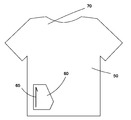
- FIG. 7 shows a representation of a garment where the supplemental material 60 has been placed on a base material 50 that forms part of a shirt 70 .
- the supplemental layer 60 has a trapezoidal shape and includes an opening 65 . Because the supplemental layer 60 has been bonded to the base layer 50 only along the perimeter, the supplemental layer 60 forms a pocket on the shirt 70 with the opening 65 providing an entry to the pocket.
- the opening 65 may be closeable, such as with a zipper or buttons, or may remain open at all times.
- FIG. 7 shows that the base material 50 has been used to provide a shirt
- the base material 50 may be used to form any of various other garments, accessories, or other items of apparel, including pants, hats, shoes, socks, armbands, jackets, bags, or backpacks.
- the word “item of apparel” as used herein is intended to cover any such garment or accessory, including those mentioned in the foregoing sentence and equivalents thereof.
- the supplemental layer provided on base material may take any of numerous forms and serve any of a number of purposes, including functional and decorative purposes. For example, FIG.
- the adhesive material 40 is formed in the shape of a star, the adhesive material for use in association with bonding similar star shaped layers of fabric to a base fabric. Additionally, it will be recognized that the supplemental material may be bonded to the base layer before or after the base layer is formed as a garment or other item of apparel.
- the process described above provides a method of bonding shaped materials onto a base fabric that reduces the amount of waste compared to past methods. Specifically, the process described herein greatly reduces the amount of thermoplastic waste or other adhesive material when compared to traditional die-cutting methods. Furthermore, because the thermoplastic ink takes on the desired shape immediately upon printing, handling of the adhesive material during the manufacturing process is significantly reduced, as the die-cutting step is eliminated. This significantly reduces the time and cost associated with manufacturing the related product. Furthermore, if the thermoplastic ink is delivered to a paper backing provided in roll form, the handling of the adhesive material may be even easier and additional efficiencies may be achieved.
- FIG. 1 has been described in association with FIGS. 1-8 to describe at least one embodiment of the method for bonding supplemental materials to textiles, it will be recognized that other embodiments are contemplated.
- the adhesive material 40 is removed from the paper backing 30 before the adhesive material is secured to the base fabric 50 .
- step 14 of FIG. 1 occurs prior to step 12 of FIG. 1 .
- the adhesive material 40 is placed on the base fabric.
- the adhesive material 40 may then be bonded to the base fabric 50 either before or after the supplemental layer 60 is placed in contact with the adhesive material 40 . If the bonding occurs after the supplemental layer 60 is placed in contact with the adhesive material, bonding of the adhesive material to the base fabric 50 and the supplemental layer may occur simultaneously.
- the adhesive material 40 is printed directly on the base fabric 50 or the supplemental layer 60 and not on a backing layer. This further simplifies the embodiment of FIG. 1 by removing the backing material from the process.
- the adhesive material is printed to either the base fabric 50 or the supplemental material 60 , the two layers of base fabric and supplemental material 60 are brought into contact with each other and the adhesive material is bonded to the base fabric 50 and the supplemental material 60 .
- the supplemental layer 60 must be cut either before or after the adhesive material is printed on the supplemental layer.
- the backing sheet 30 of FIG. 3 is substituted with a sheet of supplemental material 60 .
- the adhesive material 40 is then printed in a predetermined shape on the sheet of supplemental material 60 .
- the sheet of supplemental material 60 is then die cut to the predetermined shape, resulting in an overlay with adhesive material 40 provided along the perimeter portion of the overlay. These overlays are then placed on the base layer of fabric 50 and the adhesive material 40 is used to bond the overlay to the base layer 50 .
- thermoplastic ink as the adhesive material that is heated and cured to form a bond
- UV inks capable of forming bonds with fabrics.
- the term “ink” generally refers to any substance configured for use in association with a printing device.
Landscapes
- Engineering & Computer Science (AREA)
- Mechanical Engineering (AREA)
- Textile Engineering (AREA)
- Laminated Bodies (AREA)
- Details Of Garments (AREA)
- Socks And Pantyhose (AREA)
- Outer Garments And Coats (AREA)
- Decoration Of Textiles (AREA)
- Decoration By Transfer Pictures (AREA)
- Adhesives Or Adhesive Processes (AREA)
Abstract
Description
- The present application relates to the design and manufacture of garments and other apparel, and particularly to methods for bonding supplemental materials onto textiles, including textiles used for garments and other apparel.
- During the manufacture of garments and other products, including hats, shoes, gloves, bags, and other accessories, a supplemental material having a particular shape may need to be secured to a base textile. The supplemental material may be provided for decoration, identification, reinforcement, or other purposes. For example, when manufacturing athletic uniforms, pockets or zippers may be attached to a base fabric layer of a jersey.
- Attachment of supplemental material to a garment or related product may occur in any of numerous ways. For example, the supplemental material may be stitched onto a base layer of fabric. Alternatively, an adhesive may be used to bond the supplemental material to the fabric. Adhesives, such as thermoplastic films, are often the preferred method of securing supplemental material to a garment for numerous reasons. First, bonding helps maintain water-proof features of a seam-taped garment. Bonding can also reduce the weight of a garment by allowing for the removal of extraneous seam tape. A bonded seam may also be useful toward flattening or reducing the profile of a seam line that would otherwise be felt next to the skin of the wearer of the garment. Furthermore, bonding may be used to achieve a particular aesthetic on a garment.
- A typical method for securing supplemental material to a garment includes die-cutting a sheet of adhesive material in the form of a thermoplastic film. The sheet of thermoplastic film is cut to match the shape of the supplemental material to be secured to a base fabric. Once the thermoplastic film is cut to the desired shape, it is secured to the base fabric using a heat treatment or other bonding process. The supplemental shape is then placed on the exposed side of the thermoplastic film and the adhesive material is again exposed to the bonding process, thus securing the supplemental shape to the base fabric. An example of such a process is disclosed in U.S. Patent Publication No. 2004/0176005.
- While the foregoing process for bonding a supplemental material to a base fabric has certain efficiencies over other processes, it may also result in a significant amount of waste. In particular, if the shape of the die-cut piece of thermoplastic film is irregular or has a closed perimeter such that a hollow area is formed within the shape, a large amount of scrap material may result from the die-cutting process. It is not uncommon for this waste to exceed fifty percent of the adhesive sheet. Furthermore, the die-cutting process for the thermoplastic film results in significant handling costs during the manufacturing process.
- In view of the foregoing, it would be desirable to provide a process for bonding a supplemental material to a base fabric that results in reduced waste. It would also be advantageous if the process for bonding supplemental material to a base textile could reduce manufacturing costs.
- A method is disclosed for bonding supplemental materials of various shapes to textiles. The method involves printing an adhesive material, such as a thermoplastic ink, onto a backing sheet, such as a paper backing. The thermoplastic ink may be printed onto the backing sheet using a print head, silk screen, gravure, or any other appropriate printing device capable of printing the ink onto the backing sheet in a desired shape and with a desired thickness. The adhesive material is generally printed in substantially the same shape as the perimeter of the supplemental material to be bonded to the base textile. After the thermoplastic ink is printed onto the backing sheet, the thermoplastic ink is transferred to the base fabric using a bonding process. The backing sheet is then peeled away, and the perimeter of the supplemental material is aligned with the adhesive material on the base textile. The supplemental material is then bonded to the exposed adhesive material on the base fabric using a subsequent bonding process.
- The above described features and advantages, as well as others, will become more readily apparent to those of ordinary skill in the art by reference to the following detailed description and accompanying drawings. While it would be desirable to provide customizable athletic apparel that provides one or more of these or other advantageous features as may be apparent to those reviewing this disclosure, the teachings disclosed herein extend to those embodiments which fall within the scope of the appended claims, regardless of whether they include or accomplish one or more of the advantages or features mentioned herein.
-
FIG. 1 shows a flowchart of a process for securing a supplemental material onto a textile; -
FIG. 2 shows a diagrammatic view of a printer used to print thermoplastic ink on a paper backing sheet according to the method ofFIG. 1 ; -
FIG. 3 shows a top view of the paper backing sheet ofFIG. 2 with a plurality of shapes printed on the paper backing with the thermoplastic ink; -
FIG. 4 shows a heat platen used to bond the thermoplastic ink onto a base fabric according to the method ofFIG. 1 ; -
FIG. 5 shows the paper backing being peeled away from the thermoplastic ink according to the method ofFIG. 1 ; -
FIG. 6 shows a supplemental material being bonded to the base fabric and thermoplastic ink ofFIG. 5 using a heat platen; -
FIG. 7 shows a garment with the supplemental material ofFIG. 6 bonded to the garment; and -
FIG. 8 shows an alternative embodiment of the paper backing sheet ofFIG. 3 where the thermoplastic ink is provided in the decorative shape of a star. - With general reference to
FIG. 1 , a method is shown for bonding supplemental materials of various shapes to textiles. As noted bybox 10 ofFIG. 1 , and as shown in relatedFIGS. 2 and 3 , the method involves first printing anadhesive material 40, such as a thermoplastic ink, onto abacking sheet 30, such as a paper backing. Thethermoplastic ink 40 may be printed onto the paper backing 30 using aprint head 20 or any other appropriate printing device capable of printing theink 40 onto the paper backing 30 in a desired shape and with a desired thickness. InFIG. 2 , theprint head 20 is moved relative to the paper backing 30 to form thethermoplastic ink 40 in the desired shape on the paper backing 30. - In at least one embodiment, the paper backing 30 may be provided in roll form, such that the
print head 20 receives portions of blank paper from afeeder roll 26 and delivers printed portions of paper to adestination roll 28. The roll form of thepaper backing 30 allows for repeated printing of the thermoplastic ink in the desired shape over a length of paper. The continuous form of the paper allows the shapes to be printed relatively close together. Furthermore, because the paper is provided in roll form, the shapes of adhesive material may be easily handled during manufacturing by machines as well as humans. - In the exemplary embodiment of
FIG. 3 , the adhesive material in the form ofthermoplastic ink 40 has been printed in the shape of a plurality of substantially trapezoidal perimeters on the paper backing 30. While theadhesive material 40 has been disclosed herein as a thermoplastic ink, in alternative embodiments the ink could be comprised of a different material, such as a UV-reactive ink, an emulsion containing thermoplastics, or other appropriate material for the selected bonding process. Furthermore, while thebacking sheet 30 has been described as a paper backing 30, in other embodiments, the backing sheet could be comprised of other materials, such as a polymer material, Mylar®, silicone coated paper, or any other appropriate backing material, depending on the type of adhesive material used in the process. - The
adhesive material 40 is generally printed on thebacking sheet 30 in a shape that substantially matches the perimeter of asecond layer 60 of fabric or other material to be added to abase layer 50 of fabric. This shape is typically a closed perimeter shape, but in alternative embodiments could be an open perimeter (i.e., not a closed shape). Because the adhesive material is printed only in a perimeter shape in these embodiments,open areas 45 with noadhesive material 40 are formed in an interior portion of the printed shapes. Theseopen areas 45 expose thebacking material 30 within the printed shape, and generally extend over a greater area than the area covered by the adhesive material along the perimeter of the shape. In other words, theopen area 45 within any given shape is generally more than the area covered by the adhesive along the perimeter of the shape. However, in some alternative embodiments, the area covered by the adhesive material could actually be greater than the open area in the interior of the shape. In any event, using adhesive material along the perimeter of the shape with substantialopen areas 45 is advantageous because the adhesive material tends to be expensive. Therefore, because substantialopen areas 45 are formed in the printed shape, significant savings are realized over processes that involve printing the entire shape with adhesive material, including the interior portion of the shape. - With the
adhesive material 40 printed on thebacking sheet 30 in a given shape, the backing sheet may then be cut to provide one or more of the printed shapes on a single piece of backing material. These pieces ofbacking material 30 are then used to transfer the thermoplastic ink in the given shape to another location. - As noted in
box 12 of the embodiment ofFIG. 1 , after thethermoplastic ink 40 is printed onto thepaper backing 30, the thermoplastic ink is transferred to thebase fabric 50 using a bonding process. The bonding process may be any of various known bonding processes, such as thermal bonding, high frequency welding, or any of various other bonding processes. Thebase fabric 50 may be provided as part of a garment, shoes, bags, athletic accessory, or any of various other items. The term “apparel” as used herein refers generally to coverings and related accessories, including, for example, garments, shoes, gloves, hats and bags. -
FIG. 4 shows an exemplary embodiment of a thermal bonding operation where theadhesive material 40 is thermoplastic ink.FIG. 4 shows thebase fabric 50 of a garment with thethermoplastic ink 40 facing thebase fabric 50. In the embodiment ofFIG. 4 , aheated platen 22 is moved into contact with thepaper backing 30, thus forcing thethermoplastic ink 40 against thebase fabric 50. The heat and pressure from theplaten 22 causes the thermoplastic ink to bond with thebase fabric 50. - Once the
thermoplastic ink 40 is heated by the platen, it is allowed to cure, as noted bybox 14 ofFIG. 1 . Then, thepaper backing 30 is peeled away from thethermoplastic ink 40, as shown inFIG. 5 . After the paper packing 30 is peeled away from thethermoplastic ink 40, thethermoplastic ink 40 is exposed on the surface of thebase fabric 50. - Next, as noted in
box 16 ofFIG. 1 and in the diagram ofFIG. 6 , asupplemental material 60 is placed over the thermoplastic ink on the base fabric. Thesupplemental material 60 may be a fabric or other material which provides a functional or decorative element to thebase material 50. For example, the supplemental material may be designed to provide a pocket, zipper, design or any number of other features to the base material. Thesupplemental material 60 is generally disclosed herein as an overlay on the base material, but may also comprise an under or interior portion on the base material. Thesupplemental material 60 has generally the same perimeter shape as thethermoplastic ink 40 bonded to thebase fabric 50. Accordingly, thesupplemental material 60 is aligned with thethermoplastic ink 40 when thesupplemental material 60 is placed on the base fabric. - As noted in
box 18 ofFIG. 1 , after the supplemental material is placed over the thermoplastic ink, aheated platen 24 is moved into contact with thesupplemental material 60. The heat and pressure from theplaten 24 causes the thermoplastic ink to bond to the supplemental material, thus securing thesupplemental material 60 on thebase fabric 50. Of course, it will be recognized that in other embodiments any of various different bonding processes may be used to secure thesupplemental material 60 to the base fabric with theadhesive material 40. For example, an ultrasonic or other welding process may be used to cause theadhesive material 40 to bond to thesupplemental layer 60. -
FIG. 7 shows a representation of a garment where thesupplemental material 60 has been placed on abase material 50 that forms part of ashirt 70. Thesupplemental layer 60 has a trapezoidal shape and includes anopening 65. Because thesupplemental layer 60 has been bonded to thebase layer 50 only along the perimeter, thesupplemental layer 60 forms a pocket on theshirt 70 with theopening 65 providing an entry to the pocket. In various embodiments, theopening 65 may be closeable, such as with a zipper or buttons, or may remain open at all times. - While
FIG. 7 shows that thebase material 50 has been used to provide a shirt, it will be recognized that thebase material 50 may be used to form any of various other garments, accessories, or other items of apparel, including pants, hats, shoes, socks, armbands, jackets, bags, or backpacks. Accordingly, the word “item of apparel” as used herein is intended to cover any such garment or accessory, including those mentioned in the foregoing sentence and equivalents thereof. Furthermore, it will be recognized that the supplemental layer provided on base material may take any of numerous forms and serve any of a number of purposes, including functional and decorative purposes. For example,FIG. 8 showsadhesive material 40 on apaper backing 30, where theadhesive material 40 is formed in the shape of a star, the adhesive material for use in association with bonding similar star shaped layers of fabric to a base fabric. Additionally, it will be recognized that the supplemental material may be bonded to the base layer before or after the base layer is formed as a garment or other item of apparel. - The process described above provides a method of bonding shaped materials onto a base fabric that reduces the amount of waste compared to past methods. Specifically, the process described herein greatly reduces the amount of thermoplastic waste or other adhesive material when compared to traditional die-cutting methods. Furthermore, because the thermoplastic ink takes on the desired shape immediately upon printing, handling of the adhesive material during the manufacturing process is significantly reduced, as the die-cutting step is eliminated. This significantly reduces the time and cost associated with manufacturing the related product. Furthermore, if the thermoplastic ink is delivered to a paper backing provided in roll form, the handling of the adhesive material may be even easier and additional efficiencies may be achieved.
- While
FIG. 1 has been described in association withFIGS. 1-8 to describe at least one embodiment of the method for bonding supplemental materials to textiles, it will be recognized that other embodiments are contemplated. For example, in one alternative embodiment, theadhesive material 40 is removed from thepaper backing 30 before the adhesive material is secured to thebase fabric 50. Thus, in this embodiment, step 14 ofFIG. 1 occurs prior to step 12 ofFIG. 1 . After the adhesive material 40 (in solid form) is peeled from thepaper backing 30, theadhesive material 40 is placed on the base fabric. Theadhesive material 40 may then be bonded to thebase fabric 50 either before or after thesupplemental layer 60 is placed in contact with theadhesive material 40. If the bonding occurs after thesupplemental layer 60 is placed in contact with the adhesive material, bonding of the adhesive material to thebase fabric 50 and the supplemental layer may occur simultaneously. - In yet another example of an alternative embodiment of the method for bonding supplemental materials to textiles, the
adhesive material 40 is printed directly on thebase fabric 50 or thesupplemental layer 60 and not on a backing layer. This further simplifies the embodiment ofFIG. 1 by removing the backing material from the process. In this embodiment, after the adhesive material is printed to either thebase fabric 50 or thesupplemental material 60, the two layers of base fabric andsupplemental material 60 are brought into contact with each other and the adhesive material is bonded to thebase fabric 50 and thesupplemental material 60. - In an embodiment where the adhesive material is printed directly on the
supplemental material 60, thesupplemental layer 60 must be cut either before or after the adhesive material is printed on the supplemental layer. Accordingly, in at least one embodiment, thebacking sheet 30 ofFIG. 3 is substituted with a sheet ofsupplemental material 60. Theadhesive material 40 is then printed in a predetermined shape on the sheet ofsupplemental material 60. The sheet ofsupplemental material 60 is then die cut to the predetermined shape, resulting in an overlay withadhesive material 40 provided along the perimeter portion of the overlay. These overlays are then placed on the base layer offabric 50 and theadhesive material 40 is used to bond the overlay to thebase layer 50. - Although the method for bonding supplemental materials to textiles has been described with respect to certain preferred embodiments, it will be appreciated by those of skill in the art that other implementations and adaptations are possible. For example, although the disclosed embodiment involves thermoplastic ink as the adhesive material that is heated and cured to form a bond, other types of inks are possible such as UV inks capable of forming bonds with fabrics. Thus, as used herein, the term “ink” generally refers to any substance configured for use in association with a printing device. Moreover, it will be recognized that there are advantages to individual advancements described herein that may be obtained without incorporating other aspects described above. Therefore, the spirit and scope of any eventual claims should not be limited to the description of the preferred embodiments contained herein.
Claims (22)
Priority Applications (6)
| Application Number | Priority Date | Filing Date | Title |
|---|---|---|---|
| US12/569,526 US8974625B2 (en) | 2009-09-29 | 2009-09-29 | Method for bonding supplemental material to textiles |
| JP2012531114A JP2013506057A (en) | 2009-09-29 | 2010-09-28 | How to join supplementary material to fabric |
| KR1020127007931A KR20120093177A (en) | 2009-09-29 | 2010-09-28 | Method for bonding supplemental material to textiles |
| EP10821116.0A EP2483070A4 (en) | 2009-09-29 | 2010-09-28 | Method for bonding supplemental material to textiles |
| PCT/US2010/050554 WO2011041316A1 (en) | 2009-09-29 | 2010-09-28 | Method for bonding supplemental material to textiles |
| CN201080043032.XA CN102548752B (en) | 2009-09-29 | 2010-09-28 | Method for bonding supplemental material to textiles |
Applications Claiming Priority (1)
| Application Number | Priority Date | Filing Date | Title |
|---|---|---|---|
| US12/569,526 US8974625B2 (en) | 2009-09-29 | 2009-09-29 | Method for bonding supplemental material to textiles |
Publications (2)
| Publication Number | Publication Date |
|---|---|
| US20110072558A1 true US20110072558A1 (en) | 2011-03-31 |
| US8974625B2 US8974625B2 (en) | 2015-03-10 |
Family
ID=43778652
Family Applications (1)
| Application Number | Title | Priority Date | Filing Date |
|---|---|---|---|
| US12/569,526 Expired - Fee Related US8974625B2 (en) | 2009-09-29 | 2009-09-29 | Method for bonding supplemental material to textiles |
Country Status (6)
| Country | Link |
|---|---|
| US (1) | US8974625B2 (en) |
| EP (1) | EP2483070A4 (en) |
| JP (1) | JP2013506057A (en) |
| KR (1) | KR20120093177A (en) |
| CN (1) | CN102548752B (en) |
| WO (1) | WO2011041316A1 (en) |
Cited By (10)
| Publication number | Priority date | Publication date | Assignee | Title |
|---|---|---|---|---|
| US20110203034A1 (en) * | 2010-02-25 | 2011-08-25 | Jonathan Shlafer | Waterproof Pocket |
| US20130007947A1 (en) * | 2011-07-08 | 2013-01-10 | Hurley International, Llc | Water Shorts |
| CN107820526A (en) * | 2015-07-09 | 2018-03-20 | 镐田实业株式会社 | Using the bond pattern line formed by high frequency bonding method fabric without sewing joint method |
| US10743596B2 (en) * | 2016-10-06 | 2020-08-18 | Nike, Inc. | Insulated vented garment formed using non-woven polymer sheets |
| US11019865B2 (en) | 2016-10-06 | 2021-06-01 | Nike, Inc. | Insulated garment |
| US11229250B2 (en) | 2012-04-18 | 2022-01-25 | Nike, Inc. | Cold weather vented garment |
| US11406148B2 (en) | 2015-10-07 | 2022-08-09 | Nike, Inc. | Vented garment |
| US11606992B2 (en) | 2012-04-18 | 2023-03-21 | Nike, Inc. | Vented garment |
| US12035770B2 (en) | 2012-04-18 | 2024-07-16 | Nike, Inc. | Vented garment |
| WO2025141565A1 (en) * | 2023-12-24 | 2025-07-03 | Kornit Digital Ltd. | Direct to film printing process and apparatus |
Families Citing this family (15)
| Publication number | Priority date | Publication date | Assignee | Title |
|---|---|---|---|---|
| CN110462127B (en) | 2017-02-14 | 2021-03-26 | 耐克创新有限合伙公司 | Anti-taste compositions, structures with anti-taste properties, methods of making anti-taste compositions and structures |
| EP3638507B1 (en) | 2017-09-29 | 2021-01-06 | NIKE Innovate C.V. | Methods for making and using structurally-colored articles |
| JP2020094296A (en) * | 2018-12-12 | 2020-06-18 | ナガイレーベン株式会社 | Tape fitting apparatus |
| CN112334028A (en) * | 2019-06-05 | 2021-02-05 | 维珍妮国际(集团)有限公司 | method of making clothes |
| EP3969947A1 (en) | 2019-06-26 | 2022-03-23 | Nike Innovate C.V. | Structurally-colored articles and methods for making and using structurally-colored articles |
| EP3989764A4 (en) * | 2019-06-27 | 2023-07-05 | Bemis Associates, Inc. | METHOD OF JOINING A TEXTILE |
| WO2021021562A1 (en) | 2019-07-26 | 2021-02-04 | Nike, Inc. | Structurally-colored articles and methods for making and using structurally-colored articles |
| CN111264956A (en) * | 2019-09-12 | 2020-06-12 | 李选平 | Batch continuous processing method for clothing accessories |
| US11986042B2 (en) | 2019-10-21 | 2024-05-21 | Nike, Inc. | Structurally-colored articles and methods for making and using structurally-colored articles |
| CN111114007B (en) * | 2019-12-25 | 2021-06-22 | 马鞍山市欧凯包装材料有限公司 | Production device and processing technology of puncture-resistant packaging bag |
| DE102020205461A1 (en) * | 2020-04-30 | 2021-11-04 | Robert Bosch Gesellschaft mit beschränkter Haftung | Method for producing a textile composite material |
| EP4219189A1 (en) | 2020-05-29 | 2023-08-02 | Nike Innovate C.V. | Structurally-colored articles and methods for making and using structurally-colored articles |
| US11129444B1 (en) | 2020-08-07 | 2021-09-28 | Nike, Inc. | Footwear article having repurposed material with concealing layer |
| US11241062B1 (en) | 2020-08-07 | 2022-02-08 | Nike, Inc. | Footwear article having repurposed material with structural-color concealing layer |
| CN112223761A (en) * | 2020-08-28 | 2021-01-15 | 余新军 | Preparation process of hot-pressed woven tape |
Citations (29)
| Publication number | Priority date | Publication date | Assignee | Title |
|---|---|---|---|---|
| US3537194A (en) * | 1967-11-30 | 1970-11-03 | Milton A Engle | Clothing label |
| US3720562A (en) * | 1967-03-10 | 1973-03-13 | Johnson & Johnson | A method of bonding non woven fabrics |
| US3765997A (en) * | 1968-12-16 | 1973-10-16 | Kimberly Clark Co | Laminate |
| US3920499A (en) * | 1969-09-19 | 1975-11-18 | Polymark Corp | Method of applying heat-sealable marking labels for flexible articles |
| US4089722A (en) * | 1976-09-23 | 1978-05-16 | Holoubek Studios, Inc. | Method of affixing heat transferrable indicia to a fabric surface |
| US4139613A (en) * | 1975-07-23 | 1979-02-13 | Kufner Textilwerke Kg | Process for the patterned deposition of powdered thermoplastic adhesive materials on the outer surface of a surface form |
| US4157272A (en) * | 1966-12-19 | 1979-06-05 | Nishizawa Shoji, Ltd. | Method of making an applique article |
| US4294641A (en) * | 1976-07-23 | 1981-10-13 | Reed Kenneth J | Heat transfer sheets |
| US4315790A (en) * | 1979-03-07 | 1982-02-16 | Decor Innovations Limited | Decoration of flexible substrates |
| US4401494A (en) * | 1979-07-25 | 1983-08-30 | Pernicano Vincent S | Reflective garment and method of manufacturing same |
| US4451315A (en) * | 1981-11-20 | 1984-05-29 | Firma Carl Freudenberg | Process for producing a non-woven fabric |
| US4544590A (en) * | 1982-03-17 | 1985-10-01 | Miller Products, Inc. | Laminated member and method of making same |
| US4564406A (en) * | 1984-02-21 | 1986-01-14 | Solar-Kist Corporation | Method of and means for combination design transfer and application of heat reactivatable adhesive |
| US4629441A (en) * | 1984-05-16 | 1986-12-16 | Cahill Mary J | Fabric doll face with stuffed feature, and method |
| US4655868A (en) * | 1983-08-26 | 1987-04-07 | Kuener Textilwerke GmbH | Top cloth for articles of clothing as well as a manufacturing process and transfer unit for it |
| US4687527A (en) * | 1983-08-16 | 1987-08-18 | Kabushiki Kaisha Tokyo Horaisha | Method of forming flock patterns |
| US4776916A (en) * | 1986-07-29 | 1988-10-11 | Playtex Apparel, Inc. | Method and apparatus for providing additional support to selected portions of a garment |
| US4838965A (en) * | 1988-01-25 | 1989-06-13 | Bussard Janice W | Holographic art applied to T-shirts or other textile products |
| US5133819A (en) * | 1990-05-01 | 1992-07-28 | Marjorie Croner | Process for producing decorative articles |
| US5244524A (en) * | 1990-04-09 | 1993-09-14 | Brother Kogyo Kabushiki Kaisha | Printing method for thermally transferring image section of print sheet to image receiving member |
| US5407729A (en) * | 1991-09-06 | 1995-04-18 | Prismatic, Inc. | Light diffracting material having improved launderability |
| US5631064A (en) * | 1995-09-15 | 1997-05-20 | Minnesota Mining And Manufacturing Company | Retroreflective transfer sheet and applique |
| US6224707B1 (en) * | 1997-10-15 | 2001-05-01 | Societe D'enduction Et De Flockage | Method for the production and multicolor printing of thermo-adhesive flocked films |
| US6425324B1 (en) * | 1999-04-02 | 2002-07-30 | Yugen Kaisha Kowa Technoa | Method of printing electronic images on a piece of colored cloth |
| US6635604B1 (en) * | 1999-02-11 | 2003-10-21 | Baker Hughes Incorporated | Low molecular weight water soluble organic compounds as crystallization point suppressants in brines |
| US20040176005A1 (en) * | 2003-03-05 | 2004-09-09 | Nike Incorporated | Composite article joined with an adhesive |
| US6793999B2 (en) * | 2002-02-14 | 2004-09-21 | Cardinal Brands, Inc. | Customizable decal and kit for making the same |
| US7182828B2 (en) * | 2000-12-04 | 2007-02-27 | Irving Joseph Zirker | Acrylic paint monotype artwork |
| US20070235125A1 (en) * | 2006-03-29 | 2007-10-11 | Doeling Dean R | Article of apparel with graphic elements and method of manufacturing same |
Family Cites Families (11)
| Publication number | Priority date | Publication date | Assignee | Title |
|---|---|---|---|---|
| US4017A (en) * | 1845-05-01 | Reid r | ||
| US3383263A (en) * | 1966-04-26 | 1968-05-14 | Rohm & Haas | Method for preparing fabric laminate |
| DE2237923A1 (en) * | 1972-08-02 | 1974-02-21 | Guetermann & Co | DEVICES FOR JOINING TEXTILE FABRICS IN PARTICULAR WITH WELDING OR HEAT SEALABLE POLYMERS |
| JPS6013871A (en) | 1983-07-06 | 1985-01-24 | Dynic Corp | Adhesive sheet |
| FR2641798B1 (en) * | 1989-01-13 | 1991-05-03 | Picardie Lainiere | METHOD AND APPARATUS FOR MANUFACTURING A TEXTILE-BASED HEAT-STICKING PRODUCT |
| JPH0468100A (en) | 1990-07-10 | 1992-03-03 | Tokyo Hamapuren Kogyo Kk | Lining structure of leather for sheet cover, leather for sheet cover, and lining material of leather for sheet cover |
| JP3183842B2 (en) * | 1997-02-25 | 2001-07-09 | 大東ポリマー工業株式会社 | Method of forming marks on stretchable fabric |
| CN2314933Y (en) * | 1997-09-26 | 1999-04-21 | 迪奇鸭实业有限公司 | Elastic full color pressure sensitive transfer decals |
| CN2698789Y (en) * | 2004-05-26 | 2005-05-11 | 杭州福斯特热熔胶膜有限公司 | Hot melt adhesive film with lining paper |
| EP1645607A1 (en) * | 2004-10-05 | 2006-04-12 | Kun-Chung Liu | Method for preparing a logo label |
| JP5598793B2 (en) | 2009-08-26 | 2014-10-01 | 貫太郎 野村 | Fabric seal, silk fabric seal, and manufacturing method thereof |
-
2009
- 2009-09-29 US US12/569,526 patent/US8974625B2/en not_active Expired - Fee Related
-
2010
- 2010-09-28 JP JP2012531114A patent/JP2013506057A/en active Pending
- 2010-09-28 KR KR1020127007931A patent/KR20120093177A/en not_active Withdrawn
- 2010-09-28 CN CN201080043032.XA patent/CN102548752B/en not_active Expired - Fee Related
- 2010-09-28 WO PCT/US2010/050554 patent/WO2011041316A1/en not_active Ceased
- 2010-09-28 EP EP10821116.0A patent/EP2483070A4/en not_active Withdrawn
Patent Citations (31)
| Publication number | Priority date | Publication date | Assignee | Title |
|---|---|---|---|---|
| US4157272A (en) * | 1966-12-19 | 1979-06-05 | Nishizawa Shoji, Ltd. | Method of making an applique article |
| US3720562A (en) * | 1967-03-10 | 1973-03-13 | Johnson & Johnson | A method of bonding non woven fabrics |
| US3537194A (en) * | 1967-11-30 | 1970-11-03 | Milton A Engle | Clothing label |
| US3765997A (en) * | 1968-12-16 | 1973-10-16 | Kimberly Clark Co | Laminate |
| US3920499A (en) * | 1969-09-19 | 1975-11-18 | Polymark Corp | Method of applying heat-sealable marking labels for flexible articles |
| US4139613A (en) * | 1975-07-23 | 1979-02-13 | Kufner Textilwerke Kg | Process for the patterned deposition of powdered thermoplastic adhesive materials on the outer surface of a surface form |
| US4294641A (en) * | 1976-07-23 | 1981-10-13 | Reed Kenneth J | Heat transfer sheets |
| US4089722A (en) * | 1976-09-23 | 1978-05-16 | Holoubek Studios, Inc. | Method of affixing heat transferrable indicia to a fabric surface |
| US4315790A (en) * | 1979-03-07 | 1982-02-16 | Decor Innovations Limited | Decoration of flexible substrates |
| US4401494A (en) * | 1979-07-25 | 1983-08-30 | Pernicano Vincent S | Reflective garment and method of manufacturing same |
| US4451315A (en) * | 1981-11-20 | 1984-05-29 | Firma Carl Freudenberg | Process for producing a non-woven fabric |
| US4544590A (en) * | 1982-03-17 | 1985-10-01 | Miller Products, Inc. | Laminated member and method of making same |
| US4687527A (en) * | 1983-08-16 | 1987-08-18 | Kabushiki Kaisha Tokyo Horaisha | Method of forming flock patterns |
| US4655868A (en) * | 1983-08-26 | 1987-04-07 | Kuener Textilwerke GmbH | Top cloth for articles of clothing as well as a manufacturing process and transfer unit for it |
| US4564406A (en) * | 1984-02-21 | 1986-01-14 | Solar-Kist Corporation | Method of and means for combination design transfer and application of heat reactivatable adhesive |
| US4629441A (en) * | 1984-05-16 | 1986-12-16 | Cahill Mary J | Fabric doll face with stuffed feature, and method |
| US4776916A (en) * | 1986-07-29 | 1988-10-11 | Playtex Apparel, Inc. | Method and apparatus for providing additional support to selected portions of a garment |
| US4838965A (en) * | 1988-01-25 | 1989-06-13 | Bussard Janice W | Holographic art applied to T-shirts or other textile products |
| US5244524A (en) * | 1990-04-09 | 1993-09-14 | Brother Kogyo Kabushiki Kaisha | Printing method for thermally transferring image section of print sheet to image receiving member |
| US5489359A (en) * | 1990-04-09 | 1996-02-06 | Brother Kogyo Kabushiki Kaisha | Printing method for thermally transferring image section of print sheet to image receiving member and print sheet making device |
| US5133819A (en) * | 1990-05-01 | 1992-07-28 | Marjorie Croner | Process for producing decorative articles |
| US5407729A (en) * | 1991-09-06 | 1995-04-18 | Prismatic, Inc. | Light diffracting material having improved launderability |
| US5631064A (en) * | 1995-09-15 | 1997-05-20 | Minnesota Mining And Manufacturing Company | Retroreflective transfer sheet and applique |
| US6224707B1 (en) * | 1997-10-15 | 2001-05-01 | Societe D'enduction Et De Flockage | Method for the production and multicolor printing of thermo-adhesive flocked films |
| US6635604B1 (en) * | 1999-02-11 | 2003-10-21 | Baker Hughes Incorporated | Low molecular weight water soluble organic compounds as crystallization point suppressants in brines |
| US6425324B1 (en) * | 1999-04-02 | 2002-07-30 | Yugen Kaisha Kowa Technoa | Method of printing electronic images on a piece of colored cloth |
| US7182828B2 (en) * | 2000-12-04 | 2007-02-27 | Irving Joseph Zirker | Acrylic paint monotype artwork |
| US6793999B2 (en) * | 2002-02-14 | 2004-09-21 | Cardinal Brands, Inc. | Customizable decal and kit for making the same |
| US20040176005A1 (en) * | 2003-03-05 | 2004-09-09 | Nike Incorporated | Composite article joined with an adhesive |
| US7364783B2 (en) * | 2003-03-05 | 2008-04-29 | Nike, Inc. | Composite article joined with an adhesive |
| US20070235125A1 (en) * | 2006-03-29 | 2007-10-11 | Doeling Dean R | Article of apparel with graphic elements and method of manufacturing same |
Non-Patent Citations (2)
| Title |
|---|
| English translation of JP-04-068100, 3/3/1992 * |
| English translation of JP2011-068130A, 4/7/2011 * |
Cited By (17)
| Publication number | Priority date | Publication date | Assignee | Title |
|---|---|---|---|---|
| US20110203034A1 (en) * | 2010-02-25 | 2011-08-25 | Jonathan Shlafer | Waterproof Pocket |
| US20130007947A1 (en) * | 2011-07-08 | 2013-01-10 | Hurley International, Llc | Water Shorts |
| US11284658B2 (en) | 2011-07-08 | 2022-03-29 | Nike, Inc. | Water shorts with webbed configuration |
| US11229250B2 (en) | 2012-04-18 | 2022-01-25 | Nike, Inc. | Cold weather vented garment |
| US12035770B2 (en) | 2012-04-18 | 2024-07-16 | Nike, Inc. | Vented garment |
| US11992072B2 (en) | 2012-04-18 | 2024-05-28 | Nike, Inc. | Vented garment |
| US11606992B2 (en) | 2012-04-18 | 2023-03-21 | Nike, Inc. | Vented garment |
| EP3321416A4 (en) * | 2015-07-09 | 2019-03-13 | Hojeon Limited | METHOD FOR SEAMLESS TISSUE-COUPLING USING A LINK PATTERN LINE FORMED BY HIGH-FREQUENCY LINKAGE TECHNIQUE |
| US20180201005A1 (en) * | 2015-07-09 | 2018-07-19 | Hojeon Limited | Method for seamlessly coupling fabric using bonding pattern line formed by high-frequency bonding technique |
| CN107820526A (en) * | 2015-07-09 | 2018-03-20 | 镐田实业株式会社 | Using the bond pattern line formed by high frequency bonding method fabric without sewing joint method |
| US11406148B2 (en) | 2015-10-07 | 2022-08-09 | Nike, Inc. | Vented garment |
| US11998071B2 (en) | 2015-10-07 | 2024-06-04 | Nike, Inc. | Vented garment |
| US11019865B2 (en) | 2016-10-06 | 2021-06-01 | Nike, Inc. | Insulated garment |
| US10743596B2 (en) * | 2016-10-06 | 2020-08-18 | Nike, Inc. | Insulated vented garment formed using non-woven polymer sheets |
| US11737503B2 (en) | 2016-10-06 | 2023-08-29 | Nike, Inc. | Insulated garment |
| US11771156B2 (en) | 2016-10-06 | 2023-10-03 | Nike, Inc. | Insulated vented garment formed using non-woven polymer sheets |
| WO2025141565A1 (en) * | 2023-12-24 | 2025-07-03 | Kornit Digital Ltd. | Direct to film printing process and apparatus |
Also Published As
| Publication number | Publication date |
|---|---|
| EP2483070A4 (en) | 2014-04-30 |
| US8974625B2 (en) | 2015-03-10 |
| EP2483070A1 (en) | 2012-08-08 |
| CN102548752A (en) | 2012-07-04 |
| JP2013506057A (en) | 2013-02-21 |
| KR20120093177A (en) | 2012-08-22 |
| CN102548752B (en) | 2015-05-13 |
| WO2011041316A1 (en) | 2011-04-07 |
Similar Documents
| Publication | Publication Date | Title |
|---|---|---|
| US8974625B2 (en) | Method for bonding supplemental material to textiles | |
| EP2216168B1 (en) | Stretchable appliqué and method for making the same | |
| US5737775A (en) | Stick-on shirt pocket and advertising display | |
| US9773434B2 (en) | Dye sublimation fabric separated elements | |
| US6613412B1 (en) | Carrier for decorative graphics and lettering | |
| EP2556967B1 (en) | Method of manufacturing a decorative piece constituted of thermoplastic synthetic resin and having a dye migration preventing layer | |
| US20120005808A1 (en) | Digitally printed appliqué and method of making same | |
| EP0385611A2 (en) | Dye impermeable, distortion resistant textile identification products | |
| EP4223524B1 (en) | Making method for clothing capable of automatically having openings | |
| US9586435B2 (en) | Performance fabric appliqués | |
| US20050279445A1 (en) | Thermal applique text | |
| US9695548B2 (en) | Methods employing raised transfers for embroidered-style products | |
| US20060021113A1 (en) | Methods of embroidery, and products so made | |
| JP2016084174A (en) | Laminated bag body and manufacturing method thereof | |
| US20200270776A1 (en) | Sew free interior woven label and automated application | |
| HK1226699A1 (en) | Transfer sheet and transfer method using such transfer sheet | |
| HK1226699B (en) | Transfer sheet and transfer method using such transfer sheet | |
| US20050281974A1 (en) | Thermo bonding film structure | |
| JP2019203206A (en) | Pocket forming member | |
| JP2004230647A (en) | Method and apparatus for welding fabric for mark | |
| JP2001071693A (en) | Manufacture of number with mount paper and number with mount paper |
Legal Events
| Date | Code | Title | Description |
|---|---|---|---|
| AS | Assignment |
Owner name: UNDER ARMOUR, INC, MARYLAND Free format text: ASSIGNMENT OF ASSIGNORS INTEREST;ASSIGNOR:BERNS, JASON;REEL/FRAME:023299/0747 Effective date: 20090925 |
|
| STCF | Information on status: patent grant |
Free format text: PATENTED CASE |
|
| MAFP | Maintenance fee payment |
Free format text: PAYMENT OF MAINTENANCE FEE, 4TH YEAR, LARGE ENTITY (ORIGINAL EVENT CODE: M1551); ENTITY STATUS OF PATENT OWNER: LARGE ENTITY Year of fee payment: 4 |
|
| AS | Assignment |
Owner name: JPMORGAN CHASE BANK, N.A., AS ADMINISTRATIVE AGENT, ILLINOIS Free format text: SECURITY INTEREST;ASSIGNOR:UNDER ARMOUR, INC.;REEL/FRAME:052654/0756 Effective date: 20200512 |
|
| FEPP | Fee payment procedure |
Free format text: MAINTENANCE FEE REMINDER MAILED (ORIGINAL EVENT CODE: REM.); ENTITY STATUS OF PATENT OWNER: LARGE ENTITY |
|
| LAPS | Lapse for failure to pay maintenance fees |
Free format text: PATENT EXPIRED FOR FAILURE TO PAY MAINTENANCE FEES (ORIGINAL EVENT CODE: EXP.); ENTITY STATUS OF PATENT OWNER: LARGE ENTITY |
|
| STCH | Information on status: patent discontinuation |
Free format text: PATENT EXPIRED DUE TO NONPAYMENT OF MAINTENANCE FEES UNDER 37 CFR 1.362 |
|
| FP | Lapsed due to failure to pay maintenance fee |
Effective date: 20230310 |