US20080098617A1 - Foot anti-contamination barrier membrane structure - Google Patents
Foot anti-contamination barrier membrane structure Download PDFInfo
- Publication number
- US20080098617A1 US20080098617A1 US11/588,773 US58877306A US2008098617A1 US 20080098617 A1 US20080098617 A1 US 20080098617A1 US 58877306 A US58877306 A US 58877306A US 2008098617 A1 US2008098617 A1 US 2008098617A1
- Authority
- US
- United States
- Prior art keywords
- membrane structure
- barrier
- foot
- barrier membrane
- sole
- Prior art date
- Legal status (The legal status is an assumption and is not a legal conclusion. Google has not performed a legal analysis and makes no representation as to the accuracy of the status listed.)
- Abandoned
Links
- 230000004888 barrier function Effects 0.000 title claims abstract description 53
- 238000011109 contamination Methods 0.000 title claims abstract description 13
- 239000012528 membrane Substances 0.000 title claims abstract 15
- 239000000463 material Substances 0.000 claims abstract description 23
- 239000000853 adhesive Substances 0.000 claims abstract description 15
- 230000001070 adhesive effect Effects 0.000 claims abstract description 15
- 230000002223 anti-pathogen Effects 0.000 claims abstract description 3
- 238000000034 method Methods 0.000 claims description 5
- 230000001717 pathogenic effect Effects 0.000 claims description 5
- 244000052769 pathogen Species 0.000 claims description 2
- 239000000835 fiber Substances 0.000 claims 2
- 239000004698 Polyethylene Substances 0.000 claims 1
- 239000004033 plastic Substances 0.000 claims 1
- 229920003023 plastic Polymers 0.000 claims 1
- -1 polyethylene Polymers 0.000 claims 1
- 229920000573 polyethylene Polymers 0.000 claims 1
- 238000012216 screening Methods 0.000 description 10
- 239000011248 coating agent Substances 0.000 description 4
- 238000000576 coating method Methods 0.000 description 4
- 239000000356 contaminant Substances 0.000 description 4
- 238000012986 modification Methods 0.000 description 3
- 230000004048 modification Effects 0.000 description 3
- 239000004775 Tyvek Substances 0.000 description 2
- 229920000690 Tyvek Polymers 0.000 description 2
- 230000006835 compression Effects 0.000 description 2
- 238000007906 compression Methods 0.000 description 2
- 239000012783 reinforcing fiber Substances 0.000 description 2
- 239000002313 adhesive film Substances 0.000 description 1
- 239000013590 bulk material Substances 0.000 description 1
- 238000010276 construction Methods 0.000 description 1
- 238000004519 manufacturing process Methods 0.000 description 1
- 238000005507 spraying Methods 0.000 description 1
- 239000002699 waste material Substances 0.000 description 1
Images

Classifications
-
- A—HUMAN NECESSITIES
- A43—FOOTWEAR
- A43B—CHARACTERISTIC FEATURES OF FOOTWEAR; PARTS OF FOOTWEAR
- A43B7/00—Footwear with health or hygienic arrangements
-
- A—HUMAN NECESSITIES
- A43—FOOTWEAR
- A43B—CHARACTERISTIC FEATURES OF FOOTWEAR; PARTS OF FOOTWEAR
- A43B1/00—Footwear characterised by the material
- A43B1/0045—Footwear characterised by the material made at least partially of deodorant means
-
- A—HUMAN NECESSITIES
- A43—FOOTWEAR
- A43B—CHARACTERISTIC FEATURES OF FOOTWEAR; PARTS OF FOOTWEAR
- A43B13/00—Soles; Sole-and-heel integral units
- A43B13/28—Soles; Sole-and-heel integral units characterised by their attachment, also attachment of combined soles and heels
Definitions
- the present invention addresses this concern in a unique and a very simple manner.
- This manner focuses attention on providing such passengers, for completely temporary, and indeed throw-away, use during such a security-screening process, very thin, and indeed gossamer-thin, anti-pathogen-contamination, sheet-like barriers which have a low-tack, repositionable adhesive applied to one side to allow them to be placed temporarily by adhesion directly onto the undersides (the soles) of shoeless feet.
- These adhesively applied, temporary barriers, once so applied may then be worn through a security screening area, whereby the bottoms of feet, and stockings and socks, never come directly into contact with a potentially pathogen-contaminated floor surface.
- these thin underfoot barriers are constructed so that they will adhere relatively tenaciously during the short periods of time that they are worn and walked upon, and that they have structural qualities which allow them, despite their preferable gossamer characteristic, to stay intact during short periods of use, and also to stay relatively well adhered to the bottoms of feet, stockings, etc. during use.
- this barrier structure should be such that it will confidently prevent true contamination with respect to any pathogenic contaminant which might be picked up from foot/stocking/sock contact with the floor surface where they are used.
- FIG. 1 is a top plan view of a pair of barrier sheets made in accordance with a preferred embodiment of the invention, shaped with respective left-foot/right-foot perimetral outline configurations.
- FIG. 2 is an enlarged cross section taken generally along the line 2 - 2 in FIG. 1 (through the right-foot barrier sheet shown in FIG. 1 ).
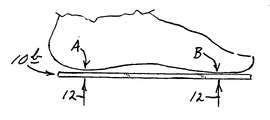
- FIG. 3 is a fragmentary and simplified side elevation generally illustrating quick adhesion application of one of the barrier sheets of FIGS. 1 and 2 to the underside (sole) of a foot from which a shoe has been removed.
- FIG. 4 illustrates a point in time slightly later than that which is illustrated in FIG. 3 , and specifically shows how, when the now barrier-guarded foot lowers into contact with the airport concourse floor (in this illustration shown as a carpeted floor), the gossamer and drapey nature of the barrier sheet causes it to form and reshape itself to provide intimate adhesion contact with the sole of the foot—a feature of the invention which promotes successful use of a low-tack, repositionable adhesive without creating a situation where an applied barrier shape is likely to break away from the foot sole during a short period of use.
- FIGS. 5 and 6 are similar to FIG. 1 , except that they show two different perimetrally shaped barrier sheets made in accordance with modified forms of the invention. In other respects, these barrier sheets are essentially the same in construction as the barrier sheets illustrated in FIGS. 1-4 , inclusive.
- FIG. 5 is a very simplified and schematic side elevation, with structural portions broken away, illustrating one type of coin, or card, operated vending dispenser which may be provided close to the point of intended use along an airport concourse for vending barrier sheets made in accordance with the invention.
- FIG. 1 illustrated generally at 10 in FIG. 1 is pair of foot barrier sheets 10 a , 10 b which, as illustrated in FIG. 1 , have perimetral outlines that possess essentially left-foot and right-foot outlines, respectively. The “toe ends” of these sheets are shown pointing upwardly in FIG. 1 .
- Barrier sheet 10 b which is to be applied to the underside (sole) of the right foot of a user, is shown in cross section in FIG. 2 on a scale which is significantly larger than that employed in FIG. 1 .
- FIG. 1 illustrated generally at 10 in FIG. 1 is pair of foot barrier sheets 10 a , 10 b which, as illustrated in FIG. 1 , have perimetral outlines that possess essentially left-foot and right-foot outlines, respectively. The “toe ends” of these sheets are shown pointing upwardly in FIG. 1 .
- Barrier sheet 10 b which is to be applied to the underside (sole) of the right foot of a user, is shown in cross section in FIG. 2 on a scale which
- each of these barrier sheets is formed with an underlayer, preferably, of a gossamer-thin, flexible and drapey sheet material, such as the commercially available material sold under the trademark Tyvek® 10 c , the upper surface, or face, 10 c 1 of which, i.e., the intended foot-attaching adhesion surface, or face, being suitably coated with what is known as a low-tack, repositionable adhesive film 10 d .
- the adhesive making up film 10 d is preferably very much like the low tack, repositionable adhesive employed on the well-known product made by 3M sold under the trademark Post It®.
- a preference for gossamer thinness in the basic material of the foot barrier sheet of this invention is important for several reasons. First of all, substantial thinness minimizes the amount of material which is employed in the structure of such a sheet, and thus minimizes manufacturing cost and acceptable sale price. Such gossamer thinness also cooperates with the use of the mentioned low-tack, repositionable adhesive, whereby, when a sheet has been applied to the underside of a foot, and then stood upon, the sheet tends to deform quite easily to increase the foot-sole bonding-surface area by deforming readily on the underside of a foot, thereby bringing a larger surface area of the coating adhesive into contact with either the bare bottom of the foot, or a stocking or a sock.
- the basic barrier sheet material must have enough structural strength so as not to come apart, to shred, or to tear during short periods of use. This consideration is probably best met by a material which includes internal reinforcing fibers.
- Tyvek® commercially available product is quite suitable in all of these regards. It is also available in relatively quite thin expanses having a thickness which may preferably lie in the range of about 3-mils to about 6-mils.
- the adhesive coating, such as coating, or film, 10 d which is applied to the intended upper surface (adhesion face 10 c 1 ) of a barrier sheet made in accordance with the present invention may be applied in any suitable manner, such as by spraying, by roll-coating, etc. And, as was mentioned earlier herein, this adhesive also preferably lies in the category of adhesives known as re-positionable, low-tack adhesives, such as that which is employed in the earlier-mentioned Post It® product made by 3M.
- barrier sheets are made specifically shaped for left-foot and right-foot use, it is, of course, important that the distributed adhesive lie on the appropriate side for left-foot, and right-foot applications.
- barrier sheets like those shown in FIGS. 1 and 2 , are ready for use, they are quickly applied, as is generally indicated by arrows 12 in FIG. 3 , to the underside (the sole) of a shoe-free foot, by quickly and gently “slapping” the sheets into place. Initial contact with the foot sole is likely to create only a limited amount of adhesion area contact, and this condition is illustrated quite clearly in FIG. 3 at A and B.
- a user steps down onto a floor surface, such as the airport security-screening floor surface shown at 14 a for floor 14 in FIG. 4 , a surface which, in this figure, is covered with a carpet, such as that shown at 16 , the region of compression between the floor carpet and the underside of a foot causes a natural deformation to occur in the applied barrier sheet, whereby the area of adhesion contact with the foot increases substantially.
- a floor surface such as the airport security-screening floor surface shown at 14 a for floor 14 in FIG. 4
- a carpet such as that shown at 16
- the wearer walks through the security screening area with that wearer's feet essentially completely protected against pathogen through-contamination from the floor.
- the barrier sheets are quickly, easily and carefully (in order to avoid contact with any contaminant) peeled away in favor of putting one's shoes back on, and the used barrier sheets are then preferably thrown away.
- Whether not a user elects to keep these sheets for possible future use is purely a matter of user choice, though it should be understood that they are intended to be treated as single-use, discardable products, inasmuch as, once used, they may well have picked up an unwanted contaminant.
- FIGS. 5 and 6 two modified forms of barrier sheets are shown generally at 18 , 20 , respectively.
- the two sheets shown at 18 in FIG. 5 have an elongate, ovate shape, whereas the different sheets shown at 20 in FIG. 6 have an elongate, rectangular shape.
- the sheets shown here do not possess a left-foot/right-foot characteristic, and this means that only a single sheet shape is required.
- the rectangular sheets shown at 20 in FIG. 6 because of their rectangularity, probably make the most economic use of the basic bulk sheet material from which these sheets are preferably made. In other words, if a foot barrier sheet is to be cut from a starting sheet of bulk material, the sheet illustrated in FIG. 6 can be produced leaving little or no waste material.
- FIG. 7 illustrates, very simply and schematically, one of such ways.
- These sheets may preferably be made purchasable directly within airports, and even at locations therein which are immediately adjacent where passenger security screening takes place.
- a coin-operated, or credit-card-operated, vending machine is shown generally at 22 , with this machine being provided with a suitable and conventional payment-input structure pictured generally at 22 a .
- individual, or side-by-side pairs of, foot barrier sheets are dispensed through a machine opening 22 b from a vending coil 24 which is elongate, and which includes a large plurality of vendible sheets.
- the present invention provides a very simple, unique, and elegant anti-contamination, anti-pathogen, foot barrier sheet, (a) suitable for convenient and very effective throw-away use, (b) structured of a material which can quickly and easily be adhered (for later simple removal) to the underside of a foot, and (c) capable of providing positive anti-contamination barriering as described earlier herein.
- These sheets may be made of relatively inexpensive material which is lightweight enough to have the quality of gossamer thinness for the reasons stated above.
- the specific sheet material employed preferably not only will function well as a anti-contamination barrier for the underside of a foot, but it will also be sufficiently strong, as by possessing internal reinforcing fibers, so that is will “hang together” during the expected very brief periods of underfoot wearing use.
Landscapes
- Health & Medical Sciences (AREA)
- Epidemiology (AREA)
- General Health & Medical Sciences (AREA)
- Public Health (AREA)
- Socks And Pantyhose (AREA)
Abstract
Disposable, anti-pathogen, anti-contamination barrier membrane structure characterized with drape, and adapted to be interposed the sole of the foot and a walking surface including (a) gossamer-thin, flexible, pathogen-blocking, sheet-like barrier material having an adhesion face, placeable, adhesively and removably, with light pressure, onto, and fully covering, from a perimetral point of view, the sole of a person's foot, and (b) low-tack, re-positionable adhesive structure resident on the adhesion face.
Description
- At commercial airports distributed around the United States and elsewhere in the world, ticketed passengers are now routinely subjected to a regular security screening process before they are permitted to enter the relevant boarding-gate concourses. This screening process now almost routinely either requires, or strongly encourages, that, before a person passes through a personnel security-screening gate, that person's shoes be removed, with such shoes, and other passenger-carried items, being directed independently through a weapons and contraband scanning tunnel on a conveyor belt which collects these items typically at a point which is some distance, perhaps several yards, away from where they are ultimately returned to their owning passengers. With regard to many people who are airline passengers, objections and concerns have arisen, and have been voiced, regarding the fact that, when shoes are removed in safety-screening areas, with the result that people must then committedly walk substantially or actually barefooted on the safety-screening area floor (carpeted or not), there is a potential for floor contact foot exposure to pathogenic contaminants which could cause illness.
- The present invention addresses this concern in a unique and a very simple manner. This manner focuses attention on providing such passengers, for completely temporary, and indeed throw-away, use during such a security-screening process, very thin, and indeed gossamer-thin, anti-pathogen-contamination, sheet-like barriers which have a low-tack, repositionable adhesive applied to one side to allow them to be placed temporarily by adhesion directly onto the undersides (the soles) of shoeless feet. These adhesively applied, temporary barriers, once so applied, may then be worn through a security screening area, whereby the bottoms of feet, and stockings and socks, never come directly into contact with a potentially pathogen-contaminated floor surface.
- Preferably, these thin underfoot barriers are constructed so that they will adhere relatively tenaciously during the short periods of time that they are worn and walked upon, and that they have structural qualities which allow them, despite their preferable gossamer characteristic, to stay intact during short periods of use, and also to stay relatively well adhered to the bottoms of feet, stockings, etc. during use.
- After such short-term use, they are easily and quickly removed because of the low-tack characteristic of the adhesive with which they are preferably equipped.
- Also, the specific material forming this barrier structure should be such that it will confidently prevent true contamination with respect to any pathogenic contaminant which might be picked up from foot/stocking/sock contact with the floor surface where they are used.
- These and other features and advantages of this invention will become more fully apparent as the description which now follows is read in conjunction with the accompanying drawings.
-
FIG. 1 is a top plan view of a pair of barrier sheets made in accordance with a preferred embodiment of the invention, shaped with respective left-foot/right-foot perimetral outline configurations. -
FIG. 2 is an enlarged cross section taken generally along the line 2-2 inFIG. 1 (through the right-foot barrier sheet shown inFIG. 1 ). -
FIG. 3 is a fragmentary and simplified side elevation generally illustrating quick adhesion application of one of the barrier sheets ofFIGS. 1 and 2 to the underside (sole) of a foot from which a shoe has been removed. -
FIG. 4 illustrates a point in time slightly later than that which is illustrated inFIG. 3 , and specifically shows how, when the now barrier-guarded foot lowers into contact with the airport concourse floor (in this illustration shown as a carpeted floor), the gossamer and drapey nature of the barrier sheet causes it to form and reshape itself to provide intimate adhesion contact with the sole of the foot—a feature of the invention which promotes successful use of a low-tack, repositionable adhesive without creating a situation where an applied barrier shape is likely to break away from the foot sole during a short period of use. -
FIGS. 5 and 6 are similar toFIG. 1 , except that they show two different perimetrally shaped barrier sheets made in accordance with modified forms of the invention. In other respects, these barrier sheets are essentially the same in construction as the barrier sheets illustrated inFIGS. 1-4 , inclusive. -
FIG. 5 is a very simplified and schematic side elevation, with structural portions broken away, illustrating one type of coin, or card, operated vending dispenser which may be provided close to the point of intended use along an airport concourse for vending barrier sheets made in accordance with the invention. - Turning attention now to the drawings, and referring first of all to
FIGS. 1 and 2 , illustrated generally at 10 inFIG. 1 is pair offoot barrier sheets 10 a, 10 b which, as illustrated inFIG. 1 , have perimetral outlines that possess essentially left-foot and right-foot outlines, respectively. The “toe ends” of these sheets are shown pointing upwardly inFIG. 1 . Barrier sheet 10 b, which is to be applied to the underside (sole) of the right foot of a user, is shown in cross section inFIG. 2 on a scale which is significantly larger than that employed inFIG. 1 .FIG. 2 specifically illustrates that each of these barrier sheets is formed with an underlayer, preferably, of a gossamer-thin, flexible and drapey sheet material, such as the commercially available material sold under the trademark Tyvek® 10 c, the upper surface, or face, 10 c 1 of which, i.e., the intended foot-attaching adhesion surface, or face, being suitably coated with what is known as a low-tack, repositionable adhesive film 10 d. The adhesive making up film 10 d is preferably very much like the low tack, repositionable adhesive employed on the well-known product made by 3M sold under the trademark Post It®. - A preference for gossamer thinness in the basic material of the foot barrier sheet of this invention is important for several reasons. First of all, substantial thinness minimizes the amount of material which is employed in the structure of such a sheet, and thus minimizes manufacturing cost and acceptable sale price. Such gossamer thinness also cooperates with the use of the mentioned low-tack, repositionable adhesive, whereby, when a sheet has been applied to the underside of a foot, and then stood upon, the sheet tends to deform quite easily to increase the foot-sole bonding-surface area by deforming readily on the underside of a foot, thereby bringing a larger surface area of the coating adhesive into contact with either the bare bottom of the foot, or a stocking or a sock.
- Another important consideration, of course, is that the specific material chosen for use is one which truly will act as a barrier to pathogenic contamination regarding anything stood upon during use of the sheet.
- A further important consideration is that, despite its thinness, the basic barrier sheet material must have enough structural strength so as not to come apart, to shred, or to tear during short periods of use. This consideration is probably best met by a material which includes internal reinforcing fibers.
- The mentioned Tyvek® commercially available product is quite suitable in all of these regards. It is also available in relatively quite thin expanses having a thickness which may preferably lie in the range of about 3-mils to about 6-mils.
- The adhesive coating, such as coating, or film, 10 d, which is applied to the intended upper surface (adhesion face 10 c 1) of a barrier sheet made in accordance with the present invention may be applied in any suitable manner, such as by spraying, by roll-coating, etc. And, as was mentioned earlier herein, this adhesive also preferably lies in the category of adhesives known as re-positionable, low-tack adhesives, such as that which is employed in the earlier-mentioned Post It® product made by 3M.
- Where barrier sheets are made specifically shaped for left-foot and right-foot use, it is, of course, important that the distributed adhesive lie on the appropriate side for left-foot, and right-foot applications.
- When barrier sheets, like those shown in
FIGS. 1 and 2 , are ready for use, they are quickly applied, as is generally indicated byarrows 12 inFIG. 3 , to the underside (the sole) of a shoe-free foot, by quickly and gently “slapping” the sheets into place. Initial contact with the foot sole is likely to create only a limited amount of adhesion area contact, and this condition is illustrated quite clearly inFIG. 3 at A and B. - When, as illustrated by
arrows 17 inFIG. 4 , a user steps down onto a floor surface, such as the airport security-screening floor surface shown at 14 a forfloor 14 inFIG. 4 , a surface which, in this figure, is covered with a carpet, such as that shown at 16, the region of compression between the floor carpet and the underside of a foot causes a natural deformation to occur in the applied barrier sheet, whereby the area of adhesion contact with the foot increases substantially. This condition is shown very clearly inFIG. 4 in the drawings, and is of course promoted by the quality of gossamer thinness preferably present in the foot-applied barrier sheets of the invention. - A similar situation of increased adhesion-contact area between an attached barrier sheet and the sole of a foot occurs when what is stepped down upon by a foot is an uncarpeted surface structure. This is true because of compression flattening of the foot sole which takes place under such a circumstance to enlarge the sole/barrier-sheet contact interface.
- With the barrier sheets of this invention thus adhesion-applied as just discussed, the wearer walks through the security screening area with that wearer's feet essentially completely protected against pathogen through-contamination from the floor. When the wearer regains possession of removed shoes, the barrier sheets are quickly, easily and carefully (in order to avoid contact with any contaminant) peeled away in favor of putting one's shoes back on, and the used barrier sheets are then preferably thrown away. Whether not a user elects to keep these sheets for possible future use is purely a matter of user choice, though it should be understood that they are intended to be treated as single-use, discardable products, inasmuch as, once used, they may well have picked up an unwanted contaminant.
- In
FIGS. 5 and 6 , two modified forms of barrier sheets are shown generally at 18, 20, respectively. The two sheets shown at 18 inFIG. 5 have an elongate, ovate shape, whereas the different sheets shown at 20 inFIG. 6 have an elongate, rectangular shape. - What will be noticed immediately about the invention modifications shown in
FIGS. 5 and 6 is that the sheets shown here do not possess a left-foot/right-foot characteristic, and this means that only a single sheet shape is required. Additionally, the rectangular sheets shown at 20 inFIG. 6 , because of their rectangularity, probably make the most economic use of the basic bulk sheet material from which these sheets are preferably made. In other words, if a foot barrier sheet is to be cut from a starting sheet of bulk material, the sheet illustrated inFIG. 6 can be produced leaving little or no waste material. - There are many ways in which foot barrier sheets made in accordance with this invention may be sold or vended to a user, and
FIG. 7 (below discussed) illustrates, very simply and schematically, one of such ways. These sheets may preferably be made purchasable directly within airports, and even at locations therein which are immediately adjacent where passenger security screening takes place. - In
FIG. 7 , a coin-operated, or credit-card-operated, vending machine is shown generally at 22, with this machine being provided with a suitable and conventional payment-input structure pictured generally at 22 a. In the dispensing approach illustrated in this figure, individual, or side-by-side pairs of, foot barrier sheets are dispensed through a machine opening 22 b from avending coil 24 which is elongate, and which includes a large plurality of vendible sheets. - Thus, the present invention provides a very simple, unique, and elegant anti-contamination, anti-pathogen, foot barrier sheet, (a) suitable for convenient and very effective throw-away use, (b) structured of a material which can quickly and easily be adhered (for later simple removal) to the underside of a foot, and (c) capable of providing positive anti-contamination barriering as described earlier herein. These sheets may be made of relatively inexpensive material which is lightweight enough to have the quality of gossamer thinness for the reasons stated above. The specific sheet material employed preferably not only will function well as a anti-contamination barrier for the underside of a foot, but it will also be sufficiently strong, as by possessing internal reinforcing fibers, so that is will “hang together” during the expected very brief periods of underfoot wearing use.
- Accordingly, while a preferred embodiment, and certain of modifications, of the present invention have been described herein, it is appreciated that variations and modifications may be made without departing from the spirit of the invention.
Claims (6)
1. Disposable, anti-pathogen, anti-contamination barrier membrane structure characterized with drape, and adapted to be interposed the sole of the foot and a walking surface comprising
gossamer-thin, flexible, pathogen-blocking, sheet-like barrier material having an adhesion face, placeable, adhesively and removably, with light pressure, onto, and fully covering, from a perimetral point of view, the sole of a person's foot, and
low-tack, re-positionable adhesive structure resident on said adhesion face.
2. The barrier membrane structure of claim 1 , wherein said barrier material is a fiber-containing material.
3. The barrier membrane structure of claim 1 , wherein said barrier material has a thickness preferably in the range of about 3-mils to about 6-mils.
4. The barrier membrane structure of claim 1 , wherein said barrier material is formed of a material selected from the group including (a) paper, (b) plastic, and (c) a material possessing polyethylene fibers.
5. A method for preventing contact pathogen contamination of the soles of bare, or stocking-clad, or sock-clad, feet with respect to walking contact with public walking surfaces, including
adhesively and removably placing, with light pressure, an adhesion-prepared, sheet-like, pathogen-blocking barrier membrane structure onto the sole of each foot,
enabling treading across a public walking surface with the feet wearing such sole-adhered barrier membrane structure,
removing the barrier membrane structure from the feet after a wearer-selected, short period of such treading, and
optionally disposing of the thus-used and removed barrier membrane structure.
6. A method for creating an anti-contamination barrier membrane structure which is removably attachable to the sole of the foot comprising
choosing a gossamer-thin, anti-contamination, barrier-membrane sheet material,
selecting a perimetral outline for a foot barrier membrane structure which is to be made from the chosen sheet material,
creating, from the such chosen material a two-faced barrier membrane structure having the selected outline, and
applying a low-tack, re-positionable adhesive to one of the two faces of the thus-created barrier membrane structure.
Priority Applications (1)
| Application Number | Priority Date | Filing Date | Title |
|---|---|---|---|
| US11/588,773 US20080098617A1 (en) | 2006-10-27 | 2006-10-27 | Foot anti-contamination barrier membrane structure |
Applications Claiming Priority (1)
| Application Number | Priority Date | Filing Date | Title |
|---|---|---|---|
| US11/588,773 US20080098617A1 (en) | 2006-10-27 | 2006-10-27 | Foot anti-contamination barrier membrane structure |
Publications (1)
| Publication Number | Publication Date |
|---|---|
| US20080098617A1 true US20080098617A1 (en) | 2008-05-01 |
Family
ID=39328436
Family Applications (1)
| Application Number | Title | Priority Date | Filing Date |
|---|---|---|---|
| US11/588,773 Abandoned US20080098617A1 (en) | 2006-10-27 | 2006-10-27 | Foot anti-contamination barrier membrane structure |
Country Status (1)
| Country | Link |
|---|---|
| US (1) | US20080098617A1 (en) |
Cited By (12)
| Publication number | Priority date | Publication date | Assignee | Title |
|---|---|---|---|---|
| US20100037485A1 (en) * | 2008-08-13 | 2010-02-18 | Chi-Kung Wu | Slippers |
| US20100043255A1 (en) * | 2008-08-21 | 2010-02-25 | Trevino Steven M | External sole liner and method of manufacturing and using the same |
| US20100301076A1 (en) * | 2010-08-03 | 2010-12-02 | Adam Paul Cross | Adhesive footwear |
| US20110047815A1 (en) * | 2009-08-28 | 2011-03-03 | Asquith Theresa A | Solemates |
| US20120260533A1 (en) * | 2011-04-18 | 2012-10-18 | Columbia Sportswear North America, Inc. | Adhering footwear |
| US20120304502A1 (en) * | 2011-06-06 | 2012-12-06 | Leslie Baker | Air Pedipad |
| US20140202037A1 (en) * | 2010-08-03 | 2014-07-24 | Adam Paul Cross | Adhesive protective covering |
| US20150230551A1 (en) * | 2014-02-18 | 2015-08-20 | Catherine Maureen O'Brien | Shoe liners and method for making the same |
| US20160198790A1 (en) * | 2015-01-12 | 2016-07-14 | Rollinkine, Llc | Protective footwear |
| WO2018044545A1 (en) * | 2016-08-30 | 2018-03-08 | Feetease | Sticky foot protector |
| US20190021440A1 (en) * | 2018-09-20 | 2019-01-24 | Igor Vainer | Shoe Insole Replacement Method |
| US12453391B1 (en) * | 2024-08-08 | 2025-10-28 | Timothy Flanagan | Topless shoes |
Citations (11)
| Publication number | Priority date | Publication date | Assignee | Title |
|---|---|---|---|---|
| US1980621A (en) * | 1934-04-26 | 1934-11-13 | Robert I Innis | Sanitary sandal |
| US2985970A (en) * | 1957-11-25 | 1961-05-30 | Edward F Mccarthy | Shoes and means of attaching them |
| US6640465B1 (en) * | 1999-08-11 | 2003-11-04 | Marjorie S. Burgess | Disposable foot protector |
| US6684442B1 (en) * | 2000-05-11 | 2004-02-03 | Camelia Joan Parker | Protective foot pad, composite and method of manufacture |
| US20050011084A1 (en) * | 2003-07-17 | 2005-01-20 | Cynthia Stephenson | Disposable slipper |
| US20050126037A1 (en) * | 2003-10-31 | 2005-06-16 | Benham Joan M. | Low-cost disposable protective foot covering |
| US20060037214A1 (en) * | 2004-08-19 | 2006-02-23 | Kathi Goggin-Lewis | Disposable adhesive slippers |
| US7029552B1 (en) * | 2004-07-12 | 2006-04-18 | Thats Cool Inc. | Method of manufacturing self-adhering footwear |
| US20070119723A1 (en) * | 2005-11-28 | 2007-05-31 | Weston Resources, Inc. | Safety socks |
| US7377054B2 (en) * | 2005-03-15 | 2008-05-27 | Tripco, Inc. | Disposable sole for the shoe or foot of a wearer |
| US7559159B1 (en) * | 2004-01-09 | 2009-07-14 | Lundberg Gwendolyn E | Solemat |
-
2006
- 2006-10-27 US US11/588,773 patent/US20080098617A1/en not_active Abandoned
Patent Citations (12)
| Publication number | Priority date | Publication date | Assignee | Title |
|---|---|---|---|---|
| US1980621A (en) * | 1934-04-26 | 1934-11-13 | Robert I Innis | Sanitary sandal |
| US2985970A (en) * | 1957-11-25 | 1961-05-30 | Edward F Mccarthy | Shoes and means of attaching them |
| US6640465B1 (en) * | 1999-08-11 | 2003-11-04 | Marjorie S. Burgess | Disposable foot protector |
| US6684442B1 (en) * | 2000-05-11 | 2004-02-03 | Camelia Joan Parker | Protective foot pad, composite and method of manufacture |
| US20050011084A1 (en) * | 2003-07-17 | 2005-01-20 | Cynthia Stephenson | Disposable slipper |
| US20050126037A1 (en) * | 2003-10-31 | 2005-06-16 | Benham Joan M. | Low-cost disposable protective foot covering |
| US7493707B2 (en) * | 2003-10-31 | 2009-02-24 | Designing Sisters, Inc. | Low-cost disposable protective foot covering |
| US7559159B1 (en) * | 2004-01-09 | 2009-07-14 | Lundberg Gwendolyn E | Solemat |
| US7029552B1 (en) * | 2004-07-12 | 2006-04-18 | Thats Cool Inc. | Method of manufacturing self-adhering footwear |
| US20060037214A1 (en) * | 2004-08-19 | 2006-02-23 | Kathi Goggin-Lewis | Disposable adhesive slippers |
| US7377054B2 (en) * | 2005-03-15 | 2008-05-27 | Tripco, Inc. | Disposable sole for the shoe or foot of a wearer |
| US20070119723A1 (en) * | 2005-11-28 | 2007-05-31 | Weston Resources, Inc. | Safety socks |
Cited By (16)
| Publication number | Priority date | Publication date | Assignee | Title |
|---|---|---|---|---|
| US20100037485A1 (en) * | 2008-08-13 | 2010-02-18 | Chi-Kung Wu | Slippers |
| US20100043255A1 (en) * | 2008-08-21 | 2010-02-25 | Trevino Steven M | External sole liner and method of manufacturing and using the same |
| US20110047815A1 (en) * | 2009-08-28 | 2011-03-03 | Asquith Theresa A | Solemates |
| US9289019B2 (en) * | 2010-08-03 | 2016-03-22 | Adam Paul Cross | Adhesive protective covering |
| US20100301076A1 (en) * | 2010-08-03 | 2010-12-02 | Adam Paul Cross | Adhesive footwear |
| US8677651B2 (en) * | 2010-08-03 | 2014-03-25 | Adam Paul Cross | Adhesive footwear |
| US20140202037A1 (en) * | 2010-08-03 | 2014-07-24 | Adam Paul Cross | Adhesive protective covering |
| US20120260533A1 (en) * | 2011-04-18 | 2012-10-18 | Columbia Sportswear North America, Inc. | Adhering footwear |
| US20120304502A1 (en) * | 2011-06-06 | 2012-12-06 | Leslie Baker | Air Pedipad |
| US20150230551A1 (en) * | 2014-02-18 | 2015-08-20 | Catherine Maureen O'Brien | Shoe liners and method for making the same |
| US10182616B2 (en) * | 2014-02-18 | 2019-01-22 | Catherine Maureen O'Brien | Shoe liners and method for making the same |
| US20160198790A1 (en) * | 2015-01-12 | 2016-07-14 | Rollinkine, Llc | Protective footwear |
| WO2018044545A1 (en) * | 2016-08-30 | 2018-03-08 | Feetease | Sticky foot protector |
| US20190021440A1 (en) * | 2018-09-20 | 2019-01-24 | Igor Vainer | Shoe Insole Replacement Method |
| US10524535B2 (en) * | 2018-09-20 | 2020-01-07 | Igor Vainer | Shoe insole replacement method |
| US12453391B1 (en) * | 2024-08-08 | 2025-10-28 | Timothy Flanagan | Topless shoes |
Similar Documents
| Publication | Publication Date | Title |
|---|---|---|
| US7377054B2 (en) | Disposable sole for the shoe or foot of a wearer | |
| US7559159B1 (en) | Solemat | |
| US7012525B1 (en) | Sanitary security sock system | |
| US6684442B1 (en) | Protective foot pad, composite and method of manufacture | |
| US20110047815A1 (en) | Solemates | |
| US2985970A (en) | Shoes and means of attaching them | |
| US2075229A (en) | Safety bath foot pad | |
| US20050011084A1 (en) | Disposable slipper | |
| US20060037214A1 (en) | Disposable adhesive slippers | |
| US8677651B2 (en) | Adhesive footwear | |
| US20110225847A1 (en) | Multi-Utility Footwear Device | |
| US20040016149A1 (en) | Tamper resistant institutional shoe and method | |
| US20120148778A1 (en) | Mat apparatus preventing the spread of bacteria infection | |
| US20060265903A1 (en) | Self-adhering pedicure footwear | |
| US20080222792A1 (en) | Abrasive foot mat | |
| US20120304502A1 (en) | Air Pedipad | |
| US7493707B2 (en) | Low-cost disposable protective foot covering | |
| US20070119723A1 (en) | Safety socks | |
| US20210244127A1 (en) | Security Screening Protective Foot Liner | |
| US9072396B1 (en) | Antimicrobial screening runner and mat | |
| US20020062912A1 (en) | Mat product communication system | |
| US20070059493A1 (en) | Wet-slip resistant sheet and wet-slip resistant structure | |
| AU2002100185B8 (en) | Dance Aid | |
| AU644751B2 (en) | Callous pad | |
| JP3230307U (en) | Sports shoes and non-slip devices for sports shoes |
Legal Events
| Date | Code | Title | Description |
|---|---|---|---|
| STCB | Information on status: application discontinuation |
Free format text: ABANDONED -- AFTER EXAMINER'S ANSWER OR BOARD OF APPEALS DECISION |