US20080098593A1 - Wire insertion tool for push-in wire connectors - Google Patents
Wire insertion tool for push-in wire connectors Download PDFInfo
- Publication number
- US20080098593A1 US20080098593A1 US11/835,149 US83514907A US2008098593A1 US 20080098593 A1 US20080098593 A1 US 20080098593A1 US 83514907 A US83514907 A US 83514907A US 2008098593 A1 US2008098593 A1 US 2008098593A1
- Authority
- US
- United States
- Prior art keywords
- wire
- connector
- carriage
- insertion tool
- slide assembly
- Prior art date
- Legal status (The legal status is an assumption and is not a legal conclusion. Google has not performed a legal analysis and makes no representation as to the accuracy of the status listed.)
- Granted
Links
Images




Classifications
-
- H—ELECTRICITY
- H01—ELECTRIC ELEMENTS
- H01R—ELECTRICALLY-CONDUCTIVE CONNECTIONS; STRUCTURAL ASSOCIATIONS OF A PLURALITY OF MUTUALLY-INSULATED ELECTRICAL CONNECTING ELEMENTS; COUPLING DEVICES; CURRENT COLLECTORS
- H01R43/00—Apparatus or processes specially adapted for manufacturing, assembling, maintaining, or repairing of line connectors or current collectors or for joining electric conductors
- H01R43/26—Apparatus or processes specially adapted for manufacturing, assembling, maintaining, or repairing of line connectors or current collectors or for joining electric conductors for engaging or disengaging the two parts of a coupling device
-
- B—PERFORMING OPERATIONS; TRANSPORTING
- B25—HAND TOOLS; PORTABLE POWER-DRIVEN TOOLS; MANIPULATORS
- B25B—TOOLS OR BENCH DEVICES NOT OTHERWISE PROVIDED FOR, FOR FASTENING, CONNECTING, DISENGAGING, OR HOLDING
- B25B27/00—Hand tools, specially adapted for fitting together or separating parts or objects whether or not involving some deformation, not otherwise provided for
- B25B27/02—Hand tools, specially adapted for fitting together or separating parts or objects whether or not involving some deformation, not otherwise provided for for connecting objects by press fit or detaching same
- B25B27/10—Hand tools, specially adapted for fitting together or separating parts or objects whether or not involving some deformation, not otherwise provided for for connecting objects by press fit or detaching same inserting fittings into hoses
-
- B—PERFORMING OPERATIONS; TRANSPORTING
- B25—HAND TOOLS; PORTABLE POWER-DRIVEN TOOLS; MANIPULATORS
- B25B—TOOLS OR BENCH DEVICES NOT OTHERWISE PROVIDED FOR, FOR FASTENING, CONNECTING, DISENGAGING, OR HOLDING
- B25B27/00—Hand tools, specially adapted for fitting together or separating parts or objects whether or not involving some deformation, not otherwise provided for
- B25B27/14—Hand tools, specially adapted for fitting together or separating parts or objects whether or not involving some deformation, not otherwise provided for for assembling objects other than by press fit or detaching same
-
- H—ELECTRICITY
- H01—ELECTRIC ELEMENTS
- H01R—ELECTRICALLY-CONDUCTIVE CONNECTIONS; STRUCTURAL ASSOCIATIONS OF A PLURALITY OF MUTUALLY-INSULATED ELECTRICAL CONNECTING ELEMENTS; COUPLING DEVICES; CURRENT COLLECTORS
- H01R4/00—Electrically-conductive connections between two or more conductive members in direct contact, i.e. touching one another; Means for effecting or maintaining such contact; Electrically-conductive connections having two or more spaced connecting locations for conductors and using contact members penetrating insulation
- H01R4/22—End caps, i.e. of insulating or conductive material for covering or maintaining connections between wires entering the cap from the same end
-
- Y—GENERAL TAGGING OF NEW TECHNOLOGICAL DEVELOPMENTS; GENERAL TAGGING OF CROSS-SECTIONAL TECHNOLOGIES SPANNING OVER SEVERAL SECTIONS OF THE IPC; TECHNICAL SUBJECTS COVERED BY FORMER USPC CROSS-REFERENCE ART COLLECTIONS [XRACs] AND DIGESTS
- Y10—TECHNICAL SUBJECTS COVERED BY FORMER USPC
- Y10T—TECHNICAL SUBJECTS COVERED BY FORMER US CLASSIFICATION
- Y10T29/00—Metal working
- Y10T29/51—Plural diverse manufacturing apparatus including means for metal shaping or assembling
- Y10T29/5147—Plural diverse manufacturing apparatus including means for metal shaping or assembling including composite tool
- Y10T29/5148—Plural diverse manufacturing apparatus including means for metal shaping or assembling including composite tool including severing means
- Y10T29/515—Plural diverse manufacturing apparatus including means for metal shaping or assembling including composite tool including severing means to trim electric component
-
- Y—GENERAL TAGGING OF NEW TECHNOLOGICAL DEVELOPMENTS; GENERAL TAGGING OF CROSS-SECTIONAL TECHNOLOGIES SPANNING OVER SEVERAL SECTIONS OF THE IPC; TECHNICAL SUBJECTS COVERED BY FORMER USPC CROSS-REFERENCE ART COLLECTIONS [XRACs] AND DIGESTS
- Y10—TECHNICAL SUBJECTS COVERED BY FORMER USPC
- Y10T—TECHNICAL SUBJECTS COVERED BY FORMER US CLASSIFICATION
- Y10T29/00—Metal working
- Y10T29/51—Plural diverse manufacturing apparatus including means for metal shaping or assembling
- Y10T29/5147—Plural diverse manufacturing apparatus including means for metal shaping or assembling including composite tool
- Y10T29/5148—Plural diverse manufacturing apparatus including means for metal shaping or assembling including composite tool including severing means
- Y10T29/515—Plural diverse manufacturing apparatus including means for metal shaping or assembling including composite tool including severing means to trim electric component
- Y10T29/5151—Means comprising hand-manipulatable implement
-
- Y—GENERAL TAGGING OF NEW TECHNOLOGICAL DEVELOPMENTS; GENERAL TAGGING OF CROSS-SECTIONAL TECHNOLOGIES SPANNING OVER SEVERAL SECTIONS OF THE IPC; TECHNICAL SUBJECTS COVERED BY FORMER USPC CROSS-REFERENCE ART COLLECTIONS [XRACs] AND DIGESTS
- Y10—TECHNICAL SUBJECTS COVERED BY FORMER USPC
- Y10T—TECHNICAL SUBJECTS COVERED BY FORMER US CLASSIFICATION
- Y10T29/00—Metal working
- Y10T29/53—Means to assemble or disassemble
- Y10T29/5313—Means to assemble electrical device
- Y10T29/532—Conductor
- Y10T29/53209—Terminal or connector
-
- Y—GENERAL TAGGING OF NEW TECHNOLOGICAL DEVELOPMENTS; GENERAL TAGGING OF CROSS-SECTIONAL TECHNOLOGIES SPANNING OVER SEVERAL SECTIONS OF THE IPC; TECHNICAL SUBJECTS COVERED BY FORMER USPC CROSS-REFERENCE ART COLLECTIONS [XRACs] AND DIGESTS
- Y10—TECHNICAL SUBJECTS COVERED BY FORMER USPC
- Y10T—TECHNICAL SUBJECTS COVERED BY FORMER US CLASSIFICATION
- Y10T29/00—Metal working
- Y10T29/53—Means to assemble or disassemble
- Y10T29/5313—Means to assemble electrical device
- Y10T29/532—Conductor
- Y10T29/53209—Terminal or connector
- Y10T29/53213—Assembled to wire-type conductor
- Y10T29/53217—Means to simultaneously assemble multiple, independent conductors to terminal
-
- Y—GENERAL TAGGING OF NEW TECHNOLOGICAL DEVELOPMENTS; GENERAL TAGGING OF CROSS-SECTIONAL TECHNOLOGIES SPANNING OVER SEVERAL SECTIONS OF THE IPC; TECHNICAL SUBJECTS COVERED BY FORMER USPC CROSS-REFERENCE ART COLLECTIONS [XRACs] AND DIGESTS
- Y10—TECHNICAL SUBJECTS COVERED BY FORMER USPC
- Y10T—TECHNICAL SUBJECTS COVERED BY FORMER US CLASSIFICATION
- Y10T29/00—Metal working
- Y10T29/53—Means to assemble or disassemble
- Y10T29/5313—Means to assemble electrical device
- Y10T29/532—Conductor
- Y10T29/53209—Terminal or connector
- Y10T29/53213—Assembled to wire-type conductor
- Y10T29/53222—Means comprising hand-manipulatable implement
-
- Y—GENERAL TAGGING OF NEW TECHNOLOGICAL DEVELOPMENTS; GENERAL TAGGING OF CROSS-SECTIONAL TECHNOLOGIES SPANNING OVER SEVERAL SECTIONS OF THE IPC; TECHNICAL SUBJECTS COVERED BY FORMER USPC CROSS-REFERENCE ART COLLECTIONS [XRACs] AND DIGESTS
- Y10—TECHNICAL SUBJECTS COVERED BY FORMER USPC
- Y10T—TECHNICAL SUBJECTS COVERED BY FORMER US CLASSIFICATION
- Y10T29/00—Metal working
- Y10T29/53—Means to assemble or disassemble
- Y10T29/5313—Means to assemble electrical device
- Y10T29/532—Conductor
- Y10T29/53209—Terminal or connector
- Y10T29/53213—Assembled to wire-type conductor
- Y10T29/53222—Means comprising hand-manipulatable implement
- Y10T29/53226—Fastening by deformation
-
- Y—GENERAL TAGGING OF NEW TECHNOLOGICAL DEVELOPMENTS; GENERAL TAGGING OF CROSS-SECTIONAL TECHNOLOGIES SPANNING OVER SEVERAL SECTIONS OF THE IPC; TECHNICAL SUBJECTS COVERED BY FORMER USPC CROSS-REFERENCE ART COLLECTIONS [XRACs] AND DIGESTS
- Y10—TECHNICAL SUBJECTS COVERED BY FORMER USPC
- Y10T—TECHNICAL SUBJECTS COVERED BY FORMER US CLASSIFICATION
- Y10T29/00—Metal working
- Y10T29/53—Means to assemble or disassemble
- Y10T29/5313—Means to assemble electrical device
- Y10T29/532—Conductor
- Y10T29/53209—Terminal or connector
- Y10T29/53213—Assembled to wire-type conductor
- Y10T29/53222—Means comprising hand-manipulatable implement
- Y10T29/5323—Fastening by elastic joining
-
- Y—GENERAL TAGGING OF NEW TECHNOLOGICAL DEVELOPMENTS; GENERAL TAGGING OF CROSS-SECTIONAL TECHNOLOGIES SPANNING OVER SEVERAL SECTIONS OF THE IPC; TECHNICAL SUBJECTS COVERED BY FORMER USPC CROSS-REFERENCE ART COLLECTIONS [XRACs] AND DIGESTS
- Y10—TECHNICAL SUBJECTS COVERED BY FORMER USPC
- Y10T—TECHNICAL SUBJECTS COVERED BY FORMER US CLASSIFICATION
- Y10T29/00—Metal working
- Y10T29/53—Means to assemble or disassemble
- Y10T29/5313—Means to assemble electrical device
- Y10T29/532—Conductor
- Y10T29/53209—Terminal or connector
- Y10T29/53213—Assembled to wire-type conductor
- Y10T29/53235—Means to fasten by deformation
-
- Y—GENERAL TAGGING OF NEW TECHNOLOGICAL DEVELOPMENTS; GENERAL TAGGING OF CROSS-SECTIONAL TECHNOLOGIES SPANNING OVER SEVERAL SECTIONS OF THE IPC; TECHNICAL SUBJECTS COVERED BY FORMER USPC CROSS-REFERENCE ART COLLECTIONS [XRACs] AND DIGESTS
- Y10—TECHNICAL SUBJECTS COVERED BY FORMER USPC
- Y10T—TECHNICAL SUBJECTS COVERED BY FORMER US CLASSIFICATION
- Y10T29/00—Metal working
- Y10T29/53—Means to assemble or disassemble
- Y10T29/5313—Means to assemble electrical device
- Y10T29/532—Conductor
- Y10T29/53209—Terminal or connector
- Y10T29/53213—Assembled to wire-type conductor
- Y10T29/53239—Means to fasten by elastic joining
-
- Y—GENERAL TAGGING OF NEW TECHNOLOGICAL DEVELOPMENTS; GENERAL TAGGING OF CROSS-SECTIONAL TECHNOLOGIES SPANNING OVER SEVERAL SECTIONS OF THE IPC; TECHNICAL SUBJECTS COVERED BY FORMER USPC CROSS-REFERENCE ART COLLECTIONS [XRACs] AND DIGESTS
- Y10—TECHNICAL SUBJECTS COVERED BY FORMER USPC
- Y10T—TECHNICAL SUBJECTS COVERED BY FORMER US CLASSIFICATION
- Y10T29/00—Metal working
- Y10T29/53—Means to assemble or disassemble
- Y10T29/5313—Means to assemble electrical device
- Y10T29/532—Conductor
- Y10T29/53243—Multiple, independent conductors
-
- Y—GENERAL TAGGING OF NEW TECHNOLOGICAL DEVELOPMENTS; GENERAL TAGGING OF CROSS-SECTIONAL TECHNOLOGIES SPANNING OVER SEVERAL SECTIONS OF THE IPC; TECHNICAL SUBJECTS COVERED BY FORMER USPC CROSS-REFERENCE ART COLLECTIONS [XRACs] AND DIGESTS
- Y10—TECHNICAL SUBJECTS COVERED BY FORMER USPC
- Y10T—TECHNICAL SUBJECTS COVERED BY FORMER US CLASSIFICATION
- Y10T29/00—Metal working
- Y10T29/53—Means to assemble or disassemble
- Y10T29/5313—Means to assemble electrical device
- Y10T29/53261—Means to align and advance work part
-
- Y—GENERAL TAGGING OF NEW TECHNOLOGICAL DEVELOPMENTS; GENERAL TAGGING OF CROSS-SECTIONAL TECHNOLOGIES SPANNING OVER SEVERAL SECTIONS OF THE IPC; TECHNICAL SUBJECTS COVERED BY FORMER USPC CROSS-REFERENCE ART COLLECTIONS [XRACs] AND DIGESTS
- Y10—TECHNICAL SUBJECTS COVERED BY FORMER USPC
- Y10T—TECHNICAL SUBJECTS COVERED BY FORMER US CLASSIFICATION
- Y10T29/00—Metal working
- Y10T29/53—Means to assemble or disassemble
- Y10T29/5313—Means to assemble electrical device
- Y10T29/53265—Means to assemble electrical device with work-holder for assembly
Definitions
- Push-in wire connectors are a well-known type of wire connector having an electrically-insulating housing in which a conductive wire retainer is disposed.
- the housing has two or more openings therein through which the stripped ends of electrical wires can be inserted.
- the bare ends of the inserted wires engage the wire retainer in the interior of the housing.
- the wire retainer is often in the form of a spring clip.
- the spring clip includes spring fingers which are arranged to receive wires pushed into the housing and then grab or hold the wires to prevent them from being pulled out of the housing.
- the inserted wires are electrically connected to one another by the clip.
- a variation of this construction is a releasable push-in connector which has a spring finger which can be manipulated by a user to release the inserted wires and allow them to be retracted from the housing.
- Examples of push-in wire connectors are shown in U.S. Pat. Nos. 4,824,395 and 6,746,286, the disclosures of which are hereby incorporated by reference.
- Push-in connectors are an alternative to twist-on wire connectors.
- push-in connectors may be used as an alternative to twist-on wire connectors in an attempt to avoid possible issues relating to repetitive stress injuries or trauma such as carpal tunnel syndrome.
- this effort can be largely futile as the user is simply trading one repetitive motion for another. That is, the pincer-like finger grip of a wire required by the manual use of a push-in connector can be, for those so disposed, as much of a problem as the wrist twisting motion required by manual installation of a twist-on connector.
- the afore-mentioned problems are overcome by the present invention which provides a tool for installing wires into push-in connectors.
- the tool has a bed which includes a carriage where a push-in connector is momentarily fixed.
- a reciprocating slide is mounted to the bed and carries a wire holder for reciprocal motion.
- the wire holder grasps a wire with the stripped end of the wire opposite an opening of the fixed connector.
- the slide advances the wire holder in a direction parallel to the axis of the wire, thereby inserting the bare end of the wire into the connector housing.
- the wire holder then releases its grasp of the wire and the slide is retracted. Either the connector or the wire holder is indexed to align the wire holder with the next housing opening.
- the wire holder could be arranged to hold multiple wires opposite the housing openings. Then all wires could be installed in a single translation of the slide and wire holder. In such a case the filled connector could be removed from the carriage before, during or after retraction of the slide wire holder.
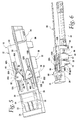
- FIGS. 1 and 2 are perspective views of the wire installation tool of the present invention, shown in the fully retracted position ready for parts to be loaded.
- the line of sight of FIG. 1 is largely a top plan view while FIG. 2 approaches a side elevation view.
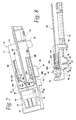
- FIGS. 3 and 4 are perspective views of the wire installation tool of the present invention, shown in the fully retracted position with a push-in connector and a stripped electrical wire loaded therein. Again the line of sight of FIG. 3 is close to a top plan view while FIG. 4 is mostly from the side of the tool.
- FIGS. 5 and 6 are perspective views of the wire installation tool of the present invention, shown in the partially advanced position with the wire holder jaws locked onto a wire.
- the line of sight of FIG. 5 is nearly a top plan view and FIG. 6 is nearly a side elevation view.
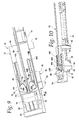
- FIGS. 7 and 8 are perspective views of the wire installation tool of the present invention, shown in the abutted advanced position with the wire holder jaws still locked onto a wire.
- the line of sight of FIG. 7 is primarily a top plan view while FIG. 8 is primarily a side elevation view.
- FIGS. 9 and 10 are perspective views of the wire installation tool of the present invention, shown in the fully advanced position with the wire holder jaws unlocked and ready for retraction.
- the line of sight of FIG. 9 is largely a top plan view while FIG. 10 is largely a side elevation view.
- FIG. 11 is a perspective view of an alternate embodiment of the wire installation tool, showing the left or cover side of a hand-held, hand-actuated tool.
- FIG. 12 is a side elevation view of the left or cover side of the hand-held insertion tool of FIG. 11 .
- FIG. 13 is a section taken along line 13 - 13 of FIG. 12 .
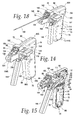
- FIG. 14 is a perspective view of the front end of the tool.
- FIG. 15 is a perspective view similar to FIG. 14 but with the cover removed to illustrate the slide assembly and actuator in the interior of the case.
- FIG. 16 is a side elevation view of the hand-held insertion tool with the cover removed.
- FIG. 17 is a perspective view of the hand-held insertion tool with the cover removed.
- FIG. 18 is a perspective view similar to FIG. 14 but showing a wire mounted in the slide assembly and the trigger actuated to move the slide assembly toward a push-in wire connector.
- a wire insertion tool is shown generally at 10 in FIGS. 1 and 2 . It includes a frame 12 having a rectangular, generally flat base plate or bed 14 .
- the bed has a pair of elongated slots 16 A, 16 B which extend through the entire thickness of the bed.
- the top surface of the bed has a pair of cam rails 18 A, 18 B adjacent the slots 16 A,B on the lateral edges of the bed 14 .
- the cam rails may be fixed to the bed. Alternately, the cam rails could be adjustably mounted on the bed to adjust the point at which the gripping fingers or jaws close or open on a wire, as will be explained below.
- a riser 22 that terminates at a ledge 24 .
- the bed has a portion of increased thickness that defines an abutment 28 .
- a bracket 30 attached to the underside of the bed.
- the bracket may be integrally formed with the bed as shown, or alternately it may be a separate part suitably fixed to the bed.
- a slide assembly 32 is mounted for reciprocating motion on the underside of the bed 14 .
- the slide assembly includes a jaw block 34 , an unlocking block 36 , guide rods 38 with heads 40 , and a compression spring 42 .
- the blocks 34 , 36 are free to move longitudinally of the bed, but not laterally.
- the jaw block 34 has an inverted L-shape which includes a nose portion 35 .
- the vertical leg of the jaw block has horizontal bores therethrough which receive the guide rods 38 .
- the guide rods have one end fixed in the unlocking block 36 .
- the rods extend from the unlocking block through the bores in the jaw block 34 , terminating at a nut or head 40 .
- the jaw block is slidably mounted on the rods 38 .
- the nut or head 40 on the free ends of the rods prevents the jaw block from sliding off the rods.
- a compression spring 42 is placed between the blocks 34 , 36 to normally bias them apart.
- the counterbores are sized such that together they can receive the entire spring when the tool is fully extended or advanced. This permits the faces of the jaw block 34 and unlocking block 36 to adjoin one another, as seen in FIGS. 9 and 10 .
- the slide assembly 32 reciprocates between extended and retracted positions. It is driven by a linear actuator, such as the air cylinder shown at 44 .
- the air cylinder of course, is connected to a suitable supply of compressed air and includes a suitable user-activated switch for controlling the flow of air to the cylinder.
- the cylinder is suitably fastened to the bracket 30 .
- a pushrod 46 extends from the cylinder 44 through a bore in the bracket 30 and connects to the unlocking block 36 . It will be understood that other types of actuators could be used, such as electro-mechanical actuators or hydraulic actuators.
- the jaw block 34 carries a wire holder.
- the wire holder includes a pair of jaws 48 A, 48 B.
- the jaws are pivotably mounted on jaw pins 50 A, 50 B.
- the jaw pins 50 A, 50 B have their lower ends fixed to the jaw block 34 for reciprocating movement therewith.
- the jaw pins extend from the jaw block up through the slots 16 A and 16 B, respectively.
- the upper, free ends of the jaw pins mount the jaws for rotation on the pins.
- the jaws also reciprocate with the slide assembly. That is, they move longitudinally on the surface of the bed 14 .
- each jaw 48 A, 48 B include a side cam follower 52 , a leading edge 54 , a gripping surface 56 , a relieved edge 58 and a release cam follower 60 .
- the side cam follower surface 52 is engageable with one of the cam rails 18 A, 18 B.
- the gripping surface 56 is an arcuate, preferably serrated surface. Together the gripping surfaces of the two jaws define a throat 57 between them into which an electric wire is placed.
- the gripping surface merges with the relieved edge 58 .
- the release cam follower surface 60 spans the associated slot 16 A or 16 B and is adapted for engagement with an unlocking pin 62 A or 62 B.
- the unlocking pins are fixed in the unlocking block 36 for reciprocating movement with the unlocking block.
- Pins 62 A, 62 B extend up through the slots 16 A, 16 B and are releasably engageable with the release cam follower surfaces 60 of the jaws.
- the rotational positions of the jaws 48 A,B are controlled by the engagement of the side cam follower surface 52 with the sides cams rails 18 A,B, respectively.
- the slide assembly reciprocates the changing contour of the cam rails causes the jaws to pivot about the jaw pins 50 A,B.
- the unlocking pins 62 A,B are arranged to the inside of the jaw pins 50 A, 50 B. That is, the unlocking pins are closer to the longitudinal centerline of the bed 14 than are the jaw pins.
- the carriage 26 is adapted to receive a push-in connector, such as the one shown at 64 in FIGS. 3-10 .
- the push-in connector has a hollow housing or enclosure made of electrically insulating material.
- the housing includes three wire openings (not shown) in an end face thereof.
- the interior of the housing includes a spring clip or other electrically conductive device that retains the wires inserted into the housing and electrically connects those wires.
- a single wire is shown at 66 .
- the end of the wire has had its insulation stripped to expose a bare end 68 of the underlying conductor. The stripped end portion of the wire is inserted into the connector housing.
- the carriage could be adjustably fixed to the bed to permit the length of the depression to be altered to fit a particular connector housing.
- the spacing between the notch 20 and the riser 22 and ledge 24 could be set so there is a snug fit of the connector housing on the carriage, thereby holding the connector fixed during operation of the slide assembly.
- a clamp or stay could be arranged to retain the connector on the carriage, or a laterally movable mounting could be used.
- FIGS. 1 and 2 illustrate the wire insertion tool 10 in the fully retracted position ready for parts to be loaded therein.
- FIGS. 3 and 4 show the tool fully retracted with a push-in connector 64 loaded on the carriage 26 and a wire 66 loaded into the throat area between the jaws 48 .
- the bare conductor 68 is aligned with the central opening of the connector housing.
- the user then activates the air cylinder 44 via a suitable switch.
- Movement of the jaw block 34 carries the jaws 48 A,B into contact with a closing portion of the cam rails 18 A,B, causing the jaws to close on the wire as seen in FIGS. 5 and 6 .
- the wire subsequently moves axially with the slide assembly toward the connector housing.
- FIGS. 7 and 8 illustrate the point of the slide assembly advancement where the nose 35 of the jaw block engages the abutment 28 .
- the pushrod 46 continues to advance, pushing the unlocking block toward the jaw block and compressing the spring 42 .
- the continued advancement of the unlocking block after the jaw block has been arrested by the abutment causes the unlocking pins 62 A,B to rotate the jaws out of engagement with the wire, as described above. This is shown in FIGS. 9 and 10 .
- FIGS. 9 and 10 how the guide rods 38 carry the heads 40 to a spaced location relative to the jaw block.
- the user can lift the joined wire and connector out of the tool and actuate the air cylinder control switch to retract the pushrod 46 .
- Retraction will first cause separation between the unlocking block 36 and the jaw block 34 , pulling the guide rods 38 back through the jaw block.
- the spring 42 will hold the nose 35 of the jaw block against the abutment 28 until the heads 40 reengage the jaw block.
- the jaw block will start to retract with the unlocking block and the entire slide assembly 32 will move as unit back to the starting point of FIGS. 1-4 .
- the user can reload the connector onto the carriage with a second housing opening aligned with the throat of the jaws.
- the first wire can be flexed slightly to overlie one of the jaws.
- a second wire is then loaded in the throat and the advancing stroke of the air cylinder repeats to insert the second wire as described above.
- a similar retraction stroke occurs after insertion of the second wire.
- If need be third (or more) wires are similarly inserted. It can be seen that all the operator has to do is position the connector and wires on the tool bed and activate the air cylinder. The pinching and advancing of the wire is then performed by the tool and the repetitive stresses on the operator are eliminated.
- FIGS. 11-18 An alternate embodiment of the wire insertion tool is shown generally at 70 in FIGS. 11-18 .
- This embodiment is a hand-held, hand-actuated, pistol-grip unit.
- Tool 70 has a two-piece housing that includes a generally hollow case 72 and a matching cover 74 .
- FIGS. 15-17 illustrate that the case 72 has a side wall 76 which includes an extension 78 .
- At the top of the extension there is a transversely-extending platform 80 which has an L-shaped channel 82 ( FIG. 16 ) formed therein. This channel receives a foot of a carriage as will be explained below.
- the edges of the platform 80 are bounded in front by an upstanding transverse rail 84 and on the outside, i.e., the right side as seen in FIG.
- transverse rail 84 joins the front end of longitudinal rail 86 .
- the rear end of rail 86 joins a transverse shoulder 88 ( FIG. 16 ) which defines a slot between it and the platform 80 for receiving a lip of a carriage as will be explained later.
- the case 72 further includes a top wall 90 which is perpendicular to the side wall 76 and extends from the shoulder 88 to a rear end wall 92 .
- the rear end wall 92 curves to merge with a back perimeter wall 94 .
- the back perimeter wall 94 in turn joins a bottom perimeter wall 96 that connects to a front perimeter wall 98 .
- the back, bottom and front perimeter walls 94 , 96 and 98 are all perpendicular to the side wall 76 . Together with the lower portion of the side wall 76 the perimeter walls form a handle 100 .
- FIGS. 15-17 illustrate the internal components of the case 72 .
- a base plate 102 Spaced below the platform 80 is a base plate 102 extending along the lower edge of the extension 78 and perpendicular thereto.
- the base plate 102 terminates at the front of the tool at a nose 104 that includes an internal cam actuating surface 106 .
- an oval track 108 At the end of the tool opposite the nose 104 there is an oval track 108 that is upraised and defines a pin-receiving race 110 therein.
- Somewhat above and to the front of track 108 is another circular pin-receiving enlargement (a small portion of which can be seen at 111 in FIGS. 15 and 17 ) formed on the inside of the side wall 76 .
- bosses 112 At the upper corners of track 108 is a pair of bosses 112 having bores therein for receiving connecting screws extending through the cover 74 . Another pair of such bosses 112 is found in the extension 78 . Two similar pairs of bosses 112 are also found in the handle 100 .
- a hollow spring seat 114 joins the back perimeter wall 94 .
- the cover 74 has a perimeter shape generally complementary to that of the case 72 .
- Cover parts generally corresponding to those of the case are designated with the same reference numeral with the letter A added, and their description will not be repeated.
- the cover is fastened to the case by screws (not shown) which extend through openings 115 in the cover and thread into the bores of the bosses 112 in the case.
- One area where the cover differs from the case is in the vicinity of the platform 80 .
- the cover has a laterally extending flat deck 116 ( FIG. 13 ). The top surface of the deck matches that of the platform. Underneath the deck there is a projection 117 in which a channel (not shown) is formed.
- This channel is shaped the same as the channel 82 in the case's platform 80 .
- the two channels are aligned with one another.
- the top surface of the deck 116 and platform 80 is beneath the top of the transverse rail 84 for reasons which will be explained below.
- To the rear of the deck 116 is a lateral guide wall 121 .
- a canopy 120 extends from the guide wall to the front edge of the deck 116 . The canopy defines a hollow receptacle underneath it for entrapping the retainer plate of the carriage as will be set forth below.
- the slide assembly includes an elongated slide rod 124 .
- the slide rod may be a generally U-shaped member having flat, upstanding sides 126 joined by a lower bight 128 . The bight does not extend the full length of the pushrod, the sides of which define a clevis 130 at the rear end.
- each side 126 of the slide rod 124 has an enlarged head 132 .
- One head further includes an upstanding extension terminating at a curved hood 134 .
- the cam has a curved, serrated wire gripping surface 138 which is biased toward the hood 134 by a torsion spring 139 ( FIGS. 16 and 17 ).
- the slide rod 124 is slidably mounted on the base plates 102 , 102 A.
- the hood 134 extends above the open top of the extensions 78 , 78 A.
- the slide rod 124 is connected to an actuator.
- the slide rod's clevis 130 carries a link pin 140 .
- the ends of the link pin 140 are mounted for reciprocating movement in the races 110 .
- the link pin 140 also extends through a clevis at one end of a pushrod 142 .
- the other end of pushrod 142 is pinned by a trigger-link pin 144 to a trigger 146 .
- Trigger 146 is pivotably connected to the housing by a main pivot pin 148 .
- the ends of the main pivot pin 148 are carried in the circular pin-receiving enlargements 111 .
- the pushrod 142 and trigger 146 are constructed similarly to the slide rod 132 .
- each are generally U-shaped members having flat sides joined by a bight which does not extend the full length of the member.
- the sides define a single clevis at the top of the trigger for the main pivot pin 148 while the sides define two clevises, one at each end of the pushrod 142 .
- all of the slide rod 124 , pushrod 142 and trigger 146 may be made of stampings which are rolled to shape, although it will be understood that other suitable forms and manufacturing methods are possible for each of these three elongated members.
- a return spring 150 has one end held in the spring seat 114 .
- the other end of the return spring surrounds a tang 151 that extends from the pushrod 142 .
- the return spring urges the trigger 146 away from the handle 100 to a rest or extended position.
- a wire connector holder in the form of a carriage 152 is disposed generally above the platform 80 and deck 116 .
- the main part of the carriage is a generally five-sided box or enclosure which is open to the front of the tool.
- the rear edge of the plate 154 adjoins the lateral guide wall 121 of the cover 74 and is slidable in the slot defined under the shoulder 88 of the case.
- the plate 154 also fits into the receptacle defined by the canopy 120 .
- the carriage is movable laterally between a connector loading position, which is all the way to the left, and a wire insertion position, which is toward the longitudinal rail 86 .
- a user can push or pull the carriage 152 to a different desired position as needed for either aligning a connector opening with the slide rod or for mounting or dismounting a connector in the carriage.
- the longitudinal rail 86 limits the rightward sliding of the carriage, while the canopy 120 limits leftward sliding of the carriage. Engagement of the foot 158 with the deck 116 and platform 80 and engagement of the plate 154 with the shoulder 88 prevents lifting the carriage off the tool.
- FIG. 13 shows that on the underside of the carriage plate 154 there is a series of longitudinal grooves 162 . These receive the ball of the detent mechanism 119 to releasably hold the carriage 152 in a selected position.
- the right-most groove in FIG. 13 defines the connector loading position.
- the other three grooves define wire insertion positions. In each of these positions one of the openings in the housing of the wire connector 160 is aligned with the slide rod 124 and the wire gripping surface 138 . The user locates the carriage 152 to align an available connector opening with the slide rod, which makes the connector ready for insertion of a wire.
- a push-in wire connector 160 has to be loaded into the carriage. As just mentioned this is done by pushing or pulling the carriage 152 onto the deck 116 to the connector loading position. As viewed by a user holding the tool in his or her hand for actuation, with the thumb around the handle 100 and the fingers wrapped around the trigger 146 , the carriage is moved to the user's left for loading the carriage. This allows the carriage cavity to clear the transverse rail 84 .
- the connector 160 is pressed into the cavity in the carriage through the open front side of the carriage. The connector is oriented so its openings face the front of the tool.
- the cavity of the carriage is preferably shaped to receive the connector in only the correct orientation; it won't fit if inserted backwards or sideways. Then the carriage is moved to the right to align the first connector opening with the cam 136 of the slide assembly 124 .
- the detent grooves 162 interact with the detent mechanism 119 to provide tactile feedback when the carriage is in the correct position. With the carriage in one of the wire insertion positions the transverse rail 84 will partially close the cavity of the carriage to retain the connector in the carriage.
- the end of a wire to be inserted is placed in the slide assembly, between the wire gripping surface 138 and the hood 134 . The stripped end of the wire faces the connector 160 with a portion of the wire's insulation adjacent the serrated wire gripping surface 138 .
- the pivoting trigger pushes the pushrod 142 backwards toward the rear of the tool.
- the link pin 140 also moves rearwardly but is constrained by the oval track 108 , 108 A to move in a horizontal direction only. This draws the slide rod 124 rearwardly.
- the arrangement of the cam gripping surface and the location of the cam's pivotal mounting to the slide rod create a self-locking action of the cam on the wire.
- the carriage is returned to the connector loading position, i.e., to the left of the tool. This allows the connector cavity to clear the transverse rail 84 which in turn permits removal of the connector from the carriage. The tool is then ready to receive the next wire connector.
- the wire holder could be adapted to insert multiple wires in a single full stroke of the slide assembly.
- the wire holder or carriage could be connected to the slide assembly to index the carriage laterally during a return stroke so the carriage is automatically position for the next wire to be inserted.
- the manual actuator of the pistol grip unit could replaced by a powered actuator.
- the motion of the slide assemblies shown herein is strictly linear, it will be understood that some non-linear motion could be accommodated so long as the component of slide motion immediately before wire insertion is parallel to the entry axis of the connector housing.
- the slide assembly could impart an initially arcuate motion to the wire holder which arcuate motion then concludes with a tangential component that is parallel to the entry axis, thereby inserting the wire parallel to the entry axis.
Landscapes
- Engineering & Computer Science (AREA)
- Mechanical Engineering (AREA)
- Manufacturing & Machinery (AREA)
- Manufacturing Of Electrical Connectors (AREA)
Abstract
Description
- This application claims the benefit of priority from U.S. Provisional Patent Application No. 60/821,663 titled “Wire Insertion Tool for Push-in Wire Connectors”, filed on Aug. 7, 2006, the entire contents of which are herein incorporated by reference.
- Push-in wire connectors are a well-known type of wire connector having an electrically-insulating housing in which a conductive wire retainer is disposed. The housing has two or more openings therein through which the stripped ends of electrical wires can be inserted. The bare ends of the inserted wires engage the wire retainer in the interior of the housing. The wire retainer is often in the form of a spring clip. The spring clip includes spring fingers which are arranged to receive wires pushed into the housing and then grab or hold the wires to prevent them from being pulled out of the housing. The inserted wires are electrically connected to one another by the clip. A variation of this construction is a releasable push-in connector which has a spring finger which can be manipulated by a user to release the inserted wires and allow them to be retracted from the housing. Examples of push-in wire connectors are shown in U.S. Pat. Nos. 4,824,395 and 6,746,286, the disclosures of which are hereby incorporated by reference.
- Push-in connectors are an alternative to twist-on wire connectors. In high volume applications push-in connectors may be used as an alternative to twist-on wire connectors in an attempt to avoid possible issues relating to repetitive stress injuries or trauma such as carpal tunnel syndrome. However, in certain situations this effort can be largely futile as the user is simply trading one repetitive motion for another. That is, the pincer-like finger grip of a wire required by the manual use of a push-in connector can be, for those so disposed, as much of a problem as the wrist twisting motion required by manual installation of a twist-on connector.
- Another problem with push-in connectors occurs when they are used with stranded wires. Stranded wires have a tendency to buckle as they are inserted into a push-in connector by hand, especially if the user's grip is remote from the end of the wire. Or sometimes if the wire isn't carefully aligned with the housing opening some of the strands may get separated from the bulk of the strands and these individual strands get hung up on the exterior of the housing. For obvious safety reasons this is undesirable.
- The afore-mentioned problems are overcome by the present invention which provides a tool for installing wires into push-in connectors. The tool has a bed which includes a carriage where a push-in connector is momentarily fixed. A reciprocating slide is mounted to the bed and carries a wire holder for reciprocal motion. The wire holder grasps a wire with the stripped end of the wire opposite an opening of the fixed connector. The slide advances the wire holder in a direction parallel to the axis of the wire, thereby inserting the bare end of the wire into the connector housing. The wire holder then releases its grasp of the wire and the slide is retracted. Either the connector or the wire holder is indexed to align the wire holder with the next housing opening. Then another wire is placed in the holder for insertion into the connector and the translation step is repeated. When all of the wires are inserted the filled connector is released from the carriage and the next connector is presented. Alternately, the wire holder could be arranged to hold multiple wires opposite the housing openings. Then all wires could be installed in a single translation of the slide and wire holder. In such a case the filled connector could be removed from the carriage before, during or after retraction of the slide wire holder.
-
FIGS. 1 and 2 are perspective views of the wire installation tool of the present invention, shown in the fully retracted position ready for parts to be loaded. The line of sight ofFIG. 1 is largely a top plan view whileFIG. 2 approaches a side elevation view. -
FIGS. 3 and 4 are perspective views of the wire installation tool of the present invention, shown in the fully retracted position with a push-in connector and a stripped electrical wire loaded therein. Again the line of sight ofFIG. 3 is close to a top plan view whileFIG. 4 is mostly from the side of the tool. -
FIGS. 5 and 6 are perspective views of the wire installation tool of the present invention, shown in the partially advanced position with the wire holder jaws locked onto a wire. The line of sight ofFIG. 5 is nearly a top plan view andFIG. 6 is nearly a side elevation view. -
FIGS. 7 and 8 are perspective views of the wire installation tool of the present invention, shown in the abutted advanced position with the wire holder jaws still locked onto a wire. The line of sight ofFIG. 7 is primarily a top plan view whileFIG. 8 is primarily a side elevation view. -
FIGS. 9 and 10 are perspective views of the wire installation tool of the present invention, shown in the fully advanced position with the wire holder jaws unlocked and ready for retraction. The line of sight ofFIG. 9 is largely a top plan view whileFIG. 10 is largely a side elevation view. -
FIG. 11 is a perspective view of an alternate embodiment of the wire installation tool, showing the left or cover side of a hand-held, hand-actuated tool. -
FIG. 12 is a side elevation view of the left or cover side of the hand-held insertion tool ofFIG. 11 . -
FIG. 13 is a section taken along line 13-13 ofFIG. 12 . -
FIG. 14 is a perspective view of the front end of the tool. -
FIG. 15 is a perspective view similar toFIG. 14 but with the cover removed to illustrate the slide assembly and actuator in the interior of the case. -
FIG. 16 is a side elevation view of the hand-held insertion tool with the cover removed. -
FIG. 17 is a perspective view of the hand-held insertion tool with the cover removed. -
FIG. 18 is a perspective view similar toFIG. 14 but showing a wire mounted in the slide assembly and the trigger actuated to move the slide assembly toward a push-in wire connector. - A wire insertion tool according to the present invention is shown generally at 10 in
FIGS. 1 and 2 . It includes aframe 12 having a rectangular, generally flat base plate orbed 14. The bed has a pair ofelongated slots cam rails slots 16A,B on the lateral edges of thebed 14. The cam rails may be fixed to the bed. Alternately, the cam rails could be adjustably mounted on the bed to adjust the point at which the gripping fingers or jaws close or open on a wire, as will be explained below. Toward one end of the bed there is a depression which defines anotch 20. Axially spaced from the notch there is ariser 22 that terminates at a ledge 24. Together thenotch 20,riser 22 andledge 24 define acarriage 26. Underneath the carriage the bed has a portion of increased thickness that defines anabutment 28. At the opposite end of the bed from the abutment there is abracket 30 attached to the underside of the bed. The bracket may be integrally formed with the bed as shown, or alternately it may be a separate part suitably fixed to the bed. - A
slide assembly 32 is mounted for reciprocating motion on the underside of thebed 14. The slide assembly includes ajaw block 34, an unlockingblock 36, guiderods 38 withheads 40, and acompression spring 42. Theblocks jaw block 34 has an inverted L-shape which includes anose portion 35. The vertical leg of the jaw block has horizontal bores therethrough which receive theguide rods 38. - One of the guide rods is seen at 38. The guide rods have one end fixed in the unlocking
block 36. The rods extend from the unlocking block through the bores in thejaw block 34, terminating at a nut orhead 40. Thus, the jaw block is slidably mounted on therods 38. The nut orhead 40 on the free ends of the rods prevents the jaw block from sliding off the rods. Acompression spring 42 is placed between theblocks spring 42. The counterbores are sized such that together they can receive the entire spring when the tool is fully extended or advanced. This permits the faces of thejaw block 34 and unlockingblock 36 to adjoin one another, as seen inFIGS. 9 and 10 . - The
slide assembly 32 reciprocates between extended and retracted positions. It is driven by a linear actuator, such as the air cylinder shown at 44. The air cylinder, of course, is connected to a suitable supply of compressed air and includes a suitable user-activated switch for controlling the flow of air to the cylinder. The cylinder is suitably fastened to thebracket 30. Apushrod 46 extends from thecylinder 44 through a bore in thebracket 30 and connects to the unlockingblock 36. It will be understood that other types of actuators could be used, such as electro-mechanical actuators or hydraulic actuators. - The
jaw block 34 carries a wire holder. In the illustrated embodiment the wire holder includes a pair ofjaws jaw pins jaw block 34 for reciprocating movement therewith. The jaw pins extend from the jaw block up through theslots bed 14. - The perimeter surfaces of each
jaw side cam follower 52, a leadingedge 54, a grippingsurface 56, arelieved edge 58 and arelease cam follower 60. The sidecam follower surface 52 is engageable with one of the cam rails 18A, 18B. The grippingsurface 56 is an arcuate, preferably serrated surface. Together the gripping surfaces of the two jaws define athroat 57 between them into which an electric wire is placed. The gripping surface merges with therelieved edge 58. The releasecam follower surface 60 spans the associatedslot pin block 36 for reciprocating movement with the unlocking block.Pins slots - The rotational positions of the
jaws 48A,B are controlled by the engagement of the sidecam follower surface 52 with the sides cams rails 18A,B, respectively. As the slide assembly reciprocates the changing contour of the cam rails causes the jaws to pivot about the jaw pins 50A,B. It is further pointed out that the unlockingpins 62A,B are arranged to the inside of the jaw pins 50A, 50B. That is, the unlocking pins are closer to the longitudinal centerline of thebed 14 than are the jaw pins. With the unlocking pins arranged in this manner, contact between the unlocking pins and the release cam follower surfaces 62 will cause the jaws to rotate in a manner that releases thegripping surfaces 56 from a wire, i.e.,jaw 48A will rotate clockwise (as seen inFIG. 1 ) aboutpin 50A whilejaw 48B will rotate counterclockwise aboutpin 50B. - The
carriage 26 is adapted to receive a push-in connector, such as the one shown at 64 inFIGS. 3-10 . The push-in connector has a hollow housing or enclosure made of electrically insulating material. In this example the housing includes three wire openings (not shown) in an end face thereof. It will be understood that the interior of the housing includes a spring clip or other electrically conductive device that retains the wires inserted into the housing and electrically connects those wires. Alternately, there may be a separate retaining member and conductive busbar inside the connector housing. A single wire is shown at 66. The end of the wire has had its insulation stripped to expose abare end 68 of the underlying conductor. The stripped end portion of the wire is inserted into the connector housing. Alternatively, the carriage could be adjustably fixed to the bed to permit the length of the depression to be altered to fit a particular connector housing. In this case the spacing between thenotch 20 and theriser 22 andledge 24 could be set so there is a snug fit of the connector housing on the carriage, thereby holding the connector fixed during operation of the slide assembly. As a further alternate, a clamp or stay could be arranged to retain the connector on the carriage, or a laterally movable mounting could be used. - The use, operation and function of the invention are as follows.
FIGS. 1 and 2 illustrate thewire insertion tool 10 in the fully retracted position ready for parts to be loaded therein.FIGS. 3 and 4 show the tool fully retracted with a push-inconnector 64 loaded on thecarriage 26 and awire 66 loaded into the throat area between the jaws 48. Thebare conductor 68 is aligned with the central opening of the connector housing. The user then activates theair cylinder 44 via a suitable switch. As thepushrod 46 advances it pushes theslide assembly 32 toward the connector. Movement of thejaw block 34 carries thejaws 48A,B into contact with a closing portion of the cam rails 18A,B, causing the jaws to close on the wire as seen inFIGS. 5 and 6 . The wire subsequently moves axially with the slide assembly toward the connector housing. -
FIGS. 7 and 8 illustrate the point of the slide assembly advancement where thenose 35 of the jaw block engages theabutment 28. This stops movement of the jaw block, and consequently of the jaws and wire as well, at a position where the wire is fully inserted into the connector housing. Thepushrod 46, however, continues to advance, pushing the unlocking block toward the jaw block and compressing thespring 42. The continued advancement of the unlocking block after the jaw block has been arrested by the abutment causes the unlockingpins 62A,B to rotate the jaws out of engagement with the wire, as described above. This is shown inFIGS. 9 and 10 . - Note in
FIGS. 9 and 10 how theguide rods 38 carry theheads 40 to a spaced location relative to the jaw block. With the jaws opened by the unlocking pins, the user can lift the joined wire and connector out of the tool and actuate the air cylinder control switch to retract thepushrod 46. Retraction will first cause separation between the unlockingblock 36 and thejaw block 34, pulling theguide rods 38 back through the jaw block. Thespring 42 will hold thenose 35 of the jaw block against theabutment 28 until theheads 40 reengage the jaw block. Then the jaw block will start to retract with the unlocking block and theentire slide assembly 32 will move as unit back to the starting point ofFIGS. 1-4 . At that time the user can reload the connector onto the carriage with a second housing opening aligned with the throat of the jaws. The first wire can be flexed slightly to overlie one of the jaws. A second wire is then loaded in the throat and the advancing stroke of the air cylinder repeats to insert the second wire as described above. A similar retraction stroke occurs after insertion of the second wire. If need be third (or more) wires are similarly inserted. It can be seen that all the operator has to do is position the connector and wires on the tool bed and activate the air cylinder. The pinching and advancing of the wire is then performed by the tool and the repetitive stresses on the operator are eliminated. - An alternate embodiment of the wire insertion tool is shown generally at 70 in
FIGS. 11-18 . This embodiment is a hand-held, hand-actuated, pistol-grip unit.Tool 70 has a two-piece housing that includes a generallyhollow case 72 and a matchingcover 74.FIGS. 15-17 illustrate that thecase 72 has aside wall 76 which includes anextension 78. At the top of the extension there is a transversely-extendingplatform 80 which has an L-shaped channel 82 (FIG. 16 ) formed therein. This channel receives a foot of a carriage as will be explained below. The edges of theplatform 80 are bounded in front by an upstandingtransverse rail 84 and on the outside, i.e., the right side as seen inFIG. 13 , by an upstandinglongitudinal rail 86. The outside end oftransverse rail 84 joins the front end oflongitudinal rail 86. The rear end ofrail 86 joins a transverse shoulder 88 (FIG. 16 ) which defines a slot between it and theplatform 80 for receiving a lip of a carriage as will be explained later. - The
case 72 further includes atop wall 90 which is perpendicular to theside wall 76 and extends from theshoulder 88 to arear end wall 92. Therear end wall 92 curves to merge with aback perimeter wall 94. Theback perimeter wall 94 in turn joins abottom perimeter wall 96 that connects to afront perimeter wall 98. As is the case with the top and rear walls, the back, bottom andfront perimeter walls side wall 76. Together with the lower portion of theside wall 76 the perimeter walls form ahandle 100. -
FIGS. 15-17 illustrate the internal components of thecase 72. Spaced below theplatform 80 is abase plate 102 extending along the lower edge of theextension 78 and perpendicular thereto. Thebase plate 102 terminates at the front of the tool at anose 104 that includes an internalcam actuating surface 106. At the end of the tool opposite thenose 104 there is anoval track 108 that is upraised and defines a pin-receivingrace 110 therein. Somewhat above and to the front oftrack 108 is another circular pin-receiving enlargement (a small portion of which can be seen at 111 inFIGS. 15 and 17 ) formed on the inside of theside wall 76. At the upper corners oftrack 108 is a pair ofbosses 112 having bores therein for receiving connecting screws extending through thecover 74. Another pair ofsuch bosses 112 is found in theextension 78. Two similar pairs ofbosses 112 are also found in thehandle 100. Ahollow spring seat 114 joins theback perimeter wall 94. - Turning now to
FIGS. 11 and 12 , it can be seen that thecover 74 has a perimeter shape generally complementary to that of thecase 72. Cover parts generally corresponding to those of the case are designated with the same reference numeral with the letter A added, and their description will not be repeated. The cover is fastened to the case by screws (not shown) which extend throughopenings 115 in the cover and thread into the bores of thebosses 112 in the case. One area where the cover differs from the case is in the vicinity of theplatform 80. Here the cover has a laterally extending flat deck 116 (FIG. 13 ). The top surface of the deck matches that of the platform. Underneath the deck there is aprojection 117 in which a channel (not shown) is formed. This channel is shaped the same as thechannel 82 in the case'splatform 80. The two channels are aligned with one another. It will be noted that the top surface of thedeck 116 andplatform 80 is beneath the top of thetransverse rail 84 for reasons which will be explained below. Adjacent to theprojection 117 and depending from thedeck 116 there is acylindrical sleeve 118 having a bore through it. In the bore is positioned adetent mechanism 119 including a ball, spring and set screw. To the rear of thedeck 116 is alateral guide wall 121. Acanopy 120 extends from the guide wall to the front edge of thedeck 116. The canopy defines a hollow receptacle underneath it for entrapping the retainer plate of the carriage as will be set forth below. - Together the non-handle portions of the
side walls extensions platform 80, thetop walls rear end walls base plates 102, 102A, thenoses deck 116 define a frame portion of the housing. Inside this frame is aslide assembly 122. The slide assembly includes anelongated slide rod 124. The slide rod may be a generally U-shaped member having flat,upstanding sides 126 joined by alower bight 128. The bight does not extend the full length of the pushrod, the sides of which define aclevis 130 at the rear end. At the front end eachside 126 of theslide rod 124 has anenlarged head 132. One head further includes an upstanding extension terminating at acurved hood 134. Between theheads 132 and underneath thehood 134 there is pinned acam 136. The cam has a curved, serratedwire gripping surface 138 which is biased toward thehood 134 by a torsion spring 139 (FIGS. 16 and 17 ). Theslide rod 124 is slidably mounted on thebase plates 102, 102A. Thehood 134 extends above the open top of theextensions - The
slide rod 124 is connected to an actuator. In the illustrated embodiment the slide rod'sclevis 130 carries alink pin 140. The ends of thelink pin 140 are mounted for reciprocating movement in theraces 110. Thelink pin 140 also extends through a clevis at one end of apushrod 142. The other end ofpushrod 142 is pinned by a trigger-link pin 144 to atrigger 146.Trigger 146 is pivotably connected to the housing by amain pivot pin 148. The ends of themain pivot pin 148 are carried in the circular pin-receivingenlargements 111. Thepushrod 142 and trigger 146 are constructed similarly to theslide rod 132. That is, they each are generally U-shaped members having flat sides joined by a bight which does not extend the full length of the member. The sides define a single clevis at the top of the trigger for themain pivot pin 148 while the sides define two clevises, one at each end of thepushrod 142. Advantageously, all of theslide rod 124,pushrod 142 and trigger 146 may be made of stampings which are rolled to shape, although it will be understood that other suitable forms and manufacturing methods are possible for each of these three elongated members. - A
return spring 150 has one end held in thespring seat 114. The other end of the return spring surrounds atang 151 that extends from thepushrod 142. The return spring urges thetrigger 146 away from thehandle 100 to a rest or extended position. - A wire connector holder in the form of a
carriage 152 is disposed generally above theplatform 80 anddeck 116. The main part of the carriage is a generally five-sided box or enclosure which is open to the front of the tool. There is a lateral Z-shaped extension (FIG. 16 ) attached to the enclosure. It includes aflat plate 154, afront leg 156 and afoot 158 connected to the leg. The foot tucks under theplatform 80 anddeck 116 and is slidable in thechannel 82 in the platform andprojection 117. The rear edge of theplate 154 adjoins thelateral guide wall 121 of thecover 74 and is slidable in the slot defined under theshoulder 88 of the case. Theplate 154 also fits into the receptacle defined by thecanopy 120. Thus, the carriage is movable laterally between a connector loading position, which is all the way to the left, and a wire insertion position, which is toward thelongitudinal rail 86. A user can push or pull thecarriage 152 to a different desired position as needed for either aligning a connector opening with the slide rod or for mounting or dismounting a connector in the carriage. It is noted that thelongitudinal rail 86 limits the rightward sliding of the carriage, while thecanopy 120 limits leftward sliding of the carriage. Engagement of thefoot 158 with thedeck 116 andplatform 80 and engagement of theplate 154 with theshoulder 88 prevents lifting the carriage off the tool. - It will be noted in
FIG. 14 that when thecarriage 152 is in a wire insertion position thetransverse rail 84 is engageable with thewire connector 160, which prevents the connector from coming out of the carriage. When the carriage is moved all the way to the left, to the connector loading position, the connector clears therail 84. The reduced height of thedeck 116 allows the connector to be placed into or taken out of the carriage. -
FIG. 13 shows that on the underside of thecarriage plate 154 there is a series oflongitudinal grooves 162. These receive the ball of thedetent mechanism 119 to releasably hold thecarriage 152 in a selected position. The right-most groove inFIG. 13 defines the connector loading position. The other three grooves define wire insertion positions. In each of these positions one of the openings in the housing of thewire connector 160 is aligned with theslide rod 124 and thewire gripping surface 138. The user locates thecarriage 152 to align an available connector opening with the slide rod, which makes the connector ready for insertion of a wire. - The use, operation and function of the wire insertion tool are as follows. First a push-in
wire connector 160 has to be loaded into the carriage. As just mentioned this is done by pushing or pulling thecarriage 152 onto thedeck 116 to the connector loading position. As viewed by a user holding the tool in his or her hand for actuation, with the thumb around thehandle 100 and the fingers wrapped around thetrigger 146, the carriage is moved to the user's left for loading the carriage. This allows the carriage cavity to clear thetransverse rail 84. Theconnector 160 is pressed into the cavity in the carriage through the open front side of the carriage. The connector is oriented so its openings face the front of the tool. In fact, the cavity of the carriage is preferably shaped to receive the connector in only the correct orientation; it won't fit if inserted backwards or sideways. Then the carriage is moved to the right to align the first connector opening with thecam 136 of theslide assembly 124. Thedetent grooves 162 interact with thedetent mechanism 119 to provide tactile feedback when the carriage is in the correct position. With the carriage in one of the wire insertion positions thetransverse rail 84 will partially close the cavity of the carriage to retain the connector in the carriage. Next, the end of a wire to be inserted is placed in the slide assembly, between thewire gripping surface 138 and thehood 134. The stripped end of the wire faces theconnector 160 with a portion of the wire's insulation adjacent the serratedwire gripping surface 138. - The user then squeezes the
trigger 146. The pivoting trigger pushes thepushrod 142 backwards toward the rear of the tool. Thelink pin 140 also moves rearwardly but is constrained by theoval track 108, 108A to move in a horizontal direction only. This draws theslide rod 124 rearwardly. As the slide rod moves, it pulls thecam 136 out of engagement with thecam actuating surface 106 of thenose 104. This permits thetorsion spring 139 to rotate the cam toward thehood 134, thereby gripping the wire firmly in the slide assembly. The arrangement of the cam gripping surface and the location of the cam's pivotal mounting to the slide rod create a self-locking action of the cam on the wire. Continued squeezing of the trigger advances the wire held by thecam 136 toward the opening in theconnector 160. This is shown inFIG. 18 with the wire illustrated at 164. Once the wire is seated in the connector the user releases the trigger. Thereturn spring 150 pushes thetrigger 146 back toward the extended or rest position. This also advances the slide rod to the front of the tool. Slide rod movement toward the nose allows the cam to rotate to an unlocked condition with respect to the wire. When thecam 136 hits thecam actuating surface 106 the cam rotates to the loading position ofFIG. 14 , ready for the next wire. The user slides thecarriage 152 in the appropriate direction to align the next empty connector opening with thecam 136. The next wire is mounted in the slide assembly and the wire insertion process is repeated. This is done for as many wires as needed or desired. - Once all of the wires are inserted, the carriage is returned to the connector loading position, i.e., to the left of the tool. This allows the connector cavity to clear the
transverse rail 84 which in turn permits removal of the connector from the carriage. The tool is then ready to receive the next wire connector. - While the preferred form of the invention has been shown and described herein, it should be realized that there may be many modifications, substitutions and alterations thereto. For example, the wire holder could be adapted to insert multiple wires in a single full stroke of the slide assembly. Or, the wire holder or carriage could be connected to the slide assembly to index the carriage laterally during a return stroke so the carriage is automatically position for the next wire to be inserted. The manual actuator of the pistol grip unit could replaced by a powered actuator. Also, while the motion of the slide assemblies shown herein is strictly linear, it will be understood that some non-linear motion could be accommodated so long as the component of slide motion immediately before wire insertion is parallel to the entry axis of the connector housing. Thus, for example, the slide assembly could impart an initially arcuate motion to the wire holder which arcuate motion then concludes with a tangential component that is parallel to the entry axis, thereby inserting the wire parallel to the entry axis.
Claims (8)
Priority Applications (1)
| Application Number | Priority Date | Filing Date | Title |
|---|---|---|---|
| US11/835,149 US7685702B2 (en) | 2006-08-07 | 2007-08-07 | Wire insertion tool for push-in wire connectors |
Applications Claiming Priority (2)
| Application Number | Priority Date | Filing Date | Title |
|---|---|---|---|
| US82166306P | 2006-08-07 | 2006-08-07 | |
| US11/835,149 US7685702B2 (en) | 2006-08-07 | 2007-08-07 | Wire insertion tool for push-in wire connectors |
Publications (2)
| Publication Number | Publication Date |
|---|---|
| US20080098593A1 true US20080098593A1 (en) | 2008-05-01 |
| US7685702B2 US7685702B2 (en) | 2010-03-30 |
Family
ID=39328426
Family Applications (1)
| Application Number | Title | Priority Date | Filing Date |
|---|---|---|---|
| US11/835,149 Active 2028-04-18 US7685702B2 (en) | 2006-08-07 | 2007-08-07 | Wire insertion tool for push-in wire connectors |
Country Status (1)
| Country | Link |
|---|---|
| US (1) | US7685702B2 (en) |
Cited By (5)
| Publication number | Priority date | Publication date | Assignee | Title |
|---|---|---|---|---|
| CN109773457A (en) * | 2019-03-18 | 2019-05-21 | 克莱斯电梯(中国)有限公司 | A kind of elevator assembling fittings assembly device |
| CN113648537A (en) * | 2021-08-13 | 2021-11-16 | 北京品驰医疗设备有限公司 | Wire propeller assembly |
| US20230129398A1 (en) * | 2021-10-25 | 2023-04-27 | Douglas Dickie | Fish Tape Drilling Attachment Device |
| CN119566751A (en) * | 2024-11-08 | 2025-03-07 | 宁波汇聚汽车零部件有限公司 | Automatic clamping device for blade thorn rope |
| CN120772783A (en) * | 2025-08-27 | 2025-10-14 | 韶关丸仁电子有限公司 | Automatic clamping type shell assembling mechanism |
Families Citing this family (3)
| Publication number | Priority date | Publication date | Assignee | Title |
|---|---|---|---|---|
| CA2689244C (en) * | 2009-01-07 | 2012-11-27 | Thomas & Betts International, Inc. | Coaxial cable installation tool |
| USD622568S1 (en) * | 2009-03-20 | 2010-08-31 | Sanchez David L | Trampoline spring tool |
| US10978859B2 (en) * | 2017-05-09 | 2021-04-13 | Nonconductive Tool Company, LLC | Wire tip clipping tool and method of using same |
Citations (3)
| Publication number | Priority date | Publication date | Assignee | Title |
|---|---|---|---|---|
| US4534107A (en) * | 1984-03-09 | 1985-08-13 | Amp Incorporated | Wire insertion and terminal crimping tool |
| US4642874A (en) * | 1985-10-24 | 1987-02-17 | Amp Incorporated | Hand held tool for wire insertion |
| US6877218B2 (en) * | 2001-06-21 | 2005-04-12 | Rauland-Borg Corporation | Hand tool for applying electrical connectors |
-
2007
- 2007-08-07 US US11/835,149 patent/US7685702B2/en active Active
Patent Citations (3)
| Publication number | Priority date | Publication date | Assignee | Title |
|---|---|---|---|---|
| US4534107A (en) * | 1984-03-09 | 1985-08-13 | Amp Incorporated | Wire insertion and terminal crimping tool |
| US4642874A (en) * | 1985-10-24 | 1987-02-17 | Amp Incorporated | Hand held tool for wire insertion |
| US6877218B2 (en) * | 2001-06-21 | 2005-04-12 | Rauland-Borg Corporation | Hand tool for applying electrical connectors |
Cited By (5)
| Publication number | Priority date | Publication date | Assignee | Title |
|---|---|---|---|---|
| CN109773457A (en) * | 2019-03-18 | 2019-05-21 | 克莱斯电梯(中国)有限公司 | A kind of elevator assembling fittings assembly device |
| CN113648537A (en) * | 2021-08-13 | 2021-11-16 | 北京品驰医疗设备有限公司 | Wire propeller assembly |
| US20230129398A1 (en) * | 2021-10-25 | 2023-04-27 | Douglas Dickie | Fish Tape Drilling Attachment Device |
| CN119566751A (en) * | 2024-11-08 | 2025-03-07 | 宁波汇聚汽车零部件有限公司 | Automatic clamping device for blade thorn rope |
| CN120772783A (en) * | 2025-08-27 | 2025-10-14 | 韶关丸仁电子有限公司 | Automatic clamping type shell assembling mechanism |
Also Published As
| Publication number | Publication date |
|---|---|
| US7685702B2 (en) | 2010-03-30 |
Similar Documents
| Publication | Publication Date | Title |
|---|---|---|
| US7685702B2 (en) | Wire insertion tool for push-in wire connectors | |
| JP5232874B2 (en) | Termination tool with corresponding male and female connectors | |
| CN112769021B (en) | Alignment device for aligning cables | |
| US4642874A (en) | Hand held tool for wire insertion | |
| EP3246259A1 (en) | Cable tie tensioning and cut off tool | |
| JP4665030B2 (en) | T5 terminal mounting tool | |
| CA1043991A (en) | Apparatus for applying a tubular insulating housing to an electrical connector | |
| EP0371290A1 (en) | Banding tool | |
| DE2548656A1 (en) | LOCKING DEVICE FOR A SWITCH OF AN ELECTRICAL DEVICE | |
| US2777345A (en) | Magazine-type hand tool for crimping electrical connectors | |
| US4389769A (en) | Terminating tool which is adjustable to accommodate different centerline spacing | |
| US4341134A (en) | Tool for stripping insulating covering | |
| US4817274A (en) | Puller tool for multiple pin connectors | |
| EP0112630B1 (en) | Hand tool for terminating wires in a connector | |
| NO783274L (en) | APPLIANCE FOR PLACING CABLES IN ELECTRICAL CLAMPS | |
| US5007465A (en) | Hand operated band bending tool | |
| US4718159A (en) | Apparatus for terminating an electrical wire to an electrical connector | |
| US11296472B2 (en) | Hand crimp tool having wire inserter | |
| CA1263010A (en) | Apparatus for assembling two-part connectors | |
| EP2875904A1 (en) | Switching device for electrically driveable garden tools | |
| US3151389A (en) | Apparatus for making electrical connections | |
| JPS60165076A (en) | Manual clipping plier | |
| WO2016061271A1 (en) | Shield snipping systems | |
| US11267104B2 (en) | Adjusting pliers | |
| KR101707909B1 (en) | strip apparatus of wire sheath |
Legal Events
| Date | Code | Title | Description |
|---|---|---|---|
| AS | Assignment |
Owner name: IDEAL INDUSTRIES, INC., ILLINOIS Free format text: ASSIGNMENT OF ASSIGNORS INTEREST;ASSIGNORS:SUTTER, ROBERT W.;NIEMI, DAVID;REEL/FRAME:020377/0185 Effective date: 20070906 Owner name: IDEAL INDUSTRIES, INC., ILLINOIS Free format text: ASSIGNMENT OF ASSIGNORS INTEREST;ASSIGNOR:WARD, JACOB C.;REEL/FRAME:020377/0233 Effective date: 20080114 Owner name: IDEAL INDUSTRIES, INC.,ILLINOIS Free format text: ASSIGNMENT OF ASSIGNORS INTEREST;ASSIGNORS:SUTTER, ROBERT W.;NIEMI, DAVID;REEL/FRAME:020377/0185 Effective date: 20070906 Owner name: IDEAL INDUSTRIES, INC.,ILLINOIS Free format text: ASSIGNMENT OF ASSIGNORS INTEREST;ASSIGNOR:WARD, JACOB C.;REEL/FRAME:020377/0233 Effective date: 20080114 |
|
| STCF | Information on status: patent grant |
Free format text: PATENTED CASE |
|
| FPAY | Fee payment |
Year of fee payment: 4 |
|
| MAFP | Maintenance fee payment |
Free format text: PAYMENT OF MAINTENANCE FEE, 8TH YEAR, LARGE ENTITY (ORIGINAL EVENT CODE: M1552) Year of fee payment: 8 |
|
| MAFP | Maintenance fee payment |
Free format text: PAYMENT OF MAINTENANCE FEE, 12TH YEAR, LARGE ENTITY (ORIGINAL EVENT CODE: M1553); ENTITY STATUS OF PATENT OWNER: LARGE ENTITY Year of fee payment: 12 |
|
| AS | Assignment |
Owner name: JPMORGAN CHASE BANK, N.A., AS ADMINISTRATIVE AGENT, ILLINOIS Free format text: SECURITY INTEREST;ASSIGNORS:IDEAL INDUSTRIES, INC.;ANDERSON POWER PRODUCTS, INC.;REEL/FRAME:066358/0354 Effective date: 20240119 |