US20080098127A1 - Method and Network Element for Rerouting Traffic, While Maintaining the Quality of Service, in Networks with Slow Route Convergence - Google Patents
Method and Network Element for Rerouting Traffic, While Maintaining the Quality of Service, in Networks with Slow Route Convergence Download PDFInfo
- Publication number
- US20080098127A1 US20080098127A1 US11/632,903 US63290305A US2008098127A1 US 20080098127 A1 US20080098127 A1 US 20080098127A1 US 63290305 A US63290305 A US 63290305A US 2008098127 A1 US2008098127 A1 US 2008098127A1
- Authority
- US
- United States
- Prior art keywords
- route
- message
- network element
- traffic
- announced
- Prior art date
- Legal status (The legal status is an assumption and is not a legal conclusion. Google has not performed a legal analysis and makes no representation as to the accuracy of the status listed.)
- Abandoned
Links
- 238000000034 method Methods 0.000 title claims description 50
- 238000012986 modification Methods 0.000 claims abstract description 5
- 230000004048 modification Effects 0.000 claims abstract description 5
- 230000004913 activation Effects 0.000 claims description 16
- 230000001960 triggered effect Effects 0.000 abstract description 3
- 230000008859 change Effects 0.000 description 16
- 230000008569 process Effects 0.000 description 11
- 230000005540 biological transmission Effects 0.000 description 4
- 230000011664 signaling Effects 0.000 description 4
- 230000003111 delayed effect Effects 0.000 description 3
- 230000000694 effects Effects 0.000 description 3
- 238000012545 processing Methods 0.000 description 3
- 230000002411 adverse Effects 0.000 description 2
- 230000008901 benefit Effects 0.000 description 2
- 238000012790 confirmation Methods 0.000 description 2
- 230000001934 delay Effects 0.000 description 2
- 230000001419 dependent effect Effects 0.000 description 2
- 238000011161 development Methods 0.000 description 2
- 230000002045 lasting effect Effects 0.000 description 2
- 238000004891 communication Methods 0.000 description 1
- 238000007796 conventional method Methods 0.000 description 1
- 238000005516 engineering process Methods 0.000 description 1
- 230000006872 improvement Effects 0.000 description 1
- 230000003993 interaction Effects 0.000 description 1
- 230000007774 longterm Effects 0.000 description 1
- 230000000644 propagated effect Effects 0.000 description 1
- 230000000699 topical effect Effects 0.000 description 1
- 238000012546 transfer Methods 0.000 description 1
Images


Classifications
-
- H—ELECTRICITY
- H04—ELECTRIC COMMUNICATION TECHNIQUE
- H04L—TRANSMISSION OF DIGITAL INFORMATION, e.g. TELEGRAPHIC COMMUNICATION
- H04L47/00—Traffic control in data switching networks
- H04L47/70—Admission control; Resource allocation
- H04L47/80—Actions related to the user profile or the type of traffic
- H04L47/805—QOS or priority aware
-
- H—ELECTRICITY
- H04—ELECTRIC COMMUNICATION TECHNIQUE
- H04L—TRANSMISSION OF DIGITAL INFORMATION, e.g. TELEGRAPHIC COMMUNICATION
- H04L45/00—Routing or path finding of packets in data switching networks
- H04L45/02—Topology update or discovery
- H04L45/023—Delayed use of routing table updates
-
- H—ELECTRICITY
- H04—ELECTRIC COMMUNICATION TECHNIQUE
- H04L—TRANSMISSION OF DIGITAL INFORMATION, e.g. TELEGRAPHIC COMMUNICATION
- H04L45/00—Routing or path finding of packets in data switching networks
- H04L45/02—Topology update or discovery
- H04L45/033—Topology update or discovery by updating distance vector protocols
-
- H—ELECTRICITY
- H04—ELECTRIC COMMUNICATION TECHNIQUE
- H04L—TRANSMISSION OF DIGITAL INFORMATION, e.g. TELEGRAPHIC COMMUNICATION
- H04L45/00—Routing or path finding of packets in data switching networks
- H04L45/02—Topology update or discovery
- H04L45/04—Interdomain routing, e.g. hierarchical routing
-
- H—ELECTRICITY
- H04—ELECTRIC COMMUNICATION TECHNIQUE
- H04L—TRANSMISSION OF DIGITAL INFORMATION, e.g. TELEGRAPHIC COMMUNICATION
- H04L45/00—Routing or path finding of packets in data switching networks
- H04L45/22—Alternate routing
-
- H—ELECTRICITY
- H04—ELECTRIC COMMUNICATION TECHNIQUE
- H04L—TRANSMISSION OF DIGITAL INFORMATION, e.g. TELEGRAPHIC COMMUNICATION
- H04L45/00—Routing or path finding of packets in data switching networks
- H04L45/28—Routing or path finding of packets in data switching networks using route fault recovery
-
- H—ELECTRICITY
- H04—ELECTRIC COMMUNICATION TECHNIQUE
- H04L—TRANSMISSION OF DIGITAL INFORMATION, e.g. TELEGRAPHIC COMMUNICATION
- H04L45/00—Routing or path finding of packets in data switching networks
- H04L45/302—Route determination based on requested QoS
-
- H—ELECTRICITY
- H04—ELECTRIC COMMUNICATION TECHNIQUE
- H04L—TRANSMISSION OF DIGITAL INFORMATION, e.g. TELEGRAPHIC COMMUNICATION
- H04L47/00—Traffic control in data switching networks
- H04L47/70—Admission control; Resource allocation
- H04L47/72—Admission control; Resource allocation using reservation actions during connection setup
- H04L47/724—Admission control; Resource allocation using reservation actions during connection setup at intermediate nodes, e.g. resource reservation protocol [RSVP]
-
- H—ELECTRICITY
- H04—ELECTRIC COMMUNICATION TECHNIQUE
- H04L—TRANSMISSION OF DIGITAL INFORMATION, e.g. TELEGRAPHIC COMMUNICATION
- H04L47/00—Traffic control in data switching networks
- H04L47/70—Admission control; Resource allocation
- H04L47/78—Architectures of resource allocation
- H04L47/783—Distributed allocation of resources, e.g. bandwidth brokers
- H04L47/785—Distributed allocation of resources, e.g. bandwidth brokers among multiple network domains, e.g. multilateral agreements
-
- H—ELECTRICITY
- H04—ELECTRIC COMMUNICATION TECHNIQUE
- H04L—TRANSMISSION OF DIGITAL INFORMATION, e.g. TELEGRAPHIC COMMUNICATION
- H04L47/00—Traffic control in data switching networks
- H04L47/70—Admission control; Resource allocation
- H04L47/82—Miscellaneous aspects
- H04L47/826—Involving periods of time
-
- H—ELECTRICITY
- H04—ELECTRIC COMMUNICATION TECHNIQUE
- H04L—TRANSMISSION OF DIGITAL INFORMATION, e.g. TELEGRAPHIC COMMUNICATION
- H04L47/00—Traffic control in data switching networks
- H04L47/70—Admission control; Resource allocation
- H04L47/83—Admission control; Resource allocation based on usage prediction
Definitions
- the invention relates to a method for defining a route for the routing of traffic and to a network element with means for executing such a method.
- a currently very topical field of activity in the area of networks and network technologies is the further development of data networks for the transmission of real-time traffic while maintaining quality-of-service features.
- IP Internet Protocol
- QoS Quality of Service
- BGP Border Gateway Protocol
- RFC1771 Border Gateway Protocol
- BGP peering sessions and exchange routing information via what are known as UPDATE messages.
- a network uses BGP to learn which IP addresses are accessible via which routes. Routes in this case are routes between networks at the level of autonomous systems and are encoded as sequences of AS (Autonomous System) numbers. Autonomous systems are assigned unique AS numbers for this purpose.
- AS Autonomous System
- a border router announces a change in route by means of an UPDATE message (announcement of the new route, or withdrawal of an existing route, or both).
- This type of change in route is generally broadcast from network to network across many networks using further UPDATE messages.
- Networks further away generally receive a number of UPDATE messages via a number of routes and see different routes from which they select the best route from their standpoint. This means that a convergence process is started with the first UPDATE which has been measured as lasting around three minutes on average.
- the traffic affected is as a rule diverted numerous times to changing routes which means that significant delays of IP packets and high packet loss rates have to be expected.
- Resource management systems and signaling protocols such as BGRP (BGRP: Border Gateway Reservation Protocol) for example, are used for the provision and administration of the resources needed for QoS services.
- Resource Management reserves the necessary resources along the routes provided by the BGP protocol. A resource reservation must then follow the route changes initiated by the BGP protocol, i.e. when a route is changed a correspondingly changed reservation must be undertaken. This causes major problems, above all during the convergence time in which a network is looking for a new stable route from a number of routes. Routes selected in the interim are not immediately recognizable as intermediate solutions. If the route changes are followed rapidly by resource management then resources are reserved several times for the same traffic. If resource management waits for convergence the assured quality of service of the QoS traffic can be damaged in the long term.
- An object of the invention is to specify an optimized method for defining routes while maintaining quality-of-service features.
- the invention is based on the idea, when defining a route, e.g. within the framework of a route change or a notification of a new route, of only announcing this route before it is put into service or activated after a delay, e.g. by making a corresponding entry in a routing table.
- the announcement of the route preferably consists of communicating the future route. It is for example also possible to reference within the framework of the announcement a route already reserved as an alternate in order to bring about the activation of the route in this way.
- the invention is primarily intended to overcome the problems which arise during the definition of inter-domain routes, e.g. by means of the BGP protocol, caused by the comparatively slow convergence during the determination or specification of new or changed routes. These slow convergence times are above all a problem in the transmission of real-time traffic.
- the route is first announced and is later activated after a time delay.
- the optimum route in the sense of a metric is selected from a number of announced routes to the same destination and a resource reservation along this optimum route can be undertaken.
- the necessary resources are available when the route is activated.
- the traffic to be transported, especially QoS traffic can be diverted without any adverse effects. It is conceivable for the inventive method and the conventional procedures to be used in parallel, with the inventive method being employed if QoS traffic is involved.
- Planned route changes i.e. rerouting necessary because of line and node outages, can be executed with the inventive method without disturbing the assured quality of service for the QoS traffic.
- the method thus increases the availability of QoS services and simplifies resource management.
- the quality of service of QoS services in the planned rerouting of cross-network traffic streams can be safeguarded in this way. In particular this supports traffic engineering of cross-network traffic which even today is an increasingly significant practice among network operators.
- inventive procedures can be employed in any communication networks in which problematic delays occur in the definition of new or modified routes.
- inventive method can also be employed in intra-domain routing if difficulties arise for similar reasons in respect of convergence times in the Intra-domain routing.
- the event which causes the new route to be put into operation or activates the new route is preferably specified by the sending of a route activation message, also simply referred to as activation below.
- a network element which puts a new route into operation then receives two different messages delayed in relation to each other; one to announce the change of route, the second to activate this route change.
- the event which initiates the putting into operation could however also take another form, it being conceivable for example for a network element to start a timer or timers after receiving a route modification message and to initiate the putting into operation after this timer times out.
- a route activation message can be provided by an UPDATE message of the BGP protocol for example.
- Resources are preferably reserved between the receipt of the route announcement message and the activation of the route. This resource reservation may possibly precede a selection of an optimum route.
- the reservation of resources for the new route (which may have been identified as the optimum one) can for example be implemented with the aid of a resource reservation message which is sent to a resource management entity.
- the address of this resource management entity can have been communicated by means of a route announcing message to the network element responsible for route definition.
- the resource management entities affected by resource reservations are localized in a preferred embodiment along the route to be defined. In this case a resource reservation message is transmitted from the network element along a route which was set up when the resource announcing message was processed, which corresponds to the new route in its course and allows reservation messages to be sent without affecting existing traffic.
- the route is preferably created, when the resource announcing message is processed, with a prefix which is notified by the resource announcing message and contains an address of the resource manager in the system which has originally initiated the route announcing.
- a message can be propagated in this way along at the entire route, alternatively the routing entities lying on the new route for their part send resource reservation messages to assigned resource management entities to guarantee a resource reservation along the entire route. Since resource reservation messages can run in the opposite direction on the path from route announcing messages, the assignment of a resource management entity can easily be derived from the route announcement message.
- a successful resource reservation can be confirmed to the network element responsible for defining the route.
- the activation of the route can be made dependent on the prior receipt of a confirmation of the reservation, i.e. the activation is not undertaken unless a confirmation for the resource reservation is available.
- the arrival of the activation can be prevented, e.g. by a route activation message not being sent to the network element.
- the activation can be made dependent on the resource manager specified in the route announcing messages receiving, as a reaction to its announcement, reservations for which the total resource requirements lie within one period of time.
- the route announcing message preferably contains a code or attribute which identifies it as an announcing message.
- Information about the time of arrival of the event e.g. the time of the sending of a route activation message, can be transferred with this announcing message.
- This information can consist both of a time difference between the announcing message and the event triggering the activation, and also of an absolute point in time of the planned arrival of the event of the activation. In the latter case it is desirable to synchronize the clocks of the sender of the message and the recipient, i.e. the network element, which for example can be achieved using the NTP (Network Time Protocol) protocol (described in RFC1305).
- NTP Network Time Protocol
- the route announcing message can essentially take the form of a BGP UPDATE message, in which case it is modified in relation to conventional UPDATE messages at least to the extent that it should include a code identifying it as an announcing message. It can comprise information about the arrival of the time and an address of a resource management entity responsible, which also represents an expansion with respect to conventional UPDATE messages.
- the inventive method then executes as follows in a preferred embodiment realized by means of UPDATE messages. Advance announcements of route changes are triggered by traffic engineering and other planned traffic diversions. If in future current traffic is to reach an autonomous system A via another border router R 2 instead of via a border router R 1 , i.e. is to be routed via new paths, then the border router R 2 to be used in the future sends a BGP UPDATE message in the conventional manner to the neighbors involved. By contrast with the previous execution sequence however, it sends an UPDATE message U 1 with an advance announcement of the new route. Later, at an announced time, R 2 sends a second regular UPDATE message U 2 with the new route announced in U 1 .
- the UPDATE message U 1 announces U 2 and gives the networks involved the opportunity, without disturbing current traffic, of running through the convergence process beforehand, reserving the required resources on the new convergent route and diverting the traffic involved with the propagation of U 2 without any problems in one step onto a prepared route.
- new attributes are inserted into UPDATE messages in accordance with RFC 1771: for the identification of announcements, for the notification of the transmit time of U 2 and for the notification of the address of a resource manager in A to which reservations for the announced route are to be sent.
- an announcement also contains a route consisting of a prefix P, a route R encoded in a list of AS numbers and attributes. The prefix P, route R and attributes are identical to those in U 2 .
- the border router R 2 could send an announcement U 1 without specifying the time of the planned sending of the actual UPDATE message U 2 and simply wait for an appropriate length of time before U 2 is sent (estimates about distribution of the route lengths) and a reacting AS could likewise wait for an appropriate period of time for the signaling for resource reservation (estimates about distribution of the route lengths).
- U 1 could contain a time interval instead of a point in time which is adapted from border router to border router (deduction of forwarding and processing time) and which displays the remaining time until U 2 is sent out.
- the UPDATE U 2 can contain a reference to U 1 and facilitate the linkage with the announced route change.
- the object of the invention also includes a network element with means for executing a method in the sense of the inventive procedure.
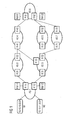
- FIG. 1 a section of an internetwork which is formed by autonomous systems (AS).
- AS autonomous systems
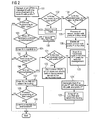
- FIG. 2 and FIG. 3 a flowchart for executing an inventive method.
- route changes during inter-domain routing are announced by means of the BGP protocol with a new form of UPDATE messages.
- the actual route changes are then undertaken delayed by a few minutes in time from the announcement, this being able to be undertaken in the way provided for in conventional methods in the BGP protocol.
- the time delay is selected so that an optimum route is determined as a rule before the route change and a resource reservation can be undertaken. Since an average convergence process in inter-domain routing takes about 3 minutes, a time delay of a few minutes makes sense. This enables the convergence phase and the resource reservation for QoS traffic to be given priority in the period of time between the announcement and the actual rerouting.
- the rerouting is only delayed in relation to the announcement if the convergent route is already known and the resources needed have already been provided.
- Route announcements are transported by means of UPDATE messages and undergo the same convergence process as regular UPDATE messages, however do not change the traffic flow but initiate the determination of the later convergent route.
- new attributes are used in BGP UPDATE messages, with which a route change can be announced in advance with an UPDATE message U 1 (this route announcing message is also referred to as an announcement below).
- the attributes identify the UPDATE message as an announcement of a route change.
- the rerouting is initiated with a regular second UPDATE message U 2 .
- the UPDATE message U 2 contains the prefixes which can be reached and the AS path, i.e. the IP addresses of the accessible systems and the list of the autonomous systems leading to the destination.
- the UPDATE message U 1 which is used as the announcement contains the same information as U 2 and additional specifications: an indicator that an announcement of an incoming new route is involved, the time at which actual route change is to be initiated with the second UPDATE message U 2 and also the address of a resource manager responsible for the resource reservations.
- this resource manager is localized in the autonomous system which originally announces the route change with the UPDATE message U 1 .
- This resource manager is localized in the example given in FIG. 1 at the border router R 12 .
- a resource manager can for example be implemented with the aid of software by processes which run on a router or on an independent hardware platform. A central resource management is also possible.
- the announcement U 1 and all announcements derived from it in the subsequent course of execution undergo the usual selection processes at each border router, e.g. filter for incoming UPDATEs, selection of the best route (‘best path selection’) and filter for outgoing UPDATEs which decides on the route selection and forwarding, without however changing the existing routing of the traffic affected by the activation of the announced route.
- filter for incoming UPDATEs selection of the best route (‘best path selection’) and filter for outgoing UPDATEs which decides on the route selection and forwarding, without however changing the existing routing of the traffic affected by the activation of the announced route.
- Best path selection selection of the best route
- filter for outgoing UPDATEs which decides on the route selection and forwarding, without however changing the existing routing of the traffic affected by the activation of the announced route.
- FIB routing information base
- the announcement U 1 thus triggers convergence processes.
- a remote autonomous system B which will later react to U 2 and will divert QoS traffic, undergoes a convergence process and already learns the routes available later and especially the convergent routes to be selected later, onto which the traffic will then be diverted. After an appropriate period of time and before the time at which U 2 is sent which is known from the announcements, the autonomous system B reserves the resources needed for the diversion of the traffic involved on the convergent, best future route learned from the announcements.
- a corresponding signaling message is sent to the resource manager of the autonomous system A named in the announcement U 1 .
- all autonomous systems involved in the forwarding of the announced routes have created a route with a suitable prefix of the IP address of the resource manager. This means that the signaling message to the resource manager in the autonomous system A is generally already being sent over the new best path.
- the UPDATE message U 2 is then sent at the announced time, all autonomous systems react as previously, i.e. implementing routing for the traffic involved along the new route.
- Those autonomous systems which already know from the announcement phase that they are diverting traffic onto a new route wait for the arrival of the already known convergent route. Only then do they modify their routing tables (FIBs: forwarding information bases) and forward a corresponding UPDATE message.
- FIBs forwarding information bases
- FIG. 1 shows seven autonomous systems AS 1 , AS 2 , . . . , AS 7 .
- Two networks, network N 1 and network N 2 are connected to AS 1 .
- the end systems can be reached with the IP addresses in the address block 10.10.10.0/24, i.e. 10.10.10.0 through 10.10.10.255
- the end systems can be reached with the addresses in the address block 10.10.11.0/24, i.e. 10.10.11.0 through 10.10.11.255.
- 10.10.10.0/24 specifies an IP address, 10.10.10.0, and a mask length, 24 , and stands for all IP addresses which match the specified address 10.10.10.0 in the first 24 bits (mask length), i.e. 10.10.10.0 through 10.10.10.255.
- FIG. 1 the border routers via which the autonomous systems are connected to each other: R 11 , R 12 , R 21 , R 22 , R 31 , R 32 , R 33 , R 41 , R 42 , R 51 , R 52 , R 61 , R 62 , R 71 and R 72 . Also only partly shown are the components responsible for resource management. As indicated by the typical resource managers RM 11 , RM 12 , RM 61 and RM 62 each border router is especially assigned a resource manager here.
- Routes are shown in this example in the form (P, a 1 , a 2 , . . . , aN).
- the prefix P describes the address block with the reachable destination addresses and the following sequence a 1 , a 2 , . . . , aN the sequence of the autonomous systems to be passed through via which the traffic reaches the destination addresses from P.
- a 1 , a 2 , . . . , aN the sequence of the autonomous systems to be passed through via which the traffic reaches the destination addresses from P.
- P For example (10.10.10.0/23, 4, 2, 1) is a route from the autonomous system AS 6 . It leads with the address block 10.10.10.0/23 to the networks N 1 and N 2 .
- the character sequence 4 , 2 , 1 stands for the sequence of the autonomous systems: AS 4 , AS 2 , AS 1 which forward the traffic from the autonomous system AS 6 to the networks N 1 and N 2 .
- autonomous system AS 6 uses the route (10.10.10.0/23, 4, 2, 1) for the traffic to the destination networks N 1 and N 2 , the load on the connection between the routers R 21 and R 11 is approaching the capacity limit and the autonomous system AS 1 would like to divert a part of the traffic onto other routes. It is further assumed that the autonomous system AS 1 decides to divert the traffic to network N 2 on routes via R 12 .
- the router R 11 would restrict the destination addresses which can be accessed via it with an UPDATE message to 10.10.10.0/24 and notify the router R 12 with an UPDATE message about the accessibility 10.10.11.0/24. This would initiate a convergence process generally lasting three minutes on average, during which the quality-of-service for traffic streams from the autonomous system AS 6 to the networks N 1 and N 2 suffers considerably and possibly during the convergence process resources are reserved in number of times on different paths between the autonomous systems AS 6 and AS 1 .
- the router R 12 sends an UPDATE message U 1 to the router R 31 which contains an announcement of the route (10.10.11.0/24, 1).
- U 1 could contain the fact that this route will be notified as a binding route in 10 minutes with a further UPDATE message.
- AS 3 propagates the announced route as (10.10.11.0/24, 3, 1) to routers R 41 , R 51 and R 71 .
- the autonomous system AS 4 propagates the announced route as (10.10.11.0/24, 4, 3, 1) to the autonomous system AS 6 although the router R 42 has already forwarded (10.10.10.0/23, 4, 3, 1) to router R 61 .
- the convergence phase is completed in this example when (10.10.11.0/24, 4, 3, 1) via router R 42 , (10.10.11.0/24, 5, 3, 1) via router R 52 and (10.10.11.0/24, 7, 3, 1) via router R 72 have arrived in the autonomous system AS 6 and the autonomous system AS 6 has selected what it sees as the best route. It is assumed here that the autonomous system AS 6 decides on (10.10.11.0/24, 5, 3, 1), e.g. because this is the optimum route in the sense of a metric. With the announced routes the autonomous system AS 6 also finds out about the switchover time intended by the autonomous system AS 1 .
- the autonomous system AS 6 will inform its resource management in good time about its choice of route and cause the resource manager RM 62 to signal the required resources on the selected future route to the resource manager RM 12 .
- the resource manager RM 61 will adapt the resources reserved on the old route via the autonomous systems AS 4 , AS 2 and AS 1 , i.e. release the resources no longer needed because of the traffic diversion.
- the autonomous system AS 6 proceeds in this case according to the flowchart shown in FIG. 2 and FIG. 3 .
- an UPDATE only contains an announced route R with prefix P (step 101 ).
- An expansion for UPDATE messages which announces a number of routes is of no importance to the person skilled and the art.
- Steps 102 , 104 , 105 , 107 , 108 and 109 correspond to the processing of announced routes described in RFC1771.
- step 106 route announcements are filtered out in this sequence which in future describe the best routes and are stored in a new database for announced routes, Pen-RIB (Pen stands for Pending), (step 123 ), if R is the first such route announcement for the prefix P (not entered in Pen-RIB) a timer is started (step 121 and 122 ).
- a route R* is generated from the route announcement R which is identical to R except for the prefix P* (step 124 ).
- P* is the prefix of the resource manager responsible for reservations on the announced route with the prefix R, in the example a prefix for an address of RM 12 in AS 1 .
- R* is now entered in Loc-RIB and activated instead of the route announcement (step 125 ).
- Announced routes which are expected as a result of the route announcements entered in Pen-RIB are filtered out in step 103 and given special treatment. They are entered in the database Pen-RIB (step 131 ). With the first such entry a timer is started (step 132 and 133 ). If the route R corresponds to the new best route contained in the Pen-RIB, all routes buffered in the Pen-RIB for the prefix P are processed and all entries for the prefix P in Pen-RIB deleted (step 134 , 135 and 136 ). The processing in step 135 corresponds to that of steps 104 , 105 , 107 , 108 and 109 .
- step 201 If a timer set in step 122 times out (step 201 ) the resource management is informed about an impending change of route in order to initiate a corresponding resource reservation (step 202 ). If a timer set in step 133 times out (step 301 ) it is assumed that the new best route stored in Pen-RIB is no longer valid. A check is made as to whether there are entries for the prefix P in Pen-RIB (step 302 ). If there are, all the routes buffered for prefix P in Pen-RIB are processed (step 303 ) and deleted in Pen-RIB (step 304 ). Furthermore the resource management is informed about the change (step 305 ).
- Pen-RIB If it is to be assumed that route changes initiated by a number of autonomous systems for the same prefix must be held in Pen-RIB, the entries in Pen-RIB must be made according to prefix and an identification of the sender of the original announcement (AS 1 or router R 12 in the example) must be provided. To this end route change messages must where necessary also provide a suitable value for this identification, e.g. an AS number or a IP address of a border router.
Landscapes
- Engineering & Computer Science (AREA)
- Computer Networks & Wireless Communication (AREA)
- Signal Processing (AREA)
- Data Exchanges In Wide-Area Networks (AREA)
Applications Claiming Priority (3)
| Application Number | Priority Date | Filing Date | Title |
|---|---|---|---|
| DE102004037024A DE102004037024B4 (de) | 2004-07-30 | 2004-07-30 | Verfahren und Netzelement für ein die Dienstgüte erhaltendes Umrouten von Verkehr in Netzen mit langsamer Routenkonvergenz |
| DE102004037024.9 | 2004-07-30 | ||
| PCT/EP2005/053718 WO2006013191A1 (de) | 2004-07-30 | 2005-07-29 | Verfahren und netzelement für ein die dienstgüte erhaltendes umrouten von verkehr in netzen mit langsamer routenkonvergenz |
Publications (1)
| Publication Number | Publication Date |
|---|---|
| US20080098127A1 true US20080098127A1 (en) | 2008-04-24 |
Family
ID=35115858
Family Applications (1)
| Application Number | Title | Priority Date | Filing Date |
|---|---|---|---|
| US11/632,903 Abandoned US20080098127A1 (en) | 2004-07-30 | 2005-07-29 | Method and Network Element for Rerouting Traffic, While Maintaining the Quality of Service, in Networks with Slow Route Convergence |
Country Status (5)
| Country | Link |
|---|---|
| US (1) | US20080098127A1 (de) |
| EP (1) | EP1774730A1 (de) |
| CN (1) | CN1993942A (de) |
| DE (1) | DE102004037024B4 (de) |
| WO (1) | WO2006013191A1 (de) |
Cited By (13)
| Publication number | Priority date | Publication date | Assignee | Title |
|---|---|---|---|---|
| US20070094361A1 (en) * | 2005-10-25 | 2007-04-26 | Oracle International Corporation | Multipath routing process |
| US20070233885A1 (en) * | 2006-03-31 | 2007-10-04 | Buskens Richard W | Architectures for assuring the inter-domain transport of QoS sensitive information |
| US20100040073A1 (en) * | 2008-08-15 | 2010-02-18 | At&T Intellectual Property I, L.P. | Apparatus and method for managing a network |
| US20120124238A1 (en) * | 2010-11-12 | 2012-05-17 | Alcatel-Lucent Bell N.V. | Prioritization of routing information updates |
| US9424144B2 (en) | 2011-07-27 | 2016-08-23 | Microsoft Technology Licensing, Llc | Virtual machine migration to minimize packet loss in virtualized network |
| US20160261486A1 (en) * | 2015-03-02 | 2016-09-08 | Cisco Technology, Inc. | Symmetric routing enforcement |
| US9531642B1 (en) | 2014-09-30 | 2016-12-27 | Amazon Technologies, Inc. | Distributing routing updates according to a synchronous mode |
| US9699068B1 (en) * | 2014-09-30 | 2017-07-04 | Amazon Technologies, Inc. | Distributing routing updates according to a decay mode |
| US20170308408A1 (en) * | 2016-04-22 | 2017-10-26 | Cavium, Inc. | Method and apparatus for dynamic virtual system on chip |
| US10146463B2 (en) | 2010-04-28 | 2018-12-04 | Cavium, Llc | Method and apparatus for a virtual system on chip |
| US20220174019A1 (en) * | 2015-10-16 | 2022-06-02 | Huawei Technologies Co., Ltd. | Route Processing Method, Device, and System |
| US20220329621A1 (en) * | 2021-04-07 | 2022-10-13 | Cisco Technology, Inc. | Bgp blackhole and hijack mitigation |
| US20230275825A1 (en) * | 2022-02-28 | 2023-08-31 | Microsoft Technology Licensing, Llc | End-to-end performance aware traffic engineering for internet peering |
Families Citing this family (2)
| Publication number | Priority date | Publication date | Assignee | Title |
|---|---|---|---|---|
| DE102006015239B3 (de) * | 2006-03-30 | 2007-08-23 | Siemens Ag | Netzzugangssteuerung mit zusätzlicher Verkehrsklasse in einem Kommunikationsnetz |
| EP1940091B1 (de) * | 2006-12-27 | 2009-10-07 | Nec Corporation | Autonomes Netzwerk, Netzknotenvorrichtung, Netzwerkredundanzverfahren und Aufzeichnungsmittel |
Citations (3)
| Publication number | Priority date | Publication date | Assignee | Title |
|---|---|---|---|---|
| US6658469B1 (en) * | 1998-12-18 | 2003-12-02 | Microsoft Corporation | Method and system for switching between network transport providers |
| US6792091B2 (en) * | 2002-02-22 | 2004-09-14 | Marc S. Lemchen | Network-based intercom system and method for simulating a hardware based dedicated intercom system |
| US20040221296A1 (en) * | 2003-03-18 | 2004-11-04 | Renesys Corporation | Methods and systems for monitoring network routing |
Family Cites Families (3)
| Publication number | Priority date | Publication date | Assignee | Title |
|---|---|---|---|---|
| JP2001217839A (ja) * | 2000-01-31 | 2001-08-10 | Fujitsu Ltd | ノード装置 |
| US7234001B2 (en) * | 2000-12-20 | 2007-06-19 | Nortel Networks Limited | Dormant backup link for OSPF network protection |
| US7286468B2 (en) * | 2002-11-12 | 2007-10-23 | Cisco Technology, Inc. | Routing system and method for synchronizing a routing system with peers after failover |
-
2004
- 2004-07-30 DE DE102004037024A patent/DE102004037024B4/de not_active Expired - Fee Related
-
2005
- 2005-07-29 EP EP05777989A patent/EP1774730A1/de not_active Withdrawn
- 2005-07-29 US US11/632,903 patent/US20080098127A1/en not_active Abandoned
- 2005-07-29 CN CNA2005800259284A patent/CN1993942A/zh active Pending
- 2005-07-29 WO PCT/EP2005/053718 patent/WO2006013191A1/de not_active Ceased
Patent Citations (3)
| Publication number | Priority date | Publication date | Assignee | Title |
|---|---|---|---|---|
| US6658469B1 (en) * | 1998-12-18 | 2003-12-02 | Microsoft Corporation | Method and system for switching between network transport providers |
| US6792091B2 (en) * | 2002-02-22 | 2004-09-14 | Marc S. Lemchen | Network-based intercom system and method for simulating a hardware based dedicated intercom system |
| US20040221296A1 (en) * | 2003-03-18 | 2004-11-04 | Renesys Corporation | Methods and systems for monitoring network routing |
Cited By (21)
| Publication number | Priority date | Publication date | Assignee | Title |
|---|---|---|---|---|
| US20070094361A1 (en) * | 2005-10-25 | 2007-04-26 | Oracle International Corporation | Multipath routing process |
| US8166197B2 (en) * | 2005-10-25 | 2012-04-24 | Oracle International Corporation | Multipath routing process |
| US8706906B2 (en) | 2005-10-25 | 2014-04-22 | Oracle International Corporation | Multipath routing process |
| US20070233885A1 (en) * | 2006-03-31 | 2007-10-04 | Buskens Richard W | Architectures for assuring the inter-domain transport of QoS sensitive information |
| US20100040073A1 (en) * | 2008-08-15 | 2010-02-18 | At&T Intellectual Property I, L.P. | Apparatus and method for managing a network |
| US8036141B2 (en) * | 2008-08-15 | 2011-10-11 | At&T Intellectual Property I, L.P | Apparatus and method for managing a network |
| US10146463B2 (en) | 2010-04-28 | 2018-12-04 | Cavium, Llc | Method and apparatus for a virtual system on chip |
| US20120124238A1 (en) * | 2010-11-12 | 2012-05-17 | Alcatel-Lucent Bell N.V. | Prioritization of routing information updates |
| US9424144B2 (en) | 2011-07-27 | 2016-08-23 | Microsoft Technology Licensing, Llc | Virtual machine migration to minimize packet loss in virtualized network |
| US9699068B1 (en) * | 2014-09-30 | 2017-07-04 | Amazon Technologies, Inc. | Distributing routing updates according to a decay mode |
| US9531642B1 (en) | 2014-09-30 | 2016-12-27 | Amazon Technologies, Inc. | Distributing routing updates according to a synchronous mode |
| US9806985B2 (en) * | 2015-03-02 | 2017-10-31 | Cisco Technology, Inc. | Symmetric routing enforcement |
| US20160261486A1 (en) * | 2015-03-02 | 2016-09-08 | Cisco Technology, Inc. | Symmetric routing enforcement |
| US20220174019A1 (en) * | 2015-10-16 | 2022-06-02 | Huawei Technologies Co., Ltd. | Route Processing Method, Device, and System |
| US11909657B2 (en) * | 2015-10-16 | 2024-02-20 | Huawei Technologies Co., Ltd. | Route processing method, device, and system |
| US20170308408A1 (en) * | 2016-04-22 | 2017-10-26 | Cavium, Inc. | Method and apparatus for dynamic virtual system on chip |
| US10235211B2 (en) * | 2016-04-22 | 2019-03-19 | Cavium, Llc | Method and apparatus for dynamic virtual system on chip |
| US20220329621A1 (en) * | 2021-04-07 | 2022-10-13 | Cisco Technology, Inc. | Bgp blackhole and hijack mitigation |
| US11909763B2 (en) * | 2021-04-07 | 2024-02-20 | Cisco Technology, Inc. | BGP blackhole and hijack mitigation |
| US20230275825A1 (en) * | 2022-02-28 | 2023-08-31 | Microsoft Technology Licensing, Llc | End-to-end performance aware traffic engineering for internet peering |
| US11843533B2 (en) * | 2022-02-28 | 2023-12-12 | Microsoft Technology Licensing, Llc | End-to-end performance aware traffic engineering for internet peering |
Also Published As
| Publication number | Publication date |
|---|---|
| CN1993942A (zh) | 2007-07-04 |
| DE102004037024B4 (de) | 2006-07-13 |
| EP1774730A1 (de) | 2007-04-18 |
| DE102004037024A1 (de) | 2006-03-23 |
| WO2006013191A1 (de) | 2006-02-09 |
Similar Documents
| Publication | Publication Date | Title |
|---|---|---|
| US7551551B2 (en) | Fast reroute (FRR) protection at the edge of a RFC 2547 network | |
| US6205488B1 (en) | Internet protocol virtual private network realization using multi-protocol label switching tunnels | |
| US7583590B2 (en) | Router and method for protocol process migration | |
| EP1997017B1 (de) | Verfahren zur vermeidung von routingschleifen mittels verbreitung von bgp-attributinformationen in einem ospf-konfigurierten netz | |
| US6512763B1 (en) | Method and apparatus for data routing, delivery, and authentication in a packet data network | |
| US8379511B2 (en) | System for securing the access to a destination in a virtual private network | |
| US20130235715A1 (en) | Method and system for controlling communication network and router used in the network | |
| US20040205190A1 (en) | Systems and methods for termination of session initiation protocol | |
| US20070121486A1 (en) | System and method for PE-node protection | |
| US20120124238A1 (en) | Prioritization of routing information updates | |
| US8223629B2 (en) | Core router capable of securing the output router of an autonomous system | |
| CN1993942A (zh) | 在路由会聚缓慢的网络中保持业务质量的通信路由转换的方法和网络元件 | |
| US8154993B2 (en) | Method for providing alternative paths as a rapid reaction to the failure of a link between two routing domains | |
| JP4005600B2 (ja) | パケット網における効率的なイントラドメインルーティング | |
| JPH1168799A (ja) | 同期デジタル階層型通信ネットワーク及びそれに適用される方法 | |
| US20070101018A1 (en) | Inter-domain QoS reservation establishment and modification | |
| US8176201B1 (en) | Controlling the signaling of label-switched paths using a label distribution protocol employing messages which facilitate the use of external prefixes | |
| EP3861692A1 (de) | System und verfahren zur implementierung eines controller-border-gateway-protokolls (cbgp) | |
| US7424006B1 (en) | Methods and systems for prioritized message processing | |
| US20060002402A1 (en) | QoS and fault isolation in BGP traffic, address families and routing topologies | |
| US20120257539A1 (en) | Method for mac addresses withdrawal in telecommunication networks | |
| US7624175B1 (en) | Update messaging system | |
| US20070002729A1 (en) | Method for optimally deactivating inter-domain routes | |
| US8516148B2 (en) | Method for control management based on a routing protocol | |
| EP4518277A1 (de) | Verfahren zur verarbeitung von routerwerbungsnachrichten, vorrichtung, speichermedium und elektronische vorrichtung |
Legal Events
| Date | Code | Title | Description |
|---|---|---|---|
| AS | Assignment |
Owner name: SIEMENS AKTIENGESELLSCHAFT, GERMANY Free format text: ASSIGNMENT OF ASSIGNORS INTEREST;ASSIGNOR:ENGEL, THOMAS;REEL/FRAME:018828/0473 Effective date: 20060825 |
|
| STCB | Information on status: application discontinuation |
Free format text: ABANDONED -- FAILURE TO RESPOND TO AN OFFICE ACTION |