US20030198970A1 - Genostics - Google Patents
Genostics Download PDFInfo
- Publication number
- US20030198970A1 US20030198970A1 US10/206,568 US20656802A US2003198970A1 US 20030198970 A1 US20030198970 A1 US 20030198970A1 US 20656802 A US20656802 A US 20656802A US 2003198970 A1 US2003198970 A1 US 2003198970A1
- Authority
- US
- United States
- Prior art keywords
- receptor
- protein
- alpha
- factor
- gene
- Prior art date
- Legal status (The legal status is an assumption and is not a legal conclusion. Google has not performed a legal analysis and makes no representation as to the accuracy of the status listed.)
- Abandoned
Links
Images


Classifications
-
- C—CHEMISTRY; METALLURGY
- C07—ORGANIC CHEMISTRY
- C07K—PEPTIDES
- C07K16/00—Immunoglobulins [IG], e.g. monoclonal or polyclonal antibodies
- C07K16/18—Immunoglobulins [IG], e.g. monoclonal or polyclonal antibodies against material from animals or humans
-
- C—CHEMISTRY; METALLURGY
- C12—BIOCHEMISTRY; BEER; SPIRITS; WINE; VINEGAR; MICROBIOLOGY; ENZYMOLOGY; MUTATION OR GENETIC ENGINEERING
- C12Q—MEASURING OR TESTING PROCESSES INVOLVING ENZYMES, NUCLEIC ACIDS OR MICROORGANISMS; COMPOSITIONS OR TEST PAPERS THEREFOR; PROCESSES OF PREPARING SUCH COMPOSITIONS; CONDITION-RESPONSIVE CONTROL IN MICROBIOLOGICAL OR ENZYMOLOGICAL PROCESSES
- C12Q1/00—Measuring or testing processes involving enzymes, nucleic acids or microorganisms; Compositions therefor; Processes of preparing such compositions
- C12Q1/68—Measuring or testing processes involving enzymes, nucleic acids or microorganisms; Compositions therefor; Processes of preparing such compositions involving nucleic acids
- C12Q1/6813—Hybridisation assays
- C12Q1/6827—Hybridisation assays for detection of mutation or polymorphism
-
- C—CHEMISTRY; METALLURGY
- C12—BIOCHEMISTRY; BEER; SPIRITS; WINE; VINEGAR; MICROBIOLOGY; ENZYMOLOGY; MUTATION OR GENETIC ENGINEERING
- C12Q—MEASURING OR TESTING PROCESSES INVOLVING ENZYMES, NUCLEIC ACIDS OR MICROORGANISMS; COMPOSITIONS OR TEST PAPERS THEREFOR; PROCESSES OF PREPARING SUCH COMPOSITIONS; CONDITION-RESPONSIVE CONTROL IN MICROBIOLOGICAL OR ENZYMOLOGICAL PROCESSES
- C12Q1/00—Measuring or testing processes involving enzymes, nucleic acids or microorganisms; Compositions therefor; Processes of preparing such compositions
- C12Q1/68—Measuring or testing processes involving enzymes, nucleic acids or microorganisms; Compositions therefor; Processes of preparing such compositions involving nucleic acids
- C12Q1/6876—Nucleic acid products used in the analysis of nucleic acids, e.g. primers or probes
- C12Q1/6883—Nucleic acid products used in the analysis of nucleic acids, e.g. primers or probes for diseases caused by alterations of genetic material
-
- C—CHEMISTRY; METALLURGY
- C12—BIOCHEMISTRY; BEER; SPIRITS; WINE; VINEGAR; MICROBIOLOGY; ENZYMOLOGY; MUTATION OR GENETIC ENGINEERING
- C12Q—MEASURING OR TESTING PROCESSES INVOLVING ENZYMES, NUCLEIC ACIDS OR MICROORGANISMS; COMPOSITIONS OR TEST PAPERS THEREFOR; PROCESSES OF PREPARING SUCH COMPOSITIONS; CONDITION-RESPONSIVE CONTROL IN MICROBIOLOGICAL OR ENZYMOLOGICAL PROCESSES
- C12Q1/00—Measuring or testing processes involving enzymes, nucleic acids or microorganisms; Compositions therefor; Processes of preparing such compositions
- C12Q1/68—Measuring or testing processes involving enzymes, nucleic acids or microorganisms; Compositions therefor; Processes of preparing such compositions involving nucleic acids
- C12Q1/6876—Nucleic acid products used in the analysis of nucleic acids, e.g. primers or probes
- C12Q1/6883—Nucleic acid products used in the analysis of nucleic acids, e.g. primers or probes for diseases caused by alterations of genetic material
- C12Q1/6886—Nucleic acid products used in the analysis of nucleic acids, e.g. primers or probes for diseases caused by alterations of genetic material for cancer
-
- C—CHEMISTRY; METALLURGY
- C12—BIOCHEMISTRY; BEER; SPIRITS; WINE; VINEGAR; MICROBIOLOGY; ENZYMOLOGY; MUTATION OR GENETIC ENGINEERING
- C12Q—MEASURING OR TESTING PROCESSES INVOLVING ENZYMES, NUCLEIC ACIDS OR MICROORGANISMS; COMPOSITIONS OR TEST PAPERS THEREFOR; PROCESSES OF PREPARING SUCH COMPOSITIONS; CONDITION-RESPONSIVE CONTROL IN MICROBIOLOGICAL OR ENZYMOLOGICAL PROCESSES
- C12Q2600/00—Oligonucleotides characterized by their use
- C12Q2600/106—Pharmacogenomics, i.e. genetic variability in individual responses to drugs and drug metabolism
Definitions
- DNA variants leading to monogenic diseases are usually rare in a population due to the process of natural selection.
- variants of genes involved in, or contributing to, polygenic diseases do not act alone to produce the phenotype. As such selection against them occurs only when they are in the appropriate condition to cause the disease, as a result of this differential selection pressure they the individual variants can exist at quite high frequencies within a population.
- Alteration of a single gene may not by itself be detrimental, but in combination with certain variants of other genes, may contribute to a disease phenotype (e.g. el-Zein et al, 1997, observed that the inheritance of a particular combination of metabolising genes is strongly associated with lung cancer).
- the interaction of the relevant variant genes may be enough to cause a disease phenotype or spectrum of phenotypes, but in many cases other kinds of factors will also influence the course of events (e.g. interaction of ApoE genotype and head injury in Alzheimer's disease Nicholl et al 1996).
- the human genome is made up of some 100,000 separate genes.
- a device capable of delivering information on 10,000 genes may leave its user in grave danger of information overload and render him/her unable to identify and abstract the critical information required to enhance patient management or healthcare.
- the invention described herein identifies the core group of genes required for the design development and manufacture of such a valuable aid to clinical management of the patient and general healthcare management.
- the number of genes and their configurations (mutations and polymorphisms) needed to be identified in order to provide critical clinical information concerning individual prognosis is considerably less than the 100,000 thought to comprise the human genome.
- the identification of the identity of the core group of genes enables the invention of a design for genetic profiling technologies which comprises of the identification of the core group of genes and their sequence variants required to provide a broad base of clinical prognostic information—‘genostics’.
- the invention does not provide a method for treatment as such. Nor does it provide a direct method of diagnosis of illness or health risk as such.
- Information obtainable using the invention can be used by a medical practitioner to tailor resources and therapy to meet the likely requirements of individual patients and selected populations of patients. For example in a complex regime or clinical management plan (as seen for example in FIGS. 1 and 2) the invention allows the better prediction of the outcome of both the disease and the chosen therapeutic process.
- gene sequence data can be retrieved, by persons skilled in the art, by searching the following public databases: Website Address Description DbEST http://www.ncbi.nlm.nih.gov/dbEST Database of expressed sequence tags EBI/EMBL http://www.ebi.ac.uk/mutations/ Mutations EBI: The European http://www.ebi.ac.uk/ebi home.html Nucleotide Sequence Bioinformatics Database Institute, Hinxton, UK EMBL http://www.ebi.ac.uk/queries/queries.html Nucleotide Sequence Database GDB: The Genome http://www.gdb.org/gdb/gdbtop.html Human Genome Database Database, Infobiogen European Node, France GeneCards http://bioinformatics.weizmann.ac.il/cards/index.html GeneCards is a database of human genes, their products and their involvement in
- Man PubMed http://www.ncbi.nlm.nih.gov/PubMed/ PubMed accesses MEDLINE medica literature database and links to full-text journals. It is also the literature component of the Entrez retrieval system for molecular biology information.
- UniGene is a system for Human Gene automatically partitioning Sequence GenBank sequences into a Collection. (NCBI) non-redundant set of gene oriented clusters. Each UniGene cluster contains sequences that represent a unique gene, as well as related information such as the tissue types in which the gene has been expressed and map location. University of http://dnal.chem.ou.edu/index.html Genomic databases Oklahoma WEHI, Melbourne, http://wehih.wehi.edu.au/srs/srsc/ Sequence Retrieval System Aus
- genes coding for proteins known to play a key role in organ function or disease are designated ‘candidate genostic genes’. Variations within the gene structure may alter the regulatory or structural integrity of the gene product leading to enhancement or reduction in the specific function (e.g. receptor binding, enzyme activity). The exact role that a candidate gene plays in disease, prognosis and healthcare management can be fully ascertained by assessing the effects of variation in gene structure in particular patient groups, populations or individuals (see examples 2, 3 and 4).
- One candidate ‘genostic’ gene is the gene encoding nitric oxide synthetase (NOS-1).
- NOS-1 Neuronal NO synthetase
- inducible endothelial
- neuronal Neuronal NO synthetase
- neurotransmission the regulation of body fluid homeostasis
- neuroendocrine physiology the regulation of smooth muscle motility
- sexual function the regulation of smooth muscle motility
- monocyte biology the regulation of smooth muscle motility
- NOS1 cDNA clones contain different 5-prime terminal exons spliced to a common exon 2.
- Xie et al. (1995) demonstrated that the unique exons are positioned within 300 bp of each other but separated from exon 2 by an intron that is at least 20 kb long.
- a CpG island engulfs the downstream 5-prime terminal exon.
- most of the upstream exon resides outside of this CpG island.
- the upstream exon includes a GT dinucleotide repeat. The expression of these 2 exons is subject to transcriptional control by separate promoters.
- Nitric oxide is synthesized in skeletal muscle by neuronal-type NO synthase, which is localized to sarcolemma of fast-twitch fibers. Synthesis of NO in active muscle opposes contractile force. Brenman et al. (1995) showed that NOS1 partitions with skeletal muscle membranes owing to association of enzyme with dystrophin, the protein mutated in Duchenne muscular dystrophy. The dystrophin complex interacts with an N-terminal domain of NOS1 that contains a GLGF motif. Both humans with DMD and mdx mice show a selective loss of NOS1 protein and catalytic activity from muscle membranes. NOS1-deficient mice are resistant to neural stroke damage following middle cerebral artery ligation. Nelson et al. (1995) reported a large increase in aggressive behavior and excess, inappropriate sexual behavior in NOS1 ‘knockout’ mice. Initial observations indicated that male (but not female) NOS 1-deficient mice engaged in chronic aggressive behavior.
- Magee et al. (1996) used PCR to clone a novel form of neuronal NOS from rat penile RNA.
- This NOS cDNA was termed PnNOS for ‘penile neuronal NOS.’
- Sequencing revealed that the PnNOS cDNA was identical to rat cerebellar neuronal NOS1 except for a 102-bp insertion in PnNOS.
- Repetition of RT-PCR showed PnNOS to be the only form of NOS1 expressed in rat penis, urethra, prostate, and skeletal muscle.
- PnNOS may be responsible for the synthesis of nitric oxide during penile erection and may be involved in control of the tone of the urethra, prostate, and bladder.
- Alu-1 repeat which are known to cause recombination, allows one to detect gross chromosomal rearrangements. Changes in either the sequence or the genomic structure may well correlate with clinical or pathological symptoms.
- Voltage-dependent Ca(2+) channels not only mediate the entry of Ca(2+) ions into excitable cells but are also involved in a variety of Ca(2+)—dependant processes, including muscle contraction, hormone or neurotransmitter release and gene expression.
- Calcium Channels are multi-subunit complexes and the channel activity is directed by a pore-forming alpha-1 sub-unit.
- the auxiliary sub-units beta, alpha-2/delta, and gamma regulate channel activity.
- Ca(2+) currents have been described on the basis of their biophysical and pharmacological properties and include L-, N-, T-, P-, Q-, and R-types.
- P/Q type channels colocalise with a subset of docked vesicles at the synapse where they control exocytosis, demonstrated by the sensitivity of various types of neurotransmission to specific blockers of these channels.
- P/Q type channels are involved in CSD (cortical spreading depression—which causes the aura or visual symptoms of migraine) and release of neurotransmitters, including 5-HT (migraine patients have systemic disturbance of 5-HT metabolism).
- alpha-1A, B, C, D, E and S are at least 6 classes of alpha-1 subunits. They are derived from 6 genes representing members of a gene family. The alpha-1A, B and E isoforms are abundantly expressed in the neuronal tissue. The genes encoding the alpha-1A, B, and E isoforms are symbolised CACNL1A4, CACNL1A5, and CACNL1A6 respectively.
- the CACNL1A4 gene was assigned to 19p13, (Diriong et al., 1995). The gene was characterised by Ophoff et al (1996) in preparation for a mutation search in neurological disorders that map to 19p13. They found that the gene covers 300 kb with 47 exons and reported the amino acid sequence for residues 1-2262. Sequencing of all the exons and their surroundings revealed polymorphic variations, including a (CA)n-repeat, a (CAG)n-repeat in the 3-prime-UTR, and different types of deleterious mutations in 2 neurological disorders; familial hemiplegic migraine and episodic ataxia type 2. Thus, these 2 neurological disorders are allelic channelopathies.
- Calcium channels are also known to be important in regulating the function of the heart (particularly arrhythmias) and a number of drugs express their therapeutic effects by blocking myocardial Ca(2+) or prolonging the activation time of the channel (Brody, Larner and Minneman 1998). Polymorphic variation can help predict individual response to injury and disease, the symptoms and consequences of cardiovascular disease, dysfunction and damage to the system.
- a third example of a candidate for a ‘genostic’ gene is the enzyme lipoprotein lipase (LPL).
- Human lipoprotein lipase is a member of a lipase gene family, which also includes the hepatic and pancreatic lipases.
- LPL is located on the surface of endothelial cells of capillaries where it hydrolyses triacylglycerols of plasma lipoproteins to fatty acids and glycerol. These fatty acids are then taken up by cell and used for energy production.
- the enzyme plays a central role in lipid metabolism and is a candidate susceptibility gene for cardiovascular disease.
- the LPL gene contains ten exons spanning 30 kb and encodes a protein of 475 amino acids and has several well characterised functional domains including the APOC-II binding site, the heparin-binding clusters used to localise LPL to the endothelial wall and the domains that contribute to the active site.
- the LPL gene sequence has been shown to contain distinct sequence variations among populations, (Nickerson et al, 1998).
- Nickerson et al described 88 variants in a region of the LPL gene, 90% of which were single nucleotide polymorphisms (SNPs), the remaining being insertion-deletion variations.
- SNPs single nucleotide polymorphisms
- 81 variants were found in intronic regions, and 7 in the exonic sequence. Only 4 of the exonic variants altered the protein sequence.
- sequence data for genes of interest can be readily obtained. Genetic variation in specific regions of genes can also be determined. The identification of a core group of genes which have important effects on the key physiological and pathophysiological processes in human disease would form an important medical advance.
- a device or detector configured and designed using this core group of genes would have a general utility in the practice of medicine and healthcare management for:
- sequence data concerning the existence of polymorphic variation can be located.
- sequence data concerning the existence of polymorphic variation can be located.
- Category 1 Enzymes ⁇ -glucosidasc Mutation type Total number of mutations Nucleotide substitutions (missense/nonsense) 20 Nucleotide substitutions (splicing) 4 Nucleotide substitutions (regulatory) 0 Small deletions 7 Small insertions 0 Small indels 0 Gross deletions 1 Gross insertions & duplications 0 Complex rearrangements (including inversions) 1 Repeat variations 0 TOTAL 33 Accession Number Codon Nucleotide Amino acid Phenotype CM970540 40 cCGA-TGA Arg-Term Glycogen storage disease 2 CM950491 299 CTG-CGG Leu-Arg Glycogen storage disease 2 CM980577 309 cGGG-AGG Gly-Arg Glycogen storage disease
- the human genome is known to be highly variable in different individuals. Variation exists in approximately one nucleic acid residue in every 300. Although a single nucleic acid change (single nucleotide polymorphism, SNP e.g. Schafer and Hawkins 1997, Nickerson et al 1998, Rieder et al 1998, SNP Consortium 1999) is the commonest form of genetic variation, other more complex forms also occur for example: Type of variation Example Deletion intronic deletion in the angiotensin converting enzyme gene Insertion 144 bp insertion in the prion gene Repeats Huntingtin gene in Huntington's chorea
- This invention provides a means of fusing the genomic and pharmacological profiles together with their clinical associations in such a way as to enhance and enable the provision of individually tailored therapeutic packages for enhanced healthcare management.
- the generation of such an output can be achieved using machine learning algorithms.
- the genetic algorithm Goldberg 1989, Fogarty and Ireson 1994
- the genetic algorithm is designed to converge the population to an optimum point in the search space. Processes of data selection, crossover, mutation and replacement of old members of the dataset achieve this with new members of more value.
- the effective use of the genetic algorithm process is a representation of the search space, which is responsive to the heuristics, embodied in the genetic operators.
- the user must also supply an evaluation function identifying the degree to which the point in space approaches an optimum (‘weighting’) such that the selection operator for propagation through the dataset can choose them.
- the genetic algorithm can be used to find predictively meaningful categories that is:
- Familial adenomatous polyposis is an autosomal dominant disorder which typically presents with colorectal cancer (CRC) in early adult life secondary to extensive adenomatous polyps of the colon. Polyps also develop in the upper gastrointestinal tract and malignancies may occur in other sites including the brain and the thyroid. Helpful diagnostic features include pigmented retinal lesions known as congenital hypertrophy of the retinal pigment, jaw cysts, sebaceous cysts, and osteomata. The APC gene at 5q21 is mutant in FAP.
- Familial adenomatous polyposis is characterized by adenomatous polyps of the colon and rectum; in extreme cases the bowel is carpeted with a myriad of polyps. This is an aggressive premalignant disease with one or more polyps progressing through dysplasia to malignancy in untreated gene carriers with a median age at diagnosis of 40 years. Carcinoma may arise at any age from late childhood through the seventh decade.
- the presenting features are usually those of malignancy, such as weight loss and inanition, bowel obstruction, or bloody diarrhea. Cases of new mutation still present in these ways but in areas with well organized registers most other gene carriers are detected by bowel examination while still asymptomatic. Occasionally, the extracolonic features of the condition lead to presentation.
- Drugs interact with the body in many different ways to produce their effect. Some drugs act as false substrates of inhibitors for transport systems (e.g. calcium channels) or enzymes (acetylcholinesterase). Most drugs however, produce their effects by acting on receptors, usually located in the cell membrane, which normally respond to endogenous chemicals in the body (Weatherall, Leadingham and Warrell 1996). Drugs that activate receptors and produce a response are called agonists (e.g cholinomimetics).
- agonists e.g cholinomimetics
- Antagonists combine with receptors but do not activate them, thus reduceing the probability of the transmitter substance combining with the receptor and so blocking receptor activation.
- the ability of the drug to interact with the receptor depends on the specificity of the drug for the receptor or ‘target’ (Brody, Lamer and Minneman 1998).
- drugs In addition to the main categories of agonist and antagonist, drugs also have mechanisms of action whereupon they interact with specific types of molecules—targets'—that include:
- enzyme inhibition e.g. angiotensin convertying enzyme inhibitors, acetylcholinesterase inhibitors
- Beta-blockers Noradrenaline (beta-adrenergic) ⁇ receptors Atypical antidepressants Alpha-adrenoceptors ⁇ Beta-adrenoceptors Beta-adrenoceptors antagonists Dopamine blockers/boosters Dopamine receptors ⁇ Dopamine blockers/ Dopamine transporter (DAT1) ⁇ boosters/depleters Anticholinergics (muscarinic Muscarinic receptors ⁇ antagonists) Anticholinergics Nicotinic receptors ⁇ (nicotinic antagonists) Anticholinesterases Acetylcholinesterase (ACHE) ⁇ COMT inbibitor Catechol-O-methyltransferase ⁇ (COMT) Sodium channel blocker Sodium channel ⁇ Opioid analgesics & Opioid receptors (OPRM1; OPRK1; ⁇ antagonists OPRD 1) Antipsychotics/neuroleptics 5-HT/D2 receptors ⁇ (5-
- ACE inhibitors Angiotensin converting enzyme (ACE) ⁇ HMG CoA reductase HMG CoA reductase ⁇ inhibitors, e.g simvastatin Angiotensin II antagonists Angiotensinogen ⁇ Calcium channel blocker Calcium channel ⁇ Thromboxane A2 synthase Thromboxane A2 synthase ⁇ inhibitor A2 receptor antagonist Thromboxane A2 receptor ⁇ Potassium channel blocker Potassium channel ⁇ Na—H ion exchange (NHE) Na—H ion exchanger (NHE) ⁇ inhibitor bile acid transport inhibitor SLC1OA1 (sodium/bile acid cotransporter) ⁇ bile acid transport inhibitor SLCIOA2 (sodium/bile acid cotransporter) ⁇ platelet aggregation inhibitor Von Willebrand factor ⁇ ACAT inhibitor Acetoacetyl-CoA-thiolas
- Proton pump inhibitor e.g H+/K+ adenosine triphosphatase (ATPase) ⁇ omeprazole.
- enzyme system (‘proton pump’) H2 antagonists Histamine H2-rcceptor ⁇ (e.g. cimetidine) Muscarinic antagonists Muscarinic m1 & m3 receptors ⁇ (e.g. pirenepine)
- Prostaglandins inhibit Adenylate cyclase, histamine-induced ⁇ cAMP activity
- drugs with known addictive properties are Amphetamines, Temazepam and Phenobarbitone, although having approved medicinal use e.g. phenobarbitone for epilepsy, they may cause problems of dependency and misuse in individuals. Knowledge of such an individual's susceptibility before prescribing certain drugs would be an advantage to the medical practitioner.
- Any drug may produce unwanted or unexpected adverse events, these can range from trivial (slight nausea) to fatal (aplastic anaemia).
- One of the main reasons for adverse events following drug intake is the drug binding to a non specific or non target receptors in the body (Brody, Larner and Minneman 1998).
- Another reason is the interaction of the drug with other drugs given to the patient. This is a particular problem in the elderly who frequently suffer from multiple illnesses requiring many different classes of drugs and providing a real potential for drug interactions (Weatherall, Leadingham and Warrell 1996).
- the drug may also produce adverse events over time as the drug is absorbed, distributed, metabolised and excreted e.g. products of metabolising the drug may be reactive themselves and be toxic to the body.
- Genostic approach described above would be of considerable utility in determining the likelihood and magnitude of therapeutic response to drugs in the inventories described above. Such difficulties can arise from adverse events, variations in metabolism and drug-drug interactions in situations where several diseases, requiring treatment, exist in a given patient. The potential for adverse events or deleterious outcomes could be ascertained in individuals, patients or populations in relation to all of the drugs referred to above. These factors are of considerable importance in enabling the selection and monitoring of therapeutic interventions and effective healthcare management.
- FAP familial adenomatous polyposis
Landscapes
- Chemical & Material Sciences (AREA)
- Life Sciences & Earth Sciences (AREA)
- Organic Chemistry (AREA)
- Health & Medical Sciences (AREA)
- Proteomics, Peptides & Aminoacids (AREA)
- Engineering & Computer Science (AREA)
- Genetics & Genomics (AREA)
- Zoology (AREA)
- Wood Science & Technology (AREA)
- Analytical Chemistry (AREA)
- Immunology (AREA)
- Molecular Biology (AREA)
- General Health & Medical Sciences (AREA)
- Biochemistry (AREA)
- Biophysics (AREA)
- General Engineering & Computer Science (AREA)
- Microbiology (AREA)
- Biotechnology (AREA)
- Physics & Mathematics (AREA)
- Bioinformatics & Cheminformatics (AREA)
- Pathology (AREA)
- Hospice & Palliative Care (AREA)
- Oncology (AREA)
- Medicinal Chemistry (AREA)
- Enzymes And Modification Thereof (AREA)
- Measuring Or Testing Involving Enzymes Or Micro-Organisms (AREA)
- Apparatus Associated With Microorganisms And Enzymes (AREA)
Abstract
People vary enormously in their response to disease and the also in their response to therapeutic interventions aimed at ameliorating the disease process and progression. However, the provision of medical care and medical management is centered around observations and protocols developed in clinical trials on groups or cohorts of patients. This group data is used to derive a standardised method of treatment which is subsequently applied on an individual basis. There is considerable evidence that a significant factor underlying the individual variability in response to disease, therapy and prognosis lies in a person's genetic make-up. There have been numerous examples relating that polymorphisms within a given gene can alter the functionality of the protein encoded by that gene thus leading to a variable physiological response. In order to bring about the integration of genomics into medical practice and enable design and building of a technology platform which will enable the everyday practice of molecular medicine a way must be invented for the DNA sequence data to be aligned with the identification of genes central to the induction, development, progression and outcome of disease or physiological states of interest. According to the invention, the number of genes and their configurations (mutations and polymorphisms) needed to be identified in order to provide critical clinical information concerning individual prognosis is considerably less than the 100,000 thought to comprise the human genome. The identification of the identity of the core group of genes enables the invention of a design for genetic profiling technologies which comprises of the identification of the core group of genes and their sequence variants required to provide a broad base of clinical prognostic information—‘genostics’. The “GenosticTM” profiling of patients and persons will radically enhance the ability of clinicians, healthcare professionals and other parties to plan and manage healthcare provision and the targeting of appropriate healthcare resources to those deemed most in need. The use of our invention could also lead to a host of new applications for such profiling technologies, such as identification of persons with particular work or environment related risk, selection of applicants for employment, training or specific opportunities or for the enhancing the planning and organisation of health services, education services and social services.
Description
- People vary enormously in their response to disease and the also in their response to therapeutic interventions aimed at ameliorating the disease process and progression. However, the provision of medical care and medical management is centered around observations and protocols developed in clinical trials on groups or cohorts of patients. This group data is used to derive a standardised method of treatment which is subsequently applied on an individual basis (e.g. the comment that drugs are often prescribed on the basis that everyone is a 70 kg white male).
- It is standard practice for clinicians to prescribe the same starting dose of a particular drug for a given indication and then adjust the treatment regimen by monitoring the progress of the disease and therapeutic response in individual patients. Observation of actual therapeutic outcome following these adjustments to patient's therapy provides the basis for determining a prognosis for the disease and developing a clinical management plan for patient care (e.g. see FIG. 1, algorithm for management of schizophrenia, from FIG. 1 Taylor and Kerwin 1997, FIG. 2 algorithm for treatment of depression from FIG. 1 Pathare and Paton 1997) and treatment algorithms published by the National Cancer Institute).
- The standard practice of clinical management has its disadvantages. In particular it is retro-active in that changes to patient management will occur following the emergence of therapeutic failures, adverse events or other difficulties in undertaking the therapeutic regime (Lazarou et al 1998).
- There is considerable evidence that a significant factor underlying this individual variability in response to disease, therapy and prognosis lies in a person's genetic make-up. There have been numerous examples relating that polymorphisms within a given gene can alter the functionality of the protein encoded by that gene thus leading to a variable physiological response (see Marshall 1997a and b for reviews).
- Gene sequence variations that are present at a frequency of less than 1% in the population are arbitrarily designated as mutations whilst those at a higher frequency are known as polymorphisms (Schafer and Hawkins 1998).
- DNA variants leading to monogenic diseases (e.g. presenilin mutations causing Alzheimer's disease, BRCA mutations causing breast cancer) are usually rare in a population due to the process of natural selection. However, variants of genes involved in, or contributing to, polygenic diseases do not act alone to produce the phenotype. As such selection against them occurs only when they are in the appropriate condition to cause the disease, as a result of this differential selection pressure they the individual variants can exist at quite high frequencies within a population.
- Alteration of a single gene may not by itself be detrimental, but in combination with certain variants of other genes, may contribute to a disease phenotype (e.g. el-Zein et al, 1997, observed that the inheritance of a particular combination of metabolising genes is strongly associated with lung cancer). The interaction of the relevant variant genes may be enough to cause a disease phenotype or spectrum of phenotypes, but in many cases other kinds of factors will also influence the course of events (e.g. interaction of ApoE genotype and head injury in Alzheimer's disease Nicholl et al 1996).
- The identification of modifier genes that influence the penetrance and expressivity of these risk alleles will be key variables in assessing individual risk profiles. It is likely that the combination of and interaction between small discrete genetic influences on a disease state represent the single largest explanation for the phenotypic variation seen in medicine.
- This opens the possibility that the identification of the genes associated with disease and an understanding of how these genes interact with the environment, can lead to better prediction of the outcome of both the disease and the therapeutic process. This in turn would allow the tailoring of resources and therapy to meet the likely requirements of the individual patient (Marshall 1997a). The net result should be improved clinical management, identification of the potential for prevention, the reduction of the burden of disability and, ultimately, improved quality of life for the individual (Poste 1998).
- As a result of the appreciation of the contribution of genetic variation to medicine, considerable effort has been made to determine how individual genetic variations affect overall health (including predisposition to disease) and once disease is manifest, the likely patterns of progression, responsiveness to treatment and overall prognosis.
- In a quest to understand and plot the limits of genetic variation in humans the Human Genome Project was launched in 1990 with a mission to sequence the code of all 100,000 or so human genes by 2002.
- As a result of the Human Genome project not only is the mapping and sequencing of the human genome becoming well understood but also the degree of variability in gene sequence between individuals is being documented (Lander 1996). The average difference between individuals appears to be around 0.3% which equates roughly to a difference in one base pair every 500-1000 base pairs of sequence. The variations are known as polymorphisms and such polymorphic variation is thought underlie much of the clinical variability observed in patients with disease and in their response to therapy.
- The resultant explosion of genetic sequence information has lead to the emerging sciences of genomics and proteomics. Within the disciplines technologies have evolved (e.g. polymerase chain reaction, single strand conformational polymorphism etc) which allow us to read individual sequence data and detect and identify polymorphic variation in individuals, in disease states and in different ethnic groups (Griffin et al 1997, Little et al 1997).
- As a result of such studies individual genes have been identified which indicate a predisposition to disease or a susceptibility to adverse drug responses (e.g. presenilin gene mutations and development of Alzheimer's disease, BRCA gene mutation and development of breast cancer, ACE polymorphisms and early onset heart disease, cytochrome P450 polymorphisms and drug metabolism).
- However, such studies have been completed as academic exercises in scientific discovery and involve individual genes and large groups of patients.
- Usually a particular individual response to disease or therapy is likely to result from a complex interaction between multiple genes, discrete environmental factors and the particular therapeutic approach offered (for example see algorithms in FIGS. 1 and 2).
- As a result, despite the many publications concerning the theoretical or potential applications of genomics to medicine (e.g. Marshall 1997a and b, Poste 1998, Crooke 1998), progress in implementing these approaches on a practical level has been exceedingly slow. In particular, little progress has been made in the understanding of or the ability to prognose individual response to particular disease states or therapeutic regimes (Poste 1998).
- In part this has been related to the types of technology available for such studies (Marshall and Hodgson 1998). Such techniques as MALDI-TOF (Griffin et al 1997), sequencing (Dramanac et al 1998) and molecular beacons (Tyagi et al 1998) are complex and relatively slow and require the availability of specialised laboratories and highly trained personnel.
- In recent reviews of the field it has been stated that:
- ‘within next 10 years when not only all genes (will have been) identified but all common intragenic variation also’ (Lander 1996).
- the ‘assembly of comprehensive clinical databanks and their use for large-scale genetic association studies to define robust disease-gene risk correlations’ constitutes a significant technological challenge (Poste 1998).
- ‘if all human DNA variants were known this set would include all functional polymorphisms and if they could be analysed in all individuals comparison of phenotypes and correlation with genotype might make possible the assignment of function to every gene that predisposes to disease of any kind, and also to nonclinical phenotypes including behavioural traits. The sheer task of this is overwhelming and may never be practical’ (Shafer and Hawkins 1998).
- On the basis of the current state of the art it seems clear that translating the colossal investment in the human genome project into a means of revolutionising healthcare management requires both substantial creativity in the harnessing of technologies and considerable technical invention before its promise of can be realised.
- For the realisation of the promised revolution in medicine two key factors require consideration;
- The human genome is made up of some 100,000 separate genes.
- Not all genes are of equal biological importance as regards the physiological functioning of humans.
- The first issue, that of reading and tracking the volume of information encapsulated in the human genome by the sequence of 100,000 genes and their mutations and polymorphic variations, is beginning to be addressed by emergent technologies such as DNAchips, MALDI-TOF MS (Marshall and Hodgson 1998 see Table 1) and PEDIAT-type technologies (Fox 1998).
TABLE 1 The main features of some hybridization array formats currently available (Marshall & Hodgson 1998) Company Arraying method Hybridization step Readout Main focus Affymetrix On-chip 10,000-260,000 oligo Fluorescence Expression profiling, (Santa Clara, photolithographic features probed with polymorphism analysis, CA) synthesis of −20-25- labelled 30-40 and mer oligos onto nucleotide fragments diagnosis silicon of sample cDNA or wafers, which are antisense RNA diced Brax Short synthetic oligo, 1,000 oligos on a Mass Diagnostics, expression (Cambridge, synthesized off chip “universal chip” spectrometry profiling, novel gene UK) probed with tagged identification nucleic acids Hyseq 500-2000 nt DNA 64 sample cDNA Radioisotope Expression profiling, (Sunnyvale, samples printed onto spots probed with novel CA) 0.6 8,000 7-mer oligos gene identification, and cm2 (HyGnostics) or (HyGnostics) or large scale sequencing ˜18 cm2 (Gene ≦55,000 sample (Gene Discovery) cDNA spots probed Discovery array), membranes with 300 7-mer oligos polymorphism analysis (Gene Discovery) and diagnostics (HyGnostics/ HyChip arrays), and Universal 1024 oligo Fluorescence large spots probed 10 kb sample sequencing Prefabricated 5-mer sample cDNAs, (HyChip oligos printed as 1.15 labelled 5-mer oligos array) cm2 arrays onto glass and ligase Incyte Piezoelectric printing ≦(eventually 10,000) Fluorescence and Expression profiling Pharmaceuticals for spotting PCR oligo/PCR fragment Radioisotope Polymorphism analysis, (Palo Alto, CA) fragments and on-chip spots probed with Diagnostics synthesis of oligos labelled RNA Molecular 500-5000 nt cDNAs ˜10,000 cDNA spots Fluorescence Expression profiling and Dynamics printed by pen onto probed with 200-400 novel gene identification (Sunnyvale, ˜10 nt labelled sample CA) cm2 on glass slide cDNAs Nanogen Prefabricated ˜20 mer 25, 64, 100, 400 (and Fluorescence Diagnostics and short (San Diego, CA) oligos, captured onto eventually 10,000) tandem electroactive spots on oligo spots polarized repeat identification silicon wafer, which to enhance are hybridization to 200- diced. Into ≦1 cm2 400 nt labelled sample chips cDNAs Protogene On-chip synthesis of ≦8,000 oligo spots Fluorescence Expression profiling, and Laboratories 40-50-mer oligos onto probed with 200-400 polymorphism analysis (Palo Alto, CA) 9 nt labelled sample cm2 glass chip via nucleic acids printing to a surface- Sequenom Off-set printing of 250 locations per Mass Novel gene (Hamburg, array, around 20-25- SpectroChip spectrometry identification, Germany and mer interrogated by laser candidate gene San desorbtion and mass validation, Diego, CA) spectrometry diagnostics, and mapping Synteni 500-5000 nt cDNAs ≦10,000 cDNA spots Fluorescence Expression profiling and (Fremont, CA) printed by tip onto ˜4 probed with 200-400 novel gene identification cm2 glass chip nt labelled sample cDNAs The German Prototypic DNA Around 1000 spots on Fluorescence/mass Expression profiling and Cancer Institute macrochip with on- a 8 × 12 cm chip spectrometry diagnostics (Heidelberg, chip Germany) synthesis of probes using f-moc or t-boc chemistry - These new technologies mark a significant advance in the potential application of genomic information to the problems of biology and human health. The reason for this is their capability of determining or confirming a large volume of DNA sequence data very quickly at the individual level. In this way they open the door to the application of genomic information to the individual patient.
- These technologies are also evolving quickly according to Moore's Law (which posits that computer chips' power doubles every 18 months). For instance, three years ago the genechips made by leading companies held some 20,000 DNA probes. Currently genechips with 65,000 probes are available, and a chip with 400,000 probes has recently been produced (Marshall and Hodgson 1998). Applications for such technologies have included sequencing, diagnostics (mutation detection in the BRCA1 gene for cancer), gene discovery, gene expression profiling and gene mapping (Marshall and Hodgson 1998).
- However despite their value as research and diagnostic tools, the genechips in existence are utilized largely as research tools (Marshall and Hodgson 1998). They have not been used as a tool for the express purpose of improving healthcare management by enabling the process of clinical prognosis and facilitating the generation of health risk profiles.
- The reason for this is the failure to conceive of or invent an appropriate design which identifies the critical core of genes which are the most important in terms of human function. The genetic variability in this group of genes is the most important contributor to the variation in clinical and physiological phenotypes. Not all genes are equally important in the normal physiological functioning of the human body nor in the induction, development or progression of diseases or physiological states. In a given disease, as few as 5-10 genes in different configurations may be of seminal importance in determining the vast bulk of inter-individual variability to disease and therapeutic approaches (Drews 1997, Goodman and Gillman 1996).
- As such, a device capable of delivering information on 10,000 genes may leave its user in grave danger of information overload and render him/her unable to identify and abstract the critical information required to enhance patient management or healthcare.
- As a result, the translation of such technologies in genechip devices from research tools into healthcare management tools is severely limited (Marshall and Hodgson 1998, Poste 1998, Schafer and Hawkins 1997).
- In an effort to overcome this difficulty a consortium of academic and industrial groups (SNP Consortium) has been formed to try and identify the important disease related variants of human genes. The technologies to be used are the generation and assembly of a SNP map spanning the whole human genome and its application to linkage studies.
- However, this approach is still in its infancy and is widely held to face considerable technical hurdles in the robust statistical analysis of huge datasets.
- In order to bring about the integration of genomics into medical practice and enable design and building of a technology platform which will enable the everyday practice of molecular medicine a way must be invented for the DNA sequence data to be aligned with the identification of genes central to the induction, development, progression and outcome of disease or physiological states of interest:
- Practitioners of molecular healthcare need to be able to;
- Identify the presence or absence of a selected group of genes and polymorphic variants central to the induction, development progression and outcome of disease or physiological states
- Focus on polymorphisms that lie within the coding or regulatory regions of the gene and are likely to result in altered structure or expression of the protein.
- Utilise the data on the core group of genes in order to generate guidelines and guidance for the healthcare management of patients or persons.
- The invention described herein identifies the core group of genes required for the design development and manufacture of such a valuable aid to clinical management of the patient and general healthcare management.
- According to the invention, the number of genes and their configurations (mutations and polymorphisms) needed to be identified in order to provide critical clinical information concerning individual prognosis is considerably less than the 100,000 thought to comprise the human genome.
- The identification of the identity of the core group of genes enables the invention of a design for genetic profiling technologies which comprises of the identification of the core group of genes and their sequence variants required to provide a broad base of clinical prognostic information—‘genostics’.
- By careful and lengthy research of the literature, tabulation of data, cross referencing of studies and conduction of a variety of experiments we have identified the core group of genes, which, if assessed for the presence of their functional variants, will enable an enhanced prognosis for an individual patient and form the basis for converting genetic profiling technologies from research tools into universal tools for health management.
- Identification of the core group of genes and their functional variants also allows for said technologies to be utilised in generating individual health-risk profiles and profiling the health-risks of the population at large. The determination and identification of sequence data required to identify the important functional variants is readily accomplished by those skilled in the practice of the relevant arts.
- The invention does not provide a method for treatment as such. Nor does it provide a direct method of diagnosis of illness or health risk as such. Information obtainable using the invention can be used by a medical practitioner to tailor resources and therapy to meet the likely requirements of individual patients and selected populations of patients. For example in a complex regime or clinical management plan (as seen for example in FIGS. 1 and 2) the invention allows the better prediction of the outcome of both the disease and the chosen therapeutic process.
- The enablement of the invention and the generation of the information required for the design of ‘genostics’ requires:
- 1. Identification of sequence data (Example 1).
- 2. Assessment of the type and significance of sequence variation in the core group of genes (Examples 2, 3, 4).
- 3. Identification of likely genetic variation/disease relationships (Example 5 and 5a).
- 4. Means of identifying and detecting additional polymorphisms in the core group of genes (Example 6).
- 5. A practical approach to data analysis to generate information on prognosis (Example 7).
- 6. An illustration of how clinical management of a patient can be enhanced by utilising genetic profiling approaches (Example 8 and 9).
- Gene sequence data is readily available in the public domain.
- For the design of the GENOSTIC genechip device, gene sequence data can be retrieved, by persons skilled in the art, by searching the following public databases:
Website Address Description DbEST http://www.ncbi.nlm.nih.gov/dbEST Database of expressed sequence tags EBI/EMBL http://www.ebi.ac.uk/mutations/ Mutations EBI: The European http://www.ebi.ac.uk/ebi home.html Nucleotide Sequence Bioinformatics Database Institute, Hinxton, UK EMBL http://www.ebi.ac.uk/queries/queries.html Nucleotide Sequence Database GDB: The Genome http://www.gdb.org/gdb/gdbtop.html Human Genome Database Database, Infobiogen European Node, France GeneCards http://bioinformatics.weizmann.ac.il/cards/index.html GeneCards is a database of human genes, their products and their involvement in diseases. GeneClinics http://www.geneclinics.org/ GeneClinics (formerly Genline) is a knowledge base of expert-authored, up-to-date information relating genetic testing to the diagnosis, management, and counseling of individuals and families with inherited disorders. Genethon http://www.genethon.fr/genethon_en.html The Human Genome Research Centre. GSDB: Genome http://www.ncgr.org/ A collection of DNA Sequence database sequence data and related information. HGP: Human http://www.ornl.gov/TechResources/Human_Genome/home.html Useful background & links. Genome Project Information Human Gene http://www.uwcm.ac.uk/uwcm/mg/search Mutations Mutation Database NCBI http://www.ncbi.nlm.nih.gov/ KEY SITE. Nucleotide Sequence retrieval start point OMIM: Online http://www.ncbi.nlm.nih.gov/Omim/ This database is a catalog of Mendelian Inheritance human genes and genetic in disorders. Man PubMed http://www.ncbi.nlm.nih.gov/PubMed/ PubMed accesses MEDLINE medica literature database and links to full-text journals. It is also the literature component of the Entrez retrieval system for molecular biology information. Research Tools http://www.ncbi.nlm.nih.gov/SCIENCE96/ResTools.html A Gene Map of the Human (Science - NCBI) Genome. RHdb: Radiation http://www.ebi.ac.uk/RHdb Radiation Hybrid Database. Hybrid Database, Hinxton, UK Stanford Human http://www.shgc.stanford.edu/ Sequence database. Genome Centre HUGO: The Human http://www.gene.ucl.ac.uk/hugo HUGO is the international Genome Organisation organisation of scientists involved in the Human Genome Project. TIGR: The Institute http://www.tigr.org/ Genomic databases. for Genomic Research The National Human http://www.nhgri.nih.gov/ Access to sequence databases Genome Research Institute The Whitehead http://www.genome.wi.mit.edu/ Genome map and sequence Institute Center for information. Genome Research Unigene: Unique http://www.ncbi.nlm.nih.gov/UniGene/index.html UniGene is a system for Human Gene automatically partitioning Sequence GenBank sequences into a Collection. (NCBI) non-redundant set of gene oriented clusters. Each UniGene cluster contains sequences that represent a unique gene, as well as related information such as the tissue types in which the gene has been expressed and map location. University of http://dnal.chem.ou.edu/index.html Genomic databases Oklahoma WEHI, Melbourne, http://wehih.wehi.edu.au/srs/srsc/ Sequence Retrieval System Aus - Genes coding for proteins known to play a key role in organ function or disease are designated ‘candidate genostic genes’. Variations within the gene structure may alter the regulatory or structural integrity of the gene product leading to enhancement or reduction in the specific function (e.g. receptor binding, enzyme activity). The exact role that a candidate gene plays in disease, prognosis and healthcare management can be fully ascertained by assessing the effects of variation in gene structure in particular patient groups, populations or individuals (see examples 2, 3 and 4).
- Human Neuronal Nitric Oxide Synthetase
- Gene Map Locus: 12q24.2q24.31(OMIM Ref. 163731).
- One candidate ‘genostic’ gene is the gene encoding nitric oxide synthetase (NOS-1).
- The enzymes responsible for NO synthesis in man constitute a family with at least three distinct isoforms: inducible, endothelial, and neuronal. Neuronal NO synthetase (NOS-1) is localised to human chromosome 12, and participates in diverse biologic processes including neurotransmission, the regulation of body fluid homeostasis, neuroendocrine physiology, control of smooth muscle motility, sexual function and monocyte biology.
- Burnett et al. (1992) localized NO synthase to rat penile neurons innervating the corpora cavernosa and to neuronal plexuses in the adventitial layer of penile arteries. They demonstrated that small doses of NO synthase inhibitors abolished electrophysiologically induced penile erections establishing that nitric oxide is a physiologic mediator of erectile function.
- Kharazia et al. (1994) found that all neurons in the striatum and many in the cortex were positive for nitric oxide synthase indicating a role of NOS in brain function.
- NOS1 cDNA clones contain different 5-prime terminal exons spliced to a common exon 2. Xie et al. (1995) demonstrated that the unique exons are positioned within 300 bp of each other but separated from exon 2 by an intron that is at least 20 kb long. A CpG island engulfs the downstream 5-prime terminal exon. In contrast, most of the upstream exon resides outside of this CpG island. The upstream exon includes a GT dinucleotide repeat. The expression of these 2 exons is subject to transcriptional control by separate promoters. Nitric oxide is synthesized in skeletal muscle by neuronal-type NO synthase, which is localized to sarcolemma of fast-twitch fibers. Synthesis of NO in active muscle opposes contractile force. Brenman et al. (1995) showed that NOS1 partitions with skeletal muscle membranes owing to association of enzyme with dystrophin, the protein mutated in Duchenne muscular dystrophy. The dystrophin complex interacts with an N-terminal domain of NOS1 that contains a GLGF motif. Both humans with DMD and mdx mice show a selective loss of NOS1 protein and catalytic activity from muscle membranes. NOS1-deficient mice are resistant to neural stroke damage following middle cerebral artery ligation. Nelson et al. (1995) reported a large increase in aggressive behavior and excess, inappropriate sexual behavior in NOS1 ‘knockout’ mice. Initial observations indicated that male (but not female) NOS 1-deficient mice engaged in chronic aggressive behavior.
- Magee et al. (1996) used PCR to clone a novel form of neuronal NOS from rat penile RNA. This NOS cDNA was termed PnNOS for ‘penile neuronal NOS.’ Sequencing revealed that the PnNOS cDNA was identical to rat cerebellar neuronal NOS1 except for a 102-bp insertion in PnNOS. Repetition of RT-PCR showed PnNOS to be the only form of NOS1 expressed in rat penis, urethra, prostate, and skeletal muscle. PnNOS may be responsible for the synthesis of nitric oxide during penile erection and may be involved in control of the tone of the urethra, prostate, and bladder.
- Using the available genomic sequence of neuronal NOS-1 it is possible to identify those parts of the gene which show variation sufficient to alter the normal functioning of the gene.
- 1.) Transcriptional Promoter Sequences:
- Sequence mutations in the promoter region of the NOS1 gene will allow the identification of individuals with altered transcriptional regulation control.
- 2.) RNA Processing (Splicing) Sequences:
- Characterise mutations in the intron/exon structure of the NOS1 gene to identify individuals with altered RNA splicing patterns. These results in truncated proteins or splice variants with an altered function.
- 3.) Messenger RNA Translation and Stability Sequences:
- Sequence and characterise mutations within the repetitive sequences located in the 3′ untranslated region of the NOS-1 gene. These individuals have altered translational control of their mRNA.
- 4.) DNA Sequences Involved in Genomic Rearrangement or Expansion:
- The presence of Alu-1 repeat, which are known to cause recombination, allows one to detect gross chromosomal rearrangements. Changes in either the sequence or the genomic structure may well correlate with clinical or pathological symptoms.
- 102-bp insertion will also be involved in the functional variation of activity involving the urogenital tract.
- 5.) Coding Sequences:
- Mutations and polymorphisms in the coding (exon) sequences of the NOS-1 gene will result in changes at the structural level of the protein with functional changes. Amino acid substitutions, within neuronal NOS-1, will play a role in age/brain related neuronal defects.
- The specific sequences are detailed in Table 2.
TABLE 2 Summary of Genome Elements within the Neuronal Nitric Oxide Synthetase Gene. Gene Anatomy Key Region Functional Elements 1. 5′ Flanking Region: GC-enriched sequences: DNA methyltransferase foot print region CpG Island Promoter elements TATA box Inverted CAAT boxes AP-2-like element CREB/ATF element c-Fos element NF-kB-like ETS-binding sites TEF-1/MCBF binding sites NRF-1 binding sites RNA Pol III site 2. Exon Coding Regions Translation initiation exon 2 Translation termination exon 29 3. RNA Processing Intron/exon boundaries (1-29) Cassette splicing exons 9-11 4. RNA Translation 3′ Untranslated Region 5. Insertion 102 bp insertion 6. Repetitive Sequences Alu-1 family Dinucleotide repeats - These variations in the genomic structure of the human NOS1 gene are important in controlling the physiological role of NOS in normal or disease states in humans. Alterations in the physiology of NOS have significant healthcare indications (i.e. stroke, cardiac and circulatory disease, urogenital disease and dysfunction, psychiatric symptoms and musculoskeletal disorders).
- In consideration with an assessment of the functional variation in other genes, identification of the pattern of NOS1 gene variation in a patient cohort, population or individual offers a powerful practical tool for improving the management of healthcare and the prognosis of health risk.
- Voltage-Gated Calcium Channels
- Gene Map Locus (OMIN Ref.601011)
- Other candidate ‘genostic’ genes are the calcium channel subunit genes.
- There are six functional subclasses of calcium channel. Voltage-dependent Ca(2+) channels not only mediate the entry of Ca(2+) ions into excitable cells but are also involved in a variety of Ca(2+)—dependant processes, including muscle contraction, hormone or neurotransmitter release and gene expression.
- Calcium Channels are multi-subunit complexes and the channel activity is directed by a pore-forming alpha-1 sub-unit. The auxiliary sub-units beta, alpha-2/delta, and gamma regulate channel activity. Ca(2+) currents have been described on the basis of their biophysical and pharmacological properties and include L-, N-, T-, P-, Q-, and R-types.
- P/Q type channels colocalise with a subset of docked vesicles at the synapse where they control exocytosis, demonstrated by the sensitivity of various types of neurotransmission to specific blockers of these channels. P/Q type channels are involved in CSD (cortical spreading depression—which causes the aura or visual symptoms of migraine) and release of neurotransmitters, including 5-HT (migraine patients have systemic disturbance of 5-HT metabolism).
- The distinctive properties of each of the Ca(2+) channel types are primarily related to the expression of a variety of alpha-1 isoforms (Dunlap et al., 1995). There are at least 6 classes of alpha-1 subunits: alpha-1A, B, C, D, E and S. They are derived from 6 genes representing members of a gene family. The alpha-1A, B and E isoforms are abundantly expressed in the neuronal tissue. The genes encoding the alpha-1A, B, and E isoforms are symbolised CACNL1A4, CACNL1A5, and CACNL1A6 respectively.
- The CACNL1A4 gene was assigned to 19p13, (Diriong et al., 1995). The gene was characterised by Ophoff et al (1996) in preparation for a mutation search in neurological disorders that map to 19p13. They found that the gene covers 300 kb with 47 exons and reported the amino acid sequence for residues 1-2262. Sequencing of all the exons and their surroundings revealed polymorphic variations, including a (CA)n-repeat, a (CAG)n-repeat in the 3-prime-UTR, and different types of deleterious mutations in 2 neurological disorders; familial hemiplegic migraine and episodic ataxia type 2. Thus, these 2 neurological disorders are allelic channelopathies.
- Calcium channels are also known to be important in regulating the function of the heart (particularly arrhythmias) and a number of drugs express their therapeutic effects by blocking myocardial Ca(2+) or prolonging the activation time of the channel (Brody, Larner and Minneman 1998). Polymorphic variation can help predict individual response to injury and disease, the symptoms and consequences of cardiovascular disease, dysfunction and damage to the system.
- Lipoprotein Lipase LPL
- Gene Map Locus (OMIN Ref. 238600)
- A third example of a candidate for a ‘genostic’ gene is the enzyme lipoprotein lipase (LPL).
- Human lipoprotein lipase is a member of a lipase gene family, which also includes the hepatic and pancreatic lipases. LPL is located on the surface of endothelial cells of capillaries where it hydrolyses triacylglycerols of plasma lipoproteins to fatty acids and glycerol. These fatty acids are then taken up by cell and used for energy production. The enzyme plays a central role in lipid metabolism and is a candidate susceptibility gene for cardiovascular disease.
- The LPL gene contains ten exons spanning 30 kb and encodes a protein of 475 amino acids and has several well characterised functional domains including the APOC-II binding site, the heparin-binding clusters used to localise LPL to the endothelial wall and the domains that contribute to the active site.
- Diseases that affect the metabolism and transport of lipids frequently result in abnormally high plasma triacyglycerols and or cholesterol that are often associated with coronary artery disease, artherosclerosis and/or obesity. DNA sequence variation in genes that encode many of the enzymes and proteins involved in lipid metabolism and transport (including LPL) have been identified and associated with clinically abnormal lipid profiles.
- The LPL gene sequence has been shown to contain distinct sequence variations among populations, (Nickerson et al, 1998). Nickerson et al described 88 variants in a region of the LPL gene, 90% of which were single nucleotide polymorphisms (SNPs), the remaining being insertion-deletion variations. 81 variants were found in intronic regions, and 7 in the exonic sequence. Only 4 of the exonic variants altered the protein sequence.
- Assessing the functional variability of the LPL gene in conjunction with the functional variabilty of other core genes will provide a tool in predicting the likelihood of developing a range of diseases including the symptoms and consequences of coronary artery disease, artherosclerosis and/or obesity.
- As shown above, sequence data for genes of interest can be readily obtained. Genetic variation in specific regions of genes can also be determined. The identification of a core group of genes which have important effects on the key physiological and pathophysiological processes in human disease would form an important medical advance.
- A device or detector configured and designed using this core group of genes (GENOSTIC) would have a general utility in the practice of medicine and healthcare management for:
- prognosing the course of illness
- predicting likely therapeutic response
- identifying potential adverse event profile.
- List of Genes with Known Association with Disease
- The following are examples of genes with known associations with disease which can be discerned by a careful review of the medical and biochemical literature and by experimentation. Many such genes can also be identifed by a review of publicly available databases e.g. Human Gene Mutation Database
- (http://www/uwcm.ac.uk/uwcm/mg/search/), OMIM Database
- (http://www.ncbi.nlm.nih.gov/omim) or GENECARDS
- (http://bioinformatics.welzmann.ac.il/cards/index.html).
- Note: The tabulated genes are listed in alphabetical groups, but the numbering of genes within each group is not necessarily continuous.
A B C D 1:APOA4 1:BLM 1:CRYAA 1:DPYD 2:AAC2 2:BCKDHA 2:CRYBB2 2:DIAPH1 3:AD2 3:BTD 3:CHM 3:DMD 4:AGA 4:BPGM 4:C2 4:DPYS 5:APOA1 5:BRCA2 5:C5 5:DFN1 6:ALAS2 6:BRCA1 6:C9 6:DKC1 7:ALB 7:BCP 7:C3 7:DLD 8:APT1 8:BLMH 8:C7 8:DENA5 9:APOA2 9:BCKDHB 9:CTNS 9:DTD 10:APOH 10:BCHE 10:C1QA 10:DCX 11:AMELX 12:BTK 11:C1QB 11:DYT1 12:APT1LG1 13:BARD1 12:CNGA3 12.DMPK 13:A2M 18:BSEP 13:C1QG 13:DRD4 14:APBB1 14:CPO 14:DDB2 15:AGXT 15:CDH1 15:DIAPH2 16:AGTR1 16:C4A 16.dgcr5 17:ALDH2 17:C4B 17:DRD2 18:ARG1 18:C6 18:DES 19:ALD 19:C8B 19:DBT 20:AGT 20:CACT 20:DCP1 21:ACHE 21:chit 24:DYSF 22:ADSL 22:CLCN1 27:DRA 23:ADRB3 23:CFTR 29:DLX3 24:atpsk2 24:COL1OA1 31:DRPLA 25:ATM 25:CYP1A1 38:DIA1 26:ASPA 26:CLCNKB 39:DHAPAT 27:ACTC 27:CD3G 28:ADRB2 28:CAGNA1F 29:AIRE 29:CPS1 30:AZF1 30:CRX 31:AT3 31:CYBA 32:ABO 32:CKN1 33:ABCR 33:CST3 34:AACT 34:CNGA1 36:ANK1 35:CETP 37:ALAD 36:CAT 38:APOE 37:CTSK 39:APP 38:CYBB 40:APOC3 40:CSX E F G H 1:EPOR 1:FUCA1 1:GM2A 2:HD 2:EPB41 2:FRDA 2:GYPC 3:HK1 3:EMX2 3:FGB 3:GALT 5:HBG2 4:EXT2 4:EH 4:GLB1 6:HSD3B2 5:EMD 5:FGG 5:GALE 7:HBG1 6:ED1 6:FMR2 6:GAMT 9:HFE 7:ESR 7:FGFR1 7:GYPA 10:HTN3 8:EXT1 8:FGA 8:GPI 11:HOXA 13 9:EPHX1 9:F10 9:GPC3 12:HR 10:EPX-PEN 10:FUT6 10:GLI3 13:HBA1 11:EDNRB 11:FKHL15 11:GCDH 14:HMGCL 12:EPM2A 12:FRAXF 12:GAA 15:HBD 13:EDN3 13:FBP1 13:G6PC 16:HTR2C 14:ETFA 14:F11 14:GBA 18:HP 15:ETFB 15:F12 15:GALK1 19:HSD11B2 16:ENG 16:FCGR1A 16:GBE1 20:HK2 17:EPB42 17:FBN2 17:GLS 21:HPS 18:ETFDH 18:FAH 18:G6PT 1 23:HGD 19:EFE2 19:FSHR 19:GLUD1 25:HBA2 20:ERCC5 20:F13B 20:GRL 26:HCF2 22:ERCC4 21:FMO3 21:GSS 27:HRG 23:ELN 22:FUT3 22:GK 28:HOXD 13 24:EYA1 23:F13A1 23:GP1BB 29:HEXB 25:ERCC6 24:FANCA 24:GSN 32:HLCS 26:ERCC3 25:F7 25:GCGR 33:HPRT1 27:EGR2 26:FTL 26:GLRA1 34:HBB 28:ERCC2 27:F5 27:GH1 35:HTR1A 28:FUT2 28:G6PD 36:HSD17B1 29:FMR1 29:GYS2 37:HSD17B3 30:FCMD 30:GHRHR 40:HSD17B4 31:FGDY 31:GH2 32:FANCC 32:GCP 33:FCGR2A 33:GALC 34:FGFR3 34:GP9 35:FECH 35:GNRHR 36:FSHB 36:GIPR 37:F8C 37:GSTT1 38:FBN1 38:GLA 39:FABP2 39:GRPR 40:F9 40:GPD2 I J K L 1:IL2RA 1:JAG 1 1:KRT9 1:LPL 2:IVD 2:JAK3 2:KCNQ3 2:LJPC 4:IFNGR 1 3:KRT1 3:LOR 5:IL2RG 4:KNG 4:LDLR 6:IFNGR2 5:KRT16 5:LYZ 7:IGHG2 6:KRT18 6:LIG1 9:INSR 7:KRT6A 7:LDHA 10:IDUA 8:KRT6B 8:LDHB 11:IL4R 9:KRT3 9:LQT2 12:ITGA7 10:KHK 10:LEPR 13:ITGA2B 11:KRTHB1 11:LHCGR 14:IGKV 12:KEL 12:LEP 15:IAPP 13:KRTHB6 13:LHB 16:IPF1 14:KAL1 14:LIPA 17:INS 15:KRT4 15:LAMA3 18:IGF1 16:KRT13 16:LICAM 19:IGHM 17:KRT2A 17:LAMC2 20:ITGA6 18:KRT12 19:LCAT 21:IRS1 19:KRT5 20:LAMA2 22:ICAM1 20:KRT14 21:LMX1B 23:ITGB3 21:KRT10 22:LTBP2 24:ITGB4 22:KRT17 23:LMAN1 25:IDS 23:KCNQ2 26:LAMB3 28:ITGB2 24:KCNQ1 26:KCNJ 1 28:KCNJ11 30:KCNA1 32:KIT 36:KCNE1 M N O P 1:MTM1 1:NME1 1:OA1 1:PROP1 2:MUT 2:NF1 2:OCA2 2:PLP 3:MTR 3:NBS1 3:OCRL 3:PRPS1 4:MLH 1 4:NPHP1 4:OXCT 4:PEPD 5:MMP3 5:NF2 5:OPHN1 5:PCCB 6:MVK 6:NCF1 6:OTC 6:PCCA 7:MANBA 7:NDP 7:OAT 7:PCSK1 8:MTRR 8:NCF2 8:COLIA2 8:PAH 9:MANB 9:NP 9:POU1F1 10:MPO 10:NEU 10:PPOX 11:MYO5A 11:NTF3 11:PRKCG 12:MYH7 12:NOTCH3 12:PXMP1 13:MAOA 13:NRTN 13:PPGB 14:MYOC 14:CHRNA4 14:PRB3 15:MADH4 15:NPC1 15:PRB1 16:MEFV 16:NAGA 16:PRB4 17:MAT1A 17:NEFH 17:PMP22 18:MEN1 18:NTRK1 18:PABP2 19:MOCS1 19:NAIP 19:PEX7 20:mocs1b 20:NDUFS4 20:PDDR 21:MLR 21:NOS3 21:PAFAH2 22:MSH2 23:NODAL 22:PARK2 23:MSX2 25:NAGLU 23:PLG 25:MPI 24:PPARG 26:MC4R 25:PON2 28:MDCR 26:PROC 29:MBL 27:PROS1 30:MJD 28:PDE6A 31:MC2R 29:PXMP3 32:MYL2 30:PPP1R3 33:MC1R 31:PON 1 34:MYO15 32:PEX1 35:MAPT 33:PC 36:MPZ 34:PENK 37:MID1 35:PXR1 38:MSX1 36:PGK1 39:MGAT2 37:PTH 40:MTHFR 38:PDE6B 39:PSEN2 40:PKD2 Q R S T 1:QDPR 1:RHO 1:SSA1 1:TAT 2:RP2 2:SOD1 2:THBD 3:RLBP1 3:COL2A1 3:TNNT2 4:RHD 4:SDH2 4:TF 5:RBI 5:SGSH 5:TBG 6:ROM1 6:SLC5A5 6:TSC1 7:RP3 7:SLC12A3 7:TCN2 8:RHCE 8:SDH1 8:TP11 9:RHAG 9:SUOX 9:TPM1 10:RHOK 10:STS 10:TBXA2R 12:rfxank 11:ssadh 11:TPMT 13:REN 12:SALL1 12:TYR 14:RYR1 13:SHOX 13:TGM1 15:RS1 14:SLC12A1 14:TTR 16:RDS 15:SLC2A2 15:TSC2 17:RFC2 16:SNRPN 16:TG 18:RCP 17:SPTB 17:TTPA 21:RFXAP 18:SCA2 18:TCOF1 22:RAG2 19:SMN1 19:TULP 1 23:RPS6KA3 20:STK11 20:TNF 24:RPE65 21:SPTA1 21:THPO 25:RFX5 23:SH2D1A 22:TCF2 26:RAG1 24:SCNN1B 23:TPO 25:SI 24:TEK 26:SCA1 25:TPM3 27:SLC2A1 26:TYRP1 28:SELE 27:TGFB1 31:SAA1 28:TSHB 32:SNCA 29:TNN13 33:SOD3 30:TIMP3 34:SCN1B 31:TECTA 35:SLC6A4 32:TAP1 36:SRK 33:TCF14 37:SLC5A1 36:TH 39:SLC10A2 37:TSHR 38:THRB 39:TAP2 40:TGFBR2 U V W X 1:UMPS 1:VWF 1:WT1 1:XPA 2:UGB 2:VDR 2:WFS1 2:XDH 3:USH2A 3:VMD2 3:WRN 3:XPC 4:UFD1L 4:VHL 4:WAS 6:XK 5:ugtld 8:X1ST 6:UROD 9:XRCC9 7:UBE3A 8:UCP3 9:UROS 10:UGT1 Y Z 1:Z1C2 2:Z1C3 - Polymorphic Variation
- For each gene, sequence data concerning the existence of polymorphic variation can be located. For example, below are the details of the polymorphic variations of six genes, representative of major gene product/protein categories on the core list.
Category 1 - Enzymes α-glucosidasc Mutation type Total number of mutations Nucleotide substitutions (missense/nonsense) 20 Nucleotide substitutions (splicing) 4 Nucleotide substitutions (regulatory) 0 Small deletions 7 Small insertions 0 Small indels 0 Gross deletions 1 Gross insertions & duplications 0 Complex rearrangements (including inversions) 1 Repeat variations 0 TOTAL 33 Accession Number Codon Nucleotide Amino acid Phenotype CM970540 40 cCGA-TGA Arg-Term Glycogen storage disease 2 CM950491 299 CTG-CGG Leu-Arg Glycogen storage disease 2 CM980577 309 cGGG-AGG Gly-Arg Glycogen storage disease 2 CM910167 318 ATG-ACG Met-Thr Glycogen storage disease 2 CM900102 402 aTGG-CGG Trp-Arg Glycogen storage disease 2 CM940798 519 cATG-GTG Met-Val Glycogen storage disease 2 CM910168 521 cGAG-AAG Glu-Lys Glycogen storage disease 2 CM940799 545 CCT-CTT Pro-Leu Glycogen storage disease 2 CM980578 566 cTTC-CCC Ser-Pro Glycogen storage disease 2 CM930287 643 eGGG-AGG Gly-Arg Glycogen storage disease 2 CM940800 645 GACg-GAA Asp-Glu Glycogen storage disease 2 CM980579 645 cGAC-AAC Asp-Asn Glycogen storage disease 2 CM950492 645 eGAC-CAC Asp-His Glycogen storage disease 2 CM940801 647 TGCg-TGG Cys-Trp Glycogen storage disease 2 CM980580 648 eGGC-AGC Gly-Ser Glycogen storage disease 2 CM980581 672 CGG-CAG Arg-Gln Glycogen storage disease 2 CM980582 672 gCGG-TGG Arg-Trp Glycogen storage disease 2 CM930288 725 cCGG-TGG Arg-Trp Glycogen storage disease 2 CM980583 768 CCC-CGC Pro-Arg Glycogen storage disease 2 CM930289 854 cCGA-TGA Arg-Term Glycogen storage disease 2 Accession Donor/ Relative Number IVS Acceptor location Substitution Phenotype CS941486 1 as −13 T-G Glycogen storage disease 2 CS971665 6 as −22 T-G Glycogen storage disease 2 CS941487 10 ds +1 G-C Glycogen storage disease 2 CS971666 16 ds +2 T-C Glycogen storage disease 2 Accession Location/ Number codon Deletion Phenotype CD981927 126 GCAGCCC{circumflex over ( )}TGGtgCTTCTTCCCA Glycogen storage disease 2 CD972136 160 CACCTTCA{circumflex over ( )}TTCccCAAGGACATC Glycogen storage disease 2 CD941678 174 TGATG{circumflex over ( )}GAGACtGAGAACCGCC Glycogen storage disease 2 CD961963 470 CATCACC{circumflex over ( )}AACgagaCCGGCCAGCC Glycogen storage disease 2 CD941679 485 CGGGTCC{circumflex over ( )}ACTgccttccccgactTCACCAACCC Glycogen storage disease 2 CD981928 674 CGGAAC{circumflex over ( )}CACAacaGCCTGCTCAG Glycogen storage disease 2 CD951684 902 GCAGCTG{circumflex over ( )}CAGaagGTGACTGTCC Glycogen storage disease 2 Description Phenotype 536 by 117E18-332 to E18119+39 Glycogen storage disease 2 (mutation described at genomic DNA level) Description Phenotype Ins C nt. 2741, ins G nt. 2743 Glycogen storage disease 2 -
Category 2-Transport and Storage Albumin Total number of Mutation type mutations Nucleotide substitutions (missense/nonsense) 21 Nucleotide substitutions (splicing) 2 Nucleotide substitutions (regulator) 0 Small deletions 2 Small insertions 1 Small indels 0 Gross deletions 0 Gross insertions & duplications 0 Complex rearrangements (including inversions) 0 Repeat variations 0 TOTAL 26 Accession Amino Number Codon Nucleotide acid Phenotype CM910024 1 GAT-GTT Asp-Val Albumin variant CM940018 3 aCAC-TAC His-Tyr Albumin variant CM910025 −1 CGA-CAA Arg-Gln Albumin variant CM910026 −2 CGT-CAT Arg-His Albumin variant CM900011 −2 tCGT-TGT Arg-Cys Albumin variant CM940019 32 tCAG-TAG Gin-Term Analbuminaemia CM940020 114 cCGA-TGA Arg-Tcrm Analbuminaemia CM910027 128 CAT-CGT His-Arg Albumin variant CM940021 214 TGGg-TGA Trp-Term Analbuminaemia CM920015 218 CGC-CAC Arg-His Albumin variant CM970070 218 CGC-CCC Arg-Pro Dysalbuminaemic hyperthyroxinaemia, familial CM940022 225 cAAA-CAA Lys-Gln Albumin variant CM940023 276 AAGG- Lys-Asn Albumin variant AAC CM940024 313 AAGG- Lys-Asn Albumin variant AAT CM910028 365 GAT-GTT Asp-Val Albumin variant CM910029 372 cAAA-GAA Lys-Glu Albumin variant CM900012 501 aGAG-AAG Glu-Lys Albumin variant CM930016 505 tGAA-AAA Glu-Lys Albumin variant CM940025 563 cGAT-AAT Asp-Asn Albumin variant CM910030 570 cGAG-AAG Glu-Lys Albumin variant CM940026 573 tAAA-GAA Lys-Glu Albumin variant Accession Location/ Number codon Deletion Phenotype CD941562 566 TAAGGAG{circumflex over ( )}ACCtGCTTTGCCGA Albumin variant CD910474 579 TGCTGCA{circumflex over ( )}AGTcAAGCTGCCTT Albumin variant Accession Number Nucleotide Codon Insertion Phenotype C1941818 9156 267 A Analbuminaemia -
Category 3 - Structural Proteins Collagen IV alpha 3Mutation type Total number of mutations Nueleotide substitutions (missense/nonsense) 2 Nucleotide substitutions (splicing) 1 Nucleotide substitutions (regulatory) 0 Small deletions 2 Small insertions 0 Small indels 0 Gross deletions 0 Gross insertions & duplications 0 Complex rearrangements (including inversions) 0 Repeat variations 0 TOTAL 5 Accession Number Codon Nucleotide Amino acid Phenotype CM940306 1481 aCGC-TGA Arg-Term Alport syndrome CM940307 1524 TCA-TGA Ser-Term Alport syndrome Accession Donor/ Relative Number IVS Acceptor location Substitution Phenotype CS951356 5 as −320 G-T Alport syndrome Accession Location/ Number codon Deletion Phenotype CD951631 1448 TTTGTCATTCAcccgacaCAGTCAAACC Alport syndrome CD941648 1471 AGTGGGTATTTcttttCTTTTTGTAC Alport syndrome -
Category 4 - Immune Protection and inflammation Interleukin 4 receptor Total number Mutation type of mutations Nucleotide substitutions (missense / nonsense) 1 Nucleotide substitutions (splicing) 0 Nucleotide substitutions (regulatory) 0 Small deletions 0 Small insertions 0 Small indels 0 Gross deletions 0 Gross insertions & duplications 0 Complex rearrangements (including inversions) 0 Repeat variations 0 TOTAL 1 -
Accession Number Codon Nucleotide Amino Acid Phenotype CM970744 576 CAG-CGG Gln-Arg Atopy, association with -
Category 5-Generation and Transmission of Nervous Impulses Prion protein Total number of Mutation type mutations Nucleotide substitutions (missense/nonsense) 14 Nucleotide substitutions (splicing) 0 Nucleotide substitutions (regulator) 0 Small deletions 0 Small insertions 0 Small indels 0 Gross deletions 0 Gross insertions & duplications 0 Complex rearrangements (including inversions) 0 Repeat variations 0 TOTAL 14 Accession Number Codon Nucleotide Amino acid Phenotype CM890102 102 CCG-CTG Pro-Leu Gerstmann-Straeussler syndrome CM930595 105 CCA-CTA Pro-Leu Gerstmann-Straeussler syndrome CM890103 117 GCA-GTA Ala-Val Gerstmann-Straeussler syndrome CM890104 129 cATG-GTG Met-Vat Gerstmann-Straeussler syndrome CM971202 171 AAC-AGC Asn-Ser Schizophrenia CM910305 178 cGAC-AAC Asp-Asn Creutzfeld-Jakob syndrome CM930596 180 cGTC-ATC Val-Ile Creutzfeld-Jakob syndrome CM971203 183 cACA-GCA Thr-Ala Spongiform encephalopathy, familial CM920588 198 TTC-TCC Phe-Ser Gerstmann-Stracussler syndrome CM890105 200 cGAG-AAG Glu-Lys Creutzfeld-Jakob syndrome CM961133 208 CGC-CAC Arg-His Creutzfeld-Jakob syndrome CM930597 210 gGTT-ATT Val-Ile Creutzfeld-Jakob syndrome CM920589 217 CAG-CGG Gln-Arg Gerstmann-Straeusster syndrome CM930598 232 ATG-AGG Met-Arg Creutzfetd-Jakob syndrome -
Category 6-Growth and Differentiation Vitamin D receptor Mutation type Total number of mutations Nucleotide substitutions (missense/nonsense) 10 Nucleotide substitutions (splicing) 1 Nucleotide substitutions (regulatory) 0 Small deletions 0 Small insertions 0 Small indels 0 Gross deletions 0 Gross insertions & duplications 0 Complex rearrangements (including inversions) 0 Repeat variations 0 TOTAL 11 Accession Number Codon Nucleotide Amino acid Phenotype CM971505 30 cCGA-TGA Arg-Term Rickets, vitamin D resistant CM880062 33 GGC-GAC Gly-Asp Rickets, vitamin D resistant CM961380 46 GGC-GAC Gly-Asp Rickets, vitamin D resistant CM910389 50 CGA-CAA Arg-Gln Rickets, vitamin D resistant CM880063 73 CGA-CAA Arg-Gln Rickets, vitamin D resistant CM900227 80 CGG-CAG Arg-Gln Rickets, vitamin D resistant CM930718 152 cCAG-TAG Gln-Term Rickets, vitamin D resistant CM930719 274 CGC-CTC Arg-Leu Rickets, vitamin D resistant CM890115 295 TACc-TAA Tyr-Term Rickets, vitamin D resistant CM971506 305 CACa-CAG His-Gln Rickets, vitamin D resistant Accession Donor/ Relative Number IVS Acceptor location Substitution Phenotype CS961654 4 ds +5 G-C Rickets, vitamin D resistant - The identification of the core group of genes considered to have an important effect on the physiological and pathophysiological processes of disease enables attention to be focussed on ascertaining, identifying and cataloguing the genetic vatriation within the core group of genes utilising tried and tested technologies and techniques.
- Identifying and Detecting Polymorphic Variation in the Core List of Genes
- The human genome is known to be highly variable in different individuals. Variation exists in approximately one nucleic acid residue in every 300. Although a single nucleic acid change (single nucleotide polymorphism, SNP e.g. Schafer and Hawkins 1997, Nickerson et al 1998, Rieder et al 1998, SNP Consortium 1999) is the commonest form of genetic variation, other more complex forms also occur for example:
Type of variation Example Deletion intronic deletion in the angiotensin converting enzyme gene Insertion 144 bp insertion in the prion gene Repeats Huntingtin gene in Huntington's chorea - These more complex forms of genetic variations account for more than 40% of the genetic changes associated with human disease.
- Variations in human gene sequences, which are present in more than 1% of the population, are known as polymorphisms. These changes in genetic sequence can be detected by a variety of methods, which allow the direct sequencing and correct alignment of nucleotides (e.g. the Sanger method). However, this method is prone to error and multiple runs are required to ensure accuracy. More recently (Schafer and Hawkins 1997, Gilles et al 1999) many other techniques have been developed to, accurately and sensitively, identify the presence of polymorphic variation based on:
- restriction fragment length polymorphisms using Southern blots
- allele specific extensions of a detection primer using high fidelity enzymes
- scanning for single strand conformational polymorphisms
- gel mobility detection of heteroduplexs
- detection of denaturing gradient differences using gel electrophoresis
- ribonuclease cleavage of RNA:RNA or RNA:DNA heteroduplexes
- chemical cleavage of heteroduplex mismatches
- gel based detection of resolvase cleavage using T4 endonuclease
- radioactive labelling and multi-photon detection
- detection of altered banding patterns on gels using cleavage fragment length polymorphisms
- recognition of heteroduplex mismatches using E. Coli mismatch repair enzymes
- DNA variation detection using denaturing high performance liquid chromatography
- matrix assisted laser desorption/ionisation time of flight mass spectrometry
- electronic array of DNA probes on silicon microchips
- Therefore, given an identified gene sequence, the technology to identify polymorphic variation is well established and is generally applicable to any section of the human genome. (Nickerson et al 1998, Wang et al 1998, Rieder et al 1999).
- In addition computational approaches can also be used to search for and assess polymorphic variation in existing gene sequence databases (as confirmed by Buetow et al 1999).
- Thus the methods of generating the nucleotide sequence required for the design of an array or chip is well known to those skilled in the art.
- However, for the purposes of an array design it would be useful to establish the frequency of a given polymorphism in the general population and thus derive a way of assessing its likely clinical importance. Polymorphisms are defined as being a genetic variation present in more than 1% of the population. In order to determine the frequency of a polymorphism in a given population a number of individual DNA samples will need to be investigated. The table below provides the number of DNA samples, which will need to be examined in order to determine the frequency of polymorphisms at a particular threshold of statistical certainty.
NUMBER OF DNA SAMPLES REQUIRED TO DETECT POLYMORPHISMS Minimum Allele Statistical Frequency Appears Once Appears Twice Certainty >1% 58 97 90% 75 119 95% 115 166 99% >5% 12 19 90% 15 24 95% 23 33 99% >10% 6 10 90% 8 12 95% 11 16 99% - The technologies and methodologies required for the identification and tabulation of polymorphic variation are of considerable value in the identification of genetic variation, which will be informative in the practice of medicine.
- This invention provides a means of fusing the genomic and pharmacological profiles together with their clinical associations in such a way as to enhance and enable the provision of individually tailored therapeutic packages for enhanced healthcare management.
- In addition, the use of such devices and the tabulating of genomic variations that lead to or predispose to disease, will lead to revolutionary insights into the pathophysiology of diseases. These may well lead to the classical definitions of disease states being sub-divided or re-organised into specific genomic configurations, creating the potential for new therapeutic approaches (as indicated in Drews and Ryser 1997).
- The actual demonstration of associations between disease, outcomes, adverse events or specific symptom clusters will emerge as the result of clinical trials and investigations using accepted approaches and methods.
- The generation of genetic profiling data and its analysis alongside clinical information derived from patients presents considerable challenges for data handling and analysis. The volume of information, number of information categories and the variable nature of the information (e.g. dimensional or categorical) ensure that the operation of a database combining genetic and clinical information to generate a prognostic outcome is a complex task.
- However, the complexity can be dealt with using existing analytical approaches. Association analysis between genetic polymorphisms can be dealt with by using standard statistical techniques (analysis of variance, meta-analysis etc) with appropriate corrections for multiple testing. The thresholds for statistical significance will be derived from scientific convention (e.g. significance at the 5% level following Bonnferoni correction). The data concerning genotype/phenotype relationships between the core group of genes and clinical signs and symptoms and therapeutic interventions will form a central component of the database.
- The creation of a database containing and elaborating on such genotype/phenotype relationships will become an important tool for the practice of molecular medicine and the development of healthcare management. In order to derive benefit from such a database it must be capable (following interrogation using a patients profile of genetic variation derived from the core group of genes) of analysing the profile and providing a meaningful output to the healthcare professional which will provide guidance on the prognosis, healthcare management and therapeutic interventions appropriate to the patient.
- The generation of such an output can be achieved using machine learning algorithms. The genetic algorithm (Goldberg 1989, Fogarty and Ireson 1994) has been shown to provide a general process for achieving good results for search in large noisy domains. Starting from a population of randomly generated points in a search space, and given an evaluation of each of those points, the genetic algorithm is designed to converge the population to an optimum point in the search space. Processes of data selection, crossover, mutation and replacement of old members of the dataset achieve this with new members of more value. The effective use of the genetic algorithm process is a representation of the search space, which is responsive to the heuristics, embodied in the genetic operators.
- The user must also supply an evaluation function identifying the degree to which the point in space approaches an optimum (‘weighting’) such that the selection operator for propagation through the dataset can choose them.
- The genetic algorithm can be used to find predictively meaningful categories that is:
- intervals of continuous attribute values
- sets of nominal attribute values
- combinations of attributes
- Together these attributes can create a simple Bayesian classifier for aspects of healthcare management.
- Additional techniques (e.g. Bahadur-Lazarsfeld expansion) enable second order approximation of dependencies between predictive attributes. This allows the full complexity of the individual's genetic variation profile and the specifics of their clinical, psychological and social state to be assessed in order to produce an output concerning their prognosis, healthcare management and the possibilities for therapeutic intervention.
- Assembly of such data will allow the merging of accepted treatment algorithms with the polymorphic variation underlying specific aspects of genomic functionality. This will produce new algorithms that will provide a prognostic indication for individual patients and, coupled with the expertise of their responsible clinician, allow the appropriate healthcare decisions to be made in a pro-active way.
- The identification of genetic variation in the core list of genes and its application to healthcare management will have significant beneficial effects on the way in which clinicians will be able to formulate plans for healthcare management.
- This will be seen in at least two ways. The first by enabling the targeting of resources at appropriate individuals (see Example 8) and the second by enabling an objective risk assessment of the optimum configuration for different types of therapeutic intervention (e.g drugs, surgery, radiotherapy, occupational therapy) and the identification of those patients at significant risk of suffering adverse events from therapeutic intervention (see Example 9).
- Familial adenomatous polyposis (FAP) is an autosomal dominant disorder which typically presents with colorectal cancer (CRC) in early adult life secondary to extensive adenomatous polyps of the colon. Polyps also develop in the upper gastrointestinal tract and malignancies may occur in other sites including the brain and the thyroid. Helpful diagnostic features include pigmented retinal lesions known as congenital hypertrophy of the retinal pigment, jaw cysts, sebaceous cysts, and osteomata. The APC gene at 5q21 is mutant in FAP.
- Clinical Features
- Familial adenomatous polyposis (FAP) is characterized by adenomatous polyps of the colon and rectum; in extreme cases the bowel is carpeted with a myriad of polyps. This is an aggressive premalignant disease with one or more polyps progressing through dysplasia to malignancy in untreated gene carriers with a median age at diagnosis of 40 years. Carcinoma may arise at any age from late childhood through the seventh decade. The presenting features are usually those of malignancy, such as weight loss and inanition, bowel obstruction, or bloody diarrhea. Cases of new mutation still present in these ways but in areas with well organized registers most other gene carriers are detected by bowel examination while still asymptomatic. Occasionally, the extracolonic features of the condition lead to presentation.
- Petersen et al. (1993) demonstrated the feasibility of presymptomatic direct detection of APC mutations in each of 4 families. No change in the conventional FAP colon screening regimen was recommended for children found to have a mutation. In contrast, when direct tests indicated that an individual did not have the mutation, they recommended that screening be decreased. Three of the mutations were nonsense mutations and one was a frameshift mutation due to insertion of 1 nucleotide. In an evaluation of molecular genetic diagnosis in the management of familial polyposis, Maher et al. (1993) concluded that intragenic and closely linked DNA markers are informative in most families and that, in addition to the clinical benefits of presymptomatic diagnosis, the reduction in screening for low-risk relatives means that molecular genetic diagnosis is a cost-effective procedure.
- Davies et al. (1995) found that families with mutations 3-prime of codon 1444 had significantly more lesions on dental panoramic radiographs (P less than 0.001) and appeared to have a higher incidence of desmoid tumors than did families with mutations at the 5-prime end. All 7 families except one with mutations 5-prime of exon 9 did not express CHRPE. All of 38 individuals from 16 families with mutations between exon 9 and codon 1444 expressed CHRPE. The 11 individuals from 4 families with mutations 3-prime of codon 1444 did not express CHRPE. These results suggested that the severity of some of the features of Gardner syndrome may correlate with genotype in FAP.
- Since an alteration of the APC gene occurs early in most colorectal tumors, detection of APC mutations in fecal tumor DNA could be a powerful tool for the diagnosis of noninvasive cancer. Deuter and Muller (1998) described a highly sensitive and nonradioactive heteroduplex-PCR method (HD-PCR) for detecting APC mutations in stool DNA.
- Petersen et al. (1989) demonstrated how one could use linkage information to modify the standard recommendations for follow-up. For example, in the family of an affected 36-year-old man with a positive family history of APC, there were 4 asymptomatic children under the age of 10 years. Before linkage analysis, all children had a 50% risk. Screening protocols would call for annual sigmoiloscopy in all beginning at age 12 years. With the linkage information, one could state to the family with 98% confidence that 3 of the children did not inherit the gene and that 1 child did. That child could be screened annually; the others would have screening every 3 years beginning at ages 12 or 13 and continuing until age 35.
- Therapeutic intervention by the use of drugs is a common mode of clinical treatment. However, this is not without difficulty (Weatherall, Leadingham and Warell 1996) and even hazard (Lazarou et al 1998). Drugs interact with the body in many different ways to produce their effect. Some drugs act as false substrates of inhibitors for transport systems (e.g. calcium channels) or enzymes (acetylcholinesterase). Most drugs however, produce their effects by acting on receptors, usually located in the cell membrane, which normally respond to endogenous chemicals in the body (Weatherall, Leadingham and Warrell 1996). Drugs that activate receptors and produce a response are called agonists (e.g cholinomimetics). Antagonists combine with receptors but do not activate them, thus reduceing the probability of the transmitter substance combining with the receptor and so blocking receptor activation. The ability of the drug to interact with the receptor depends on the specificity of the drug for the receptor or ‘target’ (Brody, Lamer and Minneman 1998).
- In addition to the main categories of agonist and antagonist, drugs also have mechanisms of action whereupon they interact with specific types of molecules—targets'—that include:
- blockade of uptake or transport sites (e.g selective serotonin reuptake inhibitors)
- enzyme inhibition (e.g. angiotensin convertying enzyme inhibitors, acetylcholinesterase inhibitors)
- blockade of ion channels (calcium channel antagonists, anaesthetics)
- However, many drugs are known to vary in their efficacy and side effects from patient to patient. This variation in drug response will be associated with the polymorphic variation in the drug target.
CNS MARKETED DRUGS Drug Drug Target Polymorphic? Tricyclic antidepressants Neurotransmitter (NA/5-HT) re- ✓ (TCA) uptake proteins (NET & SERT) SSRIs Selective serotonin transport re-uptake ✓ protein (SERT) MAOIs Monoamine oxidase A & B ✓ Benzodiazepines (GABA GABA receptors ✓ facilitators)/GABA antagonists. Barbiturates. Beta-blockers Noradrenaline (beta-adrenergic) ✓ receptors Atypical antidepressants Alpha-adrenoceptors ✓ Beta-adrenoceptors Beta-adrenoceptors antagonists Dopamine blockers/boosters Dopamine receptors ✓ Dopamine blockers/ Dopamine transporter (DAT1) ✓ boosters/depleters Anticholinergics (muscarinic Muscarinic receptors ✓ antagonists) Anticholinergics Nicotinic receptors ✓ (nicotinic antagonists) Anticholinesterases Acetylcholinesterase (ACHE) ✓ COMT inbibitor Catechol-O-methyltransferase ✓ (COMT) Sodium channel blocker Sodium channel ✓ Opioid analgesics & Opioid receptors (OPRM1; OPRK1; ✓ antagonists OPRD 1) Antipsychotics/neuroleptics 5-HT/D2 receptors ✓ (5-HT/D2 antagonists) Antiinflammatory drugs Cyclooxygenase (COX1, COX2) ✓ Antihistamines Histamine receptors ✓ -
CARDIOVASCULAR MARKETED DRUGS Drug Drug Target Polymorphic? ACE inhibitors Angiotensin converting enzyme (ACE) ✓ HMG CoA reductase HMG CoA reductase ✓ inhibitors, e.g simvastatin Angiotensin II antagonists Angiotensinogen ✓ Calcium channel blocker Calcium channel ✓ Thromboxane A2 synthase Thromboxane A2 synthase ✓ inhibitor A2 receptor antagonist Thromboxane A2 receptor ✓ Potassium channel blocker Potassium channel ✓ Na—H ion exchange (NHE) Na—H ion exchanger (NHE) ✓ inhibitor bile acid transport inhibitor SLC1OA1 (sodium/bile acid cotransporter) ✓ bile acid transport inhibitor SLCIOA2 (sodium/bile acid cotransporter) ✓ platelet aggregation inhibitor Von Willebrand factor ✓ ACAT inhibitor Acetoacetyl-CoA-thiolase (ACAT) ✓ Endothelin antagonist Endothelin (EDN3) ✓ -
GASTROINTESTINAL (Peptic ulcer) MARKETED DRUGS Drug Drug Target Polymorphic? Proton pump inhibitor (e.g H+/K+ adenosine triphosphatase (ATPase) ✓ omeprazole). enzyme system (‘proton pump’) H2 antagonists Histamine H2-rcceptor ✓ (e.g. cimetidine) Muscarinic antagonists Muscarinic m1 & m3 receptors ✓ (e.g. pirenepine) Prostaglandins (inhibit Adenylate cyclase, histamine-induced ✓ cAMP) activity - Another problem the medical practitioner faces, is that certain patients may be particularly susceptible to drug addiction. Examples of drugs with known addictive properties are Amphetamines, Temazepam and Phenobarbitone, although having approved medicinal use e.g. phenobarbitone for epilepsy, they may cause problems of dependency and misuse in individuals. Knowledge of such an individual's susceptibility before prescribing certain drugs would be an advantage to the medical practitioner.
- Any drug may produce unwanted or unexpected adverse events, these can range from trivial (slight nausea) to fatal (aplastic anaemia). One of the main reasons for adverse events following drug intake is the drug binding to a non specific or non target receptors in the body (Brody, Larner and Minneman 1998). Another reason is the interaction of the drug with other drugs given to the patient. This is a particular problem in the elderly who frequently suffer from multiple illnesses requiring many different classes of drugs and providing a real potential for drug interactions (Weatherall, Leadingham and Warrell 1996). The drug may also produce adverse events over time as the drug is absorbed, distributed, metabolised and excreted e.g. products of metabolising the drug may be reactive themselves and be toxic to the body. Being able to predict the likelihood of a particular individual suffering from an adverse event and the severity of that event would be an important tool for the practitioner. Many of the important components of the biological pathways involved in drug metabolism are coded by genes containing polymorphic variation.
METABOLISING ENZYMES Drug Drug-metabolising enzyme Polymorphic? Most Cytochromc P450 enzyme, CYP2C19 ✓ Most Cytochrome P450 enzyme, CYP2D6 ✓ Most UDP-glucuronosyltransferase ✓ Most N-acetyltransferase (NAT 1) ✓ Most Methyltransferase ✓ Most Sulphotransferase ✓ Most NADPH-cytochrome p450 reductase ✓ - The inventory of drugs and preparations both registered and in development which can be matched to drug targets exhibiting genetic polymorphisms can be found in standard works of reference, in particular the British National Formulary, 1998, the Dental Practioners' Formulary, 1998, Martindale, 1998, Herbal medicines, 1998. Drugs available in the United States can be found in U.S. Pharmacopeia, 1998, and drugs available in Japan can be found in Iryoyaku Nihon lyakuhinshu, 1998, Ippanyaku Nihon lyakuhinshu, 1998 and Hokenyaku Jiten, 1998. Drugs available in other countries can be found in the appropriate National Formularies. A list of drugs currently under development worldwide can be found in current journals and text (Pipeline pulse, 1999, Scrip, 1998, IDrugs, 1998, Current Opinion in Drug Discovery and Development, 1998).
- The use of the Genostic approach described above would be of considerable utility in determining the likelihood and magnitude of therapeutic response to drugs in the inventories described above. Such difficulties can arise from adverse events, variations in metabolism and drug-drug interactions in situations where several diseases, requiring treatment, exist in a given patient. The potential for adverse events or deleterious outcomes could be ascertained in individuals, patients or populations in relation to all of the drugs referred to above. These factors are of considerable importance in enabling the selection and monitoring of therapeutic interventions and effective healthcare management.
- Core Genes for Design and Manufacture of ‘Genostics’
- We have elaborated on the value and utility to be derived from the gathering together of the genes which form the core gene list for the Genostic system.
- These genes are elaborated below:


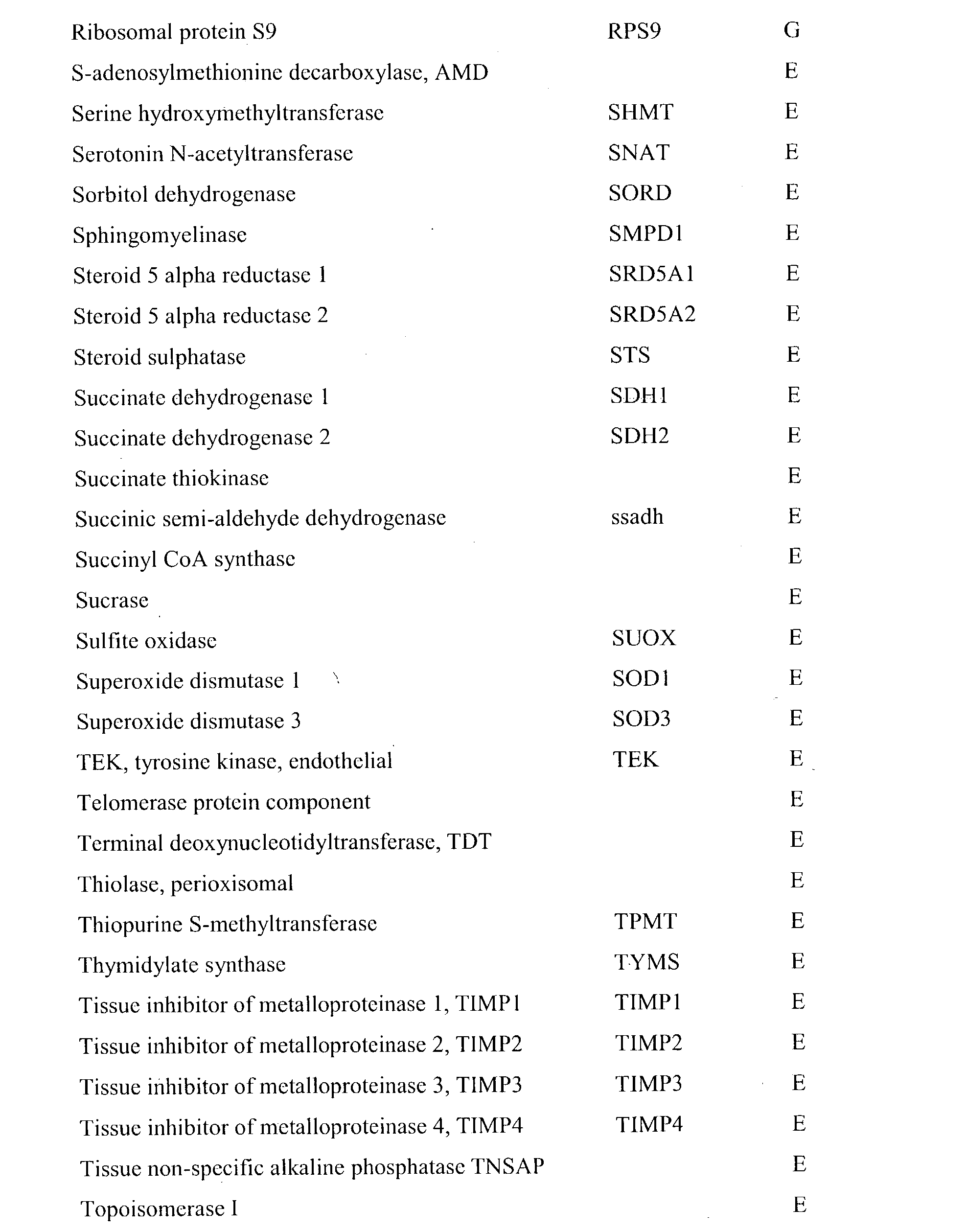


- The core list of genes provides a platform for the design and application of profiling technologies to healthcare management. We have termed these designs for profiting “GenosticsTM”—an amalgam of genomics and prognosis.
- This “GenosticTM” profiling of patients and persons will radically enhance the ability of clinicians, healthcare professionals and other parties to plan and manage healthcare provision and the targeting of appropriate healthcare resources to those deemed most in need.
- The use of our invention could also lead to a host of new applications for such profiling technologies, such as identification of persons with particular work or environment related risk, selection of applicants for employment, training or specific opportunities or for the enhancing the planning and organisation of health services, education services and social services.
- Brenman, J. E.; Chao, D. S.; Xia, H.; Aldape, K.; Bredt, D. S. Nitric oxide synthetase complexed with dystrophin and absent from skeletal muscle sarcolemma in Duchenne muscular dystrophy. Cell 82: 743-752, 1995.
- British National Formulary Number 35. British Medical Association and Royal Pharmaceutical Society of Great Britain (March 1998).
- Brody T. M., Lamer J., Minneman K. P. Human Pharmacology Molecular to Clinical. 3rd Ed. Mosby, 1998.
- Buetow K H, Edmonson M N and Cassidy A B. Reliable identification of large numbers of candidate SNP's from public EST data. Nature Genetics 21, 323-5, 1999.
- Cowen, S. G., Pipeline pulse, March 1999
- Crooke S T. 1998. Optimising the impact of genomics on drug discovery and development. Nature Biotechnology 16 (Supplement): 29-30.
- Davies, D. R.; Armstrong, J. G.; Thakker, N.; Homer, K.; Guy, S. P.; Clancy, T.; Sloan, P.; Blair, V.; Dodd, C.; Wames, T. W.; Harris, R.; Evan, D. G. R.: Severe Gardner syndrome in families with mutations restricted to a specific region of the APC gene. Am. J. Hum. Genet. 57: 1151-1158, 1995.
- Dental Practitioners' Formulary, 1998-2000 Edition. British Medical Association and Royal Pharmaceutical Society of Great Britain (1998).
- Deuter, R.; Muller, O.: Detection of APC mutations in stool DNA of patients with colorectal cancer by HD-PCR. Hum. Mutat. 11: 84-89, 1998. Drew S (1998). HRT—More good than harm. Geriatric Medicine 28: 23-26.
- Drmanac S, Kita D, Labat I, Hauser B, Schmidt C, Burczak J D and Drmanac R. 1998. Accurate sequencing by hybridisation for DNA diagnostics and individual genomics. Nature Biotechnology 16:54-58.
- Drews. J. 1997. Nature Biotechnology 14: 1516-1518.
- Drews J and Ryser S. 1997. Nature Biotechnology 15: 1318-1319.
- Fogarty T. C. and Ireson N. S. (1994) Evolving Bayseian classifiers for credit control—a comparison with other machine-learning methods. IMA Journal of Mathematics Applied in Business and Industry 5, 63-75.
- Fox S 1998. Genomic Diagnostics: the next stage in drug development.
- Gilles P N. 1999. Single nucleotide polymorphic discrimination by an electronic dot blot assay on semiconductor microchips. Nature Biotechnology 17 (4): 365-370.
- Goldberg D. E. (1989) Genetic algorithms in search optimisation and machine learning. Addison-Wesley.
- Goodman and Gillman. The Pharmacological Basis of Therapeutics, 9th Ed. McGrawHill, New York 1996.
- Griffin T J., Tang W and Smith L M. 1997. Genetic analysis by peptide nucleic acid affinity MALDI-TOF mass spectrometry. Nature Biotechnology 15 1368-1372.
- Herbal Medicines, 1998
- Lander E S. 1996. The new genomics: global views of biology. Science 274:540-545.
- Lazarou J, Pomeranz B H, Corey P N. 1998. Incidence of adverse drug reactions in hospitalised patients: a meta-analysis of prospective studies. JAMA Apr 15; 279 (15): 1200-5
- Marshall A. 1997. Getting the right drug into the right patient. Nature Biotechnology. 151249-1252.
- Magee, T.; Fuentes, A. M.; Garban, H.; Rajavashisth, T.; Marquez, D.; Rodriguez, J.A.; Rajfer, J.; Gonzalez-Cadavid, N. F. Cloning of a novel neuronal nitric oxide synthase expressed in penis and lower urinary trac Biochem. Biophys. Res. Commun 226: 145-151, 1996.
- Maher, E. R.; Barton, D. E.; Slatter, R.; Koch, D. J.; Jones, M. H.; Nagase, H.; Payne, S. J.; Charles, S. J.; Moore, A. T.; Nakamura, Y.; Ferguson-Smith, M. A.: Evaluation of molecular genetic diagnosis in the management of familial adenomatous polyposis coli: a population based study. J. Med. Genet. 30: 675-678, 1993.
- Marshall A and Hodgson J 1998. DNA chips: an array of possibilities. Nature Biotechnology 16:27-31.
- Martindale, 1998. Royal Pharmaceutical Society of Great Britain.
- Nelson, R. J.; Demas, G. E.; Huang, P. L.; Fishman, M. C.; Dawson, V. L.; Dawson, T. M.; Snyder, S. H.: Behavioural abnormalities in male mice lacking neuronal nitric oxide synthase. Nature 378: 383-386, 1995.
- Nickerson D A, et al DNA sequence diversity in a 9.7-kb region of the human lipoprotein lipase gene. Nature Genetics 19, 233-40, 1998.
- Pathare S R and Paton C. ABC of mental health—psychotropic drug treatment. British Medical Journal 315: 661-664, 1997.
- Petersen, G. M.; Francomano, C.; Kinzler, K.; Nakamure, Y.: Presymptomatic direct detection of adenomatous polyposis coli (APC) gene mutations in familial adenomatous polyposis. Hum. Genet. 91: 307-311, 1993.
- Patersen, G. M.; Shohat, T.; Brown, J.; Nakamura, Y.: Genetic counseling for familial adenomatous polyposis (FAP) with chromosome 5q linkage information. (Abstract) Am. J. Hum. Genet. 45 (suppl.): A125 only, 1989. Poste G. 1998. Molecular medicine and information-based targetted of healthcare. Nature Biotechnology. 16 (Supplement): 19-21.
- Rieder M J, Taylor S L, Clark A G and Neckerson). Sequence variation in the human angiotensin converting enzyme. Nature Genetics 22, 62-9, 1999.
- Schafer A J and Hawkins J R 1997. DNA variation and the future of human genetics. Nature Biotechnology 16: 33-44.
- Taylor D. and Kerwin R. (1997). Clozapine's role in the treatment of schizophrenia. Prescriber—Suplement.
- Tyagi s, Bratu D P and Kramer F R 1998. Multicolour molecular beacons for allele discrimination. Nature Biotechology 16: 49-53.
- U.S. Pharmacopeia, 1998.
- Wang D G, et al. Large-scale identification, mapping andgenotyping of single nucleotide polymorphisms in the human genome. Science 265, 2049-54, 1998.
- Weatherall D j, Ledingham J G G and Warrel D A. Eds Oxford Textbook of Medicine 3rd Edition. Oxford Medical Publications 1996.
- Xie, J.; Roddy, P.; Rife, T. K.; Murad, F.; Young, A. P.: Two closely linked but separable promoters for human neuronal nitric oxide synthase gene transcription Proc. Nat. Acad. Sci 92: 1242-1246, 1995.
Claims (34)
1. A set of nucleotide probes for detecting relevant variants (mutations and polymorphisms), e.g. nucleotide substitutions (missense, nonsense, splicing and regulatory), small deletions, small insertions, small insertion deletions, gross insertions, gross deletions, duplications, complex rearrangements and repeat variations in a target group of genes; said probes being complementary to DNA and RNA sequences of said group of genes; characterised in that said group is a core group of genes consisting of substantially all of the following:
2. A set of probes, said probes being antibodies or antibody fragments which interact with specific expressed proteins encoded by gene sequences of a group of genes, said probes being for detecting relevant variants (mutations and polymorphisms), e.g. nucleotide substitutions (missense, nonsense, splicing and regulatory), small deletions, small insertions, small insertion deletions, gross insertions, gross deletions, duplications, complex rearrangements and repeat variations in a target group of genes; characterised in that said group is a core group of genes consisting of substantially all of the genes defined in claim 1 .
3. A set according to claim 1 or 2 in which a minority of said probes for listed genes are absent.
4. A set according to claim 1 or 2 in which a limited number of additional probes are present together with substantially all of the probes for the listed genes.
5. A set according to claim 1 or 2 in which a limited number of probes are replaced by probes for non-listed genes.
6. A set of probes for a core group of genes according to any of claims 1 to 5 in which each gene to be probed is substantially similar (greater than 85% homologous) in sequence to the respective member of the core list of genes.
7. A set according to any of claims 1 to 6 consisting of probes for members of a sub-group of the core group.
8. A set according to any preceding claim in which said probes are in the form of an array and are spatially arranged at known locations on a substrate.
9. A set according to any preceding claim wherein said probes are on a substrate which forms part of or consists of one or more chip plate(s), for use in a chip assay for detection of said gene variants.
10. A set according to any preceding claim in which said probes are mass, electrostatic or fluorescence tagged probes.
11. A set according to claim 8 or 9 in which said substrate is a semiconductor microchip.
12. A set according to any preceding claim for use in a biological assay for detection of said gene variants.
13. A set according to any preceding claim for use in the measurement of differential gene expression levels.
14. A medical device including a set according to any preceding claim for use in an assay for detection of said gene variants.
15. A medical device including a set according to any of claims 1 to 13 for use in an array for detection of differential gene expression levels.
16. A method for use in assessing the genomic profile of a patient or individual, the method comprising testing for and detecting the presence or absence of DNA or RNA encoding the relevant structural variants (as defined in claim 1) in a target group of genes by hybridising a nucleic acid-containing sample from said patient or individual to a set according to any of claims 1 and 3 to 13 and relating the probe hybridisation pattern to said variations.
17. A method for use in assessing the the genomic profile of a patient or individual, the method comprising testing for and detecting the presence or absence of DNA or RNA encoding the relevant structural variants (as defined in claim 2) in a target group of genes by interacting an expressed-protein-containing sample from said patient or individual with a set of probes according to any of claims 2 to 13 and relating the probe interaction pattern to said variations.
18. Use of a set or device according to any of claims 1 to 13 for the prognosis and management of patients suffering from or at risk of disease.
19. Use of a set or device according to any of claims 1 to 13 for predicting likely therapeutic response and adverse events following therapeutic intervention.
20. Use of a set or device according to any of claims 1 to 13 for predicting likely patterns of symptom clusters (symptom profiles) in disease and the likelihood of subsequent, contingent, disease or symptoms.
21. Use of a set or device according to any of claims 1 to 13 for general health screening, occupational health purposes, healthcare planning on a population basis and other healthcare management utilisations.
22. Use of a set or device according to any of claims 1 to 13 for the development of new strategies of therapeutic intervention and in clinical trials.
23. Use of a set or device according to any of claims 1 to 13 for construction of and generation of algorithms for patient and healthcare management.
24. Use of a set or device according to any of claims 1 to 13 for modelling or assessing the impact of diseases or healthcare management strategies on individuals, groups, patient cohorts or populations.
25. Use of a set or device according to any of claims 1 to 13 for modelling, assessing or exploring the theoretical impact of diseases and healthcare management strategies on individuals, groups, patient cohorts or populations.
26. Use of a set or device according to any of claims 1 to 13 for predicting optimum configuration/management of thereapeutic intervention.
27. A method according to claim 16 or 17 in which the identification of gene variants is indicative of a higher risk of developing clinical symptoms for the patient or individual.
28. A method for generating a model to assess whether a patient or individual or population or group is or are likely to develop clinical symptoms which method comprises:
i) obtaining DNA or RNA or protein samples from patients or individuals diagnosed as suffering from symptoms;
ii) obtaining DNA or RNA or protein samples from a control group of subjects diagnosed as not suffering from the symptoms;
iii) analysing the samples obtained in i) and ii) to identify the polymorphic variations encoded in the core group of genes as defined in any of claims 1 to 7 ;
iv) calculating the frequencies of these alleles in the samples from i) and ii);
v) comparing the frequencies of these alleles in i) and ii);
vi) performing a statistical analysis on the results from v) in order to generate a model for assessing the risk of developing symptoms.
29. A method for assessing whether a given subject will be at risk of developing symptoms, which comprises comparing said subject's genotype with a model generated by the method of claim 28 .
30. A method according to any of claims 16, 17, 28 and 29 wherein at least one step is computer-controlled.
31. An assay suitable for use in a method according to any of claims 16, 17, 28 and 29; said assay comprising means for determining the presence or absence of relevant polymorphic variants of the core group of genes as defined in any of claims 1 to 7 in a biological sample.
32. A formatted assay technique (kit) for use in assessing the risk of a patient or individual developing symptoms; said kit comprising:
i) means for testing for the presence or absence or DNA or RNA encoding relevant polymorphic variants of the core group of genes as defined in claim 1 or 3 to 7 in a sample of human DNA;
ii) reagents for use in the detection process
iii) readout indicating the probability of a patient or individual developing symptoms.
33. A formatted assay technique (kit) for use in assessing the risk of a patient or individual developing symptoms; said kit comprising:
i) means for testing for the presence or absence of proteins encoded by the core group of genes and/or relevant polymorphic variants of the core group of genes as defined in any of claims 2 to 7 in an expressed-protein-containing human sample;
ii) reagents for use in the detection process
iii) readout indicating the probability of a patient or individual developing symptoms.
34. A set of probes according to claim 1 , wherein the probes are selected from the group consisting of oligonucleotides and polynucleotides.
Priority Applications (1)
| Application Number | Priority Date | Filing Date | Title |
|---|---|---|---|
| US10/206,568 US20030198970A1 (en) | 1998-06-06 | 2002-07-29 | Genostics |
Applications Claiming Priority (6)
| Application Number | Priority Date | Filing Date | Title |
|---|---|---|---|
| GBGB9812098.3A GB9812098D0 (en) | 1998-06-06 | 1998-06-06 | Genostics |
| GB9812098.3 | 1998-06-06 | ||
| GB9828289.0 | 1998-12-23 | ||
| GBGB9828289.0A GB9828289D0 (en) | 1998-12-23 | 1998-12-23 | Genostics |
| US32512399A | 1999-06-03 | 1999-06-03 | |
| US10/206,568 US20030198970A1 (en) | 1998-06-06 | 2002-07-29 | Genostics |
Related Parent Applications (1)
| Application Number | Title | Priority Date | Filing Date |
|---|---|---|---|
| US32512399A Continuation | 1998-06-06 | 1999-06-03 |
Publications (1)
| Publication Number | Publication Date |
|---|---|
| US20030198970A1 true US20030198970A1 (en) | 2003-10-23 |
Family
ID=26313799
Family Applications (1)
| Application Number | Title | Priority Date | Filing Date |
|---|---|---|---|
| US10/206,568 Abandoned US20030198970A1 (en) | 1998-06-06 | 2002-07-29 | Genostics |
Country Status (7)
| Country | Link |
|---|---|
| US (1) | US20030198970A1 (en) |
| EP (1) | EP1084273A1 (en) |
| JP (1) | JP2003528564A (en) |
| AU (1) | AU766544B2 (en) |
| CA (1) | CA2330929A1 (en) |
| GB (2) | GB2339200B (en) |
| WO (1) | WO1999064626A2 (en) |
Cited By (77)
| Publication number | Priority date | Publication date | Assignee | Title |
|---|---|---|---|---|
| US20040030503A1 (en) * | 1999-11-29 | 2004-02-12 | Scott Arouh | Neural -network-based identification, and application, of genomic information practically relevant to diverse biological and sociological problems, including susceptibility to disease |
| US20040157255A1 (en) * | 2003-02-06 | 2004-08-12 | David Agus | Gene expression markers for response to EGFR inhibitor drugs |
| US20040191817A1 (en) * | 2003-02-20 | 2004-09-30 | Randy Scott | Use of intronic RNA to measure gene expression |
| US20040209290A1 (en) * | 2003-01-15 | 2004-10-21 | Cobleigh Melody A. | Gene expression markers for breast cancer prognosis |
| US20050019785A1 (en) * | 2002-11-15 | 2005-01-27 | Baker Joffre B. | Gene expression profiling of EGFR positive cancer |
| US20050042681A1 (en) * | 2003-06-25 | 2005-02-24 | Van Eyk Jennifer E. | Methods and formulations for diagnosing, monitoring, staging and treating heart failure |
| US20050048542A1 (en) * | 2003-07-10 | 2005-03-03 | Baker Joffre B. | Expression profile algorithm and test for cancer prognosis |
| US20050064455A1 (en) * | 2003-05-28 | 2005-03-24 | Baker Joffre B. | Gene expression markers for predicting response to chemotherapy |
| US20050095634A1 (en) * | 2003-10-16 | 2005-05-05 | Genomic Health Inc. | qRT-PCR assay system for gene expression profiling |
| US20050136415A1 (en) * | 2003-12-22 | 2005-06-23 | Valberg Stephanie J. | Method of detecting equine glycogen storage disease IV |
| US20050164218A1 (en) * | 2003-05-30 | 2005-07-28 | David Agus | Gene expression markers for response to EGFR inhibitor drugs |
| EP1561821A2 (en) | 2003-12-11 | 2005-08-10 | Epigenomics AG | Prognostic markers for prediction of treatment response and/or survival of breast cell proliferative disorder patients |
| US20050177196A1 (en) * | 2004-02-05 | 2005-08-11 | Orhan Soykan | Methods and apparatus for identifying patients at risk for life threatening arrhythmias |
| US20050180971A1 (en) * | 2002-02-14 | 2005-08-18 | Ashdown Martin L. | Cancer therapy |
| US20050196782A1 (en) * | 2003-12-23 | 2005-09-08 | Kiefer Michael C. | Universal amplification of fragmented RNA |
| US20050214826A1 (en) * | 2004-02-19 | 2005-09-29 | Yale University | Identification of cancer protein biomarkers using proteomic techniques |
| US20050260646A1 (en) * | 2004-04-09 | 2005-11-24 | Genomic Health Inc. | Gene expression markers for predicting response to chemotherapy |
| US20050266576A1 (en) * | 2004-02-05 | 2005-12-01 | Medtronic, Inc. | Identifying patients at risk for life threatening arrhythmias |
| US20050287574A1 (en) * | 2004-06-23 | 2005-12-29 | Medtronic, Inc. | Genetic diagnostic method for SCD risk stratification |
| US20060013456A1 (en) * | 2004-06-23 | 2006-01-19 | Medtronic, Inc. | Self-improving identification method |
| US20060019397A1 (en) * | 2004-06-23 | 2006-01-26 | Medtronic, Inc. | Self-improving classification system |
| US20060166230A1 (en) * | 2004-11-05 | 2006-07-27 | Baker Joffre B | Predicting response to chemotherapy using gene expression markers |
| US20070059737A1 (en) * | 2002-03-13 | 2007-03-15 | Baker Joffre B | Gene expression profiling in biopsied tumor tissues |
| US20070130694A1 (en) * | 2005-12-12 | 2007-06-14 | Michaels Emily W | Textile surface modification composition |
| US20070202119A1 (en) * | 2003-10-24 | 2007-08-30 | Ashdown Martin L | Method Of Therapy |
| EP1840227A1 (en) * | 2006-03-02 | 2007-10-03 | University College Dublin | Markers for melanoma |
| EP1813943A4 (en) * | 2004-10-19 | 2007-12-12 | Univ Kumamoto | NEW DIAGNOSTIC KIT FOR MALIGNANT MELANOMA |
| US20080175842A1 (en) * | 1999-07-28 | 2008-07-24 | Genentech, Inc. | Compositions and methods for treatment |
| US20080228703A1 (en) * | 2007-03-16 | 2008-09-18 | Expanse Networks, Inc. | Expanding Attribute Profiles |
| US20080248022A1 (en) * | 2004-09-08 | 2008-10-09 | Immunaid Pty Ltd | Therapeutic Strategy for Treating Autoimmune and Degenerative Diseases |
| US20090041760A1 (en) * | 2000-08-18 | 2009-02-12 | Martin Leonard Ashdown | Retroviral immunotherapy |
| US20090043795A1 (en) * | 2007-08-08 | 2009-02-12 | Expanse Networks, Inc. | Side Effects Prediction Using Co-associating Bioattributes |
| US20090093424A1 (en) * | 2006-03-02 | 2009-04-09 | University College Dublin | Markers for melanoma |
| US20090131276A1 (en) * | 2007-11-14 | 2009-05-21 | Medtronic, Inc. | Diagnostic kits and methods for scd or sca therapy selection |
| US7622251B2 (en) | 2004-11-05 | 2009-11-24 | Genomic Health, Inc. | Molecular indicators of breast cancer prognosis and prediction of treatment response |
| US20100029504A1 (en) * | 2007-01-16 | 2010-02-04 | Phigenix, Inc. | Detecting pax2 for the diagnosis of breast cancer |
| US20100029560A1 (en) * | 2007-01-16 | 2010-02-04 | Phigenix, Inc | Compositions and methods for diagnosing, treating, and preventing prostate conditions |
| US20100063930A1 (en) * | 2008-09-10 | 2010-03-11 | Expanse Networks, Inc. | System for Secure Mobile Healthcare Selection |
| US20100063865A1 (en) * | 2008-09-10 | 2010-03-11 | Expanse Networks, Inc. | Masked Data Provider Profiling |
| US20100063835A1 (en) * | 2008-09-10 | 2010-03-11 | Expanse Networks, Inc. | Method for Secure Mobile Healthcare Selection |
| US20100063843A1 (en) * | 2008-09-10 | 2010-03-11 | Expanse Networks, Inc. | Masked Data Record Access |
| US20100063830A1 (en) * | 2008-09-10 | 2010-03-11 | Expanse Networks, Inc. | Masked Data Provider Selection |
| US20100070292A1 (en) * | 2008-09-10 | 2010-03-18 | Expanse Networks, Inc. | Masked Data Transaction Database |
| US20100076988A1 (en) * | 2008-09-10 | 2010-03-25 | Expanse Networks, Inc. | Masked Data Service Profiling |
| US20100076950A1 (en) * | 2008-09-10 | 2010-03-25 | Expanse Networks, Inc. | Masked Data Service Selection |
| US7723033B2 (en) | 2003-06-24 | 2010-05-25 | Genomic Health, Inc. | Prediction of likelihood of cancer recurrence |
| US20100190173A1 (en) * | 2006-01-11 | 2010-07-29 | Wayne Cowens | Gene Expression Markers For Colorectal Cancer Prognosis |
| US20100285980A1 (en) * | 2009-05-01 | 2010-11-11 | Steven Shak | Gene expression profile algorithm and test for likelihood of recurrence of colorectal cancer and response to chemotherapy |
| US20100304391A1 (en) * | 2009-05-29 | 2010-12-02 | Lombard Jay L | Methods for assessment and treatment of depression via utilization of single nucleotide polymorphisms analysis |
| US20100317006A1 (en) * | 2009-05-12 | 2010-12-16 | Medtronic, Inc. | Sca risk stratification by predicting patient response to anti-arrhythmics |
| US20100326218A1 (en) * | 2007-09-27 | 2010-12-30 | Michael Boeckh | Identifying a subject with an increased risk of invasive mold infection |
| US20110143956A1 (en) * | 2007-11-14 | 2011-06-16 | Medtronic, Inc. | Diagnostic Kits and Methods for SCD or SCA Therapy Selection |
| US7964577B2 (en) | 2005-10-14 | 2011-06-21 | Donald Carlton D | Targeting PAX2 for the induction of DEFB1-mediated tumor immunity and cancer therapy |
| US20110237537A1 (en) * | 2009-05-29 | 2011-09-29 | Lombard Jay L | Methods for assessment and treatment of mood disorders via single nucleotide polymorphisms analysis |
| AU2011213758B2 (en) * | 2004-02-19 | 2012-11-15 | Yale University | Identification of cancer protein biomarkers using proteomic techniques |
| US8355927B2 (en) | 2010-11-05 | 2013-01-15 | Genomind, Llc | Neuropsychiatric test reports |
| US8655915B2 (en) | 2008-12-30 | 2014-02-18 | Expanse Bioinformatics, Inc. | Pangenetic web item recommendation system |
| US8725426B2 (en) | 2012-01-31 | 2014-05-13 | Genomic Health, Inc. | Gene expression profile algorithm and test for determining prognosis of prostate cancer |
| US8906625B2 (en) | 2006-03-31 | 2014-12-09 | Genomic Health, Inc. | Genes involved in estrogen metabolism |
| US9031870B2 (en) | 2008-12-30 | 2015-05-12 | Expanse Bioinformatics, Inc. | Pangenetic web user behavior prediction system |
| US9122778B2 (en) | 2009-05-27 | 2015-09-01 | Biotempus Limited | Methods of treating diseases |
| WO2016169806A1 (en) * | 2015-04-22 | 2016-10-27 | Nestec S.A. | Biomarkers for predicting degree of weight loss in male subjects |
| WO2016169807A1 (en) * | 2015-04-22 | 2016-10-27 | Nestec S.A. | Biomarkers for predicting degree of weight loss in female subjects |
| US10260104B2 (en) | 2010-07-27 | 2019-04-16 | Genomic Health, Inc. | Method for using gene expression to determine prognosis of prostate cancer |
| CN110687284A (en) * | 2019-08-26 | 2020-01-14 | 中国医学科学院肿瘤医院 | Application of reagents for the detection of SIX2 autoantibodies in serum |
| US11031119B2 (en) * | 2019-11-13 | 2021-06-08 | Cube Click, Inc. | Dental images processed with deep learning for national security |
| US20210171937A1 (en) * | 2019-09-13 | 2021-06-10 | Google Llc | Methods and compositions for protein and peptide sequencing |
| CN113533748A (en) * | 2021-07-15 | 2021-10-22 | 无锡市儿童医院 | Combined kit for predicting childhood asthma attack and application thereof |
| US11322227B2 (en) | 2008-12-31 | 2022-05-03 | 23Andme, Inc. | Finding relatives in a database |
| CN114705846A (en) * | 2021-12-22 | 2022-07-05 | 中国科学技术大学 | Compositions and methods for labeling or tracking proteins of interest |
| US11773449B2 (en) | 2017-09-01 | 2023-10-03 | The Hospital For Sick Children | Profiling and treatment of hypermutant cancer |
| WO2023225221A1 (en) * | 2022-05-18 | 2023-11-23 | The Johns Hopkins University | Machine learning system for predicting gene cleavage sites background |
| US11834756B2 (en) | 2019-09-13 | 2023-12-05 | Google Llc | Methods and compositions for protein and peptide sequencing |
| US11905561B2 (en) | 2018-10-16 | 2024-02-20 | King Faisal Specialist Hospital & Research Centre | Method for diagnosing or treating pulmonary fibrosis using S100A13 protein |
| US11939635B2 (en) | 2020-08-15 | 2024-03-26 | Regeneron Pharmaceuticals, Inc. | Treatment of obesity in subjects having variant nucleic acid molecules encoding Calcitonin Receptor (CALCR) |
| US12275685B2 (en) | 2018-12-03 | 2025-04-15 | Board Of Regents, The University Of Texas System | Oligo-benzamide analogs and their use in cancer treatment |
| US12564326B2 (en) | 2022-10-25 | 2026-03-03 | GE Precision Healthcare LLC | Non-invasive bilirubin detection using induced photoreaction |
Families Citing this family (36)
| Publication number | Priority date | Publication date | Assignee | Title |
|---|---|---|---|---|
| US7037663B2 (en) | 1998-02-19 | 2006-05-02 | Eastern Virginia Medical School | Human zona pellucida protein 3 and uses thereof |
| US7019114B2 (en) | 1998-02-19 | 2006-03-28 | Eastern Virginia Medical School | Recombinant, biologically active human zona pellucida protein 3 (HZP3) to test male fertility |
| US20010053849A1 (en) * | 1999-06-16 | 2001-12-20 | Mary Jeanne Kreek | Plural biological sample arrays, and preparation and uses thereof |
| US7058517B1 (en) | 1999-06-25 | 2006-06-06 | Genaissance Pharmaceuticals, Inc. | Methods for obtaining and using haplotype data |
| US6713309B1 (en) | 1999-07-30 | 2004-03-30 | Large Scale Proteomics Corporation | Microarrays and their manufacture |
| US7179638B2 (en) | 1999-07-30 | 2007-02-20 | Large Scale Biology Corporation | Microarrays and their manufacture by slicing |
| DE19955024C2 (en) * | 1999-11-16 | 2003-01-16 | Adnagen Gmbh | Diagnostic Kit |
| US6931326B1 (en) | 2000-06-26 | 2005-08-16 | Genaissance Pharmaceuticals, Inc. | Methods for obtaining and using haplotype data |
| ES2296586T3 (en) | 2000-07-10 | 2008-05-01 | Deutsches Krebsforschungszentrum Stiftung Des Offentlichen Rechts | DIAGNOSTIC METHOD BASED ON THE DETECTION OF THE L1 ADHESION MOLECULA FOR OVARY TUMORS AND THE ENDOMETRY. |
| DE10037769A1 (en) * | 2000-08-03 | 2002-02-21 | Epigenomics Gmbh | Diagnosis of diseases associated with CD24 |
| DE10054974A1 (en) * | 2000-11-06 | 2002-06-06 | Epigenomics Ag | Diagnosis of diseases associated with Cdk4 |
| DE10054972A1 (en) * | 2000-11-06 | 2002-06-06 | Epigenomics Ag | Diagnosis of diseases associated with humus |
| US20030113726A1 (en) * | 2000-12-04 | 2003-06-19 | Zenta Tsuchihashi | Human single nucleotide polymorphisms |
| DE10061338A1 (en) * | 2000-12-06 | 2002-06-20 | Epigenomics Ag | Diagnosis of diseases associated with angiogenesis |
| FR2817558A1 (en) * | 2000-12-06 | 2002-06-07 | Inst Nat Sante Rech Med | METHOD FOR DETECTING A RISK OF ATHEROSCLEROSIS |
| WO2002046460A2 (en) * | 2000-12-06 | 2002-06-13 | Institut National De La Sante Et De La Recherche Medicale (Inserm) | Method for detecting risk of atherosclerosis |
| US7054758B2 (en) | 2001-01-30 | 2006-05-30 | Sciona Limited | Computer-assisted means for assessing lifestyle risk factors |
| US7314725B2 (en) | 2001-07-20 | 2008-01-01 | The United States Of America As Represented By The Secretary Of The Department Of Health And Human Services | Phenylthiocarbamide (PTC) taste receptor |
| WO2003011118A2 (en) | 2001-08-02 | 2003-02-13 | Trinity Biomedical Technology Corporation | Human zona pellucida proteins and methods of their use in diagnosing male infertility |
| CA2468431C (en) | 2001-11-28 | 2011-06-28 | The General Hospital Corporation | A blood-based assay for dysferlinopathies |
| AU2003209340A1 (en) * | 2002-01-18 | 2003-09-02 | Bristol-Myers Squibb Company | Predictor sets for tyrosine kinase pathways |
| EP1340818A1 (en) * | 2002-02-27 | 2003-09-03 | Epigenomics AG | Method and nucleic acids for the analysis of a colon cell proliferative disorder |
| US6764824B2 (en) * | 2002-03-21 | 2004-07-20 | Council Of Scientific And Industrial Research | Primers for screening schizophrenia and a method thereof |
| EP1485499B1 (en) * | 2002-03-25 | 2009-04-29 | Council of Scientific and Industrial Research | Novel primers for screening schizophrenia and a method thereof |
| DE10214788A1 (en) * | 2002-04-04 | 2003-10-23 | Universitaetsklinikum Hamburg | Method for detecting a mutation in a gene predisposed to hereditary colorectal tumors |
| GB0222042D0 (en) * | 2002-09-23 | 2002-10-30 | Sciona Ltd | Genostics |
| US20050048543A1 (en) * | 2003-07-11 | 2005-03-03 | Jeroen Aerssens | CHRNA2 genetic markers associated with galantamine response |
| SE0302559D0 (en) | 2003-09-25 | 2003-09-25 | Astrazeneca Ab | Method |
| WO2005059108A2 (en) * | 2003-12-12 | 2005-06-30 | Bayer Pharmaceuticals Corporation | Gene expression profiles and methods of use |
| US20080305962A1 (en) * | 2005-07-29 | 2008-12-11 | Ralph Markus Wirtz | Methods and Kits for the Prediction of Therapeutic Success, Recurrence Free and Overall Survival in Cancer Therapies |
| US20090208945A1 (en) * | 2005-12-22 | 2009-08-20 | Siemens Medical Solutions Diagnostics Gmbh | Method for the Prediction of Adverse Drug Responses to Stains |
| KR101765999B1 (en) * | 2015-01-21 | 2017-08-08 | 서울대학교산학협력단 | Device and Method for evaluating performace of cancer biomarker |
| CA3044086A1 (en) * | 2015-11-20 | 2017-05-26 | Universite De Strasbourg | Method for identifying personalized therapeutic strategies for patients affected with a cancer |
| CN110373465A (en) * | 2019-07-25 | 2019-10-25 | 中山大学附属第六医院 | A kind of combination of colorectal cancer marker and its application |
| CN112779340B (en) * | 2021-02-01 | 2023-05-16 | 新疆农垦科学院 | Haplotype molecular marker related to sheep high fertility, screening method and application |
| CN117867128B (en) * | 2023-10-16 | 2025-05-09 | 宁夏大学 | Molecular marker loci related to milk production traits in dairy cows and their applications |
Citations (4)
| Publication number | Priority date | Publication date | Assignee | Title |
|---|---|---|---|---|
| US5474796A (en) * | 1991-09-04 | 1995-12-12 | Protogene Laboratories, Inc. | Method and apparatus for conducting an array of chemical reactions on a support surface |
| US5639652A (en) * | 1992-01-08 | 1997-06-17 | Synaptic Pharmaceutical Corporation | DNA encoding a human 5-HT1F receptor and uses thereof |
| US5691153A (en) * | 1996-09-06 | 1997-11-25 | Creighton University | Genetic markers to detect high bone mass |
| US5783680A (en) * | 1993-10-06 | 1998-07-21 | The General Hospital Corporation | Genetic diagnosis and treatment for impulsive aggression |
Family Cites Families (2)
| Publication number | Priority date | Publication date | Assignee | Title |
|---|---|---|---|---|
| US5858659A (en) * | 1995-11-29 | 1999-01-12 | Affymetrix, Inc. | Polymorphism detection |
| WO1997010366A2 (en) * | 1995-09-15 | 1997-03-20 | Genzyme Corporation | High throughput screening method for sequences or genetic alterations in nucleic acids |
-
1999
- 1999-06-04 GB GB9912914A patent/GB2339200B/en not_active Expired - Fee Related
- 1999-06-04 WO PCT/GB1999/001779 patent/WO1999064626A2/en not_active Ceased
- 1999-06-04 AU AU41586/99A patent/AU766544B2/en not_active Ceased
- 1999-06-04 CA CA002330929A patent/CA2330929A1/en not_active Abandoned
- 1999-06-04 EP EP99925207A patent/EP1084273A1/en not_active Withdrawn
- 1999-06-04 JP JP2000553616A patent/JP2003528564A/en active Pending
-
2001
- 2001-07-24 GB GBGB0118013.2A patent/GB0118013D0/en not_active Ceased
-
2002
- 2002-07-29 US US10/206,568 patent/US20030198970A1/en not_active Abandoned
Patent Citations (4)
| Publication number | Priority date | Publication date | Assignee | Title |
|---|---|---|---|---|
| US5474796A (en) * | 1991-09-04 | 1995-12-12 | Protogene Laboratories, Inc. | Method and apparatus for conducting an array of chemical reactions on a support surface |
| US5639652A (en) * | 1992-01-08 | 1997-06-17 | Synaptic Pharmaceutical Corporation | DNA encoding a human 5-HT1F receptor and uses thereof |
| US5783680A (en) * | 1993-10-06 | 1998-07-21 | The General Hospital Corporation | Genetic diagnosis and treatment for impulsive aggression |
| US5691153A (en) * | 1996-09-06 | 1997-11-25 | Creighton University | Genetic markers to detect high bone mass |
Cited By (240)
| Publication number | Priority date | Publication date | Assignee | Title |
|---|---|---|---|---|
| US20080175842A1 (en) * | 1999-07-28 | 2008-07-24 | Genentech, Inc. | Compositions and methods for treatment |
| US20040030503A1 (en) * | 1999-11-29 | 2004-02-12 | Scott Arouh | Neural -network-based identification, and application, of genomic information practically relevant to diverse biological and sociological problems, including susceptibility to disease |
| US20090041760A1 (en) * | 2000-08-18 | 2009-02-12 | Martin Leonard Ashdown | Retroviral immunotherapy |
| US20050180971A1 (en) * | 2002-02-14 | 2005-08-18 | Ashdown Martin L. | Cancer therapy |
| US20070065845A1 (en) * | 2002-03-13 | 2007-03-22 | Baker Joffre B | Gene expression profiling in biopsied tumor tissues |
| US20070141589A1 (en) * | 2002-03-13 | 2007-06-21 | Baker Joffre B | Gene expression profiling in biopsied tumor tissues |
| US20070141587A1 (en) * | 2002-03-13 | 2007-06-21 | Baker Joffre B | Gene expression profiling in biopsied tumor tissues |
| US20070141588A1 (en) * | 2002-03-13 | 2007-06-21 | Baker Joffre B | Gene expression profiling in biopsied tumor tissues |
| US8071286B2 (en) | 2002-03-13 | 2011-12-06 | Genomic Health, Inc. | Gene expression profiling in biopsied tumor tissues |
| US20070065846A1 (en) * | 2002-03-13 | 2007-03-22 | Baker Joffre B | Gene expression profiling in biopsied tumor tissues |
| US20070059737A1 (en) * | 2002-03-13 | 2007-03-15 | Baker Joffre B | Gene expression profiling in biopsied tumor tissues |
| US10241114B2 (en) | 2002-03-13 | 2019-03-26 | Genomic Health, Inc. | Gene expression profiling in biopsied tumor tissues |
| US20100209920A1 (en) * | 2002-03-13 | 2010-08-19 | Baker Joffre B | Gene Expression Profiling in Biopsied Tumor Tissues |
| US20080182255A1 (en) * | 2002-03-13 | 2008-07-31 | Baker Joffre B | Gene Expression Profiling in Biopsied Tumor Tissues |
| US7858304B2 (en) | 2002-03-13 | 2010-12-28 | Genomic Health, Inc. | Gene expression profiling in biopsied tumor tissues |
| US7838224B2 (en) | 2002-03-13 | 2010-11-23 | Genomic Health, Inc. | Gene expression profiling in biopsied tumor tissues |
| US8148076B2 (en) | 2002-11-15 | 2012-04-03 | Genomic Health, Inc. | Gene expression profiling of EGFR positive cancer |
| US20050019785A1 (en) * | 2002-11-15 | 2005-01-27 | Baker Joffre B. | Gene expression profiling of EGFR positive cancer |
| US8008003B2 (en) | 2002-11-15 | 2011-08-30 | Genomic Health, Inc. | Gene expression profiling of EGFR positive cancer |
| US20100222229A1 (en) * | 2003-01-15 | 2010-09-02 | Cobleigh Melody A | Gene Expression Markers for Breast Cancer Prognosis |
| US8206919B2 (en) | 2003-01-15 | 2012-06-26 | Genomic Health, Inc. | Gene expression markers for breast cancer prognosis |
| US9944990B2 (en) | 2003-01-15 | 2018-04-17 | Genomic Health, Inc. | Gene expression markers for breast cancer prognosis |
| US8741605B2 (en) | 2003-01-15 | 2014-06-03 | Genomic Health, Inc. | Gene expression markers for breast cancer prognosis |
| US8034565B2 (en) | 2003-01-15 | 2011-10-11 | Genomic Health, Inc. | Gene expression markers for breast cancer prognosis |
| US11220715B2 (en) | 2003-01-15 | 2022-01-11 | Genomic Health, Inc. | Gene expression markers for breast cancer prognosis |
| US7569345B2 (en) | 2003-01-15 | 2009-08-04 | Genomic Health, Inc. | Gene expression markers for breast cancer prognosis |
| US20040209290A1 (en) * | 2003-01-15 | 2004-10-21 | Cobleigh Melody A. | Gene expression markers for breast cancer prognosis |
| US20040157255A1 (en) * | 2003-02-06 | 2004-08-12 | David Agus | Gene expression markers for response to EGFR inhibitor drugs |
| US20040191817A1 (en) * | 2003-02-20 | 2004-09-30 | Randy Scott | Use of intronic RNA to measure gene expression |
| US7767391B2 (en) | 2003-02-20 | 2010-08-03 | Genomic Health, Inc. | Use of intronic RNA to measure gene expression |
| US20050064455A1 (en) * | 2003-05-28 | 2005-03-24 | Baker Joffre B. | Gene expression markers for predicting response to chemotherapy |
| US20050164218A1 (en) * | 2003-05-30 | 2005-07-28 | David Agus | Gene expression markers for response to EGFR inhibitor drugs |
| US10619215B2 (en) | 2003-06-24 | 2020-04-14 | Genomic Health, Inc. | Prediction of likelihood of cancer recurrence |
| US7723033B2 (en) | 2003-06-24 | 2010-05-25 | Genomic Health, Inc. | Prediction of likelihood of cancer recurrence |
| US20050042681A1 (en) * | 2003-06-25 | 2005-02-24 | Van Eyk Jennifer E. | Methods and formulations for diagnosing, monitoring, staging and treating heart failure |
| US20090280490A1 (en) * | 2003-07-10 | 2009-11-12 | Baker Joffre B | Expression Profile Algorithm and Test for Cancer Prognosis |
| US7939261B2 (en) | 2003-07-10 | 2011-05-10 | Genomic Health, Inc. | Expression profile algorithm and test for cancer prognosis |
| US20050048542A1 (en) * | 2003-07-10 | 2005-03-03 | Baker Joffre B. | Expression profile algorithm and test for cancer prognosis |
| US7526387B2 (en) | 2003-07-10 | 2009-04-28 | Genomic Health, Inc. | Expression profile algorithm and test for cancer prognosis |
| US20050095634A1 (en) * | 2003-10-16 | 2005-05-05 | Genomic Health Inc. | qRT-PCR assay system for gene expression profiling |
| US20070202119A1 (en) * | 2003-10-24 | 2007-08-30 | Ashdown Martin L | Method Of Therapy |
| EP1561821A2 (en) | 2003-12-11 | 2005-08-10 | Epigenomics AG | Prognostic markers for prediction of treatment response and/or survival of breast cell proliferative disorder patients |
| US7129049B2 (en) | 2003-12-22 | 2006-10-31 | Regents Of The University Of Minnesota | Method of detecting equine glycogen storage disease IV |
| US20050136415A1 (en) * | 2003-12-22 | 2005-06-23 | Valberg Stephanie J. | Method of detecting equine glycogen storage disease IV |
| US8329398B2 (en) | 2003-12-23 | 2012-12-11 | Genomic Health, Inc. | Universal amplification of fragmented RNA |
| US20050196782A1 (en) * | 2003-12-23 | 2005-09-08 | Kiefer Michael C. | Universal amplification of fragmented RNA |
| US7622303B2 (en) | 2004-02-05 | 2009-11-24 | Medtronic, Inc. | Methods for identifying patients at risk for life threatening arrhythmias |
| US20050177196A1 (en) * | 2004-02-05 | 2005-08-11 | Orhan Soykan | Methods and apparatus for identifying patients at risk for life threatening arrhythmias |
| US20050266576A1 (en) * | 2004-02-05 | 2005-12-01 | Medtronic, Inc. | Identifying patients at risk for life threatening arrhythmias |
| US7608458B2 (en) | 2004-02-05 | 2009-10-27 | Medtronic, Inc. | Identifying patients at risk for life threatening arrhythmias |
| US8975379B2 (en) | 2004-02-19 | 2015-03-10 | Yale University | Identification of cancer protein biomarkers using proteomic techniques |
| US20050214826A1 (en) * | 2004-02-19 | 2005-09-29 | Yale University | Identification of cancer protein biomarkers using proteomic techniques |
| AU2011213758B2 (en) * | 2004-02-19 | 2012-11-15 | Yale University | Identification of cancer protein biomarkers using proteomic techniques |
| EP2336779A1 (en) * | 2004-02-19 | 2011-06-22 | Yale University | Identification of cancer protein biomarkers using proteomic techniques |
| EP2026071A3 (en) * | 2004-02-19 | 2009-09-02 | Yale University | Identification of cancer protein biomarkers using proteomic techniques |
| US7666583B2 (en) | 2004-02-19 | 2010-02-23 | Yale University | Identification of cancer protein biomarkers using proteomic techniques |
| US9470688B2 (en) | 2004-02-19 | 2016-10-18 | Yale University | Identification of cancer protein biomarkers using proteomic techniques |
| US10168334B2 (en) | 2004-02-19 | 2019-01-01 | Yale University | Identification of cancer protein biomarkers using proteomic techniques |
| US20050260646A1 (en) * | 2004-04-09 | 2005-11-24 | Genomic Health Inc. | Gene expression markers for predicting response to chemotherapy |
| US7871769B2 (en) | 2004-04-09 | 2011-01-18 | Genomic Health, Inc. | Gene expression markers for predicting response to chemotherapy |
| US9605318B2 (en) | 2004-04-09 | 2017-03-28 | Genomic Health, Inc. | Gene expression markers for predicting response to chemotherapy |
| US8335652B2 (en) | 2004-06-23 | 2012-12-18 | Yougene Corp. | Self-improving identification method |
| US8027791B2 (en) | 2004-06-23 | 2011-09-27 | Medtronic, Inc. | Self-improving classification system |
| US20050287574A1 (en) * | 2004-06-23 | 2005-12-29 | Medtronic, Inc. | Genetic diagnostic method for SCD risk stratification |
| US20060013456A1 (en) * | 2004-06-23 | 2006-01-19 | Medtronic, Inc. | Self-improving identification method |
| US20060019397A1 (en) * | 2004-06-23 | 2006-01-26 | Medtronic, Inc. | Self-improving classification system |
| US20080248022A1 (en) * | 2004-09-08 | 2008-10-09 | Immunaid Pty Ltd | Therapeutic Strategy for Treating Autoimmune and Degenerative Diseases |
| US8017345B2 (en) | 2004-10-19 | 2011-09-13 | Kumamoto University | Diagnostic kit for malignant melanoma |
| EP1813943A4 (en) * | 2004-10-19 | 2007-12-12 | Univ Kumamoto | NEW DIAGNOSTIC KIT FOR MALIGNANT MELANOMA |
| US20090111095A1 (en) * | 2004-10-19 | 2009-04-30 | Kumamoto University | Novel diagnostic kit for malignant melanoma |
| US20060166230A1 (en) * | 2004-11-05 | 2006-07-27 | Baker Joffre B | Predicting response to chemotherapy using gene expression markers |
| US8868352B2 (en) | 2004-11-05 | 2014-10-21 | Genomic Health, Inc. | Predicting response to chemotherapy using gene expression markers |
| US7930104B2 (en) | 2004-11-05 | 2011-04-19 | Genomic Health, Inc. | Predicting response to chemotherapy using gene expression markers |
| US20110178374A1 (en) * | 2004-11-05 | 2011-07-21 | Baker Joffre B | Predicting Response to Chemotherapy Using Gene Expression Markers |
| US7622251B2 (en) | 2004-11-05 | 2009-11-24 | Genomic Health, Inc. | Molecular indicators of breast cancer prognosis and prediction of treatment response |
| US7964577B2 (en) | 2005-10-14 | 2011-06-21 | Donald Carlton D | Targeting PAX2 for the induction of DEFB1-mediated tumor immunity and cancer therapy |
| US20070130694A1 (en) * | 2005-12-12 | 2007-06-14 | Michaels Emily W | Textile surface modification composition |
| US8153380B2 (en) | 2006-01-11 | 2012-04-10 | Genomic Health, Inc. | Gene expression markers for colorectal cancer prognosis |
| US8153378B2 (en) | 2006-01-11 | 2012-04-10 | Genomic Health, Inc. | Gene expression markers for colorectal cancer prognosis |
| US8153379B2 (en) | 2006-01-11 | 2012-04-10 | Genomic Health, Inc. | Gene expression markers for colorectal cancer prognosis |
| US8029995B2 (en) | 2006-01-11 | 2011-10-04 | Genomic Health, Inc. | Gene expression markers for colorectal cancer prognosis |
| US8367345B2 (en) | 2006-01-11 | 2013-02-05 | Genomic Health Inc. | Gene expression markers for colorectal cancer prognosis |
| US8273537B2 (en) | 2006-01-11 | 2012-09-25 | Genomic Health, Inc. | Gene expression markers for colorectal cancer prognosis |
| US8026060B2 (en) | 2006-01-11 | 2011-09-27 | Genomic Health, Inc. | Gene expression markers for colorectal cancer prognosis |
| US20110039272A1 (en) * | 2006-01-11 | 2011-02-17 | Wayne Cowens | Gene Expression Markers for Colorectal Cancer Prognosis |
| US20100190173A1 (en) * | 2006-01-11 | 2010-07-29 | Wayne Cowens | Gene Expression Markers For Colorectal Cancer Prognosis |
| US8198024B2 (en) | 2006-01-11 | 2012-06-12 | Genomic Health, Inc. | Gene expression markers for colorectal cancer prognosis |
| US20110111421A1 (en) * | 2006-01-11 | 2011-05-12 | Wayne Cowens | Gene Expression Markers for Colorectal Cancer Prognosis |
| US20110039269A1 (en) * | 2006-01-11 | 2011-02-17 | Wayne Cowens | Gene Expression Markers for Colorectal Cancer Prognosis |
| US20110039270A1 (en) * | 2006-01-11 | 2011-02-17 | Wayne Cowens | Gene Expression Markers for Colorectal Cancer Prognosis |
| US20110039271A1 (en) * | 2006-01-11 | 2011-02-17 | Wayne Cowens | Gene Expression Markers for Colorectal Cancer Prognosis |
| US20090093424A1 (en) * | 2006-03-02 | 2009-04-09 | University College Dublin | Markers for melanoma |
| EP1840227A1 (en) * | 2006-03-02 | 2007-10-03 | University College Dublin | Markers for melanoma |
| US8906625B2 (en) | 2006-03-31 | 2014-12-09 | Genomic Health, Inc. | Genes involved in estrogen metabolism |
| US8088603B2 (en) | 2007-01-16 | 2012-01-03 | Phigenix, Inc. | Compositions and methods for diagnosing, treating, and preventing prostate conditions |
| US8445444B2 (en) | 2007-01-16 | 2013-05-21 | Phigenix, Inc. | Compositions and methods for diagnosing, treating, and preventing prostate conditions |
| US20100029560A1 (en) * | 2007-01-16 | 2010-02-04 | Phigenix, Inc | Compositions and methods for diagnosing, treating, and preventing prostate conditions |
| US20110229492A1 (en) * | 2007-01-16 | 2011-09-22 | Phigenix, Inc. | Compositions and methods for diagnosing, treating, and preventing prostate conditions |
| US20100029504A1 (en) * | 2007-01-16 | 2010-02-04 | Phigenix, Inc. | Detecting pax2 for the diagnosis of breast cancer |
| US8722367B2 (en) | 2007-01-16 | 2014-05-13 | Phigenix, Inc. | Detecting PAX2 for the diagnosis of breast cancer |
| US8623617B2 (en) | 2007-01-16 | 2014-01-07 | Phigenix, Inc. | Detecting PAX2 for the diagnosis of breast cancer |
| US20080228723A1 (en) * | 2007-03-16 | 2008-09-18 | Expanse Networks, Inc. | Predisposition Prediction Using Attribute Combinations |
| US20080228766A1 (en) * | 2007-03-16 | 2008-09-18 | Expanse Networks, Inc. | Efficiently Compiling Co-associating Attributes |
| US7844609B2 (en) | 2007-03-16 | 2010-11-30 | Expanse Networks, Inc. | Attribute combination discovery |
| US12243654B2 (en) | 2007-03-16 | 2025-03-04 | 23Andme, Inc. | Computer implemented identification of genetic similarity |
| US12106862B2 (en) | 2007-03-16 | 2024-10-01 | 23Andme, Inc. | Determination and display of likelihoods over time of developing age-associated disease |
| US7818310B2 (en) | 2007-03-16 | 2010-10-19 | Expanse Networks, Inc. | Predisposition modification |
| US11791054B2 (en) | 2007-03-16 | 2023-10-17 | 23Andme, Inc. | Comparison and identification of attribute similarity based on genetic markers |
| US7797302B2 (en) | 2007-03-16 | 2010-09-14 | Expanse Networks, Inc. | Compiling co-associating bioattributes |
| US11735323B2 (en) | 2007-03-16 | 2023-08-22 | 23Andme, Inc. | Computer implemented identification of genetic similarity |
| US11621089B2 (en) | 2007-03-16 | 2023-04-04 | 23Andme, Inc. | Attribute combination discovery for predisposition determination of health conditions |
| US11600393B2 (en) | 2007-03-16 | 2023-03-07 | 23Andme, Inc. | Computer implemented modeling and prediction of phenotypes |
| US11581098B2 (en) | 2007-03-16 | 2023-02-14 | 23Andme, Inc. | Computer implemented predisposition prediction in a genetics platform |
| US11581096B2 (en) | 2007-03-16 | 2023-02-14 | 23Andme, Inc. | Attribute identification based on seeded learning |
| US11545269B2 (en) | 2007-03-16 | 2023-01-03 | 23Andme, Inc. | Computer implemented identification of genetic similarity |
| US11515047B2 (en) | 2007-03-16 | 2022-11-29 | 23Andme, Inc. | Computer implemented identification of modifiable attributes associated with phenotypic predispositions in a genetics platform |
| US11495360B2 (en) | 2007-03-16 | 2022-11-08 | 23Andme, Inc. | Computer implemented identification of treatments for predicted predispositions with clinician assistance |
| US7933912B2 (en) | 2007-03-16 | 2011-04-26 | Expanse Networks, Inc. | Compiling co-associating bioattributes using expanded bioattribute profiles |
| US7941434B2 (en) | 2007-03-16 | 2011-05-10 | Expanse Networks, Inc. | Efficiently compiling co-associating bioattributes |
| US7941329B2 (en) | 2007-03-16 | 2011-05-10 | Expanse Networks, Inc. | Insurance optimization and longevity analysis |
| US11482340B1 (en) | 2007-03-16 | 2022-10-25 | 23Andme, Inc. | Attribute combination discovery for predisposition determination of health conditions |
| US11348691B1 (en) | 2007-03-16 | 2022-05-31 | 23Andme, Inc. | Computer implemented predisposition prediction in a genetics platform |
| US11348692B1 (en) | 2007-03-16 | 2022-05-31 | 23Andme, Inc. | Computer implemented identification of modifiable attributes associated with phenotypic predispositions in a genetics platform |
| US20080228703A1 (en) * | 2007-03-16 | 2008-09-18 | Expanse Networks, Inc. | Expanding Attribute Profiles |
| US10991467B2 (en) | 2007-03-16 | 2021-04-27 | Expanse Bioinformatics, Inc. | Treatment determination and impact analysis |
| US10957455B2 (en) | 2007-03-16 | 2021-03-23 | Expanse Bioinformatics, Inc. | Computer implemented identification of genetic similarity |
| US10896233B2 (en) | 2007-03-16 | 2021-01-19 | Expanse Bioinformatics, Inc. | Computer implemented identification of genetic similarity |
| US10803134B2 (en) | 2007-03-16 | 2020-10-13 | Expanse Bioinformatics, Inc. | Computer implemented identification of genetic similarity |
| US20080228727A1 (en) * | 2007-03-16 | 2008-09-18 | Expanse Networks, Inc. | Predisposition Modification |
| US8024348B2 (en) | 2007-03-16 | 2011-09-20 | Expanse Networks, Inc. | Expanding attribute profiles |
| US20080243843A1 (en) * | 2007-03-16 | 2008-10-02 | Expanse Networks, Inc. | Predisposition Modification Using Co-associating Bioattributes |
| US20080228768A1 (en) * | 2007-03-16 | 2008-09-18 | Expanse Networks, Inc. | Individual Identification by Attribute |
| US20080228698A1 (en) * | 2007-03-16 | 2008-09-18 | Expanse Networks, Inc. | Creation of Attribute Combination Databases |
| US10379812B2 (en) | 2007-03-16 | 2019-08-13 | Expanse Bioinformatics, Inc. | Treatment determination and impact analysis |
| US20080228756A1 (en) * | 2007-03-16 | 2008-09-18 | Expanse Networks, Inc. | Compiling Co-associating Bioattributes |
| US20080228751A1 (en) * | 2007-03-16 | 2008-09-18 | Expanse Networks, Inc. | Attribute Combination Discovery |
| US8051033B2 (en) | 2007-03-16 | 2011-11-01 | Expanse Networks, Inc. | Predisposition prediction using attribute combinations |
| US8055643B2 (en) | 2007-03-16 | 2011-11-08 | Expanse Networks, Inc. | Predisposition modification |
| US8065324B2 (en) | 2007-03-16 | 2011-11-22 | Expanse Networks, Inc. | Weight and diet attribute combination discovery |
| US20080228730A1 (en) * | 2007-03-16 | 2008-09-18 | Expanse Networks, Inc. | Compiling Co-associating Bioattributes Using Expanded Bioattribute Profiles |
| US20080228722A1 (en) * | 2007-03-16 | 2008-09-18 | Expanse Networks, Inc. | Attribute Prediction Using Attribute Combinations |
| US8099424B2 (en) | 2007-03-16 | 2012-01-17 | Expanse Networks, Inc. | Treatment determination and impact analysis |
| US20080228702A1 (en) * | 2007-03-16 | 2008-09-18 | Expanse Networks, Inc. | Predisposition Modification Using Attribute Combinations |
| US20080228677A1 (en) * | 2007-03-16 | 2008-09-18 | Expanse Networks, Inc. | Identifying Co-associating Bioattributes |
| US20080228700A1 (en) * | 2007-03-16 | 2008-09-18 | Expanse Networks, Inc. | Attribute Combination Discovery |
| US20080228043A1 (en) * | 2007-03-16 | 2008-09-18 | Expanse Networks, Inc. | Diagnosis Determination and Strength and Weakness Analysis |
| US8185461B2 (en) | 2007-03-16 | 2012-05-22 | Expanse Networks, Inc. | Longevity analysis and modifiable attribute identification |
| US20080228701A1 (en) * | 2007-03-16 | 2008-09-18 | Expanse Networks, Inc. | Destiny Modification Using Attribute Combinations |
| US20080228757A1 (en) * | 2007-03-16 | 2008-09-18 | Expanse Networks, Inc. | Identifying Co-associating Bioattributes |
| US20080228797A1 (en) * | 2007-03-16 | 2008-09-18 | Expanse Networks, Inc. | Creation of Attribute Combination Databases Using Expanded Attribute Profiles |
| US8209319B2 (en) | 2007-03-16 | 2012-06-26 | Expanse Networks, Inc. | Compiling co-associating bioattributes |
| US8224835B2 (en) | 2007-03-16 | 2012-07-17 | Expanse Networks, Inc. | Expanding attribute profiles |
| US20080228824A1 (en) * | 2007-03-16 | 2008-09-18 | Expanse Networks, Inc. | Treatment Determination and Impact Analysis |
| US20080228765A1 (en) * | 2007-03-16 | 2008-09-18 | Expanse Networks, Inc. | Genetic Attribute Analysis |
| US20080228706A1 (en) * | 2007-03-16 | 2008-09-18 | Expanse Networks, Inc. | Determining Bioattribute Associations Using Expanded Bioattribute Profiles |
| US20080228705A1 (en) * | 2007-03-16 | 2008-09-18 | Expanse Networks, Inc. | Predisposition Modification Using Co-associating Bioattributes |
| US20080228699A1 (en) * | 2007-03-16 | 2008-09-18 | Expanse Networks, Inc. | Creation of Attribute Combination Databases |
| US20080228767A1 (en) * | 2007-03-16 | 2008-09-18 | Expanse Networks, Inc. | Attribute Method and System |
| US20080228451A1 (en) * | 2007-03-16 | 2008-09-18 | Expanse Networks, Inc. | Predisposition Prediction Using Co-associating Bioattributes |
| US20080228818A1 (en) * | 2007-03-16 | 2008-09-18 | Expanse Networks, Inc. | Compiling Co-associating Bioattributes |
| US20080228410A1 (en) * | 2007-03-16 | 2008-09-18 | Expanse Networks, Inc. | Genetic attribute analysis |
| US8458121B2 (en) | 2007-03-16 | 2013-06-04 | Expanse Networks, Inc. | Predisposition prediction using attribute combinations |
| US9582647B2 (en) | 2007-03-16 | 2017-02-28 | Expanse Bioinformatics, Inc. | Attribute combination discovery for predisposition determination |
| US8606761B2 (en) | 2007-03-16 | 2013-12-10 | Expanse Bioinformatics, Inc. | Lifestyle optimization and behavior modification |
| US20080228708A1 (en) * | 2007-03-16 | 2008-09-18 | Expanse Networks, Inc. | Goal Achievement and Outcome Prevention |
| US8655899B2 (en) | 2007-03-16 | 2014-02-18 | Expanse Bioinformatics, Inc. | Attribute method and system |
| US20080228753A1 (en) * | 2007-03-16 | 2008-09-18 | Expanse Networks, Inc. | Determining Attribute Associations Using Expanded Attribute Profiles |
| US8655908B2 (en) | 2007-03-16 | 2014-02-18 | Expanse Bioinformatics, Inc. | Predisposition modification |
| US9170992B2 (en) | 2007-03-16 | 2015-10-27 | Expanse Bioinformatics, Inc. | Treatment determination and impact analysis |
| US20080228531A1 (en) * | 2007-03-16 | 2008-09-18 | Expanse Networks, Inc. | Insurance Optimization and Longevity Analysis |
| US20080227063A1 (en) * | 2007-03-16 | 2008-09-18 | Expanse Networks, Inc | Career Selection and Psychological Profiling |
| US20080228704A1 (en) * | 2007-03-16 | 2008-09-18 | Expanse Networks, Inc. | Expanding Bioattribute Profiles |
| US20080228820A1 (en) * | 2007-03-16 | 2008-09-18 | Expanse Networks, Inc. | Efficiently Compiling Co-associating Bioattributes |
| US8788283B2 (en) | 2007-03-16 | 2014-07-22 | Expanse Bioinformatics, Inc. | Modifiable attribute identification |
| US20090043752A1 (en) * | 2007-08-08 | 2009-02-12 | Expanse Networks, Inc. | Predicting Side Effect Attributes |
| US20090043795A1 (en) * | 2007-08-08 | 2009-02-12 | Expanse Networks, Inc. | Side Effects Prediction Using Co-associating Bioattributes |
| US8788286B2 (en) | 2007-08-08 | 2014-07-22 | Expanse Bioinformatics, Inc. | Side effects prediction using co-associating bioattributes |
| US20100326218A1 (en) * | 2007-09-27 | 2010-12-30 | Michael Boeckh | Identifying a subject with an increased risk of invasive mold infection |
| US20110143956A1 (en) * | 2007-11-14 | 2011-06-16 | Medtronic, Inc. | Diagnostic Kits and Methods for SCD or SCA Therapy Selection |
| US20090136954A1 (en) * | 2007-11-14 | 2009-05-28 | Medtronic, Inc. | Genetic markers for scd or sca therapy selection |
| US20090131276A1 (en) * | 2007-11-14 | 2009-05-21 | Medtronic, Inc. | Diagnostic kits and methods for scd or sca therapy selection |
| US20100063830A1 (en) * | 2008-09-10 | 2010-03-11 | Expanse Networks, Inc. | Masked Data Provider Selection |
| US20100076950A1 (en) * | 2008-09-10 | 2010-03-25 | Expanse Networks, Inc. | Masked Data Service Selection |
| US20100063843A1 (en) * | 2008-09-10 | 2010-03-11 | Expanse Networks, Inc. | Masked Data Record Access |
| US20100063835A1 (en) * | 2008-09-10 | 2010-03-11 | Expanse Networks, Inc. | Method for Secure Mobile Healthcare Selection |
| US20100063865A1 (en) * | 2008-09-10 | 2010-03-11 | Expanse Networks, Inc. | Masked Data Provider Profiling |
| US8458097B2 (en) | 2008-09-10 | 2013-06-04 | Expanse Networks, Inc. | System, method and software for healthcare selection based on pangenetic data |
| US8452619B2 (en) | 2008-09-10 | 2013-05-28 | Expanse Networks, Inc. | Masked data record access |
| US20100063930A1 (en) * | 2008-09-10 | 2010-03-11 | Expanse Networks, Inc. | System for Secure Mobile Healthcare Selection |
| US7917438B2 (en) | 2008-09-10 | 2011-03-29 | Expanse Networks, Inc. | System for secure mobile healthcare selection |
| US20100070292A1 (en) * | 2008-09-10 | 2010-03-18 | Expanse Networks, Inc. | Masked Data Transaction Database |
| US8326648B2 (en) | 2008-09-10 | 2012-12-04 | Expanse Networks, Inc. | System for secure mobile healthcare selection |
| US20100076988A1 (en) * | 2008-09-10 | 2010-03-25 | Expanse Networks, Inc. | Masked Data Service Profiling |
| US8200509B2 (en) | 2008-09-10 | 2012-06-12 | Expanse Networks, Inc. | Masked data record access |
| US20110153355A1 (en) * | 2008-09-10 | 2011-06-23 | Expanse Networks, Inc. | System for Secure Mobile Healthcare Selection |
| US9031870B2 (en) | 2008-12-30 | 2015-05-12 | Expanse Bioinformatics, Inc. | Pangenetic web user behavior prediction system |
| US11514085B2 (en) | 2008-12-30 | 2022-11-29 | 23Andme, Inc. | Learning system for pangenetic-based recommendations |
| US8655915B2 (en) | 2008-12-30 | 2014-02-18 | Expanse Bioinformatics, Inc. | Pangenetic web item recommendation system |
| US11003694B2 (en) | 2008-12-30 | 2021-05-11 | Expanse Bioinformatics | Learning systems for pangenetic-based recommendations |
| US11322227B2 (en) | 2008-12-31 | 2022-05-03 | 23Andme, Inc. | Finding relatives in a database |
| US11508461B2 (en) | 2008-12-31 | 2022-11-22 | 23Andme, Inc. | Finding relatives in a database |
| US12100487B2 (en) | 2008-12-31 | 2024-09-24 | 23Andme, Inc. | Finding relatives in a database |
| US11468971B2 (en) | 2008-12-31 | 2022-10-11 | 23Andme, Inc. | Ancestry finder |
| US11935628B2 (en) | 2008-12-31 | 2024-03-19 | 23Andme, Inc. | Finding relatives in a database |
| US11657902B2 (en) | 2008-12-31 | 2023-05-23 | 23Andme, Inc. | Finding relatives in a database |
| US11776662B2 (en) | 2008-12-31 | 2023-10-03 | 23Andme, Inc. | Finding relatives in a database |
| US10179936B2 (en) | 2009-05-01 | 2019-01-15 | Genomic Health, Inc. | Gene expression profile algorithm and test for likelihood of recurrence of colorectal cancer and response to chemotherapy |
| US20100285980A1 (en) * | 2009-05-01 | 2010-11-11 | Steven Shak | Gene expression profile algorithm and test for likelihood of recurrence of colorectal cancer and response to chemotherapy |
| US20100317006A1 (en) * | 2009-05-12 | 2010-12-16 | Medtronic, Inc. | Sca risk stratification by predicting patient response to anti-arrhythmics |
| US9239904B2 (en) | 2009-05-27 | 2016-01-19 | Biotempus Limited | Computer systems for treating diseases |
| US9268908B2 (en) | 2009-05-27 | 2016-02-23 | Biotempus Limited | Computer systems for treating diseases |
| US10714208B2 (en) | 2009-05-27 | 2020-07-14 | Biotempus Pty Ltd | Computer systems for treating diseases |
| US9122778B2 (en) | 2009-05-27 | 2015-09-01 | Biotempus Limited | Methods of treating diseases |
| US20110237537A1 (en) * | 2009-05-29 | 2011-09-29 | Lombard Jay L | Methods for assessment and treatment of mood disorders via single nucleotide polymorphisms analysis |
| US20100304391A1 (en) * | 2009-05-29 | 2010-12-02 | Lombard Jay L | Methods for assessment and treatment of depression via utilization of single nucleotide polymorphisms analysis |
| WO2010138796A3 (en) * | 2009-05-29 | 2011-04-21 | Genomind, Llc | Methods for assessment and treatment of depression via utilization of single nucleotide polymorphisms analysis |
| WO2011025475A1 (en) * | 2009-08-24 | 2011-03-03 | Phigenix, Inc. | Detecting pax2 for the diagnosis of breast cancer |
| AP3331A (en) * | 2009-08-24 | 2015-07-31 | Phigenix Inc | Detecting PAX2 for the diagnosis of breast cancer |
| US10260104B2 (en) | 2010-07-27 | 2019-04-16 | Genomic Health, Inc. | Method for using gene expression to determine prognosis of prostate cancer |
| US8355927B2 (en) | 2010-11-05 | 2013-01-15 | Genomind, Llc | Neuropsychiatric test reports |
| US8706526B2 (en) | 2010-11-05 | 2014-04-22 | Genomind, Llc | Neuropsychiatric test reports |
| US8725426B2 (en) | 2012-01-31 | 2014-05-13 | Genomic Health, Inc. | Gene expression profile algorithm and test for determining prognosis of prostate cancer |
| US11011252B1 (en) | 2012-01-31 | 2021-05-18 | Genomic Health, Inc. | Gene expression profile algorithm and test for determining prognosis of prostate cancer |
| WO2016169806A1 (en) * | 2015-04-22 | 2016-10-27 | Nestec S.A. | Biomarkers for predicting degree of weight loss in male subjects |
| CN107533067A (en) * | 2015-04-22 | 2018-01-02 | 雀巢产品技术援助有限公司 | For predicting the biomarker of masculine subjects' weight loss degree |
| CN107533068A (en) * | 2015-04-22 | 2018-01-02 | 雀巢产品技术援助有限公司 | Biomarkers for Predicting Extent of Weight Loss in Female Subjects |
| WO2016169807A1 (en) * | 2015-04-22 | 2016-10-27 | Nestec S.A. | Biomarkers for predicting degree of weight loss in female subjects |
| US11773449B2 (en) | 2017-09-01 | 2023-10-03 | The Hospital For Sick Children | Profiling and treatment of hypermutant cancer |
| US11905561B2 (en) | 2018-10-16 | 2024-02-20 | King Faisal Specialist Hospital & Research Centre | Method for diagnosing or treating pulmonary fibrosis using S100A13 protein |
| US12275685B2 (en) | 2018-12-03 | 2025-04-15 | Board Of Regents, The University Of Texas System | Oligo-benzamide analogs and their use in cancer treatment |
| CN110687284A (en) * | 2019-08-26 | 2020-01-14 | 中国医学科学院肿瘤医院 | Application of reagents for the detection of SIX2 autoantibodies in serum |
| US11834756B2 (en) | 2019-09-13 | 2023-12-05 | Google Llc | Methods and compositions for protein and peptide sequencing |
| US11926820B2 (en) * | 2019-09-13 | 2024-03-12 | Google Llc | Methods and compositions for protein and peptide sequencing |
| US20210171937A1 (en) * | 2019-09-13 | 2021-06-10 | Google Llc | Methods and compositions for protein and peptide sequencing |
| US11031119B2 (en) * | 2019-11-13 | 2021-06-08 | Cube Click, Inc. | Dental images processed with deep learning for national security |
| US11939635B2 (en) | 2020-08-15 | 2024-03-26 | Regeneron Pharmaceuticals, Inc. | Treatment of obesity in subjects having variant nucleic acid molecules encoding Calcitonin Receptor (CALCR) |
| CN113533748A (en) * | 2021-07-15 | 2021-10-22 | 无锡市儿童医院 | Combined kit for predicting childhood asthma attack and application thereof |
| CN114705846A (en) * | 2021-12-22 | 2022-07-05 | 中国科学技术大学 | Compositions and methods for labeling or tracking proteins of interest |
| WO2023225221A1 (en) * | 2022-05-18 | 2023-11-23 | The Johns Hopkins University | Machine learning system for predicting gene cleavage sites background |
| US12564326B2 (en) | 2022-10-25 | 2026-03-03 | GE Precision Healthcare LLC | Non-invasive bilirubin detection using induced photoreaction |
Also Published As
| Publication number | Publication date |
|---|---|
| WO1999064626A8 (en) | 2000-04-20 |
| WO1999064626A2 (en) | 1999-12-16 |
| CA2330929A1 (en) | 1999-12-16 |
| EP1084273A1 (en) | 2001-03-21 |
| JP2003528564A (en) | 2003-09-30 |
| GB0118013D0 (en) | 2001-09-19 |
| GB2339200A (en) | 2000-01-19 |
| AU766544B2 (en) | 2003-10-16 |
| GB9912914D0 (en) | 1999-08-04 |
| GB2339200B (en) | 2001-09-12 |
| AU4158699A (en) | 1999-12-30 |
Similar Documents
| Publication | Publication Date | Title |
|---|---|---|
| AU766544B2 (en) | Probes used for genetic profiling | |
| US20070026393A1 (en) | Detection of variations in the dna methylation profile | |
| WO1999064627A2 (en) | Probes used for genetic profiling | |
| US20230187016A1 (en) | Systems and methods for the interpretation of genetic and genomic variants via an integrated computational and experimental deep mutational learning framework | |
| EP1364069B1 (en) | Method for the development of gene panels for diagnostic and therapeutic purposes based on the expression and methylatoin status of the genes | |
| JP2004529630A5 (en) | ||
| US20060099578A1 (en) | Mitochondrial biology expression arrays | |
| US20210151123A1 (en) | Interpretation of Genetic and Genomic Variants via an Integrated Computational and Experimental Deep Mutational Learning Framework | |
| EP3649260B1 (en) | Target-enriched multiplexed parallel analysis for assessment of tumor biomarkers | |
| WO2012104642A1 (en) | Method for predicting risk of developing cancer | |
| US20140038840A1 (en) | DNA Methylation Changes Associated with Major Psychosis | |
| AU2018296568B2 (en) | Enrichment of targeted genomic regions for multiplexed parallel analysis | |
| US20020032319A1 (en) | Human single nucleotide polymorphisms | |
| ES2264728T3 (en) | PROCEDURES AND PRODUCTS OF INFORMATIC PROGRAMS TO DETERMINE THE BIOLOGICAL EFFECT AND / OR THE ACTIVITY OF PHARMACOS, CHEMICAL SUBSTANCES AND / OR PHARMACEUTICAL COMPOSITIONS BASED ON THEIR EFFECT ON THE STATE OF METHODATION OF DNA. | |
| JP2004532013A5 (en) | ||
| AU2018296673B2 (en) | Target-enriched multiplexed parallel analysis for assessment of risk for genetic conditions | |
| EP1627927A2 (en) | Methods, systems and computer program products for determining the biological effect and/or activity of drugs, chemical substances and/or pharmaceutical compositions based on their effect on the methylation status of the DNA | |
| Kazan et al. | The Promise of Exome Sequencing for the Differential Diagnosis of Late-Onset End-Stage Renal Disease in Turkish Cypriots | |
| AU2002254915A1 (en) | Method for the Development of Gene Panels for Diagnostic and Therapeutic Purposes based on the Expression and Methylation Status of the Genes | |
| AU2002256633A1 (en) | Methods, systems and computer program products for determining the biological effect and/or activity of drugs, chemical substances and/or pharmaceutical compositions based on their effect on the methylation status of the DNA | |
| HK40030209A (en) | Target-enriched multiplexed parallel analysis for assessment of risk for genetic conditions | |
| HK40030209B (en) | Target-enriched multiplexed parallel analysis for assessment of risk for genetic conditions | |
| HK40030211B (en) | Enrichment of targeted genomic regions for multiplexed parallel analysis | |
| HK40030211A (en) | Enrichment of targeted genomic regions for multiplexed parallel analysis | |
| HK40030210B (en) | Target-enriched multiplexed parallel analysis for assessment of fetal dna samples |
Legal Events
| Date | Code | Title | Description |
|---|---|---|---|
| STCB | Information on status: application discontinuation |
Free format text: ABANDONED -- FAILURE TO RESPOND TO AN OFFICE ACTION |