US20030198829A1 - Organic element for electroluminescent devices - Google Patents
Organic element for electroluminescent devices Download PDFInfo
- Publication number
- US20030198829A1 US20030198829A1 US10/086,067 US8606702A US2003198829A1 US 20030198829 A1 US20030198829 A1 US 20030198829A1 US 8606702 A US8606702 A US 8606702A US 2003198829 A1 US2003198829 A1 US 2003198829A1
- Authority
- US
- United States
- Prior art keywords
- host
- dopant
- group
- bis
- compound
- Prior art date
- Legal status (The legal status is an assumption and is not a legal conclusion. Google has not performed a legal analysis and makes no representation as to the accuracy of the status listed.)
- Granted
Links
- 0 *.C.CB1(C)N2C=CC=CC2=C([Y])C2=CC=CC=N21.CC.CC Chemical compound *.C.CB1(C)N2C=CC=CC2=C([Y])C2=CC=CC=N21.CC.CC 0.000 description 13
- LWYAEZQTYHWLPW-UHFFFAOYSA-N C1=CC=C(B2(C3=CC=CC=C3)N3C(=CC4=N2C2=C(C=CC=C2)C=C4)C=CC2=CC=CC=C23)C=C1.FB1(F)N2C(=CC3=N1C1=C(C=C3)C=C3C=CC=CC3=C1)C=CC1=C2C=CC2=C1C=CC=C2 Chemical compound C1=CC=C(B2(C3=CC=CC=C3)N3C(=CC4=N2C2=C(C=CC=C2)C=C4)C=CC2=CC=CC=C23)C=C1.FB1(F)N2C(=CC3=N1C1=C(C=C3)C=C3C=CC=CC3=C1)C=CC1=C2C=CC2=C1C=CC=C2 LWYAEZQTYHWLPW-UHFFFAOYSA-N 0.000 description 2
- GMMRDXOQGUVSAG-UHFFFAOYSA-N CB1(C)N2C(=CC3=N1C1=C(C=CC=C1)C=C3)C=NC1=CC=CC=C12.CC(C)(C)C1=CN2C(=CC3=N(C=NC=C3)B2(F)F)C=C1.FB1(F)N2C(=CC3=N1C1=C(C=CC=C1)C=C3)C=CC1=C2C=CC=C1.FB1(F)N2C=CC3=C(C=CC=C3)C2=CC2=N1C1=C(C=CC=C1)C=C2.FB1(F)N2C=CC3=C(C=CC=C3)C2=CC2=N1C=CC1=C2C=CC=C1.FB1(F)N2C=CC=CC2=CC2=N1C1=C(C=CC=C1)C=C2.FB1(F)N2C=CC=CC2=CC2=N1C=CC=C2 Chemical compound CB1(C)N2C(=CC3=N1C1=C(C=CC=C1)C=C3)C=NC1=CC=CC=C12.CC(C)(C)C1=CN2C(=CC3=N(C=NC=C3)B2(F)F)C=C1.FB1(F)N2C(=CC3=N1C1=C(C=CC=C1)C=C3)C=CC1=C2C=CC=C1.FB1(F)N2C=CC3=C(C=CC=C3)C2=CC2=N1C1=C(C=CC=C1)C=C2.FB1(F)N2C=CC3=C(C=CC=C3)C2=CC2=N1C=CC1=C2C=CC=C1.FB1(F)N2C=CC=CC2=CC2=N1C1=C(C=CC=C1)C=C2.FB1(F)N2C=CC=CC2=CC2=N1C=CC=C2 GMMRDXOQGUVSAG-UHFFFAOYSA-N 0.000 description 2
- XLOVIDYEPUIAAS-UHFFFAOYSA-N CC(C)(C)C1=CC=CC2=C1C=CC1=CC3=N(C=C(OC4=CC=CC=C4)C=C3)B(F)(F)N12.CC(C)(C)OC1=CC=CN2=C1C=C1C=CC3=C(C=CC=C3)N1B2(F)F.CC1=C2C=CC=CC2=CC2=N1B(F)(F)N1C=CC=CC1=C2.CN(C)C(=O)C1=CC2=CC3=N(C4=C(C=C3)C(N(C)C)=CC=C4)B(F)(F)N2C=C1.COC1=C2C=CC=CN2B2(C3CCCC2CCC3)N2=C1C1=C(C=CC=C1)C=C2.FB1(F)N2C(=CC3=N1C=NC=N3)C=CC1=C2C=CC=C1 Chemical compound CC(C)(C)C1=CC=CC2=C1C=CC1=CC3=N(C=C(OC4=CC=CC=C4)C=C3)B(F)(F)N12.CC(C)(C)OC1=CC=CN2=C1C=C1C=CC3=C(C=CC=C3)N1B2(F)F.CC1=C2C=CC=CC2=CC2=N1B(F)(F)N1C=CC=CC1=C2.CN(C)C(=O)C1=CC2=CC3=N(C4=C(C=C3)C(N(C)C)=CC=C4)B(F)(F)N2C=C1.COC1=C2C=CC=CN2B2(C3CCCC2CCC3)N2=C1C1=C(C=CC=C1)C=C2.FB1(F)N2C(=CC3=N1C=NC=N3)C=CC1=C2C=CC=C1 XLOVIDYEPUIAAS-UHFFFAOYSA-N 0.000 description 2
- DOGCENUUNJIWRY-UHFFFAOYSA-N CC1=CC(C)=C(C)C2=C(C)C3=N(C4=C(C=CC=C4)C=C3)B(F)(F)N12.COC1=CC2=CC3=N(C(F)=C(F)C(F)=C3F)B(F)(F)N2C2=C1C=CC=C2.FB1(F)N2C(=CC3=N1C(Cl)=C1C=CC=CC1=C3)C=CC1=C2C2=C(C=CC=N2)C=C1.FB1(F)N2C(=CC3=N1C1=C(C=CC=C1)C1=C3C=CC=C1)C=CC=C2SC1=CC=CC=C1.FB1(F)N2C(=CC3=N1C1=C(C=CC=C1)C=C3)N=CC1=C2N=CN1C1=CC=CC=C1.OC1=CN2C(=C(C3=CC=CC=C3)C3=N(C=CC=C3)B2(F)F)C=C1 Chemical compound CC1=CC(C)=C(C)C2=C(C)C3=N(C4=C(C=CC=C4)C=C3)B(F)(F)N12.COC1=CC2=CC3=N(C(F)=C(F)C(F)=C3F)B(F)(F)N2C2=C1C=CC=C2.FB1(F)N2C(=CC3=N1C(Cl)=C1C=CC=CC1=C3)C=CC1=C2C2=C(C=CC=N2)C=C1.FB1(F)N2C(=CC3=N1C1=C(C=CC=C1)C1=C3C=CC=C1)C=CC=C2SC1=CC=CC=C1.FB1(F)N2C(=CC3=N1C1=C(C=CC=C1)C=C3)N=CC1=C2N=CN1C1=CC=CC=C1.OC1=CN2C(=C(C3=CC=CC=C3)C3=N(C=CC=C3)B2(F)F)C=C1 DOGCENUUNJIWRY-UHFFFAOYSA-N 0.000 description 2
- NYKDSZAJQPEVRX-UHFFFAOYSA-N CC1=CC2=CC3=N(C=CC=C3)B(C3=CC=CC=C3)(C3=CC=CC=C3)N2C=C1.CCCB1(CCC)N2C=C(OC3=CC=CC=C3)C=CC2=CC2=N1C1=C(C=C2)OC=C1.FB1(F)N2C(Cl)=CC=CC2=CC2=N1C=NC1=C2N=CN1C1=CC=CC=C1.FB1(F)N2C3=C(C=CC=C3)C=CC2=C(C2=NC3=C(C=CC=C3)C=C2)C2=N1C1=C(C=CC=C1)C=C2.FB1(F)N2C=CC=C(C3=CC=CC=C3)C2=CC2=N1C1=C(C=CC=C1)C=C2.N#CC1=CC2=CC3=N(C4=C(C=C3)CCCC4)B(F)(F)N2C=C1 Chemical compound CC1=CC2=CC3=N(C=CC=C3)B(C3=CC=CC=C3)(C3=CC=CC=C3)N2C=C1.CCCB1(CCC)N2C=C(OC3=CC=CC=C3)C=CC2=CC2=N1C1=C(C=C2)OC=C1.FB1(F)N2C(Cl)=CC=CC2=CC2=N1C=NC1=C2N=CN1C1=CC=CC=C1.FB1(F)N2C3=C(C=CC=C3)C=CC2=C(C2=NC3=C(C=CC=C3)C=C2)C2=N1C1=C(C=CC=C1)C=C2.FB1(F)N2C=CC=C(C3=CC=CC=C3)C2=CC2=N1C1=C(C=CC=C1)C=C2.N#CC1=CC2=CC3=N(C4=C(C=C3)CCCC4)B(F)(F)N2C=C1 NYKDSZAJQPEVRX-UHFFFAOYSA-N 0.000 description 2
- CQZAFTXSQXUULO-UHFFFAOYSA-N C1=CC2=C(C=C1)C1=C3C(=C2)C2=CC=C/C4=C5\C=CC=C\C5=C\C(=C24)/C3=C/C=C\1 Chemical compound C1=CC2=C(C=C1)C1=C3C(=C2)C2=CC=C/C4=C5\C=CC=C\C5=C\C(=C24)/C3=C/C=C\1 CQZAFTXSQXUULO-UHFFFAOYSA-N 0.000 description 1
- CSHWQDPOILHKBI-UHFFFAOYSA-N C1=CC2=C3C(=C1)C1=CC=C/C4=C/C=C\C(=C14)/C3=C/C=C\2 Chemical compound C1=CC2=C3C(=C1)C1=CC=C/C4=C/C=C\C(=C14)/C3=C/C=C\2 CSHWQDPOILHKBI-UHFFFAOYSA-N 0.000 description 1
- YYMBJDOZVAITBP-UHFFFAOYSA-N C1=CC=C(C2=C3C=CC=CC3=C(C3=CC=CC=C3)C3=C(C4=CC=CC=C4)C4=C(C=CC=C4)C(C4=CC=CC=C4)=C23)C=C1 Chemical compound C1=CC=C(C2=C3C=CC=CC3=C(C3=CC=CC=C3)C3=C(C4=CC=CC=C4)C4=C(C=CC=C4)C(C4=CC=CC=C4)=C23)C=C1 YYMBJDOZVAITBP-UHFFFAOYSA-N 0.000 description 1
- ZIBMOMRUIPOUQK-UHFFFAOYSA-N C1=CC=C2C(=C1)[Ir]N1=C2C=CC=C1 Chemical compound C1=CC=C2C(=C1)[Ir]N1=C2C=CC=C1 ZIBMOMRUIPOUQK-UHFFFAOYSA-N 0.000 description 1
- BFTIPCRZWILUIY-UHFFFAOYSA-N CC(C)(C)C1=CC2=C3C(=C1)C1=CC(C(C)(C)C)=C/C4=C/C(C(C)(C)C)=C\C(=C14)/C3=C/C(C(C)(C)C)=C\2 Chemical compound CC(C)(C)C1=CC2=C3C(=C1)C1=CC(C(C)(C)C)=C/C4=C/C(C(C)(C)C)=C\C(=C14)/C3=C/C(C(C)(C)C)=C\2 BFTIPCRZWILUIY-UHFFFAOYSA-N 0.000 description 1
- OEOAFDOYMOXWHL-UHFFFAOYSA-N CC(C)(C)C1=CC2=C3C(=C1)C1=CC=C/C4=C/C(C(C)(C)C)=C\C(=C14)/C3=C/C=C\2 Chemical compound CC(C)(C)C1=CC2=C3C(=C1)C1=CC=C/C4=C/C(C(C)(C)C)=C\C(=C14)/C3=C/C=C\2 OEOAFDOYMOXWHL-UHFFFAOYSA-N 0.000 description 1
- YUNVAORALFWXFD-UHFFFAOYSA-N CC1=CC(C)=N2C1=C(C)C1=C(C)C=C(C)N1B2(F)F.CC1=CC2=CC3=C4C=CC=CC4=C(C4=CC=CC=C4)N3B(F)(F)N2=C1.CCC1=C(CC)C2=CC3=C4C=CC=CC4=C(CC)N3B(F)(F)N2=C1.FB1(F)N2C(C3=CC=CC=C3)=CC(C3=CC=CC=C3)=C2C=C2C(C3=CC=CC=C3)=CC(C3=CC=CC=C3)=N21.FB1(F)N2C=C3C=CC=CC3=C2C=C2C(C3=CC=CC=C3)=CC(C3=CC=CC=C3)=N21 Chemical compound CC1=CC(C)=N2C1=C(C)C1=C(C)C=C(C)N1B2(F)F.CC1=CC2=CC3=C4C=CC=CC4=C(C4=CC=CC=C4)N3B(F)(F)N2=C1.CCC1=C(CC)C2=CC3=C4C=CC=CC4=C(CC)N3B(F)(F)N2=C1.FB1(F)N2C(C3=CC=CC=C3)=CC(C3=CC=CC=C3)=C2C=C2C(C3=CC=CC=C3)=CC(C3=CC=CC=C3)=N21.FB1(F)N2C=C3C=CC=CC3=C2C=C2C(C3=CC=CC=C3)=CC(C3=CC=CC=C3)=N21 YUNVAORALFWXFD-UHFFFAOYSA-N 0.000 description 1
- LQYYDWJDEVKDGB-XPWSMXQVSA-N CC1=CC=C(N(C2=CC=C(C)C=C2)C2=CC=C(/C=C/C3=CC=C(/C=C/C4=CC=C(N(C5=CC=C(C)C=C5)C5=CC=C(C)C=C5)C=C4)C=C3)C=C2)C=C1 Chemical compound CC1=CC=C(N(C2=CC=C(C)C=C2)C2=CC=C(/C=C/C3=CC=C(/C=C/C4=CC=C(N(C5=CC=C(C)C=C5)C5=CC=C(C)C=C5)C=C4)C=C3)C=C2)C=C1 LQYYDWJDEVKDGB-XPWSMXQVSA-N 0.000 description 1
- BLGXPNUXTJZYPK-GDNGEXCGSA-M CC1=C[O-][Mn+]N1.CC1=N[Mn+][O-]C1 Chemical compound CC1=C[O-][Mn+]N1.CC1=N[Mn+][O-]C1 BLGXPNUXTJZYPK-GDNGEXCGSA-M 0.000 description 1
- DVQYQTJMLAFBSH-TXMNDBBKSA-N CCC1=C(CC)/C2=C/C3=N4/C(=C\C5=C(CC)C(CC)=C6/C=C7/C(CC)=C(CC)C8=N7[Pt]4(N65)N2C1=C8)C(C)=C3C Chemical compound CCC1=C(CC)/C2=C/C3=N4/C(=C\C5=C(CC)C(CC)=C6/C=C7/C(CC)=C(CC)C8=N7[Pt]4(N65)N2C1=C8)C(C)=C3C DVQYQTJMLAFBSH-TXMNDBBKSA-N 0.000 description 1
- IJDNQMDRQITEOD-UHFFFAOYSA-N CCCC Chemical compound CCCC IJDNQMDRQITEOD-UHFFFAOYSA-N 0.000 description 1
- TVSXRWNJJYLPGI-UHFFFAOYSA-N CN1C2=CC3=C(C=C2C(=O)C2=C1C=C(F)C=C2)N(C)C1=C(C=CC(F)=C1)C3=O Chemical compound CN1C2=CC3=C(C=C2C(=O)C2=C1C=C(F)C=C2)N(C)C1=C(C=CC(F)=C1)C3=O TVSXRWNJJYLPGI-UHFFFAOYSA-N 0.000 description 1
- SCZWJXTUYYSKGF-UHFFFAOYSA-N CN1C2=CC3=C(C=C2C(=O)C2=C1C=CC=C2)N(C)C1=C(C=CC=C1)C3=O Chemical compound CN1C2=CC3=C(C=C2C(=O)C2=C1C=CC=C2)N(C)C1=C(C=CC=C1)C3=O SCZWJXTUYYSKGF-UHFFFAOYSA-N 0.000 description 1
- CXFCSSDPVAZGPY-UHFFFAOYSA-N FB1(F)N2C(=CC3=N1C1=C(C=CC=C1)C=C3)C=CC1=C2C=CC=C1.FB1(F)N2C=CC=CC2=CC2=N1C1=C(C=CC=C1)C=C2.FB1(F)N2C=CC=CC2=CC2=N1C=CC=C2 Chemical compound FB1(F)N2C(=CC3=N1C1=C(C=CC=C1)C=C3)C=CC1=C2C=CC=C1.FB1(F)N2C=CC=CC2=CC2=N1C1=C(C=CC=C1)C=C2.FB1(F)N2C=CC=CC2=CC2=N1C=CC=C2 CXFCSSDPVAZGPY-UHFFFAOYSA-N 0.000 description 1
- GUHHEAYOTAJBPT-UHFFFAOYSA-N FB1(F)N2C=CC=C2C=C2C=CC=N21 Chemical compound FB1(F)N2C=CC=C2C=C2C=CC=N21 GUHHEAYOTAJBPT-UHFFFAOYSA-N 0.000 description 1
- AXQQGMNUTQGGNL-UHFFFAOYSA-N FB1(F)N2C=CC=CC2=CC2=N1C=CC=C2 Chemical compound FB1(F)N2C=CC=CC2=CC2=N1C=CC=C2 AXQQGMNUTQGGNL-UHFFFAOYSA-N 0.000 description 1
- NQKYZJNBEHSZKP-UHFFFAOYSA-N [Eu].[H]BN1N=C(C)C=C1C Chemical compound [Eu].[H]BN1N=C(C)C=C1C NQKYZJNBEHSZKP-UHFFFAOYSA-N 0.000 description 1
- NRCMAYZCPIVABH-UHFFFAOYSA-N [H]N1C2=CC3=C(C=C2C(=O)C2=C1C=CC=C2)N([H])C1=C(C=CC=C1)C3=O Chemical compound [H]N1C2=CC3=C(C=C2C(=O)C2=C1C=CC=C2)N([H])C1=C(C=CC=C1)C3=O NRCMAYZCPIVABH-UHFFFAOYSA-N 0.000 description 1
Images

Classifications
-
- H—ELECTRICITY
- H10—SEMICONDUCTOR DEVICES; ELECTRIC SOLID-STATE DEVICES NOT OTHERWISE PROVIDED FOR
- H10K—ORGANIC ELECTRIC SOLID-STATE DEVICES
- H10K85/00—Organic materials used in the body or electrodes of devices covered by this subclass
- H10K85/30—Coordination compounds
- H10K85/321—Metal complexes comprising a group IIIA element, e.g. Tris (8-hydroxyquinoline) gallium [Gaq3]
-
- H—ELECTRICITY
- H05—ELECTRIC TECHNIQUES NOT OTHERWISE PROVIDED FOR
- H05B—ELECTRIC HEATING; ELECTRIC LIGHT SOURCES NOT OTHERWISE PROVIDED FOR; CIRCUIT ARRANGEMENTS FOR ELECTRIC LIGHT SOURCES, IN GENERAL
- H05B33/00—Electroluminescent light sources
- H05B33/12—Light sources with substantially two-dimensional [2D] radiating surfaces
- H05B33/18—Light sources with substantially two-dimensional [2D] radiating surfaces characterised by the nature or concentration of the activator
-
- H—ELECTRICITY
- H10—SEMICONDUCTOR DEVICES; ELECTRIC SOLID-STATE DEVICES NOT OTHERWISE PROVIDED FOR
- H10K—ORGANIC ELECTRIC SOLID-STATE DEVICES
- H10K50/00—Organic light-emitting devices
- H10K50/10—OLEDs or polymer light-emitting diodes [PLED]
- H10K50/11—OLEDs or polymer light-emitting diodes [PLED] characterised by the electroluminescent [EL] layers
-
- H—ELECTRICITY
- H10—SEMICONDUCTOR DEVICES; ELECTRIC SOLID-STATE DEVICES NOT OTHERWISE PROVIDED FOR
- H10K—ORGANIC ELECTRIC SOLID-STATE DEVICES
- H10K85/00—Organic materials used in the body or electrodes of devices covered by this subclass
- H10K85/30—Coordination compounds
- H10K85/341—Transition metal complexes, e.g. Ru(II)polypyridine complexes
-
- H—ELECTRICITY
- H10—SEMICONDUCTOR DEVICES; ELECTRIC SOLID-STATE DEVICES NOT OTHERWISE PROVIDED FOR
- H10K—ORGANIC ELECTRIC SOLID-STATE DEVICES
- H10K85/00—Organic materials used in the body or electrodes of devices covered by this subclass
- H10K85/30—Coordination compounds
- H10K85/341—Transition metal complexes, e.g. Ru(II)polypyridine complexes
- H10K85/342—Transition metal complexes, e.g. Ru(II)polypyridine complexes comprising iridium
-
- H—ELECTRICITY
- H10—SEMICONDUCTOR DEVICES; ELECTRIC SOLID-STATE DEVICES NOT OTHERWISE PROVIDED FOR
- H10K—ORGANIC ELECTRIC SOLID-STATE DEVICES
- H10K85/00—Organic materials used in the body or electrodes of devices covered by this subclass
- H10K85/30—Coordination compounds
- H10K85/351—Metal complexes comprising lanthanides or actinides, e.g. comprising europium
-
- H—ELECTRICITY
- H10—SEMICONDUCTOR DEVICES; ELECTRIC SOLID-STATE DEVICES NOT OTHERWISE PROVIDED FOR
- H10K—ORGANIC ELECTRIC SOLID-STATE DEVICES
- H10K85/00—Organic materials used in the body or electrodes of devices covered by this subclass
- H10K85/60—Organic compounds having low molecular weight
- H10K85/615—Polycyclic condensed aromatic hydrocarbons, e.g. anthracene
-
- H—ELECTRICITY
- H10—SEMICONDUCTOR DEVICES; ELECTRIC SOLID-STATE DEVICES NOT OTHERWISE PROVIDED FOR
- H10K—ORGANIC ELECTRIC SOLID-STATE DEVICES
- H10K85/00—Organic materials used in the body or electrodes of devices covered by this subclass
- H10K85/60—Organic compounds having low molecular weight
- H10K85/631—Amine compounds having at least two aryl rest on at least one amine-nitrogen atom, e.g. triphenylamine
-
- H—ELECTRICITY
- H10—SEMICONDUCTOR DEVICES; ELECTRIC SOLID-STATE DEVICES NOT OTHERWISE PROVIDED FOR
- H10K—ORGANIC ELECTRIC SOLID-STATE DEVICES
- H10K85/00—Organic materials used in the body or electrodes of devices covered by this subclass
- H10K85/60—Organic compounds having low molecular weight
- H10K85/649—Aromatic compounds comprising a hetero atom
-
- Y—GENERAL TAGGING OF NEW TECHNOLOGICAL DEVELOPMENTS; GENERAL TAGGING OF CROSS-SECTIONAL TECHNOLOGIES SPANNING OVER SEVERAL SECTIONS OF THE IPC; TECHNICAL SUBJECTS COVERED BY FORMER USPC CROSS-REFERENCE ART COLLECTIONS [XRACs] AND DIGESTS
- Y10—TECHNICAL SUBJECTS COVERED BY FORMER USPC
- Y10S—TECHNICAL SUBJECTS COVERED BY FORMER USPC CROSS-REFERENCE ART COLLECTIONS [XRACs] AND DIGESTS
- Y10S428/00—Stock material or miscellaneous articles
- Y10S428/917—Electroluminescent
Definitions
- This invention relates to organic light emitting diode (OLED) electroluminescent (EL) device comprising a light-emitting layer containing a boron dopant compound containing a bis(azinyl)methene boron group.
- OLED organic light emitting diode
- EL electroluminescent
- an organic EL device is comprised of an anode for hole injection, a cathode for electron injection, and an organic medium sandwiched between these electrodes to support charge recombination that yields emission of light. These devices are also commonly referred to as organic light-emitting diodes, or OLEDs.
- organic EL devices are Gurnee et al. U.S. Pat. No. 3,172,862, issued Mar. 9, 1965; Gurnee U.S. Pat. No. 3,173,050, issued Mar.
- More recent organic EL devices include an organic EL element consisting of extremely thin layers (e.g. ⁇ 1.0 ⁇ m) between the anode and the cathode.
- the organic EL element encompasses the layers between the anode and cathode electrodes. Reducing the thickness lowered the resistance of the organic layer and has enabled devices that operate at much lower voltage.
- one organic layer of the EL element adjacent to the anode is specifically chosen to transport holes, therefore, it is referred to as the hole-transporting layer, and the other organic layer is specifically chosen to transport electrons, referred to as the electron-transporting layer.
- the interface between the two layers provides an efficient site for the recombination of the injected hole/electron pair and the resultant electroluminescence.
- LEL organic light-emitting layer
- the light-emitting layer commonly consists of a host material doped with a guest material—dopant, which results in an efficiency improvement and allows color tuning.
- a useful class of dopants is derived from the 5,6,5-tricyclyc pyrromethene-BF2 complexes and disclosed in U.S. Pat. No. 5,683,823; JP 09,289,081A; and JP 11,097,180A. These materials are characterized by typically narrow emission spectra, which may result in attractively high color purity. However, the green-emitting unsubstituted or alkyl substituted pyrromethene-BF2 complexes exhibit relatively low quantum efficiencies of electroluminescence. In order to achieve highly efficient OLEDs, one needs to use phenyl rings as substituents thereby extending the conjugated ⁇ -system.
- the emission wavelength typically becomes red-shifted yielding a reddish amber color, which is the shortest wavelength light that can be emitted by pyrromethene-BF2 complexes with good efficiency.
- luminance efficient green OLEDs do not appear to be conveniently obtained with pyrromethene BF 2 complexes used as dopants.
- the invention provides an OLED device comprising a light-emitting layer containing a host and a dopant where the dopant comprises a boron compound containing a bis(azinyl)methene boron complex group.
- the invention also provides a display including such a device and a method of imaging using such a device.
- Such a device exhibits improved luminance efficiency.
- FIG. 1 shows a cross-section of a typical OLED device in which this invention may be used.
- the invention is generally as described above.
- An OLED device of the invention is a multilayer electroluminescent device comprising a cathode, an anode, charge-injecting layers (if necessary), charge-transporting layers, and a light-emitting layer (LEL) comprising a host and at least one dopant, a bis(azinyl)methene boron compound.
- LEL light-emitting layer
- azine or azinyl refers to a six-membered aromatic ring system containing at least one nitrogen as defined by the Hantzsch-Widman stems [ The Naming and Indexing of Chemical Substances for Chemical Abstracts—A Reprint of Index IV ( Chemical Substance Index Names ) from the Chemical Abstracts— 1992 Index Guide; American Chemical Society: Columbus, Ohio, 1992; paragraph 146].
- the light-emitting layer of the device comprises a host and dopant where the dopant is present in an amount of up to 10 wt % of the host, more typically from 0.1-5.0 wt % of the host.
- the group is suitably a 6,6,6-tricyclic bis(azinyl)methene boron complex group, and usefully a bis(pyridinyl)methene boron complex group. Good results are obtained when at least one or both of the pyridyl groups are substituted, particularly where at least one or both of the pyridyl groups has substituent groups joined to form a fused ring.
- Desirable hosts include those based on a chelated oxinoid compound or an anthracene compound. Particular examples of hosts are tris(8-quinolinolato)aluminum (III) and 2-tert-butyl-9,10-di-(2-naphthyl)anthracene.
- Embodiments of the dopants useful in the invention provide an emitted light having a green hue. Substituents are selected to provide embodiments that exhibit a reduced loss of initial luminance compared to the device containing no boron compound of claim 1.
- a and A′ represent independent azine ring systems corresponding to 6-membered aromatic ring systems containing at least one nitrogen;
- each X a and X b is an independently selected substituent, two of which may join to form a fused ring to A or A′;
- n and n are independently 0 to 4.
- Y is H or a substituent
- Z a and Z b are independently selected substituents
- 1, 2, 3, 4, 1′, 2′, 3′, and 4′ are independently selected as either carbon or nitrogen atoms.
- 1, 2, 3, 4, 1′, 2′, 3′, and 4′ are conveniently all carbon atoms.
- the device may desirably contain at least one or both of ring A or A′ that contains substituents joined to form a fused ring.
- at least one X a or X b group selected from the group consisting of halide and alkyl, aryl, alkoxy, and aryloxy groups.
- a Z a and Z b group are independently selected from the group consisting of fluorine and alkyl, aryl, alkoxy and aryloxy groups.
- Z a and Z b are F.
- Y is suitably hydrogen or a substituent such as an alkyl, aryl, or heterocyclic group.
- the emission wavelength of these compounds may be adjusted to some extent by appropriate substitution around the central bis(azinyl)methene boron group to meet a color aim, namely green.
- the bis(azinyl)methene boron compound is usually doped into a host compound, which represents the light-emitting layer between the hole-transporting and electron-transporting layers.
- the host is chosen such that there is efficient energy transfer from the host to the bis(azinyl)methene boron compound.
- the bis(azinyl)methene boron complex emits from the excited state to afford a bright, highly-efficient, stable EL device.
- the EL device of the invention is useful in any device where light emission is desired such as a lamp or a component in a static or motion imaging device, such as a television, cell phone, DVD player, or computer monitor.
- Embodiments of the invention provide not only improved luminance efficiency but also improved stability under load and a more desirable green hue as evidenced by the location and shape of the absorption curve of the emitted light.
- substituted or “substituent” means any group or atom other than hydrogen (what about deuterium).
- group when the term “group” is used, it means that when a substituent group contains a substitutable hydrogen, it is also intended to encompass not only the substituent's unsubstituted form, but also its form further substituted with any substituent group or groups as herein mentioned, so long as the substituent does not destroy properties necessary for device utility.
- a substituent group may be halogen or may be bonded to the remainder of the molecule by an atom of carbon, silicon, oxygen, nitrogen, phosphorous, sulfur, selenium, or boron.
- the substituent may be, for example, halogen, such as chloro, bromo or fluoro; nitro; hydroxyl; cyano; carboxyl; or groups which may be further substituted, such as alkyl, including straight or branched chain or cyclic alkyl, such as methyl, trifluoromethyl, ethyl, t-butyl, 3-(2,4-di-t-pentylphenoxy) propyl, and tetradecyl; alkenyl, such as ethylene, 2-butene; alkoxy, such as methoxy, ethoxy, propoxy, butoxy, 2-methoxyethoxy, sec-butoxy, hexyloxy, 2-ethylhexyloxy, tetradecyloxy, 2-(2,4-di-t-pentylphenoxy)ethoxy, and 2-dodecyloxyethoxy; aryl such as phenyl, 4-t-butylphenyl
- the substituents may themselves be further substituted one or more times with the described substituent groups.
- the particular substituents used may be selected by those skilled in the art to attain the desired desirable properties for a specific application and can include, for example, electron-withdrawing groups, electron-donating groups, and steric groups.
- the substituents may be joined together to form a ring such as a fused ring unless otherwise provided.
- the above groups and substituents thereof may include those having up to 48 carbon atoms, typically 1 to 36 carbon atoms and usually less than 24 carbon atoms, but greater numbers are possible depending on the particular substituents selected.
- the present invention can be employed in most OLED device configurations. These include very simple structures comprising a single anode and cathode to more complex devices, such as passive matrix displays comprised of orthogonal arrays of anodes and cathodes to form pixels, and active-matrix displays where each pixel is controlled independently, for example, with a thin film transistor (TFT).
- TFT thin film transistor
- FIG. 1 A more typical structure is shown in FIG. 1 and contains a substrate 101 , an anode 103 , an optional hole-injecting layer 105 , a hole-transporting layer 107 , a light-emitting layer 109 , an electron-transporting layer 111 , and a cathode 113 . These layers are described in detail below. Note that the substrate may alternatively be located adjacent to the cathode, or the substrate may actually constitute the anode or cathode. Also, the total combined thickness of the organic layers is preferably less than 500 nm.
- the substrate 101 can either be light transmissive or opaque, depending on the intended direction of light emission.
- the light transmissive property is desirable for viewing the EL emission through the substrate.
- Transparent glass or organic material are commonly employed in such cases.
- the transmissive characteristic of the bottom support is immaterial, and therefore can be light transmissive, light absorbing or light reflective.
- Substrates for use in this case include, but are not limited to, glass, plastic, semiconductor materials, ceramics, and circuit board materials. Of course it is necessary to provide in these device configurations a light-transparent top electrode.
- the conductive anode layer 103 is commonly formed over the substrate and, when EL emission is viewed through the anode, should be transparent or substantially transparent to the emission of interest.
- Common transparent anode materials used in this invention are indium-tin oxide (ITO) and tin oxide, but other metal oxides can work including, but not limited to, aluminum- or indium-doped zinc oxide (IZO), magnesium-indium oxide, and nickel-tungsten oxide.
- ITO indium-tin oxide
- IZO aluminum- or indium-doped zinc oxide
- IZO aluminum- or indium-doped zinc oxide
- magnesium-indium oxide magnesium-indium oxide
- nickel-tungsten oxide nickel-tungsten oxide.
- metal nitrides such as gallium nitride
- metal selenides such as zinc selenide
- metal sulfides such as zinc sulfide
- the transmissive characteristics of layer 103 are immaterial and any conductive material can be used, transparent, opaque or reflective.
- Example conductors for this application include, but are not limited to, gold, iridium, molybdenum, palladium, and platinum.
- Typical anode materials, transmissive or otherwise, have a work function of 4.1 eV or greater. Desired anode materials are commonly deposited by any suitable means such as evaporation, sputtering, chemical vapor deposition, or electrochemical means. Anodes can be patterned using well-known photolithographic processes.
- HIL Hole-Injecting Layer
- a hole-injecting layer 105 be provided between anode 103 and hole-transporting layer 107 .
- the hole-injecting material can serve to improve the film formation property of subsequent organic layers and to facilitate injection of holes into the hole-transporting layer.
- Suitable materials for use in the hole-injecting layer include, but are not limited to, porphyrinic compounds such as those described in U.S. Pat. No. 4,720,432, and plasma-deposited fluorocarbon polymers such as those described in U.S. Pat. No. 6,208,075.
- Alternative hole-injecting materials reportedly useful in organic EL devices are described in EP 0 891 121 A1 and EP 1 029 909 A1.
- the hole-transporting layer 107 of the organic EL device contains at least one hole-transporting compound such as an aromatic tertiary amine, where the latter is understood to be a compound containing at least one trivalent nitrogen atom that is bonded only to carbon atoms, at least one of which is a member of an aromatic ring.
- the aromatic tertiary amine can be an arylamine, such as a monoarylamine, diarylamine, triarylamine, or a polymeric arylamine group. Exemplary monomeric triarylamines are illustrated by Klupfel et al. U.S. Pat. No. 3,180,730.
- a more preferred class of aromatic tertiary amines are those which include at least two aromatic tertiary amine moieties as described in U.S. Pat. No. 4,720,432 and U.S. Pat. No. 5,061,569. Such compounds include those represented by structural formula (A).
- Q 1 and Q 2 are independently selected aromatic tertiary amine moieties and G is a linking group such as an arylene, cycloalkylene, or alkylene group of a carbon to carbon bond.
- G is a linking group such as an arylene, cycloalkylene, or alkylene group of a carbon to carbon bond.
- at least one of Q 1 or Q 2 contains a polycyclic fused ring group, e.g., a naphthalene.
- G is an aryl group, it is conveniently a phenylene, biphenylene, or naphthalene group.
- a useful class of triarylamine groups satisfying structural formula (A) and containing two triarylamine groups is represented by structural formula (B):
- R 1 and R 2 each independently represents a hydrogen atom, an aryl group, or an alkyl group or R 1 and R 2 together represent the atoms completing a cycloalkyl group;
- R 3 and R 4 each independently represents an aryl group, which is in turn substituted with a diaryl substituted amino group, as indicated by structural formula (C):
- R 5 and R 6 are independently selected aryl groups.
- at least one of R 5 or R 6 contains a polycyclic fused ring group, e.g., a naphthalene.
- Another class of aromatic tertiary amine groups are the tetraaryldiamines.
- Desirable tetraaryldiamines groups include two diarylamino groups, such as indicated by formula (C), linked through an arylene group.
- Useful tetraaryldiamines include those represented by formula (D).
- each Are is an independently selected arylene group, such as a phenylene or anthracene group,
- n is an integer of from 1 to 4, and
- Ar, R 7 , R 8 , and R 9 are independently selected aryl groups.
- at least one of Ar, R 7 , R 8 , and R 9 is a polycyclic fused ring group, e.g., a naphthalene
- the various alkyl, alkylene, aryl, and arylene groups of the foregoing structural formulae (A), (B), (C), (D), can each in turn be substituted.
- Typical substituents include alkyl groups, alkoxy groups, aryl groups, aryloxy groups, and halogen such as fluoride, chloride, and bromide.
- the various alkyl and alkylene groups typically contain from about 1 to 6 carbon atoms.
- the cycloalkyl moieties can contain from 3 to about 10 carbon atoms, but typically contain five, six, or seven ring carbon atoms—e.g., cyclopentyl, cyclohexyl, and cycloheptyl ring structures.
- the aryl and arylene groups are usually phenyl and phenylene moieties.
- the hole-transporting layer can be formed of a single or a mixture of aromatic tertiary amine compounds.
- a triarylamine such as a triarylamine satisfying the formula (B)
- a tetraaryldiamine such as indicated by formula (D).
- a triarylamine is employed in combination with a tetraaryldiamine, the latter is positioned as a layer interposed between the triarylamine and the electron injecting and transporting layer.
- useful aromatic tertiary amines are the following:
- Another class of useful hole-transporting materials includes polycyclic aromatic compounds as described in EP 1 009 041.
- polymeric hole-transporting materials can be used such as poly(N-vinylcarbazole) (PVK), polythiophenes, polypyrrole, polyaniline, and copolymers such as poly(3,4-ethylenedioxythiophene)/poly(4-styrenesulfonate) also called PEDOT/PSS.
- the light-emitting layer (LEL) 109 of the organic EL element comprises a luminescent or fluorescent material where electroluminescence is produced as a result of electron-hole pair recombination in this region.
- the light-emitting layer can be comprised of a single material, but more commonly consists of a host material doped with a guest compound or compounds where light emission comes primarily from the dopant and can be of any color.
- the host materials in the light-emitting layer can be an electron-transporting material, as defined below, a hole-transporting material, as defined above, or another material or combination of materials that support hole-electron recombination.
- the dopant is usually chosen from highly fluorescent dyes, but phosphorescent compounds, e.g., transition metal complexes as described in WO 98/55561, WO 00/18851, WO 00/57676, and WO 00/70655 are also useful. Dopants are typically coated as 0.01 to 10% by weight into the host material.
- An important relationship for choosing a dye as a dopant is a comparison of the bandgap potential which is defined as the energy difference between the highest occupied molecular orbital and the lowest unoccupied molecular orbital of the molecule.
- the band gap of the dopant is smaller than that of the host material.
- Host and emitting molecules known to be of use include, but are not limited to, those disclosed in U.S. Pat. No. 4,768,292, U.S. Pat. No. 5,141,671, U.S. Pat. No. 5,150,006, U.S. Pat. No. 5,151,629, U.S. Pat. No. 5,405,709, U.S. Pat. No. 5,484,922, U.S. Pat. No. 5,593,788, U.S. Pat. No. 5,645,948, U.S. Pat. No. 5,683,823, U.S. Pat. No. 5,755,999, U.S. Pat. No. 5,928,802, U.S. Pat. No. 5,935,720, U.S. Pat. No. 5,935,721, and U.S. Pat. No. 6,020,078.
- Metal complexes of 8-hydroxyquinoline and similar derivatives constitute one class of useful host compounds capable of supporting electroluminescence, and are particularly suitable for light emission of wavelengths longer than 500 nm, e.g., green, yellow, orange, and red.
- M represents a metal
- n is an integer of from 1 to 4.
- Z independently in each occurrence represents the atoms completing a nucleus having at least two fused aromatic rings.
- the metal can be monovalent, divalent, trivalent, or tetravalent metal.
- the metal can, for example, be an alkali metal, such as lithium, sodium, or potassium; an alkaline earth metal, such as magnesium or calcium; an earth metal, such aluminum or gallium, or a transition metal such as zinc or zirconium.
- alkali metal such as lithium, sodium, or potassium
- alkaline earth metal such as magnesium or calcium
- earth metal such aluminum or gallium, or a transition metal such as zinc or zirconium.
- any monovalent, divalent, trivalent, or tetravalent metal known to be a useful chelating metal can be employed.
- Z completes a heterocyclic nucleus containing at least two fused aromatic rings, at least one of which is an azole or azine ring. Additional rings, including both aliphatic and aromatic rings, can be fused with the two required rings, if required. To avoid adding molecular bulk without improving on function the number of ring atoms is usually maintained at 18 or less.
- CO-1 Aluminum trisoxine [alias, tris(8-quinolinolato)aluminum(III)]
- CO-2 Magnesium bisoxine [alias, bis(8-quinolinolato)magnesium(II)]
- CO-4 Bis(2-methyl-8-quinolinolato)aluminum(III)- ⁇ -oxo-bis(2-methyl-8-quinolinolato) aluminum(III)
- CO-5 Indium trisoxine [alias, tris(8-quinolinolato)indium]
- CO-6 Aluminum tris(5-methyloxine) [alias, tris(5-methyl-8-quinolinolato) aluminum(III)]
- CO-7 Lithium oxine [alias, (8-quinolinolato)lithium(I)]
- CO-8 Gallium oxine [alias, tris(8-quinolinolato)gallium(III)]
- Form F Derivatives of 9,10-di-(2-naphthyl)anthracene (Formula F) constitute one class of useful hosts capable of supporting electroluminescence, and are particularly suitable for light emission of wavelengths longer than 400 nm, e.g., blue, green, yellow, orange or red.
- R 1 , R 2 , R 3 , R 4 , R 5 , and R 6 represent hydrogen or one or more substituents selected from the following groups:
- Group 1 hydrogen, alkyl and alkoxy groups typically having from 1 to 24 carbon atoms;
- Group 2 a ring group, typically having from 6 to 20 carbon atoms;
- Group 3 the atoms necessary to complete a carbocyclic fused ring group such as naphthyl, anthracenyl, pyrenyl, and perylenyl groups, typically having from 6 to 30 carbon atoms;
- Group 4 the atoms necessary to complete a heterocyclic fused ring group such as furyl, thienyl, pyridyl, and quinolinyl groups, typically having from 5 to 24 carbon atoms;
- Group 5 an alkoxylamino, alkylamino, and arylamino group typically having from 1 to 24 carbon atoms;
- Group 6 fluorine, chlorine, bromine and cyano radicals.
- Illustrative examples include 9,10-di-(2-naphthyl)anthracene and 2-t-butyl-9,10-di-(2-naphthyl)anthracene.
- Other anthracene derivatives can be useful as a host in the LEL, including derivatives of 9,10-bis[4-(2,2-diphenylethenyl)phenyl]anthracene, and phenylanthracene derivatives as described in EP 681,019.
- Benzazole derivatives constitute another class of useful hosts capable of supporting electroluminescence, and are particularly suitable for light emission of wavelengths longer than 400 nm, e.g., blue, green, yellow, orange or red.
- n is an integer of 3 to 8;
- Z is —O, —NR or —S where R is H or a substituent
- R′ represents one or more optional substituents where R and each R′ are H or alkyl groups such as propyl, t-butyl, and heptyl groups typically having from 1 to 24 carbon atoms; carbocyclic or heterocyclic ring groups such as phenyl and naphthyl, furyl, thienyl, pyridyl, and quinolinyl groups and atoms necessary to complete a fused aromatic ring group typically having from 5 to 20 carbon atoms; and halo such as chloro, and fluoro;
- L is a linkage unit usually comprising an alkyl or ary group which conjugately or unconjugately connects the multiple benzazoles together.
- An example of a useful benzazole is 2,2′,2′′-(1,3,5-phenylene)tris[1-phenyl-1H-benzimidazole].
- Distyrylarylene derivatives as described in U.S. Pat. No. 5,121,029 are also useful host materials in the LEL.
- Desirable fluorescent dopants include groups derived from fused ring, heterocyclic and other compounds such as anthracene, tetracene, xanthene, perylene, rubrene, coumarin, rhodamine, quinacridone, dicyanomethylenepyran, thiopyran, polymethine, pyrilium thiapyrilium, and carbostyryl compounds.
- Illustrative examples of useful dopants include, but are not limited to, the following: L1 L2 L3 L4 L5 L6 L7 L8 X R1 R2 L9 O H H L10 O H Methyl L11 O Methyl H L12 O Methyl Methyl L13 O H t-butyl L14 O t-butyl H L15 O t-butyl t-butyl L16 S H H L17 S H Methyl L18 S Methyl H L19 S Methyl Methyl L20 S H t-butyl L21 S t-butyl H L22 S t-butyl t-butyl X R1 R2 L23 O H H L24 O H Methyl L25 O Methyl H L26 O Methyl Methyl L27 O H t-butyl L28 O t-butyl H L29 O t-butyl t-butyl L30 S H
- ETL Electron-Transporting Layer
- Preferred thin film-forming materials for use in forming the electron-transporting layer 111 of the organic EL devices of this invention are metal chelated oxinoid compounds, including chelates of oxine itself (also commonly referred to as 8-quinolinol or 8-hydroxyquinoline). Such compounds help to inject and transport electrons and exhibit both high levels of performance and are readily fabricated in the form of thin films.
- exemplary of contemplated oxinoid compounds are those satisfying structural formula (E), previously described.
- electron-transporting materials include various butadiene derivatives as disclosed in U.S. Pat. No. 4,356,429 and various heterocyclic optical brighteners as described in U.S. Pat. No. 4,539,507.
- Benzazoles satisfying structural formula (G) are also useful electron transporting materials.
- layers 109 and 111 can optionally be collapsed into a single layer that serves the function of supporting both light emission and electron transportation.
- the cathode layer 113 used in this invention can be comprised of nearly any conductive material. Desirable materials have good film-forming properties to ensure good contact with the underlying organic layer, promote electron injection at low voltage, and have good stability. Useful cathode materials often contain a low work function metal ( ⁇ 4.0 eV) or metal alloy. One preferred cathode material is comprised of a Mg:Ag alloy wherein the percentage of silver is in the range of 1 to 20%, as described in U.S. Pat. No. 4,885,221. Another suitable class of cathode materials includes bilayers comprised of a thin layer of a low work function metal or metal salt capped with a thicker layer of conductive metal.
- cathode is comprised of a thin layer of LiF followed by a thicker layer of Al as described in U.S. Pat. No. 5,677,572.
- Other useful cathode materials include, but are not limited to, those disclosed in U.S. Pat. No. 5,059,861, U.S. Pat. No. 5,059,862, and U.S. Pat. No. 6,140,763.
- the cathode When light emission is viewed through the cathode, the cathode must be transparent or nearly transparent. For such applications, metals must be thin or one must use transparent conductive oxides, or a combination of these materials.
- Optically transparent cathodes have been described in more detail in U.S. Pat. No. 5,776,623. Cathode materials can be deposited by evaporation, sputtering, or chemical vapor deposition. When needed, patterning can be achieved through many well known methods including, but not limited to, through-mask deposition, integral shadow masking as described in U.S. Pat. No. 5,276,380 and EP 0 732 868, laser ablation, and selective chemical vapor deposition.
- the organic materials mentioned above are suitably deposited through sublimation, but can be deposited from a solvent with an optional binder to improve film formation. If the material is a polymer, solvent deposition is usually preferred.
- the material to be deposited by sublimation can be vaporized from a sublimator “boat” often comprised of a tantalum material, e.g., as described in U.S. Pat. No. 6,237,529, or can be first coated onto a donor sheet and then sublimed in closer proximity to the substrate. Layers with a mixture of materials can utilize separate sublimator boats or the materials can be pre-mixed and coated from a single boat or donor sheet. Patterned deposition can be achieved using shadow masks, integral shadow masks (U.S.
- OLED devices are sensitive to moisture and/or oxygen so they are commonly sealed in an inert atmosphere such as nitrogen or argon, along with a desiccant such as alumina, bauxite, calcium sulfate, clays, silica gel, zeolites, alkaline metal oxides, alkaline earth metal oxides, sulfates, or metal halides and perchlorates.
- a desiccant such as alumina, bauxite, calcium sulfate, clays, silica gel, zeolites, alkaline metal oxides, alkaline earth metal oxides, sulfates, or metal halides and perchlorates.
- a glass substrate coated with an 85 nm layer of indium-tin oxide (ITO) as the anode was sequentially ultrasonicated in a commercial detergent, rinsed in deionized water, degreased in toluene vapor and exposed to oxygen plasma for about 1 min.
- ITO indium-tin oxide
- CFx fluorocarbon
- HIL hole-injecting layer
- HTL hole-transporting layer of N,N′-di-1-naphthalenyl-N,N′-diphenyl-4, 4′-diaminobiphenyl (NPB) having a thickness of 75 nm was then evaporated from a tantalum boat.
- Samples 2 and 3 were EL devices incorporating Inv-4 or Inv-5 fabricated in an identical manner as the example incorporating Inv-1.
- Sample 4 is a comparative device that was prepared omitting Inv-1 from the LEL and maintaining the same device architecture as in the inventive examples. The cells thus formed were tested for efficiency (in the form of luminance yield), and the results are listed in Table 1. TABLE 1 Evaluation Results for EL devices.
- Efficiency Sample Host Dopant (cd/A) 1 Type 1 TBADN Inv-1 9.10 Invention 2 ′′ Inv-4 6.36 Invention 3 ′′ Inv-5 3.75 Invention Avg 6.4 4 ′′ None 1.41 Comparison
- a glass substrate coated with an 85 nm layer of indium-tin oxide (ITO) as the anode was sequentially ultrasonicated in a commercial detergent, rinsed in deionized water, degreased in toluene vapor and exposed to oxygen plasma for about 1 min.
- ITO indium-tin oxide
- NPB N,N′-di-1-naphthalenyl-N,N′-diphenyl-4, 4′-diaminobiphenyl
- a comparative device was prepared as Sample 12 omitting Inv-1 from the light-emitting layer and maintaining the same device architecture as this example.
- the cells thus formed were tested for efficiency (in the form of luminance yield), and the results are listed in Table 3. TABLE 3 Evaluation Results for EL devices.
- the tested EL device incorporating the INV dopant in an AlQ 3 host demonstrates a superior luminance yield relative to the comparative device.
- the inventive device exhibited green emission ( ⁇ max of 540 nm) with a well-defined vibronic structure and narrow emission peaks as opposed to the very broad AlQ 3 emission at 540 nm.
- HIL Hole-Injecting layer
- ETL Electron-Transporting layer
Landscapes
- Chemical & Material Sciences (AREA)
- Physics & Mathematics (AREA)
- Optics & Photonics (AREA)
- Inorganic Chemistry (AREA)
- Engineering & Computer Science (AREA)
- Materials Engineering (AREA)
- Electroluminescent Light Sources (AREA)
Abstract
Description
- This invention relates to organic light emitting diode (OLED) electroluminescent (EL) device comprising a light-emitting layer containing a boron dopant compound containing a bis(azinyl)methene boron group.
- While organic electroluminescent (EL) devices have been known for over two decades, their performance limitations have represented a barrier to many desirable applications. In simplest form, an organic EL device is comprised of an anode for hole injection, a cathode for electron injection, and an organic medium sandwiched between these electrodes to support charge recombination that yields emission of light. These devices are also commonly referred to as organic light-emitting diodes, or OLEDs. Representative of earlier organic EL devices are Gurnee et al. U.S. Pat. No. 3,172,862, issued Mar. 9, 1965; Gurnee U.S. Pat. No. 3,173,050, issued Mar. 9, 1965; Dresner, “Double Injection Electroluminescence in Anthracene”, RCA Review, Vol. 30, pp. 322-334, 1969; and Dresner U.S. Pat. No. 3,710,167, issued Jan. 9, 1973. The organic layers in these devices, usually composed of a polycyclic aromatic hydrocarbon, were very thick (much greater than 1 μm). Consequently, operating voltages were very high, often >100V.
- More recent organic EL devices include an organic EL element consisting of extremely thin layers (e.g. <1.0 μm) between the anode and the cathode. Herein, the organic EL element encompasses the layers between the anode and cathode electrodes. Reducing the thickness lowered the resistance of the organic layer and has enabled devices that operate at much lower voltage. In a basic two-layer EL device structure, described first in U.S. Pat. No. 4,356,429, one organic layer of the EL element adjacent to the anode is specifically chosen to transport holes, therefore, it is referred to as the hole-transporting layer, and the other organic layer is specifically chosen to transport electrons, referred to as the electron-transporting layer. The interface between the two layers provides an efficient site for the recombination of the injected hole/electron pair and the resultant electroluminescence.
- There have also been proposed three-layer organic EL devices that contain an organic light-emitting layer (LEL) between the hole-transporting layer and electron-transporting layer, such as that disclosed by Tang et al [ J. Applied Physics, Vol. 65, Pages 3610-3616, 1989]. The light-emitting layer commonly consists of a host material doped with a guest material—dopant, which results in an efficiency improvement and allows color tuning.
- Since these early inventions, further improvements in device materials have resulted in improved performance in attributes such as color, stability, luminance efficiency and manufacturability, e.g., as disclosed in U.S. Pat. No. 5,061,569, U.S. Pat. No. 5,409,783, U.S. Pat. No. 5,554,450, U.S. Pat. No. 5,593,788, U.S. Pat. No. 5,683,823, U.S. Pat. No. 5,908,581, U.S. Pat. No. 5,928,802, U.S. Pat. No. 6,020,078, and U.S. Pat. No. 6,208,077, amongst others.
- Notwithstanding these developments, there are continuing needs for organic EL device components, such as dopants, that will provide high luminance efficiencies combined with high color purity and long lifetimes.
- A useful class of dopants is derived from the 5,6,5-tricyclyc pyrromethene-BF2 complexes and disclosed in U.S. Pat. No. 5,683,823; JP 09,289,081A; and JP 11,097,180A. These materials are characterized by typically narrow emission spectra, which may result in attractively high color purity. However, the green-emitting unsubstituted or alkyl substituted pyrromethene-BF2 complexes exhibit relatively low quantum efficiencies of electroluminescence. In order to achieve highly efficient OLEDs, one needs to use phenyl rings as substituents thereby extending the conjugated π-system. As a result, the emission wavelength typically becomes red-shifted yielding a reddish amber color, which is the shortest wavelength light that can be emitted by pyrromethene-BF2 complexes with good efficiency. In simple terms, luminance efficient green OLEDs do not appear to be conveniently obtained with pyrromethene BF 2 complexes used as dopants.
- It is a problem to be solved to provide a dopant compound for a light-emitting layer of an OLED device that exhibits improved luminance efficiency.
- The invention provides an OLED device comprising a light-emitting layer containing a host and a dopant where the dopant comprises a boron compound containing a bis(azinyl)methene boron complex group. The invention also provides a display including such a device and a method of imaging using such a device.
- Such a device exhibits improved luminance efficiency.
- FIG. 1 shows a cross-section of a typical OLED device in which this invention may be used.
- The invention is generally as described above.
- An OLED device of the invention is a multilayer electroluminescent device comprising a cathode, an anode, charge-injecting layers (if necessary), charge-transporting layers, and a light-emitting layer (LEL) comprising a host and at least one dopant, a bis(azinyl)methene boron compound. The term azine or azinyl refers to a six-membered aromatic ring system containing at least one nitrogen as defined by the Hantzsch-Widman stems [ The Naming and Indexing of Chemical Substances for Chemical Abstracts—A Reprint of Index IV (Chemical Substance Index Names) from the Chemical Abstracts—1992 Index Guide; American Chemical Society: Columbus, Ohio, 1992; paragraph 146].
- Suitably, the light-emitting layer of the device comprises a host and dopant where the dopant is present in an amount of up to 10 wt % of the host, more typically from 0.1-5.0 wt % of the host. The group is suitably a 6,6,6-tricyclic bis(azinyl)methene boron complex group, and usefully a bis(pyridinyl)methene boron complex group. Good results are obtained when at least one or both of the pyridyl groups are substituted, particularly where at least one or both of the pyridyl groups has substituent groups joined to form a fused ring.
- The benefit imparted by the dopant does not appear to be host specific. Desirable hosts include those based on a chelated oxinoid compound or an anthracene compound. Particular examples of hosts are tris(8-quinolinolato)aluminum (III) and 2-tert-butyl-9,10-di-(2-naphthyl)anthracene.
- Embodiments of the dopants useful in the invention provide an emitted light having a green hue. Substituents are selected to provide embodiments that exhibit a reduced loss of initial luminance compared to the device containing no boron compound of claim 1.
- Compounds useful in the invention are suitably represented by Formula (1):

- wherein
- A and A′ represent independent azine ring systems corresponding to 6-membered aromatic ring systems containing at least one nitrogen;
- each X a and Xb is an independently selected substituent, two of which may join to form a fused ring to A or A′;
- m and n are independently 0 to 4;
- Y is H or a substituent;
- Z a and Zb are independently selected substituents; and
- 1, 2, 3, 4, 1′, 2′, 3′, and 4′ are independently selected as either carbon or nitrogen atoms.
- In the device, 1, 2, 3, 4, 1′, 2′, 3′, and 4′ are conveniently all carbon atoms. The device may desirably contain at least one or both of ring A or A′ that contains substituents joined to form a fused ring. In one useful embodiment, there is present at least one X a or Xb group selected from the group consisting of halide and alkyl, aryl, alkoxy, and aryloxy groups. In another embodiment, there is present a Za and Zb group are independently selected from the group consisting of fluorine and alkyl, aryl, alkoxy and aryloxy groups. A desirable embodiment is where Za and Zb are F. Y is suitably hydrogen or a substituent such as an alkyl, aryl, or heterocyclic group.
- The emission wavelength of these compounds may be adjusted to some extent by appropriate substitution around the central bis(azinyl)methene boron group to meet a color aim, namely green.
Ring Illustrative System Example Structure Inventive 6, 6, 6 Pyridomethene BF2 complex 
Comparative 5, 6, 5 Pyrromethene BF2 complex 
- The bis(azinyl)methene boron compound is usually doped into a host compound, which represents the light-emitting layer between the hole-transporting and electron-transporting layers. The host is chosen such that there is efficient energy transfer from the host to the bis(azinyl)methene boron compound. The bis(azinyl)methene boron complex emits from the excited state to afford a bright, highly-efficient, stable EL device.
- The EL device of the invention is useful in any device where light emission is desired such as a lamp or a component in a static or motion imaging device, such as a television, cell phone, DVD player, or computer monitor.
- Illustrative examples of bis(azinyl)methene boron compounds useful in the present invention are the following:


- Embodiments of the invention provide not only improved luminance efficiency but also improved stability under load and a more desirable green hue as evidenced by the location and shape of the absorption curve of the emitted light.
- Unless otherwise specifically stated, use of the term “substituted” or “substituent” means any group or atom other than hydrogen (what about deuterium). Additionally, when the term “group” is used, it means that when a substituent group contains a substitutable hydrogen, it is also intended to encompass not only the substituent's unsubstituted form, but also its form further substituted with any substituent group or groups as herein mentioned, so long as the substituent does not destroy properties necessary for device utility. Suitably, a substituent group may be halogen or may be bonded to the remainder of the molecule by an atom of carbon, silicon, oxygen, nitrogen, phosphorous, sulfur, selenium, or boron. The substituent may be, for example, halogen, such as chloro, bromo or fluoro; nitro; hydroxyl; cyano; carboxyl; or groups which may be further substituted, such as alkyl, including straight or branched chain or cyclic alkyl, such as methyl, trifluoromethyl, ethyl, t-butyl, 3-(2,4-di-t-pentylphenoxy) propyl, and tetradecyl; alkenyl, such as ethylene, 2-butene; alkoxy, such as methoxy, ethoxy, propoxy, butoxy, 2-methoxyethoxy, sec-butoxy, hexyloxy, 2-ethylhexyloxy, tetradecyloxy, 2-(2,4-di-t-pentylphenoxy)ethoxy, and 2-dodecyloxyethoxy; aryl such as phenyl, 4-t-butylphenyl, 2,4,6-trimethylphenyl, naphthyl; aryloxy, such as phenoxy, 2-methylphenoxy, alpha- or beta-naphthyloxy, and 4-tolyloxy; carbonamido, such as acetamido, benzamido, butyramido, tetradecanamido, alpha-(2,4-di-t-pentyl-phenoxy)acetamido, alpha-(2,4-di-t-pentylphenoxy)butyramido, alpha-(3-pentadecylphenoxy)-hexanamido, alpha-(4-hydroxy-3-t-butylphenoxy)-tetradecanamido, 2-oxo-pyrrolidin-1-yl, 2-oxo-5-tetradecylpyrrolin-1-yl, N-methyltetradecanamido, N-succinimido, N-phthalimido, 2,5-dioxo-1-oxazolidinyl, 3-dodecyl-2,5-dioxo-1-imidazolyl, and N-acetyl-N-dodecylamino, ethoxycarbonylamino, phenoxycarbonylamino, benzyloxycarbonylamino, hexadecyloxycarbonylamino, 2,4-di-t-butylphenoxycarbonylamino, phenylcarbonylamino, 2,5-(di-t-pentylphenyl)carbonylamino, p-dodecyl-phenylcarbonylamino, p-tolylcarbonylamino, N-methylureido, N,N-dimethylureido, N-methyl-N-dodecylureido, N-hexadecylureido, N,N-dioctadecylureido, N,N-dioctyl-N′-ethylureido, N-phenylureido, N,N-diphenylureido, N-phenyl-N-p-tolylureido, N-(m-hexadecylphenyl)ureido, N,N-(2,5-di-t-pentylphenyl)-N′-ethylureido, and t-butylcarbonamido; sulfonamido, such as methylsulfonamido, benzenesulfonamido, p-tolylsulfonamido, p-dodecylbenzenesulfonamido, N-methyltetradecylsulfonamido, N,N-dipropyl-sulfamoylamino, and hexadecylsulfonamido; sulfamoyl, such as N-methylsulfamoyl, N-ethylsulfamoyl, N,N-dipropylsulfamoyl, N-hexadecylsulfamoyl, N,N-dimethylsulfamoyl, N-[3-(dodecyloxy)propyl]sulfamoyl, N-[4-(2,4-di-t-pentylphenoxy)butyl]sulfamoyl, N-methyl-N-tetradecylsulfamoyl, and N-dodecylsulfamoyl; carbamoyl, such as N-methylcarbamoyl, N,N-dibutylcarbamoyl, N-octadecylcarbamoyl, N-[4-(2,4-di-t-pentylphenoxy)butyl]carbamoyl, N-methyl-N-tetradecylcarbamoyl, and N,N-dioctylcarbamoyl; acyl, such as acetyl, (2,4-di-t-amylphenoxy)acetyl, phenoxycarbonyl, p-dodecyloxyphenoxycarbonyl methoxycarbonyl, butoxycarbonyl, tetradecyloxycarbonyl, ethoxycarbonyl, benzyloxycarbonyl, 3-pentadecyloxycarbonyl, and dodecyloxycarbonyl; sulfonyl, such as methoxysulfonyl, octyloxysulfonyl, tetradecyloxysulfonyl, 2-ethylhexyloxysulfonyl, phenoxysulfonyl, 2,4-di-t-pentylphenoxysulfonyl, methylsulfonyl, octylsulfonyl, 2-ethylhexylsulfonyl, dodecylsulfonyl, hexadecylsulfonyl, phenylsulfonyl, 4-nonylphenylsulfonyl, and p-tolylsulfonyl; sulfonyloxy, such as dodecylsulfonyloxy, and hexadecylsulfonyloxy; sulfinyl, such as methylsulfinyl, octylsulfinyl, 2-ethylhexylsulfinyl, dodecylsulfinyl, hexadecylsulfinyl, phenylsulfinyl, 4-nonylphenylsulfinyl, and p-tolylsulfinyl; thio, such as ethylthio, octylthio, benzylthio, tetradecylthio, 2-(2,4-di-t-pentylphenoxy)ethylthio, phenylthio, 2-butoxy-5-t-octylphenylthio, and p-tolylthio; acyloxy, such as acetyloxy, benzoyloxy, octadecanoyloxy, p-dodecylamidobenzoyloxy, N-phenylcarbamoyloxy, N-ethylcarbamoyloxy, and cyclohexylcarbonyloxy; amine, such as phenylanilino, 2-chloroanilino, diethylamine, dodecylamine; imino, such as 1 (N-phenylimido)ethyl, N-succinimido or 3-benzylhydantoinyl; phosphate, such as dimethylphosphate and ethylbutylphosphate; phosphite, such as diethyl and dihexylphosphite; a heterocyclic group, a heterocyclic oxy group or a heterocyclic thio group, each of which may be substituted and which contain a 3 to 7 membered heterocyclic ring composed of carbon atoms and at least one hetero atom selected from the group consisting of oxygen, nitrogen, sulfur, phosphorous, or boron, such as 2-furyl, 2-thienyl, 2-benzimidazolyloxy or 2-benzothiazolyl; quaternary ammonium, such as triethylammonium; quaternary phosphonium, such as triphenylphosphonium; and silyloxy, such as trimethylsilyloxy.
- If desired, the substituents may themselves be further substituted one or more times with the described substituent groups. The particular substituents used may be selected by those skilled in the art to attain the desired desirable properties for a specific application and can include, for example, electron-withdrawing groups, electron-donating groups, and steric groups. When a molecule may have two or more substituents, the substituents may be joined together to form a ring such as a fused ring unless otherwise provided. Generally, the above groups and substituents thereof may include those having up to 48 carbon atoms, typically 1 to 36 carbon atoms and usually less than 24 carbon atoms, but greater numbers are possible depending on the particular substituents selected.
- General Device Architecture
- The present invention can be employed in most OLED device configurations. These include very simple structures comprising a single anode and cathode to more complex devices, such as passive matrix displays comprised of orthogonal arrays of anodes and cathodes to form pixels, and active-matrix displays where each pixel is controlled independently, for example, with a thin film transistor (TFT).
- There are numerous configurations of the organic layers wherein the present invention can be successfully practiced. Essential requirements are a cathode, an anode, an HTL and an LEL. A more typical structure is shown in FIG. 1 and contains a
substrate 101, ananode 103, an optional hole-injectinglayer 105, a hole-transportinglayer 107, a light-emittinglayer 109, an electron-transportinglayer 111, and acathode 113. These layers are described in detail below. Note that the substrate may alternatively be located adjacent to the cathode, or the substrate may actually constitute the anode or cathode. Also, the total combined thickness of the organic layers is preferably less than 500 nm. - Substrate
- The
substrate 101 can either be light transmissive or opaque, depending on the intended direction of light emission. The light transmissive property is desirable for viewing the EL emission through the substrate. Transparent glass or organic material are commonly employed in such cases. For applications where the EL emission is viewed through the top electrode, the transmissive characteristic of the bottom support is immaterial, and therefore can be light transmissive, light absorbing or light reflective. Substrates for use in this case include, but are not limited to, glass, plastic, semiconductor materials, ceramics, and circuit board materials. Of course it is necessary to provide in these device configurations a light-transparent top electrode. - Anode
- The
conductive anode layer 103 is commonly formed over the substrate and, when EL emission is viewed through the anode, should be transparent or substantially transparent to the emission of interest. Common transparent anode materials used in this invention are indium-tin oxide (ITO) and tin oxide, but other metal oxides can work including, but not limited to, aluminum- or indium-doped zinc oxide (IZO), magnesium-indium oxide, and nickel-tungsten oxide. In addition to these oxides, metal nitrides, such as gallium nitride, and metal selenides, such as zinc selenide, and metal sulfides, such as zinc sulfide, can be used inlayer 103. For applications where EL emission is viewed through the top electrode, the transmissive characteristics oflayer 103 are immaterial and any conductive material can be used, transparent, opaque or reflective. Example conductors for this application include, but are not limited to, gold, iridium, molybdenum, palladium, and platinum. Typical anode materials, transmissive or otherwise, have a work function of 4.1 eV or greater. Desired anode materials are commonly deposited by any suitable means such as evaporation, sputtering, chemical vapor deposition, or electrochemical means. Anodes can be patterned using well-known photolithographic processes. - Hole-Injecting Layer (HIL)
- While not always necessary, it is often useful that a hole-injecting
layer 105 be provided betweenanode 103 and hole-transportinglayer 107. The hole-injecting material can serve to improve the film formation property of subsequent organic layers and to facilitate injection of holes into the hole-transporting layer. Suitable materials for use in the hole-injecting layer include, but are not limited to, porphyrinic compounds such as those described in U.S. Pat. No. 4,720,432, and plasma-deposited fluorocarbon polymers such as those described in U.S. Pat. No. 6,208,075. Alternative hole-injecting materials reportedly useful in organic EL devices are described in EP 0 891 121 A1 and EP 1 029 909 A1. - Hole-Transporting Layer (HTL)
- The hole-transporting
layer 107 of the organic EL device contains at least one hole-transporting compound such as an aromatic tertiary amine, where the latter is understood to be a compound containing at least one trivalent nitrogen atom that is bonded only to carbon atoms, at least one of which is a member of an aromatic ring. In one form the aromatic tertiary amine can be an arylamine, such as a monoarylamine, diarylamine, triarylamine, or a polymeric arylamine group. Exemplary monomeric triarylamines are illustrated by Klupfel et al. U.S. Pat. No. 3,180,730. Other suitable triarylamines substituted with one or more vinyl radicals and/or comprising at least one active hydrogen containing group are disclosed by Brantley et al U.S. Pat. No. 3,567,450 and U.S. Pat. No. 3,658,520. - A more preferred class of aromatic tertiary amines are those which include at least two aromatic tertiary amine moieties as described in U.S. Pat. No. 4,720,432 and U.S. Pat. No. 5,061,569. Such compounds include those represented by structural formula (A).

- wherein Q 1 and Q2 are independently selected aromatic tertiary amine moieties and G is a linking group such as an arylene, cycloalkylene, or alkylene group of a carbon to carbon bond. In one embodiment, at least one of Q1 or Q2 contains a polycyclic fused ring group, e.g., a naphthalene. When G is an aryl group, it is conveniently a phenylene, biphenylene, or naphthalene group.
- A useful class of triarylamine groups satisfying structural formula (A) and containing two triarylamine groups is represented by structural formula (B):

- where
- R 1 and R2 each independently represents a hydrogen atom, an aryl group, or an alkyl group or R1 and R2 together represent the atoms completing a cycloalkyl group; and
- R 3 and R4 each independently represents an aryl group, which is in turn substituted with a diaryl substituted amino group, as indicated by structural formula (C):

- wherein R 5 and R6 are independently selected aryl groups. In one embodiment, at least one of R5 or R6 contains a polycyclic fused ring group, e.g., a naphthalene.
- Another class of aromatic tertiary amine groups are the tetraaryldiamines. Desirable tetraaryldiamines groups include two diarylamino groups, such as indicated by formula (C), linked through an arylene group. Useful tetraaryldiamines include those represented by formula (D).

- wherein
- each Are is an independently selected arylene group, such as a phenylene or anthracene group,
- n is an integer of from 1 to 4, and
- Ar, R 7, R8, and R9 are independently selected aryl groups. In a typical embodiment, at least one of Ar, R7, R8, and R9 is a polycyclic fused ring group, e.g., a naphthalene
- The various alkyl, alkylene, aryl, and arylene groups of the foregoing structural formulae (A), (B), (C), (D), can each in turn be substituted. Typical substituents include alkyl groups, alkoxy groups, aryl groups, aryloxy groups, and halogen such as fluoride, chloride, and bromide. The various alkyl and alkylene groups typically contain from about 1 to 6 carbon atoms. The cycloalkyl moieties can contain from 3 to about 10 carbon atoms, but typically contain five, six, or seven ring carbon atoms—e.g., cyclopentyl, cyclohexyl, and cycloheptyl ring structures. The aryl and arylene groups are usually phenyl and phenylene moieties.
- The hole-transporting layer can be formed of a single or a mixture of aromatic tertiary amine compounds. Specifically, one may employ a triarylamine, such as a triarylamine satisfying the formula (B), in combination with a tetraaryldiamine, such as indicated by formula (D). When a triarylamine is employed in combination with a tetraaryldiamine, the latter is positioned as a layer interposed between the triarylamine and the electron injecting and transporting layer. Illustrative of useful aromatic tertiary amines are the following:
- 1,1-Bis(4-di-p-tolylaminophenyl)cyclohexane
- 1,1-Bis(4-di-p-tolylaminophenyl)-4-phenylcyclohexane
- 4,4′-Bis(diphenylamino)quadriphenyl
- Bis(4-dimethylamino-2-methylphenyl)-phenylmethane
- N,N,N-Tri(p-tolyl)amine
- 4-(di-p-tolylamino)-4′-[4(di-p-tolylamino)-styryl]stilbene
- N,N,N′,N′-Tetra-p-tolyl-4-4′-diaminobiphenyl
- N,N,N′,N′-Tetraphenyl-4,4′-diaminobiphenyl
- N,N,N′,N′-tetra-1-naphthyl-4,4′-diaminobiphenyl
- N,N,N′,N′-tetra-2-naphthyl-4,4′-diaminobiphenyl
- N-Phenylcarbazole
- 4,4′-Bis[N-(1-naphthyl)-N-phenylamino]biphenyl
- 4,4′-Bis[N-(1-naphthyl)-N-(2-naphthyl)amino]biphenyl
- 4,4″-Bis [N-(1-naphthyl)-N-phenylamino]p-terphenyl
- 4,4′-Bis [N-(2-naphthyl)-N-phenylamino]biphenyl
- 4,4′-Bis [N-(3-acenaphthenyl)-N-phenylamino]biphenyl
- 1,5-Bis[N-(1-naphthyl)-N-phenylamino]naphthalene
- 4,4′-Bis [N-(9-anthryl)-N-phenylamino]biphenyl
- 4,4″-Bis[N-(1-anthryl)-N-phenylamino]-p-terphenyl
- 4,4′-Bis[N-(2-phenanthryl)-N-phenylamino]biphenyl
- 4,4′-Bis[N-(8-fluoranthenyl)-N-phenylamino]biphenyl
- 4,4′-Bis[N-(2-pyrenyl)-N-phenylamino]biphenyl
- 4,4′-Bis[N-(2-naphthacenyl)-N-phenylamino]biphenyl
- 4,4′-Bis[N-(2-perylenyl)-N-phenylamino]biphenyl
- 4,4′-Bis[N-(1-coronenyl)-N-phenylamino]biphenyl
- 2,6-Bis(di-p-tolylamino)naphthalene
- 2,6-Bis[di-(1-naphthyl)amino]naphthalene
- 2,6-Bis[N-(1-naphthyl)-N-(2-naphthyl)amino]naphthalene
- N,N,N′,N′-Tetra(2-naphthyl)-4,4″-diamino-p-terphenyl
- 4,4′-Bis {N-phenyl-N-[4-(1-naphthyl)-phenyl]amino}biphenyl
- 4,4′-Bis[N-phenyl-N-(2-pyrenyl)amino]biphenyl
- 2,6-Bis[N,N-di(2-naphthyl)amine]fluorine
- 1,5-Bis[N-(1-naphthyl)-N-phenylamino]naphthalene
- Another class of useful hole-transporting materials includes polycyclic aromatic compounds as described in EP 1 009 041. In addition, polymeric hole-transporting materials can be used such as poly(N-vinylcarbazole) (PVK), polythiophenes, polypyrrole, polyaniline, and copolymers such as poly(3,4-ethylenedioxythiophene)/poly(4-styrenesulfonate) also called PEDOT/PSS.
- Light-Emitting Layer (LEL)
- As more fully described in U.S. Pat. No. 4,769,292 and 5,935,721, the light-emitting layer (LEL) 109 of the organic EL element comprises a luminescent or fluorescent material where electroluminescence is produced as a result of electron-hole pair recombination in this region. The light-emitting layer can be comprised of a single material, but more commonly consists of a host material doped with a guest compound or compounds where light emission comes primarily from the dopant and can be of any color. The host materials in the light-emitting layer can be an electron-transporting material, as defined below, a hole-transporting material, as defined above, or another material or combination of materials that support hole-electron recombination. The dopant is usually chosen from highly fluorescent dyes, but phosphorescent compounds, e.g., transition metal complexes as described in WO 98/55561, WO 00/18851, WO 00/57676, and WO 00/70655 are also useful. Dopants are typically coated as 0.01 to 10% by weight into the host material.
- An important relationship for choosing a dye as a dopant is a comparison of the bandgap potential which is defined as the energy difference between the highest occupied molecular orbital and the lowest unoccupied molecular orbital of the molecule. For efficient energy transfer from the host to the dopant molecule, a necessary condition is that the band gap of the dopant is smaller than that of the host material.
- Host and emitting molecules known to be of use include, but are not limited to, those disclosed in U.S. Pat. No. 4,768,292, U.S. Pat. No. 5,141,671, U.S. Pat. No. 5,150,006, U.S. Pat. No. 5,151,629, U.S. Pat. No. 5,405,709, U.S. Pat. No. 5,484,922, U.S. Pat. No. 5,593,788, U.S. Pat. No. 5,645,948, U.S. Pat. No. 5,683,823, U.S. Pat. No. 5,755,999, U.S. Pat. No. 5,928,802, U.S. Pat. No. 5,935,720, U.S. Pat. No. 5,935,721, and U.S. Pat. No. 6,020,078.
- Metal complexes of 8-hydroxyquinoline and similar derivatives (Formula E) constitute one class of useful host compounds capable of supporting electroluminescence, and are particularly suitable for light emission of wavelengths longer than 500 nm, e.g., green, yellow, orange, and red.

- wherein
- M represents a metal;
- n is an integer of from 1 to 4; and
- Z independently in each occurrence represents the atoms completing a nucleus having at least two fused aromatic rings.
- From the foregoing it is apparent that the metal can be monovalent, divalent, trivalent, or tetravalent metal. The metal can, for example, be an alkali metal, such as lithium, sodium, or potassium; an alkaline earth metal, such as magnesium or calcium; an earth metal, such aluminum or gallium, or a transition metal such as zinc or zirconium. Generally any monovalent, divalent, trivalent, or tetravalent metal known to be a useful chelating metal can be employed.
- Z completes a heterocyclic nucleus containing at least two fused aromatic rings, at least one of which is an azole or azine ring. Additional rings, including both aliphatic and aromatic rings, can be fused with the two required rings, if required. To avoid adding molecular bulk without improving on function the number of ring atoms is usually maintained at 18 or less.
- Illustrative of useful chelated oxinoid compounds are the following:
- CO-1: Aluminum trisoxine [alias, tris(8-quinolinolato)aluminum(III)]
- CO-2: Magnesium bisoxine [alias, bis(8-quinolinolato)magnesium(II)]
- CO-3: Bis[benzo{f}-8-quinolinolato]zinc (II)
- CO-4: Bis(2-methyl-8-quinolinolato)aluminum(III)-μ-oxo-bis(2-methyl-8-quinolinolato) aluminum(III)
- CO-5: Indium trisoxine [alias, tris(8-quinolinolato)indium]
- CO-6: Aluminum tris(5-methyloxine) [alias, tris(5-methyl-8-quinolinolato) aluminum(III)]
- CO-7: Lithium oxine [alias, (8-quinolinolato)lithium(I)]
- CO-8: Gallium oxine [alias, tris(8-quinolinolato)gallium(III)]
- CO-9: Zirconium oxine [alias, tetra(8-quinolinolato)zirconium(IV)]
- CO-10: Bis(2-methyl-8-quinolinato)-4-phenylphenolatoaluminum (III)
- Derivatives of 9,10-di-(2-naphthyl)anthracene (Formula F) constitute one class of useful hosts capable of supporting electroluminescence, and are particularly suitable for light emission of wavelengths longer than 400 nm, e.g., blue, green, yellow, orange or red.
F 
- wherein: R 1, R2, R3, R4, R5, and R6 represent hydrogen or one or more substituents selected from the following groups:
- Group 1: hydrogen, alkyl and alkoxy groups typically having from 1 to 24 carbon atoms;
- Group 2: a ring group, typically having from 6 to 20 carbon atoms;
- Group 3: the atoms necessary to complete a carbocyclic fused ring group such as naphthyl, anthracenyl, pyrenyl, and perylenyl groups, typically having from 6 to 30 carbon atoms;
- Group 4: the atoms necessary to complete a heterocyclic fused ring group such as furyl, thienyl, pyridyl, and quinolinyl groups, typically having from 5 to 24 carbon atoms;
- Group 5: an alkoxylamino, alkylamino, and arylamino group typically having from 1 to 24 carbon atoms; and
- Group 6: fluorine, chlorine, bromine and cyano radicals.
- Illustrative examples include 9,10-di-(2-naphthyl)anthracene and 2-t-butyl-9,10-di-(2-naphthyl)anthracene. Other anthracene derivatives can be useful as a host in the LEL, including derivatives of 9,10-bis[4-(2,2-diphenylethenyl)phenyl]anthracene, and phenylanthracene derivatives as described in EP 681,019.
- Benzazole derivatives (Formula G) constitute another class of useful hosts capable of supporting electroluminescence, and are particularly suitable for light emission of wavelengths longer than 400 nm, e.g., blue, green, yellow, orange or red.

- where:
- n is an integer of 3 to 8;
- Z is —O, —NR or —S where R is H or a substituent; and
- R′ represents one or more optional substituents where R and each R′ are H or alkyl groups such as propyl, t-butyl, and heptyl groups typically having from 1 to 24 carbon atoms; carbocyclic or heterocyclic ring groups such as phenyl and naphthyl, furyl, thienyl, pyridyl, and quinolinyl groups and atoms necessary to complete a fused aromatic ring group typically having from 5 to 20 carbon atoms; and halo such as chloro, and fluoro;
- L is a linkage unit usually comprising an alkyl or ary group which conjugately or unconjugately connects the multiple benzazoles together.
- An example of a useful benzazole is 2,2′,2″-(1,3,5-phenylene)tris[1-phenyl-1H-benzimidazole].
- Distyrylarylene derivatives as described in U.S. Pat. No. 5,121,029 are also useful host materials in the LEL.
- Desirable fluorescent dopants include groups derived from fused ring, heterocyclic and other compounds such as anthracene, tetracene, xanthene, perylene, rubrene, coumarin, rhodamine, quinacridone, dicyanomethylenepyran, thiopyran, polymethine, pyrilium thiapyrilium, and carbostyryl compounds. Illustrative examples of useful dopants include, but are not limited to, the following:

L1 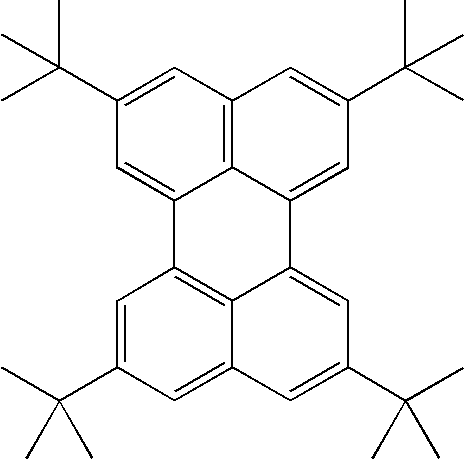
L2 
L3 
L4 
L5 
L6 
L7 
L8 
X R1 R2 L9 O H H L10 O H Methyl L11 O Methyl H L12 O Methyl Methyl L13 O H t-butyl L14 O t-butyl H L15 O t-butyl t-butyl L16 S H H L17 S H Methyl L18 S Methyl H L19 S Methyl Methyl L20 S H t-butyl L21 S t-butyl H L22 S t-butyl t-butyl 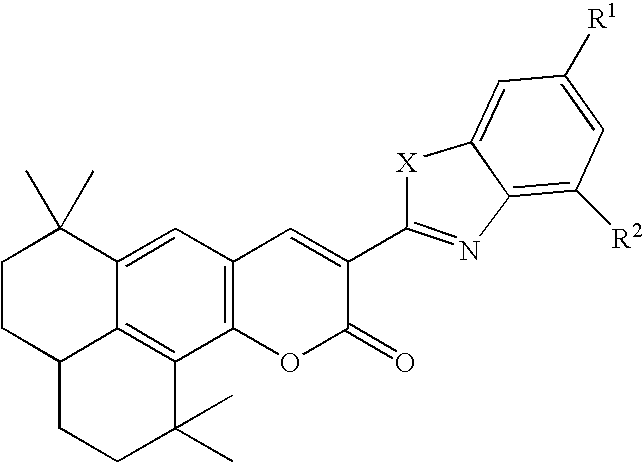
X R1 R2 L23 O H H L24 O H Methyl L25 O Methyl H L26 O Methyl Methyl L27 O H t-butyl L28 O t-butyl H L29 O t-butyl t-butyl L30 S H H L31 S H Methyl L32 S Methyl H L33 S Methyl Methyl L34 S H t-butyl L35 S t-butyl H L36 S t-butyl t-butyl 
R L37 phenyl L38 methyl L39 t-butyl L40 mesityl 
R L41 phenyl L42 methyl L43 t-butyl L44 mesityl 
L45 
L46 
L47 
L48 - Electron-Transporting Layer (ETL)
- Preferred thin film-forming materials for use in forming the electron-transporting
layer 111 of the organic EL devices of this invention are metal chelated oxinoid compounds, including chelates of oxine itself (also commonly referred to as 8-quinolinol or 8-hydroxyquinoline). Such compounds help to inject and transport electrons and exhibit both high levels of performance and are readily fabricated in the form of thin films. Exemplary of contemplated oxinoid compounds are those satisfying structural formula (E), previously described. - Other electron-transporting materials include various butadiene derivatives as disclosed in U.S. Pat. No. 4,356,429 and various heterocyclic optical brighteners as described in U.S. Pat. No. 4,539,507. Benzazoles satisfying structural formula (G) are also useful electron transporting materials.
- In some instances,
layers - Cathode
- When light emission is through the anode, the
cathode layer 113 used in this invention can be comprised of nearly any conductive material. Desirable materials have good film-forming properties to ensure good contact with the underlying organic layer, promote electron injection at low voltage, and have good stability. Useful cathode materials often contain a low work function metal (<4.0 eV) or metal alloy. One preferred cathode material is comprised of a Mg:Ag alloy wherein the percentage of silver is in the range of 1 to 20%, as described in U.S. Pat. No. 4,885,221. Another suitable class of cathode materials includes bilayers comprised of a thin layer of a low work function metal or metal salt capped with a thicker layer of conductive metal. One such cathode is comprised of a thin layer of LiF followed by a thicker layer of Al as described in U.S. Pat. No. 5,677,572. Other useful cathode materials include, but are not limited to, those disclosed in U.S. Pat. No. 5,059,861, U.S. Pat. No. 5,059,862, and U.S. Pat. No. 6,140,763. - When light emission is viewed through the cathode, the cathode must be transparent or nearly transparent. For such applications, metals must be thin or one must use transparent conductive oxides, or a combination of these materials. Optically transparent cathodes have been described in more detail in U.S. Pat. No. 5,776,623. Cathode materials can be deposited by evaporation, sputtering, or chemical vapor deposition. When needed, patterning can be achieved through many well known methods including, but not limited to, through-mask deposition, integral shadow masking as described in U.S. Pat. No. 5,276,380 and EP 0 732 868, laser ablation, and selective chemical vapor deposition.
- Deposition of Organic Layers
- The organic materials mentioned above are suitably deposited through sublimation, but can be deposited from a solvent with an optional binder to improve film formation. If the material is a polymer, solvent deposition is usually preferred. The material to be deposited by sublimation can be vaporized from a sublimator “boat” often comprised of a tantalum material, e.g., as described in U.S. Pat. No. 6,237,529, or can be first coated onto a donor sheet and then sublimed in closer proximity to the substrate. Layers with a mixture of materials can utilize separate sublimator boats or the materials can be pre-mixed and coated from a single boat or donor sheet. Patterned deposition can be achieved using shadow masks, integral shadow masks (U.S. Pat. No. 5,294,870), spatially-defined thermal dye transfer from a donor sheet (U.S. Pat. No. 5,851,709 and U.S. Pat. No. 6,066,357) and inkjet method (U.S. Pat. No. 6,066,357).
- Encapsulation
- Most OLED devices are sensitive to moisture and/or oxygen so they are commonly sealed in an inert atmosphere such as nitrogen or argon, along with a desiccant such as alumina, bauxite, calcium sulfate, clays, silica gel, zeolites, alkaline metal oxides, alkaline earth metal oxides, sulfates, or metal halides and perchlorates. Methods for encapsulation and desiccation include, but are not limited to, those described in U.S. Pat. No. 6,226,890.
- The entire contents of the patents and other publications referred to in this specification are incorporated herein by reference.
- The inventions and its advantages are further illustrated by the specific examples which follow.
- Synthesis
- Preparation of 2-Quinolylacetonitrile: To a solution of 2-(chloromethyl)quinoline (20.74 g, 117 mmol) in ethanol and water (200 mL, 4:1 ratio) was added NaCN (5.73 g, 117 mmol), and the reaction mixture was heated at reflux for 18 h. The reaction mixture was cooled to ambient temperature; diluted with a mixture of heptane, ethyl acetate, and THF; and washed with a 5% aqueous solution of K 2CO3 and brine. The organic layer was isolated and dried over MgSO4. Purification by column chromatography with an elution gradient of 75:25 heptane/ethyl acetate to 65:35 heptane/ethyl acetate afforded 14.6 g (74.5%) of desired product. Results of 1H NMR spectroscopy and electrospray mass spectroscopy are consistent with the product. 1H NMR (300 MHz, CDCl3): δ 4.12 (s, 2H), 7.66 (m, 2H), 7.76 (m, 2H), 7.84 (d, J=8.2 Hz, 1H), 8.06 (d, J=8.2 Hz, 1H), 8.22 (d, J 8.5 Hz, 1H).
- Preparation of Bis(2-quinolinyl)acetonitrile: To a solution of 2-quinolylacetonitrile (14.5 g, 86.2 mmol) in toluene (200 mL) was added slowly NaH (6.9 g of 60% oil dispersion, 172 mmol). The reaction mixture was stirred at ambient temperature for 15 min at which point H 2 evolution was no longer evident. A solution of 2-chloroquinoline (14.1 g, 86.2 mmol) in toluene (150 mL) was added to the reaction flask, and the reaction mixture was then heated at reflux for 18 h. The reaction mixture was cooled to ambient temperature, diluted with THE, and quenched with H2O. The organic solution was washed with 1N HCl (200 mL), saturated aqueous solution of NaHCO3, and brine. An orange solid precipitated from the organic layer and was isolated via vacuum filtration. The mother liquor was dried over MgSO4 and the volatile components were removed with a rotary evaporator. The resulting solid was combined with the orange powder isolated via filtration. The solid was washed with a mixture of ether and heptane to afford 14.7 g (57.6%) of product. Results of 1H NMR spectroscopy and electrospray mass spectroscopy are consistent with the product. 1H NMR (300 MHz, CDCl3): δ 7.36 (m, 2H), 7.57 (d, J=9.1 Hz, 2H), 7.64 (m, 4H), 7.73 (d, J=8.8 Hz, 2H), 7.86 (d, J=9.1 Hz, 2H).
- Preparation of Bis(2-quinolinyl)methane: Bis(2-quinolinyl)acetonitrile (14.3 g, 48.4 mmol) was dissolved in 70% H 2SO4 in H2O (85 mL), and the resulting solution was heated at reflux for 1.5 h. The reaction mixture was poured into a 2-L beaker full of ice and was neutralized very carefully with a NaOH solution. The aqueous solution was extracted with a mixture of ether and THF, and the organic layer was isolated and dried over MgSO4. The volatile components were removed, and the resulting solid was washed with a solution of heptane and ether to afford 11.7 g (89.5%) of bis(2-quinolinyl)methane as a reddish powder. Results of 1H NMR spectroscopy and electrospray mass spectroscopy are consistent with the product. 1H NMR (300 MHz, CDCl3): δ 4.74 (s, 2H), 7.42 (d, J=8.5 Hz, 2H), m, 2H), 7.51 (m, 2H), 7.72 (m, 2H), 7.77 (d, J=8.2 Hz, 2H), 8.04 (d, J=8.5 Hz, 2H), 8.11 (d, J=8.5 Hz, 2H).
- Preparation of Difluoro[1,2-dihydro-2[(2-quinolinyl-κN)methylene]pyridinato-κN]boron (Inv-1): A mixture of bis(2-quinolyl)methane, diisoprylethylamine, BF 3 etherate, and CH2Cl2 were heated at reflux for 5 h and then dilute with a solution of THF and diethyl ether. The organic solution was washed with H2O and brine, and then dried over MgSO4. The volatile components were removed with a rotary evaporator. The resulting red solid was suspended in hot ethanol and isolated via vacuum filtration. Water was added to the mother liquor to precipitate out more product, which was isolated via filtration. The combined precipitates were dried under dynamic vacuum resulting in 2.35 g (57%) of product. This product may be further purified by sublimation (165° C.@710 millitorr) with a N2 carrier gas. Results of 1H NMR spectroscopy and electrospray mass spectroscopy are consistent with the product. 1H NMR (300 MHz, CDCl3): δ 5.49 (s, 1H), 6.85 (d, J=9.1 Hz, 2H), 7.29 (m, 2H), 7.51 (m, 2H), 7.60 (m, 4H), 8.57 (m, 2H).
- An EL device satisfying the requirements of the invention was constructed as Sample 1 in the following manner:
- A glass substrate coated with an 85 nm layer of indium-tin oxide (ITO) as the anode was sequentially ultrasonicated in a commercial detergent, rinsed in deionized water, degreased in toluene vapor and exposed to oxygen plasma for about 1 min.
- a) Over the ITO was deposited a 1 nm fluorocarbon (CFx) hole-injecting layer (HIL) by plasma-assisted deposition of CHF 3.
- b) A hole-transporting layer (HTL) of N,N′-di-1-naphthalenyl-N,N′-diphenyl-4, 4′-diaminobiphenyl (NPB) having a thickness of 75 nm was then evaporated from a tantalum boat.
- c) A 25 nm light-emitting layer (LEL) of 2-tert-butyl-9,10-di-(2-naphthyl)anthracene (TBADN) and Inv-1 (0.5% wt %) were then deposited onto the hole-transporting layer. These materials were also evaporated from tantalum boats.
- d) A 35 nm electron-transporting layer (ETL) of tris(8-quinolinolato)aluminum (III) (AlQ 3) was then deposited onto the light-emitting layer. This material was also evaporated from a tantalum boat.
- e) On top of the AlQ 3 layer was deposited a 220 nm cathode formed of a 10:1 volume ratio of Mg and Ag.
- The above sequence completed the deposition of the EL device. The device was then hermetically packaged in a dry glove box for protection against ambient environment.
- Samples 2 and 3 were EL devices incorporating Inv-4 or Inv-5 fabricated in an identical manner as the example incorporating Inv-1. Sample 4 is a comparative device that was prepared omitting Inv-1 from the LEL and maintaining the same device architecture as in the inventive examples. The cells thus formed were tested for efficiency (in the form of luminance yield), and the results are listed in Table 1.
TABLE 1 Evaluation Results for EL devices. Efficiency Sample Host Dopant (cd/A)1 Type 1 TBADN Inv-1 9.10 Invention 2 ″ Inv-4 6.36 Invention 3 ″ Inv-5 3.75 Invention Avg 6.4 4 ″ None 1.41 Comparison - As can be seen from Table 1, all tested EL devices incorporating the INV dopants demonstrated superior luminance yields relative to the comparative device containing only TBADN. These doped EL devices exhibit green electroluminescence with λ max ranging from 508-532 nm. In contrast, blue emission (λmax of 448 nm), attributed to TBADN fluorescence, is generated in the light-emitting layer of comparative Sample 4.
- In addition to the high luminance yields demonstrated by EL devices containing bis(azinyl)methene boron complexes, the stability of these EL devices also appears to be increased over that of a device without that material. For example, a series of EL devices (Samples 5-9) containing Inv-1 and TBADN and a comparative device (Sample 10) without Inv-1 were prepared and subjected to a constant current density of 20 mA/cm 2 at 70° C. The percent loss of initial luminance was measured after 300 hours, and the results are reported in Table 2. As can be seen from the data, the EL devices containing Inv-1 retain far more of their initial luminance intensity than did the comparative example, with an average improvement of about 35%.
TABLE 2 EL Device Stability Comprised of Inv-1 in TBADN Dopant luminance Sample Type wt % loss-%1 5 Invention (0.5%) 28.8 6 Invention (1.0%) 28.1 7 Invention (1.5%) 31.6 8 Invention (2.0%) 32.1 9 Invention (2.5%) 36.2 Avg. 31.4 10 Comparison (0.0%) 43.6 - An EL device satisfying the requirements of the invention was constructed as Sample 11 in the following manner:
- A glass substrate coated with an 85 nm layer of indium-tin oxide (ITO) as the anode was sequentially ultrasonicated in a commercial detergent, rinsed in deionized water, degreased in toluene vapor and exposed to oxygen plasma for about 1 min.
- a) Over the ITO was deposited a 1 nm fluorocarbon (CFx) HIL by plasma-assisted deposition of CHF 3.
- b) A HTL of N,N′-di-1-naphthalenyl-N,N′-diphenyl-4, 4′-diaminobiphenyl (NPB) having a thickness of 75 nm was then evaporated from a tantalum boat.
- c) A 37.5 nm LEL of tris(8-quinolinolato)aluminum (III) (AlQ 3) and Inv-1 (0.4 wt %) were then deposited onto the hole-transporting layer. These materials were also evaporated from tantalum boats.
- d) A 37.5 nm ETL of tris(8-quinolinolato)aluminum (III) (AlQ 3) was then deposited onto the light-emitting layer. This material was also evaporated from a tantalum boat.
- e) On top of the AlQ 3 layer was deposited a 220 nm cathode formed of a 10:1 volume ratio of Mg and Ag.
- The above sequence completed the deposition of the EL device. The device was then hermetically packaged in a dry glove box for protection against ambient environment.
- A comparative device was prepared as Sample 12 omitting Inv-1 from the light-emitting layer and maintaining the same device architecture as this example. The cells thus formed were tested for efficiency (in the form of luminance yield), and the results are listed in Table 3.
TABLE 3 Evaluation Results for EL devices. Efficiency Sample Host Dopant (cd/A)1 Type 11 AlQ3 Inv-1 10.39 Invention 12 ″ None 3.40 Comparison - As can be seen from Table 3, the tested EL device incorporating the INV dopant in an AlQ 3 host demonstrates a superior luminance yield relative to the comparative device. The inventive device exhibited green emission (λmax of 540 nm) with a well-defined vibronic structure and narrow emission peaks as opposed to the very broad AlQ3 emission at 540 nm.
- EL data for the 5,6,5-tricyclic pyrromethene BF 2 complexes, presented in patents U.S. Pat. No. 5,683,823, JP 09,289,081A, and JP 11,097,180A is not directly comparable with the EL data obtained above. Such compounds are exemplified by the following:

- The reported luminance yields for the 5,6,5-tricyclic pyrromethene BF 2 complexes appear to be lower on average than those yields of the inventive examples tested. In addition, of the 5,6,5-tricyclic pyrromethene BF2 complexes reported, only 4,4-difluoro-1,3,5,7,8-pentamethyl-4-bora-3a,4a-diaza-s-indacene exhibited green electroluminescence at 2.58 cd/A as reported in JP 11,097,180A. All other EL devices containing 5,6,5-tricyclic pyrromethene BF2 complexes exhibited red electroluminescence. It appears that the bis(azinyl)methene boron group is a necessary component to generate highly efficient EL devices with green emission and desirable stability.
- 101 Substrate
- 103 Anode
- 105 Hole-Injecting layer (HIL)
- 107 Hole-Transporting layer (HTL)
- 109 Light-Emitting layer (LEL)
- 111 Electron-Transporting layer (ETL)
- 113 Cathode
Claims (26)


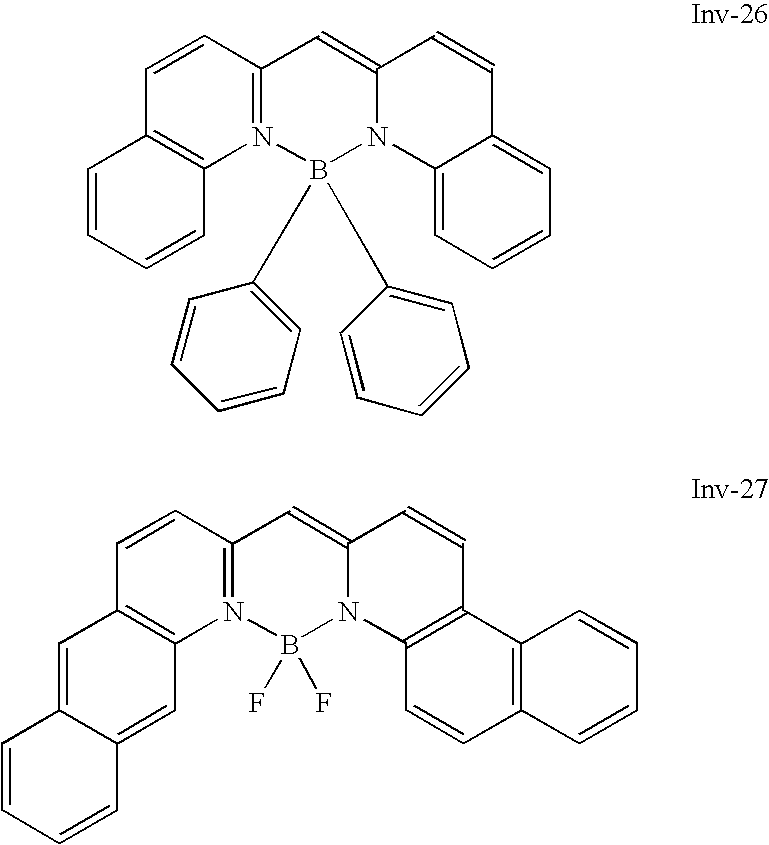

Priority Applications (7)
| Application Number | Priority Date | Filing Date | Title |
|---|---|---|---|
| US10/086,067 US6824893B2 (en) | 2002-02-28 | 2002-02-28 | Organic element for electroluminescent devices |
| TW091138061A TWI268285B (en) | 2002-02-28 | 2002-12-31 | Organic element for electroluminescent devices |
| DE60332787T DE60332787D1 (en) | 2002-02-28 | 2003-02-17 | Boron compound as a dopant for an OLED |
| EP03075447A EP1341242B1 (en) | 2002-02-28 | 2003-02-17 | Dopant comprising boron for an OLED |
| KR10-2003-0012328A KR20030071557A (en) | 2002-02-28 | 2003-02-27 | Organic element for electroluminescent devices |
| JP2003051259A JP4050634B2 (en) | 2002-02-28 | 2003-02-27 | Organic light emitting diode device |
| CNB031198074A CN100483775C (en) | 2002-02-28 | 2003-02-28 | Organic element for electric luminous device |
Applications Claiming Priority (1)
| Application Number | Priority Date | Filing Date | Title |
|---|---|---|---|
| US10/086,067 US6824893B2 (en) | 2002-02-28 | 2002-02-28 | Organic element for electroluminescent devices |
Publications (2)
| Publication Number | Publication Date |
|---|---|
| US20030198829A1 true US20030198829A1 (en) | 2003-10-23 |
| US6824893B2 US6824893B2 (en) | 2004-11-30 |
Family
ID=27733405
Family Applications (1)
| Application Number | Title | Priority Date | Filing Date |
|---|---|---|---|
| US10/086,067 Expired - Lifetime US6824893B2 (en) | 2002-02-28 | 2002-02-28 | Organic element for electroluminescent devices |
Country Status (7)
| Country | Link |
|---|---|
| US (1) | US6824893B2 (en) |
| EP (1) | EP1341242B1 (en) |
| JP (1) | JP4050634B2 (en) |
| KR (1) | KR20030071557A (en) |
| CN (1) | CN100483775C (en) |
| DE (1) | DE60332787D1 (en) |
| TW (1) | TWI268285B (en) |
Cited By (24)
| Publication number | Priority date | Publication date | Assignee | Title |
|---|---|---|---|---|
| US6885026B1 (en) | 2004-01-30 | 2005-04-26 | Eastman Kodak Company | Organic element for electroluminescent devices |
| US20050170203A1 (en) * | 2004-01-30 | 2005-08-04 | Eastman Kodak Company | Organic element for electroluminescent devices |
| US20050170205A1 (en) * | 2004-01-30 | 2005-08-04 | Eastman Kodak Company | Organic element for electroluminescent devices |
| US20050170204A1 (en) * | 2004-01-30 | 2005-08-04 | Eastman Kodak Company | Organic element for electroluminescent devices |
| US20050181232A1 (en) * | 2004-02-17 | 2005-08-18 | Eastman Kodak Company | Anthracene derivative host having ranges of dopants |
| US20060003183A1 (en) * | 2004-06-30 | 2006-01-05 | Eastman Kodak Company | Organic element for electroluminescent devices |
| US20060240278A1 (en) * | 2005-04-20 | 2006-10-26 | Eastman Kodak Company | OLED device with improved performance |
| US20070092753A1 (en) * | 2005-10-26 | 2007-04-26 | Eastman Kodak Company | Organic element for low voltage electroluminescent devices |
| US20070134512A1 (en) * | 2005-12-13 | 2007-06-14 | Eastman Kodak Company | Electroluminescent device containing an anthracene derivative |
| US20070207345A1 (en) * | 2006-03-01 | 2007-09-06 | Eastman Kodak Company | Electroluminescent device including gallium complexes |
| US7300709B2 (en) | 2004-03-31 | 2007-11-27 | Eastman Kodak Company | Organic element for electroluminescent devices |
| US20080030131A1 (en) * | 2006-08-04 | 2008-02-07 | Eastman Kodak Company | Electrically excited organic light-emitting diodes with spatial and spectral coherence |
| US20090004365A1 (en) * | 2005-04-21 | 2009-01-01 | Liang-Sheng Liao | Contaminant-scavenging layer on oled anodes |
| US20100253210A1 (en) * | 2009-04-06 | 2010-10-07 | Vargas J Ramon | Organic element for electroluminescent devices |
| EP2355198A1 (en) | 2006-05-08 | 2011-08-10 | Global OLED Technology LLC | OLED electron-injecting layer |
| US8253126B2 (en) | 1999-12-31 | 2012-08-28 | Lg Chem. Ltd. | Organic electronic device |
| US20130153871A1 (en) * | 2011-12-14 | 2013-06-20 | Nitto Denko Corporation | Top-emitting white organic light-emitting diodes having improved efficiency and stability |
| US8680693B2 (en) | 2006-01-18 | 2014-03-25 | Lg Chem. Ltd. | OLED having stacked organic light-emitting units |
| WO2015191867A1 (en) * | 2014-06-11 | 2015-12-17 | Royster Tommie L | Phosphorescent emitting compositions |
| US20170133438A1 (en) * | 2012-10-30 | 2017-05-11 | Semiconductor Energy Laboratory Co., Ltd. | Light-Emitting Panel, Display Device, and Method for Manufacturing Light-Emitting Panel |
| US9666826B2 (en) | 2005-11-30 | 2017-05-30 | Global Oled Technology Llc | Electroluminescent device including an anthracene derivative |
| KR20200087758A (en) * | 2017-11-23 | 2020-07-21 | 도레이 카부시키가이샤 | Organic light emitting device |
| US20200377537A1 (en) * | 2019-05-30 | 2020-12-03 | Samsung Display Co., Ltd. | Organometallic compound and organic light-emitting device including the same |
| US20230021165A1 (en) * | 2020-06-01 | 2023-01-19 | Lg Chem, Ltd. | Composition, deposition source, organic electroluminescent device including same, and manufacturing method therefor |
Families Citing this family (12)
| Publication number | Priority date | Publication date | Assignee | Title |
|---|---|---|---|---|
| JPWO2004064453A1 (en) * | 2003-01-10 | 2006-05-18 | 株式会社半導体エネルギー研究所 | Light emitting device and manufacturing method thereof |
| JP2004226673A (en) * | 2003-01-23 | 2004-08-12 | Toyota Industries Corp | Organic electroluminescent device |
| US9085729B2 (en) * | 2004-02-09 | 2015-07-21 | Lg Display Co., Ltd. | Blue emitters for use in organic electroluminescence devices |
| KR100696505B1 (en) * | 2005-03-31 | 2007-03-19 | 삼성에스디아이 주식회사 | Organic electroluminescent device and manufacturing method thereof |
| KR100786292B1 (en) * | 2005-07-15 | 2007-12-18 | 삼성에스디아이 주식회사 | Organic electroluminescent element |
| WO2007023916A1 (en) * | 2005-08-26 | 2007-03-01 | Matsushita Electric Industrial Co., Ltd. | Projection display device |
| KR101460184B1 (en) * | 2008-03-03 | 2014-11-11 | 삼성디스플레이 주식회사 | METHOD FOR MANUFACTURING ELECTRONALLY-ELEMENT DEVICE |
| US8759818B2 (en) | 2009-02-27 | 2014-06-24 | E I Du Pont De Nemours And Company | Deuterated compounds for electronic applications |
| US20100231125A1 (en) * | 2009-03-12 | 2010-09-16 | Sheng Li | Organic light emitting device to emit in near infrared |
| KR102086556B1 (en) * | 2013-08-02 | 2020-03-10 | 삼성디스플레이 주식회사 | Organic light emitting diode |
| US9871205B2 (en) | 2013-08-02 | 2018-01-16 | Samsung Display Co., Ltd. | Organic light-emitting device |
| KR102086555B1 (en) | 2013-08-14 | 2020-03-10 | 삼성디스플레이 주식회사 | Anthracene-based compounds and Organic light emitting device comprising the same |
Citations (1)
| Publication number | Priority date | Publication date | Assignee | Title |
|---|---|---|---|---|
| US6661023B2 (en) * | 2002-02-28 | 2003-12-09 | Eastman Kodak Company | Organic element for electroluminescent devices |
Family Cites Families (9)
| Publication number | Priority date | Publication date | Assignee | Title |
|---|---|---|---|---|
| US5834894A (en) * | 1995-09-14 | 1998-11-10 | Casio Computer Co., Ltd. | Carrier injection type organic electro-luminescent device which emits light in response to an application of a voltage |
| US5683823A (en) * | 1996-01-26 | 1997-11-04 | Eastman Kodak Company | White light-emitting organic electroluminescent devices |
| JPH09289081A (en) | 1996-04-23 | 1997-11-04 | Mitsubishi Chem Corp | Organic electroluminescent device |
| US6312835B1 (en) * | 1997-02-13 | 2001-11-06 | Queen's University At Kingston | Luminescent compounds and methods of making and using same |
| JP3853038B2 (en) | 1997-09-24 | 2006-12-06 | 三井化学株式会社 | Organic electroluminescence device |
| US5935721A (en) * | 1998-03-20 | 1999-08-10 | Eastman Kodak Company | Organic electroluminescent elements for stable electroluminescent |
| US5972247A (en) * | 1998-03-20 | 1999-10-26 | Eastman Kodak Company | Organic electroluminescent elements for stable blue electroluminescent devices |
| JP3389888B2 (en) * | 1998-11-09 | 2003-03-24 | 東レ株式会社 | Light emitting element |
| JP2001240761A (en) * | 2000-02-28 | 2001-09-04 | Mitsubishi Chemicals Corp | Method for producing pyromethene dye |
-
2002
- 2002-02-28 US US10/086,067 patent/US6824893B2/en not_active Expired - Lifetime
- 2002-12-31 TW TW091138061A patent/TWI268285B/en not_active IP Right Cessation
-
2003
- 2003-02-17 DE DE60332787T patent/DE60332787D1/en not_active Expired - Lifetime
- 2003-02-17 EP EP03075447A patent/EP1341242B1/en not_active Expired - Lifetime
- 2003-02-27 KR KR10-2003-0012328A patent/KR20030071557A/en not_active Withdrawn
- 2003-02-27 JP JP2003051259A patent/JP4050634B2/en not_active Expired - Lifetime
- 2003-02-28 CN CNB031198074A patent/CN100483775C/en not_active Expired - Lifetime
Patent Citations (1)
| Publication number | Priority date | Publication date | Assignee | Title |
|---|---|---|---|---|
| US6661023B2 (en) * | 2002-02-28 | 2003-12-09 | Eastman Kodak Company | Organic element for electroluminescent devices |
Cited By (41)
| Publication number | Priority date | Publication date | Assignee | Title |
|---|---|---|---|---|
| US8253126B2 (en) | 1999-12-31 | 2012-08-28 | Lg Chem. Ltd. | Organic electronic device |
| US20050170204A1 (en) * | 2004-01-30 | 2005-08-04 | Eastman Kodak Company | Organic element for electroluminescent devices |
| US20050170205A1 (en) * | 2004-01-30 | 2005-08-04 | Eastman Kodak Company | Organic element for electroluminescent devices |
| US20050170203A1 (en) * | 2004-01-30 | 2005-08-04 | Eastman Kodak Company | Organic element for electroluminescent devices |
| US7070868B2 (en) | 2004-01-30 | 2006-07-04 | Eastman Kodak Company | Organic element for electroluminescent devices |
| US7074503B2 (en) | 2004-01-30 | 2006-07-11 | Eastman Kodak Company | Organic element for electroluminescent devices |
| US20060210829A9 (en) * | 2004-01-30 | 2006-09-21 | Eastman Kodak Company | Organic element for electroluminescent devices |
| US6885026B1 (en) | 2004-01-30 | 2005-04-26 | Eastman Kodak Company | Organic element for electroluminescent devices |
| US7329466B2 (en) | 2004-01-30 | 2008-02-12 | Eastman Kodak Company | Organic element for electroluminescent devices |
| US7252893B2 (en) | 2004-02-17 | 2007-08-07 | Eastman Kodak Company | Anthracene derivative host having ranges of dopants |
| US20050181232A1 (en) * | 2004-02-17 | 2005-08-18 | Eastman Kodak Company | Anthracene derivative host having ranges of dopants |
| WO2005080527A1 (en) * | 2004-02-17 | 2005-09-01 | Eastman Kodak Company | Anthracene derivative host having ranges of dopants |
| US7300709B2 (en) | 2004-03-31 | 2007-11-27 | Eastman Kodak Company | Organic element for electroluminescent devices |
| US20060003183A1 (en) * | 2004-06-30 | 2006-01-05 | Eastman Kodak Company | Organic element for electroluminescent devices |
| US7147938B2 (en) | 2004-06-30 | 2006-12-12 | Eastman Kodak Company | Organic element for electroluminescent devices |
| US20060240278A1 (en) * | 2005-04-20 | 2006-10-26 | Eastman Kodak Company | OLED device with improved performance |
| US8057916B2 (en) | 2005-04-20 | 2011-11-15 | Global Oled Technology, Llc. | OLED device with improved performance |
| US20090004365A1 (en) * | 2005-04-21 | 2009-01-01 | Liang-Sheng Liao | Contaminant-scavenging layer on oled anodes |
| US20070092753A1 (en) * | 2005-10-26 | 2007-04-26 | Eastman Kodak Company | Organic element for low voltage electroluminescent devices |
| US9666826B2 (en) | 2005-11-30 | 2017-05-30 | Global Oled Technology Llc | Electroluminescent device including an anthracene derivative |
| US20070134512A1 (en) * | 2005-12-13 | 2007-06-14 | Eastman Kodak Company | Electroluminescent device containing an anthracene derivative |
| US8680693B2 (en) | 2006-01-18 | 2014-03-25 | Lg Chem. Ltd. | OLED having stacked organic light-emitting units |
| US20070207345A1 (en) * | 2006-03-01 | 2007-09-06 | Eastman Kodak Company | Electroluminescent device including gallium complexes |
| EP2355198A1 (en) | 2006-05-08 | 2011-08-10 | Global OLED Technology LLC | OLED electron-injecting layer |
| US7667391B2 (en) | 2006-08-04 | 2010-02-23 | Eastman Kodak Company | Electrically excited organic light-emitting diodes with spatial and spectral coherence |
| US20080030131A1 (en) * | 2006-08-04 | 2008-02-07 | Eastman Kodak Company | Electrically excited organic light-emitting diodes with spatial and spectral coherence |
| WO2010117886A1 (en) | 2009-04-06 | 2010-10-14 | Global Oled Technology Llc | Organic element for electroluminescent devices |
| US20100253210A1 (en) * | 2009-04-06 | 2010-10-07 | Vargas J Ramon | Organic element for electroluminescent devices |
| US8206842B2 (en) | 2009-04-06 | 2012-06-26 | Global Oled Technology Llc | Organic element for electroluminescent devices |
| US9722200B2 (en) * | 2011-12-14 | 2017-08-01 | Nitto Denko Corporation | Top-emitting white organic light-emitting diodes having improved efficiency and stability |
| US20130153871A1 (en) * | 2011-12-14 | 2013-06-20 | Nitto Denko Corporation | Top-emitting white organic light-emitting diodes having improved efficiency and stability |
| US9299945B2 (en) * | 2011-12-14 | 2016-03-29 | Nitto Denko Corporation | Top-emitting white organic light-emitting diodes having improved efficiency and stability |
| US20160285026A1 (en) * | 2011-12-14 | 2016-09-29 | Nitto Denko Corporation | Top-emitting white organic light-emitting diodes having improved efficiency and stability |
| US20170133438A1 (en) * | 2012-10-30 | 2017-05-11 | Semiconductor Energy Laboratory Co., Ltd. | Light-Emitting Panel, Display Device, and Method for Manufacturing Light-Emitting Panel |
| WO2015191867A1 (en) * | 2014-06-11 | 2015-12-17 | Royster Tommie L | Phosphorescent emitting compositions |
| KR20200087758A (en) * | 2017-11-23 | 2020-07-21 | 도레이 카부시키가이샤 | Organic light emitting device |
| US11296304B2 (en) * | 2017-11-23 | 2022-04-05 | Toray Industries, Inc. | Organic light-emitting element |
| KR102413966B1 (en) * | 2017-11-23 | 2022-06-29 | 도레이 카부시키가이샤 | organic light emitting device |
| US20200377537A1 (en) * | 2019-05-30 | 2020-12-03 | Samsung Display Co., Ltd. | Organometallic compound and organic light-emitting device including the same |
| US12398163B2 (en) * | 2019-05-30 | 2025-08-26 | Samsung Display Co., Ltd. | Organometallic compound and organic light-emitting device including the same |
| US20230021165A1 (en) * | 2020-06-01 | 2023-01-19 | Lg Chem, Ltd. | Composition, deposition source, organic electroluminescent device including same, and manufacturing method therefor |
Also Published As
| Publication number | Publication date |
|---|---|
| TWI268285B (en) | 2006-12-11 |
| JP2003288990A (en) | 2003-10-10 |
| EP1341242A3 (en) | 2006-06-14 |
| EP1341242A2 (en) | 2003-09-03 |
| CN1496205A (en) | 2004-05-12 |
| JP4050634B2 (en) | 2008-02-20 |
| TW200303349A (en) | 2003-09-01 |
| EP1341242B1 (en) | 2010-06-02 |
| DE60332787D1 (en) | 2010-07-15 |
| KR20030071557A (en) | 2003-09-03 |
| CN100483775C (en) | 2009-04-29 |
| US6824893B2 (en) | 2004-11-30 |
Similar Documents
| Publication | Publication Date | Title |
|---|---|---|
| US6824893B2 (en) | Organic element for electroluminescent devices | |
| US6661023B2 (en) | Organic element for electroluminescent devices | |
| US7553558B2 (en) | Electroluminescent device containing an anthracene derivative | |
| US20050271899A1 (en) | Efficient electroluminescent device | |
| US6841267B2 (en) | Efficient electroluminescent device | |
| US6670053B2 (en) | Organic electroluminescent devices with high luminance | |
| US6849345B2 (en) | Organic electroluminescent devices with high luminance | |
| US20060204783A1 (en) | Organic electroluminescent device | |
| US7662485B2 (en) | White organic light-emitting devices with improved performance | |
| US20060088729A1 (en) | White organic light-emitting devices with improved performance | |
| US20060204784A1 (en) | Organic light-emitting devices with mixed electron transport materials | |
| US7264889B2 (en) | Stable electroluminescent device | |
| US7517595B2 (en) | Electroluminescent devices with mixed electron transport materials | |
| US7329466B2 (en) | Organic element for electroluminescent devices | |
| US7052785B2 (en) | Organic element for electroluminescent devices | |
| US7083865B2 (en) | Organic element for electroluminescent devices | |
| US7087320B2 (en) | Organic element for electroluminescent devices | |
| US20060088730A1 (en) | Organic light-emitting devices with improved performance | |
| US7049012B2 (en) | Organic element for electroluminescent devices |
Legal Events
| Date | Code | Title | Description |
|---|---|---|---|
| AS | Assignment |
Owner name: EASTMAN KODAK COMPANY, NEW YORK Free format text: ASSIGNMENT OF ASSIGNORS INTEREST;ASSIGNORS:HOAG, BENJAMIN P.;KONDAKOV, DENIS Y.;REEL/FRAME:012663/0093 Effective date: 20020228 |
|
| FEPP | Fee payment procedure |
Free format text: PAYOR NUMBER ASSIGNED (ORIGINAL EVENT CODE: ASPN); ENTITY STATUS OF PATENT OWNER: LARGE ENTITY |
|
| STCF | Information on status: patent grant |
Free format text: PATENTED CASE |
|
| FPAY | Fee payment |
Year of fee payment: 4 |
|
| FEPP | Fee payment procedure |
Free format text: PAYER NUMBER DE-ASSIGNED (ORIGINAL EVENT CODE: RMPN); ENTITY STATUS OF PATENT OWNER: LARGE ENTITY Free format text: PAYOR NUMBER ASSIGNED (ORIGINAL EVENT CODE: ASPN); ENTITY STATUS OF PATENT OWNER: LARGE ENTITY |
|
| AS | Assignment |
Owner name: GLOBAL OLED TECHNOLOGY LLC,DELAWARE Free format text: ASSIGNMENT OF ASSIGNORS INTEREST;ASSIGNOR:EASTMAN KODAK COMPANY;REEL/FRAME:023998/0368 Effective date: 20100122 Owner name: GLOBAL OLED TECHNOLOGY LLC, DELAWARE Free format text: ASSIGNMENT OF ASSIGNORS INTEREST;ASSIGNOR:EASTMAN KODAK COMPANY;REEL/FRAME:023998/0368 Effective date: 20100122 |
|
| FPAY | Fee payment |
Year of fee payment: 8 |
|
| FPAY | Fee payment |
Year of fee payment: 12 |