US20030194722A1 - Nucleotide analogues comprising a reporter moiety and a polymerase enzyme blocking moiety - Google Patents
Nucleotide analogues comprising a reporter moiety and a polymerase enzyme blocking moiety Download PDFInfo
- Publication number
- US20030194722A1 US20030194722A1 US10/276,759 US27675903A US2003194722A1 US 20030194722 A1 US20030194722 A1 US 20030194722A1 US 27675903 A US27675903 A US 27675903A US 2003194722 A1 US2003194722 A1 US 2003194722A1
- Authority
- US
- United States
- Prior art keywords
- compound
- enzyme
- formula
- group
- thymidine
- Prior art date
- Legal status (The legal status is an assumption and is not a legal conclusion. Google has not performed a legal analysis and makes no representation as to the accuracy of the status listed.)
- Granted
Links
- 125000003729 nucleotide group Chemical group 0.000 title claims abstract description 80
- 102000004190 Enzymes Human genes 0.000 title claims abstract description 53
- 108090000790 Enzymes Proteins 0.000 title claims abstract description 53
- 230000000903 blocking effect Effects 0.000 title claims abstract description 46
- 150000001875 compounds Chemical class 0.000 claims abstract description 117
- 239000002773 nucleotide Substances 0.000 claims abstract description 57
- 125000002467 phosphate group Chemical group [H]OP(=O)(O[H])O[*] 0.000 claims abstract description 4
- 238000000034 method Methods 0.000 claims description 40
- 238000003776 cleavage reaction Methods 0.000 claims description 27
- 239000001226 triphosphate Substances 0.000 claims description 22
- 235000011178 triphosphate Nutrition 0.000 claims description 21
- 230000007017 scission Effects 0.000 claims description 20
- 238000012163 sequencing technique Methods 0.000 claims description 17
- LSBDFXRDZJMBSC-UHFFFAOYSA-N Amide-Phenylacetic acid Natural products NC(=O)CC1=CC=CC=C1 LSBDFXRDZJMBSC-UHFFFAOYSA-N 0.000 claims description 15
- 238000010348 incorporation Methods 0.000 claims description 15
- UNXRWKVEANCORM-UHFFFAOYSA-N triphosphoric acid Chemical compound OP(O)(=O)OP(O)(=O)OP(O)(O)=O UNXRWKVEANCORM-UHFFFAOYSA-N 0.000 claims description 15
- GKHVLBALBJVWQJ-JOAULVNJSA-N [hydroxy-[[(2r,3s,5r)-3-hydroxy-5-(5-methyl-2,4-dioxopyrimidin-1-yl)-2-[[(2,2,2-trifluoroacetyl)amino]methyl]oxolan-2-yl]methoxy]phosphoryl] phosphono hydrogen phosphate Chemical compound O=C1NC(=O)C(C)=CN1[C@@H]1O[C@](CNC(=O)C(F)(F)F)(COP(O)(=O)OP(O)(=O)OP(O)(O)=O)[C@@H](O)C1 GKHVLBALBJVWQJ-JOAULVNJSA-N 0.000 claims description 14
- ACLVJOXIOQBHIA-APNQJHFZSA-N (2s)-2-amino-n-[[(2r,3s,5r)-3-hydroxy-2-(hydroxymethyl)-5-(5-methyl-2,4-dioxopyrimidin-1-yl)oxolan-2-yl]methyl]-4-methylpentanamide Chemical compound C1[C@H](O)[C@@](CNC(=O)[C@@H](N)CC(C)C)(CO)O[C@H]1N1C(=O)NC(=O)C(C)=C1 ACLVJOXIOQBHIA-APNQJHFZSA-N 0.000 claims description 13
- 125000002496 methyl group Chemical group [H]C([H])([H])* 0.000 claims description 13
- CIQNBYCIQDYHRW-JVLSTEMRSA-N 2-acetamido-n-[[(2r,3s,5r)-3-hydroxy-2-(hydroxymethyl)-5-(5-methyl-2,4-dioxopyrimidin-1-yl)oxolan-2-yl]methyl]acetamide Chemical compound C1[C@H](O)[C@@](CNC(=O)CNC(=O)C)(CO)O[C@H]1N1C(=O)NC(=O)C(C)=C1 CIQNBYCIQDYHRW-JVLSTEMRSA-N 0.000 claims description 11
- VMOCKVOUSHRVHP-IYYTYJHQSA-N 2-amino-n-[[(2r,3s,5r)-3-hydroxy-2-(hydroxymethyl)-5-(5-methyl-2,4-dioxopyrimidin-1-yl)oxolan-2-yl]methyl]acetamide Chemical compound O=C1NC(=O)C(C)=CN1[C@@H]1O[C@@](CO)(CNC(=O)CN)[C@@H](O)C1 VMOCKVOUSHRVHP-IYYTYJHQSA-N 0.000 claims description 10
- 239000000975 dye Substances 0.000 claims description 10
- 108020004707 nucleic acids Proteins 0.000 claims description 9
- 102000039446 nucleic acids Human genes 0.000 claims description 9
- 150000007523 nucleic acids Chemical class 0.000 claims description 9
- 239000000126 substance Substances 0.000 claims description 8
- 108700023418 Amidases Proteins 0.000 claims description 7
- 108091005804 Peptidases Proteins 0.000 claims description 7
- 102000035195 Peptidases Human genes 0.000 claims description 7
- 102000005922 amidase Human genes 0.000 claims description 7
- 125000001997 phenyl group Chemical group [H]C1=C([H])C([H])=C(*)C([H])=C1[H] 0.000 claims description 7
- KXDAEFPNCMNJSK-UHFFFAOYSA-N Benzamide Chemical compound NC(=O)C1=CC=CC=C1 KXDAEFPNCMNJSK-UHFFFAOYSA-N 0.000 claims description 6
- FKHZJJOHCNGOSN-VAOFZXAKSA-N [[(2r,3s,5r)-2-(aminomethyl)-3-hydroxy-5-(5-methyl-2,4-dioxopyrimidin-1-yl)oxolan-2-yl]methoxy-hydroxyphosphoryl] phosphono hydrogen phosphate Chemical compound O=C1NC(=O)C(C)=CN1[C@@H]1O[C@](CN)(COP(O)(=O)OP(O)(=O)OP(O)(O)=O)[C@@H](O)C1 FKHZJJOHCNGOSN-VAOFZXAKSA-N 0.000 claims description 6
- 235000019833 protease Nutrition 0.000 claims description 6
- 239000007790 solid phase Substances 0.000 claims description 6
- 102000004092 Amidohydrolases Human genes 0.000 claims description 5
- 108090000531 Amidohydrolases Proteins 0.000 claims description 5
- HUUMPWLKWZCYLC-IYYTYJHQSA-N [[(2r,3s,5r)-2-[[(2-aminoacetyl)amino]methyl]-3-hydroxy-5-(5-methyl-2,4-dioxopyrimidin-1-yl)oxolan-2-yl]methoxy-hydroxyphosphoryl] phosphono hydrogen phosphate Chemical compound O=C1NC(=O)C(C)=CN1[C@@H]1O[C@](CNC(=O)CN)(COP(O)(=O)OP(O)(=O)OP(O)(O)=O)[C@@H](O)C1 HUUMPWLKWZCYLC-IYYTYJHQSA-N 0.000 claims description 5
- ANRHNWWPFJCPAZ-UHFFFAOYSA-M thionine Chemical compound [Cl-].C1=CC(N)=CC2=[S+]C3=CC(N)=CC=C3N=C21 ANRHNWWPFJCPAZ-UHFFFAOYSA-M 0.000 claims description 5
- 230000002255 enzymatic effect Effects 0.000 claims description 4
- 125000001998 leucyl group Chemical group 0.000 claims description 4
- 108090000371 Esterases Proteins 0.000 claims description 3
- OALHHIHQOFIMEF-UHFFFAOYSA-N 3',6'-dihydroxy-2',4',5',7'-tetraiodo-3h-spiro[2-benzofuran-1,9'-xanthene]-3-one Chemical compound O1C(=O)C2=CC=CC=C2C21C1=CC(I)=C(O)C(I)=C1OC1=C(I)C(O)=C(I)C=C21 OALHHIHQOFIMEF-UHFFFAOYSA-N 0.000 claims description 2
- 108700019535 Phosphoprotein Phosphatases Proteins 0.000 claims description 2
- 102000045595 Phosphoprotein Phosphatases Human genes 0.000 claims description 2
- 102000009097 Phosphorylases Human genes 0.000 claims description 2
- 108010073135 Phosphorylases Proteins 0.000 claims description 2
- ZYGHJZDHTFUPRJ-UHFFFAOYSA-N benzo-alpha-pyrone Natural products C1=CC=C2OC(=O)C=CC2=C1 ZYGHJZDHTFUPRJ-UHFFFAOYSA-N 0.000 claims description 2
- 235000001671 coumarin Nutrition 0.000 claims description 2
- 125000003630 glycyl group Chemical group [H]N([H])C([H])([H])C(*)=O 0.000 claims description 2
- PWEBUXCTKOWPCW-UHFFFAOYSA-L squarate Chemical compound [O-]C1=C([O-])C(=O)C1=O PWEBUXCTKOWPCW-UHFFFAOYSA-L 0.000 claims description 2
- 108010031186 Glycoside Hydrolases Proteins 0.000 claims 1
- 102000005744 Glycoside Hydrolases Human genes 0.000 claims 1
- 150000004775 coumarins Chemical class 0.000 claims 1
- 238000006243 chemical reaction Methods 0.000 description 61
- OKKJLVBELUTLKV-UHFFFAOYSA-N Methanol Chemical compound OC OKKJLVBELUTLKV-UHFFFAOYSA-N 0.000 description 54
- YMWUJEATGCHHMB-UHFFFAOYSA-N Dichloromethane Chemical compound ClCCl YMWUJEATGCHHMB-UHFFFAOYSA-N 0.000 description 51
- 229940088598 enzyme Drugs 0.000 description 43
- 239000000243 solution Substances 0.000 description 39
- ZMXDDKWLCZADIW-UHFFFAOYSA-N N,N-Dimethylformamide Chemical compound CN(C)C=O ZMXDDKWLCZADIW-UHFFFAOYSA-N 0.000 description 35
- 108010014303 DNA-directed DNA polymerase Proteins 0.000 description 21
- 102000016928 DNA-directed DNA polymerase Human genes 0.000 description 21
- 125000005647 linker group Chemical group 0.000 description 18
- 0 [2*][Y]BC1OC(C)(C[W])C(C)C1[3*] Chemical compound [2*][Y]BC1OC(C)(C[W])C(C)C1[3*] 0.000 description 17
- 239000007787 solid Substances 0.000 description 17
- OKKJLVBELUTLKV-MZCSYVLQSA-N Deuterated methanol Chemical compound [2H]OC([2H])([2H])[2H] OKKJLVBELUTLKV-MZCSYVLQSA-N 0.000 description 16
- 239000002904 solvent Substances 0.000 description 16
- JUJWROOIHBZHMG-UHFFFAOYSA-N Pyridine Chemical compound C1=CC=NC=C1 JUJWROOIHBZHMG-UHFFFAOYSA-N 0.000 description 14
- 230000015572 biosynthetic process Effects 0.000 description 14
- 239000002777 nucleoside Substances 0.000 description 14
- 238000002360 preparation method Methods 0.000 description 14
- XLYOFNOQVPJJNP-UHFFFAOYSA-N water Chemical compound O XLYOFNOQVPJJNP-UHFFFAOYSA-N 0.000 description 14
- 108010058966 bacteriophage T7 induced DNA polymerase Proteins 0.000 description 13
- -1 carboxyl ester Chemical group 0.000 description 13
- WEVYAHXRMPXWCK-UHFFFAOYSA-N Acetonitrile Chemical compound CC#N WEVYAHXRMPXWCK-UHFFFAOYSA-N 0.000 description 12
- WYURNTSHIVDZCO-UHFFFAOYSA-N Tetrahydrofuran Chemical compound C1CCOC1 WYURNTSHIVDZCO-UHFFFAOYSA-N 0.000 description 12
- ZMANZCXQSJIPKH-UHFFFAOYSA-N Triethylamine Chemical compound CCN(CC)CC ZMANZCXQSJIPKH-UHFFFAOYSA-N 0.000 description 12
- 230000000694 effects Effects 0.000 description 12
- 238000003786 synthesis reaction Methods 0.000 description 12
- DNSXKQZXWOMPIM-VAOFZXAKSA-N 1-[(2r,4s,5r)-5-(aminomethyl)-4-hydroxy-5-(hydroxymethyl)oxolan-2-yl]-5-methylpyrimidine-2,4-dione Chemical compound O=C1NC(=O)C(C)=CN1[C@@H]1O[C@](CN)(CO)[C@@H](O)C1 DNSXKQZXWOMPIM-VAOFZXAKSA-N 0.000 description 11
- PCYGQZWMYYGDJF-LLHLLMPMSA-N 2,2,2-trifluoro-n-[2-[[(2r,3s,5r)-3-hydroxy-2-(hydroxymethyl)-5-(5-methyl-2,4-dioxopyrimidin-1-yl)oxolan-2-yl]methylamino]-2-oxoethyl]acetamide Chemical compound O=C1NC(=O)C(C)=CN1[C@@H]1O[C@@](CO)(CNC(=O)CNC(=O)C(F)(F)F)[C@@H](O)C1 PCYGQZWMYYGDJF-LLHLLMPMSA-N 0.000 description 11
- 239000000203 mixture Substances 0.000 description 11
- 239000011541 reaction mixture Substances 0.000 description 11
- 108010073038 Penicillin Amidase Proteins 0.000 description 10
- IQFYYKKMVGJFEH-XLPZGREQSA-N Thymidine Chemical compound O=C1NC(=O)C(C)=CN1[C@@H]1O[C@H](CO)[C@@H](O)C1 IQFYYKKMVGJFEH-XLPZGREQSA-N 0.000 description 10
- 229910052757 nitrogen Inorganic materials 0.000 description 10
- 229940127073 nucleoside analogue Drugs 0.000 description 10
- 150000003833 nucleoside derivatives Chemical class 0.000 description 10
- YXFVVABEGXRONW-UHFFFAOYSA-N Toluene Chemical compound CC1=CC=CC=C1 YXFVVABEGXRONW-UHFFFAOYSA-N 0.000 description 9
- 239000000047 product Substances 0.000 description 9
- QTBSBXVTEAMEQO-UHFFFAOYSA-N Acetic acid Chemical compound CC(O)=O QTBSBXVTEAMEQO-UHFFFAOYSA-N 0.000 description 8
- IAZDPXIOMUYVGZ-WFGJKAKNSA-N Dimethyl sulfoxide Chemical compound [2H]C([2H])([2H])S(=O)C([2H])([2H])[2H] IAZDPXIOMUYVGZ-WFGJKAKNSA-N 0.000 description 8
- 229910052740 iodine Inorganic materials 0.000 description 8
- 238000003756 stirring Methods 0.000 description 8
- FPGGTKZVZWFYPV-UHFFFAOYSA-M tetrabutylammonium fluoride Chemical compound [F-].CCCC[N+](CCCC)(CCCC)CCCC FPGGTKZVZWFYPV-UHFFFAOYSA-M 0.000 description 8
- ZCYVEMRRCGMTRW-UHFFFAOYSA-N 7553-56-2 Chemical compound [I] ZCYVEMRRCGMTRW-UHFFFAOYSA-N 0.000 description 7
- 230000006820 DNA synthesis Effects 0.000 description 7
- 102100034343 Integrase Human genes 0.000 description 7
- 108010092799 RNA-directed DNA polymerase Proteins 0.000 description 7
- 238000003556 assay Methods 0.000 description 7
- 238000003818 flash chromatography Methods 0.000 description 7
- 239000006260 foam Substances 0.000 description 7
- 239000011630 iodine Substances 0.000 description 7
- UMJSCPRVCHMLSP-UHFFFAOYSA-N pyridine Natural products COC1=CC=CN=C1 UMJSCPRVCHMLSP-UHFFFAOYSA-N 0.000 description 7
- IJGRMHOSHXDMSA-UHFFFAOYSA-N Atomic nitrogen Chemical compound N#N IJGRMHOSHXDMSA-UHFFFAOYSA-N 0.000 description 6
- 108010051152 Carboxylesterase Proteins 0.000 description 6
- 102000013392 Carboxylesterase Human genes 0.000 description 6
- XEKOWRVHYACXOJ-UHFFFAOYSA-N Ethyl acetate Chemical compound CCOC(C)=O XEKOWRVHYACXOJ-UHFFFAOYSA-N 0.000 description 6
- JGFZNNIVVJXRND-UHFFFAOYSA-N N,N-Diisopropylethylamine (DIPEA) Chemical compound CCN(C(C)C)C(C)C JGFZNNIVVJXRND-UHFFFAOYSA-N 0.000 description 6
- LQZMLBORDGWNPD-UHFFFAOYSA-N N-iodosuccinimide Chemical compound IN1C(=O)CCC1=O LQZMLBORDGWNPD-UHFFFAOYSA-N 0.000 description 6
- HEDRZPFGACZZDS-MICDWDOJSA-N Trichloro(2H)methane Chemical compound [2H]C(Cl)(Cl)Cl HEDRZPFGACZZDS-MICDWDOJSA-N 0.000 description 6
- 150000001413 amino acids Chemical class 0.000 description 6
- 238000000746 purification Methods 0.000 description 6
- YLQBMQCUIZJEEH-UHFFFAOYSA-N tetrahydrofuran Natural products C=1C=COC=1 YLQBMQCUIZJEEH-UHFFFAOYSA-N 0.000 description 6
- TZCTVVXQSQYRDW-QRZCLRCLSA-N 1-[(2r,4s,5r)-5-[bis(benzylamino)methyl]-4-[tert-butyl(dimethyl)silyl]oxy-5-[[tert-butyl(diphenyl)silyl]oxymethyl]oxolan-2-yl]-5-methylpyrimidine-2,4-dione Chemical compound O=C1NC(=O)C(C)=CN1[C@@H]1O[C@@](CO[Si](C=2C=CC=CC=2)(C=2C=CC=CC=2)C(C)(C)C)(C(NCC=2C=CC=CC=2)NCC=2C=CC=CC=2)[C@@H](O[Si](C)(C)C(C)(C)C)C1 TZCTVVXQSQYRDW-QRZCLRCLSA-N 0.000 description 5
- VIBRQZZSRIFKLO-BPYKYCOYSA-N 1-[(2r,4s,5r)-5-[bis(benzylamino)methyl]-4-hydroxy-5-(hydroxymethyl)oxolan-2-yl]-5-methylpyrimidine-2,4-dione Chemical compound O=C1NC(=O)C(C)=CN1[C@@H]1O[C@@](CO)(C(NCC=2C=CC=CC=2)NCC=2C=CC=CC=2)[C@@H](O)C1 VIBRQZZSRIFKLO-BPYKYCOYSA-N 0.000 description 5
- DWRXFEITVBNRMK-UHFFFAOYSA-N Beta-D-1-Arabinofuranosylthymine Natural products O=C1NC(=O)C(C)=CN1C1C(O)C(O)C(CO)O1 DWRXFEITVBNRMK-UHFFFAOYSA-N 0.000 description 5
- KDLHZDBZIXYQEI-UHFFFAOYSA-N Palladium Chemical compound [Pd] KDLHZDBZIXYQEI-UHFFFAOYSA-N 0.000 description 5
- VYPSYNLAJGMNEJ-UHFFFAOYSA-N Silicium dioxide Chemical compound O=[Si]=O VYPSYNLAJGMNEJ-UHFFFAOYSA-N 0.000 description 5
- IQFYYKKMVGJFEH-UHFFFAOYSA-N beta-L-thymidine Natural products O=C1NC(=O)C(C)=CN1C1OC(CO)C(O)C1 IQFYYKKMVGJFEH-UHFFFAOYSA-N 0.000 description 5
- 239000000872 buffer Substances 0.000 description 5
- 238000001514 detection method Methods 0.000 description 5
- 238000002372 labelling Methods 0.000 description 5
- 239000011734 sodium Substances 0.000 description 5
- 125000000999 tert-butyl group Chemical group [H]C([H])([H])C(*)(C([H])([H])[H])C([H])([H])[H] 0.000 description 5
- 238000004809 thin layer chromatography Methods 0.000 description 5
- 229940104230 thymidine Drugs 0.000 description 5
- IMFACGCPASFAPR-UHFFFAOYSA-N tributylamine Chemical compound CCCCN(CCCC)CCCC IMFACGCPASFAPR-UHFFFAOYSA-N 0.000 description 5
- QEMJGVVKRRRJPF-SKWCMTHISA-N 1-[(2r,4s,5r)-5-(aminomethyl)-4-hydroxy-5-(hydroxymethyl)oxolan-2-yl]pyrimidine-2,4-dione Chemical compound C1[C@H](O)[C@@](CN)(CO)O[C@H]1N1C(=O)NC(=O)C=C1 QEMJGVVKRRRJPF-SKWCMTHISA-N 0.000 description 4
- VVXUUJPVGUOREX-WHDBNVBXSA-N 1-[(2r,4s,5r)-5-[bis(benzylamino)methyl]-4-[tert-butyl(dimethyl)silyl]oxy-5-[[tert-butyl(diphenyl)silyl]oxymethyl]oxolan-2-yl]pyrimidine-2,4-dione Chemical compound C([C@]1(O[C@H](C[C@@H]1O[Si](C)(C)C(C)(C)C)N1C(NC(=O)C=C1)=O)C(NCC=1C=CC=CC=1)NCC=1C=CC=CC=1)O[Si](C(C)(C)C)(C=1C=CC=CC=1)C1=CC=CC=C1 VVXUUJPVGUOREX-WHDBNVBXSA-N 0.000 description 4
- QBRMURKNZQWABC-XZDHIHRUSA-N 1-[(2r,4s,5r)-5-[bis(benzylamino)methyl]-4-hydroxy-5-(hydroxymethyl)oxolan-2-yl]pyrimidine-2,4-dione Chemical compound N1([C@@H]2O[C@@]([C@H](C2)O)(CO)C(NCC=2C=CC=CC=2)NCC=2C=CC=CC=2)C=CC(=O)NC1=O QBRMURKNZQWABC-XZDHIHRUSA-N 0.000 description 4
- MEKOFIRRDATTAG-UHFFFAOYSA-N 2,2,5,8-tetramethyl-3,4-dihydrochromen-6-ol Chemical compound C1CC(C)(C)OC2=C1C(C)=C(O)C=C2C MEKOFIRRDATTAG-UHFFFAOYSA-N 0.000 description 4
- VHUUQVKOLVNVRT-UHFFFAOYSA-N Ammonium hydroxide Chemical compound [NH4+].[OH-] VHUUQVKOLVNVRT-UHFFFAOYSA-N 0.000 description 4
- XKRFYHLGVUSROY-UHFFFAOYSA-N Argon Chemical compound [Ar] XKRFYHLGVUSROY-UHFFFAOYSA-N 0.000 description 4
- RTZKZFJDLAIYFH-UHFFFAOYSA-N Diethyl ether Chemical compound CCOCC RTZKZFJDLAIYFH-UHFFFAOYSA-N 0.000 description 4
- LFQSCWFLJHTTHZ-UHFFFAOYSA-N Ethanol Chemical compound CCO LFQSCWFLJHTTHZ-UHFFFAOYSA-N 0.000 description 4
- CSNNHWWHGAXBCP-UHFFFAOYSA-L Magnesium sulfate Chemical compound [Mg+2].[O-][S+2]([O-])([O-])[O-] CSNNHWWHGAXBCP-UHFFFAOYSA-L 0.000 description 4
- RZCIEJXAILMSQK-JXOAFFINSA-N TTP Chemical compound O=C1NC(=O)C(C)=CN1[C@H]1[C@H](O)[C@H](O)[C@@H](COP(O)(=O)OP(O)(=O)OP(O)(O)=O)O1 RZCIEJXAILMSQK-JXOAFFINSA-N 0.000 description 4
- 229960000583 acetic acid Drugs 0.000 description 4
- 235000011114 ammonium hydroxide Nutrition 0.000 description 4
- 150000002148 esters Chemical class 0.000 description 4
- 239000012362 glacial acetic acid Substances 0.000 description 4
- 125000002887 hydroxy group Chemical group [H]O* 0.000 description 4
- YHJJMMNNYFBBBY-MKPLZMMCSA-N n-[[(2r,3s,5r)-5-(2,4-dioxopyrimidin-1-yl)-3-hydroxy-2-(hydroxymethyl)oxolan-2-yl]methyl]acetamide Chemical compound C1[C@H](O)[C@@](CNC(=O)C)(CO)O[C@H]1N1C(=O)NC(=O)C=C1 YHJJMMNNYFBBBY-MKPLZMMCSA-N 0.000 description 4
- WRMXOVHLRUVREB-UHFFFAOYSA-N phosphono phosphate;tributylazanium Chemical compound OP(O)(=O)OP([O-])([O-])=O.CCCC[NH+](CCCC)CCCC.CCCC[NH+](CCCC)CCCC WRMXOVHLRUVREB-UHFFFAOYSA-N 0.000 description 4
- 239000000758 substrate Substances 0.000 description 4
- 238000012360 testing method Methods 0.000 description 4
- 238000011282 treatment Methods 0.000 description 4
- 238000005406 washing Methods 0.000 description 4
- CCCLCXSGKVUXQV-QSOCVKKASA-N (2r,3s,5r)-3-[tert-butyl(dimethyl)silyl]oxy-2-[[tert-butyl(diphenyl)silyl]oxymethyl]-5-(5-methyl-2,4-dioxopyrimidin-1-yl)oxolane-2-carbaldehyde Chemical compound O=C1NC(=O)C(C)=CN1[C@@H]1O[C@@](CO[Si](C=2C=CC=CC=2)(C=2C=CC=CC=2)C(C)(C)C)(C=O)[C@@H](O[Si](C)(C)C(C)(C)C)C1 CCCLCXSGKVUXQV-QSOCVKKASA-N 0.000 description 3
- RYHBNJHYFVUHQT-UHFFFAOYSA-N 1,4-Dioxane Chemical compound C1COCCO1 RYHBNJHYFVUHQT-UHFFFAOYSA-N 0.000 description 3
- NLXLAEXVIDQMFP-UHFFFAOYSA-N Ammonium chloride Substances [NH4+].[Cl-] NLXLAEXVIDQMFP-UHFFFAOYSA-N 0.000 description 3
- 108020004414 DNA Proteins 0.000 description 3
- 108010017826 DNA Polymerase I Proteins 0.000 description 3
- 102000004594 DNA Polymerase I Human genes 0.000 description 3
- IAZDPXIOMUYVGZ-UHFFFAOYSA-N Dimethylsulphoxide Chemical compound CS(C)=O IAZDPXIOMUYVGZ-UHFFFAOYSA-N 0.000 description 3
- 241000588724 Escherichia coli Species 0.000 description 3
- XQFRJNBWHJMXHO-RRKCRQDMSA-N IDUR Chemical compound C1[C@H](O)[C@@H](CO)O[C@H]1N1C(=O)NC(=O)C(I)=C1 XQFRJNBWHJMXHO-RRKCRQDMSA-N 0.000 description 3
- 239000011358 absorbing material Substances 0.000 description 3
- QGZKDVFQNNGYKY-UHFFFAOYSA-N ammonia Natural products N QGZKDVFQNNGYKY-UHFFFAOYSA-N 0.000 description 3
- 239000012043 crude product Substances 0.000 description 3
- 239000000706 filtrate Substances 0.000 description 3
- 239000000499 gel Substances 0.000 description 3
- 239000010410 layer Substances 0.000 description 3
- 238000004519 manufacturing process Methods 0.000 description 3
- 239000000463 material Substances 0.000 description 3
- DCTAGULNNACUTD-YGOYTEALSA-N n-[[(2r,3s,5r)-3-hydroxy-2-(hydroxymethyl)-5-(5-iodo-2,4-dioxopyrimidin-1-yl)oxolan-2-yl]methyl]acetamide Chemical compound C1[C@H](O)[C@@](CNC(=O)C)(CO)O[C@H]1N1C(=O)NC(=O)C(I)=C1 DCTAGULNNACUTD-YGOYTEALSA-N 0.000 description 3
- 125000003835 nucleoside group Chemical group 0.000 description 3
- NFHFRUOZVGFOOS-UHFFFAOYSA-N palladium;triphenylphosphane Chemical compound [Pd].C1=CC=CC=C1P(C=1C=CC=CC=1)C1=CC=CC=C1.C1=CC=CC=C1P(C=1C=CC=CC=1)C1=CC=CC=C1.C1=CC=CC=C1P(C=1C=CC=CC=1)C1=CC=CC=C1.C1=CC=CC=C1P(C=1C=CC=CC=1)C1=CC=CC=C1 NFHFRUOZVGFOOS-UHFFFAOYSA-N 0.000 description 3
- 239000012071 phase Substances 0.000 description 3
- 238000000926 separation method Methods 0.000 description 3
- 239000000741 silica gel Substances 0.000 description 3
- 229910002027 silica gel Inorganic materials 0.000 description 3
- 239000007858 starting material Substances 0.000 description 3
- DTQVDTLACAAQTR-UHFFFAOYSA-N trifluoroacetic acid Substances OC(=O)C(F)(F)F DTQVDTLACAAQTR-UHFFFAOYSA-N 0.000 description 3
- OPYQUDBECRBPCK-UHFFFAOYSA-N 2-chloro-1,3,2-dioxaphosphinin-4-one Chemical compound ClP1OC=CC(=O)O1 OPYQUDBECRBPCK-UHFFFAOYSA-N 0.000 description 2
- FPQQSJJWHUJYPU-UHFFFAOYSA-N 3-(dimethylamino)propyliminomethylidene-ethylazanium;chloride Chemical compound Cl.CCN=C=NCCCN(C)C FPQQSJJWHUJYPU-UHFFFAOYSA-N 0.000 description 2
- OKTJSMMVPCPJKN-UHFFFAOYSA-N Carbon Chemical compound [C] OKTJSMMVPCPJKN-UHFFFAOYSA-N 0.000 description 2
- 108060002716 Exonuclease Proteins 0.000 description 2
- ZHNUHDYFZUAESO-UHFFFAOYSA-N Formamide Chemical compound NC=O ZHNUHDYFZUAESO-UHFFFAOYSA-N 0.000 description 2
- NQTADLQHYWFPDB-UHFFFAOYSA-N N-Hydroxysuccinimide Chemical compound ON1C(=O)CCC1=O NQTADLQHYWFPDB-UHFFFAOYSA-N 0.000 description 2
- OKJIRPAQVSHGFK-UHFFFAOYSA-N N-acetylglycine Chemical compound CC(=O)NCC(O)=O OKJIRPAQVSHGFK-UHFFFAOYSA-N 0.000 description 2
- 229910020889 NaBH3 Inorganic materials 0.000 description 2
- 108090000526 Papain Proteins 0.000 description 2
- NQRYJNQNLNOLGT-UHFFFAOYSA-N Piperidine Chemical compound C1CCNCC1 NQRYJNQNLNOLGT-UHFFFAOYSA-N 0.000 description 2
- 239000004365 Protease Substances 0.000 description 2
- UIIMBOGNXHQVGW-UHFFFAOYSA-M Sodium bicarbonate Chemical compound [Na+].OC([O-])=O UIIMBOGNXHQVGW-UHFFFAOYSA-M 0.000 description 2
- FAPWRFPIFSIZLT-UHFFFAOYSA-M Sodium chloride Chemical compound [Na+].[Cl-] FAPWRFPIFSIZLT-UHFFFAOYSA-M 0.000 description 2
- WQDUMFSSJAZKTM-UHFFFAOYSA-N Sodium methoxide Chemical compound [Na+].[O-]C WQDUMFSSJAZKTM-UHFFFAOYSA-N 0.000 description 2
- NINIDFKCEFEMDL-UHFFFAOYSA-N Sulfur Chemical group [S] NINIDFKCEFEMDL-UHFFFAOYSA-N 0.000 description 2
- STSCVKRWJPWALQ-UHFFFAOYSA-N TRIFLUOROACETIC ACID ETHYL ESTER Chemical compound CCOC(=O)C(F)(F)F STSCVKRWJPWALQ-UHFFFAOYSA-N 0.000 description 2
- XSQUKJJJFZCRTK-UHFFFAOYSA-N Urea Chemical compound NC(N)=O XSQUKJJJFZCRTK-UHFFFAOYSA-N 0.000 description 2
- 239000002253 acid Substances 0.000 description 2
- 150000001408 amides Chemical class 0.000 description 2
- 229910052786 argon Inorganic materials 0.000 description 2
- QVGXLLKOCUKJST-UHFFFAOYSA-N atomic oxygen Chemical compound [O] QVGXLLKOCUKJST-UHFFFAOYSA-N 0.000 description 2
- 229910052799 carbon Inorganic materials 0.000 description 2
- 125000003178 carboxy group Chemical group [H]OC(*)=O 0.000 description 2
- 239000003153 chemical reaction reagent Substances 0.000 description 2
- 230000000295 complement effect Effects 0.000 description 2
- 238000010168 coupling process Methods 0.000 description 2
- 238000005859 coupling reaction Methods 0.000 description 2
- HGCIXCUEYOPUTN-UHFFFAOYSA-N cyclohexene Chemical compound C1CCC=CC1 HGCIXCUEYOPUTN-UHFFFAOYSA-N 0.000 description 2
- 230000003247 decreasing effect Effects 0.000 description 2
- 238000010511 deprotection reaction Methods 0.000 description 2
- MGHPNCMVUAKAIE-UHFFFAOYSA-N diphenylmethanamine Chemical compound C=1C=CC=CC=1C(N)C1=CC=CC=C1 MGHPNCMVUAKAIE-UHFFFAOYSA-N 0.000 description 2
- 238000005516 engineering process Methods 0.000 description 2
- 102000013165 exonuclease Human genes 0.000 description 2
- 238000001914 filtration Methods 0.000 description 2
- 239000007850 fluorescent dye Substances 0.000 description 2
- 238000004108 freeze drying Methods 0.000 description 2
- 238000009396 hybridization Methods 0.000 description 2
- AFQIYTIJXGTIEY-UHFFFAOYSA-N hydrogen carbonate;triethylazanium Chemical compound OC(O)=O.CCN(CC)CC AFQIYTIJXGTIEY-UHFFFAOYSA-N 0.000 description 2
- 238000011534 incubation Methods 0.000 description 2
- 229910052943 magnesium sulfate Inorganic materials 0.000 description 2
- 238000004949 mass spectrometry Methods 0.000 description 2
- 230000001404 mediated effect Effects 0.000 description 2
- 230000004048 modification Effects 0.000 description 2
- 238000012986 modification Methods 0.000 description 2
- 238000000329 molecular dynamics simulation Methods 0.000 description 2
- 230000003287 optical effect Effects 0.000 description 2
- 239000012044 organic layer Substances 0.000 description 2
- 229910052760 oxygen Inorganic materials 0.000 description 2
- 239000001301 oxygen Substances 0.000 description 2
- 229910052763 palladium Inorganic materials 0.000 description 2
- 229940055729 papain Drugs 0.000 description 2
- 235000019834 papain Nutrition 0.000 description 2
- 230000037361 pathway Effects 0.000 description 2
- WLJVXDMOQOGPHL-UHFFFAOYSA-N phenylacetic acid Chemical compound OC(=O)CC1=CC=CC=C1 WLJVXDMOQOGPHL-UHFFFAOYSA-N 0.000 description 2
- XHXFXVLFKHQFAL-UHFFFAOYSA-N phosphoryl trichloride Chemical compound ClP(Cl)(Cl)=O XHXFXVLFKHQFAL-UHFFFAOYSA-N 0.000 description 2
- 230000000865 phosphorylative effect Effects 0.000 description 2
- 229920002401 polyacrylamide Polymers 0.000 description 2
- 239000000843 powder Substances 0.000 description 2
- 230000008569 process Effects 0.000 description 2
- 108090000765 processed proteins & peptides Proteins 0.000 description 2
- 102000004169 proteins and genes Human genes 0.000 description 2
- 108090000623 proteins and genes Proteins 0.000 description 2
- 230000002829 reductive effect Effects 0.000 description 2
- 125000006853 reporter group Chemical group 0.000 description 2
- 239000011347 resin Substances 0.000 description 2
- 229920005989 resin Polymers 0.000 description 2
- 238000004007 reversed phase HPLC Methods 0.000 description 2
- 229920006395 saturated elastomer Polymers 0.000 description 2
- 239000001488 sodium phosphate Substances 0.000 description 2
- 229910000162 sodium phosphate Inorganic materials 0.000 description 2
- AKHNMLFCWUSKQB-UHFFFAOYSA-L sodium thiosulfate Chemical class [Na+].[Na+].[O-]S([O-])(=O)=S AKHNMLFCWUSKQB-UHFFFAOYSA-L 0.000 description 2
- WVLBCYQITXONBZ-UHFFFAOYSA-N trimethyl phosphate Chemical compound COP(=O)(OC)OC WVLBCYQITXONBZ-UHFFFAOYSA-N 0.000 description 2
- 125000002264 triphosphate group Chemical group [H]OP(=O)(O[H])OP(=O)(O[H])OP(=O)(O[H])O* 0.000 description 2
- LWIHDJKSTIGBAC-UHFFFAOYSA-K tripotassium phosphate Chemical compound [K+].[K+].[K+].[O-]P([O-])([O-])=O LWIHDJKSTIGBAC-UHFFFAOYSA-K 0.000 description 2
- RYFMWSXOAZQYPI-UHFFFAOYSA-K trisodium phosphate Chemical compound [Na+].[Na+].[Na+].[O-]P([O-])([O-])=O RYFMWSXOAZQYPI-UHFFFAOYSA-K 0.000 description 2
- 239000011534 wash buffer Substances 0.000 description 2
- CBPJQFCAFFNICX-IBGZPJMESA-N (2s)-2-(9h-fluoren-9-ylmethoxycarbonylamino)-4-methylpentanoic acid Chemical compound C1=CC=C2C(COC(=O)N[C@@H](CC(C)C)C(O)=O)C3=CC=CC=C3C2=C1 CBPJQFCAFFNICX-IBGZPJMESA-N 0.000 description 1
- 125000003088 (fluoren-9-ylmethoxy)carbonyl group Chemical group 0.000 description 1
- 108091032973 (ribonucleotides)n+m Proteins 0.000 description 1
- LMDZBCPBFSXMTL-UHFFFAOYSA-N 1-Ethyl-3-(3-dimethylaminopropyl)carbodiimide Substances CCN=C=NCCCN(C)C LMDZBCPBFSXMTL-UHFFFAOYSA-N 0.000 description 1
- ATQYQEZERUBCBG-OZVIIMIRSA-N 1-[(2s,4s,5r)-2-dimethylsilyl-4-hydroxy-5-[(2-methylpropan-2-yl)oxymethyl]oxolan-2-yl]-5-methylpyrimidine-2,4-dione Chemical compound C1=C(C)C(=O)NC(=O)N1[C@@]1([SiH](C)C)C[C@H](O)[C@@H](COC(C)(C)C)O1 ATQYQEZERUBCBG-OZVIIMIRSA-N 0.000 description 1
- QIYITYLFMQUZSP-JOAULVNJSA-N 2,2,2-trifluoro-n-[[(2r,3s,5r)-3-hydroxy-2-(hydroxymethyl)-5-(5-methyl-2,4-dioxopyrimidin-1-yl)oxolan-2-yl]methyl]acetamide Chemical compound O=C1NC(=O)C(C)=CN1[C@@H]1O[C@@](CO)(CNC(=O)C(F)(F)F)[C@@H](O)C1 QIYITYLFMQUZSP-JOAULVNJSA-N 0.000 description 1
- QKNYBSVHEMOAJP-UHFFFAOYSA-N 2-amino-2-(hydroxymethyl)propane-1,3-diol;hydron;chloride Chemical compound Cl.OCC(N)(CO)CO QKNYBSVHEMOAJP-UHFFFAOYSA-N 0.000 description 1
- BFSVOASYOCHEOV-UHFFFAOYSA-N 2-diethylaminoethanol Chemical compound CCN(CC)CCO BFSVOASYOCHEOV-UHFFFAOYSA-N 0.000 description 1
- QTWJRLJHJPIABL-UHFFFAOYSA-N 2-methylphenol;3-methylphenol;4-methylphenol Chemical compound CC1=CC=C(O)C=C1.CC1=CC=CC(O)=C1.CC1=CC=CC=C1O QTWJRLJHJPIABL-UHFFFAOYSA-N 0.000 description 1
- SMWZGZIZOHNWBH-UHFFFAOYSA-N 3-bromo-5-phenyl-1,2-oxazole Chemical compound O1N=C(Br)C=C1C1=CC=CC=C1 SMWZGZIZOHNWBH-UHFFFAOYSA-N 0.000 description 1
- 102100022749 Aminopeptidase N Human genes 0.000 description 1
- BVKZGUZCCUSVTD-UHFFFAOYSA-M Bicarbonate Chemical compound OC([O-])=O BVKZGUZCCUSVTD-UHFFFAOYSA-M 0.000 description 1
- GBRDWRSBWBOQJH-UHFFFAOYSA-N C.CC(=O)C(F)(F)F.CC(C)(C)[Si](C)(C)C.CC(C)=O.CC=O.CCCC.O=CC(F)(F)F Chemical compound C.CC(=O)C(F)(F)F.CC(C)(C)[Si](C)(C)C.CC(C)=O.CC=O.CCCC.O=CC(F)(F)F GBRDWRSBWBOQJH-UHFFFAOYSA-N 0.000 description 1
- QCCDLTOVEPVEJK-UHFFFAOYSA-N CC(=O)CC1=CC=CC=C1 Chemical compound CC(=O)CC1=CC=CC=C1 QCCDLTOVEPVEJK-UHFFFAOYSA-N 0.000 description 1
- 108010049990 CD13 Antigens Proteins 0.000 description 1
- WWZKQHOCKIZLMA-UHFFFAOYSA-N Caprylic acid Natural products CCCCCCCC(O)=O WWZKQHOCKIZLMA-UHFFFAOYSA-N 0.000 description 1
- 241001155433 Centrarchus macropterus Species 0.000 description 1
- 102000053602 DNA Human genes 0.000 description 1
- 108050009160 DNA polymerase 1 Proteins 0.000 description 1
- 238000001712 DNA sequencing Methods 0.000 description 1
- 102000004163 DNA-directed RNA polymerases Human genes 0.000 description 1
- 108090000626 DNA-directed RNA polymerases Proteins 0.000 description 1
- 101100013965 Danio rerio gata3 gene Proteins 0.000 description 1
- KCXVZYZYPLLWCC-UHFFFAOYSA-N EDTA Chemical compound OC(=O)CN(CC(O)=O)CCN(CC(O)=O)CC(O)=O KCXVZYZYPLLWCC-UHFFFAOYSA-N 0.000 description 1
- 108010059378 Endopeptidases Proteins 0.000 description 1
- 102000005593 Endopeptidases Human genes 0.000 description 1
- 108010091443 Exopeptidases Proteins 0.000 description 1
- 102000018389 Exopeptidases Human genes 0.000 description 1
- 102000004366 Glucosidases Human genes 0.000 description 1
- 108010056771 Glucosidases Proteins 0.000 description 1
- 108010078851 HIV Reverse Transcriptase Proteins 0.000 description 1
- 108010004098 Leucyl aminopeptidase Proteins 0.000 description 1
- 102000002704 Leucyl aminopeptidase Human genes 0.000 description 1
- JLVVSXFLKOJNIY-UHFFFAOYSA-N Magnesium ion Chemical compound [Mg+2] JLVVSXFLKOJNIY-UHFFFAOYSA-N 0.000 description 1
- QOSSAOTZNIDXMA-UHFFFAOYSA-N N,N′-Dicyclohexylcarbodiimide Substances C1CCCCC1N=C=NC1CCCCC1 QOSSAOTZNIDXMA-UHFFFAOYSA-N 0.000 description 1
- IFAXXCBMQJNCCF-UHFFFAOYSA-N N-(trifluoroacetyl)glycine Chemical compound OC(=O)CNC(=O)C(F)(F)F IFAXXCBMQJNCCF-UHFFFAOYSA-N 0.000 description 1
- GKLBXYWYSPDDOD-UHFFFAOYSA-N O=C(CCCC1=CC=CC1)C1CCC1 Chemical compound O=C(CCCC1=CC=CC1)C1CCC1 GKLBXYWYSPDDOD-UHFFFAOYSA-N 0.000 description 1
- 229910019142 PO4 Inorganic materials 0.000 description 1
- 229930182555 Penicillin Natural products 0.000 description 1
- JGSARLDLIJGVTE-MBNYWOFBSA-N Penicillin G Chemical compound N([C@H]1[C@H]2SC([C@@H](N2C1=O)C(O)=O)(C)C)C(=O)CC1=CC=CC=C1 JGSARLDLIJGVTE-MBNYWOFBSA-N 0.000 description 1
- 108010002747 Pfu DNA polymerase Proteins 0.000 description 1
- ABLZXFCXXLZCGV-UHFFFAOYSA-N Phosphorous acid Chemical group OP(O)=O ABLZXFCXXLZCGV-UHFFFAOYSA-N 0.000 description 1
- 101710180958 Putative aminoacrylate hydrolase RutD Proteins 0.000 description 1
- 102000009609 Pyrophosphatases Human genes 0.000 description 1
- 108010009413 Pyrophosphatases Proteins 0.000 description 1
- 238000001069 Raman spectroscopy Methods 0.000 description 1
- 108091028664 Ribonucleotide Proteins 0.000 description 1
- 239000012506 Sephacryl® Substances 0.000 description 1
- 108010006785 Taq Polymerase Proteins 0.000 description 1
- IJEWKIHKOINEPB-UHFFFAOYSA-N [H]N(C)C(C)=O.[H]N([H])C.[H]OC(C)=O Chemical compound [H]N(C)C(C)=O.[H]N([H])C.[H]OC(C)=O IJEWKIHKOINEPB-UHFFFAOYSA-N 0.000 description 1
- TUCNEACPLKLKNU-UHFFFAOYSA-N acetyl Chemical compound C[C]=O TUCNEACPLKLKNU-UHFFFAOYSA-N 0.000 description 1
- 125000002777 acetyl group Chemical group [H]C([H])([H])C(*)=O 0.000 description 1
- 238000007259 addition reaction Methods 0.000 description 1
- 125000001980 alanyl group Chemical group 0.000 description 1
- 230000004075 alteration Effects 0.000 description 1
- 125000000539 amino acid group Chemical group 0.000 description 1
- 125000004202 aminomethyl group Chemical group [H]N([H])C([H])([H])* 0.000 description 1
- 238000013459 approach Methods 0.000 description 1
- 239000007864 aqueous solution Substances 0.000 description 1
- 239000012298 atmosphere Substances 0.000 description 1
- GONOPSZTUGRENK-UHFFFAOYSA-N benzyl(trichloro)silane Chemical compound Cl[Si](Cl)(Cl)CC1=CC=CC=C1 GONOPSZTUGRENK-UHFFFAOYSA-N 0.000 description 1
- 239000012267 brine Substances 0.000 description 1
- UDSAIICHUKSCKT-UHFFFAOYSA-N bromophenol blue Chemical compound C1=C(Br)C(O)=C(Br)C=C1C1(C=2C=C(Br)C(O)=C(Br)C=2)C2=CC=CC=C2S(=O)(=O)O1 UDSAIICHUKSCKT-UHFFFAOYSA-N 0.000 description 1
- 239000007853 buffer solution Substances 0.000 description 1
- 239000008366 buffered solution Substances 0.000 description 1
- 239000006172 buffering agent Substances 0.000 description 1
- 125000000484 butyl group Chemical group [H]C([*])([H])C([H])([H])C([H])([H])C([H])([H])[H] 0.000 description 1
- 239000004202 carbamide Substances 0.000 description 1
- 239000003054 catalyst Substances 0.000 description 1
- 150000001768 cations Chemical class 0.000 description 1
- 125000003636 chemical group Chemical group 0.000 description 1
- 239000007795 chemical reaction product Substances 0.000 description 1
- 238000004587 chromatography analysis Methods 0.000 description 1
- 238000001816 cooling Methods 0.000 description 1
- 125000000332 coumarinyl group Chemical class O1C(=O)C(=CC2=CC=CC=C12)* 0.000 description 1
- 230000008878 coupling Effects 0.000 description 1
- 229930003836 cresol Natural products 0.000 description 1
- 238000004132 cross linking Methods 0.000 description 1
- 239000013058 crude material Substances 0.000 description 1
- 230000001351 cycling effect Effects 0.000 description 1
- NHVNXKFIZYSCEB-XLPZGREQSA-N dTTP Chemical compound O=C1NC(=O)C(C)=CN1[C@@H]1O[C@H](COP(O)(=O)OP(O)(=O)OP(O)(O)=O)[C@@H](O)C1 NHVNXKFIZYSCEB-XLPZGREQSA-N 0.000 description 1
- DEZRYPDIMOWBDS-UHFFFAOYSA-N dcm dichloromethane Chemical compound ClCCl.ClCCl DEZRYPDIMOWBDS-UHFFFAOYSA-N 0.000 description 1
- 238000003936 denaturing gel electrophoresis Methods 0.000 description 1
- 239000005547 deoxyribonucleotide Substances 0.000 description 1
- 125000002637 deoxyribonucleotide group Chemical group 0.000 description 1
- 230000001419 dependent effect Effects 0.000 description 1
- 230000027832 depurination Effects 0.000 description 1
- 239000003599 detergent Substances 0.000 description 1
- UXGNZZKBCMGWAZ-UHFFFAOYSA-N dimethylformamide dmf Chemical compound CN(C)C=O.CN(C)C=O UXGNZZKBCMGWAZ-UHFFFAOYSA-N 0.000 description 1
- 239000012153 distilled water Substances 0.000 description 1
- 230000036267 drug metabolism Effects 0.000 description 1
- 238000002330 electrospray ionisation mass spectrometry Methods 0.000 description 1
- 230000007613 environmental effect Effects 0.000 description 1
- 238000001976 enzyme digestion Methods 0.000 description 1
- 230000007717 exclusion Effects 0.000 description 1
- 239000000284 extract Substances 0.000 description 1
- GNBHRKFJIUUOQI-UHFFFAOYSA-N fluorescein Chemical compound O1C(=O)C2=CC=CC=C2C21C1=CC=C(O)C=C1OC1=CC(O)=CC=C21 GNBHRKFJIUUOQI-UHFFFAOYSA-N 0.000 description 1
- 238000001506 fluorescence spectroscopy Methods 0.000 description 1
- 238000013467 fragmentation Methods 0.000 description 1
- 238000006062 fragmentation reaction Methods 0.000 description 1
- 230000006870 function Effects 0.000 description 1
- 239000011521 glass Substances 0.000 description 1
- 238000010438 heat treatment Methods 0.000 description 1
- ARGNFRQXCRRALH-UHFFFAOYSA-N hydrogen carbonate;trimethylazanium Chemical compound CN(C)C.OC(O)=O ARGNFRQXCRRALH-UHFFFAOYSA-N 0.000 description 1
- NPZTUJOABDZTLV-UHFFFAOYSA-N hydroxybenzotriazole Substances O=C1C=CC=C2NNN=C12 NPZTUJOABDZTLV-UHFFFAOYSA-N 0.000 description 1
- 230000006872 improvement Effects 0.000 description 1
- 238000000338 in vitro Methods 0.000 description 1
- 238000011065 in-situ storage Methods 0.000 description 1
- 230000002401 inhibitory effect Effects 0.000 description 1
- 230000003993 interaction Effects 0.000 description 1
- 238000004255 ion exchange chromatography Methods 0.000 description 1
- 150000002500 ions Chemical class 0.000 description 1
- 238000005304 joining Methods 0.000 description 1
- 238000012177 large-scale sequencing Methods 0.000 description 1
- 125000001909 leucine group Chemical group [H]N(*)C(C(*)=O)C([H])([H])C(C([H])([H])[H])C([H])([H])[H] 0.000 description 1
- 229910001425 magnesium ion Inorganic materials 0.000 description 1
- 235000019341 magnesium sulphate Nutrition 0.000 description 1
- 229910001437 manganese ion Inorganic materials 0.000 description 1
- BCVXHSPFUWZLGQ-UHFFFAOYSA-N mecn acetonitrile Chemical compound CC#N.CC#N BCVXHSPFUWZLGQ-UHFFFAOYSA-N 0.000 description 1
- 230000005012 migration Effects 0.000 description 1
- 238000013508 migration Methods 0.000 description 1
- 238000002156 mixing Methods 0.000 description 1
- 239000002808 molecular sieve Substances 0.000 description 1
- 239000000178 monomer Substances 0.000 description 1
- NCGWKCHAJOUDHQ-UHFFFAOYSA-N n,n-diethylethanamine;formic acid Chemical compound OC=O.OC=O.CCN(CC)CC NCGWKCHAJOUDHQ-UHFFFAOYSA-N 0.000 description 1
- YLVZXUDCYZWBLC-YWPYICTPSA-N n-[[(2r,3s,5r)-5-[2,4-dioxo-5-(prop-2-ynylamino)pyrimidin-1-yl]-3-hydroxy-2-(hydroxymethyl)oxolan-2-yl]methyl]acetamide Chemical compound C1[C@H](O)[C@@](CNC(=O)C)(CO)O[C@H]1N1C(=O)NC(=O)C(NCC#C)=C1 YLVZXUDCYZWBLC-YWPYICTPSA-N 0.000 description 1
- FUZZWVXGSFPDMH-UHFFFAOYSA-N n-hexanoic acid Natural products CCCCCC(O)=O FUZZWVXGSFPDMH-UHFFFAOYSA-N 0.000 description 1
- 229910000069 nitrogen hydride Inorganic materials 0.000 description 1
- 229940049954 penicillin Drugs 0.000 description 1
- 238000005897 peptide coupling reaction Methods 0.000 description 1
- 238000010647 peptide synthesis reaction Methods 0.000 description 1
- 239000003208 petroleum Substances 0.000 description 1
- 229960003424 phenylacetic acid Drugs 0.000 description 1
- 239000003279 phenylacetic acid Substances 0.000 description 1
- NBIIXXVUZAFLBC-UHFFFAOYSA-K phosphate Chemical compound [O-]P([O-])([O-])=O NBIIXXVUZAFLBC-UHFFFAOYSA-K 0.000 description 1
- 239000010452 phosphate Substances 0.000 description 1
- SWFDTFBWXCNRGN-UHFFFAOYSA-N phosphonato phosphate;tributylazanium Chemical compound [O-]P([O-])(=O)OP([O-])([O-])=O.CCCC[NH+](CCCC)CCCC.CCCC[NH+](CCCC)CCCC.CCCC[NH+](CCCC)CCCC.CCCC[NH+](CCCC)CCCC SWFDTFBWXCNRGN-UHFFFAOYSA-N 0.000 description 1
- 230000026731 phosphorylation Effects 0.000 description 1
- 238000006366 phosphorylation reaction Methods 0.000 description 1
- 230000035790 physiological processes and functions Effects 0.000 description 1
- 229920000642 polymer Polymers 0.000 description 1
- 238000006116 polymerization reaction Methods 0.000 description 1
- 239000013641 positive control Substances 0.000 description 1
- 229910000160 potassium phosphate Inorganic materials 0.000 description 1
- 235000011009 potassium phosphates Nutrition 0.000 description 1
- 239000002244 precipitate Substances 0.000 description 1
- 125000002924 primary amino group Chemical group [H]N([H])* 0.000 description 1
- 102000004196 processed proteins & peptides Human genes 0.000 description 1
- JKANAVGODYYCQF-UHFFFAOYSA-N prop-2-yn-1-amine Chemical compound NCC#C JKANAVGODYYCQF-UHFFFAOYSA-N 0.000 description 1
- 229940024999 proteolytic enzymes for treatment of wounds and ulcers Drugs 0.000 description 1
- 125000000561 purinyl group Chemical class N1=C(N=C2N=CNC2=C1)* 0.000 description 1
- 150000003230 pyrimidines Chemical class 0.000 description 1
- 239000011535 reaction buffer Substances 0.000 description 1
- 230000009257 reactivity Effects 0.000 description 1
- 238000010992 reflux Methods 0.000 description 1
- 230000003252 repetitive effect Effects 0.000 description 1
- 238000010839 reverse transcription Methods 0.000 description 1
- 230000002441 reversible effect Effects 0.000 description 1
- 239000002336 ribonucleotide Substances 0.000 description 1
- 125000002652 ribonucleotide group Chemical group 0.000 description 1
- 150000003839 salts Chemical class 0.000 description 1
- 238000011451 sequencing strategy Methods 0.000 description 1
- URGAHOPLAPQHLN-UHFFFAOYSA-N sodium aluminosilicate Chemical compound [Na+].[Al+3].[O-][Si]([O-])=O.[O-][Si]([O-])=O URGAHOPLAPQHLN-UHFFFAOYSA-N 0.000 description 1
- 235000017557 sodium bicarbonate Nutrition 0.000 description 1
- 229910000030 sodium bicarbonate Inorganic materials 0.000 description 1
- 239000011780 sodium chloride Substances 0.000 description 1
- 239000012064 sodium phosphate buffer Substances 0.000 description 1
- HPALAKNZSZLMCH-UHFFFAOYSA-M sodium;chloride;hydrate Chemical compound O.[Na+].[Cl-] HPALAKNZSZLMCH-UHFFFAOYSA-M 0.000 description 1
- 239000000725 suspension Substances 0.000 description 1
- 125000001981 tert-butyldimethylsilyl group Chemical group [H]C([H])([H])[Si]([H])(C([H])([H])[H])[*]C(C([H])([H])[H])(C([H])([H])[H])C([H])([H])[H] 0.000 description 1
- WHRNULOCNSKMGB-UHFFFAOYSA-N tetrahydrofuran thf Chemical compound C1CCOC1.C1CCOC1 WHRNULOCNSKMGB-UHFFFAOYSA-N 0.000 description 1
- RYYWUUFWQRZTIU-UHFFFAOYSA-K thiophosphate Chemical compound [O-]P([O-])([O-])=S RYYWUUFWQRZTIU-UHFFFAOYSA-K 0.000 description 1
- 230000009466 transformation Effects 0.000 description 1
Images


Classifications
-
- C—CHEMISTRY; METALLURGY
- C07—ORGANIC CHEMISTRY
- C07H—SUGARS; DERIVATIVES THEREOF; NUCLEOSIDES; NUCLEOTIDES; NUCLEIC ACIDS
- C07H19/00—Compounds containing a hetero ring sharing one ring hetero atom with a saccharide radical; Nucleosides; Mononucleotides; Anhydro-derivatives thereof
- C07H19/02—Compounds containing a hetero ring sharing one ring hetero atom with a saccharide radical; Nucleosides; Mononucleotides; Anhydro-derivatives thereof sharing nitrogen
- C07H19/04—Heterocyclic radicals containing only nitrogen atoms as ring hetero atom
- C07H19/06—Pyrimidine radicals
- C07H19/10—Pyrimidine radicals with the saccharide radical esterified by phosphoric or polyphosphoric acids
-
- C—CHEMISTRY; METALLURGY
- C07—ORGANIC CHEMISTRY
- C07H—SUGARS; DERIVATIVES THEREOF; NUCLEOSIDES; NUCLEOTIDES; NUCLEIC ACIDS
- C07H19/00—Compounds containing a hetero ring sharing one ring hetero atom with a saccharide radical; Nucleosides; Mononucleotides; Anhydro-derivatives thereof
- C07H19/02—Compounds containing a hetero ring sharing one ring hetero atom with a saccharide radical; Nucleosides; Mononucleotides; Anhydro-derivatives thereof sharing nitrogen
- C07H19/04—Heterocyclic radicals containing only nitrogen atoms as ring hetero atom
- C07H19/16—Purine radicals
- C07H19/20—Purine radicals with the saccharide radical esterified by phosphoric or polyphosphoric acids
-
- C—CHEMISTRY; METALLURGY
- C07—ORGANIC CHEMISTRY
- C07H—SUGARS; DERIVATIVES THEREOF; NUCLEOSIDES; NUCLEOTIDES; NUCLEIC ACIDS
- C07H21/00—Compounds containing two or more mononucleotide units having separate phosphate or polyphosphate groups linked by saccharide radicals of nucleoside groups, e.g. nucleic acids
-
- C—CHEMISTRY; METALLURGY
- C12—BIOCHEMISTRY; BEER; SPIRITS; WINE; VINEGAR; MICROBIOLOGY; ENZYMOLOGY; MUTATION OR GENETIC ENGINEERING
- C12Q—MEASURING OR TESTING PROCESSES INVOLVING ENZYMES, NUCLEIC ACIDS OR MICROORGANISMS; COMPOSITIONS OR TEST PAPERS THEREFOR; PROCESSES OF PREPARING SUCH COMPOSITIONS; CONDITION-RESPONSIVE CONTROL IN MICROBIOLOGICAL OR ENZYMOLOGICAL PROCESSES
- C12Q1/00—Measuring or testing processes involving enzymes, nucleic acids or microorganisms; Compositions therefor; Processes of preparing such compositions
- C12Q1/68—Measuring or testing processes involving enzymes, nucleic acids or microorganisms; Compositions therefor; Processes of preparing such compositions involving nucleic acids
- C12Q1/6844—Nucleic acid amplification reactions
-
- C—CHEMISTRY; METALLURGY
- C12—BIOCHEMISTRY; BEER; SPIRITS; WINE; VINEGAR; MICROBIOLOGY; ENZYMOLOGY; MUTATION OR GENETIC ENGINEERING
- C12Q—MEASURING OR TESTING PROCESSES INVOLVING ENZYMES, NUCLEIC ACIDS OR MICROORGANISMS; COMPOSITIONS OR TEST PAPERS THEREFOR; PROCESSES OF PREPARING SUCH COMPOSITIONS; CONDITION-RESPONSIVE CONTROL IN MICROBIOLOGICAL OR ENZYMOLOGICAL PROCESSES
- C12Q1/00—Measuring or testing processes involving enzymes, nucleic acids or microorganisms; Compositions therefor; Processes of preparing such compositions
- C12Q1/68—Measuring or testing processes involving enzymes, nucleic acids or microorganisms; Compositions therefor; Processes of preparing such compositions involving nucleic acids
- C12Q1/6869—Methods for sequencing
Definitions
- the present invention relates to nucleoside and nucleotide analogues.
- the invention relates to nucleotide analogues having enzyme-cleavable blocking and reporter groups positioned on separate parts of the nucleotide.
- BASS Base Addition Sequencing Scheme
- Methods such as BASS rely on the use of nucleotide analogues that possess polymerase enzyme blocking (or terminator) groups at the 3′ hydroxyl position of the sugar on the nucleotide.
- the blocking group is a combined terminator and label/reporter moiety such that the incorporated nucleotide can be detected while the bulky label or reporter moiety itself fulfils the role of blocking a polymerase from any further DNA synthesis.
- the terminator group is also the reporter moiety, a single reaction allows simultaneous removal of both functions thus allowing subsequent DNA synthesis and for incorporation of the next base to be read.
- these polymerase enzyme blocking groups are, typically, attached to the nucleotide via a linking group in such a way that they can be removed.
- conventional sequencing strategies require high temperatures of cycling (typically approximately 95° C. or above) which are associated with pH changes in the reaction mixture. Such conditions can cause reactivity of certain chemical bonds.
- the coupling methods for attaching blocking and labelling groups to nucleotides which have been used to date have focused on using those linking groups which can withstand changes in chemical conditions (such as temperature and pH).
- the blocking and label groups can be attached via photosensitive linkage groups and thus cleavable by light irradiation (i.e. photochemical means, see, for example, WO 93/05183) or via chemical means.
- nucleotide terminators are incorporated by polymerases with an efficiency which fails to approach 97%.
- modified nucleotides may be inactive (i.e. not incorporated), inhibitory (i.e. inhibit DNA synthesis) or may result in an alteration of the polymerase enzyme fidelity.
- the known methods of removing the terminator groups require repeated insult by reactive chemicals or irradiation which can result in damage to the template DNA strand through reactions such as base transformation, crosslinking, or depurination.
- any one of, or a combination of, these effects will result in a reduced accuracy in the sequence data obtained and, in particular, a decreased signal-to-noise ratio will be found on detection.
- nucleotide analogues may have one or more of the following attributes: tolerated by polymerases; stable during the polymerization phase; and blocking groups can be removed efficiently under conditions which minimise damage to the template strand or template-primer complex.
- the improved analogues display more than one of these features and most preferably they display all of these features.
- nucleotide analogue to which blocking and reporter moieties are attached at separate positions of the nucleotide. It is another object of the invention to provide a nucleotide analogue to which blocking and reporter moieties are attached via linking groups which are enzyme-cleavable groups.
- linking groups which are enzyme-cleavable groups.
- Such latter nucleotide analogues are most suitable for using in sequencing reactions which involve an isothermic reaction and therefore do not involve exposure of the nucleotide analogues to high temperatures and to undesirable variations in chemical conditions. Under the conditions of suitable sequencing reactions, including array-based sequencing technologies (such as BASS), enzyme-cleavable groups will be essentially stable.
- enzyme-cleavable linking groups removes the need for harsh, template-damaging treatments to remove the blocking and reporter moieties.
- the present invention describes the separation of blocking and reporter moieties on a nucleotide and the use of linkage groups cleavable by enzymatic action to attach blocking and reporter moieties to nucleotides.
- the invention provides a nucleotide comprising a reporter moiety and a polymerase enzyme blocking moiety characterised in that the reporter moiety does not also act as a polymerase enzyme blocking moiety.
- the invention provides a compound of Formula I:
- W is a phosphate group
- B is a base
- Y is a linker comprising an enzyme-cleavable group
- R 2 is a reporter moiety
- R 3 is selected from H or OH
- Z and Z′ are selected from H, OH, or a group X—R 1 , wherein X is a linker comprising an enzyme-cleavable group and R 1 is a polymerase enzyme blocking group, provided that at least one of Z and Z′ is X—R 1 .
- W represents a phosphate group and may be a mono-, di- or tri-phosphate group. In a particularly preferred embodiment W is a triphosphate.
- Suitable bases, B include purines or pyrimidines and, in particular, any of the bases A, C, G, U and T or their analogues.
- Z and Z′ are X—R 1 .
- Z is X—R 1 and Z′ is H or OH.
- X and/or Y may be a chain of up to 30 bond lengths and may include atoms selected from carbon, nitrogen, oxygen and sulphur atoms, the linker group may be rigid or flexible, unsaturated or saturated as is well known in the field.
- X and/or Y may flier incorporate one or more amino acids joined by peptide bonds. The incorporation of amino acids can be through the incorporation of amino acid monomers or oligomers using standard amino acid chemistry (see, for example, “Synthetic Peptides—A Users Guide” Ed. G. A. Grant; 1992).
- linker Y links the base, B to the reporter moiety R 2 .
- Suitable enzyme-cleavable groups in X and Y include any chemical structure which is recognisable by an enzyme and which, in an enzyme-cleavage reaction, results in the polymerase enzyme blocking group (R 1 ) and/or the reporter moiety (R 2 ) being detached from the compound.
- the enzyme-cleavable groups in X and Y can be the same or different.
- X and/or Y incorporate amino linkage groups.
- the enzyme-cleavage reaction results in the formation of an —OH group in the 3′ position thus leaving the incorporated nucleotide capable of binding to a subsequent nucleotide.
- the enzyme-cleavage reaction leaves a group in the 4′ position which allows subsequent incorporation of a nucleotide (i.e. chain extension).
- the enzyme cleavage reaction leaves an amino methyl group in the 4′ position.
- X and Y comprise the same enzyme-cleavable group thus facilitating a single addition or reaction causing cleavage of both blocking and reporter groups in one reaction.
- the ezyme-cleavable groups may be, for example, groups cleavable by enzymes such as esterases, phosphatases, peptidases (i.e. endo or exo peptidases), amidases, glucosidases or phosphorylases. Suitable enzymes are those that are reactive under mild conditions. (see Handbook of Proteolytic Enzymes, Barrett et al., ISBN 0-12-079370-9). In a particularly preferred embodiment, the enzyme-cleavable group is cleavable by penicillin amidase.
- At least one of X and Y comprise a carboxyl group.
- Non-specific esterase activity is associated with a number of enzyme systems. This activity has been associated with both physiological function and drug metabolism. Such a non-specific carboxylesterase activity can be used to modify molecules in vitro.
- the linkage groups may be digested with a non-specific esterase to remove the blocking group and reporter moiety without damaging the template strand or the template/primer complex. Following deprotection, DNA synthesis is reinitiated leading to the next cycle of labelled analogue addition.
- Suitable enzyme-cleavable groups include those cleavable by amidases and peptidases.
- Amidases catalyse the cleavage of amide bonds as set out in Reaction Scheme 2.
- Penicillin amidase also known as penicillin aminohydrolase; EC 3.5.1.11
- Penicillin aminohydrolase EC 3.5.1.11
- X and/or Y comprise a penicillin amidase cleavage site.
- Suitable methods for attaching a linker comprising an enzyme cleavable group to a base moiety are described, for example, in Cavallaro et al. Bioconjugate Chem. 2001, 12, 143-151. Further methods are described in Langer et al, Proc Natl Acad Sci USA, 1981, 78, 6633-6637; Livak et al, Nucleic Acids Res, 1992, 20, 4831-4837 and Gebeyehu et al, Nucleic Acids Res, 1987, 15, 4513-4534.
- a suitable reporter moiety, R 2 may be any one of various known reporting systems. It may be a radioisotope by means of which the nucleoside analogue is rendered easily detectable, for example 32 P, 33 P, 35 S incorporated in a phosphate or thiophosphate or H phosphonate group or alternatively 3 H or 14 C or an iodine isotope. It may be an isotope detectable by mass spectrometry or NMR. It may be a signal moiety e.g. an enzyme, hapten, fluorophore, chromophore, chemiluminescent group, Raman label, electrochemical label, or signal compound adapted for detection by mass spectrometry.
- the reporter moiety has fluorescent properties and can be detected using a sensitive fluorescence detector. It may be a fluorophore, for example, selected from fluoresceins, rhodamines, coumarins, BODIPYTM dyes, cyanine dyes and squarate dyes (described, for example, in WO 97/40104). Most preferably, the reporter moiety is a cyanine dye.
- the Cyanine dyes (sometimes referred to as “Cy dyesTM”), described, for example, in U.S. Pat. No.
- 5,268,486 is a series of biologically compatible fluorophores which are characterised by high fluorescence emission, environmental stability and a range of emission wavelengths extending into the near infra-red which can be selected by varying the internal molecular skeleton of the fluorophore.
- the reporter moiety may comprise a signal moiety and a linker group joining it to the remainder of the molecule, which linker group may be a chain of up to 30 bond lengths and may include atoms selected from carbon, nitrogen, oxygen and sulphur atoms, the linker group may be rigid or flexible, unsaturated or saturated as is well known in the field.
- different reporter moieties will be chosen such that more than one base can be incorporated and detected in a single sequencing reaction.
- each base will be labelled with a different reporter moiety so that all four bases can be used at the same time in a sequencing reaction.
- the different reporter moieties will enable the different bases to be distinguishable by fluorescence spectroscopy or other optical means.
- the reporter moiety is chosen such that 4 distinguishable moieties can be used to label each of the 4 natural bases, A, G, C and T or their analogues such that each of the nucleotides are distinguishable from each other.
- R 3 is selected from H or OH.
- ribonucleotides and deoxyribonucleotides are envisaged together with other nucleoside analogues.
- a polymerase enzyme blocking group, R 1 is one which should have the functional properties of blocking further elongation of the polymer once the nucleotide of the present invention has been incorporated by a selected polymerase in selected polymerase enzyme conditions.
- a blocking group is any chemical group which can be attached to a nucleotide and which will allow the 5′ end of the modified nucleotide to attach to a 3′ end of another nucleotide in a DNA chain but will not allow attachment of a nucleotide to the 3′hydroxyl group of the modified nucleotide.
- the absence of an OH group in the 3′ position will prevent further elongation by polymerase activity.
- the blocking group, R 1 is selected from acetyl, CH 3 , glycyl, leucyl and alanyl groups.
- the blocking group may be in the form of a di or tri peptide.
- the polymerase enzyme blocking group can be attached at the 4′ position i.e. Z′ is X—R 1 . It is postulated that modification at this position results in an analogue that is more readily accepted as a substrate by polymerases.
- Methods for synthesising nucleotide analogues having a 4′ blocking modification are described by Giese et al. in EP 0,799,834.
- Z′ is X—R 1
- Z is, preferably, OH.
- R 1 detaching blocking group
- the blocking group R 1 does not also act as a reporter molecule.
- the modified nucleotide remains compatible with elongation enzymology, i.e. it can still be incorporated by a polymerase.
- a polymerase e.g. a polymerase capable of selectively incorporating a nucleotide.
- Examples of particularly preferred compounds of Formula I, in which R 2 is the cyanine dye Cy3, include 5- ⁇ [N-(carboxypentyl)-trimethinecyanine]amidoacetic acid-3-allyl ester ⁇ -3′-acetoxy-2′-deoxyuridine-5′-triphosphate, 5- ⁇ [N-(carboxypentyl)-trimethinecyanine]amidoacetic acid-3-allyl ester ⁇ -3′-acetoxy-2′-deoxycytidine-5′-triphosphate, 7- ⁇ [N-(carboxypentyl)-trimethinecyanine]amidoacetic acid-3-allyl ester ⁇ -3′-acetoxy-2′-deoxy-7-deazaadenosine-5′-triphosphate and 7- ⁇ [N-(carboxypentyl)-trimethinecyanine]amidoacetic acid-3-allyl ester ⁇ -3′-acetoxy-2′-deoxy-7-deazaguanos
- a further preferred compound is 5-[N-Fluorescein-5(and-6) carboxamidohexanoyl]propargylamino-4′-C-(acetylaminomethyl)-2′-deoxyuridine triphosphate (shown in FIG. 6).
- a chemical intermediate selected from the group consisting of: 4′-C-(Glycylaminomethyl)thymidine triphosphate; 4′-C-(N-trifluoroacetylaminomethyl)thymidine triphosphate; 4′-C-(Aminomethyl)thymidine triphosphate (shown in FIG.
- a set of nucleotides characterised in that the set contains at least one compound of Formula I.
- a set will comprise each of the four natural bases A, G, C and T (or their analogues) wherein at least one is a compound of Formula I.
- the set of nucleotides will comprise at least two compounds of Formula I having different bases, B, characterised in that each compound of Formula I has a different reporter moiety, R 2 .
- the set of nucleotides may comprise compounds of Formula I with bases A and G wherein the compound with base, A, has a first reporter moiety (R 2 ) and the compound with base, G, has a second reporter moiety (R 2 ) wherein the first and second reporter molecules are distinguishable from each other.
- the set of nucleotides comprises four compounds of Formula I characterised in that each compound has a different base, B, such that each of the bases A, G, C and T are present and each of the four compounds of Formula I has a reporter moiety which is distinguishable from all of the other three bases.
- the complex of primer and template can be preformed by incubation under appropriate hybridisation conditions before immobilising the complex onto a solid phase.
- the primer or the template can be immobilised onto a solid phase prior to formation of the complex by introduction of the appropriate hybridisation partner (i.e. template or primer, respectively).
- the complex immobilised onto the solid phase can be a single nucleic acid molecule comprising both “primer” and “template”; for example, the immobilised nucleotide can be a hairpin structure.
- Suitable polymerases are enzymes that perform template-dependent base addition including DNA polymerases, reverse transcriptases and RNA polymerases.
- Suitable native or engineered polymerases include but are not limited to T7 polymerase, the Klenow fragment of E. coli polymerase which lacks 3′-5′exonuclease activity, E.
- coli polymerase III SequenaseTM, ⁇ 29 DNA polymerase, exonuclease-free Pfu, exonuclease-free VentTM polymerase, Thermosequenase, Thermosequenase II, Tth DNA polymerase, Tts DNA polymerase, MuLv Reverse transcriptase or HIV reverse transcriptase.
- the selection of an appropriate polymerase depends on the interaction between a polymerase and the specific modified nucleotide (as described by Metzker et al., Nucleic Acids Res 1994, Vol.22, No.20; p. 4259-4267).
- Nucleotides comprising enzyme-cleavable linkage groups such as carboxyl ester attachment groups are suitable for use in sequencing reactions used in array based sequencing, such as BASS. Such reactions are isothermic, unlike cycle sequencing, so allowing much better control of reaction conditions. In particular, the sequencing reaction takes place at relatively low temperatures (typically less than 70° C.) thus enabling enzyme-cleavable linkage groups, such as the carboxyl ester attachment, to remain stable under these sequencing reaction conditions. Accordingly, polymerases which may be useful in the fifth aspect of the invention include thermostable polymerases and non-thermostable polymerases.
- the method further comprises the steps of
- Suitable conditions for enzyme cleavage of the enzyme-cleavable groups will depend on the nature of the enzymes involved. Enzyes such as carboxyesterases are active under a broad range of conditions and do not require co-factors. Commercially available carboxyesterases will hydrolyse esters under mild pH conditions of between pH 7.0 and pH 8.0. e.g. 0.1M NaCl, 0.05M Tris.HCl, pH 7.5. Suitable conditions for cleavage by amidases and peptidases are exemplified in Example 8 below.
- the method further comprises
- the enzyme in step d) is an amidase.
- sequencing reactions using modified nucleotides in accordance with the first aspect of the invention may be performed as follows.
- Primer template complexes are immobilised to a solid surface and contacted with modified nucleotides in the presence of a suitable buffer also containing a polymerase, such as Klenow fragment of E. coli polymerase which lacks 3′-5′exonuclease activity, and a commercially available pyrophosphatase.
- the reaction is incubated under suitable conditions for a polymerase-mediated base addition reaction followed by the removal of non-incorporated nucleotides and enzymes by washing with a wash buffer.
- the wash buffer contains a buffering agent, such as an organic salt, to maintain a stable pH of approximately pH 6 to pH 9 and possibly also comprises monovalent or divalent cations and a detergent so as to eliminate non-covalently bound molecules from the solid surface.
- a buffering agent such as an organic salt
- the modified nucleotides comprise a fluorescent reporter molecule
- incorporated nucleotides are detected by measuring fluorescence and the corresponding nucleotide identified.
- the templates are contacted with a buffered solution containing an excess of a protein displaying the appropriate enzyme activity and incubated under conditions for enzyme cleavage activity.
- the solution contains an excess of a protein displaying non-specific esterase activity.
- the products of enzymatic cleavage are eliminated by washing as above.
- the immobilised template is washed with an excess of buffer used for the polymerase reaction and the steps of polymerase-mediated base addition, detection of incorporated nucleotide and enzyme-cleavage activity are repeated to obtain further sequence data.
- FIG. 1 shows a reaction scheme for syntesising a compound of Formula I.
- FIG. 2 shows examples of compounds of Formula I.
- FIG. 3 shows a reaction scheme for synthesising nucleotide analogues.
- FIGS. 4 and 5 show reaction schemes for synthesising nucleoside analogues.
- FIG. 6 shows a reaction scheme for synthesising a fluorescein-labelled nucleotide.
- FIGS. 7 and 8 show reaction schemes for synthesising nucleoside analogues.
- FIGS. 9 and 10 show reaction schemes for synthesising nucleotide analogues.
- FIG. 11 shows a reaction scheme for synthesising a nucleoside analogue.
- FIG. 12 shows a reaction scheme for synthesising a fluorescein-labelled nucleoside.
- a reaction scheme for the synthesis of an example of a compound of Formula I is set out in FIG. 1 using 5-iodo-2′-deoxyuridine (Sigma-Aldrich Chemical Co.) as the starting material and incorporating the dye, Cy3, by reaction with (N-hydroxy)succinimide Cy3 ester.
- TBDMS tertbutyldimethylsilyl
- DMTr Dimethoxytrityl
- TFA trifluoroacyl
- nBu linear Butyl chain
- MeCN MeCN—Acetonitrile
- TCA Terichloroacetic acid
- DCM Dichloromethane
- DMF N,N-Dimethylformamide
- TEAB Tetraethylammonium bicarbonate buffer
- THF Tetrahydrofuran
- Ac Ac—Acetyl.
- TBDMS, Ac, TFA and nBu have the following structural formulae:
- FIG. 3 illustrates the synthetic pathway for nucleotide analogues indicated as (6), (8) and (9) via the intermediate compound (4).
- Neat glacial acetic acid (0.11 g, 1.9 mmol, 0.11 mL) was then added and the solution stirred for 30 minutes at ambient temperature, during which time a white precipitate formed.
- Solid NaBH 3 CN (0.25 g, 4.1 mmol) was then added in portions to the stirred suspension. The resulting mixture was then stirred at ambient temperature for 18 hours. The solvent was then removed under vacuum and the residue redissolved in dichloromethane and washed with brine. The organic layer was then separated, dried over MgSO 4 and then filtered.
- FIG. 4 illustrates the synthetic pathway for the nucleoside analogue, 5-(N-Trifluoroacetyl)propargylamino-4′-C-(acetylaminomethyl)-2′-deoxyuridine (16).
- a longer peptidase or amidase cleavable linker is introduced into compound (16′) (TFA deprotected analogue of compound (16)) according to the reaction scheme of FIG. 5 in which R is the side chain of any of the natural amino acids.
- 5-propargylamino-4′-C-(acetylaminomethyl)-2′-deoxyuridine (16′) is coupled to suitably derivatised (protected) commercially available peptides (e.g Bachem) using standard peptide coupling reagents (e.g. TSTU, EDCI, DCC, HOBt etc.) or assembled by the sequential addition of suitably derivatised (protected) amino acids following standard peptide synthesis protocols either in solution or on solid phase (see, for example, “Synthetic Peptides—A Users Guide” Ed. G. A. Grant; 1992).
- the resulting nucleoside linker conjugate is converted to the corresponding triphosphate by using the conditions described for the preparation of compound (6). Labelling of the triphosphate so produced is achieved by following the procedure described below for the preparation of compound (18).
- Nucleoside analogue (16) was converted to a nucleotide and a fluorescent label incorporated according to the reaction scheme of FIG. 6.
- FIG. 7 shows a reaction scheme for synthesis of nucleoside analogues (compounds (19) and (21)) which have a blocking group attached through an amidase cleavable linker at the 4′ position
- nucleotide equivalent of compound (19) is prepared according to the methods for phosphorylating compounds (5) or (7) (see above).
- nucleoside equivalent of compound (21) is prepared by phosphorylation of compound (20) according to the methods for phosphorylating compound (7) (see above) prior to the deprotection reaction of compound (20) to form compound (21) as described above.
- FIG. 8 shows a reaction scheme for synthesising a further nucleoside having an amidase cleavage site at the 4′ position (compound (22)).
- a nucleosides having formula (22) is converted to the corresponding triphosphate by using the conditions described for the preparation of compound (8).
- FIG. 9 shows a reaction scheme for synthesising a nucleotide having a penicillin amidase cleavage site at the 4′ position (compound (31)).
- N- ⁇ -[3′-O-((tertbutyl)dimethylsilyl)-5′-O-((tertbutyl)diphenylsilyl)-4′-methyloxythymidyl]phenyl ⁇ phenylacetamide (29) is treated with tetrabutylammonium fluoride in tetrahydrofuran in accordance with the procedure used to prepare compound (26) to obtain the title compound (30).
- N- ⁇ -[4′-methyloxythymidyl]phenyl ⁇ phenylacetamide (30) is treated with 2-chloro-4H-1,3,2-dioxaphosphorin-4-one, pyridine, tributylammonium pyrophosphate, iodine solution and tributylamine in accordance with the procedure used to prepare compound (27) to obtain the title compound (31).
- FIG. 10 shows a reaction scheme for the synthesis of a nucleotide of formula (27).
- N-Iodosuccinimide (0.33 g, 1.5 mmol) was then added as a solid to the cooled solution. The resulting solution was then stirred for 3 hours at 0 C. Saturated sodium thiosulfate solution (10 mL) was then added and the organic layer separated. The aqueous layer was back extracted with a portion of dichloromethane (10 mL). The combined organic extracts were then dried over magnesium sulfate, filtered and then concentrated under vacuum. Purification by flash column chromatography (1:1 40-60 petrol ether:ethyl acetate) gave the title compound (1:1 mixture of diastercoisomers) as a white foam on removal of solvent from the appropriate fractions.
- N-[ ⁇ -(5′-O-tertbutyldiphenylsilyl-3′-O-thymidyl)-phenyl)]-phenylacetamide (25) (0.4 g, 0.56 mmol) was dissolved in tetrahydrofuran (10 mL) at ambient temperature. A 1M solution of tetrabutylammonium fluoride in tetrahydrofuran (0.56 mL) was then added to the solution of the nucleoside. After stirring for 4 hours methanol (2 mL) was added and the solvent removed under vacuum to give a white foam.
- N-[ ⁇ -(3′-O-thymidyl)-phenyl)]-phenylacetamide (26) (0.11 g, 0.24 mmol)
- 2-chloro-4H-1,3,2-dioxaphosphorin-4-one (0.24 mL of 1M solution in 1,4-dioxane)
- pyridine (0.24 mL)
- tributylammonium pyrophosphate (0.72 mL of 1M solution in DMF)
- iodine 0.16 g dissolved in 7.2 mL pyridine/0.14 mL water
- tributylamine were combined according to the procedure used to prepare compound (8).
- FIG. 11 shows a reaction scheme for the synthesis of a compound of formula (36).
- Compound (35) may then be converted to nucleoside (36) using the procedure outlined for the preparation of compound (26). Conversion to a triphosphate is achieved by using the procedure described for the preparation of compound (27). Labelling of the triphosphate so produced is achieved by following the procedure described for the preparation of compound (18).
- FIG. 12 shows a reaction scheme for the synthesis of a compound of formula (42).
- Mass spectrometric detection of the thymidine daughter ion (mass 242) arising from fragmentation of 4′-C-(N-aminomethyl)thymidine suggested that enzyme induced cleavage of the amino acid from the leucyl-containing compound (4′-C-(N-Leucylaminomethyl)thymidine (21)) had occurred.
- the undigested substrate control migrated from the origin with no ultraviolet light absorbing material present at the origin and a clear fluorescence observable proximal to the solvent front.
- the non-fluoresceinated nucleoside control appeared as a strongly ultraviolet light absorbing material that showed little or no migration from the origin.
- the papain digested material resulted in the production of a non-fluorescent, strongly ultraviolet light absorbing material at the origin that was consistent with the cleavage of the linker and separation of the nucleoside from the fluor.
- DNA polymerase assays were performed using Sequence 1 as primer and Sequence 2 as template.
- the template (Sequence 2) was designed such that the base (underlined) immediately adjacent to the 3′ end of the hybridised primer is complementary to the nucleotide test compound.
- Nucleotide test compounds were compounds (6) (4′-C-(glycylaminomethyl)thymidine triphosphate), (8) (4′-C-(N-trifluoroacetyaminomethyl)thymidine triphosphate) and (9) (4′-C-(aminomethyl)thymidine triphosphate) as described above.
- Primer extension reactions were performed using the above primers in the presence of 40 to 80 ⁇ M of nucleotide triphosphates. Positive control reactions contained all four native nucleotide triphosphates.
- TTP was replaced with either a 2:1 ratio of TTP/dTTP for the terminator control, or entirely by the test compound
- the enzymes were used at a final concentration of 0.175 units/ ⁇ l and a magnesium ion concentration of 2.5 mM in buffers supplied by the manufacturer.
- the primer and template concentrations were 0.5 pmol/ ⁇ l and 2 pmol/ ⁇ l respectively.
- thermophilic enzymes were performed by initially denaturing the fully assembled reactions at 70° C. for 5 min. followed by 45° C. for 20-40 minutes.
- the following enzymes were used: Taq DNA polymerase (Taq); Thermosequenase (TS); Thermosequenase II (TSII); Thermosequenase E (TSE), Tfl DNA polymerase (Tfl); Tth DNA polymerase (Tth), deltaTts DNA polymerase (deltaTts), deltaTts D DNA polymerase (dettaTTSD) (all from APBiotech); Pfu DNA polymerase (Pfu) (Stratagene Ltd); VentTM DNA polymerase (Vent) (New England Biolabs).
- Extension reactions preformed with mesophilic polymerases were carried out by mixing all the components of the reaction except the enzyme and heating to 70° C. for 5 min. After the reactions had cooled to room temperature 0.175 units of the enzyme were added and the reactions heated to 37° C. for 20-40 minutes.
- the following enzymes were used: T7 DNA polymerase (T7); Sequenase 2TM (Seq); Klenow fragment of DNA polymerase 1 (Klen); phi-29 DNA polymerase (Phi-29); T4 DNA polymerase (T4) (all from AP Biotech) and Bst DNA polymerase (Bst) (Cambio Ltd).
- thermophilic and mesophilic enzymes were performed essentially as described above for thermophilic and mesophilic enzymes.
- the template for these reactions was the RNA equivalent of sequence 2.
- All the thermophilic enzymes were assayed in Tth reaction buffer (Cambio Ltd, Cambridge UK) containing 2.5 mM Manganese ions.
- the following enzymes were used: Thermosequenase (TS1); Thermosequenase II (TSII); delta Tts DNA polymerase (deltaTts); delta Tts D DNA polymerase (deltaTtsD) (all from APBiotech); Retrotherm reverse transcriptase (Retroth) (Cambio Ltd); Tth DNA polymerase (Tth) (Cambio Ltd.).
- the reactions were stopped by adding a 0.5 volume aliquot of 80% formamide containing 0.1% (w/v) bromophenol blue and 0.1% (w/v) cresol blue.
- the reaction products were separated by denaturing gel electrophoresis at a constant power of 45 W on 16% polyacrylamide gels containing 50% urea.
- test nucleotide triphosphate results in the appearance on a polyacrylamide gel of a single band corresponding to a single base extension product. If, however, the enzyme adds additional bases then further bands would be observed that corresponded to either the full-length product or positions of other complementary bases in the template.
- T/E Predominant product is primer extended by one base, but evidence of some further extension also observed.
- TABLE shows the results of Thermostable DNA polymerase reactions compound (6) compound (8) compound (9) Taq +/ ⁇ T +/ ⁇ T +/ ⁇ T TS + T + T + T TSII + T + T + T Pfu ⁇ ⁇ ⁇ Vent +/ ⁇ T +/ ⁇ T +/ ⁇ T TSE ++ T ++ T ++ T Tfl +/ ⁇ T +/ ⁇ T +/ ⁇ T Tth + T ++ T ++ T delta Tts + T + T +T T delta TTSD ++ T ++ T/E ++ T/E
- TABLE 2 shows the results of Mesophilic DNA polymerase reactions compound (6) compound (8) compound (9) T7 +/ ⁇ T/E +/ ⁇ T/E +/ ⁇ T/E Bst + T + T + T Seq + T + T + T + T Klen ⁇ ⁇ ⁇ phi-29 +/ ⁇ T +/ ⁇ T +/ ⁇ T T4 + T + T + T
- TABLE 3 shows the results of reactions with Thermostable polymerases under reverse transcription conditions compound (6) compound (8) compound (9) TS I + T/E + T/E + T/E TS II + E + E ++ E Retroth.
Landscapes
- Chemical & Material Sciences (AREA)
- Organic Chemistry (AREA)
- Life Sciences & Earth Sciences (AREA)
- Health & Medical Sciences (AREA)
- Engineering & Computer Science (AREA)
- Biochemistry (AREA)
- Molecular Biology (AREA)
- Proteomics, Peptides & Aminoacids (AREA)
- Biotechnology (AREA)
- General Health & Medical Sciences (AREA)
- Genetics & Genomics (AREA)
- Zoology (AREA)
- Wood Science & Technology (AREA)
- General Engineering & Computer Science (AREA)
- Biophysics (AREA)
- Physics & Mathematics (AREA)
- Immunology (AREA)
- Microbiology (AREA)
- Analytical Chemistry (AREA)
- Bioinformatics & Cheminformatics (AREA)
- Chemical Kinetics & Catalysis (AREA)
- Saccharide Compounds (AREA)
- Measuring Or Testing Involving Enzymes Or Micro-Organisms (AREA)
- Enzymes And Modification Thereof (AREA)
- Pharmaceuticals Containing Other Organic And Inorganic Compounds (AREA)
- Investigating Or Analysing Biological Materials (AREA)
- Investigating Or Analysing Materials By The Use Of Chemical Reactions (AREA)
Abstract

Description
- The present invention relates to nucleoside and nucleotide analogues. In particular, the invention relates to nucleotide analogues having enzyme-cleavable blocking and reporter groups positioned on separate parts of the nucleotide.
- Recent improvements in DNA sequencing techniques have sought to meet the increasing demands of large scale sequencing. Increasingly, methods in which the template nucleic acid molecules are attached to a solid surface are being developed (see, for example, U.S. Pat. No. 5,302,509 and U.S. Pat. No. 5,547,839). Such methods dispense with the need for an electrophoretic separation step and, with he use of optical detection technologies (see, for example, Nie et al. Annu. Rev. Biophys. Biomol. Struct. 1997, 26: 567-96), aim to allow sequencing information at the level of a single molecule to be obtained. This has the further potential for multiple samples to be analysed simultaneously.
- One example of such methods is Base Addition Sequencing Scheme (BASS) (see, for example, Metzker et al., Nucleic Acids Res 1994, Vol.22, No.20; p. 4259-4267). BASS is a method involving the incorporation of nucleotide analogues which have been modified so as to comprise a blocking group which terminates DNA synthesis. A primer is annealed to a template bound to a solid support and sequence data obtained by repetitive cycles of incorporation of modified nucleotides. At each cycle, the incorporated base is identified in situ before being deprotected to remove the blocking group and allow the next cycle of DNA synthesis.
- Methods such as BASS rely on the use of nucleotide analogues that possess polymerase enzyme blocking (or terminator) groups at the 3′ hydroxyl position of the sugar on the nucleotide. Typically, the blocking group is a combined terminator and label/reporter moiety such that the incorporated nucleotide can be detected while the bulky label or reporter moiety itself fulfils the role of blocking a polymerase from any further DNA synthesis. Conveniently, as the terminator group is also the reporter moiety, a single reaction allows simultaneous removal of both functions thus allowing subsequent DNA synthesis and for incorporation of the next base to be read.
- In order to allow subsequent rounds of DNA synthesis, these polymerase enzyme blocking groups are, typically, attached to the nucleotide via a linking group in such a way that they can be removed. However, conventional sequencing strategies require high temperatures of cycling (typically approximately 95° C. or above) which are associated with pH changes in the reaction mixture. Such conditions can cause reactivity of certain chemical bonds. Accordingly, the coupling methods for attaching blocking and labelling groups to nucleotides which have been used to date have focused on using those linking groups which can withstand changes in chemical conditions (such as temperature and pH). For example, the blocking and label groups can be attached via photosensitive linkage groups and thus cleavable by light irradiation (i.e. photochemical means, see, for example, WO 93/05183) or via chemical means.
- However, the use of known nucleotide analogues suffers from a number of disadvantages.
- Firstly, by attaching the bulky reporter moiety in the 3′ position of the nucleotide, the ability of the DNA polymerase to recognise or tolerate the nucleotide is reduced. Currently known nucleotide terminators are incorporated by polymerases with an efficiency which fails to approach 97%. In addition to being poorly incorporated, modified nucleotides may be inactive (i.e. not incorporated), inhibitory (i.e. inhibit DNA synthesis) or may result in an alteration of the polymerase enzyme fidelity.
- Secondly, the known methods of removing the terminator groups require repeated insult by reactive chemicals or irradiation which can result in damage to the template DNA strand through reactions such as base transformation, crosslinking, or depurination.
- Any one of, or a combination of, these effects will result in a reduced accuracy in the sequence data obtained and, in particular, a decreased signal-to-noise ratio will be found on detection. Moreover, this means that the amount of sequence data that can be obtained from successive rounds of enzyme incorporation and cleavage is limited. For example, if a combined error of approximately 3% in incorporation and cleavage were to accumulate, the result would be that sequence could only be obtained from 5 bases or fewer of the template DNA before the decreased signal to noise ratio made further sequencing impractical.
- Accordingly, there is a need for improved nucleotide analogues. Such analogues may have one or more of the following attributes: tolerated by polymerases; stable during the polymerization phase; and blocking groups can be removed efficiently under conditions which minimise damage to the template strand or template-primer complex. Preferably, the improved analogues display more than one of these features and most preferably they display all of these features.
- It is thus an object of the invention to provide a nucleotide analogue to which blocking and reporter moieties are attached at separate positions of the nucleotide. It is another object of the invention to provide a nucleotide analogue to which blocking and reporter moieties are attached via linking groups which are enzyme-cleavable groups. Such latter nucleotide analogues are most suitable for using in sequencing reactions which involve an isothermic reaction and therefore do not involve exposure of the nucleotide analogues to high temperatures and to undesirable variations in chemical conditions. Under the conditions of suitable sequencing reactions, including array-based sequencing technologies (such as BASS), enzyme-cleavable groups will be essentially stable. The use of enzyme-cleavable linking groups removes the need for harsh, template-damaging treatments to remove the blocking and reporter moieties.
- The present invention describes the separation of blocking and reporter moieties on a nucleotide and the use of linkage groups cleavable by enzymatic action to attach blocking and reporter moieties to nucleotides.
- Accordingly, in a first aspect, the invention provides a nucleotide comprising a reporter moiety and a polymerase enzyme blocking moiety characterised in that the reporter moiety does not also act as a polymerase enzyme blocking moiety.
- In a second aspect, the invention provides a compound of Formula I:

- wherein
- W is a phosphate group
- B is a base
- Y is a linker comprising an enzyme-cleavable group
- R 2 is a reporter moiety
- R 3 is selected from H or OH
- Z and Z′ are selected from H, OH, or a group X—R 1, wherein X is a linker comprising an enzyme-cleavable group and R1 is a polymerase enzyme blocking group, provided that at least one of Z and Z′ is X—R1.
- Suitably, W represents a phosphate group and may be a mono-, di- or tri-phosphate group. In a particularly preferred embodiment W is a triphosphate.
- Suitable bases, B, include purines or pyrimidines and, in particular, any of the bases A, C, G, U and T or their analogues.
- Suitably, only one of Z and Z′ is X—R 1. In one preferred embodiment, Z is X—R1 and Z′ is H or OH.
- In a preferred embodiment, X and/or Y may be a chain of up to 30 bond lengths and may include atoms selected from carbon, nitrogen, oxygen and sulphur atoms, the linker group may be rigid or flexible, unsaturated or saturated as is well known in the field. X and/or Y may flier incorporate one or more amino acids joined by peptide bonds. The incorporation of amino acids can be through the incorporation of amino acid monomers or oligomers using standard amino acid chemistry (see, for example, “Synthetic Peptides—A Users Guide” Ed. G. A. Grant; 1992). Suitably, linker Y links the base, B to the reporter moiety R 2.
- Suitable enzyme-cleavable groups in X and Y include any chemical structure which is recognisable by an enzyme and which, in an enzyme-cleavage reaction, results in the polymerase enzyme blocking group (R 1) and/or the reporter moiety (R2) being detached from the compound. The enzyme-cleavable groups in X and Y can be the same or different. In one embodiment, X and/or Y incorporate amino linkage groups.
- In a preferred embodiment, where Z is X—R 1, the enzyme-cleavage reaction results in the formation of an —OH group in the 3′ position thus leaving the incorporated nucleotide capable of binding to a subsequent nucleotide.
- In another embodiment, where Z′ is X—R 1, the enzyme-cleavage reaction leaves a group in the 4′ position which allows subsequent incorporation of a nucleotide (i.e. chain extension). In a particularly preferred embodiment, the enzyme cleavage reaction leaves an amino methyl group in the 4′ position.
- In a particularly preferred embodiment, X and Y comprise the same enzyme-cleavable group thus facilitating a single addition or reaction causing cleavage of both blocking and reporter groups in one reaction.
- In a preferred embodiment, the ezyme-cleavable groups may be, for example, groups cleavable by enzymes such as esterases, phosphatases, peptidases (i.e. endo or exo peptidases), amidases, glucosidases or phosphorylases. Suitable enzymes are those that are reactive under mild conditions. (see Handbook of Proteolytic Enzymes, Barrett et al., ISBN 0-12-079370-9). In a particularly preferred embodiment, the enzyme-cleavable group is cleavable by penicillin amidase.
- Esterases catalyse the general reaction set out below in Reaction Scheme 1:

- Thus, in a further preferred embodiment of the second aspect, at least one of X and Y comprise a carboxyl group.
- Non-specific esterase activity is associated with a number of enzyme systems. This activity has been associated with both physiological function and drug metabolism. Such a non-specific carboxylesterase activity can be used to modify molecules in vitro. Thus in a preferred embodiment, once the nucleotides are incorporated, the linkage groups may be digested with a non-specific esterase to remove the blocking group and reporter moiety without damaging the template strand or the template/primer complex. Following deprotection, DNA synthesis is reinitiated leading to the next cycle of labelled analogue addition.
- Other suitable enzyme-cleavable groups include those cleavable by amidases and peptidases.
- Amidases catalyse the cleavage of amide bonds as set out in
Reaction Scheme 2.
- Where R′ and R″ both represent one or more amino acid residues, then peptidases catalyse the following general reaction set out in Reaction Scheme 3:

- Penicillin amidase (also known as penicillin aminohydrolase; EC 3.5.1.11) cleaves the group:

- In addition, cleavage of phenylacetic acid by penicillin amidase has been described in WO 97/20855. Accordingly, in a particularly preferred embodiment, X and/or Y comprise a penicillin amidase cleavage site.
- Suitable methods for attaching a linker comprising an enzyme cleavable group to a base moiety are described, for example, in Cavallaro et al. Bioconjugate Chem. 2001, 12, 143-151. Further methods are described in Langer et al, Proc Natl Acad Sci USA, 1981, 78, 6633-6637; Livak et al, Nucleic Acids Res, 1992, 20, 4831-4837 and Gebeyehu et al, Nucleic Acids Res, 1987, 15, 4513-4534.
- A suitable reporter moiety, R 2, may be any one of various known reporting systems. It may be a radioisotope by means of which the nucleoside analogue is rendered easily detectable, for example 32P, 33P, 35S incorporated in a phosphate or thiophosphate or H phosphonate group or alternatively 3H or 14C or an iodine isotope. It may be an isotope detectable by mass spectrometry or NMR. It may be a signal moiety e.g. an enzyme, hapten, fluorophore, chromophore, chemiluminescent group, Raman label, electrochemical label, or signal compound adapted for detection by mass spectrometry.
- In a preferred embodiment, the reporter moiety has fluorescent properties and can be detected using a sensitive fluorescence detector. It may be a fluorophore, for example, selected from fluoresceins, rhodamines, coumarins, BODIPY™ dyes, cyanine dyes and squarate dyes (described, for example, in WO 97/40104). Most preferably, the reporter moiety is a cyanine dye. The Cyanine dyes (sometimes referred to as “Cy dyes™”), described, for example, in U.S. Pat. No. 5,268,486, is a series of biologically compatible fluorophores which are characterised by high fluorescence emission, environmental stability and a range of emission wavelengths extending into the near infra-red which can be selected by varying the internal molecular skeleton of the fluorophore.
- The reporter moiety may comprise a signal moiety and a linker group joining it to the remainder of the molecule, which linker group may be a chain of up to 30 bond lengths and may include atoms selected from carbon, nitrogen, oxygen and sulphur atoms, the linker group may be rigid or flexible, unsaturated or saturated as is well known in the field.
- In a preferred embodiment, different reporter moieties will be chosen such that more than one base can be incorporated and detected in a single sequencing reaction. In a particularly preferred embodiment, each base will be labelled with a different reporter moiety so that all four bases can be used at the same time in a sequencing reaction. The different reporter moieties will enable the different bases to be distinguishable by fluorescence spectroscopy or other optical means. In a preferred embodiment, the reporter moiety is chosen such that 4 distinguishable moieties can be used to label each of the 4 natural bases, A, G, C and T or their analogues such that each of the nucleotides are distinguishable from each other.
- Suitably R 3 is selected from H or OH. Thus ribonucleotides and deoxyribonucleotides are envisaged together with other nucleoside analogues.
- A polymerase enzyme blocking group, R 1, is one which should have the functional properties of blocking further elongation of the polymer once the nucleotide of the present invention has been incorporated by a selected polymerase in selected polymerase enzyme conditions. In particular, a blocking group is any chemical group which can be attached to a nucleotide and which will allow the 5′ end of the modified nucleotide to attach to a 3′ end of another nucleotide in a DNA chain but will not allow attachment of a nucleotide to the 3′hydroxyl group of the modified nucleotide. Suitably, the absence of an OH group in the 3′ position will prevent further elongation by polymerase activity. In a particularly preferred embodiment, the blocking group, R1 is selected from acetyl, CH3, glycyl, leucyl and alanyl groups. In another embodiment, the blocking group may be in the form of a di or tri peptide.
- In another embodiment, the polymerase enzyme blocking group can be attached at the 4′ position i.e. Z′ is X—R 1. It is postulated that modification at this position results in an analogue that is more readily accepted as a substrate by polymerases. Methods for synthesising nucleotide analogues having a 4′ blocking modification are described by Giese et al. in EP 0,799,834.
- Where Z′ is X—R 1, Z is, preferably, OH. In this preferred embodiment, it is speculated that the presence of a 3′ OH group in the modified nucleotide of Formula I may facilitate polymerase recognition of the modified analogue and would also leave the nucleotide ready for subsequent incorporation upon detaching blocking group, R1.
- Preferably, the blocking group R 1 does not also act as a reporter molecule.
- In another preferred embodiment, the modified nucleotide remains compatible with elongation enzymology, i.e. it can still be incorporated by a polymerase. Procedures for selecting suitable nucleotide and polymerase combinations will be readily adapted from Metzker et al, Nucleic Acids Res 1994, Vol. 22, No. 20, 4259-4267. In particular, it is desired that a selected polymerase be capable of selectively incorporating a nucleotide.
- Examples of particularly preferred compounds of Formula I, in which R 2 is the cyanine dye Cy3, include 5-{[N-(carboxypentyl)-trimethinecyanine]amidoacetic acid-3-allyl ester}-3′-acetoxy-2′-deoxyuridine-5′-triphosphate, 5-{[N-(carboxypentyl)-trimethinecyanine]amidoacetic acid-3-allyl ester}-3′-acetoxy-2′-deoxycytidine-5′-triphosphate, 7-{[N-(carboxypentyl)-trimethinecyanine]amidoacetic acid-3-allyl ester}-3′-acetoxy-2′-deoxy-7-deazaadenosine-5′-triphosphate and 7-{[N-(carboxypentyl)-trimethinecyanine]amidoacetic acid-3-allyl ester}-3′-acetoxy-2′-deoxy-7-deazaguanosine-5′-triphosphate. These preferred compounds are shown in FIG. 2. A further preferred compound is 5-[N-Fluorescein-5(and-6) carboxamidohexanoyl]propargylamino-4′-C-(acetylaminomethyl)-2′-deoxyuridine triphosphate (shown in FIG. 6).
- In a third aspect of the invention, there is provided a chemical intermediate selected from the group consisting of: 4′-C-(Glycylaminomethyl)thymidine triphosphate; 4′-C-(N-trifluoroacetylaminomethyl)thymidine triphosphate; 4′-C-(Aminomethyl)thymidine triphosphate (shown in FIG. 3); 5-(N-Trifluoroacetyl)propargylamino-4′-C-(acetylaminomethyl)-2′-deoxyuridine; 4′-C-(N-Acetylglycylaminomethyl)thymidine; 4′-C-(N-Leucylaminomethyl)thymidine (shown in FIG. 7); 4′-C-(N-Glycylaminomethyl)thymidine (shown in FIG. 8); N-{α-[4′-methyloxythymidyl]phenyl}phenylacetamide triphosphate (shown in FIG. 9); N-[α-(3′-O-thymidyl)-phenyl)]-phenylacetamide triphosphate, N-{α-[3′-O-(5-N-(α-methyloxy-N′-trifluoroacetylaminopropyl benzamide) phenylacetamide-2′-deoxyuridyl]-phenyl}-phenylacetamide (shown in FIG. 11) and a compound of the following formula:
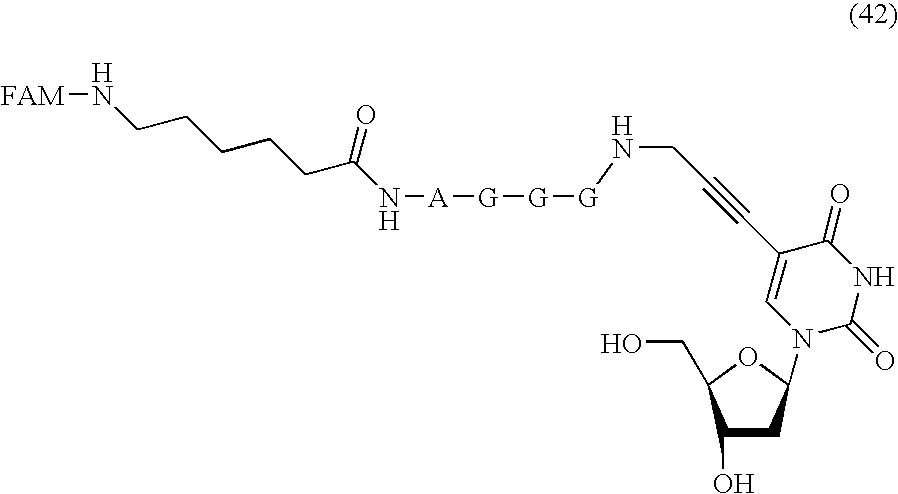
- In another aspect of the invention, there is provided a process for the manufacture of a compound in accordance with any of the first, second or third aspects. In a further aspect there is provided a process for the manufacture of a compound of Formula I using an intermediate compound as defined in the third aspect.
- In a fourth aspect of the invention, there is provided, a set of nucleotides characterised in that the set contains at least one compound of Formula I. Preferably, such a set will comprise each of the four natural bases A, G, C and T (or their analogues) wherein at least one is a compound of Formula I.
- In a preferred embodiment of the fourth aspect the set of nucleotides will comprise at least two compounds of Formula I having different bases, B, characterised in that each compound of Formula I has a different reporter moiety, R 2. Thus, for example, the set of nucleotides may comprise compounds of Formula I with bases A and G wherein the compound with base, A, has a first reporter moiety (R2) and the compound with base, G, has a second reporter moiety (R2) wherein the first and second reporter molecules are distinguishable from each other.
- In another preferred embodiment of the fourth aspect, the set of nucleotides comprises four compounds of Formula I characterised in that each compound has a different base, B, such that each of the bases A, G, C and T are present and each of the four compounds of Formula I has a reporter moiety which is distinguishable from all of the other three bases.
- In a fifth aspect of the invention there is provided, a method for nucleic acid molecule sequencing comprising the steps of
- a) immobilising a complex of a primer and a template to a solid phase
- b) incubating with a polymerase in the presence of a compound of Formula I.
- In one embodiment of the fifth aspect, the complex of primer and template can be preformed by incubation under appropriate hybridisation conditions before immobilising the complex onto a solid phase. In another embodiment, the primer or the template can be immobilised onto a solid phase prior to formation of the complex by introduction of the appropriate hybridisation partner (i.e. template or primer, respectively). In yet another embodiment, the complex immobilised onto the solid phase can be a single nucleic acid molecule comprising both “primer” and “template”; for example, the immobilised nucleotide can be a hairpin structure.
- Suitable polymerases are enzymes that perform template-dependent base addition including DNA polymerases, reverse transcriptases and RNA polymerases. Suitable native or engineered polymerases include but are not limited to T7 polymerase, the Klenow fragment of E. coli polymerase which lacks 3′-5′exonuclease activity, E. coli polymerase III, Sequenase™, φ29 DNA polymerase, exonuclease-free Pfu, exonuclease-free Vent™ polymerase, Thermosequenase, Thermosequenase II, Tth DNA polymerase, Tts DNA polymerase, MuLv Reverse transcriptase or HIV reverse transcriptase. The selection of an appropriate polymerase depends on the interaction between a polymerase and the specific modified nucleotide (as described by Metzker et al., Nucleic Acids Res 1994, Vol.22, No.20; p. 4259-4267).
- Nucleotides comprising enzyme-cleavable linkage groups such as carboxyl ester attachment groups are suitable for use in sequencing reactions used in array based sequencing, such as BASS. Such reactions are isothermic, unlike cycle sequencing, so allowing much better control of reaction conditions. In particular, the sequencing reaction takes place at relatively low temperatures (typically less than 70° C.) thus enabling enzyme-cleavable linkage groups, such as the carboxyl ester attachment, to remain stable under these sequencing reaction conditions. Accordingly, polymerases which may be useful in the fifth aspect of the invention include thermostable polymerases and non-thermostable polymerases.
- In a preferred embodiment of the fifth aspect, the method further comprises the steps of
- c) detecting the incorporation of a compound of Formula I
- d) incubating in the presence of enzyme under suitable conditions for enzymatic cleavage of the enzyme-cleavable groups X and Y
- Suitable conditions for enzyme cleavage of the enzyme-cleavable groups will depend on the nature of the enzymes involved. Enzyes such as carboxyesterases are active under a broad range of conditions and do not require co-factors. Commercially available carboxyesterases will hydrolyse esters under mild pH conditions of between pH 7.0 and pH 8.0. e.g. 0.1M NaCl, 0.05M Tris.HCl, pH 7.5. Suitable conditions for cleavage by amidases and peptidases are exemplified in Example 8 below.
- In another embodiment of the fifth aspect, the method further comprises
- e) repeating steps a)-d)
- In a preferred embodiment of the fifth aspect, the enzyme in step d) is an amidase.
- In a further aspect of the invention there is provided use of a compound of Formula I in a sequencing reaction.
- Briefly, sequencing reactions using modified nucleotides in accordance with the first aspect of the invention may be performed as follows. Primer template complexes are immobilised to a solid surface and contacted with modified nucleotides in the presence of a suitable buffer also containing a polymerase, such as Klenow fragment of E. coli polymerase which lacks 3′-5′exonuclease activity, and a commercially available pyrophosphatase. The reaction is incubated under suitable conditions for a polymerase-mediated base addition reaction followed by the removal of non-incorporated nucleotides and enzymes by washing with a wash buffer. Suitably, the wash buffer contains a buffering agent, such as an organic salt, to maintain a stable pH of approximately
pH 6 topH 9 and possibly also comprises monovalent or divalent cations and a detergent so as to eliminate non-covalently bound molecules from the solid surface. Where the modified nucleotides comprise a fluorescent reporter molecule, incorporated nucleotides are detected by measuring fluorescence and the corresponding nucleotide identified. Following identification, the templates are contacted with a buffered solution containing an excess of a protein displaying the appropriate enzyme activity and incubated under conditions for enzyme cleavage activity. For example, where the enzyme-cleavable group linking reporter molecule and/or blocking group to the nucleotides is a carboxyl group, the solution contains an excess of a protein displaying non-specific esterase activity. Following enzyme activity, the products of enzymatic cleavage are eliminated by washing as above. Following the washing step, the immobilised template is washed with an excess of buffer used for the polymerase reaction and the steps of polymerase-mediated base addition, detection of incorporated nucleotide and enzyme-cleavage activity are repeated to obtain further sequence data. - For the purposes of clarity, certain embodiments of the present invention will now be described by way of example with reference to the following figures:
- FIG. 1 shows a reaction scheme for syntesising a compound of Formula I.
- FIG. 2 shows examples of compounds of Formula I.
- FIG. 3 shows a reaction scheme for synthesising nucleotide analogues.
- FIGS. 4 and 5 show reaction schemes for synthesising nucleoside analogues.
- FIG. 6 shows a reaction scheme for synthesising a fluorescein-labelled nucleotide.
- FIGS. 7 and 8 show reaction schemes for synthesising nucleoside analogues.
- FIGS. 9 and 10 show reaction schemes for synthesising nucleotide analogues.
- FIG. 11 shows a reaction scheme for synthesising a nucleoside analogue.
- FIG. 12 shows a reaction scheme for synthesising a fluorescein-labelled nucleoside.
- A reaction scheme for the synthesis of an example of a compound of Formula I is set out in FIG. 1 using 5-iodo-2′-deoxyuridine (Sigma-Aldrich Chemical Co.) as the starting material and incorporating the dye, Cy3, by reaction with (N-hydroxy)succinimide Cy3 ester.
- In the reaction scheme, the following abbreviations are used: TBDMS—tertbutyldimethylsilyl; DMTr—Dimethoxytrityl; TFA—trifluoroacyl; nBu—linear Butyl chain; MeCN—Acetonitrile; TCA—Trichloroacetic acid; DCM—Dichloromethane; DMF—N,N-Dimethylformamide; TEAB—Tetraethylammonium bicarbonate buffer, THF—Tetrahydrofuran; Ac—Acetyl.
- Wherein TBDMS, Ac, TFA and nBu have the following structural formulae:

- FIG. 3 illustrates the synthetic pathway for nucleotide analogues indicated as (6), (8) and (9) via the intermediate compound (4).
- i) 3′-O-[(tertbutyl)dimethylsilyl]-5′-O-[(tertbutyl)diphenylsilyl]-4′-C-(1,1′-diphenylmethylaminomethyl)thymidine (2).
- The starting
material 3′-O-[(tertbutyl)dimethylsilyl]-5′-O-[(tertbutyl)diphenylsilyl]-4′-C-formylthymidine (1) (described in Marx et al. Helv. Chim. Acta. 1996, 79, 1980-1994 and references cited therein.) (1.7 g, 2.7 mmol) and Ph2CHNH2 (0.53 g, 2.9 mmol; 0.5 mL) were dissolved in anhydrous acetonitrile (10 mL) at ambient temperature. Neat glacial acetic acid (0.11 g, 1.9 mmol, 0.11 mL) was then added and the solution stirred for 30 minutes at ambient temperature, during which time a white precipitate formed. Solid NaBH3CN (0.25 g, 4.1 mmol) was then added in portions to the stirred suspension. The resulting mixture was then stirred at ambient temperature for 18 hours. The solvent was then removed under vacuum and the residue redissolved in dichloromethane and washed with brine. The organic layer was then separated, dried over MgSO4 and then filtered. Concentration of the filtrate under vacuum gave a white foam which was purified by flash column chromatography (7:3, dichloromethane:ethyl acetate) to afford the title compound (2) (1.2 g, 55%) as a white foam. δH(300 MHz, CDCl3) 8.3(1H, s, br, N3—H), 7.72-7.65(4H, dd, Ph), 7.49-7.14(17H, m, Ph 2CHNH, Ph 2SitBu; H-6, s, obs), 6.37(1H, dd, H-1′), 4.67(1H, s, Ph2 CHNH), 4.57(1H, dd, H-3′), 3.96(2H, 2d, H-5′), 2.70(1H, d, 4′-C—CH2), 2.55(1H, d, 4′-C—CH2), 2.25(2H, m, H-2′), 1.61(3H, s, 5-CH3), 1.11(9H, s, tBuSiPh2), 0.75(9H, s, tBuSiMe2), 0.11(3H, s, MeSi), 0.01(3H, s, MeSi); δC(75.45 MHz, CDCl3) 163.47, 150.13, 144.14, 143.79, 135.72, 135.65, 133.07, 132.58, 130.14, 129.63, 128.67, 128.59, 128.41, 127.97, 126.94, 126.88, 111.03, 89.79, 83.84, 72.89, 67.99, 66.74, 49.80, 41.85, 27.08, 25.63, 19.44, 17.85, 14.20, 12.07, −4.68, −5.36; ν cm−1 1688, 1112, 833. - ii) 4′-C-(1,1′-diphenylmethylaminomethyl)thymidine (3).
- 3′-O-[(tertbutyl)dimethylsilyl]-5′-O-[(tertbutyl)diphenylsilyl]-4′-C-(1,1′-diphenylmethylaminomethyl)thymidine (2) (1.2 g, 1.5 mmol) was dissolved in tetrahydrofuran (50 mL) at ambient temperature. A solution of tetrabutylammonium fluoride in tetrahydrofuran (4.5 mL) was then added to the solution. The resulting mixture was stirred for 3 hours at ambient temperature. Methanol (5 mL) was then added and the reaction mixture concentrated under vacuum. The residue was purified by flash column chromatography (95:5 dichloromethane:methanol) to give the title compound (3) as an amorphous white solid (0.65 g, 100%) on removal of solvent from the appropriate fractions. δ H(300 MHz, d6-DMSO) 11.23(1H, s, br, N3—H), 7.75(1H, s, H-6), 7.41-7.15(10H, m, Ph2 CHNH), 6.21(1H, dd, H-1′), 5.57(1H, d, br, 3′-OH), 5.21(1H, t, 5′-OH), 4.78(1H, s, Ph2 CHNH), 4.35(1H, m, H-3′), 3.61(2H, 2d, H-5′), 2.54(2H, 2d, 4′-C—CH2), 2.18(2H, m, H-2′), 1.75(3H, s, 5-CH3); δC(75.45 MHz, d6-DMSO) 150.46, 144.53, 144.28, 136.28, 128.36, 126.99, 126.74, 109.17, 88.39, 83.18, 66.79, 64.10, 54.91, 12.27.
- iii) 4′-C-Aminomethylthymidine (4).
- 4′-C-(1,1′-diphenylmethylaminomethyl)thymidine (3) (0.65 g, 1.5 mmol) was dissolved in absolute ethanol (50 mL). Cyctohexene (12 mL), glacial acetic acid (5 mL) and 5%-palladium on charcoal (0.6 g) were added and the mixture heated under reflux with stirring. The solution was heated for 5 hours and then allowed to cool to ambient temperature. Palladium catalyst was removed by filtration through celite and the filtrate was concentrated under vacuum to give the crude title compound (4), which was used in the following step without further purification. ES +ve m/z 272(M+H) +, 242(M—CH2NH2)+. For an alternative synthesis of this compound see: Wang et al;
Tetrahedron Letters 1996, 37, 6515-6518. - iv) 4′-C-(N-trifluoroacetylglycylaminomethyl)thymidine (5).
- 4′-C-Aminomethylthymidine (4) (0.14 mmol) was dissolved in anhydrous N,N-dimethylformamide (1 mL). N-Trifluoroacetylglycine (0.036 g, 0.21 mmol) and O-(N-succimidyl)-N,N,N′,N′-tetramethyluronium tetrafluoroborate [TSTU] (0.085, 0.28 mmol) were then added and the solution stirred at ambient temperature. Diisopropylethylamine (0.036 g, 0.28 mmol, 0.05 mL) was then added dropwise to the solution with stirring. After 12 hours the solvent was removed under vacuum and the residue redissolved in dichloromethane:methanol (9:1). Applied solution directly to a silica gel column and eluted with dichloromethane:methanol (9:1). Fractions containing the desired material were pooled and the solvent removed under vacuum to give the title compound (5) as a clear, glassy material (0.28 g, 28% from crude 4). δ H(300 MHz, CD3OD) 7.91(1H, s, H-6), 6.27(1H, dd, H-1′), 4.49(1H, dd, H-3′), 3.74(2H, s, glycyl CH2), 3.52(1H, d, H-5′), 3.51(2H, s, 4′-C—CH2), 3.43(1H, d, H-5′), 2.32(2H, m, H-2′), 1.68(3H, s, 5-CH3); ES +ve m/z 425(M+H)+, 442(M+H2O)+, 447(M+Na)+.
- v) 4′-C-(Glycylaminomethyl)thymidine triphosphate (6).
- 4′-C-(N-trifluoroacetylglycylaminomethyl)thymidine (5) (0.026 g, 0.06 mmol) and proton sponge (0.02 g, 0.09 mmol) were dissolved in trimethylphosphate (1 mL) at ambient temperature. The solution was then cooled to 0 C. on an ice bath under an atmosphere of nitrogen. Phosphorous oxychloride (0.02 g, 0.12 mmol, 0.01 mL) was then added dropwise to the cooled mixture while stirring. After stirring for two hours at 0 C. a solution of 0.5M tri-n-butylammonium pyrophosphate in N,N-dimethylformamide (1 mL) and tributylamine (0.075 mL) was added to the cooled solution. After stirring for a further two minutes 0.2M trimethylammonium bicarbonate buffer (2 mL) was added and the solution allowed to warm to ambient temperature. The solution was stirred for 45 minutes at ambient temperature and then concentrated under vacuum. The oily residue was then redissolved in concentrated ammonia solution (1 mL) and allowed to stand overnight at ambient temperature. Removal of the solvent under vacuum then gave an oily residue which was redissolved in distilled water and subjected to purification by ion exchange chromatography (DEAE Sephacryl, eluted with 0-100% water-0.8M triethylammonium bicarbonate buffer). Fractions containing the desired product were detected by U.V. and pooled. Lyophilisation of the appropriate fractions gave a white residue which was redissolved in water and eluted through a preparative C18 hplc column with water. Fractions containing the desired product were pooled and lyophilised to give the title compound (6) as a white foam (0.8 μmol, 13%). δ H(300 MHz, D2O) 7.48(1H, s, H-6), 6.19(1H, dd, H-1′), 3.99(3H, dd, H-3′,m, br, H-5′), 3.50(1H, d, 4′-C—CH2), 3.38(2H, s, glycyl CH2), 3.36(1H, d, 4′-C—CH2), 2.36(2H, m, H-2′), 1.77(3H, s, 5-CH3); δP(121.5 MHz, D2O) −5.6(d), −10.8(d), −19.0(t); λmax 264 nm.
- vi) 4′-C-(N-trifluoroacetylaminomethyl)thymidine (7).
- 4′-C-Aminomethylthymidine (4) (1.5 mmol) was dissolved in methanol (10 mL) and triethylamine (1.5 mL) at ambient temperature. The solution was then treated with neat ethyl trifluoroacetate (1 mL) and the resulting solution stirred for 18 hours at ambient temperature with exclusion of moisture. The solvents and reagents were then removed under vacuum to give the crude product. Purification by flash column chromatography (9:1 dichloromethane:methanol) afforded the title compound (7) as a white foam (0.37 g, 66%). δ H(300 MHz, CD3OD) 8.77(1H, t, br, N3—H), 7.73(1H, s, H-6), 6.24(1H, dd, H-1′), 4.56(1H, dd, H-3′), 3.6(3H, s, H-5′, obs d, 4′-C—CH2), 3.53(1H, d, 4′-C—CH2), 2.35(2H, m, H-2′), 1.81(3H, s, 5-CH3); δC(75.45 MHz, CD3OD), 166.24, 160.08-158.62(q, CF3CO), 152.21, 138.11, 123.01-111.51(q, CF3CO), 111.51, 88.93, 85.69, 72.79, 64.23, 41.70, 40.81, 12.40; ES +ve m/z 368 (M+H)+, 390(M+Na)+; ν cm−1 1684. For an alternative synthesis of this compound see Wang et al,
Tetrahedron Letters 1996, 37, 6515-6518. - vii) 4′-C-(N-trifluoroacetylaminomethyl)thymidine triphosphate(8).
- 4′-C-(N-trifluoroacetylaminomethyl)thyridine (7) was weighed into a round-bottom flask and the flask flushed with argon. Pyridine and 1,4-dioxane were then added to give a clear solution. A 1M solution of 2-Chlorol-4H-1,3,2-dioxaphosphorin-4-one was then added to the stirred solution. After stirring for 30 minutes a 0.5M solution of tributylammonium pyrophosphate in DMF and tributylamine were added together and the resulting solution stirred for a further 30 minutes. A 1% solution of iodine in pyridine:water 98:2 was then added and the solution stirred for a further 30 minutes. Excess iodine was then destroyed by the addition of saturated sodium thiosulfate solution. The reaction mixture was then concentrated to give a crude product which was then initially purified by the procedure described for the preparation of compound (6). Final purification was achieved using preparative reverse-phase HPLC, eluting with 0.1M triethyammonium bicarbonate:acetonitrile. Obtained the title compound (8) as a white powder after lyophilisation of the appropriate fractions (0.54 mg). δ H(300 MHz, D2O) 7.45(1H, s, H-6), 6.23(1H, dd, H-1′), 3.76(1H, dd, H-3′), 3.00(2H, 2d, H-5′), 2.61(2H, 2d, 4′-C—CH2), 2.10(2H, m, H-2′), 1.62(3H, s, 5-CH3); δP(121.5 MHz, D2O) −4.9(d), −10.5(d), −20.4(t); λmax 266 nm.
- viii) 4′-C-(Aminomethyl)thymidine triphosphate (9).
- 4′-C-(N-trifluoroacetylaminomethyl)thymidine triphosphate (8) was dissolved in concentrated aqueous ammonia solution and allowed to stand for 18 hours at ambient temperature. The solution was then lyophilised to give the title compound (9) as a white powder.
- FIG. 4 illustrates the synthetic pathway for the nucleoside analogue, 5-(N-Trifluoroacetyl)propargylamino-4′-C-(acetylaminomethyl)-2′-deoxyuridine (16).
- i) 3′-O-[(tertbutyl)dimethylsilyl]-5′-O-[(tertbutyl)diphenylsilyl]-4′-(1,1′-diphenylmethylaminomethyl)-2′-deoxyuridine (11).
- 3′-O-[(tertbutyl)dimethylsilyl]-5′-O-[(tertbutyl)diphenylsilyl]-4′-C-formyl-2-deoxyuridine (10) (Yang et al;
Tetrahedron Letters 1992, 33, 37-40.) (0.15 g, 0.25 mmol) was treated with Ph2CHNH2 (0.07 g, 0.37 mmol, 0.064 mL), glacial acetic acid (0.015 g, 0.26 mmol, 0.015 mL) and NaBH3CN (0.023 g, 0.37 mmol) in acetonitrile (1 mL) according to the procedure used for the preparation of compound (2). The title compound (11) was obtained as clear, viscous oil (0.13 g, 69%). δH(300 MHz, CDCl3) 8.02(1H, s, br, N3—H), 7.81(1H, d, H-6), 7.69-7.18(20H, m, Ph 2CHNH, tBuSiPh 2), 6.32(1H, dd, H-1′), 5.30(1H, d, H-5), 4.67(1H, s, Ph2 CHNH), 4.61(1H, dd, H-3′), 4.02(1H, d, H-5′), 3.87(1H, d, H-5′), 2.69(1H, d, 4′-C—CH2), 2.53(1H, d, 4′-C—CH2), 2.37(1H, m, H-2′), 2.17(1H, m, H-2′), 1.10(9H, s, tBuSiPh2), 0.75(9H, s, tBuSiMe2), 0.01(6H, s, tBuSiMe 2); ES +ve m/z 776(M+H)+. - ii) 4′-C-(1,1′-diphenylmethylaminomethyl)-2′-deoxyuridine (12).
- 3′-O-[(tertbutyl)dimethylsilyl]-5′-O-[(tertbutyl)diphenylsilyl]-4′-C-(1,1′-diphenylmethylaminomethyl)-2′-deoxyuridine (11) (0.13 g, 0.16 mmol) was treated with tetrabutylammonium fluoride solution (0.45 mL) in tetrahydrofuran (5 mL) according to the procedure used for the preparation of compound (3). The title compound (12) was obtained as a clear glass (0.056 g, 78%). δ H(300 MHz, d6-DMSO) 11.25(1H, s, br, N3—H), 7.90(1H, d, H-6), 7.40-7.15(10H, m, Ph2 CHNH), 6.19(1H, dd, H-1′), 5.93(1H, d, br, 3′-OH), 5.91(1H, s, br, Ph2CHNH), 5.11(1H, t, br, 5′-OH), 4.78(1H, s, Ph2 CHNH), 4.33(1H, dd, H-3′), 3.61(1H, d, H-5′), 2.52-2.49(2H, m, 4′-C—CH2), 2.18(2H, m, H-2′); δC(75.45 MHz, d6-DMSO) 163.13, 150.43, 144.50, 144.25, 140.62, 128.34, 126.97, 126.92, 126.72, 101.60, 88.63, 83.50, 72.0, 66.85, 58.8, 51.15; ES +ve m/z 424(M+H)+.
- iii) 4′-C-Aminomethyl-2′-deoxyuridine (13).
- 4′-C-(1,1′-diphenylmethylaminomethyl)-2′-deoxyuridine (12) (0.056 g, 0.13 mmol) was treated with cyclohexene (1 mL), glacial acetic acid 0.5 mL) and 5% palladium on charcoal (0.06 g) in ethanol (5 mL) according to the procedure used for the preparation of compound (4). The crude product was purified by dissolving in water and washing with toluene. The aqueous layer was separated and the solvent removed under vacuum to give the title compound (13) as an amorphous solid (0.034 g, 100%). δ H(300 MHz, D2O) 7.64(1H, d, H-6), 6.22(1H, dd, H-1′), 5.72(1H, d, H-5), 4.43(1H, m, H-3′), 3.56(2H, 2d, H-5′), 3.26(1H, d, CH2 NH2), 3.05(1H, d, CH2 NH2), 2.40(2H, m, H-2′); δC(75.45 MHz, D2O) 166.95, 152.46, 142.67, 103.11, 86.77, 86.43, 73.97, 64.82, 41.59, 39.25; ES +ve m/z 258(M+H)+, 242(M−NH3)+.
- iv) 4′-C-(Acetylaminomethyl)-2′-deoxyuridine (14)
- 4′-C-Aminomethyl-2′-deoxyuridine (13) (0.034 g, 0.13 mmol) was dissolved in anhydrous N,N-dimethylformamide (0.5 mL) at ambient temperature. Excess pentafluorophenyl acetate (0.88 g, 0.39 mmol) was then added directly to the reaction mixture as a solid. The resulting solution was stirred for 18 hours at ambient temperature. The solvent was then removed under vacuum and the residue re-dissolved in water and then washed with toluene. The aqueous layer was then separated and the solvent removed under vacuum. The title compound was obtained as an amorphous solid (0.032 g, 82%). δ H(300 MHz, D2O) 7.68(1H, d, H-6), 6.11(1H, dd, H-1′), 5.71(1H, d, H-5), 4.44(1H, dd, H-3′), 4.49(2H, 2d, H-5′), 3.33(2H, 2d, 4′-C—CH2), 2.33(2H, m, H-2′), 1.89(3H, s, CH3CONH); δC(75.45 MHz, D2O) 175.60, 167.08, 152.43, 142.86, 102.93, 88.93, 85.57, 71.91, 63.16, 40.37, 39.15, 22.72; ES +ve m/z 300(M+H)+, 242(M−CH3CONH)+.
- v) 5-Iodo-4′-C-(acetytaminomethyl)-2′-deoxyuridine (15)
- Iodine (0.032 g, 0.13 mmol) was dissolved in 1,4-dioxane (1 mL) at ambient temperature. PhI(COCF 3) (0.056 g, 0.13 mmol) and pyridine (0.022 g, 0.28 mmol, 0.023 mL) were then added and the reaction mixture stirred until iodine colour faded. 4′-C-(Acetylaminomethyl)-2′-deoxyuridine (14) (0.032, 0.11 mmol) in pyridine (0.25 mL) was then added dropwise to the reaction mixture. The mixture was warmed to 60 C. for on hour and then allowed to cool to ambient temperature after which the solvents were removed under vacuum. The residue was re-dissolved in 9:1 dichloromethane and then eluted through a short flash silica gel column using 9:1 dichloromethane:methanol. The title compound (15) was obtained, with some unreacted starting material, as an amorphous solid. δH(300 MHz, CD3OD) 8.52(1H, s, H-6), 6.21(1H, dd, H-1′), 4.48(1H, dd, H-3′), 3.60(2H, 2d, H-5′), 3.39-3.29(2H, 2d, 4′-C—CH2), 2.50-2.24(2H, m, H-2′), 1.98(3H, s, CH3CONH).
- vi) 5-(N-Trifluoroacetyl)propargylamino-4′-C-(acetylaminomethyl)-2′-deoxyuridine (16)
- 5-Iodo-4′-C-(acetylaminomethyl)-2′-deoxyuridine (15) (0.1 mmol) and CuI (0.01 g, 0.05 mmol) were weighed into an round-bottom flask equipped with a magnetic stirrer bar. The flask was then fitted with a septum and flushed with dry argon. N,N-dimethylformamide (0.5 mL) was added to the flask and the contents stirred until all solids were dissolved. A solution of N-(tifluoroacetyl)propargylamine (0.05 g, 0.33 mmol) in triethylamine (0.02 g, 0.22 mmol, 0.03 mL) was then added to the flask and the resulting solution stirred for five minutes. Solid tetrakis(triphenylphosphine) palladium (0.031 g, 0.03 mmol) was then added and the resulting mixture stirred at ambient temperature for 4 hours. The reaction mixture was then diluted with 1:1 dichloromethane:methanol (2 mL) before adding solid sodium hydrogencarbonate. The mixture was stirred for a further hour before filtering through celite. The filtrate was then concentrated under vacuums. The residue was purified by flash column chromatography (95:5 dichloromethane:methanol). Obtained the title compound as an amorphous solid (5.3 mg). δ H(300 MHz, CD3OD) 8.32(1H, s, H-6), 6.22(1H, dd, H-1′), 4.46(1H, dd, H-3′), 4.26(2H, s, propargyl CH2), 3.59(2H, 2d, H-5′), 3.53(1H, d, 4′-C—CH2), 3.36(1H, d, 4′-C—CH2), 2.37(2H, m, H-2′), 1.97(3H, s, CH3CONH); δC(75.45 MHz, CD3OD) 174.33, 164.66, 151.15, 145.79, 124.5-110.8(q, CF3CONH), 99.44, 90.38, 88.35, 86.68, 76.01, 72.66, 64.21, 41.61, 41.24, 22.52, 9.25; ES +ve m/z 470(M+H)+, 493(M+Na)+.
- A longer peptidase or amidase cleavable linker is introduced into compound (16′) (TFA deprotected analogue of compound (16)) according to the reaction scheme of FIG. 5 in which R is the side chain of any of the natural amino acids.
- 5-propargylamino-4′-C-(acetylaminomethyl)-2′-deoxyuridine (16′) is coupled to suitably derivatised (protected) commercially available peptides (e.g Bachem) using standard peptide coupling reagents (e.g. TSTU, EDCI, DCC, HOBt etc.) or assembled by the sequential addition of suitably derivatised (protected) amino acids following standard peptide synthesis protocols either in solution or on solid phase (see, for example, “Synthetic Peptides—A Users Guide” Ed. G. A. Grant; 1992). The resulting nucleoside linker conjugate is converted to the corresponding triphosphate by using the conditions described for the preparation of compound (6). Labelling of the triphosphate so produced is achieved by following the procedure described below for the preparation of compound (18).
- Nucleoside analogue (16) was converted to a nucleotide and a fluorescent label incorporated according to the reaction scheme of FIG. 6.
- i) 5-(N-Trifluoroacetyl)propargylamino-4′-C-(acetylaminomethyl)-2′-deoxyuridine triphosphate (17)
- 5-(N-Trifluoroacetyl)propargylamino-4′-C-(acetylaminomethyl)-2′-deoxyuridine (16) (5.3 mg, 0.012 mmol) was treated with phosphorous oxychloride (0.04 g, 0.0244 mmol, 2.2 uL), tributylammonium pyrophosphate (0.25 mL of 0.5M solution) and tributylamine (0.019 mL) in trimethylphosphate (0.25 mL) and N,N-dimethylformamide (0.25 mL) according to the procedure used to prepare compound (6).
- ii) 5-[N-Fluorescein-5(and-6-)carboxamidohexanoyl]propargylamino-4′-C-(acetylaminomethyl)-2′-deoxyuridine triphosphate (18)
- 5-(N-Trifluoroacetyl)propargylamino-4′-C-(acetylaminomethyl)-2′-deoxyuridine triphosphate (17) was dissolved in anhydrous DMSO at ambient temperature. 6-[Fluorescein-5(and-6)-carboxamidohexanoic acid N-hydroxysuccinamidyl ester and triethylamine were then added and the reaction mixture stirred at ambient temperature for 18 hours. Reaction mixture was then diluted with water and lyophilised for 48 hours. The crude material was then re-dissolved in 0.1M triethylammonium bicarbonate (1 mL) and subjected to preparative reverse phase HPLC purification using 0.1 triethylammonium bicarbonate/water as mobile phase.
- FIG. 7 shows a reaction scheme for synthesis of nucleoside analogues (compounds (19) and (21)) which have a blocking group attached through an amidase cleavable linker at the 4′ position
- i) 4′-C-(N-Acetylglycylaminomethyl)thymidine (19)
- 4′-C-(Aminomethyl)thymidine (4) (0.025 g, 0.1 mmol), N-acetylglycine (0.023 g, 0.2 mmol) and TSTU (0.09 g, 0.3 mmol) were dissolved in anhydrous N,N-dimethylformamide (1 mL) at ambient temperature. Diisopropylethylamine (0.065 g, 0.5 mmol, 0.087 mL) was then added and the reaction mixture stirred for 18 hours at ambient temperature. The solvent was then removed under vacuum and the residue re-dissolved in 9:1 dichloromethane:methanol and eluted through a flash silica gel column with 9:1 dichloromethane:methanol. The title compound (19) was obtained as an amorphous solid on removal of solvent from the appropriate fractions (0.023 g). δ H(300 MHz, CD3OD) 7.78(1H, s, H-6), 6.26(1H, dd, H-1′), 4.48(1H, dd, H-3′), 3.83(2H, s, glycyl CH2), 3.60(2H, 2d, H-5′), 3.58(1H, d, 4′-C—CH2), 3.42(1H, d, 4′-C—CH2), 2.33(2H, m, H-2′), 2.00(3H, s, CH3CO), 1.86(3H, s, 5-CH3); ES +ve m/z 393(M+Na)+.
- ii) 4′-C-[N-(9-Fluorenylmethyloxycarbonyl)leucylaminomethyl)thymidine (20)
- 4′-C-(Aminomethyl)thymidine (4) (0.025 g, 0.1 mmol), N-(9-fluorenylmethyloxycarbonyl)leucine (0.071 g, 0.2 mmol), TSTU (0.09 g, 0.3 mmol) and diisopropylethylamine (0.065 g, 0.5 mmol, 0.087 mL) were combined in DMF (1 mL) according to the procedure used to prepare compound (19). The title compound (20) was obtained as an amorphous solid (0.056 g). δ H(300 MHz, CD3OD) 7.86-7.37(8H, m, Fmoc), 7.74(1H, s, H-6), 6.24(1H, dd, H-1′), 4.56(1H, dd, H-3′), 3.68(2H, 2d, H-5′), 3.40(2H, 2d, 4′-C—CH2), 2.37(2H, m, H-2′), 1.70(3H, m, leucyl CH, CH2), 1.66(3H, s, 5-CH3), 1.05(3H, d, leucyl CH3), 1.02(3H, d, leucyl CH3); ES +ve m/z 607(M+H)+, 629(M+Na)+.
- iii) 4′-C-(N-Letcylaminomethyl)thymidine (21)
- 4′-C-[N-(9-Fluorenylmethyloxycarbonyl)leucylaminomethyl)thymidine (20) was dissolved in N,N-dimethylformamide. Piperidine was then added and the solution stirred at ambient temperature for 6 hours. The solvent was then removed under vacuum and the residue re-dissolved in water. The aqueous solution was then washed with toluene and 40-60 petroleum ether, and then separated and lyophilised. The lyophilised product was further purified by flash column chromatography (85:15 dcihloromethane:methanol) to give the title compound (21) as a resin. δ C(300 MHz, D2O) 7.47(1H, s, H-6), 6.13(1H, dd, H-1′), 4.65(1H, dd, H-3′), 3.34(2H, 2d, H-5′), 3.28(1H, d, 4′-C—CH2), 3.00(1H, d, 4′-C—CH2), 2.50(1H, dd, leucyl CH), 2.33(2H, m, H-2′), 1.73(3H, s, 5-CH3), 1.11(2H, m, leucyl CH2), 0.76(3H, d, leucyl CH3), 0.71(3H, d, leucyl CH3); ES +ve m/z 385(M+H)+.
- The nucleotide equivalent of compound (19) is prepared according to the methods for phosphorylating compounds (5) or (7) (see above).
- The nucleoside equivalent of compound (21) is prepared by phosphorylation of compound (20) according to the methods for phosphorylating compound (7) (see above) prior to the deprotection reaction of compound (20) to form compound (21) as described above.
- FIG. 8 shows a reaction scheme for synthesising a further nucleoside having an amidase cleavage site at the 4′ position (compound (22)).
- i) 4′-C-(N-Glycylaminomethyl)thymidine (22)
- 4′-C-(N-trifluoroacetylglycylaminomethyl)thymidine (5) (17 mg, 0.4 mmol) was dissolved in concentrated aqueous ammonia solution (1 mL) and allowed to stand overnight at ambient temperature. The reaction mixture was then lyophilised to give the title compound (22) as a colourless resin (0.0088 g, 67%). δH(300 MHz, D2O) 7.46(1H, s, H-6), 6.14(1H, dd, H-1′), 4.48(1H, dd, H-3′), 3.70(2H, s, glycyl CH2), 3.47(2H, 2d, H-5′), 3.40(2H, 2d, 4′-C—CH2), 2.35(2H, m, H-2′), 1.73(3H, s, 5-CH3); ES +ve m/z 329(M+H)+.
- A nucleosides having formula (22) is converted to the corresponding triphosphate by using the conditions described for the preparation of compound (8).
- FIG. 9 shows a reaction scheme for synthesising a nucleotide having a penicillin amidase cleavage site at the 4′ position (compound (31)).
- i) N-{α-[3′-O-((teributyl)dimethylsilyl)-5′-O-((tertbutyl)diphenysilyl)-4′-methyloxythymidyl]phenyl}phenylacetamide (29).
- 3′-O-[(tertbutyl)dimethylsilyl]-5′-O-[(tertbutyl)diphenylsilyl]-4′-hydroxymethyl thymidine (Marx et. al. Helv. Chim. Acta. 1996, 79, 1980-1994 and references cited therein) (28) is treated with N-[α-thioethylphenyl]phenyl acetamide (24) and N-iodosuccinimide in accordance with the procedure described for the preparation of compound (25) to obtain the title compound (29).
- ii) N-{α-[4′-methyloxythymidyl]phenyl}phenylacetamide (30).
- N-{α-[3′-O-((tertbutyl)dimethylsilyl)-5′-O-((tertbutyl)diphenylsilyl)-4′-methyloxythymidyl]phenyl}phenylacetamide (29) is treated with tetrabutylammonium fluoride in tetrahydrofuran in accordance with the procedure used to prepare compound (26) to obtain the title compound (30).
- iii) N-{α-[4′-methyloxythymidyl]phenyl}phenylacetamide triphosphate (31).
- N-{α-[4′-methyloxythymidyl]phenyl}phenylacetamide (30) is treated with 2-chloro-4H-1,3,2-dioxaphosphorin-4-one, pyridine, tributylammonium pyrophosphate, iodine solution and tributylamine in accordance with the procedure used to prepare compound (27) to obtain the title compound (31).
- Labelling of the triphosphates so produced is achieved by following the procedure described for the preparation of compound (18).
- FIG. 10 shows a reaction scheme for the synthesis of a nucleotide of formula (27).
- i) N-[α-(5′-O-terbutyldiphenylsily N-3′-O-thymidyl)-phenyl)]-phenylacetamide (25)
- 5′-O-tertbutyldimethylsilyl thymidine (0.5 g, 1 mmol) (23) and N-[α-thioethylphenyl]phenyl acetamide (Flitsch et. al. Tetrahedron Letters 1998, 39, 3819-3822 and references cited therein; Flitsch et. al. PCT WO 97/20855) (24) (0.28 g, 1 mmol) were dissolved in anhydrous dichloromethane (5 mL) at ambient temperature. Crushed, activated 4A molecular sieves (1 g) were then added and the mixture stirred for 15 minutes at ambient temperature before cooling to 0 C. on an ice bath N-Iodosuccinimide (0.33 g, 1.5 mmol) was then added as a solid to the cooled solution. The resulting solution was then stirred for 3 hours at 0 C. Saturated sodium thiosulfate solution (10 mL) was then added and the organic layer separated. The aqueous layer was back extracted with a portion of dichloromethane (10 mL). The combined organic extracts were then dried over magnesium sulfate, filtered and then concentrated under vacuum. Purification by flash column chromatography (1:1 40-60 petrol ether:ethyl acetate) gave the title compound (1:1 mixture of diastercoisomers) as a white foam on removal of solvent from the appropriate fractions. Yield=0.4 g (55%). δ(300 MHz, d6-DMSO) 11.35(1H, s, N3—H), 9.05(1H, 2d, amide N—H), 7.59-7.15(22H, m, Ph2Si, Ph, PhCH2CO, α-H, H-6), 6.23-6.14(1H, m, H-1′), 4.46-3.29(4H, m, H-5′, H-4′, H-3′), 2.48-2.17(2H, m, H-2′), 1.44, 1.41(3H, 2s, 5-CH3), 0.98, 0.95(9H, 2s, tBuSi); δ(75.45 MHz, d6-DMSO) 170.87, 163.54, 150.38, 139.21, 135.85, 135.23, 134.88, 132.85, 132.26, 130.02, 129.04, 128.28, 128.24, 127.97, 126.30, 109.74, 84.40, 83.91, 83.67, 83.47, 79.03, 78.60, 76.54, 76.40, 63.97, 59.72, 55.33, 48.57, 42.23, 37.45, 26.60, 20.74, 18.83, 14.06, 11.72.
- ii) N-[α-(3′-O-thymidyl)-phenyl)]-phenylacetamide (26)
- N-[α-(5′-O-tertbutyldiphenylsilyl-3′-O-thymidyl)-phenyl)]-phenylacetamide (25) (0.4 g, 0.56 mmol) was dissolved in tetrahydrofuran (10 mL) at ambient temperature. A 1M solution of tetrabutylammonium fluoride in tetrahydrofuran (0.56 mL) was then added to the solution of the nucleoside. After stirring for 4 hours methanol (2 mL) was added and the solvent removed under vacuum to give a white foam. Flash column chromatography (95:5 dichloromethane:methanol) gave the title compound as a white foam (mixture of diastereoisomers). Yield=0.22 g (85%). δ(300 MHz, d 6-DMSO) 11.30(1H, s, N3—H), 9.03(1H, 2d, amide N—H), 7.67, 7.63(1H, 2s, H-6), 7.43-7.18(11H, m, Ph, PhCH2CO, α-H), 6.19-6.11(1H, m, H-1′), 5.07(1H, t, br, 5′-OH), 4.28-3.98(3H, m, H-4′, H-3′), 3.56(2H, m, H-5′), 2.40-2.20(2H, m, H-2′), 1.75, 1.74(3H, 2s, 5CH3); δ(75.45 MHz, d6-DMSO) 170.84, 170.78, 139.44, 135.94, 135.88, 129.02, 128.28, 128.26, 128.23, 128.15, 126.43, 126.35, 109.49, 84.65, 83.75, 78.85, 77.20, 76.95, 59.72, 42.20, 20.74, 14.06, 12.24.
- iii) N-[α-(3′-O-thymidyl)-phenyl)]-phenylacetamide triphosphate (27)
- N-[α-(3′-O-thymidyl)-phenyl)]-phenylacetamide (26) (0.11 g, 0.24 mmol), 2-chloro-4H-1,3,2-dioxaphosphorin-4-one (0.24 mL of 1M solution in 1,4-dioxane), pyridine (0.24 mL), tributylammonium pyrophosphate (0.72 mL of 1M solution in DMF), iodine (0.16 g dissolved in 7.2 mL pyridine/0.14 mL water) and tributylamine were combined according to the procedure used to prepare compound (8).
- FIG. 11 shows a reaction scheme for the synthesis of a compound of formula (36).
- i) 5-Hydroxymethyl-5′,3′-di-O-p-toluyl-2′-deoxyuridine (32) (prepared using well established procedures described, for example, in Chemistry of Nucleosides and Nucleotides;
Volume 1. Ed. L. B. Townsend, 1988) and N-[α-thioethyl-N′-trifluoroacetylaminopropyl benzamide] phenylacetamide (33) (prepared from procedures in Katritzky et al.; Synthesis, 1993, 445-456) is combined in the presence of N-iodosuccinimide according to the procedure used to obtain compound (25) to afford the intermediate (34). - ii) Compound (34) is converted to the intermediate (35) by treatment with sodium methoxide in methanol, followed by ethyl trifluoroacetate in methanol.
- iii) Compound (35) may then be converted to nucleoside (36) using the procedure outlined for the preparation of compound (26). Conversion to a triphosphate is achieved by using the procedure described for the preparation of compound (27). Labelling of the triphosphate so produced is achieved by following the procedure described for the preparation of compound (18).
- FIG. 12 shows a reaction scheme for the synthesis of a compound of formula (42).
- i) 5-iodo-2′-deoxyuridine (37) was reacted with TFAproparglyamine in a palladium (Pd(PPh 3)4) catalysed coupling reaction in the presence of CuI and DMF to introduce the trifluoroacetylproparglyamino arm.
- ii) 5-propargylamino-2′-deoxyurdine (39) was then obtained by stirring with concentrated aqueous ammonia
- iii) Coupling the tetrapeptide N-Boc-Ala-Gly-Gly-Gly-OH (Bachem Ltd, UK) (tBOC-NH-AGGG-OH) to (39) was achieved by treatment with EDCI.HCl and N-hydroxysuccinimide in dimethylformamide.
- iv) The N-terminal Boc group was then removed by treatment with 50% trifluoroacetic acid in dichloromethane to give the peptide-nucleoside conjugate (41).
- v) Labelling of the tetrapeptide N-terminus was achieved by treating (41) with a molar excess of fluorescein hexanoic acid NHS ester (6-(Fluorescein-5(and-6) carboxamidohexanoic acid NHS ester) in triethylamine/dimethylformamide. The product (42) was purified by thin layer chromatography.
- a) Cleavage of the 4′ blocking group from compound (22)
- 1 mg of 4′-C-(N-Glycylaminomethyl)thymidine (22) or 4′-C-(N-Acetylglycylaminomethyl)thymidine (19) is incubated at 37° C. in 60 mM sodium phosphate buffer pH 7.0 with 0.5 units aminopeptidase M (Calbiochem 164598), to a final volume of 200 ul.
- b) Cleavage of 4′ blocking group from compound (21)
- 1 mg of 4′-C-(N-Leucylaminomethyl)thymidine (21) is incubated at 37° C. in 47 mM sodium phosphate pH 7.2 with 3.3% methanol and 0.25 units leucine aminopeptidase (Sigma L0632), to a final volume of 200 ul.
- c) Cleavage of 3′ blocking group from compound (26)
- 1 mg of N-[α-(3′-O-thymidyl)-phenyl)]-phenylacetamide (26) is incubated at 37° C. in 50 mM potassium phosphate pH 7.5 with 2 units of penicillin amidase (Fluka P3319), to a final volume of 200 ul.
- The products resulting from a), b) or c) above are analysed by thin layer chromatography using reverse phase plates with 10% acetonitrile in water or by electrospray mass spectrometry. Successful cleavage reactions yield nucleosides running concurrently with 4′-aminomethylthymidine which is used as a standard.
- Mass spectrometric detection of the thymidine daughter ion (mass 242) arising from fragmentation of 4′-C-(N-aminomethyl)thymidine suggested that enzyme induced cleavage of the amino acid from the leucyl-containing compound (4′-C-(N-Leucylaminomethyl)thymidine (21)) had occurred.
- d) Cleavage of the fluorophore from the nucleoside of compound (42)
- 1 mg of the substrate (42) was dissolved in a buffer containing 0.1M sodium phosphate, pH 6.3, 5 mM EDTA, 60 μM β-Mercaptomethanol. Enzyme digestion was started by adding 1 unit of papain (150 units/mg, Europa Ltd) in a final reaction volume of 200 μl followed by incubation at 50° C. for 2 h. The reactions were spotted on a thin layer chromatography plate and air dried before chromatography for 20 min. in a 4:1 mixture of dichloromethane/methanol.
- Following thin layer chromatography, the undigested substrate control migrated from the origin with no ultraviolet light absorbing material present at the origin and a clear fluorescence observable proximal to the solvent front. In contrast the non-fluoresceinated nucleoside control appeared as a strongly ultraviolet light absorbing material that showed little or no migration from the origin. As evidenced by thin layer chromatography, the papain digested material resulted in the production of a non-fluorescent, strongly ultraviolet light absorbing material at the origin that was consistent with the cleavage of the linker and separation of the nucleoside from the fluor.
- DNA polymerase assays were performed using
Sequence 1 as primer andSequence 2 as template. -
Sequence 1 5′[Cy3]TAACTCATTAACAGGATC 3′ -
Sequence 2 5′AT TCG CGG TAT TCT GGT ATG AAG CTT TTA GAT CCT GTT AAT GAG TTA GTA3′ - The template (Sequence 2) was designed such that the base (underlined) immediately adjacent to the 3′ end of the hybridised primer is complementary to the nucleotide test compound. Nucleotide test compounds were compounds (6) (4′-C-(glycylaminomethyl)thymidine triphosphate), (8) (4′-C-(N-trifluoroacetyaminomethyl)thymidine triphosphate) and (9) (4′-C-(aminomethyl)thymidine triphosphate) as described above.
- Primer extension reactions were performed using the above primers in the presence of 40 to 80 μM of nucleotide triphosphates. Positive control reactions contained all four native nucleotide triphosphates. For the other reactions the TTP was replaced with either a 2:1 ratio of TTP/dTTP for the terminator control, or entirely by the test compound The enzymes were used at a final concentration of 0.175 units/μl and a magnesium ion concentration of 2.5 mM in buffers supplied by the manufacturer. The primer and template concentrations were 0.5 pmol/μl and 2 pmol/μl respectively.
- Extension reactions with thermophilic enzymes were performed by initially denaturing the fully assembled reactions at 70° C. for 5 min. followed by 45° C. for 20-40 minutes. The following enzymes were used: Taq DNA polymerase (Taq); Thermosequenase (TS); Thermosequenase II (TSII); Thermosequenase E (TSE), Tfl DNA polymerase (Tfl); Tth DNA polymerase (Tth), deltaTts DNA polymerase (deltaTts), deltaTts D DNA polymerase (dettaTTSD) (all from APBiotech); Pfu DNA polymerase (Pfu) (Stratagene Ltd); Vent™ DNA polymerase (Vent) (New England Biolabs).
- Extension reactions preformed with mesophilic polymerases were carried out by mixing all the components of the reaction except the enzyme and heating to 70° C. for 5 min. After the reactions had cooled to room temperature 0.175 units of the enzyme were added and the reactions heated to 37° C. for 20-40 minutes. The following enzymes were used: T7 DNA polymerase (T7); Sequenase 2™ (Seq); Klenow fragment of DNA polymerase 1 (Klen); phi-29 DNA polymerase (Phi-29); T4 DNA polymerase (T4) (all from AP Biotech) and Bst DNA polymerase (Bst) (Cambio Ltd).
- Reverse transcriptase reactions were performed essentially as described above for thermophilic and mesophilic enzymes. The template for these reactions was the RNA equivalent of
sequence 2. All the thermophilic enzymes were assayed in Tth reaction buffer (Cambio Ltd, Cambridge UK) containing 2.5 mM Manganese ions. The following enzymes were used: Thermosequenase (TS1); Thermosequenase II (TSII); delta Tts DNA polymerase (deltaTts); delta Tts D DNA polymerase (deltaTtsD) (all from APBiotech); Retrotherm reverse transcriptase (Retroth) (Cambio Ltd); Tth DNA polymerase (Tth) (Cambio Ltd.). - Mesophilic reverse transcriptases (AMV RT; MuLV RT; SAV RT and HIV RT all from APBiotech) were assayed in their respective buffers with a final enzyme concentration of 4 units/μl.
- The reactions were stopped by adding a 0.5 volume aliquot of 80% formamide containing 0.1% (w/v) bromophenol blue and 0.1% (w/v) cresol blue. The reaction products were separated by denaturing gel electrophoresis at a constant power of 45 W on 16% polyacrylamide gels containing 50% urea.
- Gels were scanned for Cy3 fluorescence on a Molecular Dynamics Fluorimager and the data analysed using
Molecular Dynamics ImageQuant 5 software. - The incorporation of a test nucleotide triphosphate results in the appearance on a polyacrylamide gel of a single band corresponding to a single base extension product. If, however, the enzyme adds additional bases then further bands would be observed that corresponded to either the full-length product or positions of other complementary bases in the template.
- The results were graded as follows:
- − No extension within assay time
- +/− up to 25% of primer extended by at least one base within assay time
- + up to 50% of primer extended by at least one base within assay time
- ++ up to 75% of primer extended by at least one base within assay time
- +++ essentially all primer extended by at least one base within assay time
- T Incorporation results in termination
- E Incorporation permits further chain extension
- T/E Predominant product is primer extended by one base, but evidence of some further extension also observed.
TABLE shows the results of Thermostable DNA polymerase reactions compound (6) compound (8) compound (9) Taq +/− T +/− T +/− T TS + T + T + T TSII + T + T + T Pfu − − − Vent +/− T +/− T +/− T TSE ++ T ++ T ++ T Tfl +/− T +/− T +/− T Tth + T ++ T ++ T delta Tts + T + T +T T delta TTSD ++ T ++ T/E ++ T/E -
TABLE 2 shows the results of Mesophilic DNA polymerase reactions compound (6) compound (8) compound (9) T7 +/− T/E +/− T/E +/− T/E Bst + T + T + T Seq + T + T + T Klen − − − phi-29 +/− T +/− T +/− T T4 + T + T + T -
TABLE 3 shows the results of reactions with Thermostable polymerases under reverse transcription conditions compound (6) compound (8) compound (9) TS I + T/E + T/E + T/E TS II + E + E ++ E Retroth. ++ E ++ E +++ E Tth +++ T +++ T +++ T delta Tts +++ T +++ T +++ T delta TtsD +++ E +++ E +++ E -
TABLE 4 shows the results of reactions with Mesophilic reverse transcriptase. compound (6) compound (8) compound (9) AMV RT − − − MuLV RT ++ E ++ E ++ E SAV RT + E? ++ E ++ E HIV RT +++ E +++ E +++ E - Summary
- Compounds (6) (4′-C-(glycylaminomethyl)thymidine triphosphate), (8) (4′-C-(trifluoroacetylaminomethyl)-thymidine triphosphate) and (9) (4′-C-(aminomethyl)thymidine triphosphate) were effective substrates for a range of polymerases and that their incorporation resulted in termination. When reverse transcriptase conditions were used, some extension was observed suggesting that a larger blocking group may be required for those nucleotides when used with certain enzymes under certain specific conditions.
Claims (20)


Applications Claiming Priority (3)
| Application Number | Priority Date | Filing Date | Title |
|---|---|---|---|
| GBGB0013276.1A GB0013276D0 (en) | 2000-06-01 | 2000-06-01 | Nucleotide analogues |
| GB0013276.1 | 2000-06-01 | ||
| PCT/GB2001/002402 WO2001092284A1 (en) | 2000-06-01 | 2001-05-31 | Nucleotide analogues comprising a reporter moiety and a polymerase enzyme blocking moiety |
Publications (2)
| Publication Number | Publication Date |
|---|---|
| US20030194722A1 true US20030194722A1 (en) | 2003-10-16 |
| US7078499B2 US7078499B2 (en) | 2006-07-18 |
Family
ID=9892749
Family Applications (1)
| Application Number | Title | Priority Date | Filing Date |
|---|---|---|---|
| US10/276,759 Expired - Fee Related US7078499B2 (en) | 2000-06-01 | 2001-05-31 | Nucleotide analogues comprising a reporter moiety and a polymerase enzyme blocking moiety |
Country Status (10)
| Country | Link |
|---|---|
| US (1) | US7078499B2 (en) |
| EP (1) | EP1287012B1 (en) |
| JP (1) | JP2003535102A (en) |
| AT (1) | ATE368049T1 (en) |
| AU (2) | AU6249501A (en) |
| CA (1) | CA2408143A1 (en) |
| DE (1) | DE60129553D1 (en) |
| GB (1) | GB0013276D0 (en) |
| IL (1) | IL152673A0 (en) |
| WO (1) | WO2001092284A1 (en) |
Cited By (15)
| Publication number | Priority date | Publication date | Assignee | Title |
|---|---|---|---|---|
| US7169560B2 (en) | 2003-11-12 | 2007-01-30 | Helicos Biosciences Corporation | Short cycle methods for sequencing polynucleotides |
| US7220549B2 (en) | 2004-12-30 | 2007-05-22 | Helicos Biosciences Corporation | Stabilizing a nucleic acid for nucleic acid sequencing |
| US7297518B2 (en) | 2001-03-12 | 2007-11-20 | California Institute Of Technology | Methods and apparatus for analyzing polynucleotide sequences by asynchronous base extension |
| US7397546B2 (en) | 2006-03-08 | 2008-07-08 | Helicos Biosciences Corporation | Systems and methods for reducing detected intensity non-uniformity in a laser beam |
| US7462449B2 (en) | 1999-06-28 | 2008-12-09 | California Institute Of Technology | Methods and apparatuses for analyzing polynucleotide sequences |
| US7476734B2 (en) | 2005-12-06 | 2009-01-13 | Helicos Biosciences Corporation | Nucleotide analogs |
| US7482120B2 (en) | 2005-01-28 | 2009-01-27 | Helicos Biosciences Corporation | Methods and compositions for improving fidelity in a nucleic acid synthesis reaction |
| US7635562B2 (en) | 2004-05-25 | 2009-12-22 | Helicos Biosciences Corporation | Methods and devices for nucleic acid sequence determination |
| US7645596B2 (en) | 1998-05-01 | 2010-01-12 | Arizona Board Of Regents | Method of determining the nucleotide sequence of oligonucleotides and DNA molecules |
| US7666593B2 (en) | 2005-08-26 | 2010-02-23 | Helicos Biosciences Corporation | Single molecule sequencing of captured nucleic acids |
| EP2270205A2 (en) | 2003-10-20 | 2011-01-05 | Isis Innovation Ltd | Nucleic acid sequencing methods |
| US7981604B2 (en) | 2004-02-19 | 2011-07-19 | California Institute Of Technology | Methods and kits for analyzing polynucleotide sequences |
| US9096898B2 (en) | 1998-05-01 | 2015-08-04 | Life Technologies Corporation | Method of determining the nucleotide sequence of oligonucleotides and DNA molecules |
| US20150225785A1 (en) * | 2006-09-28 | 2015-08-13 | Illumina, Inc. | Compositions and methods for nucleotide sequencing |
| US10190162B2 (en) | 2014-10-23 | 2019-01-29 | Complete Genomics, Inc. | Signal confinement sequencing (SCS) and nucleotide analogues for signal confinement sequencing |
Families Citing this family (48)
| Publication number | Priority date | Publication date | Assignee | Title |
|---|---|---|---|---|
| US7501245B2 (en) | 1999-06-28 | 2009-03-10 | Helicos Biosciences Corp. | Methods and apparatuses for analyzing polynucleotide sequences |
| US9708358B2 (en) | 2000-10-06 | 2017-07-18 | The Trustees Of Columbia University In The City Of New York | Massive parallel method for decoding DNA and RNA |
| EP3034627B1 (en) | 2000-10-06 | 2019-01-30 | The Trustees of Columbia University in the City of New York | Massive parallel method for decoding dna and rna |
| DE10120797B4 (en) * | 2001-04-27 | 2005-12-22 | Genovoxx Gmbh | Method for analyzing nucleic acid chains |
| WO2003006625A2 (en) * | 2001-07-13 | 2003-01-23 | Ambergen, Inc. | Nucleotide compositions comprising photocleavable markers and methods of preparation thereof |
| GB0128526D0 (en) * | 2001-11-29 | 2002-01-23 | Amersham Pharm Biotech Uk Ltd | Nucleotide analogues |
| US7057026B2 (en) * | 2001-12-04 | 2006-06-06 | Solexa Limited | Labelled nucleotides |
| GB0129012D0 (en) | 2001-12-04 | 2002-01-23 | Solexa Ltd | Labelled nucleotides |
| US7074597B2 (en) | 2002-07-12 | 2006-07-11 | The Trustees Of Columbia University In The City Of New York | Multiplex genotyping using solid phase capturable dideoxynucleotides and mass spectrometry |
| EP3147292B1 (en) | 2002-08-23 | 2018-09-26 | Illumina Cambridge Limited | Labelled nucleotides |
| AU2003259350A1 (en) | 2002-08-23 | 2004-03-11 | Solexa Limited | Modified nucleotides for polynucleotide sequencing |
| US11008359B2 (en) | 2002-08-23 | 2021-05-18 | Illumina Cambridge Limited | Labelled nucleotides |
| US7414116B2 (en) | 2002-08-23 | 2008-08-19 | Illumina Cambridge Limited | Labelled nucleotides |
| US8637650B2 (en) | 2003-11-05 | 2014-01-28 | Genovoxx Gmbh | Macromolecular nucleotide compounds and methods for using the same |
| GB0326073D0 (en) | 2003-11-07 | 2003-12-10 | Solexa Ltd | Improvements in or relating to polynucleotide arrays |
| US7622279B2 (en) * | 2004-03-03 | 2009-11-24 | The Trustees Of Columbia University In The City Of New York | Photocleavable fluorescent nucleotides for DNA sequencing on chip constructed by site-specific coupling chemistry |
| WO2007002204A2 (en) | 2005-06-21 | 2007-01-04 | The Trustees Of Columbia University In The City Of New York | Pyrosequencing methods and related compostions |
| GB0517097D0 (en) | 2005-08-19 | 2005-09-28 | Solexa Ltd | Modified nucleosides and nucleotides and uses thereof |
| US8796432B2 (en) | 2005-10-31 | 2014-08-05 | The Trustees Of Columbia University In The City Of New York | Chemically cleavable 3'-o-allyl-DNTP-allyl-fluorophore fluorescent nucleotide analogues and related methods |
| WO2007053702A2 (en) | 2005-10-31 | 2007-05-10 | The Trustees Of Columbia University In The City Of New York | Synthesis of four color 3'-o-allyl modified photocleavable fluorescent nucleotides and related methods |
| US7772390B1 (en) | 2006-07-18 | 2010-08-10 | The Regents Of The University Of California | Lipid mediated nucleic acid synthesis |
| GB2457402B (en) | 2006-12-01 | 2011-10-19 | Univ Columbia | Four-color DNA sequencing by synthesis using cleavable fluorescent nucleotide reversible terminators |
| US11940413B2 (en) | 2007-02-05 | 2024-03-26 | IsoPlexis Corporation | Methods and devices for sequencing nucleic acids in smaller batches |
| US8481259B2 (en) | 2007-02-05 | 2013-07-09 | Intelligent Bio-Systems, Inc. | Methods and devices for sequencing nucleic acids in smaller batches |
| US11035823B2 (en) | 2009-03-17 | 2021-06-15 | Qiagen Sciences, Llc | Methods and devices for sequencing nucleic acids in smaller batches |
| EP2207900B1 (en) | 2007-10-19 | 2015-04-29 | The Trustees of Columbia University in the City of New York | Design and synthesis of cleavable fluorescent nucleotides as reversible terminators for dna sequencing by synthesis |
| EP2209911B1 (en) | 2007-10-19 | 2013-10-16 | The Trustees of Columbia University in the City of New York | Dna sequencing with non-fluorescent nucleotide reversible terminators and cleavable label modified nucleotide terminators and a deoxyinosine analogue with a reversible terminator group |
| WO2010111674A2 (en) | 2009-03-27 | 2010-09-30 | Life Technologies Corporation | Methods and apparatus for single molecule sequencing using energy transfer detection |
| US20100330569A1 (en) * | 2009-04-23 | 2010-12-30 | Intelligent Bio-Systems, Inc. | Hydroxymethyl Linkers For Labeling Nucleotides |
| WO2011050938A1 (en) | 2009-10-26 | 2011-05-05 | Genovoxx Gmbh | Conjugates of nucleotides and method for the application thereof |
| US8603741B2 (en) | 2010-02-18 | 2013-12-10 | Pacific Biosciences Of California, Inc. | Single molecule sequencing with two distinct chemistry steps |
| EP2702171A1 (en) | 2011-04-27 | 2014-03-05 | Cherkasov, Dmitry | Method and components for detecting nucleic acid chains |
| US20150086981A1 (en) | 2011-05-04 | 2015-03-26 | Genovoxx Gmbh | Nucleoside-triphosphate conjugate and methods for the use thereof |
| WO2012162429A2 (en) | 2011-05-23 | 2012-11-29 | The Trustees Of Columbia University In The City Of New York | Dna sequencing by synthesis using raman and infrared spectroscopy detection |
| WO2014144883A1 (en) | 2013-03-15 | 2014-09-18 | The Trustees Of Columbia University In The City Of New York | Raman cluster tagged molecules for biological imaging |
| ES2685549T3 (en) | 2013-03-15 | 2018-10-09 | Illumina Cambridge Limited | Nucleosides or modified nucleotides |
| FR3020071B1 (en) | 2014-04-17 | 2017-12-22 | Dna Script | PROCESS FOR THE SYNTHESIS OF NUCLEIC ACIDS, IN PARTICULAR LARGE NUCLEIC ACIDS, USE OF THE METHOD AND KIT FOR IMPLEMENTING THE METHOD |
| FR3025201B1 (en) | 2014-09-02 | 2018-10-12 | Dna Script | MODIFIED NUCLEOTIDES FOR THE SYNTHESIS OF NUCLEIC ACIDS, A KIT COMPRISING SUCH NUCLEOTIDES AND THEIR USE FOR GENERATING SYNTHETIC NUCLEIC ACID GENES OR SEQUENCES |
| WO2019030149A1 (en) | 2017-08-07 | 2019-02-14 | Dna Script | Variants of family a dna polymerase and uses thereof |
| WO2019135007A1 (en) | 2018-01-08 | 2019-07-11 | Dna Script | Variants of terminal deoxynucleotidyl transferase and uses thereof |
| US10752887B2 (en) | 2018-01-08 | 2020-08-25 | Dna Script | Variants of terminal deoxynucleotidyl transferase and uses thereof |
| JP7430701B2 (en) | 2018-07-23 | 2024-02-13 | ディーエヌエー スクリプト | Large-scale parallel enzymatic synthesis of nucleic acid strands |
| WO2020036926A1 (en) | 2018-08-17 | 2020-02-20 | Cellecta, Inc. | Multiplex preparation of barcoded gene specific dna fragments |
| SG11202105441WA (en) | 2018-12-13 | 2021-06-29 | Dna Script | Direct oligonucleotide synthesis on cells and biomolecules |
| US11293061B2 (en) | 2018-12-26 | 2022-04-05 | Illumina Cambridge Limited | Sequencing methods using nucleotides with 3′ AOM blocking group |
| WO2020165137A1 (en) | 2019-02-12 | 2020-08-20 | Dna Script | Efficient product cleavage in template-free enzymatic synthesis of polynucleotides. |
| IL297992B2 (en) | 2020-06-22 | 2025-03-01 | Illumina Cambridge Ltd | Nucleotides and nucleosides with a 3' masking group |
| US12435369B2 (en) * | 2021-08-13 | 2025-10-07 | Singular Genomcis Systems, Inc. | Nucleotide analogs and uses thereof |
Citations (3)
| Publication number | Priority date | Publication date | Assignee | Title |
|---|---|---|---|---|
| US5268486A (en) * | 1986-04-18 | 1993-12-07 | Carnegie-Mellon Unversity | Method for labeling and detecting materials employing arylsulfonate cyanine dyes |
| US5681940A (en) * | 1994-11-02 | 1997-10-28 | Icn Pharmaceuticals | Sugar modified nucleosides and oligonucleotides |
| US6147205A (en) * | 1995-12-15 | 2000-11-14 | Affymetrix, Inc. | Photocleavable protecting groups and methods for their use |
Family Cites Families (1)
| Publication number | Priority date | Publication date | Assignee | Title |
|---|---|---|---|---|
| AU2674092A (en) * | 1991-09-09 | 1993-04-05 | Baylor College Of Medicine | Method and device for rapid dna or rna sequencing determination by a base addition sequencing scheme |
-
2000
- 2000-06-01 GB GBGB0013276.1A patent/GB0013276D0/en not_active Ceased
-
2001
- 2001-05-31 US US10/276,759 patent/US7078499B2/en not_active Expired - Fee Related
- 2001-05-31 IL IL15267301A patent/IL152673A0/en unknown
- 2001-05-31 AU AU6249501A patent/AU6249501A/en active Pending
- 2001-05-31 JP JP2002500897A patent/JP2003535102A/en active Pending
- 2001-05-31 CA CA002408143A patent/CA2408143A1/en not_active Abandoned
- 2001-05-31 AT AT01936624T patent/ATE368049T1/en not_active IP Right Cessation
- 2001-05-31 EP EP01936624A patent/EP1287012B1/en not_active Expired - Lifetime
- 2001-05-31 DE DE60129553T patent/DE60129553D1/en not_active Expired - Lifetime
- 2001-05-31 WO PCT/GB2001/002402 patent/WO2001092284A1/en not_active Ceased
- 2001-05-31 AU AU2001262495A patent/AU2001262495B2/en not_active Ceased
Patent Citations (3)
| Publication number | Priority date | Publication date | Assignee | Title |
|---|---|---|---|---|
| US5268486A (en) * | 1986-04-18 | 1993-12-07 | Carnegie-Mellon Unversity | Method for labeling and detecting materials employing arylsulfonate cyanine dyes |
| US5681940A (en) * | 1994-11-02 | 1997-10-28 | Icn Pharmaceuticals | Sugar modified nucleosides and oligonucleotides |
| US6147205A (en) * | 1995-12-15 | 2000-11-14 | Affymetrix, Inc. | Photocleavable protecting groups and methods for their use |
Cited By (29)
| Publication number | Priority date | Publication date | Assignee | Title |
|---|---|---|---|---|
| US9096898B2 (en) | 1998-05-01 | 2015-08-04 | Life Technologies Corporation | Method of determining the nucleotide sequence of oligonucleotides and DNA molecules |
| US10214774B2 (en) | 1998-05-01 | 2019-02-26 | Life Technologies Corporation | Method of determining the nucleotide sequence of oligonucleotides and DNA molecules |
| US10208341B2 (en) | 1998-05-01 | 2019-02-19 | Life Technologies Corporation | Method of determining the nucleotide sequence of oligonucleotides and DNA molecules |
| US9957561B2 (en) | 1998-05-01 | 2018-05-01 | Life Technologies Corporation | Method of determining the nucleotide sequence of oligonucleotides and DNA molecules |
| US9725764B2 (en) | 1998-05-01 | 2017-08-08 | Life Technologies Corporation | Method of determining the nucleotide sequence of oligonucleotides and DNA molecules |
| US9540689B2 (en) | 1998-05-01 | 2017-01-10 | Life Technologies Corporation | Method of determining the nucleotide sequence of oligonucleotides and DNA molecules |
| US7645596B2 (en) | 1998-05-01 | 2010-01-12 | Arizona Board Of Regents | Method of determining the nucleotide sequence of oligonucleotides and DNA molecules |
| US9458500B2 (en) | 1998-05-01 | 2016-10-04 | Life Technologies Corporation | Method of determining the nucleotide sequence of oligonucleotides and DNA molecules |
| US9212393B2 (en) | 1998-05-01 | 2015-12-15 | Life Technologies Corporation | Method of determining the nucleotide sequence of oligonucleotides and DNA molecules |
| US7462449B2 (en) | 1999-06-28 | 2008-12-09 | California Institute Of Technology | Methods and apparatuses for analyzing polynucleotide sequences |
| US7297518B2 (en) | 2001-03-12 | 2007-11-20 | California Institute Of Technology | Methods and apparatus for analyzing polynucleotide sequences by asynchronous base extension |
| EP2431481A1 (en) | 2003-10-20 | 2012-03-21 | Kalim Mir | Parallel polymer sequencing methods |
| EP2270206A2 (en) | 2003-10-20 | 2011-01-05 | Isis Innovation Ltd | Nucleic acid sequencing methods |
| EP2270205A2 (en) | 2003-10-20 | 2011-01-05 | Isis Innovation Ltd | Nucleic acid sequencing methods |
| US9657344B2 (en) | 2003-11-12 | 2017-05-23 | Fluidigm Corporation | Short cycle methods for sequencing polynucleotides |
| US7169560B2 (en) | 2003-11-12 | 2007-01-30 | Helicos Biosciences Corporation | Short cycle methods for sequencing polynucleotides |
| US9012144B2 (en) | 2003-11-12 | 2015-04-21 | Fluidigm Corporation | Short cycle methods for sequencing polynucleotides |
| US7897345B2 (en) | 2003-11-12 | 2011-03-01 | Helicos Biosciences Corporation | Short cycle methods for sequencing polynucleotides |
| US7981604B2 (en) | 2004-02-19 | 2011-07-19 | California Institute Of Technology | Methods and kits for analyzing polynucleotide sequences |
| US7635562B2 (en) | 2004-05-25 | 2009-12-22 | Helicos Biosciences Corporation | Methods and devices for nucleic acid sequence determination |
| US7220549B2 (en) | 2004-12-30 | 2007-05-22 | Helicos Biosciences Corporation | Stabilizing a nucleic acid for nucleic acid sequencing |
| US7482120B2 (en) | 2005-01-28 | 2009-01-27 | Helicos Biosciences Corporation | Methods and compositions for improving fidelity in a nucleic acid synthesis reaction |
| US9868978B2 (en) | 2005-08-26 | 2018-01-16 | Fluidigm Corporation | Single molecule sequencing of captured nucleic acids |
| US7666593B2 (en) | 2005-08-26 | 2010-02-23 | Helicos Biosciences Corporation | Single molecule sequencing of captured nucleic acids |
| US7476734B2 (en) | 2005-12-06 | 2009-01-13 | Helicos Biosciences Corporation | Nucleotide analogs |
| US7397546B2 (en) | 2006-03-08 | 2008-07-08 | Helicos Biosciences Corporation | Systems and methods for reducing detected intensity non-uniformity in a laser beam |
| US9469873B2 (en) * | 2006-09-28 | 2016-10-18 | Illumina, Inc. | Compositions and methods for nucleotide sequencing |
| US20150225785A1 (en) * | 2006-09-28 | 2015-08-13 | Illumina, Inc. | Compositions and methods for nucleotide sequencing |
| US10190162B2 (en) | 2014-10-23 | 2019-01-29 | Complete Genomics, Inc. | Signal confinement sequencing (SCS) and nucleotide analogues for signal confinement sequencing |
Also Published As
| Publication number | Publication date |
|---|---|
| DE60129553D1 (en) | 2007-09-06 |
| JP2003535102A (en) | 2003-11-25 |
| AU2001262495B2 (en) | 2006-02-02 |
| EP1287012A1 (en) | 2003-03-05 |
| CA2408143A1 (en) | 2001-12-06 |
| IL152673A0 (en) | 2003-06-24 |
| GB0013276D0 (en) | 2000-07-26 |
| EP1287012B1 (en) | 2007-07-25 |
| AU6249501A (en) | 2001-12-11 |
| US7078499B2 (en) | 2006-07-18 |
| WO2001092284A1 (en) | 2001-12-06 |
| ATE368049T1 (en) | 2007-08-15 |
Similar Documents
| Publication | Publication Date | Title |
|---|---|---|
| US7078499B2 (en) | Nucleotide analogues comprising a reporter moiety and a polymerase enzyme blocking moiety | |
| AU2001262495A1 (en) | Nucleotide analogues comprising a reporter moiety and a polymerase enzyme blocking moiety | |
| US12559797B2 (en) | Four-color DNA sequencing by synthesis using cleavable fluorescent nucleotide reversible terminators | |
| US20050164182A1 (en) | Nucleotide analogues | |
| US7777013B2 (en) | Labeled nucleotide analogs and uses therefor | |
| US6255475B1 (en) | Chain terminators, the use thereof for nucleic acid sequencing and synthesis and a method of their preparation | |
| AU763671B2 (en) | Detection using degradation of a tagged sequence | |
| US6682887B1 (en) | Detection using degradation of a tagged sequence | |
| US6664058B2 (en) | Base analogues | |
| CA2215489A1 (en) | Process for amplifying nucleic acids | |
| EP0254646A1 (en) | Probes containing 2'-deoxy-adenosine derivatives for nucleic acids | |
| Stolze et al. | Synthesis of 3′‐Sugar‐and Base‐Modified Nucleotides and Their Application as Potent Chain Terminators in DNA Sequencing | |
| EP1340766B1 (en) | Optically active DNA probe having phosphonic diester linkage | |
| JPH064670B2 (en) | Enzyme-labeled polynucleotide and method for producing the same |
Legal Events
| Date | Code | Title | Description |
|---|---|---|---|
| AS | Assignment |
Owner name: AMERSHAM BIOSCIENCES UK LTD., GREAT BRITAIN Free format text: ASSIGNMENT OF ASSIGNORS INTEREST;ASSIGNORS:ODEDRA, RAJ;SIMMONDS, ADRIAN;PICKERING, LEE;REEL/FRAME:013880/0825 Effective date: 20021212 |
|
| AS | Assignment |
Owner name: GE HEALTHCARE UK LIMITED,UNITED KINGDOM Free format text: CHANGE OF NAME;ASSIGNORS:BATESON;AMERSHAM LIFE SCIENCE;AMERSHAM LIFE SCIENCE LIMITED;AND OTHERS;SIGNING DATES FROM 19970528 TO 20020124;REEL/FRAME:017325/0248 Owner name: GE HEALTHCARE UK LIMITED, UNITED KINGDOM Free format text: CHANGE OF NAME;ASSIGNORS:BATESON;AMERSHAM LIFE SCIENCE;AMERSHAM LIFE SCIENCE LIMITED;AND OTHERS;SIGNING DATES FROM 19970528 TO 20020124;REEL/FRAME:017325/0248 Owner name: GE HEALTHCARE UK LIMITED, UNITED KINGDOM Free format text: CHANGE OF NAME;ASSIGNORS:BATESON;AMERSHAM LIFE SCIENCE;AMERSHAM LIFE SCIENCE LIMITED;AND OTHERS;REEL/FRAME:017325/0248;SIGNING DATES FROM 19970528 TO 20020124 |
|
| REMI | Maintenance fee reminder mailed | ||
| LAPS | Lapse for failure to pay maintenance fees | ||
| STCH | Information on status: patent discontinuation |
Free format text: PATENT EXPIRED DUE TO NONPAYMENT OF MAINTENANCE FEES UNDER 37 CFR 1.362 |
|
| FP | Lapsed due to failure to pay maintenance fee |
Effective date: 20100718 |