US20030194637A1 - Dye-fixing element for color diffusion transfer process, and image-forming method using the same - Google Patents
Dye-fixing element for color diffusion transfer process, and image-forming method using the same Download PDFInfo
- Publication number
- US20030194637A1 US20030194637A1 US10/284,141 US28414102A US2003194637A1 US 20030194637 A1 US20030194637 A1 US 20030194637A1 US 28414102 A US28414102 A US 28414102A US 2003194637 A1 US2003194637 A1 US 2003194637A1
- Authority
- US
- United States
- Prior art keywords
- dye
- layer
- ultraviolet
- ultraviolet absorber
- image
- Prior art date
- Legal status (The legal status is an assumption and is not a legal conclusion. Google has not performed a legal analysis and makes no representation as to the accuracy of the status listed.)
- Granted
Links
- 238000000034 method Methods 0.000 title claims abstract description 55
- 238000012546 transfer Methods 0.000 title claims abstract description 27
- 238000009792 diffusion process Methods 0.000 title claims abstract description 20
- 239000006097 ultraviolet radiation absorber Substances 0.000 claims abstract description 50
- 150000001875 compounds Chemical class 0.000 claims abstract description 44
- 239000002612 dispersion medium Substances 0.000 claims abstract description 22
- 239000011248 coating agent Substances 0.000 claims abstract description 19
- 238000000576 coating method Methods 0.000 claims abstract description 17
- 239000010410 layer Substances 0.000 claims description 99
- 108010010803 Gelatin Proteins 0.000 claims description 45
- 229920000159 gelatin Polymers 0.000 claims description 45
- 239000008273 gelatin Substances 0.000 claims description 45
- 235000019322 gelatine Nutrition 0.000 claims description 45
- 235000011852 gelatine desserts Nutrition 0.000 claims description 45
- 229920003169 water-soluble polymer Polymers 0.000 claims description 26
- 239000011230 binding agent Substances 0.000 claims description 10
- 239000011241 protective layer Substances 0.000 claims description 8
- 239000000463 material Substances 0.000 description 63
- XLYOFNOQVPJJNP-UHFFFAOYSA-N water Substances O XLYOFNOQVPJJNP-UHFFFAOYSA-N 0.000 description 58
- 239000002904 solvent Substances 0.000 description 54
- 239000000243 solution Substances 0.000 description 47
- 238000009835 boiling Methods 0.000 description 45
- 239000000203 mixture Substances 0.000 description 45
- 239000006185 dispersion Substances 0.000 description 37
- -1 silver halide Chemical class 0.000 description 32
- 239000004094 surface-active agent Substances 0.000 description 29
- 238000011161 development Methods 0.000 description 24
- 239000003795 chemical substances by application Substances 0.000 description 21
- 239000000126 substance Substances 0.000 description 21
- 239000000839 emulsion Substances 0.000 description 19
- 229910052709 silver Inorganic materials 0.000 description 19
- 239000004332 silver Substances 0.000 description 19
- XEKOWRVHYACXOJ-UHFFFAOYSA-N Ethyl acetate Chemical compound CCOC(C)=O XEKOWRVHYACXOJ-UHFFFAOYSA-N 0.000 description 18
- FAPWRFPIFSIZLT-UHFFFAOYSA-M Sodium chloride Chemical compound [Na+].[Cl-] FAPWRFPIFSIZLT-UHFFFAOYSA-M 0.000 description 18
- 239000012071 phase Substances 0.000 description 15
- SQGYOTSLMSWVJD-UHFFFAOYSA-N silver(1+) nitrate Chemical compound [Ag+].[O-]N(=O)=O SQGYOTSLMSWVJD-UHFFFAOYSA-N 0.000 description 15
- ZCCIPPOKBCJFDN-UHFFFAOYSA-N calcium nitrate Chemical compound [Ca+2].[O-][N+]([O-])=O.[O-][N+]([O-])=O ZCCIPPOKBCJFDN-UHFFFAOYSA-N 0.000 description 14
- 238000010438 heat treatment Methods 0.000 description 13
- 206010070834 Sensitisation Diseases 0.000 description 11
- 230000002421 anti-septic effect Effects 0.000 description 11
- 238000005562 fading Methods 0.000 description 11
- 230000008313 sensitization Effects 0.000 description 11
- 239000006096 absorbing agent Substances 0.000 description 10
- 239000003945 anionic surfactant Substances 0.000 description 10
- 239000003638 chemical reducing agent Substances 0.000 description 10
- 230000000694 effects Effects 0.000 description 10
- 238000012360 testing method Methods 0.000 description 10
- OKKJLVBELUTLKV-UHFFFAOYSA-N Methanol Chemical class OC OKKJLVBELUTLKV-UHFFFAOYSA-N 0.000 description 9
- HEMHJVSKTPXQMS-UHFFFAOYSA-M Sodium hydroxide Chemical compound [OH-].[Na+] HEMHJVSKTPXQMS-UHFFFAOYSA-M 0.000 description 9
- 239000003960 organic solvent Substances 0.000 description 9
- 239000011780 sodium chloride Substances 0.000 description 9
- BQCADISMDOOEFD-UHFFFAOYSA-N Silver Chemical compound [Ag] BQCADISMDOOEFD-UHFFFAOYSA-N 0.000 description 8
- 238000003756 stirring Methods 0.000 description 8
- 238000009472 formulation Methods 0.000 description 7
- 238000002360 preparation method Methods 0.000 description 7
- 239000003381 stabilizer Substances 0.000 description 7
- YMWUJEATGCHHMB-UHFFFAOYSA-N Dichloromethane Chemical compound ClCCl YMWUJEATGCHHMB-UHFFFAOYSA-N 0.000 description 6
- 239000007864 aqueous solution Substances 0.000 description 6
- 239000004816 latex Substances 0.000 description 6
- 229920000126 latex Polymers 0.000 description 6
- 239000004698 Polyethylene Substances 0.000 description 5
- 239000008346 aqueous phase Substances 0.000 description 5
- 239000002585 base Substances 0.000 description 5
- 229920001577 copolymer Polymers 0.000 description 5
- 238000002156 mixing Methods 0.000 description 5
- 239000004848 polyfunctional curative Substances 0.000 description 5
- 229920000642 polymer Polymers 0.000 description 5
- 238000005406 washing Methods 0.000 description 5
- UGZADUVQMDAIAO-UHFFFAOYSA-L zinc hydroxide Chemical compound [OH-].[OH-].[Zn+2] UGZADUVQMDAIAO-UHFFFAOYSA-L 0.000 description 5
- 229940007718 zinc hydroxide Drugs 0.000 description 5
- 229910021511 zinc hydroxide Inorganic materials 0.000 description 5
- 239000000654 additive Substances 0.000 description 4
- 239000011575 calcium Substances 0.000 description 4
- 238000011033 desalting Methods 0.000 description 4
- 239000003112 inhibitor Substances 0.000 description 4
- 230000003287 optical effect Effects 0.000 description 4
- 239000005020 polyethylene terephthalate Substances 0.000 description 4
- 229920000139 polyethylene terephthalate Polymers 0.000 description 4
- 229920002451 polyvinyl alcohol Polymers 0.000 description 4
- 239000011369 resultant mixture Substances 0.000 description 4
- 230000001235 sensitizing effect Effects 0.000 description 4
- 239000007787 solid Substances 0.000 description 4
- 238000000108 ultra-filtration Methods 0.000 description 4
- OYPRJOBELJOOCE-UHFFFAOYSA-N Calcium Chemical compound [Ca] OYPRJOBELJOOCE-UHFFFAOYSA-N 0.000 description 3
- 229920002134 Carboxymethyl cellulose Polymers 0.000 description 3
- 229910002651 NO3 Inorganic materials 0.000 description 3
- 229910021607 Silver chloride Inorganic materials 0.000 description 3
- QAOWNCQODCNURD-UHFFFAOYSA-N Sulfuric acid Chemical compound OS(O)(=O)=O QAOWNCQODCNURD-UHFFFAOYSA-N 0.000 description 3
- 235000010724 Wisteria floribunda Nutrition 0.000 description 3
- SJOOOZPMQAWAOP-UHFFFAOYSA-N [Ag].BrCl Chemical compound [Ag].BrCl SJOOOZPMQAWAOP-UHFFFAOYSA-N 0.000 description 3
- 238000010521 absorption reaction Methods 0.000 description 3
- 239000003513 alkali Substances 0.000 description 3
- 238000005282 brightening Methods 0.000 description 3
- 229910052791 calcium Inorganic materials 0.000 description 3
- 239000001768 carboxy methyl cellulose Substances 0.000 description 3
- 235000010948 carboxy methyl cellulose Nutrition 0.000 description 3
- 239000008112 carboxymethyl-cellulose Substances 0.000 description 3
- 230000000052 comparative effect Effects 0.000 description 3
- 230000002542 deteriorative effect Effects 0.000 description 3
- 238000011156 evaluation Methods 0.000 description 3
- 239000011521 glass Substances 0.000 description 3
- 150000004820 halides Chemical class 0.000 description 3
- 239000002609 medium Substances 0.000 description 3
- 239000002243 precursor Substances 0.000 description 3
- 238000012545 processing Methods 0.000 description 3
- 150000003839 salts Chemical class 0.000 description 3
- HKZLPVFGJNLROG-UHFFFAOYSA-M silver monochloride Chemical compound [Cl-].[Ag+] HKZLPVFGJNLROG-UHFFFAOYSA-M 0.000 description 3
- SSOURMYKACOBIV-UHFFFAOYSA-N 3-methyl-4-nitro-1-oxidopyridin-1-ium Chemical compound CC1=C[N+]([O-])=CC=C1[N+]([O-])=O SSOURMYKACOBIV-UHFFFAOYSA-N 0.000 description 2
- 229920002307 Dextran Polymers 0.000 description 2
- 239000004743 Polypropylene Substances 0.000 description 2
- 239000004793 Polystyrene Substances 0.000 description 2
- 229920002125 Sokalan® Polymers 0.000 description 2
- PPBRXRYQALVLMV-UHFFFAOYSA-N Styrene Chemical compound C=CC1=CC=CC=C1 PPBRXRYQALVLMV-UHFFFAOYSA-N 0.000 description 2
- GWEVSGVZZGPLCZ-UHFFFAOYSA-N Titan oxide Chemical compound O=[Ti]=O GWEVSGVZZGPLCZ-UHFFFAOYSA-N 0.000 description 2
- 230000000996 additive effect Effects 0.000 description 2
- 230000002411 adverse Effects 0.000 description 2
- 239000003963 antioxidant agent Substances 0.000 description 2
- 230000003078 antioxidant effect Effects 0.000 description 2
- 239000002216 antistatic agent Substances 0.000 description 2
- 239000003637 basic solution Substances 0.000 description 2
- 239000011324 bead Substances 0.000 description 2
- BOCHMRRKXXKQIJ-UHFFFAOYSA-N carbamimidoylazanium;pyridine-2-carboxylate Chemical compound NC(N)=N.OC(=O)C1=CC=CC=N1 BOCHMRRKXXKQIJ-UHFFFAOYSA-N 0.000 description 2
- ZUIVNYGZFPOXFW-UHFFFAOYSA-N chembl1717603 Chemical compound N1=C(C)C=C(O)N2N=CN=C21 ZUIVNYGZFPOXFW-UHFFFAOYSA-N 0.000 description 2
- 229910052751 metal Inorganic materials 0.000 description 2
- 239000002184 metal Substances 0.000 description 2
- 239000003094 microcapsule Substances 0.000 description 2
- 239000011259 mixed solution Substances 0.000 description 2
- 235000019796 monopotassium phosphate Nutrition 0.000 description 2
- 239000002245 particle Substances 0.000 description 2
- 239000004014 plasticizer Substances 0.000 description 2
- 229920003229 poly(methyl methacrylate) Polymers 0.000 description 2
- 229920000573 polyethylene Polymers 0.000 description 2
- 239000004926 polymethyl methacrylate Substances 0.000 description 2
- 229920001155 polypropylene Polymers 0.000 description 2
- 229920002223 polystyrene Polymers 0.000 description 2
- FGIUAXJPYTZDNR-UHFFFAOYSA-N potassium nitrate Chemical compound [K+].[O-][N+]([O-])=O FGIUAXJPYTZDNR-UHFFFAOYSA-N 0.000 description 2
- 239000000047 product Substances 0.000 description 2
- 238000006748 scratching Methods 0.000 description 2
- 230000002393 scratching effect Effects 0.000 description 2
- 229920001059 synthetic polymer Polymers 0.000 description 2
- OGIDPMRJRNCKJF-UHFFFAOYSA-N titanium oxide Inorganic materials [Ti]=O OGIDPMRJRNCKJF-UHFFFAOYSA-N 0.000 description 2
- 150000003672 ureas Chemical class 0.000 description 2
- WBYWAXJHAXSJNI-VOTSOKGWSA-M .beta-Phenylacrylic acid Natural products [O-]C(=O)\C=C\C1=CC=CC=C1 WBYWAXJHAXSJNI-VOTSOKGWSA-M 0.000 description 1
- HXMRAWVFMYZQMG-UHFFFAOYSA-N 1,1,3-triethylthiourea Chemical compound CCNC(=S)N(CC)CC HXMRAWVFMYZQMG-UHFFFAOYSA-N 0.000 description 1
- BCMCBBGGLRIHSE-UHFFFAOYSA-N 1,3-benzoxazole Chemical class C1=CC=C2OC=NC2=C1 BCMCBBGGLRIHSE-UHFFFAOYSA-N 0.000 description 1
- YGDWUQFZMXWDKE-UHFFFAOYSA-N 1-oxido-1,3-thiazole Chemical class [O-]S1=CN=C=C1 YGDWUQFZMXWDKE-UHFFFAOYSA-N 0.000 description 1
- WBPWDGRYHFQTRC-UHFFFAOYSA-N 2-ethoxycyclohexan-1-one Chemical compound CCOC1CCCCC1=O WBPWDGRYHFQTRC-UHFFFAOYSA-N 0.000 description 1
- QDACQOOLIVCDNP-UHFFFAOYSA-N 2-nitro-1-oxidopyridin-1-ium Chemical class [O-][N+](=O)C1=CC=CC=[N+]1[O-] QDACQOOLIVCDNP-UHFFFAOYSA-N 0.000 description 1
- KAKZBPTYRLMSJV-UHFFFAOYSA-N Butadiene Chemical class C=CC=C KAKZBPTYRLMSJV-UHFFFAOYSA-N 0.000 description 1
- 229920002284 Cellulose triacetate Polymers 0.000 description 1
- WBYWAXJHAXSJNI-SREVYHEPSA-N Cinnamic acid Chemical compound OC(=O)\C=C/C1=CC=CC=C1 WBYWAXJHAXSJNI-SREVYHEPSA-N 0.000 description 1
- 239000004375 Dextrin Substances 0.000 description 1
- 229920001353 Dextrin Polymers 0.000 description 1
- 239000004642 Polyimide Substances 0.000 description 1
- VYPSYNLAJGMNEJ-UHFFFAOYSA-N Silicium dioxide Chemical compound O=[Si]=O VYPSYNLAJGMNEJ-UHFFFAOYSA-N 0.000 description 1
- DWAQJAXMDSEUJJ-UHFFFAOYSA-M Sodium bisulfite Chemical compound [Na+].OS([O-])=O DWAQJAXMDSEUJJ-UHFFFAOYSA-M 0.000 description 1
- NNLVGZFZQQXQNW-ADJNRHBOSA-N [(2r,3r,4s,5r,6s)-4,5-diacetyloxy-3-[(2s,3r,4s,5r,6r)-3,4,5-triacetyloxy-6-(acetyloxymethyl)oxan-2-yl]oxy-6-[(2r,3r,4s,5r,6s)-4,5,6-triacetyloxy-2-(acetyloxymethyl)oxan-3-yl]oxyoxan-2-yl]methyl acetate Chemical compound O([C@@H]1O[C@@H]([C@H]([C@H](OC(C)=O)[C@H]1OC(C)=O)O[C@H]1[C@@H]([C@@H](OC(C)=O)[C@H](OC(C)=O)[C@@H](COC(C)=O)O1)OC(C)=O)COC(=O)C)[C@@H]1[C@@H](COC(C)=O)O[C@@H](OC(C)=O)[C@H](OC(C)=O)[C@H]1OC(C)=O NNLVGZFZQQXQNW-ADJNRHBOSA-N 0.000 description 1
- 239000002253 acid Substances 0.000 description 1
- 229940048053 acrylate Drugs 0.000 description 1
- 150000001298 alcohols Chemical class 0.000 description 1
- 229910052783 alkali metal Inorganic materials 0.000 description 1
- 229910052782 aluminium Inorganic materials 0.000 description 1
- XAGFODPZIPBFFR-UHFFFAOYSA-N aluminium Chemical compound [Al] XAGFODPZIPBFFR-UHFFFAOYSA-N 0.000 description 1
- PNEYBMLMFCGWSK-UHFFFAOYSA-N aluminium oxide Inorganic materials [O-2].[O-2].[O-2].[Al+3].[Al+3] PNEYBMLMFCGWSK-UHFFFAOYSA-N 0.000 description 1
- 150000001408 amides Chemical class 0.000 description 1
- 239000002280 amphoteric surfactant Substances 0.000 description 1
- 239000003242 anti bacterial agent Substances 0.000 description 1
- 239000003429 antifungal agent Substances 0.000 description 1
- 229940121375 antifungal agent Drugs 0.000 description 1
- 239000012298 atmosphere Substances 0.000 description 1
- QVGXLLKOCUKJST-UHFFFAOYSA-N atomic oxygen Chemical compound [O] QVGXLLKOCUKJST-UHFFFAOYSA-N 0.000 description 1
- IRERQBUNZFJFGC-UHFFFAOYSA-L azure blue Chemical compound [Na+].[Na+].[Na+].[Na+].[Na+].[Na+].[Na+].[Na+].[Al+3].[Al+3].[Al+3].[Al+3].[Al+3].[Al+3].[S-]S[S-].[O-][Si]([O-])([O-])[O-].[O-][Si]([O-])([O-])[O-].[O-][Si]([O-])([O-])[O-].[O-][Si]([O-])([O-])[O-].[O-][Si]([O-])([O-])[O-].[O-][Si]([O-])([O-])[O-] IRERQBUNZFJFGC-UHFFFAOYSA-L 0.000 description 1
- QVQLCTNNEUAWMS-UHFFFAOYSA-N barium oxide Chemical compound [Ba]=O QVQLCTNNEUAWMS-UHFFFAOYSA-N 0.000 description 1
- 230000004888 barrier function Effects 0.000 description 1
- 229910001864 baryta Inorganic materials 0.000 description 1
- 150000008366 benzophenones Chemical class 0.000 description 1
- 150000001565 benzotriazoles Chemical class 0.000 description 1
- 229920001400 block copolymer Polymers 0.000 description 1
- 235000013877 carbamide Nutrition 0.000 description 1
- 239000006229 carbon black Substances 0.000 description 1
- 239000000679 carrageenan Substances 0.000 description 1
- 229920001525 carrageenan Polymers 0.000 description 1
- 229940113118 carrageenan Drugs 0.000 description 1
- 229920002678 cellulose Polymers 0.000 description 1
- 235000010980 cellulose Nutrition 0.000 description 1
- 239000000919 ceramic Substances 0.000 description 1
- 239000007795 chemical reaction product Substances 0.000 description 1
- 238000005660 chlorination reaction Methods 0.000 description 1
- 229930016911 cinnamic acid Natural products 0.000 description 1
- 235000013985 cinnamic acid Nutrition 0.000 description 1
- 230000001427 coherent effect Effects 0.000 description 1
- 239000008119 colloidal silica Substances 0.000 description 1
- 239000013078 crystal Substances 0.000 description 1
- NLCKLZIHJQEMCU-UHFFFAOYSA-N cyano prop-2-enoate Chemical class C=CC(=O)OC#N NLCKLZIHJQEMCU-UHFFFAOYSA-N 0.000 description 1
- 238000000354 decomposition reaction Methods 0.000 description 1
- 230000008021 deposition Effects 0.000 description 1
- 235000019425 dextrin Nutrition 0.000 description 1
- 239000004815 dispersion polymer Substances 0.000 description 1
- 239000012153 distilled water Substances 0.000 description 1
- 230000005684 electric field Effects 0.000 description 1
- 238000005401 electroluminescence Methods 0.000 description 1
- 238000004945 emulsification Methods 0.000 description 1
- 238000005516 engineering process Methods 0.000 description 1
- NPERTKSDHFSDLC-UHFFFAOYSA-N ethenol;prop-2-enoic acid Chemical compound OC=C.OC(=O)C=C NPERTKSDHFSDLC-UHFFFAOYSA-N 0.000 description 1
- 239000000835 fiber Substances 0.000 description 1
- 230000006870 function Effects 0.000 description 1
- 229910052736 halogen Inorganic materials 0.000 description 1
- 150000002367 halogens Chemical class 0.000 description 1
- 150000002391 heterocyclic compounds Chemical class 0.000 description 1
- 229920001903 high density polyethylene Polymers 0.000 description 1
- 239000004700 high-density polyethylene Substances 0.000 description 1
- 230000002209 hydrophobic effect Effects 0.000 description 1
- 150000003949 imides Chemical class 0.000 description 1
- 150000002484 inorganic compounds Chemical class 0.000 description 1
- 229910010272 inorganic material Inorganic materials 0.000 description 1
- 229910052500 inorganic mineral Inorganic materials 0.000 description 1
- 238000011835 investigation Methods 0.000 description 1
- 239000004973 liquid crystal related substance Substances 0.000 description 1
- GQYHUHYESMUTHG-UHFFFAOYSA-N lithium niobate Chemical compound [Li+].[O-][Nb](=O)=O GQYHUHYESMUTHG-UHFFFAOYSA-N 0.000 description 1
- 238000001459 lithography Methods 0.000 description 1
- 229920001684 low density polyethylene Polymers 0.000 description 1
- 239000004702 low-density polyethylene Substances 0.000 description 1
- 239000000314 lubricant Substances 0.000 description 1
- 239000000155 melt Substances 0.000 description 1
- 229910044991 metal oxide Inorganic materials 0.000 description 1
- 150000004706 metal oxides Chemical class 0.000 description 1
- WBYWAXJHAXSJNI-UHFFFAOYSA-N methyl p-hydroxycinnamate Natural products OC(=O)C=CC1=CC=CC=C1 WBYWAXJHAXSJNI-UHFFFAOYSA-N 0.000 description 1
- 239000011707 mineral Substances 0.000 description 1
- 235000010755 mineral Nutrition 0.000 description 1
- 229910000402 monopotassium phosphate Inorganic materials 0.000 description 1
- VBEGHXKAFSLLGE-UHFFFAOYSA-N n-phenylnitramide Chemical class [O-][N+](=O)NC1=CC=CC=C1 VBEGHXKAFSLLGE-UHFFFAOYSA-N 0.000 description 1
- 230000003472 neutralizing effect Effects 0.000 description 1
- 239000002736 nonionic surfactant Substances 0.000 description 1
- 150000007523 nucleic acids Chemical class 0.000 description 1
- 102000039446 nucleic acids Human genes 0.000 description 1
- 108020004707 nucleic acids Proteins 0.000 description 1
- 150000007530 organic bases Chemical class 0.000 description 1
- 150000002894 organic compounds Chemical class 0.000 description 1
- 150000002923 oximes Chemical class 0.000 description 1
- 229910052760 oxygen Inorganic materials 0.000 description 1
- 239000001301 oxygen Substances 0.000 description 1
- 239000012188 paraffin wax Substances 0.000 description 1
- PJNZPQUBCPKICU-UHFFFAOYSA-N phosphoric acid;potassium Chemical compound [K].OP(O)(O)=O PJNZPQUBCPKICU-UHFFFAOYSA-N 0.000 description 1
- 239000000049 pigment Substances 0.000 description 1
- 230000010287 polarization Effects 0.000 description 1
- 229920003207 poly(ethylene-2,6-naphthalate) Polymers 0.000 description 1
- 229920001495 poly(sodium acrylate) polymer Polymers 0.000 description 1
- 229920000172 poly(styrenesulfonic acid) Polymers 0.000 description 1
- 239000004417 polycarbonate Substances 0.000 description 1
- 229920000515 polycarbonate Polymers 0.000 description 1
- 229920000728 polyester Polymers 0.000 description 1
- 239000011112 polyethylene naphthalate Substances 0.000 description 1
- 229920001721 polyimide Polymers 0.000 description 1
- 229940005642 polystyrene sulfonic acid Drugs 0.000 description 1
- 229920000915 polyvinyl chloride Polymers 0.000 description 1
- 239000004800 polyvinyl chloride Substances 0.000 description 1
- 235000010333 potassium nitrate Nutrition 0.000 description 1
- 239000004323 potassium nitrate Substances 0.000 description 1
- JYILWUOXRMWVGD-UHFFFAOYSA-M potassium;quinoline-2-carboxylate Chemical compound [K+].C1=CC=CC2=NC(C(=O)[O-])=CC=C21 JYILWUOXRMWVGD-UHFFFAOYSA-M 0.000 description 1
- 230000001681 protective effect Effects 0.000 description 1
- 150000003222 pyridines Chemical class 0.000 description 1
- 238000002601 radiography Methods 0.000 description 1
- 229920005604 random copolymer Polymers 0.000 description 1
- 239000011347 resin Substances 0.000 description 1
- 229920005989 resin Polymers 0.000 description 1
- 229910052594 sapphire Inorganic materials 0.000 description 1
- 239000010980 sapphire Substances 0.000 description 1
- 239000002356 single layer Substances 0.000 description 1
- 229940079827 sodium hydrogen sulfite Drugs 0.000 description 1
- 235000010267 sodium hydrogen sulphite Nutrition 0.000 description 1
- NVIFVTYDZMXWGX-UHFFFAOYSA-N sodium metaborate Chemical compound [Na+].[O-]B=O NVIFVTYDZMXWGX-UHFFFAOYSA-N 0.000 description 1
- 159000000000 sodium salts Chemical class 0.000 description 1
- PLTCLMZAIZEHGD-UHFFFAOYSA-M sodium;quinoline-2-carboxylate Chemical compound [Na+].C1=CC=CC2=NC(C(=O)[O-])=CC=C21 PLTCLMZAIZEHGD-UHFFFAOYSA-M 0.000 description 1
- 241000894007 species Species 0.000 description 1
- 230000003595 spectral effect Effects 0.000 description 1
- 230000003068 static effect Effects 0.000 description 1
- 229940124530 sulfonamide Drugs 0.000 description 1
- 150000003456 sulfonamides Chemical class 0.000 description 1
- 230000008961 swelling Effects 0.000 description 1
- 239000000057 synthetic resin Substances 0.000 description 1
- 229920003002 synthetic resin Polymers 0.000 description 1
- 239000008399 tap water Substances 0.000 description 1
- 235000020679 tap water Nutrition 0.000 description 1
- XOLBLPGZBRYERU-UHFFFAOYSA-N tin dioxide Chemical compound O=[Sn]=O XOLBLPGZBRYERU-UHFFFAOYSA-N 0.000 description 1
- 229910001887 tin oxide Inorganic materials 0.000 description 1
- 150000003918 triazines Chemical class 0.000 description 1
- WFKWXMTUELFFGS-UHFFFAOYSA-N tungsten Chemical compound [W] WFKWXMTUELFFGS-UHFFFAOYSA-N 0.000 description 1
- 229910052721 tungsten Inorganic materials 0.000 description 1
- 239000010937 tungsten Substances 0.000 description 1
- 239000002349 well water Substances 0.000 description 1
- 235000020681 well water Nutrition 0.000 description 1
Classifications
-
- G—PHYSICS
- G03—PHOTOGRAPHY; CINEMATOGRAPHY; ANALOGOUS TECHNIQUES USING WAVES OTHER THAN OPTICAL WAVES; ELECTROGRAPHY; HOLOGRAPHY
- G03C—PHOTOSENSITIVE MATERIALS FOR PHOTOGRAPHIC PURPOSES; PHOTOGRAPHIC PROCESSES, e.g. CINE, X-RAY, COLOUR, STEREO-PHOTOGRAPHIC PROCESSES; AUXILIARY PROCESSES IN PHOTOGRAPHY
- G03C8/00—Diffusion transfer processes or agents therefor; Photosensitive materials for such processes
- G03C8/40—Development by heat ; Photo-thermographic processes
- G03C8/4013—Development by heat ; Photo-thermographic processes using photothermographic silver salt systems, e.g. dry silver
- G03C8/4046—Non-photosensitive layers
- G03C8/4066—Receiving layers
-
- G—PHYSICS
- G03—PHOTOGRAPHY; CINEMATOGRAPHY; ANALOGOUS TECHNIQUES USING WAVES OTHER THAN OPTICAL WAVES; ELECTROGRAPHY; HOLOGRAPHY
- G03C—PHOTOSENSITIVE MATERIALS FOR PHOTOGRAPHIC PURPOSES; PHOTOGRAPHIC PROCESSES, e.g. CINE, X-RAY, COLOUR, STEREO-PHOTOGRAPHIC PROCESSES; AUXILIARY PROCESSES IN PHOTOGRAPHY
- G03C8/00—Diffusion transfer processes or agents therefor; Photosensitive materials for such processes
- G03C8/42—Structural details
- G03C8/52—Bases or auxiliary layers; Substances therefor
-
- G—PHYSICS
- G03—PHOTOGRAPHY; CINEMATOGRAPHY; ANALOGOUS TECHNIQUES USING WAVES OTHER THAN OPTICAL WAVES; ELECTROGRAPHY; HOLOGRAPHY
- G03C—PHOTOSENSITIVE MATERIALS FOR PHOTOGRAPHIC PURPOSES; PHOTOGRAPHIC PROCESSES, e.g. CINE, X-RAY, COLOUR, STEREO-PHOTOGRAPHIC PROCESSES; AUXILIARY PROCESSES IN PHOTOGRAPHY
- G03C1/00—Photosensitive materials
- G03C1/76—Photosensitive materials characterised by the base or auxiliary layers
- G03C1/815—Photosensitive materials characterised by the base or auxiliary layers characterised by means for filtering or absorbing ultraviolet light, e.g. optical bleaching
-
- Y—GENERAL TAGGING OF NEW TECHNOLOGICAL DEVELOPMENTS; GENERAL TAGGING OF CROSS-SECTIONAL TECHNOLOGIES SPANNING OVER SEVERAL SECTIONS OF THE IPC; TECHNICAL SUBJECTS COVERED BY FORMER USPC CROSS-REFERENCE ART COLLECTIONS [XRACs] AND DIGESTS
- Y10—TECHNICAL SUBJECTS COVERED BY FORMER USPC
- Y10S—TECHNICAL SUBJECTS COVERED BY FORMER USPC CROSS-REFERENCE ART COLLECTIONS [XRACs] AND DIGESTS
- Y10S430/00—Radiation imagery chemistry: process, composition, or product thereof
- Y10S430/132—Anti-ultraviolet fading
Definitions
- the present invention relates to a method for improving light fastness of an image obtained on a dye-fixing element, in an image-forming system using a photosensitive element and a dye-fixing element. More specifically, the present invention relates to an image-forming method of generating and releasing an image-forming dye by exposure of a photosensitive silver halide to light and development thereof, and diffusing and transferring the image-forming dye from a photosensitive layer to an image-receiving layer so as to form an image, with the method being capable of forming the image improved in fastness to light.
- the present invention also relates to a dye-fixing element used in a method of generating and releasing an image-forming dye by exposure of a photosensitive silver halide to light and development thereof, and diffusing and transferring the image-forming dye from a photosensitive layer to an image-receiving layer, to form an image.
- JP-A-46-3335 JP-A means unexamined published Japanese patent application
- JP-A-57-157245 JP-A-61-153638
- the method is effective for improving light resistance of an image.
- it is necessary to cut off harmful ultraviolet rays sufficiently, and to add a large amount of an ultraviolet absorber.
- a mobile material such as a salt, an oil, a base or a precursor thereof, added to a photosensitive material or a dye-fixing element, tends to diffuse by heating, so as to weaken the physical strength of the film. Therefore, the adverse effect on the physical strength by the addition of an ultraviolet absorber is rather remarkable.
- the present invention is a dye-fixing element for color diffusion transfer process, having an ultraviolet-absorbing layer that contains an ultraviolet absorber in a coating amount of 0.2 g/m or more, over a mordant layer; and containing, as at least one dispersion medium for the ultraviolet absorber, a compound represented by formula (1), in a ratio (mass ratio) of 25 to 200% of the ultraviolet absorber; with the sum of coating amounts of the ultraviolet absorber and total dispersion medium contained for the ultraviolet absorber being 1.0 g/m 2 or less;
- x and y each represent a molar fraction of each recurring unit, the total of x and y is 1, and y ranges from 0.85 to 0.95.
- the present invention is an image-forming method using the above dye-fixing element.
- the inventor having made investigations to solve the above-mentioned problems, has found out that, by using a certain water-insoluble copolymer as at least one species of a dispersion medium for an ultraviolet absorber, dispersing the absorber, and introducing the absorber into a dye-fixing element, the light fastness of an image can be remarkably improved without deteriorating the physical strength of the film containing the absorber.
- the present invention has been made based on this finding.
- a dye-fixing element for a color diffusion transfer process having an ultraviolet-absorbing layer that contains an ultraviolet absorber in a coating amount of 0.2 g/m 2 or more, over a mordant layer (on the side where an image is to be observed); and containing, as at least one dispersion medium for the ultraviolet absorber, a compound represented by formula (1), in a ratio (mass ratio) of 25 to 200% of the ultraviolet absorber, and the sum of coating amounts of the ultraviolet absorber and total dispersion medium contained for the ultraviolet absorber being 1.0 g/m 2 or less;
- x and y each represent a molar fraction of each recurring unit, the total of x and y is 1, and y ranges from 0.85 to 0.95.
- the above-mentioned formula represents the molar fractions of the recurring units in the copolymer, and the bonding manner therein is not particularly limited (for example, the copolymer can be a block copolymer or a random copolymer).
- An image-forming method comprising using the dye-fixing element according to any one of items (1) to (4) in combination with a photosensitive element.
- the “ultraviolet-absorbing layer” in the present invention means a layer that absorbs at least one part of ultraviolet rays, which are originally to reach the next layer, by absorbing ultraviolet rays arriving at the layer.
- One of the distinguishing features of the ultraviolet-absorbing layer in the present invention is that an ultraviolet absorber is at least added thereto, in a coating amount of 0.2 g/m 2 or more.
- the upper limit of the total coating amount of the ultraviolet absorber and one or more dispersion medium(s) used to disperse the ultraviolet absorber, which will be described later, is 1.0 g/m 2 .
- the ultraviolet-absorbing layer is arranged between protective layers, or between a protective layer and a dye-fixing layer.
- the ultraviolet-absorbing layer may be formed as a single layer structure, or as a multilayered structure, which has plural divided layers.
- a compound having an appropriate absorption property may be selected from known organic compounds, and used.
- the material added to the ultraviolet-absorbing layer is preferably an organic ultraviolet absorber, and is more preferably one selected from ordinary organic ultraviolet absorbers and/or compounds similar thereto, which will be listed up below.
- organic ultraviolet absorber examples include benzotriazole compounds (described in, for example, U.S. Pat. No. 3,533,794); 4-thiazolidone compounds, benzophenone compounds (described in, for example, JP-A-46-2784); ester compounds of cinnamic acid (described in, for example, U.S. Pat. No. 3,705,805 and U.S. Pat. No. 3,707,375); benzoxazole compounds (described in, for example, U.S. Pat. No. 3,700,455); butadiene compounds (described in, for example, U.S. Pat. No. 4,045,229); compounds described in U.S. Pat. No.
- the above-mentioned known ultraviolet absorbers may be used alone or in a combination of two or more kinds, as the organic ultraviolet absorber(s) in the present invention.
- the method for introducing an ultraviolet absorber into an ultraviolet-absorbing layer in the present invention is a method of using the ultraviolet absorber together with a dispersion medium, and introducing the ultraviolet absorber as an emulsion.
- this dispersion medium at least, the compound represented by the formula (1) is used in an amount of 25 to 200%, preferably 25 to 100%, of the mass of the ultraviolet absorber.
- another generally-known dispersion medium may be additionally used together with the compound represented by the formula (1), as a dispersion medium to emulsify and disperse the ultraviolet absorber.
- a water-soluble polymer a typical example of which is gelatin, may be used together.
- examples of a water-soluble polymer for use as a binder in the ultraviolet-absorbing layer include poly(acrylic acid), poly(vinyl alcohol), modified poly(vinyl alcohol), copolymer of poly(acrylic acid) and poly(vinyl alcohol), dextran, and the like.
- the compound represented by the formula (1) is not specified particularly by its molecular mass.
- the compound has a low molecular mass.
- the mass average molecular mass thereof is preferably from 300 to 5000.
- the compound represented by the formula (1) a commercially available compound may be used.
- An example thereof is Crystalex 1120 (made by Hercules Inc.).
- the image-fixing material used in the present invention has, at least, a layer for fixing a dye that forms an image, on a support, and to this dye-fixing layer is added a mordant.
- a surface protecting layer, a timing layer, and an acid neutralizing layer may be provided, and the following(s) may be incorporated thereto: a binder, a base generator, a thermal solvent, an antifoggant, a stabilizer, a hardener, a plasticizer, a high-boiling organic solvent, an auxiliary coating agent, a surfactant, an antistatic agent, a matt agent, a lubricant, an antioxidant, and the like.
- additives, materials and layer structures used in a dye-fixing element described in JP-A-8-304982 a dye image-receiving material described in JP-A-9-5968, an image-receiving material described in JP-A-9-34081, an image-receiving element described in JP-A-10-142765, and an image-receiving element (dye-fixing element) described in JP-A-9-152705. More preferred modes are also described therein.
- the photosensitive material used in the present invention is basically a material having a photosensitive silver halide, a binder, and a dye donating compound, on a support.
- the photosensitive material may contain a chemical sensitizer, a sensitivity-enhancing agent, a spectral sensitizer, a supersensitizer, a brightening agent, an antifoggant, a stabilizer, a light absorber, a filter dye, a hardener, a base generator, a plasticizer, a high-boiling organic solvent, an auxiliary coating agent, a surfactant, an antistatic static agent, a matte agent, and the like.
- the photosensitive material include a heat-developable color photosensitive material described in JP-A-9-15805, a diffusion transfer silver halide photosensitive material described in JP-A-9-152705, a color photosensitive material described in JP-A-9-90582, a heat-developable color photosensitive material described in JP-A-9-34081, and a color diffusion transfer photosensitive material described in JP-A-10-142765. More preferred modes are also described therein.
- an alkali processing composition may be used in the present invention.
- the alkali processing composition is a composition which is uniformly spread between a photosensitive element and an image-receiving element after the photosensitive element is exposed to light, to carry out development of the photosensitive layer.
- the composition contains an alkali and a developing agent.
- the composition can contain a viscosity-enhancing agent, a development accelerator, a development inhibitor, an antioxidant, and the like.
- a processing composition described in JP-A-10-142765 falls under this composition. More preferred modes are also described therein.
- examples of a support of a photosensitive material or an image-fixing material include photographic bases, such as synthetic polymers (films) and papers described in “Shashin Kogaku no Kiso—Ginen Shashin-hen—(Principles of Photographic Science and Engineering—Silver Salt Photography Version—)”, pages (223)-(224), edited by Nihon shashin-gakkai (the Society of Photographic Society and Technology of Japan), and published by Corona-sha (Corona Publishing Co., Ltd.) (1979), and the like.
- photographic bases such as synthetic polymers (films) and papers described in “Shashin Kogaku no Kiso—Ginen Shashin-hen—(Principles of Photographic Science and Engineering—Silver Salt Photography Version—)”, pages (223)-(224), edited by Nihon shashin-gakkai (the Society of Photographic Society and Technology of Japan), and published by Corona-sha (Corona Publishing Co., Ltd.) (1979), and the like.
- PET polyethylene terephthalate
- polyethylene naphthalate polycarbonate
- polyvinyl chloride polystyrene
- polypropylene polyimide
- celluloses for example, triacetylcellulose
- films wherein a pigment, such as titanium oxide, is incorporated into any one of these films synthetic paper made from polypropylene and the like; paper made by mixing synthetic resin pulp, such as polyethylene, and natural pulp; Yankee paper; baryta paper; coated paper (particularly, cast-coated paper); metal; cloths; glasses; and ceramics, and the like.
- An antistatic agent including carbon black, a hydrophilic binder, a semi-conductive metal oxide, such as alumina sol or tin oxide, and the like may be applied to the surface of the above-mentioned support.
- the thickness of the support varies dependently on the purpose of the use thereof, and is usually 40 ⁇ m or more and 400 ⁇ m or less.
- the support of the element an image on which is not used as an end product image is preferably a thinner support having a thickness range of smaller than the above-mentioned range (5 ⁇ m or more and 250 ⁇ m or less).
- a thin support there is used, for example, a film wherein aluminum is vacuum-evaporated on PET.
- a support described in the following can be preferably used as the support for the photosensitive material: JP-A-6-41281, JP-A-6-43581, JP-A-6-51426, JP-A-6-51437, JP-A-6-51442, JP-A-6-82961, JP-A-6-82960, JP-A-6-82959, JP-A-6-746, JP-A-6-202277, JP-A-6-175282, JP-A-6-118561, JP-A-7-219129, or JP-A-7-219144.
- Examples of the method of exposing the photographic material to light and recording an image include a method wherein a landscape, a man, or the like is directly photographed by a camera or the like; a method wherein a reversal film or a negative film is exposed to light using, for example, a printer, or an enlarging apparatus; a method wherein an original picture is subjected to scanning exposure through a slit or the like, by using an exposure system of a copying machine or the like; a method wherein light-emitting diodes, various lasers and the like, are allowed to emit light, to carry out exposure of image information through electrical signals; and a method wherein image information is outputted to an image display device, such as a CRT, a liquid crystal display, an electroluminescence display, a plasma display or the like, and exposure is carried out directly or through an optical system.
- an image display device such as a CRT, a liquid crystal display, an electroluminescence display, a plasma display or the like, and exposure
- Light sources that can be used for recording an image on the photographic material include natural light and light sources and exposure methods described in U.S. Pat. No. 4,500,626, 56th column, JP-A-2-53378 and JP-A-2-54672, such as a tungsten lamp, a light-emitting diode, a laser light source, and a CRT light source.
- a light source wherein a blue light-emitting diode, which has been remarkably developed in recent years, is combined with a green light-emitting diode and a red light-emitting diode, can be used.
- an expose device described in the following can be preferably used: JP-A-7-140567, JP-A-7-248549, JP-A-7-248541, JP-A-7-295115, JP-A-7-290760, JP-A-7-301868, JP-A-7-301869, JP-A-7-306481, and JP-A-8-15788.
- image-wise exposure can be carried out by using a wavelength-converting element that uses a nonlinear optical material and a coherent light source, such as laser rays, in combination.
- a nonlinear optical material refers to a material that can develop nonlinearity between the electric field and the polarization that appears when subjected to a strong photoelectric field, such as laser rays, and inorganic compounds, represented by lithium niobate, potassium dihydrogenphosphate (KDP), lithium iodate, and BaB 2 O 4 ; urea derivatives; nitroaniline derivatives; nitropyridine-N-oxide derivatives, such as 3-methyl-4-nitropyridine-N-oxide (POM); and compounds described in JP-A-61-53462 and JP-A-62-210432 can be preferably used.
- the form of the wavelength-converting element for example, a single crystal optical waveguide type and a fiber type are known, and all of which are useful.
- the above image information can be, for example, image signals obtained from video cameras, electronic still cameras, and the like; television signals, represented by Nippon Television Singo Kikaku (NTSC); image signals obtained by dividing an original picture into a number of picture elements by a scanner or the like; and image signals produced by a computer, represented by CG or CAD.
- NTSC Nippon Television Singo Kikaku
- the photosensitive material and/or the dye-fixing element for use in the present invention can be used for various purposes.
- the dye-fixing element after subjected to heat-development transfer can be used as a positive or negative color print material.
- a photosensitive material wherein a black dye-providing substance, or a mixture of yellow-, magenta- and cyan-dye-providing substances is used, it can be used as a black and white positive or negative print material, a material for printing such as a photosensitive material for lithography, or a material for radiography.
- the dye-fixing element of the present invention is particularly used as a material for obtaining a print from a shooting (photographing) material
- a method described in JP-A-5-241251, JP-A-5-19364 or JP-A-5-19363 can be used.
- the photosensitive material after heat-development transfer may be appropriately subjected to desilvering treatment, whereby the photosensitive material can be used as a shooting material.
- the photosensitive material it is preferred to use, as its support, a support having a magnetic substance layer described in JP-A-4-124645, JP-A-5-40321, JP-A-6-35092 or JP-A-6-317875, and record shooting data and the like.
- the photographic material and/or dye-fixing material may be in a form having an electro-conductive heat-generating element layer, which serves as a heating means for heat development and diffusion transfer of a dye.
- an electro-conductive heat-generating element layer which serves as a heating means for heat development and diffusion transfer of a dye.
- the heat-generating element those described, for example, in JP-A-61-145544 can be employed.
- the heating temperature in the heat-development step is generally about 50° C. to about 250° C., and particularly a heating temperature about 60° C. to 180° C. is effective.
- the step of diffusion transfer of a dye may be carried out simultaneously with heat development, or it may be carried out after the completion of the heat-development step. In the latter case, although the transfer can be made in a temperature range between the temperature in the heat developing step and room temperature, the heating temperature in the transfer step is more preferably 50° C. or higher, but equal to or lower than the temperature that is lower by 10° C. than the temperature in the heat developing step.
- the transfer of a dye can be caused only by heat.
- a solvent may be used to accelerate the dye-transfer.
- a method of carrying out heating in the presence of a small amount of a solvent (particularly, water), to perform development and transfer simultaneously or successively, which is described in U.S. Pat. No. 4,704,345, No. 4,740,445, JP-A-61-238056, or the like, is also useful.
- the heating temperature is preferably from 50° C. to the boiling point of the solvent.
- the solvent is, for example, water
- the heating temperature is preferably 50° C. to 100° C.
- Examples of the solvent used to accelerate development and/or diffuse and transfer a dye include water, aqueous basic solutions containing an inorganic alkali metal salt or an organic base (those described in the above mentioned JP-A-61-238,056 on page 4, upper right column, line 9 to page 6, upper left column, line 8, can be used as the base), low-boiling point solvents, and a mixed solution of a low-boiling solvent with water or with the above-mentioned aqueous basic solution.
- a surfactant, an antifoggant, a compound which is combined with a slightly soluble metal salt to form a complex, an antifungal agent, and an anti-bacterial agent may be contained in the solvent.
- the solvent used in the steps of heat development and diffusion transfer is preferably water.
- the water may be any water which is generally used. Specific examples thereof include distilled water, tap water, well water and mineral water.
- water may be used in a heat-developing apparatus in which a light-sensitive material and an image-receiving element are used in a heat-developing apparatus in which a light-sensitive material and an image-receiving element are used in a heat-developing apparatus in which a light-sensitive material and an image-receiving element are used in a heat-developing apparatus in which a light-sensitive material and an image-receiving element are used in a heat-developing apparatus in which a light-sensitive material and an image-receiving element are used, water may be used in a batch form or circulating form. In the latter case, water that contains substances eluted from the material is used. Water and apparatuses described in JP-A-63-144354, JP-A-63-144355, JP-A-
- the above-mentioned solvent may be supplied to the light-sensitive material, or the dye-fixing element, or both of the two.
- the amount to be used thereof is equal to or less than the mass of the solvent corresponding to the maximum swelling volume of all of the applied films.
- the method of supplying water for example, the method described in JP-A-62-253159, page (5) and JP-A-63-85544 is preferably used.
- the solvent may be confined in microcapsules, or may take the form of a hydrate, to be previously incorporated into either or both of the light-sensitive material and the dye-fixing element, for use.
- the temperature of the supplied water may be from 30° C. to 60° C. as described in the above-mentioned JP-A-63-85544, and the like.
- a system can be adapted where a hydrophilic heat solvent that is solid at normal temperatures and melts at a higher temperature, can be built in the light-sensitive material and/or the dye-fixing element.
- the layer wherein the hydrophilic heat solvent is built in may be any of the light-sensitive silver halide emulsion layer, the intermediate layer, the protective layer, and the dye-fixing layer, but preferably it is built-in the dye-fixing layer and/or the layer adjacent thereto.
- hydrophilic heat solvent examples include ureas, pyridines, amides, sulfonamides, imides, alcohols, oximes, and other heterocyclic compounds.
- Examples of a heating method in the development step and/or transferring step include one wherein the photographic material is brought in contact with a heated block or plate; a method wherein the photographic material is brought in contact with a hot plate, a hot presser, a hot roller, a hot drum, a halogen lamp heater, an infrared lamp heater, or a far-infrared lamp heater; and a method wherein the photographic material is passed through a high-temperature atmosphere.
- any of various development apparatuses can be used.
- apparatuses described, for example, in JP-A-59-75247, JP-A-59-177547, JP-A-59-181353, JP-A-60-18951, unexamined published Japanese Utility Model Application (JU-A) No. 62-25944, JP-A-6-130509, JP-A-6-95338, JP-A-6-95267, JP-A-8-29955, JP-A-8-29954, and the like can be preferably used.
- PICTROSTAT 100, PICTROSTAT 200, PICTROSTAT 300, PICTROSTAT 330, PICTROGRAPHY 3000, and PICTROGRAPHY 4000 (trade names, all produced by Fuji Photo Film Co., Ltd.), may be used.
- the dye-fixing element of the present invention it is possible to form an image excellent in light fastness, without lowering film strength, and it is also possible to realize an image-forming method that gives an image excellent in light fastness, without deteriorating film strength, in a method where an image-forming dye or a precursor thereof is released or generated in association with silver development, and an image is formed by diffusion transfer of the dye.
- the dye-fixing element of the present invention is preferable for use in a method where an image-forming dye or a precursor thereof is released or generated, corresponding to silver development or reversely corresponding thereto, and an image is formed by diffusing and transferring the dye.
- the image-forming method of the present invention can form a color image excellent in light resistance, without deteriorating physical strength of the film using the above dye-foxing element.
- a color image-forming material such as a heat-developable color diffusion transfer photosensitive material, using the above-mentioned dye-fixing element, exhibits excellent effect of forming an image excellent in light fastness, without lowering film strength as mentioned in the above.
- EMPARA 40 (trade name, C 28 H 48.9 Cl T.1 manufactured by Ajinomoto K.K.)
- MP Polymer MP-102 (trade name, manufactured by Kuraray Co.)
- Matt agent (1) Kuraray Co.
- SYLYSIA 431 (trade name, manufactured by Fuji silysia chemical Ltd.)
- LX-438 (trade name, manufactured by Nippon Zeon Co.)
- Chlorinated paraffin (chlorination ratio: 40%)
- CRYSTALEX 1120 (a compound wherein x is 0.1 and y is 0.9 in the formula (1); manufactured by Hercules Inc.)
- An ultraviolet absorber (1) was dispersed using a dispersion medium shown in Table 3. This dispersed product was added to the fifth layer of the dye-fixing element to make the layer as an ultraviolet-absorbing layer.
- Dye-fixing elements 101 to 110 were prepared. Among them, Dye-fixing elements 108 to 109 were those according to the present invention, while the others were Comparative Examples for checking the effects of the present invention by comparison.
- the compound (4) used in the Dye-fixing elements 108 to 110 was a dispersion medium for use in the present invention.
- Crystalex 1120 (trade name), commercially available from Hercules Inc., was used.
- Photosensitive silver halide emulsion (1) (emulsion for the fifth layer (680 nm light-sensitive layer))
- Photosensitive silver halide emulsion (2) (emulsion for the third layer (750 nm light-sensitive layer))
- Sensitizing Dye ⁇ circle over (2) ⁇ in the form of a methanol solution (the solution having the composition shown in Table 10) was added.
- the temperature was lowered to 40° C. and then 200 g of a gelatin dispersion of the later-described Stabilizer ⁇ circle over (1) ⁇ was added, followed by stirring well, and kept in a casing. In this way, 938 g of a monodisperse cubic silver chlorobromide emulsion having a deviation coefficient of 12.6% and an average grain size of 0.25 ⁇ m was obtained.
- Photosensitive silver halide emulsion (3) (emulsion for the first layer (810 nm light-sensitive layer))
- Gelatin dispersions of a yellow-dye-providing compound, a magenta-dye-providing compound, and a cyan-dye-providing compound, whose formulations are shown in Table 18, were prepared, respectively. That is, the oil phase components were dissolved by heating to about 70° C., to form a uniform solution, and to the resultant solution, were added the aqueous phase components that had been heated to about 60° C., followed by stirring to mix and dispersing by a homogenizer for 10 min at 10,000 rpm. To the resultant dispersion, was added additional water, followed by stirring, to obtain a uniform dispersion.
- the resultant gelatin dispersion of the cyan dye-providing compound was repeatedly diluted with water and concentrated using an ultrafiltration module (ultrafiltration module: ACV-3050, trade name, made by Asahi Chemical Co., Ltd.), so that the amount of ethyl acetate would be 1/17.6 of the amount thereof shown in Table 18.
- ultrafiltration module ACV-3050, trade name, made by Asahi Chemical Co., Ltd.
- a gelatin dispersion of Antifoggant ⁇ circle over (4) ⁇ whose formulation is shown in Table 19, was prepared. That is, the oil phase components were dissolved by heating to about 60° C. to form a solution, and to the resultant solution, were added the aqueous phase components that had been heated to about 60° C., and after stirring and mixing them, the resultant mixture was dispersed for 10 min at 10,000 rpm by a homogenizer, to obtain a uniform dispersion.
- a gelatin dispersion of Reducing Agent ⁇ circle over (2) ⁇ whose formulation is shown in Table 21, was prepared. That is, the oil phase components were dissolved by heating to about 60° C. to form a solution, and to the resultant solution, were added the aqueous phase components that had beep heated to about 60° C., and after stirring and mixing them, the resultant mixture was dispersed for 10 min at 10,000 rpm by a homogenizer, to obtain a uniform dispersion. From the thus-obtained dispersion, ethyl acetate was removed off using a vacuum organic solvent removing apparatus.
- a dispersion of Polymer Latex a was prepared. That is, while a mixed solution of Polymer Latex a, Surfactant ⁇ circle over (5) ⁇ , and water, whose amounts are shown in Table 22, was stirred, Anionic Surfactant ⁇ circle over (6) ⁇ was added thereto, over 10 min, to obtain a uniform dispersion.
- the resulting dispersion was repeatedly diluted with water and concentrated using an ultrafiltration module (Ultrafiltration Module: ACV-3050, trade name, manufactured by Asahi Chemical Industry Co., Ltd.), to bring the salt concentration of the dispersion to 1/9, thereby obtaining a dispersion.
- a gelatin dispersion of Stabilizer ⁇ circle over (1) ⁇ was prepared. That is, the oil phase components were dissolved at room temperature to form a solution, and to the resultant solution, were added the aqueous phase components that had been heated to about 40° C., and after stirring and mixing them, the resultant mixture was dispersed for 10 min at 10,000 rpm by a homogenizer. To the resultant dispersion, was added additional water, followed by stirring, thereby obtaining a uniform dispersion.
- a gelatin dispersion of zinc hydroxide was prepared according to the formulation shown in Table 24. That is, after the components were mixed and dissolved, dispersing was carried out for 30 min in a mill, using glass beads having an average particle diameter of 0.75 mm. Then the glass beads were separated and removed off, to obtain a uniform dispersion. (Zinc hydroxide having an average grain size of 0.25 ⁇ m was used.) TABLE 24 Composition of dispersion Zinc hydroxide 15.9 g Carboxymethyl cellulose 0.7 g Poly(sodium acrylate) 0.07 g Lime-processed gelatin 4.2 g Water 100 ml High-boiling solvent ⁇ circle over (2) ⁇ 0.4 g
- a solution containing PMMA dissolved in methylene chloride was added, together with a small amount of a surfactant, to gelatin, and they were stirred and dispersed at high speed. Then the methylene chloride was removed off using a vacuum solvent removing apparatus, to obtain a uniform dispersion having an average particle size of 4.3 ⁇ m.
- the dye-fixing elements 100 to 110 were each combined with the above-mentioned photosensitive material, and each combination was subjected to maximum exposure and development, using a printer sold under the trade name PICTROGRAPHY 3000 by Fuji Photo Film Co., Ltd., to yield a black solid image wherein Y, M and C components were color-developed up to maximum densities.
- Fading tester Weather-O-meter 65WRC (trade name), manufactured by ATLAS Co.;
- Scratch tester continuous load type scratching tester TYPE 18, made by Shinto Scientific Co., Ltd.;
- the dye-fixing elements of the present invention produced a smaller undesired effect on diffusion transfer, and had a higher dye-remaining rate in the fading test, and superior film strength, than the comparative dye-fixing elements.
Landscapes
- Physics & Mathematics (AREA)
- General Physics & Mathematics (AREA)
- Engineering & Computer Science (AREA)
- Architecture (AREA)
- Structural Engineering (AREA)
- Non-Silver Salt Photosensitive Materials And Non-Silver Salt Photography (AREA)
- Thermal Transfer Or Thermal Recording In General (AREA)
Abstract

Description
- The present invention relates to a method for improving light fastness of an image obtained on a dye-fixing element, in an image-forming system using a photosensitive element and a dye-fixing element. More specifically, the present invention relates to an image-forming method of generating and releasing an image-forming dye by exposure of a photosensitive silver halide to light and development thereof, and diffusing and transferring the image-forming dye from a photosensitive layer to an image-receiving layer so as to form an image, with the method being capable of forming the image improved in fastness to light. The present invention also relates to a dye-fixing element used in a method of generating and releasing an image-forming dye by exposure of a photosensitive silver halide to light and development thereof, and diffusing and transferring the image-forming dye from a photosensitive layer to an image-receiving layer, to form an image.
- As a method of generating or releasing and diffusing an image-forming dye by exposure of a photosensitive silver halide to light, and development thereof, and then transferring the image-forming dye, to form an image, there are known a method using a color diffusion transfer-type photographic material (so-called instant photography), a heat-developable color diffusion transfer system, and a method using photosensitive microcapsules.
- Images obtained by these methods are generally poorer in light resistance than images obtained by conventional photography system. Therefore, various methods that obtain an image improved with light resistance have been investigated.
- Many methods, such as a use of a color-fading inhibitor, a contrivance of a layer structure, and a deposition of an oxygen barrier layer, have been investigated. Among these, methods using an ultraviolet absorber as a color-fading inhibitor have been reported (JP-A-46-3335 (“JP-A” means unexamined published Japanese patent application), JP-A-57-157245 and JP-A-61-153638).
- The method is effective for improving light resistance of an image. However, to exhibit the effect sufficiently, it is necessary to cut off harmful ultraviolet rays sufficiently, and to add a large amount of an ultraviolet absorber. On the other hand, it is necessary, in principle, to add the ultraviolet absorber to a layer where a dye reacts with a mordant, or to a layer that is closer to the viewing surface than the mordant layer, and doing this unavoidably hinders the diffusion of this dye.
- Thus, to attain the effect of cutting off ultraviolet rays sufficiently while an undesired effect on the diffusion of the dye is minimized, the percentage of the ultraviolet absorber in the layer in which the ultraviolet absorber is added inevitably becomes high, to produce an adverse effect that the physical strength of the layer becomes weak.
- Particularly in a heat-developable color diffusion transfer process using heat to form an image, a mobile material, such as a salt, an oil, a base or a precursor thereof, added to a photosensitive material or a dye-fixing element, tends to diffuse by heating, so as to weaken the physical strength of the film. Therefore, the adverse effect on the physical strength by the addition of an ultraviolet absorber is rather remarkable.
- The present invention is a dye-fixing element for color diffusion transfer process, having an ultraviolet-absorbing layer that contains an ultraviolet absorber in a coating amount of 0.2 g/m or more, over a mordant layer; and containing, as at least one dispersion medium for the ultraviolet absorber, a compound represented by formula (1), in a ratio (mass ratio) of 25 to 200% of the ultraviolet absorber; with the sum of coating amounts of the ultraviolet absorber and total dispersion medium contained for the ultraviolet absorber being 1.0 g/m 2 or less;

- wherein x and y each represent a molar fraction of each recurring unit, the total of x and y is 1, and y ranges from 0.85 to 0.95.
- Further, the present invention is an image-forming method using the above dye-fixing element.
- Other and further features and advantages of the invention will appear more fully from the following description.
- The inventor, having made investigations to solve the above-mentioned problems, has found out that, by using a certain water-insoluble copolymer as at least one species of a dispersion medium for an ultraviolet absorber, dispersing the absorber, and introducing the absorber into a dye-fixing element, the light fastness of an image can be remarkably improved without deteriorating the physical strength of the film containing the absorber. Thus, the present invention has been made based on this finding.
- According to the present invention, there are provided the following means:
- (1) A dye-fixing element for a color diffusion transfer process, having an ultraviolet-absorbing layer that contains an ultraviolet absorber in a coating amount of 0.2 g/m 2 or more, over a mordant layer (on the side where an image is to be observed); and containing, as at least one dispersion medium for the ultraviolet absorber, a compound represented by formula (1), in a ratio (mass ratio) of 25 to 200% of the ultraviolet absorber, and the sum of coating amounts of the ultraviolet absorber and total dispersion medium contained for the ultraviolet absorber being 1.0 g/m2 or less;

- wherein x and y each represent a molar fraction of each recurring unit, the total of x and y is 1, and y ranges from 0.85 to 0.95.
- In the present specification, the above-mentioned formula represents the molar fractions of the recurring units in the copolymer, and the bonding manner therein is not particularly limited (for example, the copolymer can be a block copolymer or a random copolymer).
- (2) The dye-fixing element according to item (1), wherein, in the ultraviolet-absorbing layer, a water-soluble polymer is used as a binder, in an amount of 50 to 200% of the sum of masses of the ultraviolet absorber and total dispersion medium.
- (3) The dye-fixing element according to item (2), wherein 50 to 100% of the water-soluble polymer used as the binder in the ultraviolet-absorbing layer is a gelatin.
- (4) The dye-fixing element according to item (1), (2), or (3), which is used in a heat-developable color diffusion transfer process.
- (5) An image-forming method, comprising using the dye-fixing element according to any one of items (1) to (4) in combination with a photosensitive element.
- The present invention will be described in detail hereinafter.
- The “ultraviolet-absorbing layer” in the present invention means a layer that absorbs at least one part of ultraviolet rays, which are originally to reach the next layer, by absorbing ultraviolet rays arriving at the layer. One of the distinguishing features of the ultraviolet-absorbing layer in the present invention is that an ultraviolet absorber is at least added thereto, in a coating amount of 0.2 g/m 2 or more. The upper limit of the total coating amount of the ultraviolet absorber and one or more dispersion medium(s) used to disperse the ultraviolet absorber, which will be described later, is 1.0 g/m2.
- In the present invention, the ultraviolet-absorbing layer is arranged between protective layers, or between a protective layer and a dye-fixing layer. The ultraviolet-absorbing layer may be formed as a single layer structure, or as a multilayered structure, which has plural divided layers.
- As the ultraviolet absorber to be added to the ultraviolet-absorbing layer in the present invention, a compound having an appropriate absorption property may be selected from known organic compounds, and used. A compound which is not generally used as an ultraviolet absorber, but has an absorption within the ultraviolet range from 320 nm to 400 nm—an absorption in the range has a very intense effect on light resistance of the dye-fixing element—may also be used as the ultraviolet absorber in the present invention.
- In view of the advantageous effect of the present invention, the material added to the ultraviolet-absorbing layer is preferably an organic ultraviolet absorber, and is more preferably one selected from ordinary organic ultraviolet absorbers and/or compounds similar thereto, which will be listed up below.
- Specific examples of the organic ultraviolet absorber include benzotriazole compounds (described in, for example, U.S. Pat. No. 3,533,794); 4-thiazolidone compounds, benzophenone compounds (described in, for example, JP-A-46-2784); ester compounds of cinnamic acid (described in, for example, U.S. Pat. No. 3,705,805 and U.S. Pat. No. 3,707,375); benzoxazole compounds (described in, for example, U.S. Pat. No. 3,700,455); butadiene compounds (described in, for example, U.S. Pat. No. 4,045,229); compounds described in U.S. Pat. No. 3,499,792, JP-A-54-48535, and the like; and compounds mentioned as typical ultraviolet absorbers in general remarks of publications such as “Shigaisen Shadan (UV cut) Sozai no Tokusei to Ouyo (Property and Application of Ultraviolet Cutting-off (UV Cut) Material)” (Gijutsu Joho Kyokai (Technical Information Society)), for example, cyanoacrylate compounds and triazine compounds.
- The above-mentioned known ultraviolet absorbers may be used alone or in a combination of two or more kinds, as the organic ultraviolet absorber(s) in the present invention.
- The method for introducing an ultraviolet absorber into an ultraviolet-absorbing layer in the present invention is a method of using the ultraviolet absorber together with a dispersion medium, and introducing the ultraviolet absorber as an emulsion. As this dispersion medium, at least, the compound represented by the formula (1) is used in an amount of 25 to 200%, preferably 25 to 100%, of the mass of the ultraviolet absorber. If this requirement is satisfied, another generally-known dispersion medium may be additionally used together with the compound represented by the formula (1), as a dispersion medium to emulsify and disperse the ultraviolet absorber. For example, a water-soluble polymer, a typical example of which is gelatin, may be used together. In addition, examples of a water-soluble polymer for use as a binder in the ultraviolet-absorbing layer include poly(acrylic acid), poly(vinyl alcohol), modified poly(vinyl alcohol), copolymer of poly(acrylic acid) and poly(vinyl alcohol), dextran, and the like.
- The compound represented by the formula (1) is not specified particularly by its molecular mass. Preferably, the compound has a low molecular mass. The mass average molecular mass thereof is preferably from 300 to 5000.
- As the compound represented by the formula (1), a commercially available compound may be used. An example thereof is Crystalex 1120 (made by Hercules Inc.).
- The image-fixing material used in the present invention has, at least, a layer for fixing a dye that forms an image, on a support, and to this dye-fixing layer is added a mordant. If necessary, a surface protecting layer, a timing layer, and an acid neutralizing layer may be provided, and the following(s) may be incorporated thereto: a binder, a base generator, a thermal solvent, an antifoggant, a stabilizer, a hardener, a plasticizer, a high-boiling organic solvent, an auxiliary coating agent, a surfactant, an antistatic agent, a matt agent, a lubricant, an antioxidant, and the like.
- Specifically, the following may be applied: additives, materials and layer structures used in a dye-fixing element described in JP-A-8-304982, a dye image-receiving material described in JP-A-9-5968, an image-receiving material described in JP-A-9-34081, an image-receiving element described in JP-A-10-142765, and an image-receiving element (dye-fixing element) described in JP-A-9-152705. More preferred modes are also described therein.
- The photosensitive material used in the present invention is basically a material having a photosensitive silver halide, a binder, and a dye donating compound, on a support. If necessary, the photosensitive material may contain a chemical sensitizer, a sensitivity-enhancing agent, a spectral sensitizer, a supersensitizer, a brightening agent, an antifoggant, a stabilizer, a light absorber, a filter dye, a hardener, a base generator, a plasticizer, a high-boiling organic solvent, an auxiliary coating agent, a surfactant, an antistatic static agent, a matte agent, and the like.
- Specific examples of the photosensitive material include a heat-developable color photosensitive material described in JP-A-9-15805, a diffusion transfer silver halide photosensitive material described in JP-A-9-152705, a color photosensitive material described in JP-A-9-90582, a heat-developable color photosensitive material described in JP-A-9-34081, and a color diffusion transfer photosensitive material described in JP-A-10-142765. More preferred modes are also described therein.
- If necessary, an alkali processing composition may be used in the present invention. The alkali processing composition is a composition which is uniformly spread between a photosensitive element and an image-receiving element after the photosensitive element is exposed to light, to carry out development of the photosensitive layer. The composition contains an alkali and a developing agent. If necessary, the composition can contain a viscosity-enhancing agent, a development accelerator, a development inhibitor, an antioxidant, and the like. Specifically, a processing composition described in JP-A-10-142765 falls under this composition. More preferred modes are also described therein.
- In the present invention, examples of a support of a photosensitive material or an image-fixing material include photographic bases, such as synthetic polymers (films) and papers described in “Shashin Kogaku no Kiso—Ginen Shashin-hen—(Principles of Photographic Science and Engineering—Silver Salt Photography Version—)”, pages (223)-(224), edited by Nihon shashin-gakkai (the Society of Photographic Society and Technology of Japan), and published by Corona-sha (Corona Publishing Co., Ltd.) (1979), and the like. Specific examples thereof include polyethylene terephthalate (PET); polyethylene naphthalate; polycarbonate; polyvinyl chloride; polystyrene; polypropylene; polyimide; celluloses (for example, triacetylcellulose); films wherein a pigment, such as titanium oxide, is incorporated into any one of these films; synthetic paper made from polypropylene and the like; paper made by mixing synthetic resin pulp, such as polyethylene, and natural pulp; Yankee paper; baryta paper; coated paper (particularly, cast-coated paper); metal; cloths; glasses; and ceramics, and the like.
- These may be used alone, or may be used as a support wherein one surface or two surfaces of any one of these supports is laminated with a synthetic polymer, such as polyethylene, PET, polyester, polystyrene, or the like.
- Besides, a support described in JP-A-62-253159, pages (29)-(31), JP-A-1-161236, pages (14)-(17), JP-A-63-316848, JP-A-2-22651 and JP-A-3-56955, U.S. Pat. No. 5,001,033, or the like, can be used.
- An antistatic agent including carbon black, a hydrophilic binder, a semi-conductive metal oxide, such as alumina sol or tin oxide, and the like may be applied to the surface of the above-mentioned support.
- In order to improve wettability of the coating solution and to improve adhesion between the coating film and the support, it is preferred to apply a gelatin, or a polymer, such as PVA, to the surface of the support, in advance.
- The thickness of the support varies dependently on the purpose of the use thereof, and is usually 40 μm or more and 400 μm or less. However, in the case of a method that forms an image using elements applied onto two or more separate supports, the support of the element an image on which is not used as an end product image, is preferably a thinner support having a thickness range of smaller than the above-mentioned range (5 μm or more and 250 μm or less). As such a thin support, there is used, for example, a film wherein aluminum is vacuum-evaporated on PET.
- Particularly, in the case in which heat resistance and curling property are strictly requested, a support described in the following can be preferably used as the support for the photosensitive material: JP-A-6-41281, JP-A-6-43581, JP-A-6-51426, JP-A-6-51437, JP-A-6-51442, JP-A-6-82961, JP-A-6-82960, JP-A-6-82959, JP-A-6-67346, JP-A-6-202277, JP-A-6-175282, JP-A-6-118561, JP-A-7-219129, or JP-A-7-219144.
- Examples of the method of exposing the photographic material to light and recording an image, include a method wherein a landscape, a man, or the like is directly photographed by a camera or the like; a method wherein a reversal film or a negative film is exposed to light using, for example, a printer, or an enlarging apparatus; a method wherein an original picture is subjected to scanning exposure through a slit or the like, by using an exposure system of a copying machine or the like; a method wherein light-emitting diodes, various lasers and the like, are allowed to emit light, to carry out exposure of image information through electrical signals; and a method wherein image information is outputted to an image display device, such as a CRT, a liquid crystal display, an electroluminescence display, a plasma display or the like, and exposure is carried out directly or through an optical system.
- Light sources that can be used for recording an image on the photographic material, as mentioned above, include natural light and light sources and exposure methods described in U.S. Pat. No. 4,500,626, 56th column, JP-A-2-53378 and JP-A-2-54672, such as a tungsten lamp, a light-emitting diode, a laser light source, and a CRT light source.
- In addition, a light source wherein a blue light-emitting diode, which has been remarkably developed in recent years, is combined with a green light-emitting diode and a red light-emitting diode, can be used. Particularly, an expose device described in the following can be preferably used: JP-A-7-140567, JP-A-7-248549, JP-A-7-248541, JP-A-7-295115, JP-A-7-290760, JP-A-7-301868, JP-A-7-301869, JP-A-7-306481, and JP-A-8-15788.
- Further, image-wise exposure can be carried out by using a wavelength-converting element that uses a nonlinear optical material and a coherent light source, such as laser rays, in combination. Herein, the term “nonlinear optical material” refers to a material that can develop nonlinearity between the electric field and the polarization that appears when subjected to a strong photoelectric field, such as laser rays, and inorganic compounds, represented by lithium niobate, potassium dihydrogenphosphate (KDP), lithium iodate, and BaB 2O4; urea derivatives; nitroaniline derivatives; nitropyridine-N-oxide derivatives, such as 3-methyl-4-nitropyridine-N-oxide (POM); and compounds described in JP-A-61-53462 and JP-A-62-210432 can be preferably used. As the form of the wavelength-converting element, for example, a single crystal optical waveguide type and a fiber type are known, and all of which are useful.
- The above image information can be, for example, image signals obtained from video cameras, electronic still cameras, and the like; television signals, represented by Nippon Television Singo Kikaku (NTSC); image signals obtained by dividing an original picture into a number of picture elements by a scanner or the like; and image signals produced by a computer, represented by CG or CAD.
- The photosensitive material and/or the dye-fixing element for use in the present invention can be used for various purposes. For example, the dye-fixing element after subjected to heat-development transfer can be used as a positive or negative color print material. Further, by using a photosensitive material, wherein a black dye-providing substance, or a mixture of yellow-, magenta- and cyan-dye-providing substances is used, it can be used as a black and white positive or negative print material, a material for printing such as a photosensitive material for lithography, or a material for radiography. In the case in which the dye-fixing element of the present invention is particularly used as a material for obtaining a print from a shooting (photographing) material, it is preferred to expose the photosensitive material to light, using a shooting material having information-recording function as described in JP-A-6-163450 and JP-A-4-338944, and to form a print on the dye-fixing element of the present invention by heat-development transfer. As this printing method, a method described in JP-A-5-241251, JP-A-5-19364 or JP-A-5-19363 can be used.
- The photosensitive material after heat-development transfer may be appropriately subjected to desilvering treatment, whereby the photosensitive material can be used as a shooting material. In this case, it is preferred to use, as its support, a support having a magnetic substance layer described in JP-A-4-124645, JP-A-5-40321, JP-A-6-35092 or JP-A-6-317875, and record shooting data and the like.
- The photographic material and/or dye-fixing material may be in a form having an electro-conductive heat-generating element layer, which serves as a heating means for heat development and diffusion transfer of a dye. In this case, as the heat-generating element, those described, for example, in JP-A-61-145544 can be employed.
- The heating temperature in the heat-development step is generally about 50° C. to about 250° C., and particularly a heating temperature about 60° C. to 180° C. is effective. The step of diffusion transfer of a dye may be carried out simultaneously with heat development, or it may be carried out after the completion of the heat-development step. In the latter case, although the transfer can be made in a temperature range between the temperature in the heat developing step and room temperature, the heating temperature in the transfer step is more preferably 50° C. or higher, but equal to or lower than the temperature that is lower by 10° C. than the temperature in the heat developing step.
- The transfer of a dye can be caused only by heat. However, a solvent may be used to accelerate the dye-transfer. A method of carrying out heating in the presence of a small amount of a solvent (particularly, water), to perform development and transfer simultaneously or successively, which is described in U.S. Pat. No. 4,704,345, No. 4,740,445, JP-A-61-238056, or the like, is also useful. In this system, the heating temperature is preferably from 50° C. to the boiling point of the solvent. When the solvent is, for example, water, the heating temperature is preferably 50° C. to 100° C.
- Examples of the solvent used to accelerate development and/or diffuse and transfer a dye include water, aqueous basic solutions containing an inorganic alkali metal salt or an organic base (those described in the above mentioned JP-A-61-238,056 on page 4, upper right column, line 9 to page 6, upper left column, line 8, can be used as the base), low-boiling point solvents, and a mixed solution of a low-boiling solvent with water or with the above-mentioned aqueous basic solution. Further, a surfactant, an antifoggant, a compound which is combined with a slightly soluble metal salt to form a complex, an antifungal agent, and an anti-bacterial agent, may be contained in the solvent.
- The solvent used in the steps of heat development and diffusion transfer is preferably water. The water may be any water which is generally used. Specific examples thereof include distilled water, tap water, well water and mineral water. In a heat-developing apparatus in which a light-sensitive material and an image-receiving element are used, water may be used in a batch form or circulating form. In the latter case, water that contains substances eluted from the material is used. Water and apparatuses described in JP-A-63-144354, JP-A-63-144355, JP-A-62-38460, JP-A-3-210555, and the like may be used.
- The above-mentioned solvent may be supplied to the light-sensitive material, or the dye-fixing element, or both of the two. The amount to be used thereof is equal to or less than the mass of the solvent corresponding to the maximum swelling volume of all of the applied films.
- As the method of supplying water, for example, the method described in JP-A-62-253159, page (5) and JP-A-63-85544 is preferably used. The solvent may be confined in microcapsules, or may take the form of a hydrate, to be previously incorporated into either or both of the light-sensitive material and the dye-fixing element, for use.
- The temperature of the supplied water may be from 30° C. to 60° C. as described in the above-mentioned JP-A-63-85544, and the like.
- To accelerate the dye transfer, a system can be adapted where a hydrophilic heat solvent that is solid at normal temperatures and melts at a higher temperature, can be built in the light-sensitive material and/or the dye-fixing element. The layer wherein the hydrophilic heat solvent is built in, may be any of the light-sensitive silver halide emulsion layer, the intermediate layer, the protective layer, and the dye-fixing layer, but preferably it is built-in the dye-fixing layer and/or the layer adjacent thereto.
- Examples of the hydrophilic heat solvent include ureas, pyridines, amides, sulfonamides, imides, alcohols, oximes, and other heterocyclic compounds.
- Examples of a heating method in the development step and/or transferring step include one wherein the photographic material is brought in contact with a heated block or plate; a method wherein the photographic material is brought in contact with a hot plate, a hot presser, a hot roller, a hot drum, a halogen lamp heater, an infrared lamp heater, or a far-infrared lamp heater; and a method wherein the photographic material is passed through a high-temperature atmosphere.
- As a method wherein the photographic material and a dye-fixing material are placed one upon the other, methods described in JP-A-62-253159 and JP-A-61-147244, on page (27) can be applied.
- To process the photographic elements for use in the present invention, any of various development apparatuses can be used. For example, apparatuses described, for example, in JP-A-59-75247, JP-A-59-177547, JP-A-59-181353, JP-A-60-18951, unexamined published Japanese Utility Model Application (JU-A) No. 62-25944, JP-A-6-130509, JP-A-6-95338, JP-A-6-95267, JP-A-8-29955, JP-A-8-29954, and the like can be preferably used. Besides, as a commercially available development apparatus, for example, PICTROSTAT 100, PICTROSTAT 200, PICTROSTAT 300, PICTROSTAT 330, PICTROGRAPHY 3000, and PICTROGRAPHY 4000 (trade names, all produced by Fuji Photo Film Co., Ltd.), may be used.
- According to the dye-fixing element of the present invention, it is possible to form an image excellent in light fastness, without lowering film strength, and it is also possible to realize an image-forming method that gives an image excellent in light fastness, without deteriorating film strength, in a method where an image-forming dye or a precursor thereof is released or generated in association with silver development, and an image is formed by diffusion transfer of the dye.
- The dye-fixing element of the present invention is preferable for use in a method where an image-forming dye or a precursor thereof is released or generated, corresponding to silver development or reversely corresponding thereto, and an image is formed by diffusing and transferring the dye. The image-forming method of the present invention can form a color image excellent in light resistance, without deteriorating physical strength of the film using the above dye-foxing element.
- Further, a color image-forming material, such as a heat-developable color diffusion transfer photosensitive material, using the above-mentioned dye-fixing element, exhibits excellent effect of forming an image excellent in light fastness, without lowering film strength as mentioned in the above.
- The present invention will be described in more detail based on the following examples, but the present invention is not limited thereto.
- First, a preparation method of a dye-fixing element will be explained. Coating was carried out onto a support shown in Table 1, to have a layer constitution shown in Table 2. In this way, a dye-fixing element 100 was prepared. This dye-fixing element, which had no ultraviolet-absorbing layer, was a Comparative Example to the present invention.
TABLE 1 Constitution of Support Film thickness Name of layer Composition (μm) Surface undercoat Gelatin 0.1 layer Surface PE layer Low-density polyethylene 36.0 (Glossy) (PE) (Density 0.923): 90.2 parts by mass Surface-processed titanium oxide: 9.8 parts by mass Ultramarine: 0.001 parts by mass Pulp layer Fine quality paper 152.0 (LBKP/NBSP = 6/4, Density 1.053) Back-surface PE High-density polyethylene 27.0 layer (Matt) (Density 0.955) Back-surface Styrene/acrylate copolymer 0.1 undercoat layer Colloidal silica Polystyrenesulfonic acid sodium salt 215.2 -
TABLE 2 Constitution of dye-fixing material 100 Number Coating of amount layer Additive (mg/m2) Sixth Water-soluble polymer (1) 130 layer Water-soluble polymer (2) 35 Water-soluble polymer (3) 45 Potassium nitrate 20 Anionic surfactant (1) 6 Anionic surfactant (2) 6 Amphoteric surfactant (1) 50 Stain-preventing agent (1) 7 Stain-preventing agent (2) 12 Matt agent (1) 7 Fifth Gelatin 570 layer Anionic surfactant (3) 25 High-boiling organic solvent (2) 450 Hardener (1) 60 Forth Mordant (2) 1850 layer Water-soluble polymer (2) 260 Water-soluble polymer (4) 1400 Dispersion of latex (1) 600 Anionic surfactant (3) 25 Nonionic surfactant (1) 18 Guanidine picolinate 2550 Sodium quinolinate 350 Third Gelatin 370 layer Mordant (1) 300 Anionic surfactant (3) 12 Second Gelatin 700 layer Mordant (1) 290 water-soluble polymer (1) 55 Water-soluble polymer (2) 330 Anionic surfactant (3) 30 Anionic surfactant (4) 7 High-boiling organic solvent (1) 700 Brightening agent (1) 30 Stain-preventing agent (3) 32 Guanidine picolinate 360 Potassium quinolinate 45 First Gelatin 190 layer Water-soluble polymer (1) 8 Anionic surfactant (1) 10 Sodium metaborate 23 Hardener (1) 300 Support: Paper Support described in Table 1 (thickness 2l5 μm) -
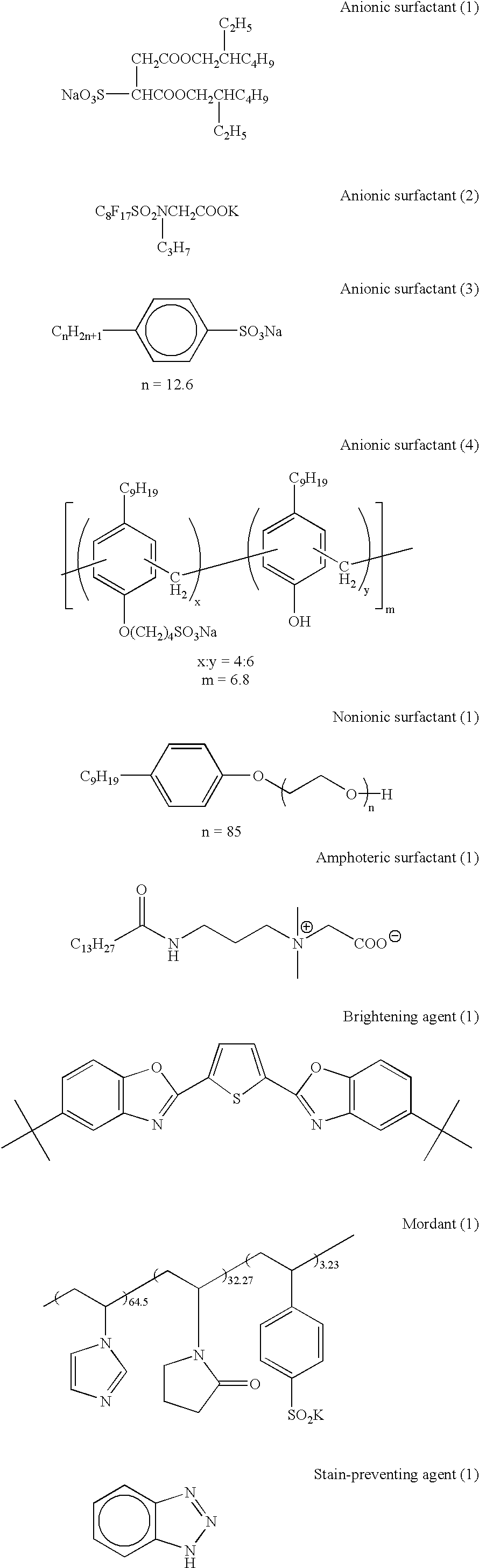

- High-boiling organic solvent (1)
- EMPARA 40 (trade name, C 28H48.9ClT.1 manufactured by Ajinomoto K.K.)
- Water-soluble polymer (1)
- Sumikagel L5-H (trade name, manufactured by Sumitomo Kagaku Co., Ltd.)
- Water-soluble polymer (2)
- Dextran (molecular weight 70,000)
- Water-soluble polymer (3)
- κ(kappa)-Carrageenan (trade name, manufactured by Taito Co.)
- Water-soluble polymer (4) Taito Co.)
- MP Polymer MP-102 (trade name, manufactured by Kuraray Co.)
- Matt agent (1) Kuraray Co.)
- SYLYSIA 431 (trade name, manufactured by Fuji silysia chemical Ltd.)

- Dispersion of latex (1)
- LX-438 (trade name, manufactured by Nippon Zeon Co.)
- High-boiling organic solvent (1)
- Chlorinated paraffin (chlorination ratio: 40%)

- Compound (4)
- CRYSTALEX 1120 (a compound wherein x is 0.1 and y is 0.9 in the formula (1); manufactured by Hercules Inc.)

- An ultraviolet absorber (1) was dispersed using a dispersion medium shown in Table 3. This dispersed product was added to the fifth layer of the dye-fixing element to make the layer as an ultraviolet-absorbing layer. Thus, Dye-fixing elements 101 to 110 were prepared. Among them, Dye-fixing elements 108 to 109 were those according to the present invention, while the others were Comparative Examples for checking the effects of the present invention by comparison. The compound (4) used in the Dye-fixing elements 108 to 110 was a dispersion medium for use in the present invention. As the compound represented by formula (1), Crystalex 1120 (trade name), commercially available from Hercules Inc., was used.
TABLE 3 Kind and addition amount of Color-fading inhibitor and Brightening agent in the dye-fixing material Ultraviolet Dispersion medium absorber* Addition Addition Dye-fixing Amount Amount material Compound (g/m2) (g/m2) 100 None None None 101 High-boiling organic 0.2 0.5 solvent (1) 102 High-boiling organic 0.5 0.5 solvent (1) 103 High-boiling organic 0.7 0.5 solvent (1) 104 High-boiling organic 0.2 0.5 solvent (2) 105 High-boiling organic 0.5 0.5 solvent (2) 106 High-boiling organic 0.2 0.5 solvent (3) 107 High-boiling organic 0.5 0.5 solvent (3) 108 Compound (4) 0.2 0.5 109 Compound (4) 0.5 0.5 110 Compound (4) 0.7 0.5 - Then, a preparation method of a heat-developable color photosensitive material will be explained.
- First, the preparation method of a photosensitive silver halide emulsion will be explained. Photosensitive silver halide emulsion (1) (emulsion for the fifth layer (680 nm light-sensitive layer))
- A (I) solution and a (II) solution having compositions shown in Table 5 were simultaneously added to a vigorously-stirred aqueous solution having a composition shown in Table 4, over 13 minutes. After 10 minutes from the addition, (III) and (IV) solutions having compositions shown in Table 5 were added thereto, over 33 minutes.
TABLE 4 Composition H2O 620 ml Lime-processed gelatin 20 g KBr 0.3 g NaCl 2 g Silver halide solvent {circle over (1)} 0.030 g Sulfuric acid (1N) 16 ml Temperature 45° C. 
-
TABLE 5 Solution Solution Solution Solution Component (I) (II) (III) (IV) AgNO3 30.0 g None 70.0 g None NH4NO3 0.125 g None 0.375 g None KBr None 13.7 g None 44.1 g NaCl None 3.6 g None 2.4 g K2IrCl6 None None None 0.039 mg Total Water to Water to Water to Water to volume make make make make 126 ml 132 ml 254 ml 252 ml - Further, after 13 min from the start of addition of solution (III), 150 ml of an aqueous solution containing 0.350% of sensitizing dye {circle over (1)} was added over 27 min.

- After washing with water and desalting (that was carried out using Settling agent a, at a pH of 4.1) in a usual manner, 22 g of lime-processed ossein gelatin was added, and then, after adjusting the pH and pAg to 6.0 and 7.9 respectively, the chemical sensitization was carried out at 60° C. The compounds used in the chemical sensitization are shown in Table 6. In this way, 630 g of a monodisperse cubic silver chlorobromide emulsion having a deviation coefficient of 10.2% and an average grain size of 0.20 μm was obtained.

TABLE 6 Chemicals used in chemical sensitization Added amount 4-Hydroxy-6-methyl- 0.36 g 1,3,3a,7-tetrazaindene Sodium thiosulfate 6.75 mg Antifoggant {circle over (1)} 0.11 g Antiseptic {circle over (1)} 0.07 g Antiseptic {circle over (2)} 3.13 g 


- Photosensitive silver halide emulsion (2) (emulsion for the third layer (750 nm light-sensitive layer))
- A (I) solution and a (II) solution having compositions shown in Table 8 were simultaneously added to a vigorously-stirred aqueous solution having a composition shown in Table 7, over 18 minutes. After 10 minutes from the addition, (III) and (IV) solutions having compositions shown in Table 8 were added thereto, over 24 minutes.
TABLE 7 Composition H2O 620 ml Lime-processed gelatin 20 g KBr 0.3 g NaCl 2 g Silver halide solvent {circle over (1)} 0.030 g Sulfuric acid (1N) 16 ml Temperature 45° C. -
TABLE 8 Solution Solution Solution Solution Component (I) (II) (III) (IV) AgNO3 30.0 g None 70.0 g None NH4NO3 0.125 g None 0.375 g None KBr None 13.7 g None 44.1 g NaCl None 3.6 g None 2.4 g K4[Fe(CN)6 ].H2O None None None 0.065 g K2IrCl6 None None None 0.040 mg Total Water to Water to Water to Water to volume make make make make 188 ml 188 ml 250 ml 250 ml - After washing with water and desalting (that was carried out using the above-described Settling Agent b at a pH of 3.9) in a usual manner, 22 g of lime-processed ossein gelatin from which calcium had been removed (the calcium content: 150 ppm or less) was added, re-dispersing was made at 40° C., 0.39 g of 4-hydroxy-6-methyl-1,3,3a,7-tetrazaindene was added, and the pH and pAg were adjusted to 5.9 and 7.8 respectively. Thereafter, the chemical sensitization was carried out at 70° C. The compounds used in the chemical sensitization are shown in Table 9. At the end of the chemical sensitization, Sensitizing Dye {circle over (2)} in the form of a methanol solution (the solution having the composition shown in Table 10) was added. After the chemical sensitization, the temperature was lowered to 40° C. and then 200 g of a gelatin dispersion of the later-described Stabilizer {circle over (1)} was added, followed by stirring well, and kept in a casing. In this way, 938 g of a monodisperse cubic silver chlorobromide emulsion having a deviation coefficient of 12.6% and an average grain size of 0.25 μm was obtained.
TABLE 9 Chemicals used in chemical Added sensitization amount 4-Hydroxy-6-methyl- 0.39 g 1,3,3a,7-tetrazaindene Triethylthiourea 3.3 mg Nucleic acid decomposition 0.39 g product NaCl 0.15 g KI 0.12 g Antifoggant {circle over (2)} 0.10 g Antiseptic {circle over (1)} 0.07 g -
TABLE 10 Composition of dye solution Added amount Sensitizing dye {circle over (2)} 0.19 g Methanol 18.7 ml -

- Photosensitive silver halide emulsion (3) (emulsion for the first layer (810 nm light-sensitive layer))
- A (I) solution and a (II) solution having compositions shown in Table 12 were simultaneously added to a vigorously-stirred aqueous solution having a composition shown in Table 11, over 18 minutes. After 10 minutes from the addition, (III) and (IV) solutions having compositions shown in Table 12 were added thereto over 24 minutes.
TABLE 11 Composition H2O 620 ml Lime-processed gelatin 20 g KBr 0.3 g NaCl 2 g Silver halide solvent {circle over (1)} 0.030 g Sulfuric acid (1N) 16 ml Temperature 50° C. -
TABLE 12 Solution Solution Solution Solution (I) (II) (III) (IV) AgNO3 30.0 g None 70.0 g None KBr None 13.7 g None 44.1 g NaCl None 3.62 g None 2.4 g K2IrCl6 None None None 0.020 mg Total Water to Water to Water to Water to volume make make make make 180 ml 181 ml 242 ml 250 ml - After washing with water and desalting (that was carried out using Settling Agent a, at a pH of 3.8) in a usual manner, 22 g of lime-processed ossein gelatin was added, and after adjusting the pH and pAg to 7.4 and 7.8 respectively, the chemical sensitization was carried out at 60° C. The compounds used in the chemical sensitization are shown in Table 13. The yield of the resulting emulsion was 683 g. The emulsion was a monodispersion cubic silver chlorobromide emulsion of which the variation coefficient was 9.7% and the average grain size was 0.32 μm.
TABLE 13 Chemicals used in chemical Added sensitization amount 4-Hydroxy-6-methyl-1,3,3a,7- 0.38 g tetrazaindene Triethylthiourea 3.10 mg Antifoggant {circle over (2)} 0.19 g Antiseptic {circle over (1)} 0.07 g Antiseptic {circle over (2)} 3.13 g - Next, the preparation method of a silver chloride fine-grain, to be added to the first layer (810 nm light-sensitive layer), is described below.
- A (I) solution and a (II) solution having compositions shown in Table 15 were simultaneously added to a vigorously-stirred aqueous solution having a composition shown in Table 14, over 4 minutes. After 3 minutes from the addition, (III) and (IV) solutions having compositions shown in Table 15 were added thereto, over 8 minutes.
TABLE 14 Composition H2O 3770 ml Lime-processed gelatin 60 g NaCl 0.8 g 38° C. -
TABLE 15 Solution Solution Solution Solution (I) (II) (III) (IV) AgNO3 300 g None 300 g None NH4NO3 10 g None 10 g None NaCl None 108 g None 104 g Total Water to Water to Water to Water to volume make make make make 940 ml 940 ml 1170 ml 1080 ml - After washing with water and desalting (that was carried out using Settling Agent a at a pH of 3.9) in a usual manner, 132 g of lime-processed gelatin was added, re-dispersing was made at 35° C., 4 g of 4-hydroxy-6-methyl-1,3,3a,7-tetrazaindene was added, and the pH was adjusted to 5.7. The yield of the resulting silver chloride fine-grain emulsion was 3,200 g, whose average grain size was 0.10 μm.
- Next, the preparation method of a gelatin dispersion of colloidal silver is described below.
- To a well-stirred aqueous solution having the composition shown in Table 16, was added a solution having the composition shown in Table 17, over 24 min. Thereafter, the washing with water using Settling Agent a was carried out, then 43 g of lime-processed ossein gelatin was added, and the pH was adjusted to 6.3. In this way, 512 g of a dispersion having average grain size of 0.02 μm, and containing silver 2% and gelatin 6.8% was obtained.
TABLE 16 Composition H2O 620 ml Dextrin 16 g NaOH (5N) 41 ml Temperature 30° C. -
TABLE 17 Composition H2O 135 ml AgNO3 17 g - Then, the preparation methods of gelatin dispersions of hydrophobic additives are described.
- Gelatin dispersions of a yellow-dye-providing compound, a magenta-dye-providing compound, and a cyan-dye-providing compound, whose formulations are shown in Table 18, were prepared, respectively. That is, the oil phase components were dissolved by heating to about 70° C., to form a uniform solution, and to the resultant solution, were added the aqueous phase components that had been heated to about 60° C., followed by stirring to mix and dispersing by a homogenizer for 10 min at 10,000 rpm. To the resultant dispersion, was added additional water, followed by stirring, to obtain a uniform dispersion. Furthermore, the resultant gelatin dispersion of the cyan dye-providing compound was repeatedly diluted with water and concentrated using an ultrafiltration module (ultrafiltration module: ACV-3050, trade name, made by Asahi Chemical Co., Ltd.), so that the amount of ethyl acetate would be 1/17.6 of the amount thereof shown in Table 18.
TABLE 18 Composition of dispersion (mg/m2) Yel- Magen- low ta Cyan Oil Cyan-dye-providing compound None None 4.45 phase Magenta-dye-providing compound None 5.27 None Yellow-dye-providing compound {circle over (1)} 1.68 None None Yellow-dye-providing compound {circle over (2)} 4.03 None None Reducing agent {circle over (1)} 0.47 0.06 0.29 Antifoggant {circle over (3)} 0.1 None 0.06 Antifoggant {circle over (4)} None 0.21 None Surfactant {circle over (1)} 0.6 0.23 0.45 High-boiling solvent {circle over (1)} 0.84 None 1.34 High-boiling solvent {circle over (2)} 2.01 2.63 4.47 High-boiling solvent {circle over (3)} None None None Development accelerator {circle over (1)} 1.01 None None Dye (a) 0.59 None 0.14 Water 0.19 None 0.3 Ethyl acetate 10 16 16 Aqueous Lime-processed gelatin 5.5 3.1 2.4 phase Calcium nitrate 0.05 0.04 None Surfactant {circle over (1)} None None None Sodium hydroxide aq. soln. (1 N) None None 0.07 Carboxymethyl cellulose None None 31 Water 35 31 40 Water (after emulsification) 40 43 0.03 Antiseptic {circle over (1)} 0.003 0.002 None - A gelatin dispersion of Antifoggant {circle over (4)}, whose formulation is shown in Table 19, was prepared. That is, the oil phase components were dissolved by heating to about 60° C. to form a solution, and to the resultant solution, were added the aqueous phase components that had been heated to about 60° C., and after stirring and mixing them, the resultant mixture was dispersed for 10 min at 10,000 rpm by a homogenizer, to obtain a uniform dispersion.
TABLE 19 Composition of dispersion Oil Antifoggant {circle over (4)} 0.8 g phase Reducing agent {circle over (1)} 0.1 g High-boiling 2.3 g solvent {circle over (2)} High-boiling 0.2 g solvent {circle over (5)} Surfactant {circle over (1)} 0.5 g Surfactant {circle over (4)} 0.5 g Ethyl acetate 10.0 ml Aqueous Lime-processed 10.0 g phase gelatin Antiseptic {circle over (1)} 0.004 g Calcium nitrate 0.1 g Water 35.0 ml Additional Water 46.0 ml - A gelatin dispersion of High-boiling solvent 12, whose formulation is shown in Table 20, was prepared. That is, the oil phase components were dissolved by heating to about 60° C. to form a solution, and to the resultant solution, were added the aqueous phase components that had been heated to about 60° C., and after stirring and mixing them, the resultant mixture was dispersed for 10 min at 10,000 rpm by a homogenizer, to obtain a uniform dispersion.
TABLE 20 Composition of dispersion Oil High-boiling organic solvent {circle over (2)} 9.1 g phase High-boiling organic solvent {circle over (5)} 0.2 g Surfactant {circle over (1)} 0.5 g Surfactant {circle over (4)} 0.5 g Ethyl acetate 10.0 ml Aqueous Acid-processed gelatin 10.0 g phase Antiseptic {circle over (1)} 0.004 g Calcium nitrate 0.1 g Water 74.0 ml Additional water 104.0 ml - A gelatin dispersion of Reducing Agent {circle over (2)}, whose formulation is shown in Table 21, was prepared. That is, the oil phase components were dissolved by heating to about 60° C. to form a solution, and to the resultant solution, were added the aqueous phase components that had beep heated to about 60° C., and after stirring and mixing them, the resultant mixture was dispersed for 10 min at 10,000 rpm by a homogenizer, to obtain a uniform dispersion. From the thus-obtained dispersion, ethyl acetate was removed off using a vacuum organic solvent removing apparatus.
TABLE 21 Composition of dispersion Oil Reducing agent {circle over (2)} 7.5 g phase High-boiling solvent {circle over (1)} 4.7 g Surfactant {circle over (1)} 1.9 g Ethyl acetate 14.4 ml Aqueous Acid-processed gelatin 10.0 g phase Antiseptic {circle over (1)} 0.02 g Antiseptic {circle over (4)} 0.04 g Sodium hydrogensulfite 0.1 g Water 136.7 ml - A dispersion of Polymer Latex a, whose formulation is shown in Table 22, was prepared. That is, while a mixed solution of Polymer Latex a, Surfactant {circle over (5)}, and water, whose amounts are shown in Table 22, was stirred, Anionic Surfactant {circle over (6)} was added thereto, over 10 min, to obtain a uniform dispersion. The resulting dispersion was repeatedly diluted with water and concentrated using an ultrafiltration module (Ultrafiltration Module: ACV-3050, trade name, manufactured by Asahi Chemical Industry Co., Ltd.), to bring the salt concentration of the dispersion to 1/9, thereby obtaining a dispersion.
TABLE 22 Composition of dispersion Polymer Latex a aqueous 108.0 ml solution (solid content 13%) Surfactant {circle over (5)} 20.0 g Anionic surfactant {circle over (6)} aqueous 600.0 ml solution (5%) Water 1232.0 ml - A gelatin dispersion of Stabilizer {circle over (1)}, whose formulation is shown in Table 23, was prepared. That is, the oil phase components were dissolved at room temperature to form a solution, and to the resultant solution, were added the aqueous phase components that had been heated to about 40° C., and after stirring and mixing them, the resultant mixture was dispersed for 10 min at 10,000 rpm by a homogenizer. To the resultant dispersion, was added additional water, followed by stirring, thereby obtaining a uniform dispersion.
TABLE 23 Composition of dispersion Oil Stabilizer {circle over (1)} 4.0 g phase Sodium hydroxide 0.3 g Methanol 62.8 g High-boiling solvent {circle over (2)} 0.9 g Aqueous Gelatin from which calcium 10 g phase had been removed (Ca content 100 ppm or less) Antiseptic {circle over (1)} 0.04 g Water 320.5 ml - A gelatin dispersion of zinc hydroxide was prepared according to the formulation shown in Table 24. That is, after the components were mixed and dissolved, dispersing was carried out for 30 min in a mill, using glass beads having an average particle diameter of 0.75 mm. Then the glass beads were separated and removed off, to obtain a uniform dispersion. (Zinc hydroxide having an average grain size of 0.25 μm was used.)
TABLE 24 Composition of dispersion Zinc hydroxide 15.9 g Carboxymethyl cellulose 0.7 g Poly(sodium acrylate) 0.07 g Lime-processed gelatin 4.2 g Water 100 ml High-boiling solvent {circle over (2)} 0.4 g - The preparation method of a gelatin dispersion of a matt agent that was to be added to the protective layer is described below.
- A solution containing PMMA dissolved in methylene chloride was added, together with a small amount of a surfactant, to gelatin, and they were stirred and dispersed at high speed. Then the methylene chloride was removed off using a vacuum solvent removing apparatus, to obtain a uniform dispersion having an average particle size of 4.3 μm.


- Using the above materials, a heat-developable color photosensitive material shown in Tables 25 was prepared.
TABLE 25 Constitution of Main Materials of Heat- Developable Photosensitive Material Number of Name of Coating amount layer layer Additive (mg/m2) Seventh Protective Acid-processed gelatin 378 layer layer Reducing agent {circle over (2)} 70 High-boiling solvent {circle over (1)} 44 Colloidal silver grain 2 Matt agent (PMMA resin) 17 Surfactant {circle over (1)} 19 Surfactant {circle over (2)} 16 Surfactant {circle over (3)} 2 Surfactant {circle over (4)} 12 Surfactant {circle over (6)} 17 Polymer Latex a 14 Calcium nitrate 5 Sixth Intermediate Lime-processed gelatin 882 layer layer Zinc hydroxide 577 Antifoggant {circle over (4)} 18 Reducing agent {circle over (1)} 2 High-boiling solvent {circle over (2)} 54 High-boiling solvent {circle over (5)} 6 Surfactant {circle over (1)} 11 Surfactant {circle over (2)} 0.5 Surfactant {circle over (7)} 11 Water-soluble polymer {circle over (1)} 5 Calcium nitrate 17 Fifth 680 nm- Lime-processed gelatin 428 layer light- Light-sensitive silver 287 sensitive halide emulsion (1) layer Magenta-dye-providing 487 compound High-boiling solvent {circle over (2)} 244 Reducing agent {circle over (1)} 6 Antifoggant {circle over (4)} 20 Surfactant {circle over (1)} 22 Water-soluble polymer {circle over (1)} 11 Fourth Intermediate Lime-processed gelatin 416 layer layer Zinc hydroxide 271 Antifoggant {circle over (4)} 8 Reducing agent {circle over (1)} 1 High-boiling solvent {circle over (2)} 25 High-boiling solvent {circle over (5)} 3 Surfactant {circle over (1)} 5 Surfactant {circle over (2)} 0.3 Surfactant {circle over (7)} 5 Water-soluble polymer {circle over (1)} 2 Calcium nitrate 8 Third 750 nm- Lime-processed gelatin 404 layer light- Light-sensitive silver 184 sensitive halide emulsion (2) layer Stabilizer {circle over (1)} 8 Cyan-dye-providing 428 compound Dye (a) 13 High-boiling solvent {circle over (1)} 128 High-boiling solvent {circle over (2)} 429 High-boiling solvent {circle over (3)} — Reducing agent {circle over (1)} 28 Antifoggant {circle over (3)} 5 Surfactant {circle over (1)} 43 Carboxymethyl cellulose 7 Water-soluble polymer {circle over (1)} 9 Second Intermediate Lime-processed gelatin 708 layer layer Antifoggant {circle over (5)} 4 Surfactant {circle over (2)} 2 Surfactant {circle over (5)} 104 Water-soluble polymer {circle over (2)} 14 Calcium nitrate 5 First 810 nm- Lime-processed gelatin 569 layer light- Light-sensitive silver 330 sensitive halide emulsion (3) layer Fine-grain silver chloride 30 emulsion Stabilizer {circle over (1)} 8 Yellow-dye-providing 119 compound {circle over (1)} Yellow-dye-providing 285 compound {circle over (2)} Sensitizing dye {circle over (3)} 0.1 Dye (a) 42 High-boiling solvent {circle over (1)} 59 High-boiling solvent {circle over (2)} 143 Surfactant {circle over (1)} 41 Reducing agent {circle over (1)} 33 Development accelerator {circle over (1)} 71 Antifoggant {circle over (3)} 6 Water-soluble polymer {circle over (2)} 41 Hardener {circle over (1)} 45 - Image-Forming Method
- The dye-fixing elements 100 to 110 were each combined with the above-mentioned photosensitive material, and each combination was subjected to maximum exposure and development, using a printer sold under the trade name PICTROGRAPHY 3000 by Fuji Photo Film Co., Ltd., to yield a black solid image wherein Y, M and C components were color-developed up to maximum densities.
- Light Fastness Evaluation
- Light-fading tests for the dye-fixing elements 100 to 110 were performed under the following conditions:
- Fading tester: Weather-O-meter 65WRC (trade name), manufactured by ATLAS Co.;
- Cycle: Light (100000 Lux)/Dark=3.8 hr/i hr; and
- Filter: none.
- An X-rite 310TR (trade name) manufactured by X-rite Co. was used to measure the cyan reflection densities in the black solid image portion before the fading test and after the fading test of 2 weeks. Thus, dye-remaining rates after the color-fading test were calculated from the equation shown later. The values are shown in Table 26. In Table 26, the symbol “x” is attached to each of the dye-fixing elements that were substantially unsatisfactory for practical use, and the symbol “◯” is attached to each of the dye-fixing elements that were satisfactory for practical use.
- [Dye-remaining rate]=[reflection density after the fading test]/[reflection density before the fading test]
- Film Strength Evaluation
- The surface of each of the dye-fixing elements 100 to 110, which was obtained by the above-mentioned image-forming method, was subjected to a scratch test under the conditions shown below. The results are shown in Table 26. In Table 26, the symbol “x” is attached to each of the dye-fixing elements that substantially unsatisfactory for practical use, and the symbol “◯” is attached to each of the dye-fixing elements that were satisfactory for practical use.
- Scratch tester: continuous load type scratching tester TYPE 18, made by Shinto Scientific Co., Ltd.;
- Scratching conditions: sapphire needle (diameter, 0.5 mm), a load of 0 to 100 g; and
- Environment: 25° C./50% RH
TABLE 26 Results of light fastness and scratch tests of images obtained by dye- fixing elements Cyan dye Ratio of Total weight remaining Dye- dispersion of ultraviolet Scratch- rate (%), fixing Dis- medium/ absorber and ing test Fastness ele- persion ultraviolet dispersion results evaluation ment medium absorber medium * ** 100 Com- None — 0.0 g/m2 70 g 47% para- ◯ x tive example 101 Com- High- 40% 0.7 g/m2 15 g 82% para- boiling x ◯ tive organic example solvent (1) 102 Com- High- 100% 1.0 g/m2 5 g 81% para- boiling x ◯ tive organic example solvent (1) 103 Com- High- 140% 1.2 g/m2 0 g 90% para- boiling x ◯ tive organic example solvent (1) 104 Com- High- 40% 0.7 g/m2 20 g 85% para- boiling x ◯ tive organic example solvent (2) 105 Com- High- 100% 1.0 g/m2 10 g 83% para- boiling x ◯ tive organic example solvent (2) 106 Com- High- 40% 0.7 g/m2 10 g 80% para- boiling x ◯ tive organic example solvent (3) 107 Com- High- 100% 1.0 g/m2 0 g 82% para- boiling x ◯ tive organic example solvent (3) 108 The Com- 40% 0.7 g/m2 70 g 85% present pound ◯ ◯ in- (1) vention 109 The Com- 100% 1.0 g/m2 95 g 83% present pound ◯ ◯ in- (1) vention 110 Com- Com- 140% 1.2 g/m2 40 g 89% para- pound x ◯ tive (1) example - It can be understood from the above-mentioned results that the dye-fixing elements of the present invention produced a smaller undesired effect on diffusion transfer, and had a higher dye-remaining rate in the fading test, and superior film strength, than the comparative dye-fixing elements.
- Having described our invention as related to the present embodiments, it is our intention that the invention not be limited by any of the details of the description, unless otherwise specified, but rather be construed broadly within its spirit and scope as set out in the accompanying claims.
Claims (11)


Applications Claiming Priority (2)
| Application Number | Priority Date | Filing Date | Title |
|---|---|---|---|
| JP2001338534 | 2001-11-02 | ||
| JP2001-338534 | 2001-11-02 |
Publications (2)
| Publication Number | Publication Date |
|---|---|
| US20030194637A1 true US20030194637A1 (en) | 2003-10-16 |
| US6689533B2 US6689533B2 (en) | 2004-02-10 |
Family
ID=28786076
Family Applications (1)
| Application Number | Title | Priority Date | Filing Date |
|---|---|---|---|
| US10/284,141 Expired - Fee Related US6689533B2 (en) | 2001-11-02 | 2002-10-31 | Dye-fixing element for color diffusion transfer process, and image-forming method using the same |
Country Status (1)
| Country | Link |
|---|---|
| US (1) | US6689533B2 (en) |
Families Citing this family (1)
| Publication number | Priority date | Publication date | Assignee | Title |
|---|---|---|---|---|
| US6831712B1 (en) * | 2003-05-27 | 2004-12-14 | Eastman Kodak Company | Polymer-dispersed liquid-crystal display comprising an ultraviolet blocking layer and methods for making the same |
Family Cites Families (5)
| Publication number | Priority date | Publication date | Assignee | Title |
|---|---|---|---|---|
| GB890861A (en) * | 1959-01-14 | 1962-03-07 | Polaroid Corp | Coloured photographic image protection and product therefor |
| CH533853A (en) | 1970-03-23 | 1973-02-15 | Ciba Geigy Ag | Use of 2'-hydroxyphenyl-1,3,5-triazines as stabilizers against ultraviolet radiation in photographic material |
| JPS57157245A (en) | 1981-03-23 | 1982-09-28 | Fuji Photo Film Co Ltd | Photographic sensitive material for color diffustion transfer method |
| JPS61153638A (en) | 1984-12-07 | 1986-07-12 | Fuji Photo Film Co Ltd | Dye fixing material |
| US5919552A (en) * | 1997-05-07 | 1999-07-06 | Xerox Corporation | Coated substrates and methods |
-
2002
- 2002-10-31 US US10/284,141 patent/US6689533B2/en not_active Expired - Fee Related
Also Published As
| Publication number | Publication date |
|---|---|
| US6689533B2 (en) | 2004-02-10 |
Similar Documents
| Publication | Publication Date | Title |
|---|---|---|
| EP0443529B1 (en) | Photographic materials containing polysaccharides | |
| JPH0251496B2 (en) | ||
| US6689533B2 (en) | Dye-fixing element for color diffusion transfer process, and image-forming method using the same | |
| US5716775A (en) | Heat-developable color light-sensitive material | |
| JPH11125889A (en) | Method for enhancing light-fastness of image and image forming material | |
| JP3153380B2 (en) | Thermal development color photosensitive material | |
| DE69229328T2 (en) | Image fixing system | |
| US6268105B1 (en) | Dye-fixing element and image-forming method, using a specific dye-mordant | |
| DE69426902T2 (en) | Diffusion transfer type heat-developable color light-sensitive material and process for producing a color image | |
| JP2824720B2 (en) | Thermal development diffusion transfer type color photosensitive material | |
| JP3563173B2 (en) | Thermal development color photosensitive material | |
| JP3556715B2 (en) | Thermal development color photosensitive material | |
| JP2003202655A (en) | Dye fixing element for color diffusion transfer process and image forming method using the same | |
| US5558973A (en) | Heat-developable color light-sensitive material and method for producing the same | |
| EP0926551B1 (en) | Heat developable color photographic material and image-forming system using the same | |
| US6410217B2 (en) | Heat-developable color light-senitive material | |
| US5773189A (en) | Image formation process | |
| JP3619298B2 (en) | Image forming material | |
| JP3563151B2 (en) | Thermal development color photosensitive material | |
| JP3037853B2 (en) | Thermal development color photosensitive material | |
| JP2000347374A (en) | Dye fixing element | |
| JPH0720620A (en) | Heat developable color photosensitive material | |
| JPH09325461A (en) | Pigment fixing element used for color diffusion transfer method and color diffusion transfer photographic material using the same | |
| JPH01161335A (en) | Heat developable photosensitive material | |
| JP2003066575A (en) | Image forming method and dye fixing element |
Legal Events
| Date | Code | Title | Description |
|---|---|---|---|
| AS | Assignment |
Owner name: FUJI PHOTO FILM CO., LTD., JAPAN Free format text: ASSIGNMENT OF ASSIGNORS INTEREST;ASSIGNOR:IRITA, KIYOSHI;REEL/FRAME:013450/0257 Effective date: 20021022 |
|
| FEPP | Fee payment procedure |
Free format text: PAYOR NUMBER ASSIGNED (ORIGINAL EVENT CODE: ASPN); ENTITY STATUS OF PATENT OWNER: LARGE ENTITY |
|
| AS | Assignment |
Owner name: FUJIFILM CORPORATION, JAPAN Free format text: ASSIGNMENT OF ASSIGNORS INTEREST;ASSIGNOR:FUJIFILM HOLDINGS CORPORATION (FORMERLY FUJI PHOTO FILM CO., LTD.);REEL/FRAME:018904/0001 Effective date: 20070130 Owner name: FUJIFILM CORPORATION,JAPAN Free format text: ASSIGNMENT OF ASSIGNORS INTEREST;ASSIGNOR:FUJIFILM HOLDINGS CORPORATION (FORMERLY FUJI PHOTO FILM CO., LTD.);REEL/FRAME:018904/0001 Effective date: 20070130 |
|
| FPAY | Fee payment |
Year of fee payment: 4 |
|
| REMI | Maintenance fee reminder mailed | ||
| LAPS | Lapse for failure to pay maintenance fees | ||
| STCH | Information on status: patent discontinuation |
Free format text: PATENT EXPIRED DUE TO NONPAYMENT OF MAINTENANCE FEES UNDER 37 CFR 1.362 |
|
| FP | Lapsed due to failure to pay maintenance fee |
Effective date: 20120210 |