US20030192092P1 - Strawberry plant named 'ps-3546' - Google Patents
Strawberry plant named 'ps-3546' Download PDFInfo
- Publication number
- US20030192092P1 US20030192092P1 US10/392,885 US39288503V US2003192092P1 US 20030192092 P1 US20030192092 P1 US 20030192092P1 US 39288503 V US39288503 V US 39288503V US 2003192092 P1 US2003192092 P1 US 2003192092P1
- Authority
- US
- United States
- Prior art keywords
- fruit
- medium
- strong
- foliage
- mean
- Prior art date
- Legal status (The legal status is an assumption and is not a legal conclusion. Google has not performed a legal analysis and makes no representation as to the accuracy of the status listed.)
- Granted
Links
- 244000307700 Fragaria vesca Species 0.000 title 1
- 240000009088 Fragaria x ananassa Species 0.000 claims abstract description 4
- 235000013399 edible fruits Nutrition 0.000 abstract description 46
- 241001164374 Calyx Species 0.000 abstract description 11
- 229930002877 anthocyanin Natural products 0.000 abstract description 7
- 235000010208 anthocyanin Nutrition 0.000 abstract description 7
- 239000004410 anthocyanin Substances 0.000 abstract description 7
- 150000004636 anthocyanins Chemical class 0.000 abstract description 7
- 230000037393 skin firmness Effects 0.000 abstract description 3
- 241000196324 Embryophyta Species 0.000 description 22
- 241001466077 Salina Species 0.000 description 10
- 238000004519 manufacturing process Methods 0.000 description 5
- 235000011363 Fragaria x ananassa Nutrition 0.000 description 3
- 240000001140 Mimosa pudica Species 0.000 description 3
- 239000000796 flavoring agent Substances 0.000 description 3
- 235000019634 flavors Nutrition 0.000 description 3
- 241001573881 Corolla Species 0.000 description 2
- 241000700605 Viruses Species 0.000 description 2
- 230000007613 environmental effect Effects 0.000 description 2
- 238000003780 insertion Methods 0.000 description 2
- 230000037431 insertion Effects 0.000 description 2
- 230000000644 propagated effect Effects 0.000 description 2
- 230000005070 ripening Effects 0.000 description 2
- 239000007787 solid Substances 0.000 description 2
- 241001124076 Aphididae Species 0.000 description 1
- 241000221785 Erysiphales Species 0.000 description 1
- 241000220223 Fragaria Species 0.000 description 1
- 235000016623 Fragaria vesca Nutrition 0.000 description 1
- 241000238631 Hexapoda Species 0.000 description 1
- 241000365764 Scirtothrips dorsalis Species 0.000 description 1
- 241001454293 Tetranychus urticae Species 0.000 description 1
- 241000607479 Yersinia pestis Species 0.000 description 1
- 230000011681 asexual reproduction Effects 0.000 description 1
- 238000013465 asexual reproduction Methods 0.000 description 1
- 235000021028 berry Nutrition 0.000 description 1
- 238000009395 breeding Methods 0.000 description 1
- 230000001488 breeding effect Effects 0.000 description 1
- 238000006243 chemical reaction Methods 0.000 description 1
- 239000003086 colorant Substances 0.000 description 1
- 230000018109 developmental process Effects 0.000 description 1
- 201000010099 disease Diseases 0.000 description 1
- 208000037265 diseases, disorders, signs and symptoms Diseases 0.000 description 1
- 210000004209 hair Anatomy 0.000 description 1
- 238000005259 measurement Methods 0.000 description 1
- 230000033458 reproduction Effects 0.000 description 1
- 239000002689 soil Substances 0.000 description 1
- 241000894007 species Species 0.000 description 1
- 230000017260 vegetative to reproductive phase transition of meristem Effects 0.000 description 1
Images




Classifications
-
- A—HUMAN NECESSITIES
- A01—AGRICULTURE; FORESTRY; ANIMAL HUSBANDRY; HUNTING; TRAPPING; FISHING
- A01H—NEW PLANTS OR NON-TRANSGENIC PROCESSES FOR OBTAINING THEM; PLANT REPRODUCTION BY TISSUE CULTURE TECHNIQUES
- A01H6/00—Angiosperms, i.e. flowering plants, characterised by their botanic taxonomy
- A01H6/74—Rosaceae, e.g. strawberry, apple, almonds, pear, rose, blackberries or raspberries
- A01H6/749—Rosa, i.e. roses
-
- A—HUMAN NECESSITIES
- A01—AGRICULTURE; FORESTRY; ANIMAL HUSBANDRY; HUNTING; TRAPPING; FISHING
- A01H—NEW PLANTS OR NON-TRANSGENIC PROCESSES FOR OBTAINING THEM; PLANT REPRODUCTION BY TISSUE CULTURE TECHNIQUES
- A01H5/00—Angiosperms, i.e. flowering plants, characterised by their plant parts; Angiosperms characterised otherwise than by their botanic taxonomy
- A01H5/08—Fruits
Definitions
- the present invention relates to a new and distinct overbearing strawberry variety designated as ‘PS-3546’.
- This new variety is a result of a controlled cross made in 1995 between ‘PS-592’ (U.S. Plant Pat. No. 9,903) and ‘PS-1150’ (U.S. Plant Pat. No. 10,780).
- the variety is botanically known as Fragaria ananassa. The new variety was discovered by the inventors, Stephen M. Ackerman, Steven D. Nelson, and Michael D. Nelson.
- ‘PS-3546’ is primarily adapted to the climate and growing conditions of the central coast of California. This region provides the necessary winter temperatures required for it to produce a strong vigorous plant and to remain in fruit production from April through November. The nearby Pacific Ocean provides the needed humidity and moderate temperatures to maintain fruit quality during the spring and summer production months.
- the following list of traits in combination define ‘PS-3546’ as a unique variety distinguishing it from other closely related commercial varieties in the region:
- ‘PS-3546’ differs by the following combination of characteristics.
- the plant of ‘PS-3546’ is smaller in size as compared to ‘PS-592’.
- the foliage is smaller in size, lighter in color with slightly more interveinal leaf blistering.
- the fruit of ‘PS-3546’ is smaller in size, firmer with a darker internal and external color as compared to ‘PS-592’.
- the difference in shape between primary and secondary fruit is greater between ‘PS-3546’ than ‘PS-592’.
- the seeds of ‘PS-3546’ tend to be slightly more above the surface of the fruit as compared to ‘PS-592.
- the fruiting trusses tend to be slightly shorter in length with more anthocyanin than ‘PS-592.
- the fruit and flowers of ‘PS-3546’ tend to be more visible above the plant as compared to ‘PS-592’.
- ‘PS-3546’ differs by the following combination of characteristics.
- the plant of ‘PS-3546’ is slightly larger in size as compared to ‘PS-1150’.
- the foliage is darker in color, larger in size, stronger in interveinal leaf blistering, stronger in gloss with deeper serrations. Bract leaflets are similar in size yet tend to occur much more often on the petioles.
- the fruit of ‘PS-3546’ is larger in size with better overall flavor than ‘PS-1150’.
- the calyx segments tend to be slightly more reflexed with a greater difference in shape between primaries and secondaries as compared to ‘PS-1150’.
- the seeds of ‘PS-3546’ tend to be slightly more above the surface of the fruit as compared to ‘PS-1150’.
- ‘PS-3546’ differs by the following combination of characteristics.
- the plant of ‘PS-3546’ is slightly smaller in size as compared to ‘PS-1269’.
- the foliage. is slightly stronger in interveinal leaf blistering, stronger in gloss, darker in color, with deeper serrations.
- the length to width ratio of the terminal leaflet is longer than broad to much longer than broad as compared to as long as broad for ‘PS-1269’.
- the foliage of ‘PS-3546 is much flatter in cross section as compared to ‘PS-1269’ which tends to be strongly concave.
- the fruit of ‘PS-3546’ is smaller in size and stronger in overall gloss with better appearance ratings than ‘PS-1269’.
- the internal flesh color is darker.
- the seeds of ‘PS-3546’ tend to be slightly more above the surface of the fruit while the calyx segments tend to be more reflexed.
- the fruiting trusses of ‘PS-3546’ tend to be similar in overall length with more anthocyanin as compared to ‘PS-1269’.
- FIG. 1 shows typical fruiting field characteristics on Jun. 10, 2002.
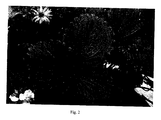
- FIG. 2 shows a close-up view of a typical mature tri-foliate on Jul. 3, 2002.
- FIG. 3 shows typical mature and immature field fruit on Jun. 10, 2002.
- FIG. 4 shows a close-up view of fruit on Jul. 1, 2002.
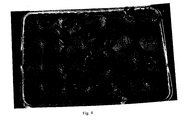
- FIG. 5 shows typical internal and external fruit characteristics on Aug. 1, 2002.
- ‘PS-3546’ fruit, fruit production and fruit quality characteristics Fruit characteristics are taken from secondary fruit on a first year planting. TABLE 1 1999-2002 market fruit yield, fruit size and runner production characteristics of ‘PS-3546’ from Salinas, California. 1999-2002 1999-2002 1999-2002 Average Average Average April/May Total Fruit 1999-2002 Yield Yield Size Average Cultivar GM/PL GM/PL GRM Runners/PL ‘PS-3546’ 193 1,556 22.7 1.5 ‘PS-592’ 255 1,633 24.3 0.4 ‘PS-1150’ 138 1,327 18.8 0.5 ‘PS-1269’ 263 1,454 24.7 0.4
- Receptacle color — whitish (N9.25/84.2%R to N9/78.7%R).
- Seed color dark yellow to moderate red (5Y 5/6 to 7.5R 2/8).
- Time of flowering (50% of plants at first flower ).—early.
- Time of ripening (50% of plants with first ripe fruit ).—early.
- Time of ripening length of time from flower to maturity ).—28.6 days in mid summer.
- ‘PS-3546’ plant characteristics Plant characteristics are taken from a fully mature mid season plant. TABLE 4 Comparison of plant characteristics of ‘PS-3546’, with standards from Salinas, California, Jul. 13, 2002. Character ‘PS-3546’ ‘PS-592’ ‘PS-1150’ ‘PS-1269’ Plant Height 25.5 34.1 26.4 27.6 mean (cm) Plant Spread 30.1 35.4 28.2 30.7 mean (cm) Crowns/Plant (mean) 5.5 6.3 5.2 3.8
- Density medium to dense.
- ‘PS-3546’ foliage characteristics Foliage characteristics are taken from a fully mature tri-foliate during mid season. TABLE 5 Comparison of leaf characteristics of ‘PS-3546’, with standards from Salinas, California, Jun. 13, 2002. Character ‘PS-3546’ ‘PS-592’ ‘PS-1150’ ‘PS-1269’ Munsell Color Range 7.5GY 3/4 to 2/4 7.5GY 4/4 to 3/4 7.5GY 4/4 to 3/4 7.5GY 3/4 to 3/6 (upper surface) Terminal Leaflet Length 9.3 10.0 7.9 8.4 mean (cm) Terminal Leaflet Width 7.9 8.6 6.9 8.5 mean (cm) Terminal Leaflet 1.18 1.20 1.10 1.00 ratio(L/W) Petiole Length 17.2 20.8 18.9 18.6 mean (cm) Petiole Width 4.9 5.4 4.1 4.7 mean (mm) Petiolule Length 8.3 12.1 9.2 12.9 mean (mm) Serrations/Leaf 19.6 20.1 21.0 22.6 Serration
- Color of under side. medium gray green (7.5GY 5/4 to 6/4).
- Terminal Leaflet [0072] Terminal Leaflet
- Length/width ratio longer than broad to much longer than broad.
- ‘PS-3546’ inflorescence and flower characteristics are taken from a fully mature plant during mid season. Flower characteristics are taken from a secondary flower during mid season at full maturity: TABLE 6 Comparison of inflorescence and secondary flower characteristics of ‘PS-3546’, with standards from Salinas, California, Jun. 12, 2002.
- Anthocyanin moderate to strong.
- This new variety may not be resistant to any of the known insects, diseases or viruses common in California. It is known to be moderately susceptible to the two-spotted spider mite and aphid and may be slightly more susceptible to flower thrips. It is also known to be moderately susceptible to grey fruit mold and slightly susceptible to powdery mildew. The susceptibility of the new variety to any of the virus complexes of California has not been determined.
Landscapes
- Life Sciences & Earth Sciences (AREA)
- Health & Medical Sciences (AREA)
- Physiology (AREA)
- Botany (AREA)
- Developmental Biology & Embryology (AREA)
- Environmental Sciences (AREA)
- Natural Medicines & Medicinal Plants (AREA)
- Breeding Of Plants And Reproduction By Means Of Culturing (AREA)
- Cultivation Of Plants (AREA)
Abstract
This invention relates to a new and distinct everbearing variety of strawberry plant named ‘PS-3546’ primarily adapted to the growing conditions of the central coast of California. The new variety is primarily characterized by medium to dark green foliage, strong interveinal leaf blistering, strong leaf gloss, medium to large foliage, longer than to much longer than broad terminal leaf, deep serrations, strong stipule and stolon anthocyanin colorations, conical fruit shape, moderate to marked differences in shape between primaries and secondaries, narrow to medium band without achenes, very good fruit gloss and skin firmness, seeds slightly set above the fruit surface, calyx which tends to be slightly reflexed and fruit and flowers characteristically above the foliage.
Description
- Latin name of the genus and species of the plant claimed: Fragaria ananassa
- Variety Denomination: Strawberry Plant Named ‘PS-3546’
- The present invention relates to a new and distinct overbearing strawberry variety designated as ‘PS-3546’. This new variety is a result of a controlled cross made in 1995 between ‘PS-592’ (U.S. Plant Pat. No. 9,903) and ‘PS-1150’ (U.S. Plant Pat. No. 10,780). The variety is botanically known as Fragaria ananassa. The new variety was discovered by the inventors, Stephen M. Ackerman, Steven D. Nelson, and Michael D. Nelson.
- The seedling resulting from the aforementioned cross was asexually propagated by stolons in a nursery located in Siskiyou County, California, and was subsequently selected from a controlled breeding plot in Salinas, Calif. in 1997. After its selection, the new variety was further asexually propagated in both Siskiyou County, California and San Joaquin County, California by stolons. The new variety was then extensively tested over the next several years in the fruiting fields of Salinas, Calif. This propagation has demonstrated that the combination of traits disclosed herein as characterizing the new variety are fixed and remain true to type through successive generations of asexual reproduction.
- ‘PS-3546’ is primarily adapted to the climate and growing conditions of the central coast of California. This region provides the necessary winter temperatures required for it to produce a strong vigorous plant and to remain in fruit production from April through November. The nearby Pacific Ocean provides the needed humidity and moderate temperatures to maintain fruit quality during the spring and summer production months. The following list of traits in combination define ‘PS-3546’ as a unique variety distinguishing it from other closely related commercial varieties in the region:
- 1. Medium to dark green foliage, strong interveinal leaf blistering, strong leaf gloss, medium to large foliage, longer than to much longer than broad terminal leaf, deep serrations;
- 2. strong stipule and stolon anthocyanin colorations,
- 3. conical fruit shape, moderate to marked differences in shape between primaries and secondaries, narrow to medium band without achenes, very good fruit gloss and skin firmness, seeds slightly set above the fruit surface;
- 4. calyx which tends to be slightly reflexed; and
- 5. fruit and flowers characteristically above the foliage.
- The varieties which are believed to be most closely related to ‘PS-3546’ are ‘PS-592’, ‘PS-1150’ and ‘PS-1269’ (U.S. Plant Pat. No. 10,686).
- In comparison to the parental variety, ‘PS-592’, ‘PS-3546’ differs by the following combination of characteristics. The plant of ‘PS-3546’ is smaller in size as compared to ‘PS-592’. The foliage is smaller in size, lighter in color with slightly more interveinal leaf blistering. The fruit of ‘PS-3546’ is smaller in size, firmer with a darker internal and external color as compared to ‘PS-592’. The difference in shape between primary and secondary fruit is greater between ‘PS-3546’ than ‘PS-592’. The seeds of ‘PS-3546’ tend to be slightly more above the surface of the fruit as compared to ‘PS-592. The fruiting trusses tend to be slightly shorter in length with more anthocyanin than ‘PS-592. The fruit and flowers of ‘PS-3546’ tend to be more visible above the plant as compared to ‘PS-592’.
- In comparison to the parental variety, ‘PS-1150’, ‘PS-3546’ differs by the following combination of characteristics. The plant of ‘PS-3546’ is slightly larger in size as compared to ‘PS-1150’. The foliage is darker in color, larger in size, stronger in interveinal leaf blistering, stronger in gloss with deeper serrations. Bract leaflets are similar in size yet tend to occur much more often on the petioles. The fruit of ‘PS-3546’ is larger in size with better overall flavor than ‘PS-1150’. The calyx segments tend to be slightly more reflexed with a greater difference in shape between primaries and secondaries as compared to ‘PS-1150’. The seeds of ‘PS-3546’ tend to be slightly more above the surface of the fruit as compared to ‘PS-1150’.
- In comparison to the similar variety, ‘PS-1269’, ‘PS-3546’ differs by the following combination of characteristics. The plant of ‘PS-3546’ is slightly smaller in size as compared to ‘PS-1269’. The foliage. is slightly stronger in interveinal leaf blistering, stronger in gloss, darker in color, with deeper serrations. The length to width ratio of the terminal leaflet is longer than broad to much longer than broad as compared to as long as broad for ‘PS-1269’. The foliage of ‘PS-3546 is much flatter in cross section as compared to ‘PS-1269’ which tends to be strongly concave. The fruit of ‘PS-3546’ is smaller in size and stronger in overall gloss with better appearance ratings than ‘PS-1269’. The internal flesh color is darker. The seeds of ‘PS-3546’ tend to be slightly more above the surface of the fruit while the calyx segments tend to be more reflexed. The fruiting trusses of ‘PS-3546’ tend to be similar in overall length with more anthocyanin as compared to ‘PS-1269’.
- For identification a series of molecular markers have been determined for this new variety.
- The accompanying color photographs show typical specimens of the new variety at various stages of development as nearly true as it is possible to make in color reproductions the depicted plant and plant parts were approximately 7 to 9 months old.
- FIG. 1 shows typical fruiting field characteristics on Jun. 10, 2002.
- FIG. 2 shows a close-up view of a typical mature tri-foliate on Jul. 3, 2002.
- FIG. 3 shows typical mature and immature field fruit on Jun. 10, 2002.
- FIG. 4 shows a close-up view of fruit on Jul. 1, 2002.
- FIG. 5 shows typical internal and external fruit characteristics on Aug. 1, 2002.
- The following description of ‘PS-3546’ unless otherwise noted, is based on observations taken during the 2002 growing season in Salinas, Calif. These measurements and ratings were taken from plants dug from a high-elevation nursery located in Siskiyou County, California during the middle of October 2001 and planted approximately 3 weeks later in Salinas, Calif. The approximate age of the observed plants is 7 to 8 months. Yield observations and fruit quality characteristics are averaged from data collected during the 1999 through 2002 production seasons. The characteristics of the new variety may vary in detail, depending upon variations in environmental factors, including weather (temperature, humidity and light intensity), day length, soil type and location. ‘PS-3546’ has not been observed under all possible environmental conditions. Color terminology where noted follows the Munsell Book of Colors, Munsell Color, Baltimore, Md. (1976).
- ‘PS-3546’ fruit, fruit production and fruit quality characteristics. Fruit characteristics are taken from secondary fruit on a first year planting.
TABLE 1 1999-2002 market fruit yield, fruit size and runner production characteristics of ‘PS-3546’ from Salinas, California. 1999-2002 1999-2002 1999-2002 Average Average Average April/May Total Fruit 1999-2002 Yield Yield Size Average Cultivar GM/PL GM/PL GRM Runners/PL ‘PS-3546’ 193 1,556 22.7 1.5 ‘PS-592’ 255 1,633 24.3 0.4 ‘PS-1150’ 138 1,327 18.8 0.5 ‘PS-1269’ 263 1,454 24.7 0.4 -
TABLE 2 Comparison of secondary fruit characteristics of ‘PS-3546’, with standards from Salinas, California, Jun. 13, 2002. Character ‘PS-3546’ ‘PS-592’ ‘PS-1150’ ‘PS-1269’ Munsell Color Range 7.5 R 3/87.5 R 3/127.5 R 4/107.5 R 3/10Mature Fruit to 4/10 to 4/12 to 3/8 to 4/10 Fruit Length 4.11 3.95 3.79 4.13 mean (cm)* Fruit Width 4.05 4.02 3.86 3.95 mean (cm)* Fruit Length/Width Ratio 1.01 0.98 1.05 1.29 Calyx Diameter 5.6 5.4 5.1 5.2 mean (cm) No. Sepals/Berry 13.8 14.1 14.7 14.2 Seed Weight 0.58 0.6 0.5 0.6 mean (mgs) -
TABLE 3 Comparison of 1999-2002 fruit quality characteristics, including flavor and soluble solids of ‘PS-3546’, with standards from Salinas, California. Character ‘P5-3546’ ‘PS-592’ ‘PS-1150’ ‘PS-1269’ Skin Firmness* 8.4 7.7 8.3 8.1 Fruit Appearance* 8.0 7.9 8.2 7.3 Fruit Gloss* 8.1 8.2 8.5 7.2 Flavor** 3.1 3.4 3.0 3.2 Soluble Solids*** 9.0 10.0 8.1 9.6 - Fruit:
- Ratio of length/width.—as long as broad.
- Size.—medium.
- Predominant shape.—conical.
- Difference in shapes between primary and secondary fruit.—moderate to marked.
- Band without achenes.—narrow to medium.
- Unevenness of surface.—weak to medium.
- Color of mature fruit.—red.
- Color of immature fruit.—medium whitish yellow (10Y 8/4 to 7/6).
- Evenness of color.—slightly uneven to even.
- Glossiness.—strong.
- Insertion of achenes.—level with to above surface.
- Insertion of calyx.—level with to in the basin.
- Attitude of the calyx segments.—spreading to reflexed.
- Size of calyx in relation to fruit diameter.—slightly to much larger.
- Adherence of calyx (when fully ripe).—strong.
- Firmness of skin.—strong.
- Firmness of flesh.—firm.
- Color of flesh.—medium red (7.5
R 4/10 to 4/12). - Distribution of red color of the flesh.—marginal to central.
- Hollow center.—weakly to strongly expressed.
- Receptacle color.—whitish (N9.25/84.2%R to N9/78.7%R).
- Seed color.—dark yellow to moderate red (5Y 5/6 to 7.5R 2/8).
- Time of flowering (50% of plants at first flower).—early.
- Time of ripening (50% of plants with first ripe fruit).—early.
- Time of ripening (length of time from flower to maturity).—28.6 days in mid summer.
- Type of bearing.—fully remontant.
- ‘PS-3546’ plant characteristics. Plant characteristics are taken from a fully mature mid season plant.
TABLE 4 Comparison of plant characteristics of ‘PS-3546’, with standards from Salinas, California, Jul. 13, 2002. Character ‘PS-3546’ ‘PS-592’ ‘PS-1150’ ‘PS-1269’ Plant Height 25.5 34.1 26.4 27.6 mean (cm) Plant Spread 30.1 35.4 28.2 30.7 mean (cm) Crowns/Plant (mean) 5.5 6.3 5.2 3.8 - Plant:
- Size.—medium.
- Habit.—globose.
- Density.—medium to dense.
- Vigor.—medium.
- Stolons:
- Number.—medium.
- Anthocyanin coloration.—very strong.
- Thickness.—very thick.
- Pubescence.—medium to strong.
- ‘PS-3546’ foliage characteristics. Foliage characteristics are taken from a fully mature tri-foliate during mid season.
TABLE 5 Comparison of leaf characteristics of ‘PS-3546’, with standards from Salinas, California, Jun. 13, 2002. Character ‘PS-3546’ ‘PS-592’ ‘PS-1150’ ‘PS-1269’ Munsell Color Range 7.5 GY 3/4 to 2/47.5 GY 4/4 to 3/47.5 GY 4/4 to 3/47.5 GY 3/4 to 3/6(upper surface) Terminal Leaflet Length 9.3 10.0 7.9 8.4 mean (cm) Terminal Leaflet Width 7.9 8.6 6.9 8.5 mean (cm) Terminal Leaflet 1.18 1.20 1.10 1.00 ratio(L/W) Petiole Length 17.2 20.8 18.9 18.6 mean (cm) Petiole Width 4.9 5.4 4.1 4.7 mean (mm) Petiolule Length 8.3 12.1 9.2 12.9 mean (mm) Serrations/Leaf 19.6 20.1 21.0 22.6 Serration Depth 7.7 7.7 5.0 5.5 mean (mm) Stipule Length 3.1 3.0 3.2 2.9 mean (cm) Stipule Width 1.9 1.7 1.8 2.0 mean (cm) - Foliage:
- Color of upper surface.—medium to dark green.
- Color of under side.—medium gray green (7.5GY 5/4 to 6/4).
- Shape in cross section.—slightly concave to flat.
- Blistering.—medium to strong.
- Glossiness.—medium to strong.
- Number of leaflets/leaf.—three.
- Terminal Leaflet:
- Size.—medium to large.
- Length/width ratio.—longer than broad to much longer than broad.
- Shape of base.—obtuse.
- Shape of incision of margins.—obtuse.
- Depth of serrations.—deep.
- Petiole:
- Pubescence.—sparse.
- Stipule color.—light to medium green.
- Anthocyanin coloration of stipule.—strong to very strong.
- Attitude of hairs.—slightly outward to strongly outward.
- Size of bract leaflets.—small.
- Frequency of bract leaflets.—occur on approximately 40% of the petioles.
- ‘PS-3546’ inflorescence and flower characteristics. Inflorescence characteristic are taken from a fully mature plant during mid season. Flower characteristics are taken from a secondary flower during mid season at full maturity:
TABLE 6 Comparison of inflorescence and secondary flower characteristics of ‘PS-3546’, with standards from Salinas, California, Jun. 12, 2002. Character ‘P5-3546’ ‘PS-592’ ‘Ps-1150’ ‘PS-1269’ Fruiting Truss Length* 34.2 35.6 32.7 33.7 mean (cm) Corolla Diameter 31 31 30 30 mean (mm) Calyx Diameter 42 38 39 39 mean (mm) Petal Length 1.3 1.3 1.3 1.1 mean (mm) Petal Width 1.2 1.4 1.2 1.2 mean (mm) Petal L/W Ratio 1.08 0.93 1.08 0.92 Petals/Flower (mean) 6.8 6.7 7.1 7.1 Sepal Length 19 16 16 14 mean (mm) Sepal Width 6 5 6 7 mean (mm) Sepal L/W Ratio 3.2 3.2 2.7 2.0 Sepals/Flower (mean) 13.0 13.1 12.8 13.9 Stamens/Flower (mean) 28.5 31.2 30.8 27.3 Pistils/Flower (mean) 642 561 415 689 - Inflorescence:
- Position relative to foliage.—above.
- Pubescence.—medium.
- Anthocyanin.—moderate to strong.
- Number of bract leaflets per truss.—1 to 2.
- Size of bract leaflets.—medium to large.
- Fruiting truss length.—medium.
- Flowers:
- Color.—white.
- Size.—medium.
- Size of calyx relative to corolla.—larger.
- Relative position of petals (observed on flowers with 5 or 6 petals).—overlapping.
- Petal length/width ratio.—longer than broad.
- Pest Reactions:
- This new variety may not be resistant to any of the known insects, diseases or viruses common in California. It is known to be moderately susceptible to the two-spotted spider mite and aphid and may be slightly more susceptible to flower thrips. It is also known to be moderately susceptible to grey fruit mold and slightly susceptible to powdery mildew. The susceptibility of the new variety to any of the virus complexes of California has not been determined.
Claims (1)
1. A new and distinct strawberry plant named ‘PS-3546’, as herein described and illustrated by the characteristics set forth above.
Priority Applications (1)
| Application Number | Priority Date | Filing Date | Title |
|---|---|---|---|
| US10/392,885 USPP14446P3 (en) | 2002-03-29 | 2003-03-21 | Strawberry plant named ‘PS-3546’ |
Applications Claiming Priority (2)
| Application Number | Priority Date | Filing Date | Title |
|---|---|---|---|
| US36816602P | 2002-03-29 | 2002-03-29 | |
| US10/392,885 USPP14446P3 (en) | 2002-03-29 | 2003-03-21 | Strawberry plant named ‘PS-3546’ |
Publications (2)
| Publication Number | Publication Date |
|---|---|
| US20030192092P1 true US20030192092P1 (en) | 2003-10-09 |
| USPP14446P3 USPP14446P3 (en) | 2004-01-06 |
Family
ID=28678218
Family Applications (1)
| Application Number | Title | Priority Date | Filing Date |
|---|---|---|---|
| US10/392,885 Expired - Lifetime USPP14446P3 (en) | 2002-03-29 | 2003-03-21 | Strawberry plant named ‘PS-3546’ |
Country Status (1)
| Country | Link |
|---|---|
| US (1) | USPP14446P3 (en) |
-
2003
- 2003-03-21 US US10/392,885 patent/USPP14446P3/en not_active Expired - Lifetime
Also Published As
| Publication number | Publication date |
|---|---|
| USPP14446P3 (en) | 2004-01-06 |
Similar Documents
| Publication | Publication Date | Title |
|---|---|---|
| USPP11639P (en) | Strawberry plant named `Alisal` | |
| US20170006747P1 (en) | Strawberry plant named 'PE-7.2059' | |
| USPP20394P3 (en) | Strawberry plant named ‘VALOR’ | |
| USPP17312P2 (en) | Strawberry plant named ‘PS-5016’ | |
| USPP31148P2 (en) | Strawberry plant named ‘BG-9.3128’ | |
| USPP21415P3 (en) | Strawberry plant named ‘Reliance’ | |
| USPP14446P3 (en) | Strawberry plant named ‘PS-3546’ | |
| USPP14447P3 (en) | Strawberry plant named ‘PS-3523’ | |
| USPP14445P3 (en) | Strawberry plant named ‘PS-3395’ | |
| USPP17725P3 (en) | Strawberry plant name ‘BG-1975’ | |
| USPP14457P3 (en) | Strawberry plant named ‘PS-3456’ | |
| USPP15597P3 (en) | Strawberry plant named PS-2880 | |
| USPP17487P2 (en) | Strawberry plant named ‘PS-4634’ | |
| USPP23291P2 (en) | Strawberry plant named ‘PS-3.108’ | |
| USPP33475P2 (en) | Strawberry plant named ‘Nina’ | |
| USPP33512P2 (en) | Strawberry plant named ‘Pinta’ | |
| USPP33476P2 (en) | Strawberry plant named ‘SANTA MARIA’ | |
| USPP32017P2 (en) | Strawberry plant named ‘BG-9.3147’ | |
| USPP32193P3 (en) | Strawberry plant named ‘CIVRL333’ | |
| USPP32436P2 (en) | Strawberry plant named ‘PS-10.1160’ | |
| USPP17864P3 (en) | Strawberry plant named ‘BG-959’ | |
| USPP32435P2 (en) | Strawberry plant named ‘BG-10.3169’ | |
| USPP31913P2 (en) | Strawberry plant named ‘PE-7.2054’ | |
| USPP13320P2 (en) | Strawberry plant named ‘BG-633’ | |
| USPP23255P2 (en) | Strawberry plant named ‘BG-4316’ |
Legal Events
| Date | Code | Title | Description |
|---|---|---|---|
| AS | Assignment |
Owner name: PLANT SCIENCES, INC., CALIFORNIA Free format text: ASSIGNMENT OF ASSIGNORS INTEREST;ASSIGNORS:ACKERMAN, STEPHEN M.;NELSON, STEVEN D.;NELSON, MICHAEL D.;REEL/FRAME:013900/0004 Effective date: 20030311 Owner name: BERRY R&D, INC., CALIFORNIA Free format text: ASSIGNMENT OF ASSIGNORS INTEREST;ASSIGNORS:ACKERMAN, STEPHEN M.;NELSON, STEVEN D.;NELSON, MICHAEL D.;REEL/FRAME:013900/0004 Effective date: 20030311 |