US20030191312A1 - Kinase inhibitor scaffolds and methods for their preparation - Google Patents
Kinase inhibitor scaffolds and methods for their preparation Download PDFInfo
- Publication number
- US20030191312A1 US20030191312A1 US10/270,030 US27003002A US2003191312A1 US 20030191312 A1 US20030191312 A1 US 20030191312A1 US 27003002 A US27003002 A US 27003002A US 2003191312 A1 US2003191312 A1 US 2003191312A1
- Authority
- US
- United States
- Prior art keywords
- substituted
- group
- compound
- alkyl
- aryl
- Prior art date
- Legal status (The legal status is an assumption and is not a legal conclusion. Google has not performed a legal analysis and makes no representation as to the accuracy of the status listed.)
- Granted
Links
- 238000000034 method Methods 0.000 title claims description 145
- 229940043355 kinase inhibitor Drugs 0.000 title description 12
- 239000003757 phosphotransferase inhibitor Substances 0.000 title description 12
- 238000002360 preparation method Methods 0.000 title description 10
- 125000001072 heteroaryl group Chemical group 0.000 claims abstract description 47
- 150000001412 amines Chemical group 0.000 claims abstract description 34
- -1 C2-substituted purine compound Chemical class 0.000 claims description 126
- 150000001875 compounds Chemical class 0.000 claims description 117
- KDLHZDBZIXYQEI-UHFFFAOYSA-N Palladium Chemical compound [Pd] KDLHZDBZIXYQEI-UHFFFAOYSA-N 0.000 claims description 81
- 125000000623 heterocyclic group Chemical group 0.000 claims description 63
- 229920005989 resin Polymers 0.000 claims description 56
- 239000011347 resin Substances 0.000 claims description 56
- 125000003118 aryl group Chemical group 0.000 claims description 54
- 125000000217 alkyl group Chemical group 0.000 claims description 49
- 125000000561 purinyl group Chemical class N1=C(N=C2N=CNC2=C1)* 0.000 claims description 47
- 238000006243 chemical reaction Methods 0.000 claims description 38
- 239000002904 solvent Substances 0.000 claims description 36
- 238000005859 coupling reaction Methods 0.000 claims description 35
- 229910052763 palladium Inorganic materials 0.000 claims description 35
- 239000003054 catalyst Substances 0.000 claims description 34
- 125000001309 chloro group Chemical group Cl* 0.000 claims description 34
- 239000003446 ligand Substances 0.000 claims description 34
- KDCGOANMDULRCW-UHFFFAOYSA-N Purine Natural products N1=CNC2=NC=NC2=C1 KDCGOANMDULRCW-UHFFFAOYSA-N 0.000 claims description 33
- 239000002585 base Substances 0.000 claims description 33
- 229910052736 halogen Inorganic materials 0.000 claims description 33
- 125000000547 substituted alkyl group Chemical group 0.000 claims description 33
- 150000003839 salts Chemical class 0.000 claims description 32
- 150000002367 halogens Chemical class 0.000 claims description 31
- 125000001424 substituent group Chemical group 0.000 claims description 30
- 239000001257 hydrogen Substances 0.000 claims description 29
- 229910052739 hydrogen Inorganic materials 0.000 claims description 29
- 238000006467 substitution reaction Methods 0.000 claims description 25
- HZVOZRGWRWCICA-UHFFFAOYSA-N methanediyl Chemical compound [CH2] HZVOZRGWRWCICA-UHFFFAOYSA-N 0.000 claims description 22
- 125000003107 substituted aryl group Chemical group 0.000 claims description 21
- 125000005843 halogen group Chemical group 0.000 claims description 17
- 125000004404 heteroalkyl group Chemical group 0.000 claims description 17
- 125000004435 hydrogen atom Chemical group [H]* 0.000 claims description 16
- YXFVVABEGXRONW-UHFFFAOYSA-N Toluene Chemical compound CC1=CC=CC=C1 YXFVVABEGXRONW-UHFFFAOYSA-N 0.000 claims description 15
- 125000001153 fluoro group Chemical group F* 0.000 claims description 15
- PAYRUJLWNCNPSJ-UHFFFAOYSA-N Aniline Chemical compound NC1=CC=CC=C1 PAYRUJLWNCNPSJ-UHFFFAOYSA-N 0.000 claims description 14
- 239000010949 copper Substances 0.000 claims description 12
- RYGMFSIKBFXOCR-UHFFFAOYSA-N Copper Chemical compound [Cu] RYGMFSIKBFXOCR-UHFFFAOYSA-N 0.000 claims description 11
- 238000005804 alkylation reaction Methods 0.000 claims description 11
- 125000003710 aryl alkyl group Chemical group 0.000 claims description 11
- 125000001246 bromo group Chemical group Br* 0.000 claims description 11
- 229910052802 copper Inorganic materials 0.000 claims description 11
- OPQARKPSCNTWTJ-UHFFFAOYSA-L copper(ii) acetate Chemical group [Cu+2].CC([O-])=O.CC([O-])=O OPQARKPSCNTWTJ-UHFFFAOYSA-L 0.000 claims description 11
- 125000005842 heteroatom Chemical group 0.000 claims description 11
- 230000001404 mediated effect Effects 0.000 claims description 11
- 125000004433 nitrogen atom Chemical group N* 0.000 claims description 11
- RYHBNJHYFVUHQT-UHFFFAOYSA-N 1,4-Dioxane Chemical compound C1COCCO1 RYHBNJHYFVUHQT-UHFFFAOYSA-N 0.000 claims description 10
- 125000000592 heterocycloalkyl group Chemical group 0.000 claims description 10
- 229910052757 nitrogen Inorganic materials 0.000 claims description 10
- 125000001997 phenyl group Chemical group [H]C1=C([H])C([H])=C(*)C([H])=C1[H] 0.000 claims description 10
- 239000000126 substance Substances 0.000 claims description 10
- 230000029936 alkylation Effects 0.000 claims description 9
- 150000001543 aryl boronic acids Chemical class 0.000 claims description 9
- FJDQFPXHSGXQBY-UHFFFAOYSA-L caesium carbonate Chemical group [Cs+].[Cs+].[O-]C([O-])=O FJDQFPXHSGXQBY-UHFFFAOYSA-L 0.000 claims description 9
- 239000007822 coupling agent Substances 0.000 claims description 9
- 125000002346 iodo group Chemical group I* 0.000 claims description 9
- LWIHDJKSTIGBAC-UHFFFAOYSA-K tripotassium phosphate Chemical group [K+].[K+].[K+].[O-]P([O-])([O-])=O LWIHDJKSTIGBAC-UHFFFAOYSA-K 0.000 claims description 9
- 125000004178 (C1-C4) alkyl group Chemical group 0.000 claims description 8
- ISWSIDIOOBJBQZ-UHFFFAOYSA-N Phenol Chemical compound OC1=CC=CC=C1 ISWSIDIOOBJBQZ-UHFFFAOYSA-N 0.000 claims description 7
- 125000003545 alkoxy group Chemical group 0.000 claims description 7
- 239000000460 chlorine Substances 0.000 claims description 7
- 239000008194 pharmaceutical composition Substances 0.000 claims description 7
- 229910000024 caesium carbonate Inorganic materials 0.000 claims description 6
- 230000000269 nucleophilic effect Effects 0.000 claims description 6
- LFSXCDWNBUNEEM-UHFFFAOYSA-N phthalazine Chemical class C1=NN=CC2=CC=CC=C21 LFSXCDWNBUNEEM-UHFFFAOYSA-N 0.000 claims description 6
- 150000003216 pyrazines Chemical class 0.000 claims description 6
- 150000003230 pyrimidines Chemical class 0.000 claims description 6
- 150000003246 quinazolines Chemical class 0.000 claims description 6
- 150000003252 quinoxalines Chemical class 0.000 claims description 6
- 125000004169 (C1-C6) alkyl group Chemical group 0.000 claims description 5
- LFQSCWFLJHTTHZ-UHFFFAOYSA-N Ethanol Chemical compound CCO LFQSCWFLJHTTHZ-UHFFFAOYSA-N 0.000 claims description 5
- 125000002252 acyl group Chemical group 0.000 claims description 5
- 238000005917 acylation reaction Methods 0.000 claims description 5
- 229910052801 chlorine Inorganic materials 0.000 claims description 5
- 229940076286 cupric acetate Drugs 0.000 claims description 5
- 238000006073 displacement reaction Methods 0.000 claims description 5
- 125000001449 isopropyl group Chemical group [H]C([H])([H])C([H])(*)C([H])([H])[H] 0.000 claims description 5
- 239000000651 prodrug Substances 0.000 claims description 5
- 229940002612 prodrug Drugs 0.000 claims description 5
- 125000004191 (C1-C6) alkoxy group Chemical group 0.000 claims description 4
- MYHNUQVKTSTVDI-UHFFFAOYSA-N 2-methyl-2-[(2-methylpropan-2-yl)oxy]propane;potassium Chemical group [K].CC(C)(C)OC(C)(C)C MYHNUQVKTSTVDI-UHFFFAOYSA-N 0.000 claims description 4
- UFHFLCQGNIYNRP-UHFFFAOYSA-N Hydrogen Chemical compound [H][H] UFHFLCQGNIYNRP-UHFFFAOYSA-N 0.000 claims description 4
- YNAVUWVOSKDBBP-UHFFFAOYSA-N Morpholine Chemical group C1COCCN1 YNAVUWVOSKDBBP-UHFFFAOYSA-N 0.000 claims description 4
- ZADPBFCGQRWHPN-UHFFFAOYSA-N boronic acid Chemical compound OBO ZADPBFCGQRWHPN-UHFFFAOYSA-N 0.000 claims description 4
- 239000003937 drug carrier Substances 0.000 claims description 4
- 239000012038 nucleophile Substances 0.000 claims description 4
- 229910000160 potassium phosphate Inorganic materials 0.000 claims description 4
- 235000011009 potassium phosphates Nutrition 0.000 claims description 4
- 125000000229 (C1-C4)alkoxy group Chemical group 0.000 claims description 3
- ZAMOUSCENKQFHK-UHFFFAOYSA-N Chlorine atom Chemical compound [Cl] ZAMOUSCENKQFHK-UHFFFAOYSA-N 0.000 claims description 3
- 230000010933 acylation Effects 0.000 claims description 3
- 125000001797 benzyl group Chemical group [H]C1=C([H])C([H])=C(C([H])=C1[H])C([H])([H])* 0.000 claims description 3
- 150000004677 hydrates Chemical class 0.000 claims description 3
- 238000010534 nucleophilic substitution reaction Methods 0.000 claims description 3
- 150000004892 pyridazines Chemical class 0.000 claims description 3
- 230000002194 synthesizing effect Effects 0.000 claims description 3
- 125000006552 (C3-C8) cycloalkyl group Chemical group 0.000 claims description 2
- 125000006570 (C5-C6) heteroaryl group Chemical group 0.000 claims description 2
- 150000002431 hydrogen Chemical class 0.000 claims 9
- ZUOUZKKEUPVFJK-UHFFFAOYSA-N diphenyl Chemical compound C1=CC=CC=C1C1=CC=CC=C1 ZUOUZKKEUPVFJK-UHFFFAOYSA-N 0.000 claims 2
- 125000001624 naphthyl group Chemical group 0.000 claims 2
- 235000010290 biphenyl Nutrition 0.000 claims 1
- 239000004305 biphenyl Substances 0.000 claims 1
- 125000001626 borono group Chemical group [H]OB([*])O[H] 0.000 claims 1
- 125000004076 pyridyl group Chemical group 0.000 claims 1
- 239000012453 solvate Substances 0.000 claims 1
- 150000001448 anilines Chemical class 0.000 abstract description 19
- 150000002989 phenols Chemical class 0.000 abstract description 16
- 125000005620 boronic acid group Chemical class 0.000 abstract description 14
- 238000010651 palladium-catalyzed cross coupling reaction Methods 0.000 abstract description 11
- 239000012071 phase Substances 0.000 abstract description 11
- 238000010532 solid phase synthesis reaction Methods 0.000 abstract description 6
- 238000007080 aromatic substitution reaction Methods 0.000 abstract description 3
- 238000007429 general method Methods 0.000 abstract description 2
- 0 *[2*](N[1*])C1=CC=CC=C1.*[2*](N[1*])N([4*])C1=CC=CC=C1.*[2*](N[1*])N([4*])[5*].*[2*](N[1*])OC1=CC=CC=C1.[3*]C.[3*]C.[3*]C Chemical compound *[2*](N[1*])C1=CC=CC=C1.*[2*](N[1*])N([4*])C1=CC=CC=C1.*[2*](N[1*])N([4*])[5*].*[2*](N[1*])OC1=CC=CC=C1.[3*]C.[3*]C.[3*]C 0.000 description 98
- YMWUJEATGCHHMB-UHFFFAOYSA-N Dichloromethane Chemical compound ClCCl YMWUJEATGCHHMB-UHFFFAOYSA-N 0.000 description 49
- 125000000524 functional group Chemical group 0.000 description 45
- HEDRZPFGACZZDS-MICDWDOJSA-N Trichloro(2H)methane Chemical compound [2H]C(Cl)(Cl)Cl HEDRZPFGACZZDS-MICDWDOJSA-N 0.000 description 44
- OKKJLVBELUTLKV-UHFFFAOYSA-N Methanol Chemical compound OC OKKJLVBELUTLKV-UHFFFAOYSA-N 0.000 description 42
- XKRFYHLGVUSROY-UHFFFAOYSA-N Argon Chemical compound [Ar] XKRFYHLGVUSROY-UHFFFAOYSA-N 0.000 description 30
- 239000000243 solution Substances 0.000 description 25
- ZMXDDKWLCZADIW-UHFFFAOYSA-N N,N-Dimethylformamide Chemical compound CN(C)C=O ZMXDDKWLCZADIW-UHFFFAOYSA-N 0.000 description 24
- 238000005160 1H NMR spectroscopy Methods 0.000 description 23
- QTBSBXVTEAMEQO-UHFFFAOYSA-N Acetic acid Chemical compound CC(O)=O QTBSBXVTEAMEQO-UHFFFAOYSA-N 0.000 description 21
- XYFCBTPGUUZFHI-UHFFFAOYSA-N Phosphine Chemical compound P XYFCBTPGUUZFHI-UHFFFAOYSA-N 0.000 description 20
- 239000000203 mixture Substances 0.000 description 18
- 238000004252 FT/ICR mass spectrometry Methods 0.000 description 17
- 239000007787 solid Substances 0.000 description 16
- 229910052786 argon Inorganic materials 0.000 description 15
- 239000000758 substrate Substances 0.000 description 14
- 239000002253 acid Substances 0.000 description 12
- 239000000047 product Substances 0.000 description 12
- LRHPLDYGYMQRHN-UHFFFAOYSA-N N-Butanol Chemical compound CCCCO LRHPLDYGYMQRHN-UHFFFAOYSA-N 0.000 description 10
- WYURNTSHIVDZCO-UHFFFAOYSA-N Tetrahydrofuran Chemical compound C1CCOC1 WYURNTSHIVDZCO-UHFFFAOYSA-N 0.000 description 10
- 229910000073 phosphorus hydride Inorganic materials 0.000 description 10
- 239000000725 suspension Substances 0.000 description 10
- 229910001868 water Inorganic materials 0.000 description 10
- 125000002496 methyl group Chemical group [H]C([H])([H])* 0.000 description 9
- 150000003254 radicals Chemical class 0.000 description 9
- DTQVDTLACAAQTR-UHFFFAOYSA-N Trifluoroacetic acid Chemical compound OC(=O)C(F)(F)F DTQVDTLACAAQTR-UHFFFAOYSA-N 0.000 description 8
- 125000003277 amino group Chemical group 0.000 description 8
- 238000003776 cleavage reaction Methods 0.000 description 8
- 230000014759 maintenance of location Effects 0.000 description 8
- 230000007017 scission Effects 0.000 description 8
- 238000003786 synthesis reaction Methods 0.000 description 8
- 235000011054 acetic acid Nutrition 0.000 description 7
- 238000006664 bond formation reaction Methods 0.000 description 7
- 239000003795 chemical substances by application Substances 0.000 description 7
- 238000010168 coupling process Methods 0.000 description 7
- 238000004128 high performance liquid chromatography Methods 0.000 description 7
- 230000007935 neutral effect Effects 0.000 description 7
- WEVYAHXRMPXWCK-UHFFFAOYSA-N Acetonitrile Chemical compound CC#N WEVYAHXRMPXWCK-UHFFFAOYSA-N 0.000 description 6
- IJGRMHOSHXDMSA-UHFFFAOYSA-N Atomic nitrogen Chemical compound N#N IJGRMHOSHXDMSA-UHFFFAOYSA-N 0.000 description 6
- UHOVQNZJYSORNB-UHFFFAOYSA-N Benzene Chemical compound C1=CC=CC=C1 UHOVQNZJYSORNB-UHFFFAOYSA-N 0.000 description 6
- ZMANZCXQSJIPKH-UHFFFAOYSA-N Triethylamine Chemical compound CCN(CC)CC ZMANZCXQSJIPKH-UHFFFAOYSA-N 0.000 description 6
- 238000005576 amination reaction Methods 0.000 description 6
- 238000013459 approach Methods 0.000 description 6
- 230000015572 biosynthetic process Effects 0.000 description 6
- 230000008878 coupling Effects 0.000 description 6
- 238000009472 formulation Methods 0.000 description 6
- 239000003112 inhibitor Substances 0.000 description 6
- 238000002347 injection Methods 0.000 description 6
- 239000007924 injection Substances 0.000 description 6
- LPNYRYFBWFDTMA-UHFFFAOYSA-N potassium tert-butoxide Chemical compound [K+].CC(C)(C)[O-] LPNYRYFBWFDTMA-UHFFFAOYSA-N 0.000 description 6
- 150000003141 primary amines Chemical class 0.000 description 6
- 102000004169 proteins and genes Human genes 0.000 description 6
- 108090000623 proteins and genes Proteins 0.000 description 6
- 238000010200 validation analysis Methods 0.000 description 6
- QMMFVYPAHWMCMS-UHFFFAOYSA-N Dimethyl sulfide Chemical compound CSC QMMFVYPAHWMCMS-UHFFFAOYSA-N 0.000 description 5
- 108010010803 Gelatin Proteins 0.000 description 5
- VEXZGXHMUGYJMC-UHFFFAOYSA-N Hydrochloric acid Chemical compound Cl VEXZGXHMUGYJMC-UHFFFAOYSA-N 0.000 description 5
- 102000001253 Protein Kinase Human genes 0.000 description 5
- 229920002472 Starch Polymers 0.000 description 5
- 230000008901 benefit Effects 0.000 description 5
- 239000002775 capsule Substances 0.000 description 5
- 229910052799 carbon Inorganic materials 0.000 description 5
- 125000004432 carbon atom Chemical group C* 0.000 description 5
- 238000001212 derivatisation Methods 0.000 description 5
- 239000012467 final product Substances 0.000 description 5
- 229920000159 gelatin Polymers 0.000 description 5
- 239000008273 gelatin Substances 0.000 description 5
- 235000019322 gelatine Nutrition 0.000 description 5
- 235000011852 gelatine desserts Nutrition 0.000 description 5
- 238000007339 nucleophilic aromatic substitution reaction Methods 0.000 description 5
- 239000000546 pharmaceutical excipient Substances 0.000 description 5
- 235000013855 polyvinylpyrrolidone Nutrition 0.000 description 5
- 239000001267 polyvinylpyrrolidone Substances 0.000 description 5
- 229920000036 polyvinylpyrrolidone Polymers 0.000 description 5
- 238000012746 preparative thin layer chromatography Methods 0.000 description 5
- 125000006239 protecting group Chemical group 0.000 description 5
- 108060006633 protein kinase Proteins 0.000 description 5
- 229910052717 sulfur Inorganic materials 0.000 description 5
- BTTNYQZNBZNDOR-UHFFFAOYSA-N 2,4-dichloropyrimidine Chemical compound ClC1=CC=NC(Cl)=N1 BTTNYQZNBZNDOR-UHFFFAOYSA-N 0.000 description 4
- RMFWVOLULURGJI-UHFFFAOYSA-N 2,6-dichloro-7h-purine Chemical compound ClC1=NC(Cl)=C2NC=NC2=N1 RMFWVOLULURGJI-UHFFFAOYSA-N 0.000 description 4
- CGRYAJPRWWJQQD-UHFFFAOYSA-L CC1=CC(C)=C(N2C=CN(C3=C(C)C=C(C)C=C3C)=C2)C(C)=C1.CC1=CC(C)=C(N2C=N(C3=C(C)C=C(C)C=C3C)CC2)C(C)=C1.FB(F)F.[Cl-].[F-] Chemical compound CC1=CC(C)=C(N2C=CN(C3=C(C)C=C(C)C=C3C)=C2)C(C)=C1.CC1=CC(C)=C(N2C=N(C3=C(C)C=C(C)C=C3C)CC2)C(C)=C1.FB(F)F.[Cl-].[F-] CGRYAJPRWWJQQD-UHFFFAOYSA-L 0.000 description 4
- XTHFKEDIFFGKHM-UHFFFAOYSA-N Dimethoxyethane Chemical compound COCCOC XTHFKEDIFFGKHM-UHFFFAOYSA-N 0.000 description 4
- JGFZNNIVVJXRND-UHFFFAOYSA-N N,N-Diisopropylethylamine (DIPEA) Chemical compound CCN(C(C)C)C(C)C JGFZNNIVVJXRND-UHFFFAOYSA-N 0.000 description 4
- QAOWNCQODCNURD-UHFFFAOYSA-N Sulfuric acid Chemical compound OS(O)(=O)=O QAOWNCQODCNURD-UHFFFAOYSA-N 0.000 description 4
- OIRDTQYFTABQOQ-KQYNXXCUSA-N adenosine Chemical compound C1=NC=2C(N)=NC=NC=2N1[C@@H]1O[C@H](CO)[C@@H](O)[C@H]1O OIRDTQYFTABQOQ-KQYNXXCUSA-N 0.000 description 4
- 125000004429 atom Chemical group 0.000 description 4
- 239000000969 carrier Substances 0.000 description 4
- 125000004122 cyclic group Chemical group 0.000 description 4
- 239000008298 dragée Substances 0.000 description 4
- 238000003818 flash chromatography Methods 0.000 description 4
- 125000004474 heteroalkylene group Chemical group 0.000 description 4
- 125000005647 linker group Chemical group 0.000 description 4
- 239000007788 liquid Substances 0.000 description 4
- 125000004573 morpholin-4-yl group Chemical group N1(CCOCC1)* 0.000 description 4
- 230000003287 optical effect Effects 0.000 description 4
- 150000007524 organic acids Chemical class 0.000 description 4
- 229910052760 oxygen Inorganic materials 0.000 description 4
- 239000003381 stabilizer Substances 0.000 description 4
- 235000019698 starch Nutrition 0.000 description 4
- 238000003756 stirring Methods 0.000 description 4
- 239000003826 tablet Substances 0.000 description 4
- 238000004809 thin layer chromatography Methods 0.000 description 4
- XLYOFNOQVPJJNP-UHFFFAOYSA-N water Substances O XLYOFNOQVPJJNP-UHFFFAOYSA-N 0.000 description 4
- QSRHDECGWFBHKY-UHFFFAOYSA-N 2-(2,4-dimethoxyphenyl)-n-[(4-methoxyphenyl)methyl]-9-propan-2-ylpurin-6-amine Chemical compound C1=CC(OC)=CC=C1CNC1=NC(C=2C(=CC(OC)=CC=2)OC)=NC2=C1N=CN2C(C)C QSRHDECGWFBHKY-UHFFFAOYSA-N 0.000 description 3
- PDMSQJKBAMAEQE-UHFFFAOYSA-N 2-chloro-n-[(4-methoxyphenyl)methyl]-9-propan-2-ylpurin-6-amine Chemical compound C1=CC(OC)=CC=C1CNC1=NC(Cl)=NC2=C1N=CN2C(C)C PDMSQJKBAMAEQE-UHFFFAOYSA-N 0.000 description 3
- VHKWMYIPTRBMHQ-UHFFFAOYSA-N 2-n-(2-fluorophenyl)-6-n-[(4-methoxyphenyl)methyl]-9-propan-2-ylpurine-2,6-diamine Chemical compound C1=CC(OC)=CC=C1CNC1=NC(NC=2C(=CC=CC=2)F)=NC2=C1N=CN2C(C)C VHKWMYIPTRBMHQ-UHFFFAOYSA-N 0.000 description 3
- GUBGYTABKSRVRQ-XLOQQCSPSA-N Alpha-Lactose Chemical compound O[C@@H]1[C@@H](O)[C@@H](O)[C@@H](CO)O[C@H]1O[C@@H]1[C@@H](CO)O[C@H](O)[C@H](O)[C@H]1O GUBGYTABKSRVRQ-XLOQQCSPSA-N 0.000 description 3
- QGZKDVFQNNGYKY-UHFFFAOYSA-O Ammonium Chemical compound [NH4+] QGZKDVFQNNGYKY-UHFFFAOYSA-O 0.000 description 3
- DBJNWDVLSZLQOL-UHFFFAOYSA-N CC(C)N(C)C1=CC=CC=C1 Chemical compound CC(C)N(C)C1=CC=CC=C1 DBJNWDVLSZLQOL-UHFFFAOYSA-N 0.000 description 3
- ZVAXFKMPKLESSD-UHFFFAOYSA-N COC1=CC=C(NC(C)C)C=C1 Chemical compound COC1=CC=C(NC(C)C)C=C1 ZVAXFKMPKLESSD-UHFFFAOYSA-N 0.000 description 3
- FBPFZTCFMRRESA-FSIIMWSLSA-N D-Glucitol Natural products OC[C@H](O)[C@H](O)[C@@H](O)[C@H](O)CO FBPFZTCFMRRESA-FSIIMWSLSA-N 0.000 description 3
- FBPFZTCFMRRESA-JGWLITMVSA-N D-glucitol Chemical compound OC[C@H](O)[C@@H](O)[C@H](O)[C@H](O)CO FBPFZTCFMRRESA-JGWLITMVSA-N 0.000 description 3
- PEDCQBHIVMGVHV-UHFFFAOYSA-N Glycerine Chemical compound OCC(O)CO PEDCQBHIVMGVHV-UHFFFAOYSA-N 0.000 description 3
- DGAQECJNVWCQMB-PUAWFVPOSA-M Ilexoside XXIX Chemical compound C[C@@H]1CC[C@@]2(CC[C@@]3(C(=CC[C@H]4[C@]3(CC[C@@H]5[C@@]4(CC[C@@H](C5(C)C)OS(=O)(=O)[O-])C)C)[C@@H]2[C@]1(C)O)C)C(=O)O[C@H]6[C@@H]([C@H]([C@@H]([C@H](O6)CO)O)O)O.[Na+] DGAQECJNVWCQMB-PUAWFVPOSA-M 0.000 description 3
- GUBGYTABKSRVRQ-QKKXKWKRSA-N Lactose Natural products OC[C@H]1O[C@@H](O[C@H]2[C@H](O)[C@@H](O)C(O)O[C@@H]2CO)[C@H](O)[C@@H](O)[C@H]1O GUBGYTABKSRVRQ-QKKXKWKRSA-N 0.000 description 3
- 108091000080 Phosphotransferase Proteins 0.000 description 3
- 230000002378 acidificating effect Effects 0.000 description 3
- 150000007513 acids Chemical class 0.000 description 3
- 150000001414 amino alcohols Chemical class 0.000 description 3
- WPYMKLBDIGXBTP-UHFFFAOYSA-N benzoic acid group Chemical group C(C1=CC=CC=C1)(=O)O WPYMKLBDIGXBTP-UHFFFAOYSA-N 0.000 description 3
- 229910002092 carbon dioxide Inorganic materials 0.000 description 3
- 239000003153 chemical reaction reagent Substances 0.000 description 3
- KRKNYBCHXYNGOX-UHFFFAOYSA-N citric acid Chemical compound OC(=O)CC(O)(C(O)=O)CC(O)=O KRKNYBCHXYNGOX-UHFFFAOYSA-N 0.000 description 3
- 125000000753 cycloalkyl group Chemical group 0.000 description 3
- 238000011161 development Methods 0.000 description 3
- LMBWSYZSUOEYSN-UHFFFAOYSA-N diethyldithiocarbamic acid Chemical compound CCN(CC)C(S)=S LMBWSYZSUOEYSN-UHFFFAOYSA-N 0.000 description 3
- 229950004394 ditiocarb Drugs 0.000 description 3
- 239000003814 drug Substances 0.000 description 3
- 238000010828 elution Methods 0.000 description 3
- 239000000499 gel Substances 0.000 description 3
- 239000008101 lactose Substances 0.000 description 3
- 238000011068 loading method Methods 0.000 description 3
- 150000007522 mineralic acids Chemical class 0.000 description 3
- KAQPSLPVWKOLHR-UHFFFAOYSA-N n-[(4-methoxyphenyl)methyl]-2-(4-methylphenoxy)-9-propan-2-ylpurin-6-amine Chemical compound C1=CC(OC)=CC=C1CNC1=NC(OC=2C=CC(C)=CC=2)=NC2=C1N=CN2C(C)C KAQPSLPVWKOLHR-UHFFFAOYSA-N 0.000 description 3
- 235000005985 organic acids Nutrition 0.000 description 3
- 230000003647 oxidation Effects 0.000 description 3
- 238000007254 oxidation reaction Methods 0.000 description 3
- 125000004430 oxygen atom Chemical group O* 0.000 description 3
- 238000007911 parenteral administration Methods 0.000 description 3
- 102000020233 phosphotransferase Human genes 0.000 description 3
- 229920001223 polyethylene glycol Polymers 0.000 description 3
- 229920005990 polystyrene resin Polymers 0.000 description 3
- 230000003389 potentiating effect Effects 0.000 description 3
- 239000000843 powder Substances 0.000 description 3
- 239000011734 sodium Substances 0.000 description 3
- 229910052708 sodium Inorganic materials 0.000 description 3
- 239000000600 sorbitol Substances 0.000 description 3
- 239000007858 starting material Substances 0.000 description 3
- 235000000346 sugar Nutrition 0.000 description 3
- 125000004434 sulfur atom Chemical group 0.000 description 3
- LMBFAGIMSUYTBN-MPZNNTNKSA-N teixobactin Chemical compound C([C@H](C(=O)N[C@@H]([C@@H](C)CC)C(=O)N[C@@H](CO)C(=O)N[C@H](CCC(N)=O)C(=O)N[C@H]([C@@H](C)CC)C(=O)N[C@@H]([C@@H](C)CC)C(=O)N[C@@H](CO)C(=O)N[C@H]1C(N[C@@H](C)C(=O)N[C@@H](C[C@@H]2NC(=N)NC2)C(=O)N[C@H](C(=O)O[C@H]1C)[C@@H](C)CC)=O)NC)C1=CC=CC=C1 LMBFAGIMSUYTBN-MPZNNTNKSA-N 0.000 description 3
- YLQBMQCUIZJEEH-UHFFFAOYSA-N tetrahydrofuran Natural products C=1C=COC=1 YLQBMQCUIZJEEH-UHFFFAOYSA-N 0.000 description 3
- 125000002023 trifluoromethyl group Chemical group FC(F)(F)* 0.000 description 3
- IDPURXSQCKYKIJ-UHFFFAOYSA-N 1-(4-methoxyphenyl)methanamine Chemical compound COC1=CC=C(CN)C=C1 IDPURXSQCKYKIJ-UHFFFAOYSA-N 0.000 description 2
- QMIBKPMIRDMZQM-UHFFFAOYSA-N 1-[4-[6-[(4-methoxyphenyl)methylamino]-9-propan-2-ylpurin-2-yl]phenyl]ethanone Chemical compound C1=CC(OC)=CC=C1CNC1=NC(C=2C=CC(=CC=2)C(C)=O)=NC2=C1N=CN2C(C)C QMIBKPMIRDMZQM-UHFFFAOYSA-N 0.000 description 2
- IXPNQXFRVYWDDI-UHFFFAOYSA-N 1-methyl-2,4-dioxo-1,3-diazinane-5-carboximidamide Chemical compound CN1CC(C(N)=N)C(=O)NC1=O IXPNQXFRVYWDDI-UHFFFAOYSA-N 0.000 description 2
- OXLFKYDMAIASLV-UHFFFAOYSA-N 2-(2-methoxyphenyl)-n-[(4-methoxyphenyl)methyl]-9-propan-2-ylpurin-6-amine Chemical compound C1=CC(OC)=CC=C1CNC1=NC(C=2C(=CC=CC=2)OC)=NC2=C1N=CN2C(C)C OXLFKYDMAIASLV-UHFFFAOYSA-N 0.000 description 2
- FKHOJIDQCYUSJT-UHFFFAOYSA-N 2-(4-fluorophenyl)-n-[(4-methoxyphenyl)methyl]-9-propan-2-ylpurin-6-amine Chemical compound C1=CC(OC)=CC=C1CNC1=NC(C=2C=CC(F)=CC=2)=NC2=C1N=CN2C(C)C FKHOJIDQCYUSJT-UHFFFAOYSA-N 0.000 description 2
- HZLCGUXUOFWCCN-UHFFFAOYSA-N 2-hydroxynonadecane-1,2,3-tricarboxylic acid Chemical compound CCCCCCCCCCCCCCCCC(C(O)=O)C(O)(C(O)=O)CC(O)=O HZLCGUXUOFWCCN-UHFFFAOYSA-N 0.000 description 2
- NOZBPCKYNHWANT-UHFFFAOYSA-N 2-n-(4-methoxyphenyl)-6-n-[(4-methoxyphenyl)methyl]-9-propan-2-ylpurine-2,6-diamine Chemical compound C1=CC(OC)=CC=C1CNC1=NC(NC=2C=CC(OC)=CC=2)=NC2=C1N=CN2C(C)C NOZBPCKYNHWANT-UHFFFAOYSA-N 0.000 description 2
- IGBXMOBOWSFDPG-UHFFFAOYSA-N 3-(3-methoxyphenyl)-n-[(4-methoxyphenyl)methyl]quinoxalin-2-amine Chemical compound C1=CC(OC)=CC=C1CNC1=NC2=CC=CC=C2N=C1C1=CC=CC(OC)=C1 IGBXMOBOWSFDPG-UHFFFAOYSA-N 0.000 description 2
- BMYNFMYTOJXKLE-UHFFFAOYSA-N 3-azaniumyl-2-hydroxypropanoate Chemical compound NCC(O)C(O)=O BMYNFMYTOJXKLE-UHFFFAOYSA-N 0.000 description 2
- ZEQCCAKBLGRWNU-UHFFFAOYSA-N 6-(3-methoxyphenyl)-n-[(4-methoxyphenyl)methyl]pyrazin-2-amine Chemical compound C1=CC(OC)=CC=C1CNC1=CN=CC(C=2C=C(OC)C=CC=2)=N1 ZEQCCAKBLGRWNU-UHFFFAOYSA-N 0.000 description 2
- ATQADBJFIMXMIA-UHFFFAOYSA-N 6-n-[(4-methoxyphenyl)methyl]-2-n-methyl-2-n-phenyl-9-propan-2-ylpurine-2,6-diamine Chemical compound C1=CC(OC)=CC=C1CNC1=NC(N(C)C=2C=CC=CC=2)=NC2=C1N=CN2C(C)C ATQADBJFIMXMIA-UHFFFAOYSA-N 0.000 description 2
- GVGIUOHHISSXIU-UHFFFAOYSA-N 6-n-[(4-methoxyphenyl)methyl]-9-propan-2-yl-2-n-(2,4,6-trimethylphenyl)purine-2,6-diamine Chemical compound C1=CC(OC)=CC=C1CNC1=NC(NC=2C(=CC(C)=CC=2C)C)=NC2=C1N=CN2C(C)C GVGIUOHHISSXIU-UHFFFAOYSA-N 0.000 description 2
- RGVMJONEIKDCPT-UHFFFAOYSA-N 7-(3-methoxyphenyl)-n-[(4-methoxyphenyl)methyl]quinazolin-4-amine Chemical compound C1=CC(OC)=CC=C1CNC1=NC=NC2=CC(C=3C=C(OC)C=CC=3)=CC=C12 RGVMJONEIKDCPT-UHFFFAOYSA-N 0.000 description 2
- 229920001817 Agar Polymers 0.000 description 2
- 239000002126 C01EB10 - Adenosine Substances 0.000 description 2
- YKFSGBQYXYZNGD-UHFFFAOYSA-N C1=CC=C2C=NN=CC2=C1.C1=CC=C2N=CC=NC2=C1.C1=CC=C2N=CN=CC2=C1.C1=CC=NN=C1.C1=CN=CC=N1.C1=CN=CN=C1.CC(C)C.CC(C)C.CC(C)C.CC(C)C.CC(C)C.CC(C)C.CC(C)C.CC(C)C.CC(C)C.CC(C)C.CC(C)C.CC(C)C.CC(C)C1=NC(C(C)C)=C2N=CN(C(C)C)C2=N1 Chemical compound C1=CC=C2C=NN=CC2=C1.C1=CC=C2N=CC=NC2=C1.C1=CC=C2N=CN=CC2=C1.C1=CC=NN=C1.C1=CN=CC=N1.C1=CN=CN=C1.CC(C)C.CC(C)C.CC(C)C.CC(C)C.CC(C)C.CC(C)C.CC(C)C.CC(C)C.CC(C)C.CC(C)C.CC(C)C.CC(C)C.CC(C)C1=NC(C(C)C)=C2N=CN(C(C)C)C2=N1 YKFSGBQYXYZNGD-UHFFFAOYSA-N 0.000 description 2
- PDLCCNYKIIUWHA-UHFFFAOYSA-N CC(=O)C1=CC=C(C(C)C)C=C1 Chemical compound CC(=O)C1=CC=C(C(C)C)C=C1 PDLCCNYKIIUWHA-UHFFFAOYSA-N 0.000 description 2
- AYAIQBZQPXTPBN-UHFFFAOYSA-N CC(=O)C1=CC=C(C2=NC(NCC3=CC=C(C)C=C3)=C3N=CN(C(C)C)C3=N2)C=C1.CC1=CC=C(CNC2=C3N=CN(C(C)C)C3=NC(C3=C(C)C=CC=C3)=N2)C=C1.CC1=CC=C(CNC2=C3N=CN(C(C)C)C3=NC(C3=CC=C(C)C=C3)=N2)C=C1.CC1=CC=C(CNC2=C3N=CN(C(C)C)C3=NC(C3=CC=C(F)C=C3)=N2)C=C1.CC1=CC=C(CNC2=C3N=CN(C(C)C)C3=NC(NC3=C(C)C=C(C)C=C3C)=N2)C=C1.CC1=CC=C(CNC2=C3N=CN(C(C)C)C3=NC(NC3=CC=C(C)C=C3)=N2)C=C1 Chemical compound CC(=O)C1=CC=C(C2=NC(NCC3=CC=C(C)C=C3)=C3N=CN(C(C)C)C3=N2)C=C1.CC1=CC=C(CNC2=C3N=CN(C(C)C)C3=NC(C3=C(C)C=CC=C3)=N2)C=C1.CC1=CC=C(CNC2=C3N=CN(C(C)C)C3=NC(C3=CC=C(C)C=C3)=N2)C=C1.CC1=CC=C(CNC2=C3N=CN(C(C)C)C3=NC(C3=CC=C(F)C=C3)=N2)C=C1.CC1=CC=C(CNC2=C3N=CN(C(C)C)C3=NC(NC3=C(C)C=C(C)C=C3C)=N2)C=C1.CC1=CC=C(CNC2=C3N=CN(C(C)C)C3=NC(NC3=CC=C(C)C=C3)=N2)C=C1 AYAIQBZQPXTPBN-UHFFFAOYSA-N 0.000 description 2
- CNUOZDHBSAYMLT-UHFFFAOYSA-N CC(C)C1=CC(C(C)C)=NC=N1.CC(C)C1=CC=NC(C(C)C)=N1.CC(C)C1=CN=CC(C(C)C)=N1.CC(C)C1=NC=CN=C1C(C)C.CC(C)C1=NN=C(C(C)C)C=C1 Chemical compound CC(C)C1=CC(C(C)C)=NC=N1.CC(C)C1=CC=NC(C(C)C)=N1.CC(C)C1=CN=CC(C(C)C)=N1.CC(C)C1=NC=CN=C1C(C)C.CC(C)C1=NN=C(C(C)C)C=C1 CNUOZDHBSAYMLT-UHFFFAOYSA-N 0.000 description 2
- WZBZLXHSUKNNEF-UHFFFAOYSA-N CC(C)C1=CC2=C(C=CC=C2)O1 Chemical compound CC(C)C1=CC2=C(C=CC=C2)O1 WZBZLXHSUKNNEF-UHFFFAOYSA-N 0.000 description 2
- XZISOEPNTDOUEA-UHFFFAOYSA-N CC(C)C1=CC=C(F)C=C1 Chemical compound CC(C)C1=CC=C(F)C=C1 XZISOEPNTDOUEA-UHFFFAOYSA-N 0.000 description 2
- SPSHJVZQQTXDFH-UHFFFAOYSA-N CC(C)C1=NC(C(C)C)=C2N=CN(C(C)C)C2=N1 Chemical compound CC(C)C1=NC(C(C)C)=C2N=CN(C(C)C)C2=N1 SPSHJVZQQTXDFH-UHFFFAOYSA-N 0.000 description 2
- XJCUYISZYNEDKN-UHFFFAOYSA-N CC(C)N1CCCC1CO Chemical compound CC(C)N1CCCC1CO XJCUYISZYNEDKN-UHFFFAOYSA-N 0.000 description 2
- FKWMKMFEKOIMOS-UHFFFAOYSA-N CC(C)N1CCN(C2=CC=CC(C(F)(F)F)=C2)CC1 Chemical compound CC(C)N1CCN(C2=CC=CC(C(F)(F)F)=C2)CC1 FKWMKMFEKOIMOS-UHFFFAOYSA-N 0.000 description 2
- ANZBKMZVBJDTEL-UHFFFAOYSA-N CC(C)NC(CO)C(C)C Chemical compound CC(C)NC(CO)C(C)C ANZBKMZVBJDTEL-UHFFFAOYSA-N 0.000 description 2
- OFAHMDGZJFLHEC-UHFFFAOYSA-N CC(C)NC1=CC2=C(C=C1)OCCO2 Chemical compound CC(C)NC1=CC2=C(C=C1)OCCO2 OFAHMDGZJFLHEC-UHFFFAOYSA-N 0.000 description 2
- SKODCHPTCLQVTN-UHFFFAOYSA-N CC(C)NC1=CC=C2CCCC2=C1 Chemical compound CC(C)NC1=CC=C2CCCC2=C1 SKODCHPTCLQVTN-UHFFFAOYSA-N 0.000 description 2
- WLWGNHRGJQRJIF-UHFFFAOYSA-N CC(C)NC1=CC=CC=C1F Chemical compound CC(C)NC1=CC=CC=C1F WLWGNHRGJQRJIF-UHFFFAOYSA-N 0.000 description 2
- WHKUSTNUIKQFLL-UHFFFAOYSA-N CC(C)NCC1=CC2=C(C=C1)OCO2 Chemical compound CC(C)NCC1=CC2=C(C=C1)OCO2 WHKUSTNUIKQFLL-UHFFFAOYSA-N 0.000 description 2
- GMZRCPRHCXBZQB-UHFFFAOYSA-N CC(C)NCCCN1CCCC1=O Chemical compound CC(C)NCCCN1CCCC1=O GMZRCPRHCXBZQB-UHFFFAOYSA-N 0.000 description 2
- KFSRMUHHVMJRLZ-UHFFFAOYSA-N CC(C)OC1=C2C=CC=CC2=CC=C1 Chemical compound CC(C)OC1=C2C=CC=CC2=CC=C1 KFSRMUHHVMJRLZ-UHFFFAOYSA-N 0.000 description 2
- UTAPGJVNMPQBRS-UHFFFAOYSA-N CC(C)OC1=CC(C2=CC=CC=C2)=CC=C1 Chemical compound CC(C)OC1=CC(C2=CC=CC=C2)=CC=C1 UTAPGJVNMPQBRS-UHFFFAOYSA-N 0.000 description 2
- CQNOLDRFHJLOPA-UHFFFAOYSA-N CC(C)OC1=CC=C(F)C=C1 Chemical compound CC(C)OC1=CC=C(F)C=C1 CQNOLDRFHJLOPA-UHFFFAOYSA-N 0.000 description 2
- CWRYADQYOFXMND-UHFFFAOYSA-N CC1=CC(C)=C(NC(C)C)C(C)=C1 Chemical compound CC1=CC(C)=C(NC(C)C)C(C)=C1 CWRYADQYOFXMND-UHFFFAOYSA-N 0.000 description 2
- HZLKLSRFTPNXMY-UHFFFAOYSA-N CC1=CC(OC(C)C)=CC=C1 Chemical compound CC1=CC(OC(C)C)=CC=C1 HZLKLSRFTPNXMY-UHFFFAOYSA-N 0.000 description 2
- OKOGIIGZICWDPI-UHFFFAOYSA-N CC1=CC=C(CNC2=C3N=CN(C(C)C)C3=NC(N(C)C3=CC=CC=C3)=N2)C=C1.CC1=CC=C(CNC2=C3N=CN(C(C)C)C3=NC(NC(CO)C(C)C)=N2)C=C1.CC1=CC=C(CNC2=C3N=CN(C(C)C)C3=NC(NC3=CC=C4CCCC4=C3)=N2)C=C1.CC1=CC=C(CNC2=C3N=CN(C(C)C)C3=NC(NC3=CC=C4OCCOC4=C3)=N2)C=C1.CC1=CC=C(CNC2=C3N=CN(C(C)C)C3=NC(NC3=CC=CC=C3F)=N2)C=C1.CC1=CC=C(CNC2=C3N=CN(C(C)C)C3=NC(NCCCN3CCCC3=O)=N2)C=C1 Chemical compound CC1=CC=C(CNC2=C3N=CN(C(C)C)C3=NC(N(C)C3=CC=CC=C3)=N2)C=C1.CC1=CC=C(CNC2=C3N=CN(C(C)C)C3=NC(NC(CO)C(C)C)=N2)C=C1.CC1=CC=C(CNC2=C3N=CN(C(C)C)C3=NC(NC3=CC=C4CCCC4=C3)=N2)C=C1.CC1=CC=C(CNC2=C3N=CN(C(C)C)C3=NC(NC3=CC=C4OCCOC4=C3)=N2)C=C1.CC1=CC=C(CNC2=C3N=CN(C(C)C)C3=NC(NC3=CC=CC=C3F)=N2)C=C1.CC1=CC=C(CNC2=C3N=CN(C(C)C)C3=NC(NCCCN3CCCC3=O)=N2)C=C1 OKOGIIGZICWDPI-UHFFFAOYSA-N 0.000 description 2
- MJKYLMMZLHVTNR-UHFFFAOYSA-N CC1=CC=C(CNC2=C3N=CN(C(C)C)C3=NC(OC3=CC=C(C)C=C3)=N2)C=C1.CC1=CC=C(CNC2=C3N=CN(C(C)C)C3=NC(OC3=CC=CC(C)=C3)=N2)C=C1.CC1=CC=C(CNC2=C3N=CN(C(C)C)C3=NC(OC3=CC=CC=C3C)=N2)C=C1 Chemical compound CC1=CC=C(CNC2=C3N=CN(C(C)C)C3=NC(OC3=CC=C(C)C=C3)=N2)C=C1.CC1=CC=C(CNC2=C3N=CN(C(C)C)C3=NC(OC3=CC=CC(C)=C3)=N2)C=C1.CC1=CC=C(CNC2=C3N=CN(C(C)C)C3=NC(OC3=CC=CC=C3C)=N2)C=C1 MJKYLMMZLHVTNR-UHFFFAOYSA-N 0.000 description 2
- ZHNNNPIVFOUVOO-UHFFFAOYSA-N CC1=CC=C(OC(C)C)C=C1 Chemical compound CC1=CC=C(OC(C)C)C=C1 ZHNNNPIVFOUVOO-UHFFFAOYSA-N 0.000 description 2
- ONNCZAPKYZWFHQ-UHFFFAOYSA-N CC1=CC=CC=C1OC(C)C Chemical compound CC1=CC=CC=C1OC(C)C ONNCZAPKYZWFHQ-UHFFFAOYSA-N 0.000 description 2
- CPRLNEYCSRYXLG-UHFFFAOYSA-N CCN(CC1=CC=NC=C1)C(C)C Chemical compound CCN(CC1=CC=NC=C1)C(C)C CPRLNEYCSRYXLG-UHFFFAOYSA-N 0.000 description 2
- NNZRVXTXKISCGS-UHFFFAOYSA-N COC1=C(C(C)C)C=CC=C1 Chemical compound COC1=C(C(C)C)C=CC=C1 NNZRVXTXKISCGS-UHFFFAOYSA-N 0.000 description 2
- ZSRHOISGDCJOAT-UHFFFAOYSA-N COC1=CC(OC)=C(C(C)C)C=C1 Chemical compound COC1=CC(OC)=C(C(C)C)C=C1 ZSRHOISGDCJOAT-UHFFFAOYSA-N 0.000 description 2
- PBUISMISKPGFIT-UHFFFAOYSA-N COC1=CC=C(CNC2=C3N=CN(C(C)C)C3=NC(NC3=CC=C4CCCC4=C3)=N2)C=C1 Chemical compound COC1=CC=C(CNC2=C3N=CN(C(C)C)C3=NC(NC3=CC=C4CCCC4=C3)=N2)C=C1 PBUISMISKPGFIT-UHFFFAOYSA-N 0.000 description 2
- MXLGAAOZGUWOHY-UHFFFAOYSA-N COC1=CC=C(CNC2=C3N=CN(C(C)C)C3=NC(NCCCN3CCCC3=O)=N2)C=C1 Chemical compound COC1=CC=C(CNC2=C3N=CN(C(C)C)C3=NC(NCCCN3CCCC3=O)=N2)C=C1 MXLGAAOZGUWOHY-UHFFFAOYSA-N 0.000 description 2
- VTYYLEPIZMXCLO-UHFFFAOYSA-L Calcium carbonate Chemical compound [Ca+2].[O-]C([O-])=O VTYYLEPIZMXCLO-UHFFFAOYSA-L 0.000 description 2
- CURLTUGMZLYLDI-UHFFFAOYSA-N Carbon dioxide Chemical compound O=C=O CURLTUGMZLYLDI-UHFFFAOYSA-N 0.000 description 2
- VZCYOOQTPOCHFL-OWOJBTEDSA-N Fumaric acid Chemical compound OC(=O)\C=C\C(O)=O VZCYOOQTPOCHFL-OWOJBTEDSA-N 0.000 description 2
- NYHBQMYGNKIUIF-UUOKFMHZSA-N Guanosine Chemical compound C1=NC=2C(=O)NC(N)=NC=2N1[C@@H]1O[C@H](CO)[C@@H](O)[C@H]1O NYHBQMYGNKIUIF-UUOKFMHZSA-N 0.000 description 2
- AFVFQIVMOAPDHO-UHFFFAOYSA-N Methanesulfonic acid Chemical compound CS(O)(=O)=O AFVFQIVMOAPDHO-UHFFFAOYSA-N 0.000 description 2
- 229910002666 PdCl2 Inorganic materials 0.000 description 2
- NBIIXXVUZAFLBC-UHFFFAOYSA-N Phosphoric acid Chemical compound OP(O)(O)=O NBIIXXVUZAFLBC-UHFFFAOYSA-N 0.000 description 2
- ZLMJMSJWJFRBEC-UHFFFAOYSA-N Potassium Chemical compound [K] ZLMJMSJWJFRBEC-UHFFFAOYSA-N 0.000 description 2
- CZPWVGJYEJSRLH-UHFFFAOYSA-N Pyrimidine Chemical compound C1=CN=CN=C1 CZPWVGJYEJSRLH-UHFFFAOYSA-N 0.000 description 2
- CDBYLPFSWZWCQE-UHFFFAOYSA-L Sodium Carbonate Chemical compound [Na+].[Na+].[O-]C([O-])=O CDBYLPFSWZWCQE-UHFFFAOYSA-L 0.000 description 2
- 238000006069 Suzuki reaction reaction Methods 0.000 description 2
- NKANXQFJJICGDU-QPLCGJKRSA-N Tamoxifen Chemical compound C=1C=CC=CC=1C(/CC)=C(C=1C=CC(OCCN(C)C)=CC=1)/C1=CC=CC=C1 NKANXQFJJICGDU-QPLCGJKRSA-N 0.000 description 2
- GWEVSGVZZGPLCZ-UHFFFAOYSA-N Titan oxide Chemical compound O=[Ti]=O GWEVSGVZZGPLCZ-UHFFFAOYSA-N 0.000 description 2
- 239000004480 active ingredient Substances 0.000 description 2
- 229960005305 adenosine Drugs 0.000 description 2
- 239000000443 aerosol Substances 0.000 description 2
- 239000008272 agar Substances 0.000 description 2
- 235000010419 agar Nutrition 0.000 description 2
- 229940040563 agaric acid Drugs 0.000 description 2
- 150000001298 alcohols Chemical class 0.000 description 2
- 150000001299 aldehydes Chemical class 0.000 description 2
- 235000010443 alginic acid Nutrition 0.000 description 2
- 239000000783 alginic acid Substances 0.000 description 2
- 229920000615 alginic acid Polymers 0.000 description 2
- 229960001126 alginic acid Drugs 0.000 description 2
- 150000004781 alginic acids Chemical class 0.000 description 2
- 125000002947 alkylene group Chemical group 0.000 description 2
- 239000007864 aqueous solution Substances 0.000 description 2
- 238000002306 biochemical method Methods 0.000 description 2
- GDTBXPJZTBHREO-UHFFFAOYSA-N bromine Chemical compound BrBr GDTBXPJZTBHREO-UHFFFAOYSA-N 0.000 description 2
- 239000000872 buffer Substances 0.000 description 2
- 238000006555 catalytic reaction Methods 0.000 description 2
- 239000001913 cellulose Substances 0.000 description 2
- 229920002678 cellulose Polymers 0.000 description 2
- 235000010980 cellulose Nutrition 0.000 description 2
- 238000000576 coating method Methods 0.000 description 2
- 125000000113 cyclohexyl group Chemical group [H]C1([H])C([H])([H])C([H])([H])C([H])(*)C([H])([H])C1([H])[H] 0.000 description 2
- 230000001419 dependent effect Effects 0.000 description 2
- XBDQKXXYIPTUBI-UHFFFAOYSA-N dimethylselenoniopropionate Natural products CCC(O)=O XBDQKXXYIPTUBI-UHFFFAOYSA-N 0.000 description 2
- 238000007876 drug discovery Methods 0.000 description 2
- 239000000839 emulsion Substances 0.000 description 2
- 150000002169 ethanolamines Chemical class 0.000 description 2
- 239000010685 fatty oil Substances 0.000 description 2
- 239000000945 filler Substances 0.000 description 2
- 230000006870 function Effects 0.000 description 2
- 125000001188 haloalkyl group Chemical group 0.000 description 2
- 238000010438 heat treatment Methods 0.000 description 2
- 150000002430 hydrocarbons Chemical group 0.000 description 2
- 239000012535 impurity Substances 0.000 description 2
- 239000012442 inert solvent Substances 0.000 description 2
- 230000002401 inhibitory effect Effects 0.000 description 2
- 238000003402 intramolecular cyclocondensation reaction Methods 0.000 description 2
- 238000010255 intramuscular injection Methods 0.000 description 2
- 238000004895 liquid chromatography mass spectrometry Methods 0.000 description 2
- HQKMJHAJHXVSDF-UHFFFAOYSA-L magnesium stearate Chemical compound [Mg+2].CCCCCCCCCCCCCCCCCC([O-])=O.CCCCCCCCCCCCCCCCCC([O-])=O HQKMJHAJHXVSDF-UHFFFAOYSA-L 0.000 description 2
- BDAGIHXWWSANSR-UHFFFAOYSA-N methanoic acid Natural products OC=O BDAGIHXWWSANSR-UHFFFAOYSA-N 0.000 description 2
- 125000000956 methoxy group Chemical group [H]C([H])([H])O* 0.000 description 2
- 230000004048 modification Effects 0.000 description 2
- 238000012986 modification Methods 0.000 description 2
- SWZYWJVMCAHYIB-UHFFFAOYSA-N n-[(4-methoxyphenyl)methyl]-2-(2-methylphenoxy)-9-propan-2-ylpurin-6-amine Chemical compound C1=CC(OC)=CC=C1CNC1=NC(OC=2C(=CC=CC=2)C)=NC2=C1N=CN2C(C)C SWZYWJVMCAHYIB-UHFFFAOYSA-N 0.000 description 2
- VGIPLIVIBOJBIA-UHFFFAOYSA-N n-[(4-methoxyphenyl)methyl]-2-(3-methylphenoxy)-9-propan-2-ylpurin-6-amine Chemical compound C1=CC(OC)=CC=C1CNC1=NC(OC=2C=C(C)C=CC=2)=NC2=C1N=CN2C(C)C VGIPLIVIBOJBIA-UHFFFAOYSA-N 0.000 description 2
- 231100000252 nontoxic Toxicity 0.000 description 2
- 230000003000 nontoxic effect Effects 0.000 description 2
- IWDCLRJOBJJRNH-UHFFFAOYSA-N p-cresol Chemical compound CC1=CC=C(O)C=C1 IWDCLRJOBJJRNH-UHFFFAOYSA-N 0.000 description 2
- PIBWKRNGBLPSSY-UHFFFAOYSA-L palladium(II) chloride Chemical compound Cl[Pd]Cl PIBWKRNGBLPSSY-UHFFFAOYSA-L 0.000 description 2
- 239000000825 pharmaceutical preparation Substances 0.000 description 2
- 239000011591 potassium Substances 0.000 description 2
- 229910052700 potassium Inorganic materials 0.000 description 2
- BWHMMNNQKKPAPP-UHFFFAOYSA-L potassium carbonate Chemical compound [K+].[K+].[O-]C([O-])=O BWHMMNNQKKPAPP-UHFFFAOYSA-L 0.000 description 2
- NROKBHXJSPEDAR-UHFFFAOYSA-M potassium fluoride Chemical compound [F-].[K+] NROKBHXJSPEDAR-UHFFFAOYSA-M 0.000 description 2
- 230000008569 process Effects 0.000 description 2
- 238000012545 processing Methods 0.000 description 2
- JWVCLYRUEFBMGU-UHFFFAOYSA-N quinazoline Chemical compound N1=CN=CC2=CC=CC=C21 JWVCLYRUEFBMGU-UHFFFAOYSA-N 0.000 description 2
- LOUPRKONTZGTKE-LHHVKLHASA-N quinidine Chemical compound C([C@H]([C@H](C1)C=C)C2)C[N@@]1[C@H]2[C@@H](O)C1=CC=NC2=CC=C(OC)C=C21 LOUPRKONTZGTKE-LHHVKLHASA-N 0.000 description 2
- 230000002285 radioactive effect Effects 0.000 description 2
- 238000006268 reductive amination reaction Methods 0.000 description 2
- 229920006395 saturated elastomer Chemical class 0.000 description 2
- 229910052710 silicon Inorganic materials 0.000 description 2
- 235000010413 sodium alginate Nutrition 0.000 description 2
- 239000000661 sodium alginate Substances 0.000 description 2
- 229940005550 sodium alginate Drugs 0.000 description 2
- 239000012321 sodium triacetoxyborohydride Substances 0.000 description 2
- 239000007790 solid phase Substances 0.000 description 2
- 239000008107 starch Substances 0.000 description 2
- 150000008163 sugars Chemical class 0.000 description 2
- 239000000454 talc Substances 0.000 description 2
- 229910052623 talc Inorganic materials 0.000 description 2
- 235000012222 talc Nutrition 0.000 description 2
- 229940124597 therapeutic agent Drugs 0.000 description 2
- VLLMWSRANPNYQX-UHFFFAOYSA-N thiadiazole Chemical compound C1=CSN=N1.C1=CSN=N1 VLLMWSRANPNYQX-UHFFFAOYSA-N 0.000 description 2
- 150000004867 thiadiazoles Chemical class 0.000 description 2
- 125000005309 thioalkoxy group Chemical group 0.000 description 2
- VZCYOOQTPOCHFL-UHFFFAOYSA-N trans-butenedioic acid Natural products OC(=O)C=CC(O)=O VZCYOOQTPOCHFL-UHFFFAOYSA-N 0.000 description 2
- 125000004417 unsaturated alkyl group Chemical group 0.000 description 2
- 239000003981 vehicle Substances 0.000 description 2
- SQTUYFKNCCBFRR-UHFFFAOYSA-N (2,4-dimethoxyphenyl)boronic acid Chemical compound COC1=CC=C(B(O)O)C(OC)=C1 SQTUYFKNCCBFRR-UHFFFAOYSA-N 0.000 description 1
- LNAZSHAWQACDHT-XIYTZBAFSA-N (2r,3r,4s,5r,6s)-4,5-dimethoxy-2-(methoxymethyl)-3-[(2s,3r,4s,5r,6r)-3,4,5-trimethoxy-6-(methoxymethyl)oxan-2-yl]oxy-6-[(2r,3r,4s,5r,6r)-4,5,6-trimethoxy-2-(methoxymethyl)oxan-3-yl]oxyoxane Chemical compound CO[C@@H]1[C@@H](OC)[C@H](OC)[C@@H](COC)O[C@H]1O[C@H]1[C@H](OC)[C@@H](OC)[C@H](O[C@H]2[C@@H]([C@@H](OC)[C@H](OC)O[C@@H]2COC)OC)O[C@@H]1COC LNAZSHAWQACDHT-XIYTZBAFSA-N 0.000 description 1
- LAXXPOJCFVMVAX-ZETCQYMHSA-N (2s)-2-amino-4-butylsulfanylbutanoic acid Chemical compound CCCCSCC[C@H](N)C(O)=O LAXXPOJCFVMVAX-ZETCQYMHSA-N 0.000 description 1
- DNXIKVLOVZVMQF-UHFFFAOYSA-N (3beta,16beta,17alpha,18beta,20alpha)-17-hydroxy-11-methoxy-18-[(3,4,5-trimethoxybenzoyl)oxy]-yohimban-16-carboxylic acid, methyl ester Natural products C1C2CN3CCC(C4=CC=C(OC)C=C4N4)=C4C3CC2C(C(=O)OC)C(O)C1OC(=O)C1=CC(OC)=C(OC)C(OC)=C1 DNXIKVLOVZVMQF-UHFFFAOYSA-N 0.000 description 1
- BIWQNIMLAISTBV-UHFFFAOYSA-N (4-methylphenyl)boronic acid Chemical compound CC1=CC=C(B(O)O)C=C1 BIWQNIMLAISTBV-UHFFFAOYSA-N 0.000 description 1
- 125000004209 (C1-C8) alkyl group Chemical group 0.000 description 1
- WSEQXVZVJXJVFP-HXUWFJFHSA-N (R)-citalopram Chemical compound C1([C@@]2(C3=CC=C(C=C3CO2)C#N)CCCN(C)C)=CC=C(F)C=C1 WSEQXVZVJXJVFP-HXUWFJFHSA-N 0.000 description 1
- PVHUJELLJLJGLN-INIZCTEOSA-N (S)-nitrendipine Chemical compound CCOC(=O)C1=C(C)NC(C)=C(C(=O)OC)[C@@H]1C1=CC=CC([N+]([O-])=O)=C1 PVHUJELLJLJGLN-INIZCTEOSA-N 0.000 description 1
- KZPYGQFFRCFCPP-UHFFFAOYSA-N 1,1'-bis(diphenylphosphino)ferrocene Chemical compound [Fe+2].C1=CC=C[C-]1P(C=1C=CC=CC=1)C1=CC=CC=C1.C1=CC=C[C-]1P(C=1C=CC=CC=1)C1=CC=CC=C1 KZPYGQFFRCFCPP-UHFFFAOYSA-N 0.000 description 1
- DDMOUSALMHHKOS-UHFFFAOYSA-N 1,2-dichloro-1,1,2,2-tetrafluoroethane Chemical compound FC(F)(Cl)C(F)(F)Cl DDMOUSALMHHKOS-UHFFFAOYSA-N 0.000 description 1
- 125000001637 1-naphthyl group Chemical group [H]C1=C([H])C([H])=C2C(*)=C([H])C([H])=C([H])C2=C1[H] 0.000 description 1
- 125000004214 1-pyrrolidinyl group Chemical group [H]C1([H])N(*)C([H])([H])C([H])([H])C1([H])[H] 0.000 description 1
- 125000001462 1-pyrrolyl group Chemical group [*]N1C([H])=C([H])C([H])=C1[H] 0.000 description 1
- 125000004206 2,2,2-trifluoroethyl group Chemical group [H]C([H])(*)C(F)(F)F 0.000 description 1
- MLCNOCRGSBCAGH-UHFFFAOYSA-N 2,3-dichloropyrazine Chemical compound ClC1=NC=CN=C1Cl MLCNOCRGSBCAGH-UHFFFAOYSA-N 0.000 description 1
- SPSSDDOTEZKOOV-UHFFFAOYSA-N 2,3-dichloroquinoxaline Chemical compound C1=CC=C2N=C(Cl)C(Cl)=NC2=C1 SPSSDDOTEZKOOV-UHFFFAOYSA-N 0.000 description 1
- DAKZGEGGEKAXMS-UHFFFAOYSA-N 2,6-dichloro-9-(4-methylphenyl)purine Chemical compound C1=CC(C)=CC=C1N1C2=NC(Cl)=NC(Cl)=C2N=C1 DAKZGEGGEKAXMS-UHFFFAOYSA-N 0.000 description 1
- ASNBMEFTEPQHDX-UHFFFAOYSA-N 2,6-dichloro-9-(oxan-2-yl)purine Chemical group C12=NC(Cl)=NC(Cl)=C2N=CN1C1CCCCO1 ASNBMEFTEPQHDX-UHFFFAOYSA-N 0.000 description 1
- SGTNSNPWRIOYBX-UHFFFAOYSA-N 2-(3,4-dimethoxyphenyl)-5-{[2-(3,4-dimethoxyphenyl)ethyl](methyl)amino}-2-(propan-2-yl)pentanenitrile Chemical compound C1=C(OC)C(OC)=CC=C1CCN(C)CCCC(C#N)(C(C)C)C1=CC=C(OC)C(OC)=C1 SGTNSNPWRIOYBX-UHFFFAOYSA-N 0.000 description 1
- NWYYWIJOWOLJNR-UHFFFAOYSA-N 2-Amino-3-methyl-1-butanol Chemical compound CC(C)C(N)CO NWYYWIJOWOLJNR-UHFFFAOYSA-N 0.000 description 1
- 125000004174 2-benzimidazolyl group Chemical group [H]N1C(*)=NC2=C([H])C([H])=C([H])C([H])=C12 0.000 description 1
- HBJGQJWNMZDFKL-UHFFFAOYSA-N 2-chloro-7h-purin-6-amine Chemical compound NC1=NC(Cl)=NC2=C1NC=N2 HBJGQJWNMZDFKL-UHFFFAOYSA-N 0.000 description 1
- 125000002941 2-furyl group Chemical group O1C([*])=C([H])C([H])=C1[H] 0.000 description 1
- WRBRIRNGWAUZRF-UHFFFAOYSA-N 2-methyl-2-[(2-methylpropan-2-yl)oxy]propane;sodium Chemical compound [Na].CC(C)(C)OC(C)(C)C WRBRIRNGWAUZRF-UHFFFAOYSA-N 0.000 description 1
- SDTMFDGELKWGFT-UHFFFAOYSA-N 2-methylpropan-2-olate Chemical group CC(C)(C)[O-] SDTMFDGELKWGFT-UHFFFAOYSA-N 0.000 description 1
- 125000001622 2-naphthyl group Chemical group [H]C1=C([H])C([H])=C2C([H])=C(*)C([H])=C([H])C2=C1[H] 0.000 description 1
- 125000000094 2-phenylethyl group Chemical group [H]C1=C([H])C([H])=C(C([H])=C1[H])C([H])([H])C([H])([H])* 0.000 description 1
- 125000003903 2-propenyl group Chemical group [H]C([*])([H])C([H])=C([H])[H] 0.000 description 1
- 125000004105 2-pyridyl group Chemical group N1=C([*])C([H])=C([H])C([H])=C1[H] 0.000 description 1
- 125000000389 2-pyrrolyl group Chemical group [H]N1C([*])=C([H])C([H])=C1[H] 0.000 description 1
- 125000000175 2-thienyl group Chemical group S1C([*])=C([H])C([H])=C1[H] 0.000 description 1
- ZOOGRGPOEVQQDX-UUOKFMHZSA-N 3',5'-cyclic GMP Chemical compound C([C@H]1O2)OP(O)(=O)O[C@H]1[C@@H](O)[C@@H]2N1C(N=C(NC2=O)N)=C2N=C1 ZOOGRGPOEVQQDX-UUOKFMHZSA-N 0.000 description 1
- GUSVDVLMPUVYMR-UHFFFAOYSA-N 3-(3-methoxyphenyl)-n-[(4-methoxyphenyl)methyl]-8-methyl-2h-quinoxalin-1-amine Chemical compound C1=CC(OC)=CC=C1CNN1C2=C(C)C=CC=C2N=C(C=2C=C(OC)C=CC=2)C1 GUSVDVLMPUVYMR-UHFFFAOYSA-N 0.000 description 1
- 125000000474 3-butynyl group Chemical group [H]C#CC([H])([H])C([H])([H])* 0.000 description 1
- 125000003682 3-furyl group Chemical group O1C([H])=C([*])C([H])=C1[H] 0.000 description 1
- 125000003349 3-pyridyl group Chemical group N1=C([H])C([*])=C([H])C([H])=C1[H] 0.000 description 1
- 125000001397 3-pyrrolyl group Chemical group [H]N1C([H])=C([*])C([H])=C1[H] 0.000 description 1
- 125000001541 3-thienyl group Chemical group S1C([H])=C([*])C([H])=C1[H] 0.000 description 1
- OSWFIVFLDKOXQC-UHFFFAOYSA-N 4-(3-methoxyphenyl)aniline Chemical compound COC1=CC=CC(C=2C=CC(N)=CC=2)=C1 OSWFIVFLDKOXQC-UHFFFAOYSA-N 0.000 description 1
- 125000000339 4-pyridyl group Chemical group N1=C([H])C([H])=C([*])C([H])=C1[H] 0.000 description 1
- KDDQRKBRJSGMQE-UHFFFAOYSA-N 4-thiazolyl Chemical group [C]1=CSC=N1 KDDQRKBRJSGMQE-UHFFFAOYSA-N 0.000 description 1
- CWDWFSXUQODZGW-UHFFFAOYSA-N 5-thiazolyl Chemical group [C]1=CN=CS1 CWDWFSXUQODZGW-UHFFFAOYSA-N 0.000 description 1
- QSTASPNCKDPSAH-UHFFFAOYSA-N 6-chloro-9-(oxan-2-yl)purine Chemical group C1=NC=2C(Cl)=NC=NC=2N1C1CCCCO1 QSTASPNCKDPSAH-UHFFFAOYSA-N 0.000 description 1
- ZCYVEMRRCGMTRW-UHFFFAOYSA-N 7553-56-2 Chemical group [I] ZCYVEMRRCGMTRW-UHFFFAOYSA-N 0.000 description 1
- 244000215068 Acacia senegal Species 0.000 description 1
- 229930183010 Amphotericin Natural products 0.000 description 1
- QGGFZZLFKABGNL-UHFFFAOYSA-N Amphotericin A Natural products OC1C(N)C(O)C(C)OC1OC1C=CC=CC=CC=CCCC=CC=CC(C)C(O)C(C)C(C)OC(=O)CC(O)CC(O)CCC(O)C(O)CC(O)CC(O)(CC(O)C2C(O)=O)OC2C1 QGGFZZLFKABGNL-UHFFFAOYSA-N 0.000 description 1
- 241000416162 Astragalus gummifer Species 0.000 description 1
- 208000032791 BCR-ABL1 positive chronic myelogenous leukemia Diseases 0.000 description 1
- 239000005711 Benzoic acid Substances 0.000 description 1
- COVZYZSDYWQREU-UHFFFAOYSA-N Busulfan Chemical compound CS(=O)(=O)OCCCCOS(C)(=O)=O COVZYZSDYWQREU-UHFFFAOYSA-N 0.000 description 1
- MZCVRGQHMXZLRC-UHFFFAOYSA-J CC(C)(C)P(C1=C(C2=CC=CC=C2)C=CC=C1)C(C)(C)C.CC(C)C1=CC=CC(C(C)C)=C1N1C=CN(C2=C(C(C)C)C=CC=C2C(C)C)=C1.CC(C)C1=CC=CC(C(C)C)=C1N1C=N(C2=C(C(C)C)C=CC=C2C(C)C)CC1.CC1=CC(C)=C(N2C=CN(C3=C(C)C=C(C)C=C3C)=C2)C(C)=C1.CC1=CC(C)=C(N2C=N(C3=C(C)C=C(C)C=C3C)CC2)C(C)=C1.FB(F)F.FB(F)F.[Cl-].[Cl-].[F-].[F-] Chemical compound CC(C)(C)P(C1=C(C2=CC=CC=C2)C=CC=C1)C(C)(C)C.CC(C)C1=CC=CC(C(C)C)=C1N1C=CN(C2=C(C(C)C)C=CC=C2C(C)C)=C1.CC(C)C1=CC=CC(C(C)C)=C1N1C=N(C2=C(C(C)C)C=CC=C2C(C)C)CC1.CC1=CC(C)=C(N2C=CN(C3=C(C)C=C(C)C=C3C)=C2)C(C)=C1.CC1=CC(C)=C(N2C=N(C3=C(C)C=C(C)C=C3C)CC2)C(C)=C1.FB(F)F.FB(F)F.[Cl-].[Cl-].[F-].[F-] MZCVRGQHMXZLRC-UHFFFAOYSA-J 0.000 description 1
- KWSHGRJUSUJPQD-UHFFFAOYSA-N CC(C)C1=CC=C(C2=CC=CC=C2)C=C1 Chemical compound CC(C)C1=CC=C(C2=CC=CC=C2)C=C1 KWSHGRJUSUJPQD-UHFFFAOYSA-N 0.000 description 1
- LSALPIXASPRHQS-UHFFFAOYSA-N CC(C)C1=CC=C2C(=C1)N=CN=C2C(C)C.CC(C)C1=CC=C2N=CN=C(C(C)C)C2=C1.CC(C)C1=NC2=CC=CC=C2C(C(C)C)=N1.CC(C)C1=NC2=CC=CC=C2N=C1C(C)C.CC(C)C1=NC=NC2=C(C(C)C)C=CC=C12.CC(C)C1=NC=NC2=CC=CC(C(C)C)=C21.CC(C)C1=NN=C(C(C)C)C2=CC=CC=C21 Chemical compound CC(C)C1=CC=C2C(=C1)N=CN=C2C(C)C.CC(C)C1=CC=C2N=CN=C(C(C)C)C2=C1.CC(C)C1=NC2=CC=CC=C2C(C(C)C)=N1.CC(C)C1=NC2=CC=CC=C2N=C1C(C)C.CC(C)C1=NC=NC2=C(C(C)C)C=CC=C12.CC(C)C1=NC=NC2=CC=CC(C(C)C)=C21.CC(C)C1=NN=C(C(C)C)C2=CC=CC=C21 LSALPIXASPRHQS-UHFFFAOYSA-N 0.000 description 1
- LIWRTHVZRZXVFX-UHFFFAOYSA-N CC(C)C1=CC=CC(C2=CC=CC=C2)=C1 Chemical compound CC(C)C1=CC=CC(C2=CC=CC=C2)=C1 LIWRTHVZRZXVFX-UHFFFAOYSA-N 0.000 description 1
- HSUFNRFRAJOAPK-UHFFFAOYSA-N CC(C)NC1=C2C=CC=CC2=CC=C1.CC(C)NC1=CC=C(N(C)C)C=C1.CC(C)OC1=C2C=CC=CC2=CC=C1.CC(C)OC1=C2OC(C)(C)CC2=CC=C1.CC(C)OC1=CC2=C(C=C1)CCC2.CC1=CC=CC(OC(C)C)=C1.CCN1CCN(C(C)C)CC1 Chemical compound CC(C)NC1=C2C=CC=CC2=CC=C1.CC(C)NC1=CC=C(N(C)C)C=C1.CC(C)OC1=C2C=CC=CC2=CC=C1.CC(C)OC1=C2OC(C)(C)CC2=CC=C1.CC(C)OC1=CC2=C(C=C1)CCC2.CC1=CC=CC(OC(C)C)=C1.CCN1CCN(C(C)C)CC1 HSUFNRFRAJOAPK-UHFFFAOYSA-N 0.000 description 1
- JBANLQWLJAVWIV-UHFFFAOYSA-N CC(C)NC1=C2C=CC=CC2=CC=C1.CC(C)NC1=CC=C(N(C)C)C=C1.CC(C)OC1=C2C=CC=CC2=CC=C1.CC(C)OC1=C2OC(C)(C)CC2=CC=C1.CC(C)OC1=CC2=C(C=C1)CCC2.CCN1CCN(C(C)C)CC1.COC1=CC=CC(OC(C)C)=C1 Chemical compound CC(C)NC1=C2C=CC=CC2=CC=C1.CC(C)NC1=CC=C(N(C)C)C=C1.CC(C)OC1=C2C=CC=CC2=CC=C1.CC(C)OC1=C2OC(C)(C)CC2=CC=C1.CC(C)OC1=CC2=C(C=C1)CCC2.CCN1CCN(C(C)C)CC1.COC1=CC=CC(OC(C)C)=C1 JBANLQWLJAVWIV-UHFFFAOYSA-N 0.000 description 1
- JQMVZHXHVKJKRO-UHFFFAOYSA-N CC1=C2N=CN([Ar])C2=NC([W])=N1 Chemical compound CC1=C2N=CN([Ar])C2=NC([W])=N1 JQMVZHXHVKJKRO-UHFFFAOYSA-N 0.000 description 1
- VCGBZXLLPCGFQM-UHFFFAOYSA-N CC1=CC=C(CC(C)C)C=C1 Chemical compound CC1=CC=C(CC(C)C)C=C1 VCGBZXLLPCGFQM-UHFFFAOYSA-N 0.000 description 1
- VJEWXIWTUGOIDG-UHFFFAOYSA-N CC1=CC=C(CNC2=CN=CC(C3=CC(C)=CC=C3)=N2)C=C1.CC1=CC=C(CNC2=NC(C3=CC(C)=CC=C3)=NC=C2C)C=C1.CC1=CC=C(CNC2=NC3=CC=CC=C3N=C2C2=CC(C)=CC=C2)C=C1.CC1=CC=C(CNC2=NC=NC3=CC(C4=CC(C)=CC=C4)=CC=C32)C=C1 Chemical compound CC1=CC=C(CNC2=CN=CC(C3=CC(C)=CC=C3)=N2)C=C1.CC1=CC=C(CNC2=NC(C3=CC(C)=CC=C3)=NC=C2C)C=C1.CC1=CC=C(CNC2=NC3=CC=CC=C3N=C2C2=CC(C)=CC=C2)C=C1.CC1=CC=C(CNC2=NC=NC3=CC(C4=CC(C)=CC=C4)=CC=C32)C=C1 VJEWXIWTUGOIDG-UHFFFAOYSA-N 0.000 description 1
- DVQTWVBGJXZMTH-UHFFFAOYSA-N COC1=CC=C(CNC2=C3N=CN(C(C)C)C3=NC(NC(CO)C(C)C)=N2)C=C1 Chemical compound COC1=CC=C(CNC2=C3N=CN(C(C)C)C3=NC(NC(CO)C(C)C)=N2)C=C1 DVQTWVBGJXZMTH-UHFFFAOYSA-N 0.000 description 1
- XSJPMDHURPWBCB-UHFFFAOYSA-N COC1=CC=C(CNC2=C3N=CN(C(C)C)C3=NC(NC3=CC=C(CO)C=C3)=N2)C=C1 Chemical compound COC1=CC=C(CNC2=C3N=CN(C(C)C)C3=NC(NC3=CC=C(CO)C=C3)=N2)C=C1 XSJPMDHURPWBCB-UHFFFAOYSA-N 0.000 description 1
- AJOMTTSCWZMVGS-UHFFFAOYSA-N COC1=CC=C(CNC2=C3N=CN(C(C)C)C3=NC(NC3=CC=C4OCCOC4=C3)=N2)C=C1 Chemical compound COC1=CC=C(CNC2=C3N=CN(C(C)C)C3=NC(NC3=CC=C4OCCOC4=C3)=N2)C=C1 AJOMTTSCWZMVGS-UHFFFAOYSA-N 0.000 description 1
- MTTPVJCRPCHGOW-UHFFFAOYSA-N COC1=CC=C(CNC2=NC(C3=CC(OC)=CC=C3)=NC=C2C)C=C1 Chemical compound COC1=CC=C(CNC2=NC(C3=CC(OC)=CC=C3)=NC=C2C)C=C1 MTTPVJCRPCHGOW-UHFFFAOYSA-N 0.000 description 1
- XINCYEXLJNFQGQ-UHFFFAOYSA-N COC1=CC=C(OC(C)C)C=C1 Chemical compound COC1=CC=C(OC(C)C)C=C1 XINCYEXLJNFQGQ-UHFFFAOYSA-N 0.000 description 1
- HWINBBUYLKWIBO-UHFFFAOYSA-N COC1=CC=CC(C(C)C)=C1 Chemical compound COC1=CC=CC(C(C)C)=C1 HWINBBUYLKWIBO-UHFFFAOYSA-N 0.000 description 1
- OYPRJOBELJOOCE-UHFFFAOYSA-N Calcium Chemical compound [Ca] OYPRJOBELJOOCE-UHFFFAOYSA-N 0.000 description 1
- OKTJSMMVPCPJKN-NJFSPNSNSA-N Carbon-14 Chemical compound [14C] OKTJSMMVPCPJKN-NJFSPNSNSA-N 0.000 description 1
- KZBUYRJDOAKODT-UHFFFAOYSA-N Chlorine Chemical compound ClCl KZBUYRJDOAKODT-UHFFFAOYSA-N 0.000 description 1
- GDLIGKIOYRNHDA-UHFFFAOYSA-N Clomipramine Chemical compound C1CC2=CC=C(Cl)C=C2N(CCCN(C)C)C2=CC=CC=C21 GDLIGKIOYRNHDA-UHFFFAOYSA-N 0.000 description 1
- 229920002261 Corn starch Polymers 0.000 description 1
- MIKUYHXYGGJMLM-GIMIYPNGSA-N Crotonoside Natural products C1=NC2=C(N)NC(=O)N=C2N1[C@H]1O[C@@H](CO)[C@H](O)[C@@H]1O MIKUYHXYGGJMLM-GIMIYPNGSA-N 0.000 description 1
- 102000016736 Cyclin Human genes 0.000 description 1
- 108050006400 Cyclin Proteins 0.000 description 1
- 102000015792 Cyclin-Dependent Kinase 2 Human genes 0.000 description 1
- 108010024986 Cyclin-Dependent Kinase 2 Proteins 0.000 description 1
- FBPFZTCFMRRESA-KVTDHHQDSA-N D-Mannitol Chemical compound OC[C@@H](O)[C@@H](O)[C@H](O)[C@H](O)CO FBPFZTCFMRRESA-KVTDHHQDSA-N 0.000 description 1
- NYHBQMYGNKIUIF-UHFFFAOYSA-N D-guanosine Natural products C1=2NC(N)=NC(=O)C=2N=CN1C1OC(CO)C(O)C1O NYHBQMYGNKIUIF-UHFFFAOYSA-N 0.000 description 1
- HCYAFALTSJYZDH-UHFFFAOYSA-N Desimpramine Chemical compound C1CC2=CC=CC=C2N(CCCNC)C2=CC=CC=C21 HCYAFALTSJYZDH-UHFFFAOYSA-N 0.000 description 1
- 229920002307 Dextran Polymers 0.000 description 1
- 239000004338 Dichlorodifluoromethane Substances 0.000 description 1
- IAZDPXIOMUYVGZ-WFGJKAKNSA-N Dimethyl sulfoxide Chemical compound [2H]C([2H])([2H])S(=O)C([2H])([2H])[2H] IAZDPXIOMUYVGZ-WFGJKAKNSA-N 0.000 description 1
- LVGKNOAMLMIIKO-UHFFFAOYSA-N Elaidinsaeure-aethylester Natural products CCCCCCCCC=CCCCCCCCC(=O)OCC LVGKNOAMLMIIKO-UHFFFAOYSA-N 0.000 description 1
- 241000792859 Enema Species 0.000 description 1
- 102000004190 Enzymes Human genes 0.000 description 1
- 108090000790 Enzymes Proteins 0.000 description 1
- PXGOKWXKJXAPGV-UHFFFAOYSA-N Fluorine Chemical compound FF PXGOKWXKJXAPGV-UHFFFAOYSA-N 0.000 description 1
- 108091006027 G proteins Proteins 0.000 description 1
- 102000003688 G-Protein-Coupled Receptors Human genes 0.000 description 1
- 108090000045 G-Protein-Coupled Receptors Proteins 0.000 description 1
- 102000030782 GTP binding Human genes 0.000 description 1
- 108091000058 GTP-Binding Proteins 0.000 description 1
- 229920000084 Gum arabic Polymers 0.000 description 1
- WHXSMMKQMYFTQS-UHFFFAOYSA-N Lithium Chemical compound [Li] WHXSMMKQMYFTQS-UHFFFAOYSA-N 0.000 description 1
- 235000019759 Maize starch Nutrition 0.000 description 1
- 229930195725 Mannitol Natural products 0.000 description 1
- 238000006751 Mitsunobu reaction Methods 0.000 description 1
- KWYHDKDOAIKMQN-UHFFFAOYSA-N N,N,N',N'-tetramethylethylenediamine Chemical compound CN(C)CCN(C)C KWYHDKDOAIKMQN-UHFFFAOYSA-N 0.000 description 1
- 206010028980 Neoplasm Diseases 0.000 description 1
- PHVGLTMQBUFIQQ-UHFFFAOYSA-N Nortryptiline Chemical compound C1CC2=CC=CC=C2C(=CCCNC)C2=CC=CC=C21 PHVGLTMQBUFIQQ-UHFFFAOYSA-N 0.000 description 1
- 229910003849 O-Si Inorganic materials 0.000 description 1
- 108090000854 Oxidoreductases Proteins 0.000 description 1
- 102000004316 Oxidoreductases Human genes 0.000 description 1
- 229910003872 O—Si Inorganic materials 0.000 description 1
- NFHFRUOZVGFOOS-UHFFFAOYSA-N Pd(PPh3)4 Substances [Pd].C1=CC=CC=C1P(C=1C=CC=CC=1)C1=CC=CC=C1.C1=CC=CC=C1P(C=1C=CC=CC=1)C1=CC=CC=C1.C1=CC=CC=C1P(C=1C=CC=CC=1)C1=CC=CC=C1.C1=CC=CC=C1P(C=1C=CC=CC=1)C1=CC=CC=C1 NFHFRUOZVGFOOS-UHFFFAOYSA-N 0.000 description 1
- 102000035195 Peptidases Human genes 0.000 description 1
- 108091005804 Peptidases Proteins 0.000 description 1
- 239000002202 Polyethylene glycol Substances 0.000 description 1
- OFOBLEOULBTSOW-UHFFFAOYSA-N Propanedioic acid Natural products OC(=O)CC(O)=O OFOBLEOULBTSOW-UHFFFAOYSA-N 0.000 description 1
- 239000004365 Protease Substances 0.000 description 1
- 102000055027 Protein Methyltransferases Human genes 0.000 description 1
- 108700040121 Protein Methyltransferases Proteins 0.000 description 1
- 108091007187 Reductases Proteins 0.000 description 1
- LCQMZZCPPSWADO-UHFFFAOYSA-N Reserpilin Natural products COC(=O)C1COCC2CN3CCc4c([nH]c5cc(OC)c(OC)cc45)C3CC12 LCQMZZCPPSWADO-UHFFFAOYSA-N 0.000 description 1
- QEVHRUUCFGRFIF-SFWBKIHZSA-N Reserpine Natural products O=C(OC)[C@@H]1[C@H](OC)[C@H](OC(=O)c2cc(OC)c(OC)c(OC)c2)C[C@H]2[C@@H]1C[C@H]1N(C2)CCc2c3c([nH]c12)cc(OC)cc3 QEVHRUUCFGRFIF-SFWBKIHZSA-N 0.000 description 1
- KJTLSVCANCCWHF-UHFFFAOYSA-N Ruthenium Chemical compound [Ru] KJTLSVCANCCWHF-UHFFFAOYSA-N 0.000 description 1
- MEFKEPWMEQBLKI-AIRLBKTGSA-N S-adenosyl-L-methioninate Chemical compound O[C@@H]1[C@H](O)[C@@H](C[S+](CC[C@H](N)C([O-])=O)C)O[C@H]1N1C2=NC=NC(N)=C2N=C1 MEFKEPWMEQBLKI-AIRLBKTGSA-N 0.000 description 1
- 229910007161 Si(CH3)3 Inorganic materials 0.000 description 1
- VYPSYNLAJGMNEJ-UHFFFAOYSA-N Silicium dioxide Chemical compound O=[Si]=O VYPSYNLAJGMNEJ-UHFFFAOYSA-N 0.000 description 1
- XUIMIQQOPSSXEZ-UHFFFAOYSA-N Silicon Chemical compound [Si] XUIMIQQOPSSXEZ-UHFFFAOYSA-N 0.000 description 1
- UIIMBOGNXHQVGW-DEQYMQKBSA-M Sodium bicarbonate-14C Chemical compound [Na+].O[14C]([O-])=O UIIMBOGNXHQVGW-DEQYMQKBSA-M 0.000 description 1
- 229920002125 Sokalan® Polymers 0.000 description 1
- CZMRCDWAGMRECN-UGDNZRGBSA-N Sucrose Chemical compound O[C@H]1[C@H](O)[C@@H](CO)O[C@@]1(CO)O[C@@H]1[C@H](O)[C@@H](O)[C@H](O)[C@@H](CO)O1 CZMRCDWAGMRECN-UGDNZRGBSA-N 0.000 description 1
- 229930006000 Sucrose Natural products 0.000 description 1
- NINIDFKCEFEMDL-UHFFFAOYSA-N Sulfur Chemical compound [S] NINIDFKCEFEMDL-UHFFFAOYSA-N 0.000 description 1
- 229920001615 Tragacanth Polymers 0.000 description 1
- YZCKVEUIGOORGS-NJFSPNSNSA-N Tritium Chemical compound [3H] YZCKVEUIGOORGS-NJFSPNSNSA-N 0.000 description 1
- 239000003875 Wang resin Substances 0.000 description 1
- NERFNHBZJXXFGY-UHFFFAOYSA-N [4-[(4-methylphenyl)methoxy]phenyl]methanol Chemical compound C1=CC(C)=CC=C1COC1=CC=C(CO)C=C1 NERFNHBZJXXFGY-UHFFFAOYSA-N 0.000 description 1
- 235000010489 acacia gum Nutrition 0.000 description 1
- 239000000205 acacia gum Substances 0.000 description 1
- DPXJVFZANSGRMM-UHFFFAOYSA-N acetic acid;2,3,4,5,6-pentahydroxyhexanal;sodium Chemical compound [Na].CC(O)=O.OCC(O)C(O)C(O)C(O)C=O DPXJVFZANSGRMM-UHFFFAOYSA-N 0.000 description 1
- 230000002411 adverse Effects 0.000 description 1
- 238000005865 alkene metathesis reaction Methods 0.000 description 1
- 150000001336 alkenes Chemical class 0.000 description 1
- 125000003342 alkenyl group Chemical group 0.000 description 1
- 125000003282 alkyl amino group Chemical group 0.000 description 1
- 125000005210 alkyl ammonium group Chemical group 0.000 description 1
- 125000004414 alkyl thio group Chemical group 0.000 description 1
- 125000005237 alkyleneamino group Chemical group 0.000 description 1
- 125000005238 alkylenediamino group Chemical group 0.000 description 1
- 125000005530 alkylenedioxy group Chemical group 0.000 description 1
- 125000005529 alkyleneoxy group Chemical group 0.000 description 1
- 125000000304 alkynyl group Chemical group 0.000 description 1
- HSFWRNGVRCDJHI-UHFFFAOYSA-N alpha-acetylene Natural products C#C HSFWRNGVRCDJHI-UHFFFAOYSA-N 0.000 description 1
- 229910000147 aluminium phosphate Inorganic materials 0.000 description 1
- 150000001413 amino acids Chemical class 0.000 description 1
- 229960000836 amitriptyline Drugs 0.000 description 1
- KRMDCWKBEZIMAB-UHFFFAOYSA-N amitriptyline Chemical compound C1CC2=CC=CC=C2C(=CCCN(C)C)C2=CC=CC=C21 KRMDCWKBEZIMAB-UHFFFAOYSA-N 0.000 description 1
- 229960002519 amoxapine Drugs 0.000 description 1
- QWGDMFLQWFTERH-UHFFFAOYSA-N amoxapine Chemical compound C12=CC(Cl)=CC=C2OC2=CC=CC=C2N=C1N1CCNCC1 QWGDMFLQWFTERH-UHFFFAOYSA-N 0.000 description 1
- 229940009444 amphotericin Drugs 0.000 description 1
- APKFDSVGJQXUKY-INPOYWNPSA-N amphotericin B Chemical compound O[C@H]1[C@@H](N)[C@H](O)[C@@H](C)O[C@H]1O[C@H]1/C=C/C=C/C=C/C=C/C=C/C=C/C=C/[C@H](C)[C@@H](O)[C@@H](C)[C@H](C)OC(=O)C[C@H](O)C[C@H](O)CC[C@@H](O)[C@H](O)C[C@H](O)C[C@](O)(C[C@H](O)[C@H]2C(O)=O)O[C@H]2C1 APKFDSVGJQXUKY-INPOYWNPSA-N 0.000 description 1
- 238000004458 analytical method Methods 0.000 description 1
- 238000004873 anchoring Methods 0.000 description 1
- 125000002490 anilino group Chemical group [H]N(*)C1=C([H])C([H])=C([H])C([H])=C1[H] 0.000 description 1
- 239000005557 antagonist Substances 0.000 description 1
- 230000003474 anti-emetic effect Effects 0.000 description 1
- 239000003416 antiarrhythmic agent Substances 0.000 description 1
- 239000000935 antidepressant agent Substances 0.000 description 1
- 239000002111 antiemetic agent Substances 0.000 description 1
- 229940125683 antiemetic agent Drugs 0.000 description 1
- 239000002220 antihypertensive agent Substances 0.000 description 1
- 229940127088 antihypertensive drug Drugs 0.000 description 1
- 239000002246 antineoplastic agent Substances 0.000 description 1
- 230000006907 apoptotic process Effects 0.000 description 1
- 239000008135 aqueous vehicle Substances 0.000 description 1
- 238000003491 array Methods 0.000 description 1
- 150000001500 aryl chlorides Chemical class 0.000 description 1
- 125000005165 aryl thioxy group Chemical group 0.000 description 1
- 238000006254 arylation reaction Methods 0.000 description 1
- 125000004104 aryloxy group Chemical group 0.000 description 1
- QVGXLLKOCUKJST-UHFFFAOYSA-N atomic oxygen Chemical compound [O] QVGXLLKOCUKJST-UHFFFAOYSA-N 0.000 description 1
- 230000004888 barrier function Effects 0.000 description 1
- 235000010233 benzoic acid Nutrition 0.000 description 1
- 239000011230 binding agent Substances 0.000 description 1
- 230000000975 bioactive effect Effects 0.000 description 1
- 230000008827 biological function Effects 0.000 description 1
- 125000000319 biphenyl-4-yl group Chemical group [H]C1=C([H])C([H])=C([H])C([H])=C1C1=C([H])C([H])=C([*])C([H])=C1[H] 0.000 description 1
- 229910052794 bromium Inorganic materials 0.000 description 1
- UDSAIICHUKSCKT-UHFFFAOYSA-N bromophenol blue Chemical compound C1=C(Br)C(O)=C(Br)C=C1C1(C=2C=C(Br)C(O)=C(Br)C=2)C2=CC=CC=C2S(=O)(=O)O1 UDSAIICHUKSCKT-UHFFFAOYSA-N 0.000 description 1
- 239000006227 byproduct Substances 0.000 description 1
- ZMCUDHNSHCRDBT-UHFFFAOYSA-M caesium bicarbonate Chemical compound [Cs+].OC([O-])=O ZMCUDHNSHCRDBT-UHFFFAOYSA-M 0.000 description 1
- 239000011575 calcium Substances 0.000 description 1
- 229910052791 calcium Inorganic materials 0.000 description 1
- 229910000019 calcium carbonate Inorganic materials 0.000 description 1
- 239000001506 calcium phosphate Substances 0.000 description 1
- 229910000389 calcium phosphate Inorganic materials 0.000 description 1
- 235000011010 calcium phosphates Nutrition 0.000 description 1
- KVUAALJSMIVURS-ZEDZUCNESA-N calcium;(2s)-2-[[4-[(2-amino-5-formyl-4-oxo-1,6,7,8-tetrahydropteridin-6-yl)methylamino]benzoyl]amino]pentanedioic acid Chemical compound [Ca+2].C1NC=2NC(N)=NC(=O)C=2N(C=O)C1CNC1=CC=C(C(=O)N[C@@H](CCC(O)=O)C(O)=O)C=C1 KVUAALJSMIVURS-ZEDZUCNESA-N 0.000 description 1
- 201000011510 cancer Diseases 0.000 description 1
- 150000001721 carbon Chemical group 0.000 description 1
- 239000001569 carbon dioxide Substances 0.000 description 1
- 229960004424 carbon dioxide Drugs 0.000 description 1
- 239000011203 carbon fibre reinforced carbon Substances 0.000 description 1
- 239000001768 carboxy methyl cellulose Substances 0.000 description 1
- 150000001732 carboxylic acid derivatives Chemical class 0.000 description 1
- 125000002843 carboxylic acid group Chemical group 0.000 description 1
- MSPRUJDUTKRMLM-UHFFFAOYSA-N caroverine Chemical compound O=C1N(CCN(CC)CC)C2=CC=CC=C2N=C1CC1=CC=C(OC)C=C1 MSPRUJDUTKRMLM-UHFFFAOYSA-N 0.000 description 1
- 229960003355 caroverine Drugs 0.000 description 1
- 125000002091 cationic group Chemical group 0.000 description 1
- 230000001413 cellular effect Effects 0.000 description 1
- 238000004587 chromatography analysis Methods 0.000 description 1
- LOUPRKONTZGTKE-UHFFFAOYSA-N cinchonine Natural products C1C(C(C2)C=C)CCN2C1C(O)C1=CC=NC2=CC=C(OC)C=C21 LOUPRKONTZGTKE-UHFFFAOYSA-N 0.000 description 1
- 229960001653 citalopram Drugs 0.000 description 1
- 229960004606 clomipramine Drugs 0.000 description 1
- 229940110456 cocoa butter Drugs 0.000 description 1
- 235000019868 cocoa butter Nutrition 0.000 description 1
- 239000007819 coupling partner Substances 0.000 description 1
- 238000006880 cross-coupling reaction Methods 0.000 description 1
- WZHCOOQXZCIUNC-UHFFFAOYSA-N cyclandelate Chemical compound C1C(C)(C)CC(C)CC1OC(=O)C(O)C1=CC=CC=C1 WZHCOOQXZCIUNC-UHFFFAOYSA-N 0.000 description 1
- 125000000392 cycloalkenyl group Chemical group 0.000 description 1
- 125000000582 cycloheptyl group Chemical group [H]C1([H])C([H])([H])C([H])([H])C([H])([H])C([H])(*)C([H])([H])C1([H])[H] 0.000 description 1
- 125000001511 cyclopentyl group Chemical group [H]C1([H])C([H])([H])C([H])([H])C([H])(*)C1([H])[H] 0.000 description 1
- 125000004186 cyclopropylmethyl group Chemical group [H]C([H])(*)C1([H])C([H])([H])C1([H])[H] 0.000 description 1
- 239000003405 delayed action preparation Substances 0.000 description 1
- 229960003914 desipramine Drugs 0.000 description 1
- 125000005131 dialkylammonium group Chemical group 0.000 description 1
- PXBRQCKWGAHEHS-UHFFFAOYSA-N dichlorodifluoromethane Chemical compound FC(F)(Cl)Cl PXBRQCKWGAHEHS-UHFFFAOYSA-N 0.000 description 1
- 235000019404 dichlorodifluoromethane Nutrition 0.000 description 1
- 229940042935 dichlorodifluoromethane Drugs 0.000 description 1
- 229940087091 dichlorotetrafluoroethane Drugs 0.000 description 1
- 235000014113 dietary fatty acids Nutrition 0.000 description 1
- 239000003085 diluting agent Substances 0.000 description 1
- 230000008034 disappearance Effects 0.000 description 1
- 239000002270 dispersing agent Substances 0.000 description 1
- 239000002552 dosage form Substances 0.000 description 1
- 229960005426 doxepin Drugs 0.000 description 1
- ODQWQRRAPPTVAG-GZTJUZNOSA-N doxepin Chemical compound C1OC2=CC=CC=C2C(=C/CCN(C)C)/C2=CC=CC=C21 ODQWQRRAPPTVAG-GZTJUZNOSA-N 0.000 description 1
- 230000000694 effects Effects 0.000 description 1
- 239000007920 enema Substances 0.000 description 1
- 229940079360 enema for constipation Drugs 0.000 description 1
- 125000001495 ethyl group Chemical group [H]C([H])([H])C([H])([H])* 0.000 description 1
- LVGKNOAMLMIIKO-QXMHVHEDSA-N ethyl oleate Chemical compound CCCCCCCC\C=C/CCCCCCCC(=O)OCC LVGKNOAMLMIIKO-QXMHVHEDSA-N 0.000 description 1
- 229940093471 ethyl oleate Drugs 0.000 description 1
- 125000002534 ethynyl group Chemical group [H]C#C* 0.000 description 1
- 238000000605 extraction Methods 0.000 description 1
- 239000000194 fatty acid Substances 0.000 description 1
- 229930195729 fatty acid Natural products 0.000 description 1
- 239000011737 fluorine Substances 0.000 description 1
- 229910052731 fluorine Inorganic materials 0.000 description 1
- 230000037406 food intake Effects 0.000 description 1
- 235000019253 formic acid Nutrition 0.000 description 1
- 239000001530 fumaric acid Substances 0.000 description 1
- 238000007306 functionalization reaction Methods 0.000 description 1
- 239000007789 gas Substances 0.000 description 1
- 239000011521 glass Substances 0.000 description 1
- 125000005456 glyceride group Chemical group 0.000 description 1
- 239000008187 granular material Substances 0.000 description 1
- 238000000227 grinding Methods 0.000 description 1
- 229940029575 guanosine Drugs 0.000 description 1
- 238000005658 halogenation reaction Methods 0.000 description 1
- 125000004446 heteroarylalkyl group Chemical group 0.000 description 1
- 125000004366 heterocycloalkenyl group Chemical group 0.000 description 1
- IXCSERBJSXMMFS-UHFFFAOYSA-N hydrogen chloride Substances Cl.Cl IXCSERBJSXMMFS-UHFFFAOYSA-N 0.000 description 1
- 229910000041 hydrogen chloride Inorganic materials 0.000 description 1
- 230000002209 hydrophobic effect Effects 0.000 description 1
- 239000001866 hydroxypropyl methyl cellulose Substances 0.000 description 1
- 235000010979 hydroxypropyl methyl cellulose Nutrition 0.000 description 1
- 229920003088 hydroxypropyl methyl cellulose Polymers 0.000 description 1
- UFVKGYZPFZQRLF-UHFFFAOYSA-N hydroxypropyl methyl cellulose Chemical compound OC1C(O)C(OC)OC(CO)C1OC1C(O)C(O)C(OC2C(C(O)C(OC3C(C(O)C(O)C(CO)O3)O)C(CO)O2)O)C(CO)O1 UFVKGYZPFZQRLF-UHFFFAOYSA-N 0.000 description 1
- KTUFNOKKBVMGRW-UHFFFAOYSA-N imatinib Chemical compound C1CN(C)CCN1CC1=CC=C(C(=O)NC=2C=C(NC=3N=C(C=CN=3)C=3C=NC=CC=3)C(C)=CC=2)C=C1 KTUFNOKKBVMGRW-UHFFFAOYSA-N 0.000 description 1
- 229960004801 imipramine Drugs 0.000 description 1
- BCGWQEUPMDMJNV-UHFFFAOYSA-N imipramine Chemical compound C1CC2=CC=CC=C2N(CCCN(C)C)C2=CC=CC=C21 BCGWQEUPMDMJNV-UHFFFAOYSA-N 0.000 description 1
- 238000002513 implantation Methods 0.000 description 1
- 238000000099 in vitro assay Methods 0.000 description 1
- 238000005462 in vivo assay Methods 0.000 description 1
- 238000001802 infusion Methods 0.000 description 1
- 230000000968 intestinal effect Effects 0.000 description 1
- 239000007927 intramuscular injection Substances 0.000 description 1
- 238000010253 intravenous injection Methods 0.000 description 1
- 229910052740 iodine Inorganic materials 0.000 description 1
- ZCYVEMRRCGMTRW-YPZZEJLDSA-N iodine-125 Chemical compound [125I] ZCYVEMRRCGMTRW-YPZZEJLDSA-N 0.000 description 1
- 229940044173 iodine-125 Drugs 0.000 description 1
- 239000003456 ion exchange resin Substances 0.000 description 1
- 229920003303 ion-exchange polymer Polymers 0.000 description 1
- 125000000959 isobutyl group Chemical group [H]C([H])([H])C([H])(C([H])([H])[H])C([H])([H])* 0.000 description 1
- FZWBNHMXJMCXLU-BLAUPYHCSA-N isomaltotriose Chemical compound O[C@@H]1[C@@H](O)[C@H](O)[C@@H](CO)O[C@@H]1OC[C@@H]1[C@@H](O)[C@H](O)[C@@H](O)[C@@H](OC[C@@H](O)[C@@H](O)[C@H](O)[C@@H](O)C=O)O1 FZWBNHMXJMCXLU-BLAUPYHCSA-N 0.000 description 1
- 230000000155 isotopic effect Effects 0.000 description 1
- 238000000021 kinase assay Methods 0.000 description 1
- 239000004922 lacquer Substances 0.000 description 1
- 239000002502 liposome Substances 0.000 description 1
- 229940057995 liquid paraffin Drugs 0.000 description 1
- 238000006138 lithiation reaction Methods 0.000 description 1
- 229910052744 lithium Inorganic materials 0.000 description 1
- 239000007937 lozenge Substances 0.000 description 1
- 239000000314 lubricant Substances 0.000 description 1
- 159000000003 magnesium salts Chemical class 0.000 description 1
- 235000019359 magnesium stearate Nutrition 0.000 description 1
- VZCYOOQTPOCHFL-UPHRSURJSA-N maleic acid Chemical compound OC(=O)\C=C/C(O)=O VZCYOOQTPOCHFL-UPHRSURJSA-N 0.000 description 1
- 239000011976 maleic acid Substances 0.000 description 1
- 239000000594 mannitol Substances 0.000 description 1
- 235000010355 mannitol Nutrition 0.000 description 1
- 229960004090 maprotiline Drugs 0.000 description 1
- QSLMDECMDJKHMQ-GSXCWMCISA-N maprotiline Chemical compound C12=CC=CC=C2[C@@]2(CCCNC)C3=CC=CC=C3[C@@H]1CC2 QSLMDECMDJKHMQ-GSXCWMCISA-N 0.000 description 1
- 239000000463 material Substances 0.000 description 1
- 230000007246 mechanism Effects 0.000 description 1
- 229940098779 methanesulfonic acid Drugs 0.000 description 1
- HRDXJKGNWSUIBT-UHFFFAOYSA-N methoxybenzene Chemical group [CH2]OC1=CC=CC=C1 HRDXJKGNWSUIBT-UHFFFAOYSA-N 0.000 description 1
- 229920000609 methyl cellulose Polymers 0.000 description 1
- 239000001923 methylcellulose Substances 0.000 description 1
- 235000010981 methylcellulose Nutrition 0.000 description 1
- 125000001570 methylene group Chemical group [H]C([H])([*:1])[*:2] 0.000 description 1
- 230000011278 mitosis Effects 0.000 description 1
- 125000006682 monohaloalkyl group Chemical group 0.000 description 1
- 125000004572 morpholin-3-yl group Chemical group N1C(COCC1)* 0.000 description 1
- SYSQUGFVNFXIIT-UHFFFAOYSA-N n-[4-(1,3-benzoxazol-2-yl)phenyl]-4-nitrobenzenesulfonamide Chemical class C1=CC([N+](=O)[O-])=CC=C1S(=O)(=O)NC1=CC=C(C=2OC3=CC=CC=C3N=2)C=C1 SYSQUGFVNFXIIT-UHFFFAOYSA-N 0.000 description 1
- 125000004108 n-butyl group Chemical group [H]C([H])([H])C([H])([H])C([H])([H])C([H])([H])* 0.000 description 1
- 125000003136 n-heptyl group Chemical group [H]C([H])([H])C([H])([H])C([H])([H])C([H])([H])C([H])([H])C([H])([H])C([H])([H])* 0.000 description 1
- 125000001280 n-hexyl group Chemical group C(CCCCC)* 0.000 description 1
- 125000000740 n-pentyl group Chemical group [H]C([H])([H])C([H])([H])C([H])([H])C([H])([H])C([H])([H])* 0.000 description 1
- 125000004123 n-propyl group Chemical group [H]C([H])([H])C([H])([H])C([H])([H])* 0.000 description 1
- 239000006199 nebulizer Substances 0.000 description 1
- 229930027945 nicotinamide-adenine dinucleotide Natural products 0.000 description 1
- BOPGDPNILDQYTO-NNYOXOHSSA-N nicotinamide-adenine dinucleotide Chemical compound C1=CCC(C(=O)N)=CN1[C@H]1[C@H](O)[C@H](O)[C@@H](COP(O)(=O)OP(O)(=O)OC[C@@H]2[C@H]([C@@H](O)[C@@H](O2)N2C3=NC=NC(N)=C3N=C2)O)O1 BOPGDPNILDQYTO-NNYOXOHSSA-N 0.000 description 1
- HYIMSNHJOBLJNT-UHFFFAOYSA-N nifedipine Chemical compound COC(=O)C1=C(C)NC(C)=C(C(=O)OC)C1C1=CC=CC=C1[N+]([O-])=O HYIMSNHJOBLJNT-UHFFFAOYSA-N 0.000 description 1
- 229960001597 nifedipine Drugs 0.000 description 1
- 229960005425 nitrendipine Drugs 0.000 description 1
- QJGQUHMNIGDVPM-UHFFFAOYSA-N nitrogen group Chemical group [N] QJGQUHMNIGDVPM-UHFFFAOYSA-N 0.000 description 1
- 229960001158 nortriptyline Drugs 0.000 description 1
- 238000000655 nuclear magnetic resonance spectrum Methods 0.000 description 1
- 239000003921 oil Substances 0.000 description 1
- 235000019198 oils Nutrition 0.000 description 1
- 238000005457 optimization Methods 0.000 description 1
- 239000003960 organic solvent Substances 0.000 description 1
- 239000003791 organic solvent mixture Substances 0.000 description 1
- 239000001301 oxygen Substances 0.000 description 1
- BHAAPTBBJKJZER-UHFFFAOYSA-N p-anisidine Chemical compound COC1=CC=C(N)C=C1 BHAAPTBBJKJZER-UHFFFAOYSA-N 0.000 description 1
- YJVFFLUZDVXJQI-UHFFFAOYSA-L palladium(ii) acetate Chemical compound [Pd+2].CC([O-])=O.CC([O-])=O YJVFFLUZDVXJQI-UHFFFAOYSA-L 0.000 description 1
- 229940083251 peripheral vasodilators purine derivative Drugs 0.000 description 1
- XYFCBTPGUUZFHI-UHFFFAOYSA-O phosphonium Chemical compound [PH4+] XYFCBTPGUUZFHI-UHFFFAOYSA-O 0.000 description 1
- OJMIONKXNSYLSR-UHFFFAOYSA-N phosphorous acid Chemical class OP(O)O OJMIONKXNSYLSR-UHFFFAOYSA-N 0.000 description 1
- 230000000704 physical effect Effects 0.000 description 1
- 230000004962 physiological condition Effects 0.000 description 1
- 239000002504 physiological saline solution Substances 0.000 description 1
- 239000000049 pigment Substances 0.000 description 1
- 239000006187 pill Substances 0.000 description 1
- 125000000587 piperidin-1-yl group Chemical group [H]C1([H])N(*)C([H])([H])C([H])([H])C([H])([H])C1([H])[H] 0.000 description 1
- 125000004483 piperidin-3-yl group Chemical group N1CC(CCC1)* 0.000 description 1
- 239000004014 plasticizer Substances 0.000 description 1
- 239000002798 polar solvent Substances 0.000 description 1
- 125000006684 polyhaloalkyl group Polymers 0.000 description 1
- 229920000642 polymer Polymers 0.000 description 1
- 239000011736 potassium bicarbonate Substances 0.000 description 1
- 235000015497 potassium bicarbonate Nutrition 0.000 description 1
- 229910000028 potassium bicarbonate Inorganic materials 0.000 description 1
- 229910000027 potassium carbonate Inorganic materials 0.000 description 1
- 235000011181 potassium carbonates Nutrition 0.000 description 1
- 239000011698 potassium fluoride Substances 0.000 description 1
- 235000003270 potassium fluoride Nutrition 0.000 description 1
- TYJJADVDDVDEDZ-UHFFFAOYSA-M potassium hydrogencarbonate Chemical compound [K+].OC([O-])=O TYJJADVDDVDEDZ-UHFFFAOYSA-M 0.000 description 1
- 229920001592 potato starch Polymers 0.000 description 1
- 239000003755 preservative agent Substances 0.000 description 1
- 230000002335 preservative effect Effects 0.000 description 1
- 150000003138 primary alcohols Chemical class 0.000 description 1
- 125000002924 primary amino group Chemical group [H]N([H])* 0.000 description 1
- 239000003380 propellant Substances 0.000 description 1
- 235000019260 propionic acid Nutrition 0.000 description 1
- 229960002601 protriptyline Drugs 0.000 description 1
- BWPIARFWQZKAIA-UHFFFAOYSA-N protriptyline Chemical compound C1=CC2=CC=CC=C2C(CCCNC)C2=CC=CC=C21 BWPIARFWQZKAIA-UHFFFAOYSA-N 0.000 description 1
- 125000003373 pyrazinyl group Chemical group 0.000 description 1
- 125000005344 pyridylmethyl group Chemical group [H]C1=C([H])C([H])=C([H])C(=N1)C([H])([H])* 0.000 description 1
- 125000000714 pyrimidinyl group Chemical group 0.000 description 1
- 238000010791 quenching Methods 0.000 description 1
- 230000000171 quenching effect Effects 0.000 description 1
- IUVKMZGDUIUOCP-BTNSXGMBSA-N quinbolone Chemical compound O([C@H]1CC[C@H]2[C@H]3[C@@H]([C@]4(C=CC(=O)C=C4CC3)C)CC[C@@]21C)C1=CCCC1 IUVKMZGDUIUOCP-BTNSXGMBSA-N 0.000 description 1
- 229960001404 quinidine Drugs 0.000 description 1
- 239000000718 radiation-protective agent Substances 0.000 description 1
- 238000001959 radiotherapy Methods 0.000 description 1
- 230000035484 reaction time Effects 0.000 description 1
- 239000002464 receptor antagonist Substances 0.000 description 1
- 229940044551 receptor antagonist Drugs 0.000 description 1
- 238000001953 recrystallisation Methods 0.000 description 1
- BJOIZNZVOZKDIG-MDEJGZGSSA-N reserpine Chemical compound O([C@H]1[C@@H]([C@H]([C@H]2C[C@@H]3C4=C([C]5C=CC(OC)=CC5=N4)CCN3C[C@H]2C1)C(=O)OC)OC)C(=O)C1=CC(OC)=C(OC)C(OC)=C1 BJOIZNZVOZKDIG-MDEJGZGSSA-N 0.000 description 1
- 229960003147 reserpine Drugs 0.000 description 1
- 229940100486 rice starch Drugs 0.000 description 1
- MDMGHDFNKNZPAU-UHFFFAOYSA-N roserpine Natural products C1C2CN3CCC(C4=CC=C(OC)C=C4N4)=C4C3CC2C(OC(C)=O)C(OC)C1OC(=O)C1=CC(OC)=C(OC)C(OC)=C1 MDMGHDFNKNZPAU-UHFFFAOYSA-N 0.000 description 1
- 229910052707 ruthenium Inorganic materials 0.000 description 1
- 229930195734 saturated hydrocarbon Natural products 0.000 description 1
- 125000002914 sec-butyl group Chemical group [H]C([H])([H])C([H])([H])C([H])(*)C([H])([H])[H] 0.000 description 1
- 150000003333 secondary alcohols Chemical class 0.000 description 1
- 150000003335 secondary amines Chemical class 0.000 description 1
- VGKDLMBJGBXTGI-SJCJKPOMSA-N sertraline Chemical compound C1([C@@H]2CC[C@@H](C3=CC=CC=C32)NC)=CC=C(Cl)C(Cl)=C1 VGKDLMBJGBXTGI-SJCJKPOMSA-N 0.000 description 1
- 229960002073 sertraline Drugs 0.000 description 1
- 239000008159 sesame oil Substances 0.000 description 1
- 235000011803 sesame oil Nutrition 0.000 description 1
- 230000011664 signaling Effects 0.000 description 1
- 239000010703 silicon Substances 0.000 description 1
- 239000002002 slurry Substances 0.000 description 1
- 150000003384 small molecules Chemical class 0.000 description 1
- 235000015424 sodium Nutrition 0.000 description 1
- URGAHOPLAPQHLN-UHFFFAOYSA-N sodium aluminosilicate Chemical class [Na+].[Al+3].[O-][Si]([O-])=O.[O-][Si]([O-])=O URGAHOPLAPQHLN-UHFFFAOYSA-N 0.000 description 1
- 229910000029 sodium carbonate Inorganic materials 0.000 description 1
- 235000017550 sodium carbonate Nutrition 0.000 description 1
- 235000019812 sodium carboxymethyl cellulose Nutrition 0.000 description 1
- 229920001027 sodium carboxymethylcellulose Polymers 0.000 description 1
- 239000007901 soft capsule Substances 0.000 description 1
- 239000012439 solid excipient Substances 0.000 description 1
- 238000001228 spectrum Methods 0.000 description 1
- 239000007921 spray Substances 0.000 description 1
- 230000000087 stabilizing effect Effects 0.000 description 1
- 238000010561 standard procedure Methods 0.000 description 1
- 238000010254 subcutaneous injection Methods 0.000 description 1
- 239000005720 sucrose Substances 0.000 description 1
- 125000005555 sulfoximide group Chemical group 0.000 description 1
- 239000011593 sulfur Substances 0.000 description 1
- 239000000829 suppository Substances 0.000 description 1
- 239000002511 suppository base Substances 0.000 description 1
- 239000000375 suspending agent Substances 0.000 description 1
- 239000006188 syrup Substances 0.000 description 1
- 235000020357 syrup Nutrition 0.000 description 1
- 229960001603 tamoxifen Drugs 0.000 description 1
- 125000000999 tert-butyl group Chemical group [H]C([H])([H])C(*)(C([H])([H])[H])C([H])([H])[H] 0.000 description 1
- 150000003512 tertiary amines Chemical class 0.000 description 1
- 238000012360 testing method Methods 0.000 description 1
- 125000004192 tetrahydrofuran-2-yl group Chemical group [H]C1([H])OC([H])(*)C([H])([H])C1([H])[H] 0.000 description 1
- 125000001412 tetrahydropyranyl group Chemical group 0.000 description 1
- 125000003396 thiol group Chemical class [H]S* 0.000 description 1
- 239000004408 titanium dioxide Substances 0.000 description 1
- 238000007832 transition metal-catalyzed coupling reaction Methods 0.000 description 1
- PHLBKPHSAVXXEF-UHFFFAOYSA-N trazodone Chemical compound ClC1=CC=CC(N2CCN(CCCN3C(N4C=CC=CC4=N3)=O)CC2)=C1 PHLBKPHSAVXXEF-UHFFFAOYSA-N 0.000 description 1
- 229960003991 trazodone Drugs 0.000 description 1
- 150000003626 triacylglycerols Chemical class 0.000 description 1
- 125000005208 trialkylammonium group Chemical group 0.000 description 1
- QORWJWZARLRLPR-UHFFFAOYSA-H tricalcium bis(phosphate) Chemical compound [Ca+2].[Ca+2].[Ca+2].[O-]P([O-])([O-])=O.[O-]P([O-])([O-])=O QORWJWZARLRLPR-UHFFFAOYSA-H 0.000 description 1
- YNJBWRMUSHSURL-UHFFFAOYSA-N trichloroacetic acid Chemical compound OC(=O)C(Cl)(Cl)Cl YNJBWRMUSHSURL-UHFFFAOYSA-N 0.000 description 1
- CYRMSUTZVYGINF-UHFFFAOYSA-N trichlorofluoromethane Chemical compound FC(Cl)(Cl)Cl CYRMSUTZVYGINF-UHFFFAOYSA-N 0.000 description 1
- 229940029284 trichlorofluoromethane Drugs 0.000 description 1
- 239000003029 tricyclic antidepressant agent Substances 0.000 description 1
- 229960002431 trimipramine Drugs 0.000 description 1
- ZSCDBOWYZJWBIY-UHFFFAOYSA-N trimipramine Chemical compound C1CC2=CC=CC=C2N(CC(CN(C)C)C)C2=CC=CC=C21 ZSCDBOWYZJWBIY-UHFFFAOYSA-N 0.000 description 1
- SYHDSBBKRLVLFF-UHFFFAOYSA-N triparanol Chemical class C1=CC(OCCN(CC)CC)=CC=C1C(O)(C=1C=CC(C)=CC=1)CC1=CC=C(Cl)C=C1 SYHDSBBKRLVLFF-UHFFFAOYSA-N 0.000 description 1
- 229910000404 tripotassium phosphate Inorganic materials 0.000 description 1
- 229910052722 tritium Inorganic materials 0.000 description 1
- 229960001722 verapamil Drugs 0.000 description 1
- 125000000391 vinyl group Chemical group [H]C([*])=C([H])[H] 0.000 description 1
- 229920002554 vinyl polymer Polymers 0.000 description 1
- 229940100445 wheat starch Drugs 0.000 description 1
Images

Classifications
-
- C—CHEMISTRY; METALLURGY
- C07—ORGANIC CHEMISTRY
- C07D—HETEROCYCLIC COMPOUNDS
- C07D239/00—Heterocyclic compounds containing 1,3-diazine or hydrogenated 1,3-diazine rings
- C07D239/02—Heterocyclic compounds containing 1,3-diazine or hydrogenated 1,3-diazine rings not condensed with other rings
- C07D239/24—Heterocyclic compounds containing 1,3-diazine or hydrogenated 1,3-diazine rings not condensed with other rings having three or more double bonds between ring members or between ring members and non-ring members
- C07D239/28—Heterocyclic compounds containing 1,3-diazine or hydrogenated 1,3-diazine rings not condensed with other rings having three or more double bonds between ring members or between ring members and non-ring members with hetero atoms or with carbon atoms having three bonds to hetero atoms with at the most one bond to halogen, directly attached to ring carbon atoms
- C07D239/32—One oxygen, sulfur or nitrogen atom
- C07D239/42—One nitrogen atom
-
- A—HUMAN NECESSITIES
- A61—MEDICAL OR VETERINARY SCIENCE; HYGIENE
- A61P—SPECIFIC THERAPEUTIC ACTIVITY OF CHEMICAL COMPOUNDS OR MEDICINAL PREPARATIONS
- A61P43/00—Drugs for specific purposes, not provided for in groups A61P1/00-A61P41/00
-
- C—CHEMISTRY; METALLURGY
- C07—ORGANIC CHEMISTRY
- C07D—HETEROCYCLIC COMPOUNDS
- C07D239/00—Heterocyclic compounds containing 1,3-diazine or hydrogenated 1,3-diazine rings
- C07D239/70—Heterocyclic compounds containing 1,3-diazine or hydrogenated 1,3-diazine rings condensed with carbocyclic rings or ring systems
- C07D239/72—Quinazolines; Hydrogenated quinazolines
- C07D239/86—Quinazolines; Hydrogenated quinazolines with hetero atoms directly attached in position 4
- C07D239/94—Nitrogen atoms
-
- C—CHEMISTRY; METALLURGY
- C07—ORGANIC CHEMISTRY
- C07D—HETEROCYCLIC COMPOUNDS
- C07D241/00—Heterocyclic compounds containing 1,4-diazine or hydrogenated 1,4-diazine rings
- C07D241/02—Heterocyclic compounds containing 1,4-diazine or hydrogenated 1,4-diazine rings not condensed with other rings
- C07D241/10—Heterocyclic compounds containing 1,4-diazine or hydrogenated 1,4-diazine rings not condensed with other rings having three double bonds between ring members or between ring members and non-ring members
- C07D241/14—Heterocyclic compounds containing 1,4-diazine or hydrogenated 1,4-diazine rings not condensed with other rings having three double bonds between ring members or between ring members and non-ring members with hetero atoms or with carbon atoms having three bonds to hetero atoms with at the most one bond to halogen, e.g. ester or nitrile radicals, directly attached to ring carbon atoms
- C07D241/20—Nitrogen atoms
-
- C—CHEMISTRY; METALLURGY
- C07—ORGANIC CHEMISTRY
- C07D—HETEROCYCLIC COMPOUNDS
- C07D241/00—Heterocyclic compounds containing 1,4-diazine or hydrogenated 1,4-diazine rings
- C07D241/36—Heterocyclic compounds containing 1,4-diazine or hydrogenated 1,4-diazine rings condensed with carbocyclic rings or ring systems
- C07D241/38—Heterocyclic compounds containing 1,4-diazine or hydrogenated 1,4-diazine rings condensed with carbocyclic rings or ring systems with only hydrogen or carbon atoms directly attached to the ring nitrogen atoms
- C07D241/40—Benzopyrazines
- C07D241/44—Benzopyrazines with hetero atoms or with carbon atoms having three bonds to hetero atoms with at the most one bond to halogen, e.g. ester or nitrile radicals, directly attached to carbon atoms of the hetero ring
-
- C—CHEMISTRY; METALLURGY
- C07—ORGANIC CHEMISTRY
- C07D—HETEROCYCLIC COMPOUNDS
- C07D473/00—Heterocyclic compounds containing purine ring systems
- C07D473/02—Heterocyclic compounds containing purine ring systems with oxygen, sulphur, or nitrogen atoms directly attached in positions 2 and 6
- C07D473/16—Heterocyclic compounds containing purine ring systems with oxygen, sulphur, or nitrogen atoms directly attached in positions 2 and 6 two nitrogen atoms
-
- C—CHEMISTRY; METALLURGY
- C07—ORGANIC CHEMISTRY
- C07D—HETEROCYCLIC COMPOUNDS
- C07D473/00—Heterocyclic compounds containing purine ring systems
- C07D473/02—Heterocyclic compounds containing purine ring systems with oxygen, sulphur, or nitrogen atoms directly attached in positions 2 and 6
- C07D473/18—Heterocyclic compounds containing purine ring systems with oxygen, sulphur, or nitrogen atoms directly attached in positions 2 and 6 one oxygen and one nitrogen atom, e.g. guanine
-
- C—CHEMISTRY; METALLURGY
- C07—ORGANIC CHEMISTRY
- C07D—HETEROCYCLIC COMPOUNDS
- C07D473/00—Heterocyclic compounds containing purine ring systems
- C07D473/26—Heterocyclic compounds containing purine ring systems with an oxygen, sulphur, or nitrogen atom directly attached in position 2 or 6, but not in both
- C07D473/32—Nitrogen atom
- C07D473/34—Nitrogen atom attached in position 6, e.g. adenine
Definitions
- the purine ring is a prime example of one of these planar heteroaryls.
- Guanosine and adenosine two of the most common purines, serve as key recognition and anchoring elements in a variety of cofactors and signaling molecules (e.g., ATP, GTP, cAMP, cGMP, adoMet, adenosine and NADH).
- cofactors and signaling molecules e.g., ATP, GTP, cAMP, cGMP, adoMet, adenosine and NADH.
- an enormous number of proteins have evolved to recognize the purine motif including reductases, polymerases, G-proteins, methyltransferases, and protein kinases. Despite the abundance of protein kinases (Venter, J. C.
- the present invention provides, inter alia, methods for the preparation of heteroaryls using both solution phase and solid phase chemistry.
- the methods of the present invention are useful for the preparation of a wide array of kinase inhibitor scaffolds and kinase inhibitors.
- Both the solution and solid phase synthesis methodologies of the present method provides scaffolds and inhibitors, which are synthesized rapidly and which are substantially free of side products.
- the methods of the present invention are useful for preparing kinase-directed heteroaryl libraries using a combinatorial scaffold approach.
- the present invention provides kinase inhibitor scaffolds and kinase inhibitors and, in particular, arrays or libraries of kinase inhibitors that are based on diverse planar heteroarylalkyl and heteroaryl core molecules having pendant substituents.
- Representative core molecules include, but are not limited to, both substituted and unsubstituted purines, pyrimidines, quinazolines, pyrazines, pyridazines, quinoxalines, phthalazines and thiadiazoles.
- Other appropriate planar heteroaryl scaffold components will be both apparent, and readily accessible to those of skill in the art.
- the scaffolds and inhibitors of the invention are prepared by an unexpectedly efficient process for adding elements of diversity to a scaffold element using solution phase as well as solid phase synthetic methodologies.
- FIG. 1 displays diverse kinase inhibitor scaffolds.
- FIG. 2 displays examples of diverse heteroaryls constructed by combinatorial scaffold approach of the invention.
- the term “leaving group” refers to a portion of a substrate that is cleaved from the substrate in a reaction.
- Protecting group refers to a portion of a substrate that is substantially stable under a particular reaction condition, but which is cleaved from the substrate under a different reaction condition.
- a protecting group can also be selected such that it participates in the direct oxidation of the aromatic ring component of the compounds of the invention.
- useful protecting groups see, for example, Greene et al., Protective Groups in Organic Synthesis, John Wiley & Sons, New York (1991).
- alkyl by itself or as part of another substituent, means, unless otherwise stated, a straight or branched chain, or cyclic hydrocarbon radical, or combination thereof, which may be fully saturated, mono- or polyunsaturated and can include di- and multivalent radicals, having the number of carbon atoms designated (i.e. C 1 -C 10 means one to ten carbons).
- saturated hydrocarbon radicals include groups such as methyl, ethyl, n-propyl, isopropyl, n-butyl, t-butyl, isobutyl, sec-butyl, cyclohexyl, (cyclohexyl)methyl, cyclopropylmethyl, homologs and isomers of, for example, n-pentyl, n-hexyl, n-heptyl, n-octyl, and the like.
- An unsaturated alkyl group is one having one or more double bonds or triple bonds.
- alkyl groups examples include vinyl, 2-propenyl, crotyl, 2-isopentenyl, 2-(butadienyl), 2,4-pentadienyl, 3-(1,4-pentadienyl), ethynyl, 1- and 3-propynyl, 3-butynyl, and the higher homologs and isomers.
- alkyl unless otherwise noted, is also meant to include those derivatives of alkyl defined in more detail below as “heteroalkyl.” Alkyl groups which are limited to hydrocarbon groups are termed “homoalkyl”.
- alkoxy alkylamino and “alkylthio” (or thioalkoxy) are used in their conventional sense, and refer to those alkyl groups attached to the remainder of the molecule via an oxygen atom, an amino group, or a sulfur atom, respectively.
- heteroalkyl by itself or in combination with another term, means, unless otherwise stated, a stable straight or branched chain, or cyclic hydrocarbon radical, or combinations thereof, consisting of the stated number of carbon atoms and from one to three heteroatoms selected from the group consisting of O, N, Si and S, and wherein the nitrogen and sulfur atoms may optionally be oxidized and the nitrogen heteroatom may optionally be quaternized.
- the heteroatom(s) O, N and S may be placed at any interior position of the heteroalkyl group.
- the heteroatom Si may be placed at any position of the heteroalkyl group, including the position at which the alkyl group is attached to the remainder of the molecule.
- Examples include —CH 2 —CH 2 —O—CH 3 , —CH 2 —CH 2 —NH—CH 3 , —CH 2 —CH 2 —N(CH 3 )—CH 3 , —CH 2 —S—CH 2 —CH 3 , —CH 2 —CH 2 ,—S(O)—CH 3 , —CH 2 —CH 2 —S(O) 2 —CH 3 , —CH ⁇ CH—O—CH 3 , —Si(CH 3 ) 3 , —CH 2 —CH ⁇ N—OCH 3 , and —CH ⁇ CH—N(CH 3 )—CH 3 .
- heteroalkylene by itself or as part of another substituent means a divalent radical derived from heteroalkyl, as exemplified by —CH 2 —CH 2 —S—CH 2 CH 2 — and —CH 2 —S—CH 2 —CH 2 —NH—CH 2 —.
- heteroalkylene groups heteroatoms can also occupy either or both of the chain termini (e.g., alkyleneoxy, alkylenedioxy, alkyleneamino, alkylenediamino, and the like). Still further, for alkylene and heteroalkylene linking groups, no orientation of the linking group is implied.
- cycloalkyl and “heterocycloalkyl”, by themselves or in combination with other terms, represent, unless otherwise stated, cyclic versions of “alkyl” and “heteroalkyl”, respectively. Additionally, for heterocycloalkyl, a heteroatom can occupy the position at which the heterocycle is attached to the remainder of the molecule. Examples of cycloalkyl include cyclopentyl, cyclohexyl, 1-cyclohexenyl, 3-cyclohexenyl, cycloheptyl, and the like.
- heterocycloalkyl examples include 1-(1,2,5,6-tetrahydropyridyl), 1-piperidinyl, 2-piperidinyl, 3-piperidinyl, 4-morpholinyl, 3-morpholinyl, tetrahydrofuran-2-yl, tetrahydrofuran-3-yl, tetrahydrothien-2-yl, tetrahydrothien-3-yl, 1-piperazinyl, 2-piperazinyl, and the like.
- halo or “halogen,” by themselves or as part of another substituent, mean, unless otherwise stated, a fluorine, chlorine, bromine, or iodine atom. Additionally, terms such as “haloalkyl,” are meant to include monohaloalkyl and polyhaloalkyl.
- halo(C 1 -C 4 )alkyl is mean to include trifluoromethyl, 2,2,2-trifluoroethyl, 4-chlorobutyl, 3-bromopropyl, and the like.
- a particular halogen e.g., chloro
- one of skill in the art could substitute a different halogen for the one exemplified.
- aryl means, unless otherwise stated, a polyunsaturated, typically aromatic, hydrocarbon substituent, which can be a single ring or multiple rings (up to three rings), which are fused together or linked covalently.
- heteroaryl refers to aryl groups (or rings) that contain from zero to four heteroatoms selected from N, O, and S, wherein the nitrogen and sulfur atoms are optionally oxidized, and the nitrogen atom(s) are optionally quaternized.
- a heteroaryl group can be attached to the remainder of the molecule through a heteroatom.
- Non-limiting examples of aryl and heteroaryl groups include phenyl, 1-naphthyl, 2-naphthyl, 4-biphenyl, 1-pyrrolyl, 2-pyrrolyl, 3-pyrrolyl, 3-pyrazolyl, 2-imidazolyl, 4-imidazolyl, pyrazinyl, 2-oxazolyl, 4-oxazolyl, 2-phenyl-4-oxazolyl, 5-oxazolyl, 3-isoxazolyl, 4-isoxazolyl, 5-isoxazolyl, 2-thiazolyl, 4-thiazolyl, 5-thiazolyl, 2-furyl, 3-furyl, 2-thienyl, 3-thienyl, 2-pyridyl, 3-pyridyl, 4-pyridyl, 2-pyrimidyl, 4-pyrimidyl, 5-benzothiazolyl, purinyl, 2-benzimidazolyl, 5-indolyl, 1-isoquinoly
- aryl when used in combination with other terms (e.g., aryloxy, arylthioxy, arylalkyl) includes both aryl and heteroaryl rings as defined above.
- arylalkyl is meant to include those radicals in which an aryl group is attached to an alkyl group (e.g., benzyl, phenethyl, pyridylmethyl and the like) including those alkyl groups in which a carbon atom (e.g., a methylene group) has been replaced by, for example, an oxygen atom (e.g., phenoxymethyl, 2-pyridyloxymethyl, 3-(1-naphthyloxy)propyl, and the like).
- alkyl group e.g., benzyl, phenethyl, pyridylmethyl and the like
- an oxygen atom e.g., phenoxymethyl, 2-pyridyloxymethyl, 3-(1-naph
- Substituents for the alkyl and heteroalkyl radicals can be one or more of a variety of groups selected from, but not limited to: —OR′, ⁇ O, ⁇ NR′, ⁇ N—OR′, —NR′R′′, —SR′, -halogen, —SiR′R′′R′′′, —OC(O)R′, —C(O)R′, —CO 2 R′, —CONR′R′′, —OC(O)NR′R′′, —NR′′C(O)R′, —NR′—C(O)NR′′R′′′, —NR′′C(O) 2 R′, —NR—C(NR′R′′R′′′) ⁇ NR
- R′, R′′, R′′′ and R′′′′ each preferably independently refer to hydrogen, substituted or unsubstituted heteroalkyl, substituted or unsubstituted aryl, e.g., aryl substituted with 1-3 halogens, substituted or unsubstituted alkyl, alkoxy or thioalkoxy groups, or arylalkyl groups.
- each of the R groups is independently selected as are each R′, R′′, R′′′ and R′′′′ groups when more than one of these groups is present.
- R′ and R′′ are attached to the same nitrogen atom, they can be combined with the nitrogen atom to form a 5-, 6-, or 7-membered ring.
- —NR′R′′ is meant to include, but not be limited to, 1-pyrrolidinyl and 4-morpholinyl.
- alkyl is meant to include groups including carbon atoms bound to groups other than hydrogen groups, such as haloalkyl (e.g., —CF 3 and —CH 2 CF 3 ) and acyl (e.g., —C(O)CH 3 , —C(O)CF 3 , —C(O)CH 2 OCH 3 , and the like).
- haloalkyl e.g., —CF 3 and —CH 2 CF 3
- acyl e.g., —C(O)CH 3 , —C(O)CF 3 , —C(O)CH 2 OCH 3 , and the like.
- substituents for the aryl and heteroaryl groups are varied and are selected from, for example: halogen, —OR′, ⁇ O, ⁇ NR′, ⁇ N—OR′, —NR′R′′, —SR′, -halogen, —SiR′R′′R′′′, —OC(O)R′, —C(O)R′, —CO 2 R′, —CONR′R′′, —OC(O)NR′R′′, —NR′′C(O)R′, —NR′—C(O)NR′′R′′′, —NR′′C(O) 2 R′, —NR—C(NR′R′′) ⁇ NR′′′, —S(O)R′, —S(O) 2 R′, —S(O) 2 NR′R′′, —NRSO 2 R′, —CN and —NO 2 , —R′, —N 3 ,
- Two of the substituents on adjacent atoms of the aryl or heteroaryl ring may optionally be replaced with a substituent of the formula —T—C(O)—(CRR′) q —U—, wherein T and U are independently —NR—, —O—, —CRR′— or a single bond, and q is an integer of from 0 to 3.
- two of the substituents on adjacent atoms of the aryl or heteroaryl ring may optionally be replaced with a substituent of the formula —A—(CH 2 ) r —B—, wherein A and B are independently —CRR′—, —O—, —NR—, —S—, —S(O)—, —S(O) 2 —, —S(O) 2 NR′— or a single bond, and r is an integer of from 1 to 4.
- One of the single bonds of the new ring so formed may optionally be replaced with a double bond.
- two of the substituents on adjacent atoms of the aryl or heteroaryl ring may optionally be replaced with a substituent of the formula —(CRR′) s —X—(CR′′R′′′) d —, where s and d are independently integers of from 0 to 3, and X is —O—, —NR′—, —S—, —S(O)—, —S(O) 2 —, or —S(O) 2 NR′—.
- the substituents R, R′, R′′ and R′′′ are preferably independently selected from hydrogen or substituted or unsubstituted (C 1 -C 6 )alkyl.
- heterocycle refers to both heterocycloalkyl and heteroaryl groups.
- heteroatom is meant to include oxygen (O), nitrogen (N), sulfur (S) and silicon (Si).
- salts are meant to include salts of the active compounds which are prepared with relatively nontoxic acids or bases, depending on the particular substituents found on the compounds described herein.
- base addition salts can be obtained by contacting the neutral form of such compounds with a sufficient amount of the desired base, either neat or in a suitable inert solvent.
- pharmaceutically acceptable base addition salts include sodium, potassium, calcium, ammonium, organic amino, or magnesium salt, or a similar salt.
- acid addition salts can be obtained by contacting the neutral form of such compounds with a sufficient amount of the desired acid, either neat or in a suitable inert solvent.
- Examples of pharmaceutically acceptable acid addition salts include those derived from inorganic acids like hydrochloric, hydrobromic, nitric, carbonic, monohydrogencarbonic, phosphoric, monohydrogenphosphoric, dihydrogenphosphoric, sulfuric, monohydrogensulfuric, hydriodic, or phosphorous acids and the like, as well as the salts derived from relatively nontoxic organic acids like acetic, propionic, isobutyric, maleic, malonic, benzoic, succinic, suberic, fumaric, lactic, mandelic, phthalic, benzenesulfonic, p-tolylsulfonic, citric, tartaric, methanesulfonic, and the like.
- inorganic acids like hydrochloric, hydrobromic, nitric, carbonic, monohydrogencarbonic, phosphoric, monohydrogenphosphoric, dihydrogenphosphoric, sulfuric, monohydrogensulfuric, hydriodic, or phosphorous acids and
- salts of amino acids such as arginate and the like, and salts of organic acids like glucuronic or galactunoric acids and the like (see, for example, Berge et al., Journal of Pharmaceutical Science, 66, 1-19 (1977)).
- Certain specific compounds of the present invention contain both basic and acidic functionalities that allow the compounds to be converted into either base or acid addition salts.
- the neutral forms of the compounds are preferably regenerated by contacting the salt with a base or acid and isolating the parent compound in the conventional manner.
- the parent form of the compound differs from the various salt forms in certain physical properties, such as solubility in polar solvents, but otherwise the salts are equivalent to the parent form of the compound for the purposes of the present invention.
- the present invention provides compounds, which are in a prodrug form.
- Prodrugs of the compounds described herein are those compounds that readily undergo chemical changes under physiological conditions to provide the compounds of the present invention.
- prodrugs can be converted to the compounds of the present invention by chemical or biochemical methods in an ex vivo environment. For example, prodrugs can be slowly converted to the compounds of the present invention when placed in a transdermal patch reservoir with a suitable enzyme or chemical reagent.
- Certain compounds of the present invention can exist in unsolvated forms as well as solvated forms, including hydrated forms. In general, the solvated forms are equivalent to unsolvated forms and are intended to be encompassed within the scope of the present invention. Certain compounds of the present invention may exist in multiple crystalline or amorphous forms. In general, all physical forms are equivalent for the uses contemplated by the present invention and are intended to be within the scope of the present invention.
- Certain compounds of the present invention possess asymmetric carbon atoms (optical centers) or double bonds; the racemates, diastereomers, geometric isomers and individual isomers are encompassed within the scope of the present invention.
- the compounds of the present invention may also contain unnatural proportions of atomic isotopes at one or more of the atoms that constitute such compounds.
- the compounds may be radiolabeled with radioactive isotopes, such as for example tritium ( 3 H), iodine-125 ( 125 I) or carbon-14 ( 14 C). All isotopic variations of the compounds of the present invention, whether radioactive or not, are intended to be encompassed within the scope of the present invention.
- the present invention provides a compound having a structure selected from the following:
- R 0 is a functional group including, but not limited to, substituted or unsubstituted alkyl, substituted or unsubstituted heteroalkyl and acyl groups.
- R 1 is a functional group including, but not limited to, substituted or unsubstituted alkyl and substituted or unsubstituted heteroalkyl.
- R 2 is a functional group including, but not limited to, substituted or unsubstituted planar heterocyclic or heteroaryl moiety.
- R 3 , R 4 and R 5 are independently selected and are functional groups including, but not limited to, substituted or unsubstituted alkyl, substituted or unsubstituted heteroalkyl, substituted or unsubstituted aryl, substituted or unsubstituted heteroaryl, substituted or unsubstituted heterocycloalkyl, halogens, and alkoxy groups.
- the present invention provides a compound having the following formula:
- R is a 6-membered aromatic ring containing 2 nitrogen atoms.
- R is a 6,5-fused aromatic ring containing from 1-4 nitrogen atoms.
- R is a 6,6-fused aromatic ring containing from 1-4 nitrogen atoms.
- R is a functional group including, but not limited to, the following:
- R is a functional group including, but not limited to, the following:
- R is a functional group including, but not limited to, the following:
- the present invention provides a compound wherein R is the following structure:
- the present invention provides a compound wherein R is a 2,6,9-substituted purine, substituted with a functional group including, but not limited to, the following:
- R 1 is a functional group including, but not limited to, phenyl and benzyl, substituted on the aromatic ring with from 1-4 substituents that are independently selected and that include, but are not limited to, C 1-6 alkyl, C 1-6 alkoxy, C 1-6 alkylhydroxy, C 1-6 alkylamine, C 1-6 aminoalkyl, halo and heterocycle.
- R 1 is a phenyl substituted with a morpholino group.
- L in Formula XV, is a functional group including, but not limited to,—O—, —NR 2 — and a bond.
- L is —C—.
- each R 2 is independently selected and is a functional group including, but not limited to, hydrogen and C 1-4 alkyl. In a preferred embodiment, R 2 is hydrogen or methyl.
- R 3 in Formula XV, is a functional group including, but not limited to, hydrogen, optionally substituted alkyl, optionally substituted heteroalkyl, optionally substituted aryl, optionally substituted heteroaryl, optionally substituted heterocycloalkyl, halogen and alkoxy groups.
- R 2 and R 3 can be taken together to form a 3-8 membered heterocyclic ring containing from 1-2 heteroatoms that are independently selected from N and O, and that are optionally substituted with 1-2 substitutents that are independently selected and include, but are not limited to C 1-4 alkyl, C 1-4 alkylhydroxy, C 1-4 alkoxy and C 1-4 alkylamine.
- R 4 if present in Formula XV, is a functional group including, but not limited to, optionally substituted alkyl, optionally substituted heteroalkyl and acyl groups.
- the present invention provides a compound wherein R is a 2,6,9-substituted purine, substituted with a member selected from the group consisting of:
- R 1 is a phenyl substituted with morpholine, i.e., a morpholino group
- L—R 3 is a member selected from the group consisting of:
- R 4 is not present or, if present, R 4 is isopropyl.
- Illustrative compounds of the present invention include, but are not limited to, the following:
- the present invention provides the following compounds:
- the compounds of the present invention can exist as geometric isomers, most notably when olefins (carbon-carbon double bonds) are incorporated.
- the invention includes the individual geometric isomers as well as mixtures of isomers.
- an asymmetric center is incorporated in a compound of the present invention, it can exist as a pair of optical isomers.
- the invention includes the individual optical isomers as well as mixtures thereof.
- a compound of the present invention contains multiple asymmetric centers, multiple centers of geometric isomerism, one or more centers of geometric isomerism in addition to one or more asymmetric centers, the invention includes all combinations of geometric and optical isomers.
- the compounds of the present invention can exist as neutral compounds or as acid addition salts.
- the invention includes both the neutral and salt forms. It specifically contemplates pharmaceutically acceptable acid addition salts, including salts formed with inorganic acids such as hydrochloric acid, hydrobromic acid, sulfuric acid, phosphoric acid, and the like, and salts formed with organic acids such as acetic acid, citric acid, fumaric acid, maleic acid, benzoic acid, methanesulfonic acid, and the like.
- the invention encompasses hydrated forms and solvated forms of the compounds of the present invention and of their acid addition salts.
- the compounds of the present invention can exist as neutral compounds or as salts, where the carboxylate anion in paired with an organic or inorganic counterion.
- the counterion can be an external cationic species, or it can be an ammonium group present within the compounds of the present invention, in which case the molecule is zwitterionic.
- the invention includes the neutral and salt forms, including zwitterionic forms.
- salts formed with inorganic counterions such as lithium, sodium, potassium, ammonium, and the like
- salts formed with organic counterions such as alkylammonium, dialkylammonium, trialkylammonium, tetralkylammonium, trialkylsulfonium, tetraalkyl or tetraaryl phosphonium counterions and the like.
- the invention encompasses hydrated forms and solvated forms of the compounds of the present invention and of their carboxylate salts when a carboxylic acid group is present.
- the compounds of the present invention can be readily screened for their kinase inhibitory activity, i.e., their ability to inhibit kinases, using in vitro and in vivo assays known to those of skill in the art.
- purine analogs having protein kinase inhibitory activity can be screened for using the CDK2/CYCLIN A microtiter-based solution-phase protein kinase assay described by Buxbaum, J. D., et a.l, Anal. Biochem,. 169:209-215 (1988), the teachings of which are incorporated herein by reference.
- the present invention provides, inter alia, methods for the solution phase and solid phase synthesis of substituted heteroaryls and, in particular, substituted purines.
- the present invention provides methods for the solution phase synthesis of substituted heteroaryls (such as substituted purines) as well as methods for the solid phase synthesis of substituted heteroaryl scaffold moieties (such as substituted purine moieties).
- the present invention further provide methods for the preparation of a chemical library or array of substituted heteroaryl scaffold moieties through the application of solid-support media.
- the present invention provides a method of preparing a C2-substituted purine compound, the method comprising: reacting a C2-halogenated purine compound with a compound of Formula I:
- A is a functional group including, but not limited to, alkyl, substituted alkyl, aryl, substituted aryl, heterocyclyl and substituted heterocyclyl; and X is a functional group including, but not limited to, —B(OH) 2 , —OH, and —NHR 1 , wherein R 1 is a functional group including, but not limited to, hydrogen, alkyl and substituted alkyl.
- the C2-substituted purine compound is a compound of Formula II:
- R 2 is a functional group including, but not limited to, hydrogen, alkyl, substituted alkyl, aryl, substituted aryl, heterocyclyl and substituted heterocyclyl;
- X′ in Formula II, is a functional group including, but not limited to, a bond, NR 1 and O, wherein R 1 is as defined above.
- X′′ in Formula II, is a functional group including, but not limited to, a bond, O and NR 3 , wherein R 3 is a functional group including, but not limited to, hydrogen, alkyl and substituted alkyl, with the provisos that when X′′ is NR 3 , Y is R 4 or A′, and that when X′ is O or a direct bond, Y is A′.
- A is as defined above, whereas A is a functional group including, but not limited to, alkyl, substituted alkyl, aryl, substituted aryl, arylalkyl, substituted arylalkyl, heterocyclyl and substituted heterocyclyl.
- R 4 is a functional group including, but not limited to, alkyl or substituted alkyl.
- the C2-halogenated purine is a compound having the structure of Formula III:
- W is a halogen, i.e., a halo group, including, but not limited to cholor, fluoro, bromo and iodo.
- W is a chloro or fluoro group.
- X′′, Y and R 2 are as defined above.
- W is chloro; R 2 is isopropyl; X′′ is NR 3 , wherein R 3 is hydrogen; and A′ is methoxybenzyl.
- the present invention provides a method of preparing a C2-substituted purine compound of Formula II:
- W, X, X′ X′′, A, A′, Y, R 1 , R 2 , R 3 , R 4 are as defined above.
- carbene or phosphine ligands can be used.
- ligands suitable for use in the methods of the present invention include, but are not limited to, the following carbene and phosphine ligands:
- the ligand is a carbene ligand including, but not limited to, the following:
- bases can be used in carrying out the methods of the present invention.
- bases suitable for use in the above method include, but are not limited to, cesium carbonate, potassium carbonate, sodium carbonate, sodium bicarbonate, potassium bicarbonate, cesium bicarbonate, potassium fluoride, potassium phosphate, potassium tert-butyloxide, sodium tert-butyloxide, and triethylamine.
- solvents can be used in carrying out the methods of the present invention.
- solvents suitable for use in the above method include, but are not limited to, 1,4-dioxane, tetrahydrofuran, dimethoxyethane (DME), dimethylformamide (DMF), benzene and toluene.
- a number of palladium catalysts can be used in carrying out the methods of the present invention.
- the oxidation state of the palladium in the catalyst is (0) or (II).
- Examples of palladium catalysts suitable for use in carrying out the methods of the present invention include, but are not limited to, Pd 2 (dba) 3 , Pd(OAc) 2 , Pd(PPh 3 ) 4 , Pd(O), PdCl 2 (dppf) and PdCl 2 .
- Such catalysts are known to and used by those of skill in the art and, thus, their structures are known.
- the palladium catalyst is Pd 2 (dba) 3 .
- the present invention provides a method for preparing a compound of Formula III, the method comprising: reacting a dihalopurine, such as the compound of Formula IV:
- W and W′ are both halogen;
- X′′′ is a functional group including, but not limited to, —B(OH) 2 , —OH and NHR 3 , wherein R 3 is a functional group including, but not limited to, hydrogen, alkyl and substituted alkyl.
- W and W′ are both chloro or both fluoro.
- the present invention provides a chemical library comprising a plurality of 2-substituted purine compounds prepared by the methods described above.
- the present invention provides a method for preparing a C6-substituted purine compound, the method comprising: reacting a C6-halogenated purine with a compound of Formula I:
- A is a functional group including, but not limited to, alkyl, substituted alkyl, aryl, substituted aryl, heterocyclyl and substituted heterocyclyl; and X is a functional group including, but not limited to, —B(OH) 2 , —OH, and —NHR 1 , wherein R 1 is a functional group including, but not limited to, hydrogen, alkyl and substituted alkyl.
- the C6-substituted purine compound is a compound of of Formula VI or Formula VII:
- R 2 is a functional group including, but not limited to, hydrogen, alkyl, substituted alkyl, aryl, substituted aryl, heterocyclyl and substituted heterocyclyl.
- X′ in Formula VI, is a functional group including, but not limited to, a bond, NR 1 and O, wherein R 1 is a functional group including, but not limited to, hydrogen, alkyl and substituted alkyl.
- X′′ in Formula VI, is a functional group including, but not limited to, a bond, O and NR 3 , wherein R 3 is a functional group including, but not limited to, hydrogen, alkyl and substituted alkyl, with the proviso that when X′′ is NR 3 , Y is R 4 or A′, and when X is O or a direct bond, Y is A′.
- A is a functional group including, but not limited to, alkyl, substituted alkyl, aryl, substituted aryl, heterocyclyl and substituted heterocyclyl
- A′ is a functional group including, but not limited to, alkyl, substituted alkyl, aryl, substituted aryl, arylalkyl, substituted arylalkyl, heterocyclyl and substituted heterocyclyl;
- R 4 in Formula VI, is a functional group including, but not limited to, alkyl or substituted alkyl.
- the C6-halogenated purine is a compound of Formula VII:
- W is a halogen or halo group (e.g., chloro, fluoro, bromo or iodo), whereas X′ and Y are as defined above.
- the present invention provides a method for preparing a C6-substituted purine compound of Formula VI:
- the present invention provides a chemical library comprising a plurality of 6-substituted purine compounds prepared by the methods described above.
- the present invention provides a method for preparing a 9-aryl substituted purine compound, the method comprising: reacting a 2,6-dihalogenated purine with a compound of Formula X:
- Ar is a functional group including, but not limited to, aryl, substituted aryl, heterocyclyl and substituted heterocyclyl.
- the 9-aryl substituted purine compound is a compound of Formula IX:
- Ar is a functional group including, but not limited to, aryl, substituted aryl, heterocyclyl and substituted heterocyclyl.
- W and W′, in Formula IX are each independently selected and include, but are not limited to, fluoro, chloro, bromo and iodo.
- the catalyst is a copper catalyst.
- Suitable copper catalysts for use in the present invention will be known to and used by those of skill in the art.
- the copper of the copper catalyst is in an oxidation state of (0), (I) or (II).
- Examples of copper catalysts suitable for use in the method of the present invention include, but are not limited to, Cu(OAc) 2 , [Cu(OH).TMEDA] 2 Cl 2 and CuI.
- the catalyst is cupric acetate.
- solvents suitable for use in the above method include, but are not limited to, 1,4-dioxane, tetrahydrofuran, dimethoxyethane (DME), dimethylformamide (DMF), benzene and toluene.
- the present invention provides a chemical library comprising a plurality of 9-aryl substituted purine compounds prepared by the methods described above.
- the present invention provides a method for synthesizing a substituted heteroaryl, the method comprising: (a) providing a dihaloheteroaryl scaffold moiety; and (b) capturing the dihaloheteroaryl scaffold moiety on a resin by nucleophilic substitution of a first halogen by a resin-bound amine nucleophile to afford a substituted heteroaryl, e.g, a resin-bound amine substituted monohaloheteroaryl.
- Suitable resins useful for the present invention include, but are not limited to, PAL resin, Wang resin, and polystyrene resin. Other suitable resins would be clear to a person of skill in the art. In a preferred embodiment, the PAL resin is utilized.
- the two halogens, i.e., halo groups, of the dihaloheteroaryl scaffold moiety are independently selected and include, but are not limited to, chloro, fluoro, bromo and iodo. In a presently preferred emodiments, the two halogens are chloro or fluoro groups.
- the method further comprises substitution of the second halogen of the dihaloheteroaryl scaffold moiety by nucleophilic displacement or, alternatively, by a coupling reaction.
- a coupling reaction is employed to carry out the substitution of the second halogen of the dihaloheteroaryl scaffold moiety.
- the coupling reaction is preferably a palladium-mediated coupling reaction.
- Suitable functional groups include, but are not limited to, anilines, phenols, amines and boronic acids (see, Table 1).
- the functional group includes, but is not limited to, aryl boronic acids, anilines and phenols.
- the method further comprises performing an initial substitution prior to substitution of the first halogen of the dihaloheteroaryl scaffold moiety.
- the initial substitution is carried out using a reaction including, but not limited to, alkylation reactions, acylation reactions and coupling reactions.
- dihaloheteroaryl scaffold moieties can be used in the methods of the present invention.
- suitable dihaloheteroaryl scaffold moieties include, but not limited to, purines, pyrimidines, quinazolines, pyrazines, phthalazines, pyradazines and quinoxalines.
- the palladium-catalyzed coupling reaction typically involves reacting the dihaloheteroaryl or the resin-bound amine substituted monohaloheteroaryl with a coupling agent in the presence of a solvent, a palladium catalyst, a base and a carbene or phosphine ligand.
- Suitable coupling agents include, but are not limited to, boronic acids, amines and alcohols.
- suitable coupling agents include, but are not limited to, aryl boronic acids, anilines and phenols. It is noted that the foregiong discussions relating to the carbene or phophine ligands, bases, solvents, palladium catalysts and copper catalysts set forth in connection with the methods for preparing a C-2 substituted purine compound or a 9-aryl substituted purine compound are fully applicable to the method for preparing a substituted heteroaryl compound and, thus, they will not be repeated here.
- the foregoing methods further comprise cleaving the compound from the solid support.
- the compounds of the present invention can be readily cleaved from the solid support using standard methods known to and used by those of skill in the art. Cleavage of a resin-bound compound nd liberation of the desired compound from the resin is typically carried in the presence of an acid.
- Suitable acids include, but are not limited to, an organic acid such as formic acid, acetic acid, propionic acid, trichloroacetic acid, trifluoroacetic acid and the like, and inorganic acids such as hydrochloric acid, hydrobromic acid, sulfuric acid, hydrogen chloride, etc., or the like.
- the reaction is usually carried out in a solvent such as water, an alcohol such as methanol, ethanol, 1,4, dioxane, methylene chloride, tetrahydrofuran, a mixture thereof or any other solvent which does not adversely influence the reaction.
- a solvent such as water, an alcohol such as methanol, ethanol, 1,4, dioxane, methylene chloride, tetrahydrofuran, a mixture thereof or any other solvent which does not adversely influence the reaction.
- the foregoing method is adapted to prepare a library (or an array) of heteroaryl scaffold moieties.
- the library of substituted scaffold moieties is prepared using a plurality of dihaloheteroaryl scaffold moieties.
- the present invention provides a method for synthesizing a combinatorial library of substituted heteroaryls (e.g., heterocycles), the method comprising: providing a plurality of dihaloheterocyclic scaffold moieties; and capturing the dichloroheterocyclic scaffold moieties on a resin by nucleophilic substitution of a first chlorine by a resin-bound amine nucleophile).
- the two halogens, i.e., halo groups, present in the dihaloheteroaryl scaffold moieties are independently selected and include, but are not limited to, chloro, fluoro, bromo and iodo.
- the two halogens of the dihaloheteroary scaffold moieites are chloro groups.
- the method further comprises substitution of the second halogen of the dihaloheteroaryl scaffold moieties by nucleophilic displacement or, alternatively, by a coupling reaction.
- a coupling reaction is employed to carry out the substitution of the second halogen of the dihaloheteroaryl scaffold moieties.
- the coupling reaction is preferably a palladium-mediated coupling reaction.
- Suitable functional groups include, but are not limited to, anilines, phenols, amines and boronic acids (see, Table I).
- the functional groups include, but are not limited to, aryl boronic acids, anilines and phenols.
- the method further comprises performing initial substitutions prior to substitution of the first halogens of the dihaloheteroaryl scaffold moieties.
- the initial substitution is carried out using a reaction including, but not limited to, alkylation reactions, acylation reactions and coupling reactions.
- dihaloheteroaryl scaffold moieties can be used in the methods of the present invention.
- suitable dihaloheteroaryl scaffold moieties include, but not limited to, purines, pyrimidines, quinazolines, pyrazines, phthalazines, pyradazines and quinoxalines.
- the palladium-catalyzed coupling reaction typically involves reacting the dihaloheteroaryl or the resin-bound amine substituted monohaloheteroaryl with a coupling agent in the presence of a solvent, a palladium catalyst, a base and a carbene or phosphine ligand.
- Suitable coupling agents include, but are not limited to, boronic acids, amines and alcohols.
- suitable coupling agents include, but are not limited to, aryl boronic acids, anilines and phenols. It is noted that the foregiong discussions relating to the carbene or phophine ligands, bases, solvents, palladium catalysts and copper catalysts set forth in connection with the methods for preparing a C-2 substituted purine compound or a 9-aryl substituted purine compound are fully applicable to the methods for preparing a combinatorial library or array of substituted heteroaryl compound and, thus, they will not be repeated here.
- An exemplary strategy for preparing the scaffolds and inhibitors of the present invention relies on the capture of a dichloroheterocyclic scaffold (including substituted purines S1, pyrimidines S2, quinazolines S3, pyrazines S4, pyridazines S5, quinoxalines S6, phthalazines S7 and thiadiazoles S8) with a resin-bound amine nucleophile where one chloro group is susceptible to nucleophilic aromatic substitution.
- an initial alkylation, acylation or coupling reaction can be performed prior to the capture step to introduce one diversity element. The remaining chloro substituent is then available for nucleophilic displacement or a palladium-mediated coupling reaction with anilines, phenols, and boronic acids.
- the scaffolds and inhibitors of the invention are assembled using the procedure outlined in Scheme 1.
- the heterocycle capture strategy uses 2,6-dichloropurine because the 6-chloro can be selectively displaced by amines and the 2-chloro has been demonstrated to function in palladium-mediated coupling reactions in solution (see, U.S. Provisional Application No. 60/328,763, entitled “Expanding the Diversity of Purine Libraries,” which was filed Oct. 12, 2001).
- Suitable resins useful for the present invention would be clear to a person of skill in the art.
- a resin-bound nucleophilic amino group can be obtained through the coupling of primary amines to a (4-formyl-3,5dimethoxyphenoxy)methyl-polystyrene resin (PAL-resin) by reductive amination using sodium triacetoxyborohydride with 1% acetic acid to afford the PAL-amine resin) (see, Albericio et al., J. Org. Chem., 55, 3730 (1990); Boojamra et al., J. Org. Chem., 62, 1240 (1997); and Jin et al., J.
- PAL-resin (4-formyl-3,5dimethoxyphenoxy)methyl-polystyrene resin
- the PAL linkage offers the advantage that functionalized amines can readily be installed and cleavage results in an NH group that serves as a key hydrogen bond donor to many kinase active sites.
- a representative sequence starts by loading 2,6-dichloropurine onto the PAL-amine at the more reactive C6 position in butanol at 80° C. with exclusive regioselectivity. Modification of the N9 position of purine can be achieved by either Mitsunobu alkylation of N9 on a solid support (Path B) or by capturing the product of a solution phase Mitsunobu alkylation of 2,6-dichloropurine (Path A, Scheme 2).
- a palladium-catalyzed cross-coupling step can be performed as, for example, a final derivatization process, as illustrated in Scheme 2.
- a palladium-catalyzed cross-coupling reaction is performed as the final derivatization step.
- An exemplary embodiment utilizes approximately five equivalents of the coupling partner (arylboronic acids, anilines or phenols), 7 mol % of Pd 2 (dba) 3 , 14 mol % of the corresponding ligand and six equivalents of the base.
- the resulting mixture is maintained for 12 hours at 80° C. with 1,4-dioxane for C—C and C—N bond formation or toluene for C—O bond formation as solvent.
- reaction time and the amount of coupling reagents can be optimized for each type of reaction and substrate, the general coupling protocol described above is generally useful for achieving quantitative conversion of the starting material (the chloro-group at the C2 position of purine) with different substrates on the solid support.
- the palladium catalyzed cross-coupling reaction can also be used to prepare heterocycloalkyl and heteroaryl moieties having an array of substituents appended thereto.
- resin-bound purine 3 (X ⁇ Cl, Y ⁇ H, Scheme 2) can be reacted with a variety of arylboronic acids, anilines/amines, and phenols. See, Table 1. Analysis of the products following TFA mediated cleavage by LC-MS revealed greater that 95% conversion with a variety of electron rich or poor aromatic ring systems.
- the amination reaction proved to be the most versatile with diverse substrates ranging from primary and secondary anilines to a sterically hindered primary amine (2-amino-3-methyl-butanol) and cyclic/acyclic secondary amines (see Table 1). While all three types of palladium-catalyzed cross-coupling reactions on solid support were preferentially carried out in concentrated form (>0.2M), the amination reaction is preferably performed with at least 0.2 M aniline otherwise a significant amount of t-butoxide substituted product can be observed. TABLE 1 Boronic Acids Anilines Amines Phenols
- the palladium catalyzed C2-couplings on solid support can be extended to the reaction to C-8 halo-substituted purines (e.g., C-8 bromo or chloro-substituted purines).
- C-8 halo-substituted purines e.g., C-8 bromo or chloro-substituted purines.
- the C-8 bromo/chloro substituted purines are prepared by lithiation of the C8 position of 6-chloro-9-tetrahydropyranyl or 2,6-dichloro-9-tetrahydropyranyl purine with LDA followed by quenching with appropriate halogen donors.
- the tetrahydropyranyl protecting group can be removed by treatment with 10% acetic acid in methanol.
- the support-bound purines can be modified at C8 or C2 and C8 simultaneously using palladium-mediated cross-coupling reactions as described above (see, Scheme 2).
- This chemistry provides access to known adenosine-P1 receptor antagonists as well as generic 6-5-6 triaryl systems that represent a large class of bioactive pharmacophores.
- the heterocycle resin-capture strategy of the present invention has broad general applicability.
- a collection of dichloroheterocycles can be coupled to PAL-amine resin.
- the general resin capture condition involves reacting 2 equivalents of dichloroheterocycles with PAL-amine in the presence of 3 equivalents of diisopropylethylamine at 90° C. in butanol for 24 hours. Because the resin-capture presumably proceeds through a nucleophilic aromatic substitution mechanism, electron poor dichloroheterocycles are loaded on solid support quantitatively using the reaction condition described above. These include all the heterocycles shown in Scheme 1.
- heterocycles such as 2,4-dichloropyrimidine are captured at room temperature with high efficiency.
- the capture of other heterocycles is possible using the methods set forth herein.
- Different scaffolds can require different conditions for efficient capture to occur. For example, S4 to S6 require more forcing conditions (90° C., n-butanol, 24 hrs., quantitative loading) than 2,4-dichloropyrimidine. Determining suitable capture conditions for a particular heterocycloalkyl or heteroaryl group is well within the abilities of those of skill in the art.
- the remaining chloro substituent is generally replaced by another group.
- the chloro group is replaced in a palladium-catalyzed cross-coupling reaction.
- R 1 was fixed as p-methoxybenzylamine and the remaining chloro group of the resin-captured heterocyclic scaffolds was subjected to a palladium-catalyzed cross-coupling reaction as the final derivatization step.
- the reaction conditions are essentially the same as described for the purines.
- resin-bound amino alcohol such as ethanolamine derivatives
- the chloro group is replaced using nucleophilic aromatic substitution conditions.
- the less reactive C2-chloro group of pyrimidine (S2), quinazoline (S3) and C3-chloro of thiadiazole (S8) reacts with various amines quantitatively.
- Preferred conditions include high concentration (>2M) amine and reactions times of about 12 hours at 100° C.
- anilines react with the C2 chloro group of pyrimidine scaffold.
- Preferred conditions are 0.2M of the aniline at 80° C.
- the C6-chloro group of pyrimidine and the second chloro group of scaffolds S4 through S7 can react quantitatively with anilines in the presence of a stoichiometric amount of potassium t-butoxide as the base.
- the invention provides a general method for the solid phase synthesis of various substituted heterocycles.
- Alkylated purines halogenated at the 2,6, 6,8 or 2,6,8 positions and various dihaloheterocycles can be captured onto solid support and further elaborated by aromatic substitution with amines at elevated temperature or by anilines, boronic acids, and phenols via palladium-catalyzed cross-coupling reactions.
- the combinatorial scaffold approach described herein can be used in conjunction with one or more of the methods for making substituted heterocycles (including purines) that are described in U.S. Provisional Application No. 60/328,763, which is entitled “Expanding the Diversity of Purine Libraries,” and was filed on Oct. 12, 2001.
- the approach is also suitable for use with the methods for making substituted heterocycles described in U.S. Provisional Application No. 60/328,741, which is entitled “A Concise and Traceless Linker Strategy Toward Combinatorial Libraries of 2,6,9-Substituted Purines,” and was filed on Oct. 12, 2001, and in U.S. Provisional Application Nos. 60/346,552 and 60/347,037, entitled “Methods For the Synthesis of Substituted Purine Libraries,” which were filed on Jan. 7 and 8, 2002.
- the present invention provides a pharmaceutical formulation comprising a compound of the invention and a pharmaceutically acceptable carrier.
- the compounds described herein, or pharmaceutically acceptable addition salts or hydrates thereof, can be delivered to a patient using a wide variety of routes or modes of administration. Suitable routes of administration include, but are not limited to, inhalation, transdermal, oral, rectal, transmucosal, intestinal and parenteral administration, including intramuscular, subcutaneous and intravenous injections.
- the compounds described herein, or pharmaceutically acceptable salts and/or hydrates thereof can be administered singly, in combination with other compounds of the invention, and/or in cocktails combined with other therapeutic agents.
- therapeutic agents that can be co-administered with the compounds of the invention will depend, in part, on the condition being treated.
- the compounds when administered to a patient undergoing cancer treatment, can be administered in cocktails containing anti-cancer agents and/or supplementary potentiating agents.
- the compounds can also be administered in cocktails containing agents that treat the side-effects of radiation therapy, such as anti-emetics, radiation protectants, etc.
- Supplementary potentiating agents that can be co-administered with the compounds of the invention include, e.g., tricyclic anti-depressant drugs (e.g., imipramine, desipramine, amitriptyline, clomipramine, trimipramine, doxepin, nortriptyline, protriptyline, amoxapine and maprotiline); non-tricyclic and anti-depressant drugs (e.g., sertraline, trazodone and citalopram); Ca +2 antagonists (e.g., verapamil, nifedipine, nitrendipine and caroverine); amphotericin; triparanol analogues (e.g., tamoxifen); antiarrhythmic drugs (e.g., quinidine); antihypertensive drugs (e.g., reserpine); thiol depleters (e.g., buthion
- the active compound(s) of the invention are administered per se or in the form of a pharmaceutical composition wherein the active compound(s) is in admixture with one or more pharmaceutically acceptable carriers, excipients or diluents.
- Pharmaceutical compositions for use in accordance with the present invention are typically formulated in a conventional manner using one or more physiologically acceptable carriers comprising excipients and auxiliaries, which facilitate processing of the active compounds into preparations which, can be used pharmaceutically. Proper formulation is dependent upon the route of administration chosen.
- the agents of the invention can be formulated in aqueous solutions, preferably in physiologically compatible buffers such as Hanks's solution, Ringer's solution, or physiological saline buffer.
- physiologically compatible buffers such as Hanks's solution, Ringer's solution, or physiological saline buffer.
- penetrants appropriate to the barrier to be permeated are used in the formulation. Such penetrants are generally known in the art.
- the compounds can be formulated readily by combining the active compound(s) with pharmaceutically acceptable carriers well known in the art.
- Such carriers enable the compounds of the invention to be formulated as tablets, pills, dragees, capsules, liquids, gels, syrups, slurries, suspensions and the like, for oral ingestion by a patient to be treated.
- Pharmaceutical preparations for oral use can be obtained solid excipient, optionally grinding a resulting mixture, and processing the mixture of granules, after adding suitable auxiliaries, if desired. to obtain tablets or dragee cores.
- Suitable excipients are, in particular, fillers such as sugars, including lactose, sucrose, mannitol, or sorbitol; cellulose preparations such as, for example, maize starch, wheat starch, rice starch, potato starch, gelatin, gum tragacanth, methyl cellulose, hydroxypropylmethyl-cellulose, sodium carboxyniethylcellulose, and/or polyvinylpyrrolidone (PVP).
- disintegrating agents can be added, such as the cross-linked polyvinyl pyrrolidone, agar, or alginic acid or a salt thereof such as sodium alginate.
- Dragee cores are provided with suitable coatings.
- suitable coatings can be used, which can optionally contain gum arabic, talc, polyvinyl pyrrolidone, carbopol gel, polyethylene glycol, and/or titanium dioxide, lacquer solutions, and suitable organic solvents or solvent mixtures.
- Dyestuffs or pigments can be added to the tablets or dragee coatings for identification or to characterize different combinations of active compound doses.
- compositions which can be used orally, include push-fit capsules made of gelatin, as well as soft, sealed capsules made of gelatin and a plasticizer, such as glycerol or sorbitol.
- the push-fit capsules can contain the active ingredients in admixture with filler such as lactose, binders such as starches, and/or lubricants such as talc or magnesium stearate and, optionally, stabilizers.
- the active compounds can be dissolved or suspended in suitable liquids, such as fatty oils, liquid paraffin, or liquid polyethylene glycols.
- stabilizers can be added. All formulations for oral administration should be in dosages suitable for such administration.
- compositions may take the form of tablets or lozenges formulated in conventional manner.
- the compounds for use according to the present invention are conveniently delivered in the form of an aerosol spray presentation from pressurized packs or a nebulizer, with the use of a suitable propellant, e.g., dichlorodifluoromethane, trichlorofluoromethane, dichlorotetrafluoroethane, carbon dioxide or other suitable gas.
- a suitable propellant e.g., dichlorodifluoromethane, trichlorofluoromethane, dichlorotetrafluoroethane, carbon dioxide or other suitable gas.
- a suitable propellant e.g., dichlorodifluoromethane, trichlorofluoromethane, dichlorotetrafluoroethane, carbon dioxide or other suitable gas.
- a suitable propellant e.g., dichlorodifluoromethane, trichlorofluoromethane, dichlorotetrafluoroethane, carbon dioxide or
- the compounds may be formulated for parenteral administration by injection, e.g., by bolus injection or continuous infusion.
- Formulations for injection may be presented in unit dosage form, e.g., in ampoules or in multi-dose containers, with an added preservative.
- the compositions may take such forms as suspensions, solutions or emulsions in oily or aqueous vehicles, and may contain formulatory agents such as suspending, stabilizing and/or dispersing agents may be added, such as the cross-linked polyvinyl pyrrolidone, agar, or alginic acid or a salt thereof such as sodium alginate.
- compositions for parenteral administration include aqueous solutions of the active compounds in water-soluble form. Additionally, suspensions of the active compounds may be prepared as appropriate oily injection suspensions. Suitable lipophilic solvents or vehicles include fatty oils such as sesame oil, or synthetic fatty acid esters, such as ethyl oleate or triglycerides, or liposomes. Aqueous injection suspensions may contain substances, which increase the viscosity of the suspension, such as sodium carboxymethyl cellulose, sorbitol, or dextran. Optionally, the suspension may also contain suitable stabilizers or agents, which increase the solubility of the compounds to allow for the preparation of highly, concentrated solutions.
- the active ingredient may be in powder form for constitution with a suitable vehicle, e.g., sterile pyrogen-free water, before use.
- a suitable vehicle e.g., sterile pyrogen-free water
- the compounds may also be formulated in rectal compositions such as suppositories or retention enemas, e.g., containing conventional suppository bases such as cocoa butter or other glycerides.
- the compounds may also be formulated as a depot preparation. Such long acting formulations may be administered by implantation or transcutaneous delivery (e.g., subcutaneously or intramuscularly), intramuscular injection or a transdermal patch.
- the compounds may be formulated with suitable polymeric or hydrophobic materials (e.g., as an emulsion in an acceptable oil) or ion exchange resins, or as sparingly soluble derivatives, for example, as a sparingly soluble salt.
- compositions also may comprise suitable solid or gel phase carriers or excipients.
- suitable solid or gel phase carriers or excipients include but are not limited to calcium carbonate, calcium phosphate, various sugars, starches, cellulose derivatives, gelatin, and polymers such as polyethylene glycols.
- the Schlenk flask was evacuated and backfilled with argon and charged with anhydrous 1,4-dioxane (2.0 mL).
- the reaction was stirred under argon at 80° C. and monitored by TLC.
- the solvent was removed in vacuo and the reaction crude was purified by flash column chromatography (3% methanol in dichloromethane) to afford desired 2-(2,4-dimethoxyphenyl)-6-(4-methoxybenzylamino)-9-isopropylpurine (207 mg, 96%).
- Phenol coupling A 10 mL flame-dried Schlenk flask equipped with a magnetic stir bar was charged with 2-chloro-6-(4-methoxybenzylamino)-9-isopropylpurine (0.193 g, 0.5 mmol, 1.0 equiv), 4-methylphenol (0.081 g, 0.75 mmol, 1.5 equiv), Pd 2 (dba) 3 (0.0069 g, 0.0075 mmol, 0.015 equiv.), ligand 1 (0.0051 g, 0.015 mmol, 0.03 equiv.) and KO t Bu (0.112 g, 1.0 mmol, 2.0 equiv.).
- the reaction was heated to 80° C. under argon. After 12 hours, the resin was washed by sodium diethyldithiocarbamate solution (0.05M in DMF, 1 mL ⁇ 4), dichloromethane (1 mL ⁇ 4) and methanol (1 mL ⁇ 4) and dried under vacuum.
- the derivatized resin was subsequently cleaved in CH 2 Cl 2 :TFA:Me 2 S:H 2 O/45:45:5:5/v:v:v:v (0.5 mL) for two hours. The solution was collected and the solvent was removed in vacuo to afford desired final product (P1).
- the Schlenk flask was evacuated and backfilled with argon and charged with anhydrous 1,4-dioxane (1.0 mL). The reaction was heated to 80° C. under argon. After 12 hours, the resin was washed by sodium diethyldithiocarbamate solution (0.05M in DMF, 1 mL ⁇ 4), dichloromethane (1 mL ⁇ 4) and methanol (1 mL ⁇ 4) and dried under vacuum. The derivatized resin was subsequently cleaved in CH 2 Cl 2 :TFA:Me 2 S:H 2 O/45:45:5:5/v:v:v:v (0.5 mL) for two hours. The solution was collected and the solvent was removed in vacuo to afford desired final product (P2).
- the reaction was heated to 80° C. under argon. After 12 hours, the derivatized resin was washed by sodium diethyldithiocarbamate solution (0.05M in DMF, 1 mL ⁇ 4), dichloromethane (1 mL ⁇ 4) and methanol (1 mL ⁇ 4) and dried under vacuum. The resin was subsequently cleaved in CH 2 Cl 2 :TFA:Me 2 S:H 2 O/45:45:5:5/v:v:v:v (0.5 mL) for two hours. The solution was collected and the solvent was removed in vacuo to afford desired final product (P3).
Landscapes
- Organic Chemistry (AREA)
- Chemical & Material Sciences (AREA)
- Health & Medical Sciences (AREA)
- Nuclear Medicine, Radiotherapy & Molecular Imaging (AREA)
- Life Sciences & Earth Sciences (AREA)
- Chemical Kinetics & Catalysis (AREA)
- General Chemical & Material Sciences (AREA)
- Medicinal Chemistry (AREA)
- Engineering & Computer Science (AREA)
- Pharmacology & Pharmacy (AREA)
- Bioinformatics & Cheminformatics (AREA)
- Animal Behavior & Ethology (AREA)
- General Health & Medical Sciences (AREA)
- Public Health (AREA)
- Veterinary Medicine (AREA)
- Pharmaceuticals Containing Other Organic And Inorganic Compounds (AREA)
- Pyridine Compounds (AREA)
- Low-Molecular Organic Synthesis Reactions Using Catalysts (AREA)
- Plural Heterocyclic Compounds (AREA)
Abstract
Description
- This patent application claims the benefit of U.S. Provisional Patent Application No. 60/328,763, filed Oct. 12, 2001, U.S. Provisional Patent Application No. 60/331,835, filed Nov. 20, 2001, U.S. Provisional Patent Application No. 60/346,480, filed Jan. 7, 2002 and U.S. Provisional Patent Application No. 60/348,089, filed Jan. 10, 2002, the teachings of all of which are incorporated herein by reference. This patent application is related to U.S. Provisional Patent Application No. 60/328,741, filed Oct. 12, 2001, U.S. Provisional Patent Application No. 60/346,552, filed Jan. 7, 2002, U.S. Provisional Patent Application No. 60/347,037, filed Jan. 8, 2002, the teachings of all of which are incorporated herein by reference.
- With the large number of novel proteins being derived from genomics, proteomics, and traditional biochemical approaches there is a tremendous need to develop more efficient methods for the discovery and optimization of small molecule ligands to help determine the biological function of these proteins. Not surprisingly, many of these new targets come from protein families that have received considerable attention ((a) Dolle, R. E., Molecular Diversity, 3, 199 (1998); (b) Dolle et al., J. Comb. Chem., 1, 235 (1999); (c) Dolle, R. E., J. Comb. Chem., 2, 383 (2000) and references therein) in the past such as GPCRs, proteases, and kinases. This presents the combinatorial chemists with the opportunity to take scaffolds developed against a particular protein family member and develop generalized synthetic schemes that allow other family members to be selectively targeted.
- A survey of the literature (McMahon et al., Current Opinion in Drug Discovery & Development, 1, 131 (1998); Adams et al., Current Opinion in Drug Discovery & Development, 2, 96 (1999); Garcia-Echeverria et al., Med. Res. Rev, 20, 28 (2000) and references therein) reveals that the vast majority of kinase inhibitor scaffolds consist of planar heteroaryls that present both key hydrogen bond donating/accepting functionality and proper hydrophobicity (FIG. 1).
- The purine ring is a prime example of one of these planar heteroaryls. Guanosine and adenosine, two of the most common purines, serve as key recognition and anchoring elements in a variety of cofactors and signaling molecules (e.g., ATP, GTP, cAMP, cGMP, adoMet, adenosine and NADH). Correspondingly, an enormous number of proteins have evolved to recognize the purine motif including reductases, polymerases, G-proteins, methyltransferases, and protein kinases. Despite the abundance of protein kinases (Venter, J. C. et al., Science, 291, 1304 (2001)) (estimated to be encoded by 2 to 5% of the eukaryotic genome) and the high degree of conservation of active site residues, ATP-binding site directed inhibitors have been designed that are highly specific. For example, ST1571 (Druker et al., Nat. Med., 2, 561 (1996); Zimmermann et al., Bioorg. Med. Chem. Lett., 7, 187 (1997); Schindler et al., Science, 289, 1938 (2000)) has been developed as a potent and selective Ab1 kinase inhibitor, and is in use for the treatment of chronic myelogenous leukemia (CML). Screens of purine libraries (Gray et al., Science, 281, 533 (1998) and references therein; Rosania et al., Proc. Natl. Acad. Sci. USA, 96, 4797 (1999); Chang et al., Chemistry and Biology, 6, 361 (1999)) have resulted in the identification of diverse purines that inhibit mitosis, alter cellular morphology, and induce apoptosis. By constructing new purine derivatives, we hope to develop inhibitors of different ATP-dependent proteins, which will be useful for elucidating function and potentially provide starting points for the development of new therapeutics.
- Previous syntheses of purine libraries have relied on nucleophilic-aromatic substitution and alkylation chemistry to derivatize the 2-, 6- and 9-positions of the purine ring. One of the primary limitations of this chemistry is the inability to access a large number of pharmacologically relevant derivatives bearing aryl, anilino or phenolic substituents. In addition, the sluggish aromatic substitution of 2-fluoro or 2-chloro substituted purine compounds precludes the introduction of sterically hindered amines or anilines (Chang et al., Chemistry and Biology, 6, 361 (1999)).
- Recently, there have been significant advances in methodology for performing palladium-catalyzed C—C, C—N and C—O bond formation reactions with a wide variety of substrates. For example, new phosphine ligands (Wolfe et al., J. Am. Chem. Soc., 121, 9550 (1999); Stürmer, R., Angew. Chem. Int. Ed., 38, 3307 (1999) and references therein; Wolfe et al., J. Org. Chem., 65, 1158 (2000)) have allowed palladium mediated functionalization of inexpensive chloroarenes with boronic acids and amines at room temperature. 1,3-Dimesityl-imidazolin-2-ylidene and its saturated analog, originally developed by Grubbs as carbene ligands for ruthenium-based olefin metathesis catalysts (Scholl et al., Tetrahedron Lett., 40, 2247 (1999); Scholl et al., Org. Lett., 1, 953 12 (1999)), have also been found to be highly effective ligands.
- In view of the above, a method using transition metal-catalyzed coupling reaction for the preparation of substituted purines, as well as other planar heteroaryls, would provide access to a greater diversity of substituted planar heteroaryls. Application of this method for the preparation of libraries of planar heteroaryls, which is based on a combinatorial scaffold approach, would represent a significant advance in the art. Surprisingly, the present invention provides such a method and compounds produced by the method.
- The present invention provides, inter alia, methods for the preparation of heteroaryls using both solution phase and solid phase chemistry. The methods of the present invention are useful for the preparation of a wide array of kinase inhibitor scaffolds and kinase inhibitors. Both the solution and solid phase synthesis methodologies of the present method provides scaffolds and inhibitors, which are synthesized rapidly and which are substantially free of side products. In particular, the methods of the present invention are useful for preparing kinase-directed heteroaryl libraries using a combinatorial scaffold approach.
- In addition to the method for preparing kinase inhibitor scaffolds and kinase inhibitors and, in particular, combinatorial libraries of such kinase inhibitors, the present invention provides kinase inhibitor scaffolds and kinase inhibitors and, in particular, arrays or libraries of kinase inhibitors that are based on diverse planar heteroarylalkyl and heteroaryl core molecules having pendant substituents. Representative core molecules include, but are not limited to, both substituted and unsubstituted purines, pyrimidines, quinazolines, pyrazines, pyridazines, quinoxalines, phthalazines and thiadiazoles. Other appropriate planar heteroaryl scaffold components will be both apparent, and readily accessible to those of skill in the art.
- The scaffolds and inhibitors of the invention are prepared by an unexpectedly efficient process for adding elements of diversity to a scaffold element using solution phase as well as solid phase synthetic methodologies.
- Other objects and advantages of the present invention will be apparent from the detailed description and examples that follow.
- FIG. 1 displays diverse kinase inhibitor scaffolds.
- FIG. 2 displays examples of diverse heteroaryls constructed by combinatorial scaffold approach of the invention.
- Definitions
- Unless defined otherwise, all technical and scientific terms used herein generally have the same meaning as commonly understood by one of ordinary skill in the art to which this invention belongs. Generally, the nomenclature used herein and the laboratory procedures for organic and analytical chemistry are those well known and commonly employed in the art.
- As used herein, the term “leaving group” refers to a portion of a substrate that is cleaved from the substrate in a reaction.
- “Protecting group,” as used herein refers to a portion of a substrate that is substantially stable under a particular reaction condition, but which is cleaved from the substrate under a different reaction condition. A protecting group can also be selected such that it participates in the direct oxidation of the aromatic ring component of the compounds of the invention. For examples of useful protecting groups, see, for example, Greene et al., Protective Groups in Organic Synthesis, John Wiley & Sons, New York (1991).
- The term “alkyl,” by itself or as part of another substituent, means, unless otherwise stated, a straight or branched chain, or cyclic hydrocarbon radical, or combination thereof, which may be fully saturated, mono- or polyunsaturated and can include di- and multivalent radicals, having the number of carbon atoms designated (i.e. C 1-C10 means one to ten carbons). Examples of saturated hydrocarbon radicals include groups such as methyl, ethyl, n-propyl, isopropyl, n-butyl, t-butyl, isobutyl, sec-butyl, cyclohexyl, (cyclohexyl)methyl, cyclopropylmethyl, homologs and isomers of, for example, n-pentyl, n-hexyl, n-heptyl, n-octyl, and the like. An unsaturated alkyl group is one having one or more double bonds or triple bonds. Examples of unsaturated alkyl groups include vinyl, 2-propenyl, crotyl, 2-isopentenyl, 2-(butadienyl), 2,4-pentadienyl, 3-(1,4-pentadienyl), ethynyl, 1- and 3-propynyl, 3-butynyl, and the higher homologs and isomers. The term “alkyl,” unless otherwise noted, is also meant to include those derivatives of alkyl defined in more detail below as “heteroalkyl.” Alkyl groups which are limited to hydrocarbon groups are termed “homoalkyl”.
- The terms “alkoxy,” “alkylamino” and “alkylthio” (or thioalkoxy) are used in their conventional sense, and refer to those alkyl groups attached to the remainder of the molecule via an oxygen atom, an amino group, or a sulfur atom, respectively.
- The term “heteroalkyl,” by itself or in combination with another term, means, unless otherwise stated, a stable straight or branched chain, or cyclic hydrocarbon radical, or combinations thereof, consisting of the stated number of carbon atoms and from one to three heteroatoms selected from the group consisting of O, N, Si and S, and wherein the nitrogen and sulfur atoms may optionally be oxidized and the nitrogen heteroatom may optionally be quaternized. The heteroatom(s) O, N and S may be placed at any interior position of the heteroalkyl group. The heteroatom Si may be placed at any position of the heteroalkyl group, including the position at which the alkyl group is attached to the remainder of the molecule. Examples include —CH 2—CH2—O—CH3, —CH2—CH2—NH—CH3, —CH2—CH2—N(CH3)—CH3, —CH2—S—CH2—CH3, —CH2—CH2,—S(O)—CH3, —CH2—CH2—S(O)2—CH3, —CH═CH—O—CH3, —Si(CH3)3, —CH2—CH═N—OCH3, and —CH═CH—N(CH3)—CH3. Up to two heteroatoms may be consecutive, such as, for example, —CH2—NH—OCH3 and —CH2—O—Si(CH3)3. Similarly, the term “heteroalkylene” by itself or as part of another substituent means a divalent radical derived from heteroalkyl, as exemplified by —CH2—CH2—S—CH2CH2— and —CH2—S—CH2—CH2—NH—CH2—. For heteroalkylene groups, heteroatoms can also occupy either or both of the chain termini (e.g., alkyleneoxy, alkylenedioxy, alkyleneamino, alkylenediamino, and the like). Still further, for alkylene and heteroalkylene linking groups, no orientation of the linking group is implied.
- The terms “cycloalkyl” and “heterocycloalkyl”, by themselves or in combination with other terms, represent, unless otherwise stated, cyclic versions of “alkyl” and “heteroalkyl”, respectively. Additionally, for heterocycloalkyl, a heteroatom can occupy the position at which the heterocycle is attached to the remainder of the molecule. Examples of cycloalkyl include cyclopentyl, cyclohexyl, 1-cyclohexenyl, 3-cyclohexenyl, cycloheptyl, and the like. Examples of heterocycloalkyl include 1-(1,2,5,6-tetrahydropyridyl), 1-piperidinyl, 2-piperidinyl, 3-piperidinyl, 4-morpholinyl, 3-morpholinyl, tetrahydrofuran-2-yl, tetrahydrofuran-3-yl, tetrahydrothien-2-yl, tetrahydrothien-3-yl, 1-piperazinyl, 2-piperazinyl, and the like.
- The terms “halo” or “halogen,” by themselves or as part of another substituent, mean, unless otherwise stated, a fluorine, chlorine, bromine, or iodine atom. Additionally, terms such as “haloalkyl,” are meant to include monohaloalkyl and polyhaloalkyl. For example, the term “halo(C 1-C4)alkyl” is mean to include trifluoromethyl, 2,2,2-trifluoroethyl, 4-chlorobutyl, 3-bromopropyl, and the like. In the specific embodiments described herein, a particular halogen (e.g., chloro) is sometimes specified. However, one of skill in the art could substitute a different halogen for the one exemplified.
- The term “aryl” means, unless otherwise stated, a polyunsaturated, typically aromatic, hydrocarbon substituent, which can be a single ring or multiple rings (up to three rings), which are fused together or linked covalently. The term “heteroaryl” refers to aryl groups (or rings) that contain from zero to four heteroatoms selected from N, O, and S, wherein the nitrogen and sulfur atoms are optionally oxidized, and the nitrogen atom(s) are optionally quaternized. A heteroaryl group can be attached to the remainder of the molecule through a heteroatom. Non-limiting examples of aryl and heteroaryl groups include phenyl, 1-naphthyl, 2-naphthyl, 4-biphenyl, 1-pyrrolyl, 2-pyrrolyl, 3-pyrrolyl, 3-pyrazolyl, 2-imidazolyl, 4-imidazolyl, pyrazinyl, 2-oxazolyl, 4-oxazolyl, 2-phenyl-4-oxazolyl, 5-oxazolyl, 3-isoxazolyl, 4-isoxazolyl, 5-isoxazolyl, 2-thiazolyl, 4-thiazolyl, 5-thiazolyl, 2-furyl, 3-furyl, 2-thienyl, 3-thienyl, 2-pyridyl, 3-pyridyl, 4-pyridyl, 2-pyrimidyl, 4-pyrimidyl, 5-benzothiazolyl, purinyl, 2-benzimidazolyl, 5-indolyl, 1-isoquinolyl, 5-isoquinolyl, 2-quinoxalinyl, 5-quinoxalinyl, 3-quinolyl, and 6-quinolyl. Substituents for each of the above noted aryl and heteroaryl ring systems are selected from the group of acceptable substituents described below.
- For brevity, the term “aryl” when used in combination with other terms (e.g., aryloxy, arylthioxy, arylalkyl) includes both aryl and heteroaryl rings as defined above. Thus, the term “arylalkyl” is meant to include those radicals in which an aryl group is attached to an alkyl group (e.g., benzyl, phenethyl, pyridylmethyl and the like) including those alkyl groups in which a carbon atom (e.g., a methylene group) has been replaced by, for example, an oxygen atom (e.g., phenoxymethyl, 2-pyridyloxymethyl, 3-(1-naphthyloxy)propyl, and the like).
- Each of the above terms (e.g., “alkyl,” “heteroalkyl,” “aryl” and “heteroaryl”) are meant to include both substituted and unsubstituted forms of the indicated radical. Preferred substituents for each type of radical are provided below.
- Each of the above terms (e.g., “alkyl,” “heteroalkyl,” “aryl” and “heteroaryl”) is meant to include both substituted and unsubstituted forms of the indicated radical. Preferred substituents for each type of radical are provided below.
- Substituents for the alkyl and heteroalkyl radicals (including those groups often referred to as alkylene, alkenyl, heteroalkylene, heteroalkenyl, alkynyl, cycloalkyl, heterocycloalkyl, cycloalkenyl, and heterocycloalkenyl) can be one or more of a variety of groups selected from, but not limited to: —OR′, ═O, ═NR′, ═N—OR′, —NR′R″, —SR′, -halogen, —SiR′R″R′″, —OC(O)R′, —C(O)R′, —CO 2R′, —CONR′R″, —OC(O)NR′R″, —NR″C(O)R′, —NR′—C(O)NR″R′″, —NR″C(O)2R′, —NR—C(NR′R″R′″)═NR″″, —NR—C(NR′R″)═NR′″, —S(O)R′, —S(O)2R′, —S(O)2NR′R″, —NRSO2R′, —CN and —NO2 in a number ranging from zero to (2m′+1), where m′ is the total number of carbon atoms in such radical. R′, R″, R′″ and R″″ each preferably independently refer to hydrogen, substituted or unsubstituted heteroalkyl, substituted or unsubstituted aryl, e.g., aryl substituted with 1-3 halogens, substituted or unsubstituted alkyl, alkoxy or thioalkoxy groups, or arylalkyl groups. When a compound of the invention includes more than one R group, for example, each of the R groups is independently selected as are each R′, R″, R′″ and R″″ groups when more than one of these groups is present. When R′ and R″ are attached to the same nitrogen atom, they can be combined with the nitrogen atom to form a 5-, 6-, or 7-membered ring. For example, —NR′R″ is meant to include, but not be limited to, 1-pyrrolidinyl and 4-morpholinyl. From the above discussion of substituents, one of skill in the art will understand that the term “alkyl” is meant to include groups including carbon atoms bound to groups other than hydrogen groups, such as haloalkyl (e.g., —CF3 and —CH2CF3) and acyl (e.g., —C(O)CH3, —C(O)CF3, —C(O)CH2OCH3, and the like).
- Similar to the substituents described for the alkyl radical, substituents for the aryl and heteroaryl groups are varied and are selected from, for example: halogen, —OR′, ═O, ═NR′, ═N—OR′, —NR′R″, —SR′, -halogen, —SiR′R″R′″, —OC(O)R′, —C(O)R′, —CO 2R′, —CONR′R″, —OC(O)NR′R″, —NR″C(O)R′, —NR′—C(O)NR″R′″, —NR″C(O)2R′, —NR—C(NR′R″)═NR′″, —S(O)R′, —S(O)2R′, —S(O)2NR′R″, —NRSO2R′, —CN and —NO2, —R′, —N3, —CH(Ph)2, fluoro(C1-C4)alkoxy, and fluoro(C1-C4)alkyl, in a number ranging from zero to the total number of open valences on the aromatic ring system; and where R′, R″, R′″ and R″″ are preferably independently selected from hydrogen, (C1-C8)alkyl and heteroalkyl, unsubstituted aryl and heteroaryl, (unsubstituted aryl)-(C1-C4)alkyl, and (unsubstituted aryl)oxy-(C1-C4)alkyl. When a compound of the invention includes more than one R group, for example, each of the R groups is independently selected as are each R′, R″, R′″ and R″″ groups when more than one of these groups is present.
- Two of the substituents on adjacent atoms of the aryl or heteroaryl ring may optionally be replaced with a substituent of the formula —T—C(O)—(CRR′) q—U—, wherein T and U are independently —NR—, —O—, —CRR′— or a single bond, and q is an integer of from 0 to 3. Alternatively, two of the substituents on adjacent atoms of the aryl or heteroaryl ring may optionally be replaced with a substituent of the formula —A—(CH2)r—B—, wherein A and B are independently —CRR′—, —O—, —NR—, —S—, —S(O)—, —S(O)2—, —S(O)2NR′— or a single bond, and r is an integer of from 1 to 4. One of the single bonds of the new ring so formed may optionally be replaced with a double bond. Alternatively, two of the substituents on adjacent atoms of the aryl or heteroaryl ring may optionally be replaced with a substituent of the formula —(CRR′)s—X—(CR″R′″)d—, where s and d are independently integers of from 0 to 3, and X is —O—, —NR′—, —S—, —S(O)—, —S(O)2—, or —S(O)2NR′—. The substituents R, R′, R″ and R′″ are preferably independently selected from hydrogen or substituted or unsubstituted (C1-C6)alkyl.
- As used herein, the term “heterocycle,” refers to both heterocycloalkyl and heteroaryl groups.
- As used herein, the term “heteroatom” is meant to include oxygen (O), nitrogen (N), sulfur (S) and silicon (Si).
- The term “pharmaceutically acceptable salts” is meant to include salts of the active compounds which are prepared with relatively nontoxic acids or bases, depending on the particular substituents found on the compounds described herein. When compounds of the present invention contain relatively acidic functionalities, base addition salts can be obtained by contacting the neutral form of such compounds with a sufficient amount of the desired base, either neat or in a suitable inert solvent. Examples of pharmaceutically acceptable base addition salts include sodium, potassium, calcium, ammonium, organic amino, or magnesium salt, or a similar salt. When compounds of the present invention contain relatively basic functionalities, acid addition salts can be obtained by contacting the neutral form of such compounds with a sufficient amount of the desired acid, either neat or in a suitable inert solvent. Examples of pharmaceutically acceptable acid addition salts include those derived from inorganic acids like hydrochloric, hydrobromic, nitric, carbonic, monohydrogencarbonic, phosphoric, monohydrogenphosphoric, dihydrogenphosphoric, sulfuric, monohydrogensulfuric, hydriodic, or phosphorous acids and the like, as well as the salts derived from relatively nontoxic organic acids like acetic, propionic, isobutyric, maleic, malonic, benzoic, succinic, suberic, fumaric, lactic, mandelic, phthalic, benzenesulfonic, p-tolylsulfonic, citric, tartaric, methanesulfonic, and the like. Also included are salts of amino acids such as arginate and the like, and salts of organic acids like glucuronic or galactunoric acids and the like (see, for example, Berge et al., Journal of Pharmaceutical Science, 66, 1-19 (1977)). Certain specific compounds of the present invention contain both basic and acidic functionalities that allow the compounds to be converted into either base or acid addition salts.
- The neutral forms of the compounds are preferably regenerated by contacting the salt with a base or acid and isolating the parent compound in the conventional manner. The parent form of the compound differs from the various salt forms in certain physical properties, such as solubility in polar solvents, but otherwise the salts are equivalent to the parent form of the compound for the purposes of the present invention.
- In addition to salt forms, the present invention provides compounds, which are in a prodrug form. Prodrugs of the compounds described herein are those compounds that readily undergo chemical changes under physiological conditions to provide the compounds of the present invention. Additionally, prodrugs can be converted to the compounds of the present invention by chemical or biochemical methods in an ex vivo environment. For example, prodrugs can be slowly converted to the compounds of the present invention when placed in a transdermal patch reservoir with a suitable enzyme or chemical reagent.
- Certain compounds of the present invention can exist in unsolvated forms as well as solvated forms, including hydrated forms. In general, the solvated forms are equivalent to unsolvated forms and are intended to be encompassed within the scope of the present invention. Certain compounds of the present invention may exist in multiple crystalline or amorphous forms. In general, all physical forms are equivalent for the uses contemplated by the present invention and are intended to be within the scope of the present invention.
- Certain compounds of the present invention possess asymmetric carbon atoms (optical centers) or double bonds; the racemates, diastereomers, geometric isomers and individual isomers are encompassed within the scope of the present invention.
- The compounds of the present invention may also contain unnatural proportions of atomic isotopes at one or more of the atoms that constitute such compounds. For example, the compounds may be radiolabeled with radioactive isotopes, such as for example tritium ( 3H), iodine-125 (125I) or carbon-14 (14C). All isotopic variations of the compounds of the present invention, whether radioactive or not, are intended to be encompassed within the scope of the present invention.
- The Compounds
- In a first aspect, the present invention provides a compound having a structure selected from the following:

- In the Formulae displayed immediately above, R 0 is a functional group including, but not limited to, substituted or unsubstituted alkyl, substituted or unsubstituted heteroalkyl and acyl groups. R1 is a functional group including, but not limited to, substituted or unsubstituted alkyl and substituted or unsubstituted heteroalkyl. R2 is a functional group including, but not limited to, substituted or unsubstituted planar heterocyclic or heteroaryl moiety. R3, R4 and R5 are independently selected and are functional groups including, but not limited to, substituted or unsubstituted alkyl, substituted or unsubstituted heteroalkyl, substituted or unsubstituted aryl, substituted or unsubstituted heteroaryl, substituted or unsubstituted heterocycloalkyl, halogens, and alkoxy groups.
- In one embodiment, the present invention provides a compound having the following formula:
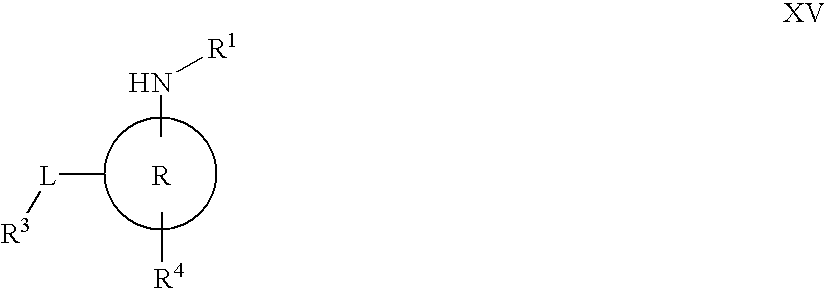
- In Formula XV, R is a functional group including, but not limited to, a 5- or 6-membered heteroaryl and a 9- or 10-membered 6,5- or 6,6-fused heteroaryl, containing from 1-4 nitrogen atoms, optionally substituted with 1-2 functional groups that are independently selected and include, but are not limited to, hydrogen, C 1-6alkyl, aryl, C1-6alkylaryl, C3-8cycloalkyl, heterocycle, heteroaryl, C1-6alkylhydroxy, C1-6alkoxy and NR4R4.
- In a preferred embodiment, R is a 6-membered aromatic ring containing 2 nitrogen atoms. In another preferred embodiment, R is a 6,5-fused aromatic ring containing from 1-4 nitrogen atoms. In yet another preferred embodiment, R is a 6,6-fused aromatic ring containing from 1-4 nitrogen atoms.
- In another embodiment, R is a functional group including, but not limited to, the following:

- In still another preferred embodiment, R is a functional group including, but not limited to, the following:

- In yet another preferred embodiment, R is a functional group including, but not limited to, the following:

- In a presently preferred embodiment, the present invention provides a compound wherein R is the following structure:

- In another embodiment, the present invention provides a compound wherein R is a 2,6,9-substituted purine, substituted with a functional group including, but not limited to, the following:

- In Formula XV, R 1 is a functional group including, but not limited to, phenyl and benzyl, substituted on the aromatic ring with from 1-4 substituents that are independently selected and that include, but are not limited to, C1-6alkyl, C1-6alkoxy, C1-6alkylhydroxy, C1-6alkylamine, C1-6aminoalkyl, halo and heterocycle. In a preferred embodiment, R1 is a phenyl substituted with a morpholino group.
- L, in Formula XV, is a functional group including, but not limited to,—O—, —NR 2— and a bond. In a presently preferred embodiment, L is —C—.
- In Formula XV, each R 2 is independently selected and is a functional group including, but not limited to, hydrogen and C1-4alkyl. In a preferred embodiment, R2 is hydrogen or methyl.
- R 3, in Formula XV, is a functional group including, but not limited to, hydrogen, optionally substituted alkyl, optionally substituted heteroalkyl, optionally substituted aryl, optionally substituted heteroaryl, optionally substituted heterocycloalkyl, halogen and alkoxy groups.
- In an alternative embodiment, R 2 and R3 can be taken together to form a 3-8 membered heterocyclic ring containing from 1-2 heteroatoms that are independently selected from N and O, and that are optionally substituted with 1-2 substitutents that are independently selected and include, but are not limited to C1-4alkyl, C1-4alkylhydroxy, C1-4alkoxy and C1-4alkylamine.
- R 4, if present in Formula XV, is a functional group including, but not limited to, optionally substituted alkyl, optionally substituted heteroalkyl and acyl groups.
- In a preferred embodiment, the present invention provides a compound wherein R is a 2,6,9-substituted purine, substituted with a member selected from the group consisting of:

- R 1 is a phenyl substituted with morpholine, i.e., a morpholino group;
- L—R 3 is a member selected from the group consisting of:

- R 4 is not present or, if present, R4 is isopropyl.
- Illustrative compounds of the present invention include, but are not limited to, the following:


- In a preferred embodiment, the present invention provides the following compounds:
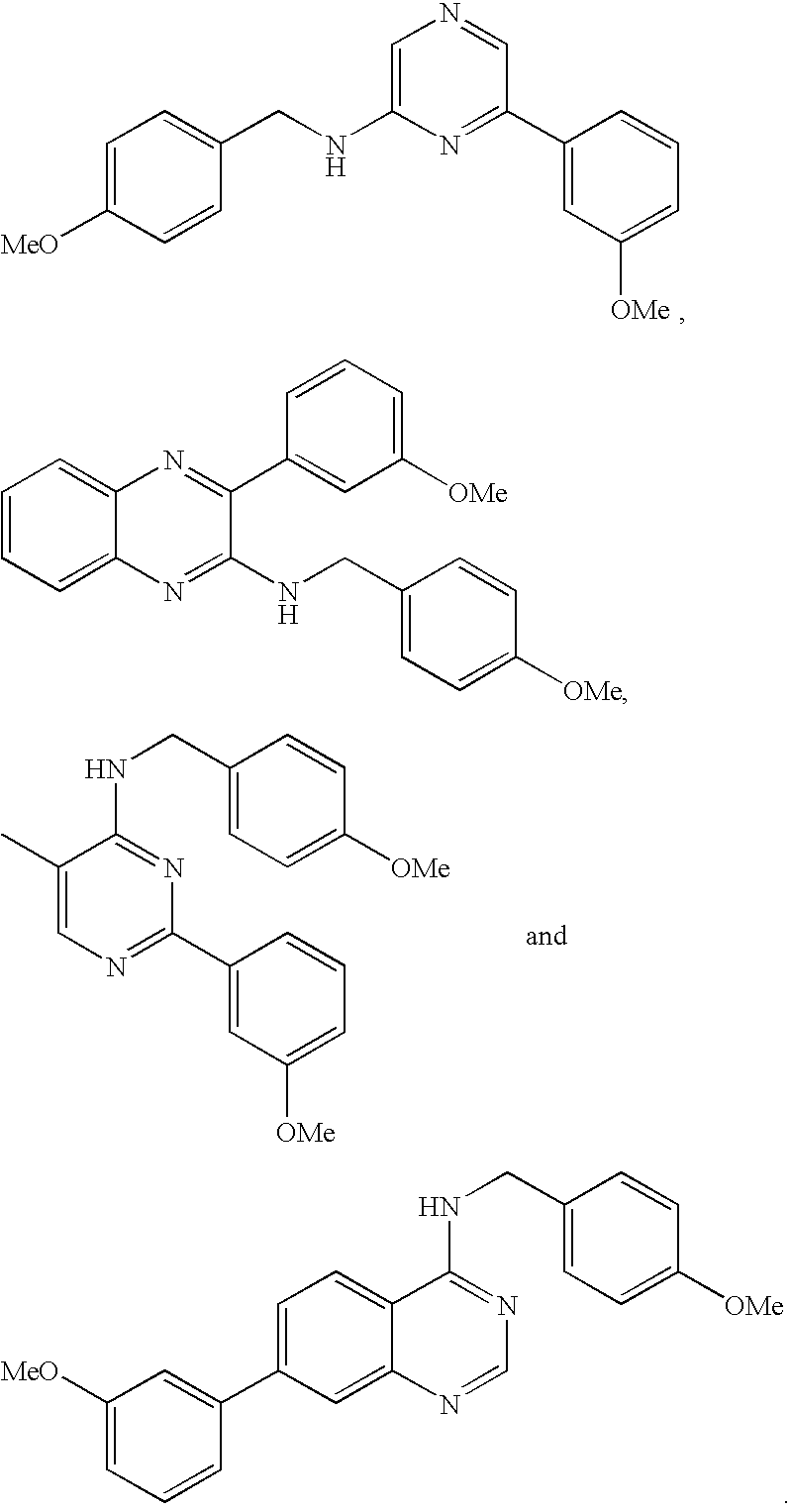
- The compounds of the present invention can exist as geometric isomers, most notably when olefins (carbon-carbon double bonds) are incorporated. The invention includes the individual geometric isomers as well as mixtures of isomers. When an asymmetric center is incorporated in a compound of the present invention, it can exist as a pair of optical isomers. The invention includes the individual optical isomers as well as mixtures thereof. When a compound of the present invention contains multiple asymmetric centers, multiple centers of geometric isomerism, one or more centers of geometric isomerism in addition to one or more asymmetric centers, the invention includes all combinations of geometric and optical isomers.
- The compounds of the present invention can exist as neutral compounds or as acid addition salts. The invention includes both the neutral and salt forms. It specifically contemplates pharmaceutically acceptable acid addition salts, including salts formed with inorganic acids such as hydrochloric acid, hydrobromic acid, sulfuric acid, phosphoric acid, and the like, and salts formed with organic acids such as acetic acid, citric acid, fumaric acid, maleic acid, benzoic acid, methanesulfonic acid, and the like. The invention encompasses hydrated forms and solvated forms of the compounds of the present invention and of their acid addition salts.
- Where a carboxylic acid is included, the compounds of the present invention can exist as neutral compounds or as salts, where the carboxylate anion in paired with an organic or inorganic counterion. The counterion can be an external cationic species, or it can be an ammonium group present within the compounds of the present invention, in which case the molecule is zwitterionic. The invention includes the neutral and salt forms, including zwitterionic forms. It specifically contemplates pharmaceutically acceptable salts, including salts formed with inorganic counterions such as lithium, sodium, potassium, ammonium, and the like, and salts formed with organic counterions, such as alkylammonium, dialkylammonium, trialkylammonium, tetralkylammonium, trialkylsulfonium, tetraalkyl or tetraaryl phosphonium counterions and the like. The invention encompasses hydrated forms and solvated forms of the compounds of the present invention and of their carboxylate salts when a carboxylic acid group is present.
- The compounds of the present invention can be readily screened for their kinase inhibitory activity, i.e., their ability to inhibit kinases, using in vitro and in vivo assays known to those of skill in the art. For instance, purine analogs having protein kinase inhibitory activity can be screened for using the CDK2/CYCLIN A microtiter-based solution-phase protein kinase assay described by Buxbaum, J. D., et a.l, Anal. Biochem,. 169:209-215 (1988), the teachings of which are incorporated herein by reference.
- Methods
- The present invention provides, inter alia, methods for the solution phase and solid phase synthesis of substituted heteroaryls and, in particular, substituted purines. In particular, the present invention provides methods for the solution phase synthesis of substituted heteroaryls (such as substituted purines) as well as methods for the solid phase synthesis of substituted heteroaryl scaffold moieties (such as substituted purine moieties). The present invention further provide methods for the preparation of a chemical library or array of substituted heteroaryl scaffold moieties through the application of solid-support media.
- In one aspect, the present invention provides a method of preparing a C2-substituted purine compound, the method comprising: reacting a C2-halogenated purine compound with a compound of Formula I:
- A—X I
- in the presence of a solvent, a base, a carbene or phosphine ligand and a palladium catalyst to provide the C2-substituted purine compound. In Formula I, A is a functional group including, but not limited to, alkyl, substituted alkyl, aryl, substituted aryl, heterocyclyl and substituted heterocyclyl; and X is a functional group including, but not limited to, —B(OH) 2, —OH, and —NHR1, wherein R1 is a functional group including, but not limited to, hydrogen, alkyl and substituted alkyl.
- In a preferred embodiment the C2-substituted purine compound is a compound of Formula II:
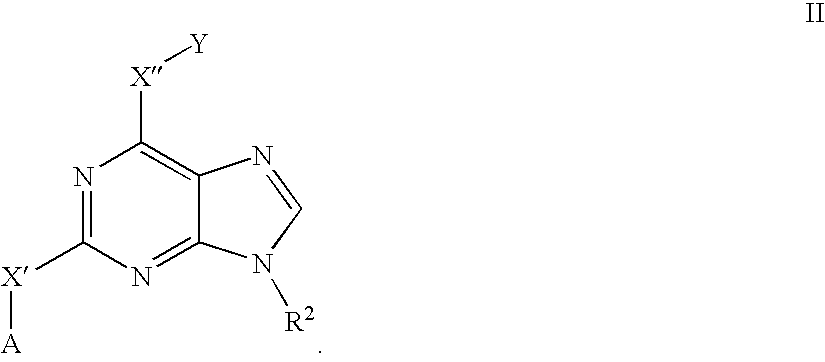
- In Formula II, R 2 is a functional group including, but not limited to, hydrogen, alkyl, substituted alkyl, aryl, substituted aryl, heterocyclyl and substituted heterocyclyl;
- X′, in Formula II, is a functional group including, but not limited to, a bond, NR 1 and O, wherein R1 is as defined above.
- X″, in Formula II, is a functional group including, but not limited to, a bond, O and NR 3, wherein R3 is a functional group including, but not limited to, hydrogen, alkyl and substituted alkyl, with the provisos that when X″ is NR3, Y is R4 or A′, and that when X′ is O or a direct bond, Y is A′.
- In Formula II, A is as defined above, whereas A is a functional group including, but not limited to, alkyl, substituted alkyl, aryl, substituted aryl, arylalkyl, substituted arylalkyl, heterocyclyl and substituted heterocyclyl.
- If Y is R 4, R4 is a functional group including, but not limited to, alkyl or substituted alkyl.
- In a preferred embodiment, the C2-halogenated purine is a compound having the structure of Formula III:

- In Formula III, W is a halogen, i.e., a halo group, including, but not limited to cholor, fluoro, bromo and iodo. In a presently preferred embodiment, W is a chloro or fluoro group. In Formula III, X″, Y and R 2 are as defined above. In a presently preferred embodiment, W is chloro; R2 is isopropyl; X″ is NR3, wherein R3 is hydrogen; and A′ is methoxybenzyl.
- In one preferred embodiment, the present invention provides a method of preparing a C2-substituted purine compound of Formula II:

- the method comprising: reacting a C2-halogenated purine compound of Formula III:

- with a compound of Formula I:
- A—X I,
- in the presence of a solvent, a base, a carbene or phosphine ligand and a palladium catalyst, thereby forming the compound of Formula II.
- In the compounds of Formulae I, II and III of the above method, W, X, X′ X″, A, A′, Y, R 1, R2, R3, R4 are as defined above.
- In the above methods, carbene or phosphine ligands can be used. Examples of ligands suitable for use in the methods of the present invention include, but are not limited to, the following carbene and phosphine ligands:

- In a presently preferred embodiment, the ligand is a carbene ligand including, but not limited to, the following:

- A number of bases can be used in carrying out the methods of the present invention. Examples of bases suitable for use in the above method include, but are not limited to, cesium carbonate, potassium carbonate, sodium carbonate, sodium bicarbonate, potassium bicarbonate, cesium bicarbonate, potassium fluoride, potassium phosphate, potassium tert-butyloxide, sodium tert-butyloxide, and triethylamine.
- A number of solvents can be used in carrying out the methods of the present invention. Examples of solvents suitable for use in the above method include, but are not limited to, 1,4-dioxane, tetrahydrofuran, dimethoxyethane (DME), dimethylformamide (DMF), benzene and toluene.
- A number of palladium catalysts can be used in carrying out the methods of the present invention. Typically, the oxidation state of the palladium in the catalyst is (0) or (II). Examples of palladium catalysts suitable for use in carrying out the methods of the present invention include, but are not limited to, Pd 2(dba)3, Pd(OAc)2, Pd(PPh3)4, Pd(O), PdCl2(dppf) and PdCl2. Such catalysts are known to and used by those of skill in the art and, thus, their structures are known. In a preferred embodiment, the palladium catalyst is Pd2(dba)3.
- In another embodiment, the present invention provides a method for preparing a compound of Formula III, the method comprising: reacting a dihalopurine, such as the compound of Formula IV:

- with a compound of Formula V:
- X′″—A′ V,
- in the presence of a solvent, a base, a carbene or phosphine ligand and a palladium catalyst, thereby forming the compound of Formula III.
- In the above method, W and W′ are both halogen; X′″ is a functional group including, but not limited to, —B(OH) 2, —OH and NHR3, wherein R3 is a functional group including, but not limited to, hydrogen, alkyl and substituted alkyl. In a preferred embodiment, W and W′ are both chloro or both fluoro.
- In a preferred embodiment, the present invention provides a chemical library comprising a plurality of 2-substituted purine compounds prepared by the methods described above.
- In another aspect, the present invention provides a method for preparing a C6-substituted purine compound, the method comprising: reacting a C6-halogenated purine with a compound of Formula I:
- A—X I,
- in the presence of a solvent, a base, a carbene or phosphine ligand and a palladium catalyst to provide the C6-substituted purine compound. In Formula I, A is a functional group including, but not limited to, alkyl, substituted alkyl, aryl, substituted aryl, heterocyclyl and substituted heterocyclyl; and X is a functional group including, but not limited to, —B(OH) 2, —OH, and —NHR1, wherein R1 is a functional group including, but not limited to, hydrogen, alkyl and substituted alkyl.
- In a preferred embodiment the C6-substituted purine compound is a compound of of Formula VI or Formula VII:

- In Formula VI, R 2 is a functional group including, but not limited to, hydrogen, alkyl, substituted alkyl, aryl, substituted aryl, heterocyclyl and substituted heterocyclyl.
- X′, in Formula VI, is a functional group including, but not limited to, a bond, NR 1 and O, wherein R1 is a functional group including, but not limited to, hydrogen, alkyl and substituted alkyl.
- X″, in Formula VI, is a functional group including, but not limited to, a bond, O and NR 3, wherein R3 is a functional group including, but not limited to, hydrogen, alkyl and substituted alkyl, with the proviso that when X″ is NR3, Y is R4 or A′, and when X is O or a direct bond, Y is A′.
- In Formula VI, A is a functional group including, but not limited to, alkyl, substituted alkyl, aryl, substituted aryl, heterocyclyl and substituted heterocyclyl, whereas A′ is a functional group including, but not limited to, alkyl, substituted alkyl, aryl, substituted aryl, arylalkyl, substituted arylalkyl, heterocyclyl and substituted heterocyclyl;
- R 4, in Formula VI, is a functional group including, but not limited to, alkyl or substituted alkyl.
- In a presently preferred embodiment, the C6-halogenated purine is a compound of Formula VII:
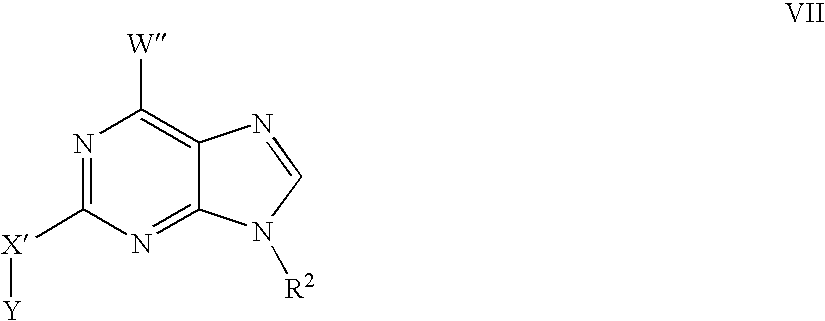
- In Formula VII, W is a halogen or halo group (e.g., chloro, fluoro, bromo or iodo), whereas X′ and Y are as defined above.
- In another aspect, the present invention provides a method for preparing a C6-substituted purine compound of Formula VI:

- the method comprising: reacting a C6-halogenated purine of Formula VII:

- with a compound of Formula I:
- A—X I,
- in the presence of a solvent, a base, a carbene ligand and a palladium catalyst to provide a C6-substituted purine compound of Formula VI.
- In a presently preferred embodiment, the present invention provides a chemical library comprising a plurality of 6-substituted purine compounds prepared by the methods described above.
- It is noted that the discussion (as well as preferred embodiments) relating to the carbene or phophine ligands, bases, solvents and palladium catalysts set forth in connection with the method for preparing a C-2 substituted purine compound are fully applicable to the method for preparing a C-6 substituted purine compound and, thus, it will not be repeated here.
- In yet another embodiment, the present invention provides a method for preparing a 9-aryl substituted purine compound, the method comprising: reacting a 2,6-dihalogenated purine with a compound of Formula X:
- Ar—B(OH)2 X,
- in the presence of a solvent and a catalyst, to provide the 9-aryl substituted purine compound.
- In Formula X, Ar is a functional group including, but not limited to, aryl, substituted aryl, heterocyclyl and substituted heterocyclyl.
- In a presently preferred embodiment, the 9-aryl substituted purine compound is a compound of Formula IX:

- In Formula IX, Ar is a functional group including, but not limited to, aryl, substituted aryl, heterocyclyl and substituted heterocyclyl. W and W′, in Formula IX, are each independently selected and include, but are not limited to, fluoro, chloro, bromo and iodo.
- In a preferred embodiment of the foregoing method, the catalyst is a copper catalyst. Suitable copper catalysts for use in the present invention will be known to and used by those of skill in the art. Typically, the copper of the copper catalyst is in an oxidation state of (0), (I) or (II). Examples of copper catalysts suitable for use in the method of the present invention include, but are not limited to, Cu(OAc) 2, [Cu(OH).TMEDA]2Cl2 and CuI. In a presently preferred embodiment, the catalyst is cupric acetate.
- A number of solvents can be used in carrying out the methods of the present invention. Examples of solvents suitable for use in the above method include, but are not limited to, 1,4-dioxane, tetrahydrofuran, dimethoxyethane (DME), dimethylformamide (DMF), benzene and toluene.
- In a presently preferred embodiment, the present invention provides a chemical library comprising a plurality of 9-aryl substituted purine compounds prepared by the methods described above.
- In yet another aspect, the present invention provides a method for synthesizing a substituted heteroaryl, the method comprising: (a) providing a dihaloheteroaryl scaffold moiety; and (b) capturing the dihaloheteroaryl scaffold moiety on a resin by nucleophilic substitution of a first halogen by a resin-bound amine nucleophile to afford a substituted heteroaryl, e.g, a resin-bound amine substituted monohaloheteroaryl.
- Suitable resins useful for the present invention include, but are not limited to, PAL resin, Wang resin, and polystyrene resin. Other suitable resins would be clear to a person of skill in the art. In a preferred embodiment, the PAL resin is utilized.
- In a preferred embodiment, the two halogens, i.e., halo groups, of the dihaloheteroaryl scaffold moiety are independently selected and include, but are not limited to, chloro, fluoro, bromo and iodo. In a presently preferred emodiments, the two halogens are chloro or fluoro groups.
- In a preferred embodiment, the method further comprises substitution of the second halogen of the dihaloheteroaryl scaffold moiety by nucleophilic displacement or, alternatively, by a coupling reaction. In a presently preferred embodiment, a coupling reaction is employed to carry out the substitution of the second halogen of the dihaloheteroaryl scaffold moiety. In this connection, the coupling reaction is preferably a palladium-mediated coupling reaction.
- It will be readily apparent to those of skill in the art that the two halogens, i.e., halo groups, of the dihaloheteroaryl scaffold moiety can be substituted with a number of different functional groups. Suitable functional groups include, but are not limited to, anilines, phenols, amines and boronic acids (see, Table 1). In a preferred embodiment, the functional group includes, but is not limited to, aryl boronic acids, anilines and phenols.
- In a preferred embodiment, the method further comprises performing an initial substitution prior to substitution of the first halogen of the dihaloheteroaryl scaffold moiety. In a preferred embodiment, the initial substitution is carried out using a reaction including, but not limited to, alkylation reactions, acylation reactions and coupling reactions.
- Numerous dihaloheteroaryl scaffold moieties can be used in the methods of the present invention. Examples of suitable dihaloheteroaryl scaffold moieties include, but not limited to, purines, pyrimidines, quinazolines, pyrazines, phthalazines, pyradazines and quinoxalines.
- When a palladium-catalyzed coupling reaction is employed to substitute the halo groups of the dihaloheteroary or the halo group of the resin-bound amine substituted monohaloheteroaryl, the palladium-catalyzed coupling reaction typically involves reacting the dihaloheteroaryl or the resin-bound amine substituted monohaloheteroaryl with a coupling agent in the presence of a solvent, a palladium catalyst, a base and a carbene or phosphine ligand. Suitable coupling agents include, but are not limited to, boronic acids, amines and alcohols. In a presently preferred embodiment, suitable coupling agents include, but are not limited to, aryl boronic acids, anilines and phenols. It is noted that the foregiong discussions relating to the carbene or phophine ligands, bases, solvents, palladium catalysts and copper catalysts set forth in connection with the methods for preparing a C-2 substituted purine compound or a 9-aryl substituted purine compound are fully applicable to the method for preparing a substituted heteroaryl compound and, thus, they will not be repeated here.
- In a preferred embodiment, the foregoing methods further comprise cleaving the compound from the solid support. It will be readily appreciated that the compounds of the present invention can be readily cleaved from the solid support using standard methods known to and used by those of skill in the art. Cleavage of a resin-bound compound nd liberation of the desired compound from the resin is typically carried in the presence of an acid. Suitable acids include, but are not limited to, an organic acid such as formic acid, acetic acid, propionic acid, trichloroacetic acid, trifluoroacetic acid and the like, and inorganic acids such as hydrochloric acid, hydrobromic acid, sulfuric acid, hydrogen chloride, etc., or the like. The reaction is usually carried out in a solvent such as water, an alcohol such as methanol, ethanol, 1,4, dioxane, methylene chloride, tetrahydrofuran, a mixture thereof or any other solvent which does not adversely influence the reaction.
- In yet another aspect of the present invention, the foregoing method is adapted to prepare a library (or an array) of heteroaryl scaffold moieties. Typically, the library of substituted scaffold moieties is prepared using a plurality of dihaloheteroaryl scaffold moieties. As such, in another aspect, the present invention provides a method for synthesizing a combinatorial library of substituted heteroaryls (e.g., heterocycles), the method comprising: providing a plurality of dihaloheterocyclic scaffold moieties; and capturing the dichloroheterocyclic scaffold moieties on a resin by nucleophilic substitution of a first chlorine by a resin-bound amine nucleophile).
- In a preferred embodiment, the two halogens, i.e., halo groups, present in the dihaloheteroaryl scaffold moieties are independently selected and include, but are not limited to, chloro, fluoro, bromo and iodo. In a presently preferred emodiments, the two halogens of the dihaloheteroary scaffold moieites are chloro groups.
- In a preferred embodiment, the method further comprises substitution of the second halogen of the dihaloheteroaryl scaffold moieties by nucleophilic displacement or, alternatively, by a coupling reaction. In a presently preferred embodiment, a coupling reaction is employed to carry out the substitution of the second halogen of the dihaloheteroaryl scaffold moieties. In this connection, the coupling reaction is preferably a palladium-mediated coupling reaction.
- It will be readily apparent to those of skill in the art that the two halogens, i.e., halo groups, of the dihaloheteroaryl scaffold moieties can be substituted with a number of different functional groups, each of which is independently selected. Suitable functional groups include, but are not limited to, anilines, phenols, amines and boronic acids (see, Table I). In a presently preferred embodiment, the functional groups include, but are not limited to, aryl boronic acids, anilines and phenols.
- In a preferred embodiment, the method further comprises performing initial substitutions prior to substitution of the first halogens of the dihaloheteroaryl scaffold moieties. In a preferred embodiment, the initial substitution is carried out using a reaction including, but not limited to, alkylation reactions, acylation reactions and coupling reactions.
- Numerous dihaloheteroaryl scaffold moieties can be used in the methods of the present invention. Examples of suitable dihaloheteroaryl scaffold moieties include, but not limited to, purines, pyrimidines, quinazolines, pyrazines, phthalazines, pyradazines and quinoxalines.
- When a palladium-catalyzed coupling reaction is employed to substitute the halo groups of the dihaloheteroary scaffold moieties or the halo group of the resin-bound amine substituted monohaloheteroaryls, the palladium-catalyzed coupling reaction typically involves reacting the dihaloheteroaryl or the resin-bound amine substituted monohaloheteroaryl with a coupling agent in the presence of a solvent, a palladium catalyst, a base and a carbene or phosphine ligand. Suitable coupling agents include, but are not limited to, boronic acids, amines and alcohols. In a presently preferred embodiment, suitable coupling agents include, but are not limited to, aryl boronic acids, anilines and phenols. It is noted that the foregiong discussions relating to the carbene or phophine ligands, bases, solvents, palladium catalysts and copper catalysts set forth in connection with the methods for preparing a C-2 substituted purine compound or a 9-aryl substituted purine compound are fully applicable to the methods for preparing a combinatorial library or array of substituted heteroaryl compound and, thus, they will not be repeated here.
- An exemplary strategy for preparing the scaffolds and inhibitors of the present invention relies on the capture of a dichloroheterocyclic scaffold (including substituted purines S1, pyrimidines S2, quinazolines S3, pyrazines S4, pyridazines S5, quinoxalines S6, phthalazines S7 and thiadiazoles S8) with a resin-bound amine nucleophile where one chloro group is susceptible to nucleophilic aromatic substitution. Depending on the type of heterocycle being captured, an initial alkylation, acylation or coupling reaction can be performed prior to the capture step to introduce one diversity element. The remaining chloro substituent is then available for nucleophilic displacement or a palladium-mediated coupling reaction with anilines, phenols, and boronic acids.
- In an exemplary embodiment, the scaffolds and inhibitors of the invention are assembled using the procedure outlined in Scheme 1.

- In an exemplary embodiment, the heterocycle capture strategy uses 2,6-dichloropurine because the 6-chloro can be selectively displaced by amines and the 2-chloro has been demonstrated to function in palladium-mediated coupling reactions in solution (see, U.S. Provisional Application No. 60/328,763, entitled “Expanding the Diversity of Purine Libraries,” which was filed Oct. 12, 2001).
- Suitable resins useful for the present invention would be clear to a person of skill in the art. In a preferred embodiment, a resin-bound nucleophilic amino group can be obtained through the coupling of primary amines to a (4-formyl-3,5dimethoxyphenoxy)methyl-polystyrene resin (PAL-resin) by reductive amination using sodium triacetoxyborohydride with 1% acetic acid to afford the PAL-amine resin) (see, Albericio et al., J. Org. Chem., 55, 3730 (1990); Boojamra et al., J. Org. Chem., 62, 1240 (1997); and Jin et al., J. Comb. Chem., 3, 97 (2001)). The PAL linkage offers the advantage that functionalized amines can readily be installed and cleavage results in an NH group that serves as a key hydrogen bond donor to many kinase active sites. A representative sequence starts by loading 2,6-dichloropurine onto the PAL-amine at the more reactive C6 position in butanol at 80° C. with exclusive regioselectivity. Modification of the N9 position of purine can be achieved by either Mitsunobu alkylation of N9 on a solid support (Path B) or by capturing the product of a solution phase Mitsunobu alkylation of 2,6-dichloropurine (Path A, Scheme 2). The latter approach offers the advantages of using less reagents and ease of handling. However, alkylation on a solid support provides improved regio-selectivity (N9/N7), presumably because N7 is more sterically hindered due to the presence of a large substituent at C6. Having the flexibility to perform the alkylation either on a solid support or in solution offers different operational advantages when making large combinatorial libraries. Most primary and secondary alcohols lacking additional acidic hydrogens work well in the Mitsunobu reaction at N9 (see, Chang et al., Chemistry and Biology, 6, 361 (1999); and U.S. Provisional Application No. 60/328,741, entitled “A Concise and Traceless Linker Strategy Toward Combinatorial Libraries of 2,6,9-Substituted Purines,” which was filed Oct. 12, 2001).
- In another exemplary embodiment, a palladium-catalyzed cross-coupling step can be performed as, for example, a final derivatization process, as illustrated in
Scheme 2.
- As illustrated in
Scheme 2, a palladium-catalyzed cross-coupling reaction is performed as the final derivatization step. An exemplary embodiment utilizes approximately five equivalents of the coupling partner (arylboronic acids, anilines or phenols), 7 mol % of Pd2(dba)3, 14 mol % of the corresponding ligand and six equivalents of the base. The resulting mixture is maintained for 12 hours at 80° C. with 1,4-dioxane for C—C and C—N bond formation or toluene for C—O bond formation as solvent. Although the reaction time and the amount of coupling reagents can be optimized for each type of reaction and substrate, the general coupling protocol described above is generally useful for achieving quantitative conversion of the starting material (the chloro-group at the C2 position of purine) with different substrates on the solid support. - The palladium catalyzed cross-coupling reaction can also be used to prepare heterocycloalkyl and heteroaryl moieties having an array of substituents appended thereto. For example, resin-bound purine 3 (X═Cl, Y═H, Scheme 2) can be reacted with a variety of arylboronic acids, anilines/amines, and phenols. See, Table 1. Analysis of the products following TFA mediated cleavage by LC-MS revealed greater that 95% conversion with a variety of electron rich or poor aromatic ring systems. The amination reaction proved to be the most versatile with diverse substrates ranging from primary and secondary anilines to a sterically hindered primary amine (2-amino-3-methyl-butanol) and cyclic/acyclic secondary amines (see Table 1). While all three types of palladium-catalyzed cross-coupling reactions on solid support were preferentially carried out in concentrated form (>0.2M), the amination reaction is preferably performed with at least 0.2 M aniline otherwise a significant amount of t-butoxide substituted product can be observed.
TABLE 1 Boronic Acids Anilines Amines Phenols 


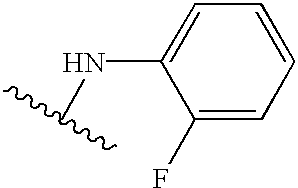


- The palladium catalyzed C2-couplings on solid support can be extended to the reaction to C-8 halo-substituted purines (e.g., C-8 bromo or chloro-substituted purines). In an exemplary embodiment, the C-8 bromo/chloro substituted purines are prepared by lithiation of the C8 position of 6-chloro-9-tetrahydropyranyl or 2,6-dichloro-9-tetrahydropyranyl purine with LDA followed by quenching with appropriate halogen donors. The tetrahydropyranyl protecting group can be removed by treatment with 10% acetic acid in methanol. After Mitsunobu alkylation of N9 and resin capture at C6, the support-bound purines can be modified at C8 or C2 and C8 simultaneously using palladium-mediated cross-coupling reactions as described above (see, Scheme 2). This chemistry provides access to known adenosine-P1 receptor antagonists as well as generic 6-5-6 triaryl systems that represent a large class of bioactive pharmacophores.
- The heterocycle resin-capture strategy of the present invention has broad general applicability. For example, a collection of dichloroheterocycles can be coupled to PAL-amine resin. The general resin capture condition involves reacting 2 equivalents of dichloroheterocycles with PAL-amine in the presence of 3 equivalents of diisopropylethylamine at 90° C. in butanol for 24 hours. Because the resin-capture presumably proceeds through a nucleophilic aromatic substitution mechanism, electron poor dichloroheterocycles are loaded on solid support quantitatively using the reaction condition described above. These include all the heterocycles shown in Scheme 1.
- According to the present invention certain heterocycles, such as 2,4-dichloropyrimidine are captured at room temperature with high efficiency. The capture of other heterocycles is possible using the methods set forth herein. Different scaffolds can require different conditions for efficient capture to occur. For example, S4 to S6 require more forcing conditions (90° C., n-butanol, 24 hrs., quantitative loading) than 2,4-dichloropyrimidine. Determining suitable capture conditions for a particular heterocycloalkyl or heteroaryl group is well within the abilities of those of skill in the art.
- Using the methods set forth herein, it is possible to obtain regioselective capture of a scaffold. For example, 2,4-dichloropyrimidine resulted in a regioisomeric mixture with some resin-bound amines, e.g., PAL-resin-bound primary amines capture 2,4-dichloropyrimidine exclusively at C4 position. The palladium-catalyzed amination conditions provided herein can be used to carry out resin-capture of less electron poor dichloroheterocycles with moderate loading.
- Following capture of the dichloroheterocycles on the solid support, the remaining chloro substituent is generally replaced by another group. In one embodiment, the chloro group is replaced in a palladium-catalyzed cross-coupling reaction. In an exemplary embodiment, R 1 was fixed as p-methoxybenzylamine and the remaining chloro group of the resin-captured heterocyclic scaffolds was subjected to a palladium-catalyzed cross-coupling reaction as the final derivatization step. The reaction conditions are essentially the same as described for the purines. These conditions are general for both modifying the whole spectrum of resin-captured heterocycles with all regioisomers and achieving quantitative conversion of the starting material (the remaining chloro-group) with different substrates on the solid support. While the yields of the cleaved final products mainly depend on the capture step which can be achieved quantitatively using the standardized capture condition described above (since quantitative palladium catalyzed final derivatization can be easily achieved), little impurities sometimes appeared when the qualities of coupling substrates (boronic acids, anilines and phenols) varied. For example, up to 5% of de-halogenation product could be observed when the substrates are somewhat wet. Removal of small amounts of impurity is within the abilities of those of skill in the art by methods such as recrystallization, chromatography, extraction and the like.
- In some embodiments, it has been found that the use of resin-bound amino alcohol, such as ethanolamine derivatives, results in intramolecular cyclization products under the palladium catalyzed C—C or C—O bond formation condition even with excess boronic acids or phenols around where the oxygen atom of the resin-bound amino alcohol displaces the proximal remaining chloro group of the heterocycle to form 6 or 7-membered ring system.
- In another exemplary embodiment, the chloro group is replaced using nucleophilic aromatic substitution conditions. The less reactive C2-chloro group of pyrimidine (S2), quinazoline (S3) and C3-chloro of thiadiazole (S8) reacts with various amines quantitatively. Preferred conditions include high concentration (>2M) amine and reactions times of about 12 hours at 100° C.
- In yet another exemplary embodiment, anilines react with the C2 chloro group of pyrimidine scaffold. Preferred conditions are 0.2M of the aniline at 80° C. The C6-chloro group of pyrimidine and the second chloro group of scaffolds S4 through S7 can react quantitatively with anilines in the presence of a stoichiometric amount of potassium t-butoxide as the base.
- As only a small subset of the heterocycles could be modified under standard nucleophilic aromatic substitution conditions, the use of palladium-catalyzed cross-coupling reactions on solid support was investigated. With R 1 fixed as p-methoxybenzylamine, the remaining chloro group of the resin-captured heterocyclic scaffolds was subjected to a palladium-catalyzed cross coupling reaction as the final derivatization step. The reaction conditions are essentially the same as described for the purines. These conditions were found to be most general for modifying the resin-captured heterocycles (see, Table 2) and generally afforded quantitative conversion of the starting material (the remaining chloro group) with different substrates on the solid support. Exploration of the reaction scope revealed the same broad range of substrates can be used as demonstrated for the purine scaffold (see Table 1). A survey of resin-bound amines also showed considerable diversity in primary amines that are effective substrates. Only β-branched resin-bound primary amines were found to have relatively slow capture rates. Interestingly, the use of resin-bound amino alcohols, such as ethanolamine derivatives, can provide intramolecular cyclization products for 2,3-dichloroquinoxaline and 2,3-dichloropyrazine under the palladium-catalyzed C—C or C—O bond formation conditions to form six- or seven-membered ring systems (Torraca et. al., J. Am. Chem. Soc., 122, 12907-12908) (2000) (Scheme 3).
TABLE 2 Validation of Heterocyclic Scaffolds as Diversity Inputs 

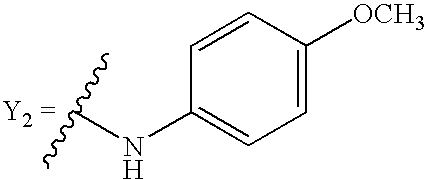
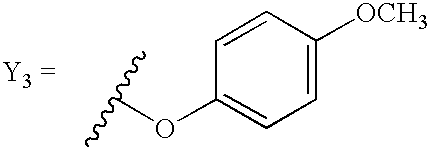
(Y1) Purity & (Y2)Purity (Y3)Purity Entry Scaffolds (R2) Yield (%) & Yield (%) & Yield (%) 1 
95 (90) 96 (90) 92 (86) 2 
96 (91) 95 (91) 91 (85) 3 
96 (91) 90 (90) 90 (86) 4 
93 (89) 95 (90) 96 (88) 5 
91 (85) 88 (82) 90 (83) 6 
96 (90) 94 (89) 93 (89) 7 
80 (79) 89 (78) 85 (78) 8 
92 (85) 93 (86) 94 (85) 9 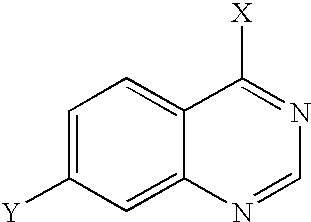
91 (82) 95 (89) 95 (89) 10 
93 (83) 93 (86) 92 (88) 11 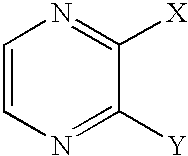
90 (85) 93 (86) 96 (88) 12 
94 (84) 94 (89) 91 (84) 13 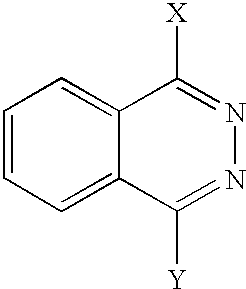
92 (85) 92 (84) 90 (83) 14 
91 (84) 92 (87) 91 (86) 15 
93 (84) 86 (81) 91 (83) -

- In summary, in this aspect, the invention provides a general method for the solid phase synthesis of various substituted heterocycles. Alkylated purines halogenated at the 2,6, 6,8 or 2,6,8 positions and various dihaloheterocycles can be captured onto solid support and further elaborated by aromatic substitution with amines at elevated temperature or by anilines, boronic acids, and phenols via palladium-catalyzed cross-coupling reactions.
- The combinatorial scaffold approach described herein can be used in conjunction with one or more of the methods for making substituted heterocycles (including purines) that are described in U.S. Provisional Application No. 60/328,763, which is entitled “Expanding the Diversity of Purine Libraries,” and was filed on Oct. 12, 2001. The approach is also suitable for use with the methods for making substituted heterocycles described in U.S. Provisional Application No. 60/328,741, which is entitled “A Concise and Traceless Linker Strategy Toward Combinatorial Libraries of 2,6,9-Substituted Purines,” and was filed on Oct. 12, 2001, and in U.S. Provisional Application Nos. 60/346,552 and 60/347,037, entitled “Methods For the Synthesis of Substituted Purine Libraries,” which were filed on Jan. 7 and 8, 2002.
- Pharmaceutical Formulations
- In another preferred embodiment, the present invention provides a pharmaceutical formulation comprising a compound of the invention and a pharmaceutically acceptable carrier.
- The compounds described herein, or pharmaceutically acceptable addition salts or hydrates thereof, can be delivered to a patient using a wide variety of routes or modes of administration. Suitable routes of administration include, but are not limited to, inhalation, transdermal, oral, rectal, transmucosal, intestinal and parenteral administration, including intramuscular, subcutaneous and intravenous injections.
- The compounds described herein, or pharmaceutically acceptable salts and/or hydrates thereof, can be administered singly, in combination with other compounds of the invention, and/or in cocktails combined with other therapeutic agents. Of course, the choice of therapeutic agents that can be co-administered with the compounds of the invention will depend, in part, on the condition being treated.
- For example, when administered to a patient undergoing cancer treatment, the compounds can be administered in cocktails containing anti-cancer agents and/or supplementary potentiating agents. The compounds can also be administered in cocktails containing agents that treat the side-effects of radiation therapy, such as anti-emetics, radiation protectants, etc.
- Supplementary potentiating agents that can be co-administered with the compounds of the invention include, e.g., tricyclic anti-depressant drugs (e.g., imipramine, desipramine, amitriptyline, clomipramine, trimipramine, doxepin, nortriptyline, protriptyline, amoxapine and maprotiline); non-tricyclic and anti-depressant drugs (e.g., sertraline, trazodone and citalopram); Ca +2 antagonists (e.g., verapamil, nifedipine, nitrendipine and caroverine); amphotericin; triparanol analogues (e.g., tamoxifen); antiarrhythmic drugs (e.g., quinidine); antihypertensive drugs (e.g., reserpine); thiol depleters (e.g., buthionine and sulfoximine); and calcium leucovorin.
- The active compound(s) of the invention are administered per se or in the form of a pharmaceutical composition wherein the active compound(s) is in admixture with one or more pharmaceutically acceptable carriers, excipients or diluents. Pharmaceutical compositions for use in accordance with the present invention are typically formulated in a conventional manner using one or more physiologically acceptable carriers comprising excipients and auxiliaries, which facilitate processing of the active compounds into preparations which, can be used pharmaceutically. Proper formulation is dependent upon the route of administration chosen.
- For injection, the agents of the invention can be formulated in aqueous solutions, preferably in physiologically compatible buffers such as Hanks's solution, Ringer's solution, or physiological saline buffer. For transmucosal administration, penetrants appropriate to the barrier to be permeated are used in the formulation. Such penetrants are generally known in the art.
- For oral administration, the compounds can be formulated readily by combining the active compound(s) with pharmaceutically acceptable carriers well known in the art. Such carriers enable the compounds of the invention to be formulated as tablets, pills, dragees, capsules, liquids, gels, syrups, slurries, suspensions and the like, for oral ingestion by a patient to be treated. Pharmaceutical preparations for oral use can be obtained solid excipient, optionally grinding a resulting mixture, and processing the mixture of granules, after adding suitable auxiliaries, if desired. to obtain tablets or dragee cores. Suitable excipients are, in particular, fillers such as sugars, including lactose, sucrose, mannitol, or sorbitol; cellulose preparations such as, for example, maize starch, wheat starch, rice starch, potato starch, gelatin, gum tragacanth, methyl cellulose, hydroxypropylmethyl-cellulose, sodium carboxyniethylcellulose, and/or polyvinylpyrrolidone (PVP). If desired, disintegrating agents can be added, such as the cross-linked polyvinyl pyrrolidone, agar, or alginic acid or a salt thereof such as sodium alginate.
- Dragee cores are provided with suitable coatings. For this purpose, concentrated sugar solutions can be used, which can optionally contain gum arabic, talc, polyvinyl pyrrolidone, carbopol gel, polyethylene glycol, and/or titanium dioxide, lacquer solutions, and suitable organic solvents or solvent mixtures. Dyestuffs or pigments can be added to the tablets or dragee coatings for identification or to characterize different combinations of active compound doses.
- Pharmaceutical preparations, which can be used orally, include push-fit capsules made of gelatin, as well as soft, sealed capsules made of gelatin and a plasticizer, such as glycerol or sorbitol. The push-fit capsules can contain the active ingredients in admixture with filler such as lactose, binders such as starches, and/or lubricants such as talc or magnesium stearate and, optionally, stabilizers. In soft capsules, the active compounds can be dissolved or suspended in suitable liquids, such as fatty oils, liquid paraffin, or liquid polyethylene glycols. In addition, stabilizers can be added. All formulations for oral administration should be in dosages suitable for such administration.
- For buccal administration, the compositions may take the form of tablets or lozenges formulated in conventional manner.
- For administration by inhalation, the compounds for use according to the present invention are conveniently delivered in the form of an aerosol spray presentation from pressurized packs or a nebulizer, with the use of a suitable propellant, e.g., dichlorodifluoromethane, trichlorofluoromethane, dichlorotetrafluoroethane, carbon dioxide or other suitable gas. In the case of a pressurized aerosol the dosage unit may be determined by providing a valve to deliver a metered amount. Capsules and cartridges of e.g., gelatin for use in an inhaler or insufflator may be formulated containing a powder mix of the compound and a suitable powder base such as lactose or starch.
- The compounds may be formulated for parenteral administration by injection, e.g., by bolus injection or continuous infusion. Formulations for injection may be presented in unit dosage form, e.g., in ampoules or in multi-dose containers, with an added preservative. The compositions may take such forms as suspensions, solutions or emulsions in oily or aqueous vehicles, and may contain formulatory agents such as suspending, stabilizing and/or dispersing agents may be added, such as the cross-linked polyvinyl pyrrolidone, agar, or alginic acid or a salt thereof such as sodium alginate.
- Pharmaceutical formulations for parenteral administration include aqueous solutions of the active compounds in water-soluble form. Additionally, suspensions of the active compounds may be prepared as appropriate oily injection suspensions. Suitable lipophilic solvents or vehicles include fatty oils such as sesame oil, or synthetic fatty acid esters, such as ethyl oleate or triglycerides, or liposomes. Aqueous injection suspensions may contain substances, which increase the viscosity of the suspension, such as sodium carboxymethyl cellulose, sorbitol, or dextran. Optionally, the suspension may also contain suitable stabilizers or agents, which increase the solubility of the compounds to allow for the preparation of highly, concentrated solutions.
- Alternatively, the active ingredient may be in powder form for constitution with a suitable vehicle, e.g., sterile pyrogen-free water, before use.
- The compounds may also be formulated in rectal compositions such as suppositories or retention enemas, e.g., containing conventional suppository bases such as cocoa butter or other glycerides.
- In addition to the formulations described previously, the compounds may also be formulated as a depot preparation. Such long acting formulations may be administered by implantation or transcutaneous delivery (e.g., subcutaneously or intramuscularly), intramuscular injection or a transdermal patch. Thus, for example, the compounds may be formulated with suitable polymeric or hydrophobic materials (e.g., as an emulsion in an acceptable oil) or ion exchange resins, or as sparingly soluble derivatives, for example, as a sparingly soluble salt.
- The pharmaceutical compositions also may comprise suitable solid or gel phase carriers or excipients. Examples of such carriers or excipients include but are not limited to calcium carbonate, calcium phosphate, various sugars, starches, cellulose derivatives, gelatin, and polymers such as polyethylene glycols.
- General Considerations. Purity of compounds were assessed by reverse-phase liquid chromatography—mass spectrometer (Agilent Series 1100 LC—MS) with an UV detector at λ=255 nm (reference at 360 mn) and an API-ES ionization source. NMR spectra were recorded on Bruker−400 MHz and 500 MHz instrument and calibrated using residual undeuterated solvent as an internal reference. The following abbreviations were used to designate the multiplicities: s=singlet, d=doublet, t=triplet, q=quartet, m=multiplet. LC elution methods (using a Phenomenex Luna 50*2.00
mm 5 μ C18 column): (1) 10 minutes method: starting from 5% solvent A (acetonitrile) in solvent B (water with 0.5% acetic acid) and running the gradient to 95% A in 8 minutes, followed by 2 minutes elution with 95% A. (2) 17 minutes method: starting from 5% solvent A (acetonitrile) in solvent B (water with 0.5% acetic acid) and running the gradient to 95% A in 15 minutes, followed by 2 minutes elution with 95% A. - Boronic Acid coupling reactions: A 10 mL flame-dried Schlenk flask equipped with a magnetic stir bar was charged with 2-chloro-6-(4-methoxybenzylamino)-9-isopropylpurine (0.193 g, 0.5 mmol, 1.0 equiv), 2,4-dimethoxyphenylboronic acid (0.136 g, 0.75 mmol, 1.5 equiv), Pd 2(dba)3 (0.0069 g, 0.0075 mmol, 0.015 equiv.), ligand 1 (0.0051 g, 0.015 mmol, 0.03 equiv.) and Cs2CO3 (0.326 g, 1.0 mmol, 2.0 equiv.). The Schlenk flask was evacuated and backfilled with argon and charged with anhydrous 1,4-dioxane (2.0 mL). The reaction was stirred under argon at 80° C. and monitored by TLC. When the reaction was complete after 8 hours, the solvent was removed in vacuo and the reaction crude was purified by flash column chromatography (3% methanol in dichloromethane) to afford desired 2-(2,4-dimethoxyphenyl)-6-(4-methoxybenzylamino)-9-isopropylpurine (207 mg, 96%). 1H NMR (400 MHz, CDCl3) δ1.59 (d, 6H, J=6.8 Hz), 3.79 (s, 3H), 3.84 (s, 3H), 3.85 (s, 3H), 4.87-4.96 (m, 3H), 6.14 (br, 1H), 6.57-6.60 (m, 2H), 6.85 (d, 2H, J=8.6 Hz), 7.34 (d, 2H, J=8.6 Hz), 7.73 (s, 1H), 7.78 (d, 1H, J=8.2 Hz); HRMS (MALDI-FTMS) [MH+] C24H28N5O3 434.2187, found: 434.2168.
- Aniline coupling: A 10 mL flame-dried Schlenk flask equipped with a magnetic stir bar was charged with 2-chloro-6-(4-methoxybenzylamino)-9-isopropylpurine (0.193 g, 0.5 mmol, 1.0 equiv), 4-methoxyaniline (0.092 g, 0.75 mmol, 1.5 equiv), Pd 2(dba)3 (0.0069 g, 0.0075 mmol, 0.015 equiv.), ligand 1 (0.0051 g, 0.015 mmol, 0.03 equiv.) and KOtBu (0.112 g, 1.0 mmol, 2.0 equiv.). The Schlenk flask was evacuated and backfilled with argon and charged with anhydrous 1,4-dioxane (2.0 mL). The reaction was stirred under argon at 80° C. and monitored by TLC. When the reaction was complete after 8 hours, the solvent was removed in vacuo and the reaction crude was purified by flash column chromatography (3% methanol in dichloromethane) to afford desired 2-(4-methoxyphenylamino)-6-(4-methoxybenzylamino)-9-isopropylpurine (203 mg, 97%): 1H NMR (500 MHz, CDCl3) δ1.54 (d, 6H, J=6.6 Hz), 3.76 (s, 3H), 3.78 (s, 3H), 4.66 (m, 1H, J=6.6 Hz), 4.72 (br, 2H), 6.06 (br, 1H), 6.60 (br, 1H), 6.82 (d, 2H, J=13 Hz), 6.84 (d, 2H, J=13 Hz), 7.09 (s, 1H), 7.26 (d, 2H, J=8.8 Hz), 7.42 (s, 1H), 7.56 (d, 2H, J=8.8 Hz); HRMS (MALDI-FTMS) [MH+] C23H27N6O2 419.2195, found: 419.2209.
- Phenol coupling: A 10 mL flame-dried Schlenk flask equipped with a magnetic stir bar was charged with 2-chloro-6-(4-methoxybenzylamino)-9-isopropylpurine (0.193 g, 0.5 mmol, 1.0 equiv), 4-methylphenol (0.081 g, 0.75 mmol, 1.5 equiv), Pd 2(dba)3 (0.0069 g, 0.0075 mmol, 0.015 equiv.), ligand 1 (0.0051 g, 0.015 mmol, 0.03 equiv.) and KOtBu (0.112 g, 1.0 mmol, 2.0 equiv.). The Schlenk flask was evacuated and backfilled with argon and charged with anhydrous 1,4-dioxane (2.0 mL). The reaction was stirred under argon at 90° C. and monitored by TLC. When the reaction was complete after 8 hours, the solvent was removed in vacuo and the reaction crude was purified by flash column chromatography (2% methanol in dichloromethane) to afford desired 2-(4-methylphenoxy)-6-(4-methoxy-benzylamino)-9-isopropylpurine (180 mg, 90%): 1H NMR (400 MHz, CDCl3) δ1.53 (d, 6H, J=6.8 Hz), 2.37 (s, 3H), 3.79 (s, 3H), 4.54 (br, 2H), 4.71 (m, 1H, J=6.8 Hz), 6.35 (br, 1H), 6.81 (d, 2H, J=8.4 Hz), 7.10-7.18 (m, 6H), 7.65 (s, 1H); HRMS (MALDI-FTMS) [MH+] C23H26N5O2 404.2081, found: 404.2080.
- Purine N9 arylation via boronic acids/cupric acetate: A 20 mL glass vial equipped with a magnetic stir bar was charged with 2,6-dichloropurine (0.200 g, 1.06 mmol, 1.0 equiv), 4-methylphenylboronic acid (0.288 g, 2.12 mmol, 2.0 equiv), anhydrous cupric acetate (0.384 g, 2.12 mmol, 2.0 equiv.), 4 Å activated molecular sieves (0.500 g), triethylamine (0.443 mL, 3.18 mmol, 3.0 equiv.) and dichloromethane (5.0 mL). The reaction was stirred under air at ambient temperature and monitored by TLC. When the reaction was complete after 24 hours, it was filtered through Celite, washed with methanol and purified by flash column chromatography (1% methanol in dichloromethane) to afford desired 2,6-dichloro-9-(4-methylphenyl)-purine (0.136 g, 47%). 1H NMR (400 MHz, CDCl3) δ2.47 (s, 3H), 7.41 (d, 2H, J=8.1 Hz), 7.54 (d, 2H, J=8.1 Hz), 8.35 (s, 1H); HRMS (MALDI-FTMS) C12H8Cl2N4 [MH+] 279.0199, found: 279.0208.
- Reductive Amination for Synthesis of PAL-resin-bound amine (1). To a suspension of 4-formyl-3,5-dimethoxyphenoxymethyl functionalized polystyrene resin (PAL) (10.0 g, 11.3 mmol) in DMF (350 mL) was added a primary amine (56.5 mmol), followed by addition of sodium triacetoxyborohydride (7.18 g, 33.9 mmol) and acetic acid (6.52 mL, 113 mmol). The mixture was shaken gently at room temperature. After overnight the resin 1 was washed by methanol (300 mL×4) and dichloromethane (300 mL×4) and dried under vacuum. The complete conversion of PAL aldehyde to resin-bound amine was confirmed by disappearance of the aldehyde stretch.
- Resin Capture of Dichloroheterocycles (C). To a solution of dichloro-heterocycle (S) (15.0 mmol) in n-butanol (200 mL) was added PAL-resin-bound amine 1 (10.0 mmol), followed by addition of diisopropylethylamine (5.2 mL, 30.0 mmol). The suspension was heated to 90° C. under argon. After 12 hours, the resin was washed by methanol (200 mL×4) and dichloromethane (200 mL×4) and dried under vacuum. The complete conversion of secondary amine (PAL-amine) to tertiary amine was confirmed by bromophenol blue test.
- Substitution of Remaining Chloro Group with Boronic Acids via Suzuki Coupling and Product Cleavage (P1). A 10 mL flame-dried Schlenk flask was charged with resin C (0.10 mmol, 1.0 equiv), arylboronic acid (0.50 mmol, 5.0 equiv), Pd 2(dba)3 (0.007 mmol, 0.07 equiv.), carbine ligand (0.014 mmol, 0.14 equiv.) and Cs2CO3 (0.60 mmol, 6.0 equiv.). The Schlenk flask was evacuated and backfilled with argon and charged with anhydrous 1,4-dioxane (1.0 mL). The reaction was heated to 80° C. under argon. After 12 hours, the resin was washed by sodium diethyldithiocarbamate solution (0.05M in DMF, 1 mL×4), dichloromethane (1 mL×4) and methanol (1 mL×4) and dried under vacuum. The derivatized resin was subsequently cleaved in CH2Cl2:TFA:Me2S:H2O/45:45:5:5/v:v:v:v (0.5 mL) for two hours. The solution was collected and the solvent was removed in vacuo to afford desired final product (P1).
- Substitution of Remaining Chloro Group with Anilines or Amines via Palladium-Catalyzed Reaction and Product Cleavage (P2). A 10 mL flame-dried Schlenk flask was charged with resin C (0.10 mmol, 1.0 equiv), aniline or amine (0.50 mmol, 5.0 equiv), Pd 2(dba)3 (0.007 mmol, 0.07 equiv.), carbine ligand (0.014 mmol, 0.14 equiv.) and KOtBu (0.60 mmol, 6.0 equiv.). The Schlenk flask was evacuated and backfilled with argon and charged with anhydrous 1,4-dioxane (1.0 mL). The reaction was heated to 80° C. under argon. After 12 hours, the resin was washed by sodium diethyldithiocarbamate solution (0.05M in DMF, 1 mL×4), dichloromethane (1 mL×4) and methanol (1 mL×4) and dried under vacuum. The derivatized resin was subsequently cleaved in CH2Cl2:TFA:Me2S:H2O/45:45:5:5/v:v:v:v (0.5 mL) for two hours. The solution was collected and the solvent was removed in vacuo to afford desired final product (P2).
- Substitution of Remaining Chloro Group with Phenols via Palladium-Catalyzed Reaction and Product Cleavage (P3). A 10 mL flame-dried Schlenk flask was charged with resin C (0.10 mmol, 1.0 equiv), phenol (0.50 mmol, 5.0 equiv), Pd 2(dba)3 (0.007 mmol, 0.07 equiv.), phosphine ligand (0.028 mmol, 0.28equiv.) and K3PO4 (0.70 mmol, 7.0 equiv.). The Schlenk flask was evacuated and backfilled with argon and charged with anhydrous toluene (1.0 mL). The reaction was heated to 80° C. under argon. After 12 hours, the derivatized resin was washed by sodium diethyldithiocarbamate solution (0.05M in DMF, 1 mL×4), dichloromethane (1 mL×4) and methanol (1 mL×4) and dried under vacuum. The resin was subsequently cleaved in CH2Cl2:TFA:Me2S:H2O/45:45:5:5/v:v:v:v (0.5 mL) for two hours. The solution was collected and the solvent was removed in vacuo to afford desired final product (P3).
- Substitution of Remaining Chloro Group with Amines via non-Palladium-Catalyzed Amination Reaction without Base and Product Cleavage (P4). The resin C (0.05 mmol) was suspended in the solution of an amine (2M in n-butanol, 0.2 mL). After 12 hours heating at 80° C. in a scaled reaction vessel under argon, the resin was washed with methanol (1 mL×4) and dichloromethane (1 mL×4) and dried under vacuum. It was subsequently cleaved using CH 2Cl2:TFA:Me2S:H2O/45:45:5:5/v:v:v:v (0.3 mL) to afford desired final product (P4) (>90% HPLC purity in average, 80% purified yield).
- Substitution of Remaining Chloro Group with Amines via non-Palladium-Catalyzed Amination Reaction with KO tBu as Base and Product Cleavage. To a suspension of resin C (0.05 mmol) in THF (anhydrous, 0.25 mL) was added an amine (0.25 mmol), followed by addition of KOtBu solution (in THF, 1.0M, 0.25 mL, 0.25 mmol). After 12 hours heating at 70° C. in a sealed reaction vessel under argon, the resin was washed with methanol (1 mL×4) and dichloromethane (1 mL×4) and dried under vacuum. It was subsequently cleaved using CH2Cl2:TFA:Me2S:H2O/45:45:5:5/v:v:v:v (0.3 mL) to afford desired final product (in average >85% HPLC purity, 80% purified yield).
TABLE 1 Validation of palladium catalyzed cross-coupling reactions for derivatizing resin-bound 2-chloro-6-aminopurine with boronic acids, anilines, amines and phenols. (Purities refer to HPLC purities, and yields refer to isolated yields by preparative TLC.) 
C2 Substituents Retention Calculated Observed Purity & C2 Substituents Retention Calculated Observed Purity & Entry via boronic acids Time (min) [M] [MH+] Yields (%) Entry via anilines Time (min) [M] [MH+] Yields (%) B1 
8 28 391 18 392 20 90 (84) An1 
5 77a 418 21 419 20 97 (90) B2 
5 72 403 20 404 20 94 (85) An2 
6 59 446 21 447 20 96 (91) B3 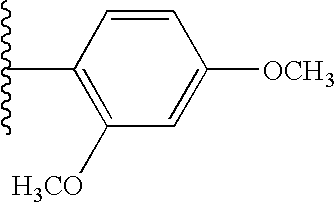
5.28 433 21 434 20 92 (85) An3 
6 83 430.25 431.20 89 (81) B4 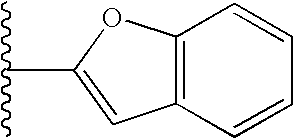
8.02 413 19 414 20 91 (82) An4 
7 54 406 19 407.20 89 (80) B5 
7.57 415.20 416 20 90 (80) An5 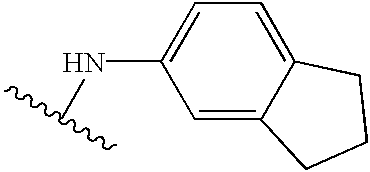
7.82 428.23 429 20 95 (88) B6 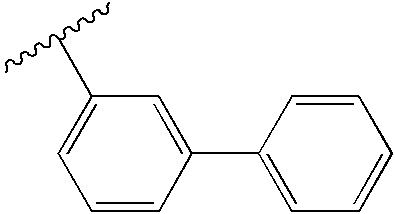
9.05 449.22 450 20 90 (85) An6 
7 63 402.22 403 20 97 (91) C2 Substituents Retention Calculated Observed Purity & C2 Substituents Retention Calculated Oberved Purity & Entry via amines Time (min) [M] [MH+] Yields (%) Entry via phenols Time (min) [M] [MH+] Yields (%) Am1 
3.98 396.24 399 20 89 (83) P1 
7 43 403 20 404 20 90 (82) Am2 
4.31 437 25 438.30 97 (90) P2 
7.53 403.20 404 20 91 (82) Am3 
5 81 446.21 447.20 96 (91) P3 
7.52 403 20 404 20 92 (81) Am4 
5.07 431 24 432 20 91 (84) P4 
7 59 439 20 440 20 90 (80) Am5 
5 38 396 23 397 20 92 (84) P5 
7 30 407.18 408 20 88 (81) Am6 
8 71 525 25 526.20 98 (90) P6 
8.03 465 22 466 20 92 (80) -
TABLE 2 Validation of resin-bound chloroheterocyclic scaffolds which can be derivatized via Suzuki coupling reaction. (Purities refer to HPLC purities, and yields refer to isolated yields by preparative TLC.) 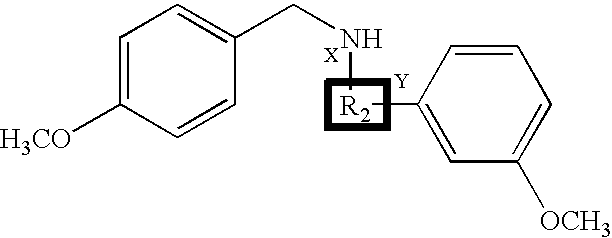
Retention Calcu- Ob- Purity Time lated served & Yield Entry Scaffolds (R2) (min) [M] [MH+] (%) 1 
4.46 321.15 322.20 95 (90) 2 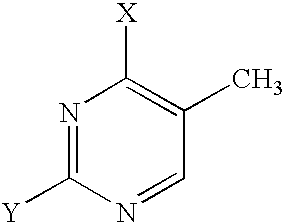
4.47 335.16 336.20 95 (91) 3 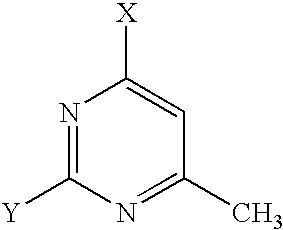
4.31 335.16 336.20 96 (91) 4 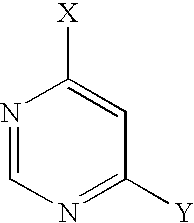
4.72 321.15 322.20 93 (89) 5 
4.11 336.16 337.15 91 (85) 6 
4.91 371.16 372.20 95 (90) 7 
4.87 371.16 372.20 86 (79) 8 
4.80 371.16 372.20 92 (85) 9 
4.65 371.16 372.20 91 (82) 10 
4.60 371.16 372.20 93 (83) 11 
6.81 321.15 322.10 95 (85) 12 
7.01 321.15 322.20 94 (84) 13 
4.51 371.16 372.10 92 (85) 14 
4.69 321.15 322.10 91 (84) 15 
7.94 371.16 372.15 93 (84) 16 
7.53a 403.20 404.30 89 (80) -
TABLE 3 Validation of resin-bound chloroheterocyclic scaffolds which can be derivatized via palladium catalyzed amination reaction. (Purities refer to HPLC purities, and yields refer to isolated yields by preparative TLC.) 
Retention Cal- Ob- Purity Time culated served & Yield Entry Scaffolds (R2) (min) [M] [MH+] (%) 1 
4.26 336.16 337.15 96 (90) 2 
4.32 350.17 351.20 95 (91) 3 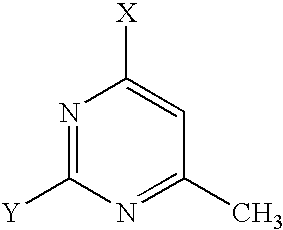
4.26 350.17 351.20 96 (90) 4 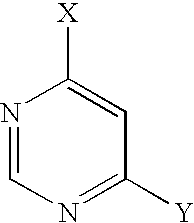
4.25 336.16 337.20 95 (90) 5 
4.18 351.17 352.20 88 (82) 6 
4.58 386.17 387.20 94 (89) 7 
4.59 386.17 387.20 89 (78) 8 
4.58 386.17 387.20 93 (86) 9 
4.65 386.17 387.20 95 (89) 10 
6.13 386.17 387.20 93 (85) 11 
5.98 336.16 337.10 93 (86) 12 
5.72 336.16 337.10 94 (89) 13 
4.38 386.16 387.20 92 (84) 14 
4.12 336.16 337.10 92 (87) 15 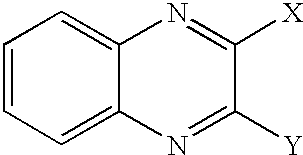
7.61 386.17 387.20 88 (81) 16 
5.77a 418.21 419.30 91 (85) - Table 4. Validation of resin-bound chloroheterocyclic scaffolds which be derivatized via palladium catalyzed C—O bond formation reaction. (Purities refer to HPLC purities, and yields refer to isolated yields by preparative TLC.)
TABLE 4 Validation of resin-bound chloroheterocyclic scaffolds which can be derivatized via palladium catalyzed C—O bond formation reaction. (Purities refer to HPLC purities, and yields refer to isolated yields by preparative TLC.) 
Retention Calcu- Ob- Purity Time lated served & Yield Entry Scaffolds (R2) (min) [M] [MH+] (%) 1 
4.73 337.14 338.10 92 (86) 2 
4.68 351.16 352.20 91 (85) 3 
4.59 351.16 352.20 93 (88) 4 
6.30 337.14 338.10 96 (88) 5 
4.79 352.15 353.10 90 (83) 6 
4.99 387.16 388.10 93 (89) 7 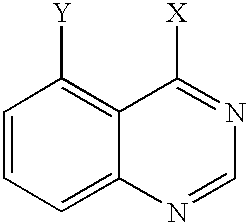
4.56 387.16 388.20 85 (78) 8 
4.83 387.16 388.15 94 (85) 9 
4.70 387.16 388.10 95 (89) 10 
4.36 387.16 388.15 92 (88) 11 
7.16 337.14 338.10 96 (88) 12 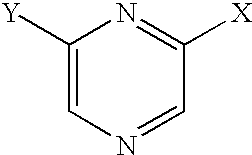
6.90 337.14 338.10 91 (84) 13 
4.76 387.16 388.10 90 (83) 14 
4.64 336.16 337.10 91 (86) 15 
8.15 337.14 338.10 91 (83) 16 
6.72a 419.20 420.30 90 (85) -
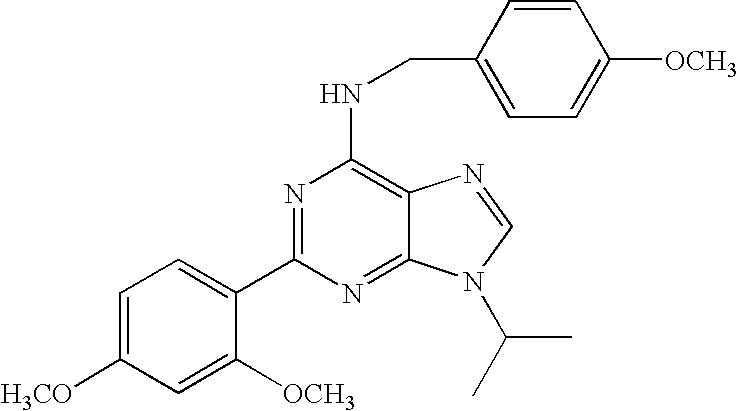
- 2-(2,4-dimethoxyphenyl)-6-(4-methoxybenzylamino)-9-isopropylpurine. 1H NMR (400 MHz, CDCl3) δ1.59 (d, 6H, J=6.8 Hz), 3.79 (s, 3H), 3.84 (s, 3H), 3.85 (s, 3H), 4.87-4.96 (m, 3H), 6.14 (br, 1H), 6.57-6.60 (m, 2H), 6.85 (d, 2H), J=8.6 Hz), 7.34 (d, 2H, J=8.6 Hz), 7.73 (s, 1H), 7.78 (d, 1H, J=8.2 Hz); HRMS (MALDI-FTMS) [MH+] C24H28N5O3 434.2187, found: 434.2168

- 2-(4-fluorophenyl)-6-(4-methoxybenzylamino)-9-isopropylpurine. 1H NMR (400 MHz, CDCl3) δ1.61 (d, 6H, J=6.8 Hz), 3.81 (s, 3H), 4.87 (br, 2H), 5.04 (m, 1H, J=6.8 Hz), 6.85 (d, 2H, J=8.4 Hz), 7.00 (d, 2H, J=8.8 Hz), 7.17 (d, 2H, J=8.4 Hz), 7.73 (d, 2H, J=8.8 Hz), 8.38 (s, 1H); HRMS (MALDI-FTMS) [MH+] C22H23FN5O 392.1881, found: 392.1885

- 2-(4-acetylphenyl)-6-(4-methoxybenzylamino)-9-isopropylpurine. 1H NMR (400 MHz, CDCl3) δ1.79 (d, 6H, J=6.8 Hz), 2.52 (s, 3H), 3.81 (s, 3H), 4.91 (d, 2H), 5.13 (m, 1H, J=6.8 Hz), 6.82 (d, 2H, J=8.5 Hz), 7.15 (d, 2H, J=8.5 Hz), 7.88 (d, 2H, J=8.1 Hz), 7.97 (d, 2H, J=8.1 Hz), 8.65 (s, 1H); HRMS (MALDI-FTMS) [MH+] C24H26N5O2 416.2081, found: 416.2099

- 2-(2-methoxyphenyl)-6-(4-methoxybenzylamino)-9-isopropylpurine. 1H NMR (400 MHz, CDCl3) δ1.60 (d, 6H, J=6.8 Hz), 3.79 (s, 3H), 3.85 (s, 3H), 4.87 (d, 2H), 4.92 (m, 1H, J=6.8 Hz), 5.99 (br, 1H), 6.86 (d, 2H, J=8.5 Hz), 7.01-7.06 (m, 2H), 7.35 (m, 3H), 7.72 (d, 1H, J=7.2 Hz), 7.79 (s, 1H); HRMS (MALDI-FTMS) [MH+] C23H26N5O2 404.2081, found: 404.2056

- 2-(4-methoxyphenylamino)-6-(4-methoxybenzylamino)-9-isopropylpurine: 1H NMR (500 MHz, CDCl3) δ1.54 (d, 6H, J=6.6 Hz), 3.76 (s, 3H), 3.78 (s, 3H), 4.66 (m, 1H, J=6.6 Hz), 4.72 (br, 2H), 6.06 (br, 1H), 6.60 (br, 1H), 6.82 (d, 2H, J=13 Hz), 6.84 (d, 2H, J=13 Hz), 7.09 (s, 1H), 7.26 (d, 2H, J=8.8 Hz), 7.42 (s, 1H), 7.56 (d, 2H, J=8.8 Hz); HRMS (MALDI-FTMS) [MH+] C23H27N6O2 419.2195, found: 419.2209

- 2-(2-fluorophenylamino)-6-(4-methoxybenzylamino)-9-isopropylpurine: 1H NMR (400 MHz, CDCl3) δ1.58 (d, 6H, J=6.8 Hz), 3.78 (s, 3H), 4.69 (m, 1H, J=6.8 Hz), 4.76 (br, 2H), 6.34 (br, 1H), 6.85 (d, 2H, J=8.4 Hz), 7.04-7.11(m, 2H), 7.14 (d, 1H, J=2.8 Hz), 7.30 (d, 2H, J=8.4 Hz), 7.50 (s, 1H), 8.62 (t, 1H, J=8.4 Hz); HRMS (MALDI-FTMS) [MH+] C22H24FN6O 407.1990, found: 407.1996.
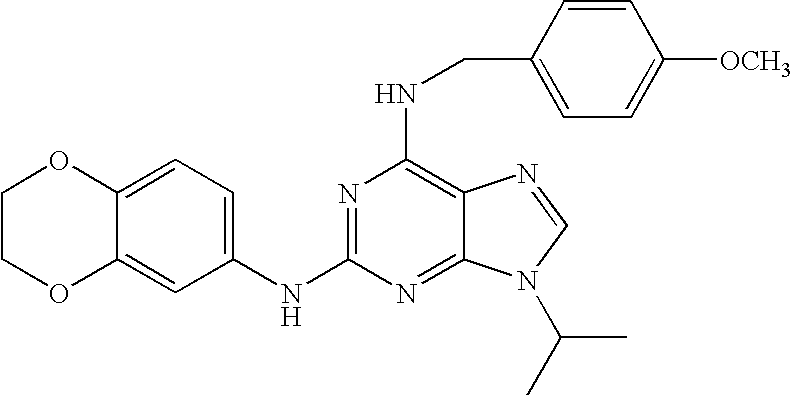
- 2-(1,4-benzodioxan-6-amino)-6-(4-methoxybenzylamino)-9-isopropylpurine: 1H NMR (400 MHz, CDCl3) δ1.56 (d, 6H, J=6.8 Hz), 3.78 (s, 3H), 4.24 (m, 4H), 4.70 (m, 1H, J=6.8 Hz), 4.72 (br, 2H), 6.14 (br, 1H), 6.77 (d, 1H, J=8.7 Hz), 6.85 (m, 3H), 6.99 (m, 1H), 7.29 (d, 2H, J=8.5 Hz), 7.44 (d, 1H, J=2.3 Hz), 7.49 (s, 1H); HRMS (MALDI-FTMS) [MH+] C24H27N6O3 447.2139, found: 447.2134

- 2-(indan-5-amino)-6-(4-methoxybenzylamino)-9-isopropylpurine: 1H NMR (400 MHz, CDCl3) δ1.57 (d, 6H, J=6.8 Hz), 2.06 (m, 2H), 2.86 (m, 4H), 3.78 (s, 3H), 4.69 (m, 1H, J=6.8 Hz), 4.75 (br, 2H), 6.09 (br, 1H), 6.85 (d, 2H, J=8.5 Hz), 6.92 (s, 1H); 7.13 (d, 1H, J=8.1 Hz), 7.29 (d, 2H, J=8.5 Hz), 7.40 (d, 1H, J=8.0 Hz), 7.50 (s, 1H), 7.60 (s, 1H); HRMS (MALDI-FTMS) [MH+] C25H29N6O 429.2397, found: 429.2417

- 2-(2,4,6-tri-methylphenylamino)-6-(4-methoxybenzylamino)-9-isopropylpurine: 1H NMR (400 MHz, CDCl3) δ1.47 (d, 6H, J=6.8 Hz), 2.22 (s, 6H), 2.31 (s, 3H), 3.78 (s, 3H), 4.52 (br, 2H), 4.60 (m, 1H, J=6.8 Hz), 5.86 (br, 1H), 6.11 (br, 1H), 6.77 (d, 2H, J=8.4 Hz), 6.93 (s, 2H), 7.10 (d, 2H, J=7.5 Hz), 7.49 (s, 1H); HRMS (MALDI-FTMS) [MH+] C25H31N6O 431.2554, found: 431.2569

- 2-(N-methylphenylamino)-6-(4-methoxybenzylamino)-9-isopropylpurine: 1H NMR (400 MHz, CDCl3) δ1.52 (d, 6H, J=6.8 Hz), 3.57 (s, 3H), 3.77 (s, 3H), 4.54 (br, 2H), 4.62 (m, 1H, J=6.8 Hz), 5.92 (br, 1H), 6.79 (d, 2H, J=8.5 Hz), 7.10 (d, 1H, J=7.3 Hz), 7.15 (d, 2H, J=8.5 Hz), 7.32 (m, 2H), 7.38 (d, 2H, J=7.7 Hz), 7.48 (s, 1H); HRMS (MALDI-FTMS) [MH+] C23H27N6O 403.2241, found: 403.2249

- 2-(4-methylphenoxy)-6-(4-methoxybenzylamino)-9-isopropylpurine. 1H NMR (400 MHz, CDCl3) δ1.53 (d, 6H, J=6.8 Hz), 2.37 (s, 3H), 3.79 (s, 3H), 4.54 (br, 2H), 4.71 (m, 1H, J=6.8 Hz), 6.35 (br, 1H), 6.81 (d, 2H, J=8.4 Hz), 7.10-7.18 (m, 6H), 7.65 (s, 1H); HRMS (MALDI-FTMS) [MH+] C23H26N5O2 404.2081, found: 404.2080

- 2-(3-methylphenoxy)-6-(4-methoxybenzylamino)-9-isopropylpurine. 1H NMR (400 MHz, CDCl3) δ1.53 (d, 6H, J=6.8 Hz), 2.37 (s, 3H), 3.78 (s, 3H), 4.52 (br, 2H), 4.71 (m, 1H, J=6.8 Hz), 6.62 (br, 1H), 6.81 (d, 2H, J=8.4 Hz), 7.00-7.05 (m, 3H), 7.14 (d, 2H, J=7.7 Hz), 7.25 (d, 1H, J=7.8 Hz), 7.66 (s, 1H); HRMS (MALDI-FTMS) [MH+] C23H26N5O2 404.2081, found: 404.2092

- 2-(2-methylphenoxy)-6-(4-methoxybenzylamino)-9-isopropylpurine. 1H NMR (400 MHz, CDCl3) δ1.52 (d, 6H, J=6.8 Hz), 2.20 (s, 3H), 3.78 (s, 3H), 4.42 (br, 2H), 4.71 (m, 1H, J=6.8 Hz), 6.63 (br, 1H), 6.77 (d, 2H, J=8.4 Hz), 7.04 (m, 2H), 7.11 (d, 1H, J=7.8 Hz), 7.15 (d, 1H, J=7.4 Hz), 7.21 (d, 1H, J=7.6 Hz), 7.25 (1H), 7.65 (s, 1H); HRMS (MALDI-FTMS) [MH+] C23H26N5O2 404.2081, found: 404.2087
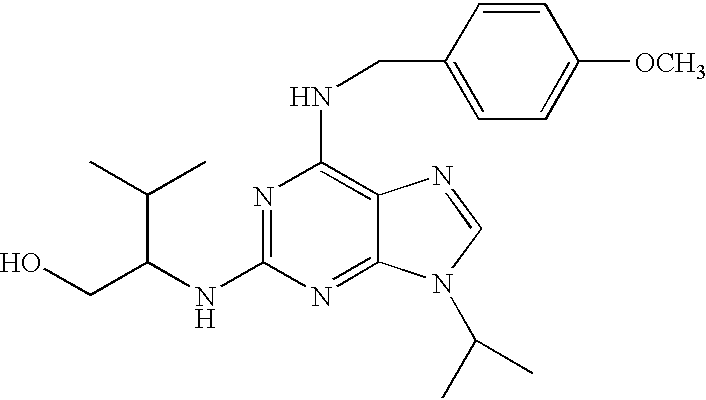
- 1H NMR (500 MHz, d6-DMSO) δ: d 0.85 (d, 6H, 7.1 Hz), 1.44 (d, 6H, 7.1 Hz), 1.93 (m, 1H), 3.31 (s, 2H), 3.46 (d, 2H, 5.3 Hz), 3.69 (s, 3H), 3.79 (m, 1H), 4.49 (m, 3H), 5.75 (s, 1H), 6.83 (d, 2H, J=8.7 Hz), 7.27 (d, 2H, J=8.7 Hz), 7.75 (s, 1H); HRMS calc'd for C 21H30N6O2 [MH+] 399.2508, found: 399.2510.
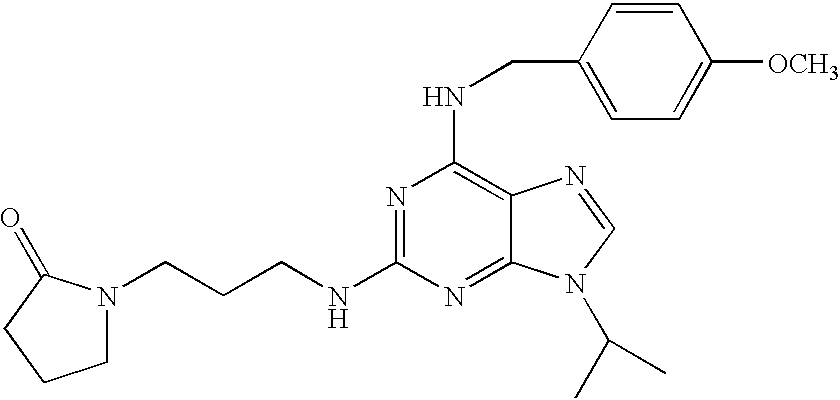
- 1H NMR (400 MHz, CDCl 3) δ: 1.61 (d, 6H, J=6.8 Hz), 1.92 (m, 2H), 2.10 (m, 2H), 2.52 (t, 2H, J=6.3 Hz), 3.44-3.56 (m, 6H), 3.80 (s, 3H), 4.81 (b, 3H)), 6.88 (d, 2H, J=7.9 Hz), 7.32 (d, 2H), 8.08 (s, 1H); MS (ES) calc'd for [MH+] C23H32N7O2 438.26, found 438.30

- 2-(4-methoxybenzylamino)-6-(3-methoxyphenyl)-pyrazine. 1H NMR (400 MHz, CDCl3) δ3.82 (s, 3H), 3.85 (s, 3H), 4.99 (br, 2H), 6.91-6.99 (m, 4H), 7.16 (d, 2H, J=8.8 Hz), 7.43-7.56 (m, 4H); MS (ES) calc'd for [MH+] C19H20N3O2 322.16, found 322.20

- 2-(4-methoxybenzylamino)-3-(3-methoxyphenyl)-quinoxaline. 1H NMR (400 MHz, CDCl3) δ3.79 (s, 3H), 3.84 (s, 3H), 4.95 (br, 2H), 5.86 (br, 1H), 6.87 (d, 2H, J=8.5 Hz), 7.05 (m, 1H), 7.25 (2H), 7.31 (d, 2H, J=8.4 Hz), 7.36 (m, 3H), 7.66 (m, 1H), 7.96 (d, 1H, J=8.1 Hz); MS (ES) calc'd for [MH+] C23H22N3O2 372.17, found 372.20

- 2-(3-methoxyphenyl)-4-(4-methoxybenzylamino)-5-methyl-quinoxaline. 1H NMR (400 MHz, CDCl3) δ2.15 (s, 3H), 3.89 (s, 3H), 3.98 (s, 3H), 4.87 (d 2H, J=5.4 Hz), 5.83 (br, 1H), 6.93 (d, 2H, J=8.6 Hz), 7.15 (dd, 1H), 7.33 (d, 2H, J=8.6 Hz), 7.45 (t, 1H, J=8.0 Hz), 8.14 (2H), 8.20 (d, 1H, J=8.3 Hz); MS (ES) calc'd for [MH+] C20H22N3O2 336.17, found 336.20
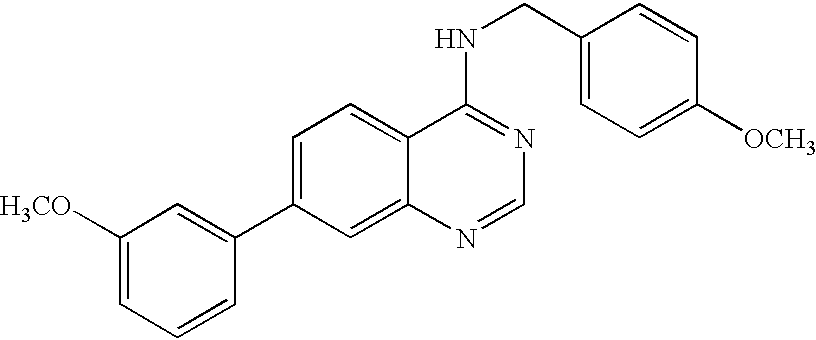
- 4-(4-methoxybenzylamino)-7-(3-methoxyphenyl)-quinazoline. 1H NMR (400 MHz, CDCl3) δ3.75 (s, 3H), 3.81 (s, 3H), 4.90 (br, 2H), 6.82 (m, 4H), 6.97 (2H), 7.47 (m, 4H), 8.21-8.49 (m, 3H); MS (ES) calc'd for [MH+] C23H22N3O2 372.17, found 372.20
- It is understood that the examples and embodiments described herein are for illustrative purposes only and that various modifications or changes in light thereof will be suggested to persons skilled in the art and are to included within the spirit and purview of this application and are considered within the scope of the appended claims. All publications, patents, and patent applications cited herein are hereby incorporated by reference in their entirety for all purposes.
Claims (72)


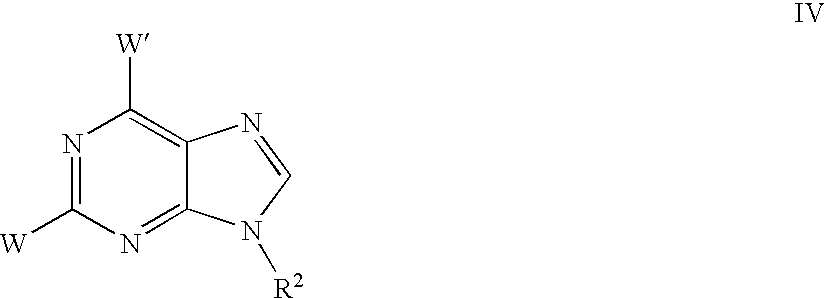

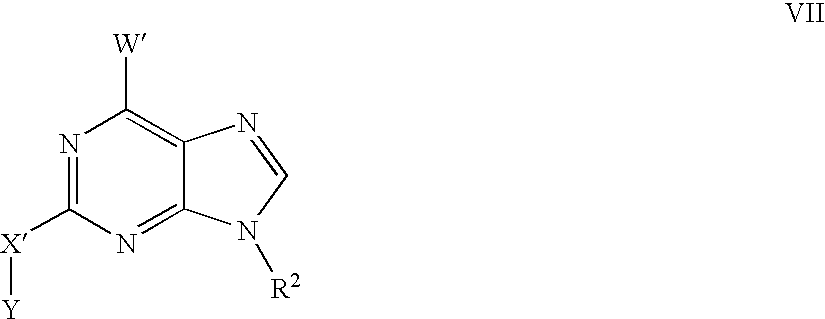


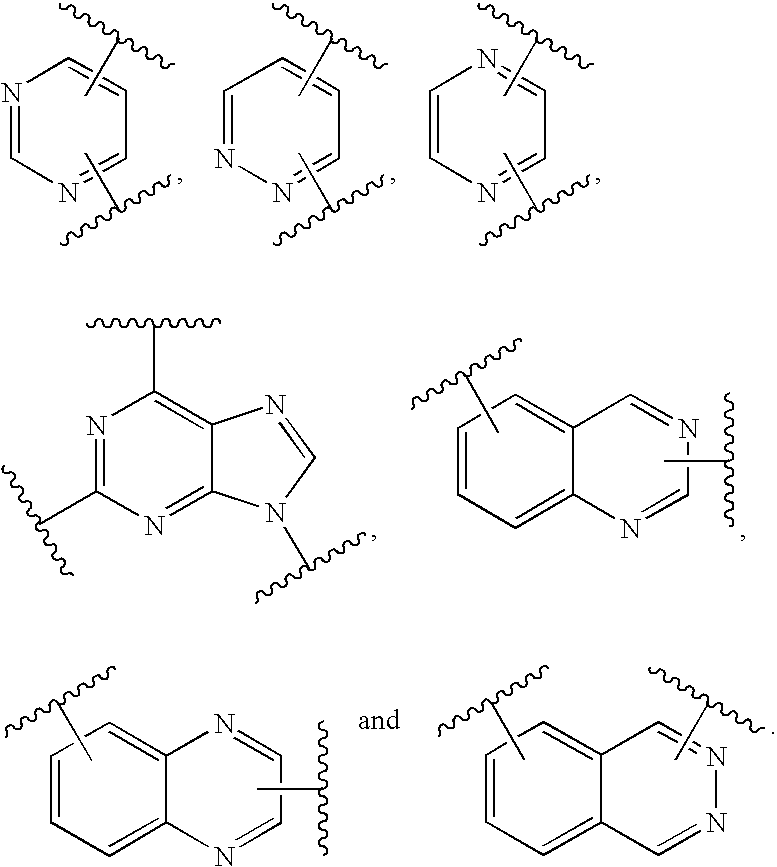


Priority Applications (2)
| Application Number | Priority Date | Filing Date | Title |
|---|---|---|---|
| US10/270,030 US7176312B2 (en) | 2001-10-12 | 2002-10-12 | Kinase inhibitor scaffolds and methods for their preparation |
| US11/673,976 US20070191380A1 (en) | 2001-10-12 | 2007-02-12 | Kinase inhibitor scaffolds and methods for their preparation |
Applications Claiming Priority (5)
| Application Number | Priority Date | Filing Date | Title |
|---|---|---|---|
| US32876301P | 2001-10-12 | 2001-10-12 | |
| US33183501P | 2001-11-20 | 2001-11-20 | |
| US34648002P | 2002-01-07 | 2002-01-07 | |
| US34808902P | 2002-01-10 | 2002-01-10 | |
| US10/270,030 US7176312B2 (en) | 2001-10-12 | 2002-10-12 | Kinase inhibitor scaffolds and methods for their preparation |
Related Child Applications (1)
| Application Number | Title | Priority Date | Filing Date |
|---|---|---|---|
| US11/673,976 Division US20070191380A1 (en) | 2001-10-12 | 2007-02-12 | Kinase inhibitor scaffolds and methods for their preparation |
Publications (2)
| Publication Number | Publication Date |
|---|---|
| US20030191312A1 true US20030191312A1 (en) | 2003-10-09 |
| US7176312B2 US7176312B2 (en) | 2007-02-13 |
Family
ID=27502388
Family Applications (2)
| Application Number | Title | Priority Date | Filing Date |
|---|---|---|---|
| US10/270,030 Expired - Fee Related US7176312B2 (en) | 2001-10-12 | 2002-10-12 | Kinase inhibitor scaffolds and methods for their preparation |
| US11/673,976 Abandoned US20070191380A1 (en) | 2001-10-12 | 2007-02-12 | Kinase inhibitor scaffolds and methods for their preparation |
Family Applications After (1)
| Application Number | Title | Priority Date | Filing Date |
|---|---|---|---|
| US11/673,976 Abandoned US20070191380A1 (en) | 2001-10-12 | 2007-02-12 | Kinase inhibitor scaffolds and methods for their preparation |
Country Status (6)
| Country | Link |
|---|---|
| US (2) | US7176312B2 (en) |
| EP (1) | EP1578722A4 (en) |
| JP (1) | JP2005512972A (en) |
| AU (1) | AU2002342051B2 (en) |
| CA (1) | CA2463563A1 (en) |
| WO (1) | WO2003031406A2 (en) |
Cited By (25)
| Publication number | Priority date | Publication date | Assignee | Title |
|---|---|---|---|---|
| US20030171583A1 (en) * | 2001-10-12 | 2003-09-11 | Irm Llc, A Delaware Limited Liability Company | Methods for the synthesis of substituted purines |
| US20030176699A1 (en) * | 1997-08-07 | 2003-09-18 | The Regents Of The University Of California | Purine inhibitors of protein kinases, G proteins and polymerases |
| US20040053927A1 (en) * | 2002-06-21 | 2004-03-18 | Darrow James W. | Certain amino-substituted monocycles as kinase modulators |
| US20040082627A1 (en) * | 2002-06-21 | 2004-04-29 | Darrow James W. | Certain aromatic monocycles as kinase modulators |
| US20050009846A1 (en) * | 2001-06-27 | 2005-01-13 | Fischer Peter Martin | 2,6,9-Substituted purine derivatives and their use in the treatment of proliferative disorders |
| WO2003031405A3 (en) * | 2001-10-12 | 2005-03-03 | Irm Llc | Methods for the synthesis of substituted purines |
| US20060009642A1 (en) * | 2001-10-12 | 2006-01-12 | Irm Llc, A Delaware Limited Liability Company | Methods for the synthesis of substituted purines |
| US7091346B1 (en) * | 1995-11-01 | 2006-08-15 | Novartis Ag | Purine derivatives and processes for their preparation |
| US20060183760A1 (en) * | 2002-08-15 | 2006-08-17 | Fischer Peter M | New purine derivatives |
| US20060229308A1 (en) * | 2003-07-15 | 2006-10-12 | Neurogen Corporation | Substituted pyrirmidin-4-ylamine analogues as vanilloid receptor ligands |
| US20070149538A1 (en) * | 2005-09-27 | 2007-06-28 | Irm Llc | Diarylamine-Containing Compounds and Compositions, and their use as Modulators of C-Kit Receptors |
| US20070161637A1 (en) * | 2003-07-22 | 2007-07-12 | Neurogen Corporation | Substituted pyridin-2-ylamine analogues |
| US20070219203A1 (en) * | 2004-03-04 | 2007-09-20 | Neurogen Corporation | Arylalkylamino-substituted quinazoline analogues |
| US20090042768A1 (en) * | 2005-05-16 | 2009-02-12 | Boulos Zacharie | Purine derivatives and their use for treatment of autoimmune diseases |
| WO2009146406A1 (en) * | 2008-05-30 | 2009-12-03 | Genentech, Inc. | Purine pi3k inhibitor compounds and methods of use |
| US20110230464A1 (en) * | 2007-10-26 | 2011-09-22 | Paul Goldsmith | Purine derivatives useful as p13 kinase inhibitors |
| US20110251172A1 (en) * | 2008-08-13 | 2011-10-13 | Rivkin Alexey A | Purine derivatives for treatment of alzheimer's disease |
| US8293736B2 (en) | 2010-07-14 | 2012-10-23 | F. Hoffmann La Roche Ag | Purine compounds selective for PI3K P110 delta, and methods of use |
| US8883799B2 (en) | 2010-12-16 | 2014-11-11 | Genentech, Inc. | Tricyclic PI3K inhibitor compounds and methods of use |
| US9012462B2 (en) | 2008-05-21 | 2015-04-21 | Ariad Pharmaceuticals, Inc. | Phosphorous derivatives as kinase inhibitors |
| US9273077B2 (en) | 2008-05-21 | 2016-03-01 | Ariad Pharmaceuticals, Inc. | Phosphorus derivatives as kinase inhibitors |
| US9611283B1 (en) | 2013-04-10 | 2017-04-04 | Ariad Pharmaceuticals, Inc. | Methods for inhibiting cell proliferation in ALK-driven cancers |
| US9834571B2 (en) | 2012-05-05 | 2017-12-05 | Ariad Pharmaceuticals, Inc. | Compounds for inhibiting cell proliferation in EGFR-driven cancers |
| US9834518B2 (en) | 2011-05-04 | 2017-12-05 | Ariad Pharmaceuticals, Inc. | Compounds for inhibiting cell proliferation in EGFR-driven cancers |
| CN113979999A (en) * | 2021-12-23 | 2022-01-28 | 北京鑫开元医药科技有限公司 | Compound for targeted ubiquitination degradation of BCR-ABL kinase and preparation method, composition and application thereof |
Families Citing this family (43)
| Publication number | Priority date | Publication date | Assignee | Title |
|---|---|---|---|---|
| JP2005515176A (en) * | 2001-11-03 | 2005-05-26 | アストラゼネカ アクチボラグ | Quinazoline derivatives as antitumor agents |
| GB0126433D0 (en) * | 2001-11-03 | 2002-01-02 | Astrazeneca Ab | Compounds |
| AU2003231231A1 (en) * | 2002-05-06 | 2003-11-11 | Bayer Pharmaceuticals Corporation | Pyridinyl amino pyrimidine derivatives useful for treating hyper-proliferative disorders |
| GB0215775D0 (en) * | 2002-07-06 | 2002-08-14 | Astex Technology Ltd | Pharmaceutical compounds |
| US8246980B2 (en) * | 2002-07-30 | 2012-08-21 | Ucb Pharma Gmbh | Transdermal delivery system |
| AU2002953255A0 (en) * | 2002-12-11 | 2003-01-02 | Cytopia Research Pty Ltd | Protein kinase inhibitors |
| WO2004058265A1 (en) * | 2002-12-24 | 2004-07-15 | Biofocus Plc | Compound libraries of 2,3-substituted pyrazine derivatives capable of binding to g-protein coupled receptors |
| DK1667991T3 (en) | 2003-09-16 | 2008-08-18 | Astrazeneca Ab | Quinazoline derivatives as tyrosine kinase inhibitors |
| MXPA06003113A (en) | 2003-09-19 | 2006-06-20 | Astrazeneca Ab | Quinazoline derivatives. |
| NZ547481A (en) * | 2003-11-19 | 2009-12-24 | Array Biopharma Inc | Heterocyclic inhibitors of mek and methods of use thereof |
| PT2277865E (en) | 2003-12-03 | 2015-02-05 | Ym Biosciences Australia Pty | Phenyl-substituted 6-ring nitrogen-heterocycles as microtubule polymerisation inhibitors |
| EP1727806A1 (en) * | 2004-01-16 | 2006-12-06 | Novartis AG | 2,4-diaminopyrimidines and their use for inducing cardiomyogenesis |
| CA2565037A1 (en) | 2004-04-28 | 2005-11-10 | Cv Therapeutics, Inc. | Purine derivatives as a1 adenosine receptor antagonists |
| GT200500284A (en) | 2004-10-15 | 2006-03-27 | Aventis Pharma Inc | PYRIMIDINS AS ANTAGONISTS OF PROSTAGLANDINA D2 RECEPTOR |
| GB0428082D0 (en) | 2004-12-22 | 2005-01-26 | Welcome Trust The Ltd | Therapeutic compounds |
| WO2006078886A2 (en) * | 2005-01-18 | 2006-07-27 | Irm Llc | Compounds and compositions as wnt signaling pathway modulators |
| CN101163684B (en) | 2005-02-23 | 2012-08-29 | 盐野义制药株式会社 | Quinazoline derivatives with tyrosine kinase inhibitory activity |
| AU2006309171A1 (en) * | 2005-10-28 | 2007-05-10 | Irm Llc | Compounds and compositions as protein kinase inhibitors |
| WO2007133773A2 (en) * | 2006-05-15 | 2007-11-22 | Senex Biotechnology, Inc | Identification of cdki pathway inhibitors |
| US8673929B2 (en) | 2006-07-20 | 2014-03-18 | Gilead Sciences, Inc. | 4,6-di- and 2,4,6-trisubstituted quinazoline derivatives and pharmaceutical compositions useful for treating viral infections |
| WO2008009078A2 (en) | 2006-07-20 | 2008-01-24 | Gilead Sciences, Inc. | 4,6-dl- and 2,4,6-trisubstituted quinazoline derivatives useful for treating viral infections |
| CN101686675A (en) * | 2007-03-20 | 2010-03-31 | 史密丝克莱恩比彻姆公司 | Compound |
| CN101677554A (en) * | 2007-03-20 | 2010-03-24 | 史密丝克莱恩比彻姆公司 | compound |
| EP2142547A1 (en) | 2007-03-28 | 2010-01-13 | NeuroSearch A/S | Purinyl derivatives and their use as potassium channel modulators |
| US20100105705A1 (en) * | 2007-03-28 | 2010-04-29 | Neurosearch A/S | Purinyl derivatives and their use as potassium channel modulators |
| DK2209786T3 (en) | 2007-10-05 | 2013-06-03 | Verastem Inc | PYRIMIDINE-SUBSTITUTED PURINDER DERIVATIVES |
| ES2734288T3 (en) * | 2007-11-28 | 2019-12-05 | Dana Farber Cancer Inst Inc | Bcr-abl small molecule myristate inhibitors and methods of use |
| PE20100362A1 (en) * | 2008-10-30 | 2010-05-27 | Irm Llc | PURINE DERIVATIVES THAT EXPAND HEMATOPOYETIC STEM CELLS |
| CN102428085B (en) | 2009-04-03 | 2015-07-15 | 维拉斯通股份有限公司 | Pyrimidine-substituted purine compounds as kinase inhibitors |
| WO2012088712A1 (en) * | 2010-12-31 | 2012-07-05 | Curegenix Inc. | Compound as wnt signaling inhibitor, composition, and use thereof |
| KR20150033679A (en) | 2012-06-26 | 2015-04-01 | 사니오나 에이피에스 | A phenyl triazole derivative and its use for modulating the gabaa receptor complex |
| EP2742869A1 (en) | 2012-12-12 | 2014-06-18 | Samsung Medison Co., Ltd. | Ultrasound apparatus and method of inputting information into the same |
| UA115388C2 (en) | 2013-11-21 | 2017-10-25 | Пфайзер Інк. | 2,6-substituted purine derivatives and their use in the treatment of proliferative disorders |
| US10167451B2 (en) | 2014-12-22 | 2019-01-01 | The Chinese University Of Hong Kong | Combinational use of mechanical manipulation and programin derivatives to increase Oct4, Sox2, or Nanog expression in fibroblasts |
| JP6736253B2 (en) * | 2014-12-22 | 2020-08-05 | ザ チャイニーズ ユニバーシティ オブ ホンコン | Combined use of mechanical manipulation and programin to generate pluripotent stem cells from somatic cells |
| DK3097102T3 (en) | 2015-03-04 | 2018-01-22 | Gilead Sciences Inc | TOLL-LIKE RECEPTOR MODULATING 4,6-DIAMINO-PYRIDO [3,2-D] PYRIMIDINE COMPOUNDS |
| MA46093A (en) | 2016-09-02 | 2021-05-19 | Gilead Sciences Inc | TOLL-TYPE RECEIVER MODULATING COMPOUNDS |
| WO2018045150A1 (en) | 2016-09-02 | 2018-03-08 | Gilead Sciences, Inc. | 4,6-diamino-pyrido[3,2-d]pyrimidine derivaties as toll like receptor modulators |
| TW202212339A (en) | 2019-04-17 | 2022-04-01 | 美商基利科學股份有限公司 | Solid forms of a toll-like receptor modulator |
| TW202210480A (en) | 2019-04-17 | 2022-03-16 | 美商基利科學股份有限公司 | Solid forms of a toll-like receptor modulator |
| TWI879779B (en) | 2019-06-28 | 2025-04-11 | 美商基利科學股份有限公司 | Processes for preparing toll-like receptor modulator compounds |
| KR20250121114A (en) | 2022-12-16 | 2025-08-11 | 아스트라제네카 아베 | 2,6,9-trisubstituted purine |
| EP4725942A1 (en) * | 2024-10-09 | 2026-04-15 | Sibylla Biotech S.p.A. | Compounds active on cyclin d1 pathway and their use |
Citations (2)
| Publication number | Priority date | Publication date | Assignee | Title |
|---|---|---|---|---|
| US20030171583A1 (en) * | 2001-10-12 | 2003-09-11 | Irm Llc, A Delaware Limited Liability Company | Methods for the synthesis of substituted purines |
| US20040157864A1 (en) * | 2002-10-15 | 2004-08-12 | Irm Llc | Compositions and methods for inducing osteogenesis |
Family Cites Families (14)
| Publication number | Priority date | Publication date | Assignee | Title |
|---|---|---|---|---|
| JP2636118B2 (en) * | 1991-09-10 | 1997-07-30 | 三省製薬株式会社 | Hair restorer |
| PT874846E (en) * | 1995-11-01 | 2003-08-29 | Novartis Ag | PURINA DERIVATIVES AND PROCESSES FOR THEIR PREPARATION |
| FR2741881B1 (en) * | 1995-12-01 | 1999-07-30 | Centre Nat Rech Scient | NOVEL PURINE DERIVATIVES HAVING IN PARTICULAR ANTI-PROLIFERATIVE PRORIETES AND THEIR BIOLOGICAL APPLICATIONS |
| US5866702A (en) * | 1996-08-02 | 1999-02-02 | Cv Therapeutics, Incorporation | Purine inhibitors of cyclin dependent kinase 2 |
| AU735127B2 (en) * | 1997-08-07 | 2001-06-28 | Regents Of The University Of California, The | Purine inhibitor of protein kinases, G proteins and polymerases |
| WO1999034018A1 (en) | 1997-12-24 | 1999-07-08 | The Regents Of The University Of California | Methods of using chemical libraries to search for new kinase inhibitors |
| WO2000037471A1 (en) * | 1998-12-23 | 2000-06-29 | Neurogen Corporation | 2-amino-9-alkylpurines: gaba brain receptor ligands |
| FR2793794B1 (en) * | 1999-05-21 | 2001-07-27 | Hoechst Marion Roussel Inc | NOVEL PURINE DERIVATIVES, THEIR PREPARATION PROCESS, THEIR APPLICATION AS MEDICAMENTS, PHARMACEUTICAL COMPOSITIONS AND NEW USE |
| GB9918035D0 (en) * | 1999-07-30 | 1999-09-29 | Novartis Ag | Organic compounds |
| US7115589B2 (en) * | 1999-12-17 | 2006-10-03 | Ariad Pharmaceuticals, Inc. | Purine derivatives |
| US7262176B2 (en) * | 2001-08-08 | 2007-08-28 | Cv Therapeutics, Inc. | Adenosine A3 receptor agonists |
| CN100427487C (en) * | 2002-06-27 | 2008-10-22 | 弗·哈夫曼·拉罗切有限公司 | Synthesis of Purine Derivatives |
| MXPA06001758A (en) * | 2003-08-15 | 2006-08-11 | Irm Llc | 6-substituted anilino purines as rtk inhibitors. |
| US7592177B2 (en) * | 2003-11-10 | 2009-09-22 | The Scripps Research Institute | Compositions and methods for inducing cell dedifferentiation |
-
2002
- 2002-10-12 EP EP02776216A patent/EP1578722A4/en not_active Withdrawn
- 2002-10-12 CA CA002463563A patent/CA2463563A1/en not_active Abandoned
- 2002-10-12 US US10/270,030 patent/US7176312B2/en not_active Expired - Fee Related
- 2002-10-12 WO PCT/US2002/032680 patent/WO2003031406A2/en not_active Ceased
- 2002-10-12 JP JP2003534390A patent/JP2005512972A/en active Pending
- 2002-10-12 AU AU2002342051A patent/AU2002342051B2/en not_active Ceased
-
2007
- 2007-02-12 US US11/673,976 patent/US20070191380A1/en not_active Abandoned
Patent Citations (2)
| Publication number | Priority date | Publication date | Assignee | Title |
|---|---|---|---|---|
| US20030171583A1 (en) * | 2001-10-12 | 2003-09-11 | Irm Llc, A Delaware Limited Liability Company | Methods for the synthesis of substituted purines |
| US20040157864A1 (en) * | 2002-10-15 | 2004-08-12 | Irm Llc | Compositions and methods for inducing osteogenesis |
Cited By (48)
| Publication number | Priority date | Publication date | Assignee | Title |
|---|---|---|---|---|
| US7091346B1 (en) * | 1995-11-01 | 2006-08-15 | Novartis Ag | Purine derivatives and processes for their preparation |
| US6803371B2 (en) * | 1997-08-07 | 2004-10-12 | The Regents Of The University Of California | Purine inhibitors of protein kinases, G proteins and polymerases |
| US20030176699A1 (en) * | 1997-08-07 | 2003-09-18 | The Regents Of The University Of California | Purine inhibitors of protein kinases, G proteins and polymerases |
| US20050009846A1 (en) * | 2001-06-27 | 2005-01-13 | Fischer Peter Martin | 2,6,9-Substituted purine derivatives and their use in the treatment of proliferative disorders |
| US7612079B2 (en) * | 2001-06-27 | 2009-11-03 | Cyclacel Limited | 2,6,9-substituted purine derivatives and their use in the treatment of proliferative disorders |
| US20060009642A1 (en) * | 2001-10-12 | 2006-01-12 | Irm Llc, A Delaware Limited Liability Company | Methods for the synthesis of substituted purines |
| US6949644B2 (en) * | 2001-10-12 | 2005-09-27 | Irm Llc | Methods for the synthesis of substituted purines |
| WO2003031405A3 (en) * | 2001-10-12 | 2005-03-03 | Irm Llc | Methods for the synthesis of substituted purines |
| US20030171583A1 (en) * | 2001-10-12 | 2003-09-11 | Irm Llc, A Delaware Limited Liability Company | Methods for the synthesis of substituted purines |
| US20040082627A1 (en) * | 2002-06-21 | 2004-04-29 | Darrow James W. | Certain aromatic monocycles as kinase modulators |
| US7015227B2 (en) | 2002-06-21 | 2006-03-21 | Cgi Pharmaceuticals, Inc. | Certain amino-substituted monocycles as kinase modulators |
| US20040053927A1 (en) * | 2002-06-21 | 2004-03-18 | Darrow James W. | Certain amino-substituted monocycles as kinase modulators |
| US20090270427A1 (en) * | 2002-08-15 | 2009-10-29 | Cyclacel Limited | Purine derivatives |
| US7544689B2 (en) | 2002-08-15 | 2009-06-09 | Cyclacel Limited | Purine derivatives |
| US20060183760A1 (en) * | 2002-08-15 | 2006-08-17 | Fischer Peter M | New purine derivatives |
| US20060229308A1 (en) * | 2003-07-15 | 2006-10-12 | Neurogen Corporation | Substituted pyrirmidin-4-ylamine analogues as vanilloid receptor ligands |
| US20070161637A1 (en) * | 2003-07-22 | 2007-07-12 | Neurogen Corporation | Substituted pyridin-2-ylamine analogues |
| US20070219203A1 (en) * | 2004-03-04 | 2007-09-20 | Neurogen Corporation | Arylalkylamino-substituted quinazoline analogues |
| US20090042768A1 (en) * | 2005-05-16 | 2009-02-12 | Boulos Zacharie | Purine derivatives and their use for treatment of autoimmune diseases |
| US8080555B2 (en) | 2005-05-16 | 2011-12-20 | Prometic Biosciences Inc. | Purine derivatives and their use for treatment of autoimmune diseases |
| US7563894B2 (en) | 2005-09-27 | 2009-07-21 | Irm Llc | Diarylamine-containing compounds and compositions, and their use as modulators of c-kit receptors |
| US20080139597A1 (en) * | 2005-09-27 | 2008-06-12 | Irm Llc, A Delaware Limited Liability Comapny | Diarylamine-containing compounds and compositions, and their use as modulators of c-kit receptors |
| US7514447B2 (en) | 2005-09-27 | 2009-04-07 | Irm Llc | Diarylamine-containing compounds and compositions, and their use as modulators of c-kit receptors |
| US20090012094A1 (en) * | 2005-09-27 | 2009-01-08 | Irm Llc, A Delaware Limited Liability Comapny | Diarylamine-containing compounds and compositions, and their use as modulators of c-kit receptors |
| US20080139559A1 (en) * | 2005-09-27 | 2008-06-12 | Irm Llc, A Delaware Limited Liability Comapny | Diarylamine-containing compounds and compositions, and their use as modulators of c-kit receptors |
| US7592349B2 (en) | 2005-09-27 | 2009-09-22 | Irm Llc | Diarylamine-containing compounds and compositions, and their use as modulators of c-kit receptors |
| US20090264649A1 (en) * | 2005-09-27 | 2009-10-22 | Irm Llc | Diarylamine-containing compounds and compositions, and their use as modulators of c-kit receptors |
| RU2436776C2 (en) * | 2005-09-27 | 2011-12-20 | Айрм Ллк | DIARYLAMINE-CONTAINING COMPOUNDS, COMPOSITIONS AND USE THEREOF AS c-KIT RECEPTOR MODULATORS |
| WO2007038669A3 (en) * | 2005-09-27 | 2007-11-22 | Irm Llc | Diarylamine-containing compounds and compositions, and their use as modulators of c-kit receptors |
| US20070149538A1 (en) * | 2005-09-27 | 2007-06-28 | Irm Llc | Diarylamine-Containing Compounds and Compositions, and their use as Modulators of C-Kit Receptors |
| JP2009510086A (en) * | 2005-09-27 | 2009-03-12 | アイアールエム・リミテッド・ライアビリティ・カンパニー | Diarylamine-containing compounds and compositions and their use as modulators of C-KIT receptors |
| US7638523B2 (en) | 2005-09-27 | 2009-12-29 | Irm Llc | Diarylamine-containing compounds and compositions, and their use as modulators of c-kit receptors |
| US20110230464A1 (en) * | 2007-10-26 | 2011-09-22 | Paul Goldsmith | Purine derivatives useful as p13 kinase inhibitors |
| US9012462B2 (en) | 2008-05-21 | 2015-04-21 | Ariad Pharmaceuticals, Inc. | Phosphorous derivatives as kinase inhibitors |
| US9273077B2 (en) | 2008-05-21 | 2016-03-01 | Ariad Pharmaceuticals, Inc. | Phosphorus derivatives as kinase inhibitors |
| RU2509081C2 (en) * | 2008-05-30 | 2014-03-10 | Дженентек, Инк. | Purine compounds inhibiting pi3k, and application methods |
| US8158624B2 (en) | 2008-05-30 | 2012-04-17 | Genetech, Inc. | Purine PI3K inhibitor compounds and methods of use |
| US8445487B2 (en) | 2008-05-30 | 2013-05-21 | Genentech, Inc. | Purine PI3K inhibitor compounds and methods of use |
| US20090318411A1 (en) * | 2008-05-30 | 2009-12-24 | Genentech, Inc. | Purine pi3k inhibitor compounds and methods of use |
| WO2009146406A1 (en) * | 2008-05-30 | 2009-12-03 | Genentech, Inc. | Purine pi3k inhibitor compounds and methods of use |
| US20110251172A1 (en) * | 2008-08-13 | 2011-10-13 | Rivkin Alexey A | Purine derivatives for treatment of alzheimer's disease |
| US8293736B2 (en) | 2010-07-14 | 2012-10-23 | F. Hoffmann La Roche Ag | Purine compounds selective for PI3K P110 delta, and methods of use |
| US8883799B2 (en) | 2010-12-16 | 2014-11-11 | Genentech, Inc. | Tricyclic PI3K inhibitor compounds and methods of use |
| US9546182B2 (en) | 2010-12-16 | 2017-01-17 | Genentech, Inc. | Tricyclic PI3K inhibitor compounds and methods of use |
| US9834518B2 (en) | 2011-05-04 | 2017-12-05 | Ariad Pharmaceuticals, Inc. | Compounds for inhibiting cell proliferation in EGFR-driven cancers |
| US9834571B2 (en) | 2012-05-05 | 2017-12-05 | Ariad Pharmaceuticals, Inc. | Compounds for inhibiting cell proliferation in EGFR-driven cancers |
| US9611283B1 (en) | 2013-04-10 | 2017-04-04 | Ariad Pharmaceuticals, Inc. | Methods for inhibiting cell proliferation in ALK-driven cancers |
| CN113979999A (en) * | 2021-12-23 | 2022-01-28 | 北京鑫开元医药科技有限公司 | Compound for targeted ubiquitination degradation of BCR-ABL kinase and preparation method, composition and application thereof |
Also Published As
| Publication number | Publication date |
|---|---|
| WO2003031406A3 (en) | 2006-01-05 |
| AU2002342051B2 (en) | 2009-06-11 |
| US20070191380A1 (en) | 2007-08-16 |
| CA2463563A1 (en) | 2003-04-17 |
| US7176312B2 (en) | 2007-02-13 |
| JP2005512972A (en) | 2005-05-12 |
| WO2003031406A2 (en) | 2003-04-17 |
| EP1578722A4 (en) | 2006-09-06 |
| EP1578722A2 (en) | 2005-09-28 |
Similar Documents
| Publication | Publication Date | Title |
|---|---|---|
| US7176312B2 (en) | Kinase inhibitor scaffolds and methods for their preparation | |
| AU2002342051A1 (en) | Kinase inhibitor scaffolds and methods for their preparation | |
| Daluge et al. | An efficient, scalable synthesis of the HIV reverse transcriptase inhibitor Ziagen®(1592U89) | |
| CN111875585B (en) | A class of kinase inhibitors | |
| CA2944610C (en) | (5,6-dihydro)pyrimido[4,5-e]indolizines | |
| Zatloukal et al. | Synthesis and in vitro biological evaluation of 2, 6, 9-trisubstituted purines targeting multiple cyclin-dependent kinases | |
| TW201639831A (en) | Substituted 2-hydro-pyrazole derivatives as anticancer drugs | |
| US20030171583A1 (en) | Methods for the synthesis of substituted purines | |
| WO2009099163A1 (en) | Pyrrolopyrimidin derivative for use as pi3k inhibitor, and use thereof | |
| WO2014135028A1 (en) | Pyridopyrimidine or pyrimidopyrimidine compound, preparation method, pharmaceutical composition and use thereof | |
| CN107686477B (en) | Novel compounds as CDK4/6 inhibitors and their applications | |
| US20060009642A1 (en) | Methods for the synthesis of substituted purines | |
| CN108290899A (en) | A kind of substituted pyrrolopyrimidine compound and its application | |
| CA2699040A1 (en) | Perharidines | |
| JPH08828B2 (en) | Heterocyclic compounds for enhancing antitumor activity | |
| AU2002334992B2 (en) | Methods for the synthesis of substituted purines | |
| Lougiakis et al. | Design and synthesis of purine analogues as highly specific ligands for FcyB, a ubiquitous fungal nucleobase transporter | |
| Siutkina et al. | Microwave-Assisted Synthesis, Structure, and Preliminary Biological Evaluation of Novel 6-Methoxy-5, 6-dihydro-5-azapurines | |
| AU2002334992A1 (en) | Methods for the synthesis of substituted purines | |
| Weyler et al. | Versatile, convenient synthesis of pyrimido [1, 2, 3-cd] purinediones | |
| Ye et al. | Discovery of pyrido [4, 3-d] pyrimidinone derivatives as novel Wee1 inhibitors | |
| Jin et al. | Pyrrolo [2, 3-b] pyridine-3-one derivatives as novel fibroblast growth factor receptor 4 inhibitors for the treatment of hepatocellular carcinoma | |
| Giannouli et al. | Design and synthesis of new substituted pyrazolopyridines with potent antiproliferative activity | |
| CN115867280A (en) | 5-Amino-8-(4-pyridyl)-[1,2,4]triazolo[4,3-c]pyrimidin-3-one compounds for anticancer | |
| Baraldi et al. | An efficient one-pot synthesis of 6-alkoxy-8, 9-dialkylpurines via reaction of 5-amino-4-chloro-6-alkylaminopyrimidines with N, N-dimethylalkaneamides and alkoxide ions |
Legal Events
| Date | Code | Title | Description |
|---|---|---|---|
| AS | Assignment |
Owner name: IRM LLC, BERMUDA Free format text: ASSIGNMENT OF ASSIGNORS INTEREST;ASSIGNORS:DING, QIANG;GRAY, NATHANAEL S.;REEL/FRAME:013810/0171 Effective date: 20030122 |
|
| AS | Assignment |
Owner name: SCRIPPS RESEARCH INSTITUTE, THE, CALIFORNIA Free format text: ASSIGNMENT OF ASSIGNORS INTEREST;ASSIGNOR:DING, SHENG;REEL/FRAME:013888/0015 Effective date: 20030311 |
|
| REMI | Maintenance fee reminder mailed | ||
| LAPS | Lapse for failure to pay maintenance fees | ||
| STCH | Information on status: patent discontinuation |
Free format text: PATENT EXPIRED DUE TO NONPAYMENT OF MAINTENANCE FEES UNDER 37 CFR 1.362 |
|
| FP | Lapsed due to failure to pay maintenance fee |
Effective date: 20110213 |