US20020184897A1 - Methos and Apparatus of Heat-Shocking Fresh Produce and for Cooling Such Produce to a Desired Temperature and Moisture Content - Google Patents
Methos and Apparatus of Heat-Shocking Fresh Produce and for Cooling Such Produce to a Desired Temperature and Moisture Content Download PDFInfo
- Publication number
- US20020184897A1 US20020184897A1 US10/210,990 US21099002A US2002184897A1 US 20020184897 A1 US20020184897 A1 US 20020184897A1 US 21099002 A US21099002 A US 21099002A US 2002184897 A1 US2002184897 A1 US 2002184897A1
- Authority
- US
- United States
- Prior art keywords
- produce
- temperature
- water
- lettuce
- vacuum
- Prior art date
- Legal status (The legal status is an assumption and is not a legal conclusion. Google has not performed a legal analysis and makes no representation as to the accuracy of the status listed.)
- Granted
Links
- 238000001816 cooling Methods 0.000 title claims description 39
- XLYOFNOQVPJJNP-UHFFFAOYSA-N water Substances O XLYOFNOQVPJJNP-UHFFFAOYSA-N 0.000 claims abstract description 102
- 235000003228 Lactuca sativa Nutrition 0.000 claims abstract description 59
- 230000035939 shock Effects 0.000 claims abstract description 25
- 235000011299 Brassica oleracea var botrytis Nutrition 0.000 claims abstract description 21
- 235000017647 Brassica oleracea var italica Nutrition 0.000 claims abstract description 21
- 240000003259 Brassica oleracea var. botrytis Species 0.000 claims abstract description 21
- 244000061456 Solanum tuberosum Species 0.000 claims abstract description 20
- 235000002595 Solanum tuberosum Nutrition 0.000 claims abstract description 20
- 235000012015 potatoes Nutrition 0.000 claims abstract description 19
- 238000012545 processing Methods 0.000 claims abstract description 15
- 238000000034 method Methods 0.000 claims description 69
- 239000007789 gas Substances 0.000 claims description 21
- 230000004044 response Effects 0.000 claims description 20
- 238000001035 drying Methods 0.000 claims description 16
- 238000001704 evaporation Methods 0.000 claims description 16
- 238000004806 packaging method and process Methods 0.000 claims description 11
- IJGRMHOSHXDMSA-UHFFFAOYSA-N Atomic nitrogen Chemical compound N#N IJGRMHOSHXDMSA-UHFFFAOYSA-N 0.000 claims description 10
- 239000003795 chemical substances by application Substances 0.000 claims description 7
- 239000011261 inert gas Substances 0.000 claims description 7
- 239000002917 insecticide Substances 0.000 claims description 7
- 229910052757 nitrogen Inorganic materials 0.000 claims description 5
- 230000001965 increasing effect Effects 0.000 claims description 4
- 244000141359 Malus pumila Species 0.000 claims description 3
- 235000021016 apples Nutrition 0.000 claims description 3
- 238000004321 preservation Methods 0.000 claims description 2
- 241000208822 Lactuca Species 0.000 claims 19
- 235000013311 vegetables Nutrition 0.000 claims 2
- 240000008415 Lactuca sativa Species 0.000 abstract description 41
- 238000002845 discoloration Methods 0.000 abstract description 2
- 230000000694 effects Effects 0.000 description 11
- 230000008569 process Effects 0.000 description 10
- 108700023158 Phenylalanine ammonia-lyases Proteins 0.000 description 6
- 238000006243 chemical reaction Methods 0.000 description 5
- 238000002635 electroconvulsive therapy Methods 0.000 description 5
- 230000008020 evaporation Effects 0.000 description 5
- QSHDDOUJBYECFT-UHFFFAOYSA-N mercury Chemical compound [Hg] QSHDDOUJBYECFT-UHFFFAOYSA-N 0.000 description 5
- 229910052753 mercury Inorganic materials 0.000 description 5
- 230000009467 reduction Effects 0.000 description 5
- 241000196324 Embryophyta Species 0.000 description 4
- 238000007654 immersion Methods 0.000 description 4
- 230000004060 metabolic process Effects 0.000 description 4
- 235000013824 polyphenols Nutrition 0.000 description 4
- 108090000790 Enzymes Proteins 0.000 description 3
- 102000004190 Enzymes Human genes 0.000 description 3
- 235000010702 Insulata Nutrition 0.000 description 3
- 244000165077 Insulata Species 0.000 description 3
- 238000003306 harvesting Methods 0.000 description 3
- 239000000575 pesticide Substances 0.000 description 3
- ISWSIDIOOBJBQZ-UHFFFAOYSA-N phenol group Chemical group C1(=CC=CC=C1)O ISWSIDIOOBJBQZ-UHFFFAOYSA-N 0.000 description 3
- 238000003860 storage Methods 0.000 description 3
- 239000002352 surface water Substances 0.000 description 3
- 238000011282 treatment Methods 0.000 description 3
- 238000007738 vacuum evaporation Methods 0.000 description 3
- PZIRUHCJZBGLDY-UHFFFAOYSA-N Caffeoylquinic acid Natural products CC(CCC(=O)C(C)C1C(=O)CC2C3CC(O)C4CC(O)CCC4(C)C3CCC12C)C(=O)O PZIRUHCJZBGLDY-UHFFFAOYSA-N 0.000 description 2
- 102000002812 Heat-Shock Proteins Human genes 0.000 description 2
- 108010004889 Heat-Shock Proteins Proteins 0.000 description 2
- 241000366676 Justicia pectoralis Species 0.000 description 2
- 238000007605 air drying Methods 0.000 description 2
- 235000012055 fruits and vegetables Nutrition 0.000 description 2
- 238000012986 modification Methods 0.000 description 2
- 230000004048 modification Effects 0.000 description 2
- 150000002989 phenols Chemical class 0.000 description 2
- 238000001243 protein synthesis Methods 0.000 description 2
- 238000001179 sorption measurement Methods 0.000 description 2
- 230000014616 translation Effects 0.000 description 2
- 238000001291 vacuum drying Methods 0.000 description 2
- CWVRJTMFETXNAD-BMNNCGMMSA-N (1s,3r,4s,5r)-3-[(e)-3-(3,4-dihydroxyphenyl)prop-2-enoyl]oxy-1,4,5-trihydroxycyclohexane-1-carboxylic acid Chemical compound O[C@H]1[C@H](O)C[C@@](O)(C(O)=O)C[C@H]1OC(=O)\C=C\C1=CC=C(O)C(O)=C1 CWVRJTMFETXNAD-BMNNCGMMSA-N 0.000 description 1
- CWVRJTMFETXNAD-FWCWNIRPSA-N 3-O-Caffeoylquinic acid Natural products O[C@H]1[C@@H](O)C[C@@](O)(C(O)=O)C[C@H]1OC(=O)\C=C\C1=CC=C(O)C(O)=C1 CWVRJTMFETXNAD-FWCWNIRPSA-N 0.000 description 1
- 244000019459 Cynara cardunculus Species 0.000 description 1
- 235000019106 Cynara scolymus Nutrition 0.000 description 1
- YDDGKXBLOXEEMN-UHFFFAOYSA-N Di-E-caffeoyl-meso-tartaric acid Natural products C=1C=C(O)C(O)=CC=1C=CC(=O)OC(C(O)=O)C(C(=O)O)OC(=O)C=CC1=CC=C(O)C(O)=C1 YDDGKXBLOXEEMN-UHFFFAOYSA-N 0.000 description 1
- 235000015802 Lactuca sativa var crispa Nutrition 0.000 description 1
- 240000004201 Lactuca sativa var. crispa Species 0.000 description 1
- CWVRJTMFETXNAD-KLZCAUPSSA-N Neochlorogenin-saeure Natural products O[C@H]1C[C@@](O)(C[C@@H](OC(=O)C=Cc2ccc(O)c(O)c2)[C@@H]1O)C(=O)O CWVRJTMFETXNAD-KLZCAUPSSA-N 0.000 description 1
- 244000025272 Persea americana Species 0.000 description 1
- 235000008673 Persea americana Nutrition 0.000 description 1
- 238000005299 abrasion Methods 0.000 description 1
- 238000010521 absorption reaction Methods 0.000 description 1
- 230000004075 alteration Effects 0.000 description 1
- 235000016520 artichoke thistle Nutrition 0.000 description 1
- 230000008901 benefit Effects 0.000 description 1
- 238000007664 blowing Methods 0.000 description 1
- 235000014121 butter Nutrition 0.000 description 1
- YDDGKXBLOXEEMN-IABMMNSOSA-N chicoric acid Chemical compound O([C@@H](C(=O)O)[C@@H](OC(=O)\C=C\C=1C=C(O)C(O)=CC=1)C(O)=O)C(=O)\C=C\C1=CC=C(O)C(O)=C1 YDDGKXBLOXEEMN-IABMMNSOSA-N 0.000 description 1
- CWVRJTMFETXNAD-JUHZACGLSA-N chlorogenic acid Chemical compound O[C@@H]1[C@H](O)C[C@@](O)(C(O)=O)C[C@H]1OC(=O)\C=C\C1=CC=C(O)C(O)=C1 CWVRJTMFETXNAD-JUHZACGLSA-N 0.000 description 1
- 229940074393 chlorogenic acid Drugs 0.000 description 1
- FFQSDFBBSXGVKF-KHSQJDLVSA-N chlorogenic acid Natural products O[C@@H]1C[C@](O)(C[C@@H](CC(=O)C=Cc2ccc(O)c(O)c2)[C@@H]1O)C(=O)O FFQSDFBBSXGVKF-KHSQJDLVSA-N 0.000 description 1
- 235000001368 chlorogenic acid Nutrition 0.000 description 1
- BMRSEYFENKXDIS-KLZCAUPSSA-N cis-3-O-p-coumaroylquinic acid Natural products O[C@H]1C[C@@](O)(C[C@@H](OC(=O)C=Cc2ccc(O)cc2)[C@@H]1O)C(=O)O BMRSEYFENKXDIS-KLZCAUPSSA-N 0.000 description 1
- 239000000498 cooling water Substances 0.000 description 1
- 238000005520 cutting process Methods 0.000 description 1
- 230000006378 damage Effects 0.000 description 1
- 238000010586 diagram Methods 0.000 description 1
- YDDGKXBLOXEEMN-WOJBJXKFSA-N dicaffeoyl-L-tartaric acid Natural products O([C@@H](C(=O)O)[C@@H](OC(=O)C=CC=1C=C(O)C(O)=CC=1)C(O)=O)C(=O)C=CC1=CC=C(O)C(O)=C1 YDDGKXBLOXEEMN-WOJBJXKFSA-N 0.000 description 1
- 230000002708 enhancing effect Effects 0.000 description 1
- 230000009746 freeze damage Effects 0.000 description 1
- 238000010438 heat treatment Methods 0.000 description 1
- KRZBCHWVBQOTNZ-DLDRDHNVSA-N isochlorogenic acid Natural products O[C@@H]1[C@H](C[C@@](O)(C[C@H]1OC(=O)C=Cc2ccc(O)c(O)c2)C(=O)O)OC(=O)C=Cc3ccc(O)c(O)c3 KRZBCHWVBQOTNZ-DLDRDHNVSA-N 0.000 description 1
- 239000012528 membrane Substances 0.000 description 1
- 238000013021 overheating Methods 0.000 description 1
- 238000010791 quenching Methods 0.000 description 1
- 238000011160 research Methods 0.000 description 1
- 230000000717 retained effect Effects 0.000 description 1
- 235000012045 salad Nutrition 0.000 description 1
- 230000004083 survival effect Effects 0.000 description 1
- 230000002195 synergetic effect Effects 0.000 description 1
- 239000011885 synergistic combination Substances 0.000 description 1
- 238000010792 warming Methods 0.000 description 1
Images


Classifications
-
- A—HUMAN NECESSITIES
- A23—FOODS OR FOODSTUFFS; TREATMENT THEREOF, NOT COVERED BY OTHER CLASSES
- A23B—PRESERVATION OF FOODS, FOODSTUFFS OR NON-ALCOHOLIC BEVERAGES; CHEMICAL RIPENING OF FRUIT OR VEGETABLES
- A23B2/00—Preservation of foods or foodstuffs, in general
- A23B2/80—Freezing; Subsequent thawing; Cooling
- A23B2/805—Materials not being transported through or in the apparatus with or without shaping, e.g. in the form of powders, granules or flakes
- A23B2/8055—Materials not being transported through or in the apparatus with or without shaping, e.g. in the form of powders, granules or flakes with packages or with shaping in the form of blocks or portions
-
- A—HUMAN NECESSITIES
- A23—FOODS OR FOODSTUFFS; TREATMENT THEREOF, NOT COVERED BY OTHER CLASSES
- A23B—PRESERVATION OF FOODS, FOODSTUFFS OR NON-ALCOHOLIC BEVERAGES; CHEMICAL RIPENING OF FRUIT OR VEGETABLES
- A23B2/00—Preservation of foods or foodstuffs, in general
- A23B2/10—Preservation of foods or foodstuffs, in general by treatment with pressure variation, shock, acceleration or shear stress
- A23B2/103—Preservation of foods or foodstuffs, in general by treatment with pressure variation, shock, acceleration or shear stress using sub- or super-atmospheric pressures, or pressure variations transmitted by a liquid or gas
-
- A—HUMAN NECESSITIES
- A23—FOODS OR FOODSTUFFS; TREATMENT THEREOF, NOT COVERED BY OTHER CLASSES
- A23B—PRESERVATION OF FOODS, FOODSTUFFS OR NON-ALCOHOLIC BEVERAGES; CHEMICAL RIPENING OF FRUIT OR VEGETABLES
- A23B2/00—Preservation of foods or foodstuffs, in general
- A23B2/80—Freezing; Subsequent thawing; Cooling
-
- A—HUMAN NECESSITIES
- A23—FOODS OR FOODSTUFFS; TREATMENT THEREOF, NOT COVERED BY OTHER CLASSES
- A23B—PRESERVATION OF FOODS, FOODSTUFFS OR NON-ALCOHOLIC BEVERAGES; CHEMICAL RIPENING OF FRUIT OR VEGETABLES
- A23B7/00—Preservation of fruit or vegetables; Chemical ripening of fruit or vegetables
- A23B7/04—Freezing; Subsequent thawing; Cooling
- A23B7/0425—Materials not being transported through or in the apparatus, with or without shaping, e.g. in the form of powders, granules or flakes
- A23B7/0433—Materials not being transported through or in the apparatus, with or without shaping, e.g. in the form of powders, granules or flakes with packages or with shaping in the form of blocks or portions
-
- F—MECHANICAL ENGINEERING; LIGHTING; HEATING; WEAPONS; BLASTING
- F25—REFRIGERATION OR COOLING; COMBINED HEATING AND REFRIGERATION SYSTEMS; HEAT PUMP SYSTEMS; MANUFACTURE OR STORAGE OF ICE; LIQUEFACTION SOLIDIFICATION OF GASES
- F25D—REFRIGERATORS; COLD ROOMS; ICE-BOXES; COOLING OR FREEZING APPARATUS NOT OTHERWISE PROVIDED FOR
- F25D31/00—Other cooling or freezing apparatus
Definitions
- This invention provides methods for applying controlled elevated temperature water to fresh produce such as lettuce, broccoli and potatoes to create a heat-shock response in the produce tissue, and then removing the water and cooling the produce by vacuum evaporation of the water, leaving the produce tissue at a desired temperature and with a desired moisture content.
- U.S. Pat. No. 5,992,169 discloses vacuum cooling and drying of fresh produce such as lettuce, and apparatus therefor, as an alternative and superior method to centrifuge drying and cooling, or forced air drying and cooling of processed produce.
- Vacuum cooling, and drying requires less handling, and, therefore, causes less abrasion and abuse of produce tissue, reducing wound response and browning of the tissue, and enhancing marketability.
- Produce sprayed or immersed in water absorbs and adsorbs water.
- iceberg lettuce immersed in water after being chopped or cut may take up to twenty percent or more of its weight in water. The more water that the lettuce tissue absorbs/adsorbs, the higher the temperature must be to evaporate unwanted water in a given time period, in the vacuum evaporation process. (See FIGS. 2A and 2B).
- This response causes physiological changes in produce tissue which, when growing, aids in survival, and, after harvest, preserves marketability.
- This response causes enzyme changes in lettuce, especially processed lettuce, which can delay or prevent discoloration, e.g. browning, increasing lettuce marketability.
- processed lettuce is meant lettuce that has been cut, chopped, shredded and/or cored.
- this ability of produce to withstand elevated water temperatures and, in fact, to benefit from this immersion also provides a synergistic relationship with the vacuum cooling and drying of fresh produce, in that the rinse water removal by vacuum drying, i.e. evaporation, is made more effective or efficient by the elevated starting temperature of the water.
- the present invention utilizes the synergistic combination of heat shock and vacuum drying and cooling. Nevertheless, the invention contemplates the same synergism by using an elevated temperature rinse water, which may be above the starting temperature of the produce, even though that elevated temperature is less than that which will produce heat shock.
- the packaged salad industry utilizes proper cooling, special semipermeable membrane bags, and/or modified gas atmospheres to control the metabolism of plant tissue and to minimize browning of produce, especially processed lettuce.
- This invention provides methods for delivering produce, especially processed produce such as lettuce, broccoli and potatoes at a desired temperature and a desired moisture content, after the produce has been subjected to a heat shock or other anti-browning treatment.
- the process of heat-shocking produce, then cooling and drying it can be applied to any produce in need of cooling and drying for shipment or storage, but is especially effective on lettuce, such as iceberg lettuce.
- the heat-shock reaction takes place and can be detected when the processed produce is exposed to a temperature about 18° F. higher than the harvest temperature of the produce.
- Proper heat shock treatment therefore depends on the temperature of the produce at the outset of the heat-shock process, the temperature of the water utilized to cause the shock, and the time needed to create the heat-shock response, i.e. BTU's delivered.
- the produce has a temperature of about 50° F.
- the temperature of the produce is reduced to the range between about 34° F. and about 41° F., i.e. to a temperature where the metabolism of the produce is slowed substantially without killing the produce.
- the processing (cutting, chopping, shredding, and/or coring) of lettuce induces alterations in the phenolic metabolism of the lettuce which causes browning, reducing quality.
- Phenylalanine ammonia-lyase (PAL) and the concentration of phenolic compounds e.g. chlorogenic acid, dicaffeoyl tartaric acid and iso-chlorogenic acid
- PAL Phenylalanine ammonia-lyase
- concentration of phenolic compounds e.g. chlorogenic acid, dicaffeoyl tartaric acid and iso-chlorogenic acid
- PAL activity increases with the duration of heat-shock treatment, and the reduction of PAL increases faster as the water temperature increases.
- PAL activity is barely detected after a 60-second treatment with 155 degree Fahrenheit water.
- heat-shock treatment at a water temperature above 140° F. and up to about 155° F. for 30 seconds may damage produce tissue.
- lettuce tissue becomes translucent. Therefore, it is important that the starting temperature of the produce to be heat-shocked be known and be low enough to prevent over-heating, but not so low as to create undue expense.
- the starting temperature of the produce to be heat-shocked be known and be low enough to prevent over-heating, but not so low as to create undue expense.
- Heat-shock protein synthesis redirection differs depending on the nature of the produce. Produce with preformed phenolic compounds, such as artichokes and avocados, will brown after wounding even if subjected to elevated temperatures. However, iceberg, red and green leaf, romaine and butter lettuce, as well as broccoli, all can have their enzyme activity redirected by exposure to hot water. The exposure to heat shock water significantly reduces the PAL activity and associated phenolic activity.
- the water rinse/vacuum cooling process can be utilized to apply anti-browning agents to produce tissue with elevated levels of preformed phenolics like potatoes and apples, and then to cool the produce. These anti-browning agents can be applied evenly in the produce rinse water, which can then be rinsed off before the evaporation process.
- the temperature of the lettuce is reduced to 50° F. by vacuum cooling with cold water or with cold air. This cooling ensures that the exposure to a heat-shock environment will not heat the tissue to too high a temperature, causing translucence.
- the lettuce to be processed has a starting temperature of from about 33° F. to about 41° F., this would be acceptable, or the starting temperature could be adjusted upwardly somewhat if desired, with warm air, warm water, or heating frequencies of light, as desired. It is not necessary, practical or economical to cool the produce too much.
- the selection of a base or starting temperature for heat-shock depends on the kind of produce and its specific reaction to the heat-shock environment.
- the lettuce is placed into approximately 122° F. water for 60-120 seconds to warm the tissue and cause the desired heat-shock effect. This immersion warms the lettuce to approximately 114° F. while the tissue adsorbs/absorbs about eight percent water by weight.
- the lettuce is then placed in a vacuum chamber, such as described in the previously mentioned U.S. Pat. No. 5,992,169.
- the vacuum pump is activated and the sub-atmospheric pressure inside the chamber is reduced to about 4.7 mm of mercury. This reduction in pressure effects evaporation of the aforesaid eight percent absorbed/adsorbed water, while concomitantly reducing the temperature of the produce to the desired temperature of approximately 33° F.
- the potatoes are first immersed in water with a suitable anti-browning agent, and then transferred to vacuum cooling/rinse water with a temperature of about 155° F.
- the potatoes are retained in the water until the tissue temperature reaches about 155° F., to effect the desired heat-shock.
- This water immersion adds about twelve percent by weight of water to the cut potatoes.
- the potatoes are cooled in a vacuum chamber, as aforementioned, by reducing the pressure inside the chamber to a vacuum pressure corresponding to a desired evaporation point, preferably to a pressure of about 4.7 mm of mercury, which is the pressure that corresponds to evaporating 33° F. water.
- more than twelve percent by weight of water is removed from the potatoes, leaving the potato tissue slightly dry to minimize biotic growth during shipment and storage.
- Water treatment of produce to attain the heat-shock reaction may cause more water to be adsorbed/absorbed than can be removed by vacuum pressure in a one-step reduction to sub-atmospheric pressure.
- One solution is to form a vacuum within a chamber, then release the vacuum while directing the incoming air to blow surface water from the produce tissue.
- This use of incoming air to blow surface water from the tissue could also be used to warm the tissue (add BTU's), thereby facilitating additional moisture to be evaporated in a subsequent vacuum evaporation/cooling cycle without risking freeze damage.
- This use of incoming air may be, repeated through additional cycles as necessary to obtain the desired moisture content and desired temperature of the produce.
- This rewarming may also serve to repeat or augment the heat shock process.
- produce such as iceberg lettuce may be introduced to 90° F. water for 60-120 seconds, raising its temperature to 85° F., resulting in an approximately eight percent by weight adsorption/absorption of water on and in its tissue.
- the cooling and drying process may be as follows: The produce is loaded into a vacuum chamber as aforementioned and the pressure reduced to 5.17 mm of mercury (the pressure that corresponds to evaporating 35° F. water) to evaporate about 5% of the 8% of the added water.
- the sub-atmospheric pressure then could be released for a time with the incoming air blowing one percent of the moisture off the produce while warming the produce tissue to 55° F. At this time, the vacuum pressure is reestablished, to bring the vacuum chamber to 4.7 mm of mercury pressure and to remove the remaining 2% of the added 8% water. Alternatively, the release of vacuum pressure might be allowed to raise the produce tissue temperature higher, allowing for a slight drying of the produce for storage and marketability reasons.
- excess water adhering to the surface of the processed lettuce could be removed by conventional centrifuge or by air pressure outside the vacuum chamber before vacuum cooling and drying.
- temperature adjusted lettuce is placed in a tray or basket and loaded into a vacuum chamber as aforementioned. Water in the range of about 50° F. to about 160° F. is then delivered into the chamber and onto the produce to cause the heat-shock response. The warm water is removed from the chamber and pressurized air may be used to remove excess water. The pressure inside the chamber is reduced to 4.7 mm of mercury and the produce is held at this pressure until the lettuce is cooled to 33° F. and the desired amount of water remains in the lettuce. The lettuce is then ready for packaging.
- water vapor with a temperature between 50° F. and 212° F. is applied to produce tissue inside or outside a vacuum chamber to heat-shock the produce. This vapor condenses evenly on the produce while delivering the necessary heat-shock. This water vapor delivery prevents excessive water adsorption, and the produce then is cooled in the vacuum cooling/drying procedure, as described above.
- broccoli may be sprayed with or immersed in 122 degree Fahrenheit, or higher, water for a time sufficient to cause the heat-shock reaction. This broccoli can then be quenched, cooled and dried by chilled water and centrifuging, or by chilled air alone. However, if the broccoli is to be vacuum cooled and dried pursuant to the procedures of the present invention, the broccoli may need to be cooled in several steps or stages. In each step or stage, cooling water is applied to the broccoli, the broccoli is then vacuum cooled to a given temperature. Water is applied again, and the broccoli is again vacuum cooled. These steps are repeated until the broccoli reaches the desired temperature.
- the gas introduced into the vacuum chamber can be, or can include an insecticide or other active gas.
- the gas can, if desired, include nitrogen or other inert gases, with or without a pesticide or other active gas.
- a pesticides could be applied during other phases of the procedure, for example, as part of the heat-shock or preheat-shock process.
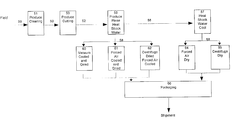
- FIG. 1 is a schematic diagram of an embodiment of a process to heat shock, cool and dry produce
- FIG. 2A provides heat balance calculations for water removal by vacuum cooling
- FIG. 2B provides heat balance calculations for water removal by vacuum cooling.
- harvested lettuce is placed in bins or containers and transported to a processing facility.
- area 51 damaged parts of the produce are removed.
- the temperature of the produce is adjusted to a desired level, if necessary, to assure a consistent heat shock response.
- the produce passes to processing area 53 where the produce is chopped, shredded or subdivided.
- the produce passes to chamber 56 where it is rinsed with warm water to cause the heat shock reaction.
- the produce is then transferred to vacuum cooler/drier 60 , or forced air chiller/dryer 61 , or centrifuge dryer/forced air cooler 62 .
- the produce can be transferred to cold water bath 57 to attain a desired temperature, then moved to forced air drying 64 or centrifuge drying 65 , to remove excess water, leaving the produce with the desired water content and at a desired temperature.
- the lettuce is then transported to packaging 66 .
- an anti-browning agent could be added to heat shock water 56 or heat shock quench water 57 . Then the lettuce would be transferred to vacuum cooling and drying 60 .
Landscapes
- Engineering & Computer Science (AREA)
- Life Sciences & Earth Sciences (AREA)
- Chemical & Material Sciences (AREA)
- Polymers & Plastics (AREA)
- Zoology (AREA)
- Food Science & Technology (AREA)
- Wood Science & Technology (AREA)
- Chemical Kinetics & Catalysis (AREA)
- General Chemical & Material Sciences (AREA)
- Combustion & Propulsion (AREA)
- Physics & Mathematics (AREA)
- Mechanical Engineering (AREA)
- Thermal Sciences (AREA)
- General Engineering & Computer Science (AREA)
- Preparation Of Fruits And Vegetables (AREA)
Abstract
Produce, especially processed produce, such as lettuce, broccoli and potatoes, is heat-shocked with water having an elevated temperature relative to the produce, to minimize discoloration of the produce from the processing after the heat shock, the produce is low pressure or vacuum cooled and dried to remove heat-shock water adsorbed and absorbed by the produce.
Description
- This application is a continuation-in-part of copending application Ser. No. 09/431,363, filed Nov. 1, 1999, which is a continuation-in-part of Ser. No. 09/040,139, filed Mar. 17, 1998, now U.S. Pat. No. 5,992,169.
- Field of the Invention
- This invention provides methods for applying controlled elevated temperature water to fresh produce such as lettuce, broccoli and potatoes to create a heat-shock response in the produce tissue, and then removing the water and cooling the produce by vacuum evaporation of the water, leaving the produce tissue at a desired temperature and with a desired moisture content.
- U.S. Pat. No. 5,992,169, incorporated herein by reference as though fully set forth here, discloses vacuum cooling and drying of fresh produce such as lettuce, and apparatus therefor, as an alternative and superior method to centrifuge drying and cooling, or forced air drying and cooling of processed produce. Vacuum cooling, and drying requires less handling, and, therefore, causes less abrasion and abuse of produce tissue, reducing wound response and browning of the tissue, and enhancing marketability.
- Produce sprayed or immersed in water absorbs and adsorbs water. For example, iceberg lettuce immersed in water after being chopped or cut may take up to twenty percent or more of its weight in water. The more water that the lettuce tissue absorbs/adsorbs, the higher the temperature must be to evaporate unwanted water in a given time period, in the vacuum evaporation process. (See FIGS. 2A and 2B).
- To minimize lettuce residency time in rinse water without sacrificing produce quality, research has been done to determine what the upper temperature limit of lettuce rinse water could be. Surprisingly, lettuce tissue can withstand rather high air and water temperatures. Warm air or water applied to produce tissues causes a preservation response called a heat-shock response. See Loaiza-Velarde, J. G., Thomas-Barbera, F. A., and Saltveit, M. E., “Effect of Intensity and Duration of Heat-shock Treatments on Wound-induced Phenolic Metabolism in Iceberg Leftuce,” J. Amer. Soc. Hort. Sci. 122(6):873-877 (1997), incorporated by reference as though fully set forth herein. This response causes physiological changes in produce tissue which, when growing, aids in survival, and, after harvest, preserves marketability. This response causes enzyme changes in lettuce, especially processed lettuce, which can delay or prevent discoloration, e.g. browning, increasing lettuce marketability. (By “processed lettuce” is meant lettuce that has been cut, chopped, shredded and/or cored.) In accordance with the present invention, this ability of produce to withstand elevated water temperatures and, in fact, to benefit from this immersion, also provides a synergistic relationship with the vacuum cooling and drying of fresh produce, in that the rinse water removal by vacuum drying, i.e. evaporation, is made more effective or efficient by the elevated starting temperature of the water. In its optimum aspects, the present invention utilizes the synergistic combination of heat shock and vacuum drying and cooling. Nevertheless, the invention contemplates the same synergism by using an elevated temperature rinse water, which may be above the starting temperature of the produce, even though that elevated temperature is less than that which will produce heat shock.
- At present, the packaged salad industry utilizes proper cooling, special semipermeable membrane bags, and/or modified gas atmospheres to control the metabolism of plant tissue and to minimize browning of produce, especially processed lettuce. Immersion of such produce in water at a temperature in the range of 50° F. to 160° F. for a suitable time to produce the heat-shock response, itself inhibits browning.
- For additional information, see the following publications:
- 1. Brecht, J. K., 1995, “Physiology of Lightly Processed Fruits and Vegetables,” Hort. Science 30: 18-22.
- 2. Bolin, H. R. and Hursoll, C. C., 1991. “Effect of Preparation Procedure and Storage Parameters on Quality Retention of Salad-Cut Lettuce,” J. Food Sci., 56: 60-67.
- 3. Couture, R., Cantwell, M. I., Ke, D, and Saltviet, N. E., 1993. “Physiological Attributes and Storage Lite of Minimally Processed Lettuce,” Hort. Science 28: 223-725.
- 4. Ke, D. and Saltviet, N. E., 1988, “Plant Hormone Interaction and Phenolic Metabolism in the Regulation of Russet Spotting in Iceberg Lettuce,” Plant Physical: 88: 1136-1140.
- 5. Loaize-Velarde, J., Tomas-Barberan, F. A., Saltviet, N. E., 1997. “Effect of Intensity and Duration of Heat Shock Treatments on Wound Induced Phenolic Metabolic in Iceberg Lettuce,” J. Amer Soc. Hort. Science 122(6): 873-877.
- 6. Lopez Galvez, G, Saltviet, M. E., and Cantwell, M., 1997. “Wound Induced Phenylalanine Ammonia Lyase Activity: Factors Affecting its Induction and Correlation with the Quality of Minimally Processed Lettuce,” Postharvest Biol. Technol. 9: 223-233.
- 7. Pollock, C. F., Eagles, C. F., Howarth, C. J., Schunumann, P. H. D., and Stoudart, J. L., 1993. “Temperature Stress” p.109-132 In: L. Fowden, T. Mansfield, J. Stoudart (Eds) Plant Adaptation to Environmental Stress. Chapman and Hall, New York.
- 8. Saltviet, M. E., 1997. “Physical and Physiological Changes in Minimally Processed Fruits and Vegetables,” p. 205-220 In: F. A. Tomes Barberan (Ed.) Phytochemistry of Fruits and Vegetables. Oxford University Press, Oxford, UK.
- 9. Vierling, E., 1991, “The Roles of Heat Shock Proteins in Plants.” Annu. Rev. Plant Physiol. Plant. Mol. Biol. 42:579-620.
- This invention provides methods for delivering produce, especially processed produce such as lettuce, broccoli and potatoes at a desired temperature and a desired moisture content, after the produce has been subjected to a heat shock or other anti-browning treatment. The process of heat-shocking produce, then cooling and drying it, can be applied to any produce in need of cooling and drying for shipment or storage, but is especially effective on lettuce, such as iceberg lettuce.
- For most processed produce, and particularly for green leafy produce such as lettuce, where the harvest temperature of the produce is in the range of about 35° F. to about 90° F., the heat-shock reaction takes place and can be detected when the processed produce is exposed to a temperature about 18° F. higher than the harvest temperature of the produce. However, it is important not to heat the produce too much. Proper heat shock treatment therefore depends on the temperature of the produce at the outset of the heat-shock process, the temperature of the water utilized to cause the shock, and the time needed to create the heat-shock response, i.e. BTU's delivered. Preferably, but not necessarily, the produce has a temperature of about 50° F. at the beginning of the heat-shock process, but could have a temperature as low as about 33° F. The exposure to higher temperature water, e.g. water at a temperature of about 50° F. to about 160° F, continues until the heat-shock response has taken place, e.g., for about 30 to 480 seconds. Thereafter, the temperature of the produce is reduced to the range between about 34° F. and about 41° F., i.e. to a temperature where the metabolism of the produce is slowed substantially without killing the produce.
- The processing (cutting, chopping, shredding, and/or coring) of lettuce induces alterations in the phenolic metabolism of the lettuce which causes browning, reducing quality. Phenylalanine ammonia-lyase (PAL) and the concentration of phenolic compounds (e.g. chlorogenic acid, dicaffeoyl tartaric acid and iso-chlorogenic acid) increase in wound areas after processing. This increase in the wound response enzyme activity is reduced when the cut tissue is exposed to a heat-shock environment which redirects the protein synthesis away from a cut-shock response.
- The reduction of PAL activity increases with the duration of heat-shock treatment, and the reduction of PAL increases faster as the water temperature increases. PAL activity is barely detected after a 60-second treatment with 155 degree Fahrenheit water. However, heat-shock treatment at a water temperature above 140° F. and up to about 155° F. for 30 seconds may damage produce tissue. For example, lettuce tissue becomes translucent. Therefore, it is important that the starting temperature of the produce to be heat-shocked be known and be low enough to prevent over-heating, but not so low as to create undue expense. For the proper conditions of temperature and time, see, generally, the above-cited article by Loaiza-Velarde et al.
- Heat-shock protein synthesis redirection differs depending on the nature of the produce. Produce with preformed phenolic compounds, such as artichokes and avocados, will brown after wounding even if subjected to elevated temperatures. However, iceberg, red and green leaf, romaine and butter lettuce, as well as broccoli, all can have their enzyme activity redirected by exposure to hot water. The exposure to heat shock water significantly reduces the PAL activity and associated phenolic activity.
- Alternatively or additionally, the water rinse/vacuum cooling process can be utilized to apply anti-browning agents to produce tissue with elevated levels of preformed phenolics like potatoes and apples, and then to cool the produce. These anti-browning agents can be applied evenly in the produce rinse water, which can then be rinsed off before the evaporation process.
- Many different methods are available to cool heat-shocked processed produce. For example, forced air cooling is available, but the forced air dries the produce tissue unevenly, resulting in a product that is unappealing to consumers. Centrifuge drying of lettuce is available, but it cannot remove water in precise amounts, and tends to crush the lettuce tissue, resulting in limp leaves, reducing yield, and leaving lettuce that is unappealing. On the other hand, vacuum pressure evenly removes a desired and controlled amount of water and a desired amount of heat, resulting in more appealing lettuce. In addition, vacuum cooling provides an increased yield per head, as the outermost cap leaves, which are damaged by centrifuges, can be utilized. In evaporative cooling of lettuce, evaporation of about one percent water by weight effects approximately a 10 degree Fahrenheit temperature reduction of the produce.
- It may be desired or necessary to conduct the vacuum cooling process in multiple evacuation stages, where the vacuum is released between successive evacuation stages. In that case one may direct the incoming vacuum release air to blow surface water from the produce.
- As one illustrative example, consider 1,000 pounds of chopped lettuce harvested at 85° F. First, the temperature of the lettuce is reduced to 50° F. by vacuum cooling with cold water or with cold air. This cooling ensures that the exposure to a heat-shock environment will not heat the tissue to too high a temperature, causing translucence. Conversely, if the lettuce to be processed has a starting temperature of from about 33° F. to about 41° F., this would be acceptable, or the starting temperature could be adjusted upwardly somewhat if desired, with warm air, warm water, or heating frequencies of light, as desired. It is not necessary, practical or economical to cool the produce too much. The selection of a base or starting temperature for heat-shock depends on the kind of produce and its specific reaction to the heat-shock environment.
- Having established a base temperature, the lettuce is placed into approximately 122° F. water for 60-120 seconds to warm the tissue and cause the desired heat-shock effect. This immersion warms the lettuce to approximately 114° F. while the tissue adsorbs/absorbs about eight percent water by weight. The lettuce is then placed in a vacuum chamber, such as described in the previously mentioned U.S. Pat. No. 5,992,169. The vacuum pump is activated and the sub-atmospheric pressure inside the chamber is reduced to about 4.7 mm of mercury. This reduction in pressure effects evaporation of the aforesaid eight percent absorbed/adsorbed water, while concomitantly reducing the temperature of the produce to the desired temperature of approximately 33° F.
- As another example, consider fresh-cut red or green leaf lettuce that arrives at the processing facility with a tissue temperature of 45° F. The lettuce is treated with water at a temperature of about 70° F. until the tissue temperature reaches approximately 65° F., effecting the desired heat-shock. At this time the tissue will have absorbed/adsorbed about three percent moisture and can be transferred to the vacuum chamber for cooling and drying, as described above.
- To treat and cool fresh cut potatoes, the potatoes are first immersed in water with a suitable anti-browning agent, and then transferred to vacuum cooling/rinse water with a temperature of about 155° F. The potatoes are retained in the water until the tissue temperature reaches about 155° F., to effect the desired heat-shock. This water immersion adds about twelve percent by weight of water to the cut potatoes. Thereafter, the potatoes are cooled in a vacuum chamber, as aforementioned, by reducing the pressure inside the chamber to a vacuum pressure corresponding to a desired evaporation point, preferably to a pressure of about 4.7 mm of mercury, which is the pressure that corresponds to evaporating 33° F. water. In this step, more than twelve percent by weight of water is removed from the potatoes, leaving the potato tissue slightly dry to minimize biotic growth during shipment and storage.
- Water treatment of produce to attain the heat-shock reaction may cause more water to be adsorbed/absorbed than can be removed by vacuum pressure in a one-step reduction to sub-atmospheric pressure. One solution is to form a vacuum within a chamber, then release the vacuum while directing the incoming air to blow surface water from the produce tissue. This use of incoming air to blow surface water from the tissue could also be used to warm the tissue (add BTU's), thereby facilitating additional moisture to be evaporated in a subsequent vacuum evaporation/cooling cycle without risking freeze damage. This use of incoming air may be, repeated through additional cycles as necessary to obtain the desired moisture content and desired temperature of the produce.
- This rewarming may also serve to repeat or augment the heat shock process. For example, after a preheat-shock temperature adjustment (if needed), produce such as iceberg lettuce may be introduced to 90° F. water for 60-120 seconds, raising its temperature to 85° F., resulting in an approximately eight percent by weight adsorption/absorption of water on and in its tissue. The cooling and drying process may be as follows: The produce is loaded into a vacuum chamber as aforementioned and the pressure reduced to 5.17 mm of mercury (the pressure that corresponds to evaporating 35° F. water) to evaporate about 5% of the 8% of the added water. The sub-atmospheric pressure then could be released for a time with the incoming air blowing one percent of the moisture off the produce while warming the produce tissue to 55° F. At this time, the vacuum pressure is reestablished, to bring the vacuum chamber to 4.7 mm of mercury pressure and to remove the remaining 2% of the added 8% water. Alternatively, the release of vacuum pressure might be allowed to raise the produce tissue temperature higher, allowing for a slight drying of the produce for storage and marketability reasons.
- Alternatively, excess water adhering to the surface of the processed lettuce could be removed by conventional centrifuge or by air pressure outside the vacuum chamber before vacuum cooling and drying.
- As another alternative, temperature adjusted lettuce is placed in a tray or basket and loaded into a vacuum chamber as aforementioned. Water in the range of about 50° F. to about 160° F. is then delivered into the chamber and onto the produce to cause the heat-shock response. The warm water is removed from the chamber and pressurized air may be used to remove excess water. The pressure inside the chamber is reduced to 4.7 mm of mercury and the produce is held at this pressure until the lettuce is cooled to 33° F. and the desired amount of water remains in the lettuce. The lettuce is then ready for packaging.
- In another alternative, water vapor with a temperature between 50° F. and 212° F. is applied to produce tissue inside or outside a vacuum chamber to heat-shock the produce. This vapor condenses evenly on the produce while delivering the necessary heat-shock. This water vapor delivery prevents excessive water adsorption, and the produce then is cooled in the vacuum cooling/drying procedure, as described above.
- In another alternative, broccoli may be sprayed with or immersed in 122 degree Fahrenheit, or higher, water for a time sufficient to cause the heat-shock reaction. This broccoli can then be quenched, cooled and dried by chilled water and centrifuging, or by chilled air alone. However, if the broccoli is to be vacuum cooled and dried pursuant to the procedures of the present invention, the broccoli may need to be cooled in several steps or stages. In each step or stage, cooling water is applied to the broccoli, the broccoli is then vacuum cooled to a given temperature. Water is applied again, and the broccoli is again vacuum cooled. These steps are repeated until the broccoli reaches the desired temperature.
- In some circumstances it is necessary to treat the produce with pesticides, as in the case of certain export shipments. This can be readily and effectively accomplished in conjunction with the procedure of the present invention. For example, after the heat-shock treatment, and following the vacuum cooling/drying procedure, when the vacuum is released, the gas introduced into the vacuum chamber can be, or can include an insecticide or other active gas. Similarly, the gas can, if desired, include nitrogen or other inert gases, with or without a pesticide or other active gas. Obviously, a pesticides could be applied during other phases of the procedure, for example, as part of the heat-shock or preheat-shock process.
- The invention can better be understood by reference to the drawings in which:
- FIG. 1 is a schematic diagram of an embodiment of a process to heat shock, cool and dry produce;
- FIG. 2A provides heat balance calculations for water removal by vacuum cooling; and
- FIG. 2B provides heat balance calculations for water removal by vacuum cooling.
- In FIG. 1, harvested lettuce is placed in bins or containers and transported to a processing facility. In
area 51, damaged parts of the produce are removed. At station 54, the temperature of the produce is adjusted to a desired level, if necessary, to assure a consistent heat shock response. The produce passes toprocessing area 53 where the produce is chopped, shredded or subdivided. The produce passes tochamber 56 where it is rinsed with warm water to cause the heat shock reaction. The produce is then transferred to vacuum cooler/drier 60, or forced air chiller/dryer 61, or centrifuge dryer/forcedair cooler 62. Alternatively, the produce can be transferred tocold water bath 57 to attain a desired temperature, then moved to forced air drying 64 or centrifuge drying 65, to remove excess water, leaving the produce with the desired water content and at a desired temperature. The lettuce is then transported topackaging 66. - Alternatively, an anti-browning agent could be added to
heat shock water 56 or heat shock quenchwater 57. Then the lettuce would be transferred to vacuum cooling and drying 60. - Having described the present invention and illustrated it with a number of examples, various modifications and variations will be apparent to those familiar with this art. Such variations and modifications as are embraced by the spirit and scope of the appended claims are contemplated as being within the purview of the present invention.
- While the specification describes particular embodiments of the present invention, those of ordinary skill can devise variations of the present invention without departing from the inventive concept.
Claims (52)
1. In the method of processing, preserving and packaging of produce, the steps of: (a) heat-shocking the produce by contacting the produce with water at a relatively elevated temperature compared with the produce starting temperature, to elevate the temperature of the produce, and (b) vacuum evaporating at least a portion of excess adsorbed/absorbed water from step (a) to dry and cool the produce to a desired water content and temperature.
2. In the method of claim 1 , said produce is a leafy vegetable.
3. In the method of claim 1 , said produce is lettuce, and in step (a) the temperature of the produce is elevated to about 18° F. above said starting temperature and continues at the elevated temperature for about 30 to 480 seconds.
4. In the method of claim 3 , in step (b) the produce is cooled to a temperature of about 34 to 41° F.
5. In the method of claim 3 , in step (a) the elevated temperature of the produce is less than about 140° F.
6. In the method of processing, preserving and packaging of produce, the steps of: (a) heat-shocking the produce by contacting the produce with water at a relatively elevated temperature compared with the produce starting temperature, to elevate the temperature of the produce, (b) vacuum evaporating at least a portion of excess adsorbed/absorbed water from step (a) to dry and cool the produce to a desired water content and temperature, and (c) releasing the vacuum of step (b) with a gas.
7. In the method of claim 6 , the gas of step (c) includes an insecticide.
8. In the method of claim 6 , the gas of step (c) includes nitrogen and/or another inert gas.
9. In the method of claim 6 , the gas of step (c) includes nitrogen and/or another inert gas, and an insecticide.
10. In the method of processing, preserving and packaging of produce, the steps of: (a) treating the produce by contacting the produce with water at a relatively elevated temperature compared with the produce starting temperature, and (b) vacuum evaporating at least a portion of excess adsorbed/absorbed water from step (a) to dry and cool the produce to a desired water content and temperature.
11. In the method of claim 10 , said produce is a leafy vegetable.
12. In the method of claim 10 , said produce is lettuce.
13. In the method of claim 12 , in step (b) the produce is cooled to a temperature of about 34 to 41° F.
14. In the method of clam 12, in step (a) the elevated temperature of the produce is less than about 140° F.
15. In the method of processing, preserving and packaging of produce, the steps of: (a) treating the produce by contacting the produce with water at a relatively elevated temperature compared with the produce starting temperature, (b) vacuum evaporating at least a portion of excess adsorbed/absorbed water from step (a) to dry and cool the produce to a desired water content and temperature, and (c) releasing, at least in part, the vacuum of step (b) with a gas.
16. In the method of claim 15 , the gas of step (c) includes an insecticide.
17. In the method of claim 15 , the gas of step (c) includes nitrogen and/or another inert gas.
18. In the method of claim 15 , the gas of step (c) includes nitrogen and/or another inert gas, and an insecticide.
19. In the method of processing, preserving and packaging of produce, the step of: (a) treating the produce by contacting the produce with water containing an anti-browning agent, and heat-shocking the produce by contacting the produce with water at a relatively elevated temperature compared with the produce starting temperature, to elevate the temperature of the produce, and (b) vacuum evaporating at least a portion of excess adsorbed/absorbed water from step (a) to dry and cool the produce to a desired water content and temperature.
20. In the method of claim 19 , said produce is cut potatoes or apples.
21. In the method of claim 19 , said produce is cut potatoes or apples, and in step (a) the temperature of the produce is elevated to at least about 18° F. above said starting temperature and continues at the elevated temperature for about 30 to 480 seconds.
22. In the method of claim 21 , in step (b) the produce is cooled to a temperature of about 34 to 41° F.
23. In the method of claim 21 , in step (a) the elevated temperature of the produce is less than about 140° F.
24. In the method of processing, preserving and packaging of produce, the steps of: (a) heat-shocking the produce by contacting the produce with water at a relatively elevated temperature compared with the produce starting temperature, to elevate the temperature of the produce, and (b) vacuum evaporating at least a portion of excess adsorbed/absorbed water from step (a) to dry and cool the produce.
25. In the method of processing, preserving and packaging of produce, the steps of: (a) heat-shocking the produce by contacting the produce with water at a relatively elevated temperature compared with the produce starting temperature, to elevate the temperature of the produce, (b) vacuum evaporating at least a portion of excess adsorbed/absorbed water from step (a) to dry and cool the produce, and (c) releasing the vacuum of step (b) with a gas comprising an inert gas.
26. In the method of claim 25 , the gas of step (c) includes an insecticide.
27. In the method of processing, preserving and packaging of produce, the steps of: (a) treating the produce by contacting the produce with water at an elevated temperature, and (b) vacuum evaporating at least a portion of excess adsorbed/absorbed water from step (a) to dry and cool the produce.
28. In the method of processing, preserving and packaging of produce, the steps of: (a) treating the produce by contacting the produce with water at an elevated temperature, (b) vacuum evaporating at least a portion of excess adsorbed/absorbed water from step (a) to dry and cool the produce, and (c) releasing the vacuum of step (b) with a gas comprising an inert gas.
29. In the method of claim 28 , the gas of step (c) includes an insecticide.
30. A method for delivering produce at a desired temperature and a desired moisture content comprising:
subjecting said produce to water at a temperature and for a time sufficient to cause the heat shock preservation response, then cooling and drying said produce to a desired temperature in the range of about 33° F. to about 41° F. without substantial loss of interstitial moisture.
31. The method of claim 30 wherein said heat shock response is effected by applying to said processed produce water at a temperature at least about 18° F. higher than the temperature of said produce at the outset of said heat shock step, then reducing the temperature of the produce after the heat shock response has taken place to a temperature in the range of about 33° to about 41° F.
32. The method of claim 30 wherein said produce is chopped, cut or shredded before said subjecting step.
33. The method of claim 31 wherein said produce is chopped, cut or shredded before said subjecting step.
34. The method of claim 30 wherein, after said heat shock response step, the processed produce is vacuum cooled while a gas is blown across the surface of the produce to remove water.
35. The method of claim 31 wherein after said heat shock response step, the processed produce is vacuum cooled while a gas is blown across the surface of the produce to remove water.
36. The method of claim 32 wherein after said heat shock response step, the processed produce is vacuum cooled while a gas is blown across the surface of the produce to remove water.
37. The method of claim 33 wherein after said heat shock response step, the processed produce is vacuum cooled while a gas is blown across the surface of the produce to remove water.
38. The method of claim 30 wherein said produce is fresh, leafy lettuce.
39. The method of claim 31 wherein said produce is fresh, leafy lettuce.
40. The method of claim 32 wherein said produce is fresh, leafy lettuce.
41. The method of claim 33 wherein said produce is fresh, leafy lettuce.
42. The method of claim 34 wherein said produce is fresh, leafy lettuce.
43. The method of claim 35 wherein said produce is fresh, leafy lettuce.
44. The method of claim 36 wherein said produce is fresh, leafy lettuce.
45. The method of claim 37 wherein said produce is fresh, leafy lettuce.
46. A method for delivering lettuce at a desired temperature and a desired moisture content comprising:
controlling the temperature of said lettuce at a desired temperature;
subjecting said lettuce to heat shock;
vacuum cooling said lettuce to a desired temperature.
47. A method for delivering broccoli at a desired temperature and a desired moisture content comprising:
controlling the temperature of said broccoli at a desired temperature;
subjecting said broccoli to heat shock;
vacuum cooling said broccoli to a desired temperature.
48. A method for delivering cut potatoes at a desired temperature and a desired moisture content comprising:
subjecting said cut potatoes to an anti-browning agent and increasing their moisture content;
vacuum cooling said cut potatoes to a desired temperature.
49. A method of delivering lettuce at a desired temperature and a desired moisture content comprising:
controlling the temperature of said lettuce at a desired temperature;
subjecting said lettuce to heat shock;
vacuum cooling said lettuce to a desired temperature; and
cooling said lettuce to a desired temperature.
50. A method for delivering broccoli at a desired temperature and a desired moisture content comprising:
controlling the temperature of said broccoli at a desired temperature;
subjecting said broccoli to heat shock;
vacuum cooling said broccoli to a desired temperature; and
cooling said broccoli to a desired temperature.
51. A method for delivering cut potatoes at a desired temperature and a desired moisture content comprising:
subjecting said cut potatoes to an anti-browning agent and increasing their moisture content;
vacuum cooling said cut potatoes to a desired temperature; and
cooling said cut potatoes to a desired temperature.
52. A method for delivering produce at a desired temperature and a desired moisture content comprising;
controlling the temperature of said produce at a desired temperature;
subjecting said produce to heat shock;
cooling said produce to a desired temperature and a desired moisture content.
Priority Applications (1)
| Application Number | Priority Date | Filing Date | Title |
|---|---|---|---|
| US10/210,990 US6644043B2 (en) | 1998-03-17 | 2002-08-02 | Method and apparatus of heat-shocking fresh produce and for cooling such produce to a desired temperature and moisture content |
Applications Claiming Priority (4)
| Application Number | Priority Date | Filing Date | Title |
|---|---|---|---|
| US09/040,139 US5992169A (en) | 1998-03-17 | 1998-03-17 | Apparatus and methods for vacuum cooling produce |
| US43136399A | 1999-11-01 | 1999-11-01 | |
| US09/804,201 US6434951B2 (en) | 1998-03-17 | 2001-03-13 | Methods for heat-shocking fresh produce and for cooling such produce to a desired temperature, and moisture content |
| US10/210,990 US6644043B2 (en) | 1998-03-17 | 2002-08-02 | Method and apparatus of heat-shocking fresh produce and for cooling such produce to a desired temperature and moisture content |
Related Parent Applications (1)
| Application Number | Title | Priority Date | Filing Date |
|---|---|---|---|
| US09/804,201 Continuation US6434951B2 (en) | 1998-03-17 | 2001-03-13 | Methods for heat-shocking fresh produce and for cooling such produce to a desired temperature, and moisture content |
Publications (2)
| Publication Number | Publication Date |
|---|---|
| US20020184897A1 true US20020184897A1 (en) | 2002-12-12 |
| US6644043B2 US6644043B2 (en) | 2003-11-11 |
Family
ID=27365668
Family Applications (2)
| Application Number | Title | Priority Date | Filing Date |
|---|---|---|---|
| US09/804,201 Expired - Lifetime US6434951B2 (en) | 1998-03-17 | 2001-03-13 | Methods for heat-shocking fresh produce and for cooling such produce to a desired temperature, and moisture content |
| US10/210,990 Expired - Fee Related US6644043B2 (en) | 1998-03-17 | 2002-08-02 | Method and apparatus of heat-shocking fresh produce and for cooling such produce to a desired temperature and moisture content |
Family Applications Before (1)
| Application Number | Title | Priority Date | Filing Date |
|---|---|---|---|
| US09/804,201 Expired - Lifetime US6434951B2 (en) | 1998-03-17 | 2001-03-13 | Methods for heat-shocking fresh produce and for cooling such produce to a desired temperature, and moisture content |
Country Status (1)
| Country | Link |
|---|---|
| US (2) | US6434951B2 (en) |
Cited By (1)
| Publication number | Priority date | Publication date | Assignee | Title |
|---|---|---|---|---|
| FR2873541A1 (en) * | 2004-08-02 | 2006-02-03 | Bonduelle Sa Ets | PROCESS AND INSTALLATION FOR THE PREPARATION AND PRESERVATION OF DENREES |
Families Citing this family (13)
| Publication number | Priority date | Publication date | Assignee | Title |
|---|---|---|---|---|
| US6434951B2 (en) * | 1998-03-17 | 2002-08-20 | Roger Carson Later | Methods for heat-shocking fresh produce and for cooling such produce to a desired temperature, and moisture content |
| SE514560C2 (en) * | 1999-07-30 | 2001-03-12 | Tetra Laval Holdings & Finance | Apparatus for evapoative cooling of a liquid product |
| US7162880B2 (en) * | 2002-09-10 | 2007-01-16 | Royal Fumigation, Inc. | Cooling apparatus, systems and methods |
| BRPI0410431A (en) * | 2003-05-21 | 2006-06-13 | David B Linton | low pressure and low temperature cooking method via the tuning process |
| CN1917771A (en) * | 2003-05-21 | 2007-02-21 | 大卫·B·林顿 | Method of Cooking at Low Pressure and Low Temperature by LintonizingTM Process |
| US7082775B1 (en) * | 2003-11-03 | 2006-08-01 | Emergency Water Solutions, Inc. | Heat exhaustion evaporative cooling |
| US20050112256A1 (en) * | 2003-11-24 | 2005-05-26 | Josh Mitchell | Method and apparatus for harvesting, washing, and drying cut vegetables and produce |
| US20060247975A1 (en) * | 2003-12-30 | 2006-11-02 | Craig Shapiro | Processes and systems employing multiple sources of funds |
| US7810338B2 (en) * | 2004-07-16 | 2010-10-12 | Siegfried Marx | Control method for the air-conditioning treatment of products |
| US20070148297A1 (en) * | 2005-07-16 | 2007-06-28 | Bell Laurence D | Surface pasteurization of bulk agricultrual products |
| US9166139B2 (en) * | 2009-05-14 | 2015-10-20 | The Neothermal Energy Company | Method for thermally cycling an object including a polarizable material |
| US10123559B2 (en) * | 2016-07-07 | 2018-11-13 | Guardian Manufacturing, Inc. | Ozone rain pan |
| US10913095B2 (en) | 2016-07-07 | 2021-02-09 | Guardian Manufacturing, Inc. | Ozone rain pan |
Family Cites Families (15)
| Publication number | Priority date | Publication date | Assignee | Title |
|---|---|---|---|---|
| US3844132A (en) * | 1973-09-14 | 1974-10-29 | Inter Process Corp | Produce cooler and method of cooling product |
| GB1516654A (en) * | 1974-08-26 | 1978-07-05 | Grumman Allied Industries | Low temperature hypobaric storage of metabolically active matter |
| US4068495A (en) * | 1976-03-31 | 1978-01-17 | The United States Of America As Represented By The United States National Aeronautics And Space Administration | Closed loop spray cooling apparatus |
| US4353222A (en) * | 1979-07-04 | 1982-10-12 | Kyowa Vacuum Engineering, Ltd. | Vacuum apparatus |
| US4576014A (en) * | 1985-01-31 | 1986-03-18 | Western Precooling Systems, Inc. | Produce vacuum cooler with improved venting |
| US5534280A (en) * | 1987-12-04 | 1996-07-09 | Welch; George | Method for dehydration of solid foods |
| US4827727A (en) * | 1988-02-08 | 1989-05-09 | Caracciolo Louis D | Carcass chiller and sterilizer |
| US4942053A (en) * | 1989-07-19 | 1990-07-17 | Geo. A. Hormel & Company | Vacuum chilling for processing meat |
| US5277031A (en) * | 1991-11-27 | 1994-01-11 | Western Precooling Systems | Method and apparatus for cooling produce |
| US5386703A (en) * | 1992-03-04 | 1995-02-07 | Roger Carson Later | Apparatus and methods for vacuum cooling fresh produce |
| US5375431A (en) * | 1992-03-04 | 1994-12-27 | Later; Roger C. | Apparatus and methods for vacuum cooling fresh produce |
| CA2162425C (en) * | 1995-11-08 | 2002-10-01 | William Duncan Powrie | Preparation and preservation of fresh, vitaminized, flavoured and unflavoured cut apple pieces |
| US5925395A (en) * | 1998-01-09 | 1999-07-20 | Mantrose-Haeuser Co., Inc. | Methods for preserving fresh vegetables |
| US5992169A (en) * | 1998-03-17 | 1999-11-30 | Later; Roger C. | Apparatus and methods for vacuum cooling produce |
| US6434951B2 (en) * | 1998-03-17 | 2002-08-20 | Roger Carson Later | Methods for heat-shocking fresh produce and for cooling such produce to a desired temperature, and moisture content |
-
2001
- 2001-03-13 US US09/804,201 patent/US6434951B2/en not_active Expired - Lifetime
-
2002
- 2002-08-02 US US10/210,990 patent/US6644043B2/en not_active Expired - Fee Related
Cited By (2)
| Publication number | Priority date | Publication date | Assignee | Title |
|---|---|---|---|---|
| FR2873541A1 (en) * | 2004-08-02 | 2006-02-03 | Bonduelle Sa Ets | PROCESS AND INSTALLATION FOR THE PREPARATION AND PRESERVATION OF DENREES |
| EP1632140A1 (en) * | 2004-08-02 | 2006-03-08 | Bonduelle Société Anonyme | Process and apparatus for the preparation and conservation of products such as food and/or biological products |
Also Published As
| Publication number | Publication date |
|---|---|
| US20010009098A1 (en) | 2001-07-26 |
| US6434951B2 (en) | 2002-08-20 |
| US6644043B2 (en) | 2003-11-11 |
Similar Documents
| Publication | Publication Date | Title |
|---|---|---|
| US6434951B2 (en) | Methods for heat-shocking fresh produce and for cooling such produce to a desired temperature, and moisture content | |
| Rahman et al. | Drying and food preservation | |
| KR101481774B1 (en) | Surface sterilization and surface sterilization of pieces of food | |
| US6312745B1 (en) | Process for dehydration of berries | |
| US6523276B1 (en) | Produce drying system utilizing multiple energy sources | |
| US2765236A (en) | Preserving of foodstuffs | |
| US5595775A (en) | Method for preserving fresh fruit and vegetable | |
| US2490951A (en) | Food treatment process | |
| US4557937A (en) | Method for blanching mushrooms and other vegetables | |
| Mohapatra et al. | Banana post harvest practices: Current status and future prospects-A review. | |
| EP0460962A2 (en) | Food storage | |
| US5992169A (en) | Apparatus and methods for vacuum cooling produce | |
| US4670275A (en) | Prolonging the shelf life of fresh root vegetables | |
| US2874059A (en) | Method of preserving apples | |
| US4855153A (en) | Prolonging the shelf life of fresh root vegetables | |
| CN106262120A (en) | The preparation method of the Abelmoschus esculentus instant crispy slice of fruit | |
| US6066351A (en) | Method for treating raw foods | |
| US4808420A (en) | Fresh root vegetables with prolonged shelf life | |
| EP0221489B1 (en) | Prolonging the shelf life of fresh root vegetables | |
| JP2000125799A (en) | Production of frozen product of roasted vegetable or roasted fruit | |
| US4919948A (en) | Prolonging the shelf life of fresh root vegetables | |
| Datta et al. | Value addition of fruits and vegetables through drying and dehydration | |
| CA2354300C (en) | Process for dehydration of berries | |
| ur‐Rehman et al. | Dehydration of fruit and vegetables in tropical regions | |
| Chanbisana et al. | Effect of temperature and blanching methods on drying of broccoli var. Sadhana |
Legal Events
| Date | Code | Title | Description |
|---|---|---|---|
| REMI | Maintenance fee reminder mailed | ||
| FPAY | Fee payment |
Year of fee payment: 4 |
|
| SULP | Surcharge for late payment | ||
| REMI | Maintenance fee reminder mailed | ||
| LAPS | Lapse for failure to pay maintenance fees | ||
| STCH | Information on status: patent discontinuation |
Free format text: PATENT EXPIRED DUE TO NONPAYMENT OF MAINTENANCE FEES UNDER 37 CFR 1.362 |
|
| FP | Lapsed due to failure to pay maintenance fee |
Effective date: 20111111 |