US20020184818A1 - Device and method for adapting a container for use in a floral arrangement - Google Patents
Device and method for adapting a container for use in a floral arrangement Download PDFInfo
- Publication number
- US20020184818A1 US20020184818A1 US09/874,031 US87403101A US2002184818A1 US 20020184818 A1 US20020184818 A1 US 20020184818A1 US 87403101 A US87403101 A US 87403101A US 2002184818 A1 US2002184818 A1 US 2002184818A1
- Authority
- US
- United States
- Prior art keywords
- vase
- grid cover
- cover
- openings
- open top
- Prior art date
- Legal status (The legal status is an assumption and is not a legal conclusion. Google has not performed a legal analysis and makes no representation as to the accuracy of the status listed.)
- Granted
Links
Images


Classifications
-
- A—HUMAN NECESSITIES
- A47—FURNITURE; DOMESTIC ARTICLES OR APPLIANCES; COFFEE MILLS; SPICE MILLS; SUCTION CLEANERS IN GENERAL
- A47G—HOUSEHOLD OR TABLE EQUIPMENT
- A47G7/00—Flower holders or the like
- A47G7/02—Devices for supporting flower-pots or cut flowers
- A47G7/06—Flower vases
- A47G7/07—Guiding means for flowers in vases, e.g. perforated covers
-
- Y—GENERAL TAGGING OF NEW TECHNOLOGICAL DEVELOPMENTS; GENERAL TAGGING OF CROSS-SECTIONAL TECHNOLOGIES SPANNING OVER SEVERAL SECTIONS OF THE IPC; TECHNICAL SUBJECTS COVERED BY FORMER USPC CROSS-REFERENCE ART COLLECTIONS [XRACs] AND DIGESTS
- Y10—TECHNICAL SUBJECTS COVERED BY FORMER USPC
- Y10S—TECHNICAL SUBJECTS COVERED BY FORMER USPC CROSS-REFERENCE ART COLLECTIONS [XRACs] AND DIGESTS
- Y10S220/00—Receptacles
- Y10S220/908—Trash container
Definitions
- the present invention relates to devices and methods that are used to divide a container into sections so that the container can better be used to hold a designed floral arrangement. More particularly, the present invention relates to partitioned covers for vases, and other traditional flower holding containers, that assist in the formation of a floral design.
- Cut flowers and greens have been used for decorations for many centuries. As is well known by most people, cut flowers and greens remain alive and beautiful for a significant period of time if they are placed in water while being displayed. As such, most all cut flowers are typically displayed in a vase or some other container that is designed to hold both the flowers and a volume of water that surrounds the cut stems of the flowers.
- a vase is a container with an open top.
- Vases come in a large variety of sizes shapes and designs. However, in most cases, the vase presents a single top opening into which flowers and greens are placed.
- flowers and green When arranging flowers in a vase, little holds each flower in place other than the tangle of the cut stems in the confined space of the vase. Consequently, flowers and green often move out of position in a vase, especially if the vase is moved or the flowers are inadvertently touched.
- Open cell foam is a soft foam material that retains water within its structure. Cut stems from flowers and greens can be forced into the foam, wherein the foam holds the stems in place. Many professional flower arrangers place segments of open cell foam into vases. The flowers are then inserted into the foam as the flowers are set in the vase. As such, the foam holds the flowers in a set position throughout the life of the flowers.
- Open cell foam is bulky and must be cut to size. As such, it is hard to store and labor intensive to use. As cut flowers and greens are inserted into a segment of open cell foam, the foam becomes damaged. As a consequence, most people throw the open cell foam away with the flowers after the flowers die. This requires that a new segment of open cell foam be cut to size and inserted into a vase each time a new set of cut flowers is held in that vase.
- Grids are also used to hold flowers in place in a vase or similar container.
- Grids are open framework structures that are placed over the open top of a vase. The framework defines evenly spaced openings arranged in a grid pattern. Cut flowers and greens are then placed into the vase through the open spaces, wherein the grid holds the flowers apart in pattern in which they were inserted through the grid.
- Floral tape is a thin waterproof tape that has a high tensile strength. The tape is cut into strips and is placed across the open top of a vase to divide the vase into different compartments. Flowers are then placed into the openings between the strips of tape.
- floral tape can be used on vases of any size and shape, the floral tape is difficult and time consuming to install. Furthermore, the tape must be replaced after one use. Thus it is expensive to use by people to arrange flowers regularly.
- the present invention is a device and method for preparing a vase or other container to receive a floral arrangement.
- the device includes a grid cover that is placed around the open end of a vase or similar container.
- the grid cover has a flat top surface and a peripheral wall that extends downwardly from the edge of the top surface.
- the grid cover is made of elastomeric material and is initially smaller than the open top of the vase.
- the grid cover is stretched over the open top of the vase, wherein the peripheral wall of the grid cover passes over the edges of the vase's open top and retains the stretched grid cover in place.
- a plurality of openings are distributed throughout the top surface of the grid cover. As the grid cover is stretched over the top of a vase, the openings become positioned across the open top of the vase. Elements of a floral arrangement are placed into the vase through the available openings. The openings in the grid cover retain the elements of the floral arrangement in a set pattern, thereby preventing the floral arrangement from changing out of its originally designed configuration.
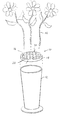
- FIG. 1 is perspective view of an exemplary embodiment of the present invention grid cover shown in conjunction with a vase and elements of a floral arrangement;
- FIG. 2 is a top view of the present invention grid cover shown with a vase having a convoluted shape
- FIG. 3 is a fragmented cross-sectional view of the present invention grid cover engaging the top edge of a vase
- FIG. 4 is a perspective view of an alternate embodiment of the present invention grid cover.
- the present invention device and method can be used to orient any elongated object within a receptacle, such as paint brushes in a can
- the present invention is particularly well suited for retaining cut flowers in a vase. Accordingly, the present invention is described in an application where it is used to hold flowers in a vase in order to set forth the best mode contemplated for the invention.
- FIG. 1 an embodiment of the present invention grid cover 10 is shown in conjunction with a vase 12 and a plurality of cut flowers 14 .
- the vase 12 is of a traditional construction, having a circular open top.
- vases with non-circular open tops can also be used.
- the present invention is a grid cover 10 that engages the vase 12 over its open top end.
- the grid cover 10 is made of elastomeric material and can therefore be stretched into many different configurations.
- the grid cover 10 contains a top surface 16 and a peripheral wall 18 that extends downwardly from the edge of the top surface 16 .
- the top surface 16 is not solid. Rather, the top surface 16 is formed in a grid pattern, where multiple open spaces 20 are spaced evenly across the top surface 16 . Each open space 20 extends completely through the top surface 16 of the grid cover 10 and is unobstructed.
- the grid cover 10 is made from thin elastomeric material that has a high degree of elasticity.
- the grid cover 10 is circular in shape. However, other geometrically symmetric shapes, such as polygonal shapes can also be used.
- the grid cover 10 has a predetermined outside diameter D 1 .
- the diameter D 1 of the grid cover 10 is preferably smaller than the maximum distance between points on the open top of the vase 12 , Accordingly, in order to have the grid cover 10 fit over the open top of the vase 12 , the grid cover 10 must be stretched to a size larger than the open top of the vase 12 .
- FIG. 2 the top edge of a vase 22 is shown.
- the vase 22 does not have a perfectly circular rim, such as was shown in FIG. 1. Rather, the vase 22 has a convoluted top edge that is not symmetrically formed.
- the top edge of the vase 22 has a maximum diameter D 2 at its widest point.
- the grid cover 10 has an unstretched diameter D 1 that is smaller than the maximum diameter D 2 of the top edge of the vase 22 .
- a grid cover 10 is selected that can be stretched to a diameter that is larger than the maximum diameter D 2 of the top edge of the vase 22 .
- the grid cover 10 can be stretched to a maximum diameter D 3 , which is shown with a hidden line.
- the maximum diameter D 3 of the stretched grid cover 10 is larger than the maximum diameter D 2 of the top edge of the vase 22 .
- the grid cover 10 can be stretched over the top edge of the vase 22 .
- FIG. 3 the grid cover 10 is shown covering the vase 12 previously illustrated in FIG. 1. From FIG. 3, it can be seen that once the grid cover 10 is stretched over the top edge of a vase 12 , the peripheral wall 18 of the grid cover 10 extends down the side of the vase 12 . As the peripheral wall 18 extends down the side of the vase 12 , the elastomeric material of the peripheral wall 18 conforms to the shape of the vase 12 near its top edge. The result is a grid cover 10 that attaches the vase without over-extending the vase 12 . Consequently, one grid cover can be attached to a large variety of vases.
- the grin cover 10 is made of elastomeric material.
- the selected material has a high degree of elasticity and is hydrophobic.
- the grid cover 10 can be manufactured in a variety of colors.
- the grid cover 10 can be green or have a camouflage pattern. In this manner, the grid cover 10 would not be highly noticeable when positioned under an arrangement of cut flowers and greens.
- the grid cover 10 can be translucent. In this manner, the vase 12 would appear to have no covering and the grid cover 10 would not detract from the color scheme of the vase or the flower arrangement in the vase 12 .
- a grid cover 40 is shown.
- the grid cover 40 has a peripheral wall 42 that is formed as a polygon. Consequently, the periphery of the top surface 44 of the grid cover 40 is also shaped as a polygon.
- the polygon is a square.
- any other polygonal shape such as a triangle, pentagon or the like, can also be used.
- a grid cover 40 with a polygonal shape is for use on a vase having a top edge with a polygonal shape. For instance, suppose a vase is provided that has a top edge that is essentially square in shape.
- a grid cover that is square in shape would fit on this vase better than a grid cover that is circular.
- a circular grid cover could be used, a circular grid cover may buckle around the top edge of the vase.
- the openings in the top surface 44 of the grid cover are formed in a manner that is different from what has been previously described.
- slits 46 are formed in the top surface 44 of the grid cover 40 .
- the slits 46 are closed when the grid cover 40 is not stretched.
- the stretching of the grid cover 40 causes the slits 46 to pucker, thereby creating enlarged openings through which the stems of cut flowers and greens can be placed.
Landscapes
- Cultivation Receptacles Or Flower-Pots, Or Pots For Seedlings (AREA)
- Closures For Containers (AREA)
Abstract
Description
- 1. Field of the Invention
- In general, the present invention relates to devices and methods that are used to divide a container into sections so that the container can better be used to hold a designed floral arrangement. More particularly, the present invention relates to partitioned covers for vases, and other traditional flower holding containers, that assist in the formation of a floral design.
- 2. Description of the Prior Art
- Cut flowers and greens have been used for decorations for many centuries. As is well known by most people, cut flowers and greens remain alive and beautiful for a significant period of time if they are placed in water while being displayed. As such, most all cut flowers are typically displayed in a vase or some other container that is designed to hold both the flowers and a volume of water that surrounds the cut stems of the flowers.
- Over the years, the art of floral design has developed into a sophisticated art form. In floral design, flowers and greens are placed in arrangements according to their color, size, flower type and shape. However, in order to create an aesthetically pleasing arrangement, flowers and greens must be set into a designed arrangement so that both the flowers and greens remain erect, oriented and properly spaced. Flowers and greens are not just randomly combined and displayed. Rather, great care is taken to place each flower and each green into a particular position that enhances the beauty of the overall display.
- Most often, cut flowers and greens are placed in vases. A vase is a container with an open top. Vases come in a large variety of sizes shapes and designs. However, in most cases, the vase presents a single top opening into which flowers and greens are placed. When arranging flowers in a vase, little holds each flower in place other than the tangle of the cut stems in the confined space of the vase. Consequently, flowers and green often move out of position in a vase, especially if the vase is moved or the flowers are inadvertently touched.
- To help prevent arranged flowers from moving out of their designed placement, many different types of devices have been developed. One such item is open cell foam. Open cell foam is a soft foam material that retains water within its structure. Cut stems from flowers and greens can be forced into the foam, wherein the foam holds the stems in place. Many professional flower arrangers place segments of open cell foam into vases. The flowers are then inserted into the foam as the flowers are set in the vase. As such, the foam holds the flowers in a set position throughout the life of the flowers.
- Open cell foam is bulky and must be cut to size. As such, it is hard to store and labor intensive to use. As cut flowers and greens are inserted into a segment of open cell foam, the foam becomes damaged. As a consequence, most people throw the open cell foam away with the flowers after the flowers die. This requires that a new segment of open cell foam be cut to size and inserted into a vase each time a new set of cut flowers is held in that vase.
- In the prior art, grids are also used to hold flowers in place in a vase or similar container. Grids are open framework structures that are placed over the open top of a vase. The framework defines evenly spaced openings arranged in a grid pattern. Cut flowers and greens are then placed into the vase through the open spaces, wherein the grid holds the flowers apart in pattern in which they were inserted through the grid.
- The problem associated with prior art grids is that they are rigid structures that are made to a specific size. Vases and other flower containers come in a wide variety of shapes, styles and sizes. Accordingly, when a grid is placed across the top of a vase, the grid overlaps the vase at a variety of points. This often detracts from the aesthetic value of the floral arrangement. As such, a floral designer must either have a large selection of grids to fit many different types of vases, or the floral designer must accept the visually undesirable overlap of the grid.
- Another type of flower arrangement accessory is floral tape. Floral tape is a thin waterproof tape that has a high tensile strength. The tape is cut into strips and is placed across the open top of a vase to divide the vase into different compartments. Flowers are then placed into the openings between the strips of tape.
- Although floral tape can be used on vases of any size and shape, the floral tape is difficult and time consuming to install. Furthermore, the tape must be replaced after one use. Thus it is expensive to use by people to arrange flowers regularly.
- A need therefore exists for a device and method of retaining a floral design pattern in a vase without having to cut open cell foam, accepting poorly fitting grids or wasting time and money on tape. This need is met by the present invention as described and claimed below.
- The present invention is a device and method for preparing a vase or other container to receive a floral arrangement. The device includes a grid cover that is placed around the open end of a vase or similar container. The grid cover has a flat top surface and a peripheral wall that extends downwardly from the edge of the top surface. The grid cover is made of elastomeric material and is initially smaller than the open top of the vase. The grid cover is stretched over the open top of the vase, wherein the peripheral wall of the grid cover passes over the edges of the vase's open top and retains the stretched grid cover in place.
- A plurality of openings are distributed throughout the top surface of the grid cover. As the grid cover is stretched over the top of a vase, the openings become positioned across the open top of the vase. Elements of a floral arrangement are placed into the vase through the available openings. The openings in the grid cover retain the elements of the floral arrangement in a set pattern, thereby preventing the floral arrangement from changing out of its originally designed configuration.
- For a better understanding of the present invention, reference is made to the following description of exemplary embodiments thereof, considered in conjunction with the accompanying drawings, in which:
- FIG. 1 is perspective view of an exemplary embodiment of the present invention grid cover shown in conjunction with a vase and elements of a floral arrangement;
- FIG. 2 is a top view of the present invention grid cover shown with a vase having a convoluted shape;
- FIG. 3 is a fragmented cross-sectional view of the present invention grid cover engaging the top edge of a vase; and
- FIG. 4 is a perspective view of an alternate embodiment of the present invention grid cover.
- Although the present invention device and method can be used to orient any elongated object within a receptacle, such as paint brushes in a can, the present invention is particularly well suited for retaining cut flowers in a vase. Accordingly, the present invention is described in an application where it is used to hold flowers in a vase in order to set forth the best mode contemplated for the invention.
- Referring to FIG. 1, an embodiment of the present
invention grid cover 10 is shown in conjunction with avase 12 and a plurality ofcut flowers 14. Thevase 12 is of a traditional construction, having a circular open top. However, it should be understood that vases with non-circular open tops can also be used. - The present invention is a
grid cover 10 that engages thevase 12 over its open top end. Thegrid cover 10 is made of elastomeric material and can therefore be stretched into many different configurations. The grid cover 10 contains atop surface 16 and aperipheral wall 18 that extends downwardly from the edge of thetop surface 16. However, thetop surface 16 is not solid. Rather, thetop surface 16 is formed in a grid pattern, where multipleopen spaces 20 are spaced evenly across thetop surface 16. Eachopen space 20 extends completely through thetop surface 16 of thegrid cover 10 and is unobstructed. - The
grid cover 10 is made from thin elastomeric material that has a high degree of elasticity. In the shown embodiment, thegrid cover 10 is circular in shape. However, other geometrically symmetric shapes, such as polygonal shapes can also be used. In the shown illustration, thegrid cover 10 has a predetermined outside diameter D1. The diameter D1 of thegrid cover 10 is preferably smaller than the maximum distance between points on the open top of thevase 12, Accordingly, in order to have thegrid cover 10 fit over the open top of thevase 12, thegrid cover 10 must be stretched to a size larger than the open top of thevase 12. - As the
grid cover 10 is stretched, a contracting bias is experienced in the material of thegrid cover 10. Accordingly, when theperipheral wall 18 of thegrid cover 10 is extended over the open top of thevase 12, the contracting bias in the material of thegrid cover 10 causes thegrid cover 10 to conform to the shape of the open top of thevase 12. If thevase 12 has an open top edge that is not circular, theperipheral wall 18 of thegrid cover 10 will conform to the shape of the edge of the vase. Accordingly, a single grid device can be used to cover the open top of a variety of different vases, regardless of the size, shape or configuration of the vase. This point is better illustrated by referring to FIG. 2. - In FIG. 2, the top edge of a
vase 22 is shown. Thevase 22 does not have a perfectly circular rim, such as was shown in FIG. 1. Rather, thevase 22 has a convoluted top edge that is not symmetrically formed. The top edge of thevase 22 has a maximum diameter D2 at its widest point. Thegrid cover 10 has an unstretched diameter D1 that is smaller than the maximum diameter D2 of the top edge of thevase 22. Agrid cover 10 is selected that can be stretched to a diameter that is larger than the maximum diameter D2 of the top edge of thevase 22. In the shown illustration, thegrid cover 10 can be stretched to a maximum diameter D3, which is shown with a hidden line. The maximum diameter D3 of the stretchedgrid cover 10 is larger than the maximum diameter D2 of the top edge of thevase 22. As such, it will be understood that thegrid cover 10 can be stretched over the top edge of thevase 22. - Referring now to FIG. 3, the
grid cover 10 is shown covering thevase 12 previously illustrated in FIG. 1. From FIG. 3, it can be seen that once thegrid cover 10 is stretched over the top edge of avase 12, theperipheral wall 18 of thegrid cover 10 extends down the side of thevase 12. As theperipheral wall 18 extends down the side of thevase 12, the elastomeric material of theperipheral wall 18 conforms to the shape of thevase 12 near its top edge. The result is agrid cover 10 that attaches the vase without over-extending thevase 12. Consequently, one grid cover can be attached to a large variety of vases. - As has been previously described, the
grin cover 10 is made of elastomeric material. The selected material has a high degree of elasticity and is hydrophobic. Thegrid cover 10 can be manufactured in a variety of colors. For example, thegrid cover 10 can be green or have a camouflage pattern. In this manner, thegrid cover 10 would not be highly noticeable when positioned under an arrangement of cut flowers and greens. Alternatively, thegrid cover 10 can be translucent. In this manner, thevase 12 would appear to have no covering and thegrid cover 10 would not detract from the color scheme of the vase or the flower arrangement in thevase 12. - It is understood that not all vases have circular or quasi-circular top edges. Rather, many vases have a top edge that follows a polygonal shape, where sharp edges exist at the salient points along the polygonal path. The present invention grid cover can be manufactured for use on such vases.
- Referring to FIG. 4, a
grid cover 40 is shown. In this embodiment, thegrid cover 40 has aperipheral wall 42 that is formed as a polygon. Consequently, the periphery of thetop surface 44 of thegrid cover 40 is also shaped as a polygon. In the shown illustration, the polygon is a square. However, any other polygonal shape, such as a triangle, pentagon or the like, can also be used. Agrid cover 40 with a polygonal shape is for use on a vase having a top edge with a polygonal shape. For instance, suppose a vase is provided that has a top edge that is essentially square in shape. If this were the case, a grid cover that is square in shape would fit on this vase better than a grid cover that is circular. Although a circular grid cover could be used, a circular grid cover may buckle around the top edge of the vase. Using a grid cover with a polygonal shape similar to that of the vase, eliminates buckling and provides for a more precise and neat fit. - In the embodiment of FIG. 4, the openings in the
top surface 44 of the grid cover are formed in a manner that is different from what has been previously described. In the embodiment of FIG. 4, slits 46 are formed in thetop surface 44 of thegrid cover 40. Theslits 46 are closed when thegrid cover 40 is not stretched. However, when thegrid cover 40 is stretched over a larger vase, the stretching of thegrid cover 40 causes theslits 46 to pucker, thereby creating enlarged openings through which the stems of cut flowers and greens can be placed. - It will be understood that the embodiments of the present invention device and method described and illustrated herein are merely exemplary and a person skilled in the art can make many variations to the embodiments shown without departing from the scope of the present invention. All such variations, modifications and alternate embodiments are intended to be included within the scope of the present invention as defined by the appended claims.
Claims (20)
Priority Applications (1)
| Application Number | Priority Date | Filing Date | Title |
|---|---|---|---|
| US09/874,031 US7000347B2 (en) | 2001-06-06 | 2001-06-06 | Device and method for adapting a container for use in a floral arrangement |
Applications Claiming Priority (1)
| Application Number | Priority Date | Filing Date | Title |
|---|---|---|---|
| US09/874,031 US7000347B2 (en) | 2001-06-06 | 2001-06-06 | Device and method for adapting a container for use in a floral arrangement |
Publications (2)
| Publication Number | Publication Date |
|---|---|
| US20020184818A1 true US20020184818A1 (en) | 2002-12-12 |
| US7000347B2 US7000347B2 (en) | 2006-02-21 |
Family
ID=25362833
Family Applications (1)
| Application Number | Title | Priority Date | Filing Date |
|---|---|---|---|
| US09/874,031 Expired - Lifetime US7000347B2 (en) | 2001-06-06 | 2001-06-06 | Device and method for adapting a container for use in a floral arrangement |
Country Status (1)
| Country | Link |
|---|---|
| US (1) | US7000347B2 (en) |
Cited By (16)
| Publication number | Priority date | Publication date | Assignee | Title |
|---|---|---|---|---|
| WO2005110167A1 (en) * | 2004-04-03 | 2005-11-24 | Darren Wayne Gervis | Flower arranging aid |
| US20060096171A1 (en) * | 2004-10-25 | 2006-05-11 | Robert Taddeo | Flower web for arranging plants |
| USD526595S1 (en) | 2005-12-02 | 2006-08-15 | Robert Taddeo | Flower web |
| US20060265951A1 (en) * | 2005-05-31 | 2006-11-30 | Richard Foster | Fresh flower bouquet system |
| USD534833S1 (en) | 2004-04-12 | 2007-01-09 | 804935 Ontario Ltd. | Apparatus for arranging flowers |
| FR2904183A1 (en) * | 2006-07-27 | 2008-02-01 | Valcoplast Sarl Sarl | Container for e.g. selling cut flowers, has base cooperating with body in lower part by stacking in sealed manner, and head membrane including passage hole for passing cut flowers, where base and membrane are formed in elastomer material |
| US20080302009A1 (en) * | 2005-11-25 | 2008-12-11 | Jardin Imprevu | Mural Support For Any Type of Natural Plants |
| US7526893B2 (en) | 2005-04-12 | 2009-05-05 | Catherine M. Thoele | Method and device for assembling a grid over the opening of a floral vase/container |
| USD660197S1 (en) * | 2009-07-20 | 2012-05-22 | Donald Corey | Holder for a stem or tube |
| US9861218B1 (en) | 2017-08-18 | 2018-01-09 | Catherine Matula | Vase brace |
| US20180206415A1 (en) * | 2017-01-20 | 2018-07-26 | Dongguna City Changping ChangMao Products Factory | Multi-functional flowerpot |
| USD838626S1 (en) | 2017-08-18 | 2019-01-22 | Catherine Matula | Vase brace |
| US10458644B2 (en) | 2015-08-27 | 2019-10-29 | AMCS Consulting, LLC | Floating grid arrangement to support and position decorative elements |
| US11653776B2 (en) * | 2020-03-06 | 2023-05-23 | Woods IP Holdings LLC | Vase with retainer mounted on securing ring |
| USD1001003S1 (en) * | 2021-02-09 | 2023-10-10 | Huxli (Pty) Ltd | Flower holder |
| US12258181B1 (en) * | 2023-09-25 | 2025-03-25 | Adam Gorcey | Wine cover |
Families Citing this family (19)
| Publication number | Priority date | Publication date | Assignee | Title |
|---|---|---|---|---|
| US20050102950A1 (en) * | 2000-12-13 | 2005-05-19 | Knudson Edward A. | Environment resistant retaining wall block and methods of use thereof |
| US6695544B2 (en) * | 2001-11-02 | 2004-02-24 | New Technology Resources, Inc. | Environment resistant retaining wall planter block and methods of use thereof |
| DE60333313D1 (en) * | 2002-11-29 | 2010-08-19 | Onoda Shigeyoshi | CAP FOR CAN DRINK |
| US20050145592A1 (en) * | 2003-08-28 | 2005-07-07 | Re Charles T. | Restrainer and method of inserting a restrainer into a bottle |
| US7854573B2 (en) * | 2005-05-11 | 2010-12-21 | New Technology Resources, Inc. | Landscaping products including continuous chamber mass confinement cells and methods of use thereof |
| US7296773B2 (en) * | 2005-02-07 | 2007-11-20 | Golden State Silk Flowers, Inc. | Stand for holding silk floral arrangements |
| US7866923B2 (en) * | 2005-08-10 | 2011-01-11 | New Technology Resources, Inc. | Continuous chamber mass confinement cells and methods of use thereof |
| US8033420B2 (en) * | 2006-11-28 | 2011-10-11 | Htss Capital Llc | Anti-splash device for a beverage container |
| CA2638646A1 (en) * | 2007-08-28 | 2009-02-28 | Carrie Vos | Rainwater collector and lid |
| US20090152272A1 (en) * | 2007-12-18 | 2009-06-18 | Ruth Guptil | Removable Breathable Covers for Beverage Containers |
| US20110253575A1 (en) * | 2010-04-16 | 2011-10-20 | David Lee Addis | Covers for decorative containers, covered decorative containers, and methods |
| GB2483302B (en) * | 2010-09-06 | 2015-11-04 | Nicholas Staley | A storage housing for a waste receptacle |
| GB2502748A (en) * | 2011-03-28 | 2013-12-04 | Urbio Llc | Modular magnetic container system |
| US8708166B1 (en) * | 2012-11-29 | 2014-04-29 | Elizabeth Lynne Crouch | Confection rack |
| US9266383B2 (en) * | 2013-04-18 | 2016-02-23 | Lou George Patrou | Three dimensional visual display device kit |
| US9096366B2 (en) * | 2013-11-15 | 2015-08-04 | Daniel Sabogal | Apparatus and method for the conservation, shipment and exhibition of fresh flowers |
| US10165876B2 (en) | 2015-08-26 | 2019-01-01 | Michael Gaffney | Floral display box |
| WO2018072001A1 (en) | 2016-10-20 | 2018-04-26 | Flora Guppy Holdings Inc. | Floral arranging apparatus |
| USD874870S1 (en) * | 2018-10-17 | 2020-02-11 | Larry Parker | Trivet |
Citations (3)
| Publication number | Priority date | Publication date | Assignee | Title |
|---|---|---|---|---|
| US2064411A (en) * | 1936-02-08 | 1936-12-15 | Samuel J Brandstein | Combination bowl and adjustable moisture tight cover therefor |
| US2900760A (en) * | 1956-04-17 | 1959-08-25 | Tupper Corp | Straining and stem holding structure |
| US3883990A (en) * | 1971-08-20 | 1975-05-20 | David L Stidolph | Method and apparatus for packing, shipping and marketing of perishable products such as cut flowers |
Family Cites Families (16)
| Publication number | Priority date | Publication date | Assignee | Title |
|---|---|---|---|---|
| US1379340A (en) * | 1921-01-07 | 1921-05-24 | Edgar D Hegamin | Flower-holder |
| US2080108A (en) * | 1936-11-21 | 1937-05-11 | Samuel J Brandstein | Cover for containers of different sizes |
| US2876587A (en) * | 1954-10-01 | 1959-03-10 | Candlestick Flower Arranger In | Candlestick flower arranger |
| US3170875A (en) * | 1962-03-12 | 1965-02-23 | Rexall Drug Chemical | Colander |
| US3447262A (en) * | 1968-06-06 | 1969-06-03 | John J Uhl | Flower arranging device |
| US3862614A (en) * | 1972-01-28 | 1975-01-28 | Illinois Tool Works | Sheet of elastic covers for containers |
| US3768685A (en) * | 1972-05-08 | 1973-10-30 | M Eckman | Vial device |
| US4418496A (en) * | 1982-08-25 | 1983-12-06 | Dakota Plastics Company | Support structure for small floral arrangement |
| EP0182453A1 (en) * | 1984-11-21 | 1986-05-28 | Harry And David | Shipping potted plants |
| US4901881A (en) * | 1987-10-09 | 1990-02-20 | Mcelroy Steven G | Method and apparatus for closing containers |
| US5036994A (en) * | 1988-09-12 | 1991-08-06 | Mcelroy Steven G | Integrated container/lid assembly |
| JPH04190719A (en) * | 1990-11-24 | 1992-07-09 | Jun Sekiba | Pressurized flower vessel |
| US5142820A (en) * | 1990-12-13 | 1992-09-01 | Thomas Aquino | Multiple flower stem holder |
| US5848493A (en) * | 1996-07-15 | 1998-12-15 | Gasper; Ekkehart | Apparatus for attaching a flower to Christmas tree |
| US5758452A (en) * | 1996-09-09 | 1998-06-02 | Matteucci; Carlo | Floral arranging aid |
| US6189261B1 (en) * | 1999-04-01 | 2001-02-20 | Valerie A. Helgeson | Flexible floral arranging grid |
-
2001
- 2001-06-06 US US09/874,031 patent/US7000347B2/en not_active Expired - Lifetime
Patent Citations (3)
| Publication number | Priority date | Publication date | Assignee | Title |
|---|---|---|---|---|
| US2064411A (en) * | 1936-02-08 | 1936-12-15 | Samuel J Brandstein | Combination bowl and adjustable moisture tight cover therefor |
| US2900760A (en) * | 1956-04-17 | 1959-08-25 | Tupper Corp | Straining and stem holding structure |
| US3883990A (en) * | 1971-08-20 | 1975-05-20 | David L Stidolph | Method and apparatus for packing, shipping and marketing of perishable products such as cut flowers |
Cited By (17)
| Publication number | Priority date | Publication date | Assignee | Title |
|---|---|---|---|---|
| WO2005110167A1 (en) * | 2004-04-03 | 2005-11-24 | Darren Wayne Gervis | Flower arranging aid |
| USD534833S1 (en) | 2004-04-12 | 2007-01-09 | 804935 Ontario Ltd. | Apparatus for arranging flowers |
| US20060096171A1 (en) * | 2004-10-25 | 2006-05-11 | Robert Taddeo | Flower web for arranging plants |
| US7263800B2 (en) | 2004-10-25 | 2007-09-04 | Robert Taddeo | Flower web for arranging plants |
| US7526893B2 (en) | 2005-04-12 | 2009-05-05 | Catherine M. Thoele | Method and device for assembling a grid over the opening of a floral vase/container |
| US20060265951A1 (en) * | 2005-05-31 | 2006-11-30 | Richard Foster | Fresh flower bouquet system |
| US20080302009A1 (en) * | 2005-11-25 | 2008-12-11 | Jardin Imprevu | Mural Support For Any Type of Natural Plants |
| USD526595S1 (en) | 2005-12-02 | 2006-08-15 | Robert Taddeo | Flower web |
| FR2904183A1 (en) * | 2006-07-27 | 2008-02-01 | Valcoplast Sarl Sarl | Container for e.g. selling cut flowers, has base cooperating with body in lower part by stacking in sealed manner, and head membrane including passage hole for passing cut flowers, where base and membrane are formed in elastomer material |
| USD660197S1 (en) * | 2009-07-20 | 2012-05-22 | Donald Corey | Holder for a stem or tube |
| US10458644B2 (en) | 2015-08-27 | 2019-10-29 | AMCS Consulting, LLC | Floating grid arrangement to support and position decorative elements |
| US20180206415A1 (en) * | 2017-01-20 | 2018-07-26 | Dongguna City Changping ChangMao Products Factory | Multi-functional flowerpot |
| US9861218B1 (en) | 2017-08-18 | 2018-01-09 | Catherine Matula | Vase brace |
| USD838626S1 (en) | 2017-08-18 | 2019-01-22 | Catherine Matula | Vase brace |
| US11653776B2 (en) * | 2020-03-06 | 2023-05-23 | Woods IP Holdings LLC | Vase with retainer mounted on securing ring |
| USD1001003S1 (en) * | 2021-02-09 | 2023-10-10 | Huxli (Pty) Ltd | Flower holder |
| US12258181B1 (en) * | 2023-09-25 | 2025-03-25 | Adam Gorcey | Wine cover |
Also Published As
| Publication number | Publication date |
|---|---|
| US7000347B2 (en) | 2006-02-21 |
Similar Documents
| Publication | Publication Date | Title |
|---|---|---|
| US7000347B2 (en) | Device and method for adapting a container for use in a floral arrangement | |
| ES2283400T3 (en) | FLORAL ARRANGEMENT APPLIANCE. | |
| US4584792A (en) | Plant support | |
| US5456046A (en) | Bouquet display apparatus | |
| US20100095585A1 (en) | Flower arranging apparatus and method | |
| US10165876B2 (en) | Floral display box | |
| US12171173B2 (en) | Flower stem insertion device for forming flower bouquets | |
| US6189261B1 (en) | Flexible floral arranging grid | |
| US20030089033A1 (en) | Flower grouping organizer | |
| US7406798B2 (en) | Floral arranging vase cover | |
| US5461825A (en) | Pot for culturing plants | |
| US7310910B2 (en) | Floral arrangement holding assembly and method | |
| US20050091917A1 (en) | Process for arranging cut flowers and floral arrangement apparatus | |
| US20120210639A1 (en) | Vase and insert assembly for holding flowers, flags, balloons, and the like | |
| US20020134017A1 (en) | Post planter | |
| US11653776B2 (en) | Vase with retainer mounted on securing ring | |
| US9861218B1 (en) | Vase brace | |
| US2241389A (en) | Umbrella | |
| CA1132500A (en) | Vase, horticultural display and method of preparing a horticultural display | |
| US20220117165A1 (en) | Fixing structure for collecting and assembling flower | |
| KR200174587Y1 (en) | A sectional flowerpot | |
| US6446387B1 (en) | Conversion kit for chairs | |
| US7017298B2 (en) | Flower supporting device | |
| US20260083067A1 (en) | Collapsible Plant Pot Device | |
| JP6644394B1 (en) | Storage tube material |
Legal Events
| Date | Code | Title | Description |
|---|---|---|---|
| STCF | Information on status: patent grant |
Free format text: PATENTED CASE |
|
| FPAY | Fee payment |
Year of fee payment: 4 |
|
| REMI | Maintenance fee reminder mailed | ||
| FEPP | Fee payment procedure |
Free format text: PATENT HOLDER CLAIMS MICRO ENTITY STATUS, ENTITY STATUS SET TO MICRO (ORIGINAL EVENT CODE: STOM); ENTITY STATUS OF PATENT OWNER: MICROENTITY |
|
| FPAY | Fee payment |
Year of fee payment: 8 |
|
| SULP | Surcharge for late payment | ||
| FEPP | Fee payment procedure |
Free format text: MAINTENANCE FEE REMINDER MAILED (ORIGINAL EVENT CODE: REM.) |
|
| FEPP | Fee payment procedure |
Free format text: SURCHARGE FOR LATE PAYMENT, MICRO ENTITY (ORIGINAL EVENT CODE: M3556) |
|
| MAFP | Maintenance fee payment |
Free format text: PAYMENT OF MAINTENANCE FEE, 12TH YEAR, MICRO ENTITY (ORIGINAL EVENT CODE: M3553) Year of fee payment: 12 |