US20020071094A1 - Dynamically stabilized contact lenses - Google Patents
Dynamically stabilized contact lenses Download PDFInfo
- Publication number
- US20020071094A1 US20020071094A1 US09/732,647 US73264700A US2002071094A1 US 20020071094 A1 US20020071094 A1 US 20020071094A1 US 73264700 A US73264700 A US 73264700A US 2002071094 A1 US2002071094 A1 US 2002071094A1
- Authority
- US
- United States
- Prior art keywords
- lens
- front surface
- thin zones
- eye
- back surface
- Prior art date
- Legal status (The legal status is an assumption and is not a legal conclusion. Google has not performed a legal analysis and makes no representation as to the accuracy of the status listed.)
- Granted
Links
- 230000002093 peripheral effect Effects 0.000 claims abstract description 11
- 238000000034 method Methods 0.000 claims description 16
- 230000004075 alteration Effects 0.000 claims description 7
- 238000005259 measurement Methods 0.000 claims description 7
- 210000004087 cornea Anatomy 0.000 claims description 6
- 230000003287 optical effect Effects 0.000 claims description 6
- 238000012876 topography Methods 0.000 claims description 5
- 238000004519 manufacturing process Methods 0.000 claims description 4
- 230000006641 stabilisation Effects 0.000 abstract description 9
- 238000011105 stabilization Methods 0.000 abstract description 9
- 239000000463 material Substances 0.000 description 5
- 239000000017 hydrogel Substances 0.000 description 4
- 210000000744 eyelid Anatomy 0.000 description 3
- 229920001296 polysiloxane Polymers 0.000 description 3
- -1 siloxane functionality Chemical group 0.000 description 3
- 238000012937 correction Methods 0.000 description 2
- 238000013461 design Methods 0.000 description 2
- 239000002184 metal Substances 0.000 description 2
- 239000011347 resin Substances 0.000 description 2
- 229920005989 resin Polymers 0.000 description 2
- 230000008719 thickening Effects 0.000 description 2
- 230000004397 blinking Effects 0.000 description 1
- 238000007796 conventional method Methods 0.000 description 1
- 230000007547 defect Effects 0.000 description 1
- 235000013870 dimethyl polysiloxane Nutrition 0.000 description 1
- 239000004205 dimethyl polysiloxane Substances 0.000 description 1
- KPUWHANPEXNPJT-UHFFFAOYSA-N disiloxane Chemical class [SiH3]O[SiH3] KPUWHANPEXNPJT-UHFFFAOYSA-N 0.000 description 1
- 239000012530 fluid Substances 0.000 description 1
- 239000007788 liquid Substances 0.000 description 1
- 239000000203 mixture Substances 0.000 description 1
- 229920000435 poly(dimethylsiloxane) Polymers 0.000 description 1
- 229920002379 silicone rubber Polymers 0.000 description 1
- NLAIHECABDOZBR-UHFFFAOYSA-M sodium 2,2-bis(2-methylprop-2-enoyloxymethyl)butyl 2-methylprop-2-enoate 2-hydroxyethyl 2-methylprop-2-enoate 2-methylprop-2-enoate Chemical compound [Na+].CC(=C)C([O-])=O.CC(=C)C(=O)OCCO.CCC(COC(=O)C(C)=C)(COC(=O)C(C)=C)COC(=O)C(C)=C NLAIHECABDOZBR-UHFFFAOYSA-M 0.000 description 1
Images

Classifications
-
- G—PHYSICS
- G02—OPTICS
- G02C—SPECTACLES; SUNGLASSES OR GOGGLES INSOFAR AS THEY HAVE THE SAME FEATURES AS SPECTACLES; CONTACT LENSES
- G02C7/00—Optical parts
- G02C7/02—Lenses; Lens systems ; Methods of designing lenses
- G02C7/04—Contact lenses for the eyes
- G02C7/048—Means for stabilising the orientation of lenses in the eye
-
- G—PHYSICS
- G02—OPTICS
- G02C—SPECTACLES; SUNGLASSES OR GOGGLES INSOFAR AS THEY HAVE THE SAME FEATURES AS SPECTACLES; CONTACT LENSES
- G02C7/00—Optical parts
- G02C7/02—Lenses; Lens systems ; Methods of designing lenses
- G02C7/04—Contact lenses for the eyes
Definitions
- the invention relates to contact lenses.
- the invention provides contact lenses that incorporate one or more stabilization zones to stabilize the orientation of the lens in relationship to the eye.
- Lenses designed to maintain their on-eye orientation typically are of two general types.
- One type uses prism stabilization, or thickening of certain lens portions, to maintain orientation.
- prism stabilization methods include decentering the front relative to the back lens surface, prismatic balancing, thickening of the lower lens edge, supporting the lens on the lower eyelid, forming depressions or elevations on the lens' surface, and truncating the lens edge.
- a second lens type uses the movement of the eyelids to maintain lens orientation.
- Dynamic stabilization methods include reducing the thickness of the lens' outer surface at two symmetrically lying regions, typically top and bottom zones on the lens, while maintaining the thickness of the outer regions in the horizontal center axis.
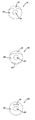
- FIG. 1 illustrates a magnified, plan view of a front surface of an embodiment of the lens of the invention.
- FIG. 2 illustrates a magnified, plan view of a front surface of a second embodiment of the lens of the invention.
- FIG. 3 illustrates a magnified, plan view of a front surface of a third embodiment of the lens of the invention.
- stabilized contact lens may be obtained by using spline or polynomials to generate one or more peripheral portions of a surface of the lens.
- the invention provides an effective method, and lenses incorporating that method, for on-eye lens stabilization.
- the invention permits the design of the lens' peripheral stabilization zones to be carried out with a high degree of control.
- the resulting lens' stabilization zones are smoothly integrated into the lens surface providing a lens that is both effectively stabilized on the eye and comfortable for the lens wearer.
- the lenses may be produced using computer numerically controlled (“CNC”) coding without the need for specialized tooling.
- the invention provides a contact lens comprising, consisting essentially of, and consisting of an optic zone, a peripheral portion and one or more thin zones in the peripheral portion, wherein the one or more thin ones are generated using a function that is a spline, a high order polynomial, or a ombination thereof
- the invention provides a method for roducing the contact lenses of the invention.
- peripheral portion is meant the area of the lens outside of the central optic zone.
- the peripheral portion of the lens may include, without limitation, a non-optical lenticular zone, a lens edge, a bevel, or a combination thereof
- high order polynomial is meant a polynomial of at least the 4 h order.
- the lenses of the invention may be either hard or soft contact lenses. Preferably, the lenses are soft contact lenses.
- the one or more thin zones may be located on the front surface, the back surface, or both surfaces.
- front surface is meant the object side of the lens.
- back surface is meant the surface of the lens that rests on the eye.
- the one or more thin zones are on the front surface.
- the lenses of the invention may have any of a variety of corrective optical characteristics incorporated onto either or both the front and back surfaces.
- the lens may have any one or more of spheric, aspheric, bifocal, multifocal, prismatic, or cylindric corrections, or combinations thereof
- the surfaces may be surfaces calculated from corneal topographic measurements, or topographically-derived surfaces, surfaces calculated from wavefront aberration measurements of the eye, and the like and combinations thereof.
- the location, thickness, and symmetry of the thin zones may be any of a wide variety of combinations.
- a lens 10 is shown with optic zone 11 , and peripheral portion 12 which is a non-optical lenticular zone.
- Thin zone 13 is shown, which is centered about the 90 degree axis of lens 10 .
- lens 20 is depicted lens 20 with optic zone 21 , lenticular zone 22 and thin zones 23 and 24 , which are asymmetrical.
- lens 30 wherein thin zone 31 is shown in lenticular zone 32 .
- the thin zones may be located at any position on the lens surface that is outside of the optic zone, preferably at least greater than about 200 microns from the outermost edge of the optic zone and within the non-optical lenticular zone.
- the lens includes a bevel and the thin zone or zones are located at least greater than about 200 microns from the edge of the optic zone and extend up to the innermost edge of the bevel.
- innermost edge of the bevel is meant the edge of the bevel that is closet to the optic zone. If more than one thin zone is used, the zones each may be about the same radial distance from the lens' geometric center or this distance may vary.
- At least one surface of the lens is designed using corneal topographic data of an individual to correspond to all or a portion of the topography of the individual's cornea.
- corneal topographic data of an individual By “correspond” means that the surface of the lens is designed so that it fits on the cornea in a hand-in-glove manner. This embodiment is advantageous in that the back surface will aid the rotational stability of the lens on the eye.
- the back surface of the lens is designed using topographic data and either or both the front and back surfaces additionally correct for wavefront aberrations of the eye.
- the thin zones of the lenses of the invention are generated, meaning that the curvatures of the zones are described, using a spline function, a high order polynomial functions, or combinations thereof
- the difference in thickness between the thickest point of the lens outside of the thin zones and the thinnest point within the thin zones preferably is about 50 to about 300 microns, more preferably about 100 to about 200 microns.
- the lenses of the invention may be produced by any conventional method for producing contact lenses.
- the lens design may be cut into a metal and the metal used to produce plastic mold inserts for the lens' surfaces. A suitable liquid resin is then placed between the inserts, the inserts compressed, and the resin cured to form the lens.
- the lens of the invention may be produced by cutting the lens on a lathe.
- an advantage of the invention is that the lenses may be produced by the use of CNC lathing of the lenses or mold tools to produce the lenses.
- Materials useful for forming the lenses of the invention may be any known materials used in the production of hard or soft contact lenses.
- the material selected for forming the lenses of the invention is a material suitable for forming soft contact lenses.
- Suitable materials for forming such contact lenses using the method of the invention include, without limitation, silicone elastomers, silicone-containing macromers including, without limitation, those disclosed in U.S. Pat. Nos.
- hydrogels silicone-containing hydrogels, and the like and combinations thereof More preferably, the surface is a siloxane, or contains a siloxane functionality, including, without limitation, polydimethyl siloxane macromers, methacryloxypropyl polyalkyl siloxanes, and mixtures thereof, silicone hydrogel or a hydrogel, such as etafilcon A.
Landscapes
- Health & Medical Sciences (AREA)
- Ophthalmology & Optometry (AREA)
- Physics & Mathematics (AREA)
- General Health & Medical Sciences (AREA)
- General Physics & Mathematics (AREA)
- Optics & Photonics (AREA)
- Eyeglasses (AREA)
- Pharmaceuticals Containing Other Organic And Inorganic Compounds (AREA)
Abstract
Stabilized contact lens are provided in which the stabilization zones are obtained by using spline or polynomials to describe one or more peripheral portions of a surface of the lens. The lens' stabilization zones are smoothly integrated into the lens providing a lens that is both effectively stabilized on the eye and comfortable for the lens wearer.
Description
- The invention relates to contact lenses. In particular, the invention provides contact lenses that incorporate one or more stabilization zones to stabilize the orientation of the lens in relationship to the eye.
- It is known that the correction of certain optical defects can be accomplished by imparting non-spherical corrective characteristics into a contact lens, such as cylindrical or multifocal characteristics. Additionally, advances in technology permit production of lenses customized to a particular wearer using corneal topographic and wave front aberration measurements. The use of these lenses may be problematic in that the lenses need to be maintained at a specific orientation while on the eye to be effective. However, a lens will rotate on the eye due to blinking as well as eyelid and tear fluid movement.
- Lenses designed to maintain their on-eye orientation typically are of two general types. One type uses prism stabilization, or thickening of certain lens portions, to maintain orientation. Examples of prism stabilization methods include decentering the front relative to the back lens surface, prismatic balancing, thickening of the lower lens edge, supporting the lens on the lower eyelid, forming depressions or elevations on the lens' surface, and truncating the lens edge.
- A second lens type, dynamically stabilized lenses, uses the movement of the eyelids to maintain lens orientation. Dynamic stabilization methods include reducing the thickness of the lens' outer surface at two symmetrically lying regions, typically top and bottom zones on the lens, while maintaining the thickness of the outer regions in the horizontal center axis.
- The known methods for maintaining lens orientation suffer from a number of disadvantages including that lenses incorporating the methods require specialized, off-axis tooling for production, that these lenses are uncomfortable to wear, and that the known methods are not highly effective. Thus, a need exists for a method of maintaining on-eye orientation of a lens that overcomes some of these disadvantages.
- FIG. 1 illustrates a magnified, plan view of a front surface of an embodiment of the lens of the invention.
- FIG. 2 illustrates a magnified, plan view of a front surface of a second embodiment of the lens of the invention.
- FIG. 3 illustrates a magnified, plan view of a front surface of a third embodiment of the lens of the invention.
- It is a discovery of the invention that stabilized contact lens may be obtained by using spline or polynomials to generate one or more peripheral portions of a surface of the lens. The invention provides an effective method, and lenses incorporating that method, for on-eye lens stabilization. The invention permits the design of the lens' peripheral stabilization zones to be carried out with a high degree of control. The resulting lens' stabilization zones are smoothly integrated into the lens surface providing a lens that is both effectively stabilized on the eye and comfortable for the lens wearer. Additionally, the lenses may be produced using computer numerically controlled (“CNC”) coding without the need for specialized tooling.
- In one embodiment, the invention provides a contact lens comprising, consisting essentially of, and consisting of an optic zone, a peripheral portion and one or more thin zones in the peripheral portion, wherein the one or more thin ones are generated using a function that is a spline, a high order polynomial, or a ombination thereof In another embodiment, the invention provides a method for roducing the contact lenses of the invention.
- By “peripheral portion” is meant the area of the lens outside of the central optic zone. Typically, the peripheral portion of the lens may include, without limitation, a non-optical lenticular zone, a lens edge, a bevel, or a combination thereof By “high order polynomial” is meant a polynomial of at least the 4 h order.
- The lenses of the invention may be either hard or soft contact lenses. Preferably, the lenses are soft contact lenses. The one or more thin zones may be located on the front surface, the back surface, or both surfaces. By “front surface” is meant the object side of the lens. By “back surface” is meant the surface of the lens that rests on the eye. Preferably, the one or more thin zones are on the front surface.
- Further, the lenses of the invention may have any of a variety of corrective optical characteristics incorporated onto either or both the front and back surfaces. For example, the lens may have any one or more of spheric, aspheric, bifocal, multifocal, prismatic, or cylindric corrections, or combinations thereof Additionally, the surfaces may be surfaces calculated from corneal topographic measurements, or topographically-derived surfaces, surfaces calculated from wavefront aberration measurements of the eye, and the like and combinations thereof.
- The location, thickness, and symmetry of the thin zones may be any of a wide variety of combinations. Referring to FIG. 1, a
lens 10 is shown withoptic zone 11, andperipheral portion 12 which is a non-optical lenticular zone.Thin zone 13 is shown, which is centered about the 90 degree axis oflens 10. In FIG. 2 is depictedlens 20 withoptic zone 21,lenticular zone 22 andthin zones lens 30 whereinthin zone 31 is shown inlenticular zone 32. - The thin zones may be located at any position on the lens surface that is outside of the optic zone, preferably at least greater than about 200 microns from the outermost edge of the optic zone and within the non-optical lenticular zone. Most preferably, the lens includes a bevel and the thin zone or zones are located at least greater than about 200 microns from the edge of the optic zone and extend up to the innermost edge of the bevel. By “innermost edge of the bevel” is meant the edge of the bevel that is closet to the optic zone. If more than one thin zone is used, the zones each may be about the same radial distance from the lens' geometric center or this distance may vary.
- In a preferred embodiment, at least one surface of the lens, preferably the back surface, is designed using corneal topographic data of an individual to correspond to all or a portion of the topography of the individual's cornea. By “correspond” means that the surface of the lens is designed so that it fits on the cornea in a hand-in-glove manner. This embodiment is advantageous in that the back surface will aid the rotational stability of the lens on the eye. In a more preferred embodiment, the back surface of the lens is designed using topographic data and either or both the front and back surfaces additionally correct for wavefront aberrations of the eye.
- The thin zones of the lenses of the invention are generated, meaning that the curvatures of the zones are described, using a spline function, a high order polynomial functions, or combinations thereof The difference in thickness between the thickest point of the lens outside of the thin zones and the thinnest point within the thin zones preferably is about 50 to about 300 microns, more preferably about 100 to about 200 microns.
- The lenses of the invention may be produced by any conventional method for producing contact lenses. For example, the lens design may be cut into a metal and the metal used to produce plastic mold inserts for the lens' surfaces. A suitable liquid resin is then placed between the inserts, the inserts compressed, and the resin cured to form the lens. Alternatively, the lens of the invention may be produced by cutting the lens on a lathe. One ordinarily skilled in the art will recognize that an advantage of the invention is that the lenses may be produced by the use of CNC lathing of the lenses or mold tools to produce the lenses.
- Materials useful for forming the lenses of the invention may be any known materials used in the production of hard or soft contact lenses. Preferably, the material selected for forming the lenses of the invention is a material suitable for forming soft contact lenses. Suitable materials for forming such contact lenses using the method of the invention include, without limitation, silicone elastomers, silicone-containing macromers including, without limitation, those disclosed in U.S. Pat. Nos. 5,371,147, 5,314,960, and 5,057,578 incorporated in their entireties herein by reference, hydrogels, silicone-containing hydrogels, and the like and combinations thereof More preferably, the surface is a siloxane, or contains a siloxane functionality, including, without limitation, polydimethyl siloxane macromers, methacryloxypropyl polyalkyl siloxanes, and mixtures thereof, silicone hydrogel or a hydrogel, such as etafilcon A.
Claims (20)
1. A contact lens comprising, an optic zone, a peripheral portion and one or more thin zones in the peripheral portion, wherein the one or more thin zones are generated using a function that is a spline, a high order polynomial, or a combination thereof.
2. The lens of claim 1 , wherein the lens is a soft contact lens.
3. The lens of claim 1 , wherein the one or more thin zones are located on a front surface of the lens.
4. The lens of claim 1 , wherein the one or more thin zones are located on a back surface of the lens.
5. The lens of claim 1 , wherein the one or more thin zones are located on a back and a front surface of the lens.
6. The lens of claim 1 , wherein a back surface of the lens corresponds to all or a portion of a topography of an individual's cornea.
7. The lens of claim 1 , wherein a front surface of the lens corresponds to all or a portion of a topography of an individual's cornea.
8. The lens of claim 6 , wherein the front surface, the back surface or both surfaces are calculated from wavefront aberration measurements of the eye.
9. The lens of claim 7 , wherein the front surface, the back surface or both surfaces are calculated from wavefront aberration measurements of the eye.
10. The lens of claim 1 , wherein the one or more thin zones are located at least greater than about 200 microns from an outermost edge of an optic zone of the lens.
11. The lens of claim 10 , wherein the peripheral portion comprises a non-optical lenticular zone and a bevel and wherein the one or more thin zones extends up to an innermost edge of the bevel.
12. The lens of claim 1 , wherein the one or more thin zones are generated using a spline function.
13. The lens of claim 1 , wherein the one or more thin zones are generated using a high order polynomial function.
14. A method for producing a contact lens, comprising the step of generating one or more thin zones using a function that is a spline, a high order polynomial, or a combination thereof.
15. The method of claim 14 , wherein the generating step is carried out using a spline function.
16. The method of claim 14 , wherein the generating step is carried out using a spline function.
17. The method of claim 14 , further comprising the step of providing a back surface of the lens corresponding to all or a portion of a topography of an individual's cornea.
18. The method of claim 14 , further comprising the step of providing a front surface of the lens corresponding to all or a portion of a topography of an individual's cornea.
19. The method of claim 17 , further comprising the step of calculating a front surface, the back surface, or both surfaces of the lens from wavefront aberration measurements of an individual's eye.
20. The method of claim 18 , further comprising the step of calculating the front surface, a back surface, or both surfaces of the lens from wavefront aberration measurements of an individual's eye.
Priority Applications (10)
| Application Number | Priority Date | Filing Date | Title |
|---|---|---|---|
| US09/732,647 US6491392B2 (en) | 2000-12-08 | 2000-12-08 | Dynamically stabilized contact lenses |
| ARP010105698A AR031791A1 (en) | 2000-12-08 | 2001-12-07 | CONTACT LENSES DYNAMICALLY STABILIZED AND METHOD TO PRODUCE |
| TW090130276A TW594098B (en) | 2000-12-08 | 2001-12-07 | Dynamically stabilized contact lenses |
| AU2002228994A AU2002228994A1 (en) | 2000-12-08 | 2001-12-10 | Dynamically stabilized contact lenses |
| JP2002548503A JP2004523778A (en) | 2000-12-08 | 2001-12-10 | Dynamically stabilized contact lenses |
| CA002431059A CA2431059A1 (en) | 2000-12-08 | 2001-12-10 | Dynamically stabilized contact lenses |
| CNA018201296A CN1479880A (en) | 2000-12-08 | 2001-12-10 | Dynamically Stabilized Contact Lenses |
| EP01990124A EP1344102A2 (en) | 2000-12-08 | 2001-12-10 | Dynamically stabilized contact lenses |
| PCT/US2001/047902 WO2002046829A2 (en) | 2000-12-08 | 2001-12-10 | Dynamically stabilized contact lenses |
| BR0116466-0A BR0116466A (en) | 2000-12-08 | 2001-12-10 | Dynamically stabilized contact lenses |
Applications Claiming Priority (1)
| Application Number | Priority Date | Filing Date | Title |
|---|---|---|---|
| US09/732,647 US6491392B2 (en) | 2000-12-08 | 2000-12-08 | Dynamically stabilized contact lenses |
Publications (2)
| Publication Number | Publication Date |
|---|---|
| US20020071094A1 true US20020071094A1 (en) | 2002-06-13 |
| US6491392B2 US6491392B2 (en) | 2002-12-10 |
Family
ID=24944412
Family Applications (1)
| Application Number | Title | Priority Date | Filing Date |
|---|---|---|---|
| US09/732,647 Expired - Lifetime US6491392B2 (en) | 2000-12-08 | 2000-12-08 | Dynamically stabilized contact lenses |
Country Status (10)
| Country | Link |
|---|---|
| US (1) | US6491392B2 (en) |
| EP (1) | EP1344102A2 (en) |
| JP (1) | JP2004523778A (en) |
| CN (1) | CN1479880A (en) |
| AR (1) | AR031791A1 (en) |
| AU (1) | AU2002228994A1 (en) |
| BR (1) | BR0116466A (en) |
| CA (1) | CA2431059A1 (en) |
| TW (1) | TW594098B (en) |
| WO (1) | WO2002046829A2 (en) |
Cited By (21)
| Publication number | Priority date | Publication date | Assignee | Title |
|---|---|---|---|---|
| US20050041202A1 (en) * | 2003-08-20 | 2005-02-24 | Jubin Philippe F. | Rotationally stabilized contact lenses |
| US20050088614A1 (en) * | 2003-10-27 | 2005-04-28 | Jubin Philippe F. | Methods for reducing corneal staining in contact lens wearers |
| US20050254005A1 (en) * | 2000-03-31 | 2005-11-17 | Coopervision, Inc. | Contact lens having a uniform horizontal thickness profile |
| US20050259220A1 (en) * | 2004-05-20 | 2005-11-24 | Neadle Susan W | Methods for rotationally stabilizing contact lenses |
| US20060264917A1 (en) * | 2005-05-20 | 2006-11-23 | Visx, Incorporated | Scleral lenses for custom optic evaluation and visual performance improvement |
| US20070109495A1 (en) * | 2000-03-31 | 2007-05-17 | Coopervision, Inc. | Contact lens having a uniform horizontal thickness profile |
| US20090051059A1 (en) * | 2007-08-21 | 2009-02-26 | Widman Michael F | Methods for formation of an ophthalmic lens precursor and lens |
| US20090053351A1 (en) * | 2007-08-21 | 2009-02-26 | Widman Michael F | Apparatus for formation of an ophthalmic lens precursor and lens |
| US20090174863A1 (en) * | 2007-08-21 | 2009-07-09 | Widman Michael F | Free form ophthalmic lens |
| US20090225273A1 (en) * | 2008-03-04 | 2009-09-10 | Clutterbuck Timothy A | Rotationally Stabilized Contact Lenses and Methods for their Design |
| WO2009139021A1 (en) * | 2008-05-13 | 2009-11-19 | 株式会社メニコン | Contact lens |
| US20100047380A1 (en) * | 2008-08-20 | 2010-02-25 | Widman Michael F | Ophthalmic lens precursor and lens |
| US20100245761A1 (en) * | 2009-03-31 | 2010-09-30 | Widman Michael F | Free form lens with refractive index variations |
| US20110220021A1 (en) * | 2010-03-12 | 2011-09-15 | Enns John B | Apparatus for vapor phase processing ophthalmic devices |
| US20140268033A1 (en) * | 2013-03-15 | 2014-09-18 | Johnson & Johnson Vision Care, Inc. | Ophthalmic devices with stabilization features |
| US9417464B2 (en) | 2008-08-20 | 2016-08-16 | Johnson & Johnson Vision Care, Inc. | Method and apparatus of forming a translating multifocal contact lens having a lower-lid contact surface |
| EP3136157A1 (en) * | 2015-08-26 | 2017-03-01 | Johnson & Johnson Vision Care Inc. | Rotationally stabilized contact lens with improved comfort and method of optimization |
| US9645412B2 (en) | 2014-11-05 | 2017-05-09 | Johnson & Johnson Vision Care Inc. | Customized lens device and method |
| US10359643B2 (en) | 2015-12-18 | 2019-07-23 | Johnson & Johnson Vision Care, Inc. | Methods for incorporating lens features and lenses having such features |
| CN113396357A (en) * | 2018-12-05 | 2021-09-14 | 哈尼塔镜片公司 | Contact lenses with adjustable curvature |
| US11364696B2 (en) | 2020-09-18 | 2022-06-21 | Johnson & Johnson Vision Care, Inc | Apparatus for forming an ophthalmic lens |
Families Citing this family (20)
| Publication number | Priority date | Publication date | Assignee | Title |
|---|---|---|---|---|
| US7111938B2 (en) * | 2001-04-27 | 2006-09-26 | Novartis Ag | Automatic lens design and manufacturing system |
| AU2003260369A1 (en) * | 2002-08-06 | 2004-02-25 | Novartis Ag | Contact lenses |
| JP4627756B2 (en) * | 2003-05-21 | 2011-02-09 | ノバルティス アーゲー | contact lens |
| US20050041203A1 (en) * | 2003-08-20 | 2005-02-24 | Lindacher Joseph Michael | Ophthalmic lens with optimal power profile |
| CA2613513A1 (en) | 2005-06-24 | 2007-01-04 | Boston Foundation For Sight | Scleral contact lens with grooves and method of making lens |
| AR062067A1 (en) | 2006-07-17 | 2008-10-15 | Novartis Ag | TORICAS CONTACT LENSES WITH CONTROLLED OPTICAL POWER PROFILE |
| US7695135B1 (en) | 2008-11-11 | 2010-04-13 | Boston Foundation For Sight | Scleral lens with scalloped channels or circumferential fenestrated channels |
| US8113652B2 (en) * | 2009-03-27 | 2012-02-14 | Crt Technology, Inc. | Contact lens with meridional sagittal variation and methods for making and using the same |
| US8968904B2 (en) * | 2010-04-05 | 2015-03-03 | GM Global Technology Operations LLC | Secondary battery module |
| CN101881892A (en) * | 2010-06-24 | 2010-11-10 | 陈迪生 | Novel rigid air-permeable corneal contact lens |
| JP5747279B2 (en) * | 2011-04-28 | 2015-07-15 | 東海光学株式会社 | Design method for vision correction lens |
| US9132005B2 (en) | 2012-09-07 | 2015-09-15 | BeautiEyes, LLC | Eye aperture enhancing prosthesis and method |
| US9995947B2 (en) | 2012-09-07 | 2018-06-12 | BeautiEyes, LLC | Prosthesis and method for widening the palpebral fissure of an individual's eye |
| US9414906B2 (en) | 2012-09-07 | 2016-08-16 | BeautiEyes, LLC | Eye aperture enhancing prosthesis and method |
| IL303151B2 (en) | 2015-09-23 | 2025-04-01 | Ohio State Innovation Foundation | Contact lens comprising a lenticular in a superior portion of the contact lens |
| US10191302B2 (en) | 2015-09-23 | 2019-01-29 | Ohio State Innovation Foundation | Contact lens comprising lenticular-like curve |
| US11320673B2 (en) | 2017-09-01 | 2022-05-03 | Ohio State Innovation Foundation | Soft contact lens comprising a lenticular in a superior portion of the contact lens with enhanced tear exchange |
| US11079614B2 (en) | 2018-06-18 | 2021-08-03 | Johnson & Johnson Vision Care, Inc. | Rotationally stabilized contact lens with improved comfort and improved stabilization utilizing optimized stiffness profiles |
| AR115981A1 (en) | 2019-03-19 | 2021-03-17 | Ohio State Innovation Foundation | CONTACT LENS |
| USD1075870S1 (en) | 2020-03-26 | 2025-05-20 | Ohio State Innovation Foundation | Contact lens |
Family Cites Families (13)
| Publication number | Priority date | Publication date | Assignee | Title |
|---|---|---|---|---|
| US4095878A (en) | 1974-03-28 | 1978-06-20 | Titmus Eurocon Kontaktlinsen Gmbh & Co. Kg | Soft contact lens with flattened region for automatic orientation |
| US4195919A (en) * | 1977-10-31 | 1980-04-01 | Shelton William A | Contact lens with reduced spherical aberration for aphakic eyes |
| US4268133A (en) | 1978-07-14 | 1981-05-19 | Bausch & Lomb Incorporated | Preferential orientation of contact lenses |
| US4324461A (en) | 1979-11-26 | 1982-04-13 | Salvatori Ophthalmics, Inc. | Contact lens for non-rotational orientation |
| US5020898A (en) | 1990-01-29 | 1991-06-04 | Schering Corporation | Contact lens for correction of astigmatism |
| US5452031A (en) | 1993-05-05 | 1995-09-19 | Boston Eye Technology, Inc. | Contact lens and a method for manufacturing contact lens |
| US5650837A (en) | 1995-05-04 | 1997-07-22 | Johnson & Johnson Vision Products, Inc. | Rotationally stable contact lens designs |
| US5880809A (en) * | 1996-12-30 | 1999-03-09 | Scientific Optics, Inc. | Contact lens |
| US6241355B1 (en) * | 1996-03-29 | 2001-06-05 | Brian A. Barsky | Computer aided contact lens design and fabrication using spline surfaces |
| SG83139A1 (en) | 1998-08-10 | 2001-09-18 | Johnson & Johnson Vision Prod | Dynamically stabilized contact lenses |
| US6244709B1 (en) * | 1999-03-12 | 2001-06-12 | Bausch & Lomb Incorporated | Multifocal lens article |
| US6206520B1 (en) | 1999-03-25 | 2001-03-27 | Johnson & Johnson Vision Care, Inc. | Contact lenses with contoured edges |
| US6264328B1 (en) * | 1999-10-21 | 2001-07-24 | University Of Rochester | Wavefront sensor with off-axis illumination |
-
2000
- 2000-12-08 US US09/732,647 patent/US6491392B2/en not_active Expired - Lifetime
-
2001
- 2001-12-07 TW TW090130276A patent/TW594098B/en not_active IP Right Cessation
- 2001-12-07 AR ARP010105698A patent/AR031791A1/en not_active Application Discontinuation
- 2001-12-10 CA CA002431059A patent/CA2431059A1/en not_active Abandoned
- 2001-12-10 CN CNA018201296A patent/CN1479880A/en active Pending
- 2001-12-10 JP JP2002548503A patent/JP2004523778A/en active Pending
- 2001-12-10 BR BR0116466-0A patent/BR0116466A/en not_active IP Right Cessation
- 2001-12-10 WO PCT/US2001/047902 patent/WO2002046829A2/en not_active Ceased
- 2001-12-10 AU AU2002228994A patent/AU2002228994A1/en not_active Abandoned
- 2001-12-10 EP EP01990124A patent/EP1344102A2/en not_active Withdrawn
Cited By (64)
| Publication number | Priority date | Publication date | Assignee | Title |
|---|---|---|---|---|
| US7134753B2 (en) | 2000-03-31 | 2006-11-14 | Coopervision, Inc. | Contact lens having a uniform horizontal thickness profile |
| US7618142B2 (en) | 2000-03-31 | 2009-11-17 | Cooper Vision International Holding Company, Lp | Contact lenses |
| US7625084B2 (en) | 2000-03-31 | 2009-12-01 | Coopervision International Holding Company, Lp | Contact lens |
| US7628485B2 (en) | 2000-03-31 | 2009-12-08 | Coopervision International Holding Company, Lp | Contact lens having a uniform horizontal thickness profile |
| US20050254005A1 (en) * | 2000-03-31 | 2005-11-17 | Coopervision, Inc. | Contact lens having a uniform horizontal thickness profile |
| US20050254004A1 (en) * | 2000-03-31 | 2005-11-17 | Coopervision, Inc. | Contact lens having a uniform horizontal thickness profile |
| US20090009712A1 (en) * | 2000-03-31 | 2009-01-08 | Coopervision,Inc. | Contact lens |
| US20050280774A1 (en) * | 2000-03-31 | 2005-12-22 | Coopervision, Inc. | Contact lens having a uniform horizontal thickness profile |
| US20080030676A1 (en) * | 2000-03-31 | 2008-02-07 | Coopervision, Inc. | Contact lenses |
| US7133174B2 (en) | 2000-03-31 | 2006-11-07 | Coopervision, Inc. | Contact lens having a uniform horizontal thickness profile |
| US20070109495A1 (en) * | 2000-03-31 | 2007-05-17 | Coopervision, Inc. | Contact lens having a uniform horizontal thickness profile |
| US20070019155A1 (en) * | 2000-03-31 | 2007-01-25 | Coopervision, Inc. | Contact lenses |
| US20050041202A1 (en) * | 2003-08-20 | 2005-02-24 | Jubin Philippe F. | Rotationally stabilized contact lenses |
| WO2005019907A1 (en) * | 2003-08-20 | 2005-03-03 | Johnson & Johnson Vision Care, Inc. | Rotationally stabilized contact lenses |
| AU2004267683B2 (en) * | 2003-08-20 | 2010-04-29 | Johnson & Johnson Vision Care, Inc. | Rotationally stabilized contact lenses |
| US6939005B2 (en) | 2003-08-20 | 2005-09-06 | Johnson & Johnson Vision Care Inc. | Rotationally stabilized contact lenses |
| CN100480782C (en) * | 2003-08-20 | 2009-04-22 | 庄臣及庄臣视力保护公司 | Rotatable but stable contact lens |
| US7036930B2 (en) | 2003-10-27 | 2006-05-02 | Johnson & Johnson Vision Care, Inc. | Methods for reducing corneal staining in contact lens wearers |
| US20050088614A1 (en) * | 2003-10-27 | 2005-04-28 | Jubin Philippe F. | Methods for reducing corneal staining in contact lens wearers |
| US7201480B2 (en) | 2004-05-20 | 2007-04-10 | Johnson & Johnson Vision Care, Inc. | Methods for rotationally stabilizing contact lenses |
| US20050259220A1 (en) * | 2004-05-20 | 2005-11-24 | Neadle Susan W | Methods for rotationally stabilizing contact lenses |
| US20060264917A1 (en) * | 2005-05-20 | 2006-11-23 | Visx, Incorporated | Scleral lenses for custom optic evaluation and visual performance improvement |
| WO2006127173A3 (en) * | 2005-05-20 | 2007-11-22 | Visx Inc | Scleral lenses for custom optic evaluation and visual performance improvement |
| US8317505B2 (en) | 2007-08-21 | 2012-11-27 | Johnson & Johnson Vision Care, Inc. | Apparatus for formation of an ophthalmic lens precursor and lens |
| US9857607B2 (en) | 2007-08-21 | 2018-01-02 | Johnson & Johnson Vision Care, Inc. | Apparatus for formation of an ophthalmic lens precursor and lens |
| US20090053351A1 (en) * | 2007-08-21 | 2009-02-26 | Widman Michael F | Apparatus for formation of an ophthalmic lens precursor and lens |
| US20090051059A1 (en) * | 2007-08-21 | 2009-02-26 | Widman Michael F | Methods for formation of an ophthalmic lens precursor and lens |
| US9180634B2 (en) | 2007-08-21 | 2015-11-10 | Johnson & Johnson Vision Care, Inc. | Methods for formation of an ophthalmic lens precursor and lens |
| US20090174863A1 (en) * | 2007-08-21 | 2009-07-09 | Widman Michael F | Free form ophthalmic lens |
| US10901319B2 (en) | 2007-08-21 | 2021-01-26 | Johnson & Johnson Vision Care, Inc. | Apparatus for forming an ophthalmic lens |
| US7905594B2 (en) | 2007-08-21 | 2011-03-15 | Johnson & Johnson Vision Care, Inc. | Free form ophthalmic lens |
| US10571718B2 (en) | 2007-08-21 | 2020-02-25 | Johnson & Johnson Vision Care, Inc | Apparatus for formation of an ophthalmic lens precursor and lens |
| US10126567B2 (en) | 2007-08-21 | 2018-11-13 | Johnson & Johnson Vision Care, Inc. | Apparatus for formation of an ophthalmic lens precursor and lens |
| US9266294B2 (en) | 2007-08-21 | 2016-02-23 | Johnson & Johnson Vision Care, Inc. | Apparatus for formation of an ophthalmic lens precursor and lens |
| US9610742B2 (en) | 2007-08-21 | 2017-04-04 | Johnson & Johnson Vision Care, Inc. | Apparatus for formation of an ophthalmic lens precursor and lens |
| US9180633B2 (en) | 2007-08-21 | 2015-11-10 | Johnson & Johnson Vision Care, Inc. | Methods for formation of an ophthalmic lens precursor and lens |
| US8318055B2 (en) | 2007-08-21 | 2012-11-27 | Johnson & Johnson Vision Care, Inc. | Methods for formation of an ophthalmic lens precursor and lens |
| US8795558B2 (en) | 2007-08-21 | 2014-08-05 | Johnson & Johnson Vision Care, Inc. | Methods for formation of an ophthalmic lens precursor and lens |
| US8646908B2 (en) | 2008-03-04 | 2014-02-11 | Johnson & Johnson Vision Care, Inc. | Rotationally stabilized contact lenses and methods for their design |
| US20090225273A1 (en) * | 2008-03-04 | 2009-09-10 | Clutterbuck Timothy A | Rotationally Stabilized Contact Lenses and Methods for their Design |
| WO2009139021A1 (en) * | 2008-05-13 | 2009-11-19 | 株式会社メニコン | Contact lens |
| US8313828B2 (en) | 2008-08-20 | 2012-11-20 | Johnson & Johnson Vision Care, Inc. | Ophthalmic lens precursor and lens |
| US9417464B2 (en) | 2008-08-20 | 2016-08-16 | Johnson & Johnson Vision Care, Inc. | Method and apparatus of forming a translating multifocal contact lens having a lower-lid contact surface |
| US20100047380A1 (en) * | 2008-08-20 | 2010-02-25 | Widman Michael F | Ophthalmic lens precursor and lens |
| US8157373B2 (en) | 2009-03-02 | 2012-04-17 | Johnson & Johnson Vision Care, Inc. | Free form ophthalmic lens |
| US20110116036A1 (en) * | 2009-03-02 | 2011-05-19 | Widman Michael F | Free form ophthalmic lens |
| US8240849B2 (en) | 2009-03-31 | 2012-08-14 | Johnson & Johnson Vision Care, Inc. | Free form lens with refractive index variations |
| US9075186B2 (en) | 2009-03-31 | 2015-07-07 | Johnson & Johnson Vision Care, Inc. | Free form lens with refractive index variations |
| US20100245761A1 (en) * | 2009-03-31 | 2010-09-30 | Widman Michael F | Free form lens with refractive index variations |
| US9346226B2 (en) | 2010-03-12 | 2016-05-24 | Johnson & Johnson Vision Care, Inc. | Apparatus for vapor phase processing ophthalmic devices |
| US8807076B2 (en) | 2010-03-12 | 2014-08-19 | Johnson & Johnson Vision Care, Inc. | Apparatus for vapor phase processing ophthalmic devices |
| US20110220021A1 (en) * | 2010-03-12 | 2011-09-15 | Enns John B | Apparatus for vapor phase processing ophthalmic devices |
| US9316848B2 (en) * | 2013-03-15 | 2016-04-19 | Johnson & Johnson Vision Care, Inc. | Ophthalmic devices with stabilization features |
| US20140268033A1 (en) * | 2013-03-15 | 2014-09-18 | Johnson & Johnson Vision Care, Inc. | Ophthalmic devices with stabilization features |
| US9645412B2 (en) | 2014-11-05 | 2017-05-09 | Johnson & Johnson Vision Care Inc. | Customized lens device and method |
| EP3136157A1 (en) * | 2015-08-26 | 2017-03-01 | Johnson & Johnson Vision Care Inc. | Rotationally stabilized contact lens with improved comfort and method of optimization |
| US9778487B2 (en) | 2015-08-26 | 2017-10-03 | Johnson & Johnson Vision Care, Inc. | Rotationally stabilized contact lens with improved comfort and method of optimization |
| CN106483676A (en) * | 2015-08-26 | 2017-03-08 | 庄臣及庄臣视力保护公司 | There is adherent lenses and the optimization method of the spin stabilization improving comfort level |
| KR20170026162A (en) * | 2015-08-26 | 2017-03-08 | 존슨 앤드 존슨 비젼 케어, 인코포레이티드 | Rotationally stabilized contact lens with improved comfort and method of optimization |
| KR102659759B1 (en) | 2015-08-26 | 2024-04-24 | 존슨 앤드 존슨 비젼 케어, 인코포레이티드 | Rotationally stabilized contact lens with improved comfort and method of optimization |
| US10359643B2 (en) | 2015-12-18 | 2019-07-23 | Johnson & Johnson Vision Care, Inc. | Methods for incorporating lens features and lenses having such features |
| CN113396357A (en) * | 2018-12-05 | 2021-09-14 | 哈尼塔镜片公司 | Contact lenses with adjustable curvature |
| EP3891553A4 (en) * | 2018-12-05 | 2022-07-06 | Hanita Lenses R.C.A. | ADAPTABLE CURVATURE CONTACT LENS |
| US11364696B2 (en) | 2020-09-18 | 2022-06-21 | Johnson & Johnson Vision Care, Inc | Apparatus for forming an ophthalmic lens |
Also Published As
| Publication number | Publication date |
|---|---|
| WO2002046829A3 (en) | 2003-01-16 |
| CA2431059A1 (en) | 2002-06-13 |
| CN1479880A (en) | 2004-03-03 |
| AU2002228994A1 (en) | 2002-06-18 |
| TW594098B (en) | 2004-06-21 |
| US6491392B2 (en) | 2002-12-10 |
| BR0116466A (en) | 2004-01-06 |
| EP1344102A2 (en) | 2003-09-17 |
| AR031791A1 (en) | 2003-10-01 |
| WO2002046829A2 (en) | 2002-06-13 |
| JP2004523778A (en) | 2004-08-05 |
Similar Documents
| Publication | Publication Date | Title |
|---|---|---|
| US6491392B2 (en) | Dynamically stabilized contact lenses | |
| CA2432422C (en) | Contact lenses with improved centering and orienting | |
| JP4777247B2 (en) | Ophthalmic lens with optimal power profile | |
| WO2001016641A1 (en) | Rotationally stabilized contact lenses | |
| US6899425B2 (en) | Multifocal ophthalmic lenses | |
| US4194815A (en) | Semi-scleral contact lens | |
| JP4263172B2 (en) | Contact lens with stable angular position in the circumferential direction | |
| US20020024631A1 (en) | Rotationally stabilized contact lenses | |
| AU2001297597A1 (en) | Contact lenses with improved centering and orienting | |
| CA2784347C (en) | Stabilized contact lenses | |
| AU2009221955B2 (en) | Rotationally stabilized contact lenses and methods for their design | |
| JP2007503011A5 (en) | ||
| EP0980015A1 (en) | Dynamically stabilized contact lenses | |
| US5988813A (en) | Differential thickness contact lens utilizing multiple base curves and method of manufacturing same | |
| SG181625A1 (en) | Method for producing stabilized contact lenses | |
| WO2001029608A1 (en) | Rotationally stabilized contact lenses | |
| KR20030060113A (en) | Dynamically stabilized contact lenses | |
| US20040017544A1 (en) | Contact lenses and methods for their design | |
| GB1569764A (en) | Progressive power ophthalmic lens | |
| KR20050032574A (en) | Rotationally stabilized contact lenses | |
| HK1175543A (en) | Stabilized contact lenses | |
| HK1175543B (en) | Stabilized contact lenses | |
| MXPA06005361A (en) | Translating bifocal wear modality |
Legal Events
| Date | Code | Title | Description |
|---|---|---|---|
| AS | Assignment |
Owner name: JOHNSON & JOHNSON VISION CARE, INC., FLORIDA Free format text: ASSIGNMENT OF ASSIGNORS INTEREST;ASSIGNORS:ROFFMAN, JEFFREY H.;JUBIN, PHILIPPE F.;WASHINGTON, ALEX T.;REEL/FRAME:011382/0586 Effective date: 20001207 |
|
| STCF | Information on status: patent grant |
Free format text: PATENTED CASE |
|
| FPAY | Fee payment |
Year of fee payment: 4 |
|
| FPAY | Fee payment |
Year of fee payment: 8 |
|
| FPAY | Fee payment |
Year of fee payment: 12 |