US1925604A - Fluid operated machine - Google Patents
Fluid operated machine Download PDFInfo
- Publication number
- US1925604A US1925604A US478635A US47863530A US1925604A US 1925604 A US1925604 A US 1925604A US 478635 A US478635 A US 478635A US 47863530 A US47863530 A US 47863530A US 1925604 A US1925604 A US 1925604A
- Authority
- US
- United States
- Prior art keywords
- valve
- pressure
- sleeve
- cylinder
- fluid
- Prior art date
- Legal status (The legal status is an assumption and is not a legal conclusion. Google has not performed a legal analysis and makes no representation as to the accuracy of the status listed.)
- Expired - Lifetime
Links
- 239000012530 fluid Substances 0.000 title description 27
- 239000011435 rock Substances 0.000 description 3
- 229910000831 Steel Inorganic materials 0.000 description 2
- 239000010959 steel Substances 0.000 description 2
- 101100379079 Emericella variicolor andA gene Proteins 0.000 description 1
- 238000003754 machining Methods 0.000 description 1
- 238000004519 manufacturing process Methods 0.000 description 1
- 230000008520 organization Effects 0.000 description 1
- 230000008707 rearrangement Effects 0.000 description 1
- 125000006850 spacer group Chemical group 0.000 description 1
Images

Classifications
-
- E—FIXED CONSTRUCTIONS
- E21—EARTH OR ROCK DRILLING; MINING
- E21B—EARTH OR ROCK DRILLING; OBTAINING OIL, GAS, WATER, SOLUBLE OR MELTABLE MATERIALS OR A SLURRY OF MINERALS FROM WELLS
- E21B1/00—Percussion drilling
- E21B1/12—Percussion drilling with a reciprocating impulse member
- E21B1/24—Percussion drilling with a reciprocating impulse member the impulse member being a piston driven directly by fluid pressure
- E21B1/30—Percussion drilling with a reciprocating impulse member the impulse member being a piston driven directly by fluid pressure by air, steam or gas pressure
Definitions
- valve section 18 "i" This invention relates to iiuid operated machines of the hammer type, and more specifically to an improved organization of valvular mechamsm.
- One object of my invention is to provide a sleeve valve for a iiuid actuated machine having means actuated by live motive fluid for throwing and holding the valve,
- valve of this type in such a manner as to facilitate manufacture and assembly,- and to provide a sectional valve adapted to be held together by fluid pressure for unitary operation.
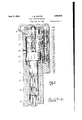
- V i Y Otherobjects of this invention will be apparent from the following detailed description wherein ⁇ similar characters ofrreference designate corresponding parts and whereinz Fig. l is a vertical section of a rock drill, partly broken away, constructed in accordance with this 20 invention, showing the relation assumed by the parts at the initial movement of the blow-stroke of the piston.
- Fig. 2 is a vertical section, partly broken away, of a rock drill constructed in accordance with this invention, showing the relation assumed by the parts at that point 'when the piston has reached the eXtreme position. of the blow-stroke.
- Y With reference to the drawings I have illustrated a rock drill of the usual type comprising 30 a cylinder 5,A a rear head 6, and a forward head 7, which are secured together in the usual manner by tie-bolts (not shown).
- a piston 8, having asplined stem 9 is reciprocally mounted in the cylinder 5.
- .A1 rotation mechanism including a ratchet ring 10 secured by the head 6 against a plate 11 seated in the cylinder and a plurality of pawls 12 carried by a rifled bar 13, is arranged to rotate the drill steel in the usual manner.
- the riiied bar 13 4Q enters a ried axial opening in the piston 8and the splined stem 9 co-operates with'a chuck 14 to impart the rotary motion of the piston to the drill steel 15.
- An exhaust., port 16 is formed through the wall of the cylinder 5 and is arranged f1 Y to be controlled by the piston.
- the exterior wall of the cylinder is formedV is provided with cylindrical lands 25 and 26 of reduced diameters, respectively, and the Valve section 19 is similarly formed with lands 27.
- the sleeve 20 is formed with a bore 29 arranged to fit the lands 26 and 28,- and counter bores 3) and 31 of increased'diameter to nt lands and 27 respectively.
- the sleeve 20 is provided with an internal circumferential recessr58 within which the -inner ends of the, valve members 18 and 19 are moved in abutting relation and are held in this relationrby thevpressure of motive fluid. It is therefore obvious that the lower internal portionr of the sleeve 20 accomodating the valve section 18 does not have to be concentric with the similar upper portion of the sleeve accomodating the valve section 19, thus facilitating the internal machining of the sleeve as well as allowing the replacement of one of the valve sections without the other.
- the interior surface of the hollow enlargement 17. is provided with an annular groove 32 opening into the' rearward end of .the cylinder 5, and a similar groove 33 opening into the forward end thereof.
- a series of aperturesv 34 in the sleeve 2U open into the groove 32, and the apertures 35 open into the groove 33.
- Grooves 36, and 36 formed in the interior wall ofthe enlargement 17 communicate with the interior of the cylinder 5 through ports 38 yand 39,v respectively.
- a port 40 leads from the groove 36' into an annular spacer 41between the outer ends of the counterbore 30 andtheshoulder 42 which joins the lands 27 and 28.
- a port 43 ⁇ through the sleeve 2O opens into the groove 36 and the annular space 44 between the outer end of the counter bore 3l and the shoulder 45 which joins the lands'25 and 26.
- the shoulders 42 and 45 serve ⁇ as shifting areas in the operation of the valve.
- VVents 46 of substantially smaller cross sectional area than the ports'40 ⁇ and 43 lead from the annular space 41 and 44 to the atmosphere.
- a plurality of ports 50 open through the valve member 18 adjacent one end. thereof and are arranged to communicate with the annular recess 51 which is defined by the counterbore 31, shoulder 52 between the lands 25 and 26 and the land 25.
- the port 53 opens through the valve member 19-adjacent the end thereof and are arranged to communicate'with the annular recess 54 which is defined by the counterbore 30,”shoulder 55 between the lands 28 and 27, and the land 28.
- the shoulders 52 and 55 serve as holding areas in the operation of the valve.
- valve section 18 and 19 are then machined to size and slipped into the sleeve 20 from the opposite ends thereof. rIhe circumferential relation of the valve members and the sleeve is also immaterial since the ports 50 and 53 open into annular chambers. The inner end of the valve members 18 and 19 are moved into abutting relation and are held in this relation by the pressure of motive fluid.
- the port 39 is uncovered, allowing live motive iiuid to flow into the groove 36 through the port 40 into the annular space 41. A portion of the fluid escapes to the atmosphere through the vent 46, the differential areas of the inlet 40 and outlet 46 creating an intermediate pressure acting against the shoulder 42.
- the area of the shoulder 42 is equivalent to the area of the shoulder 55, thus the pressure exerted on this last shoulder will be balanced by the pressure exerted on the shoulder 42.
- the area ofthe shoulder 52 of the valve member 18 is greater than the area 57, and such shoulder being constantly subjected to the action of 'the pressure fluid overcomes the pressure upon the area 57, and consequently causes the valve to move to the position shown in Fig. 2.
- the land 27 of the valve member 19 slides over and closes the aperture 34, thereby cutting ofi the supply of fluid to the rear end of the cylinder, and the land 25 of the valve member 18 uncovers the aperture 35 adport 43 into the chamber 44.
- the pressure thereby established against the shoulder 45 balances the pressure exerted upon the equivalent larea 52.
- the area of the shoulderm of the Yvalve member 19 is greater than the area 56, and
- the exhaust vport 16 is located substantially closer to the lower end of the piston stroke than to the upper in order that live air will be admitted to thelower end of the cylinder after the piston has delivered its blow to the drill, and will be admitted to the upper end in ample time to check the upward movement of the piston and prevent the same from striking plate 11.
- a Cylinder'V having a piston reciprocably mounted therein,A a sleeve within the wallof said cylinder, a iiuid actuated valve reciprocably mounted within said sleeve being formed of a lplurality of similar hollowed members through which pressure fluid is free to iiow, saidV members being heldin abutting relation by the actionof ,the pressure uid thereon, ports through said sleeve controlled by said valve for alternatively admitting pressure fluid to the ends of said cylinderl to actuate said piston, an exhaust port through the Wall o f said cylinder through which pressure fluid may exhaust to Vatmosphere, opposed valve holding' areas alternaitc tively subjected to the action o f the pressure fluid to hold saidy valve in operative position, opposed valve shifting areas, ports through each of said membersfor constantly admitting pressure fluid to said opposed valve shifting areas, opposed valve kicking areas alternatively subjected to the action of the pressure fluid from
- a cylinder having a piston reciprocable therein, a borewithin the wall of said cylinder, a sleeve within said bore within which there is reciprocably mounted a fluid actuated valve formed of a plurality of similar hollowed members through which pressure iiuid is free to fiow, said members being held in abutting relation by the action of the pressure fluid thereon, ports through said sleeve controlled by said valve for alternatively admitting pressure iluid to the ends of said cylinder toactuate said piston, an exhaust port through the Wall of said cylinder Vthrough Which pressure fluid may exhaust to atmosphere after acting upon said piston, opposed valve holding areas alternatively subjected to the action of the pressure fiuid to hold said valve in operative position, opposed valve shifting areas, ports through each of said members for constantly admitting pressure fluid to said opposed valve shifting areas, opposed valve kicking areas alternatively subjected to the action of the pressure fluid from said cylinder to balance the pressure exerted upon one of said valve shifting areas and allow
Landscapes
- Engineering & Computer Science (AREA)
- Mechanical Engineering (AREA)
- Life Sciences & Earth Sciences (AREA)
- Geology (AREA)
- Mining & Mineral Resources (AREA)
- Physics & Mathematics (AREA)
- Environmental & Geological Engineering (AREA)
- Fluid Mechanics (AREA)
- General Life Sciences & Earth Sciences (AREA)
- Geochemistry & Mineralogy (AREA)
- Reciprocating Pumps (AREA)
Description
Sept. 5, 1933. J.. E. RENFER 1,925,604
FLUID OPERATED MACHINE Filed Aug. 29, 1930 2 sneets-snet 1 "il MM 57 r Wsw' Sept. 5, 1933. 1 E RENFER 1,925,604
tLUID OPERATED MACHINE Filed Aug. 29, 1930 2 Sheets-Sheet 2 '.v INVENTOR Patented Sept. 5, 1933 TATES UNET ArtNr FFICE 24. The exterior surface of the valve section 18 "i" This invention relates to iiuid operated machines of the hammer type, and more specifically to an improved organization of valvular mechamsm.
5A One object of my invention is to provide a sleeve valve for a iiuid actuated machine having means actuated by live motive fluid for throwing and holding the valve,
Other objects are to construct a valve of this type in such a manner as to facilitate manufacture and assembly,- and to provide a sectional valve adapted to be held together by fluid pressure for unitary operation.V i Y Otherobjects of this invention will be apparent from the following detailed description wherein `similar characters ofrreference designate corresponding parts and whereinz Fig. l is a vertical section of a rock drill, partly broken away, constructed in accordance with this 20 invention, showing the relation assumed by the parts at the initial movement of the blow-stroke of the piston.
Fig. 2 is a vertical section, partly broken away, of a rock drill constructed in accordance with this invention, showing the relation assumed by the parts at that point 'when the piston has reached the eXtreme position. of the blow-stroke. Y With reference to the drawings I have illustrated a rock drill of the usual type comprising 30 a cylinder 5,A a rear head 6, and a forward head 7, which are secured together in the usual manner by tie-bolts (not shown). v
A piston 8, having asplined stem 9is reciprocally mounted in the cylinder 5. .A1 rotation mechanism including a ratchet ring 10 secured by the head 6 against a plate 11 seated in the cylinder and a plurality of pawls 12 carried by a rifled bar 13, is arranged to rotate the drill steel in the usual manner. The riiied bar 13 4Q enters a ried axial opening in the piston 8and the splined stem 9 co-operates with'a chuck 14 to impart the rotary motion of the piston to the drill steel 15. An exhaust., port 16 is formed through the wall of the cylinder 5 and is arranged f1 Y to be controlled by the piston.
The exterior wall of the cylinder is formedV is provided with cylindrical lands 25 and 26 of reduced diameters, respectively, and the Valve section 19 is similarly formed with lands 27.
and 28 of successively reduceddiameters. n
The sleeve 20 is formed with a bore 29 arranged to fit the lands 26 and 28,- and counter bores 3) and 31 of increased'diameter to nt lands and 27 respectively. f s
Intermediate its ends, the sleeve 20, is provided with an internal circumferential recessr58 within which the -inner ends of the, valve members 18 and 19 are moved in abutting relation and are held in this relationrby thevpressure of motive fluid. It is therefore obvious that the lower internal portionr of the sleeve 20 accomodating the valve section 18 does not have to be concentric with the similar upper portion of the sleeve accomodating the valve section 19, thus facilitating the internal machining of the sleeve as well as allowing the replacement of one of the valve sections without the other.
The interior surface of the hollow enlargement 17.is provided with an annular groove 32 opening into the' rearward end of .the cylinder 5, and a similar groove 33 opening into the forward end thereof. A series of aperturesv 34 in the sleeve 2U open into the groove 32, and the apertures 35 open into the groove 33. Grooves 36, and 36 formed in the interior wall ofthe enlargement 17 communicate with the interior of the cylinder 5 through ports 38 yand 39,v respectively. A port 40 leads from the groove 36' into an annular spacer 41between the outer ends of the counterbore 30 andtheshoulder 42 which joins the lands 27 and 28. A port 43`through the sleeve 2O opens into the groove 36 and the annular space 44 between the outer end of the counter bore 3l and the shoulder 45 which joins the lands'25 and 26. `The shoulders 42 and 45 serve` as shifting areas in the operation of the valve. VVents 46 of substantially smaller cross sectional area than the ports'40` and 43 lead from the annular space 41 and 44 to the atmosphere.
A plurality of ports 50 open through the valve member 18 adjacent one end. thereof and are arranged to communicate with the annular recess 51 which is defined by the counterbore 31, shoulder 52 between the lands 25 and 26 and the land 25. Similarly the port 53 opens through the valve member 19-adjacent the end thereof and are arranged to communicate'with the annular recess 54 which is defined by the counterbore 30,"shoulder 55 between the lands 28 and 27, and the land 28. The shoulders 52 and 55 serve as holding areas in the operation of the valve. Surfaces 56 and 57 in the ends of the valve members 18 and 19 respectively are adapted to receive fluid pressure thereagainst relative to the posithe arrangement of the ports since all the fluid passages through the sleeve open into annular grooves in the interior surface of the enlargement 17, the relative circumferential position of the sleeve and enlargement being therefore `immaterial.
The valve section 18 and 19 are then machined to size and slipped into the sleeve 20 from the opposite ends thereof. rIhe circumferential relation of the valve members and the sleeve is also immaterial since the ports 50 and 53 open into annular chambers. The inner end of the valve members 18 and 19 are moved into abutting relation and are held in this relation by the pressure of motive fluid.
In operation iiuid pressure is admitted through the inlet passage 23. Assuming that the parts are'in the position shown in Figure 1,y the pressure fluid passes through the apertures 34 into the groove 32 andA thence into the rearward end of the cylinder 5 to drive the piston 8 forwardly. The pressure fluid also passes through the bores 21 and v22 and ports 50 and 53 in each respective valve member 18 and 19 and against the shoulders 52 and 55 of the valve members to press the same toward each other. The apertures 35 leading to the forward end of the cylinder are closed by the land 25 of the valve member 18.
Since the combined areas 57 on'the end of the valve and 55 which are exposed to fluid pressure Lare greater than the shoulder 52, the valve Will be held in its f forward position as sho'wn in Figure 1.
As the piston moves forwardly through the cylinder the port 39 is uncovered, allowing live motive iiuid to flow into the groove 36 through the port 40 into the annular space 41. A portion of the fluid escapes to the atmosphere through the vent 46, the differential areas of the inlet 40 and outlet 46 creating an intermediate pressure acting against the shoulder 42. The area of the shoulder 42 is equivalent to the area of the shoulder 55, thus the pressure exerted on this last shoulder will be balanced by the pressure exerted on the shoulder 42. The area ofthe shoulder 52 of the valve member 18 is greater than the area 57, and such shoulder being constantly subjected to the action of 'the pressure fluid overcomes the pressure upon the area 57, and consequently causes the valve to move to the position shown in Fig. 2. It will be seen that the pressure exerted upon the constantly exposed shifting area 55, cooperating withthe holding area 57 to hold the valve forwardly, is balanced by the pressure exerted upon the kicking area 42, and that the shifting of the valve is accomplished by the pressure exerted upon the shifting area 52 overcoming the pressurerupon the holding area 57.
As the valve moves, the land 27 of the valve member 19 slides over and closes the aperture 34, thereby cutting ofi the supply of fluid to the rear end of the cylinder, and the land 25 of the valve member 18 uncovers the aperture 35 adport 43 into the chamber 44. The pressure thereby established against the shoulder 45 balances the pressure exerted upon the equivalent larea 52. The area of the shoulderm of the Yvalve member 19 is greater than the area 56, and
such area being constantly subjected to the action of the pressure duid will overcome the pressure exerted upon. the area 56, and cause the valve to move in the position illustrated in Fig. 1 to begin another cycle of the operation.
The exhaust vport 16 is located substantially closer to the lower end of the piston stroke than to the upper in order that live air will be admitted to thelower end of the cylinder after the piston has delivered its blow to the drill, and will be admitted to the upper end in ample time to check the upward movement of the piston and prevent the same from striking plate 11.
While the foregoing description is necessarily of a detailed character, it is to be understood that the specific terminology employed is not to be construed as restrictive or limiting, and it is to be further understood that various rearrangements of parts and modications may be resorted to without departing'from the scope orspirit of the invention as claimed herein. Y f A 1. In a fluid actuated tool, a Cylinder'V having a piston reciprocably mounted therein,A a sleeve within the wallof said cylinder, a iiuid actuated valve reciprocably mounted within said sleeve being formed of a lplurality of similar hollowed members through which pressure fluid is free to iiow, saidV members being heldin abutting relation by the actionof ,the pressure uid thereon, ports through said sleeve controlled by said valve for alternatively admitting pressure fluid to the ends of said cylinderl to actuate said piston, an exhaust port through the Wall o f said cylinder through which pressure fluid may exhaust to Vatmosphere, opposed valve holding' areas alternaitc tively subjected to the action o f the pressure fluid to hold saidy valve in operative position, opposed valve shifting areas, ports through each of said membersfor constantly admitting pressure fluid to said opposed valve shifting areas, opposed valve kicking areas alternatively subjected to the action of the pressure fluid from said cylinder to balance the pressure exerted upon one of said valve shifting areas and allow the pressure exerted upon thecother of said shifting areas to overcome the pressure upon one of said holding areas to actuate the valve, the pressureacting upon said kicking areas being admitted thereto through passages controlled by said piston, a recess within said sleeve within which the abutting ends of said members are disposed, permitting thereby a variation in the concentricity of the sleeve which accommodates each of said members without affecting the operation of said valve.
2. In a fluid actuated tool, a cylinder having a piston reciprocable therein, a borewithin the wall of said cylinder, a sleeve within said bore within which there is reciprocably mounted a fluid actuated valve formed of a plurality of similar hollowed members through which pressure iiuid is free to fiow, said members being held in abutting relation by the action of the pressure fluid thereon, ports through said sleeve controlled by said valve for alternatively admitting pressure iluid to the ends of said cylinder toactuate said piston, an exhaust port through the Wall of said cylinder Vthrough Which pressure fluid may exhaust to atmosphere after acting upon said piston, opposed valve holding areas alternatively subjected to the action of the pressure fiuid to hold said valve in operative position, opposed valve shifting areas, ports through each of said members for constantly admitting pressure fluid to said opposed valve shifting areas, opposed valve kicking areas alternatively subjected to the action of the pressure fluid from said cylinder to balance the pressure exerted upon one of said valve shifting areas and allow the pressure exerted upon the other of said shifting areas to overcome the pressure upon one of the holding areas to actuate the valve, the pressure acting upon said kicking areas being admitted thereto from the cylinder through passage in said sleeve and said cylinder and controlled by said piston, a recess within said sleeve within which the abutting ends of said members are disposed permitting thereby a variation in the concentricity of the sleeve accommodating each of said members Without affecting the operation of said Valve and means within said bore whereby the different ports through said sleeve may remain in communication with said cylinder irrespective of the lateral position of said sleeve within said bore.
JOHN E. RENFER.
Priority Applications (1)
| Application Number | Priority Date | Filing Date | Title |
|---|---|---|---|
| US478635A US1925604A (en) | 1930-08-29 | 1930-08-29 | Fluid operated machine |
Applications Claiming Priority (1)
| Application Number | Priority Date | Filing Date | Title |
|---|---|---|---|
| US478635A US1925604A (en) | 1930-08-29 | 1930-08-29 | Fluid operated machine |
Publications (1)
| Publication Number | Publication Date |
|---|---|
| US1925604A true US1925604A (en) | 1933-09-05 |
Family
ID=23900741
Family Applications (1)
| Application Number | Title | Priority Date | Filing Date |
|---|---|---|---|
| US478635A Expired - Lifetime US1925604A (en) | 1930-08-29 | 1930-08-29 | Fluid operated machine |
Country Status (1)
| Country | Link |
|---|---|
| US (1) | US1925604A (en) |
Cited By (1)
| Publication number | Priority date | Publication date | Assignee | Title |
|---|---|---|---|---|
| FR2592605A1 (en) * | 1985-12-23 | 1987-07-10 | Sp K Bjur | PERCUSSION DEVICE. |
-
1930
- 1930-08-29 US US478635A patent/US1925604A/en not_active Expired - Lifetime
Cited By (1)
| Publication number | Priority date | Publication date | Assignee | Title |
|---|---|---|---|---|
| FR2592605A1 (en) * | 1985-12-23 | 1987-07-10 | Sp K Bjur | PERCUSSION DEVICE. |
Similar Documents
| Publication | Publication Date | Title |
|---|---|---|
| US1802987A (en) | Rock drill | |
| US1740713A (en) | Fluid-pressure motor | |
| US1662576A (en) | Valve for pneumatic tools | |
| US1942690A (en) | Rock drill | |
| US2051839A (en) | Pressure fluid motor | |
| US1965264A (en) | Valve mechanism for rock drills | |
| US1350342A (en) | Valve for percussive tools | |
| US2048957A (en) | Valve for rock drills | |
| US1858059A (en) | Fluid operated tool | |
| US2016124A (en) | Valve mechanism for rock drills | |
| US1368470A (en) | Hammer-drill | |
| US1637001A (en) | Fluid-operated tool | |
| US3232177A (en) | Pneumatic percussion tool | |
| US1919717A (en) | Rock drill | |
| US1874063A (en) | Pneumatic tool | |
| US2213826A (en) | Valve for rock drills | |
| US1852593A (en) | Valve for rock drills | |
| US1639313A (en) | Fluid-pressure-operated tool | |
| US783638A (en) | Rock-drilling engine. | |
| US996889A (en) | Pneumatic hammer. | |
| US1946989A (en) | Valve for rock drills | |
| US1969368A (en) | Rotation mechanism for percussive tools | |
| US974543A (en) | Fluid-pressure motor. | |
| US1265133A (en) | Rock-drill. | |
| US1761134A (en) | Valve for rock drills |