US1922232A - Telephone system - Google Patents
Telephone system Download PDFInfo
- Publication number
- US1922232A US1922232A US529680A US52968031A US1922232A US 1922232 A US1922232 A US 1922232A US 529680 A US529680 A US 529680A US 52968031 A US52968031 A US 52968031A US 1922232 A US1922232 A US 1922232A
- Authority
- US
- United States
- Prior art keywords
- junction
- relay
- switch
- impulses
- junctions
- Prior art date
- Legal status (The legal status is an assumption and is not a legal conclusion. Google has not performed a legal analysis and makes no representation as to the accuracy of the status listed.)
- Expired - Lifetime
Links
- 238000004804 winding Methods 0.000 description 6
- 230000001419 dependent effect Effects 0.000 description 5
- 230000000694 effects Effects 0.000 description 4
- 238000000034 method Methods 0.000 description 4
- 230000005540 biological transmission Effects 0.000 description 2
- 238000009877 rendering Methods 0.000 description 2
- 230000000284 resting effect Effects 0.000 description 2
- 125000000773 L-serino group Chemical group [H]OC(=O)[C@@]([H])(N([H])*)C([H])([H])O[H] 0.000 description 1
- 241001275117 Seres Species 0.000 description 1
- OPMNROCQHKJDAQ-UHFFFAOYSA-N festucine Natural products C1CC2OC3C(NC)C2N1C3 OPMNROCQHKJDAQ-UHFFFAOYSA-N 0.000 description 1
- AVDXUVZURBFCNE-UHFFFAOYSA-N lolin Natural products CC1C(O)C(O)C2(COC(=O)C)C(CCC=C2CO)C13CC(OC3=O)c4cocc4 AVDXUVZURBFCNE-UHFFFAOYSA-N 0.000 description 1
- 238000012423 maintenance Methods 0.000 description 1
- 238000005065 mining Methods 0.000 description 1
- 235000012976 tarts Nutrition 0.000 description 1
Images


Classifications
-
- F—MECHANICAL ENGINEERING; LIGHTING; HEATING; WEAPONS; BLASTING
- F16—ENGINEERING ELEMENTS AND UNITS; GENERAL MEASURES FOR PRODUCING AND MAINTAINING EFFECTIVE FUNCTIONING OF MACHINES OR INSTALLATIONS; THERMAL INSULATION IN GENERAL
- F16K—VALVES; TAPS; COCKS; ACTUATING-FLOATS; DEVICES FOR VENTING OR AERATING
- F16K3/00—Gate valves or sliding valves, i.e. cut-off apparatus with closing members having a sliding movement along the seat for opening and closing
- F16K3/02—Gate valves or sliding valves, i.e. cut-off apparatus with closing members having a sliding movement along the seat for opening and closing with flat sealing faces; Packings therefor
- F16K3/04—Gate valves or sliding valves, i.e. cut-off apparatus with closing members having a sliding movement along the seat for opening and closing with flat sealing faces; Packings therefor with pivoted closure members
- F16K3/06—Gate valves or sliding valves, i.e. cut-off apparatus with closing members having a sliding movement along the seat for opening and closing with flat sealing faces; Packings therefor with pivoted closure members in the form of closure plates arranged between supply and discharge passages
- F16K3/08—Gate valves or sliding valves, i.e. cut-off apparatus with closing members having a sliding movement along the seat for opening and closing with flat sealing faces; Packings therefor with pivoted closure members in the form of closure plates arranged between supply and discharge passages with circular plates rotatable around their centres
-
- H—ELECTRICITY
- H04—ELECTRIC COMMUNICATION TECHNIQUE
- H04Q—SELECTING
- H04Q3/00—Selecting arrangements
- H04Q3/0016—Arrangements providing connection between exchanges
Definitions
- the present invention relates to *telephone systerns and is more particularly concernedwith setting up connections between different exchanges'over junctions.
- a first digit dialled may determine in which direction the connection is'to be extended and further digits would" then take offectiri setting switches in the serially-connected exchanges until the required subscribers line is reached. It will be seen at once that sucha method involves different digits being dialled at diilferent exchanges to call a particular exchange" and if there'are a number of exchanges in the area, a large number of digits would in some cases be requiredtost up a connection.
- Digit translating arrangements couldof, course be provided, in order that a subscriber may be called by dialling the same digits irrespectiveof the exchange at which the call originates'but this would prove costly, particularlywhere specialcfacilities such as rural party lines requiring
- junctions may be associated 'so that there ;is a chain of free junctions inreadiness for a connection but no actual connection between one junction and the next adjacent junction exists until a junction call is'niade. As many serially connected junctions may then be taken into use 7 as arerequisite to extend the route to a desired exchange, and the otherwaiting junctions, are
- routesetting digitis transmittedand it may be arranged that themake period of an impulse energizes a line" relay at the incoming end of the junction, the de energization oifthe the relay, consequent on the transmission of the break of thenext impulse eilecting-theswitching throu'ghof the junction to the next adjacent-,-
- the dialling by a subscr'ber of trains comprising dverent numbers of "impulses according to the positionof the calling and called. exchanges in the chain it is arranged that a certain maximum number of impulses is always dialled for the route setting train and certain of these impulses are suppressed at the originating lecting switch which in accordance with the value of the digit searches for a freeoutlet in the direc tion of the required exchange, i. e. to the left or right or over local switches, and marks a count
- the second digit is predetermined and comprises at least the maximum number of impulses that will be required for the interconnection of the extreme exchanges, this may be for example the digit 9.
- the impulses of this digit cause thecounting device to operate and count the impulses and at the same time the impulses are transmitted'over the selected outlet.
- the counting device reaches the position marked by the first dialled digit further impulse repetition over the selected-outlet is suppressed.
- all the impulsesjof the route setting train may be suppressed.
- the counting device consists of a simple steppingswitch which may be embodied in the first selectorat an exchange.
- Contacts in a bank of the switch are or ss connected to a set of contacts corresponding to groups of selector outlets, the group in which an outlet is selected being marked, and atest relay connected to the wiper oi the counting switch coactingwith the cross connected contacts is arranged to operate when a marked contact is reached and short circuitthe-impulse receiving contact in the outgoing wires. This short circuit is removed at the end of the digit by suitable means to enable further impulse trains to be transmitted without translation for the setting of switches in the desired exchange.
- the connector may be stepped automatically when the controllin device is taken into use to a *r o 7 0 cup of contacts overwhichit may search for a free junction in one direction in response to the first digit received. If however the first digit received direction .over which it searches automatically.
- a junction is only marked available for use when a controlling device is associated with the searching switch (preselector) at its incoming end.
- search for a free controlling device may take place when the demand arises and a second dialling signal is given after the second digit has been dialled.
- an incoming preselector If an incoming preselector is unable to find a free junction section, it may come to rest on contacts associated with a busy signal circuit so that when it is taken into use the calling subscriber will receive a busy signal.
- the arrangements lend themselves to mixed automatic and manual exchanges in an area.
- the operator thereat may dial the required number of impulses to extend the junction sections to the wanted exchange, inst of the exchange determining digit, a controlling device then be-
- the incoming preselectors terminating junction sections which preselectors would still be provided, may have access to the answering equipment for the purpose of dealing with local calls.
- the multiple jacks would take the place of levels in the selecting switches in an auto matic exchange and would be multipled to the junction outlets from the incoming preselectors.
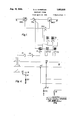
- Fig. 1 shows in diagrammat cform the arrangement of switches and connections at an exchange having junctions outgoing to the left the right of the figure, the junctions being used for traffic in both directions.
- Fig. 2 shows a first selector at an exchange, the selector having combined with it a counting switch which is marked by the exchange determining digit controls the transmission of impulses for the connecting up of junction sections until the desired exchange is reached.
- Fig. 3 shows a preselector connected to the incoming end of a junction which preselects junction to the next exchange when the junction to which it is connected is taken into use it extends the connection either to the next junction section or to local switches.
- Fig. 1 shows in diagrammat cform the arrangement of switches and connections at an exchange having junctions outgoing to the left the right of the figure, the junctions being used for traffic in both directions.
- Fig. 2 shows a first selector at an exchange, the selector having combined with it a counting switch which is marked by the exchange determining digit controls the transmission of impulses for the connecting
- second preselector PSS first selectorlS
- intermediate selector GS intermediate selector GS
- fine-l selector In the upper tart 'of thedrflwngsi indicated junctions outgoing to orincomingfronq the left the left ofthe figure is connected over ecu inenlt BWEL when it is to be used for both ay working to the junction preselector JPSL,
- ncoming selectors such as iiCS,.t-Tne bank contacts of which multipied.
- thoseci intermediateiselectors such as and connected 'to fi n al selectors such as F5
- the junction JR onf" the right of the figure is connected overthe e'quipment BWER to; the junction preselector JP$R,-thebank contactsof which are connected me similar mannerto those of JPSL.
- junction JL if incoming from they left would be connectedidirectly to JPSL, the bank contacts of which. concerned with junction connections would'be connected. directly to junctions such as JR outgoingto thejright oijthe figure; the junc- If" wl'ientaken into use.
- Incoming junctions from the right such as JR and preseiector would then be connected in a similarmanner, th mul tipleci connections betwe n the incoming preselccto rsjand the first selectors rciiresented by 7 IS and the connections to incoming selectors rop resented by ICS being made as before.
- Selectors ICS, G-SantlFS are of aizi cl l lSi ii iuy, employed for the purposes-they serve haying regarcl to the system of impnlsing itesting and s'up'eryision at the exchange where they are situated land' 'the tre-selectors ES and PSSrnay beswitchesof any suitable imotfxzn type.
- contactaii closes inits front position la circuit 'iorlrelay L which thereupon operates and locks up over contacts Z1, lei anclol and contact Z2 prepares the circuit of the test relayT oyer its winding. (1) and contact 13 prepares the circuit no function this stage. Atthe end of the inn-- pulse train relelyA remains steaciiy operated and ,relayD releases closing a circuit formagnet RM magnetltltfl Other contacts of relay .Ahave,
- relay T operates by means of its winding (I) and locks up over its winding (II) and contacts t1, (11, A21 and v1.
- the rotary'magnet circuit is opened at contact t7 and contact t4 connects earth directly to the test wiper to mark the outlet engaged.
- Contacts t2 and t3 close in the a and b wires and contact t5 prepares a circuit for magnet DM of the single motion switch.
- Contact t6 closes a circuit over contact 03, for relay C which thereupon operates and prepares a holding circuit for itself at contact 01.
- the contacts corresponding to levels of the selec-' tor are connected to contacts in the bank of wiper AS, the contact corresponding to the level from which outlets to a local group selector such as GS (-Fig. l) are taken being connected to the normal contact of the switch on which wiper AS rests when the switch is not in use.
- the vertical wiper VS connects earth to the contact in the bank of wiper AS corresponding to the level to which the switch has been stepped and in the case of calls to be completed locally earth is also connected over the normal contact to wiper AS.
- outlets to a group selector for the completionv of local calls are connected in one level and outlets to junctions going out in one direction such as junctions J L (Fig. l) are connected in levels corresponding to the digits denoting exchanges in that direction, contacts in the several levels concerned being commoned if necessary.
- Outlets to junctions going out in the other direction such as junction J R are connected in levels corresponding to digits designating exchanges in that direction.
- relay V releases releasing relay T at contact 01 and contact t4 initiates the release of subsequent switches and relay Y releases.
- Contact t6 releases relay E, and contact t8 releases relay S and contact t7 closes the circuit of the release magnet ZM.
- selector wipers are now restored to their normal position and the restoring of the vertical off-normal contacts opens the circuit of magnet ZM at contact 763.
- the first digit dialled will be that corresponding to the exchange to which the wanted subscriber is connected.
- the selector will be stepped to a level depending on this digit, the level containing outlets to junctions leading in the direction of the wanted exchange. Accordingly after the end of the first train of impulses earth will be connected by wiper VS to the corresponding contact in the bank of wiper AS (not contact 5) but relay S will not operate at this time as wiper AS is resting on its normal or home contact.
- relay T When a free outlet has been found relay T operates and closes a circuit in which relay C operates as before but as relay S is uno erated relay A repeats impulses of the second train over the junction seized at contact a2, The second digit is 0 and on the first impulse break taking place relay E operates and leaves relay C dependent for its continued energization on the back of contact a5.
- Contact e2 closes and at the end of the impulse a circuit is closed over the 2) wire at contact a2 to cause the preselector connected to the incoming end of the junction at the next exchange to prepare to switch the junction through. This operation will be more fully described later with reference to Fig. 3.
- Relay S being unoperated, each time relay A releases a circuit is closed from battery over contacts s3, t5, a5 magnet DM to earth.
- the counting swich is in consequence stepped until wiper AS is stepped onto the contact earthed over wiper VS whereupon when relay A reoperates a short circuit is removed from relay S and the relay operates opening the magnet circuit at contact s3 and short-circuiting contact a2 at contact $2.
- relay C releases and opens the short circuit about contact which is now closed and impulses of further trains are repeated at contact a2 for the setting of switches at the distant exchange for the completion of the connection.
- the counting switch When the connection is released by the calling subscriber the counting switchis rotated to norinal by the energization of its magnet DM in a homing circuit over wiper BS and the off-normal segment, contact 124 and an. interrupter.
- the counting switch permits a'deflnite number of impulses to be transmitted over the junction as the second digit, the number being determined by the first digit dialled. As the second digit is always 0 any number of impulses from l'to 10 can be transmitted and each impulse effects the connection of a further junction section until a route to the wanted exchange is built up.
- relay PL When the calling subscriber clears relay PL releases releasing relays PR, PQ and PT and PY and the release of succeeding switches is, ini-' tiated. If the test connection is a local one the release of relays PQ and PT connects magnet PDlVi over wiper JC to the 'earthed contacts and those on the right (lower) to JPSl-t.
- the switch is stepped until the first contacts connected to an outlet to a free junction is met and the. switch comes to rest with its wipers on such contacts.
- a special equipment such as that denoted by BWEL or BWER (Fig. l) is connected between the incoming end of a junction and the junction preselector.
- the equipments BWEL and BWER are identical and one of them is shown in Fig. 4; for convenience this will be assumed to be the equipment designated BWER in Fig. l and the junction wires on th right of Fig. 4 (upper part) will be assumed to be the junction JR.
- the wires on the left will be connected to JPSL and IS and In the case of a call incoming over the junction JR the operation of the test relay in the preceding circuit connects earth over relay'Y or PY as the case may be to the junction a Wire and this connection extends over contacts corl and $12 and relay ETR to bat- 1 tery.
- Relay ETR iscf high resistance and operates but the answering supervisory relay in series with it does not.
- Contact ctrl' disconnects relay COR. and connects earth to the junction multipled in the banks ofJPSL and IS (Fig. 1) to mark the junction engaged and to cause JPSL to step on and preselect another free junction.
- Relay SR operating contact s'rl opens a further point in the circuit of relay COR and prepares an alternative earth connection to :the junction in the multiple which circuit is com- I, pleted on the release of relay E'IR at contact 312. -The setting up of the connection now proceeds as before described.
- earth will be connected to the wire on the left of the Fig. 42 by the operation of the test relay in the preceding switch and relay COR operates.
- the earth h connection to wire (2 marks the junction engaged and contacts corl and, 0012 switch the connection through over junction J R to the next exchange.
- a plurality of exchanges junctions connecting the exchanges in tandem or serial relationship, and means in each intermediate exchange for associating free juncs changes, junctions connectingthe exchanges in tandem or serial relationship, and pre-selecting switching devices in each intermediate exchange for automatically associating each free junction with a 'free junction leading to an adjacent exchange.
- a plurality of exchanges connected by junctions in tandem or serial relationship, means in each intermediate exchange automatically operated for associating free junctions from one of the adjacent exchanges with free junctions from the other of the adjacent exchanges to maintain a free route through the series of exchanges, and subscribercontrolled means for effectively interconnecting associated junctions.
- a telephone system a plurality of exchanges connected by junctions in tandem or serial relationship, means in each tandem exchange for automatically associating free junctions from one of the adjacent exchanges with free junctions from the other of the adjacent exchanges to maintain a free route through the chain of exchanges, subscriber controlled means for seizing ajunction and for transmitting a series of impulses thereto, and means controlled by the impulses for effectively interconnecting associated junctions.
- ma telephone system a plurality of serially related free junctions, means for taking the first junction of the series into use and for transmitting a series of impulses thereto, and means responsive to said series of impulses for progressively interconnecting adjacent junctions.
- a plurality of free junctions automatic switches for associating said junctions in tandem or serial relationship, means for transmitting a series of impulses to the first junction in the chain, and means responsive to said impulse series for progressively connecting the junctions, said means comprising means in each switch operated responsive to a single one of the impulses of the series.
- a plurality of exchanges connected by junctions in tandem or serial relationship means in each tandem exchange for associating together free junctions extending to the respective adjacent exchanges, means controlled by a calling party in an intermediate exchange for selecting a free junction extending to one of the adjacent exchanges, and means controlled by the calling party for effectively connecting the selected junction with the associated junction in said adjacent exchange.
- a plurality of automatic exchanges connected by junctions in tandem or serial relationship, means in each exchange for associating free junctions extending to adjacent exchanges, subscribers lines terminating in the exchanges, subscriber-controlled means for transmitting series of impulses over the line, means responsive to the first series of impulses transmitted over a line for selecting a free junction extending from the exchange terminating the line, and means responsive to the second series of impulses transmitted over the line for progressively connecting a plurality of associated junctionsto extend a connection from the line to a wanted exchange.
- tions extending to adjacent exchanges, a sub scribers line terminating in one exchange, means serial relationship, a hunting switch for;
- junctions and means responsive to junction
- ,lOLIn a telephonesystein, a plhrality oif' changes ,connectedby junctions in, tandem or junction, said switches being arranged to select a free junction exte ing to an ad exchange, means for, transmitting i. .ipu.
- junctions in a chain means necting the seized junction to a junction extending to an adjacent exchange, and means re sponsive to each succeeding impulse of the for connecting the junction last'connected with q to a junction extending to 1 farther along in the chain.
- a selector repeater switch means for transmitting series of impulses to the switch, means responsive ,toithe first series of impulses for setting the switch in selec tive relation to a group of junctions, means in :the switch for automatically selecting an idle one of said junctions, and means in tlie switch for repeating a portion of the second series of impulses over the selected junction, the number of impulses repeated depending on the initial setting of the switch.
- means for transmittingseries of impulses to the switch means responsive "to the first series A of impulses for setting the switch and for deter- 1 mining the portion of the second series of 1mrepeating of all impulses of subsequent series transmitted to the switch, i
- a selecting switch and an associatedauxiliaryiswitch means in the first switch for responding to a plurality of series of impulses, means responsive to the first n pulses ,for progressivelyconnecting associated an idle one of said junctions means responsive telephone system in which exchanges h h h case the contact marked by the first 12;
- a plurality of ex" switch. for seizing a junction and for transmitting a series of current impulses thereover, means re sponsive to the first impulse of the series for con series Goiimpulses for setting the'first switch in selective relation to a group of junctions and for marking a contact accessible to the second switch means in the-first switch for automatically SQ? looting and seizing an idle junctioninthe'selected group, and means responsive to the second; series ofimpulses for operatingsaid second switch and for simultaneously repeating the impulses over the seized junction until the second switch con nects withsaid marked contact.
- a selecting switch and an associated auxiliary switch means for es cl impulses to the first switch, means responsive to the first series ofimpulses forl setting the first switch inselective relation to a group of junctions and for marking a contact accessible to the second switch, means in the switch for automatically connecting with to the second series of impulses for operating the secondswitch one step for each-impulse of the series and for simultaneously repeating the impulses, over said one junction, a relay oper ated responsive to the second switch connecting with said marked contact, and means controlled lay saidrelayfcr disabling the last said means.
- a junction terminating in a hunting switch two groups of junctions accessihle tosaid switch, means for closing a air- 0 cuit over the first junction, and means controlled by the duration of said circuit closure for de termining the group in which the switch will seize a junction.
- a switch having access to two groups of outlets, two test wipers for testingfthe outlet groups, respectively, means for transmitting impulses of different lengths tothe switch, and L means dependent on the length of the impulse for rendering one or the other of said wipers effective.
- i h 21A switch having access to two groups of outlets, means for operating the switch to select an outlet in one group, means for transmitting a long or ashort impulseto the switch, means responsive to a short impulse for operating the switch to seize the selected outlet, and means responsive to ,a long impulse for operating the 1355' switch to select and seize an outlet in the other group; i I i 23.
- a switch having accessto two groups of outlets means for transmitting a single impulse or a series of impulses to the switch, means in 144-0 the switch responsive to the receipt of a single impulse for operating the switch to connect with an idle outlet in one group,l,and means in the switch responsive tothe receipt of the first impulse of aseries for operating the switch to seize an outlet in the other group and for rendering the switch effective to repeat subsequent impulses of the series over the seized outlet.
- a line relayand a test relay means for energizing the line relay for either a short interval or a long interval, means controlled by the line relay for preparing a circuit for the test relay upon energizing and for completing said circuit upon releasing provided the line relay has been energized for a short-interval, and'means including a relay energized provided the line relay has been energized for a long interval for preventing the completion of said circuit.
- a telephone system comprising a plurality of exchanges, two-way junctions connecting the exchanges in tandem or serial relationship, hunting switches associated with both ends of 'the junctions, means for maintaining said switches in selective relation with idle junctions extending to adjacent exchanges, means for seizing a junction at one end, means responsive to said seizure for disconnecting the associated switch at said one end, means for transmitting a current impulse over the seized junction, and means controlled by said impulse for causing the associated switch at the other end of the junction to seize the pre-selected junction extending to the adjacent exchange.
- a plurality of unconnected serially related junctions means for taking the first junction of the series intouse, means for transmitting a series of evenly spaced impulses over the first junction, and means responsive'directly to the impulses for progressively connecting the associated junctions.
- a plurality of serially related junctions a switch terminating each junction and associating it with the next adjacent junction of the series, means for taking the first junction of the series into use, means for transmitting a series of impulses over the first junction, and means responsive to said impulses for progressively operating said switches to connect associated junctions while the impulses are being transmitted.
- means for responding to two series of impulses means for repeating a variable number of impulses of one series, and means controlled by the other impulse series for controlling said first means.
- means for responding to a plurality of series of impulses means for setting the device responsive to the first series of impulses, means for repeating a variable number of impulses of the second series of impulses, and
Landscapes
- Engineering & Computer Science (AREA)
- General Engineering & Computer Science (AREA)
- Mechanical Engineering (AREA)
- Computer Networks & Wireless Communication (AREA)
- Interface Circuits In Exchanges (AREA)
- Multiple-Way Valves (AREA)
- Structure Of Telephone Exchanges (AREA)
Applications Claiming Priority (1)
| Application Number | Priority Date | Filing Date | Title |
|---|---|---|---|
| GB12796/30A GB353508A (en) | 1927-08-22 | 1930-04-25 | Improvements relating to telephone systems |
Publications (1)
| Publication Number | Publication Date |
|---|---|
| US1922232A true US1922232A (en) | 1933-08-15 |
Family
ID=10011295
Family Applications (1)
| Application Number | Title | Priority Date | Filing Date |
|---|---|---|---|
| US529680A Expired - Lifetime US1922232A (en) | 1930-04-25 | 1931-04-13 | Telephone system |
Country Status (3)
| Country | Link |
|---|---|
| US (1) | US1922232A (de) |
| DE (2) | DE655689C (de) |
| GB (1) | GB353568A (de) |
Cited By (1)
| Publication number | Priority date | Publication date | Assignee | Title |
|---|---|---|---|---|
| US2554115A (en) * | 1947-12-08 | 1951-05-22 | Automatic Elect Lab | Automatic director telephone system |
Families Citing this family (2)
| Publication number | Priority date | Publication date | Assignee | Title |
|---|---|---|---|---|
| FR2543645B1 (fr) * | 1983-03-31 | 1985-06-28 | Chleq Frote Cie | Organe fluidique multivoie, tel qu'une vanne ou un distributeur, a disque guillotine a rotation axiale |
| GB2159925B (en) * | 1984-06-08 | 1988-05-11 | Dorf Ind Pty Ltd | Taps |
-
1930
- 1930-05-12 GB GB14558/30A patent/GB353568A/en not_active Expired
-
1931
- 1931-04-13 US US529680A patent/US1922232A/en not_active Expired - Lifetime
- 1931-04-22 DE DES98180D patent/DE655689C/de not_active Expired
- 1931-04-22 DE DES107250D patent/DE680313C/de not_active Expired
Cited By (1)
| Publication number | Priority date | Publication date | Assignee | Title |
|---|---|---|---|---|
| US2554115A (en) * | 1947-12-08 | 1951-05-22 | Automatic Elect Lab | Automatic director telephone system |
Also Published As
| Publication number | Publication date |
|---|---|
| DE680313C (de) | 1939-08-28 |
| DE655689C (de) | 1938-01-21 |
| GB353568A (en) | 1931-07-30 |
Similar Documents
| Publication | Publication Date | Title |
|---|---|---|
| US2592784A (en) | Restricted service telephone system | |
| USRE23056E (en) | Relay automatic telephone system | |
| GB739905A (en) | Improvements in or relating to telecommunication systems | |
| US2262595A (en) | Telephone system | |
| GB295421A (en) | Improvements in telephone systems | |
| US1738564A (en) | christian | |
| US2249067A (en) | Telephone system | |
| US2177069A (en) | Telephone system | |
| US2516645A (en) | All-relay automatic and manual telephone system having butt-in and alarm features | |
| US1721640A (en) | Automatic telephone system | |
| US2162892A (en) | Telephone system | |
| US1912453A (en) | Telephone exchance system | |
| US1667950A (en) | Automatic telephone system | |
| US1732185A (en) | Telephone system | |
| US1675310A (en) | Telephone system | |
| US1855779A (en) | Telephone system | |
| US1792454A (en) | Automatic telephone system | |
| US2654001A (en) | Sequence switch circuit | |
| US3453392A (en) | Range extension equipment in step-bystep telephone systems | |
| US1638513A (en) | Automatic telephone system | |
| US1885784A (en) | Automatic switch | |
| US2210068A (en) | Telephone system | |
| US2268635A (en) | Telephone system | |
| US1841123A (en) | Telephone exchange system | |
| US2713614A (en) | Finder and finder-allotter arrangements in telephone systems |